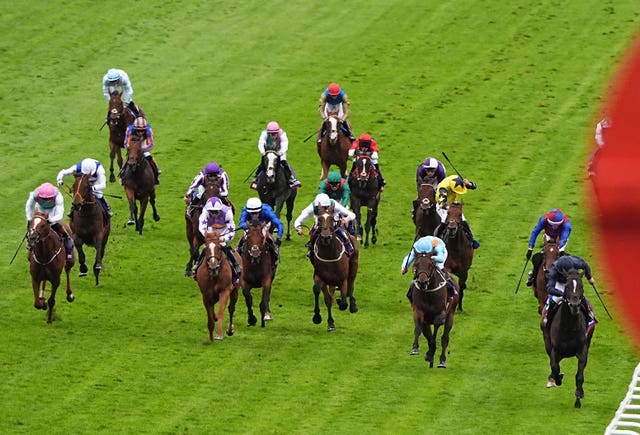
Owners Middleham Park Racing have been left “gutted” after Lazy Griff was cruelly ruled out of the Betfred St Leger following a setback.
The Charlie Johnston-trained colt has been a standout performer for his connections this term and was due to head to Doncaster with leading claims after placed efforts in both the Derby at Epsom and the Irish equivalent.
He was as short as 4-1 second favourite behind Aidan O’Brien’s Scandinavia for the world’s oldest Classic next Saturday, with his team now having to turn their attentions to next season with the injury set to keep Lazy Griff out of action for the rest of the current campaign.
Mike Prince of owners Middleham Park Racing said: “He’s met with a setback. He was due to do his last piece of work before the Leger on Saturday but he’s now out for the rest of the season.
“He should be fine to come back next season but it is a bit gutting to get so close to heading to the Leger, where on paper he looked to have a really great chance.
“The syndicate are really gutted and they were all set to head to Doncaster next Saturday, but these things happen and are set to test us.
“It’s one of those things and hopefully we can get him back for next season. We’ll probably look to campaign him in those long-distance races and cup races, he is certainly of that level. Although everyone is a bit flat and disappointed at the moment.”
https://www.geegeez.co.uk/wp-content/uploads/2025/09/42f2dcf9-4f3e-4911-8221-15ede1bb2795.jpg9091818Geegeez Newshttps://www.geegeez.co.uk/wp-content/uploads/2022/10/geegeez_banner_new_170x78.pngGeegeez News2025-09-07 16:13:502025-09-07 16:13:50St Leger dreams dashed for Lazy Griff team
Charlie Johnston is praying for rain, as he counts down the days until Lazy Griff goes for Betfred St Leger glory at Doncaster next month.
The Middleham Park Racing-owned colt has already given his connections a real thrill when placing in both the Derby at Epsom and Irish equivalent this summer, but Johnston has always felt the extended stamina emphasis of the oldest Classic would play to his stable star’s strengths.
Content to head straight to Town Moor fresh, Johnston was a keen observer of York’s Great Voltigeur Stakes last week. Although it is conditions in South Yorkshire that are giving him most concern.
Johnston said: “Doncaster is coming round quick, it’s only 19 days – not that we’re counting them down.
“All is good apart from the weather and surely this summer will end at some point and the rain will come because we will need it.
“It was a fairly easy watch the Voltigeur for us, nothing too scary came out of that and I think if we can get a bit of ease in the ground then we will be really looking forward to Doncaster.”
The defeat of Lazy Griff’s dual Derby conqueror Lambourn at York saw his Aidan O’Brien-trained stablemate and Goodwood Cup scorer Scandinavia harden as favourite for the final Classic of the year.
The Kingsley Park challenger is now 11-2 second-favourite with the race sponsors, a position Johnston feels is a fair reflection of his claims, as the Middleham handler relishes another crack at the cream of Ballydoyle on September 13.
Johnston continued: “Even before the Voltigeur, I knew where we stood with Lambourn and I could see reasons why we could reverse that scoreline up in distance and on slower ground.
“We have no idea where we stand with Scandinavia and we’re under no illusions that he looks to set a high bar.
“But I do think we’re rightfully second-favourite now and his biggest danger and we’re looking forward to that challenge.”
https://www.geegeez.co.uk/wp-content/uploads/2025/08/42f2dcf9-4f3e-4911-8221-15ede1bb2795.jpg8901779Geegeez Newshttps://www.geegeez.co.uk/wp-content/uploads/2022/10/geegeez_banner_new_170x78.pngGeegeez News2025-08-25 10:34:012025-08-25 11:00:17Charlie Johnston banking on break in weather to spark St Leger dream
Charlie Johnston believes Ancient Egypt “could be the real deal” after he remained unbeaten at Goodwood on Sunday.
The Frankel colt cost 1,100,000 guineas as a yearling and after impressing on debut at Beverley last month, looked to face some useful opposition as he attempted to carry a penalty to success in the British Stallion Studs EBF Novice Stakes on the Sussex Downs.
Sent off 11-4 in the hands of Rowan Scott, he produced a professional display, racing prominently and knuckling down well in the closing stages to not only repel his rivals but suggest a bright future lies ahead.
Ancient Egypt takes his record to a perfect two from two, taking out the British Stallion Studs EBF Novice Stakes from the front under @rowan_49 ✅ pic.twitter.com/Pvf2tULaXx
Johnston is already dreaming of what the Amo Racing-owned colt could achieve when reaching his peak next season, but for the meantime could allow Ancient Egypt to continue climbing the pyramid in Newmarket’s Group Two Royal Lodge Stakes on September 27.
“It’s a bit of an overused phrase, but it’s never easy to give away a penalty in novice race,” said the Middleham trainer.
“I felt he needed more experience before he went up in grade and he’s a bit of a playboy, as you saw in the stalls he had a bit of a go and also while saddling, so mentally he’s still quite immature.
“I think there is a lot of improvement still to come and he’s a very exciting horse for next year in particular.
Charlie Johnston (left) with Ancient Egypt and other connections after victory at Goodwood (Steven Paston/PA)
“He’s well-entered and all of our eyes will probably turn to the Royal Lodge next which looks an obvious place to go. But we’ll need to be confident it is the right thing for the horse and we’ll see how he comes out of this and progresses at home.
“I would be very keen not to over-face him too much this year with a view to next year because I do think he could be the real deal, but if we think he is ready he could reappear in the Royal Lodge.”
Earlier on the card, Tribal Chief (15-2) booked his ticket to Newmarket’s bet365 Cambridgeshire on the same afternoon as the Royal Lodge after notching a welcome local success for David Menuisier in the Virgin Bet A Good Bet Handicap.
https://www.geegeez.co.uk/wp-content/uploads/2025/08/2.81338559-scaled.jpg12802560Geegeez Newshttps://www.geegeez.co.uk/wp-content/uploads/2022/10/geegeez_banner_new_170x78.pngGeegeez News2025-08-24 16:27:152025-08-24 16:27:15Ancient Egypt continues progression at Goodwood
Lazy Griff is firmly on course for a third tilt at Classic glory in the Betfred St Leger, as he prepares to head straight to Doncaster.
Charlie Johnston’s charge has performed admirably in defeat on each of his three starts so far this season, finishing second in both the Chester Vase and the Derby before taking third in the Irish Derby, on each occasion chasing home Aidan O’Brien’s Lambourn.
Owners Middleham Park Racing considered a trip overseas in a bid for a Group One breakthrough with Lazy Griff, but have instead elected to keep their powder dry for the world’s oldest Classic on September 13.
“We thought about going to Germany for the race Rebel’s Romance won (on Sunday), but it was quite a warm race and we didn’t really want to leave any Leger chances over there,” said Middleham Park’s Mike Prince.
Christophe Soumillon returns aboard Lazy Griff after his runner-up finish at Epsom (PA)
“There’s the Great Voltigeur next week, but we felt there wasn’t going to be enough time between that and Doncaster. I think the ground will be plenty quick at York for him anyway and waiting for September just gives us the chance for hopefully a little bit softer ground if the weather breaks in the next couple of weeks.
“Charlie has had the Leger in mind for him all year and we’ll go straight there now, that is absolutely the plan.”
Paddy Power make Lazy Griff the 7-1 third-favourite for the St Leger, with the O’Brien-trained pair of Scandinavia and his old rival Lambourn the two ahead of him in the betting at 5-4 and 7-2 respectively.
Prince added: “I’d say Scandinavia might be the favourite (to run) out of the two, just because of the trips he’s been running over. I wonder whether they’ll go for the Arc with Lambourn, you never know.
“Whatever Aidan sends will probably go off favourite, whether it’s Scandinavia or Lambourn, and if he sends both then I suspect they’ll both be ahead of us in the market.
Scandinavia will be one of the big dangers to Lazy Griff at Doncaster (Matt Alexander/PA)
“He’s got plenty of ammo, but we’re all geared up and ready to go.”
The Middleham Park team have also started to make plans beyond Doncaster, with Prince saying: “We’ve given him an entry in the Long Distance Cup on Champions Day at Ascot and I suppose the options after the St Leger are that and the Prix Royal-Oak at Saint-Cloud at the end of October.
“It’ll probably be the Leger and then one of those.”
https://www.geegeez.co.uk/wp-content/uploads/2025/08/2.80548766-scaled.jpg12802560Geegeez Newshttps://www.geegeez.co.uk/wp-content/uploads/2022/10/geegeez_banner_new_170x78.pngGeegeez News2025-08-11 16:30:042025-08-11 16:30:04Middleham Park happy to be heading straight to Doncaster with Lazy Griff
In a season where Charlie Johnston might yet hit the Classic target, he has high hopes for the future with Ancient Egypt after the regally-bred youngster made a winning debut at Beverley last week.
Kia Joorabchian’s Amo Racing operation went to 1,100,000 guineas for the son of Frankel out of Atone, who is a sister to Midday.
Ridden by Rowan Scott, he needed all of the extended seven-furlong trip to get on top but was doing his best work in the closing stages and Johnston – who won the same race 12 months ago with his dual Derby-placed and now St Leger-bound colt Lazy Griff – is keen to get him out again this season.
“He’s come out of the race good, I was relieved to get his head in front on debut,” said the Middleham handler.
“He horse we’ve always liked. He’s a big boy. He’s a horse for next year. I’m not sure what we’ll do with him now, I’m sure we’ll see him again at least once more this year, quite how quickly we step up in class, we’ll have to have a think about, but he’s a he’s a smart horse.
“I love the way he was only just getting half the idea in the last furlong when he went and put it to bed. Rowan took about half an hour to pull him up and come back in again so he’ll take a big step forward from that. We think he’s a smart horse.
“It was the same race that Lazy Griff won. I’m not going to stand here and say that I’ve been planning that for months, but after he worked last week I thought it was the entry, so let’s hope he ends up in the same sort of echelons as him.”
https://www.geegeez.co.uk/wp-content/uploads/2025/08/2.81074892-scaled.jpg12802560Geegeez Newshttps://www.geegeez.co.uk/wp-content/uploads/2022/10/geegeez_banner_new_170x78.pngGeegeez News2025-08-04 12:47:242025-08-04 12:47:24Johnston has plenty to look forward to with Ancient Egypt
It is surely only a matter of time before Evanesco opens his account judged on a promising second run at Goodwood on Saturday.
Ultimately well beaten when fifth on his Haydock debut a month ago, Charlie Johnston’s charge was a 14-1 shot for his next assignment in what looked a strong contest on the Sussex Downs.
The Too Darn Hot colt clearly learnt plenty from that initial effort as he was travelling best of all entering the final furlong before being run down by Aidan O’Brien’s odds-on favourite Isaac Newton. It will be a surprise if Evanesco does not make it third time lucky in maiden company next time.
https://www.geegeez.co.uk/wp-content/uploads/2025/08/2.81167405-scaled.jpg12802560Geegeez Newshttps://www.geegeez.co.uk/wp-content/uploads/2022/10/geegeez_banner_new_170x78.pngGeegeez News2025-08-02 16:44:422025-08-02 16:44:42Evanesco is Goodwood Eyecatcher following narrow defeat
Connections of Lazy Griff have yet to decide whether to give the top-class colt another run ahead of a planned third tilt at Classic glory in the Betfred St Leger.
Charlie Johnston’s three-year-old has bumped into the Aidan O’Brien-trained Lambourn on each of his three previous starts this season, finishing second in the Chester Vase and the Derby at Epsom before making late gains into third place in the Irish Derby.
A fourth clash could be on the cards at Doncaster in September, with Lambourn the 15-8 favourite and Lazy Griff a 7-1 shot for the Leger with Paddy Power – but whether the latter will be seen in action before the Town Moor showpiece remains to be seen.
“He’s fine and back cantering now and I need to have a chat with Mike Prince and the Middleham Park team, just to thrash out what route we’re going to go down,” said Johnston.
“We haven’t come to any firm decisions on that yet, but whatever we do it will all revolve around the Leger, that’s for sure.
“I think we’re probably looking for him to have two more runs this year and it’s just a question of whether we run him somewhere between now and the Leger or we go straight to the Leger and have another run after that at the back-end of the season. That is the conversation that needs to be had.
“He had a couple of easy weeks as the main priority was to get the horse out of Ireland in good shape and back cantering and we’ve done that, so the tough bit now is deciding what to do next.
“They’re nice decisions to have to make, I wouldn’t mind plenty more of them.”
https://www.geegeez.co.uk/wp-content/uploads/2025/07/2.80018718-scaled.jpg12802560Geegeez Newshttps://www.geegeez.co.uk/wp-content/uploads/2022/10/geegeez_banner_new_170x78.pngGeegeez News2025-07-23 14:16:332025-07-23 14:16:33Lazy Griff’s route to Doncaster still open to discussion
If Lazy Griff runs again before the Betfred St Leger it is likely to be in the Grosser Preis von Berlin.
Charlie Johnston’s charge has finished behind dual Derby winner Lambourn at Chester, Epsom and the Curragh this season and may yet have to come up against him at Doncaster.
His third in the Irish Derby was the opposite of his runner-up finish at Epsom, where he was handy throughout, as this time he was outpaced before flying home to finish third.
“It was quicker ground. William (Buick) jumped to go forward and he just couldn’t go the early pace on that ground,” said Mike Prince of owners Middleham Park Racing.
“He travelled sweetly at Epsom, but he just couldn’t lie up with them and it wasn’t until he hit the rising ground that he absolutely flew home. So the Derby form was upheld, but it happened in a very different way.
“It was a strange race to watch as coming round the bend Lambourn looked in trouble, but I think he fools you as that’s his racing style, he’s just tough and reality has shown he is a very good horse.
“What we do next is an interesting one as obviously the St Leger is his main target for the rest of the season. We’re coming into the height of summer and Charlie reiterated he wouldn’t want to run him on fast ground again.
“He’s in the Grosser Preis von Berlin on August 10 which is normally run on good ground so if we did have a run that would be the most likely as the Great Voltigeur is a bit close to Doncaster. But we’re not adamant that he needs to run again as he’s done Chester, Epsom and the Curragh which is tight enough with three tough races.
“The Leger is definitely his number one target and if he runs before then we’ll see. William said afterwards that his Derby run was no fluke and he’s a proper Group One horse.”
https://www.geegeez.co.uk/wp-content/uploads/2025/06/2.80018718.jpg10532107https://www.geegeez.co.uk/wp-content/uploads/2022/10/geegeez_banner_new_170x78.png2025-06-30 13:04:002025-06-30 13:04:00Lazy Griff not guaranteed to run again before Leger bid
Charlie Johnston is “more than happy” to let Lazy Griff take on Lambourn for a third time in the Dubai Duty Free Irish Derby at the Curragh on Sunday.
A Group Three winner in France at the end of his juvenile campaign, Lazy Griff made his return to action in last month’s Chester Vase and emerged with plenty of credit in finishing second to Lambourn, earning him a shot at the Betfred Derby at Epsom.
Johnston’s charge was a widely unconsidered 50-1 shot for the premier Classic, but belied those odds with an excellent effort to again finish best of the rest behind Aidan O’Brien’s front-running colt and round three will take place at the Curragh this weekend.
“It wasn’t an easy decision to come to, perhaps the Grand Prix de Paris might have been an easier challenge and we certainly wouldn’t have been taking on a horse that’s already beaten us twice, but the lure of the Irish Derby was too strong to turn down,” said Johnston.
“We’re under no illusions about the task in hand because it is two-nil to Lambourn, but having said that we weren’t afraid to have another go at him.
“It’ll be interesting to see how the race pans out. You can’t take anything away from Lambourn and what he did at Epsom at all, but at the same time he was given a very good front-running ride and we all maybe gave him a little bit too much rope on the front end.
“Sunday is going to be a different day on a different track with a different field and we’re more than happy to have another go and see what we can do to reverse the form.”
Christophe Soumillon was on board Lazy Griff at Epsom, but as the French-based Belgian is required to partner Goliath in Sunday’s Grand Prix de Saint-Cloud, Johnston has turned to William Buick to ride his stable star in his bid for Classic glory.
William Buick will ride Lazy Griff for the first time in the Irish Derby (David Davies/PA)
He added: “Obviously it’s a shame as Goliath and Lazy Griff are probably Christophe’s two marquee horses for the season at the moment and it’s sod’s law that they’re both running on the same day.
“It’s a shame for him, but we’re able to bring William in who is obviously top-class but will also be very confident at the moment after a great Royal Ascot, it’s a great replacement to call upon.”
Lazy Griff and Lambourn feature in a 10-strong field following Friday’s declaration stage, with Aidan O’Brien also saddling Lingfield Derby Trial winner Puppet Master and Gallinule Stakes scorer Thrice, as well as Serious Contender and Shackleton, both of whom performed well in defeat at Royal Ascot.
His son Joseph runs Derby third Tennessee Stud, while Green Impact is a fascinating contender for Jessica Harrington on what will be his first attempt at a mile and a half.
Ralph Beckett’s Dante winner Pride Of Arras bids to bounce back from Epsom disappointment, with his stablemate Sir Dinadan completing the line-up.
https://www.geegeez.co.uk/wp-content/uploads/2025/06/4542fbb9-ab28-4359-8023-983d5db1c4cf-2.jpg10242048https://www.geegeez.co.uk/wp-content/uploads/2022/10/geegeez_banner_new_170x78.png2025-06-27 11:37:482025-06-27 11:37:48Lazy Griff all set for a third crack at Lambourn in Irish Derby
Lazy Griff’s participation in the Dubai Duty Free Irish Derby will be a late call and depend on how much rain falls at the Curragh this week.
Charlie Johnston’s charge outran his odds of 50-1 under Christophe Soumillon in the Derby at Epsom, getting closet to impressive winner Lambourn, just has he had done in the Chester Vase.
However, connections are keen not to ask him to race on ground which they deem to be too quick.
“It was good, good to firm this morning and we’re in the same situation as applied at Epsom, we don’t want to run him on fast ground,” said Mike Prince of owners Middleham Park Racing.
“We’ll keep him in at the forfeit stage (on Tuesday) and then play it by ear. I’ve seen some forecasts suggest plenty of rain midweek, but others saying only two to three millimetres.
“All we can do is keep him in and keep monitoring, it keeps changing every time I look.
“It will probably be the Grand Prix de Paris if he doesn’t run. It’s the German Derby next week or the Grand Prix the week after, those are the options and France is more likely than Germany currently.
“He doesn’t have to leave until Friday so we don’t have to decide until declarations.”
He added: “He’s been fine since Epsom, Charlie’s really happy with him and we’re going to check in with Christophe, just to see what is what.”
https://www.geegeez.co.uk/wp-content/uploads/2025/06/2.80548766-scaled.jpg12802560https://www.geegeez.co.uk/wp-content/uploads/2022/10/geegeez_banner_new_170x78.png2025-06-23 15:57:582025-06-23 17:40:14Middleham Park looking to the Curragh skies for Lazy Griff
Options in France, Germany and Ireland are under consideration for Lazy Griff following his fantastic effort to fill the runner-up spot in the Betfred Derby at Epsom on Saturday.
Second to Lambourn in the Chester Vase on his three-year-old debut, Charlie Johnston’s colt was a widely unconsidered 50-1 shot for the premier Classic but outran his odds to again finish best of the rest behind Aidan O’Brien’s all-the-way winner, much to the delight of the Middleham Park Racing team.
Middleham Park’s director of operations, Mike Prince, said: “It was a brilliant day and it was surreal watching him as he was coming round the bend and into the straight travelling so sweetly.
“There was just a split second where you thought ‘he might just do it’! I think Christophe (Soumillon) thought that he would get past him (Lambourn), but the winner is obviously a good horse and he was super tough in that final furlong.”
A huge thank you to @itvracing for capturing the incredible scenes after Lazy Griff’s brilliant 2nd place finish in The Derby.
This is syndication at its finest, sharing unforgettable moments together!💙🧡
— Middleham Park Racing (@MprUpdates) June 7, 2025
Prince insists Lazy Griff’s performance was not a huge surprise to his connections, particularly after the rain that fell on the Surrey Downs in the lead-up to the race.
“He’d worked well in the spring and he just missed a week before Chester, so we knew we were going into Chester undercooked and we knew he’d come on for it. So having seen him run such a big race there, that kind of cemented us going for the Derby,” Prince continued.
“The only issue was Charlie didn’t want to run him on super fast ground, that was the only reason he wouldn’t have gone to Epsom, but obviously the rain came which was helpful.
“We were thinking we could finish in the top six going in there – we weren’t going there just for a day out that’s for sure and Christophe obviously won a Group Three in France on him last year and I know he couldn’t understand why he was such a big price either.”
A trio of Group One assignments are on the table for the Protectionist colt’s next start, while another tilt at Classic glory in the St Leger at Doncaster appears an obvious target.
Prince said: “There’s the German Derby, the Irish Derby and the Grand Prix de Paris. No decision has been made as yet and obviously the ground will play a part – if it’s fast anywhere we won’t go.
“I think it will be one of those three and I’d say the percentage call at this point would be the Grand Prix de Paris, but it’s certainly not set in stone and if it came up heavy in Ireland with proper soft ground that might change things.
“The St Leger would make sense later in the year as although he was quite fleet of foot there coming down the hill at Epsom, there is plenty of stamina in his pedigree, being by a Melbourne Cup winner, and I know after Chester Charlie said ‘this is a Leger horse’.”
Wherever Lazy Griff turns up next it should be an exciting second half of the season for his 24 individual owners, which include George Griffiths, after whom the horse is named.
Prince said: “We have a policy where the first person to buy a 15 per cent share gets to name the horse and George also got his name on the racecard. He and his wife Amy were obviously on cloud nine on Saturday.”
https://www.geegeez.co.uk/wp-content/uploads/2025/06/4542fbb9-ab28-4359-8023-983d5db1c4cf-1.jpg10242048https://www.geegeez.co.uk/wp-content/uploads/2022/10/geegeez_banner_new_170x78.png2025-06-09 14:00:022025-06-09 14:00:02Lazy Griff connections keep options open after Derby exploits
Charlie Johnston is dreaming of the rest of the season with Lazy Griff, after the 50-1 shot chased home Lambourn in the Betfred Derby.
It was the second time this year the Middleham Park Racing-owned colt has found Aidan O’Brien’s new mile-and-a-half star too strong, as the same two horses filled the same positions in the Chester Vase last month.
Ridden by Christophe Soumillon, Lazy Griff – who got off the mark at the third time of asking as a two-year-old at Beverley – cruised around Tatttenham Corner and while his large army of owners will no doubt have been briefly thinking they were about to hit the jackpot, the winner was going away again at the line.
Should he head to the Irish Derby next it would likely mean round three with Lambourn, but Johnston also raised the possibility of a return to France for the Grand Prix de Paris. Lazy Griff won a Group Three at Chantilly last year.
“We told as many people as would listen we couldn’t understand why he was such a huge price. Lambourn was 13-2 yet this morning we were 100-1! It’s safe to say the Chester form held up well,” said Johnston.
Lazy Griff (light blue) beat all bar Lambourn (Aaron Chown/PA)
“I’m delighted, I’m surprised how well he handled the track because that was always my biggest concern because he’s quite a heavy-topped horse and we felt if the ground wasn’t as soft as it was he wouldn’t be here.
“I said after Chester that Doncaster (St Leger) would be his place, but to run so well leaves us dreaming about the rest of the year.
“I would say it will be the Irish Derby or the Grand Prix de Paris. The Irish Derby would mean going into the lion’s den I suppose, but it will be one or the other I would say.”
Soumillon partnered Lazy Griff at Chantilly and did not need to be asked twice to ride him in the Derby.
“What a race and I was travelling so well, the whole race I was travelling so well and I was just cruising down the hill,” said Soumillon, who has still to win the premier Classic.
“This kind of track suits him and when I came downhill I was talking Mickael (Barzalona, on Midak) that there was nobody able to follow us, we were cruising. I thought at that point I would be able to win the race two furlongs out, then I took my time to come out, which I don’t think was the best option.
“I maybe should have stayed on the rail, but the horse in front was so lazy in the turn I thought he would stop at a point, but he never gave up and went to the end. Rounding the bend I thought ‘now I go and we will see’ and for two furlongs I thought we will get the winner, but in the end he was too strong.
“I’m so proud of my horse. It’s a great run and it’s the same form as the Chester Vase. I was very surprised when I saw the odds in the paper this morning at the airport. I thought how can I be so high? For me it was a nice horse with a decent chance and finally he proved it today on the track.
“He would be able to make the German Derby, but I just spoke to the trainer who was asking me if he could go in the St Leger. I think that can also be an option, he stays really well. We’ll just see how he comes back from this race.”
He added: “When my agent called me to say I could ride this horse I said ‘let’s go’ straight away. I loved him last year and he did everything I asked. Mr Johnston’s horses are really tough and that’s what you need and this really feels like a winner to me. I’m so proud of the horse. It’s a great result.”
Joseph O’Brien was watching his father win the race for an 11th time, but the man who rode two of them, Camelot and Australia (the sire of Lambourn), was close to his own piece of history by saddling Tennessee Stud to finish third.
He said: “I’m very proud of him, it was a serious run and he came home strongly. I’m so pleased for the owners, it’s very good to be placed in the Derby and he’s an unexposed type from whom there should be plenty more to come.”
https://www.geegeez.co.uk/wp-content/uploads/2025/06/4542fbb9-ab28-4359-8023-983d5db1c4cf.jpg10242048https://www.geegeez.co.uk/wp-content/uploads/2022/10/geegeez_banner_new_170x78.png2025-06-07 16:06:472025-06-07 16:06:47Johnston can afford to dream of what might be to come with Lazy Griff
After the thrills and many spills of the Cheltenham Festival attention now turns to the start of the turf flat season, writes Dave Renham. Saturday 29th March is the starting date this year and the crowds will descend on Doncaster for a card that includes the first big handicap of the season, the Lincoln. In this article I am going to look at some early season trainer form and trends. Data are taken from 2019 to 2025, although in 2020 there was no flat racing in the early part of the season due to Covid.
Selected Trainers: First Ten Runs
We see in the racing press plenty of stats connected with a trainer’s recent form, be it the last seven, 14 or 30 days, or their last ‘x’ number of runs. For some punters this information is really important and forms an integral part of their selection process. With that in mind, one question I am keen to address in this article is connected with recent trainer form. I want to try and establish whether the first few runs of the season from a particular stable is indicative of how their runners perform up to the end of April. Also, I will be looking at whether a similar level of performance each year is achieved by trainers up to the end of the first full month of the season. I just would like to clarify that the data shared in this piece has been collated starting from the day of the first turf flat meeting through to the 30th April in each season.
In order to make this piece manageable I have decided to focus on a selected group of trainers who tend to have a good number of entries in the early weeks of the season. This includes some of the big guns, namely Charlie Appleby, William Haggas and John/Thady Gosden.
My starting point was to work out the PRB (Percentage of Rivals Beaten) figures for each trainer over their first ten runs of each season. I felt that using the PRBs would be the most accurate way of determining how well a stable was performing over those ten runs. Clearly, I could have used win strike rate but over such a small sample size we could potentially get a blurred picture of how well the horses are actually running. Here are my findings.
N.B. I have combined the figures for the Johnston stable although of course Charlie Johnston is now in sole charge:
Early Season Trainer Form: Selected trainers' PRB figures
Before doing a comparison with their records up to the end of April for each year, the table does highlight that we cannot guarantee exactly how well each stable will get out of the blocks each season. Taking Richard Hannon as one example, in 2023 his first ten runners of the turf season hit a PRB of only 0.46, but last year in 2024 it was up at a huge 0.83. Likewise, the Johnston stable has seen wide variances with three PRBs below 0.35 and two hitting 0.65 and above. Now of course ten runs is a small sample but by using PRBs it does give us a better idea of the very early form of a specific stable compared with other metrics. I believe the numbers shared in this table also help to highlight that each year is different and even if stables traditionally start the season quickly, there will be years that for whatever reason things will progress more slowly. And of course, vice versa.
Selected Trainers: To End of April
Let's now take a look at the annual PRBs for each trainer covering the start of the turf flat up to the end of April. Essentially, for most years this equates to roughly the first five weeks of the season.
Early season trainer form: up to end April annually
As might be expected, fluctuations year by year in the PRBs are now less pronounced due to the much bigger datasets, although two of Charlie Appleby’s figures differ quite markedly - from 0.81 in 2022 down to 0.63 in 2024. Likewise, the Gosden stable saw a big difference between their 2019 figure of 0.71 and their 2023 one of 0.51.
Now that we have these two sets of figures we can try to address the earlier question of whether the first few runs of the season from a particular yard are indicative of how their runners will perform up to the end of April. In order to do this, I have picked out some of the trainers to analyse in more detail.
Specific Trainers: Early Season Form
Charlie Appleby
If we look at Charlie Appleby’s performance with his first ten runners in 2019, 2022 and 2024 we can see he has quite well aligned PRB figures (0.62, 0.64 and 0.66). In 2019 and 2024 he maintained a similar level of performance up to the end of April hitting 0.66 and 0.63. However, in 2022, his PRB figure for the longer timeframe soared to 0.81. That year he had 23 winners from 55 runners up to April 30th equating to a strike rate of just under 42%. From those similar starting PRBs in 2019 and 2024 he managed a longer-term strike rate of 29.2% and 29% respectively. It is difficult to say why those early five or so weeks of 2022 panned out so well for the stable compared with 2019 and 2024 when they started off in the same vein. It perhaps underlines how challenging it can be to predict future trainer form based on a smallish sample of runs.
Mick Appleby
Next for the microscope is Mick Appleby. The graph below shows the comparison:
Mick Appleby: early season form, 2019-2024
The graph shows that Appleby has been consistent in terms of overall performance in the weeks up to April 30th (the orange line) - four of the five years saw PRB figures within a very small band ranging from 0.44 to 0.46. In 2022 he did have a better overall start to the season hitting 0.53 over those first few weeks, and that year he had started fast with a 0.63 figure for his first ten runners. The 2023 season saw an even better start with a 0.66 10-run figure, but that form tailed off quickly ending up at 0.46 for the longer time frame. Looking at this data tells me that the first ten runs of the year for Mick Appleby would not necessarily have given us a good guide to how the next few weeks would have panned out for his runners.
Going back to his PRB figures for all runs up to 30th April, despite having similar ones, the correlation with the win strike rates is not completely ‘positive’ as the graph below shows:
Mick Appleby: early season win strike rate comparison
Yes, the best year was 2022, (16.1%), which correlates with the highest PRB figure of 0.53, but there is a big variance between 2019’s strike rate of 14.3% compared with 2023’s 3.2% figure. This is despite having very similar PRB figures in those two years (0.44 and 0.46 respectively).
As with all metrics, any single one does not necessarily give us the best picture. Clearly in 2019 and 2023 the Appleby runners were generally running at the same level overall – the PRB figures show that. However, in terms of winning races 2019 saw many more winners than 2023.
This type of number crunching is an excellent reminder of why racing can be difficult to profit from. Let’s imagine for example we back 20 horses to win in one month, if all of them run really well but all finish second, we still would have lost all 20 bets.
Andrew Balding
Next is Andrew Balding. Again, I have graphed the comparison between the PRB of the first ten runners with that of all runners to the end of April each year.
Andrew Balding early season form: comparison of first 10 runs with all to end April
2021, 2022 and 2023 mirrored each other with both the 10-run PRBs and the all runs to end of April PRBs very close together. In 2019 and 2024 we saw a similar pattern, with the stable flying out of the blocks in those first 10 runs and then slipping back to more normalised figures based on a larger sample.
When looking at those early weeks of the season up to the end of April, Balding does tend to perform at a similar level year on year. If we look at his win strike rate from the start of the season up to the end of April, we can see that in four of the five years they were between 17 and 19%:
There is positive correlation between the PRB figures and the win strike rate in those four years. We saw earlier with Mick Appleby that we don’t always get that positive correlation, and for Balding the 2022 figures paint a similar story. That year saw a lower strike rate despite a similar PRB figure to other years. This highlights once again why it is a good idea, where possible, to look at more than one metric when analysing a set of results in order to get a broader and better overview.
Tim Easterby
Tim Easterby has a lot of runners but his overall strike rate year on year is quite low, both early in the season and taking the season as a whole. Hence his first 10-run PRB figures are the lowest of the trainers mentioned taking the five years as a whole. 2022 saw a poorer start than usual but, by the end of April, he had pulled back to very similar five-week figures as achieved in other years.
Looking at his PRBs for those early weeks up to the end of April, we can see that there is only 0.04 between the highest and lowest ones. Essentially, at the beginning of the season, Easterby has followed a similar pattern every year with similar outcomes. Not surprisingly his win strike rate up to the end of April each year has been low as the table shows:
Tim Easterby early season win strike rate
Personally, I rarely back Tim Easterby horses even if they appear to have ticks in several boxes. For me, finding good value in his team is tricky. On the plus side, his patterns of performance rarely surprise us.
William Haggas
William Haggas has had very consistent longer-term PRB figures (up to the end of April) ranging from 0.60 to 0.67 over the five different years. His PRBs for the first ten runs are more varied as we would expect given the smaller sample size. However, it seems that, year on year, runners from the Haggas stable perform in a similar fashion. Again though, the win percentages up to the 30th of April have varied much more as the table shows:
William Haggas early season metrics
As we can see, the two highest PRB figures of 0.67 in 2019 and 0.64 in 2023 did not produce the two highest win rates. In fact, they produced the lowest win rates by some margin. 2019 was definitely unlucky for Haggas in those first few weeks as they had 12 second places from their 42 runners that year. Against that, Haggas had only six winners hence the 14.3% strike rate. We talk about luck in racing, and regardless of how good a punter one is, luck and variance are ever-present, sometimes massively.
I would not worry too much about what sort of numbers Haggas posts after his first ten runners this season. We can be fairly confident that his team over the first month or so will run to a similar level to previous years. Whether they win at around 27% or 14% I cannot say, but for readers that back any of his, let’s hope it is nearer 27!
Richard Hannon
For Richard Hannon I want to compare the two sets of PRB figures side by side as I did for Mick Appleby and Andrew Balding.
Richard Hannon early season PRB figures
The orange line represents the longer-term figures up to the end of April and, aside from the 0.47 figure for 2022, the rest lie between 0.51 and 0.59 showing that Hannon's runners perform at roughly the same type of level at this stage of the season year on year.
What I find interesting is the difference between the first 10-run figures for 2023 and 2024, which was huge. 2024 was his best start at a massive 0.83 PRB, 2023 was his worst at just 0.46. However, by the end of the first month although 2024 ended up ‘better’ in PRB terms, the gap was quite small at 0.06 (0.57 v 0.51). Indeed, looking at the win percentages for these two years there was less than 2% in it. 2023 saw a 10%-win rate, 2024 stood at 11.8%.
This is another reminder that looking at a handful of races may not be as important or as useful as some punters/pundits may think; and I am not just talking about the first ten starts of the year. It is essentially the same thing when looking at any 7-day trainer form snapshot throughout the season when a trainer has had ten runners or so during that period. Is that really a reliable enough sample on which to judge how the next few weeks are going to go for the yard in question?
Charlie Johnston
The final yard I want to look in more detail at is that of Charlie Johnston (and its recent incarnations), formerly run solely by father Mark, then by Mark and his son Charlie, and since 2023 by Charlie on his own. Here are the two sets of PRBs:
Charlie Johnston / Johnston yard early season form
I mentioned earlier the huge variances in their opening 10-run figures (the blue line), but despite that the longer term PRBs are all in the same ballpark lying between 0.50 and 0.57. I don’t think the performance of the first ten runners will be that relevant again this year when it comes to predicting what will happen in the subsequent weeks to the end of April. However, we can be fairly sure how they will perform over the longer five-week time frame.
*
Selected Trainers: Win Strike Rates to end April Annually
To finish off let me share the win strike rates for all trainers for each of the five years based on their runners from the start of the turf season to the end of April:
Selected trainers: early season win strike rates 2019-2024
These percentages can vary markedly year on year, as I meantioned earlier when looking at the performance of the Haggas yard. Luck plays its part for all trainers every year, be it good luck or bad. A few bobs of the head in a finish can make a big difference to the win rate; hopefully Geegeez members will be on the right end of tight finishes more often than not!
That is almost it for this week but for before closing I will put my head on the block and predict the win strike rates and PRBs for all of the stables mentioned in this article from the start of the Doncaster Lincoln meeting this year to the end of April. Here goes:
Projected early season win percent and PRB figures for selected trainers
Hopefully, most of these projections will be close to their mark.
Until next time,
- DR
https://www.geegeez.co.uk/wp-content/uploads/2016/08/charlieappleby2-1.jpg320830Dave Renhamhttps://www.geegeez.co.uk/wp-content/uploads/2022/10/geegeez_banner_new_170x78.pngDave Renham2025-03-26 05:29:552025-03-26 08:53:01Early Flat Season Trainer Form
In this article I am looking at some all-weather data going back to 2019 in the UK, writes Dave Renham. At this time of year, the only flat racing in Britain occurs at the six all-weather tracks, these being Chelmsford, Kempton, Lingfield, Newcastle, Southwell and Wolverhampton. The first three named all race on a Polytrack surface, the last three on a Tapeta surface.
My initial research for this piece is connected with the last time out all-weather (LTO AW) course that a horse ran and linking it to the course they raced on next time. As you might expect, certain horses tend to stick to one specific AW track. The two most likely reasons for this are either they run better there, or their stable is close to the track in question (or both). I guess trainers with smaller yards have to keep a close eye on costs, and travelling less distance is one way to save money.
All Runners: Surface Same or Different
When thinking about AW runners that have run well LTO, my perception in the past has been that I would rather see a horse running at the same AW track as they raced last time. If the horse switches tracks, then I would prefer them to stick to the same surface (e.g. Polytrack to Polytrack or Tapeta to Tapeta). If a horse did not run particularly well LTO then any switch of track or surface could be seen to be a potential positive. Thinking about this now, I realise that I have not crunched any data comparing the LTO AW course to current AW course, so my starting point is to look at just that.
Let me begin by comparing all runners between the LTO AW course to today's AW course. It should be noted that for any data connected with Southwell, I have used only runs on the new Tapeta surface which was first deployed at the end of 2021. It made no sense to include previous fibresand results.
The table below displays win strike rates, ROI percentages (to both Industry Starting Price, SP, and Betfair Starting Price, BSP), as well as Actual vs Expected (A/E) indices. I have colour coded some of the A/E indices – those in green are deemed positive (0.95 or above), those in red deemed negative (0.79 or below):
The vast majority of LTO course to ‘this time’ course stats seem much of a muchness. However, the five A/E ‘positives’ each have one thing in common – these paired courses all have different surfaces:
I concede I was not expecting this. In terms of strong positives, I would have expected to see the two courses in question either being the same course, or at least having the same surface.
Sticking with Newcastle as the LTO course, the data seem to suggest that horses perform better next time when switching to race on Polytrack. Indeed, here are the exact splits for this:
There is quite strong evidence here highlighting that if a horse ran at Newcastle LTO, one would much prefer to see it switch surfaces next time to race at one of the three Polytrack courses (Chelmsford, Kempton, Lingfield).
Let’s now compare the A/E indices of the other five courses in terms of LTO course to the today's surface and see if a surface switch is also preferable:
As an example, the first bar represents a run at Chelmsford last time and racing on Polytrack next; second is Chelmsford runners moving to Tapeta next time; and so on.
Chelmsford (Polytrack 0.83/Tapeta 0.82) and Wolverhampton (Polytrack 0.82/Tapeta 0.83) have very similar A/E figures indicating that the next time surface makes little or no difference from a value standpoint.
However, the other three tracks have slightly bigger differentials seemingly in favour of a surface switch. This is especially true for LTO runners at Southwell. This cohort, when switching surfaces to Polytrack, has produced an A/E index of 0.91 compared to 0.84 for those remaining on Tapeta. That is not quite as potent as the figures shared earlier for Newcastle, but the differences are noteworthy given the data analysed covers thousands of races.
The overall data shared to date points firmly to the fact that a surface switch offers punters better value. This has especially been the case for horses that raced at either Newcastle or Southwell LTO.
LTO Winners: Surface Same or Different
So far, I have only looked at general cases connected with all runners. But what if we restrict the research only to LTO winners? The table below has the same columns as in section one, showing win SR%, A/E indices and returns to SP and BSP. Again, I have highlighted positive and negative A/E indices – green for positive, red for negative.
Nine of the LTO to 'today' course combinations have seen LTO winners show a profit to SP; this increases to 18 when using BSP.
Looking at the negatives we see that Southwell to Chelmsford and vice versa have both produced poor results for LTO winners. This may be worth noting.
Staying with A/E indices, here are the ten ‘positives’ (0.95 or higher) grouped together:
Again, perhaps surprisingly, nine of these ten ‘positives’ involve a surface switch. In fact, if we lump together all the results of LTO AW winners, comparing horses that have switched surfaces with those that did not, we get the following results:
All the evidence is pointing to the fact that LTO AW winners that switched surface are by far the best value and also are more likely to win compared with those that haven’t switched.
Looking at the least experienced LTO winners, two-year-olds (2yos), we can see that a surface switch (regardless of which way round) is an extremely strong positive when comparing the returns to SP and BSP:
These numbers show that 2yos that won LTO on the all-weather were far better on the wallet when switching surfaces from their last run to this one. In terms of win strike rates 2yos switching surfaces won 28.3% of the time, with those racing on the same surface having won 26.9% of the time. These SR%s are quite close together, so I am thinking it is not solely the 1.4% difference in strike rates that has affected the bottom lines. My guess is that it is also due to the fact that the market has been slightly blind, offering bigger prices on these inexperienced LTO winners when they switch surface.
Surface Same or Different: Trainers
I now want to look at a handful of trainers who seem to have strong patterns when it comes to comparing the LTO course surface with the course surface next time.
George Boughey
George Boughey’s runners seem to have performed better on a Tapeta surface than on Polytrack. In fact, looking at his runners on the sand since 2019 (regardless of whether they ran on the AW LTO) he has shown a blind profit to BSP at all three Tapeta courses (Newcastle, Southwell, Wolverhampton). I want to compare his record with horses that raced on Polytrack LTO and are racing on it again next time, with those that ran on Tapeta LTO and stick to Tapeta in their follow-up run. Here are the splits:
The differences are stark and the ‘betting angle’ is clear. Boughey horses staying on a Tapeta surface require very close scrutiny. Profits have been made ‘blind’ to SP; to BSP the profit stands at £50.10 (ROI +22.7%). Those returning to a Polytrack surface look best avoided. Here are some additional Boughey stats worth sharing:
1. Horses that have started favourite racing on a Polytrack surface having raced LTO on the same surface have won 9 of their 35 starts (SR 25.7%) for losses to SP of £16.07 (ROI -45.9%)
2. Horses that have started favourite racing on a Tapeta surface having raced LTO on the same surface have won 25 races from 62 (SR 40.3%) for a small SP profit of £1.67 (ROI +2.7%); to BSP this improves to +£10.54 (ROI +17%)
3. Boughey 2yos racing on a Tapeta surface having raced on Tapeta LTO have won 14 races from 50 runners (SR 28%) for a profit to SP of £24.73 (ROI +49.5%); to BSP the figures read +£32.31 (ROI + 64.6%). Compare this to his 2yos going from Polytrack LTO to Polytrack this time – these figures read a dismal 6 wins from 53 (SR 11.3%) for an SP loss of £40.97 (ROI -77.3%)
Charlie Johnston
Charlie Johnston has only been training on his own for a couple of years, but he runs plenty of horses on the AW, so we have sufficient data to crunch. Johnston has been the reverse of Boughey when it comes to Tapeta LTO to Tapeta this time runners. He has really struggled with these horses. Of the 159 qualifiers only 14 have won (SR 8.8%) for an SP loss of £41.10 (ROI -25.9%). The loss figures would have looked much worse but for one of his winners that scored at a very unexpected 40/1. He has saddled 24 favourites with this profile and only two have won for a whopping 82p in the £ loss to SP. His second favourites have fared little better winning three from 21, losing 44p in the £.
Compare this to a near 19% strike rate with Johnston horses racing on a Polytrack surface having raced on Polytrack LTO. Backing all runners blind to BSP in this scenario would have seen one break even. Backing favourites and second favourites combined with this profile yielded excellent results unlike their Tapeta/Tapeta counterparts. These runners have scored 16 times from 46 (SR 34.8%) for an SP profit of £8.36 (ROI +18.2%).
David O’Meara
O’Meara has a good record with horses racing on a Polytrack surface having raced on Polytrack LTO. 153 horses have tried, of which 28 have won (SR 18.3%) for a profit of £30.12 to SP (ROI +19.7%). To BSP this improves to +£60.66 (ROI +39.7%).
Horses switching from Polytrack to Tapeta though have been only half as successful from a win perspective, passing the post first just 9.7% of the time (17 wins from 176). It should also be noted that horses making this surface switch for O’Meara, and which started in the top three of the betting, have incurred SP losses of over 24p in the £. In addition, horses that finished first or second LTO on Polytrack before switching to Tapeta next time have won just four times from 46 attempts.
---------------------
Concluding Thoughts
When researching huge data sets like I have for the majority of this article, the good news is we can have a fair degree of confidence with the results that are found. As a general rule, this research seems to suggest that a switch of AW surfaces from LTO run to today's run is preferable, especially when we are talking about betting value. It certainly should not be viewed as a negative. For LTO winners and especially LTO 2yo winners, a surface switch does seem a real positive. The figures shared here for both look strong and clear-cut, showing positive correlation.
So, does this mean I’ll be lumping on surface switchers this winter? No, of course not, but I will take a much keener interest in such runners than I have done in the past. Another thing this research has done is open my eyes to how punters, like me, can be blinkered in their thinking. In the third paragraph of this article, I said,
‘When thinking about AW runners that have run well LTO, my perception in the past has been that I would rather see a horse running at the same AW track as they raced last time. If the horse switches tracks, then I would prefer them to stick to the same surface (eg. Polytrack to Polytrack or Tapeta to Tapeta). If a horse has not run that well LTO then any switch of track or surface could be seen to be a positive.’
As a mathematician by trade I am a logical thinker, so what I wrote earlier made perfect sense. Well, it did at the time! Now I have researched this area I can see that, according to this recent data at least, my perception was an inaccurate one.
This process has also demonstrated to me that as punters we should be evolving and always trying to get better. If we stand still, we will fall behind the crowd. Every day is a school day!
- DR
https://www.geegeez.co.uk/wp-content/uploads/2019/09/CallumRodriguez830x320.jpg320830Dave Renhamhttps://www.geegeez.co.uk/wp-content/uploads/2022/10/geegeez_banner_new_170x78.pngDave Renham2024-11-20 08:54:222024-11-21 09:16:17A Look at All-Weather Returners
This is the second in a two-parter looking at two-year-old (2yo) debut runners, writes Dave Renham. The first part - which you can read here - looked at market factors, gender, sires and damsires. This concluding half hones in on a plethora of trainer data. I have collated data for UK flat racing for six full years from 2017 to 2022, and this includes both turf and all-weather. I have calculated profit and loss to Betfair SP (BSP), with commission of 5% taken into account.
Overall 2yo debut stats for trainers
I am going to start with a full table of trainers who have had at least 75 two-year old debut runners in the past six seasons. I think it is important to share as much raw trainer data as possible. I have ordered the trainers by win strike rate:
* C Johnston from 2023; ** Jack Channon from 2023
Any trainer from Eve Johnson Houghton upwards deserves credit, with ten of those eleven in profit as well as having a decent strike rate. Sticking with strike rate, Charlie Appleby stands head and shoulders above the rest and I will be digging deeper into his stats later in the piece.
2yo debutants in 5f races
I want to split the data by distance so I am looking at the minimum trip first. There are fewer 2yo races over 5f compared to six and seven furlongs, so that does need to be taken into account. Here are win strike rates for those trainers who have had at least 50 debut runners over 5f:
There are three trainers with excellent strike rates of over 20% (Archie Watson, Clive Cox and the Johnston stable); at the other end of the scale Tim Easterby is a pretty dismal 1 from 118. Not surprisingly Watson, Cox and Johnston have all made a blind profit with their runners to BSP. Having said that, I would personally be a little wary about Watson as the last three seasons have been less good than before with only three winners from 27 (admittedly he has had a few near misses).
Another trainer worth mentioning is Michael Bell. He did not have enough runners to qualify for the graph above, but of his 39 juvenile debutants over five furlongs, 10 won (SR 25.6%) for a BSP profit of £17.41 (ROI +44.6%).
2yo debutants in 6f races
Up an extra furlong now to three-quarters of a mile, or six furlongs if you prefer. Again, a trainer must have saddled a minimum of 50 qualifiers to appear in the table. Here are all the trainers who qualify, this time in tabular form:
As can be seen, the profit / loss figures are all over the place – you only have to look at the stats for Jamie Osborne to see that. Just one decent priced outsider winning can turn a very poor run of results into a profitable set.
Richard Hannon has comfortably secured the most winners, but he has had the most runners over this trip. Four of the six study years have actually turned a profit, with only one poor year which was 2020. Hannon's profits have come from maiden races rather than novice events and he has recorded a 19% win strike rate in the month of May. In fact his winning percentage when combining May, June and July results is almost double that of his August to December figure (13.9% versus 7.2%).
2yo debutants in 7f races
Onto to 7 furlongs now. The data is based on 50 runs minimum once more and the focus is on the trainers with the highest win percentages:
Charlie Appleby remains head and shoulders above the rest, but one other stat that stood out was for the Johnston stable. Their record in June in 7f races has been excellent with 14 debut winners from 49 (SR 28.6%) for a BSP profit of £40.41 (ROI +82.5%). Not only that, 12 further horses were placed. I am wondering if this is down to excellent race placement: June is the first full month of 2yo 7f races and many of the big juvenile stars of the future tend to be seen later in the season. Hence the standard of 7f races in June are likely to be weaker in quality compared with later in the year.
Before moving away from the June Johnston data, it is worth sharing that 12 of his winners figured in the top three in the betting from 32 runners returning an impressive over 90 pence in the £.
2yo debutants in 1m+ races
A look at the longest distances now. The furthest distance a two-year-old runs is 1 mile 3 furlongs and that has only occurred twice in the last six seasons. Just over 70% of races at 1 mile or more are actually raced at a mile.
Let’s look at the trainer splits (50 runs or more):
These are the only trainers to qualify, mainly because longer distance races for 2yos are less common. Indeed, there are nearly twice the number of 7f races compared to races of 1 mile and up.
Charlie Appleby again tops the table to make it a clean sweep at distances from six furlongs to a mile, so now it is time to dig deeper into his record with 2yos making their racecourse debut.
Charlie Appleby's 2yo Debutants
To begin with let us look at the yearly breakdown in terms of win percentage / strike rate:
As the graph shows he has struggled to maintain those staggeringly high figures from the first three years in the review window. However, the figures for 2020 to 2022 are still pretty darn good.
I want to look at jockey data now; William Buick and James Doyle are the two riders Appleby uses the most as the table shows:
As punters, these type of findings are clearly important. Buick and Doyle have scored twice as frequently when compared to all other jockeys that have ridden 2yo debutants for Appleby. Clearly we should focus our attention on the mounts of Buick and Doyle only.
In terms of price, most of Appleby’s runners are at, or near, the head of the market. I have split his results by different Industry SP price bands but with the results calculated once again to BSP.
The table suggests that the very shortest priced runners are poor value. From this past data it seems better to focus on horses that are likely to be priced between 13/8 and 7/1.
Here are some other Appleby stats I would like to share:
2yo debutants over 5f are rare which is why he did not appear in the 5f stats earlier. However, from his 20 5f runners, an amazing 13 won (SR 65%) for a BSP profit of £26.95 (ROI +134.8%).
Appleby has a similar strike rate with male and female runners – male runners have won just over 28% of their starts, females just under 27%.
He does not send that many runners out early in the season. However, if we combine April and May data he has secured 22 victories from only 51 first starters (SR 43.1%) for a profit of £26.48 (ROI +51.9%).
He sends more debutants to turf courses (245 versus 99) but again has similar strike rates. On turf it is 28.6% and on the sand it 26.3%. The A/E indices are almost identical as well (0.91 and 0.92).
Trainers and 2yo debutants in the top three in the betting
Moving away from a specific focus on Charlie Appleby now, I want to examine trainer records when their debutants start in the top three in the betting. This avoids big-priced winners skewing the profit and loss figures. It also makes it a relatively fair comparison between the trainers. I have used 50 or more runs once again as my qualifying mark:
I find this type of table illuminating. Considering the prices (96% of all the qualifying runners were single figure prices), any trainer in profit has fared extremely well. The top five in terms of strike rate - Appleby, Charlton, Watson, Bell and Cox - have secured a profit, and I feel these trainers are worth noting this season when one of their runners is in the top three of the betting.
At the other end of the scale, Andrew Balding has a really poor record: of his 18 favourites just one has prevailed. In Balding's defence, the stable is very much known for horses improving through their early starts. His runners won just 8.2% on debut in the six-year study period, but that shot up to 17.4% on second start, 22% on third start and 26% on fourth start. Not strictly 'on topic' but worth noting.
The A/E indices are shown in the table but I think it worth graphing them as well to see which trainers have been the best ‘value’ according to this metric:
The seven trainers with the highest A/E indices are also the seven trainers with the highest strike rates (albeit not perfectly in the same order). The trainers with the lowest five A/E indices (all under 0.65) are the trainers that fill the bottom five places in the strike rate order. As a general rule, you would expect to see that type of correlation with strike rates and A/E indices, but it does not always happen like that.
Trainer Jockey combinations with 2yo debutants
Earlier we saw the importance of jockey booking when looking at Charlie Appleby debutants. Well, there are a couple of other trainers where we find similar stats. Firstly Archie Watson:
Oisin Murphy has not ridden for Watson for over a year due to his suspension, but it is clear from this data that if he, Danny Tudhope, or Hollie Doyle especially is on board then a good run is expected. The 11.1% figure for ‘All other jockeys’ is poor in comparison.
Likewise when we examine the Gosden stable we see a similar pattern. Robert Havlin has ridden 220 of the 512 2yo debutants and his win record far outstrips the rest:
There is a huge difference in A/E indices, too, with Havlin at an impressive 1.07 and all other jockeys combining to average out at 0.76. The final stat to mention here is that Havlin / Gosden runners have proved profitable over the 220 debut rides to the tune of 34p in the £ at Betfair SP.
Trainers and Courses for 2yo debutants
Data is a little limited here so I would not go headlong into backing every combo in the table. However, I still want to share the most impressive course stats for some trainers. The vast majority have produced a six year profit and all bar one have produced a strike rate of 20% or more. The one that did not was close to that mark (19.35%) and, due to a good sample size (62 runs), I thought it was worth including:
This table is a bit of a 2yo debut Trainer Track Stats, to use Matt's previous trainer-based report terminology. Personally, during this upcoming season, I will be taking note of any of these combinations that have secured a double figure number of wins – I will not back them blind, but I will look at the relevant runners in some detail in order to determine whether I would deem them to a potential bet or not. The Gosden / Yarmouth combo is one I will certainly look out for.
Before I finish, let me summarise some of the key stats this article has highlighted:
MAIN 2yo DEBUTANT PART 2 TAKEWAYS
Charlie Appleby has by far the highest win percentage and he is consistent across all race distances. His 13 wins from 20 runners in 5f races is arguably the highlight despite the smaller sample size.
In 5f races the stables of Archie Watson, Clive Cox and Charlie Johnston have the best strike rates of those with 50+ runners over the six-year period.
Over 6f Charlie Appleby and the Crisford stable are the only ones to have secured strike rates in excess of 20%.
The Johnston stable has had an excellent record in the month of June in 7f races.
Over 1 mile+ Charlie Appleby, Ralph Beckett and the Gosden stable have the strongest looking stats.
Charlie Appleby, Roger and Harry Charlton, Archie Watson, Michael Bell and Clive Cox are trainers who have secured good strike rates with 2yo debutants from the top three in the betting. In addition they have all secured individual profits.
Saeed bin Suroor, Sir Michael Stoute, Charlie Hills and Andrew Balding have poor records with 2yo debut runners which start in the top three in the betting. All are famously patient trainers.
Charlie Appleby does twice as well with juvenile debutants when either William Buick or James Doyle are on board when compared with all other jockeys.
Archie Watson and Hollie Doyle, and the Gosden stable with Robert Havlin are positive trainer / jockey combos.
There were 12 wins from 41 2yo debutants from the Gosden stable making their racecourse bow at Yarmouth. These runners have produced profits of over 92p in the £.
----
I hope you have found the two articles on 2yo debutants useful. I certainly enjoyed uncovering these interesting angles. 2yo debutants will now take a back seat, editorially speaking, with my attention switching to 2yos on their second starts. That is next on the agenda for researching and next week I will be sharing my findings with Geegeez readers.
Until then...
- DR
https://www.geegeez.co.uk/wp-content/uploads/2022/10/EternalPearl_Newmarket.jpg319830Dave Renhamhttps://www.geegeez.co.uk/wp-content/uploads/2022/10/geegeez_banner_new_170x78.pngDave Renham2023-04-10 19:23:142023-04-10 19:23:14Two-Year-Old Runners on Debut: Part 2
geegeez.co.uk uses cookies to improve your experience. We assume that's OK, but you may opt-out from the settings. Cookie settingsACCEPT
Privacy & Cookies Policy
Privacy Overview
This website uses cookies to improve your experience while you navigate through the website. Out of these cookies, the cookies that are categorized as necessary are stored on your browser as they are essential for the working of basic functionalities of the website. We also use third-party cookies that help us analyze and understand how you use this website. These cookies will be stored in your browser only with your consent. You also have the option to opt-out of these cookies. But opting out of some of these cookies may have an effect on your browsing experience.
Necessary cookies are absolutely essential for the website to function properly. This category only includes cookies that ensures basic functionalities and security features of the website. These cookies do not store any personal information.
Any cookies that may not be particularly necessary for the website to function and is used specifically to collect user personal data via analytics, ads, other embedded contents are termed as non-necessary cookies. It is mandatory to procure user consent prior to running these cookies on your website.