Tag Archive for: George Boughey

Haydock victor Bow Echo has Classic engagement on his radar

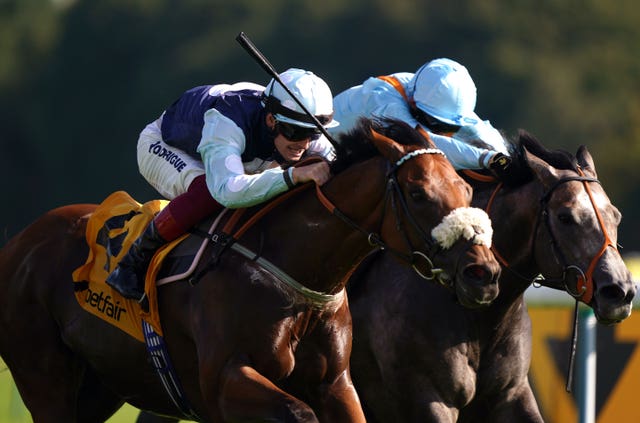
Next year’s 2000 Guineas is the ultimate target for Bow Echo after George Boughey’s exciting juvenile lived up to his tall reputation with victory in the Betting.Betfair Ascendant Stakes at Haydock.

Having been rerouted from last weekend’s Solario Stakes at Sandown, John and Thady Gosden’s Publish was the early favourite for this one-mile Listed contest, but sustained support for Bow Echo – a dominant winner on his Newbury debut three weeks ago – saw him go off the 5-6 market leader.

Odds-on backers will have been smiling when the Night Of Thunder colt cruised to the lead in the hands of Billy Loughnane heading inside the final two furlongs and while Publish looked set to pick him up late in the day, Bow Echo found more once challenged and was a length in front at the line.

Boughey did not make the trip to Merseyside, but was delighted with what he saw.

“He’s a lovely horse who has shown plenty of ability at home, but he’s possibly still quite raw,” said the Newmarket handler.

“He probably didn’t learn too much on his debut at Newbury and he’s only had once piece of work since.

“Billy was of the opinion that he really wanted something to give him a lead for longer at Newbury and it was similar today. It looked like Publish was coming to win the race, but our horse was waiting for him and outbattled him in the end.

“I’m delighted to make him a Stakes winner for Sheikh Mohammed Obaid (owner) as he’s a homebred from a good family.”

While Publish holds big-race entries in the Royal Lodge and Dewhurst at Newmarket, Bow Echo does not, with Boughey keen to take a patient approach with a horse he views as a legitimate Classic contender.

He added: “I think we’ll just see how he comes out of the race. The reason we didn’t enter him in those races (Royal Lodge and Dewhurst) is because we see him as very much a horse for next year.

“Maybe we could step him up in class again this year, but I’d be quite happy to wait and run him in a Guineas trial next spring.

“He has plenty of pace, he’s a Guineas horse and that’s what we’ll be training him for.”

Bow Echo arrowing towards Haydock next

George Boughey is struggling to contain his excitement for Bow Echo, with Haydock’s Betfair-sponsored Ascendant Stakes on Saturday week pencilled in for the impressive Newbury winner.

The son of Night Of Thunder created a deep impression with a dazzling display in the hands of Billy Loughnane on debut, with the Newmarket handler now seeing the one-mile Listed event as the perfect next step in the career of the budding star.

“The likelihood is he will probably go to the Ascendant Stakes at Haydock, he started over a mile and I think that is probably where he will be staying,” said Boughey.

“He was very impressive on debut and a very natural animal who hadn’t done a huge amount of work beforehand and was mainly there to have a nice experience, but he looked pretty good.

“He’s hard not to get excited about as he’s a very natural horse with a great pedigree and to see him go and do that on debut was great to see.”

The Sheikh Mohammed Obaid-owned Bow Echo holds an entry for Doncaster’s Betfred Champagne Stakes on September 13, but stablemate Protection Act – who is also one from one after a taking victory at Haydock – appears more likely to head to Town Moor on St Leger day.

“There’s no harm leaving Bow Echo in the Champagne with weather changing and then see how we go, but Protection Act looks like going to Doncaster and he was equally exciting on debut, albeit in a slightly different manner,” added Boughey.

“The race has worked out pretty well and he was a decisive winner at the line having missed the kick.

“He is a horse who was very weak at the time of his debut and is still developing. It’s all a learning curve for him at the minute, as like Bow Echo he is going to be a better three-year-old and is still very raw.

“But if he relaxes like he did on debut then I think Doncaster will suit him well.

“It can often be a small field which is always a bit of a shame and I just hope we get a properly-run race. If we can get Protection Act there in the same form he went into his debut, then he should be competitive.”

Boughey is entitled to have high hopes for the smart team of youngsters assembled at his Craven House base which includes the classy Albany Stakes runner-up Awaken.

However, one who will remain in calmer waters for the immediate future is taking Windsor winner Hilitany who will be kept to novice company for his next start despite holding entries for both the Mill Reef and Middle Park Stakes next month.

“He’s a nice colt who is well-entered up,” continued Boughey.

“He’s probably going to stick to the novice route for now and we’ll see, he’s still weak.

“I was happy with him going into his novice win, but he’s a horse who is going to keep improving into the winter and into next year and we’ll take him step by step. He’ll definitely go to another novice before he steps up in grade.”

Options home and abroad for promising filly Awaken

Royal Ascot runner-up Awaken is poised to return to deeper waters after a brief drop back in grade to open her account at Leicester recently.

Second to Richard Spencer’s well-regarded Gold Digger at Yarmouth on debut, she reversed that form when again a silver medallist in the Albany Stakes at the Royal meeting, finishing a length and a half adrift of Karl Burke’s Venetian Sun in a race that is beginning to look a red-hot piece of form.

The daughter of Mehmas made all to open her account at Leicester and Harry Herbert of owners Highclere Thoroughbreds said: “The Albany form is very strong and she has come out of the race really well, which she should have done really as it was just a piece of work for her in many ways.

“It was good to make her a winner and in that respect it was job done and now we can aim our sights towards black-type races again.”

Trained by George Boughey, Awaken is currently a single figure price for the Sky Bet Lowther Stakes during York’s Ebor Festival, but she is not certain to line-up on the Knavesmire with connections also contemplating a step up in trip for Deauville’s Prix du Calvados.

Herbert continued: “It could be the Lowther next but I’m not sure that necessarily smells totally right at the moment and she has plenty of options. There’s also the Prix du Calvados in France and we think seven furlongs would very much be in her compass.

“There’s two or three races lurking and we do think now she’s got the win under her belt she is capable of taking that step back into black-type company and see how far she takes us.

“She’s a very scopey filly and it is also about next season as well and here at Highclere we’re forever dreaming she may develop into a 1000 Guineas prospect, it’s fantastically exciting.”

Soprano aiming to hit Pipalong high notes

Soprano bids to put Royal Ascot disappointment behind her in the Weatherbys Hamilton Pipalong Stakes at Pontefract on Tuesday.

Winner of the Sandringham Stakes at the Royal meeting last season, George Boughey’s filly returned to the Berkshire circuit on the back of a successful reappearance in Listed company at Kempton.

However, the four-year-old was too keen to do herself justice in the Group Two Duke of Cambridge Stakes and weakened to finish last of seven behind Crimson Advocate, who she had beaten on her previous outing.

Harry Herbert, managing director for Soprano’s owners Highclere Thoroughbred Racing, said: “She’s in great form and looks absolutely fantastic, the best she’s looked this year I think.

“Sadly we had a disaster at Royal Ascot when she ran with the choke out for more than half the race and obviously didn’t get home, so she doesn’t need to do that again.

“She was just too fresh going into that race but she’s well, Billy (Loughnane) knows her very well and while it’s a tough race giving weight away at Pontefract, I think she’ll be very competitive.

“We had beaten the winner at Ascot the time before so it was frustrating what happened, she beat herself on the day. She thrives on racing and we probably should have given her another run, but it’s easy in hindsight.

“George and the team closest to her think she’s bang on for this to run a big race.”

Soprano heads a field of 11 fillies and mares declared for Pontefract’s Listed feature, with Dave Loughnane’s Sparks Fly and Royal Dress from James Tate’s yard among her rivals.

Boughey backing Believing to make Royal Ascot mark

George Boughey is confident Believing is firing on all cylinders following a “faultless preparation” for the King Charles III Stakes at Royal Ascot on Tuesday.

After several near-misses at the highest level, the five-year-old finally claimed the Group One win she had long promised in the Al Quoz Sprint at Meydan in late March and having since kept his powder dry for the Royal meeting, Boughey is anticipating another big effort.

“We’ve been very happy with her since Meydan and it’s very hard not to be positive on her – she’s had a faultless preparation,” said the Newmarket handler.

“It’s quite strange to have a filly of that quality run so consistently to form. I always think you can’t count your chickens, but she’s fit and ready to go and we’d be very happy with her.”

Believing ran twice at Royal Ascot in 2024, finishing a close fourth behind the reopposing Asfoora in the King Charles before occupying the same position in the Queen Elizabeth II Stakes Jubilee Stakes four days later.

The five-year-old, who is in foal to Frankel, has again been left in Saturday’s six-furlong Group One, but is deemed “unlikely” to line up this time around.

Boughey added: “It (King Charles III Stakes) looks a similar renewal to last year, so hopefully she can give a good account of herself.

“I think because it’s such an open race it’s attracted a bigger field. We’re drawn in one and possibly a little bit away from some of the others, but I spoke to Ryan (Moore) yesterday and we said it makes our decision pretty clear – we know which way we’re going and that’s in a straight line towards home.

“A stiff five is probably what she wants now, I think a stiff six is possibly too far. That’s why the six in Meydan was so tailor-made for her and anything now is a bonus.”

Regional (left) winning the 2023 Sprint Cup at Haydock
Regional (left) winning the 2023 Sprint Cup at Haydock (Tim Goode/PA)

The Ed Bethell-trained Regional was second to Asfoora 12 months ago and was beaten just three-quarters of a length by Believing when they last clashed in Dubai.

Bethell said: “Everything has gone smoothly, so we’ll keep everything crossed. There’s some familiar names in there and we all know each other’s positives and negatives. We’re all there and fingers crossed it’s a good spectacle.

“I’ve been really pleased with our horse, he’s come to himself really well and is training really good.

“We’re looking forward to it but it’s going to be a tough task and hopefully we’re drawn in the right place (stall 17), as I think the draw will be the key thing in this race. Who knows how it will work out? Hopefully we’re in the right place but we might not be and that’s just horseracing, I guess.”

Karl Burke’s talented Night Raider has his first attempt at five furlongs, having been snapped up by the Wathnan Racing operation following what was a promising third at York last month.

“He’s very fast and set some blistering fractions in the Duke of York into a strong headwind that day,” said Richard Brown, Wathnan’s racing adviser.

“He’s won over seven furlongs and was a Guineas horse last year, but I just can’t wait to see him over five furlongs as he’s blisteringly fast. James (Doyle) rode him up at Karl Burke’s the other day and was seriously impressed by how quick he was and I’m really looking forward to seeing him.

“When those sprinters are absolutely flying at Ascot, it’s one of the great sights in racing and I think he’s going to be one winging along.”

Asfoora is fitted with first-time blinkers for the defence of her title, having finished seventh on her most recent appearance in her native Australia.

Asfoora and Oisin Murphy after winning the King Charles III Stakes at Royal Ascot last year
Asfoora and Oisin Murphy after winning the King Charles III Stakes at Royal Ascot last year (David Davies/PA)

Trainer Henry Dwyer said: “We went right through the summer to York last year and I thought when she got to York (fourth in Nunthorpe) she was a bit flat. She had a really big preparation and I went there really confident she would win and the five furlongs on a flat track would suit her.

“Watching the race back, I just felt she was flat and showing the effects of a long preparation and travelling so we sent her home. She took an age to re-acclimatise and we backed right off her and took stock before giving her two runs in Adelaide.

“She won the first which showed she still wanted to be there, which we were a little apprehensive about, and then we went to the Sangster Stakes which was six furlongs not five but it was just a matter of having a run before coming here.

“There doesn’t seem to be many different (runners) to last year and the likes of Big Evs and Bradsell are both at stud now so it’s kind of just the old guard of us, Believing and Regional.

“I think she’s going as well as she was last year and I think that’s all we need to do based on the opposition – get her there in good order and hopefully the form is there.”

Loughnane raring to get going at Royal Ascot again

Billy Loughnane has reflected on his phenomenal Royal Ascot breakthrough 12 months ago – and is banking on an old friend to replicate last year’s success this time around.

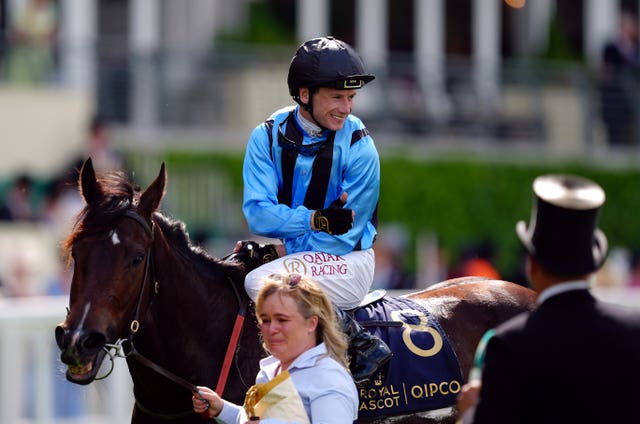
There were emotional scenes in the winner’s enclosure when the 19-year-old, adorned in the famous Sangster silks that have been a staple of Ascot, opened his account at the summer showpiece in the second race of the meeting by steering Brian Meehan’s Rashabar to Coventry Stakes glory at 80-1.

Loughnane’s week would get better when his Newmarket training ally George Boughey legged him up aboard Soprano in the Sandringham Stakes, completing a double on the biggest stage and a week he will always remember fondly.

Billy Loughnane after riding Rashabar to victory in the Coventry Stakes
Billy Loughnane after riding Rashabar to victory in the Coventry Stakes (John Walton/PA)

“It was a good Ascot last year and I’m excited to get back there, said Loughnane.

“It was a brilliant feeling winning the Coventry and ticking it off so early in the week was great. It was a special day and it was great to be there on the big stage. To also win on Soprano later in the week really was the icing on the cake.”

The young jockey has big ambitions of another dream week in Berkshire and is already busy amassing a stacked book of rides for five of the biggest days of the Flat season.

And it is last year’s Ascot heroine Soprano who Loughnane is pinning his hopes on once again as she returns to the Royal meeting for the Duke of Cambridgeshire Stakes, along with stablemate Bountiful who could provide a Sandringham double for not only Loughnane and Boughey but also owners Highclere Thoroughbred Racing.

Loughnane continued: “I’ve hopefully got a good book of rides and some good teams behind me. I’ve got some nice ones for George and Jane Chapple-Hyam and some other connections as well.

“Royal Ascot is the peak of our whole season so it’s important to go there with chances of winning. I’m hoping for a big week and will be disappointed to shoot a blank.

“Soprano will probably be my standout of the week and was a winner there for me last year. She’s going to run again and is in great nick. I’ve been riding her at home, she likes Ascot and loves quick ground and providing we get that I think she seems really well and will be going there with a good squeak.

“Bountiful can also run well for Highclere and George. She’s going to run in the Sandringham and her work has been good and I think stepping up to a mile will help her. I think she could be a bit of a sleeper.”

A Look at All-Weather Returners

In this article I am looking at some all-weather data going back to 2019 in the UK, writes Dave Renham. At this time of year, the only flat racing in Britain occurs at the six all-weather tracks, these being Chelmsford, Kempton, Lingfield, Newcastle, Southwell and Wolverhampton. The first three named all race on a Polytrack surface, the last three on a Tapeta surface.

My initial research for this piece is connected with the last time out all-weather (LTO AW) course that a horse ran and linking it to the course they raced on next time. As you might expect, certain horses tend to stick to one specific AW track. The two most likely reasons for this are either they run better there, or their stable is close to the track in question (or both). I guess trainers with smaller yards have to keep a close eye on costs, and travelling less distance is one way to save money.

All Runners: Surface Same or Different

When thinking about AW runners that have run well LTO, my perception in the past has been that I would rather see a horse running at the same AW track as they raced last time. If the horse switches tracks, then I would prefer them to stick to the same surface (e.g. Polytrack to Polytrack or Tapeta to Tapeta). If a horse did not run particularly well LTO then any switch of track or surface could be seen to be a potential positive. Thinking about this now, I realise that I have not crunched any data comparing the LTO AW course to current AW course, so my starting point is to look at just that.

Let me begin by comparing all runners between the LTO AW course to today's AW course. It should be noted that for any data connected with Southwell, I have used only runs on the new Tapeta surface which was first deployed at the end of 2021. It made no sense to include previous fibresand results.

The table below displays win strike rates, ROI percentages (to both Industry Starting Price, SP, and Betfair Starting Price, BSP), as well as Actual vs Expected (A/E) indices. I have colour coded some of the A/E indices – those in green are deemed positive (0.95 or above), those in red deemed negative (0.79 or below):


The vast majority of LTO course to ‘this time’ course stats seem much of a muchness. However, the five A/E ‘positives’ each have one thing in common – these paired courses all have different surfaces:


I concede I was not expecting this. In terms of strong positives, I would have expected to see the two courses in question either being the same course, or at least having the same surface.

Sticking with Newcastle as the LTO course, the data seem to suggest that horses perform better next time when switching to race on Polytrack. Indeed, here are the exact splits for this:


There is quite strong evidence here highlighting that if a horse ran at Newcastle LTO, one would much prefer to see it switch surfaces next time to race at one of the three Polytrack courses (Chelmsford, Kempton, Lingfield).

Let’s now compare the A/E indices of the other five courses in terms of LTO course to the today's surface and see if a surface switch is also preferable:


As an example, the first bar represents a run at Chelmsford last time and racing on Polytrack next; second is Chelmsford runners moving to Tapeta next time; and so on.

Chelmsford (Polytrack 0.83/Tapeta 0.82) and Wolverhampton (Polytrack 0.82/Tapeta 0.83) have very similar A/E figures indicating that the next time surface makes little or no difference from a value standpoint.

However, the other three tracks have slightly bigger differentials seemingly in favour of a surface switch. This is especially true for LTO runners at Southwell. This cohort, when switching surfaces to Polytrack, has produced an A/E index of 0.91 compared to 0.84 for those remaining on Tapeta. That is not quite as potent as the figures shared earlier for Newcastle, but the differences are noteworthy given the data analysed covers thousands of races.

The overall data shared to date points firmly to the fact that a surface switch offers punters better value. This has especially been the case for horses that raced at either Newcastle or Southwell LTO.

LTO Winners: Surface Same or Different

So far, I have only looked at general cases connected with all runners. But what if we restrict the research only to LTO winners? The table below has the same columns as in section one, showing win SR%, A/E indices and returns to SP and BSP. Again, I have highlighted positive and negative A/E indices – green for positive, red for negative.


Nine of the LTO to 'today' course combinations have seen LTO winners show a profit to SP; this increases to 18 when using BSP.

Looking at the negatives we see that Southwell to Chelmsford and vice versa have both produced poor results for LTO winners. This may be worth noting.

Staying with A/E indices, here are the ten ‘positives’ (0.95 or higher) grouped together:


Again, perhaps surprisingly, nine of these ten ‘positives’ involve a surface switch. In fact, if we lump together all the results of LTO AW winners, comparing horses that have switched surfaces with those that did not, we get the following results:


All the evidence is pointing to the fact that LTO AW winners that switched surface are by far the best value and also are more likely to win compared with those that haven’t switched.

Looking at the least experienced LTO winners, two-year-olds (2yos), we can see that a surface switch (regardless of which way round) is an extremely strong positive when comparing the returns to SP and BSP:


These numbers show that 2yos that won LTO on the all-weather were far better on the wallet when switching surfaces from their last run to this one. In terms of win strike rates 2yos switching surfaces won 28.3% of the time, with those racing on the same surface having won 26.9% of the time. These SR%s are quite close together, so I am thinking it is not solely the 1.4% difference in strike rates that has affected the bottom lines. My guess is that it is also due to the fact that the market has been slightly blind, offering bigger prices on these inexperienced LTO winners when they switch surface.


Surface Same or Different: Trainers

I now want to look at a handful of trainers who seem to have strong patterns when it comes to comparing the LTO course surface with the course surface next time.

George Boughey

George Boughey’s runners seem to have performed better on a Tapeta surface than on Polytrack. In fact, looking at his runners on the sand since 2019 (regardless of whether they ran on the AW LTO) he has shown a blind profit to BSP at all three Tapeta courses (Newcastle, Southwell, Wolverhampton). I want to compare his record with horses that raced on Polytrack LTO and are racing on it again next time, with those that ran on Tapeta LTO and stick to Tapeta in their follow-up run. Here are the splits:


The differences are stark and the ‘betting angle’ is clear. Boughey horses staying on a Tapeta surface require very close scrutiny. Profits have been made ‘blind’ to SP; to BSP the profit stands at £50.10 (ROI +22.7%). Those returning to a Polytrack surface look best avoided. Here are some additional Boughey stats worth sharing:

1. Horses that have started favourite racing on a Polytrack surface having raced LTO on the same surface have won 9 of their 35 starts (SR 25.7%) for losses to SP of £16.07 (ROI -45.9%)

2. Horses that have started favourite racing on a Tapeta surface having raced LTO on the same surface have won 25 races from 62 (SR 40.3%) for a small SP profit of £1.67 (ROI +2.7%); to BSP this improves to +£10.54 (ROI +17%)

3. Boughey 2yos racing on a Tapeta surface having raced on Tapeta LTO have won 14 races from 50 runners (SR 28%) for a profit to SP of £24.73 (ROI +49.5%); to BSP the figures read +£32.31 (ROI + 64.6%). Compare this to his 2yos going from Polytrack LTO to Polytrack this time – these figures read a dismal 6 wins from 53 (SR 11.3%) for an SP loss of £40.97 (ROI -77.3%)


Charlie Johnston

Charlie Johnston has only been training on his own for a couple of years, but he runs plenty of horses on the AW, so we have sufficient data to crunch. Johnston has been the reverse of Boughey when it comes to Tapeta LTO to Tapeta this time runners. He has really struggled with these horses. Of the 159 qualifiers only 14 have won (SR 8.8%) for an SP loss of £41.10 (ROI -25.9%). The loss figures would have looked much worse but for one of his winners that scored at a very unexpected 40/1. He has saddled 24 favourites with this profile and only two have won for a whopping 82p in the £ loss to SP. His second favourites have fared little better winning three from 21, losing 44p in the £.

Compare this to a near 19% strike rate with Johnston horses racing on a Polytrack surface having raced on Polytrack LTO. Backing all runners blind to BSP in this scenario would have seen one break even. Backing favourites and second favourites combined with this profile yielded excellent results unlike their Tapeta/Tapeta counterparts. These runners have scored 16 times from 46 (SR 34.8%) for an SP profit of £8.36 (ROI +18.2%).


David O’Meara

O’Meara has a good record with horses racing on a Polytrack surface having raced on Polytrack LTO. 153 horses have tried, of which 28 have won (SR 18.3%) for a profit of £30.12 to SP (ROI +19.7%). To BSP this improves to +£60.66 (ROI +39.7%).

Horses switching from Polytrack to Tapeta though have been only half as successful from a win perspective, passing the post first just 9.7% of the time (17 wins from 176). It should also be noted that horses making this surface switch for O’Meara, and which started in the top three of the betting, have incurred SP losses of over 24p in the £. In addition, horses that finished first or second LTO on Polytrack before switching to Tapeta next time have won just four times from 46 attempts.


---------------------


Concluding Thoughts

When researching huge data sets like I have for the majority of this article, the good news is we can have a fair degree of confidence with the results that are found. As a general rule, this research seems to suggest that a switch of AW surfaces from LTO run to today's run is preferable, especially when we are talking about betting value. It certainly should not be viewed as a negative. For LTO winners and especially LTO 2yo winners, a surface switch does seem a real positive. The figures shared here for both look strong and clear-cut, showing positive correlation.

So, does this mean I’ll be lumping on surface switchers this winter? No, of course not, but I will take a much keener interest in such runners than I have done in the past. Another thing this research has done is open my eyes to how punters, like me, can be blinkered in their thinking. In the third paragraph of this article, I said,

‘When thinking about AW runners that have run well LTO, my perception in the past has been that I would rather see a horse running at the same AW track as they raced last time. If the horse switches tracks, then I would prefer them to stick to the same surface (eg. Polytrack to Polytrack or Tapeta to Tapeta). If a horse has not run that well LTO then any switch of track or surface could be seen to be a positive.’

As a mathematician by trade I am a logical thinker, so what I wrote earlier made perfect sense. Well, it did at the time! Now I have researched this area I can see that, according to this recent data at least, my perception was an inaccurate one.

This process has also demonstrated to me that as punters we should be evolving and always trying to get better. If we stand still, we will fall behind the crowd. Every day is a school day!

- DR


Monday Musings: Sistina’s Aussie Fortunes


Who would have believed it? Three hundred and twenty-five days after buying the then five-year-old mare Via Sistina for 2,700,000 guineas at Tattersalls December sales, new owners Yu Long Investments were already in the black, writes Tony Stafford.

On Saturday at Moonee Valley racecourse, Via Sistina tackled the Ladbrokes Cox Plate over ten furlongs. She won, beating the Japanese-trained favourite, the six-year-old entire Prognosis by eight lengths in track record time, taking her earnings in Australia to £2.9 million.

It’s common knowledge that Australian trainers know how to prepare for the Melbourne Cup, Tuesday week’s (November 5) biggest prize and “the race that stops a nation”, but before we get too excited about Via Sistina’s chance in the big one, there is a small hurdle for her to overcome.

Moonee Valley and Flemington may only be 3.1 kilometres apart, so less than the Cup’s distance of two miles (3,200 metres), but the double in the same year of these two highly prestigious races has been only rarely achieved. Phar Lap, the greatest Australian horse of the Inter-War period, did it in 1930, while the dual Melbourne Cup heroine Makybe Diva did the Cups double 19 years ago. Time flies.

She was a six-year-old, and that second Melbourne Cup win proved to be her racing swansong before retiring to stud.

The Cox Plate is acknowledged to be Australia’s premier non-handicap Group 1 race and it carried just over £1.6 million to the winner on Saturday. It was Via Sistina’s fourth Group 1 victory in six starts since travelling down to Australia, to which can be added one second place in another £1.6 million to the winner extravaganza.

Chris Waller, best known for his training of Winx, never asked that great mare to go further than the 1m2f of the Cox Plate. She won the second of her consecutive quartet in the race by eight lengths, mirroring Via Sistina on Saturday, and won 37 of her 43 career starts.

Should Waller decide to go for the Cup. Via Sistina will clearly challenge for favouritism and while like Winx she has never won at beyond 1m2f, she is a staying rather than the speed type of Winx at the trip. If she runs it would add massive excitement and a completely different aspect to an already compelling race.

Two people at least that will be looking on wanly should she run, will be previous owner Becky Hillen, daughter of the late David Wintle, and her initial trainer Joseph Tuite, who handled the five grand yearling as an unraced two-year-old and progressive three/four-year-old.

George Boughey had her in his yard at the latter part of her four-year-old season and then at five, where she began the startling progression, that culminated (so far) in that Cox Plate tour-de-force. Some selling owners cannot bear watching their former horses win for the new connections. Until Saturday, Becky and husband, bloodstock agent Steve, were probably happy enough. After Saturday and maybe next week, it might be a different story.

But for Joe Tuite it can only have been two years of turmoil and what might-have-been after he relinquished his licence in late August 2022. Clearly, studying Via Sistina’s career from the comfort of my office, Tuite had a major part in developing a late-maturing filly into the colossus she now is.

Unraced at two, Via Sistina won second time out as a three-year-old, by five-and-a-half lengths in a Goodwood maiden fillies’ race. She added a Newmarket handicap off 89 by four lengths in October of that year. Such was her obvious potential at that stage, that when Tuite targeted a fillies’ Listed race at Doncaster the following month, she went off as the 11/4 favourite, but finished in the ruck, only 13th of 18.

Clearly at the start of her four-year-old season, her training hadn’t gone smoothly, and it wasn’t until August 27 that Via Sistina made her debut. She appeared in the Winter Hill Stakes at Windsor, a Group 3 race open to colts and geldings as well as fillies. She was a 33/1 shot and in finishing fourth she probably exceeded expectations.

By now though, the die was cast and Joe had already made up his mind to give up the unequal fight of trying to keep himself financially afloat. A report in the Racing Post the day after the filly’s promising return to action tells how it was almost with a measure of relief that he was finishing. The story went thus:-

Joe Tuite felt a mix of sadness and nerves as he saddled the final runner of his 11-year training career on Saturday, yet he stands by a decision to retire due to financial difficulties. Via Sistina outran her 33/1 odds to finish fourth in the Sytner Sunningdale & Maidenhead BMW Winter Hill Stakes at Windsor.

Tuite revealed he'd had a "few offers" for a future job in racing but no decision had been made.

Tuite said on Saturday morning: "It's a bit of a weird feeling – I can't really describe it. It's a bit of sadness I suppose.

"There are a lot of times where you go racing and there's not much of a worry but today I'm on tenterhooks about it all."

The trainer said a difficult season, with just two winners, and financial issues heightened by escalating costs were behind his reasons to retire.

He added: "It's definitely the right thing to do. I was down on numbers, and it was putting square pegs into round holes. I'd be worried looking down the road what the future would be like for the lower-tier of racing, that's for sure.

"It's tough but business is tough for everyone, not just racing, it's in all walks of life.

"I know my decision surprised a few people, but a few people that were closer to me weren't, as they could see the way things were going."

Within not much more than a month, Via Sistina was already showing Joe that maybe if he had held on for a short while, things might have sorted themselves out for him. Transferred to George Boughey, Via Sistina was quickly off the mark for him, running 2nd in the Group 3 Pride Stakes at Newmarket at the beginning of that October and then going across to Toulouse and picking up a provincial Group 3 in November.

She ran five times for Boughey last year as a five-year-old, starting off with a six-length win in the Group 3 Dahlia Stakes at Newmarket in May, before going across to the Curragh for the Group 1 Pretty Polly on July 1 where she beat Hughie Morrison’s slightly unlucky in running Stay Alert by two lengths.

She didn’t win again in this hemisphere, but third as the even-money favourite in the Group 1 Falmouth at Newmarket 13 days later when dropping back to a mile probably wasn’t her ideal task. Then it was 2nd, beaten a nose in the Prix Jean Romanet (ten furlongs) at Deauville before that sale-exploding run behind King Of Steel in the Champion Stakes at Ascot a year ago.

The luck was certainly just as much with Becky Hillen in terms of the timing with the December sales and all that Aussie money, barely a month ahead. Just as the luck had been notoriously absent when Joe Tuite had to make the awful decision to cut his losses and hand in his licence even as the filly he nurtured so carefully was about to come into full bloom as a late-developing racehorse.

For each of her 121 seconds of action around Moonee Valley on Saturday, Via Sistina earned her new (ish) owners £13,000.

In 11 years as a trainer in the UK, Joe Tuite had a best tally of 30, but usually picked up between 15 and 20 or so wins each year. From 1,881 runs over those 11 seasons, on the flat he won 173 races and total earnings of £1,552,585. Put another way, it represented a return of £825 per runner.

It must be salutary to think that his former inmate, the one that he brought to a position where she was equipped to make the giant strides she later managed as she had not been rushed or abused, won more in those 121 track-record-breaking seconds than he did in all those 11 years.

We keep saying it. Something’s rotten about English racing that we can afford to lose people with the skills of a Joe Tuite because he can’t manage to make it pay. Our only point in world racing seems to be to provide the proven material that can then go back to countries with many times more prize money to spread around and clean up – like Via Sistina!

One footnote. Cheltenham’s winter season proper started on Friday and Saturday and, as usual, it proved a bonanza for the Irish. They had six winners over the two days, including the first four races on Saturday. Henry De Bromhead had the 1-2 in the £100,000 featured chase, his pair mopping up £75k as they careered well clear of the rest up the Cheltenham run-in. Here we go again!

- TS


Monday Musings: A Right Royal Week

We’ve just been through five days of the most wonderful racing – and, until Saturday, flawless weather – at Royal Ascot, but for many the experience was incomplete, writes Tony Stafford. For my part, I don’t think I managed to make a single phone call on my mobile on any of the four days I attended.

Others fared better but the internet, and especially punters attempting to put on bets via their devices, proved a generally difficult and frustrating process.

One friend not in attendance said: “It’s just the same at West Ham. As soon as you get to half-time 60,000 people take out their phones and it’s just impossible.”

But going to a Premier League football match is nothing like spending six hours watching the racing and fashion and arranging to meet up with friends. You might be able to suggest a point to gather, but when as on Saturday there is a crowd of more than 69,000 that’s not so easy. Surely it’s not beyond the wit, or the finances, of Ascot to improve communications.

I described my feelings as the week progressed – not improved on Saturday when my glasses disappeared while eating lunch – as being in solitary confinement.  Not that I ever have been!

The racing started with a bang with world best Baaeed in the Queen Anne, quickly followed by a performance full of promise from Bradsell and Hollie Doyle for Archie Watson in the Coventry, and it went on from there.

Quite by chance I had the ear of Chris Waller for a little while before racing started on Tuesday and, as well as appreciating his confidence in the chance of Nature Strip in the Group One King’s Stand Stakes, which he won as a champion should, I also got some interesting stuff on the post-racing life of his great mare Winx.

Owners of many outstanding racemares have found that life in the breeding shed has not been as straight-forward as they might have hoped. Winx has had her setbacks, losing one foal, following which she had a tough time according to Waller.

If I understood him correctly, he believes extreme activity on the racecourse often inhibits the development of the reproductive systems making such mares immature in that regard. Winx deserves to get a foal or two to pass on her magical ability.

Then there was the narrow success of Coroebus in the St James’s Palace Stakes, William Buick bringing him with one of many well-timed challenges during the week.

Buick competed toe to toe throughout with Ryan Moore just as Godolphin did with Coolmore and while it was honours even in terms of good rides and victories for the two major powers, Ryan had the edge numerically. His riding this season is as good as it ever was.

Over recent seasons we had become accustomed to Ryan vainly trying to make up ground in the latter stages of Royal Ascot races after Frankie Dettori had made the first move. This year he seemed much more intent on riding closer to the front.

Once the field gets round the home turn at Ascot there is not much more than two furlongs for a rider to develop a winning run and, with crowding often to be expected, jockeying for position is more important there than on many tracks.

I did think Ryan’s riding of Kyprios in the Gold Cup was a masterpiece. It’s one thing making sure you keep your main rival boxed in when you can. At least twice as Dettori searched for a gap to start his move on Stradivarius, Moore, level and on his outside, kept the door shut.

But when Frankie’s race as far as winning was run, Moore still had saved enough on Kyprios for the Coolmore/O’Brien horse to deal with the dangerous challenge of Mojo Star around the outside. Last year’s Derby and St Leger runner-up, resuming for the Richard Hannon team after a long break, loomed up in the Amo Racing colours, looking sure to prevail.

Sadly for Amo boss Kia Joorabchian – in the paddock on Saturday with a football-oriented entourage that included Rio Ferdinand – none of his 16 runners at the meeting could win. This fastest-growing team in racing will win some big ones, that’s inevitable. How long, though, the emotional Kia can balance expectation with the inevitable disappointments that racing at this sort of level brings, is the interesting question.

Amo Racing’s support was a major factor in George Boughey’s rapid advance in the first couple of years of his career so it came as quite a shock for me to discover that of the 82 horses to have run from his Hamilton Road stable in Newmarket this year, only three have been in Amo Racing ownership.

Already successful at Classic level with Cachet in the 1,000 Guineas this year, Boughey now has two Royal Ascot wins to his name. Inver Park won Thursday’s concluding handicap, but a much more impressive winner showed the trainer’s sure touch on Saturday.

The Golden Gates Handicap, a three-year-old contest over ten furlongs, is a recent addition as Ascot went to a full five days of seven-race cards. Boughey’s Missed The Cut could not have been a more convincing winner.

I have mentioned before how significant it was for the UK racing and breeding industry that so many potentially high-class horses from the Shadwell stable were made available because of the economies needed after the death of Sheikh Hamdan Al Maktoun.

Missed The Cut, a son of the top US sire Quality Road, never raced as a juvenile and went to the February sale at Newmarket where he was snapped up by former jockey, Ed Babington. A successful businessman in garden furniture, he is also developing his racing interests, having involvement in the Roger Varian stable as well as with Boughey.

Missed The Cut cost 40k, which might not have looked a bargain when he first set foot on the track running fourth at the Craven meeting. But easy wins by eleven and then five lengths in two novice contests brought an opening mark of 95. He was heavily backed, as many of Boughey’s horses are – down to 5-2 on Saturday - and defeat never looked a possibility.

He stormed to the front two furlongs out and stretched the margin to almost five lengths, He’s already at least Listed class as we’ll see tomorrow when the new ratings appear. I reckon he’s a Group horse and maybe a top-level one.

Dettori did get some joy from the returning win of one-time 1,000 Guineas favourite Inspiral in the Coronation Stakes, but most people found his public “calling out” over the Stradivarius ride by joint-trainer John Gosden left a sour taste. You would think the number of winners the prince of racing has ridden for the stable, many at the top level, would have deserved a little more understanding in the face of one less than perfect ride on a horse for whom he has so much affection.

Nobody will ever worry in the fulness of time that Stradivarius, already a three-time Gold Cup winner, did not make it four. It was a shame for owner Bjorn Neilsen and no doubt Gosden senior would have liked another Gold Cup to his name, but that’s racing and for once Ryan rode the socks off Frankie.

Gosden was much more positive about the winning ride on Nashwa – like Inspiral a daughter of Frankel – in yesterday’s Prix De Diane at Chantilly. The Oaks third took the quick turn-around well when winning nicely under Hollie Doyle, who thus became the first female jockey to win a major European Classic.

I must say I have been dismayed all year once it became known of the departure of Tony Nerses from his role as the long-time manager of Nashwa’s owner. Initially for Saleh Al Homaizi, then for the partnership between Saleh and Imad Al Sagar, to Imad’s outright ownership when Al Homaizi bowed out a few years ago

I always believed Tony had a big input in the suggestion that Hollie might become the retained jockey for the team. Now we learn it was Mr Gosden’s idea all along. Just as it was when William Buick first went to the US, no doubt!

- TS

Monday Musings: A Guineas Double Top for the Doyler

Standing by the side of the paddock as the generally agreed handsome field for the 2,000 Guineas lined past, Alex Cole, son of trainer Paul and elder brother of joint-trainer Oliver, and Olly Sangster, grandson of Robert, were agreed that the three principals in the market were the biggest and the best-looking, writes Tony Stafford.

“Both Charlie Appleby’s are coming up to 540 kilos and Native Trail already was a giant as a two-year-old”, said Alex. “Dad always said it was better to buy a big horse. As long as you are careful with them, they usually have so much more substance.”

How the Cole stable would love to be back in the same milieu inhabited nowadays only by the likes of Godolphin, Coolmore and the biggest established teams like Varian, Balding, Hannon, Fahey and Johnston (father and son). The five supplied the fourth, fifth, sixth, seventh and eighth respectively and the only absentees from their “two-hundred club” were William Haggas, and the Gosdens father and son, without a runner in the first Classic race of 2022.

For all the merit of the supporting cast, though, they could not match the three market leaders – the big, very big, three of Coroebus, Native Trail and Aidan O’Brien’s Luxembourg, of whom everyone immediately afterwards said, “The Derby!” If the old “fourth in the Guineas, first in the Derby” adage needs a little finessing, so be it.

Master Cole, still glowing after the Palace House Stakes success immediately beforehand of Khaadem, owned by Mrs Fitri Hay, to whom he is racing manager, will be an adherent of the formula.

Back in 1991, when Alex was but a lad, Generous, trained by his father for Prince Fahd Salman, finished fourth in the 2,000 Guineas and did indeed go on to success in the Derby a month later. I’m sure that Guineas is engraved on the family’s hearts and it is on mine, too.

As the semi-celebration of a Classic fourth place from the large Saudi entourage developed that day as I’m sure talk of the Derby took root, a tall elegant young gentleman beckoned me over from among the waiting press corps for an early chinwag.

That was Prince Fahd’s younger brother, Prince Ahmed bin Salman, and he told me he would like me to write some articles for the newspaper his family owned and still does three decades later. In Central London, on news-stands, the “green paper” as London’s Arabic community knows Asharq Al Awsat, is to this day highly conspicuous.

I did indeed thereafter write a column – translated of course – every week for a decade and that led to working with the Prince’s Thoroughbred Corporation which was also to win the Derby with Oath eight years later. Many international races also came its way including five consecutive US Triple Crown races (but oddly no Triple Crown) and many Breeders’ Cups. Then, in 2002, his sudden and untimely death, almost exactly a year after Prince Fahd’s, both men had been in their forties, ended an era.

For both Charlie Appleby and Coroebus’ rider James Doyle, this was a 2,000 Guineas first and, for Doyle, an initial success in any UK Classic. It must have been a wonderful family occasion all round and one that William Buick did not begrudge his friend as he filled second place on the favourite Native Trail.

Charlie’s mum, Patricia, and James’s mother, Jacqui, are constant companions on the racetrack at the major meetings. Former trainer Jacqui has been the biggest and strongest support for her son and elder daughter Sophie, riding with great success in the US for the last few years. Her pride in their success can only be exceeded by the knowledge that she has produced two wonderful, modest human beings.

When she was training in Lambourn at around the turn of the century, her biggest financial supporter was Tom Ford, coincidentally my former opening partner in the Eton Manor cricket side of the late 1960’s, but by then a big financial player in the City. Tom and Jacqui split after a few years’ intermittent success, and the way she battled to bring up her kids and kept going through various difficulties was more than admirable.

Long before those days, my former next-door neighbour in Hertfordshire, Roger Anderson, knew Jacqui from the pointing field and I remember chatting to her with Roger at Huntingdon races while the two very young children would be running around, playing in front of the grandstands.

On Saturday, James Doyle had his first British Classic. Yesterday, in the manner of London buses, a second comes along right after and, in guiding Cachet to an all-the-way success, he was returning the favour by giving George Boughey his initial Classic triumph in only his third full season with a licence.

Boughey’s rise from the time he was assistant to Hugo Palmer has been, to coin a hackneyed phrase, meteoric and anyone who thought it was only Amo Racing’s horses which represent football agent Kia Joorabchian that has got him there, think again.

It was fine that Godolphin and Coolmore would fight out the colts’ Classic ahead of the rest of the domestic major teams, but this was a victory for the small – probably not for long – man.  George was listed with 104 horses in the latest Horses in Training and that is sure to go up – probably already has at the breeze-ups with some more to come.

This filly has modest antecedents as a daughter of the £6k National Stud stallion Aclaim, a horse raced and trained by Martyn Meade to win seven of his 15 starts, including the Group 1 Prix de la Foret on Arc day in his final race.

The £6,000 fee in 2022 is just below half his starting point and Cachet, a member of his first crop, is alone going to be responsible for sending him into orbit and providing Martyn with a healthy dividend for his massive investment in the sport. The biggest commitment has been the purchase of Manton, which even put a strain on Robert Sangster’s finances three decades ago.

When Cachet came up for sale as a yearling, she attracted a bid of 60,000 guineas and became one of the many successful Highclere purchases, master-minded by Harry Herbert and his brother-in-law (and Her Majesty’s racing manager), John Warren.

I have friends who have been with Highclere all along since they started and I’m hoping, Andrew, that you came into this one although I fear you probably did not. But again, a win for a syndicate horse of prosaic origins can be the life blood of the sport going forward.

James Doyle only rode at Newmarket for two of the three days of the Guineas meeting – he had a success at Goodwood on Friday – and he preceded Coroebus’ victory with a well-judged win on 22/1 Ian Williams-trained Cap Francais in a valuable nine-furlong handicap.

As he welcomed the former Ed Walker inmate into the enclosure, he reflected on what could have been at Ascot earlier in the week when Enemy got squeezed up the rail by the tough Irish mare Princess Zoe which allowed Quickthorn to pinch second place close home.

“At least we know now I was on the right track with Enemy”, said Williams on Saturday. “He’ll run in the Henry II at Sandown at the end of the month, then I’ll give him a long break before he travels out to Australia for the Melbourne Cup. He’ll have his prep as the best Australians do just before in the Caulfield Cup. You might as well run for a couple of million if you’re going to have a trial,” he said.

Before that for Williams and everyone else, it’s the small matter of Chester. Friday’s Chester Cup fell to his last Melbourne Cup challenger, Magic Circle, four years ago when he also won the Henry II Stakes. He fears the Cup may be beyond him this time but he has a plethora of possibles in Friday’s finale, and the Plate for Cup eliminations. I will be shocked if he didn’t win it but don’t ask me (or Ian probably) with which one!

- TS

Class of 2020: Five New Trainers To Note

We're coming up to the half way point in the 2020 flat turf season after its delayed June 1st resumption; and it feels like a good time to introduce a few fledgling trainers who have enjoyed flying starts and with whom you may not (yet) be familiar.

Before we meet them, however, a few words on the approach. Racing, like all sports and indeed pretty much all things, is transient: its actors come and go, wax and wane. From a betting perspective, the earlier we can latch on to potentially promising players - trainers, jockeys, sires, even horses - the better our chance of beating the market. The flip side is that, in the rush to become an early adopter, we are likely to encounter a share of false positives. In lay person's terms, one swallow doesn't make a summer: there is a danger that we (in this case, I) place too much store on an eye-catching beginning when little subsequent substance manifests beyond that early flourish.

Moreover, with new trainers in particular, their generally very small strings can quickly meet their match in the handicapper: win one, shame on me; win two, shame on you, as it were.

That's a verbose way of saying we need to tread carefully with what look like promising angles, and consider the early detection of new players in the wider wagering context of the race (conditions, other runners, draw, pace, etc).

So, with caution aforethought, here are my five to follow in the second half of 2020 and beyond:

George Boughey

Career record to date:

Boughey, like myself a good Dorset man, saddled the first runner from his Hamilton Road, Newmarket, stables on 24th July last year. Three weeks later, on 13th August 2019, in a lowly Class 7 event at Lingfield, he was off the mark, at the eighth time of asking. His debut runner, and winner, was the same horse, Three C's.

By the end of 2019, Boughey was 2/39 and on the tail of a 27-runner losing streak. By mid-February he'd added another five winners and, lockdown aside, has not looked back.

Before taking out his own license, Boughey had worked in bloodstock sales, and subsequently for the likes of Gai Waterhouse in Australia then, most recently, spent six years as assistant trainer to Hugo Palmer. Now out on his own, and up to speed, he's one to note and still a touch under the radar.

James Ferguson

Career record to date:

Former amateur jump jockey, and son of Bloomfields trainer and bloodstock adviser to Sheikh Mohammed's Godolphin operation, John Ferguson, James has not so much hit the ground running as scorched the earth beneath his sneakers.

Clearly not one to set the bar too low, his website quotes him as saying, “My primary goal is to create one of the world’s leading training establishments, to train winners at the highest level at the biggest meetings, and to provide owners with an experience for their overall enjoyment”. Crikey, fair play.

After a short and somewhat low key overture between late November last year and late January this, the first movement of Ferguson's career arrived when Arabian King notched a hat-trick in little more than two weeks from 30th January. Interspersed with that one-horse treble was a score for Johnny Reb to round out a four-in-a-row sequence for the newbie trainer.

Based, like Boughey, in Newmarket, Ferguson's record gained Black Type lustre as Zoetic prevailed in the Listed St Hugh's Fillies' Stakes at Newbury on Sunday, the highlight of his career to date.

Ferguson had started out with a spell learning from Sir Mark Prescott before stints with Charlie Appleby, Brian Meehan and Jessica Harrington, all in assistant trainer roles. With a(n unsustainable) 25% strike rate so far, his entries should not be readily overlooked.

Terry Kent

Career record to date:

If training, like most vocations, is "a young man's game", nobody told Terry Kent, and good luck to him for that. Kent doesn't yet have the patronage of the other names in this list, and he's arguably the biggest 'flyer' in this five to follow, but his CV is impressive.

Now 53, Kent was originally an apprentice jockey with the late Michael Jarvis before spending most of two decades as part of the Godolphin operation, principally with David Loder. After that, he returned to Kremlin House Stables where Roger Varian, formerly assistant to Jarvis, took over after his passing and installed Kent as his assistant.

Having saddled his first runner from the boxes he rents at Frankland Lodge Stables in Newmarket just two months ago - and achieved a winner with his fourth - he is ahead of Ferguson and Boughey at this nascent stage in his new career. Whether he can spring forward as that pair have seems less likely, but it ought to pay to follow his small string of about a dozen in the coming months.

Joseph Parr

Career record to date:

Apparently, Joseph Parr's granddad, Alan Bailey, told him to steer well clear of applying for a trainer's license. Kids, eh? They rarely listen to their elders, and that's not always a bad thing. Not so far, in this case, at least.

Parr, who remarkably is not just the fourth Newmarket trainer on this list but also shares the Frankland Lodge yard with Terry Kent, had only sent out three runners when the pandemic paused proceedings. But that hadn't prevented him from breaking his duck with Clem A, formerly trained by gramps, on the trainer's second day at the track with a license.

Since the resumption, Parr has added another four wins from 15 starts, including three-in-a-row earlier this month. He and Kent will doubtless feed off each other in the coming months as they press their respective careers forward.

Gearoid O'Loughlin

National Hunt career record to date:

And now, as they say, for something completely different. We head out of Newmarket, out of Britain, and away from the flat to an Irish National Hunt trainer who could make waves this coming campaign... and he may even have a live outsider for a shallow-looking Champion Hurdle next March.

O'Loughlin has been training for two years, sending out his inaugural winner at the 16th attempt on the 10th January 2019, when Sidetracked took the honours in a maiden hunter chase at Clonmel. His second win as a trainer came in a maiden hurdle at the same venue but, a year later with three more winners on the board, O'Loughlin was celebrating a higher profile and big-priced success in the Ulster National at Downpatrick with the Chris Jones-owned Space Cadet.

Jones, who enjoyed dual Cheltenham Festival success with Klairon Davis and more recently landed a touch in the Fred Winter with the high-class flat filly, What A Charm, entrusts his string to O'Loughlin now; since so doing he's not only been rewarded with the Ulster National score but has also seen his Mitchouka, formerly with Gordon Elliott, revitalised to win a beginners' chase.

However, the horse about which Jones must be most excited is surely Cedarwood Road, a big lumbering brute of a teenager about to become a man in 2020/21. I hope. I've backed him to win the Champion Hurdle at 100/1 you see. There's a better than fair chance he either proves not good enough or takes a different path to top honours this term; but his trainer's patience has been rewarded first with a facile eleven-length score in a 25-runner maiden hurdle on Boxing/St Stephen's Day, and most recently with a snug triumph in Listed company. He has a stone and more to find to be a genuine Blue Riband contender but, with just four runs to his belt, this five-rising-six-year-old son of Stowaway has all the attributes to progress through the ranks.

O'Loughlin meanwhile is the fifth man in my quintet of handlers to follow, and offers some variety to the spice of Newmarket life.