Staged at Fairyhouse racecourse the 2026 Irish Grand National is run over a trip of 3m5f with 24 fences to be jumped.
The gruelling contest is always staged on Easter Monday, which this year falls on 6th April 2025. While several Irish Grand National winners have also won the Aintree Grand National, but none in the same season – I Am Maximus, Bobbyjo and Numbersixvalverde are recent examples of this.
But this year the Irish National comes BEFORE the Aintree Grand National, which is on 11th April.
Regarding the stats - did you know?
The 19 of the last 22 winners carried 10-13 or less in weight, while 16 of the last 22 successful horses were Irish-bred.
We’ve also seen just three winning favourites in the last 22 renewals, while in 2021 we saw a 150/1 winner of the race - FREEWHEELIN DYLAN - and 11 of the last 22 returned 20/1+.
To prove any horse really can win this National.
I Am Maximus (2023) gave Willie Mullins just his second win in the race but also provided Paul Townend with his first. As mentioned he went onto win the Aintree Grand National the following season.
In 2024 Intense Raffles won the Irish National, but despite being well-fancied for the Aintree National was pulled up.
While last year (2025) the Rebecca Curtis-trained Haiti Couleurs raided Ireland to win the Irish Grand National - he went onto win the Welsh National the following season (2025/26)
Recent Irish Grand National Winners
2025 - HAITI COULEURS (13/2)
2024 - INTENSE RAFFLES (13/2)
2023 – I AM MAXIMUS (8/1)
2022 – LORD LARIAT (40/1)
2021 - FREEWHEELIN DYLAN (150/1)
2020 - No Race (Covid)
2019 – BURROWS SAINT (6/1 fav)
2018 - GENERAL PRINCIPLE (20/1)
2017 – OUR DUKE (9/2 fav)
2016 – ROGUE ANGEL (16/1)
2015 – THUNDER AND ROSES (20/1)
2014 – SHUTTHEFRONTDOOR (8/1 fav)
2013 – LIBERTY COUNSEL (50/1)
2012 – LION NA BEARNAI (33/1)
2011 – ORGANISEDCONFUSION (12/1)
2010 – BLUESEA CRACKER (25/1)
2009 – NICHE MARKET (33/1)
2008 – HEAR THE ECHO (33/1)
2007 – BUTLER’S CABIN (14/1)
2006 – POINT BARROW (20/1)
2005 – NUMBERSIXVALVERDE (9/1)
2004 – GRANIT D’ESTRUVAL (33/1)
2003 – TIMBERA (11/1)
Irish Grand National Betting Trends
20/22 – Won over at least 3m previously
20/22 – Winning distance – 5 lengths or less
19/22 – Carried 10-13 or LESS
19/22 – Had raced within the last 8 weeks
19/22 – Aged 9 or younger
17/22 – Won by an Irish-based trainer
16/22 – Irish bred
16/22 – Carried 10-8 or LESS
16/22 – Came from outside the top 3 in the betting
15/22 – Returned a double-figure (or triple-figure) price
14/22 – Had raced at Fairyhouse previously
13/22 – Carried 10-6 or LESS
13/22 – Unplaced favourites
13/22 – Finished fourth or better last time out
11/22 – Had raced within the last 4 weeks
11/22 – Rated between 130-137
5/22 – Won by an English-based trainer
5/22 – Won last time out
3/22 – Ran at Navan last time out
3/22 – Winning favourites (3 in the last 11)
2/22 – Trained by Jonjo O’Neill (2007 & 2014)
2/22 – Trained by Thomas Gibney (2 in last 13)
Trainer Dermot A McLoughlin has trained 2 of the last 5
Trainer Willie Mullins has trained 2 of the last 6
Trainer Gordon Elliott has only won the race once (2018, General Principle)
Only 5 winners since 1996 have carried 11st 1lb+ (but 2 of the last 3 carried 11-1+)
11 of the last 22 winners returned 20/1 +
The average winning SP in the last 22 years is 25/1
Only 4 British-trained winners since 2005
Only 4 horses since 2000 to win with more than 11-0, Intense Raffles (2024), I Am Maximus (2023), Our Duke (2017) & Commanche Court (2000)
https://www.geegeez.co.uk/wp-content/uploads/2019/04/burrowssaint_830x320.jpg320830Andy Newtonhttps://www.geegeez.co.uk/wp-content/uploads/2022/10/geegeez_banner_new_170x78.pngAndy Newton2026-04-04 01:53:082026-04-06 16:30:002026 Irish Grand National Trends
The days are getting appreciably longer, writes Tony Stafford. We’ve already snatched back three and a half hours of daylight from the miserly spans of midwinter, and Cheltenham starts tomorrow. In other words, 2026 begins now.
Two septuagenarians, Messrs Henderson and Mullins, have for decades been the major forces at the meeting, and neither is ready to lie down as the opening day entries show, but such as Dan Skelton, Ben Pauling and Olly Murphy on this side of the Irish Sea, and grittily determined Gordon Elliott, Willie’s Irish shadow for the past decade and more, as well as Gavin Cromwell and Henry de Bromhead, will be poised if either drops off from their usual lofty excellence.
Not everything will be the same. For the first time since 2011, Henderson will not be represented in the Champion Hurdle, a race he has won nine times. In the competitive absence of Group-seeking flat-minded nine-year-old Constitution Hill and injured Sir Gino, he can instead watch with pride the former’s gracing of the paddock before the race we thought he might win three or even four times before injury and a strange later aversion to jumping at racing speed took over.
Mullins has three chances, principally with the mare Lossiemouth, backed over the past few days into favouritism. Less obvious are Poniros, last year’s shock Triumph Hurdle winner, and Anzadam, runner-up in the Fighting Fifth Hurdle to Golden Ace late last year.
Two more from Ireland, the drifting third-favourite and Lossiemouth last-time humbler Brighterdaysahead (Gordon), and Workahead (Henry). Maybe this 66/1 shot isn’t a feasible contender but surely Henry De Bromhead is entitled to have another crack having won the race both in 2021 and the following year with Honeysuckle.
That great course specialist, along with now-retired Rachael Blackmore, came back to win the Mares’ race as a career finale in 2023, wisely side-stepping Constitution Hill when Nicky’s phenomenon was at his peak.
It wasn’t feasible either we thought before Jeremy Scott’s Golden Ace pounced last year following Constitution Hill’s early exit and most crucially State Man’s last flight fall when Mullins’ 2024 hero looked certain to follow up. He too is missing this year through injury.
We’ve been waiting for something to emerge from where I knew not, so with all the trials and tribulations out of the way, we’re left with The New Lion, worthy, dependable, much in the way of his trainer Dan Skelton, set for a final tally of more than £4 million for the season.
The New Lion, winner of the Turners novice hurdle over 2m5f last year, could have been returning with a faultless career record, but it’s now five from six following his being the second fall guy (along with Constitution Hill) in Golden Ace’s Newcastle success, secured at another massive price.
Skelton’s big hope appeared to have the race won on his first start since last March when falling late on, leaving Golden Ace to hold off Mullins’ Anzadam. The New Lion took his time to assert in what ended up a penalty kick on Trials Day at Cheltenham, but he comes here with the right profile. Brighterdaysahead’s dominant display against Lossiemouth at the Dublin Racing Festival, it seems, hasn’t been taken seriously by the market, presumably because of her capitulation last March.
So, the three most powerful stables in the two countries this season take centre stage. Their records for the campaign domestically are remarkably similar, numerically and in money terms. Skelton’s inexorable rise to a first trainer’s championship cannot be cheated this time, even if Mullins takes all the races he contests this week, has a clean sweep of the ten paying positions in the Grand National, and nicks all the other big prizes there and at Ayr and Sandown next month.
Skelton is on £3,462k, a full £3,160k more than Mullins. Even if Willie matches last year’s four Cheltenham daily takeaways of respectively £267k, £245k, £243k and a finishing £475k – which didn’t include the Gold Cup – that would ‘only’ amount to £1,230k. I doubt Dan will be heading off on holiday over the last seven weeks of the season either.
I love looking at stats in my customary now and again mode. Which of Mullins and Elliott do you think leads the prizemoney table in Ireland? As has often been the case at this stage, and sometimes even later, it’s Elliott. It’s taken 305 individual horses and 1,002 runs, 164 of them winners, to earn €4,340k. Mullins, much more sparing with runs from his 274 individual horses, has won 161 of 661, so 500 losers for €3,963K. I wonder how many of them were odds-on [55 odds-on losers from 127 - Ed.]
Over the last fortnight Mullins has won with 13 of 35 runners, supplying in that time the same number of odds-on shots. Tomorrow, between them, Mullins and Elliott have almost half the 45 Irish-trained runners on the opening day card. The home team has 67, with Henderson striking off early with favourite Old Park Star (Supreme) against Mullins’ Mighty Park (JP McManus), then Lulamba close in the market against Willie’s favourite and last year’s Supreme winner Kopek Des Bordes in the Arkle, with another mare Kargese as the Irishman’s back-up in a terrific seven-horse line-up.
Gary and Josh Moore were the stars of Saturday’s Sandown card, and their Hansard is worthy of his place against better-publicised opponents. Add Sam Thomas’s Steel Ally, who saw off Ben Pauling’s candidate and reopposing Mambonumberfive when they met at Kempton, and it’s a heady mix.
Lulamba won the Game Spirit Chase at Newbury despite showing obvious signs of inexperience and that was never the case with Steel Ally at Kempton. In three runs over fences, he has won with increasing facility each time and has the sexiest of French jumping pedigrees being by Doctor Dino out of a mare by Martaline. At 12/1, he’s worth a second look.
When I peeped at the Racing Post last Wednesday to check I was still alive, I was described as Tony Stafford – former Daily Telegraph tipster, or was it journalist? My memory! Anyway, I am still here, and reckon that in the first race, reviving my old tipster role, I’m looking for Elliott to disappoint both Henderson and Mullins with El Cairos.
With Gary and Josh Moore last season, he did very well when amateur-ridden by then owner David Maxwell and was sold at the owner’s dispersal for £410k. The Moores will not have been surprised by the talent he is showing over hurdles, stumbling and falling unluckily on the run-in when in the lead on debut and then an easy winner from a Mullins horse last time. No doubt Gary wishes he still had him to train.
For a value bet number three, let’s go with Faye Bramley’s Winston Junior – no not named after Sir Keir – winner of his latest of three runs at Ascot in scintillating front-running style. His owners might give a clue as to why he’s 8/1 in a massive field for what deserves forever to be known as just the Fred Winter, despite whoever adds their name to it.
The trio of connections – Ronnie Bartlett, Justin Carthy (JP’s mate) and Mrs Paul Shanahan (and her husband of course) – know how to line up a winner from whichever yard their horses happen to run.
Just as I’d stopped looking, a name from a year or so ago jumped out at me. Walking On Air began life in the Nicky Henderson stable, running very well in bumpers in the colours of Mrs Doreen Tabor. He didn’t always live up to the promise of those early days and, since late in 2024, various owner combinations including Justin Carthy and Mrs Shanahan have been alongside his name.
Now it’s the Cheeky Pups and again trainer Faye Bramley, a protégé of AP McCoy’s, who trains him. The nine-year-old’s last run was a good third to Geegeez’ Dartmoor Pirate in the Great Yorkshire Chase at Doncaster last month.
I mentioned top French breeding earlier. Walking On Air’s pedigree takes some beating. He’s by Michael Tabor’s Derby runner-up, the wonderful jumps sire Walk in The Park, out of his smart long-distance mare Refinement. It’s 18 years since I was alongside Harry Taylor in the Cheltenham paddock watching on the big screen as Refinement came to the line just in front in the David Nicholson Mares’ Hurdle.
Just before the line, I turned to Harry and said, “She’s won!”.
Eyes still on the screen, Harry said, “She hasn’t!” and she hadn’t, letting Whiteoak get back by a short head. She had one more run, another second place for Jonjo O’Neill and AP McCoy in Ireland, and then retired.
I asked Michael if she would go to stud. “Me send a jump mare to stud? How f…ing old would I be before she got a runner?” Well, Michael did relent and Refinement has bred four nice jumps winners including Walking On Air. A 12/1 shot for tomorrow and also from the Bramley yard, he can make it a memorable afternoon for his young trainer.
Normally we would have had both days of the Dublin Racing Festival to reflect upon this not so bright Monday morning, but it’s rather like the 1997 Grand National, writes Tony Stafford. Then, at the height of the IRA’s bombing campaign in the UK, a bomb threat led to 60,000 racegoers (including me) being evacuated from Aintree.
The race was delayed for 49 hours to the following Monday and those that could – unfortunately I couldn’t – reconvened for a single race off at 5.00 p.m. in the afternoon.
Naturally, my original tip for the race, Lord Gyllene, owned by Sir Stanley Clarke, also owner of Uttoxeter racecourse, trained by Steve Brookshaw and ridden by Tony Dobbin won the 36-runner race and its £178k prize by 25 lengths from Charlie Brooks’ Suny Bay. He started 14/1 and I don’t think I backed it!
This weekend the only villain of the piece was the ground on Saturday morning for the opening instalment of what is best known as the Willie Mullins Benefit Weekend. That card was rescheduled for today and in view of the lead up to yesterday’s programme, the ground didn’t look too bad.
The great man did win two of the Grade 1 races on the card, impressive scorers for the JP McManus/Mark Walsh team that will soon be dissolved when Harry Cobden takes over the job as his stable rider in the two countries.
First, in the Ladbrokes Novice Chase over 2m5 1/2f, Kaid d’Authie (5/1) rather than Mullins’ hotpot Final Demand (100/30 on) took the spoils. Willie had supplied three of the four runners. Then in the Ladbrokes Dublin Chase (2m1f) Majborough dispelled any fears about his technique over fences. He made all to beat favourite and last year’s Queen Mother Champion Chase winner Marine Nationale by 19 lengths with an exhilarating display of front-running and fast jumping.
Majborough is now the deserved favourite for this year’s Queen Mother Champion Chase and there isn’t much that can happen in the six weeks that remain before the Festival to remove him from that position.
Mullins then had a later, and possibly even more unexpected reverse, with 10/11 shot Lossiemouth, regarded in many places as the likely Champion Hurdle winner next month following the departure from calculations of Sir Gino last weekend. In what looked beforehand a virtual match race for the Timeless Sash Windows Irish Champion Hurdle – great sponsorship that! - Lossiemouth was never going as well and was unable to match the finishing verve of Gordon Elliott’s Brighterdaysahead. That market rival was thus emphatically reversing the one-length Christmas defeat by Lossiemouth over the same course and distance.
Brighterdaysahead has now won ten of her 14 career starts. One reverse was when she failed to live up to second favouritism in last year’s Champion Hurdle, finishing a long way behind Golden Ace in fourth, a placing that even flattered her on the day.
It was won with a fair portion of good fortune by that seven-year-old mare, trained by Jeremy Scott. If anything, Golden Ace has improved her profile since. First, she ran a fine second at Punchestown last spring behind State Man, who had been denied a second Champion Hurdle victory when falling in a clear lead at the final hurdle last March. The margin of just over four lengths at Punchestown suggested Golden Ace was progressing. A gritty win in the Fighting Fifth at Newcastle and second to Sir Gino in the Christmas Hurdle show her continuing improvement.
State Man is another absentee this time around. We could still be seeing the 2023 champion Constitution Hill if he comes through that tantalising hurdle-avoiding gallop round Southwell on Friday evening the 20th of this month. It’s strategically placed timing-wise before the big race, Southwell having grafted Hendo’s star’s target onto an original seven-race Friday night card.
Including that new race, there’s a total of £245k on offer during the evening, and Constitution Hill’s event could hardly have been more sensitively framed. It’s a 4yos and upwards novice over 1m4f. I hope there are some nice animals to make Constitution Hill work for the £21k first prize. Make a note in your diary, 5.00 p.m. off time, first leg of that Friday night bonanza.
He is down to a 6/1 chance, despite that litany of falls in his latest appearances. Brighterdaysahead and Dan Skelton’s The New Lion, workmanlike at Cheltenham the previous weekend, vie for favouritism, with Constitution Hill coming next. Such is the paucity of serious contenders at this stage, Lossiemouth is still fourth favourite with Golden Ace just behind her.
Brighterdaysahead and Lossiemouth are age seven. I remember when Ruby Walsh was talking on ITV the other day, he pointed out that Lossiemouth also has the mares’ race as a Cheltenham option – and that was before yesterday’s disappointment. I wouldn’t be too surprised if Willie decides on that course of action.
Now you know I love a statistic, even if as the Editor will be the first to point out, my interpretation is not always flawless. Mullins was matched for winners yesterday by Gordon Elliott who also picked up a valuable handicap hurdle with Bowensonfire (10/1). The UK champion jockey of that name, Sean Bowen, making his first visit to Leopardstown, is indeed “on fire” and he didn’t waste any time getting a winner. He was on Backmersackme who took another nice €88k’s worth for the Emmet Mullins’ (Willie’s nephew) stable.
Sorry Sean, you slipped in there before I could illustrate again what an unbalanced affair top Irish jumps racing is – as if it wasn’t already obvious. Yesterday Wilie Mullins had 32 runners on the card while Gordon Elliott had just the meagre ten, so 42 between them from a total of 96 on the day.
Today, Willie has 19 declared to Gordon’s 23, so between them 42 of 77, and over the two days 84 from 173, slightly more than 48 per cent. I think that’s ridiculous.
Willie’s UK raids continue to be hit-and-miss. On Saturday, impressive Kempton Christmas winner Kitzbuhel was widely expected to dominate Sandown’s Scilly Isles Novices Chase. Perhaps it was being denied an early lead that unsettled him, with the Fergal O’Brien-trained Sixmilebridge setting a fast pace in front. He never looked in danger of defeat once the favourite and a re-routed Paul Townend checked out at the sixth fence, where the rider was unseated after some poor right-handed leaps.
As I’ve already awarded the trainers’ championship to Dan Skelton, who sensibly kept away from Leopardstown, I must report over the past two weeks he’s had 20 winners from 54 runners, barely half Mullins and Elliott will have jointly sent out over two days in Dublin. Now past £3 million, it’s time to toast a great young force in the training ranks.
- TS
https://www.geegeez.co.uk/wp-content/uploads/2026/02/Brighterdaysahead_IrishChampionHurdle_2026.png319830Tony Staffordhttps://www.geegeez.co.uk/wp-content/uploads/2022/10/geegeez_banner_new_170x78.pngTony Stafford2026-02-02 07:04:572026-02-02 07:04:57Monday Musings: A Short Delay
Staged at Leopardstown racecourse, Ireland, the Grade One Savills Chase (formerly the Lexus Chase) is run over a distance of 3m and is often seen as a decent guide ahead of the Cheltenham Gold Cup, run later that season.
Some great names in recent years to land both races are Denman (2007/08) and Best Mate (2003/04), while considering the contest is staged in Ireland, we’ve actually seen eight UK-based horses come over and win the prize in the last 24 years.
While for the last two seasons (2023 and 2024) we've seen the Willie Mullins-trained Galopin Des Champs romp away with the prize.
Here at GeeGeez, we take a look back at recent winners and gives you the key trends ahead of the 2025 renewal - Sunday 28th December 2025.
Recent Savills Chase Winners
2024 - GALOPIN DES CHAMPS
2023 - GALOPIN DES CHAMPS
2022 – CONFLATED
2021 - GALVIN
2020 - A PLUS TARD
2019 – DELTA WORK
2018 - KEMBOY
2017 - ROAD TO RESPECT
2016 – OUTLANDER
2015 – DON POLI
2014 – ROAD TO RICHES
2013 – BOBS WORTH
2012 – TIDAL BAY
2011 – SYNCHRONISED
2010 – PANDORAMA
2009 – WHAT A FRIEND
2008 – EXOTIC DANCER
2007 – DENMAN
2006 – THE LISTENER
2005 – BEEF OR SALMON
2004 – BEEF OR SALMON
2003 – BEST MATE
2002 – BEEF OR SALMON
Savills Chase Betting Trends
23/24 – Returned 8/1 or shorter in the betting
23/24 – Had won at least 3 times over fences before
22/24 – Placed in the top 3 last time out
22/24 – Aged 8 or younger
20/24 – Had raced within the last 8 weeks
19/24 – Had won over at least 3m (fences) before
17/24 – Won by an Irish bred horse
16/24 – Placed favourites
14/24 – Aged either 7 or 8 years-old
12/24 – Winning distance – 4 lengths or more
9/24 – Winning favourites
8/24 – Won by a UK-based stable
6/24 – Won last time out
4/24 – Ran at Haydock last time out
3/24 – Trained by Paul Nicholls
3/24 – Ridden by Jack Kennedy (3 of the last 9)
3/24 – Went onto win that season’s Cheltenham Gold Cup
Trainers Gordon Elliott (4) and Willie Mullins (4) have won 8 of the last 10 runnings
================================================
FROMTHESTABLES.com
GET THE BEST DAILY TRAINER INFO FROM 18 TOP STABLES - Sent direct to your in-box!
**SPECIAL OFFER** TRY US FOR JUST £1 (for first month)!!
A week ago, when talking to Nicky Richards in the morning when he had sent three horses to Ayr – he won in the afternoon with 4/1 on shot Upon Tweed - we had a quick chat about one of his other runners, writes Tony Stafford. Red Cadillac had narrowly won his previous race at Carlisle and as a result he was carrying 11st13lb in this £4k to the winner handicap hurdle.
“I expect our horse will run well, that is unless Gordon Elliott’s boys are coming with their betting boots on”. Like three other runners on the day, King Gris was to be ridden by Sean Bowen. Running off 73, therefore in receipt of 25lb from Nicky’s horse, King Gris, owned by the Sette A Milano Syndicate, was 5lb wrong, as his official mark was a bargain-basement 68!
By the time of the race at 2.45 p.m., as the Editor and I were just about on the dessert course at the Horserace Writers and Photographers Association lunch in London, Elliott and the champion jockey already had two wins on the board. At the off, King Gris, 5/2 against at one point in the morning, was 11/4 on and won comfortably doing only what was needed by Bowen to land the odds.
The official margin, which could clearly have been extended if Bowen (and no doubt Elliott) had wished, was two lengths. After that in the seven-horse affair over the minimum trip it was 7 lengths, 6½, 9½, 3¾ and half a length. Strung out like washing on the line as the pre-race market suggested they would be.
Probably struggling to keep a straight face afterwards speaking to Racing TV, Gordon Elliott said, “It was nip and tuck going to the last, but King Gris won which is the most important thing, and he has a good attitude. That was a low-grade race but hopefully he'll be able to win a couple more.” No doubt! Richards’ guess is that he could be a 120 horse.
Red Cadillac, of course, was second and having done his best against what clearly were virtually impossible odds, his connections are going to have to pay a price. As Richards said yesterday, “No doubt after this he’ll go up in Tuesday’s new ratings and from there it will be harder for us to find another race with him.”
Reflecting yesterday morning in response to my reminding him of the event, he said, “There’s been hell on about it. I’ve had calls about it, but I think the BHA are to blame for allowing such a situation to arise.
“This was a Class 5, 0-100 race. During Covid, the rules were changed to prevent Irish stables having runners in races over here at Class 5. That has since been rescinded, but why I’ve no idea. We struggle enough to beat their horses in the top races – look at what Il Etait Temps did to Jonbon and co at Sandown. If we must contend with apparent set-ups like King Gris, what chance do we have?”
So, how did King Gris, a former Irish pointer with a very close third as the best of three runs on his card for owner-trainer Denis Paul Murphy, manage to arrive at a jumps rating of 68, equating to a flat mark in the early/mid 20s?
A short time after that promising pointing third I referred to, King Gris was gelded and it was only a few weeks later that he turned out in a hurdle race at Bangor under the auspices of Merseyside trainer Patrick Morris. He was a 25/1 shot, reflecting that point-to-point effort just a couple of months earlier but finished ninth of ten and was beaten a mammoth 90 lengths.
Next came Morris’s local track Aintree, where King Gris was fifth of six, beaten 63 lengths at 150/1. The final qualifying effort was at Cartmel. There, starting 250/1, and ridden as at Aintree by Charlie Todd, he was last of nine finishers. Job done – three runs from April 24 to May 28.
That was the last we saw of him until Monday a week ago.
The most intriguing element of the story must surely be why he was sent to Morris after the gelding operation if he was eventually destined for one of the top Irish jumping yards. Indeed, the stable that is second only to the magical Willie Mullins.
Morris has been training since 2002 with runners on the flat since 2004 and, apart from two blanks during that time, he has been a regular winner. In 2025 he boasts a decent strike-rate with 14 winners, a tally beaten only three times with the peak of 19 coming in 2011.
Coincidentally, the day of King Gris’ Ayr coup, Morris had a winner later on at Wolverhampton, then one the following day at Newcastle, and another on Saturday back at Dunstall Park. No reason then not to send a horse to Morris? Maybe, but here’s another coincidence. The trainer has run only two individual horses over jumps last season and this. They are King Gris and the useful chaser Royal Deeside who has won twice this term.
The coincidence? Morris’s last jump runners before King Gris and Royal Deeside had been as long ago as in 2011, the time of his best flat season. In all, before 2024/25 he sent out a total of 29 sporadic runners over the quarter-century for a single jumping success.
*
If you want a strike-rate at the other end of the scale, how about Sara Bradstock, widow of Mark Bradstock and daughter of my long-term Daily Telegraph colleague John Oaksey. After the Bradstocks’ Mr Vango won a 3m6f chase in testing ground at Exeter two seasons back by 50 lengths, I thought he would knock the Irish off their collective perches at Cheltenham in the National Hunt Chase.
That proved beyond him at that stage, but last winter he went unbeaten through a forensically chosen three-race campaign, culminating with success in the Midlands Grand National over four and a quarter miles at Uttoxeter, a couple of weeks before the Grand National.
Mr Vango will now have the big race on his agenda next March, having come through a trial go over the big-race fences in Saturday’s Becher Chase (3m2f). Having looked beaten and running off top weight of 12st, from a peg 32lb higher than when winning that race at Exeter and 9lb higher than Uttoxeter, he was as unlucky a loser as you can find.
That said, in Twig he met an equally determined and deserving runner from the Ben Pauling stable, ridden as usual by Beau Morgan, son of Twig’s owner.
Twig had been my long-priced nap for the 2025 Grand National and, in running tenth of the 34, was the second home-trained finisher intruding on the Irish juggernaut’s private carving up of the £1 million prizemoney. With Ben saying he “wouldn’t swop him”, for some reason I preferred to look elsewhere for my best bet on Saturday and grimaced as the close-up showed his head down with his rival’s up to get the better of a wonderful finish.
Every time Sara sends out a runner under Rules, I think back to all those years when her father and I comprised the Sunday Telegraph writing team at the Grand National.
While John was crafting his wonderful words for the larger, later editions in terms of readership, I was the “sprinter” charged with doing the fast version of events for the Irish, Scottish and Northern readership.
We operated from a house across the road from the track, with a phone in every room and shared with Brough Scott and others those facilities in Chasandi, the home of a very nice Scouser family. No phones in the track, no computers to put the words together, just a disembodied telephonist taking your words back in Fleet Street to send on to the printers.
One of the top writers at the time was Christopher Poole, a giant, genial, rotund chap who worked for the London Evening Standard. If you thought our system in today’s world would be considered tortuous, Chris had to relate his to his own travelling telephonist, Max, who would then repeat the words back to Fleet Street! If Mr Vango does beat all those Irish stars next spring, even I won’t be able to resist a tear or two remembering John and quite a few others too.
- TS
https://www.geegeez.co.uk/wp-content/uploads/2017/10/ElliottGordon-143171.jpg316592Tony Staffordhttps://www.geegeez.co.uk/wp-content/uploads/2022/10/geegeez_banner_new_170x78.pngTony Stafford2025-12-08 07:34:142025-12-08 07:34:14Monday Musings: A Grey Area
An exploration of Irish National Hunt trainers using the Geegeez Query Tool
Gold members of Geegeez have so many benefits and for the first part of this article I am going to discuss how I used one of these, the Query Tool, to obtain a wealth of trainer data, writes Dave Renham. The second part of the piece will crunch some of those numbers.
My focus was Irish racing and hence Irish trainers in National Hunt races. Data has been taken from 1st January 2018 to 30th September 2025 with profits and losses calculated to Betfair Starting Price (BSP) with a 2% commission applied on any winning bets.
Setting Up With Query Tool
So, the starting point for using the Query Tool was straightforward: by inputting the date range, then going to the RACE menu where, on the Country tab, I ticked ‘Ire’ and then, going to the Race Code tab, I ticked all of the NH code boxes. The screenshot below shows the filters used:
So, this gave me all the Irish data I was looking for so – over 11,000 races as can be seen from the 'Wins' column:
Next I went to the RUNNER menu and then clicked on the ‘Trainer’ radio button, which groups the criteria by the selected variable (in this case, trainer), and then I clicked 'Generate Report'. This gave me the records for every single Irish trainer who had had a runner during the period of study. The first few trainers in alphabetical order are shown below:
From here I wanted to focus only on the trainers who sent out the most runners in order to have big enough sample sizes to drill down into other areas. I ordered the trainers by runs in the Query Tool and decided on 800 runs or more as my cut off point. This gave me 29 trainers to review. By ticking the ‘+’ sign to the left of each of these 29 trainers' names (and, when doing this, the plus sign became a minus sign meaning the trainer had been selected), I added them to my shortlist. Once all were ticked, I generated a new report with only these 29 trainers shown:
I then went back to the SUMMARY tab (top of the main part of the page) and used the 'COPY' button to paste all of the trainer data into a Microsoft Excel file I had already opened. With the 29 trainers logged in the Query Tool, I then went about generating numerous reports by changing the Query Tool variables or options. Once generated, new reports were pasted into a worksheet and I added an additional column with the specific variable for that report. I created 30 different reports, all copied across to my Excel worksheet. This took no more than 20 minutes tops, and I now had all the data I needed to analyse and number crunch.
Irish NH Trainers, by Win Strike Rate
The rest of this article will take a more familiar format for regular readers, although I may discuss some Excel methods I used along the way, in case you want to do some digging for yourself!
First things first, let me share the results for each of the 29 trainers over the timeframe (trainers ordered by win strike rate):
One immediate point to share is that Irish racing has had bigger average field sizes when compared to the UK in recent years, and that helps to explain why the trainer strike rates are generally lower than we are be used to seeing when looking at UK trainer data. The maestro that is Willie Mullins was head and shoulders above the rest in terms of win strike rate having hit a touch more than one win in every four. His runners, if backed ‘blind’, made a very small profit to BSP. The second and third listed trainers, Henry de Bromhead and Joseph O’Brien, were also profitable to BSP. A handful of other trainers made a profit to BSP, but all of these had at least one massive BSP priced winner to skew their bottom line somewhat.
Irish NH Trainers, by 'Favourite' performance
One advantage of copying the 30 different reports into Excel meant I could create a Pivot Table to easily compare the data sets and see if there were any significant patterns or angles that were worth sharing. Pivot tables are an extremely useful way to number crunch data in Excel. For those interested in finding out more about them there are plenty of easy to follow YouTube videos around.
I started off by analysing some betting market stats beginning with trainer data for favourites. In order to have a big enough sample, I decided that a trainer must have saddled at least 100 or more favourites during the period of study. I wanted to start by comparing their overall win strike rate for 'All favs' with their strike rates for market leaders specifically in chases or hurdle races. The sample size for NH Flat favourites was too small for most trainers, so I have opted not to show that. The splits were thus:
Don’t be too put off by the huge variance in strike rates between, say, Mullins and Rothwell, because 88% of market leaders for Mullins were in non-handicaps, and 84% of Rothwell’s were in handicaps. Non-handicap favourites start at much shorter prices on average than handicap jollies, so Mullins was always going to have a much higher strike rate when comparing the two of them. Talking of handicaps and non-handicaps it makes sense for me to share and compare their win strike rates to help illustrate my previous point:
Most trainers conformed to the pattern of much better win rates in non-handicaps, although a few did buck this trend. Declan Queally, for example, had virtually the same strike rate in both race types and when we analyse his results in full, we see the following:
Favourites in handicaps produced excellent returns for Queally and anyone following his market leaders in these contests would have been counting their money. Philip Rothwell has fared far better in handicaps than non-handicaps with favourites, but the vast majority of his market leaders were in handicaps (only 18 in non-handicaps).
It's time to narrow down the research a little by looking at a handful of the most successful trainers.
Irish NH Trainers: Specific Handlers
Willie Mullins
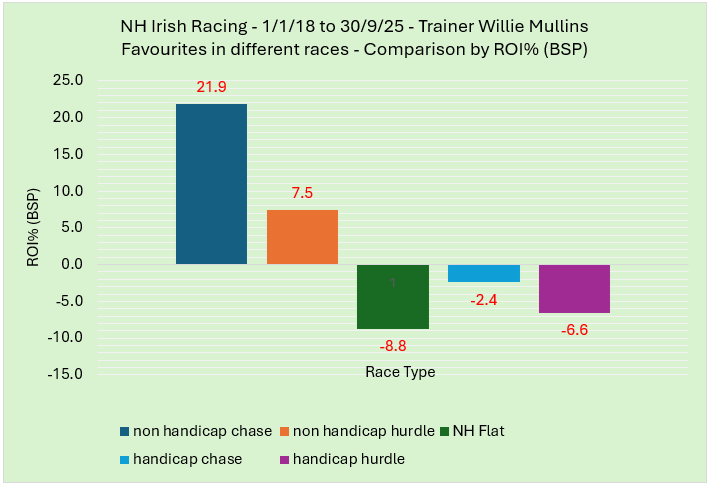
I called him the ‘maestro’ earlier and he has been in a different league to his peer group in recent years. Clearly, he has the backing of some huge owners and gets many of the best horses, but one still needs to deliver. I have shared some of his market leader stats already, and below is a graph sharing his ROI percentages (BSP) in more specific race types – handicap chases, handicap hurdles, non-handicap chases, non-handicap hurdles and NH Flat races.
As can be seen, Mullins produced excellent returns when saddling the favourite in non-handicap chases. The full stats read 316 wins from 536 (SR 59%) for a profit of £116.47 (ROI +21.7%). He also showed a blind profit with market leaders in non-handicap hurdle races thanks to 540 wins from 1028 runners (SR 52.5%) for a profit of £75.68 (ROI +7.5%). He was less successful in handicaps, making a loss in both chase and hurdle race types. His worst record with favourites was in NH Flat races where losses were close to 9 pence in the £.
Switching to all runners rather than just favourites, Mullins had some powerful stats during the period of study when we analyse the run style of his runners in chase contests. Regular readers of my articles will know that chases tend to offer front runners a solid edge over all other run styles. Mullins conformed to this pattern in such races going back to the start of 2018 as the graph below, which shows his win strike rate across the different run styles, highlights:
Mullins’ horses that have taken the lead at the start of their chase races went onto win nearly 45% of their races. If we had known pre-race which of his horses would front run and backed them accordingly, we would have been in profit to the tune of £185.78 (ROI +36.1%). Compare this to the potential returns of midfield and held up runners, which would have lost 18p and 30p in the £ respectively.
Moving on to the very best contests, Class 1 events. Here, Mullins produced a blind profit and, considering he had 2536 runners in them, this was an impressive performance, even more so considering every Irish (and British) punter knows what this trainer has achieved. His record in Grade 3 races produced the best results: 117 wins from 457 (SR 25.6%) for a profit of £74.58 (ROI +16.3%).
Henry de Bromhead
Henry de Bromhead had some amazing wins in the UK during this timeframe, especially at the Cheltenham Festival, but here I will drill into his Irish record in more detail. His overall record showed a blind profit equating to over 6p in the £ and his yearly splits are shown in the graph below:
2021 was a poor year from a returns’ perspective, and 2020 showed a small loss, but the other six years all returned a profit. Hence, de Bromhead has been extremely consistent over this timeframe.
Like Mullins, de Bromhead has some interesting stats connected with run style but his most interesting numbers have been in hurdle races. His win strike rate splits have been as follows:
Horses that have led early have been the most successful by far and, if our crystal ball had been in tip top working order, backing these runners pre-race would have yielded a very healthy return of nearly 70p in the £.
From a personal perspective it will be sad that we will not see the iconic Rachael Blackmore riding for him in the future. They have been one of the best trainer/jockey combos of recent years and gave racing fans some great memories.
Gordon Elliott
For Gordon Elliott I would like to share his record with favourites in NH Flat races. Each year Elliott has had numerous runners in NH Flat races of which roughly 28% of them have started favourite. His record with these market leaders was as follows:
For favourites to return over 30p in the £ across a good number of bets is rare, so Elliott has performed well above the norm with this cohort of runners.
Elliott is another trainer who produced some very interesting run style stats during this time period. The stats for hurdle races were as follows:
As we know, the run style each Elliott horse employed was only known after the start of its race. Hence, the profit figures for leaders and prominent runners were not something we could have achieved in reality. However, what it does show once again is that for the majority of races the importance of being up with the pace rather than off the pace.
Geegeez Gold members interested in run style research can investigate further by using the Pace Analyser if wishing to dig into specific courses and/or distances. The example screenshot below shows some Carlisle data:
Parameters of race code, course, distance, going, number of runners, handicap/non-handicap and time frame can all be tweaked. Also we can check out both Irish and UK courses.
Members can also use the Query Tool for run style research like I have done for this article exploring other areas such as trainers, jockeys, etc.
Joseph O’Brien
Jospeh O’Brien, like Gordon Elliott, has produced positive stats when it comes to NH Flat races. The table below shows his overall record in these races, his record with favourites, and his record with horses that were in the top three of the betting:
O’Brien has clearly excelled in these races, and it will be interesting to see what happens over the coming season.
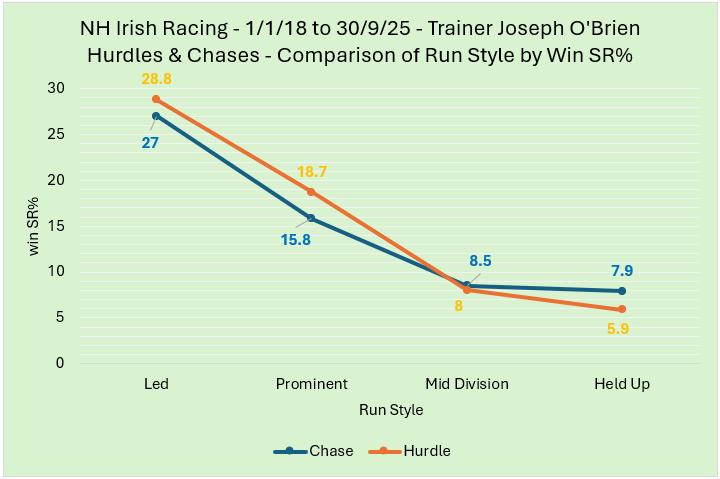
Like the other trainers discussed, O’Brien has worthwhile run style stats to share. Below is a graph showing the win percentages for each run style group in both chases and hurdle races:
Once again, we see front runners from his stable had a huge edge over prominent racers who in turn had a significant edge over horses that were held up or raced in midfield.
**
I hope this article has served two purposes. Firstly, I wanted to show that research can be undertaken very quickly to generate useful stats and across a variety of areas; and secondly, I have shared some data relating to the highest volume Irish trainers which we should be able to use to our advantage this coming winter and beyond.
Finally, I hope some members will be tempted to use the content here to inspire your own research using Query Tool, Pace Analyser and the other tools in the Geegeez Swiss Army Knife.
Until next time...
- DR
https://www.geegeez.co.uk/wp-content/uploads/2018/04/mullins_elliott_fists-1.jpg319830Dave Renhamhttps://www.geegeez.co.uk/wp-content/uploads/2022/10/geegeez_banner_new_170x78.pngDave Renham2025-11-05 09:53:332025-11-05 09:53:48An Irish National Hunt Trainers Analysis
On a day when Ascot’s Champions Day supplied winners at 200/1 and 100/1 for home stables, two of Ireland’s biggest yards were at it elsewhere, writes Tony Stafford. It came as little surprise when Aidan O’Brien had the first five and then mercifully allowed someone else to get on the scoresheet before making it six on the day back home at Leopardstown.
With several multiple opportunities through the card, it wasn’t easy to identify which would be the better, notably in the fifth, the Group 3 Killavullan Stakes. This went to 13/8 second-best Dorset in the Derrick Smith silks, after getting first run on the Michael Tabor colours on 6/4 favourite Daytona, clear of the rest and much to the mirth of the two gentlemen concerned back at Ascot.
I doubt whether even they or their trainer would have been able to predict all six beforehand. If they had, it was around a 1,150/1 six-timer, eclipsing the 200/1 longest-ever Group 1 winning starting price recorded by the Richard Fahey-trained Powerful Glory back at Ascot. His victory in the Qipco Champion Sprint owed much to a Jamie Spencer masterclass amid the whoops and disbelieving on the straight course at Ascot where his age-old skills never dim.
Two races later I did venture into the paddock, when many of the connections stay to view their race on the big screen, to watch the Queen Elizabeth II Stakes. Horse racing can bring emotion far removed from everyday life and I swear I saw more than one very emotional woman and at least half a dozen men unashamedly crying as Charlie Hills’ Cicero’s Gift returned to unsaddle.
It was a day of days for owners Rosehill Racing and even jockey Jason Watson was wiping away a tear or two as he brought the unconsidered five-year-old back having edged out the big guns. Behind, a revived The Lion In Winter led home Alakazi and Docklands, with the disappointing pair Field Of Gold and Rosallion next home.
No doubt emotion in the entire Hills family was the order of the day just short of four months after Charlie’s father Barry, such a genius of a trainer, died at the age of 88. I snatched a few words with Barry’s widow and Charlie’s mum Penny earlier in the day. Afterwards I recalled one day driving down Fulham Palace Road in West London a decade or more prior, passing Charing Cross Hospital where Barry was being treated for cancer and seeing Penny on her way out having visited him, as she did every day during his illnesses.
She looked great on Saturday and I’m sure she felt that her son, often under-valued by ultra-critical people in racing – not always the kindest of arenas – had gone a long way to silencing his critics. After all, hadn’t he also won the Grade 2 Woodford Stakes at Keeneland two weeks earlier with the nine-year-old Khaadem, partnered by Frankie Dettori? That Fitri Hay-owned sprinter had won the Group 1 Queen Elizabeth II Jubilee at Royal Ascot both in 2023 and last year. You don’t keep top-class horses going that long into a career without having a real talent for the job.
Frankie no doubt would have been keeping an eye on matters at Ascot on the 29th anniversary of his unique seven-race through-the-card feat. I saw Gary Wiltshire at Chelmsford on Thursday night and he’s still dining out on how he lost £2 million laying the last winner of that septet. I won’t ever forget it either, having to write an extra chapter for the book Year in The Life Of Frankie Dettori, ready to go as it was then.
Gary’s latest book detailing those days is a steady seller, and I hope Victor Thompson’s Eighty Years in the Fast Lane, also published by Weatherbys will get a nice response. I helped Victor and his partner Gina Coulson put it together, and the final piece in the puzzle came with Nick Luck’s stylish and heart-warming foreword last week. Publication should be at the end of this month.
If ever I write another book of my own, the title ought to be “I digress” (!), because almost the most unlikely eventuality of all those remarkable Saturday feats was occurring over in the US at Far Hills racecourse in New Jersey.
Gordon Elliott might have been bullied almost into submission in the top races over the years by Willie Mullins, but he certainly knows how to pick his spots. He sent a team of horses to the US’s biggest day of jump racing in both prestige and money terms on Saturday and won five, including their Champion Hurdle and Grand National.
Jack Kennedy, happily recovered from his latest injury, rode four of them, giving way to Danny Gilligan on Coutach in the £72k to the winner Champion Hurdle. Pride of place goes to the last of the quintet, Zanahiyr, an Aga Khan-bred son of Nathaniel, Enable’s sire. Nathaniel, at the age of 17, has been making enough of a revival to stand at an increased £20k at Newsells Park Stud. Graham Smith-Bernal, Newsells’ owner, was still bubbling over another sales triumph (3.6 million gns) even though only second of the pile at Tattersalls Book 1 for a son of Frankel, sold of course to Amo Racing.
Zanahiyr collected £120k for his neck success over fellow Irishman, the Gavin Cromwell-trained Ballysax Hank. He’s another versatile type having won the Summer Plate at Market Rasen (a race won the previous year by geegeez syndicate horse, Sure Touch, which also followed up there this week) and collected a 1m6f flat race on home turf before his trip to New Jersey.
Cromwell had fulfilled a long ambition when sending out Stumptown, a regular in good handicap chases, to win the Velka Pardubicka over the fearsome obstacles at Pardubice, Czech Republic, the previous weekend.
In all, Elliott’s five pulled in a total of £300,000. It’s to his credit that he’s come through the dark days and the ban that followed that infamous photo with ever more energy and operational dexterity.
Judged on recent events Elliott, Cromwell and Joseph O’Brien will be ever more visible going for the top UK prizes this winter when the home defence, with one or two exceptions, might struggle to withstand them – never forgetting the imperious Willie Mullins.
I hear a whisper that the champ already has earmarked the horses he intends to line up for the five Grade 1 races that were the fixture for so many years for the opening day at Cheltenham’s Festival meeting next March. One of the stable’s most ardent followers was bemoaning the rearrangement of the four-day programme that as he says dilutes the top races through the week. Maybe it’s a response by bookmakers sick of having their pants down and bottoms smacked every year by Wearisome Willie!
I digressed and did so again. What a day. We saw a proper middle-distance champion in the French gelding Calandagan, too speedy for the rest and ridden with great tactical awareness by Mickael Barzalona, two weeks on from his Arc de Triomphe win on Daryz. An early test of that form was Kalpana’s easy repeat win in Saturday’s Champion Filly and Mare race, soon clear in the straight and never tested in repelling a late thrust from Estrange. That striking grey ran a blinder considering the unsuitably fast ground.
John Gosden seemed more pleased to have ended the three-race tussle with Delacroix (who finished fourth) on the credit side, two-to-one, than worry about Osbudsman’s being beaten by the French raider who, like Daryz, is trained by Francis-Henri Graffard.
In that race I was astonished that Delacroix hadn’t finished in front of outsider Almaqam, trained by Ed Walker, especially as my vantage point was as near to level with the winning line as it can get. Certainly, it’s better than from the Royal Box fifty yards further down the straight!
Again, there was chat about Christophe Soumillon, even after winning the Two-Year-Old Conditions race on Mission Control for the Coolmore team and O’Brien. In the big one, he was ahead of both Calandagan and William Buick on Ombudsman turning for home but then was swamped by a pincer movement from behind, immediately losing his nice pitch. I doubt he would have troubled the winner, but he might have been in another close fight with the Gosden horse had he kept out of trouble. Most of us thought he ought to have done better in the finish for third too, but I’ve talked about his coming unstuck in photos before.
Then again, having had a chip each way (forget which of my old-time friends used to say that!) on Karl Burke’s Holloway Boy in the closing Balmoral Handicap, the one handicap on the day, my eyes again deceived me. I knew Crown of Oaks had won to give yet another big handicap to William Haggas but was sure Holloway Boy, in his first run since Meydan in April, was a narrow outright second.
Once more, I was wrong, the dead-heat announcement being a further surprise. Talking of Holloway Boy he, like the fifth-placed favourite Native Warrior, is trained by Karl Burke, one trainer inexorably moving up the ladder.
A reflection of that is how he’s now winning races overseas, too. Yesterday in the Group 2 Prix du Conseil de Paris at Longchamp he reversed Balmoral Handicap fortunes with Haggas, Convergent getting the better of his rival’s Dubai Honour by a neck.
Native Warrior was one of five Wathnan Racing runners on the day, from four different stables, all ridden by James Doyle. His is a fantastic job and one that can only get better as the owners and Richard Brown extend their tentacles.
There are still a few rungs to go before Karl Burke makes the top three in his peer group. After Saturday’s skirmishes, when O’Brien, Andrew Balding and the Gosdens each had one winner, it’s status quo in the UK trainers’ title race, with Aidan now guaranteed another triumph. If he wins the Futurity at Doncaster on Saturday, he’ll nudge over £8million in prize money.
Finally, after a day with more to mention than space warrants, on the way out I bumped into old pal Graham Thorner, former trainer and Grand National winning rider. I suggested that Ascot remains unique in that it attracts massive crowds for all its dates and that I’d never seen so many young people at a race meeting before. He agreed. Whatever Ascot’s blueprint for success, they should make sure they pass it on to less successful venues.
- TS
https://www.geegeez.co.uk/wp-content/uploads/2025/10/CicerosGift_QEII_Stakes_Ascot_2025.png319830Tony Staffordhttps://www.geegeez.co.uk/wp-content/uploads/2022/10/geegeez_banner_new_170x78.pngTony Stafford2025-10-20 05:36:592025-10-19 16:42:33Monday Musings: A Five and a Six Away from Ascot
Zanahiyr made a welcome return to the winning ways in the Kinlay Hostel Chase on the final day of the Galway Festival.
Third in the 2023 Champion Hurdle, Gordon Elliott’s one-time Triumph Hurdle favourite was third in the Galway Plate last year and was making his second appearance of the week at the Ballybrit track after finishing seventh and well held in this year’s feature chase.
Sent off 9-4 in the hands of Jack Kennedy, this was far from an easy assignment with Willie Mullins’ Blood Diamond the odds-on favourite, but the eight-year-old rolled back the years to strike for the first time since shedding his maiden status over fences in February 2024.
Kennedy said: “Delighted for the horse. He’s been a great horse, placed in Champion Hurdles and it’s nice for him to get his head in front today.
“I was happy enough to tip away in front, I didn’t go mad, and it worked out well.
“He was brilliant at the last two in the dip and is better when you are going on with him and not getting in too tight.
“It’s been a great week.”
Elsewhere John McConnell’s Ballystone kept on well to win in the Kenny Galway Peugeot Handicap Hurdle.
It was a dream success for his jockey Alex Harvey who was full of praise for the 14-1 scorer.
Harvey said: “He’s a lovely horse, very genuine. I got a lovely run around on the inside and it was just a matter of holding onto him and pressing the button.
“He put his head down on the run-in and galloped away to the line.
“The ground was a question as he wants a bit of nicer ground. To be honest it’s just the slow side of good bar the straight which is borderline heavy.
“He’s progressive and I can’t wait to see him over a fence.
“I’ve been coming here since I was a kid and you dream about having a winner so to have two in the week is unbelievable.”
https://www.geegeez.co.uk/wp-content/uploads/2025/08/2.81178062-scaled.jpg12802560Geegeez Newshttps://www.geegeez.co.uk/wp-content/uploads/2022/10/geegeez_banner_new_170x78.pngGeegeez News2025-08-03 14:33:512025-08-03 14:33:51Zanahiyr gets back to winning ways at Galway
Last year’s runner-up Ndaawi was called the winner of the Guinness Galway Hurdle after first past the post Helvic Dream was demoted by the stewards.
It is 20 years since trainer Noel Meade saddled his most recent winner of the Ballybrit highlight in More Rainbows but he had come close on several occasions since, while Ndaawi’s trainer Gordon Elliott had never won it previously.
Helvic Dream, a Group One winner on the Flat for Meade in the 2021 Tattersalls Gold Cup, was an 8-1 shot in the hands of Donagh Meyler and settled down to fight it out with the 13-2 shot Ndaawi and Jack Kennedy in the home straight.
However, the pair did come close together all the way up the run-in as both horses and jockeys gave their all, with Ndaawi short of room against the far rail, and while Helvic Dream passed the post a head in front the stewards felt the interference was significant enough to reverse the placings.
Elliott, completing a big-race double after landing Wednesday’s Galway Plate with Western Fold, said: “We have won most of the big handicaps so this is the race I wanted to win, although it is not a nice way to win.
“Noel is one of my greatest friends and there isn’t a day goes by that we don’t talk and we have great banter, but that’s the way it goes unfortunately.
“The stewards have their jobs to do, Jack said it straightaway after the race and I was talking to Ruby (Walsh) as well and he felt we would definitely get it.
“It is unbelievable to win the two big races here this week and the horses have all run well, I can’t believe it.”
Noel Meade intends to appeal the decision (Damien Eagers/PA)
On future plans for Ndaawi, the trainer added: “There is a $150,000 Flat race in America for him in October now.”
Meade later indicated he will appeal the decision.
He told Racing TV: “I didn’t think we’d lose it, considering the race and considering Jack didn’t have to stop riding.
“I do believe in my heart and soul it’s the wrong decision and I will appeal it.”
Western Fold ran out a comprehensive winner of the Tote Galway Plate for Gordon Elliott and Danny Gilligan.
Only six, the winner had been successful on his last two outings but was 10lb higher than when winning the Mayo National at Ballinrobe last time out.
Amirite led the field until the final two fences but that was when Gilligan moved into contention going ominously well, along with Noel Meade’s Jesse Evans, who, having been runner-up in the Galway Hurdle twice, went on to fill the same position in the Plate.
It was all about Western Fold (11-1), however, who won by four and a half lengths with Shecouldbeanything back in third, a stablemate of the winner.
Elliott and Gilligan were successful in the Plate two years ago with Ash Tree Meadow while it was a fifth win in the race overall for the trainer.
The favourite, Nurburgring, aiming to join an elite list who have won the Hurdle and Plate, made an early mistake and was never competitive.
“He’s a right horse. Bobby O’Ryan bought him for David (L’Estrange) and John (Wright, owners) and the boys have been very patient with him, he was a bit backward when he was young,” said Elliott.
“This race has been the plan for a while so I’m delighted the lads are here, it’s a dream for the lads to be here and win the race. Bobby put the syndicate together so all credit has to go to him.
“Everything worked out great. Danny got away at the start and the horse jumped like a buck, I think he just missed one into the dip. Everything went right and it was poetry in motion.
“I thought it (10lb rise) might be enough to stop him to be honest, I was worried.
“I’d say the ground is the key to this horse, he likes a bit of nice ground. He’s a very nice horse.
“My Dad’s in hospital so he’ll enjoy watching this and hopefully it will cheer him up.
“He’ll be out, hopefully, for the football in Summerhill on Saturday. He’s watching it in hospital so hopefully it gives him a lift.”
Earlier on the card, Hipop De Loire saw his odds cut for the Sky Bet Ebor when taking the opening Tote #50,000 Guaranteed Placepot Today Maiden Hurdle for Willie Mullins.
Sent off the 4-9 favourite for his first hurdling start since running at this meeting last season, he obliged in style, recording an emphatic 11-length victory over Tony Martin’s Zanndabad.
Paddy Power now make him 7-2 to better last year’s fifth in York’s feature handicap and provide the master of Closutton a third victory in the race after Sesenta (2009) and Absurde (2023).
“He came to us last year. He ran a cracker here in Galway and ran a really good race in the Ebor, which I think we’ll probably head back for now after that,” said Mullins.
“Looking at him jumping there he was electric for a horse having his second run over hurdles, coming from Poland. The only jumping he did was in our place.
“His Ebor run was a hell of a run. Hopefully we can go back this year, get a bit more daylight and keep out of trouble.”
As we start a New Year, I want to examine the performance of Irish trainers when they send runners to the UK, writes Dave Renham. The focus of what follows is National Hunt racing, and I have taken data going back ten years, to 2015. Profits/losses are calculated to both Industry SP and Betfair SP.
Now, I am sure virtually everyone reading this will be aware of the excellent record of Irish trainers versus the British trainers at the Cheltenham Festival in recent years. So let's begin by reviewing this. Subsequently, I will delve deeply into the broader picture to see if there are any angles that, as punters, we may be able to take advantage of.
Cheltenham Festival
This four-day feast of racing will be upon us sooner than we think – March may be two months away, but the time soon flies by. Below is an overall table directly comparing the Irish trainer record at the Cheltenham Festival with their British counterparts.
It's hardly breaking news, but the Irish have been so dominant in this time frame; they have a much higher strike rate - well over double - and in terms of returns they have trounced the British in at both SP and BSP. It should be noted that Irish trainers outperformed British ones in the ten years prior to that (2005 to 2014), too, but the gap was closer, certainly in terms of win percentage (Irish won 7.9% of races compared to 4.6% for the British).
It's time now to start a deeper dive into the overall Irish performance. To begin with here are the stats for all Irish runners in the UK since 2015:
As the table indicates, there have been blind losses to SP of around 17 pence in the £, but a small 4p return to BSP. Taking the Cheltenham Festival out of the equation produces a small loss to BSP.
Time to drill down into the Irish / UK performance across different parameters...
Performance by Year
From this starting point I am going to look at some yearly data. For this I have used a method based on a Nick Mordin idea that I've previously used in recent draw bias articles; this approach helps to avoid individual year fluctuations which can make possible performance changes harder to pick up. I am using rolling four-year timeframes to help spot any patterns. Here are the four-yearly data in terms of returns to BSP.
The graph shows each four-yearly time frame has produced a profit to BSP which is clearly noteworthy. However, the last couple of years (2023 and 2024) have been losers, hence the recent drop in the 2021-2024 figures. It looks as though the market has now fully 'cottoned on' to current Irish dominance.
Here are the A/E indices using the same principle:
The highest A/E index of 0.95 was seen in the period from 2018 to 2021 which coincides with the best period in terms of Betfair SP returns. Also, the recent BSP drop off is mirrored here.
Taking this performance as a whole, the stats are impressive. Irish raiders have consistently made punters money over the past ten years if betting on the exchanges. Of course, there are plenty of big prices that help to inflate these results but, even so, the results are highly noteworthy.
Performance by Course
We have seen some course data already in terms of Cheltenham, and its Festival in March. Below are the overall Cheltenham course figures along with any other course that has seen 100 or more Irish runners during this ten-year time frame.
All of the Cheltenham BSP profit was procured at the Festival. A very small loss has occurred when combining all other Cheltenham meetings together.
In terms of the other courses Aintree is one to mention: runners at the Liverpool track have done extremely well considering the BSP profit is not badly skewed by big priced winners. Indeed, focusing on Irish runners at Aintree priced at 8/1 or less (industry odds), they would have produced a profit to both SP and BSP. Specifically, 57 of them won from 246 qualifiers (SR 23.2%) for an SP profit of £21.86 (ROI +8.9%); to BSP profits were £53.19 (ROI +21.7%). As you would expect a big proportion of these runners ran at the Grand National meeting in April.
Of the lower profile courses, Perth’s positive BSP figures are entirely down to one 200/1+ BSP winner, while Cartmel’s figures are not as bad as you may initially think. When concentrating on horses priced 8/1 or less at SP, Cartmel runners have also seen a small profit to BSP to the tune of £10.05 (ROI +5.2%). The outsiders at Cartmel have been the ones to avoid with 0 wins from 75 for horses priced 14/1 or bigger.
Performance by Race type
I would like to compare chases, hurdle races and bumpers (NH Flat) next. Here are the splits:
Hurdle races have produced a healthy profit to BSP, although as one would expect this has included a few big odds successes. There have been five wins at 100/1+ BSP to be precise and all hurdlers priced in three figures have combined to produce around 75% of the hurdling profit. Having said all that, six of the ten years has seen a blind hurdling profit to BSP with two of the four losing years showing very small losses. Focusing on shorter priced runners of 12/1 or shorter would have seen a break-even scenario. Hence, it is fair to say Irish hurdlers have performed well as an overall group. Before moving away from this section, both non-handicaps and handicaps have offered positive hurdling returns. Non-handicappers have returned 16p in the £, handicappers 9p.
Performance by Industry SP
A look at the results in terms of SP prices now.
There have been only small losses for shorter priced runners (5/2 or shorter). One can surmise that with a little bit of additional form study one could probably have narrowed down this group of runners in terms of which ones to back, with the potential to edge into profit as a result.
At the other end of the spectrum, horses priced 28/1 or bigger would have secured a very big profit if backing them all to Betfair SP. This will come as no surprise based on the information shared to date in this article about some big prices having gone in. While I am sure many of you are writing off the idea of backing such big-priced runners due to the fact that for such a method to work you probably need let’s say those monster 100/1+ winners hitting the mark more than they statistically should; or at least the prices of most of the winners offering value. However, the point is that one or both of the above has happened.
If we compare the results of horses priced 28/1+ in terms of British runners versus Irish runners, we see that British horses have won less than 1% of the time (0.97%) and produced losses of 56p in the £ to SP, and losses of 20p in the £ to BSP. Irish-trained runners priced 28/1+, as the figures in the table show, have won over 1.7 times more often than their British counterparts and the returns have been better by 39p and 63p in the £ respectively.
Of course, it takes a brave person with a large betting bank playing to small stakes to back very big odds runners regularly. Huge losing runs undermine confidence and if the tank is not set up appropriately, it could easily run dry. However, I found that this has not been a one-off after checking the record of Irish runners priced 28/1 or bigger from an earlier time frame (2008 to 2014). I haven’t gone back further in time because 2008 was the first full year that the Betfair Starting Price was used. Overall, during these seven years the bigger priced Irish raiders won 1.51% of the time (17 wins from 1127) for a profit to BSP of £725.31 (ROI +64.4%). Excellent overall returns once again – hence I am wondering whether anyone might be tempted to back such runners in the future. I, for one, will be keeping tabs on it.
Performance by Race Class
I want now to assess the class of race and whether it makes any difference either positively or negatively with regards to Irish performance in UK NH racing. Let me share the Betfair SP Return on Investment percentages (ROI%):
The chart has the highest classes of race on the left, starting with Class 1 races, moving through to the lowest class of race on the right, namely Class 6. It seems the better the class of race the more profitable for backers of Irish runners. Put simply, the highest three classes have produced profits, the lowest three losses. The BSP results for the two lowest Classes (5 and 6) have produced significant losses and it looks best to avoid these races.
If we look into Class 1 races in more depth, we see that Irish runners in all three types of Graded race (1, 2 and 3) have made a profit.
Don’t be put off by the low Grade 3 win strike rate as these contests, all handicaps, have averaged 20 runners per race over the past ten years. The class / graded data suggests to me that the Irish target the better races with higher prize money. That makes sense given the travelling costs and so on.
Before moving on I want to compare these Graded results to the record of British-trained runners during this period. Firstly, let me compare the strike rates, both win and each way:
Irish runners are ahead in all six comparisons and significantly so in Grade 1 and 2 contests. Now let me compare their A/E indices:
Again, the Irish runners have been completely dominant over their British counterparts offering better value across the board.
Performance by trainer
Trainer data is always popular so I will share the results for all Irish trainers who have sent 100+ runners to contest UK National Hunt races during this time frame, as long as they had at least one runner in 2024. The table is ordered by win strike rate.
The big guns of Willie Mullins and Gordon Elliott have sent a significant number of runners across the pond with good success. However, making a profit from either is not so easy due to their reputations; rheir runners do not go unbacked very often.
A few trainers in the list have shown a profit to BSP, but Gavin Cromwell and John McConnell’s results are the most impressive as they have not had a huge BSP winner to skew their results. Here are some additional stats for these two starting with Cromwell:
1. Cromwell has sent 36 runners to the Cheltenham Festival during the study period, of which six won (SR 16.7%) for a profit to SP of £20.63 (ROI +57.3%). This increases if backing to BSP to the tune of £36.20 (ROI +100.5%)
2. Sticking with Cheltenham, Cromwell's record at all other meetings at the course stands at 10 wins from 45 (SR 22.2%). Profits to SP have been £7.60 (ROI +16.9%), to BSP £11.36 (ROI +25.2%)
3. LTO winners from the stable have fared exceptionally well thanks to a 25% strike rate (16 wins from 64). Returns to SP were nearly 66p in the £, to BSP this increases to over 90p
4. Horses that started in the top two of the betting won 33 times from 105 runners (SR 31.4%) for a profit to SP of £8.74 (ROI +8.3%); to BSP £15.34 (ROI +14.6%)
Now onto McConnell:
1. Horses that finished in the first three LTO have been worth following thanks to 50 wins from 167 runners (SR 29.9%) for an SP profit of £23.22 (ROI +13.9%). To BSP this improves to £46.15 (ROI +27.6%)
2. McConnell's male runners have won almost twice as often as his female runners (26.6% versus 13.7%)
3. Horses that started favourite made a small SP profit of £8.16 (ROI +10.2%) thanks to a strike rate of 52.5% (42 wins from 80). Returns to BSP have edged up to just over 14p in the £
4. Hexham has been a good course for McConnell with 11 wins from 22 (SR 50%). He is only one win from 24 at the Cheltenham Festival, but at all other Cheltenham meetings combined he has saddled 10 winners from 44 (SR 22.7%) for an SP profit to £26.88 (ROI +61.1%); to BSP +£43.06 (ROI +97.9%)
-------------------
I hope this article has offered up some potential betting angles on Irish runners. It is widely known how well Irish runners perform at the Cheltenham Festival, but they also have competed extremely well at Aintree. In fact, Irish-trained horses' performance at Aintree is arguably more impressive than it has been at Cheltenham.
Bigger priced runners sent from Ireland to UK should not be totally written off as far more have won than statistically they should. Graded events have seen the Irish enjoy a clear advantage over British-trained runners, while the lower classes of 5 and 6 are generally races to avoid from an Irish perspective. There are two trainers that are worth keeping a particular eye on, namely John McConnell and Gavin Cromwell.
We have all heard the saying ‘the luck of the Irish’ but I think in UK NH racing terms there is a good bit more to it than that.
- DR
https://www.geegeez.co.uk/wp-content/uploads/2025/01/GavinCromwell_PatrickMullins_FlooringPorter_StayersHurdle_Cheltenham2022.jpg319830Dave Renhamhttps://www.geegeez.co.uk/wp-content/uploads/2022/10/geegeez_banner_new_170x78.pngDave Renham2025-01-07 10:02:172025-01-07 10:02:17Irish Trainers in UK National Hunt Racing
What a lovely Saturday afternoon, writes Tony Stafford. Sky Sports Racing – now on my Now TV sports package, if you please – had all three UK cards. Thus, there was a constant flow of high-class jumping from Newcastle, Doncaster and, above all, Newbury suggesting that all may not be quite so gloomy where our sport is concerned.
Alex Hammond, Mick Fitzgerald and Jamie Lynch provide a refreshing balance of experience, insight and regional accent and they were in their element, especially Mick, as his old boss Nicky Henderson was on one of his very good days. The former stable number one showed he keeps a keen, close acquaintanceship.
Basically, he knows where the Seven Barrows horses go to work at home or, at important times, away and even, no doubt, what they had for breakfast.
The Henderson highlight, of course, was super-sub Sir Gino, nimbly stepping in after his work with Constitution Hill at Newbury suggested he might have made up a chunk of the 23lb that officially separated them in the BHA handicap.
Lameness was the reason for the former (2023) Champion Hurdle winner’s absence from Saturday’s Fighting Fifth Hurdle at Newcastle. It could turn out in time that Henderson might not have needed to search so intently for a reason <lame excuse?> to explain the gallop’s outcome.
Saturday’s field seemed to contain only one horse capable of challenging the previously unbeaten Henderson four-year-old. That was Mullins’ superbly bred Mystical Power, result of a union between perennial (but deceased) champion flat-race stallion Galileo and close-to unbeatable hurdling mare Annie Power, one of the stars of Willie Mullins’ long career.
Mystical Power was never going in a race where a couple of outsiders made the pace. Nico de Boinville moved Sir Gino out to challenge entering the straight and when he asked him to extend, the gelding did so thrillingly, winning by an ever-widening eight lengths from five-time winner (from eight runs) Lump Sum. It was Nicky’s eighth victory in the race.
Sir Gino started out with an unexpected debut win in France and, once “lifted” from under Harold Kirk’s and Mullins’ noses, went unbeaten last season, missing the Triumph Hurdle, but sorting out the Triumph runner-up, Mullins’ Kargese, by almost four lengths at Aintree. Constitution Hill’s performances still stretch far into the distance where even the best of the rest is concerned, but Sir Gino could just be getting a good deal closer, and his stablemate clearly hasn’t been as easy to train of late.
Until I checked on Sunday morning, I had no idea of Willie Mullins’ age or when he started his training career. It was a shock to see he’s 68 years old and took out his first licence 36 years ago!
That still makes him a novice compared with the six-years-older Henderson, who began training ten years earlier. The pair have been at the top in their respective countries for decades and the most pugnacious of opponents at every Cheltenham Festival meeting since Mullins got into his stride.
Paul Nicholls began as a trainer three years after Mullins, but with the credibility from his time as a jockey when he won two consecutive runnings of the then Hennessy Gold Cup on Broadheath and Playschool in 1986/87 for David Barons. How he ever managed 10st 5lb to ride Broadheath I can’t fathom, but then, when Ned Sangster can ride in amateur riders’ races on the flat at under 10 stone, I suppose anything is possible! Don’t turn sideways Ned, I won’t be able to see you!
Nicholls didn’t take long showing he had gone through a thorough apprenticeship. Towards the end of the Martin Pipe superiority after the turn of the century, when Pipe won 15 titles, Nicholls got ever closer, finally ending that one-sided era with a first triumph on a memorable final day at Sandown in April 2006.
Over the next 17 years, he and Henderson dominated, albeit heavily in Nicholls’s favour, 14 to four, with legends like Kauto Star and Denman to fuel the lavish prizemoney that decides the title. Henderson had collected twice in the 1980’s, so he has six.
Then, last April, it became evident that Willie Mullins, not content with 17 consecutive championships at home, was intent on dislodging either Nicholls or Paul’s former assistant Dan Skelton, and he duly achieved it with something to spare.
The statistics around this top three – Henderson, Nicholls and Mullins – are collectively most impressive with only Skelton in the UK likely to beat the trio to the top spot. Skelton’s wonderful training complex near Alcester, was built and designed on father Nick’s business acumen and Olympic Gold medal riding skills over many years.
Both Dan and younger brother Harry, already a champion jump jockey and potentially going close to another title this season, had their initial racing experience in Nicholls yard, as did emerging trainer Harry Derham.
In Ireland, Gordon Elliott has withstood what many thought would be a career-ending faux-pas a few years ago to come back even bigger and stronger.
Elliott’s stats are remarkable. After Saturday’s racing, in the season from May, Gordon had run 232 individual horses in 633 races, winning 86 and accruing €1,822k. Mullins, with 78 fewer horses (154) and from under half the runs, has 65 wins for €1,326k.
Skelton meanwhile in the UK has gone off at a fast pace, returning to getting as many wins as possible at the “phoney” first half of the season (May to October) before the real stuff begins. His stats are not far short of Elliott’s. He has run 196 horses for 484 runs, 96 wins and £1,247k. Nicholls has 47 wins and £845k from 114 horses and 194 runs. Slow-starting Henderson has 29 wins and £496k from 84 horses and 128 runs.
Henderson was at Newbury on Saturday, saddling two winners, both making their seasonal comeback. Nicholls, too, was content to let his Coral (ex-Hennessy) Gold Cup contender Kandoo Kid go to Newbury without a previous run this autumn and his judgment and that of rider Harry Cobden proved correct as he won comfortably from the favourite, Nigel Twiston-Davies’ Broadway Boy. Here the inherent dangers of punditry came to the fore, one of the trio (Mr Lynch I believe) suggesting the Coral Gold Cup rarely goes to a horse first time out. It did this time.
This was a fourth training win in the race to go with those almost four decades ago riding successes. We all remember Denman’s duo – the only thing we might have forgotten was that they were respectively 17 and 15 years ago!
It’s not only Nicholls whose former assistants rise to a high level after taking their leave. Henderson saw Tom Symonds, a former joint assistant with Ben Pauling, enjoying a prestige win with Navajo Indy in the Gerry Feilden Hurdle. The runner-up there, the former Oliver Sherwood-trained mare Queens Gamble, now with Harry Derham along with her former handler, was a good second first time out for a year, and she is the one I would take from the entire Newbury card.
Talking of Pauling, while his Henrys Friend was only fifth in the big race, he would have been much closer I’m sure had he not punctuated his otherwise great jumping round with a shattering mistake halfway down the back straight second time around. He was also making his return to action and should not be missed next time.
The previous afternoon at Newbury, Pauling showed his hand with another young chaser who could be winning the Coral Gold Cup next year. Carrying Harry Redknapp’s colours, The Jukebox Man made an exhilarating first run over fences in the John Francome Novices Chase, sponsored by Corals. Ben brought him along carefully through his bumper and hurdles seasons and he is now ready to reveal his true potential as a chaser.
I mentioned above the numerical strength of Elliott and Mullins in Ireland. Gordon had 17 runners on the Saturday Fairyhouse card but it wasn’t until the day’s final race, the bumper, that he had a winner. Most punters would have been expecting Ma Jacks Hill, a €310k acquisition for Giggingstown House Stud to land 4/5 favouritism, but he was only third to Elliott’s other runner, William Butler, a 25/1 shot. I hope Sir Mark Prescott’s assistant noticed it running and had a fiver on it!
Talking of expensive buys, the Sir Alex Ferguson colours had their first airing on the Nicholls-trained €740k acquisition Coldwell Potter at Carlisle yesterday. He and Harry Cobden treated the crowd to an exhibition from the front and won easily. That Nicholls fellow keeps persuading the boys to fork out the money. He won’t get back on top otherwise.
Staged at Down Royal racecourse in Ireland this Saturday’s (2nd November 2024) Ladbrokes Champion Chase(formerly the JNwine.com Chase) always attracts some of the best chasers from both England and Ireland.
Run over 3m the Grade 1 contest has been won by greats such as Kauto Star, Beef Or Salmon, Looks Like Trouble and Florida Pearl in the past.
With top UK trainer Paul Nicholls winning 5 of the last 17 renewals then anything he sends across the Irish Sea should be respected, while the powerful Gordon Elliott camp have also saddled four of the last 9 winners.
Elliott and Nicholls are the joint-winning trainers - both with five successes.
While it's a race the Gigginstown House Stud horses have done very well in recently - they've won the race seven times since 2013.
Here at GEEGEEZ.co.uk we are on hand with all the key stats head of the 2024 renewal – this year run on Saturday 2nd November 2024
Recent Ladbrokes Champion Chase Winners
2023 - GERRI COLOMBE (4/7 fav)
2022 - ENVOI ALLEN (7/2)
2021 - FRODON (3/1)
2020 - THE STORYTELLER (9/2)
2019 – ROAD TO RESPECT (5/2)
2018 – ROAD TO RESPECT (6/4 fav)
2017 – OUTLANDER (16/1)
2016 – VALSEUR LIDO (2/1 fav)
2015 – DON COSSACK (2/11 fav)
2014 – ROAD TO RICHES (9/2)
2013 – ROI du MEE (12/1)
2012 – KAUTO STONE (4/1)
2011 – QUITO de la ROQUE (11/4 fav)
2010 – KAUTO STAR (4/7 fav)
2009 – THE LISTENER (7/1)
2008 – KAUTO STAR (2/5 fav)
2007 – TARANIS (10/11 fav)
2006 – BEEF OR SALMON (11/4)
2005 – No Race
2004 – BEEF OR SALMON (Evs)
2003 – GLENELLY GALE (7/1)
2002 – MORE THAN A STROLL (20/1)
2001 – FOXCHAPEL KING (4/1)
Ladbrokes Champion Chase Betting Trends
20/22 – Had won at least a Grade 2 Chase before
18/22 – Had won over at least 3m over fences before
17/22 – Had won at least 5 times over fences before
16/22 – Aged 8 or older
16/22 – Returned 9/2 or shorter in the betting
15/22 – Had won a Grade 1 Chase before
14/22 – Finished 1st or 2nd last time out
13/22 – Winning distance 2 ½ lengths or more
12/22 – Having their first run of the season
11/22 – Had run at Down Royal before
10/22 – Winning favourites
8/22 – Won by a Gigginstown House Stud-owned horse (7 winners since 2013)
7/22 – Won their last race
6/22– Raced at Aintree last time out
5/22 – Trained by Paul Nicholls
5/22 – Trained by Gordon Elliott (4 of the last 9)
4/22 – Raced at Limerick last time out
Henry De Bromhead has won 2 of the last 7
The last 13 winners aged 9 or younger
The average winning SP in the last 10 runnings is 4/1
================================================
TRAINERS-QUOTES.COM
GET THE BEST DAILY TRAINER INFO FROM 13 TOP STABLES - Sent direct to your in-box!
We’re just about into the final third of the 2023-24 jumps season in the UK and Ireland and the concluding bumper at Fairyhouse on Saturday provided an interesting statistic, writes Tony Stafford. Its winner, the debutant Romeo Coolio, ridden by Mr Harry Swan for the Gordon Elliott team, was the trainer’s 155th victory of the domestic campaign.
This, from the once reviled but now it seems fully rehabilitated and still ebullient handler, was Elliott’s 300th individual runner of the season. It brings his prizemoney tally to €3,274k.
Until the last few days, he had been ahead of his great (and hitherto too-great!) rival Willie Mullins in all categories apart from strike-rate. Willie has had to make do so far with 254 individual horses, but his 168 victories (two at Punchestown yesterday) have careered him past Elliott a shade sooner than usual. By the time we get to May, no doubt, Mullins will I’m sure be back in his usual place at the top of the pile with all those big prizes still to be won. He stands on an interim €3,387K.
Two more were added to the first-time Elliott count at Punchestown yesterday and with lots more buys from the pointing and French fields to come, it might even be feasible to expect an end-of-season accumulation of 400, but let’s play safe and suggests it will be 350, as if that wouldn’t be totally unbelievable.
If Gordon were, say, to be content with just a 20-hour waking day – he should manage four hours’ kip surely! - then he could afford to give each of the three hundred a respectable four minutes of his attention – in between driving to the tracks and speaking to the media, not to mention living of course.
No doubt though, as the season has gone on, there has been a regular in-and-out process so that the horses that favoured summer ground and opposition are sent elsewhere until their optimum part of this year comes around. Or even sold.
Even so, you must reckon on a minimum of 200 boxes either at the main yard, or sprinkled around nearby to accommodate the hordes as they prepare for their races.
Planning programmes, making entries, and generally finding alternative objectives when the weather intervenes as has been the case lately, taxes the ingenuity. In some ways it’s easy. “There are five nice races at Punchestown next week,” he might say, adding “Put those ten in that one, that lot in the next” and so on.
Meanwhile Mr Mullins is doing the same thing at his only marginally less horse-swollen base, and hence the pair go head-to-head in almost every novice, conditions race and Graded event in the calendar. I’ve never forgotten Luca Cumani’s words, however. It might have been at the time he lost the Aga Khan’s horses when, in a pique, HH decided to have nothing trained in the UK. Luca always reckoned it was easier to train a lot of horses than a lesser number. You could find the time of day about them, he argued, as Luca certainly could.
Such is the Mullins/Elliott joint domination that only two other trainers have run more than 100 horses. Third in every category is Henry de Bromhead, who despite his Gold Cup and Champion Hurdle successes has been limited to exactly half as many horses as Elliott – 151. His 62 wins have come from 51 horses, and he’s almost on €1.1million. Almost without exception, UK trainers will be saying, “I should be so limited!”
Gavin Cromwell comes next in the list with 124 horses, €700k coming from 35 individual winners of 47 races. Philip Rothwell (26 from 76) and 34 wins from 353 runners is 5th to show the extent to which the sport across the Irish Sea is dominated by a cartel that has no inclination of going away.
No wonder Elliott bristled at the prospect of any restriction in the number of horses he could run in one race. His 15 of 20 in the Troytown last November might have been only a sample of what is to come given his relentless expansion. The possible limit of four in UK handicaps, especially the Grand National, will be welcome, though not for Elliott – if any of our trainers is equipped to take advantage.
On the flat and over jumps It’s a self-fulfilling numbers game. The two Premier race day cards at Kempton and Warwick on Saturday – to which a decent Wetherby programme was grafted on, drew only the minimal attention of Irish stables.
Mullins with a third and Elliott, a fifth place, had one visitor each, but Joseph O’Brien brought Banbridge to Kempton for the Coral Silviniaco Conti Chase and he beat Pic D’Orhy to remind us that he is indeed still training jumpers. Mullins was 3rd in this with Janidil.
At one time it seemed O’Brien would make a more significant challenge to the big two, but as he has been winning races like the Melbourne Cup (twice) and Group/Grade 1 races in Ireland, the UK, the US and Dubai, the concentration has understandably been more on flat racing.
In the present jumps season, Joseph has run only 36 horses in a total of 80 races and the 14 winners have collected 16 victories. His domestic tally of €311k is respectable in the circumstances. He clearly has quality rather than quantity in mind for the winter game.
One trainer aware of the possibilities offered by the dual Premier fixtures at Kempton and Warwick was Dan Skelton, holidaying in Barbados but still ably backed up by brother Harry, who rode a Warwick double, the former champion jockey and his wife Bridget Andrews among others supervising matters on course.
The numbers game truism holds here, too. Dan Skelton, while not yet in the scale of Ireland’s big two, has still sent 191 different horses to the races this season, easily the most among UK stables. On Saturday 9% of them – viz 16 – were dispatched to the three jumps meetings and they came back to Warwickshire with six winners, one second, four third places, two fourths and a sixth.
Skelton won the Lanzarote at Kempton with 33/1 shot Jay Jay Reilly, making his first run back over hurdles since early 2022. The trainer’s other major victory came with Grey Dawning, the gelding thrillingly going clear of his field in the Grade 2 Hampton Novices Chase at Warwick. Cheltenham beckons for both and many more I would assume from this target stable. His team will be one of the main defences against the onslaught of well-treated Irish “improvers” in many of the handicaps in seven weeks’ time.
It must be a shade frustrating in comparison with what a similar haul would have brought in Ireland or France, that six wins (worth £145k and those other places, yielded 180 grand, given the trumpeting of the new concept). It was still enough to carry him past Nicky Henderson into second slot in the UK trainers’ list.
Skelton’s 70 wins from 457 runners have earned £1,370k so he stands rather more than £200k behind his former mentor and perennial champion, Paul Nicholls. The Ditcheat master, hopefully now back on terra firma after the previous week’s abandon ship call came out in his flooded stable yard, has 72 wins from 306 runs (58 from 151 individual horses) and is just a tick short of £1.6 million.
Henderson has sent out 132 horses – a visitor to Seven Barrows might ask, “Where does he find room for them all?” – and 65 wins from 266 runs and £1,235k in prizes.
An unexpected name in fourth place is Venetia Williams, not that her talent isn’t well chronicled. In a way she defies the numbers element, even if she is comfortably behind the top three at £935k. The million should come. Her achievement is notable as she has sent out only 64 horses, 25 of them winning 38 races. Nicholls, Henderson and Williams are all operating at 24% whereas Skelton is at a relatively modest 15%.
As a one-time associate used to say – and sorry Mr Hatter I’ve used it many times, including here – “Everything is just different numbers.” It is.
The marvel of the Elliott/Mullins and to an extent Skelton achievement is to have control over such an obviously unwieldy model. How does a trainer do morning or evening stables as in the old days? I’ve been at Hughie Morrison’s yard a few years ago and the lad would present his horse as the trainer came along the line, asking how he was and checking limbs to satisfy himself. (Of course, unlike the old days when it was probably a maximum of two horses per lad, the 2020s model required a fair bit of nimbleness on the part of the grooms as they swopped to organise one of their other three or even four further on!)
You could picture Noel Murless or, from an earlier generational, Fred Darling, satisfying himself not only with the horses’ but also the lads’ appearance as he checked them off one by one. Evening stables at Elliott’s must be fun. By the time he gets round the lot, there wouldn’t be much time for a pint.
TS
https://www.geegeez.co.uk/wp-content/uploads/2018/04/mullins_elliott_fists.jpg319830Tony Staffordhttps://www.geegeez.co.uk/wp-content/uploads/2022/10/geegeez_banner_new_170x78.pngTony Stafford2024-01-15 05:12:052024-01-14 18:43:39Monday Musings: The NH Numbers Game
This is the third article in a series looking at the performance of some of the top National Hunt jockeys. Parts 1 and 2 can be read here and here. For this piece I will be heading over the water to examine the stats of three of the top Irish jockeys - Paul Townend, Jack Kennedy and Rachael Blackmore.
I have analysed NH data for racing from 1st Jan 2016 to 31st Oct 2023 with the primary focus being their respective records in Ireland. However, at the end of each jockey’s section I have shared a selection of their UK stats.
As with the first two articles the Geegeez Query Tool has been my ‘go to’ for data collection, and I have sourced further insights from the Geegeez Profiler to help with certain parts. Profits and losses have been calculated to Industry SP, but I quote Betfair SP where appropriate. All tables include A/E indices, and when any data has been pulled from the Geegeez Profiler Tool, I also share the PRB figures (Percentage of Rivals Beaten).
Let’s start with Paul Townend.
Paul Townend Overall Record
Below is Paul Townend’s Irish record across all runners during the study period:
A strike rate of better than one in four is comfortably the best we have seen so far in this series. The PRB of 0.66 is very high and the A/E index of 0.93 is comfortably above the average figure for all jockeys which stands at 0.87. Losses of nearly 16p in the £ to SP are a note of caution, however; to BSP this loss is reduced to just under 3p in the £.
Of course, Townend's overall win rate is so good because he rides primarily for the behemoth Willie Mullins yard – just over 65% of his total Irish rides have been for Mullins during this time frame. Below is his record with Mullins compared to all other trainers combined:
As we can see it is a staggering 34.2% strike rate when riding for Mullins in Ireland compared with 12.1% for all other trainers.
Paul Townend Record by Year
Yearly stats are my next port of call. Here is a breakdown by both win, and win/placed (Each Way) percentage / Strike Rate (SR%):
This graph is unlike any graph we have seen to date in this series. However, this is because in 2016 and 2017 Townend rode 239 times for Mullins but 534 times for other trainers. Since 2018 he has ridden 1443 times for Mullins and only 356 times for other trainers. Indeed, in 2022 and 2023 he has had 488 rides in total of which 475 have been for Mullins: just 13 for other trainers. As we have already seen, more rides for Mullins means better strike rates.
Paul Townend Record by Betting Odds / Price (SP)
A look next at his results by splitting them into different price bands:
The prices to concentrate on seem to be the shorter priced ones. Townend has almost broken even to SP with horses priced 13/8 or shorter. To BSP these runners would have made a small £21.10 profit (ROI +2.8%). Horses at the other end of the scale (16/1 or bigger) should be avoided if these past results are anything to go by.
Paul Townend Record by Race type
It is time to see if Townend’s record is better in chase or hurdle races:
He has ridden in far more hurdle races than chases, but his chase record looks slightly superior. When riding a clear favourite in a chase he has secured a strike rate of 54.3% (182 wins from 335) for an SP profit of £31.25 (ROI +9.3%). To BSP this increases a little to +£47.17 (ROI +14.1%).
Paul Townend Record by Racecourse
I am now going to look at all courses where Townend has had at least 100 rides. The courses are listed alphabetically:
His strike rate at Navan is modest by Townend's own standards but, thanks to a few double figure priced winners, he has edged into profit there. At Galway his stats are relatively poor, but Galway does stage highly competitive racing which could at least partially explain the figures. In contrast, the Tramore data are exceptional, hitting close to 40% of winners and showing excellent profits and a huge PRB figure of 0.75. For the record, in 2020 he won 8 of his 12 rides at the track and in 2022 won 8 out of 10.
Paul Townend Record by Run style
Time to look at an area that is still undervalued by some punters namely run style. Here is a breakdown of Paul Townend's run style performance in terms of win strike rate across ALL races:
This breakdown shows one of the strongest front running biases I have seen. A strike rate of 44% is mind-blowing. If you had been able to predict pre-race which of his horses went into an early lead you would have secured an SP profit of £40.60 (ROI +7.6%). Contrast that with the returns on all hold up horses, which would have produced significant losses of £197.00 (ROI -30.3%).
Let me also share his run style record when riding the favourite:
Front running favourites have produced outstanding results with prominent-racing favourites outperforming the other two groups.
Paul Townend UK data
Before moving on to our next jockey, let me take a quick look at Townend’s record in the UK. Overall, he has had 221 rides of which 38 have been successful meaning his strike rate has been 17.2%. (179 of his 221 rides have been for Mullins). His strike rate is lower here compared to Ireland as two thirds of his rides have come at Cheltenham with the majority of those being at the Festival. His Cheltenham strike rate is exactly 17% and you would have made a 10.7% profit if backing all his rides at the track. He is a rare visitor to tracks away from Aintree and Cheltenham, but at Perth he is 4 from 9 (SR 44.4%) for a profit of £5.50 (ROI +61.1%).
Possibly the most interesting UK stats are related to market position. Backing Townend on favourites would have lost you nearly 22p in the £; backing him on second favourites this worsens to losses of over 64p in the £. However, if backing runners from outside the top two in the betting you would have made an SP profit of £49.00 (ROI +41.5%).
*
Jack Kennedy Overall Record
Jack Kennedy’s record across all Irish races is as follows:
Kennedy is close to hitting 17% in terms of win rate, with a slightly above average A/E index and a decent PRB figure. Losses have been around 20p in the £ to SP which is still some way below the average. To Betfair SP you would have turned that loss into a small profit of £112.36 (ROI +4.2%). However, one big-priced Betfair winner (168.49) is responsible for that.
My next port of call is looking at his yearly figures.
Jack Kennedy Record by Year
Below we see the yearly breakdown by strike rate - both win, and win/placed (Each Way):
In general, we have seen an uptick in the past four years with 2020, 2022 and 2023 seeing win percentages more than 20%. 2021 looks disappointing from a win perspective but the each way figure suggests he was perhaps a little unlucky that year. This was also the year when his main trainer, Gordon Elliott, was suspended for six months, which is surely a contributory factor.
While discussing each way stats they have also been much stronger since the start of 2020.
Jack Kennedy Record by Betting Odds / Price (SP)
I would like to look at the market now and I am splitting results up by the same Starting Price bands as earlier:
The shortest price band (Evens or shorter) have actually nudged into a miniscule profit. Horses priced 4/1 or shorter have completely outperformed those 9/2 or bigger when looking at returns and A/E indices. To BSP, horses priced 4/1 or shorter have made a small profit to £1 level stakes of £30.21 (ROI +3.2%). Overall, it looks worth avoiding bigger priced runners ridden by Kennedy.
Jack Kennedy Record by Race type
Under the microscope next comes Jack's record in hurdle races and chases.
We have a very similar set of figures for both race types. However, it is worth splitting the hurdle stats into handicap versus non-handicaps. In non-handicaps his strike rate has been 21% with SP losses of 11p in the £; in handicaps the strike rate drops to under 10% (9.1%) with losses of 40p in the £. To BSP non-handicaps have made a profit of £214.60 (ROI +18.1%), handicaps have still made a significant loss of £187.96 (ROI -28.1%).
Jack Kennedy Record by Racecourse
It is course data next for Kennedy. As earlier, 100 runs at a track is the cut off point for the table:
Kennedy has crept into profit at just Down Royal thanks mainly to an excellent strike rate of over 28%. He has a very good record on favourites at this track winning on 20 of the 31 of them. Not only that, of the other 11 he has finished placed on nine. Backing all Kennedy-ridden favourites at Down Royal would have yielded an SP profit of £10.45 (ROI +33.7%). To BSP this nudges up slightly to £11.69 (ROI +37.7%).
Jack Kennedy Record by Trainer
Nearly 80% of his rides have been for Gordon Elliott and their record together is much stronger than when we combine Kennedy with all the other trainers he has ridden for. Here are those splits:
It is interesting when we revisit the Down Royal stats in terms of trainers. When teaming up with Elliott, Kennedy is 35 from 96 (SR 36.5%), all other trainers have provided just one win from 20.
Jack Kennedy Record by Run Style
Let me look at the run style splits next starting with win percentages:
His front running record is excellent and if you had been able to predict pre-race which of his horses went into an early lead you would have secured an SP profit of £61.57 (ROI +21.5%). Conversely, backing all hold up horses would have seen huge losses of £314.42 (ROI -51.3%).
Let me also share his run style record when riding the favourite:
It is the same powerful message that we have seen numerous times before. It is remarkable to think that front-running favourites have been twice as successful as held up favourites in terms of win percentage.
Jack Kennedy UK data
Before moving onto Rachael Blackmore, a quick look at Kennedy's UK stats. He is not a regular visitor and comes primarily for the big two festivals at Cheltenham and Aintree. His overall UK record reads 17 wins from 123 (SR 13.8%) for an SP profit of £45.31 (ROI +38.8%). He has had three winners priced between 20/1 and 25/1 which skew the profit figure somewhat. At Cheltenham he has had 11 wins from 76 (SR 14.5%), while at Aintree he has won 4 races from 25 rides (SR 16%).
*
Rachael Blackmore Overall Record
Rachael Blackmore burst to prominence in 2021 when she not only won the Champion Hurdle at Cheltenham but she also became leading jockey at the Festival, a month before being the first female jockey to win the Grand National, on Minella Times. A year later she repeated her win in the Champion hurdle and followed it up with success in the Gold Cup: it is quite a CV she is building. I will look at her UK stats at the end of this section, but let me start with Irish data and her overall record there:
Her overall figures look moderate, especially when comparing them to the other jockeys we have looked at to date in this series. However, to BSP losses have been massively reduced to just 3p in the £ rather than 23p. We do need to examine her yearly stats as they will paint a clearer picture.
Rachael Blackmore Record by Year
Below we see her yearly breakdown by strike rate - both win, and win/placed (Each Way):
As you can see, she started from a very low base in 2016 winning less than 7% of the time. Compare that with the improved record from 2018 which coincides with getting more rides for trainer Henry de Bromhead. 2021 was her best year in terms of both win and each way strike rates.
Rachael Blackmore Record by Betting Odds / Price (SP)
Time to examine different price bands to see if any patterns emerge:
We see a similar trend here to both Townend and Kennedy, where shorter priced runners have been better value. Horses sent off at evens or shorter have made a profit, albeit only just. Once the prices hit 9/2 or bigger the results are relatively modest.
Rachael Blackmore Record by Race type
It is chases versus hurdles next:
The returns on investment (ROI) for each group are within 1% of each other. She has a better SR% in chases, but this is more down to field size than anything else (average field size in hurdle races is bigger than in chases).
Rachael Blackmore Record by Racecourse
Splitting Rachael's results up by course next. 100+ rides again to qualify:
Just one course has seen a strike rate higher than 20% which is Naas, standing at 23.8%. Blackmore has made decent profits there, too, and her A/E index of 1.31 is also excellent. She has had winners at 25/1 and 22/1 at Naas, but she has made a solid profit with shorter priced runners, too. Indeed, focusing on Naas runners from the top two in the betting, you would have been rewarded with 22 winners from 50 (SR 44%) for an SP profit of £16.98 (ROI +34%). Tipperary has edged into profit, and she has a good record on favourites there (13 wins from 28) returning 19p in the £ to SP. Her overall record at Downpatrick has been poor in comparison, although there have been better signs in the past two years with 4 wins from 24 (SR 16.7%).
Rachael Blackmore Record by Trainer
Henry de Bromhead has provided just under half of Blackmore’s rides during the period of study, but that figure is around 70% when we focus in on this year 2023. There are three other trainers that she has had at least 75 rides for and has ridden for them this year - they are also in the table below:
Her strike rate when teaming up with de Bromhead is good and the partnership would have made a blind profit to BSP, although those profits were accrued over 2018 and 2019. At Naas Blackmore and de Bromhead have combined to win 23 of their 71 starts (SR 32.4%) for a healthy SP profit of £76.04 (ROI +107.1%).
Rachael Blackmore Record by Run Style
The final main Irish section focuses on Blackmore and her run style stats.
Front runners would have yielded excellent returns of 28p in the £ if you had predicted their run style pre-race. Compare that with losses for both mid-division runners and hold up horses who both would have lost a whopping 46p in the £. Front runners for de Bromhead have won just over 30% of the time when Blackmore has been on board.
Now favourites split by run style:
As with the ‘all runners’ stats, front-running favourites would have proved profitable while hold up/midfield favourites would have lost 37p and 42p in the £ respectively.
Rachael Blackmore UK data
Earlier I mentioned some of Rachael's successes in the biggest UK races so let us look at her overall record in this country:
These are very solid figures considering 45% of her UK rides have come at the Cheltenham Festival. Her Festival record is similar to her overall UK record with a 16.1% SR% and positive returns of almost 15p for every £1 staked. However, it should be noted that a Festival winner in 2019 was priced at 50/1 and this skews the overall figures somewhat.
When Blackmore has been on a favourite in the UK her record reads an impressive 11 wins from 25 (SR 44%) for a profit to SP of £10.88 (ROI +43.5%). Indeed, when riding second favourites her record has also been positive – 10 wins from 32 runners (SR 31.3%) for a profit of £8.33 (ROI +26%). At the Cheltenham Festival she is 12 from 26 (SR 46.2%) when combining her rides on horses first or second in the betting for an SP profit of £15.16 (ROI +58.3%).
20 of her 30 winners have come for de Bromhead, while her rare trips to Huntingdon have seen three winners and a second from four rides. Finally, her record in Grade 1 events has been excellent, hitting 20% success rate thanks to 14 winners from 70.
Main Takeaways
Paul Townend (Irish racing)
He has an excellent 34% strike rate for Willie Mullins.
Horses priced 13/8 or shorter have provided the best value.
Townend has a strong record when riding a favourite in a chase.
He has a good record at Tramore but has struggled a little at Galway.
Townend has an exceptional 44%-win rate on front runners.
Paul Townend (UK racing)
Runners outside the top two in the betting have provided by far the best value.
He is a rare visitor to Perth, but he has a good record from his handful of rides.
Jack Kennedy (Irish racing)
Horses priced 4/1 or shorter have provided the best value, especially those priced Evens or shorter.
Kennedy has a good record in non handicap hurdle races. Conversely his record poor in handicap hurdle contests.
Kennedy has a good record at Down Royal on all price bands. This includes favs where his record is very strong.
As with Townend he has very strong record when riding front runners.
His record on favourites that are held up early in a race is poor.
Rachael Blackmore (Irish racing)
Horses priced Evens or shorter has edged into profit. Horses priced 9/2 or bigger have proved to be relatively poor value.
Blackmore has a very good record at Naas, especially when the horse comes from top two of the betting. Also, when riding for De Bromhead her record at Naas has been excellent.
She has done extremely well at Tipperary when riding the favourite.
She is a solid record on front runners both when favourite and when not favourite.
Favourites that race mid division or further back early in the race have a very poor record (when comparing them to all favs).
Rachael Blackmore (UK racing)
Has an excellent record on favourites.
At the Cheltenham festival she has an outstanding record on either favs or second favs.
She has a strike rate of 20% in Grade 1 events which is roughly double the average figure for all jockeys.
-------------
So, there you go! Our trip over the Irish sea is completed. Next time, it’s back to the UK.
geegeez.co.uk uses cookies to improve your experience. We assume that's OK, but you may opt-out from the settings. Cookie settingsACCEPT
Privacy & Cookies Policy
Privacy Overview
This website uses cookies to improve your experience while you navigate through the website. Out of these cookies, the cookies that are categorized as necessary are stored on your browser as they are essential for the working of basic functionalities of the website. We also use third-party cookies that help us analyze and understand how you use this website. These cookies will be stored in your browser only with your consent. You also have the option to opt-out of these cookies. But opting out of some of these cookies may have an effect on your browsing experience.
Necessary cookies are absolutely essential for the website to function properly. This category only includes cookies that ensures basic functionalities and security features of the website. These cookies do not store any personal information.
Any cookies that may not be particularly necessary for the website to function and is used specifically to collect user personal data via analytics, ads, other embedded contents are termed as non-necessary cookies. It is mandatory to procure user consent prior to running these cookies on your website.