Tag Archive for: Royal Ascot draw bias

Royal Ascot 2026: Must Know Betting Angles

Royal Ascot – Exploring a variety of angles

Royal Ascot 2026 is less than a week away, writes Dave Renham. It's obviously one of the biggest meetings of the year and it is one of my favourites, in my top three along with Cheltenham and Goodwood. In this article I will delve into Royal Ascot results data going back ten years (2016-2025) in preparation for the upcoming five days of the festival. I will be looking at some areas I have not previously publicly examined in depth, so I'm excited to get cracking. Profit/ loss figures have been calculated to Betfair Starting Price (BSP) less 2% commission.

Last year For Royal Ascot I looked at Group 1 races and in 2024 I focused on the mile handicaps. In this piece, as the title indicates, I am going to look at a variety of angles. Let’s get started.

Royal Ascot Draw Bias

Straight Track Drawn Bias (up to a mile)

Where horses are berthed in the stalls often has a big say in certain big field races on the straight track. Below are some recent examples, starting with the 2023 Sandringham Handicap run over a mile. The first nine runners home, along with their post positions, were:
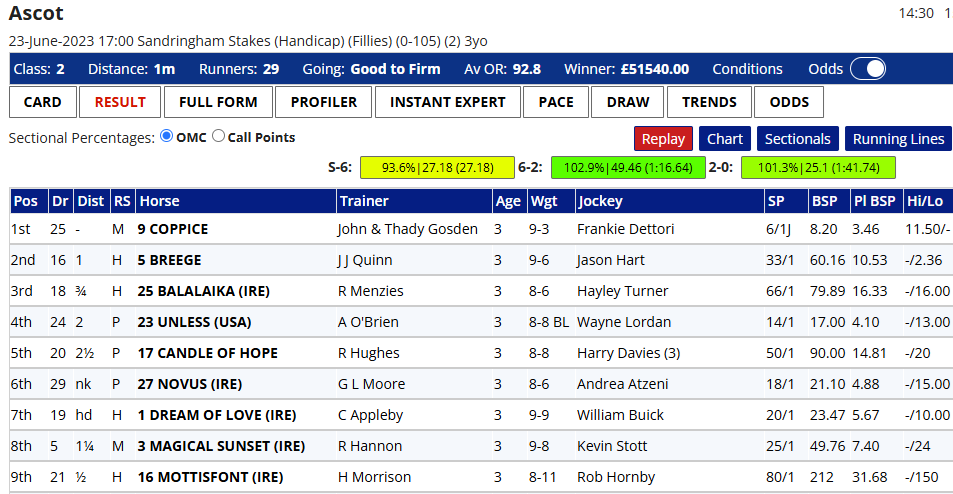
 

Ascot race card: list of 9 horses, trainers, jockeys and odds for the Sandringham Stakes (Fillies) 3yo.


There was a clear high to middle draw bias in this race with eight of the first nine home, and all of the first seven, racing stands’ side. Not only that several of these runners were big prices with a 33/1 second, a 66/1 third and a 50/1 in fifth.

The next example occurred in 2024:
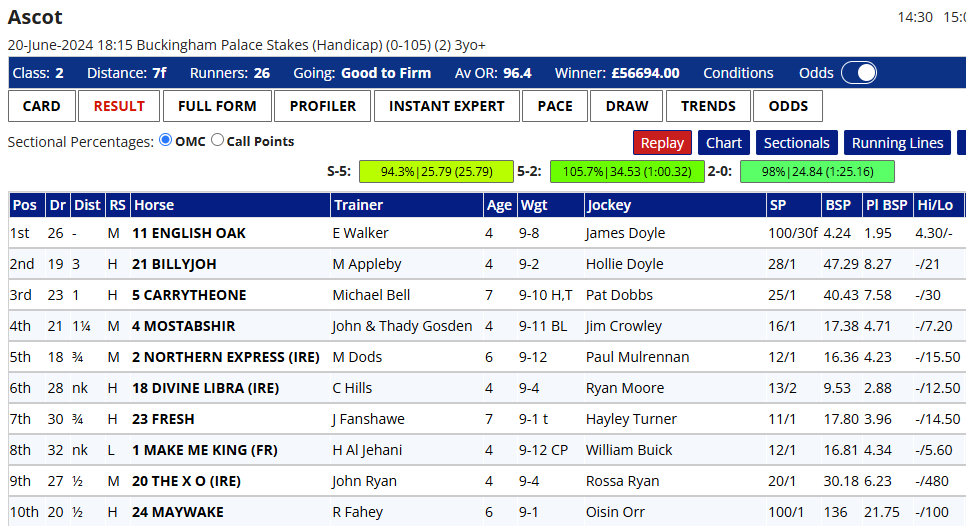
 

Race results page for Ascot Buckingham Palace Stakes handicap; table lists horses, trainers, jockeys, weights, and finishing positions.


This renewal of the Buckingham Palace Handicap, run over a furlong less than the Sandringham, again witnessed a very substantial bias in favour of high to middle berthed runners. The first ten home were drawn 18 or higher and all raced stands’ side. And the second and third placed horses were 28/1 and 25/1.

Last year's edition of the same race saw a near carbon copy occur as the result below shows:
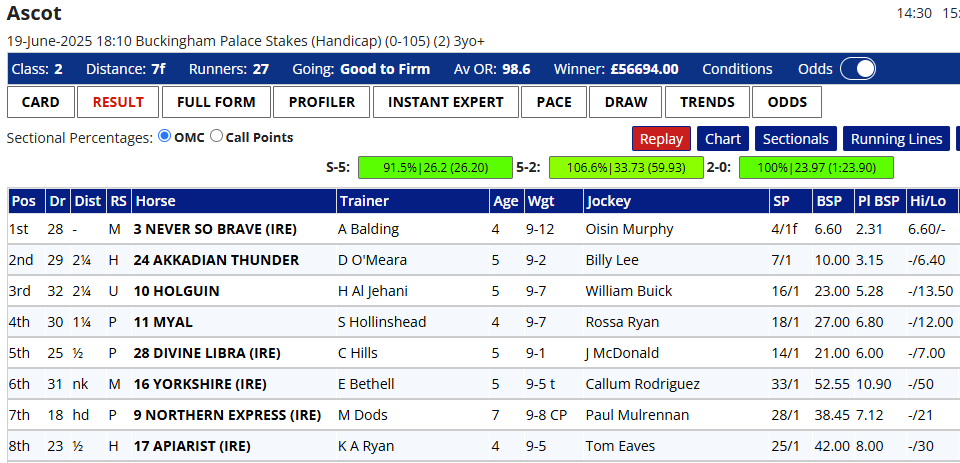
 

Ascot Stakes results table: horses, trainers, weights, and placings (handicap race). Accessible summary of top eight finishers at Ascot.


The first four home exited from the highest five stalls. Indeed, it should also be noted that the 2023 renewal of this contest also favoured high to middle drawn runners (best finishing position of a horse drawn in single figures was ninth). Based on these recent races, when they line up in the Buckingham Palace Stakes this year it will be tempting to completely ignore those runners drawn low.

However, although we get some handicap races on the straight course that show a significant draw bias, when we look at all such races over the past ten years, the draw breakdown by ‘thirds’ are probably more even than might have been expected.
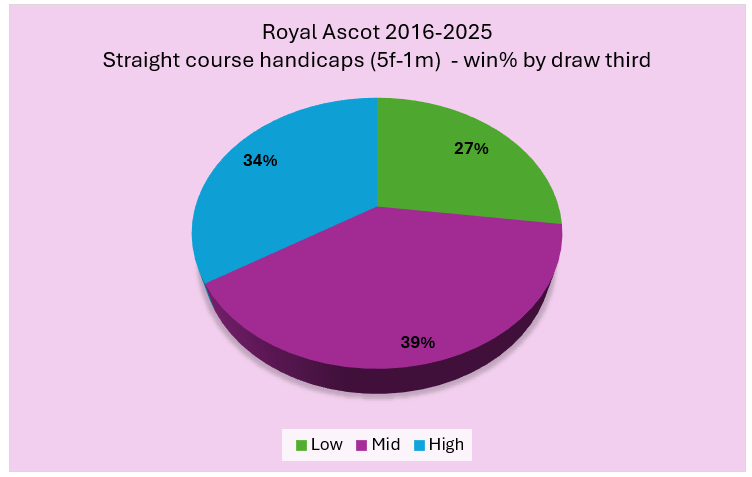
 

Pie chart titled 'Royal Ascot 2016-2025' showing win% by draw position for straight course handicaps (5f-1m); Low 27%, Mid 39%, High 34% (legend colors: Low green, Mid purple, High blue).


Lowish draws have won the smallest percentage, but I must admit I had expected a figure at least five percentage points lower. Middle draws have been the most successful in terms of wins at least, perhaps because plenty of the big field races are contested down the centre of the track thus meaning no lost ground manoeuvring for position.

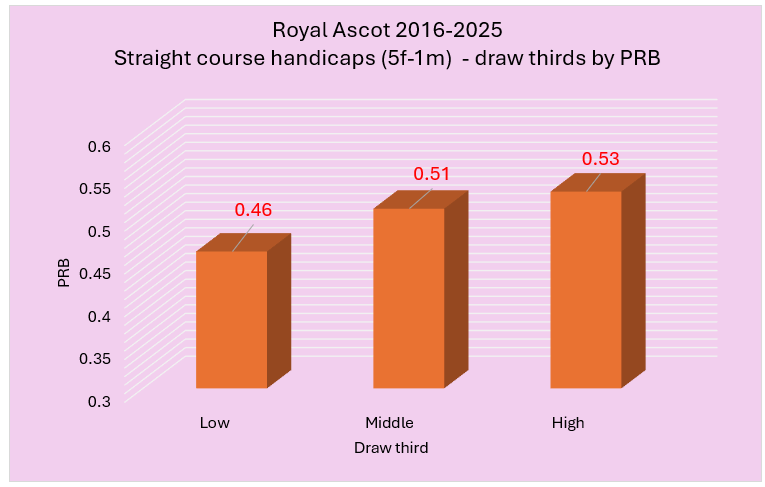
Of course, we can view this draw data in a different way by looking at Percentage of Rivals Beaten (PRB). This potentially gives us a more accurate picture as it considers all runners in all races, not just the winners. Here were the splits across the 59 races:
 

Bar chart showing PRB draw thirds by handicap level: Low 0.46, Middle 0.51, High 0.53 for Royal Ascot 2016–2025 straight course handicaps (5f–1m).


This is more the type of pattern I was expecting with high edging it over middle and low a few points behind. 46% of rivals beaten on a sample this size is material: it's quite tough for the low drawn horses.


Royal Ascot Round course Draw Bias (1m4f)

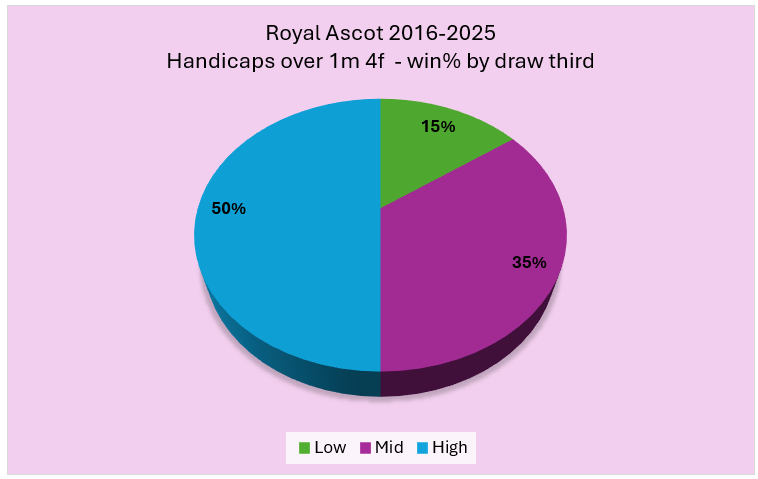
If you were thinking draw bias only has the potential to impact straight course races, think again. Over 1m 4f we have seen a strong draw bias, albeit from a smallish sample of 20 handicaps run over this trip over the past ten meetings. Let me share the win splits by third of the draw first:
 

Pie chart of win% by draw position for Royal Ascot handicaps over 1m4f (2016–2025): High 50%, Mid 35%, Low 15%


Low drawn runners have struggled, winning just three of the 20 races even though they ostensibly have the shortest distance to travel having been drawn closer to the inside running rail. Meanwhile, high draws won half of the sample races, with seven wins for the middle third. If we focus on the four lowest drawn horses versus the four highest drawn horses, we get this dichotomy:

 

Comparison table of performance for lowest vs highest 4 stalls: Runs 80; Wins 2 vs 10; Win% 2.5% vs 12.5%; WinPL -44.58 vs 41.41; ROI -55.73% vs 51.76%.


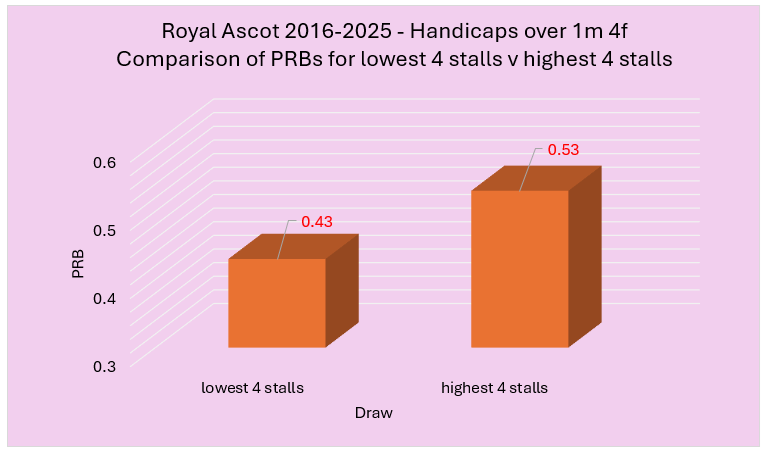
These numbers are quite powerful and are at least partially corroborated by the PRB figures:
 

Bar chart comparing PRBs for lowest four stalls (0.43) and highest four stalls (0.53) in Royal Ascot 2016–2025 handicaps over 1m4f.


Based on these stats, it is a challenge to be berthed in draws one to four, perhaps because one either has to use petrol to hold a position or else take back and ride for luck buried in the ruck. Middle to high draws hold sway with 13 of the 20 winners coming from the top half of the draw.

OK, moving on from the draw let’s now look at...

Odds Movement at Royal Ascot

Early Morning odds compared with Opening Show odds

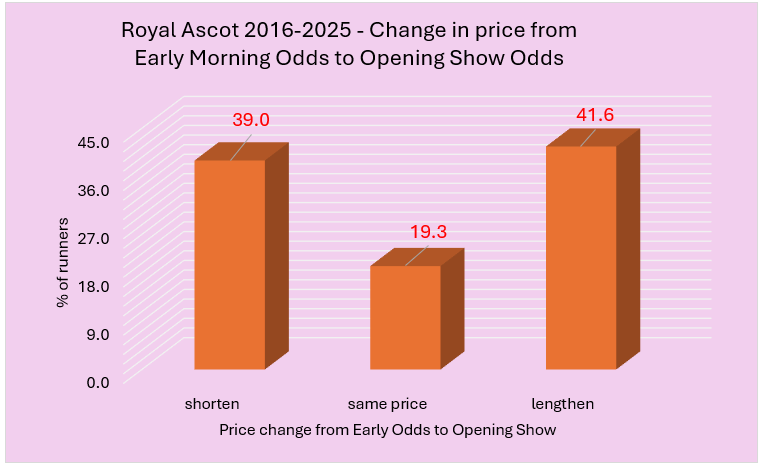
One would assume market movements at Royal Ascot differ slightly compared with your average meeting. I was expecting the early morning odds (EMO) for most runners to be more accurate than usual, for example. Below are the percentages for horses that lengthened/drifted in price from EMO to Opening Show (OS), those that shortened, and those that stayed the same price. For the record, the EMO prices were taken from around 9.30am and I have used William Hill odds. The OS odds are based on when the market became ‘live’ so usually around 15 minutes before the start of the race.
 

Bar chart titled 'Royal Ascot 2016-2025 - Change in price from Early Morning Odds to Opening Show Odds'. Three orange bars show the percentage of runners: 'shorten' 39.0%, 'same price' 19.3%, and 'lengthen' 41.6%, illustrating changes in price.


These figures are very different from the figures for all flat races. The control group of 'all UK flat races' saw 52.6% of horses lengthen in price, 36.4% shorten and 11% stayed the same. Hence, at Royal Ascot the market sees far fewer horses lengthen in price with their overall numbers similar to those that have shortened. In addition, far more horses have remained at the same price. Ultimately, I guess this is what we should expect – more accurate morning markets meaning less fluctuations during the day; and, perhaps, fewer horses defensively priced early in the day.


Opening Show odds compared with Starting Price

What about the price shifts in the minutes before the ‘off’? What type of changes do we see from the Opening Show on course to the final SP?
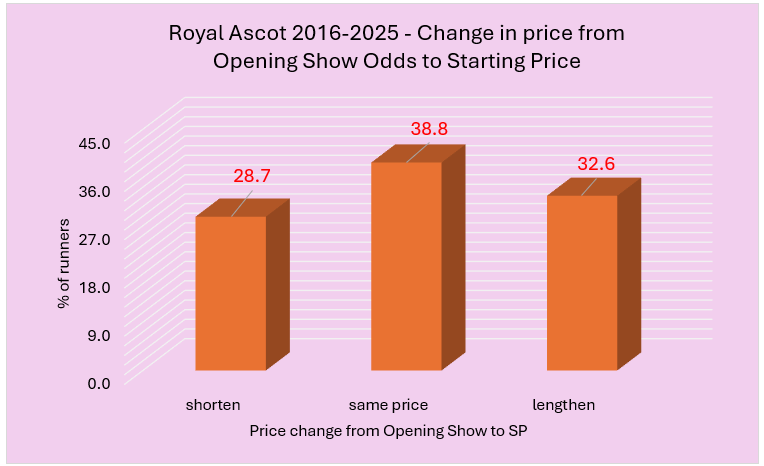
 

Bar chart showing the percentage of punters changing odds from Opening Show to Starting Price for Royal Ascot 2016–2025: shortened 28.7%, same price 38.8%, lengthened 32.6% (background in pink).


More horses remain at the same price than those that either shorten or lengthen/drift in price. Again, these figures differ markedly from the norm – in flat races as a whole, around 42% of runners drift in price, 24% remain the same price, while around 34% shorten. For those punters who bet close to the ‘off’, these stats will be useful to know.

There is one more comparison I would like to share before moving on. In all flat races horses that were clear favourite at early prices remained favourite at the off around 63% of the time. At Royal Ascot, more early morning favourites have retained favouritism at the ‘off’ than has been the norm with their figure standing at 73%.

Royal Ascot: Exchange Markets

BSP prices

I wanted to take a quick look at Betfair SP (BSP) to see if there has been a price band that offered some value. In Class 1 races the sweet spot seems to have been between BSP 5.0 and 10.0. This price grouping has seen 79 winners from 493 (SR 16%) for a profit of £60.67 (ROI +12.3%). Narrowing these Class 1 races down to the cream of the crop, the Group 1s, horses priced BSP 9.0 or lower has been the area to totally focus on. Backing all these runners blind would have seen us make a 16p in the £ on investment. Quite incredible, really.

In handicaps, the 5.0 to 10.0 band which was positive for Class 1 races was far from optimal here, producing just an 11.1% strike rate (27 winners from 243) for losses of £40.38 (ROI -20.3%). The best value in the handicaps was with longer priced horses – primarily those between 17.0 and 60.0. However, the strike rate is down at 4.5% across this huge cohort and hence finding the right horses within this odds bracket would have been tricky to say the least.


In-running betting/trading

Roughly 20% of all money bet on a horse race happens in running. At Royal Ascot, with competitive races, this percentage may edge up a point or two. I analysed some Royal Ascot in-running data in relation to ‘dobbing’. Dobbing or ‘DOB’ means ‘double or bust’. Essentially, dobbing is an in-play trading strategy employed by some traders where they are looking to double their original stake if their trade succeeds. Conversely, if the trade/DOB is unsuccessful they ‘bust’ or lose their stake.

I have written about dobbing before but for those who have not heard of it, I will offer a quick worked example. Let us imagine we back a horse at 10.0 for £10; in order to create a potential DOB we try and lay the horse at half the odds for double the stake – so we set a lay at 5.0 for £20. If the horse hits 5.0 or lower in running, our lay bet will be matched and regardless of the result we will win £10 (less commission).

The basic mathematics behind it are shown in the table below:



For dobbing to be profitable long term, we are probably looking to have a success rate of around 53% or more. This figure has to be a bit higher than a 50.1% baseline as we need to take commission into account.

Scene set, here are some Royal Ascot dobbing data. Mainly, I wanted to see if the price of the horse made a difference. Below is a graph that shows the dobbing percentages for different BSP price bands:
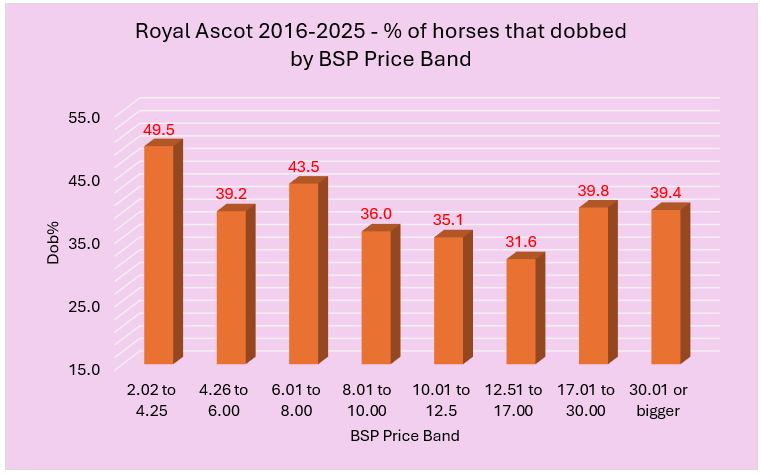


Horses priced under BSP 2.02 cannot ‘DOB’ hence why the lowest price band starts at 2.02. Horses priced between 2.02 and 4.25 have got close to a 50% dob rate, but the rest have been well below the type of figures we would be looking for to make a profit.

What about the distance of the race? Can that make a difference?
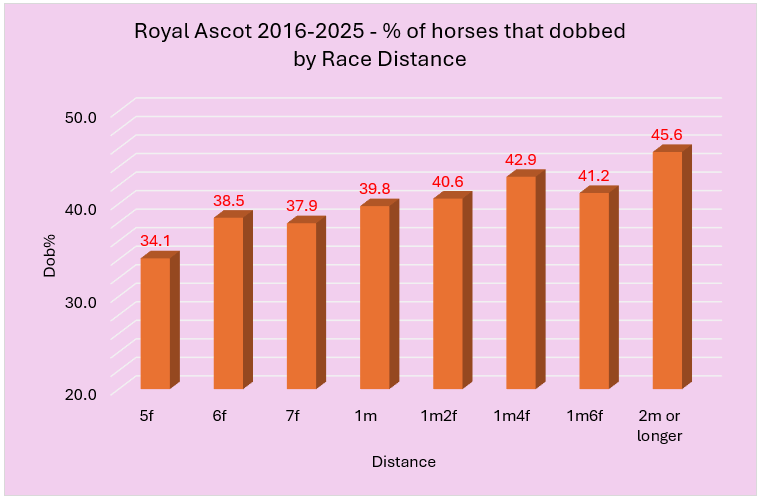


The graph clearly shows that the longer the race at Royal Ascot the more chance a horse has of dobbing. The longest distances of 2 miles or more have hit over 45% but still some way short of that 53% figure we would be looking for to edge towards profit.

If we combine the best BSP price band of 2.02 to 4.25 with races 2 miles or further, we would have hit a 65% DOB rate. However, before we get too excited this comes from a small sample of 23 runners.

Finally, on the in-play front, it should be noted that 80% of all winners traded higher than their BSP in running. So, if as a punter your preference is betting BSP, it may be worth considering setting pre-race a slightly higher figure than the expected BSP for a small proportion of your overall stake. For the record 39 of the 40 winners of 1-mile non-handicaps traded higher in running than their BSP.


Royal Ascot Trainer Form

Top Trainers by Win Strike Rate

Before closing, I wanted to review some Royal Ascot trainer data. With the level of racing being so competitive it is difficult for even the very best trainers to be consistently successful, and the highest win strike rate for any trainer who has had at least 50 runners in the past ten years is just 13.5% - not surprisingly it’s Aidan O’Brien. He has saddled an impressive 48 winners but from 355 runners.

John Gosden, and now with son Thady on the licence, has been the best of the British with 32 winners at a strike rate of 11.5%. No other trainer has saddled more than 20 winners and only three have hit double figures, namely Charlie Appleby (15), Andrew Balding (12) and Roger Varian (11).

To avoid big odds winners skewing bottom lines, let me share the trainer results for horses priced BSP 24.0 or less. To be included a trainer must have had at least 25 qualifying runners:
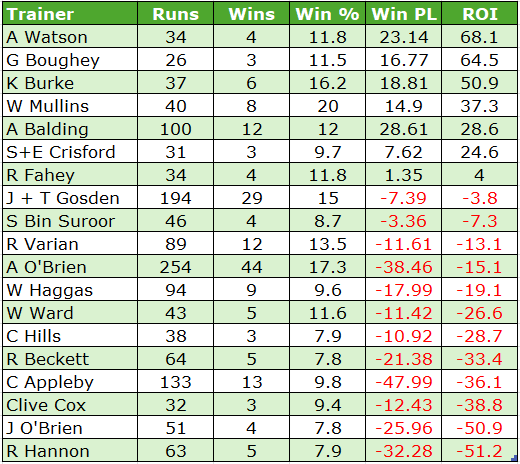


Seven of the 19 managed a profit but for some - notably Appleby, Beckett, Cox, Hannon and Joseph O’Brien - it has been hard going in terms of returns. Even Aidan O’Brien would have lost us more than 15p in the £.


Top Trainers by Percentage of Rivals Beaten (PRB)

It is also worth sharing the PRBs for these trainers with BSP 24.0 or lower priced runners and these were as follows:
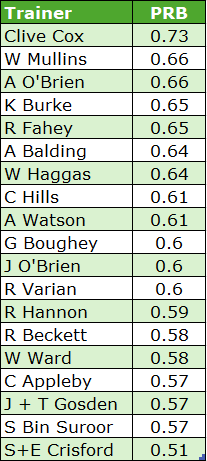


One trainer in particular who we can say has been unlucky is Clive Cox. He has by far the best PRB of any of the trainers at 0.73, but has managed just three winners from 32. That PRB figure, though, does nod to the fact that Cox saddled ten placed runners as well as the trio of winners, and backing all of his Royal Ascot runners to place would have yielded a 25p in the £ profit on the Betfair Place market.


Specific Royal Ascot Trainer Angles

There are some additional trainer stats I wish to share based on the BSP price cap of 24.0.

  1. The Gosdens in Group 1s have secured a near 30% strike rate thanks to 13 winners from 44. Backing all runners blind would have yielded a return of 64 pence in the £.
  2. Meanwhile backing all Aidan O’Brien runners priced 24.0 or less would have seen significant losses of over 34p in the £.
  3. Charlie Appleby has a poor record when saddling the favourite at Royal Ascot with just three winners from 21 (SR 14.3%) for hefty losses of £13.49 (ROI -64.3%).
  4. Roger Varian has had an outstanding record when his horses have started favourite, winning 61.5% of the time thanks to eight winners from 13. Backing all Varian favourites to BSP would have seen an excellent profit of £20.31 (ROI +156.3%).
  5. Another poor Charlie Appleby stat is that in handicaps he has had just one win from 43 with losses of 84 pence in the £.
  6. Keep an eye on NH guru Willie Mullins when he sends a runner here that raced in a NH race last time out. Of the 23 such entries, six have won (SR 26.1%) for a profit of £11.94 (ROI +51.9%). Backing these types to place on Betfair would have yielded a further 20p in the £ return.


Royal Ascot 2026 promises to be an absolute treat for us racing and betting fans. Hopefully there is something in this piece to help you get your nose in front whether you're a backer, a layer or a trader. Good luck to those who will be punting during this meeting. I'll be sharing the race previews with a strong panel of experts next week before returning with my regular column the following week.

Until then...

- DR

Royal Ascot 2021: Day 3 Preview, Tips

Royal Ascot 2021: Day 3 Preview, Tips

I’m taking over from Matt for day three of Royal Ascot, but don’t worry, Matt will be back tomorrow. Thursday can often be one of the toughest betting days and with no less than three big field handicaps bringing the curtain down on this card most will be looking for some early winners!

The biggest question mark hanging over Thursday’s racing is the weather, and of course it’s effect on the ground. There are thunderstorms forecast overnight from Wednesday into Thursday and everyone knows how unpredictable these can be. You can get hit with 40mm of rain whilst the next town along can get nothing. They put 10mm of water on the straight course on both Saturday and Monday just to keep it good to firm so it will take plenty of rain to soften this surface, but plenty of rain may well be coming.

2.30 Norfolk Stakes (5f, Group 2, 2yo)

Not much to go on here! Early pace is no disadvantage over the minimum trip here and a high draw is generally preferable over this trip. If there is a real star in this field they’d be well capable of overcoming either of those biases though.

Wesley Ward won this in 2013 and 2018 and there will be no hanging around for his runners. Lucci appears to be the stable first string and given he won just a 4 runner race last time he’s very difficult to assess, other than he looks very quick! He could be difficult to peg back from his high draw. Stable mate Nakatomi beat 10 runners when winning his only start on the dirt last time, also showing loads of speed. What effect any rain has on this pair is unknown, but Wesley Ward’s contingent generally prefer fast ground.

Aidan O’Brien also has two wins in this in the past decade and he saddles Cadamosto here. Amazingly he’s been a non runner six times already this season, twice because of soft ground. His sire No Nay Never won this in 2013 and his progeny often act on softer ground so he wouldn’t be without a hope if plenty of rain does fall but stall 2 might not be ideal.

Clive Cox’s runners massively outperform market expectations at Royal Ascot and he won this in 2012 with Reckless Abandon. This year he is represented by Instinctive Move who won well at Bath last time out. That form has been let down a few times since.

Only one runner can boast two wins from two runs and that is William Haggas’ Second Wind. He’s led on both starts so far, defied a penalty in a novice race beating a subsequent winner, looks well drawn in stall 15 and could be interesting at a fair price.

Norfolk Stakes Tips

Lots of unknowns so difficult to bet with much confidence but SECOND WIND has fewer question marks than most and he’s also won on both good to firm and good to soft which is a bonus ahead of an unsettled weather forecast. It will be interesting to watch the Wesley Ward runners in the market regardless of what happens with the weather.

3.05 Hampton Court Stakes (1m2f, Group 3, 3yo)

A likely short priced favourite here in the shape of Mohaafeth for William Haggas. He was relatively well fancied for the Derby before being pulled out because of the rain so he definitely won’t want to see lots of wet stuff and is likely to be withdrawn if the ground is on the soft side. He was impressive in a small field last time out at listed level and looks a very exciting son of Frankel.

One Ruler carries a 4lb penalty in this courtesy of his Group 3 Autumn Stakes victory last season and he faces a quick turnaround having been well beaten in the Derby just twelve days ago. Both his runs this term have come in Group 1 races so sixth places in both the 2000 Guineas and Epsom Derby can be forgiven and he might find this intermediate trip suits perfectly. He’s versatile with regards to the ground but is vulnerable to an improver.

One feature of this race is a potential lack of pace Aidan O’Brien’s Roman Empire looking the likely pace angle.

It’s not easy to make all over this course and distance, even with an easy lead, and he’ll need to improve to take this having been well enough beaten last time in the Dante.

Given a lack of strong pace it could pay to race prominently here. In handicaps in similar conditions prominent racers have a 47.62% place strike rate. Movin Time is likely to be prominent and he looked an improved performer at 3 when taking a maiden in fairly impressive style last time out. The runner up in that maiden won by 6 lengths next time out and runs in Wednesday’s Queen’s Vase and Movin Time looks capable of further progress over middle distances this season.

Hampton Court Stakes Tips

Not an easy race to figure out but it could be worth chancing MOVIN TIME to prove up to this level (and possibly better). He may enjoy a tactical advantage and whilst several of these have already tried and failed to win good races, he comes here very much on the up.

3.40 Ribblesdale Stakes (1m4f, Group 2, 3yo fillies)

A key form line here could be Newbury’s Fillies Trial Stakes in which the unbeaten Eshaada edged out Gloria Mundi with Aristea and Twisted Reality back in 3rd and 4th respectively. Gloria Mundi was well placed off a slow gallop that day and is poorest drawn of the quartet here so she could be worth taking on. Eshaada undoubtedly looks the one with most potential of the remaining trio and she’s also the best drawn here so she looks interesting, especially if there is rain.

John Gosden has won three of the last four renewals of this race and if he doesn’t win it with Gloria Mundi, the mount of Frankie Dettori, he still has chances with Taslima and Loving Dream. The former looked in need of further when third at listed level last time out. The winner of that race finished 2nd to Snowfall in the Oaks since so it wasn’t a bad listed race but you’d have preferred Taslima to have shown a bit more speed, even at 10f. Loving Dream was well enough beaten in the Lingfield Oaks Trial on soft ground and on his previous good ground 2nd she has plenty of work to do to reverse form with the better fancied Noon Star here.

In hindsight Noon Star’s 3.75 length defeat at the hands of Snowfall looks pretty good form. She’s impeccably bred being by Galileo out of Midday and looks the potential class act in the field, both on form so far and breeding, so she shouldn’t be underestimated.

Aidan O’Brien won this in 2014, 2016 and 2018 so anything he runs commends plenty of respect. This year’s sole runner is Divinely, who has looked happiest on a soft surface to date. It’s a quick turnaround after the Epsom Oaks though so whilst she’d have a decent chance on form, especially if it turns soft, she’ll need to have recovered quickly from a fairly tough race.

Ribblesdale Stakes Tips

An open contest which seems to be the feature of the day. NOON STAR looks a very promising type who has shown form on a variety of going so far which is enough to persuade me she could be the one in this. Eshaada is potentially the biggest danger whilst Divinely has the form to win this but he’s a risk after contesting the Oaks so recently.

4.15 Gold Cup (2m4f, Group 1, 4yo+)

Can Stradivarius equal Yeats’ record four wins in a row in this? Rain would be considered a negative for him but he’s won this on soft for the past two years so it’s possible all rain does is make him a better price.

This definitely looks a tougher renewal than last year though. Tough front runner Subjectivist won’t mind any rain and although he’s yet to prove his stamina, he’s got better the further he has gone. Last year’s Derby winner Serpentine could hamper Subjectivist’s chances though by taking him on early.

Stamina was always going to be Trueshan’s forte as he made his second racecourse start over a mile and a half. He enjoyed the step up to two miles when beating Stradivarius in the Long Distance Cup by a wide margin. That form shouldn’t be taken literally but Trueshan confirmed himself a smart horse when finishing runner up to Japan at Chester last month. He’s fairly ground dependent so will want as much rain as possible but if it comes he’d have a good chance.

Spanish Mission has improved as a stayer in the past year or so and won what was admittedly a pretty poor renewal of the Doncaster Cup last year. His Yorkshire Cup victory last time out was a career best when accounting for Santiago who reopposes here. He’s one that won’t want any rain and might not enjoy this test as much as some of the slowly run races he has been running in over shorter.

Connections will be hoping the extra distance can help Santiago reverse that form with Spanish Mission. He got within 2.25 lengths of Stradivarius at Goodwood last year and the key to this horse could be rain. His best performances seem to have come when getting cut in the ground and a combination of this trip on softish ground could see a career best, especially with a couple of front runners in the field.

Ascot Gold Cup Tips

The going will have a massive effect on this race. On faster ground STRADIVARIUS looks a very good thing to equal Yeats’ record. He can often come there like he’s going to win by a wide margin only to end up toughing it out. In fact eleven of his last twelve wins have come by a winning distance of 1.75 lengths or less which is relatively 'unimpressive' for a horse considered a bit of a superstar. If you can find an ‘unders’ bet on the winning distance that might make him much better value.

If the ground was to end up softer than good Stradivarius would still be the most likely winner but the each way value could swing towards SANTIAGO who is still unexposed as a stayer and has spent most of his career racing on ground that was probably faster than ideal.

5.00 Britannia Stakes (1m, class 2 handicap, 3yo)

All eyes will be on the Royal Hunt Cup ahead of placing any bets on this and that’s the race most likely to highlight a potential draw bias. Without the benefit of knowing the Hunt Cup result at the time of writing we’ll rely on the Geegeez data to give us the draw pointers.

The data suggests no strong draw bias here but it’s worth remembering that sometimes nearside is favoured and sometimes far side is favoured, which is why both sides of the draw have performed well. It can be easier to get a run when drawn on a flank and the pace data strongly suggests you want to be with something that is patiently ridden so backing central drawn hold up performers will often be riskier than wide drawn hold ups.

Mithras is the early market leader in this for Gosden and Dettori. He only just got home in a traditionally strong Newbury handicap on seasonal debut but this year’s renewal has worked out really poorly and the fact that Mithras was well enough beaten at Sandown next time out is very disappointing and in line with the form of that Newbury run, even if this latest run was in listed company. Perhaps the ground was too soft last time out (might be soft again here) but an 8lb rise for that narrow Newbury win might still be harsh and he could one to take on.

Air To Air is one I’ve had in mind for this race for a while, he looks one of those horses that will be ideally suited by Ascot’s straight mile. He’s been called a few names for seemingly not going through with his effort in the past but after being gelded in March he seems an improved horse. He may have been beaten over 4 lengths when odds on on his following start but he was the only one to make up any ground over what now seems an inadequate 7f. That race has worked out extremely well too.

Bowman, who very much got the run of the race, hasn’t run well since but the runner up has won three times since, the 3rd won on his next start and the 5th went close last time out. Air To Air has since won twice himself and he took apart a fairly decent field last time out on his first start over a mile. He’s a bit more exposed than some but he’s improving and looks the typical Spencer sort on this straight course. His latest win came on fast ground but his previous win in novice company came on soft ground. That softer ground might not be perfect for him but at least he’s proved his versatility.

Roger Varian won this last year and assuming his reserve doesn’t get in he has two high drawn runners in this. Raadobarg has won all three starts this season including the Silver Bowl at Haydock in heavy ground last time out. He’s chased leaders in all three starts this season and could end up too close to the pace, plus he’ll want plenty of rain. Dinoo is the other one for Varian. He’s still a maiden after three runs but split two 100+ rated horses on debut on fast ground before blowing the start in a Group 3 on his second and final start last season. He was once again slowly away in a maiden this season and poorly placed off a modest gallop. You’d hope with a mark of 93 he could have overcome this sort of thing but the mile promises to suit and he could run well if the ground stays fast.

A 7lb rise for winning a 5 runner handicap by less than a length seems a harsh punishment for Aerion Power’s latest success but he shouldn’t be underestimated. The runner up and 3rd came out of that contest and won making that 7lb rise look a bit more acceptable. Stall 1 and a prominent racing style are offputting though and he’d appeal more for something like the mile handicap at Sandown on Eclipse day or one of the 3yo handicaps at the July Festival the following week.

Britannia Stakes Tips

Many of the fancied runners in this seem quite likely to race not far off the pace which is rarely the place to be over the straight mile, especially in this race where there is a lot of early pace spread across the track. Perhaps some will be ridden more patiently but nothing is likely to be ridden with more patience than AIR TO AIR. Confidence would be increased if the ground gets no softer than good and if some of the lower drawn runners go close in the Royal Hunt Cup.

5.35 King George V Stakes (1m4f, class 2 handicap, 3yo)

Only a handicap but often won by a very smart sort, last year’s winner Hukum scored at Group 3 level later in the season. The draw may have a fairly large bearing on the result here.

A massive 17 of last 24 12f handicaps with 16 runners or more on ground ranging from good to firm down to good to soft have been won by double figure draws. Low draws have a PRB of just 0.41 with middle draws and high draws earning PRBs of 0.54 and 0.55. Fairly strong preference would be for something breaking from stall 8 or higher and this information hopefully makes narrowing down this difficult field a little easier.

Handicap debutant Nagano heads the market early for Roger Varian and he’s going to have to be extremely useful to win this from stall 2. He looks at least fairly handicapped off 94 based on his win over Mystical Dawn on his penultimate run (that runner has since gone close off 90) but he’s difficult to back from this draw in such a competitive race.

This is often won by a top trainer so it’s a surprise that John Gosden hasn’t had the winner of this since 1997. He runs First Light here who might be just about okay in stall 7, for all higher would probably have been better. Some will see form with John Leeper and be drawn to that but in that race, when First Light was 3rd, Moktasaab was 2nd, 2.5 lengths ahead of First Light, and he’s since been beaten in a handicap off 79. First Light has since won a soft ground Ripon maiden by 12 lengths but that race didn’t take much winning and there are probably better handicapped rivals, especially if it doesn’t turn soft here.

Sir Lamorack represents Aidan O’Brien who won this in 2019 and he seems to have a nice draw in 11. He ran on soft and heavy as a 2yo but his two runs this season have come on the all weather and good ground. He was withdrawn at Chester due to good to soft ground which might be an indication this runner will want the rain to stay away. He’s already proved himself in handicaps, he was an easy winner of a 10f handicap at Leopardstown last time out and the placed horses from that have placed again so it was okay form. He’s up 15lbs for that win so he’ll need to improve for the step up in trip, which he should do.

Kondo Isami is interesting on his York form. He beat Tashkhan by a short head there and Tashkhan won 3.25 lengths next time out. That runner actually reopposes here but Kondo Isami is 8lbs better off this time around so should have no problem confirming form. Kondo Isami got collared late on next time out at Doncaster over further and he might not have quite stayed, but he was also beaten by a runner completing a four timer so it wasn’t a bad effort. He looks Mark Johnston’s best chance and is well enough drawn in 9.

If the ground got very testing one who might prove overpriced is Act Of Wisdom. He was a heavy ground winner over 10f as a 2yo which suggests he’ll be a strong stayer and fast ground didn’t suit last time out at Newmarket. That 5th last time was still a good effort though with the winner and 3rd winning next time out. From stall 14 he could outrun his odds if the word soft appears in the going by race time.

King George V Stakes Tips

Plenty in this who could be anything and it’s a race that is potentially more interesting going forward than it is a betting medium here. If having a punt the value in this contest could lie with KONDO ISAMI if the ground is no worse than good, he’ll enjoy a likely fast pace and has plenty in his favour. If it’s softer than good then ACT OF WISDOM would come into the equation and he could be a bit underestimated in this. They might not be as potentially well handicapped as some but are both capable of running into a place at least granted suitable ground conditions.

6.10 Buckingham Palace Stakes (7f, class 2 handicap, 3yo+)

What an easy race to end the card with! As usual in these contests the draw and pace will play their part. By the time this race is run there may be a clear draw bias to either side but without that information at the time of writing it seems an advantage to be drawn in either low double figures or very high (20+).

There isn’t such a need to be held up over this distance as there is on the straight mile. There is still some benefit to being patiently ridden but early pace holds up much better than it does in big fields over a furlong further.

You don’t see many 3yos run in this but William Haggas heads the early betting with Aldaary. He’s a course and distance winner but might have been better served by a mile and he’ll definitely want the rain.

Boardman is interesting chasing a four timer. The way he travels through his races means he should be ideally suited by this course but he’s potentially drawn a little lower than ideal in 9. He beat Ejtilaab last time out and that horse won his next start. He’s another that wants a little bit of rain.

One that won’t want the rain is Karibana who was a bit of an eyecatcher on soft ground here in May before winning at Chelmsford, nailing a well handicapped front runner on the line. He looks like he’d be ideally suited by fast ground at this course and although stall 11 is okay statistically a higher draw might have been preferable.

Persuasion has to be of some interest. He’s looks to have been saved for this since winning at Haydock six weeks ago.

The runner up has won since from a 3lb higher mark, the 4th went extremely close next time out on ground that didn’t suit and has the chance to frank the form on Wednesday in the finale and even the 5th went close on his first run on fast ground since. Persuasion only went up 3lbs for that win and whilst most of his form is on faster ground, he has finished 2nd on heavy ground so even if the ground softens he should be fine. Stall 24 looks good at this stage.

Buckingham Palace Stakes Tips

If the ground stayed on the fast side I’d be inclined to forgive Karibana for stall 11 (low double figures do have a decent record after all) and get involved each way. If betting early or simply looking for a solid selection in this contest PERSUASION seems to tick all the boxes and he can even be backed if the bad weather hits the course as he should be fine regardless of underfoot conditions, something that can’t be said about many here. The majority of the pace in this race is drawn high which could give Persuasion an extra edge over Karibana, even if the ground stays fast.

Ascot: Course Overview and Draw Bias

Ascot hosts the best domestic flat race meeting of the year, Royal Ascot. That meeting is also among the hardest from which to derive a betting profit.

With a meeting like Royal Ascot, and Ascot races in general, it is imperative to have a game plan, so let us attempt to know what we can know about the course and any nuances or biases it may have.

Ascot Course Characteristics

Ascot's course layout: straight up to a mile, with longer races on the round course. Also a round mile

Ascot's course layout: straight up to a mile, with longer races on the round course. Also a round mile

Uphill

The above graphic illustrates the stiff test that the Ascot racecourse represents, with the red triangle just past the winning post signifying the highest point on the course. Thus there is an uphill drag almost the whole way up the straight. On the round course, the lowest point is at the round mile (Old Mile) start, meaning that distance is also almost entirely uphill, too.

For more extended races on the round course, which is actually closer to being triangular than round, there is some early respite in the loop prior to the long climb for glory.

Tight bends

It is also worth noting that the bend into the home straight for round course races is tight and, being situated just two and a half furlongs from the finish, can cause trouble in running with horses either locked in a pocket or having to fan very wide on the turn to find daylight.

For round course races, then, it is often advantageous to be on or close to the pace: here, a horse and rider will have no traffic problems and, if the fuel has been burned proportionately, can slingshot into the straight and prove very hard to peg back.

The main focus of this article, however, is on the straight track, and will cover draw, pace and draw/pace composite analyses for each of five-, six-, seven-, and eight-furlong races.

Ascot Draw / Pace Bias

There may then be a pace bias on the round course, but what of the straight track? Races here are run at five, six, seven and eight furlongs, many of them big field handicaps or Group race sprints, and our Draw Analyser can help understand historical advantages.

Ascot 5f Draw Bias

The below chart shows something we call PRB3 for five-furlong races of 14 runners or more (good or quicker) since 2009, based on actual draw (i.e. after non-runners have been accounted for). PRB3 is the rolling three-stall average percentage of rivals beaten and it helps to better quantify the merit of a particular part of the track from a draw perspective. More information on PRB3 can be found here.

An average PRB score would be 50%, or 0.5, implying that a horse beat as many horses as beat it. Thus, any part of the track where the PRB(3) score is consistently greater than 0.5 implies a draw advantage. The converse is also true: a PRB(3) consistently below 0.5 implies a disadvantage in the starting stalls postcode lottery.

It can be seen, then, that, generally speaking, high numbers enjoy a slight benefit in big fields.

Ascot 5f Pace Bias

Horses racing from the front in big fields up Ascot's five furlong straight have fared best, as can be seen below. This information is derived from our Pace Analyser tool. The chart is based on place percentages, but the story is similar in the win context, too, as can be seen from the table and the coloured blobs above the chart.


The coloured blobs tell us that runners which led (or were very close to the pace, e.g. "pressed leader") in big field fast ground five furlong races at Ascot won nine races from 95 horses to adopt such a run style. That's a little under 10%, and was worth a profit at starting price of £20.50 to a £1 level stake. All other run styles were loss-making with win and place strike rates between half and two-thirds that of early leaders.

That is not to say it is always easy to identify the early speed, nor that a one-in-ten hit rate will be plain sailing; but it is worth knowing that pace bias looks a little stronger than draw bias at the minimum on fast ground and in big fields.

Ascot 5f Draw / Pace Combinations

As might be expected, runners with early pace that were drawn high have fared best in big field five-furlong races at Ascot. Our Draw Analyser tool - and the Draw tab within any race in our racecards - contains a heat map illustrating the draw/run style combinations. Sorted by percentage of rivals beaten, it looks like this:

As can be seen, horses are able to run their race from anywhere on the track, with no big negatives. However, there does appear to be a 'green triangle' for pace pressers drawn middle to high, with high drawn leaders significantly outperforming the 0.5 benchmark.

Ascot 5f Draw / Pace Summary

High draws may have the best of it in big field fast ground five-furlong races. So, too, may pace pressers. And being a fast starter drawn high compounds those positives, with five from 20 such runners prevailing (+23.5 at SP), and another four making the frame.

*

Ascot 6f Draw Bias

It's a similar story over six furlongs. If there is a stalls position bias, it might be slightly against low drawn horses, with middle to high persistently above the 0.5 mark as can be seen from this chart:

One important caveat to that is stall one, hard against the rail. That post position has secured seven winners from 58 to depart there, at a 12% clip (+44 level stakes at SP). It might be that the watering doesn't quite reach the innermost strip of turf and/or that the rail helps the runner there maintain its position. Either way, it looks material for all that it could be coincidental. [Stall one also outperformed its near neighbours, though to a lesser extent, over five furlongs.]

Ascot 6f Pace Bias

It is harder to lead all the way at six furlongs than it is at five, as can be seen by comparing the image below with the equivalent for the minimum trip above. Nevertheless, early leaders still have the best win and place strike rates, and an impact value of greater than 1.5. Those held up have also fared well relatively, with prominent and midfield runners collectively faring only as well as held up horses, from an almost 50% bigger sample.

Ascot 6f Draw / Pace Combinations

The combination of a high draw and early speed is again seen to good effect in the below 6f draw/pace heat map. But note also the performance of middle-to-high draws which are waited with. Any score of 0.55 or above can be considered meritorious in the general context of percentage of rivals beaten (PRB).

Ascot 6f Draw / Pace Summary

Over the six furlong range at Ascot, it is a similar story to the five furlong summary: early speed and a high draw are seen to best effect. But note the improved performance of hold up types, who are often exhilarating to watch if generally exasperating to wager!

*

Ascot 7f Draw Bias

The picture becomes less clear still when we move up in range to Ascot's straight seven furlongs. Although those berthed highest have fared best, in percentage of rivals beaten terms, the scale on the vertical axis of this chart is narrower: there is a less pronounced draw bias, indeed arguably there is nothing worth noting.

Ascot 7f Pace Bias

It is a long way home in a big field cavalry charge up the stiff straight seven furlongs, and those waited with have performed clearly best. The chart below is sorted by place percentage for the sake of consistency with previously discussed distances, but the win percentage line would have been even more striking.

Indeed, perusing the table reveals that held up runners have won more seven-furlong Ascot races than the other run styles combined! Numerically, they've prevailed at 6.73% compared with all other run styles' combined 3.72%. It is clear that patience is a virtue in this particular trial.

Ascot 7f Draw / Pace Combinations

The heat map again ratifies the individual considerations of draw and pace, with those draw away from low and held up generally performing best, in PRB terms.

As an indicator of how difficult it is to win at Ascot over seven furlongs from the front, I've included the same heat map sorted this time by win percent:

Just two of the 90 horses to have vied for the early lead in the sample managed to get home. Middle to high and waited with achieved significantly more.

*

Ascot Straight Mile Draw Bias

In fuller fields on the straight mile course, close to a wing has been better than up the middle, perhaps providing greater assurance of 'a run' away from the density of what can be a highly populous centre pack:

Ascot Straight Mile Pace Bias

From a pace perspective, the pendulum swing has completed its arc, with held up runners now not only ascendant in win strike rate terms but also profitable to back. Indeed a £1 e/w bet on all such runners over Ascot's straight mile would have yielded a surplus of £83.60. Hold up types have won as many races as all other run styles combined from slightly more than half as many runners.

Those racing prominently have a horrible record, winning at not markedly better than 1% of the time.

Ascot Straight Mile Draw / Pace Combinations

This is a classic heat map image, with a clear diffusion of colour: greens at the back, oranges and reds at the front. There is little of note in terms of stall position but a stonewall takeaway from a run style perspective.

*

Ascot Straight Track Draw and Pace Summary

As with all tracks, it is a very solid starting point for your wagering considerations to understand the constitution of the course and any general principles which may assist. Our racecourse pages, including this one for Ascot, will help in that regard.

Based on what has been shown above, there is a pleasingly clean pattern to proceedings:

- Pace pressers perform best in five and six furlong sprints, more so at the shorter trip.

- It is much harder to hold on to the lead at seven furlongs and a mile, where waited-with types have the best of it.

- Generally speaking, middle to high is better than low at up to seven furlongs on the straight track, while...

- It may be preferable to be drawn closer to one rail or other in big field straight mile races, particularly if you like a hold up type.

It is unlikely that any of the above will help find winners by itself, but it ought to steer generally in the right direction. Naturally, Geegeez Gold has many more tools to assist the elimination process, and you can find out more about them here. Good luck!

Matt