Tag Archive for: York Ebor Meeting

Monday Musings: Powerful Goddess

When Mums Tipple took apart the 2017 running of the 21-horse Goff’s 2YO Sales race to the tune of 11 lengths, we all said, “It’s inconceivable that he isn’t at least a stakes horse”, writes Tony Stafford.

That was the second win for the Richard Hannon-trained colt after a narrow success on debut. He was still going until July at Ascot last year when, as an 8yo gelding, he won for the eighth time. His owners, Marian Lyons and Patricia Zanelli, also had nine places to enjoy from a career total of 55 outings.

From a high mark of 116 after that initial explosion onto the scene as a juvenile, at one point he was as low as 78, but ended (if he has ended, I presume so) rated 92 following that Ascot win off 86.

So many lovely days out for the duo, who had paid £45k for him via the services of long-standing Hannon family talent spotters Peter and Ross Doyle. Even if that initial jackpot success worth £147,540 was never quite replicated, to this point he has earned a highly respectable £384k.

It was inevitable that the name of Mums Tipple came up when last week’s renewal of the Goffs race, now carrying a winner’s pot of £293k, was also a one-sided affair even with 20 juveniles taking part.

Sun Goddess, the even-money favourite, who boasted a Group 1 victory last time out in the Keeneland Phoenix Stakes at the Curragh, where she won comfortably from the Joseph O’Brien colt Folsome Blues, was drawn unfavourably high in stall 17.

Beforehand, Ryan Moore was planning to “go straight down the middle” but mindful of the disadvantaged position stalls 18 to 21 had - those on his outside broke a little more alertly - and the drift for Ryan towards the inside then became inevitable.

Strong finishes had been her trademark in five previous runs – three wins and two second places – but that still wasn’t quite enough to determine the outcome of the Albany Stakes at Royal Ascot.

There she had worked into an apparently winning position, when the George Boughey-trained Libertango came from out of the clouds to catch and pass her in the final 100 yards. When Libertango won the Sky Bet Lowther Stakes, run over the same six furlongs immediately preceding the sales race on Thursday with a similar late finish having tacked across the field from her high draw, it could only be a boost for the Coolmore filly in the much lower quality, and slightly higher quantity, sales race.

So, straightforward then. Well, not quite. Having been manhandled into the middle of the pack, Ryan was looking to navigate a way through from a long way back when one horse abruptly changed direction, causing Sun Goddess to snatch up and almost fall.

I was standing next to a pretty good judge at the time. “That’s it”, he said, a comment replicated all over the racecourse, often accompanied with a gasp as her momentum was halted. But then, you saw Ryan manoeuvre to the outside and there wasn’t much more than a furlong to run, so only seconds after my friend’s words of resignation, and with the filly still probably only fifth or sixth, I replied, “It isn’t, she’s won!” Maybe wishful thinking, but I swear not.


Mums Tipple’s finish all those years ago was impressive; Sun Goddess’s demolition of her field, drawing six lengths clear, admittedly of horses that Ryan realistically described as ordinary, was spectacular. Then again, to take out six (or probably ten lengths once she got going) in around a furlong is rare. Talking of rare, I’m rarely excited by a race – seen too many I suppose – but I was this time. And she did it marginally faster than Libertango.
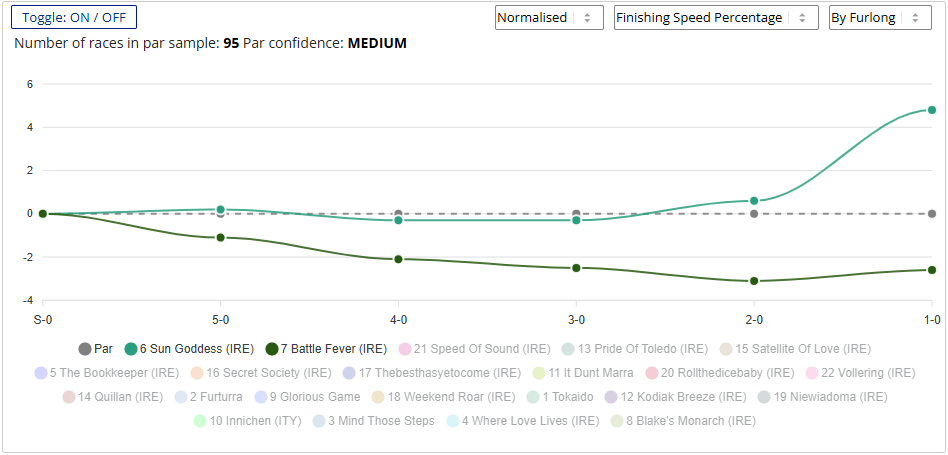
 

Electric sectionals from Sun Goddess as she breezed past Battle Fever et al in the Harry's Half Million sales race at York, 20th August 2026


In fact, I was embarrassingly excited. I've lost count of how many friends have called to suggest I was trying to hog the camera after the race when I did find myself standing next to Aidan. I was even grabbed around the shoulders to stand next to him – “come on Tony!” - when they took the “connections” photo. I’m not one of them, of course, a point the Racing Post acknowledged when the sub-editor in the office cropped the picture with just my umbrella – never needed to be true – and a sliver of a grey jacket left for posterity.

The bookmakers reacted by making Sun Goddess favourite for the 1,000 Guineas. Rightly so, I thought. She stayed so well on Thursday and while I know Aidan likes to keep his bases covered, she does have the Moyglare (7f) and Fillies Mile entries this year.

Even the day after the race, Derrick Smith, in whose colours she runs along with Sue Magnier, Michael Tabor and Westerberg (George von Opel), was repeating in disbelief, “She cost 120 grand! I can’t believe it.” Putting that remark in context, the usual Coolmore partnership had earlier in the week forked out €4.6 million for a Wootton Bassett yearling colt at Arqana sales in Deauville. Derrick’s shock is understandable.

As Anita Wigan, wife of bloodstock legend James, responded, “She was there for everyone to see. Your team was clever enough to buy her.”

Even with all that evidence to call on, the team’s in-house grading of their two-year-old fillies still had plenty of opinion favouring Alpha, a daughter of Sea The Stars out of 1,000 Guineas winner Alpha Centauri. There was a little pre-planning I’m sure that put her in Saturday’s Group 2 Alpha Centauri Debutante Stakes at the Curragh, and she did start odds-on with a couple of nice wins on the board already.

The snag was always going to be Joseph O’Brien’s maiden filly Green Empress, running in the green and white of my old associates, the Thoroughbred Racing Corporation, revived over the past few years by the son of the late Prince Ahmed bin Salman. She had run only twice: initially second, five lengths behind Sun Goddess; and latterly runner-up at less than a length to the same filly in a Group 2 between Sun Goddess’ Ascot run and her Group 1 in August.

On Saturday Alpha cut out the running, but after manoeuvring out of a pocket, Dylan Browne McMonagle got Green Empress up close to the line, passing his own stablemate Dancing Destiny. That filly, a 12/1 shot, had only been beaten a head behind Alpha in her previous start. There might be a domestic realignment of the Ballydoyle juvenile fillies, but Ryan wasn’t on hand so no doubt Alpha will get a chance to re-establish herself, maybe at the Irish Champions meeting next month.

Green Empress was the fourth of four consecutive winners for Dylan Browne and he added a fifth later. Four of them were for his boss Joseph. Aidan struck back with two Group winners of his own on the card, namely Queenstown in the Irish St Leger Trial and Group 2 winner Giant Sequoia, easier to write than to pronounce even for some close to the team. Still, what can you expect with four consecutive vowels?

It was just as well for O’Brien senior that the York sales race carried such a massive prize, considering Andrew Balding’s amazing run at the fixture. The highlights were Item for the sponsors in the Juddmonte International where, with hindsight, 10/1 was an astonishing price as his only career defeat was on that awful ground in the Derby, and the gallant Kalpana in the Yorkshire Oaks.

A couple of big pots always helps, but it’s the overall numerical strength and depth of quality of the Balding stable that counts. He is now on 138 wins for the season (although none since Thursday – what’s happened?!) that has aggregated more than £7 million, almost exactly £700k less than O’Brien’s £7.7million.

I think everything will come down to how they do in their head-to-heads at Ascot on Champions Day, October 17. There are five Group 1 races, the first three of £500k each. The Queen Elizabeth Stakes over a mile carries £1.1 million, while the Champion Stakes is the most valuable at £1.3 million. In the red corner!

York was fantastic! Oisin Murphy had a great week, joining in much of the Balding success, but Tony Hind kept Billy Loughnane mostly at the back-up meetings and he consequently extended his lead over the champion by a couple more in this year’s title race.

When your luck’s out, though, not even the champion can help you. Oisin spent the entire week wriggling though tiny gaps to get the job done but when it came to my day’s best bet in the last race on Saturday, he ran slap bang into a pocket just as it seemed Bourbon Blues was going to give Brian Meehan a welcome winner and me a 16/1 nap. Still, another Cambridgeshire winner for the Manton stable would be an acceptable consolation.

Staying as usual in York with Jim and Mary Cannon was uniformly great. Dinner on successive nights at Thompsons Famous Fish and Chips on the Malton Road; Del Rio’s Italian (venue for all the stars – yes even me occasionally!) and Lal Quila, an Indian restaurant in Bishopthorpe Road, accounted for my first three nights. I stayed home on Friday at Jim and Mary’s to watch the Arsenal game. No restaurant, then, just Jim’s post-match patented cheese on toast – Carlisle Rarebit- and that was another summer holiday done.

- TS
Ebor Festival 2026: A Statistical Overview

The Ebor Festival at York – A statistical look back over the past ten meetings

The Ebor Festival at York Racecourse is one of the crown jewels of the British Flat racing season, writes Dave Renham. Indeed, I would argue it is the third most prestigious meeting of the year behind Royal Ascot and Glorious Goodwood. It takes place across four days in the middle of August and starts on Wednesday, blending championship‑level Group 1 racing with the famous Ebor Handicap, Europe’s richest flat handicap. The meeting is often described as “the Royal Ascot of the North”, which probably does it a slight disservice as it is truly a superlative event in its own right.

Across the week, York will showcase some of the sport’s most iconic races.

Introduction

The Juddmonte International, run on the opening day, is perennially one of the highest‑rated middle‑distance contests in the world, won by greats such as Frankel and Sea The Stars.

The Yorkshire Oaks brings together elite fillies and mares, with champions like Enable and Love adding their names to the roll of honour.

Friday’s feature, the Nunthorpe Stakes, is a blistering five‑furlong sprint that crowns the fastest horses in Europe. Then on Saturday comes the meeting’s namesake: the Ebor Handicap, a huge-field staying race that has produced some surprising results from time to time and remains one of the biggest betting events of the summer.

York’s wide, galloping track is known for fairness, giving top-class horses the chance to show their true ability. However, as we will see, there are biases, notably draw and run style, that can affect the outcome at certain distances. In this article, I will be looking at data covering the last ten Ebor meetings with profits calculated to Betfair SP (BSP) less 2% commission on winning bets.

Let's get cracking!


The Betting Market

Our first port of call is the market. Here is the record of different market positions as determined by their Betfair Starting Price (BSP). The first five positions are shown individually, while horses sixth in the market or bigger have been grouped together.


Market Rank (BSP) Runs Wins Win% BSP P/L BSP ROI
Favourite 269 79 29.37 8.99 3.34
2nd favourite 270 48 17.78 32.31 11.97
3rd favourite 267 35 13.11 23.13 8.66
4th in betting 265 21 7.92 -54.98 -20.75
5th in betting 260 24 9.23 77.62 29.85
6th+ in betting 2150 63 2.93 -161.25 -7.5


As the table indicates, the market has been an excellent guide when we look at the meeting as a whole. The top three betting positions have all produced blind profits to BSP, as has position five. However, as far as horses fifth in the betting are concerned my guess is that this has been partly due to happenstance.

Those sixth or bigger in the betting have performed poorly despite the losses standing at just 7.5 pence in the £. This figure has been skewed somewhat because one of the winners was priced at BSP 538.81.

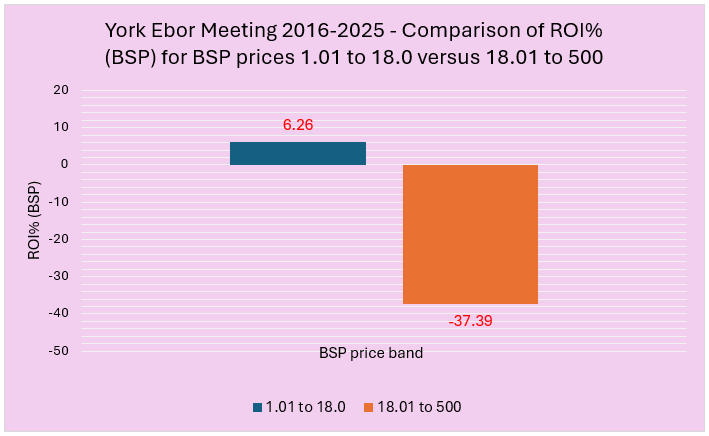
If we take that winner out of the ‘6th+’ group, losses for the remaining runners stands at a touch more than 32% (32p in the £). Indeed, if we compare ROI percentages (return on investment) for BSP prices 18.0 and lower compared with 18.01 to 500 we see the following:


Bar chart comparing ROI% for BSP price bands: 1.01–18.0 yields about 6.26% and 18.01–500 yields about −37.39% (York Ebor Meeting 2016–2025).


That 538.81 winner mentioned earlier lies outside the 18.01 to 500 band to help emphasise the strong market bias we have seen at this meeting over the past ten years. I now want to drill into favourites in a bit more detail as well as the top three horses in the betting, so let me start with the market leaders.

York Ebor Meeting Favourites

Backing favourites blind would, somewhat surprisingly, have yielded a profit in six of the ten years. Below is a breakdown of handicap favourites versus non-handicap ones.


Race Type Runs Wins Win% BSP P/L BSP ROI
Non-handicap 140 55 39.29 11.86 8.47
Handicap 129 24 18.6 -2.87 -2.23


We would expect to see a much higher strike in non-handicaps, and we do. From a returns perspective, non-handicap favourites delivered a profit to the tune of better than 8p in the £.


York Ebor Meeting Favourites by Race Class

What about class of race? In the table below we see the results for favourites in Group 1, 2, 3 and Listed races, as well as all other races which were Class 2 level.


Race Class Runs Wins Win% BSP P/L BSP ROI
Group 1 31 15 48.39 1.87 6.02
Group 2 46 19 41.3 3.32 7.22
Group 3 23 6 26.09 -5.14 -22.36
Listed 20 7 35 3.75 18.74
Class 2 149 32 21.48 5.2 3.49


Favourites have been fairly consistent across the five levels with only Group 3 jollies showing a loss.

I have two additional market leader stats worth sharing. The first is the performance of favourites in 3yo only races: they won 12 of 36 races (SR 33.3%) for a profit of £10.78 (ROI +29.9%).

The second is when Exchange favourites were aged five or older. They won an impressive 42.6% of the time (20 wins from 47) for a healthy profit of £23.26 (ROI +49.5%).

Top three in the York Ebor meeting markets

Next I'll group the top three in the Exchange market together.


Runs Wins Win% BSP P/L BSP ROI
806 162 20.1 64.43 7.99


Backing all of the top three market positions blind in every single race over the past ten years would have made a solid profit. In terms of handicaps vs conditions races we see the following results:


Race Type Runs Wins Win% BSP P/L BSP ROI
Non-handicap 421 100 23.75 4.75 1.13
Handicap 385 62 16.1 59.68 15.5


Based on what we saw earlier when looking solely at favourites, it is clear that second and third market choices in handicaps have performed extremely well. Indeed, backing the two in every handicap race would have produced a very healthy return of over 24 pence for every £1 bet.

We saw earlier that Exchange favourites when aged five and older fared very well, and extending these 5yos to those that were in the top three of the betting improved matters still further. This older cohort produced 38 winners from 131 runs (SR 29%) for a significant profit of £72.15 (ROI +55.1%). It should be noted that the bigger returns were seen in handicap races (72p in the £), but even in non-handicaps older horses returned 35p in the £.

Course last time out (LTO)

A look now to see whether the location of a horses' previous race course outing made any difference. Here are the data, with qualifying courses need to have had a minimum of 40 qualifiers.


Course LTO Runs Wins Win% BSP P/L BSP ROI
Ascot 457 38 8.32 -78.35 -17.14
Ayr 46 2 4.35 -21.15 -45.98
Chester 85 3 3.53 -53.88 -63.39
Curragh 114 18 15.79 -0.18 -0.16
Doncaster 69 6 8.7 39.52 57.28
Goodwood 837 65 7.77 -232.55 -27.78
Hamilton 47 3 6.38 6.6 14.04
Haydock 148 11 7.43 6.35 4.29
Musselburgh 44 1 2.27 -18.5 -42.05
Newbury 127 13 10.24 0.57 0.45
Newcastle 59 0 0 -59 -100
Newmarket 300 27 9 25.93 8.64
Pontefract 68 3 4.41 3.76 5.53
Ripon 54 7 12.96 18.18 33.67
Sandown 90 12 13.33 18.72 20.8
Thirsk 71 3 4.23 -32.01 -45.08
Windsor 60 5 8.33 -23.27 -38.78
York 252 18 7.14 500.11 198.46


No prizes for guessing where the 538.81 BSP winner raced last time...!

The main finding for me is the poor performance of horses that ran at Goodwood last time. Of the 837 qualifiers, 833 had raced at Glorious Goodwood LTO so maybe a good proportion of these runners had been primed to peak at Goodwood which would partly explain these disappointing numbers. Even so, to lose over 27p in the £ across so many runners is very steep.

It gets worse still if we focus on horses that finished in the first three LTO at that Glorious meeting – this group of horses scored less than 10% of the time at the Ebor meeting on their next start (32 wins from 331 runners; SR 9.7%). Backing all of them would have seen losses of £137.04 (ROI -41.4%). Wow! Losses of more than 41 pence in the £ is crazy. Even when we extend to horses that finished in the top six at the Goodwood Festival meeting LTO losses were still 35p in the £.

Another point to note is that horses from some of the lower grade Northern tracks have performed poorly, too. I guess this should be expected, but LTO runners at Newcastle (0 from 59), Thirsk (3 from 71) and Pontefract (3 from 68) have particularly struggled. Likewise, horses that raced at Ayr, Chester and Musselburgh LTO found winning tough at the Ebor meeting.

It is not only the positive angles we should be looking for because negative ones can help us narrow down a field and make the selection process far more manageable.

In terms of positives, horses running at the Curragh last time performed quite well. Of their 18 winners, eight came from Aidan O’Brien but his runners actually made a loss of 28p in the £. Combining all other trainers together would have turned a profit, with an overall return of 17p in the £.

York Ebor Meeting Trainer Angles

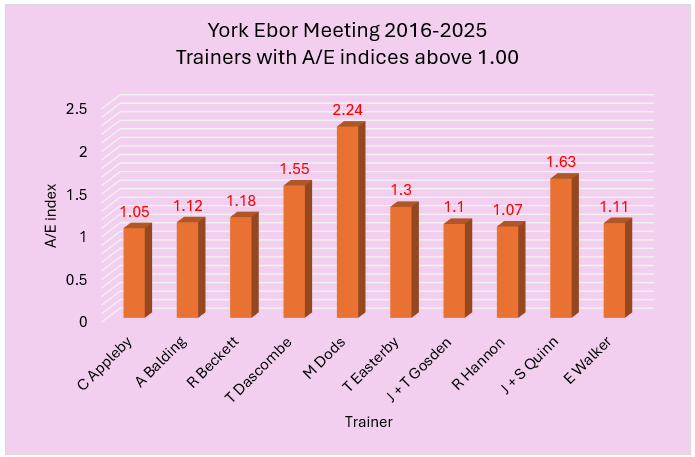
A look at trainers now, although as with most big meetings, it is hard for even the best trainers to stand out in such a competitive environment. Firstly, I want to share the trainers with the top ten A/E indices, all of which happen to be above the magic 1.00. These are based on Industry SP, so in truth we can upgrade them a little further.


Bar chart: AE indices by trainer for York Ebor Meeting (2016–2025); highest M. Dods at 2.24, others 1.05–1.63.


Any score above 1.00 suggests betting value across the trainer cohort as a whole, and Michael Dods stands out with an A/E index of 2.24. A fair proportion of these trainers are ones we might have expected to do well, namely (Charlie) Appleby, Balding, Beckett and the Gosden yard. Here are the full stats for the ten:


Trainer Runs Wins Win% BSP P/L BSP ROI
J + T Gosden 97 23 23.71 11.73 12.09
C Appleby 61 12 19.67 7.55 12.38
M Dods 41 8 19.51 49.54 120.83
J + S Quinn 34 5 14.71 50.31 147.97
A Balding 138 19 13.77 34.05 24.67
R Beckett 86 11 12.79 15.9 18.49
R Hannon 97 11 11.34 -17.08 -17.61
T Dascombe 46 5 10.87 9.02 19.61
E Walker 40 4 10 16.57 41.43
T Easterby 100 8 8 536.4 536.4


Nine of the ten stables proved profitable to follow with only the Hannon yard enduring a punting 'reverse'. The Dods stats are strong, as expected off his 2.24 A/E figure, but five of his eight winners arrived between 2016 and 2019. The Gosden yard has been highly consistent with at least one winner in eight of the past ten years. Indeed, in four of those years they managed four victories per meeting. Take note if the Betfair market has a Gosden runner at the head of it, as 15 of their 26 Betfair favourites have won, returning punters nearly 38 pence in the £.

The following table contains data for all other trainers who saddled at least 30 runners at York's Ebor meeting in the past ten years. Again, they are ordered by win rate:


Trainer Runs Wins Win% BSP P/L BSP ROI
A O'Brien 110 15 13.64 -45.73 -41.57
W Haggas 143 15 10.49 -47.85 -33.46
C Hills 66 6 9.09 -13.82 -20.94
R Varian 78 7 8.97 -32.04 -41.08
Clive Cox 37 3 8.11 9.47 25.59
K Burke 103 6 5.83 -16.48 -16
D O'Meara 140 7 5 -82.36 -58.83
R Fahey 154 7 4.55 -37.56 -24.39
K A Ryan 160 7 4.38 -52.17 -32.61
H Palmer 54 2 3.7 10.55 19.54
I Williams 38 1 2.63 -31.53 -82.97
B Ellison 32 0 0 -32 -100
Michael Bell 32 0 0 -32 -100
C Johnston 41 0 0 -41 -100


As we can see, when looking at the raw figures it seems that the mercurial Aidan O’Brien has not quite mastered this meeting. Losses of over 41p in the £ is steep for all his runners. However, there are two very important caveats. Firstly, he has improved notably in the last three years with nine of his 15 winners in the decade striking; and, secondly, his bigger priced runners have struggled and can generally be ignored: Ballydoyle runners sent off at a BSP higher than 12.0 went 0 from 47 over the past ten Ebor meetings.

William Haggas, too, has very modest overall stats but, like O’Brien, his recent record is much better, with ten of his 15 winners having come in the past four years. Some of that was variance for the proud Yorkshireman and he's had a winner every year since at least 2009 - with the exception of 2021 when, bizarrely, his Percentage of Rivals Beaten (PRB) figure of 64% was his highest since 2015. These are some of the challenges when trying to make sense of small datasets!

York Ebor Meeting Run style / Pace Bias

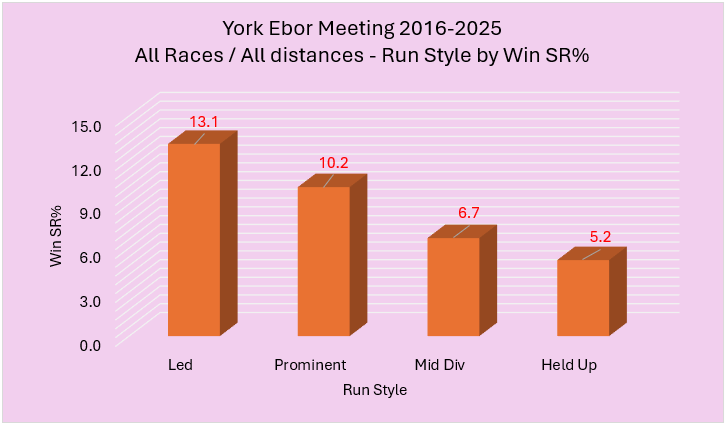
Onto run style now. I'll kick off by looking at win strike rate by run style across all races.


Bar chart showing Run Style by Win SR% for York Ebor Meeting 2016–2025; Led 13.1%, Prominent 10.2%, Mid Div 6.7%, Held Up 5.2% (higher SR% for lead positions).


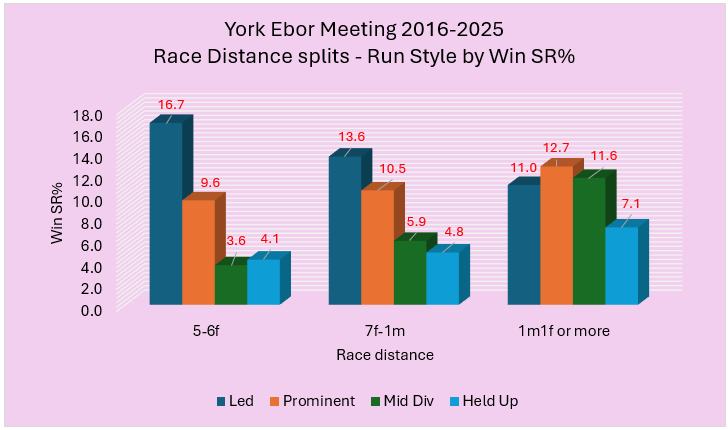
Front runners enjoy a good edge at York, and this type of linear pattern is one we have seen numerous times before where the bars get smaller from left (led) to right (held up). We normally see strong front running biases at shorter distances so the graph below splits the York Ebor meeting data into three distance bands – 5f to 6f; 7f to a mile; and 1m1f+.


Bar chart of York Ebor Meeting 2016–2025: race distance splits by run style (Led, Prominent, Mid Div, Held Up) with Win SR% values for 5–6f, 7f–1m, and 1m1f+.


Over 7f and 1m the closer to the early pace the better, but once we get to longer distances it is a much more level playing field, although hold up types have still struggled.

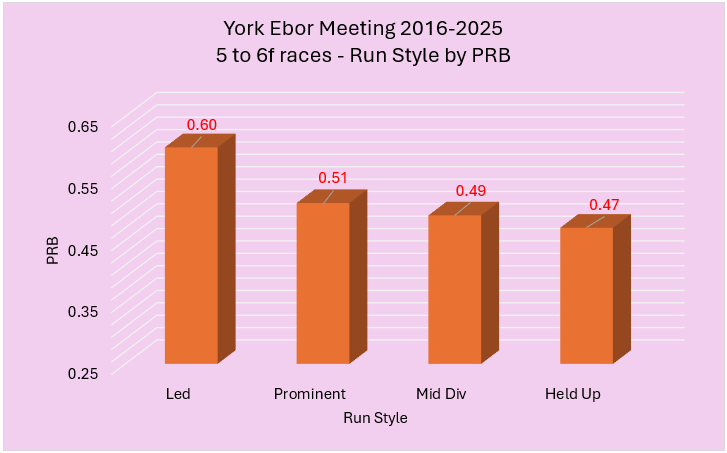
Meanwhile, on the straight track (5-6f) front runners have had a very strong edge in terms of win percentage/strike rate. Looking at PRB in these sprints there is a strong positive correlation with the win rates as the graph shows below:


Bar chart of Run Style by PRB for 5–6f races at York Ebor Meeting (2016–2025): Led 0.60, Prominent 0.51, Mid Div 0.49, Held Up 0.47.


0.60 is a very strong PRB figure and, clearly, we should look out for potential front runners in sprint races. There have been four specific races which stand out:

Wed 1.50 Hong Kong Jockey Club handicap (5f) – in eight of the last ten years this race was won by a horse that either raced prominently or led early (6 wins for Prom; 2 for Led). 132 horses were either held up or raced mid-division and only two won. However, for the record these two winners came within the past three renewals.

Wed 5.20 Sky Bet Nursery (6f) – four of the last ten races were won by the early leader and, considering nine of the last ten renewals were contested by at least 16 runners, this is extremely noteworthy. There were four further wins for prominent racers, meaning - again - those racing in the second half of the field early on were left fighting for scraps generally.

Thu 1.50 Lowther Stakes (6f) – four of the last eight renewals have been won by the horse that took the lead early.

Fri 3.35 Nunthorpe Stakes (5f) – there have been eight wins for prominent racers and one for the front runner in the last decade. Hold up horses were 0 from 54.

York Ebor Meeting Draw Bias

I want to finish up by looking at whether any draw biases are likely to occur. Generally at York, there is a low draw bias over 5-6f and also at a mile. Below I've combined 5f and 6f races first to analyse the draw data from all York sprint handicaps of 14 or more runners since 2021. I have used a small part of the excellent Geegeez Gold Draw Analyser tool for this:


Racing statistics table for York 5f–6f races, going hard, 14 runners, dates 2021–2026; rows LOW, MID, HIGH with Wins, Places and betting figures.


I have chosen 14 or more runners because more than 80% of the sprint handicaps at this meeting over the past ten years have seen at least 14 runners line up. Low draws have definitely had the best of it at the track in the past few years based on the metrics shown in the table.

Moving up to a mile and there will be two handicaps at the distance again this year, almost certainly with very big fields. For the record, 16 of the 20 1-mile handicaps at this meeting over the past ten years has seen at least 16 runners line up. So I have set the Draw Analyser parameters to look at 16+ runner handicaps run at York (any meeting) going back to 2021 in order to illustrate what has transpired.


Form table for York sprints: LOW, MID, HIGH with Draw, Runs, Wins, Places, Win% and Place% with P/L values.


Low draws have dominated and high draws have really struggled. It should be noted that mile races are contested on the round course and a berth closest to the inside rail in these races has proved a real advantage. Indeed, this is a trend that goes all the way back to the 1990s.

Looking at the ten-year draw trends for each 1-mile handicap:

On Thursday at 3.00, the Sir Kevin Sinfield 7 In 7 Grand Finale Handicap has seen five of the last ten renewals won by horses drawn four or lower, with eight going to horses drawn eight or lower.

The 1.50 on Friday, the Sky Bet Mile Stakes, has resulted in seven of the last ten winners emerging from stall five or lower; all bar one of the ten were posted seven or lower and, therefore, in the bottom half of the draw.

*

I hope this article has offered some useful pointers for the four excellent racing days at York this week. The best of luck to you if you're playing.

- DR

Monday Musings: Lies, Damned Lies, and…

Don’t look now, but York starts on Wednesday and every year for me that means the beginning of the end of summer, writes Tony Stafford. The nights start to draw in; evening race meetings begin at 4 p.m. and if they want to stage ten-race cards as they have been doing recently, they’ll need to be over by 8 p.m. at the latest, except on all-weather.

I’m still not going racing, instead waiting for the day that, like the French, the British (and Irish) public can attend. Harry and Alan are going up to York and have got a great deal in the Marriott at the mile and a half gate. All they need now are some of the highly-regulated owners’ badges to go their way. Wednesday looks good apparently, but some of the other days are more questionable. It might be a case of watching on the hotel telly.

There’s been a fair amount of goalpost-moving lately. I’m delighted that I can get back from today to ice-rink chauffeuring. In the end Mrs S and her skating chums didn’t have to resort to chaining themselves to the Downing Street railings like latter-day suffragettes to get their pleas heard. Now she needs to see if she can still skate after six months off since her latest leg operation.

But the biggest movement, and one more than relevant to someone who has meticulously – as you all will be aware – kept the Covid-19 UK daily death figures since mid-March, immediately after the conclusion of the Cheltenham Festival, is how they are reported.

Spikes and the now seemingly-defunct “R” number have kept us all in check – bar the odd quarter of a million on Bournemouth, Brighton or Southend beaches when it got really hot. But in the middle of last week, suddenly the Government finally proved that there really are “three kinds of lies - lies, damned lies and statistics” as commonly attributed to the American writer Mark Twain, though whose true origin may predate that great wordsmith.

Back in mid-April, in the week to April 12 there were 6,425 recorded Coronavirus UK deaths, an alarming figure that mercifully began to reduce steadily. By mid-July we were in the realms of below 500 a week and still falling. During the same period, testing was increasing exponentially from the starting point of barely 10,000 tests – in other words, at that time people were really only tested when it was obvious they had the virus. But, by July, between 100,000 and 200,000 tests were available every day.

Then suddenly last week, the Ministry – amid renewed local lock-downs where clusters of positive tests were revealed – concluded it would no longer count as Coronavirus deaths, anyone tested as having the virus but who died more than 28 days afterwards.

So from July 31, when the brave new world came in, and when positive tests were going back up again to 1,000 plus each day the daily deaths in the UK were not. Starting on the last day of July the number of deaths has been 5, 1, 18, 14, 18, 12, 3, 5, 17, 14, 20, 18, 11, 3 and 5. Those numbers are probably smaller than many other routine causes of deaths in a population of 60 million. In all honesty, if that is the basis by which it’s judged, shouldn’t we be getting back to normal?

If they don’t yet have a vaccine ready, shame on them. There have been plenty of people willing to act as paid guinea-pigs, especially if their jobs have disappeared. You might even say if the figures can be presented thus, what’s all the fuss been about?

To the racing. It’s expected to be fast ground at York – amazing news for anyone who has been waiting for the action to start at the Test match at Southampton over the past few days, and they are the conditions I prefer to see on the Knavesmire. Frankie Dettori won’t be there but as the great man approaches his 50th birthday in December, he is showing a rare facility for making correct choices.

While the racing goes on at York, he’ll be staying in Deauville having had the news on Friday that the newly-re-imposed 14-day self-isolation period for people returning from France and some other countries has been modified for elite sportsmen. They, it seems, need only face a seven- or eight-day spell under specific conditions in self-isolation at home before resuming full activity.

Frankie was anxious not to miss either Mishriff, the French Derby winner, impressive again at Deauville last Saturday, or the unbeaten St James’s Palace hero Palace Pier in yesterday’s Prix Jacques Le Marois. That fast-improving colt came through to beat Alpine Star with the older horses led home by Circus Maximus, and best of the home team, Persian King, well beaten off. He is now being lined up for the QE II Stakes at Ascot in the autumn.

Alpine Star had been narrowly pipped in the French Oaks by the Donnacha O’Brien-trained Fancy Blue who went on to take the Nassau Stakes at Goodwood with authority. Jessica Harrington trains Alpine Star, and the two Irish fillies – along with the Aidan O’Brien-trained Peaceful – comprise a formidable trio of mile/ten-furlong star sophomores.

None of them will be at York, but the best of the lot among the Classic generation of females will be.

Potential opposition to Love in Thursday’s Yorkshire Oaks again seems to fall principally on Frankly Darling, who disappointingly failed to provide much of a test at Epsom for the Coolmore filly as she added the Oaks to her 1,000 Guineas honours in spectacular style. The four-year-old Manuela De Vega is smart but conceding lumps of weight? Hardly! Dettori’s absence from York – he’s staying en France an extra week – tough! – to wait for a Wesley Ward runner in next weekend’s Prix Morny.

That will still give him time for the requisite eight and a few more days before teaming up with Enable in Kempton’s September Stakes, a cleverly-thought-out target from John Gosden which obviates the need to tackle Love before the Arc. Enable won the September Stakes two years ago as a prelude to her second win in Paris in October. How they would cherish a third as a six-year-old after the shock of being caught close home by Waldgeist last year.

The York meeting opens with another Gosden star, Lord North, the major loss this week for Dettori judged on the four-year-old’s upward-mobility this summer. Winner of six of his nine career races with two seconds and a luckless eased last of eight in the other, Lord North has progressed from a laughably-easy Cambridgeshire winner to outclassing his Prince Of Wales’s Stakes opponents at Royal Ascot. James Doyle is the beneficiary, as he was at Ascot when Dettori rode Mehdaayih. Who’s to say Lord North cannot progress enough to beat Ghaiyyath, as well as the 2,000 Guineas winner Kameko and possibly Magical in the Juddmonte International?

We won’t have Saturday’s Ebor Handicap runners until around 1 p.m. today and I can’t wait to see which potentially top-class horse Messrs Gosden, Haggas or Varian will have lined up to win it. Even though the total prize pool has been slashed from £600,000 to a relatively frugal £250,000 I’m sure there will be enough horses to fill the 22 available stalls. It would be great if a hard-knocking horse from the North could see off the aristocrats from Newmarket.

Another race that I’m looking forward to is Friday’s Nunthorpe Stakes, not least because Wesley Ward is bringing a lightly-raced but clearly talented juvenile to tackle Battaash, Art Power and A’Ali. His Golden Pal, runner-up after making the running to The Lir Jet in the Norfolk Stakes will be going there as a maiden with form figures of 22, having earlier been beaten when favourite for a Gulfstream Park maiden in the spring.

He will be echoing to a large degree the pre-Nunthorpe record 13 years ago of the John Best-trained juvenile Kingsgate Native, a 66-1 debut runner-up in the Windsor Castle Stakes and then second again in the Molecomb at Goodwood.

Backed down to 12-1 (among many, by me!), Kingsgate Native easily beat Desert Lord with future stallions Dandy Man and Red Clubs the next two home. I note the weights will be unchanged from then, so Battaash carries 9st11lb; three-year-olds Art Power and A’Ali 2lb less and Golden Pal only 8st1lb. He will have Andrea Atzeni, who rode him at Ascot, back on board.

I know the other three are highly-talented, and it would be another feather in the Charlie Hills cap if Battaash could win a second Nunthorpe, but I’d much prefer Wesley’s undying love for British racing to get a reward after a couple of less than wonderful years. He certainly seems to have all his ducks in line this time.

So in conclusion, I say enjoy York, if you are, like Harry and Alan, fully documented-up. If not, the wonderful coverage – free and flourishing on ITV though I still doggedly stick to Racing TV – deserves watching for all four days. Please then, start taking off the restraints, Mr Boris. Five months using only two tanks of fuel has been sacrifice enough.

York Ebor Stats: Draw, Pace and Trainer Profiles

It's York's Ebor meeting next week, with its smattering of Group 1 features as well as the first ever £1,000,000 handicap in British flat racing, attached naturally enough to the race which gives its name to the meeting (and which in turn was derived from the name, Eboracum, the Romans gave to a fort which resided on the site of what is now the town of York).

In view of four heady days on the Knavesmire, with what general information should punters at York arm themselves? This article, revised since last year's meeting, should help.

York Racecourse Configuration

The track at York features a six furlong straight down which races at up to that distance are run. There is a dogleg start from a chute for seven furlong races, and a pretty tight bend into the home straight for races longer than that. You can find more York racecourse insights on our dedicated York course info page.


York Draw Information

So what impact, if any, does the shape of the racetrack - and indeed drainage - have on draw positions? The weather is set fair for the week and the going is currently good to firm, good in places - the clerk has stated that he will water to ensure broadly that ground. Using geegeez.co.uk's Draw Analyzer tool, offers the following insights:

Five furlong draw at York

Looking only at bigger field handicaps on good to soft or quicker, we can see that there is a slight bias towards lower drawn horses. It is important, however, to check for an even spread of pace across the track: if high numbers have the most early dash, that could be enough to overcome any implied bias in the data.


Six furlong draw at York

Over the longest piste on the straight course, low again seem just about to have the best of it, particularly when reviewing the place data: this reveals a gradation from low (best) to high (worst). There is nothing insurmountable in these straight data but, all other things being equal, lower numbers may shade it.


Seven furlong draw at York

On the dogleg, there is a small advantage to be drawn middle to high. Looking at the constitution of the track, that makes sense as such runners can cut the corner of the dogleg, especially if breaking alertly. Again, though, it probably won't make the difference between a horse winning and losing, it's just a mild negative for those drawn low.

1m/ 1m1f draw at York

The mile and nine furlong trips are the first we've considered which take in that sharp bend quite soon after the start of races; that can make life challenging for those trapped wide. As a jockey, do you use up petrol trying to get handy, or take back and ride for luck? This challenge is borne out in the data, which shows those on the outside winning far less often - and placing less often - than those inside (low).

This time I've illustrated using the full draw chart table as well as a chart showing IV3, a unique geegeez perspective of draw based on the average Impact Value* of a stall and its immediate neighbours.

*Impact Value is the name given to an index created from the number of winners having a certain characteristic compared with the number of runners having that same characteristic. In this example, we are looking at the exactly 1000 runners to race in 8/9f 12-runner-plus York handicaps since 2009 (good to firm through to good to soft) which contested the 61 races in that sample.

So, for instance, we can see that the number of stall 1 winners was five, and the number of stall 1 runners was 61.

Our calculation is:

(number of stall 1 wins / number of stall 1 runs) divided by (all wins in the sample / all runs in the sample)

Numerically that's

(5 / 61)    /    (61 / 1000)

which equals

0.0819672131 / 0.061

which equals 1.34 (see the IV column, second from the right)

The IV3 for stall 4, for instance, is the mean average of the IV of stalls 3, 4, and 5. That is, (2.96 + 1.88 + 1.88) / 3 = 2.24

Of course, you absolutely do not need to understand how it is calculated to know that it is useful in probability terms. Not necessarily in profitability terms, which is a different fish entirely. (We use A/E - Actual vs Expected - more of which another day, or here).

All you need to know is that 1.00 is 'par', 'standard', 'normal' and/or otherwise unremarkable. The further away from 1.00 you get the better or worse such horses have fared, bigger numbers being better.

Management summary: numbers greater than 1.00, especially on bigger sample sizes, imply a greater probability of success.

Hopefully that makes sense - don't get bogged down in the method, but do take note of the meaning.

Draw at longer trips at York

There is no noteworthy draw advantage over longer distances at York.


**

York Pace Information

So that's draw, but what of pace? Are particular run styles favoured on this expansive track with its near five furlong home straight?

As with most courses, the front is the place to be in sprint handicaps: front runners at York in big field 5f or 6f handicaps win around two-and-a-quarter times as often as random, and are very profitable to back blindly. See the image below, taken from Gold's Pace Analyzer.

Of course, the problem is that we don't know which horse will lead until the race is underway. However, we can often project that fairly accurately based on historical run styles. Naturally, Geegeez Gold will inform you of what you need to know with a couple of mouse clicks.

There is no discernible pace bias at seven furlongs in big field handicaps, though when the going is good to firm those on the speed have a better chance of seeing it through.

Over a mile, it doesn't pay to be too far back as this somewhat linear chart attests. Although the fewest number of races were won from the front, the number to attempt that feat was commensurately small: a win strike rate of 12% compares favourably with the other run style cohorts. We can see from the table below (Place% column) that these data are backed up by those horses to make the frame.


There are no nine furlong races at York's Dante meeting, and at ten furlongs there is no discernible pace bias. That said, those trying to make all are 2 from 78 (-40 points, IV 0.4).

And at a mile and a half, it pays to be played later: those which led or raced prominently in big field twelve-furlong handicaps are a collective 21-374 (5.6% strike rate) for a starting price loss of £205.75.

**

Top York Handicap Trainers in August (Ebor meeting)

You may well have seen lists of trainers to follow elsewhere, and fair play to the publishers. Here I want to look at trainer performance overall, and by race type.

York Ebor Meeting: Overall Trainers, 25+ runners, 2014-2018

There are some interest headlines here. First, Mark Johnston runs a lot here but wins with very few. The 21% place rate is way down on this yard's overall rate, normally hitting the frame at around 36%.

Next, Aidan O'Brien. Tony Keenan established chapter and verse on the Ballydoyle Ebor efforts in this excellent post, and it can be seen from the below that York's meeting is not a hugely successful one for the Coolmore head handler: five wins from 56 runners, 0.65 A/E is moderate for this preeminent operation.

Richard Fahey, Brian Ellison, and Richard Hannon are others about whom to be apprehensive in the general context, though further digging below may shine a more favourable light on some sections of their entry.

On a more positive front, William Haggas, famously a Yorkshireman exiled in Newmarket, relishes the opportunity to plunder pots at his home racetrack; and he does so regularly. His 11 winners in the last five years is four better than the next best haul, with Haggas even managing to chisel out a profit and a positive A/E for followers.

And it's been a good meeting for the Godolphin blue, especially the Charlie Appleby team, which has recorded positive punting figures from seven victories. A 24% hit rate is exceptional given the depth of competition at this fixture.

Andrew Balding and Charlie Hills are both solid operators with a mildly positive wagering expectation.

York Ebor Meeting: Handicap Trainers, 15+ runners, 2014-2018

Specifically in handicaps, there is little of value to be gleaned from this table, except perhaps that the place records of Richard Fahey, Tim Easterby and notably William Haggas - whose overall record is so strong - suggest that caution is advised.

Ebor meeting handicaps are notoriously difficult to win and, as such, the hat-tricks notched by Messrs. Ryan, Balding and Appleby (C) are meritorious. In each case the place rate backs up the higher profile statistic.


York Ebor Meeting: Pattern (Listed or better) Race Trainer performance, 10+ runners, 2014-2018

In the good races at the Ebor meeting, we see the emergence of Charlie Appleby as a main man. Just nine runners in such races have yielded three winners, and a further placed effort. Although those numbers are unlikely to be completely lost on the market, there may remain some punting nutrition in his Pattern entries.

William Haggas has claimed two wins from ten runs, with four more placed: excellent figures and testament to the 'target' nature of this meeting for his better horses. Note that Haggas has saddled a 20/1 winner and a 14/1 second in that small group.

Nobody else has managed more than two winners.

On the downside, Mark Johnston's zero from 11 is poor, as is an 18% place rate. I'd be against them, on balance. Aidan O'Brien has an overall win rate in UK Pattern races of 15.78% (16th August 2014 to present), which makes his 5.56% Ebor Festival hit rate highly unsatisfactory. Indeed, just three places from 18 runners in this context in the last five years suggests the meeting is not a material consideration for Coolmore.


York Ebor Meeting: Class 2 or lower Non-Handicap Trainer performance, selected, 2013-2017

Here we are essentially talking about maiden and/or novice races, and we can see that man Haggas sits top of the tree. Richard Hannon's otherwise middling record at the meeting is solid if not bankable in this race type.

Local lads Ryan and Fahey look to be largely entertaining owners at their marquee home fixture and their entries can be pretty much overlooked in this context, though the latter did hit his mark with 33/1 Red Balloons last year - which paid for a lot of losers!


Ebor Trainer Summary

Overall, one does have to be careful with small sample sizes and current trainer form. But, accounting for those, the main trainer takeaways from the last five Ebor meetings are:

- Beware Johnston, Fahey, Ryan and O'Meara. They've collectively won 19 of the 127 races at this fixture since 2014, having saddled 353 of the 1660 runners. An Impact Value of 0.70 compares with their overall five year IV of 1.23 across more than 24,000 runners. It's likely they'll win four or five of the 25 races, but they're also likely to send out around 70 runners most of whose prices will be more indicative of the 'better than peer group' global IV rather than the poorer local IV. That's a verbose way of saying they'll represent poor value overall.

- William Haggas is the man to follow in non-handicaps.

- Charlie Appleby runners should be given two looks without exception.

- Aidan O'Brien appears not to target the meeting, so his runners may make the market for anything else you fancy.