
Two-year-old Foaling Date – is there an edge?
The start of the turf flat season is upon us with the Lincoln meeting at Doncaster on Saturday and, in this article, I will delve into an area that I have never written about for Geegeez before, writes Dave Renham. I will be looking to see what, if any, impact on two-year-old performance foaling date has.
Introduction
2yo races can be tricky to unravel at any time of year, but especially so early in the season as the vast majority of runners are making their racecourse debuts. I have written several articles about juvenile races in the past focusing mainly on trainer and sire data to help give us an edge. Now it is time to share my foaling date research as there are some angles that we may be able to exploit in the coming weeks and months.
The data have been taken from UK flat racing (turf and AW) spanning eight seasons from 2018 to 2025. The profit/loss figures have been calculated to Betfair SP (BSP) less 2% commission. I will be examining 2yo non-handicap races only, as firstly 2yo handicaps do not start until later in the year and secondly with 2yo races I think it is better to analyse non-handicaps and handicaps separately.
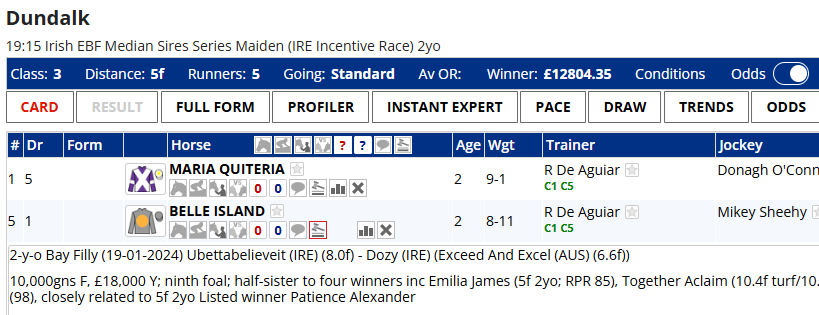
On geegeez.co.uk, foaling date can be found behind the breeding/sales icon on the racecard:
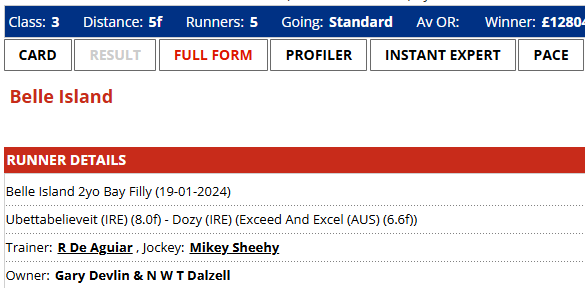
And on the Full Form tab / popout:

Two-year-old non-handicap races run in March and April
To begin with I want to focus on early season 2yo non-handicap data, so races that were run in the months of March and April. Below is a chart of the win strike rates for the different foaling months:
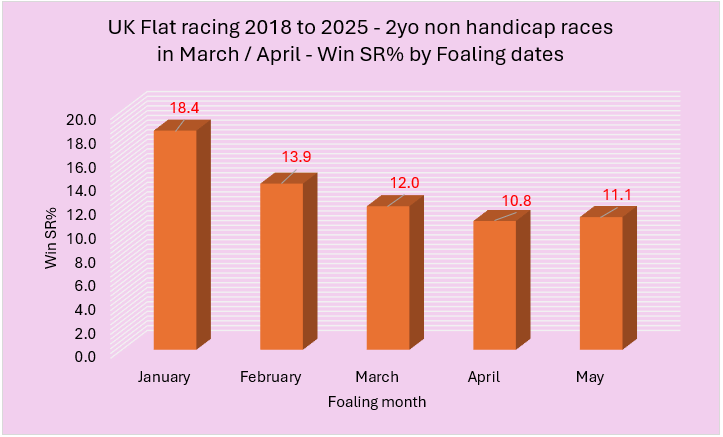
As can be seen 2yos foaled in January have a clear edge in term of win rate and, generally speaking, at this early stage of the season the older the 2yo the more likely they have been to win. Here is a fuller breakdown of two-year-old non-handicap races in March and April by foaling month:
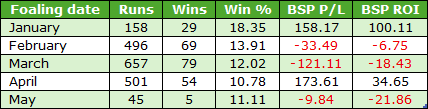
January foals not only won more often in the first few weeks of the season, but they were also extremely profitable to follow. There was a BSP 57.43 winner in there, but even that runner the profit stands at over £100, with returns of 64p in the £.
It should be noted that the profit for April foals was skewed massively by one huge price winner at BSP 334.75; so in reality April runners, with their low strike rate as well, were poor value. The May data is limited but it is unlikely that it would improve much even with a bigger sample.
If I set a price cap of BSP 20.0 or less, to remove the chances of skewed bottom lines,the table looks thus:
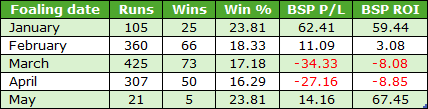
I would take the May figures with a pinch of salt due to the tiny 21-runner sample size, but it is noticeable again the edge January foals had over February ones, who in turn outperformed March and April foals.
Two-year-old non-handicap races run in May
Moving into races run in May, here are the foaling month data, keeping with the BSP 20.0 or less price cap:
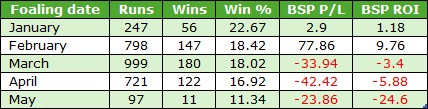
Again, January foals won the most often and edged into blind profit once more. February foals enjoyed the second-best win rate (just) and produced decent overall profits. The pattern in May was similar to the March/April one where the January and February foals were better value than those later foaled runners, as well as scoring more often.
Two-year-old non-handicap races run in June and July
It is at this point in the season that the playing field starts to level out and the edge that January, and to a lesser extent February, foals had disappears. The graph below shows the win strike rates for each foaling month for racing in June and July. This incorporates all runners (no price cap):
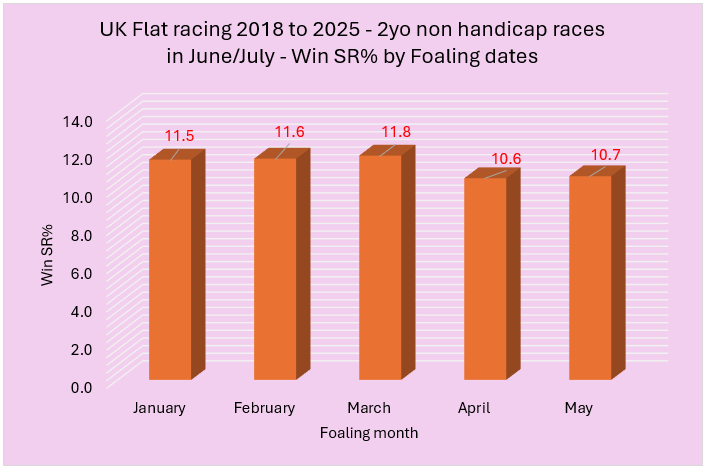
The strike rates for January, February and March foals were virtually identical with April and May roughly one percentage point behind. If we reintroduce the price cap of BSP 20.0 or less, the results for June and July and looked like this:
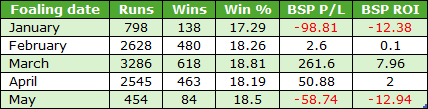
January foals no longer had an edge in terms of strike rate and more importantly offered poor value. March foals fared especially well in terms of profits and returns, while May foals won as often as the rest, but overall they were once again poor value.
Summary by Month
By mid-summer, therefore, foaling date bias to horses born in earlier months has diminished. To illustrate this I have constructed a graph of win strike rates by month for each of the different foaling months (all prices).
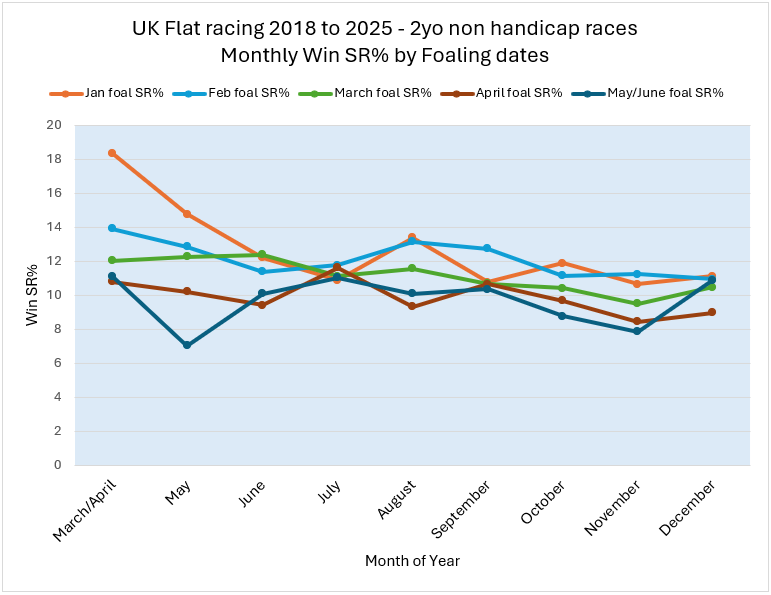
The graph neatly captures that once we hit June and beyond win rates start to even out. By December the win rates between four of the five foaling dates were within 0.6% of each other. That's quite the difference when compared with races run in March, April and May.
Favourite performance in two-year-old non-handicaps by foal month
I now want to look how the favourite has fared in 2yo non-handicaps when considering their foaling month. I have viewed this as a whole, so combining the race results from all months and years. These were my findings:
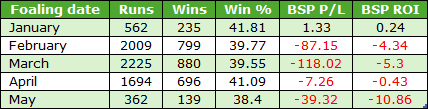
Favourites foaled in January produced a nominal profit, while April foals have come close to breaking even.
There is a strong stat to share for January foaled favourites when we again focus on the early months of the season. Horses foaled in January which started favourite when racing in either March, April or May won 38 races from 73 (SR 52.1%) for a heathy profit of £25.48 (ROI +34.9%).
In contrast, the youngest 2yos - those foaled in May - have quite a poor record when sent off favourite, recording losses of over 10p in the £.

The data shared to date in this article for May foals have been the poorest of the foaling months by some margin, this being another case in point. For the record. June foals started favourite on just three occasions so far too small a sample to analyse.
Top four in the market: performance in two-year-old non-handicaps by foal month
Expanding this overall research to horses that started in the top four of the betting across all months and years we would have seen the following splits:
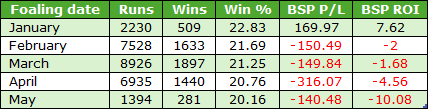
When starting in the top four of the betting, January foals again performed best in win strike rate terms, and notchde a tidy profit to boot. On the flip side, May foals once more produced the worst returns by some margin. [There were just seven June foals that started in the top four of the betting – again far too small a sample to share.]
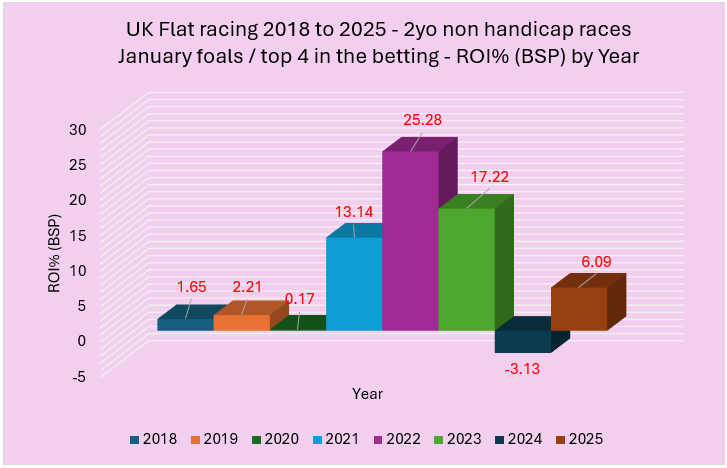
Sticking with January foals that started in the top four of the betting, they turned a profit in seven of the eight years as the graph below illustrates:
*
To conclude, foaling dates clearly make a difference in the early weeks of the season based on these findings. January foals seemed to have a genuine advantage over their younger rivals in the months of March and April especially. Their performance dropped away a little in May, but they still went well in that month.
February foals also started the season well, seemingly peaking in May, while March foals performed best in the months of June and July.
The one constant across all months was the poor record of May foals compared to the rest. In term of returns, other than from the small sample in March and April, they recorded fairly significant losses across the board even with more fancied runners.
I was not sure how much I was going to find when embarking on this research, but I have been pleasantly surprised with the findings. Keep it to hand in the early weeks of this season.
Until next time…
- DR
Other Recent Posts by This Author:
- Ebor Festival 2026: A Statistical Overview
- Billy Loughnane: ‘The Kid’ in Numbers
- Course Topography: Uphill Finishes
- The Impact of Last Time Out Run Style
- Combining Pace and SR Ratings, Part 2








Great data. I have for a long time incorporated this in the early 2 YO races as it makes so much sense as a January foal is effectively 25% older than a May foal and that impacts dramatically one would expect into physicality. Considering that GG does not currently provide foaling dates on their racecards I’ve found that Betfair in the comments does a good job until Matt incorporates the foaling data within GG.
very interesting for the start of the season for 2yo
Great article – do you please have the data for including all winners, not just the BSP of 20.0 or shorter?
Great read as always, Dave. What is the best (easiest) way to find foaling dates?
Great research again Dave, I shall definitely be using this information. Thank you.
I must be being very stupid… using HRB.com with the following settings: Non-Handicap – 2yo – 2018-2026 March April racedates – foaled Jan and Feb, I get:
2903 races with 107 bets, 161W (13.34%) for a P&L of -202.27. A/E 0.89 P&L on BF -16.16…. Why am I so wildly out?
Sorry 293 races – 1207 bets – screen and sunlight dont mix!
You have included Irish races Nick.
Huge, long, separate conversation, but on the surface, why would Ireland and the UK be different?
Hi again Nick
There is definitely a big error with the HRB Irish foaling data. I’ve just checked a few horses that were supposed to be January foals but none were!
Is there any chance of adding the foaling month to the QT please Matt?
Although I read a lot of Mr Renham’s articles I have never been much of a ‘stats’ man, the torrent of data makes my head swim. I have actually known about the significance of birth date of 2 YO’s for around 30 years. It may be some use but an immeidate question/objection, is how do you choose if you have several horses in a race all born in January? Do you simply follow the market of look more deeply into the breeding? I recently had 4 tracker horses in one race on a Saturday and couldn’t simply back them all. So I had to examine going, recent form, breeding, trainer stats etc. Stats can only offer indications, in my view they are no use for betting blind.
Hi MP, Like everything else, it’s just one piece of the jigsaw. Nothing is holy grail – I know you know that!
So, you go with whatever else fits in the race. Or do something different. It’s just data 🙂
Matt
Leave a Reply
Want to join the discussion?Feel free to contribute!