Monday Musings: The End is Nigh?

At last some movement, writes Tony Stafford. The five-week-long stretch of mockingly-sunny days with unblemished blue skies is about to break in the South of England according to a weather forecast I took scant notice of on Saturday evening. Horse racing is about to start in Germany, on May 4th, and in France a week later.

Hints and allegations, to quote Paul Simon, swirl around the possible resumption in the UK, with mid-May being hinted and Nick Rust reportedly the target of allegations from some senior trainers according to yesterday’s Sunday Telegraph. Rust, whose six-year stint as chief executive of the BHA will end at the conclusion of a year’s notice on Dec 31, according to the paper has been urged to step aside immediately by senior trainers including Ralph Beckett and Mark Johnston.

That pair is reputedly among a group that has canvassed Annamarie Phelps, chair of the BHA, to remove Rust amid disquiet about his handling of the sport during the suspension of racing as a result of the coronavirus lockdown. They clearly believe a rapid resumption behind closed doors is vital, with no racing having been staged in the UK since March 17th, a week after the beginning of the highly controversial Cheltenham Festival.

It is likely that any hesitancy by the sport and its figurehead Nick Rust to press for an imminent return is partly based on the lingering embarrassment that some feel because Cheltenham was allowed to proceed. Matt Hancock, Health Secretary, is also the MP for Newmarket and it would be interesting to discover how he voted when the calls by other politicians to cancel the meeting were being discussed in Cabinet.

Hughie Morrison, interviewed by John Hunt on Sky Sports Racing the other night, put a very strong case for an early resumption. He said that a behind-closed-doors race meeting could easily be staged with probably a much lower chance of spreading a contagion like Covid19 than mooching round a supermarket to do the weekly shopping. People might be asked to keep their distance in shops, not that they do, so it’s hard to see how anyone with the virus will contrive to keep it to him or herself in that environment.

Morrison reckons race meetings would be relatively easy to organise: with no racegoers other than trainers, jockeys, officials and the odd owner – one per horse the norm when Ireland were racing behind their closed doors before drawing stumps last month – and in the countryside, risks Hughie says would be minimal.

I like the potential look of a mid-to late-May restart, with the plan for both Guineas at the start of June, Royal Ascot – maybe Prince Andrew can be persuaded to come out of his Royal lockdown and tasked to present all the winners’ prizes – fan-free but in its usual slot, and the Derby and Oaks on one day at Epsom at the end of June or beginning of July. The May resumption would allow Classic trials to be staged in advance of the Guineas races.

One unkind soul, when the likelihood of crowd-free meetings extending some way into the future, suggested there might in that case be more people than is usual at some Newcastle and Southwell all-weather meetings!

But joking apart – this is no joking matter – we need racing to return. I heard second-hand from a friend of a friend, who is also a friend, that one major bookmaking company is suffering very little compared with normal activity, such has been the take-up of on-line games and the like.

There is such a hunger for something to bet on – as I hinted or alleged last week – that many bookmaker and casino-game firms are inundating the breaks between television programmes with advertising material.

Imagine how much more business they will be doing when racing and top-flight football return. As to the latter sport I find it totally mind-numbing the way certain newspaper web sites keep reporting on possible future transfer deals and what their tame football celebrities think on many matters, mostly about how little they deserve to have their salaries reduced.

For all the tragedy of at least 20,000 hospital deaths associated with the virus, while obviously by no means the only cause, and however many more elsewhere especially in care homes, some elements of normal life remain.

One long-term friend, a racing fan who had been struggling in the winter despite having for many years sold motor vehicles while also running a shellfish cabin in deepest Essex, told me the other day things have turned around. The fish bar was never a restaurant, so it didn’t need to close. Meanwhile he’s been furloughed from the car sales job so has been able to run the cabin full-time on the four days it opens from Thursday to Sunday, rather than just the weekend.

Now they are doing deliveries and take-outs and he says business is booming. When I’m allowed out again I’ll go down to Billericay and take up Kevin’s offer of a free surf and turf. It’s too far for their home delivery service to accommodate me in Hackney Wick, 30 odd miles away, so I’ll have to be patient.

There were two million-pound-to-the-winner races at Sha Tin in Hong Kong yesterday morning with mixed fortunes for jockey Zac Purton on the two odds-on favourites. Beauty Generation was foiled by a short-head in the Mile race, but Purton got his revenge aboard Exultant in the QEII Cup. Exultant, the champion middle-distance horse in HK is now a six-year-old; as a three-year-old for Mick Halford when called Irishcorrespondent, the son of Teolifio won his first two races and then finished third to Churchill in the Irish 2,000 Guineas.

The Irish Guineas, and all other Classic races in that country and the UK, will need to be slotted into the European programme and full marks to the French for getting their retaliation in first. One positive side-effect for racecourses is that their ground has had a much better chance to recover from the rigours suffered during the incessant rain and universally-heavy ground early in the year, while the Flat-only tracks will be looking pristine.

A happy consequence of that will be that they will last longer into the year when we resume. For instance, in Yorkshire, Ripon and Thirsk, which normally are looking to close their doors early in September, can be capable of going on much longer. I believe that Flat racing in the UK in 2020 could easily be staged on grass well beyond the normal early November finale at Doncaster. Who’s up for a New Year’s Eve spectacular at Newmarket?

 - TS

Monday Musings: Time Flying By

Logic told me time would pass slowly during lock-down. Five weeks in, it’s definitely speeded up, writes Tony Stafford. I spoke to my son twice last week, briefly on Sunday and then again for a few minutes more on Friday and I swore that there could only have been a couple of days between the two contacts.

Twin came around on BBC4 again on Saturday evening in my favourite 9 p.m. international drama slot and will already be finished by next weekend. Thankfully I’ve now joined BBC I-Player so I can have a second look on the confusing bits of that rapidly-evolving and brain-challenging eight-part (two each week) Norwegian epic when I get some time. I was very disappointed that Spiral, a series of series I most wanted to see and that motivated my joining, is not on the list.

The other evening it was still light when the Thursday 8 p.m. clapping reverberated from the flats all around. Racing fans in the UK, denied so much since the shut-down on March 18 and more so in Ireland, will have lost most markedly; along with the mainstream we all are aware of, the accelerating number of evening meetings, many of them over jumps, that bolster the normal spring racing menu have also been cancelled. Just to let you know, the days start getting shorter in nine weeks’ time!

The Racing Post’s online-only newspaper carries the cards, like Gulfstream Park and Tampa Bay, that have kept racing going in Florida. Like everyone else, the Post included, I expected the Wesley Ward juveniles on show at Gulfstream on successive early evenings last week to do a Lady Aurelia and blow away the opposition.

But both on Thursday and Friday, first the 30-100 shot Lime, a daughter of Iqbaal, and then Golden Pal, 1-2 (by Uncle Mo), contrived to show the trademark Ward early pace only to succumb in almost identical fashion to a single stronger finisher even though their races were over only four and a half furlongs.

This pair was reportedly among the planned Ward annual contingent for Royal Ascot but first that spectator-free entity needs to be confirmed as does secondly that overseas runners may be accepted if it does. Should they come, I’m sure the traditional fear in which they are held by home trainers may have been a little diluted, although there’s plenty of time for Wesley to build some of that extra physical maturity that his juvenile challengers always seem to display.

I’ve been intrigued by the identity of today’s evening offering at Will Rogers Downs and thought it might justify a little investigating. I wasn’t at all prepared for what I readily discovered on the web. Will Rogers Downs is a gaming (principally, of course) and horse racing venue in Rogers County, close to Tulsa, Oklahoma, and is operated by the Cherokee Nation.

That administrative area encompasses 14 counties in North-East Oklahoma and a local population of around 200,000 in one way or another descended mainly from Cherokee and two other Native American tribes.

If that wasn’t unusual enough, the jockeys and trainers will be totally unknown to most of us, unlike the stars who descend on Florida each winter and spring, especially with New York firmly shut down. For the record, Floyd Wethey, Jr. is the top rider so far in 2020 and Scott Young is leading trainer. Tonight’s 10-race card offers one quite valuable prize, a near £25k to the winner fillies and mares race. I won’t put forward a potential winner.

The gaming provides the prizemoney and the track keeps a chunk of all the race wagering. Gaming is also keeping the UK bookmaking companies going, and if the number of advertisements for casino betting that we see in the commercial breaks on most channels nowadays is indicative of betting levels in these odd times, gambling is probably going off the charts.

How the BHA must wish it could get its claws on even a small percentage of that massive cake, not that it would be right to do so (as we saw with the FOBT fiasco). Maybe they should ask Captain Tom to do a sponsored walking-frame-push around the Ascot paddock on his 100th birthday on Thursday next week while singing his chart-topping duet with Michael Ball of You’ll Never Walk Alone? The £23 million (probably more by the time you read this) by which his exploits will be aiding the NHS efforts exceeds the not-insignificant £22 million that the Levy Board is targeting to help racecourses and others through their troubled financial times.

Yesterday we went for a fourth walk of the lockdown, this time forsaking the Olympic Park, for the newly (at Easter) re-opened Victoria Park, which is in the opposite direction. The park had been closed for some time after that initial period when sunbathing and all the other indicators of holidays in good weather in the summertime caused a Government re-think. Everyone was doing the keep-out-of-the-way six-feet walk yesterday; there is no cycling and all the dogs including our Yorkie Josephina were on a lead.

What was obvious, though, was that while the ground is not yet showing any real suggestion of much new growth, the five weeks of drought, following hard on the months of near waterlogging, has already brought great cracks in the turf at some places.

Hughie Morrison has been kindly sending me a brief video every Friday of Ray Tooth’s big homebred and still unraced three-year-old Bogeyman going through his paces. Each week they have been working on the wonderful grass gallops, developed over many years by the Cundell family but now owned and managed by Sir James Dyson.

The Victoria Park phenomenon is extending into Berkshire as the colour of the terrain seems to be lightening week on week. How ironic, with barely a day’s racing after the turn of the year and before Cheltenham being staged on anything but soft or heavy ground, unless we get some rain soon, it will be firm or as near as makes no difference when we resume. Expect to see stand-pipes in the streets by July.

Finally, after hearing that he thinks racing should start as soon as possible – Nick Rust’s line at the weekend too – it was salutary that Mark Johnston has subsequently revealed he is in isolation at home after being quite ill after contracting Covid-19. It must be so frustrating, frightening even, with the Flat season still to start, for Britain’s winning-most trainer that the new norm is so alien. I’m sure that everyone in racing will be wishing Mark, wife Deirdre and their family and staff all the best in the coming trying days.

- TS

Monday Musings: The Month Long Day

Four weeks in and I don’t know about you, but it’s almost impossible to tell the days apart, writes Tony Stafford. I know I’m writing this on what they tell me is Easter Sunday; but with little varying day to day – even the weather, with the sun blazing incessantly and perma-warm temperatures – what we have had is a totally homogenised month.

The initial shopping frenzy has cooled. I act as driver for our once-a-week taxi journey a few miles to the usual supermarket where I stay secure in the car with the windows firmly closed while Mrs S does the six-foot-apart car park snake towards the entrance. Inside, she assures me, she scrupulously adheres to the one-way arrows on the floor and reckons she’s almost the only shopper who does. Food is available now and thousands have died as we proceed in our frozen state.

The Racing Post, predictably and understandably, has been forced to reduce the size of its daily computer newspaper usually to eight pages, so I’ve no idea if the birthdays remain available. For my part I just have a quick squint before looking elsewhere.

I mention birthdays because Easter Sunday would have been the 100th birthday of my father had he not died 18 years ago. For years I regretted he had never seen the development of the Olympic Park, part of his home turf for all his life, apart from the six years he had to give up to join in the Second World War, which he spent mostly in Egypt. Not only did he not see the Olympics, he never knew they were coming. My mum was still alive and I can still picture sitting with her as the announcement that the Games had been won and would be staged in London in 2012 was broadcast to the nation.

Dad took me racing, to Arsenal and to the Oval as a kid, three pastimes that have never wavered in my interest. His principal goal in life seemed to be to ensure that I joined Eton Manor boys sports club as soon as I could, which meant on my 14th birthday.

Sixty years on, we took our permitted walk on Saturday with a puffing Yorkshire terrier, close to the River Lea, on the same land where I’d played so much of my cricket as a kid. I had even contrived to play in a match there rather than watch the World Cup Final in 1966, three years after – between innings – watching the famous Irish Derby when Relko, the runaway Derby winner, had to be withdrawn lame a few minutes before the start. That left the nine-length Epsom third Ragusa to step up.

Working for the racing press led me to so many places and a great deal of the more unlikely connections came from making summer trips to Kentucky when Keeneland still had the July Selected Yearling sale. In the late 1980’s I’d bumped into the former teen idol David Cassidy there, so when on Friday I noticed that an hour and a half documentary was to air promising the last recordings of the life that ended aged 67 three years ago, it was required viewing.

The all-encompassing years when his role in the antiseptic TV show The Partridge Family, which led to his becoming the most-worshipped pop star of the early 1970’s, were already way behind him. He got into racing and breeding and a couple of times we happened to be in the same company at dinner in the famed Dudley’s restaurant in downtown Lexington.

Then at Epsom on Derby Day 1987, I noticed someone in morning dress looking over at me. It was David, and he said he recognised me from Kentucky and asked where could he get a good view of the big race? It was the days of the old Epsom grandstand – two structures ago! -and I said I could sneak him up to the top of the Press stand.

As an American, he got a great thrill seeing his compatriot and friend Steve Cauthen coming home clear on Henry Cecil’s all-the-way winner Reference Point. Cassidy was in London that summer having taken over the leading role originally played in the West End by Cliff Richard in the musical, Time. He invited the family to see the show and asked the five of us backstage to his dressing room afterwards. He seemed a very nice chap and it was salutary to discover from the documentary the problems he had with his own father, the film star and famous tenor, Jack Cassidy.

Even more devastating was the evidence of his dementia, which as he honestly and perhaps possibly for the first time in his life, stated in interviews was caused by alcoholism.

Mortality is being brought home to us every day right now. One person whose recovery from coronavirus was revealed recently was Sir Kenny Dalglish, who shares a birthday with me. It’s so random who will be struck down next, you just have to keep out of harm’s way as much as you can.

Racing is going on in a few selected areas around the world under strictly-controlled circumstances, and two people who have been delighted that Australia has kept going are William Haggas and Tom Marquand. On Saturday at Randwick, taking advantage of the retirement of Winx, winner of the previous three runnings, they stepped up to win the Queen Elizabeth Cup with Addeybb by almost three lengths from Verry Elleegant. The near £700,000 first prize will no doubt have been causing envious glances from their training and riding counterparts around the UK.

Addeybb was following up his victory in another Group 1 10-furong race at Rosehill last month when he beat Verry Elleegant by only half a length. Forty minutes before the Queen Elizabeth Cup, the pair teamed up with recent Australian Group 3 winner Young Rascal, the 19-10 favourite for the two-mile Sydney Cup. Young Rascal disappointed, finishing unplaced and well behind former stable-companion Raheen House, who was a close third a week after winning a 50k prep race over the same track.

I see from the now long list of owners that Lew Day, who originally bought the six-year-old as a yearling on the advice of Sam Sangster and his first trainer Brian Meehan, still has his name as part of the syndicate. I’m delighted that he will have picked up a few pounds, or rather Aussie dollars, from his now far-away involvement.

On the same card, another well-known name, Con Te Partira, a winner at Royal Ascot for the Wesley Ward stable in 2017, collected a big prize for mares, the Group 1 Coolmore Legacy Stakes. The daughter of Scat Daddy was winning her third race for the Gai Waterhouse stable and will be worth a fortune when she eventually goes to stud. What price Royal Ascot, even behind closed doors, this year?

 - TS

Monday Musings: Different Numbers

Did you miss me? I missed myself. I think that was only the second blank week since I started my musings more than eight years ago, writes Tony Stafford. I relayed my withdrawal symptoms to the boss and he gave me the all clear to resume, but no 4 a.m. Monday for me. The other day, the phone rang and I looked at the clock, it was 8.45 a.m., the latest I’d awakened in decades.

There’s been a slight confusion whether these offerings have been musings or meanderings – the latter term hardly describes my physical movement over the past three housebound weeks.

No racing, football, cricket or anything else. Just three-hour daily afternoon sessions with eons-old reruns on Channel 120 – ITV4, the place we see ITV racing when 103 is tied up – of Minder, The Professionals and The Sweeney from around 1980.

Sometimes, when I was the editor of the Racehorse magazine at that stage of my career – doubling up with my Daily Telegraph job to help pay off Mr Lippman – we’d be out for lunch In Battersea and see them filming The Sweeney. – Sweeney Todd, Flying Squad for those of you without the rudiments of Cockney rhyming slang.

In those days I had a fair knowledge of day-to-day form. Racing was not encumbered with anything like the volume of bookmaker-benefiting dross of today, but I had an opinion on pretty much every race, just as well as I had to make a selection in them all each day for the Telegraph. Even holidays brought no respite from the sausage-machine of racing and betting even if most of it was not televised.

Now we see it all, except in Covid 19 Great Britain there’s nothing to see. There’s only Hong Kong twice a week or the odd still-soldiering-on action from one or two tracks in the US. I rarely bother with either.

Then suddenly, on Saturday, the 18th consecutive day without horse racing in the UK, we had the Computer Grand National, 40 runners over what passed quite impressively and realistically for the track. The horses’ gaits and strides over the fences, while a generation up from the early betting shop “jumps” computer tracks, still had an artificial look about it. I suppose it would!

What struck me again, and I’d mentioned it after the autumn Aintree meeting, was the totally-unexpected difference to Becher’s Brook. Where the horses used to have to stretch to clear the gaping breadth of the brook while ideally half-turning in midair to take the immediate left turn towards Valentines, they now appear to go straight on. The fence has been rendered pretty innocuous in fact and its computer-model looked even more straight-forward on Saturday. That’s a big loss for purists, but then 30 fences and almost four and a half miles is test enough for most people.

Anything computer-generated needed human input to provide the data for whatever device crunched the numbers to elicit the result, so the outsiders in the market almost by definition, were most unlikely to prevail. Punters, or even in many cases, non-punters, because in normal times plenty of once-a-year bettors break their annual disinterest with racing and have a flutter on that Saturday in April at Aintree, grabbed at the chance of relieving the present torpor.

Trainer Ian Williams had the initiative to set up a sweepstake on the race, offering handsome prizes for the lucky few to secure horses “finishing” in the first four. As I said, the computer was hardly going to reward those of us unlucky enough to land on a rag.

In the old days, I’d invariably had a Grand National fancy on the day of the weights, always tipping and backing it at that stage, and enjoyed plenty of winners over the 30-year spell. Those were the times of office sweeps when unfailingly I’d get one of the outsiders. Yesterday my name came out alongside the 66-1 shot Peregrine Run. I can safely say I’d never previously heard its name and marvelled that his black and red colours were relatively prominent for much of the “race” before wilting away as 66-1 shots were bound to do.

It seemed after the event that Ian reckoned around £4,500 had been earned for charity from that single event. I think he had multiple – possibly four – full fields, so the offers of expensive meals for two in a top Birmingham restaurant, champagne breakfasts for four at his stables quite close to the Second City and other lesser prizes were recycled and put up for auction by at least one of the winners.

On his What’s App feed, Ian even showed pictures of his stable’s real horses gently exercising with the riders all keeping appropriate Social Distancing. For those of us who did take part, it was great to see somebody bringing enjoyment at such a time of fear and unease.

When I first got to know Raymond Tooth, one of the main reasons we met was the input of Derek Hatter who had known Ray in business for many years. Derek dropped out of our little team around six years ago when already just into his 80’s and it was sad to hear that his elder brother Sir Maurice Hatter had died aged 90 last week. Sir Maurice was a great man in charity work with his wife Lady Hatter for many years and the news of his death made me wonder if Derek is fit and well.

So where are we now? After a couple of weeks, I’m reading almost a book a day; am surprisingly rubbish at sudoku; only slowly taking off the surplus pounds from the last year’s excesses – probably solely because there are no more Set 1 breakfasts at the café – and am still in the early stages of a fitness regime.

Meanwhile horses have to be exercised and fed, although most jumpers will have been “roughed off” with the BHA announcing no jumping until July, concentrating on a return to Flat racing before that. The jumps trainers will have had some respite in that at least the weather has become much more Spring-like with the prospect of new young grass on the horizon in place of the bare and flooded fields of winter enabling turning out.

Everyone is raring to get going again, but as Derek Hatter always used to say when discussing anything to do with money or life. “Everything’s the same all the time, it’s just different numbers!”

The key will be those graphs which will hopefully show a slowdown and then downturn in deaths and new Covid 19 cases. At the moment, the total to have died in the UK is fewer than 5,000, which is less than one in 10,000. As one of the leading healthcare experts suggested last week, the UK will be “doing well” if the death toll is restricted to 20,000. That would be around one in 3,000. If you stay healthy and stay safe at home, as I intend to continue to do, we should hopefully all be around when the world gets back to normal. Different numbers.

Monday Musings: The New Abnormal

Just nine days ago my over-riding thought as I contemplated the very strong card at Kempton was still how awful it was that Goshen had been cruelly robbed of his rightful crowning as the best four-year-old hurdler in memory, writes Tony Stafford. Sympathies for Gary and all the Moore family and the owners were intruding ahead of the general feeling that I’d witnessed one of the great four days of Cheltenham.

Just over a week later, along with everyone in the country, if not the world, apart of course from China where it started and where they now claim there have been no new cases for several days - sure! – even Goshen has been put at the back of the brain.

Looking back, there we were, between 53,000 on the first day and 65,000 on Friday talking, greeting and breathing on each other. A good proportion of racegoers at any time are in the older age group. Now 1.5 million of us senior citizens around the country are to receive letters telling us to stay at home for three months to help “damp down” in Boris’s words, the dreaded Coronavirus.

I’ve already effectively remained in the house under instruction from my wife, who will not be receiving such a letter. My only relief from the embargo has been three short taxi-service one-way trips to drop her at shops that have been denuded of fresh meat and fish, bread, pasta, toilet and kitchen rolls and household products. She did yesterday, though, and much to my amazement, come home triumphantly brandishing a copy of the Racing Post, cost £3.90. I wonder what the publication’s 110 journalistic employees are doing to keep that listing vessel above water?

Every day for the past week I’ve been pondering whether I’ve had it, got it or am incubating it ready to transmit to anyone I meet – which pretty much begins and ends with Mrs S. Yesterday she started a daily exercise session, prompted by my difficulty with putting on my socks without sitting down. It couldn’t have been too taxing, but today and on subsequent days it will be ramped up. Whatever you can say about people born and brought up in the old USSR, especially in Siberia, they can be pretty relentless!

I was thinking last Tuesday that the UK racing no-spectator model might work, but that stopped after one day. Then on Wednesday the Irish decided to race on crowd-free, so on Saturday we had Thurles on Racing TV and South Africa’s two meetings on Sky Sports Racing. Somehow, my copy of the Racing Post arrived in time to have a look at the 4.10 from Thurles in which a horse I’d seen run well recently over two miles, stepped up in trip and class for a beginners’ chase.

He’d previously won a hurdle over three miles and was trained by Joseph O’Brien, so more than enough reason to have a good look. I thought he would be around 6-1, checked and found he was double those odds, and had a tiny tickle. Backed down to 9-1, Thermistocles proved once again that young Mr O’Brien can win any race over any discipline at any level and sound jumping and stamina enabled this eight-year-old to beat a strong field with some comfort.

Sky Sports Racing also had yesterday’s Sha Tin card which started at 5 a.m. and featured, almost four hours later, the Hong Kong Derby with its £1 million-plus first prize. Local jockey C Y Ho was entrusted with the ride on the 3-4 favourite Golden Sixty and as he brought him towards the straight he was right at the back of the 14-strong field; meanwhile Aussie rider Blake Shinn sent the 290-1 shot Playa Del Puente into a long lead on the inside. Ho and Golden Sixty came wide, gradually gained ground, but still had at least three lengths to find a furlong out.

Instead of the frenzied tumult had the Sha Tin stands been as usual full of punters, there must have been almost an eerie silence that accompanied the favourite’s continued run which bore fruit three strides from the finish.  The Australian-bred Golden Sixty, a son of Medaglia d’Oro, has now won ten of 11 career starts, and never had a winning margin more than just over two lengths in any of them.

While everything is on hold here – I can imagine just how frustrated the few UK trainers nowadays that concentrate on early juveniles must be feeling – Ireland actually stages its first turf Flat meeting of the year today at Naas. Joseph and his father Aidan both had entries in the first two-year-old race of 2020 in Europe but Aidan’s runner, Lipizzaner, participates.

In between the sparse live fare available, there have been some interesting offerings on the specialist channels and one commentator for whom my regard has grown greatly in recent months has been Mick Fitzgerald. I confess it took ages to get past that gratingly-harsh accent but in a long discussion with John Hunt on Sky Sports Racing the other day he spoke very intelligently on the challenges facing trainers and jockeys, not to mention owners. His thoughts, not least his compassion, equated to the attitude of the Prime Minister and Chancellor as they announced the tightening up of measures to stop the virus.

But now I must return to Goshen. Anyone who saw the Triumph Hurdle on Friday the 13th of March will have been convinced that the margin – some say a dozen lengths – that he held over his toiling rivals coming to the last where he made his calamitous, race-ending mistake, would have been considerably extended by the line.

David Dickinson, the BHA handicapper responsible for two-mile hurdle assessments, had the job of putting the race on a numerical footing. We don’t see the Irish ratings, so the two horses that finished first and second under sufferance, Burning Victory and Aspire Tower, the latter who had a 152 mark pre-race, do not appear on the BHA ratings list.

But Allmankind, Navajo Pass and Sir Psycho, who finished third, fourth and fifth, went into Cheltenham on ratings respectively of 148, 139 and 147 and finished within a couple of lengths, close behind the second who was almost three lengths adrift of the winning Willie Mullins-trained filly.

Dickinson has left Allmankind and Sir Psycho on their existing marks, choosing to raise Navajo Pass to 147, which neatly makes this race a true ratings barometer. If Allmankind is 148 then presumably Aspire Tower could be dropped to 149 from 152 in Ireland and then the winner 152 (less the 7lb filly allowance she benefited from) thus around 145. Of the others Solo, rated 157 after his Kempton Adonis Hurdle romp, ran a stinker and has dropped to 152.

So what to do with Goshen? He was 151 going into the race and on the way he just scooted away from as we have seen some already decent opposition into an overwhelming last-flight superiority, I thought it the best performance (until he exited of course) ever by a four-year-old. I think it was probably only challenged by Our Conor’s 15-length victory seven years earlier which brought a 161 rating.

If the eventual winner had been male, the rating would be 152 and she was hardly going to reduce the margin, yet Dickinson has bottled it! He has chosen to raise Goshen to only 158, in other words suggesting he would have beaten the runner-up by six lengths. Ridiculous, indeed shameful! Not only have Goshen’s connections been robbed of a massive prize and well-earned recognition, the performance has been dimmed for no other reason than small-mindedness.

Goshen should have got at least 165 as I suggested here last week, and that would only have reflected his maintaining the margin to the line, when that seemed a conservative prospect. It’s not an easy job, I realise that, but when it hits you between the eyes, have the decency to admit it!

- TS

Monday Musings: A Very Different World

In the week that Lord Derby’s much-hated Hatchfield Farm plan has finally been given approval in its latest scaled-down form, Newmarket’s own Member of Parliament has indicated that there will be further irritations to come for some of his most celebrated constituents, writes Tony Stafford.

Matt Hancock, Secretary of State for Health as well as West Suffolk MP, said that “in the coming weeks, people aged over 70 would be required to stay at home in self-isolation for four months” with the aim of protecting that vulnerable group from the ever-growing threat of Covid 19.

Sir Michael Stoute is one of the trainers who will need to work out feasible working patterns within his yard to fulfil those conditions. Nick Rust, outgoing Chief Executive of the BHA, indicated that within a very short time, the UK would echo most other racing authorities around the world by imposing the “no-spectator” format, with one groom and one owner only allowed for each participating horse.

I was looking forward to Huntingdon on Thursday but that no longer seems an option. Even if Waterproof is allowed to run, I’m in the soon-to-be-barred age group. Last night my wife, who doesn’t drive, confirmed that our local shop where I’ve bought my Racing Post each morning for the past 17 years had run out of toilet rolls in the manner of the supermarket we visited late on Friday after my return from Cheltenham. Yesterday morning, the Turkish-born owner laughed as he pointed to very full shelves of the largely-missing product. I don’t think the people that sanctioned the seemingly-annual price-rise in that publication, now £3.50 daily and £3.90 on Saturday, might experience a reader backlash!

It’s a fast-moving situation.

We knew we were on borrowed time in Gloucestershire (or across the border in Worcester where Harry Taylor and I stayed in the wonderful Barn B and B, Pershore) last week. Thankfully for the racing industry and racegoers, but more especially the local community, as the Racing Post headline put it, it was a Last Hurrah. See you, hopefully, sometime in July. Just how much damage in human and commercial terms will have been done by then is a terrifying prospect.

*

Every day since 1962, the best part of 60 years, I’ve been obsessed by horse racing. I still find it hard to accept that almost everyone else has no conception of Hethersett, the 1962 St Leger winner who a month earlier at York was the agent of my first big win as a 16-year-old in a Bournemouth betting shop, part of a treble with Sostenuto (Ebor) and Persian Wonder.

In jumping, contrarily, it wasn’t ever Arkle: I was a Mill House adherent in their clashes in the mid-1960’s. It was his compatriot, L’Escargot, a few years on, twice winner of the Gold Cup and the horse that prevented Red Rum from a Grand National hat-trick in 1975 when the weights and the ground turned the tide in his favour. Rummy’s third win was delayed for two years, Rag Trade similarly denying the Ginger McCain star in 1976. These heroics from L’Escargot came five years after his first of two successive Gold Cups.

Last week Al Boum Photo joined the select group of dual winners of Cheltenham showpiece, with Kauto Star’s two victories being separated by success for that great horse’s equally eminent stable-companion and contemporary, Denman. Triple winners in the modern (post 1945) era have been restricted to Cottage Rake, Arkle and Best Mate, whose trainer Henrietta Knight was busily autographing copies of her latest book in the Shopping Village last week.

On Gold Cup Day I believe we were in the process of witnessing the best performance ever by a four-year-old at the Cheltenham Festival when the final flight intervened to halt Goshen’s serene progress. Veterans, like me, will have been recalling a similar blunder by Attivo back in 1974, but he and rider Robert Hughes recovered. The Cyril Mitchell-trained and Peter O’Sullevan-owned favourite kept going to win by four lengths as his owner commentated with his usual unflappable calm on BBC television.

In 2013 - is it really seven years ago? - Our Conor won the race by 15 lengths, his final victory in a career ended a year later with a third-flight fall in the Champion Hurdle. Four horses have achieved the feat of following the Triumph Hurdle win in the next year’s Champion Hurdle. The first was Clair Soleil, in the race’s Hurst Park days. That track, between Kempton and Sandown, closed in 1962, the race transferring to Cheltenham three years later.

The Hurst Park years were generally a French benefit and some of that country’s top trainers targeted it. Francois Mathet, Derby winner Relko’s handler, trained him as a four-year-old but it was in Ryan Price’s care that he won the Champion Huirdle, Fred Winter the jockey both times. Alec Head was another to win the race during that era. At Cheltenham, the great Persian War preceded three consecutive Champion Hurdles with his Triumph victory and the others were Kribensis, trained for Sheikh Mohammed by Michael Stoute all of 32 years ago and Katchit (Alan King).

I’m convinced that had the understandably distraught Jamie Moore managed to retain his balance after his mount’s single error in an otherwise flawless performance, Our Conor’s margin would have been superseded. It was a display of raw power that the handicapper Dave Dickinson would have been hard pushed to keep below 165 at a minimum.

It was a week for the clever trainers, that is those with yards full of horses that they can engineer to enable them to target big races without giving away too much in the build-up, and some spectacular results were achieved. None was more striking than Saint Roi, a horse who had been fourth in his sole run in France, in an Auteuil Listed race in September. Transferred to Willie Mullins plenty was expected, but certainly not the 23-length fifth of 17 at 1-3 at Clonmel in December. He atoned by winning a maiden by nine lengths on New Year’s Day at lowly Tramore.

He’d obviously improved more than a touch in the intervening ten weeks under Mullins’ tutelage as the torrent of money told on Friday morning and, off 137, Saint Roi won the County Hurdle as he liked. McFabulous on Saturday at Kempton, a superb bumper horse the previous season, but surprisingly lack-lustre in his first couple of hurdles, also managed a timely win at the third attempt for Paul Nicholls at Market Rasen last month. That (minimum three runs) qualified him for the EBF Final. Off an undemanding 132, McFabulous strolled home as the 5-2 favourite in an 18-runner supposedly-competitive race where they went 10-1 bar one in the re-scheduled-from-Sandown event.

*

I keep intending to give Coquelicot a bigger mention in these jottings and she certainly deserves a stage of her own after a third win in a row on Saturday. Her victory came with some elan in the also re-staged from Sandown EBF Mares’ Final, a Listed National Hunt Flat race which makes the geegeez.co.uk-owned filly a very valuable proposition.

Do I sense a move in her direction by someone whose horses run in green and gold colours and who has horses in the Anthony Honeyball stable? She certainly has the profile of a JP horse! By the time we get the answer to that, Sir Michael and me will almost certainly be in lock-down. This time a week ago we inhabited a very different world.

Monday Musings: Cheltenham Looms

I’ve not had much to say about Cheltenham 2020 until now, writes Tony Stafford. Normally I would be preparing, as I have for almost all of the last 20-odd Festival Eves, for a trip up the A1 to the Bedfordshire Racing Club, but it has always meant a 12.30 a.m. arrival home and therefore a mad rush to get organised for the ride west the following early morning.

I reluctantly ducked out this time and I trust the rather more youthful replacement – I assume whoever he or she is, must be! - will add some vigour to proceedings. It has been a lovely privilege to see the members every year and as I sit down to dinner tonight in Pershore, I’m sure my thoughts will drift off to Langford a time or two.

Poor Nicky Henderson, newly-adorned with a well-deserved honour, has yet another ticklish issue with Altior. In a season where the best chaser of recent times – never mind Cyrname’s rating and defeat of him at two miles, five furlongs this season - now there’s an old splint flaring up to put Wednesday’s participation in doubt in the Betway Queen Mother Champion Chase.

For the past four years Altior has been a standing dish at the Festival. Initially as a 4-1 shot he beat Min by seven lengths in the 2016 Supreme Novice Hurdle. Then with a Champion Hurdle seemingly a future penalty kick, he was immediately switched to chasing and the following year he was 1-4 when winning the Arkle. His first Queen Mother Champion came the next year at even-money with a replica seven-length demolition of Min and then last season it was 4-11 as he swooped late after looking likely to be beaten by Politologue in his second Queen Mum Chase.

Now, Nicky OBE is wrestling with the will he?, won’t he? dilemma he’s faced a number of times before with Altior. The problem has been that a requirement to provide copy for the bookmaking firm that sponsors his yard brought negative publicity earlier in the season over another Altior issue. Now he clearly feels obliged to detail every step his horses take, so while other trainers would be quietly hosing down the culprit limb in total privacy, Henderson is duty bound to keep the betting public in the loop.

In any case, Altior at 3-1 seems no bargain to me in a year when there are two truly top-class opponents in Defi Du Seuil and Chacun Pour Soi. I don’t think I’d want to run him in these circumstances, especially as Hendo’s and Mrs Pugh’s sporting instincts clearly took over in face of public clamour before his sole jumping defeat in that ill-judged clash at Ascot with a fitter and stamina-proven Cyrname.

Henderson and Willie Mullins have been the overwhelming powers at Cheltenham this century and there seems no reason to think that they will not continue to dominate the four days at Prestbury Park. They have six between them in the 17-runner Unibet Champion Hurdle, Henderson’s quartet headed by Christmas Hurdle heroine, Epatante.

It is rare enough for a mare to head the Champion Hurdle market. She is the only female in tomorrow’s line-up as her stable-companion Verdana Blue has been withdrawn, presumably owing to the very soft ground, as has the unbeaten Honeysuckle, who has been switched to a mouth-watering opening-day clash with Benie Des Dieux in the Close Brothers Mares’ Hurdle.

In the 93-year history of the Champion Hurdle – four since 1927 have not been staged – only four mares have won the race. Even I can’t remember African Sister in 1939, but since then only Dawn Run (1984), Flakey Dove ten years later and Annie Power in 2016, have beaten their male counterparts.

Two of those four were of the highest class and if Epatante is to equal their achievements, she would need to be special, even if by common consent this might not be an up-to-standard championship race. In an open year I’m looking for a little each-way bet on Darver Star to help Gavin Cromwell gain closure for the understandable feeling that last year’s surprise winner Espoir D’Allen would have been the one to beat again had he not suffered a life-ending injury on the gallops late last year.

Darver Star’s rise echoes in many ways his predecessor’s arrival at Cheltenham last March, and while the 20-1 I should have taken is long gone, around 12’s is not too bad in this line-up.

I’ve been nagged ever since I’ve got to know him by a recently-acquired friend, Scott Ellis, who also makes the trek west today and in his case has done for 25 years, boy and man. He has been saying The Conditional, trained by David Bridgwater, is a certainty for the Ultima Handicap Chase, the race that precedes the Champion Hurdle. It is run on the Old Course’s version of the Gold Cup distance, so slightly less but just as severe a test and we have a full field of 24.

Scott was paranoid that the horse, originally in the 60’s in the first entry list, would not make the cut, and even on Sunday morning when at 9.30 there were still only 22 declared and 24 could run, he was worried The Conditional might not make it. In the event there are seven below him.

A course and distance winner in the autumn and then good enough to finish second to De Rasher Counter in the Ladbrokes Trophy (Hennessy) back in November, The Conditional then ran fourth over what proved a few furlongs too far at Warwick when favourite for the Classic Chase. I’m surprised considering it was stamina rather than ability that caused his defeat, that he was dropped 3lb to a rating of 139. I agree with Mr Ellis, he looks a big threat to all.

Solo on Friday in the JCB Triumph Hurdle has Gary Moore’s Goshen to beat among others, and I have to side with the latter, who could win by a cricket score. Solo won the race in which Ray Tooth’s Waterproof was being tested at Kempton. A burst blood vessel when apparently still well placed coming to the home turn ended Ray’s hopes.

Happily, after reassuring signals from the stable and the vet, he is being lined up for the Silver Cup on Friday at Fakenham, where he won his maiden. Last year there were eight runners in the race so we were hopeful when the entries came out on Saturday morning even though rated 127 in a 0-125 he’ll be the first to be eliminated. Depending on total entries on the day, the race can accommodate between ten (minimum) and 16. Thirty-two were nominated and I fear it won’t be like the Ultima. Instead it looks like a novice at Ludlow next week where he cannot be eliminated.

Great news that the mares’ bumper, lost to Sandown last weekend and the intended target of Geegeez’ smart filly Coquelicot, will be moved to Kempton on Saturday. If that track falls victim to the weather, I’ll give up. There’s more chance of being struck by lightning, or its modern-day equivalent, the CV!

- TS

Monday Musings: Maximum Security in the Sportswash Classic

Michael Tabor has seen many amazing and unexpected things – more positive than negative – in his long association with horse racing around the globe, but I’d be willing to wager that the one-time King of the Punters would never have expected to see his colours carried in a race in Saudi Arabia, writes Tony Stafford. That happened (twice) on Saturday night in Riyadh and Maximum Security came out on top while sporting them in the world’s richest-ever horse race.

His friends in London could only marvel – “Typical Michael!” they said – when his Thunder Gulch won the Kentucky Derby as a near 25-1 shot coincidentally 25 year ago. That win was the forerunner to Tabor’s teaming up with John Magnier at Coolmore Stud, and Thunder Gulch stood throughout his stallion career at Ashford Stud, Coolmore’s Kentucky breeding arm, albeit without ever producing anything near his own eminence.

Now his friends back home are no longer shocked with anything achieved by the Coolmore triumvirate – Derrick Smith, like Tabor a former London-based bookmaker, was the latest addition - and he has shared in the last six (since Pour Moi in 2011) of the eight Epsom Derby wins for the team.

As time has gone on, M V Magnier, John’s son, has been increasingly visible, at the sales especially. He was the on-site presence on Saturday after Maximum Security came with a sustained run up the straight at the King Abdulaziz racecourse near Riyadh to win the inaugural Saudi Cup over nine furlongs of the dirt course. Modest and measured as ever, he embodies the Coolmore reserve in the face of their coruscating triumphs.

To say that recent events on the world stage have made for tensions in western countries’ attitudes to the Kingdom is an under-statement, but KSA (as it likes to be known) has hit on the idea of using sporting events to counter that negativity.

Whether it works or not is questionable but the fact that last year, by paying a handful of top golfers massive appearance fees (far beyond the actual winner’s prize) for a Saudi golf tournament, they did persuade them to come. One or two, indeed, didn’t make the cut for the last two days of the tournament, but never mind, they came and had a lucrative little jolly.

They certainly came from all around the world for the Saudi Cup with its world record prize fund of £15million – yes that WAS sterling! – easily outstripping previous record holders the Breeders’ Cup Classic, the Pegasus (briefly) and the Dubai World Cup where you might expect some of Saturday’s principals to reappear.

Whether four weeks would be deemed sufficient for Maximum Security to go again must be doubtful. He had a tough enough race in chasing down early leader and old rival Mucho Gusto up the straight and, once getting past the weaving-around leader, he then had to resist the vigorously-ridden US mare Midnight Bisou in the final half-furlong.

The riders of three of the first four home were given suspensions, all for whip offences. Mike Smith on the runner-up, had 60 per cent of his share of the £2.6million second prize docked for hitting her 14 times (maximum ten) as she came from last to almost winning in the straight. Oisin Murphy, on the gallant third Benbatl, got a couple of days, but can shrug off whatever sanction he got when partnering the same horse in the World Cup.

The versatile six-year-old, a recent convert to dirt racing, will now assuredly go as Saeed Bin Suroor’s main chance of a tenth winner of his country’s principal race. The Americans will again provide the biggest threat to a home winner as they have ever since the great Cigar, trained by Bill Mott, was the first of their 11 victors in the inaugural running in 1996. American-trained horses filled four of the first five places, confirming that dirt is their playground.

The path to a Saudi win for the Tabor colours – Aidan O’Brien’s globe-trotting mare Magic Wand was the other, filling ninth spot and collecting an acceptable-enough £225,000 for her efforts – needed some understanding from Gary and Mary West, the breeders and, thereto, outright owners of the colt.

They had suffered the ultimate penalty back on the first Saturday in May last year when Maximum Security was “taken down” after crossing the line first in the Derby for an incident on the home turn when jockey Luis Saez was deemed to have caused significant interference. He was placed officially 17th of the 19 runners and the Wests’ mood at their misfortunate could hardly have been improved

when he failed when a 1-20 shot next time in a Monmouth Park Listed race. They could easily have dumped the jockey as a result and the new owners were wise enough to leave well alone.

Happily, consecutive wins in the Grade 1 Haskell back at Monmouth, a Grade 3 at Belmont and finally the Grade 1 Cigar Mile were enough to clinch the champion three-year-old colt Eclipse Award for the Jason Servis-trained colt. Coolmore stepped in for a half share, making it three recent “winners” of the Kentucky Derby to stand at Ashford. He will follow in the steps of American Pharoah (2015) and Justify (2018), the only Triple Crown winners since Affirmed in 1978.

New Year’s Day, Maximum Security’s sire, is a son of Sheikh Mohammed’s Street Cry, most famed for siring 37-time winner Winx. New Year’s Day raced only three times, all as a juvenile, winning the last two, a Del Mar maiden race and then the Breeders’ Cup Juvenile. In that race he beat Coolmore-owned Havana, previously unbeaten and sporting the Tabor colours.

There was a link to Justify in Saturday’s big race. Gronkowski, the mount of Frankie Dettori and running for Phoenix Thoroughbred III and Khalid bin Mishref, sent over from his present base in Dubai, met Justify in the Belmont Stakes, the final outing in a six-race unbeaten career for the latter. Previously with Jeremy Noseda he was being prepped for the Kentucky Derby and won four consecutive all-weather races for the now-retired (but no doubt probably to return) Newmarket trainer.

I’m pretty sure that the last of them was a win-and-you’re-in qualifier, but in the end Phoenix fell out with Noseda and switched Gronkowski to top US trainer Chad Brown. He didn’t take up the Derby engagement, but Brown aimed him at the Belmont and he finished a one-length second to Justify who retired as the only ever unbeaten Triple Crown winner among the 13 possessors of that distinction. Even Secretariat lost five times!

Noseda’s former wife Sally is a sister to Lady Cecil and also trainers Rae and Richard Guest. The family is largely based around Newmarket but Richard has been based for many years in the North, riding the winner of the Grand National for Durham-based Norman Mason, and then training from a yard in Yorkshire. This week comes news that he is coming to town to join his siblings, effectively as private trainer to construction businessman Simon Lockyer, who most recently had his team with Shaun Keightley.

Are racing’s viewing figures in terminal decline?

The new C4 Racing line up

The new C4 Racing line up

Last weekend saw the third and fourth Classics of the British flat season run at Epsom, with both the Oaks and Derby winners making headlines with their successes. But the TV audience was lower - strikingly lower - than for the same pair of races last year, and just half of the figures of a few years ago.

So what has happened to strangle the interest of the British watching public to such a degree and, more materially perhaps, what can be done to revive the dwindling audience?

A spot of context

Let's start with a bit of historical context. The year is 2008, and New Approach wins the Derby for Jim Bolger and 'Mrs Sheikh Mohammed'. BBC TV reports viewing figures of three million, and a spokesperson is quoted as saying, "We are very pleased the figures remained consistent on such a busy weekend of sport."

The figures were in line with the 2007 renewal, when Authorized gave Frankie Dettori his Derby win.

On the Friday of the 2008 Derby Festival, viewing figures for the Oaks and Coronation Cup (which has since moved to Saturday) were 900,000.

In the same year, Channel 4's coverage of the Gold Cup attracted two million viewers, and the BBC's coverage of the Grand National commanded a whopping 10.1 million peak viewers.

Six years have passed since those very strong viewing figures were recorded, and much has changed. The global economic crisis has struck and the ripple effect of its shock waves are still being felt in terms of disposable income and, therefore in available punting pounds.

Competition for that wagering pound is increasingly fierce, with everything from FOBT's in betting shops to virtual racing to saturation coverage of sport across the airwaves, both terrestrial and satellite. And, to that end, the transition from analogue to digital TV has expanded the number of viewing options on the average gogglebox.

In the microcosm of racing's TV coverage, two earthquakes have struck, and they too have generated significant aftershocks. First, BBC Sport limped in to the bidding process  to continue to host horse racing, essentially surrendering its right to cover Royal Ascot, the Derby, and other top meetings. Then, upon winning the bidding (phoney) war, Channel 4 announced dramatic changes both behind and in front of the cameras.

That was 2012, and C4 now has two Derby meetings under its belt, as well as continued coverage of the Cheltenham Festival.

At the time of the deal, Richard Fitzgerald, chief exec of Racecourse Media Group, the company that spearheaded C4's bid, was quoted as saying:

"This new deal will not only deliver increased revenues for British racing, but with all of our sport's crown jewels in its portfolio, Channel 4 offers a compelling vision to innovate the way racing is broadcast."

Now, two years on, it is right and proper that those splashing the cash, and expounding grand visions, are held to account against their prophetic (or not) sound bites.

The state of the racing broadcasting nation

As the ink dried on the contract, so the axe swung on the - granted, somewhat legacy - broadcast team which had been in situ on the Channel 4 sofas since day one of its racing coverage. Old school stalwarts such as John McCririck, Derek Thompson, and John Francome were mothballed in favour of fresher-faced frontmen and women. Nick Luck, Rishi Persad, Graham Cunningham, and notably Clare Balding were recruited, along with Mick Fitzgerald.

The proof of the pudding is always in the eating and, having dined on this menu for two years, the British viewing public has considered it less appetizing than its heartier predecessor. At least, that's what the bare figures imply.

Let's look at those figures.

The Derby of this week drew a peak audience of 1.55 million, and the Oaks coverage on Friday was shared with just 558,000 viewers. Those figures are awful. There really is no other way of putting it.

Whilst it's unfair to compare them with the BBC viewing figures of 2008, it's entirely reasonable to compare them directly with the Channel 4 viewing figures of a year ago. Then, the Derby was watched by a peak of nigh on two million, and the Oaks by pushing 800,000.

That represents a year on year drop of almost a quarter for the Derby, and even more than that for the Oaks.

Channel 4's head of sport, Jamie Aitchison, was quoted in The Guardian as saying:

“I’m pleased with the high-quality coverage from the Channel 4 Racing team over two glorious days at the Investec Derby Festival.

“Despite there being live sport across all four main terrestrial channels yesterday afternoon, Australia’s win in the Derby was watched by a bigger peak audience than the French Open Ladies’ Final, the Challenge Cup Rugby and the Formula 1 practice session.”

As head-burying ostriches go, Aitchison has found himself a pretty big sandpit in which to shield his eyes from the (mixed metaphorical) reality of a sinking ship. And, to some observers, it is a sign of the lack of alternative leadership at C4 that there has yet to be whispers of mutiny amongst the ailing crew.

Let's be clear: references to alternative sport don't really wash. Remember that quote from 2008?

"We are very pleased the figures remained consistent on such a busy weekend of sport."

The beeb was able to maintain its viewing figure in the face of sports broadcasting competition.

And, last year, on Derby Day - 1st June - competing sports on TV included French Open tennis, and British Lions vs Barbarians rugby. The fact that Aitchison references the practice session from a Grand Prix implies how far racing has fallen in the public affections. Or has it?

Channel 4's Cheltenham coverage recorded a viewing figure of 1.53 million for the 2014 Gold Cup, a race run on a Friday, as opposed to the Derby on a Saturday. This was actually up marginally on 2013.

And C4's Grand National coverage has plateaued the past two years at over eight million, an impressive figure when compared with Auntie's ten million, given the additional reach BBC1 has over C4 generally.

So what's the difference?

So far all I've achieved is to aggregate a whole bunch of numbers, and try to flag a couple of meaningful historical punctuation marks in racing broadcasting's current chapter.

It's high time we tried to pull all this together, and figure out what's working and what's not working.

Based on the empirical evidence, and on my own (admittedly somewhat myopic) inspection, here are some points to consider...

1. Racing gets its biggest audiences when it touts for them

The viewing figures for the Grand National and Cheltenham have very little to do with production values and the quality of the presenting team, despite what Aitchison would have us believe. Rather, they are a product of the amount of peripheral marketing that goes on around the main events.

The Grand National had a fantastic billboard campaign, some excellent TV ads, and plenty of cross-promotion on more mainstream shows, such as Alan Carr, Chatty Man.

Whatever racing's suits think, this is what works. It brings people to the sport who otherwise would not engage. Channel 4 - and racing as a whole - needs to do more of this. It's not a boy's club any more, it's an ecumenical church (small 'e', small 'c') where every man and woman can have an opinion and put their money where their tweet is.

After all, isn't that the society in which we currently reside? In the land of 'me, me, me', why isn't racing - and Channel 4 Racing - tapping in to that sentiment?

Broaden the appeal with cross-promotion, tout for opinions, and people will engage. It's the most basic marketing message of all time.

2. Shades of grey do not appeal beyond racing's own

The team of presenters on the Channel 4 roster currently almost all share a professionalism that was occasionally lacking in the pre-2012 squad. And, if you're a perfectionist or a racing form enthusiast, you probably value that. (I do). But let's face it, if you're that sort of person, you probably have at least one of the two satellite racing channels.

Channel 4's job, as I've alluded to in point 1 above, is to broaden the appeal of the sport. As the sole terrestrial broadcaster, they have an obligation to hold the torch for British racing.

The presenters have very little chance of broadening the appeal as things stand, in my opinion. They are too similar, too pedagogic, too... aloof, almost.

Here's how I'd shape a team if I was charged with such matters.

Anchor - Amiable, charismatic. The lead presenter needs to be able to take one long arm and embrace both the racing personalities at the heart of the sport, and an audience which drifts far beyond racing aficionados. The ideal for me is a person that might actually keep you watching even if you didn't care two hoots for horses.

Matt Chapman can overcook it on occasion (Frankel's Champions Day 2012, for instance). But there's little doubt he has a personality, a breadth of knowledge, and an easy way with all-comers that is both engaging and entertaining.

Racing broadcasting needs to entertain in the bits between the races, and it's kind of forgotten how to do that to some degree.

Foil - Quirky, occasionally insightful, occasionally irritating. Willie Carson had many detractors when paired with Clare Balding, but there's no doubt they had an on-screen chemistry which is missing from the sterile laboratory environment of the C4 broadcast bus.

They were an OB duo - outside broadcasters, in all weather. Balding has been isolated since her move to C4, and she doesn't operate nearly as well in the sole anchor role. I liked Willie Carson, though I sometimes had enough of him; and I respect Clare Balding, though I don't especially enjoy her presentation work these days.

I often had enough of Big Mac, but he represented a viewing demographic that is no longer represented, and has long since switched off, or over. The two goons who do the betting now are uninteresting, and at least one resource too many, in my view. But they are better than Wiltshire and Parrott who were on the other side, who were in turn far better as bookies and snooker players.

Face facts: the two satellite channels cover betting with a bloke (or lass) in a booth, and a graphic on the screen. It just doesn't need any more than that.

Ex-Pro - It is always insightful to get a view from someone who has done things you never will. I've read form; I've written about racing; I've made bets. But I've never ridden or trained a horse. John Francome has. And he was extremely adept at articulating those ethereal imponderables that go into ensuring a horse is right for the job on the day.

Mick Fitzgerald is, I'm afraid, a pale shadow of Francome, and has none of his wit or charisma. Good horseman though he was, he's not an especially good presenter, and he's been at it a fair few years now.

There are any amount of ex-pro's looking for work. Surely somewhere in their midst is a diamond in the rough. And that's exactly what's needed for this role, which is why Francome excelled in it. His departure - out of loyalty to the former production team - was a shame at the time, and he has been a big miss pretty much ever since.

Punter - Racing is about punting for most people. In my opinion, C4 has done well to understand that and to bring in the likes of Paul Kealy and Tom Segal for The Morning Line. Both are excellent judges and, while the smoke blown up them from Lucky and co is a little misplaced, they are definitely 'value add' for me on the early shift.

Form Boffin - A form boffin, who also likes to bet and doesn't mind sharing as much, is a staple. C4 has two, which is one too many... unless they approach the puzzle from different angles. They don't. Both Jim McGrath and Graham Cunningham are fine judges, and extremely professional presenters. But they are 99.9999% from the same gene pool, and entirely interchangeable to my eye, and ear.

Personally, I'd marginally prefer Cunningham, but there's very little in it, as I've alluded.

3. Let's re-format this disk...

The definition of insanity is doing the same thing over and over again, and expecting a different result. We now know that Janus Jamie Aitchison will be crowing in April after the Grand National figures; and crying in June at the Epsom / Royal Ascot numbers.

He, his programmes, and his presenters, are currently products of their environment: so much driftwood at the whim of the wider marketing push. That they are losing their core audience is extremely disconcerting, though, and something that requires a change of format, regardless of the pointless positing about professionalism from Aitchison.

What I'd really like to see is someone - and some time - dedicated to the shape of the race: what it normally takes to win a race like this; how the pace shapes up; the liveliest outsiders (that could turn out to be heroes or, perfectly possibly, zeroes).

Perhaps some - most, in fact - of that could be visualized. We live in a world of infographics, tweets, and status updates. Bite size chunks of data: information plankton for us hungry knowledge-gathering whales.

Attention spans are shortening as a consequence. "Just tell me what's going to win". That's the cowards' way out. The single smartest move I ever made (and, highly likely, ever will make) at geegeez was to 'visualize' races with the Race Analysis Reports.

Can you colour de-code this?!

Can you colour de-code this?!

In that one view, anyone - and I mean anyone, with the possible exception of those who are both short-sighted and colour blind, or just blind (apologies) - can see in an instant which horses are best suited to today's race conditions.

It's a blunt instrument. There's no finesse to it, no inference about horses ahead of the handicapper, whatever. But it's remarkably effective, and can be interpreted in different ways to suit different punters' tastes. And can be colour-decoded by anyone.

Bloke off the street? Instant awareness. He could tell you that Horse A has placed in three of his six runs on this ground, but has a doubt about the distance. And so on. That's real power to the peripheral punters' elbow.

It is e-x-t-r-e-m-e-l-y simple. And it works. It is a form tool for our time. And it is exactly the sort of thing that takes the dark art of form reading out of the hands of one or two judges and shares the wealth, to some degree at least, with every(wo)man.

That, for me, is the job of the production team at C4. It's time for them to break down the barriers between a newbie and the payout window; to expand the knowledge horizons of the transient viewer; to convert that viewing transience into a more committed tuner-in.

It can be done. It just takes a shift of focus. And a wider marketing push.

4. The Morning Line. 9 o'clock.

Finally, move The Morning Line back to a more sociable hour. I have daddy duties on Saturday morning. I used to have hangovers on Saturday morning. 8am is the graveyard shift, and Channel 4 know it. If Aitchison has any clout, he'd be on to the guv'nors to move that back an hour.

**

So that's what I think, but what do you reckon? What do you think works, and doesn't work with Channel 4 currently? Who do you like to see/listen to? And who not so much? What would you like to see added to the shows to make them more appealing?

Are Field Sizes in Terminal Decline?

A tweet by an American racing scribe last night piqued my interest regarding the equivalent issue of field size here in the UK. @o_crunk posted the following:

USJanFieldSize

Stateside, the year on year (y-o-y) decline from an average of 8.16 runners per race to an average of 7.86 equates to just shy of a 4% reduction. That sits in the context of an increase in the number of races, from 2,550 last year to 2,619 this January.

So, what of good old Blighty? How is racing and its field sizes holding up? First, the headline figures.

January 2014 accommodated 637 races at an average of 8.07 runners per race. That compares with 608 races last January at an average of 8.41 runners per race. The decline in average numbers is in line with that of our transatlantic cousins, at around 4%. But the broader picture makes for uncomfortable reading. Below is a list of the number of races, and average runners per race from 2007, 2010, 2013, and this year.

2007 - 600 races - 10.06 av runners
2010 - 525 races - 8.96 av runners
2013 - 608 races - 8.41 av runners
2014 - 637 races - 8.07 av runners

The decline in average number of runners from 10.06 in 2007 to 8.07 in 2014 is stark. It equates to a 20% drop over a seven year period, a reduction that is patently unsustainable.

Against that, we see an increase in the number of races, from 600 to 637, of 6%. The question begs to be asked, why?

Whilst the microcosm of January helps to frame the issue, there are several issues at play in parallel, and they require teasing out. In the remainder of this post, I'll look at various breakdowns of the overall data in search of underlying issues.

I'll consider turf racing in January (i.e. National Hunt) versus all weather racing; I'll look for any possible problems with the distribution by class; and I'll probe more deeply into the races by number of runners, by handicap versus non-handicap, and by going, to see what lies therein.

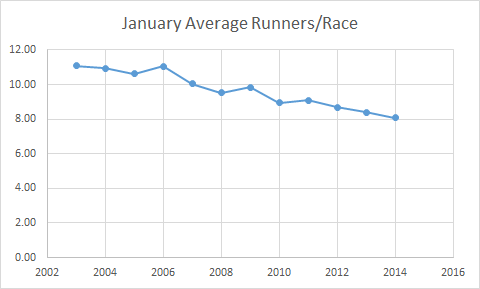
First, lest you think the four years in the table above were cherry-picked, here is the full y-o-y view of January racing from 2003 to the present.


You can see that in January 2003, the average number of runners per race was nigh on eleven, more than satisfactory. In 2014, the figure of 8.07 is alarming. Over more than a decade, it is reasonable to expect that any outlier years have been smoothed by the curve, and the correlation between these data looks extremely robust.

In plain English, there IS a problem here. Probably more than one.

Let's dig further and try to isolate some of the challenges British racing faces, at least in terms of the size of its fields.

First, I want to look at all weather against National Hunt. I should declare before we proceed that I am a fan of all weather racing, and I am a fan of National Hunt racing. So I have no axe to grind. Rather, I hope the numbers will speak for themselves.

All weather racing will celebrate its 25th anniversary on 30th October this year, so it was already a mature part of the sport by 2003, the earliest year in this sample. Below is a table showing the average runners per race each January from 2003 to 2014.


AWRunnersperRaceJan

Note the huge decline between 2006 and 2008, when the average fell from 11.23 runner per race to 8.13 runners per race. This coincided with a massive increase in races, from 246 in 2006 to 362 in 2008.

In percentage terms, all weather racing lost 28% of its average race runners at the same time it gained 47% more fixtures.

Since 2008, the average number of runners per January all weather race has not really changed materially - 8.13 in 2008 and 8.06 in 2014. The number of races each January in that time has also remained fairly constant: after the aberration of 362 in 2008, there has never been more than 336 since then, and the average has been 317 from 2009 to 2014.

The number of runners in all weather races, in absolute terms, has remained constant over the last five January's, at around 2600. 2012 was an exception, when the number of races shrank by almost 20% due to postponements.

AWRunnersperRaceJan2

So what, if any, conclusions can we draw from those all weather data? Probably the clearest observation is that the volume of races has affected the average field size. Whilst that in itself is not an issue - after all, the bookmakers want more racing (or 'product' as they like to refer to it) - the average number of runners is now precariously close the golden number of eight.

Eight is the minimum number of runners in a race in which three places are paid on each way betting, and it is a minimum threshold keenly sought by the bookmaking fraternity, whose turnover drops significantly on smaller field races. Indeed, the big four bookies have voluntarily offered an additional payment for the first time this year, in a bid to bolster field sizes... and, one suspects, as a pre-emptive move against the impending point of consumption tax.

As things stand then, an average number of runners per race of 8.06 is borderline acceptable for all weather racing and, in the context of 2013's January average of 7.91 it represents a possible green shoot of recovery. Time will tell on that front.

**

What, then, of the field sizes in National Hunt races?

NHRunnersperRaceJan

Although the most recent figures are broadly the same - average number of runners in National Hunt races in January 2014 was 8.08 compared to 8.06 for all weather races - the rate of decline, this time unchecked, is of major concern.

Whereas all weather racing experienced a rapid decline in line with an increase in the number of races between 2006 and 2008, and has subsequently 'flat lined' largely, National Hunt racing figures were fairly stable between 2003 and 2009, but have dropped dramatically since then.

The average between 2003 and 2009 was 10.76 runners per NH race in January. Between 2010 and 2014, the average has plummeted to 9.08. Moreover, the best January in the last five years saw an average of 10.02 runners per NH race. That compares with the worst year in the previous seven of 10.12.

The average of 8.08, if taken at face value, is a massive drop from last January's 9.01 average and a devastating slump from 2011's 10.02 average.

I write "if taken at face value" because it is worth asking whether there are circumstantial elements in play which have impacted the figures here. The most obvious culprit is the weather. So, did January 2014 have more races run on heavy ground, and is that a material factor in the figures?

Ignoring the all weather National Hunt races in the sample, which tend to be very well subscribed, the figures for the period 2003 - 2014 (January each year only) aligns with what we'd expect: good to soft is optimal jumping ground, and heavy is the least favoured of winter ground.

NHRunnersperRaceJan_Going

It is then reasonable to say that heavy ground is a material factor in field size, especially after as wet a January as we have experienced this year. To level the playing field, below are the average number of runners in January National Hunt races staged on heavy ground since 2003.

NHRunnersperRaceJan_Heavy

For the first time, it becomes difficult to immediately spot a correlation between ground and field size. However, the downward slope of the graph since 2009 maps to the same southbound trend for average runners per race as a whole.

And the average for heavy ground races in January 2014 of 7.71 is not so different to the 8.08 for all races in that month.

**

Let us now look at the distribution of races by number of runners. That is, for instance, how many two- to four-runner races were there? Here are the data for January 2014, covering both all weather and National Hunt.

distracesbyrunnersJan14

Most races were between five and ten runners, with 38% having five to seven horses, and 34% eight to ten horses. Just 19.47% of races could boast eleven or more runners, and 53 of the 637 races run in January suffered an embarrassment of runners less than the each way place quorum for two places.

The distribution comparison between all weather and National Hunt was surprisingly similar. Looking at the 2014 figures in comparison with the 2013 figures, it is most noteworthy that races comprising eleven-plus fields made up nearly a quarter of January 2013 events (23.68%), whereas in 2014 they were less than a fifth (19.47%).

And, whereas 56.41% of races run in January 2013 had eight or more runners (and therefore three each way places to shoot at), that was down to 53.69% last month.

**

Another area worthy of investigation is that of the rise and rise of handicap races. Are they good for the sport? Are they good for the funding of the sport? Whilst those two questions almost certainly have different answers, it is indisputable that handicaps have a healthier impact on field size than non-handicaps, taken as a whole.

For the period 2003-2014, and solely for 2014, the January totals were as follows:

hcapvsnonhcap

The disparity, in terms of average number of runners, for the whole period is just over 2%. That is, there were just over 2% more runners per handicap race than per non-handicap race between 2003 and 2014 (January's only).

Last month, the disparity was an eye-watering near 15%. Whilst it is reckless to make definitive statements based on a single month's data, it would certainly appear that the race planning department's tinkering with various segments of the non-handicap programme has been unsuccessful. And, moreover, any pandering to trainers who bemoan the lack of 'penalty kick' opportunities should be avoided at all costs.

In fairness to race planning, they have made changes aimed at enhancing the programme for fillies and mares, and at increasing the competitiveness of novice events. Their remit is a far broader one than solely field size, but that latter consideration is a crucial one to the successful funding of the sport.

Talking of funding, it is my opinion that the lop-sided distribution of prize money is one of the remaining taboos at the top table of racing politics. Simply put, too much of the available prize fund goes to too few of the owners. Put another way, racing has its own 18th century distribution of wealth model.

It is lamentable that the sport actually allows so many of the good horses to dodge and swerve each other whilst still picking up fat pots en route to the Festival gravy train. It doesn't serve punters; it doesn't serve bookmakers; it doesn't serve the reputation of the sport; and it doesn't serve the vast majority of owners or trainers.

There are too many pattern races. Look at the average number of runners by class, 2003-2014:

runnersbyclassJan2003to2014

Let's break that down by Class 1 to 3, and Class 4 to 7.

Class 1 to 3 - 12,552 runners - 1,365 races - 9.2 average runners per race

Class 4 to 7 - 56,326 runners - 5,786 races - 9.73 average runners per race

The average number of runners in Class 1 races is the lowest of all class levels. Why then should they receive such a disproportionate volume of prize money?

**

Where then does all that tabling and charting leave us?

The implication may be that the sub-dom relationship between BHA's race planning department (doubtless imposed upon them by the 'thought leaders' there) and the bookmaking industry is in danger of splitting its seams, and that further - perhaps - the bookmakers don't actually know how to ask for what they want. The endless demand for 'product' can be argued to have led to smaller fields, which in turn are responsible for reduced bookmaker handle (or turnover).

This January microcosm needs to be set in the full-year context of course, a wider vista which does little to ease concerns. I've written previously about the funding issue, and a snippet from that piece might be instructive here.

...consider that the 2010 pattern’s 142 races (Listed class or better) accounted for £20,483,170 from a total prize money allocation of £67,572,859, to be spread across 6,309 races.

That’s the top 2.25% of races receiving 30.3% of prize money… at an average of £15,275 per runner.

Compare this with the rest of racing’s pyramid, which stretched 69.7% of the prize fund across 97.75% of the races… at an average of just £791 per runner.

The tapering of prize money as one descends racing's class structure is over-zealous, and anachronistic. It dates to before the vastly expanded race programme of recent years, without reasonably considering the needs of stakeholders at the bottom rungs.

There is a perception that the BHA don't want to engage with Class 5 and below, even while recognising the fundamental importance of that volume end of their business.

Low grade racing has become the dog to be kicked, and the root of all racing evils - see the recent Curley gamble backlash - but if the BHA keep sweeping their trash under the carpet, some of it is bound to stink after a while.

Solutions to the field size conundrum need to be both qualitative and quantitative. It is too easy to blithely opine that there is too much racing, and far too much low grade racing. That fails to acknowledge the saprophytic (borderline parasitic?) relationship between the sport and its 'benefactors', the bookmakers; and swingeing cuts at the bottom tier would be akin to treating a verruca by amputating below the knee.

However, it is also true that there probably is too much racing. Certainly, it seems there are too many pattern races, and that is an area that should be addressed. Central funding for races which fail to meet an agreed quota of runners should be cut. This then brings the racecourses into the equation, giving them greater accountability for the success of their flagship events.

Why should the same pot be handed out year after year when field sizes - and thus the spectacle of the contests - dwindle?

The bookmaking fraternity for their part need to understand that their demand for volume of races has a direct impact on field size and, when that drops below 'the dead eight', on turnover.

Perhaps (read, almost certainly) they'd be better off asking for less fixtures and more field size guarantees.

And, as I've written, racecourses need to be more accountable for field size, or risk losing their funding. Fakenham, Ffos Las, Perth, Bangor, Hamilton, Brighton and Yarmouth all have a long-term average of less than eight runners per race. That should not be acceptable to anyone.

How can field sizes be improved? Better track maintenance is a start: while Ffos Las and Perth suffer from geographical issues (why build a course so far from the madding crowds?), Brighton and Yarmouth - and Ffos Las for that matter - are blighted with extremes of going.

Better incentivised prize money is another part-solution. At least one race per meeting should have an 'expenses paid' concession to owners, up to a fixed fee. This would make the costs of travelling - a cost which is often more than third place prize money - more palatable, and encourage owners to consider races they previously would not have.

In greyhound racing - and, like it or not, we are not that very far from there with horse racing in 2014 - owners receive appearance money every time their animal runs. In horse racing, owners pay entry fees. That doesn't seem right, and it's something else that racecourses can do to play their part in both the funding of the sport, and the enhancement of their own spectacles.

Field size and funding are intrinsically linked and, whilst this piece has deliberately ignored macro-economic factors such as recession and increased competition for potential owners' disposable income, those factors do not alter the urgency with which racing needs to tends its own field size wounds.

Given the excellent early successes Paul Bittar enjoyed at the head of the British Horseracing Association, it is disappointing that so little progress has been made in an area that Bittar himself made a top priority in July 2012. The evidence in light of those comments suggests that a different tack is needed, and one in which both racecourses and bookmakers bring more to the table.

Blaming external factors may be convenient - heck, it may even be valid, at least to some degree - but it doesn't help to solve the problem. Merely explaining why things are bad is no use. It's time for racing, led by the BHA, to take action. Drastic action.

Your first 30 days for just £1