Tag Archive for: Brian Hughes

The ‘Super Six’ NH Jockeys: What Happened Next?

As a horse racing researcher, there are good days and bad days, writes Dave Renham. On good days I research an idea and find that the data connected with it is interesting and robust enough to dissect and eventually use for an article. On bad days the idea or ideas I research seem to constantly hit a dead end, with the data crunched offering little or nothing of interest to me or potential readers of said research.

The second week in January was a week where I had a few bad days in a row. All my ideas were falling flat or at least after some digging offered up nothing of significant interest. However, just as I was binning yet another idea, I stumbled across some numbers that made me stop in my tracks. Had I eventually found something that had the potential for a worthwhile piece? About half an hour later after testing a few further theories, I felt I did, and hence I will be sharing my findings today.

Rationale

The data for this article has been taken from UK National Hunt racing covering the years 2019 to 2025. Any profits / losses quoted are calculated to Betfair Starting Price (BSP), with a 2% commission being applied on any winning bets.

For this article, I have been looking at the performance of horses that were ridden last time out by some of the top jockeys in the country. I have chosen the following – Nico de Boinville, Sean Bowen, Harry Cobden, Brian Hughes, Gavin Sheehan and Harry Skelton. These six have had some of the best win percentages of recent years as well as riding a decent number of horses each season, which means we have an excellent initial sample size from which to work.

My initial reasoning for why this angle might prove fruitful was that it is rare for any of these jockeys to ride a complete no-hoper and hence most horses they ride are expected to run well. Of course, there is no guarantee that the same jockey will be on board again next time, but whether they are or are not, one would assume if these horses were expected to run well once, they would be expected to run well next time too. I felt that my reasoning had some sound logic behind it; however, the proof is in the pudding and all that.


Overall: horses ridden by Super Six last time out (LTO)

So, first things first, here are the results for all horses ridden LTO by one of my six jockeys in terms of their very next course outing:



This was an extremely solid – indeed, astounding – starting point producing a sound win rate, with returns edging towards 8 pence in the £. Splitting the results by year produced the following:
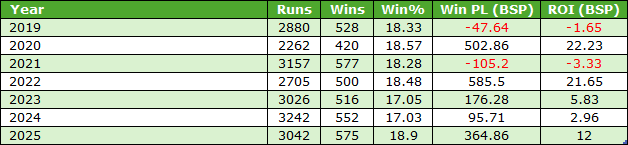


There have been five winning years out of seven, with the two losing years showing only smallish losses. Hence, this simple starting point has been fairly consistent.

Now these results include all possible BSP prices and as we know bottom lines can be massively skewed by big-priced winners. Unfortunately, this set of results does include such winners, with nine of the qualifying horses winning at a BSP of 100.0 or bigger. Backing all horses in triple figures over this timeframe would have yielded 60% of the initial £1572.30 profit figure. Hence, it made sense to ignore those bigger priced runners and focus on a subset of runners at shorter prices. Otherwise, one or more of those 100.0+ winners could be skewing some, or all, of the areas I wanted to explore. I decided therefore that a price limit of BSP 30.0 would be a much better and fairer option. Thus, the remainder of the article is restricted to horses that were priced BSP 30.0 or less.

Let me therefore look at the overall figures for this subset of runners with that BSP 30.0 price cap:



We have lost roughly 15% of the original qualifiers, but we are still left with a very good sample size, and although the returns are slightly less impressive, a blind profit of over 4p in the £ is still noteworthy.

From this starting point, I wanted to dig deeper, so I began by looking at the yearly A/E indices. The indices presented below are based on BSP rather than ISP, as the exchange prices are more accurate:
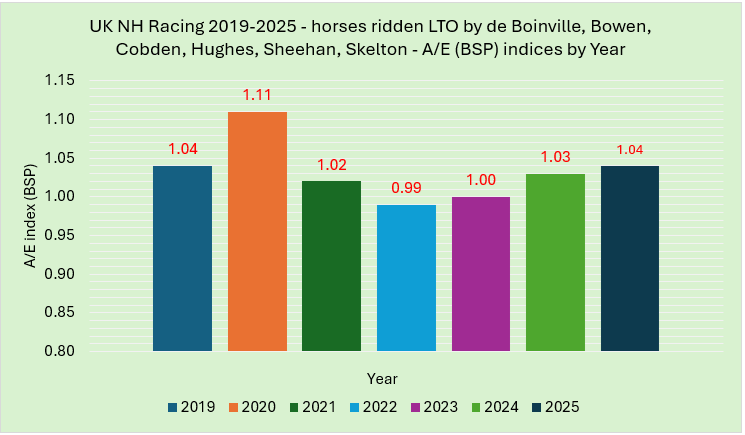


As the graph shows, these horses have offered ‘value’ (A/E 1.00 or bigger) in six of the seven years. Five of the seven years proved to be profitable with the worst year (2022) losing a smidge over 2.5p in the £ across all runners.


Handicap vs non-handicaps

A look now at race type; specifically handicaps versus non handicaps. The splits were thus:



A much higher strike rate has been achieved in non-handicaps, but this is the norm as they tend to be less competitive. All the profits, though, have come from handicap races.

An additional statistic to note is if we restrict the handicap results to horses that had raced in a handicap LTO as well. This specific handicap-to-handicap group produced 9707 qualifiers of which 1693 won (SR 17.4%) for an impressive profit of £974.15 (ROI +10%).


Race Class

Let me next examine the Class of Race to see if anything could be gleaned from it. The splits were as follows:
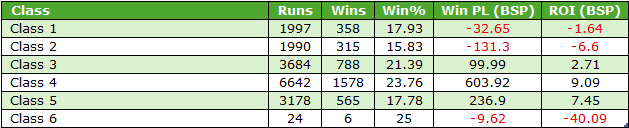


We can safely ignore the Class 6 findings as there were only 24 qualifiers, and the stats indicate that Classes 3 to 5 have offered up the best returns. The more competitive levels of Class 1 and 2 both showed losses to BSP.


Last time out race position

Onto position LTO now. Did that make a difference? Let’s take a look:
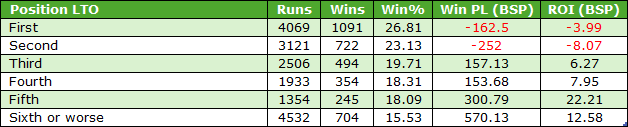


It is not surprising I guess that more than 7,000 of the c.17,500 qualifiers finished first or second LTO, as they were ridden by one of the ‘Super Six’; but a first or second finish last time was actually a negative when it came to next time out value. Conversely, horses that finished third or worse LTO combined to return over 11p in the £. It seems therefore, that this may be the group we should concentrate on in the future as those winners and almost winners last time are significantly over-bet.


Jockey change?

My next port of call was to examine the results where any of the six jockeys remained on the same horse next time out, compared with a jockey change which was not one of the six. Here were my findings:



The value lay clearly with horses ridden this time by a jockey who was not one of the six. Yes, the overall strike rate was lower but the bottom line was significantly better. Also, looking at the yearly splits for this cohort we see positive numbers in six of the seven years, and a negligible loss in the other one:
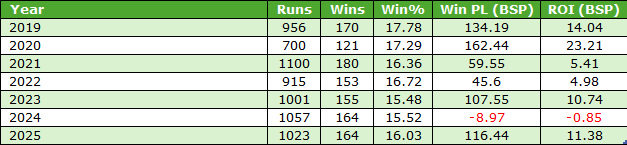


What I also found fascinating were the results when we examine the final possible jockey permutation – horses ridden by one of de Boinville, Bowen, Cobden, Hughes, Sheehan or Skelton last time and now ridden by a different jockey from the ‘Super Six’. In other words, a possible scenario being when Sean Bowen had ridden the horse last time, but Harry Cobden was on board this time; or Gavin Sheehan having been on board last time, being replaced by Brian Hughes this time, etc. Here are those findings:



These results have been extremely positive during the past seven years, so this looks like an avenue we could potentially explore in the future. One positive switch to mention is when Harry Cobden was riding a horse this time after being ridden by Sean Bowen LTO. This ‘combo’ saw 35 qualifiers of which 11 won (SR 31.4%) for a profit of £25.20 (ROI +72%).

[One such switch was when geegeez.co.uk syndicate horse Sure Touch won the 2024 Summer Plate under Cobden after Bowen was required to ride a horse for his father – Ed.]


Odds Last Time Out

Moving on, one area I always like to look at where possible is the LTO odds of the horses in question. Below is a graph showing the ROI% splits for different bands of LTO odds – I have used ISP for the LTO odds as the prices are tidier:
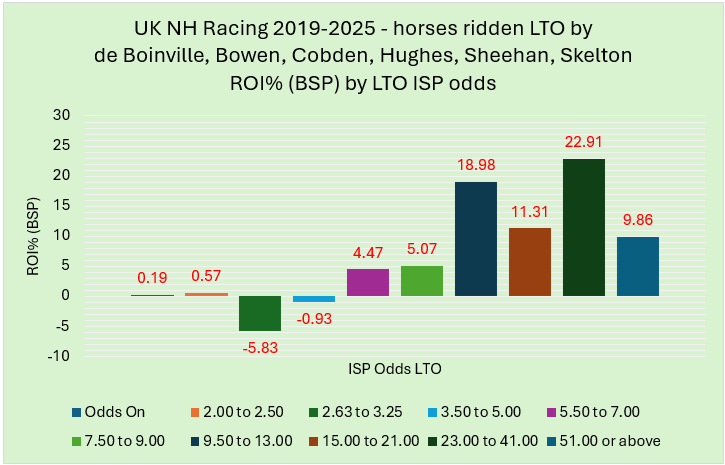


This graph gives us a clear cut steer, with runners LTO that were priced 9.50 (17/2) or higher producing much better returns on their very next start compared with prices LTO of 9.00 (8/1) or less. For the record, horses that were priced 5.0 (4/1) or lower LTO combined to produce blind losses.


Age of horse

Finally for this article, I am going to share the age of horse splits, and these are shown in the table below:
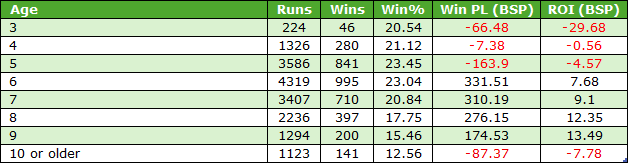


As can be seen, 3yos had a poor record. The double-digit generation also struggled a little when compared with the best range, those aged six to nine. Why this group has done best is probably because National Hunt horses are in their prime between six and nine. Suffice to say horses aged six to nine have clearly offered the best value in the past few years when ridden LTO by one of the Super Six.

**

I must admit that the data shared in this piece are far better than I had expected when I embarked upon the research. It will be interesting to see if these generally positive results are replicated in 2026 and beyond.

- DR

Jockey Profiles: Brian Hughes & Sam Twiston-Davies

This is the fourth article in a series looking at the performance of some of top National Hunt jockeys. In this one I will be looking at Sam Twiston-Davies and Brian Hughes. Previously I've looked at:

Nico de Boinville and Harry Cobden

Harry Skelton and Sean Bowen

Rachael Blackmore, Paul Townend and Jack Kennedy

I have analysed NH data for UK racing from 1st Jan 2016 to 31st Oct 2023. The main vehicle for my data gathering has been the Geegeez Query Tool, but I have also used the Geegeez Profiler when required. All the profits/losses quoted are to Industry SP, but I will quote Betfair SP where appropriate. All the tables include A/E indices. In addition, when data has been pulled from the Geegeez Profiler Tool, I have also shared PRB figures (Percentage of Rivals Beaten).

Let's start with Sam Twiston-Davies.

Sam Twiston-Davies Overall Record

Let me first share Sam's overall stats by looking at his performance on every runner during the period of study:


On average Twiston-Davies rides around 650 times a year, which is much higher than any jockey I have looked at to date. His figures are reasonable, winning on roughly one in six rides, with a PRB figure of 0.56; but his A/E index is just below ‘average’ for all jockeys. Losses to SP stand at just over 21p in the £. This drops to 9p in the £ to BSP.


Sam Twiston-Davies Record by Year

Let's see what the yearly stats show. Here is a breakdown by both win, and win/placed (Each Way) percentage / Strike Rate (SR%):


As the graph indicates, his best two years in terms of win and each way percentage were in 2016 and 2017. This is because he was riding regularly for Paul Nicholls then and 42% of his rides in those two seasons were for the Ditcheat trainer. 2020 to 2022 showed a dip in overall performance but this year (2023) to date has been much better hitting the mid-17% mark.


Sam Twiston-Davies Record by Month

Here is a breakdown of his record by month using win strike rate:


August and September are the best months, while June to September are the best four. The EW (win and placed) strike rates correlate well with June to September seeing SR%s over 40% - the remaining eight months are in the 30s ranging from 31.2% to 38.3%. While it is material that field sizes are at their smalles in NH racing between May and September, concentrating on August and September, and if we focus on horses priced 11/2 or shorter, we almost get to a break-even scenario to SP: 96 wins from 311 qualifiers (SR 30.9%) for a small loss of £4.83 (ROI -1.6%). To BSP that would have turned a small profit of £17.55 (ROI + 5.6%).


Sam Twiston-Davies Record by Betting Odds / Price (SP)

Now a look at the results by splitting them into different price bands:


The 'evens or less' group have incurred the least losses to SP, and all other groups have seen losses (ROI) of more than 10p in the £. Horses priced in double figures look best left alone on every measure.


Sam Twiston-Davies Record by Distance

Moving on now to distance metrics and Sam's record at different distances. I have grouped them into the same four distance bands as in prior articles and below is a graph looking at the win and each way strike rates:


This graph shows that the shorter the distance the better for Twiston-Davies in terms of strike rate. If we look at the PRB figures (Percentage of Rivals Beaten) they correlate with the win/EW strike rates:


The two mile and shorter group have also produced the smallest losses to SP and a better A/E index of 0.90.


Sam Twiston-Davies Record by Race type

Next under the microscope is ST-D's record by race code/type:


The hurdle and chase results are virtually a carbon copy of each other in terms of strike rate, ROI% and A/E indices. The NH flat races show a very high A/E index, but this is not reflected in the profit/loss figures. For the record, Twiston-Davies has ridden in six hunter chases (no wins).


Sam Twiston-Davies Record by Racecourse

I am now going to look at all courses where Twiston-Davies has had at least a hundred rides during the study period. The courses are split into two graphs alphabetically and the win strike rate at each course is shown:


There is quite a range here going from Sandown at 7.4% win rate up to Hereford at 25.6%. His record at Hereford has been excellent with decent profits to SP of £65.51 (ROI +54.1%). The A/E index stands at a very healthy 1.31 and the PRB figure is 0.61. In six of the eight years, Sam's strike rate at the track has exceeded 20% and in five of the eight he has secured a profit.

Fontwell is another course where he has performed well, showing a small blind profit. In chases at the West Sussex track, he has excelled winning 18 of 54 (SR 33.3%) for an SP profit of £19.30 (ROI +35.7%). Indeed, his last six chase rides (up to the time of writing) have been as follows:


That's six wins in a row with six different trainers!

In contrast he has struggled at Sandown and Newbury, while it has not been easy to get on the board at Aintree or Cheltenham either, though in the latter cases that is true for almost all jockeys.


Sam Twiston-Davies Record by Trainer

Here is a list of trainers for whom Twiston-Davies has ridden at least 80 times for during the period of study. It should be noted that he has had only two rides for Nicholls in the past 24 months.


His record for Charlie Longsdon is surprisingly poor. Only one trainer was in profit, namely Neil Mulholland, but that is entirely down to a 100/1 winner. With Sam Thomas, the Sam combo has done particularly well in chases hitting a better than 27% win rate and edging into a small profit. His record when riding for his father Nigel is not as good as I had expected with quite significant losses of 27p in the £.


Sam Twiston-Davies Record by Class of Race

It is time to breakdown Sam's performance now by class of race:


Class 1 races have the lowest strike rate as one might expect, while Class 3 and 4 races have produced the highest strike rates. A profit has been made in both Class 5 and 6 races, but these figures are skewed a little by a couple of big-priced winners.


Sam Twiston-Davies Record by Run Style

Finally on Sam T-D, let me look at his run style splits in terms of win percentages:


The usual pattern we are used to manifests once more: the nearer to the front he rides early, the better. Twiston-Davies has performed slightly better on hurdling front runners than chasing ones in terms of win percentage - 28% v 24%.

If we examine the A/E figures we can see that they correlate with the win strike rate data as the following chart shows:


The 'led' A/E index is very solid at 1.00 which suggests these runners are edging towards ‘value’. Horses that raced mid-division or further back early offered punters poor value.

Before winding up the run style stats though, let me share his record when riding the favourite:


Front-running favourites proved profitable if your crystal ball was in reliable working order, whereas held up favourites lost a whopping 31p in the £.


**

Brian Hughes Overall Record

It is time to switch to three-time NH Champion Jockey Brian Hughes and we'll start by looking at his record on all horses in all UK NH races:


At first glance these figures are slightly better than for Twiston-Davies and, amazingly, he has ridden around 1500 more horses. Indeed, Hughes and Twiston-Davies are the two jockeys who have ridden the most in the UK going back to 2016. Hughes tends to ply his trade mainly in the North as the pie chart below shows. It shows the percentage of rides by region:


74% of Hughes' rides have come at northern English tracks or in Scotland. He ventures south rarely with just 3% of his total rides being at southern tracks.

Now it is time to break down his data, firstly by year.

Brian Hughes Record by Year

Here is a graphical breakdown by both win, and win/placed (Each Way) percentage / Strike Rate (SR%):


As the graph shows, Hughes has managed a win strike rate of 16% or more in seven of the eight years, with the other year (2017) just below at 15.8. Overall, his performance year in year out has been quite consistent. There is a difference of only 4.4% between the highest yearly EW SR% and the lowest yearly one.

Brian Hughes Record by Betting Odds / Price (SP)

Let us see whether any market / price patterns can be found by breaking down his results by Starting Price bands:


The 16/1 or bigger horses look a ‘no no’, while those priced between 11/10 and 13/8 have produced the best returns; but there doesn't seem to be any SP bias going on here.


Brian Hughes Record by Distance

A dive next into Brian's record at different distances. I have grouped them into the same four distance bands I did earlier and am looking at the win and each way strike rates:


There does seem a clear distance bias here with the longest distance band of three miles or more performing well below the other three distance groupings. In these longer races Hughes has seen losses equating to 32p in the £, compared with the 2m1f-2m2f losses of just 9p in the £. It is time to look at the PRB figures now:


As the table shows the PRB figures correlate well with the win and each way strike rates, with performance much stronger to around two and a half miles and dropping off thereafter.


Brian Hughes Record by Race type

Now let's analyse Hughes' record in hurdle races, chases and in bumpers:


Chases and hurdle races offer extremely similar looking stats as far as strike rate ROI, and A/E are concerned. The results in bumpers (NH Flat) are slightly better. There is a big difference in these bumpers results when comparing male horses to female horses:


Males have outperformed females by nearly 8% in terms of strike rate, the A/E indices also strongly favour males as does the ROI%. Losses of just 8p in the £ for males compared with nearly 36p for female runners. It's hard to explain this disparity (the overall difference in bumpers is males 11.6% win and females 9.1%), and it might simply be down to a quirk of the relatively small female sample size.

Before moving on, it may or may not be worth noting that Hughes has ridden in five hunter chases, winning one.


Brian Hughes Record by Racecourse

Below is a table of all tracks where Hughes has had at least 100 rides. The courses are listed alphabetically:


Given his total number of rides, it should come as no surprise that Hughes has ridden over 100 times at so many different tracks. Aintree has not been a particularly successful hunting ground, nor has Haydock. Three courses have edged into a blind profit – Bangor, Southwell, and Stratford. Of those three, the Stratford stats are the most solid as Hughes has been profitable when focusing in on horses racing there that started in the top three in the betting. This subset of runners has won 25 from 87 (SR 28.7%) for a profit of £4.95 (ROI +5.7%).

The Musselburgh stats are strong, too, with a near break-even scenario. Again, focusing on horses from the top three in the betting at the Scottish track we get the following results: 80 wins from 260 rides (SR 30.8%) for a small SP profit of £7.49 (ROI +2.9%). Market Rasen and Worcester are two other venues where Hughes has made a profit with runners from the top three in the betting.


Brian Hughes Record by Trainer

During the period of study, Hughes has 100-plus rides with eleven trainers – one of these, Keith Dalgleish, has taken a sabbatical so here are the stats for the other ten:


Hughes is stable jockey for Donald McCain, and they have combined to hit a better than one-in-five win rate. The PRB figure of 0.60 is also noteworthy. With McCain his record has been better in hurdle races and the pair have combined to profitable effect at BSP over the smaller obstacles. There are three courses to note when Hughes is on a McCain runner – Bangor, Musselburgh, and Perth. All three have produced excellent win strike rates (27.9%, 27.2% and 32.8%), and all have provided SP profits.

Brian Ellison, James Ewart, Charlie Longsdon and Nicky Richards are four other trainers for whom he has performed well.


Brian Hughes Record by Class of Race

It is time to breakdown his performance now by class of race:


As we have often seen during this series, Class 1 races have produced the poorest results. Outside of the top level, Hughes has been consistent regardless of class bracket.


Brian Hughes Record by Run Style

The final stop is run style starting with the splits in terms of win percentages:


A near 30% strike rate on front runners continues the theme we have consistently seen throughout this series of articles. Backing all Hughes hold up runners would have set you back nearly 40p in the £.

Hughes' A/E indices by run style show a similar pattern although there is little in it between the prominent and mid-division groups:


Finally, let me share his run style win percentages when riding the favourite:


Incredibly, Hughes-ridden favourites which led have won more often than now and would have yielded a good profit if predicted pre-race. Held up jollies incurred painful losses of over 33%.

Main Takeaways

It is time to bring this fourth National Hunt jockey article to a close but before doing so, below is a table featuring some of the main takeaways to note regarding Sam Twiston-Davies and Brian Hughes. I hope I have uncovered some useful angles, both positive and negative for both jockeys.

Good luck.

- DR

Trainer Profiles: Donald McCain

We head to Cheshire to meet the next trainer in this Profiles series, and welcome Donald McCain. As with previous pieces I will be sharing nearly ten years of UK National Hunt racing data from 1st January 2013 to 31st October 2022. The vast majority of the stats I share with you can be sourced by members using from the Geegeez Query Tool. All profits / losses have been calculated to Industry Starting Price and I will quote both SP and Betfair SP returns where appropriate.

Donald McCain Brief Bio

Born in 1970, Donald McCain is the son of the legendary trainer of Red Rum, Ginger McCain. He took over from his father in June 2006 having worked as his assistant previously. He also rode in his youth and, over the years, gained experience in the racing business when working for Luca Cumani, Sir Michael Stoute and Oliver Sherwood. As a trainer he has won the Grand National (2011 with Ballabriggs) and enjoyed success at the Cheltenham Festival six times, albeit before the period of study for this piece (2006 to 2012). In fact, between 2009 and 2012 his overall win strike rate stood at 19.2% - this is worth noting when looking at the last ten years which I plan to do right now!

Donald McCain Overall Record

Let's break McCain's win record down first by year:


Overall, SP losses have equated to 21p in the £ over this 10-year period; to BSP it has been nearer 11p in the £. As we can see, from 2015 to 2020, with the exception of 2017, the win strike rate dropped quite markedly. However, there has been a very positive uptick, or so it seems, in the past two seasons. This recent improvement has been mirrored when we study the win and placed (Each Way) percentages:


So McCain’s journey as a trainer seems to have gone from early highs to modest lows and now to new highs. Any trainer can have fluctuations from year to year so it will be interesting to see whether the stable can maintain their stronger recent form in the next year or two.

Time to dig a bit deeper.

Donald McCain Performance by Race Distance

Splitting his performance by distance first:


There is not much to be gleaned from the race distance splits: a slightly better win percentage at shorter distances, but returns and A/E indices across the three groups are similar. If we split the distances stats comparing chases with hurdle races, we see the following win percentages:


Again, we see remarkably similar figures. This seems to suggest that McCain doesn't specialise, and is equally adept at training all types of horses.

Donald McCain Performance in Chases

I want to dig into chases races in more detail. Let me start by splitting them into handicap and non-handicap contests:


As can be seen in the table, there are considerably more handicap runners and, overall, they have proved far better value. To BSP, losses in handicaps are down at around 5p in the £. Below is a course breakdown of McCain's chase record in terms of strike rate at tracks where he has had at least 75 runners:


The strike rates are in a fairly narrow range, except for Aintree, where McCain has had just one winner in 76 chase races. He has made an SP profit at three courses – Catterick, Kelso and Musselburgh.

One course that is not on the list is Perth, but his chase record there is worth sharing. He has an excellent strike rate at the Scottish track of 30.4% thanks to 21 wins from 69 runners. Profits to SP stand at £27.23 (ROI +39.5%). To BSP, returns edge up to 50% (50p in the £). He picks up winners there consistently despite averaging only seven runners at the track a year. He has saddled at least two winners in eight of the last ten years and, in one of the other years (2020), he didn’t send any runners there at all.

If we combine the yard's chase record at all Scottish tracks, they have saddled 67 winners from 310 (SR 21.6%) for a profit of £39.52 (ROI +12.8%). Exchange returns increase by just over 9p in the £ to 22p.

Before moving on, here are a few extra chase nuggets worth noting:

1. Horses having their second chase start have secured 37 wins from 162 (SR 22.8%) for a small SP profit of £12.01 (ROI +7.4%); BSP profits stand at £28.58 (ROI +17.6%);

2. Chasers returning to the track within two weeks of their last run have won 37 races from 129 runners (SR 28.7%) for a profit of £48.83 (ROI +37.9%); profit to BSP is £65.24 (ROI +50.6%);

3. Horses aged 6 or 7 have been far more successful in chases than other ages. 6 and 7yos have combined to score 19.5% of the time (165 wins from 848); all other ages combined (4, 5, and 8+) have won 12.4% of the time (93 wins from 747).

Let's take a look at hurdle races now.

Donald McCain Performance in Hurdles

Let’s start once again with handicap versus non handicap splits:


This time we see a much better win percentage in non-handicap hurdle races but without too much of a differential in returns as far as Industry SP is concerned. However, to BSP, non-handicaps have lost just 3p in the £, compared to 13p for handicaps.

A course breakdown now and I am sticking to courses that have had 85 or more runners in hurdle races. I have chosen 85 as the ‘cap’ as I wanted to include the Scottish course Ayr (where there were 86 runners in the study period). I have ordered the courses by win strike rate percentage:


Aintree results are poor once more, as are those at Market Rasen. From a positive perspective, the Scottish courses tend to sit near the top of the table in terms of strike rate once again, although there is none of the overall profit that we saw in the chase data. Two courses have shown a profit to SP (Bangor and Newcastle) and the Bangor data is worth digging down into. Firstly, McCain's hurdle record at the Welsh course by year:


There was a dip in 2015, part of the period when the yard struggled, but the other nine years have seen strike rates above 18% which suggests he targets this course somewhat; in seven of the ten years there was a profit to SP, and in eight of the ten years a profit to BSP. These are consistent hurdle profits at Bangor rather than simply a couple of huge priced winners skewing the P&L column. Indeed, if we focus on horses priced 8/1 or shorter McCain’s hurdle performance at Bangor is extremely good:


Those are excellent numbers and, for the record, returns to BSP edge just over 40p in the £.

Bangor, McCain and hurdle races should definitely be on our radar in the future.

Donald McCain Performance in National Hunt Flat races

Here are the figures for all National Hunt Flat races (bumpers):


These are very modest figures from a betting perspective in spite of the decent strike rate. Losses to BSP were also steep at a painful 26p in the £. This suggests he has not had many big priced winners in this sphere and that is indeed the case. McCain runners priced 10/1 or bigger in bumpers have won just twice from 135 for a loss of £103.00 (ROI -76.3%). Ouch.

His performance at the front end of the market is not too bad, however; horses priced 3/1 or lower have won 34.9% of their races losing just 4p in the £ to SP and breaking even to BSP. Having said that, odds-on runners have won just 41% of the time losing a hefty 32.8p in the £.

Here are three more NH Flat race stats for stable that readers may find useful:

1. McCain has had just 15 NHF runners at Musselburgh but eight have won; he is 10 from 32 at Carlisle as well;

2. Jockey Brian Hughes has a 23.6% win strike rate in these races for McCain;

3. Horses that have had three or more previous career runs (that includes flat/AW races) have won just 11% of races losing over 60p in the £ to SP; 54p in the £ to BSP.

Donald McCain Performance by Starting Price

We have seen a small amount SP data already, but let us now look at all races as a whole:


The win strike rates go down uniformly as the price bands increase – it would be weird if that wasn’t the case. Industry SP losses have been the smallest with the Evens to 15/8 bracket, but there doesn’t seem a pattern to returns as a whole. However, I would definitely steer clear of his bigger priced runners (14/1 or bigger) – even to BSP you would have lost 20p in the £. This is much higher than the average loss across all 14/1 + runners which stands at around 13p.

Donald McCain Performance by Running Style

A look at run style next. To begin with let us see the proportion of runners that fit a specific run style. Geegeez breaks these run styles into four:

Led – front runners, horses that take or share an early lead; Prominent – horses that track the pace close behind the leader(s); Mid Division – horses that race mid pack; Held Up – horses that race at, or near the back of the field early.

Here are the splits for McCain:


We can see the preferred running style seems to be tracking the early pace (prominent runners); that position has accounted for nearly 40% of all runners from the stable. The early leader / front runner percentage is also high at over 27% which is good to see. Regular readers of my articles will know that horses that take the lead early win more often than any of the other run styles. Not surprisingly, this is the case for McCain as we look at the win strike rates across all run styles:


Around one in four of McCain's front runners have won, whereas just one in 14 of his hold up horses have passed the post first. Indeed, if you had backed all of his hold up horses you would have lost a whopping 43p in the £ to SP.

I want to look at favourites now in terms of their success rate by run style:


The win percentage for hold up horses that start favourite is extremely poor and would have lost you a remarkable 49p in the £. Once again front running favourites do best, and comfortably so.

Before moving on, I have looked at front running performance across different courses to see if front runners have done better at some courses than others. The graph below compares all courses where McCain has had at least 40 runners that have taken an early lead (I have rounded the %s to the nearest whole number so it fits more neatly on the graph).


There is quite a range of success here: excellent at Ayr (18 winners from 44), much less so at Aintree (two wins from 46). As we have seen, McCain's overall Aintree stats are poor so this will come as no surprise.

Donald McCain Performance by Jockey

Onto some jockey analysis now. A look at any jockey who has ridden at least 100 times for McCain since 2013, with the proviso that they have had at least one ride for the stable in 2022. I have ordered them by number of rides starting with the most:


Stable jockey Brian Hughes has by far the best strike rate. Losses of 13p in the £ were incurred to SP; with BSP, this improves to 4p in the £. Theo Gillard is in profit but a 40/1 winner makes all the difference between a profit and a loss.

As far as Hughes is concerned here are some stats worth noting:

1. Hughes has a 32% success rate on front runners;

2. On favourites he has essentially broken even; clear favourites have just nudged into profit;

3. In races of 2m1f or less he has secured a strike rate of over 24% with marginal 2% losses to SP; 11% profit to BSP;

4. Horses priced 3/1 or less (SP) have provided a BSP return on 6% (6p in the £);

5. Hughes when riding a horse who is having their first career start has a strike rate of one in three and a profit to BSP around the 35p in the £ mark.

Let's summarise the key findings from this research...

Donald McCain – Main Takeaways

It seems that Donald McCain is moving in the right direction once more. It will be interesting to see if he is able to sustain success around the 20% win mark again this season – early signs suggest he will be close.


I hope you have found this piece useful.

Best wishes for the remainder of the festive period, and wishing you a very Happy New Year.

- Dave Renham

Trainer Profiles: Nicky Richards

Trainer Profiles: Nicky Richards

It’s time for another edition of trainer profiles and, for this one, I’ve opted to run the rule over the Cumbrian operation headed by Nicky Richards.

There are two key motivating factors in selecting Richards for a bit of the data treatment. Firstly, it’s not a yard I have especially followed, and I enjoy the educational journey that penning these articles delivers: the discovery of new insight and information is the fun element of compiling these pieces. Secondly, and far more importantly, it’s a results thing. The stable has generally strong and consistent performance over time, which is a solid foundation for deeper analysis. Let’s begin.

Here is an unedited, unfiltered view of all the yards runners from 2011 at SP in UK National Hunt racing (up to and including 5th Feb 2021)


That’s a very impressive set of numbers. I’d speculate that, based on these data, if you were farming the bookies’ offers of best odds guaranteed, backing all runners from the stable you’d be at worst broadly breaking even. Not a bad starter for ten.

Nicky Richards: Performance vs. the Market

As is now tradition (if three events can be counted as tradition) we will commence with a market check to obtain a general feel for the yard, which I’ve found to be a reliable starting point in the construction of a trainer profile.

The table below contains all of Richards’ runners for just over the last ten years, grouped by starting price.


As might be expected, there is a healthy look to the picture, with the probable exception of those sent off at 22/1 or longer. Three winners from 228 runners at these prices is cause enough to avoid almost at all costs. That said, one does need to be a little careful in ranges where a single winner can significantly impact the overall view. Even so, not for me in data terms, given that just one of the 81 horses priced 50/1 or bigger made the frame.

Meanwhile, at the sharper end, there is a strong impression that broad value exists in the 5/2 to 20/1 price range. This implies a slight but consistent underestimation of the stable within the market where perhaps the form claims are not overtly obvious. That’s far from an endorsement or recommendation to get involved indiscriminately, however.

Here are the data represented graphically, displayed by A/E which assists in painting a picture of where general value may exist.


After further rummaging, there wasn’t a lot more to get excited about within this area (that I found, anyway). Therefore, the message is a broad one, in that there is value in following Richards when paying particular attention to those priced in the 5/2 to 20/1 ranges.

Despite this, for the rest of this article I’m going to only consider runners with an SP of 14/1 or shorter, unless explicitly stated otherwise. Yes, the graph and data does show potential value up to 20/1. However, between 16s and 20s, a strike rate of 5.9% (13/222) isn’t enough to insure me against the dreaded losing runs in spite of the potential long-term profit. It’s a personal choice and you have to be geared up for feast and famine at that end of the market: I’m not especially.

Nicky Richards: Seasonal Performance

As is often the case with National Hunt yards, performance can vary throughout the year and it’s something which can be seen from Team Richards, as the table below illustrates.


In relative terms at least, the numbers put up during the summer jumps season are a pale shadow of the rest of the year. They’re not terrible, far from it, but it would appear that the summer season is not a major focus for the yard. The below graph shows the same data through the prism of A/E and clearly illustrates the dip.


Catching the yard from December to March appears to be optimal in rough terms.

Digging further, I’ve mentioned before that seasonal performance and underfoot conditions often go hand in hand. Given that the A/E numbers have a slight dip during the summer it could generally be expected that the overall performance is less positive on firmer ground, a condition more prevalent at that time of year.


Exactly as expected, the insight on Good and Good to Firm are strikingly below those for going on the softer side with clear variance across strike rates, P&L, A/E and even place percentages.

It’s of specific interest to try and establish whether softer ground runners in summer do comparatively well against those running on ground more typical of the warmer months, and vice versa (firmer ground performance in winter).


The above line graph splits the data by underfoot conditions and month. By way of explanation the dotted grey line represents the overall data for the yard in terms of A/E (same data as the graph at the start of this section). The blue line shows A/E performance for stable runners on Good to Soft, Soft and Heavy ground conditions. The sunny orange line contains A/E info for Good and Good to Firm runs.

It reveals that, generally, the yard out turns better numbers when the going is on the softer side irrespective of the time of year. It also at least hints towards an assertion that there might well be some sort of edge backing Richards runners during the summer jumps season when the going is more winter like (June still moderate). In fact, A/E performance peaks in July on the wetter going across all data sets. Granted, this only relates to 12 runs, but it does demonstrate potential value can still be attained in summer, despite the higher-level data pointing in another direction.

Of course, there is no categorical rule; none of this info should mean back or laying blindly, life is always more nuanced than that. However, by gaining an understanding of these elements a general sharpening of the punting process can be attained.

For example, to convince me to part with my cash on a Richards summer jumper on Good or Good to Firm ground I’d want the horse to tick virtually every other box available and show significant superiority over the rest of the field. In such cases, there would very likely be no juice in the price as the horse’s chance would be so obvious.

On softer ground I’d show more leniency with regards to the form in the book. Naturally, we will still be wrong a lot more often than right, but by using data to find value we can ensure our winners pay for a lot more losers!


Nicky Richards: Seasonal performance by race type

Another notable aspect where the seasonal performance can be seen is with National Hunt Flat races. The first port of call is to evaluate accomplishments by the different types of National Hunt discipline to ascertain how data in bumpers holds up against the other race types.


It’s clear, and very much like Fergal O’Brien from my last article, that Richards is a trainer to follow when no obstacles are in play. It may be enough to leave it there, however, the seasonal factor is again well demonstrated focusing on this race category alone.


The above table shows the rhythm of the stable regarding its bumper runners. From May to September there are two wins from 23 runs. However, performance through the winter is exemplary. If this table is representative of the future, then March will be a good time to get on board with a strike rate of very nearly a third since January 2011.


Nicky Richards: Performance by Racecourse

There is little doubt that Richards is a leading light of the northern racing circuit. A perusal of his runners by UK region confirms that beyond all reasonable doubt.


This yard, based in Cumbria, thirty miles from the Scottish border, has saddled just under half of its UK runners in Scotland. Most of the other stable competitors have been heavily concentrated in and around Northern England. In very general terms, the rare forays to the Southern parishes are underwhelming.

The dichotomy is stark: this is a yard that is seemingly content to harvest on the northern circuit consistently, leaving the South to others.

Analysing individual track performance, the below table demonstrates all course data for those where the stable has saddled 50 or more runners over the duration of the analysis.


The focus on Scotland can be clearly seen with Ayr, Kelso and Perth filling the top three berths and Musselburgh not too far behind. However, it’s hopefully obvious regarding the tracks that are front and centre in terms of punting interest. The output at Carlisle and Hexham sticks out like the proverbial sore thumb. Consequently, they’re highlighted by the unsubtle dark blue bandings (Sedgefield and Kelso have claims, too).

Whilst Carlisle has an edge over Hexham in terms of profitability, both are worth noting with percentage strike rates well in the 30s. For the record it’s a 64% ROI at SP combined across this pair of wagering diamonds.

I spent a while trying to ascertain a better edge to the track info: race types, distances, venue of last run, all sorts of other info and, in truth, there wasn’t too much to be found to enhance the edge in question. That’s heartening, I guess, because the best, most sustainable, angles are also usually the simplest.

I did check those runners with SP’s at 16/1 or greater too, just in case there was a trick being missed at these tracks. Reassuringly, the numbers for the stable at these prices are 0/37 with only four placed horses, somewhat validating my semi-arbitrary 14/1 cut off point.

With an edge that is as route-one as this it may be expected that the market would have adapted, evolved, and essentially reduced or removed any punter advantage. To evaluate this, the graph below illustrates the cumulative profit and loss picture from the 2011 start date used in this article.


Basically, there is no sign of abatement, in fact it could be argued that performance is going from strength to strength with the twin track performance being as strong as ever over the past three years. The law of averages (and of Sod!) suggests it’s due a reversal at some point. However, as a bare minimum a Nicky Richards-trained horse at Carlisle or Hexham requires thorough analysis given that a third of them prevail. Until the market adapts, I’m going to keep a close eye on stable runners at these courses.

Nicky Richards: Stable jockeys

The below table shows the principal riders Richards has engaged from 2011 to date [excluding Brian Harding who took the bulk of the rides until his retirement in 2017]. Craig Nichol is also riding with much less frequency for the stable, too, over recent times (but is included).


If the primary focus is a quest for winners, then it’s no surprise whatsoever to see Brian Hughes lead the way. The strike rate on a Hughes ride is far superior (27%) to any other pilot deployed by the yard (Sean Quinlan, who has only taken 21 rides thus far, aside). However, deriving value from a champion jockey-steered runner is easier said than done in the long term as the ROI (0.9%) and A/E (0.95) allude. At first glance, at least, the value approach is to follow the mounts of Ryan Day. In fact, there would be worse ways to indiscriminately wager than backing the Richards/Day combo based on the intel above.

To prevail, or even tread water, in this game it’s essential to swim against the tide of the market on a consistent basis (if you’ll pardon my mixed and mangled metaphors). Listening to the many protagonists within racing media it’s quite easy to pick up on common assumptions or themes and it’s always fun trying to prove or disprove the comments through, you know, actual fact-checked analysis. It’s amazing how many urban myths and factoids are hurled around which have little statistical merit. One such oft-spouted view relates to jockey upgrades or downgrades from race to race and how much this may affect the chances of a particular horse.

By way of example, we have a young, talented jockey (Day) whose impact on his rides may be underestimated by the market. And we have an extremely high profile, leading champion jockey (Hughes) with all the associated focus. This inevitably results in his mounts usually being well found in market terms.

But what about jockey switches between the two on the same horse? We can see (albeit on a micro scale) that moving from Hughes to Day is not necessarily a downgrade. Day to Hughes is not necessarily is an upgrade either. In fact, the numbers suggest the converse.


Horses piloted last time out by Day that have switched to Hughes have produced just three victories from 23 outings. The converse switch is four from 13. Again, these are tiny samples so let’s not go overboard; but the point is to challenge assumptions about supposed rider upgrades. There are cases such as this everywhere, every day. In this example, from a value perspective, you shouldn’t be put off a horse piloted by Ryan Day, even if the champ was on top last time.

Nicky Richards: Headgear

Analysing the Richards stable in terms of headgear performance throws up some interesting stats. The table below shows the performance of the yard’s animals by whichever accoutrements are fitted to aid performance.


Yard runners dating back to 2011 have outperformed market expectations where some form of body kit has been added. Based on these numbers alone it appears to be reasonably clear cut that Richards and team are exemplar in understanding when to call on some of the aids available. Including the visored runners there are a total of 49 wins from 193 runs, an A/E of 1.29 and a 33% ROI just from backing all Richards runners with headgear at SP.

I did check to establish whether there was any pattern in how many times the yard had turned to a particular piece of headgear equipment for a given horse, expecting to potentially see horses with new (to them) attachments performing better to the tried and tested ones. There wasn’t too much in it, with all horses performing well irrespective of the freshness of the headgear solution to the animal. Again, it’s one for the checklist. A Richards runner with ‘go-faster stripes’ is one to shortlist if the price is keen enough at 14s or shorter.

Yet again, I’ve exceeded my intended word count so that’s it for another edition of Trainer Profiles. Hopefully, you’re armed with a few snippets around the top trainer Nicky Richards and have discovered something new along the way. I certainly have. The stable is right in the crosshairs now, and I’ll be tracking runners closely hereafter.