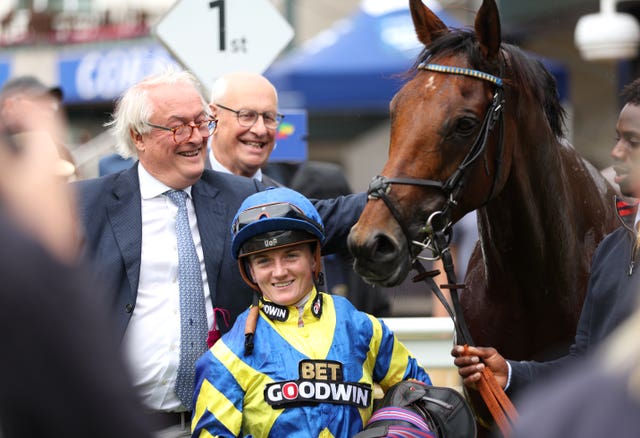
Hollie Doyle will no longer act as the retained rider to owner Imad Al Sagar, with Oisin Murphy instead due to take up the position.
Doyle was in the saddle each time Al Sagar’s star mare Nashwa took to the track, guiding her to three Group One victories at the peak of her career.
The formal retainer may have now come to an end, but Al Sagar and his racing manager Teddy Grimthorpe hope to maintain their link with the rider.
Hollie Doyle enjoyed some huge moments with Nashwa (David Davies/PA)
The latter said: “We’re keen to stress that we have had a fantastic relationship with Hollie throughout, and we hope that will continue for many years to come in different forms.
“There are, however, moments when it is time for a change and Imad felt this was the right time to move on.
“We will now use Oisin, when available, in the absence of Hollie.”
Doyle told attheraces.com: “Unfortunately, I was informed on Friday I’d lost my long-standing retainer with leading owner Imad Al Sagar. It came as a bit of a shock, particularly at this stage of the season.
“I’ve been a part of Imad’s operation for five years, riding 38 winners including at the highest of levels. We’ve enjoyed numerous stakes winners, a Royal Ascot winner and a Classic winner with the wonderful Nashwa in the Prix de Diane in 2022, followed by two further Group One successes.
“I have nothing but the utmost respect for Imad and would like to thank him for giving me such an amazing opportunity at a formative stage of my career. I wish him and the team the very best of luck in the future.”
https://www.geegeez.co.uk/wp-content/uploads/2025/08/2.68073750-scaled.jpg12802560Geegeez Newshttps://www.geegeez.co.uk/wp-content/uploads/2022/10/geegeez_banner_new_170x78.pngGeegeez News2025-08-18 09:25:132025-08-18 15:40:11Hollie Doyle retainer with Imad Al Sagar comes to an end
An emotional Hollie Doyle paid tribute to her long-time ally Trueshan, after Flat racing lost one of its enduring stars at Goodwood on Tuesday when the hugely popular stayer suffered a fatal injury.
Doyle was riding Alan King’s nine-year-old for the fourth time in the Al Shaqab Goodwood Cup, having won it in 2021, with the gelding taking part in the 35th outing of a stellar career, but pulled up sharply at halfway.
Remembering some of their great days together, which brought 11 victories, including three successive triumphs in the Long Distance Cup at Ascot on British Champions Day, Doyle told the PA news agency: “I’m just devastated. It couldn’t be any worse. He was a special, special horse, I can’t think of anything else to say.
“I am gutted. He’s been amazing for me, a star, and those memories we have together are some of my very best.”
Trueshan put up one of the best weight-carrying performances of all time in the Northumberland Plate (Richard Sellers/PA)
A 16-time winner – three of them coming at Group One level – Trueshan had attracted a following that is unusual for a Flat horse due to his longevity.
In 2022 he dropped into handicap company to defy one of the highest marks in recent times when winning the Northumberland Plate at Newcastle.
Hollie Doyle and Trueshan were a match made in heaven (Steven Paston/PA)
James Given, the British Horseracing Authority’s director of equine welfare, told ITV Racing: “I want to express my sincere condolences to all the connections and anyone associated with the horse, no one is going to feel this more than them.
“He’s been a stalwart, he’s been a firm friend, he’s been everything to them
“What has happened unfortunately is just an accident, mid-race, in a straight line going up a hill. His left-hind pastern broke and left him in a situation that wasn’t recoverable from.
“Alan was able to get down there and assess him with the vet and they felt there was no option really but to put him down.”
https://www.geegeez.co.uk/wp-content/uploads/2025/07/2.61216241-scaled.jpg12802560Geegeez Newshttps://www.geegeez.co.uk/wp-content/uploads/2022/10/geegeez_banner_new_170x78.pngGeegeez News2025-07-29 15:22:452025-07-29 15:22:45‘Devastated’ Hollie Doyle pays tribute to Trueshan
Flat racing lost one of its enduring stars at Goodwood on Tuesday, with the hugely popular Trueshan suffering a fatal injury.
Alan King’s nine-year-old was running in the Al Shaqab Goodwood Cup for a fourth time, having won it in 2021, and was taking part in the 35th outing of a stellar career. But he was pulled up by Hollie Doyle at the halfway point of the two-mile feature.
James Given, the British Horseracing Authority’s director of equine welfare, told ITV Racing: “I want to express my sincere condolences to all the connections and anyone associated with the horse, no one is going to feel this more than them.
Trueshan put up one of the best weight-carrying performances of all time in the Northumberland Plate (Richard Sellers/PA)
“He’s been a stalwart, he’s been a firm friend, he’s been everything to them
“What has happened unfortunately is just an accident, mid-race, in a straight line going up a hill. His left-hind pastern broke and left him in a situation that wasn’t recoverable from.
“Alan was able to get down there and assess him with the vet and they felt there was no option really but to put him down.”
Hollie Doyle and Trueshan were a match made in heaven (Steven Paston/PA)
A 16-time winner – three of them coming at Group One level – Trueshan had attracted a following that is unusual for a Flat horse due to his longevity.
In 2022 he dropped into handicap company to defy one of the highest marks in recent times when winning the Northumberland Plate at Newcastle.
He struck up a famous partnership with Hollie Doyle, who rode him to 11 of his victories, including three successive triumphs in the Long Distance Cup at Ascot on British Champions Day.
https://www.geegeez.co.uk/wp-content/uploads/2025/07/2.63088129-scaled.jpg12802560Geegeez Newshttps://www.geegeez.co.uk/wp-content/uploads/2022/10/geegeez_banner_new_170x78.pngGeegeez News2025-07-29 14:48:532025-07-29 15:01:02Trueshan suffers fatal injury in Goodwood Cup
Hollie Doyle was at her brilliant best to steer Witness Stand to HKJC World Pool Lennox Stakes success and give Dr Richard Newland and Jamie Insole a marquee Group Two victory at Goodwood.
There was early drama as Ralph Beckett’s race regular and leading fancy Kinross was withdrawn at the start after receiving a kick, while Ed Walker’s Royal Ascot winner Noble Champion was eased down and pulled up early into the piece.
However, Doyle avoided any complications as she latched Witness Stand on to the small cluster to go forward from start, always in the slipstream of customary front-runner Quinault and defending champion Audience.
It looked momentarily like Audience would recreate last year’s heroics, but the 25-1 winner found plenty in reserve inside the final furlong to gallop home two-and-three-quarter-lengths clear of William Haggas’ Lake Forest, the only runner to emerge from the chasing pack late on.
Insole said: “As a trainer you wait your whole life for a good horse and to win the Lennox is pretty incredible.
“We bought him for a hundred grand and felt he’d gone under the radar as there were higher offers for him that came our way afterwards. I already had this race in mind for him.
“It was his Chester run (second in a Listed race) that gave us the confidence to come here, and when I saw the rain this morning and the slower ground I knew it would be to his advantage.
“He’s in the Hungerford (at Newbury), but would have to carry a penalty now. I also put him in the Foret this morning.”
For co-trainer Newland it was a red-letter day in his new venture alongside Insole training on the level alongside his Grand National heroics in the jumps sphere. He is also a part-owner of the winner.
Newland said: “It’s a great result and fair play to Jamie and all the team. It was a lovely ride from Hollie in a funny sort of race, but I’m not complaining.
“Jamie leads the Flat team day-to-day, but I am involved in the background and discussing the training and placing of horses.
“I’m also a part-owner of that horse so it’s a terrific result. He was bought to be a flag bearer due to his high rating and it was a superb bit of purchasing by Jamie and Matt Holdsworth at the sales and now we’ve had a payday to get some money back and give us a high-profile winner which is fabulous.”
He added: “It’s more than dipping our toe in and we’re more of a Flat yard now. There’s a number of reasons for that but I’m loving the new challenge of it and it’s quite a big thing to try and re-establish yourself as a Flat yard after being a jumps yard for so long.
“I’m thrilled with how it’s going and we’ve some lovely horses coming through. It’s great fun and I’ve been doing the job 20 years so it’s nice to have a new challenge.”
https://www.geegeez.co.uk/wp-content/uploads/2025/07/2.81133183-scaled.jpg12802560Geegeez Newshttps://www.geegeez.co.uk/wp-content/uploads/2022/10/geegeez_banner_new_170x78.pngGeegeez News2025-07-29 13:54:322025-07-29 15:01:28Hollie Doyle shines as Witness Stand lifts Lennox Stakes
The 3.30 race at Goodwood on September 3rd 2024 will be one that Hollie Doyle will cherish for the rest of her life, writes Dave Renham. It was the race where she rode her 1000th career winner on the David Simcock-trained Leyhaimur. In doing so, Hollie became only the second woman to achieve this monumental feat following in the footsteps of Hayley Turner who rode her 1000th winner in November last year (2023).
Horse racing is one of the few sports where men and women compete against each other on a level playing field. One would sincerely hope that by now Doyle and Turner have proven to trainers, punters, bookmakers and fellow jockeys alike that women riders can be as successful as their male counterparts.
Back in January 2021 Matt wrote a piece on the site where he set about trying to answer two questions:
1. Has the sport begun to level the chasmic disparity between male and female rider opportunities? and
2. To what degree is it appropriate to do that based on performance data?
What I plan to do with this article is twofold. In the first part I am aiming to build upon the start of Matt’s research into his question of gender disparity, bringing us up to date over the subsequent four years. In the second part I would like to focus solely on the performance of female jockeys.
Male vs female: Overall Numbers
Firstly, let me share Matt’s findings for all riders in UK flat races between 2016 and 2020, broken down by gender focusing solely on the percentage of rides for each group.
As the pie chart shows, a whopping 91% of all rides were taken by male jockeys during this time frame. That's an enormous disparity. The question is, have matters improved at all in more recent times? Below is the same male/female percentage comparison but looking at data from 1st January 2021 to 5th September 2024:
Things have improved but just barely. I wonder if we have seen a year-on-year increase or not? Let’s see:
From 2021 to 2023 we were heading downwards not upwards. At least 2024 has seen the percentage move in the direction it should be. As can be seen, parity is a long way away and even an 80/20 male to female split seems years, possibly decades, away.
For these figures to change we need to see more Hollie Doyles. What I mean by that is that Hollie has ridden 17% of all the rides given to female jockeys in 2024. That equates to 796 rides out of the 4741 total rides for all female jockeys. Only two other female jockeys have had more than 300 rides this year to date, those being Saffie Osborne on 493 and Joanna Mason on 470. If, say, just another three female jockeys had been given the opportunities this year that Hollie has had (e.g. ridden in nearly 800 races), then the male riders to female riders’ splits would have moved from 88.7% male rides vs 11.3% female rides, to a better, if still badly unbalanced, split of 82.9% vs 17.1%. However, that would still be a solid improvement on the situation in a scenario where just three female jockeys get those better opportunities - and two of them used the lever of family connections to get started. Riders need races to gain experience, and the simple truth is that female jockeys are still not getting enough opportunities.
Male vs female: Favourites
Matt’s article also looked at data for favourites in terms of the male rides / female rides percentage splits. From 2016 to 2020 only 6.7% of all favourites were ridden by female jockeys. In the more recent past (2021 onwards) this has improved a little, but only to 8.3%. However, when we look at the overall results (2021-2024) for both groups of favourites we see some interesting findings:
Strike rates for both are within 0.33% of each other, but female jockeys have offered punters by far the better value. Losses to SP have been 7p in the £ better for female riders compared with the male jocks. Meanwhile the female A/E index is an excellent 0.96 compared with 0.91 for male riders. To Betfair SP backing all favourites ridden by female jockeys would have made a blind profit of £46.97 (ROI +2.6%).
If we examine like for like we get a better idea why the female jockeys have had the best of it on favourites. Most races in this favourite sample have been handicap races (because 71% of flat races in 2024 have been handicaps - and similar percentages apply to the other recent years). 80% of the races where females rode the favourite and 68% of races where males did have been handicap races. And in these handicap races female riders have outperformed their male counterparts. Here are the handicap favourite results for ’21 to ‘24 split by gender of the rider:
In these like for like races female jockeys have a better strike rate by roughly 1.5%, and they have almost broken even to SP, as compared with losses of 10% for males. The A/E index values (0.97 vs 0.91) also show a value edge for female riders. This represents a still present blind spot in the markets.
Before moving to part 2 of my piece, all the other stat comparisons Matt made in his write-up have similar percentage splits now to what they were then. As an example of this, from 2016 to 2020 25.2% of all apprentice jockey rides came from female riders, from 2021 onwards it stands marginally higher at 26.4%.
We can only hope the next four or five years sees a vast improvement and many more opportunities for female jockeys.
*
Top Female Jockeys: An Overview
At this juncture, it's time to move away from the male vs female rider comparison and focus solely on the ladies. Let me look at the records of the female jockeys who have had the most rides between January 2021 and early September 2024 (ordered by number of rides):
Hollie Doyle
Hollie Doyle has the highest win percentage but over the years, as her stock has risen, it has become difficult to find profitable angles when backing her. Hollie still performs exceptionally well and is obviously one of the top jockeys in the country; it is just that she has become very popular with punters which makes her expensive to follow generally speaking.
If we go back to the previous two years (2019 and 2020), her ROI was -8% to SP, and you could have secured a healthy £177.24 (ROI +9.9%) if backing all her mounts to BSP. These 2019-2020 figures were achieved with a virtually identical strike rate to what transpired in 2021-2024. Clearly, then, it is this rising popularity in the last four years especially that have driven down the prices on her runners and thus any value has been stifled.
Saffie Osborne
That has yet to happen - though of course it will do - with Saffie Osborne, as backing all her rides “blind” in the past four seasons would have secured a profit to BSP of £65.98 (ROI +3.6%). In fact, Osborne has produced a blind profit to BSP in each of the last three years.
I am a firm believer that Saffie Osborne, if given the right opportunities, can be as successful as Hollie Doyle in the years to come. She is only 22 and she seems to be going from strength to strength, especially when we consider her yearly performances in terms of the A/E index stat. This stat is one that attempts to establish value where, generally speaking, a figure above 1.00 represents a good value proposition. Here are Osborne’s A/E figures by year:
As the graph shows her figures have been getting better and better year on year. No wonder she has proved profitable to back to BSP more recently.
Saffie has had an excellent record with horses near the front end of the betting since the start of 2021. Those runners with an SP of 6/1 or shorter have provided her with 162 winners from 653 runners (SR 24.8%) for an SP profit of £40.04 (ROI + 6.1%). To BSP this improves to +£97.50 (ROI +15%). If we extend this to horses priced 14/1 or shorter, she is still in profit to SP to the tune of £31.54 (ROI +2.5%) thanks to 220 wins from 1277 rides (SR 17.3%). To BSP her profits stand at a healthy £207.88 (ROI +16.3%).
I am sure the value on Saffie Osborne’s mounts will soon diminish, especially if continuing this upwards spiral. However, for the moment I think she will continue to offer punters good value.
Joanna Mason
Another female jockey to impress me recently has been Joanna Mason. She primarily rides for the Mick & David Easterby - granddad and uncle respectively - yard and, when we compare her record for this yard with all other jockeys combined, we see the following:
Her stats are far better than when combining all the other Easterby jockeys in one group. This has also been the case when we compare the results of the more fancied runners from the stable. With Easterby horses priced 9/1 or shorter we get these splits:
It should be noted that to BSP a blind profit could have been had backing all of Joanna's runners, as well as the subset of those priced 9/1 or shorter.
It is a shame that she has not been given many opportunities from the bigger yards: she has ridden five times for William Haggas including three rides since May this year. She has ridden one winner and had three placed horses so hopefully more rides will come her way from that stable soon.
Hayley Turner
Hayley Turner averages around 400 rides a year these days, down somewhat on the peak of her career when between 2006 and 2012 she averaged 725 rides per year. However, she is still performing well 24 years after her first ride and especially when her horse is prominent in the betting. In the past four seasons on horses with an SP of 4/1 or shorter she has won 81 of her 264 rides (SR 30.7%) for a small £10.76 profit to SP. This equates to a return of just over 4p in the £. To BSP the figures improve to +£28.65 (ROI +10.9%).
David Simcock and Andrew Balding continue to use Hayley on a fairly regular basis and these two trainers have provided her with the most rides in the past four seasons. Both trainers have been rewarded with excellent results:
Turner has been very close to breaking even for both trainers across all their combination runners, and to BSP she has made a profit of £15.77 (ROI +9.3%) for Balding, and £21.83 (ROI +10.8%) for Simcock.
Josephine Gordon
Josephine Gordon has an overall win strike rate of only 7% across the past four seasons but 58% of her rides have been on horses priced 14/1 or bigger. Hence, she tends to ride lesser fancied runners which explains that low strike rate. However, when we focus on her rides on horses whose prices were 12/1 or shorter at SP her record reads 57 wins from 458 rides (SR 14.6%). These runners have edged into profit at SP to the tune of £2.42. To BSP profits stand at +£64.66 (ROI +14.1%).
While writing this article there has been quite a coincidence because Josephine Gordon has just won at Kempton in the Class 2 London Mile Series Final Handicap on Whitcombe Rocker at 11/1, giving him a brilliant ride from a tough outside stall. Funny how things happen like that!
One to note: Olivia Tubb
To finish up I want to talk about an apprentice who, despite having only 122 rides to date, could be the real deal. Her name is Olivia Tubb, and she is currently apprentice jockey to Jonathan Portman. Her overall record is impressive:
Clearly it is early days, but when we examine her record for Portman, she has a 17.7% strike rate producing returns to SP of 26p in the £ (44p to BSP). All other jockeys combined when riding for Portman have won just 7.4% of races losing a whopping 45p in the £.
It is also impressive to note that with horses priced 4/1 or shorter she is 11 from 29 (SR 37.9%) for a profit to SP of £15.24 (ROI +52.6%). Her A/E index stands at a huge 1.55. She should have an exciting future – let’s hope she gets enough chances to prove it.
*
To conclude, there is sadly still a wide opportunity chasm between the chances afforded to male riders as compared to female riders. That needs to change because there is plenty of female talent in the jockey ranks - and the stats I've shared I hope has proved that beyond doubt.
- DR
https://www.geegeez.co.uk/wp-content/uploads/2024/09/JoannaMason_MickEasterby_York.jpg319830Dave Renhamhttps://www.geegeez.co.uk/wp-content/uploads/2022/10/geegeez_banner_new_170x78.pngDave Renham2024-09-11 04:38:412024-09-09 15:42:09Seeking Value with Female Flat Jockeys
The first in a new series of articles looking at jockeys, this one will be focusing on Hollie Doyle, writes Dave Renham.
Hollie is still just 26 and has risen up the ranks quickly. She began as an apprentice at the Richard Hannon yard in 2014 and, by 2017, had ridden out her claim. Incidentally, in 2016, while still a five pound claimer, she rode a 25/1 winner for a geegeez.co.uk syndicate, Table Manners trained by Wilf Storey at Newcastle.
The 2019 campaign was her first real milestone when she rode 116 winners, in doing so setting a new record for the number of winners achieved by a female jockey in Britain. The following year, 2020, was another big one with her first win at Royal Ascot, her first Group race success, a win on Champions Day at Ascot (the first female to achieve this) swiftly followed in the next race by her first Group 1 triumph, aboard Glen Shiel. Since then Hollie has continued to go from strength to strength and is unquestionably one of the top jockeys around.
**
How to Use Profiler
Normally when gathering data for my articles on Geegeez, I use Query Tool or Draw Analyser or Pace analyser, or a combination of the three. However, for this piece I obtained a good chunk of the data from the Profiler tool. You can find Profiler by clicking on the ‘Tools’ menu item. Once there, you will be presented with this somewhat sparse screen, and an invitation to "Enter a horse, trainer, jockey or sire name to begin":
As that instruction suggests, Profiler allows us to drill down into the record of any horse, trainer, jockey or sire. It is the same principle for each research area, but if wanting to research a jockey such as Hollie Doyle, we need to type their name into the Search bar at the top, and click the 'Jockeys tab'. This will display the following:
Clicking the 'Profile' button populates the 17 categories highlighted in blue in the first screen shot and thus creates a huge web page full of data. As the first variable in the list, the going stats will be displayed at the top and for Hollie Doyle’s search they came up as follows:
As can be seen we have a wealth of data, both win and each way. We also have a PRB figure (percentage of rivals beaten) which is an excellent ‘extra’ stat. Having data for 17 different categories all on one page is extremely useful.
For this piece I needed to adjust the Date Range filters because I wanted to look specifically at the years from 2015 to 2022. I also wanted to look at both flat (turf) and all weather racing so I set the filters as follows: (N.B. these filters were in place for the Going data shown above):
There are a number of other filters so, for example, you can look at just handicap data if you wish, just the wins, and so on. Also, we can drill into National Hunt racing data if we want to. It should be noted that when using the Profiler, it returns both UK and Irish results combined.
OK, so I have my parameters set, now it's time to dig into the stats. Before sharing my findings I should mention that as well as using the Profiler Tool for this research, I have used other sources, including Query Tool. In all the tables profits/losses quoted are to Industry SP; I will quote Betfair SP where appropriate.
Hollie Doyle: Overall Record
Let us first look at Doyle’s baseline figures across every single runner during this eight-year period:
This is a thoroughly decent record:her A/E index of 0.91 is above the ‘average’ figure for all jockeys, which is 0.86. Likewise, her overall PRB figure of 0.54 is nicely above the 0.50 average mark. Losses of around 16 pence in the £ to SP convert to close to breaking even (losses of under 2p in the £) at exchange SP.
Hollie Doyle: Record by Year
I first wish to breakdown Doyle's stats by year. Here is a breakdown showing win percentage (or Strike Rate (SR%) if you prefer):
We can easily ignore the first year in the sample, 2015, as Hollie only had 39 rides in that year; and we can see how it often goes for a top jockey rising out of the apprentice ranks: a steady start launches into high strike rates as the claim's value is utilised, followed by a more challenging period post-riding out the claim, before blossoming into a top tier rider.
Hollie's profile mimics this perfectly: she rode out her claim in 2017 before a season of consolidation - more rides but fewer winners in 2018 - after which the last four years have seen her highest strike rates. Not only have the last four years seen her highest strike rates, but her most consistent ones too. 2019 to 2022 have seen strike rates within 1.3% of each other.
Hollie Doyle: Record by Distance
A look at her record at different distances now. I have grouped them into five distance bands and, again, I am comparing win strike rates:
The highest strike rate has occurred in the longer distance events (1m 7f or more); but, having said that, the data set is much smaller (just 199 races). Compare that to the 7f to 1 mile results which come from 1920 races, almost ten times as many. The vast majority of Doyle’s rides come in races of 1 mile or less – roughly 69% of all her rides have been over these shorter distances. This, in fact, perfectly mirrors the percentage of races which are run at a mile or shorter, which is unsurprising, I guess.
In a previous article on jockeys and run style I highlighted Doyle as a jockey that does well in handicaps on front runners; in sprints (5 to 6f) and also races of 7f to 1 mile. I will look in more detail at her run style data later.
Hollie Doyle: Record by Betting Odds / Price (SP)
Profiler gives a breakdown of performance by starting price splitting it up into seven price brackets. I have taken Hollie’s record straight from that table:
If you had backed all Doyle’s mounts focusing on the shorter end of the price (17/2 or shorter), you would have lost only 5p in the £. To Betfair SP though, that would have turned into a small profit of just over 4p in £. However, the value to be had with these runners has largely evaporated now she's a relative household name. In terms of very big priced runners (28/1 or bigger) only a handful have won. These have produced significant losses to SP and even to BSP losses stand at a weighty 35p in the £.
Hollie Doyle: Record by Course
I am now going to look at all courses where Hollie Doyle has had at least 75 rides. The courses are listed alphabetically in the table below:
I want to mention that course strike rates can sometimes be slightly misleading due to the average field sizes being vastly different from one track to another. For example, in the past eight seasons, the average field size (all races) at Ascot has been just under 12; contrast this with Ffos Las whose average has been around 7.6. Hence, using solely strike rates when comparing Ascot with Ffos Las is not a statistically sensible play. I am not saying that a course strike rate is without use but, as with any single piece of information, it is useful to combine it with others.
The two stats that most interest me from a course perspective are the A/E indices and the PRB figures. Doyle’s figures for Yarmouth stand out with an A/E index of 1.30 and a PRB figure of 0.58. In addition the strike rate is high and she has made decent profits to SP. Her profits to BSP stand at an even more impressive +£90.55 (ROI +65.6%), and these figures are not skewed by any huge priced winners. It is also noteworthy that she has ridden winners at Yarmouth for a good number of different trainers (21 in total), so it is not one or two specific trainers providing all of the winning rides. Sticking with Yarmouth for one more stat, when Doyle has been riding a horse priced 8/1 or shorter she has secured 28 win from 88 rides. This equates to an excellent strike rate of 32%.
Before moving away from courses, one course that did not make the list due to having had only 46 rides was Pontefract. The stats, though, are very strong despite this smallish sample – 14 wins (SR 30.4%) for an SP profit of £22.19 (ROI +48.2%). A/E index of 1.55; PRB figure of 0.58.
Hollie Doyle: Record by Trainer
Some punters love to follow certain trainer / jockey combinations and, although I don't generally, I think certain combos do produce some betting opportunities that represent value. Here are the trainers for whom Doyle has ridden at least 50 times (ordered by strike rate):
As you can see, Archie Watson provides Doyle with a high proportion of her rides. Although she has not made a profit on the 939 spins in that sample, she has done on his more fancied runners. To wit, horses priced 4/1 or shorter have provided the Doyle/Watson combination with 150 wins from 418 runners (SR 35.9%) showing a small SP profit of £14.07 (ROI +3.4%). To BSP this improves to +£40.68 (ROI +9.7%).
Her record with Alan King is excellent; not just because of the profit figure, but because the PRB is exceptionally high at 0.64. One other combo to mention is Hollie with the Gosden stable. The results are not in the table because they have only combined on 36 horses but, of these, 13 have won (SR 36.1%) for an excellent SP profit of £32.32 (ROI +89.8%). Where the Doyle/King PRB is impressive, the Doyle/Gosden figures trump them, standing at 0.69 (i.e. 69% of all rivals beaten). I think it would be worth keeping a close eye on the Gosden and King stables this season (and beyond), looking out for any Hollie Doyle booking.
Hollie Doyle: Record with Days since last run / horse layoff
A unique feature of the Profiler Tool (compared with the Query Tool) is the fact it gives you data for days since the horse last ran. Doyle’s figures are as follows:
As we can see Hollie has made a profit on horses whose last run was within a week of their prior start. As a general rule, my assumption, as with many others, has been that horses with shorter breaks outperform horses that are off the track for longer. This is the first time I have seen any PRB figures for any fitness based variable such as this. It is interesting, and pleasing to see the sliding scale from 0.61 down to 0.41. These findings give me the impetus to check PRB figures for a bigger group of runners to see if the same sliding scale is repeated. I am guessing it is – if so it might become the basis for an article in the future.
Hollie Doyle: Draw Awareness
Another first for me: this is the first time I have tried to drill down into this type of idea. Essentially punters, bookies, trainers and jockeys are aware of draw biases. Some will over- or under-estimate bias, but one would hope that seasoned jockeys understand the effect of the draw at most courses better than most. It is clearly a difficult area to research but I thought I had enough data for Hollie at one particular course, namely Kempton, to try to do this. My idea was simple: I wanted to compare her record in 8 or more runner handicaps at Kempton over 5f to 1 mile, with other jockeys, purely from a draw perspective. Kempton over these four distances (5f, 6f, 7f & 1m) offers a low draw edge and hence I wanted to compare Doyle’s record when drawn 1 to 4 (the best four draws) with all other jockeys. To do this, I decided to calculate the relevant PRB figures as these I would assume to be the most accurate, as they create bigger data sets than, say, using win and each way data.
Hollie had over 100 qualifying handicap rides when drawn in stalls 1 to 4 over these Kempton distances and her PRB figure was 0.60. The combined figure for all other jockeys is 0.55. This leads me to conclude, at least from these Kempton stats, that she has good draw awareness: she has performed notably above the norm when her horses have been well drawn at Kempton. I did check the non-handicap figures at Kempton using the same parameters – in these cases, she had fewer qualifying rides than in handicaps (44), but her PRB figure was a very impressive 0.63, the overall non handicap jockey figure stands at 0.53.
This is clearly a challenging area to research in great depth from an individual jockey perspective, due to small course and distance data sets. For example, you probably would not get enough individual data at Chester unless a jockey had ridden there regularly for 20 years or more, as that track does not host many meetings over a 12 month period. Kempton, however, has so many race meetings each year this is a course that lends itself to this avenue of research. Something else to maybe write about more in the future?
One further caveat worth mentioning with this type of research is the fact that there is some selection bias in the quality of top riders' mounts compared with the average.
Hollie Doyle: Record by Run Style
I mentioned earlier a recent article in which I touched upon Doyle’s positive record on front runners in handicaps at the sprint distances of 5f and 6f, but also at 7f and 1m. Well, Hollie's record from the front is actually extremely good across the board – handicaps / non-handicaps, and any distance. Yes, she has a higher strike rate on front runners running over shorter distances, but in all races of 1m1f or more her strike rate on these pace setters still hits just over 20% (A/E 1.10). This ranks her 9th out of all jockeys currently riding in the UK in terms of win strike rate (150 front running rides or more over 1m1f+ from 2015 to 2022), 12th if including Irish jockeys. In terms of A/E index she lies 11th (UK), 15th (UK and Ireland). For the record the average win strike for ALL jockeys over 1m1f+ stands at 15.6%.
Here is a breakdown of Hollie Doyle's run style performance across ALL races:
She has an excellent close to one win in four record with front runners, whereas with hold up horses this drops markedly to less than one win in every 12. The A/E figures correlate as the following chart shows:
As regular readers of my articles will know front runners have an edge at a majority of courses and distances, so the patterns seen for Doyle should come as no real surprise. That said, her figures are well above the norm over all distances, and if she is booked to ride a horse that often front runs, that ought to be seen as a double positive in cases where the pace map indicates an even tempo or, especially, Hollie's mount is the probable lone speed angle.
Before winding up the run style stats, let me share her record when riding the favourite:
More evidence, as if it was really needed, about the importance of early track position.
[As a side note, using favourite in run style analysis removes any selection bias regarding 'good horses at the front, bad ones at the back'. In spite of this levelling of the playing field, one invariably sees this type of strong front of field bias. Keep this in mind if you're currently backing plenty of fancied horses with a hold up run style!]
Some Extra Hollie Doyle Nuggets
With the main body of the article complete let me just share with you a few extra stats or nuggets that may be of interest:
When Hollie retains the ride after winning last time, her record reads 67 wins from 310 (SR 21.6%). Backing all runner to BSP would have yielded a profit of £31.12 (ROI +10.0%).
Horses that finished second last time have a good record with Doyle on board. Of the 585 qualifiers, 139 have won (SR 23.8%) for a BSP profit of £74.03 (ROI +12.7%).
In very small fields (2 to 4 runners) Doyle has secured 54 wins from 142 rides (SR 38.0%) for a BSP profit of £65.27 (ROI +46.0%). She made significant profits if backing to Industry SP, too (+£53.79).
In Class 1 races, Hollie has done well if the horse has been fancied (defined as priced 10/1 or shorter). 25 wins from 109 (SR 22.9%) for a BSP profit of £26.29 (ROI +24.1%).
Hollie Doyle Main Takeaways
Doyle has been extremely consistent in the past four years and as I am penning this piece her strike rate for 2023 is above her norm at 15.8%.
When riding more fancied runners (17/2 or less) Hollie has made a small profit to BSP, though that may be due to historical data so some caution is advised.
She has an excellent record at both Yarmouth and Pontefract.
Doyle should be noted when riding for Alan King or the Gosden stable and, also, when riding for Archie Watson look out for shorter priced horses (4/1 or less).
If Hollie is on board a horse that had run in the past seven days it tends to be a positive.
At Kempton in races of 1m or less when drawn 4 or lower she has performed well above the norm.
Doyle is an excellent rider from the front at all distances.
The four "extra nuggets" shared immediately above.
*
There are plenty of Hollie Doyle stats to get to grips with in the above: lots of positives, and the occasional negative, too. Hollie should continue to give us plenty of potential betting opportunities in the coming weeks, months and, I hope, years. I really rate her as one of the very best around and, more importantly, the stats tend to agree!
In this article I will be looking at my favourite area of research, namely running styles / pace, writes Dave Renham. As I have mentioned numerous times before, knowing how a race is likely to “pan out” in terms of a potential “pace angle” can give us an important edge.
Being able to predict the running style of each horse in a race can be liquid gold in certain circumstances but, as we know, in most cases this is trending towards the impossible. However, using past run style data we can make an informed judgement, and certain races will be easier to predict how things will pan out than others. In terms of past running style, arguably the most important factor is the horse itself, especially if it has a preferred pace position. However, there are other dynamics to consider, including the other horses in the race, the draw at certain tracks and over certain distances, the trainer, and the jockey. And it is that last variable I'll be delving into for the remainder of the article.
A jockey can certainly make a big difference in any race, especially when it comes to pace or running styles. How often have you seen a jockey set a steady gallop in front and manage to repel all rivals for a pillar to post victory? Just the other day at Chester we saw a masterclass of that from Hollie Doyle, aboard Pride Of America in a 1m2f handicap (12/5/23). Hollie got to the front, dictated the tempo, and then cleverly kicked for home earlier than the other jockeys were expecting. She now had them all on the stretch and kicked three lengths clear around two furlongs out. The favourite gradually closed as they reached the final furlong and possibly got a neck in front with 150 yards to go. However, the energy it had used up to get back to Pride Of America meant he had nothing left for the finish and Doyle’s mount pulled away again for a classy success.
For this article I have looked at five years' worth of data (1/1/18 to 31/12/22) including both turf and all weather racing, but in the UK only (i.e. not Ireland). My focus has been on handicap races and I will start over the two sprint trips of 5 and 6 furlongs. Before I crack on, let me give you an overview of run style and what it means (regular readers will know this inside out by now I hope!).
The run style stats have been sourced from this website's data – specifically the Query Tool. The run style data here at Geegeez is split into four sections – Led (4), Prominent (3), Mid Division (2) and Held Up (1). The number in brackets is the run style score that is assigned to each section.
The numbers are really helpful as we can use them to drill down and build a better picture and understanding of how important run style can be.
Below is a basic breakdown of which type of horse fits which type of run style profile:
Led – horses that lead early, horses that dispute the early lead. I refer to the early leader as the front runner;
Prominent – horses that lie up close to the pace just behind the leader(s);
Mid Division – horses that race mid pack or just behind the mid-point;
Held up – horses that are held up at, or near the back of the field.
Jockeys in Sprint Handicaps (5f - 6f)
As a starting point let us see which jockeys took the early lead the most (in % terms) in sprint handicaps at up to six furlongs. I have included jockeys that have had at least 100 rides over this 5-year period and who are currently still riding in the UK – those with the highest 15 percentages are shown below:
For comparison purposes the average for ALL jockeys in terms of taking the early lead is 14.2%. Thus, Ross Coakley and Kieran O’Neill both go forward early nearly twice as often as the average. Now, a look at those jockeys that have the lowest percentages:
There are a couple of very well-known jockeys in this cohort: Ryan Moore and Jamie Spencer. Spencer is renowned for his hold up style as a jockey, so that should come as no surprise. However, Ryan Moore may raise more eyebrows, as less than 6% of his sprint handicap rides have seen him take the lead early. Moore-ridden sprint handicappers have been held up more than any of the other three run styles (mid division, prominent, led), but only 11.7% of them have won. Compare this to the combined figure of horses he's ridden prominently or led aboard which have won 22.2% of the time in the same group of races. Moore is a well-respected and successful jockey, but in sprint handicaps would I want him riding a horse I'm keen on? Probably not.
Jockeys who can get their mounts to front run more often than most in sprints are definitely worth noting, but one could (rightly) argue that the win percentages for jockeys when on front runners is more important. For example, if a jockey had taken the lead in 25% of races but won only 5% of them then this turns into a negative. In contrast, a jockey that has led early in say 15% of races but won 25% of the time when taking the early lead is definitely a positive. Of course, the ideal is to have a jockey that gets to the front early a high percentage of the time, and goes on to win a high percentage of the time!
Therefore, let us now look at the top performing jockeys in terms of win % when on a front runner (30 front running rides minimum):
For comparison purposes the average win SR% for ALL front running jockeys in handicap sprints stands at 18.1%. It's good to see Messrs Coakley, Hart, Callan and Bryan in this table – they were also in the top 15 of early leading jockeys shown earlier. Some of the datasets are quite small, so we do need to be aware of this but, when it comes to Jason Hart, we have plenty of evidence with which to work. Hence let's dig a little deeper into Hart's run style record in 5-6f handicaps.
Jason Hart's Run Style in Sprint Handicaps (up to 6f)
As we have seen Jason Hart front runs / leads early in roughly a quarter of all handicap sprints in which he rides. Of these 27.2% went on to win. These are impressive and powerful numbers and I am always on the look-out for which horse Hart is riding in such contests.
Look at Hart compared to the average jockey, in terms of run style: there are two columns in the graph below. The orange columns show what percentage of horses displayed that particular running/pace style for all the jockeys; this is our control group data if you like. The blue columns are the figures for Hart. So, for instance, leaders accounted for 14% of all runners when examining the ALL jockey data, whereas Hart led on 25.5% of his sprint handicap rides; prominent racers were 33.4% for all jockeys versus 39.9% for Hart, and so on.
The graph is useful as it is an easy way to compare the data. Jason Hart clearly understands the importance of track position in sprints: 65.4% of the time he either gets to, or is close to, the front early. This is far higher than the average figure for ALL jockeys which stands at 47.6%.
If we look at the win and place breakdown for Hart, we can really see the importance of track position:
As the table shows, if you had been able to back every front running sprinter Hart rode, you would have made a huge profit, not just if backing to win, but backing each way also. Not only that, we need also to remember these profit/loss figures are calculated to Industry SP. Just imagine the profits if backing on the exchanges or taking BOG! Prominent racers would have made us a profit if backing to win also. The stats/returns for midfield and hold up horses are poor for Hart in these quick fire events – but we know from previous research this is almost always the case regardless of rider or situation.
For the record Hart has taken 123 different horses to the front early in these races and, of those he has ridden from the front four times or more, 15 of the 16 won at least once. Indeed these 16 horses have combined to front run in 107 races of which they were successful on 40 occasions, which equates to a hugely impressive 37.4% strike rate.
There is one more Jason Hart stat to share which is his record on front runners in handicap sprints when his horse was in the top three of the betting: he has won on these horses a staggering 41.2% of the time with SP returns equating to 90p in the £. Looking at the ALL jockey figures for these fancied runners, the strike rate is just 29.2%.
Before moving on, Hollie Doyle is another jockey who has done well on similarly fancied runners, scoring over 38% of the time.
Jockeys in 7f & 1m Handicaps
Up in trip now. To start with I will look once again at which jockeys took the early lead most often (in % terms) in these races. As with the sprints I have included jockeys who had at least 100 rides over the 5-year period and who are currently still riding in the UK – those with the highest 15 percentages are shown below:
Theodore Ladd has staggering figures, taking his runners to the lead over a third of the time. Next highest is Frankie Dettori, albeit with a 12% lower figure.
It should be noted that front runners in handicaps are not as successful over 7f-1m compared with 5-6f but, generally, they do still have an edge, as the graph below shows:
As can be seen a front runner is twice as likely to win as any individual hold up horse. For the record, if we had been able to use our crystal ball to predict the front runner in every qualifying race we would have made a profit of £1954.92 to £1 level win stakes, equating to returns to Industry SP of over 22p in the £.
Time to see which jockeys have performed best from the front in terms of win strike rate (50 front running rides minimum / 7f-1m handicaps):
William Buick heads the list on 30% which is excellent. He also appeared in the best percentage table for 5-6f handicaps earlier; much of this will be down to the well-drilled Charlie Appleby horses on which he typically has first dibs. Hollie Doyle appears again also, as do Daniel Tudhope and Charles Bishop.
Data as we know can get skewed under certain circumstances, so I now want to examine jockey run style performance in these 7f-1m handicaps when the horses have come from the top three in the betting. This gives us a similar group of runners which renders jockey comparison arguably more effective. First let us breakdown overall win strike rates for all four run styles when the horses are in the top three in the betting:
Early leaders still enjoy a strong edge in this cohort of exclusively fancied runners. The overall strike rate for ALL runners from the top three in the betting stands at 20.3%, so these front runners score 35% more often than the average (27.4 / 20.3 = 1.35).
Let us review which jockeys have higher strike rates on top three in the betting front runners than the 27.4% average. In addition I will share the potential profit/loss figures should we have predicted the horse/jockey would get to the front early (40 qualifiers minimum):
Some impressive figures here – Buick is again prominent in the list with an excellent 43% win success, though Tom Marquand just pips him on 44.4%. Hollie Doyle has very good stats once more.
Run style/pace averages by jockey
In order to give us a more complete picture I have produced jockey run style/pace averages. I have used these averages in the past not just for jockeys, but courses and trainers as well. I simply add up the Geegeez pace points for a particular jockey and divide it by the number of rides; the higher the average the more prominent the jockey tends to race. It makes sense to split these pace averages up into 5-6f and 7f-1m handicap figures.
I have also highlighted jockeys with high run style/pace averages (in green) and low run style/pace averages (in red). The colour coding parameters for each distance are slightly different as the average run style figure for 5-6f handicaps is 2.28, for 7f-1m it is a little lower at 2.21.
As a rule of thumb I would prefer to have a jockey with a green figure if riding a horse I wanted to bet at these distances. I also would check their win strike rate as well because, as I mentioned earlier, this is clearly important in terms of avoiding losing runs.
Before winding this piece up, here is a race example of how we could have combined our knowledge of both horse and jockey pace/run styles. It is from March 16th of this year and it was a 5f handicap at Southwell. The racecard below has been ordered by horse pace totals (last four runs):
As we know 5f handicaps generally give front runners a healthy edge and, looking at the horse data above, it seemed likely that the early pace will come from either Ustath, Brandy Station or Dapper Man. If we now look at the jockey run style pace averages (5-6f handicaps 2018-2022) we see the following:
Jason Hart, who was mentioned earlier in the article, tops the list and hence a combination of Dapper Man’s 14 points and Jason Hart’s preference to push his mounts up to or near the front early, looked a good partnership. Ustath (16 points) was ridden by Jonny Peate, but his average was relatively modest at 2.19; Brandy Station (14 points) was ridden by Zak Wheatley who had a decent enough figure of 2.42. From these stats and using solely run style/pace to find a selection, you would say that Dapper Man and Jason Hart looked the most obvious option with Brandy Station another to consider.
As is inevitably the way with example races, things panned out much as expected from a run style perspective: Ustath and Brandy Station disputed the lead for the first furlong before Dapper Man who had been tracking them took over. He led for the rest of the race and won at 8/1.
Obviously, not all races will go to script like this, but doing our run style homework should give us an edge over those who ignore run style completely, or do not fully understand it; jockeys definitely have a part to play and we need to be aware of that.
There are many other factors to consider when analysing any race, but run style bias can be potent, especially over certain courses and distances. In some cases I would argue it is the most important thing to consider. I hope this piece has further sparked your interest and, if you have not really considered run style before, this should offer some food for thought. Until next time...
- DR
https://www.geegeez.co.uk/wp-content/uploads/2023/05/JasonHart_SprintHandicapRunStyleExpert.png319830Dave Renhamhttps://www.geegeez.co.uk/wp-content/uploads/2022/10/geegeez_banner_new_170x78.pngDave Renham2023-05-24 07:33:352023-05-24 07:33:35Jockeys and Run Style Revisited
The last time I saw Tony Hind, the super jockey agent who shares his time between being a Tottenham Hotspur fanatic and grooming jockeys into becoming champions, three weeks ago at Newmarket, he wasn’t taking anything for granted, writes Tony Stafford. “No, we’ll be going full on until it’s mathematically impossible for William to be beaten.”
Three weeks later, maybe even Bony Tony will believe the race is won. Buick, after a remarkable eight wins from 12 rides on Saturday and yesterday at Goodwood, has a lead of 42 over nearest rival Hollie Doyle – 118 to 73 and with a prizemoney haul of almost double at £3,966,000 to £2,065,000.
Ben Curtis with 70 is the leader in the north. Doyle’s husband, Tom Marquand, is next, his 68 wins bringing in £2,465,000, a fair distribution of earnings between the couple. “I’ll let you be the principal bread-winner,” says Hollie, “as long as I ride more winners and get the bulk of the press and media coverage.” Something like that anyway – they seem to be in a blissfully happy state all the time, however, so I doubt those issues concern them.
It might surprise many that fifth place in the table belongs to another Northern-based jockey but one without a vestige of a northern accent, unlike his pal, Keith Walton, who is Leeds through and through. A former pro boxer who now trains a stable of fighters, Keith also finds time to run his own electrical business while being a regular on northern racecourses and boxing coach to several jockeys. Mulrennan is on 67 wins, but those and the other 316 mounts he has benefited with his undoubted skills have generated only £708,000, a measure if ever it were needed that shames the prizes generally on offer at most minor meetings away from the big tracks.
It's just as well that Paul’s wife Adele has so quickly become a valued member of the ITV Racing team’s coverage, having been head-hunted after her excellent work as a racecourse rep for the BHA in the north. Like the Marquands – or is it the Doyles? – two incomes will be handy as the price of energy spirals out of control from October and beyond.
Hind’s concern about the mathematical possibilities may have smacked of belt, braces and even bicycle clips, but were understandable. I contend though that the actual moment when William Buick won the 2022 Jockeys’ Championship, a contest which runs for less than half the calendar year – in 2022, April 30 to October 15 – arrived on February 22, a full two months before hostilities were to resume after Buick’s near miss as Oisin Murphy only narrowly saw off his rival in a last-day thriller on Champions Day at Ascot last October.
Oisin Murphy, do you remember him? Three times in a row he was the champion who had managed to stave off the implications of the tortured existence that only was to become fully evident after that exhaustive enquiry by his bosses last winter.
In the way of such matters, until last night I had never closely read the line-by-line conclusion of the case presented by the BHA which itemised the various breaches of the jockeys’ code and the misdemeanours which the BHA chose to layer on to the hapless miscreant.
In brief, Oisin was given a year’s ban until February 2023 for having been found to have, in order, breached Covid Rules, misled the BHA, indulged in prejudicial conduct, and incurred two alcohol breaches. The charge of “prejudicial conduct” covered the conclusion that he had acted in a manner that was prejudicial to the proper integrity, conduct and good reputation of the sport.
Note the order of the charges. Two breaches of the Covid rules, pretty much in line with what was considered one of the most heinous forms of law-breaking in the UK at the time, understandably took the headlines.
Murphy, as champion jockey, enjoyed considerable earning possibilities away from the UK, notably in Japan where he was a regular and most welcome visitor, enjoying rides on fancied horses in many of the well-endowed races there. At the 2021 Breeders’ Cup he was clearly very happy when the Japanese horse Loves Only You won the Filly and Mare Turf race, as he could be seen smiling away in the background when she returned to the winner’s circle.
That was the case, too, when he rode the 50/1 Japanese-trained winner of the Distaff race that same day in California, Marche Lorraine’s success bringing a £759k prize to connections. Oisin will have collected - if in line with UK percentages- maybe £50k from that.
The Covid breach involved a holiday in Greece, at the time in the Red Zone, while instead he said he was holidaying in Lake Como, a less offensive part of the world in those dark days. That was the “misleading the BHA” part of his ‘crimes’. Three months after his ban, Murphy might have smiled inwardly upon learning of the £50 fixed penalties meted out to Boris and Carrie Johnson and Rishi Sunak when they were found guilty of being present at Downing Street parties which also breached those same Covid Rules.
True in the end, that sequence where in all 100 fines were meted out to various drinks party goers, resulted in the Prime Minister’s eventual fall. Oisin was probably fined effectively at least one thousand times as much in terms of potential earnings over the year as the PM’s rebuke. By putting all his bad eggs in one basket the BHA has probably given him his best chance of retrieving his reputation and self-esteem.
During his sabbatical, he did go on at least one of the racing-themed mercy horsebox convoys to Ukraine, organised by Charlie Mann earlier in the year, but he has pretty much kept a low profile. Everyone who admired his riding will hope he has been able finally to end the alcohol dependence that was an all-embracing companion.
The riders of yesteryear had many formidable drinkers in their ranks – ask Henrietta Knight about the early version of Terry Biddlecombe before he became a reformed man as her husband in his later years. In the post-war days the top jockeys would be regulars in the night clubs in the West End of London, feted by owners, gamblers and bookmakers before going to the saunas at the public baths early in the morning to dry out.
They would still report for action at the track the next afternoon, showing little sign of their lifestyle, easier in those days as there was no fear of being tested.
Hopefully Murphy will be starting with a clean slate, but he may find he is returning to a sport where, largely through outside influences, it has become more difficult for him to attain a similar level. Much debate lately has been about the paucity of horses of a sufficient ability level to match the number of races framed in the higher echelons.
Small fields have been a constant for the last few weeks but that has been as much a function of the impossibly dry weather of the summer. What has been clear is that some of the top stables seem to be able to provide runners in pretty much all the valuable races around the country, leading to the domination by those jockeys connected to them.
William Buick’s rise, apart from his talent, has needed him to be associated with a top team and it has taken 16 years to graduate to the number one spot. By the time he rode his first ten winners in 2006, Kieren Fallon and Frankie Dettori had already finished their years as champion. In that year, Ryan Moore collected his first title, after which Seb Sanders and Jamie Spencer, a previous winner, shared one. Paul Hanagan, Richard Hughes, Silvestre De Sousa, Jim Crowley and Murphy all had their turns in the intervening period.
Buick achieved it with the constant support of his father Walter, a Scots-born jockey based originally in Newmarket who migrated to Scandinavia where he was a multiple champion jockey and later a trainer in Germany. William was born in Norway but frequently came over to England for the summer holidays and I remember his father bringing him and sometimes his brothers to the press room at Newbury in his early teens. When he took his first rides, aged 16, he weighed five stone wet through.
Those early trips involved spending time at Kingsclere riding out on the gallops, developed by Mill Reef’s trainer Ian Balding and further improved by Andrew, Ian’s son, to whom the young Buick was apprenticed. Over the years he has expanded his client base to the extent that only one of the Goodwood winners was trained by his principal employer, Charlie Appleby. Three were for his original boss Balding, with one each for Eve Johnson Houghton, Roger Varian, Simon and Ed Crisford and George Boughey, powerful allies all.
His annual haul of 140 wins – so 22 gained before the Saturday of the Guineas meeting, the official start of the championship – is a fair tally considering he spent most of the winter and early spring in Dubai, and has been shared between 33 different trainers. The best of all worlds.
With the power of Godolphin and the skill and support of Charlie Appleby to fall back on, Buick looks set for a good spell at the top with this most emphatic of titles behind him. Maybe Oisin Murphy will have something to say about that? Maybe Hollie can continue her progress and possibly have a major thrust for a first female title? The future though seems all about William Buick. Then again, after our experiences in the UK in particular and the greater world in general in 2022, what can we ever take for granted?
- TS
https://www.geegeez.co.uk/wp-content/uploads/2022/06/Coroebus_Maljoom_BerkshireShadow_BaysideBoy_StJamessPalaceStakes_Ascot2022.jpg319830Tony Staffordhttps://www.geegeez.co.uk/wp-content/uploads/2022/10/geegeez_banner_new_170x78.pngTony Stafford2022-08-29 06:53:482022-08-29 07:23:07Monday Musings: On Buick’s Title Charge
The Hollie Doyle/ Tom Marquand bubble will be stretched by a few thousand miles for the next two months, writes Tony Stafford. While Hollie contemplates a trip to Saudi Arabia for that kingdom’s big race, the multi-million-dollar Saudi Cup at the end of the month, fiancé Tom is bound for a return trip to Australia where he had such spectacular rewards last year.
It is fair to say that twin Group 1 wins on the William Haggas-trained Addeybb ‘down under’ instantly propelled him into the top echelon of Flat-race jockeys. Understandable, then, that he is prepared to spend the next two months – thereby missing the start of the 2021 turf season – on those lucrative shores.
The circumstances will be different though this year, as they will be for every UK resident not managing to secure an overseas “pass” in these days of limited air travel.
You need a valid reason for going but I‘m sure even the strictest enforcer of the rules will have agreed that travelling over to ride in races for a percentage of million-pound pots every few weeks is justifiable. Marquand will this time have to spend two weeks at the start of the trip stuck in a hotel room living off room service and, no doubt, Zoom calls to his beloved at the other side of the World.
Covid-19 first assailed, briefly relaxed its grip, and then re-established itself in Australia, where the discovery of a cluster of cases in a quarantine hotel in Melbourne which had been latterly free of the virus caused the removal of spectators from the Australian Open tennis championships halfway through a match on the main court towards the end of last week.
Luckily, Tom is bound not for Melbourne but Sydney where he had 30 wins during last year’s Autumn Carnival. Parting will be such sweet sorrow for the Golden Couple of horse racing but a few more big pots will help them hopefully on their way to getting a joint mortgage!
The two-week “house arrest” it seems will feature an exercise bike to keep the fitness up although if there are two better-prepared jockeys in the UK weighing rooms these days than Doyle and Marquand I would be surprised.
Hollie’s principal employer, apart from the plum job she got last year with Imad Al Sagar, for whom she will be riding in Saudi Arabia, is Archie Watson. The Lambourn trainer has provided her with 115 wins from the 548 mounts she has had for his stable.
Watson and Doyle teamed up for the Group 1 win of Glen Shiel in the Qipco Champion Sprint at Ascot in October when it took all the rider’s strength to get him home from the equally-gallant veteran Brando in a desperate finish.
Watson, I was surprised to note on looking through his stats this morning, actually had quite a slip in numerical terms of winners between 2019 (133) and the comparatively-modest 70 last year, although quality – rather than the quantity that made his reputation – was the stable’s new focus. Now he faces an even quieter spell after antibodies of the highly-contagious EVA (equine viral arteritis) were discovered in one of his horses.
Watson has imposed an immediate halt on having any runners from his stable for the foreseeable future and is working closely with the BHA to ensure the outbreak is confined so as not to spread it through the racing community.
Jump racing’s recent hiatus with the ravages of one of the more aggressive winters of recent memory looks likely to get a reprieve for the rest of this week. Exeter managed half a card (no chases) yesterday but it is full speed ahead today at Warwick where the featured Kingmaker Chase pits the Skeltons’ highly-regarded front-runner Allmankind against Cheddleton and Sky Pirate.
It will be great to see horses of that class aiming to secure their places in Cheltenham Festival’s Arkle Trophy. I have in the back of my mind that Chaddleton, trained by Jennie Candlish, might be value at 6-1 in a four-horse race where the ground is sure to be very testing even at two miles.
I trust you will forgive what, by necessity, is a less comprehensive view of matters racing but there can rarely have been in the seven years or so that we’ve been going in this place – except of course from mid-March to May 31 last year! –so little of note happening on a racecourse .
As they say, even reminiscing about the past is not what it was, although uncannily on the morning that the last piece was landing in the inboxes of my correspondents and on this site, the events of June 10th 1989 were to be spookily rekindled.
Referring back to a planned four-timer for horses trained by Peter Hudson at the privately-owned Linkslade Stables of Al Deera Bloodstock Holdings – now Willie Muir’s base – following last week’s two-out-of-three attempted coup, I also had to recall that time a failed final leg.
By all accounts one of the architects of the Scottish-initiated bet would have won between £2 and £3 million had the third leg won. That’s the widely-touted figure and of course I have no intention of pointing a finger anywhere! But bad luck anyway, if that’s what it was.
What I can say with some accuracy is that Pharaoh’s Delight’s failure to win Leicester’s Sports Mercury Maiden Fillies’ Stakes at 8.45 p.m. on that Saturday evening some 32 years earlier cost the owner of the horses the best part of £250k – although getting the money from the 300 shops covered by Danny, Kevin, Paul, Lennie and my dad would not have been easy.
When it came to collecting the cash, my then 69-year-old father left those duties to his dog trainer, Paul Philpott, and Paul’s boyhood Homerton mate Roland, known as Boo, who for many years has been a noted collector of racing memorabilia.
Boo, who upscaled to Hertford years ago, has so much stuff, largely racecards and the like that he has had to take a lock-up to house it all. Recently he was asked to vacate the rented space as the owner had a better use for it and, while going through some of his collectibles from the 1980’s, came across the very Leicester racecard which I now have in front of me.
Pharaoh’s Delight was ridden by Pat Eddery that night and she had worked well at home although David Dineley, who had ridden her in work before the race, is still adamant more than 30 years on that he reckoned at the time she would need the run.
That wasn’t the trainer’s view and the now Norfolk-based garden designer was of the opinion she had the best chance of the quartet. The other three won well enough (at 11-2, 3-1 and 8-11) so £10k that had been placed in a variety of bets but the majority as Yankees, was shaping up to be a proper coup.
The plot thickened when Pat returned to the weighing room after her sixth place – “dwelt, headway halfway, eased when beaten final furlong”, said the close-up in the year-old Racing Post. Pat told George Hill - there as I couldn’t attend that night: “Bad luck, she’ll win at Royal Ascot.” She did, by just the six lengths in the Windsor Castle Stakes; and, for good measure, she won the Princess Margaret Stakes (Group 2) at Ascot and then the Heinz 57 Phoenix Stakes (Group 1) at Phoenix Park on her next two starts.
I wonder where Gallahers Cross, the beaten third leg of last week’s much grander coup at Musselburgh when shortened to 4-5 favourite, will run next. If what happened to Pharaoh’s Delight is anything to go by, the Daragh Bourke gelding, having his first race for more than a year, will bolt up next time – but that will be much too late! I expect they’ll see him coming!
https://www.geegeez.co.uk/wp-content/uploads/2021/02/TomMarquand_HollieDoyle.jpg319830Tony Staffordhttps://www.geegeez.co.uk/wp-content/uploads/2022/10/geegeez_banner_new_170x78.pngTony Stafford2021-02-15 08:34:332021-02-15 08:34:33Monday Musings: Of Coups and Separation
So Hollie Doyle finished third in the new-look BBC Sports Personality of the Year 2020 showing that technology can mix with the old-style modesty and courtesy which Ms Doyle, Jordan Henderson and Stuart Broad showed by bothering to turn up on a Sunday night in Manchester, writes Tony Stafford.
Henderson, the genuinely-likeable captain of Liverpool FC, team of the year and whose manager Jurgen Klopp was coach of the year, finished second and favourite Lewis Hamilton won for the second time having been successful six years ago. Standing next to a Christmas tree – “I didn’t decorate it!” he said, Hamilton was presumably at home in Monte Carlo rather than Stevenage. Ronnie O’Sullivan and Tyson Fury didn’t show up either.
Seven world driving championships in overwhelmingly the best car proved too high a hill to climb even for Liverpool’s first winning captain in the life of the Premier League and an unassuming 24-year-old who rode her first Group winners in her eighth year as a jockey only this summer.
It had been quantity rather than quality until her recruitment by Tony Nerses to ride for his boss Imad Al Sagar and it was her win on Sagar’s Extra Elusive in the Group 3 Winter Hill Stakes, the fourth of a record five winners on a single day for her as recently as August 29 at Windsor that propelled her into the public perception.
It was a nice, albeit forlorn, idea to think she could supplant the well-established front-runners for the SPOTY award. At least the belated campaign put a few quid in the bookmakers’ coffers and a nice boost for British Telecom, although I’m sure the BBC will take a chunk of the phone receipts to help pay their quartet of highly remunerated presenters.
What Hollie will need now to be competitive in this rarefied arena is a step up, a job like stable jockey to John Gosden – move over Frankie, your time is up, maybe? Then she can ride steering jobs in Group races around the big tracks and leave the travelling to the gaffs to stack up the numbers to her fiancé, Mr Marquand! Alternatively, in true “promising debut, should win next time” racing tradition, she could even win it, as long as she gets her first championship in the meantime.
While all the talk around racing circles concerned the possible win against the odds of Hollie and the implications of Tier 4 for those of us in the now most contagious part of the country, Ascot provided two wonderful examples of talented hurdlers coming back from adversity.
The new normal won’t make much difference to me, for although I did make it to Newmarket on Thursday morning and actually saw a couple of horses, since March I’ve pretty much stayed at home. Others around where we live are not so compliant.
Later on Thursday evening, police cars swarmed past our block as they sought out the actual venue where hundreds of people, reckoned to be mainly in the 20-30 age bracket, were having an illicit drinking party. Helicopters were right overhead for at least an hour. Wasn’t us, guv’nor!
The Paisley Park story and its connection to his owner Andrew Gemmill was one of the strongest themes of the 2018-9 jumps season. The Emma Lavelle-trained hurdler went unbeaten through a five-race campaign triumphing emphatically in the Stayers’ Hurdle at Cheltenham, all the time accompanied by pictures of his enthusiastic owner who, as is well documented, has been blind from birth.
As a result, when at the track he relies on race commentaries and insights from his friends as to how his horses are going. It must have been a dreadful shock at Cheltenham this March when, with a second consecutive championship and another unblemished season in the offing, he first realised something unusual was happening. Where normally he would hear, “Paisley Park is starting to improve”, instead his star made no impression between the last two flights and finished a very tired seventh.
Initially all the stable representative could tell the stewards, understandably like the owner and many thousands of his supporters around the country wanting an explanation of what did go wrong, was he had lost two shoes during the run; but, soon after, a heart issue was discovered.
While such a finding might be alarming, it would at least be enough to explain what happened and probably why. Emma Lavelle went back to the beginning with Paisley Park after the shock had been accepted and, to her and her staff’s credit, she had him ready for the Grade 2 Ladbrokes Long Distance Hurdle at Newbury, the race in which he began his previous campaign.
Whereas 2019 brought a five-length win over Thistlecrack, new contenders lined up, understandably sensing a chink in the previously impenetrable armour, making it double the field size of the previous renewal. As well as Lisnagar Oscar, the horse that now it seems may have “borrowed” rather than taken his crown, there were a number of regulars on the staying circuit but, more tellingly, two of the new generation at the top level in McFabulous, who started favourite and Thyme Hill.
McFabulous proved unable to beat Paisley Park, but the latter in turn was unable to match the speed between the last two jumps by Philip Hobbs’ Thyme Hill. One of the best novices of his generation he was unluckily beaten out of the frame in the Albert Bartlett Novice Hurdle a year after his close third to Envoi Allen (still unbeaten and frankly untroubled) in the Festival Bumper of 2019.
Thyme Hill was getting 3lb from the old champion at Newbury and made the most of it, winning by a length and a half but Paisley Park was staying on very well at the finish. When they renewed rivalry on Saturday in the Long Walk Hurdle, a race Paisley Park won two years ago, this Grade 1 was a level-weight affair. Understandably, Thyme Hill, better off, and very much the progressive animal, was favourite to maintain his edge.
If Andrew had been nervous at any stage in the 2020 Stayers’ Hurdle, I’d hate to have been the one to tell him, apart from commentator Simon Holt, what his chances were. Until they were well into the straight Holt didn’t have the best of news to report.
After suffering some interference on the bend, he was in an unpromising sixth place coming to two out as Aidan Coleman guided him to the wide outside. By now Thyme Hill was going up to challenge Younevercall and Roksana. Holt said: Paisley Park is under pressure, who is responding, in sixth. At the last he said, “Only three lengths back is Paisley Park, still staying”, and then after the last, “Paisley Park is storming home and he’s got him. He’s pulled it out of the fire!” Thirty or more seconds of agony turned to ecstasy for the owner.
And that’s exactly what it was, a champion showing all his best abilities when everything seemed to be against him, not least his first experience of truly heavy going. After this the regaining of his Cheltenham Festival title must be a strong possibility.
The second back from – if not the dead, then certainly from adversity – was provided by Not So Sleepy, who also made a return win on the track; but, whereas Paisley Park’s first Long Walk was two years ago, Not So Sleepy had been the wide-margin winner of the concluding Betfair Exchange Trophy only last December.
Previously, Not So Sleepy had finished a creditable fourth in the Cesarewitch behind the Willie Mullins-trained Stratum and then won off what at the time looked a gift jumping mark of 122 at the November meeting on the Royal course. A 5lb rise never appeared enough to stop him on his return for the Betfair Handicap Hurdle and he duly romped home by nine lengths as the 9-2 favourite.
Trainer Hughie Morrison, who has managed the one-time Dee Stakes (more than once a precursor to Derby success) winner through seven full campaigns and 49 races, aimed higher after that. The Betfair Hurdle itself at Newbury in February was the plan despite a further, this-time restrictive, hike of 17lb.
Several false starts meant a farcical melee on the outside where Tom O’Brien lined him up in that handicap and, thereafter, he was never in contention. Morrison then took him to the Champion Hurdle and again false starts and interference at the gate precluded against his showing his merits.
So to post-lockdown and a Flat return at Pontefract in late September where he was a ridiculously-easy winner of a two-mile handicap off 94. The 4lb rise which followed in this year’s Cesarewitch could not prevent a repeat fourth place, this time to another Mullins ‘job’, Great White Shark, a six-year-old mare lined up for the purpose and a ridiculously-easy winner under Jason Watson.
Graham Lee set off at the front of the 34-strong line-up and Not So Sleepy did nothing to suggest his powers had declined. Less positive were my feelings after his abortive challenge for the Fighting Fifth at Newcastle last month when he jinked and jettisoned Paddy Brennan at the first flight of the race won so impressively by Epatante.
Lastly to Ascot at the weekend, off 2lb lower than in the “real” Betfair in February and, inexplicably with hindsight, Not So Sleepy was allowed to start at 20-1. I, like many others, was fooled by the trio of hurdles mishaps and temporarily forgetful of his Ascot hurdles and solid Flat form. Fortunately, some less short-sighted members and a few pals reading the From The Stables newsletter I edit every day, kept the faith and profited accordingly.
‘Twas ever thus, don’t do as I do, do as I say, or vice versa!
- TS
https://www.geegeez.co.uk/wp-content/uploads/2020/12/notsosleepy.jpg319830Tony Staffordhttps://www.geegeez.co.uk/wp-content/uploads/2022/10/geegeez_banner_new_170x78.pngTony Stafford2020-12-21 08:30:232020-12-21 08:30:23Monday Musings: of Hollie, Paisley and Sleepy
Many famous men through history have had to accept second place in their relationships with their even more well-known better halves, writes Tony Stafford. Their own celebrity was undoubtedly the reason they first came to the attention of their future partners, none more so than Joe Di Maggio, America’s supreme baseball star of the 1950’s, who had to grow accustomed, once hitched, to being referred to as Mr Marilyn Monroe.
Joe clearly accepted that slight (as it was in those unenlightened days) on his manhood, for why else would he have continued to support the troubled platinum blonde film star through the various subsequent alliances and scandals that stretched all the way to a President of the United States? For Donald Trump and Stormy Daniels, read John F Kennedy and Marilyn, illicit alliances half a century apart.
While entertainment and sport stars have occasionally got together, rarely has it been on such an equal basis as Mr and Mrs Hollie Doyle. Sorry, not quite yet, as although the wonderful Hollie and the equally admirable Tom Marquand are no married couple, they do live together in Hungerford. After Saturday’s exploits where the 20-some pair – Tom is the younger by two years – monopolised Champions Day at Ascot to the tune of four wins, so 67% of the six races, Tom hinted that marriage might be on the horizon.
Halfway through Saturday’s card, the various television outlets were in full Hollie mode. She won the first two races on Trueshan (by miles in the Stayers) and thrillingly by a nose on Glen Shiel (Sprint) before finishing a creditable second on Dame Malliot behind the highly-talented Wonderful Tonight, trained by David Menuisier in the fillies’ and mares’ race. Had the finishing order been reversed you could have imagined Frankie Dettori, already tailed off on Stradivarius in the opener and destined to share in Palace Pier’s first career defeat later on, wondering what was going on. Ascot’s supposed to be his private venue, but sorry Frankie, even Peter Pan had to grow old one day.
As it turned out, Glen Shiel was her final win, but after a brief break in the changing room while Palace Pier was struggling into third behind The Revenant in the Queen Elizabeth II Stakes, she picked up lesser cheques, for sixth in the Champion Stakes on Extra Elusive for her new boss Imad Sagar, and another second on Sir Michael Stoute’s Solid Stone in the Balmoral Handicap which closed the show.
I’m not sure whether the Marquand/Doyle team pools its earnings. By all accounts they usually sit down to relax after their respective long days, maybe playing a game of cards, watching telly or maybe even examining closely the relative quality of their performances.
At times one or other might be in the ascendant, as Hollie clearly was in the first half of Saturday when the total earnings of her two wins and three minor places added up to a whopping £495,000. Modesty precludes me from checking just what the precise share of that will go to the jockey, but somewhere around seven per cent might not be far wide of the mark.
So Hollie could rightfully say as they shuffled the cards: “Here’s my Group 2 and Group 1, can you match that?”. Well, fortunately, late-starting Tom could indeed counter. “Yes Hollie, here’s my 62 grand for the Balmoral Handicap on Njord, but my Group 1 and the 425k Addeybb won in the Champion Stakes easily matches your day’s work!”
In monetary terms it might just do so, but in the media perception – I still didn’t watch it on ITV, but Sky Sports Racing, who had to share their rightful coverage of Ascot with Racing TV and the national broadcaster - both revelled in Holliemania. It was indeed mostly a one-way street.
In the end, though, it proved to be almost a dead-heat on the earnings front, the final figure arriving at almost exactly £1 million (505 Tom and 495 Hollie); just like their riding styles: tidy, unobtrusive and in each case being in the right place at the right time in just about all their races.
I’ve mentioned Tony Nerses before and there’s no doubt that Imad Sagar’s Racing Manager played a big part in securing Hollie’s services earlier in the year. When the news came it was with a mixture of surprise at the appointment and dread that it might all go pear-shaped, but the tiny Hollie quickly grew into the role. The first Group races soon came, notably on Sagar’s Extra Elusive at Windsor in August, the highlight of her personal five-timer that day. Now she has that first Group 1 on her ever-expanding list of achievements and a record number of winners for a female rider: already pushing 120, that in a truncated year. Which of them will win the championship first? Possibly Hollie, but either will be a credit to the accolade.
There seems no limit to the list of potential employers – if you’re good enough for Sir Michael Stoute, you’re good enough for anyone. At the same time Marquand has seamlessly moved from the guy who happened to be available to partner Addeybb in those two winning Group 1 rides in Australia last winter to now being the go-to man for that well-travelled mudlark’s trainer, William Haggas.
I use the term mudlark advisedly, and there is little doubt that there is no point in turning up on Champions Day if you cannot cope with the soft ground that is almost inevitable in mid-October. That was always the main argument against staging such an important date so late in the year. In a normal mid-October once the European pattern gets through the various Classic schedules of the three major racing nations, there is little scope to go elsewhere. The Irish have their Champions weekend; France and the Arc meeting follows three weeks later, so this is where our big day has to be.
Not that the winners of Saturday’s races are anything but worthy, even if the names John Gosden and Aidan O’Brien, for whatever reason, didn’t manage to collect any first prizes. I was surprised to hear that Gosden was citing the going for Stradivarius’ capitulation in the opening Stayers race. It was the fourth time he’d contested it and he’d won it only once previously. This time he’d gone through the extra exertion of a full preparation for the Arc with a mile and a half run in one of the trials. Gosden’s suggestion that because the Arc had been run at a pedestrian pace it was less demanding than usual seemed surprising.
The biggest surprise, though, in view of his less than outstanding record at this fixture – nowhere near the level of his three Gold Cups there or four Goodwood Cups in high summer – was that he started as short as 11-10. Trueshan came to the race having won six of ten career starts, including a defeat of smart stayer Withhold in Listed class last time at Salisbury. Runner-up Search For A Star had won the last two renewals of the Irish St Leger for Dermot Weld and third home Fujaira Star had won a Royal Ascot handicap before impressing in a top-class Ebor at York and following home Search For A Star at the Curragh. It was a hot race.
I fully expected Andrew Gemmill to have been at Ascot on Saturday for Trueshan’s win, but he stayed home. Andrew was one of the four original owners – the Singula Partnership- of Trueshan but in May last year they leased the horse to the Barbary Lions 5, a bigger syndicate of 20 in which the quartet also participates. That lease ends at the end of the year according to Andrew and it will be interesting to see whether Alan King will allow this four-year-old gelding to run over hurdles which must have been the original plan. More than likely he’ll be happy to stay on the level and try to win next year’s Gold Cup.
Some spectacular results have been achieved by two of Saturday’s winners, cheaply bought at auction some way into their careers. The Darley-bred Glen Shiel had already raced 11 times in all, once at two, then as a three- and four-year old for Godolphin with Andre Fabre, winning three times. Turning up at the Doncaster May sales as a five-year-old, unraced so far that year, he was bought on behalf of Archie Watson for £45,000 and didn’t see a British racecourse until October. Five runs before the turn of the year didn’t produce a win, but the first of three pre-lockdown appearances did.
On January 8 at Newcastle off a mark of 96 and ridden by Hollie, he won readily. It was not until another five runs later, also at Newcastle in late June that he collected again and that was the start. The son of Pivotal has shown his and his trainer’s ability with a second to Dream Of Dreams in the Haydock Sprint Cup and then by reversing that form while also seeing off perennial Group 1 sprint contender Brando, much to his rider’s evident disbelief.
Marquand was also the beneficiary of an inspired purchase. The four-year-old Njord had started out with Sheila Lavery’s Irish stable, gaining his first win off 63 in May last year. He collected again on October 13 before going to Goff’s sales six days later when BBA Ireland paid 54,000 Euro on behalf of Jessica Harrington. By now on 82, he ran back at Gowran Park only nine days after the sale, winning comfortably. Another win, soon after racing’s resumption in June came off 88 at The Curragh. On Saturday Njord ran away with the highly-competitive Balmoral Handicap and must now be on at least 110, more than three stone higher than where he started.
I highlighted the chance of The Revenant last week in this column and was not at all surprised that he coped with conditions better than Palace Pier when going one better than last year in the QE II. He now has the remarkable figures of 10 wins, two seconds and a third in 13 career starts. In that race, Sir Busker’s alarming tendency to hang left when put under pressure didn’t stop him from finishing fourth, showing that if he had been drawn on the stands side in that most unfair of all Cambridgeshires, he might well have won it. Fourth in this coveted Group 1 and almost £35k will have been satisfactory compensation.
One other horse that we in the UK probably have hardly noticed – I hadn’t! - even after his achievement of splitting Addeyyb and Magical, who was unluckily denied a run at a crucial stage, is Skalleti. This five-year-old, trained in Marseille by the talented Jerome Reynier has a record on a par with The Revenant’s. Even after Saturday’s defeat he has 12 victories from 16 and this autumn has a Deauville Group 3 victory over subsequent Arc winner Sottsass and an easy Prix Dollar victory on Arc weekend on his record.
Preconceptions proved misguided in several cases on Saturday, but don’t make the mistake of thinking that some of the winners weren’t up to standard. They were.
- TS
https://www.geegeez.co.uk/wp-content/uploads/2020/10/glenshiel_hollie_championssprint.jpg319830Tony Staffordhttps://www.geegeez.co.uk/wp-content/uploads/2022/10/geegeez_banner_new_170x78.pngTony Stafford2020-10-19 07:33:562020-10-19 07:33:56Monday Musings: Tom and Hollie’s Top Class Show
Watch out Oisin, and for that matter Tom, Hollie’s on the prowl! The estimable Master Murphy might be a 6-1 on shot to retain his title in the 2020 Flat Jockeys’ Championship, but in the world of sport (yes Sky it’s sport not sports!) momentum is everything, writes Tony Stafford.
The 23-year-old pocket battleship already had one record on her growing honours board – I bet Mr Marquand has to look at it every day in their shared home in Hungerford – that of the 116 best-for-a-female wins in 2019. At Windsor on Saturday, while Tom was an hour and a half away at Newmarket drawing a blank from his five mounts (two favourites), Hollie had five memorable winners at Windsor. While the cat’s away, one might say.
Needless to say, this was the first time a female rider had ever ridden a five-timer on a single UK card. No doubt Julie Krone, the American who retired from professional race riding in 1999 when Hollie was barely two years old, will be aware that in this unassuming young lady, there are many similarities with herself.
In July 1992, the Daily Telegraph sports editor, in his wisdom, despatched me off to Redcar for a Wednesday night meeting that really did attract attention. The first race was the Julie Krone Maiden Stakes and, fittingly, the then 28-year-old Michigan-born sensation was duly set up with a winner. Al Karnack, an 11-2 on shot trained for Ecurie Fustok, major owners at the time, by Mohammed Mubarak, won by 20 lengths.
Four more rides followed, with two wins. I spoke to Ms Krone a few times during the event and, thinking back, like Hollie today, you were immediately struck by her small stature but most obviously the strength in her powerful broad shoulders. Picture Ms Doyle in five years’ time after many more hours in the gym and on the Equisizer and you will have Julie Krone mark 2.
Krone at that time was really about quantity, just as Hollie had been until the recent flurry of Listed and Group wins following her initial Royal Ascot success two months ago on the Alan King-trained Scarlet Dragon. At Windsor she collected two more stakes victories, a Listed on Hughie Morrison's Le Don De Vie and the Group 3 Gallagher Group Winter Hill Stakes on the Roger Charlton-trained Extra Elusive for her new retained boss, owner Imad Sagar. The following summer from that Redcar evening, in June 1993, Krone won her only Triple Crown race, the Belmont Stakes on Colonial Affair, highlight of her 3,704 career wins.
Both Hollie’s big winners and the other three that comprised her epic achievement owed as much to her ability to find a clear course on her mounts and the determination with which she sometimes contrives such a position through sheer willpower. On to Yarmouth yesterday, where three more victories followed and only bar narrow reverses by a short head and then, irritatingly, a nose, was a second five-timer within 24 hours foiled.
I noticed one race at Beverley on Thursday where the Archie Watson–trained Harrison Point looked in danger of being reeled in by Tony Hamilton on fast-finishing Zip. But as he came alongside, Hollie allowed her mount to edge slightly left, making her own mount’s mind up and possibly persuading the eventually runner-up to think again.
Watson of course, one of racing’s young innovators, was first to give more than a passing acknowledgement of the young rider’s potential – although Wilf Storey says he beat Archie to it! -, putting her on the majority of his flying juveniles painstakingly-schooled at home and often in barrier trials to show their form first time. She repaid that confidence by almost invariably getting them quickly away from the gate – a vital skill in sprints that many other riders find elusive. No names, as Mr Bolger might say.
At Windsor, on the rain-softened ground, Hollie identified the need to get to the favoured far rail, tailoring her tactics with that in mind. Every time she was first onto the far side, she stayed there until the finish. At Yarmouth, she made it to the front four times, and while it looked as though each of her mounts was vulnerable to a challenge from behind, it was only in the last stride that Jamie Spencer, on a typical last-to-first flourish on Ilalliqa could get to her on the Crisfords’ Late Arrival.
Her other near miss, Little Brown Trout, would have needed only another couple of strides to catch the Tom Queally-ridden Spirited Guest. Ten winners in two days surely would have been too much, for the racing world generally and especially for the boys at the top of the table.
Momentum in the Jockeys’ Championship race can be vital. Oisin Murphy, at 6-1 on might seem uncatchable on 94 wins, bolstered by the first three at Goodwood yesterday, but he has an eight-day suspension to serve out which means he misses the St Leger meeting this week. Ben Curtis, more annoyingly for another of the go-to men for big southern stables when their horses head north for minor meetings, has an automatic 14-day exclusion for his ill-judged foray into the nowadays-sacrosanct owners’ area at Newmarket last week, breaching the strict - but of which many may now say - outdated Coronavirus rules.
Those rules, though, were the basis that racing was allowed to start and remain the cornerstone of its license to persist. Curtis’ mistake was that he chose to talk to the owner of the one horse he was going to ride at HQ, annoyingly a late switch because Hamilton was abandoned through waterlogging. As one trainer who uses Curtis’ talents said to me, “He could have arranged to meet him in the garage half an hour earlier, sat down and had a coffee, no problem.”
So, after a momentous weekend, after Murphy there’s a massive gap to William Buick (7-1) and Marquand (9-2) both on 70. Curtis is next on 63 with Doyle up to 60. She is almost certain to narrow the gap in the coming week given her present rate of progress and while talk of a championship this year might well be so much pie-in-the-sky, second place at the main expense of her partner Marquand looks entirely possible.
Tony Nerses, someone I’ve known for almost 40 years since the time he looked after the racing affairs of Prince Yazid Bin Saud, has been the power behind the upward mobility of Imad Sagar who, with Saleh Al Homaizi, owned Derby winner, Authorized. In recent years, Al Homeizi withdrew from their Blue Mountain stud operation, leaving Sagar to go it alone. Nerses was a constant factor throughout that time and the public face of the operation. I love his ads in the Racing Post when one of the Sagar horses wins a race, which say, purchase Authorized by Tony Nerses.
I’m sure he had more than a minor part in securing Hollie’s services. So far from only seven rides, she has recorded four wins including Group race success in the Rose of Lancaster at Haydock and Saturday’s big race both on Extra Elusive, yet another example of Roger Charlton’s skill in improving horses, along with the beneficial effect a gelding operation can bring.
The main issue here was that while Extra Elusive likes to go from the front, it was almost inevitable that he would be challenged for that position by the Mark Johnston candidate, Sky Defender. But instead of going head-to-head, Ms Doyle allowed Franny Norton to have the lead, tracking him a length behind before moving up on his outside to get the rail position she wanted after the point where the figure-of-eight crosses over. From there she was never going to be denied.
Earlier, on Hughie Morrison’s Le Don De Vie, she engineered a similar position at a crucial stage and the Australia-bound four-year-old won with some authority starting off what was to be a memorable weekend for the trainer.
Yesterday at Goodwood, his five-year-old mare Urban Artist, running for the first time in a handicap after winning her novice race at Windsor second time on the Flat, signalled a profitable future with an emphatic all-the-way win against some highly-regarded younger fillies. A couple of hours later Telecaster, continuing his French love affair with Christophe Soumillon, replicated the mare’s front-running exploits with a six-and-a-half length demolition of his Grand Prix de Deauville (Group 2) opponents.
Both horses are home-bred, Telecaster by the Weinfeld family’s Meon Valley stud and Urban Artist by the late Tim Billington. Morrison was very subdued when I spoke to him yesterday morning in advance of the Goodwood race. He said that Tim had died unexpectedly three weeks earlier. In all the debate about racing and its place in the world he said that Billington had paid £2,000 for yesterday’s winner’s fourth dam and she over time had been responsible for at least 30 winners and Tim, via his syndicates – “he couldn’t afford to own them outright himself” – had brought at least 50 people who would never have thought of owning a horse into the sport.
“That’s what it’s all about – or should be” said the trainer, who at the time could not have envisaged a better afternoon than the one he was to experience. Both yesterday’s winners are excellent examples of the value of continuity in racing and breeding. Telecaster is something like a sixth generation product of one of the two main Egon Weinfeld foundation mares, and the way he has progressed from somewhat flighty and disappointing Derby candidate last year to a potential Group 1 middle-distance winner as a four-year-old is testimony to his trainer’s patience and skill.
When Urban Artist was unsuccessfully tried last winter in a Newbury novice hurdle following two bumper wins (one Listed at Cheltenham) she was stepping outside her mother’s comfort zone. Urban Artist is only the second foal to race of Cill Rialaig. She too won two bumpers, one a Listed also at Cheltenham, but never raced over hurdles. Instead she went Flat racing and got into the 100’s while winning races among them at Royal Ascot. I remember her well, but I doubt she had quite the power of this talented mare who sluiced through the ground to complete the Oisin Murphy hat-trick with complete authority to suggest a big hike from her initial 80 is inevitable.
It was Hollie’s weekend though, so I make no excuse for returning briefly to Julie Krone, about whom it is sad to relate that she never rode again in the UK during her professional career. But to get an estimate of how talented she was, she did ride in two consecutive Legends’ races at the St Leger meeting. In 2011, a full 12 years after retiring, and at the age of 48 she came to Town Moor for the mount on Declan Carroll’s Invincible Hero who started 4-1 favourite in a field of 16. He won with ease. Third that day was George Duffield who had been the runner-up to Krone 19 years earlier when on Richard Whitaker’s Gant Bleu, a 9-1 shot, she rode her second winner. “Led on bit two out and stayed on well” was the close-up comment.
As I said at the start, for me Hollie Doyle is the new Julie Krone. It’s amazing to think that now with Hayley Turner, Josephine Gordon and Hollie, all in turn riders with 100-plus wins in a season on their record, and with a host of French female riders benefiting from their continued (if in the case of the UK trio, unnecessary) weight allowance, the first female champion is not far away. I think we know who that will be!
- TS
https://www.geegeez.co.uk/wp-content/uploads/2020/08/HollieDoyle_ExtraElusive_RoseofLancaster.jpg319830Tony Staffordhttps://www.geegeez.co.uk/wp-content/uploads/2022/10/geegeez_banner_new_170x78.pngTony Stafford2020-08-31 08:52:212020-08-31 10:33:40Monday Musings: Never Mind The (Gender) Gap
geegeez.co.uk uses cookies to improve your experience. We assume that's OK, but you may opt-out from the settings. Cookie settingsACCEPT
Privacy & Cookies Policy
Privacy Overview
This website uses cookies to improve your experience while you navigate through the website. Out of these cookies, the cookies that are categorized as necessary are stored on your browser as they are essential for the working of basic functionalities of the website. We also use third-party cookies that help us analyze and understand how you use this website. These cookies will be stored in your browser only with your consent. You also have the option to opt-out of these cookies. But opting out of some of these cookies may have an effect on your browsing experience.
Necessary cookies are absolutely essential for the website to function properly. This category only includes cookies that ensures basic functionalities and security features of the website. These cookies do not store any personal information.
Any cookies that may not be particularly necessary for the website to function and is used specifically to collect user personal data via analytics, ads, other embedded contents are termed as non-necessary cookies. It is mandatory to procure user consent prior to running these cookies on your website.