Tag Archive for: Sean Bowen

The ‘Super Six’ NH Jockeys: What Happened Next?

As a horse racing researcher, there are good days and bad days, writes Dave Renham. On good days I research an idea and find that the data connected with it is interesting and robust enough to dissect and eventually use for an article. On bad days the idea or ideas I research seem to constantly hit a dead end, with the data crunched offering little or nothing of interest to me or potential readers of said research.

The second week in January was a week where I had a few bad days in a row. All my ideas were falling flat or at least after some digging offered up nothing of significant interest. However, just as I was binning yet another idea, I stumbled across some numbers that made me stop in my tracks. Had I eventually found something that had the potential for a worthwhile piece? About half an hour later after testing a few further theories, I felt I did, and hence I will be sharing my findings today.

Rationale

The data for this article has been taken from UK National Hunt racing covering the years 2019 to 2025. Any profits / losses quoted are calculated to Betfair Starting Price (BSP), with a 2% commission being applied on any winning bets.

For this article, I have been looking at the performance of horses that were ridden last time out by some of the top jockeys in the country. I have chosen the following – Nico de Boinville, Sean Bowen, Harry Cobden, Brian Hughes, Gavin Sheehan and Harry Skelton. These six have had some of the best win percentages of recent years as well as riding a decent number of horses each season, which means we have an excellent initial sample size from which to work.

My initial reasoning for why this angle might prove fruitful was that it is rare for any of these jockeys to ride a complete no-hoper and hence most horses they ride are expected to run well. Of course, there is no guarantee that the same jockey will be on board again next time, but whether they are or are not, one would assume if these horses were expected to run well once, they would be expected to run well next time too. I felt that my reasoning had some sound logic behind it; however, the proof is in the pudding and all that.


Overall: horses ridden by Super Six last time out (LTO)

So, first things first, here are the results for all horses ridden LTO by one of my six jockeys in terms of their very next course outing:



This was an extremely solid – indeed, astounding – starting point producing a sound win rate, with returns edging towards 8 pence in the £. Splitting the results by year produced the following:
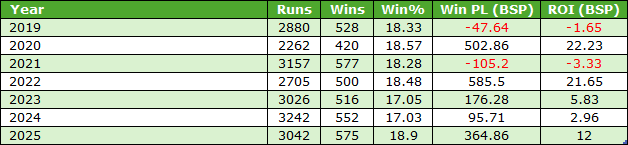


There have been five winning years out of seven, with the two losing years showing only smallish losses. Hence, this simple starting point has been fairly consistent.

Now these results include all possible BSP prices and as we know bottom lines can be massively skewed by big-priced winners. Unfortunately, this set of results does include such winners, with nine of the qualifying horses winning at a BSP of 100.0 or bigger. Backing all horses in triple figures over this timeframe would have yielded 60% of the initial £1572.30 profit figure. Hence, it made sense to ignore those bigger priced runners and focus on a subset of runners at shorter prices. Otherwise, one or more of those 100.0+ winners could be skewing some, or all, of the areas I wanted to explore. I decided therefore that a price limit of BSP 30.0 would be a much better and fairer option. Thus, the remainder of the article is restricted to horses that were priced BSP 30.0 or less.

Let me therefore look at the overall figures for this subset of runners with that BSP 30.0 price cap:



We have lost roughly 15% of the original qualifiers, but we are still left with a very good sample size, and although the returns are slightly less impressive, a blind profit of over 4p in the £ is still noteworthy.

From this starting point, I wanted to dig deeper, so I began by looking at the yearly A/E indices. The indices presented below are based on BSP rather than ISP, as the exchange prices are more accurate:
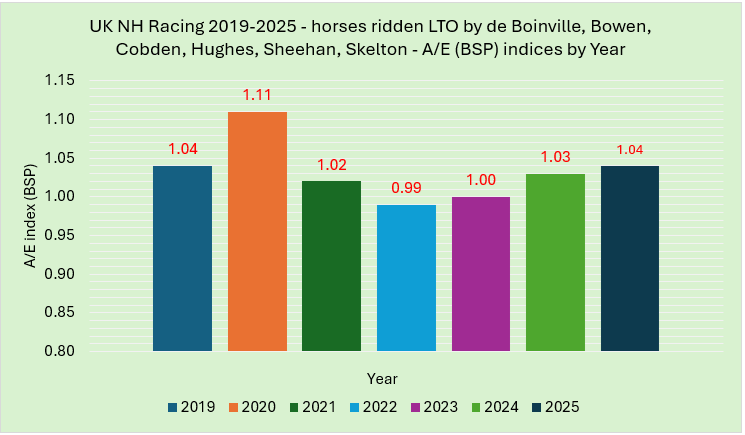


As the graph shows, these horses have offered ‘value’ (A/E 1.00 or bigger) in six of the seven years. Five of the seven years proved to be profitable with the worst year (2022) losing a smidge over 2.5p in the £ across all runners.


Handicap vs non-handicaps

A look now at race type; specifically handicaps versus non handicaps. The splits were thus:



A much higher strike rate has been achieved in non-handicaps, but this is the norm as they tend to be less competitive. All the profits, though, have come from handicap races.

An additional statistic to note is if we restrict the handicap results to horses that had raced in a handicap LTO as well. This specific handicap-to-handicap group produced 9707 qualifiers of which 1693 won (SR 17.4%) for an impressive profit of £974.15 (ROI +10%).


Race Class

Let me next examine the Class of Race to see if anything could be gleaned from it. The splits were as follows:
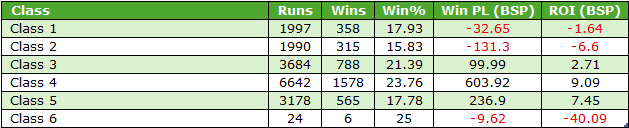


We can safely ignore the Class 6 findings as there were only 24 qualifiers, and the stats indicate that Classes 3 to 5 have offered up the best returns. The more competitive levels of Class 1 and 2 both showed losses to BSP.


Last time out race position

Onto position LTO now. Did that make a difference? Let’s take a look:
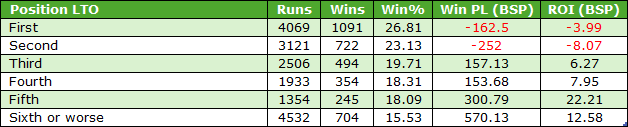


It is not surprising I guess that more than 7,000 of the c.17,500 qualifiers finished first or second LTO, as they were ridden by one of the ‘Super Six’; but a first or second finish last time was actually a negative when it came to next time out value. Conversely, horses that finished third or worse LTO combined to return over 11p in the £. It seems therefore, that this may be the group we should concentrate on in the future as those winners and almost winners last time are significantly over-bet.


Jockey change?

My next port of call was to examine the results where any of the six jockeys remained on the same horse next time out, compared with a jockey change which was not one of the six. Here were my findings:



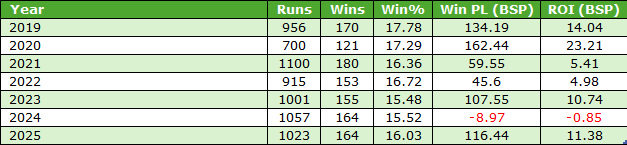
The value lay clearly with horses ridden this time by a jockey who was not one of the six. Yes, the overall strike rate was lower but the bottom line was significantly better. Also, looking at the yearly splits for this cohort we see positive numbers in six of the seven years, and a negligible loss in the other one:


What I also found fascinating were the results when we examine the final possible jockey permutation – horses ridden by one of de Boinville, Bowen, Cobden, Hughes, Sheehan or Skelton last time and now ridden by a different jockey from the ‘Super Six’. In other words, a possible scenario being when Sean Bowen had ridden the horse last time, but Harry Cobden was on board this time; or Gavin Sheehan having been on board last time, being replaced by Brian Hughes this time, etc. Here are those findings:



These results have been extremely positive during the past seven years, so this looks like an avenue we could potentially explore in the future. One positive switch to mention is when Harry Cobden was riding a horse this time after being ridden by Sean Bowen LTO. This ‘combo’ saw 35 qualifiers of which 11 won (SR 31.4%) for a profit of £25.20 (ROI +72%).

[One such switch was when geegeez.co.uk syndicate horse Sure Touch won the 2024 Summer Plate under Cobden after Bowen was required to ride a horse for his father – Ed.]


Odds Last Time Out

Moving on, one area I always like to look at where possible is the LTO odds of the horses in question. Below is a graph showing the ROI% splits for different bands of LTO odds – I have used ISP for the LTO odds as the prices are tidier:
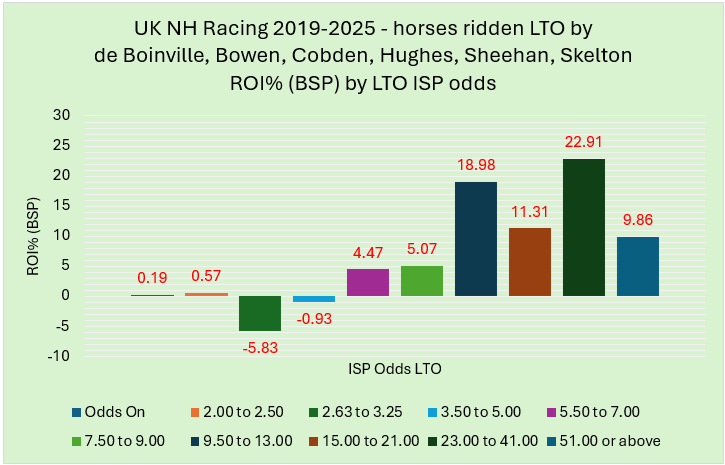


This graph gives us a clear cut steer, with runners LTO that were priced 9.50 (17/2) or higher producing much better returns on their very next start compared with prices LTO of 9.00 (8/1) or less. For the record, horses that were priced 5.0 (4/1) or lower LTO combined to produce blind losses.


Age of horse

Finally for this article, I am going to share the age of horse splits, and these are shown in the table below:
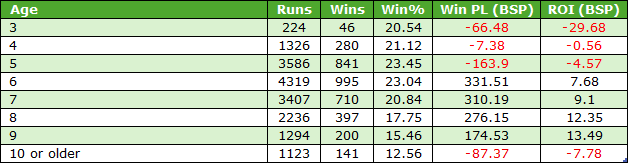


As can be seen, 3yos had a poor record. The double-digit generation also struggled a little when compared with the best range, those aged six to nine. Why this group has done best is probably because National Hunt horses are in their prime between six and nine. Suffice to say horses aged six to nine have clearly offered the best value in the past few years when ridden LTO by one of the Super Six.

**

I must admit that the data shared in this piece are far better than I had expected when I embarked upon the research. It will be interesting to see if these generally positive results are replicated in 2026 and beyond.

- DR

Monday Musings: The Glory Trail

Amid all the excitements supplied by the multi-century teams of Willie Mullins, Gary and Josh Moore and Olly Murphy, not to mention Dan Skelton, on Sandown’s National Hunt season finale, one name stood out as swimming against the tide, writes Tony Stafford.

Imagine you’ve been in the UK for just short of three years and built up a team from nothing into the 60’s at a new base in Newmarket, understandingly vacated at the end of 2024 by Newmarket doyen William Jarvis.

A score of one in his feet-finding debut campaign in late 2022, was followed by 16 and then 37 last year. Dylan Cunha, the South African Group 1 trainer in his home country and a pilot in his spare time almost, is already on 12 in the fledgling 2025 season.

But he was merely an intruder between the big boys’ free-for-all on Saturday with the only jumper he has in his yard. It’s a shame in fact that he did try the capable but inconsistent flat handicapper Ace Rothstein in one race over hurdles at Kempton in the 2023/24 season as his story in terms of jumping success would be even more remarkable.

The Ace proved more like a Joker on his hurdling appearance and is no longer part of the Phantom House Stables team, but one horse who is, Mahons Glory, has been showing that affable Dylan could train the stable cat if there were a suitable race in the Calendar.

A few weeks ago, as I mentioned here before, my friend Malcolm Caine organised a ticket for me at an upmarket Central London venue a few days before the Cheltenham Festival. It was enjoyable and quite amusing when shortly after those mostly perplexing races in Gloucestershire were concluded, Malcolm called. He said: “I took a note of every horse the panel mentioned on the day and none of them won!” I’ll take his word for it and in case you didn’t catch the roll-call last time, I’ll leave it out for now.

When you attend such an event, it’s Hobson’s Choice whom your immediate fellow-guests are. In my case it was a very nice chap called Seamus, not Irish except by pedigree. He said he and two other pals who were further around to his right were owners with Dylan Cunha.

He, and obviously they, were still buzzing from the victory at Leicester the previous day of Mahons Glory, a nine-year-old horse they had previously in training with Patrick Neville.

He had lost his form and become erratic, especially at the start, so they entered him for the January Online sale at Tattersalls – and he was unsold at 900gns. <I wonder if I’d have persuaded one of my pals to bid a grand whether they would have let him go?>.

Anyway, nobody did, and as owners with interests in a few horses with Dylan they suggested sending the 130-rated chaser to him. Quite a left-field idea, but an inspired one as it turns out.

At Leicester, as Seamus told me at the Preview, they were anxious at the start but Mahons Glory jumped off alertly under Lee Edwards, went to the front, and despite the tendency to jump to his left, he did so with rare exuberance and was never in danger of defeat, beating the Dan Skelton-trained Major Fortune by three-quarters of a length at a rewarding 16/1.

Dylan found a less taxing race for his following run, a three-horse affair at Stratford, this time going left-handed and again he made all, this time with The Wolf, in the stable of another of Saturday’s stars, Olly Murphy, and ridden by Sean Bowen a well-beaten second.

On Saturday, just another 3lb higher, Mahons Glory was again among the outsiders, but you wouldn’t have known it. In the morning, I had my regular pre-race chat with Dylan and he suggested Sandown’s track and fences would be to his liking. He loved the seven in a line down the back straight and it was only when he came to the Pond, three from home, that the tendency to jump left took its toll.

Shrewdly, Caoilin Quinn, already in the winner’s circle in the opener with 20/1 top-weight Give It To Me Oj in the novice handicap hurdle final, kept Mark Of Gold tight to the inside, and those wayward left-hand leaps, where Sandown’s finish edges to the right, were doubly costly to the front-runner.

Mark Of Gold got to the front before the last and looked sure to draw away but Edwards got Mahons Glory running again and was reducing the arrears all the way to the line, going under by less than a length.

On a day where some of the participants would have cost around £500k and even more, a 900gns chuck-out trained by a man with his sole proper jumper nearly stole the limelight.

Just for the record, when discussing his four other runners on the day, he singled out the previously unsuccessful Waistcoat in a handicap at Leicester as his pick. Reasoning that if Joe Leavy could hold on to him behind what he thought would be a headlong gallop, he could come through to win. He proved exactly right – at 8/1!

I was speaking to some people earlier in the week and one or two suggested that if Willie Mullins duly caught and passed Dan Skelton as the numbers in the right races suggested he must, he might be the object of booing from the Sandown crowd.

Anything but. His genial nature and refusal to claim victory even after South African-owned Il Etait Temps came from a long way back to swamp Jonbon for speed in the bet365 Celebration Chase with its £99k to the winner – he also picked up 18 grand for 3rd with Energumene – sealed the deal. Not a bad effort first time back in a Grade 1 with a top rival to catch, Jonbon losing for the first time away from Cheltenham.

But no, life today is all about winning and if you have overwhelming tools with which to achieve it, good for you. Mullins has worked for many years to build up such a superiority in Ireland, even over Gordon Elliott, and the fact he can come here as a late-season afterthought to beat the best of whatever we have to offer, has its obvious merits too. Especially to the sports fans of the 2020s!

Not even a Foinavon moment, say at the Pond fence, which Dan Skelton might have dreamt about, or indeed a void race as we’ve been encountering rather more often of late, would have mattered. Second to fifth behind the Olly Murphy/ Sean Bowen representative Resplendent Grey in the bet365 Gold Cup built up the lead almost to 200k, and the last race win where his Jump Allen saw off Dan’s Mostly Sunny lent an inevitable footnote to the season.

There was a television interview with Jump Allen’s rider, Harry Cobden, who reckoned that Bowen would be champion jockey for the next ten years, reasoning that he and Harry Skelton, the only other obvious contenders, according to him, were otherwise engaged – mopping up the massive prize money Skelton collected in this first season of the David Power Cup for points gained in big races.

Maybe it would have been wise for Cobden to keep his mouth shut. After his tour de force bringing home Resplendent Grey from a seemingly losing position behind Mullins’ Rachael Blackmore-ridden Lombron from the final fence, more big race rides will be coming his way from major stables.

*

With the two Guineas races coming up next weekend, it was salutary that Aidan O’Brien, seemingly out of form, nipped in with a Navan favourites hat-trick on Saturday, via Charles Darwin, impressively in the six-furlong maiden, Whistlejacket in the Listed three-year-old sprint, and Kyprios in his regular season-opener in the 1m6f Vintage Crop Stakes.

Watch out John and Thady. If you thought the 2,000 was at the mercy of Field Of Gold, Aidan’s Twain will have been tuned to the minute. Big John’s first 2,000 win is no gimme!

Jockey Profiles: Harry Skelton & Sean Bowen

This is the second article in a series looking at the performance of some of top National Hunt jockeys. Last time, I shared the records of Nico de Boinville and Harry Cobden, which you can read here. In this second piece I will be looking at Harry Skelton and Sean Bowen.

I have analysed NH data for UK racing from 1st Jan 2016 to 31st Oct 2023, and have predominantly used the Geegeez Query Tool for my data collection, but I have also sourced data from the Geegeez Profiler to help with certain sections.

All profits and losses shared have been calculated to Industry SP, but I quote Betfair SP where appropriate; and all tables include A/E indices and, when any data has been pulled from the Geegeez Profiler Tool, I have also shared PRB (Percentage of Rivals Beaten) figures.

Let’s start with Harry Skelton.

Harry Skelton Overall Record

Let me first share Skelton’s overall stats by looking at his performance on all runners during the study period:


A strike rate of better than one in five is extremely good, but overall losses stand at nearly 15 pence in the £. Having said that Harry's PRB figure is extremely high at 0.62 (higher than both de Boinville and Cobden, who were analysed in the first article). If backing to BSP you would have made a small loss of £67.62 (ROI –1.6%).

Harry Skelton: Record by Year

Yearly stats are the next port of call. Here is a breakdown by both win, and win/placed (Each Way) percentage / Strike Rate (SR%):


As the graph shows, Skelton has been consistent with six of the eight years seeing win strike rates above 20%, and all years above 19%. There seems to have been a slight dip this year which may or may not be something to keep an eye on.

Harry Skelton: Record by Betting Odds / Price (SP)

A look next at Skelton's results by splitting them into different price bands:


Patterns are unclear from this market data. Nothing really catches the eye although the 10/1 to 14/1 results are below the average for all jockeys. From a wagering perspective, it looks as though - in general - Skelton rides are slightly overbet.

Harry Skelton: Record by Distance

A look at Harry's record at different distances now. I have grouped them into four distance bands as I did last time, and am comparing the win and each way strike rates:


A remarkably consistent picture is painted in the chart above with all distance groups showing win strike rates above 20%. The 2m1f-2m2f stats are marginally the strongest for both win and each way. If we look at the PRB figures they all hit 0.60 or above with the 2m1f-2m2f edging it once more, which is highly impressive performance.


Harry Skelton: Record by Race type

It is time to see if Skelton’s record is better in chases, hurdle races or in bumpers.


The strike rates for hurdle races and chases is virtually the same, though chases have provided slightly smaller losses. Bumpers (NH Flat races) are poor in comparison with a much lower SR% and hefty losses of 34p in the £. Bumper horses to especially ignore seem to be those priced 8/1 or bigger. Of that cohort, just one win has been achieved from 116 runners.

In non-handicap chases, a tiny profit to SP of £3.56 occurred thanks to 85 winners from 296 rides (SR 28.7%). To BSP these profits stand at £30.82 (ROI +10.4%).

Harry Skelton:  Record by Racecourse

I am now going to look at all courses where Skelton has had at least 80 rides. The courses are listed alphabetically:


There is quite a mixed bag here with relatively poor strike rates and records at Cheltenham, Chepstow, Haydock, Newbury, and Sandown. These five courses have strike rates ranging from 9.6% to 11%. Compare this with Uttoxeter and Wetherby hitting 33.3% and 33% respectively. The latter two courses have proved profitable to SP, Uttoxeter with stand-out returns of 29 pence for every £1 staked (44p in the £ to BSP). Having said that the most profitable period for the Skelton / Uttoxeter combination occurred between 2016 to 2020 so the cat may be out of the bag now.

Harry Skelton: Record by Trainer

92% of Skelton’s rides are for his brother Dan. The two have combined nearly 4000 times in the past eight years:


As a result, these are very similar numbers to the jockey's overall set.

Harry Skelton:  Record by Class of Race

In terms of class of race I want to look first at Graded / Listed races:


Skelton’s record in Grade 1 and 2 events has shown significant betting losses. Indeed, his overall record in these better races is relatively poor. If we now split results by Class of Race, in terms of Class 1 to Class 6, we see the following when comparing win strike rates:


There appears to be a class bias going on here: specifically, it looks best to avoid Class 1 and 2 events and focus on Class 3 or lower. It should be noted that in Class 3, 4 and 5 events Skelton has made a BSP profit in all three.

Harry Skelton: Record by Run style

Onto one of my favourite areas – run style. Here is a breakdown of Harry Skelton's run style performance in terms of win strike rate across ALL races:


This breakdown shows a huge front running bias. A strike rate of 36.6% is very impressive. If you had been able to predict pre-race which of his horses would take an early lead you would have secured a small SP profit of £37.01 (ROI +6.4%). Contrast to that the returns on all hold up horses – they would have produced significant losses of £508.62 (ROI -29%).

As one would expect the A/E indices for his Run Style runners correlate with the win rates:


Any figure above 1.00 suggests value and early leaders / front runners have achieved this edge.

Before winding up the run style section, let me share Skelton's record when riding the favourite:


More evidence, if it was really needed, of the importance of early positioning in a race.

It is time now to switch to the record of Sean Bowen.


---

Sean Bowen Overall Record

Bowen’s record across all races is as follows:


Despite a strike rate of less than 20%, in terms of returns to SP Bowen has gone close to breaking even. And, to Betfair Starting Price, he has enjoyed a huge overall profit of £1129.71 (ROI +28.6%). However, before we get too excited, there was a single winner that paid over 700/1 on Betfair (was 200/1 Industry SP), so that takes out a significant chunk of the profits. That being said, Bowen has still recorded a BSP profit in six of the eight years.

As with Skelton my next port of call is looking at his yearly figures.

Sean Bowen: Record by Year

Below we see the yearly breakdown by strike rate - both win, and win/placed (Each Way):


In 2019 there was a bit of a dip, but since then the trend has been upward. The last two seasons have seen the best win strike rates and two of the top three each way ones. 


Sean Bowen: Record by Betting Odds / Price (SP)

I would like to look at market factors now and, as before, have split results up by the same Starting Price bands:


The shorter priced runners (first three rows in the table) have combined to sneak into profit. Despite that 200/1 winner mentioned earlier, horses priced 16/1 or bigger look the group to avoid.  Overall, this is an impressive set of results from a betting perspective, and there does still seem to be some general value in Bowen rides.

Sean Bowen: Record by Distance

A dive next into Bowen’s record at different distances. I am again looking at the win and each way strike rates:


This is the first jockey across the two articles to date who has achieved his highest win strike rate in the longer races of three miles or more. Let me now look at the Percentage of Rivals Beaten (PRB) splits:


There is a slight advantage for the two miles and shorter group with the three miles-plus group edging ‘second’.

Sean Bowen: Record by Race type

Under the microscope next comes Bowen’s record in hurdle races, chases and in bumpers:


The chase results stand out from all perspectives – strike rate, returns, A/E index. Bowen has turned an SP profit in both handicap and non-handicap chases.

His BSP profits for chases stand at +£304.50 (ROI +18.9%). The BSP figures have not been badly skewed either, and if we concentrate on chase runners that started in the top three in the betting his record reads 242 wins from 872 (SR 27.8%) for a BSP profit of £103.43 (ROI +11.9%). He has also made a profit of £35.49 (ROI +4.1%) to Industry SP.

His NH Flat (bumper) record is modest in comparison. Breaking these bumper results down, horses priced 6/1 or shorter have performed around the norm, but those priced 13/2 or bigger have fared very poorly – just 6 wins from 187 runners (SR 3.2%) for heavy losses of £109.50 (ROI -58.6%).

Sean Bowen: Record by Racecourse

It is course data next for Bowen. Once more 80 runs at a track is the cut off point for the table:


Bowen has been profitable to follow blindly at six courses, with Taunton showing the biggest returns by far; but as you might have guessed that 200/1 winner mentioned earlier in the piece occurred at the Somerset venue. The stats for Perth are strong and this is mainly because trainer Gordon Elliott has used Bowen regularly at the course in the past two years. They have combined to win 40% of races at the track.

Two courses where Bowen has seemingly struggled a little have been Ludlow and Warwick. Losses have been steep and the PRB figures at both tracks are under 0.50.

Sean Bowen: Record by Trainer

During the period of study, Bowen has 100-plus rides with several trainers, and they are shown in the table below:


These figures are very solid – you just have to look at the A/E indices which are all 0.90 or higher. To give a comparison, Bowen’s wins to runs record for all other trainers combined stands at 188 wins from 1287 rides (SR 14.6%). That compares to an overall win strike rate from the table above of 19.52%.

The Elliott figures are notably strong. a large factor in which is their potent combination at Perth.

Sean Bowen: Record by Class of Race

A look next at class of race:


The best events (Class 1) have been a struggle to this point. Indeed, Bowen has had just two successes from 53 attempts at the very highest level, Grade 1. In contrast, race classes 2 to 4 have provided some good results by all measures.

Sean Bowen: Record by Run Style

Finally, in terms of main sections, let me look at the run style splits in terms of win percentages:


We can see a familiar pattern here with front runners doing best and hold up horses doing the worst. The A/E indices correlate with the above figures as shown by the following graph:


Both front runners and prominent racers have A/E indices above 1.00, which is excellent; and both groups secured ‘blind’ SP profits if being able to predict the run style pre-race.

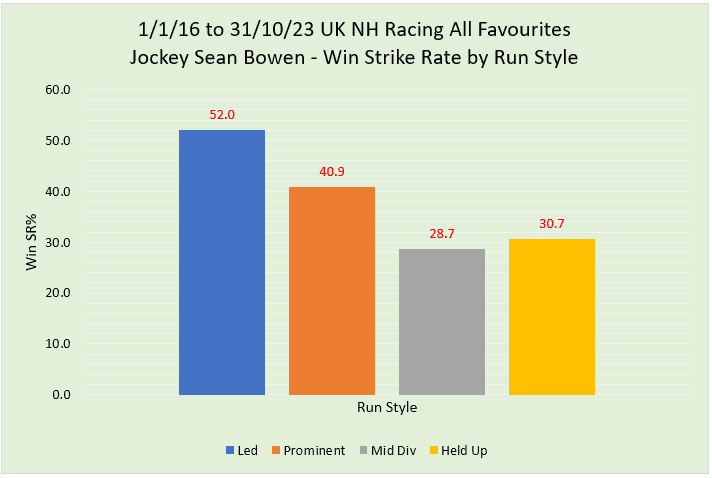
My final graph shows Sean Bowen’s record on favourites by run style group:


These are very similar to the ones we saw earlier for Skelton: front running favourites perform extremely well, while held up/midfield early favourites performed relatively poorly.


Main Takeaways

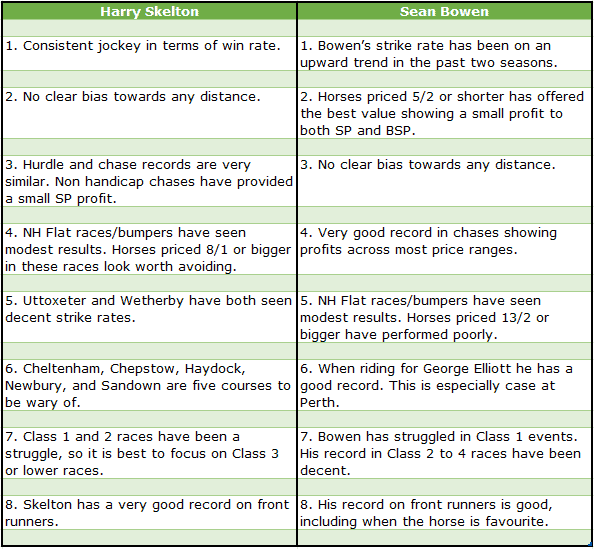
Here is a table of the main takeaways highlighted in the research above, and which will hopefully help you find some profitable bets going forwards:


Two for the price of one again this week, and I do hope there are some useful angles, both positive and negative, for you in the above.

- DR