Tag Archive for: SR Ratings

Geegeez Pace Ratings in 5f Handicaps, Part 2

Last week I shared my research into how the four-race pace totals on the Geegeez racecards performed across UK 5f handicaps in 2024 (excluding 2yo nurseries), writes Dave Renham. You can catch up with that article here. The results overall were impressive given we were looking essentially at raw figures with minimal additional ‘tinkering’.

Introduction

This week I am going to focus on the same dataset but combine the pace rating positions / scores with Dr Peter May’s ratings (the SR column in the Gold racecard).

To recap, the pace tab shows the running styles of the horses for a maximum of their last four races. Each past running style is given a score of between four and one. The splits are as follows:

4 – Front runner / early leader

3 – Prominent racer

2 – Raced in midfield / mid division

1 – held up near or at the back early

The SR ratings are derived from a neural network developed by Peter May. They are much more than a measure of speed; they include a number of form considerations making them a sort of composite of, in Racing Post terms, RPR (Racing Post Rating) and TS (Topspeed) - both of which we also publish in the racecards.

SR Ratings by Win Strike Rate and P/L

My starting point for this article is to see how the SR ratings performed in 5f handicaps in 2024 starting with win strike rate. The graph below shows the splits:


The rating position correlates well with the win strike rate, although the 5th and 6th rated are reversed. Top rated runners have won just over 17% of the time, while those rated 7th or higher have definitely struggled from a win perspective.

I want to now look at the profit/loss figures for the top three rated runners from the SR ratings. This is because later in the article I will combining the top three in the SR ratings with the top three horses in terms of their four-run pace totals (which I order highest to lowest and call the Pace Ratings Rank). Here are the results in terms of the top three ranked in the SR ratings:


As we can see, the top-rated SR runners would have lost a small amount if backing all qualifiers blind. Second rated have nudged into profit while the third rated have seen losses around the 8p in the £.

Combining SR Top Rated with Pace Rank Top Rated

Now we know the raw performance of the SR ratings I will begin to combine them with what I call the Pace Ratings Rank. Let's first look at what would have happened if only backing runners that were top rated by both set of ratings. Here are the numbers:


This is a positive start to the Pace / SR collab! The strike rate has equated to just under one win in every five with returns of over 16p in the £. There were also 26 qualifiers that finished runner-up which is another strong positive meaning that 50 of 124 finished in the first two.

If we expand this slightly to the top three of the ratings for both, we get the following results:


We have increased the number of bets by around 6.5 times whilst keeping a similar strike rate, although return on investment is slightly less. On the upside, though, we would have made more money in profit terms (from a bigger outlay of course). There were 126 qualifiers that finished second including some at tasty BSP odds such as 40.21, 47.97 and 46.0. There was also a third that was beaten just over a length in a 28-runner handicap at BSP odds of 123.97. The horse in question, No Half Measures, raced at Ascot (21/6/24) and was arguably very unlucky having been the best finisher in the far side group in a race where nine of the first ten home raced up the centre of the course.

Considering we are just combining two different ratings in this way, to get such positive results for higher rated runners in both sets, with no other considerations, is extremely encouraging. Now, I appreciate it is just one year of handicap results at one distance, but 809 horses is a decent sample.

Performance of the Lowest Rated on Pace and SR

Let's now switch and combine lower rated runners from both the Pace Rankings and SR ratings. I am looking at the results of horses rated 8th or lower in both rating sets. Here are their combined results:


These are very poor results which breeds more confidence in our earlier positive findings when combining higher rated runners from both rating sets.

Top Three Rated on Pace and SR by Handicap Age Restriction

If we split the 809 horses that were top three rated on both Pace Rank and SR Rating into 3yo only, 3yo+ and 4yo+ races we get the following results:


All three returned a profit, and all three had relatively similar ROIs. These figures demonstrate that these higher rated runners from both sets of ratings have performed consistently regardless of the ages of the horses taking part.

Top Three Rated on Pace and SR by Selected Courses: Positive

I want next to examine the performance of the top three rated on both metrics at a selection of courses that between 2017 and 2023 had the strongest front running biases over the 5f trip. I sourced these courses in the first article by examining individual track performances of early leaders / front runners during that seven-year prior time frame. I used a combination of win percentages, placed percentages and A/E indices to formulate the list.

To recap the 12 courses were: Ayr, Chelmsford, Chester, Hamilton, Kempton, Leicester, Lingfield, Redcar, Ripon, Thirsk, Windsor and York. In that piece I examined solely the top-rated runners from their previous four-run pace totals rather than the top three.

Here now are the figures for horses that were in the top three of both the Pace Ratings and the SR ratings when running at one of those 12 courses:


That's another very solid set of results with a strike rate close to 20% and returns of over 21p in the £.

Composite Ranking Performance

My next port of call was to combine the ranking positions of both sets of ratings to create an overall numerical total. Hence if a horse was top-rated in the SR ratings and ranked 5th in the Pace Ratings/totals that would score six (1+5); if a horse was ranked 4th in both it would score eight (4+4) and so on. Now we know already what a total of two has achieved as those were the results shared earlier for the top-rated in both. Below I have combined the numerical totals into bands in a graph that shows the strike rates for each one:


This graph offers further evidence that combining the higher rated runners in each set produces better strike rates. We have the sliding scale of percentages that we always want to see when looking at any type of rating-based data set. Meanwhile, the 2-4 band (i.e. SR 1st/ Pace 1st, SR 2nd/ Pace 1st, SR 1st/Pace 2nd, and SR 2nd/Pace 2nd) have a very solid strike rate close to 19%.

Using the same calculation method and the same bands I thought it would be worthwhile to look at the Percentage of Rivals Beaten (PRB) figures. This metric considers all finishing positions based on the number of runners in each race. It is a useful metric to analyse where possible. Here are the splits:


The chart presents further strong evidence of the positive correlation we have seen throughout this article in relation to the importance of ranking position within the two sets of ratings. 58% of rivals beaten for the 2-4 band is a materially high PRB figure.

Let me now share the runs, wins, profits / losses for each band:


It is pleasing to see the 2-4 band producing the best ROI% and also seeing the 5-7 band in profit. The 11-14 group have proved profitable but essentially, they had the biggest-priced winner in the whole year (BSP 127.21) which skews their bottom line considerably. The 20+ band would, not surprisingly, have produced very poor returns from a very low strike rate.

Top Rated on SR and 15 or 16 Pace Total

In the first article I looked at some of the data for the highest four-race pace totals, namely 15 and 16. Hence, horses that had gained these scores had led early in either three or all four of those runs. Based on historical research, I've shown that it is reasonable to think that these horses are the most likely to lead in their next race. So what would have happened if we had backed the top-rated SR runner when they had a pace total of 15 or 16? The results read:


This gives us a small cohort of runners but even from a small sample the figures look promising. The PRB figure is an excellent 0.62 which adds confidence to this small set.

Top Three Rated on SR and 15 or 16 Pace Total

What happens if we expand this to the top three rated in the SR ratings with runners who had a pace total of 15 or 16? The splits are:


The number of bets has nearly tripled and although the strike rate and the ROI% have dropped a little, the results are still very positive. The PRB has dropped a little too, but it still stands at a very strong 60% of rivals beaten.

Top Three Rated on SR and Pace Rank, ISP 12/1 or shorter

Finally in this piece I am going to go back to look at the results for horses that were in top three of both the SR ratings and Pace Ratings / totals. To date I have not put in any price restrictions, but as we all know a BSP 100.0 winner can skew the bottom line considerably. One of the main reasons I haven't is because all of the bigger priced winners (BSP 30.0 or more) came from horses that were not in the top three of both. If anything, other rating position bottom lines have been the ones that have been skewed.

However, I felt it only right to share the figures for the top three rated in each when we restrict the price, and to make it clean I am using an Industry SP price cap of 12/1. So, just to clarify, the figures below are those for horses that were in the top three of both ratings and were priced ISP 12/1 or less. The figures are as follows:


These figures are better than the overall figures for top three in both. A 14p in the £ profit over 720 bets would have been an excellent return. The PRB for these runners is a very strong 0.60. All of this from just two things that can be very easily found on the Geegeez Gold Racecards.

Now that looks very good value to me!

- DR

p.s. if you're unclear how to find these, follow the steps below:

1 Look for 5f UK (turf or AW) handicaps, and ignore 2yo races


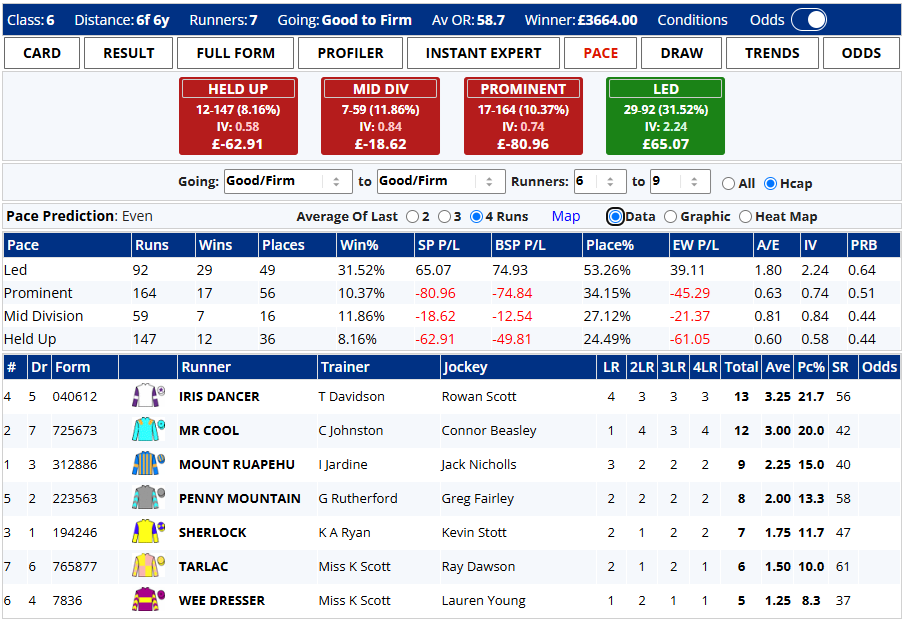
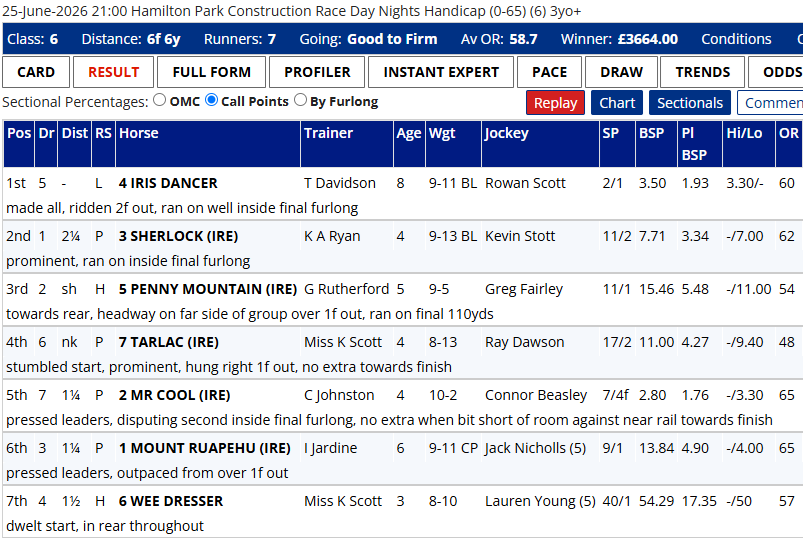
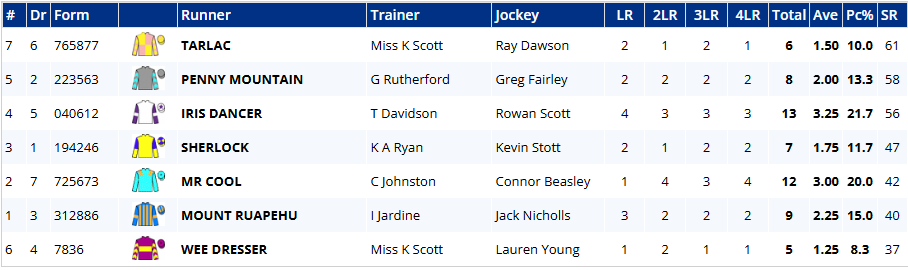
2 On the PACE tab, select 'last 4 races' and 'Data' view, and sort by Total. Then find the top rated or top three rated in the SR column. In this example, from last night, Jeans Maite was top rated on both last-four Pace Score and SR - and, as you can see from the second image below, won at 7/2 (BSP 4.97).


Made all, won!

‘SR’ Ratings on the All-Weather

There are numerous reasons why the only racecards I use are the Geegeez Gold ones, writes Dave Renham. There are several useful tabs on the racecard, three of which I always look at first: Pace, Instant Expert and Profiler. For flat and all-weather racing I will also look at the Draw tab.

Each of these tabs offers me useful and diverse information, all at simply the click of a button. In under two minutes I can decide about whether the race in question is one that merits more of my time. If it does, then I will delve into the Full Form tab to build up a bigger overall picture for myself. If I get to the stage where there looks to be a horse or horses that I may be interested in betting on, the next thing I will look at is the SR column in the main Racecard.

The number in that column is a ratings figure derived from Dr Peter May’s research. I have always had huge respect for Peter, and I will always consider his ratings when analysing a race. Having Peter’s ratings is another bonus when it comes to using the Geegeez Gold cards. And for today’s article it is Peter’s SR ratings that I am going to take a deep dive into.

Matt wrote an article in September 2023 looking at the performance of the ratings in National Hunt racing. In that piece he explained that Peter’s ratings are not strictly ‘Speed’ ratings. He wrote,

Peter's numbers are derived from a neural network: he's been doing artificial intelligence (AI) since long before it became fashionable. And they're much more than a measure of speed; they include a number of form considerations making them a sort of composite of, in Racing Post terms, RPR (Racing Post Rating) and TS (Topspeed) - both of which we also publish on geegeez.” Hence Peter’s ratings are unique.

My focus for this article is all-weather racing. I have looked at a five-year time frame from January 1st 2020 to December 31st 2024. When I refer to the ratings from now on, I will call them SR Ratings as that is how they appear on the geegeez racecards.

I have spoken to many people who have compiled ratings in the past, be they speed or ability ratings, and in every case the win rate was the key to judging the effectiveness of their ratings. The top-rated runner should have the highest win percentage, the second highest should win next most often, and so on, gradually reducing for the other runners. Obviously, it is hoped the top-rated runner is the best performer in terms of betting returns, too; however, it is important to point out that regardless of how good a set of ratings is, we cannot generally expect the top-rated runner to secure a blind profit over thousands of races. That's not the case with Racing Post Ratings, Timeform Ratings or any other public rating. Despite that, such figures are an excellent guide to which subset of horses can normally be considered contenders.

Let’s start with looking at the win percentages (strike rates) for different SR-rated runners. This covers all races on the all-weather over the five year period of study. The horizontal axis is labelled from 1 and represents the top-rated runner, 2 the second-top rated, and so on:


The win strike rate for top-rated runners is close to one win in five which is thoroughly decent, and the top three rated horses win almost half (48%) of races. The percentages correlate positively with the rated positions showing a sliding scale that we would hope for. If we look at the Each Way (win & placed) strike rates, we see a similar pattern:


The top-rated runner is comfortably clear once more, and the sliding scale is replicated showing positive correlation with the win only figures.

In terms of returns to Industry SP, the top-rated runner has performed the best although overall losses stand at 15 pence in the £. However, to Betfair SP losses stand at under 2p in the £. This is impressive considering there are around 13,000 top-rated runners in this sample.

Let me now split the races into handicaps versus non-handicaps and compare with win strike rates for the top-rated and the second rated runners:


As we can see, in non-handicaps the top-rated runner is well clear of the second rated, while in handicaps the gap is much smaller. This was to be expected, given the relatively competitive nature of handicaps compared with non-handicaps, but again it is good to see it in black and white - or should I say orange and blue!

I would like to now analyse the BSP returns of the top-rated horse in different race types. These have been split into 2yo non-handicaps, 2yo handicaps, 3yo non-handicaps, 3yo handicaps, all age non-handicaps, and all age handicaps. The graph below shows the Betfair SP return on investment percentages (BSP ROI%) for each race grouping:


Three of the six groupings (2yo non-handicaps, 2yo handicaps, 3yo handicaps) saw the top-rated secure a blind profit which is impressive stuff. All age non-handicaps showed the worst returns, still only losing 6p in the £.

Using the Query Tool on Geegeez I decided to compare the performance of AW favourites, split into those that were also top-rated on the SR Ratings versus those that were not top-rated. Here are the findings:


The Win PL (profit/loss) and ROI (return on investment) columns have been calculated to Industry SP, and we have a clear winner. In addition, the strike rate is more than six percentage points higher.

When calculating to BSP there is a similar difference between the two:


Thus, if we back favourites on the all-weather, having them top-rated on SR Ratings would have improved our bottom line. Yes, SR top-rated runners when favourite still made a loss to BSP, but it was limited to only 2p in the £ over five years. A pretty good starting point for further research.

We see a similar pattern when we look at horses second in the betting comparing their record when SR top-rated or not. Here are those splits:


Again, these are calculated to Industry SP but a clear difference, equating to around 8p in the £, can be seen. To BSP, SR top-rated horses that started second favourite secured a profit of around 4p in the £.

I would now like to look at top-rated runners in all age handicaps in more detail. The reason is that all age handicaps make up around 70% of UK all-weather races, a striking statistic. Also, from a personal perspective, these are my favourite races to bet in. I am hoping that getting a better feel for the top-rated runner has the potential to inform some of our future betting decisions.

Below is a table showing the most positive results from a BSP returns perspective in all age handicaps:


As a fan of sprint handicaps this makes very pleasing reading. The minimum distance has been a strong positive for top-rated runners in these all age handicaps. The lower weighted top-rated runners have also performed well. It should be noted that this is based on the card weight of the horse and does not consider jockey claims. A quick return is often seen as a positive and, although they tend to be overbet these days, that has not seemingly been an issue when they have been SR top-rated runners. Horses that have yet to win at the course have also snuck into profit possibly due to course winners being overbet meaning the non-winners have been slightly underbet.

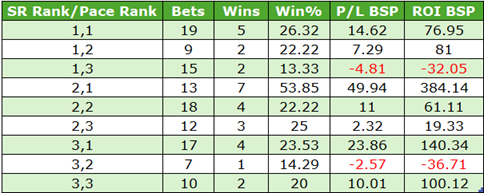
I would like to finish by combining top-rated runners with Run Style/Pace. Of course, the run style figures are only known after the race is in progress but the figures follow a familiar pattern we have seen before:


The Win PL and the ROI can be considered to be ‘projected’ returns to Industry SP, because as we know we cannot predict 100% how the run style for each horse within each race will unfold. But if we can find a top-rated runner that is a strong candidate for leading early, then this would potentially be a decent betting opportunity. For the record, front running top-rated runners offer slightly better returns in handicaps compared to non-handicaps.

**

At the beginning of this article, I was praising the virtues of the Geegeez Gold racecards. At the end of that opening paragraph I mentioned that having Peter May’s ratings (SR) was a bonus; I hope after reading this article you will agree with me and feel better equipped to tackle the all-weather, particularly under certain highlighted circumstances, going forward.

- DR