Tag Archive for: Topspeed

Topspeed Ratings in UK National Hunt, Part 2

An analysis of Racing Post’s Topspeed (TS) in UK National Hunt Racing, Part 2

This is the second article of two looking at the performance of the Racing Post’s speed ratings, known as Topspeed, in National Hunt races in the UK, writes Dave Renham. In the first piece, which you can read here, I looked at a variety of Topspeed stats including win rates for different rating positions, percentages of rivals beaten (PRB), and some general stats for top-rated and second-rated runners.

Introduction

In this concluding half I will dig deeper into the performance of top-rated runners, looking first at non-handicaps and then at handicaps. As with the first article, for the most part when talking about the Topspeed Ratings I will use the abbreviation TS.

The next paragraph is basically a carbon copy of what I wrote in the first article, as it gives some background information regarding the TS ratings. Feel free to skip it if you have read the first one.

First and foremost, TS ratings are the Racing Post’s Speed Ratings. The raw TS figure is a measure of the speed a horse achieved in a particular race. It is amended slightly considering things like distance, weight carried, and the ground conditions. Essentially the TS is calculated by comparing a horse’s time with a standard time for the same course and distance. The TS figure we see in the Geegeez Racecard are known as adjusted TS ratings with the main adjustment made for weight carried in the current race. I believe the TS handicapper also tweaks this adjusted TS rating for the current race conditions. The adjusted TS figures we see in the Racecard are based on the best raw TS performance in the past 12 months. These performances must have occurred in the same ‘Race Code’, so for NH racing, past hurdle race TS raw ratings will be used for hurdle races only, while past chase TS ratings will be used for chases only.

My focus for this article, as stated earlier is UK National Hunt racing, and I have ignored hunter chases as many of these horses have been running in point to points; I am also excluding NH Flat races run on the AW. Data has been taken from January 1st 2019 to December 31st 2025, with the profit/loss figures calculated to Betfair SP (BSP) less 2% commission.

Non-Handicaps

By TS Rank

I want to begin by focusing on non-handicaps races and I will start in a similar way to last time by looking at the win percentages (strike rates) for different TS-ranked runners in non-handicap races.

We saw in the first article that for the ‘all races’ data the graph showed strong correlation between rank position and strike rate. Let’s see if that has occurred when focusing on non-handicaps only. In terms of understanding the graph, the horizontal axis is labelled from 1 which stands for the top-rated runner, 2 is the second rated and so on:


The win strike rate for TS top-rated runners has been an impressive 31% in these non-handicaps with a significant gap to the second rated on 19.5%. Arguably more importantly, the win percentages have correlated positively once more with the TS ranked positions. We have the left to right sliding scale that is the ‘ideal’.

Each way strike rates for individual positions correlate also, showing the same sliding scale. For the record, the top-rated runners in non-handicaps have finished in a win or placed position over 56% of the time. Below are the PRBs (Percentage of Rivals Beaten) by TS rank:


We can see high PRBs for both the top-rated (0.70) and second top (0.61), whereas we get similar low figures from 6th downwards (0.43, 0.42 or 0.41).

Here is the record of every TS top-rated runner in non-handicaps since 2019:



A small profit would have been achieved in non-handicaps backing all top-rated TS runners ‘blind’. Let’s now split this data into different areas or sections.

Race Type – TS top-rated runners

Firstly, in terms of non-handicaps, I am going to look at different race types to see if the TS top-rated runner fared any better in either hurdle races, chases or NH Flat races.


Despite having the lowest win percentage, NH Flat races provided the best returns for TS top-rated runners in non-handicaps. An ROI of a smidge above 12p in the £ was impressive. Top-rated chases also turned a small profit, and at a very healthy one in three strike rate, too.

Sticking with NH Flat races, the TS top-rated runners finished in the black in six of the last seven years. The annual returns (ROI) are displayed in the graph below:


2022 was the one losing year, but overall, the NH Flat results for top-rated runners have been good and consistent.

Race Class – TS top-rated runners

A look at race class next starting with a table:


The highest level of race (Class 1) endured the poorest results by some margin. These races delivered the lowest PRB of 0.60 and losses in excess of 13p in the £. All Class 1 races have shown similar levels of loss: Grade 1s were down around 11p in the £, Grade 2s around 13.5p and Listed races a whopping 16p in the £.

Conversely, Class 2 races enjoyed the best profits, although the bottom line was skewed somewhat by a BSP 90.0 winner. That said, shorter priced TS top-rated runners had a very good record in Class 2 non-handicaps. Those priced 2/1 or shorter won 69 races from 114 for an excellent strike rate of 60.5%, producing a profit of £28.64 (ROI +25.1%).

Class 3 contests were also kind to these 2/1 or shorter priced runners, hitting a 57% win rate and returns of over 10 pence in the £.

Market Rank – TS top-rated runners

In the first article I looked at market rank across all races. Here are the splits solely for non-handicaps when it comes to the TS top-rated runners:


There was no clear pattern here unfortunately in terms of profit / loss. I am slightly surprised at the relatively poor returns for second favourites especially considering that favourites were marginally profitable.

Age – TS top-rated runners

A look at the age splits now:


Three-year-olds performed well and returned a tidy profit although a few big priced winners helped. However, it should be noted that 3yo favourites also proved profitable thanks to 84 wins from 147 (SR 55.1%) for a surplus of £20.45 (ROI +13.9%). On the flip side, 8yos and up had a relatively poor record losing 12p in the £.


Run Style – TS top-rated runners

When we examine run style, the general pattern sees front runners score more often than prominent racers who in turn out perform mid-division runners, while hold up horses tend to have the lowest win rates. Below are the win strike rates by run style group for TS top-rated runners in non-handicaps:


The graph perfectly aligns to the stereotype: horses which led did best in terms of strike rate, and if we had been able to predict their run style pre-race we would have basked in returns of over 12p in the £. Compare this to top-rated runners which were held up - they collectively lost a massive 35p in the £.


Handicaps

By TS Rank

Time to switch to handicaps now and the performance of the TS top-rated runners in those races.

Before that, I want to share the win percentages (strike rates) for different ranked runners:


Top-rated runners again secured the best strike rate, but only just. In terms of each way strike rates the top-rated runners still came out top on 38.1%, with second rated next on 36.3%. The remaining positions in the ratings continued the usual sliding scale showing positive correlation with the win rates.

In terms of PRBs the splits were as follows:


The PRBs follow the same pattern as expected, although the top three rated positions were all within 0.02 of each other.

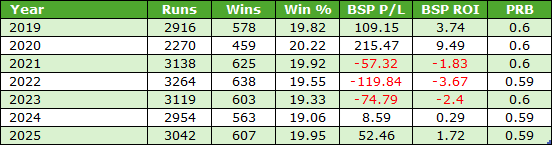
It is time now to look at the record of every single TS top-rated runner in handicaps since 2019. The figures make for positive reading:



We see a very small profit, but a profit nonetheless, from simply backing the top-rated Topspeed horse in all handicaps. I'm sure we'll be able to improve on that as we delve deeper.

Race Type – TS top-rated runners


There was quite a difference in terms of profit and loss between race codes. Handicap chases saw TS top-rated runners do extremely well and, although they have had a sprinkling of big priced winners, their record at the shorter end of the market was impressive too. Focusing on TS top-rated runners priced 11/1 or shorter in handicap chases, the following totals emerge:



These are a very solid set of metrics, and it should be noted that for this specific cohort, five of the seven years would have turned a profit.

Race Class – TS top-rated runners

Race class is next up and the results from 2019 to 2025 were as follows:


Just as we saw with non-handicap races, top-rated runners in Class 1 handicaps struggled. In fact, their record was very poor with a win rate of less than 7% and losses of over 30p in the £. Listed races were the worst performers within this cohort with just two wins from 73 top-rated runners. I am not sure why Listed races came out that bad, particularly when Class 2 races again saw the best returns,  mirroring what we saw with the non-handicap results. There were five winning years out of seven at this class level.


Market Rank – TS top-rated runners

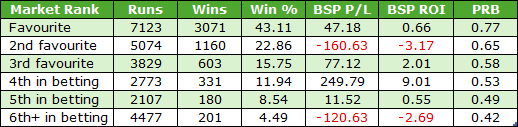
Here are the market rank splits for handicap races only when it comes to the TS top-rated runners:


Favourites effectively broke even with second favs producing a very small loss. The value seems to have been with those ranked third to fifth in the betting market, though the top five combined showed a handsome profit and a solid ROI. Once we hit sixth or higher,  performance and returns have dipped somewhat.

Age – TS top-rated runners

Onto the age stats now. Here is how they have panned out across the time period (I have ignored 3yos this time as there were only 23 qualifiers):


This has been a bit of a mixed bag with no clear patterns other than the 9yo+ group having the lowest PRB figure by some way as well as the lowest win strike rate. It will be difficult to use these stats to our advantage so it may be best to ignore age with any top-rated runners we might be looking to back in the future.

Run Style – TS top-rated runners

As with the non-handicappers, let me share the win strike rates within their specific run style groups:


There are no surprises here with the bars dropping down as we go from led (left) to held up (right). If we had been able to predict pre-race the run style of every single TS top-rated runner in handicaps, we would be retired now! The splits looked like this:


This is just another example about the importance of position early in a race – even in NH races.


**


Well, that’s about all for now. In conclusion, I hope these two articles help to point you in the right direction when it comes to the TS ratings published on geegeez racecards. TS top-rated runners have an impressive record overall and, based on past results, there has been plenty of value to be had under various circumstances. Hats off to the TS team at the Post – they have been doing a very good job.

Once the flat turf season gets underway, I will aim to do some further digging and share TS stats for that code. The all-weather and jump racing results have surprised me a little, and in a good way. It will be interesting to see if we find similar performance on the level.

- DR

Topspeed Ratings in UK National Hunt, Part 1

An analysis of Racing Post’s Topspeed (TS) in UK National Hunt Racing, Part 1

Back in December I wrote a two-part article analysing the performance of the Racing Post Topspeed Ratings (TS) in all-weather (AW) racing, writes Dave Renham. You can catch up with part one here and part two here.

I must admit to being pleasantly surprised by the overall performance of the ratings and so, in this article, I am going to analyse Topspeed in UK National Hunt racing. Hereafter I will use the abbreviation TS in lieu of Topspeed. TS ratings can be found in the Geegeez Racecard and past TS data is now interrogable in the Query Tool, which I have used to research this piece.

Introduction

If you have yet to read the two AW pieces let me explain what the TS ratings are and how they work. First and foremost, they are the Racing Post’s Speed Ratings.

The raw TS figure is a measure of the speed a horse achieved in a particular race. It is amended slightly considering things like distance, weight carried, and the ground conditions.

Essentially, TS is calculated by comparing a horse’s time with a standard time for the same course and distance. The TS figures we see in the Geegeez Racecard are known as "adjusted" TS ratings with the main adjustment made for weight carried in the current race. I believe the TS handicapper also tweaks this adjusted TS rating for the current race conditions. The adjusted TS figures we see in the Racecard are based on a horse's best raw TS performance from the past 12 months. Performances must have occurred in the same ‘Race Code’, so for NH racing, past hurdle race TS raw ratings will be used for hurdle races only, while past chase TS ratings will be used for chases only.

So where do we find the TS figures on a daily basis? In the screenshot below I have highlighted in yellow where the adjusted TS figures can be found on the Geegeez Racecard from a race run on Feb 5th this year:


It should be noted that some races will have a horse or horses that do not have a TS rating. This may be due to the race being their first run in a chase for example, or horses on debut, etc.

My focus for this article, as stated earlier, is UK National Hunt racing and I will be analysing TS figures for these specific race codes (NH Flat, hurdles and chases). I have ignored hunter chases as many of these horses were previously running in point to points, and I am also excluding any NH Flat races run on the AW.

Data have been taken from January 1st, 2019, to December 31st, 2025, with the profit/loss figures being calculated to Betfair SP (BSP) less 2% commission. Like my AW deep dive, this is the first of two articles exploring the results of the Racing Post’s TS ratings.

Strike Rates by TS Rank

Over the years I have talked to numerous figures in the racing world who have compiled their own ratings in the past, be they speed ratings or ability ratings. All of them have stated that in order to judge the effectiveness of their ratings the win rate is key. The top-rated runner should win the most often, the second-rated should have the second highest win rate and so on, gradually reducing for the others. In an ideal world, the top-rated runner would also be the best performer in terms of returns. However, it is important to point out that regardless of how good a set of ratings is, we cannot really expect the top-rated runner to secure a blind profit across thousands of races.

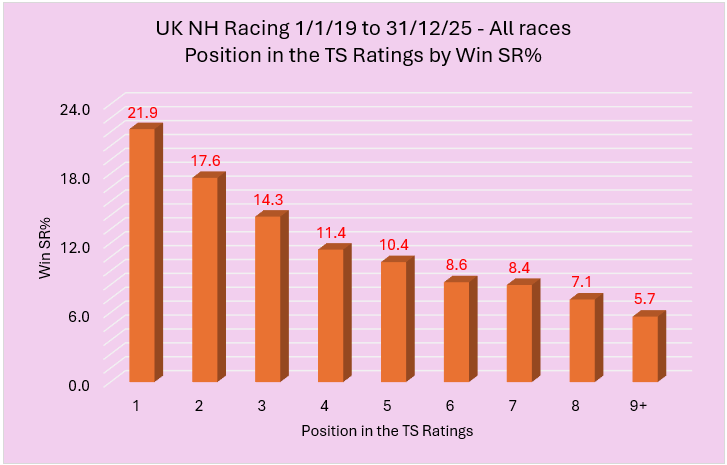
I am going to start by looking at win percentages (strike rates) for different TS rated runners. This covers all qualifying races across the period of study. The horizontal axis is labelled from 1 and stands for the top-rated runner, 2 is the second rated, 3 the third rated and so on:


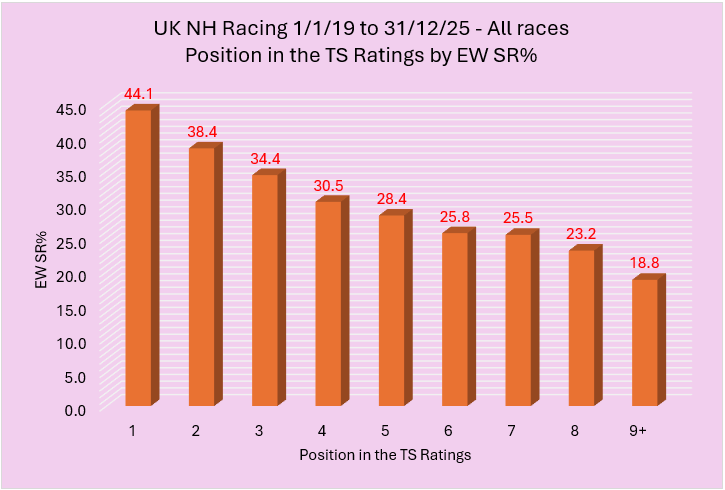
The win strike rate for top-rated runners has been better than one win in every five races which is a decent starting point for any set of ratings. More importantly perhaps, the win percentages have correlated positively with the rated positions showing the sliding scale I was talking about earlier. Hopefully, the same pattern will be replicated as we look at Each Way (win & placed) strike rates. Here are those splits:


The top-rated runner has achieved the highest percentage once more, and the sliding scale is once again in evidence. These ratings certainly have the right ‘feel’ at this juncture.

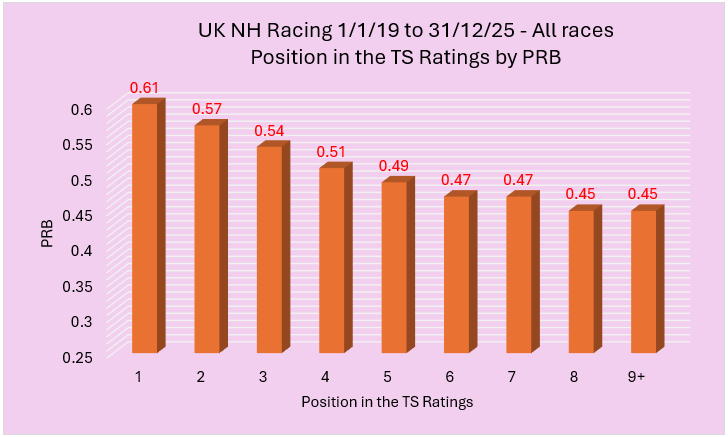
Finally for this opening section, let me share the Percentage of Rivals Beaten (PRB) figures. Being able to share these is due to another of the recent Geegeez additions - that of having PRB figures available in the Query Tool Results Summary. Again, the hope is that we see the same type of graph, with the bigger bars on the left and the smaller ones on the right:


We have the hat-trick in terms of correlation with this graph. Based on the first three sets of data analysed, the TS ratings seem to have been highly accurate at predicting the overall performance of a horse in relation to the TS ranked positions.

TS Top Rated in UK National Hunt

From my initial starting point, having seen the edge for the top-rated runners in terms of win rate, EW rate and PRB, it makes sense to focus on the TS top-rated horses to see if we can find any positive or indeed negative angles to exploit. Below is the record of every single TS top-rated runner since 2019:


Over 25,000 top-rated runners is a significant sample, and to see a small profit overall is extremely impressive. From here, it is time now to dig a bit deeper.

Annual strike rates – TS top-rated runners

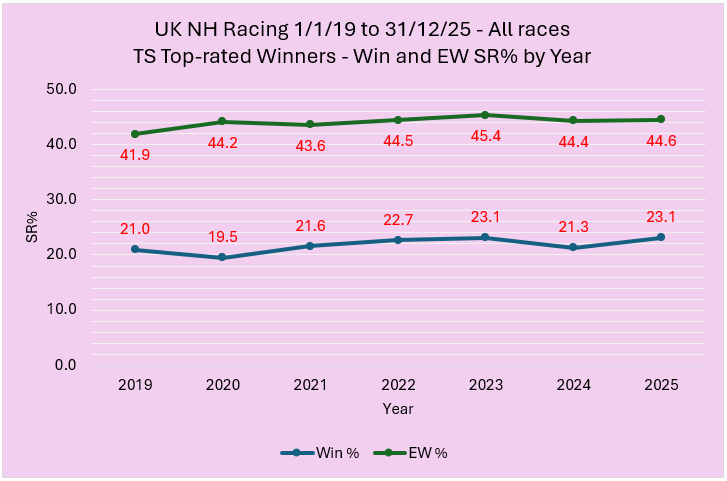
Let me start the digging process by comparing the yearly win strike rates, and the yearly win & placed (Each way) strike rates to see how they matched up. The graph below shows the splits:


Both lines are relatively straight indicating that the performance of the TS top-rated runners has been consistent from year to year out when it comes to winning and placing. In terms of the PRB figures they have been remarkably consistent, ranging from a low of 0.60 to a high of 0.61.

Market Rank – TS top-rated runners

I would now like to look at the record of the top-rated runners in terms of market position / rank. The market rank is based on traditional SP, that is Industry SP rather than BSP. Profits and losses, however, have still been calculated to BSP:


Top-rated runners when favourite have edged into profit, but the overall figures do not really conform to any major pattern. Essentially, all market positions have performed quite well with only second favourite and 6th+ in the betting runners producing losses. In reality though, the losses have been quite small.

TS top-rated favourites by Race Code

Sticking with favourites, let me share how well they have performed across the three different race codes namely chases, hurdles and NH Flat (bumpers):


There were much higher win rates for favourites in hurdle and NH Flat races than in chases, and perhaps this has influenced the bottom lines as both are in the black. The record for chasing favourites has still been decent enough considering we are talking over 2000 qualifiers.

TS top-rated favourites by Handicap or Non-Handicap

How about top-rated favourites in terms handicaps versus non-handicaps? The splits were thus:


Non-handicap TS top-rated favourites nudged into profit while the handicappers broke even. All findings so far are generating 'good vibes' as far as the TS ratings set is concerned, as each group of results has shown robust consistency.

TS top-rated favourites by Handicap Chase or Handicap Hurdle

The final set of favourite stats I wish to share are the TS top-rated splits in terms of handicap chases versus handicap hurdles. Once again, we see the consistent theme continuing.


We have seen remarkably similar metrics across the board.


Handicaps versus non-handicaps – TS top-rated runners

Reberting to top rated TS runners, regardless of their market rank, I now would like to examine the difference between handicaps and non-handicaps in terms of those top-rated horses. The split was thus:


As we should have expected top-rated non-handicap runners had the better win rate; but both secured a blind profit, albeit only just in the case of the handicappers.


TS Performance by Rating Rank

In the second half of this two-parter I will share more top-rated stats, but for now I want to move away from the top-rated horses and take a quick look at the performance of the second-rated runner. Before I do though, let me share the results for different rated positions across all races:


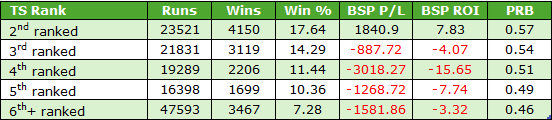
As the table shows, second ranked TS rating runners have secured a significant profit. However, before we get too excited and back these runners blind, let me divide those second-rated runners into two cohorts, one priced 20/1 or longer and the other priced 18/1 or shorter:


Both were in profit, but as we can see the vast majority of the profit came from the longshot bracket. That said, six of the seven years for the 20/1+ group turned a profit as the table below shows:


Strike rates of between 2% and 3% are only for those with titanium constitutions, so here is the breakdown for the shorter priced group (18/1 or less) of TS second-rated runners by year:


There were four winning years out of seven, and the three losing years were not too bad. Again, we can see excellent consistency in terms of win rates and PRB figures.

2nd Top-Rated Bonus Stats

There are a couple of extra stats worth sharing as regards the second-rated TS runners.

Firstly, when starting favourite, second-rated TS runners have scored just under 38% of the time (1789 wins from 4715) for a sound profit of £200.08 (ROI +4.2%).

Second, focusing on hurdle races only would have seen a return of over 12p in the £ for those positioned second in the TS ratings.

**

For the TS top-rated and second rated to both prove profitable over such a time frame is testament to the quality of the ratings. Next week, in the second article, I will expand on the performance of top-rated TS runners, looking in depth separately at both non-handicap and handicap data. Until then...

- DR

Topspeed Ratings on the All-Weather, Part 2

An analysis of Racing Post’s Topspeed (TS) on the All-Weather, Part 2

This is the second article of two looking at the performance of the Racing Post’s speed ratings, known as Topspeed, in races on the all-weather (AW), writes Dave Renham. In the first piece, which you can read here, I looked at a variety of general Topspeed stats before focusing on non-handicap races. In this concluding half, the spotlight falls on handicap races and, from now on, I will use the abbreviation TS when talking about the Topspeed ratings.

Introduction

The next paragraph is basically a carbon copy of what I wrote in the first article as it gives some background information regarding the TS ratings. Feel free to skip it if you have read the first one.

The raw TS figure is a measure of the speed a horse achieved in a particular race. It is amended slightly considering things like distance, weight carried, and the ground conditions. Essentially the TS is calculated by comparing a horse’s time with a standard time for the same course and distance. The TS figure we see in the Geegeez Racecard are known as adjusted TS ratings with the main adjustment made for weight carried in the current race. I believe the TS handicapper also tweaks this adjusted TS rating for the current race conditions. The adjusted TS figures we see in the Racecard are based on the best raw TS performance in the past 12 months. These performances must have occurred in the same ‘Race Code’, so for all-weather races only past TS raw figures in AW races have considered. Likewise for turf flat races, only past turf flat raw TS figures will be considered. For the jumps past hurdle race TS raw ratings will be used for hurdle races only, while past chase TS ratings will be used for chases only.

As I mentioned in the first paragraph this article examines all-weather racing analysing the performance of the TS figures in handicap races only. The time frame covers January 1st, 2019, to November 30th, 2025, and it includes both UK and Irish racing with any profit or loss being calculated to BSP less 2% commission.

Overall Performance of TS in All-Weather Handicaps

I noted in the first piece how it is generally considered that, for a set of ratings to be effective, the win rate is key. The top-rated runner should have the highest win percentage, gradually reducing for the remaining runners. Ideally, the top-rated runner will also be the best performer in terms of returns. However, it is important to point out that regardless of how good a set of public ratings is, be they speed or form-based ratings, it is unreasonable expect the top-rated runner to secure a blind profit over a long period of time.

Let's start in a similar way to last time by looking at win percentages (strike rates) for different rated runners in handicap races. This covers all such races on an AW surface over the period of study. We saw in article 1 that for the ‘all races’ data the graph showed the right type of correlation between the rating position and the strike rate. Let’s see if that has occurred when focusing on handicaps only. In terms of understanding the graph, the horizontal axis is labelled from 1, the top-rated runner, to 2, the second rated, and so on:


The win strike rate for TS top-rated runners has been just under 15% and, more importantly, the win percentages have correlated positively once more with the TS ordinal rank. We have the left to right sliding scale that is the ‘ideal’.

If we look at the Each Way (win & placed) strike rates, we have a similar pattern:


The top-rated runner has the highest percentage once more, albeit only just, and the sliding scale is replicated once again.

The third graph looks at Percentage of Rivals Beaten (PRB). Being able to share these is down to another of the recent Geegeez additions of having PRB figures available in the Query Tool Results Summary. Here are the splits:


We can see exactly the same type of correlation once again so it seems therefore, that in handicap races, the TS ratings have been very accurate in terms of predicting the overall performance of the horse in relation to their TS ranked positions.


Top Rated TS Runners in AW Handicaps

For the remainder of the article my main focus will be the handicap race performance of the TS top-rated horses to see if any positive or indeed negative angles can be found. Firstly, let me share the record of every single TS top-rated runner since the beginning of 2019:


We see a close to break-even situation, which is an excellent starting point. Let me now break down the TS top-rated performance in more detail.

Annual strike rates – TS top-rated runners in AW handicaps

In terms of delving deeper I want to start looking at the TS top-rated runners in all-weather handicaps by comparing their annual win strike rates and win & placed (Each way) strike rates to see how they matched up.


Both the win and EW strike rates have been extremely consistent and this has also been the case with the yearly PRB figures that have ranged from a high of 0.59 to a low of 0.56.


Market Rank – TS top-rated runners in AW handicaps

Below is a table highlighting the performance of the top-rated runners in terms of market position / rank. The splits over the period of study were as follows:


Favourites made a small loss but those ranked two to four in the betting market all edged into profit. Returns were slightly less good when horses were fifth or higher in betting.

One potential issue when looking at data across all prices is that some bottom lines can be skewed by winners at big BSP prices. Interestingly, though, out of the 2445 TS top-rated winners only five had a BSP price above 50.0 (52.07, 54.15, 61.52, 126.19, 145.1). Even so, as in the first piece I am going to use a price cap hereafter in case any of those bigger priced winners skewed certain findings. For non-handicaps my price cap was 10/1 (ISP), for handicaps I think we should go slightly longer at 12/1 (ISP).


Sex – TS top-rated runners in AW handicaps (ISP 12/1 or less)

This is an area I feel is always worth checking out. The splits over this timeframe were thus:


These stats do not correlate with the usual male/female stats found on the AW where males tend to win more often within their group than females. Here we have witnessed a different scenario where female TS top-rated runners priced 12/1 or less have been very good value going back to 2019. TS top-rated female runners aged four and five have done particularly well, combining to win 19.8% of the time (280 wins from 1416) for a healthy profit of £295.21 (ROI +20.8%).


Age of horse – TS top-rated runners in AW handicaps (ISP 12/1 or less)

Onto the age splits now. We know from the previous paragraph that the female four- and five-year-olds performed well, but they only made up about 25% of the total runners for both those age groups. Let me share the full breakdown combining male runners with female runners:


Each individual age from three to six made a blind profit which is interesting, but it was clear that once we got to 7yos and older the performance dipped markedly, despite still being top-rated. Losses of 16p in the £ are steep at the best of times, so TS top-rated runners aged 7 or older are probably best swerved in the future.


Course – TS top-rated runners in AW handicaps (ISP 12/1 or less)

Do the TS top-rated runners in all-weather handicaps have similar records at each course? Let's review the PRBs first:


The Irish track of Dundalk has seen the strongest PRB figures, and I wonder will that correlate to better returns?


*Southwell data based on results on the tapeta surface which had its first race in December 2021.


Don’t be fooled when seeing that Dundalk had the lowest strike rate; their races had the biggest average field size compared with all the courses. There were blind profits for Dundalk and for three other courses, with only Kempton TS top-rated runners producing disappointing losses. I am not sure why the Kempton figures were so disappointing compared with the others.


Race Distance – TS top-rated runners in AW handicaps (ISP 12/1 or less)

A look at the results across different distances now. The figures were as follows:


TS top-rated runners performed well at the minimum distance, which may be because five furlong handicaps are generally run at a good clip and hence speed ratings should be fairly accurate. All in all, though, the table suggests that speed ratings work to a similar level regardless of distance. [The six furlong data looks an anomaly and is hard to explain otherwise]


Field Size – TS top-rated runners in AW handicaps (ISP 12/1 or less)

My next question was could anything be gleaned from the data for different field sizes? It was a slight surprise to me that the number of runners in a race did seem to make a difference. Below are the ISP A/E indices for different field sizes:


As can be seen, the better value has clearly been in smaller sized fields as far as the TS top-rated all-weather handicap runners have been concerned. This was also reflected in the profit and loss figures as the table below shows:


Based on the past few years it does seem that fields with eight or fewer runners provide the best value when it comes to the TS top-rated runners. The performance of the 6-8 runner group was extremely good.


Headgear – TS top-rated runners in AW handicaps (ISP 12/1 or less)

The splits between the number of TS top-rated runners that wore some sort of headgear / equipment and those that didn’t were almost the same. Hence, I thought it was a good idea to see what the results were for each group. They are shown in the table below:


The numbers clearly favour horses that did not wear any headgear securing a better return - over 8p in the £ - coupled with a 3% better win rate. This is something to note for the future I feel.


Run Style – TS top-rated runners in AW handicaps (ISP 12/1 or less)

When I looked at the run style for TS top-rated in all-weather non-handicaps, I noted the traditional edge to more prominent styles of runner. Hence, let me take a look at the win strike rates (within their specific run style groups) to see if the usual pattern has been repeated:


In terms of win rate early leaders have done best, albeit the gap between them and prominent racers has been closer than we usually see. There was a clear dip in strike rate from prominent racers down to horses that raced midfield or were held up.

As I mentioned in the first article, we do not know pre-race what the run style of each horse will be and hence any profit/loss data shared in this section is essentially hypothetical. However, if we had been able to predict which TS top-rated runners took the early lead in handicaps when priced 12/1 or less, they would have made a decent BSP profit of £359.41 to £1 level stakes. This equated to an impressive return of over 17 pence in the £. Prominent racers made a profit also with returns of just over 6p in the £.

I want to share the A/E indices next for the TS top-rated runners in terms of run style. They are shown in the graph below:


Early leaders / front runners have offered the best value, surpassing the 1.00 figure. Indeed, these A/E indices are calculated from ISP so the BSP A/E index would be around 1.16 which would be considered excellent value.

What was especially interesting was when I looked at the performance of TS top-rated horses that had led early in 5f handicaps. If we had known pre-race which TS-top rated runners would have led in these sprints, we would have seen 104 winners from 308 runners (SR 33.8%) for a huge profit of £330.41 (ROI +107.3%); PRB 0.69.

Finally, one last run style fact worth sharing is that when we look at all runners priced 12/1 or less roughly 14.3% of these runners led early. In 5f handicaps however, the TS top-rated runner led early 20% of the time. Hence, when trying to predict the front runner in 5f handicaps, the TS top-rated horse will lead much more often than those runners TS ranked 2 or lower. Combining this information with the Geegeez pace score totals for each 5f handicap should enable us to improve our chances of predicting the front runner more often – should we wish to do that.

*

Before embarking on this research, I had not expected the Topspeed top-rated runners to have performed so well in all-weather handicaps. For a set of public ratings, the top-rated performance has been extremely good. I, for one, will take more stock of them in the future, especially on the sand; and the beauty is that they appear right where I need them, on the Geegeez racecard!

In the near future, I will dive into Topspeed ratings for NH racing. This will happen probably sometime in January 2026. Until then...

- DR

Topspeed Ratings on the All-Weather, Part 1

An analysis of Racing Post’s Topspeed (TS) on the All-Weather, Part 1

One of the reasons Geegeez has won the Best Betting Website award eight times since 2017 has been because it has not stood still, with upgrades and improvements made on a regular basis, writes Dave Renham. We have seen that again this December with some new additions to the Query Tool. One of these additions is the subject of this article, namely the Topspeed Ratings (TS) from the Racing Post.


Introduction

Topspeed ratings are the Racing Post’s Speed Ratings. The raw TS figure is a measure of the how fast a horse got to the finish in a particular race. It is amended slightly considering things like distance, weight carried, and the ground conditions. Essentially, TS is calculated by comparing a horse’s time against a standard time for the course and distance of the race. The TS figures we see in the Geegeez Racecard are known as 'adjusted TS ratings' with the main adjustment made for weight carried in the current race.

I believe the TS handicapper also tweaks this adjusted TS rating for the current race conditions. The adjusted TS figures we see in the Racecard are based on the best raw TS performance in the past 12 months. These performances must have occurred in the same Race Code, so for All Weather races only past TS raw figures in AW races have been considered. Likewise, for turf flat races only past turf flat raw TS figures will be considered. And, for the jumps past hurdle race TS raw ratings will be used for hurdle races only, while past chase TS ratings will be used for chases only.

It is not for me discuss the pros and cons of how the TS figure we see in the racecard is calculated. Ultimately, this is a method that the Racing Post have been using for many many years, so we need to assume they know what they are doing... or ignore it completely!

So where on geegeez.co.uk do we find the TS figures on a daily basis? In the screenshot below I have highlighted in the blue box where the adjusted TS figures can be found on the Geegeez Racecard.


My focus today is All-Weather racing and analysing the TS figures for this specific race code. The time frame used goes from January 1st 2019 to November 30th 2025, including both UK and Irish racing, with profit/loss calculated to BSP less 2% commission. This is the first of a two-parter and is slightly more of a general piece / overview, whereas the second will drill further into the stats.


Topspeed All-Weather Performance by Ordinal Rank

I have spoken to numerous respected analysts who have compiled ratings in the past, be them speed or ability ratings and, for them, to judge the effectiveness of their ratings the win rate is key. The top-rated runner should have the highest win percentage gradually reducing for the others. Obviously, it is hoped the top-rated runner is the best performer in terms of returns. However, it is important to point out that regardless of how good a set of ratings is, be they speed or form-based ratings, we cannot expect the top-rated runner to secure a blind profit over 1000s of races.

Let’s start with looking at the win percentages (strike rates) for different rated runners. This covers all races on the all-weather over the near seven-year period of study. The horizontal axis is labelled from 1 which stands for the top-rated runner, 2 the second rated and so on:


The win strike rate for top-rated runners has been slightly better than one win in every six races which is solid for any set of ratings. More importantly perhaps, the win percentages correlate positively with the rated positions showing the sliding scale I was talking about earlier.

If we look at the Each Way (win & placed) strike rates, we see a similar pattern:


The top-rated runner has the highest percentage once more, and the sliding scale is replicated showing strong positive correlation with the win only figures.

Finally, for this opening section, let me share the Percentage of Rivals Beaten (PRB) figures. Being able to share these is down to another of the recent Geegeez additions of having PRB figures available in the Query Tool Results Summary. The splits during this timeframe were thus:


The same sliding graph appears again. So we can say that the TS ratings seem to have been accurate in terms of predicting the overall performance of horses in relation to their ordinal ranked positions.


Topspeed All-Weather Performance for TS Top Rated Runners

From here, it made sense to mainly focus on the TS top-rated horses to see if we could find any positive or indeed negative angles. Hence let me look at the record of every single TS top-rated runner since 2019:


A loss of less than 3% at Betfair SP is a solid figure considering this has included every single qualifier over almost seven years. Time now to dig a bit deeper.

Annual strike rates – TS top-rated runners

Let me start the digging process by comparing the yearly win strike rates, and the yearly win & placed (Each way) strike rates to see how they matched up. The graph paints the picture.


Both lines are fairly straight indicating that the performance of the TS top-rated runners has been consistent year in year out when it comes to winning and placing. In terms of the PRB figures they have ranged from a yearly low of 0.59 to a yearly high of 0.62, again highlighting their consistency.


Market Rank – TS top-rated runners

I would now like to share the performance of the top-rated Topspeed runners in terms of their market rank. The splits over the period of study were as follows:


Although TS top-rated runners have not made a profit when they were also the market leader, it has seemed that a position nearer the top of the betting market has been preferable. Looking at TS top-rated runners that started in the top four of the betting we can see that they would have proved profitable if backing all ‘blind’. OK, a profit of £132.90 to £1 level stakes over 14,422 bets would not have been a massive return but it was a positive return, nonetheless.

Race Class (handicap races only) – TS rating of average winners

I want to delve into class of race for a bit, focusing on the TS top-rated runners racing only in handicaps. The reason for using handicap races for class analysis is simple, because a non-handicap race could be a maiden, it could be a novice race, and when we get to class 5 or lower it could be a claiming race or indeed a seller. Hence, when we group non-handicaps together, we get a mix of different race types so it makes less sense. Of course we do see the occasional handicap selling race, but the horses are still carrying the correct weight that they would in a normal handicap.

Before looking at the TS top-rated runners, I first wanted to look at the average TS rating for the winning horses across each race class classification. To do this I simply added up the ratings of each individual winner within each class bracket and divided it by the number of winners. The graph below shows the results:


As we would expect we get a similar looking graph to previous ones. The higher the class the higher the average winning TS rating and there has been a similar differential between each ‘next door’ class classification.


Race Class (handicap races only) – TS top-rated winners

Now it’s back to focusing on the top-rated winners and their averages. Let me share these splits.


Of course, these were always going to be much higher than the average figures for all winners, but these average winning ratings gave me an idea. What about looking at the performance of top-rated runners that had a TS figure higher than the winning class average for all top-rated runners? In other words, for class 2 handicaps where the average top-rated winner was rated 98.1, how did the TS top-rated runners rated 99 and higher do as a cohort? Likewise for class 3 handicaps where the average top-rated winner was rated 90.6, how did the top-rated runners rated 91 and higher do etc, etc. Here’s what I found:


In the higher classes of race (class 4 and above) we see positive profits and returns. The two lower classes (5 and 6) both showed losses, although the class 6 figures were close to breaking even. So perhaps the TS ratings work better in class 4 or higher as far as the TS top-rated runners are concerned? Indeed, if we look at those classes again and tweak the rating of the top-rated runners up a little more, we see even stronger returns:


Certainly, for classes 2-4, it seems that the higher the rating the better when it comes to the TS top-rated runners. Also, this has been the case too for class 6 handicaps where the TS top-rated runner was rated 70 or more (rather than the 63+ tested earlier). This cohort of TS top-rated runners would have secured 138 wins from 1058 qualifiers (SR 13%) for a profit to BSP of £76.77 (ROI +7.3%).

Handicaps versus non-handicaps – TS top-rated runners

I now would like to examine the difference in handicaps and non-handicaps in terms of the TS top-rated horses. The splits were thus:


As we would have expected top-rated non-handicap runners have had the better win rate but overall losses have been quite steep, edging towards 10 pence in the £. However, if I introduce an Industry SP price limit of 10/1 we see a different story:


This time the bottom lines are very similar, with a tiny profit for handicap runners and an even tinier loss for those TS top-rated in non-handicaps. Unsurprisingly, non-handicap TS top-rated runners priced 11/1 or more have a shocking record, winning just 29 times from 1133 qualifiers (SR 2.6%) for hefty losses of £526.61 (ROI -46.4%). These look worth avoiding in the future based on this dataset.

For the final section of this piece, I am going to concentrate on some further non-handicap stats looking at the ISP 10/1 or less cohort.

Non-handicap races – TS top-rated runners by Price (ISP 10/1 or less)

Let me look at TS top-rated qualifiers in terms of Industry Starting Price bands with the limit of 10/1 in place. Below I share a graph showing what the BSP returns would have been in four price bands – 2/1 or shorter, 9/4 to 7/2, 4/1 to 6/1 and 13/2 to 10/1:


The shortest prices (2/1 or less) were close to breaking even to BSP, while the 9/4 to 7/2 and the 4/1 to 6/1 groups saw similar losses of around 3½ pence in the £. The best value across the timeframe were those priced 13/2 to 10/1 which showed a healthy return of over 11 pence in the £. This price band has definitely offered value since 2019 for TS top-rated runners in non-handicaps.


Non-handicap races – TS top-rated runners by sex of horse (ISP 10/1 or less)

A look at the gender of horse now. Anyone who has read my previous contributions on geegeez.co.uk will know that male runners tend to have a edge on the all-weather. I wonder if we will see that happening again here. Let’s take a look at the splits based on the 10/1 price limit:


Males have outperformed females, by a fair amount in win strike rates but only just in terms of returns. Hence, there has been no significant edge to males under these circumstances over the past few years.


Non-handicap races – TS top-rated runners by age of horse (ISP 10/1 or less)

Onto the age splits now, and a table showing performance in non-handicaps of top-rated Topspeed horses by individual age group.


As can be seen, the majority of non-handicappers were aged two or three, and TS top-rated 3yos have performed well. They have secured a win rate close to one win in every three, while showing a small BSP profit of £60.49 (ROI +3.8%). Older top-rated runners, those seven and older, fared the worst in terms of both strike rate and returns with losses of around 7½p in the £.


Non-handicap races – TS top-rated runners by run style (ISP 10/1 or less)

Finally for this article I will share some data for run style – possibly my favoured area of research. Firstly, a look at the win strike rates (within their specific run style groups):


We see a familiar pattern to previous run style research where early leaders/front runners have comfortably attained the best win percentage within their group while hold up horses having the lowest.

As I have mentioned many times before, we cannot know pre-race what the run style of each horse will be and hence any profit/loss data shared is essentially hypothetical. However, I always like to show the splits in the hope that one day I buy a crystal ball that actually works!


Those numbers speak for themselves really. The PRB figure of 0.78 for early leaders has been the highest recorded in the whole article. If the TS top-rated runner leads early in a non-handicap when 10/1 or shorter, then we have a value selection.

*

This article has uncovered some interesting and positive findings. From what I have gleaned so far, when looking for selections in AW races top-rated Topspeed runners should be noted and potentially shortlisted for further investigation.

In the next article I will delve deeper into the performance of Topspeed in handicap races. Until then…

- DR