
I have been researching horse racing for just over 25 years now, so I have delved into a lot of different areas and ideas, writes Dave Renham. Some have provided profitable angles, some have not. I tend to write up an article after I have done the research so that I have all the stats in front of me to help decide if it is worth converting into a piece. When ideas have offered little or no significant edge, I have tended to ‘bin’ them, as a fair proportion of readers are concerned more with profit than interesting ideas which do not offer any long-term edge.
This time, however, I am playing it slightly differently by researching and writing my findings up as I go. The risk here has already been mentioned: that there is little or no punting nutrition in the angle and associated research; but it is good to mix things up from time to time. I have penned one or two this way before, but it is a rare occurrence.
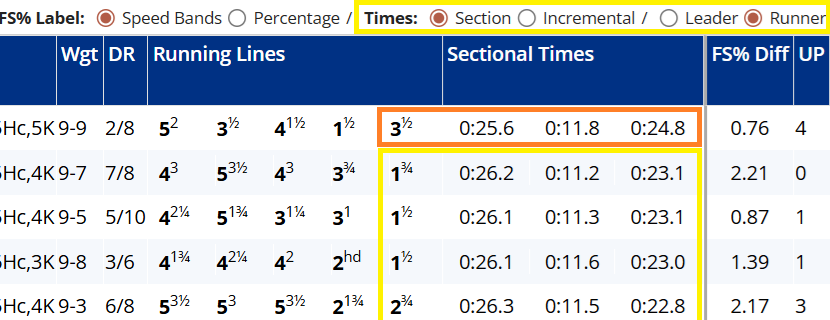
Today I am examining a new idea, for me at least. It is based around recent trainer form. This is regarded by many as an important consideration when it comes to betting on horses. Indeed, on Geegeez we offer Trainer reports where members are able to study 14-day or 30-day trainer form for all trainers who have runners on the day. The screenshot below shows an example of this:

My idea is to look at some individual trainers during specific months to see if their win strike rates showed correlation with their percentage of runners that had been pulled up.
The theory is that the fewer horses that were having to be pulled up, the higher the win percentage, and vice versa. Of course, I appreciate that the percentage of pulled up runners could impinge on the win percentage to a small extent, but we are not generally talking about pulled up monthly percentages of 30 or 40%, so the effect should be minimal. I estimate that in some instances it may make a difference of around 1% in terms of the monthly win SR%.

Data have been taken from UK National Hunt racing spanning from 1st Jan 2021 to 20th November 2025.
I will be looking at five trainers who each have a significant number of runners per year, which should make the findings more robust. The trainers are Nicky Henderson, Olly Murphy, Paul Nicholls, Dan Skelton and Nigel Twiston-Davies.
Let me start by sharing the overall percentage of horses for each trainer that were pulled up during the period of study:

As we can see there is a range of figures, with Nicky Henderson’s horses being pulled up roughly one race in every seven, whereas Olly Murphy’s runners have been pulled up roughly one race in every 14. These are the base figures I will work from for each trainer. I will move in alphabetical order and start with Henderson.
Nicky Henderson
We have seen that 14.1% of all of Henderson's runners were pulled up which seems quite a high figure. In fact, the overall percentage of pulled up runners for all trainers, not just these five, stands at just under 10%, (9.6% to be precise). Indeed, what inspired my research for this piece was the form of this particular yard in March 2024. It was when the stable was really struggling with an unexplained illness that saw numerous withdrawals and several very poor runs. Indeed, in March 2024 over 35% of Henderson’s runners were pulled up and they only had two winners across the whole month. Here we saw in black and white the possible strong link between the percentage of pulled up runners and stable form.
To test my correlation idea over the longer term I have come up with the following plan. For each stable I will use the overall percentage figure for pulled up runners as my starting point. So, for Henderson it is 14.1%. Then I will decide upon a lower ‘Pulled Up’ percentage (PU%) for specific months in an attempt to determine when the stable has potentially had a ‘much better’ month in terms of win rate, and then a higher monthly PU% when hopefully the stable has had a ‘much poorer’ month. The upper and lower figures I will choose for each trainer will be chosen by gut feel more than anything else. Also, once I have chosen these figures, I won’t tweak them in any way. It would be easy to back-fit the results slightly to help fit the narrative, but that defeats the object.
For Henderson then, my higher monthly PU% will be 19% and my lower monthly one will be anything under 10%. Hence, any month where the PU% was 19% or above, I will combine the results for all such months and work out the overall win strike rate across those months. I will do the same for months where the PU% was under 10% and work out the overall win strike rate across those months. My hypothesis, I guess rather obviously, is that we should see a much higher win strike rate in the months where the monthly PU% was under 10%. Here is what I found for Nicky H:

The results are at least the right way round in terms of the hypothesis. A 4.2% differential in win rates is fairly significant, especially as the sample sizes were large for each group – 488 runners and 609 runners respectively. It will be interesting to see if the other trainers follow a similar pattern.
Olly Murphy
Next, we head to the Wilmcote-based trainer, Olly Murphy. For Murphy the overall percentage figure for pulled up runners is much lower than for Henderson runners, down at 7.2%. Hence, I need to once more decide upon my PU%s in terms of ‘good’ and ‘bad’ months. For a ‘bad’ month I will look at data where the PU% was 11% or bigger; for a ‘good’ month 4.75% or lower. Here are the strike rates based on these limits:

We see similar strike rates to the Henderson ones. Again, the figures are the way round I was hoping for with a 3.9% differential between the two. So far so good in terms of my original hypothesis.
Paul Nicholls
Paul Nicholls is approaching 4000 winners in the UK and has been Champion trainer a remarkable 14 times. It will be interesting to see what his stats show us. The overall percentage figure for pulled up runners from the Nicholls stable stands at 10.4%. Therefore, for a ‘bad’ month I will look at data where the PU% was 14.5% or bigger; for a ‘good’ month I will look for a percentage figure under 7%. Here are the relevant strike rates for both:

Wow! This is a significant difference. When the stable’s runners are being pulled up far less often than usual, the win percentages are off the charts. In contrast, when the PU% hits a much higher monthly figure than the average, the win rate drops markedly.
At this point, the research is showing what I had hoped for, but with two trainers left to check, this could 'go south' pretty quickly. Let’s see.
Dan Skelton
Dan Skelton has been banging in winners in vast quantities over the past few seasons. I wonder if this coming year will be the year when he finally wins the Trainers’ Championship. The overall percentage figure for pulled up runners from the Skelton yard over the period of study stands at 8%. Therefore, for a ‘bad’ month I will look at data where the PU% was 11% or bigger; for a ‘good’ month I will look for a percentage figure under 5.5%. The graph below shows the splits:

We see similar splits to Henderson and Murphy with a differential of 3.5% between the two strike rates. Again, the lower PU% group have the higher win strike rate.
Nigel Twiston-Davies
The final trainer to check is Nigel (and Willy) Twiston-Davies. His overall win percentage across all races is slightly below the other four so we should expect slightly lower percentages when we examine the ‘good’ and ‘bad’ month splits. The overall percentage figure for pulled up runners from the yard stands at 8.6%. Therefore, for a ‘bad’ month I will look at data where the PU% was 11.5% or bigger; for a ‘good’ month I will look for a percentage figure under 6%. The graph below shows the strike rates:


We see similar results to the ones we saw for Paul Nicholls with the ‘good’ month strike rate nearly double the ‘bad’ month one. All five trainers have seen a edge for the ‘good’ PU% months, with two showing a very clear win percentage edge.
So far so good, but there is another thing I need to check: Betfair returns (BSP ROI%) for each trainer. Obviously, based on the findings so far, I am hoping to see better ROI percentages for the months where the PU%s were lower. These figures will be in the middle column of the table shown below. The high figures will be in the column on the right. I have highlighted in green the best ROI% of each pair:

Four of the five have correlated positively with the win strike rates showing higher returns in the months where the PU% was low. Not surprisingly, two of them, Nicholls and Twiston-Davies, have a huge differential between their two respective figures. Both see a difference close to 40 pence in the £. The outlier is Dan Skelton whose figures are ‘around the wrong way’. However, it should be noted that two of the winners in his ‘high’ group were priced BSP 44.2 and 36.8. His ‘low’ group did not have winners anywhere as high as these two prices. Hence, the ROI%s are skewed a little based on this evidence.
*
This has been an interesting journey, despite it not being that quick a piece to research and write up; I hope it's been an enjoyable ride. Ultimately, from my original hypothesis perspective, that proved to be quite a good one. If only the Skelton ROI% figures were around the other way, then I could claim it was a very good hypothesis!
Based on the findings of this piece, it does seem that the percentage of horses from a stable that are pulled up each month has an impact on the win rate of said stable.
- DR
Other Recent Posts by This Author:
- Uttoxeter 3m Handicap Chases: Deep Dive
- Miscellaneous Jump Racing Angles
- The ‘Super Six’ NH Jockeys: What Happened Next?
- A Look at Favourites in All-Weather Races
- Kempton 7f Handicaps: Deep Dive



![Constitution Hill and Nico De Boinville lead all the way to win the Betfair Fighting Fifth Hurdle at Newcastle from Epatante [right] and Not So Sleepy [left]. 26/11/2022 Pic Steve Davies/Racingfotos.com](https://www.geegeez.co.uk/wp-content/uploads/2022/11/ConstitutionHill_FightingFifth2022.jpg)


Hi Dave,
A very good piece as always and you’ve unearthed something which very few people would ever of thought of I’m sure (me included).
I personally welcome this unorthodox approach to your article in the sense that you are not try to root out a profitable strategy. Although I have on exceptional occasions followed a rule blindly, I rarely would do this as I want to look at any forthcoming race holistically taking into account all relevant factors. So a profitable mini-angle that happened to be baked into a forthcoming race scenario would be welcome to me but it wouldn’t be the thing that committed me to a bet. I’m sure some people would follow a set angle faithfully. I don’t think there’s a right and wrong here – it’s personal preference.
Where I’m going with this is that I would be an advocate of analyses that help the bottom line but which don’t necessarily generate a profit. It widens the scope of ideas to be covered and would be just as enlightening as the more orthodox content you have written to date.
Whichever way you do play it, I’ll continue to read and absorb your articles regardless!
Cheers
Russ
Very interesting angle Dave, thanks again for your left field thinking and being able to articulate it to us.
Best wishes,
Richard.
Leave a Reply
Want to join the discussion?Feel free to contribute!