
An Analysis of Place Betting on Betfair
One of the comments about an article I wrote a couple of months ago asked whether I could write an article on the subject of place betting on Betfair, writes Dave Renham. I have written around a thousand horse racing articles in my life and, consequently, have covered a fair few different topics; but I have never delved into the subject of place betting. So, thank you to Keith for requesting a piece on this subject.
This article covers ten full years of flat racing in the UK (2015 to 2024) across both turf and AW racing. All profits/losses are calculated to Betfair Place SP with 2% commission taken out. I have excluded races of 4 or fewer runners as only winners count under those circumstances.
Betfair Place SP: All Races
Overall, if we had bet every runner in every race in this ten-year time span to Betfair Place SP, we would have lost around 2.5 pence in the £. This is actually a smidge less than we would have lost if backing all horses to win. Let me split the BSP Place data up by individual year to see how it has panned out:

The worst yearly return was a loss of 4% in 2020, the best was a loss of 0.6% in 2022. For the record, the current figure for 2025, as of early July, is showing a loss of 2.2%. Looking at the graph, it could be argued that since 2021 betting on the Place market has offered punters better value than previously. Whether that has truly been the case, or the results are just down to variance, it is impossible to say.

Before moving on, I would like to point readers in the direction of an excellent and informative article written by Russell Clarke on here back in 2020. It explores each way betting with traditional bookmakers and, amongst many useful pointers, it highlights under what circumstances it is better value to bet each way. The link is here www.geegeez.co.uk/money-without-work-5-bookmaker-concessions-each-way-betting/
Betfair Place SP: Number of Runners
Having read that piece I wondered if there was a number of runners ‘edge’ we could find on the Betfair Place markets. Here is the breakdown of all races backing all runners across different field sizes:

Note that the fourth column, Place%, is different from traditional bookmaker place percent, because when there are non-runners that affect the number of placed positions, on Betfair this figure is not adjusted. Therefore, in a race with eight runners declared, if there was a non-runner, people betting with the bookmakers will see the number of places drop from three to two. On Betfair if an 8-runner race becomes a 7-runner one, they still pay three places. We could get 9-runner races having two non-runners and the same thing would happen. This is almost certainly why races with seven runners have almost broken even if betting all runners blind on the Betfair Place Market. Overall, 28.6% of runners in 7-runner contests would have paid two places with bookmakers, this figure increases to 35% on Betfair. And this is totally due to 7-runner races with non-runners paying out still on the extra place on Betfair. Now, of course, prices on the Betfair Place Market will contract a little under such circumstances but not enough it seems to give punters more chance of parity.
We see a similar thing occurring with 15-runner races. Losses are 1.12% for all 15-runner races, and more specifically for handicaps this drops further to 0.84%. Here we are seeing a similar dynamic where 16-runner handicaps that have one non-runner still pay four places on Betfair. Again, this scenario will occur in races with 17 runners declared and two non-runners, 18 declared and three non-runners, and so on. We can also see that 16-runner races have edged into profit. In terms of handicaps, it is not surprising perhaps to note, that races with 15 to 17 runners have offered the best value on the Betfair Place Market (losses of only 0.6% across all runners).
At this point it is worth sharing that non-handicaps with 12 or more runners have offered place betting Betfair players the worst value over the past ten years as losses move up from an overall average loss of 2.5% to a punishing 5.5%.
Betfair Place SP: By Course
I want to look at individual courses next to see if any patterns can be found. Firstly, let me look at the courses where placed runners did best in terms of returns:

I had wondered before starting this ‘course digging’ whether the bigger named tracks would produce better results. However, this is not the case with only Ascot and Newbury of the Grade 1 courses in the table. I’m not really seeing a pattern as yet so let me look at the worst performing courses from a Betfair place perspective:

No Grade 1 courses here, but a good mix of different calibre tracks with again no clear pattern. Sometimes we check ideas, and nothing can be found or indeed explained. That seems to be the case here.
Betfair Place SP: Actuall Odds
Moving swiftly on, one key area worth looking at is actual Betfair Place odds. I would hope this would give us some useful information. The graph below shows the Befair Place Returns to different BSP Place Odds Groupings:

Ahh! This is an extremely useful set of figures. The shorter BSP Place prices on the left of the graph have produced far better returns than the bigger priced groupings on the right. It seems that BSP Place prices of 5.0 or shorter gives punters the best chance of being profitable. Combining these runners at 5.0 or shorter would have seen us lose less than 1p in the £ for every £1 staked. Also, remember this is still sharing the data across all runners so we are talking about backing horses blind with no other considerations than price. We should be able to improve upon this with a bit of extra work.
Clearly, as with any BSP data be it win or place, we do not know the exact BSP price until the race has started, but as I have stated before betting seconds before the off will get us very similar results.
Betfair Place SP: Early Morning Odds to Opening Show Odds
I now would like to examine price movement based on William Hill prices in terms of Early Morning Odds to Opening Show Odds. The Early Morning Odds I've used are those available around 9am, while the Opening Show Odds occur roughly 10 minutes before race time. Does price movement between these time frames make any difference to the returns for placed runners? Let’s see:

Based on these figures, horses that shorten in price between Early Morning Odds and Opening Show Odds have provided the better returns. Still an overall loss as we would expect but only equating to just over one penny in the pound.
Digging a bit further with those horses that shortened in price from Early to Opening, if we restrict qualifiers to those that continued to shorten from Opening Odds to SP that would have produced a Betfair Place Profit of £213.09 from 68,778 qualifiers. Not a huge profit based on the number of qualifiers but a profit, nonetheless.
Betfair Place SP: Trainers
A look at trainers now, focusing first on the trainers with the highest placed percentages. Below are the top 20 in terms of place rank.

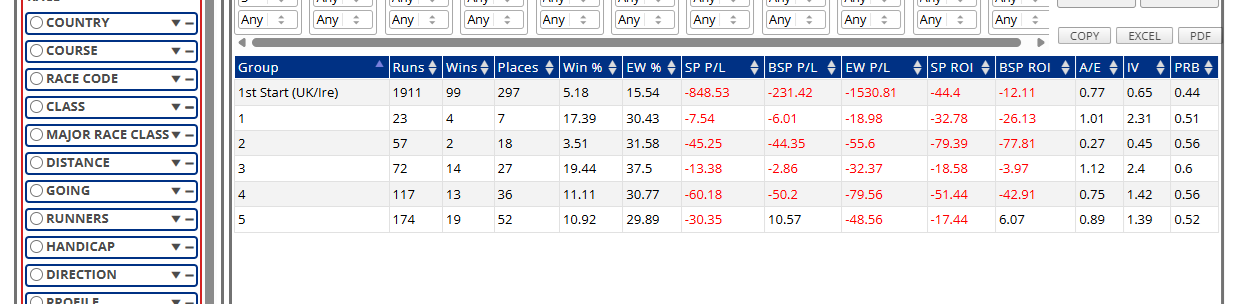
Nine of the 20 trainers have made profits in the Betfair Place Market. The Crisford stable have the best returns (an impressive 6.65% ROI), and they have had seven winning years out of ten. It should also be noted that their 3yo runners have returned over 10p in the £ if betting to BSP Place. Charlie Appleby’s figures are very solid when we drill down to the jockey data. There have been seven jockeys that have ridden 50 or more times for the stable and six have turned a place profit.
The Charlton stable on the other hand has very poor place returns. Betting their runners to place each year would have seen ten losing years out of ten. The Haggas stable has also struggled through this lens.
Other trainers to have made significant positive place returns over the past decade include Jane Chapple-Hyam (17% ROI), Grant Tuer (11% ROI), Bryan Smart (8% ROI), William Muir / Chris Grassick (7% ROI), and Paul and Oliver Cole (7% ROI).
Betfair Place SP: Trainers by Odds Band
I am now going to look at 75 trainers and their ROI Place Percentages across different Befair Place odds bands. The biggest place price in the table is 5.00, and I have split the prices into seven groupings. Figures in black show a positive return within that group, those in red show a negative return. The minimum number in each price band is 100 runners; if there a trainer saddled less than 100 runners in a price band the box is empty in the table:


You can pick out the detail of interest for yourself in this table, both positive and negative. But I will share a few personal observations to get you started:
C Appleby – we saw in the first table that he had shown a Betfair profit on his placed runners. In this table we perhaps see why, with five of the seven price bands turning a profit. His runners have offered the best value between place odds of 3.01 and 5.00.
R Beckett – all price bands have shown a negative ROI%. The 3.51 to 5.00 price band have shown the biggest losses.
Jane Chapple-Hyam – it was noted earlier that Jane Chapple-Hyam had secured a decent profit across all her runners on the place market. She had enough runners to qualify on six of the seven price bands and four showed a profit. For the record she showed good returns on bigger priced runners too.
H+R Charlton – seven reds out of seven. We saw earlier how poor the yard's place returns were overall. This helps to explain why.
B Ellison – he has secured a positive ROI% in six of the seven price bands. Yard seems to offer solid value in the place markets.
J Goldie – some good stats especially with the shorter prices on the place market. Generally strong looking figures when horses are priced 3.50 or lower.
B Millman – five of the six bands to have enough runners have secured a profit for Millman. It should be noted however that his performance is poor once we get to prices of 6.5 or bigger.
G Tuer – as with Millman, Tuer has secured five profitable returns out of six. Tuer has also made significant returns with horses priced 9.00 or bigger on the place market.
I hope readers will get an opportunity to analyse the table in their own time and find further useful angles for other trainers.
------------------------
This has been my first foray into Betfair place betting, and I have been pleasantly surprised in terms of the overall stats. It's an area that certainly will demand more of my attention in future. Do please continue suggest any ideas for future place (or indeed other) articles in the comments. I can't guarantee to write to your specific request but, as this piece shows, if I feel there are sufficient data and angles then it'll get some focus.
- DR
Other Recent Posts by This Author:
- Early Season 2yo Performance by Foaling Month
- Changes in UK Flat Racing: 2010-2025
- Topspeed Ratings in UK National Hunt, Part 2
- Topspeed Ratings in UK National Hunt, Part 1
- NH Jockeys: Home or Away?





Dave
Continuing on the theme of Place betting have you given any thoughts to an updated piece on E/W betting with bookmakers Concessions – I’m particularly interested in how Extra Place races affect any returns (particularly when some Bookmakers still offer BOG when they have Extra Places and some don’t offer BOG at all)
Shorts65: you may want to take a look at the Hong Kong racing. Once the season starts, give it 6 weeks for form to settle down, concentrate on what the top riders are on, and look for the extra place offers. It’s not hard to find 4 places available on the maximum 12-runner races. Unfortunately, your account wont be open for long.
Well done Dave, a mammoth effort you put in there, thank you.
Years ago, I used to make a profit by backing place only in Novice Hurdles. However, the advent of the All Weather with less horses going hurdling, French breds running in them, Point to Pointers from Ireland especially, with nothing much to go on, made it unviable. I feel that the best option now, is to wait until January, when some form has been established, through to the end of the end of the NH season, and concentrate on Class 4/5/6 only. Keep away from races where say Nicholls, Henderson etc, have runners. I would be interested to hear if you have any thoughts?
You must be of a similar age to me Richard: I used to run-riot with place-only doubles on the jumps in the late 70’s and early 80’s, until place-only odds were removed from off-course bookies around about 1983. A great loss to me. As you point out, I have a brief period from 26Dec to Grand National day to make hay with EW doubles, or (as my earlier post) place-only singles on the exchanges.
Dave, what have you done? I’ve been milking the Betfair place-only markets for years, as I “discovered” the value there in the summer of 2008. And what I love about the place-only markets is that they are a gold mine whether you are a bettor or a layer. For me, the reason is that virtually nobody understands how to price-up a place-only market, and punters rely on the “win-only” odds to guide their “place-only” wagers (whether a bettor or layer). Fingers crossed that not many read this article, and even fewer put the guide into practise. Ian @ Wayward Lad
Dave. This article is superb. Thankyou. the Wayward Lad is correct. Place markets should be on occasions priced differently to win markets and this is not always the case. The research you put in is exceptional and very very useful
Thankyou for another very informative article.
Leave a Reply
Want to join the discussion?Feel free to contribute!