The Importance of Pace in 5f Handicaps: Part 3

In my first two articles I looked at pace in five-furlong handicaps focusing primarily on courses, writes Dave Renham.

Part 1, which then links to Part 2, can be found here.

The data suggest that some courses offer a much stronger pace edge than others. However, all the research points to the fact that front runners in 5f handicaps have a definite edge almost regardless of where the race is being run. When I say ‘definite edge’ perhaps I should clarify that front runners win far more often than statistically one might expect.

To recap, when I talk about pace my main focus is the initial pace in a race and positions the horses take up in the opening couple of furlongs. As mentioned before the Geegeez website splits pace data into four groups - Led, Prominent, Mid Division and Held Up. These groups are assigned numerical values – led gets 4 points, prominent 3, mid division 2 and held up 1. When I used to tip ‘back in the day’, I created similar pace figures, but used values from 5 to 1, and also used the last six runs rather than the last four. I don’t think there will ever be a ‘perfect’ method for creating pace figures, but I am sure the Geegeez method is as good as any.

Horses on the Geegeez racecard pace tab (data view) have their last four UK/Ire runs highlighted, with the most recent run to the left and each horse has an individual total for their last four runs. Hence the highest last four races pace total a horse could achieve is 16 (four 4s), while the lowest is 4 (four 1s). This is assuming of course that they have had at least four career runs.

With such an advantage in 5f handicaps it makes sense to investigate ways of trying to successfully predict the front runner. One starting point would simply be to look at the horse’s combined pace figures in the race in question and choose the horse with the highest figure. Let us look at a recent example to help make this idea clearer to the reader. The race was run on the 31st May at Hamilton – it was a 5 furlong handicap with 7 runners. Pre-race the 7 runners had the following pace totals:


5f sprint pace tab example

5f sprint pace tab example


One difficulty for predicting the front runner in this particular race was that you had three horses at the top with very close figures. Also none of the runners had led a race early in more than one of their last four starts meaning that they were not ‘out and out’ front running trail-blazers. As the race panned out, the three most likely front runners took up the first three positions early on: Jabbarockie led narrowly to Jacob’s Pillow who in turn raced just ahead of Dapper Man. Hamilton’s 5f favours front runners reasonably strongly, as can be seen from the green pace ‘blobs’ in the image, and not surprisingly perhaps the winner and runner up came from these three.

As we can see, this race panned out in a very similar way to how the pace figures had predicted it would. However, correctly predicting the front runner of the top three rated was clearly not ‘a given’. This of course is one of the problems with blindly going for the highest rated pace horse. Having said that, one would expect the highest rated pace horse to lead far more often than the lowest rated pace horse! My aim is to look at this idea in more detail in the future.

For this article I am using a slightly more simplistic approach. I am focusing on the most recent race only. To begin with I looked at horses that gained a pace figure of 4 (by leading early) last time out in a 5f handicap to see what pace figure they achieved in their very next run. I was hoping of course that a decent percentage led early on next time out. Here are my findings:

Pace figure

(next run after leading over 5f LTO)

4 3 2 1
% of runners 42.5% 39.2% 8.3% 10.0%


This is quite encouraging with 42.5% of runners leading on their very next start. In addition less than 20% of them raced midfield or further back in the pack early on. At this juncture, it should be noted that horses that were taken on for the lead last time out scored slightly lower in terms of leading next time (led roughly 34% of the time). These are the horses that gained comments such as ‘with leaders’, ‘disputed lead’ etc – for the record these runners still gain a 4 score for these comments.

I then looked at the data for horses that had gained a 4 pace score last time out in 6f handicaps. 6f races are still considered sprints, and the front runner generally has an edge in these races too. However, this edge is less strong than it is over 5f. I was intrigued however to see how the next time out figures panned out – would last time out front runners, lead again? This is what I found:

Pace figure

(next run after leading over 6f LTO)

4 3 2 1
% of runners 31.0% 44.4% 12.5% 12.1%


Down to around 1 in 3 who managed to lead next time, although 75% either led or tracked the pace (which I guess can be taken as a positive). The figures for horses that were taken on for the lead last time out again scored lower (just 21% of these runners led next time).

It seems sensible given this initial data to concentrate on 5f handicaps for the remainder of this article. This does not mean we cannot gain a pace edge over other race distances too, but I feel the front running bias works best over the minimum distance of 5f.

My next port of call was to look at horses that had gained a pace score last time out in 5f handicaps of 1 – these are the horses that raced at the back of the pack LTO. I was hoping to see that they predominantly raced at the back of the pack early on in their next run, or at least did not lead early very often. This is what I found:


Pace figure (next run after a pace score of 1 LTO over 5f) 4 3 2 1
% of runners 7.9% 35.5% 22.1% 34.5%


Interestingly a pace score of 3 has been achieved the most, although a score of 1 was not far behind. Pleasingly from a research point of view only 8% of runners that were held up at the back LTO scored a 4 and led early on their next start. The stats suggest therefore that horses that gained a 4 pace score LTO in 5f handicaps are over 5 times more likely to lead next time out than horses that gained a 1 pace score.

There are of course many factors that determine how likely a horse is to lead – not just their pace score over their last four runs, or their pace score LTO – but as I have alluded to earlier the pace competitiveness of the other runners in the race. One huge factor that has to be taken into account is the draw at certain courses. If we look at Chester over 5f one can see that it is extremely difficult to lead from a wide draw. In handicaps with 8 or more runners horses from the top third of the draw have managed to take the early lead just 13% of the time. This drops to a measly 7.5% when there have been 10 or more runners. Chester is not unique in that respect either – Beverley in 5f handicaps (10 runners or more) has seen the top third of the draw lead early just 16% of the time whereas the bottom third of the draw has assumed an early advantage 52% of the time. Thus the draw must be factored in at some courses.

I looked next at whether leading in a bigger field made it more likely you would lead next time – my theory being that to lead a bigger field would need more early pace than if you were running in a smaller field. I looked at 5f handicaps with 12 runners or more, and it should be noted that if the race had split into more than one group, I chose the overall leader only. However, the figures virtually matched the overall 5f figures as the table below shows:

Pace figure (next run after leading over 5f LTO in a 12+ runner race) 4 3 2 1
% of runners 42.4% 39.8% 7.6% 10.2%


My next port of call was looking at horses that had won a 5f handicap LTO by making all the running – these runners earn comments such as ‘made all’, ‘made most’, ‘made virtually all’, etc. My theory was that horses in form that had led LTO were more likely to lead on their very next start. This time, the data backed up the theory:

Pace figure (next run making all or making most over 5f LTO) 4 3 2 1
% of runners 51.2% 36.8% 4.8% 7.2%


For the first time we exceed the 50% mark in terms of horses that lead.

Perhaps at this juncture it is worth elaborating on why being able to predict the front runner in 5f handicaps is worth the effort. It has been noted that front runners win more often than they should statistically, but the key point is that they potentially offer huge profits. Now clearly you are never going to be able to predict the front runner all the time, but the higher percentage you achieve, the greater your chances of making decent long term returns.

Finally in this article I want to offer another approach in terms of trying to predict the front runner in 5f handicaps – this is simply focusing on individual horses that traditionally have shown a desire to lead early. Now, this is likely to limit your potential bets considerably but if you were able to create a list of say 25 such horses you would have a good chance of turning the stats in your favour. Let me look at one such horse – Bosham. At the time of writing (June 1st 2018), Bosham has raced 67 times in his career and has led early in 41 of those races – this equates to 61.2% of the time. We can improve upon this by digging a bit deeper into his record: it improves to 63.8% in 5f races; in 5f races in single figure fields (9 or less runners) this improves to 71.4% (from 21 races); in 5f races running round a bend this improves to 76% (from 25 races).

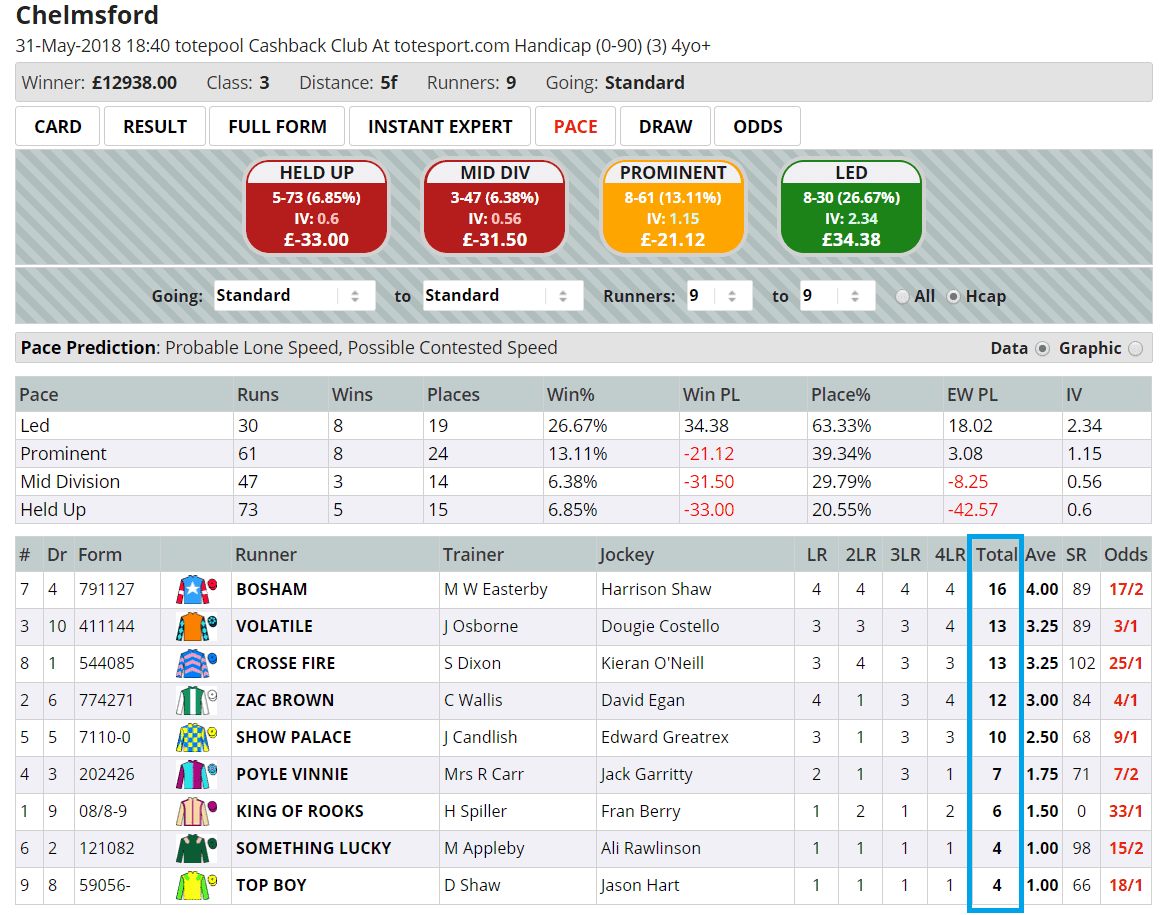
Bosham last raced on the 31st May at Chelmsford over 5f. This race was also a good example of when the Geegeez pace stats for the last four runs have worked perfectly. These were the runners in the race with their pace totals:


Bosham was a very likely leader on a speed-favouring track, and prevailed at 7/1

Bosham was a very likely leader on a speed-favouring track, and prevailed at 7/1


Bosham looked the most likely front runner having led in each of his last four starts and so it proved. Of course if you had looked at his career record this would also have pinpointed him as a likely front runner. Another positive was that he had a decent draw in 4 which meant he was close to the favoured inside rail. As it turned out, Bosham led early and went on to win relatively unchallenged at 7/1. For the record the joint-second rated pace runner, Crosse Fire, a 16/1 shot, raced in second early on before fading into fourth in the final furlong.

The data in this article cements the fact that early pace is be a highly significant factor in horseracing, and 5f handicaps in particular. Geegeez Gold offers users the insight for any race within the Pace tab, and subscribers are strongly encouraged to take some time to get to grips with it. Such time investment is quite likely to generate a robust financial return.

***Part 4 can be viewed here***

- Dave Renham

p.s. if you're not yet a Gold subscriber, you can get a taster of the pace functionality either by registering as a free user and checking the pace in our free Gold races (up to six daily), or you can take a 30 day trial for £1. Click here to start your trial.

Part 2: The Importance of Pace in 5f Handicaps

In my first article I looked at pace in 5-furlong handicaps focusing on the running style bias angle. The figures clearly showed a huge difference between the front running chances of horses depending on which 5f course he/she was running. In this second part, we will revisit the course angle and aim to offer a more complete picture.

To recap from the first article, when I talk about pace my main focus is the early pace in a race and the position horses take up early on. The Geegeez website splits pace data into four groups - Led, Prominent, Mid Division and Held Up. These groups are assigned numerical values – led gets 4 points, prominent 3, mid division 2 and held up 1. On each Geegeez racecard these figures are assigned to every horse in the race going back four UK or Irish runs.

We can use these numerical figures to create course and distance pace averages. I have done this by adding up the pace scores of all the winners at a particular course and dividing it by the total number of races. The higher the average score, the more biased the course and distance is to horses that lead early or race close to the pace. Here are the 5 furlong handicap C&D pace averages for all turf courses in the UK.


Course 5f pace average 5f Pace Rank
Lingfield (turf) 3.33 1
Chester 3.3 2
Epsom 3 3
Catterick 2.97 4
Ripon 2.97 5
Redcar 2.88 6
Chepstow 2.86 7
Hamilton 2.85 8
Nottingham 2.84 9
Thirsk 2.82 10
Windsor 2.78 11
Musselburgh 2.77 12
Newbury 2.73 13
Beverley 2.72 14
Leicester 2.72 15
Pontefract 2.69 16
Goodwood 2.64 17
Ayr 2.63 18
Newmarket 2.58 19
Haydock 2.57 20
Wetherby 2.56 21
Bath 2.54 22
Doncaster 2.51 23
Salisbury 2.5 24
Sandown 2.5 25
Brighton 2.49 26
Carlisle 2.49 27
York 2.47 28
Ffos Las 2.38 29
Yarmouth 2.24 30
Ascot 2.24 31


Lingfield (turf) tops the list, but in truth they have very few 5f handicaps so we perhaps out to take this figure with the proverbial pinch of salt. Chester comes next which is no surprise based on the stats from the previous article. In that article Chester had exceptional winning percentages for front runners and very poor percentages for hold up horses. A 3.3 C&D pace average is huge, so let us look at Chester 5f in more detail.

Running style

Chester 5f

Wins Runners Strike rate (%) IV
Led 31 88 35.23 3.38
Prominent 21 194 10.82 1.04
Mid Division 5 109 4.59 0.44
Held Up 4 194 2.06 0.20


As can be seen, 52 of 61 Chester races have been won by horses that have either led or raced prominently. Essentially these figures indicate that the winner is almost six times more likely to be racing in the front half of the pack early on, than the back half.

Epsom are third on the list but they have only had 25 races so, as with Lingfield turf, the data is limited. Let us instead look at the Catterick who lie fourth on the list. Catterick have had 145 races so a bigger sample to breakdown:


Running style

Catterick 5f

Wins Runners Strike rate (%) IV
Led 47 196 23.98 2.51
Prominent 65 672 9.67 1.00
Mid Division 15 175 8.57 0.93
Held Up 18 473 3.81 0.4


The stats for Catterick are not in Chester’s league in terms of pace bias to front/prominent racers, but the tendency is still strong. Front runners especially have a very potent edge. Digging deeper, if we focus on races at Catterick with 12 to 14 runners the pace bias does increase significantly:


Running style Wins Runners Strike rate (%) IV
Led 15 66 22.73 2.88
Prominent 22 227 9.69 1.23
Mid Division 5 88 5.68 0.72
Held Up 4 201 1.99 0.25


37 of 46 races were won by early leaders or horses that raced prominent early. The winner is roughly four more times more likely to be racing in the front half of the pack early on, than the back half.


At this juncture I decided to dig a little deeper looking to see whether the going made a difference to the overall 5f course pace averages. In the past I have heard two contrasting theories connected with front running horses which would potentially affect the course pace average on a specific type of going:

Theory 1 – horses that lead on softer ground are difficult to peg back because horses find it harder to accelerate from off the pace on such going;

Theory 2 – horses that lead on firmer ground are likely to get less tired at the front due the faster conditions and this accentuates their front running edge. (Plus on quicker ground the race is likely to be run in a shorter overall time again meaning the front runner is expending less energy).

So which one is true – or is neither true? If front runners do have a bigger edge under certain going conditions it will push up the overall course pace average.

I decided to split the results into two – races on good or firmer; and races on good to soft or softer. Here are the course pace averages for all 5f handicaps split into these going types:


Going Course Pace average
Good or firmer 2.72
Good to soft or softer 2.67


As we can see the difference is minimal and not statistically significant. I plan to look at more extremes of going when I have time – looking at soft or heavy versus good to firm or firmer. However, looking at these initial figures, I am not expecting to see a huge variance.

My final area of research in this article is concerned with ‘class’. There is an argument, which I believe is a fair one, that the higher the class, the harder it is for horses to lead from start to finish – due to the more competitive nature of the opposition. Hence, at courses that run more higher class handicaps one might expect their course pace averages to be lower as a result. How to calculate ‘class’ at a particular course is difficult – do you use class levels, prize money, average Official Ratings across all races? I have decided to use a relatively simplistic approach by creating average class levels for each course by adding the class levels for each race and dividing by how many races there were. Hence, for example, if a course had had 10 class 2 handicaps and 10 class 3 handicaps their class average would be 2.5. Here are the course class averages for 5f handicaps (lowest class averages at the top):

Course Course Race Class Average Course Class Rank
Chepstow 5.47 1
Hamilton 5.43 2
Catterick 5.32 3
Brighton 5.26 4
Ffos Las 5.12 5
Beverley 5.11 6
Yarmouth 5.08 7
Bath 5.03 8
Carlisle 5 9
Nottingham 4.96 10
Redcar 4.95 11
Lingfield (turf) 4.92 12
Musselburgh 4.85 13
Ayr 4.77 14
Leicester 4.67 15
Ripon 4.57 16
Wetherby 4.56 17
Pontefract 4.53 18
Salisbury 4.45 19
Windsor 4.44 20
Thirsk 4.09 21
Goodwood 4.04 22
Newbury 4 23
Sandown 4 24
Doncaster 3.85 25
Haydock 3.79 26
Newmarket 3.64 27
Chester 3.02 28
Epsom 2.81 29
York 2.8 30
Ascot 2.62 31


As you would expect, most of the Grade 1 courses are near the bottom of the table. Three of these courses - Ascot, York and Epsom - have the most competitive 5f handicaps in terms of class.

To see if there is a correlation between course pace averages and average course race class I have ranked both lists next to each other, and produced an average rank. For there to be a strong correlation you would expect the majority of the courses to be in similar positions in each column – in other words the higher course 5f pace averages should correlate with the lower course class averages; likewise the lower course pace averages should correlate with the higher course class averages.


Course Course Class Rank (low>high) 5f Pace Rank Class / Pace Average
Catterick 3 4 3.5
Chepstow 1 7 4
Hamilton 2 8 5
Lingfield (turf) 12 1 6.5
Redcar 11 6 8.5
Nottingham 10 9 9.5
Beverley 6 14 10
Ripon 16 5 10.5
Musselburgh 13 12 12.5
Brighton 4 26 15
Bath 8 22 15
Leicester 15 15 15
Chester 28 2 15
Windsor 20 11 15.5
Thirsk 21 10 15.5
Ayr 14 18 16
Epsom 29 3 16
Ffos Las 5 29 17
Pontefract 18 16 17
Carlisle 9 27 18
Newbury 23 13 18
Yarmouth 7 30 18.5
Wetherby 17 21 19
Goodwood 22 17 19.5
Salisbury 19 24 21.5
Haydock 26 20 23
Newmarket 27 19 23
Doncaster 25 23 24
Sandown 24 25 24.5
York 30 28 29
Ascot 31 31 31


At both ends of the list, sorted by Class/Pace Average, we have the most valid correlations. For instance, Catterick, Chepstow and Hamilton all strongly favour front-runners and all host a majority of low grade five-furlong handicaps.

Meanwhile, Ascot and York, as well as to a lesser degree Sandown, Doncaster, Newmarket and Haydock, all generally host high class sprint handicaps where the early pace holds up less well.

I hope you have enjoyed this second instalment and, as always, comments are welcomed.

***Part 3 can be viewed here***

- Dave Renham

The Importance of Pace in 5f handicaps

This is my first article for www.geegeez.co.uk and before I start I would like to share with you my racing background, writes David Renham. I have worked for the Racing Post as a Spotlight writer and the Racing and Football Outlook as a trends ‘expert’; I have also written several books, mainly on draw bias, back in the early 2000s. And I have been a tipster with some success – and some failures! In all, I have written over 700 racing articles for magazines, newspapers, and websites.

Matt asked me to write on an ‘ad hoc’ basis which suits me as I have a full-time job outside racing at present. I hope you will find my articles interesting, useful, and ultimately lead to some profitable betting opportunities. However, as we all know, making money from backing or indeed laying horses is not easy. You need a combination of many things I believe – hard work; a good understanding of what you are trying to achieve; some sort of specialism as I feel there is simply too much racing and too many horses to gain a handle on if you don’t specialise; and, last but not least, a bit of luck.

For this article I am going to discuss pace in a race. When I talk about pace my main focus is the initial pace in a race and the position the horses take up early on. One of the many useful aspects of geegeez.co.uk is the pace section and the stats I am sharing with you in this article are based on the site’s pace data (found in the Pace tab on the racecard).

The pace data on Geegeez is split into four - Led, Prominent, Mid Division and Held Up. Let me try to explain what type of horse fits what type of pace profile:

Led – essentially horses that lead early, usually within the first furlong or so; or horses that dispute or fight for the early lead;

Prominent – horses that lay up close to the pace just behind the leader(s);

Mid Division – horses that race mid pack;

Held Up – horses that are held up at, or near the back of the field.

So after each race all the horses are assigned points in regards to what position they took up early in the race. Leaders get 4, prominent runners 3, horses that ran mid division 2, and those held up score 1. Geegeez has over 1,059,000 runners’ pace comments scored, from a total of about 1,100,000. [The others are things like unseated rider at the start, or where there is no discernible pace reference in the comment].

If you click the pace tab on the website you are presented with pace data regarding the specific course and distance of that race, and pace data for each horse covering their last four UK or Irish runs. For this article I am concentrating on the course data and creating pace figures for specific course and distances – namely handicap races run over 5 furlongs. I have always been a fan of sprint handicaps and early pace in sprint handicaps generally gives a bigger advantage to front runners than races over longer distances. In addition to this, some courses offer a bigger advantage to front runners than others as you will see.

The first set of data I wish to share with you is the overall pace stats for 5f turf handicaps (minimum number of runners in a race 6):

Pace comment Runners Wins SR%
Led 3450 637 18.5
Prominent 9987 1078 10.8
Mid Division 3187 235 7.4
Held Up 8465 567 6.7

Horses that led, or disputed the lead early, have a huge advantage in turf 5f handicaps. So, if we could predict the front runner or front runners in each race we should be ‘quids in’, and indeed would be. Unfortunately, it is not an exact science and how best to do this I will leave for a future article.

Best performing 5f handicap tracks for front runners

My aim for this article is to show you the differences in the course figures for 5f handicaps and how some courses are more suited to early leaders/front runners than others. Here are the courses with the best strike rates (minimum 40 runners):

Course Front Runners Wins SR% P/L SP IV
Chester 88 31 35.2 120 3.38
Catterick 196 47 24 177.71 2.51
Hamilton 170 39 22.9 130.29 2.04
Beverley 197 44 22.3 167.29 2.51
Epsom 50 11 22 45.5 2.96
Nottingham 219 48 21.9 224.08 2.32
Leicester 88 19 21.6 60.75 1.91
Windsor 160 34 21.3 100.31 1.9


Chester has amazing stats for early leaders: the tight turning 5f clearly suits front runners and, when combined with a good draw, front runners are clearly hard to peg back. Another round 5f, Catterick lies second with excellent figures also. Keep in mind that the average strike rate is 18.5% for all courses over this minimum trip.

Worst performing 5f handicap tracks for front runners

At the other end of the scale here are the courses with the poorest stats for early leaders/front runners in 5f handicaps:

Course Front Runners Wins SR% P/L SP IV
Newmarket (July/Rowley combined) 88 12 13.6 -8.37 1.19
York 106 14 13.2 21 1.78
Haydock 146 18 12.3 -18.17 1.25
Sandown 119 13 10.9 -19.37 1.04
Yarmouth 96 10 10.4 -39.58 0.86
Ascot 98 8 8.2 -30.5 0.99
Doncaster 90 6 6.7 -32.5 0.81


It is interesting to see York in this list – York is often considered a decent front running track, but not according to our figures.


Chester performance by number of runners in race

Looking at Chester in more detail, we can split the data by number of runners:

Runners in race Front Runners Wins SR% P/L SP IV
6 to 8 36 18 50 90.5 3.65
9 to 11 35 11 31.4 23.5 3.22
12 to 14 17 2 11.8 6 1.46


Here at geegeez.co.uk, data regarding number of race runners is calibrated slightly differently to my table, but you are able to change the figures on the site to suit your own personal requirements.


Overall performance by number of runners in race

As we can see from the Chester figures, the smaller the field size, the better it has been for front runners. The general perception of punters I believe matches the Chester data – in other words most punters believe front runners are more likely to win in smaller fields. It makes sense I guess as there are less rivals to pass the leader. However, is this really the case? Here are the data:


Runners in race Front Runners Wins SR%
6 to 8 1214 264 21.7
9 to 11 1205 223 18.5
12 to 14 624 106 17.0
15+ 407 44 10.8


The stats back up the basic theory, but a 17% win rate for early leaders/front runners in 12 to 14 runner 5f turf handicaps is a strong performance, especially when you take into account the likely prices of such runners. Hence, one could legitimately argue that the best front running value lies in the 12-14 runner range.


Best performing 5f handicap tracks for hold up horses

Of course, early leader/front runner stats are not the whole story when trying to build up a ‘pace’ picture of each course. We need to look at the stats at the other end of scale – those for hold up horses. Firstly a look at the 5f courses that offer hold up horses the best strike rates:

Course Hold up horses Wins SR% P/L SP IV
Yarmouth 195 27 13.8 -33.04 1.16
Bath 332 41 12.3 -9.5 1.1
Brighton 258 30 11.6 -68.97 0.89
Newbury 99 9 9.1 -31.92 0.82
Salisbury 66 6 9.1 -23.5 0.8
Leicester 178 16 9 -51.87 0.79
Carlisle 192 17 8.9 -55.25 0.82


Interestingly you would expect these courses to match those that have the poorest stats for early leaders/front runners (see above). However, only Yarmouth appears in both groups. Hence the importance of not just looking at the ‘led’ data in order to appreciate pace biases at particular courses.

More materially, perhaps, all courses are firmly negative at SP, and most have an impact value of less than 1, meaning such types are less likely than horses with other run styles (1 meaning the same likelihood).

Worst performing 5f handicap tracks for hold up horses

Now a look at those courses with the worst strike rates for hold up horses:

Course Hold up horses Wins SR% P/L SP IV
Chepstow 187 10 5.3 -104.42 0.5
Musselburgh 746 39 5.2 -346.17 0.5
Ripon 200 8 4 -122.42 0.38
Redcar 307 12 3.9 -200.92 0.41
Catterick 473 18 3.8 -312.17 0.4
Epsom 113 3 2.7 -98.25 0.36
Chester 194 4 2.1 -160.5 0.2


Chester, Catterick and Epsom appear in this table – courses that appeared in the top 5 for front runners. However, once again the correlation between good courses for front runners / poor courses for hold up horses is not as strong as one might expect.

What can be said with a degree of confidence is that these tracks are graveyards for hold up horses and such runners make abject bets in the main.

Summing Up

So how should we use the data discussed in this article? There are numerous ways to do this, some of which I will elaborate upon in a future article. Ultimately however, it is important to appreciate the differences between each course and distance in 5f handicaps, especially their configuration and favoured run styles, points which should inform your betting when you decide to use pace data as part of your betting strategy.

For example, if you feel you have found two ‘nailed on’ front runners in two different 5f handicaps, at say Chester and Yarmouth, you need to appreciate that whoever front runs in the Chester race, has, according to past data, over 3 times more chance of winning than your Yarmouth trailblazer. Of course your ‘nailed on’ front runner might not lead early but that is not really the point I am trying to make!

I hope you have found this article interesting and potentially useful from a betting perspective. If you have yet to use the pace data on geegeez.co.uk, I hope I have sown some seeds of interest and that you may start to think about how to incorporate pace handicapping into your betting armoury.

- David Renham

** You can read Part 2 of this series here **

Your first 30 days for just £1