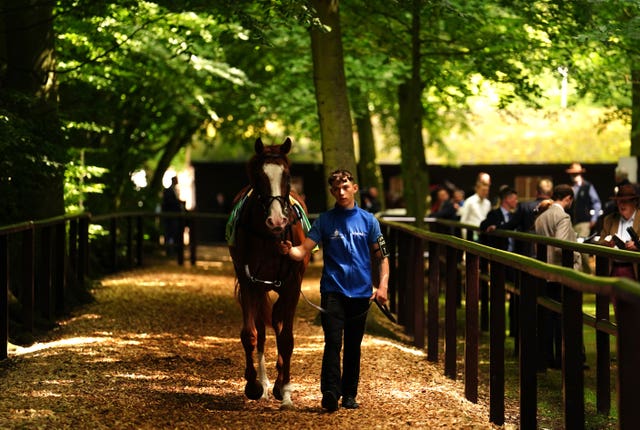
Hugo Palmer will monitor the Celebration Mile at Goodwood as he plots a route for Seagulls Eleven.
The son of Galileo Gold, who is owned by a group of current and former Brighton football players, finally broke his Group-race duck when landing the Thoroughbred Stakes on the Sussex Downs.
He could be heading back to Goodwood over course and distance, while a trip to Doncaster is also on option before a likely run overseas.
Palmer said: “He had some fairly tough assignments last year and as a result, despite the fact he was the 10th highest rated two-year-old in Europe, he only actually won a maiden so it’s lovely for him to be a Group winner.
“He got a couple of fairly nasty knocks as well. Henri Matisse crashed into him fairly hard in the National Stakes and he was crashed into from behind in the Breeders’ Cup.
“I think as a result when he just got very fractionally short of room in the Guineas, he just panicked and kind of pulled himself up, so we’ve worked hard with his confidence, both at home and in races.
“I thought he ran a really good race in the Jersey despite being drawn on the wrong side but on his side he was just a long neck, half a length second.
“And then he was obviously very good in the Henry Cecil Stakes (at Newmarket) and we were delighted when Charlie Appleby took his horse (Opera Ballo) out so we didn’t have to try to reverse form with him.
Seagulls Eleven on his way to Goodwood glory (Andrew Matthews/PA)
“We’ve put him in the Park Stakes at Doncaster and we’ll keep an eye on the Celebration Mile and see how many are likely to stay in that.
“We might supplement him in that over course and distance. He would have been a horse for what used to be the Sovereign Stakes at Salisbury, but that’s gone and he’d have had a penalty in that. We’d love to potentially travel him.
“We were thinking about a $1million race at Kentucky Downs which is quite up and down, which is un-American and quite Goodwood-esque, I believe, not that I’ve been there.
“We potentially might be invited to the Golden Eagle which is worth A$10million and it’s a lot of money to pass up. So we’ll just have to see. He’s come out of the race super.”
https://www.geegeez.co.uk/wp-content/uploads/2025/08/2.81156422-scaled.jpg12802560Geegeez Newshttps://www.geegeez.co.uk/wp-content/uploads/2022/10/geegeez_banner_new_170x78.pngGeegeez News2025-08-08 10:16:242025-08-08 10:16:24Return to Goodwood possible for Seagulls Eleven
Hugo Palmer is weighing up his options with Fitzella after her impressive victory in the Princess Margaret Stakes at Ascot last month, with France and Newmarket on the radar.
The daughter of Too Darn Hot broke her maiden at Haydock and was not disgraced in the Albany Stakes at the Royal meeting when fourth behind Karl Burke’s smart Venetian Sun.
But she came out on top on her return to the Berkshire circuit when beating Staya by a length and Palmer is now plotting where to send her next before a trip to the Breeders’ Cup.
The Malpas-based handler said: “We were very pleased with that. She seems to have come out of it in very good order.
“She’s already had four starts. It’s a question of how many more times do we want to run her this season. She’s kind of grown and changed all year and I think she is a filly with a future, I don’t think she is just a two-year-old.
“In my mind there will probably be no more than two more goes this year. She is potentially a filly for the Breeders’ Cup, so that possibly means just one more European run. We want to do everything we can to make sure that’s a winning European run before we go to California.
“In my head I thought maybe the Prix du Calvados (at Deauville on August 24), which is where Simmering went last year after winning the Princess Margaret and I thought that looked quite a nice fit.
“Predicting and reading the ground in France is tricky and she does want top of the ground, but it’s very hot in August in Deauville and it dries out very quickly being by the beach and by the river and we’ll just have to be on weather watch.
“If that didn’t work I thought probably the Rockfel (at Newmarket on September 26) would be an obvious target, it’ll be another month later but the Cambridgeshire meeting tends to throw up quite quick ground, still being relatively early.
“She is in the Moyglare as well. But the Moyglare being that jump to Group One company might be the hardest way to keep her unbeaten, to make sure her next run is a winning one.
“Any Group winning two-year-old from this point of the season onwards, you’re thinking about the Guineas. There’s a lot of water to throw under the bridge between now and then but that’s what we’d like her to be.”
https://www.geegeez.co.uk/wp-content/uploads/2025/08/2.81104091-scaled.jpg12802560Geegeez Newshttps://www.geegeez.co.uk/wp-content/uploads/2022/10/geegeez_banner_new_170x78.pngGeegeez News2025-08-05 09:39:122025-08-05 10:30:13Palmer considering Deauville or Newmarket for Fitzella
Hugo Palmer’s Seagulls Eleven bagged the big-race victory he has long promised in the Bonhams Thoroughbred Stakes at Goodwood.
A son of the trainer’s 2000 Guineas hero Galileo Gold, Seagulls Eleven is owned by several current and former Brighton & Hove Albion footballers, including James Milner and Danny Welbeck.
After breaking his duck at Haydock last summer, the three-year-old went on to run with credit in the Superlative Stakes, the National Stakes and the Dewhurst before the end of his juvenile campaign and his best race since his return came when second to Opera Ballo in a Newmarket Listed race three weeks ago.
With Opera Ballo a significant non-runner in this Group Three contest, Seagulls Eleven was one of just four runners to go to post and after taking an early lead under Oisin Murphy, the 11-4 shot found plenty for pressure late on to score by three-quarters of a length from Diego Ventura.
Palmer said: “He can be a handful to saddle but not in a nasty way, he has a kind look in his face and is genuinely versatile.
“Last year he had to run in the Group Ones and ran with great credit, but it’s taken a while for him to get his confidence back.
“Today when they came to him, he had the guts to go and get the job done.
“He’s been invited to the Golden Eagle in Australia and there are 10 million reasons why he should go for that, but first we might give him another at home. It might be that we have to supplement into the Celebration Mile and he’s not in the City of York.”
Diego Ventura is owned by Wathnan Racing, whose racing adviser Richard Brown said: “He has arguably run a career-best race. He was just getting going and Oisin has slightly rolled off the rail on the winner and it has cost him a little bit of momentum, but I don’t think it has made a difference to the result.
“We will talk to Hamad (Al Jehani, trainer) and the team but he is strongest at the line and we will probably try up in trip.”
Richard Hannon’s King Of Cities was the third-placed horse when beaten a length and a quarter under Ryan Moore, with the trainer saying: “He looked like he didn’t help Ryan much to me. It was disappointing not being beaten far.
“There are big races in him but he looks a bit flat-footed sometimes. Ryan thought it might have helped if he had gone on a bit, but they were probably going a good enough gallop if he wanted to. For me, he just does enough.”
Irish 2,000 Guineas runner-up Cosmic Year finished last of the four runners with Colin Keane reporting: “I would say the ground was a little bit against us.
“He relaxed and travelled round nicely but, when we needed him, he wasn’t able to, and I didn’t think we got to the line very strong.
“I would be inclined to come back to seven furlongs. I wouldn’t even rule out a stiff six on nicer ground, where they go hard and you can ride a race on him. Hopefully, he will hit the line better. Today he felt straightforward, it felt like he tried, it just felt like the trip was stretching him.”
https://www.geegeez.co.uk/wp-content/uploads/2025/08/2.81156332-scaled.jpg12802560Geegeez Newshttps://www.geegeez.co.uk/wp-content/uploads/2022/10/geegeez_banner_new_170x78.pngGeegeez News2025-08-01 13:23:042025-08-01 14:40:26Seagulls Eleven flies home for Thoroughbred triumph
Fitzella showed her class at Ascot with a smart victory in the Sodexo Live! Princess Margaret Stakes.
The Hugo Palmer-trained filly was fourth at the same track in the Albany Stakes at the Royal meeting, beaten three lengths by a highly-regarded rival in Karl Burke’s Venetian Sun.
This time she was the 9-4 favourite under Oisin Murphy, and took up the running early on to set a good pace from the front.
As the race developed the contenders behind her attempted to close, but the daughter of Too Darn Hot was well able to keep her head in front to claim an eventual one-length win from George Scott’s Staya.
Palmer said: “Oisin was very upset when he came in from the Albany as he felt he sat too close to a very strong pace, he did realise and took back but the damage was already kind of done by then.
“We felt on reflection that it was her class that allowed her to finish fourth on that occasion.
“She was probably drawn on the wrong side of the track that day as well and today the plan was to hold her up and race more patiently and use her finish.
“She pinged the lids and Oisin had to go straight to plan B and it worked very nicely. He didn’t go hard and of course she’s very exciting.
“She was an expensive yearling but has always been beautiful and still is and I’m delighted she’s a Group winner now.
“I’ve only watched it once so I don’t know how tough Oisin has had to be on her. She was very game and very willing which is what she has been at home since the get-go. I’m delighted today, but just sad she’s not a Royal Ascot winner.”
Coral made Fitzella a 25-1 chance for next May’s 1000 Guineas, but more immediate in Palmer’s thoughts is the Breeders’ Cup, with a trip to France a possibility before crossing the Atlantic to Del Mar in November.
Palmer continued: “She’s shown great gate speed today and the Breeders’ Cup would definitely be on the radar, she will definitely run again and possibly twice, but I wouldn’t think more than that.
“It’s her fourth start of the year and I wouldn’t want her to have many more than five or six runs.
“She has a Moyglare entry, but that is a very stiff seven furlongs and I would have thought the Prix du Calvados at Deauville may be the right option, it’s a month away. She wouldn’t want soft ground though, so we will have to see what the weather brings.”
https://www.geegeez.co.uk/wp-content/uploads/2025/07/2.81104091-scaled.jpg12802560Geegeez Newshttps://www.geegeez.co.uk/wp-content/uploads/2022/10/geegeez_banner_new_170x78.pngGeegeez News2025-07-26 13:21:272025-07-26 13:21:27Fitzella fits the bill for Hugo Palmer in Princess Margaret
Hugo Palmer’s Laureate Crown could be set for bigger things after a regal performance on debut at Ascot.
The Fitri Hay-owned son of Victor Ludorum made smooth progress under a typically patient Jamie Spencer ride to register a taking opening victory in what looked a useful novice event.
Connections are now eyeing a step into stakes company, with Goodwood’s Coral Vintage Stakes (July 29) that Palmer won with his Classic hero Galileo Gold in 2015 a possible option alongside a move up to a mile for Salisbury’s Stonehenge Stakes on August 13.
Palmer said: “He was only just ready to start so overcame greenness and I particularly thought Jamie Spencer’s default position suits a horse like that so nicely because the horse was allowed time to find his feet and relax into the race.
“He wasn’t put under any pressure and if it happened it happened and if it didn’t there would be another day, so I was delighted to see it all come together. The Vintage has to now come into consideration, (but) he’s quite a big horse, so I don’t know if Goodwood is necessarily the perfect spot for him and he might also be ready for a mile relatively soon.
“The Stonehenge at Salisbury might be more suitable, but we’ll just have to see.
“You would hope he is up to running in stakes company and being such a big horse I hope there’s much more to come from him.”
Seagulls Eleven has regained his consistency (David Davies for The Jockey Club/PA)
Although Laureate Crown’s Qatar Goodwood Festival participation is still to be decided, one who will be in action on the Sussex Downs is his stablemate Seagulls Eleven.
Owned by the Two Plus Three Two Plus Four syndicate which includes Premier League footballers James Milner and Danny Welbeck, the three-year-old chased home Charlie Appleby’s Opera Bello in the Sir Henry Cecil Stakes at Newmarket last week.
That second-place effort follows a respectable run in the Jersey Stakes at Royal Ascot, with the Manor House handler now pointing his charge towards the Group Three Bonhams Thoroughbred Stakes at Goodwood (August 1).
“He seems to be back on track and he just met a good one on Thursday, I think, but I was delighted with the way he ran,” continued Palmer.
“I would have thought the Thoroughbred Stakes would be an obvious spot for him.”
https://www.geegeez.co.uk/wp-content/uploads/2025/07/2.76204763-scaled.jpg12802560Geegeez Newshttps://www.geegeez.co.uk/wp-content/uploads/2022/10/geegeez_banner_new_170x78.pngGeegeez News2025-07-13 14:30:022025-07-13 14:30:02Palmer can consider nice options for promising Laureate Crown
Last week, I switched focus to flat racing (turf and all weather combined) and, as we’re now officially into the flat season, I am sticking again to the flat with attention switching to trainer based systems, writes Dave Renham.
As with the first five articles in this series I am going to look over the long term, studying UK data from Jan 1st 2009 to Dec 31st 2021 with all profits quoted to Betfair Starting Price.
As we know, systems are not for everyone, and I am not a system user per se. However, I do have a group of systems that highlight horses I will then go on to study in more detail: systems do not have to be totally rigid unless you want them to be.
As I have stated before when sharing these racing systems I am not advocating that you use some of them, or all of them; rather, the plan is to give you the facts and figures in order to make an informed choice. So let’s get cracking:
Keith Dalgleish – Second Career start system
Keith Dalgleish started training in 2011 in South Lanarkshire. His career strike rate stands at 12% which is very respectable and last year (2021) was his best year numerically with 93 winners in total. It was also his most profitable; backing all Dalgleish runners on the flat in 2021 would have yielded a return of over 26p in the £.
Looking at his record, he has done very well with horses having their second ever career run. Hence this system reads very simply:
Flat racing (Turf / All weather)
Trainer – Keith Dalgleish
Second career start
Let us have a look at the raw system results:
These are solid looking results – good profit from an excellent ROI. The strike rate of nearly 17% is sound considering the type of horse we are talking about: the average win strike rate for all second time starters (all trainers) is around 12%.
Let's graph the annual breakdowns and as we are looking at relatively small yearly samples I have used profit figures to £1 level stakes. As Dalgleish started training in 2011, the data set starts from there rather than 2009:
As can be seen, Dalgleish's results were not so good in the two of the first three years, but I think we can forgive this as it was the early days of his training career. From 2014 onwards his runners having their second career start have done very well. Overall they've recorded seven winning years and four losing ones; (six out of the last eight were profitable). 2017 looks poor but he had runner up finishes that year at BSP prices of 20.45, 14.50 and 12.74. Two of these were beaten very narrowly (a head and half a length) and if a couple had managed to win, the year would have been around the breakeven point. We have to appreciate that regardless of bottom line results, luck, good or bad, can play a significant part in whether we make a profit or a loss.
There is good news that these results have not been badly skewed by numerous big priced winners; just two winners over 30.0 on Betfair and none over 50.0. Indeed, if we focus on his runners whose BSP was under 30.0 results actually are even better:
That focus brings the strike rate up nicely to nearly a win from every four runners, and returns close to 73p in the £. The yearly breakdown also improves to eight winning years and three losing ones.
As with any system involving very unexposed horses, we are playing with fire a bit. However, Dalgleish has been profitable with both his 2yos and 3yos under this system (N.B. he has had just four qualifiers aged 4 or older, one of which won). The majority of his qualifiers have been 2yos, but the 66 3yo qualifiers produced half of the profits.
So is this a system to use? Quite possibly. Obviously we are reliant on the trainer having a 2yo crop each year of similar ability to what he has had in the past as they will make up about 75% of all system qualifiers, but consistency in that regard hasn't been too much of an issue to date.
Some additional points to note. Dalgleish's female runners have been particularly successful. Also, as highlighted in this Keith Dalgleish trainer profile, his best results have come at tracks in the north of England and in Scotland. He had 31 qualifiers that raced in the midlands or further south and just two have won.
Hugo Palmer – 2 & 3yos that made debut at Newmarket
This is a completely different system from anything I have shared before. This is because the same horse could become a qualifier several times in different races using this system. Essentially if the horse made their debut at Newmarket, you back it on any subsequent start as a 2yo or 3yo. That might be one or two runs, it could be ten, and it could be none.
I have also added a price cap which as we know is something we cannot always be 100% sure of when betting pre-race, especially if the early price of the horse is around the figure quoted (in this case an industry SP of 10/1). For the record a BSP price cap of 15.0 would give us virtually the same results and bottom line. The good thing about this price cap is that we know the overall figures are not skewed by any huge priced winners.
Onto the system results now:
Considering the system is backing all Newmarket debutants on all of their subsequent starts up to and including the age of three, these figures look very sound. For me personally, the strike rate of over 30% is the most impressive part. Good strike rates are not a pre-requisite for a good system, but in general the higher the hit rate the more likely it is to be consistent.
I dug a bit deeper by looking to see how many individual horses qualified under this system – 57 horses did and of those 43 managed at least one win. This means 75% of all runners that started won at least once after their Newmarket debut before reaching the age of 4. That is a very high percentage (average for all trainers is 59%), which I guess explains the system’s apparent success.
Onto the yearly breakdown now – I am using profit figures to £1 level stakes again due to the relative small number of qualifiers each year. The data shared, as with Dalgleish, only goes back to 2011, as that is when Palmer started training, too:
Despite the relatively small samples for each year, Palmer has secured profits in eight of the years, had two losing years and one that broke even. When you look at the annual strike rates, they too have been impressive:
We can ignore 2013 as he only had two qualifiers but every other year the strike rate has exceeded 20% while in nine of the 11 years the strike rate has been 25% or higher.
This is definitely an unusual system as normally the system rules creates one bet for one horse. As stated earlier, with this system the same horse can be bet several times. In general, horses that make their debut at Newmarket are of a good level of ability and in Hugo Palmer’s case they certainly seem to run well early in their careers.
The one fly in the ointment with this system is that Palmer has agreed to train for ex-footballer Michael Owen at his Manor House Stables in Cheshire. That, of course, is a lot further from Newmarket than his former Kremlin House yard on the Snailwell Road, actually in Newmarket!
Paul Midgley – Finished in first two LTO system
Paul Midgley is definitely not a household name but in previous research I have done he is a trainer who I think is underrated. This system is very simple as the title suggests:
Flat racing (Turf / All weather)
Trainer – Paul Midgley
Finished 1st or 2nd LTO
The overall results going back to 2009 are as follows:
The results are very good considering the simplicity of the system, and the strike rate is about what you would expect for this type of runner. Returns of 16p in the £ are thoroughly acceptable, too. Let’s check the annual figures now to £1 level stakes at BSP:
A small loss in 2009 was followed by a bigger reverse in 2010 but, since then, eight years of profit (albeit two only just) and three losing years. Two very good years (2012 and 2018) produced the lion’s share of the overall profits and, as with many systems, results fluctuate somewhat from year to year. Nothing is ever going to be a smooth line with system angles and this is a good example of the peaks and troughs. The key is that the peaks should Himalayan while the troughs are only small gullies!
In its raw form this not a system I would consider for backing all runners, but I would take a note of any qualifier before undertaking some further race analysis.
It is also worth sharing the fact that much bigger priced runners have performed poorly. Those with an industry SP of 20/1 or bigger have produced just one winner from 67, creating losses of £30.83 (ROI -46.0%). On the plus side this means the raw system has not been skewed in the least by big priced winners; quite the opposite in fact.
With horses that have run well last time out I am personally a fan of that good run being relatively recent – within around three weeks is normally my personal cut off point on the flat. Hence I wanted to see what difference, if any, that type of additional rule would make to the Midgley results.
Here are the findings of Midgley horses that finished LTO 1st or 2nd racing again within 3 weeks:
The strike rate has edged up and although profits are down in absolute terms by about £6 there would have been 276 fewer qualifiers compared to original system. Consequently, returns have improved from 16p to 23p in the £. In terms of annual returns, these have smoothed out a bit, too, as the table below shows:
That's ten winning years (although three were essentially break-even) and three losing years. Restricting selections to those which ran within the last three weeks looks a plausible and logical addition to the system, assuming one is happy that this is not significant back-fitting: your call. This system has possibilities for sure.
Roger Varian – Six month system
Roger Varian was assistant trainer to Michael Jarvis for a decade before taking over the reins in 2011 (making him the third trainer in this article to have started in that year). He has been a very consistent trainer and seems able to get runners fit regardless of time off the track. Here is the Roger Varian system:
Flat racing (Turf / All weather)
Trainer - Roger Varian
Six months (180 days) or more since last run
SP 10/1 or less
Some trainers are adept at getting their runners fit after a long break and Roger Varian certainly falls into that category. I have included the same price cap as I used earlier for the Hugo Palmer system. This attempts to avoid the inevitable price cap ‘back-fit’ trap that many system punters fall into; sticking to the same price cap is the way to go.
Onto the results for this system (2011-2021):
The table shows that roughly three in every ten qualifiers have won which, considering the time off the track, is impressive. Here is the annual breakdown:
It's a fairly consistent set of results with eight winning years and three losing ones. Each losing year lost less than a tenner at £1 stakes, the worst being £8.13. Further signs of consistency can be found when we look at a breakdown of qualifiers by age:
Each age group can boast a profit, strike rates are consistently good to outstanding, and all A/E values are at 1 or higher. This system looks one to follow and, at the time of writing, Varian has had seven qualifiers in 2022, two of which have won at BSP prices of 2.29 and 9.92, and a further three of which ran second, boosting the overall profits by a further few quid.
*
And so we come to end of this latest piece, the first of three focusing on flat trainer system angles. Hopefully you have found a few useful snippets above, and next time I’ll be digging under the headline numbers of four more flat trainers.
- DR
https://www.geegeez.co.uk/wp-content/uploads/2020/04/rogervarian.jpg319830Dave Renhamhttps://www.geegeez.co.uk/wp-content/uploads/2022/10/geegeez_banner_new_170x78.pngDave Renham2022-03-29 16:13:492022-03-30 08:12:26Racing Systems: Flat Trainers, Part 1
In my previous article I explored the idea of using trainer systems in National Hunt racing, writes Dave Renham. This time I have turned my attention to the all-weather with a view to finding some more profitable trainer patterns.
As with the last piece I am going to look over the long term, studying UK racing trainer data from Jan 1st 2009 to Dec 31st 2021. If trainers have proved profitable over such a long timeframe then we should have more confidence that this will continue to happen. As ever, though, racing systems are only dealing with past results: those of us not blessed with clairvoyance cannot be sure of what will happen in the future!
OK, let's get to it.
Ralph Beckett – the ‘Blind’ system
Ralph Beckett is a trainer that I think punters in general underrate. Year in, year out he seems to produce the goods. He has good figures for turf racing, but on the all-weather they are even better. Indeed, let's start with possibly the simplest system one could create:
Trainer Ralph Beckett
All races on the all-weather
That’s it – bet every single Beckett runner on the sand. The graph below shows the yearly breakdown of Beckett's Return on Investment to Betfair SP.
The Kimpton, Hampshire-based trainer has enjoyed 11 winning years out of 13, with the losses in 2018 very small in reality. His strike rate has fluctuated a little as one might expect, ranging from a low of 10.4% in 2019 to as high as 23.7% in 2020. However, 2019 was the only year it dipped below 14.5% and in eight years the strike rate has exceeded 20%. The overall bottom line reads as follows:
That's extremely impressive at first glance. Things do need clarifying a touch, however, in that his profits have been helped by some big priced winners; but these winners actually occurred on a regular basis. Indeed, Beckett has had 45 winners priced at a BSP of 12.0 or bigger since 2009, with at least two such scorers annually, and the graph below shows how these have been spread out over the years:
Whenever we look at system results we need to ensure that random big-priced winners do not skew the overall results. This is a case where I believe random big-priced winners are not skewing the results but, instead, are a feature of the result set.
Another positive in terms of consistency is when we examine the individual course data. The table below gives us the Beckett breakdown for the six UK all-weather courses:
Strike rates are consistent across the piece, and all courses show a profit at Betfair SP. This reliability can also been seen when we break down results by month. Ten of the 12 calendar months have shown a profit as we can see:
December and January, peak all-weather season in fairness, are the only two negative months. Maybe it is a time of year that Beckett targets a little less. It is interesting that ‘returns’ wise Beckett has done particularly well in the spring and summer months, definitely something worth noting when most people's focus is on flat turf racing.
Some readers may not be comfortable betting all Beckett runners ‘blind’ so are there any additional rules we can add that do not smell of the dreaded back-fitting? Well, some kind of betting market rule may help, especially if you are concerned that the results are slightly skewed due to big-priced winners. If we add the following rule:
- stick to horses from the top five in the betting
This would cut the number of selections by around 350, increase the strike rate to 22.8% and keep profits relatively high – a profit to £1 level stakes of £291.23 (ROI +21.2%). The year by year returns retain their consistency, in fact 12 of the 13 years now show a profit using this market restriction.
All in all, if there is one all-weather trainer to keep on your side it is Ralph Beckett.
Let’s check out some other trainers now.
Hugo Palmer – the Market system
Hugo Palmer has a decent record on the sand since he started in 2011. If we use a market restriction we create a potential system to follow. The rules are:
Trainer Hugo Palmer
All races on the all-weather
Top five in the betting.
Using the same market restriction I used with Beckett, Palmer’s overall figures look solid:
Using this top five in the betting rule once again means the figures are less skewed by big-priced winners, which as previously mentioned is important, but it also means we often cannot know the market rank of a runner unless it is near the very top of the betting or an outsider.
Breaking the figures down by year shows a fair amount of consistency. I have used profit figures to £1 level stakes to illustrate this:
Palmer incurred small losses in his first two seasons, but given he was still cutting his teeth in the game these can be forgiven. Since then there have been eight winning years out of nine. 2019 was a poor year but he did actually the post with several seconds that year and I think we can reasonably overlook that.
Looking at his course by course data with runners in the top five of the betting, he has made profits at Kempton, Newcastle, Southwell and Wolverhampton; broke even at Chelmsford, and made a loss at Lingfield. Again, that's fair enough consistency.
There are other options in terms of adding system rules, but this Hugo Palmer system definitely has a decent chance to remain profitable for the near future at least. Hence no need for me to change to it. You may like to research further, however!
Mark Johnston – Older horses, lower class system
Mark Johnston has averaged about 400 runners per year on the all-weather in recent years and hence it gives us a huge sample size to break down. His annual strike rate has been super consistent in recent times hitting around the 15% mark every year:
Now, most top trainers in the country, like Johnston, tend to focus more on their younger horses as they are going to be the ones that are likely to have a chance at stud (and are not exposed as moderate or in the grip of the handicapper). It is noticeable that the runners Mark Johnston (and joint-licence holder son, Charlie) keeps in training past three years old perform well as a whole on the all-weather. They make up only 23% of his runners on the sand, but if backing all such runners (4yo and up) ‘blind’ they would have broken even over the past 13 years. The route to profit seems to be in lower class races, Class 5 or below. Hence the system reads:
Trainer Mark (and Charlie) Johnston
4yo+ running on the all-weather
Class 5, 6 or 7
Running older horses in lower class races is relatively rare for trainers like Johnston but the overall stats still look promising:
A good strike rate edging towards one win in four, and returns of 32p in the £ are appealing. Let's break the data down by year and, as always, we are looking for consistency. The graph uses profit figures to £1 level stakes:
Overall there have been decent results across the piece, with just three losing years. 2020 could have been impacted by COVID so that is something that potentially we might take into account. Another positive is that in the same time frame this ‘system’ would have made a profit for Johnston in turf flat racing too; not as big a profit, but a positive return nonetheless. Hence I am hopeful that this angle should offer a good chance of making further profits in the future.
Charles Hills – Fancied Males system
It should be noted that male horses outperform female ones on the all-weather, with overall figures for all horses from all trainers seeing males win 11.8% of the time, females only 9.1%. There is a much bigger discrepancy though when you look at the runners of Charles Hills splitting them by gender. His male runners have won 19.3% of the time, whereas female runners have triumphed just 11.4% of the time. Hence the Hills gap looks extremely significant.
So here is another potential system in which we are using a limited number of rules. Again I want to implement the same market rule as I have used previously to avoid the bigger-priced winners skew dilemma. Hence our system reads:
Trainer Charles Hills
All races on the all-weather
Top five in the betting
Male horses only
His results, like Hugo Palmer’s, only go back to 2011 but the basic figures look strong:
He has seen a good strike rate as you would expect with a system that uses market factors as one of its rules. Decent returns, too, of around 26p in the £.
Once again though we need to look at the yearly data in a bid to establish consistency. Broken down this time by BSP ROI%:
2011 looks bad but he had only six runners in that first season with a licence, and all lost, hence the -100% ROI. We can see a subsequent steady improvement over time with 2012 to 2014 essentially breaking even, while every year from 2015 to 2021 has ended up with positive returns.
I had a sneaky look at his results so far in 2022, and at the time of writing (7th March), the system has generated 20 qualifiers, 10 of which have won (SR 50%) showing a BSP profit of £15.31 (ROI +76.55%). The signs remain very promising.
The beauty of all-weather racing is that it happens all year round and hence these four systems can potentially be exploited regardless of whether the main focus is on National Hunt or flat turf racing: we can just carry on finding nice winners on the sand!
*
That's all for this article. If you have any system ideas you’d like me to investigate, please leave a comment below.
- DR
https://www.geegeez.co.uk/wp-content/uploads/2022/03/ralphbeckett.jpg319830Dave Renhamhttps://www.geegeez.co.uk/wp-content/uploads/2022/10/geegeez_banner_new_170x78.pngDave Renham2022-03-07 08:56:542022-03-07 08:56:54Racing Systems: All Weather Angles
3.35 Ascot : Jeremiah @ 13/2 BOG 8th at 10/3 (Raced keenly towards rear, bit closer in mid-division on inside halfway, not clear run and switched left inside final 2f, ridden and stayed on late, never going pace to get involved) - We smashed the SP, but never got a run for our money. I rarely criticise jockeys, but I thought this was a poor ride.
Before I post the daily selection, just a quick reminder of how I operate the service. Normally, I'll identify and share the selection between 8.00am and 8.30am and I then add a more detailed write-up later within an hour or so of going "live".
Those happy to take the early price on trust can do so, whilst some might prefer to wait for my reasoning. As I fit the early service in around my family life, I can't give an exact timing on the posts, so I suggest you follow us on Twitter and/or Facebook for instant notifications of a published pick.
...in a 14-runner, Class 4, Flat Handicap for 3yo+over 1m2½f on Good ground worth £7,763 to the winner...
Why?...
This 4 yr old gelding was fourth last time out at Ascot 16 days ago and now takes a drop in both class and trip to run here, whilst the winner of that Ascot race stepped up a class to beat our pick on Saturday.
The drop in class was what caught my eye here, as I'm always interested in Hugo Palmer's handicappers dropping down a level, as those sent off at 14/1 or shorter since the start of 2017 are 27 from 117 (23.1% SR) for 64.25pts at a decent ROI of 54.92%.
And that's if you backed all of them! We don't, generally, so what filters can we apply to make our betting more efficient? Well, of those 117 class droppers, there are...
24/89 (27%) for 82.8pts (93.1%) in fields of 8-15 runners
23/90 (25.6%) for 53.6pts (+59.6%) from male runners
22/96 (22.9%) for 66.7pts (+69.4%) with runners unplaced LTO
15/66 (22.7%) for 47.2pts (+71.2%) on the Flat
15/62 (24.2%) for 28.1pts (+45.3%) at 11-25 days since their last run
7/20 (35%) for 24.2pts (+121%) dropping down in trip by 1 to 2½f
6/21 (28.6%) for 16.7pts (+79.7%) over trips of 1m2f to 1m2½f
and 6/21 (28.6%) for 18.4pts (+87.8%) with James Doyle in the saddle....
...whilst males who failed to make the frame LTO are 16 from 58 (27.6% SR) for 59.4pts (+102.4% ROI) in fields of 8-15 runners, providing us with over 92% of our original profit from less than 50% of the bets.
This horse is also Hugo's only runner at the meeting tonight, which is also of interest, as since the start of 2016, his record at Evens to 9/1 with solo entrants stands at 71/279 (25.5% SR) for 95pts (+34.1% ROI) in handicaps, including of relevance this evening...
63/224 (28.1%) for 111.8pts (+49.9%) with those off the track for more than 15 days
39/149 (26.2%) for 81.8pts (+54.9%) from those unplaced LTO
...whilst those racing after a 15+ day absence since an unplaced finish LTO are 33 from 123 (26.8%) for 77.4pts (+62.9%), including 10 from 33 (30.3%) for 25.4pts (+76.8%) from those dropping down a class...
...giving us... a 1pt win bet on Power of States @ 4/1 BOG as was quite widely available (inc several BOGs) at 8.00 am Monday, but as always please check your own BOG status (*some firms are not BOG until later in the morning). To see a small sample of odds offered on this race...
P.S. all P/L returns quoted in the stats above are to Betfair SP, as I NEVER bet to ISP and neither should you. I always use BOG bookies for SotD, wherever possible, but I use BFSP for the stats as it is the nearest approximation I can give, so I actually expect to beat the returns I use to support my picks. If that's unclear, please ask!
https://www.geegeez.co.uk/wp-content/uploads/2020/07/SotDimage.jpg320830Chris Worrallhttps://www.geegeez.co.uk/wp-content/uploads/2022/10/geegeez_banner_new_170x78.pngChris Worrall2020-08-10 07:01:042020-08-10 07:23:03Stat of the Day, 10th August 2020
geegeez.co.uk uses cookies to improve your experience. We assume that's OK, but you may opt-out from the settings. Cookie settingsACCEPT
Privacy & Cookies Policy
Privacy Overview
This website uses cookies to improve your experience while you navigate through the website. Out of these cookies, the cookies that are categorized as necessary are stored on your browser as they are essential for the working of basic functionalities of the website. We also use third-party cookies that help us analyze and understand how you use this website. These cookies will be stored in your browser only with your consent. You also have the option to opt-out of these cookies. But opting out of some of these cookies may have an effect on your browsing experience.
Necessary cookies are absolutely essential for the website to function properly. This category only includes cookies that ensures basic functionalities and security features of the website. These cookies do not store any personal information.
Any cookies that may not be particularly necessary for the website to function and is used specifically to collect user personal data via analytics, ads, other embedded contents are termed as non-necessary cookies. It is mandatory to procure user consent prior to running these cookies on your website.