Tag Archive for: Joseph O’Brien

An Irish National Hunt Trainers Analysis

An exploration of Irish National Hunt trainers using the Geegeez Query Tool

Gold members of Geegeez have so many benefits and for the first part of this article I am going to discuss how I used one of these, the Query Tool, to obtain a wealth of trainer data, writes Dave Renham. The second part of the piece will crunch some of those numbers.

My focus was Irish racing and hence Irish trainers in National Hunt races. Data has been taken from 1st January 2018 to 30th September 2025 with profits and losses calculated to Betfair Starting Price (BSP) with a 2% commission applied on any winning bets.


Setting Up With Query Tool

So, the starting point for using the Query Tool was straightforward: by inputting the date range, then going to the RACE menu where, on the Country tab, I ticked ‘Ire’ and then, going to the Race Code tab, I ticked all of the NH code boxes. The screenshot below shows the filters used:


So, this gave me all the Irish data I was looking for so – over 11,000 races as can be seen from the 'Wins' column:


Next I went to the RUNNER menu and then clicked on the ‘Trainer’ radio button, which groups the criteria by the selected variable (in this case, trainer), and then I clicked 'Generate Report'. This gave me the records for every single Irish trainer who had had a runner during the period of study. The first few trainers in alphabetical order are shown below:


From here I wanted to focus only on the trainers who sent out the most runners in order to have big enough sample sizes to drill down into other areas. I ordered the trainers by runs in the Query Tool and decided on 800 runs or more as my cut off point. This gave me 29 trainers to review. By ticking the ‘+’ sign to the left of each of these 29 trainers' names (and, when doing this, the plus sign became a minus sign meaning the trainer had been selected), I added them to my shortlist. Once all were ticked, I generated a new report with only these 29 trainers shown:


I then went back to the SUMMARY tab (top of the main part of the page) and used the 'COPY' button to paste all of the trainer data into a Microsoft Excel file I had already opened. With the 29 trainers logged in the Query Tool, I then went about generating numerous reports by changing the Query Tool variables or options. Once generated, new reports were pasted into a worksheet and I added an additional column with the specific variable for that report. I created 30 different reports, all copied across to my Excel worksheet. This took no more than 20 minutes tops, and I now had all the data I needed to analyse and number crunch.


Irish NH Trainers, by Win Strike Rate

The rest of this article will take a more familiar format for regular readers, although I may discuss some Excel methods I used along the way, in case you want to do some digging for yourself!

First things first, let me share the results for each of the 29 trainers over the timeframe (trainers ordered by win strike rate):


One immediate point to share is that Irish racing has had bigger average field sizes when compared to the UK in recent years, and that helps to explain why the trainer strike rates are generally lower than we are be used to seeing when looking at UK trainer data. The maestro that is Willie Mullins was head and shoulders above the rest in terms of win strike rate having hit a touch more than one win in every four. His runners, if backed ‘blind’, made a very small profit to BSP. The second and third listed trainers, Henry de Bromhead and Joseph O’Brien, were also profitable to BSP. A handful of other trainers made a profit to BSP, but all of these had at least one massive BSP priced winner to skew their bottom line somewhat.


Irish NH Trainers, by 'Favourite' performance

One advantage of copying the 30 different reports into Excel meant I could create a Pivot Table to easily compare the data sets and see if there were any significant patterns or angles that were worth sharing. Pivot tables are an extremely useful way to number crunch data in Excel. For those interested in finding out more about them there are plenty of easy to follow YouTube videos around.

I started off by analysing some betting market stats beginning with trainer data for favourites. In order to have a big enough sample, I decided that a trainer must have saddled at least 100 or more favourites during the period of study. I wanted to start by comparing their overall win strike rate for 'All favs' with their strike rates for market leaders specifically in chases or hurdle races. The sample size for NH Flat favourites was too small for most trainers, so I have opted not to show that. The splits were thus:


Don’t be too put off by the huge variance in strike rates between, say, Mullins and Rothwell, because 88% of market leaders for Mullins were in non-handicaps, and 84% of Rothwell’s were in handicaps. Non-handicap favourites start at much shorter prices on average than handicap jollies, so Mullins was always going to have a much higher strike rate when comparing the two of them. Talking of handicaps and non-handicaps it makes sense for me to share and compare their win strike rates to help illustrate my previous point:


Most trainers conformed to the pattern of much better win rates in non-handicaps, although a few did buck this trend. Declan Queally, for example, had virtually the same strike rate in both race types and when we analyse his results in full, we see the following:


Favourites in handicaps produced excellent returns for Queally and anyone following his market leaders in these contests would have been counting their money. Philip Rothwell has fared far better in handicaps than non-handicaps with favourites, but the vast majority of his market leaders were in handicaps (only 18 in non-handicaps).

It's time to narrow down the research a little by looking at a handful of the most successful trainers.


Irish NH Trainers: Specific Handlers

Willie Mullins

I called him the ‘maestro’ earlier and he has been in a different league to his peer group in recent years. Clearly, he has the backing of some huge owners and gets many of the best horses, but one still needs to deliver. I have shared some of his market leader stats already, and below is a graph sharing his ROI percentages (BSP) in more specific race types – handicap chases, handicap hurdles, non-handicap chases, non-handicap hurdles and NH Flat races.
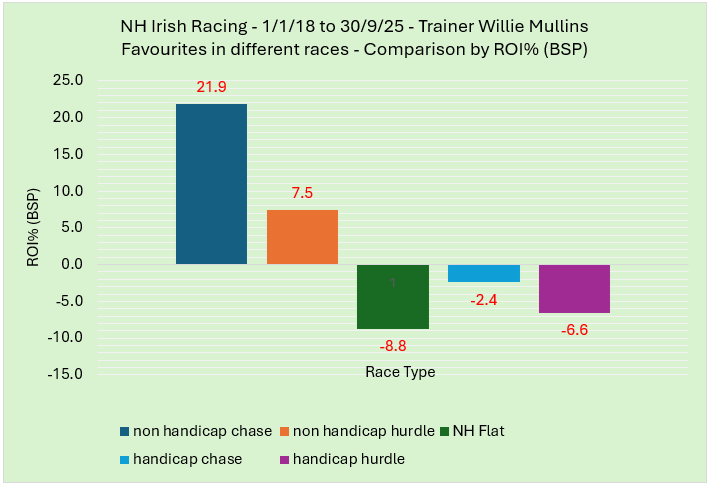


As can be seen, Mullins produced excellent returns when saddling the favourite in non-handicap chases. The full stats read 316 wins from 536 (SR 59%) for a profit of £116.47 (ROI +21.7%). He also showed a blind profit with market leaders in non-handicap hurdle races thanks to 540 wins from 1028 runners (SR 52.5%) for a profit of £75.68 (ROI +7.5%). He was less successful in handicaps, making a loss in both chase and hurdle race types. His worst record with favourites was in NH Flat races where losses were close to 9 pence in the £.

Switching to all runners rather than just favourites, Mullins had some powerful stats during the period of study when we analyse the run style of his runners in chase contests. Regular readers of my articles will know that chases tend to offer front runners a solid edge over all other run styles. Mullins conformed to this pattern in such races going back to the start of 2018 as the graph below, which shows his win strike rate across the different run styles, highlights:


Mullins’ horses that have taken the lead at the start of their chase races went onto win nearly 45% of their races. If we had known pre-race which of his horses would front run and backed them accordingly, we would have been in profit to the tune of £185.78 (ROI +36.1%). Compare this to the potential returns of midfield and held up runners, which would have lost 18p and 30p in the £ respectively.

Moving on to the very best contests, Class 1 events. Here, Mullins produced a blind profit and, considering he had 2536 runners in them, this was an impressive performance, even more so considering every Irish (and British) punter knows what this trainer has achieved. His record in Grade 3 races produced the best results: 117 wins from 457 (SR 25.6%) for a profit of £74.58 (ROI +16.3%).

Henry de Bromhead

Henry de Bromhead had some amazing wins in the UK during this timeframe, especially at the Cheltenham Festival, but here I will drill into his Irish record in more detail. His overall record showed a blind profit equating to over 6p in the £ and his yearly splits are shown in the graph below:


2021 was a poor year from a returns’ perspective, and 2020 showed a small loss, but the other six years all returned a profit. Hence, de Bromhead has been extremely consistent over this timeframe.

Like Mullins, de Bromhead has some interesting stats connected with run style but his most interesting numbers have been in hurdle races. His win strike rate splits have been as follows:


Horses that have led early have been the most successful by far and, if our crystal ball had been in tip top working order, backing these runners pre-race would have yielded a very healthy return of nearly 70p in the £.

From a personal perspective it will be sad that we will not see the iconic Rachael Blackmore riding for him in the future. They have been one of the best trainer/jockey combos of recent years and gave racing fans some great memories.

Gordon Elliott

For Gordon Elliott I would like to share his record with favourites in NH Flat races. Each year Elliott has had numerous runners in NH Flat races of which roughly 28% of them have started favourite. His record with these market leaders was as follows:



For favourites to return over 30p in the £ across a good number of bets is rare, so Elliott has performed well above the norm with this cohort of runners.

Elliott is another trainer who produced some very interesting run style stats during this time period. The stats for hurdle races were as follows:


As we know, the run style each Elliott horse employed was only known after the start of its race. Hence, the profit figures for leaders and prominent runners were not something we could have achieved in reality. However, what it does show once again is that for the majority of races the importance of being up with the pace rather than off the pace.

Geegeez Gold members interested in run style research can investigate further by using the Pace Analyser if wishing to dig into specific courses and/or distances. The example screenshot below shows some Carlisle data:


Parameters of race code, course, distance, going, number of runners, handicap/non-handicap and time frame can all be tweaked. Also we can check out both Irish and UK courses.

Members can also use the Query Tool for run style research like I have done for this article exploring other areas such as trainers, jockeys, etc.

Joseph O’Brien

Jospeh O’Brien, like Gordon Elliott, has produced positive stats when it comes to NH Flat races. The table below shows his overall record in these races, his record with favourites, and his record with horses that were in the top three of the betting:



O’Brien has clearly excelled in these races, and it will be interesting to see what happens over the coming season.

Like the other trainers discussed, O’Brien has worthwhile run style stats to share. Below is a graph showing the win percentages for each run style group in both chases and hurdle races:
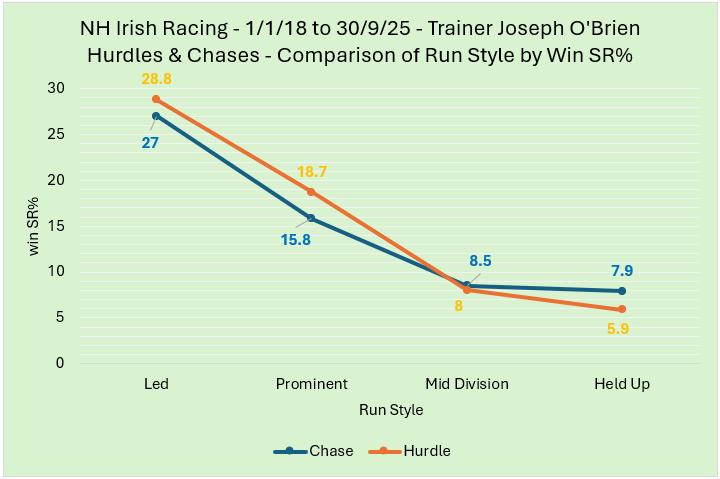


Once again, we see front runners from his stable had a huge edge over prominent racers who in turn had a significant edge over horses that were held up or raced in midfield.


**


I hope this article has served two purposes. Firstly, I wanted to show that research can be undertaken very quickly to generate useful stats and across a variety of areas; and secondly, I have shared some data relating to the highest volume Irish trainers which we should be able to use to our advantage this coming winter and beyond.

Finally, I hope some members will be tempted to use the content here to inspire your own research using Query Tool, Pace Analyser and the other tools in the Geegeez Swiss Army Knife.

Until next time...

- DR


Princess Child edges Fairy Bridge thriller at Tipperary

Princess Child just got the better of Queen Of Thunder in a thrilling finish to the Coolmore Stud No Nay Never Fairy Bridge Stakes at Tipperary.

Trained by Joseph O’Brien and ridden by Dylan Browne McMonagle, Princess Child was sent off a 3-1 shot for the Group Three prize as a five-time runner-up at Listed level and winner of the Ahonoora Handicap at the Galway Festival at the start of the month.

Settled in mid division, McMonagle managed to avoid the worst of the trouble as the field tightened up turning into the straight, with Mataariki swinging across the track to the nearside rail and appearing to impede Chantez and 11-4 favourite Fingerpaint in particular.

Switched to challenge down the middle, Princess Child reeled in Queen Of Thunder who had set sail for home, eventually edging a short head in front on the line, with Fingerpaint making late gains to be beaten a further three and a half lengths in third.

O’Brien said: “If any horse every deserved to win a stakes race it was her, although you don’t always get what you deserve. She met a bit of trouble in running but hit the line strong and while it was a head-bobber, she had previously come out the wrong side of a few tight finishes in her career.

“We had been campaigning her aggressively to try to win a stakes race and while she has a load of black type, to win a Group race is great. I’d say it will be a career-best on the figures and I thought she won the hard way.

“She is a Group winner now so it is job done, although we might look to win another one now.”

The stewards inquired into Mataariki’s move across the track, with her rider Declan McDonogh banned for seven days after being found to have ridden carelessly.

Queen Of Hawaii gets Classic quotes after Curragh performance

Joseph O’Brien has some lofty targets in mind for Queen Of Hawaii having watched her impress in the Newtownanner Stud Irish EBF Stakes at the Curragh.

Beaten on her debut, she looked good when winning her maiden at Leopardstown last month and was sent off at 100-30 against the favourite Sugar Island, from his father Aidan’s Ballydoyle stable.

The way the Kingman filly swept by Moments Of Joy, the Ballydoyle second string, suggests she is worthy of bigger targets.

Coral were impressed enough to give her a 25-1 quote for the 1000 Guineas and go 20-1 for the Oaks.

“She won her maiden well. She was very well bought by Philip Antonacci at Goffs,” said O’Brien.

“We thought she was a smart filly and you kind of come here to find out. She looks very smart and you’d have to be excited about her.

“She went through the line strong and Dylan (Browne McMonagle) said that she always feels like there is more in the locker.

“I’d imagine that she’ll either go for the Goffs Million or Fillies’ Mile in Newmarket. We could also look at the Moyglare.

“When she won her maiden at a mile we were looking at coming back to seven and having a look at the Goffs Million.

“We’ll see how she pulls up and discuss it with Philip and see. She’ll be heading for a Group One if it’s not the Million.”

Dermot Weld proved he is still a force to be reckoned with in major handicaps by producing Jagged Edge (22-1) to win the Paddy Power Supporting Cancer Trials Ireland Irish Cambridgeshire.

Having just the fourth run in his life and racing from 2lb out of the handicap, Weld employed apprentice Wayne Hassett to take a valuable 3lb off his back.

Handy throughout, Hassett managed to get his mount up right on the line to deny Genuine Article, who had also been up there all the way for Seamie Heffernan.

Weld said: “I’m delighted with this horse. He’s a big horse and he loves to be fresh. He won for us in Cork and looked like he was going to go on and he just lost his way a little bit. We left him alone and he’s come back nicely.”

There were several fundraising activities during the day in aid of cancer trials, the disease which took Weld’s former stable jockey Pat Smullen so cruelly.

He went on to say: “It’s great to see over a million being raised for pancreatic cancer. It’s such a wonderful achievement and I want to praise Frances Crowley (Smullen’s widow) for everything that she does, the whole team and everyone that contributes.

“It’s such an amazing achievement to be able to raise that kind of money and please God they keep raising more in years to come.”

Leinster puts seal on Curragh four-timer for Dylan Browne McMonagle

Leinster capped a fine afternoon for jockey Dylan Browne McMonagle when emphatically landing the Comer Group International Irish St. Leger Trial Stakes at the Curragh.

Having earlier bagged a treble on the card, the Joseph O’Brien-trained Leinster was sent off at 6-1 to give the 22-year-old a four-timer in this Group Three event.

The four-strong field raced in single file in the early stages and McMonagle was motionless aboard Leinster as the four-year-old travelled powerfully into the straight full of running and seemingly ready to make his mark.

With Dallas Star and Absurde giving way with a furlong to run and Ryan Moore easing down 10-11 favourite Puppet Master, the coast was clear for Leinster to surge four-and-a-quarter lengths clear and give the young jockey a highlight reel finish to his afternoon at Irish headquarters.

McMonagle said, “We went a steady speed, and he was a bit in my hands all the way. I’d love if they had gone on a stride, but I just needed to get him to relax today because we were riding him forward and he was just doing too much the last couple of days.

“Today coming back in trip and up in grade I thought there would have been more of an even gallop on, but we did go slow again.

“I was comfortable down past the two and I just let him flow. He stays this trip well and is a good horse.”

After notching up a 877-1 four-timer, McMonagle headed to Tramore for three further rides on Saturday evening.

Princess Child wears the crown at Galway

Princess Child, who has been campaigned exclusively in Listed and Group races for over a year, dropped down in grade to land the valuable Irish Stallion Farms EBF Ahonoora Handicap at Galway.

The consistent four-year-old filly had finished second in a Listed event at the track on Thursday but was able to land her first win since racing in France as a juvenile.

Since joining Joseph O’Brien she was more than paid her way, finishing second in four Listed races.

However, this was the first time her handler had run her in a handicap since her first start for new connections in June 2024 and she was sent off 5-1 to gain a first win in Ireland.

Gleneagle Bay made a bold bid for home but Dylan Browne McMonagle brought Princess Child with a powerful run and she went on to win by a length and a quarter with Colm Quinn Mile winner Dunum back in third.

“She had a good run here the last day. She was very unlucky and just didn’t get the rub of the green until the straight,” said the winning rider.

“She’s had a couple of days to freshen up again and was bouncing around the parade ring and felt great going to post.

“The pace was good and even for me to aim at, and she quickened up good to win well. She seemed to get through the ground well.

“You need plenty of luck when you are drawn in there (stall six) but I definitely had a willing partner.

“She’s a very consistent filly and seems to grow a leg on this ground. She likes it around here and always runs a good race here. Hopefully she can progress into stakes company again and get her head in front.”

North Coast takes Tyros triumph in style

North Coast comprehensively reversed previous form with odds-on favourite Flushing Meadows to win the Japan Racing Association Tyros Stakes at Leopardstown.

Joseph O’Brien’s charge had been beaten just under three lengths by Flushing Meadows on his debut at the Curragh in June before winning next time out and chasing home Daytona in Listed prize on his latest start.

He was sent off a 3-1 chance against the Aidan O’Brien-trained 30-100 market leader Flushing Meadows, who was only just beaten in Group Three company on his most recent start,.

Under a positive ride from Dylan Browne McMonagle, North Coast more than had the measure of the favourite, coming home a six-length winner, although Ryan Moore did ease his mount a little in the closing stages.

Paddy Power put North Coast in as a 25-1 chance for next year’s 2000 Guineas and Derby, with a Group One date likely to be next on the agenda.

Dylan Browne McMonagle and trainer Joseph O’Brien
Dylan Browne McMonagle and trainer Joseph O’Brien (Brian Lawless/PA)

“That’s probably a good trip for him, a stiff seven furlongs,” said the winning trainer.

“He ran great in Naas and you’d have to be impressed with what he did today.

“I backed him up a bit quick coming here, so we’ll probably go straight to the National Stakes now rather than going for the Futurity on the way. That would be my immediate thought.

“He’s a smart colt and has an exciting future.

“I was very impressed with his last half-furlong. It looked like it was going to be an eyeballing match down to the line but he really pulled away again.”

Composing impressed in victory
Composing impressed in victory (Brian Lawless/PA)

Composing made virtually all the running to register a comfortable success in the Saudi Cup Silver Flash Stakes.

Fifth on debut at the Curragh in May, she broke her maiden back at that track last month, prompting Aidan O’Brien to raise her sights to Group Three level here.

Moore was eager to get to the front and allowed to stride on, he dictated the pace aboard the 4-9 favourite and Composing never looked like being caught, eventually pulling three and a quarter lengths clear of the staying-on Skydance.

The Wootton Bassett filly was cut to 16-1 from 25s by Paddy Power for both the 1000 Guineas and Oaks next year, with O’Brien rating her a potential Group One challenger later in the campaign.

Leopardstown Races – Thursday July 24th
Composing with jockey Ryan Moore in the winner’s enclosure (Brian Lawless/PA)

“We’re delighted with her, she’s a lovely, straightforward filly,” said O’Brien, who was winning the race for the fourth successive season.

“She won lovely the last day and Ryan loved her. She was very professional.

“She’ll go for the Debutante Stakes at the Curragh next and could be a filly for the Moyglare.”

Smart targets in the pipeline for Wemightakedlongway

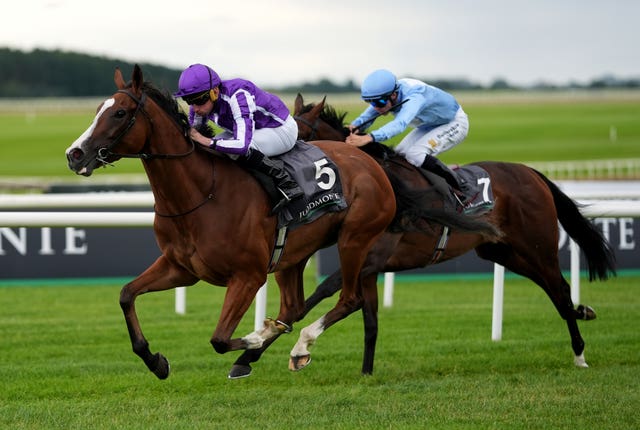
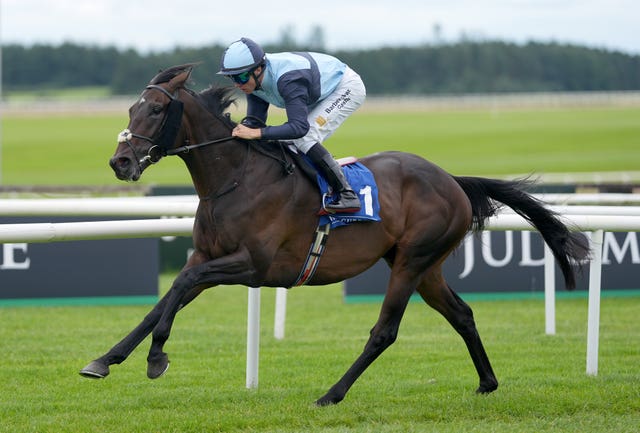
Joseph O’Brien is looking forward to further top-level events in the autumn after proudly watching Wemightakedlongway finish second to his father’s Minnie Hauk in the Juddmonte Irish Oaks.

The daughter of Australia was fourth to Minnie Hauk in the Epsom equivalent in June before not being disgraced when dropping back to 10 furlongs and filling the same spot in the Curragh’s Pretty Polly Stakes next time.

She justified her position as chief market danger to Minnie Hauk when closing the gap on the dual Classic winner in her second taste of Classic action and after her brave performance in defeat, Wemightakedlongway’s trainer is now lining up some exciting options for later in the season.

Wemightakedlongway pushed Minnie Hauk all the way at the Curragh
Wemightakedlongway pushed Minnie Hauk all the way at the Curragh (Niall Carson/PA)

“I was very proud of her run and there is no shame getting beat a length by Minnie Hauk,” said O’Brien.

“We can look at some nice fillies races with her in the autumn now and there’s a good chance she might turn up in something like the Prix Vermeille or Prix de l’Opera.”

O’Brien may have had to settle for second with Wemightakedlongway, but was thrilled to see Al Riffa – who is now somewhat a stable stalwart – excel in his first try at a mile and six.

A dual Group One winner, he built on his fine Royal Ascot second to Rebel’s Romance to romp to an impressive five-length success in the Curragh Cup and the Owning Hill handler has earmarked the Comer Group International Irish St. Leger over the same track and trip as the perfect spot to seek further top honours.

Al Riffa has long been a star performer for Joseph O'Brien
Al Riffa has long been a star performer for Joseph O’Brien (Niall Carson/PA)

“He’s a great horse who put up a real good showing in the Curragh Cup over a new distance for him,” added O’Brien.

“He seemed to cope with the trip well and the Irish St Leger is an obvious target for him now, but we have the option of popping back to Germany or something between now and then, so we’ll see how he pulls up and make a plan from there.

“He was second in the Eclipse last year and has a high level of form at a mile and a half and now he can go a mile and six as well it just opens up more options. Really, trying to win another Group One and earn some good prize-money will be our objective before the end of the year.”

Al Riffa makes class count with stylish Curragh Cup win

Joseph O’Brien’s Al Riffa stamped his class on the Michael John Kennedy Curragh Cup.

The dual Group One winner had played a supporting role in three previous outings this year, finishing third in the Neom Turf Cup in Saudi Arabia and fourth in the Prix Ganay in France before finding the globetrotting Rebel’s Romance too strong Hardwicke Stakes at Royal Ascot.

Stepping up to a mile and three-quarters for the first time, the Dylan Browne McMonagle-ridden 4-5 favourite saw out the trip in some style, rocketing clear late on to claim Group Two honours by five lengths from Shackleton.

Stable representative Kevin Blake said: “That was brilliant, he’s a horse with a lot of class and he was last to first in a National Stakes here in fairness to him.

“No one ever felt that he needed that trip, but it made sense. He was relaxed, Dylan said he was very easy to ride over that trip, he quickened up and it was really good.

“I’d say it’s most likely that he’ll go straight to the Irish Leger from here. There is a possibility of the Group One that he won in Berlin last year (Grosser Preis von Berlin), but I’d say it’s more likely he’ll go straight there.

“The Melbourne Cup is in the minds thereafter. We all know what comes with that but that would be what we’d like to do, if we’re allowed.”

New Zealand and Ryan Moore won the opening race at the Curragh
New Zealand and Ryan Moore won the opening race at the Curragh (Niall Carson/PA)

Odds-on favourite New Zealand led home a one-two-three for Aidan O’Brien in the Juddmonte Chaldean Irish EBF Maiden.

Despite finishing only seventh on his debut at this venue three weeks ago, the Frankel colt was sent on his way the 10-11 favourite to open his account in a race won by Henry Longfellow and The Lion In Winter in the past two years and was soon bowling along in front under Ryan Moore.

He was under pressure from two furlongs down, but kept responding to his rider’s urgings and had just enough up his sleeve to repel his previously unraced stablemate Issac Newton by a nose, with another Ballydoyle newcomer Action – a half-brother to dual Derby winner Lambourn – an eyecatching third.

Of the winner, O’Brien said: “He’s a lovely big horse, he hasn’t a clue what he’s doing yet – he’s massive, the power and the size of him.

“We’ll go gentle and let him come on. He learned a lot from the first day, we liked him before that and he was very green. The first day he was a little bit slow away and you could see him today, he never travelled a yard.

“He’s a big horse and he’s all power. I know he’s not short of speed, but he looks like a big, middle-distance horse.”

The Ado McGuinness-trained Go Athletico (20-1) swooped fast and late under Shane Foley to claim top honours in the €100,000 Kwiff Supercharged Betting Scurry Handicap.

Go Athletico (right) gets up to win the Scurry Handicap
Go Athletico (right) gets up to win the Scurry Handicap (Niall Carson/PA)

“It’s a nice birthday present – I’m the big 60 today,” said McGuinness.

“I suppose class is permanent and form is temporary and he did lose his form big time. He slipped back down and we were very disappointed with him.

“He’s a good horse and he’ll probably pitch up in Galway now in the Ahonoora Handicap, that’s where he’s going to do next.”

Stop The Nation was a 15-2 winner of the Lavazza Sprint Nursery Handicap for trainer Jack Davison and 3lb claimer James Ryan.

“I had a baby boy at 23.59 last night and James Ryan lost his claim there. It’s a real feel-good winner on many fronts,” said Davison.

“He’s a good colt and he’s learning the whole time. He’ll be a lovely horse for the Goffs Million.”

O’Brien eager to take on Hauk again with Wemightakedlongway

Joseph O’Brien is keen to let Wemightakedlongway have another crack at red-hot Juddmonte Irish Oaks favourite Minnie Hauk at the Curragh on Saturday.

The pair met in a Cork maiden last October when Wemightakedlongway showed the benefit of her previous experience, beating Minnie Hauk on her debut by two and a half lengths.

Since then Wemightakedlongway has won one of her four outings, the Group Three Salsabil Stakes at Navan, while Minnie Hauk has so far emerged as the best of her generation, winning at Chester and following up in determined fashion in the Oaks at Epsom from stablemate Whirl.

The form of that race looks strong as Whirl has since beaten Kalpana in the Pretty Polly, a race in which Wemightakedlongway finished fourth.

“We are looking forward to running Wemightakedlongway,” the Piltown-based trainer said.

“There is some rain forecast and any rain that falls we think might help her chances in Saturday’s Juddmonte Irish Oaks.”

Minnie Hauk’s trainer Aidan O’Brien also runs Butterfly Wings, Island Hopping and Merrily, while the field is completed by Fozzy Stack’s Bay Colony and Johnny Murtagh’s Subsonic.

Tennessee Stud and Lambourn could have second Classic clash

Betfred Derby third Tennessee Stud looks set for a rematch with his Epsom conqueror Lambourn in the Dubai Duty Free Irish Derby at the Curragh.

A Group One-winning two-year-old in the Criterium de Saint-Cloud, Joseph O’Brien’s charge was third behind Delacroix on his return to action in the Leopardstown Derby Trial last month ahead of his bid for Classic glory on the Surrey Downs.

Tennessee Stud was one of the few horses to get involved from off the pace as the front-running Lambourn provided Joseph’s father Aidan with an 11th Derby victory and O’Brien junior – who also saddled Wemightakedlongway to finish fourth in Friday’s Oaks – is happy to take on the winner again on home soil.

He said: “I was delighted with both runners over the weekend, particularly the horse in the Derby. He came home strongly and looks an exciting horse for the future.

“We felt that he’d improve for the run at Leopardstown, we had been working towards the Derby and he ran a fantastic race.

“I would imagine he’ll go back to the Irish Derby. You’d think a mile and a half at the Curragh would suit him well and he has had a good run there before (second in Beresford Stakes).”

O’Brien was similarly pleased with the performance of Wemightakedlongway, who looks set to to stick to Group One level after being beaten just over five lengths by Minnie Hauk in the Oaks.

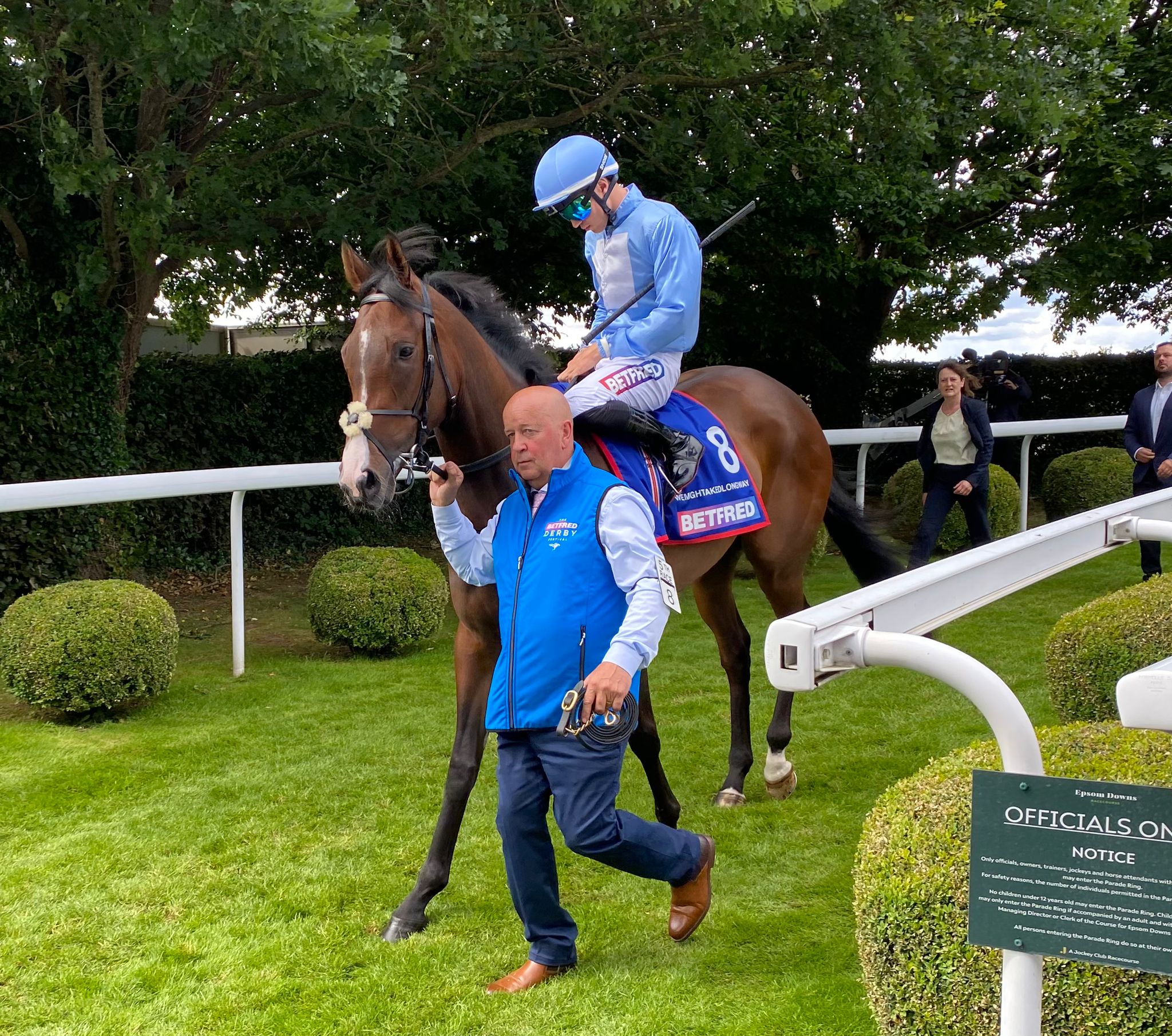
Wemightakedlongway at Epsom
Wemightakedlongway at Epsom (Adam Morgan/PA)

“She ran great and we could have a look at the Pretty Polly maybe, or the Irish Oaks, or both,” the trainer added.

“She seems well after the race. We’d be happy to try the trip again anyway, that’s for sure.

“Hopefully one or both horses can get on the scoreboard at Group One level.”

Monday Musings: from Luxembourg to Oz

Luxembourg’s emphatic success in Saturday’s Vertem Futurity, the final Group 1 race of the year in the UK, reminded us not to under-estimate the power of the Aidan O’Brien team, writes Tony Stafford.

As he conceded after the victory, things have been going rather less his way than we have come to expect, but a year in which St Mark’s Basilica, Snowfall and now this feasible 2,000 Guineas alternative to the Charlie Appleby two – Native Trail and Coroebus - have been around, it is hardly the disaster it was being painted of late.

More of Luxembourg later but eight hours before the big race at Doncaster, a ten furlong Group 1 race, the private property of that unforgettable Australian mare Winx between 2015 and 2018, was being decided.

The Ladbrokes Cox Plate, run at the tight Moonee Valley racecourse in Melbourne, is universally known as Australia’s principal weight-for-age race – the even more valuable Melbourne Cup is a handicap. Joseph O’Brien, already winning trainer of two of the last four Melbourne Cups, as against his father’s still frustrating blank in the race that stops Australia on the first Tuesday of November every year, took the £1,700,000 first prize on Saturday morning with the three-year-old colt State Of Rest.

As befits a race of its value, the opposition was stern and the second and third home, the joint-favourites at 13-5, fully deserve such a description. It took a full 20 minutes’ deliberation from the stewards to decide that Craig Williams’ objection to the winner and his rider John Allen on behalf of short-head runner-up Anamoe would be rejected. Third, staying on, was the champion mare Verry Elleegant, veteran of both successful and less so Group 1 tilts with William Haggas’s globe-trotter Addeybb among 12 wins from 30 starts.

Moonee Valley might not be Verry Elleegant’s favourite track, but the five-year-old had to concede only 1lb to her three-year-old rival (actually she counts as only a year and a half his elder because of the difference in the Northern and Southern Hemisphere breeding seasons. Anamoe, who had won a Group 1 two weeks before, the £678k to the winner Caulfield Guineas over a mile, carrying 9st as the 11/10 favourite, was foaled seven months after the winner. He received 16lb from the O’Brien horse and while the same age, will not actually be three years old until next month.

Topically, Saturday was the anniversary of State Of Rest’s final run as a juvenile when finishing fifth behind subsequent Irish 2,000 Guineas winner Mac Swiney in last year’s Futurity. He had a busy time running six races between June and October of his juvenile season and was probably ready for a quiet spring.
O’Brien delayed his comeback until the last week in June when he tackled a one-mile Listed race at The Curragh.

Conceding 10lb to both the winner Fourhometoo and runner-up Khartoum, he struggled to get a run until the last 100 yards, then flew home and would have galloped right by those mid 100’s rated and race-fit rivals in another few strides.

Until Saturday, there had been one more run, a highly-ambitious challenge to his father’s beaten Derby favourite Bolshoi Ballet at Saratoga. After Epsom, Bolshoi Ballet had gone some way to restoring his reputation with a win the following month at Belmont Park and the Saratoga Derby, a Grade 1 worth £390k and run over 9.5 furlongs at the Spa in mid-August at the time looked his for the taking. Its timing for the younger O’Brien was ideal as it gave State of Rest time to recover from his returning Curragh exertions.

Understandably, dad’s runner was a shade of odds against while the main dangers according to the betting were Jessica Harrington’s Cadillac at 9/2 and Charlie Appleby’s Secret Protector at 5/1.
Having looked back at the Curragh comeback third and the way he finished the race it seems inconceivable that State Of Rest could have been allowed to start at more than 20/1 in that company. The betting clearly suggested the home team was nothing much, yet here was a horse already worth a rating in the mid-110’s starting that price – and he had legendary East Coast rider John Velazquez in the saddle to boot.

The outcome was a one-length win in the colours of Teme Valley Racing, while Bolshoi Ballet was only fourth and the other raiders were further back. The win was much to the elation of the owners’ Racing Manager Richard Ryan, who has a wealth of experience in many facets of the racing industry.

Ryan was the long-term assistant to the late Terry Mills, who made his money in the waste disposal and demolition businesses. Many Epsom habituees ascribed much of the stable’s success to his quiet and ever discreet right-hand-man. Then after Mills’ death and son Robert’s brief spell at the helm, he left Epsom and worked the sales, before joining Ian Williams as assistant.

In that period and then since relinquishing that full-time role he has continued to unearth good horses for the trainer’s clients. Now he represents Goff’s at auctions as well as his role with Teme Valley and also maintains a close relationship with Williams.

To run horses trained in Europe for major races in Australia was always akin to a military exercise, but Joseph outlined in detail the extra hoops that are required post-, or rather, where Australia is concerned, mid-Covid. Those, together with the increased veterinary procedures imposed after Derby winner Anthony Van Dyck’s fatal injury in last year’s Melbourne Cup, have caused a number of UK trainers to abandon proposed Melbourne Cup challenges this winter.

Anthony Van Dyck’s demise took some of the family gloss off Joseph’s success with the seven-year-old Twilight Payment in the Cup last year. At least Aidan can point to his own Cox Plate seven years ago with Adelaide, now a stallion in Australia, while last year’s Cox Plate winner Sir Dragonet spent his formative years, indeed all his races before the Cox Plate, at Ballydoyle.

The beaten 11-4 favourite in Anthony Van Dyck’s 2019 Derby, he ended his time with O’Brien with a second to the great Magical in the Group 1 Tattersalls Gold Cup at The Curragh in July last year. His first run under Chris Waller’s care brought his Cox Plate win at the main expense of another former stable-companion Armory and he was then sixth in the Melbourne Cup, although his form this year has been nowhere near that level.

Doncaster’s confirmation that Luxembourg was indeed a potential Classic horse was underlined on Saturday as he drew steadily if not spectacularly away from three nice horses. Sissoko (Donnacha O’Brien), was just under two lengths behind the winner and only narrowly in front of another of Teme Valley’s (with Jock O’Connor’s Ballylinch Stud), the Roger Varian colt Bayside Boy, and Hannibal Barca inches back in fourth. This made it ten Futurity victories in 24 years for O’Brien enabling him to match the late Sir Henry Cecil’s record within the precise same time scale.

Brian Meehan had been bullish when we spoke on Saturday morning about the place chances of Hannibal Barca and it looked for much of the last furlong that the 50-1 each-way taken about the Sam Sangster-owned colt would collect. Sadly though track position on the far side as they came up the middle probably didn’t help rider Paul Mulrennan on the run home.

I’m going to the sales on Tuesday and it will be interesting to look into the box scheduled to be housing Hannibal Barca who until Sam and Brian wake up after the inevitable party they had for getting the 55,000gns son of Zoffany to a rating of at least 110, they will almost certainly pull him out. Then again they might let him have a spin round the ring with a big reserve. That would be nice. I’ll be there boys – and how I love a show!

Jumping proper started again with two days of Cheltenham and record crowds for the October meeting. The last time they had a crowd at Cheltenham, in March last year, the blame game merchants pointed to that largely outdoor gathering as a major component in the spread of Covid-19. With figures going up again that fixture is again a possible target for criticism, but the 76,000 crammed in at Old Trafford to watch Liverpool demolish Manchester United would potentially be a larger worry I would have thought. The maladies for distraught home fans might extend beyond Covid!

The most impressive Cheltenham performance for me was the flashy chase debut of the Skeltons’ First Time Lucki. A 144-rated hurdler after three wins from seven starts adding to two out of four in bumpers he looks destined for a much higher level over fences.

His jumping was fast, accurate and spectacular. At no time did Harry Skelton have a second’s concern and the eight lengths and the rest he had over some good horses in this initial novice chase could easily have been doubled had the champion jockey wished. Allmankind was similarly impressive for the brothers at Aintree yesterday.

That man (Harry) is going to be very hard to beat in his attempt at a second title and brother Dan might be an outside bet for the trainers’ title. Admittedly Fergal O’Brien is setting a very fast pace already up to 60 and if some of his potential stars waiting in the wings come through he could figure in the argument too.

Meanwhile Hollie Doyle, faced with what had looked a daunting calendar year record score of 152 for a female jockey she set in 2020, has passed it with two months to spare. Her initial title will not be long delayed.

Talking of titles, Johnny Weatherby, long-time Queen’s Representative at Ascot has been knighted. Was it Arise Sir John, or Arise Sir Johnny? I’m not sure if anyone’s taking money on it – it’s a bit like those bets on the Queen’s hat colour every day by those bookies before racing attracting once-a-year racegoers on the way from the main entrance to the grandstand. I’m sure they have their card marked! Psst- it was Sir John!!!

-TS

Breeders’ Cup 2019: Five Takeaways

The 2019 Breeders' Cup returned to Santa Anita for the tenth time. Much of the preamble to the weekend was familiar, then, but this year there was a difference. A near palpable atmosphere of anxiety and introspection pervaded proceedings; and, in spite of forensic levels of veterinary scrutiny, BC36 was not to sail smoothly across its troubled waters. That story, amongst others, is recounted in these five takeways from the meeting.

1 JOSEPH & HIS AMASSING TECHNICOLOR PALMARES

Where were you in your career path when you were 26? For most of us mere mortals, college days were behind us and we were taking our first fledgling steps in a job or career. Joseph Patrick O'Brien, barely past the quarter century, has already summited a career in the saddle which began promisingly but perhaps little more with a piece of a three-way tie for the Irish Champion Apprentice title in 2010.

The following year, he enjoyed Classic success with Roderic O'Connor in the Irish 2000 Guineas, and rode another two UK or Irish Group 1 winners, the last of which was Camelot in the Racing Post Trophy. A fortnight after that Doncaster highlight, O'Brien raised his own bar by scoring aboard St Nicholas Abbey in a Churchill Downs edition of the the Breeders' Cup Turf at the age of 18.

2012 was Joseph's - and Camelot's - year as the pair won the first two legs of the Triple Crown, the 2000 Guineas and Derby, before being cruelly denied victory in the St Leger by a horse trained by the subsequently disgraced Mahmood al Zarooni who admitted charges of using performance enhancing drugs on his horses.

That year, 2012, Joseph proved he could do quantity as well as quality as he won his first Irish Jockeys' Championship, an award he retained with a record score in 2013.

By 2016, still aged just 23 - twenty-three! - he swapped the saddle for the demands of training and, to nobody's surprise, hit the ground running, his first Group 1 win coming in the Moyglare Stud Stakes of the same year with Intricately. [It was rumoured that he had also trained Ivanovich Gorbatov to win the Grade 1 Triumph Hurdle in March that year, but let's stick to published record].

As a trainer, in less than three years and at the age of 26, he already has an Irish Derby, a Melbourne Cup and now a Breeders' Cup win to his name. The game triumph of Iridessa - who bounced out of the stalls from box one and got a great position under Wayne Lordan - in the Filly and Mare Turf on Saturday was Europe's sole victory at the meeting, and made Joseph the youngest trainer to win a Breeders' Cup race.

Naturally, given his prior exploits aboard St Nick, he is also the youngest person to record a Breeders' Cup win as both a jockey and a trainer. The sole other member of that most exclusive of Breeders' Cup clubs is Freddie Head, the French horseman who won two multiple Miles with both Miesque (as a jockey, aged 40 and 41) and Goldikova (as a trainer, aged 61, 62 and 63). Chapeau to Freddie, but Joseph is emerging as an altogether different jus.


2 AIDAN OFER'BRIEN

While O'Brien Jr was further enhancing his CV, father Aidan was enduring what might legitimately be dubbed a minor crisis. To some that may sound preposterous, so allow a little context: this year, Aidan has trained 15 Group or Grade 1 winners, last year the international G1 tally was 14; but in 2017 it was 28, in 2016 it was 22 and in 2015 it was 17.

At such rarefied altitude and on such small sample sizes it is perfectly reasonable to account for the differential as the dreaded variance - statistical slings and arrows if you will. And that's probably right enough.

But, in the microcosm of the Breeders' Cup, Aidan has now gone 35 runners without a victory since Mendelssohn prevailed in the opening race at Del Mar, the Juvenile Turf, in 2017. Again, it's a small sample. And he was dealt the rummest of rum deals at the post position draw with almost all of his nine entries exiting a double digit stall.

But Bricks And Mortar won the Turf, with a troubled trip, from nine when Anthony van Dyck lost from five. In the same race, Mount Everest, presumed the pacemaker (which may be incorrect), fluffed the start and was never nearer than at the line. Uni won the Mile from stall 11 where Circus Maximus was drawn nine; Just Wonderful missed the kick and was never nearer than fifth in the Filly and Mare Turf from stall 11; Tango and Etoile, drawn eight and 14 respectively, finished eighth and tenth having both broken moderately and struggled to get track position; Arizona, drawn 12 in the Juvenile Turf, was slow at the gate and never nearer than his final position of fifth; Fort Myers ran respectably in seventh from 13 in the same race, though he too was no better than tenth as they passed the stands first time; and King Neptune actually broke alertly in the Juvenile Turf Sprint but wasn't persisted with for a position and entered the turn in seventh place before finishing eleventh.

What is the recurring theme? In fairness, there are two, and one of them is the draw, which is out of the hands of the trainer. The other is the number of times Aidan's horses - again, in fairness, most European horses - broke slowly and were simply in a borderline insurmountable position on a tight inner turf track which was riding like lightning. Even when the races were a little more tactical on the turf, a slow start meant as many as a dozen horses in a 4 x 3 or 3 x 4 phalanx ahead: it is very, very difficult to overcome a pedestrian beginning.

Aidan quite rightly says that he spends all year trying to get horses to settle and relax, and that is the way to win European races. But if a horse doesn't have early tactical toe in order to secure a position, it is almost game over in double-digit US fields. It has been suggested that perhaps he should use American jockeys who are more accustomed to pinging a horse from the gate but, firstly, it's not necessarily something a jockey can influence especially, and secondly, the local lads would generally need to take care not to spurn their bread and butter.

While chatting with one New York punter the somewhat harsh soubriquet Aidan Ofer'Brien was coined, ofer meaning zero for, as in zero for 35 since Mendelssohn in 2017. It is fantastic, and likely extremely important, that Ballydoyle continue to send top division horses to the meeting - it would be an event lighter on entries, far less interesting from a European perspective, and less compelling as a wagering proposition, too, if he didn't - but if they are to be more than making up the numbers, gate speed 101 looks in order. Here's hoping the peerless trainer of his generation reverts to his longer-term type at Keeneland in 2020.


3 THE TRACKS

It doesn't matter where you are in the world, if your horse is unsuited to conditions it is unlikely to win. So let's discuss the tracks, the already mentioned in despatches turf course first.

It was lightning fast. They haven't had meaningful rain in LA for six months, a fact evidenced by the desperately unfortunate wildfires that are raging in the north of the state. Sure they've watered the course and continued to hydrate it. But the temperatures have been 30C+ for much of the past fortnight and before. The water table is non-existent. It was suggested by a Clockers' Corner wag that, when going to inspect the turf track in white shoes, the horseman in question returned with green soles. Well that's one way to make brown turf look green!

Of course that's almost certainly just bluster - as easy on the ear as it is - but the fact remains that if you don't have a horse that can handle Bath firm, you probably don't have a horse for the race when the Cup heads west.

Another point on the turf track, specifically in relation to the Juvenile Turf Sprint. In its inaugural running in 2017 (on the undercard), Declarationofpeace - for Aidan O'Brien, in the opening race on the Saturday - led home a Euro superfecta from 'our' only four entries. The winner had the best Euro form around a turn, and was slowly away in a race run too fast, the pace collapsing.

Last year, when none of the Euro entries had winning form around a turn, we did no better than third. This year, although Europe did even less well, the best finisher - fifth-placed Dr Simpson, a rank outsider on the US tote at close to 60/1 - was two from two on turning tracks, by seven lengths at Chester and then in a Group 3 against the boys. She is also a fast starter. Although she wasn't good enough to win, that's the sort of horse you want for this gig. If Dr Simpson's trainer, Tom Dascombe, had sent lightning breaker and turning track specialist Kachy across, he would have been seriously interesting in the Turf Sprint.

In bigger fields and at longer trips, it is often the 'best trip' - that is, the horse which gets least interference excluding front runners whose record is terrible, that wins. There is so much traffic and misfortune to factor into pricing these races up from a value perspective that they are almost a blanket 'no bet'. The sensible approach to hardier punters is to back an American horse with a British bookmaker and hope for a good trip. Races like the Mile are peppered with big-priced winners through their history, Tourist (US horse, 11/1 US tote, 33/1 UK books), Karakontie (French, 29/1 US tote, 16/1 UK books) and Court Vision (US, 64/1 US tote, 50/1 UK books) being three since only 2011 in that particular event.

The DIRT track had been harrowed very deep, and rode slow. The Classic was a truly run race and it was won in a time of 2:02.80. The previous Santa Anita Classic, in 2016, was won in a time of 2:00.11, and the Santa Anita Classic's before that in 1:59.88, 2:00.72, 2:00.11, 2:00.32 (Zenyatta, Pro-Ride), 1:59.27 (Raven's Pass, Pro-Ride), 1:59.88, 2:00.83, and 2:00.40.

Appreciative that this is labouring the point but, to spell it out, the 2019 Classic was two seconds - something like eight lengths - slower than the next slowest of seven Santa Anita dirt Classics, excluding the slightly quicker Pro-Ride surface which was controversially installed and even more controversially ripped up again in and around 2008/9.

And yet Vino Rosso was given a legit number for his win. Timeform US had him on 133, six spots higher than the next best winner at the meeting; Beyer had him at 111, a point behind Mitole (his closest pursuer on the Timeform numbers). That's by way of reaffirming the slowness of the track.

There were good reasons for that, which we'll get to. But what it meant in racing terms was that it was extremely difficult to win from off the pace. You still needed stamina and no little class to get the job done, but only one horse - Blue Prize - was able to win from some way off the pace across the seven dirt races.

The best parallel for British and Irish bettors is that the surface was something akin to Southwell: deep, with serious kickback, where early speed is sustained more often than not and very little comes from far back. This year's Breeders' Cup was, for a lot of dirt race entries, like coming from a fast track qualifier at Lingfield, Chelmsford or Kempton to Finals Day on the Rolleston beach.

It was a necessary step to harrow the course that deep but, in many racing ways, an unsatisfactory one.


4 WELFARE

Here's why it was necessary. California is a liberal state and a perfect example of the emerging anti-racing sentiment we are seeing in Britain and in other jurisdictions around the world, notably Scandinavia. There is a war raging between traditionalists and revisionists inside of racing. It's a lop-sided skirmish outside of the bubble.

Governor Gavin Newsom in September called racing at Santa Anita "a disgrace". Newsom wasn't pulling any punches in this New York Times article where he was quoted as saying,

“What happened last year was unacceptable, and all of the excuses be damned. We own that going into the next season, and we’re going to have to do something about it. I’ll tell you, talk about a sport whose time is up unless they reform. That’s horse racing. Incredible abuses to these precious animals and the willingness to just to spit these animals out and literally take their lives is a disgrace.”

That was in response to news that more than thirty horses had been put down as a result of injuries sustained either training or racing at the Arcadia track. Despite the trash talk style (notably, emotive language like "precious animals"), there is plenty of substance behind this soundbite, politicians on both sides of the Atlantic now tapping into an animal welfare zeitgeist among their constituents. Indeed, California's senior Senator, Dianne Feinstein, is of the same view and has publicly expressed it.

That's obviously bad news for racing.

What is worse is that some of the reasons for fatalities may have been avoidable. I see three main factors as conspiring: a fashion for breeding precocity and speed at the expense of durability and stamina; over-training young horses whose limbs cannot yet sustain the level of work demanded of them; and the increasingly sophisticated use of medication to patch up injuries and/or supplement punishing training regimes.

Clearly I'm not a vet and I present the above as no more than conjecture - my take, if you like. I'd very much welcome an educated rebuffal of any or all from any reader qualified to do that.

For me there are two bottom lines on the racing welfare debate. Firstly, whilst fatalities are inevitable - a point racing has to defend explicitly and unequivocally - the current levels are very likely unsustainable. And not just in California, or even America as a whole.

Second, this is an extremely complex debate peppered with flexible morality codes. Anyone who feels vehemently one way or the other probably hasn't given the subject enough thought.


5 WHERE NEXT (LITERALLY) FOR BC?

It was in the aftermath of Governor Newsom's comments that extensive vetting was implemented ahead of this year's Breeders' Cup. That led to the high profile scratchings of Imperial Hint, Fleeting and Suedois among others, on veterinary advice. Last year at Churchill Downs, Polydream, favourite for the Mile at the time, was withdrawn under similar circumstances.

Thus, naturally but even more than ever, organisers were praying for an incident- and injury-free Breeders' Cup. They almost got it.

Going into the Classic, the final race of 14 across two absorbing days of pageantry and sport, horsemen and administrators alike would have been justifiably feeling like a job well done. Alas, for racing just now it seems, if it wasn't for bad luck it wouldn't have any luck at all.

The perfect Mongolian Saturday... in Kentucky

The perfect Mongolian Saturday... in Kentucky. But not in Santa Anita

In amongst the millionaires and the billionaires and the silent powers of horse racing exist an ownership group called the Mongolian Stable and their trainer, Enebish Ganbat. They love their racing, are passionate about it, and share their passion with anyone who feels similarly. In 2015 at Keeneland, they enjoyed their greatest day as Mongolian Saturday won the Breeders' Cup Turf Sprint. He raced without Lasix, the near ubiquitous diuretic said to restrict the likelihood of a horse bleeding. He was the only horse in the field not to receive it.

These guys don't sit in a box quaffing Veuve; they are out in the cheap seats in full national dress posing for pictures and glad-handing anyone and everyone. They, and people like them, are what the sport needs.

In the Classic, they had sportingly supplemented Mongolian Groom, who had beaten Classic favourite McKinzie over the Santa Anita track in their respective final preps, and who it should be noted did run on Lasix.

Their horse broke well and was second throughout the first mile, a length off pace-setting War Of Will, with last day foe McKinzie right there as well. But disaster struck for Mongolian Groom, Mongolian Stable, Ganbat, the Breeders' Cup and American racing, as the horse suffered an injury to his left hind leg which could not be treated. Very sadly, he was taken into the horse ambulance and euthanized.

It was deeply distressing on so many counts, primarily for connections, whose love of the game and for their animals is more transparent than most top tier ownership collectives; and all the more so that the ramifications of this event, as another inquest will inevitably be held, will overshadow their own feelings of loss.

The next Breeders' Cup is in Keeneland, far from the madding Californian crowd, then nominally at Del Mar in 2021. But Del Mar is in Southern California, and Churchill Downs may again be on standby as it was reported to be earlier this year in case matters at Santa Anita became irreconcilable.

So yes, Keeneland and Del Mar have been officially unveiled for 2020 and 2021, but will the Breeders' Cup return to Santa Anita in 2022, as was widely expected? Indeed, in light of the political firestorm expected to play out in the state, the question may be whether the Breeders' Cup will ever return to Santa Anita.