Tag Archive for: Lingfield

Top 10 Front Running Biases in Handicap Chases, Part 1: 10 to 6

The Top 10 front running biases in handicap chases Part 1 – 10 to 6

Over the next two articles I will share what I believe to be the Top Ten current run style handicap chase front running biases in the UK and Ireland, writes Dave Renham. In this first half, I will reveal positions 10 down to 6; and next week I'll reveal my top five. Of course, I appreciate that there will be people who disagree with my hierarchy but, ultimately, all ten biases have shown themselves to be profitable to deploy alongside more traditional form reading. As a bonus, today I will also share three near misses that narrowly failed to make the top ten.

Introduction

To compile my top picks, I have used data for handicap chases only as they are not so prone to distortion by the ability range of the horses competing. Data are from 2018 to 2024 with no minimum runner consideration.

I mentioned in a recent offering that Gold members of Geegeez have so many benefits and one of these is access to the Pace Analyser. This allows users to dive into run style / pace biases at any racecourse in the UK and Ireland. The data can be filtered based on going, field size, distance and race type. There is also the option to separate hurdles and chase (and NH Flat) data at jumps courses; and across all courses the data can further be filtered by year to allow for possible changes in any bias. The Pace Analyser is ideal for research such as this, and it was the main source that I used to produce what follows.

The run style data on Geegeez is split into four groups - Led, Prominent, Mid Division and Held Up. A quick refresher of which type of horse fits each profile:

Led – horses that lead early, usually within the first furlong or so; or horses that dispute or fight for the early lead.

Prominent – horses that lay up close to the pace just behind the leader(s).

Mid Division – horses that race mid pack.

Held Up – horses that are held up at, or near the back of the field.


Near Misses

In general, the ‘led’ group has an edge in most handicap chases. Some courses offer a stronger edge than others and hence let me start by looking at the C&Ds that were near misses:


Exeter 2m3f

To get this distance on Geegeez we need to use the 2m4f distance figure on the Query Tool / Pace Analyser as distances are grouped every two furlongs. It should be noted, too, that some race distances at a track change slightly sometimes due to rail adjustments. This happens more and more these days, or at least it is more accurately reported these days!

Let me share the Exeter figures taken from the Pace Analyser:
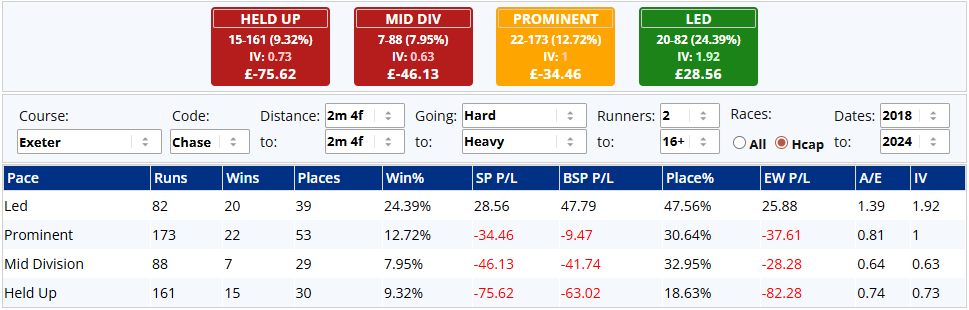


This is a good time to note that not all run style groups have the same number of runners; there are always going to be far more hold up horses than front runners / early leaders. However, despite the ‘led’ group having just 82 qualifiers compared with the held-up group of 161, they have still won 20 races compared with 15. The Win%s in the table show the strike rate within each run style group, and for this article that is how I will quantify ‘win strike rate’.

The ‘led’ group produced by far the highest percentage at 24%. That is, 24.39% of the horses that led early went on to win their races. (They actually won 31.25% (20/64) of all races in the sample).

Leaders' place percentage was comfortably the best too, with 47.6% of early leaders still in the frame at the finish line; while their A/E index of 1.39 indicates that front runners were very good value.

If we considered favourites only in these races and their performance by run style, we have seen the following win strike rates splits (I have combined favourites whose run style was either Mid Div or Held Up):
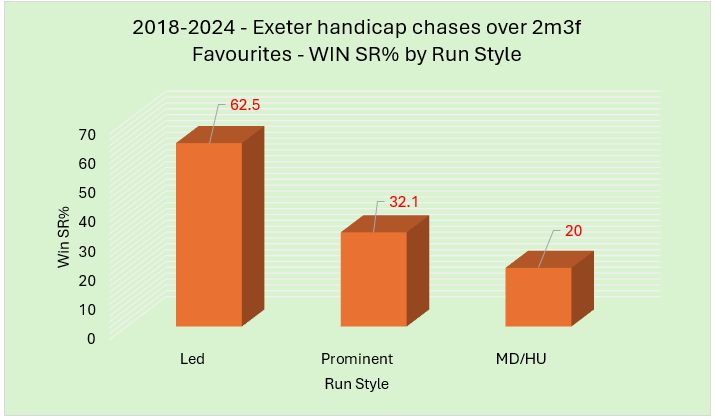


Front runners / horses that contested the early lead had an outstanding record when favoured by the market. However, it's a different story for those favourites that raced mid pack or at the back early. As can be seen, the bias over this course and distance has been very strong indeed, but still it wasn't quite enough to make my top ten. Exciting times ahead, then!

Before moving on, in terms of what has happened in 2025, of the eight races to date, five have been won by front runners.


Sedgefield 2m5f to 2m5½f

Using the Geegeez tools we use the 2m6f distance.
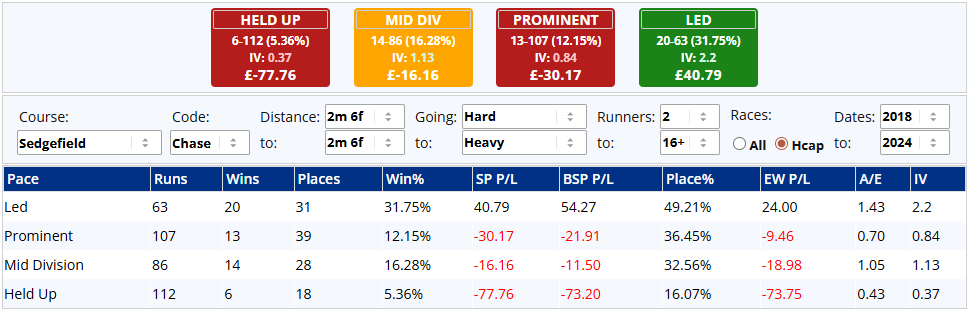


Front runners have hit a win rate in excess of 30% and the only reason this track/trip did not make the list is due to the relatively strong stats for horses that raced in midfield early. Also, the 2025 stats to date have seen horses racing mid-pack early doing well and winning three of the six races to date.


Lingfield 2m

The stats were as follows:
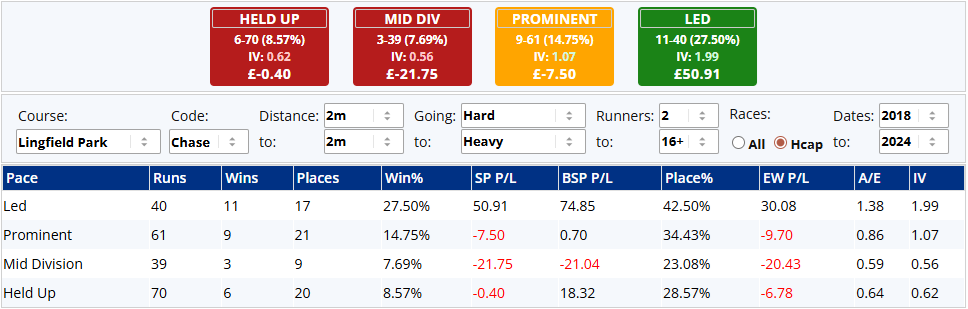


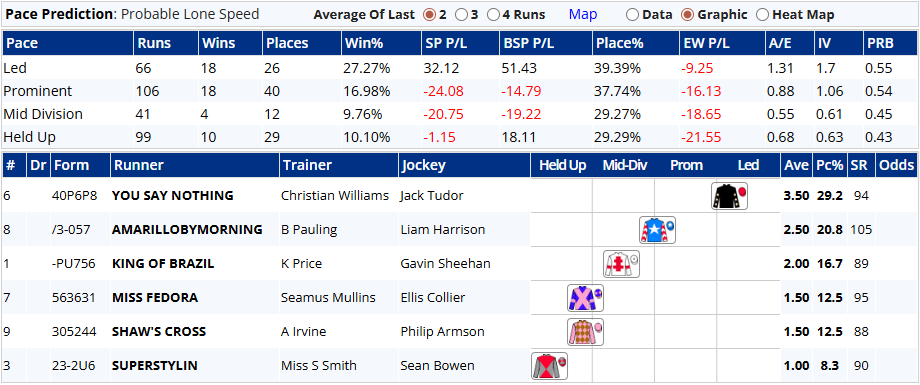
Strong figures again for front runners, although this is another course and distance (C&D) where qualifying races were relatively infrequent (only four races per year on average). Indeed, at the time of writing there has been just one qualifying handicap chase in 2025, but it was won by the early leader as we can see:


It is also worth noting that he was projected as the 'probable lone speed' in the race:


OK, near misses shared; onto position ten in my list.


Top 10, 10 to 6

#10 Chepstow 3m

Some readers may expect front runners to be at a disadvantage over longer distances in handicap chases: surely for a horse to lead from start to finish in a 3-mile race would not be any easy assignment, right? However, looking at the Chepstow breakdown I suspect might change a few minds!
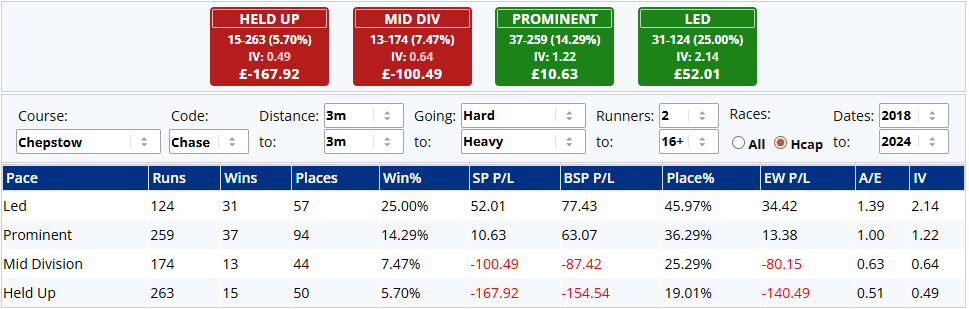


Front runners have bossed these races over the past few seasons, while prominent racers have been clearly second best with much better stats than horses which raced off the pace. 68 of the 96 winners raced close to the pace or at the front - that's 71% of the winners from 47% of the runners. And a front runner has been over four times more likely to win than a hold up horse when analysing the win percentage within their respective groups (25% versus 5.7%).

Now, as stated earlier, we get more hold up horses than front runners in most races and there were just over twice as many hold up horses compared to front runners between 2018 and 2024. That means therefore that when talking purely about race wins, front runners have won just over twice the number of races than hold ups.

There have been seven races this year so far with two being won from the front.


#9 Sandown 2m4f

It is time to head to Surrey now, and specifically Esher, to look at the 2m4f stats from Sandown. The run style splits for this time frame were as follows:
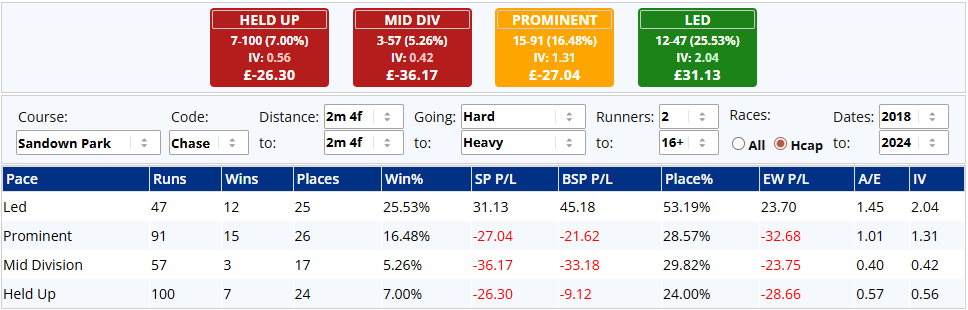


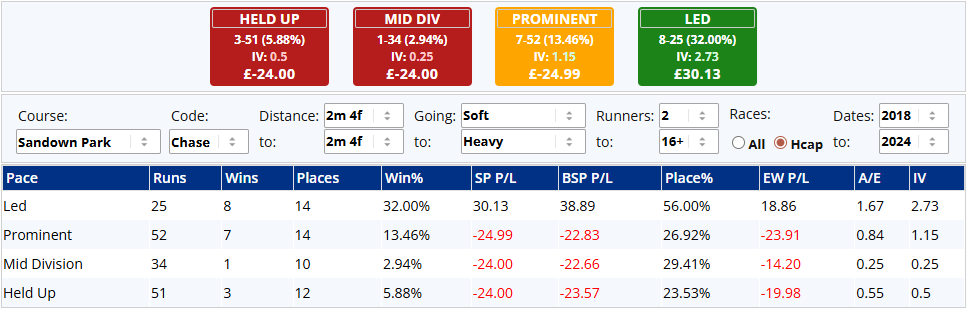
It's a similar story to Chepstow’s 3-mile trip but front runners have had a better place record here, hitting over 53%. There have not been that many qualifying races per year (roughly five to six) but keep an eye out for confirmed front runners when they race over this C&D. Those on the early lead have had an even stronger edge on soft/heavy ground as can be seen below:


From Sandown we head up country to Haydock.


#8 Haydock 2m3f-2m5f

Haydock seemed to have 'played around' a little with the usual 2m4f trip occasionally adding or dropping a furlong. Hence, I have combined results together a furlong either side of two and a half miles. Let me share the run style stats:
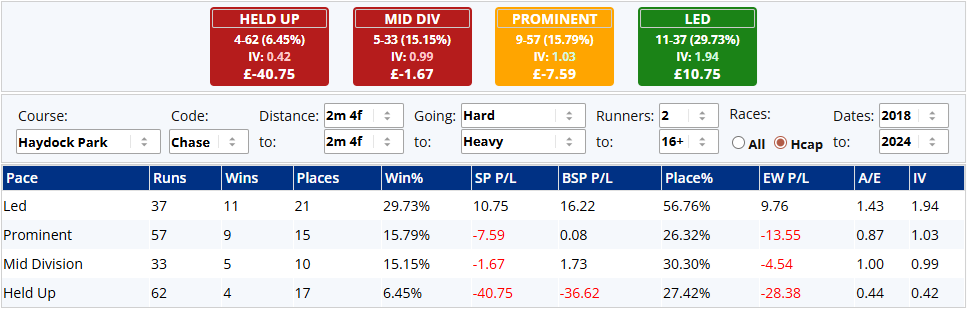


There has again not been a huge number of races each year, but the front running numbers were extremely strong over the period of study. 11 of the 29 races were won from the front and that cohort also had an outstanding place record. Hold up horses really struggled in terms of winning, though they fared better from a placed perspective.

Haydock, like Sandown, has seen the front running bias strengthen on softer ground. On soft or heavy the run style win strike rates were as follows:


It should be noted the sample size stands at only 17 races. The A/E indices correlate strongly as the graph below shows:
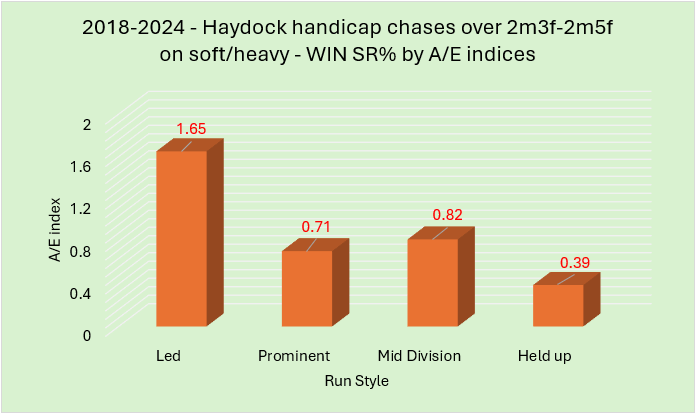


All in all, Haydock over 2m4f has strongly favoured horses racing at the front end.


#7 Carlisle 2m4f

Staying north for number seven, as we head to Carlisle next. The run style splits were:
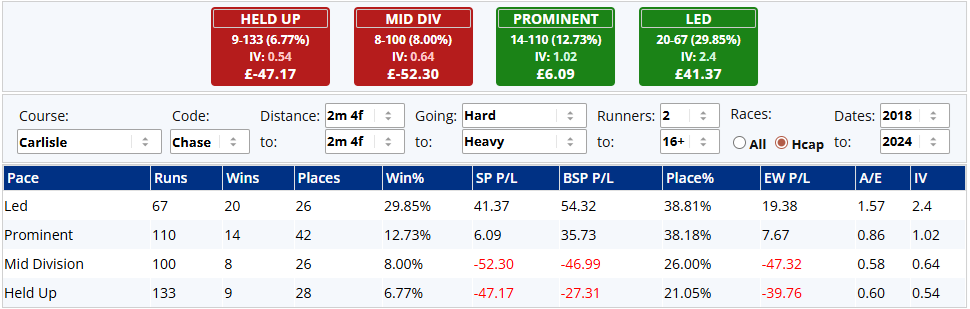


It could be argued that both Haydock and Sandown should be positioned higher than Carlisle in the list; but Carlisle’s overall sample size was bigger and that swung it for me, along with an outstanding A/E index of 1.57 and excellent IV of 2.4. The figures for both of these metrics were the highest of the four C&Ds shared to date, and comfortably so.

In terms of underfoot, once again we have seen a strengthening of the bias on softer ground. I will share the win strike rate percentages and the A/E indices once more. Firstly, the win stats:
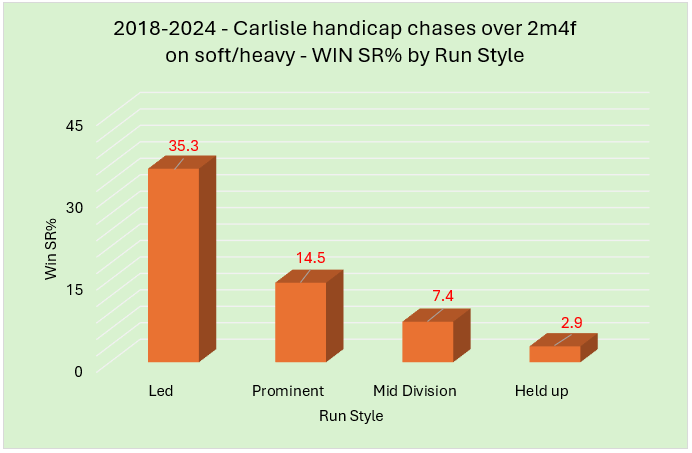


Clearly, as with the 2m4f trips at Sandown and Haydock, on soft or heavy it has been hard to make up ground from further back. 21 of the 27 races were won by front runners (12 wins) or prominent racers (9). Hold up horses had a win rate of under 3% within their run style group which is the lowest figure seen to date.

The A/E indices positively correlate with the win SR%s as we would have expected:
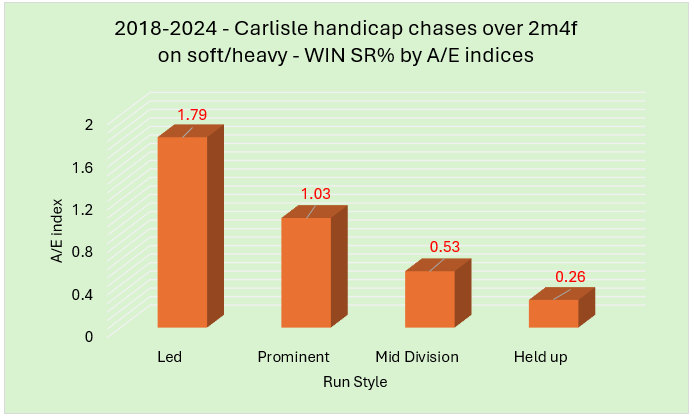


A ‘led’ figure of 1.79 suggests huge value; not so for the 0.26 hold up A/E index.

One final front running stat to share for this track and trip combination is connected with those early leaders that were in the top three of the betting market. This collective won 16 races from 36 qualifiers which equates to a win rate of over 44%.

This year, at the time of writing, there have only been four qualifying races over this C&D (all going conditions), and three of the four have been won from the front.


#6 Doncaster 2m3f to 2m4½f

Onto Donny now to close out the first half of my top ten. They have races over similar distances from 2m3f to 2m4½f so all races within that distance band are included (2m4f for all on Geegeez Pace Analyser):
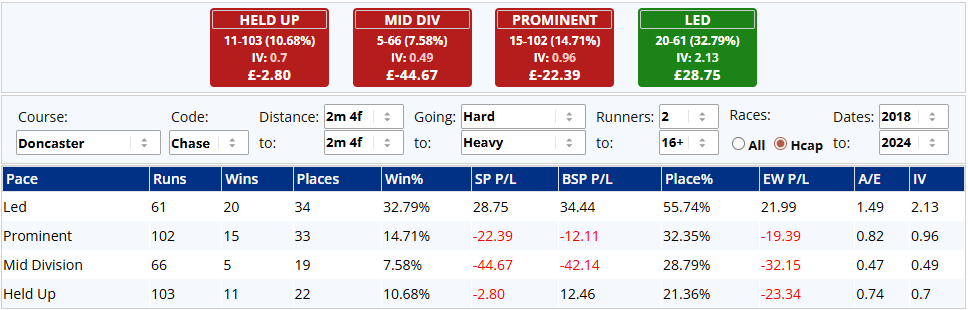


Front runners have won 20 of the 51 races and have an excellent placed record to boot. The ground is rarely testing at Doncaster, but on good to soft or softer the bias does seem to get even stronger:


11 of the 25 races, which equates to 44% of all races, were won from the front under these conditions.

If we considered favourites only at Doncaster and their performance by run style, we have seen the following win strike rates splits (I have once again combined favourites whose run style was either Mid Div or Held Up):
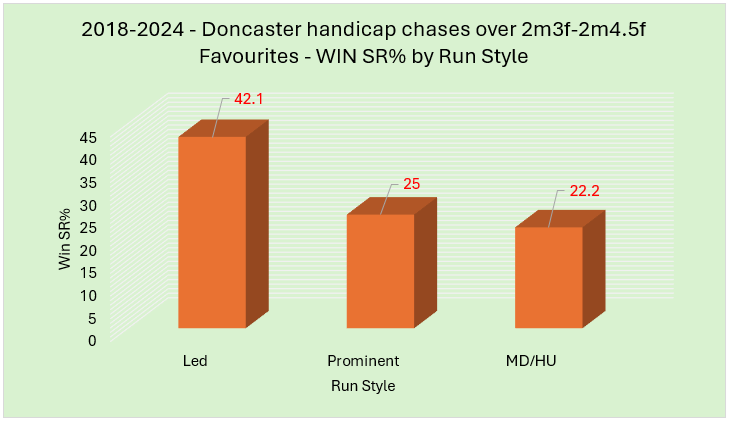
 

Favourites that led early have been far more successful than other run style groups.

And that rounds out the lower half of my top ten. Next time it will be the top five, some even stronger biases than these! Until then...

- DR


Specific Course/Distance Analysis: Lingfield 1m2f

I am a great believer in specialising when it comes to betting on horse racing, writes Dave Renham. When I ran my tipping service back in the early 2000s, I focused solely on five- and six-furlong handicaps. At the time I was doing a huge amount of research into draw bias, and it was when there was still a strong edge to be had over some course and distance combinations.


Introduction

Draw biases tend to be more prevalent over shorter distances hence the 6f cut-off point in terms of my tips. Focusing on a specific pool of races also meant I got to know many of the horses inside out, as sprint handicappers tend to run regularly during the year. Therefore, when I began to analyse a race I would have a solid knowledge of many, if not all, of the horses. Over time I started to spot other key patterns which would aid my selection process.

In this article I am going to look at one specific all-weather course and distance (C&D), making a deep dive into the plethora of related facts and figures. One could argue that looking for patterns for races from a specific C&D is a type of trends-based approach; I would agree. Trends, as a route into the horse racing puzzle, is much more fashionable than it was 30 years ago. Now we see 10-year race trends regularly in newspapers, and of course they've recently been added to the racecards here on Geegeez (as well as editorially more long-term for the big races, thanks to Andy Newton's contributions).

As I said, at the beginning of this year a TRENDS tab was added to the racecards which displays a range of information about the most recent renewals of the relevant race. Obviously not all races go back ten years, but it is a really useful addition to an already outstanding racecard. Essentially, then, this article could be considered a C&D trends piece looking at hundreds of races rather than just ten.

I am going to focus on handicap races only, ignoring nurseries (two-year-old handicaps) with data taken from 2018 to 2024, seven years' worth. Profits will be calculated to Befair Starting Price (BSP) with returns adjusted for commission. Looking at the results from a specific course and distance should hopefully give us good insight and potentially an edge over fellow punters in such races. For this article, I have chosen Lingfield over 1m2f.

Choosing a C&D on the all-weather means we are guaranteed plenty of qualifying races each year and Lingfield still hosts such races in the summer alongside flat turf contests. Indeed, there are three planned AW meetings in June in the height of the turf season and probably a couple of meetings where turf and AW racing is combined at the course. One or more 1m2f handicaps occur at most meetings.

This 10-furlong trip at Lingfield is not one I have looked at in depth before, mainly due to the fact that personally I still focus on shorter distance races when betting ‘on the level’. So, let’s find out more!


Betting market

I'll start with the betting market. The prices shown are to Industry SP, and the splits are shown below:


The value has been with horses sent off at industry SP's of between 13/2 and 12/1 with a solid overall profit to BSP. In fact, this group also snuck into Industry SP profit, too, albeit only just. Shorter priced runners have performed quite poorly and, looking specifically at favourites, they have lost over 14p in the £ to BSP. That compares very badly against the average for all-weather favourites at all courses in handicaps which stands at just over 6p in the £ during this time frame.

If I adjust the price groups slightly to create fewer price bands, we can see more clearly where the ‘value’ has been on the following graph which tracks A/E indices:


The graph also helps to confirm the earlier table's findings whereby the bigger price runners (14/1 or bigger) have been exceptionally poor value.


Position Last Time Out

Let's now see if the finishing position last time out (LTO) has offered any useful pointers:


In the time frame from 2018 to 2024 horses that finished first or second LTO have a good record when racing over 1m2f at Lingfield. The strike rate for both LTO winners and LTO runners-up are above the norm, as are the A/E indices. For both of them to be in BSP profit is impressive. When analysing 1m2f handicaps at Lingfield it makes sense to give this subset of runners at least a second glance.

Sticking with LTO winners/runners-up, those that raced at Lingfield LTO have the highest strike rate, at 24.5% (61 wins from 249), showing a BSP profit of £37.62 (ROI +15.1%). These runners would have secured a profit in five of the seven years.


Course LTO

We have seen already that a LTO run at Lingfield was a plus if the horse finished in the first two on that prior start. So what about when we look at all horses? How do the stats for LTO course stack up? To give a fairer picture I have restricted the qualifiers to horses priced 12/1 or less. This avoids the BSP bottom line being potentially skewed by huge priced winners. The table below shows the splits:


No course stands out as a super negative for the LTO run. The LTO Newcastle and Southwell results have been good albeit from modest samples. It is not a surprise that the most runners in Lingfield 10f handicaps also ran at Lingfield last time out; however, for that cohort to be (marginally) profitable from over 600 qualifiers is noteworthy.


Sex of horse

Anybody who has read previous articles penned by me on all-weather racing will know that males tend to outperform females in this code from a win rate perspective. That is the case again here as the table below shows:


Despite the SR% edge though, female runners have provided better returns. However, this is mainly due to two winning fillies going in at BSP odds of 110.0 and 145.1. If we restrict the results as before to horses with an SP of 12/1 or shorter we see the following:


Males have outpointed their female counterparts across the board here with a higher win percentage, bigger profits and a much higher A/E index. All in all, I would prefer the horse I was backing to be male over this C&D. One final stat worth sharing before moving on is that females aged five or older have struggled even within this price bracket. They secured just 18 wins from 160 runners (SR 11.3%) for a BSP loss of £38.26 (ROI -23.9%).


Class change from last race

Let's next examine whether a change in the class of the race has made a difference. Below I share the win strike rates for each group: those who have dropped in class from LTO, those that are racing in the same class, and those that have been upped in class:


Horses that have been upped in class have the best strike rate by far and they also have the highest A/E index across the three groups at 1.02. Horses dropped in class have an A/E index of 0.90, while those racing in the same class are at 0.80.

Horses upped in class have also made a decent profit to BSP of £122.76 which equates to a return of over 28 pence in the £. If we restrict these 'up in class' runners to those priced 12/1 or shorter to avoid potentially skewed results, they have still returned over 25p in the £. The evidence has a clear winner here.


Distance change from last race

Does the distance raced LTO have a bearing on results when running in a handicap over 1m2f at Lingfield? Let’s take a look:


Horses keeping to the same distance as last time out looks to be a positive. In fact, if we again use the same odds restriction (SP 12/1 or less) the LTO same distance subset have provided 149 winners from 812 runners (SR 18.3%) for a profit at Betfair SP of £83.49 (ROI +10.3%).

One very strong negative stat to share is that horses dropped in trip by more than two furlongs have won just 4.1% of the time (6 wins from 145) for huge losses of £110.16 (ROI -76%).


Course form

Does past course form count for anything? Well, if we compare previous course winners versus non-course winners there does seem to be a difference. In terms of win strike rate course winners have won 13.6% of the time compared to 9.8% for horses that have yet to win at the course. The A/E indices correlate with these figures as the bar chart below shows:


Now the ‘non-course winners’ group does involve a proportion of horses that have yet to run at Lingfield before. However, the A/E index for non-course winners that have raced at the track before is actually lower than the overall figure standing at just 0.79. Therefore, previous course winners have a definite edge over those that have yet to win at the Surrey venue.


Draw bias

Over longer distances the draw often becomes irrelevant, but it is always best to check some data rather than assume that is the case. The optimum draw position here seems to be from stall 5 to 7. This group of stalls has provided a strike rate of 13.4% with an A/E index standing at a very decent 1.03. Compare this to horses drawn 8 or higher whose strike rate is only 7.3% and the A/E is 0.71. The lowest draws meanwhile (1 to 4) have secured a strike rate of 11% with an A/E index of 0.82.

The chart below shows PRB3 (the average percentage of rivals beaten of a stall and its immediate neighbouring stalls), which corroborates the A/E narrative around stalls 5-7 (and indeed 8) being favoured.


As can be seen from the course map below, the mile and a quarter start is close to the winning line and thus presents only a short run to the first turn. This may explain why high draws are significantly unfavoured, with middle drawn horses perhaps able to find and hold a position close to the lead without using up too much energy so to do.


Although the draw is not perceived by many to be that important over this C&D, the numbers seem to suggest that higher draws (8+) are somewhat of a negative, with an ideal berth being five to seven stalls off the inside rail.


Run Style bias

In many previous articles I have shown the importance of run style. Run style can have a big say in shorter distance races on the flat/AW where front runners/early leaders often have an edge. Let's see whether there is any run style bias over 1m2f at Lingfield? Firstly, let us look at the win percentages for each group. Because each run style group has a different number of runners, we essentially use a wins to runs ratio to calculate the win% rate:


Front runners do not enjoy an edge here and are in fact only the third best group in terms of win ratio. It seems that a position close to the pace or in midfield is best. The percentages for win and placed runners also suggest prominent runners are the best group, and by a more significant margin.


These two sets of percentages are suggesting that a prominent sit is best over this C&D with a spot in mid-division more preferable than taking the early lead or being near or at the back early. It should be noted that combining the run style with the positive draw section of stalls 5 to 7 we get the following splits:


Hence if drawn in one of the favoured stalls - five, six or seven - it is definitely advantageous to race prominently or mid-division. This is further demonstrated in the PRB (percentage of rivals beaten) draw / run style heat map below:


Key takeaways

Below is a summary of the main findings from this delve into Lingfield 1m2f handicaps:

1. SP price range of 13/2 to 12/1 has been positive. Favourites have offered bad value. Horses 14/1 or higher have performed very poorly

2. LTO winners / runners-up have a very good record

3. Male runners priced 12/1 or shorter outperform their female counterparts

4. Horses upped in class have done best

5. Horses racing over the same distance to LTO are the best LTO distance group to concentrate on, especially if priced 12/1 or less

6. Past course winners have a definite edge over horses that have yet to win at the track

7. Horses drawn 5 to 7 have outperformed those drawn lower or higher

8. Prominent racers/mid division have a better record than holdups / front runners.


**

Undertaking this type of specific course and distance research can throw up some excellent insights to potentially aid the selection and betting process. If you have a specific C&D you'd like to see some key stats for, please drop a note in the comment section. I will do my best to do some initial digging.

- DR

Top Ten All-Weather Front-Running Biases

A few weeks back I looked at some recent run style data in National Hunt racing, writes Dave Renham. You can view part one here and part two here. It has been three years since I last looked at all-weather run style biases so, in this article, I will re-visit that topic and share the top ten front-running biases in terms of course and distance (CD) combinations. Well, my top ten anyway.

Data has been taken from 1st January 2020 to the present day with the focus on UK courses. I have concentrated on handicaps with seven or more runners which gives us a decent sample size for each CD. It should be noted that the surface at Southwell changed at the end of 2021 so for this course I have taken data from that later point.

Introduction

Regular readers may skip the next couple of paragraphs to the dashed line, as I explain the terminology and methodology. What we mean by run style is the position a horse takes up early on in the race, normally within the first furlong, which often defines its running preference. geegeez.co.uk has created some powerful resources to look at run style in the Tools tab, as well as an individual race view within the 'Pace' tab on each racecard. The research tools are the Pace Analyser and the Query Tool which Gold subscribers can use to undertake this type of research. Running style is often linked with the word ‘pace’ because the early pace shown by horses in a race determines what position they take up within that first furlong or so. Hence, for many, the words run style and pace are interchangeable. 

The stats I am sharing here are based on this site’s pace / run style data. The data on Geegeez is split into four brackets – Led (4), Prominent (3), Mid Division (2) and Held Up (1). The number in brackets is the run style score that is assigned to each bracket.

The numbers are really helpful as they enable us to drill down into them to build a better picture and understanding of how important run style can be. Below is a basic breakdown of which type of horse fits which type of run style profile:

Led – horses that lead early, horses that dispute the early lead. I refer to the early leader as the front-runner.

Prominent – horses that lie up close to the pace just behind the leader(s).

Mid Division – horses that race mid pack or just behind the mid-point.

Held up – horses that are held up at, or near the back of the field.


-----------------

Top Ten All-Weather Run Style Biases

It is time to start the countdown:

10. Kempton 7f

Over 7f at the Sunbury-on-Thames track front-runners have won 56 of the 289 races which equates to 19.4% of the sample. Hold up horses have won one more, giving them a total of 57 winning races (19.7%). However, on average there have been three to four hold up horses in each race (actual average for Kempton 7f = 3.54), whereas front-runners have (led or contested the lead) averaged 1.23 runners per race. This means that an individual front-runner has been nearly three times as likely to win as an individual hold up horse.

Looking at the A/E indices for all four run styles helps to demonstrate the front-running edge:


An A/E index of over 1.00 indicates ‘value’, so 1.25 means front-runners are good value. Hold Up horses, however, at a lowly A/E index of 0.6 have offered very poor value to bettors.


9. Lingfield 6f

Staying in the south we move to Lingfield. Splitting the run style results by A/E indices again, we see similar figures for front-runners and hold up horses at the 6f trip there to those we saw for Kempton’s 7f trip:


Here we have the more traditional run style graph sloping down from left to right when there is a front-running bias ‘in play’. In the graph for Kempton’s 7f, the 'mid-division' figure was higher than the 'prominent' one, which is slightly unusual.

At Lingfield over six furlongs, just over 20% of all races have been won by the front-runner(s). If, pre-race, you had predicted the early leader(s) in every qualifying 6f handicap you would have made a profit to SP of £65.05 to £1 level stakes. This equates to returns of just over 25 pence in the £. Of course, it's not always that simple.


8. Chelmsford 1m

This is only time a mile race distance makes the list. Generally, the shorter the distance the stronger the front-running bias. Chelmsford is the only course to have four different distances in the top ten and is a very strong contender for the most front-runner favouring circuit. Below is a table comparing the wins to runs ratio within each run style group, as well as their each way stats, A/E indices and Impact Values (IVs): 


As the table shows, front-runners are clearly best across all metrics. They have won over 16% within their group, which due to the occasional race where two horses vie for the early lead, actually means that 20.6% of all races have been won by these pace setters. The A/E index of 1.30 is the highest we have seen so far.


7. Kempton 6f

Back to Kempton now and the slightly shorter 6f trip. 21.2% of all races over this track and range have been won by the front-runner(s), and if you had backed them pre-race at £1 level stakes using your crystal ball, this would have turned a profit of £99.05 (ROI +30.6%). Compare that with backing all mid-division runners (ROI -36.7%) and/or all hold up performers (ROI -38.7%). If we look at the Impact Values, we see how strong the bias has been.


Front-runners have secured the highest IV to date, winning roughly 1.7 times more often than the average, while prominent runners have also performed well. Indeed, backing all horses that raced prominently would have returned a small 5p in the £ profit. In terms of A/E indices the front-running figure is high again at 1.25, prominent stands at 0.98, with mid div at 0.70 and hold ups at 0.73.


6. Chelmsford 6f

The second Chelmsford distance to hit the top ten is the 6f trip. Below is a graph showing both the A/E indices and the Impact Values for each run style group:


These are the highest figures seen so far for front-runners on both of these two metrics. Also, the hold-up numbers are extremely low in comparison. Front-runners have a significant edge at this trip winning a quarter (25%) of all races. Essentially an individual front-runner has been 3.6 times more likely to win than an individual hold up horse.

Not only are the win stats powerful for front-runners but the each way stats are extremely strong for this CD as well. If able to predict all front-runners’ pre-race one would have made a profit of £80.75 to £1 win bets, equating to returns of just under 30p in the £. Betting front-runners each way, the profit would have stood at a highly impressive £150.93.


5. Wolverhampton 5f

The first and last appearance for Wolverhampton in the top ten is over the minimum trip of five furlongs. Here are the A/E indices over this CD:


This front-running bias is similar to the last two CD combinations but when we look at the potential returns, we will see why I have put it above those two:


Front-runners would have returned close to 50p in the £ to £1 win bets, while prominent runners were close to breaking even. Backing all hold up horses would have lost you a whopping 72p in the £. Going back to front-runners, they have been able to win from any draw position and middle to higher drawn front-runners have been much better value than low drawn front-runners.

In terms of other distances at Wolves, front-runners do have an edge over 6f here at the Midlands track (A/E index 1.19), while over 7f prominent runners have the edge and hold up horses really struggle.


4. Chelmsford 7f

The third entry for Chelmsford, this time over 7f. I have graphed both the A/E indices and the Impact Values for each run style group to help illustrate the strength of the bias:


Strong positive correlation with both lines virtually mirroring each other. Front-runners have provided excellent value, while prominent racers too have edged above the magic 1.00 A/E figure. It is hard to win over this CD when taking up an early position in midfield or further back.

It is also worth sharing some data for Chelmsford 7f when combining the draw with run style. Below is the heat map which was generated from the Draw Analyser on the Geegeez site showing the A/E indices:


Somewhat surprisingly perhaps, the front-runners drawn widest (the high group) have fared exceptionally well and presented far better value than those horses drawn middle to low. The win percentage stats back this up, too:


Nearly 30% of the horses drawn in the top third of the draw have won when they have taken the early lead. These runners have won 16 races from 54, with a further 14 finishing 2nd or 3rd. The long run to the first bend, which gives the whole field a chance to make the lead, may be a factor:


The last stat to share for this CD is that each individual front-runner has been 3.93 times more likely to win than an individual hold up horse. As the heat maps above show this disparity becomes more potent the wider the draw.


3. Southwell 5f

This is the sole appearance for Southwell, and it is a top three entry over their straight 5f track. Let us start by comparing the wins to runs ratio within each run style group:


A very clear bias to front-runners and these figures correlate strongly with the A/E indices as shown below:


The 1.6 value for front-runners is comfortably the highest to date, while the prominent figure is the lowest.

It should be noted that front-running favourites have performed extremely well winning 43.9% of the time, while front-running second favourites are not far behind winning 37%. Compare this with favourites that were held up who have won less than 19% of the time and held up second favourites have won just 7.7% of the time!


2. Chelmsford 5f

The minimum trip at Chelmsford is second on my list but, to be fair, the top two CD combinations could have been reversed. To begin with let me compare the A/E indices and the Impact Values for each run style group:


The A/E index for front-runners is huge hitting just under 1.7, while prominent runners have also performed very well. Indeed, if you had backed horses from both run style groups pre-race you would have seen returns of 46p in the £ for front-runners and 18p in the £ for prominent racers. Meanwhile midfield runners lost 36p in the £ and hold-ups 42p.

In terms of Percentage of Rivals Beaten (PRB), front-runners stand at a huge 0.67 (67% of rivals beaten), whereas hold up horses are down on just 0.40. Finally, front-runners that were in single figures (SP 9/1 or less) won 39 races from 109 (SR 35.8%), whereas those priced in double figures (SP 10/1 or more) won just one race from 58 (SR 1.7%). Clearly front-runners that have started in single figures in the betting have offered punters enormous value over the past five years.


1. Lingfield 5f

Top of the tree (just) is the 5f distance at Lingfield. The A/E indices show that front-runners have offered better value here than at any other CD:


If pre-race you had predicted the front-runner or front-runners in every qualifying 5f handicap you would have made a hefty profit to SP of £128.03 to £1 level stakes. This equates to returns of 86 pence in the £! All the profits/returns quoted in this article have been calculated to Industry SP, so just imagine what the Betfair SPs would have paid.

Finally, I want to share some draw data for this CD when combining the draw with run style. Below is the heat map showing the PRBs – again this can generated by using the Draw Analyser - available to both Gold and Lite subscribers - on the Geegeez site:


Front-runners drawn middle to high have ridiculously high PRBs above 0.70. In contrast, hold up horses have very poor PRB figures regardless of draw position.


--------------------------

Conclusion

The positions in the top ten for each course and distance are, to some degree, subjective and there are few ‘next door’ positions that could easily have been placed the other way around. However, regardless of whether my order is 'correct' or not, what is clear, is that these ten combinations give front-runners a strong edge. Conversely, hold up horses are always at a serious disadvantage. The flat racing pattern that we have seen before, where the shorter the distance the better for front-runners, has been in evidence again here with four of the top five being 5f distances.

Of course, in terms of each individual contest, the run style groupings cannot be calculated until after the race, because before the race we do not know who will lead, who will track the leader, etc. Hence any profit figures or returns quoted can only be calculated after the event also. When quoting the profits / returns in this piece my aim has been to highlight why front-runners are potentially such good value.

As we know, predicting the front-runner is far from an exact science but the pre-race pace/run style figures found on the Geegeez Racecard are a very good starting point. Indeed, just for fun I have started to check some results of the top-rated pace/run style runners at Chelmsford in 5f handicaps. Currently I have back checked the last 63 races, which covers two years, of which the top-rated horse has won 11 times from 67 for an SP profit of £11.28 (ROI +16.8%). An encouraging start.

For the eagle-eyed amongst you, the reason there have been 67 top rated runners in 63 races is because in a handful of races there were joint top-rated runners and hence both were included. Perhaps even more exciting is that, if you had placed a £1 reverse straight forecast on the top two rated runners over these 67 races, you would have had six winning bets securing a profit of £106.26. Betting the Exacta instead would have been even more successful hitting a profit around the £150 mark. This type of research is labour intensive as one needs to check one race at a time, but over the next few weeks and months I plan to slowly trawl through more all-weather track/trip combinations to see whether a profit can be made using the racecard pace/run style figures.

Until next time...

- DR
 

Post Script: Using Pace on Geegeez

In support of Dave's excellent article, I've (Matt) recorded a short video to illustrate different ways you can see which horses are likely to lead over these potent track/trip combo's.

And a reminder that our Winter Special offer - big discounts on both Lite and Gold subscriptions - closes tomorrow (Thursday). So go here now if that's of interest.

- Matt

Tix Picks, Thursday 28/11/24

Thursday's racing comes from Lingfield, Musselburgh, Taunton and Thurles.
If you're new to Tix Picks, it's worth taking a moment to review the links in the next section; if you've been before, let's crack on...

What is Tix?

A video explainer can be found here.

You need a tote account to use Tix. Sign up for one here >

A few more pointers can be found in these articles:

https://www.geegeez.co.uk/exotic-betting-multi-race-bets-part-1/

https://www.geegeez.co.uk/exotic-betting-multi-race-bets-part-2/

Today's pools

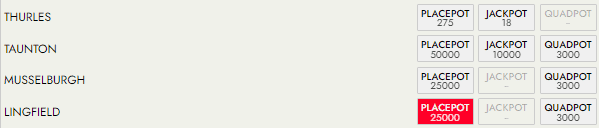
Today's meetings, pools and minimum guarantees are as follows, including a £50,000 placepot guarantee at Taunton...

Taunton looks a bit novice-heavy for my liking, so let's head to Lingfield and some soft ground for six races starting with...

Leg 1 @ 12.35... (1) Chankaya probably needed the run at Uttoxeter four weeks ago when only 10th of 11 on his debut for Tim Vaughan, having ended last season eight months earlier with a win at Taunton. Should put up a better show 2lbs and one class lower and with the benefit of having had a recent run. (3) Just Chasing May looks like a horse on the up and has finished as a runner-up in both races this term since coming back from a 130-day break that followed his five length win at Uttoxeter in mid-June and he looks the one to beat here.

(5) Twp Stori is another who probably needed to pipes clearing out when running for the first time on over five months at Uttoxeter six weeks ago. That time he was a creditable 5th of 14, beaten by 8 lengths over an inadequately short 2 mile trip. Prior to thar break/run, he had finished 3212 over longer trips. he stays 3m2f, he gets soft/heavy ground and runs off the same mark as when second at Uttoxeter over 3m on his penultimate outing. (8) Getaway With You completes my shortlist here, despite being a 13-race maiden over hurdles. The truth is that he flopped when sent off as the 3/1 favourite in a 14-runner handicap over 3m1½f at Huntingdon at the start of the month, finishing 8th, 21 lengths adrift of the winner, but his previous form had read 3262 and he's down in trip here.

That said, Getaway With You makes the least appeal of the four and I'm going with (3) Just Chasing May & (5) Twp Story with (1) Chankaya my alternate.

Leg 2 @ 1.10...I was really interested in Plantaroma when I had a cursory look at the card last night, but she's a non-runner now, effectively making this all about the hat-trick seeking (5) Jasmine Bliss, who comes here after a soft ground Class 4 bumper win and another on heavy ground at Class 2 last time out. We'll assume she can jump (Harry Derham is no mug), so the only possible issue is her fitness after nine months off.

(9) Solid Silver is probably the one most likely to challenge of those with racecourse experience, also on hurdles debut. She made the frame in a Listed bumper almost a year ago and was in the frame in back to back 2m A/W handicaps this summer and was only beaten by a length and a half here at Lingfield over 2m last time out, albeit on the polytrack. Like the main pick, we take a chance on her jumping, but she possesses decent ground speed

We should also take a newcomer and the eye catcher is (10) Holloway Queen who was a runner-up in her sole PTP race, beaten by just a length at Monks Grange. She was then sold for the thick end of 200,000 Euro and when you see the names De Boinville & Henderson, there's always a chance and she might well be better than Solid Silver!

Leg 3 @ 1.45...This isn't a strong race by any means and despite an 8lb rise, top weight (1) Vision De Maine should be the one to beat, as he comes here seeking a hat-trick after winning over 3m at Uttoxeter on his chase debut six weeks ago despite coming off a six month break before a course and distance success here sixteen days ago. (2) Airtothethrone has only won one of thirteen over fences, but generally tends to be there or thereabouts, finishing 42F4F2324 since the start of March '23, mainly at trips similar to today (but does stay 3m3f) and mainly at Class 4 (so he drops in class here). he handles soft ground well enough and could well be in the mix once more today.

(4) Aworkinprogress also comes here on a hat-trick after a pair of heavy ground successes over 2m6f/2m7f. He won a Class 4 handicap hurdle at the end of March at Fontwell, then had 205 days off before scoring on his chase debut at Stratford almost six weeks ago and I fully expect him to go well again here. (5) Camulus completes my shortlist and he's another with a poor record from a win perspective, coming here at 0/1 in bumpers, 0/4 over hurdles and 0/4 over fences, but he was third on chase debut at Fakenham in February 2023 and a runner-up here over course and distance off the back of a year off in February this year. he gets soft/heavy ground, he gets today's trip and his 266 days off are shorter than the last long break he had! Throw in a couple of paced efforts over hurdles and there's a chance, albeit small, that he's involved here today.

Of those four above, Camulus is probably the one I should omit, leaving me with (1) Vision De Maine, (4) Aworkinprogress & (2) Airtothethrone as my 1-2-3.

Leg 4 @ 2.20...(2) Nachtgeist made the frame on the Flat in a Group 2 race at Cologne in June 2023 and was a runner-up over hurdles at Huntingdon in early October. Didn't go quite as well at Ascot last time out, but this race shouldn't take much winning and he was a runner-up at Plumpton in a 2-mile hurdle on soft ground in January, so the underfoot conditions shouldn't be an issue. (2) Speiriuil probably needed the run when only 7th of 18 at Chepstow three weeks ago, coming off the back of a six month absence. He's entitled to come on for having had the run and when you consider that his other five appearances resulted in finishes of 32242 on mainly soft and/or heavy ground, you'd have to expect him to enjoy this one.

(6) Stardhem was a nose ahead of Speiriuil in that race at Chepstow, as he made his handicap debut after an absence of 201 days. He should also improve for having had that run and the benefit of handicap experience and Ben Pauling's runners always command respect, especially here at Lingfield where his handicap hurdlers have finished 181121. Stardhem is 2lbs better off with Speiriuil today and although his form line doesn't scream winner, there's no reason why he can't confirm the placings with that slight weight advantage.

(7) The Cox Express is probably the one most likely to challenge the trio above, but he's going to have to step up a long way from last time out, when he too ran in that afore-mentioned race at Chepstow 22 days ago, finishing just 11th of 18 and 33 lengths further back than Speiriuil. That said, he had been off the track for six months and did make the frame in three of his last four runs last spring. he has gone well in the mud previously, but I think he's going to need things to fall his way to make the first three home today, so I'm with (6) Stardhem, (2) Nachtgeist & (2) Speiriuil.

Leg 5 @ 2.55...This one has fallen apart somewhat with five of the original fourteen runners now not lining up. The ones I'd be most interested here would be (2) De Kingpin and (6) Miller Spirit

De Kingpin drops in class here after a decent effort at Sandown on hurdles debut 18 days ago, finishing 3rd of 8, beaten by just a length and a half some 252 days after a runner-up finish on race debut in a heavy ground Doncaster bumper. I mentioned Ben Pauling's Lingfield hurdlers earlier and I'd expect this one to be on the premises too.

The main danger should come from Miller Spirit on his hurdling debut. Ground speed won't be an issue for a 4yo whose form on the Flat over the last six months reads 114241116 with that last defeat not as bad as it seems with it being the 23-runner, Class 2, November handicap at Doncaster where he was beaten by less than three lengths 19 days ago. He's clearly fit, his last five runs have been on soft or heavy ground and his yard won this race in 2022.

Elsewhere there's little appeal, so I'll just take these two.

Leg 6 @ 3.30...And the finale has been decimated too with only 8 of 15 going to post and the one I was most interested in (Dromlac Jury) is one of the withdrawal. Another of my overnight shortlist, Ascension Day, also won't run here, so I'm left with just three of my 'originals', namely (4) Barest Of Margins, (5) Hokelami & (6) Superstylin, so I'll be taking this trio.

Barest of Margins is a perennial placer despite being an 11-race (2 x NHF, 2 x hrds & 7 x chase) maiden. He has failed to complete twice, but his other nine races have seen him finish 24 in bumpers, 33 over hurdles and 22232 over fences. he was only beaten by two lengths last time out, headed in the last half of seventeen furlongs, so the drop in trip should help here off the same mark.

Hokelami looked like needing a run when 5th of 8 at Ffos Las last month off the back of a 202-day absence, but he had won two of his four handicap chases this year prior to his break, including a nine lengths success over 2m1f at Sedgefield on soft ground in March. He is, admittedly, still 5lbs higher than that win and has every right/chance of bouncing back into the frame here, but the one to beat is possibly/probably Superstylin.

Superstylin actually won this race last year by 4.5 lengths on his chase debut. He was then rested for three months before racing three times inside four weeks last March finishing 323 with the first two on soft ground. If he returns in the same vein after an eight month break, he's be the one to beat for me with my 1-2-3 reading (6) Superstylin, (4) Barest Of Margins & (5) Hokelami

*

All of which gives me...

Leg 1: (3) Just Chasing May, (5) Twp Story & (1) Chankaya

Leg 2: (5) Jasmine Bliss, (10) Holloway Queen & (9) Solid Silver

Leg 3: (1) Vision De Maine, (4) Aworkinprogress & (2) Airtothethrone

Leg 4: (6) Stardhem, (2) Nachtgeist & (4) Speiriuil

Leg 5: (2) De Kingpin & (6) Miller Spirit

Leg 6: (6) Superstylin, (4) Barest Of Margins & (5) Hokelami

...and here's how I'd play them, whilst trying to stay close to a nominal £20 total stake...

Good Luck, everyone!
Note : I'm off tomorrow (out tonight!), so I'll be back on Saturday.
Chris

Tix Picks, Wednesday 13/11/24

Wednesday's UK placepots can be played via Tix at Ayr, Bangor, Lingfield & Southwell.

But, what is Tix?

A video explainer can be found here.

You need a tote account to use Tix. Sign up for one here >

A few more pointers can be found in these articles:

https://www.geegeez.co.uk/exotic-betting-multi-race-bets-part-1/

https://www.geegeez.co.uk/exotic-betting-multi-race-bets-part-2/

Today's pools

Today's UK meetings, pools and minimum guarantees are as follows...

Bangor looks too 'novice-y' for my liking and there are only 37 runners at Ayr in total, so we'll stick to the A/W again today and as we did Southwell yesterday, let's head for Lingfield where the polytrack is said to be standard as usual for...

11.35 Lingfield, an 11-runner, Class 5, 3yo+ handicap over 1m2f...

Obsidian Knight, Masqool and Forge Valley Lad have all won over course and distance and Obsidian Knight has a 56% (9 from 16) place strike rate on the A/W. Achillea won two starts ago and Star Pupil won three races back, as did Crafter, whilst bottom weight Moon Over The Sea has made the frame in 7 of his 10 starts this year, including two wins.

Three of the runners that caught my eye from a place perspective are on their last winning mark or lower today...

Sadly there's no real pace in the race today...

...so I'll rely on Instant Expert more here and take C&D winners (1) Obsidian Knight and (6) Masqool plus (11) Moon Over The Sea, who should offer more value than Achillea in the market.

12.05 Lingfield, a 6-runner, Class 5, 3yo+ handicap over 1m4f...

Turner Girl has been in the frame in 3 of her last 5 and has a 50% career place strike rate on both the Flat (9/18) and the A/W (7/14) and was a decent third of sixteen last time out. Sun Dancer has won three of her last five but was last home of seven over course and distance 11 days ago and has been eased a pound by the assessor.

This pair along with Glimmer of Light also seem the more likely from a pace perspective...

...and also from an Instant Expert angle...

(1) Turner Girl is the one I'd want to be with and with concerns over Sun Dancer's poor run over C&D off just 1lb higher last time out, I'll take the unexposed (3) Glimmer of Light as my alternate.

12.35 Lingfield, a 12-runner, Class 5, 2yo novice stakes over 1m...

No past winners here and three of the twelve are on debut. Of those with a run, (1) Al Shababi was a runner-up on debut four weeks ago less than a length behind a runner rated 95 who had already won at Class 2 and (2) Best Rate was third a week earlier. (7) Present Times has the benefit of two runs under his belt and has been both second and third so far and drops in class here.

Venezuelan drops three classes here and might be popular with his yard going so well at the moment, but he blew the start on debut and the three named above make more sense to me at the moment and all three are drawn high, which is often a positive here.

1.05 Lingfield, an 11-runner, Class 5, 2yo novice stakes over 1m...

The second division of the above race looks weaker and trickier to call with five of the ten runners making their racecourse bows. All five with a previous run drops in class and it's the first two on the card that make most appeal.

(1) Cape Breton is a son of Frankel, cost 450,000gns as a yearling and is a half-brother to To Catch A Thief who is a 3-time winner between 1m1½f and 1m3½f including a Class 2 handicap last time out. (2) Charming Life was 4th of 15 on debut at the start of the month and showed some early promise and a willingness to get on with things and he's a €400,000 yearling, Dubawi gelding and half brother to Opera Mundi who won a 7f Listed race in France as a 2yo this time last year.

A debutant often makes the frame in this level of race and to be fair it wouldn't take much and despite the fact that he's going to be a huge price, I quite like the look of (4) Gemmari. He's by Expert Eye and a half-brother to a few winners including Gemina who won over 7f as a 2yo, Gibeon a winner at both 7f and 1m2f and also Gendarme who won at 1m2f to 1m4f on the flat and over hurdles at 2m. All came out of the dam Gravitation who won a Group 3 race over 1m6f.

1.37 Lingfield, a 9-runner, Class 3, 3yo+ handicap over 7f...

Final Voyage is sent over from Ireland for this one having a win and two places from his last five starts and was third over 6f at Dundalk last time out. Dual 7f winner Bobby Bennu is still relatively unexposed after just six races and was a runner-up last time out, a little unlucky to run into a horse winning for the third time in four starts.

Blue Prince has made the frame in five of his last seven and is a bold confident type used to running in bigger fields than this. Local Hero has also won two of his six starts, Cill Mocheallog has a win and two places from four, whilst Lady Dreamer has three wins and a place from her last five.

But my preferences here are (1) Final Voyage, (2) Bobby Bennu & (3) Blue Prince

2.07 Lingfield, a 12-runner, 3yo+ fillies Listed stakes over 1m5f...

The bookies have only got four runners at 8/1 or shorter here and I think they've got it right. (1) Sea Theme (by Sea The Stars) was mid-division in the 14-runner Group 1 Champions Fillies And Mares Stakes at Ascot, has already won two Listed races and her yard (Wiliam Haggas) has won this race in the four of the last seven renewals. (4) Scarlett O'Hara was second to Sea Theme in a Listed race at Clairefontaine back in July. She was beaten by 4.5 lengths that day and might get closer here now 3lbs better off.

(10) Madame Celeste won over a mile at Dundalk on debut almost a year ago and has since been a Group 3 runner-up beaten by a neck at Naas and suffered a similar fate behind Bellezza in the Diamond Stakes at Dundalk over 1m2½f seven weeks ago on her last run. She likes to race prominently and it is hoped that first time blinkers do the trick here. (11) Meribella is also by Sea The Stars and has won at 7f and 1m4f, winning over the longer trip at the Doncaster St leger meeting two months ago on her last run, beating the useful filly Cabrera by a short head.

I agree with the bookies that Scarlett O'Hara is probably the most vulnerable of the four, so she's the one I'll omit as I go with (1) Sea Theme, (10) Madame Celeste & (11) Meribella for the finale.

*

All of which gives me...

Leg 1: (1) Obsidian Knight, (6) Masqool & (11) Moon Over The Sea

Leg 2: (1) Turner Girl & (3) Glimmer of Light

Leg 3: (1) Al Shababi, (2) Best Rate & (7) Present Times

Leg 4: (1) Cape Breton, (2) Charming Life & (4) Gemmari

Leg 5: (1) Final Voyage, (2) Bobby Bennu & (3) Blue Prince

Leg 6: (1) Sea Theme, (10) Madame Celeste & (11) Meribella

...and here's how I'd play them, whilst trying to stay close to a nominal £20 total stake...


Good Luck!
Chris

Monday Musings: A Rare Weekend Indeed

Rather more than fifty years ago, when I was serving my mercurial time at the Press Association in Fleet Street, if you had suggested staging a big-money jumps card at Lingfield in late January, they would have been sending the idea’s originators to the nearest psychiatric ward, writes Tony Stafford.

In those days the PA was the principal provider of all the information on racecourse going reports, jockey and trainers’ plans and the technological developments we all take for granted were still decades away. So we dozen or so on the in-house team, bolstered by at least as many outside reporters, would get all the information first.

It was quite handy in the days of Jockey Pools when some of the more unscrupulous members would withhold jockey changes to the newspapers, their principal clients, on a Friday night until James Lambie could get the teams’  last-minute coupons down to Euston station in time for the final permitted mail delivery for Liverpool.

We used to collect almost every week and sometimes for a nice few bob. In those days the office was split between journalists (so-called) and clerical staff, but it was we journos who master-minded the selections while generally the much bigger clerical team would simply spy and feast on them.

After seven or eight winning weeks in a row, one Sunday morning, one of their contingent came over to our desk and said: “How did we miss Edward Hide?” Cheeky bugger!

I just recalled that portion of those days when the biggest joke was about Lingfield. In the era either side of World War 2, and presumably before that, the minimum requirement for a clerk of the course was an army commission and Major was the most common.

Peter Beckwith-Smith at Lingfield had carried that rank during the war years and, as was also the tradition, into his civvy street activities for ever afterwards. He was one of the more optimistic of clerks.

The joke was that when going out on a boat to assess the prospects of racing a couple of days ahead of a Lingfield fixture, he took out his stick, leant precariously over the edge and searched for the bottom. Later in his bulletin to our office he pronounced without a hint of irony: “Underneath the water the going is good to soft”!

That’s just a flavour of how absurd it would have been in those days to schedule any meaningful meeting in January. They sometimes used to get away with the late December meeting which included one of the first informative juvenile tests of the year, but January was usually a write-off or, rather, a wash-out.

Drainage improvements have meant the abandonments are much fewer, but to say the course has been fortunate to go unscathed through their inaugural three-day (one all-weather) Winter Million bonanza is an understatement.

After about ten dry days the ground was still heavy with soft patches. Just one or two wet days would have been enough to scupper their ambitious, perhaps foolhardy, plan. I wouldn’t mind betting they might not be so lucky if they persevere with the deal next January. I hasten to add their bravery deserves to have paid off and friends who have been there all weekend have enjoyed the innovation.

It helped that ITV 4 were there as they were at Ascot on Saturday, otherwise I would have missed the best of the two tracks but most importantly the fantastic preliminary skirmish between the two Queen Mother Champion Chase contenders, Shishkin and Energumene, in Saturday’s Clarence House Chase at Ascot.

That Willie Mullins is a clever chap, sending over Energumene and asking Paul Townend to send him on from the start. That tactic surprised a few, expecting the only other serious opponent First Flow to set the pace. Rather shrewdly Luke Harvey suggested First Flow would not be quick enough and was entirely correct. But last year’s winner did figure for much of the middle part of the two miles when all three horses were in close formation.

Turning for home, though, it became a match and, with Energumene making no semblance of an error, racing close to the rails and not losing a millimetre, he was almost metronomic from start to finish.

It would clearly require a champion to beat him and with Shishkin not as fluent as his Irish rival and the occasional jump to the left losing a little ground, surely he had met his Waterloo (or at least Clapham Junction, as the final destination will not occur for another seven weeks). But Nico De Boinville still had time coming to the last to change his whip, settle the horse momentarily and then drive him to pick up and pass his rival with the characteristic flying finish he always contrives.

Meanwhile, the doughty First Flow was picking up the far from negligible third prize of sixteen grand which would have satisfied Kim Bailey even if 18 lengths adrift of the second and 19 from the winner. Amoola Gold, never mentioned before here or in the race either except as an onlooker from the rear as an 80-1 shot for the Skeltons, plotted his way home safely.

It made for a remunerative schooling round and his owners, the Pinks, had the excitement of sharing the paddock with, as Kim said beforehand, “Two of the racing Gods” and hopefully took advantage of the wonderful lunch available in the Ascot Owners’ Suite. After their race it would have been the ideal time for afternoon tea before going home.

I would not be shocked if that old shrewdie Dan hasn’t already sorted out a Festival target for Amoola Gold and his respectful distance adrift the top two and equally First Flow should not lead to a significant alteration to his tasty 151 rating. He’s the first contender on my list for one of the valuable handicaps.

The Clarence House, as befits a Grade 1, was worth £85,000 to the brilliant winner. Nicky Henderson is entitled to believe he has the boxes ticked for the big day but equally Willie Mullins will know more about how possibly to attack Shishkin. If Shishkin’s less secure or, rather, less accurate jumping is ironed out, there is probably no way back for the Irish but maybe a few more jumps upside him might make him uneasy. They need to try something, but whatever they come up with, the re-match promises to be the race of the week.

Yesterday’s Fleur De Lys Chase over two and three-quarter miles and worth £78,000 to the winner despite being ungraded, was another thriller, if one laced with regret as Master Tommytucker, having been smuggled into the race from a long way back by Harry Cobden, suffered a fatal injury when falling heavily at the third-last fence.

At this point Dashel Drasher, having been hounded for the lead by Lieutenant Rocco, now had to contend with Kim Bailey’s Two For Gold and old-timer Bristol De Mai, away from his Haydock comfort zone.

In a finish of swaying fortunes, the last thrust came from Two For Gold and David Bass just edging out the gallant but unfortunate Dashel Drasher and Rex Dingle, with Bristol De Mai just behind. A thriller indeed.

My favourite moment of the weekend was the opening bumper win yesterday of Hughie Morrison’s Our Jester, now a six-year-old, who followed his impressive Ascot bumper win last October with a spectacular eased-down success on the all-weather.

Hughie confessed beforehand that the owners have been keeping this excessive prize as far as bumpers are concerned in mind to brighten their January and he obliged in style under Tom O’Brien. They got £2,700 or so for Ascot but eight times as much – £21k yesterday!

Although a half-brother to the smart bumper but then Flat-race winner Urban Artist and out of bumper winning but then Royal Ascot heroine Cill Rialaig, there is one unique element to his career to date and one that strikes pertinently at my heart.

I was a great proponent of Our Jester’s sire, Garswood, in his early years at stud. Unfortunately, the former high-class sprinter-miler for Richard Fahey has long been disregarded by the never-forgiving breeding industry, consigning him to exile from Cheveley Park to a little-known nursery in France.

Trainers loved his first crop, almost to a man (or woman) big and strong, but they did not carry their physique meaningfully into battle. I mentioned a rarity with Our Jester and indeed it is. He is the only winning bumper horse (of six to try) by Garswood. I suggested to Hughie recently that maybe everyone got it wrong and despite his own speed, he should have been treated as a jumps stallion.

Knowing what his relatives have done, it could easily be that Our Jester might ply his trade later as a flat-racer; his two bumper wins will count as jumps successes but none of the other 15 Garswoods to go jumping, including those five bumper non-winners, have yet to pick up a single National Hunt race. Brave Hughie, as I’ve said before, is some trainer! He trains what he sees, not what people tell him to expect.

 - TS

Pace Wins The Race: 6f All Weather Handicaps

In my most recent article, we looked at pace bias in 5f handicaps on the all weather, and as promised here is a follow-up looking at the 6f trip, writes Dave Renham.

For regular readers I appreciate the next few lines in some form or other seem to appear in all my pace articles, but for the benefit of new readers I need to clarify the following: when discussing pace the main focus is the initial pace in a race and the position horses take up early on. At www.geegeez.co.uk there is a pace tab within the racecards for each race, and the stats in this article are based on the site’s pace data. These pace data on Geegeez are split into four sections each of which are assigned points – Led (4), Prominent (3), Mid Division (2) and Held Up (1). For all my articles I concentrate on the numerical values to create a plethora of hopefully useful stats.

The minimum distance of five furlongs gives the strongest pace bias on the flat as previous articles have illustrated. However, there is still a bias to pace horses/front runners over an extra furlong, which I will demonstrate in what follows.

The first set of data I wish to share with you is the overall pace perspective for 6f all weather handicaps with six or more runners (the data for this article has been taken from the last 5 years 2014 to 2018):

Pace comment Wins Runners SR% IV
Led (4) 325 1812 17.9 1.75
Prominent (3) 523 4448 11.8 1.15
Mid Division (2) 155 2003 7.7 0.79
Held Up (1) 357 4886 7.3 0.72


These stats give front runners a solid edge – it is not as strong as over 5f but it is still significant. Just for comparison purposes let us look at the strike rates (SR%) and Impact Values (IVs) for 6f and for 5f:


Pace comment 6f 5f   6f 5f
  SR% SR%   IV IV
Led (4) 17.9 22.3   1.75 2.04
Prominent (3) 11.8 12.5   1.15 1.15
Mid Division (2) 7.7 6.5   0.79 0.62
Held Up (1) 7.3 6.7   0.72 0.61


Over 6f front runners are still winning 1.75 times more often than average so we still have a decent starting point.

The main data for this article covers all-weather six-furlong handicaps with 6 or more runners. I then split the data into different field sizes – 6 to 8 runners; 9 – 10 runners; 11 or more runners. I did this ‘runner split’ for the 5f all-weather data in the previous article, and over that trip bigger fields produced the strongest front-running bias. As it turns out, this is replicated over 6f too:

6 to 8 runners

Pace comment Wins Runners SR% IV
Led (4) 536 104 19.4 1.41
Prominent (3) 1093 167 15.28 1.11
Mid Division (2) 304 27 8.88 0.66
Held Up (1) 988 107 10.83 0.79


9 to 10 runners

Pace comment Wins Runners SR% IV
Led (4) 548 100 18.25 1.73
Prominent (3) 1351 163 12.07 1.15
Mid Division (2) 549 43 7.83 0.74
Held Up (1) 1477 113 7.65 0.73


11 or more runners

Pace comment Wins Runners SR% IV
Led (4) 728 121 16.62 1.98
Prominent (3) 2004 193 9.63 1.14
Mid Division (2) 1150 85 7.39 0.88
Held Up (1) 2421 137 5.66 0.67


The IV for front runners increases as the number of runners increases. This is somewhat counter-intuitive and is therefore worth bearing in mind.

The article that discussed 5f all weather sprints looked at each course and distance individually. Once again this is the plan here, as different courses have different layouts, and also there are differences between certain track surfaces too. Let's start with Chelmsford and work through alphabetically.

Chelmsford

Pace comment Wins Runners SR% IV
Led (4) 58 278 20.9 1.97
Prominent (3) 71 562 12.6 1.19
Mid Division (2) 31 422 7.3 0.71
Held Up (1) 44 671 6.6 0.62


Just over a fifth of the 6f handicap races (SR 20.9%) at Chelmsford have seen the early leader going on to win. This compares with a strike rate of 26.3% over 5f: not quite as strong but with an IV close to 2 the front-running bias is still clear.

It has already been noted that in bigger fields at all of the all-weather courses the front-running bias seems to be more evident. This is certainly the case here: in races of 11 runners or more at Chelmsford, the front runner has prevailed an impressive 21 times from 87 giving a strike rate of 24.1% and an Impact Value of 2.93.

The draw seems to be material here, too, with those horses drawn nearest to the inside rail performing best when taking the early lead (all 6+ runner races). That makes sense as they will be taking advantage of the shortest route. Horses that have led early from one of the three lowest draws in these big field Chelmsford 6f handicaps have won 25% of their races with an Impact Value of 2.28.


Kempton

Pace comment Wins Runners SR% IV
Led (4) 72 388 18.6 1.85
Prominent (3) 107 938 11.4 1.14
Mid Division (2) 41 542 7.6 0.78
Held Up (1) 84 1123 7.5 0.75


The 6f trip at Kempton has a decent number of races each year giving punters plenty of opportunities to get involved. Front runners have a clear edge here and, as with Chelmsford, field size accentuates this.

In 6f handicaps of 11 or 12 runners (12 is the maximum at Kempton), front runners have secured 39 wins from 176 runners (SR 22.2%) with a very high Impact Value of 2.53. However, the draw data suggest there is no clear advantage to front runners drawn near to the inside rail (low).


Lingfield

Pace comment Wins Runners SR% IV
Led (4) 68 297 22.9 2.07
Prominent (3) 76 590 12.9 1.16
Mid Division (2) 32 380 8.4 0.79
Held Up (1) 50 745 6.7 0.61


The statistics for Lingfield seem to suggest front runners there have the biggest edge compared with the other five UK all-weather courses. Any front runner here that is well fancied has done extremely well: horses that were either favourite or second favourite and led early over 6f here went on to win 39 times out of 80 runners equating to a win rate of nearly 50%.


Newcastle

Pace comment Wins Runners SR% IV
Led (4) 23 143 16.1 1.74
Prominent (3) 34 394 8.6 0.94
Mid Division (2) 17 197 8.6 0.97
Held Up (1) 40 485 8.2 0.89


Coincidentally, the front running IV over 5f at Newcastle is also 1.74. Front runners do have an edge here but it is not a course I personally get heavily involved with, as the straight track for all distances up to a mile makes it a unique test of an all-weather horse in Britain. That greater emphasis on stamina produces the reverse to Kempton and Chelmsford, with front runners struggling in bigger fields.


Southwell

Pace comment Wins Runners SR% IV
Led (4) 33 166 19.9 1.85
Prominent (3) 102 690 14.8 1.38
Mid Division (2) 7 124 5.6 0.57
Held Up (1) 17 491 3.5 0.32


A reasonable IV of 1.85 for front runners, but it is also worth noting that horses which come from midfield or off the pace really struggle here just like they do over 5f. One other area worth sharing with you is when a front runner also happens to be in the top 5 of the Geegeez speed ratings, it has won on 22 of 79 occasions (SR 27.9%) producing an IV of 2.50.


Wolverhampton

Pace comment Wins Runners SR% IV
Led (4) 71 540 13.1 1.33
Prominent (3) 133 1274 10.4 1.06
Mid Division (2) 27 338 8.0 0.87
Held Up (1) 122 1371 8.9 0.9


Comfortably the poorest stats for front runners are at Wolverhampton, where there is a very small edge only and little to write home about. Indeed, pace seems to be far more balanced across the run styles at Wolves than at any of the other tracks.

*

Before I finish, in other articles I have used the various figures to create course and distance pace averages. I do this by adding up the pace scores of all the winners at each course and dividing it by the total number of races. The higher the average score, the more ‘biased’ the course and distance is to horses that lead early or race close to the pace.

Here are the 6 furlong handicap C&D pace averages for the six aw courses:


Taking all the data into account, six furlong handicaps on the all weather do offer ‘pace’ punters a potential edge. It is, unsurprisingly perhaps, not as strong as over five furlongs, but still strong enough to give clued in bettors a good leg up on the opposition. All we need now is to find a fail-safe method to predict the front runner...

- Dave Renham