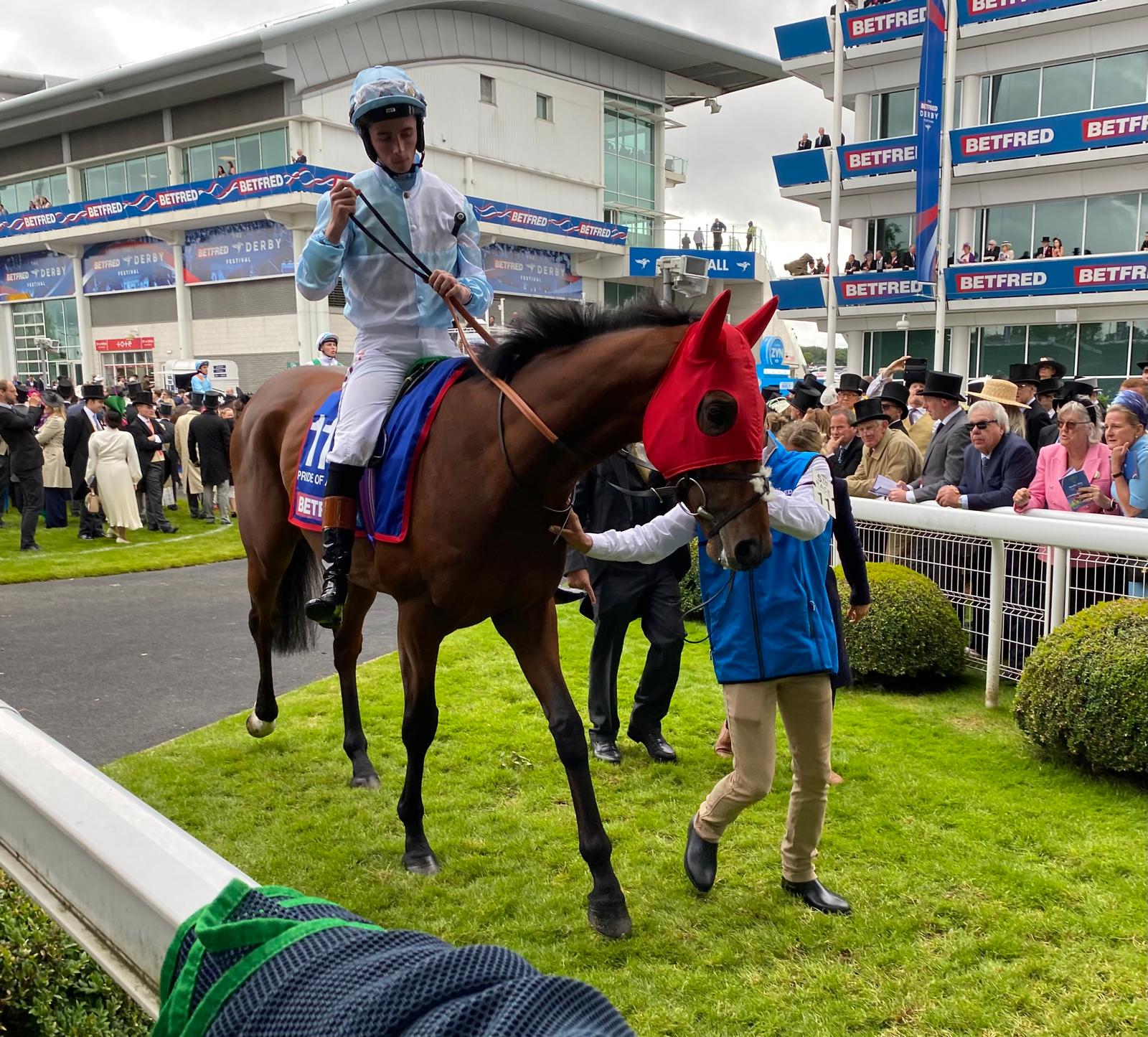
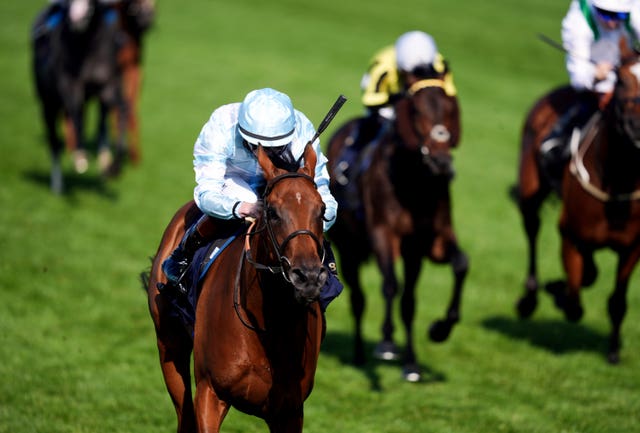
Pride Of Arras made a brilliant return to the scene of his finest hour to claim a Sky Bet Great Voltigeur Stakes at York in which dual Derby hero Lambourn misfired.
An impressive winner of the Dante on the Knavesmire earlier in the season, Ralph Beckett’s Pride Of Arras had proven no match for Aidan O’Brien’s Lambourn in both the Derby and Irish equivalent earlier in the season.
Sent off 12-1 in his first outing since being gelded, Rossa Ryan was in no rush as the 4-5 favourite Lambourn was immediately gunned to the front by Ryan Moore to keep close tabs on stablemate Thrice, who was undertaking pace-making duties.
However, unlike in his two Classic triumphs, Lambourn was unable to shrug off his rivals and with the pack swarming, it was Pride Of Arras who hit top gear up at the right time up the long home straight to return a length verdict over Paddy Twomey’s previously unbeaten Carmers.
Lambourn ended up a well-held fifth, with William Haggas’ Arabian Force another to stay on from the rear to take third ahead of Ballydoyle’s Stay True.
Beckett said of the winner: “He was back to his best, all good.
“I actually brought him here slightly underdone, having gelded him at the beginning of July, the week after the Irish Derby. It’s seven weeks on, but I’ve only really done maintenance stuff with him – I haven’t turned the screw with him – slightly because that seemed to suit him the last time we brought him here, and also because I wanted him to run well more than anything else.
“Really we came here with no expectation, but I think the track and the flat nature of York suits him really well. I wasn’t at all happy with the way he moved in the first half-mile at the Curragh, which isn’t exactly undulating anyway. He just wasn’t enjoying himself that day any more than he was at Epsom. After that it was a very easy decision to geld him.
“He’s never been difficult at home and it’s not just the gelding (that’s made the difference) as he suffers respiratory issues as well and that hasn’t helped. It certainly wasn’t helping in the spring and these things are never one specific thing, there’s always layers.”
With Pride Of Arras now not eligible to run in the St Leger or the Prix de l’Arc de Triomphe, Beckett is ready to consider targets further afield, including a possible trip to the Breeders’ Cup.
“I think this place suits him, which sorts of gives us a steer and we’ll probably end up having to travel him, but I wouldn’t be averse to that as I think he’s a different horse now and you could see that today,” the Kimpton Downs handler added.
“I would be tempted to think about California (Breeders’ Cup) and Hong Kong for him. I think the nature of those races will suit him really well.”
https://www.geegeez.co.uk/wp-content/uploads/2025/08/2.80139423-scaled.jpg12802560Geegeez Newshttps://www.geegeez.co.uk/wp-content/uploads/2022/10/geegeez_banner_new_170x78.pngGeegeez News2025-08-20 14:21:182025-08-20 15:01:04Pride Of Arras returns to form with Voltigeur victory
I think most of us have favourite trainers or at least ones we prefer, but there is a good proportion of punters who use trainer form, be it long term or recent, as a significant part of their betting selection process, writes Dave Renham.
Introduction
Some people follow trainers at certain courses, others certain jockey/trainer combos, some look for first time runners in handicaps, etc. In this article I am going to try, and please note the word ‘try’, to find a way to determine how consistent an individual trainer has been over the past decade or so.
To do this I have taken data from the last ten full years of flat racing in the UK (turf and AW) and split it into two blocks of five years – 2015 to 2019 and 2020 and 2024. The idea is that I will compare the earlier data set against the more recent one. I have chosen an elite band of trainers to make the research more manageable.
Personally, the more consistent the trainer, the easier it is to assess the chance of any of their runners. And, when I am looking at a potential bet, I prefer the trainer to be consistently good rather than consistently bad!
Methodology
The question I had before I started was, what is the best way to undertake such a comparison of different trainers? What do I use? Win strike rates? Placed strike rates? A/E indices? PRBs? Or a combination of all of those?
The logical starting point for me seemed to be win strike rates. However, I hit a snag immediately. My initial idea felt really logical: compare the win strike rates of different trainers over the two different time frames across different parameters. Then divide the highest winning 5-year percentage by the lowest to give a Comparison Strike Rate (CSR) for each trainer.
I have used this type of CSR method before when comparing win strike rates but that was when I was looking at individual trainers or individual sires and comparing them with their own strike rates across various parameters. That ratio approach generally works well as a metric and it was plan for the second part of the article.
The problem with comparing one trainer’s CSR with other trainers is when the strike rates for each trainer vary significantly. It will probably be easier to give you an example to explain what I mean.
Imagine a 100-race scenario where a trainer had five winners, equating to a 5% win strike rate. Let us then imagine that in the next set of 100 races we saw nine winners (+4 winners). This is a highly plausible scenario, but suddenly the win strike has almost doubled to 9%. This would give us a CSR figure of 1.80. Imagine the same idea with a trainer that hit 25 winners in the first 100 races and then 33 winners in the second 100. Eight more winners is a decent improvement, twice the difference in winners compared with the first trainer, but their CSR figure is much lower at 1.32. To hit a comparable CSR figure of 1.80, 45 winners would have been needed in the second group of 100 races, equating to 20 extra wins.
So, I decided to put the strike rate CSR method on the back burner for the first half of the article, opting instead to use a value metric, A/E index, instead. This seemed a better plan for trainer to trainer comparisons as long as the sample sizes were not too small.
Small sample sizes can make A/E indices look far better or worse than they are in reality. That is the same for most metrics, of course, and is one of the perils of working with racing data. However, for decent sample sizes, A/E indices tend to be a good metric when it comes to comparing different trainers (and horses and jockeys and sires and courses, and so on).
For this article I will be using a minimum of 30 runs within each area to qualify and, as I mentioned earlier, will be using A/E indices to make comparisons for this first half of the piece. The indices are based on Betfair Starting Prices.
Trainer Consistency: 2yo runners
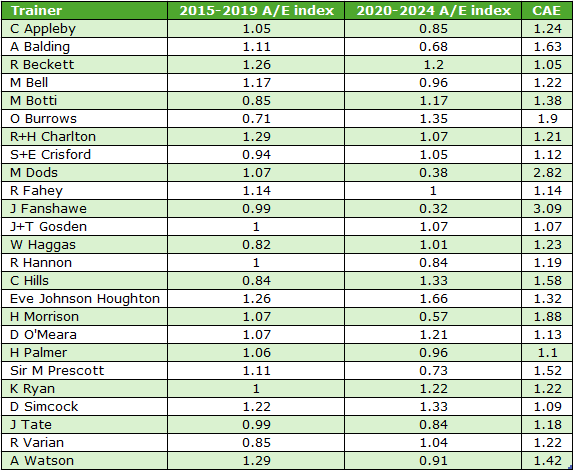
Let me look at some two-year-old (2yo) data first, starting with the individual trainer A/E indices for horses making their debuts. I will divide the bigger A/E index by the smaller one to create a comparison A/E figure using a similar idea to the one mentioned earlier with the Comparison Strike Rate (CSR). I will call it the CAE figure:
The closer the CAE figure is to 1.00, the more consistent the trainer has been in relation to comparing their A/E indices over the two-time frames. Based on this method, as far as 2yo debutants go, the trainers that have shown the most consistency are Ralph Beckett (1.05), J & T Gosden (1.07), David Simcock (1.09), Hugo Palmer (1.10), Simon & Ed Crisford (1.12) and David O’Meara (1.13).
Owen Burrows has shown a real uptick in performance from 2015 to 2019 compared with 2020 and 2024. His CAE figure of 1.90 underscores this. In fact, when we drill into his performance with 2yos on debut we see that in the past two full years (2023 and 2024) these runners won nine races from just 30 starts (SR 30%) for a BSP profit of £32.79 (ROI +109.3%).
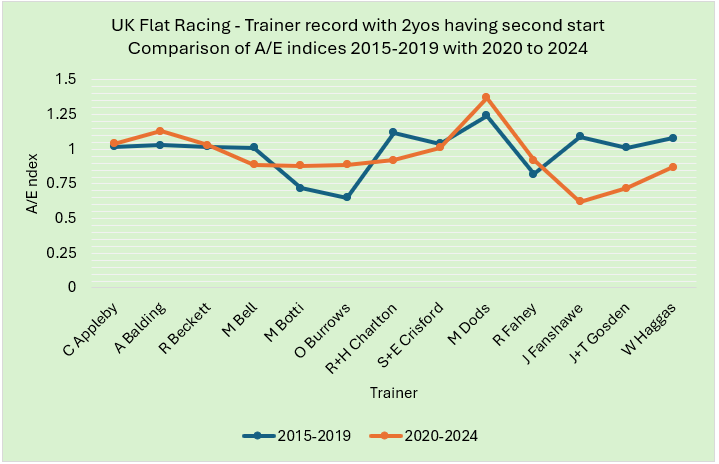
Moving onto 2yos on their second career start, here is a graphical comparison of the trainers’ A/E indices across the two-time frames. I have split the trainers into two groups in order to fit in each graph:
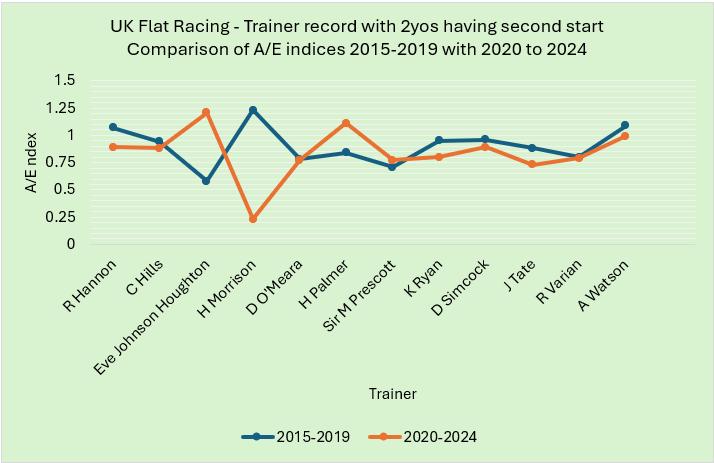
The closer the orange and blue dots are to each other, the more consistent the trainer’s A/E indices have been across the two periods.
Converting these into CAE figures we see the most consistent trainers from this group with second time starters aged two have been Ralph Beckett (1.01), Charlie Appleby (1.02), Simon & Ed Crisford (1.03), Andrew Balding (1.10), Michael Dods (1.10), Richard Fahey (1.12) and Michael Bell (1.13). Interestingly, when we look at the two win strike rates for these seven trainers, their strike rates have been very similar, which adds further confidence in the findings.
Onto the second batch of trainers now:
In this group the trainers with the closest CAE figures to 1.00 are Roger Varian (1.01), David O’Meara (1.01), Charles Hills (1.07), David Simcock (1.08), Sir Mark Prescott (1.08) and Archie Watson (1.10). These trainers have produced some consistent performances across the board with their 2yo second starters.
Trainer Consistency: 3yo runners
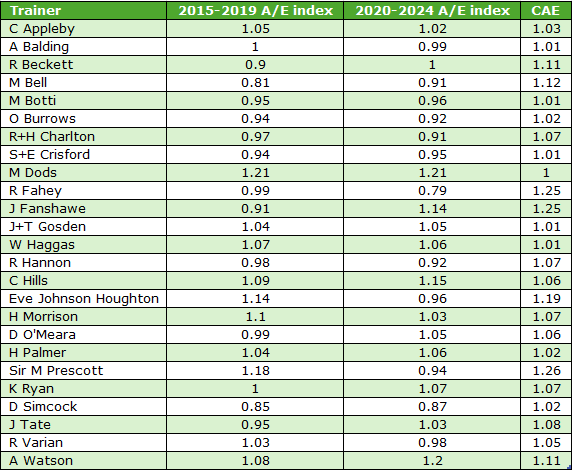
I want to move on to three-year-old (3yo) races next and am going to look at a much bigger data set, namely all 3yo non-handicaps. In theory, we should see the CAE figures much closer to 1.00 than before due to the sample size.
With 18 of the 25 trainers having a CAE figure of less than 1.10, this is an indication that most of these top trainers do perform to a similar level year in year out with specific horses in specific races – in this case 3yos in 3yo non-handicaps. Larger samples of data are less affected by those occasional unusual results which can impact on smaller data sets.
However, it should be noted that Richard Fahey and Sir Mark Prescott have both seen a dip in performance in 3yo non-handicaps over the past five years. Fahey’s record across both time frames has been particularly contrasting as the table below shows:
The strike rate has almost halved, and the returns have gone from a strong positive figure to a poor negative one. Conversely, James Fanshawe has seen an uptick in performance over the past five years, turning an 8% loss at BSP from 2015 to 2019 into a 22% profit from 2020 to 2024.
It’s now time to switch methods for the second half of the article where I aim to examine some trainer course data.
Trainer Consistency: Racecourse Angles
For the trainer course data, I plan to look at a selection of individual trainers comparing their course records and so, as I stated earlier, I will revert to the CSR (comparison strike rate) concept. Again, to help make comparisons easier when I divide the strike rates, I will divide the bigger by the smaller to give figures of 1.00 or higher.
Charlie Appleby
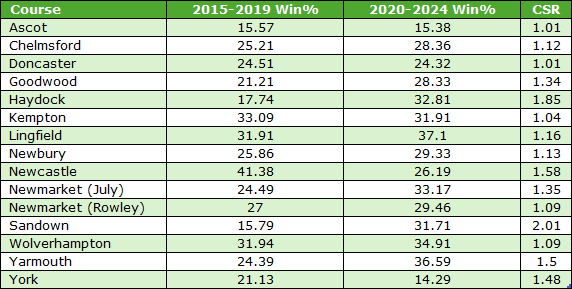
A look at the Godolphin trainer Charlie Appleby first. Here are the courses where he has had at least 30 runners in both timeframes:
I think this table shows why as punters need to be a little careful when it comes to some trainer course stats. Yes, certain trainers do target certain courses, and some are able to consistently repeat successes year on year. However, even for someone like Appleby, who has a yard chock full of top-quality horses, not all courses have delivered similar strike rates in the two five-year batches. At Sandown his win record has been excellent in the past five years but was relatively modest in the earlier five, giving a CSR figure of 2.01. The same applies for Haydock and the splits for Appleby at the Warrington track are as follows:
In terms of returns, we can see that Appleby’s figures have improved by around 40p in the £, although despite this he did not manage to get into overall profit.
Looking at which courses it might be worthwhile considering backing his runners in the future, I would say the following: Doncaster, Lingfield, Newbury and the Rowley course at Newmarket. My thinking is that these five have not only seen consistent performances (CSR figures all between 1.00 and 1.16) but have produced blind profits to BSP in both of the two five-year time frames. Ascot also falls into that category but his figures there are skewed by a BSP winner priced 36.0 in 2017 and a BSP 75.0 winner in 2022.
Before moving on, Appleby’s record at the Newmarket Rowley course is worth sharing in more detail; from 2015 to 2019 he had 54 winners from 200 (SR 27%) for a profit of £58.62 (ROI +29.3%). From 2020 to 2024 his record read 104 winners from 353 runners (SR 29.5%) for a profit of £105.76 (ROI +30%). Eight of the ten years saw the Godolphin trainer produce a blind profit on all his runners.
Andrew Balding
There are three courses where Balding has turned a profit in both five-year time frames and hit a low, i.e. consistent, CSR figure. These are Chester, Doncaster and Newbury. Of the three, Chester has the most consistent feel to the stats. He has a good record there with shorter priced runners (BSP 10.0 or lower) hitting a strike rate of 26.2% (71 wins from 271) for a profit to BSP of £60.34 (ROI +22.3%).
With bigger priced runners (above 10.0) at the track, he has made a profit of £73.52 (ROI +61.3%) thanks to 10 winners from 120. Overall, taking all prices into account, he has made a blind profit there in seven of the ten years.
Ralph Beckett
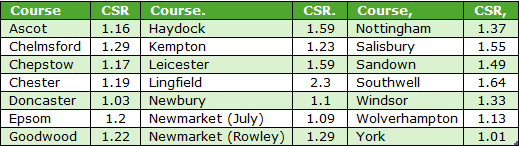
For Beckett I have produced a table of his CSR figures for different courses and these are shown below:
Doncaster, Wolverhampton and York have seen consistent CSR figures of 1.03, 1.13 and 1.01 respectively, with all three of them proving profitable across both time periods.
Chelmsford has a slightly higher CSR at 1.29 but this is a fourth course I would look out for Beckett runners as these splits are decent:
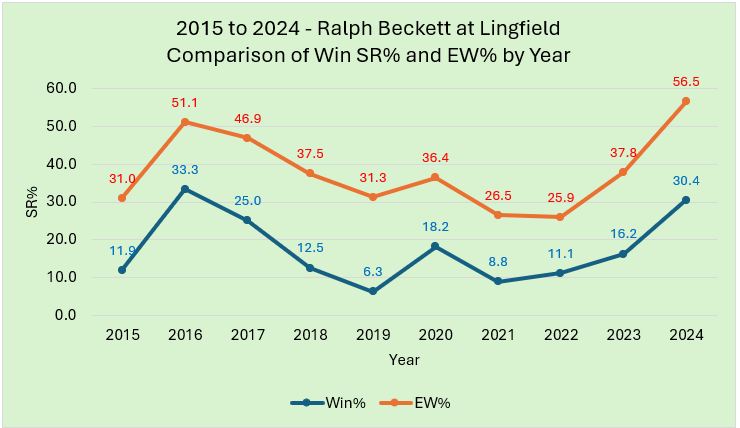
In contrast, his record at Lingfield (turf and AW courses combined) has been all over the place. The 2.30 CSR screams this and, if we look at the yearly win strike rates, coupled with the win & placed (EW) ones, we see the following:
We can see the huge discrepancies comparing 2016 and 2024, where the win rates were over 30%, with 2019 and 2021, where the win rates were 6.3% and 8.8% respectively. These results are based on fairly decent yearly sample sizes, too, with eight of the ten years having 30+ runners at the course.
I have said it many times before in articles that some stats can be misleading, and the more digging we can do behind the numbers the better.
Other Profitable Trainer Consistency Angles
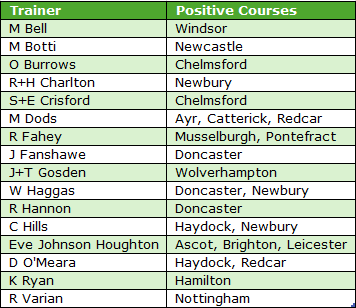
Time precludes further trawling of the full list of trainers in such detail but I will share the remaining positive trainer/course stats, based on the combination of low CSR figures combined and two profitable five-year time frames. Trainers not shown failed to complete that double qualification for any course:
Outro
As I stated at the outset, this was a piece of research where I wanted to try to establish when trainers show consistency within certain parameters. Hopefully all the hours of research combined with my approach has at least offered some tasty food for thought. I am sure the ideas are not foolproof, but I believe they have merit and utility.
Comments are always welcome and if there are any tweaks to the methods that you’d like to discuss, please let me know in the space below.
Having got his season back on track in some style at Ascot last month, Ralph Beckett’s Pinhole again dips his toe into Group-race waters in the Highclere Thoroughbred Racing Geoffrey Freer Stakes.
The Frankel colt looked an exciting prospect when winning at Southwell at the backend of his juvenile year, but any dreams of Epsom were put to bed after he finished a well-held fourth behind the subsequent dual Derby winner Lambourn on his return in the Chester Vase.
He disappointed as a joint-favourite for the Queen’s Vase at Royal Ascot on his next start, but made the most of having his sights lowered when bolting up in first-time cheek pieces on his handicap debut three weeks ago, earning him a return to Group Three level at Newbury on Saturday.
Barry Mahon, racing manager for owner-breeders Juddmonte, said: “He was obviously an easy winner the last day and the handicapper has forced our hand to head back into Group company, so we’re looking forward to seeing what he can do.
“He’s a horse we always felt was up to this sort of level, hopefully it’s not coming too soon for him.
“He’s a big horse and probably still a little on the weak side. We started out with Derby ambitions and the form of the Chester Vase has obviously worked out very well, but the Derby was coming too early in his life. Let’s hope we can get back on track at Group-race level.”
Pinhole’s five rivals include the William Haggas-trained Candleford, who was last seen finishing third behind high-class stablemate Al Aasy in the Glorious Stakes at Goodwood and Ambiente Friendly, who was one place and just under two lengths adrift of Candleford two weeks ago.
His trainer James Owen said: “He worked nicely on Tuesday morning and he’s taken a step forward from Goodwood, so I think gelding him is definitely helping.
“It’s small steps but I feel I’m getting him back into form. I think if you watch his races, even at Goodwood, in the last 15 yards he’s beginning to stay on again and I just think he needs to give himself chance to get these longer trips, then I do think he will stay well.
“He’s getting better at home and he’s improved the last twice on the track. Sean D Bowen did a great job with him the last day and rode him very well and I think that was the most settled he has been for a long time.”
The Haggas-trained More Thunder is the potential star attraction in other Group race on the card – the Visit Malta Hungerford Stakes.
Tom Marquand on More Thunder after winning the bet365 Bunbury Cup at Newmarket (Joe Giddens/PA)
The four-year-old has won three of his four starts since moving across Newmarket after Sir Michael Stoute’s retirement and he is perhaps unlucky not to be unbeaten, having just failed to reel in Get It in the Wokingham Stakes at Royal Ascot.
He bounced back to winning ways in Newmarket’s Bunbury Cup last month and now gets the chance to showcase his talent at Group Two level.
Haggas told Sky Sports Racing “It was a bit messy at Newmarket, but he’s absolutely fine and it’s time he had a step up in grade.
“He’s a pretty smart horse, he’s done really well. He’s got about the lowest rating of any of the runners on Saturday and yet he’s favourite, I don’t quite understand that, but some people think that he has the potential to do a bit better, so we’ll see if they’re right.”
The highest-rated runner is Witness Stand, who bids for back-to-back Group Two wins for the training partnership of Dr Richard Newland and Jamie Insole following his surprise Lennox Stakes success.
Insole said: “We obviously have to carry a penalty now, but he’s come out of the race at Goodwood well. He did a nice breeze on Wednesday and we’re really happy with him.
“He’s already a Group Two winner now, so we just hope he turns up and puts in another brave run to do us all proud.”
https://www.geegeez.co.uk/wp-content/uploads/2025/08/2.81096590-scaled.jpg12802560Geegeez Newshttps://www.geegeez.co.uk/wp-content/uploads/2022/10/geegeez_banner_new_170x78.pngGeegeez News2025-08-15 14:18:082025-08-15 14:18:08Pinhole aiming to justify connections’ faith in Geoffrey Freer
Centigrade will attempt to get the mercury rising in his eagerly-anticipated return to the racetrack this autumn.
The son of Too Darn Hot showed great potential in two starts as a juvenile, beaten only a short head by Jonquil on debut before wasting little time opening his account when downing subsequent Queen’s Vase runner-up Further in impressive fashion.
Ralph Beckett’s one-time Derby hope is yet to hit the track this term after suffering an early-season injury, but the Highclere Thoroughbreds-owned colt is soon to return to Kimpton Down to begin building up to very belated seasonal reappearance.
Highclere’s Harry Herbert said: “He’s had his issues, but he’s now back into canter exercise and if all goes to plan he will have an autumn campaign.
“This is a very important horse physically and his form is outstanding. The way he has progressed physically is great and he could be a very important horse not only maybe later this season but also next season.
“If he stood up in front of you he would knock your socks off and along with (William Haggas’) Merchant, they are two very important and exciting physicals. We’re excited to get him back to Ralph’s and hopefully get him back to the racetrack later this autumn.”
https://www.geegeez.co.uk/wp-content/uploads/2025/08/2.81187455-scaled.jpg12802560Geegeez Newshttps://www.geegeez.co.uk/wp-content/uploads/2022/10/geegeez_banner_new_170x78.pngGeegeez News2025-08-10 15:05:302025-08-10 15:05:30Centigrade return looks to be edging closer
Field Of Gold’s pacemaker Qirat caused an almighty shock with a 150-1 victory in the Visit Qatar Sussex Stakes at Goodwood.
John and Thady Gosden’s Field Of Gold was a 1-3 shot to follow in the hoofprints of his sire Kingman by adding this prestigious Group One contest to his previous top-level victories in the Irish 2,000 Guineas and the St James’s Palace Stakes.
The Ralph Beckett-trained Qirat, who was last seen finishing 27th of 30 runners in the Royal Hunt Cup, was supplemented for the race last week at a cost of £70,000 in a bid to ensure the red-hot favourite had a strong gallop to aim at.
But the race did not go to script, with Qirat keeping up the gallop to emerge triumphant under Richard Kingscote, despite the best efforts of Rosallion, who was a neck adrift at the line.
Richard Kingscote returns on Qirat (Andrew Matthews/PA)
Field Of Gold, meanwhile, had to settle for a laboured fourth, with Henri Matisse third.
Beckett said: “Richard has always been a very good judge of the clock. The last thing I said to him was keep going with this fellow, he could run really well.
“He loves this place and I wanted to enter him because his work was really good. It’s a horse race and anything can happen.”
Qirat’s dam, Emulous, also produced last year’s Prix de l’Arc de Triomphe winner for Beckett in Bluestocking.
He went on: “I thought he looked a million beforehand and that in the race he would set the pace from the front, and the longer he lasted the better for those concerned with the favourite.
“He’s always threatened to be a good horse and today he showed it.
“What about the mare? To come up with Bluestocking and him. She’s been like a hole in the wall, like a cash machine.”
Kingscote, who recently announced he is taking up a licence in Hong Kong, said: “I feel like a villain but when I saw it wasn’t a grey nose (Field Of Gold) coming towards me I just kept going.”
Although clearly not the result owner-breeders Juddmonte were expecting, the team’s European racing manager Barry Mahon was keen to take the positives out of it.
Of Qirat, he told Racing TV: “Ralph said in the parade ring beforehand ‘this horse is going to run big’ and said to Richard ‘there’s a big run in this horse’. Whilst he was obviously there to make the pace, Ralph thought he could finish in the three and he was dead right.
“He’s a horse we always felt had a lot of potential. Ralph actually wanted to enter him for this race earlier in the year and in my wisdom I said ‘don’t be ridiculous’. We ended up having to supplement him, but he’s got the result.
“At the end of the day Juddmonte and the owners want to compete at the top level and want to win Group One races. Whilst it’s not with the horse we thought it would be, we’ve still won the race, which is the most important thing.”
When asked about future plans for the winner, Mahon added: “I’ve had people from America and Hong Kong and every sort of racing jurisdiction coming up to me inviting him to run, so hopefully the owners might want to travel him.
“Ralph knows a thing or two about winning a Breeders’ Cup race, so maybe that’s where he’ll end up.”
Field Of Gold in the Goodwood parade ring (Molly Hunter/PA)
What the rest of the season holds for Field Of Gold remains to be seen, with Mahon saying: “The rest of the field seemed to get detached from the two pacemakers, but I think ultimately William (Buick) felt he didn’t handle the track and felt he was a bit flat today. We don’t know why, but we all have off days – human and equines and all manner of beasts.
“Whether there’s an issue there or something we’re not sure, we’ll have to investigate, but he’s definitely not the Field Of Gold that we’ve all seen and know. I’m sure he’ll be back and there’ll be another day.
“He’s had a good enough break since Ascot, John and Thady have freshened him up and they’ve been happy with how he’s trained. He looked good today and William said going to the start he felt very fresh, so maybe he was a little bit too fresh.
“We did give him a good break after Ascot and maybe we were a little bit kind on him. We’ll get him home and check him out first and I think we’ll have to make a plan after that.”
Stable companions Saqqara Sands and Tabiti shared the honours after the judge announced a dead-heat following a thrilling renewal of the HKJC World Pool Oak Tree Stakes at Goodwood.
Tabiti was among the leading contenders for the Group Three contest at 9-2 and with blinkers applied for a second time, the three-year-old set out to make all the running in the hands of Ryan Moore.
Saqqara Sands, a much bigger price at 16-1 under Rossa Ryan, emerged from the pack as the biggest threat inside the final furlong and while she briefly managed to poke her head in front, Tabiti battled back and the Ralph Beckett-trained pair passed the post as one.
Bright Thunder, the 7-2 favourite, was only half a length further behind in third.
Ralph Beckett with his winning fillies Saqqara Sands and Tabiti (PA)
Beckett said: “I’ve definitely never done that before. They are two really tough fillies. This race can be a bit of a bun fight, I recall Roger’s (Varian) filly (Jabaara) being taken down last year (demoted to second from first place).
“Saqqara Sands worked very well at the weekend and I thought she was over priced, while it looked like Tabiti had gone west on us after the Fillies’ Mile.
“The mile is probably OK for Tabiti, but I’m not sure the other filly wants it. I’ve yet to work out their trips but hey, it’s been an enjoyable day.”
Ryan, who saw his big Tuesday hope Kinross withdrawn at the start before the Lennox Stakes, said: “That was mad. I just couldn’t quite get past Tabiti. I thought I’d win but my head was up and his was down.
“She stayed battling all the way to the line and it’s good to get in the scoresheet after a disastrous day yesterday.
“My filly is improving. She’s going the right way and I think better on better ground.”
Bright Thunder’s trainer Karl Burke was satisfied with third place and will keep an eye on conditions now as he seeks the next target.
He said: “I’m as happy with that as you can be without winning.
“She’s run a great race and looked like bolting up two out, but Ryan (Moore on Tabiti) got a freebie in front. If they’d gone really hard or she’d had a bit of a better draw, I think she’d have been bang there.
“She’s a progressive filly but she likes a bit of cut in the ground so August might be tricky, but hopefully we’ll find a nice race for her in the autumn.”
https://www.geegeez.co.uk/wp-content/uploads/2025/07/2.81138926-scaled.jpg12802560Geegeez Newshttps://www.geegeez.co.uk/wp-content/uploads/2022/10/geegeez_banner_new_170x78.pngGeegeez News2025-07-30 13:33:312025-07-30 13:33:31Beckett pair share Oak Tree honours at Goodwood
It is hard to imagine the HKJC World Pool Lennox Stakes without Kinross and Ralph Beckett’s evergreen stalwart is back in search of a third victory at the Qatar Goodwood Festival.
The popular eight-year-old has been a standing dish in this contest on the Sussex Downs, taking home the first prize in 2021 and 2023.
After showing no signs of decline when reappearing with a narrow defeat in Haydock’s John of Gaunt Stakes, he now makes his fifth appearance in Tuesday’s Group Two event, looking to better last year’s third.
“He’s been great since Haydock,” said Jamie McCalmont, racing manager for owner Marc Chan.
“I would say it’s as competitive as any other Lennox he has run in, that’s for sure. It’s a very open race, but we go there in good shape.
“Every race is a bonus for him at this stage of his career, so fingers crossed he runs well.”
Andrew Balding struck with Sandrine in 2022 and attempts to repeat the dose with Jonquil, who returns to the distance over which he landed the Greenham Stakes after failing to figure down at six furlongs in the Commonwealth Cup.
Also bidding to bounce back to his best is John and Thady Gosden’s Audience, who took home the spoils impressively 12 months ago but has struggled to trouble the judge since.
Gosden said: “He hasn’t quite repeated last year’s run yet. We sent him down to Dubai, which might not have been the smartest move in the world, running him over six furlongs.
“He’s well in himself and happy. He enjoys the track and I think he’ll run a big race again.”
It was Ed Walker’s Ten Bob Tony who denied the aforementioned Kinross earlier in the season. He has been freshened up since that victory in Lancashire and his handler said: “Ten Bob Tony loves a bit of ease in the ground and goes well fresh.
“It was a huge performance to come back and beat Kinross at Haydock and he’s obviously a very talented horse.
“He’s a real yard favourite, he’s completely chilled, a real kind, straightforward horse to deal with.”
Walker in fact holds a strong hand in the seven-furlong event and will also saddle his Jersey Stakes scorer Noble Champion, who represents the same owners and will be ridden, like at Royal Ascot, by Kieran Shoemark.
“Ascot wasn’t a surprise at all, as he’s always been an exceptionally good work horse,” continued Walker.
“He’s exuberant and playful, and the set up was ideal, although I do worry about the nature of Goodwood compared to Ascot as it’s a completely different track.
“We’ve always had huge belief in this horse. On his day when everything’s right, he’s very, very good.
“It’s quite hard to get everything right with him, but I think when he gets it right, he’s an exceptional horse and he has been flying since Ascot.”
https://www.geegeez.co.uk/wp-content/uploads/2025/07/2.73206745-scaled.jpg12802560Geegeez Newshttps://www.geegeez.co.uk/wp-content/uploads/2022/10/geegeez_banner_new_170x78.pngGeegeez News2025-07-28 15:13:172025-07-28 15:13:17Kinross primed for another Lennox tussle at Goodwood
There will be no Ascot repeat for Amiloc, who will be a notable absentee from the King George VI And Queen Elizabeth Stakes at Ascot on Saturday.
The Ralph Beckett-trained three-year-old enhanced his reputation with a fifth straight win in the King Edward VII Stakes at Royal Ascot, but a return to the scene of his finest hour is now off the cards, with the track’s midsummer Group One feature deemed to be coming too soon for David and Vimy Aykroyd’s unbeaten gelding.
“It’s a training decision and Ralph felt he could just do with a little bit more time having had a hard race at Royal Ascot,” said the Aykroyds’ racing manager Patrick Cooper on the decision to miss the weekend highlight.
“The real racing for this horse will be in the autumn time and Ralph thinks it’s a little too quick after his last race, it’s nothing more than that and nothing untoward.”
Amiloc was a general 10-1 chance for the King George, which could see Coronation Cup one-two Jan Brueghel and Calandagan renew rivalry, and holds entries for both the Sky Bet Great Voltigeur Stakes at York (August 20) and the Curragh’s Comer Group International Irish St. Leger (September 14) later in the summer.
However, connections appear undecided on their next move at this stage, as they anticipate heading overseas in search of valuable prizes before the year is out.
Cooper added: “We’ll hopefully go on the road with him in the autumn time, we haven’t overly thought about it, but the big-money races are at the end of the year.
“All those races in Hong Kong, Australia and America are all on the radar and I suspect we will be on the road at some stage.”
https://www.geegeez.co.uk/wp-content/uploads/2025/07/2.80729574-scaled.jpg12802560Geegeez Newshttps://www.geegeez.co.uk/wp-content/uploads/2022/10/geegeez_banner_new_170x78.pngGeegeez News2025-07-20 13:11:492025-07-20 13:11:49Connections opt to miss the King George with Amiloc
Pride Of Arras could continue David and Vimy Aykroyd’s brilliant summer when he bids for Classic redemption in the Dubai Duty Free Irish Derby at the Curragh on Sunday.
The Yorkshire-based owner-breeders have been making their presence felt this term, with Pride Of Arras claiming the Dante to ignite Derby dreams in May, while Amiloc maintained his unbeaten record in style to give connections a day to remember at Royal Ascot.
Trained by Ralph Beckett, Pride Of Arras may have subsequently disappointed when sent off at 4-1 at Epsom following his Knavesmire heroics, but his team are refusing to be downbeat ahead of a trip to Ireland this weekend and a second shot at Classic glory for the talented son of New Bay.
Pride Of Arras was well held at Epsom (Adam Morgan/PA)
“He’s come out of Epsom well, we’re just still scratching our heads why he ran so badly,” explained Patrick Cooper, the Akyroyd’s racing manager and also the nephew of David Aykroyd.
“It’s a bit of a mystery, he obviously didn’t handle the hill and Rossa (Ryan, jockey) was easy on him once he knew he couldn’t participate in the finish, but we still don’t know truly what went wrong, so we can go to the Curragh and hopefully find out more there.
“We have to take the defeat and the kicking when you get one and it is just one race, albeit perhaps the greatest race of them all, and you have to move on to the next one.
“Hopefully we get the horse back who showed us how good he was in the Dante, he was impressive that day and we’re entitled to keep dreaming.”
Connections also have further big days to look forward to with the exciting Amiloc after he took his unbeaten record to a perfect five out of five in last week’s King Edward VII Stakes.
Amiloc thrived once again at Royal Ascot (John Walton/PA)
Rated just 1lb inferior to his stablemate in the owners’ pale blue and white quarters after his victory at the Royal meeting, the gelded son of Postponed is being lined up for a return to Ascot and a step into even deeper waters for the King George VI And Queen Elizabeth Stakes on July 26.
“The handicapper only has a pound between them and he doesn’t have rose-tinted spectacles like the rest of us and that’s how he sees it,” continued Cooper.
“With Amiloc we just don’t know where his ceiling is and he just keeps pulling out more every time we run him.
“We’re sort of aiming at the King George which would be another step up and we’ll see closer to the time. It’s next door, the race is worth a fortune and he’s a course and distance winner, so it’s kind of obvious.
“He’s a gelding so he will lose his unbeaten record at some point. Hopefully it’s not King George day, but we’ll just try to go one step further and if we have to step back in grade afterwards then so be it.”
https://www.geegeez.co.uk/wp-content/uploads/2025/06/2.80139419-scaled.jpg12802560https://www.geegeez.co.uk/wp-content/uploads/2022/10/geegeez_banner_new_170x78.png2025-06-26 10:25:522025-06-26 10:25:52Pride Of Arras team ‘entitled to keep dreaming’ as second Derby date looms
Ralph Beckett’s Allonsy got back to winning ways in the Pontefract Castle Fillies’ Stakes.
The Kirsten Rausing-owned and bred filly had won three handicaps in a row last season before finishing second in Listed company at Ascot.
This season she had struggled at Goodwood and York, but she went into this Listed contest as the highest-rated in the field and fought out the finish with Karmology, who brought the second-highest figure.
Hector Crouch on the 7-1 chance ranged up alongside Karl Burke’s mare inside the final furlong and eventually got on top to win by a neck. Beckett’s Meribella was third.
Crouch told Racing TV: “It looked a nice race for her, she’d been pushed in at the deep end in Group Three company so to drop back into Listed class and get her head in front was very important for her owner/breeder.
“She’s extremely hardy. Once we got her figured out in her three-year-old career she did nothing but improve and she finished second in a Listed race at Ascot at the back-end of last year.
“She was a little bit frustrating last year until we switched to riding her really prominently, she’s grown up quite a lot now and you don’t have to ride her quite as forwards.
“We can go back up in grade now to see if she can gain more black type for her family, we’ve nothing to lose.”
https://www.geegeez.co.uk/wp-content/uploads/2025/06/2.77701197.jpg7531505https://www.geegeez.co.uk/wp-content/uploads/2022/10/geegeez_banner_new_170x78.png2025-06-22 15:39:432025-06-22 15:39:43Allonsy takes Listed honours in Pontefract feature
Amiloc obliged favourite-backers to remain unbeaten and give Ralph Beckett his first victory at this year’s Royal Ascot courtesy of the King Edward VII Stakes.
An impressive winner of Goodwood’s Cocked Hat Stakes, the fact the son of Postponed is a gelding meant he had to bypass the Derby at Epsom for the race often referred to as the ‘Ascot Derby’.
Ryan Moore tried to slip the field on eventual third Galveston, but Rossa Ryan aboard the 11-8 market leader never let that duo too far out of his sights and after sending Amiloc to the front with a furlong to run, had enough in reserve to hold off Johnny Murtagh’s Zahraan by three-quarters of a length.
Beckett said: “He did it the hard way a little bit, we thought Galveston would probably go forward and it did work out like that.
“I didn’t really want to run him, to tell you the truth. I didn’t think he’d like the ground, but I was wrong about that.
“I don’t think we’ve ever had one win five straight, well I can’t think of one! I wasn’t confident because of the ground. We haven’t had a great week.
“Rossa was great, he rode him with plenty of confidence and it set up well for us, I will say that, but sometimes it just does.”
Amilco halved in price for the King George VI And Queen Elizabeth Stakes and asked about future plans, Beckett said: “I think ground will dictate, I wouldn’t be afraid to take anybody on with him on slower ground, so he is in everything.
“He’s going to take a bit of getting over today by the look of him; if it came up soft next month (for the King George), or with a bit of juice, I’m sure we’d be here.”
Of Zahraan, who runs in the colours of the late Aga Khan, Murtagh said: “He lost nothing in defeat. Ben (Coen) just said they quickened up from four out and just had him off the bridle a little bit earlier than ideal. I’m not saying he wants soft ground, but a little bit more juice in it would help him travel a bit longer.
“Finishing second here is definitely more frustrating as a trainer than as a jockey! It’s more nerve-wracking beforehand, and it’s gutting – you know how hard it is to win here. You see all all the people come with their best horses, and we thought we had one and we still do, but he just wasn’t good enough today.
“You’d love to think he might be an Arc horse one day, and the connections would love that race. He’s a bit to go to get there, but he might.”
He added: “I was really privileged to ride in these colours and you forget what a privilege it is until you go last week and see the Derby, which is the greatest race in the world and was run in honour of His Highness the Aga Khan, and for me to deliver now we have to find the winners on the big days.”
https://www.geegeez.co.uk/wp-content/uploads/2025/06/2.80729501-scaled.jpg12802560https://www.geegeez.co.uk/wp-content/uploads/2022/10/geegeez_banner_new_170x78.png2025-06-20 16:55:202025-06-20 17:20:19Amiloc holds off Zahraan in ‘Ascot Derby’
Ralph Beckett is tempted to drop Stanhope Gardens back down in trip after finishing a creditable fifth in the Betfred Derby.
The Kimpton Down trainer feels the lightly-raced Ghaiyyath colt just ran out of stamina close home, having made up plenty of ground after the descent from Tattenham Corner.
Beckett said: “Dropping him in trip would be the obvious thing, but what muddies the water is that he had such a bad prep.
“I don’t want to make excuses, he ran his race, but he was off the last week of April, the first week of May and then we had another problem the week before the Derby as well so he only just made it.
“From that draw (15), sectionals say he ran a fast three-to-two and two-to-one so all of that is really encouraging.
“The obvious thing is to run him over 10 furlongs because if he doesn’t get home over 12 next time then I’m in a hole. Although he’s by Ghaiyyath the mare (Pure Art), whatever they breed her to they never get more than 10 furlongs, so I think that is where we’ll end up – but it is to be debated.
“There’s the Eugene-Adam at Saint-Cloud against three-year-olds, but we’ll see where we are in a couple of weeks.”
Beckett also fielded Dante winner Pride Of Arras, who went off second-favourite but only beat one home.
“He was very disappointing. He was a little bit keen up the hill and came down the hill like an ostrich on ice,” Beckett told Racing TV.
“He’s come out of it well and we’ll go again. I’d be keen to go to the Irish Derby, as I think that will suit him.”
Last year’s Irish Oaks winner You Got To Me, bought by Amo Racing for 4,800,000 guineas, was another disappointment in the Coronation Cup and her future appears to be on temporary hold.
“I’m not sure about her, the way she’s come out of the race, which is well, I’m not sure about anything with her at the moment, I’ll have to do a bit more digging,” said Beckett.
https://www.geegeez.co.uk/wp-content/uploads/2025/06/23146ab5-f222-4661-be88-1745fe362557.jpg10242048https://www.geegeez.co.uk/wp-content/uploads/2022/10/geegeez_banner_new_170x78.png2025-06-10 15:57:472025-06-10 15:57:47Beckett can see merit in coming back in trip with Stanhope Gardens
All those Derby trials wins will have come to nought if a Ballydoyle colt doesn’t win next Saturday’s Betfred-sponsored 12-furlong skirting of Epsom Downs, writes Tony Stafford. Never mind Epsom, Aidan O’Brien and his Coolmore backers have turned winning French colts’ Classics this year into an art form.
At least, when future French turfistes look back at the record books, they will maybe delude themselves that the title Mrs Susan Magnier, stored away for further use in the copious Coolmore blue-chip name bank, had been for French-owned and trained Classic winners. But, no, Henri Matisse and Camille Pissarro, respective winners of the Poule d’Essai des Poulains (French 2,000 Guineas) and yesterday’s Prix du Jockey Club (French Derby) are just two more Aidan O’Brien examples of the right horse in the right race.
The human Pissarro, born in the (now US-owned) Vigin Islands but soon living in France, started life four decades the earlier of the pair and went through various stages of Impressionism. He died right at the start of the 20th Century (1903).
Matisse, a draughtsman as much as a painter, survived from 1869 into the middle of the last century. Great artists both, great names for a Classic winner, especially those staged in the land of their distinction.
Just as in the Poulains, Ryan Moore gave yesterday’s winner an exemplary ride. Camille Pissarro had made his own impression as he finished third with a strong finish over the mile at Longchamp while Ryan swept home in front on Henri Matisse. Henri will be staying at a mile at Royal Ascot in the St James’s Palace Stakes, and no doubt a clash with Irish 2,000 winner Fields Of Gold, in a fortnight.
I heard someone say yesterday watching the coverage that Aidan reckons the Prix du Jockey Club is more a race for milers than authentic 12-furlong Derby horses, thus none of the trial winners was in yesterday’s line-up.
Two Ballydoyle colts were in the 16-strong field though and it is always easy to earmark outsiders from the stable as cannon fodder if they are there to control the pace. That was the perceived lot of Trinity College, not such a massive 'rag' considering the make-up of the race – at 24/1.
He was quickly away under Wayne Lordan but wasn’t allowed to have it all his own way as Bowmark, the second string working on behalf of the Gosdens’ number one (Detain) and ridden by Tom Marquand, was busily doing his half-spoiler role for the horse that came home a close sixth in that busy end to the French 2,000.
Ryan, from stall one, was always in a lovely clear spot on the rail, a couple of lengths behind the leaders and nowhere near as far back as his mount had been in the mile race. His most dangerous (and probably only) moment came when he needed to scoot past Trinity College, a Dubawi colt running in the colours of Derrick Smith’s son Paul, best known hitherto for the St Leger winner Kingston Hill. Not much room, but he found what there was.
Paul will have loved to be involved so closely in the action here and Trinity College added to his already sterling service in the race by staying on for fourth and 70 grand which Paul shares with the usual suspects. They were behind Cualificar (Godolphin, Andre Fabre and William Buick) and Detain, ridden by Christophe Soumillon.
Wootton Bassett added further lustre to the riches provided to Coolmore Stud with this latest Classic success and he also sired the third home, running in the Abdullah colours of Field Of Gold.
With £708k available to the winner, trainers and owners with horses in the big field outside the main placings would be excused for looking further down the list. They would find, if they didn’t know already, that French money may be generous and with premiums for French-breds doubly so, but they only go down to fifth place, that 35k going to a horse from the Graffard stable.
As to the premium qualification, only the runner-up, a son of Lope De Vega running for Godolphin, was French-bred and that entitled connections to an extra £100k or so.
An unsatisfactory day for the French then – shame after the Fellowes/Shoemark affair and Shes Pretty in the 1,000. Sadly, Charlie’s Luther, fourth in their 2,000 was on the outside all the way and dropped out of the lucrative places this time.
And so to Epsom. I was talking to someone close to the stable a week or so ago and his slant on the ease in the Derby market of The Lion In Winter was explained away as “He goes to France”. They don’t always get it right.
Once backed back into favouritism after the initial shock of that Dante Stakes sixth place when he didn’t run too badly under a less than full-on Ryan Moore finish, he is now available at 6/1 and you never know how much transformation Aidan could have wrought in the short time since.
Everyone now assumes Ryan will be on the Leopardstown trial winner Delacroix, but while he looked very good that day, the opposition in a five-horse affair (two O’Brien tailenders) was hardly extremely testing. Ruling Court, the 2,000 Guineas winner, and the Dante winner Pride Of Arras complete the quartet at the top of the betting.
I was very impressed with the way the Beckett three-year-old creamed through the field on the far rail and the Ackroyd family horse would make a nice change in the way of such as Sir Percy in leaving the race of the season to a smaller owner.
My first fleeting experience of the man who was by 2025 to have an authentic Derby prospect, a year after his Arc win with Bluestocking and with a yard with close to 200 horses in his care, came approaching a quarter century earlier; in fact it might have been even longer ago.
Ralph had just arrived as a pupil assistant to David Loder, who at the time was the king of the well-prepared first-time-out two-year-old. Ralph used to smilingly and good-naturedly amble his way around Sefton Lodge stables, in the manner of a youthful Pride And Prejudice aristocrat, but it seemed his casual style didn’t cut too much ice with 100 miles an hour Master Loder.
I seem to recall just one comment made by his then employer. “Lazy bugger!” All that time afterwards, the mature Ralph still seems to lope his way pleasantly around, and when he does agree to an interview, it’s still the same languid delivery. We’re not all the same, thankfully.
And now after what one might have regarded as an inauspicious start, Ralph Beckett is truly part of the powerhouse of English training.
A friend asked me the other day, “If a bookmaker offered you even money about Aidan O’Brien winning the Derby this year, would you take it?”, writes Tony Stafford.
The question arose after the pre-York blanket dominance in the trials at Chester, Lingfield and Leopardstown and before the possibly temporary reputation tarnishing of The Lion In Winter, that one in the ruck behind Ralph Beckett’s Pride Of Arras in the Dante Stakes.
Amazingly, in view of the ease of the Ackroyd family’s horse’s victory on the Knavesmire, The Lion In Winter has hardened back in price after an initial ease by the bookmakers. In some places he’s a shorter price than his York conqueror.
Michael Tabor had suggested the day before that The Lion In Winter was running later in the piece than is normal for returning Derby candidates from the Ballydoyle stable but then, on June 7, the Derby is as late as it can be for a first Saturday in the month.
Anyway, the latest ante-post prices for the big race list the Leopardstown trial winner Delacroix as favourite at 5/2 ahead of Godolphin’s 2,000 Guineas hero Ruling Court (4/1), emphasised by trainer Charlie Appleby during York as firmly on target for Epsom Downs.
But after him and the two Dante protagonists, three of the next four are from the Coolmore team and their joint odds take out 66% so appreciably more than the requisite 50% for even money. And that’s not all their potential runners which, as we said last week, do not preclude an O’Brien win at long odds.
I was minutely involved with the win of Oath in 1999 and for me that seems not so long ago, recalling embarrassingly cavorting next to the unsaddling enclosure with his lad after his win for the Sir Henry Cecil stable and the Thoroughbred Corporation of Prince Ahmed Salman. It’s salutary to remember that Aidan hadn’t even won the race by that time.
Now he has – and how – with ten of the last 24 (or 42%) falling to him. Interestingly, until he starts getting different owners in the yard, he still won’t match either Sue (wife of John) Magnier and Tabor who have 11 thanks to the win of the Andre Fabre-trained Pour Moi in 2011 on top of Aidan’s ten.
By last year, they had all exceeded the nine of Lester Piggott, the foremost Derby jockey of all time. Piggott’s skill at riding the difficult Epsom track was only exceeded by the powers of persuasion he used to get on a feasible candidate when he didn’t have a retained ride (and sometimes when he did!) through his long career.
As I write on this Sunday morning, there are still 20 days remaining before the Derby and you can add another three since the Dante. In normal circumstances, 23 days between runs is rarely regarded as inadequate time to recover from the early exertions and build on that for an improved display next time.
Last year, City Of Troy had 28 days between an abject performance in the 2,000 Guineas and his dominating display in the Derby. What’s a few days when they are being managed by a genius? In the meantime, Delacroix is a solid enough flag-bearer having won as I said last week the significant Leopardstown Trial in such authoritative manner.
A closer look reveals O’Brien’s first two Derby wins in successive years, Galileo and High Chaparral, were the second and third of his 17 wins in the former Derrinstown, now Leopardstown, Derby Trial (talk about hegemony – it’s more like annihilation of his training colleagues). No Derby winner has come from the race since, although Dylan Thomas in 2006 won the Irish Derby and later the Prix de l’Arc de Triomphe.
Another superb winner of the race was subsequent peerless stayer Yeats who was scratched from the 2004 Derby for which he was the hot favourite at the time through injury a few days before. Four Gold Cup wins in succession guaranteed his place in racing folklore and was the crowning achievement for David and Diane Nagle’s Barronstown Stud, never mind its being responsible for 29 winners of 44 Classic or Group 1 races around the world.
All in all, I say to my friend, therefore, on the stats alone, evens would be a good price, if anyone would be daring enough to offer it. I do have a sneaking feeling though that Pride Of Arras, with only two – both winning – career runs behind him, may have at least the potential improvement of the hitherto harder-worked Delacroix or even The Lion In Winter.
Then we always have the debate about which horse is the more likely to have progressed and will stretch out even further for trying 1m4f around Epsom. Usually, the class horses keep going and all the worries about stamina every year are dispelled in the two minutes and 40 seconds or thereabouts. Few, if any, of the O’Brien runners in the Derby have failed through lack of stamina. Normally, class tells.
The Coolmore boys like a little insurance and while they weren’t intimately involved in ownership at the business end of the 2,000 Guineas, it didn’t upset them too much that the Godolphin winner Ruling court is by their US-based stallion Justify, sire of course of last year’s Derby hero City Of Troy.
The 2025 Kentucky Derby a couple of weeks ago was a setback for Journalism, a horse they had bought into with a view of his standing as a stallion in their Ashford Stud in Kentucky alongside Justify and their other Triple crown winner American Pharoah when he retires from racing for the Michael McCarthy stable.
He had been outstayed at Churchill Downs by Godolphin homebred Sovereignty, but that horse was immediately declared an absentee from the next leg of the Triple Crown, the half a furlong shorter Preakness Stakes run at Pimlico last Saturday evening.
In his absence, Journalism, understandably, was the even-money favourite to get his name on the Classic honours board and, after a bit of a barging match, got up close home by half a length from Gosger.
In the old days, any interference in races in the US brought instant and inevitable disqualification. Not so now it seems, yet in France, as in everything else in that country, they have their own standards. I’ve had a few looks at the disqualification of Charlie Fellowes’ Shes Perfect after their 1,000 Guineas last weekend and declare it as legalised thieving.
Interference to Zarigana was negligible and Kieran Shoemark on the original winner was blameless, instantly correcting her leftward drift by changing his whip into his left hand. Zarigana did have a tiny inconvenience, mainly from the horse in the sandwich between the two fillies, and probably suffered the most difficulty when Mickael Barzalona dropped his whip a furlong from home. His negligence was rewarded with a promoted Classic winner. Shameful.
That coming eight days after Shoemark’s being outmanoeuvred in the 2,000 Guineas by William Buick on Ruling Court was a double kick in the teeth for the rider. Worse came in between, a public dressing-down by John Gosden, saying he and son Thady would now be choosing “best available” for their horses not already committed to retained owner arrangements.
The first painful effect of that came on Saturday in the Lockinge Stakes. Lead Artist, on his favoured fast ground, turned around Sandown form to edge out Dancing Gemini by a neck over the straight mile. In eight previous races, Shoemark had been in the saddle. Here he was supplanted on the Juddmonte-owned four-year-old by Oisin Murphy. Some transgressions are treated more leniently than others. Is that what two-tier justice is about?
The winner’s prize was £226k. Generally, jockeys receive around 8.5% of the winner’s prize, so I reckon Kieran’s ejection has already cost him £20k and the embarrassment that goes with it. That John Gosden! Some man!
There’s so much gloomy navel-searching about all the things that are perceived to be wrong with racing in the UK, but it took only a couple of days in Paris to dispel them, or some of them anyway, writes Tony Stafford.
True, the statistics are invariably distorted by first place in the £2.4 million to the winner Prix de l’Arc de Triomphe – something which wouldn’t have been allowed to happen in pre-supplementing days – by Ralph Beckett’s remarkable filly Bluestocking, but in overall terms the home team took a real hiding.
Four wins for the UK, via Brian Meehan, the Gosdens and Ed Walker, as well as Beckett, matched Aidan O’Brien’s personal quartet over the two days. The French, on home soil with everything - even down to the going in their favour - limped behind with three.
Aidan also collected the £100k-plus Arqana sales conditions race on the first day and front-running Los Angeles picked up just shy of half a million for his third in the Arc. Once more, though, it was fillies to the fore, Bluestocking confirming Prix Vermeille form with Aventure, edging a half-length further away than in the trial three weeks earlier.
I’ve always found the fillies’ Group 1 on Trials Day much more significant than either the Prix Niel for 3yos or the Foy for the older colts. Those two races had five runners each last month, whereas the Vermeille had a field of 12.
The Arc 1-2 had some smart performers behind them that day: Emily Upjohn, Stay Alert and last year’s champion juvenile filly Opera Singer were the next three home. The races for the boys were remarkably similar, each run at more than four seconds above standard, a full three seconds slower than Bluestocking in the Vermeille.
Ralph Beckett has been relentless closing on the top training positions over the past few seasons and his comment, “I couldn’t see any reason not to supplement her,” epitomises his pragmatic approach to training.
Of course, as with all the big stables, and he had 183 listed in this year’s Horses In Training, there is a margin for error. When the year began, Bluestocking had won only once, on juvenile debut in September 2022. Since the summer, it has been a roller-coaster of ever greater success.
I had a look at the overall prizemoney earned by each of three major European horseracing and breeding superpowers over the weekend. Although Aidan got off to a flyer winning three Group races, including Kyprios’s second Prix du Cadran over 2m4f on day one, the momentum wasn’t quite maintained.
Yesterday, the lesser fancied of his two Jean-Luc Lagardere runners, Camille Pissarro, echoed the late-running performance on the first day of 25/1 shot Grateful. The similarity? Both were ridden by Christophe Soumillon with Ryan Moore on the first string. Ryan had the consolation of three €100k plus wins on day one, the third in the valuable conditions event put on by the Arqana sales company. And his third place on Los Angeles in the Arc earned him his jockey’s share from around half a million.
The overall Irish haul not including the Arc was around £675,000. The French on home soil amassed just over £800,000 for their non-Arc runners, while UK horses collected more than £1.22 million for 22 places. When you add in the Arc money, the GB total thanks to Bluestocking is more than £3.67 million; the French total comes to approximately £2.15 million and Ireland – almost entirely via the Coolmore runners was close to £1.3 million. So the UK stables picked up better than half the available money!
Even though the French had many more runners in the additional races than either UK or Ireland, they retained barely 30% of the money available. If we’re in trouble, how about them?
Those from the big teams cannot rest. After a day today looking at stock in the Tattersalls sales barns, Book 1 of the October Yearling Sale starts tomorrow, three days when 448 yearlings – blue-bloods all, but which cannot all turn out to be talented – go under the hammer.
The sale nowadays closely echoes the example of the Goffs Orby sale in Ireland, staged last week. That also commences with a Book 1 for the top stuff and Book 2 for the rest. A later sale offers less expensive pedigrees.
It’s amazing how the decisions of a sales company can make such a difference to the prospects of a borderline Book 1/Book 2 yearling. It’s simply the difference between whether an owner is to get a decent price for his/her sales candidates. Book 1 over there had 466 lots going under the hammer over two days. Of those, 399 (80%) found new owners at an average price of €128k.
The two days of the similarly populated Book 2 proved far less attractive to buyers with only 332 of 449 changing hands, that’s 70%. If that was significant, the average price of €20k was disturbing for many stud owners, especially pin hookers who will have struggled to match foal prices never mind a year’s costs.
One well-known trainer who was happy to pick up a horse from Book 1 at a fair price, did not look at any of the stock in Book 2. “It’s okay to buy them just because they are cheap,” he said, “but you have to find someone to pay for them and to have them trained.”
I canvassed a few trainers some weeks ago as it was proposed by friends to buy a horse in training. They were all middle-range but talented trainers and they were all somewhere around £60 a day (plus VAT of course). So, we’re already up to at least £500 a week, with extras like shoeing, vet charges and transport to the races. In Newmarket and many other training centres, there is also a gallops fee levied.
On Friday, the day after the conclusion of Book 1 and three days before Book 2 where most owners will not have to worry much about the likes of Godolphin, Coolmore, Amo Racing and rest to find a yearling, there are more than 750 lots to wade through. Smaller catalogues for Books 3 and 4 next week conclude as the runners for the Cesarewitch, Dewhurst and the rest go to post next weekend.
Newmarket’s first day stages a race which illustrates just how tough and frankly absurd UK’s horse racing economics are for all bar the super-rich – or those lucky enough to get a superstar for not much money.
The opening maiden of that Friday’s card has a prize of just more than £10k, much better admittedly than some that have been run on the Rowley Mile recently. Many were bought at this time last year, so at around a minimum £2,500 per month that’s at least £30,000 to get to this stage on top of their purchase price.
The happy winning owner on Saturday will receive approximately 70% of the £10,000 first prize, less jockeys’ fees and transport to the course. Sixteen of the 30 entries went through the ring, home-breds making up the remaining 14.
The cheapest of the sales group cost £45k – bought by our friend Sam Sangster and trained by Brian Meehan. The most expensive was £400k for a newcomer from Aidan O’Brien. The average - going for a £7k pot I emphasise - was 135k.
Talking of Sam Sangster and his link with Brian Meehan, Manton's longest-serving present incumbent had a Royal Ascot double this June with Rashabar (Coventry Stakes, Group 2) and Jayarebe (Hampton Court Stakes, Group 3). They had only one run each in the meantime, Rashabar when second in the Group 1 Prix Morny to Whistlejacket, and Jayarebe, also second at Deauville, to Economics. They came to Longchamp with high hopes.
Jayarebe did the business on Saturday in the Group 2 Prix Dollar, making all, while Rashabar was caught only in the last few strides of the Group 1 Prix Jean-Luc Lagardere by Camille Pissarro, the aforementioned O’Brien second string ridden by Christophe Soumillon.
Rashabar will aim at the 2,000 Guineas next spring while it would be no shock if Jayarebe pitched up at the Breeders’ Cup. Meehan won the Turf race there a decade or so ago with Dangerous Midge, who raced in the same Iraj Parvizi colours. Parvizi only came back to the stable after a break of several years with his purchase of Jayarebe.
There were two other notable efforts over the weekend that caught my eye. Apollo One, so often the bridesmaid in big sprint handicaps, gained a first Group-race win at Ascot on Saturday. Peter Charalambous, his owner/trainer/breeder had been frustrated at being beaten close home in the Wokingham, Stewards’ Cup and Portland handicaps this year, but on ground Pete believed he wouldn’t handle, he did, winning almost as he liked.
Secondly, another working on the wrong surface was Hughie Morrison’s Mistral Star, third in Saturday’s Group 1 Prix Royallieu where she was in front until the last 50 yards. I’m confident she would have won on faster ground.
Finally, last week I mentioned Joe Lee and his filly May Day Ready. The pair, with the help of Frankie Dettori in the saddle, got the best of a wafer-thin three way photo (centre, see below) on Friday in the Grade 2 Jessamine Stakes at Keeneland, a Win And You're In for the Breeders' Cup Juvenile Fillies Turf. Exciting times!
geegeez.co.uk uses cookies to improve your experience. We assume that's OK, but you may opt-out from the settings. Cookie settingsACCEPT
Privacy & Cookies Policy
Privacy Overview
This website uses cookies to improve your experience while you navigate through the website. Out of these cookies, the cookies that are categorized as necessary are stored on your browser as they are essential for the working of basic functionalities of the website. We also use third-party cookies that help us analyze and understand how you use this website. These cookies will be stored in your browser only with your consent. You also have the option to opt-out of these cookies. But opting out of some of these cookies may have an effect on your browsing experience.
Necessary cookies are absolutely essential for the website to function properly. This category only includes cookies that ensures basic functionalities and security features of the website. These cookies do not store any personal information.
Any cookies that may not be particularly necessary for the website to function and is used specifically to collect user personal data via analytics, ads, other embedded contents are termed as non-necessary cookies. It is mandatory to procure user consent prior to running these cookies on your website.