Tag Archive for: run style bias in handicap chases

Top 10 Front Running Biases in Handicap Chases, Part 2: 5 to 1

Top ten front running biases in handicap chases, Part 2 – 5 to 1

In this second article of two, I will be sharing what I believe to be the Top Five run style biases in handicap chases in the UK and Ireland, writes Dave Renham. In the first article, which you can read here, I revealed positions 10 down to 6; they all had very strong biases towards front runners. The five shared below I feel have been even more advantageous to early leaders.

I have used data for handicap chases only as they tend to offer more robust data; and I have gathered data from 2018 to 2024 with no minimum runner consideration. To assist with the correlation I have used two tools from this site, namely the Pace Analyser and the Query Tool. Having access to them is a huge benefit to Gold membership in my opinion.

The run style / pace data on Geegeez is split into four - Led, Prominent, Mid Division and Held Up. A quick recap of the four run styles:

Led – essentially horses that lead early, usually within the first furlong or so; or horses that dispute or fight for the early lead.

Prominent – horses that lay up close to the pace just behind the leader(s).

Mid Division – horses that race mid pack.

Held Up – horses that are held up at, or near the back of the field.

OK, let me kick on starting with number five.


5 Kelso 2m5½f-2m6½f

We start in the Scottish borders at Kelso, essentially over a trip of 2m6f. They sometimes race over a half furlong more or less then 2m6f. The stats for 2018 to 2024 were as follows:
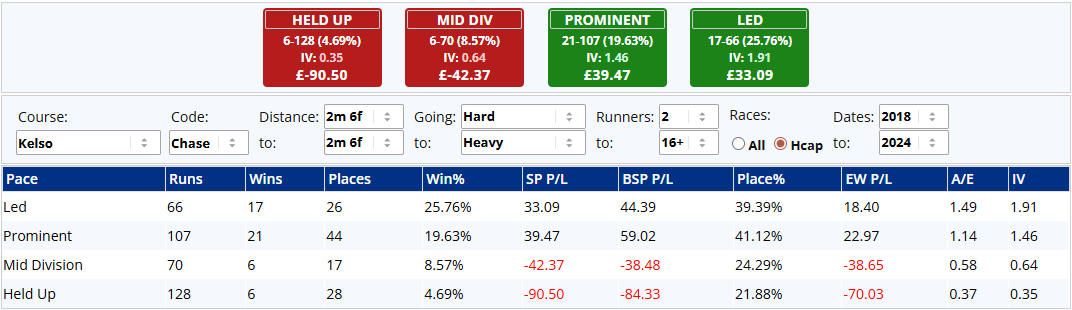


Strong prominent stats make this a course where a position at or near the front early has been a huge advantage. There were slightly stronger Led stats at some other course and distance combinations that I looked at last week but, for me, the additional strength of the prominent figures cemented a very robust overall run style bias.

Horses trying to mount their challenges from off the pace have really struggled over the past few years here, as the win and placed stats clearly show. The struggles of horses racing off the pace early can be highlighted further when sharing the PRB stats. PRB stands for ‘Percentage of Rivals Beaten’.


I grouped the Mid Div and Held Up stats together; their figure of 0.40 (40% of rivals beaten) is a poor one and, to coin a phrase, ‘well off the pace’.

The bias to horses up with or close to the front was stronger on good or firmer ground, or at least the stats suggested this:
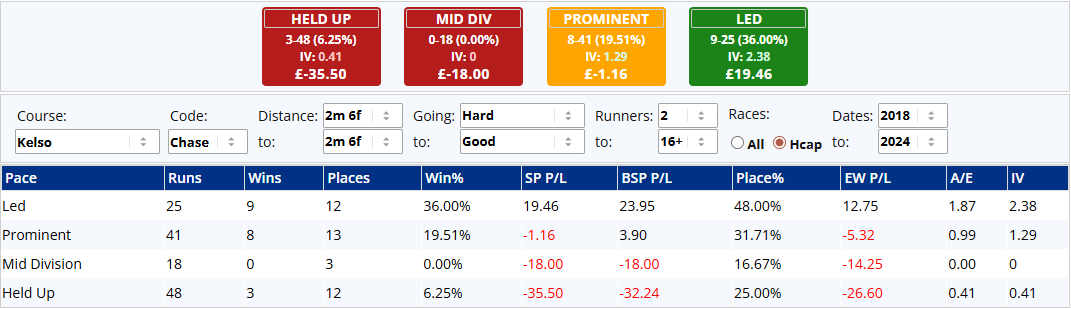


17 of the 20 races were won by either early leaders or prominent racers. The 'Led' A/E of 1.87 indicates that front runners were very good value on better ground during this timeframe.

Having started in Scotland we now travel south to Cheltenham.


4 Cheltenham 2m4f–2m5f

It is the middle distance range again, around the 2m4f mark, at Cheltenham (both courses, Old and New, combined). Perhaps not a track that initially would scream out front running bias, but the stats were very strong:
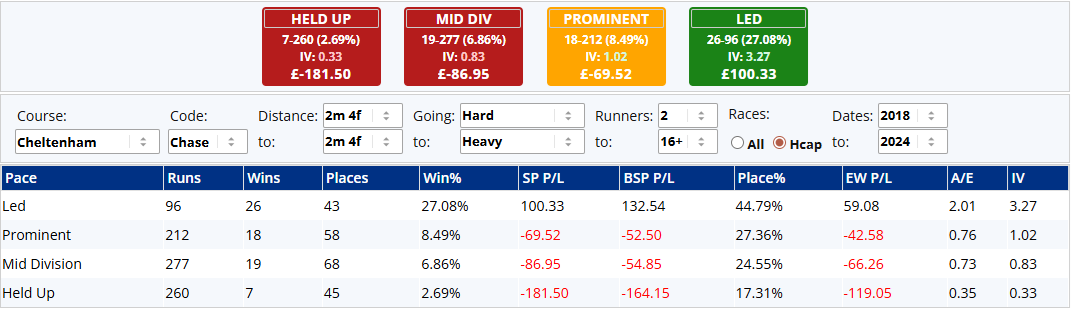


The comparison that caught my eye was the Led versus Held Up win ratios. Front runners won 26 races from just 96 runners, while Hold Ups won just seven from 260! If we had been able to predict the front runner(s) pre-race we would have made a fortune to SP, let alone BSP. Even backing each way would have been extremely profitable.

On good or quicker ground the bias seemed to strengthen as these stats suggest:
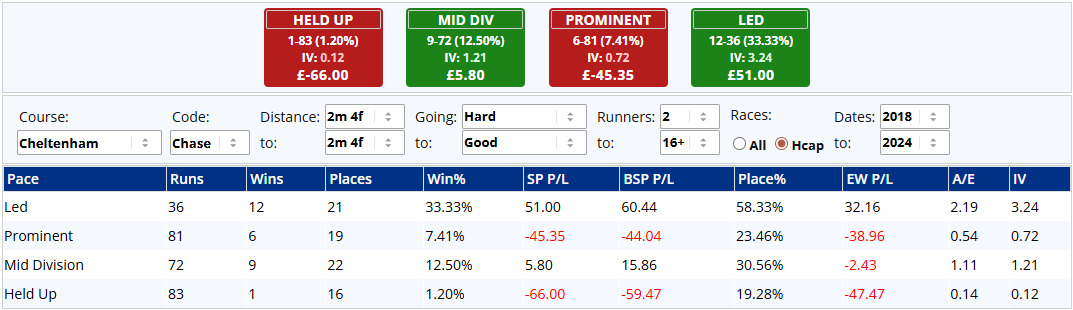


Of the 20 races with 15+ runners, just one win was achieved by a hold up horse from 114 qualifiers. The bias has still been strong on easier ground but not as strong.

Onto the PRBs (all going conditions):
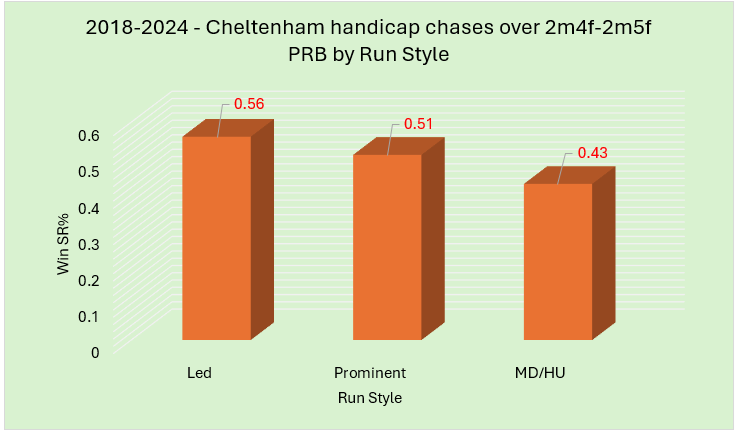


I had expected a slightly higher Led PRB based on the placed stats but they have still been comfortably the best. A higher PRB would have probably edged this track/trip further up the list.

Finally, I felt the stats for races with bigger fields (10+ runners) were worth sharing:


Front runners have offered huge value in these races (A/E index 2.53), with potential returns to BSP of nearly 200%!

There have been 11 races so far this year, with just a single win from 16 front runners. However, they have had three further placed horses including a place BSP of 37.55!


3 Tramore 1m7f-2m

The Irish course of Tramore may not be that familiar to some UK punters but run style stats for handicap chases over the 1m7f/2m trip there are well worth sharing:
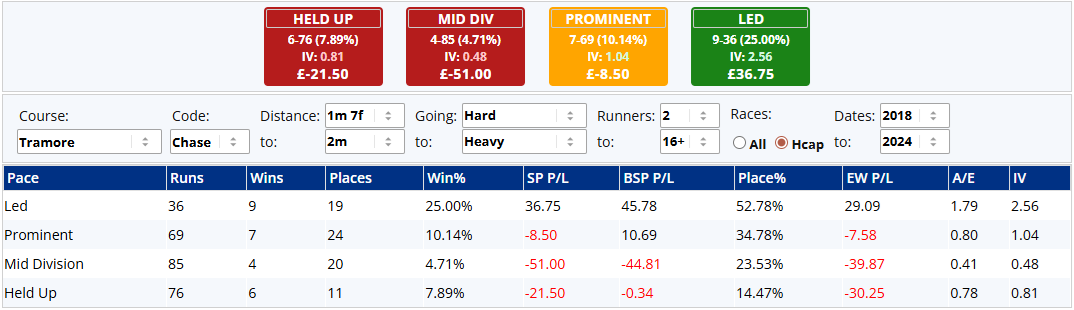


Yes, the sample size was relatively small but it was potent in favour of front runners with an extremely high A/E index at 1.79 and IV of 2.56. The PRBs correlate strongly and underscore the bias:


The 0.64 figure for front runners, compared with 0.42 for Mid Div/Held Up runners, over this timeframe indicated that the edge was huge. The big advantage of PRB figures is that they effectively help to make small datasets bigger. In racing we often deal with modest sample sizes, relative to what general statistics would consider so at any rate. Hence, when we then try to discern knowledge from the data by using PRBs we are examining all the runners in all the races, rather than just the winners and/or the placed horses. It's not a perfect metric - what is? - but it adds depth to shallow cohorts.

For the record, of the four qualifying races held in 2025 to date, two have been won from the front, at odds of 7/2 (BSP 4.99) and 6/1 (8.2). A third front runner in that quartet was still leading when unshipping his jockey five out.


2 Killarney 2m4f-2m5f

Staying in Ireland for number two, we head to Killarney over 2m4f-2m5f (use 2m4f when using the Pace Analyser / Query Tool):
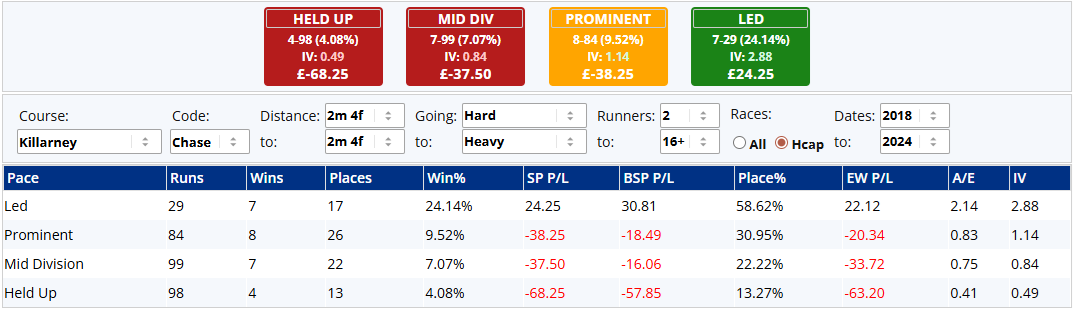


The Led group of runners hit 2.14 in terms of A/E index and 2.88 in terms of IV. There was a huge 58.6% placed figure to boot. Horses that were held up managed a place percentage of just 13.3%. As with Tramore the sample size was relatively small so let me share the PRB figures:


The 0.66 figure for the Led group compared with 0.39 for Mid Div/Held Up runners helps to confirm the huge front running edge there has been over the past few seasons.

Each year we mighgt reasonably expect four or five qualifying races, which is fewer than ideal, but when they do occur they are races we need to try and take advantage of.

And now for my number 1...


1 Uttoxeter 2m4f-2m5f

Top spot goes to Uttoxeter and its mid-range handicap chases. The majority of races were at 2m4f, but a handful were contested over an extra furlong. These are grouped together in Geegeez (using the 2m4f distance) and stats were as follows:
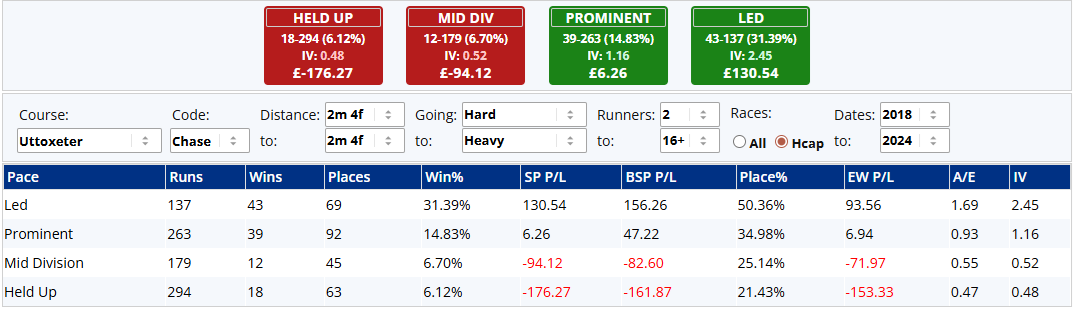


There were over 100 races in the sample, making this set of data extremely robust. Front runners won better 31% from within their group, had strong metrics across the board and potential profit levels were high. Front runners and prominent racers won 73% of the 112 races from 46% of the runners; and front runners alone won 38% of the races from just 16% of the runners!

The PRBs confirmed the pattern:


The front running edge is clear to see by looking at the bars on the graph, especially noteworthy due to the large number of races at this course and distance.

Ground conditions have made little difference with the win rate for front runners on good or firmer being 32.2%, while on good to soft or softer it was 30.8%.

At the time of writing, 2025 had seen 14 such races of which seven were won from the front.


*


Incredibly, run style bias in NH racing is something that still goes under the radar for many punters. There are not many clear-cut edges we can still get as punters these days, but knowing which course and distance combinations offer the strongest biases will almost force us to improve our bottom line.

Until next time...

- DR

Run Style Bias in Handicap Chases: 2024/25 Season Update (Part 2)

This is the second of two articles where I am revisiting run style bias, writes Dave Renham. As with the first piece, which can be read here, the focus is on handicap chases with seven or more runners, and all data has been sourced from UK NH racing between 1st January 2017 and 6th October 2024. I looked mainly at the distances of 2m1f or less and 2m3f-2m4f last time; in this follow up I concentrate on races of 2m5f-2m6f and 2m7f-3m2f.

Before getting into the numbers here is a quick recap of which type of horse fits each run style profile:

Led – horses that lead or dispute the lead early, usually within the first furlong; known as the front runner.

Prominent – horses that race close to pace tracking the leader(s).

Mid Division – horses that race mid pack or just behind the mid-point.

Held up – horses that are held up at, or near the back of the field.

Front Runners in UK Handicap Chases (7+ Runners)

Let us begin by comparing the A/E index for the ‘Led’ group (early leaders/front runners) versus the other three groups combined (Prominent, Mid Div, Held Up) across different field sizes for ALL distances.


This graph is illuminating. It clearly shows that the front running edge in handicap chases becomes stronger as the number of runners increases. The Impact Value comparison shows the same trend:


Once we get to 11 or more runners the front running bias becomes extremely potent, strengthening further still as we hit 14+ field sizes.

It’s time now to look at the stats over 2m5f-2m6f.

Run Style in UK Handicap Chases, 2m5f-2m6f (7+ Runners)

My first port of call in terms of this distance band is a comparison of the win strike rates for each run style group. It is important to note that these figures are based, as in the previous article, on the wins to runs ratio within each specific run style group. Here are the splits:


As with the first article we see a bias towards front runners, and a tapering related to early race position thereafter; but at 2m5f-2m6f prominent racers were not far behind front runners. Horses that raced further back early in the race continued though to struggle.

Let me share the A/E indices next:


There is good correlation with the wins to runs ratio here. The 1.15 figure for front runners indicates good value but it is less impressive than the 2m1f or less figure of 1.23, and also the 2m3f-2m4f figure of 1.31. Prominent racers are within 0.01 of the magic 1.00 figure. The held up A/E of 0.63 is low and has offered punters really poor value.

Onto the Impact Values now:


The same sloping pattern can be seen again, displaying good correlation across all three metrics. The 1.5 Impact Value for front runners is, like the A/E number, below the figures achieved at the two shorter distances examined in the first article (1.65/1.75). However, the front running bias is still in evidence, such types winning 50% more than might be expected.

Now I want to examine the individual course run style stats over 2m5f-2m6f. Less than half of the UK NH courses race over this trip so there are only 15 courses to share. Below is a table comparing the wins to runs ratio within each run style group, as well as their A/E indices. As with the first article I have colour coded it to help make the biases clearer. Numbers in green are positive, numbers in red are negative.


Aintree didn’t make the table due to a small sample size of races. Having said that, four of the 14 races were won by front runners and the average field size was 20. Hence, from limited data, front runners at Aintree look to have an edge.

The strongest front running biases from the other tracks appear to be at Cartmel, Kelso, Sedgefield and Taunton. Ffos Las consistently played against front runners at the shorter distances reviewed in part one, and this has again been the case. Front runners have also struggled at Leicester.

Before moving onto the longer distance races let me share the run style figures over 2m5f-2m6f restricted to horses from the top three in the betting. These stats also share potential profit and loss amounts to SP:


This table helps to show the positive correlation between the A/E indices with the ROI column. Horses from the top three in the betting that have taken the lead early have been excellent value and profitable to follow; those that raced midfield or were held up early have been very poor value.


Run Style in UK Handicap Chases, 2m7f-3m2f (7+ Runners)

Once again I’ll start by sharing the strike rates for each group (wins to runs ratio):


Even at longer distances horses that get to the front early have a strong edge. The same pattern across all run styles continues with ‘L’ outcompeting ‘P’ which in turn out outcompetes ‘MD’ with ‘HU’ bottom of the pile once more. Horses that led in handicap chases at this distance range won twice as often as horses that raced in midfield.

The A/E indices are next up:


These indices suggest that the front running bias is stronger for races between 2m7f and 3m2f than it is at those from 2m5f to 2m6f. Indeed, if one had correctly predicted the front runner(s) in each race from 2m7f-3m2f one would have profited to SP to the tune of £842.05 (ROI +31.6%). Finally let me share the Impact Values:


These values confirm how strong the bias is, so now may be a good time to compare the A/E indices and Impact Values for front runners across the four distance bands covered in the two articles:


This confirms the consistently strong figures across the board, with the 2m3f-2m4f distance edging it in terms of having had the strongest bias over the period of study. But there looks to be value and a well above average strike rate at all distances reviewed.

Back to the longer (2m7f-3m2f) distance band and let me share the run style stats when restricting to those horses that were in the top three in the betting only.


Front runners from the top three in the betting have performed extremely well showing how profitable they could have been. Again, we have terrible returns for mid division and held up runners.

It’s time now to look at the 2m7f-3m2f course run style splits looking at wins/runs and A/E indices. The format will be familiar by now:


The courses with the strongest front running biases in this distance bracket have been at Ayr, Cartmel, Catterick, Cheltenham, Chepstow, Exeter, Hereford, Hexham, Ludlow and Musselburgh, while front runners have struggled at Bangor, Carlisle and Haydock.

Overall Front Running Biases in UK Handicap Chases (7+ Runners)

There were eight courses that showed a consistently strong bias across all distances. They were Cheltenham, Doncaster, Exeter, Hexham, Kelso, Musselburgh, Sedgefield and Southwell. Two courses saw front runners at a disadvantage overall, those being Bangor and Ffos Las. The remaining courses offer front runners some sort of edge although its strength varies from track and trip to track and trip.

-------------

Summary

That concludes this two-parter. In summary, since 2017 in handicap chases of 7+ runners, front runners have enjoyed an edge at all distances and at nearly all courses. The strength of the bias has been as strong in 2023 and 2024 as it has ever been so when analysing such races make sure you consider how the race is likely to be run from a run style / pace perspective. I have no doubt it will improve your bottom line.

And, if you're not using the pace maps on this site, you are at a distinct disadvantage to those who are. The maps on geegeez.co.uk are more accurate than any other pace maps I've used, and are worth the subscription fee alone in my opinion.

- DR

Run Style Bias in Handicap Chases: 2024/25 Season Update (Part 1)

It has been three years since I looked at run style bias in National Hunt racing, so I felt now was a good time to revisit the topic, writes Dave Renham. Personally, I use run style bias for around 50% of my National Hunt bets so it is an area that I feel is extremely important. This article is the first of a two-parter.

The focus for both articles will be handicap chases with seven or more runners. Data has been taken from UK NH racing spanning from 1st January 2017 to 6th October 2024. I have split the races into four distance bands – 2m1f or less, 2m3f-2m4f; 2m5f-2m6f and 2m7f-3m2f. In this piece I will concentrate on the two shorter distances of 2m1f or less and 2m3f-2m4f. There is a relatively small number of handicap chases at 2m2f and these have a micro-section below.

As a reminder, geegeez.co.uk offers some powerful resources and the stats I am sharing with you here are based on the site’s pace / run style data, which can be found within individual racecards, a separate Pace Analyser tool, and in the highly configurable Query Tool. The run style data on Geegeez is split into four groups – Led (4), Prominent (3), Mid Division (2) and Held Up (1). The number in brackets is the run style score assigned to each group. Below is a basic breakdown of which type of horse fits which type of run style profile:

Led – horses that lead early, usually within the first furlong or so; or horses that dispute the early lead. The early leader is often referred to as the front runner.

Prominent – horses that lie up close to the pace just behind the leader(s).

Mid Division – horses that race mid pack or just behind the mid-point.

Held up – horses that are held up at, or near, the back of the field.

Race Leaders in Handicap Chases

Let me start by comparing the win percentages for the ‘L’ group (early leaders/front runners) versus the other three groups combined (Prominent, Mid Div, Held Up) across all distances by Year:


As the graph indicates front runners have a definite edge when it comes to strike rate. It is important to be aware that the number of runners in each run style group differs: prominent and hold up categories usually have more runners within their groups. 'Leaders' is the smallest group as usually you only get one early leader in this type of race, occasionally two when there is a battle for the early lead.

Hence although raw strike rates have significance, it is may be instructive to look at metrics like Impact Values (IV) and the A/E index (Actual winners/Expected winners). More information on these IV and A/E metrics can be found here.

First here are the A/E index splits by year:


These figures correlate positively with the strike rates. The ‘L’ group of race leaders have recorded consistently high A/E indices ranging from 1.09 to 1.33. The three other run style groups combined have ranged from 0.76 to 0.82. Anything above 1.00 for A/E indices suggests good value so front runners have consistently offered punters good value year in year out. Onto the Impact Value comparison now:


This is to all intents and purposes a carbon copy of the A/E graph. These initial findings already highlight why run style bias is important in handicap chases and something that needs to be factored in to your form study. It is time now to break the stats down into the distance bands as mentioned earlier. Let me start by examining the shorter distance handicap chases.

Handicap Chases of 2m1f or less

To begin with l will share the win strike rates for each group. Note that these figures are based, as before, on the wins to runs ratio within each specific group. Here are the splits:


Based on what we have seen already in this article in terms of the overall stats, these figures should come as no surprise. The ‘led’ group is comfortably clear of the rest in terms of win rates. Thereafter, the graph slopes from left to right implying that the nearer a runner is to the front of the race in the early part the better. We will see this pattern tend to recur across all race distances. Let me share the A/E indices for these shortest distance handicap chases next:


This is another demonstration of how the 'Led' group have offered punters excellent value. 1.23 is a strong A/E index figure on a significant sample size. We again see the sloping pattern from left to right, giving us the correlation statisticians are always looking for. The IV splits complete the set:


There is strong positive correlation once more, emphasizing the edge front runners have over 2m1f or less. Indeed, if you had sourced a crystal ball in perfect working order and been able to predict all the horses that led or contested the lead early in these races you would have secured a huge £1 level stakes profit of £330.21 (ROI +29.9%). This is just to Industry SP; to Betfair SP you could probably double that figure.

Now I want to examine the individual course run style stats over 2m1f or less. Courses that had a handful of qualifying races have not been included. Below is a table comparing the wins to runs ratio within each run style group, as well as their A/E indices. I have colour coded it to help make the biases clearer. Numbers in green are positive, numbers in orange or red are negative.


The strongest front running biases look to be at Cheltenham, Doncaster, Hereford, Hexham, Sedgefield, Southwell and Stratford. Other courses where the bias is still very significant include Cartmel, Huntingdon and Plumpton.

I did a little extra digging into the Cheltenham and Sedgefield run style stats because, as we know, it is all very well having a front running bias, but it is not easy predicting who will lead a race early. Looking at the Cheltenham numbers first, five of the 27 winners were top rated pre-race in the PACE section of the geegeez.co.uk racecards, while 12 of the 27 came from the top three in the pace ratings. If you had backed ‘blind’ the top three pace rated horses in all qualifying races at Cheltenham, you would have made a profit of £29.18 to SP (ROI +36%). Looking at Sedgefield, where there were more qualifying races (44), the top-rated pace horse won 12 times and backing them blind would have secured an SP profit of £16.55 (ROI +37.6%). The second rated pace horse won eight times for a profit of £28.04 (ROI +63.7%). So, 20 of the 44 races were won by one of the top two rated pace horses in the pre-race pace cards. That is extremely impressive going.

Clearly, I have delved more deeply into just two courses and distances as regards analysing the performance of the pre-race pace ratings, but the initial signs are promising. The problem with this type of research is that it is quite time consuming as you can only cross-check one race at a time. However, when I get some time, I will analyse some more.

In terms of courses where front runners ‘under achieve’, these include Carlisle, Ffos Las, Newbury, Sandown, Uttoxeter and Warwick. As punters, it is important to recognise the uniqueness of British horse racing in terms of how different course configurations can be. Courses can be left- or right-handed, sharp or stiff, undulating or flat, while the circumference and shape of each track differs too. Fences are placed in different positions and the length of run ins also varies. Some of these factors may help to strengthen or indeed weaken any front running bias.

Now it is time to switch to the next distance band.

Handicap Chases at 2m2f

Briefly, there were 86 races at this specific distance in the near eight year study period. The breakdown is below and, happily, the pattern is repeated: horses that lead do much the best, though those racing midfield have outperformed prominent runners. Hold up runners have found life difficult.


Of the five qualifying tracks with 7+ runner handicap chases at this specific distance, Kempton was by far the best performing for front runners.


Handicap Chases of 2m3f to 2m4f

I am going to start with this cohort by looking at the strike rates for each run style group as I did before. Keep in mind that these are wins to runs ratios calculated within each group.


These figures mimic closely those for the 2m1f or less distance band. Front runners would have again been a licence to print money should you have been able to predict them pre-race. Backing the front runner during this timeframe, would have made a profit of £548.82 to £1 level stakes (ROI +33.3%).

Onto the A/E indices now:


These numbers suggest the front running bias is stronger than over the shorter distance. Let’s see if the IV figures back up that assertion:


The chart does correlate with the slightly improved A/E indices. To save readers scrolling up and down to compare the two distances, the table below shows these stats in one place to make the comparison easy:


The led and prominent figures are higher for both metrics at the 2m3f-2m4f distance, while the mid div and held up figures are lower. All of this points firmly to an even stronger run style/pace bias to front runners.

Time to examine the individual course data for the 2m3f-2m4f group now, and below is another table comparing the wins to runs ratio within each run style group, as well as their A/E indices. It’s colour coded as before:


It is interesting to see that Cheltenham, Doncaster, Sedgefield and Southwell have strong front running biases again as does Plumpton. Other courses that have displayed a good edge to early leaders include Carlisle, Musselburgh, Perth and Uttoxeter. There are three courses where front runners have been at a disadvantage which were Bangor, Ffos Las and Lingfield. The Ffos Las figures for 2m1f or less were also poor for front runners.

--------------------

And that is where we will leave the first of this two-parter. It will be interesting to see how strong the front running biases are at the two longer distance groups - find out next week! Until then...

- DR

Run Style Bias in Handicap Chases

In my first two articles in this series revisiting run style bias in National Hunt racing I looked at run style bias in hurdle races, handicap and non-handicap; for this third piece I will perform a similar study on handicap chases.

What I mean by pace (or run style) is the position a horse takes up early on in the race, normally within the first furlong or two, which often defines its running preference. The first few seconds of any race see the jockeys manoeuvring their horses into the early position they wish them to take up. Sometimes, of course, the horse has other ideas (!) and you may see a horse being restrained as it wants to press forward but the jockey is keen to hold it up. Horses ‘fighting for their head’ often pay the price later in the race as they have used up too much energy fighting their jockey early.

geegeez.co.uk has created some powerful resources and the "pace" section is probably the one I personally use the most. The stats I am sharing with you here are based on the site’s pace / run style data. These data on Geegeez are split into four sections – Led (4), Prominent (3), Mid Division (2) and Held Up (1). The number in brackets is the run style score that is assigned to each section. Below is a basic breakdown of which type of horse fits which type of run style profile:

Led – horses that lead early, usually within the first furlong or so; or horses that dispute or fight for the early lead (e.g. "pressed leader"). The early leader is often referred to as the front runner;

Prominent – horses that lie up close to the pace just behind the leader(s);

Mid Division – horses that race mid pack or just behind the mid-point;

Held up – horses that are held up at, or near the back of the field.

Overall Run Style Bias in Handicap Chases

As with the previous two articles - which you can read here and here - I have only looked at races with eight or more runners: this avoids many falsely run races which often occur when there are small fields. The first set of data I wish to share with you is the overall run style stats all National Hunt handicap chases races in the UK from the beginning of 2009 to the end of July 2021, a large dataset of around 65,000 scored runners*:

*the run style of some horses is indeterminate from their in-running comments; such horses are excluded from the sample


As I mentioned last time, it is important to be aware that the number of runners in each run style group differs: prominent and hold up categories usually have more runners within their groups. 'Leaders' is the smallest group as usually you only get one early leader in this type of race, occasionally two when there is a battle for the early lead. Hence although raw strike rates have significance, it is more important to look at the Impact Values (IV) and the A/E index (Actual winners/Expected winners). More information on these IV and A/E metrics can be found here. If you're not familiar with them, I'd strongly encourage you to check out that article: it may just change the way you look at racing form!

Looking at the table we can see that the early leader goes on to win approximately one race in every six, which is a solid performance, and leaders clearly have an edge as a whole. Prominent racers have proved the next most successful group of runners. These figures are very similar to the hurdle results we saw previously. Hence, as with hurdle races, when betting on handicap chases we should be looking for horses that potentially will lead or at least race close up to the pace.

The run style bias has remained relatively consistent over the last dozen years or so as the following bar charts show. I have split the handicap chase data into two time periods in order to compare 2009 to 2014 results with those for 2015 onwards. The bar chart below compares the A/E values over these time frames:


There is excellent correlation across all four run style categories showing that the profitable edge to front runners has remained consistent over the years, perhaps even increasing in more recent years. Comparing strike rates give us a similar picture:


Before moving on I would like to share with you the front runner performance data in handicap chases (8+ runners) by year.


I have discussed in previous articles how being able to accurately predict the front runner(s) would be a license to print money – this illustrates the point perfectly – just look at the Win PL (and EW PL) column(s)! Unfortunately, as discussed in some of my previous run style articles, predicting the front runner is far from an exact science – however if one could find a method where you could correctly predict it around 65 to 70% of the time, that would almost certainly suffice for long term profitability. I am fairly certain this figure is impossible to achieve if trying to find the front runner of every single race; however, some races are easier to predict than others pace wise and if you concentrated on a select few races it may well be possible. Remember, these returns are at starting price. Better could be achieved using exchange prices.

Answers to me and Matt on a postcard, please, if you are able to achieve the pace predicting ‘holy grail’! [Though I suspect you'd keep that to yourself!]


*

Let us now start narrowing down the stats into different datasets to see whether the front running bias is stronger or weaker under more specific conditions. With the data being consistent across the years I will analyse these areas over the whole time period (January 1st 2009 to July 31st 2021).


Run Style Bias in Handicap Chases by Distance

Time to see if race distance affects the run style biases at all in handicap chases. I have split race distances into three groups as I did for the previous pieces: the groupings are 2m 1f or shorter; 2m 2f to 2m 6f; and, 2m 7f or further. A comparison of strike rates within each run style group first:


As we can see there is little discernible difference in the run style data by distance in terms of strike rate. Leaders enjoy a strong edge at all distances while hold up horses struggle regardless of the length of the contest.

Onto comparing the A/E values now:


An excellent correlation once more showing that, regardless of distance, front runners enjoy a strong (and profitable) edge.

Finally, a look impact values:


Again, unsurprisingly given the previous two charts, the Impact Values continue showing a similar linear pattern: the closer to the front of the race a horse is in the early strides, the more likely it is to win.


Run Style Bias in Handicap Chases by Course

Next stop is to analyse which courses seem to have the strongest front running bias. I analysed the highest front running strike rates and the highest A/E values to come to a consensus. If a course made the top ten of either list it made it onto my final list. Overall 12 courses made one of the two the final lists, and those eight courses noted in blue bold font were in the top ten in both:


Let's look at some of these courses in more detail.


Run Style Bias in Handicap Chases at Doncaster

Doncaster has shown the strongest front running bias at the 2m 4f trip. The stats are quite remarkable and I had to triple check the data to make sure I was correct. There have been 28 races with the following run style splits:


As you can see 15 of the 28 races (54%) were won by horses that led or contested the lead early. Below is a pie chart showing the percentages of winners to races across each run style section.


What you also have to remember is that early leaders provided just 14% of the total runners. Hence, runners taking the early lead provided 54% of the winners from just 14% of the runners.


Run Style Bias in Handicap Chases at Hexham

Hexham’s figures for front runners are particularly strong at the shorter distances. They race at both 2 miles and 2 miles 1 furlong and the combined run style stats are as follows:


These figures indicate how vital it is to be on or close to the early pace at Hexham over these distances. 40 of the 47 races were won by early leaders or prominent racers which equates to 85% of all races. It is also worth noting that if the favourite or second favourite led early they went onto to win 13 races from just 22.


Run Style Bias in Handicap Chases at Perth

The majority of Perth handicap chase races are run over 2m4f or 3 miles. They do race over 2 miles and very occasionally at longer than 3 miles, but I want to focus in on the distances that have decent data sets. Over 2m4f there have been 52 qualifying races and over 3 miles there have been 73 races. The two charts below compare strike rates and A/E values at these two distances and as you can see the run style bias is virtually the same for each:


Perth, at these two distances, offer a strong front running bias and one that we should be able to continue to take advantage of in coming seasons.


Run Style Bias in Handicap Chases at Plumpton

The Sussex course of Plumpton favours front runners strongly at 2m1f and 2m4f, but at distances of 3m2f or more there is no edge at all.


The strike rate for front runners at the two shorter trips is more than double compared with the marathon handicap chases. A/E values show the same pattern with high figures of 1.91 and 1.87 for the shorter distances and just 0.88 for the longer trip.


Run Style Bias in Handicap Chases at other tracks

There are some courses and distances that do not favour front runners in handicap chases and here are a few stats which should steer you away from what you may have thought were potential betting opportunities:

  1. Over 2m / 2m 1f Chepstow has seen just 1 win from the front from 30 races;
  2. Over 2m2f to 2m6f Ffos Las has seen just 3 front runners prevail from 53 races;
  3. At Musselburgh the strike rate for front runners is the lowest of all courses with a figure of just 8.8% over all distances (SR% of under 6% at distances of 3 miles or more);
  4. At distances of 3 miles or more only four courses have seen more combined winners for horses that raced mid division or were held up, compared with combined winners for leaders / prominent racers – these were Aintree, Newcastle, Plumpton and Worcester.


Jockeys showing a Front Running Bias in Handicap Chases

Next I want to look quickly at jockeys and to specifically peer at those who go to the front more than the norm. Below is a table of the top ten jockeys in terms of percentage of front running rides compared with all rides. Hence if you had 1000 rides and went to front early in 200 of them your FR% would be 20%.


To give some context, the average figure for all jockeys stands at 13% in terms of leading early.


Charlie Deutsch not only likes to lead more than most, but his strike rate on such runners is impressive at 22.7% (A/E 1.52). Nico De Boinville and Harry Cobden are also worth mentioning as they are both very successful when taking the early lead.

De Boinville’s figures are as follows:


He is a jockey who seems to excel when close to or up with the pace. In contrast his record on horses that come from off the pace is poor.

Meanwhile, Harry Cobden’s figures are similarly impressive.


These numbers are, I think, quite enlightening.


Before moving away from jockeys I wanted to mention a stat that unfortunately is not relevant for today, but is one worth sharing, because to me it emphasises how good a jockey Tony McCoy was. When he was riding in handicap chases his win strike rate on horses that raced mid division / held up was just under 15%. The average figure for all jockeys whose runner had an early position in the back part of the pack stands at a measly 7%.


Trainers showing a Front Running Bias in Handicap Chases

The final section of today's article shows trainers' performance with front runners. Here are the trainers who have the best win strike rates from front runners – the chart below includes all trainers with a SR% in excess of 20%:


There are some big names here including Messrs. Henderson, Skelton, Hobbs and O’Neill. Seeing Jonjo O’Neill on the list is interesting because he rarely sends his runners out into an early lead as the pie chart below clearly illustrates:


I am not sure why O’Neill favours hold up tactics so much as he is more than twice as successful in strike rate terms with his front runners compared to his hold up horses. It might be that some owners prefer their runners patiently ridden...

It is clear that some other trainers have a greater understanding of the importance of early run style, as illustrated by the stats for Donald Mc Cain and Charlie Longsdon:


There are boundless possibilities in terms of researching micro-angles from run style in handicap chases, this article only scratching the surface to that end. Hopefully this article has again demonstrated that if you are not considering run style when making your selections, it might be a very good idea to start doing so. I also hope you are inspired to use the Query Tool on Geegeez to crunch some data and find your own pace / run style angles.

Thanks for reading,

- Dave