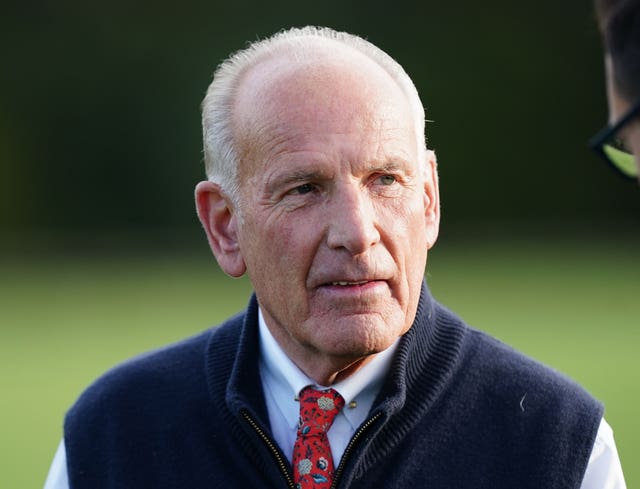
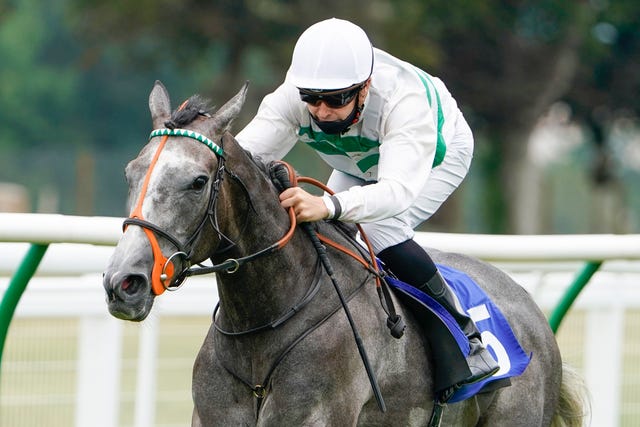
Moon Target remains under consideration for some major end-of-season prizes, despite suffering defeat for the first time in the Prestige Stakes at Goodwood late last month.
Sir Mark Prescott’s filly looked a hugely exciting prospect when making a winning debut at Newmarket in mid-July and she was just as impressive on her second start at Yarmouth under a penalty.
She was a hot favourite to complete her hat-trick at Group Three level on the Sussex Downs, but was under pressure some way from home and was eventually beaten three-quarters of a length by Aidan O’Brien’s Irish raider Precise.
Moon Target in the parade ring at Goodwood (Steven Paston/PA)
“She ran well and it was the first proper race she’d been in really because in her first couple of races she just sort of dictated,” said Chris Richardson, managing director of Cheveley Park Stud.
“Things didn’t quite go her way as she was slow out of the stalls and got a bit of a bump and was caught wide. The winner had a dream run and we were always on the back foot.”
Moon Target holds big-race entries in the Rockfel Stakes and the Fillies’ Mile at Newmarket. When asked whether those high-profile contests could be on the agenda, Richardson added: “I wouldn’t want to step on Sir Mark’s toes, but we’ll certainly be discussing those sort of races and see where we go.
“I think a step up to a mile will benefit her and I wouldn’t mind trying her on slightly easier ground. The sire (Cracksman) produces horses that go on soft ground and there’s a bit of a Pivotal influence there, so we’ll see.”
Another Cheveley Park-owned juvenile filly who could test her powers at Group-race level before the season is out is the Andrew Balding-trained Imperial Ballet, who bolted up on her introduction at Newbury last week.
Richardson said: “We were very pleased and pleasantly surprised as she’d never been on the grass, so we weren’t really expecting a huge amount.
“We haven’t really thought about plans for her yet, but we will probably creep away I would expect with a view to having a little dart at the Oh So Sharp Stakes in October, maybe.”
https://www.geegeez.co.uk/wp-content/uploads/2025/09/2.81337488-scaled.jpg12802560Geegeez Newshttps://www.geegeez.co.uk/wp-content/uploads/2022/10/geegeez_banner_new_170x78.pngGeegeez News2025-09-02 12:50:012025-09-02 13:10:13Moon Target team optimistic for the future
York Racecourse holds a special place in the affections of many within racing, including Sir Mark Prescott, who kickstarted his training career on the Knavesmire before returning to win some of the track’s biggest prizes.
The Heath House handler’s career was in its infancy when he sent Heave To up the A1 to contest the Ford Cortina Cup in 1971, but it was a victory which would become the springboard for one of the greatest training careers ever curated and by one of racing’s most decorated characters.
“York has been very good to me and in my first season I won with a horse called Heave To,” said Prescott.
Trainer Sir Mark Prescott has enjoyed a long career as a trainer (John Walton/PA)
“It was the richest sprint handicap in Britain at the time and as it’s name implied, it was very, very richly endowed. It was for six-furlong three-year-old sprinters and him winning made a great difference to my first couple of years.
“It would be most memorable for me because it came when I needed it and he would go on to win the Victoria Cup, he really helped get me going.”
Many York patrons will also remember fondly – as does Prescott himself – the gamble landed with Graham Rock’s Pasternak in the race formally known as the Magnet Cup and now the John Smith’s, leg one of an audacious double which would be completed in the autumn when scooping the Cambridgeshire.
However, York’s most prestigious handicap of them all and the centrepiece of the Ebor Festival would enter Prescott’s grasp in 1994 when Hasten To Add finally relieved his handler of the heartache of some previous crushing defeats.
“Before York everybody thought he had won the Northumberland Plate except a very wise old punter who was there,” reminisced Prescott on his agonising reversal prior to the Ebor at Newcastle.
“I thought he had won, television, everyone thought he had won.
“Yet as I pranced down to meet him convinced of what a wonderful trainer I was, this old punter who had been in the police force came up to me and said ‘I have reason to believe that you may not have won’ which was such a lovely phrase and way of disappointing me and of course he was right.
“He had been second in the Duke of Edinburgh and second in the Northumberland Plate and he’d also been fourth beaten at the shortest price ever in the Cesarewitch, so York was a great day and came at the right time, it was good to win the race and get it ticked off.”
For all the handicaps landed and plots successfully accomplished, Prescott has always been more than just a one-trick pony and over the years he has returned to the Knavesmire with the cream of the Heath House crop to take home some of the Ebor Festival’s most prestigious events.
Pivotal gave long-time Prescott owners Cheveley Park Stud one of their greatest days when battling to a narrow Nunthorpe Stakes victory in 1996, but an even more dramatic finish to York’s sprint showcase came eight years ago when Marsha provided the veteran trainer one of his most memorable triumphs of recent times.
With Marsha going head-to-head with American hotpot Lady Aurelia in the closing stages, the race is remembered by many for Frankie Dettori’s steadfast confidence as the pair of courageous mares flashed past the winning line in unison.
Watching from afar, Prescott was one of those to be initially convinced by the mercurial Italian’s bravado at the finish, but gasps would soon ring out around the racecourse as the judge delivered the verdict in Marsha’s favour, with the victory proving a catalyst for a record 6,000,000 guineas fee at the sales later that year.
“She won a nose when no one thought she had got it, including poor Mr Dettori,” explained Prescott.
“I was looking at yearlings at Miss (Kirsten) Rausing’s in Ireland at the time so I wasn’t there and I was watching on television and thought what a shame she got beat. I went straight back to what I was doing, so I certainly didn’t read it right.
Frankie celebrates… but it's Marsha who wins the Nunthorpe in a photo! Lady Aurelia is beaten by the tiniest margin pic.twitter.com/KK1OjojdE8
“Richard Hoiles, the commentator, was the only person who got it right, he said something like ‘Frankie thinks he has won it, but I’m not sure he is right’ – it was his great day as well.
“Everyone you would meet in the street said they owned a bit of Marsha and when she sold for the record price, she secured the future of the Elite Racing Club and their breeding operation forever.”
York may have been the defining moment of Marsha’s career, but for one of Prescott’s greatest alumni, the Knavesmire proved just a stopping point on the road to greater things when Alpinista set up her historic Prix de l’Arc de Triomph bid with victory in the Yorkshire Oaks.
Exceptional on her travels, but still in the eyes of many swimming under the radar when making the trip to Yorkshire somewhat under duress in August 2022, she headed home with a fifth straight Group One to her name and ParisLongchamp glory within reach.
Alpinista in action in the Yorkshire Oaks (Mike Egerton/PA)
“She had been doing a lot of her Group One winning abroad and the Arc was the aim. I had it in mind that we had beaten all the French fillies before in the previous Group One so we would go for the Prix Vermeille where you knew you could beat them,” explained Prescott on his initial reluctance to head to York.
“However, Miss Rausing said she would like it to be York as Alpinista had never won a Group One in England. If it was left to me she would have gone to the Vermeille, but as it turned out Miss Rausing was right.
“She became favourite for the Arc almost straight away which was when the worries started! From then on it all began to get tense.
“She was always under the radar and she won all those Group Ones in succession yet there wasn’t any real pressure on us until after York and building up to the Arc.
“I had no one ringing up asking for quotes on how she was doing or anything and she had won five Group Ones! But then all of a sudden the phone did start ringing, quite regularly as well!”
https://www.geegeez.co.uk/wp-content/uploads/2025/08/2.68882100-scaled.jpg12802560Geegeez Newshttps://www.geegeez.co.uk/wp-content/uploads/2022/10/geegeez_banner_new_170x78.pngGeegeez News2025-08-17 13:00:362025-08-17 13:00:36Sir Mark Prescott has cherished memories of special York moments
The exciting Moon Target will take a route Sir Mark Prescott knows well when she heads to Goodwood for the Virgin Bet Prestige Fillies’ Stakes later this month.
The Heath House youngster has shone brightly so far and having enhanced her reputation at Yarmouth, now heads for the Group Three event Prescott won with Red Camellia in 1996, but also saw his Prix de l’Arc de Triomphe heroine Alpinista beaten in 2019.
“All being well she will run in the Prestige,” said Prescott. “I managed to get Alpinista beat in the Prestige though, which seemed like the end of the world at the time but turned all right in the end.
“It is amazing when you look back now and think how on earth did that get beat there, but she did.
“You don’t want to be disparaging, but I don’t suppose they were world-beaters Moon Target beat at Yarmouth. However, she did it well didn’t she and she appears to be very relaxed which is such a great help.”
It has been hard not to be impressed by Moon Target’s progress to date, as she built on the taking nature of her debut win at Newmarket by scoring by an even wider margin in her second start.
Asked at what point he knew he had a smart horse on his hands, Prescott said: “Not until I worked her, I liked her much much more once I worked her as she always went very very well without apparently doing anything.
“Initially I thought the others must be very bad because of the way she just did it, so she’s been interesting and I think she caught everybody by surprise when it turned out at home she could go.”
Sir Mark Prescott is still at the top of his game (Mike Egerton/PA)
With one Prestige Stakes for Moon Target’s owners Cheveley Park Stud banked almost 30 years ago, the daughter of Cracksman’s rise to prominence gives Prescott the chance to continue his long association with the leading owner-breeder operation.
He added: “I’ve been a while without one for Cheveley and I had a marvellous run for them with Pivotal, Red Camellia who actually won the Prestige, and Hooray, who often gets forgotten and was champion two-year-old filly.”
Moon Target could also help Prescott in one of the few frontiers he has yet to conquer, with a Classic victory on home soil towards the top of his wish list for his remaining years in the training ranks.
Currently as short as 16-1 for next year’s 1000 Guineas and 20-1 for the Oaks, Moon Target is proving a huge asset to ensuring the Heath House master’s enthusiasm still burns brightly and could bring dreams of glory in next season’s biggest races into range if excelling on the Sussex Downs.
“I’ve never trained a winner of the Cesarewitch and I’ve never trained a Classic winner in Britain, they’re the things that need doing,” continued Prescott.
“I’m still motivated and if you are a trainer the goals remains the same all the time, as long as you retain your enthusiasm and your marbles. If anything it becomes more important as you know you are running out of time.
“Horses like Moon Target are what keeps everyone going and she looks good at the moment and we’ve got to hope everything goes right with her, but you can’t be disappointed so far.”
While Moon Target has already advertised her talent, waiting in the wings at the foot of Warren Hill and still to make her debut is the latest graduate from one of Prescott’s most successful lineages, Alpinara.
A sister to Alpinista and also from the family of multiple Group One-winner Albanova – as well as that one’s own sister, the dual Champion Stakes winner Alborada – she cost Kia Joorabchian 2.5million guineas at Tattersall’s prestigious Book One sale last autumn.
A bay, unlike her illustrious grey sibling who gave the Newmarket veteran one of his finest hours in Paris three years ago, Alpinara is steadily building up to her first racecourse appearance, envisaged to sport the Amo Racing silks for the first time in the autumn.
Alpinista’s sister is still to make her debut
“She is very interesting because at the sales everyone was asking does she look like Alpinista and the answer was not at all, completely different,” explained Prescott.
“She’s better looking in fact, but nothing like Alpinista and more like Albanova who was the grandmother of Alpinista.
“Alpinista won as a two-year-old at Epsom against colts in July, yet this one looks like she will be September into October really.
“She seems to go well and has really come to life recently. We turned her out for three months after we broke her in and she’s been fine, but who knows at this stage.”
https://www.geegeez.co.uk/wp-content/uploads/2025/08/2.76567356-scaled.jpg12802560Geegeez Newshttps://www.geegeez.co.uk/wp-content/uploads/2022/10/geegeez_banner_new_170x78.pngGeegeez News2025-08-10 13:14:162025-08-10 13:14:16Prescott has Prestige plans for exciting Moon Target
It was good enough to chat to Sir Mark Prescott and Kirsten Rausing in the sunshine of York before and after Alpinista’s fifth consecutive Group 1 success back in the summer, when she beat the gallant Oaks winner, Tuesday, in the Yorkshire Oaks, writes Tony Stafford. Yesterday I contentedly sat at home watching her battling performance in holding off a series of strong challengers up the last 200 metres to collect the £2.4 million first prize in the Prix de l’Arc de Triomphe.
The press and media were queueing up again, on an awful Parisian autumn afternoon to catch the now emotional Sir Mark – yes, he does sometimes let that relaxed urbane countenance slip! This tender side, in full view if not quite revealing actual tears, followed the victory of the same grey five-year-old mare, as she equalled a record that had stood from 11 years before the popular Baronet was born.
It was in 1937 that Corrida had been the last of her age and sex to win a race that then was only 17 years into its history. Now the Arc is rightly acknowledged as Europe’s championship race. Sir Mark, a trainer for 52 years, plotted Alpinista’s path to greatness with the same patience that for half a century he has set up maiden three-year-olds to win strings of races as they improve and learn on the job, starting low and frequently ending high.
In her case, Alpinista didn’t start low at all, winning on her first juvenile start at Epsom’s August meeting. That alone should have told us she was different. Quickly up to stakes company, although finishing only sixth in a Goodwood Group 3 and then filling fourth in a Listed race at Longchamp, her first of many overseas sorties, on her final juvenile start.
Sir Mark gave her a reappearance on July 20, 2020, no doubt because Covid had not only interrupted the early part of that season for everyone on the racecourse but inevitably delayed all the time-honoured training regime he had made second nature over the decades.
But having finished fourth in that Listed race, this time at Vichy, she made up for lost time with a victory at the same level at Salisbury before outperforming her 33-1 odds when second to the Oaks winner, Love, in the Yorkshire Oaks.
From then, there has only been one more defeat, next time in the Group 3 Princess Royal Stakes behind Antonia De Vega at Newmarket, her final three-year-old start.
Thereafter, Sir Mark has produced a two-season, eight-race unbeaten sequence that could have been modelled on some of his more celebrated handicap coups, except that the last six of the eight have been at Group 1 level.
Last year involved a late summer/autumn German Group 1 hat-trick starting with a defeat of future 2021 Arc winner Torquator Tasso in Hoppegarten, a race of which Prescott modestly said her rival was “unlucky in running”. There was no hard luck story yesterday, though, as Torquator Tasso was brought with a perfect run down the outside by Frankie Dettori, but Luke Morris and his grey co-conspiratress were never contemplating defeat.
Afterwards, Prescott said that Morris had been with him for 12 years, a span that probably leaves him at least as long to go to match George Duffield. There can be few occupations anywhere in this uncertain world with the career security of Heath House’s stable jockey. Or indeed as the quiet assistant trainer William Butler might ruefully opine, “Nor assistant to Sir Mark!”
That self-effacing gentleman at least is not threatened in his post, but it reminds me of an exchange at the Daily Telegraph when a colleague, anxious to know what would happen when his department boss – he was the deputy - was leaving in the coming weeks. The Sports Editor, said, “Don’t worry old boy, your present position is assured!”
It embarrasses me (a little) to say he took the hint and quickly left and, a few short months later, I was appointed Racing Editor since which time it’s all gone downhill!
Alpinista was one of six UK-trained winners on the two-day Longchamp card with three on the opening day, added to by another three yesterday. That tally does not include Aidan O’Brien’s Kyprios, who, I must say, put up the best performance I have ever seen from a flat-race stayer.
In the two-and-half mile Prix Du Cadran, the previous winner of the Gold Cup at Ascot, Goodwood Cup and Irish St Leger, a Galileo colt, cantered along for the first two miles of the journey, as first Quickthorn (briefly, but alas with little conviction) and then Lismore set the pace.
By the turn in, the Coolmore runner had taken the lead totally untroubled and started to draw away inexorably. There was still more than a furlong to go when he began to find it all so boring and showed a liking for the fans on the stands rail, so in the manner of the 2014 2000 Guineas winner, Night of Thunder, he thought he would come and say “Bonjour” to the Turfistes that side.
It’s easy to overstate the amount of ground conceded by such a manoeuvre, but it caused Ryan Moore a degree of discomfort for a while. Not to worry, he still had a full 20 lengths to spare passing the post, and probably three or more gears that Ryan hadn’t troubled to utilise.
Having seen off now retired Stradivarius and Trueshan at Goodwood, Aidan and the boys will be aiming at shorter rather than keep to the stayers but, still only four, it will be tempting to call in at Royal Ascot for the next few Gold Cups. Yeats was great; Stradivarius was very good for a long time, but this is a late-in-career phenomenon to add to the Galileo legend.
Having watched Luxembourg struggle in the soft ground yesterday, I wonder if Aidan is already thinking “next year’s Arc” for a Classic winner, albeit the Irish St Leger. He is improving so quickly the problem will be just which demanding prizes they challenge for.
*
It was good to have ITV cover the races up until the Arc and Sky Sports Racing the subsequent events, but when comparing what came up on those screens, with results as published in the Racing Post, there was generally a pattern to discern. Not in every case, but mostly, the punters watching on the box will have expected being paid out on those prices and will probably have been disappointed at what the bookies returned them.
The most blatant example on a day when Andre Fabre, three months my senior whereas Sir Mark is two years less a day younger than me, almost single-handedly kept the home fires burning with two Group 1 victories. His Jean-Luc Lagardere winner Belbek was 16-1 or thereabouts in both versions. Contrastingly, after his Place Du Carroussel finished strongly to deny Nashwa and Hollie Doyle in the Prix de l’Opera, Sky Sports Racing flashed up 66/1, but if you found her, the Post says she was a 41-1 chance.
Hollie got her revenge a little later when Richard Fahey’s The Platinum Queen became the first two-year-old filly to win the Prix de l’Abbaye de Longchamp since the celebrated sprinter Sigy in 1978 after a fine performance by horse and rider. Her 9-4 on the box, was as low as 7-5 with the firms. Alpinista was only a shade shorter in the Post whereas Kinross and Frankie won the Foret at only 11/8. Don’t say the bookies never show mercy – they returned 17-10.
On Saturday, there was nothing to choose between 7-10 (Post) and 4-7 (SSR)about Kyprios while Anmaat’s 23-10 was better than the 15-8 from the broadcaster. There was a big disparity though in the 13-5 about William Haggas’ Sea La Rosa and the telly’s 7-2 in the Royallieu. Then again, with so many well-backed UK-trained winners, they must have been onto something of a hiding.
Now all the big players will come back to the UK, making the annual trek to the sales at Tattersalls in Newmarket to start inspecting the choice Book 1 offerings that will be going through the ring and will be their prime targets as they seek to re-stock.
I doubt Tatts will be worrying about their gas and electricity bills with 5%, the guineas rather than pounds, if you are too young to know, commission on every sale and the prospect of many millions of pounds, euro, dollars, yen and whatever else you care to mention, sure to change hands. It’s worth a watch, Tuesday to Thursday, to see exciting bidding, big-name owners and trainers and, like me, you can keep yourself warm at someone else’s expense. Or else you can watch it at home online, but then you’ll be footing the bill!
- TS
https://www.geegeez.co.uk/wp-content/uploads/2022/10/Alpinista_Arc_2022.jpg319830Tony Staffordhttps://www.geegeez.co.uk/wp-content/uploads/2022/10/geegeez_banner_new_170x78.pngTony Stafford2022-10-03 07:20:502022-10-03 07:20:50Monday Musings: Sir Mark’s Arc
This is the fifth article in a series where I have been digging into the performance of trainers' runners of specific ages over the past few seasons, writes Dave Renham. I have used UK race data from 1st January 2016 to 31st December 2021 giving us six full seasons to examine.
My focus in this second part of the series is on three-year-old (3yo) runners and, following on from my previous piece, I have used the Geegeez Query Tool for all of the number crunching. All profits / losses have been calculated at Industry Starting Price. I appreciate most punters do not use SP these days as many (quite rightly) take advantage of early prices, Best Odds Guaranteed and / or the exchanges.
I looked in depth at non-handicap data last time; this time the focus is three-year-old runners in handicap races. Note, these could be three-year-old only or three-year-old and up handicaps.
All 3yo runners in handicaps
To start with let us overview all 3yo runners in handicaps before breaking the data down.
Here are the top 20 trainers in terms of strike rate with their 3yos in handicaps (minimum 150 runs):
Many of the usual suspects appear in the list but there are a few names - such as Chris Wall, Ron Harris and Heather Main - we have not seen prominently before. Eight of the 20 are in profit, which is surprising, but it will be interesting to see which of the profitable trainers have skewed figures due to one or two big-priced winners. In order to see whether this has been the case, the below table shows these eight trainers when their runners returned 8/1 or shorter. This takes any outliers out of the equation. Here are the figures:
Four of the eight have remained profitable, while three of the others were profitable to Betfair SP, with only Clive Cox remaining in the negative. Here are some individual highlights:
Owen Burrows has a good record with his 3yo handicappers who are in the top three of the betting – 39 wins from 124 runs (SR 31.5%) for a profit of £39.73 (ROI +32.0%).
Sir Mark Prescott has a decent record when using claiming jockeys. 13 wins from 43 (SR 30.2%) for a small profit of £9.94 (ROI +23.1%). His 3yo handicappers that wear cheekpieces have a surprisingly good record, too. 46 wins from 154 runners which equates to a win strike rate of just under 30%. They have returned an impressive 25p in the £.
Marcus Tregoning has performed considerably better with male 3yo handicappers as compared to female ones. His male runners have won over 21% of their races; his female runners have won less than 10%. The each way figures are equally skewed (42% versus 27%). Tregoning has also done well with favourites, scoring 21 times from 51 (SR 41.2%) for a profit of £18.54 (ROI 36.4%).
It looks best to ignore Charlie Fellowes if he is using a claiming jockey as only 2 of 37 such runners have won. On a more positive note, in the better handicap races of class 2 to 4 he has hit a 20.8% win strike rate for a profit of £137.48 (ROI +94.5%).
Ron Harris and front runners have been a potent combination thanks to 27 wins from 81 runners. Compare his win strike rates for the different run style groups below:
A 3yo front-running handicapper for Harris is a horse we ought to be on!
In terms of A/E indices there are 19 trainers who have managed a figure of 1.00 or more (150 runs or more). They are shown in the graph below:
These trainers have offered good value over the past six seasons with their 3yo handicappers. 11 of the 19 have secured profits to Industry SP; 14 were profitable to BSP. Ron Harris has the highest A/E value, at 1.31, followed by Roger Teal (1.26) and George Margarson (1.25). It's always good to see some new trainers, especially less familiar ones, on this list. Teal has a notably good record with favourites (8 wins from 19) for a 56p in the £ return, while Margarson, when teaming up with jockey Jane Elliott, has secured 14 wins from 62 for an outstanding return of 144p in the £.
Handicap races broken down by distance
Now let's break down trainer 3yo handicap runner performance by distance. I am going to look at sprint distances first.
3yos in handicaps over 5 to 6 furlongs
In the table below I have restricted it to trainers who have had a minimum of 75 runs or more, with the top ten in terms of strike rate shown:
Ed Walker tops the table so let's start with him in terms of some additional sprint handicap stats to share:
All bar one of Ed Walker’s winners have returned single figure prices. His record therefore with horses priced 9/1 or shorter has been impressive – 38 wins from 146 (SR 26.0%) for a profit of £52.93 (ROI +36.3%).
Ron Harris has secured a 22.5% win strike rate over 5f, but this drops markedly to 13.3% over 6f. Nevertheless, he has been profitable to follow over both sprint trips.
Amy Murphy has an outstanding record with her fillies (female runners). She has had 12 wins from 48 runners (SR 25.0%) for a profit of £56.37 (ROI +117.4%).
Andrew Balding’s runners have done well when they have been fancied. Combining his favourites and second favourites has produced 21 winners from 65 runners (SR 32.3%) for a healthy profit of £29.86 (ROI +45.9%).
3yos in handicaps over 7f to 1 mile
Onto 7f to 1 mile races next – here is a bar chart showing the trainers with the highest win strike rates:
At these Classic type distances, we're back to some of the biggest hitting trainers here and there are some strong individual stats to mention:
The Gosden team have visited Yarmouth a dozen times with their 7f-1m 3yo handicappers and a remarkable eight have won.
All 28 of Charlie Appleby’s winners were priced 8/1 or shorter. He is 0 from 18 (2 placed) from runners bigger than 8/1. Also his higher weighted runners (9st 1lb or more) have done well, with 27 wins from 84 (SR 32.1%) and a profit of £17.49 (ROI +20.8%).
William Haggas has made steady returns of 9p in the £ with horses first or second in the betting.
Andrew Balding has done well with his shorter priced runners. Those priced 3/1 or shorter have seen 41 wins from 108 (SR 38.0%) for a profit of £13.35 (ROI +12.4%).
Clive Cox has an excellent record with favourites – 30 wins from 74 (SR 40.5%) for a profit of £20.61 (ROI +27.9%).
3yos in handicaps of 1m 1f to 1m 2f
Let’s check out the stats for 9 and 10 furlong handicap races now. A look at the top ten trainers in terms of win strike rate:
There are some impressive strike rates for handicap races with all ten trainers in the table hitting at over 18%. Four of the ten are in profit including the big guns of Stoute, Charlton and bin Suroor, while six have A/E indices of 1.00 or more.
It is worth noting that the Charlton stable has been profitable in five of the six seasons which shows excellent consistency. They have also managed a yearly strike rate of 19% on five occasions. Despite Saeed bin Suroor’s positive record, the last two seasons have been poor for him with just a single win from 20 starters in this distance range.
There are three trainers (Johnston, Hannon and Fahey) that have had over 400 qualifiers but their strike rates were not good enough to make the top 10. For the record here are those volume trainers' figures:
All three are well off overall profitability. However, Richard Fahey has done well with fancied runners over these trips. His first and second favourites have produced 27 winners from 82 (SR 32.9%) for a profit of £28.17 (ROI +34.3%).
3yos in handicaps of 1m 3f to 1m 4f
The final distance group to check out is 1m 3f to 1m 4f, as races of 1m 5f or more offers only a modest dataset with which to work. The top ten are shown below along with their strike rates:
A bigger proportion of these trainers are in profit with seven managing positive figures and it's good to see Marco Botti, William Knight and Alan King getting into the top 10 to freshen things up a little. A look at their A/E indices and Impact Values now:
Seven of the ten have A/E indices over 1.00 which is excellent, and with reasonable correlation, too.
Distance comparison – individual trainers
I thought it would be useful to end this article by comparing individual trainer strike rates across the four distance groups. To qualify for a figure, each trainer needs to have had at least 60 3yo handicap runners in the relevant distance group. Trainers that have had enough runners in at least three of the four distance ranges are shown. Hence any gaps simply mean that trainer did not have 60 or more runners in the distance group. The table is also colour coded with strike rates of 20% or more in red (hot); strike rates of under 10% in blue (cold) :
William Haggas is the only trainer to have secured a strike rate of over 20% in all four distance groups. Sir Mark Prescott has achieved that in three of the groups.
It is interesting to compare trainers in this way with some very consistent figures across the board (for example, Charlie Hills and Michael Bell); others vary quite a bit – William Knight, Alan King and Marco Botti being three who have both red and blue figures.
Few handicap races are easy puzzles to solve, and many 3yo runners are still developing and looking for their optimum distance. I hope the trainer statistics in this article help to point you in the right direction.
The final piece in this series will look at trainer performance with older runners. Until then...
- DR
https://www.geegeez.co.uk/wp-content/uploads/2022/08/sirmarkprescott.jpg320830Dave Renhamhttps://www.geegeez.co.uk/wp-content/uploads/2022/10/geegeez_banner_new_170x78.pngDave Renham2022-08-22 14:21:392022-11-10 11:58:43Trainers with Three-Year-Old Runners, Part 2
They came in their droves to York on Wednesday just to see the best horse in the world, writes Tony Stafford. They saw him and he delivered by six-and-a-half lengths from the horse who had won the richest horse race in the world – if not this year, last.
A lot had been invested in the event. Not just the £1 million prize fund of which £567k went to the winner, Baaeed if you weren’t sure. A decent chunk went to the second, Mishriff, to bring his money-haul to £11,677,544, four times as much as Baaeed’s. Third home Sir Busker also picked up a six-figure prize for Kennett Valley and William Knight.
It was the razzmatazz of the whole week, seemingly trying so hard to lighten the general mood of gloom surrounding the sport and country. It appeared to try to ape the Melbourne Cup with the jockey introductions and the like before Saturday’s Skybet Ebor, the half-million total fund of which makes it the richest handicap in Europe.
That of itself is not much of a distinction, as no other major racing administration has anywhere near the preponderance of handicaps, save Ireland of course.
Everyone got very excited when the William Haggas-trained four-year-old made it ten out of ten, approaching the flawless record of Frankel, who retired to stud after 14 unblemished runs. Although Frankel was also a four-year-old when he left Sir Henry Cecil’s care for Banstead Manor stud, he had won six races before June of his three-year-old season including the 2,000 Guineas. His shadow Baaeed had not even made his racecourse debut before June as a three-year-old.
Six races were crammed within 101 days in 2021 between June and October. Then Haggas gave him seven months to mature before another quartet, all at Group 1 level, in 95 days from May to August. The last three have been a mirror image of Frankel’s: Royal Ascot’s Queen Anne, Goodwood’s Sussex Stakes, and a first try beyond a mile in the 10½ furlong Juddmonte.
The incentive for the York feature for the Khaled Abdullah homebred was obvious as the late Saudi prince had sponsored the race for many years. This time, once the path had been set for Baaeed, the only argument going around was whether Haggas might try to persuade Sheikha Hissa, daughter of the late Sheikh Hamdan Al Maktoum, to have a think about the Arc rather than end his career Frankel-like in the Champion Stakes later in October.
I had a lovely couple of days in York, securing a bed within walking distance of the track – although I did go by car – with Jim and Mary Cannon in their four-story abode in a quiet square near the Mount school, Alma Mater of Dame Judy Dench, so they told me.
Jim, a native of Carlisle, is a one-time Labour councillor in East London who moved with Mary to York nine or ten years ago and has had shares in loads of Wilf Storey horses for all that time and a little before. It’s like home from home and I can do my work, rifle the fridge and wait for him to rustle up something tasty for dinner.
That happened the first night, but on Wednesday I was in Delrio’s – known by all the racing crowd as “The Italian” and the only thing that beats it for its conviviality is the length of time it takes to turn orders into drink and especially food.
I had my back to the table immediately behind me, which among its ten squeezed-in bodies were several of the TV broadcasters. I’m pretty sure I did identify which of them pronounced: “It’s my mission to get him <Baaeed, no doubt> to the Arc”!
The way Baaeed finished off after coming from some way back offers every hope that he would stay the extra two furlongs, but would it make any difference to his appeal as a stallion? For all Sheikha Hissa and her family’s sporting and sensible policy of continuing her father’s work in a more streamlined manner, the fear that he might be beaten over a mile-and-a-half in the mud against the French (or Germans, or indeed Sir Mark Prescott’s Alpinista) should be incentive enough for the team to stay with the Champion Stakes.
Alpinista was the star of Thursday when she saw off a revived Tuesday – a little short of peak I was led to understand beforehand – in the Yorkshire Oaks. I always enjoy a chat with Sir Mark and, after he conducted interviews with every television station from the UK, Ireland and Dubai I finally got a word. His impeccable navy-blue pinstripe suit was set off with an immaculate tie, and it was only after studying him as I waited that I realised he had tucked in the tail part of it.
I said, “As you know I’m a year all but a day older than you, and I’m not too old to learn from you.” When I explained it was the tie issue that I noticed, he said he always does that. Then, after speaking to Richard Frisby, advisor to Kirsten Rausing, Alpinista’s owner-breeder, on the topic, he put me straight. “You learn that at prep school,” he revealed. I must have missed that!
Nobody missed the fact that Alpinista has won five Group 1 races including one defeat of Torquator Tasso, last year’s Arc winner. “We were lucky to beat him as he didn’t get a run,” said Sir Mark modestly.
So many amazing things happened at York. Like the 14-length win of Hughie Morrison’s ever-improving stayer, Quickthorn. Morrison and owner Lady Blyth had the option of a second shot at the Ebor, which he lost narrowly last year to Sonnyboyliston, who went on to win the Irish St Leger for Johnny Murtagh.
Instead, they took the bold step of taking on Stradivarius and Trueshan in the Lonsdale Stakes over two miles on the Friday. It was always possible that Trueshan may continue the Alan King policy of missing races when the ground was unsuitably fast and that was his eventual decision.
By that time, Stradivarius was already out with a bruised foot, so it was left according to the market as a match between Quickthorn, winner of the Group 3 Henry II Stakes at Sandown in May and a Group 2 in France last month, and Andrew Balding’s Coltrane.
Coltrane, winner of the Ascot Stakes under a big weight and then easily in a Listed over two miles at Sandown, proved best of the rest in the “finest stayers’ race ever run” when fourth in the Goodwood Cup behind Kyprios, Stradivarius and Trueshan at the Glorious meeting.
In the event, it was no contest. Tom Marquand took Quickthorn to the front, steadily building on an initial lead with consistent 12-second and change furlongs, and by the turn into the straight he was miles clear. Afterwards, Hughie told me, “I hadn’t realised how much he eased him.” The track record would have been his as well as a 20-length win at least.
I think the absent big two would have been fully stretched to have any more luck at staying with him than those that remained. He may well go the Irish St Leger route as that Group 1 win would look very nice on his CV, though that would very likely mean a shot at Kyprios.
Morrison is out of love with the Melbourne Cup nowadays after the controversy over conflicting veterinary conclusions by his own advisors and the local Flemington panel which ruled his Marmelo out of running in the 2019 edition on soundness grounds after he had finished runner-up to Charlie Appleby’s Cross Counter the year before.
One trainer perfectly happy at continuing his love affair with that race is Ian Williams and he almost carried off an Australian-style coup at York this week. It is commonplace for Australian trainers to run their horses in the days coming up to the big race, sometimes even three days before and over vastly shorter than the two miles of the Cup.
On Wednesday, Williams won the £51k to the winner two-mile handicap with Alfred Boucher by three lengths. That gave Alfred a 4lb penalty, enough to slot him in at the foot of the Ebor field. After much debate, he decided to run the six-year-old again, reasoning he would never be able to run for three hundred grand any time soon.
Backed down to 8-1 and benefiting from a fine ride by P J McDonald he was beaten just a short-head, as Williams asserted, “victim of a Frankie Dettori masterpiece.” He added, “Dettori went off fast and wide of the field, crossed him over to the front and then steadied the pace. He rode the socks off the rest of them, no criticism to P J.”
How Williams must have wished Dettori’s brief exile from the Gosdens over the Stradivarius Royal Ascot issue had been more permanent. He chose his best ride on their Trawlerman to deny what would have been one of the headlines of the week.
Talking of the Melbourne Cup, last year’s winner of that race, the seven-year-old mare Verry Elleegant, has pitched up in France in the care of Francis-Henri Graffard, presumably with the Arc as her main objective.
Frankie was recruited for yesterday’s run in Deauville and I wonder whether her Aussie owners were enamoured by this ride, sitting well out the back, asking for an effort turning for home, and then only plodding on at one pace. She finished last of seven and will need to have a form transformation if she is to add to her massive home reputation over in Europe. Connections were putting on a brave face and suggested a more suitable rehearsal will be the Prix Vermaille in three weeks' time.
- TS
https://www.geegeez.co.uk/wp-content/uploads/2022/08/baaeed_Juddmonte2022.jpg319830Tony Staffordhttps://www.geegeez.co.uk/wp-content/uploads/2022/10/geegeez_banner_new_170x78.pngTony Stafford2022-08-22 07:03:142022-08-22 07:10:36Monday Musings: A York Debrief
This is the second article in a series in which I will be looking at run style bias, writes Dave Renham. The first article was quite a general piece, although it did drill down into some of the key stats of three trainers – Eric Alston, Mark Johnston and Tom Dascombe. This follow up piece looks at success rates for trainers with front runners including breaking down the data by distance. Once again I have looked at the last eight full calendar years of data (1/1/14 to 31/12/21) including both turf and all weather racing in the UK. The focus is all race types (handicaps and non handicaps) and all distances, races with six or more runners.
Run style is all about the position a horse takes up early on in the race, normally within the first 100-200 yards. There are four basic positions a horse can adopt in a race and these are categorised on the Geegeez website as Led (4), Prominent (3), Mid Division (2) and Held Up (1). The number in brackets is the run style score that is assigned to each section.
Below is a basic breakdown of which type of horse fits which type of run style profile:
Led – horses that get to the front early or horses that dispute for the early lead often simply called (front runners);
Prominent – horses that race just behind the leader(s);
Mid Division – horses that race mid pack or just behind the mid-point;
Held up – horses that are held up at, or near the back of the field.
Run style is often linked with the word pace because the early pace shown by horses in a race determines their early position. Hence for many the words run style and pace are interchangeable.
On this site you can find plenty of run style data in both the Pace Analyser and the Query Tool. These can be found from the Tools tab anywhere on site. Additionally, each racecard has the last four run style/pace figures for each runner. Inexperienced horses may have less data as they may not have run four times.
Benchmarks: Overall strike rates for run style
To begin with I want to look at the average win percentage strike rates for all trainers / runners in terms of run style. In other words what percentage of front runners / early leaders win on average, what percentage of prominent runners win etc. Here is the breakdown:
These raw stats illustrate why run style is so important and why it staggers me that some trainers are clearly averse to sending out their runners to try and lead early.
Front runners do best at shorter distances as the graph below shows. (It should be noted that the small number of 6½f races, just 43 in total, were included in the 7f-1m data):
The advantage to front runners is very strong in sprints (5-6f) and quite potent at races up to a mile, also. The advantage is less pronounced over longer trips but those on the lead still win more often than any other of the overall run styles shown in the first chart (13.91% for leaders over 1m1f+ vs 12.3% for all prominent racers).
Data for hold up horses, as you may expect, shows the reverse. The longer the distance the more chance horses from the back of the field have of coming thorough to win:
Still, even the best strike rate for hold up horses is lower than those racing midfield overall, much lower than the prominent racer superset, and more than half as low as the early leader overall group. More materially, perhaps, the just better than 8% hit rate for hold up horses in 1m1f+ races compares highly unfavourably with the nigh on 14% rate for early leaders in the same races.
Best Front Runner Trainers: All Races
Moving on, let us look at the trainers who had the highest strike rates with their front runners in ALL races of 6+ runners (minimum 80 runs / top 30 trainers):
This table really knocks the eye out! There are some seriously impressive figures here with 14 trainers having strike rates of 25% or higher, five of them hitting 30%+.
The Win PL figures show how profitable front runners are, and that trying to find the best way of predicting them is something all punters should want to achieve.
Saeed Bin Suroor tops the list, and combining a front runner of his with a fancied runner is a potent combination as this table further illustrates:
As the table shows, bin Suroor front running favourites score nearly 54% of the time, while the top four in the betting all have good strike rates and would have produced excellent returns. Remember, all such returns shown on Geegeez are to SP. Using BOG and/or Betfair would see these figures looking even more impressive.
Best Front Runner Trainers: Non-handicap Races
Now let's drill down a level and look at the top trainer strike rates in non-handicap races only (minimum 60 runs / top 20 trainers):
There are few surprises here, with 18 of this top 20 having already appeared on the ‘All Races top 30’ list. Just David and Nicola Barron and Richard Fahey new names to the party.
Best Front Runner Trainers: Handicap Races
Onto the top 20 trainers in terms of front running strike rates in handicaps only (minimum 70 runs) and the key players are as follows:
Here we see slightly lower strike rates, but this is to be expected in handicaps where field size is generally larger (9.85 runners versus 9.26 runners in non-handicaps during the study window).
This time, there are some new names to be aware of - Chris Wall, John O’Shea, Malcolm Saunders, Julie Camacho, Stuart Kittow, Ismael Mohammad and the Coles father and son team (research based on father, Paul Cole, only).
Best Front Runner Trainers: By Race Distance
In this next section, we are going to look at different race distances; specifically, the top 10 front running trainers in terms of win strike rate in each division:
5f / 6f races
Simon Crisford, now training with his son, Ed, is the king of front-running sprinters, his speedballs that go forward immediately winning a whopping 40% of the time. Crisford is one of the more active trainers at the breeze up sales and tends to specialise in two-year-olds generally; perhaps that early education for his runners is a material component. Regardless, many of them clearly know their job from the starting stalls.
Crisford used to be racing manager for Godolphin, and the next three entries in this table are all Godolphin trainers, two of them on the payroll plus John (and Thady) Gosden.
7f / 1m races
Those familiar names appear again when the race distance ramps up a touch, though there are interlopers in the top five now. Sharing top honours with Messrs bin Suroor and Appleby, C. is William Haggas, the trio all winning at this range with around 39% of their front runners.
1m1f or longer races
As we get towards the longer distance races, the strike rates curtail somewhat - to be expected based on the overall data I shared in my introduction; and yet Saeed bin Suroor still managed to achieve a better than one-in-three win rate with early leaders in races of nine furlongs-plus. He's well clear of the wily Sir Mark Prescott and the quietly excellent David Menuisier.
Front Runner Trainer/Jockey combinations
As well as how a trainer likes his horses to be ridden, a key consideration must be the actual rider!
Here, I have collated a list of the top 50 trainer / jockey combos with front runners. For this table I have not added profit/loss data (minimum 40 races), though the A/E column may be used as a proxy (where a number above 1 implies future potential profitability).
As you might expect, there are some very strong stats here with many of the very top trainers and jockeys combining. However, perhaps of more interest are a few combinations that may have sailed under the radar, such as Channon and Bishop, Osborne and Currie, Quinn and Hart, Griffiths and Allan, Midgeley and Lee to name but five. Feel free to do your own sleuthing in the table above!
Front Runner Trainers: Led Win Rate compared with Held Up Win Rate
To finish, I would like to compare individual trainer strike rates for their front runners with the percentages for their hold up horses. Earlier in the piece we saw the average win percentage for front runners was 17.02% between 2014 and 2021 in 6+ runner flat races, while for hold up horses it was just 7.16%.
The aim of this exercise, then, is to create a 'led to held up ratio' (L:H for short) using individual trainer percentages. So, for example and using the overall figures, I divide the led percentage of 17.02 by the held up percentage of 7.16 to create the benchmark trainer L:H ratio of 2.38. From there, we can see which trainers differ markedly from the average figure.
Trainers with a high 'led to held up ratio'
This first table shows those trainers with a much higher L:H ratio. I have also included both win percentages (SR%) to aid the comparison:
Adrian Nicholls tops the list mainly due to his dreadful record with hold up horses – just 1 of the 102 such runners have won. It is also worth noting that Nicholls has a 14.3% strike rate with prominent racers which, considering his overall record, is a real stand out figure.
Phillip Makin’s stats are interesting as he has saddled 21 winners from 84 front runners (25%); compare this with his record with the other three run styles combined which has seen 31 wins from 648 runners for a strike rate of only 4.8%. It might be worth scouring the daily racecards to find potential front runners from the Makin yard.
I also will keep an eye out for other potential front runners from the following stables - Jedd O’Keeffe, Sir Mark Prescott, William Stone, Staurt Kittow, Richard Hughes, John Quinn and Karl Burke.
Trainers with a low 'led to held up ratio'
Let’s now look at the trainers with the lowest L:H ratios:
One trainer worth mentioning here is Lucy Wadham. Her flat race win strike rate across all run style categories is remarkably even:
Not many trainers whose overall SR% exceeds 10% have figures like this.
*
There is plenty to digest in this article and I hope it has given you plenty of food for thought. The next piece in the series will look at run style data for two-year-olds. Until then, and as always, thanks for reading.
- DR
00Dave Renhamhttps://www.geegeez.co.uk/wp-content/uploads/2022/10/geegeez_banner_new_170x78.pngDave Renham2022-06-01 10:03:092022-06-01 10:03:09Trainers and Run Style: Part 2
In my last piece I looked at trainer based systems in flat racing (turf and all weather combined), writes Dave Renham. I will be revisiting the same idea in this article and in one more that follows next week. As before I have analysed UK data from January 1st 2009 to December 31st 2021 with all profits quoted to Betfair Starting Price.
In terms of the systems discussed here, my plan is to provide some facts and figures from which we may make an informed choice. Systems can be flexible; nobody is ‘forcing’ us into backing every selection!
The first trainer offering this week is based on an idea that I shared last time with a different trainer. Then it was Roger Varian; this time it's...
Saeed Bin Suroor – Six month system
Saeed Bin Suroor somewhat exploded onto the racing scene with the Godolphin outfit in the mid-1990's. He had won four UK trainer titles by 2004 and looked unstoppable. As the years have passed, however, his success in Group races has diminished; nevertheless, he still regularly hits a strike rate of over 20% (all races) in Britain. In fact, since 2009, in ten of the 13 seasons bin Suroor has achieved this. Overall his strike rate is an impressive 22% and backing all his runners to BSP would have yielded a loss of only around 3p in the £.
That is a fairly good base therefore to find a profitable system. Here are the rules I have used:
Flat racing (Turf / All weather)
Trainer – Saeed Bin Suroor
180 days or more since last run
SP 10/1 or less
Let us have a look at how this system has fared since 2009:
These are a very solid set of figures comprising an impressive strike rate, good profits, and a healthy return on investment. His overall results are quite similar to the Roger Varian equivalent angle, but bin Suroor has a slightly stronger bottom line with returns equating to an extra 3p in the £.
For the record, all his horses priced exactly 10/1 lost (17 in total) but I was not going to change the SP cap just to improve his results. As stated in previous articles, back-fitting is to be avoided at all costs if you want to have any confidence in your research.
The chart below shows the annual breakdown using profit figures to £1 level stakes.
bin Suroor has enjoyed ten winning years out of 13 and, importantly, shows excellent year to year consistency. The counter, however, is that two of the last four seasons have ended up in the negative. 2020 was the worst but, as I have mentioned before in other articles, we have to be a bit wary about 2020 data due to COVID and the truncated flat season that ensued. 2018 saw the Godolphin trainer hit the post several times including a spell when he had four seconds from four starters so he could easily have posted a small profit that year. He certainly bounced back in 2021 producing returns of 62p in the £.
Another barometer of consistency is when we look at his results across different classes. He has made a profit at every single level:
His Class 2 results are weaker, but he is still in profit; only two runners raced in Class 6 company but he still has sneaked into profit there, too. Saeed Bin Suroor is still a trainer to have on your side and this system looks very promising.
Roger Charlton (& Harry Charlton) – 2yo system
Roger Charlton trains in my neck of the woods in Wiltshire and has enjoyed good success since he started in 1990. He served his apprenticeship under Jeremy Tree for 12 years. That was a stable that contained such greats as Rainbow Quest and Danehill. Indeed, in Charlton's first season in charge in 1990, he won the French Derby with Sanglamore and, less than a week later, he had landed the English Derby with Quest For Fame. It's only downhill from there! Nowadays, he is formally assisted by his son Harry, the pair sharing the licence.
When you look at Charlton’s overall record (all UK races) going back to 2009 he has been the model of consistency.
His strike rate has been above 16% in all but two years and, even then, the lower returns were still a highly acceptable 14.6% and 15.6%.
The Charlton stable has done particularly well with their 2yos in non-handicaps. Hence the system to share reads:
1. Flat racing (Turf / All weather)
2. Trainer – Roger Charlton
3. 2yos in non-handicaps
Here are the system results:
An impressive set of numbers here, with returns close to 30p in the £, and a solid strike rate considering they are juveniles. Onto the yearly breakdown by profit / loss to £1 level stakes at BSP:
There have effectively been four break-even years, two losing and seven winning years. 2017 produced just over 40% of the overall profits but even without this outlier year the figures look solid. Crucially, there have been no really bad years at all, his worst - in 2016 - losing just £6.29 to £1 level stakes.
When looking at Charlton runners in more detail, the best returns have come from debutants and those having their second career start. These runners have also made up nearly 80% of all his starters, suggesting the yard does not over-race their young horses. Males and females have both done well; males have returned 33p in the £, females 25p in the £.
If you wanted to tweak the system to give a higher strike rate and even greater consistency then you may wish to consider a price cap. As we know price caps can be tricky to implement at times, but Charlton's 2yo non-handicap starters sent off 3/1 or shorter have produced the following results:
These are similar returns to the original system but provide players with a slightly smoother ride due to the much improved strike rate. Also, there are no big priced winners skewing the results.
Working with a higher price cap, then if we use the same one as the Bin Suroor and Varian systems, 10/1 or less, the results still look good:
The Charlton system in its raw form is not one I would use blindly as personally my betting portfolio does not involve many two-year-old bets. However, I would not put anyone off using it, with or without price cap considerations.
Charlie Appleby – 3yo system
Charlie Appleby is, like Saeed bin Suroor, a trainer who operates under the Godolphin flag. He was appointed by the stable in July 2013 so the data crunched starts from then rather than 2009. His strike rate in ALL races has been an impressive 24% and in four of the last five years that win rate has exceeded 28%. The system I wish to share is as simple as it gets:
1. Flat racing (Turf / All weather)
2. Trainer – Charlie Appleby
3. 3yos
There have been nearly 1500 qualifiers as you can see below. This is a good chunk of data:
This system has produced very modest returns on investment of just under 3p in the £ but, considering its simplicity and Appleby's high profile, a blind profit is still mightily impressive. The graph below shows the yearly Return on Investment % to BSP. I am using ROI% due to the bigger sample size:
There have been five winning years and four losing losing ones. The overall performance is stronger since 2016, which is a positive (profit of £110.16 and returns of 13p in the £ from 2016 to 2021). Also there have been no really big-priced winners that have skewed the stats.
I see this system as an excellent starting point, with system qualifiers worth further scrutiny from a form reading perspective. Here are a few more stats / facts about Appleby three-year-olds that may help with that process:
1. Appleby has three jockeys he uses regularly – William Buick, James Doyle and Adam Kirby. Two of the three have made blind profits as the table below shows:
Combining the three would have given a profit of £121.04 with returns close to 14p in the £. Decent A/E values for all three riders add to confidence, so when one of these jockeys is booked I would see it as a plus.
2. I touched briefly on the fact he had no big priced winners previously. To give the meat on the bones, any horse that started bigger than 16/1 SP has lost. Charlie Appleby is 0 from 59 with such horses.
3. His male runners have outperformed female runners from a strike rate and profit perspective: a win strike rate of 26.2% for males and 21.4% for females, with correlating placed strike rates of 51.6% for males and 42.5% for females. Looking at returns we see males making a profit of 8p for every £ bet, whereas females have lost just over 12p in the £.
4. Horses that were odds on last time out have performed very well with 56 wins from 168 runners (SR 33.3%) for a profit of £47.90 (ROI +28.5%).
Sir Mark Prescott – Low Grade 3yo handicap system
Sir Mark Prescott is still going strong aged 74, but that might mean any Prescott system is on borrowed time. The wily baronet has always done well with 3yos in handicaps and this system exploits that fact. Sir Mark has made a decent overall profit with ALL 3yo handicappers since 2009 (£198.89 to £1 level stakes with an ROI of 15.1%), but he seems to excel when tackling lower class races. Hence the system reads:
1. Flat racing (Turf / All weather)
2. Trainer – Sir Mark Prescott
3. 3yo's in handicap races
4. Class 6 or 7 (NB. Just one qualifying Class 7 race, so essentially Class 6)
The results are shown in the table:
Those are some very strong looking figures, with a win rate close to 1 in 3 and returns of a whopping 41p in the £. The annual breakdown by profit to £1 level stakes to BSP is shown below:
There have been nine winning years, one break even (a 51p profit in 2019), and three losing years with those three having each seen only very small losses (less than £6 each time). Last year (2021) saw a small reverse, but Prescott had several near misses including placed runners at BSP prices of 12.7, 22.0, 15.0 and 12.5. If just one of those had won it would have been another profitable year.
The consistency can also be seen when we break the results into time of year. Splitting the years into quarters we get:
There were not many qualifiers in the first three months of the year but still a good profit and a remarkable ROI. Indeed, the numbers are very solid across the board with positive A/E values as well. All in all I do not think there is any need to modify this system - it's not broken, so let's not try to fix it - although, again, exactly if/how you deploy it comes down to personal preference.
*
So, four more systems for your consideration. I'll have another quartet to share next week in the final part of this mini-series. If there are any trainer-based systems you would like me to look into, do leave a comment below.
- DR
https://www.geegeez.co.uk/wp-content/uploads/2022/04/CharlieAppleby_Adayar_AdamKirby_Derby.jpg319830Dave Renhamhttps://www.geegeez.co.uk/wp-content/uploads/2022/10/geegeez_banner_new_170x78.pngDave Renham2022-04-05 04:46:472022-04-01 10:08:37Racing Systems: Flat Trainers, Part 2
geegeez.co.uk uses cookies to improve your experience. We assume that's OK, but you may opt-out from the settings. Cookie settingsACCEPT
Privacy & Cookies Policy
Privacy Overview
This website uses cookies to improve your experience while you navigate through the website. Out of these cookies, the cookies that are categorized as necessary are stored on your browser as they are essential for the working of basic functionalities of the website. We also use third-party cookies that help us analyze and understand how you use this website. These cookies will be stored in your browser only with your consent. You also have the option to opt-out of these cookies. But opting out of some of these cookies may have an effect on your browsing experience.
Necessary cookies are absolutely essential for the website to function properly. This category only includes cookies that ensures basic functionalities and security features of the website. These cookies do not store any personal information.
Any cookies that may not be particularly necessary for the website to function and is used specifically to collect user personal data via analytics, ads, other embedded contents are termed as non-necessary cookies. It is mandatory to procure user consent prior to running these cookies on your website.