
3yo and 3yo+ maidens – a deep dive
As I have mentioned before my preference from a betting perspective is flat racing and, within the flat sphere, I primarily bet in handicaps, writes Dave Renham. In this article however, I will be looking 3yo only and 3yo+ non-handicap maiden races. I have researched eight full years of data spanning from 2018 to 2025 for UK flat and AW racing. All profits and losses have been calculated to Betfair Starting Price (BSP) less 2% commission on any winning bets.
Market Rank
Let me start with the betting market and, specifically, the Betfair market (BSP). I want to share the stats by market position:
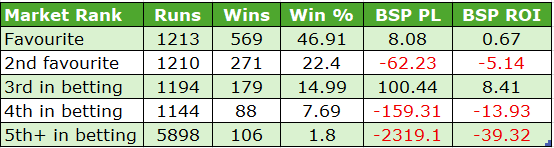
Favourites have made the tiniest of profits to BSP, while those third in market rank have proved to be the best value. Once we hit fourth or bigger in the betting, we see a severe drop off in terms of returns. For the record, favourites returned a profit in both 3yo only and 3yo+ races. Betting all of the top three market ranked horses would have been a marginally profitable endeavour.
The focus clearly should be on horses near the top of the betting, then. This race type is market friendly - more market friendly than the norm. Indeed, if we compare the percentage of races won for horses priced BSP 10.0 or less in 3yo/3yo+ maidens compared with ALL races, we see quite a contrast:

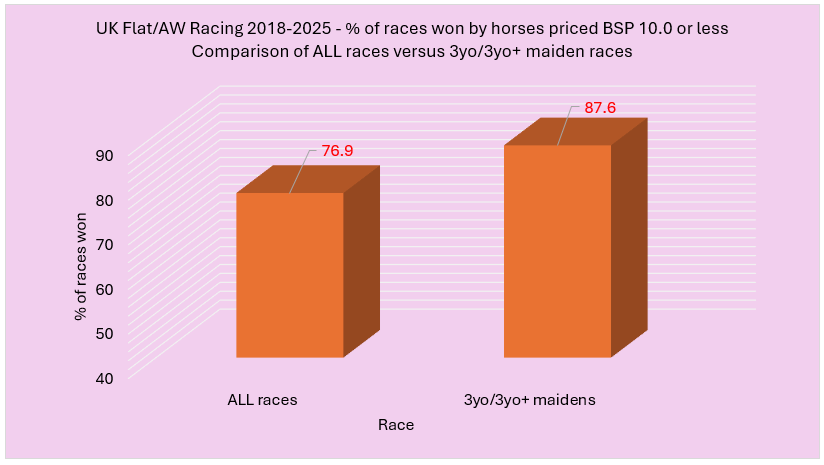
As we can see the difference is more than 10%.
Moving on, for virtually all articles I write these days I implement a BSP price cap to try and avoid any huge priced winners skewing the figures. I will do that here, too, and, looking at the overall results, a price cap of BSP 14.0 or less makes sense. The remaining stats shared therefore are based only on horses within the stipulated price cap.
Sex of horse
My first port of call away from the betting market is to look at the record of male horses versus female ones. The breakdown below is based on the results of races open to both sexes. It makes no sense to include male or female only races in any such comparison:

As is usually the case, we see far more male runners than females, but the females have provided the value, and by far the best returns of the two when focusing on runners priced BSP 14.0 or less.
Sticking with this theme, I wanted to compare the results of male runners – colts versus geldings. I assumed that the colts would outperform geldings, but I have been known to be wrong in the past. Let me start by comparing the win percentages or win strike rate for each:
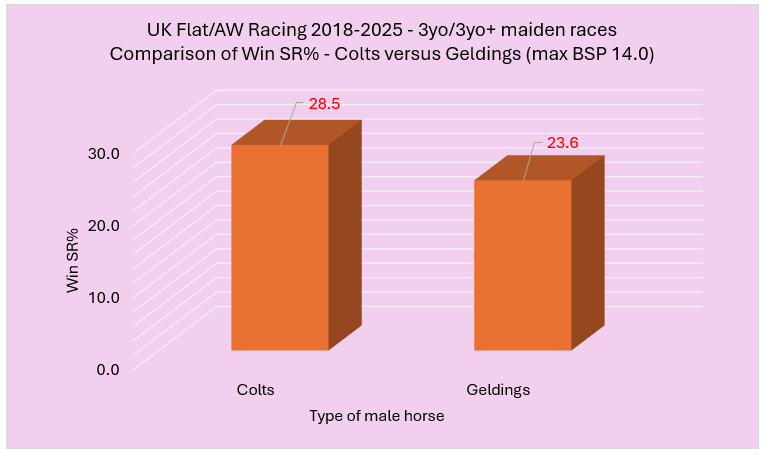
Colts have had a better win percentage by around 5% in absolute terms and a noteworthy 20% relatively; but has this equated to better value? The A/E index, based on BSP data, should be instructive:
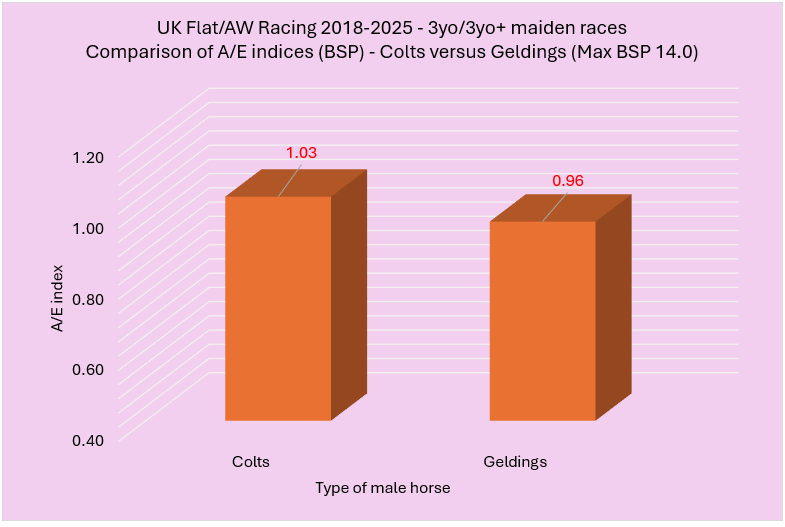
According to these numbers, colts have been much better value than geldings, and if we now compare the returns, we can see that this has been the case:

In terms of returns to BSP, geldings would have lost us over 8 pence in the £ more than colts, when priced BSP 14.0 or less. However, there is one positive gelding stat to share and that is the record of horses having their very first run after being gelded. This subset of runners won 69 races from 242 runners (SR 28.5%) for a profit of £17.22 (ROI +7.1%).
Age
In terms of age it only makes sense to share the data for races open to more than one age group so the table below includes only 3yo+ maidens over the past eight years.

All bar 187 runners have been aged three. As it turns out 4yos have provided the best value but, on average, we saw fewer than 20 qualifiers per year over the period of study. 5yos and up have the worst record from a small sample. It should be noted that this older age group have really struggled when priced above BSP 14.0 – that cohort won just three races from 357 runners. Even backing them to a Betfair place would have lost £161.88, almost half of stakes!
Career starts
Let's now look at exposure, in terms of career starts, to see what that has told us with the price cap in place.
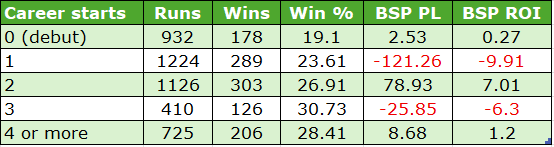
Horses making their racecourse debut had the lowest strike rate, as we would expect, but they edged into profit (just). It seems that horses that are making their second start (1 career run) have been overbet, based on the fact that they lost nearly 10p in the £.
Horses with two prior starts have produced the best returns and, if we focus on those that were in the top three in the betting, their figures improve further to 277 wins from 869 (SR 31.9%) for a profit of £97.75 (ROI +11.3%). Maybe slightly surprisingly, horses with four or more career runs also edged into profit.
Position Last Time Out (LTO)
A look now at where the horse finished LTO. Firstly, a look at the win strike rates:
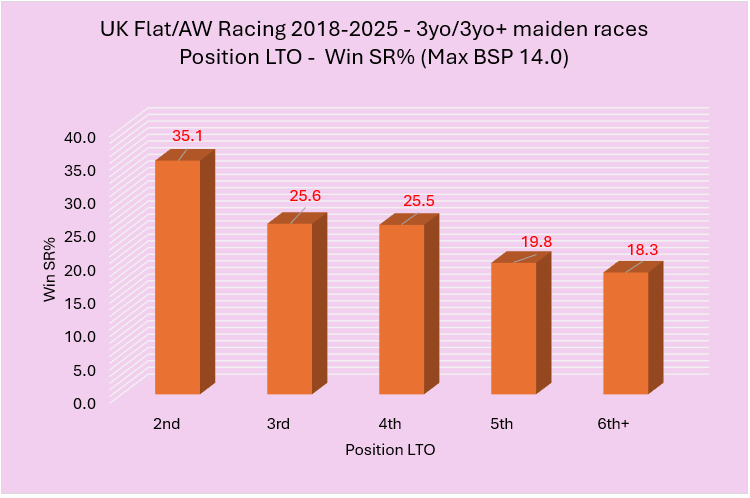
Horses that finished runner-up LTO recorded an excellent strike rate and, as we can see, the win rate reduced as the finishing position gets worse. The table below adds more colour:
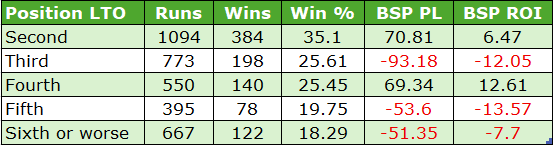
As the table shows, runners up have not only a good strike rate, but they have delivered decent profits, too. I am not sure why LTO 4ths have far better returns than those that finished third. My guess is that this is probably an anomaly, though looking at the similar win percentages it could be that they're a touch underbet in relation to third placed finishers.
Days since last run (DSLR)
There are two types of layoff abour which I would like to share some data, because both have shown a profit with runners BSP priced 14.0 or shorter. They are horses returning to the track quickly (within 10 days), and those absent for around 6 months or more (180 days+ to be precise). The table shows the two cohorts:


So, either end of the spectrum has proved to be the value.
Trainer Angles
I will finish with some trainer stats. The table below includes those trainers who saddled at least 60 runners at a BSP of 14.0 or shorter during the eight-year review period:
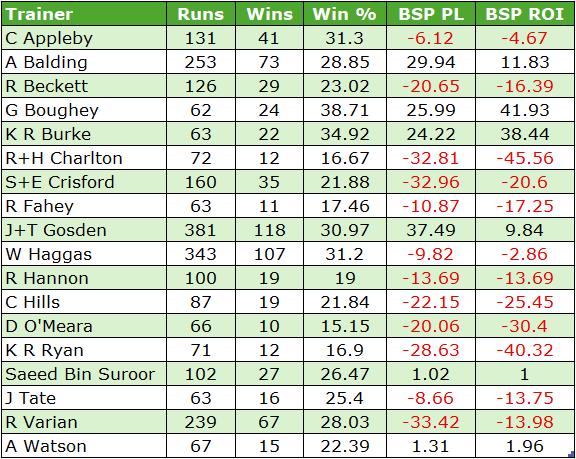
It is somewhat surprising that only six of the 18 trainers recorded a profit considering what has been shared to date. Indeed, two of the six (bin Suroor and Watson) were only marginally in profit. The performances of Kevin Ryan and the Charlton stable have been especially poor in terms of their returns (worse than 40p in the £). Both look worth avoiding generally in these contests.
On the plus side the three ‘B’s - Balding, Boughey and Burke - all performed well with good strike rates and decent profits to boot.
Let me now share some of the strongest trainer stats (BSP 14.0 or less) I could find in these maiden races and that aforementioned trio own a few, as does the Gosden yard:
- Andrew Balding debutants have fared extremely well winning 13 races from 41 starts (SR 31.7%) for a healthy profit of £25.84 (ROI +63%).
- Balding with second and third favourites combined has won 25% of races (30 wins from 120) for a profit of £37.90 (ROI +31.6%).
- Any runner at Kempton from the Balding stable should be noted based on the past eight years of results. In this timeframe 10 of the 27 runners have won (SR 37%) for a profit of £20.04 (ROI +74.2%).
- Balding runners that finished second LTO won 27 races from 69 runners (SR 39.1%) for a profit of £19.28 (ROI +27.9%).
- When Oisin Murphy has been on board for Balding, their combined record reads 25 winners from 69 rides (SR 36.2%) for a profit of £32.44 (ROI +47%).
- Horses having their second career run for the Gosden stable did well hitting a one in three win rate thanks to 42 wins from 125 with profits of £22.01 (ROI +17.6%).
- The Gosdens also performed well with their market leaders thanks to 72 wins from 140 (SR 51.4%) for a profit of £22.92 (ROI +16.4%).
- Team Gosden’s second and third favs combined won 41 from 169 (SR 24.3%) for a tidy profit of £38.51 (ROI +22.8%).
- George Boughey runners when starting favourite won an amazing 75% of the time (15 wins from 20) for a profit of £12.19 (ROI +61%).
- Boughey debutants did well from a small sample, winning 7 races from 16 starts (SR 43.8%) for a profit of 7.20 (ROI +45%).
- Boughey’s runners were far better on the turf than the AW. His AW runners made a loss while the turf runners won 14 from 27 (SR 51.9%) for a profit of £32.15 (ROI +119.1%).
- Karl Burke-trained favourites scored 12 wins from 18 (SR 66.7%) for a profit of £7.26 (ROI +40.3%).
- Burke’s female runners underperformed but his male runners had an exceptional record. They won 16 races from 31, with colts winning 8 from 14 (SR 57.1%) for a profit of £15.06 (ROI +107.6%), and geldings 8 from 17 (SR 47.1%) for a profit of £13.83 (ROI +81.4%).
There are some extremely playable trainer stats there, and it will be interesting to see how many continue to prove profitable in the coming months and years.
*
These three-year-old and 3yo+ maidens have presented some surprisingly positive angles over the past few seasons and I will certainly be looking at more such races in the future with a view to potentially have a bet based on the research shared above. I hope there are some takeaways for you, too.
Until next time...
- DR
Other Recent Posts by This Author:
- The Impact of Last Time Out Run Style
- Combining Pace and SR Ratings, Part 2
- More on Combining Pace and SR Ratings
- A Look at Summer All-Weather Racing
- 3yo+ First Time in a Handicap: An Analysis






Hi Dave another informative piece thank you! Question – is it possible to choose maiden races specially as a variable on the Geegeez query tool? I can only see handicap or non-handicap as a choice, but I don’t want to see all the novice races and other non-hcap race types, just maiden races, is this possible? Thanks!
Hi Andy
I’m afraid it’s not possible to choose maiden races only. We don’t have it as a specific differentiation in our database. At some point we’ll try to name match based on race title but that does occasionally throw false positives.
Matt
Leave a Reply
Want to join the discussion?Feel free to contribute!