Read all sorts of commentaries and tips across a range of racing disciplines on the most popular horse racing blog in Britain, from staff and guest writers.
Today's post introduces a couple of very cool Geegeez Gold reports. Both are designed to help users spot likely improvers, based on trainer behaviour.
Before I introduce the reports, let me outline the reason for them. It's a reason I've touched on before, and I make no apology for revisiting it. Essentially, if you only look at horse form, you are missing a huge part of the puzzle. Especially so when there is very little horse form to go on.
The key to finding value winners is to understand what, if anything, is materially different for a horse today when compared to its last/previous runs; and whether that difference is likely to lead to improvement. Let's look at an example race:
*
*
A moderate looking race, and we need to go into the actual form to search for material differences today. Clicking the 'horse' icon in the top menu bar for the race opens all the recent form lines for each horse. Here is that view for the top two horses in the betting.
*
The top form line is the race in question here (because we're reviewing it after the event), so it's the past form in the green boxes that is of interest.
Look at the favourite, Separate Shadows. On his previous three runs, he was in handicap company (denoted by 'Hc'), including over today's distance (20 furlongs, or two and a half miles if you prefer) and in today's class. And he'd been beaten each time. There was nothing obviously different today so why should he improve markedly on what he'd achieved thus far?
[Isn't it the definition of insanity to do the same thing repeatedly and expect a different result?]
Now look at Crinkle Crags. He had never previously run in a handicap. That is a hugely material difference. First time in a handicap. I've written about this before. AND... he was stepping up three furlongs in distance. AND... he was reverting to good ground on which he ran well on 19th March last year.
In other words, there were numerous material changes for Crinkle Crags, in terms of the race conditions today when compared with his recent runs.
Crinkle Crags was available at 11/2 in the morning, and was backed in to 5/2 second favourite. He won easily.
Spotting these differences will make you money from your betting. But let's face it, if you had to look through all the form of every runner to unearth these, it would be a lot of work. So what if a report could flag some of the differences for you?
**
Trainer H'cap 1st Run [Code]
Introducing the rather unsexy-sounding 'Trainer H'cap 1st Run [Code]' report. This report, found towards the bottom of your reports dropdown , shows all horses running in a handicap of that code (flat, hurdles, chase) for the first time today by the trainer's record with such types.
The trainer records can be viewed by one year form, two year form, five year form, and five year course form. The data displayed is specifically for each trainer's runners first time in a handicap of that code.
Crinkle Crags, the example above, was running for Nicky Richards, a trainer who - according to this report - had entered nine runners in a handicap hurdle for the first time in the last year. Five of them had won.
Crinkle Crags made that six out of ten. And then, on Saturday, Un Noble took Richards' record to seven winning handicap first-timers from eleven in the past year.
Un Noble was backed from 6/1 (the price I took) to 11/4, before winning readily. These clues are in the form book, but they're under the trainer record not the horse. Smart punters know this.
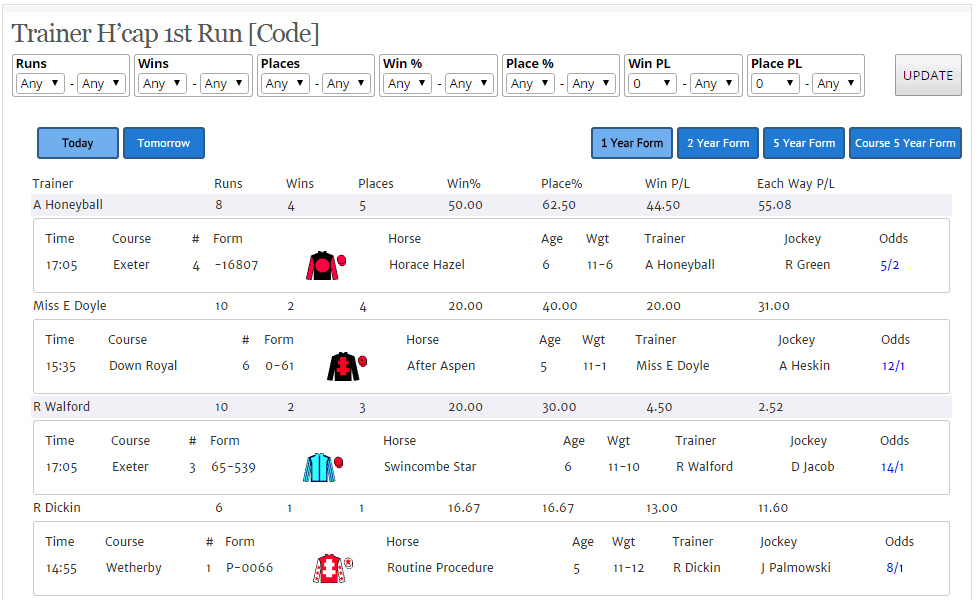
Here's an example of today's 'Trainer H'cap 1st Run [Code]' report. (Click on the image to open full size).
*
*
In this case, I've filtered for at least '0' win and place profit, and I am looking at the 1 Year Form view. I have also clicked on each trainer's name to highlight their runners today.
As we can see, Anthony Honeyball has run eight horses in handicaps for the first time in the past year. Four of them have won, and another has placed. His four winners were worth a profit of 44.5 units, and included The Geegeez Geegee at 11/1 a few weeks ago!
Miss E Doyle has had two winners and two placed horse in handicaps for the first time in the past year. They were nicely profitable to back both win and each way. And so it goes on.
This report has been in test for a few weeks, due to a couple of issues and the fact it was Cheltenham last week, and it's been finding some great winners. I'm delighted that it's now live and available to all Gold subscribers with immediate effect.
**
The second report focuses on another material difference between today and a horse's last run. That is a change of trainer. It is a fact that in all walks of life, some people are better at what they do than others. That fact extends to the training ranks, of course.
But how do we know which trainers can improve horses they inherit from other yards? And, more pertinently as punters, how do we know which ones are doing it 'under the radar'?
Simple: Geegeez Gold has a report for it!
The report is laid out in the same way as the 1st time handicap report - with views for one year, two year, five year, and five year course form - and it looks like this. (Again, click the image for a full size version)
*
As with the first image, this one is also filtered on one year and a minimum of '0' for win and place profit. But these are not necessarily the best filters to use. In fact, my suggested filters can be found in the updated user manual here.
Trainer habits are as crucial to finding winners as horse form, especially when material differences can be discerned from the last or recent runs. These two new reports will help you slice through the noise to some of the most effective winner-finding differences imaginable. You're welcome! 😉
https://www.geegeez.co.uk/wp-content/uploads/2022/10/geegeez_banner_new_170x78.png00Matt Bisognohttps://www.geegeez.co.uk/wp-content/uploads/2022/10/geegeez_banner_new_170x78.pngMatt Bisogno2015-03-17 09:49:362017-06-23 18:49:00How To Spot Improvers in 60 Seconds or Less…
In this final part of our serialization of the legendary racing gambler, Pittsburgh Phil, looks at the concepts of time, and class and weight, when it comes to horse racing. Although incredibly prescient at the time (written in 1908), some of this has been superseded by more modern thinking. But still, plenty holds as good today as it did a century ago, and the work is reproduced in its entirety for the reader.
Quite a number of systematic handicappers take time as a basis for their calculations. I could never see where time was a positive criterion. Time enters into the argument under certain conditions, but if depended upon entirely for a deduction it will be found wanting. The atmospheric conditions will have much to do with the time of a race. The way a race is run will have much to do with the time of such race. I will give an illustration of this that is positive. The match race between Admiration and May Hempstead at Sheepshead Bay was run in 1.40 1-5.
Some days before the match race both fillies ran in two different races at a mile - Admiration carrying 111 lbs. and May Hempstead 107 lbs. Admiration ran in 1.41 and May Hempstead in 1.39 1-5. Making allowance for weight, those who handicapped the match race by time, might expect both horses to run under 1.40 when they met in their duel. What was the result? Admiration won the match race in 1.40 1-5, and May Hempstead was beaten by many lengths, yet she had covered the same course under almost identical conditions even as regards the atmosphere, in 1.39 15. The cause of this change in time was due entirely to the way the match race was run.
It was the early pace that made the time slow, the first half mile being run in something less than 47 seconds, and it became a question of sheer gameness as to which mare would crack first. One of them had to wilt under the terrific pace, as is always the case in races where two or more horses are being driven to their limit of speed, in the early part of the race. No better illustration of the uncertainty of time as a basis for handicapping could be given than the Admiration and May Hempstead races.
Again it will be found on record frequently that a horse running in his own class, say a race for three-year-olds only, carrying 112 pounds, will run three quarters of a mile in 1.13, and possibly win with apparent ease. This same horse will come out three or four days later in a race for horses three years old and upward, meeting a horse like Hermis, or Voter-in fact any fast horse, and possibly he will carry but 95 pounds. A time handicapper would make the three-year-old run in 1.12 possibly if he carried out his calculations to a fraction. What would be the result of the race? Why, Hermis would beat such a horse in a gallop, and possibly would not have to run but six furlongs better than 1.14 to do it. This is accounted for by class. Hermis being a high class horse would take a three-year-old by the collar and he would run him into the ground in the first halt mile, leaving him so leg weary at the end of this distance that he would simply stagger home.
Time in such cases is absolutely useless and deceiving. There are instances, however, where it is possible to determine a good race from a bad race by time when two races are run on the same day. Time again is useful to the trainer who is watching for improvement in his horse; but it is not nearly as reliable in a trial as running one horse against another. For instance, I may have a maiden in my stable that cannot work a mile better than 1.45, yet if I start him off with Belmar for a mile trial he will run a mile in 1.41 or perhaps better. Such a horse is considered a poor work horse, one that will race much better than he works. On the other hand, there are horses that will work exceedingly fast when alone and will not run up to form in races. Such horses are very bad betting propositions.
Returning to the fallacy of time as a criterion of what horses should do and should not do, there are horses that have created records on many occasions that have never lived up to their record afterward or anywhere near it. Take a straight course, for instance, like the Futurity Course in Sheepshead Bay. Time is absolutely no use there, for the reason that there may be a wind playing down the chute that is almost a gale. It will cause the time of the race to be exceedingly fast. Again the wind may be playing head on. It would make the time of the race very slow, for the resistance of the wind is very great in a horse race, and it is correspondingly great when acting as a propeller.
There are no race going folks who can determine the velocity of the wind. Similar results follow, probably not so decided, on a circular course as on a straight stretch, for the wind sometimes blows across the track, sometimes aids the horses on the back stretch or may be against them coming home. Again it may be against them on the back stretch and aid them coming home; and a horse can run faster against the wind in the early stages of the race than he can when he becomes leg weary in the last quarter of a mile.
Then there is the sultry day with a great deal of humidity, and the hot bright day when the atmosphere is dry. All these things have an effect on the time of the race, and in fact on the condition of a horse. It is a common saying that such and such a horse is a hot weather horse, and that others will be better in the hot weather. Weather affects them as it does persons. It is almost unnecessary to go further into the details on the question of time as a handicapping basis, for I have given enough illustrations of the uncertainty of making time the foundation or basic calculation in handicapping. Horse against horse, weight against weight and accompanying conditions are the best lines to follow as to the superiority of one horse over another.
Some men will say that because a horse has run a mile in 1.40 one day and was beaten in 1.41 the next, that there was something crooked about the horse. Do not believe it. I am not saying that there is no crookedness in horse racing. There is crookedness, more or less, in every kind of business, at least in most kinds of business. The less one thinks of crookedness in horse racing the better will it be for him. There are some smart men, that is, men who consider themselves smart, because they cook up a race once in a while, but if you will look them over you will find that they possess money spasmodically, and generally wind up their careers poor.
Instead of looking for crookedness in a race, be conservative and try to find out in after study of the race where it was possible to show a defect in your own calculations, instead of Jumping at the conclusion that because a horse did not run directly up to your own deductions the race was crooked. If you will place more confidence in the result of the race than you do in an exalted opinion of your own handicapping, you will find in the end that you will be much better off and considerably richer.
When I play a horse in a race and he is beaten on his merits, I know that I have made a mistake somewhere in my deductions, and before I go to sleep that night I try to find out where that mistake is, and turn it to advantage in the future. If everybody speculating on horses, who depends upon his own opinion, will follow this advice he will find it very instructive, and in the end much more profitable than jumping at the conclusion that there was something crooked about the race.
CHAPTER 6 -- Class and Weight
Class and weight are two of the most important subjects to be considered under the general division of handicapping. Although the first is not so closely related to the actual mechanical work of bookkeeping as the latter, it cannot be overlooked. When it comes to handicapping, all your mechanical work will go for naught if you have no knowledge of class.
"Show me the man who can class horses correctly and I will show you the man who can win all the money he wants, and he only needs a dollar to start."
"Mike" Dwyer said that to me years ago, and time has shown it to be one of the greatest truths ever uttered about horseracing. Class, that intangible thing that almost defies definition, controls almost positively the running of thoroughbreds! Class enables one horse to beat another no matter what the physical odds imposed may be, what the conditions or what the distance. You may say it is that which enables a light bull terrier to whip a big dog of another breed. It enables sometimes one fighter to whip another. As I said before, it is hard to define, but everybody discerns it, when it is there.
In trying to define class in horse racing, the best I can do is to say that class in a horse is the ability possessed by it to carry its stipulated stake weight, take the track, and go the distance that nature intended it to go. It is heart, nerve and ability combined, which ignores all ordinary rules and ordinary obstacles.
There is no law by which you determine class or classify horses. An intimate knowledge of a horse alone tells. What he has done, and how he has done it, places him, and nothing else. Birth and breeding do not appear to count so much. Many great stallions, themselves of high class, with great turf records, have never sired good horses, not even when the nick has been with mares of equally high class. On the other hand, stallions that have not been so great, have produced magnificent colts, and it is the same way with the mares.
One of the mysterious rules of class that I cannot understand is that a real high class horse and a positively common horse cannot be brought together by weights within the handicapper's reason. You could put 140 pounds on Hamburg, which is a really high class horse, and 80 pounds on Alsike, and Hamburg would run him into the ground. He could take the track and outrun Alsike at every stage and the weight would not make any difference. You have seen what Reliable, a high class sprinter, had done and what Kinley Mack, Gold Heels, Ethelbert, all high class horses, can do.
Out of all the horses foaled during the year, there is hardly one-tenth of one per cent, that can be termed positively high class. After that stage comes the first class handicap horse and the proportion grows larger; then follows the moderate handicap horse, still more; then comes the lowest form of handicap horses, which dovetail into the selling plater class of the first flight, and from there they grade down to the "dogs," the poorest horses running.
Now, between the really high class horse like Hamburg and the "dog" like Alsike, there is such a wide gulf that the blindest man on the track can detect it. If that were all there is to it, racing would be easy. But then you start to go down from the top and come up from the bottom and your trouble begins. Between the first class handicap horses, and the horses a notch above the "dogs," you have not so much trouble. After that it grows harder until finally the classes dovetail, and then only the shrewdest of observers can hope to make a successful classification.
As there are more horses in the dovetailing classes than anywhere else, there are more races in those divisions, and hence one of the great uncertainties of racing. But the mysterious rule applies just the same, the better class horse has a "shade" always on the one below him-only very often we cannot fathom it.
Right here I may say that I consider Gold Heels a real high class horse, for he did in the Brighton handicap what only such horses can do. During the running of that race he stood off three challenges, one horse after another coming up to him in an effort to get the track away from him. You will remember how he stood them off one by one, taking them by the neck and beating them until Blues came up. Blues he beat from the eighth pole home in one of the greatest struggles we have ever seen on the race track. Gold Heels is to me a grand race horse.
By observation, class can be detected and tabulated in horses of a lower grade. For instance, there are many horses that will run an exceedingly good race with 90 pounds up, while 103 or 104 pounds will cause them to make a very disappointing showing. Every pound seems to send them down the scale of class, and a knowledge of this fact is very valuable to you.
It is this class that is most frequently manipulated by trainers and owners. Entered, say, at 108 pounds, this kind of a horse will show nothing. There will be two or three races just like it until the general public will classify that particular horse as a hound. Then will come a race in which the impost will be 95 pounds. The public, which does not study or observe closely, will pass him over again. They will not have noticed that his races with heavier weights have improved the horse, that he is fit and everything is propitious. He improves alarmingly, and immediately a cry goes up. Now strictly speaking there was no cheating by those concerned in the horse.
He ran as far as he could with 108 pounds up in his prior races, but nature had not made him a 108 pound horse. You will find this kind in the moderate and fairly good class of horses. There was Imp for instance. She could always be depended upon to do the best she could under any and all conditions. With 112 pounds on her she could beat first class horses at a mile and a quarter, but every pound more than that would send her down the scale. With 118 pounds she could beat high class horses for one and one-eighth miles, but if asked to go one and one-quarter miles, with the same weight, she would die away in the last furlong. She could carry 121 pounds one mile and a sixteenth and beat good horses but after that distance the weight would be fatal. I use Imp as an example-there are many in her division, running every year, of a similar disposition and class.
In regard to horses carrying weight, I figure that two-year-olds can give considerably more weight away successfully than horses in other divisions. A real high class two-year-old will carry a lot of weight, and it is hard to stop him until he is asked to carry 130 pounds or more and sometimes not even then. I have found it in my experience that a high class two-year-old will race fast with 130 pounds on him, practically as fast as he can with 120 pounds. In saying this 1 merely infer that the difference in a race a horse will run is so slight that it is hardly discernible. This refers to real first class two-year-olds. In the lower division of two-year-olds a few pounds make a very material difference to their racing; in fact, a difference of five pounds, say from 100 to 105 pounds on a common horse will make him run a very inferior race; and when a common horse is asked to carry 112 pounds or 115 pounds it seems to take his speed away altogether. Go back over any records of high class two-year-olds and you will find that this assertion is absolutely correct.
Hamburg was an extraordinary weight carrying two-year-old, and he is only one of many that could be mentioned. A good trainer will Know just about what weight his horse can carry and run a good race. He knows that if his horse is at his best with 95 pounds up he will run a very bad race if he puts 107 pounds on him. Frequently a trainer will enter a cheap selling plater in a race with the selling price so high that the horse will have to carry 110 pounds or thereabouts. He knows at the time that his horse will run poorly and has probably entered him for work only, preparing him for a race in the very near future when he will be entered to carry 95 pounds.
These little tricks are well worth watching, for by close observation it is easily seen what a trainer is doing with his horses and what his intentions are. In other words, when you have so far discovered the weight carrying ability of a horse, and you see him in a race with considerably more weight up than in your opinion he can carry, it is safe to say that this horse can be thrown into the discard, and depend on the old adage, "watch and wait." Do not understand me as saying that all trainers resort to these tricks. The majority do not, and this is a point which the player of horses has to learn. He must study the disposition of the men who train horses, as well as the horses themselves. I have found that everything being equal, two-year-olds run much more consistently than any other class of horses. They are taught to race.They are young and they know nothing else. In fact they are just like children playing on tip toe all the time.
Their consistency is due to their inexperience, for with age comes cunning and the developing of a disposition either good or bad. Some horses retain an even disposition throughout their career, while others become exceedingly eccentric. It is a common expression on the turf that a horse is "getting cunning," which means that if things suit him he will run a good race. But if they do not he will perform very indifferently. Real good horses have a lot of character about them, and they will run very consistently when in first class condition. A horse that has become eccentric in his disposition is liable to perform very indifferently. There are hundreds of horses that can win and will not run their best-horses that will work alone in the morning and shirk in the afternoon.
Administering stimulants to horses was due to the fact that some could run and would not. In these days they are called "dope" horses for the reason that they are stimulated with drugs.
Before the stimulating drug was discovered a draft of sherry or whiskey mixed with coffee was given to horses in the shape of a drench, and it has been known to have effect, but progress and experiments afterward proved that drugs were absolutely essential to make some horses put forth their best efforts. The drug question has been a very serious proposition for years, and at one time was beyond the control of racing officials. It is even now a source of considerable trouble. When the use of stimulants became prevalent I carefully studied the question, frequently getting advice from veterinary surgeons as to the effect certain kinds of drugs would have on horses. It was an exceedingly vexing question with me, for on that problem alone depended many of my investments.
When I discovered that a horse was a "dope" horse, it was absolutely necessary for me to know whether a stimulant had been given to him or not, for two reasons. If in my investigation I found that the horse had been given a stimulant, I knew he should run a good race, and therefore become a factor in my calculations. On the contrary, if he had not been stimulated by drugs it was equivalent to his not being in the race at all. If the horse in mind was one of the choices, it was a safe betting proposition to bet against him, and look elsewhere for the winner. It was sometimes very easy to beat a race two ways under such conditions, and I have frequently played the winner of a race and laid against another.
It is rather difficult these days to tell when horses have been drugged, for different drugs have different effects on horses. it was generally conceded in the old days that if a horse "broke out" into a pronounced perspiration that he was drugged. Sometimes he was and sometimes not, was my experience. The fretful horse will "break out" any day while in the paddock, and nearly all horses will show some perspiration on a hot day, so that if any of them have been drugged it cannot always be detected by their coat. But there are two things that hardly ever fail in distinguishing a horse that has been stimulated and a horse that has not.
The first is the glassy appearance of the eye and its bright, anxious look. The pupil also dilates. The second sign is the nostril, which becomes considerably distended. The breathing also is not uniform. The nostrils will expand and contract in an unusual manner. In some instances the forehead and the hide around the top of the head and neck will show continued perspiration. But those who have used stimulants on horses have things down pretty fine. They cannot stop the look in the eyes and the distending of the nostrils, but they can make their horses look as if they had been "doped" when such is not the case. Giving them a good stiff preliminary breeze under very heavy blankets will cause horses to have a "doped" appearance. This avoids suspicion in many cases and eludes the vigilance of the racing officials after they are drugged, because the horse goes to the post in apparently the same condition as regards his outward appearance every time.
If it were possible to make owners and trainers send their horses to the post in the same condition at all times, stimulating horses would not create the scandal it does, for the horses would run consistently. It is the abuse of stimulants that causes so much criticism by using them one day, and not another. This creates scandal and denunciation of the sport. All the patrons of racing want is consistency in horses, and when it is possible, they should get it. There is enough natural inconsistency in horse racing without its being forced on the public by unscrupulous men.
CHAPTER 7 -- Treatment of Horses
Many owners and trainers make mistakes and frequently spoil a good horse by not snaking him happy in his surroundings. A horse is just like a person in this respect. To do his best work, he must be contented. Whenever I bought a horse my first object was to find out his disposition. I have watched him closely in his stall, watched his eating, whether he had a good appetite, or minced at his meals. Any failing he had I would always try and remedy in some way or another. A horse that is not contented in his stable cannot take on flesh or be happy. Horses will not permit certain stable hands around them and they will even shirk their meals if interrupted by any one they do not like.
Belmar was a horse that was very hard to please. I knew he was a very good horse, but I knew that there was something wrong with him. He never seemed to run the race that I believed he could run. I bought this horse from Mr. Galway, thinking I could manage him and bring out his best qualities. Almost every moment I had to spare I would spend around Belmar's stall. I told my brother, William, that if ever we could get at the horse's disposition he would win a lot of races. We tried to please him by putting a companion in his stall in the shape of a rooster. He did not seem to take to the rooster and we tried a cat and a goat. Finally, a little fox terrier playing around the stables ran into the stall and Belmar seemed to take to him at once.
After this, if the fox terrier was away from Belmar, the old horse would sulk and whinny for him to come back again. When Belmar was lying down the little old fox terrier was always lying on his shoulder and the two always slept together. It got so that the fox terrier could be placed on the withers of Belmar and he would trot around the shed with the dog on his back. No sooner had Belmar become contented with his surroundings than he began to run good races. If I remember rightly, Mr. Vosburgh, unquestionably one of the few high class handicappers this or any other country has ever seen, had Belmar handicapped at 95 pounds in races before I got him. So much did the horse improve that he won seven straight handicaps without being defeated, and each time his weight was increased until in the last of his winning series he carried 128 pounds. In other words, he had jumped from the bottom to the top of the ladder in the handicap division, and it was all due to his being made happy and contented in his surroundings.
There was always something very noticeable about Belmar at this time and that was his excellent condition after a race it was very rare to see him oiling up distressed and it is for this reason that I am egotistic enough to say that I improved Belmar faster than the handicapper put on weight.
I never bought but one horse in my life that did not win any races for me I can safely say that every horse I ever owned improved after I had him long enough to study his disposition. A horse should be made comfortable at all times There is no animal so near like a person in disposition as a horse. They are positively human in their conduct at times. A trainer should use his best efforts to control a horse with a nervous disposition, for it is exceedingly hard to make them take on flesh and do well. The mind of a horse should be easy. He should not be anticipating anything, he should not be teased or in any way abused. Like a person, if irritable or excitable, he loses flesh and is incapable of his best efforts.
It sometimes takes months to get at the true disposition of a horse. Exceedingly close watch must be kept on him and every effort made to make him understand what is wanted of him. When a horse is fit to race it is almost cruel not to race him at least once a week. A horse expects to race if he is a thoroughbred. It is his nature, and if he is not raced he is disappointed and fretful.
This is very logical and has its resemblance in the eagerness a gamecock shows to fight. There is no time that a gamecock is not ready to get into a scrap if he is fit, and it is the same with a thoroughbred. He is high-strung and must be raced, and what is more, while in this condition he will improve with racing, and the work keeps him from being fretful, which is the main point in keeping a horse up to his condition.
This does not mean, however, that a horse will keep on improving after a certain time. When he has reached the keen edge of condition he will begin to go back. An oarsman, or a pugilist, or any other human being, who has been keyed up to the top notch by continued effort will go stale. That happens also to a horse. It will, therefore, be seen that the critical eye of the trainer should detect when to let up on a horse and not expect to keep him in first class condition forever.
There is one instance that I can recall in particular. It was at Brighton Beach where the condition of a horse after a race was so palpable to me that it made me win one of the biggest bets of the year. It was the race in which the horses Proper and Rigodon ran. Proper beat Rigodon; but in watching the horses return to the judges, as I always did, I saw that Proper was very much distressed, while Rigodon did not appear to be in the least exhausted. He just took a couple of long breaths, then pricked up his ears, and looked up and down the stretch as unconcerned as if he had not been in a race at all. Shortly after this occurrence the same two horses ran again. My observations had shown me that Proper would not run as good a race the second time, owing to his being so much distressed after his prior racing, while on the other hand Rigodon would improve considerably. I naturally had quite a large wager on Rigodon, and Rigodon won very handily.
It looked like a serious change of form, and so it was. There was considerable newspaper criticism about the two races, and quite a number at very smart men could not understand why Proper should beat Rigodon so handily one day and be so badly beaten by the same horse a few days later. In my opinion it was nothing else in the world but a case of Rigodon improving and Proper having gone back: or in other words. the first race improved one horse considerably while it had a very distressing effect on the other.
**
The full book, including interviews with contemporaries and anecdotes, can be downloaded from here.
https://www.geegeez.co.uk/wp-content/uploads/2022/10/geegeez_banner_new_170x78.png00Matt Bisognohttps://www.geegeez.co.uk/wp-content/uploads/2022/10/geegeez_banner_new_170x78.pngMatt Bisogno2015-02-25 15:22:182015-02-25 15:25:04Racing Maxims and Methods of Pittsburgh Phil (Part 3)
Pittsburgh Phil, aka George E. Smith, was one of the most famous and successful horse racing gamblers of all time. His wisdom was condensed into a book written in 1908 called "Racing Maxims and Methods of Pittsburgh Phil". And, as you'll see in this second part of the serialization, he was a very long way ahead of his time.
Part 1 can be read here, and sets the scene perfectly for this second part, which is all about the betting process and the mechanics of 'handicapping'.
CHAPTER 3 -- The Reason for Speculation
The betting ring after all is the center around which racing as a speculation revolves. If there were no betting there would be no racing, at least as we know it today. I do not propose to enter into a discussion of the ethics of the question when I am going to treat it as a business. Such it has been to me for some years and to many other men.
Sufficient knowledge to tell when to bet, or not to bet, or when to bet heavily, is of paramount importance to every man on the track. This is based upon his knowledge of the horses, their owners, their jockeys and everything connected with them. You may know a horse or a jockey are at their best. If you have not this knowledge you will lose many a foolish bet.
The basis of all betting is the amount of profit to be obtained on an investment. That is, every bettor should have such a definite conclusion as to the probable result of the race, that he can form for himself the market value of all horses in a race, and make a schedule of the prices as they should be in his opinion. I regard that as one of the reasons why I have been successful. To explain: There is a field of six or eight horses. I figure and handicap those that have a winning chance. I then fix the odds that appear to me to be legitimate quotations. Possibly one of these horses is quoted at eight to five, another at three to one and so on down the list.
When the bookmakers put up their quotations, it has happened that my prices and the ring prices differ. In one particular case the horse that I had quoted at three to one was a favorite at seven or eight to five when the betting opened. That called for a revision of my own figures, and I handicapped the horses again to see if the error was the bookmaker's or mine. I considered each horse with regard to the particular race, the weight it carried, the distance and all other conditions, the jockeys and the stable connection. Sometimes it developed that there was a quiet report of the one particular horse being "wrong."
Such a report always sent me to the paddock where I inspected the horse myself, and if satisfied that it was in good condition I would return to the ring where I and my agents watched the doings of certain men whom I considered it necessary to observe at that particular time on account of their friendly connections with stables. If my agents reported that liberties were not being taken by the men who would do such a thing if everything was not legitimate, I could generally figure whether my quotation or the ring quotation was right. If I could get a bookmaker to bet me three to one or more against a horse winning that should, in my opinion, be no better than eight to five it was a good investment in my judgment. Upon occasions of that kind I have made my largest wagers, and I may say without egotism that my deductions were correct, so far as the scale of prices was concerned, seven times out of ten. Of course, I was wrong sometimes; no man is infallible.
Take the reverse of the race of which I have just spoken. In the first instance I made my largest wagers, but where the horse I fancy is at a price a shade less than I think it should be, I make the most modest bet. I always financed my money to the best advantage, investing much heavier when I believed I was getting a better price than I had quoted in my own mind against a certain horse. Few men knew how hard I worked during the racing season, and it was in the betting ring that my hardest work was done. It was no easy matter to watch every move of the market just as the big financiers do in Wall Street; but I had to do it.
To get all the data that I wanted before betting on a race I frequently employed a half dozen men at one time. I have supplemented their labors by an acquaintance with the runners and commissioners who ply between the paddock and the ring; I knew by sight every betting commissioner on the race tracks, whom he represented, and how heavily he bet. This knowledge was possessed by the men who worked for me. They were always on the watch for some clue to the purposes of persons who might have an important influence on the race. As a result of this there was a never ending fight of stratagem and ruse during the day. If I had watched them, I knew they watched me.
Many a time, for instance, I have seen a commissioner come into the ring and bet possibly five hundred dollars on a certain horse with a certain bookmaker, after which he would bet $100 or so with other men. Immediately the whisper would go about the ring that "so and so's commissioner was betting on such and such a horse." The unthinking and uninformed usually took that as sufficient reason for following the lead. it is here that the fine work began. My man would stand at the book where the commissioner bet his $500 and watch the effect of that wager. He would be able to tell in a few minutes.
Many a time the same bookmaker has accepted the money, say at three to one, and immediately laid the top price in the ring against the same horse. That would satisfy me. It was a bet for effect. There was collusion between the bookmaker and the commissioner, which would have to be thrown out of the betting calculation altogether. It was intended to trap the unsuspecting public and I regret to say that it frequently succeeded. Nine times out of ten such horses do not finish in the money. But such things do not happen frequently, in fact in these days of racing they are of rare occurrence.
The advantage of this particular incident to me was that it eliminated a possible contender, and in a four- or five-horse race that had an important effect. it even helped me at times in beating the race on the Dutch book system. Knowing that one horse out of four, say, was not good, I would bet on all the others, thus in some cases winning twenty-five cents for every dollar invested. In other words, I bought their dollar notes for seventy-five cents each. I recall one instance, some years ago, of the value of close observation in the betting ring. This occurred when "Mike" Dwyer was the heaviest bettor on the turf. I will not give the names of the other persons concerned for the reason that some of them are now men highly respected, and who have lived down anything that they might have done in days gone by.
The race I allude to was run at a track in the vicinity of New York City, and it was practically a two horse affair, one of the horses being owned by the Dwyer Brothers, then partners in the best stable of horses that was ever trained. To hide the identity of those concerned in the affair more thoroughly I will designate the horses as "A" and "B." I may say that the incident was about the most cowardly piece of highway robbery that ever occurred in this or any other country. The race looked such a certainty for the Dwyer horse, which i will designate "A", that when the betting opened it was a one to four shot.
Few cared to speculate at those odds, consequently the business in the ring was light. I never dreamed of making a bet that day and had dismissed the race from my mind, when as I strolled toward the paddock to look over the horses entered in the following race, I met Charley Dwyer, who was then quite a youngster. We exchanged greetings and I said that it was a walk over for his father's horse. The boy replied that his father was of the same opinion and had just given an order that $30,000 be bet on the horse at any old price. I do not know what prompted me to go back to the betting ring. Possibly it was curiosity to notice the effect of a $30,000 commission on a horse already held at one to four. To my surprise there was little or no change noticeable in the odds.
The commission had evidently not yet been placed and began to watch more closely. The horses were called to the post, and still there was no change- one to four was obtainable all over the ring, while the contender showed signs of support from some quarters. In those days, and in these days too, for that matter, a thirty thousand dollar- commission would or will drive a one to four shot to at least one to seven. There was therefore "a nigger in the woodpile." My mind worked quickly - that commission was being held out. The man, or men holding it out, would do so only with the knowledge that the jockey riding the favorite was in their conspiracy. I may say right here in justice to one of the most reputable men on the turf that this jockey was not "Jimmy" McLaughlin.
As soon as i reached this conclusion, I bet several thousand dollars on the horse designated "B." The race was run and Mr. Dwyer's horse was beaten. His thirty thousand dollars had gone into the hands of some unscrupulous men and a jockey. I never said a word to him and it is possible that he never knew the truth of the affair. A funny part of this whole transaction is that other men, who had caught the drift of things, have since accused me of being implicated in the plot, because my wagers had been heaviest. But the facts are as I have related. My betting was due solely to my close observation of the ring's proceedings.
In contrast to the foregoing, I can say that oftentimes I have been influenced by a certain person betting one hundred dollars on a certain horse, although hundreds of thousands of dollars of so called wise money may have gone on others in the same race. That one hundred dollars to me represented the confidence of a conservative owner or trainer, and was wagered only after a shrewd mind had drawn a careful conclusion. Hence it is not always the heaviest commission that counts, any more than it is the flashiest horse or the flashiest stable.
Financing your capital is one of the secrets of success on the track. You must learn to know the value of your horse. There have been times when I have bet twenty thousand dollars and at other times I hesitated about betting one hundred dollars, although the figures might show that the two horses were equally probable winners. "it all depends," and upon that little sentence hangs a world of worry and work in a maelstrom of excited humanity, the betting ring. If the ring is active with smart money coming from every quarter, and the price offered is genuine, then fail in line with a good wager if the horse being bet upon is a true performer.
There is one individual highly important to every man who bets on horses, and that is a "clocker." But he must be an expert and he must be honest or he will ruin you. I notice that much has been printed recently of early morning trials at the various tracks, but I would not place too much dependence on these reports where one man pretends to have "clocked" say fifty horses in one morning. To have recognized them, and to have got their time accurately as he is pretending, is an absurdity. Better pass that kind of information over to somebody else if you cannot get the services of a good man who will go to a track with a definite purpose of finding out how the best horses are coming along, and then report honestly. The "clocker" is something like the scout in the army.
He is on the battlefield hours before the main body arrives. He learns when a horse is doing good work, when a horse is getting too much work, when he is sulking, and that all helps. It has frequently been as much to my advantage to know when a horse is track sore as it is to know when he is rounding to form. Possibly a horse, which has gone off, becomes a favorite in a race. That gives me what is called a good "lay." That is an opportunity for me to bet that he does not win. My acquaintance with bookmakers enabled me to do this by having them bet my money for me against the public. With this knowledge also I have whipsawed a race if there were but two contenders. Knowing one was wrong I laid against him and bet on the other, beating it both ways. A game of hide and seek goes on in the betting ring. I have told the story of the five hundred dollar bet made to get the public to follow a horse that was not meant to win. I have made five hundred dollar bets in a ring on horses that I knew could not win, but my motive was to get the better of the market.
The bookmakers are not in the business for their health, and as soon as they learn that certain persons fancy a certain horse and are betting upon it, they shorten the odds upon that horse. It happens that sometimes I have been compelled to use strategy to obtain fair odds upon what I considered to be a possible winner. I have bet five hundred dollars, or more, at times on horses that I verily believed did not have a chance, simply to have the rumor get about that "Pittsburgh Phil" was betting on such and such a horse. It has sometimes had the effect I wanted.
The price of the horse I knew could not win would shorten and the price of the horse I really fancied would lengthen. Then it was that my commissioners would get busy on the dark horse, betting possibly six or seven thousand dollars. I may have lost a thousand dollars or so on the strategy bet but the odds on the other more than made up for that. When the pool rooms were running in great numbers, it was possible to get a good bet down in the city and I have frequently played the institution in the city against the other at the race track. For instance, I would bet a thousand or more dollars at the track on some horse for a place. My betting would reduce the odds on one horse and raise the price on the other. In the city my commissioners would get into action and in a few minutes the telephone and personal interviews would enable them to wager a large amount of money at a fair price on the horse I believed would win.
You cannot be a successful horse player if you are going to get the worst of the price all the time. It has taken a whole lot of maneuvering for me to keep even with the several hundred shrewd bookmakers. I know they have trailed me and my men everywhere on the track and off. They wanted to know everything that I did and was going to do. That never made me mad because it was business on their part just as it was business for me to mislead the spies. I rarely have been able to keep the same set of betting commissioners for any length of time, with the exception of Walter Keyes and my nephew "Jimmy" McGill. A few bets and my commissioners were pointed out and watched. Some of the men I have used were most interesting. I have taken them from almost every walk of life.
It has happened many a time that a bookmaker in looking over his sheet after a race has found wagers of "fifties and hundreds," cash bets, and has wondered when a rural looking stranger has come to take down the winning. I have heard the bookmakers say to the cashier, looking at a long whiskered winner, "I wonder who that man is." To which the cashier replied, "He is a stranger to me." If that same bookmaker and cashier could have seen that rural looking stranger later hand over to me the winnings, they would have regarded it as important knowledge. But I never told them and sometimes I never told my dearest friend, Walter Keyes, or my nephew. I have had strangers work for me for weeks before somebody discovered the trick after which the man's usefulness was destroyed.
To conclude this chapter, the financing of your money is the high road to success. Learn when to put down a heavy wager by picking out an almost sure winner. In a race where three or four horses have a chance to win the odds are much against you, and the wager should be small or pass the race up.
I have lost as many as twenty-seven straight bets and got even and become a winner on the next two races. The average bettor should always cut his wagers when running in a losing streak and press them when luck favors him. Doubling bets when losing is ruination to any person. The time to double is when you have the bookmakers' money in hand. If a bookmaker gets you hooked, try to wiggle off with as little loss as possible, but if you get a bookmaker hooked set in your money, and if your judgment is good and you go at him cold blooded, betting on what appears to be certainties, you have a grand chance to win a small fortune.
CHAPTER 4 -- Handicapping
Many systems are employed to handicap horses. Some are successful while others are decidedly faulty. In my opinion the old-fashioned way of handicapping by comparison is the best - which is to draw conclusions from weight and class standpoint, time being a minor consideration. As the official handicapper takes weights for a foundation for his work, why should a different system be employed by a player of horses? After the official handicapper has allotted the weights to be carried in a race, it is then that the player is put to the test, and it is his judgment against that of the official handicapper. If he can find a flaw in the official handicapper's work, he will probably find the winner of the race.
The player has a great advantage over the official handicapper, for the reason that he has the opportunity of considering the present condition of a horse, when the handicapper must not let such a factor enter into his calculations. When he starts his work, he bases his calculations on the best performance of every entry, and to him all entries are supposed to be in the best physical condition possible.
For instance, when Mr. Vosburgh, the Jockey Club's official handicapper, gets the entries for the Suburban and Brooklyn Handicaps in January, and the races are not run until June, there is no chance for him to consider anything but the bare facts of horse against horse. He judges on their past, and so allots the weights they are to carry, that, in his opinion, the race will finish in a dead heat as it were. He endeavors, in his calculation, so to weigh each that all will finish together. Condition enters so much into such races as the Brooklyn and Suburban Handicap, however, that out of an entry of seventy or eighty horses sometimes not more than ten go to the post.
This is not always because the owners are not satisfied with the weights allotted, but on account of sickness or mishaps of some kind that have come to the horses during their preparation, which prevents them from being sent to the post. It is rarely that more than fifteen per cent of the entries in the classical handicaps go to the post, and not more than from seven to ten per cent in the big stake races. This shows the value of the condition of a thoroughbred when called upon to race. I mention this as a fact-that the condition of a horse in a race has considerably more to do with his winning, or losing, than the weight he carries. In other words, a horse might be allotted 126 pounds in a handicap, and he might be beaten by a moderate horse carrying only 110 pounds.
This does not mean that the moderate horse will always beat him at that difference in weight, for the condition of the two horses might reverse matters very decidedly a week or two later. A horse usually carrying top weight in a handicap could not win with 90 pounds up if he is not in condition. Sysonby once ran a dead heat with Race King. Such a result could not have been possible with both horses at their best.
For instance, a horse in the Brooklyn Handicap carrying 110 pounds, might beat the top weight carrying 126 pounds, yet in the Suburban, the condition of the top weight would be so much improved that he would run away from the horse that beat him in the Brooklyn. If any of the readers of this volume will go through the records of the classical handicaps, they will see that such cases have frequently occurred. This demonstrates absolutely that the player of horses, if he is a close student of the disposition of a horse and its condition, can almost tell the official handicapper what horses should be prominent at the finish with average racing luck. This is because he knows which horses are in the best condition.
Horses are the same as human beings where condition is the test of superiority. If a first class prize fighter, foot runner or athlete of any kind, is not in good physical condition, he can be defeated by an inferior man, where if both are in the best condition possible there would be no question which would win. It is exactly the same with horses, and picking the winner of a race rests entirely upon the ability of a man to tell when a horse is in good condition and when he is not. if one good horse is not at his best and there are inferior horses which are at their best, they will beat him in nine cases out of ten. Hence the condition of a horse is of much greater importance to a person who is playing the races, to adhere to the cast iron rule of some persons who say: "because this horse gave that horse fifteen pounds in actual weight and beat him he should beat him again today."
While he might do it, it is not a sure thing, as the reverse condition of the two horses might change the result. From this cause many people attribute the result of a race to crookedness, when it is nothing more nor less than the good condition of one horse and the lack of condition of another. The trainer may not be at fault, he has possibly done the best he could and possibly believes his horse to be in excellent condition. But horses cannot talk. They cannot tell you when they are not feeling well, and they do not always give any outward sign, though they occasionally do. I have had horses which I believed to be in the most perfect condition, yet they ran most disappointing races. I have seen horses work for a race and the work has been so impressive to my mind that I have made very large wagers on them; yet two days later in the actual race, when they should have run up to their work, they have fallen far behind. Many times a very fast work before a race does more harm to a horse than good.
From this a very common saying has arisen among the trainers: I worked my horse this morning 1 1/4 miles in 2.06, and he looks as if he will win sure." The other trainer will reply: "You have just about made him run his race to-day," and it has been proven times out of number, the fast work of two days prior having dulled his speed.
To get down to actual handicapping, you begin with the old fashioned scale weight, wherein it is prescribed that horses of certain ages shall give horses their junior so much weight at certain distances, and at different seasons of the year. This scale is the real foundation of handicapping. After a race in which these horses have met, the handicapper will decide for himself which horse is the best under the scale condition, and in future races he will put on or take off weight as he deems fitting to bring them together, or to make them run a dead heat as it were.
A man like Mr. Vosburgh, who has had years of experience and has the value of every horse that he has seen run at his finger ends, can so allot the weights that to the casual it will be mystifying. I have seen handicaps of ten horses in a race where it was next to impossible to tell which would win out of the ten. This is where the man who is a judge of the condition of a horse and of his disposition has an advantage over those who have not acquired such knowledge. It may be that some of the horses will not run over the track prescribed, while others have performed creditably over it. Some horses will not carry their weight as well as others.
Then again jockeys will make a great difference in the running of horses. All these things have to be considered and every horse must be treated separately and his entire disposition analyzed. Some things will be found in his favor and others will be found against him. After drawing a conclusion as to the most probable winner, one of the most important items is to draw a mind picture of how the race will be run - for there are many times that some horses are aided considerably by the way a race is run. while others are killed off early in the race.
One thing can be depended upon positively-if there are two or three very fast horses in a race, one or two of them will quit before the end of the journey if the route is of reasonable length. In other words they will race themselves into the ground, generally because their jockeys have no better sense than to be carried along with the early pace in a race. It is in such cases that an intelligent rider will sometimes win on the third or fourth best horse. This is where an intelligent jockey has a great value, for he profits by the mistakes of others-and lest I forget it, in future talks, you can say right here that seventy-five per cent of the inconsistency in horse-racing, which is generally put down to criminality, is nothing more nor less than lack of intelligence on the part of the jockeys.
Many times a handicapper is deceived in horses through their poor showing in races. This usually is when horses are going back after having reached the keen edge of condition. Sharp, practical trainers will then run them three or four times, knowing that they are not at their best, the intent being to get the handicapper to reduce their weight in races. Then there will be a lapse of time before such horse is entered again, but he will appear on the list with possibly the same weight to carry as he did in his last race. Instead of being in poor condition the rest he has had will have done him good, and he will be in perfect condition.
It is in such cases that killings are made. In speaking of killings many are attempted but few are accomplished, for the reason that while one man has been conniving to make a killing with one horse, there are others that have been playing the same game, and frequently three or four killings are attempted in the same race, when only one can be made. The others will be losers.
If a player can, through close observation of the market, find out that three or four different horses are being heavily played, it is a good time to test his skill as a handicapper to decide which in his opinion is the best horse of the number, and speculate accordingly, and if he cannot determine for himself exclusive of tips, stable information and the like, which is the best horse, it is best for him to watch the race without speculating, for he will not confine his attention to the one horse he is playing, but divide it between all the horses concerned, and he may see something during the running of the race that will stand him in good stead upon some future occasion, when the same horses meet again, as they frequently do after a short interval.
I have made several big winnings during my career. The biggest I ever attempted was on Parvenue, but unfortunately I did not win one-fifth of the money that I should have won, owing to a technicality. I owned Parvenue and he was a good racehorse, so good that I never really knew how good he was. A race came up at Monmouth Park for which he was eligible and I prepared him for it. Prior to my purchase of him he was a common sort of horse, but he improved much after I bought him; consequently few knew very much about him, or even entertained the thought of his improving sufficiently to beat good horses, but he had shown me in his work that he could do almost anything I wanted him to do. He looked such a real good investment to me that I had five or six men in the pool rooms of New York, of which there were many in those days, and each one had from two thousand to four thousand dollars to invest.
When the betting opened, Parvenue was quoted in some books as high as forty to one, and my commissioners told me afterwards that they placed some money at those odds, and that the lowest price they took was fifteen to one. At the track i also had several commissioners betting my money, and the lowest they got was twelve to one. Just before it was time to go to the post there was some trouble in the steward's stand. A horse, I believe it was Dagonet, had been carded on the programme to carry a certain weight, when according to the condition he should have had a much lighter or heavier impost. The mistake was not discovered until nearly post time, and the stewards decided to scratch the horse. All bets were declared off, and a new book was made.
This, of course, upset my calculations entirely. It at once disturbed the equilibrium of things. The men in the pool rooms, who had bet my money, had to wait in line to get their money back again, and when the new prices were put up Parvenue was quoted at much less odds owing to the big commission having been placed all over town, and becoming common property. The same condition of things existed at the track. My commissioners there had to wait and get their money back before they could bet it again, and this time when the prices were quoted, the highest I got was twelve to one. Much of the money was placed back again on the horse by my commissioners in the city and on the track, but nothing like the original amounts. It is unnecessary to say that Parvenue won all by himself, and after all the trouble and excitement I won over $45,000. 1 was so disgusted with the turn affairs had taken that I really never reckoned up how much money i would have won on the race had not the bets been declared off the first time, but it would have been an enormous sum.*
[* I interviewed "Sam" Doggett, who rode Parvenue in this celebrated race, and he gave me the most lucid description of "Pittsburgh Phil's" confidence in the horse and his coolness under such nerve straining conditions. He had thousands upon thousands of dollars at stake when he gave Doggett instructions how to ride. In the language of Doggett: . . . " `Pittsburgh came into the paddock and said to me, `Sam, you are riding a pretty good horse. Just let him rate along, and when you get to the head of the stretch let him down for a few strides and you will be in front. After you get there do not show him up too much.' Why, if he had been my horse and I had four hundred dollars depending on him I would have won by a sixteenth of a mile if I could, and I think if I had ever known the amount of money he stood to win on that horse I do not really know what would have happened, but I did not know that he was betting more than one hundred
dollars on him. You talk about a cool and collected man, 'Pittsbugh Phil' stood alone. He knew more about horses and horse racing than anyone and seemed to have phenomenal knowledge and confidence in his own ability. The Editor.]
In handicaps the top weights are at a disadvantage always, unless they are very high class horses, for the reason that they have to do so much more work than their opponents. It is not advisable for the top weights in a long race, say at one and a quarter miles or longer, either to make the pace or follow it too closely; for if there is too much speed in the early stages of the race it will affect the horses that try to keep up with the leaders; hence it will be seen that the top weights are generally mixed up in the middle of the bunch or in the rear if they happen to get off badly,
which causes them effort in threading their way through the field, especially if it contains anywhere from twelve to sixteen horses. They have to be very intelligently ridden to avoid interferences from horses that are dropping back, and many times they have to run outside three or four horses when they are making their run, which is very costly, for a horse loses considerable ground in running outside other horses. Then there is always the chance of their being jumped on or cut down in a race. In fact there is so much racing luck against horses, especially those carrying the heavier weights, that they are many times beaten through bad luck.
I once went over the year's record of Ethelbert and found that he lost thirty per cent of his races through bad racing luck-races that he would have won under normal conditions. This rule would not apply to a horse like Hamburg, or any very high class horse, because a real high class horse is good enough to go to the front from the start, or attain such a position in the advance guard that he will not be bothered nearly so much as a horse like Ethelbert, which was not a high class horse, but merely a first class handicap horse.
All these things have to be considered well when seeking for the winner of a handicap, or in fact any other kind of a race. Many a time a good horse is beaten in the spring of the year through lack of condition. There are few trainers who can send a horse to the post the first time out for a big race, in perfect condition. The horse may appear so to them, but they lose sight of the fact that a horse that has been trained for the race in private, should be fit to run a mile and a quarter if he is expected to run a mile race. I mean by this, that when a horse has not had a race for some months and has been prepared for a hard struggle he loses a certain amount of nervous energy while walking round the paddock, while being saddled, in the parade going to the post and in waiting for a start.
The surroundings of a race track have a great effect on some horses. They are high strung and of nervous temperament, and they waste a whole lot of energy and a great deal more the first time out after a let up than they do after a race or two. There is nothing like racing horses to be assured of their condition. One race for a horse is equal to two or three private trials. It will do him more good. It will make him hardier and it will relieve his nervous condition considerably.
A horse can be compared to an actor in this regard. An actor going to produce a new play, while he has all the ability and is satisfied in himself that he is perfect in every detail, will invariably falter at some stage or another the first night, but he will improve after that first night's experience. So it is with the majority of horses. There are some horses that seem to be devoid of nervousness. They do not fret or worry about anything. McChesney is an example. There was a horse that walked around the paddock like an old cow. He would not lose an ounce of nervous energy in a year under any condition. If he were keyed up to run one mile and a quarter he would run one mile and a quarter. You could bet anything that he would run the race that he was ready for. McChesney is an exception in this regard.
It is in such cases as these that the "clockers," the man who gets up at three o'clock in the morning to watch the horses working, is a necessary adjunct to a successful horse player. If he is a good man he will tell you exactly what the horses are doing and how they are doing it. It is not always a question with him that because a horse has worked three-quarters in 1.13 he should beat a horse that has only worked three quarters in 1.14. The horse that has worked in 1.13 has possibly received a hurried preparation, and being of a nervous disposition possibly would lose a certain amount of energy before a race, while the horse that has been worked in 1.14 has been steadily prepared and possibly carried heavier weights while working than the horse that worked in 1.13. It does not follow that because a horse has worked three-quarters in 1.13 that he will run in 1.13 in his race. He may do it much better alone than in company. It is in such cases that the disposition of a horse is the deciding factor. Then again a horse may be fully extended that has worked in 1.13, while the horse that worked in 1.14 had considerable in reserve. It is only the expert "clocker" who can discover such things, by his constant watchfulness.
I have found that track conditions are of the utmost importance. Some horses will run good races over certain tracks, while in the same company under similar conditions on other tracks they will run very disappointingly. A horse will run a good race at Sheepshead Bay while at Gravesend he will run quite the contrary.
There also are horses that like the shape of some tracks and not others; but I attribute this change of form to the action of a horse more than anything else. There are many horses that cannot make sharp turns, while others are exceedingly nimble.
For instance, Lady Amelia can run around a hat, while a great big horse finds it difficult to make a good turn. Hermis can run on any old track. He is a good horse. The same can be said of Beldame. In fact good level headed thoroughbreds can be depended upon almost anywhere. It is only what I term sucker horses that book their going and have likes and dislikes.
The Bennings track, for instance, has a very deep soil, and it takes a mighty muscular horse to win there. It needs a horse with strength. A strong horse with only moderate speed-a rater I might say, would beat a much faster horse at Bennings for the reason that the fast horse would become leg weary, and the strong horse will get him when he is nearing the finish.
On any track like Bennings where the going is deep and of a sandy nature, it is a good system to play horses that have shown a liking for such a track. If you will look over the records you will find that winners repeat frequently, while those which are defeated will be defeated almost continuously.
I won many wagers through studying the disposition of horses on certain tracks. Nothing could be more noticeable in this respect than the running of some horses on the grass track at Sheepshead Bay. It is a recognized fact that some horses improve many pounds over the grass course. One in particular, Decanter, you could always depend upon to run a good race over the turf.
There is another important item in regard to the turf course at Sheepshead Bay. It has a peculiar formation, and one of the fundamental principles in trying to figure out the winner is the early speed of a horse. Early speed is essential and a horse possessing that commodity has a much better chance to win over the turf course at Sheepshead Bay than a slow beginner, as the trailing horses usually go very wide on the turns owing to their not being banked the same as they are on the main courses. While horses do win over the turf course and come from rear positions they have to be much the best.
Another fact that I discovered in horses racing over the turf is that they will go further than they will over a dirt course. They do not get tired so quickly. A sprinter, which has been used to running three-quarters of a mile, will go a mile over the turf invariably.
A horse accustomed to running one and one sixteenth-mile races, will hold out for one mile and a quarter on the turf. I was never satisfied as to the cause of this but thought possibly that the footing was better and did not cup out with the horses like it does over a dirt course, which is naturally trying on the muscles, as it is to a man who tries to run over the sand at the seashore.
Next week: Handicapping by Time; Class and Weight; and, Treatment of Horses
https://www.geegeez.co.uk/wp-content/uploads/2022/10/geegeez_banner_new_170x78.png00Matt Bisognohttps://www.geegeez.co.uk/wp-content/uploads/2022/10/geegeez_banner_new_170x78.pngMatt Bisogno2015-02-19 10:52:432015-02-19 10:52:43Racing Maxims and Methods of Pittsburgh Phil (Part 2)
George E. Smith, aka Pittsburgh Phil, was one of the most famous horse players of all time. Operating in the late 1800's through to shortly prior to his death in 1905, Smith aggregated close to $100 million in today's money from his on track gambling.
Before he died, he shared his 'maxims and methods' with friend and confidante, Edward Cole, and these were published in 1908. Just the 107 years later, they remain a fine read, flecked with timeless good sense. In this first part of a serialization of Racing Maxims and Methods of Pittsburgh Phil, Smith shares his overview of what is involved in being a successful horse bettor; and how a day at the track would unfold for him.
PREFACE
Throughout the turf world and throughout the world in general, there live a great many persons who believe that the success of George E. Smith - "Pittsburgh Phil" - on the race track, was due more to a run of good luck than to the employment of skillful business methods.
The writer has seen him make wagers at the tracks on the Metropolitan Circuit and win large sums of money. As now and then the amounts of his winnings became known, spectators sighed and wondered why they could not have been so "lucky" as this clear headed young man hailing from the busiest city of Pennsylvania.
It was not luck that won a fortune for "Pittsburgh Phil." It was the application of one of the shrewdest minds that ever undertook to make racing a business and not a gambling uncertainty. There were times when "Pittsburgh Phil" might have been lucky for a moment, as everybody engaged in business is lucky at some time or another, but for the most part the bulk of his fortune was obtained because he went about the matter of racing on a strictly business basis, and gave exactly as much and similar attention to it as the prosperous broker or banker gives to his.
The peculiar value of this little work is that it contains the only personal interviews which "Pittsburgh Phil" ever gave to any man in regard to the proper methods to be applied to cope with racing and its various emergencies.
Although hundreds tried to interview him at one time or another, he refused absolutely to say anything regarding his manner of handling his wagers, his channels of obtaining information, or the system which he applied to make race speculation worth as much to him as stock speculation is worth to the broker.
To the writer he talked freely. At various times he entered exhaustively into the plans which he had made on various occasions and the methods which he had used to be successful in his business. He considered it as much a legitimate business as trading in cotton or oil. He scouted the notion that anyone could win on the turf purely by luck, and said that the man who would be successful should be able not only to know his horses, but to know the methods of those who were engaged in the direct control of the horses. Further than that he insisted that one must study the bookmakers and their methods, and in this volume it is explained how he managed his affairs so as to win a fortune of more than $1,700,000, by knowledge of the subject with which he was dealing.
George Smith was one of the quietest men who has ever lived in connection with American turf affairs.
When others would be inclined to boast of their success, Smith would shrink from publicity, and fairly run at the sight of a reporter, if he thought one were come to question him about his prosperity.
He began as a cork cutter in Pittsburgh. That life to him was slow and dreary, and he made up his mind early that he would get away from it. He had no fixed plan as to what he would do, but he once remarked rather dryly, "that he thought he could do a little better than cutting corks, inasmuch as he knew how to divide six by two." He was a man of exemplary habits, very fond of his immediate relatives, and never forgetful of a friend.
His first speculation was in baseball. At one time there was not a little betting in Pittsburgh on the national game, a practice which afterward dropped out of fashion. In any event, at this particular period, "Pittsburgh Phil" gathered some ready cash and came to the East to study race track methods.
He did not begin to speculate on the turf extensively until he was well posted, and had become well versed in a great deal of valuable information through experience. He began betting with the proverbial shoestring: then he continued the business which proved so successful until within a short time prior to his death.
The work, to which this is a preface, tells plainly and simply how "Pittsburgh Phil" managed his affairs to accumulate a fortune. Some of it is almost in his exact language, but all of it is authorized and direct. In its way it is a novel addition to turf literature, and it is quite probable that all who are interested in the turf will find a great many hints which will be of assistance to them in the future. Doubtless there will be many who will perceive that speculation on races is not so much blind guessing as it is applied study to the hundred and one details which are necessary to be successful.
- EDWARD W. COLE
CHAPTER 1 -- What One Must Know to Play the Races
Playing the races appears to be the one business in which men believe they can succeed without special study, special talent, or special exertion. For that reason the bookmakers ride around in automobiles and eat at Delmonico's, while the majority of the regular race-goers jokingly congratulate themselves lucky if they have the price of a meal and carfare.
Why a man, sensible in other things, holds this idea I have never been able to satisfy myself. He knows, and will acknowledge, that such methods would mean failure to him as a merchant, or as a broker, or as a business man in any other walk of life, but he never seems to apply that knowledge to racing. It must be that the quick "action" hypnotizes him, or the excitement dazzles him, or that he thinks himself too lucky to lose---I never could tell exactly which.
There are many men playing the races, nowadays, and the majority of them are losing. Some are winning, however, and while they are few, they are the characters that we must analyze and whose methods we must study if we would succeed as they do.
Seldom does one hear anything about these men until facts are studied below the surface at the race track. Then you hear everything about them. They are envied; they are called lucky; they are said to be men who always have some unfair advantage in a race. In fact you hear all reports about them except the truth. I am not putting the plunger in this class; that is the man who accumulates a bank roll one day to lose it the next. He is the comet of the racing world. He lights up everything one minute and the next minute he "lights out." Think it over yourself, and count on your fingers the names of the men who have made the flashlight bank rolls at the track. Where are they now? Few can answer. There is no comparison between them and the good solid speculator who studies and works hard to insure success.
Concerning the class that I mentioned above, the class that includes the men who quit winners year after year, one seldom hears of them until able to separate all the elements that go to make up racing. They are orderly, decent and quiet. They go about their business without bluster. They are calm, no matter how much excitement may be around them, for they are only there for business. They would have succeeded, I believe, had they turned their talents in some other direction than toward racing, and when you have analyzed their mental force you will have found men who are cool, deliberate in action, men of strong will power and of a philosophical nature. You will find that all have energy and the bulldog trait of sticking to one idea. You will find them exceedingly quick in sizing up a situation and just as quick to take advantage of it. It does not matter what their breeding may be, their birth or training afterwards, if they have these talents they are almost certain to be men of success. They have gone a long way toward winning before they ever began to bet.
A man who has not an opinion of his own and the ability to stick to it in the face of all kinds of arguments-and argument includes betting odds in a race - has not one chance in a million to beat the races for any length of time. One who is susceptible to "tips," or what is known as paddock information, may get along very well for a while, but I have yet to find one who has stuck to this line who could show a bank roll of any dimensions. Men like Charles Heaney, W. Beverley, "Mattie" Corbett, "Cad" Irish, "Pack" McKenna, "Ike" Hakelburg, and others of their class, all exceedingly successful handicappers, never think of seeking information as a basis for their betting. They rely upon their own judgment entirely and never form that judgment until after the most careful consideration. To them paddock and stable information is only an incident to confirm their previous judgment. Frequently I have met a half dozen owners and trainers of horses which have been entered in the same race and each has told me that his horse could not lose. I therefore had a half dozen "tips" on the same race, and it was there that my own judgment stood me in good stead.
Now what do the form players and successful handicappers know about horses? Well, I might say, incidentally, that they know the capabilities of every good horse in training, and have an accurate idea of what he will do under all circumstances. They know his habits, and his disposition as well, and perhaps better than you know your own brother. They know when he is at his best and when otherwise. They know what weather suits him, what track he likes best, what distance he likes to go, what weight he likes to carry, and what kind of a jockey he likes to have on his back. They know what the jockeys can do and what they cannot do, and in addition to that, they are close observers in the betting ring. If there is anything wrong it generally shows in the market.
Does not that mean some study? Can a man who regards racing as easy, who spends only an hour or so looking up the "dope," figuring upon horses as they would on a piece of machinery by time and weight, know as much as they do? It takes them years of constant close, cool-headed observation to acquire this knowledge, and at that the returns are often meager.
I have said that they know the horses. By this I do not mean that they know all the horses racing. The smartest player does not know every horse that runs any more than he bets on every race. He pays attention only to the better class of horses. The others that win only once or twice a year, he dismisses from his calculation. He knows that upon the money lost on bad horses the bookmaker thrives. But so soon as one of these horses from the rear rank shows any consistent form he is added to the list of representative horses and is thereafter considered.
Being possessed of an extraordinary memory, I can keep all the information I need about a horse in my head. Not all of the men I am speaking of can do this. I can recall a long passed race vividly, every detail of it, the weight carried, the distance, the condition of it and every incident that happened during the running. Few can do this and they have substituted a system of bookkeeping by which they accomplish a similar result.
I have said that a player of the races must be philosophical. He must not get upset by a series of winnings any more than by a succession of losses. The minute a man loses his balance on the race track he is like a horse that is trying to run away. He gets rattled. He throws discretion to the wind. If he is winning he simply believes that he cannot lose, and immediately afterward gets a bump that may put him out of business. If he is losing he becomes the prey of every kind of information and influence. I have known men who bet thousands of dollars on a race when in that state of mind, to play a "tip" given to them by a boy who sells chewing gum, a cast off stable boy, or a bartender.
It has been my observation that the best thing for a man in that condition to do is to leave the track entirely and take a vacation amid other scenes. Racing is not going to stop to-morrow nor next week. It is going on somewhere in the United States three hundred and thirteen days in the year. He can come back and there will be plenty of money for him to win, if he can win it.
One of the important rules of the men who win at the race track is that they must have absolute freedom from distraction and interference of all kinds. The successful race player knows there is a bar and a cafe at the track, and that there are some very interesting conversationalists to be met with every few steps, but he has no time for either the bar or the funny story tellers. I may appear to be exceedingly cold blooded, but for the benefit of my friends, I must say that a man who wishes to be successful cannot divide his attention between horses and women.
A man who accepts the responsibility of escorting a woman to the race track, and of seeing that she is comfortably placed and agreeably entertained, cannot keep his mind on his work before him. Between races, a man has enough to do without replying to the questions asked by her. This is of so much importance in my opinion that it has only been upon very rare occasions, and then in Saratoga, that I have asked even my mother to accompany me. Upon such days the card showed to me that there was little chance for speculation and I would, therefore, be free to devote my time otherwise. A sensible woman understands this and cannot feel hurt at my words. I do not wish to say that she should not be permitted to enter the race track. On the contrary, she is an addition and an adornment to a beautiful scene, and she should always be welcome, but if you are going to make a business of betting, you must not let a thought for anything else interfere.
All consistently successful players of horses are men of temperate habits in life. Speculation on the turf, as in all other kinds of business, requires the best efforts of its devotees. You cannot sit up all night, drink heavily, and dissipate otherwise and expect to win money at the race track. You could not do it in Wall Street, and you could not do it running a store, so why do you expect to do it there? I do not mean that you are not to have any diversion whatever. Healthful recreation and relaxation are just as necessary to the race player as to any other business man. If a man does not get it, he becomes what in turf vernacular would be called "brain sour." If a horse is continually worked and raced he loses his speed, health and ambition and has to be freshened with a rest. He is "track sour" and stale. It is exactly the same with a man, and he will realize it, sooner or later.
I have spoken this way about what kind of man I think the successful race player should be. I have not touched on the morality of playing the races, because i do not think it is under discussion. Some men may say, or think, that racing attended by betting has a harmful influence. I have nothing to say about that. There must be speculation in every branch of business, whether it is racing or keeping a dry goods store. In that respect all business may be said to have a harmful effect also. The ethics of the question do not concern me. Speculating upon racing was the one thing that I believed I was best fitted to do, and therefore 1 did it. I have no regrets or apologies to offer.
CHAPTER 2 -- One Day's Work at the Track
There is no better way of making plain what a successful racing man is, than to tell of his day at the track. What he does and what he will not do. How he conducts himself. How he remains always master of the situation and of himself. It seems to me that will be the best kind of a lesson for the man who would like to share with him in his general prosperity.
Preparation for a day at the track begins the night before, of course, for then the entries of the day are studied, impossibilities are eliminated, and the contenders are decided upon. This is succeeded by an early retirement in a condition that will guarantee natural rest from the fatigue of the day at hand. Being of a philosophical frame of mind, as I have said, the excitement and nervous strain of the incidents of the previous day are to be dismissed from the mind, and sleep is to be wooed without a rival.
As a result, the racing man should arise in the morning, cool and clearheaded, and with the first opening of his eyes he should again take up the problem of the day. The horses come before him at once and they never leave until after the contest is decided. I think about them the very first thing when I awaken, weighing them in one light, and from one standpoint and another. As I dress and eat my breakfast, I am placing them here and there, giving each a chance until at last from all standpoints I decide which one, in a truly and perfectly run race, devoid of the hundred or more unlooked for incidents that can happen, should be the winner.
In this frame of mind I go to the track. Once I enter the gate it is all business with me, and my programme of one day does not change. I get the names of the jockeys and the positions of the horses at the post, if it is a race in which I believe there is a fair speculative opportunity. I know, of course, the kind of day it is, and the condition of the track. I next go up into the grand stand and watch the horses warming up. This is of the utmost importance, for although my mind may be centered on two, or possibly three horses, at the same time it is important that I watch the others for fear there may be an unexpected display of form in any of them. If I do not see any of the horses, I had in mind, warm up, I immediately go to the paddock, after having my agent bring me the betting quotations. Arriving there I devote my time and attention entirely to the contenders, as I have picked them, and to nothing else.
It is impossible to overestimate the value of this ability to tell the condition of a thoroughbred. It is the twin sister of handicapping and more important. In that respect the ordinary form handicapper is, so to say, handicapped. What may appear to be right on paper, very, very often is wrong in the paddock. This ability to tell whether a horse is at its best before a race is acquired only after years of the closest kind of study. The merest tyro can tell in a race whether a horse is doing its best, but when it comes to getting a knowledge of what he can be expected to do before a race from a blanketed animal walking about the paddock or standing in his stall, special knowledge is necessary. It is not a talent. A man is not born with it: he must acquire it by hard work and close observation. He must be able to decide whether a horse is in good condition or not, whether he appears to feel like running a race or otherwise.
If a horse looks dull in the eye, dry, or moves and acts sluggishly, it is to me almost a sure sign in the majority of cases that he is not at his best. I say a majority of cases, because there are exceptions to every rule and some of the best horses we have ever bred had no more animation apparently than a "night hawk" cab horse before a contest. Some of these horses need only a warm up gallop on the way to the post to get out of their dull condition. You often see a jockey ride at top speed after the parade in front of the grand stand, to the starting judge, and you may usually depend upon it that it is for livening purposes. Frequently trainers want to deceive the public as to the condition of the horse, by having it appear dull and of little account in the paddock. This helps in the betting, and after all it is not an unfair strategy, because to them it is just as important to win a bet as it is to you and me. It is here that your knowledge of the disposition of a horse will stand you in good stead. If you have studied him properly you will know whether he needs the usual warm up, a preliminary gallop of a quarter of a mile, or a sprint of an eighth, or again simply a jog to the post.
An inspection of the horses in the paddock pays me for another reason. It tells of the nervous condition of a horse. Nerves are as important to a horse in training as to a person engaged in any physical contest. Poor nerves are indicated by "fretting," and a horse that frets is a very dangerous betting proposition. I can illustrate this by one particular instance in which a horse showed to me distinctly that he would not be able to repeat the high class race of a short time before. This was a horse called Pulsus. In my calculations, I became convinced that all other things being favorable he would have an excellent chance to win.
Pulsus did not warm up for the race I have in mind, so I went into the paddock to see him. I was surprised at his appearance. He was as nervous as a horse could possibly be. He had "broken out," so that the perspiration was literally running off his skin in a stream. My eyes told me that he had lost at least one hundred pounds in weight since his last race, and was certainly not within twenty-five pounds of his previous form, simply through nervous strain in his stall and the excitement in the paddock. Pulsus was one of the favorites that day. I forget just what price they were taking, but I know that it was less than two to one. I made up my mind that I would not play him straight, or place, at a thousand to one, so I looked elsewhere for the winner, and I instructed a bookmaker to lay against Pulsus for me straight and place for a considerable sum of money.
The result was a fair winning as Pulsus was nowhere. His energy and stamina gone, he finished back in the ruck.
Now having inspected the three horses, or whatever number I have in mind, as possible contenders, I discover perhaps that one or two of them, in my opinion, are not in the most promising condition to run a winning race. The scene of my operations shifts immediately from the paddock to the betting ring. I find there that the favorite is one of the horses whose looks did not impress me in the paddock and it is here that the first exercise of will power begins.
There is something about a favorite that seems to sway players to bet upon him. Their own judgment in many cases tells them that the horse in question is in a false position, but they become afraid of themselves. A majority of players will fancy that particular horse, and the individual will begin to wonder if his judgment is right. Just as the evening newspapers publish a consensus of the opinions of the newspaper handicappers, so the prices in the ring is publishing the consensus of the best handicappers at the track. It takes a strong man to disregard this, but I have always done so without any hesitation.
No matter what the class, the previous performances, or the prestige of the horse which has been played into favoritism, or the stable to which it belongs, or of the jockey that is to ride, or of the money bet upon it, I look elsewhere for the winner if he does not suit me. Mechanically I take up the second choice and subject it to as severe a handicapping test as was the winner, and if the second choice fails to come up to the standard I pass it by just as willingly as I did the first.
Prices and public opinion have absolutely no influence upon me at this time. I have gone down a list of entries until I have reached a horse that was possibly a rank outsider in the opinion of experts. Upon that horse I pin my faith and upon that horse I bet my money if other circumstances justify me. Men have often wondered how I could play a third or fourth choice in the race. It was simply because my judgment commanded me to do it. I may have been wrong, but after the race I knew why I was wrong. It was costly knowledge, but it was not useless, because it would serve me some other day.
The race is run, let us say. The shouts of the winners and the groans of the losers die away. From the grand stand there comes a rush of men on their way to the betting ring. Some to cash their wagers and others to make wagers on the next race. The horses which have been the object of all their hopes a minute before, are forgotten by the multitude. They are pulled up on the back stretch, turn and canter back to the stewards, the jockeys dismount by permission and the animals are turned over to their handlers with no more than a little perfunctory applause from the grand stand.
I say the multitude has forgotten, the multitude generally, but there are some men at the track to whom this period is of the utmost importance. You will see these men along the rail close to the judges' stand, or up in the big stand with their eyes glued to their field glasses. I have heard the uninformed say, when observing this: "That man is still running the race." It is not necessary to reply to such remarks for time is too precious. I want to know how a horse pulls up after a race, how the effort has affected him, whether he won easily without calling upon his reserve power, or whether he was distressed and all out. Many a time one horse has beaten another by a length or two, but with an expenditure of effort that told, while the beaten horse was not palpably distressed.
It will take considerable time for the winner to recover from his effort. The second horse will be improved by the race. The physical make up of horses has much to do with this. There are some light barreled horses, mares particularly, which feel the effects of a race more than others. Suppose such a mare were entered in a race two or three days later, against practically the same field, being convinced that the strain had told I might bet, other conditions being favorable, on the horse that ran second, or even third. When I have won after such procedure, I have been accused by some of having what they term "an ace in the hole;" that is, they have accused me of having had jockeys pull a horse in one race to make a killing in the next, when it is nothing in the world but my close observation after the previous race had been run.
During the running of the race my glasses never leave the horses engaged. I see every move they make. I can see that this one is not in his stride, or is running unnaturally, or is being ridden poorly. I can see if a horse is sulking, what horse is fit, what horse is unfit. After the race is run, it is sometimes said a horse has had a bad ride, or that the trainer has sent him to the post in an unfit condition, or anything and everything, except the truth.
Knowing the disposition of all the good horses, I am able to say pretty clearly that the failure of a horse to do better was due to chance, or unintelligent handling, perfectly innocent in themselves. Possibly the jockey had given him a cut of the whip at the post, which made him sour; possibly the track did not suit him. His post position, the size of the field or a bump in a jam may have taken away his courage. He may have been bumped on the start, shut off, pocketed, roughed, or interfered with in a dozen ways. Whatever it was I tried to locate the trouble and record it for the future.
Take an illustration of this - Eugenia Burch was a mare that would run an exceptionally good race if she could have an outside position and was not bothered in any way. It was this fact that made her somewhat erratic, as they say, in her running. In a small field, with an outside position she could be expected to show her best form. She could run around her field very impressively. She was naturally a slow beginner and she always had to go around her field. Now if she were in a big field and had an inside position, where she would be bumped and knocked about in the early stages, she would never extend herself until the coast was clear, and then it was usually too late.
Thus she had been beaten often by horses inferior to her, and there had been some comment on that fact by persons who did not understand the mare. I think she was timid and in that particular she was like some jockeys I have known. They will ride much better on the outside than they will in the middle of a bunch. Such riders, I am glad to say, are in a minority, but they exist just the same, and it is for you to find out who they are, and to classify them for future consideration. On the other hand, the majority of the horses and riders are game, and will fight for victory no matter where they are placed.
While speaking about this I can recall seeing horses fight their way through a field irrespective of conditions, ridden at the same time by a timid boy. The spectacle was disheartening to me as it must have been to the horse itself. I have seen a good game horse striving with all his heart, fighting his rider to allow him to push into a space that only his trained eye told him gave him a chance for victory. I have seen these horses plough between two other horses and spread them apart as a giant football rusher will do with only the goal in his mind. Gold Heels was that kind
of a horse. He was always fighting. No matter where he was, or what were the surrounding conditions, he was doing his work like a bulldog. He was never daunted and he never stopped until his physical powers failed. Gold Heels was the "bear," Eugenia Burch was the other extreme. This calls to mind another horse who may be said to illustrate another phase of the case. Previous belonged to M. F. Dwyer, and he was good and game as a horse could be, but there were times when nothing could induce him to extend himself, and those times were when Willie Simms was on his back. Simms was one of the best jockeys this country ever knew, but somehow or other he and Previous could not agree. The rider could use every art he knew, every wile and stratagem, but Previous would not get away at the post, would not run, and would not extend himself. Put a stable boy on the same horse and Previous could be depended upon to run a good race, and when Tod Sloan rode him he would always do his best.
I mention Tod Sloan. In my opinion he was possibly the greatest rider the world ever knew on a sulking horse. I have seen him mount the sourest, sulkiest, most intractable horses in training and have seen them run kindly from beginning to end. He had a happy knack of getting acquainted with a horse as soon as he got on its back. He has always told me that he catered to the disposition of his mount, by allowing it to do as it pleased so long as it was in a good position. His maxim was to hold a horse well together, reserving as much speed as possible for the last moment. On the subject of jockeys I have discovered that there are some who excel on heavy tracks. This may appear strange to the average reader, but it is credible when we remember that there are riders so chicken hearted that if they get hit in the face by a lump of mud they give up all hope of winning. The other boys go on just as determined as ever.
"Skeets" Martin was and is a good mud rider, and it was this knowledge that caused me to put him up on Howard Mann, which won the Brooklyn Handicap, beating my other two entries, Belmar and The Winner. "Tod" Sloan was riding for me then and he knew that Howard Mann could beat good horses in the mud, but he did not think he could outstep Belmar. I believed that Howard Mann could beat Belmar under certain conditions and told Martin so. I believed Martin was better than Sloan in the mud, and when Sloan chose the mount on Belmar I was secretly pleased. The only orders I gave in the race were to Martin to get up on Howard Mann, get off, and go on about his business. I added in a joking way that if "Tod" were within hearing distance of him at the head of the stretch to tell him to hurry home or he would be too late. Whether "Skeets" ever said it I do not know, but if he did "Tod" never heard him; Howard Mann was half way home before Belmar hit the quarter pole.
In his day at the track, the observing player should give a good deal of attention to jockeys. It can be seen that it is not a bad idea to do this. It was worth something to know the capabilities of Martin in the Brooklyn Handicap over a muddy track as well as it is to know the capabilities of a horse. Howard Mann might have won with a less resolute rider, but with Martin up, his chances for winning were vastly better, and consequently there was greater assurance of winning a much larger wager than otherwise. A good rider, a good horse, a good bet, was one of my mottoes.
A good mud rider will frequently bring a bad horse home, because the riders of the good horses are not as game as they might be. Weak boys are always handicapped on a heavy track. At such a time a horse needs help to keep him from sprawling and from wasting the energy which will be useful later. It is the same way with a horse that needs to be hard driven. A strong rider must be given the preference in such cases. I have frequently bet on an inferior horse with a strong boy up.
Many times an even money favorite has a weak boy up - a boy unable, say, to hold him together. At such a time it is a good opportunity for a strong and strenuous interview with our sworn enemies, the bookmakers. It is a good time to look for long shots, and if you are fortunate enough to be in a position to do so get a bookmaker to lay against the favorite for you. It is sure money nineteen times out of twenty.
It is different, of course, in a free running horse. There, the jockey has comparatively little to do and the disposition of the boy does not help so much. All a rider has to do is to sit still and hold his mount together.
There is one other thing that a man should take into consideration in his day in the track, and that is the disposition of the trainers. We have talked about the disposition of the horse and of the jockey, but now about the man who has to do with preparing the horse to race. Of course, you must know who the trainer is, what his connections are, learn his habits and his practices. Even that is not good enough. You must know what his methods are with reference to jockeys. It is a remarkable fact that honest horses ridden by honest boys are oftentimes beaten by honest trainers.
I mean by that, there are hundreds of occasions that trainers and owners give instructions to their riders that mean sure defeat, although the instructions are given with the best intention in the world. I have seen scores of horses beaten because their riders were told, for example, to keep up with the leaders at any cost. I have seen others choked to death because the jockeys have been instructed to lay away a length or two from the pacemakers. Such incidents are of everyday occurrence, and add another element of uncertainty to a most uncertain game at best.
One thing must never be forgotten, that a jockey of brains and understanding, while he will ride to orders as far as possible, will exercise his own judgment in case things are not turning out exactly as the owner or trainer anticipated. It is a poor owner or trainer who feels resentment when this is done by a capable boy. This is what helps to make up a high class jockey. Isaac Murphy, "Jimmy" McLaughlin, Garrison, "Skeets" Martin, "Tod" Sloan, Willie Shaw and boys of their class needed, or need, few instructions. They required to be told the disposition of the horse only, whether sluggish, a sulker, a free runner and how the whip should be used. Loading them down with further orders was like putting on more weight, for in their efforts to follow instructions they were bound to jeopardize their chances of winning.
I once heard a jockey say to a trainer who had dealt out a spasm of orders that would have filled an almanac: "Say, boss, don't you think you had better have those instructions printed in big type so I can read them as the race is being run? I could not remember what you have said to me if I sat up all night to study them, and this race is going to be over in less than two minutes." The trainer got a little angry at this and proceeded to call the boy down until the boy suggested that if he were told to do the best he could to win, the stable would have a better chance of taking down the purse. The trainer thought for a minute and peevishly remarked: "Oh, do what you like."
Then he walked away.
"Them is the best orders any rider with a good horse under him could get," commented the boy, as the line formed for the parade.
It is almost unnecessary to tell what happened in that particular race. The boy was a good boy and he used his judgment. He won in a drive by a neck and he was on the third best horse in the race at that. Had he been hampered by the instructions originally given, I do not believe that he would have finished in the money. It pays you to know the trainers, as I said before, for their habits will sometimes put you on a "good thing" at a good price.
Your day at the track, it can be seen, has been a busy day. There has been no idle moment; there has been no time for friendly conversation, good stories, refreshment at the bar or social meetings. When the last race is over, if you have speculated on two or more events, you will be as tired as if you had been engaged in manual labor for many hours. You will need rest and time for your nerves to become normal. As I stated at the outset, that rest cannot be gained by late hours or dissipation of any kind, but by a sane, temperate, normal course of living.
**
Part 2 - Chapters 3 to 5 (The Reason for Speculation, and Handicapping) can be read here.
https://www.geegeez.co.uk/wp-content/uploads/2022/10/geegeez_banner_new_170x78.png00Matt Bisognohttps://www.geegeez.co.uk/wp-content/uploads/2022/10/geegeez_banner_new_170x78.pngMatt Bisogno2015-02-12 09:36:382015-02-19 10:53:48Racing Maxims and Methods of Pittsburgh Phil (Part 1)
I was at the London Racing Club in Gloucester Road last night. So were the Hill's: Lawney, National Hunt (mainly) trainer; husband, Alan, point/hunter trainer; and, son Joe, amateur rider and doubtless someday trainer.
Very pleasant company they were too. Coaxed and cajoled - not that much of either was needed - by Racing UK's Alex Steedman, our panel proffered forth on an array of matters.
Having met in 1985, Mr and Mrs Hill will celebrate thirty years together in September, a happy union that has produced not just young Joe - 19, and so clearly a chip off the old block - but also daughter Gaby, ear-wigging in the audience on this occasion.
It has also yielded not one but two training yards, adjacent, and with different license holders. Under rules, Lawney is the guv'nor, and she's a couple of nice ones to look forward to in the coming months. Between the flags, Alan continues to ply his trade with what seemed to this untutored eye to be a steely resolution, possibly even a stickler's perfectionism. He too has a pair of very interesting ones in waiting. More on both in due course.
As the banter to'd and fro'd, gently guided by MC Steedman, talk turned to ailments. Not the panellists you understand but, rather, frailties in equine stock. Hence the somewhat tenuous title of this 'ere scribble.
Specifically, there was talk of breathing issues. And how they're more likely to affect bigger horses, due to the fact that the nerve which controls the larynx runs from the right side of that area all the way down a horse's back, and then back up the other side to the left of the cob's gob.
So it is, apparently, that it's far more likely for there to be weakness in the left side of a horse's throat than the right.
Why would I be telling you all this? For punting purposes of course...
Because it can lead to a partial or full paralysis of the muscle, which in turn means it can collapse across the airway making for difficulty breathing. And because this was the background to a discussion about some of the various surgical procedures that can be undertaken to correct wind problems.
Lawney eloquently elucidated - with the occasional interjection from Alan - the differences between a 'palate fire', a 'hobday', and a 'tie back' (a more acute operation for more extreme cases). And there was plenty of discussion about the fact that these surgical procedures do not currently have to be declared to the BHA.
Given how material an impact they can have on a horse's performance, it seems an absolute slam dunk that they should be noted, in much the same way that a gelding operation is, on the horse's form record. That it is not surely contravenes the BHA's own guidance on 'inside information'... at least, there is a strong argument to that end.
For instance, I know of two horses that have had wind operations in a stable that I'm close to. I'm not at liberty to say which they are because they're not my horses. This information is still in the realms of "owner's prerogative", and in the information age, that's wrong. According to the panel at least. (I tend to agree).
So the fact that the likes of Paul Nicholls and Nicky Henderson, perennially atop their peer group, resort to such intervention on such a regular basis can be seen as further affirmation to its materiality. The Denizen of Ditcheat is reputed, according to Joe, to have about 60 horses a year treated in this way, and it was conjectured that Hendo would likely have a similar number of palates sizzled and twiddled.
Joe went on to make a really noteworthy point about Nicholls, and one which might be widely known, but was a new one on me. He made reference to the positive impact of first time headgear on Ditcheat inmates. Now, as someone who has habitually dismissed headgear as a sign of desperation on doggy nags or naggy dogs, I had to look into this further.
Sure enough, young Joe is onto something. Here's the data, courtesy of those fine people at horseracebase.com:
Interesting...
Looking at the year on year data, it seems there might have been some sort of epiphany too. Judging by the increased samples, it seems unlikely to be merely coincidence...
Interesting... Very interesting
Note the relative nothingness of numbers of runners and strike rate, leading to a general leakage of cash for backers, up to 2013.
Then, look, the number of first-time headgear donners trebles, and then quadruples, and profits emerge at the same time. For such a high profile yard, this is a weirdly profitable angle.
Drilling into the data for the past three years is perilous, due to the possibility of statistical insignificance on less than a hundred runners... but let's do it anyway!
Crikey!
Crikey! The fabled hood, settler of many a buzzy beast, has hardly helped Captain Pumpkin and his band. And yet the initial application of either blinkers or the pieces has produced winners at a 30%+ clip. That's in the context of a trainer at the top of his game, who has struck with un-accoutred horses 'only' 22% of the time. Yikes! Good spot, Joe.
But I digress. The gurgly-windy situation of horses struggling to breathe evolved into chat about its low-tech alternative, the tongue tie. Often no more than a nylon stocking tied around a horse's tongue - hence the name, brilliant, right? - to keep it from flapping about and blocking the flow of oxygen, the tongue tie was hailed as a wonder of modern design by Alan.
Moreover, he noted that it is often not on the first application that a horse derives the benefit. This, he opined, was due to the fact that a horse that has been struggling with a breathing issue will, at a certain point in its exercise/stress cycle, expect to encounter difficulty breathing.
Thus, it will recoil or otherwise act to prevent the struggle for breath. It is only by going through this mental barrier - see, there's the second bit of the (granted, inordinately laboured) headline - and realising that hey, actually, that wasn't so bad, a horse will be increasingly more likely to put the full shift in.
I wanted to look at this for data corroboration (I'm a bit sad like that) and, sure enough, Mr H is spot on. I'd heard it said before about wind ops that, for exactly the same reasons, a horse can often derive more benefit from the operation on its second and subsequent starts than first time after. (That may depend on whether the nag has been pushed beyond its threshold in training or not - some work their horses harder than others...)
Again, I asked horseracebase to show me the performance of horses wearing a tongue tie, based on the number of times the apparatus - OK, the stocking - has previously been applied. Again, the findings were instructive, and in line with what those wily Hill's were saying.
The chart below shows how horses wearing a tongue tie fared, based on the number of previous times they'd worn a tongue tie. So for instance A) 0, the first line, is for horses wearing a tongue tie for the very first time.
Tongue tie performance, by previous uses...
What's really interesting about this is that it seems, judging by win and/or place strike rate, that a horse will continue to improve for the application of the tongue tie for up to ten runs.
There is nothing to trouble the profit and loss judges in this dataset - not on its own, at least - but the conformity of the curve, and the size of the sample, means that the results look highly significant.
Incidentally, in case you're wondering which horses have had 131+ career starts wearing a tongue tie, the two that accounted for those 24 runs were Jonnie Skull and Cape Royal. As you might have guessed, I was!
What else did we learn last night?
We learned that Venetia Williams' horses don't have an affinity with rain, mud and heavy ground by accident. Rather, they're pretty much all turned out in a field - dressed accordingly, natch - every day, regardless of the inclemency of the elements.
Here are the data for Venetia's handicappers, by going:
Let's go mudding with Venetia's!
Again, although the softies actually returned a small profit at BSP, more tweaking would be required to turn this into a profitable angle. But the respective strike rates speak for themselves.
Highest win rate on heavy, next highest on soft, next highest on good to soft... an interesting snippet to file in the data banks.
[We also learned that Alex would rather be a diary entry in Venetia's log book than read her entries, but that's a tale for after the watershed...]
And so, as the evening drew to its end, the inevitable, and always welcome, "giz' a horse" question was asked.
Joe responded with Brians Well, which runs at Higham point to point on Sunday (does anyone know how to get a bet on a point-to-point without going? If not, is anyone going?!)
Alan offered his 'milk bottle' horse - one for which he's been posting twenty's into a glass vessel each week prior to its first run - which, I hope he doesn't mind me sharing, is Harris Garden. No engagement as yet, but added to my geegeez tracker!
And Lawney told us that she's very hopeful for Shimba Hills, a stoutly bred ex-Mick Channon inmate, who has run really well in two novice hurdles, and now has a mark of 116 which is felt to be workable. Taunton on 5th February is the current plan.
If it's not too presumptuous or incongruent, I'd like to add my own 'one to follow' from the Lawney stable - remember she was flagged in this post as a friend to punters. Since that post was published, the nominated horse there, Changeofluck, finished second at 8/1 on its only subsequent start.
That one could win soon, but one that really catches my eye is So Oscar, a nicely bred son of Oscar, who was good enough to win a bumper just over a year ago. Since then he's been lightly raced, but qualified for his handicap mark last week when sixth at Fakenham.
A rating of 113 is far from punitive, and I reckon this lad will be winning soon on top of the ground.
So there you have it, a night with the Hill's. Engaging company, and some insightful pearlz amidst the bantz, as the kids might say.
https://www.geegeez.co.uk/wp-content/uploads/2022/10/geegeez_banner_new_170x78.png00Matt Bisognohttps://www.geegeez.co.uk/wp-content/uploads/2022/10/geegeez_banner_new_170x78.pngMatt Bisogno2015-01-22 11:56:462015-01-22 12:37:34Getting Physical (and Mental) with the Hill’s
Today, New Year's Eve 2014, sees the end of the third full calendar year for Stat of the Day, which was Geegeez' first real venture into daily tipping.
We know we've acquired lots of new subscribers of late, so a brief overview of SotD is as follows...
Whilst form and other variable parameters come in to play when normally making a bet, SotD's first port of call is find runners who fit a stat ( or usually a number of stats) suggesting they will go well.
We aim to have the selection online by the time most people rise for breakfast, where possible and it's usually done before midnight the night before the meeting.
We try to find runners priced around the 3/1 to 6/1 mark at BOG prices and look for some value in the odds achieved. A large proportion of our selections run at much shorter odds than we advise and constantly beating SP is a key in making long-term profits. Basically, our profit figures aren't massaged by some freakishly long priced winners, nor is our strike rate bolstered by a string of odds-on jollies.
What we do have is a consistent approach that aims to highlight one value selection per day and although this "one-a-day" stats-based approach to bet selection suffers all the obligatory peaks and troughs associated with betting on horses, we have managed to make a profit yet again this year.
Without blowing the collective trumpets of both myself and Matt, we're very proud of the figures accrued to date and we can safely say there aren't many (if any!) better services around. In fact, most paid-for services would kill for our figures.
https://www.geegeez.co.uk/wp-content/uploads/2013/08/Stat-of-the-Day.png150150Chris Worrallhttps://www.geegeez.co.uk/wp-content/uploads/2022/10/geegeez_banner_new_170x78.pngChris Worrall2014-12-31 13:32:112020-05-02 06:52:11Stat of the Day: The 2014 Review
Backing winners is about more than just horse form. As runners get more experience, and become more exposed, so they become more quantifiable in their own right. But for the first part of a horse's career the modus operandi of its trainer is often a more effective barometer of win probability than what a particular beast has achieved on the track.
In a country where 63% of races run under all codes are handicaps (12,615 of 19,969 in 2013 and 2014, up to 16th December) and, moreover one where the paucity of prize money relative to upkeep costs is among the lowest in the world, the ability to handicap a horse to win is almost a prerequisite for any right-thinking customer-facing trainer.
Clearly, the above paragraph won't sit easily in all quarters, but those who drive the race planning agenda - bookmakers, racecourses, the BHA, and the horseman's group - all have their hand on the knife which has carved this route to the winner's enclosure.
Like it or not, handicaps will remain the staple of British racing fare, unless or until an effective claiming system - and attitude to claiming races, and the fact that horses can actually be claimed (*gasp*) from such races - is introduced.
So that leaves us as punters with a choice: we either ignore all but top class races and exposed form handicaps, or we get smart to the rules of the game... and its finest exponents. This post is about bringing the reader up to speed (to some degree, at least) with the latter.
The Circumstances
The first thing to consider are the circumstances under which 'improvement' might be expected. Horses usually graduate to handicap ranks through either maiden races (flat) or novice races (jumps). These races accommodate horses of any and all abilities. So it was that, for example, in Frankel's maiden victory, as well as other Group 1 performers like Nathaniel and Colour Vision, there was also a horse called Castlemorris King.
Castlemorris King has a current flat rating of 66, which is very similar to the initial mark of 60 he was awarded in late September 2010 ahead of his first handicap. In fairness to Castlemorris King, he's a fair hurdling stick - rated 130-odd over obstacles - but he does serve to illustrate the 'all abilities under one race banner' point.
The same is true in novice hurdles, and in subsequent Champion Hurdler Rock On Ruby's opening hurdle win a horse called Charles finished last. Charles went on to win a Class 5 handicap hurdle - when rated 90 - while Rock On Ruby achieved a career high rating of 170.
Incidentally, Charles won that event - his only win in a 15 race career - on his first run in a handicap. Which leads me nicely on to the point here...
Horses moving from maiden or novice - in other words, open - company to far more restricted ability races logically have a better chance of winning. If I'm racing against Usain Bolt over 60 metres, I'm going to get beaten out of sight. However, if I'm running in the dad's race at the school sports day, I... well, let's just say I won't get beaten quite so far!
Handicaps group together horses of relatively similar ability. When horses have run twenty times and more, that's easy enough. But when they've had the obligatory three runs in maiden/novice company, it's somewhat more of a jelly-nailing exercise for the assessors.
The issues facing those charged with allocating initial ratings are compounded by the system - a system where, as I've written, keeping at least some of one's ability powder dry is fundamental.
A trainer may disguise a horse's ability by any or all of the following:
- Running it over the wrong trip
- Running it on the wrong ground
- Running it when 85% fit
- Running it with (or without) headgear
- Running in a hotter than average maiden/novice
- Running on an unsatisfactory track
Examples of this happen every day, up and down the country, and it is utterly pointless a) thinking they don't, or b) getting even remotely upset or moralistic about it.
Why?
It is a professional game, and a lot of money is at stake even at the grass roots level of the sport. Prize funds that are currently comparable with 2008 against a cost of living now more than 25% dearer do not help the situation.
But let's face it. Even if prize money was twice as much, the game would go on. Maybe there would be less of it; maybe there wouldn't. As trainers and owners playing an expensive game, the job is to be the best you can within the rules of the game. Better yet, within the shaded edges of the rules of the game.
And if you think this is a game reserved for the training Potless Pete's, then consider this esteemed band: Sir Mark Prescott, Luca Cumani, Jonjo O'Neill. An Englishman, an Irishman, and an Italian, all towards the head of their peer group in performance terms, and all dab hands at the handicap plot/blot.
Moreover, they undertake these machinations not for Potless Pete the owner, but for billionaires like JP McManus and Kirsten Rausing.
Why would a billionaire want to land a touch? Maybe to win a few quid - after all, you can never have enough quids - but more likely for the thrill of the sport; for the game.
We as punters need to get over any personal prejudices we have about such behaviour, for two related reasons. Firstly, it's plain stupid to perpetuate a cycle of whinging when the wool has ostensibly been pulled over one's peepers. Fool me once, shame on you; fool me twice, etc.
And secondly, there's gold in them there hills... if we can be arsed to look for it. The good news is that, with a slight shift in focus, it's a lot easier to find a horse about to reveal significant improvement than it is to conjecture about the fractional gains which could make the difference in a field of exposed handicappers.
Who?
So let's take a hard look at the players. The guys and girls who know their business, and the parameters within which their business resides, and who do the best for their owners irrespective of the bill-payers' position on the net worth continuum.
I wrote about one such, Jim Best, previously. That post is here. In it, I showed that, far from being unfair to punters, Best is actually giving us highly likely winners if we choose to take them. The details in his approach - late jockey switches and all - are not to all tastes. Frankly, they're not to mine.
But the fact that he's used the EXACT same blueprint SEVEN times - and five times in the past eighteen months - means if we're on the wrong side of that punting fence, it's not sonny Jim's fault.
We live in an information age. If you're reading this, and you still choose to look at the little string of six digits, letters and punctuation points to the left of a horse's name to inform a wagering decision, you have absolutely no right to complain if Jim Best or anyone else bags a winner unbacked by you because you couldn't find a sequence of 1's, 2's and 3's in that sextet of symbolic nothingness.
Sites like racingpost.com and sportinglife.com shine a dim light on trainer patterns; while sites like geegeez.co.uk and timeform.com will blaze the interrogation lamp from time to time. And, as in this post, the good ones do it presciently rather than retrospectively.
This section - entitled 'Who?' - is a tricky one, mainly because, as I've said, any handler worth his/her fee will be capable of identifying opportunities for their owners. However, some are more adept than others, and keeping them on the right side will make you money.
Geegeez Gold, the premium part of this website, is a treasure trove of form shortcuts, one of which is a report called Trainer Handicap First Run (Code). Snappy the title may not be, but this little beauty does what it says, flagging those with excellent recent records when placing a horse in a handicap for the very first time:
An example of the excellent Handicap 1st Time report
When it comes to betting, why whinge when you can win? Isn't there as much joy in unravelling a trainer-based puzzle as there is in untangling a horse form head scratcher?
When?
The most likely time for a horse to show marked improvement is under markedly different conditions. Sounds obvious, right? So why do some of us keep ignoring it?! [Rhetorical. We both know it's because some of us are too lazy to look at the horse with the 000 form until after it's won ;-)].
Right, let's shortcut this.
1. Move from maiden/novice to handicap
Regardless of code - flat or jumps - for most horses outside of the top class, the best chance they will ever have to win a race is their first run in a handicap. That move from open company, against the Frankels and the Rock On Ruby's of their world, to the company of hairy brutes half a rung up the food chain from a Tesco slaughterhouse (figuratively speaking) is a huge opportunity.
Of course, some are simply destined to drop down that half a rung or, more enchantingly, be rehoused as pets. But many will suddenly step forward, in finishing position terms at least.
The easiest way to see if this is 'expected' is to check the geegeez.co.uk racecard (Gold users only, I'm afraid). An HC1 icon indicates first run in a handicap. Clicking the trainer form icon will then display that trainer's record with first time handicap starters in the previous two years:
In depth lowdown on a trainer's first time handicap record right in the racecard
-
2. Step up (or occasionally down) in trip
If Usain Bolt ran over 800 metres, that boy would be puffing out of his pipe on the second lap. He's simply not designed for it. Likewise, if a son of Presenting rocks up in a six furlong sprint, he might just finish before the next race is ready to start. He too is likely not equipped for that sort of a speed test.
There are always genetic exceptions - triple Grand National winner Red Rum won a sprint as a two year old - but one cannot bet too much on such unlikely possibilities.
How can we know if a horse is likely to appreciate a change in trip? Click the TRAINER and SIRE icons on the geegeez.co.uk racecard:
Trainer AND Sire insights on distance movers
In the image above, we can see both the trainer's record in the last two years with horses stepping up 25% or more on the flat (we also display the same for jumps horses stepping up 20% or more in trip), and the sire performance in the distance range.
In this example, we see that Kevin Ryan has a 25% strike rate (62.5% in the frame) when stepping horses up markedly in distance. We can also see that the sire, Frozen Power, has an overall two-year win rate of 7.54% (place 24.35%), but this improves to 11.03% win/ 26.62% place wihth middle distance flat horses. As such, Strummer might be expected to go better than a 20/1 shot, all other things being equal.
3. Change in the going
Knee action. You may or may not have heard of it. You may or may not be able to discern it when watching a horse canter to the start. In all honesty, you don't need - or kneed - to know about it. What you do need to know is whether a sire's progeny generally handle any change in underhoof conditions, either quicker or slower. This info can be found in a range of locations, including in Gold's Full Form Filter, my personal favourite (natch).
On the Full Form tab, click the 'Sire' button, and choose the 'Going' filter. Feel free to select a specific race type, periodicity and/or anything else you consider material.
At any rate, a first run in a handicap, especially when it coincides with a first run on significantly different ground than previously encountered, should set the ding-a-lings ringing.
4. Running after a layoff
Now here's a thing. A horse suddenly takes support having been off the track for two or three months. It had three runs close together before the break and they all culminated in duck eggs. How can he possibly win? Well, what if he'd been at the training equivalent of Butlin's around the time of those racecourse spins, and has since had two months hard labour in an equine Gulag? (Again, humour me, it's figurative prose).
Again, Gold's Trainer Snippets have this covered:
Most horses are at their fittest when the money's down. Go figure.
5. Headgear switch
Blinkers on. Blinkers off. Hood on. Visor. Eyeshields. Cheek pieces. If a horse has run a hundred times already - or even a dozen - the application of headgear may generally be seen as a sign of desperation. Unless it's the re-application of headgear, in which case it should be seen as a sign of an expectation of performance in line with the last time the equipment was added/removed.
Take a look at Discoverie's form overall, and then solely with today's headgear (second image below).
Discoverie: All Runs
Discoverie: Today's Headgear only
The hood is good, especially for keen-goers, so if a horse has pulled in those early runs and now gets a hood applied for its first handicap, it gets an extra point from me.
6. Combo la Bombo!
Any of the above is worth a second glance. Any combination of the above is worth a leisurely lingering third glance. Especially if it's 1. with any others.
Who? Part 2: The Specifics
I keep track of certain individuals under certain conditions in the Geegeez Tracker tool.
This is not just a game played by Potless Pete. And, as Jim Best's omission from my own list demonstrates, there are plenty more of these lads and lasses making it pay for those who pay them, and those who pay heed to them. It is your job to seek them out - believe me, once you're tuned it, it's not difficult!
Final Thoughts
We all know it happens. Some accept handicap 'jobbing' as part of the game, and embrace it within their punting MO. Others resent it, and curse the actors rather than their own simplistic or partial methods when an apparently impossible punt is landed.
With early markets flagging 'springers' and a raft of tools (including our Trainer Handicap First Time report) able to trap similar patterns in trainer behaviour, there really is no excuse - time constraints aside - for allowing what can be very decent betting opportunities to pass you by. Even if you are hamstrung by time, it takes a few seconds to spot a curio in the betting market, and check for material differences in today's race conditions. And no more than 30 seconds to check our report.
Trip, ground, handicap first time, class drop. Easy to spot. If you're looking. But none are in the form string to the left of the nag's name. Readers are encouraged to ask their own questions where time allows. But, as a bare minimum, I hope this article serves to demonstrate that the seemingly esoteric manoeuvres of horsemen and women can be understood - at a high level anyway - and profited from by pretty much all of us.
https://www.geegeez.co.uk/wp-content/uploads/2022/10/geegeez_banner_new_170x78.png00Matt Bisognohttps://www.geegeez.co.uk/wp-content/uploads/2022/10/geegeez_banner_new_170x78.pngMatt Bisogno2014-12-17 17:12:022016-12-13 10:59:50How To Back “Impossible” Handicap Winners
What makes a good bet? Obviously, after the event, any winner is ostensibly a good bet, but many winners are still more 'lucky' than 'good'. In this post, I want to share an approach to finding good bets which has served me very well down the years, and which has been built right into the geegeez.co.uk racecards.
The Contrast Principle
You may or may not be familiar with the contrast principle, which has many applications. It is used in art, in design and in selling. What the contrast principle seeks to do is to emphasize something in relation to its surrounding environment.
The contrast principle in design/marketing
So, for example, in design, the contrast principle generally uses a vibrant colour as a background for a silhouetted figure or object. Here's an example of contrast principle in design from one of the biggest marketing companies on the planet.
Note how the black silhouette in the foreground stands out against the green backdrop; and, of course, note how the white product - an iPod - stands out against both.
Bad design contrast
Each element is easily recognisable from the others.
Now take a look at the second image, where the contrast is progressively less distinct.
Whilst the top statement is clearly visible, the middle one is tough to read, and the bottom one is very difficult to make out.
At this stage you would be forgiven for wondering what all this has to do with the price of fish. Or, more pertinently still, with the pursuit of good bets. So let's zone back into the betting angle, the scene having been set.
**
Good horses do not automatically make good bets
The first challenge we as punters face is identifying the right races in which to wager. Every day, bookmakers will feature one or more races, with enhanced odds or place terms or other concessions.
There is, naturally, a reason they're prepared to do that. And the reason is that finding winners in such races is generally bloody hard! Despite such races often being the highest quality events of the day, with the deepest level of competition, they do not offer bettors any kind of natural edge.
That's because the relative ability range is normally quite tight: put another way, many of the horses will be in form, come from top stables, have scope to improve, and so on. The horse player consequently has to assimilate the known - form in the book, trainer form, etc - with the unknown - how much more a horse may be able to produce in this race.
That's a trappy old conundrum and, whilst one may occasionally have a strong view not already echoed by the market, such opportunities are rare.
**
It's all about good races (which is to say, bad races)
Good races, as opposed to good horses, are what make for good bets. And such good races are very often bad races. Eh?! OK, let's get to the rub. My point is this. Good races in which to bet are those where one horse, or in certain circumstances more than one, stand out but are overlooked by the market. For my preferred approach, such races generally share a set of characteristics, as follows:
- Comprised entirely of exposed horses, none of which can be expected to leap forward to a career high today
- Small fields of ten or less runners
- A questionable favourite being asked to do something it has either not previously attempted, or has previously failed at
Let's look at each of these in turn.
First, we want races where pretty much all of the evidence exists in the form book. Older horse handicaps, claiming races, and the like work very well for these sort of purposes.
Secondly, it pays to find races where there is a manageable number of runners. That leads to less 'luck in running' sob stories, and less chances for a fairly well treated rival to usurp our fancy.
And thirdly, crucially, we need another animal in the race to exaggerate the price of our horse. These obvious types are almost always overbet and, in the competitive market space, that means support for one horse leads to resistance for most of the rest. Or, in plain terms, bigger prices for most of the rest.
**
How to find a bet - finding one to be against
In order to find good bets that meet the approach outlined above, we need to be doing something the market is not doing. In order to do that, we need to know what the market is doing.
Here's a caricature of market behaviour in two sentences:
1. Once a horse starts to become well backed, a snowball effect often transpires where brainless punters are keen to be on 'the gamble' irrespective of the price being offered and, therefore, the value proposition
2. A horse that won last time or, better still, that was considered unlucky in running last time, is almost always overbet.
So, if we can find a horse that either won the last day or has been touted as an 'unlucky loser', we may well have a falsely framed market. Last time out winners win their next start approximately one in six times. Which is to say they don't win their next start five times out of six. Obviously, not all last time out winners are equal, but as a general principle, this still works.
It's my opinion that the market over-reacts - often significantly - to recent form. It does this seemingly regardless of any material changes in the conditions of today's event in comparison with those of recent performances from the entries.
Let's take an example from yesterday.
Annaluna was running in a seven runner mares' handicap hurdle at Chepstow and opened up 13/8 favourite on the back of a last day win, her first for two years over hurdles. She was backed in to 5/4 at the off. This despite her previous soft ground form reading 63344, and despite three of those runs being when priced at 10/3 or shorter, two of them as favourite.
With 26 runs to her name already, Annaluna was unlikely to improve this time and, at the price, was a very poor value proposition. Annaluna finished fifth of seven.
I backed the winner in this race, an unexposed type from a team who do well with horses having their first runs in handicap hurdles. This was a bet made possible by what I perceived to be a terribly short priced favourite. (Note, it wasn't necessarily a good bet as the market drift suggested I'd got it wrong!)
A good bet 'magicked' from a bad value favourite
**
How to find a bet - finding one to be with
Unless you're a layer, it's all well and good finding a questionable horse at the top of the market, but we still need to find one to bet against it. And here's where the contrast principle kicks in. We're looking for a horse whose recent form is probably not at the level of those who make the market, but who has 'back class' - and excuses!
The most important factor for me is the strength of a horse's historical form profile. That, allied to its price, determines how many excuses I am prepared to make for ostensibly poor (or genuinely poor!) performances since previous highs.
It's easier to grasp this with an example, so let's take a convenient one from, again, yesterday. The 2.05 at Market Rasen was a handicap hurdle where the least exposed horse in the field had had fourteen runs already. In other words, none of the five was likely to leap forward on their known level of ability. A good starting point.
It also featured a horse which had been plunged upon: Home Run was having his first start since March and was backed into 13/8 favouritism for a respected trainer - David Pipe - who was also in form. But Home Run, whilst liking soft ground (three wins from six previously), had failed to win in seven prior attempts in Class 2 company. And here he was, a 13/8 shot, on his 24th career start. This was looking promising.
But then I needed to find one to be with. Enter Master Of The Hall. Here was a horse - now ten - who, in his day, had won a Listed chase at Aintree, the Grade 2 Reynoldstown Chase at Ascot, and a Class 2 chase at Kelso. He'd achieved those victories on ground ranging from heavy to good, and all four of his chase wins had been within a quarter mile of three miles - today's trip - and with between three and five rivals.
Moreover, in the hurdles sphere, Master Of The Hall had won two races in 2014, both at Market Rasen. Indeed, since mid-May, he'd run five times at Rasen with form figures of 21312.
So what price do you think Master Of The Hall was sent off here? 9/2? 6/1? How about 25/1?
Huge price for a horse with his profile
Remember what I wrote about excuses at the top of this section? The striking thing about Master Of The Hall is that we didn't even have to make any excuses for him. In his previous three runs, he'd won over course and distance (albeit in Class 4), finished a close second, and then fell when disputing in the latter part of the race last time. Hardly a string of duck eggs, is it?
[It should be said that Home Run was going well when falling late in the race, but Master Of The Hall ran on right to the line, and there's no saying Home Run - not always the strongest finisher - would have seen his job out had he remained upright].
**
The hard way to do this, and the easy way
As with most things in life, there's a hard way to find bets like these... and there's an easy way.
The hard way is to use a racing form database, or perhaps Racing Post online (forget about the newspaper, complete waste of time for betting purposes, and I absolutely genuinely mean that. I pity people trying to win at betting on horses who are exclusively using the Racing Post newspaper), and to trawl through the form of each horse individually to find a horse with back class, and an acceptable number of excuses.
Just finding a horse with the right profile would involve sifting through every runner in every race, or at least the majority subset without recent form.
And then there's the easy way.
Geegeez Gold has a daily report called The Shortlist. It looks a bit like this.
The Shortlist report, 20th November 2014
The Shortlist condenses the best 'profile fit' horses against the conditions of the race in which they're running in today (and tomorrow).
Note the 'line of green' for Master Of The Hall at the very top of the report, and his score of 15 on the right hand side (click any image in this post to open it full size in another window).
Also note that there were no other entries on The Shortlist for his race, the 2.05 Market Rasen. This is really important from the perspective of the contrast principle I've alluded to already. Clicking on the race time takes users directly to the Instant Expert grid, a visual form profile for all of the runners in the race in a single view, and from which The Shortlist is derived.
Here's the Instant Expert for the 2.05 Market Rasen yesterday:
See how not only did Master Of The Hall have the full 'green carpet', implying a royal betting opportunity, but his form profile was in stark contrast to the red and occasional amber of his rivals, all of whom had multiple knocks against at least one of yesterday's core conditions.
Bets like these, at these sorts of prices, come along once or twice a week. They obviously don't all win. If they did, I'd be writing this as part of my retirement keynote speech from a beach in Barbados (or, more likely, San Diego). But 25/1 winners with blatant credentials do come along a number of times a year. And shorter priced horses - though still value propositions in the context of their races - crop up daily.
Gold subscribers can get The Shortlist every day from the Report Selector dropdown:
If you're not a Gold subscriber, you'll still be able to see The Shortlist report on Tuesdays, though you won't be able to look at the Instant Expert grids to compare and contrast.
You do however have access to Instant Expert grids on Thursdays - so you could have manually found Master Of The Hall yesterday - and can very quickly spot possible 'of interest' horses. By "very quickly", I mean within three minutes for a day when there are four meetings.
This is just one of the amazing winner-finding features of Geegeez Gold, where we do things a bit differently and, I like to think, a bit better. Stat of the Day is the first port of call for most Gold subscribers, and that one a day tipping service has bagged a whopping 96.43 points profit to the end of October, with just one losing month.
That's an average of 9.643 points per month profit which, even at £3 a point, would more than cover the cost of subscribing.
To join the hundreds of Gold subscribers in what I think is the most comprehensive and user-friendly tipping and form-based service in the UK is just £24 a month. Or, £16.42 per month if you take an annual subscription. These prices WILL be rising in the new year because, frankly, there's too much content and value to justify such a low fee.
Existing subscribers will remain on the tariff they signed up to, a token of appreciation to those who have supported Gold thus far, and by doing so have enabled the ongoing development which has brought us to where we are.
So don't miss the bus, especially as you get a 30 day trial for just £1 with access all areas:
https://www.geegeez.co.uk/wp-content/uploads/2022/10/geegeez_banner_new_170x78.png00Matt Bisognohttps://www.geegeez.co.uk/wp-content/uploads/2022/10/geegeez_banner_new_170x78.pngMatt Bisogno2014-11-21 11:57:252021-04-29 08:26:44Why Contrast is King When Seeking Good Bets
In this latest instalment of the Oc-Tote-ber series, let's take a look at the exacta, a bet which requires the player to nominate the first and second placed horses in the correct order. The exacta is a pool bet, which means the dividend is declared by dividing the total number of winning tickets by the total pool of funds, after deductions.
For instance, if £10,000 was bet, and 20% deducted for expenses, the net pool would be £8,000. Supposing there were 80 winning tickets of £1 (£80), the dividend would be £8,000/80 = £100.
The game is to find the 1-2's that pay more than they should, and to leave the 1-2's that pay less than they should. So how exactly (or exacta-ly) do we do that?
How Not To Play The Exacta
Before we get to the good stuff, I'd like to debunk a few myths about exactas. Specifically, I'd like to look at some bad bets.
Bad bet #1: First three in the market combination exacta
The ultimate mug bet in exacta terms, this involves six combinations, all equally staked:
1-2, 1-3, 2-1, 2-3, 3-1, 3-2
Because exactas are 'bets of the people' - that is, there is no bookmaker setting the prices, but rather the people playing the bet set the odds - and most people are either lazy or don't have any sort of opinion on a given race, this is where the vast majority of wagering falls.
This sort of bet can account as much as, or more than, half of the total pool, meaning even if the result is the least likely of the six possible outcomes, it is sure to return a deflated yield.
Apart from operating at the very top of the market, and being deeply unimaginative, it also has no merit over a straight win bet.
Imagine that the average payoff for these six combinations was £15 for a £1 stake. That means a £6 bet covering all six combinations returns £15. That gives average odds of 6/4 on your £6 bet. The favourite could well be a longer price than that on its own, let alone the second or third market choices.
You can also expect to be disappointed with the dividend if the second and third market choices finish 1-2, due to the number of other punters that have taken the same well-worn path to the bet - and then the payout - windows.
Here's the management summary: if you think the top of the market will win a race, either bet a win single on your main fancy (or value fancy)... or pass the race. There is simply no point in making a combination exacta including the first three in the betting, ever.
Bad bet #2: Level staking on combinations
A subtle nuance of bad bet #1 is that all combinations have the same amount of money wagered upon them. That means the 6/4 favourite to beat the 4/1 shot has the same bet stake as the 4/1 to beat the 7/2 second favourite (assuming the top three in the market were 6/4, 7/2 and 4/1). This leads to 'prayer mat punting': hoping that the least likely of the six combinations lands even though... well, even though it's the least likely combination.
That cannot be a sensible way to bet. It is slightly more sophisticated - and commensurately more time-consuming - to stake different combinations to different amounts to ensure a more level payout regardless of which of your six combo's cops. Although this is less 'sexy' and involves less scope for the 'big coup', it is also far more likely to return a profit in the longer term.
Blind combination bets are generally not a great way forward in any case, but if you do have difficulty separating three or more horses, then at least stake them according to the likely payouts to reward yourself equally if you're correct about it being between these x horses.
Bad bet #3: Betting 'All' or most with an outsider you quite fancy
This is the chocolate teapot of wagering approaches: something good (chocolate, or an opinion on a decent priced horse) utilized in a completely useless manner (teapot, or betting with 'all').
By using so many options with your dark horse, you completely dilute the value of the opinion. Far better to bet the horse to win, or maybe even each way, than to make an exacta with all/most of the other runners in the race, and hope to catch a second biggie in the first two for a monster return. This is another prayer mat punt.
Bad bet #4: Leaving out the favourite 'because it's the favourite'
I know people who do this. It's daft. They kick themselves when the favourite, which they feared/respected, finishes second to a decent-priced horse. Dividends for bigger priced nags to beat the jolly are often bigger than they ought to be (assuming the bigger priced horse is lower down the market rank than third or fourth).
If you think the favourite looks solid for the frame, you have two choices:
1. If you have another opinion that could 'make' the bet, then play them together
2. If you don't have another opinion, or you think the 2nd or 3rd market pick could join the jolly, move on to another race
You don't have to bet, and if you don't have two good views, then your bet will probably be misguided (i.e. lose) or return less than it should (i.e. be poor value)
**
If you recognise any of the above traits in the way you bet exactas, now is a good time to review your approach, and to consider an alternative. Below are some alternative methodologies - or exactologies - that you might want to employ.
How To Play The Exacta
Good bet #1: 'Down market' staggered stake combo
In my examples, I've used starting price notation (6/4, 7/2, etc) to highlight the strength of support for each horse. But with all tote multi-horse or multi-race bets, it helps the player greatly to think less in terms of market price, and more in terms of market rank.
Let's look at a 10/1 shot (industry odds) in two different races.
In race 1, a four horse race, there is a 1/16 favourite, and the 10/1 shot is second choice, with two complete no hopers prices at 66/1 apiece.
In race 2, a nine horse race, there is a 4/1 favourite, five more horses priced between 9/2 and 8/1, our 10/1 shot, a 12/1 and a 20/1 chance.
If you expect the tote prices on those two 10/1 chances to be roughly equivalent, you will be badly wrong. The former is likely be around 5/1 on the 'nanny' (nanny goat = tote), while the latter could be as big as 20/1 depending on how 'obvious' it is in the recent form string.
The difference, as you'll have cottoned onto, is market rank. Industry market rank is much more significant than industry market price when translating to tote bets.
If you take just one thing from this article let it be that. It WILL pay you repeatedly.
So, if you have an opinion that the top two in the betting look a bit questionable, but you can't split the next three (or four), play the combinations... but to varying stakes.
A three horse combination is six bets, four horses will be twelve bets, and five horses will be twenty bets. It can take a bit of time to write the varying staked bets down, but your reward is a consistent (ish) return irrespective of which combination bags gold and silver. An example of how to stake this type of bet is below in good bet #2...
Good bet #2: The quite fancied outsider revisited
As touched on in bad bet #3, if you like an outsider, you need to have at least one other opinion to justify betting it in an exacta. For instance, if you think the favourite is weak, you can play your outsider with some of the other unfavoured runners, staggering your stakes higher to lower as you move away from the top end of the market. Let me show you what I mean.
Suppose you like a 12/1 shot in an eight horse race that bets as follows:
6/4 - 7/2 - 4/1 - 6/1 - 10/1 - 12/1 - 33/1 - 50/1
If your only view is that the 12/1 shot is of interest, then exacta is not the bet. Back it to win, or each way if you like.
However, if you think the 6/4 shot might be unsuited by today's going, or class, or pace set up, or whatever, you now have a chance to back up your primary opinion. In that case, you could for instance play the 12/1 with the 7/2 through to 10/1 chances, as follows:
£5 12/1 to beat 7/2
£4 12/1 to beat 4/1
£3 12/1 to beat 6/1
£1 12/1 to beat 10/1
That's a total stake of £13 optimized to smooth the return if you're right about the 12/1 winning. The key here is that your second opinion - that the favourite is dodgy - offers scope to improve the win price on your fancy. In other words, we're looking to get better than 12/1 for any combination of stake and non-favoured runner.
If fear drives your punting bus, and watching the 6/4 fav (or perhaps worse still, one of the rags) finish second to the 12/1 shot will hurt you, then make a small win bet on it as well.
Always remember that playing more than one combination dilutes your return. As in the bad bet #1 example, a 6 x £1 combination exacta paying £15 is not a 14/1 return, it's a 6/4 return. As obvious as that is, it is amazing how many punters delude themselves that they've made a big score, when all they've done is traded off risk against return, by having more coverage for smaller average odds.
Balance is required here, because the polar opposite - habitually taking a single horse to win over a single other horse for second - is a very narrow prayer mat punt too. Somewhere between death by a single bullet and death by a thousand cuts (or permutations) is a sustainable risk-reward equilibrium. Where that pivot point is will vary according to the race type and the nature and strength of your opinions.
Good bet #3: Staggering stakes to emphasize differing strengths of opinion
In good bet #2 above, the staking is staggered to smooth out the likely returns. That assumes that the player has no specific second opinion. In other words, (s)he feels the 12/1 is a fair bet, and the jolly looks opposable. But (s)he has no view on the remaining runners.
In this strategy, we assume that we have a view that a second runner has a better than implied chance. This might be in place of, or as well as, the view about the weak favourite.
Let's use the market from good bet #2, only this time we'll suppose that we think the 6/1 horse is probably the main danger. Although we don't want to lose the value of our main opinion, the 12/1 shot, we definitely want to emphasize our return if the 6/1 runs second. Our staggered stake might now look more like this:
£4 12/1 to beat 7/2
£2.50 12/1 to beat 4/1
£6 12/1 to beat 6/1
£0.50 12/1 to beat 10/1
We've spent the same £13, but loaded up a bit more on 12/1 to beat 6/1. The flip side is that we'll take less of a return - probably something more in line with the equivalent return for simply backing the 12/1 shot to win - if 12/1 beats one of our other nominees. That being the case, a win bet on the 12/1 with small exacta on 12/1 to beat 6/1 is a highly viable alternative play.
In both #2 and this approach, I've not touched on the prospect of the 12/1 finishing second to one of the other selections. Players wishing to insure for this will double the number of permutations - in this case, from four to eight - and should again look to spread the same (or similar) outlay over the additional combinations.
Thus, in #2 above, we might have £2 on 12/1 to beat 7/2, and £3 on the reverse; £1.50 on 12/1 to beat 4/1, and £2.50 on the reverse; £1.25 on 12/1 to beat 6/1, and £1.75 on the reverse; and, 50p either way on 12/1 and 10/1 being first/second.
In #3 here, we'd look to play up the 12/1-6/1 and 6/1-12/1 combo's, whilst splitting the other stakes accordingly.
As you can see, it quickly becomes easy to spread one's opinions too thinly to justify the play... and that's a good thing, because it forces the bettor to have a second thought about whether or not exacta is the correct conduit for investment.
(Fairly) Good bet #4: 'Two against a few'
This wouldn't be the greatest betting strategy in the world, but it is one that recognises the human failing which is the urge to bet, and embraces it! It's what the excellent 'exotics' writer Steven Crist refers to as "Stupid Exacta Tricks", also known as fun or action bets.
In races where you have a bit of an opinion but nothing strong, and where you consequently want to 'limp in', Crist suggests taking a couple at big prices for which you can make a case, and playing them with two or three or four shorted priced runners, though leaving out the front rank in the market.
Obviously, if you fancy the head of the market, or you can't make any sort of case for the bigger priced nags, then it's pass o'clock. But if you can find a pair of piggie possibles, then a bet like this is a reasonable way to engage the action:
A, B with A, B, C, D, E, F = 10 bets
A, B, C, D, E, F with A, B = 10 bets
These are ten bets each, not twelve, by the way, because A cannot be first and second, and neither can B. Should A beat B, or vice versa, the combination appears on both tickets, making for the happiness of a doubly staked winner.
Recommended Reading
Steven Crist's book, Exotic Betting, is about the best on the subject. Whilst it relates to US racing in its examples, the approaches and staking advice are generic, and will help any tote punter improve their seasonal return.
Smarter Bets - The Exacta Way: A Simple Process to Winning on Horse Racing is a newer book, written by Keith Hoffman. It's another American text, available from Amazon UK and, as the name suggests, it focuses specifically on the exacta wager.
https://www.geegeez.co.uk/wp-content/uploads/2022/10/geegeez_banner_new_170x78.png00Matt Bisognohttps://www.geegeez.co.uk/wp-content/uploads/2022/10/geegeez_banner_new_170x78.pngMatt Bisogno2014-10-22 17:18:422021-11-30 08:05:31How to Bet (and Win) on Exacta
In the first part of an Oc-TOTE-ber series of articles on tote betting, I'm going to look at multi-race tactics. This post is specifically focused on selection methods, whereas part 2 - which will follow tomorrow - will look into optimal staking strategies. Both hemispheres will improve your ability to navigate the choppy waters of a competitive race card and identify value plays in their midst.
Here are my top eight tips for making placepot selections:
1 Make sure you have time for this
The thing about the placepot, or the Pick 3, or the jackpot, or the Pick 6, is that it involves a number of races. Three in the Pick 3, four in the Irish version of the jackpot, six in lots of other bets. The implication is that it also involves a significant amount of study time to make an informed bet.
The implication is real. It does take time.
If you're in a rush, you'll slip into lazy habits, like looking at the recent form string to the left of the horse's name; or checking for top trainers and/or jockeys; or using the odds forecast to choose your selections.
That is abdicating responsibility, and it puts daylight between your form study ability and your chance of making a successful multi-race wager. Don't do this, unless you know that you're essentially having an 'action' bet, and you're entirely comfortable with that.
If you have very good tools - like the Pace Analysis, Full Form Filters and Instant Expert in Geegeez Gold - then you can get away with around ten minutes a race. If you don't, it's probably more like half an hour per race. Make time, and subscribe to good tools.
-
2 Ignore the recent form string
As I've said above, using the recent form string next to a horse's name is lazy. Not only that, it is the same lazy tactic used by the vast majority of multi-race (i.e. placepot, Pick 6, and so on) punters. If you do the same as them, you're more than likely to end up on the same horses as them. If you're on the same horses as them, one of two things will happen:
i) You'll all be right and the dividend will pay next to nothing; or
ii) You'll all be wrong, and someone who took a bit more time will scoop up all your collective cash
Either way, there is little or no value in this approach.
Now, let's be clear on something here. I'm NOT saying that you won't end up on the most logical horse from the form strings. Not at all. In fact, quite often you will. But you'll arrive at that destination via the form book, and having assured yourself that the pick is a genuine contender whose recent form was achieved under similar conditions and who has no obvious barriers to progressing again.
-
3 Look for the fancied P00/ horse
Fancied P00/ horse? Eh? Let me explain. The market is the best guide to the likely outcome of a race, of that there is no doubt. But, luckily, it is far from infallible.
Some of the best plays in multi-race tickets are the fancied nags with no form. Perhaps they're coming back after a long break. Maybe they've got the 'duck egg bracelet' of 000-000. Or perhaps they have more letters than numbers in the string, like PFFU20.
Often, these horses are no-hopers whose form string is a perfectly fair reflection of their ability and chance. But sometimes, it is not. Here's an example from yesterday at Navan. In the last leg of the placepot, a horse called Madeira Classic was running for the first time in 701 days. It had form of 005/. And yet it was a well backed 4/1 second favourite. This horse demanded closer scrutiny. Here's what I discovered when I 'lifted up the bonnet':
Madeira Classic was a stone better off than her previous form...
Madeira Classic last ran on the flat three years ago, in September 2011. That day he ran in the Curragh Amateur Derby off a mark of 70. And yet here he was with a rating of just 55, having taking significant and sustained market support, for a trainer (Christy Roche) known to be able to ready one for a gamble.
This horse was largely overlooked by the placepotting public, as the pool shows going into the last leg:
Just 7.5% of the remaining tickets were on the second favourite!
Just 7.5% of the remaining tickets were on the second favourite! As it happened, my A tickets had him, along with #8, and Madeira Classic failed by only a neck to wear down Rocky Bleier, also well gambled (20/1 into 9/1), at the line.
In what was an unremarkable sequence of results - the other five favourites, two of them odds on, all placed - the placepot paid €69.30 to a €1 stake. My €46 investment returned €242.55. For five favourites and a second favourite.
Easy pickings for easy picking!
That's the full set of tickets there, including the losers which formed part of the perm. In tomorrow's post, I'll explain more about how I structure my bets.
Onwards...
-
4 Have an opinion!
I'm often guilty of this myself. I'll decide I want to do a placepot today. That decision is made completely ignorant of whether the conditions suit such a bet. In other words, without an opinion, I'm wading in. Careless. Reckless, sometimes.
So what constitutes an opinion? Various things can help make the decision to bet, such as:
i) A good looking rollover or pool guarantee
I'm usually happy to 'force' an opinion when there's OPM (other people's money) making up my potential return. If a bet was not won on its most recent run - for example, this afternoon's Pick 6 at Tramore has a rollover of €42,766 having not been won for a few days (including when I and a couple of other geegeez readers had a crack on Tuesday) - then other people's losses (including ours in this case) are in the pot to be claimed by today's potential winners.
Obviously, if it looks impossible or you have a short bankroll it probably still doesn't make sense to play. But the odds tilt in your favour with every penny or cent of other people's cash propping up the pool.
ii) You have a strong counter-market view in at least one race
Maybe it's a dodgy jumper in a steeplechase. Maybe you feel the favourite won't act on the ground; or the step up in class pitches him against seasoned and proven animals at the new level. Whatever it is, if you have at least one solid view that swims against the market tide, you'll be disproportionately rewarded if you're correct.
Obviously, there's still the chance that the market leader will oblige. And, worse still, in placepot bets there is the constant spectre of being right, only to see the outclassed dodgy jumper that didn't go on the ground sneak the last place in a photo from a 33/1 shot. Trust me, it happens. Often. Such is the 'potter's luck.
iii) 'Chalky' plays
In America, when a race looks likely to be dominated by the top of the market, it is referred to as 'chalky' (a phrase whose etymology likely harks back to the days of bookies' boards being chalk boards).
Sometimes, like that Navan placepot yesterday for instance, it looks like the favourites will all - or almost all - run solid races. In those cases, if correct, it is possible to chart a very narrow course through the sequence, and stake higher than normal.
Using the Navan example yesterday, you can see that the €1.50 perm was a 1 x 3 x 1 x 1 x 1 x 2 perm. In other words, six lines (€9). The other winning line was a €1 1 x 4 x 1 x 1 x 1 x 2 perm, for eight lines (€8).
Navan yesterday looked chalky. And it was chalky. For it to pay €69.30 was a gift, constructed from a single interesting nag in the last race, Madeira Classic.
*
The key to making any bet is, as Michael Pizzola, a smart American punter, likes to say, "Let the bet make you". In other words, if you see an angle, play it. If you don't, don't.
-
5 Back your opinion!
Once you have a view, it is important to have the courage of that conviction. The curse of the multi-race perm bet is fear of failure, whose symptoms are flabby perms, and either over-staking or diluted staking.
You have to be prepared to lose if you're wrong. After all, isn't that the fundamental premise of striking a wager?
So if you fancy the long absent 8/1 chance who was formerly useful and looks favoured by conditions, back your judgement. If it places, and the favourite doesn't, whoop. If it places and the favourite places too, unlucky. If it doesn't place, and the favourite does, no drama - after all, that hardly helps the dividend.
Also, it's no use having a view almost for the sake of it. In other words, if you think the favourite has a very strong chance of making the frame, but you consider the long absent 8/1 shot to have a bit of a squeak if x and y and z happen, play the favourite. Or maybe play them both (though not equally staked, more on this tomorrow).
If the key to making a multi-race bet is to "let the bet make you", then the key to making it pay is not to ignore or dilute your opinions to meaninglessness.
-
6 'One Brave Race'
I have the notion of 'One Brave Race' when making multi-race wagers. That is, somewhere in the sequence, I have to hang my hat on some sort of banker play. In a placepot, that will almost always be a single horse carrying my wagering hopes through at least one leg. I may, as in the example in 4 above, take multiple bankers, which affords more aggressive staking, or perming elsewhere (or both).
But a pre-defined 2 x 2 x 2 x 2 x 2 x 2 = 64 bets staking strategy is, frankly, destined to get what it deserves. That is a bookmaker's bet, plain and simple. It denies any prospect of having an imbalance of opinion through six different punting puzzles which is, naturally, faintly preposterous. If you bet placepots like this, please, stop doing it! 😉
A brave race might mean taking two selections on A in a big field, with no B or C plays (more on this tomorrow). It might mean singling (i.e. taking one horse) an odds on shot. Not that brave, granted, but it at least slims down the total permutation.
Remember, every horse at or very near to the top of the market that you can successfully include or exclude reduces your stake and increases the prospective dividend. When I find it hard to isolate a single brave race - usually because of a fiendish hyper-competitive card with a big pool - I will arbitrarily go short on leg one.
Some people like to have a bet running for as long as possible, for the enjoyment of it. And that's fair enough. For me, I'd rather take an early bath than go out in leg six of a whopper. Different strokes for different folks.
Luckily, there are ways to mitigate one's bravery, because we can...
-
7 Insure a position
Nobody ever said that a multi-race bet has to be made in isolation. If there's an odds on shot in leg one of the placepot, and it looks solid, single it and lay it for a place on Betfair. That's a very cheap way of covering your stake. If the horse places, your bet has cost slightly more. If the horse fails to place, you had a free go into the trappier part of the sequence, and claimed a refund.
If you're still rolling in the last, you can lay your shortest option for a place to return either some or all of your initial outlay, depending on how the dividend is shaping up and how confident you are in your remaining picks. Or you can calculate the smallest winning (for you) dividend, and 'green up'.
And, in short final leg placepot fields, how about taking the uncovered runners in exactas? For instance, let's say we have a five runner race with the first two in the market covered. If the dividend is looking decent, perm the other trio in exacta bets. As with everything, don't do a simple 'box' (i.e. all ways exacta), but rather place slightly more on the better fancied horses to beat the 'rags', and less on the 'rags' to beat the shorter-priced nags.
Note, in each of these cases, it is super-important to check the non-runner situation. If an eight runner race drops to seven runners, you'll get two places in the placepot but still be laying three places on Betfair. Be careful!
-
8 Have fun!
I unapologetically bang on about this all the time. I don't care if you're a seasoned pro punter who won't eat if you don't find enough winners (how sad, actually), or a 10p patent player. If it's not fun, there's no point: it's just a job, and a dull unrewarding job at that. A form of prostitution, no less.
No, betting is about having fun. Which is not to say it should be about losing. Those who believe that winning and enjoyment are mutually exclusive in horse racing betting really are hopeless cases, clinging on to the badge of 'pro punter' as if their lives depend on it. They don't. If it's that close to the wire, get a proper job and do us all a favour.
Moaning and groaning about 'not getting on'? Play tote pools. You can always get on, and there's always a pool big enough to accommodate your stake. Or set up a network of people to place bets for you. But either way, bore off about accounts being closed. It happens. Move on.
So yes, rant out of the way, let's have some fun! After all, what brings greater joy than a relatively small stake bet, loaded with opinions, vindicated both in the results and in the returns? That is truly the utopia of horse racing wagering. And, for me at least, it always will be. 😀
*
Below you'll find part two in this Oc-TOTE-ber series, looking at optimally staking multi-race bets like the placepot and jackpot. So do look out for that. In the meantime, there's a tasty rollover at Tramore this afternoon with my name on it... 😉
In fact, if you open an account in Oc-TOTE-ber using that code, and bet €25 during the month (up to 9th November)... or if you're an existing Tote Ireland geegeez customer and bet €25 into the pool during the month, you'll be eligible for a share of a €200 syndicate bet. So get registered, get playing, and remember to use the code geegeez1 when you sign up.
But making good selections is only half the battle. The other part of the puzzle is staking your opinions optimally and, in this post, I want to delve more deeply into matters of staking.
There are two main staking methods - straight line, and full perm - and between them they probably account for 99%+ of all tote multi-race bets. But I'd estimate that they only account for around 75% of all tote multi-race stakes. Let's first look at what those staking methods are, and why they're almost always sub-optimal. And then we'll consider why they don't account for a commensurate amount of all stakes, and which 'smart money' approach does.
Straight Line
As the name suggests, this is the no nonsense one-selection-in-each-race-and-devil-take-the-hindmost approach. In a six leg bet, it has the following shape:
1 x 1 x 1 x 1 x 1 x 1 = 1 bet
It lacks finesse, it lacks coverage, and it normally requires the bettor to get lucky. As a route to profit, it's weaker than most. As a harmless fun or action ticket, why not?
The reality is that in any sequence of three, four, six races, most players will have stronger views about the chances of horses in some legs than in others. Staking singly through the card offers minimal coverage for those weaker opinions. Still, it can be a bit of fun, and the bankroll remains intact if/when the wager bows out.
Full Perm
Keegan and Breitner: full perms
No, not Kevin Keegan's barnet of choice. Rather, a full perm is selecting multiple horses in one or more legs in the sequence, and staking every pick equally. For instance:
1 x 3 x 2 x 2 x 4 x 2 = 96 bets
We have a lot more coverage here, with each of the last five races offering at least two chances to move forward. In fact, this example contains 14 different horses. So far so good. So what's the problem?
It is simply that staking your bet this way assumes you have a similarly strong view about the chance of every horse in every leg. That is very unlikely to be the case.
Look at leg five, for example. Here, in this theoretical staking plan, we have four horses running for us. Let us further suppose that they are the 3/1 favourite, the 4/1 second favourite, and two 6/1 chances. Whilst we might feel the 3/1 favourite is vulnerable but don't want to omit it, it is unlikely that we have a similarly strong (or weak) view on the other three nominations.
In actual fact, in this case, if the 3/1 fav was considered vulnerable, I'd be happy to either leave it off the ticket completely, or demote it to a lower status. More of that in a moment.
The issue with this staking approach is that we have gone from one bet in the Straight Line to 96 bets in this incarnation of the Full Perm. This will reward us if we have enough outsiders in the frame - and manage to get enough favourites out of the frame - but we stand a good chance of not returning our initial stake should we not 'luck in' with our less popular choices.
So what to do in order to have a wide (ish) sweep through the races but not slice and dice our stakes to meaninglessness? Introducing ABCX...
ABCX
In any sequence of races, as I've written, we will almost always have stronger feelings about some horses than others, and we will consider some outcomes more likely than others based on the odds. It makes no sense, then, to weight all of our selections equally given the unequal sentiment in which we hold them.
For example, we might put a Pick 3 (a US bet requiring the player to pick the winner of three races, bizarrely enough 😉 ) perm together as follows (horse numbers, and odds), ignoring the notion of 'one brave race' (which I discussed in yesterday's post) for the purposes of this scenario:
Leg 1 - 1 (3/1), 3 (8/1), 4 (6/5)
Leg 2 - 2 (2/5), 7 (4/1)
Leg 3 - 4 (2/1), 5 (7/2)
The purest form of permutation would be 3 x 2 x 2 = 12 bets. You would be forgiven for thinking, "Well, it's only twelve bets, at $5 a throw is $60". But if you have a winning ticket with 6/5, 2/5 and 2/1 on it, you'll do well to get your money back. And, according to the market, that's the most likely outcome.
[Note, it doesn't matter if we're talking dollars, pounds, euros, or roubles. It's about the number of units and the division of funds]
So how can we better utilize that $60 stake? By using a weighted perm structure, of course. The one I favour, though by no means the only one, is ABCX. Essentially, we separate all of the horses in our sequence of races into:
A - main fancies, strong chance
B - fair chance, quite like
C - dark horses, value at the price
X - not interested
Let's apply that rationale to our initial bet, noting that all horses not selected have been discarded as 'X'
Leg 1 - 1 (3/1 B), 3 (8/1 C), 4 (6/5 A)
Leg 2 - 2 (2/5 A), 7 (4/1 B)
Leg 3 - 4 (2/1 A), 5 (7/2 A)
Leg 1 has one each of A, B and C; Leg 2 has an A and a B; and Leg 3 has two A's.
When using ABCX, we are saying that some combinations of outcomes are more likely than others. Specifically, it is most likely that we will win with our A selections; it is next most likely that we will win with two A choices and a B; and it is least likely that we will win with either an A and two B's, or two A's and a C.
Importantly, we are saying that if we are sufficiently wrong in our weighting analysis that the result comes back with an A, a B and a C, we have to accept that we lose, despite selecting those horses in our initial wide sweep. This can be a difficult outcome to accept, especially for newcomers, but it is crucial to prevent players from habitually over-staking: throwing cash at the wall and hoping some of it sticks.
Remember, if we haven't got at least one strong opinion, we shouldn't be playing. So, if we snake our way out of a winner by optimizing our staking, we wipe our mouth and move on.
Let's now look at how the original $60 bet might look using the above ABCX ticket distribution.
A much better 'weighted' spread of funds
As you can see, we've spent the same $60 across five tickets.
Ticket #1 has a unit stake of $12 per line, and includes all of the A selections.
Tickets #2 and #3 have a unit stake of $6 each per line, and include two A's and one B each.
Ticket #4 has a $3 unit stake, and includes the C pick from race 1, with the A's in races 2 and 3
Ticket #5 has a $3 unit stake, and includes the B picks from both races 1 and 2 with the A's in race 3
Now, we have an optimal combination of likelihood of success and multiples of the dividend. In other words, if the most likely horses win, we'll have more units of a skinnier divvy, and if some of the less likely horses win we'll have less units of a bigger payoff.
If that sounds complicated, well, it is to a degree. But the good news is, as you might have guessed from the image above, there's a tool to help you with this. Based on American multi-race guru Steven Crist's ticket builder tool, I had my own geegeez variant built.
Although perhaps 1% of UK-based multi-race bettors use a weighted staking method, that tiny minority probably accounts for a quarter of the total pool size in some multi-race win or place pools. That 'smart money' approach is where players of all bankroll should be aiming, effectively staking to ensure an optimal return when successful, almost regardless of the dividend.
****
In further episodes of this Oc-TOTE-ber Tote Tactics series, I'll be looking at Exacta and Trifecta betting: bets known collectively as intra-race multi's. Keep an eye out for those.
In the meantime, Tote Ireland is offering a piece of a €200 syndicate bet for any geegeez player to stake €25 between now and the end of October. You can bet into UK as well as Irish tote pools with them, and they have a range of other specials, some of which are listed here.
New Tote Ireland players will be eligible for up to €50 in free bets as well as the slice of the €200 syndicate bet if using the exclusive promo code geegeez1 when registering.
Unless you've had your eyes closed and your fingers in your ears, you'll have heard me talking about the new speed ratings we've added to the Geegeez Gold package.
How to use speed ratings
They sit right within the card itself - and we're working on adding them to the pace tab too, for those who like to combine pace and speed - and are already proving to be a huge hit.
But some people have questions about the new numbers, the main one being "How do use the speed ratings?".
It's a good question, and not a simple one to answer, insofar as there is no hard and fast response. Rather, there are lots of ways to incorporate speed ratings into your existing methods, or purely as a standalone betting tool. In the video below, I've outlined a few, using the first few races from Monday 1st September. In it, you'll see examples of:
Backing the top-rated
Backing the top-rated when clear
Backing a horse at a value price in the top two or three ratings
Combining multiple horses when they're clear of the rest
Using ratings in conjunction with pace profiles
Using ratings in conjunction with Instant Expert (form profiles)
[CLICK THE BOX BOTTOM RIGHT OF THE VIDEO TO DISPLAY IT FULL SCREEN]
**
Matt
p.s. if you have an approach based on using the speed ratings in conjunction with aspects of the racecards, do leave a comment and tell us. Sharing is caring. 😉
https://www.geegeez.co.uk/wp-content/uploads/2022/10/geegeez_banner_new_170x78.png00Matt Bisognohttps://www.geegeez.co.uk/wp-content/uploads/2022/10/geegeez_banner_new_170x78.pngMatt Bisogno2014-09-01 17:39:342020-05-16 19:48:47How To Use The New Speed Ratings
In the good old days, punters used to talk about 'the three D's'. These were discipline, discipline and discipline. Many of you - like me - will relate to that readily enough, as selectivity is generally the key to success in betting.
But in the modern day betting supermarket, where the exact same product (i.e. a horse in a race, or a team in a match) is offered at often curiously differing prices, depending on the brand (i.e. the bookmaker), the three V's - value, value and value - might be the new maxim for successful betting.
Now, obviously, discipline is still as relevant as it ever was. It will always be a fundamental cornerstone that sets apart those who win from those who don't. But life has become a lot easier with the advent of a) online bookmaker offers, and b) comparison portals. In a second we can see which bookmaker has the best offer on our fancy.
Better yet, if the bookie offers Best Odds Guaranteed, we have the chance of a price drift topping up our odds still further.
What this ultimately means is that you could be, for instance, in the beer aisle, looking at twelve cases of Old Gobhoblin Pale Fizzer. Each case is the same, and seven of them have the same price on them, £9.99. But the other five are different. Two say £10.50, two say £9.49, and the other one says £7.99. You really like Old Gobhoblin Pale Fizzer. Which one do you pick up?
It's a no brainer that you'd pick up the cheapest, right? I mean, that's a 20% difference in price in your favour and, if you drink a case of Pale Fizzer a day, you'll have almost enough money saved to pay for the liver transplant 😉
But here's where it gets better. When you get to the checkout, the cashier says, "Oh, this is on special offer this week. It's only £6.99". Bingo, you've saved another 10%.
This is EXACTLY how shopping around for the best odds, and using Best Odds Guaranteed, works. We're looking for the best bargain every time.
How many of us would knowingly pay 20% more for our shopping than we needed to? Not many, of course. And yet, there are still lots and lots and lots of punters who think it doesn't matter about getting the best price; that a point here or there makes no difference.
It's just weird. I mean, the survey we recently did revealed that most people who visit geegeez bet every day. And yet 42% have five or less chances to get a bargain - in other words, five or less accounts.
Let me just quickly say that if you mainly bet for fun/entertainment/to solve the puzzle, then it maybe doesn't matter. But to anyone who said they bet to win money, and they have just a few accounts, you are making it extremely difficult for yourselves.
OK, sermon over!
**
Things you need to know today then...
1. Racebets is the latest bookmaker to offer Best Odds Guaranteed. They are a growing brand in UK and appear in most odds comparison charts these days. They have a dizzying array of money back concessions, and offer a £50 deposit match for new customers. If you use BOG bookies, add this to your set.
2. How about a completely risk free no catch bet? Betbright are offering new customers a £30 no lose bet on the World Cup semi-finals. Here's how it works: you make a bet. If it wins, you get paid out. If it loses, you get your money back. You follow? You must use this link to qualify, as it has a special tracking code associated with it.
3. If you already have a Betbright account, note that they'll be refunding correct score and scorecast bets if a semi-final match ends 0-0. Given that the Dutch and the Argentinians have had real trouble scoring in the knockout phases, and that Brazil could be toothless without Neymar, and that Germany have had two 1-0's in their last three games, this looks a very good safety net if that's your sort of wager.
**
Let's talk about another manifestation of value. Tote pools. Not just any old tote pool. Some of them are rancid pools. But some are not. Those with guaranteed pool sizes where the amount of player cash falls short of the guarantee are value. Rollovers are value. Why? Because in both cases, someone else is putting money in the pot for you to potentially take out.
I've had enormous success with Colossus Bets during this World Cup, netting three Pick 4's worth over £3,700. Each of them to a 20p winning stake (though my total bet stake was significantly higher). Colossus is a pool bet on correct scores, and every pool is guaranteed, with many of them not reaching the guarantee figure from player funds. Put another way, the pools are being subsidised.
After my own success (£1,059 for a £36 bet), I formed a little syndicate - seven readers and I each put in £50, to make a pot of £400. On our first attempt, we scooped just over £1,500 (£1,570); and on our second attempt we scooped just under £1,500 (£1,485).
Each of these pools was attractive to me/the syndicate because it had either a rollover or a guaranteed minimum fund that I didn't believe would be matched. That is to say that each time I was helping myself to a spot of someone else's cash. Nice, right?
The last Colossus Bets Pick 4 of the World Cup starts with the first semi-final tonight, and then takes in semi-final 2, the 3rd/4th place match, and the final. Obviously, it involves some conjecture into which teams will make the final, but that's the same for everyone and adds spice to the mix!
Our syndicate has dissolved now, and I'll be having a solo crack at the £50,000 guaranteed pool. At the time of writing, there's just £3,880 in the pool, meaning there is a strong likelihood of the pot being subsidised by Colossus. Which means, of course, that there's free money up for grabs, if we're smart/lucky enough to nail a winning quartet of correct scores.
You can read my review of ColossusBets here. And if you've had a crack at these pools already, leave a comment and let people know what you thought, and how you got on.
**
Value, Value, VALUE. How good a value proposition is free? Answer, varying degrees of good.
Most free stuff is free for a reason. It will actually cost you time (and possibly money) to figure out it's no good.
Other free stuff is free for another reason: it showcases the value of a product or service and acts as a potential incentive for users to 'trade up'. It's great content from which the user can benefit, and there's no hard feelings if that user doesn't want to move to a premium level of service.
Welcome to Double Dutch, the daily free tip service on geegeez. It's a service that currently shows a profit of 68.08 points, from just 260 betting days. We bet two points a day, split across two horses in two races - a 2 x 2 double. And the return on stakes is over 13%, which is way better than a majority of premium services.
We love - perhaps I should say, I love - this service, and we're very proud to offer it. But for some reason it only gets around 200 views a day. Again, weird. Anyway, today's selections can be found in various ways:
i. Go to Horse Racing Tips in the top menu
ii. Click the post on the left hand side of the home page, called 'Double Dutch, 8th July 2014'
iii. Click here
And, if you like Double Dutch, then perhaps you'd like to know about our premium level tipping service, Stat of the Day. This is a one a day service, Monday to Saturday, which has been running since November 2011. In that time, it's accumulated £4,194.20 to £20 level stakes (as at end June; July is well in profit too).
Those aren't mythical 'past performance' figures, they're real time figures from a live service. We get amazing feedback on this service, and I really should put a file together because there must be over 200 - maybe more than that - incredible comments. Here are a couple from the last few days:
PauljD said:
Having been out all day this was a “fire and forget” bet so a very pleasant surprise when I got to the results! Very nice drift as well. I note that the DD came in too although I missed that one, got yesterday’s though. Very well done and a big thank you for this week’s tips.
Doshtosh said:
On days like this, and there are so many, I want to write in to thank you, Chris and Matt, for a service, the likes of which I have never seen before, and if I wasn’t involved, thank God I am, I wouldn’t have believed existed. It’s not just the winners and profit, though they are no 1 but so much more on the web site and notifications to our emails. Thanks, so very much and have a great weekend. I hope we meet, someday, even if there will be sore heads the following day…..at my expense, it would be a pleasure.
RonCombo said:
What a brilliant day on Saturday Chris. SoTD with a super drift and DD, all coming in as winners. Then I had De Rigeur (14s) from the Shortlist and Salvatore Fury (9/2) and Sandra’s Diamond (13/2), both from the Tracker system which I bought into. Thank you (yet again) GeeGeez!
And fatboyjim said:
Incredible stuff once again. Got to be the best value out there, I have finally learned how to use the race cards to suit my own style of punting and had some big winners over the weekend.
If anyone remembers the SotD highlighted the Haggas/Hanagan a couple of weeks ago, well they certainly did the job yesterday. Also had Mister Wiseman today using the cards.
Diamond in the service though is the wonderful SotD, brilliant. I use 2% of rolling bank and I am in dreamland.
Those comments related to just one winner on one day. Stat of the Day has had 248 winners from 861 runners as at the end of June, a strike rate of 29% - favourites win at about 30%! - and for a return on investment of a mouth-watering pant-wetting account-threatening 24%.
All from one bet a day.
Best of all? This is just one part of the Geegeez Gold service. Worth way more than £24 a month on its own, it is supported by the racecards, form tools and reports that you will have heard me talk about previously.
Value. Value Value VALUE. It underscores everything we try to do here at geegeez, from offering a tip service to helping people understand the 'easy' ways to get the best chance of winning at betting.
You can try Gold for ten days for free (now that's value!). And if you like it, you can stay on board for 80p a day. You know what the guys above think about it, so perhaps it's time you gave it a whirl. What have you got to lose?
Here's the link if you want to join the hundreds of Gold subscribers whose betting has gone to another level.
Oh, and while I'm at it, the three Gold subscribers below found 33/1 winner Prince Tom yesterday using their Gold subscription. It was a fairly obvious selection for a number of reasons highlighted on Gold. But with form figures of /PB-5P the public totally ignored it. It paid 44.81 Betfair SP.
Comments and tweets yesterday about Geegeez Gold
.
A couple of quite big sites have asked to trial Geegeez Gold, and the first of their reviews is due soon. This site is not known for effusive praise of products and services, and they never go overboard. In fact, subscribers pay specifically for their hard core unbiased reviews. Well, I've seen a draft copy of their Geegeez Gold review and... let's just say they like Gold. A lot!
p.s. I'll be back on Thursday with a preview of day one from Newmarket's excellent July Festival meeting.
p.p.s. Have you any thoughts on the above? Value? Colossus? Stat of the Day/Double Dutch? Geegeez Gold? Leave a comment to enlighten those who may not have seen what you've seen, or know what you know. (And thanks!)
https://www.geegeez.co.uk/wp-content/uploads/2022/10/geegeez_banner_new_170x78.png00Matt Bisognohttps://www.geegeez.co.uk/wp-content/uploads/2022/10/geegeez_banner_new_170x78.pngMatt Bisogno2014-07-08 11:40:592014-07-08 12:47:54Value Value VALUE
A bet with a £10,000,000 jackpot is always going to capture the imagination. And I've spent the last couple of weeks playing around with the site that offers that bet, and plenty of other less headline-grabbing ones, ColossusBets.
Who are ColossusBets?
Colossus Bets are a fairly new company, who started trading last year. They offer players pool betting on football scores (mainly), with a chance to win as much as £10,000,000.
Their directors include a previous Betfair bigwig, and they are registered as a company in UK.
So far so good, but...
What is the Colossus, and how do I play?
The Colossus is the headline bet from Colossus Bets, and it involves players correctly predicting the outcomes of seven football matches. There are easier variants involve three, four, five or six matches, and all have pool guarantees, meaning you are certain to collect a set amount if you are the sole winner in a pool.
Players may choose as many scores for each game as they like, and there are three 'Any other' scores: a home win by four or more; an away win by four or more; and a draw of 2-2 or bigger.
Click here to learn more about Colossus Bets, and to sign up and play
Playing is easy - I've been getting very involved during the World Cup. You simply:
1. Choose your bet. Let's try a Pick 3 (three matches)
Colossus Bets: how to play
2. Fill out your chosen scores, and choose a stake
How to play the Colossus Bets Pick 3
3. Manage your position (or not!)
There are lots of really cool things about Colossus, but the one I love the most is the 'cash out' function.
What this allows you to do is to 'sell' all or part of your ticket at various points before the final match is complete... as long as you still have a 'live' score.
Let me give you an example, based on a chronology of the above bet.
The first two games - Costa Rica vs England and Italy vs Uruguay - both kick off at 5pm GMT. Half time in both will be somewhere between 5.45pm and 6pm GMT. Then, the final game kicks off at 9pm GMT, with half time in that game at around 9.45pm GMT.
The first two games kick off. Let's suppose England score in the first half, and are leading 1-0 at the break (it is possible!). Let's further suppose that the Italy-Uruguay match is a tetchy chanceless affair with more kicking than goalmouth action, and it remains 0-0.
Half time in the early kick offs
At half-time in those games, we will receive a 'cash in' offer. The offer tells us how much we can sell our ticket for. In the above example, where our target scores are looking good, the offer would be reasonable, and might be £50 for our £16 stake.
When you consider that it's only half-time in two of the three matches, and we haven't yet predicted any of them correctly, that's quite cool.
But here's the really clever part. We don't have to sell all of our ticket. We can sell any 10% of it. So, in this example, we could sell 40% and get £20 for that. That would mean we had a profit of £4 on the bet and, more importantly, we have a free bet for 60% of our ticket on these good looking score lines.
Of course, we could take all of the offer there and then. Or we could do nothing and let it ride. Personally, I'd be letting this one ride. But let's suppose we sell 40% to cover our stakes; and let's move on an hour.
Full time in the early kick offs
It's the end of the two 5pm games, and England have played really well (let's hope so!) and won 2-0. Italy have chiselled out a 1-0 win as well. Our bet is looking good so far, with two correct scores in the bag, and coverage of five likely scores in the final match.
We get another 'cash in' offer from Colossus Bets. This time we can take £96 for the remaining 60% of our ticket. Let's suppose we check the team news in the Greece-Ivory Coast match and see that Ivory Coast's key defender is not playing.
At this point, we decide that it might be smart to take another £48 out for 30% of the remaining 60%. That gives us a return of £68 on a stake of £16, for a profit of £52... and we've still got 30% left to cheer.
The Greece vs Ivory Coast match kicks off...
Half time in the third match
Against the form in the group, Greece have played really well in the first half and have a 1-0 lead against a lethargic looking Ivory Coast, who are down to ten men. It's half time, and we receive a further 'cash in' offer. We have three possible scores still 'live': 1-0 Greece, 1-1, and AOD (Any Other Draw).
We really don't fancy the big draw, and it doesn't look as thought Ivory Coast are going to do much, based on their first half showing. So we look a bit precarious on our 1-0 score as, if anything, Greece look likely to score again.
The offer is just £6.40 for our last 30%.
We decide to let it ride as it's not a lot of money, and we've already cleared a good profit on the bet. For thirty minutes it looks like we'll get paid out. But, in the last quarter of an hour the ten men Ivorians tire, and Greece score two late goals to win 3-0.
We lose our remaining 30% of the ticket.
Click here to learn more about Colossus Bets, and to sign up and play
4. What actually just happened?!
Let's look at what happened here. We made a bet over three games, two of which ran simultaneously, and we had three opportunities to 'cash out' before the end of the bet (half time in the first pair of matches; full time in the first pair of matches; and half time in the later third match).
At half time in the early games, we 'covered our stake'. In other words, we sold a piece of our ticket to get a free bet on the rest.
At full time in the early games, we locked in a profit. We sold a further piece of our ticket to guarantee a nice bit of beer money.
At half time in the late game, we decided to let things run, and retained our last piece of the ticket. This gave us an interest in the rest of the match, and a chance to win a few quid more.
At full time in the late game, our correct scores were sunk, meaning we actually failed to correctly predict the results of the three games, and yet we still made a healthy profit! That's why I love this bet!! 😀
Let's talk about rollovers and guarantees
You will know from my recent review of the Irish tote that I love rollovers and pool guarantees.
To remind you, a rollover is when a previous bet has not been won, and the money wagered is 'rolled over' into a new betting opportunity. These happen often with Colossus Bets, and that means two things:
1. The chance of a 'scoop', i.e. being the only winner of a pool, and
2. Huge value in a pool that has a starting fund of £100,000+ before a new bet has been struck!
As I write, there is a £56,663 Pick 4 rollover starting at 5pm today, and I will definitely be involved.
All pools are guaranteed, the Pick 3 pools to £5,000, the Pick 4 pools to £30,000, and the Pick 6 to £1,000,000. Of course, the Colossus (a Pick 7) is guaranteed to pay £10,000,000 for anyone brave enough not to cash out until the death!
Those are all for £2 stakes, but you can bet 20p's for a chance to win a million as well.
Click here to learn more about Colossus Bets, and to sign up and play
But wait, there's more... Bonuses and Consolations
The big pools - the Pick 6 and Colossus - both have bonus and consolation prizes.
The consolation prize is a pool of £5,000 (Colossus) / £1,000 (Pick 6) which is shared amongst players who correctly predict the result (i.e. home win, draw, away win) in each of the six or seven games. And that's far easier than guessing seven correct scores, even if five grand is not ten million!
The bonus prize - which is a million quid in the Pick 6 and five mill in the Colossus - is paid to any player that correctly predicts the score of a further game. Wow.
Why I love Colossus Bets
Colossus was totally new to me about a month ago. But, since the World Cup started, I've been an avid fan, playing Pick 3 / 4 games each night. It's not easy to get three or four scores right - especially in what has been a high scoring tournament so far. But, because of the cash out options, I've been able to get my stakes back and still have free bets to cheer, and take profit from, in the remaining games.
I also love the proliferation of small stakes punters who have won big money at Colossus Bets, like this guy yesterday, who turned £1.50 into £7,500 by guessing the scores of three matches.
Fancy £7,500 for £1.50? Try Colossus Bets!
Get up to £100 Matched Bet when you sign up
On top of everything else, I almost forgot to mention the huge welcome offer from ColossusBets. They will match the amount you deposit and wager during the first three days of your new account. So, if you deposit and bet £20, they will give you another £20 to bet with. Deposit and wager £5, they'll give you £5 free to bet. And if, like me, you like bigger perms and deposit/bet £100 or more, you'll get another £100 to bet with, gratis.
Give it a try... and Good Luck!
Click here to learn more about Colossus Bets, and to sign up and play
Last weekend saw the third and fourth Classics of the British flat season run at Epsom, with both the Oaks and Derby winners making headlines with their successes. But the TV audience was lower - strikingly lower - than for the same pair of races last year, and just half of the figures of a few years ago.
So what has happened to strangle the interest of the British watching public to such a degree and, more materially perhaps, what can be done to revive the dwindling audience?
A spot of context
Let's start with a bit of historical context. The year is 2008, and New Approach wins the Derby for Jim Bolger and 'Mrs Sheikh Mohammed'. BBC TV reports viewing figures of three million, and a spokesperson is quoted as saying, "We are very pleased the figures remained consistent on such a busy weekend of sport."
The figures were in line with the 2007 renewal, when Authorized gave Frankie Dettori his Derby win.
On the Friday of the 2008 Derby Festival, viewing figures for the Oaks and Coronation Cup (which has since moved to Saturday) were 900,000.
In the same year, Channel 4's coverage of the Gold Cup attracted two million viewers, and the BBC's coverage of the Grand National commanded a whopping 10.1 million peak viewers.
Six years have passed since those very strong viewing figures were recorded, and much has changed. The global economic crisis has struck and the ripple effect of its shock waves are still being felt in terms of disposable income and, therefore in available punting pounds.
Competition for that wagering pound is increasingly fierce, with everything from FOBT's in betting shops to virtual racing to saturation coverage of sport across the airwaves, both terrestrial and satellite. And, to that end, the transition from analogue to digital TV has expanded the number of viewing options on the average gogglebox.
In the microcosm of racing's TV coverage, two earthquakes have struck, and they too have generated significant aftershocks. First, BBC Sport limped in to the bidding process to continue to host horse racing, essentially surrendering its right to cover Royal Ascot, the Derby, and other top meetings. Then, upon winning the bidding (phoney) war, Channel 4 announced dramatic changes both behind and in front of the cameras.
That was 2012, and C4 now has two Derby meetings under its belt, as well as continued coverage of the Cheltenham Festival.
At the time of the deal, Richard Fitzgerald, chief exec of Racecourse Media Group, the company that spearheaded C4's bid, was quoted as saying:
"This new deal will not only deliver increased revenues for British racing, but with all of our sport's crown jewels in its portfolio, Channel 4 offers a compelling vision to innovate the way racing is broadcast."
Now, two years on, it is right and proper that those splashing the cash, and expounding grand visions, are held to account against their prophetic (or not) sound bites.
The state of the racing broadcasting nation
As the ink dried on the contract, so the axe swung on the - granted, somewhat legacy - broadcast team which had been in situ on the Channel 4 sofas since day one of its racing coverage. Old school stalwarts such as John McCririck, Derek Thompson, and John Francome were mothballed in favour of fresher-faced frontmen and women. Nick Luck, Rishi Persad, Graham Cunningham, and notably Clare Balding were recruited, along with Mick Fitzgerald.
The proof of the pudding is always in the eating and, having dined on this menu for two years, the British viewing public has considered it less appetizing than its heartier predecessor. At least, that's what the bare figures imply.
Let's look at those figures.
The Derby of this week drew a peak audience of 1.55 million, and the Oaks coverage on Friday was shared with just 558,000 viewers. Those figures are awful. There really is no other way of putting it.
Whilst it's unfair to compare them with the BBC viewing figures of 2008, it's entirely reasonable to compare them directly with the Channel 4 viewing figures of a year ago. Then, the Derby was watched by a peak of nigh on two million, and the Oaks by pushing 800,000.
That represents a year on year drop of almost a quarter for the Derby, and even more than that for the Oaks.
“I’m pleased with the high-quality coverage from the Channel 4 Racing team over two glorious days at the Investec Derby Festival.
“Despite there being live sport across all four main terrestrial channels yesterday afternoon, Australia’s win in the Derby was watched by a bigger peak audience than the French Open Ladies’ Final, the Challenge Cup Rugby and the Formula 1 practice session.”
As head-burying ostriches go, Aitchison has found himself a pretty big sandpit in which to shield his eyes from the (mixed metaphorical) reality of a sinking ship. And, to some observers, it is a sign of the lack of alternative leadership at C4 that there has yet to be whispers of mutiny amongst the ailing crew.
Let's be clear: references to alternative sport don't really wash. Remember that quote from 2008?
"We are very pleased the figures remained consistent on such a busy weekend of sport."
The beeb was able to maintain its viewing figure in the face of sports broadcasting competition.
And, last year, on Derby Day - 1st June - competing sports on TV included French Open tennis, and British Lions vs Barbarians rugby. The fact that Aitchison references the practice session from a Grand Prix implies how far racing has fallen in the public affections. Or has it?
Channel 4's Cheltenham coverage recorded a viewing figure of 1.53 million for the 2014 Gold Cup, a race run on a Friday, as opposed to the Derby on a Saturday. This was actually up marginally on 2013.
And C4's Grand National coverage has plateaued the past two years at over eight million, an impressive figure when compared with Auntie's ten million, given the additional reach BBC1 has over C4 generally.
So what's the difference?
So far all I've achieved is to aggregate a whole bunch of numbers, and try to flag a couple of meaningful historical punctuation marks in racing broadcasting's current chapter.
It's high time we tried to pull all this together, and figure out what's working and what's not working.
Based on the empirical evidence, and on my own (admittedly somewhat myopic) inspection, here are some points to consider...
1. Racing gets its biggest audiences when it touts for them
The viewing figures for the Grand National and Cheltenham have very little to do with production values and the quality of the presenting team, despite what Aitchison would have us believe. Rather, they are a product of the amount of peripheral marketing that goes on around the main events.
The Grand National had a fantastic billboard campaign, some excellent TV ads, and plenty of cross-promotion on more mainstream shows, such as Alan Carr, Chatty Man.
Whatever racing's suits think, this is what works. It brings people to the sport who otherwise would not engage. Channel 4 - and racing as a whole - needs to do more of this. It's not a boy's club any more, it's an ecumenical church (small 'e', small 'c') where every man and woman can have an opinion and put their money where their tweet is.
After all, isn't that the society in which we currently reside? In the land of 'me, me, me', why isn't racing - and Channel 4 Racing - tapping in to that sentiment?
Broaden the appeal with cross-promotion, tout for opinions, and people will engage. It's the most basic marketing message of all time.
2. Shades of grey do not appeal beyond racing's own
The team of presenters on the Channel 4 roster currently almost all share a professionalism that was occasionally lacking in the pre-2012 squad. And, if you're a perfectionist or a racing form enthusiast, you probably value that. (I do). But let's face it, if you're that sort of person, you probably have at least one of the two satellite racing channels.
Channel 4's job, as I've alluded to in point 1 above, is to broaden the appeal of the sport. As the sole terrestrial broadcaster, they have an obligation to hold the torch for British racing.
The presenters have very little chance of broadening the appeal as things stand, in my opinion. They are too similar, too pedagogic, too... aloof, almost.
Here's how I'd shape a team if I was charged with such matters.
Anchor - Amiable, charismatic. The lead presenter needs to be able to take one long arm and embrace both the racing personalities at the heart of the sport, and an audience which drifts far beyond racing aficionados. The ideal for me is a person that might actually keep you watching even if you didn't care two hoots for horses.
Matt Chapman can overcook it on occasion (Frankel's Champions Day 2012, for instance). But there's little doubt he has a personality, a breadth of knowledge, and an easy way with all-comers that is both engaging and entertaining.
Racing broadcasting needs to entertain in the bits between the races, and it's kind of forgotten how to do that to some degree.
Foil - Quirky, occasionally insightful, occasionally irritating. Willie Carson had many detractors when paired with Clare Balding, but there's no doubt they had an on-screen chemistry which is missing from the sterile laboratory environment of the C4 broadcast bus.
They were an OB duo - outside broadcasters, in all weather. Balding has been isolated since her move to C4, and she doesn't operate nearly as well in the sole anchor role. I liked Willie Carson, though I sometimes had enough of him; and I respect Clare Balding, though I don't especially enjoy her presentation work these days.
I often had enough of Big Mac, but he represented a viewing demographic that is no longer represented, and has long since switched off, or over. The two goons who do the betting now are uninteresting, and at least one resource too many, in my view. But they are better than Wiltshire and Parrott who were on the other side, who were in turn far better as bookies and snooker players.
Face facts: the two satellite channels cover betting with a bloke (or lass) in a booth, and a graphic on the screen. It just doesn't need any more than that.
Ex-Pro - It is always insightful to get a view from someone who has done things you never will. I've read form; I've written about racing; I've made bets. But I've never ridden or trained a horse. John Francome has. And he was extremely adept at articulating those ethereal imponderables that go into ensuring a horse is right for the job on the day.
Mick Fitzgerald is, I'm afraid, a pale shadow of Francome, and has none of his wit or charisma. Good horseman though he was, he's not an especially good presenter, and he's been at it a fair few years now.
There are any amount of ex-pro's looking for work. Surely somewhere in their midst is a diamond in the rough. And that's exactly what's needed for this role, which is why Francome excelled in it. His departure - out of loyalty to the former production team - was a shame at the time, and he has been a big miss pretty much ever since.
Punter - Racing is about punting for most people. In my opinion, C4 has done well to understand that and to bring in the likes of Paul Kealy and Tom Segal for The Morning Line. Both are excellent judges and, while the smoke blown up them from Lucky and co is a little misplaced, they are definitely 'value add' for me on the early shift.
Form Boffin - A form boffin, who also likes to bet and doesn't mind sharing as much, is a staple. C4 has two, which is one too many... unless they approach the puzzle from different angles. They don't. Both Jim McGrath and Graham Cunningham are fine judges, and extremely professional presenters. But they are 99.9999% from the same gene pool, and entirely interchangeable to my eye, and ear.
Personally, I'd marginally prefer Cunningham, but there's very little in it, as I've alluded.
3. Let's re-format this disk...
The definition of insanity is doing the same thing over and over again, and expecting a different result. We now know that Janus Jamie Aitchison will be crowing in April after the Grand National figures; and crying in June at the Epsom / Royal Ascot numbers.
He, his programmes, and his presenters, are currently products of their environment: so much driftwood at the whim of the wider marketing push. That they are losing their core audience is extremely disconcerting, though, and something that requires a change of format, regardless of the pointless positing about professionalism from Aitchison.
What I'd really like to see is someone - and some time - dedicated to the shape of the race: what it normally takes to win a race like this; how the pace shapes up; the liveliest outsiders (that could turn out to be heroes or, perfectly possibly, zeroes).
Perhaps some - most, in fact - of that could be visualized. We live in a world of infographics, tweets, and status updates. Bite size chunks of data: information plankton for us hungry knowledge-gathering whales.
Attention spans are shortening as a consequence. "Just tell me what's going to win". That's the cowards' way out. The single smartest move I ever made (and, highly likely, ever will make) at geegeez was to 'visualize' races with the Race Analysis Reports.
Can you colour de-code this?!
In that one view, anyone - and I mean anyone, with the possible exception of those who are both short-sighted and colour blind, or just blind (apologies) - can see in an instant which horses are best suited to today's race conditions.
It's a blunt instrument. There's no finesse to it, no inference about horses ahead of the handicapper, whatever. But it's remarkably effective, and can be interpreted in different ways to suit different punters' tastes. And can be colour-decoded by anyone.
Bloke off the street? Instant awareness. He could tell you that Horse A has placed in three of his six runs on this ground, but has a doubt about the distance. And so on. That's real power to the peripheral punters' elbow.
It is e-x-t-r-e-m-e-l-y simple. And it works. It is a form tool for our time. And it is exactly the sort of thing that takes the dark art of form reading out of the hands of one or two judges and shares the wealth, to some degree at least, with every(wo)man.
That, for me, is the job of the production team at C4. It's time for them to break down the barriers between a newbie and the payout window; to expand the knowledge horizons of the transient viewer; to convert that viewing transience into a more committed tuner-in.
It can be done. It just takes a shift of focus. And a wider marketing push.
4. The Morning Line. 9 o'clock.
Finally, move The Morning Line back to a more sociable hour. I have daddy duties on Saturday morning. I used to have hangovers on Saturday morning. 8am is the graveyard shift, and Channel 4 know it. If Aitchison has any clout, he'd be on to the guv'nors to move that back an hour.
**
So that's what I think, but what do you reckon? What do you think works, and doesn't work with Channel 4 currently? Who do you like to see/listen to? And who not so much? What would you like to see added to the shows to make them more appealing?
My name is Mike Ashurst, and my speciality is finding value in the big Saturday afternoon handicaps for all codes of racing. Each Friday afternoon I will focus on some of the most valuable and/or competitive races of the weekend and try to find some early value. I will offer my opinion on the value or otherwise at the top of the market and highlight a few horses that I think might represent some decent early opportunities.
Newmarket 15:00 Class 2 Handicap 6f (Soft)
The current joint favourite Goldream ran a cracker last time on good to firm ground and has obvious claims based on that. The opening price of around 11/2 looks about right but there is enough doubt about him reproducing that form on soft ground for me to look elsewhere. The other jolly Don’t Bother Me was also of interest to me dropping down in trip, however again there is enough doubt for me to take this one also at 11/2. Hoodna is one that interests me. He is unexposed and needs to prove himself in first time hood and on this surface, but there is enough juice in the opening price of 12/1 to take a chance with him. The other one I like is Picture Dealer, who was fairly progressive last year and ran a decent comeback race on soft ground so looks reasonable value at an opening price of 14/1.
Newmarket 15:35 Class 2 Handicap 1m4f (Soft)
If Mighty Yar acts on the ground and continues his progress then he could well be the one to beat, and there is a slither of value in the opening price of 7/2. Fellow jolly Rye House also has a good chance on his comeback run, however he needs to improve again over a longer trip and 7/2 looks a little too short for me. Plutocracy was progressive last year and I wouldn’t put anyone off backing this one, however with question marks against fitness and ground I’ll watch him on this occasion. Looking further down the market, conditions look fine for Macbeth if he is ready to go first time and I’m happy to take a chance at 25/1.
York 14:20 Class 1 Listed 1m6f (Good to soft)
The top 2 in the betting, First Mohican and Rawaki, both hold their chances if building on recent efforts, but with proven course form I prefer Clever Cookie at 6/1 to improve again at the longer trip. Shwaiman has shown enough in his two races this year to suggest that he has improved as a 4 year old, so at 14/1 represents decent value. Party Line acts with cut and if he comes on for his comeback run is on a fair mark and I’ll be playing her each way at 33/1.
York 14:50 Class 2 Handicap 5f (Good to soft)
Alben Star is in great heart at the moment, but with his best form on AW surfaces or ground quicker than he is likely to get here, I’ll swerve him as favourite. Monsieur Joe on the other hand ran his best race for some time when beating several of these over course and distance last time, if he can continue in that vein of form then a five pound rise might not be enough to stop him at a decent price of 11/1. Secret Witness may have got much closer to Monsieur Joe with a clear run last time, with a similar performance and better luck in running he also has a shout at 12/1.
https://www.geegeez.co.uk/wp-content/uploads/2022/10/geegeez_banner_new_170x78.png00MikeAhttps://www.geegeez.co.uk/wp-content/uploads/2022/10/geegeez_banner_new_170x78.pngMikeA2014-05-30 18:17:182020-05-07 10:23:32Chasing Value Race Analysis – Saturday 31 May 2014
geegeez.co.uk uses cookies to improve your experience. We assume that's OK, but you may opt-out from the settings. Cookie settingsACCEPT
Privacy & Cookies Policy
Privacy Overview
This website uses cookies to improve your experience while you navigate through the website. Out of these cookies, the cookies that are categorized as necessary are stored on your browser as they are essential for the working of basic functionalities of the website. We also use third-party cookies that help us analyze and understand how you use this website. These cookies will be stored in your browser only with your consent. You also have the option to opt-out of these cookies. But opting out of some of these cookies may have an effect on your browsing experience.
Necessary cookies are absolutely essential for the website to function properly. This category only includes cookies that ensures basic functionalities and security features of the website. These cookies do not store any personal information.
Any cookies that may not be particularly necessary for the website to function and is used specifically to collect user personal data via analytics, ads, other embedded contents are termed as non-necessary cookies. It is mandatory to procure user consent prior to running these cookies on your website.

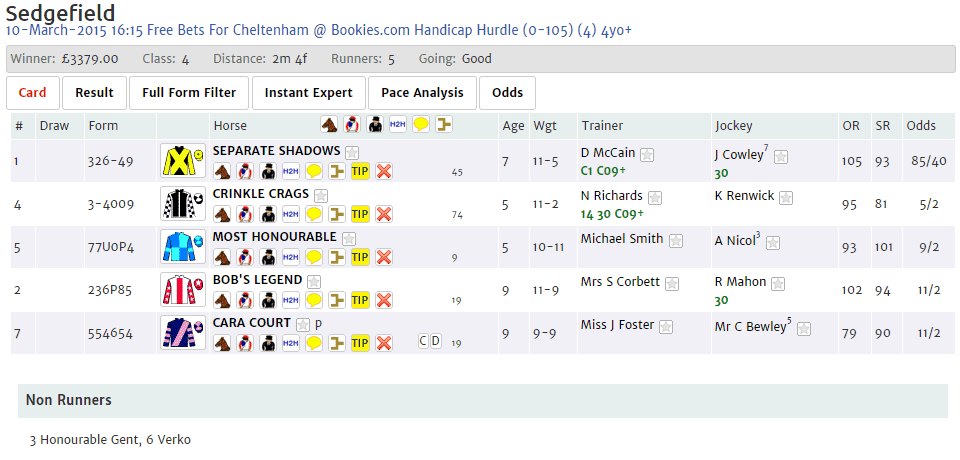
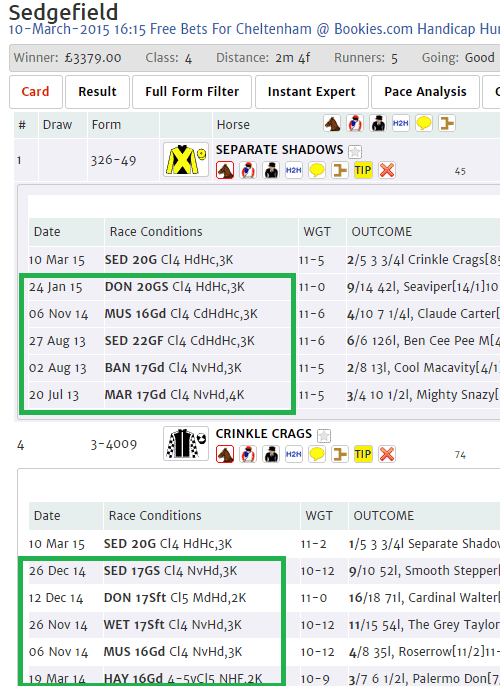
 Introducing the rather unsexy-sounding 'Trainer H'cap 1st Run [Code]' report. This report, found towards the bottom of your reports dropdown , shows all horses running in a handicap of that code (flat, hurdles, chase) for the first time today by the trainer's record with such types.