Read all sorts of commentaries and tips across a range of racing disciplines on the most popular horse racing blog in Britain, from staff and guest writers.
There are some racing jurisdictions in the racing world where pace is as fundamental a 'handicapping' tool as you can get. In places like America, even beginner bettors understand the concepts of pace and its likely effect on race outcomes.
Strange, then, that for so long pace has been completely overlooked by UK punters. The main reasons for this are twofold. Or perhaps one-and-a-half-fold, as they're directly connected.
First, there's the almost complete lack of pace data or information. Obviously, this creates a barrier to entry, because any savvy bettor wanting to establish the likely pace scenario in a race has to do all the crunching himself (or herself). It is not a quick or easy task.
And second, related to point one, is the almost blanket lack of understanding around how pace affects the outcome of horse races.
This WILL change in the next few years, as information boundaries are pushed with new racing data publishers challenging the half-asleep establishment content providers. geegeez.co.uk aims to be something of a pioneer in the space and, in today's video post, there is an introduction to the basic concepts of pace, and an example of how pace can be easily assimilated into your betting using the geegeez race cards.
Note, these concepts are not hard to understand, but they are new for most people. In that novelty, some will automatically switch off. Those that embrace the new data are far better armed for the betting battles through the summer particularly. To use a well worn, if unattractive, cliché, having this exclusive information to hand is like taking a gun to a knife fight.
So here's the video. [There's a full screen button in the bottom right corner, which will help].
**
I hope it mostly made sense, and that you can see the value in the information even if it hasn't automatically registered completely with you.
If you're not already a Gold subscriber - meaning you have access to this valuable information - you can register here.
And if you have any questions on the subject of pace, please leave a comment below, and I'll do what I can to answer.
It's nice to have something a bit different to think about, and this pace information is available in very few places currently, so you really do have a head start on almost all punters. Get to grips with it, and use it to your advantage!
Matt
https://www.geegeez.co.uk/wp-content/uploads/2022/10/geegeez_banner_new_170x78.png00Matt Bisognohttps://www.geegeez.co.uk/wp-content/uploads/2022/10/geegeez_banner_new_170x78.pngMatt Bisogno2014-04-08 08:17:322021-01-30 11:18:18What is Pace in Horse Racing? And how to use it.
The Cheltenham Festival 2014 is almost upon us and, with the unending bombardment of data, stats, bookie offers, stable whispers, preview nights, and tips (many of them emanating from these virtual pages, it should be added!), it can be hard to see the winning wood from the information overload trees.
So, in this post, I'll outline my 'Driving to Cheltenham Profits with BSM' methodology. It's nothing to do with a certain car training school, but everything to do with a three step process to keep yourself honest in the midst of what is always a week of frenzied activity.
Now, before I go any further, I should say that if Cheltenham's four day Festival is just another race meeting for you - if you do nothing differently from any other racing day - then fair play, this post will probably have limited utility.
If, however, you take the 27 races which comprise National Hunt's Olympics as a sort of personal, maybe even professional, challenge, then this will hopefully act as a timely aide memoire to retaining sanity, at the very least.
OK, with that said, let me introduce you to the first of my BSM components:
Bank
As I've scribbled above, and you probably know, there are 27 races spread across the four days of Cheltenham. From the big fields of unexposed novices to the even bigger fields of wily handicappers - many of whose talent lights have been hidden under various inappropriate engagement bushels for the larger part of the season - the Cheltenham Festival is a minefield for punters.
Consequently, it makes sense to allocate a separate ring-fenced betting pot, specifically for the week. By doing so, you'll be forced to think in terms of four days and 27 races, rather than lurching from race to race, wager to wager.
The nature of the Festival is that a significantly disproportionate amount of the publicity is focused on the first day. It's usually correct to say that Cheltenham Tuesday offers the highest calibre of racing; but that doesn't necessarily translate into it having the best wagering opportunities. Bookies are looking to get online accounts loaded on Day One, so you bet with them subsequently, and the vast majority of the best offers relate to the first day as a result.
But those who burn brightly on Tuesday only to fizzle out by early Thursday face a long walk home, in purely metaphorical terms of course (at least, I hope that's the case!)
So how much are you setting aside to wager across the Festival? And how might you divide that fund over the four days?
If you know you like a couple on Friday, make sure you've either already backed them, or you've left an adequate slice for that purpose. There's little in betting more soul-destroying than doing it in before your main fancy comes along; then limping onto it because you're 'short-stacked'; and seeing it romp home. That's an ugly, and wholly avoidable, scenario.
Finally on Bank, it doesn't make sense, unless you're following a tipping service, to bet level stakes, especially if you're intending - like me - to bet in every race, to some degree or other. Which brings me on to my second element of BSM...
Strengths
Know your strengths. As trite as that may sound, keep it in mind as the week progresses. What's your wagering / handicapping forte? Are you a judge at picking out 'plot' horses in handicaps? Do you have an all-seeing eye when it comes to Championship races? Can you skilfully infer improvement in novice horses?
Unless you're a full-time pro, the truth is likely to be that you're none of the above. But you will still be more akin to one of those types than the others. As such, it makes sense to focus more of your energies on that which you are most adept, and less on that which you are most inept.
For me, this means a primary focus on the Championship races and some of the novice events, and a cursory review of the handicap form using a few tools and techniques I've developed to shortlist the fields.
Obviously, then, betting one point level stakes across that varied punting panorama is plain daft. I will be wagering in line with the strength of my opinions, and I will live or die (again, metaphorically only!) by those opinions.
That means I will be getting stuck into a couple of Championship events; I will be having a reasonable tickle on some in the novice races; and I'll generally be mucking about in the handicaps, hoping to get lucky at a price (which, of course, is perfectly possible at Cheltenham, where lots of good horses are sent off at a price).
[Note, if you've been following my Cheltenham race previews, you'll know I've hammered one handicapper, though it's not one of the traditional handicap events... Hint: I've only previewed one handicap 😉 ]
So, what are your strengths? Give it a bit of thought if you haven't already, and try to "gear your portfolio" accordingly.
That leads us nicely into the final third of my punting triptych (good horse, she was)...
Mindset
Incorporating pieces of both Bank and Strengths, Mindset is crucial when betting, especially when we're exposed to the searing heat of a furnace of fetlocks and fancies for four full days.
It's always interesting to note the reactions of big punters - those whose responses can be publicly viewed, anyway - like JP McManus. They seem to maintain a Kipling-esque stoicism, greeting "those two impostors" of Triumph and Disaster even-handedly.
Of course, inside, they're probably cartwheeling or crying. But managing those emotions is the key to not losing - or gaining - too much confidence.
The thing with a meeting like Cheltenham is that plenty of winners are sent off at 12/1, 14/1, 16/1 and bigger. If your modus operandi is, like mine, to be frequently involved at that sort of price, then - even if you're very good - you'll incur longish losing sequences.
It is of paramount importance to remember that this is par for the course, and to continue to trust yourself. The worst thing bettors can do if they have an overall knack of finding enough nice-priced winners to pay for the losers and manage some bunce left over, is to chase the top of the market in the hope of clawing things back.
Firstly, it's not a part of the market for which you'll have the same 'value barometer'. And secondly, even when you do catch a winner - or even two - it's unlikely to return the fund to parity.
What we're actually doing when we adopt this approach is seeking comfort in correctness: a little ego stroke and reassurance when the winners have absented themselves. Always keep in mind one of the maxims of geegeez in times like this:
"What do you really want? Winners? Or profit?"
Finding winners at Cheltenham is bloody hard. But if you're safe in the knowledge that when they're unearthed, they generally pay for a lot of losers, then you're ahead of the pack mentally. Don't give in to self-doubt. After all, if you've set aside a bank and you've still got some of it to tickle the Grand Annual, the final race of 27, you've done well, win, lose or draw.
And keep in mind another geegeez maxim too:
"If it's not fun, we might as well go and get a job"
The most important aspect of mindset - even if you're a professional - is to enjoy Cheltenham's slings and arrows of outrageous fortune.
It's going to be great!!! 🙂
Matt
p.s. here's Rudyard with a poem so utterly magnificent it's been confined to cliché in pieces such as this. But if ever a man captured the very essence of what it is to engage in the betting battle at Cheltenham, it was - unwittingly - the fellow whose namesake baked exceedingly good cakes.
If you can keep your head when all about you Are losing theirs and blaming it on you, If you can trust yourself when all men doubt you, But make allowance for their doubting too;
If you can wait and not be tired by waiting, Or being lied about, don't deal in lies, Or being hated, don't give way to hating, And yet don't look too good, nor talk too wise:
If you can dream - and not make dreams your master; If you can think - and not make thoughts your aim; If you can meet with Triumph and Disaster And treat those two impostors just the same;
If you can bear to hear the truth you've spoken Twisted by knaves to make a trap for fools, Or watch the things you gave your life to broken, And stoop and build 'em up with wornout tools:
If you can make one heap of all your winnings And risk it on one turn of pitch-and-toss, And lose, and start again at your beginnings And never breathe a word about your loss;
If you can force your heart and nerve and sinew To serve your turn long after they are gone, And so hold on when there is nothing in you Except the Will which says to them: 'Hold on!'
If you can talk with crowds and keep your virtue, Or walk with kings - nor lose the common touch, If neither foes nor loving friends can hurt you, If all men count with you, but none too much;
If you can fill the unforgiving minute With sixty seconds' worth of distance run - Yours is the Earth and everything that's in it, And - which is more - you'll be a Man my son!
https://www.geegeez.co.uk/wp-content/uploads/2022/10/geegeez_banner_new_170x78.png00Matt Bisognohttps://www.geegeez.co.uk/wp-content/uploads/2022/10/geegeez_banner_new_170x78.pngMatt Bisogno2014-03-07 10:44:262014-03-07 10:44:26How to Prepare for the Cheltenham Festival
A tweet by an American racing scribe last night piqued my interest regarding the equivalent issue of field size here in the UK. @o_crunk posted the following:
Stateside, the year on year (y-o-y) decline from an average of 8.16 runners per race to an average of 7.86 equates to just shy of a 4% reduction. That sits in the context of an increase in the number of races, from 2,550 last year to 2,619 this January.
So, what of good old Blighty? How is racing and its field sizes holding up? First, the headline figures.
January 2014 accommodated 637 races at an average of 8.07 runners per race. That compares with 608 races last January at an average of 8.41 runners per race. The decline in average numbers is in line with that of our transatlantic cousins, at around 4%. But the broader picture makes for uncomfortable reading. Below is a list of the number of races, and average runners per race from 2007, 2010, 2013, and this year.
2007 - 600 races - 10.06 av runners 2010 - 525 races - 8.96 av runners 2013 - 608 races - 8.41 av runners 2014 - 637 races - 8.07 av runners
The decline in average number of runners from 10.06 in 2007 to 8.07 in 2014 is stark. It equates to a 20% drop over a seven year period, a reduction that is patently unsustainable.
Against that, we see an increase in the number of races, from 600 to 637, of 6%. The question begs to be asked, why?
Whilst the microcosm of January helps to frame the issue, there are several issues at play in parallel, and they require teasing out. In the remainder of this post, I'll look at various breakdowns of the overall data in search of underlying issues.
I'll consider turf racing in January (i.e. National Hunt) versus all weather racing; I'll look for any possible problems with the distribution by class; and I'll probe more deeply into the races by number of runners, by handicap versus non-handicap, and by going, to see what lies therein.
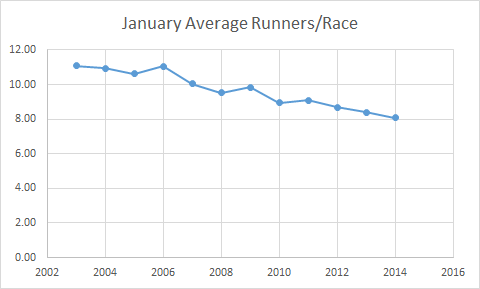
First, lest you think the four years in the table above were cherry-picked, here is the full y-o-y view of January racing from 2003 to the present.
You can see that in January 2003, the average number of runners per race was nigh on eleven, more than satisfactory. In 2014, the figure of 8.07 is alarming. Over more than a decade, it is reasonable to expect that any outlier years have been smoothed by the curve, and the correlation between these data looks extremely robust.
In plain English, there IS a problem here. Probably more than one.
Let's dig further and try to isolate some of the challenges British racing faces, at least in terms of the size of its fields.
First, I want to look at all weather against National Hunt. I should declare before we proceed that I am a fan of all weather racing, and I am a fan of National Hunt racing. So I have no axe to grind. Rather, I hope the numbers will speak for themselves.
All weather racing will celebrate its 25th anniversary on 30th October this year, so it was already a mature part of the sport by 2003, the earliest year in this sample. Below is a table showing the average runners per race each January from 2003 to 2014.
Note the huge decline between 2006 and 2008, when the average fell from 11.23 runner per race to 8.13 runners per race. This coincided with a massive increase in races, from 246 in 2006 to 362 in 2008.
In percentage terms, all weather racing lost 28% of its average race runners at the same time it gained 47% more fixtures.
Since 2008, the average number of runners per January all weather race has not really changed materially - 8.13 in 2008 and 8.06 in 2014. The number of races each January in that time has also remained fairly constant: after the aberration of 362 in 2008, there has never been more than 336 since then, and the average has been 317 from 2009 to 2014.
The number of runners in all weather races, in absolute terms, has remained constant over the last five January's, at around 2600. 2012 was an exception, when the number of races shrank by almost 20% due to postponements.
So what, if any, conclusions can we draw from those all weather data? Probably the clearest observation is that the volume of races has affected the average field size. Whilst that in itself is not an issue - after all, the bookmakers want more racing (or 'product' as they like to refer to it) - the average number of runners is now precariously close the golden number of eight.
Eight is the minimum number of runners in a race in which three places are paid on each way betting, and it is a minimum threshold keenly sought by the bookmaking fraternity, whose turnover drops significantly on smaller field races. Indeed, the big four bookies have voluntarily offered an additional payment for the first time this year, in a bid to bolster field sizes... and, one suspects, as a pre-emptive move against the impending point of consumption tax.
As things stand then, an average number of runners per race of 8.06 is borderline acceptable for all weather racing and, in the context of 2013's January average of 7.91 it represents a possible green shoot of recovery. Time will tell on that front.
**
What, then, of the field sizes in National Hunt races?
Although the most recent figures are broadly the same - average number of runners in National Hunt races in January 2014 was 8.08 compared to 8.06 for all weather races - the rate of decline, this time unchecked, is of major concern.
Whereas all weather racing experienced a rapid decline in line with an increase in the number of races between 2006 and 2008, and has subsequently 'flat lined' largely, National Hunt racing figures were fairly stable between 2003 and 2009, but have dropped dramatically since then.
The average between 2003 and 2009 was 10.76 runners per NH race in January. Between 2010 and 2014, the average has plummeted to 9.08. Moreover, the best January in the last five years saw an average of 10.02 runners per NH race. That compares with the worst year in the previous seven of 10.12.
The average of 8.08, if taken at face value, is a massive drop from last January's 9.01 average and a devastating slump from 2011's 10.02 average.
I write "if taken at face value" because it is worth asking whether there are circumstantial elements in play which have impacted the figures here. The most obvious culprit is the weather. So, did January 2014 have more races run on heavy ground, and is that a material factor in the figures?
Ignoring the all weather National Hunt races in the sample, which tend to be very well subscribed, the figures for the period 2003 - 2014 (January each year only) aligns with what we'd expect: good to soft is optimal jumping ground, and heavy is the least favoured of winter ground.
It is then reasonable to say that heavy ground is a material factor in field size, especially after as wet a January as we have experienced this year. To level the playing field, below are the average number of runners in January National Hunt races staged on heavy ground since 2003.
For the first time, it becomes difficult to immediately spot a correlation between ground and field size. However, the downward slope of the graph since 2009 maps to the same southbound trend for average runners per race as a whole.
And the average for heavy ground races in January 2014 of 7.71 is not so different to the 8.08 for all races in that month.
**
Let us now look at the distribution of races by number of runners. That is, for instance, how many two- to four-runner races were there? Here are the data for January 2014, covering both all weather and National Hunt.
Most races were between five and ten runners, with 38% having five to seven horses, and 34% eight to ten horses. Just 19.47% of races could boast eleven or more runners, and 53 of the 637 races run in January suffered an embarrassment of runners less than the each way place quorum for two places.
The distribution comparison between all weather and National Hunt was surprisingly similar. Looking at the 2014 figures in comparison with the 2013 figures, it is most noteworthy that races comprising eleven-plus fields made up nearly a quarter of January 2013 events (23.68%), whereas in 2014 they were less than a fifth (19.47%).
And, whereas 56.41% of races run in January 2013 had eight or more runners (and therefore three each way places to shoot at), that was down to 53.69% last month.
**
Another area worthy of investigation is that of the rise and rise of handicap races. Are they good for the sport? Are they good for the funding of the sport? Whilst those two questions almost certainly have different answers, it is indisputable that handicaps have a healthier impact on field size than non-handicaps, taken as a whole.
For the period 2003-2014, and solely for 2014, the January totals were as follows:
The disparity, in terms of average number of runners, for the whole period is just over 2%. That is, there were just over 2% more runners per handicap race than per non-handicap race between 2003 and 2014 (January's only).
Last month, the disparity was an eye-watering near 15%. Whilst it is reckless to make definitive statements based on a single month's data, it would certainly appear that the race planning department's tinkering with various segments of the non-handicap programme has been unsuccessful. And, moreover, any pandering to trainers who bemoan the lack of 'penalty kick' opportunities should be avoided at all costs.
In fairness to race planning, they have made changes aimed at enhancing the programme for fillies and mares, and at increasing the competitiveness of novice events. Their remit is a far broader one than solely field size, but that latter consideration is a crucial one to the successful funding of the sport.
Talking of funding, it is my opinion that the lop-sided distribution of prize money is one of the remaining taboos at the top table of racing politics. Simply put, too much of the available prize fund goes to too few of the owners. Put another way, racing has its own 18th century distribution of wealth model.
It is lamentable that the sport actually allows so many of the good horses to dodge and swerve each other whilst still picking up fat pots en route to the Festival gravy train. It doesn't serve punters; it doesn't serve bookmakers; it doesn't serve the reputation of the sport; and it doesn't serve the vast majority of owners or trainers.
There are too many pattern races. Look at the average number of runners by class, 2003-2014:
Let's break that down by Class 1 to 3, and Class 4 to 7.
Class 1 to 3 - 12,552 runners - 1,365 races - 9.2 average runners per race
Class 4 to 7 - 56,326 runners - 5,786 races - 9.73 average runners per race
The average number of runners in Class 1 races is the lowest of all class levels. Why then should they receive such a disproportionate volume of prize money?
**
Where then does all that tabling and charting leave us?
The implication may be that the sub-dom relationship between BHA's race planning department (doubtless imposed upon them by the 'thought leaders' there) and the bookmaking industry is in danger of splitting its seams, and that further - perhaps - the bookmakers don't actually know how to ask for what they want. The endless demand for 'product' can be argued to have led to smaller fields, which in turn are responsible for reduced bookmaker handle (or turnover).
This January microcosm needs to be set in the full-year context of course, a wider vista which does little to ease concerns. I've written previously about the funding issue, and a snippet from that piece might be instructive here.
...consider that the 2010 pattern’s 142 races (Listed class or better) accounted for £20,483,170 from a total prize money allocation of £67,572,859, to be spread across 6,309 races.
That’s the top 2.25% of races receiving 30.3% of prize money… at an average of £15,275 per runner.
Compare this with the rest of racing’s pyramid, which stretched 69.7% of the prize fund across 97.75% of the races… at an average of just £791 per runner.
The tapering of prize money as one descends racing's class structure is over-zealous, and anachronistic. It dates to before the vastly expanded race programme of recent years, without reasonably considering the needs of stakeholders at the bottom rungs.
There is a perception that the BHA don't want to engage with Class 5 and below, even while recognising the fundamental importance of that volume end of their business.
Low grade racing has become the dog to be kicked, and the root of all racing evils - see the recent Curley gamble backlash - but if the BHA keep sweeping their trash under the carpet, some of it is bound to stink after a while.
Solutions to the field size conundrum need to be both qualitative and quantitative. It is too easy to blithely opine that there is too much racing, and far too much low grade racing. That fails to acknowledge the saprophytic (borderline parasitic?) relationship between the sport and its 'benefactors', the bookmakers; and swingeing cuts at the bottom tier would be akin to treating a verruca by amputating below the knee.
However, it is also true that there probably is too much racing. Certainly, it seems there are too many pattern races, and that is an area that should be addressed. Central funding for races which fail to meet an agreed quota of runners should be cut. This then brings the racecourses into the equation, giving them greater accountability for the success of their flagship events.
Why should the same pot be handed out year after year when field sizes - and thus the spectacle of the contests - dwindle?
The bookmaking fraternity for their part need to understand that their demand for volume of races has a direct impact on field size and, when that drops below 'the dead eight', on turnover.
Perhaps (read, almost certainly) they'd be better off asking for less fixtures and more field size guarantees.
And, as I've written, racecourses need to be more accountable for field size, or risk losing their funding. Fakenham, Ffos Las, Perth, Bangor, Hamilton, Brighton and Yarmouth all have a long-term average of less than eight runners per race. That should not be acceptable to anyone.
How can field sizes be improved? Better track maintenance is a start: while Ffos Las and Perth suffer from geographical issues (why build a course so far from the madding crowds?), Brighton and Yarmouth - and Ffos Las for that matter - are blighted with extremes of going.
Better incentivised prize money is another part-solution. At least one race per meeting should have an 'expenses paid' concession to owners, up to a fixed fee. This would make the costs of travelling - a cost which is often more than third place prize money - more palatable, and encourage owners to consider races they previously would not have.
In greyhound racing - and, like it or not, we are not that very far from there with horse racing in 2014 - owners receive appearance money every time their animal runs. In horse racing, owners pay entry fees. That doesn't seem right, and it's something else that racecourses can do to play their part in both the funding of the sport, and the enhancement of their own spectacles.
Field size and funding are intrinsically linked and, whilst this piece has deliberately ignored macro-economic factors such as recession and increased competition for potential owners' disposable income, those factors do not alter the urgency with which racing needs to tends its own field size wounds.
Given the excellent early successes Paul Bittar enjoyed at the head of the British Horseracing Association, it is disappointing that so little progress has been made in an area that Bittar himself made a top priority in July 2012. The evidence in light of those comments suggests that a different tack is needed, and one in which both racecourses and bookmakers bring more to the table.
Blaming external factors may be convenient - heck, it may even be valid, at least to some degree - but it doesn't help to solve the problem. Merely explaining why things are bad is no use. It's time for racing, led by the BHA, to take action. Drastic action.
https://www.geegeez.co.uk/wp-content/uploads/2022/10/geegeez_banner_new_170x78.png00Matt Bisognohttps://www.geegeez.co.uk/wp-content/uploads/2022/10/geegeez_banner_new_170x78.pngMatt Bisogno2014-02-03 13:40:402014-02-03 13:40:40Are Field Sizes in Terminal Decline?
This is the end, beautiful friend
This is the end, my only friend, the end
Of our elaborate plans, the end
Jim Morrison had it about right, when he warbled the above with The Doors.
After deep consideration, and with a very heavy heart, I've decided that it's time for me to walk away from geegeez.co.uk.
I have every hope that the site will continue to exist, and most likely in a very similar format to the current setup. But that's assuming a buyer can be found who shares the vision and ethos you've come to expect from this little dot in the pointillist digital landscape of the internet.
There are two reasons I've reached this decision, and they're linked.
Firstly, I've subsidized geegeez to a significant degree from my other business interests over the past year, and that's not something I can justify any more. More on the paradox of this in a moment.
And secondly, I'm tired and I need a change. Frankly, I think geegeez probably does too. This has been my lifeblood for five and a half years now, and it's come a very long way since that first post in August 2008.
The very beginning...
Focusing on the first of those reasons for a second, I decided about this time two years ago to really kick on with geegeez.co.uk. It was doing well, providing me with a good living from talking gubbins about racing, and about betting systems and services. And it would have continued to do just that, but for one thing. I was bored.
geegeez virtually ran without input from me at the time, especially as I had help - firstly from Paul and, since June 2011, Chris has been my invaluable right hand man. That support gave me the space that every entrepreneur needs to stop being tactical - i.e. living from day to day, doing the same thing - and to start being strategic, i.e. develop a 'grand plan' for the way forward.
The grand plan had a simple mission statement: to make geegeez.co.uk the best free independent UK racing site on the 'net. I like to think we came close.
Of course, a business plan involves making money. After all, the first rule of business is that if you're not selling anything, you're not in business. (It's amazing how many businesses actually don't get that!)
geegeez was selling quite a lot of systems and services which had been reviewed on the site and our brilliant independent reviewers (thank you, guys!!!) were happy to recommend. It was thanks in part to their hard work that we were able to offer so much for so little. Or for free, to be more precise.
My new strategy involved publishing the racecards each day, and results, and having all sorts of cool - and easy to use - form study tools and reports. It also involved more interaction, through competitions and a tipping league.
Plus, I wanted to showcase some of the hottest new writing talent I could find. I couldn't afford the 'name' writers and, in any case, they've generally got too much to lose to say anything of real interest.
Indeed, the biggest 'name' I've been lucky enough to host on geegeez is Tony Stafford, senior member of the Fleet Street racing mob for many a decade. The cost of his services? A cup of tea and a bacon roll every other month. This tip top man, an absolute encyclopedia of racing, rises early most Sundays to pen some thoughts on the sport's to's and fro's of the last week or so. Plus, he hurls in a spot of Arsenal bluster here and there, but I can't begrudge him that! He does it gratis, bless him.
The writers published on these virtual pages have been expert in their areas, and have had pithy observations to make. Very little fence-sitting, but plenty of ballast to support their arguments. Just how it should be, and - though I say it myself - just how I wanted it.
But, Mr Stafford aside, they cost. Not fortunes, but they cost. Collectively, it comes to a fair sum each month. And there has never been any charge for that quality insight.
I'm sorry to say that I've had to stand the entire writing team down, with effect from the end of the month. Mal Boyle, the daily stats man; Andy Newton, and his Saturday TV and trainer trends; Tony Keenan's Irish views; Martin Pennington's excellent point-to-point knowledge; and, of course, Ian Sutherland, my news writer, for whom this particular news came in the week of his 1000th post on geegeez.
There have been others down the years too, but it's never easy to let people go, especially when they've not actually done anything wrong. It's a tremendous testament that some of the above named have offered to continue to write for free, a) because they love writing for people who actually show their appreciation for what they're doing, and b) because they'd like to write for the new owner(s), whoever that might be.
Then there's the racecards. For someone who spent ten years managing major software projects, it was an eye-opening experience getting those into being. Bootstrapping has been the order of the day. Scrimping on development costs by calling in favours from friends, and friends of the site who have become friends. My massive and sincere thanks go to Nige and Dave, whose hard work for little financial return - certainly compared to the market rate - has produced those things of beauty that help you find your picks each day.
Johanne, my intern, has created perhaps the biggest business asset in his year with me. A raw rookie in work experience terms, he came to me with a first in creative computing for his degree, and he's learned more in one year sat in the office with me than he did in three years at university (by his admission). I want to record my thanks to him too.
Even employing an intern and 'mate's rates', the development exercise was expensive. Especially so after a failed outsource operation (mostly my fault rather than theirs, I should add). It was also time-consuming.
And who knew that when you have all this clever stuff happening on your website, and people are actually using it, that you might need more than £2 a month hosting?! 😉 Well, I do now...
Whilst doing all this, I dropped the ball a little on the system/service review side. In other words, at the same time as spending a ton of money on developing the site, I also reduced the incomings from the review side. Careless on my part.
In the end, it's been a hell of a year with staff and an office and data licensing costs and project management and and and.
Oh yes, and there was the small matter of being dad to a fantastic little lad, and wanting to spend as much time as I can with him.
I'll be honest. For the first time since geegeez.co.uk squinted its virtual eyes into the bright light of cyberspace, it has felt like having a J-O-B this year. But not just any old job. No, a job where you work doubly hard, are responsible for the livelihood of other people, and earn almost no money, because you're ploughing it all back into the business.
And that brings me onto my point two above: I'm tired.
As well as being dad I have had the business to run, a double life which millions of men carry off with staggering élan on a daily basis. Fair play to them, but it's taken me to the outer limits of my capacity and, if I wanted that I'd have carried on being an overpaid consultant to over-earning financial institutions. That's what I left back then to do this...
I've been marketing director, chief correspondent, managing editor, third line customer support (and first line too), chief operating officer, accountant, clerk, secretary, syndicate manager, and a bit more besides. Again, plenty of people do that. After all, it's what running a small business generally entails. And most of those poor bastards don't get to watch racing every day!
So, no sympathy required. Rather, I'm trying to articulate how we... I... came to be where we... I... are... am.
I always said I'd give this project until the end of the year to 'wash its face', but it hasn't, and I need to be a man and walk away. The weird thing - for me, not for any potential buyer - is that having gone through the nuts and bolts over the weekend, 2014 looks full of promise.
Most of the heavy lifting - development costs, data licensing, and the like - is now done. With the vast majority of the development work to produce cool reports and tools for those who want to bet on horse racing completed, for someone - most likely an existing racing publisher, I guess - this will make a great 'turnkey' investment.
I've given five and a half years of my professional life to it, and to you, geegeez' visitors and readers: its loyal and valued subscribers and, in many, many cases, friends. It's been the second best thing I've ever done, and to all who have supported me down the years, your part will sincerely never be forgotten, in the same way that it's never been taken for granted.
But I have to face harsh reality. I've never borrowed a penny in this business, and the fact that I never will is why I have to stop. I'm not commercially aggressive enough to make the investment of this year pay in the very short term, even as I can see the point where investment and return on investment pass each other.
My biggest 'mistake' has ultimately been to give too much away for nothing, when it was costing me something. Cumulatively, a pretty something. I've always believed in being inclusive and my lack of background in marketing has found me out in the end.
So when I recently invited you to trial the Gold service, most of you politely declined. That might have been because you were busy doing other things (apparently something quite significant happens in December each year - the King George on Boxing Day?). It might have been because you've got no money, or no desire to pay for an upgrade. Or it might have been because you get all you need from the free stuff on the site.
There is one other possibility: it might (very well) have been because I did a less than stellar job of 'selling' the free trial to you. For instance, you might not even know that Gold trialists currently have a hot-off-the-press Harry Fry stable tour, with a very dark horse expected to win first time out after a long layoff and a change of stable... 😉 Oh, and I probably ought to have said something about the 6/1 winner for the little system on the Gold subscribers' page too...
You see, whilst I have a very good model for selling products on a one off basis - as plenty of my now peers in the industry can attest - I've never really quite nailed the 'building an asset base' side of things in the way I'd probably have liked to. And that's because I keep giving high quality stuff away. It's hard to feel bad about that, and I don't, but I do feel it maybe should have worked out better than it did in the finish. Anyway...
The options as it stands then are:
1 - Sell up and walk away
2 - Find an investor and re-visit the current 'free line'
3 - Downsize back to a little blog site
Option 2 is not really an option for me. I don't especially want to 'co-habit' with an investor. I don't want to have to consider someone else's opinion in key decisions (notwithstanding that I recognize they might be far better placed to determine the right path).
And I really, really don't want to re-visit the current 'free line'. Put another way, I would find it nigh on impossible to justify charging for something like the Race Analysis Reports, which have been adored as a free facet of the site. That would feel a bit like a pusher offering crack for a few months before asking for money. I guess.
It's not something I can do, and I don't feel any compulsion to reconsider that stance. So Option 2 is a non-runner.
Option 1 - sell up and walk away - is my preferred option. It would, of course, be conditional, as I have a duty of care to those reading this to ensure that a prospective buyer shares at least the guts of my ethos for geegeez. It is also conditional on my valuation being met. Because of the first condition, I am prepared to take a hit on the second. What I'm not prepared to do is, excuse me, be bent over on this.
Which brings me to the third possibility...
Option 3 - downsize back to a little blog site - has some appeal if my valuation isn't met. But things would change markedly, and you and other readers may not derive the same value that you currently do from such a route forward.
Firstly, those brilliant writers would be scarcely affordable. Secondly, it's quite likely that I'd have to tear up the data licensing contract and, thus, the racecards and related reports would go too. The tipping league is driven off that data as well, so that would be out.
Like I say, it'd be back to me writing random thoughts on horse racing, a few tips from Chris and myself (Chris is now more indispensible to geegeez than me!), and some system and service reviews.
Moreover, because I'm completely 'cream crackered', I'd have to take a month out - at least - to recharge my flat batteries. So it'd be a quiet time for a while.
My preference, as I've said, is for Option 1. But I'll not sell you - or me - short on that, which does bring in Option 3. After a rest. (Bizarrely, if someone does step forward to buy the site, I'll likely end up working with them for a couple of months to handover, but will most certainly take my leave of absence thereafter!)
I do have a prospectus for interested parties - serious enquiries only please, and some demonstration of viability will be required before data is divulged - so if you might be interested in what is a brilliant opportunity for the right company, either to synergize with existing titles, or to take a first step into the racing niche, then please do contact me.
****
I must start to close by saying that this is very sad for me personally. Very sad. And it's desperately disappointing that it's come to this. It's also been really difficult telling people whose contributions I value so much that I can no longer showcase their talent. But that's where we are, I'm afraid.
So what happens next? Well, for the next few weeks, you're very unlikely to see any difference, except that there will be less content on the site after the end of the month. That likely means I'll be doing a bit more writing myself, so apologies for that in advance. 😉
Gold membership and the racecards will continue, at least until April, when the break clause in my license can be activated. So need to do anything just yet if you're a member of that esteemed community. (And if you're not, now might be a fine time to register...)
Thereafter, during January, things will be winding down on the editorial side unless/until a buyer is found. If you, or someone you know, might be interested, please get in touch. Serious enquiries only please.
We've had a great run since 22nd August 2008 - five and a half good years. And before that, since 23rd February 2007 when I wrote my first post on nag-nag-nag. That's nigh on seven years of blogging. As a consequence of my digital scribbles, I got to write a weekly column for The Irish Field, and a Cheltenham feature last year for attheraces.com, as well as having geegeez.co.uk featured in the Racing Post (though the assertion that the site had "a few serviceable posts" still rankles!)
This year, the site has had 786,454 visits from 220,189 unique visitors. They - you - have collectively viewed 3,913,990 pages. And over 73% of you are return visitors. There have been over 10,000 posts, and 17,645 comments (none of which are spam, and all of which have been manually moderated by myself or Chris).
More good news for a potential buyer is that those figures are a step up on 2012, and offer solid evidence that the site's popularity continues on an upward curve.
Some tidy numbers for geegeez this year...
Since February 2007, I've personally written well over two MILLION words. In fact, with comment replies and the like, it's probably over three million!
Given that your average novel weighs in at somewhere between 80,000 and 120,000 words, that's close to thirty volumes in seven years. No wonder I've got RSI. (Did I mention I'm starting to get RSI?!)
So we've done a lot right. Unfortunately, I've done one thing wrong. I've not made enough money to pay the bills, and to keep my family in a way I'd want to. Bills which grew considerably in 2013, and a family which has also grown by 50%, as I've tried to take geegeez to the next level.
Although the bills will be a fair bit lower in 2014 with a number of one off costs now sunk, I remain knackered.
I don't regret trying, though I'm disappointed by my failure to achieve the business objectives I set out for geegeez. And it's perfectly fair to say that I under-estimated the enormity of the challenge, with all the management decisions - be they technical, marketing, strategic, or logistical - posted through one door: mine.
So, for now at least, many thanks for reading this post - and the likely large number of previous contributions you've perused at this virtual address - and please keep dropping by, as nothing will change in the short term. Plus, how else will I keep you updated of any developments on the future?!
In the meantime, if you'd like to encourage a potential buyer (or just help cheer me up!) by demonstrating the affection you have for the site, then please do leave a comment below. In any case, you have my heartfelt thanks for being a part of this adventure for so long, and I hope you understand my reasons for arriving at the crossroads I am now.
Thank you.
Matt
https://www.geegeez.co.uk/wp-content/uploads/2022/10/geegeez_banner_new_170x78.png00Matt Bisognohttps://www.geegeez.co.uk/wp-content/uploads/2022/10/geegeez_banner_new_170x78.pngMatt Bisogno2013-12-16 07:31:392013-12-15 22:00:00A New Beginning for geegeez.co.uk?
The Grand National fences have their first test of the season on Saturday, when the Becher chase is run over 3 miles 2 furlongs at Aintree. The race starts immediately after Valentines Brook, so is just shy of one and a half circuits of the National Course. Read more
https://www.geegeez.co.uk/wp-content/uploads/2022/10/geegeez_banner_new_170x78.png00IanShttps://www.geegeez.co.uk/wp-content/uploads/2022/10/geegeez_banner_new_170x78.pngIanS2013-12-05 06:59:352013-12-04 12:10:24Race Histories 12: The Becher Chase
I've been reading a book by a young Irish fellow called Kevin Blake. It's about betting on horses, and specifically it's about how he made over £40,000 from betting on horses this year on Irish flat racing.
The keys, you may not be surprised to learn, were discipline, selectivity, discipline, form study, discipline, specialization, and discipline.
The book, "It Can Be Done", is a good read and it's full of strong insights.
But it might be a bit lacking in fun.
Most pro backers are serious types who spend much of their time studying the form book and video replays to eke out their profit. In fairness to Kevin, he doesn't fit that archetype too snugly.
If that sounds a bit dull, then I have some good news. The book was a catalyst for me taking an early look at my own betting profit and loss for the year (I normally do this at calendar year end), and the results were as pleasant as I expected.
In a nutshell, I'm showing a profit of £6,186 from my betting so far this year on a turnover of almost exactly £20,000. I want you to note two things:
1. I love a bet, and I have lots of action bets, and I have fun with my betting.
2. I do not bet massive amounts, in terms of stake size.
I want to remind readers of my unshakeable contention that betting for fun and profit is possible, and that these two are not mutually exclusive. And I'll share some of the keys to my philosophy, such as it, in this post.
Key Principle #1: Have fun!
Firstly, I do not set profit targets. My target is to have fun. I set enjoyment targets. That doesn't mean I don't want to win. Of course I do. But if winning is at the cost of entertainment, then I might as well get a job. (You know, a proper job, not goofing about on the internet scribbling a few paragraphs about whatever tickles my fancy).
No, it starts with fun. I'll bet almost every day. Some days, especially on Mondays when the racing is generally desperate, I might have one little bet in the afternoon, or do a placepot for a bit of interest while I'm doing whatever else I'm doing.
On Saturdays, I generally don't bet much because racing outside of the festival meetings is never more competitive than it is on a Saturday.
But on Sunday, and from Tuesday to Friday, I take a keener interest in what's happening.
Key Principle #2: Get V-A-L-U-E
If you still don't 'get' this, you're completely and utterly doomed. Betting 3/1 when you could have bet 4/1 is just plain unfettered idiocy. And, forgive me, if you're still doing this, you're either very rich and are keen to become less rich; or you're a plain unfettered idiot.
Look. You cannot can't CANNOT win if you habitually take under the odds about your fancies, no matter how smart you are. (And, in case you didn't get my, ahem, inference in the above, you're not very smart if you habitually take under the odds about your fancies).
geegeez trumpets the best bookmaker offers because the very best chance you have of winning is to avail of any concession you're still qualified so to do.
Let me put it another way, and this is becoming something of a catchphrase for me. Any fool can bet 30% winners.
Just grab a betting slip, or pull up a bookmaker site, and etch onto it/tick the box which says 'Fav'. Simple. Dull. Uninspired. And a little bit sad.
It will also ultimately cause a financial death by a thousand cuts. Slow. Painful. Inexorable.
Now don't get me wrong. There are plenty of occasions when a market leader can be a value bet. But simply backing the 'fav' is a mug's game. It's the ultimate mug's game. And if you do it, you're a mug. Get over it, and try something different. You might surprise yourself.
So what is value? Well, you've heard the coin toss example probably a million times. The problem is not 'what is value?', but rather 'how do I identify value?'
And here's a thing: that's an open book of a question. There is no right answer.
Many people say to quantify value, you must create your own 'tissue', or forecast betting odds. That's all well and good, but on what do you base those odds?
I've done it a few times, and it's an interesting exercise for sure. Comparing your tissue with the actual starting prices will tell you what sort of a handle you have on the market.
But generally, I determine value by feel. If that sounds cheap - perhaps even a cop out - then so be it. The fact is, I don't have all the time in the world to review the racing. I run a business akin to a (very) small iceberg, the main visible element of which is this site.
It takes a lot of maintaining. There are a lot of people involved. I have a young son and a lovely partner with whom I want to spend time. And I like beer. Not as much as I used to, but I still like it.
Time is limited for me, as it is for most other people. But that doesn't mean we can't bet profitably, and enjoy the process as well. Value is key.
Here's a shortcut to finding value
By far the biggest blind spot in the early markets is a recency bias. Specifically, a bad run last time out can double a horse's odds. Take Bobs Worth as an example. He was 5/2 for the Gold Cup before disappointing in the Betfair Chase last weekend. He's now 5/1. Has his chance halved as a result of that seasonal setback? Well, time will tell of course, but to my eye he has so many more positive runs to that one negative effort.
And, here's where the concession thing comes in, if he runs poorly again he might not even go for the Gold Cup. So, backing him at top price with a bookmaker offering non-runner free bet, feels like a smart thing to do. My entire Cheltenham ante-post portfolio so far - which is only about six or seven bets - has been struck with BetVictor, with no bet bigger than the £50 limit on that free bet concession.
Why would I bet anywhere else if they're matching the top price? To do so shows at best a lack of value acumen, and at worst, plain unfettered idiocy. 😉
The point: look beyond a bad run, especially if there's a probable reason for the bad run. Ground, trip, fitness, pace setup, missing the break, whatever. If a horse failed to get his normal luck in running - or ideal race conditions - last time, there's a good chance the market has under-estimated that horse's chance today, assuming race conditions are more in its favour this time.
[Post script: Bobs Worth didn't win the Gold Cup, but he was sent off the 6/4 favourite. 5/1? About a 6/4 shot? Any and every day, please.]
Here's another shortcut to finding value
Check the bookmaker concessions. Check the best odds available. And be sure to bet at the best odds available, and the best concessions. For as long as you can before they close you down.
I've got a good few winning accounts, and a few losing accounts. For whatever reason, I've only got one restricted account. [Update: I've got several more restricted accounts now]
If you don't currently have an account with the firm offering the best price, open an account with them. Here are three reasons why:
1. You'll get the best odds on your fancy today
2. They'll almost certainly give you some free bet bait to sign up (always great when you were going to sign up anyway)
3. Next time they're top price, you won't have to faff about.
And here's a third shortcut to finding value (lesser known)
Look out for tote rollovers. In Britain, these tend to be the exclusive preserve of the relatively high ticket bets, the totejackpot and the Scoop6. But in Ireland, there are frequent rollovers for their jackpot (which consists of just four legs), Pick 6 (which often features a couple of 'gimme' races), and trifecta, which is always on race six, even when that's a seven horse National Hunt Flat race!
There was nothing especially clever in the below winning bets, except that I was smart enough to know that the rollover meant I was getting value:
Tote value, across the Irish Sea
A couple of things to note on there.
Firstly, that €120 Pick 6. I would never normally play that Pick 6, because I consider it too hard. But the first race featured a 1/5 shot, which duly won. And the fourth race featured Hurricane Fly - at 1/16! - who scraped home.
Not only that, but Ruby Walsh rode the first FIVE of those six winners, and none was outside of the first two in the betting.
Leg six was a big handicap, which is why I took plenty of bullets (ten). It was won by a 10/1 shot.
The dividend for this most easy of six race accumulators was €648.20. The cumulative odds were just 311/1. More than double the odds. Thank you rollover.
And what about that jackpot there? That was nice, eh? €72 staked and €1,786.80 returned.
Listowel's Harvest meeting, and just races three to six to solve. Aidan O'Brien's 5/1 third choice wins the opening leg; the 9/2 favourite wins leg two, a handicap; Johnny Murtagh trains and rides the 10/1 winner of the penultimate leg; and, clear form pick, Hidden Cyclone takes the final leg at odds of 2/1.
Cumulative odds of 1,088/1, pay out at 1,785.8/1. That time it was due to a jackpot guarantee for the festival meeting.
The image is unedited - those are all of the Irish tote bets I've had since 20th September. (Spot the action bets!)
Be aware of when and where the rollovers are. And if you don't have an Irish tote account, get one!
Key Principle #3: "Let The Bet Make You"
There's an American bloke called Michael Pizzola. He writes about racing, and he lives in Las Vegas, and he lounges in the racebooks (betting shops) there. He writes very, very articulate and compelling books, and some of his core ideas are generic. One I really like is his strap line, "Let The Bet Make You".
What he means is simply that if you don't fancy something in a race, don't have a bet. You don't have to bet. You won't stop breathing if you don't bet. Most days, you won't even have to wait more than ten minutes for another wagering opportunity.
If you really must have a bet when you don't have an opinion, make it a very small bet. When it wins, you can buy a cup of tea and a sticky bun. When it loses, you won't kick yourself too hard.
That's the thing about discipline: it doesn't need to be a straightjacket. It's your leisure pound, and you can spend it as freely as you choose. But once it's spent, it's spent. Unless you backed a winner. Bet more when you have more of a view. But never bet too much.
Key Principle #4: Contrast is Key
Have you seen the Instant Expert reports on this site? You know, the traffic light thingies, with loads of numbers on them. The idea is that they'll help you see, at a glance, horses in a race which are suited by today's going, class, course, distance and field size, and that may be handicapped to win.
The amber and red box outlines are deliberately similar colours, in order to accentuate the dark green boxes which symbolize a positive profile.
The ideal situation is a horse which has a line of dark green in a race where very little else can offer much, if any, of that verdant hue. Here's an example from the day I wrote this post:
Spot the well treated horse...
Although Seebright had no form in today's class (normally a key consideration for me), he was strong in all other departments, and within sniffing distance of his last winning mark.
Moreover, his last winning mark was last time out, implying that he's still progressive. And, furthermore, and materially in this race, none of his rivals had previously shown any alacrity in this grade before.
Seebright won at 7/4. I had £20 on him at 9/4 with a Best Odds Guaranteed bookmaker. He was favourite. I backed the favourite. At half a point bigger than his SP, it was a value bet, irrespective of the outcome.
But, despite knowing that Seebright had won his only previous start after a layoff, I didn't especially fancy him - or anything else - this day, and so I bet accordingly. It was, in truth, an interest bet.
My only other bet that day was a £20 double with Seebright and Neptune Equester. The latter was second, albeit beaten half the track. An interest bet loser. No major damage inflicted.
Other days are, obviously, further from the payout window.
Summary
The point of this piece was not to gloat (especially) about winning at betting. After all, there are plenty of people out there with far more to gloat about than me. Rather, what I've tried to outline is a vague blueprint for profitable and enjoyable betting.
Profitable and enjoyable betting.
Those are the cornerstones of what geegeez is about, and it's testament to the approach that our three daily tipping features - Stat of the Day, Double Dutch and The Shortlist - have been profitable to follow since inception.
They all use best odds guaranteed bookmaker offers, and none would be profitable without them (except the top-rated The Shortlist selections - read about their amazing profitability here). The same is true of Tom Segal's excellent Pricewise column. The same is true of Hugh Taylor's excellent value pieces on the ATR site. Higher profile they may be, but the principle is alive and well all over the place, if you care to look, and to act.
Finally, here's the summary of my betting activities, based on a sanitized download of my bank statement (i.e. I removed the occasional non-betting bank transaction - you know, like the mortgage, and the electricity bill).
Betting P&L 2013
There may be some who don't believe this account to be true, and frankly I've long since grown tired of the bitches and the trolls that hide behind their screens in cyberspace, so I won't be saying anything further than that I can assure you this is the full and complete record of my wagering deposits and withdrawals...
...except that it doesn't include things like the €344 I have in my Irish tote account, or the £700 of unsettled bets I have running on. 😉
Good luck with your betting. First and foremost, enjoy it. And if you've any tips for readers on how to improve their own bottom line or fun factor, leave a comment below, and share your investment advice!
Many have tried and failed to explain the appeal of the Galway Races to outsiders and many more will try in the next few days. The Irish love a party and quite like racing which just about explains the popularity of the Christmas meeting at Leopardstown, the Punchestown Festival, even the buzz on Irish Derby Day.
But turning out in numbers for quality racehorses is not something we necessarily do as we saw in the relatively poor attendance for Sea The Stars’ sole run as a three-year-old on home soil at Leopardstown and he was one of our own.
Yet at Galway this week we’ll be breaking down the gates to get in to look at horses that struggle to crack a rating of 100 on the flat. So what explains it? Well, firstly there’s the tradition and timing, harking back to the first week in August being the set time for holidays, farmers getting a break between the two cuts of silage and even Gaelic games taking pause.
That’s hardly the way now however as the GAA has one of its biggest weekends of the year over the August Bank Holiday and many of our farmers are now doing pilates and yoga or laying the favourite on Betfair.
Galway of course is the great party city of Ireland – try it if you don’t believe me – and that plays its part and of course so does the drinking; just look at the number of races over the week that are sponsored by drinks companies and hostelries while Galway is just about the only track in the country where you can always get a drink in seconds, no matter the crowd.
Some of the figures quoted by the pubs around the city as to the number of bottles quaffed over the seven days beggar belief; pounds of strawberries and cream at Wimbledon it isn’t.
All this however is wandering off the point, as what we’re really interested in is the meeting from a punting perspective; how is it possible to make the week-long puntathon pay?
First, however, we’ll get the drinking and pacing yourself out of the way. Let’s be clear, only the most hardened teetotaller can go to Galway and not have a drink; it’s akin to going to hairdresser and not getting a haircut. I’m not going to preach about the perils and pleasures of drinking as plenty of other websites do a much better job but we all know that drinking and gambling don’t mix as it can make punters more reckless.
With the idea that you’re going to do at least a bit of socialising over the week, it makes sense to go through the big races in the days before the start of the meeting as the entries are already out. One should also get a sense of the entries in the other races too and know where your horses to follow are down to run. If you’re picking out the right sort of horse anyway – i.e. ones that are underrated by the market and will offer value – you may be able to get away with a bit less study than usual.
Oh and as for anyone who’s planning on doing seven days racing and seven night drinking; nice idea, but it’s next to impossible.
The ground at this year’s meeting – officially on the soft side at the start of the meeting – could make things very interesting. We’ve had lots of fast ground this summer and the form has been holding up well but with the going already on the slow side and plenty more rain forecast, it’s likely to be different terrain at Ballybrit.
This however should be viewed as an opportunity as much as a change as it offers the chance to back some decent priced winners back on their favoured ground. I don’t think going back to last summer’s form is quite necessary however as there was so much soft ground that most of the mud larks got their wins and those races were invariably run at such as slow pace to make the form redundant.
With the big national hunt handicaps, the Plate and the Hurdle, as a rule it is best to give preference to winter form as it is simply contested by a better class of jumper; this is something that is not so important when dealing with lower grade jumps handicaps where the recent is king. With the Plate and Hurdle being so valuable now it makes sense to keep a good national hunt horse back for it and most trainers opt against running their horses in summer jumps races, preferring instead to prep them on the flat (often in staying maidens) if at all.
As such, Galway trials, particularly those for the Plate run at Down Royal, Limerick and Tipperary, are pretty meaningless with many of the horses contesting them not high enough in the weights to get into the main race. All this said, the market is getting pretty wise to this and perhaps the real contrarian approach is the back the summer form at bigger prices.
In-running action at Galway is always interesting and there was a fine piece in the Racing Post last week in which Pat Smullen and Barry Geraghty discussed how best to ride the track. Both talked about the perils of going too soon around Ballybrit which is oft-underrated error as punters seem more drawn to horses being given too much to do whereas in many of those cases hold-up horses are simply hostages to pace and it’s never easy to change a horse’s run-style anyway for those who say they should have made their own pace.
A more cardinal sin is committing too early and you’ll see plenty of that over the week with jockeys making their move coming down the hill about four furlongs from home which when you think about it is really mental; it’s like going on across the top at the Curragh or when leaving the back straight at Leopardstown.
Galway presents a good jumping test between the Easy-Fix obstacles on the hurdles track and the two fences in the dip on the chase course; the chase course would be slightly more galloping than the tighter hurdles and flat tracks. In the main, on good ground I’d like my horses to be close to the pace though that obviously depends on how fast they’re going and a low draw is certainly a help in that regard.
Over the week, you’ll like see plenty of horses double-jobbing and running more than once; Shadow Eile won two of her three starts at the track last year while Pintura built on a second in the Galway Mile to win the big 7f handicap at the weekend. It’s no negative to see a horse running twice in the week, certainly not on the flat or over the shorter jumps trips anyway, and the ones that reappear tend to be those that have already run well and proven they handle the track.
Remember that these are lower class horses we’re dealing with and they can take racing well as they’re not running at Group race speed and owners and trainers are much too fond of cotton wool anyway; punters may be out on their feet by the end of the week but reappearing horses often aren’t.
I’m sick of making a prognosis about Dermot Weld at the meeting as he constantly proves me wrong and every year we have to listen to him talking down his chances at this time and saying that his team isn’t as good as previous years. There might be some truth in it this year however, particularly as his national hunt numbers are well down, but as ever he’ll be strong in maidens as unlike other trainers he tends to keep good horses back for the meeting.
I wouldn’t be in a rush to oppose him in such races but it’s a different story in handicaps which are my bread-and-butter.
In handicaps, I can rarely bring myself to back his horses as you’re often taking 3s about a horse that should be 8s on form and I can’t change my whole value-based punting modus operandi. It could be argued that they are value at the price as they keep winning but I find it hard to change for seven days of the year and will be hoping for a lean time for the Weld handicappers.
With Goodwood overlapping with Galway, it’s hard to keep on top of the racing there too but it could be worthwhile, especially with the Irish horses doing so well in Britain again this year. It’s certainly worth watching out for the raiders at the Sussex track and not just the obvious ones like Dawn Approach.
After the meeting, the first thing to do is rest but don’t forget to set the Sky Box to record the racing as there’ll be plenty of eye-catchers. Racing at Galway always has loads of trouble from traffic to horses getting trapped wide as well as jockeys going for their race too soon.
If we have soft ground, it might be worth noting those that haven’t handled it and similar thoughts apply to the track; it’s a unique venue and not all horses take to it so a bad run may not be as bad as it seems.
https://www.geegeez.co.uk/wp-content/uploads/2013/04/Punting-Confessional.jpg400278TonyKeenanhttps://www.geegeez.co.uk/wp-content/uploads/2022/10/geegeez_banner_new_170x78.pngTonyKeenan2013-07-29 17:18:542018-08-09 05:57:04The Punting Confessional: The Galway Festival
We’re in the midst of the best period of weather in many a year, a heat-wave that stands in sharp contrast to the three wet summers prior to this one, and with such temperatures predicted to continue it’s probably worth pointing out a few angles for summer punting; some of these are simple down to the weather while others are more general.
The prevalence of fast ground is an obvious starting point.
At the moment one doesn’t even need to look at weather forecast to ascertain likely going conditions as it’s a generic good-to-firm across the board albeit heavily watered in some cases. Such ground is the natural habitat of flat racers, as the soft is for national hunt horses; the likes of Royal Ascot, Glorious Goodwood and the York Ebor meeting just seem wrong run on a deep surface.
I suspect that fast ground is a more ‘honest’ surface for flat racing and I mean this in terms of pace; there may still be slowly-run races on it but a lot less so than in summer 2012 when seemingly every race was slowly-run as jockeys adjusted to a prolonged period of soft ground by riding their races slower and doing their best to ensure their mounts got home in the conditions.
That led to a host of strange results – I found last summer to be one of my worst periods punting in quite some time and wasn’t alone in this – as it was often a case not of which horse handled the ground best but rather which horse got away with it. In warm conditions then, pace can become a much more useful angle.
All that said, I wouldn’t say no to a blast of rain to shake things up for a few days and give the soft ground horses that have seemingly been out of form (and had their handicap marks drop) a chance of success, and often at big prices. This is vastly different to a prolonged period of deep ground that just plays with the form book and can provide a real edge; it is the very sort of change that is a punter’s friend.
A knock-on effect of fast ground is that some trainers’ horses thrive on it. I’ll return to why this might be with some of the lesser-known national hunt handlers anon but certainly there are a number of mid-level flat trainers that are flying at the moment, notably Ger Lyons, Eddie Lynam and Mick Halford, all of whom have their strings in top-form. It is no coincidence that these are the very trainers that succeed at Dundalk during the winter as their horses are conditioned for a fast surface and/or bred for it and indeed the sort of stock they have simply tends to be fast.
Lyons, for instance, does very well with juveniles who rarely race over further than a mile while Lynam’s record with sprinters is well-recognised through the exploits of Sole Power and the likes by now. Halford is a top trainer of handicappers but most of them seem best around seven furlongs and a mile and like the aforementioned pair he rarely seems to have good stayers, even middle-distance types. All are good yards to follow as they send out reliable horses and have readable methods.
One area where my punting fell down last year was in being distracted by an excellent summer of sport that comprised the Olympics and Euro 2012 and often losing money punting on them. This year’s sport hasn’t been as much of a distraction, mainly because I dislike rugby, golf and cricket and am lukewarm on tennis whereas athletics and football in its various shapes being more to my liking.
This year’s GAA championship has left me rather cold and I’ve taken only a passing interest though shamefully I must admit to being absent for Monaghan’s first Ulster title since 1988; I gave them no chance of beating Donegal so headed for the Curragh instead! But most of all, I’ve avoided having throwaway bets on the big sporting events which has certainly helped.
While I haven’t been mixing it up with punting across different sports, I have been playing a bit on the better summer jumps races as opposed to looking solely at the flat. I’ve been finding the bottom grade stuff on the level a turn-off as many of the runners in such races are inherently unreliable and concentrating instead on the middle-range and up on the flat and the better races over obstacles.
I’ve had some good results in the latter with Rawnaq at Bellewstown an example though the defeat of Supreme Doc at Limerick (traded 1.04 in the run) was hard to take and it is certainly useful to be following the national hunt form to some degree with an eye to the mixed cards at Galway.
The summer jumping scene has proved quite competitive with many races over-subscribed while the flat racing, away from the big meetings, has been lacking in numbers. Certainly there is less Willie Mullins domination over the summer as he tends to put his best horses away for June, July and August and indeed that is true for most of the big yards; the horses they tend to run are ones that struggled to compete over the winter.
This is not the case for the smaller trainers however as they often keep their best horses for the summer, as we saw with the likes of Rebel Fitz in the Galway Hurdle last year, and such runners often offer value in the face of horses from more high-profile yards.
Finally, it’s worth remembering that this is the time of the year when most normal people are taking their holidays and don’t forget to do the same; this is something I have been guilty of in the past, not wanting to miss a meeting at a time when they are coming thick and fast. Breaks can help rejuvenate and being just back from a good holiday I’m mad for some racing. Even mini-breaks, taking a day or two off a week, can help as some cards just look impenetrable.
https://www.geegeez.co.uk/wp-content/uploads/2013/04/Punting-Confessional.jpg400278TonyKeenanhttps://www.geegeez.co.uk/wp-content/uploads/2022/10/geegeez_banner_new_170x78.pngTonyKeenan2013-07-24 10:45:222020-04-30 10:10:45How to Bet on Horses in High Summer
The Punting Confessional - Wednesday, July 3rd 2013
With Royal Ascot just gone and on a lesser scale in Ireland the Derby last weekend and Galway to come, headgear seems a topical issue at the moment.
Now there is nothing surer than punters will be up in arms at the very mention of fashion on mainstream television coverage of the big meetings – coverage I might add that is watched by a far wider array of viewers than just the betting public – but perhaps we should become more aware of a fashion that is becoming much more widespread on the actual turf at our racetracks, namely the much increased use of headgear.
Already this year we have had a Derby winner in cheekpieces – the first horse to do so – and his trainer Aidan O’Brien is at the vanguard of this trend which may ultimately become a culture.
In these islands, a number of different types of headgear can be used. Blinkers are the most obvious and most severe; they aim to reduce visual distraction by focusing a horse’s attention only on that which is in front of them and tend to be used on lazy horses.
The visor is a slightly modified version of blinkers with a slit in the side, they are less severe with cheekpieces even less so. Made of sheepskin, they are more of a concentration aid, used to sharpen an animal up.
The hood is a different piece of kit entirely as it aims at reducing noise rather than vision; in the main it is used on keen horses that tend to get geed up and struggle to settle.
For years, the culture in Europe, including Britain and Ireland, was against headgear. The general perception was that blinkers were a rogue’s badge, an admission from the trainer that the horse was less than genuine, perhaps even a last resort in order to get it to reveal its ability. While it was one thing to use them on a lowly handicapper to extract a few pounds of improvement, it was quite another to opt for them on a group horse or stallion prospect.
Even the idea that the progeny of a sire, much less the sire himself, would be in need of an aid was seen as a sign of weakness and breeders would be reluctant to support such a stallion with their mares. In the US however, the culture is totally different. Even a cursory glance at attheraces’ coverage of American racing reveals that half the field often wear some form of aid and Animal Kingdom, the most high-profile American runner in the UK in many a year at Royal Ascot, and Kentucky Derby winner, wore blinkers on every start of his career.
This is changing, however and Aidan O’Brien has been the main catalyst. He has won a Derby with a cheekpieced runner and raced numerous classy types in headgear; over the three days of Derby weekend in Ireland he had 27 runners and 14 of them wore some form of headgear.
He has, with the help of his stable jockey son Joseph, offered numerous public pronouncements on the benefits of headgear, particularly cheekpieces, with barely a mention of the issue of temperament, to such a degree that it could almost be called a PR campaign.
O’Brien is just about the only trainer with the power to change the culture of headgear and while perhaps his whole increased use of aids could be seen as him seeking the next edge it is worth remembering who his paymasters are; if he does not satisfy the greater needs of the Coolmore operation, i.e. profits from the breeding sheds, then he will soon be out of a job.
All of this begs the question: does headgear work? At the risk of copping out totally from an answer, yes and no. We must judge each horse on an individual basis and see how they respond though some overall precepts about trainers are worth developing. Often, a piece of headgear will work just once, and on the second start in them a horse will regress back to its previous form.
When they do work a second time however, you may be onto something as it’s worth considering the animal a new horse, much like one that has changed yards and improved, and often this horse will continue to be priced up on its old form for the next few starts.
This doesn’t however mean that headgear will work forever. The horse may get used to it and become wise to what is going on; what was once a concentration tool is now old hat.
With horses like this however, there is still an edge as one needs to watch out for the reapplication of headgear. In this case, the trainer will note that horse has stopped reacting to the blinkers or cheekpieces and remove them only to reapply them at a later date, likely a race that has been a target or after the horse has dropped in the weights or showed a glimmer of promise. In this situation, a punter can expect improved form.
One such horse I’m waiting for with this angle at the minute is Ucanchoose, an Irish 5f handicapper whose last three wins have come in blinkers but hasn’t worn them since September last year.
On the whole, I don’t think headgear can change a horse’s temperament, particularly those are really recalcitrant. In some cases, blinkers can even exacerbate a horse’s reluctance as was seen at Naas last week when Dermot Weld applied them on a horse called Resolute Response who rivals Charles Byrnes’ Courage for the least-aptly named horse in training.
With a horse with a slight temperament issue or a mere lazy streak, headgear can be the key but some are beyond saving.
It is worth mentioning how the bigger Irish trainers use headgear. With Aidan O’Brien, cheekpieces are a positive and so too, the hood; I still think blinkers are a negative with him and while a trendsetter in this area it will take a while to break this mode of thinking.
With Dermot Weld, blinkers are a plus as he has campaigned even his best horses in them, notably Vinnie Roe, which is something to bear in mind ahead of his annual Galway jamboree. John Oxx on the other hand is an arch-traditionalist; any sort of aid from him is a negative, perhaps even an admission of defeat.
https://www.geegeez.co.uk/wp-content/uploads/2022/10/geegeez_banner_new_170x78.png00TonyKeenanhttps://www.geegeez.co.uk/wp-content/uploads/2022/10/geegeez_banner_new_170x78.pngTonyKeenan2013-07-03 08:09:332020-04-30 10:10:06Some Thoughts on Headgear
Racing is sport of complexities from pace analysis to ratings figures to sectional times and breeding angles and these nuances should be sought out by the punter seeking an edge. One does, however, have to be aware of the folly of over thinking or at least not forgetting the KISS principle, i.e. Keep It Simple Stupid!
The basics of gambling are important and shouldn’t be forgotten in the rush to grasp the difficult concepts mentioned above; avoiding what one might call ‘schoolboy errors’ while perhaps not making you a profitable gambler can at least cut your losses, a lesson I am repeatedly reminded of.
Perhaps the most common ‘schoolboy error’ is failure to check the ground and going updates. I have ranted about the lack of going updates from the racecourses and authorities through other mediums for long enough and to be fair to both groups, in Ireland at least, their communication of this information to punters has improved markedly in the last year.
Morning updates are available through Twitter – both the trade paper The Irish Field (@TheIrishField) and Horse Racing Ireland (@HRI_Racing) have going updates early – and any punter that isn’t on Twitter at this point needs to get their act together as it’s the quickest place to get information. In terms of advance weather forecasts, the HRI’s race administration site (info.hr-racing.ie) provides decent predictions, specific to each course, and if you want something more detailed there are plenty of other sites available.
At the risk of sounding like a farmer, met.ie is good for forecasts as is accuweather.com while irelandsweather.com has access to a number of weather stations that register things such as localised rainfall, many of which are close to racecourses. There are similar Twitter feeds and websites that provide such information in the UK.
With changeable weather a fact of life in these islands, as punters we need to be aware that ground can change in a matter of hours as we saw at Fairyhouse last Wednesday; going that was described as good before the first race was yielding to soft by the last. While many bemoan a change in ground, it can also be a big plus as prices that were framed for fast ground can now offer value among horses that may be suited by an ease. Such was the case at Leopardstown last Thursday where good to firm ground became good to yielding in the hours before the off.
This meant that Reply who would have been a strong fancy for the Ballycorus Stakes had his chances ruined as he is dependent on fast ground while the Ballyogan Stakes favourite Tickled Pink was a similar case if not quite so marked; the eventual winner Fiesolana was well-suited by some cut and it also placed a greater emphasis on stamina as she had previously won over a mile. It also made the penultimate handicap more interesting as the two potentially best-treated horses in the field – Bensoon and Dane Street – needed contrasting conditions, the rain swinging the race in favour of the latter.
None of this is to say that the ground should be everything; indeed it is sometimes an overrated factor and it’s worth pointing out that ability, or at least ability relative to mark, remains the most important factor. But not registering what the ground is or how it may have changed is a basic error that should be avoided.
Another mistake one can make involves targets for horses in ante-post races and I got a costly reminder about same when I backed both Olympic Glory and Mars for the Irish 2,000 Guineas on the Tuesday before the race only for neither to turn up, a fact I would have been aware of had I paid closer attention to stable announcements. Nowadays, targets are mainly transparent though some yards are better than others.
Willie Mullins is one I find particularly frustrating with his tendency to hold back on confirmations until the very last minute while Jim Bolger has been known to throw in a volte-face or two. Every now and then one has to take a chance on a big price about a horse and hope it will turn up – just like a few did with Dawn Approach on the exchanges for the St. James’s Palace and it was hardly out of character for the trainer – but in the main it pays to be as certain as one can be that a horse is going to take its chance.
My advice would be read as widely as you can if planning an ante-post bet; search racingpost.com and Twitter and the wider internet. It’s not a bad idea to read the paper Racing Post everyday as not all articles in the print edition make it onto the website though I should follow my own advice here as I’m not a daily reader. Doing so might have prevented me from backing Mars, a bet a felt pretty hard done by given how well he shaped in the Derby on this next starts.
With bookmakers, there is no excuse for anyone not to have an array of online accounts; brand loyalty is a nonsense as by so doing you are playing right into the firms’ hands; they love nothing more than a ‘one bookie’ customer that will take their prices regardless of what may be available with a competitor. And it’s the same with shop punters; Jane in your local betting office may well be ‘a fine bit of stuff’ and very pleasant when you’re backing one but that’s not going to put you in profit.
Top price may be a fiction for the winning punter as bookies are unwilling to lay it but for the beginning punter getting on is not an issue and by always taking the best available price you’ve got some sort of chance if not of becoming profitable then at least of limiting your losses. So take the option of walking across the road or opening another window.
Finally, be wary of night before prices and don’t rush in. While every now and then a price may be completely wrong, the layers at this point are often betting to ludicrous percentages which means there will be bigger prices available the following morning or closer to the off. I find with Irish racing there are certainly fewer moves overnight with more punters seemingly practicing patience in the markets.
https://www.geegeez.co.uk/wp-content/uploads/2012/12/Punting-Confessional1.jpg400278TonyKeenanhttps://www.geegeez.co.uk/wp-content/uploads/2022/10/geegeez_banner_new_170x78.pngTonyKeenan2013-06-19 09:16:002018-08-09 05:57:09The Punting Confessional: Getting The Basics Right
It would be nice to think that the Royal Hunt Cup was named after the Danish prog-rock band, but as the race was started in 1843 and the band more than 150 years later, that’s clearly not the case. Read more
https://www.geegeez.co.uk/wp-content/uploads/2022/10/geegeez_banner_new_170x78.png00IanShttps://www.geegeez.co.uk/wp-content/uploads/2022/10/geegeez_banner_new_170x78.pngIanS2013-06-19 09:05:132013-06-19 09:05:13Race Histories 11: The Royal Hunt Cup
The Punting Confessional – Wednesday, June 5th – The Non-Triers
Recent weeks have been black for racing with a high-profile corruption case and the Al Zarooni/Sungate steroid scandal; the latter is certainly the darker cloud at present and there remains a strong suspicion we’re nowhere near the bottom of it yet. This column aims however at the punting angle and I have to admit to being clueless as how to apply anything relating to drugs to playing the horses.
Non-triers are another thing entirely however and I have strong feelings on the issue and how it applies to the average punter; by average punter I mean a punter without access to any sort of inside info.
The verdicts released by the BHA in the aftermath of these corruption cases always make for fascinating reading and one was struck by the amateur nature of the whole Ahern/Clement conspiracy. Though not quite so lax as the methods applied by Andrew Heffernan/Michael Chopra earlier in the year, here was a pair that were in contact via their own mobile phones and were laying horses through their own (or their wife’s ) exchange accounts.
There are those that would say that Betfair and the other exchanges have a lot to answer for and that problems with non-triers increased when punters, and not solely licensed bookmakers, could lay horses to lose. I couldn’t disagree more. Firstly, why is it that just a coterie of high-fliers (bookmakers and their friends) could lay a horse in the past? I’m for equality in all its forms and the exchanges provide a service and saw a niche in the market that was previously unfilled.
One is reminded of the ending of the film Trainspotting where Renton steals the drug money and says that his ‘friend’ Sick-Boy would have done just the same if only he’d thought of it sooner, a sentiment that applies to all the big bookmaking firms in terms of the exchange model. Not only that but the likes of Betfair have provided the BHA with the sort of information into the activities of corrupt individuals that was previously inaccessible.
When going through the details of such cases, one cannot help but feel that there are much more sophisticated operations at work that the authorities are struggling to get to grips with. Surely the real villains at work at a higher level are applying more smoke to their machinations using a complex series of mirrors with mobile phones that leave those at the centre unconnected from the dirty work as well as a host of ghost exchange accounts that cannot be traced back to the main participants?
At the very least, laying all the bets through a single account, often to figures exponentially larger than the average stake on the account, seems amateurish. Though speaking hypothetically, one would like to think that anyone with any more than rudimentary knowledge of how betting markets and ‘getting on’ works would be able to make a better stab at laying non-triers than some of those convicted by the BHA.
Interesting, and frightening, as such speculation may be, the average punter needs to ask: do you want to be dealing with these sorts of crooks? Or would you prefer to back proper trainers and proper owners whose campaigning of horses is largely straight and whose formbook cases you can trust? The corrupt connections are people who would stop at nothing to make a profit and trying to second-guess them is risky in the extreme.
We often hear stories, possibly apocryphal though some ring true, of owners laying a horse out for a touch, missing the price because others punters got on ahead of them, and then stopping the animal because they didn’t get on despite it being initially well-intended.
One of the big problems with the whole spotting of non-triers is that it’s just so intangible; one only needs to look at the BHA’s use of expert witnesses and their study of races to see how difficult it can be to prove that one hasn’t been trying. Recalling the Heffernan/Chopra case from early 2013, it was interesting to note that the panel ‘was not able to say one way or the other’ whether the loss of ground at the start by one of the stopped horses, Wanchai Whisper, was caused by the jockey.
Even in this most open-and-shut of cases, it was hard to call and it is easy to see how difficult it would be to spot, much less prove, that a more sophisticated operation was cheating. Comparing the ride given to a horse on different days, perhaps with a mind to market moves either positive or negative, is one way to go – the panel applied this method with reference to Wanchai Whisper – but it is hardly bombproof.
Picking out one that isn’t ‘off’ is not a task for the beginning punter as there are so many complications. Is a horse being given an easy time because it’s ungenuine and finds little off the bridle? Is it being stopped or simply getting a bad ride? It is worth remembering that many jockeys, even the best, give incompetent rides. And there are so many ways to stiff a horse: go off too hard in front like Ahern; drop one out off a slow pace; use up energy by making a mid-race move; no effort from the saddle; intentionally missing the break; riding into traffic; even changing a horse’s habitual tactics, say by dropping a front-runner out in rear could be enough.
And that’s not even to mention all the stuff that could be happening on the gallops pre-racing as well as the basic things like running a horse over the wrong trip or on the wrong ground.
Gamblers need to ask themselves what sort of punter they are and for the average punter the answer has to be a form-based player who makes up their own mind by whatever means possible. The inside information the normal punter unconnected with a horse can get will invariably be second-, third- or fourth-hand and by this stage it will be largely useless as they’ll have missed the price.
Instead of taking the whole inside information route and buying into every conspiracy theory going, the typical gambler would be better served to dispatch with the paranoia and assume that the game is straight, applying logic to his selections, an issue I’ll explore in more detail below.
The Punting Confessional , Wednesday, June 12th
Last week I looked at some ideas around non-triers and inside information and before exploring the issue further it’s worth mentioning a couple of tweets I received on the subject since. Declan Meagher (@declanmeagher76), an Irish professional gambler, mentioned that it is only the ‘dunces’ who get caught and I can’t think of a better way of describing them.
I also asked Kristian Strangeway (@KoosRacingClub), syndicate manager for Koo’s Racing Club, where he stands on assessing non-triers in his punting and he responded ‘depends on the race type really, but I don’t overly worry about it. If you spot an obvious one they get overbet anyway.’ Short and sweet, but also accurate and I couldn’t agree more.
One of the errors made by punters is to believe that only the insiders can win, that there is some sort of golden circle that have access to the information that will lead to punting nirvana. I’m reminded of a day at the Curragh in August 2011 when I backed a Bill Farrell mare called Sharisse in a six furlong handicap.
The case for the horse was simple: the trainer (at the time underrated by the market but not so much now) loved a winner at the track, the mare won a good handicap over the same course the previous June and was just 7lbs higher, she had shaped well in a listed race last time on her first run of the season. She won and directly after the race I spoke to a punter beside me who had also been cheering her home.
He went on to tell me that he’d backed the horse because Gary O’Brien of attheraces had put it up and O’Brien had access to all the right information because he spent time the sauna of some Kildare hotel with all the jockeys beforehand. Leaving aside any homo-erotic thoughts for a moment, and without wishing to cast any aspersions on O’Brien’s tipping as he’s an excellent judge, this is just the sort of faulty thinking that has punters beaten before they start. While O’Brien may well have access to much more information than the average punter (and there is no way we can ever get that information lest we rise the ranks of the racing media), his presentations on TV and the attheraces website reveal a diligent form student who puts in the work like any other sensible gambler.
Without wishing this to turn into one long anecdotal piece, I’m reminded of a recent Racing UK interview with Alex Ferguson. Apart from all the obvious fawning, the former manager made a great point about what he admired most in trainers of racehorses, their capacity for hard work, pointing out that it is a talent it and of itself that is all too often undervalued in the modern world, something punters would do well to remember.
All this privileging of inside information works off the belief that trainers and connections are all-powerful whereas in reality they’re just as fallible as the rest of us; one only need to look at Aidan O’Brien, widely regarded as the best trainer in these islands, and how he believes that Camelot is the best horse he has ever trained despite all the evidence to the contrary. That’s an extreme example, and one to be taken with a pinch of salt given the bloodstock concerns with the horse, but it shows how even the best can get it badly wrong.
Just because a horse is working well does not mean it will translate to the track and quite often punters are best backing horses that reserve their best for race-day. Even if the horse does produce its best on the day, a better-treated rival from another yard may do the same or any number of other things may go wrong.
One also needs to think about how the market reacts to plot horses and inside information. We have to accept that we don’t know connections’ staking patterns; some may back in the morning, some may wait until the off, some may want €500 on, others €50,000, some may not even want to punt it. A punter can get some sense of how a yard may play the market over time but it is very much a skill for the experienced gambler and even the best market reader is bound to get it wrong plenty of the time.
There is also a herd mentality at play with punters piling into a horse that may not even be fancied (which doesn’t mean it shouldn’t be backed by the way) but experience can at least go some way to revealing the difference between meaningful and meaningless market moves.
A lot has been written in the last year or so about how accurate the market has become and that sometimes one would be better having more on a horse when the money comes for it than if not. I can’t help but feel there’s an element of confirmation bias at play, a tendency to favour information that supports their belief, i.e. remembering the gambles that won and ignoring those that lost.
Over time, I can’t see how this approach can pay as you’re backing horses at shorter prices than you think they should be and any sort of sensible value betting approach means one should be having more on a drifter.
In the main, I want to be against gambling yards, stroke horses and dodgy owners. It’s much better to be with proper trainers that a playing with a straight bat and while acknowledging that all yards are to one extent or other gambling yards, there are certainly those that pull strokes more often than others. Such stables often have their charges overbet, whether strongly fancied or not, and I like to be against them as a rule as they often leave the other runners underbet and get beaten often enough to make it pay. These trainers prefer to make the crooked pound over the straight pound but there are many more that opt for the latter approach.
This brings me on to one of my great pet hates in racing, the idea that Irish racing is bent. It’s probably fair to say that this is the perception abroad amongst the betting shop masses and also I might add among bookmakers, who much to my chagrin are reluctant to lay a semi-civilised bet to a form-based Irish punter as they seem to believe it’s all hooky. As someone who watches a lot of Irish racing, nothing could be further from the truth and I feel I have to stand up for it.
Irish racing has excellent prize-money (in contrast to Britain for instance) which maintains a fair level of integrity and while the authorities have been slipshod in their policing of the sport with a number of recent integrity budget cuts, the natural competition between those involved means that it’s pretty straight. Those that point to gambles and touches being landed would do well to remember that it is possible to get an edge on Irish racing because it is not as well-analysed as its English equivalent; there is a smaller pool of horses and fewer punters playing so it is much easier to move a market with little money.
I’ll close with a question that every punter needs to ask themselves: where do you stand morally on non-triers? I find it a difficult one to answer and can’t give a full answer. They’re a fact of life for any racing follower and expecting it to change is foolish. They happen a lot less than people think but it doesn’t make them right. And never forget some perspective, there are a lot worse things going on.
https://www.geegeez.co.uk/wp-content/uploads/2013/04/Punting-Confessional.jpg400278TonyKeenanhttps://www.geegeez.co.uk/wp-content/uploads/2022/10/geegeez_banner_new_170x78.pngTonyKeenan2013-06-05 08:52:332020-04-30 09:42:01Dealing with Non-Triers
The Punting Confessional – Wednesday, May 15th – The Power of the Negative
Probably the best book I’ve read in the past few years had nothing to do with gambling. In ‘The Antidote: Happiness for People Who Can’t Stand Positive Thinking’, The Guardian’s psychology correspondent Oliver Burkeman dissects what he calls the ‘cult of optimism’ and puts forward the idea that many popular ideas about happiness, success and goals are flawed and indeed aiming for such things can lead to anything but.
For Burkeman, positive thinking is wildly overvalued by modern society, much as things like reputation and jockeys are overrated in betting markets. In place of all this optimism, Burkeman argues in favour of the negative with many fascinating ideas such as awareness of mortality, acceptance of failure, the dangers of goal-setting, non-attachment, imagining worst-case scenarios, stoicism, living in the now and allowing for uncertainty and fear. Some, if not all, of these ideas apply to gambling and this week and next I’ll look at them as well as some of my own thoughts on the power of the negative.
Let’s begin with what my idea of negativity isn’t. It is most certainly not the acceptance by the mug punter (or society at large for that matter) that the bookies always win and there is no such thing as a winning gambler. These are the sentiments of the betting shop loser, the punters who fall into all the stereotypical traps available: they punt only with one bookmaker, having brand loyalty despite a bigger price being available across the road or on another website; they follow stupid systems in the hope of getting rich quick; they believe the hype when a jockey or trainer or some other insider says ‘it’s the best horse I’ve ever ridden or trained’; they love the thrill of inside information and eschew the formbook over the head of it.
Instead, my idea of negative is more like healthy scepticism, perhaps even edging towards cynicism, the cliché about believing little of what you hear and judging with your own eyes has truth in it. I suspect the good punter is the negative punter, the one who sees the glass as half-empty rather than half-full. An outsider might think that racing would be filled with pessimism; most horses never make it to the racetrack, never mind win a race; injuries and setbacks are a feature of the game; at a most basic level, there can only be one winner in a race so most connections leave the track disappointed.
Yet, like the rest of the modern world, the cult of optimism reigns in racing; punters always think the big payday is just around the corner and it’s the same with owners, trainers and jockeys. Perhaps it is living on this dream that sustains them but as a gambler it might be best to think otherwise.
I acknowledge that is it not easy to be a pessimist in racing as optimism is everywhere. One need only open the trade paper or the racing pages of any of the dailies to see that the coverage of the sport is particularly toothless though there are some exceptions. The Monday Jury, where the Racing Post poses questions to jockeys, trainers and analysts in light of what unfolded on track over the previous seven days is a good example; the questions are invariably met with positive responses, with nary a semblance of doubt never mind criticism.
A negative (or perhaps realistic would be a better word) opinion is rarely ventured in racing journalism, and it is easy to see why; the racing correspondent relies on the co-operation of jockeys and trainers for their copy and to criticise would be seen as spitting in the soup. It is similar with jockeys criticising trainers or horses as it is the former upon whom he relies on for employment. All this is understandable – the dole queue is an unpleasant place – but as punters who want to turn a profit or at least grasp what is going on properly, we need to work against it.
Perhaps the best example where optimism overcomes pessimism in a disadvantageous way for punters is the ungenuine horse or, put it succinctly, the dog. Charitable types will say that such an animal doesn’t exist or at worst they are suffering from some sort of physical issue – I hope these forgiving kinds are the same with the people in their lives – but for me there are simply some horses that don’t win as frequently as their form entitles them to.
This is not to say that they don’t win as even a broken clock is right twice a day and sometimes circumstances conspire that a dodge cannot but win; the opposition is useless, they find themselves in front before they know it, the pace collapses. But keeping an eye out for those that show temperament, be it awkward head carriage, tail swishing, hanging, finishing weakly or even a poor win/run ratio is one of the best applications of the value of negativity in racing; such horses invariably run well without winning and take up too much of the market on their starts.
One of the central cogs in Burkeman’s wheel of negativity is certainty, or more accurately, our excessive desire for certainty and security. So much do we long for both these things that we are willing to accept even the illusion of such; his example of airport security as a glorified piece of theatre that is unlikely to protect us from a determined terrorist attack is a master-class in logic. I suspect a similar mind-set is at play when punters love backing horses at short prices; even the language is the same, such runners often described as a ‘certainty.’ This applies across the gambling board from the myth of the Cheltenham banker to putting short-priced runners together in accumulators despite much of the evidence about successful punting suggesting that playing away from the head of the market is the way to go.
Two most successful tipping services around are Pricewise and Hugh Taylor and both excel at the back-end of the market and there is nothing surer that if you back every favourite over time, you will lose in the long-term. No more than in life, there is no security or certainty in gambling and instead of looking for it, we should turn away from it and be willing to take a risk. Fear of failure is something that troubles us all but by acknowledging it and taking the chance anyway we may make a success of it, whatever success may be.
*
The Punting Confessional – Wednesday, May 22nd – The Power of the Negative (part 2)
If asked who my favourite horse is, I wouldn’t reply Frankel, Sea The Stars or even Wrekin Rock (a Jim Gorman-trained handicapper who landed me a nice few quid at a Curragh May Bank Holiday meeting a few years back; you had to be there). Instead, my all-time great horse is the bad favourite.
A rising tide lifts all boats and having a runner that is too short at the head of the betting can make a number of its rivals overpriced. Punters have to differentiate between a bad favourite in an absolute sense, i.e. one that almost cannot win the race and would need to be a massive price for one to even consider backing it, or one that you have to be against at the price.
We saw a good example of the latter in the shape of Declaration Of War in the Lockinge at the weekend where he was simply too short at 5/4 for what he had achieved on the track; had the same horse been 8/1 off the back of a good reappearance win and quality connections then he likely would have been a strong bet. In terms of absolute bad favourites, one stands out from recent years and that is Wonder Of Wonders in the 2011 Irish Oaks.
Here was a filly that finished second in the Epsom Oaks but had shown attitude in her previous starts and to my eyes there was little chance of her winning as he was going to throw victory in no matter the circumstances, a trait she further revealed next time in the Yorkshire Oaks.
As punters, we need to be careful about becoming too attached to horses and a version of the Buddhist belief of non-attachment is worth applying here; this concept, according to Wikipedia, is ‘a state in which a person overcomes his or her attachment to desire for things, people or concepts of the world and thus attains a heightened perspective.’
If we become overly attached to a horse we can follow it off a cliff and hardly allow it run without a bet; instead a preferable situation would be to attach ourselves to the idea of a good bet rather than a good horse.
Having a negative view as a way into a race is a good place to start, whether it is a doubt about a fancied horse’s stamina, ability to handle the ground, form or whatever. We hear trainers – Paul Nicholls being one – talk about silencing the doubters but in truth it is doubt that makes in the odds. Of course, positive angles into races work well too – there are few better approaches than finding a well-handicapped horse as they must go close, all things being equal – but doubting a horse or a form line can provide an edge.
Just because a handicap has been strong down the years does not mean it will be the same this and not all group races are equal; there is a logic to race standardisation where one expects a certain level of performance will be needed for victory but there are times when a race is much worse than it should be. A good recent example of this would be the Tetrarch Stakes at the Curragh won by Sruthan in a Racing Post Rating of 108 whereas in reality he probably had to run to little better than 95 to win; it was a listed race in name only.
Another area where punters can utilise the power of the negative is in imagining worst-case scenarios. Again, Burkeman’s The Antidote (as mentioned last week) is informative and his quotation from JK Rowling’s speech on receiving an honorary doctorate from Harvard in June 2008 is illuminating; in it she speaks of benefits of failure and what it can teach us. For her, prior to the success of the Harry Potter books, she was the biggest failure she knew yet she was still alive, in many ways living out the worst-case scenario she had imagined in her youth. The point here is that the worst had happened, all her horrible imaginings realised, but failure hadn’t killed her.
Such an approach needs to be modified for punting – I certainly wouldn’t want anyone to take this as advice to punt you brains out, find yourself in massive debt yet realise you’re still alive – but when gambling it is probably worth realising what one can lose should everything go wrong. A punter doesn’t have to be comfortable with this (no one likes losing) but it should be bearable and if it isn’t then it is time for a rethink. Planning stakes and realising all that can go wrong rather than just pottering along hoping for the best could be a worthwhile exercise.
In terms of the ideal punting mentality, I often think a sort of stoicism, where life’s slings and arrows produce a somewhat indifferent response, comes close to what is needed. This is best exemplified by someone like Hugh Taylor who whenever he is interviewed about the quality or otherwise of his selections The Form Factor, seems never to be excited one way or the other.
If things are going well, he will remind the presenter of the bunch of donkeys he tipped the previous month whereas if results have swung against him, he will talk about sticking to the process that has worked for him in the past. The game is filled with highs and lows and if one allows themselves to get too drawn into one or the other, it can end badly.
The very nature of racing seems concentrated on the future; barely is one race over than everyone wants to know where the horse is going next. So it was with Dawn Approach’s Derby bid after the Guineas and we can spend our lives wishing away the jumps season by giving too much emphasis to the Cheltenham Festival. All anyone has at any time is the moment they are in and this living in the now is certainly an idea that can be applied to racing; perhaps we should enjoy our punting wins as they are and live with the failures rather than trying to move on quickly to the next race.
The now of racing is invariably made up of more mundane racing and instead of spending so much time focussing on the bigger meetings we could be better served by trying to find an edge on the much less analysed day-to-day racing.
Finally, and bizarrely, let’s finish with goals. Modern society is obsessed with goals, with the general tenor of much of ideology behind it preaching that a person cannot get anywhere without goals. The most famous of all studies on the subject is the Harvard Goal Study where a group of students were surveyed about goals they had before leaving college and the small percentage that had written aims ended up achieving much more than the rest of the students put together.
The results of the study are often wheeled out as proof of the benefit of goals but no proof of it was ever found and it likely never happened.
Punters have to be careful with goals, particularly where the goal becomes the only thing; I’m thinking particularly here of profit targets. One has to be wary of achieving a pyrrhic victory in that profits may be realised but the expense may be too great; like a marathon runner who is so dogged in lasting the distance but injures themselves in the process, the punter has to watch the personal cost of aiming for (too much) profit.
Sometimes focussing on the process rather than the outcome is the way to go.
https://www.geegeez.co.uk/wp-content/uploads/2013/04/Punting-Confessional.jpg400278TonyKeenanhttps://www.geegeez.co.uk/wp-content/uploads/2022/10/geegeez_banner_new_170x78.pngTonyKeenan2013-05-15 11:33:332020-04-30 09:33:26Opposing Bad Favourites
The Dee Stakes has long been recognised as a Derby Trial, although it is ten years since it threw up the winner in Kris Kin. It’s hard to believe then, that one winner of the race went on to win the Grand National. You won’t remember it any more than I do: the horse was Voluptuary, and it took the Dee Stakes in 1881 and the National three years later. Read more
https://www.geegeez.co.uk/wp-content/uploads/2022/10/geegeez_banner_new_170x78.png00IanShttps://www.geegeez.co.uk/wp-content/uploads/2022/10/geegeez_banner_new_170x78.pngIanS2013-05-10 14:44:182013-05-11 18:11:27Race histories 10: The Dee Stakes
geegeez.co.uk uses cookies to improve your experience. We assume that's OK, but you may opt-out from the settings. Cookie settingsACCEPT
Privacy & Cookies Policy
Privacy Overview
This website uses cookies to improve your experience while you navigate through the website. Out of these cookies, the cookies that are categorized as necessary are stored on your browser as they are essential for the working of basic functionalities of the website. We also use third-party cookies that help us analyze and understand how you use this website. These cookies will be stored in your browser only with your consent. You also have the option to opt-out of these cookies. But opting out of some of these cookies may have an effect on your browsing experience.
Necessary cookies are absolutely essential for the website to function properly. This category only includes cookies that ensures basic functionalities and security features of the website. These cookies do not store any personal information.
Any cookies that may not be particularly necessary for the website to function and is used specifically to collect user personal data via analytics, ads, other embedded contents are termed as non-necessary cookies. It is mandatory to procure user consent prior to running these cookies on your website.