Tag Archive for: 2yo sires

Two-Year-Old Sires in 2025

It is several years since I analysed two-year-old (2yo) sire data and so, early in the flat season, I felt now was a good time to revisit, writes Dave Renham. This article examines eight years of UK flat racing data (turf and AW) spanning from 2017 to 2024. I will be comparing win strike rates, as I usually do for this type of article, but for the first time in my sire research I will also share Percentage of Rivals Beaten (PRB for short) data. There is a strong argument to suggest that PRB figures are the most accurate metric, so I am excited to be able to include them. Further, I will include some A/E index calculations and these will be based on Betfair Starting Prices. (For more on A/E and other metrics used on geegeez, and why we use them - and why we think you should, too - check out this post)

If you have not read a sire article before, let me briefly set the scene. Sires are the fathers of the respective racehorses, and they typically have an influence on their progeny (offspring).  For example, if the sire was originally a sprinter there is a good chance that his progeny will perform better at sprint distances than over say marathon trips. Sires also vary in quality, which will generally influence the next generation in terms of inherent ability. Some sires, for example, achieve around one win in every five starts with their progeny, others are nearer one win in 20. Using sire data is particularly useful for 2yo races because the actual horse form can be sparse or indeed non-existent if the two-year-old is making its debut.

Sires: All Two-Year-Old Races

Let's begin by looking at some sire data for all 2yo races. To qualify a sire must have had at least ten progeny runs in 2024, and 275 or more in total over the eight years. In addition, to make the following list they needed to be in the top 50 in terms of win strike rate. I have ordered them alphabetically:


In terms of win strike rate, then, Dubawi heads the list at 23.26%, followed by New Bay (21.23%), Frankel (19.83%), Kingman (19.2%) and Night Of Thunder (18.15%). From a PRB perspective, Dubawi (0.65), Frankel (0.63) and Kingman (0.63) are the top three. They are followed by French sire Siyouni (0.62), Sea The Stars (0.61) and Lope De Vega (0.61).

From a betting viewpoint, however, Dubawi and Frankel have not offered particularly good value with Betfair A/E indices of 0.93 and 0.89 respectively. Backing Dubawi progeny blind would have yielded losses of over 9p in the £, and Frankel over 16p in the £, at Betfair SP.


Sires: Two-Year-Old Races by Distance

I want to look at some distance data now. I have split the full set into three cohorts: races over 5 and 6 furlongs, races over 7 furlongs or a mile, and races over 1m1f or more. For the record there are on average only 30 races per year for 2yos over 1m1f or more, so for some sires there is limited data there. If a sire has had 20 or fewer qualifying runs over the distance range, I have left that entry blank.

The table shows the win strike rates and PRBs for each distance range. Sires are listed alphabetically once more and any individual sire’s PRB distance range value which is 0.05 higher than one of their others has been highlighted in green:


Let me drill down into some of these sires in terms of distance performance/preference starting with New Bay.

New Bay stands at Ballylinch Stud for €75,000 which looks a bit of a steal based on his 2yo results to date. In terms of distance his offspring have run only 22 times at 1m1f or more so it is at shorter ranges I would like to concentrate. His progeny's strike rate over 7f to 1 mile is more than double that of his 5f-6f figure, and the difference in the PRBs is a very significant 0.10. The Betfair A/E indices show a chasm between the two also with an index of 1.01 for the shorter sprint distance and 1.53 over the longer 7f to 1m range.

New Bay had his first crop of 2yos in 2020 and the graph below shows the win and each way (win & placed) strike rates by year for the 7f to 1m distance:


The each way figures are all over 40% with 2024 nudging over 50. 2023 saw a slight dip in the win rate but, overall, this performance has been extremely impressive. Backing all qualifiers blind would have yielded a profit in every year to BSP with three of the five seeing ROI%s of over 80%. In terms of yearly PRBs and A/E indices we see the following:


These figures correlate well with each other and with the pure win strike rates. Over 7f to 1m, New Bay looks a sire to keep on side.


Havana Grey is a relatively new sire on the scene (first crop 2022), but his progeny have already shown a strong preference for sprint trips. Considering his runners over 7f-plus first, this group would have lost us nearly 60p in the £ if betting all 153 of them (14 won).

By contrast, switching to shorter trips (up to six furlongs) his issue have fared particularly well when strong in the market. Those starting in the top two of the betting have secured 74 winners from 204 (SR 36.3%) for a profit of £26.13 (ROI +12.8%). Additionally, Havana Grey progeny that have taken the early lead over these sprint trips have performed well above the norm, winning 38 from 108 (SR 35.2%) for a profit of £108.67 (ROI +100.6%).


For No Nay Never, the 6f trip specifically looks optimal. Below are the yearly win and each way strike rates for No Nay Never two-year-old progeny at six furlongs:


These are consistent figures and, in terms of yearly PRBs and A/E indices, we see the following:


Five of the seven annual PRB figures are above 0.60, while all bar one of the A/E indices are over 1.00 - excellent numbers.

No Nay Never is a fine 2yo sire worth keeping in our corner; and his record at distances other than six furlongs is solid, too. At 7f-plus his runners have secured a BSP profit in five of the seven years (five of the last five).


Soldier’s Call has only thrown two crops of racing age thus far - 2025 will be his third - but already there is a strong suggestion that the shorter the trip the better for his juveniles. That should come as little surprise given that Soldier’s Call was a top-notch sprinter himself (2nd in the Nunthorpe, 3rd in the King Charles III (formerly King's Stand), 3rd in the Abbaye). At a flat 5f only (thus, excluding 5½f) his strike rate was a tad above 16%, while at 6f it was 9.2%, and over 7f+ just 1.4% ( 1 win from 74).


Sires: Two-Year-Old Races by Going

The next area I want to look at is the going. I will share PRB figures for turf versus all-weather, as well as splitting the turf going into four subsets – good to firm/firm, good, good to soft, and soft/heavy. Any value within each sire’s groupings that I perceive to be strong or weak I have coloured green (positive) and red (negative). These are only my interpretations of the PRBs and that may differ slightly from how others may perceive them. Anyway, here are the splits:


This table offers a few useful sire pointers, four of which I'd like to highlight.

Firstly, returning to New Bay we see that his progeny PRB figure on good to firm or firmer has been poor in comparison with his figures for other ground conditions.

Mayson has performed far better on easier ground (good to soft, soft and heavy), while Acclamation has been better with firmer conditions (good to firm+).

Too Darn Hot has had excellent results on easier ground (good to soft or softer) hitting a strike rate of 23.5% (24 wins from 102 runners) for a profit of £38.50 (ROI +37.8%).


Sires: Two-Year-Old Races by Gender

The penultimate sets of 2yo sire PRBs I want to share are connected with the sex of the horse – in other words, whether the progeny was male or female. I have included the win strike rates as well as PRB and, again, I have colour coded some PRBs either positive or negative based on my perception of the specifics of the individual sire’s data:


Possibly the most powerful stats from this table come from Kodi Bear. Looking at the bare numbers it seems as though males have had a significant edge; this is further underlined when comparing the profit/losses, returns and A/E indices:


As the table above shows, there is a differential of around 37p in the £ in terms of returns; males have much better figures across the board.


Sires: Two-Year-Old Races when Betfair Market Leader

Finally in this piece I am going to look at the results when the 2yo has started favourite on the Exchange. In the table I have included the sires that had 50 or more runners start favourite during the eight year study period:


Just over half (19 of 37) returned a profit to BSP which is more than I was expecting. It is interesting to see Dubawi and Frankel again both making losses, with their high profile progeny typically wildly over-bet. The PRBs for the sires listed range between 0.83 (Harry Angel and New Bay) down to a very skinny 0.71 (Muhaarar).

There are seven sires that, based on these past stats, are worth noting when starting favourite in the future. They are Bated Breath, Harry Angel, Kodiac, Lope De Vega, New Bay, No Nay Never and Oasis Dream. All have been profitable, all have A/E indices of 1.10 or above, and all have PRBs of 0.80 or more in this context.


*

There were a few more tables than usual in this piece, but I felt that was necessary to convey the differences between sires under certain conditions. I hope this will help us when betting on 2yo races this season and beyond.

The fifty sires discussed have combined to father around 40% of all raced 2yos in UK between 2017 and 2024. That is not, of course, to say that we should ignore other sires but these are the most prominent.

It is important also to note that many sires imbue their progeny with no obvious preference for distance or going or whatever else. We must recognise the limitations of datasets, and that even neutral statistics have some utility in our betting, albeit probably less so than positive and negative ones.

- DR
Two-Year-Old Runners on Debut: Part 1

Two-year-old (2yo) races on the flat are a bit ‘marmite’ – some people really focus on them, others avoid them like the plague, writes Dave Renham. The issue with 2yo, also called juvenile, races is often lack of form / information. This is especially the case when it comes to a 2yo making its racecourse debut.

In this article I wrote last year I looked at some basic trainer data for 2yo debutants, but did not go into any real detail. What follows is first of two parts where I will expand upon these initial findings by looking at many other areas, as well as updating any figures from that 2022 piece.

I have gathered data for UK flat racing for six complete years from 2017 to 2022 and this includes turf and all weather. I have calculated profit and loss to Betfair SP (BSP for short), with commission of 5% taken into account. [If you have a 2% Betfair account, keep that in mind with the quoted figures]

Market Factors with 2yo Debutants

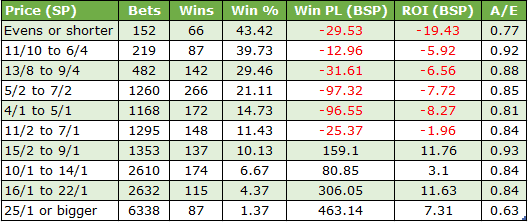
Let me begin by looking at the performance of 2yo debutants by price. The prices shown are Industry SPs because they fit to a more uniform price pattern – profits / losses / returns are to BSP as previously started:


As we can see, the shortest priced 2yo debutants have been very poor value – those priced evens or shorter would have lost you nearly 20 pence for every £1 staked. There has been better value in bigger priced horses – those priced 15/2 or bigger. It is interesting that the 15/2 to 9/1 bracket has provided five winning years out of six; likewise five out of six winning years for the 10/1 to 14/1 bracket also. The two biggest price brackets proved much more volatile as you would expect with some big winning years and some years with heavy losses.

Now we know using ‘starting price’ as a basis for a bet is not perfectly possible as we do not know the SP or BSPs until after the ‘off’. However, if betting late we can at least get very close to betting at the desired price.


Top three in the betting

Sticking with market factors, I want to do a little bit of digging into debutants who start in the top three of the betting. From the price data we have seen so far it seems unlikely that we will find many profitable avenues. However, as with all stats busting, it is not just positive angles that are useful to find; finding negative stats is equally worthwhile as horses that are avoided due to these adverse findings will certainly aid our bottom line come the end of the year.

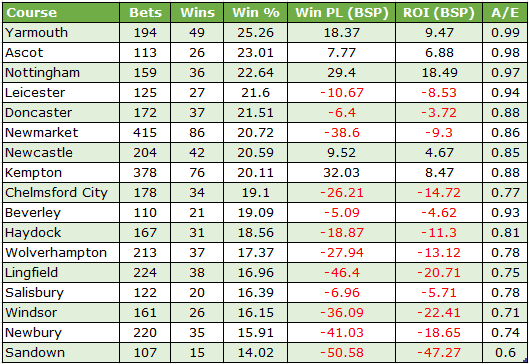
I want to share two specific areas in terms of 2yo debutants who were in the top three in the betting. Firstly let's review some course data. I have only included courses that had at least 100 qualifiers. The table is ordered by strike rate:


There is quite a difference between the ‘top’ course, Yarmouth, and the ‘bottom’ one, Sandown, in terms of strike rate, returns and A/E indices. Both courses have similar field sizes and in general it is a fair comparison. Now Yarmouth traditionally has been a course that some of the top trainers target with their juveniles. I am not sure if that is why debutants from the top three in the betting have done well there; however, it is always worth checking course stats in conjunction with other factors to see if we can gain any edge.

Of course, this subset of data is reporting on the last six seasons only so, with course stats, I often back check a different subset of data to see if results correlate. When I went back further and looked at the previous six years (2011 to 2016) I noted that four of the top five courses - Yarmouth, Nottingham, Leicester and Doncaster - all had virtually identical strike rates and A/E indices. Therefore I would hope and expect that similar results will occur this year and in the near future, at these four courses at least.

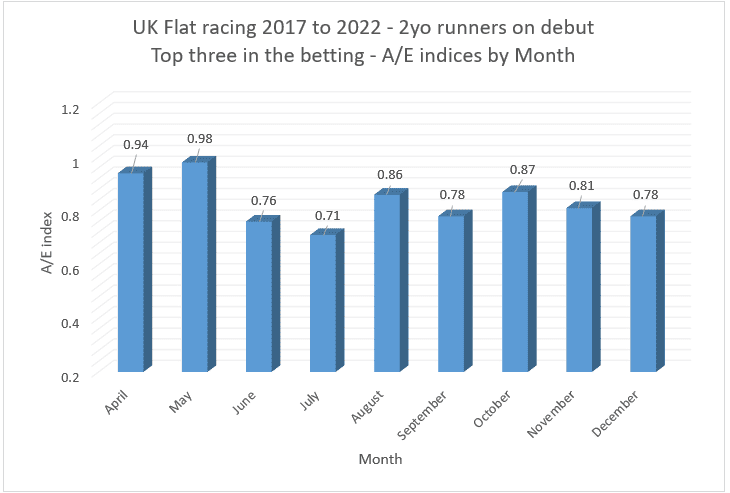
The second area I want to look at is time of year. The graph below shows the monthly breakdown of the performance of 2yo debutants in terms of A/E indices, when in the top three of the betting. I could have equally shared strike rate data as that correlated showing the same pattern.


The value in these runners clearly lies in April and May. In fact this cohort made a profit in both months, with May showing solid BSP returns of 13 pence in the £. Therefore if you are looking to back horses near the top of the betting April and May seem to be the months to focus on. In contrast June and July have seen very poor results. The A/E index for ALL 2yo runners in ALL races is 0.89 which gives you a useful figure for comparison purposes.

In general though, my personal market advice if using price as a guide, is that there is more likely to be value in those horses that are around the 15/2 mark or bigger. Hence, I would not be put off bigger priced runners, especially if I had other valid reasons for betting the horse. Of course these animals will have a low strike rate, even if they are ‘good value’, so it is not a strategy for the short term or the faint-hearted.


Gender of horse with 2yo Debutants

I always look at this factor when I research anything racing wise. Males as we know outperform females from a strike rate perspective across all race ages / types etc. That does not always mean that you should prefer male runners over female runners as prices will compensate for the general strike rate differential. If we compare ALL 2yo runners in the past six seasons (not just debutants), we will see that males had a win strike rate of 12.05%, females at 9.61%. Let us look at the 2yo debutant figures now:


The strike rates have narrowed, but there is a chasm between the two in terms of returns. Why is this the case? The simple answer is that most of the really big priced debutant winners have been male over the past six seasons. Is this likely to continue in the future? Well, there’s the million dollar question. My guess is ‘not’ for two reasons. Firstly I cannot find a logical reason to explain why males have had more big priced winners in this time frame. Secondly I did back check a previous six year period (2011 to 2016) and for this series of results females actually came out as the profitable sex. Sometimes we have to accept that there is no pattern or edge to be truly found regardless of what the raw profit and loss figures indicate. The relatively lowly A/E number is a strong reminder to 'proceed with caution'.


Sires of 2yo Debutants

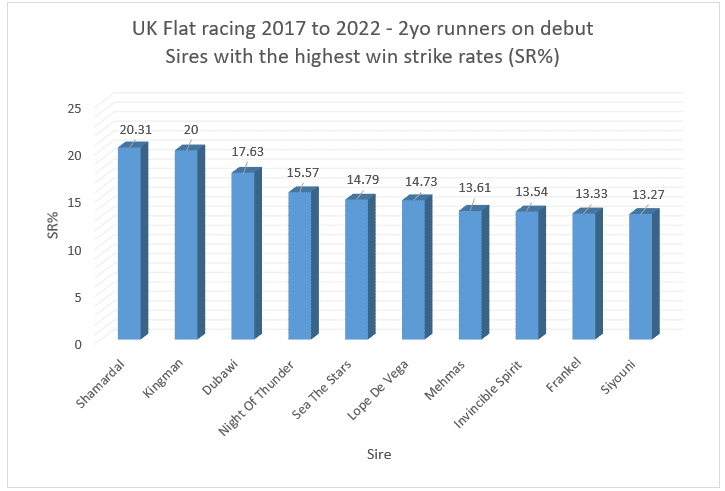
Onto sires (fathers of the horses) next. Here are top ten performing sires in terms of win strike for 2yos on their debut (minimum 100 runs):


What is useful about this specific sire data, is that each horse has just run once. Sometimes sire stats can be skewed when horses rack up multiple wins; this is not the case here.

For those of you who have read my sire articles before, most of these stallions will be very familiar to you – Shamardal, Kingman, Dubawi, Frankel are ‘regulars’ when it comes to good win records. Unfortunately, Shamardal won’t be having any 2yo debutants this year or indeed in any future year as he sadly passed away in 2020.

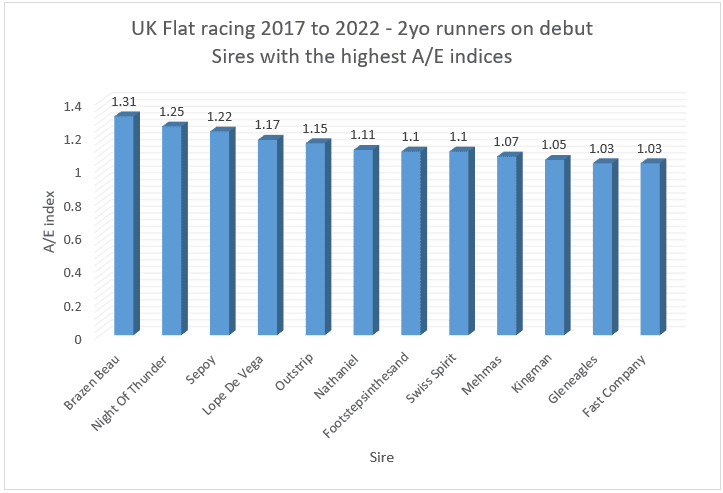
Of course win strike rate is not the only statistical ‘measure’ we are interested in. A/E indices, which we looked at earlier, are another measure I like to analyse where possible. The graph below shows the sires with A/E indices above the magic 1.00 figure:


It is good to see four sires appearing for the second time – Night of Thunder, Lope De Vega, Mehmas and Kingman were all in the win SR% top ten. These four in particular are worth close scrutiny this season when a 2yo debutant is sired by one of them.

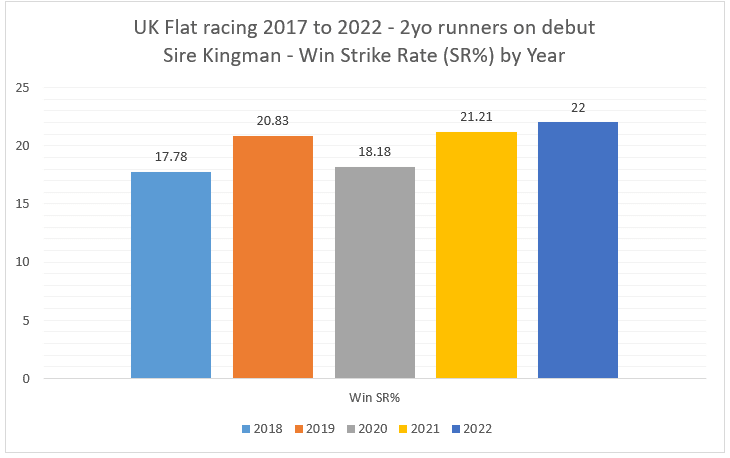
Looking in more depth at Kingman, we can see that there has been excellent consistency year by year. Here are his 2yo debutant win strike rates split by year:


His first season as a sire with runners on the track was 2018 so there is no data for 2017. The strike rates show good correlation, which is unusual for sire stats, especially debutant sire stats. One would hope to see Kingman hit the 20%+ mark once again in 2023.

Before moving on from Kingman, it should be noted that his record with these runners is better over ‘further’. Generally his 2yo debutants perform better at 7f or further compared to the sprint distances of 5 and 6f. This is actually the case when you look at all of his 2yo runners as a whole.

Dubawi is a sire who has scored slightly better than one win in every six on 2yo debut, but overall would have lost you 21p for every £1 bet. However, sticking to debutants at races of 1 mile or more, we could have secured a profit of 13p in the £ thanks in part to a healthy strike rate of 21.2% (25 wins from 118).

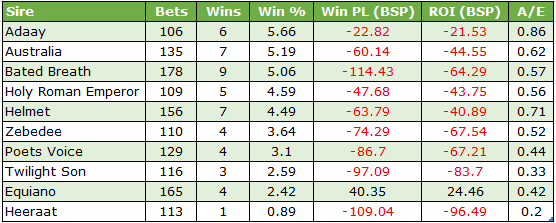
We know that for all the positive angles we come across there are bad stats too. Indeed, there are typically more bad ones than good ones. Thus it makes sense to look at sires with the poorest records over the past six seasons. Below are those sires who have the lowest win strike rate percentages with 2yos on debut:


Not only do they have low win percentages, but the A/E values are very poor (Adaay excluded). I would not be keen on backing a 2yo on debut if sired by one of these ten. Combining these sires in one group, and excluding any horse that started favourite, their collective record reads just 39 wins from 1285 runs (SR 3.0%) for a loss to BSP of £644.27 (ROI -50.4%).


Damsires of 2yo Debutants

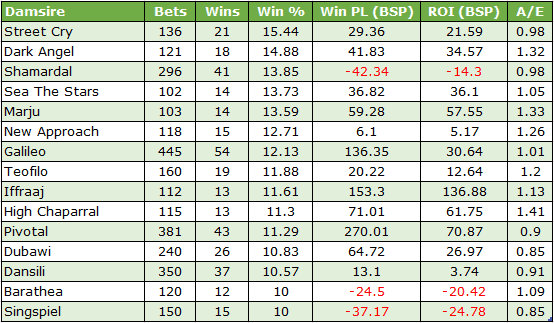
Damsires are the final port of call for this first article. Damsires are the sires (fathers) of the dams (mothers) of the respective horses. The grandfather on the female side as it were – sometimes known as maternal grandsires. Here are the records of all damsires who have had at least 100 2yo debut runners (minimum win strike rate 10%):


There are a fair few in ‘the black’ but, as we know, most of these profits are likely to be down to a big priced winner or two. However, any 2yo making its racecourse bow whose damsire has an A/E index above 1 is worth keeping an eye out for. Nine of the damsires in the table have achieved that – Dark Angel, Sea the Stars, Marju, New Approach, Galileo, Teofilo, Iffraaj, High Chaparral and Barathea.

Galileo has been the damsire of nearly 450 2yo debutants in the past six seasons and it is worth noting that there is a fairly significant difference in strike rates with turf runners versus all weather runners:


The turf strike rate is about two-thirds better than his all-weather win percentage, and there is a clear difference in A/E indices as well. Do not be fooled by the profit figures, however; these have been heavily skewed by two of the all weather winners which were priced at 130.0 and 41.61.

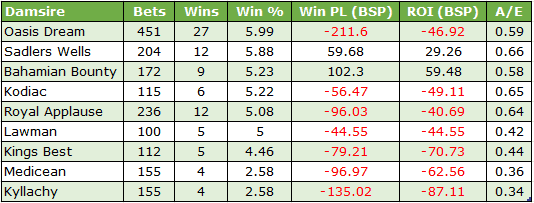
As I did with the sire data, it is worth sharing the poorer strike rates as well – below are those damsires with a strike rate below 6%:


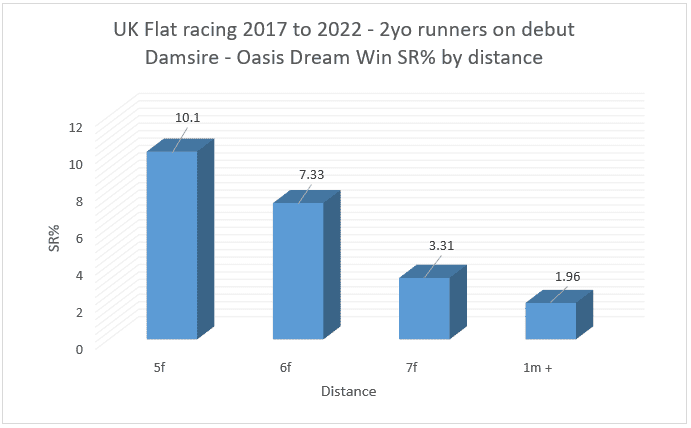
It is perhaps best to avoid these damsires, although I did find some interesting data regarding Oasis Dream when it came to distance stats, as the graph below shows:


Clearly for this damsire, what distance the 2yo debutant is running over makes quite a difference. At the minimum distance, the 10.1% strike rate is actually above the average figure for all damsires. Obviously the 7f and 1m+ figures are way below the average. Hence any Oasis Dream debut runner over 5f should not be immediately dismissed from calculations. Whereas I think you can safely draw a line through most such runners trying 7f or more. Going the extra mile in terms of research will occasionally bring some greater insight that has the potential to keep us ahead of the crowd.


MAIN TAKEWAYS

  1. Very short priced debutants (evens or shorter) have been poor value.
  2. Horses from the top three of the betting have done well in April and May. In contrast these runners have performed poorly in June and July.
  3. In general horses priced 15/2 or bigger are likely to prove better value than shorter priced runners.
  4. 2yo debutants sired by Night of Thunder, Lope De Vega, Mehmas and Kingman should be seen as a positive.
  5. Sire Kingman has been extremely consistent and it is worth noting he has a better record at 7f or more.
  6. Adaay, Australia, Bated Breath, Holy Roman Emperor, Helmet, Zebedee, Poets Voice, Twilight Son, Equiano and Heeraat are sires to avoid. This is especially true if the relevant juvenile debut offspring are not favourite.
  7. Damsires Dark Angel, Sea the Stars, Marju, New Approach, Galileo, Teofilo, Iffraaj, High Chaparral and Barathea have all offered some value in the past six seasons in terms of 2yo debut runners.

-----

In the second and final part of this juvenile debut series, the focus will be on trainers. Until then...

- DR

Punting Angles Using Sires & Damsires: Part 2

Last month I started a new series of articles looking at sires and damsires, writes Dave Renham. To recap, sires are the fathers of the respective horses and can have a significant influence on their offspring; damsires are the maternal grandfathers and can also bestow certain characteristics on their daughter's progeny.

In the first article, we saw that certain sires had strong traits; for example Casamento’s runners are better suited to longer distances with his offspring twice as likely to win at 11 furlongs or further than at sprint trips of five to six furlongs.

In this second article my focus will continue to be sires and I will be sharing some additional insights looking for positive or negative angles. I will also be concentrating on two-year-old races where sire stats can be extremely useful as we have limited, or often no, horse form to go on.

This piece is not completely ‘time sensitive’ because there are some sires who have had runners in ten or more seasons and I want to analyse individuals in more detail if I can.

Record of sires in 2yo races

Below is a table of the top 20 sires of 2yos, in terms of strike rate, between 2016 and 2020 in the UK (minimum 200 runs):

Sharmadal is the only sire in profit and, sadly, he passed away last year. He should have a crop of 2yos for the 2021 season and possibly a small one for 2022. However, the first sire I wish to look at in more depth is Kodiac.

Kodiac

Kodiac, a son of Danehill, was a decent handicapper as a racehorse and went to stud in 2007 with his first runners hitting the racecourse in 2010. He holds the record for the most 2yo wins in one season and his progeny include Campanelle, Best Solution and Hello Youmzain.

I want to share Kodiac's record with juveniles in the UK going back to his first crop in 2010, firstly breaking it down by individual years:

Looking at the yearly strike rates, Kodiac has been relatively consistent with rates ranging from 10% to just over 16%. Losses overall are around 14p in the £ but, using best odds guaranteed or the exchanges would get this loss down to probably about 2-3p in the £. I now want to break the data down by level of experience (2010-2020):

Kodiac’s strike rate with his runners on debut is solid at nearly 13%. The average strike rate (SR%) on debut for all sires stands at just 7.74%, hence Kodiac progeny seem fairly well primed and ready for their first outing on a racecourse.

Horses normally improve considerably between that first career run (debut) and their second start. Kodiac’s runners are no exception, and have won over 17% of races on their second starts as a 2yo and actually made a blind profit, which is unusual. Comparing again with all sires it should be noted that backing all sires blind on their second start would lose you around 26p in the £.

My next port of call was to look at trainer records and compare their 2yo performances with Kodiac-bred runners. I have only included trainers who have had 45 or more runs:

There is a real mix here, ranging from John Gosden's 29.17% to Tim Easterby at just 2.04%. However, Clive Cox is the most interesting one for me – his overall strike rate of 1 win in 4 (25%) is impressive and he has had 16 different 2yos sired by Kodiac, 12 of which won at least once as a 2yo. That equates to 75% of these horses winning a 2yo race. Compare this to Charles Hills who has had 23 different 2yos sired by Kodiac, but only six of those proved successful in their first season (26%). To give you more context, 44.26% of Kodiac 2yos have won at least one race as a 2yo, well above the Hills figure of 26% but well below the 75% Cox figure.

We noted when looking at the yearly breakdowns that Kodiac juveniles are consistent. Indeed this consistency can be seen to best effect when examining performance on different underfoot conditions. The graph below shows the strike rate on specific goings:

The percentages range from 13% to 14.89%. So if you are backing a Kodiac two-year-old, it seems you do not need to worry about whether it will be effective on the going.


Kingman

I now want to move onto a new sire on the block, Kingman. Kingman was a four-time Group 1 winner when racing, winning seven of his eight career races. His only defeat came in the 2014 2000 Guineas when he finished second. It perhaps comes as no surprise, then, that as a sire he has started with a bit of bang. His stud fee in 2015 was £55,000 and, six years later, that fee has nearly tripled to £150,000.

He tops the 2016 to 2020 2yo strike rates (see first table above) and I want to examine his juvenile progeny data in more detail. While it is still relatively early days, and he does not have the large data set of a Kodiac, there are still some trends that seem to have emerged already.

Let us look first at distance. Kingman 2yos have so far displayed a distance bias to 7f more as the graph shows:

There also seems a bias in terms of male runners outperforming female runners at this early stage: we are working with quite a small data set (164 runs for males and 150 runs for females) which is why I have included each way (win and placed) stats, too, in the graph below.


The win figures correlate extremely well with the each way stats – at least so far.

One area where the male dominance can be seen is when we compare the record of male horses making their 2yo debut compared to females. Males seem much more mature and ready to run from the ‘get go’. There have been 72 colts or geldings sired by Kingman making their debut at two thus far, of which 20 have won (SR 27.78%) showing a profit to SP of £54.94 (ROI +76.31%). In contrast the 65 fillies making their racecourse debut as two-year-olds recorded just six wins (SR 9.23%) for a hefty SP loss of £43.33 (ROI -66.66%). The each way SR%s correlate once again with males winning/placing 64% of the time whereas the percentage for females winning/placing is under 25%.

I now want to move away from individual sires back to general observations.

Comparing 2yo debut run to 2yo second career start

When looking at Kodiac earlier in the piece, I broke his progeny performance data down by career start number. Now I am going to expand this review to all sires that appeared in the initial table by comparing strike rates with their progeny on debuts against their second runs (as a juvenile). For this I have looked at data going back to 2010:

In the final column I have divided the 2nd run strike rate by the debut run strike rate to give us a type of Impact Value. It is not a ‘true’ IV so I’ll call it a Comparison Strike Rate (CSR). The higher this figure the more improvement the runners show on their second run compared to their debut.

As we can see by looking at that final column there is quite a difference in the CSR figures in some of the sires. Frankel’s runners for example have a CSR figure of just 1.10 – of course this is partly due to his exceptional strike rate of over 21% on debut.

The sires of most interest in this table are probably those with CSR figures above 2.00, namely Acclamation, Clodovil, Due Diligence, Gutaifan, Mehmas, Muhaarar, Requinto and Toronado. You can really expect their runners to improve considerably from their juvenile debut run to their next start as a 2yo, an angle which should help in establishing value and potentially throwing up some decent betting opportunities.


Comparing 2yo turf runs with 2yo all weather runs

In the next table I wanted to compare turf strike rate with all weather strike rate. Again I have produced a C.S.R. figure by dividing the turf SR% by the all weather SR%.

A CSR figure of 1.00 indicates the sire is equally effective on both surfaces. Figures well above 1.00 give the edge to turf performance; figures below 1.00 suggest progeny of those sires are more effective on all weather surfaces, purely in terms of juvenile win strike rate.

Looking at either end of the spectrum will isolate differences which are significant enough to be potentially interested in. For example, Frankel’s progeny at two are clearly far better on turf than on the all weather, scoring nearly twice as often on the former. There is a logic here in that such expensive acquisitions will rarely be tried on artificial footing until they have suggested that they fare poorly on grass. Likewise, New Approach seems to be a strong influence for turf over sand. But the reverse is true when we look to the bottom of the table, at Toronado and Sea The Stars: their juvenile offspring are currently showing a clear preference to all weather surfaces.

Finally I wanted to look at some sires you might wish to consider avoiding in terms of 2yos, generally at least. Below is a list of those sires whose strike rate in the last 5 years (2016-2020) has been below 8%. Clearly it is as important to be aware of negative angles as it is of potentially positive ones.

As the first two articles in this series have hopefully shown, sire research can unearth some very useful stats and angles. Geegeez will assist any curious subscriber via both the Profiler and Query Tool.

Good luck!

- DR

Dave Renham: Some Thoughts on 2yo Sires

In this article I have moved away from pace research and will instead be focusing, for the first time on the virtual pages of geegeez.co.uk, on 2yo races, writes Dave Renham.

2yo races are contests where horse form is extremely limited and many punters shy away from them for that reason. Indeed, 50% of all 2yo runners are either making their debut or just having their second career run (see prior runs table below). Thus, we need to look at additional information if we are going to bet on such contests. One avenue is to look at sire data.

Number of prior 2yo starts, January 1st 2013 to April 14th 2019


Sires are the fathers of the respective horses and many sires have a strong influence on their offspring. Why certain racehorses cost more money than others before they have even raced is almost exclusively down to their breeding and the sire is the strongest influence in that genetic makeup.

Taking a human example may help explain why some punters feel sire stats are important. Picture a mythical 100m sprint race between the offspring of Usain Bolt and the offspring of someone else of the same age living in the same town as Usain. Without having seen either child run before, where would you put your pound at even money? Most likely you would asses that Usain Bolt’s son had the stronger sire stat, and that is where your money would be likely to go. That would be especially the case if the two fathers had had children a year earlier, and the son of Bolt had won against the son of A N Other.

This article will look for positive and negative angles using sire stats from UK 2yo races. The data have been taken from 1st January 2013 to 14th April 2019 and all profits/losses have been calculated to Industry Starting Price.


2yo sires by strike rate

Firstly let us look at the sires with the highest strike rates in all 2yo races during the period of study (minimum 100 runs):


As one can see backing sires blind is the proverbial quick way to the poorhouse. Of course these figures could be improved by using Betfair SP, but as we know with Betfair SP, the occasional huge-priced winner can skew the stats. The key stat to look at in the table is the A/E index: the higher the A/E index the better things may be from a backing perspective; any figure above 1 suggests a positive scenario. Archipenko stands out with not only an A/E of 1.31 but, with over 300 runs, this is a decent sample size too. Interesting, Archipenko roughly breaks even if backing all runners ‘blind’.


Now a look at the sires with the lowest strike rates:


Not surprisingly these results produce dreadful returns for backers and in general also have very low A/E indices.

These raw stats indicate a huge discrepancy across the spectrum of sires. Having an appreciation of sire data should help inform our betting considerably in 2yo races so let's dig a bit deeper.


Top Turf 2yo Sires (compared to AW performance)

Firstly let us look at turf versus all weather and a look at sires of 2yos that perform significantly better on the turf compared to the all weather. The table below compares the turf strike rate (SR%) with the all weather SR%. In the final column I have divided the turf SR% by the all weather SR% to give us a type of Impact Value. It is not a ‘true’ IV so I’ll call it a Comparison Strike Rate (CSR). The higher this figure the stronger the sire’s liking for turf over the sand.


The two sires at the top, Piccolo and Gregorian, have not had one winner on the all weather in the UK in the study period; however their turf strike rates are both also low and that should be taken into account. Sixties Icon and Dream Ahead are the two sires that initially catch my eye; mainly due to decent sample sizes. Those two, along with Dutch Art, are sires worth further exploration. If we look at the respective A/E indices for turf 2yo races there are some sires in the list that achieve a score of 1 or more:


It is promising to see Dutch Art and Sixties Icon in this table; for the record Dream Ahead’s A/E stands at 0.86. Delegator has an impressive figure and also looks worthy of closer scrutiny.


Top AW 2yo Sires (compared to Turf performance)

Now a look in reverse at the sires of 2yos that perform significantly better on the all weather compared to the turf.


Once again there are some eye catching figures in the table. Dragon Pulse has an impressive record on the sand albeit from a relatively modest sample of 73 runs. However, if we focus on his runners that had previously run at least three times his record reads an impressive 13 wins from 46 (SR 28.3%) for an SP profit of £44.26 (ROI +96.2%); A/E index 1.62. Lethal Force is another interesting sire on the sand especially when you compare his male runners to female runners – male runners have won 22.9% of their races (11 wins from 48), while female runners have won just 6.9% (4 wins from 58).

A look at the A/E index for these runners on the all weather makes for positive reading:


Just Lethal Force slips below the 1.00 figure, and even then only just. It is clear that these sires are a group to keep an eye on in 2yo all weather races.


2yo 1st vs 2nd start

Let us move on to look at the difference between horses making their debut compared to those having their second career start. It will come as no surprise to see a big improvement in strike rates from first to second career start. Looking at all 2yo runners the debut SR% is 7.07% and the 2nd start SR% is 11.81%. Dividing the second percentage by the first we get a CSR. of 1.67. This is our baseline CSR for comparing the figures in the table below.

I have used a minimum of 50 debut runs to give us enough data to work with and the sires in this list have the highest CSR. figures:


These sires clearly improve markedly between first and second career starts. There is also some more positive news when we examine the A/E index of their second career starts. There are several sires who have achieved a score 1.00 or more:


Approve (0.99), Iffraaj (0.98), Rip Van Winkle (0.97), Medicean (0.96) and Sir Percy (0.95) were all close to the 1.00 figure. Only Galileo has a poor A/E (0.70), primarily because he's such a very well known 'mega stallion' which filters into the betting markets.


There are a handful of sires that buck the trend in terms of 2nd run improvement and have a higher SR% on debut compared to next time out. Such sires are few and far between but the five in the table below are worth sharing with you:


The A/E indices for these five sires with runners on debut are shown below:


Australian bred Epaulette is potentially a sire to note on debut it seems, as is the other Aussie sire in the sample, Helmet. Interestingly, perhaps, when priced 10/1 or shorter Epaulette’s offspring have provided 7 wins from 20 for a profit of £27.38 (ROI +136.9%).


2yo Sires: Male vs Female runners

For my last comparison in this piece let us look at male runners versus female runners. Taking all 2yo races into account male runners slightly outperform their female counterparts (12.2% to 10.1%; S.I 1.19). If we ignore geldings then the colts (males) have a slightly stronger edge over the fillies (females) – 13.2% to 10.1%; CSR. 1.31.

Let us look at those sires whose males have a particularly strong record according to their CSR. figure:


If we now look at the A/E indices we see that 6 of the sires have achieved scores in excess of 1.00. Delegator has a very high figure at 1.93:


Delegator is a relatively new sire (2019 will be his fourth full season), hence data is in fairly limited supply. Having said that, if you ignore debut runs his 2yo colts record to date has been 10 wins from 45 (SR 22.2%). Focusing on those starting 14/1 or shorter this improves to 10 wins from 25 (SR 40.0%); A/E 2.63. This feels a bit 'convenience fitted' but it may be worth keeping an eye on going forwards.


Now a look at the sires where their mares outperform the colts – a smaller list:


The top three in the list - Hellvelyn, Power and Siyouni - have extremely high Comparative Strike Rates although Siyouni has only had 30 runs for fillies so these figures may level out over time.


Conclusions

Using sires to help unravel 2yo races is a ‘must’ in my opinion, though with generally limited data to work with we are forced into forming loose opinions which may later prove unfounded. Such is the nature of equine competition forecasting!

Of course there are other factors to consider, trainers being the most obviously important one. However, in order to get an edge on our fellow bettors, we must never ignore sire data when wagering in unexposed juvenile races.

- Dave Renham