Tag Archive for: draw bias in 2026

Negative Draw Bias in 2026

Negative draw bias revisited for 2026

Last week I looked at some draw biases over 5 furlongs in 7+ runner handicaps, writes Dave Renham. In this follow up I will examine ‘negative draw bias’, or NDB for short. I discussed NDB four years ago in a piece (here), but this one will take a slightly different slant. Or at least it will be highlighting NDB horses in a slightly different way.

Russell Clarke, who has written several excellent articles on geegeez.co.uk, was the first person I saw discussing NDB back in the 1990s in Odds On magazine. Ever since then it has been something I have kept a close eye out for.

What is negative draw bias?

Negative draw bias highlights a horse or horses that ran well from a poor draw and, hence, in theory have performed much better than their finishing position initially indicated. From there, we would have a horse to keep an eye on, hoping that a good opportunity to bet this horse may come up soon afterwards given more favourable circumstances.

As with many things in racing, negative draw bias is not quite as simple as it sounds. There are problems with the idea – for example, once we have found a horse that has run well from a poor draw, we have the tricky decision of how long to continue supporting the horse in the future? One run? No more than three runs? Until it wins? What if it loses four or five races? There clearly is no ‘correct’ answer to this question.

We also need to think about under what circumstances we back the horse. Should we back it blindly? Or only under similar conditions? What if it is drawn poorly again, and so on .

A third question to consider is, can we be completely sure the horse has actually run well against a draw bias? In my 2022 article, when looking for examples of NDB I focused on individual races that had seemed to show a significant draw bias. These were primarily big field affairs, often on a straight course where one side of the draw seemed to be strongly favoured over the other. There is a case to say that biases that occur like this can be down to a pace bias (i.e. the fast horses were all congregated on one side of the track and therefore made that 'mini race' quicker) rather than a draw bias, but my educated guess is that it is often a combination of the two. How important one is over the other though is anyone’s guess and not something I want to dwell on here.

Approach

For this article I am going to take a different approach to highlighting NDB horses. It is essentially a systematic approach, and the starting point is last week’s draw bias article. System-based ideas are rigid and not for everybody, but the big plus is that we can find system qualifiers without having to do any serious legwork. Because, for this ‘system’, I’ve done the legwork for you.

Last week I highlighted a variety of courses that had shown an apparent draw bias over 5f in handicaps between 2021 to 2025. From this initial group of courses, I wanted to try and establish those with the strongest biases. I did this using two rules. The first rule was that the disadvantaged third of the draw needed to have a win percentage of below 25% coupled with a PRB figure of 0.48 or lower. The second involved a simple calculation of multiplying the win strike rate percentage of the disadvantaged third of the draw by its PRB with only the lowest scoring courses making the cut. I felt this was a fair way to do it and, essentially, I needed to use some sensible parameters to establish what were likely to be the strongest biases.

The courses that qualified were:

Ascot, Ayr, Bath, Chester, Musselburgh, Redcar and Thirsk.

Now I had the courses with the strongest 5f draw biases against my calculation, I planned to use them within my NDB method like this:

I wanted to see how horses that had run well from the poorest section of the draw at these course/distance combinations fared on their next run.

The system I came up with, then, was thus:

  1. Last run at one of Ascot, Ayr, Bath, Chester, Musselburgh, Redcar or Thirsk
  2. Last run in a 5f handicap with 8 or more runners
  3. Finished second or third when drawn in disadvantaged section of the draw.

Not many rules, which I think makes the best kind of system.

I do need to clarify what I mean by disadvantaged section of the draw. Specifically, I wanted to try and find the very worst drawn runners; so instead of including all stall positions within the ‘worst’ third of the draw, I set things up like this:
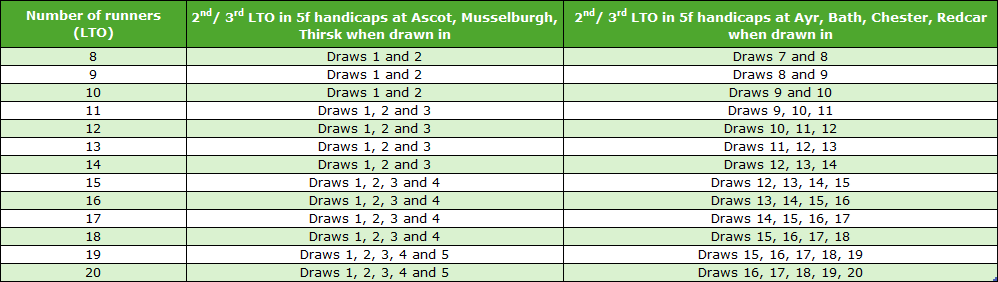


Essentially, I was trying to concentrate on horses berthed in the lowest quarter of the draw as best as possible. Clearly, because all field sizes are not divisible by four, I could not do that perfectly, so the draw positions in the table clarify which stalls qualify as being in the ‘disadvantaged’ section.

It should also be noted that the draw positions have been adjusted for when there were non-runners. For example, if the horse drawn 3 was a non-runner, then the horse drawn 4 was now effectively drawn 3, draw 5 became 4 and so on.

Baseline Method Qualifiers

Before moving on to the nitty gritty, let me quickly give two last time out (LTO) run scenarios, one where a horse would qualify under this NBD system and one where a horse would not.

  1. LTO run at Redcar 5f where the field size was 14 runners. The horse drawn 12 finishes in third place. This horse qualifies under the NDB system, as draw 12 counts as a disadvantaged stall.
  2. LTO run at Thirsk 5f where the field size was 10 runners. The horse drawn 3 finishes second. This horse does not qualify under the NDB system, as draw 3 does not count as disadvantaged stall (with 10 runners only stalls 1 and 2 qualify).


An issue with this system is that we are only going to get a small amount of qualifiers because not many runners finish second or third from a very poor draw. Indeed, over the five years I studied there were only 109 qualifiers across all LTO C&Ds. How they fared is shown in the table below:



So, the good news is that they made a fair profit with a solid strike rate, but the less good news is that the system has averaged out at around 22 qualifiers per year.

Here are the course LTO splits:
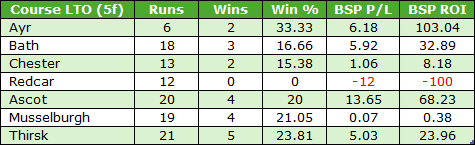


As we can see, six of the seven tracks were individually profitable, with Redcar having a shocker! Of course, these individual course sample sizes are extremely small, but it is pleasing to see that it is not just one course or one big priced winner that has been responsible for the profits.

One quick caveat at this juncture: when I researched the original draw bias piece, I used handicap races with 7+ runners. For this NBD system I tweaked it slightly and am using 8+ runners. There was nothing sinister going on like trying to improve upon the results, it was simply to make it easier for me to split the draw in four. I did back check the results for LTO races with 7 runners and the overall results would have actually improved matters! However, I was not going to change to 7+ runners LTO just to get better figures. Back-fitting is not a good option.

Broadening the Search

After this promising start I decided to look for other strong track and trip biases to test the NDB system. The distances I wanted to check next were the other ones along with 5f where the draw bias tends to be strongest – namely 6f, 7f and 1-mile races. Let’s start with the longest trip and work backwards.

1 Mile

Over the 1-mile trip the C&Ds that passed my two earlier rules were Hamilton, Pontefract and York. Their draw third win splits for qualifying 1m handicaps (7+ runners) were as follows:



And the PRBs



All three courses saw high draws really struggle during this recent timeframe and below are the overall stats when combining all NDB system qualifiers that ran over these C&Ds last time out.



It's another smallish sample despite combining three more courses, but also another very profitable one. There was a winner priced BSP 35.44 so after commission that effectively accounted for half of the profits but even taking that out of the equation the figures would have been excellent.

Here are the individual LTO course splits:



All three in profit, albeit again the sample sizes are very small. One course over 1 mile that just failed to pass my two rules was Redcar. For the record, applying the NDB system to this LTO C&D would have yielded five winners from 25 producing a return of 26p in the £.

7 Furlongs

When I switched to look for courses over 7f with a strong bias only one course passed the two NDB system tests: Goodwood. High draws have struggled there with just 16.3% of the top ‘third’ winning (PRB 0.47). Subsequent NDB system qualifiers from here would have amounted to 20 runners with the following results next time out:



Another small profit which keeps things moving along in the desired direction.

6 Furlongs

Finally, I looked at the strongest 6f biases to see which C&Ds qualified for the NDB system. Four passed my rules namely Kempton, Leicester, Yarmouth and York. For all four it was the higher draws that performed poorly. Here are their top third win percentages and PRBs:



It’s amazing that three of the four had exactly the same win percentages. The chances of that happening was extremely unlikely shall we say!

Combining these four LTO C&Ds together, NDB qualifiers would have produced the following results:



It is yet another group of courses combining to make a profit, and a bigger sample here due mainly to Kempton’s LTO qualifiers accounting for more than half of the total. (The advantage of a lot of races over a specific C&D). Here are the individual LTO course splits:



Three of the four would have been profitable, with Yarmouth just missing out.

There were a couple of other courses over 6f that were close to qualifying across my two rules, namely Chelmsford and Pontefract. As it turns out both would have proved extremely profitable if I was able to apply the NDB system rules to their potential qualifiers. Unfortunately, though they cannot be added to the overall totals. As I said earlier NO BACK-FITTING! In any case, Chelmsford has now unfortunately been mothballed, at least for the foreseeable future.

Combined Total

Ok, it is time to share the combined totals for all LTO C&Ds qualifiers (5f-1m).



That's not too shabby, if I do say so myself!

For anyone interested in following this NDB system this year, below is a list of all of the qualifying LTO courses used in the article. I have essentially replicated the earlier ‘number of runners’ table but added all the C&Ds (6f to 1 mile) to the relevant columns:
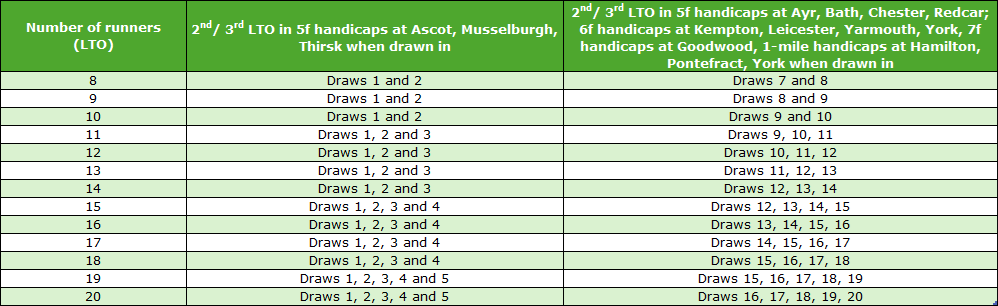


This research has seen a good deal of legwork from yours truly, and it was also extremely hard to put together coherently in an article, but it is hopefully an interesting piece. As can be seen, there's a lot of milage in negative draw bias angles - so keep your eyes peeled!

- DR

5f Draw Bias in 2026

An in depth look at draw bias over 5 furlongs

I must admit that this is my favourite time of the year for two reasons, writes Dave Renham. Firstly, I am starting to think about the sunnier and warmer weather to come in the next few months; and secondly, the flat turf season is now upon us.

From a betting perspective I prefer the flat because traditionally I have had a better betting record in flat racing compared to National Hunt. The flat also has a special place in my heart because the first book I published was a flat racing one. That book was about draw bias and back then, in the late nineties, draw bias offered astute punters a real edge. Nowadays that edge has diminished somewhat.

Primarily, that is because there are fewer biases due to either better course management or rail movements, or indeed both. Also, draw information is more accessible these days so it can be difficult to find an angle that is not widely understood. However, having said that, up to date accurate bias data is still important because biases are constantly evolving; we must not blindly stick to what we have known in the past.

Introduction

One of the beauties of Geegeez is that we have the Draw Analyser tool which means we can check all course and distance combinations in terms of recent draw bias changes. In this article, then, I will share the most up to date draw bias information for UK racecourses over the 5-furlong distance, concentrating on those tracks where the statistics seem to indicate there has been a recent advantage to one part of the track or another. Data have been taken from 2021 to 2025 with the focus being handicap races as they give us more reliable draw data. I am also ignoring races with very small fields so only including those with seven runners or more.

When analysing each individual race, I have split the draw into ‘thirds’ - those drawn in the bottom third (low), those drawn in the middle third, and those drawn in the top third (high). It should also be noted that the draw positions are adjusted when there are non-runners – for example if the horse drawn 3 is a non-runner, then the horse drawn 4 becomes drawn 3, draw 5 becomes 4 and so on.

On a completely fair course the winning percentages for each "third" of the draw should be around 33% each. The differences in the percentages will help to determine the strength of the bias. I’m also going to share the PRBs (Percentage of Rivals Beaten) when there seems to be a potential bias to help give us a more accurate overall view.

In my experience, I consider there to be two types of draw bias. One is a clear bias towards a specific section of the draw; this is the strongest possible bias. The other is a bias against a specific section of the draw.

I will work through the qualifying courses in alphabetical order.

Ascot 5f

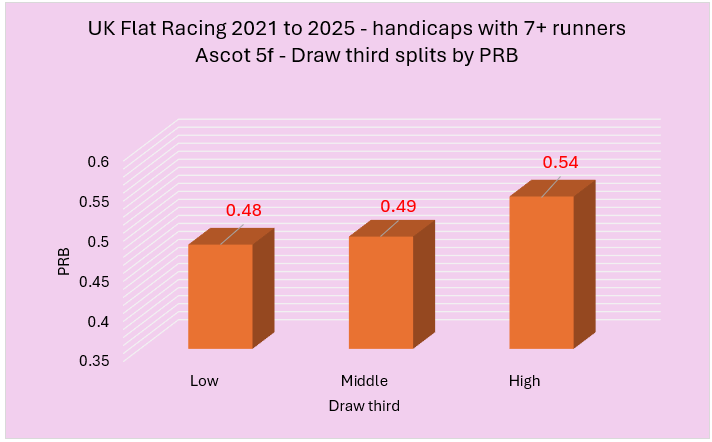
The round course at Ascot sees horses run right-handed so on the straight course where 5f races are run, the highest stall is drawn closest to the nearside stands’ rail. There have been 40 qualifying races, and the draw third splits have been as follows:


Low draws seem to have struggled a little in terms of wins over the past five years. That is at least partially because the centre of the course tends to ride a little slower than the ground closer to the stands rail. A look at the PRBs now:


The PRBs suggest that higher draws have an edge. My own experience is that lower draws have indeed been at a disadvantage, and the highest draws have a very slight edge over the middle. However, biases can change at Ascot throughout the year, so we need to keep an eye on developments.


Ayr 5f

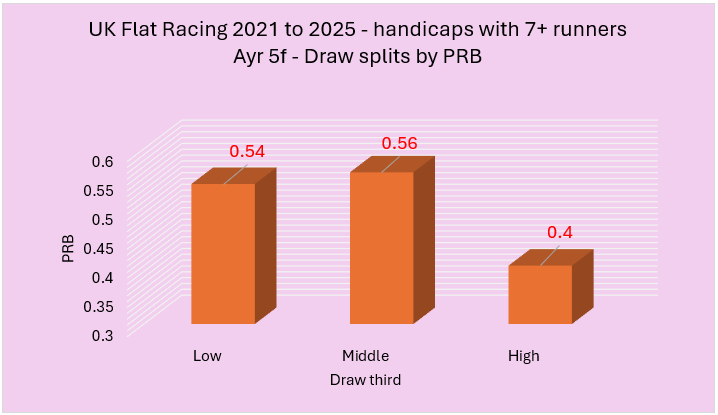
To the west coast of Scotland now and Ayr's five-furlong strip. Like Ascot there have been 40 qualifying races over the past five years. The draw splits in terms of wins are as follows:


High draws have really struggled from a win perspective. Let me share the PRB splits:


The PRBs correlate extremely well with the win third percentages, corroborating that high has been at a considerable disadvantage over this 5f trip in recent years.


Bath 5f

Bath has two 5f distances, and we are concentrating on the shorter of the two - the bare minimum. This C&D has plenty of races annually and in the past five years there have been 57 qualifying contests in total.


Horses drawn low seem to have enjoyed a solid advantage, winning twice as many races as those drawn high. Will the PRBs correlate? Let’s see:


The PRBs also indicate that lower draws have enjoyed quite a decent edge. If we had backed every single low drawn runner blind over the past five years we would have secured a BSP profit of £85.53 (ROI +51.5%).


Beverley 5f

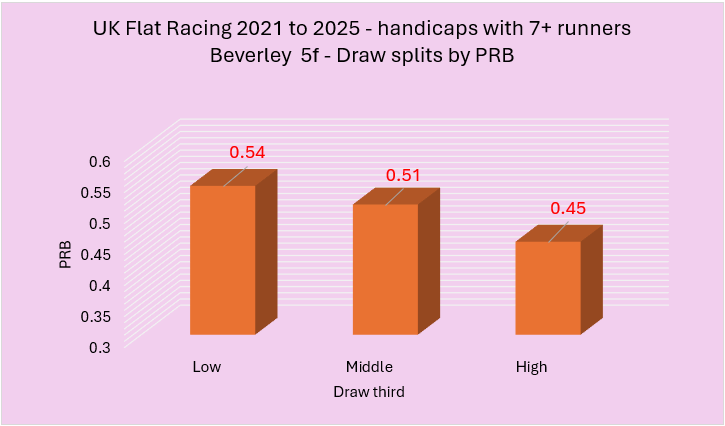
Thirty years ago, Beverley over 5f had one of the strongest draw biases in the country. That is no longer the case, but it is still perceived that horses near to the far rail (low) retain a slight edge.


There have been 99 qualifying races over the past five seasons - an excellent sample size - and low draws have enjoyed a small edge in terms of wins. High draws continued to get the worst of it. The PRB figures suggest that the bias is a little stronger than the raw win third percentages suggest, and largely against high:


It is well worth noting that 28 of the 99 races have been won by one of the two lowest drawn horses. Moreover, horses drawn 11 or higher have really struggled, winning just five races from 98 with losses equating to 57p in the £.


Catterick 5f

There have been plenty of qualifying sprints at Catterick – 83 to be precise, and the breakdown was thus:


Based on the win stats, middle draws seem to have been at a slight disadvantage.  This is also reflected in the PRB figures:


The key, though, to Catterick is the ground. On better ground lower draws have an edge; on softer ground that reverses and high draws often prevail, as when there has been plenty of rain the near side rail seems to possess the fastest strip of ground.

On good or firmer ground 19 of the 42 races have been won by horses drawn in the lowest third (45.2%), and their PRB has been clearly best at 0.55 (middle was 0.46, high 0.49). There have been 21 races on soft or heavy of which the top third have won 10 (47.6%). The PRB figure for the top third of the draw was 0.54.


Chepstow 5f

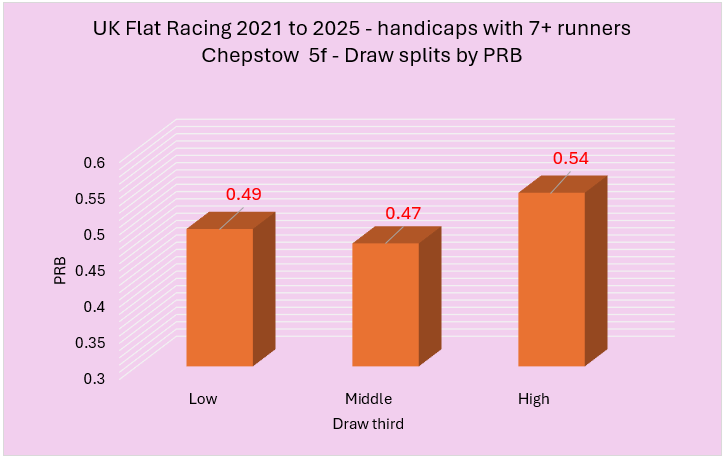
Over to Chepstow now starting with the win strike rates:


The numbers suggest that higher draws may have a small edge. Do the PRBs correlate?


The PRBs back up the likelihood that there is a small advantage to being drawn high. This has been especially true on good or firmer ground as 17 of the 32 races (53.1%) were won by horses drawn high, with a PRB of 0.55. Overall, if given the choice, one would prefer to be drawn higher than lower, especially on better ground.


Chester 5f (& 5½f)

Chester has traditionally had one of the strongest sprint biases in the country. However, in recent years, with the introduction at some meetings of a false rail at the top of the short home straight, the bias has been less potent and the strike rates back that up.


High draws still struggle a lot, but middle draws have been almost as successful from a win perspective as low draws over the past five years. The reason for this is almost certainly due to course officials moving the inside rail for some races. In fact, two thirds of these races saw rail movement of some distance or another.

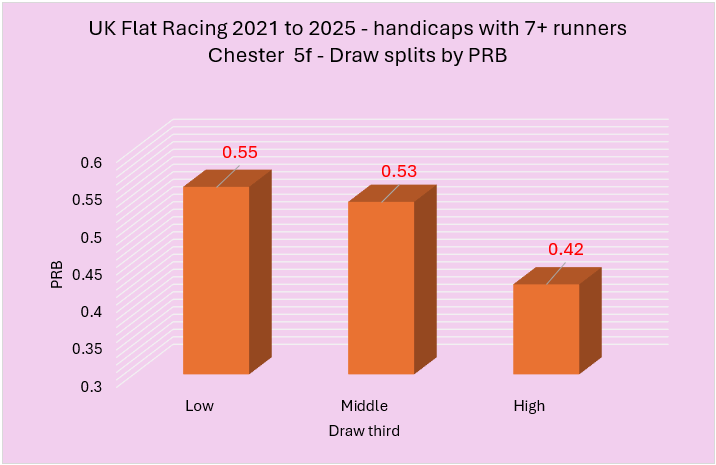
The PRBs correlate well with the win stats:


In the past five years, the value has been with those drawn in the middle. Backing all middle draws ‘blind’ would have produced a small profit to BSP of £13.67 which equates to 10p in the £. The middle third A/E index also stood at a healthy 1.13 indicating good value.

This is an example of what I discussed earlier: that we need to be aware of recent changes and not assume a historical draw bias remains as strong as it was previously. I suspect that the market is yet to fully adjust to these changes so, for the foreseeable future, middle drawn runners should continue to offer the best value.


Goodwood 5f

Down to the South coast next and my favourite track from which to watch racing. There have been 30 qualifying races over the past five years which is one of our smaller samples. The win percentages for each third were as follows:


17 of the 30 races were won by horses berthed in the lowest third of the draw. Based on this alone the bias looks strong. Let’s see what the PRBs have shown:


This is one of the reasons it is always good to focus on more than one statistic, especially with smaller sample sizes, as we should reasonably have expected a PRB of around 0.57 or 0.58 for the low third based on the win stats. Here, we have 30 races and hence only 30 winners – a relatively small sample. However, the PRB figures give some sort of score to all 310 runners – providing a much broader, and potentially more accurate, set of numbers.

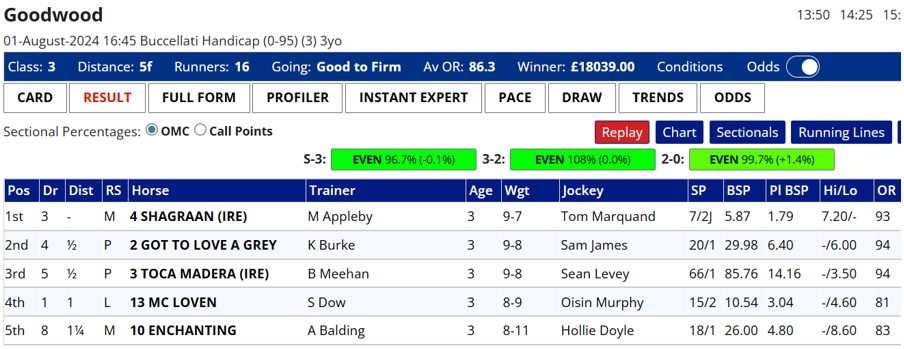
So where does that leave us with Goodwood’s 5f trip? Well, I think low drawn runners do have an edge. The ground tends to ride quicker in the centre to far side than it does near side where the high drawn runners are positioned. Also, there have been some clear examples of low draw bias in certain races – one such being the Buccellati handicap run at the Goodwood Festival meeting on 1st August 2024. The first five home were:


As can be seen, in this 16-runner race, low draws dominated the finish with four of the lowest five draws occupying the first four finishing positions. The trifecta paid nigh on £3,600 for £1.

Overall, I’d take low over high again this year.


Musselburgh 5f

Back into Scotland and to the Edinburgh shores for Musselburgh's minimum. There have been 102 qualifying races over the past five years. The win percentage breakdown for each third of the draw was as follows:


Horses drawn high have been virtually twice as successful as those drawn low from a win perspective. High draws are located close to the nearside stands’ rail, so it seems the ground has generally been riding quicker nearer to that rail than out in the centre if the win stats paint a fair picture. There is also a slight dogleg on the straight which kinks away from the lower drawn horses on the flank.

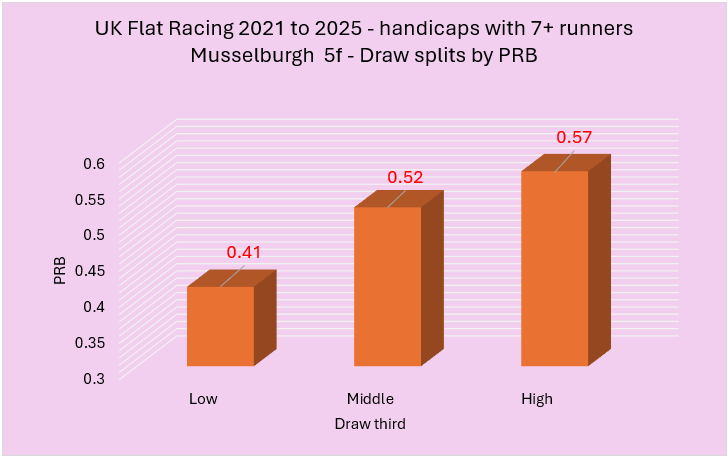
Let us see if we get better correlation with the PRBs than we did with Goodwood given to the much larger 102-race sample:


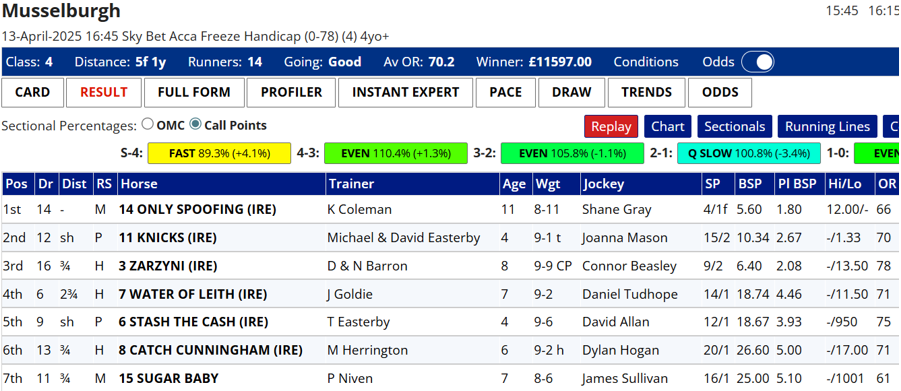
The PRBs correlate strongly with the win figures and, therefore, it seems that there has been a decent high draw rail bias in play over the past five years. This result from early last season is a good example of this:


High draws dominated this one with those drawn one to five nowhere to be seen. Ideally, then, any horse we feel has a strong chance here should be drawn high.


Pontefract 5f

Pontefract next. With the 5f track turning left one would assume lower draws might have some sort of edge. The splits for the 46 races were thus:


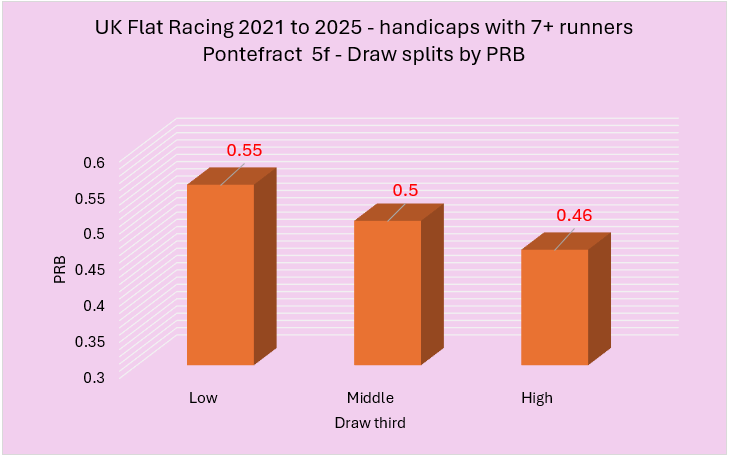
There definitely seems to have been an advantage to horses drawn low and hence near the inside rail. Let’s look at the PRBs:


The PRBs confirm that lower draws have indeed held sway. It is also worth noting that horses drawn right on the inside (stall one) have won 10 of the 46 races showing a BSP profit of £30.15 (ROI +65.5%). Very high drawn runners, those exiting stall 11 or higher, have really struggled with 0 wins from 26 and only one of those 26 making the frame.


Redcar 5f

There have been 49 qualifying races over the minimum trip at Redcar with the following win strike rates by draw third:


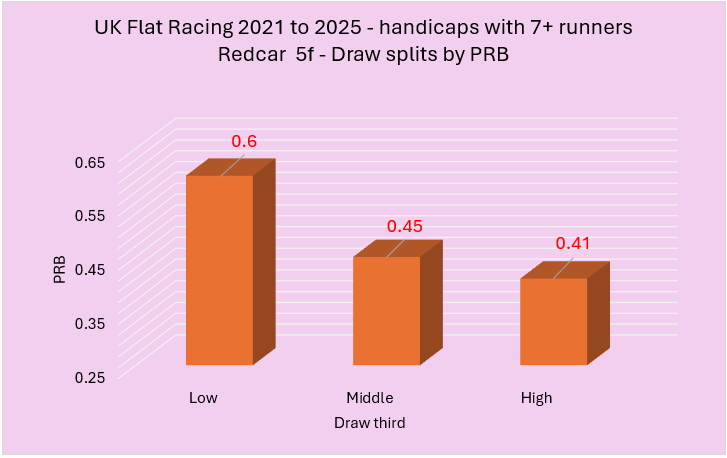
Nearly half of the races have been won by horses drawn in the lowest third. Let’s look at the PRBs to see if they corroborate this possible low draw bias:


These figures confirm we have one of the strongest biases seen to date. 21 of the 49 races were won by one of the two lowest drawn horses. Backing both stall 1 and stall 2 ‘blind’ would have secured similar returns for each at around 60p in the £. My advice: keep an eye out for 5f handicaps here as the draw might help us find some value selections.


Ripon 5f

46 races to analyse at Ripon with the following splits:


A strong edge it seems for middle draws which is surprising considering how horses tend to gravitate to the near rail (high). Do the PRBs show a similar pattern?


The PRB figures back up the win stats to some extent, although with a 50%-win rate I would have expected a higher PRB for the middle third. This course and distance is a tricky one for me; I am not convinced there is a strong bias here, even though the stats point to middle draws having the edge. Maybe the ground a few horse widths away from the rail rides slightly quicker. Not sure.


Thirsk 5f

Back in the 80s and 90s the Thirsk high draw rail bias was as strong as any in the country. That is not the case any more, but do higher draws retain an edge? Here is what the 60 race sample threw up:


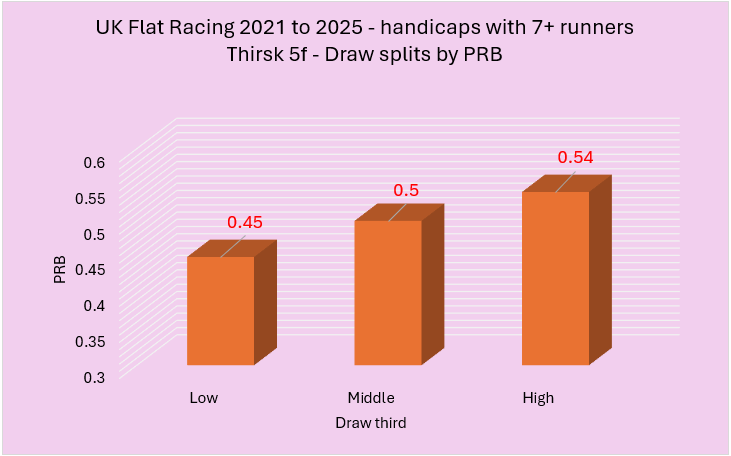
High draws have performed best, albeit not by much. Lower draws, however, have really struggled from a win perspective. Onto the PRBs:


These figures suggest the high draw edge is slightly stronger than the win stats implied. They do also confirm that lower draws have been at a disadvantage. One more nugget to share is that on good to soft or softer ground the PRB for the lowest third was just 0.41. It seems the bias against lower draws strengthens as the ground eases.


Yarmouth 5f

42 races at Yarmouth to dissect now; firstly, with the win splits:


Lower draws may have a slight edge based on these figures, and the PRBs confirm that there has been a bias in play over of the past five years:


0.56 for low draws is a solid number. It seems that if betting at Yarmouth over five this year, we should definitely prefer to be drawn lower than higher.


York 5f

Finally, we come to York. There were 58 races with 7+ runners on the Knavesmire over the past five seasons with the following breakdown:


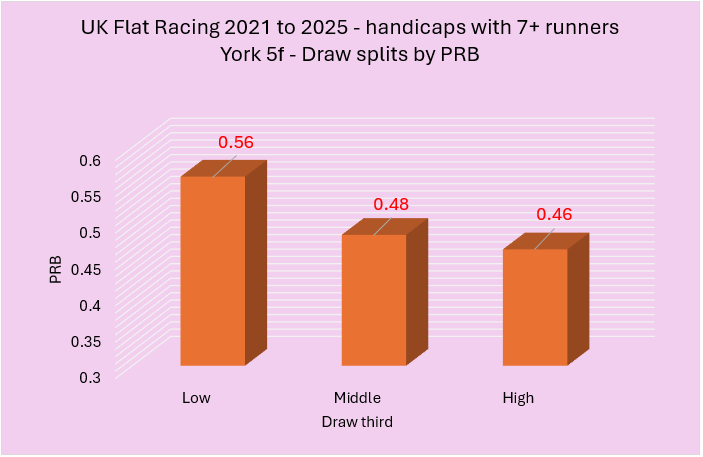
The lowest third of the draw has accounted for half of the winners. Do the PRBs correlate positively with the above numbers?


Yes, the low PRB of 0.56 confirms the advantage low draws (far side) have enjoyed here.

I should also mention that this low draw edge has looked even stronger in bigger fields. Races with 15+ runners saw the winner emerge from the lowest third of the draw 19 times in 31 races (61.3%). Further, horses drawn 15 secured just one win in 31 attempts, while horses drawn 16 or higher have won 0 races from 90! Very high draws are definitely best avoided.


*


Draw bias in 2026 is not as prevalent or as strong as it once was. However, in this piece I have reviewed 15 tracks at the minimum distance where post position does seem to make a difference; and, in some cases, a significant difference.

Before closing, I need to flag the impact that the run style of a horse will have on any potential draw bias. Normally the combination of a good draw and early speed increases the win rate and, looking across the five-furlong handicap front-running stats from 2021 to 2025 for these courses, that has been the case more often than not.

Beverley, however, has been a course where low drawn front runners actually underperformed, and that has been the case with low drawn runners at Chester, too. My guess is that some drawn low have gone off too quickly at these courses as jockeys try to take best advantage of their stall position at what have historically been renowned draw bias tracks. For the record, there were 27 low drawn front runners at Chester of which only three have won.

There were two tracks where front runners drawn in the best ‘third’ have absolutely excelled. Firstly, low drawn front runners at Pontefract won 9 times from just 18 qualifiers (50%); while at Thirsk, of the 11 high drawn front runners, 8 won (72.7%). Two other tracks also saw well drawn front runners perform extremely well and they were Redcar (8 wins from 23; 34.8%) and York (10 wins from 28; 35.7%).

I hope this article has demonstrated that, while perhaps not the same as in the golden years around the turn of the century, draw bias can still make a real difference in 2026.

- DR

p.s. for much more in depth commentary on draw biases in the UK and Ireland, see our 'Articles' archive here.