Jim Goldie is minded to miss Goodwood and wait for the Nunthorpe Stakes at York with his King Charles III Stakes hero American Affair.
The Royal Ascot hero is the third generation of the family Goldie has trained, with American Affair’s dam, Classy Anne, by Orientor whom Goldie guided with great success.
American Affair was, though, Goldie’s first ever Group One winner after several near-misses and he now has more big targets in his sights for the Paul Mulrennan-ridden five-year-old.
American Affair gets a well-deserved pat from Paul Mulrennan (John Walton/PA)
“It’s just started to sink in. He’s come out of the race well and he’s been out on the gallops yesterday and today,” said Goldie on Sunday.
“The stars aligned, but that is quite often the case with good horses. I still don’t think he’s quite as good as Orientor was, but I probably had him early enough in my career and I learned a lot from him. Fortunately for me we kept him an entire which looks very shrewd now!
“We learned a lot from the likes of him, Jack Dexter and Hawkeyethenoo. I’m looking forward to seeing where this horse will peak.”
Looking to the future Goldie does not believe Goodwood’s downhill five furlongs is totally suitable in the King George Stakes.
The King with winning rider Paul Mulrennan (Andrew Matthews/PA)
“Five furlongs up a hill at Ascot is the perfect fit for him, I always thought it might be, so I’m not sure Goodwood will suit him going downhill,” he said.
“Otherwise we will wait for York and the Nunthorpe where we might have to take on a two-year-old or two which will be interesting.”
Even further afield, American Affair now has an all-expenses paid trip to the Breeders’ Cup to look forward to.
“We’ll have to have a serious think about the Breeders’ Cup if they are going to pay. I can’t think of any other horse trained in Scotland to have run at it!” said Goldie.
https://www.geegeez.co.uk/wp-content/uploads/2025/06/2.80691752-1.jpg10522104https://www.geegeez.co.uk/wp-content/uploads/2022/10/geegeez_banner_new_170x78.png2025-06-22 15:26:112025-06-22 15:26:11Goldie cool on idea of Goodwood for American Affair
Popular veteran Hamish proved the fire still burns bright by coming out on top in a thrilling three-way tussle for the BetGoodwin Tapster Stakes at Goodwood.
The William Haggas-trained gelding had won 12 of his 24 previous starts, with eight of those victories coming at Group Three level.
Making his first appearance as a nine-year-old, having been off the track since landing a Listed prize at the Curragh in November, Hamish was an even-money favourite in the hands of Tom Marquand and while he proved difficult to handle before the off, he was as his usual professional self during the race itself.
German Derby winner Palladium, making his first appearance for John and Thady Gosden after winning his only start over hurdles for Nicky Henderson, put up a bold show from the front, while his stablemate Military Academy was also right in there pitching in the closing stages of the mile-and-a-half Listed contest.
— Goodwood Racecourse (@Goodwood_Races) June 8, 2025
There was little to choose between the Gosden pair and Hamish racing inside the last half-furlong, but it was the latter who found most for pressure in the rain-softened ground to prevail by a neck from Military Academy, with Palladium just a head further behind in third.
On his pre-race antics, Maureen Haggas, assistant to her husband, told Racing TV: “He sat on a car the other day, apparently! I was away for a day, ‘Tinks’ (Andrew Tinkler) rode him and he was very apologetic the next day that he’d wrapped him around a car and a gate post!
“We introduced a pony after he ran at Goodwood two years ago and he’s been pretty good everywhere until today, where he was absolutely appalling again! The tack fell off about four times, eventually we managed to get it on and keep it on and once he was moving he was fine.
“He was pretty naughty at the start, but he has been crying out for a race for a long time and he needs soft ground. He’s been ready to go since the John Porter which was the middle of April, so he’s just pretty bored now and needed a day out.”
Maureen Haggas rides Hamish almost every day at home (Mike Egerton/PA)
She added: “He’s not the easiest at home in that he can only go certain places, so you can’t even vary his exercise because there’s only two canters that he will ever go on. He likes routine, but he has got a little bit bored and he’s not the sort you can take for a day out either as that blows his brains.
“He still feels great. I ride him every day and he doesn’t feel like a nine-year-old, just the last two weeks you can see him looking at me saying ‘what on earth are we doing this for’. It’s good he’s had a day out to remind him what it’s all about.”
The Owen Burrows-trained Waardah (7-1) powered clear to claim top honours in the other Listed race on the card – the Weatherbys/British EBF Agnes Keyser Fillies’ Stakes.
The three-year-old won on her Sandown debut in September and while she had since finished out of the places at Newmarket and Southwell, she looked to relish this step up to a mile and a quarter, finishing strongly under Callum Rodriguez to seal a two-and-three-quarter-length verdict.
Owen Burrows was delighted with the victory of Waardah (Mike Egerton/PA)
Burrows said: “She’s always been a filly we liked and hoped she could do something like that.
“I’ll be honest, I half pencilled her in for Sandown next week in a handicap, but I saw the forecast and thought it would be worth giving her an entry in this and luckily the rain came.
“I think soft ground is probably important to her. She won first time up last year on soft ground and didn’t run bad over a mile next time when she didn’t really handle Newmarket’s undulations.
“Coming to somewhere like here, that is always in the back of your mind, but she relaxed well and got into a nice rhythm and I thought the further she was going the better and if anything Callum said he struggled to pull her up, so I wouldn’t be surprised if we go a bit further again at some stage.
“We’ll just have to see what our summer weather does, but she’s certainly one that going into the autumn we should have a bit of fun with.”
https://www.geegeez.co.uk/wp-content/uploads/2025/06/273232713-scaled.jpg12802560https://www.geegeez.co.uk/wp-content/uploads/2022/10/geegeez_banner_new_170x78.png2025-06-08 17:00:362025-06-08 17:00:36Hamish shows plenty of heart for Tapster triumph
In the previous article I shared my personal views regarding some of the top draw biases in the UK and Ireland, focusing there specifically on the 10th ‘strongest’ to the 6th, writes Dave Renham. In this follow-up piece, I will reveal my top 5.
It’s important to say that these thoughts are mine and mine alone and, of course, there will be people who disagree with my order. That is how it should be; if we all had the same opinions as regards to horse racing it would be pretty boring! Also, how would we get an edge over other punters if we all thought the same?!
It was noted last time that just because a course and distance has a draw bias, there is no guarantee that the favoured section of the stalls will produce long term profits. Indeed, sometimes there may be value in the ‘worst’ section of the draw. This can happen when the market shortens up the better drawn horses too much. When this happens the prices of other runners get bigger to compensate. Ultimately a 3/1 shot will win more often than a 20/1 shot, but if 3/1 shots win 20 races in every 100, and a 20/1 shots wins 6 races in every 100 then you’d only make a profit on the horses priced 20/1. Successful betting is about value; backing horses that have a better chance of winning than their odds imply.
For each course and distance I will share the raw draw stats, and then dig deeper looking for other angles such as the going or when the number of runners gets close to the maximum. The draw stats data comes from the last six full flat seasons (2016 to 2021) and, as ever, the initial focus will be 8+ runner handicaps. The profit and loss figures are calculated to industry SP. I will also share Betfair SP figures when they make a significant difference. As with last time, as a bonus, I will share some ‘near misses’ that just failed to make the top 10. In fact, let’s start with those near misses:
Near Misses
Gowran Park 7f (good or firmer)
The first Irish course to be discussed is Gowran Park. This seven furlongs course and distance has shown a low bias for some time. More recently, ground staff at the track have introduced a false rail which may change things a little over time. At this point, it is too early to say how much of an affect it will have.
Let me first share the win percentages on all going for each third of the draw. Firstly a look at all races from 2016 to 2021:
Low draws have a definite edge during this overall time frame. They are drawn on the inside so no surprises there. This is not a huge bias, but it is significant. Here's what happens if we split this into 'three-yearly' chunks:
The more recent trio of seasons - the false rail was introduced in 2020 - does not seem to have affected the lower draws, but it seems that higher draws are now becoming more competitive against the middle. The PRB figures for each period give us more useful information:
These figures seem to re-affirm that low draws are enjoying the same sort of advantage they have in the past.
The bias, though, does seem to be stronger on better ground. Here are the splits for 8+ runner handicaps raced on good ground or firmer (2016-2021):
Horses drawn in the lowest stalls have won 50% of these races compared with just 13.9% for those drawn high. The place percentages show a very strong edge also, as do the A/E, IV and PRB figures.
Also going back further the 2009 to 2015 stats look as strong:
There is excellent correlation with the more recent data set which adds confidence to what we have uncovered so far.
It was noted in my previous piece that at some draw-biased courses exotic bets such as tricasts or forecasts can prove profitable. This is the case here, too. If you had permed the four lowest drawn horses in full cover tricasts you would have made a small profit of around 6p in the £. The tote trifecta variant would once again have been a far better option as you would have more than doubled your money! An ROI of 120% to be precise. Isn’t hindsight a wonderful thing?
To conclude, Gowran Park was close to making the Top 10 and one could make a sound case for it actually being in there. For the Top 10, though, I wanted to stick to what I perceived to be the strongest pure biases without any extra considerations such as going.
Tipperary 5f
A second Irish course in the 'near miss' squad is Tipperary over 5f. The stats are shown below:
It is a small data set but all areas correlate strongly in terms of high draws having a good edge. The period 2009 to 2015 is equally supportive of high draws.
Clearly opportunities will be limited, but that is certainly a bias to be aware of.
Catterick 5f (good to soft or softer)
Catterick is final stop off on my 'near miss' list. When the going gets softer, higher draws start to take control. Here are the figures for races on good to soft or softer ground:
The reason high draws tend to do well is that on softer ground jockeys often make a beeline to the stands side rail which appears quicker than the far rail under these conditions. A good example of this was seen in the 15 runner 5f handicap on 26th October 2021:
On this occasion, the jockeys headed towards the near side and, as can be seen, five of the six highest drawn runners filled the first five places.
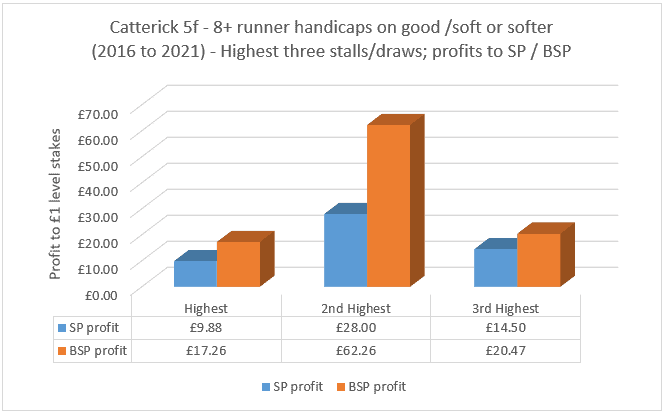
Looking at all the races run on good to soft or softer, the three highest drawn runners have all made blind profit to not only BSP, but industry SP as well.
These are excellent returns across the board. In addition, combining the three highest draws in £1 combination straight forecasts would have yielded a profit of £62.37 (ROI +31.5%). Tricasts / trifectas with the highest four draws combined also would have produced a profit.
Before moving on, it should be pointed out that the bias gets stronger as the going gets softer (soft or heavy ground), although sample is quite small:
So keep an eye on the weather before racing at Catterick. This draw bias to high stalls on good to soft or softer looks a very playable one.
From the near misses - drumroll, please - it’s time for the top five!
5th position – Goodwood 1m
Goodwood over a mile has long been considered a track and trip where draw bias can play a major role. The shame from a punting perspective is that there are very few qualifying races each year. Hence we have a small sample but one with a clear edge to lower draws:
Low draws have a positive edge in all categories and I now want to look at the individual stall positions and how they have fared:
Normally with small samples I tend not to look at individual draws / stalls, but these data set show a cut-off point at stall 5. Horses drawn 1 to 5 have won 18 races from 115 runners (SR 15.7%); horses drawn 6 or higher have won just five races from 181 runners (SR 2.8%). This strongly suggests that horses drawn 1 to 5 have been massively favoured.
To conclude, while there are not many qualifying races each year, clearly when there are they are definitely worth a few minutes of our time.
4th position – Goodwood 7f
We drop a furlong at Goodwood to see a similar low draw bias to the mile trip. One advantage of the 7f distance is there are many more races each year as these stats show:
We can see strong figures across the board here for low draws. This low draw bias has been evident at Goodwood for most of the last 30 years!
It is worth noting the bias has looked less strong in the most recent three seasons although the PRB figure is still 0.54 for low versus 0.44 for high during that time. That might be down to the fact that the going has been a bit softer in more recent seasons. In general, Goodwood biases over the years have been less prevalent on softer going. The stats back this up when we look at the good or firmer data from 2016 to 2021. Under faster conditions it can be seen that the low draw bias does seem to get stronger:
All categories (win%, place%, A/E, IV, PRB) see an improvement for low draws on better ground as compared with the 'all races' data; and, all categories deteriorate slightly for high draws.
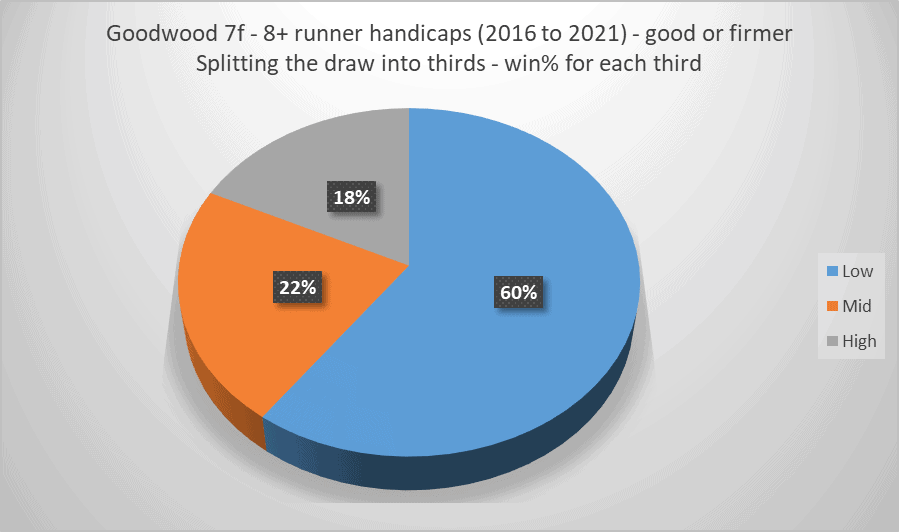
In terms of wins, which essentially is key, the draw win percentages for each third on good ground or firmer can be nicely illustrated by the following pie chart:
Six in every 10 races have been won by the lowest third of the draw under these firmer going conditions.
The 7f bias also seems to strengthen as the field size increases. In fields of 14 or more runners (all going), the draw stats for each third read as follows:
Once again we see a 60% win strike rate for low draws, but higher draws perform very poorly. We have seen this before when analysing round course biases. In big fields high draws are likely forced wide meaning they have to run further. Alternatively they can track to the inside, but then they will be faced with several horses to pass in the straight potentially needing good luck in running. It should also be noted that tracking to the inside early on losing ground also. Goodwood has a camber in the straight off which many hard luck stories are founded.
In conclusion, Goodwood over 7f has traditionally seen lower draws having the advantage. This seems to get more potent on good ground or firmer, and when the field size gets to 14+. Unsurprisingly, combining firmer ground and a bigger field accentuates the low advantage and the high disadvantage:
3rd position – Pontefract 1m
Moving into the top 3 and we travel north to Pontefract and its 1 mile trip. This is another round course bias where low draws dominate:
This is a very strong bias but, as I noted in my first article in the series, punters and bookmakers alike are much more aware of the strength of the inside edge now. Consequently, prices on the lowest drawn horses have contracted considerably in recent years. Nevertheless, the two lowest stalls have both made a profit to SP (combined profit of 15p in the £, and 21p in the £ at BSP). This is due to the fact that the two lowest drawn runners have won a remarkable 31 races between them. That means nearly 44% of all races have been won by the two stalls closest to the inside rail.
Races with big fields are rare but when we get to 13+ runners the bias seems to strengthen further:
Yes, I appreciate the sample is only 18 races, but low draws have won or placed four times more often than high draws (31 to 8). This is an eye-catching stat, as is the 0.62 to 0.40 PRB advantage to low draws over high. I think one can be fairly confident the bias does indeed gain potency in big field races.
Moving onto ground conditions, and for races on soft or heavy going, low drawn runners have won 13 of the 22 races, with high draws claiming a single solitary score. Again it's quite a small sample but the trends are clear. A similar pattern can be seen from the data between 2009 and 2015.
Having reviewed all 71 handicap races over 1 mile with 8+ runners, I can report that the exotic bets have once again proved a winner. If you had backed the two lowest drawn horses in £1 reverse forecasts you would have earned a profit of £34.06 (ROI +19.9%). The reverse Tote Exacta returns were even better with £66.50 profit (ROI +46.8%). Perming the four lowest drawn runners in combination tricasts would have yielded a small 2.2% return, while the trifecta would have harvested a very impressive 52.8% return.
These types of bets are not for everyone and they come with a low strike rate coupled with a potentially big bookmaker’s margin, but for small stakes the potential returns can be worth it. One good pay-out can really boost the bank.
Pontefract over a mile has a strong low bias where the focus should be primarily on the two lowest drawn runners. Personally, I would avoid horses drawn 9 or higher – these runners have combined to produced just 6 winners from 199 runners, a measly 3% strike rate.
2nd position – Pontefract 1m 2f
Staying at Pontefract we move up two furlongs to the mile and a quarter trip. I looked at this bias briefly in my second article in this series using the racecourse map below to show readers there is an extra left handed turn at this trip helping low draws further:
The draw stats are strong as one would expect:
At this distance compared to mile range, the market is not quite as aware of the edge low draws have, so finding past profitable angles ought to be possible. For a start, you would have made a blind profit to Betfair SP backing all four lowest drawn horses in the 39 races in the sample. Those 156 runners would have produced a profit of £23.73 to £1 level stakes equating to returns of just over 15p in the £. Amazing when you think about it really – backing four horses in every race for 39 races, and you would have made good money. The bottom four stalls accounted for 24 of the winners from 156 runners; stalls located five or more away from the inside rail accounted for 15 winners but from 242 runners.
Earlier, it was noted that the stats indicated that over a mile on soft or heavy ground the bias seems to get stronger. That theory is given extra confidence when we see the same pattern over this 1m 2f distance. It should be said there have only been 10 qualifying races on soft or heavy since 2016 but just look at the win percentages for each third of the draw:
Nine of the ten races in this small sample were won by low draws. In addition to that, the win and placed stats combined correlate strongly as we can see:
I am confident that on soft or heavy ground the bias gets more potent.
Moving back to the ‘all races’ stats, one remarkable fact is that the lowest five draws filled the first three places on no less than 11 occasions, two of which happened within an hour and a half of each other!
It should come as no surprise therefore that perming these five draws in tricasts and trifectas would have landed favourable returns. Perming five horses in all possible combinations of 1st, 2nd and 3rd amounts to a chunky 60 bets per race, so using small stakes of 10p per line (bet) makes sense, bringing in the 'per race' cost at £6. If we had done this perm using the tricast in all 39 races there would have been an outlay of £234, with £281.96 returned, giving us a profit of £47.90 (ROI +20.5%). As we have seen thus far, the trifecta tends to outdo the tricast bet, and it does it here - in style. Trifecta returns would have been £529.13 giving us a whopping profit of £295.13 (ROI +126.1%).
Pontefract over 1m 2f is a course and distance on which to keep a close eye from a draw perspective this year. It will be interesting to monitor the prices of the lower draws in the next couple of seasons; if they contract more, then profits will be harder to come by.
And, finally, it’s time for my number one draw bias in Britain and Ireland...
1st position – Chester 5f
Yes, I fully appreciate this is not a huge shocker, but I am confident about its status as the number 1 spot: the award goes to the minimum trip at Chester. This is despite the fact that they are moving the inside rail from time to time in an attempt to negate the bias. The rail movement seems to affect this shortest trip the least, and draw bias fans should stick to the minimum 5f trip and not include the extended 5½f range in considerations.
Here are the stats:
As I've said, yes, the bias is well known, but as far as draw biases go, it is still the strongest. The problem, of course, is making a profit from this widely held awareness. I discussed in the first article in the series how the prices at Chester on low drawn runners have contracted in recent years. Ultimately, this is why it is hard to make profits at Chester any more. That is, low still wins as often as it ever did (give or take - see below), but the available prices are tighter these days.
Going back to how the rail movement may be affecting this minimum 5f trip, if we compare the PRB figures from 2016 to 2018 with 2019 to 2021, we can start to see a slight weakening of the bias.
High draws seem to struggle just as much as ever, but middle draws are a little more competitive as a result of the false rail. All in all, though, low draws continue to enjoy a very significant edge.
In terms of running styles, a low draw coupled with a prominent run style, be it leading or tracking the pace, is a potent combination here as the image below illustrates.
We can see that the advantage of a low draw disappears if you race near the back early. Low draws that led early or raced prominently have been responsible for 16 winners from 59 runners (27% strike rate), which compares very well next to middle or high draws that raced mid division early or were held up – they have provided just 3 winners from 126 runners (2.4% strike rate).
The evidence is clear: combine a low draw with early pace over 5f at Chester and then you have a very effective combination.
With these five top draw bias courses, then, I've demonstrated my personal top ten UK and Irish draw biases, as well as a few 'bonus' also ran's. Please share your thoughts in the comments, especially if you think I’ve missed one. Thanks as always for reading, and good luck.
In the first article in this series I looked at how the draw can influence the market and how the market can change over time to compensate, writes Dave Renham.
Occasionally the market still gets it wrong regarding draw bias but that is increasingly rare. This is because horse racing betting markets are usually extremely efficient (by the time the race goes off, at least), not just taking the draw into account, but multiple other key factors. In this article I am going to share more draw-based research that I hope you will find interesting and ultimately useful for your own betting.
For those Gold members of Geegeez, the good news is that you are able to research the draw in two places: the Draw Analyser and the Query Tool. How you use each to study the draw is partly personal choice, but I would suggest that best insights are obtained when deploying both, not just one or the other; I use both tools for my research. Essentially, if I am just looking at the draw and nothing else I will use the Draw Analyser, but if I want to use the draw in conjunction with other factors then I’ll use the Query Tool.
When using the Geegeez Draw Analyser the stalls are split into three sections or ‘thirds’ – low, middle and high. What this means is that in a 12 runner race for example, draws 1 to 4 would be in the low third, 5 to 8 in the middle, and 9 to 12 high.
TYPES OF DRAW BIAS
I want to start by talking about types of draw bias. I believe there are two types of bias. Firstly a bias that favours a particular section of the draw; secondly a bias against a particular section of the draw. Let me illustrate with a couple of examples using draw data from 2016 to 2021. Unless otherwise stated, in this article I am going to focus on 8+ runner handicaps during this six-year period.
Pontefract 1m 2f
It is rare to get effective draw biases at distances of 1m2f or more, but Pontefract is an exception. If we look at the track configuration we can perhaps see why this bias exists:
Low draws are positioned on the inside and with an early left turn this gives them the advantage of taking the shortest route assuming they break well. In contrast, higher drawn runners are either stuck out wide round the first turn or forced to tuck in mid pack or near the back, or they need to be rushed forward to get a position thus using energy very early in the race.
There is a second left hand turn after about another two furlongs cementing the early positional advantage for low drawn runners; and there is a third turn about a quarter mile from home which again favours those racing near to the inside rail. Let’s look at the most recent six-season data now:
The stats show a clear advantage to one section of the draw (LOW); there is a significant advantage in most areas. Low drawn runners win more often, place more often, have higher IV values and higher PRB figures, too. However, backing all such runners to SP would have made a small loss and the A/E index value is lower than the middle section’s A/E value. This factor was referenced in the first article: the market at Pontefract clearly appreciates there is a draw bias. Just because one section of the draw is clearly favoured, this not in itself a license to print money! For the record, however, you would have made a small profit of £11.98 during this period backing low draws to Betfair SP.
Pontefract over 1m 2f is an example of a bias strongly favouring a particular section. With middle draws out-performing higher draws, this is an example of a fairly linear relationship: the lower the draw the better. Draw 1 is better than draw 6; draw 6 is better than draw 10 etc.
Now for an example of a draw bias against a particular section of the draw.
Musselburgh 5f
The sprint 5f trip at Musselburgh is essentially a straight five but there is a slight kink to the left at the 3f pole which can slightly hinder wider drawn runners. With Musselburgh being a right handed course at longer distances, it means horses drawn next to the rail are the higher drawn runners. Here are the stats:
This is far from being a strong draw bias, but there is a bias against lower drawn runners compared with high and middle drawn runners. Low drawn runners come out comfortably bottom in all of the parameters as shown in the breakdown above. Looking at 2009 to 2015 we get a similar picture which gives further confidence that this is likely to continue this season and beyond.
It does seem that the kink to the left at the 3f pole is enough to make life more difficult for the wide (low)-drawn runners.
Indeed if we ignore 8- and 9-runner races (the smallest fields), and look at handicap races with ten or more runners we get the following results:
All of the low drawn variables deteriorate further, and such horses are winning only just above half of the races they statistically should (IV 0.53, an Impact Value of 1.00 being on par). Consequently, both middle and high draws are winning more races than they statistically should. One would expect to see those wider draws (low) struggling more over 5f at Musselburgh as the field size increases. However, it is always good to see results in black and white - as per the image above - to back up a theory.
INDIVIDUAL DRAWS / STALLS
A question: when you look at draw biased course and distances, what do you focus in on? The so called favoured third of the draw only? The favoured half of the draw? Or do you go further and have a preference for specific draws / stalls?
There is an argument to back the horse that is in ‘pole position’ especially on a turning track. One would think that would be the horse housed closest to the inside (i.e. drawn 1). However, the stats I have uncovered suggest differently. The stats suggest the second closest horse to the inside (i.e. actual draw 2 - 'actual' draw being the real position a horse was drawn, after accounting for any non-runners) is generally most favoured.
To show this in more detail I have looked at all 8+ runner handicaps over 5f and 6f run around a bend (2016-2021). For the record there are 12 UK courses where 5f and/or 6f races occur round a bend (seven turf courses and five on the all-weather).
Firstly I want to compare win and placed strike rates (N.B. Place SR% includes winners with the placed runners).
The margins may look quite small but they are significant as the data set covers over 2400 handicap races over 5/6f. All other key stats also point in favour of 'actual' draw 2. Firstly A/E values:
Runners drawn 2 have been far better value than those drawn 1. This is a much bigger difference than I had expected.
Next a look at profit / loss figures. Firstly a comparison of traditional SP figures (to £1 level stakes):
Losses of nearly 26p in the £ if backing all horses drawn 1 are bankruptcy territory; a smaller 8p in the £ loss for all horses drawn 2 would see a far more protracted slide to the proverbial poorhouse. But, here's Betfair SP to save the day:
The flow of bleeding has been stemmed from stall 1 but there are still bank-destroying losses; whereas trap 2 is now in the black!
But... we already know that profit / loss figures can easily be skewed by big-priced outlier winners, especially using Betfair odds. So I thought it worth comparing stats for the two draws when the Betfair SP was no bigger than 16.0. Here is what I found:
We can now see that big priced winners are not skewing the stats. Draw 2 once again has a better strike rate (both win and placed), better returns and a much stronger A/E value.
So what is actually happening here to promote stall two above the notionally best-drawn box, stall one? That is something I have pondered for many years because I have seen this type of pattern repeating time and again.
One plausible theory is that it may simply be down to the fact that horses drawn right next to the rail have less room for manoeuvre. With a rail on their inside, if they break from the stalls poorly then they are very likely to be stuck behind one or more horses. Their options are compromised until they've completed the turn by which time it may be too late. Meanwhile, horses drawn 2 have a little more space either side of them and hence more options if they break slowly. Whether this theory is true or not I obviously cannot say, but there is logic there, and it is a pattern replicated in US dirt racing at sprint distances around a turn.
What is clear in terms of the stats: in 5-6f handicaps round a turn it is preferable to be drawn 2 rather than 1.
Before moving on, I mentioned that 12 courses were in that sample and, of those 12 courses, only Kempton saw a clear advantage to horses drawn 1 over those drawn 2. Two courses - Epsom (6f) and Wetherby 5½f - had limited data (just 16 and 15 races respectively), while the other nine courses all favoured horses drawn 2 over horses drawn 1, most of them fairly strongly.
GOOD DRAWS WITH PRICE CONSIDERATIONS
As we have seen, backing a specific draw / stall under certain conditions could produce a profitable scenario. However, this idea is full of risks as we are pinning our hopes on one stall position and nothing else. So, how about combining a good draw with market factors? This is what we are going to look at next.
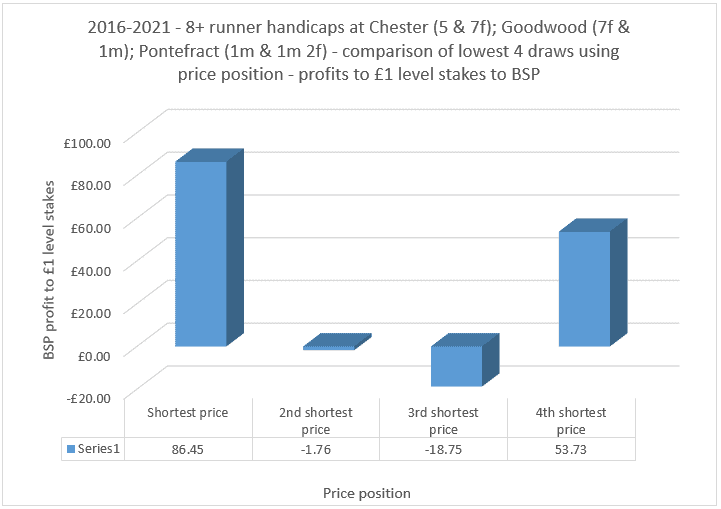
I have taken six of the strongest draw biases from the past six seasons (these are Chester over 5f and 7f; Goodwood over 7f and 1 mile; and Pontefract over 1 mile and 1 mile 2 furlongs). From there I have focused on the four stalls closest to the favoured inside rail: actual draws 1 to 4. Then I have ordered them depending on price. My idea is to compare price position of these good draws to see if there are patterns to be found.
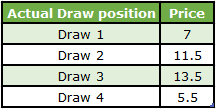
By way of an example, let’s imagine the following scenario:
That would mean an order as follows:
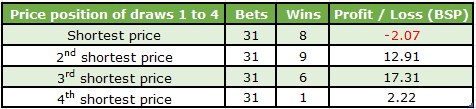
Here are the actual results for the six course/distances (profit/loss has been calculated to Betfair SP and we are again focusing on handicaps with eight or more runners):
Chester 5f
Chester 7f
Goodwood 7f
Goodwood 1 mile
Pontefract 1 mile
Pontefract 1 mile 2 furlongs
Combining the six courses we get the following results:
It seems therefore the best value lies at either end of the price position spectrum. The shortest priced runners drawn 1 to 4 have made the biggest profit. They have also had a decent strike rate of 28.6%. The biggest priced runner from draws 1 to 4 have also made good profits although it would have been a bit of a rollercoaster with just 13 wins from 258 runners (SR 5%).
So is this the way to go? I'm not sure, but I believe the idea is worthy of more digging in the future. I’ll add it to my rapidly expanding research list!
- DR
https://www.geegeez.co.uk/wp-content/uploads/2020/04/Pontefract_Pipalong_BillesdenBrook.jpg319830Dave Renhamhttps://www.geegeez.co.uk/wp-content/uploads/2022/10/geegeez_banner_new_170x78.pngDave Renham2022-04-26 07:16:002022-04-26 07:16:00Draw Bias 2022: Part 2
There was a lovely moment at Goodwood racecourse on Saturday afternoon, writes Tony Stafford. The Celebration Mile, initially the Wills Mile and a feature of the late summer fixture since 1967, was always a post-York and pre-St Leger highlight.
In the early 1980’s no trainer did better than Guy Harwood with three wins in four years, via smart trio To-Agori-Mou (1981), Sandhurst Prince the following year and Rousillon in 1984.
At around that time, his Pulborough, West Sussex, stables, financed by the family motor sales business, was one of the top yards for big race wins in the UK. Stable jockey Greville Starkey, yet to be compromised by his poor ride on Dancing Brave in the 1986 Derby and then an overly extravagant celebration after the horse won his next race in the Eclipse, rode all three.
Owner Khalid Abdullah was never a man for extravagance of any kind – save in terms of having legions of high-class racehorses – and Pat Eddery took over from that point. Dancing Brave proved one of the greats and Eddery had a long time as the Saudi Prince’s principal jockey.
In the early 1980’s the race had a lot of prestige, not quite of the level from the earliest days when such as Habitat, the peerless Brigadier Gerard and Kris adorned the race’s Roll of Honour; but it was still a major event very much to win. It fell in 1999 to Cape Cross, later sire of Sea The Stars and Golden Horn, having been disqualified as a three-year-old two years earlier.
Anyway, I mentioned a lovely moment and that came with the strong finish and narrow victory of Lavender’s Blue, trained by Amanda Perrett, daughter of Guy Harwood. It is almost impossible to believe that Amanda, with the considerable help of husband Mark, previously a top-class jumps rider, has been holding the licence for a quarter of a century since her father’s retirement.
In that period she has initially “waxed” to a best score of 60 a decade or so ago to if not quite “waning”, she certainly has had to accept much smaller figures. In the regard that she is suffering from the familiar story of established trainers struggling to attract new owners.
The 2021 version of Horses in Training listed 24 horses in her care. The fact that she has won 19 races from the 23 that have run – two juveniles of her original trio are yet to appear – speaks volumes of the efficiency of her operation.
One owner who has stayed loyal over the years, especially since the retirement of the late John Dunlop, has been Benny Andersson, 25% of storied Swedish pop group Abba in terms of personnel and 50% of the writing team.
In the persona of Chess Racing - celebrating the musical he and Bjorn Ulveaus wrote with Tim Rice – he bred Lavender’s Blue, a daughter of Sea The Stars from a Danehill mare. The decision to keep her in training as a five-year-old, apart from getting her trainer back in the big time where she belongs, has brought handsome dividends with her future stud career in mind. One day at Newmarket two years ago in the owners’ room he sat quietly with the Perrett’s at the next table to me and Peter Ashmore, a pleasant, quiet and very humble man. The memory of that day alone makes me enjoy the mare’s success.
On Saturday she needed to peg back the multiple Group 1 world traveller Benbatl as Godolphin’s seven-year-old initiated another return after injury, and also overcome a previous winner of the Group 2 race in Duke Of Hazzard.
The Celebration success added to a Listed win at the start of her season and then she was a close third in the Dahlia Stakes, a nine-furlong Group 2 on 1,000 Guineas Day, behind top-class Lady Bowthorpe, whose subsequent heroics could have prepared us rather more than the 20-1 SP on Saturday suggested.
As the Amanda Perrett stable has rationalised itself, the famed Pulborough gallops do have another occupant and one who this year has had a much higher profile. French-born David Menuisier has always been regarded as a man who takes time with his horses and he too has a smart filly in his care.
Menuisier had worked initially in the UK with John Dunlop and, while he was there, he came under the scrutiny of Marcus Hosgood, the long-time right-hand man to Dunlop whose influence in finding suitable races for the Arundel inmates should not be under-estimated. I met Hosgood at Arundel when there just the once with Prince Ahmed Bin Salman to watch a few Thoroughbred Corporation-owned horses go through their paces.
Reputedly that was a luxury even the stable jockeys for Dunlop never experienced, that singular gentleman preferring to restrict galloping duties to the trusted home-based work riders. Since taking out a licence himself, horses like Thundering Blue have advertised Menuisier’s talent and this year Wonderful Tonight is only a 10-1 chance in betting on the Prix de l’Arc de Triomphe despite her disappointing run behind Snowfall in the Yorkshire Oaks when the fast ground was not in her favour.
A few years ago I bumped into Marcus Hosgood at a gathering of former Raceform employees – many of whom have gone on to bigger and better things - myself qualifying as the one-time part-time Editor of the late, much-lamented Racehorse weekly publication. The event was organised by my almost exact contemporary Will Lefebve and we met in a pub close to the former Raceform base in Battersea, South-West London. Chatting about Menuisier, the shrewd Hosgood declared him the most talented horseman he had ever met. Praise indeed!
Amanda Perrett is no mean horsewoman either and where her yard contains, give or take a few mid-season arrivals, two dozen animals, Menuisier has three times as many in his care and stands on 31 wins, so the family firm is more than holding its own. I’m pleased to see that my friend Alan Spence maintains an interest with Amanda in a half-share with stable stalwart John Connolly in a progressive staying Gleneagles three-year-old called Eagle One, a winner and close second in his last two starts.
Jockeys have been restricted to riding at a single meeting from the resumption of racing after the Covid19 break last year and will again have to live with that rule for the whole of 2022, something I agree with. I see Jim Crowley has come out in favour of a continuing bar on racecourse saunas, which has been in place for the same period.
In the days of Guy Harwood’s pomp, most of the top jockeys would ride in the early races at Goodwood then after the Celebration Mile hightail it for the major races on the Windsor tea-time fixture which ended the year’s evening racing in those days.
Apart from the Group 3 Winter Hill Stakes, which is still going after around 40 years’ existence, there was and still is a Listed race and a valuable sprint handicap. I used to follow the jockeys’ route for what I now see is the 60-mile trip, largely because it was on my way home – sort of – and in those days I could never resist an opportunity to see top-class racing.
Twenty-one years ago, having seen Sir Michael Stoute win the Celebration Mile with Medicean, later sire of Dutch Art, I followed on to Windsor and Stoute again had the answer with the three-year-old Adilabad. Stoute may not have quite the firepower of old against the 200-plus teams that lead the sport these days, but the talent is clearly intact as he showed as his five-year-old Solid Stone picked up the 34k first prize of the Winter Hill Stakes on Saturday.
xxx
Last week I was getting rather hot under the collar when pointing out the apparent favourable treatment accorded to Irish stables in handicaps on the Flat and especially in the big UK races over jumps. I added for good measure that the French are not immune to allowing Irish horses into races with obvious chances and gave the illustration of a race due to be run at Deauville last Thursday.
Willie Mullins had orchestrated a very clever plan with his 2020 Triumph Hurdle winner Burning Victory who joined his stable after earning a 40-kilo rating (UK/Ire 88) following her three-year-old season in France.
Sparsely campaigned apart from over jumps, she had been sent for only one Flat run since her exportation to Ireland, and that two months ago when Mullins sent her across to Lyon Parilly for a minor conditions race and she had no trouble in winning it by five and a half lengths. To say I was surprised – I did have an interest in the race – that her rating remained firmly on 40 for a race with a €27,500 first prize plus 45% owner’s premium thus just about €40k to the winner is an understatement.
It was worth going for – indeed impossible to ignore - and Burning Victory duly won the race by almost two lengths. Too late for Thursday’s home opposition the handicapper closed the stable door after Mullins’ mare had bolted, giving her 5kg more (11lb). He should have done that before the race.
I was mentioning this situation three days before the race talking at Brighton to Owen Burrows, one of the trainers likely to be most affected by what could be a significant reduction in the Shadwell operation after the death of Sheikh Hamdan earlier in the year.
The twin subjects of our talk were handicappers – and, as he says, how long it takes (and costs) for a horse to come down the handicap in the UK before it is well enough treated to win a race – and the always testy subject of moderate prize money about which he feels people in racing do not complain enough.
Burrows reckons our system with the high administrative and ever-increasing feed costs encourages (or compels) smaller trainers especially to run horses deliberately below their true form to get one big chance to retrieve the high costs with a major bet.
As to prize money, reacting to my tale of the €40k for the equivalent of a 0-88 handicap he surprised me with the case of the Cambridgeshire, run next month and traditionally one of the prime handicaps of the season. This year it carries what I believe given its prestige is a derisory £61k first prize: in 2020 the understandable excuse for lower prizes was Covid and at just shy of £75,000 might have been acceptable in the circumstances.
In 2019 John Gosden’s Lord North, a Group 1 horse masquerading as a handicapper, romped home and collected to all intents and purposes £100,000. Owen wanted to know, where did the missing £40k go? I’d like to ask Jockey Club Racecourses the same thing. The prize is just about 50% more than Burning Victory won for an open goal in Deauville. Something is very wrong somewhere.
https://www.geegeez.co.uk/wp-content/uploads/2015/05/Amanda-Perrett.jpg194260Tony Staffordhttps://www.geegeez.co.uk/wp-content/uploads/2022/10/geegeez_banner_new_170x78.pngTony Stafford2021-08-30 07:42:022021-08-30 07:44:34Monday Musings: A True Goodwood Celebration
Soft ground seems to have scared many runners away this weekend leaving us with a day of largely smaller field races. The highest class race of the day is the Group 2 Celebration Mile at Goodwood and that’s going to be the focus of this article. One of the most popular features of Geegeez Gold is the ‘Instant Expert’ and I’m going to use the Instant Expert to gain a quick overview of the seven runners set to take part in this race.
Place Data
First let’s take a look at it from a place perspective:
Ground
I’ve set the going parameter to anything from good to soft down to heavy. We are probably going to be looking at soft, borderline heavy ground for this race but this should allow us to get more data. We can dig deeper into what specific going each horse has handled or not handled later.
It seems that Century Dream and Sir Busker stand out as two runners that not only handle cut in the ground, but relish it. Century Dream has had the most runs on testing ground and has impressively placed in seven of his ten runs. Sir Busker is next best with four placings from six runs on ground that is good to soft or softer.
There is limited evidence about Urban Icon’s ability to handle cut in the ground as he’s had just two runs in these conditions, placing in one of those.
Interestingly enough Regal Reality and Benbatl, the two early favourites have failed to place in over 50% of their races in this sort of going. Between them they’ve managed just three placings in nine starts. The only runners in this field to have never placed on softer ground are Duke Of Hazzard and Positive who seem to have been kept away from softer ground as often as possible and with good reason.
Class
Century Dream again comes out on top having placed in five out of eight runs in class 1 races. Duke Of Hazzard and Positive, who scored poorly on this ground, actually score very well here. That’s not a big help though if they don’t go on the ground.
Urban Icon, Regal Reality and Benbatl have poorer records in class 1 races but it’s worth remembering this will include anything from listed contests to Group 1 races and there can be more merit in finishing 4th in a Group 1 than 1st in a listed race. We’ll dig deeper into the race class later.
Sir Busker is the only one of these to be running in a class 1 race for the first time.
Course
At a course as unique as Goodwood course form is always a positive. There is one clear winner here and that is Duke Of Hazzard who has never been out of the frame in four starts. Sir Busker has placed in two of his three runs. It’s fair to say that no runner is this field has run poorly at this venue.
Distance
You’d expect most runners in a Group 2 to have a solid record over the race distance but it’s worth noting that the favourite here, Benbatl, has managed just one placing in five runs at a mile. This stat really stands out and along with the ground stats for Benbatl suggests he has a poor profile for this race.
Like Benbatl, Regal Reality is another who scored badly on this ground and also has a poor record over this distance whilst Urban Icon is another with a sub 50% placing ratio at a mile.
Century Dream continues to score well with the best ratio here having placed in 67% of his runs over a mile.
Field Size
Often an underrated criteria, many horses are better suited to bigger fields and others to smaller fields. Yet again Century Dream is looking good having placed in all his runs in field sizes of 7 or less.
The stand out here is Regal Reality’s record in small fields. He’s managed to place in just two of his eight runs in field sizes this small.
Placings Summary
Without having to dig deep into the form Instant Expert has shown us that Century Dream is the really solid horse in this race. Sir Busker also scores well in most categories but is unproven (having been untried) in this sort of company. Duke Of Hazzard looks pretty good but there are serious ground concerns.
At the other end of the scale, Benbatl and Regal Reality, look two of the riskier propositions despite their positions in the market.
Win Data
This is what Instant Expert looks like for win purposes. We are getting less data here but the data we do get should be more telling.
Once again Century Dream is coming out very well on all criteria except course as he is yet to run at Goodwood. Sir Busker is another who looks solid and a good proposition over a mile on testing ground at Goodwood. He’s yet to prove himself in this company and perhaps the biggest question mark for this horse is his ability to run well in smaller fields.
Duke Of Hazzard is interesting based on his course record of three wins from four starts. He also has a decent enough strike rate at this distance and in small fields. He’s had only one run on softer ground and finished unplaced so that’s the big unknown.
Early favourite Benbatl only really seems to have small field ability in his favour for win purposes whilst Regal Reality is unbeaten at Goodwood but other than that most of the elements that make up this race seem against him.
Positive scores poorly for wins in any of these circumstances except field size, and even a sole victory from three starts in small fields isn’t that great on the face of things. Meanwhile there is little evidence that Urban Icon will be at home in this race.
Digging Deeper
So far we have a very positive profile for Century Dream, a generally positive one for Sir Busker and a big ground question mark over Duke Of Hazzard. It also seems Benbatl and Regal Reality might be worth taking on.
Let’s first look at Duke Of Hazzard’s ground preference as he may be easy to rule out on that basis. Instant Expert is only able to look at runs from the UK and Ireland and a deeper look at Duke Of Hazzard’s form tells us he’s actually run three times on ground softer than good. Two of those runs were perhaps slightly below par but in Group 1 company so finishing unplaced wasn’t a disgrace. He also finished 2nd in a listed race at Deauville on good to soft. It doesn’t look as though he’s hopeless on softer ground and he clearly goes very well at Goodwood but there has to be a suspicion he is at his best on fast ground and it will probably take a near career best to win this.
Are Benbatl and Regal Reality really no hopers in this race despite their odds? Benbatl is the highest rated runner in this field and has largely been contesting Group 1 races over the past few years so having more unplaced efforts isn’t the end of the world. Looking at the ground though, he has been beaten favourite on softer than good on three of his four starts in those conditions (and was well beaten over too far a trip on his other attempt). The worse the ground gets, the worse he performs it seems.
Benbatl also had some worrying stats in races over a mile. Two of his five runs at a mile came on heavy ground. Those runs are relevant here as the going may not be far off heavy but they aren’t poof that he isn’t effective at a mile. He’s won over this trip at Group 2 level in the past so he’s clearly capable of winning this sort of race at this distance but it backs up the suspicion that the ground will be too soft for him.
Regal Reality was an impressive winner last time out over this trip at Group 3 level (good to firm). That was in an 8 runner field which perhaps allays fears he doesn’t act in smaller fields (he does have a poor record when there are 7 or fewer runners). All his wins outside of maiden company have been on good to firm ground though and whilst he’s placed on softer ground it’s worth noting that his only defeat from four runs at Group 3 level came on soft ground. The ground is the main reason to oppose Regal Reality but the fact he’s not won above Group 3 level in eight attempts is also a concern for his backers.
That leaves us with Century Dream and Sir Busker. Century Dream looks extremely solid based on Instant Expert so let’s see if he has any limitations. He’s never run at Goodwood but there is nothing in his profile that suggests he won’t handle the course. Possibly the best evidence we can get is to look at the Instant Expert for this race but from the sires’ perspectives.
Cape Cross’ offspring have run nine times at Goodwood in the past two years producing two winners. That might not seem a massive win ratio but it’s only bettered by Sire Prancelot (sire of Sir Busker) here and even then that’s by just 1%.
Let’s now look at Century Dreams’ defeats in Group company over a mile with cut in the ground. His two career unplaced efforts in these conditions came in an Ascot handicap on good to soft ground where perhaps it wasn’t quite soft enough for him and again at Ascot in a Group 1. In fact this horse has won just once from seven starts at Ascot (33% strike rate elsewhere) so it might not be his ideal course, for all he is Group 1 placed there on soft ground. Away from Ascot his only defeat over mile on softish ground was a 2nd in a listed race at Newmarket.
It would be hard to argue that Century Dream isn’t good enough to win this Group 2. His only run so far at this level was a 4th in the Summer Mile at Ascot on unsuitable good to firm ground. He has won both his starts at Group 3 level comfortably and has previously got within ¾ of a length of Roaring Lion in the QEII stakes at Ascot (possibly not his favourite track).
Can Sir Busker defeat him? He’s been a rapid improver this season, going up 19lbs in just 5 runs and he’s still relatively unexposed at this distance. He was slightly unlucky not to win a competitive handicap last time out off 107 so could easily yet rate higher than his current mark of 111 which leaves him just 4lbs to find on Century Dream. Sir Busker was 2nd here as a 2yo, won a low grade handicap here as a 3yo and his only unplaced effort at this course was in the Golden Mile two starts ago when getting no run on the rail whatsoever.
The main concern with Sir Busker would be his ability to handle small fields. He’s a real hold up performer who needs a decent pace to aim at so it stands to reason he’d generally be better in bigger fields. He has won in 8 and 9 runner fields, albeit off much lower marks in handicaps, but was outpaced in several smaller field races last year (often at shorter trips than this).
The key here to Sir Busker is going to be the early pace.
Benbatl is likely to lead with Century Dream well placed just off him. It doesn’t look like there will be a strong pace which could inconvenience Sir Busker. If Benbatl ends up being withdrawn because of the ground then there is likely to be an even slower gallop and that pushes things more in the favour of Century Dream and less in the favour of Sir Busker.
They say ‘class horses go on any ground’ but the evidence in this race is that several of these are going to find conditions (not just the ground) against them. Century Dream seems to have everything going for him and Sir Busker is not far behind.
I wouldn’t put anyone off either of these runners who are available at 11/2 and 9/1 respectively at the time of writing. Unfortunately with just 7 runners each way betting is far less attractive. However it could be worth maximising the value from this race by backing both Century Dream and Sir Busker in a reverse forecast.
https://www.geegeez.co.uk/wp-content/uploads/2020/07/desertencounter_goodwood.jpg319830samdarbyhttps://www.geegeez.co.uk/wp-content/uploads/2022/10/geegeez_banner_new_170x78.pngsamdarby2020-08-28 13:41:492020-08-28 13:41:49Dream Conditions For Century In Celebration Mile
Last week I wrote in this space that I would not be trying to join the 5,000 racing optimists who were all set to travel to Goodwood for the test meeting set to confirm that the country is indeed coming out of the worst effects of the now almost five-month agony of the Coronavirus pandemic, writes Tony Stafford.
Barely 24 hours before this new departure for so many, the word came of the frustration for the 5,000, the feeding of which was not the matter of a Biblical “five loaves and two fishes” miracle. It was a major logistical exercise involving butchers, bakers and if not candlestick makers, certainly outside caterers who had worked night and day on menus, the provision of champagne, lobsters and smoked salmon as well as the beer, pies and burger vans that keep all us hungry racegoers happy.
My wife’s interest in racing is about as deep as that of Josephina, the Yorkshire terrier’s, but Boris’ statement did strike a nerve and possibly the beginning of a protest movement with the prospect of ice skaters standing outside 10 Downing Street or as near as security will allow them, wearing their skates. She (not Josephina), in what was to be her first try-out of her repaired broken leg, had lessons booked for today, tomorrow and later in the week. But once again, with the rinks having gone to the expense of getting the ice prepared for action after all that time, they got the same two-week delay as beauty salons, bowling alleys and indoor theatres.
Coaches have lost their income but now, happy to be back had set up the initial appointments, which have now spun on for two more weeks. Champion skaters, those young kids who practice at crack of dawn before school every morning and then again straight after to try to do well enough to represent their country in international competition, often when they are among only a handful of people in the arena, have another fortnight at least to vegetate and try to keep the enthusiasm going. As she says, public sessions should be treated as a separate issue.
The ramifications, as with what happened to all that food prepared for Goodwood, are far-reaching. I hope the bulk of those choice provisions was able to be diverted to people who would have been grateful for it, but you have to wonder whether some was just chucked into a nearby bin with losses covered by insurance.
The cause of the delay was a “spike”, or an increase in parts of England in the mystical “R” figure. As I’ve been boring readers for months, I’ve kept a daily record of the numbers of new cases and deaths and every week since the peak on April 12, the number of deaths had been decreasing. Percentage-wise from the week of April 12th (incidentally in 2020 it would have been my dad’s 100th birthday, and how he would have celebrated Saturday’s Cup Final result!) it has gone down initially by 3%, then 11%, 14.6%, 28.8%, 18.4%, 22.4%, 21.4%, 5%, 28%, 19.2%, 11.5%, 16.2%, 10%, 20% and in the week to July 25th, another 7%.
From 6425 in the week to April 12th, deaths had dropped by 93%. Even though many more people had been tested as the weeks went on, new infections have continued to fall. The last week did show some modest increases on its immediate predecessors in new infections, but fatalities were almost static in the week of “new spikes” and an increased R number. Last week it was 452 and contrary to what we are being subliminally persuaded to believe, this week to yesterday it was still down, albeit by only three.
If the government thinks that bowling alleys, ice rinks and theatres are going to cause the much-feared second wave, then what about pubs where the boyos could watch the Cup Final in close contact with each other, or indeed Goodwood and Galway and celebrate backing a winner? Or the beaches, where in the near 90-degree heat of Friday and Saturday, the crowds were much in evidence again? Social distancing, where?
I’m just waiting, having stayed indoors to all intents and purposes since Cheltenham, to resume normal life, as no doubt we all are. As predicted, I enjoyed Goodwood and Galway, mostly for the amazing performance of Stradivarius, when I confidently expected the Irish Derby winner Santiago to take advantage of the 15lb weight-for-age allowance. The way Frankie Dettori extricated him from a typical Goodwood pocket was a measure of his enduring greatness as a jockey. I expect a big run from him in the Arc. Can he beat Enable and Love? Maybe!
Battaash emulated Strad’s four-timer in the Goodwood Cup with one of his own in the King George Qatar Stakes, but his task was far less onerous. Charlie Hills, a trainer who seems to get very little recognition for his skills - maybe it’s his mild, polite manner or just that he is his father’s son - has done wonders to concentrate all of Battaash’s once-wayward tendencies into track record-breaking brilliance.
**
In the 20 years since Betfair was launched onto an innocent market place many things have changed, especially in the horse racing world. Its arrival coincided with the last two of my 30 years at the Daily Telegraph and I remember writing in that publication that I believed anyone on the new exchange sites who laid horses should be required to be licenced as bookmakers– and pay for the privilege.
Nothing has changed that opinion, but what is different today is the degree to which Betfair Exchange odds lead running “industry” (as they are almost exclusively now) prices and influence SPs.
Another thing that hasn’t changed is that bookmakers do not give money away willingly. So when as happened in the 8.30 race at Thirsk on Wednesday, a horse that the owner had been backing, not excessively, but significantly all afternoon and at 8 p.m. or thereabouts was firm at around 10-1, could, by 8.20, just before the first show in the shops, be available briefly at 60-1 on Betfair, you knew something was probably “funny”.
The horse in question was Trouble Shooter, a five-time winner for owner Simon Lockyer in 2019 under trainer Shaun Keightley but now with Richard Guest. This was to be his debut for the Yorkshire-based trainer and in the build-up to this first run for seven months, expectations had been high. I’ve known Lockyer for just over a year and in the winter we met one of my friends who had been interested in buying into one of the owner’s horses. That didn’t happen but he obviously keeps a close eye on matters racing and betting and called at around 6.30 to say he’d seen that Trouble Shooter “has gone from 12’s to 7’s so presumably it’s fancied.”
I called Simon, and learned that yes they were more than hopeful, at the same time revealing that an associate connected to one of his horses had just called to ask him about Trouble Shooter’s chances.
“He said,” Lockyer began, “that he doesn’t like ringing to ask about another owner’s horses but would like to know if he thought it had a chance. He said he’d had a multiple bet, finding some long-priced winners and that if Trouble Shooter won, it would come to £300,000.”
Upon ending the call, I related that information to my friend and we haven’t discussed it since. Hopefully he didn’t rush to take the reduced price as he would have been no more shocked than me and of course Lockyer when the first show at the track was 25-1. That did prompt some modest mid-market support down to 12-1 but by the off he was out to 20-1 having touched 28’s according to the betting report. After at one time getting as close as fifth, around three lengths behind the leader, he eventually dropped away to finish eighth of the ten runners.
As I said earlier, bookmakers do not give money away. The trainer assured the owner that Trouble Shooter would run well, only reducing his assessment from ten out of ten to nine in the last hours before the race, but I’ve found over 50-odd years’ experience of talking to trainers that even the best of them have slightly diluted optimism as race-time approaches.
It is well known that Betfair have an open line to the BHA, one which has brought about suspensions of a number of jockeys and owners, who contrary to the rules had been found to have laid their horses on the Betfair Exchange. I trust - and I know Nick Rust sees these words every Monday - that Wednesday’s 8.30 race at Thirsk will feature in their deliberations. Not least identifying which bookmaker stood to lose £300k.
The consequences of what happened are still unravelling where Simon Lockyer is concerned, but I repeat someone must have known rather than suspected that Trouble Shooter would not win, and I was aware beforehand that one punter stood to win £300,000 if he did win, or to be Devil’s Advocate, claimed that he would. I think the lay bets should be investigated down to the minutest of transactions. I know at least one other person that could provide evidence of his actions (exclusively backing not laying!) that morning and afternoon.
How can a 7-1 shot (I think they took 10’s at 8 p.m.) open at 25-1? The Editor of this web site was interested as the former Chair of the Horseracing Bettors Forum. Since I originally wrote these words it was he that informed me that Trouble Shooter had never won previously off a layoff of more than 30 days; and that he had been ahead of the eventual winner, the favourite King’s Charisma, three furlongs out; and that he was running off a seven pounds career high mark.
Fair points, I agree, but I still contend that somebody KNEW Trouble Shooter would not be winning. It would be interesting to know who was so certain that he was prepared to offer 60-1 against it happening.
TS
https://www.geegeez.co.uk/wp-content/uploads/2020/08/battaash_Goodwood_2020.jpg319830Tony Staffordhttps://www.geegeez.co.uk/wp-content/uploads/2022/10/geegeez_banner_new_170x78.pngTony Stafford2020-08-03 05:57:132020-08-03 08:09:12Monday Musings: Trouble’d Times
geegeez.co.uk uses cookies to improve your experience. We assume that's OK, but you may opt-out from the settings. Cookie settingsACCEPT
Privacy & Cookies Policy
Privacy Overview
This website uses cookies to improve your experience while you navigate through the website. Out of these cookies, the cookies that are categorized as necessary are stored on your browser as they are essential for the working of basic functionalities of the website. We also use third-party cookies that help us analyze and understand how you use this website. These cookies will be stored in your browser only with your consent. You also have the option to opt-out of these cookies. But opting out of some of these cookies may have an effect on your browsing experience.
Necessary cookies are absolutely essential for the website to function properly. This category only includes cookies that ensures basic functionalities and security features of the website. These cookies do not store any personal information.
Any cookies that may not be particularly necessary for the website to function and is used specifically to collect user personal data via analytics, ads, other embedded contents are termed as non-necessary cookies. It is mandatory to procure user consent prior to running these cookies on your website.