Avoid Overwhelm: Material Factors, by Race Type
In some ways this is a dangerous post. In it I will attempt to answer the question, "which factors should I consider in which races?"
It's "dangerous" because different people use different things for different purposes. What works for me may very well not work for you; and what works for you works for you!
Nevertheless, one of the biggest problems with a horse racing form product like Geegeez Gold is overwhelm, that feeling that there's just too much stuff and not knowing where to start or where to end.
In what follows, then, I will share my preferred factors for given race types or situations. Again, they may not be right for you, but at least I hope they will provide some food for thought and perhaps some starting points if you're not sure where to begin right now.
The key to avoiding overwhelm is not to use too many variables. Start with one, build on to two or three, and then pause for thought. The way I tend to do things is that I will look at a race through the prism of a certain factor. What I mean by that is that, for example, if I'm looking at a five furlong sprint on a turning track, I know that I want to be with the early pace setter. If there's no early pace setter in the race I'm going to look to see if there's a possible prominent runner from an inside draw, and if there's no such horse, I'm probably going to move on to another race.
If there is a front runner, that horse becomes the focus of my attention and then I'm going to use more traditional form methodologies to support or refute the horse's case. By "traditional form methodologies" I mean things like form on the going, in the class, at the distance, recent form, trainer form, and so on. It's hardly rocket science, but the key is that I have a single angle in, and if that angle is not satisfied I'm probably going to pass the race. There are, after all, always a lot of races to look at.
In each case I'm starting from a position of asking the question, what do I know, or what do I think I know about this race? In a race with older horses that all have an exposed level of form I can know quite a lot about the race before it happens: for example, I can know the likely shape of the race in terms of the pace, and run style of the horses, I can know about trainer form, horse form, which parts of the track might be suited given the distance and going, and so on. These are races I personally like a lot because they have bundles of information and, crucially, very few gaps that need to be guessed at.
But what about races where there is little horse form information? Well, even here, although we don't know anything about the horses especially because they haven't run or they haven't run much before, we still have information about their pedigree, the trainer, jockey, and the track; and it is that information that comes to the fore in situations like this.
So let's consider some race setups and the key factors that I personally would engage in each one.
Maiden and novice races
In maiden and novice races, we're often dealing with horses that have either very little or no previous form. When horses are making their debut, we should look to the sire and especially to the trainer and the trainer's performance with first-time starters. Some trainers have their horses ready to go on the first day while others like to bring their horses on slowly, giving them an education from race to race in the early part of their career.
It also helps to know some general statistics about lightly raced or unraced horses. For example, two-year-old and three-year-old horses having their first ever start win at about 7.4%. But that same group of horses win at about 12% on their second run. So we can expect the average horse to step forward markedly from first to second start.
Within that overall statistic there are, of course, myriad different individual trainer statistics. Win strike rate in maiden and novice races is in large part down to the quality of the horses in question. So it is that the likes of Gosden, Appleby and Haggas have a huge advantage over some of the smaller, less well-patronised, trainers in those early races when the very best thoroughbreds race against more workaday types.
And, even within the top trainers, there are differences. Charlie Appleby wins with debutants 23% of the time - that's more than three times the average; and he wins with second time starters 33% of the time. Meanwhile, John Gosden (and son, Thady) wins at about 1 in 6 on debut and slightly better than one in four on second start.
Those win strike rates are much higher than the average for all trainers but naturally such information is known by the market as a whole and value can be hard to come by.
But knowing the average for the cohort can help us to look for those trainers who win more often than that average but are slightly more under the radar. Some examples of first time out trainers who perform better than one might expect include Ger Lyons, Paddy Twomey, Paul (and Oliver) Cole, Jane Chapple-Hyam, Tom Clover and Richard Spencer.
Backing all debutants from these yards since 2018 would have returned a profit of 334 points at an ROI of close to 50% to starting price. Now of course hindsight is 20/20, but these names are not especially fashionable and their debutants can be expected to continue to pay their way going forwards.
With second time starters, Messrs. Appleby, Gosden and Haggas lead the way again but are, unsurprisingly, unprofitable to follow blind. However, Keith Dalgleish, Martyn and Freddie Meade, and to a lesser degree Hugo Palmer have been very interesting handlers to watch out for with once raced horses.
Here on geegeez.co.uk, our Trainer Snippets report has buttons for '1st Start' and '2nd Start':

And you'll find this information inline in the racecards under the 'trainer' icon:

Note also the Impact Value column, IV, which shows in this example that Owen Burrows is approximately two and a half times more likely (2.62x to be precise) to win with a second time starter than the average. That's good to know.
Single age group handicaps
Handicaps for horses of a single vintage, e.g. two-year-old handicaps (also known as nurseries), three-year-old only handicaps and, over hurdles, four-year-old only handicaps, are notoriously tricky races. To be honest, I tend to leave them alone as far as possible because, in terms of what we know, we just don't know enough. Well, I don't at any rate.
These races tend to have lots of horses who are capable of better than they've shown so far and whose trainers may or may not be adept at placing them to best effect on their first or second starts in a handicap. That is usually, though not exclusively, in a single age group handicap like one for three-year-olds only. But, as with the novice and maiden races, if we know what the cohort average strike rate is we can use that to extrapolate against individual trainers.
Using the Impact Value metric we discussed in the previous section, an IV of one implies a trainer wins as often as the average; and a number below one suggests they win less frequently than the average. So that means a number above one implies a trainer wins more often than the average. (You can - and should, in my opinion - read more about these metrics here).
Whereas with a horse's first and second lifetime starts they tend to improve their win chance on the second occasion, horses that are running for the first time in a handicap actually win slightly more often than horses running for the second time in a handicap.
Indeed if you had backed all horses making their handicap debut since the beginning of 2018 in 2-year-old only and 3-year-old only handicaps at Betfair SP you would have won 700 points for an ROI of 5%, over nearly 14,000 bets! Incredibly, backing horses running for the second time in a handicap in those same race categories would have yielded almost 1% positive ROI, again at Betfair SP. Always look twice at a horse making his first or second start in a handicap.
That same report, Trainer Snippets, and the same buttons - though this time with the 'Race Type Hcap' option selected - will give you some interesting contenders to consider. In this example, Andrew Slattery wins a little better than twice as often as the average with handicap second time starters, so his horse Clever Capall needs closer review.

Here's the inline racecard representation of the same snippet:

Notice how the HC2 indicator brings it to our attention that the horse is second time in a handicap.
Sire angles

In novice and maiden races, and also handicaps when there is little form, it can be useful to review the profile of the horse's sire. This will often reveal whether conditions are favourable, especially if the horse is encountering a different distance today or is running on ground towards the extremes of going.
There are many tools you can use on Geegeez to help with sire angles. The easiest to access is Instant Expert. Change the dropdown that says 'horse' to 'sire'. Then see what shows itself in the viewport.
In this example, we might be apprehensive about the chance of the second favourite, whose sire Recorder is 0 from 25 on standard going in the last two years.

Looking at the inline racecard form behind the 'breeding and sales' icon, we see Recorder's two-year all-weather record is actually an even more moderate 0-from-41 when factoring in all going conditions:

Chronograph, the son of Recorder in question, actually did run well on debut - finishing third - and we already know that Hugo Palmer horses improve from first to second run and can be worth following on their second run. So in this case we have mixed messages and it's up to you, the punter, to decide which information is more material. Ultimately, if you're not sure, be guided by what you consider to be a price that reflects the risk associated with the negative statistic(s) you've unearthed and still leaves some margin: if you don't like the price, it's a pass.
If you want a single digest of all sire information on a given day, our Sire Snippets report is the place to go. Here, we can see that it looks as though progeny of Al Kazeem may be somewhat underrated by the market...

Who is the leader?
It is hard to overstate the value of early pace in races. Getting an early lead in a race, especially if uncontested, is a huge advantage. Watch out for, and mark up, any horse that looks to have a chance of getting an easy early lead. I have spoken about this before in this post.

In the table above, '4' equates to 'Led', '3' to 'prominent, '2' to Midfield and '1' is held up. It is pretty unambiguous about the advantage of being in the front. The data in the table relates to all runners in the last five years: UK and Ireland, flat and jumps, handicaps and non-handicaps. The A/E and IV columns show the advantage that those horses which lead generally have.
It is crucial to try to understand which horse will lead in its race, though this is not necessarily a straightforward task, and often we simply won't know. But the value of trying to predict the early leader is one of the most crucial elements of horseracing form study, regardless of race code, distance or any other factor.
To understand if a horse has a chance to get an early lead, review the in-running comments at your chosen form book. Here at geegeez, we categorize run style in four different groups: led, prominent, midfield, and held up. The favoured group is 'Led' followed by 'Prominent', with 'Midfield' and 'Held up' generally, though not always, of less interest.
As a time-saving alternative to reviewing in-running comments, use a pace map. Needless to say, we have highly configurable pace maps for all British and Irish races on this site. Here is an example, where there is also a colour overlay illustrating where the best historical combinations of draw and run style have been. Green is good!

In this race, one might expect Betrayed, drawn in stall one and with little obvious pace contention around him, to make a bold bid. We can see from the colour 'blobs' at the top that 'Led' has been a favourable run style; and the table below that further articulates the fact.
The pace map itself has been sorted by draw ('Dr' column) and is being viewed across the average of the last four runs for each horse. It is in 'Heat Map' mode, the other views being data (a number grid of 1's, 2's, 3's and 4's) and graphic (same as heat map but without the colour overlay).
Group and Graded races
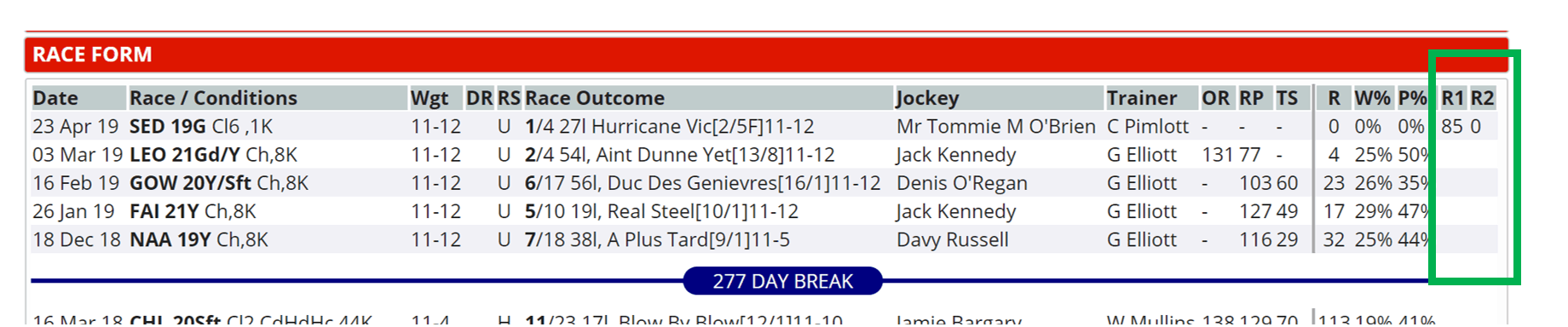
The best races, Class 1, includes Listed, and Group/Grade 3, 2, and 1 races: Group races on the flat, Graded races in National Hunt. These are often contested by at least a subset of improving unexposed horses whose ability ceiling is not yet known. In such races, a maligned and consequently frequently overlooked metric is the good old 'Official Rating'.
Indeed - and don't tell those private ratings boys - backing all of the top two (plus joint-top/joint-second) official ratings horses in Class 1 races (Listed, G1, G2, G3) since the start of 2020 would have returned almost 200 points at Betfair SP at a return on investment of nearly 6.5% across close to 3000 bets. With a strike rate of 22%, this is a classic no brainer angle that, at the very least, will keep you in the game longer and without much pain. Obviously, using it as a starting point for further study is the suggested way to play.
[Incidentally, this angle has also made a BSP profit at five of the last seven Cheltenham Festivals and is +56.38 at starting price during that time]
**
I wanted to keep this post a little bit shorter than my usual long rambling affairs, so I'll stop there. As you can see, each different race type has different factors that I consider to be of the most importance. You may disagree, and that's fine of course: it's the name of the game.
But the point I'm trying to make is that, in any given race situation, I am not using a hundred factors; I may only be using two or three. But in different race types they will be a different two or three. Consequently, I never feel overwhelmed.
And, as I've mentioned many times previously - most recently here - if you choose the right races, rather than trying to look at all of them, or the ones the bookies want you to look at, you will give yourself the best chance. If you want to know more about choosing the right races, have a look at "The Price is Wrong", a little three-part exercise that you might find fun, and potentially helpful.
So those are my thoughts, now it's over to you. Which factors do you consider most important in specific race types? Leave a comment below, and share what you know. And if you want me to research something, also leave a comment and I'll do what I can if I have access to relevant data.
Matt
p.s. don't forget, if you fancy recording a little screen share of how you use Geegeez Gold, we're looking to publish some of your approaches on the blog. More info here >