On the fourth and final day of Tix Week, I'm going to bring it all together. As well as looking at yesterday's play - with a few observations on that - I answer some of your questions; share which framework I use in different scenarios; and offer a few hints and tips to optimise your placepot/jackpot play.
First, though, if you've not watched the previous video posts, you'll find the Plus Simple one hereand the ABCX one here and the Plus Pro one here.
[Tip: you can make the video clearer by clicking the cog icon bottom right and choosing 'quality' 1080p, and you can make me speak faster with the 'playback speed' option in the same place]
I hope you've enjoyed this short series of videos and maybe learned something new about placepots, jackpots and Tix. Do have a play with the software we've built: it's been designed to improve the results of all levels of player, and it's quite unlike anything else available in the UK for playing placepot and jackpot pools.
Matt
https://www.geegeez.co.uk/wp-content/uploads/2026/02/TixPlus.png320830Matt Bisognohttps://www.geegeez.co.uk/wp-content/uploads/2022/10/geegeez_banner_new_170x78.pngMatt Bisogno2026-02-27 10:02:462026-02-27 10:02:46Tix Week: Wrapping Up
Day 3 of Tix Week and, after a quick break yesterday, today we're looking at the new Plus Pro framework. It's the most user configurable way to play multi-race pool bets but does take a little more knowing than Plus Simple and ABCX. A little, but not a lot.
Before that, then, if you've not watched the previous video posts, you'll find the Plus Simple on hereand the ABCX one here.
OK, let's talk about Plus Pro. In a nutshell, if Plus Simple is an automatic car, Pro is a manual. It gives you more control, a bit more speed through the gears, but takes a little more knowing in the first instance.
Today's video - where I try to get through an inscrutable sextet at Clonmel, reveals all.
[Tip: you can make the video clearer by clicking the cog icon bottom right and choosing 'quality' 1080p, and you can make me speed faster with the 'playback speed' option in the same place]
Tomorrow, Friday, I'll attempt to draw all the strands together by sharing which framework suits which approach, as well as a bunch of better placepotting hints and tips.
In the meantime, if you have any questions, let me know in the comments and I'll be happy to cover them for you.
Matt
https://www.geegeez.co.uk/wp-content/uploads/2026/02/TixPlus.png320830Matt Bisognohttps://www.geegeez.co.uk/wp-content/uploads/2022/10/geegeez_banner_new_170x78.pngMatt Bisogno2026-02-26 11:35:382026-02-26 11:35:38Tix Week: Plus Pro
It's day 2 of Tix Week, woohoo! Today we're looking at the ABCX framework, one of the most common approaches for multi-race tote pool players. Before that, though, if you've not yet taken a look at yesterday's video post, you'll find that here. It covers the most simple way to play Tix (choose budget, choose horses, place smart bet) and if you're new to this sort of thing, it's a great place to start. To today...
What you need to know about ABCX
ABCX is a way to build multi-race tickets by ranking your picks A, B or C based on confidence, then structuring your bets so your strongest selections get the most coverage and your weaker ones get less, helping balance cost and potential return. Using Tix, the software does all the structure bits, so you just need to pick your horses and confidence levels.
This video explains everything, as I try to pick out a winning placepot at Catterick. [Tip: you can make the video clearer by clicking the cog icon bottom right and choosing 'quality' 1080p, and you can make me speed faster with the 'playback speed' option in the same place]
I'll be back on Thursday with a look at the Tix Plus 'Pro' variant, and then on Friday I'll share some general advice on picking between the frameworks as well as some 'pro tips' for playing placepot/jackpot bets.
In the meantime, if you have any questions, let me know in the comments and I'll be happy to cover them for you.
This week on geegeez, I'll be highlighting the different playing modes on Tix, our tote multi-race staking software. By the end of the week, you'll know about Simple, ABCX, and Pro - and when to use each scenario.
Very little, in truth. You choose your maximum budget, minimum stake per line, and the horses you want included; the software does the rest.
Watch this video, where I walk you through a placepot play using Tix SIMPLE. I've had a crack at Plumpton's main meeting £50,000 guaranteed pool and, as well as mentioning a couple of things to look out for when playing placepots, I also discuss the mechanics of Tix SIMPLE. It bears repeating, though, that you don't need to know how it works particularly; you just need to know that it's a better way to stake the placepot you already play.
Here's the video. [Tip: you can make the video clearer by clicking the cog icon bottom right and choosing 'quality' 1080p, and you can make me speed faster with the 'playback speed' option in the same place]
Back tomorrow with Part 2, where we'll laser in on the ABCX framework.
But, for now, why not have a crack at TIX yourself this afternoon? Go here to check it out.
Matt
https://www.geegeez.co.uk/wp-content/uploads/2026/02/TixPlus.png320830Matt Bisognohttps://www.geegeez.co.uk/wp-content/uploads/2022/10/geegeez_banner_new_170x78.pngMatt Bisogno2026-02-23 11:27:002026-02-24 11:01:45Tix Week: Plus Simple
If you play the placepot (or jackpot, quadpot or any other multi-race pool bet), you'll know the joys and frustrations of the bet. On the upside is the chance to cop a very tidy sum for a modest investment; flip the coin and you'll get back less than you laid out or, quite often, miss by one leg (usually, though infuriatingly not always, the trickiest one).
How we used to play the placepot
For me, aside from those Kiplingesque "twin impostors" joy and frustration, bets like the placepot - and especially the jackpot - are a fantastic puzzle. The challenge is always to 'win twice': first, we have to correctly identify the winner/a placed horse in each leg; and second, because of the pooled nature of the wager, we have to occasionally go where the masses shun. We have to find a race (or two) where the winner and/or the horses in the frame are less obvious and, therefore, less endowed by tickets in the pool.
This, clearly, is tricky in the extreme with a single line running through six races. As we include more selections race to race so the multiplication gets more daunting and the dilution of our stakes makes for a less rewarding potential return... unless we hit that glorious home run whose increasingly distant and rose-tinted memory keeps us coming back for more in spite of the evidence from the interim.
The thing is, when we hit that wonder score with a caveman* ticket, we got lucky. Massively lucky. And, let's be clear, day to day we always need luck during the sextet of races. But I know how unsophisticated I was when I bagged my biggie...
I'd played a two horses per race combination: 2 x 2 x 2 x 2 x 2 x 2 = 64 bets, at 10p per line. It was Ripon and a friend of mine, Gavin Priestley (with whom you may be familiar from his excellent Festival Trends work) and his brother Gary, also a pal, had three betting shops in the Torbay area. They offered early odds based on a tissue (set of prices) they paid for.
Anyway, the opening race this day at Ripon was a maiden and there was a 'springer' in the market on their tissue, but generally offered at long odds elsewhere. As it turned out, he returned much shorter - probably close to single figures though I don't exactly recall. He finished second, with unfindable horses immediately in front and behind, and the placepot pool was decimated by first leg casualties. Actually, more than decimated: there was only about 2% of the pool left, according to teletext.
The rest of the card went far closer to expectation but the dividend still returned £6876.30 to a £1 stake. I had managed to hit four of my 10p lines (one each in four legs, two apiece in the remaining pair), so copped for 40p of the payout, or £2,750.52. I was a student on summer holidays at the time, and you can imagine the disco we had that night!
*caveman ticket: a bet where no thought has gone into the staking, and all selections carry the same chunk of your wedge regardless of being odds on or 20/1.
Why we shouldn't play placepot like that
That sublime payoff came in, I think, 1993 when I was 22 years old (I went to uni a little bit later as I'd worked in a Job Centre for a while beforehand). Thirty-something years have since passed and I have never got especially close to reprising it. Now, it should be said that a fair number of years ago I changed my staking approach and in so doing have narrowed the range of possible outcomes: in plain English, I'm using smarter staking that places more of my bunce on more likely combinations and less of it on those Hail Mary plays. In other words, I'm doing it better these days.
The harsh reality is that, although I copped for a bigg'un during my formative punting years, that approach generally returned zero or something close to zero. It was a conveyor belt of famine punctuated by the occasional 'happy meal' and one enormous episode of all-you-can-eat gluttony. The reason I remember it is because it was a monstrous outlier.
Candidly, and without wishing to be a fun-sucker, I had significantly over-staked on an outsider in that wager. I can't remember what price the other horse in that race was but it would have been the jolly, or at worst the next in. Let's be generous and say it was 4/1 with the other one being 16/1 (again, I don't remember the detail but this is illustrative enough). In that situation, I had the same stake (half of the entire bet because it was leg 1) running on to a pair of horses, one of which was four times more likely to make the frame than the other!
Let me emphasise this point with more real world numbers. Let's suppose for a moment that we're playing the jackpot - so we don't have to calculate place odds - and that in a fictional sextet of races, we play the 2 x 2 x 2 x 2 x 2 x 2 = 64 bets combo on horses priced at evens and 2/1 in each of the six legs.
The market reckons the chances of all of the even money shots winning is 63/1 (2 x 2 x 2 x 2 x 2 x 2 = 64), or about a 1.56% chance.
But what do you suppose the odds of all the 2/1 shots winning are?
The math is simple again: it's 3 x 3 x 3 x 3 x 3 x 3 = 729 (or 728/1). That's about a 0.14% chance!
So you can see that including a lot of 16/1 shots in a placepot, or 10/1 shots in a jackpot, is at best extremely inefficient; and at worst, the punting equivalent of death by a thousand cuts.
Key takeaway: not all horses have equal chances to win or make the frame, even if/when we like their chance more than the market does. And so we should not stake every horse in every race to the same amount.
Why we make dumb bets
The maths are unarguable, and I know you know that. Very possibly, like me in the good old bad old days, you're making poor plays on the placepot.
But, as all the best sales copy likes to reassure you, it's not your fault...
They made you do it. Those tricksy tickets with their rows of boxes and handy little multipliers. They practically sleepwalk you into sculpting your rock of punting marble into a pebble of a winning ticket, gradually chipping away what turn out to be quite large chunks of your funds.
Think about that 2x2 through six races. Imagine you get one horse placed and one out of the frame in leg one. You've done half your dough there. Now imagine you had a 4/1 and an 8/1 as your brace on leg 1, and the 4/1 places. Let's say it was a quarter the odds the place for ease of calculation purposes, and we end up back with evens and 2/1. One has a notional 50% chance to place and the other 33% or so.
They should not be staked the same!
The real issue is that this seemingly small error is compounded six times in a placepot or jackpot bet with level stakes: a caveman bet. There's a reason it has that rather unflattering name.
And then there was light
Before too long - and it must have been unimaginably miserable prior - cavemen figured out how to make fire and, with that, light and warmth and cooked food. They never, ever returned to the dark cold raw days that preceded their pivotal discovery.
In its own small way, discovering smarter staking - without the need to do the clunky maths and place the tickets manually (although I did that for a while!) - has made me a smarter staker. Obviously.
If I'm being honest, I play the placepot far too often, even when I have nothing in the way of strong opinions. That hurts my bottom line, but smart staking keeps me in the game just fine. And I love the companionship of a race every half an hour while I'm working in the house alone. It's not just about winning, you know!
However, winning is obviously important. I've been wining a few quid consistently on small stakes jackpot tickets, and giving it back on the placepots because of their comforting side effects. I consider that a more than agreeable trade off. You may not, in which case you'll need to be more discerning with when you play the 'pots. All fine.
But none of us should be playing caveman perms any more. Let me spell it out for you...
How to Make Smarter Placepot / Multi-Race Bets
Until now, Tix, the tool I co-created with the guy who built the vast majority of the geegeez.co.uk racecards, has been a little under-appreciated by 'two by two' players because - I admit - it looks a little daunting on first inspection. It's really not. But I don't want you to just take my word for that, so I'm going to show you.
Smarter Placepot Bets #1: ABCX
Tix features something called ABCX, which is a means of making some horses more important than others on your tickets. It's a lot better than caveman staking.
However, if I really can't persuade you to try a different way and that is your preferrred style, just picking all horses in the 'A' column makes it possible to place your straight perm ticket on Tix - and receive a 5% bonus on any winnings. By the end of this post I hope you'll see there's a better way - which is equally simple.
ABCX allows users to separate their strongest fancies in a race (A) from their warm fancies (B) and their live outsiders (C) - as well as those horses which are not of interest (X). I've produced some video content about it here, and Dave Renham wrote some further content on ABCX here.
It's a great way to differentiate between horses you really like and those you kind of like, or horses that are short prices and those that are longer odds.
But it's not perfect. The staking approach is a little 'blocky' - think Minecraft or Sensible Soccer rather than Grand Theft Auto - so, while it's much better than level staking, it lacks nuance and it doesn't really allow the user to sculpt a ticket to their own preference. Despite that, I still sometimes favour it over...
Smarter Placepot Bets #2: Tix Plus 'Simple'
New in Tix this week is a second framework called Tix Plus. It's further split into 'Simple' and 'Pro' variants, which sit either side of ABCX in terms of ease of use.
Plus 'Simple' really is simple: you pick your stake and your horses and let the software do the rest. That's it.
But what's happening under the bonnet is clever, very clever.
First things first, though. To access Tix Plus, you need to change the 'Betting Mode' dropdown from ABCX to Tix Plus, like so:
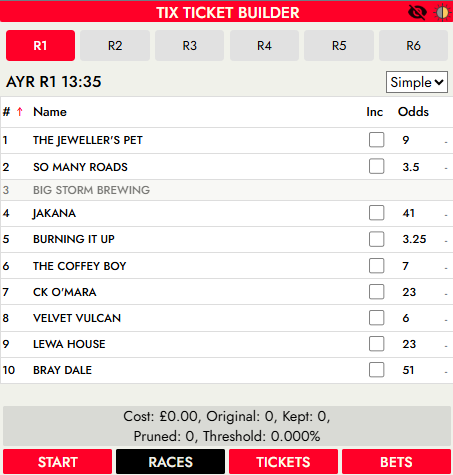
Then pick your meeting and pool, and you'll be taken to the RACES tab. For Tix Plus in 'Simple' mode, it looks like this:
Let's quickly talk around this view. At the top are the legs of the bet (R1-R6, races 1 to 6), and just below that is the specific race (AYR R1 13:35, race 1 at Ayr, due off at 1.35pm UK time). On the right of that is another dropdown, currently set to 'Simple'. This is where you can choose the 'Pro' version if you prefer; I'll come on to that shortly.
The main body of the view has saddlecloth number, horse name, a column of checkboxes called 'Inc' (include), and the current odds in decimal. Later in the day (from 9am), the dashes on the right of the screen may include some arrows: a green 'up' arrow means a horse has been supported, a red 'down' arrow means it is drifting.
All columns are sortable and, personally, I tend to sort by odds so that I can quickly see the betting shape of the race.
At the bottom of the view is a summary displaying ticket cost, the total number of possible permutations/tickets, the number of tickets that will be placed and the number which will be 'pruned' (not placed), and the threshold at which that decision will be made.
Let me explain that, but I'll first say that the only thing you must know is that, usually, not all possible permutations/tickets will be placed. That is, there will normally be at least some tickets in the 'pruned' pile.
So what's happening behind the scenes here?
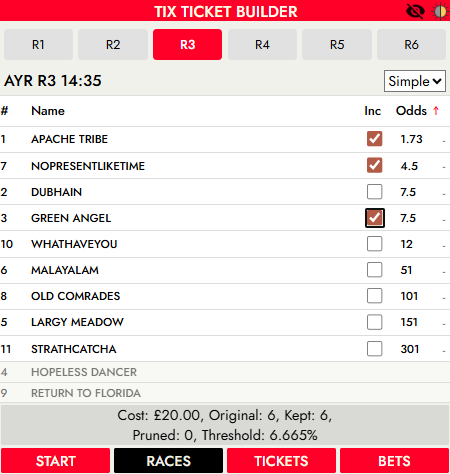
After you've chosen your stake and your minimum unit stake (I suggest starting with 1p for unit stake), you begin to build your tickets. The image below is after I've picked my horses in three of the six legs:
I've set my budget here to £20, and (unseen) I have two horses in R1, a banker in R2 and (visible here) three horses in R3. 2 x 1 x 3 = 6 possible tickets, and all are kept at this stage.
Let's go ahead and fill out the rest of the perm:
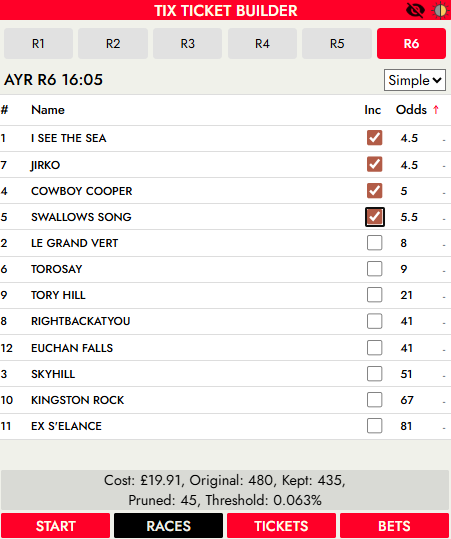
So it turns out the second half of this placepot sextet was much more competitive looking than the first. I ended up, for illustration purposes it should be said!, taking five horses in R4, and four each in R5 and R6. The image above shows R6, and my total possible tickets are 2 x 1 x 3 x 5 x 4 x 4 = 480. See 'Original: 480' at the bottom of the image.
But... the software is only retaining 435 of these and is discarding 45. Why, when £20 is plenty to cover 480 bets at 4p per line, is it not covering all permutations?
The answer is because not all lines are created equally. In my leg 3 (see image two up), I have an 8/11 (1.73) shot and a 13/2 (7.5) chance. Clearly the market doesn't believe they have the same prospects of placing, and neither do I. If we move on to the 'TICKETS' tab, you'll see what's happening here:
There's a lot going on in this image, so let's break it down. The main body of the view is dedicated to the tickets to be placed. The table headings are ticket (the selected horses on each ticket), %age (the percentage chance, based on the current win odds, of that ticket containing six winners*), £/line (the stake per line in that ticket), # (the number of lines in that ticket), Total (£/line x #, stake x lines, e.g. in th top row, £0.13 x 4 = £0.52).
I've clicked the little 'i' icon to the left of the first ticket, and it shows the individual breakdown of the four lines contained within it. Clicking the 'i' icon in the header row will open all of these should be curious to that microscopic level of detail!
There is then a 'PLACE TICKET' button at the end of each row. There is also a 'PLACE ALL BETS' button at the top. When you're happy with your bet, you can click that button and all tickets will be placed into the tote's pool.
*it is a little misleading to use win odds on placepots and other place pools as it implies your chances of getting a payout are hugely lower than they actually are. We will amend this in the next version but, for now, the key component is the 'threshold'. So let's quickly discuss that...
Threshold is the point at which two elements collide: your allocated budget running out, and the chances of a combination of horses being successful based on their odds. Basically, if there isn't enough money to proportionately stake all combinations, the software starts with the least likely single line combination of horses (based on their odds) and eliminates that combo. It carries on doing this until there are sufficient funds for the remaining 'kept' bets.
In this example, all bar 35 of the 480 possible combinations have been kept, at a total cost of £19.91. To see the combo's that were pruned, click the green 'Show Filtered Out Tickets' button:
All 45 pruned tickets included the '3' horse in R3. That was the 13/2 shot selected alongside an 8/11 and a 7/2.
The magic here is that, whereas £20 staked evenly across 480 bets would cover every possible pick for 4p, in Tix we have the most likely combinations covered for as much as 13p per line, and 106 different combinations covered for at least twice that 4p base stake.
Naturally, the flip side is that the least likely combo's have less than 4p staked on them, but those tickets - should they hit - will pay a much bigger dividend.
Tix is a realist, not a fantasist. It leans into the most likely outcomes and away from the Hail Mary's whilst still covering a fair number of those long shot bombs (depending on budget and unit stake).
Why is this good, and why is it bad?
Well, the bad news is you're less likely to hit that once in a lifetime payoff... but the good news is that, day to day, you'll get more returns that will keep you in the game longer and you still have the chance of plenty of fat divvies along the way.
Reminder: Tix Plus 'Simple' is choose stake, pick horses, place bet. The clever stuff is completely hands off.
Smarter Placepot Bets #2: Tix Plus 'Pro'
For the architects and sculptors out there, you - like me - can opt to be a little more hands on.
Welcome to Tix Plus 'Pro'!
This really is very cool, and it's the unidentical twin of Tix Plus 'Simple'.
Here's how 'Pro' looks:
The differences are two columns and one row. Columns first.
To the right of the odds/arrows columns are '%age' and 'Book'.
'%age' is a smoothed book percentage including the whole fields. It's done in 5% increments until we get to the serious longshots where 1% becomes the norm. In the example above, we see that Apache Tribe, odds of 1.83 (5/6 fractional) has a 45% %age. You might also note that the %age figures don't sum to 100. This is fine, because the 'Book' figures will always sum to 100.
In this example, we have three selected horses whose '%age' values are 45, 20 and 10, totalling 75. The 'Book' value for the favourite is 60, calculated simply by divided his '%age' by the sum of all selected '%age's. That is, 45/75 = 0.6 or 60%.
The beauty of 'Pro' is that you may overwrite any '%age' figure to emphasise your personal opinions.
If you love the jolly but still want a small bit of cover elsewhere, make that 45 number bigger. If you respect the jolly but feel his chance is over-stated, edit 45 to a smaller number. Below I've changed that %age to 35 and you can see how the division of stakes has changed in the 'Book' column.
By doing this, users can very tightly define the distribution of their budget through the bet.
The extra row appears at the bottom of the RACES view, and it is for 'Unnamed Favourite' (UNF). UNF doesn't show up on the 'Simple' version because it doesn't have a book percentage: we don't know which horse will be favoured, still less what price it will be.
In the 'Pro' view, selecting UNF will remind you to add a %age for it (see below). If you don't, it will simply be ignored. The chosen percentage will then be factored into the 'Book' calculations outlined above.
At the end of the sequence (six legs in this case), you'll again have summary info at the bottom of the view. This time, you can see I've got 459 of 480 possible combinations retained, and 21 pruned. The threshold is also slightly higher, which means my top staked ticket is now 12p per line rather than 13p previously, and I have slight amendments to other combinations. All of that is done in the engine room and is invisible to the user.
But you have ultimate control with Tix Plus 'Pro', so if you want to change things just tweak the '%age' figures in the races where you want that change.
Like I said, this is certainly not for everyone, but for those who want greater control over their multi-race pool play I think Tix Plus 'Pro' is like hitting the jackpot!
The Ultimate 'Smart' - Bonus Payouts on All Winning Tickets!
Tix enables everyone to bet placepots, jackpots and other multi-race tote bets in a smarter way. That already gives you a much better chance of coming out ahead. And, to compound that advantage, all winning tickets placed through Tix benefit from a 5% bonus. Every £100 in winnings get £5 more.
Let's say over a year you staked £2600 through Tix (£50/week, about £7/day), and your returns were £2500, a loss of £100. £2 a week for some daily fun is definitely a price I'd pay! But because of the 5% bonus, that £100 loss becomes a £25 win.
Now, obviously, there's nothing life-changing there; but the point I'm trying to highlight is that the bonus can easily be the difference between winning and losing over time and, of course, if you're a winning placepot punter, you're just going to win more!
Otherwise, you'll need to sign up with the tote first. You can do that here, then go to the link above.
I can't wait to hear how you get on with Tix Plus - and, of course, if you have any questions, just leave a comment below and I'll be sure to get back to you.
Matt
https://www.geegeez.co.uk/wp-content/uploads/2026/02/Gemini_Generated_Image_tbq4nktbq4nktbq4-scaled.png9852560Matt Bisognohttps://www.geegeez.co.uk/wp-content/uploads/2022/10/geegeez_banner_new_170x78.pngMatt Bisogno2026-02-10 19:14:022026-02-10 19:27:19Introducing Tix Plus: A Placepot Tool for Everyone
Using Tix for Jackpots, Placepots, Quadpots & the Scoop 6, primarily focusing on Placepots
Geegeez readers should by now be aware of the online software called Tix, which Matt built in conjunction with the developer who built much of the coding for the original geegeez.co.uk racecards and form tools, writes Dave Renham. The Tix software is designed to be used for tote multi-race pool bets such as the Jackpot, Placepot, Quadpot and Scoop 6. It enables punters to produce more sophisticated and strategic permutations than the bog-standard perm approaches most punters use.
Tote Bets: A Quick Intro
Before discussing the software, it should be noted that the Tote take a percentage out of any final pool, the amount depending on the bet. Below is a table showing the percentage take-outs for the main pool bets:
Pool bet
Percentage taken out
Jackpot
29%
Placepot
27%
Quadpot
26%
Scoop 6
30%
As we can see they are all in the same ballpark. If we consider the Placepot, therefore, if 27% is taken out that leaves 73% of the original pool being shared between winners.
To help understand the maths, here is an example. For a final total of £100,000 bet into a particular Placepot pool where there was £200 remaining at the end of the six races, the dividend would be worked out thus:
£100,000 x 73% = £73,000
£73,000 divided by 200 = £365
£365 is the dividend is to a £1 stake.
The lure of Placepots and Jackpots is the chance of a big payout for relatively small outlays. Personally, I have never regularly played the Jackpot but play plenty of Placepots. I’ve been fortunate enough to have enjoyed some reasonable wins, and one very big win, but of course there have been many occasions when I have lost all of my stake. As far as this article is concerned, I am going to focus on using Tix for Placepots, because it is the most commonly played of the tote multi-race bets.
Playing Placepots the Traditional Way
Let's first look at how we could play these pool bets without the aid of Tix.
One line 'Hail Mary'
The first method is to simply pick one horse in each race. In a Placepot, there are six legs and so that would be six horses. In order to win a share of the Placepot all six must either win or place. This would be the case even if we pick six favourites. For those wanting to put the favourite in as the only selection in each of the six races, this is possible because there is a Placepot option to back the unnamed favourite.
Tthere are plenty of races where the market is quite tight at the top and we would be guessing which horse is sent off favourite, so for ‘favourite’ fans this is a useful option. However, the chance of all six favourites winning or placing is surprisingly rare. Indeed, looking at the 177 flat race meetings held in the UK in April and May of this year only 13 times did six favourites win or place in each of the first six races on the card.
However, that did not mean there would have been 13 theoretical winning Placepots for favourite only backers. This is because three of these 13 did not count due to a situation where a joint favourite won or placed, but the other joint favourite did not. When this happens there can only be one horse deemed to be favourite so the horse with the lowest racecard number becomes the favourite for pool bet purposes. Hence, if we had gone down the unnamed favourite Placepot route in April and May we would have had 177 Placepots bets of which 10 won.
The problem with all favourites placing is that the dividend tends to be very low when this happens, and that was the case with all ten dividends as the table below shows:
Date
Course
Dividend to £1 stake
7th April 2025
Kempton
£6.20
12th April 2025
Brighton
£12.40
12th April 2025
Thirsk
£8.00
1st May 2025
Redcar
£11.50
3rd May 2025
Goodwood
£9.90
5th May 2025
Windsor
£10.50
9th May 2025
Nottingham
£7.30
21st May 2025
Chepstow
£13.20
23rd May 2025
Goodwood
£5.90
26th May 2025
Windsor
£8.00
If we had placed let’s say a £2 bet on each of the 177 Placepots our outlay would have been £354. Our returns would have been £185.80 showing a LOSS of £168.20. Ouch!
Favourites obviously command the most amount of money wagered in Placepots which is why, when all six win or place, the dividends are so low. Interestingly, there were two meetings in April and May where no favourites placed in any of the six races – the dividends for these meetings were somewhat different.
Date
Course
Dividend to £1 stake
19th April 2025
Musselburgh
£1954.50
31st May 2025
Lingfield
£4022
The '2x2'
For seasoned Placepot players selecting a single horse in each race is not a credible strategy. In the period discussed we have seen that putting the favourite as the only selection in each race secured a winning Placepot less than 6% of the time, and delivered significant losses.
An alternative and more popular approach is to choose two horses in each race giving players more coverage. We call this a permutation, or perm. If we choose two horses per race rather than one, the number of bets or lines goes up drastically from one to 64 because we multiply the number of selections per race to get the total number of selections.
1 x 1 x 1 x 1 x 1 x 1 = 1 while 2 x 2 x 2 x 2 x 2 x 2 = 64
Take three horses per race and we are looking at 729 bets or lines.
Obviously, the chances of winning part of the pot increase but the more bets/lines we have the more we are staking, which will have an impact on any final returns.
Variable perms
To try and reduce the number of perms, some Placepot players vary the number of horses chosen for each race. Hence, they may have a couple of races where they choose just one horse – a so called ‘banker’; perhaps they have three horses in two of the other races, and five in each of the final two races.
In this scenario the number of bets or lines would be calculated 1 x 1 x 3 x 3 x 5 x 5 which equals 225 bets. This idea covers 18 horses in total (the same as the three horses in every race perm) but cuts the number of bets/lines down considerably.
Thus, varying the number of horses chosen per race is the most sensible method discussed to date; but it is time to talk Tix and a more sophisticated approach to adjusting the Placepot perms.
Introducing Tix
The Tix software allows us to use what is known as the ‘ABCX’ approach. This approach essentially allows players to group horses by order of confidence / perceived chance. In terms of a Placepot the thinking would be along these sorts of lines (or at least this is the way I think!) -
A Horses – horses that I believe are genuine contenders to win or place; or horses that I perceive to be overpriced within the mid-range of prices such as a 10/1 shot that I think ought to be 5/1, or a 12/1 shot that is 6/1 on my reading of the race.
B Horses – the next best options that we can make a case for especially if one or more of the A contenders underperform.
C Horses – horses that are unlikely to win but have some chance of placing. An example may be a horse overpriced at 33/1 we perceive should half that price at least. Or a less fancied horse well drawn over a course and distance that has a strong bias.
X Horses – horses that are excluded from calculations as their win or place chance seems extremely unlikely or I feel they are significantly over-factored in the market.
For Placepots my preferred approach is to have more A’s than B’s and maybe one or two C’s. However, for bigger meetings such as Royal Ascot, I tend to load up on A’s and have more C’s than B’s. I am sure others will have alternative approaches that may well be better than mine. Hopefully the more I use the software the more I can finesse my methods.
In terms of the Tix software the A horses will occur in more bets/lines than the B’s that in turn occur in more bets/lines than the C’s. The table below shows all the possible combinations or perms for each individual Placepot ticket – I have colour coded them to help make it clearer. A rated selections are in red, B are in black and C are in green.
This way of combining the horses is far more efficient and a lot cheaper! The way Tix is designed is that we can have a maximum of 28 individual tickets and this only occurs if we pick at least one horse in each of A, B and C positions in every race - as per the image above.
Tix Selection Flexibility
Keeping to the ‘three horses in a race scenario’, here are total number of bets/lines based on the Tix options, assuming we keep to the same combination for all six races. It includes the two I have already shared:
Combos
All 3 on A
2 on A, 1 on B
2 on A, 1 on C
1A, 1B, 1C
1 on A, 2 on B
1 on A, 2 on C
Total Bets
729
496
256
28
73
13
The table shows the flexibility of the Tix software in terms of being able to offer various ‘number of bet’ scenarios, and remember, these example numbers are based on choosing the same A, B and/or C combination for all six races. Assuming we wanted to put three horses into each race we of course could choose a different three-way combination for each race such as:
Race no.
Column A (no. of selections)
Column B (no. of selections)
Column C (no. of selections)
Total no. of horses in race
1
2
1
0
3
2
1
1
1
3
3
1
2
0
3
4
3
0
0
3
5
1
0
2
3
6
2
0
1
3
This particular Tix construction of three horses per race would equate to 138 lines. It would take several pages to list all possible Tix bet constructions of three horses in each of the six races, so I’ll spare readers that! On the Tix site, our ticket with this type of perm/construction would potentially look something like this:
To be clear, the green column is for A picks, the yellow is for B picks, and C picks are in the right hand sandy coloured column. And these numbers in the specific columns would give us the following ten tickets:
As we can see, for this example there are ten specific groupings (tickets), and we would need at least one of those of ten groupings to have a win or placed horse in each of the six races to get a return. Of course, we may achieve a return that is less than our original stake, so six ‘win or placers’ on one of the tickets does not guarantee a profit.
If all eighteen horses manage to place then we probably would be dreaming but in that unlikely scenario these ten specific groupings/tickets would combine to have all 138 bets/lines as winning ones.
Tix Staking Flexibility
So, one of the brilliant parts about using Tix is this selection flexibility. A further feature in terms of flexibility is that we can adjust our stakes in terms of the four main groupings. This is the default position with the same stakes on each:
However, anyone who has seen Matt post his Tix selections on the site (like he did brilliantly at Royal Ascot 2025, I might say) will know he has a favoured strategy thus:
- All A's: 4x unit stake
- Five A's with one B pick: 3x unit stake
- Four A's with two B picks: 2x unit stake
- Five A's with one C pick: 1x unit stake
Using the ‘Matt Method’ we would simply tick the relevant boxes thus:
Using the example of my ten tickets shared above, this means ticket 1 (all A's) has a 4x amplification, tickets 2 to 4 (any 5 A's with 1 B) are 3x unit stake, tickets 5 to 7 (any 4 A's with 2 B's) are 2x normal stakes, and tickets 8 to 10 (any 5 A's with 1 C) are 1x stakes.
Of course, this stake amplification on certain tickets will increase the overall outlay but we're pressing up our strongest opinions whilst mixing in some 'big dividend' prospects.
In this specific example based on an original 1p per bet/line, and having no increase in stakes (so betting all lines with the same stake of 1p), it would cost £1.38.
Using the 4-3-2-1 Matt method would increase stakes to £3.00. The reasoning behind Matt’s staking plan is logical. The A horses are more likely to win or place than the Bs, who in turn should outperform the Cs. Hence the all-A column should have the highest stake, the 5A 1B column should come next and so on.
This staking method is one option, possibly the best one; obviously there are plenty of others that could be used. Also, at this point, it should be noted there is another way to adjust our stakes. We can adjust individual tickets by clicking on the ‘stake’ box at the bottom of each ticket and changing the default stake.
For those readers who have yet to use Tix, how to use the software is specific to each individual. Some I’m sure will not adjust stakes, some will. Some will load up with A’s, some may spread their horses more evenly. However, it is important to appreciate that each race meeting is different, and we are likely to play a Placepot at Carlisle with very few runners on the card differently to one at Royal Ascot where field sizes are much bigger and very competitive.
Wider Coverage
Thinking of the bigger meetings like Royal Ascot with their huge and competitive fields, it is likely that there will be an increase in the number of horses that will be used in our placepots. Earlier I looked at an imaginary three horses per race scenario sharing how placing them in different columns affected the total number of lines. Now let's look at the same idea using four horses per race (24 horses in total). Again, I have assumed that we have split the horses into the same columns for each race. Obviously placing four horses in the exact same columns for each of the six races is something that in practice we would almost definitely not do, but my reasoning is two-fold. Firstly, it is easy for me to calculate and share the total number of bets for each grouping. And secondly it gives us a decent understanding of the ‘number of total bets’ differences we can get using this flexible software:
Combos
All 4 on A
3 on A, 1 on B
3 on A, 1 on C
2 on A, 2 on B
2 on A, 2 on C
Total Bets
4096
3402
2187
1408
448
Combos
2 on A, 1 on B, 1 on C
1 on A, 3 on B
1 on A, 2 on B, 1 on C
1 on A, 1 on B, 2 on C
1 on A, 3 on C
Total Bets
688
154
79
34
19
We can see that if selecting all 24 horses in the A column (four in each race) the number of bets/lines is a massive 4096. However, when we spread them more evenly but keep mostly A’s, such as a 2A, 1B and 1C scenario for each race, this cuts the bets/lines down to 688.
As I mentioned earlier for ease of calculations, I have assumed that each race has the same A, B, C combo or grouping. But, of course, Tix players will play each race according to its make-up. Considerations will be affected by the number of runners, the individual strengths of the runners, the relative prices of those runners, etc. For example, a three-runner race with a 1/12 favourite could see us choose that favourite on A as a stand-alone banker. A three-runner race where all three horses are priced between 13/8 and 2/1 may mean we choose all three in the A column. Only one of them will count in a final Placepot dividend while the other two will be losers and all lines involving those two will ‘die’.
Example Tix Play: Royal Ascot
I now want to share my Tuesday Placepot at Royal Ascot this year and how I played it using Tix. In terms of staking, I didn’t use Matt’s 4-3-2-1 method, I simply kept to the same 1p stakes per ticket.
Leg 1 - Queen Anne Stakes:
This was the race I previewed for Geegeez on the Tuesday and happily my two selections came first and second. The winner, Docklands, returned 14/1 (backed in from 25/1) so that was a good start to the week on an individual punting front. The runner up Rosallion was favourite and pre-race I was tempted to leave him as the stand-alone ‘A’ selection in my Placepot; but the race did have a very competitive look about it. So I played safe taking five selections across two columns. I also split Rosallion and Docklands up putting Docklands on C – silly me as that turned out.
Leg 1 selections
A – numbers 4 and 10
C - numbers 3, 5 and 6
Horses that won/placed: one A, and one C
Leg 2 - Coventry Stakes:
These 2yo races with loads of runners and little form are the ones I fear most in Placepots with only three places available (and so it proved here). I went big trying to cover as many bases as possible with four A’s and four C’s:
A – numbers 1, 2, 13 and 20
C - numbers 8, 9, 11 and 17
Horses that won/placed: one C
This was frustrating from the point of view that two of my A selections finished fourth and fifth. On the flip side, I was still in the pot with one of my C’s placing, and two of the placers were 66/1 and 80/1 meaning very few tickets had those runners on them.
Having played just A’s and C’s I was now needing at least one A horse to win or place in the final four races.
Leg 3 - King Charles III Stakes:
This was another horrible race with 23 runners and only three places up for grabs. My only strong opinion on the race was that American Affair was overpriced and I was happy for that to be one of my A’s. I went four A’s and two C’s. American Affair won.
A – numbers 1, 7, 14 and 16
C - numbers 3 and 12
Horses that won/placed: two A’s
Leg 4 - St James's Palace Stakes:
Although there were only two places available in this seven-runner race, there were four rags and an odds-on fav in Field Of Gold. I had him and Henri Matisse as my A’s. No need for any ‘C’ cover.
A – numbers 1, 3
Horses that won/placed: two A’s
Leg 5 - Ascot Stakes:
There were two at a price I liked here in Nurburgring and Ascending. I decided to split them with Nurburgring on A and Ascending on C. I put one of the well fancied Mullins pair on A and what I hoped was another live outsider on C.
A – numbers 13 and 20
C - numbers 3 and 9
Horses that won/placed: one A, and one C
Ascending beat Nurburgring for a £665 exacta (and no I didn’t have it!). At least I had one A selection that counted so was still in the Placepot game with one to play.
Leg 6 - Wolferton Stakes:
With no eventual non-runners this 16-runner Listed race had only three horses to count in the Placepot. Before the race I was very keen on Sons And Lovers thinking this must finish in the frame. I decided two have two A’s and one C.
A – numbers 9 and 14
C - number 15
Horses that won/placed: one A
Sons And Lovers faded into fifth annoyingly, but fortunately my other A got the job done.
Here's how these selections would have looked in the Tix columns.
Leg
Column A
Column B
Column C
1
4, 10
3, 5, 6
2
1, 2, 13, 20
8, 9, 11, 17
3
1, 7, 14, 16
3, 12
4
1, 3
5
13, 20
3, 9
6
9, 14
15
The numbers in bold are the horses that won or placed, but two of them ended up being redundant (number 5 in leg 1 and number 9 in leg 5). The rest, in red, counted on one of the '5 on A, 1 on C' lines and, because I had two win/placed horses in two of the races, I ended up with four winning lines (1 x 1 x 2 x 2 x 1 x 1).
The Placepot to a £1 stake paid £2767.40 meaning each of my four 1p lines netted £27.67, so the overall return on that winning ticket was £110.68 (£27.67 x 4 winning lines). Taking my stake into account and the 5% bonus the Tote pays on winning Tix tickets (yet another reason for using Tix!), I ended up with a profit on the bet of just over £102.
What if?
One two-word phrase we are all too familiar with is ‘what if?’ - so, just for fun, I am going to play that game now. What if I had put six of my original selections in different columns? More specifically, what if my three ‘placers’ on C had been put on A instead; and three of my ‘losers’ from A had been put on C instead?
To achieve this scenario, I could have swapped horses 4 and 5 over in race one, horses 1 and 9 in race two, and horses 20 and 3 in race five. If I had instead done that, I would have had two places in legs 1, 3, 4 and 5, and one place each in legs 2 and 6. That would have given me 16 winning lines quadrupling the return to over £400. Considering all my selections were in A and C this scenario could have happened. Likewise, if a few of my winning A’s ended up as C's I would have won diddly!
Sticking with the ‘what if?’ line, what if my original ticket had been staked differently using Matt’s 4,3,2,1 method? Well, due to only having one successful 5A 1C combo the same payout of £110.68 would have occurred on that ticket (same 1p stake), but the cost of the overall bet would have increased by £7.68 meaning my overall profit would be slightly down at just over £94. (I appreciate that an extra £7.68 stake would have impacted the real-life pot, but it is such a small amount if I had played the bet this way instead my profit would have been virtually the same, give or take a penny or two).
I also looked at what would have happened if I had put all my C selections as B’s instead, sticking to my original 1p per line staking. This would have added an extra £20 or so to the overall stake but I would have had 12 winning lines so my return would have been around the £300 mark (allowing again for any marginal change in the actual Placepot payout due to the extra £20 of staked funds).
Summary
In this article I feel I have only scratched the surface when it comes to the potential and scope of the Tix software. In the first half of the article, I gave a general overview of how Tix works coupled with the flexibility it has in terms of limiting/varying the number of lines using certain configurations. In the second half I have delved into one of my recent Placepot plays looking at what happened, and what could have happened if I had made some slight alterations via Tix to the make-up of my Placepot.
Before writing this, I was a regular user of Tix. Having spent time researching and writing about it, my appreciation and confidence in Tix has improved even more. I am expecting Tix to help me profit further when tackling Placepots in the future. I might even be tempted into a few Jackpots too...
- DR
https://www.geegeez.co.uk/wp-content/uploads/2020/04/tix1.png237779Dave Renhamhttps://www.geegeez.co.uk/wp-content/uploads/2022/10/geegeez_banner_new_170x78.pngDave Renham2025-07-02 07:32:162025-07-02 08:11:11How to Use Tix for Multi-Race (Placepot) Bets
geegeez.co.uk uses cookies to improve your experience. We assume that's OK, but you may opt-out from the settings. Cookie settingsACCEPT
Privacy & Cookies Policy
Privacy Overview
This website uses cookies to improve your experience while you navigate through the website. Out of these cookies, the cookies that are categorized as necessary are stored on your browser as they are essential for the working of basic functionalities of the website. We also use third-party cookies that help us analyze and understand how you use this website. These cookies will be stored in your browser only with your consent. You also have the option to opt-out of these cookies. But opting out of some of these cookies may have an effect on your browsing experience.
Necessary cookies are absolutely essential for the website to function properly. This category only includes cookies that ensures basic functionalities and security features of the website. These cookies do not store any personal information.
Any cookies that may not be particularly necessary for the website to function and is used specifically to collect user personal data via analytics, ads, other embedded contents are termed as non-necessary cookies. It is mandatory to procure user consent prior to running these cookies on your website.