Tag Archive for: Musselburgh draw bias

Course & Distance Deep Dives: Musselburgh 7f, Windsor 1m

Back in early February, I wrote a piece about 3-mile handicap chases at Uttoxeter, writes Dave Renham. This was the third time I had looked at a specific course and distance and diving deeply into past statistics. I will again revisit this idea today, delving forensically into Musselburgh's 7 furlongs trip, focusing on handicap races only. And, as a ‘Brucie Bonus’, I will also look at the key stats in Windsor 1-mile handicaps. Two for the price of one!

I have noted before in the earlier articles that looking for patterns and pointers for races from a specific course and distance (C&D) is a type of trends-based approach. Using past race trends remains very popular – for example, for every race I bet on at the Cheltenham festival this year I first studied past race trends in an attempt to gain some extra insight into how the races may pan out this year.

For this article I have taken handicap data from 2017 to 2025. Profits are calculated to Betfair Starting Price (BSP) with returns adjusted for 2% commission. It should be noted that for all areas other than the draw and run style I have ignored 2yo handicaps. For the record there were only nine such 2yo races at Musselburgh.


Musselburgh 7f handicaps – an overview

Firstly, there have been on average 21 qualifying races a year over seven furlongs at Musselburgh (handicaps only), so a decent number. Just over 40% of the races were Class 6 races, the lowest tier, while around 65% were either Class 5 or 6. Let’s start the digging process.


Musselburgh 7f handicaps: Betting market

I am going to look at the betting market for our first main set of stats and specifically market rank. I have used the Betfair market for this:

 

Market-rank betting table showing runs, wins, win% and ROI by position from Favourite to 5th+ in betting.


The value has been with those second and third in the market, while favourites have been over bet. There were no ridiculously priced winners over the past nine seasons with the highest two being 50.0 and 58.93. Horses priced BSP 60 or more were 0 from 94 with just four placing.

It is interesting when we analyse favourite performance in more detail as there has been a big difference when we split their record by Class of Race.

 

Table: Favourite by Race Class with two rows (2–4 and 5–6) listing runs, wins, win% and ROI (BSP).


At the lower levels favourites have done OK. In better class races (4 and above) their record has been very poor indeed.


Musselburgh 7f handicaps: Sex of horse

Time to see whether the sex of the horse has made a difference. I have restricted races to mixed sex races (which was still a decent sample of 146 races), and below shows a comparison between the win and each way strike rates:
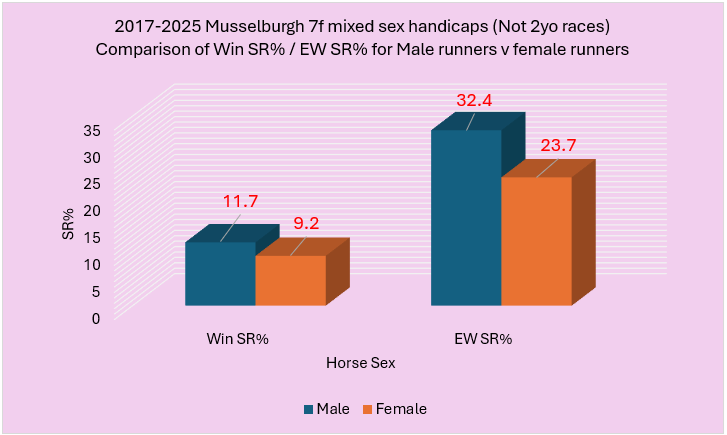


Bar chart comparing win and each-way strike rates by gender for Musselburgh 7f mixed-sex handicaps; Win SR%: Male 11.7, Female 9.2; EW SR%: Male 32.4, Female 23.7


The blue bars show there has been a definite edge to male horses, and the full splits were thus:

 

Table of horse performance by sex: Male 971 runs, 114 wins (11.74%), Win BSP 49.11, ROI BSP 5.06; Female 346 runs, 32 wins (9.25%), Win BSP -93.42, ROI BSP -27.


Males accounted for many more of the runners but made a blind profit to BSP. Of course, we need to double check these bottom lines have not been skewed by winners at huge prices, so here are the splits using a price cap of BSP 18.0 or less:

 

Table comparing performance by sex of horse: Male – 706 runs, 105 wins (14.87%), Win PL 43.39, ROI 6.15; Female – 216 runs, 29 wins (13.43%), Win PL −31.16, ROI −14.43.


We still see a clear difference between the sexes in these Musselburgh contests with males doing best.

I have said many times before, especially when using BSP for profit and loss, it often makes sense to use a price cap to avoid skewed findings. Therefore, for the remainder of the article, bar the run style and draw stats, I will be using the BSP 18.0 price cap.


Musselburgh 7f handicaps: Age

I am going to split the age stats into two – firstly I will look at 3yo+ handicaps, after which I will look at 4yo+ handicaps. So, 3yo+ handicaps first. Roughly half of all the handicaps over this C&D were open to 3yos and older:
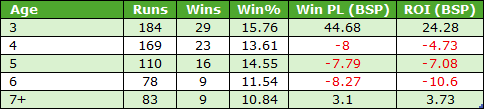
 

Table summarizing age groups (3, 4, 5, 6, 7+) with runs, wins, win percentage, win/place odds (BSP) and ROI (BSP).


There was a strong overall performance by the youngest age group, 3yos. Not only did they make a profit to win bets, but they would have made a small profit on the Betfair Place market as well. The 7yo+ group had the lowest win rate, as we would probably expect, but nudged into profit. However, four of their nine winners were priced between BSP 13.0 and 15.0 which helps to explain that.

A look at the 4yo+ handicaps now and the age splits. There were 64 such contests across the period of study:

 

Table showing performance by age group: Age 4, 5, 6 and 7+ with columns Runs, Wins, Win%, Win PL (BSP), ROI (BSP). Row 4: 138 runs, 24 wins, Win% 17.39, Win PL (BSP) 25.19, ROI (BSP) 18.25. Row 5: 120 runs, 14 wins, Win% 11.67, Win PL (BSP) -25.03, ROI (BSP) -20.86. Row 6: 63 runs, 10 wins, Win% 15.87, Win PL (BSP) -4.27, ROI (BSP) -6.78. Row 7+: 80 runs, 11 wins, Win% 13.75, Win PL (BSP) -9.76, ROI (BSP) -12.2.


We see a similar pattern here with the youngest horses, in this case 4yos, having performed best, and comfortably so. These 4yos have offered good value and their A/E index (BSP) backs that up with an impressive figure of 1.20.


Musselburgh 7f handicaps: Course form

Previous course winners have scored 15.4% of the time (57 wins from 365) for a small loss of £2.46 (ROI -0.7%).

Horses that had never raced at Musselburgh before saw 69 of them win from 471 (SR 14.7%) for a profit of £39.47 (ROI +8.4%).

Horses that had raced at the track before but had failed to win won 47 of 347 (SR 13.5%) for a loss of £31.02 (ROI -8.9%).


Musselburgh 7f handicaps: LTO Course

I am going to look now at where horses that contested these Musselburgh 7f handicaps ran last time out. There are four LTO venues that have provided at least 75 runners priced 18.0 or less. These have been:

 

Table of LTO Course stats for Ayr, Catterick, Musselburgh and Newcastle showing runs, wins, win% and financials (Win PL, ROI).


Positive returns emerged from three of the four. Clearly it was a positive to have run at Musselburgh last time, while Catterick, like Musselburgh a sharp track, also shows positive figures during the review period.


Musselburgh 7f handicaps: Recent runs

Next stop is to look at the horses’ best finishing position over the past three runs to see whether anything can be gleaned. The splits were:
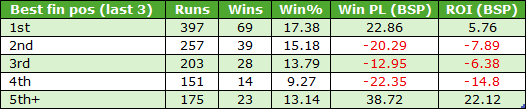
 

Table of best finish positions over the last three events showing Runs, Wins, Win%, Win PL (BSP), and ROI (BSP) for 1st through 5th+ place. 1st: 397 runs, 69 wins, 17.38% win rate, 22.86 Win PL, 5.76 ROI; 2nd: 257 runs, 39 wins, 15.18%, -20.29 Win PL, -7.89 ROI; 3rd: 203 runs, 28 wins, 13.79%, -12.95 Win PL, -6.38 ROI; 4th: 151 runs, 14 wins, 9.27%, -22.35 Win PL, -14.8 ROI; 5th+: 175 runs, 23 wins, 13.14%, 38.72 Win PL, 22.12 ROI.


It was a positive for horses to have won at least once in their previous three starts, such runners making a small gain of close to 6p in the £.  Likewise, ‘out of form’ horses, those whose best finishing position in the last three runs had been 5th at best, also proved profitable when priced BSP 18.0 or less. Indeed, returns increase to 30p in the £ if focusing solely on male runners.


Musselburgh 7f handicaps: Trainers

Trainer data is limited for most handlers in this context, but two names shone.

Richard Fahey had an 18.7% strike rate (14 wins from 75) for a profit of £12.32 (ROI +16.4%).

Grant Tuer enjoyed an even better record with 13 wins from 39 (SR 33.3%) for a very healthy profit of £39.60 (ROI +101.5%).

For the last two Musselburgh sections I will be ignoring the price cap and including all runners once more. This is because I am not focusing on profit/loss for the draw and run style analyses.


Musselburgh 7f handicaps: Draw

For a potential draw bias to exist we need bigger fields to analyse, so I have focused on races with at least eight runners. Let me share the raw data first, splitting the draw into the three sections I normally do – low third, middle third and high third, giving the win percentages for each third of the draw.
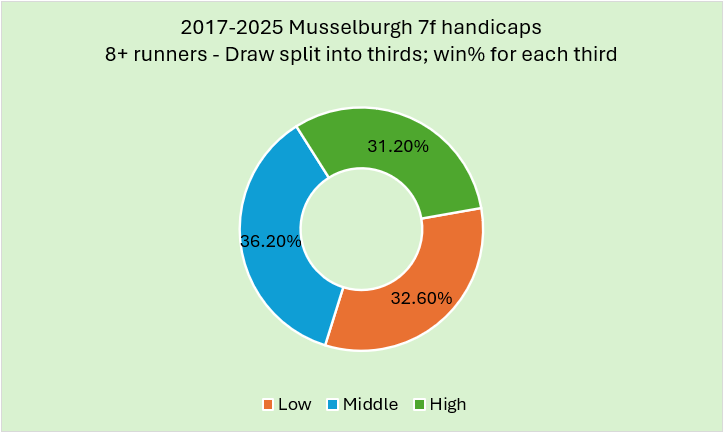
 

Donut chart of win percentages by handicap group: Low 32.6%, Middle 36.2%, High 31.2% for Musselburgh 7f race with 8+ runners (title shown).


As we can see these stats suggest that there has been very little favour to any specific third. However, if we look at the PRBs (Percentage of Rivals Beaten) we see there may have been a small bias after all.
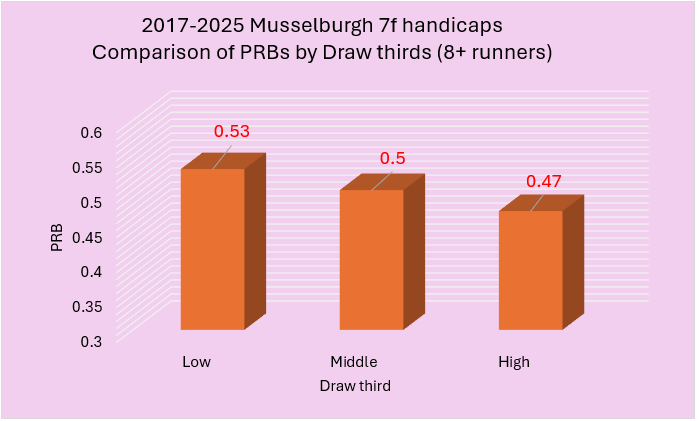
 

Triple bar chart showing PRBs by draw third (Low 0.53, Middle 0.50, High 0.47) for 8+ runners, pink background.


Low have had an edge over high (0.53 versus 0.47) and if we restrict races to good to firm or firmer, we see something quite interesting:
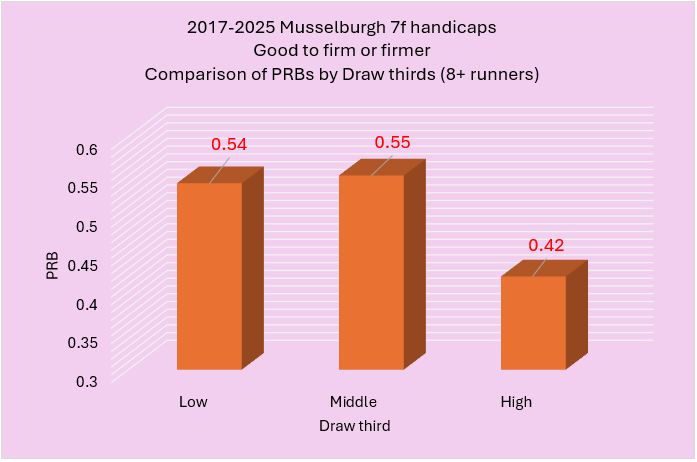
 

Bar chart: PRBs by draw third for 8+ runners in Musselburgh 7f handicaps (2017–2025). Low 0.54, Middle draw 0.55, High 0.42; background pink with orange bars.


On firmer going the PRB numbers are indicating that high draws have been at a real disadvantage under such conditions. Indeed, high draws have managed to ‘win or place’ just 21% of the time on good to firm or firmer, well below the expected figure on a perfectly fair track of 33.3%.

On soft or heavy ground low draws have performed extremely well, winning 12 of the 20 races. This was quite a small sample but with a PRB of 0.56 I would expect low draws to continue to enjoy a decent edge when the ground comes up soft or heavy in future.


Musselburgh 7f handicaps: Run Style

Finally for this course and distance I will review the run style PRB splits.

As we can see there has been a significant edge to horses that led early, and the nearer the front they were in the first part of the race the better. Hold up horses performed poorly.

By using the Geegeez Pace Analyser we can see the remaining metrics in full:
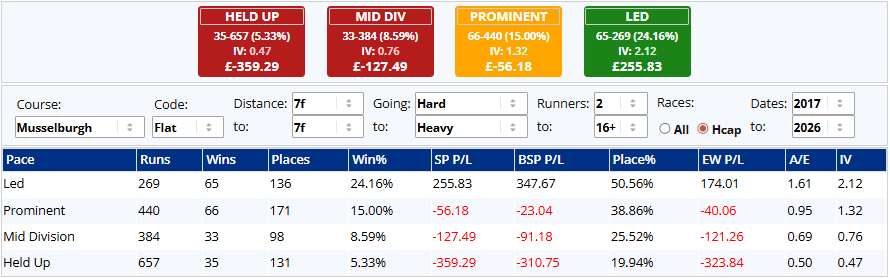
 

Table of race form by pace (Led, Prominent, Mid Division, Held Up) with runs, wins, places, win% and P/L; top filters for course, distance, going, runners, races.


More evidence of the strength of the front running bias over this C&D. Oh, for a crystal ball that could predict the early leader!


**


It is now time to switch our attention to 1-mile handicaps at Windsor. Again, 2yo handicaps have been ignored except when looking at draw and run style.


Windsor 1m handicaps – an overview 

There have been slightly more Windsor 1-mile handicaps compared to Musselburgh 7f ones with an average of 22 qualifying races a year. Before looking at the numbers in more detail let me share what Class of race we tend to get when racing this C&D. The graph below shows the splits:
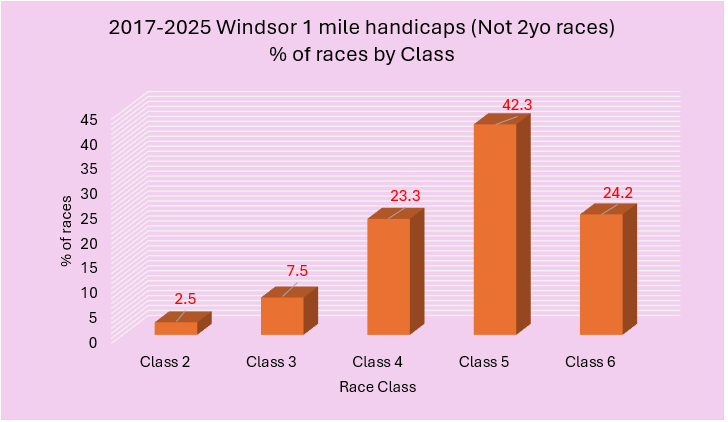
 

Bar chart of Windsor 1-mile handicaps by class (2–6) with race shares: 2.5%, 7.5%, 23.3%, 42.3%, 24.2% (Class 5 highest).


Roughly two thirds of all races have been class 5 or 6, with just 10% of races in either Class 2 or 3. Time for some digging.


Windsor 1m handicaps: Betting market

Let me take a look at the Betfair betting market and the performance of different ranked positions.
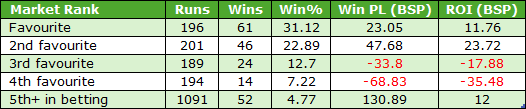
 

Table of betting market performance by rank: runs, wins, win% and financials (Win PL, ROI) for favourites, 2nd–5th+ in betting. Favourites: 196 runs, 61 wins (31.12%), Win PL 23.05, ROI 11.76%; 2nd favourite: 201 runs, 46 wins (22.89%), Win PL 47.68, ROI 23.72%; 3rd favourite: 189 runs, 24 wins (12.7%), Win PL -33.8, ROI -17.88%; 4th favourite: 194 runs, 14 wins (7.22%), Win PL -68.83, ROI -35.48%; 5th+ in betting: 1091 runs, 52 wins (4.77%), Win PL 130.89, ROI 12.


Here we see the front end of the betting market has dominated, with both favourites and second favourites making decent blind profits. The 5th+ group was also profitable but essentially this was down to two winners at big prices – BSP 107.08 and BSP 116.69. Removing those two outliers meant the remaining 1089 runners made a loss of 8 pence in the £.

Sticking with favourites and second favourites, if we combine them and look at the returns achieved in 3yo+ races, 3yo only races and 4yo+ races we see positive figures for all three:
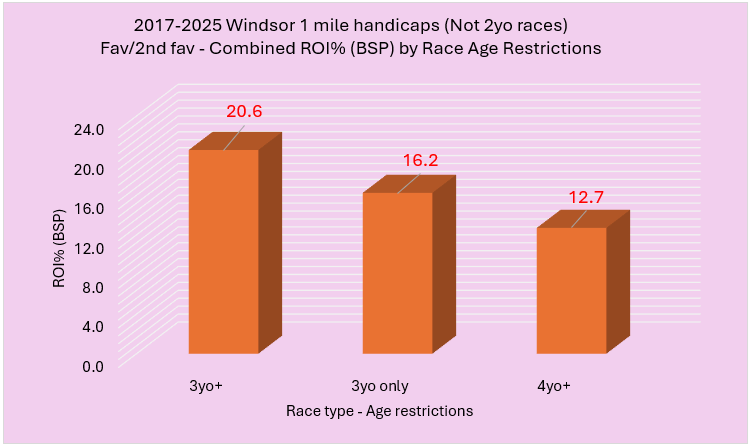
 

Bar chart of ROI% by race age: 3yo+ 20.6%, 3yo only 16.2%, 4yo+ 12.7% (2017–2025 Windsor 1 mile handicaps).


It seems that the top two in the betting have performed consistently well over the past few years.

Again, in the next few areas I will only include data regarding horses priced BSP 18.0 or less to avoid skewed bottom lines.


Windsor 1m handicaps: Sex of horse

The advantage males had over females in mixed sex races at Musselburgh over 7f has not been replicated here, but males still enjoyed a small edge. In terms of strike rate males won 15% compared to females on 12%, and they posted better returns, albeit only by around 3p in the £.

However, the value metric, the A/E (BSP) index, does indicate that males have been far better value with males on 1.05 and females on 0.87.


Windsor 1m handicaps: Age

I am going to look at the age splits in 3yo+ handicaps, as such races have occurred most often (86 races). The breakdown was thus:
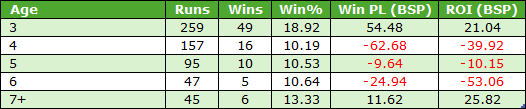
 

Table of performance by age group (3, 4, 5, 6, 7+). Columns: Runs, Wins, Win% , Win PL (BSP), ROI (BSP). Examples: age 3 – 259 runs, 49 wins, 18.92% win rate, Win PL 54.48, ROI 21.04; age 4 – 157 runs, 16 wins, 10.19%, Win PL -62.68, ROI -39.92; age 5 – 95 runs, 10 wins, 10.53%, Win PL -9.64, ROI -10.15; age 6 – 47 runs, 5 wins, 10.64%, Win PL -24.94, ROI -53.06; 7+ – 45 runs, 6 wins, 13.33%, Win PL 11.62, ROI 25.82.


We see a similar and arguably stronger 3yo edge here to the one in the Musselburgh research. 3yos won far more often than all other age groups and produced a tidy profit. Horses aged 7 and older also made a profit but the sample size was small, and three of the six winners were priced BSP 12.00, 14.00 and 16.30 so I would not see this age group as a positive over this C&D.

The 4yo+ handicap data covered only 31 races so this has been too small a sample to drill down into and find anything meaningful.


Windsor 1m handicaps: Course form

Previous course winners have scored 18.3% of the time (30 wins from 164) for a profit of £13.97 (ROI +8.5%).

Horses that had never raced at Windsor before saw 86 of them win from 643 (SR 13.4%) for a significant loss of £90.12 (ROI -14%).

Horses that had raced at the track before but had failed to win, won 59 from 379 runners (SR 15.6%) for a profit of £18.54 (ROI +4.9%).

It does seem that past experience at the track has been useful regardless of whether a horse won there previously.


Windsor 1m handicaps: LTO Course

It is time to look at where the horses ran last time out. There are four LTO venues that have produced positive stats from at least 50 runners priced 18.0 or less. These have been:

 

Table of LTO Course stats with runs, wins, win% and ROI (BSP) by course: Newbury, Newmarket, Sandown, Windsor (Win PL shown).


I mentioned in the course form section above that the stats were indicating that a previous run at Windsor had been a positive. We have now had an even stronger positive if they had raced at the track last time out. The figures for horses coming from Newmarket have also been exceptionally good.


Windsor 1m handicaps: Recent runs

I could not find any worthwhile patterns when analysing the last three runs, but in terms of LTO winners, they performed poorly losing £31.37 from 170 qualifiers showing negative returns of over 18p in the £.

It is also worth noting that last time out winners actually did very well when sent off as the favourite (a 36%-win percentage coupled with returns of 28p in the £), but if they did not start favourite their record was dreadful: just 11 wins from 120 runners (SR 9.2%) for a loss of £45.49 (ROI -37.9%).


Windsor 1m handicaps: Trainers

Trainer data is again very limited and only one trainer, Richard Hannon, saddled more than 30 qualifying runners in the review period. He ran 68 horses, of which 10 won (SR 14.7%), for a small loss of £1.85 (ROI -2.7%).

Clive Cox is worth a mention as he has had eight wins from just 25 runners (SR 32%). Profits were £24.94 (ROI +99.8%). For the record he saddled six different horses to win, so it was not a case of one or two horses skewing the stats.


Windsor 1m handicaps: Draw

As earlier I will be concentrating on races with at least eight runners when looking at the draw (2yo handicaps included). Here were the win percentage splits for the bottom, middle and highest thirds.
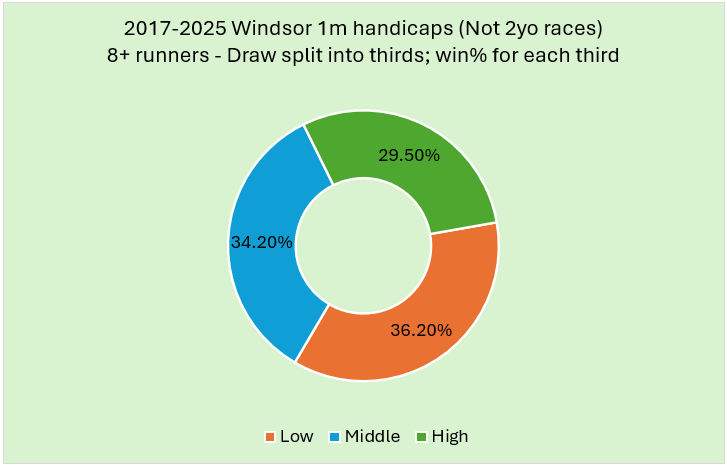
 

Donut chart showing win percentages by draw thirds for Windsor 1m handicaps (8+ runners): Low 36.2%, Middle 34.2%, High 29.5%


Once again, we have had a very level playing field. This has been backed up when looking at the PRBs:

 

Table with three columns labeled Low, Middle, High and values 0.51, 0.5, 0.5; Low column highlighted green.


Essentially, I think we can disregard the draw at this trip.


Windsor 1m handicaps: Run Style

Finally for this article I will be taking a look at the run style PRB splits over this C&D.
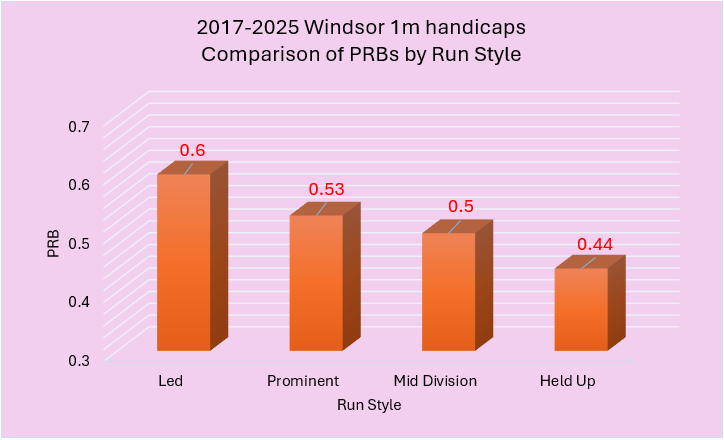
 

Bar chart titled '2017-2025 Windsor 1m handicaps' comparing PRBs by Run Style; Led 0.6, Prominent 0.53, Mid Division 0.5, Held Up 0.44 (PRB values).


As with the Musselburgh findings we can see there has been an edge to horses that have led early, and the nearer the front a horse was early in the race, the better. The bias was not as significant here, but it was still strong. The Geegeez Pace Analyser below shares the other key metrics:
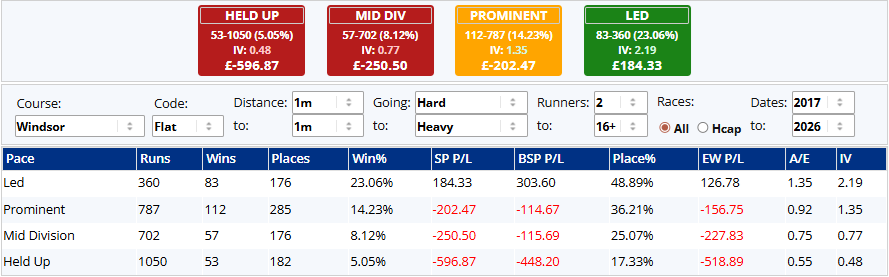
 

Dashboard of horse-racing stats by position: color-coded boxes for Led Up, Mid Div, Prominent, LED; filter controls (Course Windsor, Flat, distance 1m, going Hard to Heavy, runners, races 2017–2026); table with Pace, Runs, Wins, Places, Win% and P/L by row (Led, Prominent, Mid Division, Held Up).


These stats correlate strongly with the PRB figures and confirm the front running bias.


**


That's it for this week – two for the price of one and it’s not even Christmas! I hope we will be able to exploit these findings across the 40 or so qualifying races we will have this season.

Good luck, and until next time...

- DR

Musselburgh Draw & Pace Bias

Draw and Pace at Musselburgh

For this article we are back across the border to analyse draw and pace data from Musselburgh racecourse, writes Dave Renham. To help me with this piece I have used some of the tools available on the Geegeez website, those being the Draw Analyser, the Pace Analyser and the Query Tool.

I will be looking at race data going back to 2009 as my starting point but, as before, I will examine a more recent data set in detail, too (2015 to 2019), where appropriate. The focusas with all the other articles in the series, is on handicap races with eight or more runners.

Musselburgh Course Constitution

Musselburgh is a right-handed course roughly ten furlongs in circumference, with no notable gradients, and is generally considered to be fair. The 5f sprint trip is raced on a straight track while 7f races and above take place on the round course. (There are no 6f races).


Musselburgh 5f Draw Bias (8+ runner handicaps)

Since 2009 there have been 218 qualifying races over the past 11 seasons, a significant sample, and here are the draw splits: 

The general perception I think is that horses drawn next to the stands’ rail (high) have an advantage. There is a kink in the straight track after two furlongs and, in theory, that should aid those runners drawn high. However, the stats for 8+ runner handicaps do not especially back that up, such horses winning only as much as middle draws, and neither group performing distinctly better than low starting stalls. Now a look at the A/E values:

Middle draws seem to offer better value than higher draws despite their similar win percentages. This does imply, albeit only slightly, that maybe higher draws are slightly overbet due to the perception of draw bias.

However, when the field size increases a slight bias does start to appear. In handicap races of 11 or runners (90 races) we get the following splits:

Thus, in bigger fields, horses drawn out wider (lower stall numbers) definitely start to struggle. The A/E values back this up too.

Again middle draws offer the best value out of the three draw thirds.

Ground conditions do not appear to make any difference to the draw so let us move on to to looking at each draw position broken down by individual stall number.

For this distance I have needed to change the way I collate the data. The reason for this is that the higher draws are positioned next to the rail so in many respects analysing individual stall positions in the ‘normal’ way becomes irrelevant. What I mean by this is, that stall 8 could be drawn next to the rail (in an 8-runner race), but in a 17-runner race stall 8 is actually ten stalls away from the rail. Hence I am using a trick that Nick Mordin used many years ago in his book Betting For Living when he flipped the draw. I am reversing the draw figures if you like and looking at them in their relation to their position near to the stands’ rail. I still used the Geegeez Query Tool to give me the relevant data, but it took me more time to adjust and sort out the final figures:

These stats indicate there may be a slight stands’ rail bias as horses drawn 2, 3 or 5 stalls from the rail are all in profit. Also the each way percentages for those drawn within five of the rail are all over 30%. Having said that, it is not something that one could be too confident about. What I would be more confident in is that horses drawn ten berths or wider from the stands’ rail look at a disadvantage. This correlates with the 11+ runner draw splits mentioned earlier.

Onto a more recent data set looking at the past five seasons (2015-2019). Here are the draw splits for the 100 races that have occurred during this time frame.

No surprises here with an even looking split.

The A/E values correlate with long term figures shared earlier:

Again middle draws have offered the best value.


Time for the 5 year stats for individual draw positions with the same twist as discussed earlier (draw positions effectively reversed):

The slight rail bias that was mooted earlier is not displayed with this more recent data set. However, as you would have probably expected the stats indicate that horses drawn ten or further from the stands’ rail remain at a clear disadvantage.

Musselburgh 5f Pace Bias (8+ Runner Handicaps)

Let us look at pace and running styles now. The overall figures (2009-19) are thus:

As is often the case, front runners enjoy a decent edge – as 5f biases go it is around the overall UK course average. Hold up horses have a poor record and look best avoided unless the pace is likely to be frenetic.

The front running bias does seem to strengthen slightly the firmer the going. The stats for qualifying races on going described as good to firm or firmer is as follows:

Improvements in strike rate, A/E value and IV; also the each way placed percentage increases too.

In terms of field size there is no clear change in front running bias.

Finally in this five furlong section a look at draw / pace (running style) combinations for front runners over this minimum distance. Remember this is looking at which third of the draw is responsible for the early leader of the race (in % terms):

Higher draws get the lead more often than any other third. You would expect this as they are drawn closest to the rail. I must admit that I had expected the high draw percentage to be a bit nearer to 50%.

The draw/run style heat map, sorted by Percentage of Rivals Beaten, again points to early leaders from a pace perspective and middle to high from a draw perspective. (Any score above 0.55 implies a bias to that section, below 0.45 a bias against that section).


To conclude, in terms of the draw, higher draws are at a disadvantage as the field size gets bigger, with draws ten or further away from the rail having a particularly poor record. Pace wise, front runners have the edge and this seems to strengthen on firmer ground.


Musselburgh 7f Draw Bias (8+ runner handicaps)

As mentioned, there are no six furlong races at Musselburgh, so the next distance we'll review takes in the round course and the seven furlong (seven-eighths of a mile) range. The 7 furlong trip has had 189 qualifying races from 2009 to 2019 which is another decent sample. Here are the draw splits:

The 7f trip sees low draws start closest to the inside rail. However, this does not appear to give them any concrete advantage.

Let’s look at the A/E values to see if they correlate with the draw percentages:

Similar A/E values offering no real edge.

Drilling into the stats when the going gets softer there is a suggestion that low draws have an advantage. The problem is that there have only been 19 races on soft or heavy ground. Having said that, 12 races have been won by low-drawn runners compared with just two for higher-drawn horses. The placed stats strongly favour lower draws, too, under such conditions, but 19 races is far too small a sample to take at face value.

Time to look at what the individual draw positions offer over the 11-year period between ’09 and ’19. We can view these in the normal way:

Nothing particularly significant here as one might expect looking at the other draw data. However, draws 1 and 2 clearly have the best placed strike rates which is interesting.

On that theme you could have made a 36 point profit backing the two lowest draws in one point reverse forecasts over the 189 races. There were enough winning bets to create a small profit. For tricast fans, perming the three lowest draws in full cover tricasts would have yielded a huge profit of just under 3600 points! There were only five winning tricasts, though, and the profit basically relied on one monster payout.

Onto the last five seasons for 7f handicaps at Musselburgh. There have been 94 qualifying races since 2015, with the draw splits as follows:

These are similar figures to the longer term ones. Higher draws have performed slightly worse in the last five years but it is likely not statistically significant.

Onto the A/E values (2015-2019):

Middle draws have been the best value of the three draw thirds in the last five seasons. However, there is no edge to really take advantage of.

Now a look at the individual draw figures for this latest 5-year period:

Again nothing clear cut and ultimately 7f races offer little interest for the draw punter (despite those aforementioned forecast and tricast figures). The PRB3 data - a rolling three-stall average of percentage of rivals beaten - suggests that the course constitution does slightly favour inner-drawn horses, though this has so far yet to manifest itself in bottom line profit. Nevertheless, it is worth being aware of.

I will be looking closely at any future races on softer ground, though, as it is possible that there could be a low bias under those conditions. Here is the same view, but on soft or heavy going:


Moving on the seven-furlong handicap pace data, here are the overall pace figures going back to 2009:

This makes much better reading and front runners have a very strong edge, even more so than over 5f. More recent data offers a similar picture so this is a bias that we must try and use to our advantage.

This front running edge looks to be stronger as the ground starts to soften. On good to soft or softer there have been 47 races giving the following splits:

There also seems to be a slight increase in front running bias when the field size grows. In races of 11 or more runners, front runners win 21% of the time with an A/E value of 1.85; in races of 8 to 10 runners the strike rate is still 21% but the A/E value drops to 1.50. It should be noted that mathematically it is harder to win in bigger fields so even though both win percentages are at 21%, it is clear that in effect front runners have been more successful in bigger field races.

Let us now look at the draw / pace (running style) combinations for front runners over 7f.

Lower drawn horses get to the early lead more often – they are positioned closest to the inside rail so this is what we should expect. Having said that I would have expected a higher figure than 40%.

The draw / run style heat map offers a perfect diffusion of green to dark orange when viewed on PRB; this is normally a strong indication of a repeatable bias:

To conclude, over 7f the draw in general is extremely fair, but possibly lower draws have an edge in soft or heavy conditions. Pace wise, however, front runners have a bankable edge in all conditions which seems to increase on good to soft or softer going.


Musselburgh 1 Mile Pace Bias (8+ Runner Handicaps)

I will start our mile handicap analysis by looking at the 2009-2019 data - 90 races during this period have given the following draw splits:

There is no clear draw bias looking at these stats, but when you break the data down into halves, the bottom half of the draw won 61.1% of races to the top half figure of 38.9%. Hence a slightly lower draw seems preferable.

Let us break the mile draw data down by stall position:

Draws 1 and 2 both have decent A/E values and, breaking the data down further, stalls 1 to 4 have been 2.1 times more likely to win than draws 10 or higher (A/E values of 0.93 versus 0.66). Hence taking all things into account a lower draw seems preferable over a very high one, as reflected in the below IV3* chart:

*more information on IV3, and all of our metrics, can be found here.


The last five seasons have seen a fairly even split draw wise when splitting into thirds; draws 10 or higher have continued to struggle winning just twice from 37 runners. A look now at the pace findings for this 1 mile trip going back to 2009:

As with the two shorter distances, front runners have a definite advantage over a mile. This is one of the strongest mile pace biases in the country and it should also be noted that exactly half of all front runners went onto finish in the first three. Horses held up at the back early do not have a good record once again. The bias is consistent across all going and field sizes, although you could argue that in smaller fields (8-9 runners) it has been slightly less potent.

Finally in this section a look at which part of the draw gets to the lead first:

Although lower draws are positioned next to the rail, they do not get to the lead the most. This is probably due to the fact that there is nearly 4 furlongs until the first (and only) turn and wider drawn jockeys are keen to get a more expedient trip.

Again, we can see the golden triangle when looking at draw / run style in concert, though this time it more a 'led' bias, with a mark up for low drawn prominent and midfield (ground saving) racers.


As with 5f and 7f handicaps, over one mile the front running pace bias offers the most interest and it is a strong one. Draw wise I would always prefer lower draws over higher but all in all I don’t perceive it to be a significant factor.


Musselburgh 1 Mile 1 Furlong Pace Bias (8+ Runner Handicaps)

There have been only 44 qualifying races at this distance but some interesting findings: 

Higher draws seem to have an edge and the A/E values strongly correlate:

My concern with these figures is that they are not easy to explain – if low draws had this advantage I would assume there was an inside rail bias; with higher draws having the edge it makes virtually no sense. The most likely scenario is simply down to variance as the sample size is not that big in reality. However, it may be that jockeys are able to play more of a waiting game by dropping high-drawn horses in at the back of the pack. All may be revealed shortly!

Let’s break the data down by individual draws to see if that helps:

It is difficult to make much of this either – the unusually good stats for stall eight reinforces my belief that the draw splits cannot be relied upon.

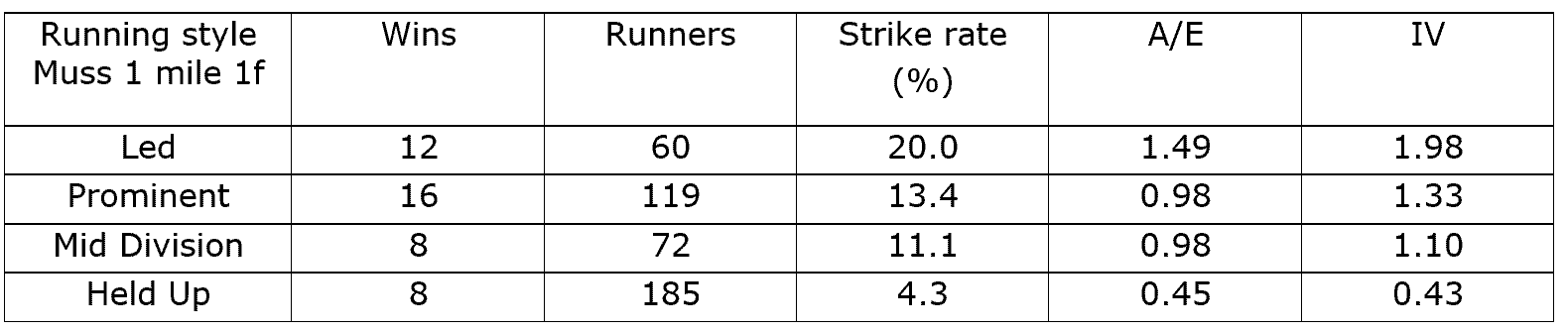
Onto pace now, and below is performance by run style.

Once again at Musselburgh we have a decent front running bias and hold up horses have an even worse record than the three shorter distances, so bang goes that theory about why wide-drawn horses have fared best!

This is surprising as normally the longer the distance, the harder it is for early leaders to make all the running; likewise longer distances normally see a much higher percentage of wins for hold up horses.

To conclude, there is a strong pace bias for the fourth consecutive distance over 1m1f. The draw stats suggest a high draw bias; but, as stated earlier, I am struggling to rationalise this in the overall context, even though the PRB data support the win and place tables above. Weird!


Musselburgh 1 Mile 4 Furlong Pace Bias (8+ Runner Handicaps)

This is the longest distance I have looked at in any of the articles but I would like to share one set of stats. The draw is fairly even and, over 12 furlongs where they start just before the winning post and make a full loop of the track, I do not feel it is worth going into too much detail.

But pace wise we continue to see that front running edge, even over this relatively long trip. Here are the 2009-2019 stats, taken from the geegeez Pace Analyser:

The figures suggest that this may be the distance where the front running edge is at its strongest. This is very surprising given the distance we are talking about. Maybe it is down to the fact there is additional sharp bend soon after the start at 1m4f and front runners get more of an advantage going the shortest route into that turn.


Musselburgh Draw and Pace Bias Summary

Although there is little out of the ordinary in draw terms, Musselburgh is a course of real interest when viewed from a pace angle. Looking for potential front runners at all distances from 5f to 1m4f is definitely a strategy worth considering. The draw is generally not a major factor but there are subtleties that one needs to be aware of.

Thanks, as always, for reading, and good luck!

- DR