On the fourth and final day of Tix Week, I'm going to bring it all together. As well as looking at yesterday's play - with a few observations on that - I answer some of your questions; share which framework I use in different scenarios; and offer a few hints and tips to optimise your placepot/jackpot play.
First, though, if you've not watched the previous video posts, you'll find the Plus Simple one hereand the ABCX one here and the Plus Pro one here.
[Tip: you can make the video clearer by clicking the cog icon bottom right and choosing 'quality' 1080p, and you can make me speak faster with the 'playback speed' option in the same place]
I hope you've enjoyed this short series of videos and maybe learned something new about placepots, jackpots and Tix. Do have a play with the software we've built: it's been designed to improve the results of all levels of player, and it's quite unlike anything else available in the UK for playing placepot and jackpot pools.
Matt
https://www.geegeez.co.uk/wp-content/uploads/2026/02/TixPlus.png320830Matt Bisognohttps://www.geegeez.co.uk/wp-content/uploads/2022/10/geegeez_banner_new_170x78.pngMatt Bisogno2026-02-27 10:02:462026-02-27 10:02:46Tix Week: Wrapping Up
Day 3 of Tix Week and, after a quick break yesterday, today we're looking at the new Plus Pro framework. It's the most user configurable way to play multi-race pool bets but does take a little more knowing than Plus Simple and ABCX. A little, but not a lot.
Before that, then, if you've not watched the previous video posts, you'll find the Plus Simple on hereand the ABCX one here.
OK, let's talk about Plus Pro. In a nutshell, if Plus Simple is an automatic car, Pro is a manual. It gives you more control, a bit more speed through the gears, but takes a little more knowing in the first instance.
Today's video - where I try to get through an inscrutable sextet at Clonmel, reveals all.
[Tip: you can make the video clearer by clicking the cog icon bottom right and choosing 'quality' 1080p, and you can make me speed faster with the 'playback speed' option in the same place]
Tomorrow, Friday, I'll attempt to draw all the strands together by sharing which framework suits which approach, as well as a bunch of better placepotting hints and tips.
In the meantime, if you have any questions, let me know in the comments and I'll be happy to cover them for you.
Matt
https://www.geegeez.co.uk/wp-content/uploads/2026/02/TixPlus.png320830Matt Bisognohttps://www.geegeez.co.uk/wp-content/uploads/2022/10/geegeez_banner_new_170x78.pngMatt Bisogno2026-02-26 11:35:382026-02-26 11:35:38Tix Week: Plus Pro
It's day 2 of Tix Week, woohoo! Today we're looking at the ABCX framework, one of the most common approaches for multi-race tote pool players. Before that, though, if you've not yet taken a look at yesterday's video post, you'll find that here. It covers the most simple way to play Tix (choose budget, choose horses, place smart bet) and if you're new to this sort of thing, it's a great place to start. To today...
What you need to know about ABCX
ABCX is a way to build multi-race tickets by ranking your picks A, B or C based on confidence, then structuring your bets so your strongest selections get the most coverage and your weaker ones get less, helping balance cost and potential return. Using Tix, the software does all the structure bits, so you just need to pick your horses and confidence levels.
This video explains everything, as I try to pick out a winning placepot at Catterick. [Tip: you can make the video clearer by clicking the cog icon bottom right and choosing 'quality' 1080p, and you can make me speed faster with the 'playback speed' option in the same place]
I'll be back on Thursday with a look at the Tix Plus 'Pro' variant, and then on Friday I'll share some general advice on picking between the frameworks as well as some 'pro tips' for playing placepot/jackpot bets.
In the meantime, if you have any questions, let me know in the comments and I'll be happy to cover them for you.
This week on geegeez, I'll be highlighting the different playing modes on Tix, our tote multi-race staking software. By the end of the week, you'll know about Simple, ABCX, and Pro - and when to use each scenario.
Very little, in truth. You choose your maximum budget, minimum stake per line, and the horses you want included; the software does the rest.
Watch this video, where I walk you through a placepot play using Tix SIMPLE. I've had a crack at Plumpton's main meeting £50,000 guaranteed pool and, as well as mentioning a couple of things to look out for when playing placepots, I also discuss the mechanics of Tix SIMPLE. It bears repeating, though, that you don't need to know how it works particularly; you just need to know that it's a better way to stake the placepot you already play.
Here's the video. [Tip: you can make the video clearer by clicking the cog icon bottom right and choosing 'quality' 1080p, and you can make me speed faster with the 'playback speed' option in the same place]
Back tomorrow with Part 2, where we'll laser in on the ABCX framework.
But, for now, why not have a crack at TIX yourself this afternoon? Go here to check it out.
Matt
https://www.geegeez.co.uk/wp-content/uploads/2026/02/TixPlus.png320830Matt Bisognohttps://www.geegeez.co.uk/wp-content/uploads/2022/10/geegeez_banner_new_170x78.pngMatt Bisogno2026-02-23 11:27:002026-02-24 11:01:45Tix Week: Plus Simple
If you play the placepot (or jackpot, quadpot or any other multi-race pool bet), you'll know the joys and frustrations of the bet. On the upside is the chance to cop a very tidy sum for a modest investment; flip the coin and you'll get back less than you laid out or, quite often, miss by one leg (usually, though infuriatingly not always, the trickiest one).
How we used to play the placepot
For me, aside from those Kiplingesque "twin impostors" joy and frustration, bets like the placepot - and especially the jackpot - are a fantastic puzzle. The challenge is always to 'win twice': first, we have to correctly identify the winner/a placed horse in each leg; and second, because of the pooled nature of the wager, we have to occasionally go where the masses shun. We have to find a race (or two) where the winner and/or the horses in the frame are less obvious and, therefore, less endowed by tickets in the pool.
This, clearly, is tricky in the extreme with a single line running through six races. As we include more selections race to race so the multiplication gets more daunting and the dilution of our stakes makes for a less rewarding potential return... unless we hit that glorious home run whose increasingly distant and rose-tinted memory keeps us coming back for more in spite of the evidence from the interim.
The thing is, when we hit that wonder score with a caveman* ticket, we got lucky. Massively lucky. And, let's be clear, day to day we always need luck during the sextet of races. But I know how unsophisticated I was when I bagged my biggie...
I'd played a two horses per race combination: 2 x 2 x 2 x 2 x 2 x 2 = 64 bets, at 10p per line. It was Ripon and a friend of mine, Gavin Priestley (with whom you may be familiar from his excellent Festival Trends work) and his brother Gary, also a pal, had three betting shops in the Torbay area. They offered early odds based on a tissue (set of prices) they paid for.
Anyway, the opening race this day at Ripon was a maiden and there was a 'springer' in the market on their tissue, but generally offered at long odds elsewhere. As it turned out, he returned much shorter - probably close to single figures though I don't exactly recall. He finished second, with unfindable horses immediately in front and behind, and the placepot pool was decimated by first leg casualties. Actually, more than decimated: there was only about 2% of the pool left, according to teletext.
The rest of the card went far closer to expectation but the dividend still returned £6876.30 to a £1 stake. I had managed to hit four of my 10p lines (one each in four legs, two apiece in the remaining pair), so copped for 40p of the payout, or £2,750.52. I was a student on summer holidays at the time, and you can imagine the disco we had that night!
*caveman ticket: a bet where no thought has gone into the staking, and all selections carry the same chunk of your wedge regardless of being odds on or 20/1.
Why we shouldn't play placepot like that
That sublime payoff came in, I think, 1993 when I was 22 years old (I went to uni a little bit later as I'd worked in a Job Centre for a while beforehand). Thirty-something years have since passed and I have never got especially close to reprising it. Now, it should be said that a fair number of years ago I changed my staking approach and in so doing have narrowed the range of possible outcomes: in plain English, I'm using smarter staking that places more of my bunce on more likely combinations and less of it on those Hail Mary plays. In other words, I'm doing it better these days.
The harsh reality is that, although I copped for a bigg'un during my formative punting years, that approach generally returned zero or something close to zero. It was a conveyor belt of famine punctuated by the occasional 'happy meal' and one enormous episode of all-you-can-eat gluttony. The reason I remember it is because it was a monstrous outlier.
Candidly, and without wishing to be a fun-sucker, I had significantly over-staked on an outsider in that wager. I can't remember what price the other horse in that race was but it would have been the jolly, or at worst the next in. Let's be generous and say it was 4/1 with the other one being 16/1 (again, I don't remember the detail but this is illustrative enough). In that situation, I had the same stake (half of the entire bet because it was leg 1) running on to a pair of horses, one of which was four times more likely to make the frame than the other!
Let me emphasise this point with more real world numbers. Let's suppose for a moment that we're playing the jackpot - so we don't have to calculate place odds - and that in a fictional sextet of races, we play the 2 x 2 x 2 x 2 x 2 x 2 = 64 bets combo on horses priced at evens and 2/1 in each of the six legs.
The market reckons the chances of all of the even money shots winning is 63/1 (2 x 2 x 2 x 2 x 2 x 2 = 64), or about a 1.56% chance.
But what do you suppose the odds of all the 2/1 shots winning are?
The math is simple again: it's 3 x 3 x 3 x 3 x 3 x 3 = 729 (or 728/1). That's about a 0.14% chance!
So you can see that including a lot of 16/1 shots in a placepot, or 10/1 shots in a jackpot, is at best extremely inefficient; and at worst, the punting equivalent of death by a thousand cuts.
Key takeaway: not all horses have equal chances to win or make the frame, even if/when we like their chance more than the market does. And so we should not stake every horse in every race to the same amount.
Why we make dumb bets
The maths are unarguable, and I know you know that. Very possibly, like me in the good old bad old days, you're making poor plays on the placepot.
But, as all the best sales copy likes to reassure you, it's not your fault...
They made you do it. Those tricksy tickets with their rows of boxes and handy little multipliers. They practically sleepwalk you into sculpting your rock of punting marble into a pebble of a winning ticket, gradually chipping away what turn out to be quite large chunks of your funds.
Think about that 2x2 through six races. Imagine you get one horse placed and one out of the frame in leg one. You've done half your dough there. Now imagine you had a 4/1 and an 8/1 as your brace on leg 1, and the 4/1 places. Let's say it was a quarter the odds the place for ease of calculation purposes, and we end up back with evens and 2/1. One has a notional 50% chance to place and the other 33% or so.
They should not be staked the same!
The real issue is that this seemingly small error is compounded six times in a placepot or jackpot bet with level stakes: a caveman bet. There's a reason it has that rather unflattering name.
And then there was light
Before too long - and it must have been unimaginably miserable prior - cavemen figured out how to make fire and, with that, light and warmth and cooked food. They never, ever returned to the dark cold raw days that preceded their pivotal discovery.
In its own small way, discovering smarter staking - without the need to do the clunky maths and place the tickets manually (although I did that for a while!) - has made me a smarter staker. Obviously.
If I'm being honest, I play the placepot far too often, even when I have nothing in the way of strong opinions. That hurts my bottom line, but smart staking keeps me in the game just fine. And I love the companionship of a race every half an hour while I'm working in the house alone. It's not just about winning, you know!
However, winning is obviously important. I've been wining a few quid consistently on small stakes jackpot tickets, and giving it back on the placepots because of their comforting side effects. I consider that a more than agreeable trade off. You may not, in which case you'll need to be more discerning with when you play the 'pots. All fine.
But none of us should be playing caveman perms any more. Let me spell it out for you...
How to Make Smarter Placepot / Multi-Race Bets
Until now, Tix, the tool I co-created with the guy who built the vast majority of the geegeez.co.uk racecards, has been a little under-appreciated by 'two by two' players because - I admit - it looks a little daunting on first inspection. It's really not. But I don't want you to just take my word for that, so I'm going to show you.
Smarter Placepot Bets #1: ABCX
Tix features something called ABCX, which is a means of making some horses more important than others on your tickets. It's a lot better than caveman staking.
However, if I really can't persuade you to try a different way and that is your preferrred style, just picking all horses in the 'A' column makes it possible to place your straight perm ticket on Tix - and receive a 5% bonus on any winnings. By the end of this post I hope you'll see there's a better way - which is equally simple.
ABCX allows users to separate their strongest fancies in a race (A) from their warm fancies (B) and their live outsiders (C) - as well as those horses which are not of interest (X). I've produced some video content about it here, and Dave Renham wrote some further content on ABCX here.
It's a great way to differentiate between horses you really like and those you kind of like, or horses that are short prices and those that are longer odds.
But it's not perfect. The staking approach is a little 'blocky' - think Minecraft or Sensible Soccer rather than Grand Theft Auto - so, while it's much better than level staking, it lacks nuance and it doesn't really allow the user to sculpt a ticket to their own preference. Despite that, I still sometimes favour it over...
Smarter Placepot Bets #2: Tix Plus 'Simple'
New in Tix this week is a second framework called Tix Plus. It's further split into 'Simple' and 'Pro' variants, which sit either side of ABCX in terms of ease of use.
Plus 'Simple' really is simple: you pick your stake and your horses and let the software do the rest. That's it.
But what's happening under the bonnet is clever, very clever.
First things first, though. To access Tix Plus, you need to change the 'Betting Mode' dropdown from ABCX to Tix Plus, like so:
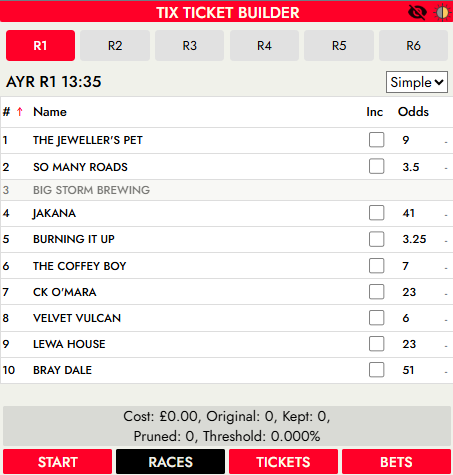
Then pick your meeting and pool, and you'll be taken to the RACES tab. For Tix Plus in 'Simple' mode, it looks like this:
Let's quickly talk around this view. At the top are the legs of the bet (R1-R6, races 1 to 6), and just below that is the specific race (AYR R1 13:35, race 1 at Ayr, due off at 1.35pm UK time). On the right of that is another dropdown, currently set to 'Simple'. This is where you can choose the 'Pro' version if you prefer; I'll come on to that shortly.
The main body of the view has saddlecloth number, horse name, a column of checkboxes called 'Inc' (include), and the current odds in decimal. Later in the day (from 9am), the dashes on the right of the screen may include some arrows: a green 'up' arrow means a horse has been supported, a red 'down' arrow means it is drifting.
All columns are sortable and, personally, I tend to sort by odds so that I can quickly see the betting shape of the race.
At the bottom of the view is a summary displaying ticket cost, the total number of possible permutations/tickets, the number of tickets that will be placed and the number which will be 'pruned' (not placed), and the threshold at which that decision will be made.
Let me explain that, but I'll first say that the only thing you must know is that, usually, not all possible permutations/tickets will be placed. That is, there will normally be at least some tickets in the 'pruned' pile.
So what's happening behind the scenes here?
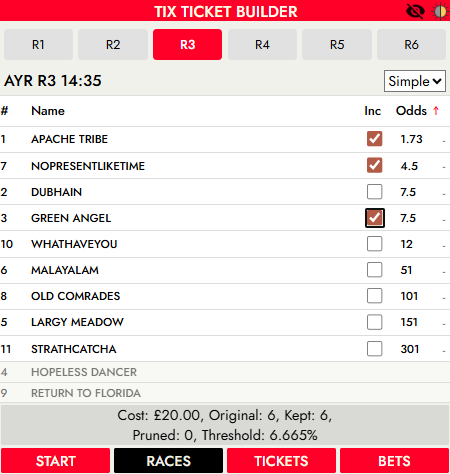
After you've chosen your stake and your minimum unit stake (I suggest starting with 1p for unit stake), you begin to build your tickets. The image below is after I've picked my horses in three of the six legs:
I've set my budget here to £20, and (unseen) I have two horses in R1, a banker in R2 and (visible here) three horses in R3. 2 x 1 x 3 = 6 possible tickets, and all are kept at this stage.
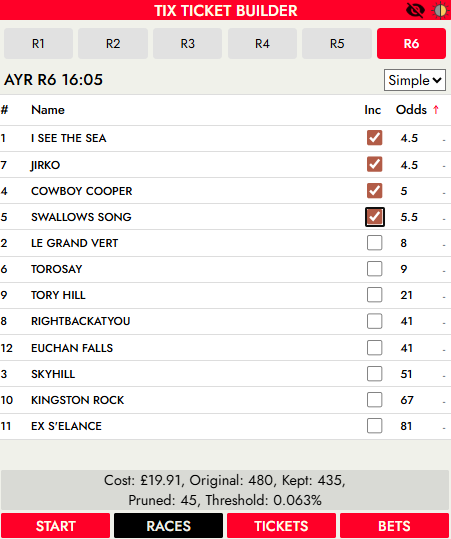
Let's go ahead and fill out the rest of the perm:
So it turns out the second half of this placepot sextet was much more competitive looking than the first. I ended up, for illustration purposes it should be said!, taking five horses in R4, and four each in R5 and R6. The image above shows R6, and my total possible tickets are 2 x 1 x 3 x 5 x 4 x 4 = 480. See 'Original: 480' at the bottom of the image.
But... the software is only retaining 435 of these and is discarding 45. Why, when £20 is plenty to cover 480 bets at 4p per line, is it not covering all permutations?
The answer is because not all lines are created equally. In my leg 3 (see image two up), I have an 8/11 (1.73) shot and a 13/2 (7.5) chance. Clearly the market doesn't believe they have the same prospects of placing, and neither do I. If we move on to the 'TICKETS' tab, you'll see what's happening here:
There's a lot going on in this image, so let's break it down. The main body of the view is dedicated to the tickets to be placed. The table headings are ticket (the selected horses on each ticket), %age (the percentage chance, based on the current win odds, of that ticket containing six winners*), £/line (the stake per line in that ticket), # (the number of lines in that ticket), Total (£/line x #, stake x lines, e.g. in th top row, £0.13 x 4 = £0.52).
I've clicked the little 'i' icon to the left of the first ticket, and it shows the individual breakdown of the four lines contained within it. Clicking the 'i' icon in the header row will open all of these should be curious to that microscopic level of detail!
There is then a 'PLACE TICKET' button at the end of each row. There is also a 'PLACE ALL BETS' button at the top. When you're happy with your bet, you can click that button and all tickets will be placed into the tote's pool.
*it is a little misleading to use win odds on placepots and other place pools as it implies your chances of getting a payout are hugely lower than they actually are. We will amend this in the next version but, for now, the key component is the 'threshold'. So let's quickly discuss that...
Threshold is the point at which two elements collide: your allocated budget running out, and the chances of a combination of horses being successful based on their odds. Basically, if there isn't enough money to proportionately stake all combinations, the software starts with the least likely single line combination of horses (based on their odds) and eliminates that combo. It carries on doing this until there are sufficient funds for the remaining 'kept' bets.
In this example, all bar 35 of the 480 possible combinations have been kept, at a total cost of £19.91. To see the combo's that were pruned, click the green 'Show Filtered Out Tickets' button:
All 45 pruned tickets included the '3' horse in R3. That was the 13/2 shot selected alongside an 8/11 and a 7/2.
The magic here is that, whereas £20 staked evenly across 480 bets would cover every possible pick for 4p, in Tix we have the most likely combinations covered for as much as 13p per line, and 106 different combinations covered for at least twice that 4p base stake.
Naturally, the flip side is that the least likely combo's have less than 4p staked on them, but those tickets - should they hit - will pay a much bigger dividend.
Tix is a realist, not a fantasist. It leans into the most likely outcomes and away from the Hail Mary's whilst still covering a fair number of those long shot bombs (depending on budget and unit stake).
Why is this good, and why is it bad?
Well, the bad news is you're less likely to hit that once in a lifetime payoff... but the good news is that, day to day, you'll get more returns that will keep you in the game longer and you still have the chance of plenty of fat divvies along the way.
Reminder: Tix Plus 'Simple' is choose stake, pick horses, place bet. The clever stuff is completely hands off.
Smarter Placepot Bets #2: Tix Plus 'Pro'
For the architects and sculptors out there, you - like me - can opt to be a little more hands on.
Welcome to Tix Plus 'Pro'!
This really is very cool, and it's the unidentical twin of Tix Plus 'Simple'.
Here's how 'Pro' looks:
The differences are two columns and one row. Columns first.
To the right of the odds/arrows columns are '%age' and 'Book'.
'%age' is a smoothed book percentage including the whole fields. It's done in 5% increments until we get to the serious longshots where 1% becomes the norm. In the example above, we see that Apache Tribe, odds of 1.83 (5/6 fractional) has a 45% %age. You might also note that the %age figures don't sum to 100. This is fine, because the 'Book' figures will always sum to 100.
In this example, we have three selected horses whose '%age' values are 45, 20 and 10, totalling 75. The 'Book' value for the favourite is 60, calculated simply by divided his '%age' by the sum of all selected '%age's. That is, 45/75 = 0.6 or 60%.
The beauty of 'Pro' is that you may overwrite any '%age' figure to emphasise your personal opinions.
If you love the jolly but still want a small bit of cover elsewhere, make that 45 number bigger. If you respect the jolly but feel his chance is over-stated, edit 45 to a smaller number. Below I've changed that %age to 35 and you can see how the division of stakes has changed in the 'Book' column.
By doing this, users can very tightly define the distribution of their budget through the bet.
The extra row appears at the bottom of the RACES view, and it is for 'Unnamed Favourite' (UNF). UNF doesn't show up on the 'Simple' version because it doesn't have a book percentage: we don't know which horse will be favoured, still less what price it will be.
In the 'Pro' view, selecting UNF will remind you to add a %age for it (see below). If you don't, it will simply be ignored. The chosen percentage will then be factored into the 'Book' calculations outlined above.
At the end of the sequence (six legs in this case), you'll again have summary info at the bottom of the view. This time, you can see I've got 459 of 480 possible combinations retained, and 21 pruned. The threshold is also slightly higher, which means my top staked ticket is now 12p per line rather than 13p previously, and I have slight amendments to other combinations. All of that is done in the engine room and is invisible to the user.
But you have ultimate control with Tix Plus 'Pro', so if you want to change things just tweak the '%age' figures in the races where you want that change.
Like I said, this is certainly not for everyone, but for those who want greater control over their multi-race pool play I think Tix Plus 'Pro' is like hitting the jackpot!
The Ultimate 'Smart' - Bonus Payouts on All Winning Tickets!
Tix enables everyone to bet placepots, jackpots and other multi-race tote bets in a smarter way. That already gives you a much better chance of coming out ahead. And, to compound that advantage, all winning tickets placed through Tix benefit from a 5% bonus. Every £100 in winnings get £5 more.
Let's say over a year you staked £2600 through Tix (£50/week, about £7/day), and your returns were £2500, a loss of £100. £2 a week for some daily fun is definitely a price I'd pay! But because of the 5% bonus, that £100 loss becomes a £25 win.
Now, obviously, there's nothing life-changing there; but the point I'm trying to highlight is that the bonus can easily be the difference between winning and losing over time and, of course, if you're a winning placepot punter, you're just going to win more!
Otherwise, you'll need to sign up with the tote first. You can do that here, then go to the link above.
I can't wait to hear how you get on with Tix Plus - and, of course, if you have any questions, just leave a comment below and I'll be sure to get back to you.
Matt
https://www.geegeez.co.uk/wp-content/uploads/2026/02/Gemini_Generated_Image_tbq4nktbq4nktbq4-scaled.png9852560Matt Bisognohttps://www.geegeez.co.uk/wp-content/uploads/2022/10/geegeez_banner_new_170x78.pngMatt Bisogno2026-02-10 19:14:022026-02-10 19:27:19Introducing Tix Plus: A Placepot Tool for Everyone
Using Tix for Jackpots, Placepots, Quadpots & the Scoop 6, primarily focusing on Placepots
Geegeez readers should by now be aware of the online software called Tix, which Matt built in conjunction with the developer who built much of the coding for the original geegeez.co.uk racecards and form tools, writes Dave Renham. The Tix software is designed to be used for tote multi-race pool bets such as the Jackpot, Placepot, Quadpot and Scoop 6. It enables punters to produce more sophisticated and strategic permutations than the bog-standard perm approaches most punters use.
Tote Bets: A Quick Intro
Before discussing the software, it should be noted that the Tote take a percentage out of any final pool, the amount depending on the bet. Below is a table showing the percentage take-outs for the main pool bets:
Pool bet
Percentage taken out
Jackpot
29%
Placepot
27%
Quadpot
26%
Scoop 6
30%
As we can see they are all in the same ballpark. If we consider the Placepot, therefore, if 27% is taken out that leaves 73% of the original pool being shared between winners.
To help understand the maths, here is an example. For a final total of £100,000 bet into a particular Placepot pool where there was £200 remaining at the end of the six races, the dividend would be worked out thus:
£100,000 x 73% = £73,000
£73,000 divided by 200 = £365
£365 is the dividend is to a £1 stake.
The lure of Placepots and Jackpots is the chance of a big payout for relatively small outlays. Personally, I have never regularly played the Jackpot but play plenty of Placepots. I’ve been fortunate enough to have enjoyed some reasonable wins, and one very big win, but of course there have been many occasions when I have lost all of my stake. As far as this article is concerned, I am going to focus on using Tix for Placepots, because it is the most commonly played of the tote multi-race bets.
Playing Placepots the Traditional Way
Let's first look at how we could play these pool bets without the aid of Tix.
One line 'Hail Mary'
The first method is to simply pick one horse in each race. In a Placepot, there are six legs and so that would be six horses. In order to win a share of the Placepot all six must either win or place. This would be the case even if we pick six favourites. For those wanting to put the favourite in as the only selection in each of the six races, this is possible because there is a Placepot option to back the unnamed favourite.
Tthere are plenty of races where the market is quite tight at the top and we would be guessing which horse is sent off favourite, so for ‘favourite’ fans this is a useful option. However, the chance of all six favourites winning or placing is surprisingly rare. Indeed, looking at the 177 flat race meetings held in the UK in April and May of this year only 13 times did six favourites win or place in each of the first six races on the card.
However, that did not mean there would have been 13 theoretical winning Placepots for favourite only backers. This is because three of these 13 did not count due to a situation where a joint favourite won or placed, but the other joint favourite did not. When this happens there can only be one horse deemed to be favourite so the horse with the lowest racecard number becomes the favourite for pool bet purposes. Hence, if we had gone down the unnamed favourite Placepot route in April and May we would have had 177 Placepots bets of which 10 won.
The problem with all favourites placing is that the dividend tends to be very low when this happens, and that was the case with all ten dividends as the table below shows:
Date
Course
Dividend to £1 stake
7th April 2025
Kempton
£6.20
12th April 2025
Brighton
£12.40
12th April 2025
Thirsk
£8.00
1st May 2025
Redcar
£11.50
3rd May 2025
Goodwood
£9.90
5th May 2025
Windsor
£10.50
9th May 2025
Nottingham
£7.30
21st May 2025
Chepstow
£13.20
23rd May 2025
Goodwood
£5.90
26th May 2025
Windsor
£8.00
If we had placed let’s say a £2 bet on each of the 177 Placepots our outlay would have been £354. Our returns would have been £185.80 showing a LOSS of £168.20. Ouch!
Favourites obviously command the most amount of money wagered in Placepots which is why, when all six win or place, the dividends are so low. Interestingly, there were two meetings in April and May where no favourites placed in any of the six races – the dividends for these meetings were somewhat different.
Date
Course
Dividend to £1 stake
19th April 2025
Musselburgh
£1954.50
31st May 2025
Lingfield
£4022
The '2x2'
For seasoned Placepot players selecting a single horse in each race is not a credible strategy. In the period discussed we have seen that putting the favourite as the only selection in each race secured a winning Placepot less than 6% of the time, and delivered significant losses.
An alternative and more popular approach is to choose two horses in each race giving players more coverage. We call this a permutation, or perm. If we choose two horses per race rather than one, the number of bets or lines goes up drastically from one to 64 because we multiply the number of selections per race to get the total number of selections.
1 x 1 x 1 x 1 x 1 x 1 = 1 while 2 x 2 x 2 x 2 x 2 x 2 = 64
Take three horses per race and we are looking at 729 bets or lines.
Obviously, the chances of winning part of the pot increase but the more bets/lines we have the more we are staking, which will have an impact on any final returns.
Variable perms
To try and reduce the number of perms, some Placepot players vary the number of horses chosen for each race. Hence, they may have a couple of races where they choose just one horse – a so called ‘banker’; perhaps they have three horses in two of the other races, and five in each of the final two races.
In this scenario the number of bets or lines would be calculated 1 x 1 x 3 x 3 x 5 x 5 which equals 225 bets. This idea covers 18 horses in total (the same as the three horses in every race perm) but cuts the number of bets/lines down considerably.
Thus, varying the number of horses chosen per race is the most sensible method discussed to date; but it is time to talk Tix and a more sophisticated approach to adjusting the Placepot perms.
Introducing Tix
The Tix software allows us to use what is known as the ‘ABCX’ approach. This approach essentially allows players to group horses by order of confidence / perceived chance. In terms of a Placepot the thinking would be along these sorts of lines (or at least this is the way I think!) -
A Horses – horses that I believe are genuine contenders to win or place; or horses that I perceive to be overpriced within the mid-range of prices such as a 10/1 shot that I think ought to be 5/1, or a 12/1 shot that is 6/1 on my reading of the race.
B Horses – the next best options that we can make a case for especially if one or more of the A contenders underperform.
C Horses – horses that are unlikely to win but have some chance of placing. An example may be a horse overpriced at 33/1 we perceive should half that price at least. Or a less fancied horse well drawn over a course and distance that has a strong bias.
X Horses – horses that are excluded from calculations as their win or place chance seems extremely unlikely or I feel they are significantly over-factored in the market.
For Placepots my preferred approach is to have more A’s than B’s and maybe one or two C’s. However, for bigger meetings such as Royal Ascot, I tend to load up on A’s and have more C’s than B’s. I am sure others will have alternative approaches that may well be better than mine. Hopefully the more I use the software the more I can finesse my methods.
In terms of the Tix software the A horses will occur in more bets/lines than the B’s that in turn occur in more bets/lines than the C’s. The table below shows all the possible combinations or perms for each individual Placepot ticket – I have colour coded them to help make it clearer. A rated selections are in red, B are in black and C are in green.
This way of combining the horses is far more efficient and a lot cheaper! The way Tix is designed is that we can have a maximum of 28 individual tickets and this only occurs if we pick at least one horse in each of A, B and C positions in every race - as per the image above.
Tix Selection Flexibility
Keeping to the ‘three horses in a race scenario’, here are total number of bets/lines based on the Tix options, assuming we keep to the same combination for all six races. It includes the two I have already shared:
Combos
All 3 on A
2 on A, 1 on B
2 on A, 1 on C
1A, 1B, 1C
1 on A, 2 on B
1 on A, 2 on C
Total Bets
729
496
256
28
73
13
The table shows the flexibility of the Tix software in terms of being able to offer various ‘number of bet’ scenarios, and remember, these example numbers are based on choosing the same A, B and/or C combination for all six races. Assuming we wanted to put three horses into each race we of course could choose a different three-way combination for each race such as:
Race no.
Column A (no. of selections)
Column B (no. of selections)
Column C (no. of selections)
Total no. of horses in race
1
2
1
0
3
2
1
1
1
3
3
1
2
0
3
4
3
0
0
3
5
1
0
2
3
6
2
0
1
3
This particular Tix construction of three horses per race would equate to 138 lines. It would take several pages to list all possible Tix bet constructions of three horses in each of the six races, so I’ll spare readers that! On the Tix site, our ticket with this type of perm/construction would potentially look something like this:
To be clear, the green column is for A picks, the yellow is for B picks, and C picks are in the right hand sandy coloured column. And these numbers in the specific columns would give us the following ten tickets:
As we can see, for this example there are ten specific groupings (tickets), and we would need at least one of those of ten groupings to have a win or placed horse in each of the six races to get a return. Of course, we may achieve a return that is less than our original stake, so six ‘win or placers’ on one of the tickets does not guarantee a profit.
If all eighteen horses manage to place then we probably would be dreaming but in that unlikely scenario these ten specific groupings/tickets would combine to have all 138 bets/lines as winning ones.
Tix Staking Flexibility
So, one of the brilliant parts about using Tix is this selection flexibility. A further feature in terms of flexibility is that we can adjust our stakes in terms of the four main groupings. This is the default position with the same stakes on each:
However, anyone who has seen Matt post his Tix selections on the site (like he did brilliantly at Royal Ascot 2025, I might say) will know he has a favoured strategy thus:
- All A's: 4x unit stake
- Five A's with one B pick: 3x unit stake
- Four A's with two B picks: 2x unit stake
- Five A's with one C pick: 1x unit stake
Using the ‘Matt Method’ we would simply tick the relevant boxes thus:
Using the example of my ten tickets shared above, this means ticket 1 (all A's) has a 4x amplification, tickets 2 to 4 (any 5 A's with 1 B) are 3x unit stake, tickets 5 to 7 (any 4 A's with 2 B's) are 2x normal stakes, and tickets 8 to 10 (any 5 A's with 1 C) are 1x stakes.
Of course, this stake amplification on certain tickets will increase the overall outlay but we're pressing up our strongest opinions whilst mixing in some 'big dividend' prospects.
In this specific example based on an original 1p per bet/line, and having no increase in stakes (so betting all lines with the same stake of 1p), it would cost £1.38.
Using the 4-3-2-1 Matt method would increase stakes to £3.00. The reasoning behind Matt’s staking plan is logical. The A horses are more likely to win or place than the Bs, who in turn should outperform the Cs. Hence the all-A column should have the highest stake, the 5A 1B column should come next and so on.
This staking method is one option, possibly the best one; obviously there are plenty of others that could be used. Also, at this point, it should be noted there is another way to adjust our stakes. We can adjust individual tickets by clicking on the ‘stake’ box at the bottom of each ticket and changing the default stake.
For those readers who have yet to use Tix, how to use the software is specific to each individual. Some I’m sure will not adjust stakes, some will. Some will load up with A’s, some may spread their horses more evenly. However, it is important to appreciate that each race meeting is different, and we are likely to play a Placepot at Carlisle with very few runners on the card differently to one at Royal Ascot where field sizes are much bigger and very competitive.
Wider Coverage
Thinking of the bigger meetings like Royal Ascot with their huge and competitive fields, it is likely that there will be an increase in the number of horses that will be used in our placepots. Earlier I looked at an imaginary three horses per race scenario sharing how placing them in different columns affected the total number of lines. Now let's look at the same idea using four horses per race (24 horses in total). Again, I have assumed that we have split the horses into the same columns for each race. Obviously placing four horses in the exact same columns for each of the six races is something that in practice we would almost definitely not do, but my reasoning is two-fold. Firstly, it is easy for me to calculate and share the total number of bets for each grouping. And secondly it gives us a decent understanding of the ‘number of total bets’ differences we can get using this flexible software:
Combos
All 4 on A
3 on A, 1 on B
3 on A, 1 on C
2 on A, 2 on B
2 on A, 2 on C
Total Bets
4096
3402
2187
1408
448
Combos
2 on A, 1 on B, 1 on C
1 on A, 3 on B
1 on A, 2 on B, 1 on C
1 on A, 1 on B, 2 on C
1 on A, 3 on C
Total Bets
688
154
79
34
19
We can see that if selecting all 24 horses in the A column (four in each race) the number of bets/lines is a massive 4096. However, when we spread them more evenly but keep mostly A’s, such as a 2A, 1B and 1C scenario for each race, this cuts the bets/lines down to 688.
As I mentioned earlier for ease of calculations, I have assumed that each race has the same A, B, C combo or grouping. But, of course, Tix players will play each race according to its make-up. Considerations will be affected by the number of runners, the individual strengths of the runners, the relative prices of those runners, etc. For example, a three-runner race with a 1/12 favourite could see us choose that favourite on A as a stand-alone banker. A three-runner race where all three horses are priced between 13/8 and 2/1 may mean we choose all three in the A column. Only one of them will count in a final Placepot dividend while the other two will be losers and all lines involving those two will ‘die’.
Example Tix Play: Royal Ascot
I now want to share my Tuesday Placepot at Royal Ascot this year and how I played it using Tix. In terms of staking, I didn’t use Matt’s 4-3-2-1 method, I simply kept to the same 1p stakes per ticket.
Leg 1 - Queen Anne Stakes:
This was the race I previewed for Geegeez on the Tuesday and happily my two selections came first and second. The winner, Docklands, returned 14/1 (backed in from 25/1) so that was a good start to the week on an individual punting front. The runner up Rosallion was favourite and pre-race I was tempted to leave him as the stand-alone ‘A’ selection in my Placepot; but the race did have a very competitive look about it. So I played safe taking five selections across two columns. I also split Rosallion and Docklands up putting Docklands on C – silly me as that turned out.
Leg 1 selections
A – numbers 4 and 10
C - numbers 3, 5 and 6
Horses that won/placed: one A, and one C
Leg 2 - Coventry Stakes:
These 2yo races with loads of runners and little form are the ones I fear most in Placepots with only three places available (and so it proved here). I went big trying to cover as many bases as possible with four A’s and four C’s:
A – numbers 1, 2, 13 and 20
C - numbers 8, 9, 11 and 17
Horses that won/placed: one C
This was frustrating from the point of view that two of my A selections finished fourth and fifth. On the flip side, I was still in the pot with one of my C’s placing, and two of the placers were 66/1 and 80/1 meaning very few tickets had those runners on them.
Having played just A’s and C’s I was now needing at least one A horse to win or place in the final four races.
Leg 3 - King Charles III Stakes:
This was another horrible race with 23 runners and only three places up for grabs. My only strong opinion on the race was that American Affair was overpriced and I was happy for that to be one of my A’s. I went four A’s and two C’s. American Affair won.
A – numbers 1, 7, 14 and 16
C - numbers 3 and 12
Horses that won/placed: two A’s
Leg 4 - St James's Palace Stakes:
Although there were only two places available in this seven-runner race, there were four rags and an odds-on fav in Field Of Gold. I had him and Henri Matisse as my A’s. No need for any ‘C’ cover.
A – numbers 1, 3
Horses that won/placed: two A’s
Leg 5 - Ascot Stakes:
There were two at a price I liked here in Nurburgring and Ascending. I decided to split them with Nurburgring on A and Ascending on C. I put one of the well fancied Mullins pair on A and what I hoped was another live outsider on C.
A – numbers 13 and 20
C - numbers 3 and 9
Horses that won/placed: one A, and one C
Ascending beat Nurburgring for a £665 exacta (and no I didn’t have it!). At least I had one A selection that counted so was still in the Placepot game with one to play.
Leg 6 - Wolferton Stakes:
With no eventual non-runners this 16-runner Listed race had only three horses to count in the Placepot. Before the race I was very keen on Sons And Lovers thinking this must finish in the frame. I decided two have two A’s and one C.
A – numbers 9 and 14
C - number 15
Horses that won/placed: one A
Sons And Lovers faded into fifth annoyingly, but fortunately my other A got the job done.
Here's how these selections would have looked in the Tix columns.
Leg
Column A
Column B
Column C
1
4, 10
3, 5, 6
2
1, 2, 13, 20
8, 9, 11, 17
3
1, 7, 14, 16
3, 12
4
1, 3
5
13, 20
3, 9
6
9, 14
15
The numbers in bold are the horses that won or placed, but two of them ended up being redundant (number 5 in leg 1 and number 9 in leg 5). The rest, in red, counted on one of the '5 on A, 1 on C' lines and, because I had two win/placed horses in two of the races, I ended up with four winning lines (1 x 1 x 2 x 2 x 1 x 1).
The Placepot to a £1 stake paid £2767.40 meaning each of my four 1p lines netted £27.67, so the overall return on that winning ticket was £110.68 (£27.67 x 4 winning lines). Taking my stake into account and the 5% bonus the Tote pays on winning Tix tickets (yet another reason for using Tix!), I ended up with a profit on the bet of just over £102.
What if?
One two-word phrase we are all too familiar with is ‘what if?’ - so, just for fun, I am going to play that game now. What if I had put six of my original selections in different columns? More specifically, what if my three ‘placers’ on C had been put on A instead; and three of my ‘losers’ from A had been put on C instead?
To achieve this scenario, I could have swapped horses 4 and 5 over in race one, horses 1 and 9 in race two, and horses 20 and 3 in race five. If I had instead done that, I would have had two places in legs 1, 3, 4 and 5, and one place each in legs 2 and 6. That would have given me 16 winning lines quadrupling the return to over £400. Considering all my selections were in A and C this scenario could have happened. Likewise, if a few of my winning A’s ended up as C's I would have won diddly!
Sticking with the ‘what if?’ line, what if my original ticket had been staked differently using Matt’s 4,3,2,1 method? Well, due to only having one successful 5A 1C combo the same payout of £110.68 would have occurred on that ticket (same 1p stake), but the cost of the overall bet would have increased by £7.68 meaning my overall profit would be slightly down at just over £94. (I appreciate that an extra £7.68 stake would have impacted the real-life pot, but it is such a small amount if I had played the bet this way instead my profit would have been virtually the same, give or take a penny or two).
I also looked at what would have happened if I had put all my C selections as B’s instead, sticking to my original 1p per line staking. This would have added an extra £20 or so to the overall stake but I would have had 12 winning lines so my return would have been around the £300 mark (allowing again for any marginal change in the actual Placepot payout due to the extra £20 of staked funds).
Summary
In this article I feel I have only scratched the surface when it comes to the potential and scope of the Tix software. In the first half of the article, I gave a general overview of how Tix works coupled with the flexibility it has in terms of limiting/varying the number of lines using certain configurations. In the second half I have delved into one of my recent Placepot plays looking at what happened, and what could have happened if I had made some slight alterations via Tix to the make-up of my Placepot.
Before writing this, I was a regular user of Tix. Having spent time researching and writing about it, my appreciation and confidence in Tix has improved even more. I am expecting Tix to help me profit further when tackling Placepots in the future. I might even be tempted into a few Jackpots too...
- DR
https://www.geegeez.co.uk/wp-content/uploads/2020/04/tix1.png237779Dave Renhamhttps://www.geegeez.co.uk/wp-content/uploads/2022/10/geegeez_banner_new_170x78.pngDave Renham2025-07-02 07:32:162025-07-02 08:11:11How to Use Tix for Multi-Race (Placepot) Bets
With four days of fierce sport at the Cheltenham Festival looming in the headlights, and much of the form study complete, now is a great time to think about strategy.
Availing of any bookmaker concessions to which you're still entitled is a no-brainer, and the best I'm aware of to date on that score is the tote's "money back as a free bet if second", which will be honoured on all 28 Festival races. Allied to their guarantee to at least match the industry starting price, it's one I'll be using with some regularity through the week.
The other tote angle I'll be playing all week is swinging at the massive placepot pools - £750,000 guaranteed daily, but likely to be closer to a million quid is my guess. And possibly also a crack at Tuesday's jackpot.
To help think about how to play the Cheltenham Festival placepot, let's start at the beginning...
Getting set up
The first thing you need is a tote account. You'll need that to get the free bet if second concession as well, of course. Most readers will already have a tote account but if you don't yet, you can get yours here. You'll probably be offered some other sweetener(s) to open and play on that account, but obviously always check the terms and conditions.
Once you've got your tote account, it's time to know a bit about the way it tends to shake down in CheltenhamPlacepotLand (that's not a real place, obviously).
The Shape of Cheltenham Placepot Dividends
The nature of the Festival is that some days feel harder to bet than others; and that's mainly, as evidenced by the tables below, because some days are harder to bet than others.
This first table shows the pool size and declared placepot dividend for each of the last twelve Cheltenham Festivals. I've colour coded the 'dividend' column where red is a skinny one and green is a big fat juicy (and almost certainly nigh on impossible to hit) payout.
Realistically, you'd have needed a crystal ball or a very, very, very lucky Mr Felt Tippy to find a placed horse six times in some of those Friday sequences. At the other end of the spectrum, there have been plenty of meh divvies. The sweet spot of gettable and worth getting is in the yellow coloured blocks. Happily, there are lots of those.
Yearly breakdown
In the next two tables, I've broken down these data into Festival years and Festival days. Years first.
Last year was a flattish one for dividends, the average and median closely aligned at a little north of a hundred quid. But the year before, 2023, saw a median of seven grand. (For the non-maths buffs, the mean average is the sum of the four days' dividends divided by four whereas the median is the middle value of the four days' dividends when placed in order - because there isn't a middle number in four days we take the average of the middle two values. Hopefully that makes vague sense at least.)
There has been the odd flat year from a median perspective, but eight of the twelve years rounded out above £200; and in a quarter of the years the median was better than a thousand of your English pounds (or Irish Euros - you can play those, too, don't you know).
Which day is hardest?
Let's look at the individual days now. There have been a few changes to the race programme this year, both in terms of race conditions and sequence, the impact of which cannot be known at this stage. If the changes have served their purpose, field sizes will be bigger, and the implication is that finding placed horses may be slightly more challenging - and therefore dividends may be commensurately higher. That's the theory at least.
Here's how the dozen years looked on a day to day basis:
The means are all over the place due to some massively outlying dividends. Tuesday has a £91,000 for a £1 return on its dance card, for example; that's why median is so useful. We can see that, with a median of just £42, Tuesday is typically the 'easiest' day to hit the placepot.
Following that median column down shows a sliding scale of difficulty through the week, culminating in what I like to call "give back Friday", which of course very much presumes you've anything to return at the end of Thursday!
Anyway, those are the numbers. Tuesday may be a day to go narrow, Wednesday and Thursday are days to sharpen the quill, and Friday might be a day to be lucky rather than good.
Bonus Bunce #1
Value is the name of the game, however you play it. If you play for fun, you'll stretch the fun out for longer if you get value. If you play for funds, you don't need me to tell you about the absolutely necessity of getting value. Me? I'm in for both, and seeing as you're reading this, I'd wager you are, too.
So here are two slices of bonus bunce coming your way this week. Three if you count the tote win 'money back as a free bet if second' concession. I keep mentioning it because it's really very good. Anyway, I digress.
The first bonus chip is Tix, a piece of software I developed with Nige, the guy who built most of the geegeez website, that does smart (and less smart if you prefer) staking on multi-race bets like the placepot. Tix saves, literally, hours of faff if you want to cover the most likely permutations without shelling out a gazillion escudos. And - here's where the bonus comes in - winning tickets get paid 5% extra.
If five percent doesn't sound that much, keep in mind that at the end of the punting year it's comfortably the difference between winning and losing overall for a big chunk of the type of literate racing players found ambling across the verdant plains of a site like this one.
In plain English, if you're playing placepot and you're not staking optimally and you're not getting extra money when you win, you're doing it wrong. Don't do it wrong.
Tix is easy to use and if you have a tote account, you've got all you need to get started with it.
1 If you need to, get your tote account from this link
4 Put your top fancies in the 'A' column, with lesser hopes on 'B' and perhaps 'C'
5 Cheer them home
6 Get 105% of the dividend on your winners
Bonus Bunce #2
As well as the above, Tix players will be automatically entered into a competition where one (or more) lucky 'potters will share £100 each day. The winner(s) will be the person who gets the highest stake-to-return multiple. For example, if your ticket cost was £2.40 and the return was £240, your stake to return multiple would be 100 (£2.40 x 100 = £240).
We'll do all the sums so you don't need to worry about that. Just know that I chose this approach because it makes it accessible to all players, whether you stake a couple of pounds (or less) or hundreds. We all bet differently and to different stakes, and that should never matter. So the stake to return method makes it a game for everyone to play.
A couple of admin lines on the comp:
In the event of a tie, the prize will be shared between all tied players. There are no tie breaker provisos.
Only bets placed via Tix on Cheltenham multi-race pools (placepot, jackpot, quadpot, Scoop6, placepot 7) will count.
The judge's (my) decision is final - I'm sure it won't come to that.
Prizes will be credited to winners' accounts on the morning following racing, e.g. Wednesday morning for Tuesday's winner(s).
Please do enter if you're into placepots, jackpots, quadpots and the like. Your first spin on Tix might be a bit confusing but you'll very quickly get the hang of it. And if you want to simply play the same bet you always do - but with 5% extra when you win, and the chance to cop £100 in the competition - just put all of your picks in the 'A' column, and choose 'x1' on the 'TICKETS' tab - see below.
It's simple once you know how. You can play for a little as penny stakes, so feel free to have a practice run today. Here's the link to TIX again.
If you have any questions, just drop them in the comments below and I'll do my best to answer.
Now, let's get this party started - good luck!
Matt
https://www.geegeez.co.uk/wp-content/uploads/2015/11/placepotpointers-e1462366254647.jpg317803Matt Bisognohttps://www.geegeez.co.uk/wp-content/uploads/2022/10/geegeez_banner_new_170x78.pngMatt Bisogno2025-03-09 22:29:522025-03-09 22:29:52How to play the Cheltenham Festival Placepot
Tomorrow's meetings, pools and minimum guarantees are as follows:
Tix Picks meeting / pool: Bath, placepot
With short fields everywhere except Kilbeggan, today I'm going to have a look at the Bath placepot. It's not a perfect shape, with a four-runner opener (win only) and two eight-runner fields to close the sequence, we have just one place to get through leg 1 and non-runners could affect the number of places available in legs 5 and 6. Ideally you'll place your bets late to account for this, but in any case it's something to be aware of.
The going is good to soft currently, with the chance of a light shower. There is no watering at Bath so it should ride genuinely as per the going description.
I'll be taking a banker in leg 3 and will build around that.
Leg 1: Four runners, three-year-olds only handicap over the minimum. Win only. The current betting has Smooth Silesie and Wrestling Revenue as vying for favouritism, but there are grounds for believing that both the exposed Soldiers Design and the unexposed Port Hedland can get competitive. I'm minded to go four deep on A and hope for one of the outsiders, but I'm going to reluctantly put Port Hedland on C, along with unnamed favourite.
Leg 2: Miss Gitana was out of the placepot places for the first time in six races last time, and even then only just. Prior to that she was a course, distance and going winner in slightly lower grade and is the most likely leader in the field for all that there are other possible forward goers. She's 422113 since taking on handicaps, a typical Sir Mark Prescott project, and is an obvious A player.
Percy Jones was a winner two back on the all-weather and he did too much early in a better race over shorter last time. That's a chuck out and, now returned to optimal distance and five pounds below his last winning mark he could go well. B. I'm not sold on A Gift Of Love for all that the longer trip could see her go close, or Maritime Lady who may be compromised if she tries to lock handbags with Miss Gitana early; but I do want another option on B. So I'll take For Pleasure, who is on a very feasible weight and has won three of his last six across all codes.
Leg 3: A banker as mentioned - you've got to take chances somewhere - and I'm taking a risk with Distant Rumble. He's drawn wide but that's not necessarily a problem over the 5 1/2f trip at Bath. This looks a pretty weak contest so fingers crossed he can at least hit the board.
Leg 4: The extended five furlongs again, this time in a 10-runner handicap. There's a little bit of speed on paper - via Fishermans Cottage and Johnny Johnson - and I want finishers to chase them down. Apache Star loves it here, especially when there's some give in the turf, and he's weighted to go close at a decent price. But Mick Appleby's Snow Berry was doing all his good work late on over five last time and the longer trip looks spot on. He's A material, as is Media Guest whose track record is very solid.
Vaunted rattled home over course and distance three back but she's very tricky at the start, as evidenced by an unseated rider from the stalls last time.
Leg 5: The Mick Appleby trainer change angle has been one of the most bankable in racing over the years, and he bids to work his magic with Honour Your Dreams here. Only 2 from 35 for Adrian Keatley, he did make the frame 11 times. Both wins were on turf and his mark has dropped to an attractive level if Mick can eke out some of the old animal here. He'll likely be chasing So Smart early - I'm betting they all will - and Grace Harris's speedster has generally been on the premises; but he's a weak finisher and might again get passed late on.
Glamorous Express is one of those closers but might just need more speed to aim at. He looks short enough in the betting and I'm taking him on. Obviously, he'll win now! Symbol Of Hope is a seven-time winner at Bath, his form in the last years here reading 1133229657041641. He's on B. So, too, is Sovereign Slipper, four from 17 lifetime and whose sole turf win came over five furlongs on similar ground at Chepstow the time before last.
Delagate This Lord is ten years old now and probably won't win, but he's an eight-time Bath scorer so hats off for that.
Leg 6: A 1m4f handicap to close out the placepot and the 'dead eight' again, meaning a non-runner will reduce us to only two places... Divine Presence represent Team Gosden, and they're two winners and two further places from five Bath starters in the past year. She's straight on A. So, too, is Ciara Pearl, the Kublers' filly a consistent sort that handles any ground.
The Alan King handicap debutant One Glance has managed to hit the frame the last twice in spite of being sent off at 40/1 and 100/1! King's record with HC1 is not great, however, and she's passed over tentatively. Bas Bleu has had plenty of goes compared with some of these and has nearly won on four of her eight attempts. But you can't put them all in, so I'll have to hope she again fails to pass the lollipop in front.
*
That makes the Tix picks look thus. A quick explainer seeing as you may be new to all this. The first column, green, are my 'A' picks. I must have at least one 'A' in each race and these are my strongest fancies in each race. The yellow column in the middle is for 'B' picks, my warmish / value alternatives. And the tan right hand column is for 'C' picks - horses I can't let beat me but that I don't especially fancy; or huge prices that I secretly admire.
Once I've added my picks on the RACES tab (that's where the image above comes from), I move on to the TICKETS tab to enter my stake and choose my multipliers. I tend to set things up as per the image below, and I'll explain why underneath that snapshot:
Ticket 1 consists solely of my 'A' picks - my main fancies - and, as such, I've given it a 4x multiplier. That means the individual stake (£0.05, see the box underneath 'place ticket' in the ticket 1 area top left) is times'd by four, i.e. 20p units. The selections are therefore AAAAAA
Tickets 2 to 4 consist of five of my 'A' race picks and the 'B' picks in one each of the three races in which I've selected horses on 'B' (legs 2, 4, and 5 - see first image). The selections here are ABAAAA (B on leg 2), AAABAA (B on leg 4), and AAAABA (B on leg 5). These have a 3x multiplier today (3 x 5p = 15p lines), though sometimes I only make a 2x multiplier for these.
Tickets 5 to 7 consist of four of my 'A' race picks and 'B' picks two of the three races in which I've selected horses on 'B'. So ABABAA, ABAABA, and AAABBA. These have a 2x multiplier today (2 x 5p = 10p lines), though sometimes I only make a 1x multiplier for these.
Finally, ticket 8 has five 'A' race picks a 'C' race pick. This is CAAAAA (my only 'C' picks being in leg 1). These always have a 1x multiplier for me, so 5p lines.
IMPORTANT POINT
It is important to note that not all combinations are covered. We get a lot of coverage across the chosen horses for a much reduced stake compared to putting all the picks in a 'caveman' perm (e.g. in this example, we'd have 5 picks in leg 1, 3 in leg 2, 1 in leg 3, 3 in leg 4, 3 in leg 5 and 2 in leg 6 - so 5*3*1*3*3*2 = 270 bets).
In order to win on ABCX we need to get either at least one correct from all six 'A' race picks; or at least one correct on five 'A' race picks plus one 'B' and/or 'C' race pick in the other leg; or four correct 'A' races with correct 'B' picks in the other two races.
That's a very verbose way of saying, in this example, we have eight separate placepot tickets which are shown in the image above.
This will all make sense in a day or two, but do ask questions in the comments if anything is unclear - I may have over-explained things, or I may have under-explained them!
*
Placing those bets at a cost of £18.10 (for 1p's it's £3.62) and moving to the BETS tab, I can see my tickets listed there (the P/L has some other bets in it, so ignore that for now) :
What I do is export the csv, and then track the bets during the day in that spreadsheet. I'll shown how I do this in a separate video. The Bath tickets look like this:
Leg 7 calculates the value of winning units for each row as I update the cells in Legs 1-6 columns once the results are known.
*
There's a lot of information in this post, much of it redundant if you already understand the ABCX method. One other very important point is that, even if you only want to have a single placepot ticket, that is, all 'A' picks, you can do that and still get 5% bonus on your winnings through Tix - so it's better value regardless of how you play.
And a reminder: the purpose of this series is not so much to tip a bunch of winners, or to have everyone play the same picks on the placepot/quadpot/jackpot; but, rather, to demonstrate how the Tix tool works and why it's a far smarter - and better value - play than placing bets directly into the placepot pool at tote or with your bookmaker.
This is the second article in a two-part series where I am looking at the Tote Placepot, writes Dave Renham. The data have been collated from the first six months of 2024 to give readers a good overview of this popular type of pool bet. I have included both UK and Irish racing. Part one can be found here.
The maths
The first point worth making is that the final pool size is less important than one might think in terms of your potential to win big. Let me explain mathematically why by comparing two hypothetical Placepot pools that, in terms of race-by-race outcomes, effectively mirror each other. I will assume that in each race, the placed horses account for 30% of the remaining units. Here’s how the maths work:
Placepot 1 – Final Pool Size £50,000
As you can see, the final winning units figure is £36.45. To calculate the Placepot payout, we need to divide £50,000 by £36.50, which gives a final dividend of £1,371.74 for a £1 unit stake.
Placepot 2 – Final Pool Size £400,000
In this example, we have £291.60 units left, but if we divide this figure by £400,000 to get our payout, lo and behold, we get the same final dividend of £1,371.74 for a £1 unit stake.
This happens because Placepot payouts/dividends are based on the percentage of the pot that is left. 10% of £1,000 and 10% of £2,000,000 is still 10%! Indeed, with a low starting pool of £79,000, the largest payout in the six months leading up to June's end came at Chelmsford. The payout to a £1 stake was just shy of £40k for a £1 unit stake. In addition to this payout, the third highest dividend in this time frame came at Tramore (£11,230.30 for a £1 stake), and the pool that day was just £13,667.
Average Placepot Dividend by Month
Having clarified some of the maths, let me start to look at some dividend data. In my previous article, I mentioned that in most years, the average dividend across all courses is around £400 to £500 to a £1 stake. Regarding the first six months of 2024, the average dividend has been £438. However, when we compare the average dividend month by month, we see how it can fluctuate:
As you can see, the January and February averages were much lower than the other four months, with January surprisingly modest at just £123.30. March and June have the most significant averages, just above the £600 mark. One cannot say whether these monthly figures indicate the ‘norm’, but with the Cheltenham Festival in March and Royal Ascot in June, I guess these two months will be at the higher end of the scale most years. Both have been the scene of monster dividends in the recent past.
Average Placepot Dividend by Country
It's time to break the data by country – UK versus Ireland.
Both nations are over the £400 mark, with the UK edging it. This is partly because Irish meetings take 30% out of the pool rather than the UK figure of 27%. It is, however, another example of how the payouts over time tend to average around these marks.
Distribution of Placepot Dividends
Now, I want to look at how the dividends have been spread across in terms of actual payouts. The table below illustrates this:
As can be seen, most payouts have been £100 or under – roughly 40% of pots have returned £50 or less, while 57% of all Placepots have been £100 or less. At the other end of the scale, payouts of over £1000 have occurred at 7.4% of meetings. As a regular Placepot punter, it pays to have patience – big payouts will occur, but they won’t happen day in and day out.
Placepot Dividends by Course
Regarding Placepot data for individual courses, data is limited for some tracks due to only six months of data. However, any course that has seen 12 or more Placepots in 2024 is shown below with their average dividend. I have ordered them by the number of meetings:
There is considerable variance between some courses, but that is to be expected, given the nature of this specific bet. These fluctuations are also more likely to be seen given the number of meetings we are dealing with. For example, in the courses with only 12 meetings, it just takes one significant dividend to increase the overall average markedly. This happened with Fairyhouse, as it turns out, thanks to a £7424 dividend, changing the average from £471 to £1051.
Course Dividend Example: Newcastle
The five all-weather courses at the top of the table have had a decent number of meetings. Let me share all the dividends for the top three courses in the table to help build a picture for each. Looking at Newcastle, here are all 45 dividends:
27 of the 45 (60%) were under £100, so just above the average for all courses (see earlier). Also, there were no payouts over £1000. This helps explain why the average dividend is down at £152.85. Newcastle hosts mainly all-weather racing (37 of the 45 meetings in the sample), and the average dividend on the sand was £172.64. Eight National Hunt meetings had a very low average dividend of £61.31.
Course Dividend Example: Wolverhampton
Wolverhampton had 44 meetings with the following dividends:
28 of the 44 dividends (63.6%) were under £100. There was one significant payout of £1349.80. Again, these numbers explain the modest average figure of £135.96.
Course Dividend Example: Southwell
Southwell, like Newcastle, hosts both NH racing and all-weather racing. The average figure for the NH meetings was £1088.03; for the all-weather, it was just £133.80. Let me split the individual dividends up this time – first, the NH:
There is quite a variety within this small subset, with seven dividends under £112 and five over £500 – three of those over £2K.
Onto the Southwell All-weather dividends:
There was nothing big here on the dividend front, with just one payout of more than £500. This means the four highest payouts came from the 12 NH meetings rather than from the 27 AW ones.
Breakdown of a Monster Placepot Dividend
To finish, I would like to go back and look in detail at the biggest Placepot payout in the last six months, which I mentioned earlier, was at Chelmsford. It occurred on 29th March, so let me take you through race by race.
Race 1 – The money wagered on this meeting was £78,973.19. After the 27% deduction, the starting pot was £57,650.41. The result for the first race was as follows:
With only two getting placed and the favourite missing out in third, around 81% of the pot disappeared, with £11,075.02 remaining going into race 2. Just over 50% of that 81% were units on the favourite.
Race 2 – A 12-runner event next, meaning three ‘placers’:
Although both the favourite and second favourite placed, the first three runners accounted for less than 40% of the remaining units, leaving £4273.85 in the pot with four races still to go.
Race 3 – Another 12-runner race for the third one:
The favourite placed again, as did the third favourite. This time, a smaller chunk was lost (around 37% of the units), leaving £2702.75 in the pot.
Race 4 – A 16-runner handicap was next on the card, meaning four horses would ‘place’:
I am sure all readers will be looking at the prices of the first four and appreciating that this result decimated the pot. Three huge prices were 2nd, 3rd, and 4th, while the winner, Merrijig, was 6th best in the betting at 14/1. Only 1.4% of the pot survived this race, leaving a paltry £37.28 for the last two races.
Race 5 – A 15-runner race was next, and at this point, a huge payout was on the cards. The last two races would ‘decide’ how big:
The favourite and third favourite placed, but even so, 75% of the remaining units were lost, leaving under £10 left - £9.75 to be precise.
Race 6 – The final race saw the following result:
Two joint third favs made the frame, but 85% of the remaining money was lost, leaving just £1.46 to be split between the winning punter(s). The final dividend was £39,486.50 for a £1 stake.
This dividend was so significant due mainly to the result of race 4, with the four placers at 14/1, 40/1, 80/1, and 40/1. However, race 6 played a more significant part than you might think. If that final race had seen the top three in the betting come 1,2,3, then the dividend would have been cut to £11,960.67. That nearly 12K is not too shabby, but it is a long way off, almost 39.5K!
**
Summary
The Tote Placepot is an excellent bet with enormous potential – it can only take one or two shock results to enhance the final dividend significantly. In theory, you could have five favourites placing and have a decent payout. Imagine a scenario where five favs have already placed, and the last race was a 7-runner affair where the first and second were priced 50/1 and 100/1. In this case, the pot would probably flip from an expected £10 dividend to potentially £2,000 or more.
Having the scope to build in more permutations is key for long-term success IMO. This is where the Tix software comes into its own. Using Tix, you can have several favs in the perm, a few mid-priced runners, and a few outsiders. This gives you cover for minimal stakes. If you haven’t used it – try it today!
-DR
https://www.geegeez.co.uk/wp-content/uploads/2015/11/placepotpointers-e1462366254647.jpg317803Dave Renhamhttps://www.geegeez.co.uk/wp-content/uploads/2022/10/geegeez_banner_new_170x78.pngDave Renham2024-07-23 20:09:002024-07-23 20:09:00A day in the life of the Tote Placepot: Part 2
In this article, I will look at how the Tote Placepot panned out on a randomly chosen day this year and what led me to research it, writes Dave Renham. I have chosen May 1st, not for any other reason than it was the first of the month and was not too long ago. I wanted to select the day randomly rather than trawling through some results and focusing on a day when there was a considerable placepot dividend or two. Punters who regularly attempt the Placepot know there are plenty of meetings with low dividends, but the fact that some huge payouts do occur makes it a bet worth considering. In fact, the average payout for the Placepot is usually between £400 to £500 in any given year.
As most readers will know, the Placepot is a bet you can place at any race meeting, and it works by choosing a selection or selections in the first six races on the card of the relevant meeting. The aim is to have a selected horse or horses to finish in the placings in each of the six races. It is important to appreciate that the number of placings per race depends on the number of race runners and, in some cases, whether it is a handicap or a non-handicap. The finishing positions that constitute a place in any race in the Placepot are as follows:
2 to 4 runners – 1st
5 to 7 runners – 1st and 2nd
8 to 15 runners – 1st, 2nd and 3rd
Non-handicap 16 or more runners – 1st, 2nd and 3rd
Handicap 16 or more runners – 1st, 2nd, 3rd and 4th
If a selection becomes a non-runner, your choice in that race moves to the favourite. You can choose ‘favourite’ in your selection process rather than a specific horse if you’d like – that is an option. It is also worth sharing that if you are on the favourite and there are joint- or co-favourites, the one with the lowest racecard number becomes your selection.
Selecting just one horse in each of the six races will create one betting line. You can, of course, choose more than one horse in a race if you wish to spread the risk, which will increase the number of betting lines. Most seasoned Placepot punters mix up the number of selections for each race to widen the net, as it were.
For those using permutations, calculating the outlay (cost) of your Placepot bet is relatively straightforward. Ultimately, you need to know how many selections you have in each race to determine your betting lines. To do this, multiply those six figures together. Hence, if you chose two horses in three races and one horse for the other three races, you will create 8 betting lines (see below).
2 x 2 x 2 x 1 x 1 x 1 = 8 lines
The cost of the bet will depend on your unit stake – if your unit stake is £1, then the cost will be £8:
8 lines x £1.00 unit stake = £8.00 total stake
You can adjust the unit stake to suit. For example, you may want to use a unit stake of 25p instead, which means the overall cost of the bet would be £2.00 (8 x 25p).
Placepot dividends are paid to a £1 stake. Hence, if the Placepot dividend is, say, £100, and you have one winning line with a unit stake of 25p, your dividend would be a quarter of £100 because you are using a quarter of a £1 stake. Your payout in this scenario would be £25 (£100 divided by 4).
For any Placepot player, though, you need to be aware of the excellent Tix software, a staking optimisation tool built by Matt and Nigel Dove. The Tix software gives far more scope for perming your selections using different stakes, should you wish. Find out more about Tix here.
The upside of the Tote Placepot is that it is a ‘pool’ bet, which means you are essentially pitting your wits against other people rather than the bookmakers. Also, a fair number of Placepot bets per day are struck at the racecourse by racegoers who are simply having a fun bet whilst on a day out. Therefore, I feel I should have a significant edge regarding my betting ‘opponents’.
However, before getting too carried away, the bet has a downside: the Tote takes out 27% of the money put into the Placepot betting pot. Hence, if £100,000 is bet on a specific Placepot, only £73,000 of this is available to win. It is essentially like a Bookmaker’s overround where they build in their profit margin.
OK, with that explainer done, let me share the Tote Placepot data for the five UK meetings that raced on May 1st:
Overall, the day was not the most productive one for Placepot players with three meagre payouts. The payouts are calculated by dividing the Adjusted Final Pool Size by the remaining winning units. Hence, the Ascot dividend of £139.90 comes from £85,632.55 divided by 612.02.
I want to analyse one of these Placepot meetings in detail—the biggest one on the day at Ascot.
Race 1 – 1.10
This was a six-runner Class 2 conditions race for 2yos. Hence, two Placepot places were up for grabs (1st and 2nd). Below shows how many units went on each horse, what percentage of the pool that was, the Starting Price of each runner, and their Finishing Position.
The horses in red were the two Placepot ‘placers’. Interestingly, the most ‘pooled’ money was not on the favourite, Diligently; it was on the second favourite, Rock Hunter. Because of this, slightly more of the pot remained than one might have expected. Hence, £45,939.17 was left in the Placepot pool as we entered race 2. This equated to around 39% of the Adjusted Final Pool.
Looking at the % splits for each horse, we can also see that Sex on Fire had more than double the amount of money placed on him than Atherstone Warrior (11.1% of the pool versus 5.33%) despite their prices being virtually the same at 17/2 and 9/1. I do not have a bulletproof reason why this might have been the case, as you would expect the amounts on each horse to be closer to each other. However, data on any 2yo race is limited at this time of the year. In this particular contest, you had two debutants, three horses having their second career start, and one having their third. Hence, even the most seasoned punter finds getting a confident handle on this race more difficult. That is probably part of why there was such a discrepancy between the two horses. I am guessing there was a jockey factor in play, too, as Hoyle Doyle was riding Sex on Fire. She is a famous jockey, and I suspect some occasional Placepot punters would have seen her name and simply based their judgment on that. Another could be how their prices fluctuated during the day, but more of that discussion later.
Race 2 – 1.40
This was a Listed race with only five runners, so again, there would be two ‘placers’ counting. Here are the splits:
Again, the SPs do not quite match up with the % of pool figures. The second favourite, Docklands, had the most pool units, 3% more than the actual favourite. Likewise, there were two horses at 4/1, and there was a 6% difference between the two, equating to around 2700 units.
This was the second race in which the favourite had failed to place. Generally, better dividends occur when favourites have a poor day in terms of placing. Hopefully, this makes perfect sense, as favourites will be popular with Placepot pickers.
Race 3 – 2.15
This was another five-runner affair; this time, a Group 3 contest. Let me share the data for this one:
This time, the favourite comfortably had the most units staked on him, but again, the market leader failed to place. With the 11/1 outsider coming second and having a meagre 1.55% of the pooled money (354.82 units), this result increased the chances of a big payout. 78% of the staked units before this race were lost, leaving a pot of £5255.03.
Race 4 – 2.50
A 10-runner Group 3 sprint over 6f was the next action on the day, and a more extensive field of 10 runners went to post. Three to count this time, and here are the figures:
This race was not helpful in terms of a chance of being a very big Placepot payday. The two horses with comfortably the most units staked finished second and third. The 28/1 outsider Jakaiaro finished a neck away in 4th. If that had reversed placings with the third, it would have caused a serious dent in the remaining ‘pot’ and increased the chances significantly of a big payout. So, there was just under £3100 left in the pot with two races to go.
Race 5 – 3.25
An eight-runner sprint handicap was the penultimate Placepot race at Ascot that day. Here is how the remaining units were split between the runners:
The favourite placed for the second race running and, despite being 7/2, had over 37% of the remaining betting units. This could have been nearer 20-25% of the remaining units based on the actual SP, which again would have increased the final dividend considerably. Based on the upcoming Race 6 results, if the favourite Woolhampton had secured 25% of the remaining Race 5 units rather than 37.48%, the final dividend would have increased by around 22%. That’s significant. However, it highlights that we are dealing with unit sizes for individual runners that can fluctuate perhaps more than one would expect, given the so-called ‘true’ chance of the horse placing based on the SP.
Race 6 – 4.00
The second division of the handicap sprint was the final race as far as the Placepot was concerned. Again, we saw eight runners go to post. There were 2078.18 units remaining before the race:
The favourite failed, and the two horses with the most units (top two in the market) could not place. 29.45% of the units of the remaining units survived, leaving £612.02 left in the pot from the initial £85,632.55. The Placepot payout was a reasonable, if not huge, £139.90 to a £1 stake.
Being basically a ‘numbers man’, it is interesting for me to scrutinise each of these six races in some depth. What struck me was the correlation between the individual horses’ SPs and the units staked on these horses. It certainly was not always a positive correlation in line with expectations.
I decided to graph some Ascot data by looking at the individual horses’ SPs and the % of Placepot pool units staked on these horses. It shows all horses with SPs of 6.0 decimal odds (5/1) or shorter:
The graph does slope from the top left to the bottom right, but it is far from smooth and has plenty of outliers/anomalies.
Here is a tabular format with the exact %s (to 1 dp) for the number crunchers out there. I have highlighted in red what I perceive to be the main outliers:
As you can see at the top of the table, we have three different horses priced up at 3.0 (2/1), but one has 38.8% of the money in the pool, and the other two are much lower at 28% and 26.2%. Arguably, there is an even more significant differential when we look at the three 6.0 (5/1) runners with pool %s ranging from 5.4% to 18%.
You will get fluctuations when analysing price versus pool %, but I must admit, I was initially surprised when I looked at these Ascot results. Of course, the data is limited to just six races, but even so, I did expand my digging to the other four meetings that day and found that of all the horses priced 2/1, the lowest pool % for one horse (Cajetan) stood at 22.3%, and the highest was 38.8% (Sweet William) at Ascot. Then, I looked at some bigger price brackets than I did for Ascot and found that two horses priced 6/1 (7.0) were poles apart when it came to their pool %s – one had 20% of the units in the pool, the other just 7.4%.
Now, it should be stated that prices of horses often change from the early odds to their final SPs, so I surmised that this must be a significant contributory factor in this wide pool % of variances we have seen from such limited data. Hence, I continued to do some more digging. I looked at the two 2/1 SP shots I mentioned in the above paragraph (Cajetan and Sweet William) to see their Early Odds (e.g., their odds in the morning). Lo and behold, the 38.8% pool horse Sweet William was 15/8, a notch under the 2/1 SP, and the 22.3% pool horse Cajetan was a much bigger price ‘early doors’ at 9/2. In this comparison, therefore, it seems likely the early odds were the main reason behind the Placepot pool % variance. So, it got me thinking... obviously!
I thought it might be worthwhile to check out some horses whose prices remained the same during the day. I decided to check out some horses with early odds of 2/1 and, also a final Starting Price of 2/1. I expect these runners should be with a few percent of each other in terms of pool percentages. This type of research must be done slowly, race by race, so I have only looked at the last 30 qualifiers (at the time of writing). That should give us a fairly good overview. Here is what I found:
As you can see, we still have some significant variances. The highest figure was 47.3%, more than double the lowest figure of 22.1%. OK, they were the ‘extremes’, but even if you ignore, let’s say, the highest and lowest three figures, there is still a difference of over 10% from highest to lowest (39.4% versus 29.1%). The average figure for all 30 horses is 33.8%, which is what I would have expected.
So, what does that tell us? Clearly, fluctuations in ‘expected’ pool %s will occur regularly. Is it possible to pinpoint patterns and predict likely pool %s for some horses? That is the 64-million-dollar question. My guess is that the make-up of all the prices within each race plays a key role, not just the individual prices themselves. I am sure there are other factors, and I have some ideas, but that is for another time (and a huge chunk of research).
Of course, some punters may argue that the important thing from their perspective is that they get at least one horse placed in each race and have a slice of the Placepot dividend. That is a fair point, but I’m guessing you would rather win one pot in ten if the dividend is, say, £5000, compared with winning five pots in ten, all paying under £20. We could all win more ‘pots’ if we stacked our selections with all horses from the top end of the betting. However, any such ‘wins’ will produce low dividends and give you no chance of securing a long-term profit. In fact, you will be haemorrhaging money! You need a better strategy than that to win big at the Placepot!
**
Summary
It's time to wind up this first foray into the Tote Placepot. I appreciate that I have inadvertently created more questions than answers. Still, I hope you might now have an increased appreciation of the Placepot and how much there is to the whole conundrum. For me, it’s time to do some more research into this Tote pool bet, and I will share that with you next time.
-DR
https://www.geegeez.co.uk/wp-content/uploads/2015/11/placepotpointers-e1462366254647.jpg317803Dave Renhamhttps://www.geegeez.co.uk/wp-content/uploads/2022/10/geegeez_banner_new_170x78.pngDave Renham2024-07-15 14:37:492024-07-15 14:37:49A day in the life of the Tote Placepot
Winning the placepot bet is a great feeling. Not only does the average placepot dividend amount to over £500, and frequently go into the thousands, but the feeling it produces when you 'have' it is incredible.
And in that feeling when you 'have' it is one of the biggest drawbacks of betting this kind of wager. I'll explain what I mean in a moment, but for now, let's quickly recap what the placepot is and how it works.
What is a Placepot?
A placepot is a pool bet operated by the tote, where the player is required to select a placed horse in six consecutive races (usually the first six on the card at any given meeting).
Place positions vary depending on number of runners and type of races, but typically we're trying to get a horse to finish first, second or third in each of the six races.
As I say, this is a pool bet, which means all of the money wagered is placed into a central betting pool, from which a deduction is made (28%) to cover admin but mostly to put money back into the sport.
The remaining 72% of money in the pool is divided equally between the number of winning players. So, for instance, suppose the pool of money was £100,000, and there were 72 winning tickets.
The dividend (always declared to a £1 unit stake, though players can play multiples of as little as 5p) would be calculated as follows:
£100,000 - 28% /72 (because of the 28% deduction and the fact that we have 72 winners in this example).
In other words, £100,000 - £28,000 / 72 = £72,000 / 72 = £1,000
So the dividend in this case is £1,000. Make sense so far? Good!
Now of course you might only 'have' 20p of it, or you might have £12 of it, depending on how you staked your bet.
Alternatively, you might very well have none of it, depending on how you picked horses in your bet! 😉
So that's what a placepot is: a six leg place wager where you get back a return based on how many of your fellow placepot wagerers also correctly selected six placed horses.
How to pick your horses in a placepot
This is one of two places I think a lot of people make mistakes when betting the placepot. Sometimes people - and I've been guilty of this many times myself - try to be too 'cute' in their selections.
They might put in the long odds on favourite, and also a 16/1 who they quite like, just in case.
There's nothing wrong with that per se, but... it is clear that there is far more likelihood of the 2/5 favourite placing than the 16/1 chance. So it must be equally clear that both horses ought to be 'weighted' differently in the bet. That people don't do this is almost certainly THE most common mistake in placepot (and jackpot and scoop6 and exacta and tricast) betting. More on that in a moment.
So, back to how to pick horses for a placepot. Obviously, we're picking horses that we need to place. This may mean that we actually select horses differently from the one we might pick to win the race.
Many horses have form figures like '4011816'. In other words, they either win or run nowhere if things don't go their way. If I was playing a jackpot (I never do, though I love the US Pick 3, a more achievable mini-jackpot), I'd definitely have this horse in the mix.
But in a placepot, I'd think twice, because he's as likely to finish nowhere as he is to place, and there may be more reliable place wagers.
A good example of this is in the 1.15 race at Cheltenham today (12th November 2010), where Theatrical Moment has form figures of 44116P-
He has two wins to his name, but they were sandwiched in between a number of unplaced performances. (Clearly, there is a lot more to the selection process than that, but these horses take an inappropriate amount of the pool money quite frequently).
The other problem with contrarian views - or trying to beat the odds on favourite out of the frame - is that generally you'll be wrong. But you don't want to miss out on the relatively rare occasions that you're right! So, what to do?
Well, Steven Crist in his excellent book 'Exotic Betting', has a solution to this problem. [Exotic bets are what these type of wagers are referred to in the US, and they take FAR more of the money bet than straight win, and place bets.]
Crist suggests you break the horses down in each race, according to how likely you think they are to get the required placing. He talks of dividing them into four categories:
A - horses you feel have a very high chance of being placed
B - horses you feel have a reasonable chance of being placed, and who represent value (i.e. who might be 'dark' horses)
C - horses who might just enjoy a revival today based on some element (course, distance, going, jockey, etc) coming in its favour, and who represent value (i.e. who might be 'dark' horses)
X - horses who either have no chance, or are terrible value to place at their expected odds, or on whom you have no strong opinion
As you can see, these gradings take into account two elements: your ability to read a race (reflected in terms of what you like) and the market's relative ability to read a race (reflected in terms of where you see value horses, or under-priced horses)
By breaking each race down like this, you might end up with a chart as per the below. (This example assumes six nine-horse races).
------ A B C X
1 3,4 1,8 2,5,6,7,9
2 1 4,6 2,3,5,7,8,9
3 2,3 9 5,7 1,4,6,8
4 1,3,6,7 2 4,5,8,9
5 8,9 1,2,3,4,5,6,7
6 6 4,7 1,2,3,5,8,9
How to bet your horses in a placepot
The good news is we've managed to discard many of the runners in most of the races. The bad news is that if we tried to perm all the runners in our A, B and C lists, we'd still end up with 4 x 3 x 5 x 5 x 2 x 3 = 1800 lines.
Even if we did just 10p per line, that comes to £180 and, more worryingly still, we'd need some luck to get big priced horses hit all place positions in one, and possibly two races at least in order to get back more than the £180 we'd invested.
But, by weighting our opinions according to our perception of the likelihood of those horses making the frame, we can bet the horses in a commensurately weighted fashion.
In other words, if we can't get at least four of our A horses in the frame, we don't really deserve to win the bet, because we don't have a strong enough and / or smart enough opinion of the sextet of contests that form the placepot that day. Besides, getting four out of six on the placepot is easy, right?! 😉
So, if we accept that we should have at least four of our A-team selections come in, then we can write out multiple tickets where we'll collect if any of the following scenarios occur:
- A in all six races
- A in five races, and a B or C in the other
- A in four races, and B in the other two
This gives us lines that look like this, from our example above:
So we now have ten different placepot perms we're going to strike, and we could stake them differently as well. In this case, for simplicity, we won't bother to do that.
The total number of lines comes down to just 440, or less than a quarter of the initial number of plays for 'full coverage'.
We have lots of chances to win and, because it's a placepot bet where we can get more than one horse placed, we still have lots of chances to double - or even triple - up.
So, our previous 1800 x 10p bet, which would cost us £180, can now be re-struck at a cost of just £44 (440 x 10p), or we could 'go large' and play 40p lines for £176 - still four quid cheaper than the initial permutation.
In order to exemplify this further, I am (stupidly) going to attempt this on today's Cheltenham placepot... Drum roll...
------A ------------------------ B-------------------- C---------------------- X
Again, we have to get four A's at least for a score. Just eight tickets this time, as follows:
AAAAAA 3 x 1 x 1 x 2 x 4 x 2 = 48 bets
AABAAA 3 x 1 x 2 x 2 x 4 x 2 = 96 bets
AAAAAB 3 x 1 x 1 x 2 x 4 x 2 = 48 bets
CAAAAA 2 x 1 x 1 x 2 x 4 x 2 = 32 bets
ACAAAA 3 x 2 x 1 x 2 x 4 x 2 = 96 bets
AACAAA 3 x 1 x 2 x 2 x 4 x 2 = 96 bets
AAAACA 3 x 1 x 1 x 2 x 2 x 2 = 24 bets
AABAAB 3 x 1 x 2 x 2 x 4 x 2 = 96 bets
The total is simply perming all A, B and C selections would be a whopping 5 x 3 x 5 x 2 x 6 x 4 = 3,600 lines. Even for ten pence a line, that's a scarcely affordable £360 which is a lot of money to recoup even if you 'have' the placepot at the end of the day.
Granted it is still not the most affordable of placepot bets even with the 'four A's' rule in play. But at least we've managed to massage that figure down to a more palatable (and affordable) 536 lines which, at the aforementioned 10p a turn, is £53.60. That's just under 15% of our full coverage, and we have very good chances of getting through at least the second and last races.
Initially, I played one each in the B and C slots in the cross country race, but it's VERY hard to envisage both Garde Champetre and Sizing Australia being out of the first three. So I've used that as the banker play in the ticket.
I have placed these bets this afternoon, so we'll see how it goes!
The eight tickets for my Cheltenham Placepot
And that, dear reader, is how to play the placepot. 🙂
Matt
p.s. if you have any clever ways of whittling the number of perms down, do please leave a comment...
https://www.geegeez.co.uk/wp-content/uploads/2015/11/placepotpointers-e1462366254647.jpg317803Matt Bisognohttps://www.geegeez.co.uk/wp-content/uploads/2022/10/geegeez_banner_new_170x78.pngMatt Bisogno2010-11-11 19:51:052021-10-26 11:49:39How To Win The Placepot
geegeez.co.uk uses cookies to improve your experience. We assume that's OK, but you may opt-out from the settings. Cookie settingsACCEPT
Privacy & Cookies Policy
Privacy Overview
This website uses cookies to improve your experience while you navigate through the website. Out of these cookies, the cookies that are categorized as necessary are stored on your browser as they are essential for the working of basic functionalities of the website. We also use third-party cookies that help us analyze and understand how you use this website. These cookies will be stored in your browser only with your consent. You also have the option to opt-out of these cookies. But opting out of some of these cookies may have an effect on your browsing experience.
Necessary cookies are absolutely essential for the website to function properly. This category only includes cookies that ensures basic functionalities and security features of the website. These cookies do not store any personal information.
Any cookies that may not be particularly necessary for the website to function and is used specifically to collect user personal data via analytics, ads, other embedded contents are termed as non-necessary cookies. It is mandatory to procure user consent prior to running these cookies on your website.