
All-Weather racing in the height of summer
In this article, I will be looking at horses running on the all-weather (AW) in the months of July and August, writes Dave Renham. Data have been taken from 2017 to 2025 UK AW races and profits/losses calculated to Betfair Starting Price (BSP), less 2% commission on any winning bets.
Naturally, the focus for most in July and August is the turf with some big meetings including three of the biggest of the year at Newmarket, Goodwood and York. However, away from the limelight, has all-weather racing during those months offered punters an edge in any way over the past few years? Let’s start digging to find out.
Market Rank
I want to look first at the betting market focusing on market rank or position in the betting. I am using the BSP ranked positions for this:
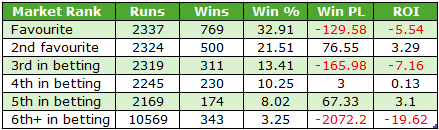
The value has been with those second in the market, a cohort that secured a blind return of just over 3p in the £. Indeed, when focusing on non-handicaps only, this group enjoyed 175 winners from 694 runners (SR 25.2%) for a profit of £76.38 with returns of 11p in the £.

In terms of favourites, we can see they suffered overall losses of 5.5p in the £, and it was non-handicap market leaders that struggled the most. Such runners won nearly 41% of the time (285 wins from 697), but their losses were steep: £69.45 (ROI -10%).
Digging into this group a little more, if we look at the record of 2-year-old favourites in non-handicaps we can see that they performed very poorly. They managed 122 wins from 377 runs (SR 37.8%) but at a loss of £59.45 (ROI -18.4%). Narrowing the 2yo non-handicap favourite data down further to 2yo maiden races, favourites endured a dreadful time of time of it with just 21 winners from 78 runners (SR 26.9%) for significant losses of £32.81 (ROI -42.1%).
It is also worth noting that horses sent off sixth or bigger in the betting performed quite poorly, losing close to 20 pence for every £1 staked.
Regular readers know that I like to concentrate on 'non-rags', so let me split the results by those that were BSP 16.0 or less versus those BSP 16.01 or more:

This perhaps should not come as such a big surprise based on the findings shared earlier about horses sixth or bigger in the betting; a good chunk of such runners would have ended up in the BSP 16.01 or more group. In fact, if we focus on an even bigger priced cohort, those BSP 30.0 or longer, that would have lost over 32p in the £.
Clearly July and August has been a time where not many big priced winners have popped up on the sand. Thus, hereafter, I will be focusing on horses that were priced BSP 16.0 or less only.
Sex of horse
Let's now look at the record of male horses versus female ones. The splits below are based on the results of races open to both sexes. It makes no sense to include male or female only races in any such comparison:

There was well over twice as many male runners, which is the norm, and they recorded a better win rate, also the norm. In terms of returns males edged that, too.
The difference between the sexes widens a little when we look specifically at mixed age handicap races. The breakdown was as follows:

Well, it certainly widens in terms of returns with males having a slightly bigger upside here. From an A/E (BSP) index perspective, a metric that measures value, males in mixed handicaps have offered better value as the graph below shows.
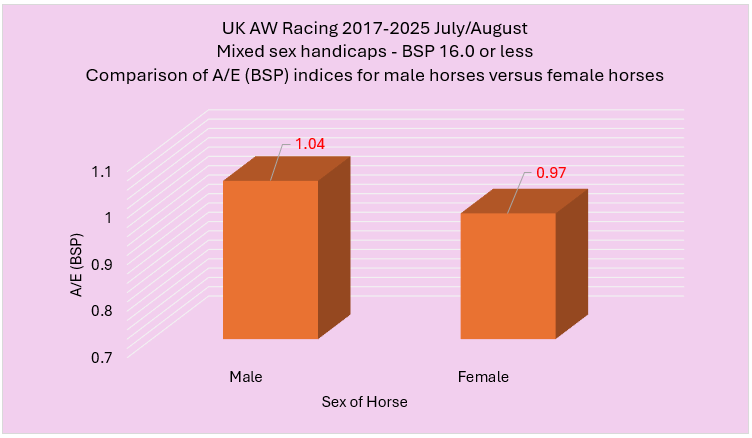
A figure above 1.00 indicates value and male runners have edged above that hitting 1.04.
Age of horse
For this section I have ignored two-year-olds as there is little point comparing them to other age groups.
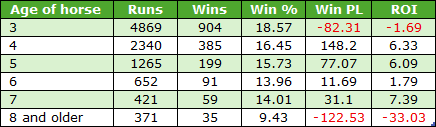
The biggest takeaway from here is the very poor performance of older horses: losses of just over 33p in the £ has been very poor. For the record, 3yos have a similar record in 3yo only races compared to those open to 3yos and older ones.
Position Last Time Out (LTO)
Let us see how the most recent run has affected performance based on last time out finishing position.
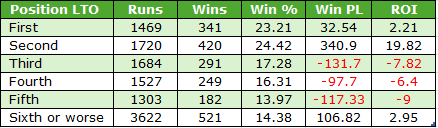
LTO winners nudged into a very small profit, while horses that finished second produced huge profits. Their A/E (BSP) figure stands at an impressive 1.12.
Race type LTO
I wondered if a run on the AW last time or on the turf would make a difference, and when I looked at the strike rates there was a difference of just over 1.5% as the graph below shows:
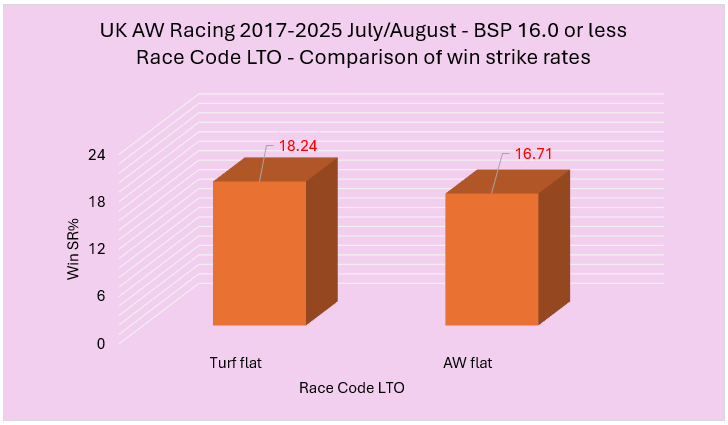
Does this strike rate difference affect the profit and loss figures? The table below reveals all:

The answer is an emphatic ‘yes’, thanks to a difference of £462.41 between the two to £1 level stakes. The difference in terms of returns was a smidge above 8p in the £. Clearly, based on these numbers, a run last time on the turf is preferable.
We saw earlier that both last time out winners and last out runners up were profitable over the period of study. When those most recent firsts or seconds were on turf, the figures improved further as the table below shows:

Not only have the strike rates improved but the returns have, too. The ROI% increase for LTO winners was around 4% while for last time runners up it increased by nearly 10%. The A/E (BSP) index for this cohort of runners up stands at a very healthy 1.22. Hence, any horse that finished first or second LTO on the turf needs close scrutiny this July and August when running next on the AW.
Trainers
On to trainer performance now. Below is a table containing all trainers who had at least 100 runners on the AW in July and August (2017-2025) priced BSP 16.0 or less. The table is sorted by win strike rate:
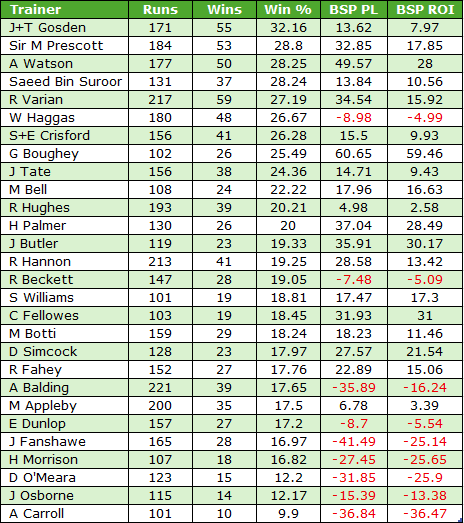
There were more trainers in profit than in loss in this table (19 of the 28), with several showing good returns. Let me share a few observations:
George Boughey
Over the last two years Boughey's record reads 10 wins from 36 (SR 27.8%) for a profit of £34.90 (ROI +96.9%). He also did well when his runners started second in the betting market. This cohort won 35.7% of the time (10 from 28) for a profit of £15.64 (ROI +55.9%).
John+Thady Gosden
Look out for Gosden-trained favourites. Their 61 qualifiers fared very well, winning 55.7% of the time and returning just below 20p in the £.
Richard Hughes
Horses second in the betting have been profitable for Hughes thanks to 12 wins from 40 (SR 30%) for a surplus of £13.52 (ROI +33.8%). He also had an exceptional record with LTO winners, scoring with 50% of their follow-up AW starts (10 wins from 20) for a healthy profit of £17.96 (ROI +89.8%).

Sir Mark Prescott
Sir Mark has been consistent across all six AW tracks producing profits at five. The only losing course for him was Wolverhampton where he had minimal losses of 4p in the £. Horses that finished fourth or worse LTO had a good record on the all-weather in July and August for the stable thanks 19 wins from 65 (SR 29.2%) for a profit of £31.55 (ROI +48.5%).
Roger Varian
Varian has performed well with second favourites, claiming 17 wins from 56 runners (SR 30.4%) for a profit of £16.20 (ROI +18.2%). He had a good record specifically when sending runners to Lingfield: 10 wins from 27 (SR 37%) for a profit of £7.62 (ROI +28.2%).
Archie Watson
Take note when Watson runners appear at Lingfield. His record reads an excellent 10 wins from 30 (SR 33.3%) for a profit of £24.79 (ROI +88.6%). He also did well at Wolverhampton with 21 winners from 58 (SR 36.2%) for a profit to BSP of £26.15 (ROI +45.1%). Watson's LTO winners performed with credit winning 12 of 30 starts (SR 40%) for a profit of £5.97 (ROI +19.9%).
Earlier I shared the fact that a LTO run on the turf had been preferable, and below is a graph showing the trainers with the best records with horses that raced in a turf flat race LTO. To qualify, they must have had at least 75 qualifiers and recorded a profit. The graph shows their relevant returns on investment to BSP.
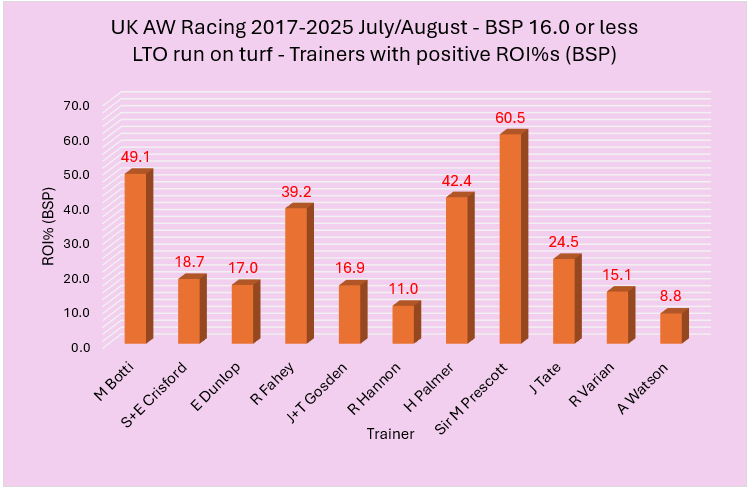
There were some excellent returns especially for Messrs. Botti, Fahey, Palmer and Prescott.
*
That wraps up this piece and it there have been plenty of positive angles highlighted for racing on the AW over the months of July and August, as well as some clear negatives.
Below is a quick summary of positives and negatives, mainly focusing on horses priced 16.0 or less BSP. The aide memoire excludes trainer findings as there were so many different positive angles, highlighted separately above.

- DR
Other Recent Posts by This Author:
- Looking Ahead to Autumn on the Flat
- How to Profit from Runners Up
- Ebor Festival 2026: A Statistical Overview
- Billy Loughnane: ‘The Kid’ in Numbers
- Course Topography: Uphill Finishes





Be interesting to look at the other seasons to see if there is any variation.
Thanks Dave for another brilliant article. Just wondering if the LTO angle is across all ages?
Leave a Reply
Want to join the discussion?Feel free to contribute!