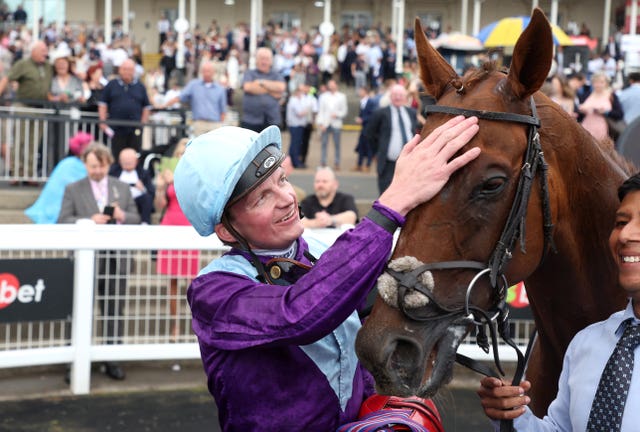
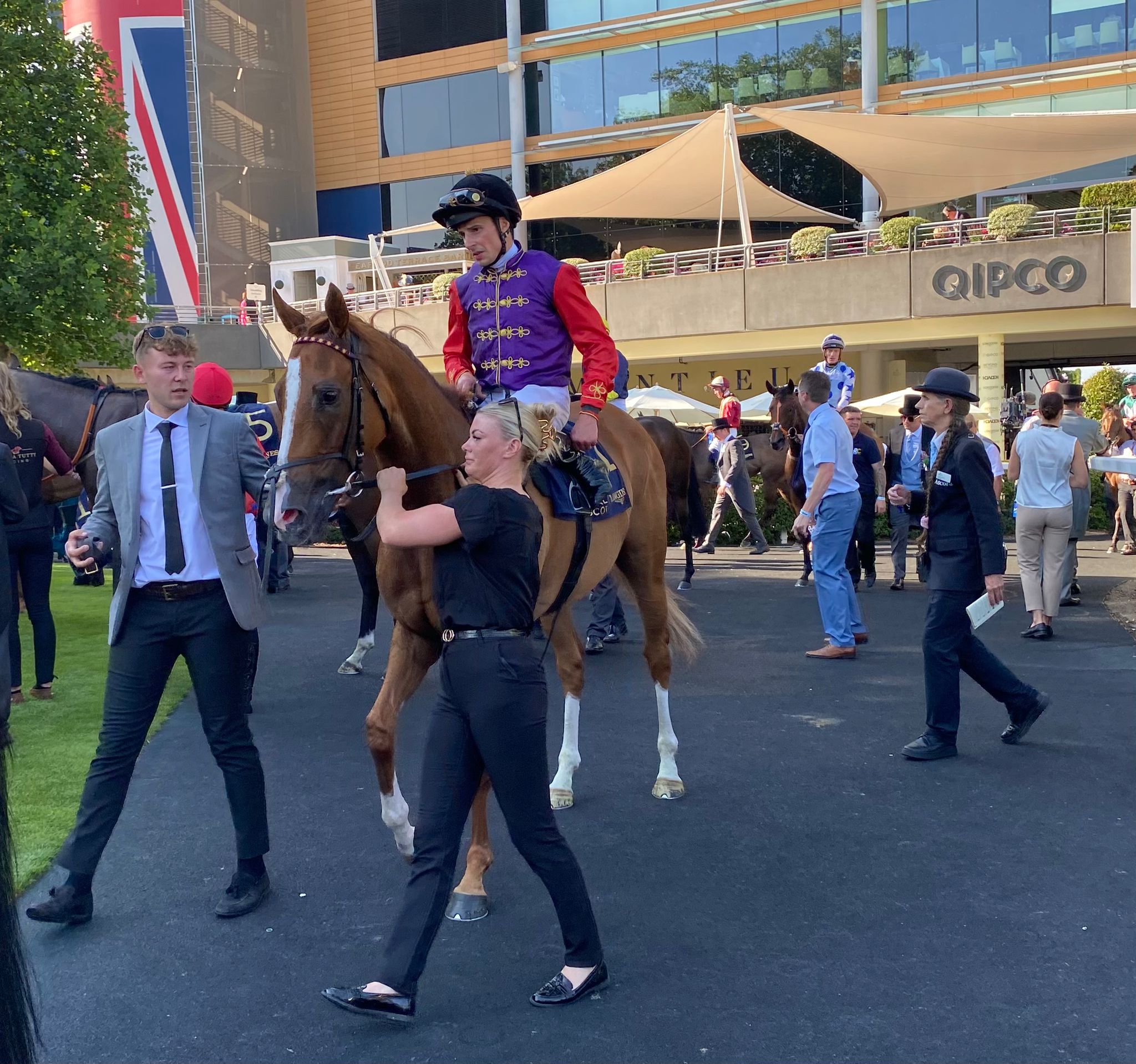
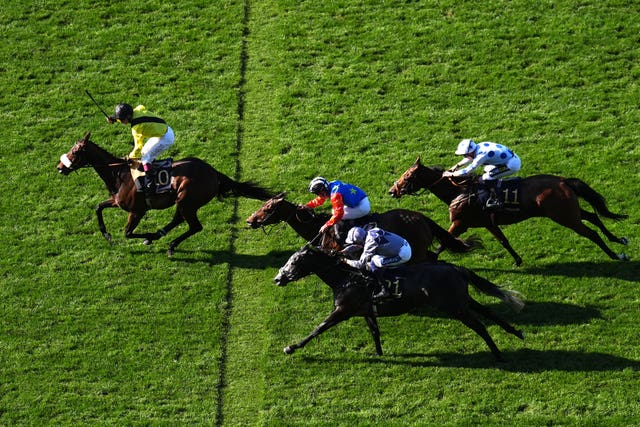
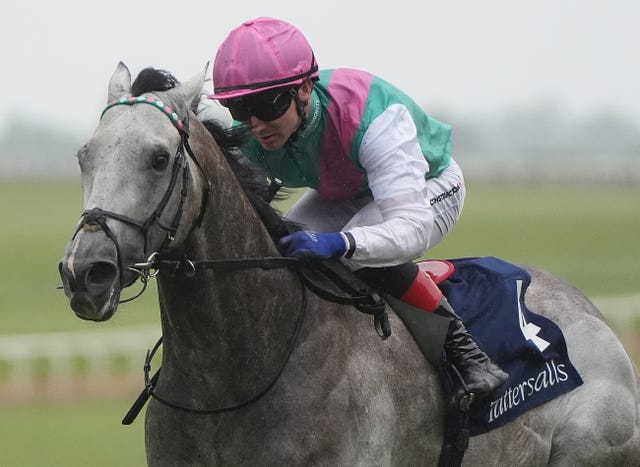
Fox Legacy struck in good style at York to take the valuable John Smith’s Cup Handicap.
The four-year-old, who is owned by King Power Racing and trained by Andrew Balding, was not far from the action when last seen in the Royal Hunt Cup at Ascot and was a 10-1 chance under PJ McDonald.
Always prominent when racing from stall 19, the bay progressed nicely through the race and was comfortably able to pull clear when asked in the final furlong to prevail by a length.
“It’s a testament to the horse that from that draw I was able to get a position and then take him back and relax where I was,” McDonald told ITV Racing.
“The only thing I had to do was to make sure not to go too soon, he travelled around beautifully for me and he gave me a great spin.
“I was still going nicely into the two (furlong pole). I thought if I let him stretch out and take it (the lead) they’d have to come and get me. Andrew’s horses are absolutely flying.”
Al Qareem showed there a few more reliable horses in training when seeing off all challengers to claim the John Smith’s Silver Cup Stakes.
Karl Burke and Nick Bradley Racing’s seasoned six-year-old won a Listed contest over the same course and distance last time out and was well backed as the 4-7 favourite under Clifford Lee.
He took up the lead at an early stage and was never passed, shrugging off every horse that attempted to challenge him in the home straight to claim victory by a dominant two and a half lengths.
“He always seems to look as though they’re going to get him but he just grinds it out, he’s so honest and a superstar of a horse to train,” said Burke.
“I’d say the weight will rule him out of the Ebor, presumably he’d get a penalty as well.
“It’s always been the target, the Irish St Leger, I think it’d be a nice race for him to roll the dice in.”
Washington Heights claimed a well-deserved success in the John Smith’s City Walls Stakes at York, justifying his status as the 9-4 favourite.
Trained by Kevin Ryan and ridden by Shane Gray, the five-year-old has run with real credit in a range of Group sprints and was most recently seen finishing a close-up seventh in the King Charles III Stakes at Royal Ascot.
On the Knavesmire he tackled the same five-furlong trip but was dropped down to Listed level, taking on seven rivals and proving the best of them with a smart three-quarter-length victory.
“He’s a great horse for a syndicate like this, he takes them to all the right meetings and as you can see today, they support him well,” said Adam Ryan, assistant to his father.
“It’s great for him to get his head in front. The thing with him is he’s as tough as bell metal, I thought they were going to get to him a furlong down but it was going to take a brave horse to get past him.
“Thankfully he dug deep, which he always does.”
https://www.geegeez.co.uk/wp-content/uploads/2025/07/2.79960760-scaled.jpg12802560Geegeez Newshttps://www.geegeez.co.uk/wp-content/uploads/2022/10/geegeez_banner_new_170x78.pngGeegeez News2025-07-12 16:11:132025-07-12 16:11:13Fox Legacy too smart in John Smith’s Cup
Blue Bolt continued her progression with a third straight victory in the Coral Distaff at Sandown.
Beaten into fifth place as an odds-on favourite for her racecourse debut at Southwell in April, Andrew Balding’s filly has not looked back since, bolting up at Windsor in May before following up with a comfortable success at Newbury in June.
She was a 2-1 favourite to complete her hat-trick at Listed level in Esher and having grabbed the lead from an early stage under Colin Keane, the daughter of Blue Point found plenty for pressure in the straight to score by a length from Cajole.
“When I saw the draw we had (stall three), I knew there was no point in taking her back,” said Keane.
“I’m still getting the hang of the place, for a stiff track it’s hard to come from too far back off the pace. When the ground is like that, being on the pace helps and being on a nice filly is an even bigger help.
“It’s such a stiff track, when you turn in on the straight you’re climbing the whole way and I suppose horses struggle to make up ground on it.”
Richard Hannon’s Dubawi gelding Classic came good in the one-mile Coral Challenge.
The five-year-old has often looked better than his bare form, and a switch to front-running tactics under Sean Levey unlocked that potential as he claimed success by a length and a quarter at 6-1.
“I was sick of seeing him be unlucky, looking like he has all the ability in the world, we know that,” said Hannon.
“Today he looked like he was never going to get beaten. Jack (Hannon’s son) said to me a furlong from home ‘is Sean OK, he looks like he’s injured or something, he’s not trying’. He was trying!
“This horse has had a lot of near-misses and he’s an extremely talented horse who is by a stallion (Dubawi) where anything is possible.
“He could well turn out to be a Group horse and could come back to seven furlongs no problem – he’s got loads of speed and loads of ability.”
Mudbir came to the fore for John and Thady Gosden in the Coral Celebrating 50 Year Eclipse Sponsorship Handicap, prevailing by half a length under Jim Crowley having started at 9-2.
The Kingman colt is owned and was bred by Shadwell and is a half-brother to their multiple Group One winners Mostahdaf and Nazeef.
A gelding operation looks to be key to Yahber after his smart win in the Coral “Pipped-At-The-Post” And Win Handicap.
Trained by William Haggas and ridden by Tom Marquand, the three-year-old son of Sea The Stars was the 9-4 favourite after showing signs of promise when second at Redcar last time.
He duly delivered over the 10-furlong trip, triumphing by a neck for owner Sheikh Juma Dalmook Al Maktoum.
“I’m really happy with him, he’s been gelded and to be honest it’s probably going to be the making of his future,” said Marquand.
“William and his team decided to do it and it’s been the making of some really fun horses we’ve had like Addeybb.
“This guy is obviously plenty talented and it seems to have done the trick, hopefully it will set him on the right trajectory now.”
The concluding Coral Golden Rewards Shaker Handicap then went the way of Flying Frontier, an 8-1 chance under Rossa Ryan who rallied late to claim a narrow victory on the line.
https://www.geegeez.co.uk/wp-content/uploads/2025/07/2.80900914-scaled.jpg12802560https://www.geegeez.co.uk/wp-content/uploads/2022/10/geegeez_banner_new_170x78.png2025-07-05 15:23:062025-07-05 16:50:13Blue Bolt strikes in Distaff heat
Andrew Balding has vowed to give Oisin Murphy “all the help and support” he can after the multiple champion jockey admitted driving a car while drunk and crashing into a tree earlier this year.
Murphy was fined £70,000 and banned from driving for 20 months after being sentenced at Reading Magistrates’ Court on Thursday, with the 29-year-old having pleaded guilty to one count of driving a motor vehicle while over the prescribed limit of alcohol.
He later issued a statement apologising for his actions, saying “there is no excuse for what I did”, while the British Horseracing Authority confirmed he is free to continue riding amid plans to place new conditions on his licence.
Balding, who has a long and successful association with Murphy, enjoyed a Friday treble at Sandown, from where he told Racing TV: “He’d made them (details of the case) known in advance, but obviously we were hoping that what we were hearing was accurate and that was the case.
“Obviously it’s not an ideal situation for him or for us or for anyone really, but I really hope that we can take this as a point to move forward and I know he’ll be working closely with the BHA and we’ll be giving him all the help and support we can to try to ensure nothing like this ever happens again.”
Murphy travelled to America to partner former Balding inmate New Century in the Belmont Derby at Saratoga on Friday night, but is scheduled to be back in action in Britain on Saturday for seven rides at Sandown, including Charlie Appleby’s 2000 Guineas winner Ruling Court in the Coral-Eclipse and three booked mounts for the Balding team.
When asked if he would continue to support Murphy, the trainer added: “Yes, of course. Everyone makes mistakes, but I think as long as there’s an intent to improve going forward, we’re all behind him.
“It’s for the regulator to put in what they want to see going forward and let them deal with it.
“We have (had a long, professional relationship with Murphy) and we expect higher standards than that. It was a very unfortunate incident and I hope that’s the end of it.”
https://www.geegeez.co.uk/wp-content/uploads/2025/07/57112807-e61a-49e5-bed8-23723d5043e5.jpg12412482https://www.geegeez.co.uk/wp-content/uploads/2022/10/geegeez_banner_new_170x78.png2025-07-04 16:54:052025-07-04 16:54:05Andrew Balding pledges ongoing support for Oisin Murphy
Having acted as a pacemaker for the brilliant Field Of Gold on his previous two starts, Windlord made the most of having his sights lowered with a hard-fought victory in the Davies Insurance Solutions Gala Stakes at Sandown.
A close second in the Sandown Classic Trial in the spring, the Dubawi colt subsequently gave his fellow Juddmonte-owned colt something to aim at in the Irish 2,000 Guineas and the St James’s Palace Stakes at Royal Ascot, ultimately finishing well beaten on both occasions.
Andrew Balding’s charge was a 6-4 favourite dropping down to Listed class and while the front-running Caviar Heights proved a tough nut to crack on his first start since joining William Haggas, Windlord got the better of a final furlong tussle by a nose in the hands of Colin Keane.
Balding said: “I know Caviar Heights very well because I bought him as a yearling and trained him as a two-year-old and he’s very tough so I wasn’t convinced we were going to get past him.
“He showed real desire and he’s previously been asked to do something (pace-making) that wasn’t ideal for him so it’s nice for him to win a race in his own right.”
Balding, Keane and Juddmonte were completing a double on the card following Kassaya’s comeback victory in the preceding Battaash Handicap
Kassaya (centre) was an impressive winner on her return at Sandown (Nigel French/PA)
A 5-2 market leader on her first appearance since finishing down the field as favourite for the Queen Mary at Royal Ascot last summer, the half-sister to 2000 Guineas hero Chaldean was good value for the winning margin of three-quarters of a length.
“We thought the world of her last year, she was favourite for the Queen Mary and got no run and then picked up an injury after that and it’s just taken an age to get her back to the sort of form where we were happy to run her,” Balding added.
“I think she’ll come on a bundle for that, it was really encouraging and exciting for the future.”
Balding then teamed up with William Buick to make it three winners on the day via Coltrane (5-2) in the Coral Marathon.
The eight-year-old won the Listed contest back in 2022 and had to dig deep for a repeat, fending off the late challenge of Al Nayyir by a short head, with just half a length back to Real Dream in third.
Coltrane took the Coral Marathon (Nigel French/PA)
Balding said: “That was thoroughly well deserved. He’s been a bit of a star and that has taken his earnings over £1 million.
“He has been the horse of a lifetime really. He loves it here and has loved his racing this year. He was a little but inconsistent last season but has been in great form this year.
“He’s not in at Goodwood and I think we will probably wait and look at Doncaster with him now and then his swansong will either be at Ascot or in the Cadran.”
https://www.geegeez.co.uk/wp-content/uploads/2025/07/2.80891197-scaled.jpg12802560https://www.geegeez.co.uk/wp-content/uploads/2022/10/geegeez_banner_new_170x78.png2025-07-04 16:52:342025-07-04 16:52:34Windlord edges Gala glory in tight Sandown finish
Spirit Mixer made it third time lucky in the JenningsBet Northumberland Plate at Newcastle.
A close second to top-class stayer Trueshan in 2023, Andrew Balding’s charge could finish only ninth 12 months ago and went off at 25-1 on this latest visit to Gosforth Park for a race affectionately known as the ‘Pitmen’s Derby’.
Bred in the purple as a son of Frankel and owner Jeff Smith’s Group One-winning mare Arabian Queen, Spirit Mixer was delivered with his challenge in the home straight and knuckled down to get the better Dancing In Paris by a neck under a delighted Rob Hornby, who travelled north for a solitary ride.
Spirit Mixer comes out on top in the Northumberland Plate!
“He was never a 25-1 shot in my head. I’ve won big races on him before and he was coming in off the back of a really good run at Goodwood,” said the jockey.
“I could have gone to Windsor and had four or five rides, but I wanted to come and ride him. He’s a horse that’s done no harm to me and it’s fantastic to get that sort of reward today.
“There’s a great crowd here today – I don’t usually make the trek up north this far! I put it in my Sat Nav and it’s just over five hours to get home, so this will make it a bit easier.”
Jockey Rob Hornby with Spirit Mixer after winning the Northumberland Plate (Scott Heppell/PA)
He added: “He’s such a cool horse, he’s seven years old now and a beautifully-bred homebred of Mr Smith’s. He’s just thriving and really enjoying his racing at his tender age.
“The race went pretty smooth. I thought I was jostling for the lead early enough, but he got into a battle and outstayed them then inside the last furlong.
“It’s important to be riding winners on Saturdays in these big races and I’ve been fortunate enough to win a July Cup in these colours (on Alcohol Free), they mean a great deal to me, as does riding winners for Kingsclere.
“What a joy he is to own and to train and to ride.”
Kalpana will bid follow in some illustrious hoofprints by providing owner-breeders Juddmonte with back-to-back victories in the Paddy Power Pretty Polly Stakes at the Curragh on Saturday.
The powerhouse operation landed the Group One feature with subsequent Prix de l’Arc de Triomphe heroine Bluestocking 12 months ago – and following an excellent start to her campaign when third behind Los Angeles and Anmaat in the Tattersalls Gold Cup, Andrew Balding’s filly looks to add her name to the roll of honour.
“It looks a great renewal, but Kalpana is in good nick, we’re happy with her and she obviously ran well over the course and distance last time,” said Juddmonte’s European racing manager, Barry Mahon.
Having rounded off last season with Group One success on Qipco Champions Day at Ascot, Kalpana was expected to pursue the “Bluestocking route” this term, with Europe’s premier middle-distance contest in Paris on the first Sunday in October a long-term goal.
A planned comeback in York’s Middleton Stakes had to be aborted due to a dirty scope, but she showed her worth behind two top-class colts in the Tattersalls Gold Cup and having since sidestepped the Hardwicke at Royal Ascot, she makes a second successive trip across the Irish Sea to take on Aidan O’Brien’s Whirl, who was second to stablemate Minnie Hauk in the Betfred Oaks at Epsom three weeks ago.
Mahon added: “I think the ground was probably a little on the quick side in Ascot. We’ve had a bit of rain here and I’m sure the ground will be good, whereas it was 30 or 32 degrees every day in Ascot and it was just starting to get a bit quick for her.
“We decided to wait and take on our own sex in a Group One instead of going in a Group Two against colts. It’s probably going to be tough to give 12lb to a filly of Whirl’s calibre, but she’s in good form and she’s ready to run a good race.”
Whirl winning the Musidora Stakes at York (Danny Lawson/PA)
Whirl dominated from the front in the Musidora Stakes at York before being beaten a neck by her stable companion at Epsom.
O’Brien said: “She’s a three-year-old, but we always thought this was a race that would suit her and she seems to have come out of Epsom well.
“She won the Musidora over a mile and a quarter and was very impressive that day. It was a big run out of her in Epsom as well and that was a step up to a mile and a half, but looking at her in York you’d say she’ll have no problem going back to a Group One over a mile and a quarter.”
Joseph O’Brien’s Oaks fourth Wemightakedlongway also features, as does French raider Survie, who was last seen finishing second to Arc runner-up Aventure in a Group Two at Saint-Cloud.
https://www.geegeez.co.uk/wp-content/uploads/2025/06/2.77864400-scaled.jpg12802560https://www.geegeez.co.uk/wp-content/uploads/2022/10/geegeez_banner_new_170x78.png2025-06-27 15:13:492025-06-27 15:13:49Kalpana out to return to winning ways in Pretty Polly
Andrew Balding’s exciting filly Formal takes on the boys in what looks a strong renewal of the Al Basti Equiworld Dubai Criterion Stakes at York on Saturday.
The seven-furlong Group Three is being run on the Knavesmire for the first time following a switch from Newmarket and is being viewed by some as a stepping-stone to the City of York Stakes, which now carries Group One status and is run over the same course and distance at the Ebor Festival later in the summer.
Formal disappointed on her seasonal debut in the Fred Darling at Newbury, but showed her true colours when winning Epsom’s Surrey Stakes on Oaks day three weeks ago and that form received a significant boost after the runner-up Saqqara Sands landed a Listed prize at Carlisle on Wednesday.
“We were going to wait for the Oak Tree at Goodwood, but Andrew was quite keen to let her take her chance on Saturday and I don’t think he’s discounted Goodwood either,” said Chris Richardson, managing director for owners Cheveley Park Stud.
“She seems to have come out of Epsom really well and they’re very happy with her. Andrew is keen to have a go, he thinks it’s a good opportunity and seven furlongs should be her trip, so we’ll all learn a bit more about her.”
The likely favourite is the William Haggas-trained Lake Forest, who returns to action less than a fortnight after finishing fifth over a mile in the Queen Anne at Royal Ascot.
The four-year-old beat Queen Elizabeth II Jubilee Stakes winner Lazzat in the Golden Eagle in Australia last year and jockey Tom Marquand is excited to ride him back over this shorter trip.
“It was a good run at Ascot, it was a funny race as we sprinted from a good way down and it was the second wave who went over the top in Docklands and Rosallion,” Marquand told Sky Sports Racing.
“They were the best of the division and I thought he ran a respectable race.
“It’s a quick enough back up but he’s a tough little horse, he loves fast ground and seven furlongs at York should be on the money trip-wise so I’m looking forward to getting back on him.”
Paborus has won four of his six starts with Ed Bethell and will carry the Wathnan Racing colours for the first time.
Wathnan’s racing adviser, Richard Brown, said: “He wouldn’t want rattling ground so with the dry spell we’ve had we’ve just had to be patient with him.
“We’ll see what Saturday brings, he was very impressive at Thirsk last time and he’s a big horse who we hope has a big future, but we will have to mind him ground-wise.
“Ed is a great guy and one of the most impressive young trainers in the country and Wathnan are delighted to have a horse with potential with him.”
The Dylan Cunha-trained Prague was a brilliant winner of Newmarket’s Joel Stakes last season but failed to fire in the QEII at Ascot on Champions Day and has not been seen in competitive action since.
“He’s in great form – as well as I’ve ever seen him. He’s training really well,” said Cunha.
“The drop to seven furlongs is just because he’s quite keen in his races – we just want to teach him to settle. We’ve been going a mile and a mile and a quarter with him, but his mother (Princess Noor) was actually a six-furlong Group Three winner.
“It’s an experiment but if he runs in the first two he’ll go to the City of York. If it’s too short, he’ll run in the Strensall. He’s definitely going to York twice in the next two months!”
https://www.geegeez.co.uk/wp-content/uploads/2025/06/2.80532755-scaled.jpg12802560https://www.geegeez.co.uk/wp-content/uploads/2022/10/geegeez_banner_new_170x78.png2025-06-27 13:46:592025-06-27 13:46:59Formal mixing it against the boys in Criterion
Humidity made his rivals feel the heat in the Chesham Stakes thanks to a fine front-running ride from James Doyle at Royal Ascot.
Trained by Andrew Balding, he was an impressive winner in the colours of Cheveley Park Stud over six furlongs at Newbury on debut, but transferred to the ownership of Wathnan Racing ahead of stepping up to seven furlongs for this Listed event.
Humidity (4-1) was quickly away and never passed by his rivals, showing great resolve when challenged late in the day to replicate his brother Holloway Boy, who won this contest on debut at the 2022 Royal meeting.
Balding said: “I am so pleased and at the beginning of the week we felt this horse was probably our strongest chance.
“He’s a lovely horse who had to battle hard today, and he’s done nothing wrong. I would hope he would stay further, but he’s not short of speed either. This was always the plan but we will now work back from something nice in the autumn.
“He’s so laid back. I’m a big fan of Ulysses – I think he’s an under-rated stallion, so this is good for him and we’ve got a couple of other nice horses by him, but he (Humidity) is an absolute dude, very relaxed.
“I think he could be a Guineas horse. He’s not short of speed and he’s got a lovely long stride, so he’s got a bright future.”
Coral make Humidity a 14-1 shot for next year’s 2000 Guineas.
Thesecretadversary followed Humidity home a length adrift at 12-1, with trainer Fozzy Stack predicting a bright future for the son of St Mark’s Basilica.
“He ran a great race. It’s annoying we didn’t get there, but he ran a great race,” said Stack.
“He’s been very straightforward, he’s always looked a bit above average from the minute we started doing a bit with him.
“I know he’s quite colourful, but he’s actually a very good model. Seamie (Heffernan, jockey) was delighted with him, he said he has the pace of a good horse, he feels he will mature in time.
“We have all the options, we can run back at a maiden, we can keep pitching in at a higher level, we will see.”
https://www.geegeez.co.uk/wp-content/uploads/2025/06/c0229756-650b-4114-ba24-df9994804c62.jpg10242048https://www.geegeez.co.uk/wp-content/uploads/2022/10/geegeez_banner_new_170x78.png2025-06-21 13:49:072025-06-22 11:40:14Humidity too much for Chesham rivals
Rainbows Edge could finish only seventh in the colours of the King and Queen, as Miss Information claimed top honours in the Kensington Palace Stakes on day two of Royal Ascot.
With the well-fancied Reaching High unable to land a blow when the 11-4 favourite for Tuesday’s Ascot Stakes, attentions turned to the next runner to carry the royal silks in the penultimate race on Wednesday’s card and Rainbows Edge was the 3-1 market leader come the off.
The four-year-old had won three of her four starts for the the in-form training team of John and Thady Gosden, but while she travelled strongly for the first half of this straight mile contest under William Buick, she was a spent force with two furlongs to run and faded out of contention.
Rainbows Edge before running at Royal Ascot (Adam Morgan/PA)
John Gosden said: “The ground was too quick for her, it dried out too much for her and she wants stepping up to a mile and a quarter.
“She’s actually run well for a filly who wasn’t in love with the ground, so we will just now go a mile and a quarter with a bit of ease in the ground and hopefully win a Listed race with her.”
At the business end of proceedings it was Andrew Balding’s Miss Information (11-1) and the Gavin Cromwell-trained Snellen who came to the fore, with the former coming out on top by a length in the hands of Oisin Murphy.
Miss Information passes the post in front in the Kensington Palace Stakes (John Walton/PA)
Balding said: “She’s been a star, this filly. She had no luck last time at Epsom, she got shuffled back and just didn’t seem to enjoy herself.
“Fast ground is what she wants, she just about got the mile.
“It’s so nice for her owner, they really get a lot of enjoyment out of it and I’m so pleased for them.
“She’s in the Bunbury Cup, we will try to get some black type at some stage and she’ll make a lovely broodmare.”
https://www.geegeez.co.uk/wp-content/uploads/2025/06/2.80705766.jpg12422484https://www.geegeez.co.uk/wp-content/uploads/2022/10/geegeez_banner_new_170x78.png2025-06-18 17:00:562025-06-18 17:15:15Disappointment for the King and Queen again at Ascot
Colin Keane made the perfect start as Juddmonte retained jockey when Blue Bolt recorded a bloodless victory at Newbury on Thursday.
It was the first time the six-time Irish champion had donned the famous colours of the Abdullah family since his appointment was announced on Monday, as he took the reins aboard Andrew Balding’s Windsor scorer Blue Bolt, who was sent off the 6-4 second-favourite for the Darley EBF Fillies’ Novice Stakes.
The Irishman left little to chance with a positive ride and having asked his mount to quicken and put the race to bed passing the two-furlong pole, Blue Bolt soon put distance between his rivals.
Although seeing her advantage shortened by Roger Varian’ Majaz in the closing stages, Blue Bolt was still a length and a quarter clear at the winning post to help rubber stamp Keane’s position as first choice to one of the leading ownership operations in racing.
His first ride and it's a first winner for Colin Keane in the @JuddmonteFarms silks since his appointment!
Keane said: “It’s the perfect start and she is a nice filly who was a good winner the last day and seems to have stepped forward again.
“She’s very uncomplicated, she just gallops on and is a nice filly. It felt very easy for her in the first half of the race and I was trying to take her back a little bit and she just got a bit lonely once she had quickened away from them. But I would say she is a filly with a nice future.
“I’m very privileged to be asked to wear these colours and they are iconic in racing. I have grown up looking at them and their farm is only up the road so I’m in a very privileged position.”
Although this was Keane’s first ride on a member of the Juddmonte string in an official capacity, he has twice tasted Classic honours in their silks when winning the Irish 2,000 Guineas with both Siskin in 2020 and John and Thady Gosden’s Field Of Gold only last month.
Field of Gold dazzled in the Irish 2,000 Guineas (Niall Carson/PA)
It is the latter that could prove Keane’s trump card at Royal Ascot next week and speaking to Sky Sports Racing he added: “He was very good on the day (in the Irish Guineas) and he felt like a proper horse. I don’t think I’ve ridden one as good as him to be honest.
“Only time will tell, but I think a fast pace would help him and bring him along further (in the St James’s Palace) and hopefully he’s then good enough to pick them off.”
Earlier on the card George Boughey’s 8-11 favourite Moonfall opened his account at the third attempt when a two-length winner of the first division of the Local IQ EBF Novice Stakes, while Charlie Appleby’s heavy odds-on favourite Time To Turn was turned over in the second division by Clive Cox’s 28-1 outsider A Bit Of Spirit.
https://www.geegeez.co.uk/wp-content/uploads/2025/06/277117824-1.jpg11532306https://www.geegeez.co.uk/wp-content/uploads/2022/10/geegeez_banner_new_170x78.png2025-06-12 15:42:572025-06-12 15:42:57Blue Bolt strike sees Keane waste no time in celebrating Juddmonte position
Exciting filly See The Fire has been supplemented to join the likes of Los Angeles and Anmaat in a mouthwatering renewal of Wednesday’s Prince of Wales’s Stakes at Royal Ascot.
Having performed well at Group One level on several occasions last season, Andrew Balding’s See The Fire could only finish fifth on her Sandown comeback, but bounced back to form with a spectacular 12-length success in last month’s Middleton Stakes at York.
She is now set to take on the boys in the feature event on day two of the Royal meeting after being added to the £1million Prince of Wales’s Stakes at a cost of £70,000.
Los Angeles (left) and Anmaat will lock horns again at Ascot (Niall Carson/PA)
Aidan O’Brien’s Los Angeles denied the Owen Burrows-trained Anmaat by half a length in the Tattersalls Gold Cup at the Curragh last month, with last year’s winner White Birch back in fourth.
All three horses look set to line up on Wednesday, with Anmaat arguably the one open to most improvement given his Tattersalls Gold Cup appearance was his first since winning the Champion Stakes at Ascot in October.
O’Brien has also left in Continuous, while French hopes are set to be carried by Francis-Henri Graffard’s Map Of Stars and Facteur Cheval from Jerome Reynier’s yard. The former has won five of his seven starts to date and was touched off by Sosie in the Prix Ganay on his most recent outing.
Ombudsman (John and Thady Gosden), Certain Lad (Jack Channon) and Royal Champion (Karl Burke) are the others to stand their ground.
https://www.geegeez.co.uk/wp-content/uploads/2025/06/280138985-scaled.jpg12802560https://www.geegeez.co.uk/wp-content/uploads/2022/10/geegeez_banner_new_170x78.png2025-06-12 12:24:352025-06-12 12:24:35See The Fire supplemented for Prince of Wales’s test
Andrew Balding has raised the possibility of Poule d’Essai des Poulains runner-up Jonquil dropping back in distance for a shot at the Commonwealth Cup at Royal Ascot.
The Juddmonte-owned son of Lope De Vega has excelled in the early stages of the season winning the Greenham before finding just Henri Matisse too good in France.
However, rather than a St James’s Palace Stakes rematch with his ParisLongchamp conqueror, the Kingsclere handler is contemplating reverting to sprinting at the Royal meeting.
“Jonquil is really good since France and obviously we’re hoping for Royal Ascot and he has a number of engagements there,” said Balding.
“I think the most likely at this stage is dropping him back to six for the Commonwealth Cup but it’s all in the mix. I’d hope he has enough speed for that.”
Balding is one of the main beneficiaries of the retirement of Sir Michael Stoute having inherited both Jonquil and the high-class Epsom-winning filly Formal and he added: “I think if Sir Michael had the horses we’ve acquired, they would have done exactly the same as what they’ve done with us this year.
“They were well looked after and well prepared and we’re very fortunate to have them.”
https://www.geegeez.co.uk/wp-content/uploads/2025/06/279707484-scaled.jpg12802560https://www.geegeez.co.uk/wp-content/uploads/2022/10/geegeez_banner_new_170x78.png2025-06-08 11:51:212025-06-08 11:51:21Balding contemplating Commonwealth challenge for Jonquil
After the thrills and many spills of the Cheltenham Festival attention now turns to the start of the turf flat season, writes Dave Renham. Saturday 29th March is the starting date this year and the crowds will descend on Doncaster for a card that includes the first big handicap of the season, the Lincoln. In this article I am going to look at some early season trainer form and trends. Data are taken from 2019 to 2025, although in 2020 there was no flat racing in the early part of the season due to Covid.
Selected Trainers: First Ten Runs
We see in the racing press plenty of stats connected with a trainer’s recent form, be it the last seven, 14 or 30 days, or their last ‘x’ number of runs. For some punters this information is really important and forms an integral part of their selection process. With that in mind, one question I am keen to address in this article is connected with recent trainer form. I want to try and establish whether the first few runs of the season from a particular stable is indicative of how their runners perform up to the end of April. Also, I will be looking at whether a similar level of performance each year is achieved by trainers up to the end of the first full month of the season. I just would like to clarify that the data shared in this piece has been collated starting from the day of the first turf flat meeting through to the 30th April in each season.
In order to make this piece manageable I have decided to focus on a selected group of trainers who tend to have a good number of entries in the early weeks of the season. This includes some of the big guns, namely Charlie Appleby, William Haggas and John/Thady Gosden.
My starting point was to work out the PRB (Percentage of Rivals Beaten) figures for each trainer over their first ten runs of each season. I felt that using the PRBs would be the most accurate way of determining how well a stable was performing over those ten runs. Clearly, I could have used win strike rate but over such a small sample size we could potentially get a blurred picture of how well the horses are actually running. Here are my findings.
N.B. I have combined the figures for the Johnston stable although of course Charlie Johnston is now in sole charge:
Early Season Trainer Form: Selected trainers' PRB figures
Before doing a comparison with their records up to the end of April for each year, the table does highlight that we cannot guarantee exactly how well each stable will get out of the blocks each season. Taking Richard Hannon as one example, in 2023 his first ten runners of the turf season hit a PRB of only 0.46, but last year in 2024 it was up at a huge 0.83. Likewise, the Johnston stable has seen wide variances with three PRBs below 0.35 and two hitting 0.65 and above. Now of course ten runs is a small sample but by using PRBs it does give us a better idea of the very early form of a specific stable compared with other metrics. I believe the numbers shared in this table also help to highlight that each year is different and even if stables traditionally start the season quickly, there will be years that for whatever reason things will progress more slowly. And of course, vice versa.
Selected Trainers: To End of April
Let's now take a look at the annual PRBs for each trainer covering the start of the turf flat up to the end of April. Essentially, for most years this equates to roughly the first five weeks of the season.
Early season trainer form: up to end April annually
As might be expected, fluctuations year by year in the PRBs are now less pronounced due to the much bigger datasets, although two of Charlie Appleby’s figures differ quite markedly - from 0.81 in 2022 down to 0.63 in 2024. Likewise, the Gosden stable saw a big difference between their 2019 figure of 0.71 and their 2023 one of 0.51.
Now that we have these two sets of figures we can try to address the earlier question of whether the first few runs of the season from a particular yard are indicative of how their runners will perform up to the end of April. In order to do this, I have picked out some of the trainers to analyse in more detail.
Specific Trainers: Early Season Form
Charlie Appleby
If we look at Charlie Appleby’s performance with his first ten runners in 2019, 2022 and 2024 we can see he has quite well aligned PRB figures (0.62, 0.64 and 0.66). In 2019 and 2024 he maintained a similar level of performance up to the end of April hitting 0.66 and 0.63. However, in 2022, his PRB figure for the longer timeframe soared to 0.81. That year he had 23 winners from 55 runners up to April 30th equating to a strike rate of just under 42%. From those similar starting PRBs in 2019 and 2024 he managed a longer-term strike rate of 29.2% and 29% respectively. It is difficult to say why those early five or so weeks of 2022 panned out so well for the stable compared with 2019 and 2024 when they started off in the same vein. It perhaps underlines how challenging it can be to predict future trainer form based on a smallish sample of runs.
Mick Appleby
Next for the microscope is Mick Appleby. The graph below shows the comparison:
Mick Appleby: early season form, 2019-2024
The graph shows that Appleby has been consistent in terms of overall performance in the weeks up to April 30th (the orange line) - four of the five years saw PRB figures within a very small band ranging from 0.44 to 0.46. In 2022 he did have a better overall start to the season hitting 0.53 over those first few weeks, and that year he had started fast with a 0.63 figure for his first ten runners. The 2023 season saw an even better start with a 0.66 10-run figure, but that form tailed off quickly ending up at 0.46 for the longer time frame. Looking at this data tells me that the first ten runs of the year for Mick Appleby would not necessarily have given us a good guide to how the next few weeks would have panned out for his runners.
Going back to his PRB figures for all runs up to 30th April, despite having similar ones, the correlation with the win strike rates is not completely ‘positive’ as the graph below shows:
Mick Appleby: early season win strike rate comparison
Yes, the best year was 2022, (16.1%), which correlates with the highest PRB figure of 0.53, but there is a big variance between 2019’s strike rate of 14.3% compared with 2023’s 3.2% figure. This is despite having very similar PRB figures in those two years (0.44 and 0.46 respectively).
As with all metrics, any single one does not necessarily give us the best picture. Clearly in 2019 and 2023 the Appleby runners were generally running at the same level overall – the PRB figures show that. However, in terms of winning races 2019 saw many more winners than 2023.
This type of number crunching is an excellent reminder of why racing can be difficult to profit from. Let’s imagine for example we back 20 horses to win in one month, if all of them run really well but all finish second, we still would have lost all 20 bets.
Andrew Balding
Next is Andrew Balding. Again, I have graphed the comparison between the PRB of the first ten runners with that of all runners to the end of April each year.
Andrew Balding early season form: comparison of first 10 runs with all to end April
2021, 2022 and 2023 mirrored each other with both the 10-run PRBs and the all runs to end of April PRBs very close together. In 2019 and 2024 we saw a similar pattern, with the stable flying out of the blocks in those first 10 runs and then slipping back to more normalised figures based on a larger sample.
When looking at those early weeks of the season up to the end of April, Balding does tend to perform at a similar level year on year. If we look at his win strike rate from the start of the season up to the end of April, we can see that in four of the five years they were between 17 and 19%:
There is positive correlation between the PRB figures and the win strike rate in those four years. We saw earlier with Mick Appleby that we don’t always get that positive correlation, and for Balding the 2022 figures paint a similar story. That year saw a lower strike rate despite a similar PRB figure to other years. This highlights once again why it is a good idea, where possible, to look at more than one metric when analysing a set of results in order to get a broader and better overview.
Tim Easterby
Tim Easterby has a lot of runners but his overall strike rate year on year is quite low, both early in the season and taking the season as a whole. Hence his first 10-run PRB figures are the lowest of the trainers mentioned taking the five years as a whole. 2022 saw a poorer start than usual but, by the end of April, he had pulled back to very similar five-week figures as achieved in other years.
Looking at his PRBs for those early weeks up to the end of April, we can see that there is only 0.04 between the highest and lowest ones. Essentially, at the beginning of the season, Easterby has followed a similar pattern every year with similar outcomes. Not surprisingly his win strike rate up to the end of April each year has been low as the table shows:
Tim Easterby early season win strike rate
Personally, I rarely back Tim Easterby horses even if they appear to have ticks in several boxes. For me, finding good value in his team is tricky. On the plus side, his patterns of performance rarely surprise us.
William Haggas
William Haggas has had very consistent longer-term PRB figures (up to the end of April) ranging from 0.60 to 0.67 over the five different years. His PRBs for the first ten runs are more varied as we would expect given the smaller sample size. However, it seems that, year on year, runners from the Haggas stable perform in a similar fashion. Again though, the win percentages up to the 30th of April have varied much more as the table shows:
William Haggas early season metrics
As we can see, the two highest PRB figures of 0.67 in 2019 and 0.64 in 2023 did not produce the two highest win rates. In fact, they produced the lowest win rates by some margin. 2019 was definitely unlucky for Haggas in those first few weeks as they had 12 second places from their 42 runners that year. Against that, Haggas had only six winners hence the 14.3% strike rate. We talk about luck in racing, and regardless of how good a punter one is, luck and variance are ever-present, sometimes massively.
I would not worry too much about what sort of numbers Haggas posts after his first ten runners this season. We can be fairly confident that his team over the first month or so will run to a similar level to previous years. Whether they win at around 27% or 14% I cannot say, but for readers that back any of his, let’s hope it is nearer 27!
Richard Hannon
For Richard Hannon I want to compare the two sets of PRB figures side by side as I did for Mick Appleby and Andrew Balding.
Richard Hannon early season PRB figures
The orange line represents the longer-term figures up to the end of April and, aside from the 0.47 figure for 2022, the rest lie between 0.51 and 0.59 showing that Hannon's runners perform at roughly the same type of level at this stage of the season year on year.
What I find interesting is the difference between the first 10-run figures for 2023 and 2024, which was huge. 2024 was his best start at a massive 0.83 PRB, 2023 was his worst at just 0.46. However, by the end of the first month although 2024 ended up ‘better’ in PRB terms, the gap was quite small at 0.06 (0.57 v 0.51). Indeed, looking at the win percentages for these two years there was less than 2% in it. 2023 saw a 10%-win rate, 2024 stood at 11.8%.
This is another reminder that looking at a handful of races may not be as important or as useful as some punters/pundits may think; and I am not just talking about the first ten starts of the year. It is essentially the same thing when looking at any 7-day trainer form snapshot throughout the season when a trainer has had ten runners or so during that period. Is that really a reliable enough sample on which to judge how the next few weeks are going to go for the yard in question?
Charlie Johnston
The final yard I want to look in more detail at is that of Charlie Johnston (and its recent incarnations), formerly run solely by father Mark, then by Mark and his son Charlie, and since 2023 by Charlie on his own. Here are the two sets of PRBs:
Charlie Johnston / Johnston yard early season form
I mentioned earlier the huge variances in their opening 10-run figures (the blue line), but despite that the longer term PRBs are all in the same ballpark lying between 0.50 and 0.57. I don’t think the performance of the first ten runners will be that relevant again this year when it comes to predicting what will happen in the subsequent weeks to the end of April. However, we can be fairly sure how they will perform over the longer five-week time frame.
*
Selected Trainers: Win Strike Rates to end April Annually
To finish off let me share the win strike rates for all trainers for each of the five years based on their runners from the start of the turf season to the end of April:
Selected trainers: early season win strike rates 2019-2024
These percentages can vary markedly year on year, as I meantioned earlier when looking at the performance of the Haggas yard. Luck plays its part for all trainers every year, be it good luck or bad. A few bobs of the head in a finish can make a big difference to the win rate; hopefully Geegeez members will be on the right end of tight finishes more often than not!
That is almost it for this week but for before closing I will put my head on the block and predict the win strike rates and PRBs for all of the stables mentioned in this article from the start of the Doncaster Lincoln meeting this year to the end of April. Here goes:
Projected early season win percent and PRB figures for selected trainers
Hopefully, most of these projections will be close to their mark.
Until next time,
- DR
https://www.geegeez.co.uk/wp-content/uploads/2016/08/charlieappleby2-1.jpg320830Dave Renhamhttps://www.geegeez.co.uk/wp-content/uploads/2022/10/geegeez_banner_new_170x78.pngDave Renham2025-03-26 05:29:552025-03-26 08:53:01Early Flat Season Trainer Form
This is the second of two articles looking at two-year-old runners (2yos) on their second career starts. The first piece looked at last time out (LTO) performance, LTO course, market factors, sires, damsires and some jockey stats. You can read that here. This one focuses exclusively on trainer data. I have collated stats from UK flat racing for six full years, from 2017 to 2022, and this includes both turf and all weather data. I have calculated profit and loss to Betfair SP (BSP for short), with commission of 5% taken into account.
Overall 2yo second run stats for trainers
I am going to start with a full table with all trainers who have had at least 100 two-year old second starters in the past six seasons. I have ordered the trainers by win strike rate:
* C Johnston in 2023; ** Jack Channon in 2023
A familiar face heads the list – Charlie Appleby. His 37%-plus strike rate is remarkable but, despite that whopping win percentage, he has failed to make it into blind profit. This is, naturally, because many of his runners start at short prices. Seven other trainers have secured strike rates of 20% or higher with juvenile runners making their second career starts, which again is extremely noteworthy. Just one of these seven in profit though: Hugo Palmer.
In terms of A/E indices Messrs. Palmer, Dods, Dalgleish, Osborne and Tinkler are above the magic 1.00, although Nigel Tinkler, with a strike rate of under 5%, is not a trainer for the faint of heart to follow.
At this juncture it makes sense to compare the performance of trainers' 2yo debut runners with their 2yos having a second run. In the following table I have broken this down by strike rates and A/E indices for each trainer. I have ordered them by trainers who have seen the most improvement in strike rate from first to second start:
In the final column I have divided the second run win percentage by the debut one to give us a type of Impact Value. I call it a Comparison Strike Rate (CSR) and I also used this idea in the previous article when comparing sire stats. The higher this figure the more improvement the runners show on their second run compared to their debut. I have highlighted any CSR figure of 2.00 or more in green as these are much higher than the average. The CSR figure to bear in mind is 1.52. This is the average CSR figure when looking at the strike rate comparison for second starters compared with debutants; that is, on average a two-year-old is 1.52 times more likely to win on its second start compared with its debut (7.96% vs 12.08% in case you were curious).
Ed Dunlop has a very high CSR figure but that is because his debut runners having won less than 0.6% of the time. His second starters still only win on average once in every 15 or 16 races. Ed Walker, Michael Dods, William Haggas, Hugo Palmer, Charlie Hills, Sir Michael Stoute and Andrew Balding are the group of trainers who I would be expecting to see excellent improvement between first and second runs. Some of their runners should offer us decent value.
Brian Meehan is one specific trainer whose second starters look poor value, especially when comparing the stats to his debut runners. With debutants his A/E index stands at an impressive 1.36, for second starters this drops markedly to 0.76. Eve Johnson Houghton has a similar slide (1.38 to 0.79) which is also worth noting. Ths is essentially saying that Brian and Eve have their two-year-olds ready to fire on day one, which in itself is well worth noting.
Distance breakdown: trainer performance in 5f and 6f races
I want to split the trainer data by distance now and for this piece I am combining the sprint distances of 5 and 6f, and then will be looking at races of 7f or further. This is because it gives better sized data sets. So, to start, here are the win strike rates for trainers who have had at least 75 two-year-old second starters over 5f / 6f. I have split the data into two graphs – the first with strike rates of 16% or more:
William Haggas stands head and shoulders above the rest in terms of win record. He also has an A/E index in excess of 1.00 (1.09), as do three others - Michael Dods (1.24), Andrew Balding (1.15) and Clive Cox (1.02). For the record these three have made decent profits to BSP, while Haggas would have just about broken even. Of the remaining trainers, all made a loss bar Tom Dascombe, who made a small profit. Dascombe will be interesting to follow this year in his second season after the move from Cheshire to Lambourn and without the support of Chasemore Farm.
Now for those with strike rates under 16%:
There are still some relatively decent strike rates here as well, on the left-hand part of the graph at least, although only Keith Dalgleish managed a BSP profit. No trainer in this group had an A/E index of 1.00 or more and, for the record, Richard Hughes and Tim Easterby had the poorest A/E indices (0.64 and 0.54 respectively) with both making significant losses.
Distance breakdown: trainer performance in races of 7f or further
There are 10 trainers who have secured a strike rate of 16% or more in these longer distance races:
Charlie Appleby strikes at a preposterous close to 40% and backing his runners would have seen you break even to BSP. Here are these trainers' A/E indices which give us a better indication of overall value:
Hugo Palmer, Archie Watson and the Charlton stable have figures above 1.00 and they are trainers who, over 7f or more, I think we should keep on the right side (more often than not).
At the other end of the scale, these are the trainers with lower strike rates over 7f+. As there are quite a few I’ve put their results in tabular form rather than in a graph.
Andrew Balding’s bottom line looks impressive but he had a 232.24 BSP winner in 2020 which accounts for most of his profit. Having said that, even without that outlier, Balding still made a positive return. The three trainers at the bottom – Richard Fahey, Sir Mark Prescott and Tim Easterby - are trainers I think should be swerved with 2yo runners at 7f or beyond when making their second start.
Before moving on there are a few points worth making.
Firstly, Clive Cox has a vastly contrasting distance record: over sprint distances his second starter strike rate is 21.9%, over 7f+ it is just 8.8%. A/E indices also have a chasm between them at 1.02 vs 0.60.
Secondly, Richard Fahey has a similar bent to his stats with much better sprint results: strike rates of 15.6% compared to 6.9%; A/E indices of 0.88 to 0.59.
And third, Roger Varian’s stats are somewhat remarkable from the point of view that his strike rate has been exactly 20% for both distance groups and his A/E indices are almost identical, too, at 0.67 and 0.68.
Market breakdown: trainer performance with top three in the betting
As we know, profit figures can be easily skewed by big priced winners. Hence it makes sense to analyse trainer data where it is a more level playing field – or at least where we can perform a fair price comparison. Here are the data for trainers when their 2yo second starters have figured in the top three of the betting. A minimum of 75 runs has been used as the cut-off point:
It seems right that Charlie Appleby hits a small profit considering his overall figures.
Any trainer with an A/E index of 0.90 or more I feel can be considered much more a positive than negative when it comes to their more fancied runners. Ten trainers have achieved that, of which six have edged into profit. These are Charlie Appleby, the Johnston yard, Archie Watson, Team Crisford, Hugo Palmer and Tom Dascombe. The other four - William Haggas, Charlie Hills, Clive Cox and Richard Fahey - made losses and only Cox had losses of worse than 7 pence in the £.
On the other side of the coin, Saeed bin Suroor’s record is surprisingly poor with qualifiers from the top three in the betting – a win rate of roughly one in six, but losses close to 30p in the £ and a very poor A/E index of 0.56.
So far in this article I have looked at more general trainer stats – but now I want to focus in on a few specific trainers starting, not surprisingly, with Charlie Appleby.
Individual Trainers with Second Start Two-Year-Olds
Charlie Appleby
We have seen already that Charlie Appleby has an impressive overall strike rate, but this does not mean he is a money making machine for punters. If only it was that simple! Strike rate is important but betting is essentially about getting a value price - having 50% of winners at 10/11 keeps you in the game but loses you money, whereas 15% of winners at 8/1 means long losing runs but wins you money. Such is the challenge for us punters: winners, or profit?
From my personal experience it is harder to find value with short prices and this is why one cannot just blindly back Appleby runners, or indeed almost any other short-priced 'no brainer' angle. This is perhaps neatly illustrated when we breakdown Appleby’s profit with horses from the top three in the betting. As the previous table showed, these runners did make a small 5p in the £ profit for him. However, all the profits came from horses second and third in the betting. These combined to produce returns of just under 26p in the £, whereas favourites lost just over 4p in the £.
I have dug deeper into the Appleby stats and one angle that does stand out is jockey based. I touched upon jockeys in the first of these articles when I compared second starters that were ridden by the same jockey who had ridden them on debut, with those who have seen their jockey change. As a general rule I found that horses ridden by the same jockey outperformed those which were not. For Appleby this bias is pronounced as the table shows:
William Buick has been responsible for 72 of these 103 ‘same jockey’ runners. His strike rate was 45.8% and backing these runners would have returned you £16.06 (ROI +22.3%). James Doyle has had an even better strike rate albeit from a much smaller group of runners. He had a success rate of 52.2% (12 win from 23) for returns of 19p in the £. Hence any 2yo second starter from the Appleby yard who is ridden for the second time by either Buick or Doyle is a horse that potentially offers some value.
We have seen good consistency before with Appleby runners and his second starters seem no exception. They have proved versatile by going / ground conditions as the graph below shows:
All the strike rates are above 30%; it should be noted that the highest one (tapeta) is from a small sample (7 wins from 15) so this may be artificially high.
Here are some additional Charlie Appleby stats, both positive and negative:
Appleby 2yo debut winners have a relatively modest record when running for the second time. They have backed up this win just 14 times from 60 (SR 23.3%) for a loss of £25.02 (ROI -41.7%).
The value in terms of debut performance has come from horses that finished 5th or worse on debut. On second starts Appleby has secured 19 winners with these runners from 58 (SR 32.8%) for a profit of £10.59 (ROI +18.3%).
At the highest level (Class 1 races) Appleby's runners on second start have won just 7 from 41 (SR 17.1%) for a loss of £18.07 (ROI -44.1%).
Second time runners returning to the course where they debuted have done well, scoring nearly 50% of the time. 16 wins from 33 (SR 48.5%) have created a BSP profit of £17.36 (ROI 52.6%).
Appleby has done well when sending second starting 2yos to Newmarket. He has been rewarded with 24 wins from 53 (SR 45.3%) for a healthy profit of £19.48 (ROI +36.8%).
Richard Hannon
I have chosen Richard Hannon next as he has had the biggest number of second starters in the past six seasons.
The eagle eyed of you would have seen already that his record in sprint events is better than 7f+ races; specifically, he has a strike rate of 17.3% for sprints compared to 10.6% for longer races. Here are some other Hannon second starter stats I would like to share.
Just like Appleby, having the same jockey on board that rode the horse on debut has been a plus. These horses have won 37 of their 224 starts (SR 16.5%) for a small profit of £11.29 (ROI of 5.0%); the record of horses with new / different jockeys is 53 wins from 450 (SR 11.8%) for a loss of £73.50 (ROI -16.3%).
2yos returning to the track within two weeks of their debut have a surprisingly good record. 40 have won from 244 (SR 16.4%) for a healthy profit of £90.27 (ROI +37.0%). Amazingly, Hannon has made a profit with these runners in five of the six years which shows good consistency.
Horses that finished first or second on debut have a good record with 26.1% of them winning on their second starts (35 wins from 135) for a profit of £40.06 (ROI +29.9%).
Hannon has scored nearly 41% of the time with second time starter favourites, making the smallest of profits, £1.93 (ROI 1.8%).
Richard Fahey
Another Richard and another trainer who has had a decent number of runners. His overall strike rate with second starters stands at just under 13% and I have found a handful of useful stats – positive, negative and neutral.
Clear favourites for Fahey have secured 33 wins from 73 2yo second starters (SR 45.2%) for a profit of £11.68 (ROI +16.0%).
2yos that won on debut have proved profitable on their second starts thanks to a strike rate of 17.9% producing returns of 56p in the £.
Second starters who race at Beverley have scored 26.5% of the time (13 wins from 49) for a break even scenario.
Having the same jockey on board as on debut has once again seen a big difference in performance, just as we saw with Appleby and Hannon runners. Fahey horses retaining the same jockey for the second run have won 19.8% of races (A/E index 1.06); those horses whose jockey has changed have won just 8.4% of their races (A/E index 0.60).
Second starters racing on all weather tracks have a poor record with only 7 wins from 104 (SR 6.7%). Losses have been steep at 54p lost for every £1 staked.
2yos that have had their second start in September or later in the year look worth avoiding. Just 11 wins from 153 (SR 7.2%) for a loss of £67.11 (ROI -43.9%). For the record, if the horse was not favourite or second favourite Fahey saw just 3 wins from 121 runners.
Other trainers
Here are some individual stats that I have unearthed related to other trainers:
Andrew Balding has an excellent record with horses that finished 1st, 2nd or 3rd on debut. On their second starts they have gone onto win 25 times from 89 (SR 28.1%) for a profit of £31.68 (ROI +35.6%). Balding has secured profits with these runners in four of the six years.
Kevin Ryan has reverse stats compared to Balding. Horses that finished in the first three on debut would have lost a whopping 46p in the £ if backed blindly on second start.
Sir Mark Prescott has sent 99 2yo second starters to all weather tracks, and only one has managed to win.
Tim Easterby has a dreadful record with horses running again within two weeks of their debut, with just one win from 104 runners.
William Haggas has a good record with 2yos that have dropped in class since their debut. He has secured a 34.2% strike rate thanks to 26 winners from 76. These runners have returned a profit of £9.84 (ROI +12.9%).
Karl Burke is another trainer that does particularly well when retaining the same jockey who rode on debut – 36 wins from 150 rides (SR 24%) for a profit of £45.34 (ROI +30.2%).
MAIN TAKEAWAYS
Below is a summary of my main takeaways from this article; but there may be stats above that are far more important to you, so keep that in mind!
Ed Walker, Michael Dods, William Haggas, Hugo Palmer, Charlie Hills, Sir Michael Stoute and Andrew Balding all enjoy much higher strike rates on second starts compared to debut runs.
Brian Meehan and Eve Johnson Houghton are two trainers whose second starting 2yos offer relatively poor value, especially when comparing second runs to debuts.
William Haggas, Michael Dods, Andrew Balding and Clive Cox have good records with 2yo second runs in 5-6f races. In contrast, Tim Easterby looks a trainer to avoid.
Hugo Palmer, Archie Watson and the Charlton stable do well in races of 7f or more with their second starters.
Charlie Appleby, the Johnston stable, Archie Watson, the Crisford stable, Hugo Palmer and Tom Dascombe have good records with second starters when in the top three in the betting. Saeed bin Suroor has a particularly poor record with these fancied runners.
Charlie Appleby runners have a very good record when the same jockey who rode on debut rides on the second start. In particular, look out for William Buick and James Doyle. Appleby also does well with horses that finished out of the first four on debut, as well as horses that ran at Newmarket.
Richard Hannon does well with horses that return to the track within two weeks of their debut. He also does well with debutants that won or finished second on debut.
Richard Fahey second starters that start clear favourite have a strong record. On the negative side, avoid second starters if racing on the all weather, or if racing after August.
There is a fair bit to get your teeth into in this article and hopefully it has started to point you in the right direction, as well as steering away from some treacherous paths. For those readers who do not generally bet in 2yo races, I hope this, and the previous three articles, may have changed your mind.
- DR
https://www.geegeez.co.uk/wp-content/uploads/2023/05/DapperValley_RichardHannon2yo_winner_Newbury.png319830Dave Renhamhttps://www.geegeez.co.uk/wp-content/uploads/2022/10/geegeez_banner_new_170x78.pngDave Renham2023-05-02 06:45:392023-05-02 06:45:39Two-Year-Old Runners on 2nd Start: Part 2
They stood in the owners’ lunchroom at Doncaster yesterday on Mike Cattermole’s cue and perfectly observed the requested two minutes’ silence, writes Tony Stafford. Then, on the big screen behind the excellent cold and hot buffet, was the unforgettable image of Her Late Majesty’s greatest moment as a racehorse owner – never mind winning the Gold Cup with Estimate – the grainy St Leger victory of her home-bred filly Dunfermline in 1977, her Silver Jubilee.
Alone now of the principals of that moment, the indefatigable Willie Carson is still very much with us. With that distinctive head looking down style, along with the rhythmic punching action, he kept Dunfermline in touch with the super horse that was the previously unbeaten and never again vanquished dual Arc winner, Alleged, and Lester Piggott.
Unbelievably, the filly can be seen closing the gap that Lester began to extend once taking the lead at the four-furlong pole. In the last furlong, the filly joined her rival and inexorably gained the advantage. You can see Lester pointedly easing Alleged in the last few strides – no sign of a rat-tat-tat response once he knew the Vincent O’Brien colt was beaten.
Seven years earlier, the same peerless pair, O’Brien and Piggott, had arrived at Doncaster with a similarly unbeaten American-bred colt in the shape of Nijinsky. In his case he did indeed win the St Leger but his exertions in becoming the first (and last) Triple Crown winner since Bahram in 1935 prefaced defeats in the Prix de l’Arc de Triomphe and Champion Stakes.
Alleged, a late developer whose fragile forelegs had persuaded connections to race him in Europe despite his dirt pedigree, did not contest either of the earlier UK Classics. Piggott’s restraint on Town Moor left him fresh enough to win his first Arc three weeks later when Dunfermline did well to finish fourth. He followed up impressively in Europe’s Championship race twelve months later before retiring to stud in Kentucky.
In another uncanny moment, as the Dunfermline race was being shown, and the Royal hearse was making its six-hour roadside-packed way from Balmoral to Edinburgh, trainer Ben Hanbury happened to sit down at the next table to myself. We showed our respective respects without talking and I’m not sure quite how I recognised the former Newmarket trainer, soberly dressed, without the colourful trousers he always wore at Keeneland where Midway Lady was bought.
She won five of her six races and was unbeaten at three in 1986 when she won both the 1,000 Guineas and Oaks. Injury prevented any further active involvement but she bred an Oaks winner in Eswarah, trained by Michael Jarvis, in 2005. You guessed it, Midway Lady was a daughter – the best daughter – of Alleged.
Earlier, on my way to the track, I listened to a Radio 5 Live broadcast where I’m sure I heard that Dunfermline, situated between Perth and Edinburgh, was to be one of the towns where the car could be seen.
I bumped into fellow Arsenal fan and Derby-winning jockey Willie Ryan (Benny The Dip, 1997) in the seats outside the Press Room as they milled around before the start of the big race. He had driven Frankie Dettori to the races, laughing as he related the former champion had cried off riding Emily Dickinson for the Coolmore team to partner another filly, Ralph Beckett’s Haskoy, for whom a £50,000 supplementary entry fee was paid.
“I’ve backed Emily”, said Willie. “Frankie keeps switching off winners”, he laughed. Ryan agreed that to consider the St Leger in any ground as a mile and three-quarters race was mistaken. “It’s a long 14 furlongs anyway, but here with that five-furlong run-in it’s really a two-mile grind”, he said.
Ryan works for Charlie Appleby in his day job – “From the floor, not on top anymore”, but went on to say that the trip on that track would be the worry for New London, the favourite for the race. His stamina appeared to run out in much the way of Alleged all those 45 years ago as he finished third behind the Roger Varian-trained Eldar Eldarov.
Frankie got one thing right, Haskoy going past the post three places ahead of Emily Dickinson in second, but what he didn’t do correctly was to satisfy the stewards that there was nothing wrong with his riding. They found he had caused interference to fourth home Giavellotto, trained by Marco Botti and ridden by Neil Callan.
They demoted Haskoy to fourth, promoting Giavellotto to third and also giving New London a knock-on promotion to second. It’s quite a big deal in prizemoney terms, second and third both doubling up their original earnings while Haskoy, far from gaining a profit on the deal after the £50k supplementary fee, is now in deficit. No wonder Beckett, “under the interference rules”, is planning an appeal.
If the last few days have been a changing of the guard in terms of the Monarch, it was very much a similar situation in the race itself. The previous five winners had all either been sons or grandsons of Galileo. Yesterday he didn’t have a representative and the only second generation runners were sixth-placed 150-1 shot El Habeeb, by Al Rifai, and last home Lizzie Jean (100-1), by Nathaniel. He died last summer, so a maximum of two more crops of three-year-olds can represent him as Classic contenders.
The winner, third-placed over the line New London and fifth home Emily Dickinson were all by Dubawi, Galileo’s sparring partner for the past decade. Now, with a freer field for a few years at least, he can enjoy a King Charles III-like interregnum at the top of the stallion charts until the next King of the Sires comes along.
For Varian it was a second St Leger triumph, following Kingston Hill eight years ago, but a first for David Egan, the highly personable and talented son of weighing room legend and shrewd bloodstock dealer, John.
I had the good fortune to be representing Jonathan Barnett, one of the owners in Varian’s sprinter Dusky Lord, along with part-owner Jennie Allen at her home course. We stood in the paddock together with trainer and rider before the race. Dusky Lord had a near impossible draw but ran well. I was delighted for both trainer and rider, for whom Eldar Eldarov looks a stayer to follow.
Over in Ireland Kyprios kept up the pressure in the staying ranks, the four-year-old seeing off fellow older gentleman Hamish in the Irish St Leger. By then his Goodwood Cup victim Trueshan had failed to deliver odds of 9-2 laid on in the Doncaster Cup, his erratic steering in the last 100 yards viewed low down from right on the winning line as Hollie tried to straighten him for a final flourish. Coltrane, expertly ridden by one of this site’s ambassadors, David Probert, was a deserved beneficiary of what Alan King clearly believes is the memory of Trueshan’s hard race at Goodwood behind Kyprios and Stradivarius on faster than ideal ground.
It was gloom all round for the Trueshan team of owners. Their best-known member, Andrew Gemmell, had taken the 10.30 train from King’s Cross, travel time 90 minutes and arrived via a taxi five minutes before Trueshan’s race – scheduled off time 2.45.
All through what remained of the afternoon, Tony Hunt, Andrew’s “eyes” for the day monitored the denuded Sunday service which promised delays and cancellations, so I thought it appropriate on such a day to offer a lift to Central London.
We had a lovely three hours listening to the Test match, reminiscing about the Queen – yes, I did meet her and shared a few words when she visited the Daily Telegraph and talked about reading the racing page every day! – and learning the latest about Andrew’s great staying hurdler, Paisley Park. What a day!
- TS
https://www.geegeez.co.uk/wp-content/uploads/2022/09/Coltrane_DoncasterCup_2022.jpg319830Tony Staffordhttps://www.geegeez.co.uk/wp-content/uploads/2022/10/geegeez_banner_new_170x78.pngTony Stafford2022-09-12 07:37:282022-09-12 08:04:02Monday Musings: Doncaster Pays its Respects
geegeez.co.uk uses cookies to improve your experience. We assume that's OK, but you may opt-out from the settings. Cookie settingsACCEPT
Privacy & Cookies Policy
Privacy Overview
This website uses cookies to improve your experience while you navigate through the website. Out of these cookies, the cookies that are categorized as necessary are stored on your browser as they are essential for the working of basic functionalities of the website. We also use third-party cookies that help us analyze and understand how you use this website. These cookies will be stored in your browser only with your consent. You also have the option to opt-out of these cookies. But opting out of some of these cookies may have an effect on your browsing experience.
Necessary cookies are absolutely essential for the website to function properly. This category only includes cookies that ensures basic functionalities and security features of the website. These cookies do not store any personal information.
Any cookies that may not be particularly necessary for the website to function and is used specifically to collect user personal data via analytics, ads, other embedded contents are termed as non-necessary cookies. It is mandatory to procure user consent prior to running these cookies on your website.