Today's UK meetings, pools and minimum guarantees are as follows...
Once again, the Newcastle pot is the largest, but let's have a change of scenery and head for Catterick, where the ground is expected to be soft for...
Leg 1 @ 12.40, a 4-runner, Class 5, 2yo maiden over 5f...
Hi Lord was second on debut at Hamilton four weeks ago a length and a quarter behind a 5/4 favourite on good to soft ground, Farandaway has been runner-up on both starts today and was only beaten by a neck when caught close to the line last time out, so the drop in trip might help, whilst Genius Mistake's form reads 24, but she has been beaten by 9.5 lengths and 2.5 lengths in her last two. Sarabi was a well beaten (11 lengths) 7th of 8 on debut at Wolverhampton last week.
So, based on the above form and distances beaten, I'll take (2) Farandaway as my pick here, but I'll also add (3) Hi Lord as back-up.
Leg 2 @ 1.12, a 6-runner, Class 6, 3yo+ handicap over 5f...
Kyber Crystal has two wins and two places from her last six starts and course and distance winner Fortunate Star has made the frame on each of his last two starts, whilst Too Much Too Young & Turn And Burn both won four races ago, but haven't made the frame since.
Fortunate Star probably edges it on relevant form over the last couple of years and at 11lbs below his last win could be dangerously weighted, although only Quanah has any soft ground form to show...
That said, Quanah is currently enduring a fairly modest set of results and I think I'll just stick with the top two on the card, although Too Much Too Young worries me from a pace perspective.
Leg 3 @ 1.42, a 7-runner, Class 4, 3yo+ handicap over 1m4f...
Lennox has shown progression with pretty much each race since finishing 7th of 9 on debut at Kempton a year ago, finishing 322U1 and was very comfortable when winning at Southwell last time out stepped up in trip. His 6lbs 3yo weight allowance should also be very useful here today, as well in might for Local Arms and Kings Scholar, especially with the former dropping two classes here.
Our pace/draw heat map points towards the two drawn highest...
...and Clansman is the only runner to have already won over today's trip (Thirsk on heavy in April), although Dreams Adozen did win over 1m4½f on heavy ground at Chester in June. She also looks really well suited to today's conditions...
and with a recent pace profile of...
...it's not entirely inconceivable that she runs clear early doors and hangs on for a place, so I'll take (3) Dreams Adozen as my back up to (5) Lennox & (6) Local Arms
Leg 4 @ 2.12, an 11-runner, Class 5, 3yo+ handicap over 7f...
Quite a few of these come here in good nick, including Homer Stokes, a winner three times in his last four, all over this course and distance and arrives here on a hat-trick. Sir Garfield has been in the first two home six times in his last seven outings, winning twice including last time out at Ayr and a course and distance win here in July.
Desert Dream is also a former course and distance winner, having done so in back to back races in August/September, after which he was 3rd of 12 on the A/W at Chelmsford before returning here to finish second of nine over track/trip ten days ago at Class 4. The 10 yr old doesn't seem to be slowing down and a drop in class will help here too. Mister Sox is also a course and distance winner dropping in class and he has been on the first two home in five of his last eight, but was beaten by over eight lengths here last time out.
And if we look back at the wins achieved by this field over the last two years, it's Homer Stokes, Sir Garfield and Desert Dream who catch the eye the most...
Those drawn highest have fared well here in the past, so that's another tick for (9) Desert Dream. (3) Homer Stokes sets the standard over course and distance and does like to lead or race prominently, which is usually a good tactic here, whilst (5) Sir Garfield led last time out and has been a model of consistency since the summer, so I'll take this trio.
Leg 5 @ 2.47, an 8-runner, Class 6, 3yo+ handicap over 2m...
The top two on the card, Bonne Vitesse and Captain Potter, both won last time out, but the former might need the run after a five-month break, whilst the latter was a course and distance winner four weeks ago. Malinka won two races ago and as sole 3yo in the race, she's helped here by an 8lbs weight allowance and although he's winless in twelve races over the last fourteen months, Tarbat Ness is now only 3lbs higher than that last win and he has made the frame in seven of those twelve defeats, finishing as runner-up in six of them including his last two, both this month (here over C&D on soft and over 2m1f at Bath on heavy) and he's actually the pick of the pack when it comes to relevant place form over the last two years...
That said, he'd still be an unlikely winner, but does have the talented Gina Mangan in the saddle, who has got a decent tune out of him in those last two races and she has a good record riding for John Berry...
(1) Bonne Vitesse and (2) Captain Potter are the easy/lazy picks of form, but I do think that there's another good race due from (7) Tarbat Ness, so I'll have all three on my Tix ticket builder today.
Leg 6 @ 3.22, a 9-runner, Class 4, 3yo+ handicap over 6f...
Game Breaker has won two of her last three and Count D'Orsay has won two from four, but with recent results reading 1161, it's Hour By Hour bringing the best form to the table. Jungle Land, Princess Alex and Knicks all finished third on their last outings.
Hour by Hour actually drops in class today, as does Princess Alex, but both Game Breaker and Knicks step up from Class 5. Count D'Orsay's win over course and distance on soft ground ten days ago is the only time any of these have won on this track.
Similar past races here have favoured those drawn highest, but early pace has been even more important than the draw. That said, the two most likely to set the early tempo are drawn in the highest third of the stalls...
...whilst my Instant Expert shortlist looks like this...
I'm definitely having (1) Hour By Hour here and of the rest (2) Count D'Orsay probably ticks most boxes leaving me to pick from Game Breaker, Jungle Land, Princess Alex and Knicks. Game Breaker fails on both pace and relevant form. There's not much between the other three in my mind, but at the risk of ignoring Knicks' soft ground prowess, he is up in class, so I'll take class-dropper and pacemaker (7) Princess Alex to complete my selections for the day.
*
All of which gives me...
Leg 1: (2) Farandaway & (3) Hi Lord
Leg 2: (1) Kyber Crystal & (2) Fortunate Star
Leg 3: (3) Dreams Adozen, (5) Lennox & (6) Local Arms
Leg 4: (3) Homer Stokes, (5) Sir Garfield & (9) Desert Dream
Leg 5: (1) Bonne Vitesse, (2) Captain Potter & (7) Tarbat Ness
Leg 6: (1) Hour By Hour, (2) Count D'Orsay & (7) Princess Alex
...and here's how I'd play them, whilst trying to stay close to a nominal £20 total stake...
In the previous article I shared my personal views regarding some of the top draw biases in the UK and Ireland, focusing there specifically on the 10th ‘strongest’ to the 6th, writes Dave Renham. In this follow-up piece, I will reveal my top 5.
It’s important to say that these thoughts are mine and mine alone and, of course, there will be people who disagree with my order. That is how it should be; if we all had the same opinions as regards to horse racing it would be pretty boring! Also, how would we get an edge over other punters if we all thought the same?!
It was noted last time that just because a course and distance has a draw bias, there is no guarantee that the favoured section of the stalls will produce long term profits. Indeed, sometimes there may be value in the ‘worst’ section of the draw. This can happen when the market shortens up the better drawn horses too much. When this happens the prices of other runners get bigger to compensate. Ultimately a 3/1 shot will win more often than a 20/1 shot, but if 3/1 shots win 20 races in every 100, and a 20/1 shots wins 6 races in every 100 then you’d only make a profit on the horses priced 20/1. Successful betting is about value; backing horses that have a better chance of winning than their odds imply.
For each course and distance I will share the raw draw stats, and then dig deeper looking for other angles such as the going or when the number of runners gets close to the maximum. The draw stats data comes from the last six full flat seasons (2016 to 2021) and, as ever, the initial focus will be 8+ runner handicaps. The profit and loss figures are calculated to industry SP. I will also share Betfair SP figures when they make a significant difference. As with last time, as a bonus, I will share some ‘near misses’ that just failed to make the top 10. In fact, let’s start with those near misses:
Near Misses
Gowran Park 7f (good or firmer)
The first Irish course to be discussed is Gowran Park. This seven furlongs course and distance has shown a low bias for some time. More recently, ground staff at the track have introduced a false rail which may change things a little over time. At this point, it is too early to say how much of an affect it will have.
Let me first share the win percentages on all going for each third of the draw. Firstly a look at all races from 2016 to 2021:
Low draws have a definite edge during this overall time frame. They are drawn on the inside so no surprises there. This is not a huge bias, but it is significant. Here's what happens if we split this into 'three-yearly' chunks:
The more recent trio of seasons - the false rail was introduced in 2020 - does not seem to have affected the lower draws, but it seems that higher draws are now becoming more competitive against the middle. The PRB figures for each period give us more useful information:
These figures seem to re-affirm that low draws are enjoying the same sort of advantage they have in the past.
The bias, though, does seem to be stronger on better ground. Here are the splits for 8+ runner handicaps raced on good ground or firmer (2016-2021):
Horses drawn in the lowest stalls have won 50% of these races compared with just 13.9% for those drawn high. The place percentages show a very strong edge also, as do the A/E, IV and PRB figures.
Also going back further the 2009 to 2015 stats look as strong:
There is excellent correlation with the more recent data set which adds confidence to what we have uncovered so far.
It was noted in my previous piece that at some draw-biased courses exotic bets such as tricasts or forecasts can prove profitable. This is the case here, too. If you had permed the four lowest drawn horses in full cover tricasts you would have made a small profit of around 6p in the £. The tote trifecta variant would once again have been a far better option as you would have more than doubled your money! An ROI of 120% to be precise. Isn’t hindsight a wonderful thing?
To conclude, Gowran Park was close to making the Top 10 and one could make a sound case for it actually being in there. For the Top 10, though, I wanted to stick to what I perceived to be the strongest pure biases without any extra considerations such as going.
Tipperary 5f
A second Irish course in the 'near miss' squad is Tipperary over 5f. The stats are shown below:
It is a small data set but all areas correlate strongly in terms of high draws having a good edge. The period 2009 to 2015 is equally supportive of high draws.
Clearly opportunities will be limited, but that is certainly a bias to be aware of.
Catterick 5f (good to soft or softer)
Catterick is final stop off on my 'near miss' list. When the going gets softer, higher draws start to take control. Here are the figures for races on good to soft or softer ground:
The reason high draws tend to do well is that on softer ground jockeys often make a beeline to the stands side rail which appears quicker than the far rail under these conditions. A good example of this was seen in the 15 runner 5f handicap on 26th October 2021:
On this occasion, the jockeys headed towards the near side and, as can be seen, five of the six highest drawn runners filled the first five places.
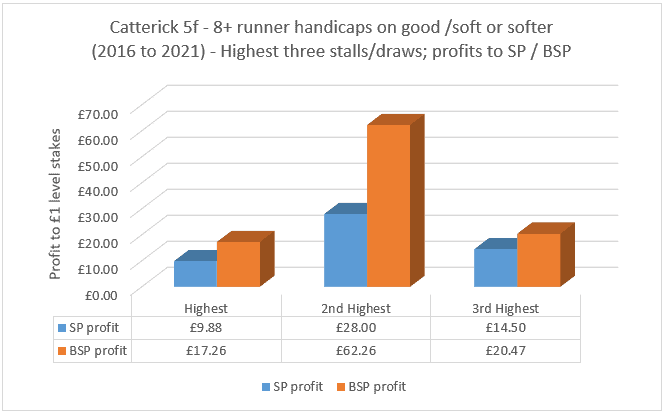
Looking at all the races run on good to soft or softer, the three highest drawn runners have all made blind profit to not only BSP, but industry SP as well.
These are excellent returns across the board. In addition, combining the three highest draws in £1 combination straight forecasts would have yielded a profit of £62.37 (ROI +31.5%). Tricasts / trifectas with the highest four draws combined also would have produced a profit.
Before moving on, it should be pointed out that the bias gets stronger as the going gets softer (soft or heavy ground), although sample is quite small:
So keep an eye on the weather before racing at Catterick. This draw bias to high stalls on good to soft or softer looks a very playable one.
From the near misses - drumroll, please - it’s time for the top five!
5th position – Goodwood 1m
Goodwood over a mile has long been considered a track and trip where draw bias can play a major role. The shame from a punting perspective is that there are very few qualifying races each year. Hence we have a small sample but one with a clear edge to lower draws:
Low draws have a positive edge in all categories and I now want to look at the individual stall positions and how they have fared:
Normally with small samples I tend not to look at individual draws / stalls, but these data set show a cut-off point at stall 5. Horses drawn 1 to 5 have won 18 races from 115 runners (SR 15.7%); horses drawn 6 or higher have won just five races from 181 runners (SR 2.8%). This strongly suggests that horses drawn 1 to 5 have been massively favoured.
To conclude, while there are not many qualifying races each year, clearly when there are they are definitely worth a few minutes of our time.
4th position – Goodwood 7f
We drop a furlong at Goodwood to see a similar low draw bias to the mile trip. One advantage of the 7f distance is there are many more races each year as these stats show:
We can see strong figures across the board here for low draws. This low draw bias has been evident at Goodwood for most of the last 30 years!
It is worth noting the bias has looked less strong in the most recent three seasons although the PRB figure is still 0.54 for low versus 0.44 for high during that time. That might be down to the fact that the going has been a bit softer in more recent seasons. In general, Goodwood biases over the years have been less prevalent on softer going. The stats back this up when we look at the good or firmer data from 2016 to 2021. Under faster conditions it can be seen that the low draw bias does seem to get stronger:
All categories (win%, place%, A/E, IV, PRB) see an improvement for low draws on better ground as compared with the 'all races' data; and, all categories deteriorate slightly for high draws.
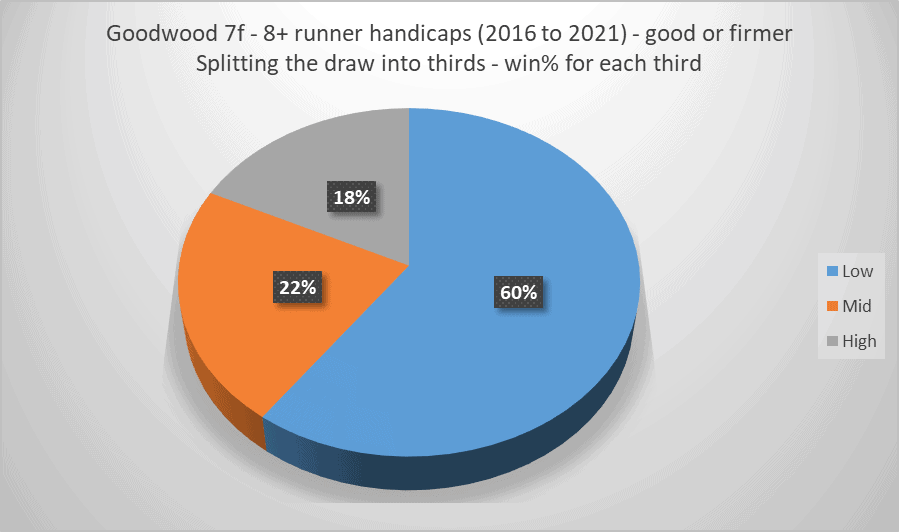
In terms of wins, which essentially is key, the draw win percentages for each third on good ground or firmer can be nicely illustrated by the following pie chart:
Six in every 10 races have been won by the lowest third of the draw under these firmer going conditions.
The 7f bias also seems to strengthen as the field size increases. In fields of 14 or more runners (all going), the draw stats for each third read as follows:
Once again we see a 60% win strike rate for low draws, but higher draws perform very poorly. We have seen this before when analysing round course biases. In big fields high draws are likely forced wide meaning they have to run further. Alternatively they can track to the inside, but then they will be faced with several horses to pass in the straight potentially needing good luck in running. It should also be noted that tracking to the inside early on losing ground also. Goodwood has a camber in the straight off which many hard luck stories are founded.
In conclusion, Goodwood over 7f has traditionally seen lower draws having the advantage. This seems to get more potent on good ground or firmer, and when the field size gets to 14+. Unsurprisingly, combining firmer ground and a bigger field accentuates the low advantage and the high disadvantage:
3rd position – Pontefract 1m
Moving into the top 3 and we travel north to Pontefract and its 1 mile trip. This is another round course bias where low draws dominate:
This is a very strong bias but, as I noted in my first article in the series, punters and bookmakers alike are much more aware of the strength of the inside edge now. Consequently, prices on the lowest drawn horses have contracted considerably in recent years. Nevertheless, the two lowest stalls have both made a profit to SP (combined profit of 15p in the £, and 21p in the £ at BSP). This is due to the fact that the two lowest drawn runners have won a remarkable 31 races between them. That means nearly 44% of all races have been won by the two stalls closest to the inside rail.
Races with big fields are rare but when we get to 13+ runners the bias seems to strengthen further:
Yes, I appreciate the sample is only 18 races, but low draws have won or placed four times more often than high draws (31 to 8). This is an eye-catching stat, as is the 0.62 to 0.40 PRB advantage to low draws over high. I think one can be fairly confident the bias does indeed gain potency in big field races.
Moving onto ground conditions, and for races on soft or heavy going, low drawn runners have won 13 of the 22 races, with high draws claiming a single solitary score. Again it's quite a small sample but the trends are clear. A similar pattern can be seen from the data between 2009 and 2015.
Having reviewed all 71 handicap races over 1 mile with 8+ runners, I can report that the exotic bets have once again proved a winner. If you had backed the two lowest drawn horses in £1 reverse forecasts you would have earned a profit of £34.06 (ROI +19.9%). The reverse Tote Exacta returns were even better with £66.50 profit (ROI +46.8%). Perming the four lowest drawn runners in combination tricasts would have yielded a small 2.2% return, while the trifecta would have harvested a very impressive 52.8% return.
These types of bets are not for everyone and they come with a low strike rate coupled with a potentially big bookmaker’s margin, but for small stakes the potential returns can be worth it. One good pay-out can really boost the bank.
Pontefract over a mile has a strong low bias where the focus should be primarily on the two lowest drawn runners. Personally, I would avoid horses drawn 9 or higher – these runners have combined to produced just 6 winners from 199 runners, a measly 3% strike rate.
2nd position – Pontefract 1m 2f
Staying at Pontefract we move up two furlongs to the mile and a quarter trip. I looked at this bias briefly in my second article in this series using the racecourse map below to show readers there is an extra left handed turn at this trip helping low draws further:
The draw stats are strong as one would expect:
At this distance compared to mile range, the market is not quite as aware of the edge low draws have, so finding past profitable angles ought to be possible. For a start, you would have made a blind profit to Betfair SP backing all four lowest drawn horses in the 39 races in the sample. Those 156 runners would have produced a profit of £23.73 to £1 level stakes equating to returns of just over 15p in the £. Amazing when you think about it really – backing four horses in every race for 39 races, and you would have made good money. The bottom four stalls accounted for 24 of the winners from 156 runners; stalls located five or more away from the inside rail accounted for 15 winners but from 242 runners.
Earlier, it was noted that the stats indicated that over a mile on soft or heavy ground the bias seems to get stronger. That theory is given extra confidence when we see the same pattern over this 1m 2f distance. It should be said there have only been 10 qualifying races on soft or heavy since 2016 but just look at the win percentages for each third of the draw:
Nine of the ten races in this small sample were won by low draws. In addition to that, the win and placed stats combined correlate strongly as we can see:
I am confident that on soft or heavy ground the bias gets more potent.
Moving back to the ‘all races’ stats, one remarkable fact is that the lowest five draws filled the first three places on no less than 11 occasions, two of which happened within an hour and a half of each other!
It should come as no surprise therefore that perming these five draws in tricasts and trifectas would have landed favourable returns. Perming five horses in all possible combinations of 1st, 2nd and 3rd amounts to a chunky 60 bets per race, so using small stakes of 10p per line (bet) makes sense, bringing in the 'per race' cost at £6. If we had done this perm using the tricast in all 39 races there would have been an outlay of £234, with £281.96 returned, giving us a profit of £47.90 (ROI +20.5%). As we have seen thus far, the trifecta tends to outdo the tricast bet, and it does it here - in style. Trifecta returns would have been £529.13 giving us a whopping profit of £295.13 (ROI +126.1%).
Pontefract over 1m 2f is a course and distance on which to keep a close eye from a draw perspective this year. It will be interesting to monitor the prices of the lower draws in the next couple of seasons; if they contract more, then profits will be harder to come by.
And, finally, it’s time for my number one draw bias in Britain and Ireland...
1st position – Chester 5f
Yes, I fully appreciate this is not a huge shocker, but I am confident about its status as the number 1 spot: the award goes to the minimum trip at Chester. This is despite the fact that they are moving the inside rail from time to time in an attempt to negate the bias. The rail movement seems to affect this shortest trip the least, and draw bias fans should stick to the minimum 5f trip and not include the extended 5½f range in considerations.
Here are the stats:
As I've said, yes, the bias is well known, but as far as draw biases go, it is still the strongest. The problem, of course, is making a profit from this widely held awareness. I discussed in the first article in the series how the prices at Chester on low drawn runners have contracted in recent years. Ultimately, this is why it is hard to make profits at Chester any more. That is, low still wins as often as it ever did (give or take - see below), but the available prices are tighter these days.
Going back to how the rail movement may be affecting this minimum 5f trip, if we compare the PRB figures from 2016 to 2018 with 2019 to 2021, we can start to see a slight weakening of the bias.
High draws seem to struggle just as much as ever, but middle draws are a little more competitive as a result of the false rail. All in all, though, low draws continue to enjoy a very significant edge.
In terms of running styles, a low draw coupled with a prominent run style, be it leading or tracking the pace, is a potent combination here as the image below illustrates.
We can see that the advantage of a low draw disappears if you race near the back early. Low draws that led early or raced prominently have been responsible for 16 winners from 59 runners (27% strike rate), which compares very well next to middle or high draws that raced mid division early or were held up – they have provided just 3 winners from 126 runners (2.4% strike rate).
The evidence is clear: combine a low draw with early pace over 5f at Chester and then you have a very effective combination.
With these five top draw bias courses, then, I've demonstrated my personal top ten UK and Irish draw biases, as well as a few 'bonus' also ran's. Please share your thoughts in the comments, especially if you think I’ve missed one. Thanks as always for reading, and good luck.
It has been a couple of years since I wrote some articles on the draw and, with the flat season hitting stride now, it is a good time to revisit the subject, writes Dave Renham. The draw will always have special place in my heart because it was essentially where my racing journey began.
Sprintline 2002: The Effects of the Draw - co-authored by Dave Renham
While at university I became interested in horse racing stats and I soon realised that there was a potential betting edge in focusing on certain sections of the draw at a few specific courses. Back then, in the late 80s and early 90s, the courses and distances with the strongest biases were at Beverley over five furlongs, Thirsk over five and six furlongs (especially on firmer ground), Chester from five to seven furlongs, Lingfield (turf course) five to seven furlongs, and Sandown over five furlongs when the stalls were placed on the far side. The beauty back then for draw punters like myself was that there was a decent edge for those of us who considered ourselves ‘in the know’. I was able to find plenty of betting opportunities that represented good value.
Unfortunately, if predictably, it was not long before draw biases started to be shared in racing articles which were then followed by comprehensive books on the subject. Indeed, I co-authored one of them!
As with many things, when a good source of highlighting value bets is found, within a few years the edge starts to disappear. This is very much a horse racing trait: good ideas have their initial edge because the majority of people are not aware of that value finding approach. As time goes on, however, the betting public and the bookmakers catch up and, as a result, prices tend to contract and the value begins to erode. This has happened to some considerable extent with the draw over recent years.
Using Chester’s five-furlong trip as an example, let us examine what has happened to the prices of the ‘best’ two stall positions over the past several years. The stalls in question are draws 1 and 2, those closest to the inside rail. I am looking here at handicap races with eight or more runners where draw bias tends to be more consistent:
Chester’s tight track has long shown a bias to lower draws and this has generally been well documented and widely understood. However, nowadays your average punter has had more exposure to draw biases than they did twenty years ago which explains the diminishing price pattern. The graph above shows that horses drawn in stall 1 had an average decimal SP price of 6.58 from 2003 to 2007, dropping to 5.19 over the most recent five-year period. Likewise, we have seen the prices of horses drawn in stall 2 dropping from 9.06 to 6.46.
Some statisticians may observe that despite the relatively solid sample sizes average prices can be skewed by an occasional bigger-priced runner. That would certainly be possible, so it make sense to compare the median prices as well. To remind you of your school maths class, median is the middle value when all are ordered from lowest to highest. This gives us another type of average, the findings of which are here:
Once again we see the same pattern: the prices for both draws 1 and 2 have dropped quite significantly over the period of study.
A further measure to illustrate how the draw affects the prices at Chester is if we look at all stall / draw positions from 2017 to 2021 and compare their average prices. We already know that the average for horses drawn in stall 1 has been 5.19 and stall 2 is 6.46. I have graphed the average prices for each stall over 5f at Chester, although due to small sample sizes in higher drawn runners I have combined those drawn in stall 8 or higher:
As we can see, despite a slight ‘blip’ with stalls / draws 6 and 7, the average price increases as the stall position increases (and is thus further away from the favoured inside rail). Looking at these data, we could confidently argue that at Chester over 5f the draw impacts on price more than any other factor.
I briefly want to go back to discuss the price reduction we saw earlier in the lowest two stall positions when comparing 2003-2007 average SP prices with 2017-2021. This has actually not coincided with the draw bias getting stronger; in fact, the draw bias has stayed roughly the same. This can be illustrated when breaking our draw data into three time frames between the years 2003 and 2021. The actual draw positions are also split into three: low third, middle third and high third.
As can be seen, low draws have continued to dominate in each time frame. This is further evidence of the fact that the price reduction is almost certainly down to more punters being aware of how fundamentally important the draw is to the business of finding winners at Chester over this minimum 5f trip. From a betting perspective, therefore, much or all of the value in lower drawn horses has now evaporated. This can be illustrated in terms of percentage returns (ROI%) if backing all horses from the bottom third (low) of the draw over different time frames.
I still find it remarkable that up to 2015 you could have made a blind profit at SP by backing all low drawn horses in 8+ handicaps over five furlongs at Chester. All good things come to an end, however, and that has not been the case in recent years. In the five year period 2016 to 2021, losses accrued were 13.7% of stakes. Ouch.
Appreciating and therefore deploying draw bias is not merely about looking at the performances of different sections of the draw; no, we also have to be acutely aware of how the market adjusts for such factors.
Being able to exploit the draw to one's advantage has also been affected in recent years by racecourse officials using other means of negating any potential bias. One way this can be done is by moving running rails which potentially changes part of the ground over which races take place as well as sometimes subtly changing the race distance by a few yards. The other, more notable, fly in the ointment has been the change in watering systems that most tracks now use. Some 20 or 30 years ago many course watering systems were badly affected by wind speed and direction, and hence certain parts of the track remained drier - and therefore quicker - giving rise to draw biases. Nowadays, though, the equipment has become more sophisticated and the water is spread much more evenly.
I mentioned earlier that Beverley over five furlongs used to be one of the strongest draw biases back in the day, and this can be seen when you look at the data. From 1998 to 2003 in 8+ runner handicaps the low third of the draw housed the winner 63.3% of the time, while the highest third won just 10% during that period. From 2004 to 2009, the strength of this bias appeared to dip a little but the low third still accounted for 53.4% of all the winners (high won a still dismal 15%). However, from 2010 to 2015 the low win percentage dropped to just under 42%, while high had narrowed the gap with 23.1% winners; and, from 2016 to 2021 it dropped to 40.8% low and 26.5% high. Over time, that's quite a big change. Yes, low draws are still favoured but the huge edge that there once was is no more.
Exactly why this has happened I cannot be sure; it is probably down to better watering and maintenance of the track. However, what is interesting is the fact that the prices on the best drawn horses have not changed much. Comparing the 2003 to 2007 segment with 2016 to 2021 here are the average prices for stalls 1 and 2:
Horses drawn in stall 1 have, on average, started at slightly shorter prices in the last five seasons (12 versus 11.42); stall 2 has seen an increase but a modest one when you consider the draw bias is nowhere near as potent these days. The median prices back up the raw average data as the table below shows:
What seems to be happening here therefore is the market at Beverley is still assuming the draw bias is as strong as it was back in the early 2000s. Unlike the Chester market, which has adapted as one might expect, this Beverley market has not: in reality, the odds should on average be higher than they currently are. The bitesize takeaway is that lower draws are generally poor value.
Another thing that has changed markedly in the past few years is the general appreciation that draw bias does not only occur over sprint trips. Pontefract, for example, over a mile and a mile and a quarter, boasts two of the strongest draw biases currently in play. Looking at 8+ runner 1 mile handicaps at Pontefract, it can be seen that this is a case of the betting market now cottoning on to the draw bias. This is in stark contrast to data gathered in 5f handicaps at Beverley.
Let’s compare once again the same two time frames - 2003 to 2007 with 2017 to 2021. Here are the average prices for stalls 1 and 2:
The average price of horses drawn in stall 1 has nearly halved; the figures for horses drawn in stall 2 have also contracted quite noticeably. Once again the median prices correlate strongly:
What this means, therefore, is that although low draws hold a significant edge over 1 mile at Pontefract the current prices on offer are so low on average, that they too are now generally poor value. We can see this in black and white when I share the fact that from 2009 to 2013 backing all low drawn horses at Pontefract over 1 mile in 8+ runner handicaps would have yielded a 13% profit; from 2017 to 2021 this flipped to a 22% loss.
This Ponte pattern mirrors the change we saw earlier in the Chester 5f prices and subsequent poorer value of low drawn runners in recent seasons.
In order to fully make the most of draw bias, or indeed perceived draw bias, it is clear we need to be aware of market factors, not just the raw draw data splits. Let us close with a look at Catterick over six furlongs – again focusing on 8+ runner handicaps. Because this six-furlong trip is contested around a bend there is a perception that lower draws have a slight edge. This is borne out when we compare the combined average prices of the three lowest drawn runners with the three highest drawn runners going back to 2016.
A difference on average of two and a half points. That may not seem much of a difference but over several races it can make a critical difference to our bottom line. During this time frame both sections of the draw have won virtually the same number of races (26 versus 27), implying that there is no bias to lower drawn runners at all. At least partly as a consequence of this perception, backing the three lowest drawn stalls would have produced crippling losses of 45.8% to SP, while blindly supporting the top three stalls would have produced a profit of 10.5%.
One observation when comparing odds over time might legitimately be that field sizes truncating has had a bearing on prices. While that impact should be spread across the full range of stalls anyway, this final chart also helps to imply that field size is likely not the main factor at play here.
It is a little 'busy', but essentially we have two lines which we might expect to be correlated - perceived win chance (expressed as SP) and actual strike rate (expressed as win %). Although the win strike rates jump around a bit, the blue dotted 'trendline' shows no advantage; compare that, however, with the orange trendline for average win odds which rises from low to high.
*
The aim of this article is to illustrate the important links between draw position and price, and to highlight the changing nature of some draw biases. Profitable betting is about getting value – well drawn horses only offer us value if the price is right. Also, we need to be aware that 'poorly' drawn horses can also offer value, but again only if the price is right.
- DR
https://www.geegeez.co.uk/wp-content/uploads/2017/05/chester_roodee.jpg320830Dave Renhamhttps://www.geegeez.co.uk/wp-content/uploads/2022/10/geegeez_banner_new_170x78.pngDave Renham2022-04-19 07:58:122022-04-19 08:10:00Draw Bias 2022: Part 1
geegeez.co.uk uses cookies to improve your experience. We assume that's OK, but you may opt-out from the settings. Cookie settingsACCEPT
Privacy & Cookies Policy
Privacy Overview
This website uses cookies to improve your experience while you navigate through the website. Out of these cookies, the cookies that are categorized as necessary are stored on your browser as they are essential for the working of basic functionalities of the website. We also use third-party cookies that help us analyze and understand how you use this website. These cookies will be stored in your browser only with your consent. You also have the option to opt-out of these cookies. But opting out of some of these cookies may have an effect on your browsing experience.
Necessary cookies are absolutely essential for the website to function properly. This category only includes cookies that ensures basic functionalities and security features of the website. These cookies do not store any personal information.
Any cookies that may not be particularly necessary for the website to function and is used specifically to collect user personal data via analytics, ads, other embedded contents are termed as non-necessary cookies. It is mandatory to procure user consent prior to running these cookies on your website.