Boxing Day: To Bet, or Not To Bet?

Boxing Day – To bet or not to bet, that is the question!

For avid fans, racing on Boxing Day is something to be cherished, usually for one of two reasons, writes Dave Renham. Firstly, the day includes one of the major steeplechases of the year, the King George at Kempton; and secondly, there is always a short hiatus before Christmas and, for those who bet regularly, a few blank days can feel like a lot longer. This year we have three days with no UK racing starting on the 23rd December, today.

In this article I will be examining data from the last ten Boxing Days, focusing on the National Hunt meetings that have been run in the UK. Profits and losses are calculated to Betfair Starting Price (BSP) with 2% commission applied to any winning bets.

This year there will be seven such meetings on Boxing Day: at Aintree, Fontwell, Kempton, Market Rasen, Sedgefield, Wetherby and Wincanton. Plenty of meetings to choose from, then, but when there are numerous meetings there can be a tendency to skimp when it comes to analysing and ultimately deciding upon our bets. Lack of time is a factor at this time of year so we need to be careful not to take our eye off the ball, and to continue to use the tried and tested methods we deploy at other times.

When discussing the need for pragmatism around Boxing Day wagering, I hope readers, and more especially my editor Matt, will permit some poetic license given the time of year – allow me a little rein, dear, as it were for the next few paragraphs. [*that was the Ed's joke - apologies! Fire away Dave, permission granted...]

A question I want to start with is, ‘Do you play chess?’

The reason I ask is because, as a keen player myself, I see a lot of parallels between a game of chess and finding a horse to bet on. A chess game is made up of three distinct phases – the opening, the middlegame and the endgame. The opening lays the foundation for the remainder of the game – it sets the stage as it were. When I play chess, which I do regularly online, the black pieces are my pieces of choice. This is despite white having the first move and effectively having the smallest of advantages. The big advantage of me playing black is that it is easier to steer the game in the direction that I would prefer. The middlegame is the complex part of a game of chess. There are usually plenty of pieces on the board and it is key to choose the best strategy for the position. Some middlegame positions see players looking to attack, others require a slower, more strategic approach. The endgame is the final phase where the ultimate goal is checkmating your opponent’s king and winning the game.

My approach to betting on horses is very similar to that of a game of chess. The process I use, like chess, has three distinct phases. The first, is scrolling through the racecard. I will start by looking for the types of races I want to bet in, as well as looking for horses that I have previously made notes on with a view to backing them another day. Just like with the opening in chess, I am trying to play to my strengths.

The second phase is looking in more detail at the races I have initially highlighted, deciding which races fit best in terms of the strategies I typically employ. Some races are easy to attack: they appear less complex, maybe with fewer runners or limited competition; while others demand more time and consideration. The final phase, or my ‘endgame’, is to decide which selections I am going to bet, with the ultimate goal being that I will have a winning day where the bookmakers are ‘checkmated’.

The other parallel that betting on the horses has with chess is how one’s preparation for both has changed in the last 25-30 years. The advance in technology over this period has changed things beyond comprehension for both. Before the late 90s the best humans were better at chess than the best computers. That is not the case now with computers so much better than the best players in the world. However, computers have changed how players learn, study and improve their chess. Likewise in horse racing, 30 years ago there was limited technology to help us with the study of races. Nowadays, 95%+ of serious punters will be using technology when analysing a race.

Here at Geegeez, Gold (and Lite) members have a plethora of tools, at the touch of a button, to help when it comes to the betting selection process. The Query tool, the Profiler tab, the Pace and Draw analysers, numerous daily stats reports, and of course the racecard. From the Geegeez racecard we can easily tap into past form, utilise the excellent Instant Expert tab, as well as look at past race trends, and instantly compare bookmakers’ odds.

Now, I appreciate that readers' approaches will all be slightly different when it comes to deciding upon which horses to punt. However, when betting this Boxing Day, I hope my chess and racing parallels will remind you to select bets in the same way that you would do on any other given day. I have been bitten myself on a few previous Boxing Days when I have rushed, not following my usual methodical approach. I have hurried in the past because of family commitments, which many of us have. But I have learnt that, if I am restricted time wise, I must simply look at fewer races. Alternatively, some, or indeed most race prep can be done before Boxing Day thanks to the early declarations. However, regardless of how many races I eventually look at, I still need to use all of the Geegeez tools that I normally do.

Well, that could be the longest preamble for one of my articles ever! So let me now share some numbers.

Firstly, I would like to look at the win strike rates of different BSP price bands comparing all UK NH results between 2015 and 2024 with the Boxing Day results for those ten years. Clearly, the sample sizes vary considerably but there have been over 430 races run on Boxing Day during this time frame which is a decent sample. The graph below shows the splits:


As the graph shows, the comparative strike rates have been fairly similar across the price bands, although the 1.01 to 8.00 group for Boxing Day runners has been a couple of percentage points below the norm. Ultimately the evidence points to the fact that we are unlikely to see a plethora of unusual results this coming Boxing Day, such as huge betting coups landed on a regular basis, or most favourites going in.


Boxing Day Racing: BSP Market Data

To attempt to put more meat on the bones, below are some more detailed BSP splits for the last ten Boxing Days, looking not just at strike rates, but at profits/losses and returns too:


Horses priced BSP 30.01 and above have produced very poor returns, affirming that big shocks have been rare, indeed rarer than we see usually. The ‘sweet spot’ seems to have been those runners priced 12.01 to 20.00 – they have produced very solid profits over the past ten Boxing Days. The shorter priced runners (BSP 4.25 or shorter) have been slightly below par as a group.

Meanwhile we have seen quite a difference between the returns for the favourite versus the second favourite. Favourites on Boxing Day have been very poor value overall losing over 14p in the £; (133 wins from 438 for a loss of £62.38). Second favourites however have been good value, winning 100 times from 432 runners (SR 23.2%) for profit of £57.21 (ROI +13.2%).


Boxing Day Racing: Favourites by Course

I thought it was worth sharing favourite performance by course. I have not included Aintree as that is a new Boxing Day fixture and the sample size amounts to just 14 runs.


Only Fontwell favourites made a profit during the period of study, and the worst returns have come at the most prestigious meeting at Kempton. It will be interesting to see how favourites fare this Boxing Day at the Surrey venue. Neither Sedgefield nor Wincanton has been kind to favourite backers in the past ten years.

For the remainder of the piece, I would like to set a maximum price limit of BSP 20.0 in order to avoid any of the really big priced winners skewing the bottom lines.


Boxing Day Racing: Market Movement

With this price limit set I want to examine market movement, specifically the price movement from Early Morning Odds (EMO) to Opening Show (OS) odds. The table below shows my findings:


As the table clearly shows, horses that lengthened in price from early morning to Opening Show on Boxing Day have proved to be poor value. Conversely, those horses staying the same price or shortening have proved profitable. What is even more interesting is when we examine the group that shortened between EMO and OS but then drifted between OS and the final ISP. This qualifying group, still with the earlier caveat that their final BSP was 20.0 or less, have produced 454 qualifiers of which 79 won (SR 17.4%) for a healthy profit of £149.04 (ROI +32.8%). So, assuming the pattern repeats this Boxing Day, we should be looking for horses that shorten during the day, but drift in the last ten minutes or so before the off.


Boxing Day Racing: Fitness – based on days since last run

Time to look at ‘days since last run’ data, again with the 20.0 BSP cap. Below is a graph which shows the BSP returns (ROI%) based on different periods of time off the track:


In terms of value, the more recent the run, the worse it has been. Horses returning to the track within ten days of their previous run have lost over 20p in the £. Those off the track for 11 to 21 days would have lost us over 11p in the £. The better value has been with horses returning off a longer layoff, especially those absent between 22 and 84 days (three to twelve weeks). Even those off the track for more than 12 weeks (85 days+) have edged into profit.


Boxing Day Racing: Last time out (LTO) finishing position

The finishing position last time out is next on my agenda. The Boxing Day splits have been as follows:


Based on these stats a finishing position third or worse last time out has been clearly preferable. Horses that finished runner-up LTO have proved to be very poor value. Continuing with the runner-up theme, looking at horses that finished second LTO but were priced bigger than BSP 20.0, there were 65 such qualifiers and all lost. For whatever reason, horses finishing second LTO have clearly not enjoyed Boxing Day in recent years, and they've certainly been over-bet.


Boxing Day Racing: Trainers

Finally let me share some trainer data. Clearly, sample sizes for trainers with runners priced BSP 20.0 or less over just ten days are relatively modest to say the least. The table below shows those trainers who have saddled at least 30 runners:


A few trainers do stand out, one being Gary (and Josh) Moore. That yard has produced an excellent strike rate of 32% with returns of just under 16p in the £. Their market leaders have been particularly impressive with 11 wins from 16 (SR 68.8%) for a profit of £9.38 (ROI +58.6%). The Neil Mullholland stable has also performed well hitting a strike rate of just over one win in every five with the price cap in place. They have sent runners to most meetings, but two courses have seen significantly better results: Wetherby has seen four wins and two seconds for Mulholland from 12 runners producing a decent profit of £26.70 (ROI +222.5%), while the stable's record at Fontwell has been very similar with four wins and one second from 12 runners for a profit of £21.39 (ROI +178.3%).

Philip Kirby is another trainer who has excelled with his runners on Boxing Day producing huge returns from a strike rate in excess of 30%. Most of his profits have come from his handicap hurdlers which enjoyed eight wins from 22 runners (SR 36.4%) for a profit of £58.01 (ROI +263.7%). One other stat to note is that Kirby has sent eight runners to Sedgefield of which four have won at BSP prices of 12.0, 7.56, 4.65 and 10.27.

The legend that is Nicky Henderson has a decent Boxing Day record having secured a better than one in four strike rate, coupled with returns of a smidge above 16 pence in the £. His hurdlers have been the ones to follow thanks to 19 wins from 53 (SR 35.8%) for a profit of £31.60 (ROI + 59.6%).

A trainer who has fared less well based on the win stats is Paul Nicholls, with just 12 wins from 108 runners that were priced BSP 20.0 or less. However, before writing off his runners this Boxing Day, it should be noted that he has had 24 (!) second places across this time frame. It seems that luck may not have been on his side on Boxing Day in recent years, his illustrious record in the King George aside.

*

So those are my thoughts on the topical question, "To bet or not to bet on Boxing Day?"

That will be a question each of us must answer and, for those who respond in the positive, I hope the stats I have shared will point towards some value on the day.

Have a fantastic Christmas and thanks for your support and for the many positive comments members have posted over the past year.

- DR

Topspeed Ratings on the All-Weather, Part 2

An analysis of Racing Post’s Topspeed (TS) on the All-Weather, Part 2

This is the second article of two looking at the performance of the Racing Post’s speed ratings, known as Topspeed, in races on the all-weather (AW), writes Dave Renham. In the first piece, which you can read here, I looked at a variety of general Topspeed stats before focusing on non-handicap races. In this concluding half, the spotlight falls on handicap races and, from now on, I will use the abbreviation TS when talking about the Topspeed ratings.

Introduction

The next paragraph is basically a carbon copy of what I wrote in the first article as it gives some background information regarding the TS ratings. Feel free to skip it if you have read the first one.

The raw TS figure is a measure of the speed a horse achieved in a particular race. It is amended slightly considering things like distance, weight carried, and the ground conditions. Essentially the TS is calculated by comparing a horse’s time with a standard time for the same course and distance. The TS figure we see in the Geegeez Racecard are known as adjusted TS ratings with the main adjustment made for weight carried in the current race. I believe the TS handicapper also tweaks this adjusted TS rating for the current race conditions. The adjusted TS figures we see in the Racecard are based on the best raw TS performance in the past 12 months. These performances must have occurred in the same ‘Race Code’, so for all-weather races only past TS raw figures in AW races have considered. Likewise for turf flat races, only past turf flat raw TS figures will be considered. For the jumps past hurdle race TS raw ratings will be used for hurdle races only, while past chase TS ratings will be used for chases only.

As I mentioned in the first paragraph this article examines all-weather racing analysing the performance of the TS figures in handicap races only. The time frame covers January 1st, 2019, to November 30th, 2025, and it includes both UK and Irish racing with any profit or loss being calculated to BSP less 2% commission.

Overall Performance of TS in All-Weather Handicaps

I noted in the first piece how it is generally considered that, for a set of ratings to be effective, the win rate is key. The top-rated runner should have the highest win percentage, gradually reducing for the remaining runners. Ideally, the top-rated runner will also be the best performer in terms of returns. However, it is important to point out that regardless of how good a set of public ratings is, be they speed or form-based ratings, it is unreasonable expect the top-rated runner to secure a blind profit over a long period of time.

Let's start in a similar way to last time by looking at win percentages (strike rates) for different rated runners in handicap races. This covers all such races on an AW surface over the period of study. We saw in article 1 that for the ‘all races’ data the graph showed the right type of correlation between the rating position and the strike rate. Let’s see if that has occurred when focusing on handicaps only. In terms of understanding the graph, the horizontal axis is labelled from 1, the top-rated runner, to 2, the second rated, and so on:


The win strike rate for TS top-rated runners has been just under 15% and, more importantly, the win percentages have correlated positively once more with the TS ordinal rank. We have the left to right sliding scale that is the ‘ideal’.

If we look at the Each Way (win & placed) strike rates, we have a similar pattern:


The top-rated runner has the highest percentage once more, albeit only just, and the sliding scale is replicated once again.

The third graph looks at Percentage of Rivals Beaten (PRB). Being able to share these is down to another of the recent Geegeez additions of having PRB figures available in the Query Tool Results Summary. Here are the splits:


We can see exactly the same type of correlation once again so it seems therefore, that in handicap races, the TS ratings have been very accurate in terms of predicting the overall performance of the horse in relation to their TS ranked positions.


Top Rated TS Runners in AW Handicaps

For the remainder of the article my main focus will be the handicap race performance of the TS top-rated horses to see if any positive or indeed negative angles can be found. Firstly, let me share the record of every single TS top-rated runner since the beginning of 2019:


We see a close to break-even situation, which is an excellent starting point. Let me now break down the TS top-rated performance in more detail.

Annual strike rates – TS top-rated runners in AW handicaps

In terms of delving deeper I want to start looking at the TS top-rated runners in all-weather handicaps by comparing their annual win strike rates and win & placed (Each way) strike rates to see how they matched up.


Both the win and EW strike rates have been extremely consistent and this has also been the case with the yearly PRB figures that have ranged from a high of 0.59 to a low of 0.56.


Market Rank – TS top-rated runners in AW handicaps

Below is a table highlighting the performance of the top-rated runners in terms of market position / rank. The splits over the period of study were as follows:


Favourites made a small loss but those ranked two to four in the betting market all edged into profit. Returns were slightly less good when horses were fifth or higher in betting.

One potential issue when looking at data across all prices is that some bottom lines can be skewed by winners at big BSP prices. Interestingly, though, out of the 2445 TS top-rated winners only five had a BSP price above 50.0 (52.07, 54.15, 61.52, 126.19, 145.1). Even so, as in the first piece I am going to use a price cap hereafter in case any of those bigger priced winners skewed certain findings. For non-handicaps my price cap was 10/1 (ISP), for handicaps I think we should go slightly longer at 12/1 (ISP).


Sex – TS top-rated runners in AW handicaps (ISP 12/1 or less)

This is an area I feel is always worth checking out. The splits over this timeframe were thus:


These stats do not correlate with the usual male/female stats found on the AW where males tend to win more often within their group than females. Here we have witnessed a different scenario where female TS top-rated runners priced 12/1 or less have been very good value going back to 2019. TS top-rated female runners aged four and five have done particularly well, combining to win 19.8% of the time (280 wins from 1416) for a healthy profit of £295.21 (ROI +20.8%).


Age of horse – TS top-rated runners in AW handicaps (ISP 12/1 or less)

Onto the age splits now. We know from the previous paragraph that the female four- and five-year-olds performed well, but they only made up about 25% of the total runners for both those age groups. Let me share the full breakdown combining male runners with female runners:


Each individual age from three to six made a blind profit which is interesting, but it was clear that once we got to 7yos and older the performance dipped markedly, despite still being top-rated. Losses of 16p in the £ are steep at the best of times, so TS top-rated runners aged 7 or older are probably best swerved in the future.


Course – TS top-rated runners in AW handicaps (ISP 12/1 or less)

Do the TS top-rated runners in all-weather handicaps have similar records at each course? Let's review the PRBs first:


The Irish track of Dundalk has seen the strongest PRB figures, and I wonder will that correlate to better returns?


*Southwell data based on results on the tapeta surface which had its first race in December 2021.


Don’t be fooled when seeing that Dundalk had the lowest strike rate; their races had the biggest average field size compared with all the courses. There were blind profits for Dundalk and for three other courses, with only Kempton TS top-rated runners producing disappointing losses. I am not sure why the Kempton figures were so disappointing compared with the others.


Race Distance – TS top-rated runners in AW handicaps (ISP 12/1 or less)

A look at the results across different distances now. The figures were as follows:


TS top-rated runners performed well at the minimum distance, which may be because five furlong handicaps are generally run at a good clip and hence speed ratings should be fairly accurate. All in all, though, the table suggests that speed ratings work to a similar level regardless of distance. [The six furlong data looks an anomaly and is hard to explain otherwise]


Field Size – TS top-rated runners in AW handicaps (ISP 12/1 or less)

My next question was could anything be gleaned from the data for different field sizes? It was a slight surprise to me that the number of runners in a race did seem to make a difference. Below are the ISP A/E indices for different field sizes:


As can be seen, the better value has clearly been in smaller sized fields as far as the TS top-rated all-weather handicap runners have been concerned. This was also reflected in the profit and loss figures as the table below shows:


Based on the past few years it does seem that fields with eight or fewer runners provide the best value when it comes to the TS top-rated runners. The performance of the 6-8 runner group was extremely good.


Headgear – TS top-rated runners in AW handicaps (ISP 12/1 or less)

The splits between the number of TS top-rated runners that wore some sort of headgear / equipment and those that didn’t were almost the same. Hence, I thought it was a good idea to see what the results were for each group. They are shown in the table below:


The numbers clearly favour horses that did not wear any headgear securing a better return - over 8p in the £ - coupled with a 3% better win rate. This is something to note for the future I feel.


Run Style – TS top-rated runners in AW handicaps (ISP 12/1 or less)

When I looked at the run style for TS top-rated in all-weather non-handicaps, I noted the traditional edge to more prominent styles of runner. Hence, let me take a look at the win strike rates (within their specific run style groups) to see if the usual pattern has been repeated:


In terms of win rate early leaders have done best, albeit the gap between them and prominent racers has been closer than we usually see. There was a clear dip in strike rate from prominent racers down to horses that raced midfield or were held up.

As I mentioned in the first article, we do not know pre-race what the run style of each horse will be and hence any profit/loss data shared in this section is essentially hypothetical. However, if we had been able to predict which TS top-rated runners took the early lead in handicaps when priced 12/1 or less, they would have made a decent BSP profit of £359.41 to £1 level stakes. This equated to an impressive return of over 17 pence in the £. Prominent racers made a profit also with returns of just over 6p in the £.

I want to share the A/E indices next for the TS top-rated runners in terms of run style. They are shown in the graph below:


Early leaders / front runners have offered the best value, surpassing the 1.00 figure. Indeed, these A/E indices are calculated from ISP so the BSP A/E index would be around 1.16 which would be considered excellent value.

What was especially interesting was when I looked at the performance of TS top-rated horses that had led early in 5f handicaps. If we had known pre-race which TS-top rated runners would have led in these sprints, we would have seen 104 winners from 308 runners (SR 33.8%) for a huge profit of £330.41 (ROI +107.3%); PRB 0.69.

Finally, one last run style fact worth sharing is that when we look at all runners priced 12/1 or less roughly 14.3% of these runners led early. In 5f handicaps however, the TS top-rated runner led early 20% of the time. Hence, when trying to predict the front runner in 5f handicaps, the TS top-rated horse will lead much more often than those runners TS ranked 2 or lower. Combining this information with the Geegeez pace score totals for each 5f handicap should enable us to improve our chances of predicting the front runner more often – should we wish to do that.

*

Before embarking on this research, I had not expected the Topspeed top-rated runners to have performed so well in all-weather handicaps. For a set of public ratings, the top-rated performance has been extremely good. I, for one, will take more stock of them in the future, especially on the sand; and the beauty is that they appear right where I need them, on the Geegeez racecard!

In the near future, I will dive into Topspeed ratings for NH racing. This will happen probably sometime in January 2026. Until then...

- DR

Topspeed Ratings on the All-Weather, Part 1

An analysis of Racing Post’s Topspeed (TS) on the All-Weather, Part 1

One of the reasons Geegeez has won the Best Betting Website award eight times since 2017 has been because it has not stood still, with upgrades and improvements made on a regular basis, writes Dave Renham. We have seen that again this December with some new additions to the Query Tool. One of these additions is the subject of this article, namely the Topspeed Ratings (TS) from the Racing Post.


Introduction

Topspeed ratings are the Racing Post’s Speed Ratings. The raw TS figure is a measure of the how fast a horse got to the finish in a particular race. It is amended slightly considering things like distance, weight carried, and the ground conditions. Essentially, TS is calculated by comparing a horse’s time against a standard time for the course and distance of the race. The TS figures we see in the Geegeez Racecard are known as 'adjusted TS ratings' with the main adjustment made for weight carried in the current race.

I believe the TS handicapper also tweaks this adjusted TS rating for the current race conditions. The adjusted TS figures we see in the Racecard are based on the best raw TS performance in the past 12 months. These performances must have occurred in the same Race Code, so for All Weather races only past TS raw figures in AW races have been considered. Likewise, for turf flat races only past turf flat raw TS figures will be considered. And, for the jumps past hurdle race TS raw ratings will be used for hurdle races only, while past chase TS ratings will be used for chases only.

It is not for me discuss the pros and cons of how the TS figure we see in the racecard is calculated. Ultimately, this is a method that the Racing Post have been using for many many years, so we need to assume they know what they are doing... or ignore it completely!

So where on geegeez.co.uk do we find the TS figures on a daily basis? In the screenshot below I have highlighted in the blue box where the adjusted TS figures can be found on the Geegeez Racecard.


My focus today is All-Weather racing and analysing the TS figures for this specific race code. The time frame used goes from January 1st 2019 to November 30th 2025, including both UK and Irish racing, with profit/loss calculated to BSP less 2% commission. This is the first of a two-parter and is slightly more of a general piece / overview, whereas the second will drill further into the stats.


Topspeed All-Weather Performance by Ordinal Rank

I have spoken to numerous respected analysts who have compiled ratings in the past, be them speed or ability ratings and, for them, to judge the effectiveness of their ratings the win rate is key. The top-rated runner should have the highest win percentage gradually reducing for the others. Obviously, it is hoped the top-rated runner is the best performer in terms of returns. However, it is important to point out that regardless of how good a set of ratings is, be they speed or form-based ratings, we cannot expect the top-rated runner to secure a blind profit over 1000s of races.

Let’s start with looking at the win percentages (strike rates) for different rated runners. This covers all races on the all-weather over the near seven-year period of study. The horizontal axis is labelled from 1 which stands for the top-rated runner, 2 the second rated and so on:


The win strike rate for top-rated runners has been slightly better than one win in every six races which is solid for any set of ratings. More importantly perhaps, the win percentages correlate positively with the rated positions showing the sliding scale I was talking about earlier.

If we look at the Each Way (win & placed) strike rates, we see a similar pattern:


The top-rated runner has the highest percentage once more, and the sliding scale is replicated showing strong positive correlation with the win only figures.

Finally, for this opening section, let me share the Percentage of Rivals Beaten (PRB) figures. Being able to share these is down to another of the recent Geegeez additions of having PRB figures available in the Query Tool Results Summary. The splits during this timeframe were thus:


The same sliding graph appears again. So we can say that the TS ratings seem to have been accurate in terms of predicting the overall performance of horses in relation to their ordinal ranked positions.


Topspeed All-Weather Performance for TS Top Rated Runners

From here, it made sense to mainly focus on the TS top-rated horses to see if we could find any positive or indeed negative angles. Hence let me look at the record of every single TS top-rated runner since 2019:


A loss of less than 3% at Betfair SP is a solid figure considering this has included every single qualifier over almost seven years. Time now to dig a bit deeper.

Annual strike rates – TS top-rated runners

Let me start the digging process by comparing the yearly win strike rates, and the yearly win & placed (Each way) strike rates to see how they matched up. The graph paints the picture.


Both lines are fairly straight indicating that the performance of the TS top-rated runners has been consistent year in year out when it comes to winning and placing. In terms of the PRB figures they have ranged from a yearly low of 0.59 to a yearly high of 0.62, again highlighting their consistency.


Market Rank – TS top-rated runners

I would now like to share the performance of the top-rated Topspeed runners in terms of their market rank. The splits over the period of study were as follows:


Although TS top-rated runners have not made a profit when they were also the market leader, it has seemed that a position nearer the top of the betting market has been preferable. Looking at TS top-rated runners that started in the top four of the betting we can see that they would have proved profitable if backing all ‘blind’. OK, a profit of £132.90 to £1 level stakes over 14,422 bets would not have been a massive return but it was a positive return, nonetheless.

Race Class (handicap races only) – TS rating of average winners

I want to delve into class of race for a bit, focusing on the TS top-rated runners racing only in handicaps. The reason for using handicap races for class analysis is simple, because a non-handicap race could be a maiden, it could be a novice race, and when we get to class 5 or lower it could be a claiming race or indeed a seller. Hence, when we group non-handicaps together, we get a mix of different race types so it makes less sense. Of course we do see the occasional handicap selling race, but the horses are still carrying the correct weight that they would in a normal handicap.

Before looking at the TS top-rated runners, I first wanted to look at the average TS rating for the winning horses across each race class classification. To do this I simply added up the ratings of each individual winner within each class bracket and divided it by the number of winners. The graph below shows the results:


As we would expect we get a similar looking graph to previous ones. The higher the class the higher the average winning TS rating and there has been a similar differential between each ‘next door’ class classification.


Race Class (handicap races only) – TS top-rated winners

Now it’s back to focusing on the top-rated winners and their averages. Let me share these splits.


Of course, these were always going to be much higher than the average figures for all winners, but these average winning ratings gave me an idea. What about looking at the performance of top-rated runners that had a TS figure higher than the winning class average for all top-rated runners? In other words, for class 2 handicaps where the average top-rated winner was rated 98.1, how did the TS top-rated runners rated 99 and higher do as a cohort? Likewise for class 3 handicaps where the average top-rated winner was rated 90.6, how did the top-rated runners rated 91 and higher do etc, etc. Here’s what I found:


In the higher classes of race (class 4 and above) we see positive profits and returns. The two lower classes (5 and 6) both showed losses, although the class 6 figures were close to breaking even. So perhaps the TS ratings work better in class 4 or higher as far as the TS top-rated runners are concerned? Indeed, if we look at those classes again and tweak the rating of the top-rated runners up a little more, we see even stronger returns:


Certainly, for classes 2-4, it seems that the higher the rating the better when it comes to the TS top-rated runners. Also, this has been the case too for class 6 handicaps where the TS top-rated runner was rated 70 or more (rather than the 63+ tested earlier). This cohort of TS top-rated runners would have secured 138 wins from 1058 qualifiers (SR 13%) for a profit to BSP of £76.77 (ROI +7.3%).

Handicaps versus non-handicaps – TS top-rated runners

I now would like to examine the difference in handicaps and non-handicaps in terms of the TS top-rated horses. The splits were thus:


As we would have expected top-rated non-handicap runners have had the better win rate but overall losses have been quite steep, edging towards 10 pence in the £. However, if I introduce an Industry SP price limit of 10/1 we see a different story:


This time the bottom lines are very similar, with a tiny profit for handicap runners and an even tinier loss for those TS top-rated in non-handicaps. Unsurprisingly, non-handicap TS top-rated runners priced 11/1 or more have a shocking record, winning just 29 times from 1133 qualifiers (SR 2.6%) for hefty losses of £526.61 (ROI -46.4%). These look worth avoiding in the future based on this dataset.

For the final section of this piece, I am going to concentrate on some further non-handicap stats looking at the ISP 10/1 or less cohort.

Non-handicap races – TS top-rated runners by Price (ISP 10/1 or less)

Let me look at TS top-rated qualifiers in terms of Industry Starting Price bands with the limit of 10/1 in place. Below I share a graph showing what the BSP returns would have been in four price bands – 2/1 or shorter, 9/4 to 7/2, 4/1 to 6/1 and 13/2 to 10/1:


The shortest prices (2/1 or less) were close to breaking even to BSP, while the 9/4 to 7/2 and the 4/1 to 6/1 groups saw similar losses of around 3½ pence in the £. The best value across the timeframe were those priced 13/2 to 10/1 which showed a healthy return of over 11 pence in the £. This price band has definitely offered value since 2019 for TS top-rated runners in non-handicaps.


Non-handicap races – TS top-rated runners by sex of horse (ISP 10/1 or less)

A look at the gender of horse now. Anyone who has read my previous contributions on geegeez.co.uk will know that male runners tend to have a edge on the all-weather. I wonder if we will see that happening again here. Let’s take a look at the splits based on the 10/1 price limit:
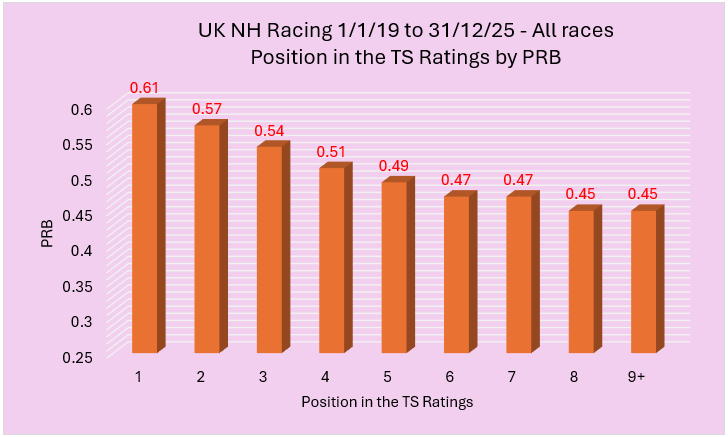


Males have outperformed females, by a fair amount in win strike rates but only just in terms of returns. Hence, there has been no significant edge to males under these circumstances over the past few years.


Non-handicap races – TS top-rated runners by age of horse (ISP 10/1 or less)

Onto the age splits now, and a table showing performance in non-handicaps of top-rated Topspeed horses by individual age group.


As can be seen, the majority of non-handicappers were aged two or three, and TS top-rated 3yos have performed well. They have secured a win rate close to one win in every three, while showing a small BSP profit of £60.49 (ROI +3.8%). Older top-rated runners, those seven and older, fared the worst in terms of both strike rate and returns with losses of around 7½p in the £.


Non-handicap races – TS top-rated runners by run style (ISP 10/1 or less)

Finally for this article I will share some data for run style – possibly my favoured area of research. Firstly, a look at the win strike rates (within their specific run style groups):


We see a familiar pattern to previous run style research where early leaders/front runners have comfortably attained the best win percentage within their group while hold up horses having the lowest.

As I have mentioned many times before, we cannot know pre-race what the run style of each horse will be and hence any profit/loss data shared is essentially hypothetical. However, I always like to show the splits in the hope that one day I buy a crystal ball that actually works!


Those numbers speak for themselves really. The PRB figure of 0.78 for early leaders has been the highest recorded in the whole article. If the TS top-rated runner leads early in a non-handicap when 10/1 or shorter, then we have a value selection.

*

This article has uncovered some interesting and positive findings. From what I have gleaned so far, when looking for selections in AW races top-rated Topspeed runners should be noted and potentially shortlisted for further investigation.

In the next article I will delve deeper into the performance of Topspeed in handicap races. Until then…

- DR

Thinking Out Loud: Trainer ‘P’ Form

I have been researching horse racing for just over 25 years now, so I have delved into a lot of different areas and ideas, writes Dave Renham. Some have provided profitable angles, some have not. I tend to write up an article after I have done the research so that I have all the stats in front of me to help decide if it is worth converting into a piece. When ideas have offered little or no significant edge, I have tended to ‘bin’ them, as a fair proportion of readers are concerned more with profit than interesting ideas which do not offer any long-term edge.

This time, however, I am playing it slightly differently by researching and writing my findings up as I go. The risk here has already been mentioned: that there is little or no punting nutrition in the angle and associated research; but it is good to mix things up from time to time. I have penned one or two this way before, but it is a rare occurrence.

Today I am examining a new idea, for me at least. It is based around recent trainer form. This is regarded by many as an important consideration when it comes to betting on horses. Indeed, on Geegeez we offer Trainer reports where members are able to study 14-day or 30-day trainer form for all trainers who have runners on the day. The screenshot below shows an example of this:


My idea is to look at some individual trainers during specific months to see if their win strike rates showed correlation with their percentage of runners that had been pulled up.

The theory is that the fewer horses that were having to be pulled up, the higher the win percentage, and vice versa. Of course, I appreciate that the percentage of pulled up runners could impinge on the win percentage to a small extent, but we are not generally talking about pulled up monthly percentages of 30 or 40%, so the effect should be minimal. I estimate that in some instances it may make a difference of around 1% in terms of the monthly win SR%.

Data have been taken from UK National Hunt racing spanning from 1st Jan 2021 to 20th November 2025.

I will be looking at five trainers who each have a significant number of runners per year, which should make the findings more robust. The trainers are Nicky Henderson, Olly Murphy, Paul Nicholls, Dan Skelton and Nigel Twiston-Davies.

Let me start by sharing the overall percentage of horses for each trainer that were pulled up during the period of study:


As we can see there is a range of figures, with Nicky Henderson’s horses being pulled up roughly one race in every seven, whereas Olly Murphy’s runners have been pulled up roughly one race in every 14. These are the base figures I will work from for each trainer. I will move in alphabetical order and start with Henderson.


Nicky Henderson

We have seen that 14.1% of all of Henderson's runners were pulled up which seems quite a high figure. In fact, the overall percentage of pulled up runners for all trainers, not just these five, stands at just under 10%, (9.6% to be precise). Indeed, what inspired my research for this piece was the form of this particular yard in March 2024. It was when the stable was really struggling with an unexplained illness that saw numerous withdrawals and several very poor runs. Indeed, in March 2024 over 35% of Henderson’s runners were pulled up and they only had two winners across the whole month. Here we saw in black and white the possible strong link between the percentage of pulled up runners and stable form.

To test my correlation idea over the longer term I have come up with the following plan. For each stable I will use the overall percentage figure for pulled up runners as my starting point. So, for Henderson it is 14.1%. Then I will decide upon a lower ‘Pulled Up’ percentage (PU%) for specific months in an attempt to determine when the stable has potentially had a ‘much better’ month in terms of win rate, and then a higher monthly PU% when hopefully the stable has had a ‘much poorer’ month. The upper and lower figures I will choose for each trainer will be chosen by gut feel more than anything else. Also, once I have chosen these figures, I won’t tweak them in any way. It would be easy to back-fit the results slightly to help fit the narrative, but that defeats the object.

For Henderson then, my higher monthly PU% will be 19% and my lower monthly one will be anything under 10%. Hence, any month where the PU% was 19% or above, I will combine the results for all such months and work out the overall win strike rate across those months. I will do the same for months where the PU% was under 10% and work out the overall win strike rate across those months. My hypothesis, I guess rather obviously, is that we should see a much higher win strike rate in the months where the monthly PU% was under 10%. Here is what I found for Nicky H:


The results are at least the right way round in terms of the hypothesis. A 4.2% differential in win rates is fairly significant, especially as the sample sizes were large for each group – 488 runners and 609 runners respectively. It will be interesting to see if the other trainers follow a similar pattern.


Olly Murphy

Next, we head to the Wilmcote-based trainer, Olly Murphy. For Murphy the overall percentage figure for pulled up runners is much lower than for Henderson runners, down at 7.2%. Hence, I need to once more decide upon my PU%s in terms of ‘good’ and ‘bad’ months. For a ‘bad’ month I will look at data where the PU% was 11% or bigger; for a ‘good’ month 4.75% or lower. Here are the strike rates based on these limits:


We see similar strike rates to the Henderson ones. Again, the figures are the way round I was hoping for with a 3.9% differential between the two. So far so good in terms of my original hypothesis.


Paul Nicholls

Paul Nicholls is approaching 4000 winners in the UK and has been Champion trainer a remarkable 14 times. It will be interesting to see what his stats show us. The overall percentage figure for pulled up runners from the Nicholls stable stands at 10.4%. Therefore, for a ‘bad’ month I will look at data where the PU% was 14.5% or bigger; for a ‘good’ month I will look for a percentage figure under 7%. Here are the relevant strike rates for both:


Wow! This is a significant difference. When the stable’s runners are being pulled up far less often than usual, the win percentages are off the charts. In contrast, when the PU% hits a much higher monthly figure than the average, the win rate drops markedly.

At this point, the research is showing what I had hoped for, but with two trainers left to check, this could 'go south' pretty quickly. Let’s see.


Dan Skelton

Dan Skelton has been banging in winners in vast quantities over the past few seasons. I wonder if this coming year will be the year when he finally wins the Trainers’ Championship. The overall percentage figure for pulled up runners from the Skelton yard over the period of study stands at 8%. Therefore, for a ‘bad’ month I will look at data where the PU% was 11% or bigger; for a ‘good’ month I will look for a percentage figure under 5.5%. The graph below shows the splits:


We see similar splits to Henderson and Murphy with a differential of 3.5% between the two strike rates. Again, the lower PU% group have the higher win strike rate.


Nigel Twiston-Davies

The final trainer to check is Nigel (and Willy) Twiston-Davies. His overall win percentage across all races is slightly below the other four so we should expect slightly lower percentages when we examine the ‘good’ and ‘bad’ month splits. The overall percentage figure for pulled up runners from the yard stands at 8.6%. Therefore, for a ‘bad’ month I will look at data where the PU% was 11.5% or bigger; for a ‘good’ month I will look for a percentage figure under 6%. The graph below shows the strike rates:


We see similar results to the ones we saw for Paul Nicholls with the ‘good’ month strike rate nearly double the ‘bad’ month one. All five trainers have seen a edge for the ‘good’ PU% months, with two showing a very clear win percentage edge.

So far so good, but there is another thing I need to check: Betfair returns (BSP ROI%) for each trainer. Obviously, based on the findings so far, I am hoping to see better ROI percentages for the months where the PU%s were lower. These figures will be in the middle column of the table shown below. The high figures will be in the column on the right. I have highlighted in green the best ROI% of each pair:


Four of the five have correlated positively with the win strike rates showing higher returns in the months where the PU% was low. Not surprisingly, two of them, Nicholls and Twiston-Davies, have a huge differential between their two respective figures. Both see a difference close to 40 pence in the £. The outlier is Dan Skelton whose figures are ‘around the wrong way’. However, it should be noted that two of the winners in his ‘high’ group were priced BSP 44.2 and 36.8. His ‘low’ group did not have winners anywhere as high as these two prices. Hence, the ROI%s are skewed a little based on this evidence.


*


This has been an interesting journey, despite it not being that quick a piece to research and write up; I hope it's been an enjoyable ride. Ultimately, from my original hypothesis perspective, that proved to be quite a good one. If only the Skelton ROI% figures were around the other way, then I could claim it was a very good hypothesis!

Based on the findings of this piece, it does seem that the percentage of horses from a stable that are pulled up each month has an impact on the win rate of said stable.

- DR


NH Trainers: Short vs Long Distance Travellers

NH Trainers and distance travelled

We know that trainers have their own personalised methods of training horses, as well as how they go about placing horses in terms of which races they are going to run in, writes Dave Renham. In this article I will examine the records of certain trainers in terms of the distance they travel with their runners to the racecourse.

Introduction

Clearly, the location of training facilities impacts where the racecourses are in relation to the racing yard; trainers that train in Scotland for example are somewhat restricted in terms of short journeys to courses. Nick Alexander, who trains in Fife, has two courses within 40 miles (Musselburgh and Perth), and he still has to travel more than 90 miles to get to the other two Scottish tracks, Ayr and Kelso. Compare this to Nigel (and Willy) Twiston-Davies, Fergal O’Brien and Kim Bailey to name but three, who all train within 40 miles of six different racecourses.

In terms of data for this piece I have looked at UK National Hunt racing from 1st January 2019 to 11th November 2025. Any profit/losses have been calculated to Betfair Starting Price (BSP) less 2% commission.

How a journey impacts a horse is hard to say. Logically, we could argue that the less time the horse has to travel the better: there's less chance for it to become unsettled on the journey and such like. However, the counter argument would be that for a trainer to send a horse on a very long journey there must be a good reason. There are a few situations in which a trainer might look further afield including more suitable race conditions, a less competitive looking race, targeting a specific prize, or looking to increase the profile of the horse or indeed the yard by entering at bigger meetings. There are also cases when the owners might want to run somewhere, either because it's convenient for them or because of any associated prestige/good day out. Trainers' and owners' intentions are not always 100% aligned!

When considering how a horse is likely to fare on a shorter or longer journey to the track, I am hoping that digging into individual trainers will help to give some answers. My assumption is that each trainer will be different with some trainers primarily targeting races close to home, whereas others happier to travel the length and breadth of the country in search of what they deem to be better opportunities.

My approach will be to first look at distances of 40 miles and less to the racecourse, as most of these journeys involve a horse travelling for about an hour or less. I will then look at runners travelling distances of 175 miles or more, which I estimate means a minimum journey time of around four hours given the likely vehicle speed restrictions.

40 miles or less

I'll begin by looking at shorter journeys to the track, and below are the figures for all trainers combined when travelling 40 miles or less to the racecourse:


This gives us a benchmark to use as a comparison when looking at individual trainers. Below is a list of the all  trainers who saddled at least 250 runners in total with travel of 40 miles or less from stable to racecourse. I have restricted qualifiers to horses that were a BSP price of 12.0 or less in order to try and avoid potential skewed profits from huge-priced winners. The table is ordered by Betfair SP Return on Investment.


21 of the 36 trainers made a profit with their runners priced BSP 12.0 or less, while 23 had A/E indices of over 1.00. A few handlers stand out, namely Rebecca Menzies, James Moffatt, Ben Pauling and Matt Sheppard. All four secured excellent profits over the timeframe. Looking in more detail at the record of Rebecca Menzies, there are three courses within 40 miles of her stables and her breakdown for each was as follows:


Profits at all three with the Newcastle record being particularly strong. What is also worth noting is her consistency year on year with these runners. The graph below shows Menzies' yearly win strike rates in this context:


Every year has seen a win rate better than one in five and in addition to this she recorded a blind profit in every year.

There are six tracks within 40 miles of Ben Pauling's yard, and he secured a profit at five of these. His record at Worcester was particularly impressive with 21 wins from 75 (SR 28%) for a profit of £37.37 (ROI +49.8%). He has been a rare visitor to Ludlow but of his 20 runners there, eight won (SR 40%) for a profit of £15.25 (ROI +76.3%).

All of James Moffatt’s qualifiers raced at Cartmel, while Matt Sheppard made a profit at four nearby courses - Hereford, Ludlow, Stratford and Worcester.

Moving on to some of the ‘big guns’, Nicky Henderson’s record looks quite modest for him but, to be fair, the only courses within 40 miles are Ascot and Newbury, two tough tracks at which to attain profitability. Like Henderson, the yard of Paul Nicholls has only two courses within 40 miles, Taunton and Wincanton. Nicholls has hit a strike rate of over 30% at both with his runners priced BSP 12.0 or less, Taunton producing a small positive return of just under 10 pence in the pound.

Dan Skelton has six courses within 40 miles (Cheltenham, Hereford, Stratford, Warwick, Wolverhampton and Worcester) but only Hereford has seen a positive return with these shorter priced runners. His record there was 26 wins from 69 (SR 37.7%) for a profit of £26.50 (ROI +38.4%). However, with favourites across all six courses Skelton has done well thanks to 122 winners from 286 (SR 42.7%) for a profit of £25.95 (ROI +9.1%). With those market leaders he has proved profitable across the three main race types and the BSP ROI percentages for each race type are shown below.


As can be seen, he has fared especially well with favourites ‘on the level’ in NH flat races/bumpers, returning nearly 19 pence in the £.

Before moving on, let me share the trainers who have secured returns of over 10% (10p in the £) with horses that started in the top three in the betting when travelling 40 miles or less. The graph below shows the 11 who made the cut:


It is perhaps no surprise to see Messrs Moffatt, Pauling and Sheppard in the line up based on the earlier data, and it may also be interesting that none of the perceived big guns make the list. From a punting perspective I feel it always gives us an edge when some of the lesser-known trainers have potentially profitable angles to exploit.


175 miles or more

As we did with the shorter distances, let me set the scene by sharing the overall figures for all UK NH trainers who travelled 175 miles or more to race. The total number of qualifiers is roughly half of those in the '40 or less' group which is no surprise:


We see a higher strike rate than the 'short distance travelled' group, but almost double the losses. Here, backing all runners blind would have cost us 8.3p in the £ compared with 4.4p with the other group.

As before, when looking at individual trainers I will be using a price cap of BSP 12.0. To qualify for this list, trainers needed to have had at least 100 qualifiers within this price bracket, and I have again sorted the table by BSP ROI:


This time, only 11 of 34 trainers made a profit with their runners priced BSP 12.0 or less, while 13 had A/E indices of over 1.00. These percentages of 'positive' trainers are not as good compared with what we saw earlier. In general, at this juncture, it does seem that a shorter trip to the course has been preferable to a longer one. Of course, not all trainers have had enough qualifiers to make both lists but, for those who have, I have produced a comparison of their data at the end of the article.

Looking at trainers with positive records with long distance travellers, Laura Morgan’s figures have been extremely impressive. Her record during this timeframe was particularly good when she sent runners to Scotland: such entries (BSP 12.0 or less) combined to win 34 of the 101 races (SR 36.7%) for a healthy profit of £64.05 to £1 level stakes. Returns equated to over 63 pence in the £. The majority of her Scottish raiders travelled to Perth, but all four courses north of the border returned a profit as the table below shows:


It seems that any of Morgan's runners heading to Scotland in the near future demand close scrutiny, unless the market suggests otherwise.

Paul Nicholls was another trainer to make a blind profit during this timeframe with longer travellers. When stable jockey Harry Cobden was on board the record was even better hitting a strike rate of close to 37% (82 winners from 222) for a profit of £58.36 (ROI +26.3%). They combined to ride at least 20 times at four different courses – Aintree, Ayr, Musselburgh and Southwell – and all four produced decent returns. Indeed, when we examine the value metric (A/E index) at these four courses, we see that the runners proved to be outstanding value.


In terms of other big names, Dan Skelton, like Morgan, has performed well when sending runners to Scotland. His raiders have provided returns of over 23p in the £ thanks to a strike rate of nearly 32%. Nicky Henderson rarely sends runners to Scotland, especially Kelso, Musselburgh and Perth. However, he has had five winners from nine at Kelso, three from four at Musselburgh, and four from eight at Perth. Returns combined at these three courses were over 50p in the £.

Finally, in this section, let me share the trainers who had the best records with long travellers sent off in the top three in the betting. Five managed ROI percentages of over 10% and these are shown in the table below:


Short vs Long: A Comparison

The last thing I want to do is compare trainers who had enough qualifying runners to make both main tables, short and long. Obviously, readers can look at the separate tables above, but having the key figures next to each other is more convenient. I have used the following metrics: win percentage, ROI% and A/E indices. ROIs that were negative are coloured in red; what I deem to be positive stats are highlighted in blue:


This table helps to highlight some potentially useful pointers such as Henderson, Lacey and Murphy’s stronger records with longer travellers; compared with Pauling, Team Twiston-Davies, Evan Williams and Venetia Williams who all have much better records with horses running closer to home.

I hope this article has offered up some interesting and useful facts and figures that we can take advantage of over the coming months. With trainers we need to be aware that ‘one cap does not fit all’, and I believe the more we dig into individual trainer records the better.

- DR

Top 10 Front Running Biases in Handicap Chases, Part 2: 5 to 1

Top ten front running biases in handicap chases, Part 2 – 5 to 1

In this second article of two, I will be sharing what I believe to be the Top Five run style biases in handicap chases in the UK and Ireland, writes Dave Renham. In the first article, which you can read here, I revealed positions 10 down to 6; they all had very strong biases towards front runners. The five shared below I feel have been even more advantageous to early leaders.

I have used data for handicap chases only as they tend to offer more robust data; and I have gathered data from 2018 to 2024 with no minimum runner consideration. To assist with the correlation I have used two tools from this site, namely the Pace Analyser and the Query Tool. Having access to them is a huge benefit to Gold membership in my opinion.

The run style / pace data on Geegeez is split into four - Led, Prominent, Mid Division and Held Up. A quick recap of the four run styles:

Led – essentially horses that lead early, usually within the first furlong or so; or horses that dispute or fight for the early lead.

Prominent – horses that lay up close to the pace just behind the leader(s).

Mid Division – horses that race mid pack.

Held Up – horses that are held up at, or near the back of the field.

OK, let me kick on starting with number five.


5 Kelso 2m5½f-2m6½f

We start in the Scottish borders at Kelso, essentially over a trip of 2m6f. They sometimes race over a half furlong more or less then 2m6f. The stats for 2018 to 2024 were as follows:


Strong prominent stats make this a course where a position at or near the front early has been a huge advantage. There were slightly stronger Led stats at some other course and distance combinations that I looked at last week but, for me, the additional strength of the prominent figures cemented a very robust overall run style bias.

Horses trying to mount their challenges from off the pace have really struggled over the past few years here, as the win and placed stats clearly show. The struggles of horses racing off the pace early can be highlighted further when sharing the PRB stats. PRB stands for ‘Percentage of Rivals Beaten’.


I grouped the Mid Div and Held Up stats together; their figure of 0.40 (40% of rivals beaten) is a poor one and, to coin a phrase, ‘well off the pace’.

The bias to horses up with or close to the front was stronger on good or firmer ground, or at least the stats suggested this:


17 of the 20 races were won by either early leaders or prominent racers. The 'Led' A/E of 1.87 indicates that front runners were very good value on better ground during this timeframe.

Having started in Scotland we now travel south to Cheltenham.


4 Cheltenham 2m4f–2m5f

It is the middle distance range again, around the 2m4f mark, at Cheltenham (both courses, Old and New, combined). Perhaps not a track that initially would scream out front running bias, but the stats were very strong:


The comparison that caught my eye was the Led versus Held Up win ratios. Front runners won 26 races from just 96 runners, while Hold Ups won just seven from 260! If we had been able to predict the front runner(s) pre-race we would have made a fortune to SP, let alone BSP. Even backing each way would have been extremely profitable.

On good or quicker ground the bias seemed to strengthen as these stats suggest:


Of the 20 races with 15+ runners, just one win was achieved by a hold up horse from 114 qualifiers. The bias has still been strong on easier ground but not as strong.

Onto the PRBs (all going conditions):


I had expected a slightly higher Led PRB based on the placed stats but they have still been comfortably the best. A higher PRB would have probably edged this track/trip further up the list.

Finally, I felt the stats for races with bigger fields (10+ runners) were worth sharing:


Front runners have offered huge value in these races (A/E index 2.53), with potential returns to BSP of nearly 200%!

There have been 11 races so far this year, with just a single win from 16 front runners. However, they have had three further placed horses including a place BSP of 37.55!


3 Tramore 1m7f-2m

The Irish course of Tramore may not be that familiar to some UK punters but run style stats for handicap chases over the 1m7f/2m trip there are well worth sharing:


Yes, the sample size was relatively small but it was potent in favour of front runners with an extremely high A/E index at 1.79 and IV of 2.56. The PRBs correlate strongly and underscore the bias:


The 0.64 figure for front runners, compared with 0.42 for Mid Div/Held Up runners, over this timeframe indicated that the edge was huge. The big advantage of PRB figures is that they effectively help to make small datasets bigger. In racing we often deal with modest sample sizes, relative to what general statistics would consider so at any rate. Hence, when we then try to discern knowledge from the data by using PRBs we are examining all the runners in all the races, rather than just the winners and/or the placed horses. It's not a perfect metric - what is? - but it adds depth to shallow cohorts.

For the record, of the four qualifying races held in 2025 to date, two have been won from the front, at odds of 7/2 (BSP 4.99) and 6/1 (8.2). A third front runner in that quartet was still leading when unshipping his jockey five out.


2 Killarney 2m4f-2m5f

Staying in Ireland for number two, we head to Killarney over 2m4f-2m5f (use 2m4f when using the Pace Analyser / Query Tool):


The Led group of runners hit 2.14 in terms of A/E index and 2.88 in terms of IV. There was a huge 58.6% placed figure to boot. Horses that were held up managed a place percentage of just 13.3%. As with Tramore the sample size was relatively small so let me share the PRB figures:


The 0.66 figure for the Led group compared with 0.39 for Mid Div/Held Up runners helps to confirm the huge front running edge there has been over the past few seasons.

Each year we mighgt reasonably expect four or five qualifying races, which is fewer than ideal, but when they do occur they are races we need to try and take advantage of.

And now for my number 1...


1 Uttoxeter 2m4f-2m5f

Top spot goes to Uttoxeter and its mid-range handicap chases. The majority of races were at 2m4f, but a handful were contested over an extra furlong. These are grouped together in Geegeez (using the 2m4f distance) and stats were as follows:


There were over 100 races in the sample, making this set of data extremely robust. Front runners won better 31% from within their group, had strong metrics across the board and potential profit levels were high. Front runners and prominent racers won 73% of the 112 races from 46% of the runners; and front runners alone won 38% of the races from just 16% of the runners!

The PRBs confirmed the pattern:


The front running edge is clear to see by looking at the bars on the graph, especially noteworthy due to the large number of races at this course and distance.

Ground conditions have made little difference with the win rate for front runners on good or firmer being 32.2%, while on good to soft or softer it was 30.8%.

At the time of writing, 2025 had seen 14 such races of which seven were won from the front.


*


Incredibly, run style bias in NH racing is something that still goes under the radar for many punters. There are not many clear-cut edges we can still get as punters these days, but knowing which course and distance combinations offer the strongest biases will almost force us to improve our bottom line.

Until next time...

- DR

Top 10 Front Running Biases in Handicap Chases, Part 1: 10 to 6

The Top 10 front running biases in handicap chases Part 1 – 10 to 6

Over the next two articles I will share what I believe to be the Top Ten current run style handicap chase front running biases in the UK and Ireland, writes Dave Renham. In this first half, I will reveal positions 10 down to 6; and next week I'll reveal my top five. Of course, I appreciate that there will be people who disagree with my hierarchy but, ultimately, all ten biases have shown themselves to be profitable to deploy alongside more traditional form reading. As a bonus, today I will also share three near misses that narrowly failed to make the top ten.

Introduction

To compile my top picks, I have used data for handicap chases only as they are not so prone to distortion by the ability range of the horses competing. Data are from 2018 to 2024 with no minimum runner consideration.

I mentioned in a recent offering that Gold members of Geegeez have so many benefits and one of these is access to the Pace Analyser. This allows users to dive into run style / pace biases at any racecourse in the UK and Ireland. The data can be filtered based on going, field size, distance and race type. There is also the option to separate hurdles and chase (and NH Flat) data at jumps courses; and across all courses the data can further be filtered by year to allow for possible changes in any bias. The Pace Analyser is ideal for research such as this, and it was the main source that I used to produce what follows.

The run style data on Geegeez is split into four groups - Led, Prominent, Mid Division and Held Up. A quick refresher of which type of horse fits each profile:

Led – horses that lead early, usually within the first furlong or so; or horses that dispute or fight for the early lead.

Prominent – horses that lay up close to the pace just behind the leader(s).

Mid Division – horses that race mid pack.

Held Up – horses that are held up at, or near the back of the field.


Near Misses

In general, the ‘led’ group has an edge in most handicap chases. Some courses offer a stronger edge than others and hence let me start by looking at the C&Ds that were near misses:


Exeter 2m3f

To get this distance on Geegeez we need to use the 2m4f distance figure on the Query Tool / Pace Analyser as distances are grouped every two furlongs. It should be noted, too, that some race distances at a track change slightly sometimes due to rail adjustments. This happens more and more these days, or at least it is more accurately reported these days!

Let me share the Exeter figures taken from the Pace Analyser:


This is a good time to note that not all run style groups have the same number of runners; there are always going to be far more hold up horses than front runners / early leaders. However, despite the ‘led’ group having just 82 qualifiers compared with the held-up group of 161, they have still won 20 races compared with 15. The Win%s in the table show the strike rate within each run style group, and for this article that is how I will quantify ‘win strike rate’.

The ‘led’ group produced by far the highest percentage at 24%. That is, 24.39% of the horses that led early went on to win their races. (They actually won 31.25% (20/64) of all races in the sample).

Leaders' place percentage was comfortably the best too, with 47.6% of early leaders still in the frame at the finish line; while their A/E index of 1.39 indicates that front runners were very good value.

If we considered favourites only in these races and their performance by run style, we have seen the following win strike rates splits (I have combined favourites whose run style was either Mid Div or Held Up):


Front runners / horses that contested the early lead had an outstanding record when favoured by the market. However, it's a different story for those favourites that raced mid pack or at the back early. As can be seen, the bias over this course and distance has been very strong indeed, but still it wasn't quite enough to make my top ten. Exciting times ahead, then!

Before moving on, in terms of what has happened in 2025, of the eight races to date, five have been won by front runners.


Sedgefield 2m5f to 2m5½f

Using the Geegeez tools we use the 2m6f distance.


Front runners have hit a win rate in excess of 30% and the only reason this track/trip did not make the list is due to the relatively strong stats for horses that raced in midfield early. Also, the 2025 stats to date have seen horses racing mid-pack early doing well and winning three of the six races to date.


Lingfield 2m

The stats were as follows:


Strong figures again for front runners, although this is another course and distance (C&D) where qualifying races were relatively infrequent (only four races per year on average). Indeed, at the time of writing there has been just one qualifying handicap chase in 2025, but it was won by the early leader as we can see:


It is also worth noting that he was projected as the 'probable lone speed' in the race:


OK, near misses shared; onto position ten in my list.


Top 10, 10 to 6

#10 Chepstow 3m

Some readers may expect front runners to be at a disadvantage over longer distances in handicap chases: surely for a horse to lead from start to finish in a 3-mile race would not be any easy assignment, right? However, looking at the Chepstow breakdown I suspect might change a few minds!


Front runners have bossed these races over the past few seasons, while prominent racers have been clearly second best with much better stats than horses which raced off the pace. 68 of the 96 winners raced close to the pace or at the front - that's 71% of the winners from 47% of the runners. And a front runner has been over four times more likely to win than a hold up horse when analysing the win percentage within their respective groups (25% versus 5.7%).

Now, as stated earlier, we get more hold up horses than front runners in most races and there were just over twice as many hold up horses compared to front runners between 2018 and 2024. That means therefore that when talking purely about race wins, front runners have won just over twice the number of races than hold ups.

There have been seven races this year so far with two being won from the front.


#9 Sandown 2m4f

It is time to head to Surrey now, and specifically Esher, to look at the 2m4f stats from Sandown. The run style splits for this time frame were as follows:


It's a similar story to Chepstow’s 3-mile trip but front runners have had a better place record here, hitting over 53%. There have not been that many qualifying races per year (roughly five to six) but keep an eye out for confirmed front runners when they race over this C&D. Those on the early lead have had an even stronger edge on soft/heavy ground as can be seen below:


From Sandown we head up country to Haydock.


#8 Haydock 2m3f-2m5f

Haydock seemed to have 'played around' a little with the usual 2m4f trip occasionally adding or dropping a furlong. Hence, I have combined results together a furlong either side of two and a half miles. Let me share the run style stats:


There has again not been a huge number of races each year, but the front running numbers were extremely strong over the period of study. 11 of the 29 races were won from the front and that cohort also had an outstanding place record. Hold up horses really struggled in terms of winning, though they fared better from a placed perspective.

Haydock, like Sandown, has seen the front running bias strengthen on softer ground. On soft or heavy the run style win strike rates were as follows:


It should be noted the sample size stands at only 17 races. The A/E indices correlate strongly as the graph below shows:


All in all, Haydock over 2m4f has strongly favoured horses racing at the front end.


#7 Carlisle 2m4f

Staying north for number seven, as we head to Carlisle next. The run style splits were:


It could be argued that both Haydock and Sandown should be positioned higher than Carlisle in the list; but Carlisle’s overall sample size was bigger and that swung it for me, along with an outstanding A/E index of 1.57 and excellent IV of 2.4. The figures for both of these metrics were the highest of the four C&Ds shared to date, and comfortably so.

In terms of underfoot, once again we have seen a strengthening of the bias on softer ground. I will share the win strike rate percentages and the A/E indices once more. Firstly, the win stats:


Clearly, as with the 2m4f trips at Sandown and Haydock, on soft or heavy it has been hard to make up ground from further back. 21 of the 27 races were won by front runners (12 wins) or prominent racers (9). Hold up horses had a win rate of under 3% within their run style group which is the lowest figure seen to date.

The A/E indices positively correlate with the win SR%s as we would have expected:


A ‘led’ figure of 1.79 suggests huge value; not so for the 0.26 hold up A/E index.

One final front running stat to share for this track and trip combination is connected with those early leaders that were in the top three of the betting market. This collective won 16 races from 36 qualifiers which equates to a win rate of over 44%.

This year, at the time of writing, there have only been four qualifying races over this C&D (all going conditions), and three of the four have been won from the front.


#6 Doncaster 2m3f to 2m4½f

Onto Donny now to close out the first half of my top ten. They have races over similar distances from 2m3f to 2m4½f so all races within that distance band are included (2m4f for all on Geegeez Pace Analyser):


Front runners have won 20 of the 51 races and have an excellent placed record to boot. The ground is rarely testing at Doncaster, but on good to soft or softer the bias does seem to get even stronger:


11 of the 25 races, which equates to 44% of all races, were won from the front under these conditions.

If we considered favourites only at Doncaster and their performance by run style, we have seen the following win strike rates splits (I have once again combined favourites whose run style was either Mid Div or Held Up):


Favourites that led early have been far more successful than other run style groups.

And that rounds out the lower half of my top ten. Next time it will be the top five, some even stronger biases than these! Until then...

- DR


An Irish National Hunt Trainers Analysis

An exploration of Irish National Hunt trainers using the Geegeez Query Tool

Gold members of Geegeez have so many benefits and for the first part of this article I am going to discuss how I used one of these, the Query Tool, to obtain a wealth of trainer data, writes Dave Renham. The second part of the piece will crunch some of those numbers.

My focus was Irish racing and hence Irish trainers in National Hunt races. Data has been taken from 1st January 2018 to 30th September 2025 with profits and losses calculated to Betfair Starting Price (BSP) with a 2% commission applied on any winning bets.


Setting Up With Query Tool

So, the starting point for using the Query Tool was straightforward: by inputting the date range, then going to the RACE menu where, on the Country tab, I ticked ‘Ire’ and then, going to the Race Code tab, I ticked all of the NH code boxes. The screenshot below shows the filters used:


So, this gave me all the Irish data I was looking for so – over 11,000 races as can be seen from the 'Wins' column:


Next I went to the RUNNER menu and then clicked on the ‘Trainer’ radio button, which groups the criteria by the selected variable (in this case, trainer), and then I clicked 'Generate Report'. This gave me the records for every single Irish trainer who had had a runner during the period of study. The first few trainers in alphabetical order are shown below:


From here I wanted to focus only on the trainers who sent out the most runners in order to have big enough sample sizes to drill down into other areas. I ordered the trainers by runs in the Query Tool and decided on 800 runs or more as my cut off point. This gave me 29 trainers to review. By ticking the ‘+’ sign to the left of each of these 29 trainers' names (and, when doing this, the plus sign became a minus sign meaning the trainer had been selected), I added them to my shortlist. Once all were ticked, I generated a new report with only these 29 trainers shown:


I then went back to the SUMMARY tab (top of the main part of the page) and used the 'COPY' button to paste all of the trainer data into a Microsoft Excel file I had already opened. With the 29 trainers logged in the Query Tool, I then went about generating numerous reports by changing the Query Tool variables or options. Once generated, new reports were pasted into a worksheet and I added an additional column with the specific variable for that report. I created 30 different reports, all copied across to my Excel worksheet. This took no more than 20 minutes tops, and I now had all the data I needed to analyse and number crunch.


Irish NH Trainers, by Win Strike Rate

The rest of this article will take a more familiar format for regular readers, although I may discuss some Excel methods I used along the way, in case you want to do some digging for yourself!

First things first, let me share the results for each of the 29 trainers over the timeframe (trainers ordered by win strike rate):


One immediate point to share is that Irish racing has had bigger average field sizes when compared to the UK in recent years, and that helps to explain why the trainer strike rates are generally lower than we are be used to seeing when looking at UK trainer data. The maestro that is Willie Mullins was head and shoulders above the rest in terms of win strike rate having hit a touch more than one win in every four. His runners, if backed ‘blind’, made a very small profit to BSP. The second and third listed trainers, Henry de Bromhead and Joseph O’Brien, were also profitable to BSP. A handful of other trainers made a profit to BSP, but all of these had at least one massive BSP priced winner to skew their bottom line somewhat.


Irish NH Trainers, by 'Favourite' performance

One advantage of copying the 30 different reports into Excel meant I could create a Pivot Table to easily compare the data sets and see if there were any significant patterns or angles that were worth sharing. Pivot tables are an extremely useful way to number crunch data in Excel. For those interested in finding out more about them there are plenty of easy to follow YouTube videos around.

I started off by analysing some betting market stats beginning with trainer data for favourites. In order to have a big enough sample, I decided that a trainer must have saddled at least 100 or more favourites during the period of study. I wanted to start by comparing their overall win strike rate for 'All favs' with their strike rates for market leaders specifically in chases or hurdle races. The sample size for NH Flat favourites was too small for most trainers, so I have opted not to show that. The splits were thus:


Don’t be too put off by the huge variance in strike rates between, say, Mullins and Rothwell, because 88% of market leaders for Mullins were in non-handicaps, and 84% of Rothwell’s were in handicaps. Non-handicap favourites start at much shorter prices on average than handicap jollies, so Mullins was always going to have a much higher strike rate when comparing the two of them. Talking of handicaps and non-handicaps it makes sense for me to share and compare their win strike rates to help illustrate my previous point:


Most trainers conformed to the pattern of much better win rates in non-handicaps, although a few did buck this trend. Declan Queally, for example, had virtually the same strike rate in both race types and when we analyse his results in full, we see the following:


Favourites in handicaps produced excellent returns for Queally and anyone following his market leaders in these contests would have been counting their money. Philip Rothwell has fared far better in handicaps than non-handicaps with favourites, but the vast majority of his market leaders were in handicaps (only 18 in non-handicaps).

It's time to narrow down the research a little by looking at a handful of the most successful trainers.


Irish NH Trainers: Specific Handlers

Willie Mullins

I called him the ‘maestro’ earlier and he has been in a different league to his peer group in recent years. Clearly, he has the backing of some huge owners and gets many of the best horses, but one still needs to deliver. I have shared some of his market leader stats already, and below is a graph sharing his ROI percentages (BSP) in more specific race types – handicap chases, handicap hurdles, non-handicap chases, non-handicap hurdles and NH Flat races.


As can be seen, Mullins produced excellent returns when saddling the favourite in non-handicap chases. The full stats read 316 wins from 536 (SR 59%) for a profit of £116.47 (ROI +21.7%). He also showed a blind profit with market leaders in non-handicap hurdle races thanks to 540 wins from 1028 runners (SR 52.5%) for a profit of £75.68 (ROI +7.5%). He was less successful in handicaps, making a loss in both chase and hurdle race types. His worst record with favourites was in NH Flat races where losses were close to 9 pence in the £.

Switching to all runners rather than just favourites, Mullins had some powerful stats during the period of study when we analyse the run style of his runners in chase contests. Regular readers of my articles will know that chases tend to offer front runners a solid edge over all other run styles. Mullins conformed to this pattern in such races going back to the start of 2018 as the graph below, which shows his win strike rate across the different run styles, highlights:


Mullins’ horses that have taken the lead at the start of their chase races went onto win nearly 45% of their races. If we had known pre-race which of his horses would front run and backed them accordingly, we would have been in profit to the tune of £185.78 (ROI +36.1%). Compare this to the potential returns of midfield and held up runners, which would have lost 18p and 30p in the £ respectively.

Moving on to the very best contests, Class 1 events. Here, Mullins produced a blind profit and, considering he had 2536 runners in them, this was an impressive performance, even more so considering every Irish (and British) punter knows what this trainer has achieved. His record in Grade 3 races produced the best results: 117 wins from 457 (SR 25.6%) for a profit of £74.58 (ROI +16.3%).

Henry de Bromhead

Henry de Bromhead had some amazing wins in the UK during this timeframe, especially at the Cheltenham Festival, but here I will drill into his Irish record in more detail. His overall record showed a blind profit equating to over 6p in the £ and his yearly splits are shown in the graph below:


2021 was a poor year from a returns’ perspective, and 2020 showed a small loss, but the other six years all returned a profit. Hence, de Bromhead has been extremely consistent over this timeframe.

Like Mullins, de Bromhead has some interesting stats connected with run style but his most interesting numbers have been in hurdle races. His win strike rate splits have been as follows:


Horses that have led early have been the most successful by far and, if our crystal ball had been in tip top working order, backing these runners pre-race would have yielded a very healthy return of nearly 70p in the £.

From a personal perspective it will be sad that we will not see the iconic Rachael Blackmore riding for him in the future. They have been one of the best trainer/jockey combos of recent years and gave racing fans some great memories.

Gordon Elliott

For Gordon Elliott I would like to share his record with favourites in NH Flat races. Each year Elliott has had numerous runners in NH Flat races of which roughly 28% of them have started favourite. His record with these market leaders was as follows:


For favourites to return over 30p in the £ across a good number of bets is rare, so Elliott has performed well above the norm with this cohort of runners.

Elliott is another trainer who produced some very interesting run style stats during this time period. The stats for hurdle races were as follows:


As we know, the run style each Elliott horse employed was only known after the start of its race. Hence, the profit figures for leaders and prominent runners were not something we could have achieved in reality. However, what it does show once again is that for the majority of races the importance of being up with the pace rather than off the pace.

Geegeez Gold members interested in run style research can investigate further by using the Pace Analyser if wishing to dig into specific courses and/or distances. The example screenshot below shows some Carlisle data:


Parameters of race code, course, distance, going, number of runners, handicap/non-handicap and time frame can all be tweaked. Also we can check out both Irish and UK courses.

Members can also use the Query Tool for run style research like I have done for this article exploring other areas such as trainers, jockeys, etc.

Joseph O’Brien

Jospeh O’Brien, like Gordon Elliott, has produced positive stats when it comes to NH Flat races. The table below shows his overall record in these races, his record with favourites, and his record with horses that were in the top three of the betting:


O’Brien has clearly excelled in these races, and it will be interesting to see what happens over the coming season.

Like the other trainers discussed, O’Brien has worthwhile run style stats to share. Below is a graph showing the win percentages for each run style group in both chases and hurdle races:


Once again, we see front runners from his stable had a huge edge over prominent racers who in turn had a significant edge over horses that were held up or raced in midfield.


**


I hope this article has served two purposes. Firstly, I wanted to show that research can be undertaken very quickly to generate useful stats and across a variety of areas; and secondly, I have shared some data relating to the highest volume Irish trainers which we should be able to use to our advantage this coming winter and beyond.

Finally, I hope some members will be tempted to use the content here to inspire your own research using Query Tool, Pace Analyser and the other tools in the Geegeez Swiss Army Knife.

Until next time...

- DR


Prepping for NH 2025/26, Part 5: National Hunt Flat

Prepping for the Jumps - Part 5, Bumpers

 This the fifth and final article in a series which has been looking forward to the National Hunt season, writes Dave Renham. In the previous piece I discussed handicap hurdles, while for this one, National Hunt Flat races, often called Bumpers, take centre stage.

For convenience, the previous articles are here:

Part 1: Novice Hurdles        Part 2: Novice Chases       Part 3: Handicap Chases       Part 4: Handicap Hurdles

Introduction

As throughout the series, data have been taken from 1st January 2018 to 31st August 2025 with profit and loss calculated to Betfair Starting Price (BSP) with a 2% commission applied on any winning bets. Only UK NH races have been researched, so this does not include Irish racing. Most NH bumpers are run on turf, but there have been a few races contested on the all-weather (roughly 20 every year). I will include both in the breakdowns.

Bumpers are not the type of races I bet in regularly, although I have had some bets in the past in the biggest races held at the Cheltenham and Aintree festivals. Hence, this was a piece of research I was looking forward to because of my limited past knowledge of such contests.

We have had a reasonable number of qualifying races per year, the average being around 270 over the past few years. So, over the time frame this equated to just over 2000 races. I will start as I have done for the previous four articles by examining the betting market.

Market factors

I used Betfair in terms of market rank and this was what I found:


Favourites performed solidly, losing only a small amount (1.5 pence in the £). The value has seemingly been with horses that started third in the betting. However, before we get too carried away, 2024 and 2025 combined proved a poor period for third favs as they lost £69.52 to £1 level stakes incurring losses of 18 pence in the £. As with some data I have shared in the past, I believe the overall profit for third favs was down to variance. Essentially the market has not been giving us great clues.

Let's move on then and, as with previous articles in the series, I have imposed a BSP price limit of 20.0 or lower for the remainder of the number crunching, to avoid any winners at excessively big odds potentially skewing the bottom line. It still included nearly 40,000 runners so the sample size remained huge.

Sex of horse

There will always be more male runners than females but in bumpers the disparity is less stark than in other disciplines. The splits were:


Males edged it in terms of strike rate, but overall, all the key metrics were very similar. It should be noted that losses on the Betfair Place market have been far worse for female runners.

Age of horse

Let me move onto the age stats now. Below are the A/E indices across different ages:


The sweet spot seemed to be with five-year-olds in terms of these figures. The below table covers a broader set of metrics:


Five-year-olds

As can be seen, five-year-olds had the best figures across all metrics. Not only that, this age group was profitable on the Betfair place market as well, to the tune of £82.12. Compare this to four-year-olds who would have lost us £176.80 on the place market. Overall, horses aged three or four seemed to be at a slight disadvantage, which may simply be down to lack of experience or physical maturity in general.

Five-year-olds were very consistent, which can be seen when viewing their yearly win strike rates:


In the last five seasons their strike rate has been virtually the same, with figures between 19.1 and 19.8%. Not only that, when we compare their A/E indices across the eight years, they have all been over the magic 1.00 figure suggesting good value in each year:


Sticking with five-year-olds, it does seem that experience counted for something because if we focus on runners in this age group who had at least two previous racecourse starts their record was 250 wins from 1123 runners (SR 22.3%) for a profit of £147.37 (ROI +13.1%). Meanwhile, five-year-old male runners outperformed their female counterparts, winning 633 times from 3160 runners (SR 20%) for a healthy profit of £221.47 (ROI +7%).

Country of Breeding

I want to look now at some data focusing on the country of breeding. The main country's break down as follows:


We see similar strike rates for the three main countries of Britain, Ireland and France which often is the case. German-bred runners were far less common but had the highest strike rate. French-bred runners proved relatively poor value overall, while the Irish-bred results were a notch above the rest from a betting perspective. This Irish-bred edge was replicated in the Betfair Place market as the table below shows:


It should also be noted that Irish bumper runners aged five and up produced a return in the win market of just over 7p in the £.

Older French-bred runners have been quite rare, but when aged six or older their record has been poor thanks to 19 wins from 123 (SR 15.4%) for a loss of £36.64 (ROI -29.8%).

Position Last Time Out (LTO)

A look next at some LTO data focusing on the most recent run of the horses in question looking a position the horse finished last time out.


LTO winners made a small loss, while all other groups somewhat surprisingly all proved profitable.

At this point I would like to share the results for horses who had not previously run and hence were making their racehorse debut. This cohort was obviously a big one with 5620 runners in total. Of these, 881 were successful for a strike rate of 15.7%. Losses to £1 level stakes stood at £231.80 (ROI -4.1%); A/E 0.96.

Trainers

Trainer data is always a favourite of racing fans so let’s see what we can find. In the table below all trainers who had at least 60 runners in the study period are shown. The trainers have been ordered alphabetically:


18 of the 43 trainers made a blind profit during the timeframe, while nine managed A/E indices of 1.10 or higher.

From this initial starting point, let me breakdown some of the data, starting with a look at trainer performance when the horses have started favourite. Below is a graph sharing the ROI%s where to qualify a trainer must have saddled 40 or more market leaders.


There are some real fluctuations regarding these figures. Harry Fry has had an excellent record with favourites. His ROI of +32.3% came from 21 wins from 46 (SR 45.7%) for a profit to £1 level stakes of £14.87, A/E 1.29. Jamie Snowden was another to have excelled when it comes to market leaders - 25 wins from 50 (SR 50%) for a profit of £11.19 (ROI +22.4%); A/E 1.29. In contrast, Fergal O’Brien has had a poor record with his bumper favourites losing over 19p in the £. His strike rate of 29.1% (35 wins from 119) was lowest of all the trainers shown in the graph. Nicky Henderson’s stats for bumper favourites have also been relatively poor. His record reads 57 wins from 161 (SR 35.4%) for a loss of £15.87 (ROI -9.9%); A/E 0.93.

Debut vs 2nd start

I would like to look now at individual trainer performance comparing horses making their racecourse debuts with horses that had run once previously. To help give us a benchmark, the overall figures for all trainers were as follows:


As we can see from these figures there was a clear improvement for second starters compared to debut runs so we would expect most trainers to conform to that type of pattern.

I have put the individual trainer data in a table comparing win strike rates, ROI percentages and A/E indices. Anything highlighted in ‘blue’ is a positive, anything in ‘red’ a negative. My criteria for each, was as follows:


By colour coding it helps us to compare the data sets a little more easily.


There are few trainers I would like to comment upon.

- Harry Fry had an excellent overall record in bumpers over this period and performed extremely well with debutants so keep an eye out for those.

- Alan King’s profile is similar to Fry with his debutants clearly outperforming those having their second start.

- The trainer combo of Lucinda Russell and Peter Scudamore (and now with Michael Scudamore) had an excellent record with debutants, producing returns of close to 32p in the £; A/E 1.14. Second starters, though, struggled losing 36p in the £; A/E 0.70.

- Chris Gordon’s second starters improved markedly in terms of win rate. Their strike rate went up from 15.7% to 28.6%. Second starters proved extremely profitable, too, with returns of 84p in the £.

- Nicky Henderson’s debutants had a decent win rate, but they were overbet based on losses equating to nearly 20p in the £. His runners definitely improved for the experience, and his second starters broke even.

- Messrs. McCain, Murphy, Pauling and Snowden are four trainers to note with second time starters; their runners seemed to come on a lot for the debut run.

Trainer Track Stats

To finish off, there are a handful of trainers who have produced impressive bumper stats at specific courses. They are listed below (ordered by number of runs):


There are some very impressive numbers in this table, although we need to be aware that some of the sample sizes were quite small. Having said that, I will be keeping an eye out for these trainer/course combos this winter.

**

And that concludes the fifth and final article in this series. It's another one chock full of stats that should point us in the right direction in terms of potential bumper bets over the coming months.

Good luck!

- DR

Prepping for NH 2025/26, Part 4: Handicap Hurdles

Prepping for the Jumps - Part 4, Handicap Hurdles

This the fourth article in a series looking forward to the National Hunt season, writes Dave Renham. In the opening part, linked to below, I discussed novice hurdle races, and today I am going revisit the hurdle theme but this time we'll be looking at all other handicap hurdle races. Essentially this will include all handicap hurdle races without the term ‘novice’ in the title.

As throughout this series, data has been taken from 1st January 2018 to 31st August 2025 with profit and loss calculated to the Betfair Starting Price (BSP) with a 2% commission applied on any winning bets. Only UK NH races have been researched so this does not include Irish racing.

The previous articles are here:

Part 1: Novice Hurdles        Part 2: Novice Chases       Part 3: Handicap Chases

On average there have been just over 1000 qualifying races per year, so we have a good sample size to review. I will start by examining the betting market.

Market factors

Betfair's market rank data shows the following:


Favourites made a small profit across the time frame, and it is interesting to see the A/E index broken down by time of year/months. Grouping months in pairs (e.g. January & February, March & April, etc) revealed this:


From September to April, the A/E indices were strong across the board. In the summer months, when there is less NH racing, the figures were low in comparison. [Readers may note that Peter May's SR figures are not produced on site between June and August because the data is considered less reliable at this time]

The betting returns (ROI%) correlate with the A/E indices as the following graph shows:


Anyone backing favourites from September to April over the period of study would have ended up doing quite well. If we had backed handicap hurdle favourites blind in the eight months 'non-summer months' from 2018 onwards profits accrued to £286.92 from £1 level stakes.

Having looked at the market, it is time to move on to other areas. As with the first three articles, I am going to impose a BSP price limit of 20.0 or lower from now on, to avoid any winners at excessively big odds potentially skewing the bottom line.

Sex of horse

There will always be more male runners than females and the ratio in handicap hurdle races was around 3:1 over the period of study. The findings are shown in the table:


Both sexes achieved similar win rates but, overall, female runners offered better value. However, fillies - female runners aged three or four - struggled, albeit from a modest sample. 597 fillies raced in these contests with 58 winning (SR 9.7%) for hefty losses of £202.20 (ROI -33.9%); A/E 0.68.


Age of horse

Let me move onto the age stats now. We saw that younger female runners struggled and, overall, that has been the case for both sexes as the table below shows:


Male runners aged three or four lost over 16p in the £, not as much as the fillies but still a steep loss. Horses aged five made a small blind profit and, looking across all metrics, five and six-year-olds showed a solid record.

The older brigade, those aged ten and up, made a fair profit with a decent A/E index of 1.09. Backing all these older runners to place on Befair was profitable also. Perhaps some punters ignored their chances based on age and hence they started slightly higher prices than their true price point. Sticking with the 10-year-olds, they performed even better over shorter distances of 2m4f or less. Their record with this distance requirement was 176 wins from 1328 runners (SR 13.3%) for a healthy profit of £204.62 (ROI +15.4%); A/E 1.13. On the place market the profit was also solid at £85.07. Based on this recent evidence, 10-year-olds may offer some value in the months to come.

Country of Breeding

I want to look now at some breeding data next with focus on the country of breeding. The splits were as follows:


American bred runners were rare and their record was poor. There was not too much in it in terms of the three main countries of Britain, Ireland and France, although the Irish figures read slightly better. German breds made a very small blind profit, as they did on the Betfair Place market, too (£18.78).

Position Last Time Out (LTO)

A look next at some LTO data focusing on the position a horse finished last time out. Here is the breakdown:


I feel Position LTO is a factor that I should always share but, on many occasions, there has been limited value to be found. Based on these stats horses running third LTO offered punters a minute profit but, in my view, this was likely coincidence and ultimately the finishing position last time offers no real clues to handicap hurdle races during the timeframe.

Days since last run (DSLR)

A look next at how long handicap hurdlers have been away from the track between runs. The ranges are necessarily a little arbitrary, and below is how I've broken them down:


It is rare for me to share these DSLR stats because usually there is nothing clear-cut to note. However, on this occasion there were some strong pointers which the table above shows clearly. Horses returning to the track within three days did really well, albeit from a smallish sample; and those who returned within four to seven days essentially broke even, so quick returners could be an area to keep a close eye on this season.

At the other end of the 'time off' spectrum, horses that were absent from the track for four months or more also turned a fair profit, so I am assuming a similar thing happened here as it did with the 10-year-old and older stats we saw earlier. My guess is that these runners started at prices that were marginally higher than their true price due to a possible ‘fitness bias’.

Trainers

Trainer data is always a favourite of racing fans so let’s see what we can find. In the table below I've listed all trainers who saddled at least 250 handicap hurdle runners during the study period. The trainers are ordered alphabetically:


23 of the 55 trainers made a blind profit during the timeframe, while 12 managed A/E indices of 1.10 or higher. Any of these 12 can be deemed to be trainers that performed well above the average.

On the flip side, a handful of trainers struggled, including Alan King, Martin Keighley, Seamus Mullins and Ian Williams. These handlers look over-bet in such races as a general rule.

From this initial starting point, I wanted to examine trainer performance across different BSPs. To do this I split their results into six price bands:


I wanted to compare A/E indices across said price brackets over the review period. Each trainer needed to have at least 60 runners within each individual price band to qualify and, to appear in the table, the trainer must have achieved that in four or more of the six price bands. Any price band where they sent out fewer than 60 runners was left blank.

Any entry highlighted in ‘blue’ was a positive, anything in ‘red’ a negative. My criteria for this was:


By colour coding it helps us to compare the data sets more easily. Here were the splits:


If we look back at Chris Gordon’s overall record, we can see that it was extremely positive with an overall A/E index of 1.08 and returns equating to just over 20 pence in the £. Hence, it is no surprise perhaps to see him with three ‘blues’ out of five, and indices of 1.00 and 0.93 in the other price segments. Likewise, Tom Lacey, whose overall strike rate was above 23% with returns of 28.9% and a 1.26 A/E index, had four ‘blues’ out of five with the other A/E index above 1.00 at 1.03.

Seeing that type of positive consistency across different price bands makes Lacey’s overall stats even more impressive. Rebecca Menzies, another trainer who had excellent overall stats, achieved four ‘blues’ out of five. She, along with Gordon and Lacey were trainers to excel during this timeframe and it will be interesting to see if they can replicate this over the coming months. If we combine the results of these three trainers and look at the yearly ROI% returns we see the following:


Seven winning years out of eight – I wonder if system punters might consider combining the three this year and backing all such runners?

Neil Mulholland attacks handicap hurdles on a regular basis so his overall figures are impressive. In terms of the price bands, he had three ‘blues’ out of six, with the other three indices being 1.00, 1.09 and 0.94. Again, over the past few years he has been a trainer to keep on the right side of, so I am expecting his runners to go well once more this year.

Other positives worth noting are that both the O’Neill stable and the Hobbs/White yard did exceptionally well with shorter prices runners (BSP 3.5 or less). The O’Neill stable had 49 winners from 109 (SR 45%) for a profit of £19.11 (ROI +17.5%); the Hobbs/White had a 50% strike rate thanks to 43 winners from 86 for a BSP profit of £24.86 (ROI +28.9%).

In terms of negatives, Alan King’s overall figures were quite poor, showing losses of over 27p in the £. That manifested as four ‘reds’ out of five. He is not typically a trainer to offer value in handicap hurdles based on these findings.

Summary

Let me finish by placing my interpretation of the main positives and negatives highlighed above in a table, as a sort of handicap hurdle ‘ready reckoner’:


That’s it for this 'NH Prep' deep dive. Next week I'll be taking a look at bumpers, or National Hunt Flat races to give them their full title. Until then...

- DR


Prepping for NH 2025/26, Part 3: Handicap Chases

Preparing for the Jumps - Part 3, Handicap Chases

In this third article in a series looking forward to the National Hunt season we'll continue last week's chase theme, this time focusing on non-novice handicap chases, writes Dave Renham. That is, any handicap chase without the term ‘novice’ in the title. As before, data has been taken from 1st January 2018 to 31st August 2025 with profits and losses calculated to the Betfair Starting Price (BSP) with a 2% commission applied on any winning bets. Only UK NH races have been researched, so this does not include Irish racing.

We have a good number of qualifying races per year, usually between 850 and 900; in total, then, this equates to nearly 6500 races. I will start as I always do by examining the betting market.

Market factors

I have used Betfair to determine market rank and the table below shows performance by position in the Betfair SP market:


Favourites performed well and even made a small blind profit. Concentrating on the other market positions, horses ranked fourth in the betting made a solid profit which is a big outlier when comparing to other market positions in the table whose ROI%s are all in the same ballpark. It is interesting that if backing horses fourth in the betting year in year out, a blind profit was achieved in six of the eight years.

Personally, I do not see backing horses fourth in the market as a strategy this coming season because I am assuming it is down to variance. Having said that, I looked back on the previous eight-year subset (2010 to 2017) and horses fourth in the market made a profit then, too. The ROI% was +3% in that time frame. I’ll leave you to decide how to interpret that...

Returning to favourites for a slightly deeper dive, here are the yearly ROI% numbers:


As we can see, there were flucatuations from year to year ranging from 2018, the year showing the best returns at +7.4%, to the year showing the worst returns (2019) at -12.3%. This is a good example that even annual results for a similar type of horse are rarely uniform. It is something as bettors we really need to appreciate. It’s like the tossing a coin analogy where the first ten tosses see seven heads and three tails, and the second ten see the script flipped somewhat with two heads and eight tails. The previous ten tosses are usually not a statistical or mathematical guide to the next ten. We know over a long period of time that the percentages for the number of heads compared to tails is going to trend towards 50-50, but over shorter periods we will get significant fluctuations.

Moving on, and still with favourites, here is performance by race class.


As we can see there are far more handicap chases when we get to Class 3 level or lower. The strike rate for Class 1 handicaps was lower than the rest and this was simply down to bigger average field sizes. The lowest class (5) has seen the best results with six of the eight years turning a profit, and the A/E index of 1.07 was extremely solid.

Having looked at the market, it is time to look into other areas. As with the first two articles, I am going to impose a BSP price limit of 20.0 or lower from now on, to avoid any winners at excessively big odds potentially skewing the bottom line. It still includes nearly 40,000 runners so the sample size remains huge.


Sex of horse

There will always be more male runners than females but how did their stats stack up against each other? Let me see:


In terms of performance, both sexes performed in a comparable way across all the key metrics so there was no real edge to either.


Age of horse

Moving on to age data now, and I'll begin by sharing the A/E indices across different ages:


The 4yo stats are based on just 127 runners so, concentrating on the bigger samples of horses aged five and older, there seems nothing much in it between the ages of five and nine, but once we get to handicap chasers aged ten or older we start to see a dip.  Here is a fuller view covering other key metrics:


When looking at the data as a whole, there seems to be the same age bias as we saw in the graph in play here: lower win rates for horses aged 10 and older, and much poorer ROI percentages too. Even when focusing on horses aged 10+ that started favourite or second favourite, their record was relatively poor in comparison to the other market stats we saw earlier. This cohort of older favs won 374 races from 1671 runners (SR 22.4%) for losses of £160.48 (ROI -9.5%); A/E 0.93. Logic dictates therefore that in general we should concentrate on horses aged five to nine.


Country of Breeding

Changing tack to breeding and specifically the country of breeding, below is a breakdown for the four main breeding entities - British, Irish, French and German-breds:


We have similar strike rates for the three main countries, Britain, Ireland and France. German-bred runners are less common and have performed below the level of the other three.

There are interesting stats for French bred runners when we split their data into different age groups. Combining five- and six-year-old runners together they produced 400 winners from 2056 qualifiers (SR 19.5%) for a small profit of £52.94 (ROI +2.6%); A/E 1.05. Moreover, backing all qualifiers to place on Betfair also nudged into profit to the tune of £36.58.

Compare this to the record of French-breds aged 10 and up. This older cohort produced 168 winners from 1324 runners (SR 12.7%) for a hefty loss of £150.30 (ROI –11.4%), A/E 0.94.

British-bred runners aged eight or younger combined to produce a good set of figures: 832 wins from 4545 runners (SR 18.3%) for a healthy profit to BSP of £420.95 (ROI +9.3%). The A/E index of 1.08 suggests these runners have offered good value. British-bred older runners, though, performed even more poorly than their French counterparts, hitting a strike rate of just 11.6% (229 wins from 1973) for losses of £277.60 (ROI -14.1%); A/E 0.89.


Position Last Time Out (LTO)

A quick mention of the most recent piece of form in terms of finishing position LTO. There were no clear patterns that I found but here are three stats that I thought were reasonably interesting.

Firstly, LTO winners performed reasonably well, making only a small loss of 1.5 pence in the £. They won 21.6% of the time, so with a bit of extra digging there may be some value to be found in certain last time winners in handicap chases.

Secondly, horses that fell or were unseated LTO did not perform well. They collectively achieved 201 wins from 1520 (SR 13.2%) for a loss of £114.44 (ROI -7.5%); A/E 0.93.

And thirdly, horses that were pulled up LTO but started favourite next time had a good overall record. Clearly, not a high percentage of horses that were pulled up LTO go off favourite on their next start, but when they did, 71 won from 201 runners (SR 35.3%) for a decent profit of £48.02 (ROI +23.9%); A/E 1.25.


Weight

In handicaps of course horses carry weight based on their Official Rating, although it is rare to find anything significant overall as the handicapper does such a good job rating and weighting horses. It can difficult sometimes to decide how best to analyse weight. Weight carried or weight rank are two obvious options, and I have used both many times before.

For these data I have chosen a new idea by comparing different groups in relation to the average weight carried in the race. As Geegeez has recently added the average OR for each race in their racecards it seems a good idea to take this approach. I have split the runners into three groups:

  1. Horses carrying 4lb or more than the race average.
  2. Horses carrying 4lb or less than the race average.
  3. Horses weighted within 4lb of the race average.

Here are the A/E indices of the three groups:


Horses carrying less weight offered the best value within the timeframe and the ‘4lb or less’ group turned a small profit of £238.04 (ROI +2%). Overall, this group contained 11,106 runners of which 1676 won (SR 15.1%). The other two groups lost 4p in the £ across 14,284 bets and 13,599 bets respectively.


Race Class change

A look at change in class next. Here are the splits:


Horses upped in class did best, albeit by a smallish margin given the number of runners within each group.


Trainer Angles: Overall

The final port of call for this piece is to look at some trainer data. Let me start by flagging those trainers with the highest win rates (who saddled at least 150 runners during the time frame). This is a big table containing over 50 trainers. They are ordered alphabetically:


32 of the 54 trainers made a blind profit which is a higher number than I had expected, while seven had A/E indices of 1.20 or higher – these trainers are Gary Hanmer, Ben Haslam, Matt Sheppard, Henry Daly, Martin Keighley, David Dennis and Richard Hobson. That septet appears to have gone under the radar somewhat. Here are some additional positives for some of those trainers:

  1. Ben Haslam seems to excel with older horses. Those aged 9 or older won 25 times from 107 (SR 23.4%) for a profit of £51.98 (ROI +48.6%); A/E 1.48. There were a few multiple winners but 11 different older horses came home in front so Haslam seems to have good knack of rejuvenating veteran runners.
  2. Henry Daly did especially well in races of three miles or more. In these contests he saddled 31 winners from 154 (SR 20.1%) for a huge £103.14 profit (ROI +67%); A/E 1.33.
  3. Sticking with Daly, his runners won just three times in 47 attempts in Class 1 or 2 events. However, in Class 3 or lower his record was 43 wins from 179 (SR 24%) for a profit of £111.44 (ROI +62.3%).
  4. Martin Keighley has shown excellent consistency when we compare his record across the year. When we split the year into four groups of three months (Jan to Mar, Apr to Jun, Jul to Sept and Oct to Dec), his win strike rates were as follows:


Not only was Keighley consistent, he also secured returns of at least 14p in the £ in each of the four quarterly groupings.

  1. Richard Hobson produced a profit in seven of the eight years. Hobson’s record with favourites should also be noted – 16 wins from 37 (SR 43.2%) for a profit of £20.09 (ROI +54.3%); A/E 1.48.


Trainer Angles: Comparative Data

The final data for these 54 trainers that I would like to share shows their results split into two groups – 2018 to 2021 and 2022 to 2025. I have placed the comparative data in a table covering win strike rate, ROI percentage and A/E indices. Anything highlighted in ‘blue’ is a positive, anything in ‘red’ is a negative. My criteria for each, was as follows:


By colour coding the table I hope that it helps to compare the data a little more easily. Here is the table:


Some points I would like to highlight:

Firstly, there is a statistical quirk which, when I saw it, I took a double take. Notice the two strike rates for the different groups of four years for Nick Alexander – they both are 16.77%, but what makes this even more remarkable is that the wins to runs ratio for both timeframes was 26 wins from 155 runners!

Other key points to note:

  1. Messrs. Daly, Haslam, Keighley and Sheppard, four of the seven positive trainers noted earlier, managed to be consistently good across both time frames.
  2. Brian Ellison, Warren Greatrex, Alan King, Ben Pauling, Jeremy Scott and Robert Walford have all shown a significant uptick in performance in the more recent four years.
  3. Nigel Hawke and Tom Lacey have both struggled more recently, well down on their stats for the 2018 to 2021 period.
  4. The Greenall / Guerriero stable, along with the Moore stable have both had decent results in both timeframes. We could say the same about Neil King and Evan Williams.


**


And that concludes my handicap chase analysis ahead of this jumps season. There's plenty to go at in there and I hope some of the stats will assist you in finding some good value handicap chase winners between now and the spring.

- DR


Prepping for NH 2025/26, Part 2: Novice Chases

Preparing for the jumps – Part 2, Novice Chases

This the second article in a series which is looking forward to the National Hunt season, writes Dave Renham. In the first piece I looked at non-handicap novice hurdle races. In this one, I will focus on novice chasers. I plan to look at both non-handicap and handicap races, starting with the former.

Data has been taken from 1st January 2018 to 31st August 2025 with profits and losses calculated to the Betfair Starting Price (BSP) with a 2% commission applied on any winning bets.

Non-handicap Novice Chases

There has been a serious drop in the number of non-handicap novice chases in recent years so good betting opportunities have proved somewhat limited. However, I feel it is still worthwhile sharing my findings and I would like to begin by looking at market factors for all qualifying races.

Market factors

I have used Betfair in terms of market rank and here is the breakdown:


Favourites won roughly 50% of all races and backing all of them would have made a small loss equating to just over a penny in the £. Second favourites offered some value and this was especially true when they had been shorter prices. Second favourites with a BSP of 3.0 or lower won 86 races from 194 runners (SR 44.3%) for a profit of £34.98 (ROI +18%). Meanwhile, backing horses positioned 4th or higher in the betting market would have lost a significant amount. That is despite a good looking A/E index.

Having looked at the overall market, it is time to look into other areas. As with the first article, I am going to impose a BSP price limit of 20.0 or lower from now on, to avoid any winners at excessively big odds potentially skewing the bottom line.


Sex of horse

Does the sex of the horse make a difference? Let’s see:


As can be seen, the ratio of male runners to female is around 6:1. In terms of performance, males have won more often but the bottom lines are very similar, as are the A/E indices.


Age of horse

Let me move onto the age stats now, beginning with the returns across different ages (the BSP ROI percentages):


Note that the 4yo stats are based on just 29 runners, so concentrating on the bigger samples of horses aged five and older, we can see that the trend is the younger the horse the better the returns. Once we get to horses aged nine amd up losses become fairly steep. Here are the full stats, including other key metrics:


It is interesting to note that 5yos have an A/E index below 1. That is surprising based on the strike rate, profit and returns. At the other end of the age spectrum, it does seem that we should be slightly wary of horses aged nine or older.


Country of Breeding

I want to look now at breeding and specifically the country of breeding. Here are the splits for the three main countries:


French breds performed best and showed a healthy profit, while British breds produced the worst returns. French bred runners which won last time out did particularly well, winning once in every three starts (80 wins from 240) for a profit of £71.99 (ROI +30%); A/E (BSP 1.07.


Trainers

Finally for the non-handicap novice chases let's look at some trainer data. Below is a table sharing individual trainer data in non-handicap novice chases during the period of study and with the 20.0 BSP price cap. To qualify a trainer must have had at least 50 such runners during the time frame:


The trainers that stand out are Harry Fry, Alan King and Jamie Snowden with strong metrics across the board. Gordon Elliott’s figures are solid too.

*

Let's now move on to the second part of the article where the focus will be on novice handicap chases. There are around five times the number of these compared to the non-handicap ones, so we have more data as well as more races to potentially attack this winter. I will also be drilling down into some additional areas than I did for the non-handicaps. 


Novice Handicap Chases

Market factors

I will start again with market rank. This includes all runners; and, as with the non-handicap novice chases, once we move on from this section I will have imposed the BSP 20.0 price limit:


Favourites have gone close to breaking even, while horses second and third in the betting market have both lost small (and similar) amounts. Those fifth+ in the betting market have made a profit but essentially this boiled down to three winners at BSP 210, 180 and 324.41. Remove that trio and the cohort would have lost money. Hopefully this helps explain the price cap I will be using once more from now on.


Sex of horse

In the non-handicaps discussed earlier there was little in it between male and female runners. Was that the case in novice handicap chases? Let’s compare the strike rates first:


We see a definite edge to male runners this time. How about the A/E (BSP) indices?


Again, there is strong edge here for males, so does this correlate when we look at the profit/loss/ROI% figures? Here are the full splits:


There is a huge discrepancy in terms of the total number of runs for each group, but the male edge is there across the board. For mares, losses of nearly 17p in the £ coupled with a very modest 0.89 A/E index illustrate the struggles they had in such races. I would be wary of backing any female runner in novice handicap chases against the geldings.


Age of horse

We saw earlier that in non-handicap novice chases horses aged nine or older produced the poorest returns by some margin. Was that replicated in handicaps? As before I'll start by sharing the returns across different ages (the BSP ROI percentages):


This time, we see even poorer returns for the aged nine and up group. Losses of more than 18 pence in the £ are negatively noteworthy. Here is the full breakdown for each age group:


4yo runners were again relatively rare but they had the highest win rate, best ROI% and highest A/E index. Hence, it seems those young'uns require at least a second glance. 6yos had a good record and with over 3500 runners in a very decent sized sample; they made a profit to follow blindly in seven of the last eight years. I cannot give a logical reason why 6yos have done so well, except perhaps that this is the optimal year in their career trajectories from young horses graduating from novice or second season hurdlers.

Going back to the older brigade of runners aged 9yo+, they had the lowest strike rate and the poorest A/E index, coupled with those poor returns noted earlier. I would need a good reason to back an older horse in a novice chase of any description based on these numbers.


Country of Breeding

We saw earlier that French bred runners had an edge in non-handicap novice chases. We see a similar pattern in handicap novice chases, too:


The French breds held sway once more with the best figures across all metrics. It should be noted that German bred runners also performed well from a small sample. There were 79 GER-bred runners of which 18 won (SR 22.8%) for a very healthy profit of £51.59 (ROI +65.3%); A/E (BSP) 1.36. With 14 different winning German bred horses and no horse winning more than twice, nothing can be said to have skewed the data.

Going back to French breds, those who raced in a hurdle race last time saw excellent returns of nearly 25p in the £. Over 700 qualifiers there was a profit to BSP of £175.86 (ROI 24.8%); A/E (BSP) 1.17. Also, younger French bred runners fared extremely well with those aged seven or less producing a strike rate of 20.8% (409 wins from 1968 runners) for a profit of £180.10 (ROI +9.2%). Further, this young cohort was consistent with seven profitable years out of the eight - only 2018 producing a loss, and a small one at that.


Position Last Time Out (LTO)

A look now at the most recent piece of form in terms of finishing position LTO.


These splits are interesting. As we would expect, LTO winners had the best strike rate; and last day runners up achieved a better win rate than horses further back (third or worse) on their most recent start. However, those recent 1-2 finishers incurred losses of over 9p in the £ which is well above the norm for such runners: they're clearly over bet. Also, their A/E indices were lower than we would normally see.

The best value was found with horses that finished sixth or worse LTO and I guess some of these have flown under the radar.


Weight Carried

In handicaps horses carry weight based on their Official Rating so I wanted to review this angle. Below are the A/E indices for different weight brackets:


The higher weighted runners seem to have offered the worst value and when we look at the full splits, we see that this is the case:


The best value seems to have been with the mid-range weight bracket of 11st to 11st 4lb, followed by the 10st 8lb to 10st 13lb group. Higher weighted runners (11st 5lb or more) were indeed the worst value.


Trainers

The last port of call for this piece is to review some trainer statistics for novice handicap chases. We have more data to drill into than the ‘nons’ so let me start by sharing trainers who have saddled at least 100 such runners during the time frame. They are ordered alphabetically:


Almost half of the trainers in the table (15 out of 33) recorded a profit with their runners which is a decent effort. Here are a few individual trainer stats worth sharing:

  1. The Greenall/Guerriero yard have excelled with horses making their second chase start. This cohort won 9 of 24 (SR 37.5%) for a profit of £26.62 (ROI +110.9%); A/E (BSP) 1.96.
  2. Nicky Henderson had only 28 female runners but 9 won (SR 32.1%) for a profit of £21.10 (ROI +75.4%); A/E (BSP) 1.81. He also performed well with horses making their chasing debut thanks to a 25% strike rate (19 wins from 76) for a profit of £20.74 (ROI +27.3%), A/E (BSP) 1.14.
  3. The Hobbs/White yard made an overall loss, but when their runners start favourite we should take note. Their market leaders won 13 from 37 (SR 35.1%) for a profit of £13.04 (ROI +35.2%); A/E (BSP) 1.17.
  4. Paul Nicholls should be noted when saddling the favourite. His record with jollies has been superb. 45 of the 88 won (SR 51.1%) for a healthy profit of £22.83 (ROI +25.9%); A/E (BSP) 1.22.
  5. Evan Williams has bucked the trend when it comes to last time out winners. His record has been excellent with 13 winners from 40 (SR 32.5%) for a profit of £20.31 (ROI +50.8%); A/E (BSP) 1.63.
  6. Venetia Williams has done well with horses aged seven or younger. They produced a profit of £31.11 (ROI +20.6%) thanks to 37 winners from 151 (SR 24.5%); A/E (BSP) 1.09.
  7. Kerry Lee did not make the table due to having saddled just below 100 runners in total, but her favourites did well, winning 12 of 26 starts (SR 46.2%) for a profit of £9.89 (ROI +38%); A/E (BSP) 1.40.

**

That's it for this second part of our 2025/26 NH prep series. There is a banquet of stats and snippets in this piece that hopefully will point us in the right direction when it comes to novice chases this season. Look out for part 3 next week when I'll be lasering in on another cohort of runners performing through the autumn, winter and spring. Until then...

- DR


Prepping for NH 2025/26, Part 1: Novice Hurdles

Preparing for the jumps – Part 1, Novice Hurdles

The days are getting shorter, the nights are getting longer, which means the National Hunt season is beginning to click into gear, writes Dave Renham. October has 51 scheduled meetings in the UK over jumps, more than double the number in September. I will be writing a series of six articles over the coming weeks that share statistics, both positive and negative, that I hope we can use to our advantage this season.

Introduction

In this first piece I am going to concentrate on novice hurdle races, with data taken from 1st January 2018 to 31st August 2025, a period of a little over seven and a half years. Profits and losses have been calculated using Betfair Starting Price (BSP) with a 2% commission applied on any winning bets.

Novice hurdle races can be either handicap or non-handicap contests, and as there are roughly treble the number of non-handicaps, my focus is on this bigger group. Let me start by looking at market factors for all non-handicap novice hurdle races.

Market factors

I will use Betfair's market rank, which may occasionally be slightly different from the industry SP rank - though such differences are unlikely to materially impact any discernible patterns. I will start by sharing the results for the ‘value’ metric, the A/E index. These indices are based on BSP prices and the splits are as follows:


Third and fourth favourites offered the best value. Is that replicated when studying a wider array of metrics?


Third favourites performed the best from a profit/loss perspective, while fourth favourites essentially broke even, so the A/E indices were a good guide in terms of value. Meanwhile, favourites won roughly half of all these races but despite that dominance they made a small loss overall. Those sent off fifth market rank or lower on Betfair did extremely poorly, losing over 34p in the £.

Returning to favourites, horses aged five and six provided around 75% of all favourites, and those runners virtually broke even if backing all of them blind – 1293 wins from 2513 (SR 51.5%) for a minimal loss of £5.67 (ROI -0.2%); A/E (BSP) 1.01. There were some positive angles for favourites, but due to the short prices on offer it is difficult to produce significant returns.

Here are a few:


I will analyse trainers in greater detail below, but it seems that Gordon Elliott should be noted when saddling a favourite in non-handicap novice hurdle races.

Having looked at the market, it is time to move on to other areas. However, I have imposed a BSP price limit of 20.0 or lower from now on, to avoid any winners at excessively big odds potentially skewing the bottom line.

Sex of horse

Is there any difference between the performance of male horses versus female ones? There are three times as many male runners when it comes to non-handicap novice hurdles, so more races are won by males of course. However, was there a difference in the respective win strike rates using the BSP 20.0 or lower limit?


Males outperformed females by around 2.4% in absolute win percentage terms, which equates to a differential of just over 10%. That also translated to a marginally better bottom line:


As we can see, male runners broke even during the review period while female runners lost us just over two pence in the £. There was not too much in it overall but, in general terms, male runners were slightly better betting propositions than females over the period of study.

Age

A look at the age of horses racing in non-handicap novice hurdles next. There were only 15 three-year-old qualifiers since 2018 - that age group almost exclusively running in juvenile races - so I have ignored those. Here are the splits for four-year-olds and up:


It is interesting that the general trend in terms of win strike rate was the older the better, which is unusual in most race types across both flat and NH. Not only that but the best value was also with older horses. Those aged six and up recorded solid overall profits. Sticking with the aged six and older group, if we restrict races to shorter distances (2m 1f or less) their record improved further:


Returns approached 13p in the £ and this cohort secured a positive return (ROI%) in seven of the eight years as the graph below shows:


The only losing year has been this current year, 2025, but losses are small and there is still plenty of time to edge back into profit.

Previous hurdle runs

My next port of call looks at the number of hurdles races each runner had previously had. The findings surprised me a little:


The more experience over hurdles a horse boasted the better the win percentage. This perhaps correlates well with the age stats displayed earlier although it doesn't necessarily follow that an older horse is a more experienced one.

The most successful group in monetary terms were those making their debut over hurdles. These runners secured a profit of over £260 to £1 level stakes, equating to returns in excess of 10p in the £.

Perhaps not surprisingly based on previous findings, hurdle debutants aged six-plus was a strong angle: 116 wins from 560 runners (SR 20.7%) for a profit of £138.24 (ROI +24.7%); A/E (BSP) 1.12. It could be argued that this is back-fitting, but nevertheless the results catch the eye.

Last time out (LTO) Race type

What about LTO Race type? Is there anything to glean from these stats? Let us see:


The vast majority of runners ran in a hurdle race last time, which is to be expected, but it is the last day NH Flat figures that stand out with a near 9% ROI. If we further restricted those LTO NHF qualifiers to horses that finished in the first five on that prior spin, results improved to 258 wins from 1132 runs (SR 22.8%) for a profit of £156.87 (ROI +13.9%); A/E (BSP) 1.05.

Trainers

Different trainers target different types of races, and of course the quality of horses within their stables differs massively. That has a bearing on the handlers who appear in this section, others performing to better effect further down the line in handicap company.

Below is a table outlining individual trainer data in novice hurdles during the period of study with the 20.0 BSP price cap. To qualify a trainer must have had at least 90 such runners:


13 of the 32 trainers made a blind profit, with Lucinda Russell’s figures particularly impressive (returns of over 39p in the £). She had an excellent record at Ayr with 11 wins from 34 (SR 32.4%) for a healthy profit of £38.87 (ROI +114.3%). She also made decent profits at Newcastle (6 wins from 16) and Carlisle (7 wins from 19) – each with returns in excess of 100%.

In contrast the O’Neill and Pipe stables have performed relatively poorly, showing significant losses.

Previous hurdle runs by trainer

I would like to expand my trainer research a little by looking at the performance of trainers' runners in relation to the number of previous races they had had over hurdles. Firstly, let me compare win strike rates:


We saw earlier that, in terms of win percentage, the more exoerience the better over hurdles; but as far as individual trainers are concerned there are not too many that conform to that pattern. Lucinda Russell, for example, saw her strike rate drop as her runners gained more experience over hurdles. Her record with hurdling debutants was excellent – a strike rate of 30.9% thanks to 17 wins from 55 for a profit of £48.56 (ROI +88.3%); A/E (BSP) 1.53.

The stables of Alan King and the Moores also fared particularly well with hurdle debutants although both had fewer qualifiers in the past year or two.

At the other end of the scale was Ben Pauling whose hurdle debutants struggled overall, scoring less than 9% of the time and incurring losses of over 65p in the £. Likewise, Warren Greatrex runners in such races improved steadily from a low (9.68%) novice hurdle debut strike rate.

Trainers to note with horses having their second run over hurdles were Donald McCain and Jamie Snowden. McCain’s 33 wins from 94 (SR 35.1%) notched a profit of £17.93 (ROI +19.1%), A/E (BSP) 1.25; while Snowden’s 16 wins from 39 (SR 41%) was worth £8.27 (ROI +21.1%); A/E (BSP) 1.20.

In terms of the more experienced hurdlers, Kim Bailey's team did well when they'd had at least three previous runs (the 4+ group). His record in that context reads 19 wins from 46 (SR 41.3%) for a healthy profit of £16.73 (ROI +36.4%); A/E (BSP) 1.26. Fergal O’Brien also performed well with these experienced runners, securing 64 wins from 169 (SR 37.9%) and a profit of £31.28 (ROI +18.5%); A/E (BSP) 1.17.

Let me build on that and share a comparison of A/E (BSP) indices. For this table I have highlighted the most positive indices (in blue) and the poorest ones (in red):


Nigel (now assisted by Willy) Twiston-Davies earns a mention as the only trainer to have managed an A/E index above 1.00 across all four groups. The Hobbs/White yard were close with three 1.00+ figures and a 0.98, as was Kim Bailey whose only figure below 1.00 was 0.99. Not surprisingly I guess, all three of these stables made a blind profit with their novice hurdlers as can be seen in the earlier table.

Onto my final piece of digging, which is...

Trainers and courses

Have any trainers excelled at specific course with their novice hurdlers? These were the strongest combinations ordered by course (20 runs minimum to qualify):


All 16 combinations proved profitable, with the Hobbs/White performance at Taunton particularly impressive. Long may it continue!


**


I hope this opening salvo for the National Hunt has highlighted some interesting angles for non-handicap novice hurdles. I'll be back next week with Part 2, looking at the novice chase division.

Until then...

- DR

Handicaps: Today vs Last Run (Part 2)

Handicap comparisons – last run to current run (Part 2)

This is the second article of two where I am continuing to look at some handicap data focusing on horses in terms of their most recent run compared with their current one, writes Dave Renham. The first article can be viewed here.

Introduction

In the first piece I looked at a variety of criteria including distance, class, weight carried, official rating (OR), average race OR, odds, course and trainer. I looked at each of these individually, but in this second half I plan to combine some of those variables. I also plan to look into trainer-based ‘last run to current run’ stats in greater depth.

I have analysed UK flat handicap races between 2019 and 2024 on both turf and all-weather (AW), with a few caveats. Firstly, horses must have been at least three years old; secondly, they must have had at least six career starts; third, they must have run in a flat handicap last time out; and, finally, their price must have been 12.0 BSP or lower.

Sticking with horses aged three or more seemed logical as far as handicap races go; and with horses needing at least six career starts to qualify, it means that most of them would have found their niche as it were in terms of distance, class, and so on. Using last time out (LTO) flat handicaps meant we could get a proper comparison in terms of changes in distances, official rating, weight etc., while the price limit avoids bottom lines being skewed by the odd huge price making the winner’s enclosure. Profit and loss detail has been calculated to Betfair Starting Price (BSP) less 2% commission on winning bets.
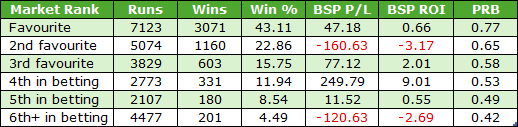
Before sharing my latest findings I want to set the scene, which I hope explains why I started looking at specific combinations of criteria. Hopefully the next paragraph will do this!

Context

The class of race that a horse runs in is restricted somewhat by their OR (also known as their handicap mark), so most horses race at a similar level to the one they raced in last time. Hence, horses tend to run against a similar level of opposition from one race to the next. This may change a little over a period of races as there will be some horses that are improving or running consistently well. For example, horses that win multiple races in a relative short number of races will soon move up class levels and face stronger opposition.


Of course, we can get the opposite with horses struggling and sliding down the handicap, and thus facing easier opposition in subsequent starts. However, as stated earlier, most horse ply their trade in a similar class, and also race over a similar distance, and perhaps there is something to said for horses being familiar with the type of race they are running in.

When back at the trainer’s yard, racehorses tend to be looked after day to day by the same person, kept in the same stable, ridden out by the same jockey: a fairly well defined routine. Horses have familiarity at home all the time, because it provides safety, stability and so on. It makes sense therefore that horses should respond to familiarity on the racecourse.


"Doing the same thing"

So the first combinations of criteria I researched were ones that were the same in this race as in the previous run. My initial focus therefore was on familiarity or similarity at the racecourse. I chose six variables - distance, class, weight carried, OR, average race OR, and betting odds - and I combined three of them at a time. This means I looked at 20 different three-way combinations. Here are my findings:


It was a surprise to find that 17 of the 20 combinations had produced a profit to BSP. Not only that, two of three losing combos came from the two smallest samples (40 and 103 qualifiers respectively). Maybe there is something to be said for familiarity on the racecourse?

Of course, there are numerous other three-way combinations I could try. I could change the parameters so that they all differ, or indeed one or more differ with one or more remaining the same. However, that would take an age to calculate, and we would have perhaps the biggest table of data in the world to try and analyse! Moreover, I could potentially try combining four parameters in any which way, or two... the list is endless.


Back in trip with some variables the same

However, before moving on to my trainer analysis I would like to share a few more combinations, because one of the things that came out of the first article was that horses dropping in distance outperformed those that were upped in trip. So it makes sense to look at some combinations with one of the parameters being ‘dropped in distance’. The other two parameters I will keep as the ‘same’. Here are a few of the more profitable combinations in terms of ROI% first:


All five shown provided solid returns and the full splits with strike rate percentage (SR%) and profit are as follows:


With so many three-way combinations producing positive results, we could be forgiven for thinking that virtually all of them have been profitable. That is certainly not the case, however, and there were a few that lost a fair few quid. Five such 'dodge or lay' combinations are shown in the table below:


To summarise, thinking about the original table I shared where three parameters stayed the same and were then combined, it has made me feel that the fewer changes the better for most horses running in handicaps. It makes sense, of course, and from the numbers I have crunched at least it seems this is the case. Perhaps this is largely a case of horses running well and "if it ain't broke, don't fix it".

Trainers

The second part of this article is devoted to a variety of trainer-based stats that came out of my research. For any trainer to qualify in this section, they would have needed to have saddled at least 100 runners within each group.

Change in Course

In the first piece it was noted that horses that were racing at the same course as they did LTO had a slightly better record overall than those that switched courses. I wondered, are there any trainers that show a significant difference in their 'same course' vs 'different course' results? Well, yes, there were six trainers who seemed to strongly fit that profile and the graph below shows a comparison of their win strike rates:


It is nice to see some trainers that we rarely see in my articles appearing here such as Michael Herrington, Derek Shaw and Adrian Wintle. There were some significant differences in their respective win percentages. However, does that translate to other metrics? The full stats are shown in the table below:


All six produced far better returns and improved A/E indices with those much better win strike rates. David O’Meara has been profitable with both groups but the ROI% differential is still over 22% or 22p in the £.

One additional stat I would like to share is that horses from these six stables which finished in the first three LTO, when returning to the same track next time combined to produce 149 wins from 599 runners (SR 24.9%) for a profit of £208.33 (ROI +34.8%).

Change in Distance

I next wanted to see if there were any trainers that had significantly different figures in connection with distance change? There were seven trainers where this was the case and, in the table, below I have shared their ROI% and the A/E indices across the three metrics – horses dropping in distance, horses upped in distance and horses racing over the same distance.

Anything highlighted in blue is a strong positive, anything in red is a strong negative and anything black is neutral:


Again, it is good to see some different names from those who usually appear. As the table shows, Michael Bell, Ruth Carr and the Quinn stable fared particularly well when keeping their runners to the same distance. Brian Ellison, Philip Kirby and Grant Tuer excelled with horses dropping in distance from their last run. Meanwhile Ed Dunlop had a good record with both horses dropping in distance and racing at the same distance. Pretty much all seven, perhaps excepting Messrs. Tuer and Bell, struggled when moving horses up in distance.

Change in Class

A look at change in class of race next and for this section I am going to look at four trainers individually.


Ralph Beckett

A look at Beckett’s figures first:


As we can see, his runners struggled when upped in distance. They had a much lower win rate, lost a significant amount to BSP (unlike the other two which made good profits), and their A/E index was poor at 0.77. For the record, they had a much poorer placed record too. We should be a bit wary of Beckett horses moving up in grade.


Julie Camacho

Not a trainer I have studied or shared many stats on in the past, but there are definite differences with Camacho's results for class change:


Horses racing at the same level as last time performed really well and may be worth looking out for.


Scott Dixon

Another trainer rarely discussed in previous articles but Dixon had some very strong stats. Below are the A/E index comparisons first:


Horses upped in class performed exceptionally well based on these figures. When we analyse a wider set of metrics we can see that this is the case across the board:


Based on these findings, Scott Dixon’s runners should be noted when upped in class as the data look extremely solid. These runners did slightly better in sprints compared the other distances.


R Fell + S Murray

Finally in this section, a look at the Fell/Murray duo. They performed best when keeping runners to the same class. The table below shows the splits:


A solid performance for the pair when running in the same class, doing particularly well in Class 4 handicaps as well as with their female runners.


Change in Odds

Shorter this time than last time

The final trainer area I examined was a change in odds. The sample sizes for trainers with horses which were sent off at the same odds were too small so I compared only lower odds to their last run and higher odds to that previous race. The first table shows trainers who performed far better with runners whose price was shorter (lower) than on their previous run compared with those whose price was higher:


In general, we would expect much better strike rates for the 'lower' group across all trainers, not just this select band: shorter prices win more often than bigger prices, simple as that. However, these four had much more significant differences between the ‘lower’ and ‘higher’ results than the other trainers I looked at.

Longer this time than last time

Onto the more unusual group of trainers who had more positive results with horses which were bigger prices than they were last time out:


All five had better strike rates for their runners sent off longer than last time, which goes somewhat against the grain. There were decent profits across the board for this cohort and again it was good to see trainers that have rarely appeared in other articles (Declan Carroll, Kevin Frost, Mark Usher and Stuart Williams).

**

I think that's plenty for this piece. Both this one and last week's have uncovered some interesting stats and hopefully there will be ways to profit from those in the future.

Until next time...

- DR

Using Official Ratings to Measure Trainers’ Ability

Using Official Ratings to measure  trainers' ability

Trying to predict whether horses are improving, have reached their ceiling, or are on the downgrade is a part of the racing puzzle that punters have get a handle on, writes Dave Renham. Whether it equates to long term profits is still determined by how much value we are getting, especially on winning selections. If we spot an improver but everyone else does too, it is unlikely to offer value because the price will be driven down by popular opinion. However, if we can spot an improver that most of the crowd do not, then that is a different matter.

Introduction

In this article I will look at fifty trainers with the aim of trying to gauge whether their horses improve, or not, within specific time frames. To do this, I compared their horses in terms of movement in Official Ratings (OR). Specifically, I compared their ORs after three, seven, ten and fifteen career starts.

For each trainer I will first compare horses' OR figure between three and seven starts, then seven and ten starts, and finally ten and fifteen. I have taken data from 2017 to 2024 and, when quoting any profit/loss figures, I have calculated to Betfair Starting Price (BSP) less 2% commission.

It's important to note that only UK and Irish runs are included, so those horses that have raced overseas may have had more than the stated number of runs. Overall, this difference should be negligible but feel free to consider some of the stats approximations and use the intel accordingly.

Three career runs vs. seven career runs

This first group is dominated by younger horses: around 22% of them were aged two and roughly 64% were aged three. I have calculated the percentage of horses within each stable that saw an improved Official Rating between their third and seventh career runs, those with a decreased rating, and those that stayed the same. The trainers are listed in alphabetical order, with any positives and negatives highlighted in the ‘OR Up %’ column. Positive percentages in blue (65% and above); negative percentages in red (40% and below).

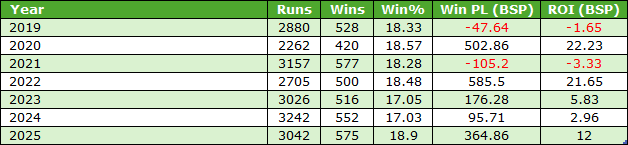


It should come as no surprise to see Charlie Appleby, William Haggas, Sir Mark Prescott, Roger Varian, and the Gosden and Charlton stables with a high percentage of horses who have improved their ORs within this early time frame. Many of the lower scoring trainers are more renowned for handicappers and hence it will be interesting to see whether their figures start to improve as the number of runs increases.

Charlie Appleby’s figures are quite stunning with 88% of his horses increasing their OR figure between career runs three and seven. Digging deeper, backing all Appleby runners that had previously run between three and seven times would have seen the following impressive figures: 245 wins from 956 runners (SR 25.6%) for a profit of £189.87 (ROI +19.9%); A/E 1.08.

Here are some further Appleby stats to keep an eye out for this coming autumn. His horses that had run exactly three times and were racing for the fourth time in either September or October produced 30 wins from 74 runners (SR 40.5%) for a profit of £42.67 (ROI +57.7%); A/E 1.34. Add one run to that - those horses who had four career starts and were having their fifth in September/October - and their record reads 13 wins from 41 (SR 31.7%); A/E 1.26 for a profit of £18.40 (ROI +44.9%); A/E 1.26.

Next, I have calculated the average OR improvement per horse that the ‘better’ trainers achieved within these past runs grouping. [By ‘better’, I mean those with the top ten percentage improvement figures].


Charlie Appleby again tops the list. On average his horses improved 9.7lbs between those four runs from third to seventh career start, a very decent figure. All trainers in this top ten have performed well above the norm.


Seven career runs vs. ten career runs

Onto the second grouping. Logic dictates that the improvement achieved later in horses' careers will be less in OR terms overall than with the previous group of runners. This is indeed the case and hence I have moved the positive percentage figure to 60%+ (in blue); the negative figure remains at 40% or lower:


Sir Mark Prescott heads the figures here, with 75% of his runners improving their ORs between their seventh and tenth career start. Backing all Sir Mark's runners that had raced between seven and ten times previously across these eight years was worth 100 wins from 388 (SR 25.8%) for a profit of £44.73 (ROI +11.5%).

Next in the list are James Tate (68.6%), James Fanshawe (66.7%), Simon & Ed Crisford (65.4%) and William Haggas (65.0%). Prescott, Tate, Crisford and Haggas all had positive ‘blue’ figures in the first table as well.

At the other end of the scale, there are some surprisingly low improvement percentages for Charlie Johnston (33.3%) and Archie Watson (31.8%).

Let me once again calculate the average OR improvement per horse that the top ten trainers achieved within the 7-10 grouping:


Sir Mark Prescott is comfortably ahead, averaging an improvement per horse of 5.4lb. For the record, 38 of the 50 trainers managed a positive percentage improvement across their total runner cohorts. The numbers for these top ten are lower overall than we saw for the first grouping, but as horses get more exposed it is harder for them to improve their OR figure.

The horse that showed the biggest improvement was Love So Deep trained by Jane Chapple-Hyam. Her rating went up 27lbs from 74 to 101.


Ten career runs vs. fifteen career runs

Finally, a look at this most exposed of the three groupings. This time there are several trainers who have not saddled enough runners to make the figures meaningful. I have included trainers who had at least 30 qualifiers - 20 of the original list missed out on that basis. Here are the splits for the remaining 30 trainers with the same colour coding as for the previous group:


Charlie Hills is the only trainer to have improved more than 60% of his horses in terms of their OR figure between their tenth and 15th starts. Meanwhile, Messrs. Cox, Dods, Evans and Simcock all ended up below the 40% mark in terms of improvement. These are four trainers that I had expected to have much better figures.

Of the trainers that didn’t make the list due to limited qualifiers, I should mention that the Charlton stable saw improved ORs for 13 of their 15 qualifiers (86.7%). Also, George Boughey saw 20 of his 26 (76.9%) achieve improved ORs.

The final graph shows the average OR improvement per horse that the top ten trainers in this group achieved within the 10-15 career run bracket. Naturally, these are much lower than we have seen previously:


The horse that improved the most within this whole grouping was Lion Hearted, trained by Mick Appleby. He improved 28lbs from a rating of 58 after 10 starts to a rating of 86 after 15 starts.

*


As horses mature there is usually less improvement to be had before they settle at their ability level; however, as we've seen, some trainers find that level quicker than others, and knowing which to follow now and which to be patient with is a big advantage on Joe Punter.

Good luck

- DR


Your first 30 days for just £1