When Horses Return to the Same Race

Horses racing in the same race that they contested last year

Back on January 2nd 2025, Geegeez incorporated an excellent addition to the racecard namely the TRENDS tab, writes Dave Renham.

Geegeez Trends

Before discussing my plan for this article, let;s take a look at the TRENDS tab in a little more detail. Clicking the TRENDS tab will take us to a screen like the one shown below:


These were the trends for a handicap race at York which occurred fairly recently, on the 25th July 2025. The left-hand half of the screen is focused on standard information, like winning horse, trainer, jockey and going. The middle to right-hand of the screen has further info including the weight the winner carried, the age it was, its SP, official rating, and so on.

Note the red font. Any jockey in red means they are riding in the race again this year. Hence past winning jockeys in this race Oisin Orr and Rowan Scott had rides again in this 2025 renewal. Likewise for trainers, Bailey, Fahey, Nicholls and Ellison had runners this year too. There was one horse highlighted in red namely Dicko The Legend, and this horse was trying to repeat its win in 2024. (As it turned out Dicko The Legend did win the race for the second year running).

When we click on the TRENDS tab for a particular race, if we click on any race date this takes us to the result of that race for the selected/clicked year.

In addition, all of the columns within the TRENDS tab are sortable, making it easy to see if a specific profile is emerging around any of the variables. Hence, some races can offer up some useful past trends that we might be able to use to our advantage. The point of past race trends is not really to pinpoint winners - after all, looking only at win trends is a narrow field of vision for such a thing - but, rather, to highlight potential positives and negatives for horses that you are considering in the round of their overall form profile. Geegeez also has regular articles written by Andy Newton which highlight key trends in certain big races.

As far this article is concerned, I want to examine the performance of horses that ran in the same race the previous year. How often do winners manage to double up? And what about horses that ran in the race last year but did not win? Well, let’s see...

I have looked at UK flat racing (turf & AW) between 1st Jan 2017 and 31st Dec 2024. Any profits and losses have been calculated to Betfair Starting Price (BSP) less 2% commission.


All Runners Returning to the Same Race A Year On

The first thing to say is that not all races can have repeat winners or indeed runners from previous years, such as those restricted to horses of a certain specific age group. However, there have been plenty that contested the same race as in the previous year so what do the stats show us?

The table below shows us ALL runners that came back a year later to contest the same race but split into those that won the race last year versus those that did not:


As we can see the previous year’s winners have won more often, but in terms of returns they would have lost us a bigger percentage of our bankroll. In fact, both ROI figures are disappointing in truth. I had hoped for and expected better.

Perhaps not the start we were hoping for then, but there is an early positive to share when looking at horses that finished runners up the previous year – they have turned a small profit:


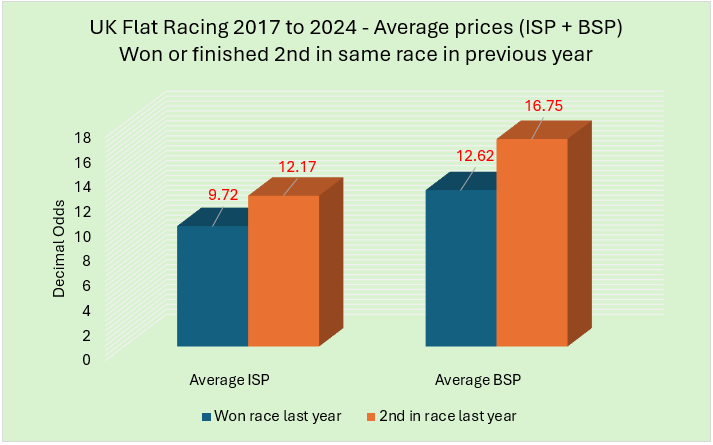
The win rates for last year winners compared to runners up are similar, but have those past winners been overbet driving their average price down? If we compare the average prices for previous year winners compared to previous year runners up, we might get some pointers:


Both the average decimal odds for the Industry SP and Betfair SP show a lower figure for the horses that won the race the previous year. I tlooks like horses trying to repeat their win a year later have been overbet by the punting fraternity after all. I’ll come back to this later.


Horses that Won the race last year

Handicaps vs Non-Handicaps

Despite the overall results for horses that won the same race the previous year not being that positive, let me dig a bit further to see if any positives can be found. Or indeed any strong negatives. I’ll start with non-handicaps versus handicaps:


As might have been expected there are far more horses trying to repeat a win in the same handicap race than in non-handicap races. There is a higher strike rate in non-handicaps which is also to be expected, but returns have actually been worse.

Race Class

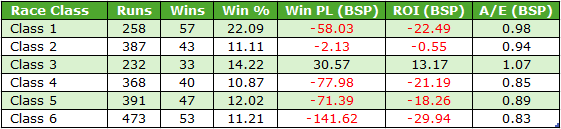
What about splitting the results up by class of race? I have not included Class 7 races as there were only five qualifiers (who all got beaten).


The strike rate in Class 1 events is decent but this is partly because all races were non-handicaps. If we exclude Class 1 races, there does seem a trend where the lower classes of race have offered last year’s winner less value.

When lumping together the results for horses that tried to repeat their win in Class 4, 5 and 6 races, losses amount to nearly 24 pence in the £, with a poor BSP A/E index of only 0.85. I would be steering clear of these runners unless I had a gilt-edged reason to convince me otherwise.

Class 2 and 3 races have produced the best returns, and an interesting stat is when we look at the results in 3yo+ handicaps across these two classes: winners of the same race the previous year have gone on to repeat their success 53 times from 395 runners (SR 13.4%) for a profit of £89.76 (ROI +22.7%). Also, if we restrict further to the most fancied runners, those priced BSP 4.5 or less, this cohort would have produced 18 winners from just 38 qualifiers (SR 47.4%) for a profit to Betfair SP of £23.22 (ROI +61.1%).

Turf vs All-Weather

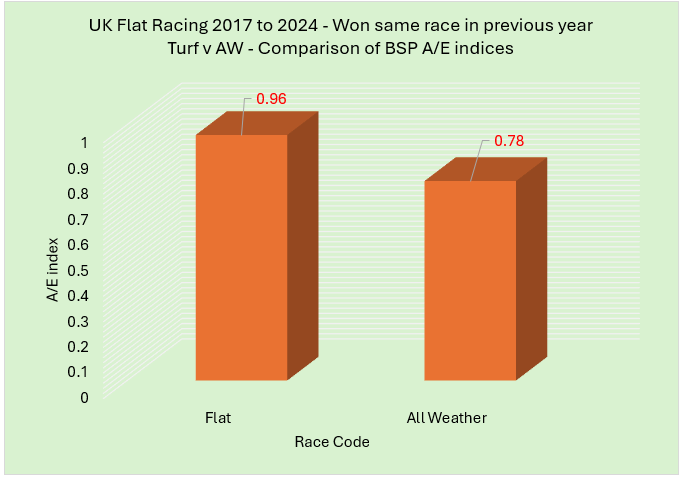
I next wanted to compare turf races with all-weather (AW) ones. Would there be similar results? The answer is an emphatic no as the graph below comparing A/E indices shows:


Horses that won the same race last year have proved far better value in turf races than AW ones as the numbers clearly show. Indeed, the other metrics back these A/E indices up:


There was a better win strike rate for turf performers and a very clear ‘win’ in terms of their respective returns. OK, turf runners have not proved to be profitable, but they have returned close to 30p more in the £ compared to AW runners.

Sticking with the AW for a minute, the worst time in the calendar for last year’s race to have been run has been during the winter AW season. From November to March the record reads a dismal 37 winners from 337 (SR 11%) for a loss to BSP of £154.55 (ROI -45.9%).

Courses

With turf racing producing the better stats, what about different courses? Has it been easier to repeat wins on certain courses compared to others? One slight issue is limited data for some courses, so let me start by grouping together the results on the ‘best’ tracks - those tracks that are considered Grade 1 tracks. These are Ascot, Doncaster, Epsom, Goodwood, Newbury, Newmarket, Sandown and York:


These have combined to edge us into blind profit which is pleasing to see. Splitting the results by individual track see the following four hit a profit:


There is one other course I would like to mention and that is Chester. The figures for horses trying to repeat their win the previous year is decent – 11 wins from 57 (SR 19.3%) for a profit of £23.41 (ROI +41.1%); A/E 1.35.

Trainers

A quick look at trainer performance next. Data again is limited and only a handful of trainers have had more than 30 qualifying runners. They are shown in the table below:


There are two trainers that stand out, namely Richard Fahey and David O’Meara. Both have strike rates above 20% and have returned good profits with excellent A/E indices. These two trainers are worth noting in the future with the previous year’s winner attempting a repeat.

Overall, it has been hard to find many positives for horses trying to repeat their last year’s win but I have uncovered a small handful.

For the second part of this piece I'll look at runners up from the race the previous year as they gave us a better starting baseline as we saw earlier.


Horses that were 2nd in the race last year

Handicaps vs Non-handicaps

I’ll start as before with non-handicap results versus handicaps:


We see the same type of difference in win percentage but this time non-handicaps have provided far better returns. Having said that, handicappers have still gone close to breaking even.

Race Class

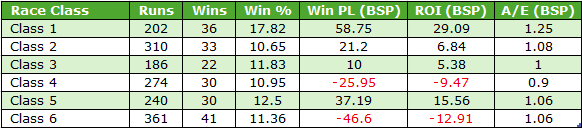
Race class now and it will be interesting to see if the performance in the lower classes of 4 to 6 is poor as it was for the last year’s winners:


Class 4 and 6 have incurred losses once more although Class 5 results buck the earlier trend. Once again Class 6 results have proved to be the worst from a profit/loss/returns perspective. It is interesting to see the positive performance in Class 1 events with this cohort of runners. Their strike rate is 4.27% below that of the last year winners’ group shared earlier, but they have turned a 22p in the £ loss to a 29p in the £ profit. The reason for this is the same one discussed earlier when looking at each groups’ results as a whole; it comes down to the prices that have been on offer for each group and the averages prices in Class 1 races have been as follows:


Once again, we see that the average decimal odds for the Industry SP and Betfair SP are showing lower figures for the horses that won the race the previous year. The difference between the average prices for each group is much bigger than we saw for ALL runners. In these better class races it looks like race winners from the prior year are significantly overbet, while the runners up from a year ago were significantly under bet.

Turf vs All-Weather

Turf versus all-weather next. Will we see the same pattern as earlier with turf results outperforming AW ones by some margin?


Overall, the metrics as a whole are much closer, but the profit/loss and returns still show turf races to be comfortably the better option.

Courses

Onto courses now and a look at the performance of the Grade 1 tracks. They produced solid results earlier, how about now?


These are even better than we saw for the combined results of last year winners. Doncaster’s figures were strong once again, producing returns in excess of 90p in the £ thanks to a 20.8% strike rate (11 wins from 53).

Trainers

Trainers will be my final port of call, and as before data is limited. Only four trainers had over 30 qualifying runners:


Four familiar faces from before. Again, O’Meara’s stats are excellent, while Fahey’s are not as good as we saw earlier. Meanwhile, Tim Easterby has a poor record with these runners.


Conclusions

I have always been a fan of past race trends over a time frame of 10 or 15 years. This is especially true at the big meetings such as the Cheltenham Festival, Royal Ascot, Glorious Goodwood, etc. I feel better quality races tend to produce stronger profile patterns. We have seen in this piece, although we have only focused on horses that came first or second in a specific race a year prior, that better class races tend to produce the most positive results; likewise the higher profile courses do the same.

Other Key findings

  • Horses looking to repeat a win in the same race the following year are generally over bet, while runners-up from last year’s race are generally under bet.
  • Turf results have been far stronger than AW results for both winners / runners-up from last year’s race.
  • David O’Meara has an excellent record with horses that were first or second last year and returning to run in the same race.
  • Avoid Class 6 races in terms of both last year’s winner / runner-up.

That's all for this week. More racing data crunching next Wednesday. Until then...

- DR

Examining Trainer Consistency

Gauging Trainer Consistency

I think most of us have favourite trainers or at least ones we prefer, but there is a good proportion of punters who use trainer form, be it long term or recent, as a significant part of their betting selection process, writes Dave Renham.

Introduction

Some people follow trainers at certain courses, others certain jockey/trainer combos, some look for first time runners in handicaps, etc. In this article I am going to try, and please note the word ‘try’, to find a way to determine how consistent an individual trainer has been over the past decade or so.

To do this I have taken data from the last ten full years of flat racing in the UK (turf and AW) and split it into two blocks of five years – 2015 to 2019 and 2020 and 2024. The idea is that I will compare the earlier data set against the more recent one. I have chosen an elite band of trainers to make the research more manageable.

Personally, the more consistent the trainer, the easier it is to assess the chance of any of their runners. And, when I am looking at a potential bet, I prefer the trainer to be consistently good rather than consistently bad!

Methodology

The question I had before I started was, what is the best way to undertake such a comparison of different trainers? What do I use? Win strike rates? Placed strike rates? A/E indices? PRBs? Or a combination of all of those?

The logical starting point for me seemed to be win strike rates. However, I hit a snag immediately. My initial idea felt really logical: compare the win strike rates of different trainers over the two different time frames across different parameters. Then divide the highest winning 5-year percentage by the lowest to give a Comparison Strike Rate (CSR) for each trainer.

I have used this type of CSR method before when comparing win strike rates but that was when I was looking at individual trainers or individual sires and comparing them with their own strike rates across various parameters. That ratio approach generally works well as a metric and it was plan for the second part of the article.

The problem with comparing one trainer’s CSR with other trainers is when the strike rates for each trainer vary significantly. It will probably be easier to give you an example to explain what I mean.

Imagine a 100-race scenario where a trainer had five winners, equating to a 5% win strike rate. Let us then imagine that in the next set of 100 races we saw nine winners (+4 winners). This is a highly plausible scenario, but suddenly the win strike has almost doubled to 9%. This would give us a CSR figure of 1.80. Imagine the same idea with a trainer that hit 25 winners in the first 100 races and then 33 winners in the second 100. Eight more winners is a decent improvement, twice the difference in winners compared with the first trainer, but their CSR figure is much lower at 1.32. To hit a comparable CSR figure of 1.80, 45 winners would have been needed in the second group of 100 races, equating to 20 extra wins.

So, I decided to put the strike rate CSR method on the back burner for the first half of the article, opting instead to use a value metric, A/E index, instead. This seemed a better plan for trainer to trainer comparisons as long as the sample sizes were not too small.

Small sample sizes can make A/E indices look far better or worse than they are in reality. That is the same for most metrics, of course, and is one of the perils of working with racing data. However, for decent sample sizes, A/E indices tend to be a good metric when it comes to comparing different trainers (and horses and jockeys and sires and courses, and so on).

For this article I will be using a minimum of 30 runs within each area to qualify and, as I mentioned earlier, will be using A/E indices to make comparisons for this first half of the piece. The indices are based on Betfair Starting Prices.

Trainer Consistency: 2yo runners

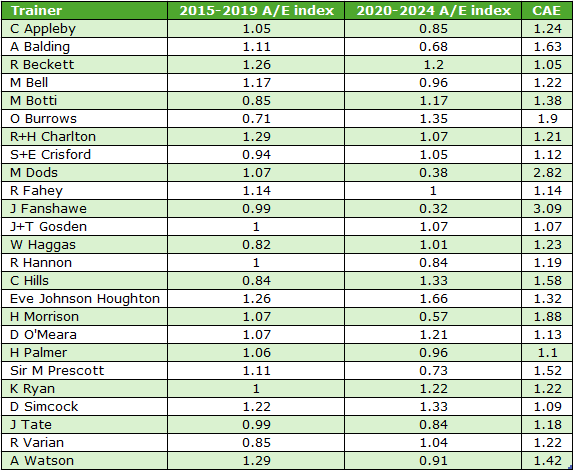
Let me look at some two-year-old (2yo) data first, starting with the individual trainer A/E indices for horses making their debuts. I will divide the bigger A/E index by the smaller one to create a comparison A/E figure using a similar idea to the one mentioned earlier with the Comparison Strike Rate (CSR). I will call it the CAE figure:


The closer the CAE figure is to 1.00, the more consistent the trainer has been in relation to comparing their A/E indices over the two-time frames. Based on this method, as far as 2yo debutants go, the trainers that have shown the most consistency are Ralph Beckett (1.05), J & T Gosden (1.07), David Simcock (1.09), Hugo Palmer (1.10), Simon & Ed Crisford (1.12) and David O’Meara (1.13).

Owen Burrows has shown a real uptick in performance from 2015 to 2019 compared with 2020 and 2024. His CAE figure of 1.90 underscores this. In fact, when we drill into his performance with 2yos on debut we see that in the past two full years (2023 and 2024) these runners won nine races from just 30 starts (SR 30%) for a BSP profit of £32.79 (ROI +109.3%).

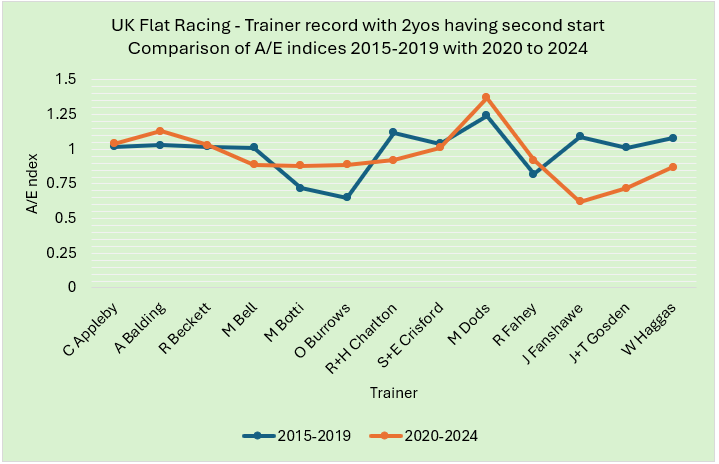
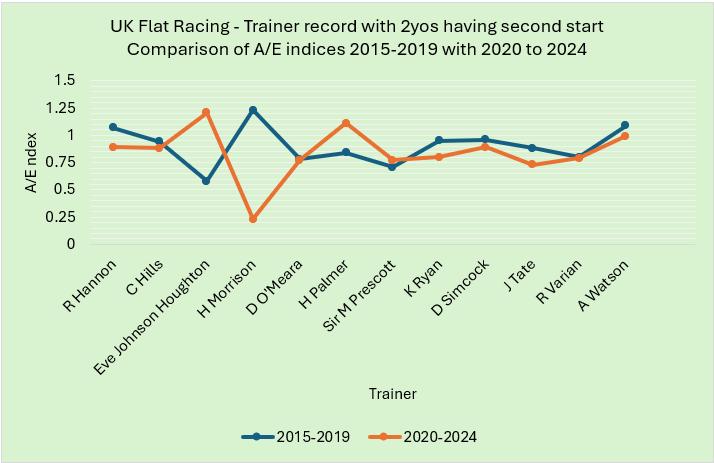
Moving onto 2yos on their second career start, here is a graphical comparison of the trainers’ A/E indices across the two-time frames. I have split the trainers into two groups in order to fit in each graph:


The closer the orange and blue dots are to each other, the more consistent the trainer’s A/E indices have been across the two periods.

Converting these into CAE figures we see the most consistent trainers from this group with second time starters aged two have been Ralph Beckett (1.01), Charlie Appleby (1.02), Simon & Ed Crisford (1.03), Andrew Balding (1.10), Michael Dods (1.10), Richard Fahey (1.12) and Michael Bell (1.13). Interestingly, when we look at the two win strike rates for these seven trainers, their strike rates have been very similar, which adds further confidence in the findings.

Onto the second batch of trainers now:


In this group the trainers with the closest CAE figures to 1.00 are Roger Varian (1.01), David O’Meara (1.01), Charles Hills (1.07), David Simcock (1.08), Sir Mark Prescott (1.08) and Archie Watson (1.10). These trainers have produced some consistent performances across the board with their 2yo second starters.

Trainer Consistency: 3yo runners

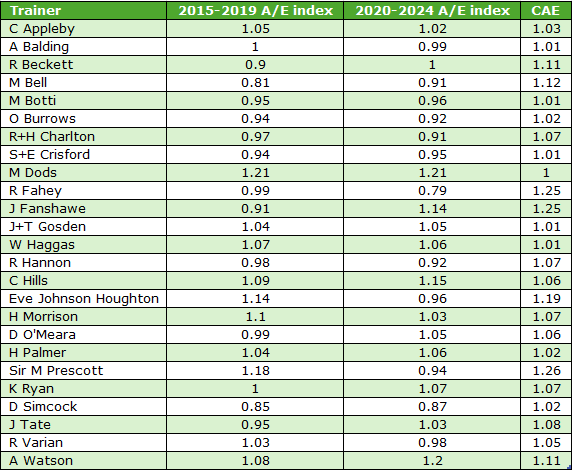
I want to move on to three-year-old (3yo) races next and am going to look at a much bigger data set, namely all 3yo non-handicaps. In theory, we should see the CAE figures much closer to 1.00 than before due to the sample size.


With 18 of the 25 trainers having a CAE figure of less than 1.10, this is an indication that most of these top trainers do perform to a similar level year in year out with specific horses in specific races – in this case 3yos in 3yo non-handicaps. Larger samples of data are less affected by those occasional unusual results which can impact on smaller data sets.

However, it should be noted that Richard Fahey and Sir Mark Prescott have both seen a dip in performance in 3yo non-handicaps over the past five years. Fahey’s record across both time frames has been particularly contrasting as the table below shows:


The strike rate has almost halved, and the returns have gone from a strong positive figure to a poor negative one. Conversely, James Fanshawe has seen an uptick in performance over the past five years, turning an 8% loss at BSP from 2015 to 2019 into a 22% profit from 2020 to 2024.

It’s now time to switch methods for the second half of the article where I aim to examine some trainer course data.

Trainer Consistency: Racecourse Angles

For the trainer course data, I plan to look at a selection of individual trainers comparing their course records and so, as I stated earlier, I will revert to the CSR (comparison strike rate) concept. Again, to help make comparisons easier when I divide the strike rates, I will divide the bigger by the smaller to give figures of 1.00 or higher.

Charlie Appleby

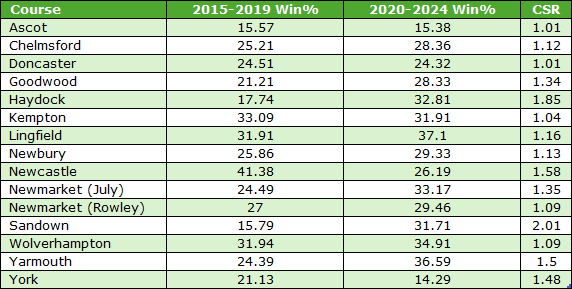
A look at the Godolphin trainer Charlie Appleby first. Here are the courses where he has had at least 30 runners in both timeframes:


I think this table shows why as punters need to be a little careful when it comes to some trainer course stats. Yes, certain trainers do target certain courses, and some are able to consistently repeat successes year on year. However, even for someone like Appleby, who has a yard chock full of top-quality horses, not all courses have delivered similar strike rates in the two five-year batches. At Sandown his win record has been excellent in the past five years but was relatively modest in the earlier five, giving a CSR figure of 2.01. The same applies for Haydock and the splits for Appleby at the Warrington track are as follows:


In terms of returns, we can see that Appleby’s figures have improved by around 40p in the £, although despite this he did not manage to get into overall profit.

Looking at which courses it might be worthwhile considering backing his runners in the future, I would say the following: Doncaster, Lingfield, Newbury and the Rowley course at Newmarket. My thinking is that these five have not only seen consistent performances (CSR figures all between 1.00 and 1.16) but have produced blind profits to BSP in both of the two five-year time frames. Ascot also falls into that category but his figures there are skewed by a BSP winner priced 36.0 in 2017 and a BSP 75.0 winner in 2022.

Before moving on, Appleby’s record at the Newmarket Rowley course is worth sharing in more detail; from 2015 to 2019 he had 54 winners from 200 (SR 27%) for a profit of £58.62 (ROI +29.3%). From 2020 to 2024 his record read 104 winners from 353 runners (SR 29.5%) for a profit of £105.76 (ROI +30%). Eight of the ten years saw the Godolphin trainer produce a blind profit on all his runners.

Andrew Balding

There are three courses where Balding has turned a profit in both five-year time frames and hit a low, i.e. consistent, CSR figure. These are Chester, Doncaster and Newbury. Of the three, Chester has the most consistent feel to the stats. He has a good record there with shorter priced runners (BSP 10.0 or lower) hitting a strike rate of 26.2% (71 wins from 271) for a profit to BSP of £60.34 (ROI +22.3%).

With bigger priced runners (above 10.0) at the track, he has made a profit of £73.52 (ROI +61.3%) thanks to 10 winners from 120. Overall, taking all prices into account, he has made a blind profit there in seven of the ten years.

Ralph Beckett

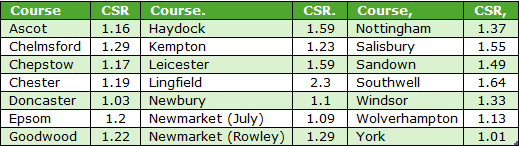
For Beckett I have produced a table of his CSR figures for different courses and these are shown below:


Doncaster, Wolverhampton and York have seen consistent CSR figures of 1.03, 1.13 and 1.01 respectively, with all three of them proving profitable across both time periods.

Chelmsford has a slightly higher CSR at 1.29 but this is a fourth course I would look out for Beckett runners as these splits are decent:


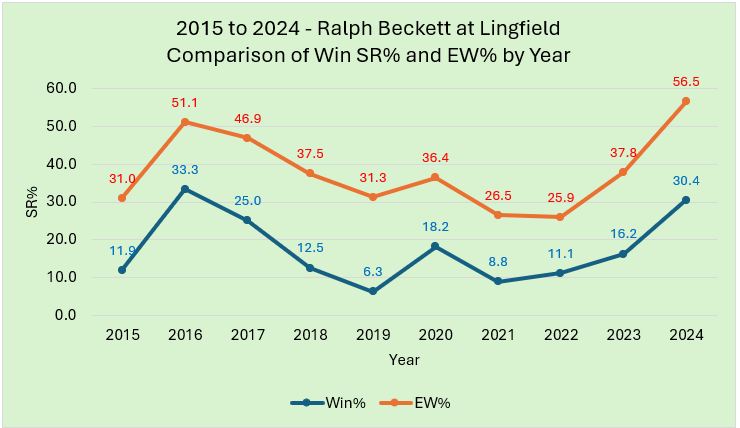
In contrast, his record at Lingfield (turf and AW courses combined) has been all over the place. The 2.30 CSR screams this and, if we look at the yearly win strike rates, coupled with the win & placed (EW) ones, we see the following:


We can see the huge discrepancies comparing 2016 and 2024, where the win rates were over 30%, with 2019 and 2021, where the win rates were 6.3% and 8.8% respectively. These results are based on fairly decent yearly sample sizes, too, with eight of the ten years having 30+ runners at the course.

I have said it many times before in articles that some stats can be misleading, and the more digging we can do behind the numbers the better.

Other Profitable Trainer Consistency Angles

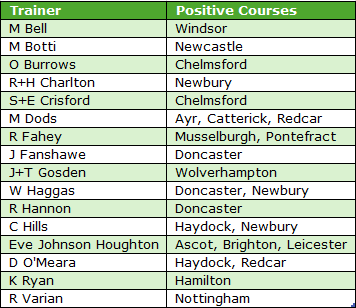
Time precludes further trawling of the full list of trainers in such detail but I will share the remaining positive trainer/course stats, based on the combination of low CSR figures combined and two profitable five-year time frames. Trainers not shown failed to complete that double qualification for any course:


Outro

As I stated at the outset, this was a piece of research where I wanted to try to establish when trainers show consistency within certain parameters. Hopefully all the hours of research combined with my approach has at least offered some tasty food for thought. I am sure the ideas are not foolproof, but I believe they have merit and utility.

Comments are always welcome and if there are any tweaks to the methods that you’d like to discuss, please let me know in the space below.

  • DR

Does Gelding Improve Racehorse Performance?

Most male horses begin their life on the flat as an entire, writes Dave Renham. At some point sooner or later - usually sooner - most horses disappoint their connections with racecourse performance and thus, in search of improvement, are gelded.

Introduction

The term "gelded" refers to the process of castrating a male horse, and this procedure is common within the horse racing industry especially with horses that race on the flat. The main reason for gelding a horse are to improve temperament and focus which it is hoped will improve performance on the track. Further, gelding a horse can improve a horse's compatibility with other horses, reducing tensions and possible distractions during races and on the gallops.

First Time Gelding

Overall

In this article I will primarily focus on data concerned with a first run after being gelded. The data has been taken from six full years of UK flat racing (2019 to 2024) and any profit / losses have been calculated to Betfair Starting Price (BSP) less 2% commission. The A/E indices have also been calculated to BSP.

Let me start by looking at the results for ALL horses that were having their first run since being gelded. The stats read as follows:


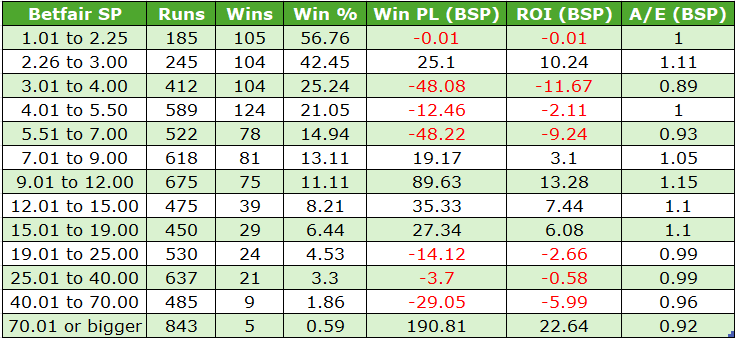
As we can see these horses win close to one time in every eight starts, and a small profit would have been made from backing them all. Of course, the chances are that we have had a few big prices which have skewed the returns a little. Below then are the results by different BSP price bands:


The best value has been with those horses priced BSP 7.01 to 19.00. In terms of the huge prices, there were five horses that won at three figure odds (BSP 100.0 +) with the biggest winning price being a whopping BSP 612.25.

It makes sense for the remainder of the article to have a BSP price ceiling in place to avoid skewing.

For the rest of the article therefore I will impose a BSP price limit of 19.00. This still gives us over 4000 horses to examine.


Age of horse

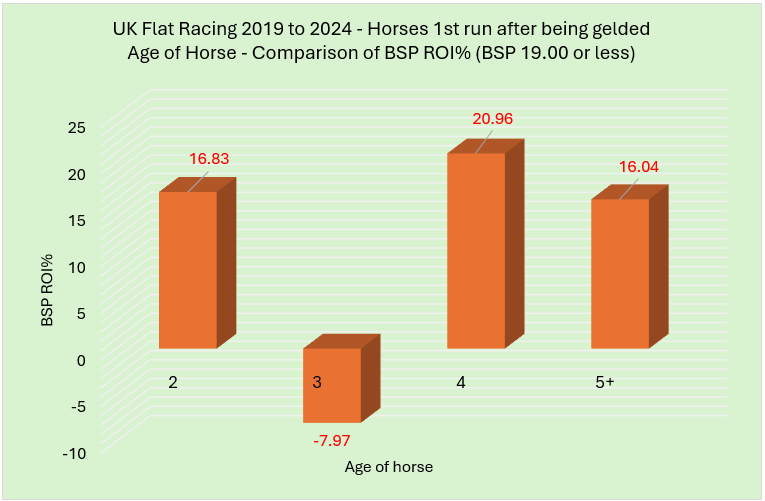
My first port of call with this price limitation is to look at different ages of horses to see if that had made any difference. The graph below looks at the BSP returns (ROI%) across different age groups:


Three-year-olds have by far the worst record (they also have the lowest win strike rate of all the age groups). The Classic generation have struggled particularly in Class 6 events. Their overall strike rate stands at 17% but in Class 6 races this drops to 13.8% as a result of just 70 winners from 506 runners. Backing all qualifiers would have seen significant losses of £117.03 (ROI -23.1%).

Juveniles (two-year-olds) having their first run after being gelded have done particularly well when contesting Novice races. Of the 123 runners, 33 have won (SR 26.8%) for a healthy BSP profit of £53.84 (ROI +43.8%).

Four-year-olds on their first run after the op have performed best in handicaps with 133 winners from 692 runners (SR 19.2%) for a decent profit of £178.61 (ROI +25.8%).


Career starts

One interesting finding relates to career starts. Horses that have raced three times in their careers previously and then were gelded have a good record. This is especially true when they race in handicap races as virtually all of them were making their handicap debut having qualified to run in handicaps for the first time. This cohort of runners have run 1044 times with 191 winning (SR 18.3%). Backing these runners blind would have produced a healthy profit of £188.03 (ROI +18%). This is especially impressive considering the BSP price limit that I imposed earlier.


Position LTO

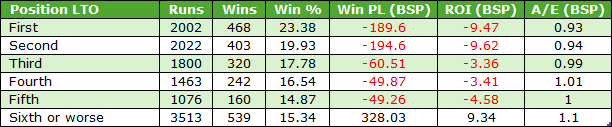
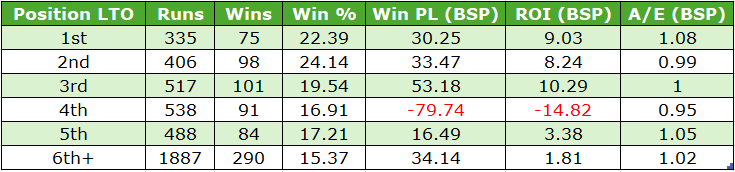
Onto last time out performance now, specifically position last time out. Here are the splits:


It is interesting to note that 335 horses that won last time out were still subsequently gelded; that is a bigger number than I had expected. Having said that, they performed well on their next starts, making a solid profit – returns are just over 9p in the £. When we look at the strike rates across different finishing positions, there is not the drop off I had expected. Horses that finished sixth or worse have still won over 15% of the time which is a decent effort.


Days since last run

Horses that are gelded are rarely rushed back to the racecourse for obvious reasons. Only 3.5% of all horses that have been gelded return to the track within four weeks. The rest tend to be given much longer to recover. Indeed, 55% of all gelded horses are given at least five months until they are asked to race again, the surgery often coinciding with a horse's scheduled winter break.

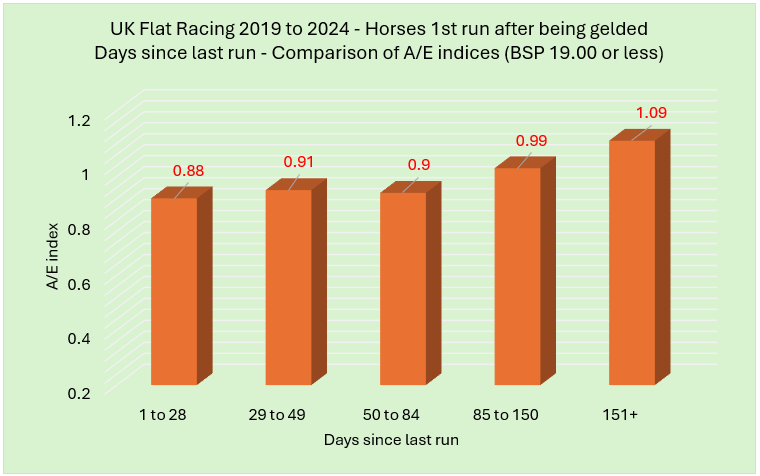
In reality, the longer the break the better in terms of offering punters value, as the graph below displaying the A/E indices for different ‘days off track’ groupings shows:


Once we get to 85 days plus (more than 12 weeks), we can see an improvement in the A/E indices. Those off the track for five months or more (151+ days) provided good value. This cohort of runners had an excellent A/E index of 1.09 (as seen above), and their overall figures read an impressive 431 wins from 2294 runners (SR 18.8%) for a level stakes profit of £258.69 (ROI +11.3%).


Sires

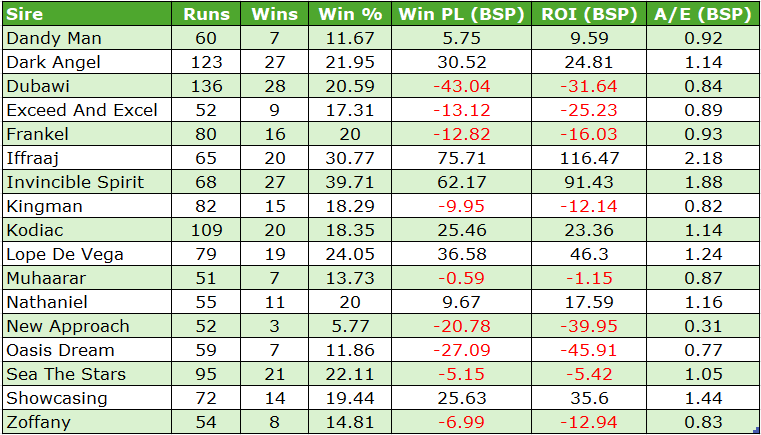
I thought it would be interesting to see if any sires showed a pattern in terms of when their offspring were gelded. It is generally agreed that sires can influence their progeny from the perspective of distance requirements, ideal ground conditions, etc. I wondered if that also applied to behaviour, attitude, temperament etc? Below is a list of sires who have had at least 50 of their offspring running for the first time after being gelded coupled with the 19.0 BSP or lower price restriction:


Eight sires have turned a profit but two stand out, namely Iffraaj and Invincible Spirit. Both have seen strike rates of more than 30% (with Invincible Spirit nigh on 40%), and both have made excellent profits. Progeny of New Approach, however, have really struggled on their first run after being gelded.

I did take a quick look at sire performance when having their second, third or fourth runs after being gelded. Iffraaj and Invincible Spirit’s strike rates both dipped back to around 20%, but both still turned a profit. New Approach on the other hand saw a huge improvement in strike rate (22%), although backing all qualifiers would still have made a small loss.


Trainers

1st run after gelding

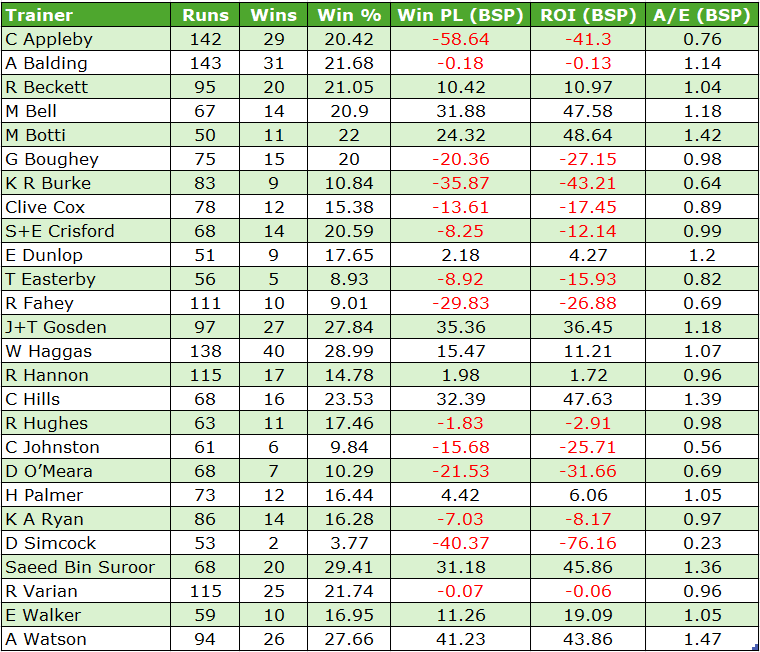
All trainers will have a slightly different approach to what happens after one of their horses has been gelded from the viewpoint of methods of recovery and rehabilitation. They will also plan out horses' return to the track slightly differently from each other. Below is a list of trainers who have saddled at least 50 qualifiers (1st run after being gelded / BSP 19.00 or less). The list is order alphabetically:


The first thing that stands out to me is the difference in the figures for the Godolphin trainers Charlie Appleby and Saeed bin Suroor. Appleby’s figures, by his high standards, are poor, while bin Suroor’s are excellent.

There do seem a be a handful of trainers to avoid; namely David Simcock (whose record is dreadful), Karl Burke, Richard Fahey, Charlie Johnston and David O’Meara.

1st vs 2nd run after gelding

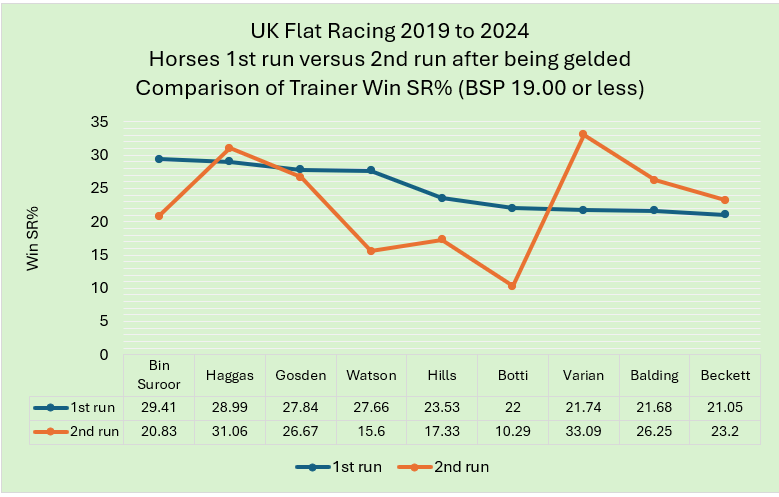
Before winding this piece up, I would like to compare win strike rates for individual trainers comparing the first run after being gelded with the second run. I have split the data up into three graphs – the first one contains the eight trainers with the highest strike rates from the first run data shown earlier. The second graph shows the next eight trainers, and the final graph shows the nine that had the lowest strike rates. Presenting in this way makes each graph comparison easier to see:


As we can see William Haggas, Ralph Beckett and the Gosden yard have very similar strike rates. However, there is a marked difference with some of the others. Most have seen a significant drop, such as Marco Botti 22% down to 10.29%, Saeed bin Suroor down from 29.41% to 20.83%, and Archie Watson down from 27.66% to just 15.6%.

Roger Varian is the only trainer to really buck the trend with a big jump in the opposite direction from 21.74% to 33.09%. I will share the full figures of all the trainers including profit/losses/returns after the third graph.


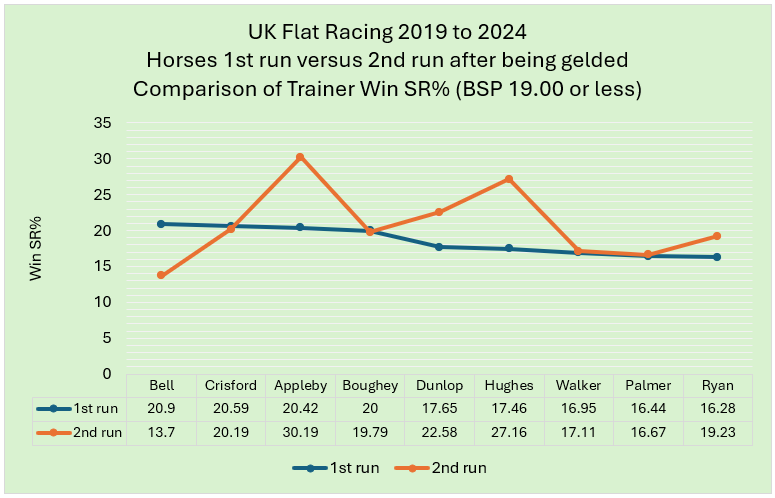
Onto the second group of trainers now:


In this group we have five trainers with very similar strike rates, while Richard Hughes and Charlie Appleby have seen significant improvements in terms of win success. Michael Bell’s figures look more akin to the first group of trainers with a drop from just under 21% to 13.7%.

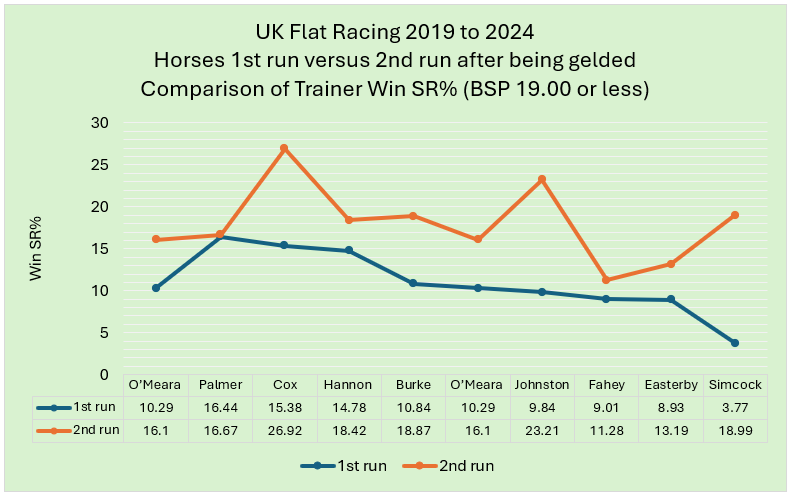
And finally to the third group:


This third group were the trainers with the lowest strike rates with horses having their first run after being gelded. As we can see, every single trainer improved their strike rate when the horses were having their second run. Charlie Johnston (9.84% to 23.21%), David Simcock (3.77% to 18.99%) and Clive Cox (15.38% to 26.92%) all showing significant improvements.

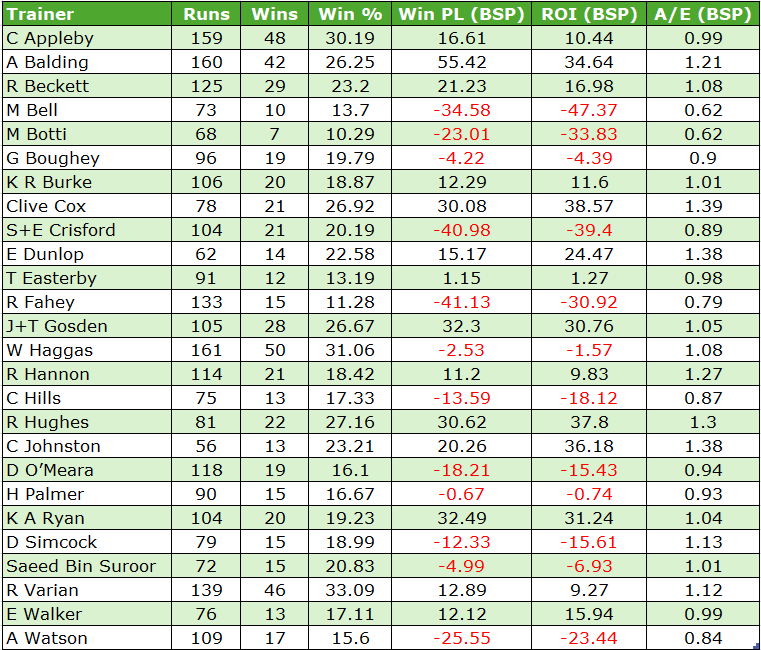
As promised, here are the full facts and figures for these trainers with their runners that are having their second run after being gelded:


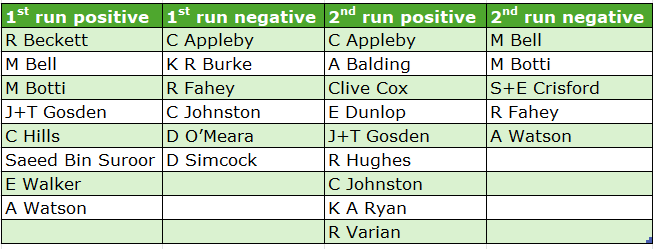
There is a stark difference between some individual trainer performances when comparing first run versus second run.

To make it easier to digest, in the table below I have listed those trainers that have either a positive record or a negative one across both first and second runs after being gelded:


This article has thrown up a fair few positive angles – more than I had expected.

I hope it has been an interesting read, and it is time for me to start thinking about my next piece. Until then...

- DR

A Preliminary Look at Race Class in Flat Handicaps

Dipping my toe into Race Class in flat handicaps

Introduction

I would like to start this piece with a question, writes Dave Renham. “When analysing a handicap race, how many of us look at the class of the race and other class factors in detail?”

Clearly, I cannot speak for everyone, just for myself, but in terms of the pecking order of race factors I’ll look at, class considerations are at the lower end of my list of priorities. I would always look at run style/pace, the draw, Peter May’s ratings, last time out (LTO) factors (position, odds, course) first. Once I move on to class factors though, there are five main things I will look at:

  1. which class of race each horse raced in last time and over its last few starts
  2. which horses have won at this level before, or indeed at a higher class level
  3. recent handicap marks or Official Ratings (ORs) over the past few races noting how well the horses ran on each occasion
  4. highest winning handicap marks, as long as they are relatively recent (within 18 months or so)
  5. past placed form and the relative handicap mark at the time

I must admit there are times when, especially if I am looking at a big field handicap, I’ll only do this for the main contenders, or at least the horses I believe are the main contenders! Also, in terms class factors, I know from past research that it is quite difficult to find an edge when taking on the Official handicapper, as the handicapping system in this country is extremely accurate. However, I still want to review what I think I know and compare it against recent evidence.

Data has been taken from UK racing, turf and AW, handicaps spanning the four full years from 2021 to 2024.

Before sharing my research let me discuss the different classes of handicaps. In 2021 and 2022 the European Free Handicap was the only remaining Class 1 handicap, but that race was discontinued thereafter, so the highest class of handicap is now Class 2 - and the lowest level is Class 6.

Within each class there are races open to slightly different ability levels as regards their Official Ratings. Every classification has at least two different rating bands within it, and there may be some variants of these which I've not listed, for example 56-72:


Class 2 includes Heritage Handicaps. The rating bands for this class are 86-100, 91-105 and 96-110.

Class 3 The ratings band for this class are 76-90 and 81-95

Class 4 For horses rated 66-80 and 71-85

Class 5 For horses rated 56-70 and 61-75

Class 6 For horses rated 46-60 and 51-65


Class 2 Races Overview

Therefore, within each classification there are races where the quality or class level of the runners is slightly different.

Let me give two race examples of Class 2 handicaps run during the period of study. The first race, run on October 16th 2021 at Ascot, was the Class 2 Balmoral Handicap, a 20-runner race where all horses were rated between 101 and 110. The average OR for the race was 105. The second race, run on October 17th 2024 at Southwell, was the Class 2 Download the At the Races App Handicap, a 12-runner race where 11 of the 12 runners were rated 94 or less with the highest rated horse having an OR of 98. The average OR rating for the race was just 91, a difference therefore between the two race OR averages of 14 pounds.

Hence, we need to be aware that the level of competition within each class band can differ, and sometimes quite markedly. Of course, the handicapper, as I have already stated, does an excellent job when rating horses, so in theory the rating adjustments made should ensure races are equally as hard to win regardless of the average OR. Having said that, higher rated runners in Class 2 handicaps do win slightly more often than lower rated ones.

This can be seen when we look at the splits for horses rated 101 to 110 compared with those rated 90 and lower when racing in Class 2 handicaps. Let me look first at qualifiers with a BSP winning price set at a maximum of 20.0. This is to avoid the results potentially being skewed by a huge priced winner or two:


Horses with a higher rating have outperformed those with a lower one as mentioned above, albeit the difference in absolute win rate is only 1.7%. In relative terms, it is nearly 14% greater. The hugher rated runners recorded a small profit with a difference of just under 7p in the £ when comparing the two rating groups. The A/E index was also higher for the 101 to 110 group.

Just for the record here are the figures for qualifiers priced over 20.0 BSP for each rating band:


Hence, in this cohort of genuine outsiders, the higher rated Class 2 runners have comfortably outperformed the lower rated runners across strike rate, returns and A/E indices. It should be noted that the 101 to 110 group did not have any 100/1+ winners that would have completely skewed their profit figure. Indeed, it was the 90 or below group which had the biggest priced winner and comfortably so at BSP 146.4.

Class 3-6 Races Overview

We see a similar pattern in different class groupings when comparing the highest rated runners with the lowest, including a price cap of BSP 20.0. Across all class groups the higher rated runners won more often. Differences in win strike rates vary from 3% or higher to 4.5% or higher depending on the class level. In terms of A/E indices the higher rated runners have proved better value in Class 3, 4 and 5 contests. At Class 6 level the lower rated runners have had the edge value wise.


Comparing Average Race OR with LTO Average Race OR

Having given us some background, for the remainder of this article, I am going to dig a bit deeper into the whole question of class. I will set an odds range of BSP 20.0 or shorter once more to avoid very big prices skewing the findings. In addition, the horse data I am checking requires the horse to have run in a flat handicap (turf or AW) last time out as well.

I have discussed already that within each race class we can get a significant differential in terms of average race ORs of the runners. For the main body of this article, I want to examine the performance of horses racing in a handicap when comparing the average OR of their current race with the average OR of their last race. I have decided to split the OR race average differences up thus:


Just to clarify, a horse that raced in a handicap that had an average OR of 76 last time out and races in a handicap with an average OR of 82 this time would go in the '+6 to 9' group as the difference is six higher. A horse racing in a handicap where the average was the same would go into the '+1 to –1' group, and so on.

Let's examine and compare the win strike rates of each group first. I wasn’t sure what I would find but these results come from huge sample sizes so we can be very confident in the numbers:


As we can see the strike rates are very similar which again perhaps highlights how accurately calculated handicap ratings in this country are overall. The two highest percentages lie at the right of the graph with the '-6 to -9' group and the '-10 or lower' group. If we now compare the A/E indices (to BSP) we again see a very level playing field:


The figures vary by just 0.03 from the lowest, 0.99, to the highest, 1.02. For the second graph running the '-6 to -9' group and the '-10 or lower' group are marginally better performing than the rest. Both these groups also made a small profit to BSP with their cohort of runners that were BSP 20.0 or less.


There are so many different routes I could take at this point, but I elected to fully focus on the '-10 or lower' group for the remainder of this article, as based on these initially findings this could be the group where we find an edge.


Handicap Races where Average OR dropped by 10 pounds or more from previous race (also a handicap)

Race Class Change

The first area which I want to look at for this cohort is ‘Race Class Change’ in terms of official classifications (Class 2, 3, 4 etc). Clearly, with a drop in race average OR of 10 or more from LTO, there were always going to be very few qualifiers in terms of being upped in class next time – just 18 horses went up in class to be precise (for the record this small sample made an ROI% loss of 14.4%). Here are the splits for qualifiers racing in the same class or dropped in class:


According to these figures, the bigger the drop in race class the better. There is positive correlation across strike rates, returns and A/E indices.

What is really interesting is when we look at the race class last time out for any qualifying class dropper. For example, if a horse raced in Class 2 LTO, then raced in Class 3 or lower next time, their record when the average race OR drops by 10 or more is quite remarkable:


These runners have shown a BSP profit in each of the four years showing excellent consistency with A/E values for each year ranging from 1.08 to 1.21. I, for one, will keep a close eye on these runners in the future.

The Betting Market

Moving onto market factors, and horses that start in the top three of the betting, after seeing the race average OR drop by 10 or more produced a blind profit:


Returns equated to a smidge under 3p in the £ and, if we stuck to favourites only, returns were marginally better at 3.3p in the £.

When we look at BSP prices, those qualifiers priced between 15.0 and the price cap of 20.0 won just 5.2% of the time (48 wins from 932) for a hefty loss of £133.20 (ROI –14.3%).

Based on this evidence, it seems to make sense to be looking for horses nearer the top end of the betting market more often than not.

Position LTO

How about last time out finishing position? The past stats have favoured horses that finished either second or third last time out. These runners have combined to produce the following figures:


We see a strike rate close just better one win in every five, and positive returns of over 5p in the £. The A/E index of 1.04 is also very solid. Logic dictated to me that there would not be too many LTO winners that qualified considering the average race class OR drop, but actually there were 204 such winners of which 43 won (SR 21.8%). However, they are very well found in the market and have proved quite costly to follow, losing £28.56 (ROI –14.0%).

Trainers

Trainer data is always something punters are drawn to and for this area of research I think the findings may be more illuminating than usual. One skill that all trainers need is an ability to find the right race for their horses. However, in handicaps there will be times when this may not the case and a trainer will be quite happy to see a moderate or even poor run in the hope that the horse's handicap mark drops. But how many trainers have been adept at finding a much weaker race in an attempt to exploit it? Let’s see.

The table below shows those trainers who had at least 50 runners with a drop in race average OR of 10 or more compared with the average rating of the race they contested last time out. The table is ordered alphabetically:


We have quite a mixed bag here, but there is a good proportion of trainers who stand out positively including George Boughey, John Butler, David and Mick Easterby, Brian Ellison, David Evans, Richard Fahey, Paul Midgley, Gary and Josh Moore, Nigel Tinkler and Archie Watson.

What may be even more enlightening is to compare the record of the trainers in the above table against their overall record with all other runners under all other circumstances, (e.g. runners whose race average OR changed by -9 or more). Below are the trainers with the biggest differentials between the two in terms of win strike rate:


We could argue that these nine trainers have been very adept at placing horses in much weaker races compared with the handicap LTO over the past four years. Not only do the strike rates suggest that, the A/E indices for each group show that too:


There are some excellent A/E indices there in the blue columns. Overall, of the 33 trainers in the original table 24 had better records when their charges raced in handicaps with an average race OR of 10 or less compared to their most recent start.


Summary

As with a lot of areas I research, I have literally scratched the surface in terms of race class. However, it has been an interesting journey with several positives noted on the way. The second half of the article focused on just one specific group of runners - those who were contested a handicap where the average official rating was at least 10lb lower than their previous race - so there is scope to look in detail at other groupings in the future. For those who want more class articles (no pun intended) please suggest any ideas in the comments.

- DR

The Vagaries of Early Speed: Soft Leads and Pace Collapses

The Vagaries of Early Speed: Soft Leads and Pace Collapses

In recent years the question of pace in a race has become much more on punter’s radars, writes Dave Renham. When we watch flat racing on the television, pundits or commentators will almost always include a discussion about where the pace in the race is, and who is likely to lead.

Introduction

The pace in a race is linked to run style, and I have written numerous articles analysing the run style of horses in both flat and National Hunt racing on this site. These articles, which can be found here, have often highlighted the edge front runners enjoy in races over certain distances at certain tracks. In this article I want to try as best I can to compare races where front runners get an uncontested lead, as opposed to races where there is strong competition for the early lead. I have decided to focus on handicaps of 1 mile or less in UK flat racing. I have looked at around 3000 races which is a very decent sized dataset.

I had two objectives. Firstly, to look at races where the leader got a ‘soft’ or ‘uncontested’ lead. In other words, a race where the front runner was not pestered in front and could potentially dictate the race. In an ideal world that would see the leader setting slow fractions thus saving more energy for later in the race, meaning there was more chance of the horse making all of the running to win. And secondly, I wanted to look at the opposite type of race, where there was strong competition for the lead with multiple horses up with or very close to the pace. In this type of scenario, the expectation is that those near the front will typically go off too hard, using too much energy, which makes it easier for a more conservatively ridden horse to come late and win from off the pace.

The problem with researching these ideas, is how to accurately determine which races fall into which category. It is not easy to do. If I had sectional timing for all courses and all races, with all the times for all horses at all call points in a database or spreadsheet, that would be a tool that could do the job. However, sadly I do not have access to such data. If I had the time to watch the replays of all 3000 or so races in this sample, then that potentially could help in analysing my ideas (although it would be subjective). That though is not a sensible use of my time, even if I had all the time in the world! Hence, I needed to come up with a different plan, one that could hopefully do the job...

Methodology

So I came up with a plan which, while I appreciate is not foolproof, I think it gives us a good overview if nothing else - a flavour, if you will - of how pace affects these types of races.

Firstly, I decided to find the average pace rating for every single race in the sample. To do this I used the same numerical values found on Geegeez where led (early leader) gets 4 points, prominent 3, mid division 2 and held up 1. Hence to get the average pace rating for each race I added up the pace scores of all the runners and divided it by the total number of runners in the race. Let me give a worked example to help explain it more clearly.

Below is a result from Chelmsford over 6f from July 2023:


As we can see there were 10 runners, one early leader (L), two prominent racers (P), four horses that raced mid-division (M), and three that were held up (H). Hence the calculation is as follows:


Thus, if we add up the total points column, we get 21 and then we divide it by 10 runners to give us the average pace rating for that race:


I did this calculation for each race using some Excel wizardry and the averages ranged between a lowest pace average of 1.96 and the highest standing at 3.50. The vast majority of race averages landed between 2.10 and 2.90.

The reason for creating these race pace averages was to help determine how much pace there was in each race. The lower the average, the more horses would have been held up or raced in mid pack. Hence, there was likely to be far less pressure on the early leader. Higher race pace averages would see more horses contesting for the early lead and/or being on the heels of the leader(s).

Although I could not be 100% certain for every race, logic dictated - and my working assumption was - that lower pace race averages would conform to races where the early leader gets a soft or uncontested lead, while the higher averages would have a greater chance of producing races where the early pace might collapse. I decided for any run style or pace comparison from now on I was going to lump together the results for mid-division horses with hold up horses. This makes sense to me as mid-division horses still have plenty of ground to make up in order to win. From now on this joint group will be referred to as simply 'the hold-up group' – making it less of a mouthful than to keep calling it the hold-up/mid-division  group.

Having calculated the race pace averages I needed to decide on the best way was to interpret the results. The problem we always have with any pace/run style data is how to calculate win rates etc. It is not as simple as what proportion of races are won by early leaders compared to hold up horses. This is because, on average, there are far more horses that are held up compared with horses that lead early. In my example Chelmsford race, there was one front runner, four midfield and three held up horses.

Normally, I simply divide the number of winners to runners within each run style group but when I did this looking across different pace race averages, I realised we could not compare strike rates in that way. I won’t go into the mathematical reasoning as it is quite complicated to understand - and even more difficult to explain!

I decided the only way to have a fair comparison was to create a type of impact value where I divided the win percentage of leaders within their leaders’ group by the win percentage of hold up runners within their hold up group. I will call it the Comparison Strike Rate, or CSR for short.

This way I could get a straight comparison, with the idea being that the CSR figure would help to show any significant differences in performance (according to the relative strike rates). Hence a CSR of 2 would suggest that a lone front runner has double the chance of winning as compared to one of the hold up horses. [I have used this CSR idea before in two 2yo articles back in 2019.]


All Distances (5f-1m)

I split the race pace averages up into four groups where there was a similar number of races within each group. Here are the CSR splits:


Essentially, the 2.39 or less group are the races where it is more likely that a front runner got an uncontested lead; and we can see that front runners have been far more successful within their run style group than hold up runners have within theirs, winning 2.44 times as often.

Fast forward to the races with the highest race pace averages (the 2.68+ group) and we can see the CSR drops to 1.34. It is in these races, where there is the most pace in the race, that we would expect an overly fast early tempo - and the numbers back this up. Front runners do still have an edge, but it is vastly diminished. Therefore, it does seem that what pundits and punters have believed for years is true: front runners that get an uncontested lead win far more often than front runners that have horses pressing them for the lead or snapping at their heels.

What is also pleasing when looking at the graph is that not only do both ends of the spectrum match the expectation, but there is excellent correlation as the race pace averages increase (from left to right on the graph). This gives me more confidence in the findings and my initial theory.

Having found the types of patterns that I was hoping for I felt I wanted to dig deeper and split the data further by looking at different distances, starting with the minimum distance.

For the rest of this article though I am just going to compare the two ‘extremes’ – the races with the lowest race pace average band (2.39 or less) with races with the highest (2.68 or more).

5f handicaps

Anyone who has read my run style/pace articles over the years will know that 5f races give front runners the strongest edge when taking all courses into account. Hence, I would expect the CSR figures for both groups to be higher than the average figures for all 5f-1m races we saw in the first graph. I would also hope that we still see a significant differential between the two CSR figures.

Here is what I found:


As the graph shows, front runners had a CSR figure of 3.68 in races where the early leader got an easy time of it. This is well above the 5f-1m average figure of 2.44. In 5f handicaps when there was plenty of competition up or near the front early, front runners were still 2.27 times more likely to win than one of the hold up horses.

Ultimately, punters should not be put off backing a potential front runner in a 5f handicap even if there is likely to be a lot of pace on. They still have a decent edge and offer value. If the shape of the pace suggests an easy lead, then we can be even more confident of a good run from the horse that takes the early lead.


6f handicaps

Front runners maintain a healthy edge generally over 6f, but it is nowhere near as potent as it is over 5f. Hence, we should expect a drop in both CSR figures. Here are my findings:


In six-furlong races where there is less competition for the lead, we see a strong CSR figure of 2.76. Front runners continue to enjoy a huge edge over hold up horses. However, when we get to races over 6f where there is plenty of early pace and possible battles up front, we see the figure drop markedly to just 1.27. Front runners still offer better value than hold ups under such conditions, but the edge is small. 


7f-1m handicaps

I am lumping together 7f and 1m handicaps simply because once we hit 7f, although front runners still hold sway, the advantage is much diminished when compared to the stats at 6f and especially 5f contests. There are a handful of courses where over 7f front runners enjoy a very strong edge; Beverley, Chelmsford, Epsom, Leicester and Musselburgh immediately spring to mind. However, overall, it is a more even playing field. Let’s see what the CSR figures show this time:


Races where the pace average was 2.39 or less still favoured front runners more than those where the pace average was 2.68 or higher. However, both figures have dropped further from those we saw over 6f. This is as we would expect but it always good to have it confirmed in black and white, or in this case red.

I would like to share one final graph which combines the preceding trio of charts so we can perhaps more easily compare the CSR figures across the different distances / race pace averages:


Conclusions

So, what has this research told us? Well, assuming that my theory is correct in terms of races with a pace average of 2.39 or lower being races where the early leader has an easier time of it, and that those 2.68 or higher are when there is more competition for the lead, then theories about easy leads and pace collapses are almost certainly true. At least the numbers shared suggest this is the case in handicaps of 1m or less. Moreover, the shorter the distance the easier it seems for front runners with uncontested leads to win.

Before I finish, what I have done for my own peace of mind is to watch back some replays of races where the pace race averages were 2.39 or less, and virtually all races saw the early leader lacking strong competition for its lead. Likewise, I did the same for some races averaging 2.68 or more and a high percentage of those saw some very strong competition for the lead early. This adds some qualitative confidence that my race pace averages do the job I was hoping for.

I appreciate that, until the race has been run, we are unable to calculate the race pace averages. However, the Geegeez racecards give us past running styles for each horse to a maximum of their most recent four runs so this is a tool we can use to try and work up the likely pace make-up for any race in question.

There is plenty more scope for me to keep researching races with different pace make-ups. I do have data for non-handicaps up to 1 mile, as well as data at longer distances. I also could try to look at other angles within the 5f-1m handicap bracket. Ideas include do front runners with uncontested leads win more often in lower class races? That has some logic behind the theory so I may test that. I may also analyse different courses in more detail, and I might expand to try and find any positives or negatives regarding prominent racers across different race pace averages.

So many ideas, why are days only 24 hours in length?!

- DR

An Analysis of Place Betting on Betfair

An Analysis of Place Betting on Betfair

One of the comments about an article I wrote a couple of months ago asked whether I could write an article on the subject of place betting on Betfair, writes Dave Renham. I have written around a thousand horse racing articles in my life and, consequently, have covered a fair few different topics; but I have never delved into the subject of place betting. So, thank you to Keith for requesting a piece on this subject.

This article covers ten full years of flat racing in the UK (2015 to 2024) across both turf and AW racing. All profits/losses are calculated to Betfair Place SP with 2% commission taken out. I have excluded races of 4 or fewer runners as only winners count under those circumstances.

Betfair Place SP: All Races

Overall, if we had bet every runner in every race in this ten-year time span to Betfair Place SP, we would have lost around 2.5 pence in the £. This is actually a smidge less than we would have lost if backing all horses to win. Let me split the BSP Place data up by individual year to see how it has panned out:


The worst yearly return was a loss of 4% in 2020, the best was a loss of 0.6% in 2022. For the record, the current figure for 2025, as of early July, is showing a loss of 2.2%. Looking at the graph, it could be argued that since 2021 betting on the Place market has offered punters better value than previously. Whether that has truly been the case, or the results are just down to variance, it is impossible to say.

Before moving on, I would like to point readers in the direction of an excellent and informative article written by Russell Clarke on here back in 2020. It explores each way betting with traditional bookmakers and, amongst many useful pointers, it highlights under what circumstances it is better value to bet each way. The link is here www.geegeez.co.uk/money-without-work-5-bookmaker-concessions-each-way-betting/


Betfair Place SP: Number of Runners

Having read that piece I wondered if there was a number of runners ‘edge’ we could find on the Betfair Place markets. Here is the breakdown of all races backing all runners across different field sizes:


Note that the fourth column, Place%, is different from traditional bookmaker place percent, because when there are non-runners that affect the number of placed positions, on Betfair this figure is not adjusted. Therefore, in a race with eight runners declared, if there was a non-runner, people betting with the bookmakers will see the number of places drop from three to two. On Betfair if an 8-runner race becomes a 7-runner one, they still pay three places. We could get 9-runner races having two non-runners and the same thing would happen. This is almost certainly why races with seven runners have almost broken even if betting all runners blind on the Betfair Place Market. Overall, 28.6% of runners in 7-runner contests would have paid two places with bookmakers, this figure increases to 35% on Betfair. And this is totally due to 7-runner races with non-runners paying out still on the extra place on Betfair. Now, of course, prices on the Betfair Place Market will contract a little under such circumstances but not enough it seems to give punters more chance of parity.

We see a similar thing occurring with 15-runner races. Losses are 1.12% for all 15-runner races, and more specifically for handicaps this drops further to 0.84%. Here we are seeing a similar dynamic where 16-runner handicaps that have one non-runner still pay four places on Betfair. Again, this scenario will occur in races with 17 runners declared and two non-runners, 18 declared and three non-runners, and so on. We can also see that 16-runner races have edged into profit. In terms of handicaps, it is not surprising perhaps to note, that races with 15 to 17 runners have offered the best value on the Betfair Place Market (losses of only 0.6% across all runners).

At this point it is worth sharing that non-handicaps with 12 or more runners have offered place betting Betfair players the worst value over the past ten years as losses move up from an overall average loss of 2.5% to a punishing 5.5%.

Betfair Place SP: By Course

I want to look at individual courses next to see if any patterns can be found. Firstly, let me look at the courses where placed runners did best in terms of returns:


I had wondered before starting this ‘course digging’ whether the bigger named tracks would produce better results. However, this is not the case with only Ascot and Newbury of the Grade 1 courses in the table. I’m not really seeing a pattern as yet so let me look at the worst performing courses from a Betfair place perspective:


No Grade 1 courses here, but a good mix of different calibre tracks with again no clear pattern. Sometimes we check ideas, and nothing can be found or indeed explained. That seems to be the case here.


Betfair Place SP: Actuall Odds

Moving swiftly on, one key area worth looking at is actual Betfair Place odds. I would hope this would give us some useful information. The graph below shows the Befair Place Returns to different BSP Place Odds Groupings:


Ahh! This is an extremely useful set of figures. The shorter BSP Place prices on the left of the graph have produced far better returns than the bigger priced groupings on the right. It seems that BSP Place prices of 5.0 or shorter gives punters the best chance of being profitable. Combining these runners at 5.0 or shorter would have seen us lose less than 1p in the £ for every £1 staked. Also, remember this is still sharing the data across all runners so we are talking about backing horses blind with no other considerations than price. We should be able to improve upon this with a bit of extra work.

Clearly, as with any BSP data be it win or place, we do not know the exact BSP price until the race has started, but as I have stated before betting seconds before the off will get us very similar results.

Betfair Place SP: Early Morning Odds to Opening Show Odds

I now would like to examine price movement based on William Hill prices in terms of Early Morning Odds to Opening Show Odds. The Early Morning Odds I've used are those available around 9am, while the Opening Show Odds occur roughly 10 minutes before race time. Does price movement between these time frames make any difference to the returns for placed runners? Let’s see:


Based on these figures, horses that shorten in price between Early Morning Odds and Opening Show Odds have provided the better returns. Still an overall loss as we would expect but only equating to just over one penny in the pound.

Digging a bit further with those horses that shortened in price from Early to Opening, if we restrict qualifiers to those that continued to shorten from Opening Odds to SP that would have produced a Betfair Place Profit of £213.09 from 68,778 qualifiers. Not a huge profit based on the number of qualifiers but a profit, nonetheless.

Betfair Place SP: Trainers

A look at trainers now, focusing first on the trainers with the highest placed percentages. Below are the top 20 in terms of place rank.


Nine of the 20 trainers have made profits in the Betfair Place Market. The Crisford stable have the best returns (an impressive 6.65% ROI), and they have had seven winning years out of ten. It should also be noted that their 3yo runners have returned over 10p in the £ if betting to BSP Place. Charlie Appleby’s figures are very solid when we drill down to the jockey data. There have been seven jockeys that have ridden 50 or more times for the stable and six have turned a place profit.

The Charlton stable on the other hand has very poor place returns. Betting their runners to place each year would have seen ten losing years out of ten. The Haggas stable has also struggled through this lens.

Other trainers to have made significant positive place returns over the past decade include Jane Chapple-Hyam (17% ROI), Grant Tuer (11% ROI), Bryan Smart (8% ROI), William Muir / Chris Grassick (7% ROI), and Paul and Oliver Cole (7% ROI).

Betfair Place SP: Trainers by Odds Band

I am now going to look at 75 trainers and their ROI Place Percentages across different Befair Place odds bands. The biggest place price in the table is 5.00, and I have split the prices into seven groupings. Figures in black show a positive return within that group, those in red show a negative return. The minimum number in each price band is 100 runners; if there a trainer saddled less than 100 runners in a price band the box is empty in the table:


You can pick out the detail of interest for yourself in this table, both positive and negative. But I will share a few personal observations to get you started:

C Appleby – we saw in the first table that he had shown a Betfair profit on his placed runners. In this table we perhaps see why, with five of the seven price bands turning a profit. His runners have offered the best value between place odds of 3.01 and 5.00.

R Beckett – all price bands have shown a negative ROI%. The 3.51 to 5.00 price band have shown the biggest losses.

Jane Chapple-Hyam – it was noted earlier that Jane Chapple-Hyam had secured a decent profit across all her runners on the place market. She had enough runners to qualify on six of the seven price bands and four showed a profit. For the record she showed good returns on bigger priced runners too.

H+R Charlton – seven reds out of seven. We saw earlier how poor the yard's place returns were overall.  This helps to explain why.

B Ellison – he has secured a positive ROI% in six of the seven price bands. Yard seems to offer solid value in the place markets.

J Goldie – some good stats especially with the shorter prices on the place market. Generally strong looking figures when horses are priced 3.50 or lower.

B Millman – five of the six bands to have enough runners have secured a profit for Millman. It should be noted however that his performance is poor once we get to prices of 6.5 or bigger.

G Tuer – as with Millman, Tuer has secured five profitable returns out of six. Tuer has also made significant returns with horses priced 9.00 or bigger on the place market.

I hope readers will get an opportunity to analyse the table in their own time and find further useful angles for other trainers.

------------------------

This has been my first foray into Betfair place betting, and I have been pleasantly surprised in terms of the overall stats. It's an area that certainly will demand more of my attention in future. Do please continue suggest any ideas for future place (or indeed other) articles in the comments. I can't guarantee to write to your specific request but, as this piece shows, if I feel there are sufficient data and angles then it'll get some focus.

- DR

Newmarket July Meeting: A Ten Year View

Newmarket July Meeting – a look at the past 10 years

Later this week racing fans will enjoy the three-day Newmarket July Meeting, writes Dave Renham. Expect top quality action headlined by two Group 1s, the July Cup and the Falmouth Stakes, as well as four Group 2s. There will also be several decent handicaps to get stuck into. In this article I am going to look at stats for the most recent ten meetings going back to 2015. Profit / loss has been calculated to £1 level stakes using Betfair Starting Price (BSP), with 2% commission taken out of any winning selections.

Newmarket July Meeting: Market Rank (Exchange)

I would like to start by examining the betting market, more specifically the market rank of Betfair. Here are the splits:


It seems the sweet spot over the past decade was horses ranked third to fifth in betting preference. Favourites by contrast suffered fairly significant losses equating to more than 17 pence in the £. Splitting the favourite data into handicaps versus non-handicaps, it was handicaps that offered better results, albeit losses were still over 11p in the £. Losses in non-handicaps were over 23p in the £ for the jollies. Eye-watering stuff!

If we look at the Betfair A/E indices for Market Rank, we can see excellent correlation with the earlier table:


Horses ranked third to fifth in the betting have offered excellent value over the past ten years. It will be interesting to see if this pattern continues this year.


Newmarket July Meeting: Price movement

Now I want to look at price movement data comparing Early Morning Odds to final Starting Prices. I am going to share the win strike rates for horses that lengthened in price over the day, stayed the same price, and shortened in price.


Horses that shortened in price were the most successful, as is the norm, but the differential between ‘shorteners’ and those that drifted in price is huge. Horses that were backed over the day won more than 2.5 times more often than those that drifted. If we now look at the profit / loss for the three groups, based on their final BSP we see the following:


It seems that following the money would have been a good strategy over the past ten meetings. Despite the prices shortening, 'line trackers' still would have seen a 10p in the £ return to BSP on horses that were shorter prices at the off than they were in the morning.

There are two trainers in particular that were worth noting when the money was down: Andrew Balding and Ralph Beckett. Balding was 7 from 31 (SR 22.6%) with shorteners, just 2 from 28 (SR 7.1%) with drifters. Beckett meanwhile was 7 from 29 (SR 24.1%) with shorteners and just 1 from 21 (SR 4.8%) with drifters.


Newmarket July Meeting: Age in 3yo+ & 4yo+ races

Let me next look at the performance of different aged runners in races open to 3yos and over / 4yos and over. It should be noted that the vast majority (87% of them) were 3yo+ races. Here are the age splits:


This is illuminating. Three- and four-year olds have clearly outperformed their elders both from a win rate perspective as well as a profit / loss one. It looks like we can pretty much write off any horse aged seven or older based on these figures.

The contrast between younger and older has been strongest in non-handicaps where horses aged five or older have won just three times from 97 attempts (SR 3.1%) for losses of over 80 pence in the £. In handicaps three-year-olds fared extremely well as the graph for win strike rate below shows:


I would think the starting point for any all-age handicap would be the 3yos based on this data. It should be noted, too, that 3yos that shortened in price from Early Odds to SP in these races won over 24% for a healthy 18% ROI%.

Newmarket July Meeting : Recent form

Moving on to ‘last time out’ factors, let's start with recent form and the position the horse finished on their most recent start. Here is the breakdown:


It is unusual to see similar win rates for horses finishing first, second, third or fourth last time out (LTO). The LTO winners’ group made a BSP profit, but those figures are skewed somewhat by three decent priced winners – BSP 66.34, 50.0 and 40.0. All in all, I would not be paying too much heed to LTO performance as in the past, for this meeting at least, it has not been much of a guide.

Newmarket July Meeting: Course LTO

Another LTO factor is the course at which the horse ran last time. Below are the LTO courses that have provided at least 50 of the Newmarket July meeting runners:


A good chunk of the runners raced at Ascot last time, many of which were racing at the Royal meeting a few weeks previously. There were also a significant number of horses that raced at Newmarket LTO and these had the best record in terms of strike rate as well as delivering a fair profit. Sandown and York were the other two LTO courses to turn a profit here, and York’s figures look particularly solid. LTO York runners that started in the top three in the betting at the Newmarket July festival secured a 31% strike rate and returns of over 100p in the £. In contrast, the Newcastle and Windsor figures have been poor, and both have commensurately disappointing place percentages, too.

Newmarket July Meeting: Course form

Onto course form now and looking at the performance of past course winners compared to those that had not won at the track. To make this a fair comparison I will compare only horses that had already run at the track: clearly horses that were yet to run there could not have previously won! I am going to compare the win strike rates and the win & placed (Each Way) strike rates first:


It seems therefore that a previous course win is preferable both from a win and a place perspective. This is also reflected in the profit/loss and return columns in terms of win bets:


In terms of betting on the Place market on Betfair, there has been a big discrepancy there as well. Previous course winners produced a £38.41 profit to £1 level stakes; non-course winners lost £52.24.

With regards horses that raced at the course previously and had been placed before (includes winners of course), they too have a strong edge as these stats show:


Taking all these stats into account a previous win or placed effort at the track has been a definite positive at this meeting.


Newmarket July Meeting: Trainers

The final area I want to look at is trainers: which handlers have excelled at this meeting and which ones have found it a struggle? Only trainers with 30 runners or more are shown. As far as Charlie Johnston is concerned, I have combined his record with his father’s, Mark. The table is ordered by return on investment at Betfair Starting Price (BSP ROI).


Several trainers were in profit through the decade although Ralph Beckett, Michael Bell, Karl Burke and the Johnston stable's performance figures were boosted by a few bigger priced winners dropping in. Charlie Appleby, Andrew Balding, Richard Hannon, Aidan O’Brien and Saeed bin Suroor have more solid looking overall profiles and all five showed good profits with horses in the short to mid-price range.

There are a couple of extra stats worthy of note. Firstly, when William Buick rides for Appleby the strike rate has been a smidge under 30% for a 49p in the £ return. Secondly, Aidan O’Brien should be noted when any of his runners pivot from Royal Ascot. This cohort won 27% of the time for a 63p in the £ return.

The records of William Haggas, Charlie Hills, Hugo Palmer and Kevin Ryan have been poor, although Haggas has had plenty of near misses. Palmer and Hills have a poor record in terms of placed runners as well, and they may be two trainers worth avoiding at the fixture.

-----------

Newmarket July Meeting: Key Positives

The key positives are as follows:

  1. Horses third to fifth in the betting market
  2. Horses that shorten in price from Early Morning Odds to SP
  3. 3yos in 3yo+ handicaps
  4. Ran at Newmarket or York LTO
  5. Previous course form (both win and placed)
  6. Trainers - Appleby, Balding, Hannon, O’Brien and bin Suroor

-----------


I hope this piece has provided a few pointers that will prove useful over the three days of Newmarket's always excellent July meeting. Good luck to those punting, and don’t forget to use the Tix software if playing the Jackpot, Placepot, Scoop 6 or Quadpot.

- DR
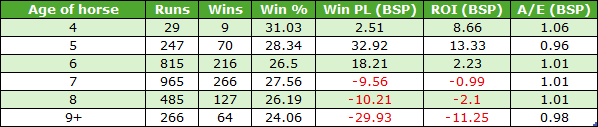
 

How to Use Tix for Multi-Race (Placepot) Bets

Using Tix for Jackpots, Placepots, Quadpots & the Scoop 6, primarily focusing on Placepots

Geegeez readers should by now be aware of the online software called Tix, which Matt built in conjunction with the developer who built much of the coding for the original geegeez.co.uk racecards and form tools, writes Dave Renham. The Tix software is designed to be used for tote multi-race pool bets such as the Jackpot, Placepot, Quadpot and Scoop 6. It enables punters to produce more sophisticated and strategic permutations than the bog-standard perm approaches most punters use.

Tote Bets: A Quick Intro

Before discussing the software, it should be noted that the Tote take a percentage out of any final pool, the amount depending on the bet. Below is a table showing the percentage take-outs for the main pool bets:


Pool bet Percentage taken out
Jackpot 29%
Placepot 27%
Quadpot 26%
Scoop 6 30%

As we can see they are all in the same ballpark. If we consider the Placepot, therefore, if 27% is taken out that leaves 73% of the original pool being shared between winners.

To help understand the maths, here is an example. For a final total of £100,000 bet into a particular Placepot pool where there was £200 remaining at the end of the six races, the dividend would be worked out thus:

£100,000 x 73% = £73,000

£73,000 divided by 200 = £365

£365 is the dividend is to a £1 stake.

The lure of Placepots and Jackpots is the chance of a big payout for relatively small outlays. Personally, I have never regularly played the Jackpot but play plenty of Placepots. I’ve been fortunate enough to have enjoyed some reasonable wins, and one very big win, but of course there have been many occasions when I have lost all of my stake. As far as this article is concerned, I am going to focus on using Tix for Placepots, because it is the most commonly played of the tote multi-race bets.

Playing Placepots the Traditional Way

Let's first look at how we could play these pool bets without the aid of Tix.

One line 'Hail Mary'

The first method is to simply pick one horse in each race. In a Placepot, there are six legs and so that would be six horses. In order to win a share of the Placepot all six must either win or place. This would be the case even if we pick six favourites. For those wanting to put the favourite in as the only selection in each of the six races, this is possible because there is a Placepot option to back the unnamed favourite.

Tthere are plenty of races where the market is quite tight at the top and we would be guessing which horse is sent off favourite, so for ‘favourite’ fans this is a useful option. However, the chance of all six favourites winning or placing is surprisingly rare. Indeed, looking at the 177 flat race meetings held in the UK in April and May of this year only 13 times did six favourites win or place in each of the first six races on the card.

However, that did not mean there would have been 13 theoretical winning Placepots for favourite only backers. This is because three of these 13 did not count due to a situation where a joint favourite won or placed, but the other joint favourite did not. When this happens there can only be one horse deemed to be favourite so the horse with the lowest racecard number becomes the favourite for pool bet purposes. Hence, if we had gone down the unnamed favourite Placepot route in April and May we would have had 177 Placepots bets of which 10 won.

The problem with all favourites placing is that the dividend tends to be very low when this happens, and that was the case with all ten dividends as the table below shows:


Date Course Dividend to £1 stake
7th April 2025 Kempton £6.20
12th April 2025 Brighton £12.40
12th April 2025 Thirsk £8.00
1st May 2025 Redcar £11.50
3rd May 2025 Goodwood £9.90
5th May 2025 Windsor £10.50
9th May 2025 Nottingham £7.30
21st May 2025 Chepstow £13.20
23rd May 2025 Goodwood £5.90
26th May 2025 Windsor £8.00


If we had placed let’s say a £2 bet on each of the 177 Placepots our outlay would have been £354. Our returns would have been £185.80 showing a LOSS of £168.20. Ouch!

Favourites obviously command the most amount of money wagered in Placepots which is why, when all six win or place, the dividends are so low. Interestingly, there were two meetings in April and May where no favourites placed in any of the six races – the dividends for these meetings were somewhat different.


Date Course Dividend to £1 stake
19th April 2025 Musselburgh £1954.50
31st May 2025 Lingfield £4022


The '2x2'

For seasoned Placepot players selecting a single horse in each race is not a credible strategy. In the period discussed we have seen that putting the favourite as the only selection in each race secured a winning Placepot less than 6% of the time, and delivered significant losses.

An alternative and more popular approach is to choose two horses in each race giving players more coverage. We call this a permutation, or perm. If we choose two horses per race rather than one, the number of bets or lines goes up drastically from one to 64 because we multiply the number of selections per race to get the total number of selections.

1 x 1 x 1 x 1 x 1 x 1 = 1 while 2 x 2 x 2 x 2 x 2 x 2 = 64

Take three horses per race and we are looking at 729 bets or lines.

Obviously, the chances of winning part of the pot increase but the more bets/lines we have the more we are staking, which will have an impact on any final returns.

Variable perms

To try and reduce the number of perms, some Placepot players vary the number of horses chosen for each race. Hence, they may have a couple of races where they choose just one horse – a so called ‘banker’; perhaps they have three horses in two of the other races, and five in each of the final two races.

In this scenario the number of bets or lines would be calculated 1 x 1 x 3 x 3 x 5 x 5 which equals 225 bets. This idea covers 18 horses in total (the same as the three horses in every race perm) but cuts the number of bets/lines down considerably.

Thus, varying the number of horses chosen per race is the most sensible method discussed to date; but it is time to talk Tix and a more sophisticated approach to adjusting the Placepot perms.

Introducing Tix

The Tix software allows us to use what is known as the ‘ABCX’ approach. This approach essentially allows players to group horses by order of confidence / perceived chance. In terms of a Placepot the thinking would be along these sorts of lines (or at least this is the way I think!) -


A Horses – horses that I believe are genuine contenders to win or place; or horses that I perceive to be overpriced within the mid-range of prices such as a 10/1 shot that I think ought to be 5/1, or a 12/1 shot that is 6/1 on my reading of the race.

B Horses – the next best options that we can make a case for especially if one or more of the A contenders underperform.

C Horses – horses that are unlikely to win but have some chance of placing. An example may be a horse overpriced at 33/1 we perceive should half that price at least. Or a less fancied horse well drawn over a course and distance that has a strong bias.

X Horses – horses that are excluded from calculations as their win or place chance seems extremely unlikely or I feel they are significantly over-factored in the market.


For Placepots my preferred approach is to have more A’s than B’s and maybe one or two C’s. However, for bigger meetings such as Royal Ascot, I tend to load up on A’s and have more C’s than B’s. I am sure others will have alternative approaches that may well be better than mine. Hopefully the more I use the software the more I can finesse my methods.

In terms of the Tix software the A horses will occur in more bets/lines than the B’s that in turn occur in more bets/lines than the C’s. The table below shows all the possible combinations or perms for each individual Placepot ticket – I have colour coded them to help make it clearer. A rated selections are in red, B are in black and C are in green.


This way of combining the horses is far more efficient and a lot cheaper! The way Tix is designed is that we can have a maximum of 28 individual tickets and this only occurs if we pick at least one horse in each of A, B and C positions in every race - as per the image above.

Tix Selection Flexibility

Keeping to the ‘three horses in a race scenario’, here are total number of bets/lines based on the Tix options, assuming we keep to the same combination for all six races. It includes the two I have already shared:


Combos All 3 on A 2 on A, 1 on B 2 on A, 1 on C 1A, 1B, 1C 1 on A,  2 on B 1 on A, 2 on C
Total Bets 729 496 256 28 73 13


The table shows the flexibility of the Tix software in terms of being able to offer various ‘number of bet’ scenarios, and remember, these example numbers are based on choosing the same A, B and/or C combination for all six races. Assuming we wanted to put three horses into each race we of course could choose a different three-way combination for each race such as:


Race no. Column A (no. of selections) Column B (no. of selections) Column C (no. of selections) Total no. of horses in race
1 2 1 0 3
2 1 1 1 3
3 1 2 0 3
4 3 0 0 3
5 1 0 2 3
6 2 0 1 3


This particular Tix construction of three horses per race would equate to 138 lines. It would take several pages to list all possible Tix bet constructions of three horses in each of the six races, so I’ll spare readers that! On the Tix site, our ticket with this type of perm/construction would potentially look something like this:


To be clear, the green column is for A picks, the yellow is for B picks, and C picks are in the right hand sandy coloured column. And these numbers in the specific columns would give us the following ten tickets:


As we can see, for this example there are ten specific groupings (tickets), and we would need at least one of those of ten groupings to have a win or placed horse in each of the six races to get a return. Of course, we may achieve a return that is less than our original stake, so six ‘win or placers’ on one of the tickets does not guarantee a profit.

If all eighteen horses manage to place then we probably would be dreaming but in that unlikely scenario these ten specific groupings/tickets would combine to have all 138 bets/lines as winning ones.

Tix Staking Flexibility

So, one of the brilliant parts about using Tix is this selection flexibility. A further feature in terms of flexibility is that we can adjust our stakes in terms of the four main groupings. This is the default position with the same stakes on each:


However, anyone who has seen Matt post his Tix selections on the site (like he did brilliantly at Royal Ascot 2025, I might say) will know he has a favoured strategy thus:


- All A's: 4x unit stake

- Five A's with one B pick: 3x unit stake

- Four A's with two B picks: 2x unit stake

- Five A's with one C pick: 1x unit stake


Using the ‘Matt Method’ we would simply tick the relevant boxes thus:


Using the example of my ten tickets shared above, this means ticket 1 (all A's) has a 4x amplification, tickets 2 to 4 (any 5 A's with 1 B) are 3x unit stake, tickets 5 to 7 (any 4 A's with 2 B's) are 2x normal stakes, and tickets 8 to 10 (any 5 A's with 1 C) are 1x stakes.

Of course, this stake amplification on certain tickets will increase the overall outlay but we're pressing up our strongest opinions whilst mixing in some 'big dividend' prospects.

In this specific example based on an original 1p per bet/line, and having no increase in stakes (so betting all lines with the same stake of 1p), it would cost £1.38.

Using the 4-3-2-1 Matt method would increase stakes to £3.00. The reasoning behind Matt’s staking plan is logical. The A horses are more likely to win or place than the Bs, who in turn should outperform the Cs. Hence the all-A column should have the highest stake, the 5A 1B column should come next and so on.

This staking method is one option, possibly the best one; obviously there are plenty of others that could be used. Also, at this point, it should be noted there is another way to adjust our stakes. We can adjust individual tickets by clicking on the ‘stake’ box at the bottom of each ticket and changing the default stake.


For those readers who have yet to use Tix, how to use the software is specific to each individual. Some I’m sure will not adjust stakes, some will. Some will load up with A’s, some may spread their horses more evenly. However, it is important to appreciate that each race meeting is different, and we are likely to play a Placepot at Carlisle with very few runners on the card differently to one at Royal Ascot where field sizes are much bigger and very competitive.

Wider Coverage

Thinking of the bigger meetings like Royal Ascot with their huge and competitive fields, it is likely that there will be an increase in the number of horses that will be used in our placepots. Earlier I looked at an imaginary three horses per race scenario sharing how placing them in different columns affected the total number of lines. Now let's look at the same idea using four horses per race (24 horses in total). Again, I have assumed that we have split the horses into the same columns for each race. Obviously placing four horses in the exact same columns for each of the six races is something that in practice we would almost definitely not do, but my reasoning is two-fold. Firstly, it is easy for me to calculate and share the total number of bets for each grouping. And secondly it gives us a decent understanding of the ‘number of total bets’ differences we can get using this flexible software:


Combos All 4 on A 3 on A, 1 on B 3 on A, 1 on C 2 on A, 2 on B 2 on A,  2 on C
Total Bets 4096 3402 2187 1408 448
Combos 2 on A, 1 on B, 1 on C 1 on A,  3 on B 1 on A, 2 on B, 1 on C 1 on A, 1 on B, 2 on C 1 on A, 3 on C
Total Bets 688 154 79 34 19


We can see that if selecting all 24 horses in the A column (four in each race) the number of bets/lines is a massive 4096. However, when we spread them more evenly but keep mostly A’s, such as a 2A, 1B and 1C scenario for each race, this cuts the bets/lines down to 688.

As I mentioned earlier for ease of calculations, I have assumed that each race has the same A, B, C combo or grouping. But, of course, Tix players will play each race according to its make-up. Considerations will be affected by the number of runners, the individual strengths of the runners, the relative prices of those runners, etc. For example, a three-runner race with a 1/12 favourite could see us choose that favourite on A as a stand-alone banker. A three-runner race where all three horses are priced between 13/8 and 2/1 may mean we choose all three in the A column. Only one of them will count in a final Placepot dividend while the other two will be losers and all lines involving those two will ‘die’.

Example Tix Play: Royal Ascot

I now want to share my Tuesday Placepot at Royal Ascot this year and how I played it using Tix. In terms of staking, I didn’t use Matt’s 4-3-2-1 method, I simply kept to the same 1p stakes per ticket.

Leg 1 - Queen Anne Stakes:

This was the race I previewed for Geegeez on the Tuesday and happily my two selections came first and second. The winner, Docklands, returned 14/1 (backed in from 25/1) so that was a good start to the week on an individual punting front. The runner up Rosallion was favourite and pre-race I was tempted to leave him as the stand-alone ‘A’ selection in my Placepot; but the race did have a very competitive look about it. So I played safe taking five selections across two columns. I also split Rosallion and Docklands up putting Docklands on C – silly me as that turned out.

Leg 1 selections

A – numbers 4 and 10

C  - numbers 3, 5 and 6

Horses that won/placed: one A, and one C


Leg 2 - Coventry Stakes:

These 2yo races with loads of runners and little form are the ones I fear most in Placepots with only three places available (and so it proved here). I went big trying to cover as many bases as possible with four A’s and four C’s:

A – numbers 1, 2, 13 and 20

C  - numbers 8, 9, 11 and 17

Horses that won/placed: one C

This was frustrating from the point of view that two of my A selections finished fourth and fifth. On the flip side, I was still in the pot with one of my C’s placing, and two of the placers were 66/1 and 80/1 meaning very few tickets had those runners on them.

Having played just A’s and C’s I was now needing at least one A horse to win or place in the final four races.


Leg 3 - King Charles III Stakes:

This was another horrible race with 23 runners and only three places up for grabs. My only strong opinion on the race was that American Affair was overpriced and I was happy for that to be one of my A’s. I went four A’s and two C’s. American Affair won.

A – numbers 1, 7, 14 and 16

C  - numbers 3 and 12

Horses that won/placed: two A’s


Leg 4 - St James's Palace Stakes:

Although there were only two places available in this seven-runner race, there were four rags and an odds-on fav in Field Of Gold. I had him and Henri Matisse as my A’s. No need for any ‘C’ cover.

A – numbers 1, 3

Horses that won/placed: two A’s


Leg 5 - Ascot Stakes:

There were two at a price I liked here in Nurburgring and Ascending. I decided to split them with Nurburgring on A and Ascending on C. I put one of the well fancied Mullins pair on A and what I hoped was another live outsider on C.

A – numbers 13 and 20

C  - numbers 3 and 9

Horses that won/placed: one A, and one C

Ascending beat Nurburgring for a £665 exacta (and no I didn’t have it!). At least I had one A selection that counted so was still in the Placepot game with one to play.


Leg 6 - Wolferton Stakes:

With no eventual non-runners this 16-runner Listed race had only three horses to count in the Placepot. Before the race I was very keen on Sons And Lovers thinking this must finish in the frame. I decided two have two A’s and one C.

A – numbers 9 and 14

C  - number 15

Horses that won/placed: one A

Sons And Lovers faded into fifth annoyingly, but fortunately my other A got the job done.

Here's how these selections would have looked in the Tix columns.


Leg Column A Column B Column C
1 4, 10 3, 5, 6
2 1, 2, 13, 20 8, 9, 11, 17
3 1, 7, 14, 16 3, 12
4 1, 3
5 13, 20 3, 9
6 9, 14 15


The numbers in bold are the horses that won or placed, but two of them ended up being redundant (number 5 in leg 1 and number 9 in leg 5). The rest, in red, counted on one of the '5 on A, 1 on C' lines and, because I had two win/placed horses in two of the races, I ended up with four winning lines (1 x 1 x 2 x 2 x 1 x 1).

The Placepot to a £1 stake paid £2767.40 meaning each of my four 1p lines netted £27.67, so the overall return on that winning ticket was £110.68 (£27.67 x 4 winning lines). Taking my stake into account and the 5% bonus the Tote pays on winning Tix tickets (yet another reason for using Tix!), I ended up with a profit on the bet of just over £102.

What if?

One two-word phrase we are all too familiar with is ‘what if?’ - so, just for fun, I am going to play that game now. What if I had put six of my original selections in different columns? More specifically, what if my three ‘placers’ on C had been put on A instead; and three of my ‘losers’ from A had been put on C instead?

To achieve this scenario, I could have swapped horses 4 and 5 over in race one, horses 1 and 9 in race two, and horses 20 and 3 in race five. If I had instead done that, I would have had two places in legs 1, 3, 4 and 5, and one place each in legs 2 and 6. That would have given me 16 winning lines quadrupling the return to over £400. Considering all my selections were in A and C this scenario could have happened. Likewise, if a few of my winning A’s ended up as C's I would have won diddly!

Sticking with the ‘what if?’ line, what if my original ticket had been staked differently using Matt’s 4,3,2,1 method? Well, due to only having one successful 5A 1C combo the same payout of £110.68 would have occurred on that ticket (same 1p stake), but the cost of the overall bet would have increased by £7.68 meaning my overall profit would be slightly down at just over £94. (I appreciate that an extra £7.68 stake would have impacted the real-life pot, but it is such a small amount if I had played the bet this way instead my profit would have been virtually the same, give or take a penny or two).

I also looked at what would have happened if I had put all my C selections as B’s instead, sticking to my original 1p per line staking. This would have added an extra £20 or so to the overall stake but I would have had 12 winning lines so my return would have been around the £300 mark (allowing again for any marginal change in the actual Placepot payout due to the extra £20 of staked funds).

Summary

In this article I feel I have only scratched the surface when it comes to the potential and scope of the Tix software. In the first half of the article, I gave a general overview of how Tix works coupled with the flexibility it has in terms of limiting/varying the number of lines using certain configurations. In the second half I have delved into one of my recent Placepot plays looking at what happened, and what could have happened if I had made some slight alterations via Tix to the make-up of my Placepot.

Before writing this, I was a regular user of Tix. Having spent time researching and writing about it, my appreciation and confidence in Tix has improved even more. I am expecting Tix to help me profit further when tackling Placepots in the future. I might even be tempted into a few Jackpots too...

- DR

Evaluating Jockeys by Percentage of Rivals Beaten, Part 2

This is the second half of an analysis of jockey performance using the Percentage of Rivals Beaten metric, following this one I wrote back at the beginning of June, writes Dave Renham. This time, I will put the same 35 jockeys – those that have had the greatest number of rides on average per year over the past four years - under the microscope.

Introduction

The data has been taken from UK flat racing (turf + AW) from 2021 to 2024. I have also limited findings to horses the jockeys rode sent off at an Industry Starting Price of 20/1 or less in order to try and eliminate most of the horses that had little or no chance. Also, very big priced winners skew the data.

In the first article I primarily examined the data by using and comparing numbers based on Percentage of Rivals Beaten (PRB). PRB is a calculation based on a horse's finishing position in relation to field size. It makes key distinctions between a horse finishing, say, fourth in seven-horse race (PRB 50%, three rivals beaten, beaten by three rivals) and finishing fourth in a sixteen-horse race (PRB 80%, twelve rivals beaten, beaten by three rivals). We express the PRB as a number between 0 and 1. So, in the examples above, 50% is 0.5 and 80% is 0.8.

For this piece I will be primarily using PRB once more, and I will also be looking at strike rates, profit/loss, returns and A/E indices where appropriate. Using other metrics in conjunction with the PRBs should help to give us a clearer overall picture.

Before I start, I noted last time that certain jockey to jockey comparisons were difficult to evaluate from a PRB perspective due to what I will call ‘jockey price bias’. Essentially, some jockeys have more shorter priced rides than others, and thus conversely, other jockeys have more bigger priced rides. This could potentially skew the PRB, so it is something I am aware of and will address in what follows.

My starting point today is going to field size.

Number of race runners

It should be noted that in races of 2 to 6 runners the average PRB figure for all jockeys riding horses priced 20/1 or shorter stands at 0.55; for 7 to 9 runners, it is 0.57; for 10 to 12 it is 0.59 and for 13+ runner races it is 0.60. Knowing these figures is important to help evaluate each jockeys’ performance within each 'number of runners' grouping. However, based on my findings last time connected with jockey price bias, I also need to consider the average PRB for each jockey to provide better context. Using these two factors in tandem I have used a mathematical formula to establish what are positive PRBs and which are negative for each individual. As in the first article, positives will be highlighted in green, negatives in red:


Let’s look at the very small field size of 2 to 6 runners first. The PRB positives highlight Ghiani, Havlin, Loughnane, Stott and Watson. Let’s see if that translates into an overall profit:


Four of the five made a blind profit with only Rob Havlin in the red. When digging deeper into Jason Watson’s figures it is impressive to note that he made a profit in three of the four years, and his losing year was only 5p in the £. Also, most of Watson's winners were at the shorter priced end of market; if we restrict to runners priced 8/1 or less his record actually improves further to 63 wins from 233 (SR 27.04%) for a profit of £ 50.78 (ROI +21.79).

Meanwhile, Kevin Stott managed four profitable years in a row which is even more eye-catching. Finally for this group of jockeys, geegeez-sponsored rider Marco Ghiani proved himself to be an exceptional judge of pace in these smaller field contests winning 19 of 46 (SR 41.3%) on horses that took the lead early.

Time to look at the jockeys that had a negative PRB. Here are their figures:


All six made a loss although Oisin Murphy and Sean Levey's deficits were modest. Murphy and Danny Muscutt struggled when the runners were bigger prices: restricting to horses priced 10/1 to 20/1 saw Murphy win just once from 40 for losses of 68p in the £, and Muscutt was beaten on all 40 horses he rode in that price range.

There are four other jockeys I would like to highlight when racing in field sizes of 2 to 6 runners and they are Joe Fanning, Paul Mulrennan, Saffie Osborne and David Probert. The ‘graph’ below shows they all had very similar win strike rates (red numbers) and made decent returns (BSP ROI%, black numbers) too:


It should be noted that both Saffie Osborne and Paul Mulrennan were very good from the front in small fields. Both won 35%  of the time in such small field races when taking the early lead. It seems likely, then, that both are good judges of pace.

I am not going to go into any depth regarding the 7 to 9 and 10 to 12 runner stats. However, I will take a quick look at the bigger field contests of 13 or more runners in terms of the jockeys who achieved a positive PRB. In bigger fields, being poorly positioned and/or avoiding trouble in running becomes far more relevant. I am guessing that some jockeys are simply better than others at avoiding trouble in running or being poorly positioned.

In terms of those who had positive PRBs the table below shows the splits:


Despite the positive PRBs the results of Callum Shepherd, and particularly Kieran O’Neill, were not good for punters. We cannot really expect all eight to have returned a profit, but the losses for those two were steeper than I expected. On the flip side four made a blind profit, of which three (Jason Hart, Billy Loughnane and Rossa Ryan) produced a very significant profit. The other two made a small loss.

These figures do highlight that PRBs on their own, for this type of research at least, can be flawed. This is the same for any metric – for example a high strike rate does not guarantee profits, a good return on investment can be skewed due to a single big priced winner, and so on. That's why reviewing different metrics where possible is the ideal.

Going back to the table, Rossa Ryan’s figures are outstanding across the board. His returns (ROI%) to BSP by year are shown below:


I believe that one of the reasons for his success in bigger fields has been his ability to win on hold up horses. The win percentage for all jockeys combined in 13+ runner events when they held their mounts up stood at just 7.5% in the study period; Ryan’s was nearly double that on 14.2%. Not surprisingly, his strike rate on hold ups was the highest of all the jockeys. There is definitely something in this because Jason Hart, who also made significant profits in 13+ runner events recorded a strike of 13.6% on hold ups which is the second best of all the jockeys. Being able to manoeuvre your mount successfully through traffic in bigger fields will naturally lead to more wins overall.

Race Class

I want to look at class of race next with the starting focus on the better quality Class 1 and 2 races. I have split their results by price in order to help eliminate any bias. Combining the data for both classes, as some jockeys have limited Class 1 data within certain price bands, helps to get more meaningful datasets. I have chosen four ISP price bands – 7/2 or shorter, 4/1 to 7/1, 15/2 to 10/1, and 11/1 or bigger.

The average figures for all jockeys in the list are shown in blue at the bottom of each column and, because we are dealing with price bands, we have a more level playing field to compare one jockey’s PRB with another. Therefore, I have highlighted any PRB that is at least 3% above the average or at least 3% below the average. The 3% ‘above group’ (positive) are highlighted in green, the 3% ‘below group’ (negative) in red. Any PRB with an asterisk (*) means the dataset was limited so we should probably ignore that number. Here are the findings:


Connor Beasley and Danny Tudhope stand out with three greens and no reds. Those two jockeys seem to have excelled in the better class races, at least according to the PRBs. If we look at their profit and loss figures, we see that Beasley was +£90.43 (ROI +34.8%); while Tudhope was +£60.11 (ROI +9.6%).  At the other end of the scale David Allen and Sam James have three reds and no greens. Overall, they lost 17p and 12p in the £ respectively.

What this PRB research is telling us is that some jockeys are almost certainly better than their win rates suggest, they just don’t ride enough horses with good chances. Take Saffie Osborne as an example in Class 1 and 2 races when riding bigger priced runners. Her PRB for the 11/1 to 20/1 price band was an excellent 0.52 qualifying for a ‘green’. However, when you look at her actual overall record with these runners she has won just once in 75 attempts for huge losses if you were backing them all to win. However, if you had backed her horses to place on Betfair she would have made a profit! Her rides within this subset have been outperforming their odds more often than not.

Let's now look  at the lower end of the class scale, namely Class 5 and 6 races. I'm using the same price splits and the same colour coding:


There are fewer reds and greens here in total compared to the higher grade of race. James Doyle, David Egan and Rob Havlin have hit two greens, while Joe Fanning's performance looks more modest with three reds.

Courses by Jockey

Finally, in this piece, although there are still plenty of stats to share, I am looking at a selection of the 35 jockeys and comparing their PRB figures at different courses. This should be a very effective use of PRB data as a comparison tool because the comparison is with the individual jockey themselves. I am only using courses where a jockey had enough rides to be meaningful. I am not sharing the course data of all 35 jockeys due to space, but more importantly due to personal time constraints!

David Allan

A look at Allan’s PRBs – the graph below shows the results:


The PRBs range from 0.53 at Haydock and Musselburgh to 0.63 at Pontefract and Southwell. Indeed, Southwell is the course where Allen fared best in terms of profitability having had 25 winners from 97 rides (SR 25.8%) for a BSP profit of £98.13 (ROI +101.16). He did not made a blind profit at Pontefract, but this is probably more down to luck as he had numerous seconds (22 second places compared with 12 wins from 104 rides). Some of those seconds were at fair prices such as BSP 10.63, 11.83, 18.5, 21 and 30. Going back to Haydock and Musselburgh where he had his lowest PRBs, both showed significant losses of 52p and 25p in the £ respectively.

Connor Beasley

A look at Connor Beasley now:


The one course well below the rest in terms of PRBs, Carlisle, has been a poor hunting ground for winners for Beasley, too. He had just had five winners from 68 (SR 7.4%) for losses of £37.33 (ROI -54.9%). The highest PRB came from Southwell, but Beasley made a loss there; although he made an 18% profit if backing place only to Betfair Place SP. Beasley hit a PRB of 0.61 at Beverley, Doncaster and Thirsk, the first two named both producing a blind profit. His record at Doncaster was the best with 16 wins from 82 (SR 19.5%) for a profit of £38.29 (ROI +46.7%).

William Buick

William Buick is the next jockey to share – for his figures I have put them in a table. The five highest have been highlighted in green:


The five greens (Haydock 0.66, Kempton 0.68, Leicester 0.66, Windsor 0.66, Yarmouth 0.69) have produced the following:


Four of the five saw a blind profit with only Kempton failing. However, in the better races (Class 1 and 2) at the Sunbury track he made a small profit thanks to 10 wins from 28 (SR 35.7%) for a profit of £4.65 (ROI +16.6%). There are five more positive course angles for Buick to share which I will share in the following table:


Hollie Doyle

Hollie’s PRBs were perhaps a tad disappointing as I’m a big advocate of hers and of women’s sport generally. Having said that, her overall record speaks for itself and her win percentages across different price bands match up well with other leading jockeys. For her course PRB data I am sharing all the qualifying courses combined with other key metrics. The courses are ordered by PRB highest to lowest:


What this table illustrates, other than Doyle’s individual course PRBs, is that four of the five courses with the highest PRBs produced a blind profit – Bath, Chepstow, Brighton and Kempton. Not only that, the further you go down the list the redder the BSP PL and ROI columns become. The correlation between PRBs and profit/loss and return on investment is more positive than negative.

There are a few extras to share as far as Hollie is concerned - at Bath her record in handicaps has been excellent with 14 wins from 61 (SR 23%) for a profit of £21.58 (ROI +35.4%). Sticking with Bath her 15 winners came from 14 different trainers. Not only that, but her boss Archie Watson is not one of them! At Chepstow she is 8 from 23 for Watson producing a return of 91p in the £, and on favourites at the same track she won 13 of 25 (SR 52%) for a profit of £12.50 (ROI +36.7%).

Joe Fanning

Joe Fanning is still going strong at 54 years old. The PRBs for the courses he rides the most are shown below:


Let’s look at more metrics at the four courses with PRB figures of over 0.60:


As we can see there is excellent correlation between the PRB figures and profit/return columns with all four in profit. Three of the four had very high A/E indices which is equally positive.

In terms of negatives the two courses with the lowest PRBs Hamilton (0.49) and Wolves (0.50) produced the following overall results:


There have been significant losses at both courses, with Hamilton’s win rate particularly poor also.

Oisin Murphy

Oisin Murphy has been Champion jockey four times in the last six years, and he is undoubtably one of the top riders around. There are 18 courses where he has had enough rides / rivals and the PRBs are as follows (courses with a PRB figure of 0.67 or higher are highlighted in green):


The 0.71 figure for Newcastle stands out and his overall record there is impressive as can be seen in the table below. The table shows the results for the six courses with his highest PRBs:


Four of the six secured a profit to BSP, with two (Kempton and Yarmouth) showing very small losses. It is interesting that four of the six courses were all-weather tracks. It is also worth noting that when riding for Andrew Balding at Newcastle Murphy had a 50% strike rate (9 wins from 18) for a profit of £30.50 (ROI +169.5%). For Hugo Palmer he rode six times at Salisbury, winning five, while at Wolves the pair were five from 10. Admittedly these are small samples but eye-catching, nonetheless.

Saffie Osborne

Saffie Osborne has had some solid looking PRBs across both articles and it will be interesting to drill down into her course PRBs. The graph below shows the different course figures:


The four courses with the highest PRBs were Southwell (0.66), Newmarket (0.65), Brighton (0.64) and Newcastle (0.62). The table shows the results for these four courses:


Osborne recorded excellent profits at all four, with very high A/E indices showing positive correlation with the PRBs. She has ridden those four courses very well in the past four years.

The three courses with the lowest PRBs - Doncaster (0.50), Bath (0.51) and Chelmsford (0.52) - saw returns correlate positively too as each showed significant losses. Losses stood at 30p, 49p and 26p in the £ respectively.

Rossa Ryan

Ryan is the last jockey I am looking at here and his course PRB figures are shown in the table below:


The four highest PRBs are highlighted in green, Chelmsford (0.65), Newbury (0.64), Wolverhampton (0.64) and Lingfield (0.63). Here were his overall results at these four tracks.


All four again were in profit suggesting positive correlation once more between the PRBs and other key metrics. For the record most of his rides at Lingfield came on the all-weather (AW) and his AW ROI% at the track stood at 11%.

The lowest PRB occurred when racing at Sandown (0.51) – his overall record there has been relatively poor, as one might suspect. He had 11 winners from 89 (SR 12.4%) for a loss of £30.71 (ROI 34.5%).

-

Phew! That was a lot of research and a lot of stats.

Ultimately, as punters we 'live or die' by our final profit/loss figure. Having a high PRB does not necessarily equal profit, but this article has shown that higher PRBs tend to outperform lower ones on the ledger front. As I have always said, the more metrics we can use the better. PRBs are definitely a metric we should use where possible in combination with others: they add a lot more depth, especially in smaller sample sizes.

- DR
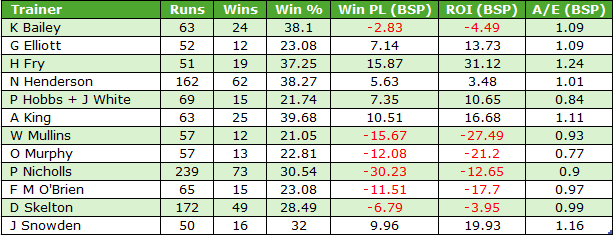
Royal Ascot 2025: Analysing The Group 1 Races

There are three festivals a year I get really excited about, writes Dave Renham. The Cheltenham Festival and Glorious Goodwood are two; and the third, which is soon to be upon us, is of course Royal Ascot. Around this time last year I looked in detail at the big 1-mile handicaps at the meeting - you can catch up with that piece here. This year I am concentrating on the Group 1 races.

Introduction

There are eight Group 1s run at the Royal meeting and they are as follows:


As would be expected, there is a good mix of different race distances and conditions although there is only one Group 1 race at a distance beyond 1m 2f, the Gold Cup.

In this article I am looking back on the last ten years of these Group 1 contests, trying to find any snippets that may help us when tackling the races this year. Profit and losses have been calculated to Betfair Starting Price (BSP) less 2% commission.

Royal Ascot Group 1s by Market Rank

Let me start by examining the market. I have ranked the runners based on BSP, which is the most accurate way of doing it. Further, it eliminates almost all of the ‘joint’ market positions.


These races have definitely been market-friendly with the top three betting positions each producing a blind profit. Those fourth in the Betfair betting lists have performed poorly but due to the modest sample we can perhaps assume this is an anomaly. Regardless, it seems that the top three in the betting are the ones to concentrate on.

Group 1 Favourites at Royal Ascot

Narrowing in on favourites, below are the Percentage of Rivals Beaten (PRB) figures for each individual race to help give a better overview of favourite performance in specific races. For the record the average PRB figures for favourites across the eight races combined stands at 0.76.


There has been quite a variance with Gold Cup favourites performing best, and by some margin. Their actual performance in the Gold Cup has been as follows:


During the ten year study period the Gold Cup favourite secured five wins, two seconds, a third and two fourths, so no BSP jolly has completely bombed out.

Royal Ascot Group 1s: Top 3 Market Ranks

If we undertake the same type of PRB analysis across the top three in the betting, the graph generally becomes more even:


The St James’s Palace has the highest figure now with the Gold Cup a close second. Nine of the ten winners of the St James’s Palace came from the top three in the betting (four favourites, three second favs, two third favs).

Conversely, of all the races the Commonwealth Cup has seen fancied runners struggle the most. Favourites have won three of the last ten Commonwealth Cup renewals, but there were no wins for second favourites (two wins for third favs). Quite a few horses that were in the top three of the betting have bombed out with 10 of the 30 failing to finish in the top ten, three of them being favourites.

It should be noted that the four winning Commonwealth Cup favourites in the past decade more than paid for the other six losing jollies, returning a profit of 2.55 units at BSP.

Royal Ascot Group 1s by Last Time Out (LTO) Position

The second area I want to look at is recent performance and specifically LTO finishing position. Here is a breakdown of performance by last day finishing position (I have grouped all horses together that finished fifth or worse LTO):


The BSP profit for those that finished third LTO has been totalled skewed by the 140.0 BSP winner Khaadem. LTO winners do look the group to concentrate on with over half of the 80 winners having also won on their most recent start. If we combine LTO winners with a position in the top three in the betting, then we see some excellent results: 36 winners from 115 runners (SR 31.13%) for a profit of £30.50 (ROI +26.5%); A/E 1.14.

It is also worth keeping an eye out for LTO winners that won by at least a length in the race prior to Ascot. These runners have scored 18.9% of the time (30 wins from 159) for a profit of £29.13 (ROI +18.3%).


Royal Ascot Group 1s by Last Time Out (LTO) Race Class

Onto looking at the class of race LTO. Here are the splits:


As we would expect horses that ran in Group 1 company last time have won most often. Those that raced in Group 3 or Listed Class LTO have been profitable, but both have been skewed by very big priced winners going in. Still, Royal Ascot is a meeting where horses fairly consistently win at massive odds.

LTO winners that contested a Group 1 race have actually offered poor value despite a strike rate of close to 30%. The 51 qualifiers lost over 28p in the £ if backing them to repeat the Group 1 win at Royal Ascot.

Royal Ascot Group 1s by Days Since Last Run (DSLR)

It is time to see whether the timing of the last run before Royal Ascot makes a difference. It should be noted this data does not include French, American or Australian runners as I do not have facility to check those. However, it still applies to over 90% of Ascot runners. Here are my findings:


As the table shows, I have included 50 to 240 days as a single group simply because there are very few runners within that grouping, and their performance has been poor. I wanted to help highlight the difference between that group and the group absent 241+ days (or eight months-plus).

The biggest cohort had a run between 22 and 35 days prior to Ascot and their results have been positive given the overall context. To give a broader overview let me share the PRB figures for each ‘days off track’ grouping:


These figures correlate with the win strike rates. The figures for 22 to 35 days and 241 days+ are clearly best. Finally in this section, below is the ten-year performance in Royal Ascot Group 1s of horses from the top three in the betting by days since last run:


Again, this points to the same two groups (22 to 35 days; 241+ days) as the areas in which to focus from a positive perspective. They would have offered punters very good value over the past ten years.

Royal Ascot Group 1 Trainers

The final area I will consider is that of trainers although it should be noted that data is limited. There are a handful of trainers who have saddled at least 20 runners in Royal Ascot Group 1s in the last ten years, and they are shown in the following table:


It is important not to take these figures (especially big profit lines) too literally due to the sample sizes. It is probably more prudent to look at the PRB values to give a better general indication of how each trainer's horses have run:


William Haggas, despite having just one winner from 24, has an excellent PRB figure so it looks like he has been somewhat unlucky in recent years. He has endured five second places,  as well as four thirds and five fourths. Haggas looks a trainer that may offer some placepot/ each way value at the very least next week.

By contrast, Roger Varian’s runners have really struggled although a good proportion of his charges have been bigger prices. Indeed, Charyn, in last year's Queen Anne Stakes is Varian's sole Royal Ascot G1 winner to date. There are sure to be more in future but his seem a little over-bet.

Other trainer titbits to share include the fact that Aidan O’Brien's 13 Group 1 winners in the past decade have all been ridden by Ryan Moore (from 61 rides). All other jockeys riding for O'Brien are a combined 0 from 43 since 2015, although again most of these runners were outsiders. Sticking with O’Brien it seems best to concentrate on those starting favourite or second favourite. They have combined to produce 12 of his 13 winners (from 34 qualifiers) returning a small 2p in the £. Finally, albeit from a very small sample, the Gosden stable has had four winners and four placed runners from just 13 runners aged four.

Summary

The Group 1 races at Royal Ascot are the races that owners, trainers and jockeys covet the most, although any win at the Royal meeting is huge.

In terms of the Group 1s, the most fancied runners - those in the top three in the betting - have fared much the best. Don’t be put off by horses having their first run in more than eight months (241+ days) and we might also consider a break of 22 to 35 days (three to five weeks) as more of a positive than a negative.

A last day win is preferable to other finishing positions and a last time out win coupled with a top three position in the betting market has been a very strong positive. From the training ranks, William Haggas appears to have been quite unlucky in the past decade and certainly I’ll be popping a few of his runners in my placepots at the very least. Aidan O’ Brien runners are worth noting if starting in the top two of the betting and particularly when ridden by Ryan Moore.

Wishing you the best of luck with your Royal Ascot Group 1 wagers.

- DR

Evaluating Jockeys by Percentage of Rivals Beaten

In this article I will put 35 jockeys under the microscope, writes Dave Renham. These are the riders with the most rides per year, on average, over the past four years. The data has been taken from UK flat racing (turf and all-weather (AW) and the full years 2021 to 2024.

Introduction

I have further limited the findings to mounts sent off at an Industry Starting Price (ISP) of 20/1 or shorter, in order to try to eliminate most of the horses that had little or no chance; and, further, because very big-priced winners tend to skew profit figures.

For this piece I will primarily examine the data using ‘Percentage of Rivals Beaten’, although I also plan to look at strike rates and A/E indices. Percentage of Rivals Beaten (PRB) is a calculation based on a horse's finishing position in relation to field size. It makes key distinctions between a horse finishing, say, fourth in a seven-horse race (PRB 50%, three rivals beaten, beaten by three rivals) and finishing fourth in a sixteen-horse race (PRB 80%, twelve rivals beaten, beaten by three rivals). We express the PRB as a number between 0 and 1. So, in the examples above, 50% is 0.5 and 80% is 0.8.

As racing researchers we can often be blighted by small sample sizes when analysing, for example, win strike rates. Hence, there is a strong argument to suggest that PRB figures are a more accurate metric, simply because they make datasets bigger: they award a sliding performance score to every runner in every race, whereas win strike rate only awards the winner a score with all other finishers getting zero.

Today's offering has a slightly different flow from usual I will be writing it "as I go along". In other words, I’m sharing the research and my thinking process stage by stage, rather than doing all the research and then writing about my findings afterwards. Thus, my main commentary will appear to be in the present tense. If that makes sense, let's crack on (and if it doesn't, it soon will!)

Top Jockeys' PRB: Overall

I will start by sharing the average PRB figures for each of the 35 jockeys over this four-year period. They are ordered alphabetically across two graphs:


To provide a benchmark, the average figure when combining these jockeys was halfway between 0.58 and 0.59, so 0.585 to be precise. Oisin Murphy has the highest PRB figure, 0.64, followed by five jockeys tied on 0.62 – William Buick, James Doyle, Rob Havlin, Jack Mitchell and Danny Tudhope. Tom Eaves, Cam Hardie and Andrew Mullen have the joint lowest PRB figure of 0.54.

It should be noted that all riders in this sample are above the 0.5 PRB benchmark and so even the lowest in the cohort are out-performing the norm.

Top Jockeys' PRB: ISP 6/4 or shorter

Although I have restricted qualifiers to those priced 20/1 or shorter, there are clearly some jockeys who have more rides at shorter prices than others. Hence, I am assuming that jockeys should have higher PRBs because of this. To help analyse and potentially confirm this hypothesis I am going to look at the percentage of rides each jockey had with horses priced 6/4 or shorter. The table shows the splits:


There is a huge variance here, from William Buick with more than 13% of his rides sent off 6/4 or shorter, to Cam Hardie at less than 1%. Of the six jockeys with the highest average PRBs I noted earlier, five of them were in the top six for the highest percentage of rides (highlighted in blue in this table). Therefore, we can see there is a strong looking correlation between price and PRB, as we should expect.

Top Jockeys' PRB: ISP 12/1 to 20/1

It makes sense next to look at the percentage of rides each jockey had when the qualifiers were bigger prices in order to consider both ends of the price spectrum. Therefore, below is a table showing these percentages when considering percentage of rides from runners priced 12/1 to 20/1.


The three jockeys with the highest percentages (shown in blue) are the jockeys who had the lowest overall PRB figures shared earlier, namely Tom Eaves, Cam Hardie and Andrew Mullen: this is further evidence of clear positive correlation. Also, the lowest four percentages in this group are for Messrs Buick, Murphy, Doyle (James) and Mitchell.

At this early point in my research I am starting to appreciate that despite the fact that PRB is a really useful metric, for this type of research the price of runners is also very important and can significantly sway the balance one way or the other. Hence, the market will be factored in for the remainder of what follows.

Top Jockeys' PRB by Price Range

Having established the importance of the starting price, I have decided to calculate PRBs for different price bands for all 35 jockeys. The brackets I am going to use are again based on Industry Starting Price and they are as follows:


In the table below I have collated the PRBs for each jockey for each price band. The average figures for all jockeys in the list are shown in blue at the bottom of each column, and I have highlighted any PRB that is at least 3% above the average or at least 3% below the average. The 3% ‘above group’ (positive) is highlighted in green, the 3% ‘below group’ (negative) is in red.


The colour coding helps to highlight jockeys that seem to perform above the norm and those that may have performed below what might be expected within each price band. There were three jockeys who obtained two ‘greens’: Robert Havlin, Clifford Lee and Kieran O’Neill. And there were four jockeys who obtained two or more ‘reds’: William Buick (3), Holly Doyle (2), Joe Fanning (3) and Rob Hornby (2).


Top Jockeys' PRB: All-Round Performance

I am thinking that another way we could analyse these data is to simply add up each jockey’s six PRB figures in the above table and compare them.  Below, then, are the riders with the top ten combined PRB figures when adding the six values together:


It could be argued that these are the top 10 performing jockeys from my original list of 35 as their totals are based on the overall performance across different price ranges. From looking at these findings I would be happy to see one of these ten riding a horse I am keen to back. Rab Havlin, who has consistently shown positive figures in the research to date, tops the list on a combined total of 3.99. (0.88 + 0.76 + 0.68 + 0.65 + 0.55 + 0.47).

Next, here are the lowest ten combined PRB totals from our sample of the top 35 riders:


As can be seen, we are talking small margins here so despite these ten being at the bottom we know that they are all still top-notch riders. However, in terms of PRB figures within certain price bands, they have performed with slightly less success than the rest of the jockeys in this sample.

To complete the set here are the remaining jockeys (positioned 11th to 25th) with their PRB totals. Due to the bigger group, I am using a table rather than a graph:


Top Jockeys: Other Metrics

I stated earlier that PRBs are arguably the most accurate metric but it always prudent to consider other metrics where possible in order to attain a stronger 'feel' for the data.

We know that finishing fifth in an 18-runner race will produce a better PRB figure than finishing eighth in the same the race, but usually finishing fifth does not make punters money (unless those generous bookie types are offering extra places).

At this point, then, I am thinking about the key battles in terms of finishing first rather than second and, therefore, I am going to share the wins, runs, strike rate, profit/loss and A/E indices for all 35 jockeys. As with the PRB data this does not include rides on horses priced over 20/1 ISP. Profits and losses have been calculated to Betfair SP less 2% commission. The A/E indices are based on Betfair prices and any figure above 1.00 has been coloured in green:


Somewhat surprisingly, 18 of the 35 jockeys have secured a profit which is impressive considering there are not any really big BSP winners to skew the returns. In fact, the highest winning BSP was 46.0 and there were only three winners in total above BSP 40.0, and only 23 above BSP 30.0 (out of total of nearly 12,000 winners).

Rossa Ryan, Saffie Osborne and William Buick have the best ROI%s (above 7%), and they each have one of the top five A/E indices. Impressively, Ryan has made a blind profit in each of the four years, Osborne and Buick matching that feat in three of the four years surveyed. There are two jockeys that made a loss in each of the four years, namely David Allan and James Doyle.

Conclusions

All this is helping me, and hopefully you, to start building a more complete picture of jockey performance; or, at least, the performance of these 35 top riders. The PRB data have given us an extra layer on top of the usual metrics we focus on. However, it is becoming clear to me that for this type of jockey-based research we do need other metrics (win percentage, profits, A/E indices, etc) to bring betting utility to the party.

I am just starting to expand the jockey PRB research into other areas and there is plenty more to share; so I have come to the realisation that this article will spawn a second piece. Thus, it is probably too early to draw any key conclusions from the research so far as there are more pieces of the puzzle to add.

However, next week I have a Royal Ascot article ready to go, so it affords me a little extra time to do further digging for part two of this jockey deep dive!

- DR
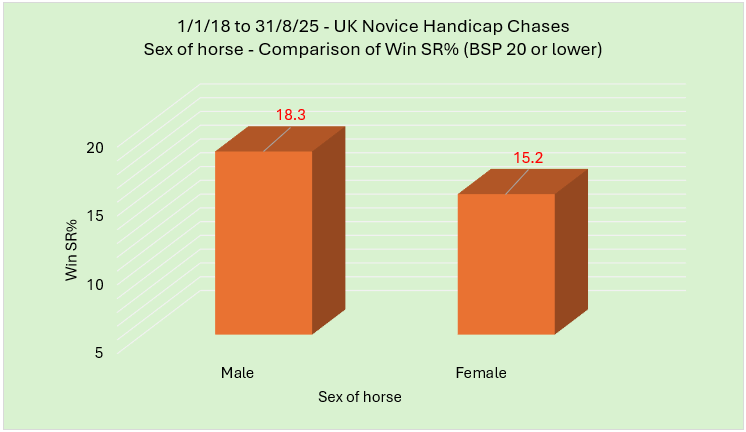
Geegeez Pace Ratings in 5f Handicaps, Part 2

Last week I shared my research into how the four-race pace totals on the Geegeez racecards performed across UK 5f handicaps in 2024 (excluding 2yo nurseries), writes Dave Renham. You can catch up with that article here. The results overall were impressive given we were looking essentially at raw figures with minimal additional ‘tinkering’.

Introduction

This week I am going to focus on the same dataset but combine the pace rating positions / scores with Dr Peter May’s ratings (the SR column in the Gold racecard).
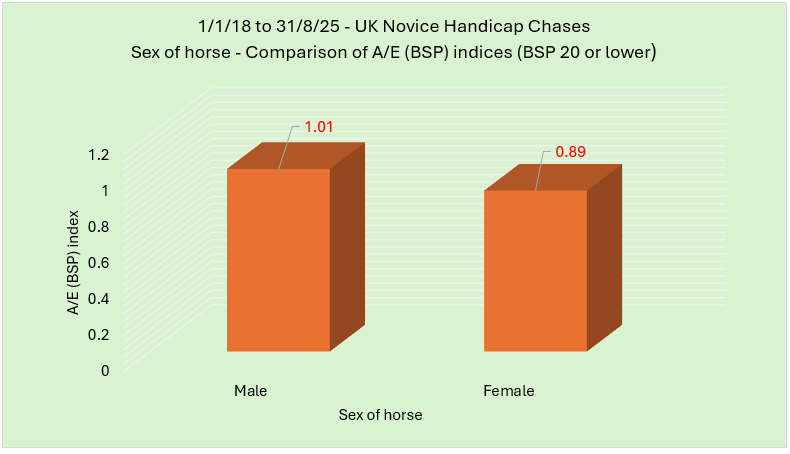
To recap, the pace tab shows the running styles of the horses for a maximum of their last four races. Each past running style is given a score of between four and one. The splits are as follows:

4 – Front runner / early leader

3 – Prominent racer

2 – Raced in midfield / mid division

1 – held up near or at the back early

The SR ratings are derived from a neural network developed by Peter May. They are much more than a measure of speed; they include a number of form considerations making them a sort of composite of, in Racing Post terms, RPR (Racing Post Rating) and TS (Topspeed) - both of which we also publish in the racecards.

SR Ratings by Win Strike Rate and P/L

My starting point for this article is to see how the SR ratings performed in 5f handicaps in 2024 starting with win strike rate. The graph below shows the splits:


The rating position correlates well with the win strike rate, although the 5th and 6th rated are reversed. Top rated runners have won just over 17% of the time, while those rated 7th or higher have definitely struggled from a win perspective.

I want to now look at the profit/loss figures for the top three rated runners from the SR ratings. This is because later in the article I will combining the top three in the SR ratings with the top three horses in terms of their four-run pace totals (which I order highest to lowest and call the Pace Ratings Rank). Here are the results in terms of the top three ranked in the SR ratings:


As we can see, the top-rated SR runners would have lost a small amount if backing all qualifiers blind. Second rated have nudged into profit while the third rated have seen losses around the 8p in the £.

Combining SR Top Rated with Pace Rank Top Rated

Now we know the raw performance of the SR ratings I will begin to combine them with what I call the Pace Ratings Rank. Let's first look at what would have happened if only backing runners that were top rated by both set of ratings. Here are the numbers:


This is a positive start to the Pace / SR collab! The strike rate has equated to just under one win in every five with returns of over 16p in the £. There were also 26 qualifiers that finished runner-up which is another strong positive meaning that 50 of 124 finished in the first two.

If we expand this slightly to the top three of the ratings for both, we get the following results:


We have increased the number of bets by around 6.5 times whilst keeping a similar strike rate, although return on investment is slightly less. On the upside, though, we would have made more money in profit terms (from a bigger outlay of course). There were 126 qualifiers that finished second including some at tasty BSP odds such as 40.21, 47.97 and 46.0. There was also a third that was beaten just over a length in a 28-runner handicap at BSP odds of 123.97. The horse in question, No Half Measures, raced at Ascot (21/6/24) and was arguably very unlucky having been the best finisher in the far side group in a race where nine of the first ten home raced up the centre of the course.

Considering we are just combining two different ratings in this way, to get such positive results for higher rated runners in both sets, with no other considerations, is extremely encouraging. Now, I appreciate it is just one year of handicap results at one distance, but 809 horses is a decent sample.

Performance of the Lowest Rated on Pace and SR

Let's now switch and combine lower rated runners from both the Pace Rankings and SR ratings. I am looking at the results of horses rated 8th or lower in both rating sets. Here are their combined results:


These are very poor results which breeds more confidence in our earlier positive findings when combining higher rated runners from both rating sets.

Top Three Rated on Pace and SR by Handicap Age Restriction

If we split the 809 horses that were top three rated on both Pace Rank and SR Rating into 3yo only, 3yo+ and 4yo+ races we get the following results:


All three returned a profit, and all three had relatively similar ROIs. These figures demonstrate that these higher rated runners from both sets of ratings have performed consistently regardless of the ages of the horses taking part.

Top Three Rated on Pace and SR by Selected Courses: Positive

I want next to examine the performance of the top three rated on both metrics at a selection of courses that between 2017 and 2023 had the strongest front running biases over the 5f trip. I sourced these courses in the first article by examining individual track performances of early leaders / front runners during that seven-year prior time frame. I used a combination of win percentages, placed percentages and A/E indices to formulate the list.

To recap the 12 courses were: Ayr, Chelmsford, Chester, Hamilton, Kempton, Leicester, Lingfield, Redcar, Ripon, Thirsk, Windsor and York. In that piece I examined solely the top-rated runners from their previous four-run pace totals rather than the top three.

Here now are the figures for horses that were in the top three of both the Pace Ratings and the SR ratings when running at one of those 12 courses:


That's another very solid set of results with a strike rate close to 20% and returns of over 21p in the £.

Composite Ranking Performance

My next port of call was to combine the ranking positions of both sets of ratings to create an overall numerical total. Hence if a horse was top-rated in the SR ratings and ranked 5th in the Pace Ratings/totals that would score six (1+5); if a horse was ranked 4th in both it would score eight (4+4) and so on. Now we know already what a total of two has achieved as those were the results shared earlier for the top-rated in both. Below I have combined the numerical totals into bands in a graph that shows the strike rates for each one:


This graph offers further evidence that combining the higher rated runners in each set produces better strike rates. We have the sliding scale of percentages that we always want to see when looking at any type of rating-based data set. Meanwhile, the 2-4 band (i.e. SR 1st/ Pace 1st, SR 2nd/ Pace 1st, SR 1st/Pace 2nd, and SR 2nd/Pace 2nd) have a very solid strike rate close to 19%.

Using the same calculation method and the same bands I thought it would be worthwhile to look at the Percentage of Rivals Beaten (PRB) figures. This metric considers all finishing positions based on the number of runners in each race. It is a useful metric to analyse where possible. Here are the splits:


The chart presents further strong evidence of the positive correlation we have seen throughout this article in relation to the importance of ranking position within the two sets of ratings. 58% of rivals beaten for the 2-4 band is a materially high PRB figure.

Let me now share the runs, wins, profits / losses for each band:


It is pleasing to see the 2-4 band producing the best ROI% and also seeing the 5-7 band in profit. The 11-14 group have proved profitable but essentially, they had the biggest-priced winner in the whole year (BSP 127.21) which skews their bottom line considerably. The 20+ band would, not surprisingly, have produced very poor returns from a very low strike rate.

Top Rated on SR and 15 or 16 Pace Total

In the first article I looked at some of the data for the highest four-race pace totals, namely 15 and 16. Hence, horses that had gained these scores had led early in either three or all four of those runs. Based on historical research, I've shown that it is reasonable to think that these horses are the most likely to lead in their next race. So what would have happened if we had backed the top-rated SR runner when they had a pace total of 15 or 16? The results read:


This gives us a small cohort of runners but even from a small sample the figures look promising. The PRB figure is an excellent 0.62 which adds confidence to this small set.

Top Three Rated on SR and 15 or 16 Pace Total

What happens if we expand this to the top three rated in the SR ratings with runners who had a pace total of 15 or 16? The splits are:


The number of bets has nearly tripled and although the strike rate and the ROI% have dropped a little, the results are still very positive. The PRB has dropped a little too, but it still stands at a very strong 60% of rivals beaten.

Top Three Rated on SR and Pace Rank, ISP 12/1 or shorter

Finally in this piece I am going to go back to look at the results for horses that were in top three of both the SR ratings and Pace Ratings / totals. To date I have not put in any price restrictions, but as we all know a BSP 100.0 winner can skew the bottom line considerably. One of the main reasons I haven't is because all of the bigger priced winners (BSP 30.0 or more) came from horses that were not in the top three of both. If anything, other rating position bottom lines have been the ones that have been skewed.

However, I felt it only right to share the figures for the top three rated in each when we restrict the price, and to make it clean I am using an Industry SP price cap of 12/1. So, just to clarify, the figures below are those for horses that were in the top three of both ratings and were priced ISP 12/1 or less. The figures are as follows:


These figures are better than the overall figures for top three in both. A 14p in the £ profit over 720 bets would have been an excellent return. The PRB for these runners is a very strong 0.60. All of this from just two things that can be very easily found on the Geegeez Gold Racecards.

Now that looks very good value to me!

- DR

p.s. if you're unclear how to find these, follow the steps below:

1 Look for 5f UK (turf or AW) handicaps, and ignore 2yo races


2 On the PACE tab, select 'last 4 races' and 'Data' view, and sort by Total. Then find the top rated or top three rated in the SR column. In this example, from last night, Jeans Maite was top rated on both last-four Pace Score and SR - and, as you can see from the second image below, won at 7/2 (BSP 4.97).


Made all, won!

An Analysis of Geegeez Pace Ratings in 5f handicaps

In some recent articles I have extolled the virtues of the Geegeez Racecard for Gold members, for example, when looking at Dr Peter May’s ratings (the SR column), writes Dave Renham.

Introduction

Another huge bonus of these racecards is the pace tab. The pace tab shows the running styles of the horses for a maximum of their last four races. Each past running style is given a score of between four and one, as follows:

4 – Front runner / early leader

3 – Prominent racer

2 – Raced in midfield / mid division

1 – held up near or at the back early

Long standing Geegeez members will have read previous articles of mine emphasising the importance of running style / early pace in a race under specific conditions. Usually though I am looking at the performance of different run styles in certain races which is based on knowledge gleaned after the race has been run. For example, how well have front runners performed over a particular course or distance.

In this article I will examine the Geegeez pace figures to see if they can help in terms of giving us an edge pre-race. I have looked at a year’s worth of pace ratings data that was published in the Geegeez Racecards before each race. The focus is on 5f handicaps (excluding 2yo nurseries) as these races tend to accentuate any run style bias. To be clear, the words 'ratings' and 'rankings' are used somewhat interchangeably in what follows. Higher ratings generally equate to higher rankings.

Past number crunching has noted the edge early leaders / front runners have at this minimum 5f distance. [Type ‘sprint’ into the search box here for a five-part deep dive into 5f handicaps]

However, the problem of taking advantage of any front running bias is that we do not know which horse is going to take the early lead in any given race. If we did then most of us would have made enough money to retire by now! The one tool that should be able to help us is the Geegeez Gold pace tab. Logic dictates that the higher a horses’ pace rating total, the more likely it is to lead. Let me share an example of a 5f handicap race run last month focusing on the pre-race pace ratings:


The first point to note, before we look at the pace totals for each runner, is the performance of early leaders at Wolverhampton. We can see from the green box that they have won nearly 25% of the time and, if able to back them all, we would have made huge profit.

This goes back to what I said previously about how useful it would be if we knew the early leader pre-race. Looking at the pace totals we can see they range from 13 to 7 with Wedgewood the highest on 13.

Hence, we would expect Wedgewood to be the most likely early leader. This is the result, with some additional sectional data.


As we can see Wedgewood, under geegeez-sponsored jockey Marco Ghiani, did indeed take the early lead and was never headed. Of course, the top-rated runner is not going to lead all the time, and the top-rated runner is not going to win all the time. However, from some past 5/6f research I shared with readers back in January 2021 those with higher pace totals led more often than those with lower ones and therefore we would expect them to win more often.

The sample size in that article was far smaller than I am sharing now but it was big enough to suggest that horses with the highest pace totals of 15 or 16 would take the early lead around 45% of the time, whereas those with the lowest pace totals of 4 or 5 would take the early lead less than 3% of the time.

In this piece I am more interested in the performance of each horse based on their pace totals / positions in the racecard, rather than how many of the top-rated runners led. Essentially, as punters we want to make money and so I wanted to find out answers to questions such as, “has the top-rated runner made a profit?”, “is the top-rated runner better value than those rated say 8 or lower?”, “do horses with pace totals of 15 or 16 perform better than those with totals of 8 or less?”, and so on.

The 2024 5f handicap data I have crunched covers just under 600 races and that means 5200 horses with their individual pace totals. This, then, is a very decent sample, and one that took quite a while to collate! After all the leg work to input the data, I hoped that I would find something worth sharing! Let’s see…


Pace Rating Rank

To begin with let’s look at performance based on the ranking positions of runners from their four-race pace totals. In the earlier Wolverhampton example this would mean the following:


Horses with the same totals such as Four Adaay and Angle Land have been given the same ranking position. I have applied this idea across all the races in the study. On that basis, here are the win strike rates, with those rated 8th or bigger in one group:


This is the type of sloping graph I had hoped for with the top-ranked pace horse winning more often than the second ranked, who in turn has scored more than the third ranked and so on. However, I had not expected it to correlate so neatly.

Below are the Betfair SP profit and loss figures for the same pace rating ranks.


The top two ranked (inc. joints) have both nudged into profit which is obviously a clear positive. The 4th ranked runners have effectively broken even, but the 3rd ranked runners have let the side down for ‘the top four’ with quite steep losses. Once we get 6th and bigger in the rankings, we can see losses have started to mount up with those 8th or bigger losing nearly 20p in the £.

Looking in a bit more detail at the top two ranked (inc. joints) if we restrict races to those with 12 runners or less, we see the following results:


If, therefore, we had stuck to mid-range to smaller field sizes, then the figures improve further for the top two ranked pace runners. These are tidy ‘blind’ profits using nothing other than the Geegeez pace ratings.


Pace Rating Total

Let’s pivot now to the four-race pace totals covering each horse’s most recent four runs. The maximum total a horse can attain is 16 (four 4s), and the lowest is 4 (four 1s). I have looked at win strike rates first below to see if there is a similar pattern to the Pace Rating Rank graph shared earlier. I have grouped the individual totals up so have joined 15 with 16, 13 with 14 and so on. Here are the findings:


We see the same type of pattern as before, although the 4 to 6 group have just ‘spoiled’ my ideal pace score graph by winning slightly more often in percentage terms than the 7 to 8 group. Again, though, this highlights that horses which have shown more early speed in their most recent four races have a better chance of winning 5f handicaps than those which have not shown gate speed. As we know, higher strike rates do not necessarily mean bigger profits, so let’s see how the returns figures have panned out:


Those horses recording a four-race pace total of 15 or 16 have combined to make a sound profit equating to returns of over 16p in the £. The general pattern is that as the rating totals drop the losses start to increase, although the 4 to 6 group buck that trend.

Pace Ratings at Different Courses

I want to look at some course data now although with only races from one calendar year, several tracks have limited samples to potentially analyse. Hence, as Baldrick would say, “I have a cunning plan”. The first phase of this plan was to back check past pace/run style course data in 5f handicaps from a longer prior time frame. I chose 2017 to 2023, and I examined the course performance of early leaders / front runners. By using win percentages, placed percentages and A/E indices, I was able to order the courses from the most front-runner biased to the least.

From there I decided to group the 12 most biased courses together in one group (group A) and the 12 courses with the weakest front running biases in a second group (group B). The idea was simple: I wanted to compare the 2024 performance of top-rated runners across both groups, with the hope being that the Group A stats for front runners would be far superior to those for Group B. Here are my findings:

Group A

The 12 courses in this group are Ayr, Chelmsford, Chester, Hamilton, Kempton, Leicester, Lingfield, Redcar, Ripon, Thirsk, Windsor and York. Funnily enough, due to plenty of past course / run style number crunching, if I had been given the task to decide what I thought the strongest 5f course biases were without any past stats at my fingertips, I would have chosen 11 of the 12. Knowing that gave me good confidence in this past course data.

So, looking at the top-rated runners in the Geegeez Pace Ratings at Group A courses we see the following results:


These results are rather impressive both from a strike rate perspective (4% higher than the figure for all courses) and a bottom line one. Returns of over 41p in the £ are not to be sniffed at.

Group B

The ‘dirty dozen’ courses in this group are Ascot, Carlisle, Chepstow, Doncaster, Goodwood, Haydock, Newbury, Newcastle, Newmarket, Nottingham, Sandown and Yarmouth. When looking at the top-rated runner across all courses combined, we get the following:


Wow! This is an even bigger differential than I had expected. Returns at these 12 courses have created losses of over 26p in the £. It does seem that the 2017 to 2023 data was a very accurate reflection of the relative front-running biases at these courses.

One would hope that we witness a similar difference between the course groups when looking at horses that achieved a pace rating of 15 or 16 although the sample sizes are a little on the small side now:


Again, we have a significant difference between groups in both strike rate and returns. As previously mentioned, the sample sizes are smaller than ideal but with the correlation between the two data groups being so strong we can have more confidence as a result in these second set of figures.


Top Rated by Age Group

The final area I want to delve into today is top-rated pace runners, and the 15-16 pace score runners, across the three main age groupings. These are 3yo only races, 3yo+ races and 4yo+ races. Let’s first compare the strike rates for the top-rated:


I have to confess these figures surprised me. I expected the top-ranked to score more often in 4yo+ handicaps where the runners are more exposed. However, it is the complete opposite with the top-ranked winning more often in 3yo only races. It should be noted that the average field size for 3yo only races was slightly smaller than for both 3yo+ and 4yo+, but not enough to make any significant difference to these percentages. Of course, strike rate is only one piece of the puzzle and when we look at the overall figures for each in terms of top-ranked in the four-race pace totals we see things change around a little:


The 3yo only top-ranked pace runners did make a profit, but the 4yo+ top-ranked pace runners performed especially well on the profit front. It wasn’t such a good read for the 3yo+ top-ranked runners with losses edging towards 16p in the £.

Now it’s time to see if the horses with a pace rating of 15 or 16 have performed in a similar fashion across the different age ranges. Here are my findings:


The sample size for 3yo only races is small, but they once again have secured the highest strike rate, albeit only just greater than 4yo+ qualifiers. Once again though the best value by far has been in the 4yo+ races with some impressive profits and returns achieved.

*

Whilst this article has looked only at a single year's worth of 5f handicap pace rating data, the findings across the board have correlated positively. Moreover, with nearly 600 races in the sample we should be fairly confident in the data.

I for one will be keeping an even closer eye on 5f handicaps in the future as there seems to be value in the top two rated runners, and those that have totals of 15 or 16 points. Of course, all the horses with totals of 16 will be top-rated (or joint top-rated), while those scoring 15 will often be either top-rated or second top.

For those who have enjoyed this week’s offering the good news is I have a follow-up piece to share next week – and it’s got some excellent payoffs!

- DR

Two-Year-Old Sires in 2025

It is several years since I analysed two-year-old (2yo) sire data and so, early in the flat season, I felt now was a good time to revisit, writes Dave Renham. This article examines eight years of UK flat racing data (turf and AW) spanning from 2017 to 2024. I will be comparing win strike rates, as I usually do for this type of article, but for the first time in my sire research I will also share Percentage of Rivals Beaten (PRB for short) data. There is a strong argument to suggest that PRB figures are the most accurate metric, so I am excited to be able to include them. Further, I will include some A/E index calculations and these will be based on Betfair Starting Prices. (For more on A/E and other metrics used on geegeez, and why we use them - and why we think you should, too - check out this post)

If you have not read a sire article before, let me briefly set the scene. Sires are the fathers of the respective racehorses, and they typically have an influence on their progeny (offspring).  For example, if the sire was originally a sprinter there is a good chance that his progeny will perform better at sprint distances than over say marathon trips. Sires also vary in quality, which will generally influence the next generation in terms of inherent ability. Some sires, for example, achieve around one win in every five starts with their progeny, others are nearer one win in 20. Using sire data is particularly useful for 2yo races because the actual horse form can be sparse or indeed non-existent if the two-year-old is making its debut.

Sires: All Two-Year-Old Races

Let's begin by looking at some sire data for all 2yo races. To qualify a sire must have had at least ten progeny runs in 2024, and 275 or more in total over the eight years. In addition, to make the following list they needed to be in the top 50 in terms of win strike rate. I have ordered them alphabetically:


In terms of win strike rate, then, Dubawi heads the list at 23.26%, followed by New Bay (21.23%), Frankel (19.83%), Kingman (19.2%) and Night Of Thunder (18.15%). From a PRB perspective, Dubawi (0.65), Frankel (0.63) and Kingman (0.63) are the top three. They are followed by French sire Siyouni (0.62), Sea The Stars (0.61) and Lope De Vega (0.61).

From a betting viewpoint, however, Dubawi and Frankel have not offered particularly good value with Betfair A/E indices of 0.93 and 0.89 respectively. Backing Dubawi progeny blind would have yielded losses of over 9p in the £, and Frankel over 16p in the £, at Betfair SP.


Sires: Two-Year-Old Races by Distance

I want to look at some distance data now. I have split the full set into three cohorts: races over 5 and 6 furlongs, races over 7 furlongs or a mile, and races over 1m1f or more. For the record there are on average only 30 races per year for 2yos over 1m1f or more, so for some sires there is limited data there. If a sire has had 20 or fewer qualifying runs over the distance range, I have left that entry blank.

The table shows the win strike rates and PRBs for each distance range. Sires are listed alphabetically once more and any individual sire’s PRB distance range value which is 0.05 higher than one of their others has been highlighted in green:


Let me drill down into some of these sires in terms of distance performance/preference starting with New Bay.

New Bay stands at Ballylinch Stud for €75,000 which looks a bit of a steal based on his 2yo results to date. In terms of distance his offspring have run only 22 times at 1m1f or more so it is at shorter ranges I would like to concentrate. His progeny's strike rate over 7f to 1 mile is more than double that of his 5f-6f figure, and the difference in the PRBs is a very significant 0.10. The Betfair A/E indices show a chasm between the two also with an index of 1.01 for the shorter sprint distance and 1.53 over the longer 7f to 1m range.

New Bay had his first crop of 2yos in 2020 and the graph below shows the win and each way (win & placed) strike rates by year for the 7f to 1m distance:


The each way figures are all over 40% with 2024 nudging over 50. 2023 saw a slight dip in the win rate but, overall, this performance has been extremely impressive. Backing all qualifiers blind would have yielded a profit in every year to BSP with three of the five seeing ROI%s of over 80%. In terms of yearly PRBs and A/E indices we see the following:


These figures correlate well with each other and with the pure win strike rates. Over 7f to 1m, New Bay looks a sire to keep on side.


Havana Grey is a relatively new sire on the scene (first crop 2022), but his progeny have already shown a strong preference for sprint trips. Considering his runners over 7f-plus first, this group would have lost us nearly 60p in the £ if betting all 153 of them (14 won).

By contrast, switching to shorter trips (up to six furlongs) his issue have fared particularly well when strong in the market. Those starting in the top two of the betting have secured 74 winners from 204 (SR 36.3%) for a profit of £26.13 (ROI +12.8%). Additionally, Havana Grey progeny that have taken the early lead over these sprint trips have performed well above the norm, winning 38 from 108 (SR 35.2%) for a profit of £108.67 (ROI +100.6%).


For No Nay Never, the 6f trip specifically looks optimal. Below are the yearly win and each way strike rates for No Nay Never two-year-old progeny at six furlongs:


These are consistent figures and, in terms of yearly PRBs and A/E indices, we see the following:


Five of the seven annual PRB figures are above 0.60, while all bar one of the A/E indices are over 1.00 - excellent numbers.

No Nay Never is a fine 2yo sire worth keeping in our corner; and his record at distances other than six furlongs is solid, too. At 7f-plus his runners have secured a BSP profit in five of the seven years (five of the last five).


Soldier’s Call has only thrown two crops of racing age thus far - 2025 will be his third - but already there is a strong suggestion that the shorter the trip the better for his juveniles. That should come as little surprise given that Soldier’s Call was a top-notch sprinter himself (2nd in the Nunthorpe, 3rd in the King Charles III (formerly King's Stand), 3rd in the Abbaye). At a flat 5f only (thus, excluding 5½f) his strike rate was a tad above 16%, while at 6f it was 9.2%, and over 7f+ just 1.4% ( 1 win from 74).


Sires: Two-Year-Old Races by Going

The next area I want to look at is the going. I will share PRB figures for turf versus all-weather, as well as splitting the turf going into four subsets – good to firm/firm, good, good to soft, and soft/heavy. Any value within each sire’s groupings that I perceive to be strong or weak I have coloured green (positive) and red (negative). These are only my interpretations of the PRBs and that may differ slightly from how others may perceive them. Anyway, here are the splits:


This table offers a few useful sire pointers, four of which I'd like to highlight.

Firstly, returning to New Bay we see that his progeny PRB figure on good to firm or firmer has been poor in comparison with his figures for other ground conditions.

Mayson has performed far better on easier ground (good to soft, soft and heavy), while Acclamation has been better with firmer conditions (good to firm+).

Too Darn Hot has had excellent results on easier ground (good to soft or softer) hitting a strike rate of 23.5% (24 wins from 102 runners) for a profit of £38.50 (ROI +37.8%).


Sires: Two-Year-Old Races by Gender

The penultimate sets of 2yo sire PRBs I want to share are connected with the sex of the horse – in other words, whether the progeny was male or female. I have included the win strike rates as well as PRB and, again, I have colour coded some PRBs either positive or negative based on my perception of the specifics of the individual sire’s data:


Possibly the most powerful stats from this table come from Kodi Bear. Looking at the bare numbers it seems as though males have had a significant edge; this is further underlined when comparing the profit/losses, returns and A/E indices:


As the table above shows, there is a differential of around 37p in the £ in terms of returns; males have much better figures across the board.


Sires: Two-Year-Old Races when Betfair Market Leader

Finally in this piece I am going to look at the results when the 2yo has started favourite on the Exchange. In the table I have included the sires that had 50 or more runners start favourite during the eight year study period:


Just over half (19 of 37) returned a profit to BSP which is more than I was expecting. It is interesting to see Dubawi and Frankel again both making losses, with their high profile progeny typically wildly over-bet. The PRBs for the sires listed range between 0.83 (Harry Angel and New Bay) down to a very skinny 0.71 (Muhaarar).

There are seven sires that, based on these past stats, are worth noting when starting favourite in the future. They are Bated Breath, Harry Angel, Kodiac, Lope De Vega, New Bay, No Nay Never and Oasis Dream. All have been profitable, all have A/E indices of 1.10 or above, and all have PRBs of 0.80 or more in this context.


*

There were a few more tables than usual in this piece, but I felt that was necessary to convey the differences between sires under certain conditions. I hope this will help us when betting on 2yo races this season and beyond.

The fifty sires discussed have combined to father around 40% of all raced 2yos in UK between 2017 and 2024. That is not, of course, to say that we should ignore other sires but these are the most prominent.

It is important also to note that many sires imbue their progeny with no obvious preference for distance or going or whatever else. We must recognise the limitations of datasets, and that even neutral statistics have some utility in our betting, albeit probably less so than positive and negative ones.

- DR

When Horses Change Stable: Part 2

This is the second of two articles looking at horses that have switched stables on the flat, writes Dave Renham. The first article looked at horses’ first run for a new yard, while this one examines the second run from that new stable. We’ll call them TC2 (Trainer Change 2nd Start).

As I mentioned last time, the one stipulation is that the switch is from a horse that has been running on the flat and not National Hunt. This is mainly because there are some dual-purpose horses that switch yards each year from a dedicated National Hunt stable to a flat stable.

The data has been taken from the last ten full years (2015-2024) of flat racing in the UK (turf/AW) and all profit and loss has been calculated to Betfair SP with 2% commission applied on any winners. This is also the first article where the A/E indices (Actual versus Expected) will be based on BSP not Industry SP.

To recap, the last article noted that all horses that have had their first run for a new trainer having switched stables scored 8.2% of the time and actually made a blind BSP profit of £732.49. This equated to a 4.65% return on investment. Unsurprisingly, these overall figures included some horses winning at huge prices: there were 12 winners that paid 100.0 or bigger ‘on the machine’ with the majority lying between 100.0 and 200.0. The two biggest winners, however, were enormous at 429.02 and 503.82. Having said all that backing all 100.0+ qualifiers actually showed a loss of £279.72 (ROI -11.2%).

All TC2 Runners

So how about all horses having their second start for a new stable. Are the overall figures similar? Let’s see:


Despite a slightly better win strike rate, we see fairly steep losses. Most of these losses have been incurred by the genuine outsiders and, if we ignore the 2153 horses that started 100.0 or bigger at BSP we get much closer to parity:


The returns now show a small loss of just over 1½ pence in the £, and if we further restrict all qualifiers to those priced BSP 20.0 or shorter we hit profit:


These runners on roughly once in every six starts and returned a profit of just under 5p for every £1 staked.

TC2 Runners Sent Off Exchange Favourite

Sticking with the betting market let’s now focus on Exchange favourites.


These figures are very similar to the ones we saw for first-time switchers – but while those runners made a small profit of just under 2p in the £, the second start cohort produced a small reverse of a penny in the £.

Let’s next compare the annual performance of these BSP favourites by examining their ROI%.


As we can see there is a bit of a mixed bag, but this is to be expected based on an average of 130 qualifiers per year. There were three poor years (2018, 2019 and 2021), two profitable years (2015 and 2020), and five years that have been close to breaking even, albeit all showed a small loss.

There are a few angles where horses having their second run for a new trainer have made a profit when starting as favourite. These are:

  1. Favourites in non-handicaps won 90 races from 190 (SR 47.4%) for a profit of £27.55 (ROI +14.5%).
  2. 2yos when starting as market leader won 24 races from 54 (SR 44.4%) for a profit of £17.60 (ROI +32.6%).
  3. Favourites racing in Class 1 or 2 company won 25 of 79 starts (SR 31.7%) for a profit of £12.50 (ROI +15.8%).

TC2 Runners Sent Off Exchange 2nd or 3rd Fav

Next, let’s now combine second and third favourites to see how they fared.


As we can see a nominal profit has been achieved. It is interesting to note that 2yos sent off second or third favourite made a profit (as we saw earlier when 2yos started favourite). This cohort of runners won 23 races from 88 (SR 26.1%) for a healthy profit of £36.37 (ROI +41.3%); A/E 1.57. The profit was solid in both nursery handicaps and non-handicaps.

Before moving on, it should be noted that 2yos having their second start for a new trainer having switched yards perform really poorly when not in the top three in the betting. This group of runners won less than 3% of the time (12 wins from 421) for a hefty loss of £196.62 (ROI -46.8%); A/E 0.70.

TC2 by Last Time Out Finishing Position

Next, I would like to look at last time out (LTO) performance in terms of finishing position on most recent start. Here are the results for horses that finished in the first three LTO:


Horses that finished second on their most recent start (their first run for their new trainer) did particularly well, but LTO winners also nudged into profit. Horses that finished fourth or worse LTO scored just under 6% of the time and lost over 12p in the £.

TC2 by Gender

It’s time to review any impact the sex of the horse has on performance. In the last piece I showed how male horses tend to slightly outperform females when analysing all races, winning roughly 1.12 times as often. To create this figure, I divided the male win strike rate by the female win strike rate in all flat races over the past ten years. That was, and still is, our benchmark. When we looked at the figures for horses switching stables and racing for the first time this figure increased to 1.27. Do we see a similar widening of the gender gap with the second time start figures?


The male strike rate is nearly 2% higher than the female one and this equates to winning 1.22 times more often. This is still comfortably above the average figure of 1.12, but a little down on the 1.27 mark for first time switchers. It seems logical to assume that a fair percentage of female horses may still not have totally settled into their new surroundings.

Before looking at trainer angles, I would like to share some LTO Industry SP price data. Horses that started 6/1 or less LTO have produced solid looking figures:


A modest 2p in the £ loss for all such qualifiers. If we focus on those that had also raced within 30 days we get to a near break-even stuation.

TC2: Trainer Angles

Onto trainers now which may provide the most worthwhile findings for many readers. Below is a list of all trainers that have run at least 80 qualifiers:


Two trainers noted in the first article for having a decent record with horses having their first run for the stable have fared well again, namely Kevin de Foy and David Loughnane, although Loughnane has performed less well in the last few seasons. His record has tailed off since 2020. Of the other trainers, Iain Jardine, who made a profit from a low strike rate last time, has improved that strike rate to over 12% and hit a profit once again.

Two trainers that stood out positively last time, Mick Appleby and Archie Watson, performed less strikingly on second start for the yards, although both have still produced good strike rates.

Mick Appleby has done brilliantly with horses that finished second LTO – these runners won 18 races from only 46 runners (SR 39.1%) for a profit of £22.62 (ROI +49.2%).

Going back to Kevin de Foy he has hit an excellent strike rate of over 21% and his returns are not skewed by any horses winning at huge odds (his biggest priced winner was BSP 19.13). If you ignore his LTO winners (who did connections a favour obviously on their first start for the yard) his record improves slightly to 14 wins from 68 (SR 20.6%) for a profit of £40.22 (ROI +59.1%).

In the first piece it was noted that Richard Fahey had underperformed significantly with his new recruits on their first start. However, his record on their second start is much better. In that context, he improved the strike rate from just above 7% to nearly 13% and such runners edged into profit. However, as with David Loughnane, his record was better in the earlier part of the ten-year time span.

Jane Chapple-Hyam just failed to make the list in my first article as she did not have quite the required number of runners. Here she does make the cut and has a very solid overall record. However, she did have one huge-priced win which accounts for all of her profit figure. Having said that, horses that started in the top four of the betting performed well for her with 11 of the 33 winning (SR 33.3%) and a tidy profit of £24.89 (ROI +75.4%).

David O’Meara has a very similar record with horses having their first or second runs for him having switched stables. One positive stat to share with those having their second start is that horses which finished 2nd, 3rd or 4th LTO are worth noting. They won 19% of the time (23 wins from 121) for a profit of £41.28 (ROI +34.11).

Trainers to generally avoid with horses having their second run for the yard are Charlie Wallis and Philip Kirby: both have very poor records.

Trainers: TC1 vs TC2

I thought it would be useful to make a trainer comparison between horses having their first starts for a yard with their second, beginning with win strike rate. I have highlighted in green the better figure of the two unless they are within 1% of each other:


Taking this group of trainers as a whole, most of them have similar strike rates for both groups. Attwater, Fahey, G+J Moore, Watson, and Stuart Williams have the biggest differentials.

Now I am going to compare the A/E indices which helps to determine ‘value’. This time I will highlight in green any A/E index which is 0.30 bigger than the other figure which is a significant difference for this particular metric:


For six trainers, horses having their first run for the stable proved considerably better value than when making their second start. The six were Mick Appleby, Julie Camacho, David Evans, Ivan Furtado, David Loughnane and Archie Watson.

Five trainers enjoyed the reverse scenario with second runs for the stable producing much better value than first runs. This quintet comprised Michael Attwater, Mick and David Easterby, Gary and Josh Moore, Rebecca Menzies and Stuart Williams.

The final comparison I will make is with the PRB figures (Percentage of Rivals Beaten). I would expect these figures to positively align to some extent with the win strike rates. I have highlighted in green any PRB that is 5% (0.05) higher than the other. Here are the splits:


For most trainers the win strike rates and the PRB figures align quite well. For example, Watson’s figures of 0.57 and 0.51 highlight the much better performance with first time starters for the stable. Likewise, we have seen that the Moore stable has performed far better with horses having their second start for the stable having switched yards, and the 0.33 vs 0.44 PRBs back this up. There are several more good examples of this including for Caroll, Chapple-Hyam, M+D Easterby and Menzies to name but four. The one real outlier is David Evans whose PRBs are completely the reverse of his strike rates.

Using different metrics for comparisons for individual trainers does help us understand the numbers better and gives us a better overall feel for the data.

*

So that wraps this piece, and the two-part trainer change series, up. I hope they have been both useful and interesting. These two articles should give us plenty of pointers to help in our quest to make long-term profits from racing. Until next time…

- DR

Your first 30 days for just £1