Tag Archive for: William Haggas

Trainers with Three-Year-Old Runners, Part 2

This is the fifth article in a series where I have been digging into the performance of trainers' runners of specific ages over the past few seasons, writes Dave Renham. I have used UK race data from 1st January 2016 to 31st December 2021 giving us six full seasons to examine.

My focus in this second part of the series is on three-year-old (3yo) runners and, following on from my previous piece, I have used the Geegeez Query Tool for all of the number crunching. All profits / losses have been calculated at Industry Starting Price. I appreciate most punters do not use SP these days as many (quite rightly) take advantage of early prices, Best Odds Guaranteed and / or the exchanges.

I looked in depth at non-handicap data last time; this time the focus is three-year-old runners in handicap races. Note, these could be three-year-old only or three-year-old and up handicaps.

All 3yo runners in handicaps

To start with let us overview all 3yo runners in handicaps before breaking the data down.

Here are the top 20 trainers in terms of strike rate with their 3yos in handicaps (minimum 150 runs):


Many of the usual suspects appear in the list but there are a few names - such as Chris Wall, Ron Harris and Heather Main - we have not seen prominently before. Eight of the 20 are in profit, which is surprising, but it will be interesting to see which of the profitable trainers have skewed figures due to one or two big-priced winners. In order to see whether this has been the case, the below table shows these eight trainers when their runners returned 8/1 or shorter. This takes any outliers out of the equation. Here are the figures:


Four of the eight have remained profitable, while three of the others were profitable to Betfair SP, with only Clive Cox remaining in the negative. Here are some individual highlights:

  1. Owen Burrows has a good record with his 3yo handicappers who are in the top three of the betting – 39 wins from 124 runs (SR 31.5%) for a profit of £39.73 (ROI +32.0%).
  2. Sir Mark Prescott has a decent record when using claiming jockeys. 13 wins from 43 (SR 30.2%) for a small profit of £9.94 (ROI +23.1%). His 3yo handicappers that wear cheekpieces have a surprisingly good record, too. 46 wins from 154 runners which equates to a win strike rate of just under 30%. They have returned an impressive 25p in the £.
  3. Marcus Tregoning has performed considerably better with male 3yo handicappers as compared to female ones. His male runners have won over 21% of their races; his female runners have won less than 10%. The each way figures are equally skewed (42% versus 27%). Tregoning has also done well with favourites, scoring 21 times from 51 (SR 41.2%) for a profit of £18.54 (ROI 36.4%).
  4. It looks best to ignore Charlie Fellowes if he is using a claiming jockey as only 2 of 37 such runners have won. On a more positive note, in the better handicap races of class 2 to 4 he has hit a 20.8% win strike rate for a profit of £137.48 (ROI +94.5%).
  5. Ron Harris and front runners have been a potent combination thanks to 27 wins from 81 runners. Compare his win strike rates for the different run style groups below:


A 3yo front-running handicapper for Harris is a horse we ought to be on!

In terms of A/E indices there are 19 trainers who have managed a figure of 1.00 or more (150 runs or more). They are shown in the graph below:


A/E, actual versus expected, is a measure of the value proposition of a 'thing', with a figure greater than 1 considered a plus. You can read more about it (and all the geegeez metrics) here.

These trainers have offered good value over the past six seasons with their 3yo handicappers. 11 of the 19 have secured profits to Industry SP; 14 were profitable to BSP. Ron Harris has the highest A/E value, at 1.31, followed by Roger Teal (1.26) and George Margarson (1.25). It's always good to see some new trainers, especially less familiar ones, on this list. Teal has a notably good record with favourites (8 wins from 19) for a 56p in the £ return, while Margarson, when teaming up with jockey Jane Elliott, has secured 14 wins from 62 for an outstanding return of 144p in the £.


Handicap races broken down by distance

Now let's break down trainer 3yo handicap runner performance by distance. I am going to look at sprint distances first.

3yos in handicaps over 5 to 6 furlongs

In the table below I have restricted it to trainers who have had a minimum of 75 runs or more, with the top ten in terms of strike rate shown:


Ed Walker tops the table so let's start with him in terms of some additional sprint handicap stats to share:

  1. All bar one of Ed Walker’s winners have returned single figure prices. His record therefore with horses priced 9/1 or shorter has been impressive – 38 wins from 146 (SR 26.0%) for a profit of £52.93 (ROI +36.3%).
  2. Ron Harris has secured a 22.5% win strike rate over 5f, but this drops markedly to 13.3% over 6f. Nevertheless, he has been profitable to follow over both sprint trips.
  3. Amy Murphy has an outstanding record with her fillies (female runners). She has had 12 wins from 48 runners (SR 25.0%) for a profit of £56.37 (ROI +117.4%).
  4. Andrew Balding’s runners have done well when they have been fancied. Combining his favourites and second favourites has produced 21 winners from 65 runners (SR 32.3%) for a healthy profit of £29.86 (ROI +45.9%).

3yos in handicaps over 7f to 1 mile

Onto 7f to 1 mile races next – here is a bar chart showing the trainers with the highest win strike rates:


At these Classic type distances, we're back to some of the biggest hitting trainers here and there are some strong individual stats to mention:

  1. The Gosden team have visited Yarmouth a dozen times with their 7f-1m 3yo handicappers and a remarkable eight have won.
  2. All 28 of Charlie Appleby’s winners were priced 8/1 or shorter. He is 0 from 18 (2 placed) from runners bigger than 8/1. Also his higher weighted runners (9st 1lb or more) have done well, with 27 wins from 84 (SR 32.1%) and a profit of £17.49 (ROI +20.8%).
  3. William Haggas has made steady returns of 9p in the £ with horses first or second in the betting.
  4. Andrew Balding has done well with his shorter priced runners. Those priced 3/1 or shorter have seen 41 wins from 108 (SR 38.0%) for a profit of £13.35 (ROI +12.4%).
  5. Clive Cox has an excellent record with favourites – 30 wins from 74 (SR 40.5%) for a profit of £20.61 (ROI +27.9%).


3yos in handicaps of 1m 1f to 1m 2f

Let’s check out the stats for 9 and 10 furlong handicap races now. A look at the top ten trainers in terms of win strike rate:


There are some impressive strike rates for handicap races with all ten trainers in the table hitting at over 18%. Four of the ten are in profit including the big guns of Stoute, Charlton and bin Suroor, while six have A/E indices of 1.00 or more.

It is worth noting that the Charlton stable has been profitable in five of the six seasons which shows excellent consistency. They have also managed a yearly strike rate of 19% on five occasions. Despite Saeed bin Suroor’s positive record, the last two seasons have been poor for him with just a single win from 20 starters in this distance range.

There are three trainers (Johnston, Hannon and Fahey) that have had over 400 qualifiers but their strike rates were not good enough to make the top 10. For the record here are those volume trainers' figures:


All three are well off overall profitability. However, Richard Fahey has done well with fancied runners over these trips. His first and second favourites have produced 27 winners from 82 (SR 32.9%) for a profit of £28.17 (ROI +34.3%).

3yos in handicaps of 1m 3f to 1m 4f

The final distance group to check out is 1m 3f to 1m 4f, as races of 1m 5f or more offers only a modest dataset with which to work. The top ten are shown below along with their strike rates:


A bigger proportion of these trainers are in profit with seven managing positive figures and it's good to see Marco Botti, William Knight and Alan King getting into the top 10 to freshen things up a little. A look at their A/E indices and Impact Values now:


Seven of the ten have A/E indices over 1.00 which is excellent, and with reasonable correlation, too.


Distance comparison – individual trainers

I thought it would be useful to end this article by comparing individual trainer strike rates across the four distance groups. To qualify for a figure, each trainer needs to have had at least 60 3yo handicap runners in the relevant distance group. Trainers that have had enough runners in at least three of the four distance ranges are shown. Hence any gaps simply mean that trainer did not have 60 or more runners in the distance group. The table is also colour coded with strike rates of 20% or more in red (hot); strike rates of under 10% in blue (cold) :


William Haggas is the only trainer to have secured a strike rate of over 20% in all four distance groups. Sir Mark Prescott has achieved that in three of the groups.

It is interesting to compare trainers in this way with some very consistent figures across the board (for example, Charlie Hills and Michael Bell); others vary quite a bit – William Knight, Alan King and Marco Botti being three who have both red and blue figures.

Few handicap races are easy puzzles to solve, and many 3yo runners are still developing and looking for their optimum distance. I hope the trainer statistics in this article help to point you in the right direction.

The final piece in this series will look at trainer performance with older runners. Until then...

- DR

Monday Musings: A York Debrief

They came in their droves to York on Wednesday just to see the best horse in the world, writes Tony Stafford. They saw him and he delivered by six-and-a-half lengths from the horse who had won the richest horse race in the world – if not this year, last.

A lot had been invested in the event. Not just the £1 million prize fund of which £567k went to the winner, Baaeed if you weren’t sure. A decent chunk went to the second, Mishriff, to bring his money-haul to £11,677,544, four times as much as Baaeed’s. Third home Sir Busker also picked up a six-figure prize for Kennett Valley and William Knight.

It was the razzmatazz of the whole week, seemingly trying so hard to lighten the general mood of gloom surrounding the sport and country. It appeared to try to ape the Melbourne Cup with the jockey introductions and the like before Saturday’s Skybet Ebor, the half-million total fund of which makes it the richest handicap in Europe.

That of itself is not much of a distinction, as no other major racing administration has anywhere near the preponderance of handicaps, save Ireland of course.

Everyone got very excited when the William Haggas-trained four-year-old made it ten out of ten, approaching the flawless record of Frankel, who retired to stud after 14 unblemished runs. Although Frankel was also a four-year-old when he left Sir Henry Cecil’s care for Banstead Manor stud, he had won six races before June of his three-year-old season including the 2,000 Guineas. His shadow Baaeed had not even made his racecourse debut before June as a three-year-old.

Six races were crammed within 101 days in 2021 between June and October. Then Haggas gave him seven months to mature before another quartet, all at Group 1 level, in 95 days from May to August. The last three have been a mirror image of Frankel’s: Royal Ascot’s Queen Anne, Goodwood’s Sussex Stakes, and a first try beyond a mile in the 10½ furlong Juddmonte.

The incentive for the York feature for the Khaled Abdullah homebred was obvious as the late Saudi prince had sponsored the race for many years. This time, once the path had been set for Baaeed, the only argument going around was whether Haggas might try to persuade Sheikha Hissa, daughter of the late Sheikh Hamdan Al Maktoum, to have a think about the Arc rather than end his career Frankel-like in the Champion Stakes later in October.

I had a lovely couple of days in York, securing a bed within walking distance of the track – although I did go by car – with Jim and Mary Cannon in their four-story abode in a quiet square near the Mount school, Alma Mater of Dame Judy Dench, so they told me.

Jim, a native of Carlisle, is a one-time Labour councillor in East London who moved with Mary to York nine or ten years ago and has had shares in loads of Wilf Storey horses for all that time and a little before. It’s like home from home and I can do my work, rifle the fridge and wait for him to rustle up something tasty for dinner.

That happened the first night, but on Wednesday I was in Delrio’s – known by all the racing crowd as “The Italian” and the only thing that beats it for its conviviality is the length of time it takes to turn orders into drink and especially food.

I had my back to the table immediately behind me, which among its ten squeezed-in bodies were several of the TV broadcasters. I’m pretty sure I did identify which of them pronounced: “It’s my mission to get him <Baaeed, no doubt> to the Arc”!

The way Baaeed finished off after coming from some way back offers every hope that he would stay the extra two furlongs, but would it make any difference to his appeal as a stallion? For all Sheikha Hissa and her family’s sporting and sensible policy of continuing her father’s work in a more streamlined manner, the fear that he might be beaten over a mile-and-a-half in the mud against the French (or Germans, or indeed Sir Mark Prescott’s Alpinista) should be incentive enough for the team to stay with the Champion Stakes.

Alpinista was the star of Thursday when she saw off a revived Tuesday – a little short of peak I was led to understand beforehand – in the Yorkshire Oaks. I always enjoy a chat with Sir Mark and, after he conducted interviews with every television station from the UK, Ireland and Dubai I finally got a word. His impeccable navy-blue pinstripe suit was set off with an immaculate tie, and it was only after studying him as I waited that I realised he had tucked in the tail part of it.

I said, “As you know I’m a year all but a day older than you, and I’m not too old to learn from you.” When I explained it was the tie issue that I noticed, he said he always does that. Then, after speaking to Richard Frisby, advisor to Kirsten Rausing, Alpinista’s owner-breeder, on the topic, he put me straight. “You learn that at prep school,” he revealed. I must have missed that!

Nobody missed the fact that Alpinista has won five Group 1 races including one defeat of Torquator Tasso, last year’s Arc winner. “We were lucky to beat him as he didn’t get a run,” said Sir Mark modestly.

So many amazing things happened at York. Like the 14-length win of Hughie Morrison’s ever-improving stayer, Quickthorn. Morrison and owner Lady Blyth had the option of a second shot at the Ebor, which he lost narrowly last year to Sonnyboyliston, who went on to win the Irish St Leger for Johnny Murtagh.

Instead, they took the bold step of taking on Stradivarius and Trueshan in the Lonsdale Stakes over two miles on the Friday. It was always possible that Trueshan may continue the Alan King policy of missing races when the ground was unsuitably fast and that was his eventual decision.

By that time, Stradivarius was already out with a bruised foot, so it was left according to the market as a match between Quickthorn, winner of the Group 3 Henry II Stakes at Sandown in May and a Group 2 in France last month, and Andrew Balding’s Coltrane.

Coltrane, winner of the Ascot Stakes under a big weight and then easily in a Listed over two miles at Sandown, proved best of the rest in the “finest stayers’ race ever run” when fourth in the Goodwood Cup behind Kyprios, Stradivarius and Trueshan at the Glorious meeting.

In the event, it was no contest. Tom Marquand took Quickthorn to the front, steadily building on an initial lead with consistent 12-second and change furlongs, and by the turn into the straight he was miles clear. Afterwards, Hughie told me, “I hadn’t realised how much he eased him.” The track record would have been his as well as a 20-length win at least.

I think the absent big two would have been fully stretched to have any more luck at staying with him than those that remained. He may well go the Irish St Leger route as that Group 1 win would look very nice on his CV, though that would very likely mean a shot at Kyprios.

Morrison is out of love with the Melbourne Cup nowadays after the controversy over conflicting veterinary conclusions by his own advisors and the local Flemington panel which ruled his Marmelo out of running in the 2019 edition on soundness grounds after he had finished runner-up to Charlie Appleby’s Cross Counter the year before.

One trainer perfectly happy at continuing his love affair with that race is Ian Williams and he almost carried off an Australian-style coup at York this week. It is commonplace for Australian trainers to run their horses in the days coming up to the big race, sometimes even three days before and over vastly shorter than the two miles of the Cup.

On Wednesday, Williams won the £51k to the winner two-mile handicap with Alfred Boucher by three lengths. That gave Alfred a 4lb penalty, enough to slot him in at the foot of the Ebor field. After much debate, he decided to run the six-year-old again, reasoning he would never be able to run for three hundred grand any time soon.

Backed down to 8-1 and benefiting from a fine ride by P J McDonald he was beaten just a short-head, as Williams asserted, “victim of a Frankie Dettori masterpiece.” He added, “Dettori went off fast and wide of the field, crossed him over to the front and then steadied the pace. He rode the socks off the rest of them, no criticism to P J.”

How Williams must have wished Dettori’s brief exile from the Gosdens over the Stradivarius Royal Ascot issue had been more permanent. He chose his best ride on their Trawlerman to deny what would have been one of the headlines of the week.

Talking of the Melbourne Cup, last year’s winner of that race, the seven-year-old mare Verry Elleegant, has pitched up in France in the care of Francis-Henri Graffard, presumably with the Arc as her main objective.

Frankie was recruited for yesterday’s run in Deauville and I wonder whether her Aussie owners were enamoured by this ride, sitting well out the back, asking for an effort turning for home, and then only plodding on at one pace. She finished last of seven and will need to have a form transformation if she is to add to her massive home reputation over in Europe. Connections were putting on a brave face and suggested a more suitable rehearsal will be the Prix Vermaille in three weeks' time.

- TS

Monday Musings: A flip flopping title race?

Last week I said something ill-advised, writes Tony Stafford. What’s strange about that you ask? I put it down to my infrequent acquisition of the tangible paper version of the Racing Post. When it was my first act every morning, even before the long-discarded and much-lamented bacon sandwich, I quickly turned to the stats and particularly the trainers’ tables.

Having chanced upon one at Goodwood, I noticed how far Charlie Appleby had stretched clear in his attempt to back up last year’s first title. No sooner had my comments hit the web site last Monday, I chanced a look at the online paper and noticed the lead had shrunk, hardly surprising in retrospect given the flurry of winners that flow every week it seems from Somerville Lodge.

Partly to purge my guilt at such sloppy work, I vowed to get the latest possible state of play and was somewhat surprised to discover that three trainers are within £1,000,000 of the Godolphin maestro as we went into the three days that lead into the four-day York August meeting.

Monday morning will reveal how many horses will be taking on the William Haggas 2-5 shot, and the world’s highest rated racehorse, Baaeed, going for his tenth unbeaten career run in the Juddmonte International on Wednesday.

Eight were in at the latest acceptance and these include two other Haggas nominees, Alenquer and Dubai Honour. All bar one of the remaining quintet is trained from stables in the top five. This year, with barely half the prizemoney haul of Appleby, Aidan O’Brien is still in fifth, but his pair are both 33/1 chances, along with recent York Group 2 winner Sir Busker, poised to pick up another chunk of change for trainer William Knight who would not mind a withdrawal or two this morning.

As Monday morning is upon us, Charlie is on £4,055,331; Haggas £3,643,155; John and Thady Gosden – John won the three previous titles with only moral rather than official help from his son – has £3,166,384 and Andrew Balding £3,006,850.

The first observation is that Haggas need only win with Baaeed not only to claw back the deficit in one go – the Juddmonte carries a first prize of £567,000, the most valuable of the 28 races of the week – but move some way clear.

That eventuality is not lost on Appleby who has Irish 2.000 Guineas winner and Newmarket 2,000 runner-up Native Trail in the race. He is third favourite behind the Gosdens’ Mishriff, who will be aiming to restore his reputation after his weaker than expected finish when third to Pyledriver and Torquator Tasso in the King George three weekends ago.

That race was even more notable for the abject flops of the two star three-year-olds in the field: Irish Derby winner Westover and Oaks runner-up Emily Upjohn. Yesterday at Deauville, Coroebus, denied a run at the last minute behind Baaeed in the Sussex Stakes at Goodwood – stablemate Modern Games stepped in to land the £215k consolation spot that day – was a weakening fifth as the Gosdens’ filly Inspiral bounced back under Frankie Dettori to win the Prix Jacques le Marois for her breeders, Cheveley Park Stud.

If Appleby cannot win the Juddmonte he will be deadly serious about trying to get a similar figure for second thus limiting the shortfall to £350k or thereabouts. Should Mishriff have a similar bounce back as his younger female stable-companion contrived yesterday, he might still be in with a shout.

York’s importance in the context of the trainers’ title race is stark. None of the four days offers less than £1.4million in total purses. Overall, it’s slightly north of £6 million.  All four of the leading trainers have multiple entries over the first three days; Appleby with 15, Haggas 17, the Gosdens 12 and Balding 13.

The final figure for Saturday will not be known until lunchtime today but Haggas has three of the first half-dozen in the betting of the Ebor, making my weak joke last week of “what’s he got in the race?” little help to anyone. I bet if he could arrange it he would love to win it with Hamish for his dad, Brian.

Now a six-year-old, Hamish must have had a litany of injuries to restrict his career after four seasons – all he did as a two-year-old was to undergo a gelding operation – to 11 runs. He would have delighted the Yorkshiremen, father and son, when he won the Melrose as a three-year-old and it is with some surprise that he heads the weights for this ultra-competitive race over course and distance on Saturday.

Many though will prefer the chance of Haggas’ ante-post favourite Gaassee, backed down to an almost suicidal price of 6/4 for the Old Newton Cup at Haydock last time. He was a creditable third after getting the kind of interference that favours the bookmakers when they seem most certain to be victims of a massive punt.

A son of Sea The Stars running in the Ahmed al Maktoum yellow and black, he had won four in a row after a debut third leading up to Haydock. Over an extra two furlongs here he could be even more devastating.

Win or lose, the spice in the trainers’ title race – which should boil down to a private battle – will liven up York and it is hoped that Maureen Haggas is on the mend after a fall from her horse in Newmarket. It happened when the animal became unsettled in face of a dog on the training grounds at an unpermitted time of day.

It seems Maureen broke two vertebrae in her neck. If she is out of action for long that will be as big a handicap that her husband could countenance, such is the influence of Lester Piggott’s elder daughter within the family stable.

Having been at Ascot for a non-runner on Shergar Cup day, and the resulting loss of my phone in the car park, I’m fully fitted up with a new device and number. I’m also going to York on Wednesday. I had hoped the same horse, Dusky Lord, would be getting in the sprint handicap which opens Wednesday’s card but 37 were entered and I made a miscalculation as to where he might end up in the long list.

I guessed 27 or 28 but happily it was 24 and we need two to come out. Another near miss would be very frustrating as he’s only an 8-1 or 10-1 shot in the market after his great run over five furlongs when second at Goodwood. Fingers crossed.

One race I always enjoy on York’s opening day is the Acomb, a seven-furlong juvenile contest that is nowadays a Group 3. All 27 runners have run either once or twice, many having won, and the qualification is that they cannot have won before July 7.

Five of the last six winners have been trained in Yorkshire, Kevin Ryan, Tim Easterby, Richard Fahey and Mark Johnston the last twice, doing the honours. Charlie Hills was the one “foreigner” in that period, with subsequent Irish 2,000 Guineas winner Phoenix of Spain four years ago. He is now a stallion at the Irish National Stud.

Last year’s winner Royal Patronage runs in the Highclere colours and, after beating Coroebus in the Royal Lodge at Newmarket last autumn, he was second to Desert Crown in the Dante before finishing miles behind that colt in the Derby. He is now with Graham Motion and recently made his US debut at Saratoga.

The 2020 winner Gear Up followed the Acomb by winning the 10-furlong late-season Group 1 in Saint-Cloud but did nothing as a three-year-old. Switched to Joseph O’Brien, he has now won twice, last time in a Group 3. He has the Melbourne Cup as his objective.

It hasn’t always been thus for Acomb winners. In Hong Kong they love to buy English-trained horses for loads of money and then change their names, so much so that trying to trace them through the Racing Post library can be troublesome.

I spent quite a time tracking down the 2019 winner Valdermoro, who won the race on his third start having already been successful the previous time. The Post record shows the race to have been won by a beast called Perpetuum. He does surface with Valdermoro’s pedigree in Hong Kong 16 months later having been gelded and presumably bought for a small (or maybe a not so small) fortune.

His new owner Mr Kameny Wong Kam Man had the doubtful pleasure of witnessing his pride and joy running four times, the first three at Sha Tin, the last at Happy Valley, adorned each time with a tongue tie, for the Tony Cruz stable.

He finished 13th of 14, 14th of 14, 9th of 9 and 12th of 12, after which he never appeared again. Win the Acomb, it can lead to feast or famine! I hope Kameny has had a bit more luck in his horse recruitment since then. Maybe he should stick to the old adage in future: “Change the name, change the luck!”

- TS

Trainers and Run Style: Part 2

This is the second article in a series in which I will be looking at run style bias, writes Dave Renham. The first article was quite a general piece, although it did drill down into some of the key stats of three trainers – Eric Alston, Mark Johnston and Tom Dascombe. This follow up piece looks at success rates for trainers with front runners including breaking down the data by distance. Once again I have looked at the last eight full calendar years of data (1/1/14 to 31/12/21) including both turf and all weather racing in the UK. The focus is all race types (handicaps and non handicaps) and all distances, races with six or more runners.

Run style is all about the position a horse takes up early on in the race, normally within the first 100-200 yards. There are four basic positions a horse can adopt in a race and these are categorised on the Geegeez website as Led (4), Prominent (3), Mid Division (2) and Held Up (1). The number in brackets is the run style score that is assigned to each section.

Below is a basic breakdown of which type of horse fits which type of run style profile:

Led – horses that get to the front early or horses that dispute for the early lead often simply called (front runners);

Prominent – horses that race just behind the leader(s);

Mid Division – horses that race mid pack or just behind the mid-point;

Held up – horses that are held up at, or near the back of the field.

Run style is often linked with the word pace because the early pace shown by horses in a race determines their early position. Hence for many the words run style and pace are interchangeable.

On this site you can find plenty of run style data in both the Pace Analyser and the Query Tool. These can be found from the Tools tab anywhere on site. Additionally, each racecard has the last four run style/pace figures for each runner. Inexperienced horses may have less data as they may not have run four times.

Benchmarks: Overall strike rates for run style

To begin with I want to look at the average win percentage strike rates for all trainers / runners in terms of run style. In other words what percentage of front runners / early leaders win on average, what percentage of prominent runners win etc. Here is the breakdown:


These raw stats illustrate why run style is so important and why it staggers me that some trainers are clearly averse to sending out their runners to try and lead early.

Front runners do best at shorter distances as the graph below shows. (It should be noted that the small number of 6½f races, just 43 in total, were included in the 7f-1m data):


The advantage to front runners is very strong in sprints (5-6f) and quite potent at races up to a mile, also. The advantage is less pronounced over longer trips but those on the lead still win more often than any other of the overall run styles shown in the first chart (13.91% for leaders over 1m1f+ vs 12.3% for all prominent racers).

Data for hold up horses, as you may expect, shows the reverse. The longer the distance the more chance horses from the back of the field have of coming thorough to win:


Still, even the best strike rate for hold up horses is lower than those racing midfield overall, much lower than the prominent racer superset, and more than half as low as the early leader overall group. More materially, perhaps, the just better than 8% hit rate for hold up horses in 1m1f+ races compares highly unfavourably with the nigh on 14% rate for early leaders in the same races.


Best Front Runner Trainers: All Races

Moving on, let us look at the trainers who had the highest strike rates with their front runners in ALL races of 6+ runners (minimum 80 runs / top 30 trainers):


This table really knocks the eye out! There are some seriously impressive figures here with 14 trainers having strike rates of 25% or higher, five of them hitting 30%+.

The Win PL figures show how profitable front runners are, and that trying to find the best way of predicting them is something all punters should want to achieve.

Saeed Bin Suroor tops the list, and combining a front runner of his with a fancied runner is a potent combination as this table further illustrates:


As the table shows, bin Suroor front running favourites score nearly 54% of the time, while the top four in the betting all have good strike rates and would have produced excellent returns. Remember, all such returns shown on Geegeez are to SP. Using BOG and/or Betfair would see these figures looking even more impressive.

Best Front Runner Trainers: Non-handicap Races

Now let's drill down a level and look at the top trainer strike rates in non-handicap races only (minimum 60 runs / top 20 trainers):


There are few surprises here, with 18 of this top 20 having already appeared on the ‘All Races top 30’ list. Just David and Nicola Barron and Richard Fahey new names to the party.


Best Front Runner Trainers: Handicap Races

Onto the top 20 trainers in terms of front running strike rates in handicaps only (minimum 70 runs) and the key players are as follows:


Here we see slightly lower strike rates, but this is to be expected in handicaps where field size is generally larger (9.85 runners versus 9.26 runners in non-handicaps during the study window).

This time, there are some new names to be aware of - Chris Wall, John O’Shea, Malcolm Saunders, Julie Camacho, Stuart Kittow, Ismael Mohammad and the Coles father and son team (research based on father, Paul Cole, only).


Best Front Runner Trainers: By Race Distance

In this next section, we are going to look at different race distances; specifically, the top 10 front running trainers in terms of win strike rate in each division:

5f / 6f races

Simon Crisford, now training with his son, Ed, is the king of front-running sprinters, his speedballs that go forward immediately winning a whopping 40% of the time. Crisford is one of the more active trainers at the breeze up sales and tends to specialise in two-year-olds generally; perhaps that early education for his runners is a material component. Regardless, many of them clearly know their job from the starting stalls.

Crisford used to be racing manager for Godolphin, and the next three entries in this table are all Godolphin trainers, two of them on the payroll plus John (and Thady) Gosden.


7f / 1m races

Those familiar names appear again when the race distance ramps up a touch, though there are interlopers in the top five now. Sharing top honours with Messrs bin Suroor and Appleby, C. is William Haggas, the trio all winning at this range with around 39% of their front runners.


1m1f or longer races

As we get towards the longer distance races, the strike rates curtail somewhat - to be expected based on the overall data I shared in my introduction; and yet Saeed bin Suroor still managed to achieve a better than one-in-three win rate with early leaders in races of nine furlongs-plus. He's well clear of the wily Sir Mark Prescott and the quietly excellent David Menuisier.


Front Runner Trainer/Jockey combinations

As well as how a trainer likes his horses to be ridden, a key consideration must be the actual rider!

Here, I have collated a list of the top 50 trainer / jockey combos with front runners. For this table I have not added profit/loss data (minimum 40 races), though the A/E column may be used as a proxy (where a number above 1 implies future potential profitability).


As you might expect, there are some very strong stats here with many of the very top trainers and jockeys combining. However, perhaps of more interest are a few combinations that may have sailed under the radar, such as Channon and Bishop, Osborne and Currie, Quinn and Hart, Griffiths and Allan, Midgeley and Lee to name but five. Feel free to do your own sleuthing in the table above!

Front Runner Trainers: Led Win Rate compared with Held Up Win Rate

To finish, I would like to compare individual trainer strike rates for their front runners with the percentages for their hold up horses. Earlier in the piece we saw the average win percentage for front runners was 17.02% between 2014 and 2021 in 6+ runner flat races, while for hold up horses it was just 7.16%.

The aim of this exercise, then, is to create a 'led to held up ratio' (L:H for short) using individual trainer percentages. So, for example and using the overall figures, I divide the led percentage of 17.02 by the held up percentage of 7.16 to create the benchmark trainer L:H ratio of 2.38. From there, we can see which trainers differ markedly from the average figure.

Trainers with a high 'led to held up ratio'

This first table shows those trainers with a much higher L:H ratio. I have also included both win percentages (SR%) to aid the comparison:


Adrian Nicholls tops the list mainly due to his dreadful record with hold up horses – just 1 of the 102 such runners have won. It is also worth noting that Nicholls has a 14.3% strike rate with prominent racers which, considering his overall record, is a real stand out figure.

Phillip Makin’s stats are interesting as he has saddled 21 winners from 84 front runners (25%); compare this with his record with the other three run styles combined which has seen 31 wins from 648 runners for a strike rate of only 4.8%. It might be worth scouring the daily racecards to find potential front runners from the Makin yard.

I also will keep an eye out for other potential front runners from the following stables - Jedd O’Keeffe, Sir Mark Prescott, William Stone, Staurt Kittow, Richard Hughes, John Quinn and Karl Burke.

Trainers with a low 'led to held up ratio'

Let’s now look at the trainers with the lowest L:H ratios:


One trainer worth mentioning here is Lucy Wadham. Her flat race win strike rate across all run style categories is remarkably even:


Not many trainers whose overall SR% exceeds 10% have figures like this.

*

There is plenty to digest in this article and I hope it has given you plenty of food for thought. The next piece in the series will look at run style data for two-year-olds. Until then, and as always, thanks for reading.

- DR

Monday Musings: Champions

An epic Champions Day at Ascot on Saturday definitely settled one major argument and all but decided another, writes Tony Stafford. In all honesty though, Murphy versus Buick and Appleby contra the Gosdens were the sideshows to an overwhelming afternoon for the Shadwell Estate Company, Jim Crowley and William Haggas.

There was a tinge of irony in the fact that in the week after the announcement of an admittedly expected but still shocking major reduction in the number of horses in the blue and white colours of the late Sheikh Hamdan Al Maktoum, Shadwell won half the races.

Most – me at the head of that particular queue – expected a John and Thady Gosden benefit. But in the opening stayers’ race, Stradivarius suffered another defeat at the hands not only of Trueshan but 50-1 shot Tashkhan who came through late to give Brian Ellison a scarcely credible second place.

So once again Hollie Doyle was the nemesis for Frankie Dettori. He had accused racing’s favourite and most talented female rider of setting an inadequate pace on a pacemaker when the pair were riding for Aidan O’Brien in the Prix Vermeille on Arc Trials Day.

Dettori was on the unbackable Snowfall that day, previously a triple Oaks winner in the summer, including at Epsom under the Italian, but was turned over by Roger Varian’s Teona. Frankie reckoned Hollie got the pace wrong, but horses are supposed to run on their merits and in the event La Joconde was only a half-length behind the superstar in third. If that smacked of sour grapes, on Saturday it was more a case of sour face.

Riding his favourite horse the now slightly faltering multiple champion stayer Stradivarius, Dettori came back boiling, now blaming young Irish rider Dylan Browne McMonagle for twice blocking his run. My view of the closing stages was that any inconvenience could hardly have been of the order of four lengths – the margin by which he was behind Trueshan. McMonagle, far from bowed by the old-timer’s complaints, quite rightly called it “just race-riding”.

The fastest finisher of the front three was undoubtedly Tashkhan, who started out in 2021 having joined Ellison from Emmet Mullins on a mark of 70. He was already up to 106 by Saturday and no doubt will have earned another hike. For Trueshan and his owners, who include Andrew Gemmell, his exploits entitle him to be the year’s top stayer.

I felt it worth starting out on Grumpy Frankie, who in a magical career of well over 30 years has had more than his fair share of good fortune – and leniency from the authorities - notably that day with the seven winners on the same racecourse. That was the year when I had just finished writing his “autobiography”, a Year in the Life of Frankie Dettori. Come off it Frankie, imagine how many times you’ve got in someone’s way when they thought they had a race in the bag!

But we move back to Shadwell. Two of their three winners on the day were home-breds. These were Baaeed, emphatic winner of the QE II Stakes and Eshaada, another Roger Varian filly to lower the colours of Snowfall, again below par in third in the Fillies’ and Mares’ race. After the brilliance of her trio of summer Group 1 wins at Epsom, The Curragh and York Snowfall may just be feeling the cumulative erosion caused by those efforts – not least her sixth in the Arc just two weeks previously. Varian must be thinking she’s his Patsy!

The third Shadwell winner was like the other two, a progressive three-year-old. William Haggas had not even revealed Baaeed to the racing public until June 7 of his three-year-old career but in the intervening 18 weeks he had won four more times including at Longchamp. Here the son of Sea The Stars was faced with the Gosdens’ Palace Pier, the highest-rated horse in Europe last year.

That status has been usurped by last weekend’s Arc hero Torquator Tasso. Baaeed was a most convincing winner and must have a massive future. Whether it will be that much more glorious than what we will see from Haggas’s other winner in the same colours cannot be certain. Aldaary, by Territories, had won a handicap on the same track two weeks earlier, the 6lb penalty for which brought his mark in Saturday’s closing Balmoral Handicap to 109. No problem as he proved to be the proverbial group horse running in a handicap by galloping away from 19 others under an exultant Crowley in a time only 0.07sec slower than the Group 1.

If there was an element of sadness around Hamdan’s colours winning half the races on that massive day, for me there was just as much poignancy about Aldaary’s success. The breeder is listed as M E Broughton, slightly disguising the identity of a man who equally hid behind the name of the Essex-based company he built, Broughton Thermal Insulation, in his many years as an enthusiastic owner-breeder.

Michael died last year – as did his wife Carol – and that after a career where the Racing Post Statistics reveal more than 100 winners in his sole name. He won races in all but two of the 33 seasons for which the Racing Post carries statistics, and in his final days actually won four to get him past the century.

He was a one-trainer owner, relying on the always-reticent Wille Musson and when the trainer retired five years ago, he stayed on as Broughton’s racing manager. Clever man that Willie Musson.
Michael was a jovial red-faced enthusiast and for a few years he used to ask me to go through the Cheltenham card on the days when he entertained a table of friends. These included his loyal PA, Maggie and Michael’s brother Roger as well as the Mussons, in the main restaurant at the Cheltenham Festival.

All his horses carried the prefix Broughtons (sometimes with an apostrophe before the “s”) and Broughtons Revival won three races of the four she competed in on turf as against a winless five appearances on all-weather, of course for Musson.

Retired to stud she had six foals before Aldaary and five of them are winners. No wonder Aldaary realised 55,000gns as a foal to the bid of Johnny McKeever at the 2018 December sales and then, re-submitted the following year in Book 2 of the October Yearling Sale, jumped up to 150,000gns to Shadwell. More than 150 Shadwell horses are due to go under the hammer at the Horses in Training Sale next week. I doubt that Aldaary, who holds the entry, will be sporting the insignia of Lot 1308 at Park Paddocks, rather enjoying some down time back at Somerville Lodge.
However sad it was that Sheikh Hamdan could not enjoy his day of days, I have much more regret that Michael was unable to enjoy seeing by far the best horse he has ever bred over all those years. Willie and Judy Musson will have been pleased as punch no doubt.

Earlier in the piece I suggested that Snowfall might not have fully recovered from her demanding run in the mud of Longchamp 13 days earlier, but the horse that finished one place ahead of her that afternoon stepped up to win the Champion Stakes thereby unseating Mishriff, the second Gosden ace in the hole.

That top-class globe-trotting winner of more than £10 million had sat out the Arc presumably to save his energies for Ascot, but shockingly, he didn’t last home, fading to fourth as Sealiway and Mickael Barzalona strode forward. Dubai Honour made a great show in second for the Haggas team and Classic winner Mac Swiney was third ahead of Mishriff thereby keeping Jim Bolger well in the action hard on the news that his other star of 2021 Poetic Flare is off to a stud career in Japan.

Sealiway had benefited from the traditional French way of training top-class three-year-olds. He had not run for almost four months before his Arc challenge having been runner-up a length and a half behind St Mark’s Basilica in the Prix Du Jockey Club.

Trained then by F Rossi, he switched to Cedric Rossi during the layoff and this convincing victory showed him as a high-class performer and one that is sure to be a major force in European and world racing over ten and twelve furlongs for the next year or so.

Elsewhere, Oisin Murphy held on to win a third title, but I understand there might still be some uncomfortable moments for him. He is a wonderful jockey and we have to hope he can overcome his demons. William Buick’s strong challenge will have given this unassuming young man the confidence that a championship is within his grasp especially as the Charlie Appleby stable remains so powerful.

Last week I suggested the Gosdens had more than enough firepower to claw back the half-million or so deficit they had on Godolphin’s main trainer, but in the event they retrieved barely ten per cent of it on Champions Day. Admittedly the season and therefore the title race in name continues until December 31 but big John and son Thady have no realistic chance of breaching the gap.
Creative Force won the sprint for Charlie and William and a touch more than £300k in the second race of the six. With his main rival surprisingly failing to get a winner on the day – especially the QE II and Champion Stakes, worth considerably more than £1.1 million that looked at their mercy - Appleby assuredly will win his first title after a period when John Gosden and Aidan O’Brien have been dominant.

The massive crowd and good weather and not least fair ground made for a wonderful day – on the tenth anniversary of the lavish Qipco sponsorship. A couple of friends managed to secure tickets for the owners’ lunchroom and Kevin and Dave had a wonderful time. The staff seemed overrun at times but the very pleasant greeter at the top of the stairs was a superlative advertisement for the hospitality trade.

The smile never left her face and then later in the afternoon I was quite surprised to see her carrying out a heavy load of rubbish to the bins. On suggesting that might be someone else’s job, she replied: “They are so busy and have been working very hard, it’s only fair!” What a woman!

At the end of the afternoon, when Dave, having enjoyed a fairly long and liquid lunch, mistook a step and fell headlong down half a flight of stairs, again the staff were quick to come to his aid, calling immediately for the medics. Dave, 78, was pronounced okay so we were cleared to go off to an evening at an Essex hostelry to complete a lovely day. And while I was fully aware of my chauffeuring requirements, the boys made a night of it and true to form were up and ready to go early on Sunday morning with Kevin, I know, supervising the action at his shellfish cabin in Billericay.

- TS

Monday Musings: Treatment of Trainers and Jockeys Chalk and Cheese

On the fateful Saturday evening of July 17 this year, an apprentice seemingly with the world at his feet made a misjudgement for which he is still paying, writes Tony Stafford. Had he been able to maintain the income per month with rides and percentage of winners of the first half of the year he would have added around £7,500 to his earnings so well was he progressing. Instead, Mark Crehan was given a 28-day salutary suspension in the manner of the old Army traditions which historically governed the Jockey Club’s total domination of racing.

On that Saturday, having only his fifth ride for Sir Michael Stoute – three of the previous four had won – he thought he was passing the winning post in the lead on Aerion Power, when he was in fact just at the half-furlong pole.

Replicating the same mistake that many riders have made down the decades, he eased his mount and was immediately horrified when two of his rivals continued urging theirs and went past him. He rallied Aerion Power to good enough effect to claw back second place, but Connor Beasley riding Colony Queen had a neck to spare at the line.

That was 51 days ago, and it was precisely one day before that when he last rode a winner. He has yet to add to the 38 he had clocked up from 225 rides in the first half of the year. Since his ban ended his ten rides have been sprinkled with near misses, one for Sir Michael who showed his support in the best way possible, and George Boughey his boss with five.

It is not just the loss of earnings but the complete halt to his momentum that is so frustrating. The late John McCririck was always most vociferous in cases like Mark’s: “Ban them for life,” might have been his coda such was his one-eyed concern with the men in the betting shops and their small daily wagers.

It seems, though, that there are mistakes and mistakes and, depending on who is making them, the penalty can be way out of proportion. The same month as Crehan’s blunder, Jessica Harrington’s course representative allowed the three-year-old filly Aurora Princess rather than the two-year-old Alezarine to run in the 2yo maiden at the Galway Festival. She finished first, unsurprisingly, but the error was discovered and she was automatically disqualified, the race going to the favourite from the Aidan O’Brien stable who had crossed the line second.

Later Mrs Harrington said it was an “indefensible blunder” and got a ticking off and a €2,000 fine. Life goes on for the top people, Aurora Princess winning as herself at Clonmel the other day. Alizerine made her “real” debut early in August and was unplaced.

A more amazing error – one described by Aidan O’Brien as “a million-to-one chance” was the mix-up in caps for two of the trainer’s runners in Deryck Smith’s purple colours in the Fillies’ Mile at Newmarket last autumn. Mother Earth, the subsequent 1,000 Guineas and Prix Rothschild heroine, ran as Snowfall, called over the line third in this Group 1 race, while Snowfall in eighth was identified throughout as Mother Earth.

Considering the pair has now won five Group 1 races between them and Epsom, Curragh and Yorkshire Oaks winner Snowfall heads betting on the Prix de l’Arc de Triomphe, a £4,000 fine was, with hindsight, hardly swingeing. I doubt the penalty troubled Aidan’s liquidity any more than Jessie’s two grand or even the bargain-basement £1k handed out to their similarly high-powered UK counterpart William Haggas this weekend.

A last fortnight tally of 15 winners from 50 runners with around £316,000 in first prizes alone is testament to his talent, power of stable and ability to find races all the way through his team. Winning Saturday’s September Stakes at Kempton with his father Brian‘s Hamish, brought back to fitness after a long absence for a tendon injury, was the emotional highlight of an eventful weekend, crowned by the fifth and finest success for the unbeaten Baeed in the Group 1 Prix du Moulin de Longchamp yesterday. Useful yardsticks Order Of Australia (Aidan) and Victor Ludorum (Fabre) followed this late challenger for Europe’s champion miler status over the line in Paris.

But over at Ascot on Saturday all was not well. There was a £38k handicap on the card and Haggas horses Chalk Stream and Candleford crossed the line in the first two places, Chalk Stream well ahead of his much longer-priced and apprentice-ridden stablemate. On weighing in, however, Candleford’s rider drew light and Haggas admitted that when saddling him he left the weight cloth on the head lad’s bucket and simply forgot about it.

So Candleford ran with a much lower weight than required and the trainer’s immediate worry was whether the BHA handicappers would take that into consideration especially as the £18k second prize was forfeit. Trainers receive a higher share of winning prizes than jockeys and William can expect more than £30k to go into his Weatherby’s account just for the last fortnight’s work.

There is absolutely no complaint intended about the trainer, apart from an unexpected lapse, just that the three examples I’ve listed are so blatantly lenient in comparison to the draconian treatment of Mark Crehan. I was pleased to see Frankie Dettori joining Sir Michael Stoute in pledging his support for the lad, but as with prizemoney and the scandal of the Cambridgeshire, referred to last week, something seriously needs to be done.

I note that while the Cambridgeshire, traditional first leg of the Autumm Double in the days when bookmakers were prepared to risk a few quid in case someone might get them both – in my time on the Daily Telegraph I managed it a couple of times – is worth £61k to the winner, the Cesarewitch over twice the distance, carries more than twice the money – £128K.

The top weight in the first leg has a handicap mark of 109 and there are 121 entries. Top weight in the Cesarewitch is 108 and 94 have been entered. It seems ridiculous given the tradition that there should be such a disparity. Among the latter race’s entries and now with a 4lb penalty after her €40k free kick in France the other day is the 2020 Triumph Hurdle winner, Burning Victory.

Yet to run on the Flat either in her now home base of Ireland or in England, she has two Flat wins in France to her credit for Willie Mullins this summer. I was gratified to see that the BHB handicapper thought she merited 96 rather than the French 88 when Cesarewitch entries were made and the 4lb more as against the French 11lb for Deauville brings them in line. How about her being the one from his 14 entries that is most fancied – he usually lines one up in particular for it? The fact she is only 12/1 suggests the guess might have some mileage.

As the ink was barely dry – yes I’m still living in the dark ages, but at least I don’t talk about quill pens! – on last week’s article, I started reading a book that has been on my shelves for years and one I have always assumed I’d read. I hadn’t!

Called Horsetrader, it was written in 1994 by noted author Patrick Robinson, with Nick Robinson, and outlined the 20 years of Coolmore stud dominance in racing and breeding and then the challenge made to them by Arab owners, particularly Sheikh Mohammed. Unexpected meetings in life can propel our future in a totally unexpected direction, and it was such an unlikely eventuality that years later brought Robert Sangster, heir to the Vernon’s Pools fortune, into a partnership with John Magnier and his father-in-law, Vincent O’Brien.

In his schooldays at Repton College, Sangster had an opinion that Vincent O’Brien must be the greatest trainer of racehorses in the world. “Had the Irishman not won three consecutive Grand Nationals and three Gold Cups and Champion Hurdles in the post-war era before turning to the Flat?”, he reasoned.

Later, as he was feeling his way in the family firm, Sangster used to meet up with several of the other well-connected young men in Liverpool where Vernon’s was based. There he met Nick Robinson, grandson of businessman Sir Foster Robinson, once a top cricketer and now a horse breeder outside his commercial interests.

Sangster’s chosen hobbies were golf on the Hoylake links where father Vernon would become Men’s Captain and mother Peggy, Lady Captain, and more seriously boxing. He won a dozen fights unbeaten before going into the army as a private soldier and another dozen in the service as a heavyweight. His godfather had taken him under his wing, often travelling down to London for big fight nights and for tuition with the great middleweight British champion, Freddie Mills.

But racing under Robinson’s prompting came into his life and it was with a horse trained locally by Eric Cousins, who was to be his first trainer before he graduated to Vincent, that he became enraptured by the sport.

On one of their Kardomah coffee house meetings, Nick Robinson told the gathering that Cousins’ horse Chalk Stream – I knew the name was familiar when seeing Saturday’s race – would win the Lincoln. It was 1960 and young Robert became captivated by the thought of a horse being “laid out” to land a big gamble, especially when his friend knew chapter and verse and also “everything it seemed” about racing.

Chalk Stream lost that race but won the Liverpool Autumn Cup in the days when Aintree still staged Flat racing, and from then there was no stopping him. Derby winners, stallions, champion owner and eventually breeder accolades all followed in great profusion over the next four decades.

I’d only got to page 6 when I saw fit to text Robert’s son Sam saying: “Now I know why you and your brothers are who you are!”

The book ends in 1994 when our hero is still intertwined with Coolmore, preparing to keep his massive new investment in Manton along with his 100 broodmares and breeding rights to some of the best and most highly valued stallions in the world. The latter chapter, just as successful but now with Michael Tabor and Smith joining Magnier and Aidan O’Brien, equally deserves telling.

I did a little research about Patrick Robinson, born in Kent but who now lives in the USA and is 81. Initially I assumed he must have been Nick’s son, but now am prepared to guess he was his elder brother as Nick is 77. As usual there’s nobody to ask once Wikepedia fails me at 3 a.m. on Monday morning.

Sadly I heard at the sales at Newmarket last week that Nick Robinson hadn’t been well. Robert Sangster of course died impossibly long ago in 2004 aged only 67. Two Derby wins – although he had owned Dr Devious before selling him too – 27 European Classic races and more than 100 Group 1 horses fell to his colours. Happily they are still seen on a number of the Sam Sangster syndicates based at Manton under Brian Meehan.

Quite a few were in action at the recently concluded Racing League where Brian, Alan King and Roger Charlton joined forces. Despite a paucity of publicity outside Sky Sports racing’s coverage, Meehan reckons it was a very good initiative that should be persevered with.

Six evenings of six races with £25k to each winner has been a target for some of the leading trainers and he believes there is scope for an expansion next year. “When it happens you should come along. You would enjoy it!” As I enjoy anything to do with racing or sales, I’m sure I would.

- TS

Monday Musings: St Mark My Words!

The sports pages yesterday were dominated by a certain football match in Rome and, much earlier on Saturday, the 18-year-old world number 338-rated female tennis player wowing the home crowd at Wimbledon, writes Tony Stafford. At least on a par, ten miles down the A3 in Esher, St Mark’s Basilica was deservedly making his own headlines.

There is winning a Group 1 race, indeed one completed in slower time for the Sandown Park ten furlongs than the two handicaps over that trip on the card, and then there’s winning it like a potential champion.

You can list a big winner’s credentials but when it gets into the top level it is rare to find a horse running past fully tested Group 1 performers in a few strides and drawing away. That is what St Mark’s Basilica did in swamping Mishriff and Addeybb for speed once Ryan Moore unleashed him.

Afterwards there was the inevitable qualifying of the performance, commentators suggesting Addeybb, who battled back to wrest second off Mishriff, and the third horse may have both come to the race a little under-cooked.

Well here’s the rub. Both horses had already won Group 1 races this year, Addeybb continuing his Australian odyssey with another defeat of the brilliant mare Verry Elleegant in the Queen Elizabeth Stakes at Randwick in April while Mishriff earned his owner Prince Abdulrahman Abdullah Faisal just about £10 million when annexing his own country’s Saudi Cup and the Dubai Sheema Classic on Dubai World Cup night.

Those wins illustrated his versatility, the former over nine furlongs on dirt and the latter a mile and a half on turf, so Sandown’s mile and a quarter will have fitted comfortably within his parameters.

When Mishriff drew alongside Addeybb in the straight on ground possibly a little less soft than ideal for the leader, he looked set to win, but St Mark’s Basilica was poised in behind in this four-horse field and, when given the signal by Ryan, he sailed serenely clear.

Sandown’s tough uphill conclusion often provides sudden changes in momentum. By the line St Mark’s Basilica was, either from loneliness or simply feeling the effects of the sudden change in velocity that took him clear, definitely if marginally coming back to the rallying Addeybb.

But William Haggas’ seven-year-old is a battle-hardened winner of 12 of 23 career starts. Mishriff, handled skilfully by the Gosdens, has won six of 11, but until Saturday his only defeat in the previous six had been in Addeybb’s Champion Stakes where he appeared not to appreciate the very testing ground.

Saturday’s success makes St Mark’s Basilica the winner of four Group 1 races in succession starting with the Dewhurst. That normally is the race that signals the champion juvenile of his year and then he went on to hoard both French Classics open to males, the Poulains and Jockey Club, where his electric burst heralded the type of performance we saw on Saturday.

In a year where four-fifths of the Aidan O’Brien Classic winners have been four different fillies and none of them Santa Barbara, the fifth has been going a long way to eradicate the overall disappointing showings – so far, and remember it is a long season – of the other colts.

A son of Siyouni – also the sire of Sottsass, the 2020 Arc winner, now standing his first-year stallion duties for €30k a pop at Coolmore Stud – his two French Classic wins made him an obvious object of admiration for French breeders as previously mentioned here.

Unfortunately, their pockets will need to have become much deeper than anticipated with each successive Group 1 victory and if the speed that has characterised all his wins remains or, as is more likely, intensifies with experience, he will easily outstrip his sire’s appeal – and stud fee.

Any thought that he will end up anywhere other than Co Tipperary is fanciful and with all those mares needing partners he will have an enviable stream of potential mates. One slight difficulty is that his dam, Cabaret, is by Galileo.

Cabaret was an unusual product of Galileo on the racetrack, atypically precocious enough to win twice including a Group 3 by mid-July of her two-year-old season but never nearer than seventh in four more races. Sold for £600k at the end of her four-year-old season – double the yearling price at which she joined Coolmore – she has been the dam not only of St Mark’s Basilica but also Aidan O’Brien’s 2,000 Guineas winner Magna Grecia, by Invincible Spirit.

Post-race quotes of 6-4 for the Juddmonte International look just about spot on in a year when you get the impression that Aidan is being more confident in narrowing down his candidates for the biggest races to the single most deserving.

Of course, there’s still Love as a possible for the Juddmonte as she won reverting to ten furlongs at Royal Ascot, but why wouldn’t O’Brien prefer to keep her in her comfort zone for a second Yorkshire Oaks at a mile and a half? Then it is the small matter in three weeks of the King George, for which in a vastly over-round market, Love and the Derby winner Adayar are vying for favouritism at around 2-1 or 9-4, with St Mark’s Basilica moving in close at 4-1 if Aidan wants to stretch him out to 12 furlongs as soon as that.

And what of Snowfall? A 16-length Classic winner is not one to ignore wherever she runs. It’s great having a lot of good horses: the trick is knowing where to run them.

One trainer who never seems to be at a loss in choosing the right target for his equine inmates is William Haggas. With 67 wins from 266 runs, but more pertinently having won with 49 of the 106 individual horses he has run this year, the Newmarket trainer operates at a better than 25% strike rate despite many of his horses having to run in high-class handicaps.

If they sometimes are not raised as rapidly as those of his fellow trainers who might have a much less healthy strike rate, the economy with which they often win is at least a contributary factor.

But they are invariably well bet, so for Haggas to be losing under a fiver to level stakes for those 266 runners is miraculous. I saw Bernard Kantor, a patron of Haggas, again last week and we were musing as to whether his Catterick winner Sans Pretension – remember she was DROPPED 2lb for that! – would ever be reappearing.

The next day, Bernard excitedly told me, “She is in at Yarmouth on Wednesday,” about his Galileo filly. I’m sure he will have seen a later and much more high-profile entry in a fillies’ race at Ascot on Friday. I could be tempted as there’s another horse on the same card I really ought to go to see. I had planned to wait until post July 19, so possibly the King George, but maybe I will try to go this week. I bet Sans Pretension will not be too far away in whichever race the shrewd Mr Haggas decides upon.

There are some jewels that one’s eye will often pass over when looking for something in the Racing Post records. While Haggas has had nine winners from 41 runs in the past fortnight there is another area where he has plenty to prove.

Like Ryan Moore, who won a hurdle race first time on the track for his dad before ever riding on the Flat and who has not revisited that discipline since, Haggas had a go at jumping. I know he had at least one winner over jumps, Fen Terrier on October 20, 1995, at Fakenham, but possibly only one.

The 6-4 second favourite, a daughter of Emerati owned by Jolly Farmer Racing, won narrowly with the 5-4 favourite Dominion’s Dream, trained by Martin Pipe, ten lengths behind in third.

William has had a further seven runners over jumps in the intervening 9,389 days without another win. I wonder if he considers he has something to prove. Probably not!

Another of my favourite meetings will come and go without my attendance this week. Whenever I think of Newmarket July I go back to the day when Hitman broke the track record in the competitive ten-furlong three-year-old handicap for owners the Paper Boys, and Brough Scott insisted I do an interview for the telly.

My then wife was blissfully unaware of my association with the Henry Cecil colt, that was until a colleague on a day off who was interested in racing congratulated her on the win in the office the next morning. Other similar offences were digested and clearly taken into account before the eventual inevitable domestic rupture!

- TS

Monday Musings: Haggas a Dab Hand with Addeybb

On February 6th 1954, two years to the day after her accession to the throne, Her Majesty the Queen, on a Royal visit to Australia, was present at Randwick racecourse, Sydney, to witness the first running of the Queen Elizabeth Stakes, writes Tony Stafford.

Inaugurated by the Australian Jockey Club in 1851 in honour of Queen Victoria, it was staged as the Queens Plate throughout her reign. Later it became the AJC Plate with single-year editions in 1928 and 1934 as the King’s Plate, honouring the present Queen’s grand-father, King George V.

Early on the morning of the funeral of HRH Prince Philip, her husband of 73 years, Englishmen William Haggas (trainer) and Ton Marquand (jockey) fittingly won the 4millionAust$ 2021 Longines Queen Elizabeth Stakes with the seven-year-old gelding Addeybb in the colours of Sheikh Ahmed bin Rashid Al Maktoum, youngest and least publicised of the four Maktoum brothers who so transformed UK and world racing.

Like the Queen, Sheikh Ahmed has had a recent family death to endure after Sheikh Hamdan, second in terms of age of the quartet and mastermind of Shadwell Farm, passed away last month in the week leading up to the Dubai World Cup meeting at Meydan.

So, 67 years after that initial running, the QE Stakes is still going strong. In its pre-QE history it was won by many of Australia’s best horses, none more so than the legendary Phar Lap, winner of the Plate in 1930.

That was in the midst of a late-flowering career that brought a sequence of wins (career total 37/51) after a halting start. Sent to race in the US, he started with a track record before dying in agony after what was subsequently identified as a massive dose of arsenic. It is believed that his murder was at the behest of criminal elements worried that Phar Lap would be a threat to the profitability of the Mafia’s illegal bookmakers.

Tulloch, another Australian great, won 36, finished second in 12 and third in four of his 53 starts, with only one unplaced. This despite his being off the track injured for a full two years after his three-year-old campaign. He won the Randwick race in 1958, 1960 and 1961.

Tulloch was the only triple winner since 1954 until along came Winx. The great mare had won her first three races, then went the next seven with only a single victory before embarking on a 33-race unbeaten spree until the end of her career.

Three consecutive Queen Elizabeth Stakes fell to her spell, the last at 10-1 on as a seven-year-old in 2019 after which she retired having won 37 of 43 starts and, helped by the massive prize of the Sydney race, with world-record earnings and Group 1 wins.

Winx’s retirement left a vacancy in 2020 and William Haggas, who sent down the then six-year-old Addeybb, previously best known as a mudlark, was aiming to fill the void.  Addeybb, another late bloomer, first hit the headlines when winning the Lincoln on his four-year-old reappearance and had won six races and finished second to Magical in the 2019 Champion Stakes before that first Australian jaunt.

On March 21 last year, five days after the first lockdown was announced by Boris Johnson, Tom Marquand was in Sydney to ride Addeybb in the Ranvet Stakes and in the first of four memorable clashes with the two-years-younger Verry Elleegant <what an inelegant name!> beat her by half a length.

Five weeks later – Marquand having been marooned away from partner Hollie Doyle by Covid19 restrictions – he enjoyed a more emphatic defeat of the filly in the QE II.

The relative exploits of the two developing stars between that day and last month again in the Ranvet Stakes where they renewed their rivalry, was stark, largely governed by the need for Haggas to take account of his horse’s tough time away from home base.

He fashioned a minutely-planned three-race home campaign, returning to finish an excellent runner-up to Lord North in the Prince Of Wales’s Stakes at Royal Ascot. He then duly collected the Listed Land Of Burns Stakes at Ayr before winning another big pot, the Qipco Champion Stakes at Ascot, where he avenged defeats by both Magical and Lord North. A 9-1 shot, he also numbered the Gosdens’ future Middle East money-spinner Mishriff among his victims.

Meanwhile, Verry Elleegant was making hay at home.  After a break she won over a mile in August; was fourth in September and was victorious twice in October over a mile then a mile and a half before stretching out with a creditable seventh in the two-mile Melbourne Cup. Freshened up, the mare was third and then won, both races in February, before lining up for the Ranvet last month.

Fully conditioned, she got the better of a possibly ring-rusty Addeybb, but memorably on Saturday, the Haggas horse gained fulsome revenge. As a gelding and given the trainer’s skill with older horses, he could easily return next year aiming to match the three-time exploits of Tulloch and Winx.

I’ve been remiss in not yet collecting my always-valued copy of Horses In Training as I’ve been nowhere for more than a year and the usual sources either at Cheltenham or from Tindalls In Newmarket High Street have been unavailable.

I do see this morning that I can get it from Amazon at a discounted price of 20 quid so when I finish these words I’ll get a move on. It will be interesting to see the status of the Haggas string which numbered 199 last year. One definite change will be among the stable’s trio of assistant trainers as Harry Eustace is now training in his own right.

He has succeeded his father James, who ended a 30-year stint at the end of last season and his son is sure to have learnt plenty. I believe he (and possibly brother David) spent time in Australia learning his trade as did George Boughey who has been pulling up trees in his early training career.

I know they were house-mates in that hothouse of thrusting young training talent a few years back with George Scott, who was a little in front of his colleagues in his career. Others there included Ed Crisford, who now shares the billing with father Simon and James Ferguson, son of John, former colleague of Simon Crisford for many years in running Sheikh Mohammed’s racing affairs in the UK and Dubai in the winter.

It’s become fashionable for trainers to hand over either joint-, as in the case of John and Thady Gosden, or outright, like Eustace and also the Bethells up in Middleham. Listed as assistant trainer in last year’s HIT, Edward Bethell has taken over seamlessly from father James at the palatial Thorngill Stables just outside Middleham and threatens to take the family fortunes by storm.

He’s already up to the six-winner mark from only 28 runners and the recent victories of Briardale (twice), Grantley and Blu Boy, his by miles and a in a canter, threaten an explosion. There were 30 horses in last year’s Bethell team. I can imagine a flood of new owners wishing to take part in what looks sure to be an exciting project and sending horses to him.

Yesterday, two meetings delayed from Saturday to free up mid-afternoon for The Duke’s funeral made for exciting viewing and Al Aasy promises to be another potential Group 1 horse for the Haggas stable and in the colours of Shadwell Farm. Not a home-bred, Al Aasy easily won the Dubai Duty Free Stakes (the John Porter to you and me)  and will be following in Addeybb’s footsteps no doubt as the season progresses.

Ayr’s Scottish Grand National meeting was one of the last jumping highlights in the UK before the domestic season ends next Saturday at Sandown. Harry Skelton’s inexorable pursuit then rapid-fire passing and drawing clear of Brian Hughes has all but clinched his first title and you have to think that with brother Dan’s fire-power and a greater readiness to take nice outside rides, he could be in for a longish spell in the number one spot. Congratulations to jockey, trainer and of course father Nick whose determination to support his sons was only exceeded by the far-sighted planning to set up their operation.

I would also like to congratulate Ian Williams for a superb training achievement in sending out One More Fleurie to win the highly-competitive novice handicap chase over three miles at Ayr.

Setting off in front, the gelding jumped every one of the 19 fences like an assured veteran, easily kept ahead of his 12 rivals throughout and stretched away for a six-and-a-half-length success with Charlie Todd not having to do much more than steer.

The exhibition was one almost of an automaton so perfect were the parabolas he executed at every fence. He didn’t gain his first career win, off a mark of 105 on his third chasing start, until seven weeks ago. He won twice more, with only a concentration lapse in between at Fakenham spoiling the sequence. This was his fourth success, now off 23lb higher than the initial winning mark.

It is easy to imagine him one day coming back to Ayr for a Scottish Grand National, or with his mix of stamina – he was going away from talented rivals rather than coming back yesterday – and jumping prowess, later on winning a Grand National.

Ian Williams is one of the truly versatile trainers who can win with any type of horse, but One More Fleurie could put him and his young rider deservedly onto a different level.  I reckon he’ll be elevated to somewhere near 138 – those iniquitous handicappers are never very lenient with Ian’s winners – so that means he will probably get in the Ladbroke Handicap Chase <Hennessy> next November. Cloth Cap won it this season off 136, so go on Ian - fill your boots!

Trainer Stats Point To Tempus In Mile Handicap

The mile handicap at Newbury staged at 2.25pm on Saturday looks a relatively solvable puzzle with 10 runners set to go to post and plenty of reliable form on offer.

There are some top trainers represented here so let’s see how they have performed in Newbury handicaps over the past 5 years:

Trainer record in Newbury handicaps for trainers represented in this race

As you can see, William Haggas and Roger Charlton not only stand out from a win percentage perspective (30.91% and 26.67% respectively) but they are also the top trainers with representatives in this race when it comes to P&L (48.63 and 22.38 respectively). They are the only two of these trainers to have been profitable to follow blindly in handicaps.

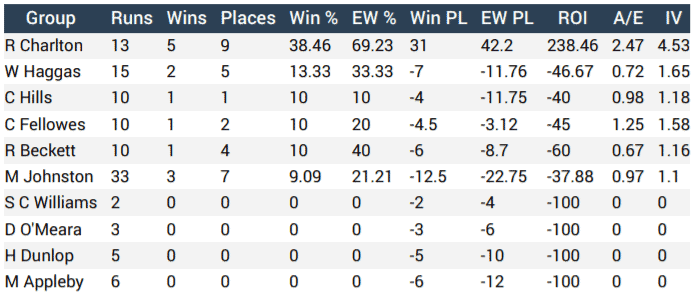
Looking at class 2 handicaps specifically now:

Trainer record at Newbury in class 2 handicaps

Roger Charlton now jumps ahead of William Haggas with a 38.46% strike rate which is almost 3 times as strong as that of Haggas. Charlton is the only one of these trainers producing a profit in class 2 handicaps at Newbury and a very healthy profit at that (31 win profit).

The data is a bit more limited here but it certainly seems Roger Charlton is sending his better handicappers to Newbury whereas Haggas is mopping up some of the lower grade handicaps.

Let’s take a look at the runners from the Haggas and Charlton yards in this race. William Haggas runs Jahbath whilst Roger Charlton saddles Tempus.

Jahbath is 4 from 5 on the all weather and 0 from 2 on turf but that doesn’t tell the whole story. His turf runs have bookended his career to date with his debut effort coming at Salisbury in a race where he only narrowly lost out to Clara Peeters who would go on to rate in the high 80s. He was conceding experience and 6lbs on that day so it was clearly a strong effort.

His most recent turf run came after a 476 day break and although beaten more than 5 lengths, he was a creditable enough 4th on soft ground at Haydock over this one mile trip. How much he’ll improve with that run under his belt on slightly better ground is difficult to gauge.

Tempus hasn’t run for 302 days which is an unknown so it’s worth comparing Roger Charlton’s record with fresh horses in handicaps with his overall handicap record.

Roger Charlton's record in handicaps since 2009 with runners returning from a 60+ day break

Roger Charlton's record in handicaps since 2009 with all runners


Since 2009 Roger Charlton has had 294 handicap runners returning from a 60+ day break and they have produced a 16.67% win rate and a 50.18 win P&L. Comparing that to all his handicap runners in this time, the strike rate is slightly improved at 17.95% but the P&L is –48.43. The market is clearly underestimating Roger Charlton horses after a break. It’s worth noting of course that a 302 day break is pretty extreme and the horse has obviously had some issues keeping him off the track.

Tempus has only had one run in handicap company and that was a slightly disappointing 4th, beaten 1.5 lengths at Wolverhampton over their extended mile. He had previously beaten Lyndon B, subsequently rated 97, giving that horse 6lbs. Given Tempus only has a mark of 91 it’s probably a fair assumption that the most recent run wasn’t his best form and whatever issue caused him to miss 10 months of racing probably affected him during that race.

Roger Charlton’s record in Newbury handicaps, and Newbury class 2 handicaps in particular, are quite enlightening. The fact that the market seems to be offering value on his runners after a break adds confidence to the feeling that Tempus might be underestimated here. His most recent turf effort, in testing conditions, suggests he is well handicapped and he could take all the beating in this race on Saturday afternoon, which is live on ITV Racing.

Monday Musings: The Month Long Day

Four weeks in and I don’t know about you, but it’s almost impossible to tell the days apart, writes Tony Stafford. I know I’m writing this on what they tell me is Easter Sunday; but with little varying day to day – even the weather, with the sun blazing incessantly and perma-warm temperatures – what we have had is a totally homogenised month.

The initial shopping frenzy has cooled. I act as driver for our once-a-week taxi journey a few miles to the usual supermarket where I stay secure in the car with the windows firmly closed while Mrs S does the six-foot-apart car park snake towards the entrance. Inside, she assures me, she scrupulously adheres to the one-way arrows on the floor and reckons she’s almost the only shopper who does. Food is available now and thousands have died as we proceed in our frozen state.

The Racing Post, predictably and understandably, has been forced to reduce the size of its daily computer newspaper usually to eight pages, so I’ve no idea if the birthdays remain available. For my part I just have a quick squint before looking elsewhere.

I mention birthdays because Easter Sunday would have been the 100th birthday of my father had he not died 18 years ago. For years I regretted he had never seen the development of the Olympic Park, part of his home turf for all his life, apart from the six years he had to give up to join in the Second World War, which he spent mostly in Egypt. Not only did he not see the Olympics, he never knew they were coming. My mum was still alive and I can still picture sitting with her as the announcement that the Games had been won and would be staged in London in 2012 was broadcast to the nation.

Dad took me racing, to Arsenal and to the Oval as a kid, three pastimes that have never wavered in my interest. His principal goal in life seemed to be to ensure that I joined Eton Manor boys sports club as soon as I could, which meant on my 14th birthday.

Sixty years on, we took our permitted walk on Saturday with a puffing Yorkshire terrier, close to the River Lea, on the same land where I’d played so much of my cricket as a kid. I had even contrived to play in a match there rather than watch the World Cup Final in 1966, three years after – between innings – watching the famous Irish Derby when Relko, the runaway Derby winner, had to be withdrawn lame a few minutes before the start. That left the nine-length Epsom third Ragusa to step up.

Working for the racing press led me to so many places and a great deal of the more unlikely connections came from making summer trips to Kentucky when Keeneland still had the July Selected Yearling sale. In the late 1980’s I’d bumped into the former teen idol David Cassidy there, so when on Friday I noticed that an hour and a half documentary was to air promising the last recordings of the life that ended aged 67 three years ago, it was required viewing.

The all-encompassing years when his role in the antiseptic TV show The Partridge Family, which led to his becoming the most-worshipped pop star of the early 1970’s, were already way behind him. He got into racing and breeding and a couple of times we happened to be in the same company at dinner in the famed Dudley’s restaurant in downtown Lexington.

Then at Epsom on Derby Day 1987, I noticed someone in morning dress looking over at me. It was David, and he said he recognised me from Kentucky and asked where could he get a good view of the big race? It was the days of the old Epsom grandstand – two structures ago! -and I said I could sneak him up to the top of the Press stand.

As an American, he got a great thrill seeing his compatriot and friend Steve Cauthen coming home clear on Henry Cecil’s all-the-way winner Reference Point. Cassidy was in London that summer having taken over the leading role originally played in the West End by Cliff Richard in the musical, Time. He invited the family to see the show and asked the five of us backstage to his dressing room afterwards. He seemed a very nice chap and it was salutary to discover from the documentary the problems he had with his own father, the film star and famous tenor, Jack Cassidy.

Even more devastating was the evidence of his dementia, which as he honestly and perhaps possibly for the first time in his life, stated in interviews was caused by alcoholism.

Mortality is being brought home to us every day right now. One person whose recovery from coronavirus was revealed recently was Sir Kenny Dalglish, who shares a birthday with me. It’s so random who will be struck down next, you just have to keep out of harm’s way as much as you can.

Racing is going on in a few selected areas around the world under strictly-controlled circumstances, and two people who have been delighted that Australia has kept going are William Haggas and Tom Marquand. On Saturday at Randwick, taking advantage of the retirement of Winx, winner of the previous three runnings, they stepped up to win the Queen Elizabeth Cup with Addeybb by almost three lengths from Verry Elleegant. The near £700,000 first prize will no doubt have been causing envious glances from their training and riding counterparts around the UK.

Addeybb was following up his victory in another Group 1 10-furong race at Rosehill last month when he beat Verry Elleegant by only half a length. Forty minutes before the Queen Elizabeth Cup, the pair teamed up with recent Australian Group 3 winner Young Rascal, the 19-10 favourite for the two-mile Sydney Cup. Young Rascal disappointed, finishing unplaced and well behind former stable-companion Raheen House, who was a close third a week after winning a 50k prep race over the same track.

I see from the now long list of owners that Lew Day, who originally bought the six-year-old as a yearling on the advice of Sam Sangster and his first trainer Brian Meehan, still has his name as part of the syndicate. I’m delighted that he will have picked up a few pounds, or rather Aussie dollars, from his now far-away involvement.

On the same card, another well-known name, Con Te Partira, a winner at Royal Ascot for the Wesley Ward stable in 2017, collected a big prize for mares, the Group 1 Coolmore Legacy Stakes. The daughter of Scat Daddy was winning her third race for the Gai Waterhouse stable and will be worth a fortune when she eventually goes to stud. What price Royal Ascot, even behind closed doors, this year?

 - TS