In this sixth and final piece in the trainer performance by age jigsaw, I will be looking at the how trainers have fared with their with older runners, specifically those aged four and upwards. As with the previous articles in the series I have used UK flat racing data from 1st January 2016 to 31st December 2021 giving us six full seasons to examine. The results include turf and all weather racing.
I have used the Geegeez Query Tool once more for all data analysis, and all profits / losses have been calculated to Industry Starting Price, although as we know these figures will be improved using either BOG, early prices or the exchanges.
Let us start by specifically looking at trainer performance with four-year-olds only.
General trainer performance with 4yo runners
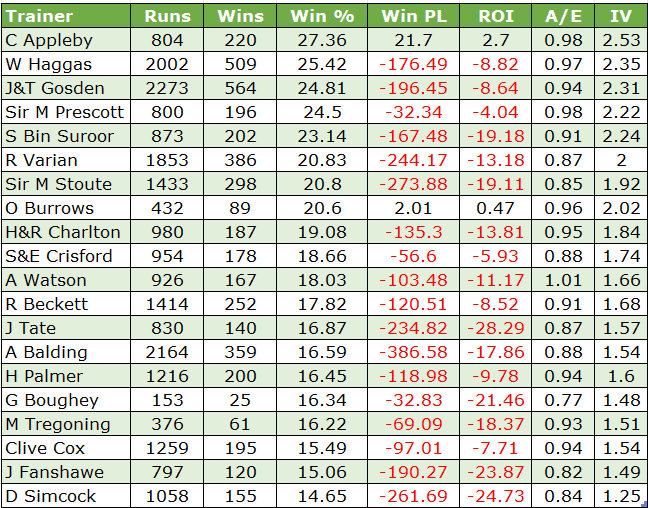
Many top trainers lose their stable stars at the end of their 3yo campaign, usually to stud or to race overseas, but a few top quality animals continue domestically into their fourth year. Here are the top 20 trainers in terms of strike rate with their 4yo runners (minimum 150 runs). The data include both handicap and non-handicaps. It should be noted that the vast majority of races that 4yos compete in are handicaps:
There is a smattering of profitable trainers here; six to be exact. This includes the Gosden stable, and they have also secured the highest win strike rate. Nine of the 20 have achieved an A/E index of 1.00 or more suggesting that their runners have been good value as a whole. While on the subject of A/E indices, here are the remaining trainers who have achieved an A/E index of over 1.00.
That's another 15 trainers, making 24 in total. The chart includes several names we have not seen too often before and I would put many of these in the underrated trainer category.
Before digging into some of the individual trainers in more detail I want to look at a different measure of 4yo performance. To wit, I am going to focus on the top ten trainers in the table and look at the percentage of their runners that won at least one race as a 4yo. The reason for doing this is that some trainer figures can be skewed a little if they have winners of multiple races in their yard. To calculate this we take the number of a trainer’s 4yos that won at least once as a 4yo and divide it by all the horses that ran as a 4yo; that gives a decimal and then we multiply it by 100 to give the percentage. Here are the findings:
Four trainers have secured percentages in excess of 50% with Chris Dwyer hitting a very impressive 75%. It should be noted Dwyer has only had 24 individual 4yo runners in total but for 18 of them to win at least once is very impressive. Of the six that didn’t manage a win as a 4yo, five made the frame at least once. William Haggas is close to the 60% mark which, considering he has saddled 126 four-year-olds in the study period, is impressive. At the other end of the scale, Charlie Appleby’s and Team Crisford’s figures are lower than expected.
Now, of course, these figures could also be skewed if several 4yos in a stable have run just once or twice in the season. However, looking at the overall data, most trainers have similar spreads when it comes to number of runs for their horses.
Individual Trainer Performance with Four-Year-Olds
Moving back to individual trainers and their overall performance, let me drill down first into the performance of John and Thady Gosden. Here are some key stats:
If you had backed all Gosden 4yo runners at Betfair SP the profit would stand at £73.24 equating to returns of 18p in the £.
Their female 4yo runners have performed exceptionally well with 36 wins from 126 runs (SR 28.6%) for a profit of £54.97 (ROI +43.6%).
In Group 1 races, the Gosdens have saddled 12 winners from 48 for an excellent 1 in 4 strike rate; in Group 2 contests this improves to 15 wins from 43 (SR 34.9%) showing a profit of £32.66 (ROI 76.0%).
The best performances have been at distances of 1m2f or more where they have secured a 26% strike rate and returns of 9p in the £.
The Gosden stable has shown good consistency with their 4yos and this is illustrated when looking at their performance at different courses. Their win SR% are shown below (minimum 15 runs):
All tracks bar Newmarket have figures of 20% or higher. Chelmsford is a clear leader thanks to 7 wins from 16.
A look at William Haggas now and his strongest stats:
Amazingly, his male and female runners have hit exactly the same win strike rate% of 21.4%.
4yos that have started favourite for Haggas have delivered with 65 wins from 174 runners (SR 37.4%) for a profit of £21.77 (ROI +12.5%). His second favourites have also proved profitable returning just under 15p in the £ from a 23.5% strike rate.
Haggas is not one for sending 4yo runners to the front that often but when he does they have won 34% of their races (17 wins from 50).
He has struggled a little at the very elite level with 0 winners from 19 in Group 1 races, although five did place. He has a better record when the level drops to Class 3 races or below; here he has secured 56 wins from 176 (SR 31.8%) for a healthy profit of £37.41 (ROI +21.3%).
Onto a few of the other trainers now and their strongest stats:
Grant Tuer is an impressive 24 from 44 (SR 54.5%) with favourites. Backing all of them would have seen a profit of £26.97 (ROI 61.2%).
Sir Michael Stoute has an excellent record on the all weather – 26 wins from 70 runners (SR 37.1%) producing returns of 24p in the £.
Saeed bin Suroor has made a small 5p in the £ profit with horses priced 8/1 or shorter. Longer priced runners (above 8/1) have lost over 64p in the £ due to just 2 winners from 88.
Chris Dwyer has saddled 12 winners from 46 runners when using 3lb claiming jockeys. They have produced a profit of £43.88 (ROI 95.4%). Also it should be noted that seven different 3lb claimers have secured at least one win. Hence these figures are not skewed by one jockey.
William Knight has a decent record on the all weather hitting a win rate of slightly better than 1 win in 5. He is 8 from 18 at Wolves and 5 from 11 at Newcastle.
Individual Trainer Performance with Five-Year-Olds and upwards
Moving up in age now let's look at all runners aged five and older. Only trainers with 200+ runs have been considered. Here are the top 20 in terms of win strike rate:
As we get into the realms of more exposed and generally less elite horses, we see quite a few new trainers on the list when compared to previous tables in this series of articles. Making a profit however, is hard to come by as one would expect. Just two trainers were in profit at SP across the six year period, and both were barely in profit at that. It is, however, good to see ten trainers with A/E indices of 1.00 or more, implying they might offer value.
Roger Varian leads the table but he has made significant losses of around 32p in the £.
John Quinn has the best record as far as returns are concerned and these are some of his stronger stats:
Quinn has made all his profits in turf races (returns of 16p in £). In all weather races he has had losses of 30p in the £.
Shorter distances of 7f or less have produced the best overall performances with 48 wins from 256 runners (SR 18.8%) for a profit of £71.62 (ROI +28.0%).
He has a 23% strike rate in non-handicaps; 11% in handicaps.
Jockey Jason Hart has ridden over half of Quinn’s older runners securing a return of 16p in the £ over 260 rides.
It needs to be appreciated that horses aged five and older, especially handicappers, are typically not going to be the most consistent animals. Although if we look at Quinn’s yearly win strike rates they are all similar except for 2021, where his runners probably over-performed compared with previous seasons:
I thought it may be interesting to compare trainer performance when we split the older runners into two age bands – 4yos & 5yos, and 6yos and older - comparing Win% (SR%), A/E indices and Impact Values. To qualify a trainer needed at least 100 runners in each age band.
The right hand columns compare the 4 & 5yo Win% data with the 6yo+ Win% data by creating a ratio of one to the other. The greater the number above 1.00, the more 4 & 5yos are favoured; the smaller the number below 1.00, the more 6yos and older are favoured. Any A/E value of 1.00 or more has been highlighted in blue. I have also highlighted any win ratio of 1.4 and above or 0.7 and below. These ratios help to highlight where there is a significant difference in the Win SR%:
It is worth noting that both Derek Shaw and Rebecca Menzies have achieved A/E indices of 1.00 or more in both age bands. That is high achieving in this context. William Knight was close also with figures of 1.1 and 0.99. Meanwhile, Jane Chapple-Hyam’s strike rate for four- and five-year-olds is double that of her six-year-old and up group. She is the only trainer to attain a win ratio% of over 2.
And that brings the final curtain down on this trainer series. Hopefully you have found some nuggets within the six ‘episodes’ that will aid your betting and produce some additional profits. For me, it’s time to start some new research on a different aspect of racing. Until then, you'll find links to the other five articles below; and may I wish you the very best of luck with your punting.
- DR
https://www.geegeez.co.uk/wp-content/uploads/2018/11/johngosden_churchilldowns_BreedersCup2018_830x320.jpg320830Dave Renhamhttps://www.geegeez.co.uk/wp-content/uploads/2022/10/geegeez_banner_new_170x78.pngDave Renham2022-08-29 07:52:042022-11-10 11:57:57Trainers with older runners (4 and up)
This is the fifth article in a series where I have been digging into the performance of trainers' runners of specific ages over the past few seasons, writes Dave Renham. I have used UK race data from 1st January 2016 to 31st December 2021 giving us six full seasons to examine.
My focus in this second part of the series is on three-year-old (3yo) runners and, following on from my previous piece, I have used the Geegeez Query Tool for all of the number crunching. All profits / losses have been calculated at Industry Starting Price. I appreciate most punters do not use SP these days as many (quite rightly) take advantage of early prices, Best Odds Guaranteed and / or the exchanges.
I looked in depth at non-handicap data last time; this time the focus is three-year-old runners in handicap races. Note, these could be three-year-old only or three-year-old and up handicaps.
To start with let us overview all 3yo runners in handicaps before breaking the data down.
Here are the top 20 trainers in terms of strike rate with their 3yos in handicaps (minimum 150 runs):
Many of the usual suspects appear in the list but there are a few names - such as Chris Wall, Ron Harris and Heather Main - we have not seen prominently before. Eight of the 20 are in profit, which is surprising, but it will be interesting to see which of the profitable trainers have skewed figures due to one or two big-priced winners. In order to see whether this has been the case, the below table shows these eight trainers when their runners returned 8/1 or shorter. This takes any outliers out of the equation. Here are the figures:
Four of the eight have remained profitable, while three of the others were profitable to Betfair SP, with only Clive Cox remaining in the negative. Here are some individual highlights:
Owen Burrows has a good record with his 3yo handicappers who are in the top three of the betting – 39 wins from 124 runs (SR 31.5%) for a profit of £39.73 (ROI +32.0%).
Sir Mark Prescott has a decent record when using claiming jockeys. 13 wins from 43 (SR 30.2%) for a small profit of £9.94 (ROI +23.1%). His 3yo handicappers that wear cheekpieces have a surprisingly good record, too. 46 wins from 154 runners which equates to a win strike rate of just under 30%. They have returned an impressive 25p in the £.
Marcus Tregoning has performed considerably better with male 3yo handicappers as compared to female ones. His male runners have won over 21% of their races; his female runners have won less than 10%. The each way figures are equally skewed (42% versus 27%). Tregoning has also done well with favourites, scoring 21 times from 51 (SR 41.2%) for a profit of £18.54 (ROI 36.4%).
It looks best to ignore Charlie Fellowes if he is using a claiming jockey as only 2 of 37 such runners have won. On a more positive note, in the better handicap races of class 2 to 4 he has hit a 20.8% win strike rate for a profit of £137.48 (ROI +94.5%).
Ron Harris and front runners have been a potent combination thanks to 27 wins from 81 runners. Compare his win strike rates for the different run style groups below:
A 3yo front-running handicapper for Harris is a horse we ought to be on!
In terms of A/E indices there are 19 trainers who have managed a figure of 1.00 or more (150 runs or more). They are shown in the graph below:
These trainers have offered good value over the past six seasons with their 3yo handicappers. 11 of the 19 have secured profits to Industry SP; 14 were profitable to BSP. Ron Harris has the highest A/E value, at 1.31, followed by Roger Teal (1.26) and George Margarson (1.25). It's always good to see some new trainers, especially less familiar ones, on this list. Teal has a notably good record with favourites (8 wins from 19) for a 56p in the £ return, while Margarson, when teaming up with jockey Jane Elliott, has secured 14 wins from 62 for an outstanding return of 144p in the £.
Handicap races broken down by distance
Now let's break down trainer 3yo handicap runner performance by distance. I am going to look at sprint distances first.
3yos in handicaps over 5 to 6 furlongs
In the table below I have restricted it to trainers who have had a minimum of 75 runs or more, with the top ten in terms of strike rate shown:
Ed Walker tops the table so let's start with him in terms of some additional sprint handicap stats to share:
All bar one of Ed Walker’s winners have returned single figure prices. His record therefore with horses priced 9/1 or shorter has been impressive – 38 wins from 146 (SR 26.0%) for a profit of £52.93 (ROI +36.3%).
Ron Harris has secured a 22.5% win strike rate over 5f, but this drops markedly to 13.3% over 6f. Nevertheless, he has been profitable to follow over both sprint trips.
Amy Murphy has an outstanding record with her fillies (female runners). She has had 12 wins from 48 runners (SR 25.0%) for a profit of £56.37 (ROI +117.4%).
Andrew Balding’s runners have done well when they have been fancied. Combining his favourites and second favourites has produced 21 winners from 65 runners (SR 32.3%) for a healthy profit of £29.86 (ROI +45.9%).
3yos in handicaps over 7f to 1 mile
Onto 7f to 1 mile races next – here is a bar chart showing the trainers with the highest win strike rates:
At these Classic type distances, we're back to some of the biggest hitting trainers here and there are some strong individual stats to mention:
The Gosden team have visited Yarmouth a dozen times with their 7f-1m 3yo handicappers and a remarkable eight have won.
All 28 of Charlie Appleby’s winners were priced 8/1 or shorter. He is 0 from 18 (2 placed) from runners bigger than 8/1. Also his higher weighted runners (9st 1lb or more) have done well, with 27 wins from 84 (SR 32.1%) and a profit of £17.49 (ROI +20.8%).
William Haggas has made steady returns of 9p in the £ with horses first or second in the betting.
Andrew Balding has done well with his shorter priced runners. Those priced 3/1 or shorter have seen 41 wins from 108 (SR 38.0%) for a profit of £13.35 (ROI +12.4%).
Clive Cox has an excellent record with favourites – 30 wins from 74 (SR 40.5%) for a profit of £20.61 (ROI +27.9%).
3yos in handicaps of 1m 1f to 1m 2f
Let’s check out the stats for 9 and 10 furlong handicap races now. A look at the top ten trainers in terms of win strike rate:
There are some impressive strike rates for handicap races with all ten trainers in the table hitting at over 18%. Four of the ten are in profit including the big guns of Stoute, Charlton and bin Suroor, while six have A/E indices of 1.00 or more.
It is worth noting that the Charlton stable has been profitable in five of the six seasons which shows excellent consistency. They have also managed a yearly strike rate of 19% on five occasions. Despite Saeed bin Suroor’s positive record, the last two seasons have been poor for him with just a single win from 20 starters in this distance range.
There are three trainers (Johnston, Hannon and Fahey) that have had over 400 qualifiers but their strike rates were not good enough to make the top 10. For the record here are those volume trainers' figures:
All three are well off overall profitability. However, Richard Fahey has done well with fancied runners over these trips. His first and second favourites have produced 27 winners from 82 (SR 32.9%) for a profit of £28.17 (ROI +34.3%).
3yos in handicaps of 1m 3f to 1m 4f
The final distance group to check out is 1m 3f to 1m 4f, as races of 1m 5f or more offers only a modest dataset with which to work. The top ten are shown below along with their strike rates:
A bigger proportion of these trainers are in profit with seven managing positive figures and it's good to see Marco Botti, William Knight and Alan King getting into the top 10 to freshen things up a little. A look at their A/E indices and Impact Values now:
Seven of the ten have A/E indices over 1.00 which is excellent, and with reasonable correlation, too.
Distance comparison – individual trainers
I thought it would be useful to end this article by comparing individual trainer strike rates across the four distance groups. To qualify for a figure, each trainer needs to have had at least 60 3yo handicap runners in the relevant distance group. Trainers that have had enough runners in at least three of the four distance ranges are shown. Hence any gaps simply mean that trainer did not have 60 or more runners in the distance group. The table is also colour coded with strike rates of 20% or more in red (hot); strike rates of under 10% in blue (cold) :
William Haggas is the only trainer to have secured a strike rate of over 20% in all four distance groups. Sir Mark Prescott has achieved that in three of the groups.
It is interesting to compare trainers in this way with some very consistent figures across the board (for example, Charlie Hills and Michael Bell); others vary quite a bit – William Knight, Alan King and Marco Botti being three who have both red and blue figures.
Few handicap races are easy puzzles to solve, and many 3yo runners are still developing and looking for their optimum distance. I hope the trainer statistics in this article help to point you in the right direction.
The final piece in this series will look at trainer performance with older runners. Until then...
- DR
https://www.geegeez.co.uk/wp-content/uploads/2022/08/sirmarkprescott.jpg320830Dave Renhamhttps://www.geegeez.co.uk/wp-content/uploads/2022/10/geegeez_banner_new_170x78.pngDave Renham2022-08-22 14:21:392022-11-10 11:58:43Trainers with Three-Year-Old Runners, Part 2
This is the fourth article in a series where I have been examining the performance of trainers with certain age groups of horses over the past few seasons, writes Dave Renham. Data for these articles have been collated from 1st January 2016 to 31st December 2021 giving six full seasons to examine (UK racing only).
For this piece my focus will be three year old (3yo) runners and I have used the Geegeez Query Tool as the sole tool to gather the data. All profits / losses have been calculated to Industry Starting Price. Of course, as punters we should be able to significantly improve upon these figures by using early prices, Best Odds Guaranteed and / or the exchanges.
3yos have a special place in UK flat racing as this is the age in which they contest the ‘Classics’: the 1000 & 2000 Guineas, the Oaks, the Derby and the St Leger. Hence, one of the primary focuses for several trainers is their 3 year old battalion. As a result, one might expect trainers to use similar methods, strategies and plans each season with their 3yos. Thus, as punters, we may - I hope! - be able to exploit some patterns.
First, let me look at all 3yo runners before breaking the data down. Three-year-olds may race in 3yo only races and also in 3yo+ races where they will typically take on older, more experienced runners. Both race types are included in the data below.
Here are the top 20 trainers in terms of strike rate with their 3yos (minimum 150 runs):
It is worth noting that 16 of these twenty trainers were in the top 20 strike rates for their full 2yo race records during this six -year period (see article 1). Moreover, if I had ordered the table by Impact Value, 19 of the twenty would have remained in the list; only David Simcock would not have made it. Just two of the twenty have made a blind profit to SP but, considering how many runners they have had, this should come as no surprise. If we consider Betfair SP, then nine of the twenty would have been profitable to follow.
Charlie Appleby tops the table in terms of strike rate, just as he did with his 2yos. The Godolphin operation, for whom he works, continues to be such a powerful entity, churning out quality runners year in year out. Let's dig down into his 3yo data set:
Every year has seen a win strike rate of better than 20%, with the last four seasons all above 25%. There's good consistency there, and when we look at his yearly A/E indices we see a similar pattern:
Figures of 1.00 or more indicate good value selections and in three of the six years Appleby has managed that.
We saw in the first two-year-old article that, in terms of the sex of Appleby’s 2yo runners, he has been more successful with male runners than female runners. This has been replicated with his 3yos as the table below shows:
It should be said that the master of Moulton Paddocks has run many more male 3yos than female ones but, even so, the figures show that his male runners are the ones on which to concentrate: a return of 9p in the £ to SP is excellent.
It is also worth looking at the records of the three jockeys who primarily ride for Appleby:
William Buick is the main jockey used and his record is outstanding with a win strike rate edging towards 30%, and decent returns of 18p in the £ to boot. Buick has been amazing from the front on Appleby 3yos: when he has gone into an early lead he has won an incredible 36 races from just 73 rides, just shy of a 50% strike rate!
Adam Kirby’s record is also impressive; indeed last season (2021) he had 19 rides of which 10 won (SR 52.6%). James Doyle’s figures are a little below the other two, but are still extremely solid.
Sir Mark Prescott comes into his own with his 3yo runners. His overall strike rate with the Classic generation is more than three times higher than with his 2yos, the younger age group having a win SR% of a measly 7.3%. Similar to Charlie Appleby, there is a big difference between his male and female runners. In fact, it is even more stark as the table below shows:
A strike rate differential of over 10% between the two is enormous: in relative terms Sir Mark's colts and geldings perform 55% better than his fillies.
Prescott’s 3yos also have a good record when they front run, recording a 37% strike rate overall. It is interesting to note that this Win SR% increases to over 42% with 3yo front runners racing over distances of a mile and half or more. Here, he has secured 32 wins from 75 starters. We know from previous articles that win percentages for front runners are higher at shorter distances so these figures for horses racing at long distances are quite remarkable.
Anyone who knows about Sir Mark Prescott will not be surprised by the following comparison between his handicappers and non-handicappers:
Prescott’s three-year-old handicap runners win more than twice as often as his non handicappers - 27% vs 13% - and there is a similar pattern when you compare the each way strike rates. His handicappers have essentially broken even at starting price and would have returned just under 10 pence in the £ if using BSP.
Another stat which I am very impressed with is that 57% of all Prescott’s 3yo horses that have raced in handicaps won at least one race. Further, 13 horses managed to win four or more times! Prescott is the undisputed master at getting multiple wins out of his 3yos.
Before moving on here are some other 3yo stats for individual trainers which caught my eye:
William Haggas has an excellent record at the distance of 1 mile 4 furlongs. He has saddled 226 runners over this distance of which 82 have won (SR 36.3%). Backing all runners would have secured a tidy £55.41 profit (ROI +24.5%). His A/E index in this context stands at a hugely eye-catching 1.26.
Owen Burrows has a good record with 3yos in handicaps with horses near the top of the weights. Those carrying 9st 4lb or more have produced 28 winners from 103 runners (SR 27.2%) for a profit of £37.15 (ROI +36.1%).
Clive Cox and William Haggas are the only two trainers from the top 20 who have secured a profit with their runners sent off as favourite.
Saeed bin Suroor is not one to back at bigger prices. His runners priced 12/1 or bigger have produced just one score from 105 runners.
The Gosden stable has secured a 20% win strike rate in Group 1 races, which is excellent considering this is the top level of racing. If you restrict Gosden runners to those that started 8/1 or shorter, the record improves to 14 wins from 44 (SR 31.8%) for a profit of £9.71 (ROI +22.1%).
Non-handicaps versus handicaps
Up to this point I have not split the data between non-handicaps and handicaps. In my next article, I will look at some of the 3yo handicap data, so for the rest of this piece I will concentrate on non-handicap races only.
Non-handicaps races broken down by distance
As we saw back during the first article in the series, 2yos have a ceiling in terms of the maximum distance over which they can race in the UK. However, with an extra year on their backs, 3yos are able to run further than 2yos, although - in overall terms - they rarely run further than a mile and a half. In fact, a mere 2% or so of all 3yos race in non-handicaps of 1m5f or more. Around 85% of all 3yo non-handicap runners race at 1m2f or less, with the highest proportion of these over 7 furlongs and 1 mile.
It's time to break trainer 3yo non-handicap performance down by distance. I am going to look at sprint distances first.
3yos in non handicaps over 5 to 6 furlongs
In the table below I have restricted it to trainers who have had a minimum of 60 runs or more, which actually only gives me 26 trainers in total. Hence with this number of trainers it makes sense to give the data for all of them:
It is interesting that Irish maestro Aidan O’Brien lurks at the bottom of the list with a win SR% of below 5%. Additionally, there are a few different trainers from those who normally appear in our 'top xx' lists which is good to see. Specifically, none of the following trainers had enough runners to qualify: Charlie Appleby, Saeed bin Suroor, Sir Michael Stoute, and/or the Gosden and Charlton stables. These trainers tend to target bigger prizes with their 3yos which are generally contested over longer distances.
When we look at the A/E indices, 12 of the 26 trainer have hit 1.00 or bigger – these trainers have essentially been good value to follow over this six year period with their non handicap sprinters.
Roger Varian tops the table in terms of strike rate, recording an impressive 35.79%, and he has made a decent profit with them, too. Varian is six from ten at Salisbury and six from 11 when sending these runners to Doncaster. He has also secured a win strike rate of better than 25% in five of the six seasons. In terms of starting prices, Roger has had only one double digit winner (12/1) while 28 of his 34 winners have been priced 5/2 or shorter.
David Simcock is second on the list in terms of win% and, when his horses start favourite, they have performed extremely well – 12 wins from 20 starters (SR 60%) for a profit of £10.63 (ROI +53.2%).
Before moving on, there are some interesting Running Style snippets to share with you. As regular Geegeez readers will know, I am a big fan of front runners, especially over the shorter distances, and certain trainers have excelled with such runners in 3yo non-handicaps over 5 and 6 furlongs. This is especially true when we compare performance to their record with hold up horses in the same cohort of races. The graph below shows a group of trainers and compares the two strike rates – the blue bar is SR% for front runners (early leaders); the orange bar is the SR% for hold up horses.
There are some massive differences here; yes, the sample sizes are modest but the figures are striking nonetheless. Clearly if one of these trainers saddles a 3yo in a 5-6f non handicap, you would prefer it to go straight to the front. If it does, its chances of winning seem to be massively increased.
3yos in non-handicaps over 7f to 1 mile
Let's now move on to 7f and 1 mile contests; this is the biggest data set we have in terms of the distance splits. This time, I have used 75 runs as a minimum to qualify and these are the top 15 trainers by strike rate first:
Some of the bigger stables now begin to show their hand although, as can be seen, it has been hard to make a profit to Industry SP. Just the two trainers (Saeed bin Suroor and Archie Watson) have exceeded 1.00 with their A/E indices. As a consequence, there are not that many positive trainer stats to dig up with this top performing group's miler(ish) 3yo non-handicappers, but here are a few that I thought were notable:
The Gosden stable has secured a 46.5% win strike with front runners in 7f-1m non handicaps – 53 winners from 114 runners; they have also managed a 1 in 3 win rate in all-weather races producing a small profit of £2.75.
When William Haggas has booked the services of jockey Jim Crowley, they have combined to win 19 out of 36 races (SR 52.8%) for a profit of £14.35 (ROI +39.9%).
Saeed bin Suroor has a good record with favourites in these races; 41 wins from 74 (SR 55.4%) for a small profit of £5.70 (ROI +7.7%).
Charlie Appleby has saddled just one winner sent off bigger than 7/1 from 35 runners. As ever it seems best to stick to his more fancied runners.
3yos in non-handicaps of 1m1f to 1m2f
Let’s check out the stats for nine- and ten-furlong three-year-old non-handicap races now. First a look at the top ten trainers in terms of win strike rate:
Charlie Appleby edges over the 30% wins to runs mark which is mightily impressive. His runners have made a good profit to Industry SP, returning nearly 14 pence in the £. He is the only one of the top 10 in profit, though the Gosden, Johnston and Varian stables would have sneaked into the black using Betfair SP.
A look at their A/E indices and Impact Values now:
The Impact Values correlate well with strike rates as you would expect; in terms of A/E indices, only Hugo Palmer has a poor figure at 0.79; Charlie Appleby hits the magic 1.00 mark, while Messrs. Gosden, Haggas, Varian, and Balding are all above average (over 0.90).
3yos in non-handicaps of 1m3f to 1m4f
The final distance group to check out is 1m3f to 1m4f, because - as previously mentioned - races of 1m 5f or more offers very little data with which to work. At this distance group (around a mile and a half), the data set is relatively modest so in the table below I am sharing all trainers that have saddled at least 70 3yos in these non-handicap events. They are ordered once again by win strike rate:
The records of the Haggas, Appleby and Gosden stable are particularly impressive at first glance. For the record, Hugo Palmer’s bottom line is skewed somewhat because he saddled a 66/1 winner (Morning Beauty at Haydock in 2018). He has also had big winners at 20/1 and 25/1.
Charlie Appleby has made huge profits and, with no winners returned greater than 16/1, his record is not badly skewed like Palmer's. Meanwhile, the longest priced winner for William Haggas was just 7/1; he is 0 from 22 with runner 15/2 or bigger. With horses 7/1 or shorter his returns stand at 34p in the £ which is highly impressive. The Gosden stable has struck with close to 55% of their favourites in 3yo non-handicaps over 1m3f-1m4f and produced a very small profit; furthermore, their record on the all-weather again sees Team Gosden hit an impressive win strike rate, at 38.3%.
Final Words
There is quite a bit of detail in this article to sink your teeth into. More than that, I hope it has given readers the incentive to personally dig deeper into different trainer records in 3yo non-handicaps. By using the Geegeez Query Tool you can extend this research to look at more specific ideas within the initial parameters that I have looked at. Once you've added the basic rules to the QT filters, see image below, it will take you literally seconds to check your ideas.
Please post any useful findings in the comments below. For me, it is time to research the follow up to this piece.
- DR
https://www.geegeez.co.uk/wp-content/uploads/2020/04/rogervarian.jpg319830Dave Renhamhttps://www.geegeez.co.uk/wp-content/uploads/2022/10/geegeez_banner_new_170x78.pngDave Renham2022-08-15 16:05:222022-11-10 11:58:57Trainers with Three-Year-Old Runners, Part 1
This is the second in a new series of articles where I will examine the performance of trainers over the past few seasons, writes Dave Renham. Throughout the series, I will be using data from 1st January 2016 to 31st December 2021 giving us six full seasons to examine (UK racing only). All profits / losses have been calculated to Industry Starting Price using £1 level stakes. Therefore these figures could be readily improved by using early prices, Best Odds Guaranteed and / or the exchanges.
In the first article of the series I looked at trainers in two-year-old (2yo) races, drilling down into non-handicaps and looking at how the distance of the race affected the results of individual trainers. In this piece I am going to examine course stats and annual breakdowns across all 2yo races, and then I will look specifically at 2yo handicaps. Once again I have used the Geegeez Query Tool as the sole tool for my data crunching.
First, then, let's delve into some 2yo trainer course stats. Below is a table of trainers who have achieved a strike rate of 20% or more and produced a profit to Industry SP. To qualify they needed to have at least 35 runners in the six-year period:
There is a good mix of trainers here; in fact we have 19 different handlers in total. Two appear three times each, the Johnstons and Karl Burke. There were a few other trainer course stats that were close to making it on the main list but just missed out. This was due to either not having quite enough runners, or the strike rate was just below the 20% benchmark I had set. However, I felt these were still worth sharing in a secondary table:
As can be seen, Archie Watson has made a decent profit at Lingfield on the turf course as well as on the all-weather strip. The Johnston stable appears for a fourth time so let's drill down into the course data in more detail for those most frequently listed trainers:
Charlie & Mark Johnston 2yo Course Stats
What follows are some extra nuggets regarding three of the four 'hot Johnston' courses that have been highlighted already:
At Chelmsford, their favourites have done particularly well with 21 wins from 38 (SR 55.3%) for a profit of £12.50. This equates to returns of just under 33p in the £; A/E index also a strong 1.29; IV is 4.03;
2yos (any odds) that took the early lead at Chelmsford have won 32% of their races (23 wins from 73);
At Bath over 1 mile or further the stable has 7 wins from 20 (SR 35%); over 5 & 6f it is a relatively poor 2 from 19 (SR 10.5%);
Over 1m1f at Epsom the Johnstons (either in tandem or just Mark) have only saddled nine runners but six have won;
Also at Epsom Francis Norton and Silvestre de Sousa both have five wins a piece from just ten and nine Johnston rides respectively.
The Johnston stable race all over the country so I thought it worthwhile looking at their 2yo A/E indices and Impact Values at each course (minimum 30 runs). The graph is split into two separate ones so they don’t get too cluttered:
One of the best things about using graphs like this is that you can judge how well the A/E indices and Impact Values correlate. In this case there is a very strong correlation. Also we can see that the courses that were highlighted earlier (Bath, Chelmsford, Epsom and Yarmouth) are four of the eight courses where the A/E index has exceeded 1.00, the others being Ascot, Newbury, Nottingham and Redcar.
The lower parts of the graph for both A/E indices and IVs show that the Johnston record is less good at Carlisle, Chester, Newcastle, Sandown and Thirsk.
These graphs are relatively easy to produce if you have Microsoft Excel as the data generated from the Query Tool can be copied straight into an excel spreadsheet. Hence you could do this with other trainers and their course stats if you had the inclination. In fact you can compare lots of different data from the Query Tool in this way, which is one of the many reasons why I personally use Geegeez so much.
Karl Burke 2yo Course Stats
We noted earlier that Karl Burke had good enough two-year-old course stats to make the ‘cut’ at three different tracks, so let us look at his ‘all courses’ data; again I am using graphical form but this time sharing Win Strike Rate percentages and Return on Investment. These can be charted in exactly the same way as per the video above but selecting the 'Win %' and 'ROI' columns. Firstly Win SR%s (again using 30 runs minimum to qualify):
There are some considerable course fluctuations, which is the case with the majority of trainers. We know already about Burke's excellent record at Carlisle, Nottingham and Pontefract, but on the flip side he seems to have struggled at Haydock, Newmarket and Redcar in particular. Let’s see how the ROI% graph correlates:
In general the correlation is sound, but the odd big-priced winner does tend to skew the ROI% when compared with the Win SR%. Doncaster has the highest ROI% by far but this is in part due to a 50/1 winner; the Newcastle returns have also been boosted somewhat, this time by a 66/1 winner.
What the Johnston and Burke course data tell us is that performance can vary considerably depending on the course.
Trainer Annual Breakdowns of Win Strike in 2yo races
In the first article in the series I compared Charlie Appleby’s annual 2yo runner breakdown in terms of strike rate. Here I am going to extend this to a further 14 trainers. To qualify, these trainers must have had at least 900 2yo runners in the past six seasons with at least 100 runs per season. This gives us a really solid data set to look at.
I will display the data in two ways; firstly in tabular form to display exact strike rates, and secondly in graphic form.
A look at the table first with the numerical strike rates displayed:
In general these figures look relatively consistent. It is usually easier to discern that by looking at the stats graphically, which I have presented below. Here I have published three trainers on four of the graphs and then two on the final graph.
Each trainer has a relatively level line although Andrew Balding had quite contrasting fortunes in 2016 compared to 2017 (19.72% dropping to 7.94%). Since then he has been much more consistent. We have to remember that each season the trainers get a different crop of 2yos and quality can fluctuate. So, while trainers are likely to have similar ‘types’ that cost similar money, 2yo crops can vary in class and ability.
The Johnston stable have had a couple of lean years by their own high standard in the past two seasons. That said, I’ve just checked this season’s figures to date (up to 18th July) and their strike rate for 2022 year is currently just under 23%. There seems to have been a small dip in Mick Channon’s results in the past three seasons and the A/E and IV figures back this up. He's currently hitting around the 10% mark in 2022.
Once again the figures for this trio are quite similar year on year. Roger Varian's and Ralph Beckett’s performance is similar but it is worth knowing that Beckett tends to offer punters more value.
It is also worth noting that Richard Fahey is having an outlier of a year to date in 2022. His strike rate, at the time of writing, is up nudging 18% and he has been profitable to the tune of 52p in the £. It will be interesting to see if he maintains this uptick for the rest of this season; statistically, it seems unlikely.
Tim Easterby has plenty of 2yo runners but success has proved hard to come by as can be seen by the green line in the chart above. William Haggas, meanwhile, generally hits close to the 20% mark; 2017 was above average for him whereas 2020 was below par. Tom Dascombe has been a solid performer who could be relied upon to hit around one win in seven on average, but his training career has essentially been reset by the loss of the Manor House Stables retainer - now with Hugo Palmer - and a relocation to Lambourn. He needs to be on the watch list only for the time being.
Richard Hannon and Karl Burke have figures that correlate closely with each other. They are both currently striking at around 14% for the first half of the 2022 season which is the type of performance level one might expect given the graph.
2yo handicaps (nurseries)
2yo handicaps, known as nurseries, begin annually in July and run until the end of the year when, of course, two-year-olds - like all horses - age by a year. Nurseries account for around 20% of all 2yo races in the UK. On average there are approximately 240 such races each year.
Let us first look at all trainers who have had at least 100 runners in nurseries in the past six seasons. I have ordered them by strike rate:
Ralph Beckett tops the list with an excellent overall record. He is close to scoring once in every four nursery races which is top drawer. Messrs. Dascombe, Ryan, Cox, Hills, Dunlop and Tinkler are the only other trainers to be profitable out of the 30 in the list.
Ralph Beckett in 2yo Handicaps
It is worth digging a bit deeper into the Beckett 2yo handicap stats. Here are my key findings:
In five of the six seasons Beckett has achieved a strike rate in excess of 20%, thus showing excellent consistency overall;
He has a much better record with male horses compared to female ones. Male 2yos have secured a strike rate of 29.5% which is roughly double that of his female nursery runners (SR 15.3%);
All Beckett's winners have returned 9/1 or less. Hence we have no big prices skewing these stats. Runners 10/1 or bigger have provided 0 winners from 29 with only two managing to place. Clearly it is best to focus on his more fancied runners;
Keep an eye on the official rating of his 2yos. Those rated 75 or higher have won 26 races from 73 runners (SR 35.2%) for a healthy profit of £43.37 (ROI +59.4%). Those rated 74 or lower have won 9 races from 74 (SR 12.2%) for a loss of £22.67 (ROI -30.6%);
Three courses where he has done particularly well in nurseries are Kempton (7 wins from 23), Newmarket (6 wins from 21), and Lingfield (6 wins from 13).
2yo Handicaps by Race Distance
Lastly, I will break trainer 2yo nursery handicap performance down by distance. I am going to split the distances into two – 5 to 6f (including 6.5f), and 7f to 1m.
The data for 1m 1f or more is too limited to give us anything concrete as only two trainers have had more than 25 runners in the time frame we are looking at. Having said that, it is worth mentioning that Richard Hughes has saddled 12 runners over 1m 1f+ and six have won!
2yo nursery handicaps over 5-6 furlongs
Sprint trips first, those being nurseries over five to six furlongs. In the chart below the top ten trainers in terms of strike rate are shown. I have restricted it to trainers who have had a minimum of 50 runs or more:
Archie Watson is the only trainer to get above the 20% mark although Tom Dascombe, Clive Cox, William Haggas and Kevin Ryan are not far away. Seven of the ten were in profit which is more than I would have thought – Haggas, Karl Burke and Mick Appleby showed losses.
Onto A/E indices now for these ten trainers which helps to show which trainers have proved the best value:
The trainers with the three lowest A/E indices are the three mentioned above that had incurred overall losses. We can see good A/E indices as a group here, however, with eight of the ten hitting over 1.00. Nigel Tinkler's and Rod Millman's figures are particularly impressive – they have proved exceptional value over the past six years in these races.
2yo nursery handicaps - 7 furlongs to 1 mile
Again a look at the top ten trainers in terms of strike rate; again 50 runs is the minimum to qualify:
We can now see more specifically where Beckett excels from a distance perspective. He has made a blind profit of £26.00 (ROI +26.8%) in nurseries over seven furlongs to a mile. Five of the other nine trainers in this cohort have proved profitable also – these being Charlie Hills, Ed Dunlop, Marco Botti, Team Johnston and Keith Dalgleish (who, incidentally, learned his trade as a jockey at Mark Johnston's yard). To be fair, Haggas and Hugo Palmer have lost under 2 pence in the £ which probably still equates to a profit at exchange or early best odds guaranteed prices.
The A/E indices are shown below:
Beckett (1.48) and Hills (1.37) stand out, while Dunlop, Botti, Dascombe and Dalgleish also are above the magic 1.00.
Distance comparison in nursery handicaps – individual trainers
I thought it would be useful to end this piece in a similar way to the first article by comparing the data for all trainers who have had at least 50 2yo runners in both 5-6f nursery handicaps and 7f-1m nursery handicaps. This time I am focusing just on the strike rates. I have included once again a Win% Ratio which can be seen in the right hand column. This is derived by comparing the short trip Win% with the longer trip Win% by creating a ratio of one to the other. The greater the number above 1.00, the more sprints are favoured; the smaller the number below 1.00, the more 7f-1m races are favoured.
Just 21 trainers have had enough runners to qualify for this table but it does give us the odd juicy titbit. Karl Burke, for example, has done significantly better in sprints (Win% Ratio of 2.34); likewise David Evans, Rod Millman, Archie Watson and Clive Cox seem to perform better with horses in the shorter distance nurseries. John Quinn and Tim Easterby also fall into that category but both their percentages are very low which makes it hard to profit from this knowledge. A couple of trainers have the Win% Ratio strongly favouring the longer trips, namely Charlie Hills (0.64) and Keith Dalgleish (0.67).
There are plenty of stats, graphs and tables to digest in this article and I hope they will point you in the right direction if betting in these types of races.
Until next time...
- DR
https://www.geegeez.co.uk/wp-content/uploads/2022/07/KarlBurke_AndriedeVries_Longchamp.jpg319830Dave Renhamhttps://www.geegeez.co.uk/wp-content/uploads/2022/10/geegeez_banner_new_170x78.pngDave Renham2022-07-25 18:41:342022-11-10 11:59:10Trainers in Two-Year-Old Races, Part 2
This is the first in a new series of articles where I will examine the performance of certain trainers over the past few seasons, writes Dave Renham. I will be using data from 1st January 2016 to 31st December 2021 giving us six full seasons to examine (UK racing only). For this piece my focus will be two-year-old races and I have used the Geegeez Query Tool as the sole source to gather the initial data. All profits / losses have been calculated to Industry Starting Price. Therefore one would expect that we could significantly improve upon the figures by using early prices, Best Odds Guaranteed and / or the exchanges.
Many punters latch on to specific trainers or groups of trainers as trainer patterns are quite a popular strategy for trying to beat the bookies. And there's logic in this: like all of us, trainers are creatures of habit, and follow a similar path year in year out. They generally stick to the same training methods, have favoured jockeys that they use where possible, know which races to target, and so on. This offers at least a reasonable chance that future results will correlate with prior ones. Let’s dig into the stats.
First, let's look at all 2yo races. Below is a table for the top 20 trainers in terms of win strike rate (minimum 150 runs across the six seasons):
These are ordered by strike rate and it is no surprise to see that a good proportion of the top trainers in the country are present. Only five of them have made a blind profit to SP, which is to be expected. For the record, yards of the Crisfords, Beckett, Palmer and the Charltons also nudged into profit if using Betfair SP.
Charlie Appleby’s record stands head and shoulders above the rest in terms of strike rate, his 30% strike rate with 2yos over six years being remarkable.
If we order by the A/E index, a measure of the perceived sustainability of profitability, then we get the following top 20:
Six of the trainers in the top 20 two-year-old strike rate table appear here as well. However, we have a much more mixed bag of strike rates as A/E indices focus on ‘value’. Any A/E index higher than 1.00 indicates the trainer gets more winners than expected which is why 10 of the 20 trainers in the list have been profitable to SP. 17 of the 20 would have been profitable using BSP.
Charlie Appleby's 2yo record
Time to drill down into a couple of individual trainers starting with that man Charlie Appleby. Firstly let us compare his strike rate performance by season:
These figures are relatively consistent considering the type of races we are dealing with. Appleby made a profit at SP in 2017 and 2020 – the years with the highest strike rates. Also in those two years the A/E index went over 1.00 both times.
In terms of the sex of Appleby's 2yo runners, he has been more successful with males as the table below shows:
A higher strike rate by about 18% relatively and 5% in absolute terms, and much better returns - losing just 2.5 pence in the £ - on male runners is noteworthy. The A/E index and the IV figures also give male runners the edge. Why this is I am not sure; what is interesting though is that I had a quick look at Appleby's three-year-old data and males out-perform females there in virtually identical fashion. I am always hoping for these supporting elements when performing this type of research.
Appleby’s runners tend to start on the short side, in other words near the head of the betting market. This pie chart illustrates this neatly:
Nearly half of his 2yos - 396 runners out of 813 (49%) - have started favourite. Just 96 runners (12%) started 4th or bigger in the betting. The breakdown of top three in the betting versus 4th or bigger is also worth sharing with you:
It looks prudent to avoid any Appleby 2yo that starts 4th or bigger in the betting, with significant losses of nearly 60p in the £ having been incurred. Conversely, the Godolphin trainer has gone close to breaking even at Industry SP with horses that started in the top 3 of the betting lists.
The Shadwell Stud sire Dubawi is a popular one when it comes to Appleby 2yos. This stallion has been responsible for 121 of the 2yos in Moulton Paddocks stable over the past six seasons. These 121 horses have run 254 times for Appleby in 2yo races, registering an impressive 89 victories, a 35% strike rate. Backing all Appleby Dubawi 2yo runners would have seen a break even situation at Industry SP. For the record, when we look at these 121 individual horses, 70 of them managed to win at least one race (58% winners to runners).
Aidan O'Brien's 2yo record
Let’s dig down a bit into the Aidan O'Brien stable next. Remember, we are looking only at UK form and, clearly, O'Brien sends over from Ireland many of his better 2yos, the majority of which race at either Newmarket or Ascot. Indeed, Newmarket runners account for more than half of his 2yo runners on these shores. What caught my eye the most was his record when contesting the top two tiers of race, namely Group 1 or Group 2 prizes. His record in both read as follows:
These are eye-catching strike rates considering the competitiveness of such races, and there is a commensurately excellent return on investment in both.
I also looked at O'Brien's performance in terms of market rank. His favourites have done extremely well, but what was interesting is that when comparing 2nd, 3rd favs etc, there is not that much in the figures:
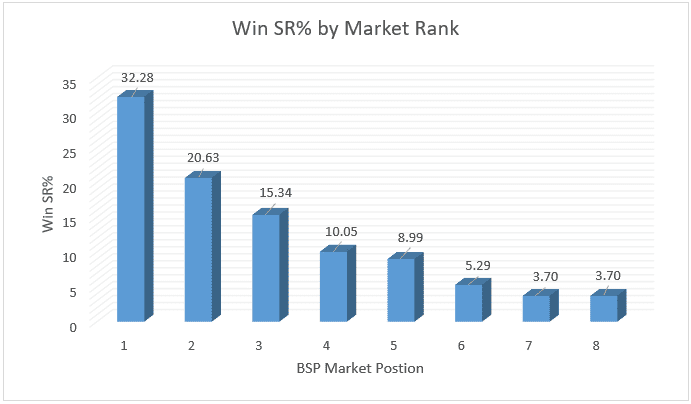
By way of comparison, the second favourite strike rate for ALL trainers is close to 21%. O'Brien's is down at 15.15%, whereas I would have expected it to be nearer 25%.
Before moving on, I would be wary of backing any O'Brien 2yo that had any type of headgear (blinkers, tongue tie, etc). 39 of his runners raced in headgear in the six years of study but only five won. Backing all of them would have yielded a loss of just over 38 pence in the £.
Non-handicaps versus handicaps
So far I have not split the data into non-handicap and handicaps. This is mainly due to the fact that non-handicaps account for roughly 80% of all 2yo races. Also, for many of the top performing 2yo trainers, this 80% figure tends to be higher. For example, 93% of Charlie Appleby 2yos have run in non-handicaps; and others at 90% or more include Roger Varian (93%), Sir Michael Stoute (95%) and John Gosden (94%). Hence for the remainder of this article I will be narrowing my focus only slightly to focus on the large non-handicap subset.
[The second article in this series will look at some of the 2yo handicap data]
Non-handicap performance by race distance
Juveniles have a ceiling in terms of how far they can race in Britain, the reason being that they are young horses in their first season of racing. They generally have not built up the necessary stamina to tackle longer distances. Here is a graph showing the breakdown of 2yo non-handicap races in terms of distance – it looks at the percentage of races run at each distance:
This shows us that 83% of all 2yo non-handicaps are contested over seven furlongs or shorter. A mile and a quarter, ten furlongs, is generally the longest distance 2yos have to race, but there has been a race at Kempton in December of the past two years over 1m3f. One of the pair was won by a 100/1 shot and the first four home in the other were priced at 22/1, 50/1, 9/1 and 50/1!
It should also be noted that for the first two full months of the two-year-old season (April and May) races are primarily over the sprint trips of 5f and 6f. Indeed there have been just five 7f races run in May over the past six seasons. Races of a mile-plus don’t properly kick in until August.
It's time to break trainer juvenile non-handicap performance down by distance now. I am going to split the distances into three: 5 to 6f (including 6.5f); 7f to 1m; and 1m 1f or more.
2yo non-handicaps over 5-6 furlongs
So, sprint distances first. In the chart below the top 15 trainers are shown, in terms of strike rate. The data is restricted to trainers who have had a minimum of 70 runners in the sample period:
Charlie Appleby tops the list once again and his runners actually made a tiny profit at Industry SP (ROI 1.25%). Others trainers to make a blind profit were Owen Burrows, Clive Cox, Andrew Balding, Martyn Meade and Ralph Beckett. Let's now look at the A/E indices for these 15 trainers, which will help to show the trainers who have proved the best value:
Six trainers have exceeded the 1.00 value benchmark, while three trainers have low figures - Saeed bin Suroor (0.79), Roger Varian (0.81) and Hugo Palmer (0.8). In ROI terms, bin Suroor runners lost 36 pence in the £, Varian’s lost 26p in the £, and Palmer’s runners lost 29p for every £ staked.
When examining most racing statistics we need an overall view – strike rate, ROI%, A/E indices and Impact Values need to be used in conjunction with each other.
2yo non-handicaps over 7f to 1 mile
In general, these longer distances are contested by better 2yos so it will be interesting to see how individual trainers fare. Again I have used 70 runs as a minimum threshold to qualify. Let’s look at the top 15 trainers by strike rate first:
In terms of profitability, only the Charlton stable have made a blind profit and barely at that. Perhaps this shows the overall competitiveness of 7f-1m races. Moreover, just two have hit over 1.00 in terms of the A/E index (the Charltons and David Simcock).
Sticking with the Beckhampton Stables yard of Harry and Roger Charlton for a moment there are three further statistics I want to share. Firstly, when saddling the favourite in these races they have won an impressive 22 races from 40 (SR 55%) for a profit of £12.37 to £1 level stakes (ROI +30.9%); secondly, when his runners start second favourite they have also made a profit thanks to 10 wins from 28 (SR 35.7%) for a profit of £7.50 (ROI +26.8%); and thirdly, 2yos that race at Newbury in 7f-1m non handicaps have done well winning 12 races from 45 (SR 26.7%) for a profit of £35.41 (ROI +78.7%).
Of course, it is extremely useful knowing which trainers have the best records, but it is also worth looking at those trainers with the poorest records. Here are the trainers with the lowest strike rates in 7f-1m 2yo non-handicaps:
Although a couple of these trainers have made a profit, this is down to a random big priced winner or two; in general, the figures for these trainers are very poor. Hence I personally would avoid them in such contests.
2yo non-handicaps of 1m 1f or longer
With these races making up less than 4% of 2yo non-handicap races in the UK, it means we have limited data to work with. Indeed, only seven trainers have had 40 or more runners at these longer distances in the past six seasons. For the record here are their stats:
That man Charlie Appleby is impressive once more, while the Gosden and Johnston stables have had the greatest number of runners but neither has been profitable to follow.
Individual trainers: comparison by distance
I thought it would be interesting to end this article by comparing the data for all trainers who have had at least 50 two-year-old runners in both 5f to 6f non-handicaps and 7f to one mile non-handicaps. It should be noted at this point that 7f-1m races have a slightly bigger average field size: 9.3 runners on average compared with 9.0 for 5-6f races. Hence this will have a small effect on trainer strike rate comparisons. For that reason, I will not only compare strike rates, but A/E indices and Impact Values too.
The right hand three columns compare the short trip data with the longer trip data by creating a ratio of one to the other. The greater the number above 1.00, the more sprints are favoured; the smaller the number below 1.00, the more longer races are favoured. For example, Andrew Balding won 1.35 times as often with his five- to six-furlong juvenile non-handicappers as he did with his seven furlong to mile ones; while David Simcock won 0.87 times as frequently (i.e. his 7f-1m non-handicap runners won at a higher strike rate than his 5f-6f equivalents).
Taking these distance data into account may assist when analysing 2yo non-handicaps races in the future.
There are some trainers who clearly perform better in 2yo non-handicap sprints as compared to 7f-1m races. A handful stand out to me when it comes to having a real edge in sprints compared to longer races – they are Jane Chapple-Hyam, Paul & Oliver Cole, Marcus Tregoning, Owen Burrows, Clive Cox, Ismail Mohammed, Stuart Williams, Jedd O’Keefe and David O’Meara. In terms of an advantage in the longer races there is not too much to go at: perhaps Sir Michael Stoute would be one to note but it is a marginal preference rather than a very strong one.
I hope this article will prove useful when evaluating 2yo races in more detail. My next piece will share more facts and figures relating to trainers and two-year-olds. Until then...
- DR
https://www.geegeez.co.uk/wp-content/uploads/2016/08/charlieappleby2-1.jpg320830Dave Renhamhttps://www.geegeez.co.uk/wp-content/uploads/2022/10/geegeez_banner_new_170x78.pngDave Renham2022-07-19 09:19:142022-11-10 11:59:25Trainers in Two-Year-Old Races, Part 1
In this article I am once again revisiting one of my favourite areas – the run style of horses, writes Dave Renham. As with the last article I am focusing on the run style profile of specific horses, using data from 2021 initially and then looking at 2022 results up to the time of writing. Initially, though, we will look at a bigger data set in order to set the scene.
For new readers let me explain run style. Essentially, run style is the position a horse takes up very early on in the race, normally within the first furlong or so. Run styles on this website are split into four categories, as follows:
Led (4) – front runners; a horse that takes an early lead (occasionally more than one horse disputes the lead, in which case we can have more than one ‘front runner’); Prominent (3) – horses that race directly behind the early leader(s); Mid Division (2) – horses that race mid pack or 'in touch' with the leaders; Held Up (1) – horses that race at, or near the back of the field early.
The number in brackets is the run style score that is assigned to each category. These numbers are extremely useful and I will again be using them later to create what I call ‘horse run style averages’.
Each race within the Geegeez racecards has a PACE ‘tab’ from where we can view some past run style data for the race in question. The word ‘pace’ is often used as an alternative to run style as the ‘early pace’ shown by each horse determines the position they take up soon after the start of the race. A maximum of the last four runs is shown as we can see below in this race taken from Epsom in July:
The latest run (LR) shows the run style in the most recent race, 2LR in the second most recent race, and so on. The last four runs are totalled for members (Total), and an average figure (Ave) is calculated also. In this race the most likely early leaders according to totals/averages were Toussarok and Pablo Del Pueblo. As it turned out, the opening furlong saw Pablo Del Pueblo lead with Toussarok racing in second place. Concierge, who had by far the lowest run style/pace total, conformed to past run style data also by racing at the back early.
And so it is that these pace/run style figures are useful in trying to determine beforehand how a race is likely to be run early on. They are of course not fool proof, but then, what is? Horses are animals, after all – they cannot tell us how they are going to run - and trainers and jockeys will potentially have an influence also (they, like us, are animals, too!)
If you have read any of my previous run style articles, you will know that early leaders generally have a solid edge in races; and particularly in races over shorter distances. For that reason, I am always looking to find means of improving my ability to predict a race's front runner / early leader.
It's time to give you some stats: as you probably know, we tend to call five- and six-furlong races ‘sprints’ due to the fact they are the shortest two distances in flat racing. Looking at all 5f and 6f races in the UK from 2017 to 2020 gives us the following run style strike rates:
These raw strike rates show a significant run style bias. One in every five wins was for the race early leader, while hold up horses only won around 1 in 16 of such sprint races. In essence, leaders in 5f or 6f races are over three times more likely to win than any individual horse up horse.
If we examine the A/E and IV values too we can see that these correlate strongly with the overall strike rates above:
The bias to front runners occurs in both handicap and non-handicaps over these sprints trips; and, while the win SR% is higher in non-handicaps, this is mainly due to the average field size being smaller. A/E and IV values are strong regardless of race type for these front runners.
So there is the background to the article and hopefully the graph above backs up what I mentioned earlier in terms of always looking for ways to improve our chances of predicting the front runner, more especially in sprint races.
Now to the meat and bones of my latest research where the focus is, not surprisingly, going to be UK races over 5 and 6 furlongs. There are also strong links to my previous article in terms of comparing two recent time frames, as you will see.
My initial dataset looked at all such races in 2021. To begin with I focused on all horses aged three or older that had raced at least four times in sprints. I used 3yos and older horses because I wanted to look at more experienced runners who, I contend, would be more likely to have developed a run style preference.
Horse run style averages
My first port of call was to produce run style averages for each horse, in exactly the same way that I have created run style averages in the past. To achieve this, I added up the Geegeez pace / run style points for each horse over the 2021 season and divided it by the number of races. The higher the average the more prominent the horse tends to race. The averages ranged from 4.00 (horses that led in every race they contested in 2021) to 1.00 (horses that were held up in every race they contested in 2021). Remember, I was exclusively using races over 5 and 6 furlongs to create my averages, so some of these horses may have run over further at some point in the season; those longer races have been ignored in order to allow for a 'pure' sprint dataset.
Once these figures were recorded, I then looked at the 2022 run style data (up to July 8th 2022) so as to create equivalent run style averages for 2022. From there, I wanted to compare the two averages – my hope being that the 2021 run style averages correlated with their 2022 counterparts.
To qualify, each horse needed to have run at least four times in each season. Of course, many of the horses would have run considerably more times, especially in the full 2021 season. In theory, the more the horses run, the more ‘accurate’ their run style average should be in terms of predicting future run style.
488 horses had enough runs in both seasons so it was a decent number of horses to examine. In order to compare the two averages I decided to create six run style/pace average ranges. I used the following groupings - 3.50 to 4.00, 3.00 to 3.49, 2.50 to 2.99, 2.00 to 2.49, 1.50 to 1.99 and 1.00 to 1.49 - then I assigned a letter to each creating six run style ‘categories’ as follows:
Doing it in this way made sense as I felt it was an easier way to compare the data and hopefully easier for you to understand my finding. To begin with I looked at category ‘A’ horses in 2021, those with run style average 3.50 or above, and compared them with their run style category in 2022. There were 30 category ‘A’ horses from 2021 and these are the categories in which they resided as of 8th July 2022:
As we can see 13 of the 30 horses have repeated their extreme front running style of racing in 2022. Eight others are still at the upper end of the run style bracket (category B) with figures of 3.00 to 3.49. Meanwhile, just one of the 30 has averaged under 2.00 this year (categories E / F) meaning just one horse has totally reversed his/her run style from the previous year.
For all that it would have been great to have seen all 30 horses in category ‘A’ for 2022, these remain very pleasing figures.
At the other end of the scale I wanted to look at the performance of genuine hold up horses from 2021 – those in category ‘F’ (average 1.00 to 1.49) to see how their 2022 run style splits compared:
The results are positive once more, with 19 of the 45 horses again landing in the lowest run style category (F). A further 18 are in category ‘E’, the second lowest grouping. These findings so far are the type of figures I was hoping for, but I had expected them also based on previous research in similar areas.
From here I wanted to look at ALL 2021 run style categories, not just ‘A’ and ‘F’, and make a comparison with 2022. For this I wanted to see what percentage of horses from each 2021 category landed either in the same category or the ‘next door’ category in 2022. To help make sense of what I mean by that sentence (as it is a bit ‘wordy’), my findings are in the following table:
This table shows very clearly that the run style of a high percentage of sprinters does not alter that much. It is fascinating to note that horses which primarily race nearer the back than the front (categories E and F – average 1.00 to 1.99) have very high consistency percentages (87.64 and 82.22 respectively).
It is also worth sharing that almost two-thirds (313 of the 488 horses, 64.1%) have 2021 and 2022 run style averages within 0.50, or half a run style grade, of each other; that's another indication of how useful and accurate run style averages can be.
I want to leave you with the horses whose run style averages from 2021 to 2022 (to date) have a difference of just 0.30 or less. We should be fairly confident that this group of horses have a definite run style preference:
Horse
5-6f 2021
2021 RSA
5-6f 2022
2022 RSA
Diff
Alcazan
4
3.25
4
3.25
0
Bungledupinblue
13
2
4
2
0
Chipstead
6
2.5
4
2.5
0
Equitation
8
2.25
4
2.25
0
Glorious Charmer
10
2
13
2
0
Grandads Best Girl
5
2.4
5
2.4
0
Hope Springs
6
1.5
6
1.5
0
King Of Stars
10
3.8
5
3.8
0
Nellie French
6
1.17
6
1.17
0
Newyorkstateofmind
15
3
6
3
0
Recall The Show
9
2.89
9
2.89
0
Rhubarb
10
2.6
10
2.6
0
Steelriver
9
1
11
1
0
Strike Red
10
1.4
5
1.4
0
Red Walls
18
2.94
14
2.93
0.02
Stone Circle
7
2.14
6
2.17
0.02
Zargun
13
2.69
6
2.67
0.03
Orchid Rose
9
1.78
4
1.75
0.03
Ustath
15
3.53
6
3.5
0.03
Shallow Hal
9
2.33
10
2.3
0.03
Amazing Amaya
8
1.13
11
1.09
0.03
Wentworth Falls
11
1.64
5
1.6
0.04
Enduring
14
3.64
5
3.6
0.04
Endowed
11
1.55
6
1.5
0.05
Qaaraat
37
3.11
13
3.15
0.05
Dapper Man
17
3.35
5
3.4
0.05
Second Collection
14
1.21
6
1.17
0.05
Helvetian
6
2.33
7
2.29
0.05
Mashaan
4
2.75
5
2.8
0.05
Ascot Jungle
9
2.56
4
2.5
0.06
Some Nightmare
9
2.44
4
2.5
0.06
Be Proud
18
1.56
10
1.5
0.06
Buniann
14
1.5
9
1.44
0.06
First Verse
9
1.56
4
1.5
0.06
Jawwaal
9
1.56
4
1.5
0.06
James Watt
14
2.14
5
2.2
0.06
Our Man In Havana
13
2.31
4
2.25
0.06
One Hart
6
2.67
5
2.6
0.07
Ginato
10
1.6
9
1.67
0.07
Tathmeen
17
1.53
13
1.46
0.07
Aberama Gold
11
3.18
8
3.25
0.07
Come On Girl
10
1.5
7
1.43
0.07
Dream Composer
7
1.43
8
1.5
0.07
Al Simmo
7
3.57
4
3.5
0.07
Cuppacoco
7
3.43
4
3.5
0.07
Koropick
14
2.36
7
2.29
0.07
Lord Of The Glen
14
2.07
5
2
0.07
Spring Bloom
7
3.57
4
3.5
0.07
Gullane One
11
3.73
5
3.8
0.07
Gustav Graves
5
2
13
1.92
0.08
Soul Seeker
17
2.59
6
2.67
0.08
Jack Ryan
8
1.25
9
1.33
0.08
Rainbow Mirage
9
1.33
4
1.25
0.08
Thaki
12
1.75
6
1.83
0.08
Gherkin
12
2.58
4
2.5
0.08
Havagomecca
9
2.33
4
2.25
0.08
Lethal Blast
12
3.92
5
4
0.08
The Tron
8
2.25
6
2.17
0.08
Mrs Bagerran
7
3.29
5
3.2
0.09
Muatadel
11
2.09
4
2
0.09
Mutabaahy
22
1.91
9
2
0.09
Twice Adaay
11
1.91
6
2
0.09
Million Reasons
7
1.57
9
1.67
0.1
Under Curfew
10
2.7
5
2.8
0.1
Della Mare
5
3.4
4
3.5
0.1
Elland Road Boy
5
2.4
4
2.5
0.1
Elzaal
10
2.4
8
2.5
0.1
La Roca Del Fuego
10
3.5
5
3.6
0.1
Many A Star
5
2.4
6
2.5
0.1
Peachey Carnehan
10
1.9
6
2
0.1
Shamshon
20
2
10
2.1
0.1
Venturous
13
1.23
6
1.33
0.1
Rathbone
11
2.18
7
2.29
0.1
Swell Song
7
3.14
4
3.25
0.11
Dark Side Prince
11
3.09
5
3.2
0.11
Swiss Pride
9
2.22
9
2.11
0.11
Tenaya Canyon
9
1.89
5
2
0.11
Youllovemewheniwin
9
2.22
6
2.33
0.11
Absolute Dream
8
2.13
4
2
0.13
Aish
8
3.13
7
3
0.13
Amnaa
8
2.63
4
2.75
0.13
Chairmanoftheboard
8
1.63
4
1.75
0.13
Makanah
8
1.63
4
1.75
0.13
Point Of Woods
8
1.38
4
1.5
0.13
Prospect
4
2.75
8
2.88
0.13
Singe Anglais
8
1.13
6
1
0.13
Sound Of Iona
16
1.88
6
2
0.13
Triggered
9
1.56
7
1.43
0.13
The Gloaming
14
1.93
10
1.8
0.13
Jordan Electrics
11
2.73
7
2.86
0.13
Boogie Time
9
3.67
5
3.8
0.13
Edessann
10
1.2
6
1.33
0.13
Kapono
9
1.33
5
1.2
0.13
Look Out Louis
6
3.33
5
3.2
0.13
Mansfield
18
2.67
10
2.8
0.13
The Thin Blue Line
10
2.3
12
2.17
0.13
Wade's Magic
15
2.47
5
2.6
0.13
Count D'orsay
15
1.53
5
1.4
0.13
Bergerac
7
3.14
7
3
0.14
Copper Knight
14
3.14
6
3
0.14
Ey Up It's Maggie
10
3
7
2.86
0.14
Lothian
7
2.86
7
2.71
0.14
Miss Nay Never
4
3
7
2.86
0.14
Whittle Le Woods
5
3
7
2.86
0.14
Twilight Heir
4
2.75
5
2.6
0.15
Freedom Flyer
11
2.18
6
2.33
0.15
Silent Flame
9
2.56
5
2.4
0.16
We're Reunited
14
3.36
5
3.2
0.16
Miss Bella Brand
11
1.91
4
1.75
0.16
Lethal Angel
11
2.36
5
2.2
0.16
Mid Winster
11
3.36
5
3.2
0.16
Blazing Hot
10
2.5
9
2.67
0.17
Bossipop
18
3.17
6
3
0.17
Company Minx
12
2.67
4
2.5
0.17
Penombre
5
2
6
2.17
0.17
Burrows Seeside
6
1.5
6
1.33
0.17
Glamorous Force
18
1.83
8
2
0.17
Moveonup
9
2.44
13
2.62
0.17
Igotatext
5
2.4
7
2.57
0.17
Internationaldream
7
2.57
4
2.75
0.18
Scale Force
14
2.43
12
2.25
0.18
Ventura Express
11
2.18
4
2
0.18
Dark Shot
23
2.78
10
2.6
0.18
High Security
13
2.38
7
2.57
0.19
Sparkling Diamond
6
1.33
7
1.14
0.19
John Kirkup
8
2.38
7
2.57
0.2
Redrosezorro
5
2.6
5
2.8
0.2
Diamond Cottage
7
2
5
1.8
0.2
Lost My Sock
15
1.87
6
1.67
0.2
Seneca Chief
10
1.8
5
1.6
0.2
Abate
12
3
5
2.8
0.2
Airshow
10
3.7
12
3.5
0.2
Apollo One
5
3.2
5
3
0.2
Dave Dexter
4
3
5
2.8
0.2
Khulu
4
2
5
2.2
0.2
Rhythm
5
2.8
5
3
0.2
Rolfe Rembrandt
4
2
5
2.2
0.2
Silver Diva
10
2.2
8
2
0.2
Storm Over
10
2.7
4
2.5
0.2
Ubahha
8
1.75
11
1.55
0.2
Phoenix Star
17
1.76
9
1.56
0.21
Eeh Bah Gum
10
3.1
9
2.89
0.21
Good Listener
4
1.5
7
1.29
0.21
Nacho
14
1.79
8
2
0.21
Expert Opinion
18
2.5
7
2.29
0.21
Tanasoq
16
1.44
9
1.22
0.22
Lihou
19
2.84
8
2.63
0.22
Hurricane Alert
18
2.28
8
2.5
0.22
Rory
10
1.6
8
1.38
0.23
Storm Melody
21
2.48
8
2.25
0.23
Nomadic Empire
11
2.27
4
2.5
0.23
Mokaman
6
3
13
2.77
0.23
Pivoting
7
2.57
6
2.33
0.24
Yukon Mission
11
2.91
6
2.67
0.24
Global Warning
9
1.56
5
1.8
0.24
Abduction
4
1.5
4
1.75
0.25
Atyaaf
12
3.25
4
3
0.25
Ballintoy Harbour
8
3
4
2.75
0.25
Blissful Song
10
2
4
2.25
0.25
Chocco Star
6
1
4
1.25
0.25
Cottam Lane
8
3
4
2.75
0.25
Dakota Gold
6
3.5
4
3.25
0.25
Due A Win
7
2
4
2.25
0.25
Iesha
12
2.75
10
2.5
0.25
Isle Of Lismore
8
2
4
1.75
0.25
Lady Nectar
6
1.5
4
1.25
0.25
Mohareb
4
2.25
7
2
0.25
Papas Girl
8
1.38
8
1.13
0.25
Prince Of Abington
8
1.75
5
2
0.25
So Grateful
8
3.5
4
3.25
0.25
Surewecan
6
1.5
4
1.25
0.25
Pettochside
11
2.45
5
2.2
0.25
Hey Ho Let's Go
9
2.67
13
2.92
0.26
Count Otto
5
2.6
7
2.86
0.26
Sir Gregory
6
2.17
11
1.91
0.26
Primo's Comet
11
1.45
7
1.71
0.26
Fine Wine
6
3.17
14
3.43
0.26
Mondammej
17
1.24
8
1.5
0.26
Brandy Station
15
3.07
6
3.33
0.27
Cool Spirit
13
3
15
2.73
0.27
Griggy
5
2.6
6
2.33
0.27
Show Me A Sunset
15
2.27
5
2
0.27
Toussarok
5
3.6
6
3.33
0.27
Rebel Redemption
17
3.35
8
3.63
0.27
Temple Bruer
11
1.73
4
2
0.27
Stallone
8
1.88
5
1.6
0.28
Mister Bluebird
9
2.78
4
2.5
0.28
Gowanlad
9
2.11
6
1.83
0.28
Good Earth
17
1.47
12
1.75
0.28
Portelet Bay
12
2.58
10
2.3
0.28
Refuge
12
2.92
5
3.2
0.28
Excessable
13
2
7
2.29
0.29
May Remain
7
1.71
6
2
0.29
Thegreyvtrain
24
3.58
8
3.88
0.29
Ghathanfar
13
2.54
12
2.83
0.29
Liberty Bay
10
3.3
6
3
0.3
Stroxx
5
2.6
10
2.9
0.3
Classy Al
4
1.5
5
1.8
0.3
Polam Lane
6
1.5
5
1.8
0.3
Strong Power
11
2
10
1.7
0.3
There are 201 horses in this list and I am confident they will show a similar running style for the rest of this season. When one of more of these horses contest a five- or six-furlong sprint, the easier it should be to predict how the early run style/pace is going to look. Whilst I have only applied these run style comparisons to 5-6f races, the concept could be easily expanded to horses that race primarily in other distance groups, too.
Good luck.
- DR
00Dave Renhamhttps://www.geegeez.co.uk/wp-content/uploads/2022/10/geegeez_banner_new_170x78.pngDave Renham2022-07-11 14:08:572022-07-11 14:26:48Past Run Style as a Profitable Indicator, Part 2
In this article, I continue to look into run style and its impact on the outcome of horse races, writes Dave Renham. This piece focuses on the run style profile of individual horses and initially examines data from 2021, before comparing with results from the first part of the 2022 flat season, up to June 24th.
Before divulging my findings, for new readers I will briefly discuss what is meant by run style. Essentially, run style is the position a horse takes up very early on in the race. These are split into four categories as follows:
Led (4) – front runners; horses or horses that take an early lead; Prominent (3) – horses that track the pace close behind the leader(s); Mid Division (2) – horses that race mid pack; Held Up (1) – horses that race at, or near the back of the field early.
The number in brackets is the run style score that is assigned to each section. These numbers can be a useful tool for number crunchers like myself and they will be used at certain points in this article.
If we look at any Geegeez racecard and click on the pace ‘tab’ we get some past run style data for the race in question. Here is an example from April of this year – a 5f handicap at Windsor:
As can be seen, the run style figures from each horse's previous four races are shown (LR, 2LR, 3LR, 4LR). These figures are quite tight / close and hence it is difficult to be confident about predicting the order in which the field is likely to order itself early in the race.
The most important run style prediction is always which horse is most likely to front run and that is tricky here too. La Roca Del Fuego topped the list, just, on 14 points, so was marginally the most likely front runner, and as it turned out did lead from start to finish.
However, pre-race, one could not have been confident that La Roca Del Fuego was going to lead. In an ideal world when trying to predict the front runner, we would prefer a horse to be well ahead numerically of the rest of its field. For example, Horse A has 16 points (the maximum possible for a four-race sample), and Horses B, C, D, etc all have scores in single figures. Even then we cannot guarantee Horse A will lead but all things being considered, the chances are very likely he/she will.
Some less regular readers at this point may be asking themselves why trying to predict the front runner is a useful thing to try to do. The answer is simple: front runners are the best value at most distances on the flat; and many distances over the sticks, too. For example, in 5f handicaps in the UK from 1st Jan 2018 to 31st Dec 2020, if you had predicted who would front run pre-race and place a £1 bet on every single horse you would have won nearly 20% of all your bets for an impressive profit of £619.46 (ROI +32.7%).
Now to the article proper as it were:
My focus today is on UK handicaps of 5 furlongs to 1 mile; I am using these races as there is a strong front running bias in general at shorter distances. The bias is strongest over 5f (see example above), but it is still potent up to a mile on most courses. My initial dataset looked at all such races in 2021.
To start with I focused on all horses that had raced at least 4 times in 5f - 1 mile handicaps in 2021. From there I wanted to check a few different things.
Horse run style averages (UK turf flat handicaps, 5f-1m, 2021)
First stop was producing run style averages for each horse: this was performed in exactly the same way that I have created trainer, jockey and course run style averages in the past. I simply added up the Geegeez pace / run style points for a particular horse over the 2021 season and divided it by the number of races. The higher the average the more prominent the horse tends to race. The averages ranged from 4.00 (horses that led in every race they contested in 2021) to 1.00 (horses that were held up in every race they contested in 2021). Just 12 horses had run style averages of 4.00, which will come as no surprise as I was looking at ALL their runs in these handicaps over the year.
There was a horse that raced 37 times in 2021 – yes, 37! The horse in question was Qaaraat. Qaaraat had a run style average for the year of 3.11 thanks to leading 11 times, racing prominently 21 times, mid-division three times, and being held up just twice.
Here is a selection of horses with their run style averages for 2021. I have chosen those with some of the highest run style averages, and those with some of the lowest – the number of races they contested in also shown:
Horse
2021 races
2021 run style average
Horse
2021 races
2021 run style average
How Bizarre
5
4.00
Diffident Spirit
4
1.25
Isla Kai
4
4.00
Elmejor
4
1.25
Master Matt
4
4.00
Hope Springs
4
1.25
Pinnata
6
4.00
James Park Woods
4
1.25
Tomouh
5
4.00
London Palladium
8
1.25
Ventura Rascal
7
4.00
Maysong
8
1.25
Lethal Blast
12
3.92
Munificent
4
1.25
Motawaazy
11
3.91
Natchez Trace
4
1.25
Asad
8
3.88
Nick Vedder
12
1.25
Rains Of Castamere
7
3.86
Otto Oyl
4
1.25
Grandfather Tom
6
3.83
Pentimento
4
1.25
La Roca Del Fuego
6
3.83
Rectory Road
12
1.25
Show Yourself
6
3.83
Rooful
4
1.25
Destroyer
5
3.80
Mondammej
17
1.24
Eye Of The Water
5
3.80
Eyes
13
1.23
King Of Stars
10
3.80
Treacherous
13
1.23
Mejthaam
5
3.80
Imperium Blue
9
1.22
Siam Fox
5
3.80
Mutanaaseq
14
1.21
Toussarok
14
3.79
Second Collection
14
1.21
Araifjan
13
3.77
Aiguillette
5
1.20
Twilight Madness
4
3.75
Amazing Amaya
5
1.20
Kraka
15
3.73
Cairn Gorm
5
1.20
Gullane One
11
3.73
Celsius
5
1.20
Ornate
11
3.73
Edessann
10
1.20
Howzak
7
3.71
Engles Rock
5
1.20
Just Glamorous
7
3.71
Our Little Pony
5
1.20
Zulu Girl
7
3.71
Power On
10
1.20
Airshow
10
3.70
Snazzy Jazzy
5
1.20
Fangorn
10
3.70
Urban Highway
5
1.20
Thaayer
10
3.70
Jewel Maker
11
1.18
Harrogate
16
3.69
Lady Alavesa
11
1.18
Al Simmo
6
3.67
Air To Air
6
1.17
Alcazan
9
3.67
Billian
6
1.17
Autumn Flight
12
3.67
Fantasy Believer
6
1.17
Boogie Time
9
3.67
La Rav
6
1.17
Enduring
15
3.67
Power Player
6
1.17
Global Esteem
11
3.64
True Mason
12
1.17
Gometra Ginty
11
3.64
Duke Of Firenze
19
1.16
Antagonize
8
3.63
The Cola Kid
13
1.15
Bankawi
8
3.63
Fauvette
7
1.14
Blackcurrent
8
3.63
Magnetised
7
1.14
Charming Kid
8
3.63
Papas Girl
7
1.14
Just Frank
8
3.63
Surprise Picture
7
1.14
Air Raid
5
3.60
Alba Del Sole
8
1.13
Alba De Tormes
5
3.60
Clashaniska
8
1.13
Animal Instinct
5
3.60
Desert Land
16
1.13
Forest Falcon
5
3.60
Otago
8
1.13
Hieronymus
5
3.60
Canoodled
9
1.11
Langholm
10
3.60
Bronze River
10
1.10
Wings Of A Dove
5
3.60
Libby Ami
11
1.09
Bowman
12
3.58
Venturous
11
1.09
Thegreyvtrain
24
3.58
De Vegas Kid
12
1.08
Gobi Sunset
7
3.57
Golden Apollo
12
1.08
Healing Power
7
3.57
Van Dijk
14
1.07
Spring Bloom
7
3.57
Alicestar
6
1.00
Bezzas Lad
9
3.56
Biplane
4
1.00
Mountain Brave
9
3.56
Catch My Breath
14
1.00
Militia
11
3.55
Chocco Star
6
1.00
Goddess Of Fire
13
3.54
Divine Messenger
6
1.00
Late Arrival
15
3.53
Dundory
4
1.00
Ustath
17
3.53
Eligible
6
1.00
Bert Kibbler
6
3.50
Fastnet Crown
6
1.00
Big Bard
4
3.50
Inaam
7
1.00
Captain Corcoran
10
3.50
Marselan
7
1.00
Della Mare
4
3.50
Mayson Mount
5
1.00
Firepower
6
3.50
Nellie French
4
1.00
Louie de Palma
6
3.50
Raatea
7
1.00
Marnie James
8
3.50
Sanaadh
13
1.00
Modular Magic
6
3.50
Sin E Shekells
5
1.00
Punchbowl Flyer
8
3.50
Steelriver
5
1.00
Rhubarb Bikini
6
3.50
Stone Of Destiny
6
1.00
Secret Handsheikh
10
3.50
Sunset
5
1.00
Sir Titan
6
3.50
Tangled
9
1.00
Wrenthorpe
6
3.50
Wicklow Warrior
4
1.00
To be honest, I wasn’t sure how relevant looking at run style averages from a longer period of time (rather than the four most recent races) would be; but I use longer term data for trainers and jockeys so felt there was some logic to justify analysing it.
Now I had the run style averages for 2021 for each horse, I grouped them as follows:
1.49 or below
1.50 to 1.99
2.00 to 2.29
2.30 to 2.59
2.60 to 2.99
3.00 to 3.49
3.50 to 4.00
From there I looked at the performance of each of the groups in terms of 2021 results. Here is what I found – I looked at strike rates first:
As the graph neatly shows, horses with higher run style averages based on the 2021 season were more successful in terms of strike rate. Horses that had an average of at least 3.5 for 2021 scored nearly 20% of the time. If we now do a comparison of return on investment (ROI%) we can see a clear correlation:
I used a line graph here as it is slightly easier to see than if using a bar chart. There was a huge return on investment for horses with an average of 3.5 or more – more than 40p in the £.
Horse Led Percentages (UK turf flat handicaps, 5f-1m, 2021)
I did the same type of analysis but using 'led percentages' rather than run style averages. In order words, I worked out in what percentage of races each horse led early during 2021. For instance, if a horse ran ten times and it led early in four of these, its figure would be 40%. As with run style averages, I grouped the led percentages to ensure acceptably sized datasets:
The chart shows a very similar pattern to what we saw with run style averages: this time, horses that led the most in percentage terms were the most successful.
Here are the figures in terms of return on investment:
Again, there is excellent correlation with both graphs; in fact all four graphs correlate strongly. Horses that led in 50% or more of their races in 2021 were extremely profitable – a return of £1.28 for every £1 bet. It should also be noted that these returns are based on starting prices, so with early prices, BOG or Betfair SP one would expect to improve markedly on this baseline figure.
Let's stop using history to predict the past...
Now statisticians will tell you, quite rightly, that using past data from one particular year in this way is going to produce slightly skewed results. This is because we are looking retrospectively at horse performances; we know horses that lead early win more and so looking at horses that led the most often in 2021 should produce the kind of positive results we have seen.
However, there are two points I’d like to make. Firstly, these data prove the point once more about how important early speed is, and secondly it shows that creating horse run style averages seems to be a worthwhile project. Indeed, the run style averages actually outperformed the led percentages, at least at the business end of their respective spectrums (the highest run style averages versus the highest led %’s).
At this point in my research I decided to use the 2021 run style averages I had created and apply them to races in 2022 – up to June 24th. Of course, these run style averages are based on the previous year with no new runs in 2022 taken into account. However, I was hoping to demonstrate that the higher run style averages would still outperform the lower ones. This is what I found.
The strike rates are much more even as you might expect, but still there is a positive edge when we get to a run style average of 3 or more. Conversely, the two lowest strike rates also occur for the two lowest run style groups. The best part, naturally, is seeing the profit/loss figures – profits for those averaging 3 to 3.49 and 3.5 to 4; and the commensurate losses for horses averaging 2.59 or lower are quite steep when viewed as a group.
As we have done to this point, let us again overlay the 2021 led percentages on the 2022 results hoping for a similarly upbeat picture:
It is gratifying to see similar results here. Specifically, horses that led 20% or more in 2021 have outperformed lower 'led percentage' groups both in strike rate terms and in returns on investment. Meanwhile, a 2021 'led percentage' of 33.3% to 49% produced a small profit from 2022 runs, with considerably bigger profits generated by the 50% or more group.
Closing thoughts
The main takeaway from this research into 5f to 1mile handicaps is that horses which led more often (in percentage terms) over a recent period of time are more likely to be profitable to follow than horses which have led less frequently. The same can be said for horses with higher run style averages.
The million dollar question, however, is how many races should we use? The four currently published in the 'pace' tab on the Geegeez racecard is a great starting point. We know from earlier research that horses which led at least once very recently are more likely to lead early than horses that have not. Likewise a last-four-race run style average is useful too (also shown in the 'pace' tab under the column ‘Ave’). The higher the average, again, the more likely it is that a horse will lead.
In answer to the question, my best guess is that anything between four and a dozen races would be optimal. In this piece, for example, some horses had run style averages based on their last four runs, and some had an average based on a lot more than four runs. One could argue this is not perfect and I'd have some sympathy with that argument; but, for me, the time it takes for data collection is important.
Using this more flexible approach (a minimum of four runs) meant it took me less time to create all the data I needed to start writing the article. I shared nearly 150 individual horse run style averages earlier; in total I had to calculate nearly 6000. If I had tried to create ‘last eight runs averages’ for example for all horses I probably would still be trying to do that at Christmas, and probably Christmas 2025! Research is just that, research. It will never be perfect, but for me it is a fun way to learn more about racing and to help me share ideas with the wider geegeez.co.uk audience.
Thanks, as always, for reading.
- DR
https://www.geegeez.co.uk/wp-content/uploads/2018/04/Catterick_Sprint.jpg319830Dave Renhamhttps://www.geegeez.co.uk/wp-content/uploads/2022/10/geegeez_banner_new_170x78.pngDave Renham2022-07-04 15:45:002022-07-04 15:45:02Past Run Style as a Profitable Indicator
For this final article in my trainers' run style series I am going to share with you some extremely detailed analysis from 2yo races during the 2021 season, writes Dave Renham. It may be only one season, but it covers more than 1100 races and over 10,000 runs, so there is plenty of data to dig into.
Before delving into the stats, for new readers let me quickly explain what is meant by run style. Essentially, run style is the position a horse takes up early on in the race, normally within the first furlong or two, which often defines its running preference. geegeez.co.uk has created two excellent resources to look more closely at run style. These are the Pace Analyser and the Query Tool which can both be found in the in the Tools menu. Running style and the word 'pace' are often linked because the early pace shown by horses in a race determines their early position. Therefore some punters and indeed pundits see run style and pace as interchangeable.
The stats I am using for this piece are based on the site’s pace / run style data. This data on Geegeez are split into four sections –
Led (4) – front runners; horses or horses that take an early lead;
Prominent (3) – horses that race close behind the leader(s);
Mid Division (2) – horses that race mid pack;
Held Up (1) – horses that race at, or near the back of the field early.
The number in brackets is the run style score that is assigned to each section.
OK, onto the flesh and bones of the research. To start let us look at 2yo debutants – juveniles having their first ever racecourse run.
Two-Year-Old Run Style: Debut runs
Here is the breakdown for 2yo debutants in terms of percentage distribution across all four run styles:
As the chart shows, nearly half of all two-year-olds making their debut are held up, either by accident or design, with less than 6% taking an early lead. This is perhaps what one might expect as on debut horses are inexperienced and 'green', and it may take time for the 'penny to drop' on that first racecourse outing. Further, many debutants will be racing against horses with previous race experience which will have an effect.
Two-Year-Old Run Style: Second career start
Juveniles on their second career starts produce a completely difference picture compared to the debut stats:
The chart highlights the vast difference in running style when we compare second career start stats to debuts. Over 16% of all runners now got to the front early and more than half, 53.5%, led or raced prominently. Compare that to 2yo debut figures noted earlier – just 5.6% for horses that lead on 2yo debut and only 29.6% for combined lead / race prominently horses.
The third start figures correlate closely with the second start ones as can be seen below.
When looking at data from fourth career run onwards, the run style splits don’t really change much, with the groups as follows: led 16.5% of the time; 33.7% for prominent racers, 20.3% for mid pack runners and 29.5% for hold ups.
What we need to take from this data is that juvenile run style shape remains similar from second career start onwards; however debut data is completely different; that's something we must take into account when trying to predict how a 2yo race will pan out in terms of run style (assuming the race includes one or more debutants).
Two-Year-Old Run Style: Debut run style – does it influence follow up run?
Let us now consider whether the run style shown by a 2yo on debut influences their second run in any way. Looking at juveniles that led on debut in 2021 (eg. gained a 4 on the Geegeez pace tab) gives the following:
If a horse has the speed to lead on debut, which we know is relatively rare from previous data, their chance of leading next time is high at 36%; in fact exactly 75% of horses that led on debut, led or raced prominently on their second career start. Those are much higher figures for front runners than the average we saw earlier – on average remember horses led on their second ever run 16.3% of the time, and led or raced prominently around half the time; here the led figure is more than double that, and the prominent figure 1.5x. Keep that in mind when assessing debut leaders.
So what happens on the second run if a horse has either raced prominently, midfield or been held up on debut? I have combined the stats on one graph for ease of comparison. The key parts of the graph are at either end – showing what percentage of horses led on their second start (on the left), and the percentage of horses that were held up on their second start (on the right).
The debut run style has a clear bearing on second start run style. As we can see, 2yos that were held up on debut led just 11.6% (about once every nine starts) in their second race, whereas 32.4% were held up once again.
The chances of leading on second start reduces from 36.4% where the horse led on debut, to 22.1% where it raced prominently on debut, to 15% when it raced mid-division on debut, down to that held up debut figure of 11.6%.
Two-Year-Old Run Style: Led on both of their last two runs
I next wanted to explore the run style figures for 2yo runners that had led on both of their previous two starts. This included all occasions when this occurred so it includes horses that led on debut and their second start; likewise it includes horses that may have led on, for instance, their fourth and fifth starts as a 2yo in 2021. Here are the findings:
Almost nearly 42% of 2yos have gone on to lead when they had led in both of their prior two races; and more than 80% led or raced prominently – given what we know from earlier articles about the value of a front rank position, that's powerful insight.
This ‘led’ figure increases to an impressive 56% when we focus on 2yos that had previously run at least five times (and led in last two starts prior).
Two-Year-Old Run Style: Held up on both of their last two runs
We have looked at the run style data for horses that led twice in a row; now a look at 2yos that were held up in both of their last two starts.
Predictably enough, perhaps, there is a complete reversal of what we saw with those juveniles which had led on both of their last two starts. Horses that were held up in consecutive runs saw just 45 of the 591 runners lead next time (7.6%) while 261 horses (44.2%) were held up once again.
I think all the data we have looked at so far shows that past run style data for 2yos is an important indicator of what a horse's future run style will/could be. Ultimately, the run style stats gathered already for this article validates why Geegeez shares past run style/pace data on their racecards.
Two-Year-Old Run Style: Individual trainer performance
I want to expand this research by looking at some 2021 run style data for individual trainers in 2yo races.
In some cases the sample sizes are relatively modest, but there are arguably still enough data for each trainer to build up a potential profile to how they handle their 2yos from a run style perspective in their early races.
There are three tables I wish to share. The first shows the 2021 data for two-year-old debut runs, focusing on run style breakdown by percentage:
Two-Year-Old Run Style: Debut run (2021), trainer run style breakdown
[minimum 30 runs on debut]
As might be expected given the debut stats we looked at earlier, the ‘led’ column has very low percentages generally. It is only really Mark (and Charlie) Johnston and Archie Watson who seem to drill their debutants to go to the front on a regular basis (Johnston had 25 of his 98 debutants go to an early lead, Watson 7 of 30).
Five trainers, on the other hand, have percentages under 3% namely Hills, Gosden, Fahey, Varian and Easterby. Of course, a number of those trainers are playing a longer game of nurture and education with what might be valuable three-year-old prospects down the line; nevertheless, it is highly instructive for us as punters to be aware of - and able to put a number on - the differences.
Two-Year-Old Run Style: 2nd career run (2021), trainer run style breakdown
This next table shows the run style percentages by trainer of two-year-olds on their second starts:
Horses learn a lot from that first racecourse run, and that is reflected a big change here for most of the trainers. However, a few trainers still seem to be averse to allowing their runners too much front end speed latitude. The Charlton stable is one, not surprisingly (see article 3 of the series for further details), but Roger Varian and Richard Fahey also rarely send a two-year-old to the front on their second start.
Two-Year-Old Run Style: 3rd career run (2021), trainer run style breakdown
Earlier in the article we saw that second and third career starts had a very similar statistical breakdown in terms of run style breakdown; let’s now examine if that has been the case for individual trainers:
The Johnston stable on both second and third career starts sent over half of their runners into an early lead (50.6% on second run, 59.2% on third) during the 2021 season.
At the other end of the scale, the Charlton yard have seen nearly 60% of their runners race mid-division or at the back of the field early in their third starts. Patience is a virtue for this team.
In general, when it comes to a two-year-old's third career start, this cohort of trainers is more likely to send their charges to the front early. Richard Fahey, however, is still not that keen (from a decent sample size of 53 runners). Michael Bell and Richard Hughes have low percentages also but in truth they have relatively small sample sizes of 18 and 24 respectively; that said, they are also both fine exponents of handicap first-timers, and it may be that it doesn't suit the plan for these runners to be too handy early doors on their final mark-qualifying run!
Those three tables should be excellent starting points for anyone interested in trying to predict trainer run style in a 2yo race (assuming it is the horses’ first, second or third career start). However, for those of you who would like to compare the chances of an individual trainer’s horse leading in any one of their first three starts as a 2yo, I have combined the led percentages in two graphs thus:
The remaining trainer figures are shown below (it would have been far too crowded to put all the trainers on just one graph).
And that concludes this fifth and final part of the trainer run styles series. What I hope the series has demonstrated is that different trainers really do have different approaches when it comes to the likely run style of their horses. This article in particular has also shown that past pace data when taken ‘generally’ is a decent indicator of future run style. And you can get this all on the Geegeez racecards - if you're not a subscriber already, here's a link to get a £1 trial month >
To close, here are five more stats that I uncovered from the 2yo data taken from the 2021 season:
2yos that led LTO (any career start) led again next time 33.2% of the time;
2yos that were held up LTO (any career start) were held up again in their next race 36.9% of the time;
Horses that were held up on their first three career starts led on their 4th start just twice from 61 qualifiers (34 were held up again which equates to nearly 56% of runners);
Horses that were held up on three consecutive starts (at any time as a 2yo) saw just 6 of 149 lead next time (4%);
Trainers Hugo Palmer, Simon Crisford and Sir Mark Prescott did not have enough individual data to appear earlier, however they sent out 80 2yo debutants between them in 2021, none of which took the early lead!
Good luck, and thanks for reading.
- DR
https://www.geegeez.co.uk/wp-content/uploads/2020/05/archiehugo-e1590238797721.jpg320830Dave Renhamhttps://www.geegeez.co.uk/wp-content/uploads/2022/10/geegeez_banner_new_170x78.pngDave Renham2022-06-27 08:52:262022-06-27 08:52:26Trainers and Run Style: Part 5
This is the fourth article in a series in which I have been looking at run style bias, writes Dave Renham. This piece follows on from the previous one with focus once again on two-year-old races. As with the rest of the series, the data for this article cover the last eight full seasons from 2014 to 2021 (UK racing only). Every 2yo race during this time frame has been collated.
For those of you who have read my previous articles, you may want to skip the next few lines as I will be explaining run style for any first time reader. Run style is concerned with the position a horse takes up early on in the race. 'Early' in a race normally means within the first furlong, sometimes the first quarter mile or so.
We split these early positions into four groups:
Led (4) – horse that gets to the front early (known as front runners). Usually you get one early leader, but occasionally you get more than one horse disputing the lead;
Prominent (3) – horses that race close to the front; right behind the leader(s);
Mid Division (2) – horses that settle mid pack in the early stages;
Held Up (1) – horses who begin their race at, or near the back of, the field.
The number in brackets is the run style score that is assigned to each section. These numerical scores help with certain types of analysis.
Each Geegeez racecard has full run style history on the Full Form tab, and the last four run style figures for each horse on the Pace tab. Pace and run style are often used to mean the same thing. This gives us useful past data with more experienced runners. Obviously some 2yo horses will have less data as they may not have run four times. This hopefully is where the trainer run style insights shared in this article will prove their worth.
I have used the Geegeez Query Tool once again to get the data and then used the power of excel to analyse it in more detail.
In my previous article the primary focus was seeing how often 2yo runners of individual trainers took the early lead (in % terms). This time I am looking, to begin with at least, at the success rate of trainers when their 2yo runners take an early lead.
Benchmarks: Overall 2yo strike rates by run style
To begin with I want to look at the average win percentage strike rates for all trainers / runners in terms of run style. In other words what percentage of front runners / early leaders win on average, what percentage of prominent runners win etc. Here is the breakdown:
These raw strike rate percentages show a striking run style bias. A huge 23%, almost a quarter, of 2yos win when they take the lead early; and early leaders are over four times more likely to win than any individual hold up horse, who barely win at more than one in 20. The average UK two-year-old field size across the period was a touch greater than nine runners per race, which equates to an average winning strike rate of about 11%.
If we examine the A/E and IV values too we can see that these correlate strongly with the overall strike rates above:
The message is clear, and one that we have seen consistently during this series of articles – early leaders comfortably outperform prominent runners, who in turn outperform midfield runners, who outperform hold up horses.
Run Style Performance by Race Distance in Two-Year-Old Races
Front runners
Generally we have seen in the past that the shorter the distance the better the performance of front runners. This is the case here, too, but the difference between sprints (5-6f) and races over 7f-1m is smaller than I had expected. As we get to 1m1f+ the overall success rate does drop off a bit, but it is still high compared to the average win chance of each runner.
Strike rates, returns on investment, A/E values and Impact Values all show a correlation as the distance increases. There are far fewer longer distance races and it seems that front runners do not offer a profitable avenue once you get past a mile.
Hold Up Horses
As we now know, 2yo runners that are held up have poor strike rates, but their chance of success improves a little when we get to 1m1f+:
As a collective, though, hold up 2yos are ones we should avoid like the plague regardless of race distance.
Best Front Runner Trainers in Two-Year-Old Races
Let us now look at the trainers who had the highest strike rates with their 2yo front runners during this eight-year time frame (minimum 40 runs / top 25 trainers):
This table illustrates why I am doing so much research into run style. The Win PL figures once again show how profitable front runners are, and that trying to find the optimum way of predicting them is something all punters should aspire to.
Saeed Bin Suroor tops the list with a very impressive strike rate from his front runners, and that improves furthre to 53.2% (33 wins from 62) with horses priced 3/1 or shorter. bin Suroor's front runners at Newmarket have won eight from 14 with another four runners placed: that's limited data but was interesting to me, nevertheless.
The other main Godolphin trainer, Charlie Appleby, has also seen great success with fancied runners – his front running favourites have won 78 from 141 (SR 55.3%). He’s been less successful with 2yo front runners priced 13/2 or bigger with just 1 win from 30 runners.
And the Gosden stable coupled with a certain Frankie Dettori on board is a potent 2yo front running combo with 20 winners from 36 (SR 55.6%).
Best Hold Up Trainers in Two-Year-Old Races
Overall, as one would expect, the best hold up records are poor in relation to the front running stats. However, here are the trainers with the best 2yo strike rates for hold up horses (minimum 80 runs / top 15 trainers):
Only three of these 15 trainers made a profit with their hold up horses, and generally the returns are very poor and the strike rates modest at best. Compare that with all barthree of the top 25 front-runner trainers making a profit!
It is worth noting that many of these trainers are associated with horses expected to show more at three years of age and, as such, are more likely to be quality animals racing over the longer two-year-old distances and on a learning curve - and therefore not rushed from the starting stalls.
Best Front Runner Trainers with favourites in Two-Year-Old Races
It was noted in the third article in this series that favourites were more likely to lead than any other market position in 2yo races. Nearly 27% of all 2yo favourites led early in the study period. Hence the performance of favourites when they led early is worth noting, especially when linked to individual trainers. Below is the list of the top trainers in terms of win strike rate with front running 2yo favourites (minimum 25 runs / top 20 trainers):
There are some very high strike rates as you might expect, but it is pleasing to note that all bar one trainer would have proved profitable at starting price with such runners.
So if you can find a 2yo favourite from one of these trainers that you think may lead early, then you potentially have a great bet. Of course the horse is not guaranteed to lead – always the tricky part, that!
However, at least we know that, as favourite, the chance of this happening is around the 27% mark without using any other factors to help with our decision.
In fact, my previous article did highlight two of the trainers above in terms of the chance of their favourites leading. To remind you, favourites from the Johnston stable led 53.1% of the time, while favourites from Archie Watson’s stable led 46.9% of the time.
It makes sense to offer a much longer list of trainers in terms of the percentage chance of their favourites leading. So, painstakingly hand cranked (but worth the effort, I feel), here they are:
For me, the more statistics I am aware of, the better. And there are huge differences in the frequency of front-running favourites by trainer, as can be seen.
Being aware of how successful a trainer is likely to be with a front running two-year-old is one thing, but if the horse's chance of actually leading is low then this obviously reduces the chance of a successful front running bet! Roger Varian, Richard Fahey, Ed Dunlop, Ed Walker, Aidan O’Brien, the Charltons, David Simcock, Stuart Williams and the Meades are trainers that rarely send favourites out to the front, so this may be noteworthy when any of these saddles a 2yo market leader.
Front Runners by Race Class in 2yo races
To finish with I want to look at 2yo front running data in connection with class of race. Firstly an overview of front running strike rates in two-year-old races by race class:
The figures are fairly uniform with the exception of the highest level, Class 1 races, where it has been harder for front runners to win. This makes sense in that the quality of opposition is as good as it gets, and the edge front runners typically enjoy at lower class levels is likely to be eroded by the ability to accelerate of their top tier rivals.
A quick look at the Impact Values now as this helps even out any anomalies connected with potential differences in number of runners per class group:
Class 1 races again come out as the least successful for front runners, which is not surprising based on the previous chart. The drop in Class 3 Impact Value is also which is worth noting, such races often having a smaller average field size (slightly fewer than eight runners per race, compared with an average of between 8.7 (Class 4) and nearly 10 (Class 1 and Class 6) for other race classes). The other class groups have very similar figures.
I have shared a huge amount of data in the first four articles in this series, all of which is important to help us have a greater appreciation of the importance of run style, and a stronger motivation for trying to predict run style. Each set of data has its own merit, but combining them all is where the edge over other less informed punters is likely to occur.
In the final part of this series looking at trainers and run style, I will be doing some laser-focused research on the entirety of the 2021 season.
Until then, happy punting.
- DR
https://www.geegeez.co.uk/wp-content/uploads/2022/06/SaeedbinSuroor_RealWorld_FrankieDettori.jpg319830Dave Renhamhttps://www.geegeez.co.uk/wp-content/uploads/2022/10/geegeez_banner_new_170x78.pngDave Renham2022-06-21 08:57:402022-06-21 09:26:09Trainers and Run Style: Part 4
This is the third article in a series in which I have been looking at run style bias in relation to trainers, writes Dave Renham. In this piece, I'll drill down looking specifically at trainer data from two-year-old (2yo) races. As with the previous articles (read them here and here) I have looked at 8 years' worth of data (1/1/14 to 31/12/21) and included both turf and all weather racing in the UK.
The focus is all race types (handicaps and non-handicaps) and all distances. I have not used a 'field size' restriction this time as around 95% of 2yo races had six or more (my usual cut off) runners anyway. I have explained the phrase 'run style' in the first two articles of the series but for new readers here is a very quick recap.
Run style is concerned with the position a horse takes up early on, usually within the first two furlongs of the race. Here on geegeez.co.uk run style is split into four categories as follows:
Led (4) – essentially those runners that get to the lead early
Prominent (3) – horses that track these early leader(s)
Mid Division (2) – horses that settle mid pack in the early stages
Held Up (1) – horses who begin their race near, or at the back of the field
The number in brackets is the run style score that is assigned to each section.
Run style is often linked with the word 'pace' because the early pace shown by horses in a race determines their early position. Hence, the words 'run style' and 'pace' are often used essentially meaning the same thing, though some commentators feel 'pace' is more associated with speed than racing position: this is why we differentiate. Each Geegeez racecard has the last four run style/pace figures for each runner within a table on the 'Pace' tab. That looks like this:
2yo horses may often have fewer data as some would not have run four times (indeed Clear Day in the example above has run only three times). This, hopefully, is where the trainer run style data shared below will prove its worth.
To help with this piece I have primarily used the Geegeez Query Tool – a tool that is available, and potentially game-changing, for all Gold subscribers. I then used my Excel knowledge to help crunch and interpret the data gathered.
Which trainers' two-year-olds led early most often?
To begin with, let us look at which trainers saw their 2yos take the early lead the most (in percentage terms). I have included trainers who have had at least 200 such runners over this 8-year period:
To offer some sort of comparison, the average percentage of all 2yo's that lead early stands at 14.6%. The trainers with the highest percentages are certainly worthy of further analysis.
(Charlie &) Mark Johnston
It is no surprise for regular readers to see Mark Johnston at the top of the pile, as we've previously discovered his modus operandi is typically to send horses forward. Nevertheless, it is an incredible statistic that more than 40% of his 2yos have led early. Mark is training with his son, Charlie, from the current season so it will be interesting to see if anything changes. I doubt it, but it is a good idea to keep an eye on such things. [Editor's note: at time of writing, the father/son Johnston team have led with 25 of 49 two-year-old runners, 51%, so little has changed at this stage]
Let's look at the Johnston stable breakdown in terms of percentage distribution across all four run styles:
Almost four out of every five of their 2yos either race prominently early or lead. To show how this bucks the general trend, compare Johnston’s stats to the overall 2yo run style stats for all trainers:
The real differences lie either end in the ‘led’ and ‘held up’ sections. This clearly illustrates how differently Johnston thinks about run style. If we look at individual years, we can see the percentage of his runners that lead has been consistent throughout:
The range, 36.1% to 46%, shows his methods have changed little over time.
In terms of race distance, we can see that in general it does not matter too much in terms of how likely a Johnston 2yo will lead. The breakdown is as follows:
It is only when we get to races beyond a mile that we see the percentage drop; even then, it is still very high when compared to other trainers.
The following table, sourced from the Pace Score section on the Query Tool, shows perhaps why the Johnston stable tend not to hold their 2yo (or indeed any age) runners up:
Hold up horses have been successful for the Johnston team just 5.5% of the time, with losses equating to just under 67 pence in every £1. That's not good for punters and, more materially from a training perspective, not good for owners. Meanwhile, early leaders won 26% of the time (incredible for owners) and would have made a profit if we had successfully decided upon which of his 2yos would actually lead (awesome for clairvoyant punters).
Archie Watson
Archie Watson is second in the standings when it comes to percentage of 2yos that took the early lead during the sample period. The most striking stats I found were when I looked at his record with 2yos that started favourite or second favourite (see below):
The differences are quite mind blowing. When we combine his 2yo's sent off in the top pair in the betting and that were held up or raced mid-division early, they produced just six winners between them from 62 runners; this equates to less than 1 in 10 winning. Watson's 2yos which led early and were top two in the betting won on average more than four times as often, at a 43% clip.
Which trainers' two-year-olds led early least often?
As we have seen earlier in this series, not all trainers are keen for their runners to take an early lead. Below is a list of the trainers with the lowest percentages in terms of horses that led early:
The eye is immediately drawn to James Fanshawe: just 1 of his 203 2yos have led early. It should be noted that Fanshawe has a relatively small crop of 2yos each year but, even so, this is remarkable. It is also worth noting that if a 2yo Fanshawe runner has raced prominently they have won 18% of the their races; compare this to the 4% win strike rate for his held up 2yos.
Some other well-known trainers appear in this table: the likes of Marcus Tregoning, Roger Varian and Roger (joined now by son Harry) Charlton to name but three. The Charlton data is worth expanding upon. Firstly let me breakdown his 2yo runners in terms of percentage of run style across all four run styles, as we saw earlier for Johnston:
A huge chunk of his 2yos tend to be held up, and nearly 65% of them have not been pushed up with or close to the pace early. Now look at the strike rates for each run style category:
It is the pattern we should all expect by now, but it begs the question why does Charlton hold up 43.8% of his 2yos when only 8.5% of them go on to win? Likewise why does he send just 8.4% of his 2yos out into an early lead when a huge 32.7% of them win? In general, it is likely to be that the Charlton runners may be incapable of getting to the front early, or that they are raced with at least one eye on the future; but the pattern is clear. Perhaps further schooling at the starting stalls might be beneficial.
Trainer run style averages
In order to give us a more complete picture, I have produced trainer run style averages, in exactly the same way that I did in the first article. To recap, I simply add up the Geegeez pace points for a particular trainer's two-year-olds and divide the total by the number of runners. The higher the average the more prominent the trainer’s horse tends to race. I have looked at overall pace averages rather than breaking down by handicap v non-handicap figures. The reason for this is that 79% of all 2yo races are non-handicaps. Also it saves some space!
For the record, the trainer run style average for all 2yos is 2.29. Have a look for your favourites below.
I have mentioned before that how you deploy these averages is personal choice. In 2yo races, especially when the horses have not run many times before, I believe the data can prove very useful. Let me give an example of a 2yo race run in April of this year.
As can be seen from the Geegeez PACE tab, only three of the horses had previously run and only once each. If we look at the trainer run style averages it looks likely that the Johnston runner will lead:
As the result below shows below, the Johnston runner Beautiful Eyes did lead, and also went onto win:
It is interesting to note that Karl Burke had the second highest number in the run style average table for this race, and his horse raced prominently and came second. Of course, the run style of all 2yo horses are not always going to correlate with the trainer averages. However, these averages can help us build up the most likely scenario of how the early stages of a race are going to be run even when horses have never raced before.
Here is a second example of a race from earlier this year, again it occurred in April:
Once again there was very limited run style/pace data from previous races to help form a picture of how the race may pan out in the early stages. The trainer run style averages for this contest were as follows:
Archie Watson comfortably had the highest run style average at 2.98, with David Evans earning the second highest. As it turns out the runners from these two trainers disputed the early lead and finished 1st and 2nd.
As I mentioned earlier this ‘prediction’ method won’t always work, but it is a useful starting point, particularly in 2yo races (or other race types where there is little no previous form).
Run style and market rank
To finish with I want to combine market rank with run style for the 2yo data from 2014 to 2021. The following graph looks at the percentage of runners that took the early lead in relation to their market rank:
What is clear from this strong correlation is that either market factors influence the running style of certain horses, or the running style of certain horses influences the market. Favourites led early in nearly 27% of all 2yo races in the eight year study period, almost double the average figure for early leaders of 14.6%. Horses occupying the next two places in the betting led in just over 20% of races but, as can be seen, once we get to horses outside of the top six in the betting, getting to the early lead was not easy for this group (less than 8% of them managed it).
This should come as no surprise. Less fancied horses in general are going to be slower than fancied horses, certainly over the full race distance; so it makes sense that this scenario is quite likely to occur early in the race as well as at the finish line. Of course, there will be occasions when an outsider is ahead of the favourite in the first furlong because trainer habits will have an effect or because the market has simply miscalculated the ability of a horse. Sometimes those horses will remain in front at the end of a race: shocks happen! But those are the exceptions.
Combining trainer run style data with market rank looks a potent combination. All Geegeez Gold users have the opportunity to dig even deeper than I have by looking at individual trainer run style statistics combined with market rank inside the Query Tool. To give you a taster, here are the top ten trainers in terms of percentage of runners which led early when sent off favourite (to qualify - 30 favourites minimum):
So Robert Cowell and (Charlie &) Mark Johnston favourites led more than half the time: that could be useful to know!
That's all for this episode. Please leave any comments, questions or thoughts below.
- DR
p.s. the next instalment of this series contains some of my most detailed research ever - stay tuned!
https://www.geegeez.co.uk/wp-content/uploads/2022/05/charlie_mark_johnston_run_style_trainers.jpg320830Dave Renhamhttps://www.geegeez.co.uk/wp-content/uploads/2022/10/geegeez_banner_new_170x78.pngDave Renham2022-06-09 08:11:102022-06-10 08:02:08Trainers and Run Style: Part 3
This is the second article in a series in which I will be looking at run style bias, writes Dave Renham. The first article was quite a general piece, although it did drill down into some of the key stats of three trainers – Eric Alston, Mark Johnston and Tom Dascombe. This follow up piece looks at success rates for trainers with front runners including breaking down the data by distance. Once again I have looked at the last eight full calendar years of data (1/1/14 to 31/12/21) including both turf and all weather racing in the UK. The focus is all race types (handicaps and non handicaps) and all distances, races with six or more runners.
Run style is all about the position a horse takes up early on in the race, normally within the first 100-200 yards. There are four basic positions a horse can adopt in a race and these are categorised on the Geegeez website as Led (4), Prominent (3), Mid Division (2) and Held Up (1). The number in brackets is the run style score that is assigned to each section.
Below is a basic breakdown of which type of horse fits which type of run style profile:
Led – horses that get to the front early or horses that dispute for the early lead often simply called (front runners);
Prominent – horses that race just behind the leader(s);
Mid Division – horses that race mid pack or just behind the mid-point;
Held up – horses that are held up at, or near the back of the field.
Run style is often linked with the word pace because the early pace shown by horses in a race determines their early position. Hence for many the words run style and pace are interchangeable.
On this site you can find plenty of run style data in both the Pace Analyser and the Query Tool. These can be found from the Tools tab anywhere on site. Additionally, each racecard has the last four run style/pace figures for each runner. Inexperienced horses may have less data as they may not have run four times.
Benchmarks: Overall strike rates for run style
To begin with I want to look at the average win percentage strike rates for all trainers / runners in terms of run style. In other words what percentage of front runners / early leaders win on average, what percentage of prominent runners win etc. Here is the breakdown:
These raw stats illustrate why run style is so important and why it staggers me that some trainers are clearly averse to sending out their runners to try and lead early.
Front runners do best at shorter distances as the graph below shows. (It should be noted that the small number of 6½f races, just 43 in total, were included in the 7f-1m data):
The advantage to front runners is very strong in sprints (5-6f) and quite potent at races up to a mile, also. The advantage is less pronounced over longer trips but those on the lead still win more often than any other of the overall run styles shown in the first chart (13.91% for leaders over 1m1f+ vs 12.3% for all prominent racers).
Data for hold up horses, as you may expect, shows the reverse. The longer the distance the more chance horses from the back of the field have of coming thorough to win:
Still, even the best strike rate for hold up horses is lower than those racing midfield overall, much lower than the prominent racer superset, and more than half as low as the early leader overall group. More materially, perhaps, the just better than 8% hit rate for hold up horses in 1m1f+ races compares highly unfavourably with the nigh on 14% rate for early leaders in the same races.
Best Front Runner Trainers: All Races
Moving on, let us look at the trainers who had the highest strike rates with their front runners in ALL races of 6+ runners (minimum 80 runs / top 30 trainers):
This table really knocks the eye out! There are some seriously impressive figures here with 14 trainers having strike rates of 25% or higher, five of them hitting 30%+.
The Win PL figures show how profitable front runners are, and that trying to find the best way of predicting them is something all punters should want to achieve.
Saeed Bin Suroor tops the list, and combining a front runner of his with a fancied runner is a potent combination as this table further illustrates:
As the table shows, bin Suroor front running favourites score nearly 54% of the time, while the top four in the betting all have good strike rates and would have produced excellent returns. Remember, all such returns shown on Geegeez are to SP. Using BOG and/or Betfair would see these figures looking even more impressive.
Best Front Runner Trainers: Non-handicap Races
Now let's drill down a level and look at the top trainer strike rates in non-handicap races only (minimum 60 runs / top 20 trainers):
There are few surprises here, with 18 of this top 20 having already appeared on the ‘All Races top 30’ list. Just David and Nicola Barron and Richard Fahey new names to the party.
Best Front Runner Trainers: Handicap Races
Onto the top 20 trainers in terms of front running strike rates in handicaps only (minimum 70 runs) and the key players are as follows:
Here we see slightly lower strike rates, but this is to be expected in handicaps where field size is generally larger (9.85 runners versus 9.26 runners in non-handicaps during the study window).
This time, there are some new names to be aware of - Chris Wall, John O’Shea, Malcolm Saunders, Julie Camacho, Stuart Kittow, Ismael Mohammad and the Coles father and son team (research based on father, Paul Cole, only).
Best Front Runner Trainers: By Race Distance
In this next section, we are going to look at different race distances; specifically, the top 10 front running trainers in terms of win strike rate in each division:
5f / 6f races
Simon Crisford, now training with his son, Ed, is the king of front-running sprinters, his speedballs that go forward immediately winning a whopping 40% of the time. Crisford is one of the more active trainers at the breeze up sales and tends to specialise in two-year-olds generally; perhaps that early education for his runners is a material component. Regardless, many of them clearly know their job from the starting stalls.
Crisford used to be racing manager for Godolphin, and the next three entries in this table are all Godolphin trainers, two of them on the payroll plus John (and Thady) Gosden.
7f / 1m races
Those familiar names appear again when the race distance ramps up a touch, though there are interlopers in the top five now. Sharing top honours with Messrs bin Suroor and Appleby, C. is William Haggas, the trio all winning at this range with around 39% of their front runners.
1m1f or longer races
As we get towards the longer distance races, the strike rates curtail somewhat - to be expected based on the overall data I shared in my introduction; and yet Saeed bin Suroor still managed to achieve a better than one-in-three win rate with early leaders in races of nine furlongs-plus. He's well clear of the wily Sir Mark Prescott and the quietly excellent David Menuisier.
Front Runner Trainer/Jockey combinations
As well as how a trainer likes his horses to be ridden, a key consideration must be the actual rider!
Here, I have collated a list of the top 50 trainer / jockey combos with front runners. For this table I have not added profit/loss data (minimum 40 races), though the A/E column may be used as a proxy (where a number above 1 implies future potential profitability).
As you might expect, there are some very strong stats here with many of the very top trainers and jockeys combining. However, perhaps of more interest are a few combinations that may have sailed under the radar, such as Channon and Bishop, Osborne and Currie, Quinn and Hart, Griffiths and Allan, Midgeley and Lee to name but five. Feel free to do your own sleuthing in the table above!
Front Runner Trainers: Led Win Rate compared with Held Up Win Rate
To finish, I would like to compare individual trainer strike rates for their front runners with the percentages for their hold up horses. Earlier in the piece we saw the average win percentage for front runners was 17.02% between 2014 and 2021 in 6+ runner flat races, while for hold up horses it was just 7.16%.
The aim of this exercise, then, is to create a 'led to held up ratio' (L:H for short) using individual trainer percentages. So, for example and using the overall figures, I divide the led percentage of 17.02 by the held up percentage of 7.16 to create the benchmark trainer L:H ratio of 2.38. From there, we can see which trainers differ markedly from the average figure.
Trainers with a high 'led to held up ratio'
This first table shows those trainers with a much higher L:H ratio. I have also included both win percentages (SR%) to aid the comparison:
Adrian Nicholls tops the list mainly due to his dreadful record with hold up horses – just 1 of the 102 such runners have won. It is also worth noting that Nicholls has a 14.3% strike rate with prominent racers which, considering his overall record, is a real stand out figure.
Phillip Makin’s stats are interesting as he has saddled 21 winners from 84 front runners (25%); compare this with his record with the other three run styles combined which has seen 31 wins from 648 runners for a strike rate of only 4.8%. It might be worth scouring the daily racecards to find potential front runners from the Makin yard.
I also will keep an eye out for other potential front runners from the following stables - Jedd O’Keeffe, Sir Mark Prescott, William Stone, Staurt Kittow, Richard Hughes, John Quinn and Karl Burke.
Trainers with a low 'led to held up ratio'
Let’s now look at the trainers with the lowest L:H ratios:
One trainer worth mentioning here is Lucy Wadham. Her flat race win strike rate across all run style categories is remarkably even:
Not many trainers whose overall SR% exceeds 10% have figures like this.
*
There is plenty to digest in this article and I hope it has given you plenty of food for thought. The next piece in the series will look at run style data for two-year-olds. Until then, and as always, thanks for reading.
- DR
00Dave Renhamhttps://www.geegeez.co.uk/wp-content/uploads/2022/10/geegeez_banner_new_170x78.pngDave Renham2022-06-01 10:03:092022-06-01 10:03:09Trainers and Run Style: Part 2
In this article I will be looking from a different angle at run style bias, which regular readers will know is an area of research in which I have a deep interest, writes Dave Renham. As I have discussed in previous articles on the subject, knowing how a race is likely to play out in terms of a potential running style angle is useful for us as punters. It might point us in the direction of a value bet or, just as importantly, help us swerve a losing bet that we would have otherwise backed had we not realised there was a negative in terms of run style.
I have written several run style articles to date on Geegeez covering numerous angles, but as yet I have not looked at trainers in any depth. This article, then, will start to address that omission as I will look at some general stats for trainer regarding the run styles of their horses.
The reason I have decided to look at trainer data is that a good proportion of handlers will tell their jockeys how they would like them to position their horses early in the race as part of their general instructions; hence past trainer run style data could be informative.
I have looked at eight calendar years' worth of data (2014 to 2021) including both turf and all weather racing in the UK. As a starting point I have looked at all races (handicaps and non handicaps) with six or more runners (all distances).
Before delving into the nitty gritty, for new readers especially, allow me to explain what is meant by run style. Essentially, run style is the position a horse takes up early on in the race, normally within the first furlong, which often defines its running preference. geegeez.co.uk has created some powerful resources to look at run style in the Tools tab. Specifically, either the Pace Analyser or the Query Tool can be used to do this type of research. Running style is often linked with pace because the early pace shown by horses in a race determines their early position. Thus, for many, the words run style and pace are synonymous.
The stats I am using for this piece are based on the site’s pace / run style data. These data on Geegeez are split into four sections – Led (4), Prominent (3), Mid Division (2) and Held Up (1). The number in brackets is the run style score assigned to each section. These are really helpful as you can drill down into them to help build a picture of how important run style can be.
Below is a basic breakdown of which type of horse fits which type of run style profile:
Led– horses that lead early, horses that dispute the early lead. I refer to the early leader as the front runner;
Prominent– horses that lie up close to the pace just behind the leader(s);
Mid Division – horses that race mid pack or just behind the mid-point;
Held Up – horses that are held up at, or near the back of the field.
Which trainers' horses lead early the most?
As a starting point let us see which trainers saw their horses take the early lead the most (in % terms). I have included trainers who have had at least 200 runners over this 8-year period:
As a useful comparison, the average percentage of all horses that lead, or share the lead, early is around 13.2%. The trainers with the highest percentages are leading up to and more than twice as frequently as average and, as we've previously established, an early lead is a general advantage; so these men and women are definitely worthy of further investigation. Let's consider some of them.
Eric Alston
Eric Alston trains a smallish string near Preston, Lancashire. His breakdown in terms of percentage of run style across all four run styles looks like this:
We can see Alston is a big fan of horses running close to or up with the pace – over 70% of all his runners have either led or raced prominently. To show how unusual this is let us review Alston’s figures against the overall numbers for all trainers:
There is a clear disparity here, with only 20.3% of Alston's runners having been held up, compared with 36.6% for trainers generally.
Being handily placed is all well and good, but only if horses are capable of winning from there. Alston’s front runners have done well when fancied, generally if they have been in the top six in the betting. We might expect fancied runners to fare best, of course, as a general rule of thumb. Below is a breakdown of Alston's front running performance by odds rank:
As can be seen from the table above, just two wins from 96 runners were when his front runners have been ranked 7th or higher in the betting market.
The final Alston stat I wish to share in this article is his record with front runners in 5f races. He has an extremely good record as you can see:
More than one in four of Eric's five furlong front runners have won which is a very positive situation. Of course, we know that we cannot easily predict front runners pre-race but we also know that this trainer's horses typically run from the front - and, further, we have the excellent Geegeez Gold pace maps to show how much contention there might be for the early lead - so it's perfectly possible to find likely front runners most of the time. Racing, and betting on it, is an inexact science, as we all know.
Charlie & Mark Johnston
Mark Johnston now shares the licence with his son Charlie, a partnership which started on Jan 1st 2022. So, when using Geegeez’s Query Tool for races before 2022, you need to remember to include M Johnston. Firstly, in relation to this powerhouse yard, let's take a look at the breakdown in terms of percentage of runners across all four run styles:
There's a very similar profile to our first trainer, but with a slightly higher combined percentage for front runners and prominent racers as a single group. No fewer than 73% of all Johnston runners showed one of those two run styles in 6+ runner races over an eight year period! The following table, taken from the Pace Score section on the Query Tool, shows perhaps why the Johnston stable tend not to hold their runners up:
Hold up horses have been successful for the Johnston team just 6% of the time, with losses equating to a huge 60p in the £1. Returns drop steadily from top to bottom as you can see.
Below is a breakdown of front runner performance by track for the Johnstons. As can be seen, there is a big difference when we compare the courses at the top of the table with those at the bottom:
No surprises to see Ascot and Newcastle low down, with neither course particularly suiting front runners. Thirsk at the bottom is a surprise, however, although only 30 runners is a smallish sample and hence the figures may be skewed a little. There are some very strong figures at the top of the table: if a potential Johnston front runner appears at any of Beverley, Southwell, Brighton, Catterick and Carlisle we need to take note! [N.B. Southwell performance was based on the previous fibresand surface, so a degree of caution is advised on the new tapeta layout for now]
Tom Dascombe
A quarter of Tom Dascombe’s runners took the early lead in the study period and the first table to share illustrates the difference in success for these early leaders by gender:
In general male horses slightly outperform female ones when it comes to front running stats but the difference is marginal. However, this is a significant difference, which is hard to explain without knowing whether there are any idiosyncrasies when it comes to training fillies. The prices of the male runners were a bit shorter on average, but not enough to make such a big difference to the bottom line. It will be interesting to see if this pattern continues in the coming years, especially with Dascombe having relocated from his Cheshire yard and essentially restarted in Lambourn.
Looking at Dascombe front runners broken down by age we see something interesting when examining their strike rates:
2yos have the best strike rate by some margin. Considering how inexperienced 2yos are this is an impressive performance. When we analyse what would have happened if we had backed all Dascombe front runners, the 2yos would have produced the best returns across the age groups:
Find a Dascombe 2yo that will take the early lead and the stats are nicely in our favour, such runners having returned just over 38p in the £.
Before moving on, it is also worth noting that Dascombe’s front runners across all age groups have performed exceptionally well in sprints with a 23.2% win SR% for races from 5f to 6f; for 7f or further the win percentage diminishes to 14.8%. That's still pretty good considering the shorter the distance the easier it is to lead from pillar to post.
Which trainers' horses lead early the least?
Not all trainers are keen for their runners to take an early lead. Below is a list of the trainers with the lowest percentages in terms of horses that led early in UK flat races of six or more runners between 2014 and 2021:
If you are looking for a front runner, it is unlikely to come from any of these stables.
Trainer Run Style Averages
In order to give us a more complete picture, I have produced some trainer pace / run style averages, using exactly the same methodology that I have previously created course and jockey pace / run style averages in the past. I simply add up the Geegeez pace points for a particular trainer and divide it by the number of runners. The higher the average the more prominent the trainer’s horses tend to race. I have also not only given each trainer an overall pace average, but separate non-handicap and handicap averages, too. To qualify for the list, trainers needed to have had saddled at least at least 100 horses in non-handicaps and 150 in handicaps. As a baseline figure, it is worth knowing that the average pace / run style average for all trainers stands at 2.23.
Most trainers have similar figures but a few - such as Shaun Harris, Sir Mark Prescott, Ed De Giles, Mark Walford, Neil Mulholland, and Christine Dunnett - demonstrate quite a difference between the two. Go figure! 😉 The right hand column shows the difference in average run style score between non-handicap and handicap runners. A negative score implies trainers whose horses that are campaigned more forwardly in handicap races than non-handicaps (say, while working towards an opening rating, for example)...
The list below is extensive!
How, or indeed if, one uses the information in this article to aid personal betting is, naturally, down to the individual; for me, as someone who is often looking to predict the front runner in a race, this trainer run style data is extremely informative. Previous run style articles have noted that huge profits could be made at certain distances if you could consistently predict the horse that is going to take the early lead. Adding trainer data to other factors such as the recent run style profile of each horse, a longer term horse run style profile, the draw and the jockey will all assist in building up the best pace and positioning profile of a race that we can.
In the next article in this series I will delve deeper into trainer run style data. Until then, thanks for reading.
- DR
https://www.geegeez.co.uk/wp-content/uploads/2022/05/charlie_mark_johnston_run_style_trainers.jpg320830Dave Renhamhttps://www.geegeez.co.uk/wp-content/uploads/2022/10/geegeez_banner_new_170x78.pngDave Renham2022-05-25 09:09:192022-05-30 09:09:59Trainers and Run Style: Part 1
In this article I will discuss another angle that can be deployed in our betting, and that is negative draw bias, writes Dave Renham. I think the phrase was coined in the late '90s by Russell Clarke when he used to write regularly in betting magazines. [He has since contributed an excellent eight part series on the betting markets here on geegeez, which can be read here].
What is negative draw bias?
Negative draw bias highlights a horse or horses that have run well from a poor draw and, hence, in theory have run much better than their finishing position may have initially indicated. From there, one would potentially have a ‘horse to follow’ and worth backing soon afterwards when granted a more favourable position in the starting gates.
As with many things in racing, negative draw bias is not quite as simple as it sounds. There are potential issues with this idea – for example, once we have a ‘horse to follow’ we have the tricky decision of how long to continue supporting the horse in the future? One run? Two? Until it wins? What if it loses four or five races? There clearly is no ‘correct’ answer’ to this question.
We also need to think about under what circumstances we back the horse. Should we back it blindly? Or only under similar conditions? What if it is drawn poorly again the next few times it races?
A third question to consider is, "can we be completely sure the horse has actually run well against a draw bias?" If the horse has been beaten a neck over 5f at Chester from stall 14 then we can be as good as 100% certain. However, generally, races - especially big field affairs on a straight course - where one side of the draw seems to be strongly advantaged over the other. There is a case to say that biases that occur like this can be down to a pace bias (i.e. the fast horses were all congregated on one side of the track and therefore made that 'mini race' quicker) than a draw bias but, regardless of which, it is likely some form of ‘bias’ is in play.
Examples of negative draw bias
It's time to look at some examples of negative draw bias in action. I want to look first at a race at York over the 1 mile trip. This course and distance is in 7th position in my top 10 draw bias courses which I looked at in a previous article with low draws holding an edge over middle draws, and high draws at a big disadvantage. The race was run at the backend of 2021:
This race had a maximum field of 20 and, as can be seen, three of the five lowest draws filled the top three positions. Two middle draws in 9 and 12 came 4th and 5th and then the best of the high draws, Another Batt (drawn 20) and Ouzo (19) came 6th and 7th. This looks a solid example of Another Batt and Ouzo running well considering their negative draws. In fact, draws 19 and 20 are the worst of the lot being stuck ‘out in the car park’.
From a negative draw bias perspective, both Another Batt and Ouzo look to be horses to follow. So how did they fare after this good run? Well, next time out Another Batt went on to win at Donny:
He was joint favourite that next day, so clearly others noticed the good run at York from a poor draw. Even so, he won fairly comfortably and 9/2 are decent enough odds. Ouzo, meanwhile, has yet to run since but may be worth noting. He was bought for 62,000 guineas in the Newmarket Autumn sale and has moved to Jamie Osborne's stable.
Now, of course not all good runs from poor draws will produce next time out winners. So this goes back to the earlier question about what to do when you find one of these negative draw bias horses, and for how long do we support it, and under what conditions? I said earlier that there is no ‘correct’ answer. What we decide will simply be down to personal preference. From my perspective I tend to keep an eye on these horses for three or four more runs. That does not mean I will back them every time and, once they have won, I tend to cross them off my list. Why three or four runs?
Well, as mentioned, conditions in subsequent races will influence their chances. They may been drawn badly again; they may be in a highly competitive 20-runner race; the going may not ideal, and so on. Also, if they do not return to the track relatively quickly, as in the case of Ouzo, then that gives another potential cause for concern. So there are many factors that will make me think twice about backing the qualifying horse, even though sometimes I will miss a good winner by being more selective.
A system from the '90s
There is another reason I will keep the horses on my radar for a few subsequent runs and that is down to a system I used back in the 1990s. This system was based on negative draw bias and the optimum strategy for this particular approach was backing such runners on their next three starts, but stopping if/when the horse was a winner. It was very successful for a four or five year period, and it made me realise that these types of horses should not be immediately discarded if they ran poorly in the race following their negative draw bias run.
I mentioned at the beginning of this piece that big field races on straight courses can produce what seems to be a draw bias but may actually be a pace bias (which, I guess, is a sort of moveable draw bias). Ascot is one such course where this happens on a fairly regular basis. A good example can be seen in the Royal Hunt Cup of 2020:
High draws dominated this race as you can see in the result above. Maydanny, who finished 7th, was the only low drawn horse to finish in the first eight. Now normally your eye would not be drawn (excuse the pun) to a horse that had finished outside the top six. However, there clearly was a bias occurring here, and Maydanny was first home on the disadvantaged far side.
Maydanny did not follow the script next time when beaten into fifth as an odds on favourite. However, on his second subsequent run this happened:
From a plum draw (for a front-running type) in stall 1, he destroyed an 18-runner field at Goodwood, winning by five lengths at odds of 5/1.
Looking back to the Royal Hunt Cup, the in-running comments were insightful, too. Maydanny was the only horse to race on the far side out of the first eight finishers. Therefore, on a straight course especially, it is a good idea to look at the race comments in conjunction with the draw positions for the first few runners home in a race.
Here is another example, where I would argue the race comments are more clear-cut than the draw numbers. The first five home in the Britannia handicap at Royal Ascot in 2021 were as follows:
If we purely look at the numerical draw positions of the first five finishers, we can see that higher draws seem to have been favoured, but on first glance we may not think the draw bias was hugely significant. It may be a different matter if four of the first five home had been drawn 24 or higher and the other runner had been drawn 1; the numbers are shouting out as us in a case like that. However, if we read the ‘in running’ comments for this race we can see that fourth-placed Dubai Honour was the only one of the first five to race on the far side. The other four raced near side. This fact coupled with the draw positions make this look like a good run from a poor draw.
Dubai Honour was a horse that we could have added to our negative draw bias list and if we did, he would have rewarded our faith next time out, getting up to win by a head at 11/2. Indeed, he subsequently won a pair of Group 2's in France before running second in the Group 1 Champion Stakes back at Ascot on British Champions Day!
The next two home on the far side were Mithras (unraced afterwards in UK, renamed Turin Redsun and now racing in Hong Kong) and Qaader, who won at 8/1 two starts later.
Identifying negative draw bias horses (and a shortcut)
I have picked out three examples of negative draw bias but there are plenty more I could have shared with you. Not all will follow the winning script, but a reasonable proportion will win within three or four races.
Ultimately, to pick up on all potential negative draw bias qualifiers, we need to look at results on a daily basis and then keep a track of them, which can be done on Geegeez using the excellent Tracker tool. However, there is a possible shortcut for those of you who simply do not have the time to do that. It won’t likely be as accurate but it will be a quicker way to determine negative draw bias type selections.
Last time out (LTO) race was a handicap with 10+ runners
Horse must have been drawn 10 or higher LTO
Horse must have finished 2nd, 3rd, or 4th LTO
This system is then to be used where the LTO course and distance was one of the following:
Now, for the eagle eyed reader, you may have noticed that my top 10 draw biased courses from 2016 to 2021 are in the list. In addition there are some of the 'near misses' I published with that top 10, as well as Dundalk over 5f. It is very difficult to win from stall 10 or higher at any of these course/distance combinations which is why I chose them.
I looked at results going right back to 2009 – essentially this was to get a bigger individual sample for each course and distance. Combining all of the qualifiers from all of those courses in their next starts we get these bottom line figures:
Considering this is a very raw type of system these combined results are impressive. It should be noted that I chose the course and distances before I checked the results so there is no back fitting here. Indeed, five of the 14 made a loss, so I could easily have manipulated the stats by ignoring those courses to improve matters – but that is not my style.
For the record, those that made a loss were horses that ran last time out at Chester 7f, Kempton 6f, Goodwood 7f, Goodwood 1m and Pontefract 1m. The other nine combinations were all profitable.
I then thought it would be a good idea to compare the strike rates of the negative draw bias system horses with ALL horses that finished 2nd, 3rd, or 4th last time out in 10+ runner handicaps (2009-2021); not just the win strike rate, but the placed strike rate as well (placed SR% being win and placed runners combined). Here is the comparison:
A better absolute strike rate of nearly 2% in terms of wins, which is almost 14% better comparatively; while the placed results show a similar pattern:
Over 3% absolute difference in the placed strike rates, and an 8% comparative improvement. It's satisfying to see increased strike rates in both groups, which adds confidence to the basic system concept and the results thereof.
This system approach should not be time consuming. There will be far fewer races to check over the course of a year compared with worrying about checking the results of all 10+ runner handicaps. Indeed you will only need to check the day’s results when one of these track and trip combo's has rnu a handicap with ten or more runners. Also the system is only concerned with the very next run which means once a horse has run again you simply strike it off the list.
Of course this method is easily adapted: for example, you may want to change last time out position of 2nd to 4th to a distance beaten figure (in lengths, or lengths per furlong - perhaps using the Geegeez Px coloured dots on the left side of the Full Form result rows); you may want to change draw 10 to draw 8; you may want to keep qualifying horses for more than one run, and so on. Ultimately, there is lots of scope to change the approach to suit your style.
Keep in mind (of course) that, as we know, a system is simply that – it is not a magic bullet and just because 2009 to 2021 produced a profit, it doesn’t mean results will continue to be positive in the future, or that there won't be losing runs. This system, however, does follow logical negative draw bias ideas so one would hope it has a sporting chance of repeating its past success in the near future at least.
I hope this article has sparked your interest in negative draw bias and please share your thoughts or personal experiences in the comments below. I'd love to hear from you.
- DR
p.s. The recent Victoria Cup, again at Ascot, saw the highest three (out of 27!) stalls combine for a £5208.10 trifecta dividend - keep an eye out for draw bias angles, both positive and negative!
In the next two articles in this series on the draw, I will share what I believe to be the Top Ten current draw biases in the UK and Ireland, writes Dave Renham. In this first half, I will reveal positions 10 down to 6; the follow-up one will examine ‘the top 5’. Of course, I appreciate that there will be people who disagree with my hierarchy, but ultimately all ten biases will be distinct and, with luck, profitable to deploy alongside more traditional form reading. As a bonus, I will also share some ‘near misses’ that just failed to make the top ten.
Now, just because a course and distance has a draw bias, that doesn't necessarily equate to a profit, as I have discussed already in the first two articles. However, having a fuller understanding of any biases does give us an edge over most other punters and enables us to factor this awareness into our wider considerations.
For each entry in the top ten, the plan is to begin by sharing the raw draw stats, and then to drill down into some interesting angles. These may be going considerations or larger field sizes. In all cases, I am looking at draw data from the last six full seasons (2016 to 2021) and, as ever, the initial focus will be 8+ runner handicaps. The profit and loss figures are calculated to industry SP, although where appropriate I will mention Betfair SP figures. With that said, let's begin the countdown...
10th position - Chester 7f
Ahead of the hugely popular May meeting on the Roodee, we go first to Chester and specifically the 7f trip. The draw breakdowns are as follows:
There is a distinct advantage here for those drawn low which may be little surprise given the tight configuration of the track. Lower draws have a definite edge here in terms of win %, placed % and Impact Value. In addition to this the PRB (percentage of rivals beaten) figure of 0.58 for low draws is strong. However, higher draws have actually proved to be the best value of the three sections despite lower draws winning nearly twice as often. Indeed, backing all high drawn horses would have made a profit to BSP to the tune of £48.61 (ROI +39.2%).
So why is this happening? Ultimately, Chester is well known for its low draw bias at various distances and the market naturally adjusts for this. It appears that at this distance it may have over-adjusted. The average SP of the lowest three draws has been 8.29/1; the highest three draws has averaged out at 22/1. This currently looks a case where it may pay to ‘go against the draw’ to find value.
I looked into whether perming lower draws in forecasts, tricasts, exactas or trifectas would have yielded any profit, but to no avail. In terms of possible profit routes, perming the lowest four drawn horses in trifectas came the closest, but would have lost 5% of overall stakes. However, if we had gone back an extra year and included 2015, this trifecta bet would have yielded an 8% profit. Exotic bets like these come with risk and low strike rates, so the odd decent payout can swing the balance.
9th position - Chester 7f 127 yards
This is the longer of two approximately seven furlong trips at Chester. With rail adjustments, from time to time this distance has been extended by up to 37 yards. For the record, when using the Geegeez Draw Analyser the distance to use is 1 mile (because of rounding, and to differentiate it from the flat 7f trip). Here are the raw draw splits:
Low draws once again hold sway as one would expect. However, it is not a profitable avenue backing lower drawn runners. Indeed there are similar losses across the board.
A similar pattern occurs over this ‘extended 7’ as we saw over 7f. Higher draws have proved slightly better value due to their inflated prices. In fact, the three ‘worst’ stalls in terms of the draw (the three highest draws), have combined to make a profit to BSP. They have produced a £34.95 profit to £1 level stakes which equates to returns of just over 21%.
Going back to the initial figures, horses drawn in lowest third of the draw have won 48.2% of all 8+ runner handicap races. This draw bias strengthens when the field size increases as the graph below shows:
There is a clear correlation showing lower draws perform better as the field size increases. Indeed, in handicaps of 12 or more runners the lowest three stalls have combined to produce a profit of £20.31 (ROI +52.1%) to BSP. At last some value it seems in backing lower drawn runners.
Chester’s low draw bias at various distances is clearly well known, and in general it is hard to make those low draws pay. However, in bigger fields over 7½f that might just be possible.
Finally a running style snippet for you: horses drawn low that lead early or race prominently win more than three times as often as all other draw and running style combinations put together.
8th position - Kempton 7f
I'm moving to the all-weather for #8. Kempton Park has a significant number of meetings each year with bundles of 7f handicaps. This gives us an excellent sample size to work with. All qualifying races give the following draw splits:
Horses drawn closest to the inside rail have the edge over middle draws, with middle draws out-performing higher draws. When we look at the individual draw positions we can see that once you get to stall 9 or higher, winning becomes more difficult:
Only horses drawn in stall 6 have proved profitable ‘blind’, which is entirely random; but it should be noted that, at Betfair SP, those drawn in stalls 1, 2 and 3 combined made a loss of just 1% (1p in the £).
The maximum field at Kempton is 14 and if we look at races with 12 or more runners, the bias strengthens:
In these bigger field races the lowest drawn horse, in stall 1, would have made a small 9.5% profit to BSP. Meanwhile, if you had backed the three highest drawn runners in handicaps of 12 or more runners, you would have seen a loss of £257.67 (ROI -50.5%) to SP; if using Betfair SP the figures improve a little but losses are still significant - £182.33 (ROI -35.8%).
There is some good news for those of you who like combining low draws in tricasts or trifectas. There have been 170 races with 12 or more runners at Kempton over 7f in the sample period. During those 170 races, the lowest three drawn horses have filled the first three places on five occasions. Now this may not sound many, just about 3%, but in reality this is quite remarkable given the huge number of possible three-stall combinations in each race. It is too complicated to go into the maths of it all, so let us look at the bottom line figures for perming the three lowest draws in tricasts or trifectas in these 12+ runner handicaps.
Let’s assume we had a 10p combination tricast on the lowest three drawn horses in these 170 races. Our outlay would be 60p per race (6 combinations / lines of 10p) and therefore an overall outlay of £102. Our returns would have been £345.11 giving a clear profit of £243.11. That converts to an ROI of 238.3%! The figures are even better for trifectas as the tote variant of the same bet would have yielded a clear profit of £311.50 (ROI +305.4%). As an aside, perming the three lowest draws in combination exactas would have made a profit too, with a modest but still eminently satisfactory 14% ROI.
From a running style perspective horses that lead early have a definite edge. Horses that race close to the pace (prominent) generally out-perform horses that run in mid-division or are held up. For those drawn in the lowest third here are the win percentages in terms of running style shown:
Leaders fare best and there is a sliding scale back to hold up horses from low draws which performed worst from the inside stalls.
To conclude, when betting at Kempton in 8+ runner handicaps, I would personally ignore horses drawn in stalls 9 or higher unless I could find a compelling reason not to, such as they had the early speed to get near the front (and they did not look to face too much early pace pressure inside). Bottom line: a horse drawn low that has early pace is the ideal type of horse we are looking for.
7th position – York 1m
Way back in the 1990s, York’s mile trip offered a strong draw bias and that remains the case today. As you can see from the racecourse map below, the 1 mile trip has a left turn that starts after about a furlong and a half, and the sweeping bend lasts for just over a furlong.
The result is that high draws can be forced wide, especially in big fields, meaning they have to run further. Alternatively they can take back and tack to the inside but then they will be faced with several horses to pass in the straight potentially needing luck in running. It should be noted that the finishing straight is quite long and therefore poorly positioned horses round the bend do have time to recover, but the draw stats illustrate the problem high stalls still have:
High draws have struggled across all categories, while the lowest draws have the edge over middle berths. In terms of wins, which essentially is key, the draw win percentages for each third can be nicely illustrated by a pie chart:
Nearly half of all 8+ runner handicaps between 2016 and 2021 were won by horses from the lowest third of the draw. Meanwhile, the highest drawn third won around one race in every seven (1 in 6.76 to be absolutely precise). Let's now look at the breakdown of individual stall positions as there are a few interesting patterns:
Firstly I note a cut off point at stall 6. According to the six-year data it is definitely an advantage to be drawn 6 or lower. That sextet of boxes have provided 33 winners from 282 runners (11.7%), while horses drawn 7 or higher have provided just 14 winners from 393 runners (3.6%). What this essentially means is that, since 2016, horses drawn 1 to 6 have been 3.3 times more likely to win than those drawn in stall 7 or higher. Also horses drawn in stalls 4, 5 and 6 have produced good returns to SP with excellent A/E values of 1.15, 1.59 and 1.36 respectively.
There also seems to be a second cut-off point at stall 14. The record of horses drawn 14 or higher has been dire – just 1 win from 111 runners. Backing all 111 runners would have yielded an SP loss of £102.00 – that means for every £10 bet you would lose £9.19. At BSP you would have been 1p better off (loss of £9.18 !!).
Why very wide draws struggle may be explained further by looking at how the stalls are set up at York. The picture below shows the stalls at York in a 20-runner 1 mile race. As can be seen, the stalls are split into blocks of ten which are joined together. In reality an extra two stalls width is added to the middle meaning that horses drawn 11 are effectively 13 stalls from the inside; those drawn 12 are 14 stalls from the inside, and so on.
On average, three to four races a year at York over 1m see fields of 16 or more; there have been 20 races during the period of study with this number of runners from which low draws have secured 12 wins (60%).
Sticking with races of 16 or more runners, there has once again been profit in certain tricast and trifecta perms. Knowing that the lowest six draws dominate these races, what would have happened if we had permed / combined these six stalls in tricasts and trifectas? The problem with six-horse perms, of course, is that there are a lot of combinations: 120 to be precise. Using 10p stakes once again, a combination tricast on the lowest six drawn horses would see an outlay of £12 per race with an overall outlay over the 20 races of £240. There were four winning bets and our returns would have been £361.20 giving a clear profit of £121.20 (ROI +50.5%). Trifecta returns, though, ‘win’ again; they would have yielded a huge profit of £417.72 (ROI +174.1%).
To conclude, York over 1 mile is a potentially playable bias, certainly in terms of narrowing the field down – in big fields I would ignore all horses drawn 14 or bigger. In all handicaps with 8+ runners my main focus would be on horses drawn in stalls 1 to 6.
6th position – Kempton 6f
Back to Kempton for our sixth best draw bias, this time a look at the 6f handicap draw statistics:
With the 7f trip showing a low draw bias, it is no surprise to see the same here. Indeed, this is an even stronger bias over the shorter distance and once more it comes from a large sample of races.
Looking at the win strike rate of individual stall positions the graph below has a clear trend:
As a general rule, win chance decreases as the actual stall position increases. We can see that horses drawn in stalls 1 to 3 have the edge over those drawn 4 to 6, who in turn have the edge over draws 7 to 12. Note that over 6f at Kempton Park, the maximum field size is 12, down from 14 for 7f races.
The placed percentage stats (win and placed combined) correlate extremely well as you can see:
When examining the 7f trip earlier, we saw the bias strengthening as the field size increased. This happens over 6f, too, as we get to near maximum fields (races with 11 or 12 runners):
For those tricast and trifecta fans out there, perming the three lowest drawn horses would have been profitable, although only just. Tricasts would have produced a small 2.6% return; trifectas a bit higher at 5.9%. The big winner from exotic bets would have been if you had backed the three lowest drawn horses in combination forecasts or exactas. If you had chosen the CSF (Computer Straight Forecast) for every £1 wagered it would have returned £1.30; exactas would have returned £1.38. Returns of 30p and 38p in the £ (30 and 38%) are certainly not to be sneezed at, and they occur more regularly than trifectas, too!
The Kempton 6f draw bias is a strong one and looks a playable one. The lowest four stalls always require very close scrutiny.
Finally a quick look at running styles combined with the draw. The heat map below shows the SR% for each draw/running style combination:
Front runners enjoy a good edge regardless of draw, although low drawn front runners are clearly the best of the bunch. Prominent racers from low and middle draws also perform above the norm. It definitely looks worth avoiding any high drawn horse that is likely to race mid pack or towards the back early.
So there we have the lower half of my top ten draw biases, #10 to #6... but I’m not quite finished yet!
Just outside the Top Ten...
Here are some biases that were close to the top 10 but just failed to make the cut.
Redcar 5f-1m (straight course) 14 or more runners
All the biases I have looked at so far have been round course biases, where the lower draws have the edge essentially due to the fact that they are in the best position to take advantage of the shortest route on the inside. But there are a few straight course biases as well, though - as I mentioned in a previous article - they are less prevalent these days due to better course management and watering systems.
At Redcar on the straight course lower draws have generally held sway, more especially when the field sizes get quite big. There is a decent amount of straight course data with 14+ runner fields at Redcar because they race over four trips on it – 5f, 6f, 7f and 1m. Here are the draw splits:
These stats look strong and definitely could have made the top 10 cut. In fact it probably would have done, but while I was doing the research there was a 20-runner race at Redcar early this season that went completely against the low draw bias script. It was a 6f handicap on the 18th April. Here are the first five finishers:
Draw 17 beat draw 19 with draw 16 back in third: three of the five highest stalls filled the first three places. Not only that, look at the prices – 40/1, 50/1 and 66/1. The tricast paid over £30,000! Also draws 13 and 18 filled 4th and 5th with stalls 10 and 12 rounding out the first seven home - all double digit stalls. The best finishing position from a low drawn horse was 8th, Jems Bond, who was beaten 5 lengths.
Now this could have simply been a one-off but, if it was, it is still not easy to explain. This type of occurrence does sometimes happen on straight courses. Some pundits believe it is down to pace bias on the day rather than draw bias. This is difficult to prove one way or the other, but it is certainly possible. What I can say is that this handicap was a very low grade affair (a 0-55) which may have been a factor in what might turn out to be a freak result. Keep your eyes peeled on upcoming big field straight track handicaps at Redcar!
Before moving on to the next course, here are some more six-year stats from 14+ runner handicaps at Redcar on the straight course. It is looking at the PRB figures for each individual distance. To remind you, PRB stands for Percentage of Rivals beaten which is a key measure when looking at draw bias.
A consistency /correlation can be seen across all distances adding confidence in the overall data.
For me, I would just like to see how a couple more big field races this year pan out before completely ‘nailing my colours to the low draws mast’. The six-year data is far more important than the one race on the 18th April but sometimes it is best to be cautious, especially early in the season, because things may have changed over the winter. I know from experience that draw biases can reverse, having seen it happen too many times over the last 30 years. My gut feeling is that low draws will still have the edge in the future, but I have been wrong before.
Brighton 1m (7f 214yds)
I have never really considered Brighton to be a course of draw bias interest but the 1 mile stats are interesting:
There seems to be an edge to high draws with low stalls seemingly at quite a disadvantage. It is not an easy bias to explain when you look at the course map:
Low is on the inside so if there were to be bias here the expectation would be that low draws would be favoured. There is one plausible explanation that Matt suggested to me when we were discussing it. He thought it may be to do with lower drawn horses hanging into the camber against the far rail and not getting a clear run, while those drawn wider either go forward or come wide in the straight thus guaranteeing clear sailing either way. That certainly makes sense and is perhaps the reason for this counter-intuitive bias.
If there is a true bias here then it seems to get stronger in bigger fields, but with a caveat that the sample size is small – below shows the 2016-2021 data with 13 or more runners:
15 races is a very small sample, but it is still statistically unlikely that these figures are completely down to chance. My plan is to keep an eye on Brighton’s mile trip this season in the hope that this ‘bias’ is replicated.
Chelmsford 1m
The final near miss to share in this article (there will more near misses next time) is Chelmsford over 1 mile. We have an excellent sample size here with 277 races:
Here we have a noticeable edge to low in all areas. For the record draws 1, 2 and 4 have all made a ‘blind’ profit to BSP ranging from 9% to 19%, so the bottom four stalls may be worthy of focus (it would make no sense whatsoever to exclude draw 3 simply because it was unprofitable).
When we get to near maximum fields (15+) high draws seem to really struggle albeit from a modest sample:
There have only been 22 races with this many runners, but there is good correlation across all the key ‘markers’.
There is not a similar low draw bias at either 5, 6 or 7f at Chelmsford which begs the question, why? I think the answer can be explained when we examine the racecourse map:
Mile races start from a separate ‘chute’ and thus wider draws have to negotiate an extra bend, which comes up reasonably rapidly, compared with the shorter distances. Therefore, if high drawn runners stay wide early, they will be travelling a greater distance than those hugging the inside. The reason the bias is modest is that wide horses still have around six and a half furlongs to recover from a potentially difficult start. This course and distance seems to be simply a case of low is best, though a higher draw is not insurmountable.
And that's it for the first half of my top ten draw biases (and near misses). Tune in next week for the five most playable biases. Until then...
In the first article in this series I looked at how the draw can influence the market and how the market can change over time to compensate, writes Dave Renham.
Occasionally the market still gets it wrong regarding draw bias but that is increasingly rare. This is because horse racing betting markets are usually extremely efficient (by the time the race goes off, at least), not just taking the draw into account, but multiple other key factors. In this article I am going to share more draw-based research that I hope you will find interesting and ultimately useful for your own betting.
For those Gold members of Geegeez, the good news is that you are able to research the draw in two places: the Draw Analyser and the Query Tool. How you use each to study the draw is partly personal choice, but I would suggest that best insights are obtained when deploying both, not just one or the other; I use both tools for my research. Essentially, if I am just looking at the draw and nothing else I will use the Draw Analyser, but if I want to use the draw in conjunction with other factors then I’ll use the Query Tool.
When using the Geegeez Draw Analyser the stalls are split into three sections or ‘thirds’ – low, middle and high. What this means is that in a 12 runner race for example, draws 1 to 4 would be in the low third, 5 to 8 in the middle, and 9 to 12 high.
TYPES OF DRAW BIAS
I want to start by talking about types of draw bias. I believe there are two types of bias. Firstly a bias that favours a particular section of the draw; secondly a bias against a particular section of the draw. Let me illustrate with a couple of examples using draw data from 2016 to 2021. Unless otherwise stated, in this article I am going to focus on 8+ runner handicaps during this six-year period.
Pontefract 1m 2f
It is rare to get effective draw biases at distances of 1m2f or more, but Pontefract is an exception. If we look at the track configuration we can perhaps see why this bias exists:
Low draws are positioned on the inside and with an early left turn this gives them the advantage of taking the shortest route assuming they break well. In contrast, higher drawn runners are either stuck out wide round the first turn or forced to tuck in mid pack or near the back, or they need to be rushed forward to get a position thus using energy very early in the race.
There is a second left hand turn after about another two furlongs cementing the early positional advantage for low drawn runners; and there is a third turn about a quarter mile from home which again favours those racing near to the inside rail. Let’s look at the most recent six-season data now:
The stats show a clear advantage to one section of the draw (LOW); there is a significant advantage in most areas. Low drawn runners win more often, place more often, have higher IV values and higher PRB figures, too. However, backing all such runners to SP would have made a small loss and the A/E index value is lower than the middle section’s A/E value. This factor was referenced in the first article: the market at Pontefract clearly appreciates there is a draw bias. Just because one section of the draw is clearly favoured, this not in itself a license to print money! For the record, however, you would have made a small profit of £11.98 during this period backing low draws to Betfair SP.
Pontefract over 1m 2f is an example of a bias strongly favouring a particular section. With middle draws out-performing higher draws, this is an example of a fairly linear relationship: the lower the draw the better. Draw 1 is better than draw 6; draw 6 is better than draw 10 etc.
Now for an example of a draw bias against a particular section of the draw.
Musselburgh 5f
The sprint 5f trip at Musselburgh is essentially a straight five but there is a slight kink to the left at the 3f pole which can slightly hinder wider drawn runners. With Musselburgh being a right handed course at longer distances, it means horses drawn next to the rail are the higher drawn runners. Here are the stats:
This is far from being a strong draw bias, but there is a bias against lower drawn runners compared with high and middle drawn runners. Low drawn runners come out comfortably bottom in all of the parameters as shown in the breakdown above. Looking at 2009 to 2015 we get a similar picture which gives further confidence that this is likely to continue this season and beyond.
It does seem that the kink to the left at the 3f pole is enough to make life more difficult for the wide (low)-drawn runners.
Indeed if we ignore 8- and 9-runner races (the smallest fields), and look at handicap races with ten or more runners we get the following results:
All of the low drawn variables deteriorate further, and such horses are winning only just above half of the races they statistically should (IV 0.53, an Impact Value of 1.00 being on par). Consequently, both middle and high draws are winning more races than they statistically should. One would expect to see those wider draws (low) struggling more over 5f at Musselburgh as the field size increases. However, it is always good to see results in black and white - as per the image above - to back up a theory.
INDIVIDUAL DRAWS / STALLS
A question: when you look at draw biased course and distances, what do you focus in on? The so called favoured third of the draw only? The favoured half of the draw? Or do you go further and have a preference for specific draws / stalls?
There is an argument to back the horse that is in ‘pole position’ especially on a turning track. One would think that would be the horse housed closest to the inside (i.e. drawn 1). However, the stats I have uncovered suggest differently. The stats suggest the second closest horse to the inside (i.e. actual draw 2 - 'actual' draw being the real position a horse was drawn, after accounting for any non-runners) is generally most favoured.
To show this in more detail I have looked at all 8+ runner handicaps over 5f and 6f run around a bend (2016-2021). For the record there are 12 UK courses where 5f and/or 6f races occur round a bend (seven turf courses and five on the all-weather).
Firstly I want to compare win and placed strike rates (N.B. Place SR% includes winners with the placed runners).
The margins may look quite small but they are significant as the data set covers over 2400 handicap races over 5/6f. All other key stats also point in favour of 'actual' draw 2. Firstly A/E values:
Runners drawn 2 have been far better value than those drawn 1. This is a much bigger difference than I had expected.
Next a look at profit / loss figures. Firstly a comparison of traditional SP figures (to £1 level stakes):
Losses of nearly 26p in the £ if backing all horses drawn 1 are bankruptcy territory; a smaller 8p in the £ loss for all horses drawn 2 would see a far more protracted slide to the proverbial poorhouse. But, here's Betfair SP to save the day:
The flow of bleeding has been stemmed from stall 1 but there are still bank-destroying losses; whereas trap 2 is now in the black!
But... we already know that profit / loss figures can easily be skewed by big-priced outlier winners, especially using Betfair odds. So I thought it worth comparing stats for the two draws when the Betfair SP was no bigger than 16.0. Here is what I found:
We can now see that big priced winners are not skewing the stats. Draw 2 once again has a better strike rate (both win and placed), better returns and a much stronger A/E value.
So what is actually happening here to promote stall two above the notionally best-drawn box, stall one? That is something I have pondered for many years because I have seen this type of pattern repeating time and again.
One plausible theory is that it may simply be down to the fact that horses drawn right next to the rail have less room for manoeuvre. With a rail on their inside, if they break from the stalls poorly then they are very likely to be stuck behind one or more horses. Their options are compromised until they've completed the turn by which time it may be too late. Meanwhile, horses drawn 2 have a little more space either side of them and hence more options if they break slowly. Whether this theory is true or not I obviously cannot say, but there is logic there, and it is a pattern replicated in US dirt racing at sprint distances around a turn.
What is clear in terms of the stats: in 5-6f handicaps round a turn it is preferable to be drawn 2 rather than 1.
Before moving on, I mentioned that 12 courses were in that sample and, of those 12 courses, only Kempton saw a clear advantage to horses drawn 1 over those drawn 2. Two courses - Epsom (6f) and Wetherby 5½f - had limited data (just 16 and 15 races respectively), while the other nine courses all favoured horses drawn 2 over horses drawn 1, most of them fairly strongly.
GOOD DRAWS WITH PRICE CONSIDERATIONS
As we have seen, backing a specific draw / stall under certain conditions could produce a profitable scenario. However, this idea is full of risks as we are pinning our hopes on one stall position and nothing else. So, how about combining a good draw with market factors? This is what we are going to look at next.
I have taken six of the strongest draw biases from the past six seasons (these are Chester over 5f and 7f; Goodwood over 7f and 1 mile; and Pontefract over 1 mile and 1 mile 2 furlongs). From there I have focused on the four stalls closest to the favoured inside rail: actual draws 1 to 4. Then I have ordered them depending on price. My idea is to compare price position of these good draws to see if there are patterns to be found.
By way of an example, let’s imagine the following scenario:
That would mean an order as follows:
Here are the actual results for the six course/distances (profit/loss has been calculated to Betfair SP and we are again focusing on handicaps with eight or more runners):
Chester 5f
Chester 7f
Goodwood 7f
Goodwood 1 mile
Pontefract 1 mile
Pontefract 1 mile 2 furlongs
Combining the six courses we get the following results:
It seems therefore the best value lies at either end of the price position spectrum. The shortest priced runners drawn 1 to 4 have made the biggest profit. They have also had a decent strike rate of 28.6%. The biggest priced runner from draws 1 to 4 have also made good profits although it would have been a bit of a rollercoaster with just 13 wins from 258 runners (SR 5%).
So is this the way to go? I'm not sure, but I believe the idea is worthy of more digging in the future. I’ll add it to my rapidly expanding research list!
- DR
https://www.geegeez.co.uk/wp-content/uploads/2020/04/Pontefract_Pipalong_BillesdenBrook.jpg319830Dave Renhamhttps://www.geegeez.co.uk/wp-content/uploads/2022/10/geegeez_banner_new_170x78.pngDave Renham2022-04-26 07:16:002022-04-26 07:16:00Draw Bias 2022: Part 2
geegeez.co.uk uses cookies to improve your experience. We assume that's OK, but you may opt-out from the settings. Cookie settingsACCEPT
Privacy & Cookies Policy
Privacy Overview
This website uses cookies to improve your experience while you navigate through the website. Out of these cookies, the cookies that are categorized as necessary are stored on your browser as they are essential for the working of basic functionalities of the website. We also use third-party cookies that help us analyze and understand how you use this website. These cookies will be stored in your browser only with your consent. You also have the option to opt-out of these cookies. But opting out of some of these cookies may have an effect on your browsing experience.
Necessary cookies are absolutely essential for the website to function properly. This category only includes cookies that ensures basic functionalities and security features of the website. These cookies do not store any personal information.
Any cookies that may not be particularly necessary for the website to function and is used specifically to collect user personal data via analytics, ads, other embedded contents are termed as non-necessary cookies. It is mandatory to procure user consent prior to running these cookies on your website.