Two-Year-Old Runners on Debut: Part 2

This is the second in a two-parter looking at two-year-old (2yo) debut runners, writes Dave Renham. The first part - which you can read here - looked at market factors, gender, sires and damsires. This concluding half hones in on a plethora of trainer data. I have collated data for UK flat racing for six full years from 2017 to 2022, and this includes both turf and all-weather. I have calculated profit and loss to Betfair SP (BSP), with commission of 5% taken into account.


Overall 2yo debut stats for trainers

I am going to start with a full table of trainers who have had at least 75 two-year old debut runners in the past six seasons. I think it is important to share as much raw trainer data as possible. I have ordered the trainers by win strike rate:


* C Johnston from 2023; ** Jack Channon from 2023


Any trainer from Eve Johnson Houghton upwards deserves credit, with ten of those eleven in profit as well as having a decent strike rate. Sticking with strike rate, Charlie Appleby stands head and shoulders above the rest and I will be digging deeper into his stats later in the piece.


2yo debutants in 5f races

I want to split the data by distance so I am looking at the minimum trip first. There are fewer 2yo races over 5f compared to six and seven furlongs, so that does need to be taken into account. Here are win strike rates for those trainers who have had at least 50 debut runners over 5f:


There are three trainers with excellent strike rates of over 20% (Archie Watson, Clive Cox and the Johnston stable); at the other end of the scale Tim Easterby is a pretty dismal 1 from 118. Not surprisingly Watson, Cox and Johnston have all made a blind profit with their runners to BSP. Having said that, I would personally be a little wary about Watson as the last three seasons have been less good than before with only three winners from 27 (admittedly he has had a few near misses).

Another trainer worth mentioning is Michael Bell. He did not have enough runners to qualify for the graph above, but of his 39 juvenile debutants over five furlongs, 10 won (SR 25.6%) for a BSP profit of £17.41 (ROI +44.6%).


2yo debutants in 6f races

Up an extra furlong now to three-quarters of a mile, or six furlongs if you prefer. Again, a trainer must have saddled a minimum of 50 qualifiers to appear in the table. Here are all the trainers who qualify, this time in tabular form:


As can be seen, the profit / loss figures are all over the place – you only have to look at the stats for Jamie Osborne to see that. Just one decent priced outsider winning can turn a very poor run of results into a profitable set.

Richard Hannon has comfortably secured the most winners, but he has had the most runners over this trip. Four of the six study years have actually turned a profit, with only one poor year which was 2020. Hannon's profits have come from maiden races rather than novice events and he has recorded a 19% win strike rate in the month of May. In fact his winning percentage when combining May, June and July results is almost double that of his August to December figure (13.9% versus 7.2%).


2yo debutants in 7f races

Onto to 7 furlongs now. The data is based on 50 runs minimum once more and the focus is on the trainers with the highest win percentages:


Charlie Appleby remains head and shoulders above the rest, but one other stat that stood out was for the Johnston stable. Their record in June in 7f races has been excellent with 14 debut winners from 49 (SR 28.6%) for a BSP profit of £40.41 (ROI +82.5%). Not only that, 12 further horses were placed. I am wondering if this is down to excellent race placement: June is the first full month of 2yo 7f races and many of the big juvenile stars of the future tend to be seen later in the season. Hence the standard of 7f races in June are likely to be weaker in quality compared with later in the year.

Before moving away from the June Johnston data, it is worth sharing that 12 of his winners figured in the top three in the betting from 32 runners returning an impressive over 90 pence in the £.


2yo debutants in 1m+ races

A look at the longest distances now. The furthest distance a two-year-old runs is 1 mile 3 furlongs and that has only occurred twice in the last six seasons. Just over 70% of races at 1 mile or more are actually raced at a mile.

Let’s look at the trainer splits (50 runs or more):


These are the only trainers to qualify, mainly because longer distance races for 2yos are less common. Indeed, there are nearly twice the number of 7f races compared to races of 1 mile and up.

Charlie Appleby again tops the table to make it a clean sweep at distances from six furlongs to a mile, so now it is time to dig deeper into his record with 2yos making their racecourse debut.


Charlie Appleby's 2yo Debutants

To begin with let us look at the yearly breakdown in terms of win percentage / strike rate:


As the graph shows he has struggled to maintain those staggeringly high figures from the first three years in the review window. However, the figures for 2020 to 2022 are still pretty darn good.

I want to look at jockey data now; William Buick and James Doyle are the two riders Appleby uses the most as the table shows:


As punters, these type of findings are clearly important. Buick and Doyle have scored twice as frequently when compared to all other jockeys that have ridden 2yo debutants for Appleby. Clearly we should focus our attention on the mounts of Buick and Doyle only.

In terms of price, most of Appleby’s runners are at, or near, the head of the market. I have split his results by different Industry SP price bands but with the results calculated once again to BSP.


The table suggests that the very shortest priced runners are poor value. From this past data it seems better to focus on horses that are likely to be priced between 13/8 and 7/1.

Here are some other Appleby stats I would like to share:

  1. 2yo debutants over 5f are rare which is why he did not appear in the 5f stats earlier. However, from his 20 5f runners, an amazing 13 won (SR 65%) for a BSP profit of £26.95 (ROI +134.8%).
  2. Appleby has a similar strike rate with male and female runners – male runners have won just over 28% of their starts, females just under 27%.
  3. He does not send that many runners out early in the season. However, if we combine April and May data he has secured 22 victories from only 51 first starters (SR 43.1%) for a profit of £26.48 (ROI +51.9%).
  4. He sends more debutants to turf courses (245 versus 99) but again has similar strike rates. On turf it is 28.6% and on the sand it 26.3%. The A/E indices are almost identical as well (0.91 and 0.92).


Trainers and 2yo debutants in the top three in the betting

Moving away from a specific focus on Charlie Appleby now, I want to examine trainer records when their debutants start in the top three in the betting. This avoids big-priced winners skewing the profit and loss figures. It also makes it a relatively fair comparison between the trainers. I have used 50 or more runs once again as my qualifying mark:


I find this type of table illuminating. Considering the prices (96% of all the qualifying runners were single figure prices), any trainer in profit has fared extremely well. The top five in terms of strike rate - Appleby, Charlton, Watson, Bell and Cox - have secured a profit, and I feel these trainers are worth noting this season when one of their runners is in the top three of the betting.

At the other end of the scale, Andrew Balding has a really poor record: of his 18 favourites just one has prevailed. In Balding's defence, the stable is very much known for horses improving through their early starts. His runners won just 8.2% on debut in the six-year study period, but that shot up to 17.4% on second start, 22% on third start and 26% on fourth start. Not strictly 'on topic' but worth noting.

The A/E indices are shown in the table but I think it worth graphing them as well to see which trainers have been the best ‘value’ according to this metric:


The seven trainers with the highest A/E indices are also the seven trainers with the highest strike rates (albeit not perfectly in the same order). The trainers with the lowest five A/E indices (all under 0.65) are the trainers that fill the bottom five places in the strike rate order. As a general rule, you would expect to see that type of correlation with strike rates and A/E indices, but it does not always happen like that.


Trainer Jockey combinations with 2yo debutants

Earlier we saw the importance of jockey booking when looking at Charlie Appleby debutants. Well, there are a couple of other trainers where we find similar stats. Firstly Archie Watson:


Oisin Murphy has not ridden for Watson for over a year due to his suspension, but it is clear from this data that if he, Danny Tudhope, or Hollie Doyle especially is on board then a good run is expected. The 11.1% figure for ‘All other jockeys’ is poor in comparison.

Likewise when we examine the Gosden stable we see a similar pattern. Robert Havlin has ridden 220 of the 512 2yo debutants and his win record far outstrips the rest:


There is a huge difference in A/E indices, too, with Havlin at an impressive 1.07 and all other jockeys combining to average out at 0.76. The final stat to mention here is that Havlin / Gosden runners have proved profitable over the 220 debut rides to the tune of 34p in the £ at Betfair SP.


Trainers and Courses for 2yo debutants

Data is a little limited here so I would not go headlong into backing every combo in the table. However, I still want to share the most impressive course stats for some trainers. The vast majority have produced a six year profit and all bar one have produced a strike rate of 20% or more. The one that did not was close to that mark (19.35%) and, due to a good sample size (62 runs), I thought it was worth including:


This table is a bit of a 2yo debut Trainer Track Stats, to use Matt's previous trainer-based report terminology. Personally, during this upcoming season, I will be taking note of any of these combinations that have secured a double figure number of wins – I will not back them blind, but I will look at the relevant runners in some detail in order to determine whether I would deem them to a potential bet or not. The Gosden / Yarmouth combo is one I will certainly look out for.

Before I finish, let me summarise some of the key stats this article has highlighted:


MAIN 2yo DEBUTANT PART 2 TAKEWAYS

  1. Charlie Appleby has by far the highest win percentage and he is consistent across all race distances. His 13 wins from 20 runners in 5f races is arguably the highlight despite the smaller sample size.
  2. In 5f races the stables of Archie Watson, Clive Cox and Charlie Johnston have the best strike rates of those with 50+ runners over the six-year period.
  3. Over 6f Charlie Appleby and the Crisford stable are the only ones to have secured strike rates in excess of 20%.
  4. The Johnston stable has had an excellent record in the month of June in 7f races.
  5. Over 1 mile+ Charlie Appleby, Ralph Beckett and the Gosden stable have the strongest looking stats.
  6. Charlie Appleby, Roger and Harry Charlton, Archie Watson, Michael Bell and Clive Cox are trainers who have secured good strike rates with 2yo debutants from the top three in the betting. In addition they have all secured individual profits.
  7. Saeed bin Suroor, Sir Michael Stoute, Charlie Hills and Andrew Balding have poor records with 2yo debut runners which start in the top three in the betting. All are famously patient trainers.
  8. Charlie Appleby does twice as well with juvenile debutants when either William Buick or James Doyle are on board when compared with all other jockeys.
  9. Archie Watson and Hollie Doyle, and the Gosden stable with Robert Havlin are positive trainer / jockey combos.
  10. There were 12 wins from 41 2yo debutants from the Gosden stable making their racecourse bow at Yarmouth. These runners have produced profits of over 92p in the £.

----

I hope you have found the two articles on 2yo debutants useful. I certainly enjoyed uncovering these interesting angles. 2yo debutants will now take a back seat, editorially speaking, with my attention switching to 2yos on their second starts. That is next on the agenda for researching and next week I will be sharing my findings with Geegeez readers.

Until then...

- DR

Two-Year-Old Runners on Debut: Part 1

Two-year-old (2yo) races on the flat are a bit ‘marmite’ – some people really focus on them, others avoid them like the plague, writes Dave Renham. The issue with 2yo, also called juvenile, races is often lack of form / information. This is especially the case when it comes to a 2yo making its racecourse debut.

In this article I wrote last year I looked at some basic trainer data for 2yo debutants, but did not go into any real detail. What follows is first of two parts where I will expand upon these initial findings by looking at many other areas, as well as updating any figures from that 2022 piece.

I have gathered data for UK flat racing for six complete years from 2017 to 2022 and this includes turf and all weather. I have calculated profit and loss to Betfair SP (BSP for short), with commission of 5% taken into account. [If you have a 2% Betfair account, keep that in mind with the quoted figures]

Market Factors with 2yo Debutants

Let me begin by looking at the performance of 2yo debutants by price. The prices shown are Industry SPs because they fit to a more uniform price pattern – profits / losses / returns are to BSP as previously started:


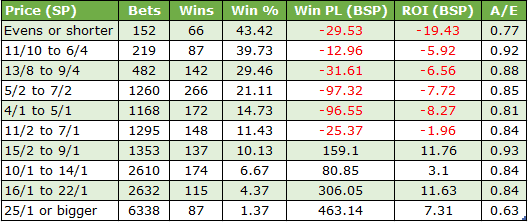
As we can see, the shortest priced 2yo debutants have been very poor value – those priced evens or shorter would have lost you nearly 20 pence for every £1 staked. There has been better value in bigger priced horses – those priced 15/2 or bigger. It is interesting that the 15/2 to 9/1 bracket has provided five winning years out of six; likewise five out of six winning years for the 10/1 to 14/1 bracket also. The two biggest price brackets proved much more volatile as you would expect with some big winning years and some years with heavy losses.

Now we know using ‘starting price’ as a basis for a bet is not perfectly possible as we do not know the SP or BSPs until after the ‘off’. However, if betting late we can at least get very close to betting at the desired price.


Top three in the betting

Sticking with market factors, I want to do a little bit of digging into debutants who start in the top three of the betting. From the price data we have seen so far it seems unlikely that we will find many profitable avenues. However, as with all stats busting, it is not just positive angles that are useful to find; finding negative stats is equally worthwhile as horses that are avoided due to these adverse findings will certainly aid our bottom line come the end of the year.

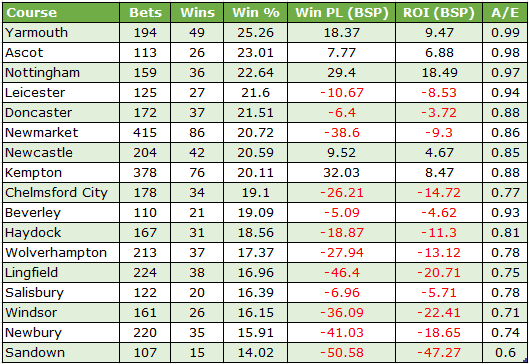
I want to share two specific areas in terms of 2yo debutants who were in the top three in the betting. Firstly let's review some course data. I have only included courses that had at least 100 qualifiers. The table is ordered by strike rate:


There is quite a difference between the ‘top’ course, Yarmouth, and the ‘bottom’ one, Sandown, in terms of strike rate, returns and A/E indices. Both courses have similar field sizes and in general it is a fair comparison. Now Yarmouth traditionally has been a course that some of the top trainers target with their juveniles. I am not sure if that is why debutants from the top three in the betting have done well there; however, it is always worth checking course stats in conjunction with other factors to see if we can gain any edge.

Of course, this subset of data is reporting on the last six seasons only so, with course stats, I often back check a different subset of data to see if results correlate. When I went back further and looked at the previous six years (2011 to 2016) I noted that four of the top five courses - Yarmouth, Nottingham, Leicester and Doncaster - all had virtually identical strike rates and A/E indices. Therefore I would hope and expect that similar results will occur this year and in the near future, at these four courses at least.

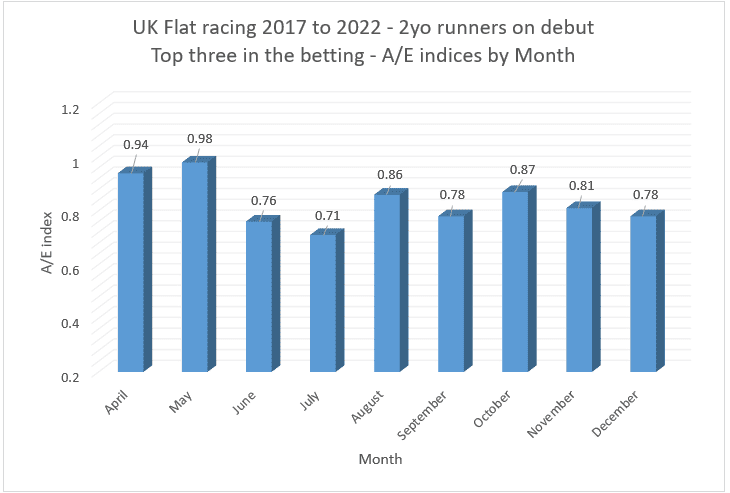
The second area I want to look at is time of year. The graph below shows the monthly breakdown of the performance of 2yo debutants in terms of A/E indices, when in the top three of the betting. I could have equally shared strike rate data as that correlated showing the same pattern.


The value in these runners clearly lies in April and May. In fact this cohort made a profit in both months, with May showing solid BSP returns of 13 pence in the £. Therefore if you are looking to back horses near the top of the betting April and May seem to be the months to focus on. In contrast June and July have seen very poor results. The A/E index for ALL 2yo runners in ALL races is 0.89 which gives you a useful figure for comparison purposes.

In general though, my personal market advice if using price as a guide, is that there is more likely to be value in those horses that are around the 15/2 mark or bigger. Hence, I would not be put off bigger priced runners, especially if I had other valid reasons for betting the horse. Of course these animals will have a low strike rate, even if they are ‘good value’, so it is not a strategy for the short term or the faint-hearted.


Gender of horse with 2yo Debutants

I always look at this factor when I research anything racing wise. Males as we know outperform females from a strike rate perspective across all race ages / types etc. That does not always mean that you should prefer male runners over female runners as prices will compensate for the general strike rate differential. If we compare ALL 2yo runners in the past six seasons (not just debutants), we will see that males had a win strike rate of 12.05%, females at 9.61%. Let us look at the 2yo debutant figures now:


The strike rates have narrowed, but there is a chasm between the two in terms of returns. Why is this the case? The simple answer is that most of the really big priced debutant winners have been male over the past six seasons. Is this likely to continue in the future? Well, there’s the million dollar question. My guess is ‘not’ for two reasons. Firstly I cannot find a logical reason to explain why males have had more big priced winners in this time frame. Secondly I did back check a previous six year period (2011 to 2016) and for this series of results females actually came out as the profitable sex. Sometimes we have to accept that there is no pattern or edge to be truly found regardless of what the raw profit and loss figures indicate. The relatively lowly A/E number is a strong reminder to 'proceed with caution'.


Sires of 2yo Debutants

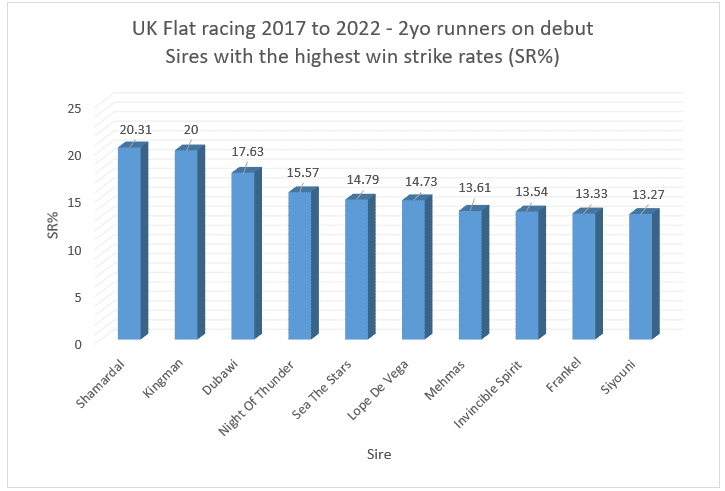
Onto sires (fathers of the horses) next. Here are top ten performing sires in terms of win strike for 2yos on their debut (minimum 100 runs):


What is useful about this specific sire data, is that each horse has just run once. Sometimes sire stats can be skewed when horses rack up multiple wins; this is not the case here.

For those of you who have read my sire articles before, most of these stallions will be very familiar to you – Shamardal, Kingman, Dubawi, Frankel are ‘regulars’ when it comes to good win records. Unfortunately, Shamardal won’t be having any 2yo debutants this year or indeed in any future year as he sadly passed away in 2020.

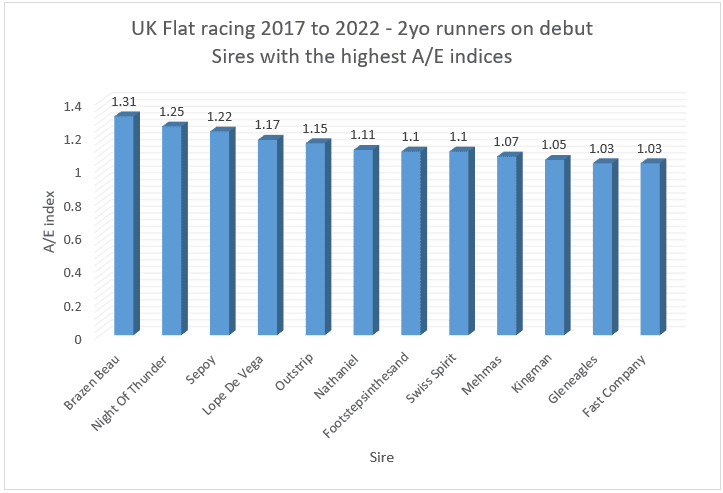
Of course win strike rate is not the only statistical ‘measure’ we are interested in. A/E indices, which we looked at earlier, are another measure I like to analyse where possible. The graph below shows the sires with A/E indices above the magic 1.00 figure:


It is good to see four sires appearing for the second time – Night of Thunder, Lope De Vega, Mehmas and Kingman were all in the win SR% top ten. These four in particular are worth close scrutiny this season when a 2yo debutant is sired by one of them.

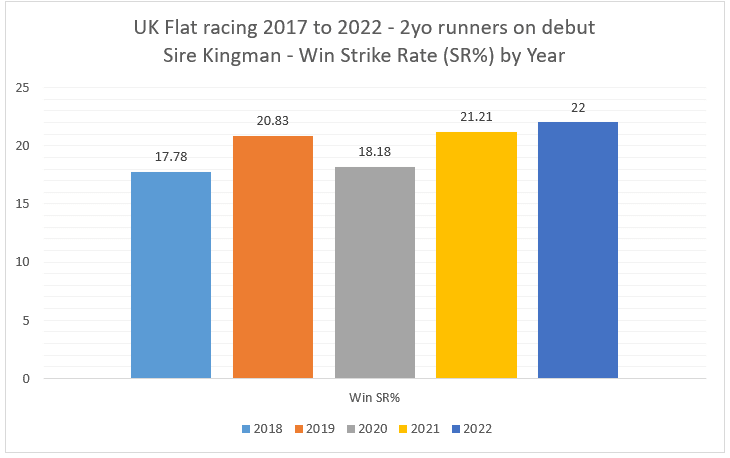
Looking in more depth at Kingman, we can see that there has been excellent consistency year by year. Here are his 2yo debutant win strike rates split by year:


His first season as a sire with runners on the track was 2018 so there is no data for 2017. The strike rates show good correlation, which is unusual for sire stats, especially debutant sire stats. One would hope to see Kingman hit the 20%+ mark once again in 2023.

Before moving on from Kingman, it should be noted that his record with these runners is better over ‘further’. Generally his 2yo debutants perform better at 7f or further compared to the sprint distances of 5 and 6f. This is actually the case when you look at all of his 2yo runners as a whole.

Dubawi is a sire who has scored slightly better than one win in every six on 2yo debut, but overall would have lost you 21p for every £1 bet. However, sticking to debutants at races of 1 mile or more, we could have secured a profit of 13p in the £ thanks in part to a healthy strike rate of 21.2% (25 wins from 118).

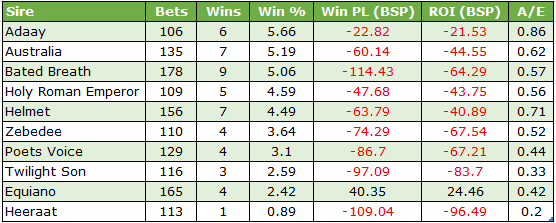
We know that for all the positive angles we come across there are bad stats too. Indeed, there are typically more bad ones than good ones. Thus it makes sense to look at sires with the poorest records over the past six seasons. Below are those sires who have the lowest win strike rate percentages with 2yos on debut:


Not only do they have low win percentages, but the A/E values are very poor (Adaay excluded). I would not be keen on backing a 2yo on debut if sired by one of these ten. Combining these sires in one group, and excluding any horse that started favourite, their collective record reads just 39 wins from 1285 runs (SR 3.0%) for a loss to BSP of £644.27 (ROI -50.4%).


Damsires of 2yo Debutants

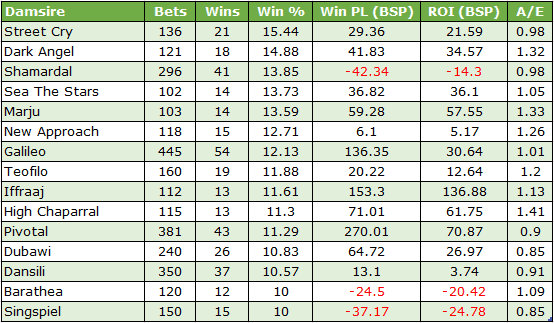
Damsires are the final port of call for this first article. Damsires are the sires (fathers) of the dams (mothers) of the respective horses. The grandfather on the female side as it were – sometimes known as maternal grandsires. Here are the records of all damsires who have had at least 100 2yo debut runners (minimum win strike rate 10%):


There are a fair few in ‘the black’ but, as we know, most of these profits are likely to be down to a big priced winner or two. However, any 2yo making its racecourse bow whose damsire has an A/E index above 1 is worth keeping an eye out for. Nine of the damsires in the table have achieved that – Dark Angel, Sea the Stars, Marju, New Approach, Galileo, Teofilo, Iffraaj, High Chaparral and Barathea.

Galileo has been the damsire of nearly 450 2yo debutants in the past six seasons and it is worth noting that there is a fairly significant difference in strike rates with turf runners versus all weather runners:


The turf strike rate is about two-thirds better than his all-weather win percentage, and there is a clear difference in A/E indices as well. Do not be fooled by the profit figures, however; these have been heavily skewed by two of the all weather winners which were priced at 130.0 and 41.61.

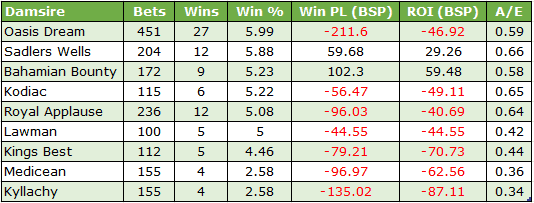
As I did with the sire data, it is worth sharing the poorer strike rates as well – below are those damsires with a strike rate below 6%:


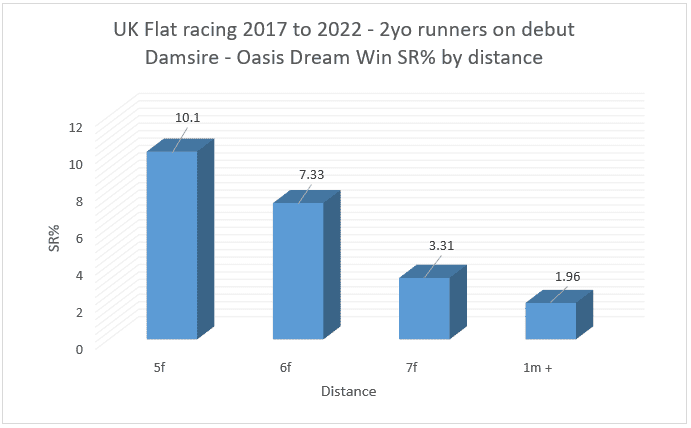
It is perhaps best to avoid these damsires, although I did find some interesting data regarding Oasis Dream when it came to distance stats, as the graph below shows:


Clearly for this damsire, what distance the 2yo debutant is running over makes quite a difference. At the minimum distance, the 10.1% strike rate is actually above the average figure for all damsires. Obviously the 7f and 1m+ figures are way below the average. Hence any Oasis Dream debut runner over 5f should not be immediately dismissed from calculations. Whereas I think you can safely draw a line through most such runners trying 7f or more. Going the extra mile in terms of research will occasionally bring some greater insight that has the potential to keep us ahead of the crowd.


MAIN TAKEWAYS

  1. Very short priced debutants (evens or shorter) have been poor value.
  2. Horses from the top three of the betting have done well in April and May. In contrast these runners have performed poorly in June and July.
  3. In general horses priced 15/2 or bigger are likely to prove better value than shorter priced runners.
  4. 2yo debutants sired by Night of Thunder, Lope De Vega, Mehmas and Kingman should be seen as a positive.
  5. Sire Kingman has been extremely consistent and it is worth noting he has a better record at 7f or more.
  6. Adaay, Australia, Bated Breath, Holy Roman Emperor, Helmet, Zebedee, Poets Voice, Twilight Son, Equiano and Heeraat are sires to avoid. This is especially true if the relevant juvenile debut offspring are not favourite.
  7. Damsires Dark Angel, Sea the Stars, Marju, New Approach, Galileo, Teofilo, Iffraaj, High Chaparral and Barathea have all offered some value in the past six seasons in terms of 2yo debut runners.

-----

In the second and final part of this juvenile debut series, the focus will be on trainers. Until then...

- DR

April on the Flat: Focusing on the turf

For flat fans the wait for the new turf season is almost over, with the Lincoln fixture taking place this weekend, writes Dave Renham. Indeed, for fans of Irish flat racing, it has already begun! For me it is the most exciting part of the year as all the winter number crunching and research I have done gets ‘tested’.

In this article I will be looking at results in April (UK racing only) going back ten seasons, focusing on turf racing only and hence excluding the all-weather. Due to Covid there was no racing in April 2020 so I have gone back to 2012 to get the tenth year of data. Profits / losses have been calculated to Industry SP, and also quoted to Betfair Starting Price when appropriate.

I will be concentrating on general factors including market data, trainers and last time out (LTO) performance. I will drill deeper when applicable, for example to make comparisons with handicap and non-handicap results. So let’s get cracking:

Market Factors in April Flat Racing

So how do fancied flat horses fare in April on the turf? Here is the breakdown of the performance of top three in the betting:


In terms of returns to SP, second favourites have lost the least amount of money (just). To BSP second favourites have again done best of the three, losing just 2.4p in the £. Favourites would have lost you 7p in £, and third favourites a similar amount (7.1p).

Moving onto strike rates, second and third favourites have won as often as they should when comparing the data with other months of the year. Taking the ten years as a whole, favourites have under-performed in April when compared with other months. The overall strike rate for turf flat favourites (all months over 10 years) is 31.7%, so the 29.39% figure for April is just over 2 percentage points lower. I suppose this is to be expected – we have a good proportion of favourites making their seasonal debut after several months off and so fitness and form lines are likely to be a little ‘blurred’. Favourites therefore have not been particularly good value at this time as year, when looking at the whole data set. However, I do want to look at favourites in more detail and, as will be seen, recent favourite performance has seemingly ‘improved’.

Favourites in April

First things first, let me look at the yearly win and each way strike rates. Each way strike rates combine and win and placed horses:


The last five years has out-performed the previous five for both winning favourites and each way market leaders. If I group this 5-year data in a table it may be easier to see the recent trend more clearly:


As the table shows there has been an uptick in strike rate, returns, A/E indices and Impact Values over the past five seasons. The win & placed (EW) strike rates reflect this also with the last five years showing 4.5% more favourites filling an each way position. So a better recent record for favourites, but despite this improvement their figures are still a little shy of favourites at other times of the year in terms of strike rate and returns.


April Favourites by race type

Time to compare handicap market leaders versus non-handicap ones:


As one might expect, non-handicap favourites have by far the higher strike rate. However, returns are virtually identical for both groups in terms of A/E.

One positive stat worth sharing is that if we focus solely on 3yo only handicaps, favourites have actually made a small profit in this month. 3yo handicap favourites have had 194 wins from 663 runners (SR 29.3%) for a small profit to SP of £7.28 (ROI +1.1%). This profit edges up to £40.68 (ROI +6.1%) when betting at BSP.

Looking at a relatively poor favourite stat now from April handicaps – horses that were favourite in 4yo+ handicaps won 23.2% of the time, but lost nearly 16p in the £ to SP (12p to BSP).


April Favourites by age

A look at the age of favourites now. Having seen the 3yo handicap data, I am expecting that age group to edge this:


As I had expected 3yo favourites across all race types have secured the best results – in terms of strike rate, return on investment, A/E index and Impact Value. 3yo favourites actually would have broken even to BSP if backing every single one in April going back to 2012. One age group where favourites perform relatively poorly in this month is 2yos. If we graph 2yo favourites across all months we can see that April is the month with the lowest strike rate, and compared to May to August there is a significant difference. (I have not included March as there were on 13 2yo favourites in total during the time frame).


Hence I would be wary of backing 2yo favourites at this time of the year. This makes sense as, in most 2yo races in April there is virtually zero form to go on, with 73% of juveniles making their debut in this month. This is likely to be a key factor in the lowish strike rate.

With 2yo favourites struggling a little there must have been value elsewhere. Amazingly perhaps, if you had backed all 2yos 5th or bigger in the betting market you would have made a profit, even to Industry SP! OK, the profit would have only been £38 to £1 level stakes which equates to around 3½p in the £. To BSP, though, these figures would have seen around £500 in profit, returning over 45p in the £. On average you would have only had 5 or 6 winners from roughly 100 bets each year, and there were five winning Aprils out of the 10. I wonder if there are any brave punters out there who will try this out in 2023?!


Trainers: April Turf Flat Racing

Let us now analyse trainers on the turf in the month of April. Let me begin by looking at the ten-year figures as a whole. I have included trainers who had at least 100 runs in April and have secured a strike rate of 11% or more, and I have ordered them by strike rate:


There is a fair smattering of profit as you can see – just under half the trainers on the list have proved profitable to SP. It should be noted that this will often be due to the odd big priced winner. Hence let us look at trainer performance with only the runners priced in single figures (minimum runs 60):


There are now nine trainers in profit to SP; however this figure increases to 15 if using BSP.

Let's dig into Charlie Appleby who heads both lists – first, here is his overall turf record in April (all prices). 197 of his 213 runners have been priced in single figures and, as the two tables above show, he has made a profit with all runners and with shorter priced runners only. His figures on the face of it are mightily impressive. Appleby's first year with results was 2014 and he had just one winner from 17 runners. From there he has ‘flown’. Here is the yearly breakdown by Win Percentage (SR%):


Five of the eight Aprils have proved profitable to SP; to BSP this becomes six (2017 profitable). Four of the last six Aprils has seen a strike rate in excess of 35% - Appleby has a good record all year round, but he clearly has his string ready to fire from the get-go.

I find it interesting that Appleby's win percentage in handicaps and non-handicaps is remarkably similar, as the next table shows:


There are comparable returns, too, with both race types returning over 20 pence in the £. This shows a good level of consistency. That consistency can also be seen when we look at his returns (ROI%) to SP across different market ranks:


As the bar chart shows Appleby has seen profitable returns across the board. He definitely looks a trainer to keep on the right side of this coming April.

Before moving away from trainers, here are some additional statistics that will hopefully give us more chance of making a profit through the first month of the flat turf season:

  1. Along with Appleby, the following trainers have been profitable to SP with favourites – William Haggas, Roger Varian, John (JJ) Quinn and Richard Fahey.
  2. Roger Varian has proved to be profitable when saddling runners at Newmarket in April thanks to a strike rate close to one in four. Focusing on his runners that started favourite or second favourite, his record at HQ reads a very impressive 13 winners from 22 (SR 59.1%) for a profit to SP of £25.25 (ROI +114.78%). To BSP this improves slightly to returns of 121p in the £.
  3. Irish maestro Aidan O’Brien has not sent many runners over in April, but as a rule they have struggled with just four wins from 49. He is just 3 from 32 with horses priced in single figures, and has had only 1 win from 16 with favourites.
  4. Richard Fahey tends to be a fast starter in April. He has secured profits at the following courses – Catterick, Leicester, Beverley, Redcar and Thirsk. Not only that, but his strike rate at all five courses has been 20% or higher. Horses from his stable that are making their seasonal debut have also made sound profits to SP; to BSP these runners would have returned you a profit in eight of the ten Aprils. In addition to this, Fahey has secured a 23.5% strike rate with his 2yos and six of the ten seasons would have secured profits to BSP. His overall figures with his 2yos show a 24p in the £ return to SP, 40p to BSP.
  5. If you are looking for a trainer to spring a surprise in April, then Richard Hannon is arguably the most likely. He has saddled eight winners priced 25/1 or bigger in April from only 72 qualifiers. The next best any other trainer has achieved in the time frame is three wins – one of those, Tim Easterby, had 250 qualifiers to obtain those three wins!


Last time Out (LTO) Factors

The final area I wish to look at in this piece is connected with LTO factors. Firstly, a look at the race code of the last run. Now, because all weather racing goes on all the year round, there is a good percentage of turf runners in April that had raced on the sand LTO. Some horses also raced LTO in a National Hunt race as the table below indicates. I have added Betfair SP data to the table this time:


LTO runners who raced on flat turf have the best strike rate but to BSP they are the only group to make a loss. Now, of course, big prices can skew vast data sets like this, and so what the data tell me is that there seems no real edge to what type of race code the horse ran in last time out.

Moving onto last time out finishing position – the graph below gives us the spread in strike rates:


It is interesting to see horses that finished second LTO actually won slightly more frequently than LTO winners (in percentage terms). As a rule the graph shows the normal type of trending down as we go from left to right. LTO winners actually have broken even to BSP, so don’t be put off by a horse that won LTO, even if that win occurred the previous turf season.


MAIN TAKEWAYS for APRIL TURF FLAT RACES

  1. As far as the market is concerned, second favourites have proved to best value, especially to BSP.
  2. Favourites have produced very similar returns in non-handicaps and handicaps.
  3. Favourites in 3yo only handicaps have made a small profit.
  4. 2yo favourites generally under-perform, as do favourites in 4yo+ handicaps.
  5. Charlie Appleby tends to start the season in very good form. His runners deserve close scrutiny regardless of price.
  6. Favourites from the yards of Charlie Appleby, William Haggas, Roger Varian, John Quinn and Richard Fahey have been profitable in the past ten Aprils.
  7. Roger Varian has an excellent record at Newmarket, especially with horses from the top two in the betting.
  8. Aidan O’Brien is one of the best in the business but his UK runners in April have really struggled recently.
  9. Richard Fahey is a trainer to generally keep on the right side of.
  10. LTO winners have broken even to BSP during the period of study.

-------

So there we have it; hopefully this article will help your punting this month. It is not an easy month to make a profit so I would urge selectivity where possible.

However, before I go, as a bonus here are three pointers to the first big meeting of the year at Doncaster.

  1. Favourites have had a poor record in the last ten meetings losing 31p in the £ to BSP. Favourites have performed particularly poorly in handicaps with just 10 wins from 93, losing 43 pence in the £ to BSP. Odds on favourites have made a small profit however (11 wins from 15).
  2. Third, fourth and fifth favourites have all made a profit to BSP.
  3. Richard Hannon is the only trainer to secure a strike rate in excess of 20% from those trainers who have had at least 25 runners (11 wins from 52).

- DR

National Hunt Sire Data: An Edge? Part 2

This is the second part of a double header where I am examining sire data in National Hunt racing to see if we can gain any type of edge. You can read part 1 here. Once again I am using UK data from 1st January 2018 through to 31st December 2022 and the profits/losses shown in all tables have been calculated to Industry Starting Price. I will also quote Betfair SP if appropriate. Virtually all of the data shared in this piece has been sourced using the Geegeez Query Tool.

At the beginning of the first article I shared a table with the top 50 sires in terms of number of runs, and I looked at Authorized, Shantou, Ask, Presenting and Yeats, highlighting some interesting facts and figures. To begin part 2, I am going to highlight two more noteworthy sires before looking in detail at a pair of specific racing angles.

Individual sire analysis

Fame and Glory

Fame and Glory is a relatively new sire having had his first runners back in 2017. The sad thing to report is that Fame and Glory died five years ago, so the current group of horses in training will not be added to. On the plus side there are around 100 still in training all aged 9 or younger. Hence he will be of interest as a sire for four or five more years, which is why I am sharing some of his data.

His overall strike rate over the five years stands at 14.9% and his yearly figures have been unbelievably consistent as the graph below indicates:


There is less than one percentage point between the highest and the lowest yearly win strike rates (SR%) - 0.79% to be precise. It is highly unusual to see this type of uniformity, something many punters would love to embrace as so many angles or systems incur wild swings of variance.

If we examine Fame and Glory’s record as a sire there are several angles that underscore this consistency. For example, male runners have won 15.3% of the time, females 14% - almost exactly what we would expect the figures to be. Likewise, strike rates in chases and hurdle races fit the overall average pattern with his chase win% at 16.7 and his hurdle one at 14.2. This gives him a chase to hurdle C.S.R. (comparison strike rate) of 1.17 where the average for all runners is 1.25 (see table in previous article).

However, indications suggest they may be a slight distance bias, certainly in terms of success rate. Here are the splits:


Horses racing at 3 miles or more have a poorer strike rate as you can see. There are potentially two logical reasons why this is the case:

  1. Fame and Glory was a flat horse who was bred as a flat horse. It may be that distances of 3 miles-plus are stretching the stamina of his progeny;
  2. Up to the end of the 2022 season the oldest runner sired by Fame and Glory was 8. We know as a rule that some older horses do step up in distance so maybe we have not got enough overall age data yet.

As I have mentioned several times in the past, it is so important when doing this type of research to appreciate that there is often no right or wrong answer. One of these reasons may be a contributing factor, both of them may contribute in some way. And neither may actually have anything to do with it! Unfortunately, with research we are often having to guess a bit; logically where possible, of course. Indeed, the first reason I gave could be contested with some validity because Fame and Glory won at 2m4f on the flat, hence it makes sense that his progeny would ‘get further’ over the sticks. For most arguments there is often a counter argument. Suffice it to say it will be interesting to see what happens in the next year or two.

Kapgarde

Kapgarde was a successful French hurdler and chaser in the early 2000s, as an entire (obviously), which is rare in UK but less so across the Channel. His offspring seem to prefer chases to hurdles as the table below shows:


The chase stats become even more interesting when we look at chase results by age. Horses aged 8 or younger have won 19.5% of the time; for those aged 9 or older this drops to 10.5%. Now it should be noted that there have been far more qualifiers for the younger age bracket, so we need to be careful not to be too judgmental here. However, the each way stats correlate strongly (37.1% v 24.6%), as do the A/E indices (1.01 v 0.73), which gives me at least more confidence that there is something in this. It is often the case the French-bred NH runners show precocity rather than longevity, so Kapgarde aligns with an overall trend.

I would also like to share that Kapgarde chasers priced 12/1 or shorter would have secured you a 14p in the £ return to BSP from just under a 22% strike rate.

*

It is now time to home in on possibly the most important area as far as sire research in NH racing goes and that is the ground conditions / going.

NH Sires by Going

One area where I believe sires can pass on a trait or a preference is when it comes to handling the going. Ground conditions vary markedly depending on the weather, time of year and the drainage of the track. Some horses seem adept on any ground, others clearly do better on either softer or firmer.

To begin with, a couple of baseline figures are that the average horse/sire wins 12.57% of the time on good or firmer ground whereas on soft/heavy this drops slightly to 11.63%, a function of field size.

This is important because below I compare each sire’s record on fast ground (good or firmer) with their record on slower (soft or heavy). To be clear, in order to achieve a proper distinction, I have ignored good to soft going descriptions.

As with the first article I am going to divide the two percentages to give us a type of Impact Value which I call Comparison Strike Rate (CSR). The average CSR figure should be 1.08. Scores above this suggest the sire performs better on firmer ground than he does on softer ground. Conversely, scores below 1.08 imply the opposite. Here are the findings – they are ordered by highest CSR figure to lowest (the midpoint of 1.08 is highlighted in green):


Robin Des Champs tops the list with a CSR figure of 1.68. Sadly this sire died in December 2018 so his horses will only be active for possibly three or four more years. However, that still leaves some time to take advantage of the fact his progeny appear far better on good or firmer ground. Backing all runners on good or firmer would have yielded a 19p in the £ profit over the past five years; backing all his runners on soft or heavy would have yielded a loss of 35p in the £ to BSP.

Yeats lies second in the table and, in the first article, I highlighted this sires’ record on good or firmer. Yeats as a racehorse performed on good to firm ground nine times winning all nine races. He also raced once on firm once, winning that, too. He only raced on soft or heavy four times; he did win once but two of his losses saw him beaten 60 lengths and 32 lengths respectively. It should be noted that he was a long distance flat horse, but regardless of that, his going traits do seem to have been passed on to his offspring.

Presenting is third in the list showing a definite preference for sounder surfaces. However, as I mentioned in the preceding article, Presenting runners generally produce poor returns, and even on good or firmer ground backing all his runners would have seen a loss of 25p in the £ to BSP.

At the other end of the spectrum, Schiaparelli has the lowest CSR at 0.60 suggesting he is far better on easier going. Indeed his runners on soft or heavy ground have produced excellent returns of 61p in the £ to BSP. Further, you would have made a profit on these runners in four of the five years in review. Schiaparelli was highlighted last time as being more effective over fences than over hurdles, and if you combine chases on soft or heavy ground, his offspring have produced 17 wins from 64 runs (SR 26.6%) for an SP profit of £38.36 (ROI +59.9%); profit to BSP has been £53.76 (ROI +84.0%).

There are plenty of other sires here near the top, or the bottom, of the table that readers may want to investigate further using the Geegeez Query Tool, but for this article it’s time to look at A/E indices.


Actual vs Expected

A/E, or Actual vs Expected, is a measure of sustainable profitability where indices of 0.95 and above are generally considered good, with indices north of 1 suggesting good overall value. You can find more information on A/E, and other metrics used here on geegeez in this article.

First let's look at sire performance on good or firmer ground. The table below shows those whose A/E index is 0.95 or above. They are ordered left to right alphabetically:


Horses sired by any of the above are worth keeping an eye on when racing on good or firmer. Here are their full stats in terms of wins, runs, returns to SP etc.


Three of the thirteen have made a blind profit to SP, which increases to 11 of 13 if betting to BSP. Only Midnight Legend (BSP ROI -4.6%) and Sulamani (BSP ROI -0.6%) missed out at exchange starting price, albeit both marginally. Naturally, I am not suggesting you should bet all 13 sires blind on better ground, but they are definitely worth considering combined with other race reading factors.

Now let's take a look at the records of sires on soft or heavy whose A/E index is 0.95 or above. Once more they are ordered left to right alphabetically:


Ask, Dylan Thomas, King’s Theatre, Malinas and Sulamani appear in both this list and the good or firmer list showing real versatility in terms of going requirements. It should come as no surprise that all five of these sires are profitable to BSP with ALL runners on ALL goings. This quintet could be a bit of a blind spot in the betting markets currently.

Here are the complete soft/heavy stats for all 14 sires with an A/E index of 0.95 or above:


Seven of the sires have produced a blind profit to SP on these soft surfaces; 13 of the 14 are profitable to BSP. Only Winged Love is in the negative.

It is often worth checking profit and loss stats where bigger priced runners are ignored; this helps to avoid ‘skewed’ results. Below are the performances of these sires on soft/heavy ground at prices of 12/1 or shorter:


These are very positive when taken as a whole; all but four have made a blind profit to SP and three of these would have made a profit to BSP. When the going rides soft or heavy, horses sired by these runners should definitely be on our radar.


Age

Below are some data relating to age of the horse, looking for any sires which have different patterns to the norm. Age wise, I have split horses into three groups – those aged 3 to 5, 6 to 8 and 9 and older. In terms of strike rate the average figures for ALL horses are as follows:


The 6 to 8yo age group win more often than the other two, while the older brigade have the poorest strike rate. In terms of A/E indices the figures are 0.85 for 3-5yos; 0.88 for 6 to 8yos; and 0.84 for horses aged 9 years-plus.

With these figures in mind here is a table with 40 of the leading sires comparing their strike rates and A/E indices across the age groups. With a ‘par’ A/E index for all sires at 0.87, I have highlighted A/E indices of 0.95 or higher (in green) – these are essentially positive. A/E indices of 0.79 or lower (in red) are essentially negative:


This should be useful table to use ‘at a glance’. Sires with green A/E indices within the specific age band are worth keeping an eye out for, as they are much more likely to offer some value. Likewise, red values are combinations of sire and age that we should perhaps avoid, or at least be wary around.

Here are some more age-based sire stats that I have uncovered – some positive, some negative:

  1. The offspring of Authorized aged 3 to 5 that started favourite or second favourite have provided 59 wins from 136 (SR 43.4%) for an SP profit of £26.28 (ROI +19.3%). To BSP returns increase around 10 pence to 29p in the £;
  2. Mahler with 3 to 5yos that started favourite also has an excellent record – 34 wins from 66 (SR 51.5%). Returns of 32p in the £ to SP; 40p to BSP. Splitting these results by race type we see that of the ten National Hunt Flat favourites eight went on to win (returns of 167p in the £); 24 wins from 45 for hurdling favourites and just 2 wins from 11 for chase favourites.
  3. Trans Island with runners aged 9 and older has a strike rate of below 5% as can be seen in the table above. Narrowing down these older runners to those priced 9/1 or shorter, this has seen just 4 winners from 51 (SR 7.8%) for loss of £26.50 (ROI -52.00%);
  4. Excluding horses that started favourite, Vinnie Roe has produced just 9 winners from 208 (SR 4.3%) with runners aged 9 or older. This equates to losses of over 45p in the £ to SP;
  5. Passing Glance has a decent record with older runners (aged 9+). They would have produced returns of 24p in the £ to SP if backing all runners blind (30p in the £ to BSP). Digging deeper and looking at performance by run style, older runners that raced close to or up with the pace (e.g. prominent or led) won 25.8% of the time; those who raced midfield or near the back early won just 3.6% of the time (2 wins from 56);
  6. Offspring of Ask have a moderate record once they get to the age of 9 or older. In fact if you exclude favourites or second favourites their record is dire – just 4 wins from 90 runners (SR 4.4%) equating to losses of 65 pence for every £1 staked.


MAIN TAKEAWAYS

Before winding this two-parter up, here are some positives and negatives to take away from this piece. I have chosen the sire stats that I feel are the strongest. Some I have highlighted in more detail already, others I have taken from the tables:


I guess sire research for some is like Marmite; but personally I think it is an under-researched area and that, under certain circumstances, can offer up a fair edge. The problem of course is that this type of data can be interpreted in so many different ways; we just have to interpret it better than most of your fellow/rival punters!

- Dave Renham

National Hunt Sire Data: An Edge? Part 1

Back in the Spring of 2021, I wrote a four-part flat series on sires and damsires (which you can read here), but this is my first departure into National Hunt sire research for Geegeez. There is plenty to get the teeth into, so I've spread the research over two articles, this being the first half.

The use of breeding as a winner finding / betting tool has become more popular in recent years, especially in flat racing: some astute punters who bet in two-year-old maidens will use sire stats to try and help predict how a juvenile with little or no form will run. Sires are the fathers of the respective horses, and sires have a more discernible influence on their offspring (progeny) than dams (mothers) due to the size of the respective samples: dams can produce only a single foal annually whereas sires can produce 100 and more.

For this first article I will be using five years' worth of UK data, from 1st January 2018 through to 31st December 2022, and profits/losses shown in all tables have been calculated to Industry Starting Price. I will also quote Betfair SP if appropriate. The vast majority of the data for this piece has been sourced using the Geegeez Query Tool.

The Top 50 National Hunt Sires by Win Strike Rate

Firstly let us look at the top 50 sires in terms of number of runs in the last five years. I am only including sires which had runners in 2022. The sires are listed in order of strike rate (win%):


As the table clearly shows, backing sires ‘blind’ is not a profitable avenue as far as Industry SP is concerned. Just one sire has made a profit to SP with all his runners in the past five years (Walk In the Park). However, using BSP, several made a solid profit after commission including Shirocco, Passing Glance, Ask, Dylan Thomas, Great Pretender, Flemensfirth, Brian Boru, Schiaparelli and Gold Well.

It is time to dig a bit deeper...

Individual Sire Analysis

Authorized

Let's look at some of the leading sires in more detail, starting with Authorized who heads the list in terms of win strike rate. One snapshot worth sharing is his record at different race distances, because as you will see from the table below, the progeny of Authorized seem to prefer shorter trips:


It should not surprise you to note that races of 2m2f or less have produced a BSP profit given the very small industry SP negative return on investment. It also is worth noting that at these shorter distances an Industry SP profit could have been achieved if focusing on runners priced 8/1 or shorter. Such runners won 93 races from 321 starts (SR 29.0%) for an SP profit of £50.47 (ROI +15.7%).

It should also come as no real surprise that there is also an age bias for Authorized runners. With a fair proportion of horses stepping up in distance as they get older, one might expect this given the more profitable form was shown by progeny in shorter races. Horses sired by Authorized aged six or younger have a far stronger record than horses aged seven or older:


It should be said that one would expect younger horses to have a slightly higher strike rate (average figures for all horses aged 6 and younger during this time frame was 12.4%, whereas for 7yos and older it was 11.3%). However, as you can see, the difference is far more marked here.


Shantou

I would have looked at King’s Theatre next, but he has hardly any runners any more (just 65 runs in total in 2022). Hence Shantou is the next sire about which I want to share a couple of interesting findings. Firstly, let us compare male runners to female ones in terms of win percentage/strike rate. The graph below shows Shantou’s figures as well as the stats for ALL sires:


As you can see males score more often than females as a general rule, but Shantou’s figures show a significant difference between the two. Taking this a stage further, a really eye-opening stat is when we look at Shantou’s female runners once their SP hits 7/2 or bigger: just 12 such runners have won from 265 runners (SR 4.5%) creating steep losses of 47 pence in the £. It is not just the really big priced runners that have affected this, either, because 69 female runners have been priced between 7/2 and 7/1 and only three have won.

It's not easy to explain why this should be the case, so if any readers have a theory do leave a comment below this post.

One further Shantou stat worth sharing is his record with runners on debut. Of 120 debutants 24 have won (SR 20%) for an SP return of 38p in the £, BSP return of 65p in the £.


Ask

British sire Ask has some interesting weight carrying stats that I would like to share. The graph below compares light weights of 10st 6lb or less with heavier weights of 11st 5lb or more. The graph shows Ask’s figures and the ‘ALL sires’ figures:


As we can see horses carrying more weight win far more often than those carrying less weight (N.B. the market takes account of this so backing higher weighted horses is not a license to print money, I’m afraid!). However, we can see with Ask that the differential is far greater than the norm. Some horses are built to carry weight better than others and Ask seems to fit this ‘type’. Perhaps his progeny are somehow bigger, or more robust, than the average. Again, does any reader know?


Presenting

One thing to be aware of is that sire results / strike rates and so on do fluctuate from month to month, year to year. However, some sires can be very consistent and an example of this is Presenting. Below we can see his yearly strike rate in terms of win and each way:


There is very little fluctuation in either set of yearly figures. Knowing what ‘you are going to get’ on a consistent basis can be important. The sad part as far as Presenting runners is concerned is that his runners look overbet, even allowing for - or probably because of - his consistency, and hence finding profitable angles is virtually impossible.


Yeats

Yeats is also one of the more consistent sires, but from a punting point of view does give us an angle to try and exploit. His record on firmer ground is much better than on softer, and if we focus on races on good ground or firmer, his record is extremely good – 217 wins from 1203 runs (SR 18.0%). To SP he made a small loss of just under 8 pence in the £, but to BSP this becomes a profitable return of the same amount (8p in the £). That figure improves further if we restrict races on good or firmer going to three miles or longer. Here the strike rate improves to 20.5% (93 wins from 453 runs). Backing horses at £1 level stakes you would have seen rewards of £97.57 (ROI +21.5%) at SP, and a BSP profit of £169.39 (ROI +37.1%).


National Hunt Sire Performance by Race Code

I have several areas I want to cover in detail in the follow up article, but there are two specific subjects that I want to focus on in this piece - starting with a review by race code.

Chase and hurdle races

The first thing to appreciate is that hurdle races have more runners on average than chases so when we compare win strike rates we need to be aware of this. What this means is that individual chase strike rates should higher than individual hurdle strike rates. The average horse (and, by association, the sire) wins 13.7% of the time in chases, whereas in hurdle races this drops to 11%. This is important because I am going to compare each sire’s chase and hurdle strike rates.

I have divided the chase strike rate by the hurdle strike rate to give us a type of Impact Value. It is not a ‘true’ IV so I’ll call it a Comparison Strike Rate (CSR). The average CSR figure should be 1.25 (13.7/11 = 1.245). Scores above this suggest the sire performs better in chases than he does in hurdles. Conversely scores below 1.25 suggest the sire's progeny perform better in hurdles than in chases. Here are the findings – they are ordered by highest CSR  figure to lowest (the midpoint is highlighted in green):


Dr Massini stands head and shoulders above the rest with a C.S.R fig of 2.5 although backing all his runners in chases would have only seen you break even on Betfair. This is partly due to the fact that the win strike rate was still a relatively modest 12.61%. Schiaparelli also has a high CSR figure of 1.93 and his runners in chases have secured a 16p in the £ profit to BSP.

Another measure to look at are the A/E indices for each sire in chases. A/E, or Actual vs Expected, is a measure of sustainable profitability where indices of 0.95 and above are generally considered good, with indices north of 1 suggesting good overall value.


Malinas (1.18) and Passing Glance (1.15) have the best two indices, and have proved profitable if backing all their runners in chases. Specifically, Malinas has seen 48 of his 222 runners win (SR 21.6%) for a BSP profit of £66.29 (ROI +29.9%), while the offspring of Passing Glance have won 37 from 177 (SR 20.9%) for a BSP profit of £162.55 (ROI +91.8%). Both made a profit to Industry SP as well.

The next four highest sires in terms of A/E indices were Great Pretender (1.09), Dylan Thomas (1.07), Shirocco (1.05) and Brian Boru (1.04); each of these also individually produced a BSP profit in chases. Indeed, you would have won £489.33 to £1 level stakes if backing the runners of all four sires in all of their chases. Ah, wonderful hindsight...

Moving briefly to hurdles, Winged Love and Walk In The Park were the two sires with the lowest CSR figures meaning they had thus far performed better over hurdles than in chases based on their win strike rates. Both horses made a blind profit to BSP in hurdle races, to the tune of 6p and 15p in the £ respectively. In chases they have both struggled, losing 21p and 22p in the £ respectively.

As an aside, I use the Comparison Strike Rate (CSR) idea quite a lot in my personal research. I also compare A/E indices and place strike rates in the same way. It just gives a bit more of an insight, and helps me to compare stats quickly.

Right and Left handed tracks

For the last section of this first half, I would like to compare sire performance at right-handed tracks compared to left-handed ones. Some horses have what Nick Mordin in his iconic book Betting For a Living called ‘the right-hand/left-hand pattern’. He mentioned the great Desert Orchid as a prime example of the right-hand pattern. This horse had a brilliant record on right-handed tracks but a relatively poor one in comparison when racing left-handed. Mordin believed that this pattern occurs a lot, generally with steeplechasers, more especially the right-handed pattern. Some horses simply don’t jump straight all the time and have a tendency to jump across the fence either right or left. Hence horses with a tendency to jump out to the right are going to struggle on left-handed tracks as they are constantly going wider on the track, especially if the jump is on or near a bend. Of course it works the other way round, too, with horses that jump to the left losing ground when racing right-handed.

Below is some sire data on left- and right-handed tracks in chases (minimum 100 runs to qualify). I am effectively grouping individual horses together here as we are looking at sire stats, but it is possible that sires pass on a preference that they had to jump to the left or right. I have graphed seven sires below in terms of strike rate on both right- and left-handed tracks. Their figures suggest each of the seven potentially show a right- or left-handed pattern:


Poliglote, Scorpion, Kayf Tara and Westerner have much better records on right-handed tracks; the other three enjoy better records on left-handed tracks. Naturally, one cannot definitively say that these results are down to a right/left pattern, but it would be an idea to delve into these sires and their individual horse records to see how many horses show a strong pattern one way or the other. The sample sizes are generally quite big which lends credence to the notion that there might be something going on here.

As an example, I looked briefly at the sire Westerner and pulled up the record of a horse called Mr Mercurial. Mr Mercurial’s chasing career spanned from 2015 to 2020 and his 24 chase starts were split thus:


Although we're now dealing with micro sample sizes, we can see a clear preference to right-handed tracks; and this strengthens further when I share that the other three runs at right-handed tracks resulted in three placed efforts. Indeed Mr Mercurial's PRB (percentage of rivals beaten) on right-handed tracks was an amazing 0.93 (93% of rivals beaten). Now, I appreciate this horse ran some of the time outside the 2018 to 2022 period on which I am focusing in this article, but hopefully you take the point.

I am not saying all horses from these seven highlighted sires will display a preference but the chances are some will. This type of knowledge, should you uncover it, will give you a useful edge over the average punter.

MAIN TAKEAWAYS

  1. Runners sired by Authorized have a good record over 2miles 2f or shorter. Horses priced 8/1 or shorter have been profitable to SP and BSP.
  2. Horses aged 6 or younger sired by Authorized have scored roughly one win in every five races for a small SP profit.
  3. The male progeny of Shantou score nearly twice as often as their female counterparts.
  4. Horses sired by Ask seem very adept at carrying big weights (11st 5lb or more). They have a poor record when carrying light weights(10st 6b or less).
  5. Runners sired by Yeats improve on better ground (good or firmer). This improvement is even greater when the race hits 3 miles or further.
  6. The progeny of Dr Massini, Schiaparelli, Malinas and Passing Glance are much better when racing over fences than over hurdles.
  7. The progeny of Winged Love and Walk In The Park are much better when racing over hurdles than over fences.
  8. The offspring of Poliglote, Scorpion, Kayf Tara and Westerner have much better records on right-handed tracks.
  9. The offspring of Jeremy, Doyen and Arcadio have much better records on left-handed tracks.

I'll be back soon with part two of this look into the characteristics of National Hunt sires… until then...

- DR

Chases, Jumping, Falling: An Analysis

In this article I am taking a one-off look at chases and, in particular, looking at a key factor for any horse that runs in such races, namely jumping, writes Dave Renham. I am looking at data from 2015 to 2022 which covers eight full seasons and I am looking at both UK and Irish results. The main aim for this article is to try and have a better appreciation of what factors impinge on a horses’ jumping. That might be racecourse related, it might be going related, it might be a combination of these and other factors. Any profit / loss figures have been calculated by using Betfair Starting Price (BSP).

In 2015, both Tony Keenan and the editor Matt Bisogno produced some research in this area - which you can read here and here - and this article will both build on the earlier work and bring it up to date.

I think most racegoers will agree that being able to jump fences is a key requisite to be successful in chase races. Imagine a 3 mile chase where two horses of similar ability race against each other. If horse A jumps cleanly all the way and horse B makes numerous jumping errors, one would expect horse A to win a very high percentage of the time.

The difficulty of jumping fences varies: some courses have more challenging obstacles – the Grand National course at Aintree springs to mind. However, the ‘big’ tracks of Ascot, Cheltenham, Kempton, Haydock, Newbury and Sandown also have more challenging obstacles than the majority of smaller tracks. Clearly it should be more difficult to jump ‘stiffer’ fences, but there are other considerations to take into account, for example, the state of the grass either side of the fence. If the turf is slippery or slightly worn, then regardless of how difficult the fence is to jump, landing cleanly can become more problematic.

We also need to consider that some tracks have more fences than others at certain distances. Did you know, for instance, that the minimum number of fences per two miles is lower at Irish courses than it is at UK ones? As an example of this let us look at two racecourses, one in Ireland (Naas) and one in the UK (Wetherby); and observe the difference when it comes to a two mile chase. Naas first:


You can see that, for two mile races, horses are required to jump two fences in the home straight on the first circuit and then eight fences on the second circuit, giving a total of 10.

Let’s compare to Wetherby now:


Wetherby’s shortest chase distance is actually a furlong less at 1m 7f, but they have to negotiate 13 fences in total; four on the first circuit, nine on the second.

Also, in terms of number of fences, one could argue that courses with a higher concentration of fences closer to the finish might prove more problematic than courses with fewer fences at the business end. Another factor to consider is race type: some courses have more handicap chases than others; some have more races for novices etc. All these factors will play a role of some sort.

As will be becoming clear, there is plenty to consider here. My initial starting point from a stats perspective is to look at individual courses and which are hardest to jump round. To do this I am simply taking the number of chasers at each track and finding the percentage of runners that either fell or were unseated. I have ignored horses that were brought down; I am not saying this is the best or only method to test out which courses are the hardest to jump round, but it is logical, and horses that fall/unseat would have almost certainly produced a jumping error of some sort. Of course the fall may not necessarily be down to poor jumping, it could be down to jockey error. Alternatively it may be down to something I alluded to earlier - landing on a slippery or churned up section of ground. However, the majority of casualties will be down to a mistake / poor jump.

What is so important when doing this type of research is to appreciate that there is often no right or wrong way, no right or wrong answer. Also one needs to be aware that there are potential flaws in any idea/method and, where possible, one should try to address them when sharing the relevant data.

OK, back to the percentages of horses that fell / unseated by course. The UK first:


Aintree tops the list, as I am guessing most expected, and as it did in 2015. The Aintree stats include both chase courses, Mildmay and Grand National, but it will come as no surprise that for the National course the percentage increases to 23% in terms of fallers/unseated riders. For the record it is 24% for the Grand National itself (over the past eight years).

But would you have expected Fakenham to be second in the list? Or indeed Ludlow third? Now I have already mentioned other factors that are potentially in play here, but there are other points to consider as well as these. For example, class of race / horses differ from course to course – that could affect the percentages, as can the speed at which horses approach the fences. The going is another factor as generally it is harder to complete the course when the underfoot is soft or heavy as compared to firmer conditions. Hence courses that have a greater percentage of chase races on softer ground will see the percentages slightly skewed. Races that are run at a quicker pace will probably see more fallers, etc, etc. This is another example of what I meant earlier about being aware of potential flaws in any research of this type. The individual course plays a major role in how easy or hard it is for a horse to jump round, but there are more pieces to this complex puzzle.

Let us compare the above with Irish course data now:


It is not surprising to see Leopardstown near the top, but I wasn’t expecting Listowel to be at the head of the list. What is interesting is if we compare the percentage figures for all UK courses to all Irish courses.


As the bar chart shows, in percentage terms far more horses have either fallen or been unseated in Irish chases as compared to UK ones. One potential reason for this is that Irish races have bigger fields on average. Hence could there be more crowding / less space at certain fences, which could cause horses to make more bad errors that are bad enough to see the horse come down? That’s certain plausible.

Could this be partly down to the going? The reason I posit this is that in Ireland 40% of the chases were raced on ground described as soft or heavy, in the UK the figure was 34.8%. Hence, it seems now would be a good time to compare the fell/unseated percentages by going. The most obvious thing to compare is soft or heavy versus good to soft or firmer. Here are the figures:


Certainly there are more jockeys falling when the conditions are soft or heavy. It may look like a small difference, but due to these figures coming from thousands of races it is almost certainly a material factor. Further, when isolating races on good to firm or firmer only, the fall/unseat percentage drops to 6.2%. This is more evidence that supports the theory.

Let's now go back and dig deeper into the differences with the UK and the Irish data. Earlier we saw that horses in Irish races fell or unseated more often than in UK races, as a result of which I had a theory that any horse that fell or unseated last time out in a chase would perform better next time in the same race type if their mishap occurred in Ireland. The thinking was simple: for whatever reason jumping fences in Ireland appears harder, so horses that had their mishap that side of the Irish Sea may have had more of an excuse than their UK counterparts. Let us see if the stats back up this hypothesis:


OK, so this is the reverse of what I was hoping for! What do I know??! However, the differences at first glance do still look quite powerful.

We need to be aware that punters, as a rule, take last time out performance as a key factor when contemplating any bet. Horses that fall/unseat do not generally get positive attention from punters. Hence an obscure reason of which country the horse fell in a chase last time out will go under the radar of most people.

Not surprisingly, if you flip the idea slightly and just concentrate on which country the chase race was run (after falling/unseating), the stats are remarkable similar:


The stats are virtually the same because most horses do not hop back and forth racing in Ireland one week, then next time in the UK, or vice versa. A few of the better horses do switch occasionally especially for the big festivals or races. However, invariably not many of these horses would have fallen or unseated last time.

Now, of course, these stats may be skewed slightly by the fact that, as I mentioned earlier, Irish chases have bigger average field sizes. This certainly explains the difference in strike rates, but it does not necessarily account for the differences in profit/loss; or, more importantly, the significant difference between the A/E indices. However, once again, when analysing data we need to be aware of any extenuating circumstances that may affect our stats. Also, we need to appreciate that sometimes we simply cannot explain the results, or at least it may be difficult to offer a logical reason why they have turned out the way they have.

So what about distance: is it a case of the longer the distance the more fallers/unseated riders? That makes possible sense as a longer distance means more fences to jump. However, it seems to be that longer distances actually see slightly fewer horses falling or unseating their riders thank shorter trips in percentage terms.


So what could be happening here? A logical explanation is that shorter races are run at a quicker pace; a quicker pace potentially offers up scope for more, or more serious, jumping errors. However, whatever the reason, I must admit I had hypothesised beforehand that longer races would have had the slightly higher percentage.

I mentioned earlier that race type will have a potential effect on the figures so let's review this. One might expect less experienced chasers (i.e. novices) to make more jumping errors than seasoned handicappers, and therefore fall / unseat more often. Here is a look at the fell/unseated percentages across different chase types:


The stats definitely back up the theory; novice and beginner chases have the highest figures; handicaps have the lowest.

Something I did notice was that in 2022 Beginner Chases were restricted to Irish courses only. No Beginner Chases in the UK that year. I have since noted that at the end of Jan this year (2023) there was a Beginners Chase at Lingfield. I am not quite sure what happened in 2022, maybe Matt knows [I don't, but the fact that there has only been one double-digit field for a UK beginners' chase since 2015 ought to be a part of the reason- Matt]

What about jockeys? They must play some sort of role in all this. I am guessing some jockeys are slightly more adept at getting their horse to jump fences; likewise some jockeys may have a better ability to stay in the saddle when others might tip over. Here are a list of jockeys with their fell/unseated percentages – it gives their overall figure, their figure in handicaps (exc. Novice handicaps) and their figure in ‘all other’ races. To qualify they must have ridden in the last year and had at least 300 rides in handicaps, as well as 300 + rides in other chases combined. They are ordered alphabetical.


For the record, the average figure for fallers/unseated for all jockeys in all races (and indeed all horses) is 7.1%. Several jockeys in the list have an overall percentage of under 5% which I count as a positive - I have highlighted them in green. Just one jockey has a figure over 10% - that is Luke Dempsey who not surprisingly rides in Ireland. Indeed three of the four jockeys with the highest figures primarily race in Ireland (Blackmore, Dempsey and Kennedy). Brendan Powell has the worst record as far as a UK jockey is concerned, so you might be wary in the future if he in on board a suspect jumper.

Another interesting finding is that the more experienced jockeys in chases fell or unseated less often. Jockeys that had ridden in 1000 chases or more (2015-2022) had a percentage fall/unseat rate of 5.7%; jockeys who had ridden 500 to 999 chases had a percentage of 7.1; jockeys who had ridden in less than 500 had a percentage of 7.9%.


MAIN TAKEWAYS

 - A bigger percentage of horses racing in chases fall or unseat in Ireland

- A bigger percentage of horses racing in chases fall or unseat on soft or heavy ground

- A bigger percentage of horses racing in chases fall or unseat in Novice chases/Beginner chases

-  A bigger percentage of horses racing in chases fall or unseat when racing on the National course at Aintree

- A bigger percentage of horses racing in chases fall or unseat in races of under 3 miles compared to chases of 3 miles or more

- Horses that fell LTO in the UK have appeared to perform better next time than their Irish counterparts

- Sean Bowen, Paddy Brennan, Brian Hughes, Denis O’Regan, Sean Quinlan and Sam Twiston-Davies are the six jockeys with the lowest fall/unseat rate of the more experienced jockeys

- More experienced jockeys tend to have a lower fell/unseated percentage than less experienced ones


To conclude, I hope you have found this an interesting read. It is certainly a different aspect of racing to what I normally write about. I have only touched on a small part of this whole jumping idea, and if enough people comment they would like to find out more, then I’ll happily pen another piece sometime in the future.

Dave Renham: A Window into My World of Racing Research

INTRODUCTION

I am writing the introduction of this article at roughly the midpoint of my research. Hence the style of this piece will be slightly different to my usual framework as normally I have finished the research and number crunching before I start to pen. Regular readers of my articles on Geegeez will know that I often produce a series of articles on a particular topic, but this is a 'standalone' piece.

Now, I would love to have been given a pound for every hour of horse racing research I have done in my life. If totalled up, that money would run into thousands upon thousands of pounds. Fortunately my research has been very varied in terms of what I have researched as well as how I have researched it. That has clearly been a good thing, as using different approaches and/or studying different themes or ideas has helped me to stay curious and motivated. I know from experience that as soon as the research becomes a drag, the likely resulting article is not going to be one of my best.

My research has changed beyond recognition from the late 1990s when I started. Back then, virtually all of my racing work was connected with draw research and especially draw biases. I wrote, or co-wrote, four books in those early years, but it is more the manner of how one researches which has changed so much. In those days, the internet was in its infancy and racing programs were rare. Hence I spent many an hour pouring over my Superform Annuals gathering the draw data I required, initially using pen and paper and numerous exercise books before moving onto basic spreadsheets in Microsoft Excel.

Clearly going through race by race, page by page, then writing down the relevant data or inputting it to excel took time. A lot of time. I lost count of the occasions I was still working at two in the morning; how I was able to get up for work at around 6.30 am is beyond me – it would certainly be beyond me these days! However, there were (and still are) significant advantages to this slow data gathering process. Primarily, this is because you do get a real ‘feel’ for the data you are collating, rather than pressing a button and being presented with the raw stats breakdown.

The first ‘game changer’ for my (and many others') racing research was Racing System Builder (RSB) – this came in CD form and once installed on your PC you had a huge array of variables that you could test either in isolation or in combination. You could create systems and the like to your heart’s content. It was also so quick – a press of a button and several years’ worth of data was collated in seconds. Unfortunately, from my draw research perspective, it was far from ideal as it split the draw into quintiles (fifths). I split the draw into thirds. However, in terms of becoming familiar with other potential research options it was fantastic.

As the years passed racing programs became more widely available as well as websites offering online research options. These programs gave more scope to research different ideas, or combinations of ideas, and with most of my articles being stats based, I could test so many more theories and gather a wider variety of data. So I analysed weight in handicaps, sire data, the effect of the market and of recent form, days since last run, last time finishing position, trainers, jockeys etc, etc. Articles could be researched relatively quickly – all I needed was an idea and the correct filters on the racing program. From there I would collate the data, interpret it and transfer it into the pieces. Obviously they still needed a bit of text and context which I added around the ‘numbers’.

I still research the majority of my articles in this fashion, but for this offering I will be combining the ‘old’ with the new. In other words, I’ll be partly using online databases, but also going through individual races one by one to pull out additional data I require. Not only that, I am going to walk you through exactly how I did it and how I tried to interpret it. Because, who knows, you might like to try something similar yourself!


RESEARCH STARTING POINT

Let me explain my initial thinking in terms of what I wanted to research. As a fan of run style and the draw I wanted to include those components. I also wanted to examine some of the speed rating data Geegeez uses, as well as studying anything around potential market bias. Having decided upon those four key areas, I set about deciding which type of races I would examine. I figured it would be a good idea to stick to similar races so I chose the following rules:

  1. All weather races in UK
  2. Handicaps with exactly 8 runners
  3. Sprint races only (5 & 6f)
  4. Races run round a bend

The last rule meant that I could include four courses - Chelmsford, Kempton, Lingfield, and Wolverhampton. The only difference in those four to be aware of is that Kempton is the only right handed course. However, I did not perceive this to be a problem.


AIMS OF THE RESEARCH

The aim of my research was to try to find an edge of some kind, which is the same aspiration each time I embark on some new research. Unearthing a killer angle is not always going to happen and, as a researcher, you need to be able to deal with that. Even if I do not find anything ‘earth-shattering’, the chances are I will uncover some worthwhile angles even if they may not quite be the "holy grail" life-changing ones we all dream about.

GATHERING THE DATA

I mentioned earlier that my research would involve a combination of quick database-generated research and the slow 'old school' race by race approach. I decided to study four years of results going from January 1st 2019 to 31st December 2022. That gave me roughly 190 races to start with. 190 races felt like a manageable number as I was going to need to study each one individually as well as reviewing the database output.

In order to get the vast majority of the data I required, I set the necessary parameters on two databases, one being the Geegeez Query Tool, in order to get all the runners from each race into an excel spreadsheet. This gave me my starting point as, once done, I had several columns of key info for each runner such as date, price, finishing position, course, distance, etc. However, there were still three columns missing that I needed, these being some specific run style (pace) data, draw positions and some Speed Rating data.


Speed Ratings Data

The Speed Ratings I was to be using are the Peter May ratings. These can be found in the daily racecards (in the column 'SR') as well as being available to back check in the Query Tool. To gather this info I used the Query Tool to firstly find all the top rated runners, then the second top rated, and finally the third top rated. I then assigned these positions to the relevant horses in the spreadsheet.


Run Style / Pace Data

For the run style data I wanted to find the top three horses in terms of their pre-race run style/pace total from their previous four runs. To find what I needed I clicked on a race result, and once the result came up I then clicked on the ‘PACE’ tab. From there I ordered them with highest totals first – an example of what I mean is shown below looking at the 8:20 race at Kempton on 17th March 2021:


In this example, Phuket Power was top ‘pace’ rated with 13, Spring Romance second on 11 and Capote’s Dream third on 10; thus I labelled these three horses 1, 2, 3 respectively on my spreadsheet. Now, as you can see there were a couple of horses that had a ‘U’ figure. This occurs occasionally when it is unclear from the in-running comments what pace number should be assigned to a specific run. For these horses I double checked different sources, or even watched the start of the relevant race so that I could add the right figure. In this example, the two horses with ‘U’s did not gain enough extra points to move into the top three. You can also see the speed ratings column (SR) I mentioned earlier in the screenshot in the furthest column on the right.

There are times when you get horses with identical four race pace totals, which means it is potentially difficult to get a ‘top three’. An example of such a race is this one from Wolves run on the 5th January 2021:


As you can see, once ordered, four horses are tied in second with 13 pace points. My method to sort out which horse comes where is one I have always used. I compare the horses with the same score (in this case, four horses) starting with the last run (LR) as this is arguably the most relevant. In this example, Alsvinder and Bellevarde score 4, the other two score 3. Hence, Alsvinder and Bellevarde are the two horses that will fill the second and third pace spots as they score the highest on the most recent (and, for me, most important) run. To determine which way round these two came, I then looked at second last run (2LR) and compared their scores. Alsvinder scored 2, Bellevarde 3, so that meant Bellevarde was second rated and Alsvinder third. It is amazing how many races had joint firsts, seconds or thirds in the pace totals, so however you decide to split these 'same score' horses, you need to stick your method every time.

In terms of collating these pace/run style scores, I ignored any race where four or more runners did not have four recent pace figures such as the following race:


The four horses at the bottom, namely Bailey’s Afterparty, Anatiya, Night Narcissus, and Highest Ambition, did not have the required number of runs. Hence I did not add pace scores for this particular race to the spreadsheet and it was not included in any pace/run style calculations. This is simply my personal choice, but I think it makes sense to ignore this type of race at least from a pace and run style perspective.


Draw

For the speed ratings and the pace run style data I was simply interested in the top three – this was due to the vast amount of extra time it would have taken to add in all the remaining five individual hierarchy positions per race. As a researcher, I sometimes have to make sensible decisions in terms of how much time I am actually willing to spend researching something: input for output and all that. However, draw wise it did not take me too long to add the stall positions for each runner into the spreadsheet. I was able to do it in eight groups starting with draw 1 and moving up the draws to finish on draw 8. Essentially eight lots of copying and pasting draw data into a spreadsheet and just matching it up to the relevant race/horse. In terms of Excel, once I had all the draw data pasted in, it was merely using the ‘sort’ function to match each horse up to each draw. The beauty of Excel is that some of the basic functions are really useful from a research perspective; of course, I use more sophisticated functions and formulae as well, which makes it a package that ideally suits my research needs.


Market Data/Bias

For the market data I used the Betfair exchange starting prices (BSP) which I already had in the original starting spreadsheet. From here I sorted them and assigned a market position from 1 to 8 to each runner in each race. It made sense to use BSP because it typically avoids horses having the same price, as would be the case if using Industry SP. Market Rank is something that is easy to check on a database like the Query Tool, but I wanted to be able to combine 1sts, 2nds and 3rds and see whether there were any patterns that may help in pinpointing potential straight forecast and tricast type options. It would be unlikely as these types of exotic bet are clearly in the bookmaker’s favour, but as someone who has often used such wagers in draw-biased races in the past, I thought it was at least worthy of investigation. In fact, I wanted to check forecast and tricast results for all four of the key areas I was researching.


NUMBER CRUNCHING

With everything I needed now in the spreadsheet it was time to start crunching the numbers. When I get to this point I am obviously hoping to find some golden ‘nuggets’, but I am humble enough to realise that the percentages are not in my favour in terms of uncovering something with gilt-edged profit written all over it.


Draw

First stop was to look at the draw. Below are the win strike rates (blue) and the each way strikes (orange) for each draw/stall position. I have accounted for non-runners; so, for example, if the horse drawn 1 was a non-runner, then the horse drawn 2 would become draw 1, etc.


I have added two lines of best fit (the dotted ones) to show the trend. Horses drawn closer to the inside do have an advantage over those horses drawn wider. Now of course, this fluctuates from course to course and from distance to distance, but as a general rule, on turning sprint tracks a lower draw is preferable due to its position closer to the inside rail.

The BSP profit/losses and returns are shown in the table below:


This table clearly illustrates that the two widest draws have delivered the poorest returns. It is perhaps only what one might expect to find as a researcher, but it is nice when the numbers match the theory. Horses drawn 2, 3 and 4 have all secured a small profit to BSP and, ultimately, the focus draw-wise in these races should probably be on the four lowest stalls. Clearly, horses drawn 6 have actually produced the biggest BSP profit but, with winners at 95.0, 44.0 and 36.0, these figures are skewed somewhat. Whenever you look at profit and loss, it is a good idea to check the prices of all the winners in each respective group.

Looking at the intra-race exotic bets now, I decided to check out forecasts (CSF) and exactas combining horses drawn 1, 2 and 3; for tricasts and trifectas I combined the horses drawn 1 to 4.

Both forecast and exacta options would have produced virtually identical losses – around £140 to a £1 stake if perming the three lowest draws in each race in a full cover permutation (six bets in total). This would equate to losses of roughly 12p for every £1 bet. As far as tricasts and trifectas were concerned there was a big difference in the overall bottom line as one race saw the following result:


As you can see at the bottom of the screenshot the trifecta paid £3292.20, the tricast considerably lower at £1584.32. Overall, perming the lowest four draws in all 189 races in a full cover perm (24 bets) would have seen the trifecta in profit to the tune of 22p in the £ (ROI 22%); tricasts would have produced losses of 27%. This specific race with its trifecta payout perhaps illustrates why these types of bet can lure punters in. A huge payout is always a possibility and of course these types of bets can be wagered with relatively small stakes if you wish (eg. 10p a line would be an outlay of only £2.40 per race). My view is that in general they are a fun bet rather than a serious one, but having personally won £20k on a tricast back in 2004, these exotic bets are worth considering, especially if you feel you have a potential edge. However, you will almost certainly need a big win or two to make it pay over the longer term.


BSP Market Rank

Moving away from the draw, my next port of call was to look at BSP Market Rank. Here are the win percentages for each market position (1 = favourite, 2nd fav, etc):


We can see a familiar sliding scale here, with favourites winning close to one in every three races. Of course, strike rates are all very well but punters need to see the bottom line; so here are the profit and loss figures at BSP:


The top three in the betting have combined to effectively break even. The outsiders of the field have proved the most profitable thanks in the main to a 61.08 BSP winner.

On the exotic bet front perming horses from the front end of the market is generally a route to the poor house. Perming the bigger priced runners requires the patience of a saint, coupled with the requisite good luck. Also, as I have mentioned in many previous articles, the problem with any market based bet is that we do not exactly know what their final prices are going to be. Obviously we can back as late as is humanly possible, but even then we may not be completely accurate in terms of what we are attempting to do. For the record, the three biggest priced runners filled the first three places in just one of the 189 races, which would have yielded a humongous profit, but more about that particular occasion a bit later...


Run style

Run style / pace is next on my agenda. I wanted to examine the performance of the top three pace scoring horses (as discussed earlier). We know that run style/pace is key, especially in sprints, but of course these pace scores are based on the last four runs, not the actual race in question. One would hope that if a horse has shown early pace in recent races then there is a good chance of that happening again, but of course horse racing is not an exact science, so this is not a ‘given’. Here are the records of the top three scoring horses from the pace tab:


A 95.0 winner was the main reason for the 2nd top rated profit, but what I did notice was that, as a group, the top three pace rated horses outperformed the horses pace ranked 4th to 8th. The average win percentage when combining the top three pace scoring horses was 14.7% (81 wins from 552 runners); the average win percentage for horses ranked 4th to 8th was 11.2% (103 wins from 920 runners).

Sticking with the top three pace rated runners from each race, I compared the 5f handicap results with those for 6f handicaps. My expectation / theory is that they should be slightly more successful at the shorter trip. Here are the stats:


The 5f runners have produced a better win strike rate which backs up my theory, but the 6f runners have produced a better profit. However, that 95.0 winner I mentioned previously was from the 6f group, so this perhaps validates another of my long held theories even more: 5f races offer the strongest run style/pace bias of all the flat distances.

In terms of forecasts, exactas and the like, perming the top three pace rated runners in straight forecasts would have seen you effectively break even. Perming the top two instead (known as a reverse exacta/forecast) would have seen a 22p in the £ profit for exactas, a small 2p in the £ loss if going the CSF route. Trifectas/tricasts when perming the top four pace rated runners would have shown big losses equating to roughly 45p in the £.


Peter May Ratings

The final area to look at is the Speed Ratings data/results. As with pace/run style my focus was the top three speed rated runners in each race. Here are the results:


There are no prizes for guessing where that 95.0 priced winner popped up! Now, although the top two rated horses did not make a profit, on the plus side their strike rates were above the norm. With eight runners in a race, the average strike rate for each of the runners given a level playing field is 12.5% (12.5 x 8 = 100). So to have strike rate around the 18% mark is quite decent for all that the ROI is still in negative equity.

Perming the top three speed rated horses in forecasts made a small 5p in the £ profit over the 186 races that were rated; exactas though produced a loss of around 11p in the £. Tricast / trifecta perms of the top four speed rated produced a phenomenal overall profit across the four years of around 60p in the £ thanks mainly to this result:


This was the race I mentioned earlier regarding the three biggest BSP priced runners filling the first three places. As you can see, there was a massive payout for both the trifecta and the tricast of over £5,500 and, as the racecard below shows, these horses were not only in the top four of speed ratings, they were actually the top three speed rated:


This result is a second example of why some punters do like these types of bets. What is there not to like about getting £5,500 return from a £24 bet; or, to smaller stakes, a £550 return for a £2.40 stake?

The four key areas have now been studied but before winding my work up, I thought it might be interesting to combine certain factors together to see what would results they would have brought.


COMBINING TWO FACTORS/AREAS

Speed Rating / Pace

I wanted to check out what happened when a horse had both the highest speed rating in the race and the highest pace total from their last four runs. Unfortunately there were only 31 horses that matched this criteria. However, six did win creating a profit to BSP of £7.66 (ROI +24.7%). I decided to expand this to horses that had one of the highest two speed ratings coupled with one of the two highest four race pace totals. This gave me 108 qualifiers of which an impressive 28 won (SR 25.9%). To BSP they would have made you a profit of £26.15 to £1 level stakes (ROI +24.2%). This was highly satisfactory, especially considering there was only one double-figure priced winner (BSP 15.5). Also, a further 20 horses hit the post finishing second.

It is clear that 108 horses from 108 races is a relatively small sample, but it does offer some impetus to expand this idea by looking at other 5f and 6f handicaps on the turf as well.

After finding this interesting and potentially profitable idea, it seemed to make sense to combine the ‘top two’ from different areas from now on. Would any other combo get close to those impressive figures?


Speed Rating / Draw

Horses drawn 1 and 2 that were also one of the top two speed rated runners occurred in 111 races. Of these 23 won (SR 20.7%), but they produced a BSP loss of £13.55 (ROI -12.2%).


Speed Rating / Market Rank

Horses first or second in the betting that were also top two in the speed ratings produced the following numbers – 49 wins from 153 qualifiers (SR 32.0%) for a small BSP profit of £14.56 (ROI +9.5%). This is another area I want to investigate further. 


Pace / Draw

What about combining draws 1 and 2 with the top two pace rated horses? This partnership produced 98 qualifiers of which 19 were successful (SR 19.4%). A small loss of £1.02 was made equating to 1p in the £.


Pace / Market Rank

Looking at the top two in the betting who were also in the top two of the four race pace ratings, these runners won 29 times from 103 starts (SR 28.2%) for a minute profit of £1.92 (ROI +1.9%).


Draw / Market Rank

Onto the last pairing now. Horses drawn 1 and 2 that were either favourite or second favourite combined to score 33 times from 122 runs (SR 27.0%) for a small loss of £7.34 (ROI -6.0%).


"Top four combo"

My final stat to share is when a horse was in the 'top two' of all four of the sections at the same time; that is, horses from the top two in the betting, drawn 1 or 2, first or second in the speed ratings and having the highest or second highest last four race pace totals. Not surprisingly I suppose, there were only a handful of qualifiers, 14 to be precise. But... eight of those 14 did win! Profits of £10.28 would have been achieved equating to returns of around 73p in the £. The chances of this type of strike rate and performance being maintained is unlikely to say the least, but it's worth keeping an eye on!


CONCLUDING THOUGHTS

Well, this has been quite a journey for me and a long one at that. Having to go through race by race is hard work, but ultimately I think the research uncovered some interesting findings. Not only that, it has inspired me to do some more digging around these themes, albeit it will no doubt be rather slow digging!

Before I finish I should mention that all BSP profits and losses have taken a 5% commission into account, as that gives the truest reflection of real life returns using that medium.

Until next time,

Dave Renham

All-Weather Analysis: Wolverhampton Racecourse

It’s time to head to the Midlands for the final article in this all-weather series, writes Dave Renham, the course in focus being Wolverhampton racecourse. I will be using racing data from 1st January 2017 to 31st August 2022 which has been once again been taken from the Geegeez Query Tool. Therefore all profits / losses have been calculated to Industry Starting Price. We all know that we should be able to significantly improve upon the baseline figures of SP and I will share Betfair SP data if appropriate.

I have written about Wolverhampton before in regards to running style, so I will be sharing the new data from the past 11 months as well as comparing with the long term figures. I have not analysed the draw in any real depth before so we will start off by looking at the long term data (2017 onwards) and take it from there. For both sections, running style and the draw, my focus will be handicaps of eight or more runners only. This is in line with previous research in those areas, except for Southwell where I used seven runners-plus due to the small time frame examined.

Wolverhampton races take place on a tapeta surface; this was changed in 2014, before which they had used polytrack. Let’s start to dig...

Running Style at Wolverhampton

Wolverhampton 5f Run Style Bias

First a look at the minimum trip of 5f. Here are the run style splits in 8+ runner handicaps covering the time since my last article (1st Oct ’21 to 31st Aug ’22):


In the past 11 months, front runners have triumphed in 13 of the 37 races which equates to 35% of all qualifying races. N.B. In some races, two horses have challenged for the early lead hence the 25.49% figure in the graph.

The A/E* indices for this recent time frame correlate positively (see below):


*A/E, or Actual vs Expected, is a measure of the profitability of an angle based on starting prices. Further details on A/E, PRB and all our metrics can be found here.

Going back to 2017 and taking the last six years as a whole (up to 31/8/22), front runners / early leaders have won just over 20% of the races (A/E 1.48). Meanwhile prominent racers have won around 12% races (A/E 0.91), so the long term figures suggest the front running bias is strong, and the recent data backs that up. Essentially, if your horse races midfield or near the back early, it is at quite a disadvantage.

Now, I rarely look at non-handicap data but if we look at the non-handicap 5f run style results since 2017 we get a very similar picture:


Arguably the bias is even more potent in non-handicaps, where there is likely an ability bias: those at the back will often not have the talent to get to the front! However, what we can say is that 5f races offer a strong front running bias in all races, not just handicaps. Backing all front runners in handicaps would have yielded a huge 70p in the £ return over the past six seasons, had the crystal ball been fully functional!


Wolverhampton 6f Run Style Bias

Onto 6f now and the run style splits from 1/10/21 to 31/8/22. There have been 56 races in this short amount of time so a decent sample:


There clearly has been a bias to horses that lead early or race prominently over six furlongs. The long term stats (back to 2017) correlate with this recent data, although the figures are not quite as strong, with front runners winning 14% and prominent racers 12% (mid div 8%, held up 7%).

Of course, we know predicting the front runner in a race is far from an exact science, but let us assume you were clairvoyant and had predicted all front runners since 2017 in 6f handicaps (8+ runners); in that notional case, there would have been a profit to SP of £117.80 for £1 level stakes which equates to returns of just over 22p in the £. Amazingly, backing all prominent racers would also have secured a profit.

Over 6f in handicaps therefore, a prominent pitch / early leading position is ideal, all other things being equal.


Wolverhampton 7f Run Style Bias

Onto the recent 7f handicap figures:


There is quite an even split here with three of the run styles, though hold up horses remain at a clear disadvantage. I think it is worth comparing these run style percentages with those from 1/1/17 to 30/9/21 to check on the correlation:


Essentially the correlation is positive: hold up horses have definitely had a tough time of it, although the long term stats suggest their chances are better than the most recent data indicated. Overall at this 7f trip I would probably look to avoid genuine hold up horses.


Wolverhampton 1 mile+ Run Style Bias

Once we get to longer distances a prominent run style seems to be very slightly favoured, but essentially I would not advocate using run style analysis in these races.


The Draw at Wolverhampton

All races are run on the round course, with the 7f distance starting from a chute:


Wolverhampton 5f Draw Bias

A look at the minimum trip first. There have been close to 250 qualifying races in this time frame so a huge sample. Here are the draw splits going back to 2017 for 8+ runner handicaps:


Low draws seem to have a solid edge from a win perspective. Let’s see whether the percentage of rivals (PRB) data backs this up:


These figures suggest that this is a playable draw bias. Also this bias has proved to be consistent year in, year out. Here are the PRB figures for both the bottom and top thirds of the draw broken down by year:


As we can see, low draws had yearly figures varying from 0.52 to 0.58; high draws from 0.40 to 0.46. In each individual year low drawn horses have clearly enjoyed a good edge over their high drawn counterparts.

In conclusion, I would always favour lower draws over higher ones. Of course we need to take run style into account too, so with that in mind here is the draw and run style heat map for 5f handicaps (PRB figs):


This map illustrates that run style is a more potent indicator than draw, as front runners can win from anywhere including high. However, the remaining run styles when drawn high have a very poor time of it; especially horses racing in mid-division or near the back early.


Wolverhampton 6f Draw Bias

There have been 359 races since 2017 so an even bigger sample. Here are the draw splits in terms of win percentage:


This looks a much more even playing field than it did over 5f. How about the PRB figures – what extra insight do they give us?


It seems that high draws are again at a disadvantage. Low and middle draws are essentially on a par with each other.

Digging a little deeper, if we combine the four lowest stalls in every race it gives us a combined strike rate of 10.7% (A/E 0.87). Backing all of those draws in every race would have yielded a loss of 15p in the £ to SP. Combining draws 10 to 13 has given a strike rate of just 5.1% (A/E 0.69) and would have produced losses of 40p in the £. Hence, it seems that daws 1 to 4 are twice as likely to win as draws 10 to 13. Something to be aware of when the field size gets to double figures for all that it's not a profitable angle in itself.

The key takeaway here is perhaps the negative draw bias in relation to the highest third.


Wolverhampton 7f Draw Bias

Up another furlong and the number of races keeps increasing. This time there are nearly 400 races in the sample:


High draws are marginally worse off again and, once again, the PRB figures support the contention that there is a slight negative bias here with high numbers definitely worse off:


The highest draws (10 or bigger) have a PRB figure of just 0.42. Hence, it should be no surprise when we get to the two biggest field sizes (11 or 12 runners) that the top third PRB figure is a relatively lowly 0.43. In general, then, I would probably ignore horses from double figure draws unless I feel they have a clear edge over the rest of the field or can get to the front without burning too much gas.

Once we get to races of over 1 mile the draw is extremely level; in these races you can disregard the draw completely.


Wolverhampton Draw Summary

At Wolverhampton in 8+ runner handicaps, the draw is material at distances up to and including 7f with very high draws at a disadvantage, while low draws are definitely best over five furlongs.


Trainers at Wolverhampton

Nearly 3500 races going back to 2017 means we have a huge chunk of trainer data to drill down into.  Below are the trainers who have secured a win strike rate of 14% or more from a minimum of 150 runs (ALL race types included):


All-weather stalwarts Haggas, Gosden and Varian all have strike rates in excess of one win in every four runs. Let’s look at these three yards in more detail.


William Haggas at Wolverhampton

Haggas' Wolves runners performance based on run style is worth sharing. His front runners and prominent racers have combined to win over 40 races and secure a strike rate of a hefty 43.1%; while his midfield and hold up horses have won just 11 races from 78 (SR 14.1%).

Other key findings are that Haggas has proved profitable to SP with horses sent off both as favourites and second favourites (ROIs of 9% and 13% respectively); and he has produced a strike rate of 36% when teaming up with jockey Tom Marquand. A return of 11p in the £ for this pair is playable. Finally, Haggas has a better record in non-handicaps where his runners have essentially broken even; his handicappers on the other hand have lost 23p in the £.


John (and Thady) Gosden at Wolverhampton

Over the past six seasons there has been good consistency shown by the Clarehaven yard of the Gosdens. Looking at the yearly win and each way strike rates show this:


From a win perspective every year has been 20% or higher; for each way purposes (win and placed combined) Team Gosden has hit 50%+ in five of the six seasons. Indeed, the 2017 figure of 44.74% is still commendable.

It should also be noted that 96.5% of all their winners have come from the top three in the betting. Horses 4th or bigger in the betting have a poor record with just 2 wins from 40 (SR 5%). Their 2yos have just about sneaked into profit, while their non-handicappers have broken even, give or take.

Finally, there is one negative to share: Gosden hold up horses have won just 15% of the time, losing an eye-watering 44p in the £.


Roger Varian at Wolverhampton

Roger Varian has just about sneaked into profit to SP which is impressive. Here are his strongest stats:

  1. When Varian books Jack Mitchell to ride they have combined to win 24 of the 72 races (SR 33.3%) for a profit of £49.13 (ROI 68.2%)
  2. Over 60% of his 3yo's have won or placed. Backing them all to win would have secured a return of 19p in the £
  3. His strike rate with fillies and mares (female runners) has been higher than his strike rate with male runners. The ladies have secured a profit of £22.66 (ROI +28.3%)
  4. His win and placed strike rate has exceeded 50% in all six seasons
  5. Horses that raced prominently have won over 35% of the time


Trainer Comparison: Wolverhampton vs Other All-Weather Tracks

Before moving away from trainers, I'd like to do something a little different compared to previous articles. Below is a table comparing trainer strike rates and A/E indices at Wolverhampton with the same trainer's combined strike rate at the other five UK all-weather courses (Chelmsford, Kempton, Lingfield, Newcastle, Southwell). To qualify, each trainer has had at least 100 runners at Wolverhampton and at least 200 runners when combining the other five courses.

I have highlighted in green all A/E indices of 1.00 or more (strong positive); all indices 0.7 or lower are in red (strong negative). For context, the overall average A/E index for all trainers is 0.86, therefore any trainer between 0.92 and 0.99 I have highlighted in blue as I see these figures as a decent/positive mark.


It is interesting to note that most trainers have quite similar strike rates and A/E indices when comparing the Wolverhampton form with the wider all-weather circuit. Only Alan King seems to be a trainer who performs far better at Wolves than he does at other all weather courses combined, and that may very well be coincidence.


Jockeys at Wolverhampton

I'm not going to go into great detail about jockeys here, but I thought it worth sharing the riders who have secured an A/E index in excess of 1.00 at the course (100+ rides). Below is a graph detailing their win and win & placed (each way) strike rates at the course:


In order to prevent the data overlapping I have rounded the strike rates to the nearest whole number; I would see it as a positive if any of these jockeys was on board a horse I fancied at Wolves.


Wolverhampton Gender bias

We have seen a gender bias at each of the all-weather courses studied to date; here are the figures for Wolverhampton:


Once again males have the edge in all departments: Win%, ROI%, A/E and IV.

Females hold their own when comparing gender data from the top three in the betting, something we have seen at the other all-weather courses: specifically, male A/E index is 0.87, female 0.86; and SP returns show a difference between the two of just 1p in the £.

But males tend to outperform females at bigger prices – again, this is a pattern we have seen before.


Wolverhampton market factors

Let's now look at the win strike rates for different positions in the betting; starting with favourites and moving down to position 7th or more:


Favourites and second favourites have proved to be the best value as the A/E indices show:


Favourites have only lost 5.5p in the £ to SP; second favourites 9p in the £. At Betfair SP, favourites would have lost you 2p in the £ after commission, second favourites just a tiny loss of 0.5p in the £. Hence the top two in the betting seem to require close scrutiny here.


Sire Performance at Wolverhampton 

Next we'll examine some sire data. Here are the top 20 sires in terms of strike rate since 2017. (To qualify – 100 runs or more; and must have had runners somewhere in the UK during 2022):


We have seen many of these in other top AW course lists such as Sharmardal, Dubawi, Frankel, and Lope De Vega to name but four. Kingman heads the list here and he has a good spread of different winners, rather than one or two horses dominating his statistical profile. In fact, 28 different horses (for his 30 wins in total) have won for him as their sire. Likewise, Dubawi has had numerous different winners: 39 different horses winning his 42 races.

In terms of damsires here are the top 10 in terms of strike rate:


It is promising to see all ten damsires with A/E indices of 1.00 or more. It is also slightly surprising to see eight of the ten in profit to SP. I'm not sure whether this will be kept up in the long term but it is interesting to say the least! This winter I think it is worth noting any runner whose damsire appears in this table; I would see it as a positive.


Wolverhampton Horses for courses

My final port of call as always is to look at some horses that have excelled at the course since 2017. To qualify for the list they must have won at least four races at the track with a strike rate of 25% or more. Further, they must have raced somewhere in the UK in 2022. Here are the horses that qualify, listed alphabetically. I have included a PRB column too (Percentage of rivals beaten):


Just the ten horses on the list, and one of the ten, Cappananty Con, switched trainers some time back and has not raced at Wolves for three years, so that is worth bearing in mind. If any of the horses in the list appear at Wolverhampton this winter, they are worth a second glance for sure.


Wolverhampton Key Takeaways

Before winding up, let's look at the main takeaways for Wolverhampton:

  1. In 5f handicaps (8+ runners) front runners have a good edge from a run style perspective. They seem to have an even stronger edge in non-handicaps
  2. In 6f handicaps (8+ runners) front runners and prominent racers clearly outperform horses that race mid-pack or are held up at or near the back early
  3. In 7f handicaps (8+ runners) hold up horses have a poor record and are at a disadvantage
  4. Low draws have an advantage over 5f; the highest draws have a relatively poor record
  5. In 6f and 7f handicaps (8+ runners) it is a disadvantage to be drawn in a double figure stall
  6. In terms of trainers, Haggas and Varian are two to generally keep on the right side
  7. Male runners outrun female runners in general. However, when looking at the front end of the market there is little between them
  8. Favourites and second favourites have performed slightly above the norm
  9. Progeny of Kingman have a very strong record at the track
  10. Refuse To Bend, Iffraaj, Dark Angel, Kingmambo, Montjeu, Street Cry, Zamindar, Exceed And Excel, Cape Cross and Dubawi are damsires whose horses have performed well here

*

And that's all of the tracks analysed. I hope you have found this all-weather series informative.

Next time, I’ll be looking at National Hunt trainers, starting with one at the very top of his game.

- DR

All-Weather Analysis: Southwell Racecourse

The all-weather track at Southwell racecourse was re-laid from fibresand to tapeta in the spring/summer of 2021, and racing resumed on 7th December 2021. Hence, for this sixth track in my all-weather analysis series, I will be using racing data from 7th December 2021 to 30th September 2022, writes Dave Renham. This gives us relatively limited data at this stage (293 races in total) but it will still be interesting to see what shows itself. My race data collection has once again been taken solely from the Geegeez Query Tool and therefore all profits / losses have been calculated to Industry Starting Price. I will include Betfair SP data when it is worth sharing.

Personally I liked the old fibresand surface as it offered some playable biases, but there’s no point dwelling on the past! Let’s start digging into the future, and the tapeta numbers.

Running Style at Southwell

For running style data I only examine handicaps and usually handicaps of 8 or more runners. For this piece, however, I am going to use 7 or more runners just to give us a little extra data to work with.

Southwell 5f Run Style Bias

Let’s start as usual with the minimum trip of 5f. It is a straight five at Southwell; the only distance raced on the straight course there. Here are the run style splits for the new tapeta surface (40 races):


Front runners have certainly had the best of it to date, and by some considerable margin. 40 races is usually enough to start building up a picture. The A/E indices correlate strongly as one would expect:


If these types of figures continue in the coming months, Southwell’s 5f trip will become one of the most potent front running biases on the sand.

I also thought it would be a good idea to work out the Percentage of Rival Beaten (PRB) figures for each run style in these 5f handicaps. These were manually calculated and an explanation of them can be found in my first Dundalk article.

Here are the PRB splits:


These correlate positively with the earlier two sets of stats. The beauty of PRB is that it includes all runners in all races, which creates a much bigger data pool. All things considered, I am confident there is currently a strong front-running bias in 5f handicaps on this new surface at Southwell.


Southwell 6f Run Style Bias

Onto 6f now and this is the first distance run around a bend.


Front runners continue to have a good edge according to the win percentages, although it doesn't seem to be as potent over this extra furlong. 41 races in the sample so similar to the 5f data shared earlier. A look at A/E indices next:


There is a positive correlation with the A/E indices and the win percentages once more. PRB figures now:


Front runners have a decent edge using this ‘measure’ once again, while the other three running styles are all around the same mark. All three data sets are giving a positive edge for front runners, and I am hopeful this trend will continue over the winter. There does not seem too much to choose between the other three running styles.


Southwell 7f Run Style Bias

There have been 32 handicaps with 7+ runners over this trip since the re-laying so the smallest sample to date. Here are the figures in tabular form:


As can be seen, front runners have not enjoyed the advantage over this 7f trip. Indeed I worked out their PRB figure and it is very low at 0.43. It is a smallish sample so I would not want to be making sweeping conclusions just yet, but my gut feel is that front runners are not the way to go at this trip. Currently run style is not a factor I would consider too deeply over this distance at Southwell.


Southwell 1m Run Style Bias

A quick look at the 1 mile handicap data:


There is very little between each group now in reality at this trip of 1 mile and, so far, it looks to play very fairly.


To finish this section I will combine all longer trips together into one group.


Southwell 1m3f+ Run Style Bias

This gives us just under 60 handicap races to breakdown:


Front runners over these distances have a poor record, while the best approach seems to be held up early.

It appears at this stage, therefore, that in terms of run style at Southwell, we have two main trips to focus on. Five furlongs, where the front running bias looks very strong, and six furlongs, where the front running bias is significant enough to be of interest. Also, when we look at 1m 3f+ races, it could pay to avoid front runners while potentially keeping an eye on hold up horses. 


The Draw at Southwell

Here is the Southwell racecourse map.


It is a 10f oval circuit with a 5f straight track. Let’s now drill down into the draw data:


Southwell 5f Draw Bias

The shortest distance first and, as mentioned, the only straight track race distance. Here are the splits since the course was re-laid to tapeta:


These stats potentially suggest that low draws may enjoy a very small edge, and if we look at the win and placed stats combined, this starts to look a more likely scenario:


In order to hopefully confirm that there has been a low draw bias of some description, we need to see the percentage of rivals beaten (PRB) data.


I think this underlines the fact that lower draws have had a tangible edge to date. Also, if you ringfenced stalls 1 to 4, their combined PRB figure stands at an even higher 0.57. The most successful stall has been the lowest one (draw 1) – this draw has seen its runners produce a huge PRB figure of 0.66.

It is also worth noting that if you had backed all low drawn runners in every qualifying 5f handicap you would have made a profit of around £19.00 to £1 level stakes equating to a return of around 12p in the £.

It is still early days, but the signs are we may have a low draw bias to try and take advantage of. The old 5f stats on the fibresand also favoured low which I guess may give us further confidence in these initial findings.


Southwell 6f Draw Bias

Here are the draw splits for the 6f trip:


Middle draws potentially fare best. How about the PRB figures?


There is nothing in it on PRB, which is the most accurate measure of potential draw bias. The A/E indices for each third are within 0.1 of each other, too, so taking all data into account it seems 6f is a level playing field so far from a draw perspective.


Southwell 7f Draw Bias

Onto 7f now and, like the 6f trip, they race around a single lefthand bend.


This race sample of 32 is the smallest to date and although these figures suggest middle draws are being squeezed a little, I personally don’t think there is anything significant going on here draw wise. The PRB figures will shed more light:


As we can see, middle draws don’t seem at a disadvantage after all. Low draws may have a slight edge but I would like to see another year’s worth of data to see if this is actually the case. It looks pretty fair at this stage.


Southwell 1m Draw Bias

Nothing to report over 1 mile really. The 30 races have seen 10 wins for low draws, 9 for middle and 11 for high.

Time to move away from the draw – it seems a level playing field from 6f upwards. As stated earlier, there may possibly be a small low draw bias over 5f.

From this point on I will be looking at ALL races, not just 7+ runner handicaps.


Trainers at Southwell

Clearly, recent data is going to be limited for trainers. Indeed just seven trainers have saddled 50 or more runners in this time frame. My starting point will therefore be to look at pre-tapeta data; specifically, reviewing fibresand trainer stats going back to 2016. Here are the top trainers from that period (minimum 70 runs; win SR% 13% or more):


From here I am going to focus on the top six trainers in terms of strike rate and look at their record over the past year to see if we can glean anything. Here are my findings:


The first thing to say is that there are limited data for all six trainers. However, the figures for the Balding and Barron’s stables look promising – they are in the same sort of ballpark as before. The others are below par although Karl Burke has had five second places and if, say, two of those had won his figures would be close to pre-tapeta levels. Likewise, if two of Archie Watson’s four seconds had won he, too, would be back to the 22% win SR.

Tim Easterby’s figures are slightly more concerning but it is still early days, so best to wait another year at least to see if his form picks up (Note: After this piece was researched Tim Easterby saddled two winners on 9th Oct 2022 at 9/1 and 40/1!)

Keeping with the Easterby family, the David and Mick Easterby stable have saddled 10 winners from 30 runners in the last year producing returns of 91p in the £. Their 2016 to 2021 fibresand data on the other hand produced just 9 winners from 148 runners. There are some racing statistics that simply cannot be explained!

Before moving on I thought it might be worth comparing the PRB figures for the six trainers across the two time frames. At least this way we get slightly more detailed data for the last year:


The figures for the last year are around what I would have expected for five of the trainers given what we knew from the fibresand days. It seems, though, that Karl Burke’s recent figures are not so different after all.

The three Bs of Balding, Barron and Burke are stables that are likely to go well in the coming months. I would not write off the other three yet – we need a few more runs in the sample for them I feel.


Jockeys at Southwell

I’m not going to go into great detail here due to the limited data, but one jockey who has started well since the resurfacing is Daniel Muscutt. At time of writing, he has ridden 13 winners from just 49 rides (SR 26.5%) for a profit of £32.51 (ROI +66.3%). What impresses me more than his bare stats is that he has ridden winners for 11 different stables. Hence there is no trainer bias going on here. Time will tell whether he can keep up this hot streak.

Before moving on, Ben Curtis and Clifford Lee both had excellent fibresand stats going back to 2016. Between them to date they have had only 32 rides between them on the new surface, so too early to tell whether they will maintain their high performance level in the future.


Southwell Gender bias

We have seen a gender bias at each of the all-weather courses I have studied so far. Here are Southwell’s tapeta figures:


For this angle, we have a decent data set and it seems the gender bias is occurring here, too. I also checked out the PRB figures and males have an edge of 0.514 to 0.468.

When we have another year’s worth of results I personally will dig a bit deeper into specific areas like market or distance / gender data.


Southwell Market factors

Time for a look at the win% strike rates for different positions in the betting; starting with favourites and moving down to position 7th or more:


Second favourites have performed above the norm so far but I would expect the 24.5% win SR% to drop to around 20% in time. Favourites are about par losing around 9p in the £ to SP.

A look at market rank A/E indices next:


These are a bit up and down, but this is almost certainly down to the fact we have less than a year's worth of data. The favourite figure, however, is approximately what we might expect.

Over time I would expect these figures to mirror other courses and, hence, I would focus most of my attention on the top five in the betting despite the mixed data we see above.


Sire Performance at Southwell

The data set for sires is really limited. Only eight sires have had 50 or more runners. We will need to wait at least two more years to start seeing any potential patterns. Damsire data is similar with just five damsires having 50 runs or more.


Southwell Horses for courses

Once again our data is limited for this section. One horse has actually won four times (from 9 starts) in the last year and that is Back From Dubai. He won four on the bounce in the early part of 2022, but since then is 0 from 4, his handicap mark taking a deserved hike in the process. Daafy is 3 from 8 (PRB 0.77) and Fine Wine is also 3 wins from 8 starts (PRB 0.67).


Southwell Takeaways

To conclude, despite there only being roughly a year of racing on the new surface we do have some key takeaways.

There looks to be a strong front running bias over 5f in handicaps.

At 6f, front runners also have an edge, although not as powerful as the 5f one.

Back to 5f, there is potentially a slight low draw bias, and it will be interesting to see how that plays out this winter.

Males outperform females as we have seen at all other all weather tracks, while favourites have produced a par performance.

Trainers wise, the Balding and Barron yards - as well perhaps as Karl Burke - are worth generally keeping on side.


That's all for this piece. I'll be back next week with the final chapter, looking at Dunstall Park, better known as Wolverhampton Racecourse.

- DR

All-Weather Analysis: Newcastle Racecourse

For this fifth track in my all-weather series, we are heading north to Newcastle. Once again I will be using racing data from 1st January 2017 to 31st August 2022 in line with previous pieces. My data collection has been again been taken solely from the Geegeez Query Tool and therefore all profits / losses have been calculated to Industry Starting Price. We know that we can improve upon the baseline figures of SP and I will share Betfair SP data when appropriate.

I have written about Newcastle before in regards to running style, so I will be sharing just the data from the past 11 months as well as comparing with the long term figures. I have not analysed the draw in any depth before so I will start off by looking at those long term stats (2017 onwards) and take it from there. For both sections on running style and draw, my focus will be handicaps of eight or more runners only. This is in line with previous research in those areas.

Newcastle's Gosforth Park circuit uses a tapeta surface rather than the polytrack researched so far at Chelmsford, Kempton and Lingfield. Hence there may be some subtle differences especially when it comes to sires and gender bias. Anyway time to crack on and see what we can find out...

Running Style at Newcastle

Newcastle 5f Run Style Bias

Let’s start with the minimum trip of 5f. Here are the run style splits in 8+ runner handicaps covering the time since my last article (1st Oct ’21 to 31st Aug ’22):


In this recent time frame there have only been 29 qualifying races so this is a smallish sample The front running stats (L) are slightly stronger than the long term figures – from 1st Jan 2017 to 30th Sept 2021, front runners were successful around 16% of the time, compared with 19.5% since; so not a huge variance. If we compare all run style win percentages over the two time frames we get the following:


Essentially similar stats across the board so we can be fairly confident the run style bias to front runners is still there. As 5f biases go, it is not as strong as at some courses, but it is still significant. I would prefer to see my horse on or close to the early lead than taking up any other position in the field. What is more unusual about the overall stats is that prominent racers are not clearly second best: at most 5f trips they outperform midfield and hold up horses.

Now we know predicting the front runner in a race is far from an exact science, but assuming we had a crystal ball and had predicted all front runners since 2017 in 5f handicaps (8+ runners), we would have seen a profit to SP of £161.51 to £1 level stakes which equates to returns of just over 66p in the £.


Newcastle 6f Run Style Bias

Onto 6f now and the run style splits from 1/10/21 to 31/8/22:


A slight edge to front runners in the last 11 months. These front running stats are virtually identical to the long term data going back to 2017 where front runners have won 13.77% of the time. The mid-division runners have performed a little bit above their long term norm but this is probably a small statistical blip. For the record, here are the stats going back to the beginning of 2017:


As we saw over 5f, the stats for prominent racers, midfield and hold up runners are in the same sort of ballpark in terms of success rate.

Hence this 6f distance gives front runners a tangible edge, but nothing overly earth-shattering. It should be noted that front runners in the top three of the betting have been quite a potent combination winning nearly 30% of the time (63% win & placed).


Newcastle 7f Run Style Bias

Once we get to 7f the front running edge is minimal as these long term stats show:


As we can see hold up horses are becoming more competitive and although front runners still do best, this not something as punters we can really make count.


Newcastle 1 Mile Run Style Bias

Moving up one more furlong to 1 mile we get a change of ‘leadership’.


Front runners start to struggle and hold up horses have become the most successful group from a win strike rate perspective. In fact if you had backed all 1140 hold up horses over 1 mile you would have made a very small profit to SP. This is unusual, to say the least. It should also be mentioned that with races of 13 or 14 runners (max field size over 1 mile is 14) hold up horses seem to perform marginally better.

To conclude the run style section, front runners have a decent edge over 5f, a solid one over 6f, while once we get to 1 mile races preference is to be on a hold up horse.


The Draw at Newcastle

From 5f to 1 mile at Newcastle, the straight track is used (see below).


Hence if there was a draw bias at one of the distances you would hope that it would be replicated over the other three. Distances of 1m2f, 1m4f and 2m are run on the round course.

Newcastle 5f Draw Bias

A look at the minimum trip first. Here are the draw splits going back to 2017 for 8+ runner handicaps. There have been close to 200 races in this time frame so a very decent sample:


High draws seem to have the edge from a win perspective. However if we look at the percentage of rivals beaten (PRB) it appears extremely even.


I would trust the PRB figures more, as they give a score to every runner in every race. Ultimately, perhaps one would marginally prefer to be drawn higher than lower. For the record, stalls 1 and 2 both have PRB figures of 0.45 so it seems very low draws may be at a disadvantage. It will be interesting to see whether the remaining straight course draw stats correlate in any way.


Newcastle 6f Draw Bias

There have been 231 races at this track/trip combination since 2017 so another huge sample. Here are the draw splits in terms of win percentage:


Highest draws again come out on top in terms of win percentage. However, again if there is a high draw bias then it is a modest one. How about the PRB figures?


Middle draws nudge it here but, again, low draws fare worst. Combining both stats I would say that perhaps low draws are at a slight disadvantage over six furlongs here. Hence the 5f and 6f figures correlate quite well.

Newcastle 7f Draw Bias

Up another furlong now to seven-eighths of a mile. Will we see low draws the worst of the three sections once more? There are even more races over this distance since 2017 – up to 258:


Win percentages again correlate with 5f and 6f with high looking best and low looking worst. PRB figures now:


Low draws with the lowest value but middle once again edge high. Again the 7f stats do seem to suggest that lower draws are at a very slight disadvantage on the straight course although there is little in it across all three distances in terms of percentage of rivals beaten by draw third.

Newcastle 1 Mile Draw Bias

The final distance raced on the straight course is a mile. There have been 258 races over this distance, exactly the same number as over 7f!


High comes out marginally best for the fourth time in terms of win percentage. A look at the PRB figures now:


Low once again are marginally the worst; as with the previous three distances.

A final draw snippet to share about the mile distance is that the two lowest draws on the straight course (all distances) have PRBs of 0.46 and 0.47; the two highest draws are at 0.51 and 0.52. With this info, coupled with the data across each individual distance, it does seem that low draws are at a slight disadvantage on the straight course. It is going to be tough though to make this pay.

The chart below shows the rolling three stall average of percentage of rivals beaten for all 8+ runner handicaps on the straight course (5f to 1 mile):


Newcastle 1m4f Draw Bias

When it comes to the draw it is rare to find a potential draw bias when the distances extend past a mile. However, the 1m4f stats at Newcastle surprised me on two counts.

There have been 119 qualifying races going back to 2017 – here are the splits:


Comparing the top third to the bottom third we see roughly double the success rate in terms of wins. What makes this even more head scratching initially, is that lower draws are positioned next to the inside rail. Hence you would have thought if there was any bias here it may play to lower draws especially with the first left turn relatively early in the race. The PRB figures back up the win percentages as you will see:


When thinking more about this I wondered whether it was down to the fact that lower draws expended too much energy trying to maintain a position close to or up with the early pace. However when we combine the draw and run style map (PRB) any ‘pattern’ like that remains unclear – to me at least.


It is the 0.54 and 0.55 for prominent racers from middle draws and high draws that really scupper my theory. If those were both below 0.50 then there may be some mileage in my idea. Essentially this leaves me with no confident explanation. However, the following graph makes me think something is going on and that high draws do enjoy a draw edge over low draws:


As we can see, each year high draws have outperformed low draws from a Percentage of Rivals beaten (PRB) perspective. Only 2020 saw a relatively ‘close contest’, but high still came out on top. My conclusion is that I would rather be drawn higher than lower, even though I have no good explanation for what seems to be consistently happening. Draws 1 to 4 do have a poor record over 1m4f, both individually and as a group.

OK, time to move away from the draw. For the remainder of this article I will be looking at data for ALL races, not just 8+ runner handicaps (from 1st Jan 2017).


Trainers at Newcastle

This is my first look at a northern course in this series so I am hoping that some trainers who have not previously appeared will show themselves. Below are the trainers who have secured a win strike rate of 15% or more from a minimum of 100 runs (ALL race types included):


We see many of the usual all-weather ‘suspects’ – the Gosden stable, William Haggas and Roger Varian have appeared in all previous top AW trainer lists, while all bar one of the rest have appeared at least once. The new name here is Marco Botti. Botti’s overall win% across the six UK all weather courses stands at 12% whereas his Newcastle hit rate is 19%, so this is potentially a track he targets.

I am now going to share data for trainers who have saddled at least 350 runners at the course, in order to provide a broader trainer outlook for this course.


There are some well known northern trainers in this list with a couple actually sneaking into profit: Karl Burke and Jim Goldie. Goldie also has an A/E index of just over 1.00.
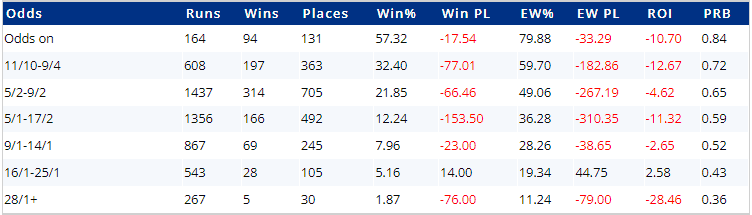
Here are some interesting trainer facts I’ve come across:

  1. Several trainers are in profit if you focus on their runners from the top three in the betting, including Charlie Appleby, Robert Cowell, Archie Watson, William Haggas, Saeed bin Suroor, Charlie Hills, Michael Dods, James Bethell, Michael Wigham and Richard Fahey.
  1. The Gosden stable has run 59 2yos of which 21 have won, equating to an impressive strike rate of 35.6%. It has not been a profitable avenue, however, losing a small percentage to SP. For the record you would have broken even backing to BSP.
  1. For profitable 2yos you need to look no further than Andrew Balding whose ten 2yos have provided six winners (SR 60%) for a profit of £14.33 (ROI +143.3%). (Note from editor: he has had three 2yo runners since this article was collated and two more have won, making it 8 from 13; the other one ran 2nd at 11/1).
  1. William Haggas has made a profit with his 3yo runners; his non-handicappers have marginally out-performed his handicappers producing returns to SP of 13p in the £ (win SR% 36.2%).
  1. In class 5 or 6 contests, Haggas has had 89 runners of which 31 have won (SR 34.8%) for an SP profit of £16.25 (ROI +18.3%).
  1. Roger Varian’s record with 3yo non-handicappers virtually mirrors Haggas - a 35.7% win SR% producing returns of 12p in the £ to SP.
  1. When Hollie Doyle has ridden for Archie Watson they have combined to secure 16 wins from 46 (SR 34.8%) for a profit of £21.83 (ROI +47.5%).


Jockeys at Newcastle

I'm not going into great detail about Newcastle course jockeys, but I thought it would be worth sharing the riders who have secured an A/E index in excess of 1.00 at the course (100+ rides):


It is not surprising to see Hollie Doyle in there considering her record when riding for Archie Watson, but some of the other names are less predictable perhaps. These are jockeys that seem to ride the track well and I would see it as a positive if they were riding a horse that I fancied at this course, especially considering the pace judgement needed at longer distances on the straight course (seven furlongs and a mile).

Newcastle Gender bias

I have noted a gender bias at each of the all-weather courses I have studied thus far. Here are Newcastle’s comparative figures:


The three Polytrack courses I looked at in previous articles indicated that, when considering the top three in the betting, females and males seem to compete on a level playing field. Once we got to 4th to 6th in the market, males started to dominate; likewise with bigger priced runners (7th+ in the betting). At Newcastle on this different (tapeta) surface, we see a similar pattern with the top three in the betting and 7+ in the betting, however the 4th to 6th figures are more even:


It seems therefore we need to generally wary about longer-priced female runners as previous AW course data has shown. Also don’t be put off if a female runner is near the head of the betting.


Newcastle Market factors

Let's now take a look at the win strike rates for different ranks in the betting, starting with favourites and moving down to position 7th or more:


This is a pattern we would expect and mirrors other courses. Favourites have lost just over 13p in the £ to SP (8p loss to BSP), which is the poorest return of all the courses seen so far. Losses are similar in both non-handicap and handicap races for these favourites.

A look at market rank A/E indices next:


Third favourites and fifth favourites have good figures and this has probably impacted on the 4th in the betting A/E index. However, with favourites as a rule being a little weak at Newcastle, there may be some value elsewhere. Even allowing for the relatively poor record of 4th favourites with 3rd and 5th favourites, these three groups combined would have yielded a 5p in the £ positive return to BSP.

My focus as ever would be on the top five in the betting in most races, and I would try to look for races with a favourite that looked vulnerable. From there I would hope to find a horse 2nd to 5th in the market that might offer up some value.


Sire Performance at Newcastle

Here are the top 20 sires in terms of strike rate since 2017. (To qualify – 100 runs or more; and must have had runners somewhere in the UK during 2022):


There are, of course, many well known sires in the list, but it is interesting to note Shamardal not making the cut after he had appeared in all three previous UK AW articles. Obviously little surprise to see Dubawi with a good strike rate; likewise Frankel. However, Frankel progeny have been very poor value losing 44p in the £.

In terms of damsires, Shamardal does make the top 10 by strike rate and here is the full list:


All ten damsires have A/E indices over 1.00, which is a rare sight. This winter it might be worth noting any runner whose damsire appears in this table: I would see it as a positive.


Newcastle Horses for courses

Our final port of call, as always, is to look at some horses that have excelled at the course since 2017. To qualify for the list each entry must have won at least four races at the track with a strike rate of 25% or more. Further, they must have raced somewhere in the UK in 2022. Here are the horses that qualify, listed alphabetically. I have included a PRB column, too:


19 horses make the list so keep an eye out for any of these over the coming months. They clearly like the track and, if some other factors are in their favour, they are definitely worth close scrutiny.


Newcastle Takeaways

But before winding up, let's review the ‘main takeaways’:

  1. Over 5f, front runners have a fair edge; over 6f, front runners also have a small edge;
  2. Over 1 mile hold up horses have the best record of all running styles;
  3. Low draws seem at a slight disadvantage on the straight course (5f-1mile). High draws look marginally best overall;
  4. Over 1m4f higher draws seem to have the edge; draws 1 to 4 have a relatively poor record overall;
  5. Andrew Balding 2yo runners are quite rare but they have an excellent record;
  6. Note if Archie Watson books Hollie Doyle to ride;
  7. Male horses have the edge over female ones when it comes to bigger priced runners;
  8. Favourites have performed a little below par. Horses 2nd to 5th in the betting seem the group on which focus;
  9. Dubawi has a decent record as a sire and a damsire.


And that's all for this Newcastle All-Weather Analysis. I hope after reading this, your punting at Gosforth Park will be a little more profitable than perhaps it was before. Good luck.

- DR


All-Weather Analysis: Lingfield Racecourse

It’s time for the fourth course in this all-weather series, this time focusing on Lingfield Park. I have used data from 1st January 2017 to 31st August 2022 which gives us a decent chunk of races to get stuck into. As with the previous pieces my data collection has been solely from the Geegeez Query Tool and therefore all profits / losses have been calculated to Industry Starting Price. We know that we can improve upon those baseline figures with exchange prices or Best Odds Guaranteed and, where appropriate, I will share any useful Betfair SP data.

Running Style at Lingfield

I have written before about Lingfield in regards to running style, so I will be sharing the new data from the past 11 months as well as looking at the long term figures. I have also touched upon the draw at Lingfield in two general AW articles around 2½ years ago, but this article will give a more detailed analysis. For both sections on running style and the draw my focus will be handicaps of eight or more runners only. This is in line with previous research in those areas.

Lingfield 5f Run Style Bias

Let’s start with the minimum trip of 5f. Here are the run style splits in 8+ runner handicaps covering the time since my last article (that is, from 1st Oct ’21 to 31st Aug ’22):


In this recent time frame there have been only 22 qualifying races so this is a limited sample. The front running stats (L) are not as strong as were the long term figures: from 1st Jan 2017 to 30th Sept 2021 front runners were successful around 24% of the time. However, with a small sample size it is easy to see this type of variance. If we compare the each way stats for front runners over the two time frames we see near identical percentages:


I am confident the run style picture in 5f handicaps at Lingfield is the same as ever in that the data points to the 5f trip at Lingfield giving front runners the edge; prominent racers are next best, while horses that take a mid pack or further back position early, are at a disadvantage. If you had your crystal ball working in tip top order and had predicted all the front runners going back to 2017, you would have made a profit of £121.88 to £1 level stakes. This equates to a remarkable return of 77p in the £. If on the other hand you had backed all mid div and hold up horses you would have lost £285.42. For every £1 bet on these runners you would have lost 48p. Ouch.


Lingfield 6f Run Style Bias

When writing about this course and distance previously, I noted the following ’dip’ in front running performance in 8+ runner handicaps:


*up to 30th Sept 2021 only


Prior to 2017, the front runners' win percentage had been consistently over 20% (2014 – 28%; 2015 – 22%; 2016 – 23%). That seems to be quite a staggering change from the start of 2018. So how do the last 11 months stack up for front runners in 6f handicaps (8+ runners)?


These data are much more in tune with the pre-2018 findings, certainly in terms of win percentage. But where does that leave us? To be honest, I’m not sure. Essentially we need to take a longer term view so let me share all run style data stretching from 1/1/17 to 31/8/22:


Looking over this longer time frame, there does seem to be a run style bias in play here, specifically that front runners and prominent racers have a combined edge over horses that race mid pack, who in turn have the advantage over held up horses. However, the old front running bias that was potent a few years back seems to have dissipated.


Lingfield 7f Run Style Bias

Looking firstly at 7f handicap run style data going back to 2017 (8+ runners), the graph below shows win and win & placed (each way) strike rate:


The win and each way lines correlate neatly adding confidence to a perception of bias towards the front rank of runners early. Front runners edge it over prominent runners in a pattern we are generally used to seeing at shortish trips. If we look at the more recent data from only the past 11 months we get this:


The sample size is 42 races and, although the front running win stats are below the long-term norm, the each way figures suggest that nothing has really changed.

In essence, this is a track and trip where the closer to the pace a runner is, the better. Hold up horses really do struggle, and in bigger fields they struggle even more so. In 7f handicaps with 12 or more runners (going back to 2017), hold up horses have a win rate of under 3% and and a win & placed (EW) rate of under 15%.

Once we hit races of 1 mile the bias levels out and, from 1m2f upwards, front runners as well as hold up horses are at a disadvantage compared with prominent and midfield racers.


Draw at Lingfield

If we look at the racecourse map for Lingfield, with its sweeping downhill home bend and relatively short straight, one may expect lower draws (those drawn on the inside) to hold an edge over the shorter distances:


Let's see if that is the case.


Lingfield 5f Draw Bias

A look at the minimum trip first. It should be noted that field sizes for this distance have a maximum of just 10 runners. Here are the draw splits going back to 2017 for 8+ runner handicaps (124 races):


Essentially, this is very even and, clearly, lower draws have not had more success from a winning perspective. Bizarrely horses from the highest third of the draw have come out on top here. Looking again at the course map, perhaps those drawn highest are able to run at a tangent to the crown of the bend. If we look at the win and placed stats (EW) we do get a slightly different picture:


This maybe is a better indicator that in fact a lower draw is preferable, and these stats also correlate with the percentage of rivals beaten (PRB) data. These figures are as follows:


Taking these three ‘measures’ into account I would say that the draw here is not crucial to the outcome of the race. However, if pushed I would prefer a lower draw given the option.


Lingfield 6f Draw Bias

Over this extra furlong the maximum field size increases to 12 and this trip sees horses encounter two left turns. There have been 180 races since 2017 so a strong sample size, relatively at least. Here are the draw splits in terms of win percentage:


Very level figures once again. So let’s examine the win and placed (EW) data to see if that sheds any more light on proceedings:


Lower draws are now edging ahead as we saw with the 5f stats. How about the PRB figures?


A similar pattern to 5f it seems. Nothing mind blowing, but essentially a lower draw is almost certainly a small advantage.

If we combine draw and run style we get the following 6f handicap heat map when looking at PRB figures:


This shows the difficulty hold up horses have from any draw and also, for horses that race mid-division, a wide draw is a definite negative. This is a key take away in terms of both run style and draw over this trip.


Lingfield 7f+ Draw Bias

As we have seen at the shorter distances, draw bias is not going to be a defining feature like it can be at somewhere like Chester, or even some of the other all-weather course/distance combinations. Once we get to 7f and beyond the draw becomes even less of a factor. Hence it’s time to move on and check out some other areas.

For the remainder of this article I will be looking at data for all races (from 1st Jan 2017), not just 8+ runner handicaps.


Trainers at Lingfield

Top Lingfield Trainers

With data going back nearly six seasons we have a good amount of info into which to drill down on the performance of trainers at Lingfield. Below are those handlers who secured a win strike rate of 15% or more from a minimum of 100 runs (all race types included):


Just one trainer has recorded an SP profit: step forward, Roger Varian. Varian has had one winner at 33/1, however, so taking that away he has essentially broken even to SP. To BSP his overall record is +£65.31, while even without the outsider winner this drops to +£15.26. All in all, his record is very solid. Let’s look at some positive angles (none of which include this 33/1 winner which would skew the stats somewhat):

  1. Results when Andrea Atzeni has been Varian’s jockey have been excellent. 12 wins and 5 placed from just 26 runners in total for a profit of £27.70 (ROI +106.5%)
  2. With very short priced runners (evens or less), Varian is 14 wins from 16 (SR 87.5%) for a profit of £6.46 (ROI +40.4%)
  3. His 3yo fillies have secured 11 wins from 39 (SR 28.2%) for a profit of £21.73 (ROI +55.7%)
  4. His 2yo runners have won around 27% of the time returning 15p in the £
  5. He has 9 wins from 16 runners (SR 56.3%) when his runners are top rated by Peter May’s Speed Ratings. These runners have returned just over 38p in the £

Onto A/E indices now – looking for trainers who have exceeded the magic figure of 1.00 which suggests their horses as a whole have been value to follow:


Four of these trainers appeared in the original table, nine others have joined them. As a general rule, I would suggest these 13 trainers are worth close scrutiny when they send runners to the track.


Caution Advised Lingfield Trainers

A look now at the trainers who have struggled at Lingfield in terms of win percentage:


These trainers are probably worth swerving at Lingfield unless you have a compelling reason to think otherwise. Indeed, looking at all 14 together, their combined record with favourites at Lingfield is a middling 20 wins from 104 (SR 19.23%) for a hefty loss of £41.17 (ROI +39.6%).


Lingfield Gender Bias

I have noted a gender bias at each of the all-weather courses I have studied to date. Here are Lingfield’s figures:


These figures are very similar to those we have seen before. However, a pattern we saw at Chelmsford and Kempton where the gender bias levelled out as horses reached the age of five is not repeated here. What I did notice, however, was that there seems to be a market bias in play at Lingfield. The graph below uses A/E indices to help show this.


As you can see, female runners from the top three in the betting are very competitive with their male counterparts (F 0.91; M 0.89). However, males start to outperform their female counterparts when we get to 4th to 6th in the betting market (F 0.74; M 0.86), and this continues to 7th or bigger in the market (F 0.61; M 0.71).

It made sense for me to back check Chelmsford and Kempton to see if there were similar findings for this angle, and this is what I discovered.

Kempton’s were:


And Chelmsford’s stats were:


Essentially both courses followed a similar pattern to Lingfield. Looking at all three in a chart may make the pattern easier to view so below I've created an A/E ratio of female performance against male performance (dividing the female A/E figure by the male A/E figure in each segment).


There is roughly parity when looking at the top 3 in the market; then a strong edge for males as we move away from the sharp end of the betting lists. This is something to check out with other courses in future articles.


Lingfield Market Factors

Keeping with the market it is time for a look at the win strike rates for different market ranks, starting with favourites and moving down to position 7th or more:


This pattern is what we would expect. Favourites have lost around 8p in the £ to SP (a 4p loss to BSP), second favourites have lost 10p in the £ (just 1.3p loss to BSP). As a side note, favourites have actually broken even in non-handicap races which is interesting (+4.6% if using BSP).

A look at market rank A/E indices next:


Lingfield is not a course for outsiders it seems. Horses 7th or bigger in the betting would have lost you 45p for every £ bet to SP; and around 21p at BSP.

Therefore I would personally focus on the front end of the market, more especially the top four in the betting.

Before moving away from the market I thought it would be interesting to see which jockeys have ridden the course well when riding a horse near the top end of the betting. Hence if focusing solely on the top four in the betting, here are the jockeys with an A/E index of 0.95 or more (100 runs minimum to qualify):


Five jockeys were in profit to SP - Messrs. Keenan, Fanning, Levey, Probert and Marquand -  which is impressive considering only three of the winners from all jockeys combined were a bigger price than 10/1. All five are jockeys I would be happy to see on board one of my horses at the track.

Darragh Keenan’s figures are particularly impressive and, of the 29 trainers he has ridden for under these circumstances, he has won for 16 different ones. Of the 13 trainers he has yet to win for, he has ridden just once for eight of them and no more than three times for any of them. Of all the other jockeys in the table, only Ryan Moore has managed to win for more than half the trainers he has ridden for (24 from 44).

Keenan had just one qualifying ride at the track in 2017 and only four in 2018 (2 wins); since then here are his win / win & placed (EW) percentages:


These are very decent looking figures and his A/E indices for each year are equally impressive:


To have achieved an Actual vs Expected figure in excess of 1.20 for each of the past four years is a record not to be sniffed at. I feel Keenan is definitely a jockey to keep on the right side of at Lingfield, especially when riding a horse near the head of the market.


Sire Performance at Lingfield

In this section we'll examine some sire data. Here are the top 15 sires in terms of strike rate since 2017. (To qualify - 150 runs or more or more; and must have had runners somewhere in the UK during 2022):


Some of the usual suspects as one would expect. Dansili, Sharmardal and Dubawi all appeared near the top of the Kempton strike rates as well. Frankel did not make the cut due to having only 108 runners in total but with a strike rate of over 19% he, too, should be mentioned.

In terms of damsires I am going to share just the top four performers in terms of strike rate (you’ll see why):


Dansili, Sharmardal and Dubawi are right to the fore once again – as punters, we should keep an eye out at Lingfield when a horse or its dam is sired by one of that top trio.


Lingfield Horses for Courses

My final port of call is, as always in this series, to look at some horses that have excelled at the course since 2017. To qualify for the list a horse must have won at least four races at the track with a strike rate of 25% or more. Also, each must have raced somewhere in the UK in 2022. Here are the horses that qualify, listed alphabetically. I have included a PRB column too (Percentage of rivals beaten):


18 horses make the list so keep an eye out for any of these horses over the coming months - perhaps add them to your Query Tool Angles (Horse Name = [these 18], Course = Lingfield, Race Code = Flat AW). They clearly like the track and if some other factors are in their favour they should be regarded as potentially good betting propositions.


Lingfield All-Weather Conclusions

There is plenty to take from this article as we have covered several different areas. The main takeaways for me are:

  1. There is a run style bias at distances ranging from 5f to 7f. Over 5f, front runners have a fair edge; at 6f and 7f, front runners and prominent racers combined have a decent advantage
  2. There is little in the draw at any distance. Low may have a tiny edge at 5f and 6f
  3. Roger Varian is a trainer to keep an eye on
  4. Jockey Darragh Keenan has an excellent record when riding a horse from the top four in the betting; also look out for Fanning, Levey, Probert and Marquand under these conditions
  5. Male horses have the edge over female ones; it seems this is much stronger as we get beyond the first three in the market
  6. Market wise, favourites and second favourites are worth a second look; generally speaking, this is a course to stick to the front end of the betting lists
  7. Look out for Dansili, Sharmardal and Dubawi both in terms of being a sire or a damsire

So there we are. There will be plenty of meetings at Lingfield over the coming months and I hope this piece has given you some useful pointers.

- DR

All-Weather Analysis: Kempton Racecourse

After looking at Chelmsford and Dundalk, it’s time to go to Kempton Park, to the west of London. I will be using all-weather data from 1st January 2017 to 31st August 2022 when analysing the Surrey track, giving us the opportunity to examine over 2500 races. I have used the Geegeez Query Tool for all the data collection, and hence all profits / losses have been calculated to Industry Starting Price. However, as I have mentioned numerous times before we will be able to improve upon these figures by using either BOG, early prices or the exchanges.

I have written about Kempton before in regards to running style and also I have shared draw data too. I will look again at both of these here, but there are plenty of other areas that I will be covering in this piece as well. However, let's start with running style.

Running Style at Kempton

When looking at run style, my focus is handicaps, and specifically handicaps with fields of eight or more runners. In an article published on Kempton early this year I looked at run style data up to 30th September 2021. Hence I will be sharing the latest data from the intervening eleven months.

There has only been one qualifying race over 5f so nothing new to share there. Front runners traditionally have a big edge over this minimum distance and, on the rare occasions 5f handicaps are run, this is worth knowing. Time therefore to move to 6f handicaps.

Kempton 6f Run Style Bias

Here are the run style splits in 8+ runner handicaps (1st Oct ’21 to 31st Aug ’22):


The sample size of 41 races is reasonable and these recent figures correlate well with the long term data, as this graphical comparison below confirms:


This gives us confidence that in 6f handicaps at Kempton front runners do have a good edge; prominent racers in turn have a small edge over horses that race further back early. For any remaining sceptics, let us look at the win and placed percentages across both time frames:


The front running stats for both time frames have virtually identical win & placed percentages standing at 47.83% and 47.9% respectively. Likewise, the other three groups have virtually identical percentage figures. This data implies therefore that we can expect roughly half of all front runners over six furlongs will hit the frame.


Kempton 7f Run Style Bias

Long-term past results had seen front runners enjoying an edge at this trip also, with a win strike rate of 16.8% from 1/1/17 to 30/9/21. The more recent data (47 races since then) has actually seen this figure drop markedly to 12.1%. Is this is a shift in bias to a more even playing field in terms of run style over 7f at Kempton? I personally don’t think so. A couple of near misses in modest samples can easily see this type of percentage drop.

Also, there are two more numbers to share that suggest the front running bias is essentially the same as it has always been. Firstly, the win & placed percentages for both time frames are very similar at 38.8% and 37.9%. And secondly, I looked at the PRB figures (Percentage of Rivals beaten) – these again were virtually the same over the two time frames:


PRB figures are generally a good indicator to see if certain biases exist. Figures on or above 0.55 tend to suggest there is a bias in play.

Traditionally, once we get past 7f, the run style bias at Kempton starts to even out, although even at a mile a front runner is a better betting proposition than a hold up horse.


The Draw at Kempton

Onto to draw now. For this area, I will again be sticking to 8+ runner handicaps, I have split all initial data into three equal thirds in order to compare the win percentages within each group. I will dig deeper from there where appropriate. The racecourse map below shows the course is right-handed and that there is an inner and an outer course. Only 5f and 1m2f races are raced on the inner course; all other distances are raced on the outer one.


Kempton 5f Draw Bias

It was noted earlier in the article that there has been just one 5f handicap with 8+ runners in the past year. There seems to be a general policy at the track to move away from 5f races with the tight inner loop making it very difficult for later running types. I will share the third of the draw splits going back to 1/1/17:


There is a small edge to lower drawn horses according to these figures. Another measure of draw bias is to look at the percentage of rivals beaten (PRB). These figures are as follows:


These figures suggest the bias may be stronger than first thought. However, with so few races these days we will need to be patient to try and utilise any bias, if indeed we can at all. [Editor's note: this is a 5f handicap carded next Tuesday, 18th October]


Kempton 6f Draw Bias

Six furlong handicaps are abundant at Kempton. We can expect around fifty 8+ runner handicaps a year so we have plenty of data to play with. Detailed draw bias stats at this course and distance appeared in an article I wrote earlier this year, where in it I placed Kempton over 6f as being the 6th strongest draw bias in the UK/Ireland. What I did not do in that piece though was look at the actual draw splits by thirds so here they are now:


Low draws are definitely best here and higher drawn runners struggle. The PRB figures correlate strongly as we can see:


These 6f races are ones I often get involved in as we have potential draw and a run style biases to utilise.

Before moving on I thought it prudent to look at the 2022 data to check the low draw bias is still in play. It certainly seems that way with the PRB figure for the bottom 'third' at 0.58 with 12 of the 22 races (54.5%) going to that section. A final stat to share is that, in 2022, horses drawn 9 or higher are 0 from 44 with just 5 placed runs.


Kempton 7f Draw Bias

The 7f distance also appeared in the same top 10 biases article, in 8th place. However, in 2022 the bias has appeared less potent for whatever reason. In the 33 qualifying races so far in 2022, only ten have been won by the bottom third of the draw, with 12 wins for middle and 11 for high, en extremely even split. The PRB figures are also more even at 0.51 (low), 0.52 (middle) and 0.47 (high). The long term PRB figure for lowest drawn horses is 0.55 so the question is, has there been a slight change going on? I am guessing probably not: race samples of 33 are relatively modest when digging into the draw. It will be interesting to see how things pan out over 7f in the run up to Christmas, but I would suggest a little caution for the time being, just in case a change is afoot.


Kempton 1 Mile Draw Bias

Here are the draw splits for mile trip (2017-2022):


Higher drawn horses look to be at a very slight disadvantage. The PRB figures suggest this disadvantage is definitely there, and maybe stronger than the win% draw splits imply:


All in all, this is not a Kempton distance where the draw plays a big part for me personally when analysing a race. However, there is a red flag over any horse I’m keen on when it is drawn in double figures.

Kempton Draw Conclusions

As far as draw conclusions go, the 6f trip is one to get stuck into draw-wise with low draws best; hopefully the 7f one will revert to ‘type’ also this winter. Keep an eye out for any of those rare 5f handicaps where low draws should be advantageous, and over a mile be a little wary of very high drawn horses.

For the remainder of the article I will be using ALL race data, not just 8+ runner handicaps. Time now to look at trainers.


Trainers at Kempton

With data going back to 2017 we have an excellent bucket into which to drill down on the performance of trainers at Kempton. This first table shows the trainers who have secured a win strike rate of 15% or more from a minimum of 100 runs (ALL race types included):


Charlie Appleby tops the list but, despite his outstanding win rate - better than one in three - he has still made a loss to SP of over 18 pence in the £. Ouch.

Three yards are in profit and I want to look at the record of one of those, namely that of the Charltons'. Their record at Kempton is excellent; only one big priced winner (33/1) and looking at their bigger priced runners as a whole, those priced 16/1 or bigger have secured that solitary win from 92 attempts. This equates to a loss of £58.00 (ROI -63%). At the pointy end, Charlton runners priced 14/1 or shorter have provided 57 winners from 212 bets (SR 26.9%) for a healthy profit of £90.19 (ROI +42.5%).

The stable has been relatively consistent over the years, too, as these next two graphs show. Firstly a look at winning data:


Other than the blip in 2018, the remaining years have been very solid in terms of win strike rate. The A/E indices for each year correlate well too:


Five of the six years are above the magic 1.00 Actual vs Expected (A/E), suggesting Charlton runners have been good value in every year bar 2018.

Here are some additional Kempton facts for Harry and Roger Charlton:

  1. The handicap win strike rate is over 24%; their non handicap figure stands at just under 15%.
  2. His male runners have comfortably outperformed females with a win rate of 22.2% compared with 14.3%. Males have secured returns of 21p in the £, while fillies/mares have lost just under 6p in the £.
  3. Charlton favourites have won 51% of races (25 wins from 49) for a profit of £14.06 (ROI +28.7%). Second favourites have also been profitable to the tune of 14p in the £.
  4. From a run style perspective 31% of front runners have won, 29% of prominent runners have won, but there has been just 7.6% success for hold up horses. (Mid div horses won 15.6%).


All Charlton stable runners deserve close attention, especially those who race in handicaps. Look out for male runners, too, and steer clear of any big prices: they do occasionally win but have been expensive to follow overall. One final Charlton fact to share is that 24 different jockeys have had at least two rides for the stable at Kempton and 19 of them have registered at least one win.

Before moving on let us focus on horses from the top three in the betting and the trainers who have had the best A/E indices with those fancied runners (50 runs or more to qualify):


It's good to see Mick Appleby, John Butler, Simon Dow and William Knight in there amongst some bigger names; and it is worth noting that eight of the ten trainers from the group above made a profit to SP.

This type of article can only scratch the surface when it comes to trainer angles so for readers interested in digging further into Kempton trainer performance, the Geegeez Query Tool that I have used here is simple to use and very powerful. Not only that, you can test numerous angles very quickly. It is accessible from the menu link under the 'tools' menu item at the top of this - and almost every - page.


Kempton Gender bias

Research I undertook for the Chelmsford and Dundalk articles pointed towards a slight bias toward male runners over females. We know this bias tends to be slightly stronger on the all-weather, but it does exist on the turf, too. Here are the splits for Kempton:


Again, there is a definite edge here to male horses, similar to what we have seen at previous all-weather tracks.

Let's look at whether the age of horse has any relevance when it comes to the gender of the horse:


What is interesting is that we have a virtually identical age bias pattern to the one we saw at Chelmsford. There, males outperformed females at 2, 3 and 4 years old, but as the horses got older it seemed to level out. It happens, or at least has happened, at Kempton too.

The A/E indices react in the same way as the graph below shows:


Just because two courses portray a similar looking age/gender bias we cannot be sure this is a pattern that will repeated at other all weather courses. Indeed Dundalk’s stats did not really correlate with these two UK tracks. However, maybe the exact nature of the individual surface is the important factor here. Unfortunately, as with some research findings, I currently cannot give you an answer that I’m fully satisfied with. I will be keeping an eye on the results over the next few months to see whether same pattern continues or dissipates.


Market factors at Kempton

It's time for a look at the win strike rates for different positions in the betting, starting with favourites and moving down to position 8th or lower in the market:


The chart shows the kind of sliding scale we'd expect to see, and the win percentage for favourites is around the average for all UK courses. Favourites have lost roughly 8p in the £ to SP which equates to a loss of 3p in the £ to BSP; second favourites have lost around 10p in the £ to SP which reduces to a 2p in the £ loss to BSP. The top two in the betting therefore have a pretty decent record at Kempton and this is reflected in the A/E indices:


Favourites have the highest A/E index at 0.94; second favourites the joint second best at 0.90.

All favourites that were also top rated on the Peter May speed ratings (published in the 'SR' column on geegeez racecards) actually made a profit to SP, recording 256 wins from 654 runners (SR 39.1%) for a profit of £1.85 (ROI +0.28%). OK, essentially this is a breakeven situation but, even so, that is still very impressive from a ratings set. One definitely needs to note horses top rated by the SR figures when they happen to be favourite at Kempton.


Sire performance at Kempton

Here are the top 20 sires in terms of strike rate at Kempton since 2017 (150 runs or more to qualify; and must have had runners in 2022):


Dubawi led the Chelmsford stats in terms of sire strike rates, and has repeated the feat here; but, despite winning over 20% of races, losses have been steep at 44p in the £.

Two sires that I am immediately drawn to in the table above are Lethal Force and Dutch Art. Both sires had good A/E indices at Chelmsford and they have repeated the dose here with Lethal Force at 1.20 and Dutch Art at 1.02. Not only that, both have edged into SP profit. There are nine other sires in the table that have A/E indices of 1.00 or more and these sires are also worth keeping an eye on.

I did look briefly at damsire data and noted that Singspiel currently has the best win strike rate at 15.5% and with an A/E index of 1.13. Only three other damsires have A/E indices of 1.00 or above: Royal Applause (1.04), Red Ransom (1.00) and Selkirk (1.00).


Kempton 'Horses for courses'

My final port of call was to look at some horses that have excelled at Kempton since 2017. To qualify for the list they must have won at least four races at the track with an overall course strike rate of 25% or more. Further, they must have raced somewhere in the UK in 2022. Here are the horses that qualified. I have included a PRB column too (Percentage of rivals beaten):


Eight-time course winner Soar Above is an interesting horse because he clearly loves Kempton, but away from the Sunbury track his record is poor. Kempton is a right-handed track and we can see how successful he has been there – he has also been placed five times along with those eight wins. Away from Kempton, he has raced only on left-handed or straight tracks and, combining these results, he's had just one win and two placed efforts from 18 starts. This includes 0 from 7 on other all-weather tracks (all left-handed). Perhaps Soar Above is an example of a horse that simply prefers running right-handed. Some horses definitely are more suited to turning one way than the other, though I have generally seen it more in National Hunt racing: probably the most famous example was Desert Orchid, who also had a preference for right-handed turns.

So there we have it. Kempton is a course with betting possibilities across the board:

- Favourites have quite a solid record, especially when top rated by Peter May’s SR figures.

- There are also a few stables to potentially keep on the right side of, perhaps notably the Charlton yard.

- Male horses should generally take preference over female ones as is the norm on the sand.

- There are some distances with an edge to lower draws (6f especially).

- There are some distances where front runners have a good edge (5f-7f).

- The 6f trip is the main one to concentrate on from a draw and run style perspective.


Let me finish then by sharing a PRB heat map overlaying draw thirds and run styles for 8+ runner 6f handicaps at Kempton since 2017:


This neatly demonstrates the strength of both biases. A low drawn horse has a definite edge unless it is held up; front runners enjoy huge success regardless of draw position. These heat maps can be found in the Draw Analyser and for each individual race in the daily racecards. It is a really useful tool to get a feel for any such biases. (Be careful, though, when looking at the Draw Analyser with all-weather courses – you need to change the going setting to incorporate not just ‘standard’ but cover all required going options).

- DR


All-Weather Analysis: Dundalk Racecourse, Part 2

This series on all-weather tracks continues with the second of two articles looking at the Irish course of Dundalk. The first looked at run style and the draw, and can be viewed here; this piece delves into a variety of other areas in relation to the sole Irish all-weather loop.

The track was resurfaced in April 2020 and reopened in July 2020, so for this article the focus will be on the races run after the renovation work, from 12th July 2020 to 31st August 2022. I will occasionally compare the new data with some past data to try and gauge whether there are any significant differences compared to the results from the old surface. That past data will be covering a similar period in terms of elapsed time and volume of races – 1st January 2018 to March 31st 2020.

I have used the Geegeez Query Tool for all the data collection, and hence all profits / losses have been calculated to Industry Starting Price. However, as I have noted many times before, we will be able to improve upon these figures by using either early prices and best odds guaranteed (BOG) or the exchanges.

Dundalk Trainers

The first port of call in this part two is to analyse the most recent trainer performance (12/7/20 to 31/8/22). One shy of thirty trainers have saddled 75 or more runners in races at Dundalk over the past two and a little bit years and so I have included them all.


Dundalk Trainers: Record of those saddling 75+ runners since the new track was laid (up to 31st August 2022)

Dundalk Trainers: Record of those saddling 75+ runners since the new track was laid (up to 31st August 2022)


It is perhaps no surprise to see just six trainers in profit; in terms of A/E index, seven trainers are above the magic 1.00 figure. It may be helpful to compare this most recent data with that from the pre-renovation sample period to see if any major changes have occurred. Below are all the trainers that had at least 75 runners in both time frames and I have compared their win strike rate percentages. The green column are the most recent:


Trainer comparison of Dundalk form before and after the course renovation

Trainer comparison of Dundalk form before and after the course renovation


In terms of these win percentages the figures for each trainer generally correlate; it seems that Johnny Murtagh and Richard O’Brien have seen the biggest downturn in results. However, in reality, the sample size is still quite small in trainer terms, so we should be careful not to read too much into it, well not just yet anyway.

One trainer who did make the list due to not quite having enough runners is the Ballydoyle maestro, Aidan O’Brien. However his recent figures since the resurfacing work are worth sharing: 17 wins from 59 runners (SR 28.8%) for a profit of £32.86 (ROI +55.7%). His A/E index stands at a solid 1.06, too. He had a similar overall strike rate prior to this at 27.1% (1/1/18 to 31/3/20), although he made a small loss during that period.

Going back to the original table, Ger Lyons is the only trainer to secure a strike rate in excess of 20%, and he has a couple of worthwhile stats to mention:

  1. In handicap races, Lyons' record reads 13 from 62 (SR 21%) showing a profit of £24.30 (ROI +39.2%).
  1. Horses that wear NO headgear (blinkers, tongue tie, cheek pieces etc) have provided 24 wins from 97 runners (SR 24.7%) for a profit of £16.65 (ROI +17.2%).

Before moving away from Lyons it is worth sharing his run style data in terms of win %:


Ger Lyons runners by run style: Dundalk Racecourse 12th July 2020 to 31st August 2022

Ger Lyons runners by run style: Dundalk Racecourse 12th July 2020 to 31st August 2022


As can be seen, Lyons horses taking the lead early have fared exceptionally well, securing 11 wins from the 23 runners that adopted that position. It is also worth noting that a further eight of these were placed, meaning 19 of 23 either won or were placed. The racing performance of Lyons' prominent racers has also been excellent, scoring once in every four runs on average. His record with hold up horses / mid pack runners is less good, however, both registering at under 10%.

Another trainer worth noting is Michael Halford. He has shown a small blind profit overall and his best time of the year seems to be October to December where he has secured a strike rate of 18% (23 wins from 128 runners) and returned a profit of £54.72 (ROI 42.7%). Halford's handicap runners have provided his most profitable results with a return of 33p in the £ across all such runners. It does look best to avoid his older runners, though: those aged six-plus have triumphed just once in 32 attempts.


Dundalk Racecourse Jockeys

It's time now to look at the record of jockeys riding Dundalk over the past two years or so. The minimum number of rides to qualify is again 75, and here are the top ten in terms of win strike rate:


Dundalk Jockeys: Record of those riding 75+ times since the track was renovated (up to 31st August 2022)

Dundalk Jockeys: Record of those riding 75+ times since the track was renovated (up to 31st August 2022)


The percentages even for the most successful course jockeys are relatively modest, but Dundalk often has big fields which is naturally going to affect the figures. Indeed the non-handicap average field size is 11.4 runners per race and the handicap average field size is 12.6. Over 53% of all races in this period saw a maximum field size of 14 runners.

Let's again compare this most recent data with that from 1/1/18 to 31/3/20 to see if there are any marked differences in jockey success. Here I am listing all jockeys that had 75 or more rides in both the time frames (most recent data again is in green):


Jockey comparison of Dundalk form before and after the course renovation

Jockey comparison of Dundalk form before and after the course renovation


With modest sample sizes you would expect the odd significant fluctuation due to luck or statistical variance, but in general nothing stands out too much. Conor Hoban is a jockey who seems to have enjoyed the new surface with a fairly decent uptick in his win strike rate. He is the only jockey in fact to have had A/E indices of over 1.00 during both timeframes. The stats suggest to me that he rides this course as well as anyone. Hoban has a very good record with horses nearer the top end of the market: since the re-opening, Hoban's record on horses priced 8/1 or shorter is 11 wins from 37 (SR 29.7%) for a profit of £20.41 (ROI +55.2%). For the record, in the similar timeframe prior to the renovation his mounts made a profit in this same odds group. I do feel Hoban is a jockey that would be a good one to have on side at Dundalk.


Gender bias at Dundalk?

I have noted before that there has always been a small but significant gender bias when it comes to flat racing, with male horses outperforming female ones. On the all-weather this bias tends to be a bit stronger and the recent Dundalk stats (12/7/20 to 31/8/22) are an example of this:


Performance by sex of horse at Dundalk, 12th July 2020 to 31st August 2022

Performance by sex of horse at Dundalk, 12th July 2020 to 31st August 2022


As can be seen, males have a better strike rate by around 2.5%; better returns (6½p in the £) and higher Actual/Expected and Impact Value indices. They may look relatively modest differences but should still be factored into your betting in my view.

The figures for male and female runners from before the resurfacing (1/1/18 to 31/3/20) are very similar:


Performance by sex of horse at Dundalk, 1st January 2018 to 31st March 2020

Performance by sex of horse at Dundalk, 1st January 2018 to 31st March 2020


We can see similar differences in strike rates and returns; likewise, the figures for A/E indices and IVs are virtually the same.

When I looked at Chelmsford data previously, there seemed to be a strengthening in the gender bias in the 2yo to 4yo age groups and a levelling off in horses aged 5 and above. This pattern is not really repeated here although 4yo females have really struggled winning just 5.4% of the time (A/E 0.65; IV 0.71).


Dundalk Racecourse: Market factors

With Dundalk generally enjoying big fields the overall market data was interesting to dig into. I mentioned earlier that 53% of all races have a maximum field size of 14; furthermore, over 80% of all races have been contested by 12 or more runners.

Firstly let's take a look at the win strike rates for different ranks in the betting; starting with favourites and moving down to betting position of 9th or more:


Dundalk performance by market rank, 12/7/20 to 31/8/22

Dundalk performance by market rank, 12/7/20 to 31/8/22


In general we see a sliding scale although the sixth and fifth in the market are out of synch: this is almost certainly one of those rare statistical anomalies. The win percentage for favourites is relatively low with the average field size the driving factor behind that.

A look at the A/E indices now:


Actual vs Expected by market rank: Dundalk racecourse 12th July 2020 to 31st August 2022

Actual vs Expected by market rank: Dundalk racecourse 12th July 2020 to 31st August 2022


The sixth market rank figure of 1.00 is a statistical anomaly as mentioned above. Ignoring that, the most interesting number for me is the 0.82 one for those 9th or lower in the betting lists. This group of runners (roughly 3000 of them) have actually broken even to Betfair SP. It is also worth noting that second favourites have broken even to Betfair SP.

A quick look now at combining trainers with market rank – I have looked at trainer performance with horses from the top three in the betting (minimum 50 qualifiers). Here are my findings:


Trainer performance when saddling one of the top three in the betting, 12th July 2020 to 31st August 2022

Trainer performance when saddling one of the top three in the betting, 12th July 2020 to 31st August 2022


To offer some context, all trainers have combined to produce a win strike rate of 20.2%, an ROI of -14% and an A/E index of 0.86. In that light, Jessica Harrington and James McAuley have performed significantly below the norm which is worth noting, while Eddie Lynam and Ado McGuinness are the top performers.

Finally in this section on the betting market I want to look at handicap races with 12 or more runners, and consider the market splits. There have been 371 such races which gives us a large swathe of market data to examine. I have split the market into three as I do with draw data to investigate the percentage of winners within each ‘third’ of the market. Hence in a 12 runner race the market position splits would be as follows:

Low 1/3 – top 4 in the betting

Mid 1/3 – 5th to 8th in the betting

High 1/3 – 9th to 12th in the betting


I have made some statistical adjustments to render these figures as accurate as I can, but there are occasions when ‘joint’ market positions exist; and, further, 13 and 14 runner races do not quite divide perfectly by three. However, I am confident these percentage splits are as near to ‘spot on’ as is possible:


Approximately two-thirds of 12+ runner handicaps are won by the most fancied third of the runners. As punters we are always looking for value, but we must operate within the generally extremely efficient confines of the market.


Sires at Dundalk 

Let us know turn our attention to the performance of winners at Dundalk based on their sire. Below is a table of all sires to have had at least 100 runners at the track in the sample period (ordered by strike rate):


Sire performance at Dundalk, 1/7/20 to 31/8/22 [100+ runners to qualify]

Sire performance at Dundalk, 1/7/20 to 31/8/22 [100+ runners to qualify]

I think we need to wait another year, perhaps two, before we make any sweeping conclusions about the performance of individual sires on this new surface. Horses that race regularly here will skew the sire stats a little especially when the sample size is around the 100 to 130 mark. Once we get more sires with 200+ runs it will be a good time to re-examine the data in more detail. For example, the Canford Cliffs figures look vastly inflated to me when I compare his progeny record at Dundalk with long term performance across similar surfaces in the UK and Ireland. Likewise, Holy Roman Emperor is not a sire that tends to produce a win strike rate of just 1.67% - what we know of his record more generally is that he is nearer the 10% mark.

As a researcher and indeed a punter one needs to be aware that statistical analysis can have some limitations. In racing, sample size is often one such limitation, and appreciating where and when this is a potential limitation will help us in our quest to make a long term profit from horse racing. Gathering stats is one thing; understanding their relevance/importance is even more key.


Horses for courses at Dundalk

In closing, I'd like to look at some horses that have excelled at Dundalk since the resurfacing work. To qualify for the list they must have won at least four races and possess a strike rate of 25% or more at the track. Further, they must have raced at least once in Ireland or the UK in 2022. These are the horses to qualify. I have included a PRB column too (Percentage of rivals beaten):


Course specialists at Dundalk racecourse, 1st July 2020 to 31st August 2022

Course specialists at Dundalk racecourse, 1st July 2020 to 31st August 2022


Most of these runners deserve close scrutiny whenever they run at Dundalk, if past performance counts for anything. The five runners with PRB figures of 0.80 or higher are particularly noteworthy.

Whatharm has had a relatively poor time of it on the turf this year so his handicap mark has dropped. It will be interesting to see if a return to Dundalk will spark a return to form.

Dundalk is a track that will have plenty of racing this Autumn and Winter. From now until 16th December they will be racing every Friday, and for eight consecutive weeks from the start of November up to Christmas they will be racing on Wednesdays, too. Hopefully this article and its predecessor, part one, will help us all to be (more) profitable at Dundalk and potentially give us some pennies to spend over the festive period: it's not that far away now!

- DR

All-Weather Analysis: Dundalk Racecourse, Part 1

My series on all weather tracks continues with the first of a two-parter looking at the Irish racecourse at Dundalk, writes Dave Renham. This is my first detailed piece of research on Dundalk and I am hoping to find some credible angles which will help us all when having a bet there. The track is 1m2f in circumference and left handed and as you can see in the picture below the 5f distance starts from a chute which joins the round course at the penultimate bend.


Dundalk was resurfaced in April 2020 and reopened in July of that year. So, for this article, the focus will be on races run from 12th July 2020 (the first fixture after the renovations) to 31st August 2022. I will at times be comparing the new data with past data to try and gauge whether there are any significant differences compared to the results from the old surface.

I have used the Geegeez toolkit - Query Tool, Pace and Draw Analysers - for all the data collection: these can be accessed from the home page from the Tools dropdown menu.

Running Style at Dundalk

For regular readers of my Geegeez articles, they will know that I believe the run style of horses at certain distances is important and is still an underused approach when taking into account all punters as a whole. For the new readers, I will briefly discuss what is meant by run style before doing some digging. In essence, run style is the position a horse takes up very early on in the race. These are split into the following four categories:

Led (4) – front runners; horse or horses that take an early lead; Prominent (3) – horses that track the pace close behind the leader(s); Mid Division (2) – horses that race mid pack; Held Up (1) – horses that race at, or near the back of the field early.

The number in brackets is the run style score that is assigned to each section. These numbers can be a useful tool for crunchers like myself as they can be used to create different numerical representations.

When analysing Dundalk run style, and indeed later when analysing the draw, I will be looking at individual distances – mainly the shorter ones with the main focus being 8+ runner handicaps. The shorter distances are more prone to ‘bias’ both in terms of run style and draw.

Dundalk Racecourse 5f Run Style Bias

Let's look at the shortest trip first. Below are the run style (pace) figures taken from the Query Tool  for the period since the resurfacing (12/7/20 to 31/8/22):


Early leaders / front runners have had a strong advantage it seems, albeit from a relatively modest sample. This is a pattern that we have seen over the minimum trip of 5f at several courses, both on the all weather and on turf, especially on turning tracks; so, despite the sample size, the chances are that this front running bias is likely to continue. The A/E (Actual vs Expected) indices and Impact Values (IV) also correlate strongly which gives more confidence to the findings*. Combining win and placed percentages (each way) also seems to confirm the bias:

*For more on A/E and IV, as well as PRB, see this post


Hold up horses have a dreadful record in handicaps over five furlongs at Dundalk: a front runner is roughly four times more likely to make the frame than any individual hold up horse.

I looked back at the 5f data before the resurfacing of the track, going back as far as I could to 2009, and the front running bias existed then, too. The win percentage of 16.1% and the win / placed percentage of 40.3% are slightly below the more recent figures posted by front runners, but they were still much stronger than any other run style category during that time frame.

My conclusion is that the surface change has not made it more difficult to win from the front in 5f handicaps, indeed it has perhaps made it easier. The next year or two will help to confirm or deny this early view.

Before moving onto to 6f handicaps, I decided to dig a bit deeper into the more recent 5f stats and I looked at the performance of front running handicappers in terms of percentage of rivals beaten (PRB). This is a measure to help with determining the strength of a bias, and it helps by awarding every runner in every qualifying race with a 'score' based on the number of rivals they beat. The winner will have a score of 1.00 (100% of rivals beaten) and the last placed horse will have a score of 0.00 (0% of rivals beaten). The fifth horse home in a nine-horse race, for instance, will have beaten four rivals (6th, 7th, 8th and 9th) and lost to four rivals (the first four home) for a PRB of 0.50 (50% of rivals beaten).

A score of 0.55 or higher is considered a good advantage, while 0.45 or lower can be viewed as a negative.

Getting back to Dundalk five furlong handicaps, I found that front runners over this trip had a PRB of 0.64. This is further proof of the advantage front runners have. I did the same calculations for hold up horses, too, and their PRB stood at a lowly 0.40.

-------------------

SIDEBAR: How I calculated PRB for this article

PRB figures can be found on Geegeez in different areas. For example if you click on the record of a horse you will see something like the following:


Here we have not just the win, placed, profit, prize money data, but also the PRB figures. In this case the turf PRB (0.62), all-weather PRB (0.52) and the overall PRB (0.57). You can get this PRB info also when clicking on the records of trainers, jockeys and sires.

PRB figures are also shared in the Draw Analyser:


In this example (taken from Chester) we see the PRB figures back up the win% data showing a strong low draw bias and, particularly, a negative bias for high-drawn horses.

The PRB figures shared earlier for front runners and hold up horses in 5f handicaps at Dundalk were not taken directly from a page on the site; rather, I manually calculated them. It was not difficult to do and I’ll now offer a quick explanation of how I calculated that front running figure of 0.64 (in case you want to examine this type of idea yourself).

Firstly, in the Query Tool I looked for all horses that had gained a 4 pace rating in 5f 8+ handicaps:


This generated the following results:


These are the figures seen at the start of this article is the very first table. From here I clicked on the qualifier tab, thus:


With 20 qualifiers per page, there were 3 pages of qualifiers in total. I copied each page of data and pasted into Microsoft Excel. I then created two new columns using a simple formula – ‘Rivals beaten’ and ‘Rivals Not Beaten’:


I then totalled up the Rivals Beaten column (286) and the Rivals Not Beaten column (161). To calculate the PRB figure you add together the two totals (447) and divide the Rivals Beaten number into this total (286 divided by 447). This gives us the 0.64 figure shown earlier.

I personally will do these run style PRB calculations for other courses now unless the data set is too big. Copying and pasting a few pages of qualifiers is relatively quick; however, doing it, say, for 100 pages is probably going above and beyond!

SIDEBAR ENDS

-------------------


I have also looked at the 5f non-handicaps stats – data is limited as there have only been 17 qualifying races (with 8+ runners). However, the win / win & placed (each way) stats suggest a strong front running edge here too:


All the stats I have shared do seem to point to a strong front running bias over 5f at Dundalk regardless of race type.

Below is a PRB heat map overlaying draw thirds and run styles for 8+ runner handicaps at Dundalk since 2020:


Dundalk 5f: Percentage of rivals beaten (PRB) draw / pace (run style) heat map


It is clear that low and led/prominent, or indeed almost any led/prominent position is hugely more beneficial than being waited with further back.


Dundalk Racecourse 6f Run Style Bias

Up a furlong now to six furlongs, and a look at the handicap run style stats over this distance since the resurfacing work; again 8+ runner races only to qualify:


At first glance these stats suggest that front runners have a slightly stronger edge over this extra furlong. The IV for front runners of 2.7 is high; as is the 1.79 A/E index.

Here are the win and placed percentages (each way):


There is a strong correlation here when comparing the each way stats with the win only stats – they paint the same picture.

Looking at the data from before the resurface (all the way back to 2009), front runners won just over 16% of races so the bias was evident but maybe not quite as strong. Hold up horses had a win percentage of 5% which is a bit below the more recent figure.

A look now at the PRB figures for front runners versus hold up horses since July 2020. Front runners have a huge PRB of 0.68, while hold up horses are down with a PRB of 0.43. These are similar to the 5f figures as one would probably expect. (These were calculated using Excel as outlined above).

It makes sense to share the non-handicap stats as I did over 5f. Here is a graphic of the win / win and placed (each way) run style percentages for non-handicap races over 6f:


In terms of win percentages, prominent racers have nudged ahead of front runners, but when we look at the win & placed (each way) figures, front runners lead once more. The strongest aspect of these data, it seems, is the quite dreadful win record for horses that race off the pace either in mid-division or held up: both run style win percentages loiter below 3%. This from 34 races giving us a small but probably satisfactory sample size. 

All the 6f handicap statistics point to the fact that front runners have a very strong edge. This advantage looks even more potent than over 5f. If this is the case, then perhaps it is down to the fact that over 6f the full turn comes into play; over 5f, because of the chute, there is effectively only a half turn (see first image at the top of this post). This is just conjecture, but it feels like a plausible suggestion. In non-handicaps, prominent racers and front runners combine to have a monster edge over those midfield and hold up horses in the first quarter mile or so.

When reviewing the draw / run style heat map we again see the difficulty slow starters face in getting competitive:

Dundalk 6f: Percentage of rivals beaten (PRB) draw / pace (run style) heat map


Dundalk Racecourse 7f Run Style Bias

Let's move on to 7f now (12/7/20 to 31/8/22):


Front runners are not the most successful group over this range; over seven furlongs, the accolade goes to prominent racers. There is still a run style bias in play here with runners close up or on the pace early having an edge over those further back. What is noticeable at most tracks is that the front-running win percentage tends to drop as the distance increases past the shortest races distances of five and six furlongs. This is mainly because the horses behind the early leader have more time to make their challenge and can eventually get to the front themselves.

Looking at the long term data going back to 2009 up to the time the course was resurfaced, front runners won 11.8% so they were slightly more successful during that period. However, a change of one percentage point is not statistically significant. It looks like the 7f run style picture has not really changed much since the renovation work.

7f non-handicaps have a similar spread of results since the resurfacing occurred – front runners have an edge with a 13% success rate; prominent racers 11%; midfield 9% and hold up horses were worse off again at just 4% (though there is some selection bias in the latter cohort due to horses of very limited ability, or those not yet ready or able to show their full ability, sometimes running in non-handicaps).

This time, the PRB heat map overlaying draw and run style is less conclusive, but it does suggest middle to high and not held up could be beneficial.


Dundalk 7f: Percentage of rivals beaten (PRB) draw / pace (run style) heat map


Dundalk Racecourse 1m Run Style Bias

The stats are similar over a mile with regards front runners – those most forwardly placed have won 11% of races in the past two years. Their A/E index stands at 1.13 and Win Impact Value at 1.48 suggesting a small edge still. Having said that, it is not a course/distance combination where I would looking to use run style bias as a key part in my selection process.


*


In conclusion, looking at run style as a whole across the shorter distances, front runners have a clear advantage over sprint trips (5f-6f) in handicaps. In non-handicaps this is true over 5f and to a lesser extent over 6f. Having said that, hold up horses and horses that race mid-division early really struggle over five and six furlongs regardless of race type. Over 7f (both handicaps and non-handicaps), horses that front run or race prominently have had the edge over horses that race mid-pack or at the back early. Once we get to 1 mile and further it becomes a relatively even playing field.


Draw Bias at Dundalk Racecourse

With the draw I like to compare recent time frames of a similar length. This is because draw patterns can (and do!) change at any time. Also, at Dundalk they have adjusted the rails on the home turn, putting in a false rail which potentially has ramifications for the draw. This change occurred more than five years ago so it makes sense not to include races before the false rail was introduced. Hence I will be looking at 8+ runner handicap draw data from July 12th 2020 to August 31st 2022, which is clearly the key data, but then comparing it with the prior two years before the resurfacing and after the false rail addition (going back to the start of 2018). Still with me? Good!

When I look at the draw my first port of call is to split the starting stall numbers into three roughly equal thirds and compare win percentages; percentages of around 33% across the board give us a completely level playing field in terms of the draw, deviations from that may imply an advantage or disadvantage.


Dundalk Racecourse 5f Draw Bias

Since the resurfacing in 2020 here are the draw splits over 5f (8+ runner handicaps):


There looks to be a clear edge to lower drawn horses here with those drawn very high struggling commensurately. Let us look now at the data in terms of percentage of rivals beaten (PRB).


This backs up the win% breakdown showing good correlation, though perhaps not as striking as in pure win percentage terms. Another snippet worth sharing is that horses drawn five or lower have won 69% of the races from just 44.5% of the total runners.

Time to compare the win percentages from this post-renovation period with data from the two years or so prior, specifically 1st January 2018 to 31st March 2020:


The results are very similar and the sample sizes are virtually identical. It could be that the new surface has slightly strengthened the low draw bias; it will be interesting to monitor the results of the next 12 months to see if this is the case.

As far as the draw is concerned I rarely look at non-handicap data unless I have a huge sample size. Here we have less than 20 races and so it is probably not a worthwhile proposition to dig into the numbers.


Dundalk Racecourse 6f Draw Bias

Below are the  6f  draw data by thirds:


There have been nearly 60 races so we have a decent sample size with which to work; low draws seem to have a strong edge, but my initial enthusiasm is tempered by the PRB figures:


This is a good example of why digging deeper into data is important and why we need to be cautious of small samples, even when they're relatively large in the context of horseracing analysis. The figures here suggest a slight lower to middle bias exists but nothing more. We need to be wary of that 50.8 win% for the bottom third of the draw, which is almost certainly inflated. The each way figures for each third are also virtually identical, which lends more credence to the PRB figures.

Looking at the data from 1st Jan 2018 to 31st March 2020, I would suggest a strong low draw bias was in existence as the win percentages and the PRB data correlate strongly this time. Win percentages first:


These are the equivalent PRB figures:


0.59 is a huge PRB figure for the lowest section of the draw. Hence my reading of the draw at Dundalk over 6f is that the new surface has some an effect in nullifying a previous low draw bias. Given the choice I’d still prefer to be drawn low, but it is marginal. Essentially I would not see the draw as a major factor over 6f at Dundalk.


Dundalk Racecourse 7f Draw Bias

Below are the 7f data and the draw splits since the course was resurfaced are as follows:


It's relatively even this time, although middle draws have won a shade more often than the other two sections. The PRB figures are as follows:


These figures correlate with the win stats suggesting if there is any edge, it lies with the middle draws. Previous to this (1/1/18 to 31/3/20), the PRB split had been similar with 0.54 for middle draws once again, but the 0.47 and 0.50 were reversed with low draws at 0.50 and high at 0.47. It seems therefore that a middle draw looks to have a small advantage over 7f but it does not look strong enough to easily exploit.

Other Dundalk Draw Observations / Conclusions

I have looked at draw data for a mile and beyond but the thirds are very even and essentially it looks like only the 5f distance is of real interest here in terms of a usable draw bias. At the minimum range, a low draw does seem to have a tangible edge and is something we should factor into our selection process.

If you, like me, are interested in exotic ‘draw based’ bets, note that a profit could been secured in 8+ runner 5f handicaps (12/7/20 to 31/8/22) combining the five lowest drawn horses in full cover tricasts: this would have provided four winning payouts and returned a profit of 52p in the £. It should be noted that a five-horse combination tricast/trifecta bet involves 60 bets so it can become a costly wager during a long losing run. Of course the beauty of tricasts is that payouts can be massive, which is why punters like me are lured into them!

*

That concludes part one of this Dundalk analysis and it’s time to research part two. My study to date suggests that, in terms of run style and draw, we have the following biases to work with this winter:

Handicap biases

5f – front running bias; low draw bias

6f – front running bias


Non-handicap biases

5f – front running bias;

6f – front runners/prominent racer bias


Dundalk, as a track, does not offer as wide a range of biases as, say, Chester, but over five and six furlongs the run style edge in particular should give us a leg up over the uninformed.

PART TWO OF THIS ARTICLE CAN BE FOUND HERE >

- DR

All-Weather Analysis: Chelmsford Racecourse

As we move into September, the weather is starting to change, and my mind is drawn to the autumn and winter racing programme, writes Dave Renham. I will be looking at National Hunt racing in the near future but, before that, what follows is the first article in a new series focusing on the all-weather tracks. In it, I will dig into numerous key stats at the six UK all-weather tracks, as well as looking in detail for the first time at Dundalk in Ireland.

I will be using all-weather racing data from 1st January 2017 to 31st August 2022 when analysing the UK tracks, giving us the opportunity to examine a plethora of stats and angles. I have used the Geegeez Query Tool for all the data collection, and hence all profits / losses have been calculated to Industry Starting Price. However, as I have mentioned before we will be able to improve upon these figures by using either BOG, early prices or the exchanges.

I have shared stats about Chelmsford racecourse before in regards to running style, and also I have looked briefly at the draw, too. I will update both of these here, and there is a number of other areas I am going to look into as well. Let's start with running style.

Running Style (Pace) Bias at Chelmsford

When looking at run style, I have always focused on handicaps, and handicaps with fields of eight or more runners. In an article published in autumn last year (2021), the data strongly pointed to a front-running bias in races staged between 5f and 7f; the strongest bias was at the minimum trip, then seven furlongs, and then six furlongs. I have decided to share only the new data since I collated that article, which gives eleven months of results to analyse. Below are the win strike rates for front runners over these three trips in 8+ runner handicaps (1st Oct ’21 to 31st Aug ’22):


The figures correlate well with the longer term data, so in these types of races whoever leads early does have a clear edge. The A/E indices show a similar picture:


The 7f figure is slightly above the long term average figure, but that can happen with smaller samples.

What is clear is that there is a sliding scale in these races when it comes to run stylefront runners have the advantage; prominent racers are next best and those mid division or held up are definitely at a disadvantage.

Before moving on, here is the long-term run style picture in terms of win strike rate across all distances at Chelmsford going back to the start of 2017 (8+ runner handicaps):


There's a strong correlation between race distance and front end advantage: generally, the shorter the distance the stronger the front-running bias; once we get to a mile and 1m2f the bias is minimal. At 1m 5f or further, front-runners are at a disadvantage.


Draw Bias at Chelmsford

Onto to the Chelmsford draw now, and for this area I will again be ignoring smaller fields and sticking to 8+ runner handicaps.

The racecourse map below shows the course is left handed and the lowest draws are positioned closest to the inside. Hence, over the shorter distances one would expect an advantage of some sort for lower drawn runners.


Chelmsford City Racecourse 5 furlong Draw Bias

When I look at the draw, my first port of call is to split the field into three thirds and compare the win percentages. Here are the relevant five furlong draw data for this distance going back to 2017:


An edge to lower drawn horses would have been expected (see above) although, considering the course configuration, it is a relatively modest one. These are the types of percentages one would have expected given that lower draws are closest to the inside rail and, therefore, have the least distance to travel around the turn. Another measure of draw bias is to look at the percentage of rivals beaten (PRB) from each stall position. These figures correlate with the win percentages as you will see below:


Those drawn 1 or 2 have a clear edge over the rest of the stall positions. Between those two berths, they have accounted for 40 winners from 128 races (31.3% of all races). Further, their PRB figures are a very high 56% (horses drawn 1) and 58% (drawn 2). Finally on these two draws, they have combined to make a small profit to SP of £23.09 which equates to nearly 10p profit for every £1 bet.


Chelmsford City Racecourse 6 furlong Draw Bias

Moving up a furlong to six furlongs, the win percentages across the three thirds are very even (low 36.1%; middle 30.7%; high 33.2%). However, the PRB figures suggest the lowest third does retain some sort of an edge:


Likewise combining win and placed results suggest this small edge does exist:


All in all, given the choice, I’d rather be drawn very low than middle to high over 6f.


Chelmsford City Racecourse 7 furlong Draw Bias

The low third come out slightly better at this distance, too, with the PRB for the low third (inside draws) standing at 0.53 (53% of rivals beaten) versus the high third’s figure of 0.46 (46%). Anything above 0.55 is a material positive bias while anything below 0.45 is a negative bias.


Chelmsford City Racecourse 1 Mile Draw Bias

In my recent series of articles on draw bias, this mile trip was highlighted as having a relatively strong bias. Here are the draw splits in terms of win percentages:


Perhaps it's because mile races start in a chute and they race almost directly into a dogleg bend that figures are similar to the 5f statistics at this range, as are the PRB figures:


It seems therefore that over 5f and 1m - the two distances where the field races very quickly into a bend - we have a playable draw bias, albeit perhaps not of Chester proportions. Essentially over these two trips (and to a lesser extent over 6f and 7f), we would prefer a lower draw than a middle or high one. And especially if combined with a forward going run style.

For the remainder of this article I will be using all race data, not just 8+ runner handicaps.


Top Trainers at Chelmsford Racecourse

I have delved into trainer stats quite a lot recently and the advantage of all-weather tracks, from a punting perspective, is that each year there is a huge number of meetings. This gives a bigger data set and, when it comes to trainer stats, I think that is very important. There are 93 trainers who saddled 70 or more runners during the study period and here are the top 15 in terms of win strike rate. As I mentioned, this incorporates ALL races, both handicaps and non handicaps:


John Gosden at Chelmsford Racecourse

Five of the 15 trainers in the table have been profitable to SP. Seven have A/E indices in excess of 1.00, indicating that their runners have offer bettors some value. It is worth looking at a couple of these handlers in more detail, starting with the Gosden stable. Here are John's (and, more recently, with his son Thady) most noteworthy stats:

  1. Older horses (aged 4+) have provided ten winners from 22 (SR 45.5%) for a small profit of £5.17 (and a large ROI +23.5%).
  2. Horses priced 5/1 or shorter have produced a win% strike rate of 33.7% thanks to 67 winners from 199 runners. Backing all such runners would have yielded a small profit of £13.26 (ROI +6.7%). Compare this to horses 11/2 or bigger in price, where only two of the 79 runners won, producing disastrous losses of nearly 80 pence in the £.
  3. Frankie Dettori on Gosden runners at Chelmsford has won on 13 of his 26 mounts. How often they'll combine this winter remains to be seen, however.
  4. Gosden’s front runners have won 36.5% of their races, while those held up have won just 15.6%.


Richard Hughes at Chelmsford Racecourse

Richard Hughes has a very solid looking record with a one-in-five win ratio and an A/E index of 1.22. In fact, Hughes has been extremely consistent and this can be illustrated by comparing his A/E indices each year (see graph below):


All six years have been above the magic 1.00 figure. He looks a trainer to potentially follow at the course. Here are some of Hughes's strongest snippets:

  1. His record in handicaps is very good – 39 winners from 169 (SR 23.1%) for a very healthy profit of £73.29 (ROI +43.4%).
  2. Hughes is happy to put a claiming jockey on board his runners and they have performed marginally better than professional jockeys, with 19 wins from 84 (SR 22.6%) producing returns of 36p in the £.
  3. His biggest priced winner was 22/1 and he has had an even spread of winners across the price ranges. Horses priced 5/1 or shorter have been a good group for him, as with the Gosden stable; 36 wins from 117 runners (SR 30.8%) for a profit of £21.36 (ROI +18.3%).


Trainers to Beware at Chelmsford Racecourse

Before moving on, here are the trainers with the poorest win strike rates ( all below 7%). It is always worth being aware of trainers that struggle under certain circumstances:


It is interesting to see Richard Fahey in this list. Fahey is not usually a trainer seen this low down the pecking order, and it is not a short trip from North Yorkshire to the Essex showgrounds. Worryingly, he has had 56 runners that started in the top four of the betting and only six of them won. These runners would have produced losses of over 56 pence in the £.

Other notable names in the list are George Boughey and Robert Eddery, both of whose A/E figures are very weak.


Gender bias at Chelmsford Racecourse?

There has always been a slight gender bias when it comes to flat racing with male horses out-performing females. This bias has traditionally been slightly more pronounced in all-weather racing as compared to the turf. For whatever reason, it may not be as strong now as 15 to 20 years ago, but it does still exist, including at Chelmsford, as the table below indicates.


The differences may look relatively modest, but they are significant enough that we, as punters, should be aware of them. A lower strike rate would be forgiven in exchange for a higher ROI but, as can be seen, all data are less appealing than the male cohort. Additionally, when we break this data down further by age group we get the following:


Colts and geldings clearly outperform fillies at 2, 3 and 4 years old but, as the horses get older, it seems to level out.

The A/E indices back this up with excellent correlation with the strike rates:


It will be fascinating to see if any of the other courses display a similar pattern when it comes to age and gender.


Market factors at Chelmsford Racecourse

As we know the betting market is extremely efficient and favourites, for example, have a similar strike rate across all courses. Having said that, there are some differences that will become apparent over this series of individual racetrack articles. Let’s examine Chelmsford in more detail from a market perspective.

Firstly let me take a look at the win strike rates for different positions in the betting; starting with favourites and moving down to position 8th or lower:


A sliding scale, as one would expect, but the win percentage for favourites is slightly higher than the average for all flat courses (34.21% compared with an overall average of just under 33%). This graph also shows how rare it is for outsiders to be successful: those outside of the top five in the market have collectively won less than once every nine races; or, put another way, the top five in the betting win eight out of every nine races at Chelmsford on average.

A look at the A/E indices now:


The value clearly lies with the top two in the betting at Chelmsford, or has done so during the period of study at least. Favourites lost just 4p in the £ to SP and actually made a small profit to Betfair SP.

Two-year-old favourites have the best strike rate of all age groups at just under 41% and they have made a small profit of 4p in the £ to SP, though this may simply be coincidence. That said, if you singled out 2yo favourites that were also top rated on the Peter May speed ratings (published here on geegeez and available to research in Query Tool) you would have had 102 qualifiers, of which 48 won (SR 47.1%) for a healthy profit of £24.33 (ROI +23.9%). For the record, all 300 2yos that topped the speed ratings (regardless of market rank) also made a small blind profit which is impressive.

Before leaving the market / price data section, it should be noted that huge prices have a dismal record at the course. There have been 1969 horses priced 50/1 or bigger and just eight have won. Losses of £1445 would have occurred if backing them, which equates to over 73p in every 3 bet.


Who Are The Best Sires at Chelmsford City Racecourse?

A look at performance by sire at Chelmsford now. Here are the top ten sires in terms of strike rate since 2017 (150 runs or more to qualify):


The top two in the list, Dubawi and Lope De Vega, edged into profit but both have had a big-priced winner which has skewed their stats (Dubawi at 40/1 and Lope De Vega at 33/1). Three of the ten have A/E indices above 1.00, with four more just below that figure. These seven sires - Lope De Vega, Oasis Dream, Dark Angel, Lethal Force, Mastercraftsman, Dutch Art and Showcasing – are worth scrutinising when researching a race at Chelmsford. One other sire, not listed in the table above, has an A/E index of over 1.00 and that is Swiss Spirit. His figure of 1.02 is clearly decent (overall win strike rate stands at 10.7%) and he's another worth looking out for.

A sire that did not make the list due to insufficient progeny runs is Frankel. His record, though, is also worth sharing as he has hit a strike rate of 21.3% thanks to 27 winners from 127 runners.

I also looked briefly at the damsire data and remarkably, and perhaps significantly, Dubawi had the highest strike rate there, too (at 15.9%). Only two damsires have A/E indices of over 1.00 and they are Rock of Gibraltar (1.28) and Danehill (1.11).


Chelmsford Racecourse Horses for courses

Let me finish by looking at some horses that have excelled at Chelmsford since 2017. To qualify for the list they must have won at least four races at the track with a strike rate of 25% or more. Also they must have raced somewhere in the UK in 2022. Here are the horses that qualify. I have included a PRB column, too (Percentage of rivals beaten):


Krazy Paving, who heads the list, has also been placed a further three times at the track. Furthermore, he has the highest PRB figure, an impressive 0.81. Any horse in that list appearing at Chelmsford in the next few months is definitely worth at least a cursory glance, especially those with the highest PRB figures.

We all know racing is not a simple game – there is no easy shortcut to making long term profits. But I hope the statistics shared in this piece of research will be an aid to you when tackling races at Chelmsford in the near future. Please share any big successes with us in the future – my cut is only 25%! 😉

- DR

Your first 30 days for just £1