As we move out of April and into May, the number of turf flat race meetings is increasing while the volume of all-weather meetings is diminishing, writes Dave Renham. Therefore, this is the time of year where we see the highest proportion of runners switching from an artificial surface on their last run to the turf next time out.
In this article, then, I am going to see if there are betting angles we can potentially take advantage of; either positive or negative. The study period covers flat turf races run in the UK between 2016 and 2023 where the previous run was on the all-weather. All profits/losses calculated to Betfair SP less 5% commission.
To start with let me share the results for ALL runners:
These runners have secured a win rate equating to close to one in ten and have an average A/E index standing at 0.85. Losses to BSP have been just over 3p in the £ which is better than the ‘norm’.
Let me now break the overall data down - firstly by market rank.
Surface switchers by Market Rank
As I am using BSP for the profit/loss column I will be analysing Betfair Market rank data. To start with let me share the A/E indices for different positions within the betting market:
As can be seen, favourites have the highest figure and the better value has come from the top four market positions. If we combine the top four in the betting the A/E index averages out to 0.89. Runners positioned 6th or lower in the market have offered relatively poor value in comparison.
Let me now share strike rates, profit/loss and returns:
The returns (ROI) have been very even with only second favourites out of line. The bigger priced runners (6th+ in the betting) have been ‘saved’ by the occasional three-figure priced winner. For the record there have been eight winners priced above 200/1 on Betfair with 880.09 being the biggest.
Surface Switchers by Finishing Position Last Time Out
I would now like to examine last time out (LTO) performance. I am using LTO finishing position and here are the stats:
Winners last time out have secured a small BSP profit, while runners-up LTO are not too far from a break-even scenario. It looks best to focus on these two groups. Horses that finished 7th or worse have edged into profit too, but again mainly due to those 200/1+ winners mentioned above.
Before moving on, let me split the LTO winner results by the all-weather course where they won:
Horses coming from four courses have seen a profit, namely Chelmsford, Dundalk, Newcastle and Wolverhampton. In contrast, last time out winners at Southwell have performed extremely poorly with a very low win rate and heavy losses of over 23 pence in the £. This has been the case over the whole-time frame so one cannot use the old fibresand surface as the reason.
Digging into this LTO course data I have found a few additional angles for LTO winners to share:
LTO winners at Newcastle that started in the top three of the betting in their next run performed well thanks to 120 wins from 437 (SR 27.5%) for a profit of £82.26 (ROI +18.8%).
LTO winners at Chelmsford that started favourite next time scored 39.7% of the time (71 wins from 179) for a profit of £29.23 (ROI +16.3%).
LTO winners at Kempton who raced next time in a handicap have gone on to win 140 races out of 772 (SR 18.1%) for a BSP profit of £92.22 (ROI +12%).
Surface Switchers by days since last run
It is time to examine days off the track to see whether that has made a difference or not:
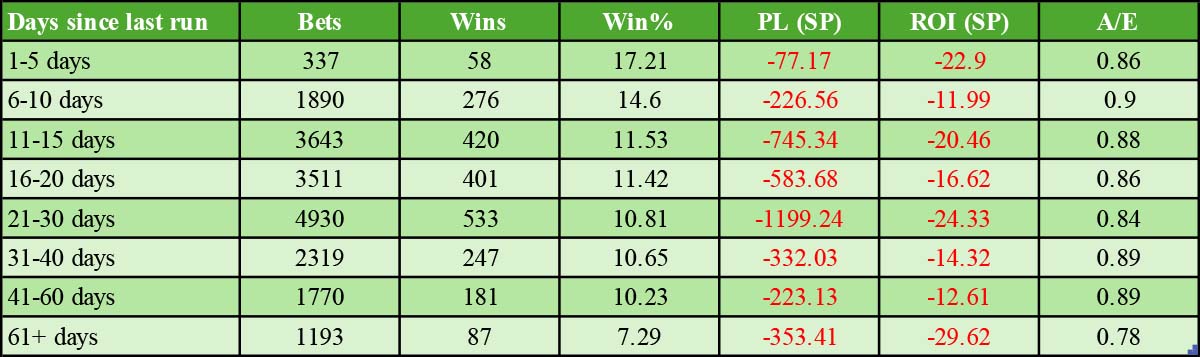
Horses returning to the racecourse within a week have by far the best strike rate and have returned over 9p in the £. There have been big profits for the 8-to-14-day group, too, but the 880.09 winner mentioned earlier is the main reason for those. Hence, from this data I would only take a return to the track within seven days as a positive.
Surface Switchers by Sex of Horse
The sex of the horse is an area I usually examine as sometimes useful angles are uncovered. Let's see if that is the case here. Below is a graph comparing the A/E indices of male horses moving from all-weather to flat turf versus female horses doing likewise:
As the numbers indicate, female runners have provided the best value when switching from the sand to turf. This might be because females tend to underperform on artificial surfaces compared to the turf and hence, when switching back there is a better chance of showing improved form.
The best time to catch female runners seems to be during the warmer months. From June to September their A/E index rises to 0.94 and backing all runners blind (nearly 9000 of them) would have yielded a profit of £454.31 (ROI +5.1%).
Surface Switchers by Class of Race
Does the class of race make a difference? The graph below suggests for one class, it does, when we compare return on investment.
Horses switching from all-weather surfaces to the turf have produced poor returns in the highest class of contests (Class 1). However, there is even more to ‘unpack’ when we dig a bit deeper into these Class 1 results. Look at the difference the Class of race they raced in last time out made:
Horses that raced in the same class LTO (i.e. Class 1) have actually made significant profits with a strong A/E index of 0.96. Those who raced in a lower class LTO have performed extremely poorly with a below par A/E index of 0.79 and losses of more than 30p in the £. There is also quite a difference when comparing the win percentages of nearly 3%.
Surface Switchers by Trainer
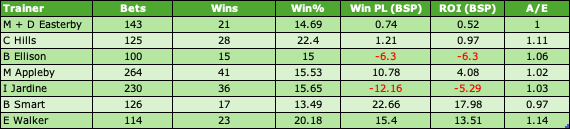
The final piece of the jigsaw is to look at the performance of trainers when their horse switches to turf from a run on the all-weather LTO. Here are the trainers with the highest strike rates:
We have the usual suspects as one might expect. The record of the Charlton stable stands out with sound profits and an excellent A/E index of 1.09. If we narrow down Charlton runners to those that started in the top four of the betting when returning to turf, they have excelled. They have combined to score 56 times from 197 qualifiers (SR 28.4%) for a profit of £87.89 (ROI +44.6%). Roger Varian’s runners in contrast seemed to have struggled with losses of around 25p in the £ and a very modest looking 0.74 A/E index.
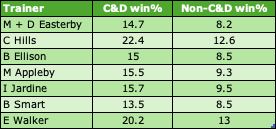
Before sharing my final thoughts, it would be useful to compare these AW to turf trainer figures with their record when their horses race on turf having raced on turf LTO. In the table below I will compare their win strike rates and A/E indices:
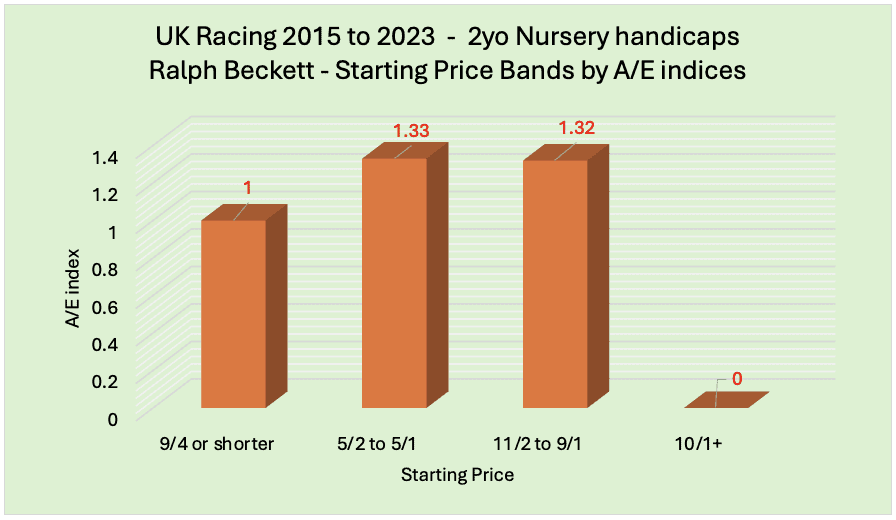
Individual trainer strike rates do not vary too much but the table gives us some useful pointers. Firstly, William Haggas and Roger Varian’s runners both perform much better when their horses have run on turf last time (both strike rate and A/E index). Ralph Beckett’s runners also do but the difference is less stark. Charlton’s runners perform better having switched surfaces, but their turf-to-turf runners still perform reasonably well.
Main Surface Switcher Takeaways
Before I wind this piece up, I have picked out what I think have been the strongest positives and negatives uncovered in my research.
This week there are more positives and less negatives than I was anticipating. Obviously one cannot guarantee the same patterns will be seen this year with runners switching from the all-weather to turf, but hopefully more will than won’t!
- DR
https://www.geegeez.co.uk/wp-content/uploads/2019/09/timoshenko_Goodwood_830x320.jpg320830Dave Renhamhttps://www.geegeez.co.uk/wp-content/uploads/2022/10/geegeez_banner_new_170x78.pngDave Renham2024-05-01 13:39:542024-05-01 13:39:54Switching from All Weather to the Turf
In my previous piece, I wrote about last time out handicap winners and reviewed what differences changes in their rating made when they next run, writes Dave Renham. This time, I am going to look at other handicap finishing positions (e.g. 2nd or worse).
As with the first article I will be sticking to horses which raced in a turf handicap last time out (LTO) and which are running in a turf handicap on their next outing. Qualifying races will be flat turf races run in the UK covering 2016 to 2023 with all profits/losses calculated to Betfair SP less 5% commission.
As I mentioned previously, when any horse runs in a handicap, the official handicapper assesses their performance and will adjust their Official Rating as they see fit. So the first thing I wanted to understand this time was the percentage of ‘non-winners’ that saw their rating go up, stay the same, or go down. Here are the splits:
As can be seen, over half of the runners were dropped in the ratings, around a third stayed the same, while less than one in seven horses saw their OR raised. How did each group fared in terms of results next time? Here is what I found:
Horses that performed better LTO have won more often but the ROI% figures are within just 0.4% of each other.
I now want to focus on horses that finished 2nd LTO.
LTO finishing position 2nd
Firstly, let me look at the general stats based on whether their rating went up, went down, or stayed the same:
In terms of returns there has been a slight edge to those LTO runners up whose rating was elevated. This group has also provided the biggest number of qualifiers, whereas it is relatively rare for such runners to be dropped in the ratings.
Below is a more detailed look at runners-up that were raised in the ratings. The table shows a next time out performance breakdown by specific rating change:
Caution is advised with the profit figures for horses that have been upped by 6lb or more as these stats have been skewed by two winners priced more than 40 BSP at 40.59 and 55.51.
During the study period, over 3000 horses that were 2nd LTO were raised in the ratings by just 1lb. These runners are close to breaking even to BSP, so it is worth digging further to see if there are any interesting stats from within this group.
Class change is one area that I looked at and I would like to share the follow-up results for all LTO turf handicap runners up that were raised exactly 1lb in the ratings, in terms of the class of race change:
These stats show that LTO 2nds when upped in class have proved good value. These runners have also been profitable in five of the last six seasons. In contrast, those dropped in class have provided very poor value losing over 22p in the £ for every £1 staked.
Sticking with these LTO runners up who have been raised by exactly 1lb, let me share their results when looking at the class of race contested:
In terms of the profit and loss column we can see that the two lowest Classes (5 & 6) have both incurred losses, with Class 5 losses especially steep. In contrast, Classes 2, 3 and 4 have all proved profitable with Class 3 results very solid including an excellent A/E index of 1.02.
Finally for this group of runners (2nd LTO / up 1lb) it is worth sharing that if restricting qualifiers to sprint handicaps (5f and 6f only) they have produced a decent profit. This subset of runners won 161 times from 930 attempts (SR 17.3%) for a BSP profit of £127.02 (ROI +13.7%). The A/E index was an impressive 1.01. The even better news is that these results are not skewed by bigger priced successes. Indeed, if restricting qualifiers to the top four in the betting we get the following:
An excellent A/E of 1.04 and returns equating to over 15p for every £1 bet.
LTO finishing position 3rd
Onto horses that finished 3rd on their last start. As I did with runners-up let me start by sharing some general stats based on whether their rating went up, down, or stayed the same. Unsurprisingly, far fewer horses were raised in the ratings compared to those who finished 2nd LTO:
Again, they are a remarkably similar set of figures with no edge to any of the three groups, and the win strike rates indicate a very solid performance by the official handicapper. Let me examine the horses that went up in the ratings and look at the effect of different changes in Official Ratings:
More than half of the runners upped in the ratings went up just 1lb, but they produced losses of nearly 11 pence in the £. Those raised 3lbs made a profit but take out a BSP 70.0 winner and that becomes a loss. Likewise, the 4+ group had two big-priced winners which again made the bottom line look better than it really is. It should also be noted that all 30 runners upped 7lb or more all lost.
LTO finishing position 4th or worse
As we move into horses that did not make the first three LTO, an even greater proportion of these will end up dropping in the ratings as the pie chart below shows.
From this cohort nearly seven in ten run next time with a lower rating, with just 4% getting raised. This should not come as a surprise considering how they ran previously. The splits for each group look thus:
Horses that went up in the ratings have provided the worst returns by a few pence in the £ and, based on next time out win strike rates, it could be argued they’ve been harshly treated as a whole.
With the group going down in the ratings being such a big one I am going to look in more detail at them.
LTO finishing position 4th or worse + went down in ratings
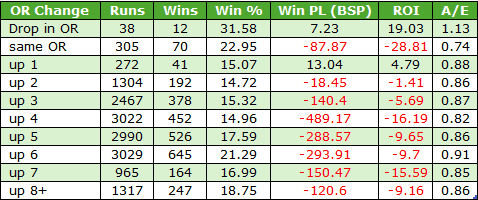
With over 50,000 horses in this sample one would hope to find some worthwhile angles be they positive or negative. So let’s break their records down by looking at the effect of different drops in OR. Firstly, a look at next time win strike rate based OR difference from prior run:
The smaller the drop in the ratings the higher the strike rate. Let’s examine how that correlates with return on investment (ROI%):
There is sound correlation between strike rates and returns: the better value has been with horses dropped either one or two pounds and I would generally avoid horses dropped more than 4lbs.
The most interesting finding concerning horses that were dropped in the ratings having finished 4th or worse was when I looked at their market rank on the betting exchanges. Here is what I found:
Both favourites and second favourites have produced profits, each with strong A/E indices of 0.98. While returns were modest in ROI terms, considering that would have been achieved from backing all such runners ‘blind’ it can certainly be viewed as a positive. Also, this top two in the market group combined to produce six winning years out of eight, thus showing good consistency.
Those fourth in the betting have provided a decent profit, too, and although 3rd favourites did not, the top four in the betting have proved far better value than those fifth or worse in the betting.
Going back to favourites/2nd favourites here are the BSP profits and losses when splitting their results by Class of Race:
There has been promising profit from Class 3, 4 and 5 events, especially when considering market position. Class 2 qualifiers lost a tiny amount, but Class 6 favs/2nd favs have under-performed in comparison. Class 6 races are often contested by more inconsistent types, and considering we are looking at horses that finished 4th or worse LTO, albeit first or second in the betting, I am not too surprised at these poorer figures.
Main Takeaways
Before closing, I have picked out what I think are the strongest positives and negatives uncovered in this research into the impact of ratings changes on beaten horses in turf handicaps.
There are a few areas of interest arising for me so it has been a worthwhile continuation from the last article. In the future I hope to revisit Official Rating Change with one potential idea being comparing their current OR rating with their highest winning rating.
Until next time…
DR
https://www.geegeez.co.uk/wp-content/uploads/2019/09/CallumRodriguez830x320.jpg320830Dave Renhamhttps://www.geegeez.co.uk/wp-content/uploads/2022/10/geegeez_banner_new_170x78.pngDave Renham2024-04-24 08:05:242024-04-24 08:05:24Handicap Losers and Official Rating Change: A Study
As the title suggests, in this article I examine last time out (LTO) handicap winners and look to see what impact, if any, different changes to their rating makes when they race again, writes Dave Renham. I will also be grouping together all LTO winners upped in the ratings to explore general trends and stats.
When any horse runs in a handicap, the Official Handicapper assesses the performance and decides whether the Official Rating – a number that determines in which class a horse should run and how much weight it should carry – should go up, down or stay the same.
These ratings are adjusted and published every Tuesday so there will be times when a handicap winner runs again before it gets reassessed. When this occurs, the horse in question must carry a fixed penalty of extra weight in order to meet its rivals on somewhat fairer terms. This is 6lb for a 2yo or 3yo, 5lb for a 4-6yo, and 4lb for a 7yo+.
Hence a seven-year-old horse that won off a handicap mark of 76 LTO will carry a 4lb fixed penalty if running prior to reassessment and will race off a handicap mark of 80 in that race (76+4).
When a horse wins a handicap, the Official Handicapper needs to decide by how much to raise its rating. If it wins narrowly, it is likely the rise will be small; but if the horse wins comfortably by several lengths, then the rise is likely to be more significant. This is why some jockeys ease their mounts up near the finish in an attempt to narrow the winning margin in hope of a smaller rating rise. Ratings points equate to 1lb in terms of weight carried.
Now, when horses switch from turf flat to all-weather or vice versa there are potential issues such as when a horse is far better on one surface than the other. In these circumstances the handicapper has the option of allotting a ‘split’ handicap rating, different for each surface. In this article I am avoiding that scenario by sticking to horses which won a turf handicap LTO and who are running in a turf handicap on their next start. I have concentrated on turf flat races run in the UK covering a time span from 2016 to 2023. All profits/losses have been calculated to Betfair SP less 5% commission.
Official Rating (OR) Change – All turf winners
To begin with let me share data for all LTO turf winners and the effect of different changes in Official Ratings:
As the table indicates from the number of runners in each row, the rise tends to be between 3 and 6 pounds. Generally, the more a horse has been raised the more it increases its chances of winning. However, this does not equate to profit! Looking at ROI% figures one could argue the better value in terms of horses going up in the ratings are with those raised between one and two pounds.
A handful of horses saw their Official Rating decrease. There are a few reasons why this might happen. It could be due to a big race having early declarations and they win just before that race takes place. It could also be due to a horse being off the track for a long time. For example, Soldier in Action won a handicap at Goodwood in September 2018 off a mark of 94 but was not seen again on the track for four years. He raced off 90 on his return as the handicapper has the discretion to drop a rating in these circumstances, when in possession of a lot more information about the value of the previous race-winning form. These runners have made a profit from a very small sample.
For the remainder of the article, I am going ignore the two small groups of LTO winners that either stayed the same rating or indeed raced from a lower rating, meaning that I will be focusing only on runners whose Official Rating increased.
Rise in Official Ratings by Race Class
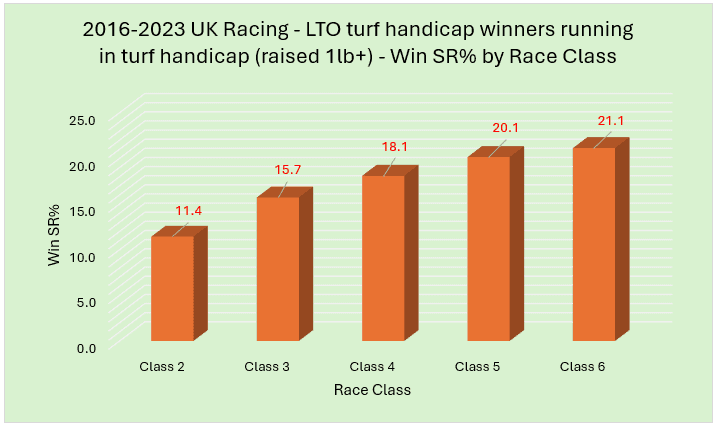
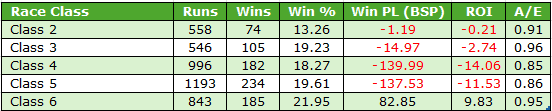
I would like to split the results of handicap winners raised at least 1lb or more by Race Class. Does this make any difference? Firstly, I looked at win strike rates:
It is interesting to see the increase in win percentage as the level of race gets easier. However, we know strike rates are not instructive from a ledger perspective so we need to examine returns. Also, Class 2 handicaps do tend to have bigger fields so one would expect the win SR% for that group to be lower.
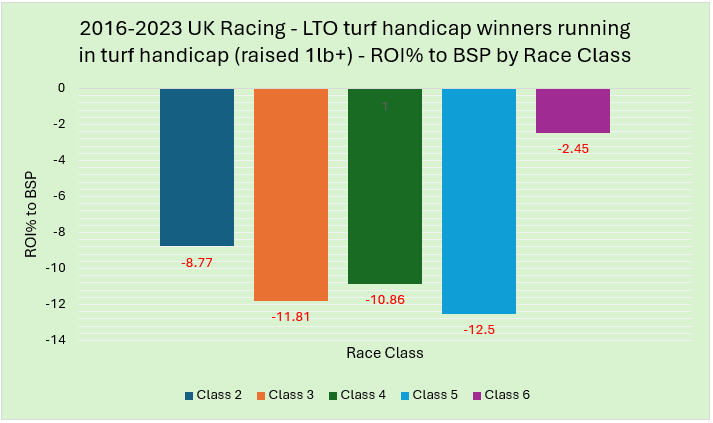
Unsurprisingly, all race classes made a loss, and the splits are shown in the graph below:
There is not much in it when comparing the returns of Classes 2 through to 5. However, Class 6 LTO handicap winners have got close to breaking even (loss of just over 2p in the £) and they seem to have offered the best value during the period of study. If you had concentrated on Class 6 qualifiers that won a Class 6 handicap LTO then these runners would have lost less than 1p in the £.
Sticking with LTO handicap winners racing at Class 6 level, it is very interesting when we split the results by how much the horse was raised. I have grouped them together in batches to give bigger sample sizes:
The table suggests that the less a horse has gone up in the weights the better from a value perspective. It should be noted that the results for Class 6 runners upped between 1 and 3 pounds have+ not been skewed by huge-priced winners. Indeed, when these runners started favourite, they returned over 14p in the £ thanks to 72 winners from 228 qualifiers (SR 31.6%) for a BSP profit of £32.37. Second favourites were also profitable though only just.
So we see that, in Class 6 handicaps, horses upped by eight pounds or more have proved very poor value albeit from a small sample. But what about horses upped by eight pounds-plus in other Class grades? Here are the stats:
As you can see Class 3 runners have snuck into profit. However, Class 5 runners have struggled losing nearly 25p in the £. Hence horses raised 8lb or more have struggled in the two lowest classes (5 and 6) – they look worth swerving.
Rise in Official Ratings by Age
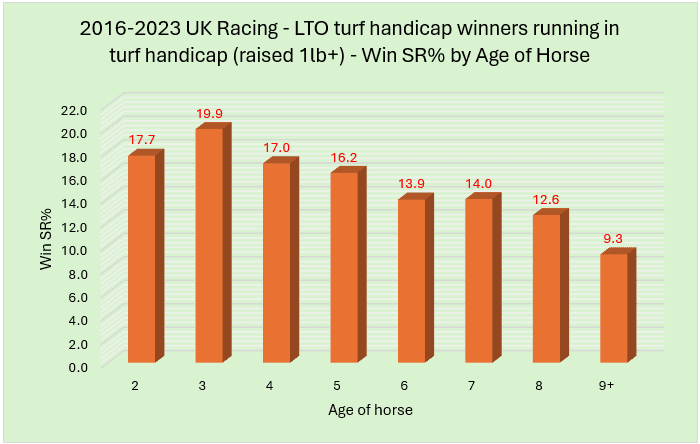
A look now at whether the age of a horse makes a difference when trying to repeat a handicap win having been upped in the weights/ratings. I want to look at win strike rate first as there is a pattern:
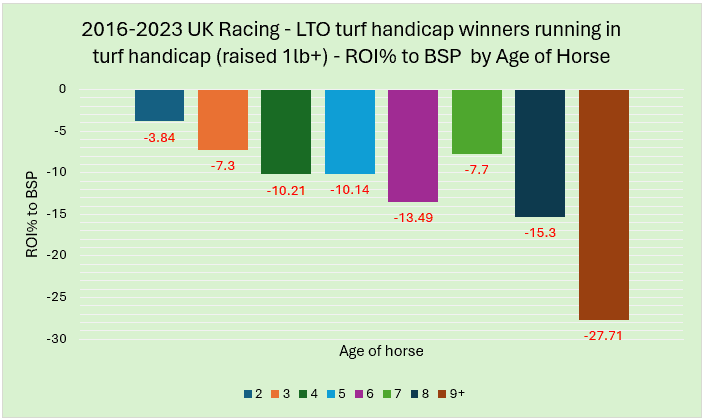
As the graph indicates, in terms of win percentage horses aged two to five outperform those six and older. Once we get to 9yos and older the win rate drops below 10%. Let me share now the Betfair return on investment figures to see if they correlate with the strike rates:
There is good correlation between the ROI% and the win strike rates. 7yos buck the trend slightly but the graph otherwise trends in the right direction. 9yos+ have been very poor value losing nearly 28p in the £. 2yos have proved the best value although would still have lost a shade under 4p in the £ for every £1 staked.
As 3yos provide the biggest group of LTO turf handicap winners by some margin, let me drill into their record in more detail. If we narrow our 3yos down to those who were raised just one or two pounds we get the following results – 72 winners from 410 (SR 17.6%) for a BSP profit of £102.08 (ROI +24.9%). Each of the last four years has produced a profit to BSP.
Remarkably the biggest hike in the weights/ratings for a LTO winning 3yo has been a massive 23lbs! It should be noted that when the rise gets beyond 10lbs, 3yos have been less successful. Under these circumstances they have managed to win just 17 of 117 races (SR 14.5%) for a loss of £31.44 (ROI -26.9%)
I have one last age-related stat to share: horses aged nine or older when raised just 1-2lbs have won only twice from 50 attempts (SR 4%). Betting all qualifiers would have lost a massive 76p in the £. 43 of these 50 runners had won LTO by less than a length so my guess is that they had nothing ‘in hand’ when winning and hence going into their next race it made a repeat win very difficult.
Rise in Official Ratings by Sex
Do male horses or female horses perform better when raised in the weights after a turf handicap win? Here are the splits:
Female runners have outperformed their male counterparts across the board, delivering a higher strike rate, better returns, and a higher A/E index. This is interesting because when we look at all flat runners, males tend to win slightly more often than females.
It makes sense to look at this female group in more detail. Firstly, let me examine their stats by Class of race:
In the ‘run of the mill’ handicaps of Class 4 and 5, female runners have performed far less well. However, at either end of the scale, Classes 2 to 3, and Class 6, their record has been very solid. At the basement level of Class 6 they have made a good profit and with the highest priced success being 22.58 BSP, these figures have not been skewed by a random 50/1+ winner or two.
Another stat worth sharing is that female qualifiers who were raised just 1 or 2 pounds would have been worth following thanks to 70 winners from 423 (SR 16.6%) for a BSP profit of £54.35 (ROI +12.9%).
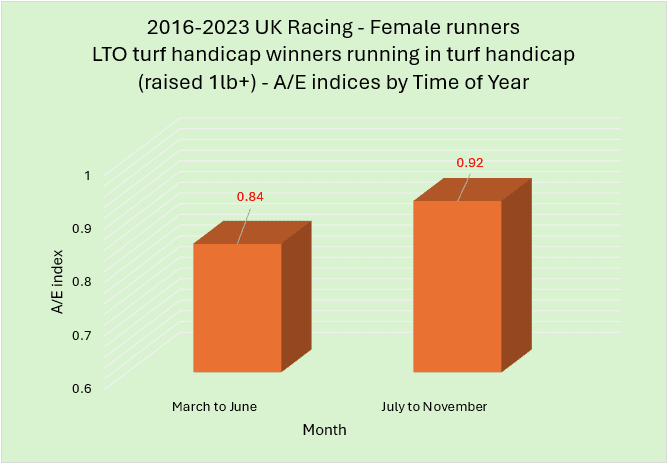
Sticking with these LTO female winners, they seem to have a favoured time of the year. Below are the A/E indices split between two time frames – March to June and July to November.
Runners racing in July to November have proved far better value than those seen earlier in the season. The ROI percentages correlate with these figures as female runners from March to June would have lost you over 16p in the £, females racing between July to November have essentially broken even. There is a theory about fillies and mares enjoying the sun on their backs and, while that may or may not be true, the data appear to support it.
Before moving on there are three more female stats worth sharing:
As we can see, LTO turf handicap winners raised in the weights who were female have proved profitable in a variety of situations.
Rise in Official Ratings – Comparison with Class LTO
When a horse wins a handicap and goes up in the ratings there will be times when they will be rated too high for the class of race that they contested last time. Hence there will be far more horses stepping up in class than dropping in class. Obviously, there will be some that will contest the same class as last time. Let us look at the overall figures for all LTO turf handicaps winners that went up 1lb or more in the ratings:
Horses dropped in class have won more often than those upped in class but they have been poor value, losing around 19p in the £. Horses remaining in the same class have offered the best returns/value, but they still produced losses of around 7p in the £.
Drilling down in class change + rating change there is one positive I have found. Horses that were raised in class but upped just 1 or 2lbs have made positive returns. The 509 qualifiers have provided profits of £97.69 (ROI +19.2%) thanks to 73 winners. The overall A/E index is a solid 0.94, and results have been consistent over the last four years as all four have turned a profit.
Conclusions / Main Takeaways
Ratings change in handicap winners is not an area that I have investigated in much detail in the past, but it has highlighted a few interesting stats well worth noting through the season.
Below I have picked out what I think are the strongest positives and negatives to keep in mind.
Good luck.
- DR
https://www.geegeez.co.uk/wp-content/uploads/2024/04/273951142-scaled.jpg12802560Dave Renhamhttps://www.geegeez.co.uk/wp-content/uploads/2022/10/geegeez_banner_new_170x78.pngDave Renham2024-04-09 09:40:082024-04-09 09:40:08Handicap Winners and Official Rating Change: A Study
Despite the turf flat slowly beginning to click into gear, I am going to dip my toe back into the world of National Hunt racing for one final time this season, writes Dave Renham. With the Aintree and Punchestown festivals to come there is plenty of great jumps racing still to look forward to.
In this article I will look at the performance of horses on their very next start having had their last race at the Cheltenham Festival. What should be looking for? Is a win at the festival a positive for the next run? How do Cheltenham Festival runners fare at Aintree? What about if they return to the racetrack at the Punchestown Festival? These questions and more will be examined in what follows. Let's dive in.
The data have been taken from 2015 to 2024 and profits / losses calculated to Betfair Starting Price less 5% commission.
[ex-toc]
What impact does Cheltenham Festival finishing position have on next start?
The first port of call is where the horse finished last time out (LTO) at the Cheltenham Festival. Here are the splits:
Fallers look to be a group of runners to ignore next time: their one in eight win rate came at a cost of over 38p lost for every pound invested. Likewise, those who finished 11th or worse but completed the course had an identical strike rate and similarly eye-watering (-33%) ROI.
In terms of positives, winners at the Cheltenhm Festival have an excellent record on their next start, doubling up just shy of 40% of the time. As a group, they have also returned a steady profit of better than 18p in the pound. Not only that, but they have a positive A/E index of 1.05 implying sustainable profit. If we look at the yearly figures for Cheltenham Festival winners, we see the following in terms of profit / loss:
Seven of the nine years have turned a profit, albeit a small one in some cases; and the two losing years were far from disastrous. It looks as though Cheltenham Festival winners require very close scrutiny on their next start.
Somewhat surprisingly given the success of LTO winners, horses that finished second at Cheltenham have performed quite poorly when considering the profit/loss column, losing over 33p in the £ and with a low A/E index of 0.74. These runners look to be significantly over-bet and well worth a swerve.
Which Courses have been best for LTO Cheltenham Festival runners?
Next, I wanted to investigate which courses fared best when Festival runners visited on their follow-up run...
Three courses recorded a profit – Ascot, Cheltenham and Punchestown. However, the Cheltenham bottom line is completely skewed by Premier Magic who was successful in the 2023 Hunter Chase at the huge BSP of 110.14 having been pulled up in the same contest a year earlier.
Next time out at Fairyhouse
At the other end of scale, horses that have headed to Fairyhouse have performed poorly from a decent sample size. Indeed, at the Fairyhouse Easter Festival from last weekend, 23 Cheltenham Festival runners showed up but only one won - Jade De Grugy at odds of 7/4. The 22 beaten included Ferns Lock at 2/7 and Zarak The Brave at 5/6 as well as six other horses at 9/2 or shorter.
It may be worth noting that only 7% of Cheltenham Festival runners make their next start at Fairyhouse.
Next time out at Punchestown
The vast majority of next time out Punchestown runners (roughly 90% of the qualifiers) did run at the Punchestown Festival which is held at the end of April / beginning of May. There are two stats worth noting in terms of these Punchestown runners:
Horses that won LTO at the Cheltenham Festival have an excellent record when turning out at Punchestown next time: there were 34 winners from 75 runners (SR 45.3%) in the sample period for a BSP profit of £40.97 (ROI +54.62).
Clear favourites have also turned a profit at the Irish track thanks to a 50.8% strike rate (63 wins from 124) amounting to a small profit of £13.64 (ROI +11%).
Not many horses head to Ascot on their next outing after the Cheltenham Festival but they tend to run well. There have been six winning years out of nine and with no winners returned above 20/1 the stats have not been enhanced by big priced scorers. Clear favourites have done well from a limited sample winning 9 from 16 (SR 56.3%) for a BSP profit of 12.34 (ROI +77.1%).
Next time out at Aintree
Focusing in now on Aintree, of the 927 runners that ran at the Liverpool track next time 867 of these ran at the showpiece Grand National meeting. 92 of these won (SR 10.6%) for a BSP loss of £55.45 (ROI -6.4%).
If we focus solely on horses that started in the top three of the Aintree betting, we can sneak into profit to BSP. This subset of runners won 67 of their 306 starts (SR 21.9%) for a profit of £13.41 (ROI +4.4%).
Cheltenham Festival winners have also done a good job of backing up that win when turning out next time at Aintree with 18 winners from 62 (SR 29%) for a profit to Betfair SP of £12.54, just over 20p in the £ ROI.
In terms of negative stats, it looks best to swerve horses that were either beaten by 30+ lengths at Cheltenham and those who failed to complete the course. These runners when coming to the Aintree Festival have combined to win just 14 races from 233 runs (SR 6%) with heavy losses of £105.81 (ROI -45.4%)
Race type – handicap v non-handicap
There is a significant difference in terms of performance between horses that contest a handicap after the Cheltenham Festival as opposed to a non-handicap. If we compare the A/E indices of each group we see a marked differential:
Horses that run in a non-handicap after the Cheltenham showpiece have been far better value than those who went on to contest handicaps. If we look at the BSP returns, we can see that the figures correlate strongly with the A/E indices:
As can be seen, horses that ran in a handicap next time lost over 20p in the £, whereas non-handicappers lost less than 4p. In fact, if we stick to horses that raced in a handicap at the Cheltenham Festival and then contested another handicap next time, the record is even worse:
These results make for very poor reading. I wonder if it is because most of the horses would have been trained with Cheltenham as their main target. Whatever the reason, I would not be keen on backing handicappers from the Cheltenham Festival when contesting another handicap next time. I should add that one of the handicap winners was priced 94.51 BSP so taking that one out means the other 1326 runners would have lost you over 32 pence per £1 staked, even more distressing than the 25% losses with that brief respite included!
Days since Cheltenham Festival run
Let's now consider the time between a horse's Cheltenham Festival run and its next appearance. Here are the splits:
A very small proportion of runners are seen again quickly (within two weeks) and this group has made a profit from a one in four strike rate. A good proportion of the 43-to-70 days group ran at the Punchestown Festival which perhaps explains the strike rate, the small losses and decent A/E index. The 181-to-270 group has the most interesting results for me. We are roughly talking about a break of between six and nine months which essentially takes us to the start of the following National Hunt season. These runners have just about broken even to BSP, with a near to one in four win rate and a very solid A/E index. Horses that started clear favourite after this 181-to-270-day break have performed well thanks to 125 wins from 235 (SR 53.2%) for a BSP profit of £24.24 (ROI +10.3%).
Market factors for LTO Cheltenham Festival runners on their next start
The next area I wish to look at is the price of the runners on their next start after the Cheltenham festival. I am look at the Betfair SP price and the table below looks at the key stats:
Although the 2.02 to 3 group have incurred relatively big losses, it generally has been preferable to stick to horses BSP priced under 9. Horses priced 21 or more have offered poor value and incurred significant losses of over 28p for every £1 staked.
If we compare the A/E indices between horses priced 9 or lower with those 9.2 or higher, we see a big difference:
To get the best value, horses priced 9 or shorter are the ones to concentrate on. Also, given the non-handicap data I shared earlier, it should come as no surprise that if sticking to this shorter price range in non-handicaps the record improves further. This subset of runners has edged into profit thanks to 443 wins from 1275 runners (SR 34.8%). The profit stands at £19.15 (ROI 1.5%).
Class Move Next Time after Running at Cheltenham Festival
Before finishing the main body of the article I have a couple of additional stats to share based on the race class difference between the Cheltenham Festival run and next start – they are both negative:
UK-trained horses going up in class on their next start have struck less than once every 18 starts for an enormous 43% loss, while those trained anywhere stepping up to Grade 1 level from a lower class run at the Cheltenham Festival were similarly catastrophic to follow in terms of both strike rate and ROI. Horses from these groups should generally be avoided!
Summary – Key Takeaways
Below are the key findings from this article.
It's a pity publication has followed the (early this year) Fairyhouse Easter Festival [apologies, my fault - Ed.] as that was predictably disastrous for Cheltenham Festival follow-up runners. But, with Aintree and Punchestown still ahead, as well as the start of the next season, there's plenty to heed, and hopefully profit from, to come.
- DR
https://www.geegeez.co.uk/wp-content/uploads/2024/03/Absurde_CountyHurdle.png319830Dave Renhamhttps://www.geegeez.co.uk/wp-content/uploads/2022/10/geegeez_banner_new_170x78.pngDave Renham2024-04-02 10:21:442024-04-02 11:35:15What Happens on Next Run After The Cheltenham Festival?
Over the past week I have finished collating thousands of stats, and crunching most of them, in order to be primed and ready for the new turf flat season, writes Dave Renham.
The first things I always update in the close season are draw statistics for each course and distance. If possible, I want to stay ahead of the crowd by noticing whether biases seem to be strengthening, weakening, or potential new biases are emerging. When analysing draw bias, I tend to focus on handicaps only with at least eight runners (generally the more runners the better). A good chunk of the data shared in this piece will be from 8+ runner handicaps only.
While draw bias may not have the overall impact it had twenty to thirty years ago, there are still enough edges in play to give shrewd punters a leg up. However, it is crucial to fully understand how strong any biases are and whether the market has compensated, or in some cases over-compensated. It has been two years since I last looked at draw bias on Geegeez so let’s crack on and review a selection of my recent findings and their potential ramifications.
The straight track at Ascot is one I keep a close eye on, not just year on year, but meeting by meeting, day by day. Draw biases seem to come and go at the Berkshire track and it is not always easy to predict how strong they will be and which part of the track, if any, will be favoured. Biases are most likely to occur in big field handicaps where the runners tend to split into two or sometimes three groups.
At the Royal Meeting in 2023 there were six straight course handicaps where the field sizes ranged from 26 to 30 runners. The first such contest of the week, the Royal Hunt Cup, produced the following result. The first ten finishers are shown:
Although the winner Jimi Hendrix was drawn in single figures the next six finishers were drawn in the 20s and eight of the top ten were drawn between 20 and 30. This race suggested that higher draws held a decent edge over middle / low draws. Now, just because one race displays a draw bias like this, we cannot be certain that this will be replicated in subsequent races during the same meeting. However, last year, by the end of the Thursday punters should have been fairly confident that there was a playable high draw bias, as the Buckingham Palace handicap that ended proceedings on the third day of the Royal meeting delivered the first five horses home from stalls 24, 23, 12, 21 and 22.
Indeed, this high draw bias was repeated in all three of the big field handicaps that took place on the Friday and the Saturday. For example, the first six in the Sandringham were drawn 25, 16, 18, 24, 20 and 29, while in the Palace of Holyroodhouse the first six finishers were drawn 25, 16, 17, 20, 27 and 29.
I mentioned earlier that draw biases at Ascot are not always replicated in subsequent races. This comes from watching and punting on many past Royal meetings. There have been times where the draw bias seems to have flip-flopped from race to race. Why this happens is not always clear. It could be that what appears to be a draw bias might in fact be down to a pace-based bias. As punters we need to make an informed judgement whenever we see what appears to be a draw bias at a specific meeting, to decide whether it actually is one or not.
The Royal Meeting, though, does provide the best opportunity to profit from draw bias at Ascot. Essentially, for me there are three ways I tend to play the draw at Royal Ascot on the straight course:
Split the stalls into three and focus solely on that part of the draw from which I think there will be an advantage. If I am right, then by eliminating two-thirds of the runners, my chances of profiting increase considerably. I can take this view before any big field handicaps have taken place or I can wait for one or two to give me a steer.
Wait for the first race or two and if one or both races have shown a strong bias, take the contrarian view and focus on what looks to be the unfavoured side. Bookmakers will be aware of the previous races and are likely to shorten up the expected ‘favoured’ side and push out prices of those drawn on the presumed unfavoured side. If the bias flip-flops, as mentioned earlier that it can do, then we have secured have excellent value. This is a risk-reward approach.
Back horses on either flank – one high, one low. Or if the field is in the mid-20s or higher I often play two either side. Alternatively, I go one high, one low, one middle. This is a hedging approach and I probably use this method the most taking the view I have more options covered and can still get value prices backing three or four runners due to the big field sizes.
Certainly 2023 was high draw friendly at Ascot on the straight course. If we look at all handicaps across the year with 14 or more runners we see the following draw splits:
As can be seen, high draws dominated the win strike rate, the P/L bottom line, PRB, A/E indices and Impact Values.
Will high draws dominate in 2024? Only time will tell. However, with big fields we should be able to get some value prices especially if the draw turns out to be in our favour.
Brighton 1 mile
Two years ago, when I wrote a series of articles on the draw, I mentioned the 1-mile Brighton bias in the third article. At the time, I had not previously been aware of this bias. In that piece the draw data from 2016 to 2021 suggested that high draws held an edge with low draws being at a disadvantage. Looking at the 2023 figures for handicaps with 8+ runners we see the following:
Obviously, the sample size of eight races is tiny, but the PRB figures are especially potent in terms of suggesting a bias still exists. Indeed, combining last year’s results with 2022 we get a bigger sample and the same pattern:
So, in the two years since sharing the high draw bias with Geegeez readers, we can see nothing appears to have changed. In fact, one could argue the bias looks slightly more pronounced. There are two additional findings I would like to share. Firstly, horses drawn 11 and higher have a PRB figure of 0.65 over this 2-year period. Secondly, if you had permed the highest three draws in combination forecasts you would have secured an 18.63-point profit.
Catterick 5f
About 15 to 20 years ago Catterick offered draw punters two biases – a low draw bias on good or firmer, and a high draw bias on soft or heavy. These days, for whatever reason, the low draw bias on firmer ground does not seem to exist. However, when the going gets soft, higher draws still have an edge. This is because the ground is better the wider you go in the straight. There have only been seven qualifying races in the past two seasons, but the figures strongly favour high draws as the table below shows:
Five of the seven races have been won by high draws, with good correlation across the A/E indices, Impact Values and the PRB figures. A good example of how strong the bias has been under these conditions can be seen by looking at the result of the Millbury Hill Country Store Handicap which took place on October 25th 2022:
As you can see the first three home were drawn in the top three stalls, the first five home were drawn in the top five stalls, the top seven home came from the top seven stalls, and those who finished in the final five spots from 8th to 12th came from the lowest five stalls.
Going further back in time to give us a bigger sample (2016 to 2023), we see the following:
These figures indicate that soft ground bias at Catterick over 5f gives punters a playable bias to work with. Indeed, you could have backed the highest three draws ‘blind’ over these 28 races and secured a profit to SP of £27.00 (ROI +32.1%); to BSP it would have been £43.44 (ROI +51.7%).
Before moving on, let us look at a smoothed-out graph of stall positions based on PRB figures from soft/heavy 5f handicaps from 2016-2023 using the Geegeez metric PRB3:
This gives us excellent correlation with all the other stats for this C&D on soft/heavy clearly showing the bias.
Goodwood 7f
Goodwood was the first course I ever visited in terms of going racing and I fell in love with it then and still love it to this day. I have been there more times than all other racecourses combined. Back in the 1990s I made huge profits in 7f handicaps as horses closest to the inside rail enjoyed a massive edge. Course officials eventually cottoned on to the bias around 2005/2006 and they have managed to even the playing field to some extent since then. However, low to middle draws still tend to hold sway with very highest draws finding it difficult to win. If we look at the last two years the 8+ runner handicap splits are as follows:
During this time frame middle draws have edged it in terms of wins and have secured decent profits. Low draws have performed well in terms of places, and they comfortably have the highest PRB figure. Now some people looking at these stats will acknowledge that higher draws seem at a disadvantage, but they may dismiss it as a course where the draw bias is not potent enough to be of interest. However, I would like to compare the performance of horses drawn 1 to 6 with those drawn 7 or higher:
This data seems to demonstrate there has been a strong draw bias at work in the past two seasons. It also demonstrates that as punters it is worth analysing data in different ways to build the most accurate picture we can. This is especially true when we are looking at small to medium sized samples.
Before moving on here are the basic draw splits for Goodwood 7f handicaps (8+ runners) since 2016:
This longer-term data set shows that the bias is something that we do need to consider. The value lies with lower draws as they have provided roughly 50% of all winners (from 33.3% of the total runners) although one still needs to find the right horse(s) as they are not profitable to follow blindly.
Gowran Park 7f
Over to Ireland now and the 7f trip at Gowran Park. This course and distance was highlighted in the same draw series of two years ago showing a decent low draw bias especially on good or firmer going. Since then we have had 15 more qualifying races similarly quick turf with the following draw third splits:
Those are strong figures, backing up the data shared previously. To save you having to scroll through past articles here are the 2016-2021 stats I shared then.
Again, we can see excellent correlation between both tables: not only have low draws enjoyed a strong edge, but higher draws have had a very poor time of it. In fact, combining all horses that were drawn 9 or higher in the past eight seasons under these conditions would have seen just six wins from 260 runners! Losses of 71p in the £ to SP just underlines the difficulty these higher draws have.
For fans of perming lower draws in forecasts, you would have made hay in 2023 thanks to one race. The first division of the Coast to Curragh Charity Cycle Handicap on 16th August 2023 saw The Fog Horn (drawn 1) win with Kodihill (drawn 2) coming second. A £1 reverse forecast on these two lowest draws would have yielded a monumental return of £976.71; the reverse exacta would have paid even more at an eye-watering £1674.50 return for a £2 stake.
Gowran Park is a course where I will be looking for draw-based opportunities in 2024.
Pontefract 1 mile
This mile trip at Pontefract has offered a strong low draw bias for many years now. Over the past two seasons there have 28 handicaps with 8+ runners, of which half of them (14) were won by one of the three lowest stalls. Here are the draw results for all stalls during this time frame:
These results clearly show the strength of the bias – just look at the PRB figures and the placed percentages for the lowest draws. If we include stall 4 with the bottom three stalls, we get the following splits in terms of placed percentages:
That is getting close to three times the number of placed runners from the inside four stalls. In terms of PRB figures the difference is equally significant:
My strategy over this track and trip has long been to focus on the lowest draws. I have tended to concentrate on stalls 5 or lower, with the lower the better. The good news from a punting perspective is that the market has still not adjusted fully and there remains some value to had with these lower draws.
*
I hope this article has shown you that draw bias is still alive and well albeit at a handful of course and distances. This is not an exhaustive list but hopefully there has been enough here to give you some useful and profitable pointers for the season ahead.
- DR
https://www.geegeez.co.uk/wp-content/uploads/2021/06/Oxted_KingsStand_RoyalAscot2021.jpg319830Dave Renhamhttps://www.geegeez.co.uk/wp-content/uploads/2022/10/geegeez_banner_new_170x78.pngDave Renham2024-03-25 16:37:512024-04-02 14:44:44Top Draw Biases for the 2024 Flat Season
Spring is upon us, and the turf flat kicks off this weekend, writes Dave Renham. It is my favourite time of the year as all of my winter research can be unleashed in an attempt to hammer the bookies! Of course, despite all the hard work put in it, it does not guarantee profits for the year ahead. No doubt it will be the usual rollercoaster of good weeks, bad weeks, and indifferent ones. Hopefully, though, there will be more good than bad!
In this article I am going to investigate recent trainer form to see what I can unearth. Newspapers, betting sites and some pundits seem to place a lot of stock in trainer form; I must admit that I tend not to, but I am prepared to change my mind depending on what I discover: have I been missing a trick all these years? Let’s see.
I have taken flat and all-weather data from 2021 to 2023 for UK racing and profits/losses have been calculated to Betfair Starting Price less 5% commission (readers can do better than those results by selecting the 2% commission option in your Betfair account).
My focus is going to be on 14-day trainer form, but with a caveat. The caveat is that a trainer must have had at least 20 runners during that time frame. I’m adding this to make sure we eliminate small samples which are unreliable.
To try and explain how small samples can be unreliable, a trainer could theoretically have had five runners in a 14-day period with one win and four losers giving them a recent win strike rate of 20%. Generally, a strike rate of 20% for trainers at any time is considered very good. However, firstly that 20% strike rate is based on very limited data. Secondly, let us imagine all five runners had been odds-on favourite – that would not be crying out good trainer form. To be clear, I’m not suggesting that 20 runners in a 14-day period is the perfect number of runs, but it seems as sensible an arbitrary figure as any.
General 'Recent Form' Trainer Statistics
Time to review the first set of data. Here, I am looking at trainer strike rates – both win and each way linking with the win percentage individual trainers had achieved in the previous 14 days.
This initial piece of evidence suggests, at least from a strike rate angle, that trainers who had been in better form over the past 14 days outperform those whose recent form had been less good. Both the orange line (Win SR%) and the blue one (EW SR%) show solid correlation with the graph, on an upward trajectory.
However, as a recent article of mine suggested, strike rates are not the be all and end all; we need to look at value and profit / loss. The table below gives us a breakdown of this:
This presents a less clear picture but, looking at the returns, the trainers who have scored 5% or less with their last 20+ runners over the most recent two-week period have provided the worst returns. Looking at the trainers with the highest recent strike rate (31% or more), it appears that the betting market has compensated for this to a great extent given losses of more than 13p in the £.
Of course, the data shared so far looks at all trainers combined. This gives us a general starting point, but to get a better overall perspective we need to split the trainers into groups. This is because comparing the 14-day win strike rate of Charlie Appleby, say, with Liam Bailey makes little sense. Appleby has a 29.6% strike rate during the time frame compared to Bailey’s 4.3%. In addition, Appleby’s A/E index of 0.94 is nearly double that of Bailey whose figure stands at 0.48. Hence in a scenario when Appleby and Bailey have secured a 15%-win strike rate in the past 14 days, we should be aware that Bailey is performing well above his norm and Appleby well below. Looking at all trainer data therefore gives us a flavour but cannot paint the full picture.
To mitigate somewhat for this, I am going to consider split trainers into groups based on their annual win rate while analysing recent form (14-day results).
I have split them into five groups: those with an annual strike rate of 8% or less, those between 9% and 12%, 13% to 16%, 17% to 20%, and finally trainers winning at a rate of 21% or more.
Trainers with a yearly win strike rate of 8% or less
Looking at all trainers who had run at least 200 runners from 2021 to 2023, around a fifth of them had an overall win strike rate of 8% or less. With this group I would not expect to see many qualifiers in the higher 14-day strike rate groupings.
The biggest group of qualifiers has occurred in the 6-10% 14-day strike rate (SR%) bracket and they have made a BSP profit. However, this is down to two unusually big-priced winners of 451.93 and 350.0 which skew the figures considerably. What is clear is that once trainers in this group hit 16% or more with 20+ runners in a 14-day period they do start to have better results. Combining the results of the 16%+ group they have returned 10p in the £ with a solid A/E index of 0.93 from a sample of around 400 runners.
Trainers with a yearly win strike rate of between 9% and 12%
This group of trainers is the biggest and includes runners from the stables of Richard Hannon, Richard Fahey, David O’Meara, Kevin Ryan, and Jim Goldie to name but five. Let us look at the overall win and each way strike rate first:
The graph shows that this group of trainers have performed quite poorly in terms of win strike rate if their 14-day Win SR% had been between 21 and 30%, which is surprising. I expected the orange and blue lines to rise gradually and relatively smoothly from left to right.
When we compare the A/E indices we see a similar pattern:
Combining the runners from the 21-25% group and the 26-30% group would have lost over 16p in the £ to BSP. Even the 31%+ group lost 15p in the £ despite a decent A/E index. It seems that the market is aware when these types of trainers are showing good recent form and prices have been more than adjusted to account for it. Here is a tabular view of this group:
The 0% group has performed better than expected. However, as we will see, this turns out to be an outlier when considering the rest of the research I share.
Trainers with a yearly win strike rate of between 13% and 16%
This group of trainers includes Charlie Johnston, Archie Watson, and Clive Cox. Here are their stats:
There are better strike rates across each grouping as we would expect from higher general strike rate trainers, but these handlers look worth avoiding if they have had no winners from 20+ runners in the past 14 days. Losses of over 26p in the £ is steep albeir on a smaller sample size.
The picture is not much brighter at the other end of the scale – trainers that seem to be in flying form with a 14-day SR% of 31% or more have made losses of over 14p in the £. Their strike rate is relatively poor, too, at 15.09% and their A/E index a modest 0.86. These are the two key discoveries from what is essentially another mixed bag of findings.
Trainers with a yearly win strike rate of between 17% and 20%
Let’s see if this smaller group of trainers can give us some stronger patterns. Ralph Beckett and Sir Michael Stoute are two trainers who are included here in the following results:
When these trainers are out of form (14-day SR% of 5% or less) they look worth avoiding. Combining the top two rows of data we see significant losses of 27p in the £. Conversely, when they hit the dizzy heights of 31% winners or better in the past 14 days this cohort has edged into profit. I would guess that it will come as less of a surprise for such trainers to hit these levels from time to time and perhaps the market has failed to properly adjust.
Overall, these stats are strong with a decent strike rate of close to one in four, returns of over 7p in the £ and an excellent A/E index of 1.04. In general, these stats correlate better with what I would have expected to see.
Trainers with a yearly win strike rate of 21% or more
We are now looking at a very select band of trainers including Charlie Appleby and Willie Haggas. Here are their win strike rates based on recent form:
I want to focus on win percentages (hence no EW ones on this graph) to help illustrate how little difference there is in some of the numbers. For example, when this group of trainers had previously had a 6-10% win SR% over the past 14 days their win rate was 19.8%. When it was 21-25% in the previous 14 days their win rate was virtually the same at 19.9%. Let me share the fuller picture:
The first thing to point out is that a 14-day SR% of 5% or less is extremely rare in this collective, as one would expect. Secondly, I want to highlight the poor performance of the 31%+ group which incurred losses of over 18p in the £ and produced a disappointing A/E index of just 0.83.
There is no easy explanation as to why the 26-30% group have fared so well in comparison. My reading of the data is that when these yards seem a little under par (previous 14-day SR% of 11 to 20%) their runners may offer a little bit of value. I guess punters could be put off by the relatively modest recent strike rate, but essentially these runners are still scoring close to each trainer’s norm.
At this juncture the picture is quite muddy when it comes to 14-day trainer form. The strongest and most important finding is that we can say that a 14-day win SR% percentage of 5% or less is a negative.
*
Individual 'Recent Form' Trainer Statistics
It is time now to look at individual trainers. With each trainer plying their trade in a different way, one would hope there might be more insights to glean here. Fifty of the leading trainers are shown in the table below in terms of their win strike rate (missing cells are due to limited data):
Before going into more detail let me share their A/E indices with you as well. I have colour coded the A/E indices with positive figures of 1.00 or more in green and negative ones of 0.70 or less in red.
Individual Trainer Angles to Note
These are what I think are the most significant findings:
Andrew Balding does unexpectedly well when his recent 14-day SR% is less than 5% returning 37p in the £ on all runners. He also made a BSP profit with his 6-10% group.
Ralph Beckett looks a stable to follow when he hits the 14-day win SR% of 26% or more. An A/E index of 1.05 and a small profit to boot.
The Crisford stable has a bizarre set of strike rates and A/E indices:
Both metrics correlate with each other which gives us confidence in the findings, but the data is suggesting that the poorer the recent form of the stable the better.
Don’t be put off by low recent 14-day win strike rates for Eve Johnson Houghton. When her strike rate was 5% or less in the previous two weeks her runners have offered good value. Backing all runners blind in this context would have secured a small profit.
When Alan King’s 14-day SR% has been between 21% and 25% he has managed just one winner from 62 runners. Losses of 90p in the £ would have been recorded backing horses from a so called ‘hot’ stable.
Daniel Mark Loughnane has the type of profile I was expecting more of. When his 14-day SR% is 5% or less his record is very poor. When it hits 26% or more his record has been excellent. He does a look a clear case of “avoid when his stable is cold, take advantage when the stable is hot”.
When the Kevin Ryan stable is out of form, his runners are probably worth swerving, especially if he has failed to record a winner from 20+ runners in the previous 14 days.
Saeed Bin Suroor’s A/E indices for the four groupings in which he has enough data are all above 0.90 suggesting his stable perform in a similar vein regardless of very recent form.
Grant Tuer shows a similar pattern to Crisford implying that the poorer the recent form of the stable the better from a betting perspective.
*
Summary
So, what are the main takeaways from this research? When looking at the general picture, I think the data indicate that poor 14-day form has more of an effect on performance than good 14-day form. ‘Cold’ stables with 14-day win rates of 5% or less from 20+ runners are best avoided (with a few individual exceptions).
In terms of when a stable has been ‘hot’ over the past 14 days we see an uptick in win rate, but this does not guarantee value or profitability due to such form being fully exposed in the market.
Regarding when a ‘hot’ trainer should potentially be followed I would use the individual trainer table of A/E indices looking for figures close to, or greater than, 1.00.
I plan to revisit this idea in the future, looking at a slightly longer prior time frame to see what difference, if any, that makes. I could also delve into NH trainer stats as well. But that’s for another day. I hope you have enjoyed this piece, and good luck with your early flat season betting.
DR
https://www.geegeez.co.uk/wp-content/uploads/2023/10/WoodhayWonder_Newmarket.jpg319830Dave Renhamhttps://www.geegeez.co.uk/wp-content/uploads/2022/10/geegeez_banner_new_170x78.pngDave Renham2024-03-20 09:42:362024-03-20 09:42:36Is Recent Trainer Form Important?
I am guessing that around 70% of the people reading this bet on horses on a regular basis, writes Dave Renham. By ‘regular basis’, I mean either daily or weekly. Regardless of how many bets you may have in a day, week, month, year or lifetime, the aim for the majority is probably to be profitable. Plenty do it just for fun and if they make a few quid from time to time that’s a bonus. And the smart ones combine those two reasons: profit, and fun.
For me I put myself mainly in the first category. There are two reasons for this, firstly a sense of arrogance, I guess; wanting to prove myself and outwit / outcompete the bookies. Secondly, I like having more money. Simple as that!
To achieve the goal of long-term profits we all follow a slightly different path, not just in terms of how many bets we average a week / year but in how we go about the process. I think time is one of the biggest factors for many. It certainly is for me – gone are the days when I was able to spend all day, every day solely devoted to betting. I did that for roughly six years straight when I was running a tipping service from 2001 to 2007. I was in my mid-thirties when these 12-hour days dedicated to horse racing and betting was the norm. Nowadays, the thought of a 12-hour shift just makes me feel tired! Not only that, but I also cannot devote that sort of time to it even if I wanted to. Alongside my life in racing, I teach private online Maths lessons, have family commitments, etc, etc.
As it stands, at this point of my life, I would guess that on average there are probably three or four days in the week where I can give some time and thought to betting. That may be 4-5 hours on any given day, that may be as little as an hour. Hence, I have had to adapt my betting methods from those I employed between 2001 to 2007. Back then I focused on 5f to 6f sprint handicaps, as well as the occasional 7f contest. I would analyse every single qualifying race in significant depth. Some races would offer up bets, some would not. Spending a few hours on one race is fine if you can pinpoint a value selection – not so much fun when you can’t!
Fast forward around 20 years, and my pathway to finding bets is somewhat different. In the rest of this article, I’ll share some of my approach…
I wonder how many readers keep a list of horses to follow. That is something I have always done, but now I am far more reliant on it than I was back in the day. In fact, it has become the first thing I look at on the days when I have time to analyse some races. If I have a horse to follow declared to run, then my first port of call will be to look at the race in which it is running and assess its chance. If I have no daily qualifiers from my list, I will head to my ‘comfort blanket’ of shorter distance handicaps, looking primarily for any race where there is potentially a run style bias, a draw bias, or ideally both.
Going back to my horses to follow list I am going to share what types of things I look for in terms of how a horse can make it on to my list.
Horses that run well against a pace bias (Negative pace bias)
This type of idea is something I discussed in a two-parter for Geegeez back in November 2020. Here’s part one, and here is part two. In the article I picked ten races which seemed to show a pace bias and looked at the subsequent performance of horses that had ostensibly run well against the bias. The research for those two articles inspired me do much more digging. After writing those pieces I spent a few months fine tuning what I will call my negative pace bias method, and by April 2021 I was using it to highlight horses to follow for my personal betting.
In terms of determining a race which has the potential to throw up pace bias qualifiers that could make my horse to follow list, I use just two methods, both of which rely on a basic criterion or starting point. I want to share one of these ideas with you and my ‘in’ in terms of looking for this group of qualifiers is as follows:
Race distance of 5f to 7f
Race must be handicap with at least 10 runners
The first three finishers must have either been given pace abbreviations of L or P, or first three must have been given pace abbreviations of M or H.
On the third point, this stipulation allows me to explore two pace scenarios. Firstly, when there is bias to more prominent racers; and secondly an off the pace bias when mid-pack or hold up horses fill out the first three placings.
This initial starting point means I can trawl through recent results to find some qualifying races. It does not mean I will find a horse to follow in every race that passes my basic criterion. However, permit me to walk you through one example that did. It was a 7f 10-runner handicap at Southwell from January last year. Here are the first seven finishers with comments in running, run style (RS) abbreviations and sectionals:
As you can see, the first three home raced close to or up with the pace (see 'RS' (run style) column - L, P, P) as indeed did the fourth placed finisher. Another thing to note is that in terms of positions given from the running lines (the set of five bold font numbers - in-race position - and superscript - distance behind the leader/ahead), all four of these runners maintained a position in the top four throughout.
A further key fact staring us in the face thanks to the sectional data was that the first part of the race was slow (note the blue colours in the left hand side 'blobs' and especially in the first race blob above the result. Generally, if the early pace is slow in a shorter race, then those positioned near the front have an even greater advantage than usual. It means that in these early stages they are not exerting themselves too much and thus they can be expected to have more in the tank at the business end of the race. This makes it harder for horses in midfield or at the back early in the race to pass them late on. That certainly seems to have been the case here and the final telling sign is that, according to the sectional blobs, the final two furlongs were run FAST or VERY FAST compared with par, suggesting there was indeed plenty in the tank for those horses that had raced prominently.
All the pointers in this race suggest that the first four home were strongly favoured by how the race was run in terms of pace. Titan Rock, on the other hand, which finished fifth, was not favoured by how the race was run. He was held up early in 8th, maintained a similar position for much of the race before finishing fastest of all in the last two furlongs. Not only that, he ‘took keen hold’ early which would have expended some additional energy. He finished best of the midfield/held up runners and was a horse that I felt had run well against a pace bias. Another positive was that, priced 22/1, he had also outrun his odds. He was a horse that I put on my horses to follow list.
Zip, who finished 6th, and Witch Hunter, 7th, were also of interest as both were settled off the pace early; and Titan Rock only beat Zip by a nose, who in turn was only a neck in front of Witch Hunter at the line. Zip had been favourite, so I downgraded his run a little as he was unable to make up any ground in the final furlong or two. Witch Hunter was of more interest than Zip because he, like Titan Rock, had been keen early, but had also been forced to switch left two furlongs out losing him some vital time. Hence Witch Hunter made my list as well as Titan Rock with Zip missing out.
Now we are all familiar with the phrase Sod’s Law... well, Zip won on his very next start at the juicy price of 11/1. So, I potentially had missed out on a big priced winner having failed to put him on the list. In better news I backed Titan Rock on his next two starts, which are shown below along with that original Southwell run:
A win at 13/2 arrived two runs after Southwell - when racing closer to the pace – that did help ease the pain of missing out on Zip’s win! Witch Hunter on the other hand was less of a success from a personal perspective. Here are his next seven runs and once again I’ve included the original Southwell result at the bottom:
As you can see Witch Hunter did eventually get his head in front at the huge price of 50/1 (7 runs and 5 months after Southwell), but I had removed him from my list by then. I ended up backing him on his next four runs, hitting the post twice at 5/2 and 14/1. I kept him on the list despite a poor 20th out of 22 showing at Doncaster. This is because he had never raced on heavy ground and was trying a mile for the first time. In hindsight, maybe I should have skipped this race and waited for the next one.
There is no fixed number of races a horse will stay on my list. Having said that, it is rare that I retain one for more than three or four runs. Likewise, I will not back every horse to follow that is declared to run. I will put my money down if I perceive the horse to offer me value.
In many respects it would be much easier if I had a hard and fast rule that stated, for instance, that any horse on my list to follow should be backed three times and then removed from the list. However, for me, that becomes more systematic which is not how I operate. That might be an idea for some – it would certainly save time and help with discipline; but I still like individual race analysis and trusting my judgement.
I could offer many more examples of horses that have ended up on my list via the pace bias route – some winning soon afterwards, others not. As with any approach it is not bombproof. The decision about the races you pick and the horses you list are personal to you. That's part of the fun!
I have been using this method for nearly three years now and it is one I will be continuing to use in the coming months and years, which probably tells you that I think it is a worthwhile one!
Horses that run well against a draw bias (Negative draw bias)
Negative draw bias attempts to highlight a horse or horses that ran well from a poor draw and hence in theory have run better than their finishing position may have initially indicated. Essentially, this is using the same premise as I did with horses that had run well against a pace bias.
I discussed the general theory of negative draw bias before back in May 2022 and, despite writing about it there, I think it is important to emphasise that this idea continues to produce future winners on a regular basis. Now, draw bias per se is not as potent as it once was and much, if not all, of the value has gone in terms of backing well drawn horses. However negative draw bias is alive and continues to kick and I want to keep it firmly in the minds of readers as you can definitely profit from this. Allow me to share with you how I pick what makes it to my horses to follow list.
There are two ways a horse could be flagged up on negative draw bias. Firstly, horses which run well from a known poor draw, for example a horse drawn 10 at Chester over 5f finishing within a length or two of the winner. And secondly, a race where the numbers seem to indicate one side of the draw was strongly favoured. This primarily occurs on straight courses with big fields (circa 15+), usually when such races see the field split into two or more groups.
Let's look at the first one – horses that run well from a 'known' poor draw. The criterion for 'poor draw' varies from course to course and distance to distance. For example, at some track/trip combinations a horse drawn 10 or higher is drawn poorly, at others a horse drawn 7 or higher is drawn poorly. I use a small but select band of course and distance pairings, namely:
As with the pace bias races, I tend to stick to handicaps and in general the bigger the field size the better. In terms of distance beaten or finishing position for potential list qualifiers, it depends on the individual race and my perception of the strength of the bias.
The second approach takes longer to establish potential list qualifiers as I need to examine every big field handicap to see if one part of the draw has seemingly been strongly favoured. Below is a race where I found three horses that made it to my horse to follow list:
This was a Chester sprint over five and a half furlongs, so low draws tend to be well favoured. The first horse that caught my attention, then, was Evocative Spark who had started from stall 8. Chester sprints I always re-watch a few times on video, and I watched this race back at least five times viewing different horses. I don’t always check the race video regarding potential list making horses but track position at Chester can be crucial due to its very tight nature.
Horses drawn 8 or wider at Chester over 5½f have a PRB figure of around 0.41, so the 8 post for Evocative Spark in this field of eleven was a poor one. Also, the horse finished really well having been short of room – he was the fastest horse in the final furlong (note his 1-0 split of 12.26s). This was a definite for my list. Likewise, Count D’Orsay, who finished a neck behind Evocative Spark in 5th was drawn even worse in 10 (DR says 12 but stalls 9 and 10 were non-runners). Not only that but he raced wide losing important ground on such a tight track. He also finished very well (3rd fastest horse in final furlong clocking 12.41s) and he too made my list.
There were two other horses I considered, the first of which was Dare To Hope. Draws 1 to 4 are by far the best draws here so the 7 box for Dare To Hope I still classed as a negative. He ran better than his finishing position of 7th suggested, but not quite well enough to make my list. The other horse I considered was the winner Call Me Ginger. It is rare that I will consider a winner as a potential horse to make my list but, having watched the race a few times, I realised that Call Me Ginger was value for more than his winning margin. Starting from stall 6 he ended up racing three wide most of the way before being shuffled about seven horses wide on the final turn. He ran much further than ideal so I reckoned that if he hadn’t been wide for so long, he would have won by two or three lengths rather than a short head. Hence, Call Me Ginger was the third horse to make my list from this race.
So, what happened in subsequent races? I’ll start with the horse that didn’t make my list, Dare To Hope. Next time out, having been dropped 2lbs in the weights, he finished second at 17/2, before winning two starts later at 14/1. This is a bit of déjà vu – first Zip and now Dare To Hope!
Meanwhile, Evocative Spark came out next time and won easily.
However, before readers pat me on the back, I did not back the horse as I was put off by his draw in 9. A wide draw over 7f is not as bad as over 5½f but it was enough to put me off. The words ‘missed’ and ‘boat’ spring to mind once more.
In happier news, Call Me Ginger was back racing seven days later at Ascot and I did back him: he won at 11/2.
Count D’Orsay came second in his next two starts, both of which carried my money. I backed him one more time, but he finished 8th and was taken off the list.
*
Let's now switch to big field handicaps where a draw bias has seemingly occurred, and there were three similar examples at Royal Ascot last year: two on Friday and one on Saturday. The first race indicating a strong draw bias was the Sandringham with the first ten horses home as follows:
The draw seemed to play a huge role in the outcome of this race with the first seven home drawn 25, 16, 18, 24, 20, 29 and 19. High to middle draws totally dominated the finish and the first seven all raced on the stands’ side (near side). Magical Sunset (drawn 5) and Lady Alara (drawn 3) were the first two home from the low draws on the unfavoured far side. This race screamed out that both these horses had run far better than their finishing position suggested. Hence both were added to my list of horses to follow.
Later that day in the 5f Palace Of Holyrood Handicap the same pattern emerged with high to middle draws dominating the race. The first eight finishers were drawn 25, 16, 17, 20, 27, 29, 13 and 23. Harry Brown (drawn 7) finished 9th, best of the low draws and far side group. The second horse home on the far side was The Big Board who finished 11th. Of the two, Harry Brown made my list but as The Big Board finished a further 2¼ lengths behind Harry Brown I decided not to add him.
The next day the Wokingham Handicap replicated the middle to high draw pattern making 5th placed Fresh (drawn 4) and 9th placed Kings Lynn (drawn 2) potential horses for the list. These were the only single figure drawn runners to finish in the first 17 horses over the line! Fresh was two lengths behind the winner and Kings Lynn a further length back. Both had done enough in my opinion to be followed.
In hindsight perhaps I should have reconsidered adding The Big Board to the list given that these races, which had been so close to each other, had both shown such a strong and consistent bias. However, I didn’t, and you guessed it, déjà vu reared its head again. The Big Board won its next two starts at 4/1 and wait for it... 22/1.
Of the five listed horses I backed Fresh three times before taking him off the list after a best effort of 5th of 17. Kings Lynn finished 6th next time, not beaten far, but after finishing well down the field in the Stewards Cup (22nd of 27) he was removed, too. Harry Brown I backed twice with disappointing finishes of 8th and 10th before binning him. Lady Alara also won two races later at 25/1, but I had scrubbed her from the list after a poor run at Sandown. Ouch! Magical Sunset proved more fruitful: she finished 7th next time but was beaten less than two lengths. I kept her on the list which proved a very good decision as she won next time at 18/1.
Using negative draw bias to pinpoint horses to follow is a method I have used for over 25 years. So, a lot longer than I have used my negative pace bias methods. Back in the late 1990s and early 2000s I felt these horses would offer value in subsequent races, and I still believe that now. As with negative pace bias such horses won’t always win for you, and sometimes you will drop horses from your list that a run or two later make you feel a fool by winning. I have also shown examples above of horses that I considered but did not ultimately appear on my list and who went on to win soon afterwards. Moreover, I have shared times when I have not backed a horse from the list only for it to win. This is part and parcel of betting I’m afraid – those ‘if only’ moments, those ‘déjà vu’ moments. You win some, you lose some.
Maybe, after all, I should experiment on paper at least, backing all negative pace and draw qualifiers on their next three starts and see how the outcome would differ. Can I be a 'system' man after all?!
Race Watching / Race Replays
While discussing the Chester sprint earlier, I mentioned I re-watched the race several times. Reviewing past races is something I have done for years, but I wish I had done more of it especially going back in time. In terms of negative pace or draw bias races, I tend to watch back all the potential negative pace bias races, but not all the draw biased ones. I tend to skip re-watching big field straight course handicaps which look draw biased – over the years I have found that using the draw positions and the comments are good enough, plus the fact many of these races I do watch live.
Although I bet far more on the flat, I do also bet on National Hunt racing, primarily in chases. National Hunt chases are the races I watch back more than any other race type, including flat races. My focus is generally on novice chases, and I try to steer clear of the bigger meetings or more high-profile young chasers. One time of the year when I watch a lot of NH racing is in the summer. Evening jumps meets are more accessible for me in terms of being able to watch racing live, so I find that a useful avenue when searching for horses to add to my list.
I want to use an example of a horse I noted back in the summer of 2017, namely Adrrastos. I saw him win at Worcester in a novice handicap chase on 18th July of that year. What impressed me was his jumping – he was fluent, jumped straight and when push came to shove his athleticism seemed to stand up well to pressure. That was his chase debut and, looking back on his hurdling career, he had won once and been placed a further five times in seven starts. His two bumper races also saw him pick up a pair of places. Hence, for the level he was at, he had been consistent over the smaller obstacles / on the level which I took as a positive. I also liked the fact that he led from start to finish. As readers of my articles will know I like front runners in chases. Another positive was that his trainer, Jamie Snowden, was faring better with his chasers than his hurdlers at the time (Chase A/E index was 0.88; hurdle one was 0.65).
Adrrastos had done enough for me to make my horses to follow list. I backed him next time in a four-runner chase at Stratford. He won comfortably by ten lengths (SP 7/4) leading from start to finish and jumping cleanly bar a slight nod on landing at the final fence.
Now, chasers can stay on my list for several races, especially young improvers, and Adrrastos as a five-year-old was in that category. His next run saw him upped in class into to a £13,000 handicap chase back at Worcester and it was his first time outside novice company racing against more experienced chasers. I decided to swerve this race from a betting perspective. I thought his price was a little tight (SP 7/2) given the class rise.
As it turned out I made the right decision. He was taken on for the lead this time and raced mainly in second. Coming to the last there were five horses within a couple of lengths. He showed a good attitude to finish close up in third, beaten 2¾ lengths. That effort was plenty good enough to keep him on my list but I did notice a couple of times he was jumping slightly to the right. Not badly, but enough for me to make a note. This was a left-handed track and horses that jump out to the right consistently are at a disadvantage especially if the jumps are on a bend. I was hoping therefore to see him race right-handed soon as this jumping trait would not potentially be an issue.
He headed to Plumpton next and was back in novice company and back down in class (£6,000 race). These were big positives for me; the only negative was being upped in trip from two miles to 2½ miles. I was not sure this increase in distance was what he needed. However, after looking at the race in detail I decided if I could get 8.0 or bigger on Betfair then that would represent value, and I managed to nick 11.0 just before the ‘off’. Adrrastos led but made his first serious jumping error in four starts and was pulled up soon afterwards, just before the second last. To be fair, despite leading at the time, I am not convinced that he would have gone on to win without the error. I think it was the extra distance that was his undoing.
The question now was should I keep him on my list? My answer was yes, but with caveats. I was now looking for very specific conditions for this horse. Back to two miles, ideally on a right-handed track, ideally likely to front run, and below Class 2 company.
Adrrastos did not reappear on the racecourse for 502 days! I had pretty much forgotten about him until his name was flagged up again. In this race, three of the four conditions were met – track was Hereford which was right-handed, it was over two miles and it was a Class 3 event. One downside was when I looked at the pace tab on Geegeez:
In the LR/2LR/3LR/4LR (last run, 2nd last run, etc) columns, 4 means 'led'. It didn’t look like Adrrastos would have it all his own way in front. Dicosimo was another genuine front runner while Envole Toi had also front run in his previous three races. Hence three of the four conditions had been met, the other was iffy.
The other potential downside was this huge break. I assumed though that if the trainer was running him again, he was ready to go; whether he would be fit enough was another matter. I looked at his trainer’s record with horses coming back from a long break – with chasers it was not too bad although to get a decent sample I looked at breaks of six months or more.
As with any potential bet from my horse list, I had to decide whether the price available offered me value. Taking all things into account I felt he should be priced somewhere around the 10/1 to 14/1 mark. 20s was available on Betfair and so I felt that represented a viable bet.
Dicosimo won the battle for the lead with Adrrastos racing in second, but Adrrastos jumped well and was still in contention three out and travelling nicely. He took the lead at this point and never surrendered it. The ideal outcome! Adrrastos stayed on my list for a further six months in which time he ran on eight further occasions. Of those eight, I backed him in four, winning once at Kempton (right-handed track where he led from start to finish), and coming 4th, 3rd and 3rd in the other three. It is rare for me to keep a horse on my list for so long, but there will be occasions when it makes sense to do so. I felt this was one such horse.
I have given you one detailed example of how I have deployed watching race replays in the past. This is one of many examples I could have chosen. Not all have gone as well as this of course, but I specifically chose that one because I wanted you to appreciate that horses can stay on the list for more than a few races. If, that is, there is good reason!
Watching past races is not for everyone but I find it very useful. Yes, I will spot things that 99% of others will, but there will be occasions when I spot something that most do not – I just have to make sure these ‘spots’ are insightful ones!
Sectional Timing
This is a relatively new area for me. Sectional timings are now a part of my pace and draw research at the courses we can get them. Clearly, sectional timing is linked inextricably to pace bias. I used some of the sectional data in the Southwell race discussed earlier in the negative pace bias section. I also used it when looking at the Chester draw race. The beauty of sectionals is it gives us more numbers to play with, as opposed to just race comments, pace abbreviations, etc.
In the last 12-18 months I have been experimenting with a variety of sectional timing ideas that I hope have the potential to find horses for my 'to follow' list. I am still learning what might work and what definitely doesn’t, but it is a fun process as it is something I have not looked at in depth before. I am not quite at the stage yet when I can confidently say a specific sectional timing idea is likely to be profitable, so no horses have been added to my list to this point. However, let me share an example of one of the ideas I’ve had that may have potential.
So, I have been looking at big field handicaps and specifically at well fancied runners (favourites / strong second favourites) that were well beaten, with the idea of trying to use sectional timing to find reasons for their poor run. If the reasons are compelling enough, then perhaps these horses could be worth following. Each of these race studies/analyses of sectionals will be slightly different depending on exactly how the race panned out and how the favourite ran.
Here is an example race from Ascot last year (I have excluded the in-running comments to get a big enough screenshot). The first ten finishers home are below:
The favourite, Perotto, finished 10th, so on the face of it a disappointing run. However, if we look carefully, out of the top ten finishers, nine of them were positioned in the back half of the field early (after two furlongs) - note the first bold number, representing race position, and the superscript denoting distance behind the leader. Perotto is the only one of the those that was positioned in the top ten early, 3 lengths off the lead (103).
The first part of the race (S-6, start to six furlongs out) - see the blobs above the result grid - was FAST compared with par, the last part (1-0, the final furlong) Q SLOW (quite slow), so everything was pointing to a pace collapse, or at least a notable deceleration, late in the race. If we focus on Perotto’s path through the race, he was challenging for the lead two furlongs out (3hd) having been five lengths off the lead at the 4-furlong pole (135). Maybe this effort was not his optimum strategy, and from there he started to drop away again.
At this point I wanted to dig further by using some of the numbers the sectionals gave us. Because the horses that were placed in the top ten positions early all finished 10th or worse, I thought it would be a good idea to compare the final furlong splits of these ten horses. I have highlighted the times (red squares) and positions/lengths behind leader (blue squares) in the screenshots below:
Perotto’s final furlong time of 13.94s was over half a second quicker than any of the horses that had raced in front of him early. The next fastest, Ghaly, was clocked at 14.53 (0.59 seconds slower). My assumption therefore was that, considering the early pace, Perotto did well to finish that quickly.
Taking all the sectional evidence into account, I feel that Perotto’s run was better than it looked. Now I’ve stated earlier that no horse has yet made my list by sectional ideas such as this one. My thinking is still not fully formed as I have intimated. I suppose I could argue that this race could be considered a negative pace bias race, which technically it was, but it did not meet my criteria to qualify on pace bias grounds. It would have done if it was over 7f as opposed to a mile.
On this occasion, it would have been a sound decision to list the horse as Perotto has raced three times since and won twice, at 5/1 and 10/3.
I am hopeful that in the next few months I will be confident enough with at least one of my sectional timing ideas to begin putting it into practice.
Those of you interested in sectional timing should really check out the data on the Geegeez site and Matt’s excellent content which can be found from the Articles tab at the top of any page and scroll down to the Sectional Timing area – there are 17 articles dedicated to it.
**
This has been a long article and it's time to wind things up. I do have other ways horses qualify for my to follow list, but that will have to wait for another time.
Please share any ideas for horses to follow lists in the comments below – it would be great to hear your thoughts.
- DR
https://www.geegeez.co.uk/wp-content/uploads/2019/09/timoshenko_Goodwood_830x320.jpg320830Dave Renhamhttps://www.geegeez.co.uk/wp-content/uploads/2022/10/geegeez_banner_new_170x78.pngDave Renham2024-02-27 11:13:062024-03-01 09:36:26How to Compose a ‘Horses to Follow’ List
In the articles I write for geegeez.co.uk, I use various different means of evaluating performance, writes Dave Renham. One of them is win strike rate. This is the measure of how often, as a percentage, something wins, be it a horse, jockey, trainer etc. I also typically look at the combined win and placed strike rate which I usually refer to as each way strike rate.
While strike rates have their place, and I especially like them for comparing specific data grouped by year because I believe seeing similar percentages year in year out should give us more confidence that an angle may be replicated in the future.
Winners, or Profit?
However, higher strike rates do not necessarily equate to value or profit. Let me try to illustrate this by looking at the following two scenarios covering a thousand bets.
A strike rate of 45% at prices of Even money
A strike rate of 25% at prices of 7/2
The first scenario would see 450 winning bets and 550 losing ones. The second scenario would see 250 winning ones and 750 losing ones. So initially one may think that the first scenario is the preferred one. However, if betting all runners at £1 level stakes, the first scenario would produce an overall loss of £100 (£900 returned on £1000 staked) – that equates to losses of 10%. Meanwhile, betting £1 level stakes based on the second scenario would deliver a profit of £125 (250 x 4.5 = £1125, less £1000 staked) which equates to overall gains of 12.5%. So, the lower strike rate out of these two examples has proved much the better option.
It is a misconception that number of winners is the most important thing when trying to make money betting on horses. Obviously, we need winners to potentially make a profit – zero winners are not going to make anyone any money! I wish I had a tenner for the number of times friends of mine have asked me for ‘winners’ when they go on their annual trip to the races. It happens every time they go. And each time I give them the same answer: ‘if you want winners, back the favourite’. Backing the fav in each race at a meeting will be the best option if your sole intention is backing the most winners; and for once a year 'day at the races' punters, it's the best approach - hope to be lucky.
However, making a profit at this game is about getting ‘value’ prices, more of which later...
Similar Strike Rates
Before discussing the key word ‘value’ I want to now look at what I call similar strike rates, and potential issues therein. Having similar strike rates does not necessarily provide the same return on investment. Below is a table showing a four-year period in the riding career of jockey Hollie Doyle. Profits / losses and returns have been calculated both to Industry SP and Betfair SP.
As you can see, we have very similar strike rates year on year ranging from 14.16% to 15.42%, but the profit/loss and returns columns differ markedly. Indeed, the lowest strike rate of the four years (in 2019) produced the best returns – using either SP or BSP. So, what is happening here? It is simply down to the fact that Hollie Doyle has become a far more well known and popular jockey as time has passed. Being more popular means more punters bet on her rides, which in turn shortens the price of those rides. However, I need evidence to back up this theory.
To do this I am going to present two graphs. This first shows a comparison of the percentage of her overall rides each year using two price brackets – horses priced 5/2 or shorter, and those priced 18/1 or bigger.
This graph shows two things that correlate with each other. Firstly, the percentage of shorter priced rides (5/2 or shorter) has increased steadily over the years; likewise, the percentage of bigger priced rides (18/1 or bigger) has decreased steadily year on year. These stats help to demonstrate that the prices on Doyle's rides have been shortening over time – at least as far as very short and very big prices are concerned.
What happens now if we consider the average price of all her rides during this four-year period? Once more I have broken the stats down by year and the graph below relays the info:
This second piece of evidence that shows the average price of Hollie's rides has been dropping year by year. There is positive correlation between both graphs. Therefore, we have two conclusive 'exhibits' which suggest that her increasing popularity and exposure has shortened the prices of her rides over the years; and, related, has enabled her to secure the mount on horses with better prospects. I am confident that my theory, for once, has proved to be a good one.
This is not the only example of the similar strike rate issue. One of the reasons certain draw biases no longer provide the potential for profit is that as a bias gets better known, the odds on that bias begin to contract/shorten.
To give a classic example of this let us look at Chester five-furlong data going back to 2004. Chester’s 5f trip is infamous for favouring lower drawn horses due to the tight turning nature of the track. Here are the stats for horses drawn right next to the inside rail (stall 1) over 5f showing a comparison between 2004-2013 and 2014-2023. I have used SP only in terms of profit/loss/ROI as BSP was not used from 2004 to 2007:
Strike rates are similar as we saw with Hollie Doyle’s data, a difference of only 1.5% here, but the profit/loss/ROI are markedly different. Yes, the 2004-2013 runners have a slightly higher strike rate but not enough to make a difference of £73 to bottom line, or an ROI swing from 25% to -20%.
If we now look at the average SPs over these time frames, we can see that the prices have shortened:
We have 6.52/1 (decimal odds 7.52) versus 5.56/1 (decimal odds 6.56) - a drop of nigh on one whole point is significant considering how many runners are in the sample.
To corroborate this,I also looked at the median prices as another guide and the median price from 2004 to 2013 was 9/2 (5.5); from 2014 to 2023 it was a point lower at 7/2 (4.5).
Now, if we examine the average prices of just the winners, we see an even sharper drop:
Going back to 2004 punters were aware of the draw bias at Chester, but the understanding of the strength of the bias was far less concrete than it is now. This is the main reason why the prices have shortened over past two decades. Any value that was around in 2004 is long gone – or so it seems.
We see this type of initial profit then loss with some of the best horse racing systems of bygone times. Systems that initially make a profit eventually start to lose money as the betting market eventually cottons on. With the good ones it is not usually down to strike rates deteriorating, but rather than the prices on offer diminish. For any specific win strike rate to make a profit, the prices need to big enough to make that happen: strike rate and available odds are a partnership perpetually operating in tandem.
The similar strike-rate examples I have shared should help punters whose primary focus has been on strike rate to consider that metric in a broader context. It is the price in relation to the actual percentage chance of a horse winning that we all need to evaluate; because to make money at betting, VALUE is the most important thing, not strike rate. We need the percentages to work in our favour.
As an example, if we could get better odds than Even money on the toss of an unbiased coin, we would naturally take the bet because the odds are in our favour. Unfortunately, the odds in horse races are rarely in our favour mainly because bookmakers have a profit margin built in for them. This is called the overround. To explain overround let me share a worked example. Imagine there is a five-runner race with the following prices available for each horse:
I have added an ‘implied probability %’ column which is the percentage chance of each horse winning according to the individual odds that are being offered. Adding the five implied probability percentages the total is 105.56%. A perfect/fair betting book should add up to 100%. In this case the book is not perfect as we have an overround of 5.56% - the difference is the bookmaker’s profit margin. The bigger the overround, the bigger the edge for bookmakers and hence the harder it is for punters to make money.
Finding Value via Actual/Expected
Of course, finding ‘value’ is not easy. Also, we will rarely know for sure if we have got value on any of our selections. We may have a good idea, but horses are not machines and horse races rarely pan out exactly how we expect them to.
One way to assess ‘value’ is by using the A/E index. The A/E index is a type of impact value stat. The ‘A’ stands for Actual whilst the ‘E’ stands for Expected and therefore the A/E index stat is an index of actual winners divided by expected winners. By 'expected' we mean as implied by the odds available. More on that in a second.
If the A/E index stat has more actual winners than expected ones, then we have found a value scenario. If the stat has fewer winners than expected, then we have found a poor value scenario. To calculate the A/E index we need to know the actual number of winners and the expected number of winners. The first part is easy as this is the number of horses that actually won. Calculating the expected number of winners is more time consuming as we need to sum up the odds of all the runners.
To do this, firstly calculate the probability or odds of winning of each runner. This is not the odds of the horse, such as 4/1, but the percentage chance of winning for the 4/1 shot. We use the following formula to work out the percentage chance:
Odds Chance of Winning = 1 / (price + 1)
For our 4/1 horse, then, the percentage chance of winning (probability) = 1 / (4 + 1) = 1 / 5 = 0.2 (20%)
For a horse priced at Evens the percentage chance of winning = 1 / (1 + 1) = 1 / 2 = 0.5 (50%)
Once we have calculated the odds of each runner we then add all those figures up to obtain the expected number of winners.
Here's a simple example based on 100 horses sent off at 4/1. The percentage chance (in decimal terms) of a 4/1 shot winning, as shown above, is 0.2; so adding all 100 of those together sums to 20. Thus, with 100 horses priced at 4/1 we would expect 20 of them to win. If 25 of them actually won, then the A/E index would be calculated by dividing 25 by 20 to give an A/E index of 1.25. Anything above 1.00 can be said to represent ‘value’ so a figure of 1.25 suggests very good value.
We need to be aware that by calculating A/E indices in this way does not take bookmaker’s overrounds into account so one could argue they are not 100% perfect. However, they are still a very useful barometer and focusing on A/E values of, say, 1.1 or 1.15 will account for most if not all of the bookmakers' margin. As an aside, if you are comparing A/E indices ‘like for like’ – e.g. one trainer versus another – then overround is not an issue.
Regular readers of my work will know I mention A/E indices in virtually every article I write. This is because they are an important piece to be considered in any profit/loss/value consideration.
But the A/E index is not the ‘be all and end all’. You can be profitable with an A/E index under 1.00, likewise you can lose money with an A/E index of above 1.00. However, it is a very useful metric and one we should try to use when analysing results.
Essentially then, if we can obtain value prices when we bet, we will make money in the long term. This can be achieved with a strike rate of 50% but could also be achieved with a measly strike rate of 5%. It should be said that from an emotional / discipline perspective, it is far easier to keep your head in the game with a winner every second bet than one in twenty; this is not a mathematical notion but very much a harsh reality for all of us when we're staring down the barrel of a losing streak!
Another point worth making is that it is important to be aware that profit/loss figures, like strike rates, can be misleading. Imagine a trainer has had 1000 runners over a five year period and has made a £150 profit to SP and a £400 profit to BSP. Do you decide to back this trainer in the future based solely on this evidence? Hopefully your answer is ‘no’. Ultimately you need to do more digging. If during your digging you find that the trainre had two winners during this period both priced at 100/1 SP (paying 200/1 and 250/1 BSP), you will appreciate that when removing these two winners the remaining 998 runners would have made a loss to both SP and BSP. We can see that ‘no’ was the right answer!
Let me share a couple of real life examples. Here are two trainer/jockey combinations that have made a decent profit between 1st Jan 2016 and 12th Feb 2024 (when I penned this).
On the face of it we have excellent figures for both. It is rare to get these sort of profits using Industry SP. However, look at what happens when we split their ROI%s into different price brackets. First Moffatt and Jones:
As can be seen, the partnership have been profitable across all price brackets. The 14/1 or bigger results are the highest and it will come as no surprise that they have had a few big priced winners together. However, these bigger priced winners are not the reason for the overall profit. It has helped, but they have produced excellent returns in every other price group (all above 40p in the £).
Now let’s look at the Lacey/Sheppard splits:
Here is a much more scattered distribution. Three of the price groupings have made a loss. In fact, the 15/2 to 12/1 price bracket produced dreadful figures – losses of over 90p in the £ due to just one win from 99 rides. As we can also see, the bulk of the profits have come from the bigger priced group. Indeed, digging deeper I can realte that the pairing enjoyed a 200/1 winner which has obviously skewed the 14/1+ profits.
Therefore, if you were considering backing one or other of these trainer/jockey combinations in the future, the Moffatt/Jones partnership looks to be a far more reliable proposition. Whether their performance will be replicated in the years to come is impossible to say, of course, but this type of extra analysis should pay dividends for those punters who are prepared to go the extra mile. For the record the A/E indices for the combos were 1.48 and 0.97 – the better value by far was for the Moffatt/Jones results.
*
It is an obvious thing to say but making money from horse racing is not easy; and finding value is not easy. Ultimately, we as punters generally want to make a profit – and ideally a long-term one. Strike rates are not the answer as we have seen although, as I mentioned in the first paragraph, they do have their place in certain circumstances.
I believe the main takeaway from this piece should be this: it is useful to know roughly how frequently something happens; but it’s crucial to know where the value lies.
The A/E index can help with ‘value’, but it is still only one piece of a rather complex puzzle!
- DR
https://www.geegeez.co.uk/wp-content/uploads/2023/12/BenGodfrey_830x320.png320830Dave Renhamhttps://www.geegeez.co.uk/wp-content/uploads/2022/10/geegeez_banner_new_170x78.pngDave Renham2024-02-21 14:29:342024-02-21 14:29:34Why Strike Rate is Not the Only Metric in Town
In this article I am going to do a deep dive into last time out winners, writes Dave Renham. The focus will be on National Hunt racing in the UK with data taken from 2016 to 2023, and I am going to concentrate on horses that have already had at least three career runs.
There are two reasons for this: firstly, these animals have at least some form in the book; and secondly, later in the piece, I will be looking at some data which is concerned with two and three runs ago. All profits / losses have been calculated to Betfair Starting Price less 5% commission.
When most of us look at horse form, our eyes are initially drawn to where a horse finished last time out. It is the most relevant performance being the most recent. We perceive that the most recent form is the most important and this is true, especially when considering the percentage chance a horse has of winning. The following graph shows strike rates for different last time out (LTO) positions:
As can be seen, horses that won LTO have managed to repeat that success more than 21% of the time. Also, as we move down the finishing positions (2nd through to 7th or worse) the percentages decline. It is worth noting that horses which fell or unseated LTO score more often than horses that finished 5th or worse. Horses that were pulled up LTO have the lowest win percentage next time out.
Sticking with LTO winners, despite their good strike rate this group would have lost around 5p in the £ betting all of them blind. In other words, for every £100 staked you would have £95 returned, losing £5. I have mentioned many times before that strike rates are just one part of the story, and not the most important; a high strike rate does not guarantee profitability.
One indicator of ‘value’ is an A/E index so let's compare those in terms of position LTO:
LTO winners have a reasonable A/E index of 0.91 – the second highest of all the finishing positions shown. To offer some context, the average A/E index for all runners is 0.87. Before moving on, it is worth noting that horses that unseated LTO perform much better in their next race than I suspect most people would have thought.
So, can we improve upon these LTO winners by looking at some different subsets? Very probably. Let's see...
NH Last Time Out winners by age
Below is a breakdown of NH LTO winners by age:
Once we get to horses aged eight or older, we see the strike rate dropping. However, despite this it is the LTO winners aged nine and ten that sneak into profit. Once we hit the veterans - 11+ - such LTO winners look best avoiding, with a low strike rate (in comparison to the other ages) of 13.6%, a poor A/E index of 0.83, and losses of over 12p in the £.
NH Last Time Out winners by Gender
A look at the sex of the horse next. As we know male horses win slightly more often than female horses but when it comes to last time out winners, we see that females have just edged it as the table shows:
We can see that female last time winners have been much the better value, with a higher A/E index and a near break-even scenario compared to losses of 5.86% for their male counterparts.
NH Last Time Out winners by Starting Price
It is time to split the LTO winner results up by price. I have used Industry SP for this comparison:
If we look at the A/E indices, it seems the better value lies with the shorter priced runners, especially those 6/4 or shorter. The 16/1 to 25/1 group has made to profit to BSP, but the figures are skewed somewhat as eight of these winners started between 40.0 and 63.37 on Betfair. What did surprise me slightly was the number of last time out winners that started at a big price on their next run – nearly 4400 LTO winners started 11/1 or bigger.
NH Last Time Out winners by Last Race Odds
I thought I would look at the odds horses were sent off when they won LTO: my thinking was that bigger priced winners would have been a surprise and hence more likely not the type of runner to follow up next time. Well, that was my theory! Here is the breakdown – I have used slightly different price groupings to those above to illustrate some patterns:
If we look at the numbers, the strike rates go down as the LTO price increases, which shows that the LTO price is extremely relevant in terms of win percentage chance next time. As a rule, the returns get worse as the LTO prices increases; likewise, the A/E indices trend downward also. Hence, when taking the LTO price data as a whole, it suggests that the shorter the LTO price the better, even if profits are not directly forthcoming.
NH Last Time Out winners by Trainer
One area I always try to look at, assuming it is relevant, is trainer data. Are any trainers particularly successful in terms of backing up a last time out win? Let us first look at the trainers that have the highest A/E indices with LTO winners. To qualify they must have had at least 100 qualifiers during the period of study. Here are the 15 trainers that have the highest figures:
The A/E indices range from 1.05 to 1.26. Generally anything above 1.00 is considered ‘value’ and, to provide a benchmark, the overall A/E index for LTO winners is 0.91. Hence all these trainers are well above that mark. Most of the trainers would not be considered the absolute top tier in terms of their peer group, but this cohort does I believe warrant close scrutiny when sending out a LTO winner. Indeed, all 15 have produced blind profits to BSP as the table below shows (trainers ordered by strike rate):
These are excellent figures correlating well with their A/E indices. Digging down into a few of these trainers, there are some interesting additional stats to share:
Kim Bailey has fared especially well with LTO winners who are coming back from a break. Horses from his stable that have been off the track for 70 days or more after a LTO win have scored in 20 races from 59 starts (SR 33.9%) for a BSP profit of £17.82 (ROI +30.2%).
Peter Bowen'a chasers that won LTO scored again 32% of the time returning a very impressive 86 pence in the £.
Henry Daly has a good record in lower level races. In races classified Class 4 or lower (i.e. Class 4-6) his LTO winners have managed to record another win on their next run 27 times from 72 (SR 37.5%) for a BSP profit of £39.43 (ROI +54.8%).
In my series on jockeys I highlighted that Charlotte Jones has a very good record riding for James Moffatt. This is certainly the case when Jones is riding a LTO winner from the Moffatt stable. They have combined to score 22 times from 61 (SR 36.1%) for a BSP profit of £52.74 (ROI +44.3%).
Now, if we have several trainers with good records with LTO winners, conversely, we are going to have trainers with poor records. Below are the trainers whose A/E index lies under 0.80 which is extremely low for this type of runner.
As can be seen, we have some low strike rates and very hefty losses to boot. The average win SR% for all trainers with LTO winners stands at 21.5%; this subset sees their SR% range from 18.7% down to 12.3%.
Some of the ‘bigger’ named trainers are yet to be accounted for so here is a selection of their figures for horses that won LTO (ordered by A/E index):
Most of these trainers have a higher-than-average win strike rate, which is to be expected, but as is shown, all bar Harry Fry have produced losses to BSP. Again, this is a good reminder that strike rate is far from the ‘be all and end all’. Generally, the market adjusts to the fact that these trainers are likely to win more often than the average trainer.
NH Last Time Out winners: Last Three Runs
My last port of call for LTO winners is to look at the previous two starts before the win. I want to compare LTO winners that finished in the first three on both of their previous two runs, with those that finished 4th or worse in both of their previous two runs. Here are the splits:
It seems that the ‘in form’ horses (those that finished 1st, 2nd or 3rd in both of their two previous runs prior to their LTO win) are the ones to keep an eye out for. Losses are minimal (1p in the £) and one would hope that a further researched subset of these runners could prove to be profitable.
Indeed, one profitable subset of horses that finished 1st, 2nd or 3rd in both of their two previous runs prior to their LTO win are those returning to the track within two weeks. Strike while the iron is hot and all that. The results are positive: 357 wins from 1067 runners (SR 33.5%) for a profit to BSP of £156.32 (ROI +14.7%). This group has been consistent with six of the eight study period years turning a profit and the two losing years seeing the very smallest of reverses.
*
It is not easy to profit from last time out winners, but certain trainers highlighted in this article have certainly managed it over recent seasons. Also, LTO winners that finished 1st, 2nd or 3rd in both of their two previous runs prior to their LTO win, have been profitable when focusing on those that are returning to the track within two weeks of that LTO success.
I hope this article has given you a better insight into LTO winners and what to look for, and what not to look for. Until next time...
- DR
https://www.geegeez.co.uk/wp-content/uploads/2020/11/Rex_Jepeck_830x320.jpg320830Dave Renhamhttps://www.geegeez.co.uk/wp-content/uploads/2022/10/geegeez_banner_new_170x78.pngDave Renham2024-02-14 07:04:552024-02-09 14:10:37Analysing Last Time Out Winners
As I write this opening salvo, I have yet to undertake the number crunching for what will follow so I can be as candid as possible, writes Dave Renham.
Have you ever wondered if there is an optimum or near optimum number of runs a horse should have in a year? I must admit I hadn’t really thought about it until the other day when I was pondering potential new angles for research. My educated guess was that sweet spot in terms of number of runs would be different for each race code, perhaps lower for National Hunt compared with the flat or all-weather. My reasoning for this was relatively straightforward, and hopefully logical, in that National Hunt racing is more demanding and hence horses would need longer breaks between races. Longer breaks between races means fewer races in a campaign. That particular question will not be answered in this article as I am going to focus on National Hunt racing only. Soon I will revisit this idea for the flat and then we'll test the hypothesis.
Thinking about National Hunt only then, I was edging towards around five to six runs as the likely optimum before I started my research. The argument I made to myself was that most National Hunt horses run for a particular portion of a year: a good number will run primarily between October and April which comprises the main NH season. Of course, there are summer jumpers who tend to ply their trade in the off season, as it were. Both types are likely to race for between five and six months of the year; and, working on a premise of roughly one run per month, that is where I came up with my five to six runs prediction.
For this research, data has been taken from UK National Hunt racing spanning from January 1st 2017 to December 31st 2023, a period of seven years. Also, to clarify, ‘horse runs in a year’ means the number of runs a horse has had in last previous days. Any profit/loss figures will be quoted to both Industry SP and Betfair Starting Price (BSP).
OK, with that said, let's combine all horses and review by number of runs, focusing first on their strike rate.
N.B. I have excluded debutants from all the findings – hence the cohort of horses with zero runs in the last 365 days only contains horses that had run before, i.e. more than a year prior. Now, this is the only group for which I have made that adjustment. This means therefore that you may get a runner, say, in the ‘three runs in a year group’ that has had precisely three career starts. I have not tinkered with this ‘one run or more’ data in terms of considering career starts for a variety of reasons. One reason was because it was by far the easiest way to collate the data. Doing it any other way would have caused me so many problems / questions it would not have been worth the time and effort. Another key reason was because I did cross check a few parts of the data in terms of considering how many career runs a horse had in relation to their last year's number of runs. It made virtually no difference to the overall strike rates, A/E indices, etc. So ‘if it ain't broke’ etc.
It is always important to be transparent when analysing data – sometimes there is no perfect way, or the route to perfection doesn't justify the additional effort. You just have to go with the method that in your opinion works best.
Reverting to the graph, the zero runs in a year group has comfortably the lowest strike rate at 6.4%. One would have expected this as I am guessing being off the track for so long means most of the runners in this group would have likely had at least a small setback, possibly quite a serious one. The highest strike rate (13.4%) is for horses that had raced five times in the past year, but there is very little difference between the groups of four to twelve runs. At least my five to six prediction lies within this grouping!
It should be noted that the sample sizes start to diminish once we hit nine or more runs in a year. Hence, I have grouped 9 to 10 runs together, 11 to 12 together and 13 or more together. Also, it should be noted that if I had split the 13+ group into subgroups the graph would have continued in a downward direction. Knowing this, if we added a couple of extra bars to the chart we would see a typical bell-curve distribution. As we know, win strike rates are only part of the story, so let's take a look at the win & placed (each way) strike rates as a comparison. Here are the findings:
As can be seen there is excellent correlation with the win only strike rates. One would expect this to be the case, but datasets do not typically match as well as this.
Time to look at A/E indices, which is one of the key indicators of ‘value’. Here is another bar graph, then, this time comparing the A/E:
Given the numbers A/E indices generate, we again have a similar pattern to the two previous graphs. It may be slightly less obvious, perhaps, but the highest figures lie once more between four and 12 runs. The 0, 1, 2 and 13+ indices are again the lowest four as previously seen looking at the Win SR%s.
It is now time to examine the results by runs, wins, profit/loss, ROIs. Here are the breakdowns:
Losses are steepest in the 0 to 2 and 13+ groups. Again, this correlates well with all the pointers given from the previous stats. It is interesting to see the 9 to 10 and 11 to 12 groups edging into BSP profit, but as you would expect there is the occasional huge-priced winner which skews this.
The returns produced again suggest it is best to concentrate on the four to 12 run group, although it could be argued that if focusing on ‘returns’ we could also include horses with three prior runs in the year.
In an ideal world, at this juncture I would have liked to see if there was much difference in terms of whether we were dealing with hurdlers or chasers, but this was too complicated to test thoroughly; the reason being that there were too many horses which switched from hurdles to chases or vice versa within that 365-day time frame. What I could look at, though, were individual trainer performances, so let me share that with you.
In the table below I have compiled the win strike rates pertaining to the number of runs in a year for a selection of trainers. I have also included their overall National Hunt win strike rate (excluding debutants) to offer a baseline, and the tables have been ordered by these individual win percentages (starting with the highest).
I have also colour coded the tables so anything in green shows an above average trainer performance in relation to their overall SR% while considering the average SR% figure for all trainers; anything in red represents a below average performance in relation to their overall SR% while considering the average SR% figure for all trainers.
I have had to split the table into two due to the amount of data. Hence, the first shows the number of runs in the last 365 days of between 0 and five, the second table looks at six or more runs. Where there are empty cells, the sample size was too small to give a meaningful SR%.
This makes for interesting reading for certain trainers. Here are five handlers I have noted for one reason or another:
Harry Fry has performed extremely well with horses that have had 0, 1 or 2 runs only in the last 365 days – he bucks the overall trainer trend with such runners.
Dr Richard Newland has excelled with horses that have run at least eight times in the last year / 365 days. With this group of runners he has secured a strike rate of close to 24%, compared with his overall strike rate of 17.6%.
Peter Bowen’s runners seem to improve steadily the more they run in a year. He has a poor record with the 0 to 2 runs group, the 3 to 5 group hit at his average win rate but, when we get to six runs or more, they generally exceed his average win rate. Horses that have run 11 or more times in a year have won 33 races from 149 runs (SR 22.2%) – nearly 8 percentage points higher than his overall SR% of 14.5%.
Paul Nicholls has a poor record with horses that have not run at all in the last 365 days – losses to BSP amount to -£29.21 which equates to 35p for every £1 bet. However, with all the rest, his strike rate is very consistent ranging from 21.7% to 25.7%. Just a 4% differential between highest and lowest.
Runners from the Christian Williams generally improve the more they race. Horses that have had 0, 1 or 2 runs only in the last year have produced woeful win figures, losing backers over 75p in the £ to SP; 65p in the £ to BSP. Whereas once we get to seven runs or more in a year we see much better results – much higher strike rate and close to a break-even betting situation.
*
This has been an interesting area to look at; as I mentioned at the beginning this is something I had never properly thought about before, let alone researched. It certainly has uncovered some data I will use in the future especially when it comes to horses that have not run many times in the past year. Also, being aware of individual trainer patterns is surely going to be helpful moving forward. It was not the easiest idea I have researched, however, it has certainly made me want to look at similar data for flat racing – something I will share with you in the future.
- DR
https://www.geegeez.co.uk/wp-content/uploads/2022/11/Cookie_Ascot_2022.jpg387830Dave Renhamhttps://www.geegeez.co.uk/wp-content/uploads/2022/10/geegeez_banner_new_170x78.pngDave Renham2024-02-07 09:01:152024-02-07 10:19:38How does exposure impact performance?
In November 2017 Matt published an article that looked at five well established horseracing adages, writes Dave Renham. He tested them by looking at data going back to 2011 and he split his findings into two comparing an earlier data set to a more recent one. You can find the link here.
In this piece I will revisit his ideas whilst making a few little tweaks here and there. I will go back to 2011 like Matt did, but we now have an extra six years of data to add into the mix. Hence the research covers the time frame of 1st Jan 2011 to 31st December 2023.
Matt looked at UK racing only, which I will also do, and, in his piece, he lumped National Hunt, turf flat and all-weather racing together. I will do the same but will additionally focus on individual race codes when appropriate.
This saying is a popular one, but what do the stats tell us? I have used Betfair Starting Prices (BSP) in three horse races to order the three runners in terms of market position. We'll begin by sharing the win percentages for all three market ranks:
These percentages are as one would expect with respectful gaps between each. Indeed, the favourite scores roughly twice as often as the second choice, who in turn wins approximately twice as frequently as the outsider. All well and good, but what about the bottom line? Here are those findings with both Industry SP and BSP figures shared:
As we can see, to Industry SP the returns are virtually the same. However, to BSP the outsider of the party has turned in a return of just under 6p in the £. This is an excellent illustration of the fact that we should not be lured in by high win strike rates. Of course, higher strike rates can turn a profit, any strike rate can. However, as punters we need to look for value because, ultimately, we are much more interested in profit than winners, right?
Now if we break the outsider of three data down by individual year big fluctuations in profit/losses can be seen, due mainly to sample sizes and standard variances. Hence, I am going to look at the annual data in a slightly different way using a method I first saw in Nick Mordin’s excellent book, ‘Winning Without Thinking’. He looked at data in five-year batches, which is a good way to try and compare things more effectively due to more reliable sample sizes. You can also see patterns changing more easily – if indeed they do change. Here is the breakdown including the Betfair profit and loss figures for these five-year groupings:
The strike rate has been consistent as one would expect given the bigger yearly groups. The majority of the five-year batches have seen a profit (six of the nine); and the three losing years showed only modest losses, with one of these losers (2019 to 2023) effectively breaking even.
Next, I thought it would be interesting to see how the outsider of three fared in different race codes so here are those figures:
A BSP profit for all three – it is interesting that the vast majority of three runner races occur over the jumps. So, while we're about it, let’s split the NH data into chases, hurdles, and NH Flat races:
Wow! That was worth doing. What a difference. Three runner chase races look to be the way to go. I am not sure why this is the case: I guess jumping mistakes become more significant in smaller fields so that could be part of it. Whatever the reason it certainly gives food for thought. I looked at the yearly breakdown for the outsider of three in chases and there were a couple of poor years, but nine of the 13 turned a BSP profit.
All in all, ‘back the outsider of three’ is an adage that seems to be TRUE.
There are plenty of worse betting approaches I can tell you!
“Never bet odds-on in a novice chase”
I heard this one in a betting shop when I was around 19 and just starting to dabble in the sport. You would think this one may be true given that novice chases are for horses with limited chasing experience and jumping mistakes are probably more likely. So, let’s look at the 12-year data:
It looks like the old adage is true given this initial data. Losses are quite small, but you would need a huge uptick in win percentage to get anywhere near a profit due to the short prices. If we look at the 5-year batch results, we see that all groupings produced a loss to BSP:
The losses range from just over 1p in the £ to just under 6p. I did also look at splitting the SPs up into groups to see if that would show us anything. Here are the findings:
The bigger the odds price the poorer the returns; it certainly seems generally worth swerving novice chasers priced between 4/6 and 10/11.
It seems for the second time in this piece we have a TRUE adage. At least it's fair to say we're edging towards TRUE over FALSE, especially at the odds-on prices closest to evens.
“Back the longest traveller”
This one does appear to have some logic behind it: why send a horse a huge distance unless you strongly fancy it, right?
To start with I looked simply at the ‘longest traveller’ – this includes joint-longest travellers, too. That's because distances are measured not only from individual stables but from training centres also (like Lambourn or Newmarket, for example). Therefore, we see a good number of joint-longest travellers. Here are the overall findings by race code. I have not included horses from overseas:
The strike rate for the 'all qualifiers' group (14.2%) is above the average for all horses in all races (average SR% is around 11%). However, despite this, losses are broadly in line with the average, both in terms of Industry SP and BSP returns. (Average ROI% for all horses in all races using Industry SP is –24%, BSP stands at –6%).
Before moving on, these 'ALL race' figures shared give you a baseline to judge any set of racing data / stats. They cover of 130,000 races in the UK since 2011 so we can be sure these figures are accurate.
Back to the longest traveller table and we can see that the turf flat group have fared slightly better than the rest in terms of returns, but those losses still rack up over a long series of qualifiers. Let's now examine the actual distance travelled by these longest travellers. Below is a graph showing the different win strike rates for different distance bands:
I have mentioned previously that strike rates do not tell the full picture, but it is noteworthy that the very longest travellers (300 miles+) have been by far the most successful group. Breaking the data down further we can see the profit/loss and returns for each travelling distance band:
The profit/loss figures make far more comfortable reading when we get to 250 miles or more. Both the 250–299 and 300+ groups have performed much better to Industry SP compared with the other groups and are close to breaking even to BSP.
It will come as no surprise that the 250-299 and 300+ groups had a few big-priced winners which of course will skew the figures, but all the other groups had similar high SP winners. In fact, the 300 or more group had fewer big-priced winners in proportion to the number of qualifiers than any other group. The longest travellers had just one winner priced over 100/1 (BSP 110.96) and one priced between 50/1 and 100/1 (BSP 53.85). Compare this to the 100-149 mile group which had ten winners returned above 100/1 including a BSP price of 880.09, and 15 winners between 50/1 and 100/1.
I would also like to share that horses which have travelled 300+ miles and were priced 7.0 or less on Betfair were not far from break even (loss of only 1.5% from 2497 runners).
When Matt looked at this in his article the adage seemed to be a strong FAIL – in that shorter time span at least. However, these longer 12-year stats are not as bad, especially if focusing on horses that have travelled 300+ miles. Using the 5-year results grouping technique, we can see that the figures have improved since the first piece was penned:
In conclusion, the adage ‘back the longest traveller’ looks still to be a FALSE one, but I suspect that adding a couple of extra filters, assuming they are logical and not back-fitted, may offer a chance of parity or even a small profit in the future.
“Follow a filly in form”
This is another extremely well-known saying. While the first three maxims we looked at were clear cut and obvious in terms of meaning and how to test them, this one is less so because it is harder to quantify the term “in form”.
In Matt’s article he focused initially on last time out winners including all female runners. That makes sense and I’ll start there as well. Hence, here are the overall stats for LTO female winners and splitting them by race code:
This paints quite a bleak picture for LTO winners despite decent looking strike rates. The all-weather returns are by far the worst of the three codes which should come as no surprise if you have read previous all–weather articles I have written where I've referenced female runners. In those I have shared data showing that females under–perform on the sand compared to the turf. To provide some numbers, let me compare the win strike rates of females on both surfaces – this is for ALL runners, not solely LTO winners:
There is a significant difference of 1.5% and this is a fair test because the average field sizes in both codes have been the same over the past twelve seasons. Not only that, the A/E indices are in favour of the turf runners too (0.87 v 0.82). Meanwhile, losses have been more than 7p in the £ worse on the sand (–11.9% v –4.7%).
Switching back to last time out female winners now, and it should be noted that fillies are female runners aged 3 or 4 so let me split the fillies’ data out from that for older mares (5yo and older). Mares have won slightly more often when attempting a repeat win (19.1% v 17.8%), and Industry SP and BSP returns have been similar too with a 1% difference for Industry SP and 0.3% for BSP.
With the age of these female runners not really making any difference to the stats, for the remainder of this section I will continue to look at both fillies and mares combined. There seems no obvious reason not to do this.
Onto to looking at female horses who have won their last two starts. Does that improve matters?
Once again, the AW bottom line is bad. However, back-to-back wins have certainly improved matters overall.
Indeed, females racing in flat races on turf have snuck into BSP profit. Looking in more detail at the turf flat data for these hat-trick seekers we find that figures are, perhaps unsurprisingly, not skewed by big-priced winners. There were 117 horses that started at a BSP of 35.0 or more and only one won – backing all 117 runners in this price bracket would have lost you £58.45 to £1 level stakes (ROI –50.0%).
Sticking with the hat–trick seekers racing on the turf, I decided to look at their two previous wins in terms of the surface they raced on. My hypothesis was that if one or both had come on the all-weather, then those wins on the sand would potentially be more significant and perhaps these horses performed even better when attempting the hat-trick. So, of the 2872 hat-trick seeking females racing on the turf, 748 of them had notched up either one or two of their back-to-back wins on the all-weather. Here is the full breeakdown for these runners:
It's nice when you are vindicated about a theory! Females who were able to win one or both of their last two runs on an all-weather surface have shown the profitable upgrade in performance I was hoping for whilst all but maintaining the turf win strike rate.
Before ending this section, I did quickly look at female runners who had finished in the first three on their last two starts and I’ll share them below:
What we can again take from this is that the bottom line is again much better on the turf flat compared to the all-weather (6% difference to BSP).
Taking all the data shared in this section the term “follow a filly in form” or to be precise “follow a female runner in form” is generally FALSE. The caveat is that hat-trick-seeking females racing on turf flat are possibly worth following if one or both of their previous two wins came on an all-weather track.
“The bigger the field the bigger the certainty”
Onto to our last adage. Again, it is not totally clear how this should be tested, but considering the word ‘certainty’, we should be looking at the clear favourite. How big though are we looking at in terms of the size of the field? Matt in his article chose 16 which is completely logical. For me, to begin with, I am going to look at it slightly differently and consider the favourite across all field sizes. This will hopefully offer some context. I have elected to group field sizes thus: 2 to 5 runners, 6 to 10 runners, 11 to 15 runners, and 16 or more runners. Here are the results for outright favourites:
The strike rates differ drastically but you would expect that given the number of runners. The ROI percentages for BSP are all within 0.6% of each other, but sadly the big field group (16+ runners) has produced marginally the worst returns.
Sticking with the 16 runners or more group because the adage states “the bigger the field”, let me split the favourite results by Race Code:
The turf flat and National Hunt have similar bottom lines, whilst there are very few AW races that qualified. How about splitting now by handicap and non-handicaps? Here is what I found:
A difference can be seen here with non-handicap favourites losing notably less. Indeed, to BSP they are within 1% of breaking even. On the flat non-handicap favourites with 16+ runners have just edged into SP profit.
Let me now break it down by the actual price of the favourite. One would guess / hope that the shorter priced ones would perform better, being more of a ‘certainty’ – well according to the price anyway! Here goes:
We seem to be getting somewhere here with the 9/4 or shorter jollies hitting a BSP profit and, obviously, no big-priced winners skewing the stats. So maybe this maxim has some veracity.
The penultimate test is to look at these 9/4 or shorter favs in 16+ runner fields where they were well clear of the second placed horse in the betting market. I chose an arbitrary measure of 3 points or more to see how that particular cohort did (e.g. if the fav is 2/1 then second fav must be 5/1 or bigger, etc). Here are the results:
A further improvement with Industry SP nicking a profit now, too, though we've wittled the sample size by a fair amount.
Finally, I want to take this cohort (9/4 or shorter, 16+ runners, 3 points clear of second fav) and split non-handicap vs handicap. When Matt looked at something similar to this, he noted the handicap results had proved profitable. Let’s see what these figures tell us:
The handicap stats do produce a positive outcome, hitting nearly 12p in the £ profit to BSP. For the record, virtually all the profit came from National Hunt favourites. Sadly, the sample size for these clear favourite handicappers is quite small, but there will be plenty of worse bets one could strike in future.
It seemed this adage would have been false until we considered shorter prices and differences in price between the favourite and market second choice. Hence, we can give this maxim a tentative TRUE if focusing on the 9/4 or shorter group.
*
This exercise has been enjoyable to work through, as well as hopefully building on previous research by Matt. Of course, you can interpret any of the adages in a slightly different way to me, and perhaps use slightly different research points. However, from the data I have shared in this piece I think there are plenty of interesting takeaways.
As the title suggests, in this article I will look at horses that have previously won at the course, over the distance, and over course and distance. My findings apply to UK National Hunt racing only, and I have looked at the last eight full years, from 2016 to 2023.
The perception of many punters is that course form is important; likewise, a majority see it as a positive if a horse is proven over the distance. Let's see what I can dig up!
Let me start with course winners. Courses in the UK are not uniform – the topography of every track is different. There may be some courses that are the same or very similar circumference, but in terms of gradient at different points, soil composition, undulations, finishing straights, and so on, they are all at least reasonably different. Likewise, hurdles and fences are placed in different locations depending on the course which again helps to make each course unique.
I want to begin by comparing the strike rates of course winners with horses that have not won at the course (non-course winners). Both win and each way figures are shown:
Course winners clearly perform better both from a win and a win & placed (each way) perspective. In terms of returns to SP, course winners still fare better although one would have lost 17p in the £ backing all of them. Non-course winners lose around 50% more at just under 26p in the £. At Betfair SP, however, there is just a penny (1%) in it.
Looking at the non-course winner group first, if we split them by: 1 - those who have previously run at the course, and 2 - those who have not run at the course previously, then we see that those who have never raced at the course have been slightly more successful in win percentage terms – 11.6% strike rate compared to 10.8%.
The question I now want to ask is can we find a subset of course winners that might prove profitable to follow? This seems very unlikely based on the overall data. However, below are some of the angles I delved into. Firstly, I looked at the differences in terms of number of course wins. The graph below illustrates individual win percentages by number of course wins:
The strike rates are relatively even. The highest strike rates are seen at either end of the spectrum (1 win only, and 5 or more wins).
The '5 or more wins' group is the smallest by some margin (312 qualifiers) but it did make a profit at SP and, therefore unsurprisingly, at BSP. A couple of reasonably priced winners were the main cause of the profits, but it should be noted that there was a BSP profit in six of the nine years, and five profitable years using Industry SP.
One could argue that using course wins alone might not be the best comparison. For example, ythere might be a horse that has won let’s say three times at the course from four attempts, while another may have won three races from 20 attempts. So I thought it may be prudent to look at the course win percentages for horses to broaden the picture. Here are the findings for all horses that had won at least once previously at the course:
This paints a pleasing picture for fans of course winners: as the graph indicates, the better a horse's course win percentage, the better the performance in terms of success. When we consider returns, those horses with the lowest course win percentages have struggled, incurring losses of 15p in the £ to BSP in the '1 to 10%' group and 11p in the £ for '11 to 20%' group. Meanwhile, the other groups combine to lose only 5.5p in the £.
Again though, we have to be aware that this approach also has flaws. For example, a horse could have a previous 100% course win record by racing at the course just once. Another horse with a 100% record could be four from four. Any data must always be scrutinized properly as no data set is perfect.
Before moving on to distance winners I want to examine some output for individual courses. To do this I am going look at course A/E indices for horses that have won at least once at the relevant track. Here are the courses with the ten highest A/E indices*.
These are strong figures. Out of these ten NH tracks, backing all course winners would have yielded a blind BSP profit at five of them (Cartmel, Perth, Newcastle, Kelso, Hexham), with the other five making only very small losses. It seems that past course winners can generally be seen as a positive when returning to one of these ten venues.
Distance winners
It is time to switch the focus on to distance winners. As with the course winners section, I will start by comparing the strike rates of distance winners with horses that have not won at the distance (non-distance winners). Both win and each way figures are shown once more:
These figures correlate closely with the course data shared earlier. In terms of returns to BSP the distance winners have also performed better, losing only 4p in the £ compared to 8p for non-distance winners.
Let me next look at the strike rate in terms of number of distance wins. Here are the splits:
As with the course figures, five or more distance wins comes out with the highest win strike rate. Not only that, but the group also made a blind profit to BSP, although two winners priced 41.49 and 31.48 skewed the figures a little. For the record, horses with exactly four previous distance winners broke even at BSP. It does seem therefore that numerous wins at the distance (say four or more) is more a positive than a negative.
Let's now look at distance win percentages, as I did earlier for course winners. Here are the findings for all horses that have won previously at the distance in terms of their overall career win record at the relevant distance:
We have the same upward slant once more. The higher a horse’s win percentage at the distance, the higher the win rate.
When viewing all the data, it seems therefore that distance winners are better investments than non-distance winners. It also seems that multiple wins at the distance or a high win percentage at the distance can generally be taken as positives.
Course and distance (C&D) winners
Finally, it makes sense to review the performance of course and distance winners. A quick note, a horse can have been a course winner over a different trip, and a distance winner at a different track; such horses would not be considered a course and distance winner for these purposes: we are looking specifically at winners over today's course and distance in combination.
To be absolutely clear, we are looking at horses with Eleven Eleven's CD profile, not those with Absolute Dream's C,D profile.
As previously I will start by comparing the strike rates of C&D winners versus horses that have not won over C&D (non-C&D winners). Both win and each way figures are shown once more:
These are the highest win percentages we have seen for the ‘winner’ group to date. However, the returns to BSP for C&D winners is only marginally better than for non-C&D winners. Therefore, the market seems to have made an appropriate price adjustment.
Onto the win strike rate in terms of number of C&D wins. Here are the splits:
It should be noted that only 357 horses managed three or more C&D successes during the time frame, with only 116 of those achieving four-plus. However, if we look at C&D winners who have won at least three times previously they have combined to make a profit of £24.49 (ROI +6.9%) to Industry SP and £68.88 (ROI 19.4%) to BSP. It looks, then, as though horses that have won at least three times over course and distance are worth a second glance from a punting perspective.
It is C&D win percentages next, and it will be interesting to see if we have the same sloping graph / correlation as we had in the two previous graphs of this type:
The trend is up, as previously, although the 51-70% group spoils the party somewhat by dropping below 14.5%! The 71% to 100% group again performs best in terms of win percentages, hitting close to one victory in every five runs.
Let's look at some individual course data now. To change it up a bit I am going to look at the performance of all courses in terms of past C&D winners running again at the course.
It is easier to fit into a table than a graph so that is the plan. I can share more data this way also. Courses are listed alphabetically with positive A/E indices (0.95 and above) shown in green and negative indices (0.79 or lower) shown in blue. Profit / losses have been calculated to BSP less 5% commission:
Seven of the 11 green courses managed a blind profit to BSP, (Fakenham, Ffos Las, Hereford, Hexham, Kelso, Newcastle, and Wincanton),and Taunton broke even. If you backed all previous C&D winners at these 11 courses (2016-2023) you would have returned a BSP profit of £184.35 to £1 level stakes (ROI +5.7%).
Combining these positive courses once more - this is how the annual figures worked out:
As can be seen, five of the eight years were in profit, and the three losing years were far from disasters losing 1.3p, 2.8p and 5p in the £ respectively.
Therefore, the data suggest that any past C&D winners declared to run at these eleven courses (Cartmel, Fakenham, Ffos Las, Hereford, Hexham, Kelso, Newcastle, Perth, Stratford, Taunton, Wincanton) should at least be shortlisted.
Now, as I have said many times, I am merely reporting on past data and we cannot be sure any of these findings will be replicated in the same way in future. However, just for fun I checked the 2012 to 2015 data for the same eleven courses to see how prior C&D winners had fared. The results were 364 winners from 2095 runners (SR 17.4%) for a BSP profit of £124.24 (ROI +5.9%). It seems therefore that these courses may offer past C&D winners an ‘edge’ over non-C&D runners.
Finally, let me share some trainers who have performed well with previous C&D winners when comparing their performance against their non-C&D winners. Eight trainers are listed in the table below comparing their win percentages for the two respective groups:
These eight all perform notably above the norm when it comes to past C&D winners. Not surprisingly, six of the eight have produced blind profits to BSP with their C&D winners. Here are their individual figures for previous C&D winners:
It should be noted that most of the qualifiers have been in the shorter to medium price range and hence the stats are not badly skewed. The A/E indices are generally strong, too. It will be interesting to see how these trainers fare in the near future with their prior C&D winners.
Summary
In conclusion, previous course winners, distance winners, and course and distance winners each win more often than their non-winning counterparts. As a rule, they also seem slightly better value, although the market has unsurprisingly adjusted well, as it tends to do for any material factor. Ultimately, whilst blind profits are not on offer here - who knew?! - I would view these 'contextual' past winners as more of a positive than a negative when evaluating a race.
- DR
https://www.geegeez.co.uk/wp-content/uploads/2024/01/Cartmel_Racecourse.png320829Dave Renhamhttps://www.geegeez.co.uk/wp-content/uploads/2022/10/geegeez_banner_new_170x78.pngDave Renham2024-01-22 17:37:412024-01-22 17:37:41The Importance of Course/Distance Form in NH Racing
In this article I will be looking at a different approach to analysing market data, writes Dave Renham. I will not be using the traditional methods of rank – favourite, second favourite, etc. – or using a specific price or price band. My focus is going to be solely on handicap races. The data has been taken from the last four full years of UK racing (2020 to 2023) and I am looking at races of between 6 and 14 runners.
My plan is to split the betting market into three thirds – in the same way that I do when I analyse draw bias. The idea here is straight-forward: horses with the shortest prices will be classified in the top third of the market, more mid-range prices will be classified in the middle third of the market, while bigger prices/outsiders will be classified in the bottom third of the market. I have used Betfair SP rather than Industry SP to do this. The reason is that with Industry SP there are more prices that are the same, which can make the splits into thirds more challenging.
One slight downfall of this method is that there is not always an even split due to the actual number of runners. However, I will use the same principles as I do for my draw bias work meaning that it should balance out fairly as the table below shows:
Hence, with 7, 10 or 13 runners, the middle third gets the extra runner, while races with 8, 11 or 14 runners the top and bottom thirds get the extra runner. Hopefully therefore, we will get a fairly accurate reflection of how the market behaves.
Each third will produce a percentage figure – in simplistic terms let us imagine a series of 100 races. If the top third of the market won 61 races, the middle third won 28 and the bottom third won 11, then the market percentages would be 61% for the top, 28% for the middle and 11% for the bottom. Clearly, we are not going to get ‘equal’ percentage splits of 33.3% for each group given the inherent accuracy of the betting market.
Handicap hurdles
I want to look at handicap hurdle splits first, and these are shown in the pie chart below:
These figures show the expected bias to the shorter priced runners (top third of betting). Close to two in every three races has a winner emerging from that portion of the market. Just one in ten races goes to the outsider group (bottom third of the market) which is perhaps slightly fewer than most people may think, me included.
Next, I grouped the races into smaller fields (6 to 8 runners), medium sized fields (9 to 11) and bigger fields (12 to 14) looking for differences. The findings were as follows:
As you can see the market bias to the front end has strengthened as the field size increases. This is a useful nugget to be aware of, especially if you strongly consider prices and market position. It also makes some sense if you consider the likely prices on offer within the specific runner groupings.
The next port of call is handicap chases.
Handicap chases
I have split the data for these races in the same way and am interested to see how well the figures match. It’s expected that they will correlate quite strongly, but how strongly? Let’s look at the overall market third splits first:
As expected, the splits are like the hurdle ones, but the outsider group have performed better in these races, striking at one win in eight compared with one win in ten. This is a relatively significant shift considering their outsider group status. I must admit I had expected outsiders to fare worse in handicap chases rather than better, as my perception was that handicap hurdles were harder to predict than their chasing counterpart.
Time to group the races into the three field size groupings as I did earlier. Here are the splits:
These figures do not quite fit the same pattern as handicap hurdles although there are some similarities, such as the top third of the market have the lowest win percentage in the 6 to 8 runner group once more, and by some margin. The bottom third of the market performed best in the 12 to 14 runner group, winning almost twice as often as in handicap hurdle races with similar field size.
Overall, the data is pointing to outsiders having more of a chance in handicap chases, and the front end of the market having more of a chance in handicap hurdles.
All-weather handicaps
Finally, it’s onto the sand to see what patterns emerge there. The overall market splits look like this:
These results are very similar to the handicap hurdle ones. The outsider group have performed the worst here with just 9.7% of wins. The front end (top third) has performed the best of the three race codes, with 64.1% of races going to that group.
Let’s now look at the splits within the field size groupings:
This conforms more to the pattern of the handicap hurdle data with the market more influential as field size grows. The top third of the market are very close to winning two-thirds of races when the field size is 12 to 14. Conversely, the bottom third of the market win only around one in every 12.
For the all-weather cohort, the data covers nearly 7000 races so it is a decent sample! Hence, I thought it would be interesting to split the market data up by class of race. Here are the findings:
There is a definite pattern here, with the front end of the market performing better as the races get weaker. At the other end of the market the reverse is true as one would expect given that initial finding. Hence, in the two better classes of race (2 and 3), the outsider group have performed better than in mid to lower class races (4 to 6). They have particularly struggled in the lowest Grade of Class 6 handicaps winning less than 9% of all races.
To conclude, when we look at the different race codes – handicap hurdles, handicap chases and all weather handicaps – the win strike rates by market splits are similar but there are important and subtle differences, too.
*
Selected Cheltenham Festival Handicap Market Trends
With the Cheltenham Festival not too far away, it is worth looking at past trends of some of the big handicap races. I have looked at two Cheltenham races, the first of which is the Pertemps Handicap Hurdle over 3 miles. I have data for the last 26 renewals and the market splits for the winner are as follows:
These are the sort of figures we have seen throughout this article although horses from the bottom third of the market have slightly under-performed in this race providing less than 8% of the winners. Now this race does have big fields so given much of the data we have seen so far, this is perhaps no huge surprise.
The Plate handicap chase (2m 4½f) is the other race I have looked it, and the breakdown for that is as follows:
Here is a quite different picture with a much more level playing field, implying a far more open contest. Of course, 26 races is a smallish sample, but ‘the world and his wife’ shares Cheltenham race trends, and usually not as many as the last 26 races!
If you are a fan of big race trends, I think this type of market breakdown/analysis is a better idea than say looking at the performance of favourites, or the performances of horses priced 25/1 or bigger, etc. It gives more of an overall feel, in my view.
*
I hope you found this slightly different perspective an interesting read. I plan to use this method to dig into turf flat races at some point in the next few months, and will share my findings then.
- DR
https://www.geegeez.co.uk/wp-content/uploads/2022/11/Cookie_Ascot_2022.jpg387830Dave Renhamhttps://www.geegeez.co.uk/wp-content/uploads/2022/10/geegeez_banner_new_170x78.pngDave Renham2024-01-17 09:15:572024-01-17 09:16:55Analysing Market Data in Handicaps
This is the last article in my series on jockeys and, to close, I have decided to do something slightly different, writes Dave Renham. For this piece I have been number crunching using Excel and reviewing all UK National Hunt Racing results going back to the beginning of 2019.
My plan? To try to evaluate jockey performance in a different way compared with more standard horse racing approaches. The idea is relatively simple: I am going to compare a jockey’s finishing position with their market position. It will be easier to give an example so let us imagine the following set of ten results:
Using these ten results I add up both columns to compare the market position total to the finishing position total. Adding up the market positions (1 + 1 + 2 + 2 + 3 + 3 + 3 + 4 + 4 + 7) we get a total of 30. The finishing positions equal 50 (1 + 3 + 4 + 8 + 1 + 6 + 5 + 3 + 8 + 11) when added up.
Hence the jockey in this imaginary example has arguably performed below expectations as the total of finishing positions is higher than the total of market positions. Now my idea is to give this overall performance a numerical figure by dividing the market position total by finishing position total. In this case we would get a performance rating of 0.60 (30 divided by 50).
I soon realised, though, that I had an issue with non-completions: horses that fell, unseated, were brought down, or pulled up. I decided it made sense to group all such horses giving them a position in last place. Doing it this way each jockey would be affected in the same way creating as level a playing field as I could. Whether this is the ‘ideal’ I am not sure, but it made the most sense to me.
So let’s start by looking at the 20 jockeys with the highest performance ratings. To qualify each needed to have at least 300 rides during the five-year period.
In general, this list contains lesser-known jockeys most of which actually have quite a poor win record. This is illustrated in the table below which shows their overall record in terms of strike rate / returns:
The question that springs to mind, then, is why are these jockeys producing the highest ratings? I believe there are two things in play here. Firstly, if we look at the majority of their each way percentages, they are higher than one might expect given their respective win percentages. John Kington is an excellent example of this with his each way percentage roughly five times higher than his win percentage. As a general rule in racing, the each way percentage is around 2½ times bigger than the win percentage.
And secondly, most of these jockeys normally ride outsiders, and if you are riding the outsider in a field of 10, any result other than 10th will give you a performance rating of greater than 1.00. Clearly, for shorter priced horses that are at the top end of the betting market, it is harder for those to beat their market rank with their finishing position. Indeed, favourites are unable to beat their finishing position – they can only match it should they win, or fall behind it.
I decided therefore that it would be a better idea to create jockey performance ratings within different Starting Price brackets, which would produce a more level playing field. The price brackets I chose to focus on, which granted were somewhat arbitrary, were: 3/1 or shorter, 100/30 to 5/1, and 11/2 to 8/1.
3/1 or shorter – let’s consider the shortest price bracket first. I have used a minimum of 50 rides and here are the top performing jockeys in terms of my performance ratings model. Overall, the ratings within this price bracket will look relatively low, for the reasons I mentioned earlier:
It is interesting (and pleasing) to see Charlotte Jones topping the list – she was discussed positively in the two most recent articles in the series. Her record reads a hugely impressive 28 winners from 51 (SR 54.9%) for an SP profit of £28.18 (ROI +55.3%). Also, as the graph clearly shows, she and Theo Gillard are well clear of the rest of the top ten.
I also want to share the ratings of the main jockeys who have appeared in this jockey series as well as some others I’ve mentioned along the way:
It is surprising perhaps to see de Boinville with the poorest rating with these well fancied runners. However, I did some digging, and he pulls up these shorter priced runners much more often than the average jockey (5.6% compared 3.5%). Hence, this looks the most likely reason why he is a significant amount below the rest.
100/30 to 5/1 – now a look at the middle price bracket. Again, here are top ten jockeys in terms of my performance ratings:
Patrick Wadge tops the list and by a comfortable margin in relative terms. It should come as no surprise therefore that he has been profitable with these runners to the tune of 31 pence in the £ to SP, 45p in the £ to BSP. Specifically, he has had 57 runners of which 15 won (SR 26.3%). Fergus Gillard has also proved nicely profitable thanks to his 26 winners from 104 rides (SR 25%). Profits to SP stand at +£28.65 (ROI +27.6%); to BSP +£38.54 (ROI +37.1%).
Now at look at the ‘main’ jockeys again – McMenamin featured in the top ten above so is not included again – he would have led this list and by a comfortable margin:
Again, we can see that Nico de Boinville is clear at the bottom. His strike rate with these runners has been 14.8%, with SP losses of over 28 pence in the £. Compare that with the average figures for all jockeys where the strike rate is 17.2% and losses are only at 12p in the £.
11/2 to 8/1 – onto the final price bracket into which we will look in detail. Once more I have collated the jockeys with the top ten ratings:
Two ladies top the list, with Charlotte Jones appearing again, this time in second place, and once again she has proved profitable to the tune of 19p in the £. Tabitha Worsley tops the pile, though, with an impressive 1.04 figure.
The shame for Tabitha Worsley is that she gets limited opportunities on better horses. 65% of her rides in the past five seasons have been on horses priced 16/1 or bigger; 44% have been 33/1 or bigger. If we consider her overall record on horses from the top three in the betting, they have essentially broken even to SP and, to BSP, have seen returns of 12p in the £.
A look now at the ‘main’ jockeys with horses priced 11/2 to 8/1:
It’s a familiar story for Nico de Boinville, whose allegiance with Nicky Henderson means almost everything he rides is over-bet; while Danny McMenamin again tops the list, continuing his decent ratings performance across the board.
Higher prices - I did briefly look at other price brackets and here are a few headlines:
For horses priced 17/2 to 11/1, once again two female jockeys had the highest ratings – Emma Smith-Chaston was top with 1.15, while Lilly Pinchin was second with 1.14. Danny McMenamin scored well again, with 1.02, topping the main group of jockeys. Nico de Boinville was not bottom of the main group this time with his score of 0.83; that dubious accolade went to Harry Cobden who was on 0.82.
Looking at the 12/1 to 18/1 bracket Paddy Brennan was third out of all the jockeys with an excellent 1.21 rating. Meanwhile, de Boinville was second worst out of ALL jockeys with a figure of 0.92. In the 20/1+ group, Tabitha Worsley and Danny McMenamin both appeared again in the top ten scoring 1.23 and 1.22 respectively.
It seems abundantly clear from these figures that Nico is hugely over-bet by the wagering public and Danny McMenamin is still vastly under-rated.
*
This article has hopefully fuelled some food for thought amongst readers. In order to make money at horse racing one needs to have an edge over the ‘crowd’. Ideas like these performance ratings have the potential to give us that edge.
While I am not remotely suggesting that these numbers are the holy grail of jockey ratings, what I am clear about is that if we don’t test out new theories or ideas, we are probably going to bet in very similar ways to everyone else. That is unlikely to give us the long-term edge most punters dream of.
Before I finish, this type of idea could be used to create horse performance ratings or trainer performances ratings, too. I might look into either or both in a future piece.
It is the turn of the younger up and coming riders to come under the spotlight in my series on National Hunt jockeys, writes Dave Renham. For this piece I have used a variety of data collection tools and as with the previous five pieces the profits/losses quoted are to Industry SP; I will quote Betfair SP when appropriate. I will be analysing a more recent National Hunt data set for UK racing than in the earlier articles, in this case starting from 1st Jan 2019 and running to 25th Dec 2023.
In the fifth article in the series, I highlighted Charlotte Jones and her overall record with trainer James Moffatt, so she seemed a good starting point for this one.
Let's look firstly at her overall record in the past five years:
These stats are extremely impressive. To BSP, Jones's profits soar to £509.30. She has made a profit to SP in four of the five years, with the other one breaking even. To BSP every year has been profitable. It is worth stating that she has had some big priced winners, which naturally skews profits and returns somewhat. However, she has been profitable and consistent even when focusing on the front end of the market. The table below include results from all horses priced 6/1 or shorter broken down by year:
Every year has been profitable, and comfortably so, which considering the price bracket is very impressive. Her overall A/E index for these 6/1 or shorter runners stands at 1.54 which is outstanding.
Let me now look her record by trainer. We know her record with Moffatt is excellent, and the Cartmel-based trainer provides most of her rides. The table below compares her record with Moffatt against all other trainers combined.
On first viewing, this is some contrast. However, we need to put the ‘all other trainers’ data in more context as only five of those rides were on horses priced in single figures, and just three were in the top three in the betting. Further, there are only 35 runners compared with 301 for Moffatt.
Jones primarily rides in the north and, as stated, Cartmel is her local track. At the Lake District venue she has ridden 25 winners from 95 (SR 26.3%) for a small SP profit of £4.08 (ROI +4.3%). Hexham is a course where she has an even better record thanks to 11 wins from 31 rides (SR 35.5%) for a profit of £9.82 (ROI +31.7%).
Before moving on, Jones managed to ride five winners in a row in November 2023 – three on the 10th November and two on the 11th. Not many jockeys achieve that feat. Hopefully she will get more opportunities in the coming months and years. (STOP PRESS – the day I was writing this up, Boxing Day, Jones had two rides at Aintree for Moffatt, and both won at 13/2 and 6/1 respectively).
Danny McMenamin
Danny McMenamin was Champion Conditional Jockey in the 2020-21 season. He rode out his claim in February 2021 and since then he has continued to impress. Below is a breakdown of his win and each way strike rate by year:
As the graph indicates there has been no drop off since riding out his claim at the beginning of 2021, and 2023 was one of his best years. Indeed, his last six rides before Christmas produced four winners, at 9/1, 9/2, 10/11 and 5/2, and one second at 10/1.
In terms of trainers Nicky Richards provides McMenamin with the most rides, and below the table shows trainers who have used him 75 times or more since 2019:
Three of the four trainers are in the black in terms of profits, even to SP. And even the negative SP ROI with Richards goes into profit at BSP to the tune of £27.18 (ROI +10.0%). Riding for Ann Hamilton has produced some excellent results – a strike rate close to 30% is outstanding. Not only that, but considering he is 0 from 16 with horses priced 20/1 or bigger means focusing in on the rest gives 23 wins from 64 (SR 35.9%) for a profit to SP of £43.72 (ROI +68.3%); to BSP it is +£75.42 (ROI +118.5%).
In terms of courses, McMenamin has ridden at least 50 times at nine different venues. Below shows the win and each way strike rates at all of them:
As you can see, his record is consistent / similar across all of them. Hence at this early stage in his career there is no stand-out course for which to keep an eye out.
Before moving on, Danny McMenamin has a good record on clear favourites, with a strike rate of 41.1% (62 wins from 151) for a small SP profit of £16.70 (ROI +11.1%). To BSP this improves a smidge to +£23.54 (ROI +15.8%).
Bryan Carver
Bryan Carver first caught my eye at the end of 2019 / beginning of 2020 when he rode six winners out of eight including an 883/1 treble at Exeter on New Year’s Day 2020. Since then, he has ridden out his claim at the beginning of April 2022 and now plies his trade mainly in the South of England, Wales, and the Midlands. Just 7% of his rides in the past five years have been in the Northern part of England or in Scotland.
The small stable of trainer Chris Honour has provided him with the most rides during the period of study and below are his stats with all trainers for whom he has had at least 50 rides:
The A/E indices are all above 1.00 which indicates value, and his record with these four trainers is better than compared with all other trainers for whom he has ridden. Combining these other trainers together gives the following figures:
I think Carver has been a little unlucky not to get a real break with one of the bigger stables since riding out his claim. Luck plays a part in any walk of life as we know; it would be a shame if Carver ends up as a journeyman type of jockey in my view.
Here are three additional stats for Carver worth sharing:
When riding clear favourites he has secured 42 wins from 105 (SR 40%) for an SP profit of £8.77 (ROI +8.4%). To BSP the profits edge up to £13.88 (ROI +13.2%).
He has ridden at Exeter more than anywhere else and his record there is excellent. He has had 18 winners from only 86 rides (SR 20.9%) for an SP profit of £56.75 (ROI +66%). To BSP his profits reads £80.54 (ROI +93.7%).
He has a good record in races of three miles or more, performing best in these longer races compared to other distance groups as the graph below indicates:
This is an unusual jockey trend based on the stats of the jockeys analysed in previous articles. In these three-mile+ races he has secured a blind profit to SP returning 23p in the £, and his A/E index stands at a solid 1.03. One would have also made good profits betting his mounts each way in such races. It should also be noted that he made solid profits in these 3-mile+ races when focusing solely on runners from the top three in the betting market. Those figures read 25 wins from 98 (SR 25.5%) for a profit to SP of £16.19 (ROI +16.5%).
Rex Dingle
Rex Dingle announced himself to the racing world when winning on the 25/1 shot Indefatigable in the Martin Pipe Conditional Jockeys' Handicap hurdle at the 2020 Cheltenham Festival. He is currently riding primarily for Anthony Honeyball and Chris Gordon, and let me start by looking at his overall record since the beginning of 2019:
This is a very solid record and to BSP he has made a small profit of £28.85 (ROI +2.7%).
My next port of call is splitting Dingle's win and each way stats up by year and this is shown in the graph below:
What immediately catches the eye is the dip in 2021. This coincides with when he was no longer able to claim his 3lb allowance. It had been at the end of December 2020 when he rode out his claim and clearly the next 12 months were a difficult adjustment. In fact, the start of 2021 was particularly difficult with just 7 winners from 100 rides (SR 7%) between January and April. The rest of 2021 began to show an uptick with 15 wins from 121 (SR 12.4%), while it should also be noted that the final eight months of the year saw 31% of his rides making the frame compared with just 17% during the first four months.
In terms of trainers there are three trainers apart from Honeyball for whom Rex has had at least 50 rides. The splits are shown below:
A one in five strike rate for Honeyball is impressive despite not quite getting into SP profit. His record for Paul Webber is poor, but Webber’s overall strike rate going back to 2019 is only 5.4% which helps explain Dingle’s figure.
The partnership with Honeyball has been particularly potent at Fontwell with 14 winners from 51 (SR 27.5%) for an SP profit of £5.14 (ROI +10.1%). This pairing has also performed extremely well when the horse has been clear favourite. Under these circumstances Honeyball and Dingle have combined to win 35 from 75 (SR 46.7%) for a profit to SP of £11.66 (ROI +15.6%); to BSP this increases slightly to £15.42 (ROI +20.6%).
Looking at Dingle’s record for all trainers, it is worth checking out his record in handicaps compared to non-handicaps. These results may surprise a few:
It is rare for jockeys to score more regularly in handicaps, but Dingle certainly has. The difference between the two race types is significant. While it is true that Dingle had a handicap winner priced 80/1, of all the horses priced over 25/1 in handicaps this was his only success from 58 runners. Hence when taking these bigger priced runners into account this sole winner does not skew the profit figures that much in reality. The non-handicap figures are quite poor especially the bottom line – this is very likely a function of riding for shrewd trainers who like to get their horses competitively handicapped.
Jonjo O’Neill, Jr.
Jonjo is the son of the trainer Jonjo O’Neill, Sr., and was the conditional Champion in the 2019/20 season. Here is his overall record since the beginning of 2019:
Jonjo Jr. has averaged nearly 400 rides a year which makes him one of the busier jockeys on the circuit. Let us see a yearly breakdown of strike rate both to win and each way:
O’Neill saw a small dip in success the year after losing his claim (2021), and since then he has nudged back up a little. As a 3lb claimer he won 20% of his races, compared with 15.6% since riding without that weight allowance.
I want to split his performance now by race type. It should be noted that he has also had two spins in hunter chases which are not shown.
A similar performance level has been achieved across the board, but his NH Flat record shows the best strike rate and a near break-even scenario at starting price. These figures are not skewed by big priced winners. For his father, the NHF strike rate hits 19.4% (26 wins from 134) with a small return of just under 8p in the £ to boot.
In terms of trainers, 72% of O’Neill, Jr. rides have been for O'Neill, Sr., and the only other significant trainer in terms of rides has been Colin Tizzard, who is now retired. His strike rate for O’Neill Senior is 17%, for all other trainers combined this drops to 12.6%.
I want to finish by looking at Jonjo Jr's course data, restricting it to courses where he has had at least 60 rides. The win strike rates are shown in the graph below.
As can be seen the performance varies markedly from course to course. Four tracks (Carlisle, Huntingdon, Southwell, and Warwick) have yielded strike rates above 22%. Of these, three have turned an SP profit – Carlisle, Huntingdon, and Warwick. Indeed, at Warwick O’Neill has been in profit in all five individual years. Hence, Warwick is a course to note whenever he has booked rides there. In contrast, six courses have seen win strike rates below 11.5%, with three of these under 7%.
O’Neill is in his mid-20s so could easily have another 20 years in the saddle. It will be interesting to see how he progresses in the years to come.
------------------
The five jockeys discussed in this piece are worth keeping a close eye on over the coming months and years. It will be interesting to see which, if any, of them will make it to the very top of the National Hunt riding tree.
- DR
https://www.geegeez.co.uk/wp-content/uploads/2020/02/WindsweptGirl-e1603189967643.png320829Dave Renhamhttps://www.geegeez.co.uk/wp-content/uploads/2022/10/geegeez_banner_new_170x78.pngDave Renham2024-01-02 16:11:592024-01-02 16:11:59NH Jockey Profiles: The Younger Generation
geegeez.co.uk uses cookies to improve your experience. We assume that's OK, but you may opt-out from the settings. Cookie settingsACCEPT
Privacy & Cookies Policy
Privacy Overview
This website uses cookies to improve your experience while you navigate through the website. Out of these cookies, the cookies that are categorized as necessary are stored on your browser as they are essential for the working of basic functionalities of the website. We also use third-party cookies that help us analyze and understand how you use this website. These cookies will be stored in your browser only with your consent. You also have the option to opt-out of these cookies. But opting out of some of these cookies may have an effect on your browsing experience.
Necessary cookies are absolutely essential for the website to function properly. This category only includes cookies that ensures basic functionalities and security features of the website. These cookies do not store any personal information.
Any cookies that may not be particularly necessary for the website to function and is used specifically to collect user personal data via analytics, ads, other embedded contents are termed as non-necessary cookies. It is mandatory to procure user consent prior to running these cookies on your website.