Value betting is the most mainstream concept in the modern betting landscape, writes Tony Keenan. It has passed into the lexicon of gambling and there can hardly be a punter around that hasn’t heard of the idea. We’ve reached a point where Tom Segal, the public face of value betting, is on The Morning Line more often than Tony McCoy and it has even spawned parody comments like ‘value loser’ and ‘you can’t eat value.’
For most, value betting means one thing: big prices. While a value bet can theoretically be a 1/3 shot that should be 1/10, in the main such examples aren’t referenced and the typical comment about a favourite in much racing writing and programming can be summed up as ‘he’ll probably win but he’s a bit short.’ Rarely do we hear mention of the odds-on shot that should be even shorter.
But perhaps the pendulum has swung too far the other way and the runners that appear short, far from being priced lower than their real chance of winning, actually aren’t short enough. This favourite-longshot bias certainly seemed at play over the recent Cheltenham Festival with some of the Mullins hotpots but it’s not just that; the place markets on the exchanges for the Grand National on Saturday were wildly out of sync with the same place odds available in an each-way bet with the bookmakers, the favourites seemingly bigger than they should be and the outsiders representing the flip-side.
I think this applies far more in day-to-day racing now than it used to and we need to be aware that markets are fluid and don’t remain the same: it is important to zig when most people are zagging. And that can be a problem for an old-style value punter who is used to looking on shorties with scorn. In fact, many of these punters – and I include myself here – would have personal betting rules like ‘never bet odds-on’, tenets that might have served you well in the past but have become outdated. As we’ll see later, taking that approach to the current Irish national hunt season would have meant there were 311 odds-on shots (judging on BSP) that you refused to back; 195 of them have won so you were taking out a large chunk of possible betting opportunities.
In the tables that follow, I will look at the fortunes of odds-on shots, defined as having a Betfair Starting Price of 2.0 or shorter, in recent Irish jumps campaigns. Using Horse Race Base, I’ve put together the numbers to see if there are any patterns emerging. When I refer to actual over expected in the final column of the table, it is done to official starting price rather than the Betfair equivalent as this is the method used on Horse Race Base.
Let’s first look at the number of odds-on shots to run over jumps in Ireland in each season since 2008/9:
NH Season
Bets
Wins
Strikerate
Level Stakes
Actual/Expected
2008/09
164
104
63.4%
+3.16
1.02
2009/10
217
125
57.6%
-16.23
0.93
2010/11
180
109
60.6%
-3.89
0.97
2011/12
227
130
57.3%
-21.69
0.91
2012/13
272
162
59.6%
-19.37
0.92
2013/14
250
159
63.6%
+1.36
1.00
2014/15
303
184
60.7%
-18.06
0.95
2015/16
311
195
62.7%
-10.00
0.97
The first thing that jumps out is the gradual rise in the number of odds-on shots; again, punters who are excluding themselves from betting in races with money-on pokes are ruling out a hell of a lot of races. We see that prior to last season, there was not a campaign with more than 272 odds-on shots but there were 303 last year and already we are at 311 in 2015/16 and there are three weeks of the season left. The other notable feature is that backing all these odds-on shots, though not profitable, has come close to breakeven point in each of the last three seasons judging by the actual over expected. Given that those figures are worked out from official SP suggests there is an edge here; Betfair SPs are typically bigger even allowing for commission while many of these winners will have been available at bigger prices before the off.
I suspect at least some of this edge is down to the attitude punters approach the market with, i.e. they want to oppose the fancied horses as they are perceived as too short. There are other reasons though. The concentration of talent in the Mullins yard has played a big part as has that trainer’s approach in that he tries to keep his horses apart as much as possible to maximise the number of races won, rather than run them in what might be seen as the most logical races. Racing has facilitated much of this with a greatly expanded programme book and I’d be in the camp that competitiveness has suffered because there is too much racing. Competitive racing, of course, produces much fewer odds-on shots.
Next, we have the record of odds-on favourites by month and instead of going back as far as 2008/9 here, I’ve worked from 2010/11 to the present day in the hope this will provide a better picture of the current state of the markets.
Month
Bets
Wins
Strikerate
Level Stakes
Actual/Expected
January
174
107
61.5%
-11.31
0.94
February
144
75
52.1%
-30.36
0.80
March
126
71
56.4%
-11.97
0.89
April
79
46
58.2%
-5.97
0.92
May
115
72
62.6%
+2.63
1.02
June
50
25
50.0%
-8.06
0.82
July
83
55
66.3%
+1.72
1.04
August
128
73
57.0%
-9.21
0.92
September
67
50
74.6%
+14.74
1.22
October
155
104
67.1%
+6.37
1.05
November
206
129
62.6%
-8.81
0.96
December
216
132
61.1%
-11.42
0.95
The findings here are surprising. One might expect odds-on shots to do best in the traditional jumps season from November to April when Willie Mullins has his best horses running. In fact, the opposite is true as betting the odds-on over summer jumps is [much] more profitable with the exception of June. It may just be a quirk of sample size – there are fewer jumps races at this time of the year – but the pattern is still quite marked and it offers food for thought at least.
Different types of Irish national hunt race are also worth considering:
Race Type
Bets
Wins
Strikerate
Level Stakes
Actual/Expected
Chase
413
261
63.2%
-0.63
1.00
Hurdle
849
513
60.4%
-54.64
0.94
Bumper
281
165
58.7%
-16.38
0.95
Again, the results here are unusual. One might expect chases to be the least predictable of the three disciplines as fences bring in a great possibility of falling but the opposite is true as odds-on shots here do best and come very close to making a small profit off level-stakes.
Finally, the record of trainers with odds-on runners since 2010/11 and for the purposes of the table I’ve looked at those with at least 20 such qualifiers. The table is in alphabetical order.
Trainer
Bets
Wins
Strikerate
Level Stakes
Actual/Expected
H. De Bromhead
56
39
69.6%
+7.80
1.14
C. Byrnes
29
16
55.2%
-2.90
0.89
G. Elliott
128
74
57.8%
-10.76
0.91
J. Harrington
51
29
56.9%
-3.97
0.92
T. Martin
38
20
52.6%
-6.96
0.83
N. Meade
71
49
69.0%
+5.31
1.06
M. Morris
20
10
50.0%
-4.03
0.82
W. Mullins
640
403
63.0%
-32.68
0.95
E. O’Grady
31
20
64.5%
+0.83
1.04
D. Weld
36
23
63.9%
-0.16
0.99
Willie Mullins has had just a staggering number of odds-on shots; in fact, in the period covered he has sent out 41.4% of the total odds-on favourites. Finding an edge with Mullins is difficult – though betting his shorties at the Cheltenham Festival makes sense – and I prefer to look at other trainers. Henry De Bromhead is one that stands out. He comes out best both on overall strikerate and actual over expected and the best spots to back his short-priced horses are in graded races and over fences and ideally a combination of both. Noel Meade also does well; his 69% return his hard on the heels of De Bromhead and, along with Edward O’Grady, they are the three trainers with actual over expecteds of greater than 1.00.
From a brief glance at the figures for the flat in Ireland, the rise in odds-on shots seems nothing like as marked but it is something I may return to over the summer. For now, be wary of opposing short-priced runners in Irish jumps races for the sake of it and, indeed, don’t be afraid to back some of them; though starting the project at Punchestown might be a little too brave as the meeting can produce some surprising end-of-season results.
Welcome to Horse Racing Betting 101: The Best of geegeez.co.uk
I've written almost two million words here at geegeez.co.uk, and in amongst that vast swarm of verbosity buzzes the occasional outbreak of punting good sense.
If you'd like to read some of the best of them, you can do so by clicking the image below.
Download: Horse Racing Betting 101
Inside, you'll discover:
- My 10 Steps to Better Betting
- 5 Racing Myths Under the Microscope
- Why Contrast is King when Seeking Value
- Why "Any Fool Can Back 30% Winners"
- How to Find Value in Markets
- How to Understand and Exploit the Handicap System for Profit
- The Full Lowdown on Handicap Ratings in UK Horse Racing
- 10 Ways (8 Free) That GeegeezGold Can Help Your Betting
https://www.geegeez.co.uk/wp-content/uploads/2015/07/race-book_2-3_v2_flat_NOCASH.jpg33002549Matt Bisognohttps://www.geegeez.co.uk/wp-content/uploads/2022/10/geegeez_banner_new_170x78.pngMatt Bisogno2015-07-08 16:59:382015-07-08 17:13:56Horse Racing Betting 101: Best of Geegeez
Today's post introduces a couple of very cool Geegeez Gold reports. Both are designed to help users spot likely improvers, based on trainer behaviour.
Before I introduce the reports, let me outline the reason for them. It's a reason I've touched on before, and I make no apology for revisiting it. Essentially, if you only look at horse form, you are missing a huge part of the puzzle. Especially so when there is very little horse form to go on.
The key to finding value winners is to understand what, if anything, is materially different for a horse today when compared to its last/previous runs; and whether that difference is likely to lead to improvement. Let's look at an example race:
*
*
A moderate looking race, and we need to go into the actual form to search for material differences today. Clicking the 'horse' icon in the top menu bar for the race opens all the recent form lines for each horse. Here is that view for the top two horses in the betting.
*
The top form line is the race in question here (because we're reviewing it after the event), so it's the past form in the green boxes that is of interest.
Look at the favourite, Separate Shadows. On his previous three runs, he was in handicap company (denoted by 'Hc'), including over today's distance (20 furlongs, or two and a half miles if you prefer) and in today's class. And he'd been beaten each time. There was nothing obviously different today so why should he improve markedly on what he'd achieved thus far?
[Isn't it the definition of insanity to do the same thing repeatedly and expect a different result?]
Now look at Crinkle Crags. He had never previously run in a handicap. That is a hugely material difference. First time in a handicap. I've written about this before. AND... he was stepping up three furlongs in distance. AND... he was reverting to good ground on which he ran well on 19th March last year.
In other words, there were numerous material changes for Crinkle Crags, in terms of the race conditions today when compared with his recent runs.
Crinkle Crags was available at 11/2 in the morning, and was backed in to 5/2 second favourite. He won easily.
Spotting these differences will make you money from your betting. But let's face it, if you had to look through all the form of every runner to unearth these, it would be a lot of work. So what if a report could flag some of the differences for you?
**
Trainer H'cap 1st Run [Code]
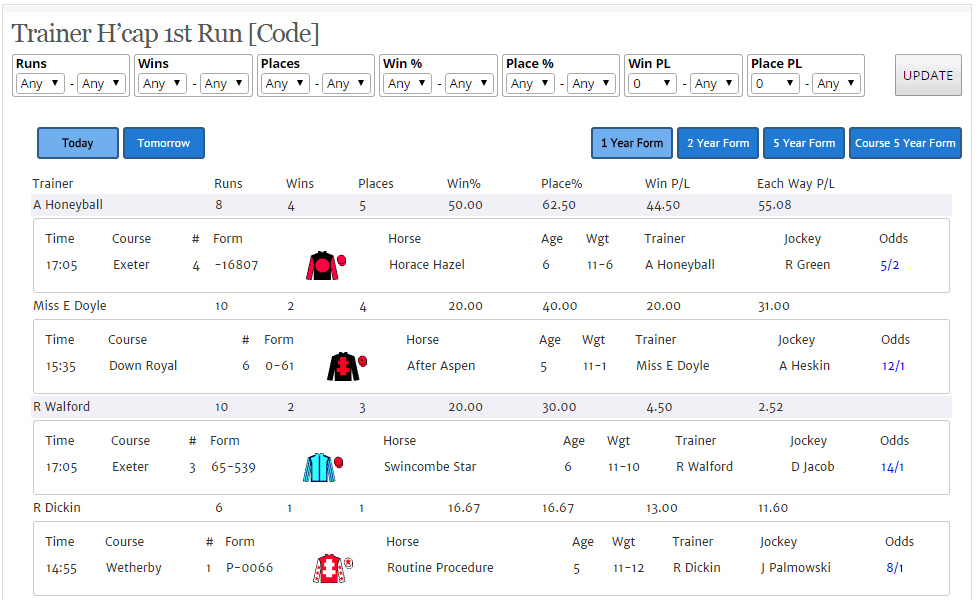
Introducing the rather unsexy-sounding 'Trainer H'cap 1st Run [Code]' report. This report, found towards the bottom of your reports dropdown , shows all horses running in a handicap of that code (flat, hurdles, chase) for the first time today by the trainer's record with such types.
The trainer records can be viewed by one year form, two year form, five year form, and five year course form. The data displayed is specifically for each trainer's runners first time in a handicap of that code.
Crinkle Crags, the example above, was running for Nicky Richards, a trainer who - according to this report - had entered nine runners in a handicap hurdle for the first time in the last year. Five of them had won.
Crinkle Crags made that six out of ten. And then, on Saturday, Un Noble took Richards' record to seven winning handicap first-timers from eleven in the past year.
Un Noble was backed from 6/1 (the price I took) to 11/4, before winning readily. These clues are in the form book, but they're under the trainer record not the horse. Smart punters know this.
Here's an example of today's 'Trainer H'cap 1st Run [Code]' report. (Click on the image to open full size).
*
*
In this case, I've filtered for at least '0' win and place profit, and I am looking at the 1 Year Form view. I have also clicked on each trainer's name to highlight their runners today.
As we can see, Anthony Honeyball has run eight horses in handicaps for the first time in the past year. Four of them have won, and another has placed. His four winners were worth a profit of 44.5 units, and included The Geegeez Geegee at 11/1 a few weeks ago!
Miss E Doyle has had two winners and two placed horse in handicaps for the first time in the past year. They were nicely profitable to back both win and each way. And so it goes on.
This report has been in test for a few weeks, due to a couple of issues and the fact it was Cheltenham last week, and it's been finding some great winners. I'm delighted that it's now live and available to all Gold subscribers with immediate effect.
**
The second report focuses on another material difference between today and a horse's last run. That is a change of trainer. It is a fact that in all walks of life, some people are better at what they do than others. That fact extends to the training ranks, of course.
But how do we know which trainers can improve horses they inherit from other yards? And, more pertinently as punters, how do we know which ones are doing it 'under the radar'?
Simple: Geegeez Gold has a report for it!
The report is laid out in the same way as the 1st time handicap report - with views for one year, two year, five year, and five year course form - and it looks like this. (Again, click the image for a full size version)
*
As with the first image, this one is also filtered on one year and a minimum of '0' for win and place profit. But these are not necessarily the best filters to use. In fact, my suggested filters can be found in the updated user manual here.
Trainer habits are as crucial to finding winners as horse form, especially when material differences can be discerned from the last or recent runs. These two new reports will help you slice through the noise to some of the most effective winner-finding differences imaginable. You're welcome! 😉
https://www.geegeez.co.uk/wp-content/uploads/2022/10/geegeez_banner_new_170x78.png00Matt Bisognohttps://www.geegeez.co.uk/wp-content/uploads/2022/10/geegeez_banner_new_170x78.pngMatt Bisogno2015-03-17 09:49:362017-06-23 18:49:00How To Spot Improvers in 60 Seconds or Less…
In this latest instalment of the Oc-Tote-ber series, let's take a look at the exacta, a bet which requires the player to nominate the first and second placed horses in the correct order. The exacta is a pool bet, which means the dividend is declared by dividing the total number of winning tickets by the total pool of funds, after deductions.
For instance, if £10,000 was bet, and 20% deducted for expenses, the net pool would be £8,000. Supposing there were 80 winning tickets of £1 (£80), the dividend would be £8,000/80 = £100.
The game is to find the 1-2's that pay more than they should, and to leave the 1-2's that pay less than they should. So how exactly (or exacta-ly) do we do that?
How Not To Play The Exacta
Before we get to the good stuff, I'd like to debunk a few myths about exactas. Specifically, I'd like to look at some bad bets.
Bad bet #1: First three in the market combination exacta
The ultimate mug bet in exacta terms, this involves six combinations, all equally staked:
1-2, 1-3, 2-1, 2-3, 3-1, 3-2
Because exactas are 'bets of the people' - that is, there is no bookmaker setting the prices, but rather the people playing the bet set the odds - and most people are either lazy or don't have any sort of opinion on a given race, this is where the vast majority of wagering falls.
This sort of bet can account as much as, or more than, half of the total pool, meaning even if the result is the least likely of the six possible outcomes, it is sure to return a deflated yield.
Apart from operating at the very top of the market, and being deeply unimaginative, it also has no merit over a straight win bet.
Imagine that the average payoff for these six combinations was £15 for a £1 stake. That means a £6 bet covering all six combinations returns £15. That gives average odds of 6/4 on your £6 bet. The favourite could well be a longer price than that on its own, let alone the second or third market choices.
You can also expect to be disappointed with the dividend if the second and third market choices finish 1-2, due to the number of other punters that have taken the same well-worn path to the bet - and then the payout - windows.
Here's the management summary: if you think the top of the market will win a race, either bet a win single on your main fancy (or value fancy)... or pass the race. There is simply no point in making a combination exacta including the first three in the betting, ever.
Bad bet #2: Level staking on combinations
A subtle nuance of bad bet #1 is that all combinations have the same amount of money wagered upon them. That means the 6/4 favourite to beat the 4/1 shot has the same bet stake as the 4/1 to beat the 7/2 second favourite (assuming the top three in the market were 6/4, 7/2 and 4/1). This leads to 'prayer mat punting': hoping that the least likely of the six combinations lands even though... well, even though it's the least likely combination.
That cannot be a sensible way to bet. It is slightly more sophisticated - and commensurately more time-consuming - to stake different combinations to different amounts to ensure a more level payout regardless of which of your six combo's cops. Although this is less 'sexy' and involves less scope for the 'big coup', it is also far more likely to return a profit in the longer term.
Blind combination bets are generally not a great way forward in any case, but if you do have difficulty separating three or more horses, then at least stake them according to the likely payouts to reward yourself equally if you're correct about it being between these x horses.
Bad bet #3: Betting 'All' or most with an outsider you quite fancy
This is the chocolate teapot of wagering approaches: something good (chocolate, or an opinion on a decent priced horse) utilized in a completely useless manner (teapot, or betting with 'all').
By using so many options with your dark horse, you completely dilute the value of the opinion. Far better to bet the horse to win, or maybe even each way, than to make an exacta with all/most of the other runners in the race, and hope to catch a second biggie in the first two for a monster return. This is another prayer mat punt.
Bad bet #4: Leaving out the favourite 'because it's the favourite'
I know people who do this. It's daft. They kick themselves when the favourite, which they feared/respected, finishes second to a decent-priced horse. Dividends for bigger priced nags to beat the jolly are often bigger than they ought to be (assuming the bigger priced horse is lower down the market rank than third or fourth).
If you think the favourite looks solid for the frame, you have two choices:
1. If you have another opinion that could 'make' the bet, then play them together
2. If you don't have another opinion, or you think the 2nd or 3rd market pick could join the jolly, move on to another race
You don't have to bet, and if you don't have two good views, then your bet will probably be misguided (i.e. lose) or return less than it should (i.e. be poor value)
**
If you recognise any of the above traits in the way you bet exactas, now is a good time to review your approach, and to consider an alternative. Below are some alternative methodologies - or exactologies - that you might want to employ.
How To Play The Exacta
Good bet #1: 'Down market' staggered stake combo
In my examples, I've used starting price notation (6/4, 7/2, etc) to highlight the strength of support for each horse. But with all tote multi-horse or multi-race bets, it helps the player greatly to think less in terms of market price, and more in terms of market rank.
Let's look at a 10/1 shot (industry odds) in two different races.
In race 1, a four horse race, there is a 1/16 favourite, and the 10/1 shot is second choice, with two complete no hopers prices at 66/1 apiece.
In race 2, a nine horse race, there is a 4/1 favourite, five more horses priced between 9/2 and 8/1, our 10/1 shot, a 12/1 and a 20/1 chance.
If you expect the tote prices on those two 10/1 chances to be roughly equivalent, you will be badly wrong. The former is likely be around 5/1 on the 'nanny' (nanny goat = tote), while the latter could be as big as 20/1 depending on how 'obvious' it is in the recent form string.
The difference, as you'll have cottoned onto, is market rank. Industry market rank is much more significant than industry market price when translating to tote bets.
If you take just one thing from this article let it be that. It WILL pay you repeatedly.
So, if you have an opinion that the top two in the betting look a bit questionable, but you can't split the next three (or four), play the combinations... but to varying stakes.
A three horse combination is six bets, four horses will be twelve bets, and five horses will be twenty bets. It can take a bit of time to write the varying staked bets down, but your reward is a consistent (ish) return irrespective of which combination bags gold and silver. An example of how to stake this type of bet is below in good bet #2...
Good bet #2: The quite fancied outsider revisited
As touched on in bad bet #3, if you like an outsider, you need to have at least one other opinion to justify betting it in an exacta. For instance, if you think the favourite is weak, you can play your outsider with some of the other unfavoured runners, staggering your stakes higher to lower as you move away from the top end of the market. Let me show you what I mean.
Suppose you like a 12/1 shot in an eight horse race that bets as follows:
6/4 - 7/2 - 4/1 - 6/1 - 10/1 - 12/1 - 33/1 - 50/1
If your only view is that the 12/1 shot is of interest, then exacta is not the bet. Back it to win, or each way if you like.
However, if you think the 6/4 shot might be unsuited by today's going, or class, or pace set up, or whatever, you now have a chance to back up your primary opinion. In that case, you could for instance play the 12/1 with the 7/2 through to 10/1 chances, as follows:
£5 12/1 to beat 7/2
£4 12/1 to beat 4/1
£3 12/1 to beat 6/1
£1 12/1 to beat 10/1
That's a total stake of £13 optimized to smooth the return if you're right about the 12/1 winning. The key here is that your second opinion - that the favourite is dodgy - offers scope to improve the win price on your fancy. In other words, we're looking to get better than 12/1 for any combination of stake and non-favoured runner.
If fear drives your punting bus, and watching the 6/4 fav (or perhaps worse still, one of the rags) finish second to the 12/1 shot will hurt you, then make a small win bet on it as well.
Always remember that playing more than one combination dilutes your return. As in the bad bet #1 example, a 6 x £1 combination exacta paying £15 is not a 14/1 return, it's a 6/4 return. As obvious as that is, it is amazing how many punters delude themselves that they've made a big score, when all they've done is traded off risk against return, by having more coverage for smaller average odds.
Balance is required here, because the polar opposite - habitually taking a single horse to win over a single other horse for second - is a very narrow prayer mat punt too. Somewhere between death by a single bullet and death by a thousand cuts (or permutations) is a sustainable risk-reward equilibrium. Where that pivot point is will vary according to the race type and the nature and strength of your opinions.
Good bet #3: Staggering stakes to emphasize differing strengths of opinion
In good bet #2 above, the staking is staggered to smooth out the likely returns. That assumes that the player has no specific second opinion. In other words, (s)he feels the 12/1 is a fair bet, and the jolly looks opposable. But (s)he has no view on the remaining runners.
In this strategy, we assume that we have a view that a second runner has a better than implied chance. This might be in place of, or as well as, the view about the weak favourite.
Let's use the market from good bet #2, only this time we'll suppose that we think the 6/1 horse is probably the main danger. Although we don't want to lose the value of our main opinion, the 12/1 shot, we definitely want to emphasize our return if the 6/1 runs second. Our staggered stake might now look more like this:
£4 12/1 to beat 7/2
£2.50 12/1 to beat 4/1
£6 12/1 to beat 6/1
£0.50 12/1 to beat 10/1
We've spent the same £13, but loaded up a bit more on 12/1 to beat 6/1. The flip side is that we'll take less of a return - probably something more in line with the equivalent return for simply backing the 12/1 shot to win - if 12/1 beats one of our other nominees. That being the case, a win bet on the 12/1 with small exacta on 12/1 to beat 6/1 is a highly viable alternative play.
In both #2 and this approach, I've not touched on the prospect of the 12/1 finishing second to one of the other selections. Players wishing to insure for this will double the number of permutations - in this case, from four to eight - and should again look to spread the same (or similar) outlay over the additional combinations.
Thus, in #2 above, we might have £2 on 12/1 to beat 7/2, and £3 on the reverse; £1.50 on 12/1 to beat 4/1, and £2.50 on the reverse; £1.25 on 12/1 to beat 6/1, and £1.75 on the reverse; and, 50p either way on 12/1 and 10/1 being first/second.
In #3 here, we'd look to play up the 12/1-6/1 and 6/1-12/1 combo's, whilst splitting the other stakes accordingly.
As you can see, it quickly becomes easy to spread one's opinions too thinly to justify the play... and that's a good thing, because it forces the bettor to have a second thought about whether or not exacta is the correct conduit for investment.
(Fairly) Good bet #4: 'Two against a few'
This wouldn't be the greatest betting strategy in the world, but it is one that recognises the human failing which is the urge to bet, and embraces it! It's what the excellent 'exotics' writer Steven Crist refers to as "Stupid Exacta Tricks", also known as fun or action bets.
In races where you have a bit of an opinion but nothing strong, and where you consequently want to 'limp in', Crist suggests taking a couple at big prices for which you can make a case, and playing them with two or three or four shorted priced runners, though leaving out the front rank in the market.
Obviously, if you fancy the head of the market, or you can't make any sort of case for the bigger priced nags, then it's pass o'clock. But if you can find a pair of piggie possibles, then a bet like this is a reasonable way to engage the action:
A, B with A, B, C, D, E, F = 10 bets
A, B, C, D, E, F with A, B = 10 bets
These are ten bets each, not twelve, by the way, because A cannot be first and second, and neither can B. Should A beat B, or vice versa, the combination appears on both tickets, making for the happiness of a doubly staked winner.
Recommended Reading
Steven Crist's book, Exotic Betting, is about the best on the subject. Whilst it relates to US racing in its examples, the approaches and staking advice are generic, and will help any tote punter improve their seasonal return.
Smarter Bets - The Exacta Way: A Simple Process to Winning on Horse Racing is a newer book, written by Keith Hoffman. It's another American text, available from Amazon UK and, as the name suggests, it focuses specifically on the exacta wager.
https://www.geegeez.co.uk/wp-content/uploads/2022/10/geegeez_banner_new_170x78.png00Matt Bisognohttps://www.geegeez.co.uk/wp-content/uploads/2022/10/geegeez_banner_new_170x78.pngMatt Bisogno2014-10-22 17:18:422021-11-30 08:05:31How to Bet (and Win) on Exacta
In the first part of an Oc-TOTE-ber series of articles on tote betting, I'm going to look at multi-race tactics. This post is specifically focused on selection methods, whereas part 2 - which will follow tomorrow - will look into optimal staking strategies. Both hemispheres will improve your ability to navigate the choppy waters of a competitive race card and identify value plays in their midst.
Here are my top eight tips for making placepot selections:
1 Make sure you have time for this
The thing about the placepot, or the Pick 3, or the jackpot, or the Pick 6, is that it involves a number of races. Three in the Pick 3, four in the Irish version of the jackpot, six in lots of other bets. The implication is that it also involves a significant amount of study time to make an informed bet.
The implication is real. It does take time.
If you're in a rush, you'll slip into lazy habits, like looking at the recent form string to the left of the horse's name; or checking for top trainers and/or jockeys; or using the odds forecast to choose your selections.
That is abdicating responsibility, and it puts daylight between your form study ability and your chance of making a successful multi-race wager. Don't do this, unless you know that you're essentially having an 'action' bet, and you're entirely comfortable with that.
If you have very good tools - like the Pace Analysis, Full Form Filters and Instant Expert in Geegeez Gold - then you can get away with around ten minutes a race. If you don't, it's probably more like half an hour per race. Make time, and subscribe to good tools.
-
2 Ignore the recent form string
As I've said above, using the recent form string next to a horse's name is lazy. Not only that, it is the same lazy tactic used by the vast majority of multi-race (i.e. placepot, Pick 6, and so on) punters. If you do the same as them, you're more than likely to end up on the same horses as them. If you're on the same horses as them, one of two things will happen:
i) You'll all be right and the dividend will pay next to nothing; or
ii) You'll all be wrong, and someone who took a bit more time will scoop up all your collective cash
Either way, there is little or no value in this approach.
Now, let's be clear on something here. I'm NOT saying that you won't end up on the most logical horse from the form strings. Not at all. In fact, quite often you will. But you'll arrive at that destination via the form book, and having assured yourself that the pick is a genuine contender whose recent form was achieved under similar conditions and who has no obvious barriers to progressing again.
-
3 Look for the fancied P00/ horse
Fancied P00/ horse? Eh? Let me explain. The market is the best guide to the likely outcome of a race, of that there is no doubt. But, luckily, it is far from infallible.
Some of the best plays in multi-race tickets are the fancied nags with no form. Perhaps they're coming back after a long break. Maybe they've got the 'duck egg bracelet' of 000-000. Or perhaps they have more letters than numbers in the string, like PFFU20.
Often, these horses are no-hopers whose form string is a perfectly fair reflection of their ability and chance. But sometimes, it is not. Here's an example from yesterday at Navan. In the last leg of the placepot, a horse called Madeira Classic was running for the first time in 701 days. It had form of 005/. And yet it was a well backed 4/1 second favourite. This horse demanded closer scrutiny. Here's what I discovered when I 'lifted up the bonnet':
Madeira Classic was a stone better off than her previous form...
Madeira Classic last ran on the flat three years ago, in September 2011. That day he ran in the Curragh Amateur Derby off a mark of 70. And yet here he was with a rating of just 55, having taking significant and sustained market support, for a trainer (Christy Roche) known to be able to ready one for a gamble.
This horse was largely overlooked by the placepotting public, as the pool shows going into the last leg:
Just 7.5% of the remaining tickets were on the second favourite!
Just 7.5% of the remaining tickets were on the second favourite! As it happened, my A tickets had him, along with #8, and Madeira Classic failed by only a neck to wear down Rocky Bleier, also well gambled (20/1 into 9/1), at the line.
In what was an unremarkable sequence of results - the other five favourites, two of them odds on, all placed - the placepot paid €69.30 to a €1 stake. My €46 investment returned €242.55. For five favourites and a second favourite.
Easy pickings for easy picking!
That's the full set of tickets there, including the losers which formed part of the perm. In tomorrow's post, I'll explain more about how I structure my bets.
Onwards...
-
4 Have an opinion!
I'm often guilty of this myself. I'll decide I want to do a placepot today. That decision is made completely ignorant of whether the conditions suit such a bet. In other words, without an opinion, I'm wading in. Careless. Reckless, sometimes.
So what constitutes an opinion? Various things can help make the decision to bet, such as:
i) A good looking rollover or pool guarantee
I'm usually happy to 'force' an opinion when there's OPM (other people's money) making up my potential return. If a bet was not won on its most recent run - for example, this afternoon's Pick 6 at Tramore has a rollover of €42,766 having not been won for a few days (including when I and a couple of other geegeez readers had a crack on Tuesday) - then other people's losses (including ours in this case) are in the pot to be claimed by today's potential winners.
Obviously, if it looks impossible or you have a short bankroll it probably still doesn't make sense to play. But the odds tilt in your favour with every penny or cent of other people's cash propping up the pool.
ii) You have a strong counter-market view in at least one race
Maybe it's a dodgy jumper in a steeplechase. Maybe you feel the favourite won't act on the ground; or the step up in class pitches him against seasoned and proven animals at the new level. Whatever it is, if you have at least one solid view that swims against the market tide, you'll be disproportionately rewarded if you're correct.
Obviously, there's still the chance that the market leader will oblige. And, worse still, in placepot bets there is the constant spectre of being right, only to see the outclassed dodgy jumper that didn't go on the ground sneak the last place in a photo from a 33/1 shot. Trust me, it happens. Often. Such is the 'potter's luck.
iii) 'Chalky' plays
In America, when a race looks likely to be dominated by the top of the market, it is referred to as 'chalky' (a phrase whose etymology likely harks back to the days of bookies' boards being chalk boards).
Sometimes, like that Navan placepot yesterday for instance, it looks like the favourites will all - or almost all - run solid races. In those cases, if correct, it is possible to chart a very narrow course through the sequence, and stake higher than normal.
Using the Navan example yesterday, you can see that the €1.50 perm was a 1 x 3 x 1 x 1 x 1 x 2 perm. In other words, six lines (€9). The other winning line was a €1 1 x 4 x 1 x 1 x 1 x 2 perm, for eight lines (€8).
Navan yesterday looked chalky. And it was chalky. For it to pay €69.30 was a gift, constructed from a single interesting nag in the last race, Madeira Classic.
*
The key to making any bet is, as Michael Pizzola, a smart American punter, likes to say, "Let the bet make you". In other words, if you see an angle, play it. If you don't, don't.
-
5 Back your opinion!
Once you have a view, it is important to have the courage of that conviction. The curse of the multi-race perm bet is fear of failure, whose symptoms are flabby perms, and either over-staking or diluted staking.
You have to be prepared to lose if you're wrong. After all, isn't that the fundamental premise of striking a wager?
So if you fancy the long absent 8/1 chance who was formerly useful and looks favoured by conditions, back your judgement. If it places, and the favourite doesn't, whoop. If it places and the favourite places too, unlucky. If it doesn't place, and the favourite does, no drama - after all, that hardly helps the dividend.
Also, it's no use having a view almost for the sake of it. In other words, if you think the favourite has a very strong chance of making the frame, but you consider the long absent 8/1 shot to have a bit of a squeak if x and y and z happen, play the favourite. Or maybe play them both (though not equally staked, more on this tomorrow).
If the key to making a multi-race bet is to "let the bet make you", then the key to making it pay is not to ignore or dilute your opinions to meaninglessness.
-
6 'One Brave Race'
I have the notion of 'One Brave Race' when making multi-race wagers. That is, somewhere in the sequence, I have to hang my hat on some sort of banker play. In a placepot, that will almost always be a single horse carrying my wagering hopes through at least one leg. I may, as in the example in 4 above, take multiple bankers, which affords more aggressive staking, or perming elsewhere (or both).
But a pre-defined 2 x 2 x 2 x 2 x 2 x 2 = 64 bets staking strategy is, frankly, destined to get what it deserves. That is a bookmaker's bet, plain and simple. It denies any prospect of having an imbalance of opinion through six different punting puzzles which is, naturally, faintly preposterous. If you bet placepots like this, please, stop doing it! 😉
A brave race might mean taking two selections on A in a big field, with no B or C plays (more on this tomorrow). It might mean singling (i.e. taking one horse) an odds on shot. Not that brave, granted, but it at least slims down the total permutation.
Remember, every horse at or very near to the top of the market that you can successfully include or exclude reduces your stake and increases the prospective dividend. When I find it hard to isolate a single brave race - usually because of a fiendish hyper-competitive card with a big pool - I will arbitrarily go short on leg one.
Some people like to have a bet running for as long as possible, for the enjoyment of it. And that's fair enough. For me, I'd rather take an early bath than go out in leg six of a whopper. Different strokes for different folks.
Luckily, there are ways to mitigate one's bravery, because we can...
-
7 Insure a position
Nobody ever said that a multi-race bet has to be made in isolation. If there's an odds on shot in leg one of the placepot, and it looks solid, single it and lay it for a place on Betfair. That's a very cheap way of covering your stake. If the horse places, your bet has cost slightly more. If the horse fails to place, you had a free go into the trappier part of the sequence, and claimed a refund.
If you're still rolling in the last, you can lay your shortest option for a place to return either some or all of your initial outlay, depending on how the dividend is shaping up and how confident you are in your remaining picks. Or you can calculate the smallest winning (for you) dividend, and 'green up'.
And, in short final leg placepot fields, how about taking the uncovered runners in exactas? For instance, let's say we have a five runner race with the first two in the market covered. If the dividend is looking decent, perm the other trio in exacta bets. As with everything, don't do a simple 'box' (i.e. all ways exacta), but rather place slightly more on the better fancied horses to beat the 'rags', and less on the 'rags' to beat the shorter-priced nags.
Note, in each of these cases, it is super-important to check the non-runner situation. If an eight runner race drops to seven runners, you'll get two places in the placepot but still be laying three places on Betfair. Be careful!
-
8 Have fun!
I unapologetically bang on about this all the time. I don't care if you're a seasoned pro punter who won't eat if you don't find enough winners (how sad, actually), or a 10p patent player. If it's not fun, there's no point: it's just a job, and a dull unrewarding job at that. A form of prostitution, no less.
No, betting is about having fun. Which is not to say it should be about losing. Those who believe that winning and enjoyment are mutually exclusive in horse racing betting really are hopeless cases, clinging on to the badge of 'pro punter' as if their lives depend on it. They don't. If it's that close to the wire, get a proper job and do us all a favour.
Moaning and groaning about 'not getting on'? Play tote pools. You can always get on, and there's always a pool big enough to accommodate your stake. Or set up a network of people to place bets for you. But either way, bore off about accounts being closed. It happens. Move on.
So yes, rant out of the way, let's have some fun! After all, what brings greater joy than a relatively small stake bet, loaded with opinions, vindicated both in the results and in the returns? That is truly the utopia of horse racing wagering. And, for me at least, it always will be. 😀
*
Below you'll find part two in this Oc-TOTE-ber series, looking at optimally staking multi-race bets like the placepot and jackpot. So do look out for that. In the meantime, there's a tasty rollover at Tramore this afternoon with my name on it... 😉
In fact, if you open an account in Oc-TOTE-ber using that code, and bet €25 during the month (up to 9th November)... or if you're an existing Tote Ireland geegeez customer and bet €25 into the pool during the month, you'll be eligible for a share of a €200 syndicate bet. So get registered, get playing, and remember to use the code geegeez1 when you sign up.
But making good selections is only half the battle. The other part of the puzzle is staking your opinions optimally and, in this post, I want to delve more deeply into matters of staking.
There are two main staking methods - straight line, and full perm - and between them they probably account for 99%+ of all tote multi-race bets. But I'd estimate that they only account for around 75% of all tote multi-race stakes. Let's first look at what those staking methods are, and why they're almost always sub-optimal. And then we'll consider why they don't account for a commensurate amount of all stakes, and which 'smart money' approach does.
Straight Line
As the name suggests, this is the no nonsense one-selection-in-each-race-and-devil-take-the-hindmost approach. In a six leg bet, it has the following shape:
1 x 1 x 1 x 1 x 1 x 1 = 1 bet
It lacks finesse, it lacks coverage, and it normally requires the bettor to get lucky. As a route to profit, it's weaker than most. As a harmless fun or action ticket, why not?
The reality is that in any sequence of three, four, six races, most players will have stronger views about the chances of horses in some legs than in others. Staking singly through the card offers minimal coverage for those weaker opinions. Still, it can be a bit of fun, and the bankroll remains intact if/when the wager bows out.
Full Perm
Keegan and Breitner: full perms
No, not Kevin Keegan's barnet of choice. Rather, a full perm is selecting multiple horses in one or more legs in the sequence, and staking every pick equally. For instance:
1 x 3 x 2 x 2 x 4 x 2 = 96 bets
We have a lot more coverage here, with each of the last five races offering at least two chances to move forward. In fact, this example contains 14 different horses. So far so good. So what's the problem?
It is simply that staking your bet this way assumes you have a similarly strong view about the chance of every horse in every leg. That is very unlikely to be the case.
Look at leg five, for example. Here, in this theoretical staking plan, we have four horses running for us. Let us further suppose that they are the 3/1 favourite, the 4/1 second favourite, and two 6/1 chances. Whilst we might feel the 3/1 favourite is vulnerable but don't want to omit it, it is unlikely that we have a similarly strong (or weak) view on the other three nominations.
In actual fact, in this case, if the 3/1 fav was considered vulnerable, I'd be happy to either leave it off the ticket completely, or demote it to a lower status. More of that in a moment.
The issue with this staking approach is that we have gone from one bet in the Straight Line to 96 bets in this incarnation of the Full Perm. This will reward us if we have enough outsiders in the frame - and manage to get enough favourites out of the frame - but we stand a good chance of not returning our initial stake should we not 'luck in' with our less popular choices.
So what to do in order to have a wide (ish) sweep through the races but not slice and dice our stakes to meaninglessness? Introducing ABCX...
ABCX
In any sequence of races, as I've written, we will almost always have stronger feelings about some horses than others, and we will consider some outcomes more likely than others based on the odds. It makes no sense, then, to weight all of our selections equally given the unequal sentiment in which we hold them.
For example, we might put a Pick 3 (a US bet requiring the player to pick the winner of three races, bizarrely enough 😉 ) perm together as follows (horse numbers, and odds), ignoring the notion of 'one brave race' (which I discussed in yesterday's post) for the purposes of this scenario:
Leg 1 - 1 (3/1), 3 (8/1), 4 (6/5)
Leg 2 - 2 (2/5), 7 (4/1)
Leg 3 - 4 (2/1), 5 (7/2)
The purest form of permutation would be 3 x 2 x 2 = 12 bets. You would be forgiven for thinking, "Well, it's only twelve bets, at $5 a throw is $60". But if you have a winning ticket with 6/5, 2/5 and 2/1 on it, you'll do well to get your money back. And, according to the market, that's the most likely outcome.
[Note, it doesn't matter if we're talking dollars, pounds, euros, or roubles. It's about the number of units and the division of funds]
So how can we better utilize that $60 stake? By using a weighted perm structure, of course. The one I favour, though by no means the only one, is ABCX. Essentially, we separate all of the horses in our sequence of races into:
A - main fancies, strong chance
B - fair chance, quite like
C - dark horses, value at the price
X - not interested
Let's apply that rationale to our initial bet, noting that all horses not selected have been discarded as 'X'
Leg 1 - 1 (3/1 B), 3 (8/1 C), 4 (6/5 A)
Leg 2 - 2 (2/5 A), 7 (4/1 B)
Leg 3 - 4 (2/1 A), 5 (7/2 A)
Leg 1 has one each of A, B and C; Leg 2 has an A and a B; and Leg 3 has two A's.
When using ABCX, we are saying that some combinations of outcomes are more likely than others. Specifically, it is most likely that we will win with our A selections; it is next most likely that we will win with two A choices and a B; and it is least likely that we will win with either an A and two B's, or two A's and a C.
Importantly, we are saying that if we are sufficiently wrong in our weighting analysis that the result comes back with an A, a B and a C, we have to accept that we lose, despite selecting those horses in our initial wide sweep. This can be a difficult outcome to accept, especially for newcomers, but it is crucial to prevent players from habitually over-staking: throwing cash at the wall and hoping some of it sticks.
Remember, if we haven't got at least one strong opinion, we shouldn't be playing. So, if we snake our way out of a winner by optimizing our staking, we wipe our mouth and move on.
Let's now look at how the original $60 bet might look using the above ABCX ticket distribution.
A much better 'weighted' spread of funds
As you can see, we've spent the same $60 across five tickets.
Ticket #1 has a unit stake of $12 per line, and includes all of the A selections.
Tickets #2 and #3 have a unit stake of $6 each per line, and include two A's and one B each.
Ticket #4 has a $3 unit stake, and includes the C pick from race 1, with the A's in races 2 and 3
Ticket #5 has a $3 unit stake, and includes the B picks from both races 1 and 2 with the A's in race 3
Now, we have an optimal combination of likelihood of success and multiples of the dividend. In other words, if the most likely horses win, we'll have more units of a skinnier divvy, and if some of the less likely horses win we'll have less units of a bigger payoff.
If that sounds complicated, well, it is to a degree. But the good news is, as you might have guessed from the image above, there's a tool to help you with this. Based on American multi-race guru Steven Crist's ticket builder tool, I had my own geegeez variant built.
Although perhaps 1% of UK-based multi-race bettors use a weighted staking method, that tiny minority probably accounts for a quarter of the total pool size in some multi-race win or place pools. That 'smart money' approach is where players of all bankroll should be aiming, effectively staking to ensure an optimal return when successful, almost regardless of the dividend.
****
In further episodes of this Oc-TOTE-ber Tote Tactics series, I'll be looking at Exacta and Trifecta betting: bets known collectively as intra-race multi's. Keep an eye out for those.
In the meantime, Tote Ireland is offering a piece of a €200 syndicate bet for any geegeez player to stake €25 between now and the end of October. You can bet into UK as well as Irish tote pools with them, and they have a range of other specials, some of which are listed here.
New Tote Ireland players will be eligible for up to €50 in free bets as well as the slice of the €200 syndicate bet if using the exclusive promo code geegeez1 when registering.
There are some racing jurisdictions in the racing world where pace is as fundamental a 'handicapping' tool as you can get. In places like America, even beginner bettors understand the concepts of pace and its likely effect on race outcomes.
Strange, then, that for so long pace has been completely overlooked by UK punters. The main reasons for this are twofold. Or perhaps one-and-a-half-fold, as they're directly connected.
First, there's the almost complete lack of pace data or information. Obviously, this creates a barrier to entry, because any savvy bettor wanting to establish the likely pace scenario in a race has to do all the crunching himself (or herself). It is not a quick or easy task.
And second, related to point one, is the almost blanket lack of understanding around how pace affects the outcome of horse races.
This WILL change in the next few years, as information boundaries are pushed with new racing data publishers challenging the half-asleep establishment content providers. geegeez.co.uk aims to be something of a pioneer in the space and, in today's video post, there is an introduction to the basic concepts of pace, and an example of how pace can be easily assimilated into your betting using the geegeez race cards.
Note, these concepts are not hard to understand, but they are new for most people. In that novelty, some will automatically switch off. Those that embrace the new data are far better armed for the betting battles through the summer particularly. To use a well worn, if unattractive, cliché, having this exclusive information to hand is like taking a gun to a knife fight.
So here's the video. [There's a full screen button in the bottom right corner, which will help].
**
I hope it mostly made sense, and that you can see the value in the information even if it hasn't automatically registered completely with you.
If you're not already a Gold subscriber - meaning you have access to this valuable information - you can register here.
And if you have any questions on the subject of pace, please leave a comment below, and I'll do what I can to answer.
It's nice to have something a bit different to think about, and this pace information is available in very few places currently, so you really do have a head start on almost all punters. Get to grips with it, and use it to your advantage!
Matt
https://www.geegeez.co.uk/wp-content/uploads/2022/10/geegeez_banner_new_170x78.png00Matt Bisognohttps://www.geegeez.co.uk/wp-content/uploads/2022/10/geegeez_banner_new_170x78.pngMatt Bisogno2014-04-08 08:17:322021-01-30 11:18:18What is Pace in Horse Racing? And how to use it.
The Cheltenham Festival 2014 is almost upon us and, with the unending bombardment of data, stats, bookie offers, stable whispers, preview nights, and tips (many of them emanating from these virtual pages, it should be added!), it can be hard to see the winning wood from the information overload trees.
So, in this post, I'll outline my 'Driving to Cheltenham Profits with BSM' methodology. It's nothing to do with a certain car training school, but everything to do with a three step process to keep yourself honest in the midst of what is always a week of frenzied activity.
Now, before I go any further, I should say that if Cheltenham's four day Festival is just another race meeting for you - if you do nothing differently from any other racing day - then fair play, this post will probably have limited utility.
If, however, you take the 27 races which comprise National Hunt's Olympics as a sort of personal, maybe even professional, challenge, then this will hopefully act as a timely aide memoire to retaining sanity, at the very least.
OK, with that said, let me introduce you to the first of my BSM components:
Bank
As I've scribbled above, and you probably know, there are 27 races spread across the four days of Cheltenham. From the big fields of unexposed novices to the even bigger fields of wily handicappers - many of whose talent lights have been hidden under various inappropriate engagement bushels for the larger part of the season - the Cheltenham Festival is a minefield for punters.
Consequently, it makes sense to allocate a separate ring-fenced betting pot, specifically for the week. By doing so, you'll be forced to think in terms of four days and 27 races, rather than lurching from race to race, wager to wager.
The nature of the Festival is that a significantly disproportionate amount of the publicity is focused on the first day. It's usually correct to say that Cheltenham Tuesday offers the highest calibre of racing; but that doesn't necessarily translate into it having the best wagering opportunities. Bookies are looking to get online accounts loaded on Day One, so you bet with them subsequently, and the vast majority of the best offers relate to the first day as a result.
But those who burn brightly on Tuesday only to fizzle out by early Thursday face a long walk home, in purely metaphorical terms of course (at least, I hope that's the case!)
So how much are you setting aside to wager across the Festival? And how might you divide that fund over the four days?
If you know you like a couple on Friday, make sure you've either already backed them, or you've left an adequate slice for that purpose. There's little in betting more soul-destroying than doing it in before your main fancy comes along; then limping onto it because you're 'short-stacked'; and seeing it romp home. That's an ugly, and wholly avoidable, scenario.
Finally on Bank, it doesn't make sense, unless you're following a tipping service, to bet level stakes, especially if you're intending - like me - to bet in every race, to some degree or other. Which brings me on to my second element of BSM...
Strengths
Know your strengths. As trite as that may sound, keep it in mind as the week progresses. What's your wagering / handicapping forte? Are you a judge at picking out 'plot' horses in handicaps? Do you have an all-seeing eye when it comes to Championship races? Can you skilfully infer improvement in novice horses?
Unless you're a full-time pro, the truth is likely to be that you're none of the above. But you will still be more akin to one of those types than the others. As such, it makes sense to focus more of your energies on that which you are most adept, and less on that which you are most inept.
For me, this means a primary focus on the Championship races and some of the novice events, and a cursory review of the handicap form using a few tools and techniques I've developed to shortlist the fields.
Obviously, then, betting one point level stakes across that varied punting panorama is plain daft. I will be wagering in line with the strength of my opinions, and I will live or die (again, metaphorically only!) by those opinions.
That means I will be getting stuck into a couple of Championship events; I will be having a reasonable tickle on some in the novice races; and I'll generally be mucking about in the handicaps, hoping to get lucky at a price (which, of course, is perfectly possible at Cheltenham, where lots of good horses are sent off at a price).
[Note, if you've been following my Cheltenham race previews, you'll know I've hammered one handicapper, though it's not one of the traditional handicap events... Hint: I've only previewed one handicap 😉 ]
So, what are your strengths? Give it a bit of thought if you haven't already, and try to "gear your portfolio" accordingly.
That leads us nicely into the final third of my punting triptych (good horse, she was)...
Mindset
Incorporating pieces of both Bank and Strengths, Mindset is crucial when betting, especially when we're exposed to the searing heat of a furnace of fetlocks and fancies for four full days.
It's always interesting to note the reactions of big punters - those whose responses can be publicly viewed, anyway - like JP McManus. They seem to maintain a Kipling-esque stoicism, greeting "those two impostors" of Triumph and Disaster even-handedly.
Of course, inside, they're probably cartwheeling or crying. But managing those emotions is the key to not losing - or gaining - too much confidence.
The thing with a meeting like Cheltenham is that plenty of winners are sent off at 12/1, 14/1, 16/1 and bigger. If your modus operandi is, like mine, to be frequently involved at that sort of price, then - even if you're very good - you'll incur longish losing sequences.
It is of paramount importance to remember that this is par for the course, and to continue to trust yourself. The worst thing bettors can do if they have an overall knack of finding enough nice-priced winners to pay for the losers and manage some bunce left over, is to chase the top of the market in the hope of clawing things back.
Firstly, it's not a part of the market for which you'll have the same 'value barometer'. And secondly, even when you do catch a winner - or even two - it's unlikely to return the fund to parity.
What we're actually doing when we adopt this approach is seeking comfort in correctness: a little ego stroke and reassurance when the winners have absented themselves. Always keep in mind one of the maxims of geegeez in times like this:
"What do you really want? Winners? Or profit?"
Finding winners at Cheltenham is bloody hard. But if you're safe in the knowledge that when they're unearthed, they generally pay for a lot of losers, then you're ahead of the pack mentally. Don't give in to self-doubt. After all, if you've set aside a bank and you've still got some of it to tickle the Grand Annual, the final race of 27, you've done well, win, lose or draw.
And keep in mind another geegeez maxim too:
"If it's not fun, we might as well go and get a job"
The most important aspect of mindset - even if you're a professional - is to enjoy Cheltenham's slings and arrows of outrageous fortune.
It's going to be great!!! 🙂
Matt
p.s. here's Rudyard with a poem so utterly magnificent it's been confined to cliché in pieces such as this. But if ever a man captured the very essence of what it is to engage in the betting battle at Cheltenham, it was - unwittingly - the fellow whose namesake baked exceedingly good cakes.
If you can keep your head when all about you Are losing theirs and blaming it on you, If you can trust yourself when all men doubt you, But make allowance for their doubting too;
If you can wait and not be tired by waiting, Or being lied about, don't deal in lies, Or being hated, don't give way to hating, And yet don't look too good, nor talk too wise:
If you can dream - and not make dreams your master; If you can think - and not make thoughts your aim; If you can meet with Triumph and Disaster And treat those two impostors just the same;
If you can bear to hear the truth you've spoken Twisted by knaves to make a trap for fools, Or watch the things you gave your life to broken, And stoop and build 'em up with wornout tools:
If you can make one heap of all your winnings And risk it on one turn of pitch-and-toss, And lose, and start again at your beginnings And never breathe a word about your loss;
If you can force your heart and nerve and sinew To serve your turn long after they are gone, And so hold on when there is nothing in you Except the Will which says to them: 'Hold on!'
If you can talk with crowds and keep your virtue, Or walk with kings - nor lose the common touch, If neither foes nor loving friends can hurt you, If all men count with you, but none too much;
If you can fill the unforgiving minute With sixty seconds' worth of distance run - Yours is the Earth and everything that's in it, And - which is more - you'll be a Man my son!
https://www.geegeez.co.uk/wp-content/uploads/2022/10/geegeez_banner_new_170x78.png00Matt Bisognohttps://www.geegeez.co.uk/wp-content/uploads/2022/10/geegeez_banner_new_170x78.pngMatt Bisogno2014-03-07 10:44:262014-03-07 10:44:26How to Prepare for the Cheltenham Festival
No seamless anecdotal lead-in to this week’s piece as I just want to continue with last week’s discussion on staking. I concluded that piece with writing about the importance of having a plan before undertaking a day’s punting but it is equally important to allow some flexibility within this plan.
A punter should know at the start of the day what the worst-case scenario is should everything go to pot but I like to add maybe 15-20% to this figure as it allows me to adapt during the day depending on market movements as the market in the morning and the market at post-time can be two entirely different things; the horse you fancied at 10.30am may now have shortened into a price that makes it unbackable while one that was tight enough in the early exchanges may have drifted to a value option.
All this reminds me of a quote from economist John Maynard Keynes that Kevin Pullein used in one of his Racing Post columns in the past year: ‘I change my mind when the facts change.’ One of the great myths of punting – and one that is reinforced by anecdotal evidence, never a good way to support an argument – is that you shouldn’t change your mind about a selection; not to put too fine a point on it but that’s bollocks.
If you thought a race was between a pair of horses, one priced at 7/4 and the other at 5/1 and you slightly (but only slightly) favoured the former in your analysis, which one would you be backing? If you’re answering the 7/4 shot then it’s unlikely you’re making money in the long-term. Sometimes I will plan to have a bet in a race but won’t decide on which horse it will be until right before the off as I know the Betfair market at that stage can fluctuate wildly and one can get some massive prices about horses.
This brings in the idea of what to do with drifters and I do have a neat anecdote about this. I was at Down Royal on the Saturday of Royal Ascot last year when Maybe won the Chesham impressively; she had been put in around 6/4 or 7/4 in the morning but was sent off 5/2 having been widely available at 3s. A punter in front of me after the race turned around and said ‘Jesus, she was the only horse I fancied today but when I saw her drift, I couldn’t touch her.’ I didn’t know whether to laugh or cry.
For me, there is only one way to deal with a drifter: back it again. If you fancy a horse at 7s, then you have to fancy it even more at 12s. Of course, you will get lots of these wrong but the ones you get right should more than make up for the wrong calls. Everyone loves to be on a springer, a horse that you have backed at 20s that goes off 7s but it’s worth remembering that all the data that has been compiled on drifters suggests that they win as often as they should relative to market position.
Too many punters oppose drifters as they suspect something sinister is going on but more often than not the drift is for an innocent reason. A horse may have done a bad piece of homework in the lead-up to the race and it has filtered into the public domain; some see this as the ultimate negative but it’s worth remembering that races are won on the track and as a punter I really want to be with horses that save their best for the racecourse and are idle at home.
Other horses being backed is another obvious cause of a drift; on Betfair say where the percentages have to add up to 100 so if a horse is being backed then another must drift. Connections may have backed their horse in the morning and had enough money on so a drift on course is inevitable. Some connections don’t gamble or gamble very lightly. And finally there are times when the market simply gets it wrong as it is far from the unerring behemoth some present it as.
The most marked drifts occur on the exchanges and this is why any right thinking punter must have a Betfair (yes, I know I do some work for them but hear me out!) or Betdaq account; frequently a horse will drift from 7s to 10s on course but will be widely available for decent money at 14s on the machine – in this case it’s a no brainer where to play.
I realise some punters can’t handle using the exchanges as a slot machine mentality kicks in and I suppose knowing that this is your weak-spot is a skill in itself but by denying yourself access to Betfair or whatever exchange you are cutting off what could be an excellent source of profit on drifters and that’s not even to mention their prices on outsiders.
I think punters have to use whatever means necessary to get on at the best prices and exchanges are a vital tool if a punter can remain in control.
Consistency of staking is a good skill to acquire and ideally a punter wants to be in a position where he is having the same on a horse depending on the level of confidence and regardless of other circumstances. This level of confidence is best determined the night or morning before a meeting rather than a post-time when the pull of the action can be strong; I find the best decisions, in gambling and otherwise, take time.
The other circumstances I refer to above would things like whether you are on a good or bad run of form or perhaps the stature of the meeting; we can all play things up a bit at the big fixtures and while acknowledging that we’re human and these things can happen it is important that they don’t get out of hand. Punters need to be aware that good betting opportunities can present themselves anywhere and one pro-punting friend of mine swears by the likes of tracks like Bellewstown and Ballinrobe as the racing there is largely uncompetitive.
I wouldn’t be quite so extreme as that though punters should try to reach a point where we have no problem having a good bet at tracks like these instead of saving our firepower for courses like the Curragh and Cheltenham.
https://www.geegeez.co.uk/wp-content/uploads/2012/07/Betslip.jpg287460TonyKeenanhttps://www.geegeez.co.uk/wp-content/uploads/2022/10/geegeez_banner_new_170x78.pngTonyKeenan2012-07-18 10:00:532012-07-17 22:08:19The Punting Confessional: Further thoughts on Staking
I've been interested in horse racing for over twenty years now and, in that time, I've spent untold hours reading, writing and researching around the subject of betting on horses.
As a consequence, I'd say I've developed from 'clueless newbie' on to 'enthusiastic amateur', then to 'happy to break even', and nowadays to 'small time winning punter'. [Note, I've never been enamoured with the idea of making fortunes from betting. Frankly, I'm probably not mentally cut out for it].
During my two decades of development, I've learned a lot. A hell of a lot.
When I started out, I'd look at the numbers (representing finishing positions) to the left of a horse's name, and this would be my most important indicator of likely performance. How naive I was.
These days, I have a group of micro-systems which I use on a daily basis, as well as a good eye for what's important when reading form. You may remember a recent video post I made on the subject. You can watch that form reading video here. [Warning: it's quite long]
The reason that video is long is because it takes time to analyse horse races: to consider the context of the race (its conditions); the likely profile of the winner based on similar races; the specific current and historical performance of the runners; and the likely interaction between horses (class ceilings and pace scenarios, for instance).
Yes, a horse race is a complex conundrum indeed.
One of the purposes of geegeez is to try to help less experienced bettors understand something of what's needed to become more experienced (and more successful) bettors.
The above is not intended to 'turn people off' or to overwhelm, but rather to illustrate the complexity of the puzzle.
Of course, betting on horses should also be fun. And here at geegeez, we insist that you're entertained during your visits here. At least, that's what we try to do. 🙂
So how can you win at betting? Well, there are a number of ways, all of which have merit in my opinion.
1. Study, study, study
If you enjoy the learning experience, then this is the best one for you, especially if you have time. The best, most satisfying and empowering way of winning at betting is to work it out for yourself.
Understanding how horse races work is a key part of that, and will undoubtedly help you to find more winners.
But more winners won't necessarily lead to more profit. What?!
What I mean is that if you currently have a strike rate of 25%, I can tell you an immediate way to get a strike rate of 31%. (Bet unnamed favourites).
Alas, my short cut to more winners will not make you money. As the jolly fellow in the Nationwide ads used to be fond of saying, "It doesn't work like that".
No, we need to understand the relationship between a horse's chance of winning in academic terms, and the market view on its chance.
The old coin toss example is instructive here.
Clearly, there is a 50% chance of a coin landing on either heads or tails, assuming the coin has not been tampered with. With that knowledge of the actual (or academic) chance of the coin landing on a nominated side (heads or tails), a bookmaker would always offer you a price slightly shy of even money for either outcome.
But what if the bookie offered you 11/10 on heads?
Even though there is still a 50% chance of the coin landing on tails, 11/10 about it coming up heads is a great bet. Why? Because it offers VALUE.
Value is simply any situation where the odds available are greater than the true chance of an outcome happening.
You might well lose that 11/10 coin toss (in fact, you'd have a 50% chance of losing!). But, if you could consistently get 11/10 about heads, you'd make 5% over time.
The problem is that horse racing is not a coin toss. It is infinitely more complex than that.
And even those charged with the job of odds compiling get things badly wrong. How could they not? This is not a criticism, it is simply a fact.
The market at off time (i.e. the starting prices) looks very different from the first morning show of prices, although it will be topologically similar. Topo-who-what?
Topologically. Meaning that whilst the odds on many of the horses will have changed - some of them markedly - the overall shape of the book will be similar, in terms of bookie profit margin.
Right. Let's pause for breath. Where are we with all this bookie-bashing bluster?
In summary, if you have time to study, you need first to understand the dynamics of a race, and then you need to overlay your view of the respective chances of the participants with the market view.
When you have a runner that you rate with a good chance, but the market has dismissed as an outsider, then you have a good bet (assuming you've made a reasonable job of understanding the race dynamics).
This will happen more often than you think. In fact, as an example, Stat of the Day picks a horse which is sent off a shorter price more often than not. The reason for this is that we look at factors which the market often overlooks in its initial position, but which become accounted for - by weight of money wagered, generally - before the race goes off.
The market of a race at 'off' time is a VERY STRONG indicator of likely chances. In fact, it's by far the best indicator.
So if you can consistently get a better price than the starting price, you have a very good chance of making a profit. Again, Stat of the Day illustrates that well enough, with circa 83 points profit and 40% return on investment since it started in November last year.
2. Become a trader
If you can understand the 'shape' of a race, in terms of who is likely to lead, which side of the track is favoured, and which horses look lazy and disinterested during a race, you could trade horses in running.
This isn't as difficult as it sounds.
Most horses have a run style which is either determined by them, or by their trainer/jockey. Some are habitual front'runners; others like to be held up; still others will be the first ones under pressure but often find more late run than smoother travelling rivals.
Whatever. If you can see how a horse is likely to run, you have the chance to trade it.
This is definitely not something I'm especially interested in myself, though I know professional traders, who nip into and out of the market in very quick succession, having secured a profit by 'greening up' (buying low and selling high to lock in a profit on a horse's price).
The reason I don't much like it is because it's quite boring. Scalping. Sniping. No interest in the final outcome of the race, only in its interim opportunities. Fair enough. But not for me.
3. Arb-o-rama
Arbers are the scourge of bookies up and down the land. An 'arb', short for arbitrage opportunity, is a situation where you can back all possible outcomes and guarantee a profit.
Two outcome events are the easiest for this. For instance, in a tennis match, only Player 1 or Player 2 can win.
Largeblokes might have Player 1 at 4/5 and Player 2 at 11/10. On the same match, Bert563 might bet 11/10 Player 1 and 4/5 Player 2.
Thus, backing Player 2 with Largeblokes and Player 1 with Bert563, both at 11/10, means you are guaranteed to make a profit of 5% on the match.
(Example: £10 win Player 1 at 11/10; £10 win Player 2 at 11/10; guaranteed return £21. Stake £20, Return £21. Profit £1 or 5%)
Again, this is far from the sexy side of betting. Indeed, it's hardly gambling at all. But it can be profitable, IF you can get both parts of the wager struck before the prices change.
Obviously, with the advent of odds comparison sites, these opportunities are quickly shut down, but they do happen every day, many times a day.
4. Follow a tipster or service
This is the favourite short cut to option 1 above, and that's entirely reasonable.
There are all sorts of situations where it's not possible, or sensible, to study, study, study. For instance, you might have a job and a family (I know, unlikely, but possible ;), which means your free time for such things is seriously compromised.
Or you might just not trust yourself to be good enough. I would hope that over time, using excellent resources like geegeez (!), you will place more trust in yourself. But for beginners, or those who have only recently committed to learn more, then following a tipster or service is a good option. Sometimes.
The problem, of course, is that not all tipsters and services are the same. In fact, they are as varied as the species of flora and fauna under the sun.
So how to find a good tipster? Well, that will depend on you, at least to some degree, though there are of course some universal factors.
First, you should be looking for a service with a track record of success and demonstrable credibility. In other words, there should be some means of corroborating what 'Honest Joe' has said his results are.
Secondly, when it comes to tipsters, a trial period is something that you should insist on. This might be a money back guarantee period, or a free trial, but either way, you at least have a chance to paper trade (i.e. follow the picks without risking money)... and you should PAPER TRADE.
[Sidenote: it REALLY gets my goat when people pile in straight away with something which might be completely wrong for them, lose money, and then complain about it. Free periods are for paper trading. Refund periods are for paper trading. If you want to bet, then fine, but you do it at your own risk. Full accountability is yours. Soap box moment over!]
The purpose of paper trading is not just about bottom line profitability (or not) of a service. It's also about seeing if that service is for you.
For example, do you like one bet a day, or five? Do you have a bank, or do you just say you have a bank? Could you retain confidence if you lost half your bank before the profits came? Do you bet £2, £20 or £200 per selection? Are you a backer or a layer or a trader or an arber or a dutcher? Can you cope with higher volatility, or do you need a winner most days 'to keep you in the game'?
As you can see, one size most definitely does not fit all.
Finally on this one, and this is a personal preference of mine, I like to have at least an understanding of how a tipster or service arrives at his selections. For example, I'm never interested in 'stable whispers' services personally (though some can be quite good). Rather, I'm interested in form students whose judgement and knowledge of the form book I can grow to trust.
So, if you want to follow a tipster or service, do ask yourself what it is you're looking for from that service. This MUST be more than 'a profit'. It needs to cover your betting style, your appetite for risk, your availability to get bets on, and so on. This is your responsibility before you hand cash over to a stranger. (I know you know that, but the reminder can't hurt!)
And later this week - tomorrow in all likelihood - I want to introduce you to the very first 'tipster' I've ever been impressed enough to publish. His approach is similar to my own, his commitment is phenomenal, his number-crunching exceptional... and his results... well, more on those in due course. Suffice it to say that they're bloody good! 😀
Until next time.
Matt
https://www.geegeez.co.uk/wp-content/uploads/2022/10/geegeez_banner_new_170x78.png00Matt Bisognohttps://www.geegeez.co.uk/wp-content/uploads/2022/10/geegeez_banner_new_170x78.pngMatt Bisogno2012-07-02 14:20:162012-07-05 10:09:01Winning at Betting: The (Untold) Truth
It’s been a grinding sort of week since I last wrote with a few reasonable winners like Prince Jock on this card and Elusive In Paris the previous evening at Dundalk peppered with plenty of losers like Catch Light, Ondeafears and Harry Trotter; I think the technical term for this is chiselling out a profit but I’ll take it whatever way it comes.
Also, despite the turf season being nearly two months old, it was the first week of really slogging form study with seven back-to-back flat meetings from Killarney on the 15th to Roscommon on the 21st. Thus far, I’ve been enjoying it and getting a winner or two has helped, though I’ll be glad of a little breather this week to catch up with some reviews ahead of the Guineas meeting at the Curragh this weekend.
When the racing starts to come thick-and-fast like this time management is important; during the summer it’s not so bad for me as I have more time on my hands but at this stage of the year I have other work commitments and how I distribute my time matters. When I come home from work in the evenings, I know I only have a narrow window in which I can work, probably a period of two or three hours. One could pull all-nighters and simply devour the formbook but such moves are unsustainable and I know, having already put in a day’s work, that I only have a short time in which my attention is at the quality level required to go through a card properly.
This means that I have to choose my battles wisely and I’m looking at doing four or maybe five races in real detail while scanning the others for obvious plays. Inevitably, I am drawn to handicaps; I wrote last week about my love for them and I know from past records that I do best in them; in 2011 for instance, I made 92% of my profits from handicaps.
When I get the declarations in the morning I will plan how I will distribute my time and select the races I want to study and in what order; I will often avoid maidens as I find they are a drain on time and rarely offer good betting opportunities. Some would say that this is because stable insiders have the edge here with the merits of unraced and lightly-raced horses but I wouldn’t overestimate this as so-called informed punters often get it wrong and the market is not always the accurate guide some pundits would have you believe.
Often, it is more a case that few have chances and the layers prices up very accurately to big margins. All that said, handicaps are my thing and I prefer to start with handicaps for older horses where the form is well established. Once I have ‘got my eye in’ I will move onto the trickier three-year-old races or nurseries where the horses are less exposed.
One of the main features of handicaps, and for me it is an appealing feature, is the transience of it all; things change very quickly with handicappers and loyalties have to be switched quickly. Over the past 3 weeks I’ve been compiling horses to follow lists for my Betfair blog and the challenge in selecting group horses and handicappers to note is completely different; with the former, you need to play the long game and project the whole season while with the latter everything is recent.
Handicappers run more frequently and a punter needs to stay on top of the form but with classier horses there is more time to digest things. Good handicap punters tend not to be too loyal and can oppose a horse one day and then back them a fortnight later; when the facts change, we change our opinions with them.
Indeed, excessive loyalty can be a flaw in a punter. I never cease to be amazed that when I give a tip to casual punter who asks me about a race and the horse wins (infrequently, I’ll grant you) that person will still be following the same horse 18 months later when its brief period of being well-handicapped and/or in-form has long since passed and they have done their best to give back the profit they made on the original bet. With winning punters, most loyalties are quickly cast to the wind and I only want to know about a winner I backed in the future if it shaped better than the result on its recent starts.
It is often said that the most important factor in the outcome of a race is the ground but I don’t agree; what matters most is the talent of the horse, or in handicaps, the talent of the horse relative to its mark. I have two main means of determining whether a horse is well-in: form and video. The former is an old-fashioned approach where one is simply looking for races that are working out or horses that have been running against tough competition while with the latter one is looking for those that were better than the bare result, be as a result of pace, draw, trouble or whatever.
When you find a well-handicapped sort you are onto to something and, by-and-large, a well-handicapped horse has to go close granted normal luck; considerations of ground and distance, provided they are not totally unsuitable (a fast ground sprinter stretching out to 10f on soft, say), are secondary. The toughest races are those in which there are no well-treated entries as other factors – ground, distance, how the race will be run – come into play and there have been a few such races in Ireland of late, for example the handicaps won by Whipless and Jazz Girl on consecutive Sundays; I tend to keep my stakes small in such races.
Another important consideration when playing in handicaps is class. In Britain, there is a straightforward framework of classifying races from one down to seven and it works well; we have no such system in Ireland, relying instead on ratings bands such as 47 to 75, and we could certainly do with a more transparent method.
Punters should keep an eye on ratings of horses (usually updated on a Monday in Ireland) to see what band they qualify for and whether they can sneak into a grade that they have previously been ineligible for. This sort of class drop, though it may appear imperceptible, makes a huge difference as a horse is now competing against animals of a totally different league; to take an extreme example, a horse rated that has run sixth in a good 0-85 may now be dropping in to compete in a 0-65 and he may have a significant class edge against the bottom feeders.
A good recent case was Moonbi Creek at Dundalk on May 4th; he had run fourth in a decent 0-80 against fair horses like Barrow Island and Knockgraffon Lad on his first run off a break but dropped into a 0-70 next time to take on limited sorts like Tsar Paul who may have been in-form but it was form from a lesser grade. Moonbi Creek won at 7/2 and while I didn’t get enough on (I missed the price), his sort are always work looking out for; he carried top-weight in the race but I never consider such things, class being the key factor.
Finally, a word on very low-class handicaps. I play in them quite a bit and would know plenty about the horses involved but I would have a preference for slightly better class races; horses that run in 0-65 races in Ireland (the lowest grade available) invariably have some sort of hole in them, being ungenuine, injury-prone, slow or simply unreliable.
It wouldn’t put me off having a good bet on one if I thought it was overpriced but I have a preference for the better handicapper or at least the middle-of-the-road ones that are just that bit more reliable. Premier handicaps, races like the Scurry or Galway Mile, are my favourite medium of all with their competitive big fields and are made for exchange betting where prices on my favourite type of horse, outsiders, tend to be inflated and offer the opportunity to knock it out of the ballpark.
https://www.geegeez.co.uk/wp-content/uploads/2012/05/Wexford.jpg13912100TonyKeenanhttps://www.geegeez.co.uk/wp-content/uploads/2022/10/geegeez_banner_new_170x78.pngTonyKeenan2012-05-23 08:01:342020-04-30 09:03:15Playing The Handicaps
I managed to the get the flat season – or at least the punting part of it – up and running at the Curragh on Bank Holiday Monday with a pair of decent winners in Ondeafears and Wrekin Rock; that the pair came in 50-80 handicaps should come as no surprise to anyone who knows my punting methods.
I realise there is something perverse in making your biggest plays in the worst races on the card – that was certainly the case here with the winners returning the worst and second-worst form ratings of the meeting – but I’m a contrarian by nature and handicaps are very much my bread-and-butter.
Group races just don’t do it for me and while some will argue that the perils of punting in such events were brought into sharp relief later on the card with the St Nicholas Abbey debacle in the Mooresbridge Stakes, I don’t agree. That race saw what was palpably the best horse getting turned over but such results are the exception, the problem with playing in pattern races from a personal punting perspective being quite the opposite, i.e. that the best horse wins all too often.
For me, this isn’t a good thing because such horses are all too obvious and invariably sent off at short prices; what I really want in a race is complexity – whether it be provided by pace, handicap marks, track or draw biases or any number of other variables – as this provides the possibility of a big score. Handicaps, by their very nature, are complex in that their stated aim to give each horse an equal chance and the fastest horse does not always win.
One of the best things about handicaps is the predictability of pace. Exposed handicappers have a running style and by-and-large they stick to it; to change it could compromise their chances. This means one can a have very good idea how a race will be run beforehand which is helpful as one can see how the likely pace scenario will favour one type of runner over another; there may be a front-runner that is going to be left alone in the lead or there may be loads of pace on which will suit closers.
Not only is such pace analysis a useful tool pre-race, it comes in handy afterwards when reviewing a meeting as one can come up with a sensible idea of which horses were advantaged or disadvantaged by the run of things; knowing how the race was expected to be run makes this sort of work far easier.
Analysing pace in other races is much more problematic. In maidens, a punter has little or no evidence to go on with running styles and oftentimes pace becomes an irrelevance as there is such a differential between the ability levels of runners. Group races are even worse, especially in Ireland, and Ballydoyle have to shoulder much of the blame for this. Such is their strength of numbers they can choreograph Irish group races which is not something that can be achieved in England and further afield where the competition is much stiffer.
The best example of this was last year’s Irish 2,000 Guineas where the Aidan O’Brien-trained Roderic O’Connor defeated the best horse in the race Dubawi Gold by dint of tactics, something Dubawi Gold’s jockey Richard Hughes was well aware of in his Racing Post column on the morning of the race; the winner finished the season pace-making in the Irish Champion Stakes while Dubawi Gold was in the frame of Group 1s with Excelebration and Frankel.
Pacemakers are another complicating factor in Irish Group races as one never knows what Ballydoyle are going to do with a race; sometimes they want a breakneck gallop, other times they want to slow it down for a suspect stayer and there are even occasions when they hardly know what they want. Getting stallion prospects is the raison d’être of the yard and it seems that any horse can be sacrificed at the altar of bloodstock, or at least a sire you can charge at least €50,000 a nomination for.
With the Ballydoyle horses, their run styles change markedly from race to race; what a horse did when a short-priced favourite for a Group 3 bears no resemblance to what it is likely to do in a Group 1 next time at 50/1 when the yard has a fancied horse they perceive needs a certain pace. I suspect this sort of chopping and changing is not good for individual horses are they are not allowed to get into habits on the track and stunts their development and I am sure it is bad for punters who simply don’t have a clue how each horse well be ridden.
Another factor that keys in with pace is track configuration; some tracks favour certain run styles and horse types. The problem with Irish group races from a punting point-of-view is that the vast majority of them are run at the Curragh or Leopardstown, a pair of tracks that are in the main very fair. This is important when one is trying to further the breed and simply find out which is the quickest horse but it reduces the complexity of races and thus makes them less interesting betting mediums.
Personally, I would find pattern races much more interesting if they were run on the Naas sprint track on soft ground (high numbers all the way), at Tipperary (a front-runner’s paradise) or even around the up-and-down Western gaffs like Galway and Ballinrobe (chaos rules).
With the top group horses, punters often need to ask themselves how much more they can know than the market; here are a coterie of talented horses who make up about 10% or less of the equine population yet take up about 90% of the column inches on horse racing (rough figures I know, but you get my meaning).
You may hold a low opinion of the standard of the racing media (I know I certainly do) but the more information they have the more they are likely to spot value and point it out to the public and the few good analysts there are among the media soon spot pricing errors in the top races. With handicappers, it’s a different story.
The proclivities of exposed handicappers may be clear to someone going through their form in detail but they are not covered in media in any great detail and this is where a shrewd punter can get an edge on the market. It seems no coincidence that a number of the punters and analysts I respect – Hugh Taylor, Tom Segal and Dave Nevison in his prime – do a lot of their backing/tipping in fields of older handicappers. Personally, I would have every confidence in playing my knowledge of Irish handicappers against most punters and certainly against the odds compilers.
I suppose an awful lot of this boils down to an old chestnut of punting: specialisation. A punter simply cannot know everything and one has to find races that suit your style. I don’t want to rule out group races entirely as I’m sure some punters swear by them and one should never be dogmatic about rules in racing as one never knows when a good betting opportunity will arrive. It may well be in a Group 1 but somehow I doubt as handicaps have provided most of the best bets of my life.
https://www.geegeez.co.uk/wp-content/uploads/2012/05/Curragh-Racecourse.jpg204285TonyKeenanhttps://www.geegeez.co.uk/wp-content/uploads/2022/10/geegeez_banner_new_170x78.pngTonyKeenan2012-05-15 09:30:502012-05-15 09:36:09The Punting Confessional: Beating the handicapper.
The Punting Confessional: Losing Runs and how to deal with them...
Dundalk, April 11th
Another losing day among many at the start of this current flat season so now seems a good time to address losing streaks and how to respond to them.
This early stage of the year is a time when I tend to lose money but I am wary of falling into the trap of cliché and saying things will turn when the form settles down; I often do well at the backend, another supposed time of form chaos, and odds compilers and layers make mistakes in March and April as often as they do at other times of the year.
We can all look back over the years and see periods when we tend to do well – Cheltenham or Galway or Christmas, say – but I often wonder is this just a self-fulfilling prophecy brought about by a positive mental attitude to a particular time of the year rather than our methods working better at different points in the season. On balance, punters need to be open to a profit seam arising at any stage of the year and not wait for a time when things should improve; past performance is no guide to future success.
The first thing to know about losing streaks is they are inevitable; this doesn’t make them any easier to handle but it should somewhat leaven the feeling of failure they bring. Losing means different things to different people; for a selective punter who places only a bet a day or even a week it could theoretically go on for months but for me when I talk of losing I don’t mean that I haven’t backed a winner for weeks but rather that I have had a period of consecutive losing days.
My approach would be quite scattergun – in a seven-race card I could easily be playing at least six races, if not all seven, and would have no aversion to backing more than one horse in a race – so I wouldn’t have a losing streak in the traditional sense of a long period without a winning bet.
It all comes back to matching your punting style to your temperament; if you really struggle to handle backing losers then playing a series of outsiders probably isn’t going to be your thing as losing streaks are more common with such an approach; I have no numbers to back up the likelihood a long string of losers but Hugh Taylor had some very interesting analysis on the Form Factor (the best racing programme on television and always worth a watch) recently and showed that with an average price taken of 10/1 losing streaks of 20 bets and more are common.
When losing, self-doubt kicks in and one needs to be wary of recency biased thinking; just like when on a winning streak when seemingly everything we touch turns to gold, it now appears that we will never back another winner. Such black-and-white thinking leads to sweeping generalisations and should be avoided.
Again the brilliant Taylor springs to mind. When interviewed at the start of the Form Factor the invariably clueless presenter asks him how his punting has been going and regardless of whether he is winning or losing, Taylor adopts a sanguine attitude and replies that all that matters are the figures at year end. I can only dream of achieving such punting equilibrium but it should certainly be aspired to.
Perhaps the key to overcoming a losing streak is routine. Consistency is vital and returning to past methods (assuming, of course, that these methods have proved profitable in the past) a must. One must do what needs to be a done whether it is form study, pace analysis or tissue prices; now is not the time to change. This is not to say that your methods should not be questioned; of course they should but not now.
In the midst of a poor run of form one is inclined to view everything in the negative whereas such questioning of performance really needs to be done in the cold light of day, perhaps even during a time when one is not punting seriously, an off-season if you will. This analysis should be backed up with data and not undertaken piecemeal; major punting decisions should be governed by the head not the heart.
A further point on taking a consistent approach; this applies to staking at least as much as to form analysis and perhaps even more so. Ask yourself how much you would have on the same horse in the same situation during a good period and if the answer is different it’s time for a rethink. Striking the balance is important here; too much on and you are chasing, too little and your money is scared and both have their pitfalls.
Past records can be a very useful source of information at these difficult times if only because they will allow you to take a more logical balanced view of your current situation. This of course assumes that you have past records to call on and if you haven’t it is probably time to start keeping them. Spreadsheets are probably the way to go now but I have to admit to being a troglodyte in this regard and being the owner of piles of hardback copies with reams of bets inside; everything else in my punting life may be digitised but records are not as yet.
Finally, a word on having horses get done on a line or coming with a late rattle and just failing to get up. These are good things for a punter particularly if like me you play away from the front end of the market; it means you are getting something right and the time to really get concerned is when your fancies are running up the track and getting beaten by the ambulance.
When they are going close you are reading the form well and the worm may be about to turn; this can be a danger point for punters as they may go on tilt when luck appears to be swinging against them. Accept that luck is a myth and on the whole will even itself out over the course of a year.
https://www.geegeez.co.uk/wp-content/uploads/2022/10/geegeez_banner_new_170x78.png00TonyKeenanhttps://www.geegeez.co.uk/wp-content/uploads/2022/10/geegeez_banner_new_170x78.pngTonyKeenan2012-04-24 20:42:532020-04-30 08:59:02Coping with Losing Runs
There was some downtime early this week with no flat racing in Ireland so I used it to set about planning my betting for upcoming flat season; ideally this should have been completed before the first day of the turf season but I had been drawn by the action of Cheltenham and had spent much of my time in early March preparing for the Festival and either way it would be a while before the turf really got up-and-running.
I don’t particularly like this sort of strategic planning which probably makes me like most other punters; I would much prefer to be cracking through races and betting away. It is however a necessary, if boring, part of improving your game and requires not a little soul searching and research but hopefully it will pay off by season’s end. In terms of planning ahead I looked at four important areas of my punting – profit targets, staking, routine and getting on – though I’m sure there are other angles that could be explored.
I began by deciding what sort of profits I wished to achieve over the coming months and to do this I looked at my figures for the past 6 years. Rather than simply pull a figure out of thin air – there is no point in taking a ‘this time next year Rodney, we’ll be millionaires’ approach – I took an average of my profits over the past four years as a guide and decided I wanted to achieve that figure plus 20%.
There were a couple of reasons for this; firstly, I think I’m a better punter now than over those years as I have changed my methods slightly and secondly, during one of those years I was working on a book about the Galway Races that took up a lot of time and meant that my punting suffered. External factors like this can of course affect your betting but it is important not to use them as excuses; in this case however I feel justified in putting some of the blame on another project.
Staking is always an interesting issue and broadly speaking I work off a points-based system that runs from one to six; this means that on horses or races I have a strong view on I will play six times heavier than on one where my opinion is weakest. At any stage, I am unlikely to work on a bank of less than 200 points so my staking is always small relative to my overall bank; I tend to play a lot of races and am more about turnover than selectivity while I also tend to oppose the front end of the market so this gives me the security I feel I need to work best.
I never go all in on a race in terms of my overall betting bank, it’s just not my style and I’m all for punters finding their own individual approach. This method has been a constant for me in recent years but this season I plan to make a change by increasing the size of the point staked by 20%; I have punted to that sort of stake in the past back in 2008 but that was when I was only really playing at weekends whereas now I am punting most days during the flat season. I have a slight concern, as should every punter, about raising the stakes as it can put you out of your comfort zone but I have been there before and I feel it is necessary if I want to achieve my profit targets.
Nor do I want to up the stakes immediately as I often find this period of the season a hard one to make money on; I will probably wait until the beginning of May by which time the form will have settled down.
Broadly speaking, I have good routine going for studying racing that includes two main areas: video reviews of past meetings and form analysis of a specific meeting the day before. I had a tendency last year to let the reviews build up on me and do four or five in a single day but I felt that this was too draining; it takes about ninety minutes to review a meeting and I invariably write about a thousand words on each and it requires quality of attention.
This season I want to do them within 3 days of the meeting itself; I have always been better at working gradually through things rather than cramming at the last minute (again, finding your own punting style is vital here) and I feel that things about that meeting such as the likely pace of each race will be fresh in your mind at this point rather than trying to recall these things two weeks after the event.
Another point I want to include in my betting routine this year is a regular look at the Turf Club excuses (published weekly on their website) and rating updates (on the HRI website, posted on Monday) as they can be an important tool; too often in the past I have taken a piecemeal approach to these areas and need to be more systematic. Given that I tend to do my writing for this site and Betfair on Mondays and Tuesdays, Wednesday seems the best day for this.
For any remotely winning punter, getting on is the most frustrating aspect of the modern game; we have more information than we have ever had before (this is not to say we wouldn’t like even more!) but we also have more hassle in getting our bets on. I don’t want to turn this into an anti-bookmaker rant – we all know that they don’t really want to support the opinions of their odds compilers and much less so to anyone who has any clue – as we simply are where we are with this and have to find ways around it.
During the past years, I have played a lot at early prices and used all sorts of chicanery to get on but there is a point where it begins to wear on you and the legwork and otherwise becomes more than a minor irritation. So over this winter, I put some time (ok, a lot of time) into comparing the early prices I took last year with Betfair Starting Price (BSP) and I was surprised to see that the difference between the two, despite all the hassle of getting at early price, was minimal.
I would classify myself as fairly good at reading a market yet much of my trouble was for nought and it is worth remembering that BSP is only one reflection of the market and there can be a lot of fluctuation in these prices in the minutes before the off so in most cases one will be able to get the money one wants on at the right prices. So this season, I intend, where possible, to push my business towards the exchanges to negate much of the hassle of getting on.
This brings up two further issues that I need to be aware of. Firstly, patience will be vital as the real money on Irish racing only comes into the exchange markets in the 15 minutes before the off and it is very hard to watch the price of a horse you fancy collapse in the early markets as you wait for the exchanges; there will however be times when your selection drifts. Secondly, there is the risk of becoming a slave to the machine as it becomes harder to maintain discipline and a slot machine mentality could possibly kick in.
In this regard, it is important to stick to your broad staking plan for the day while still allowing room for flexibility, a pair of issues I hope to return to in the future.
https://www.geegeez.co.uk/wp-content/uploads/2022/10/geegeez_banner_new_170x78.png00TonyKeenanhttps://www.geegeez.co.uk/wp-content/uploads/2022/10/geegeez_banner_new_170x78.pngTonyKeenan2012-04-11 09:37:012020-04-30 08:59:20Planning Your Betting
A day doesn't go by when a racing writer or broadcaster will refer to a horse as being 'six pounds well in', or 'racing from out of the handicap', or 'favoured by the weights'.
But what does that actually mean? And are there any anomalies that we can use to our advantage? In today's post, I'll look at handicap ratings in the context of UK racing, and try to find any related chinks in the armour of the betting masses.
So let's get stuck in, starting with handicap ratings.
Handicap Ratings
What are handicap ratings and why do we have them?
Handicap ratings, in their simplest form, are a set of numbers used to define the ability of a group of horses. Many people keep their own set of private numbers, figured out according to method and structure (allied to a hint of subjective opinion).
The reason for these ratings is to group horses together in races, called handicaps, where each animal has a theoretically equal chance of winning. There are numerous other reasons as well, such as helping to ascertain the value of a horse in training at sale, and as a means of establishing the merit of horses in different years or generations... or even in the same year.
From a betting perspective, the main purpose of handicap ratings is to understand which horse or horses might be favoured by how much lead they carry. More on that in a moment.
Who produces handicap ratings?
As I mentioned above, there are many people who keep their own records and ratings on horse performance. These are known as 'private handicaps' and, assuming the owner has some talent when it comes to rating races and horse performance, they have real credibility when it comes to betting.
The reason for this is because information from a private handicap is, by definition, not available to the general public. So, whilst in the main, a private handicapper's interpretation of a race will align with the 'official' view, sometimes there will be horses who stand out on private ratings. For example, a horse which is 7/1 with the bookies but is clear top-rated on a private handicap, may be a cracking wager if the private handicapper knows what he's doing.
But the main producer of handicap ratings, and the official rater of horses in the UK, is the British Horseracing Authority (BHA), led by Phil Smith. There is some excellent information on what the BHA handicappers do here.
How are handicap ratings produced?
In most cases, a horse must run three times under rules before being allocated a handicap rating. These runs give the handicapper an opportunity to see the relative merit of a horse, when set against other horses in the context of a race. Of course, the race conditions - distance, going, course constitution, etc - may also play their part, and makes the job of handicapping horses initially the biggest challenge... especially when some trainers may want to 'disguise' the ability of the beast in question.
This is from the BHA site again:
Once a horse has qualified to run in handicaps, we will usually publish a handicap rating for it. A full list appears every Tuesday morning on the BHA’s Racing Administration website.
Most handicaps are limited to horses with handicap ratings in a specific range. If a Flat race is for horses rated 56-70, for example, then nothing rated higher than 70 is eligible for entry. Horses rated lower than 56 are allowed to run but they would normally be given weights as if they were rated 56 irrespective of how much lower than this they are actually rated.
It would not normally make sense for the trainer of a horse rated 46 to enter. He would have to carry ten pounds more than the weight that we think would give it an equal chance. Any horse running under those circumstances is said to be “out of the handicap”. It would be better to run in a race where he would have his proper weight and a proper chance.
In most races, the deadline for entering a horse is noon six days before the race.
Once that deadline has passed, the BHA publishes the list of horses entered together with the weights they have been set to carry. The trainers then looks at the opposition, consider all the variables and decides whether they want the horse to run in the race. On the Flat that decision has to be taken by ten o’clock on the morning two days before the race. Over jumps the deadline is usually ten o’clock on the morning before the race.
How do handicap ratings transfer to weight allocation?
In order to convert ratings into weight, we need also to factor in a third variable, 'class'. Class in the context of horse races can be most simply described as a range of ratings which seeks to match horses of similar ability against each other.
Each point on the rating scale equates to a pound of weight in a race.
For instance, the above 56-70 example seeks to match horses rated within a stone of each other (70, the top of the range, minus 56, the bottom of the range, equals fourteen; and there are fourteen pounds in a stone).
So if Dobbin was rated 68 and Mister Ed 60, then Dobbin would carry eight pounds more weight in the race than Mister Ed (68-60=8). The specific weight they'd carry - as opposed to the relative weights outlined just now - would depend on who was the highest rated horse in the race.
The highest rated horse, who in this example could not be rated more than 70 (except under a certain condition which I'll get to later), would generally carry 9-10 (nine stone ten pounds). The other horses, rated lower, would carry one pound less per ratings point below the highest rated.
Again, Dobbin would be set to carry 9-08 (rated 68, two pounds below top rated/weighted), and Mister Ed would lug 9-0 (another eight pounds lower rated, and therefore weighted).
Still with me? Great!
Class Band Exceptions
Sometimes when a horse wins well, the owner and trainer will be keen to race him again quickly. This is because, as you've seen above, the handicapper does not reproduce his handicap every day. Rather, he does this weekly.
This presents an opportunity for a fit and well horse to run again before being re-assessed by the handicapper. In a fairly arbitrary attempt to counteract this, winners who are quickly turned out prior to re-assessment are given a five or six pound penalty in flat races, and seven pounds in jumps races.
The handicapper may, in due course, consider the merit of the horse's win to be worth more, or less, than five, six or seven pounds. But five or six (or seven) pounds is the excess a nag will shoulder for racing again after a win but before the official rating has been assessed.
For instance, today - Monday 16th January - Niceonefrankie carries the penalty in the 3.10 Plumpton. Note the 7x next to his name, denoting the fact that he carries the arbitrary penalty prior to tomorrow's reassessment.
But do horses running again before reassessment win often enough to justify their support? The answer is interesting...
In turf flat races since 2008, horses running off the same official rating in a handicap having won a handicap last time, won 57 of 222 races - about 25% - and showed a negligible profit of 10.33 points.
In all weather races in the same time period and under the same conditions, 29 won from 138 runners (21%) and showed a loss of 28..33 points.
And in jump races the story was similar to all weather, with 52 of 228 winning (23%) but losses incurred of 72.22 points.
What I find most interesting is what we see when we compare the performance of horses running under the seemingly arbitrary penalty, and the relative performance of those last time out winners who raced subsequently only after they were re-assessed.
The former group (quickly turned out, no re-assessed) won collectively 138 of 588 (23.47%) for a loss of 90 points (-15% ROI).
The latter group (won last time, re-assessed by the handicapper before running again) won collectively 3,461 of 20,380 (16.98%) for a loss of 2759 points (-13.5% ROI).
Notice how one's negative return in percentage terms is actually better for re-assessed horses. The implication, and take away, is this: horses running quickly under a penalty for a last time out win are overbet. They win more often, but they are less profitable. So the question, as ever, is this: do you want winners? Or profit? 😉
How does weight rank equate to performance?
We've seen so far that horses are weighted according to their rating, and relative to the other horses in their race. But, aside from understanding the mechanics of handicap races, how does this help us punters turn a profit?
Let's look at the performance of flat horses performance in handicaps by weight rank, i.e. highest weight is ranked 1, second highest 2, and so on.
Position in Weights
Bets
Wins
WinStrike
P/L
Places
PlaceStrike
1
23619
3014
13%
-4128.71
7916
34%
2
19710
2411
12%
-3648.09
6403
32%
3
19527
2254
12%
-3478.47
6011
31%
4
19271
2008
10%
-4355.82
5686
30%
5
18888
1909
10%
-3460.54
5437
29%
6
18116
1606
9%
-3700.75
4767
26%
7
16861
1295
8%
-4214.45
4180
25%
8
15298
1138
7%
-3019.92
3772
25%
9
13271
937
7%
-2883.93
3019
23%
10
11112
670
6%
-3075.44
2215
20%
Look at the beautiful linearity between a horse's position in the handicap weights, and its win strike rate. Top weighted horses win most often, second top rated win second most often, and so on.
But, further, look at the place percentages. The results are exactly the same, in terms of weight rank and performance.
Of course, this by itself will not make us all rich, as the P/L column testifies. But when betting horses, or putting systems together, it is instructive to understand the relationship between weight rank and winning chance.
Another way of looking at this is to note that the top four in the weights collectively win almost half of all turf flat weights (47% to be exact). So you could expect to collect something half the time by just blindly dutching the top four in the weights.
The above table doesn't contain ROI figures, which are of course important. So let's factor that data in now.
Pos in Weights
Bets
Wins
WinStrike
SP_PL
ROI
1
23619
3014
13%
-4128.71
-17.48%
2
19710
2411
12%
-3648.09
-18.51%
3
19527
2254
12%
-3478.47
-17.81%
4
19271
2008
10%
-4355.82
-22.60%
5
18888
1909
10%
-3460.54
-18.32%
6
18116
1606
9%
-3700.75
-20.43%
7
16861
1295
8%
-4214.45
-25.00%
8
15298
1138
7%
-3019.92
-19.74%
9
13271
937
7%
-2883.93
-21.73%
10
11112
670
6%
-3075.44
-27.68%
We no longer have the same linearity, in profit/loss terms. But look closely, and you'll note that the top weight is still the least losing horse on average. And the top three are - barring what might be a slight anomaly with the fifth rated horse - the least losing trio of horses.
So focus your turf handicap wagering on the top three in the weights, and you can expect to win 37% of the time and lose as little cash as possible from such an arbitrary approach.
Ignoring discipline, and looking at all races - turf flat, National Hunt, and all weather - in UK gives this table:
Pos Wgts
Bets
Wins
WinStrike
SP_PL
Places
Pl Str
Win ROI
1
20310
2688
13%
-3061.1
6783
33%
-15%
2
17176
2136
12%
-3164
5473
32%
-18%
3
16876
2023
12%
-3286.5
5255
31%
-19%
4
16736
1853
11%
-3303.9
5004
30%
-20%
5
16147
1749
11%
-2525.5
4757
29%
-16%
??
6
15213
1471
10%
-3098.5
4215
28%
-20%
7
13942
1162
8%
-3040.4
3575
26%
-22%
8
12167
917
8%
-3130.1
3052
25%
-26%
9
10407
809
8%
-2081.2
2469
24%
-20%
10
8328
566
7%
-1868
1790
21%
-22%
This table covers the period from 2008, and the win/place strike rates have that same perfect curve to them, from top weight to tenth ranked. (Lower weight ranks broadly conform, though as the sample sizes get smaller, so anomalies creep in. These are not material from a statistical perspective).
Again, we see that the top three weights are the least unprofitable of the set, with the same curious exception of the fifth weight. It could be that this is a point in the market where odds are greater than they ought to be. Or it could be anomalous.
I'm inclined to believe it's a curio and, mercifully, it has no monetary merit in any case - more losing less cash, rather than actually winning anything! - which relieves me of the temptation of investigating further.
Is weight change in handicaps even important?
Weight in racing is a divisive subject at the best of times, and there are plenty of learned students of the game who will attest to ignoring weight change in handicaps.
Nick Mordin wrote in his excellent book, Mordin on Time,
"The normal sort of weight swing that occurs from one race to another can only affect a horse by a few lengths, and if this is enough to cost the typical horse you bet a chance of victory, then your bets are much too speculative".
Whilst I don't agree with the ferocity of the statement, I think the general principle is true. My own interpretation is that, given the average weight of a thoroughbred racehorse might be estimated at 1200 pounds, adding seven pounds to the burden may not slow the beast down that much.
There is however a more material point about the nature of weight in handicaps. And that is this: horses who win or run well are allotted additional weight. But horses who run poorly have their rating reduced and therefore carry less weight subsequently. But which group performs better: those carrying more weight? Or those carrying less?
In the same book, Mordin quotes a US study by a chap called Rennets Alexandria, who found a large sample of horses which were running under nigh on identical conditional for two races in a row, and always over the same distance.
The study showed that the group of horses carrying more weight in the second race required, on average, an extra three pounds of weight to slow them down by one length in the race.
Compare this with the group of horses which were carrying less weight in the second race who required, on average, a drop of 6.2 pounds to improve their performance by one length in the race.
Weight of course is only one variable, and we need also to consider the fact that horses gaining weight are generally improving in their form cycle, and those losing weight are regressing in theirs. That alone, argues Mordin, is not sufficient to vindicate such a considerable disparity between the two sets of horses.
He contests that class must also be a factor. After all, when a horse wins a 0-70 race off topweight, he will be obliged to race in a higher class race next time (at least, after the handicapper has re-assessed his performance). In that higher class race, he will probably carry less weight, but against better animals.
Let's use British examples to illustrate the same point. The first table below shows those horses which won last time out, over the same distance as their next race, which was a handicap. That next race was in a higher class, albeit carrying less weight.
Bets
Wins
WinStrike
P/L
Places
PlaceStrike
6662
957
14.37%
-1059.1
2465
37.00%
A one in seven win rate, and a loss in ROI terms of 15.9%
Now then, this next table shows a similar group of horses which won last time out, over the same distance as their next race, which was a handicap. But in this case, that next race was in the same class orlower, and the horse carried more weight.
Bets
Wins
WinStrike
P/L
Places
PlaceStrike
6548
1249
19.07%
-786.92
2883
44.03%
Here, we're confronted with a roughly one in five win rate, and a negative ROI of 'only' 12.02%
In other words, horses carrying more weight in the same (or lower) grade after a win comprehensively out-perform those upped in class after winning.
Jockey Allowances and Handicaps
Apprentice (flat races), amateur (both codes) and conditional (National Hunt) jockeys are generally all entitled to claim an allowance, depending on their ability - measured in terms of races won to date - and the conditions of the contest in which they're riding.
Some trainers consider these jockeys' allowances more than offset their relative inexperience and inability (in some cases, though not all!)
For instance, a seven pound claiming jockey on the flat may have already ridden nineteen winners in his/her first season. Alternatively, they may still be seeking their first win after a hundred or more rides under rules.
It's difficult to quantify the value of amateur jockeys, except by looking at the profit and loss tables. The most recent of these, which advertise the prospects of Richie Killoran, Kielan Woods and Lee Edwards over jumps; and Harry Bentley, John Fahy and Ryan Clark on the flat; can be seen here.
Latest apprentice/conditional jockey stats.
Final takeaways on handicap ratings
With almost half of all UK races run as handicaps, a decent grasp of the mechanics is a necessity if you aim to make betting pay. But that alone will not put your nose in front. For that, we need to dig more deeply and consider actual performance of groups of horses versus the conventional wisdom.
We've seen in the above that a horse's winning chance is directly proportional to its position in the weights, with those at the top favoured.
We've also noted that following horses quickly turned out prior to official re-assessment may win more often than those whose next run is post-assessment, but they also lose more money.
And we've learned that it is generally better to look to horses carrying more weight in a similar class race than those carrying less weight in a better class race, after a win last time out.
None of these pointers will in or of themselves make you a winning punter. But each, when factored into your own betting approach, and drawn upon as you study the cards - along with all the other variables which make racing such a glorious puzzle - will bring you closer to the elusive goal of making a profit from your betting.
Matt
p.s. Please do rate this post, and/or share it, using the buttons below. That's what they're there for! 😉 And, of course, feel free to leave a comment.
https://www.geegeez.co.uk/wp-content/uploads/2022/10/geegeez_banner_new_170x78.png00Matt Bisognohttps://www.geegeez.co.uk/wp-content/uploads/2022/10/geegeez_banner_new_170x78.pngMatt Bisogno2012-01-16 12:37:192012-01-16 12:55:10Handicap Ratings in UK racing
In this important post, I outline ten points that will make you win more money more often with your betting. Even if you think you know all of this, it may pay to review this as a refresher. Smart punters are always learning and re-learning.
So, without any more ado, here are my top ten tips for becoming a better bettor.
10. Keep Records
How to Bet: Keep Records
Yes, I know it's boring. But seriously, these days, it is very easy to keep records, especially if you have online accounts (because they keep the record for you).
But keeping records is simply an exercise in administration if you don't regularly review those records. Look specifically at where you're winning money. Is there a pattern there? Perhaps you have a stronger handle in sprint races, or novice hurdles. Whatever. Pay attention to where your strengths lie, and focus more on that.
Obviously, the converse is true. If you can't help but bet on the biggest races (Group races and huge field handicaps), and you discover you haven't backed a winner in these race types for six months, stop!
Or, and this is my preferred approach, keep a small 'action bets' pot, which is separate from your main punting pot. That way, you can still get involved in the races where you probably shouldn't (from a financial perspective), but want to from an entertainment perspective.
Let's always remember the value of small stakes betting for FUN. I know it has become somewhat 'shouted out' by the make money mob and the materialism of our current social malaise (don't get me started!), but readers of geegeez remain predominantly recreational bettors and the content here is designed to fully support that.
Nevertheless, that doesn't excuse you from keeping - and inspecting - your records! 😉
9. Never Chase Losses
How to Bet: Never Chase Losses
Yes, yes. I know you know. But you still do it, don't you?! Me too, from time to time.
There is a fundamental flaw in the human psyche that needs us to be right. That, on a subconscious level at least, is one of the main reasons we bet. And it can be expensive.
Have you ever spent a period of time studying for a race, before placing your bet on the horse you've determined looks 'nailed on', only to see it unluckily fall at the last, get beaten on the run-in, never quite make it under a lambastable jockey, etc.?
It happens often, right? And the way we deal with such reversals of fortune will ultimately define the success or failure we have in the long term.
Because the problem with chasing is it's irrational, and it happens when you're in a bad place mentally. You spent an hour going through that race where the gods mocked you, and you lost twenty quid when you should have won two hundred. So what happens next?
The scenario that I remember from my ugly past - which still gets replayed roughly once every four months - is that I see a race going off in about five minutes time, I rush to the paper on the wall (or the internet race card), and I inspect the race conditions and the form of the favourite.
If the favourite looks good, I bet it. With more money than I backed the selection I took much more time over, which finished unluckily. That selection where I'd looked at all the other horses in the race, and made a clear case for my pick, and against his opposition.
Here I am saying, 'the favourite looks like he has a favourite's chance, so I will throw money at him and hope he bails me out'.
'Hope betting'. That is expensive. When that 'jolly' gets beaten, perhaps in a close finish (30% of favourites win, but 62% place), you may feel doubly hard done to.
Obviously now the spiral is gaining downward momentum, and control is lost. The wallet opens and the next favourite is backed on little more than a whim. Soon enough, the last tenner in the purse is being lobbed at a greyhound - a bloody greyhound! - to nick back a few more punting chips with which to attempt to steal parity.
You walk out of the betting shop a hundred and fifty quid down. Or five hundred. Or a tenner. It doesn't matter really. That's a question of the scale of your betting. But the point is universal.
You feel terrible. Forget the money. If you're lucky enough to be able to afford to lose that amount (which we all should be, but this is not a time of rational thinking generally), you will still be kicking yourself at the stupidity of it.
So here's the deal: although I titled this one as 'never chase losses', I fully appreciate that this sort of monastic discipline is beyond most people - certainly beyond me - and I want to make these pointers actionable.
When you next encounter the ugliness of the above, 'wipe your mouth'. Accept it. Commit to not doing it again, at least not in the near future. Do NOT repeat the scenario on the next payday, Saturday, whenever is your punting day.
If a reversal like this keeps you straight for three to four months, as it generally does for me, then it is simply a self-levied 'stupid tax' on our entertainment, and our longer term quest to win a few quid.
Shit happens. But it shouldn't happen every week!
8. Don't Pay Too Much Attention to 'Stable Whispers'
How to Bet: Forget Inside Information
We'd all love to believe that there exists a mythical shortcut to betting fortunes - and what more attractive fortune is there than one accrued from gambling - as a consequence of insider dealing. Stable whispers. Job horses. Plots.
First up, let's be clear. They do happen.
Second, let's be realistic. With all due respect, unless you're paying serious money, why the hell would anyone tell you?!
But we're weak. And we're fundamentally lazy. We want to believe that the bloke in the pub knows something. Or that the 'tipster with connections' is letting us in on a coup. Who wouldn't like a few friends like that?
Alas, nine times out of ten (stat made up on the spot to illustrate the point) the horse is beaten, or wins at far too short a price to offer a profit in the long term.
The problem with stable whispers is that they, like my out of control 'alter ego' in #9 above, only focus on the form credentials of one animal in a race. Dobbin may well have been 'lined up' for this event. He might even be 'catching pigeons' on the gallops. Plus myriad other banal cliches to exhort the virtues of one amongst a number of beasts facing the starter.
Yes, the problem is that this solipsistic (there, I've said it!) contention is akin to walking around with your hands over your eyes like a three year old and believing that because you can't see anyone else, there's nobody else there.
It. Is. Not. That. Simple.
Nor should it be. Where's the fun in that? Win and you want more. A dirty addiction; a filthy affliction, wedded to someone else's knowledge of one animal in a race. Lose, and you need a scapegoat. (Clearly, it should be you. But if your blind faith in others is such, then you're hardly likely to see your own reflection when it comes to the mirror of the post mortem...)
OK, too much sermonising there. The point is simple. If you already did your research and came up with a horse in a race, and then someone said it was fancied by the stable, great. Even if they fancy something against your selection, you might review the merit of that horse based on the form in the book (or however you choose your horses).
But taking one person's word for a single horse in a race about which you have no other opinion is irresponsible, and you ought not to do it. Next!
7. Watch More Racing.
How to Bet: watch more racing, back less camels
All right, if listening to whispers is irresponsible, then how can we seize the ownership of our punting ways. Firstly, watch more racing. And watch it with your peripheral vision set to 'widescreen'.
What I mean by that is that betting is inevitably a pursuit of self-interest. We want to be right. We want to win money. As a consequence, why on earth would we watch any other nag but the one that could gloriously validate our pre-race assertions during the contest?
Er, because we probably will want to have another bet in the future... Again, flippancy aside, only one horse wins a race (apart from dead heats of course), and only one in six last time out winners follow up in their next race (stat not made up, but based on all UK winning horses in the last eight years).
So if you want to know about a horse's winning chance, in five out of six instances you'll need to look beyond the most obvious.
There are lots of ways to watch racing these days. The bookie, for sure. Some pubs show ATR and RUK, the industry channels. And ATR is free to many people with a digital telly. Subscription to RacingPost.com will give you a lot of races as well. And sportinglife.com will give you access to some races.
attheraces.com will also allow you to review past races for free.
There is then no excuse for not watching more racing. Aside from finding the time to do it. If time is precious, then you'll likely have to accept that there is limited utility in this entire post, because pretty much all of the points here require a time for knowledge transaction.
[Incidentally, time is a curious construct, which seems to expand or contract in direct and inverse proportion to our needs for it! But it can be tamed, and previously lost hours reclaimed, with a bit of desire and a clear action plan.]
When time is of the essence, your records inspection will support you in identifying where best to focus your attention in the limited window available to you. If you have an 'eye' for sprints, watch sprints. Look for troubled runs, or poor piloting. Look for potentially unfit horses who ran well and then may have 'blown up' due to lack of match fitness.
Some of these pointers you will find in the form book. But you'll see much more if you watch races, even if you're relatively inexperienced.
And, trust me on this if you don't already know, the satisfaction of finding an unheralded winner in this way smashes the living daylights out of receiving a 'hot tip'.
6. Don't Bet Outsiders.
How to Bet: don't bet outsiders
Again, I know this may be draining all the fun out of betting on horses, but here is a sobering fact:
In UK racing since the start of 2009, just 1.75% of all races have been won by a horse starting at 20/1 or bigger. And those horses account for a bigger amount of lost betting points than all lower priced horses put together (roughly 35,000 compared with roughly 31,500).
That's a quite staggering stat to my eye.
Generally speaking, big priced horses are big prices for a reason. Lack of talent, maybe. Lack of form. Or unsuitability of conditions are three obvious reasons.
Trying to be clever is the best thing you can possibly do when betting. But we have to acknowledge the time and the place for contrarian thinking.
This is the logical slot for my 'wisdom of the crowds' reference... this has been discussed in great detail by far, far more erudite and intelligent bods than me, but in essence what we're saying here is that if three people have to guess the number of sweeties in a jar, they could be miles away from the actual number, when their guesses are averaged out.
But if three thousand people estimate the number of sweeties in that jar, and their guesses are averaged, there's a pretty strong probability that the mean average will be very close to the actual number. [You can read more about the wisdom of the crowds here.]
In betting terms, this means that a bookmaker may open his book with a horse at say 8/1, but it will take very little time for the crowd to 'assist' the bookie in moving the horse's odds far closer to the true price. This might mean it shortens or lengthens, but generally it will move. By off time, the market will have a very solid idea of who should win, and the likelihood thereupon.
And we can see the effectiveness of this collective betting wisdom by looking at the patterns of market rank (i.e. favourite, second favourite, third favourite, etc) and market odds.
This table, taken from horseracebase.com, shows the direct correlation between odds and win strike rate (and, actually, also losses).
Odds
Bets
Wins
WinStrike
SP_PL
A) Less than 1/2
1042
766
74%
-30.71
B) Btw 1/2 & 10/11
3291
1757
53%
-265.05
C) Btw Evens & 6/4
5017
2096
42%
-282.66
D) Btw 13/8 & 9/4
10883
3377
31%
-890.79
E) Btw 5/2 & 4/1
32822
7006
21%
-3144.8
F) Btw 9/2 & 6/1
31966
4509
14%
-4170
G) Btw 13/2 & 8/1
34509
3559
10%
-4799
H) Btw 17/2 & 12/1
41145
2964
7%
-7356.5
I) Btw 14/1 & 20/1
47408
2116
4%
-10788
J) Btw 22/1 & 40/1
41723
842
2%
-16591
K) 50-1 or above
30667
181
1%
-18633
And this one illustrates the market rank principle in the same way:
Market Rank
Bets
Wins
WinStrike
SP_PL
1
31851
10156
32%
-2365.2
2
29822
5673
19%
-3865
3
29633
3982
13%
-3899.1
4
29396
2806
10%
-5421.2
5
28257
2200
8%
-4480.5
6
26632
1438
5%
-7052
7
23855
1017
4%
-7485
8
20472
655
3%
-7937.5
9
16752
468
3%
-5826
10
13318
293
2%
-5205
11
10191
190
2%
-4173
12
7298
125
2%
-3172
13
4870
74
2%
-1936
14
3042
38
1%
-1461
15
1869
26
1%
-936
16
1085
15
1%
-375
17
679
6
1%
-395
18
411
5
1%
-184
19
296
2
1%
-211
20
168
1
1%
-139
Again, we can see the direct relationship between market rank and win strike rate.
This is why I, and many others who are generally shrewder than me, look for a 'sweet spot' in the market. This is somewhere between the 'blindingly obvious' of short priced favourites, and the 'blind pin-sticking' of backing 20/1 and longer shots habitually.
A couple of important caveats to this are as follows:
1. If you identify a horse in the morning that you genuinely believe has been wrongly priced, then that's fair game. You will know by race time whether you were right to do this. If the horse has contracted into the 'money zone' (18/1 or shorter), well done, and good luck. If the horses are the same price or longer pretty much as often as you bet them, you may need to re-evaluate your technique.
2. If you identify a horse in an ante-post market that you genuinely believe has been wrongly priced, then that too is fair game. Again, you'll know by race time whether you made a smart call or not. And again, too many bad calls means it's time to get the metaphorical drains up and review the proverbial plumbing of your picking processes.
Either way, if your horse starts at 20/1+, you now know your chances of collecting!
5. Systemites Need Logic and Discipline!
How to Bet: Logic and Discipline
Few things polarise thinking in betting circles as much as the use of betting systems. Here, I'm not talking about staking plans but rather mechanical rules-based selection techniques.
For instance, 'bet grey horses on a Wednesday when there's an 'E' in the month'. (I have deliberately used the most preposterous example I could think of).
When systems fail to be profitable, it is generally to do with one or both of the two main components involved in their operation: the system, and the user!
Let's look at that in more detail.
Firstly, the system. If you've been around racing for any length of time, you will probably have a pretty good 'bullshit detector', both when it comes to sales materials and system rules.
I've left the 'how to spot a scam artist' element for another day, because this is about you and me and how we can bet better.
So, the system. Use this as a rough framework through which to run a possible system, either devised by you, or bought by you.
1. Does the system have a vast number of rules?
Most of the best systems I've used are based on simplicity and strong (but often contrarian) logic. Every rule a system employs takes it a step further away from the most logical premise of all: a horse, in a race.
I'm extremely loathe to put a precise number for the rules threshold as that will be arbitrary, and in some cases fewer would be better, while other will demand deeper drilling and more rules.
Generally speaking though, more than five or six rules is probably whittling down to a statistically unrepresentative sample size. (However, to further complicate matters, experienced judges can still create micro-systems in very small pools of data, when they use a portfolio approach).
2. Are the system rules based on logic?
I saw a system recently that said, 'bet in all months except December'. When I asked why not December, I was told matter-of-factly that the system wasn't profitable in December.
In case you didn't know this already, the fact that a part of a variable (e.g. a month in a year, a going type, a race course) is not profitable is no reason in or of itself to exclude it. Equally, the fact that a part of a variable is profitable is no reason to include it.
It is the logic that underpins the rule that determines whether or not it should be included. Let's use a couple of examples to illustrate what I mean:
- Firstly, suppose I'm looking at a turf flat system which relies on the fitness of horses as its rationale. In this case, I might well be justified in excluding the month of April (the first full month of the flat turf season). Further, I might be justified in excluding a horse's first run of the season. Both of these exclusions would generally support the underlying rationale of my system, which is to bet fit horses, defined as those who were not having their first run of the season and in any case were running later than April.
- Secondly, let's say I was looking at the performance of highly weighted handicap chasers, based on the going conditions. Suppose I had a nice correlation of profit to loss based on going, from firm through to heavy. But suppose within that, the 'good to firm' category showed a loss whilst the 'firm' and 'good' categories (the neighbouring descriptions) were profitable.
There could be no conceivable logical reason to exclude races on 'good to firm' from my calculations. And, if the profile was sound enough, I'd proceed despite what looks to me like an anomaly. In other words, I can't explain why I'd exclude it, so I'll assume that in the future races run on that going description will conform to the general trend of races run of quicker surfaces.
These examples aren't brilliant in truth, but I hope you catch the general drift of what to look out for, and how to stop yourself from 'convenience fitting' (which I much prefer to the much misused 'back-fitting', a valid technique used by the likes of weather forecasters, insurance underwriters, and, gulp, system developers. Here's a Wiki definition of back-fitting).
Now let's look at the system operator, i.e. you or me!
Ask yourself some questions here. When a system says, 'I advise a bank of x points', do you start with a bank of x points? When a system advocates paper trading (as I always do) through all or part of the refund period, do you do that? If you are creating a system, and it suffers a losing run, are you likely to go back and 'tinker' with the rules?
If you don't use the recommended bank, or paper trade, or stick to your rules, fair enough. But you need to know that it may not be the system that is at fault... especially if it is grounded on the principles of sound logic espoused in the first part of this point.
As a user of one or more systems, we have a responsibility to be clinical in our trialing and / or betting approach. Like stable whispers, systems can be a bit too sterile for some tastes, and it can be argued that they take the magic out of the selection process.
However, for others, the narrowing of the selection process to a (hopefully) proven set of parameters is a joy, and the identification of those picks a happy moment in the daily routine.
Either way, a system user must either 'buy into' the logic of the system, or not. These days, when I see a system I can generally tell if it has merit or not by cursory inspection. After that, if I'm not sure, I'll use a database to interrogate certain rules to see if they make some sort of sense.
If I decide to incorporate a system into my portfolio, then I stick by it for a reasonable period. A reasonable period is three months at least (although it varies, depending on the number and price of selections).
Too many people lurch from one system to the next after a few losers, whining that the product doesn't work. If you're one of these, then forgive me, but how do you know if it works or not?!
In point of fact, there are stacks of betting system review sites out there these days, many of them reputable. Of course, we still do some reviewing here on geegeez. But most of the betting system reviews are now carried out on www.onlinebettingexposed.com or www.onlineracingreview.com, both of which are within the geegeez portfolio.
These are reliable sites, where products are trialed for sixty days, and a view offered not just on their profitability but also their ease of use, volatility and various other factors that influence the usability of a system.
So, no excuses, the evidence is there, and one needs to take personal responsibility for how and when systems are used. 🙂
4. Good Runs and Bad Runs.
How to Bet: good runs and bad runs
I can't remember where I first read this, but it has always stuck with me, and I want you to try to remember it. I'll explain why in a minute.
"After a good run, expect a bad run. After a bad run, expect a good run"
Everything is cyclical: good times, bad times; night, day; yin, yang; blah, blah.
So here's your problem: you receive yet another email declaring that System A or Tipster B has been on the most rip-roaring tsunami of winners that you surely must be a mug not to pay up and join up.
Well, er, no actually. What should you expect to happen? "After a good run, expect a bad run."
I don't need to tell you that nobody is infallible, and alchemy was proven to be bunk in the middle ages when they were not very good at science.
If someone is telling you they've found a stack of winners... heck, even if you actually believe them!... the inevitability of a losing run in the near future is set in stone.
Let me put this another way: "After a bad run, expect a good run"
It is the most contrarian logic, maybe, but if one of the systems in my backing portfolio (note, I wouldn't do this with a laying system) has a losing run, I often increase my stakes.
Why? Because I know that if a system has made it into the portfolio, then I have confidence in the underlying logic. I also know something of the likely length of losing runs, based on the average odds and such like. So I know when to turn the taps on a little, and by how much.
This is the case with my own Winning Trainers (aka Dirty Two Dozen) as I write (22nd December). It's on a losing run of 43. FORTY-THREE.
But that was after a period when it had four winning months and is still over 110 points up since going live at the start of August. And, as these runs are wont to do, I - and other Winning Trainers users - have suffered second places at 8/1, 11/1, 17/2, 11/1, and 16/1 in those 43 losers. Bummer. But that's life.
I've increased my stakes for the second time in this run, and am looking forward to the inevitability that 'after a bad run, expect a good run'.
May I suggest that the next time an email or mailing piece tells you of a phenomenal run, you consider what I've written here.
Tipsters. The very word sends shudders down my spine. I know a fair bit about racing, and I write a fair few pieces on here (and elsewhere) which conclude with a selection. But I am not a tipster. I'm much more of a systemite, I'd say.
The problem with tipsters in the main - though there are exceptions, some of them notably good - is that you don't actually know if they're any better at picking horses than you!
Another problem with tipsters is that many followers of tipsters want winners not profit. As long as the follower in question recognises that, there's no problem at all.
What I mean is that 'Honest 'Arry' could give five winning tips from seven in a week, but still lose money if they were all odds on, some of them heavily.
Now if 'Honest 'Arry' has a track record that is both in the public domain and has shown 'imself to be profitable, then all well and good. Slings and arrows of outrageous fortune and all that; good runs and bad runs.
But if 'Arry's trick is to make people think they're winning because of the number of winning selections, then we have a problem. This happens more than you might imagine.
We need value in our winners. What is value? Well, aside from being another article entirely, it is this: a sufficient return to both justify and pay for all of the losers and leave a little bit besides.
This, I'm afraid, will often require the user of tipsters to keep records (gasp, again). But the bookie accounts will show the tale of the tape (recorded messages).
Now, don't get me wrong. Whilst I'm personally not a fan of tipsters (I prefer to back my own judgment, for better or worse), there are some good ones. Tom Segal (Pricewise in the Racing Post) is the most everyman affordable and effective tipster I know.
For a couple of quid a day, you can get real insights. I remember recently on the amazing 'Champions Day' card at Ascot, he put up two horses in the closing 30 runner apprentice handicap (amazing Champions Day, bar that), and they finished first and third. The winner, Edinburgh Knight, was 18/1 and the third was 12's, having been heavily backed.
Top tipping.
Gavin's brother Gary is a notable tipster of sprint handicappers at huge prices. They don't win often, but when they do, they pay for the losers and leave a lit bit extra besides. That's value. And he's been doing it for the twenty years I've known him. He's just a judge of these things.
So yes, you can find the occasional top tipster. But look for clearly documented evidence that they are who they say they are, and they have tipped who they say they've tipped. Again, OBE and ORR have tipster reviews which you can trust as coming from the geegeez stable of reviews.
Me? Like I said, I prefer to pick 'em myself, though I will often look to see what Tom Segal or Gary have put up (and they'll generally make my placepot perms at least!)
2. Be Selective!
How to Bet: Selectivity
It is impossible to win every race. Duh! But if you're the type who sits in a shop backing from race to race, or sits at home doing the same, here are some interesting pointers.
The top tipster in the Newspaper Challenge this year is Rob Wright of The Times, with an excellent 26% strike rate and a loss of 6.22% of all stakes invested. Across 8673 picks, that's pretty good going.
But blindly backing favourites this year would have yielded a 35% strike rate (more winning favourites this year than usual), and a loss of 7.01%
'Favourites' sits second in the newspaper challenge behind Rob Wright, with all other 'paper tipsters lower down.
However, if we look at the national newspaper 'nap' selections, we get a very different story.
There are fully seventeen newspaper tipsters in profit with their naps. The pick of the pickers is currently Blackpool Gazette's Steve Simpson, who is over 31 points in front.
My point here is that selectivity is much more likely to lead to profit than trying to bet every race.
If you must bet every day, no problem. Have that 'action bet' sub-bank ready. It makes sense that if you're following a system you trust, or you fancy one, you should be having a bigger bet than if you just want to have a wager.
There's nothing at all wrong with 'just wanting to have a wager'. I do most days. But I might have a tenner (or a fiver) on a 6/1 shot. Or I might even have two quid on a longer priced thing, for an interest. This is different from when I fancy something, and the stakes reflect that.
The numbers in the stakes above are unimportant. Some bet more, some less. The material point is that when betting for fun, use smaller stakes.
When betting based on a view, bet your normal stake. And be selective.
1. Commit to Learning
How to Bet: learn more about racing
What a boring number one point, eh? Well, yes and no. It depends how you think about it really. For me, watching racing presented by intelligent people (I'm afraid you'll need a satellite dish or digibox for that, in the UK at least), is instructive.
Reading blogs - maybe even this blog - can be helpful. Reading books too.
It doesn't really matter how you learn best, whether it's the spoken or written word, TV, internet or a book or newspaper. What matters is that you understand that if you keep doing what you've been doing, you'll keep getting what you've been getting.
As cheesy and hackneyed as that maxim is, it is also true. So commit to learn more about horse racing and betting. Understand how the betting market works, and the different routes into it (ante post, morning prices, best odds guaranteed, exchanges, arbitrage, laying, tote, indices).
Learn more about trainers to follow. Look at how class affects performance. And pace. And fitness. And speed. And jockeyship. And trip. And so on and so on.
It is as impossible to know everything as it is not to learn anything when you commit to the subject matter. For me, this is a lifelong journey, irrespective of whether I get to continue writing here or not. I'll never lose my love for racing, and betting, and my thirst for knowledge remains as unslaked now as it was the first time I ever watched a race.
I have more books to read on the subject than there is time available (currently on Michael Pizzola's 'Handicapping Magic', a rare out of print US text written about ten years ago; and Racing Post's 500 Greatest Gambles, a bit of light entertainment with some interesting historical snippets that I'll drop into the blog from time to time), but that's ok. I'll get to them... probably. 😉
The other side of the coin, for more experienced racing bettors, is research. Who says you can only consume the work of others? The internet has both made huge quantities of data readily available, and made everybody a potential publisher.
This is how I got to jack in the day job and indulge my passion. And it's how I've ended up writing 5000 words here, when I only planned for about 1500...!
But this is not about me. It's about you: about you being a better bettor.
If just one or two of the points above resonate with you, and you vow to work on those elements, you'll have more fun, win more money, and feel more in control of your racing and wagering experiences. Surely, that can't be a bad thing!
Please re-tweet, like/share, or otherwise spread the love in this post if you think it worthy of such actions. Thanks in advance. 🙂
Matt
https://www.geegeez.co.uk/wp-content/uploads/2022/10/geegeez_banner_new_170x78.png00Matt Bisognohttps://www.geegeez.co.uk/wp-content/uploads/2022/10/geegeez_banner_new_170x78.pngMatt Bisogno2011-12-22 13:09:582021-01-30 11:15:59How to Bet: 10 Steps to Betting Better
geegeez.co.uk uses cookies to improve your experience. We assume that's OK, but you may opt-out from the settings. Cookie settingsACCEPT
Privacy & Cookies Policy
Privacy Overview
This website uses cookies to improve your experience while you navigate through the website. Out of these cookies, the cookies that are categorized as necessary are stored on your browser as they are essential for the working of basic functionalities of the website. We also use third-party cookies that help us analyze and understand how you use this website. These cookies will be stored in your browser only with your consent. You also have the option to opt-out of these cookies. But opting out of some of these cookies may have an effect on your browsing experience.
Necessary cookies are absolutely essential for the website to function properly. This category only includes cookies that ensures basic functionalities and security features of the website. These cookies do not store any personal information.
Any cookies that may not be particularly necessary for the website to function and is used specifically to collect user personal data via analytics, ads, other embedded contents are termed as non-necessary cookies. It is mandatory to procure user consent prior to running these cookies on your website.


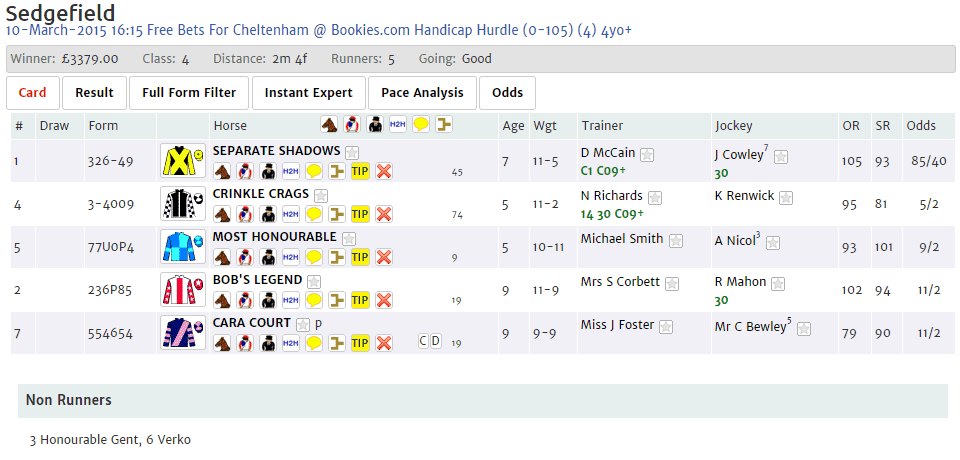
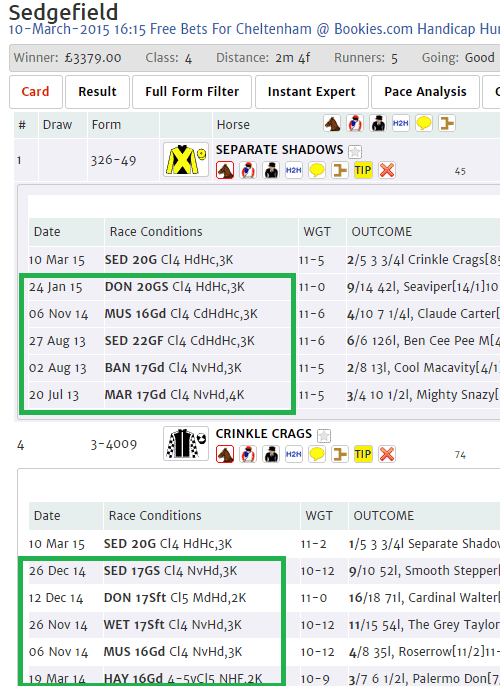
 Introducing the rather unsexy-sounding 'Trainer H'cap 1st Run [Code]' report. This report, found towards the bottom of your reports dropdown , shows all horses running in a handicap of that code (flat, hurdles, chase) for the first time today by the trainer's record with such types.