Read all sorts of commentaries and tips across a range of racing disciplines on the most popular horse racing blog in Britain, from staff and guest writers.
They were coming at the big prizes from all directions over this second weekend in July, Classic winners attempting further Group 1 triumphs, writes Tony Stafford. While some notable stars continued their upward momentum, the challenge of maintaining that level of excellence is never easy.
Normally staged on the first Saturday of the month, the Coral-Eclipse Stakes over 1m2f at Sandown might have attracted only a four-horse field, but the quartet posed an intriguing puzzle as the opening clash between the top Classic horses from the respective generations.
Considering the record of three-year-olds in this £425k to the winner prize, it was disappointing that only one attended the party. But then it was a distinguished representative, the winner of five previous races in a row, culminating in the Irish 2,000 Guineas and St James’s Palace Stakes.
This of course was Paddington and, like several of his Aidan O’Brien predecessors, here he was trying ten furlongs for the first time having been campaigned at a mile.
Ranged against him as the obvious threat was last month’s Coronation Cup heroine Emily Upjohn, dropping back to ten from 12 furlongs and without the reassuring presence of Frankie Dettori. William Buick stepped in.
As the horses started to vacate the paddock, Matt Chapman for ITV approached William Haggas, asking about his runner, the 5yo Dubai Honour, winner of two valuable prizes in Australia and placed in another massive pot at Sha Tin last time out.
“He has won twice as much money as the rest of these,” he said, but that confidence statement did not fool the market, his horse’s price of 8/1 also at variance with his official rating which slotted in between the big two.
Once that pair launched their joint bids past the one other runner, the Crisfords’ West Wind Blows, who had quickly taken the lead after initially being bettered from the stalls by an alert Paddington, it was a match. As the duo stormed together up the hill they proved to be in a class of their own, with Ryan Moore always looking to be holding his rival.
The other pair are talented, but in finishing six (WWB) and eight (DH) lengths adrift, it will be globetrotting, as Chapman suggested “against inferior foreign opposition” rather than Group 1 shopping at home and in the top European venues, that they will have to do to continue bolstering the coffers.
Emily Upjohn is firmly in line to go back up in trip with part-owner John Shack keen on the Arc. The original outright owner, he cashed in a chunk of his great filly last year and still owns a mightily valuable proposition when she ends her career and goes to partners the Lloyd Webbers’ stud.
There will clearly be a massive stud job for Paddington, too, when the son of Siyouni finishes racing. Much has been made of his going from a handicap to Sandown but, as I’ve said here before, the Coolmore team need to offer fulsome thanks to the Irish official who decided to allot him a mark of 96. He had demolished a field of 20 2yo maidens at the Curragh on second start following an exploratory opening foray at Ascot late last September.
The next offer of gratitude is that the Sunday of the Irish 2023 turf flat programme’s opening weekend, at Naas, features the Madrid Handicap which accommodates 3yo’s with high ratings. Paddington won it and then, five days before the 2000 Guineas was being contested at Newmarket, he earned a smooth albeit unspectacular win in Listed company.
The well-chronicled and minutely explained by their trainer unhinging of Auguste Rodin and Little Big Bear at Newmarket – soon eviscerated by the simple expedient of going up in trip (AR in the Derby) and down (LBB to sprinting), conveniently left a vacuum in the Irish 2000 Guineas. We now know who filled it.
Aidan has a supreme ability to get improvement race on race for his charges. In less than five weeks, Paddington has won three of the toughest Group 1s in the English/Irish calendars and his career holds a gathering similarity to that of one of his most famed predecessors at Ballydoyle.
Giant’s Causeway was known as the Iron Horse, but when I looked back at the career of the 1997-foaled son of Storm Cat, I hadn’t remembered he raced only at two and three. Unbeaten as a juvenile, with the Group 2 Prix de la Salamandre as his biggest win, he raced another ten times at three.
A win on his comeback run in a Group 3 in Ireland was followed by a near miss in the 2000 Guineas (2nd of 27 to King’s Best) and the Irish 2000, when runner-up to Bachir. He then went on a five-race Group 1 winning spree taking in the St James’s Palace Stakes (by a head), Eclipse (head again), Sussex Stakes (three-parts of a length), Juddmonte (head once more) and Irish Champion (half a length).
He finished off with two second places, in the QE II at Ascot, half a length behind Observatory, and the Breeders’ Cup Classic, a neck behind the brilliant Tiznow in an epic battle on the Belmont Park dirt track..
Having started more conservatively with Paddington, the O’Brien colt has already gone a long way onto the Giant’s Causeway ladder and in one way is already ahead of that horse’s Group 1 schedule.
Understandably, both the Sussex and Juddmonte were mentioned after Saturday and should he take in and win those, five Group 1 wins would already match the Iron Horse with the prospect of the Leopardstown and Ascot races to follow, not to mention a possible turf foray at this year’s Breeders’ Cup. Eight would be nice and for Iron Horse we would have to substitute Diamond, the hardest mineral known to man.
At Royal Ascot, Paddington meted out stable revenge on Chaldean, the horse that won the 2000 Guineas for Andrew Balding, and there was no hint of Giant’s Causeway’s love of a tight finish in which to show his battling tendencies as the Irish colt went almost four lengths clear.
Chaldean was expected to get back on the winning trail in yesterday’s Prix Jean Prat at Deauville, but after showing up in the middle of the track in the Group 1 over a straight seven furlongs, he faded away to fifth. Other veterans of this season’s mile Classics to finish unplaced here were Indestructible, 4th, Charyn, Hi Royal and the O’Brien filly Mediate.
The winner was the Fabrice Chappet-trained Kodiac colt Good Guess, 40/1 according to the Sky Sports racing caption afterwards but barely half those odds at a miserly 24/1 for off-course punters in the UK. Sixth in the French 2000, he has always been highly regarded and reflects how quickly fortunes and abilities can change as each Classic generation unfolds through the season.
One other Classic winner, Westover, Ralph Beckett’s Irish Derby hero from last year, was also in action in France this weekend, strolling home as the 2/1 on favourite in a four-runner renewal of the Grand Prix de Saint-Cloud on Saturday.
Westover had been a creditable second to Emily Upjohn in last month’s Coronation Cup, the pair finishing a long way clear of Point Lonsdale and 2021 Irish Derby hero Hurricane Lane. He, too, will be lining up for an Arc challenge.
Two further 2023 Classic participants made the trek across to New York for the very valuable Belmont Derby Invitational. Oisin Murphy must have been hopeful of winning the main prize on Dante winner and Derby fifth The Foxes,but, having been given plenty to do, he could not peg back the Todd Pletcher-trained Far Bridge who got first run and beat him by a length.
Further back was the Charlie Appleby-trained Silver Knott. Silver Knott had been only 11th in the 2000 Guineas but had been a good second when travelling to Keeneland for last year’s Breeders’ Cup Juvenile Turf, where he was beaten a nose by Aidan O’Brien’s Victoria Road.
Incidentally, Victoria Road, who has yet to reappear after a training setback in the spring, has a handful of imminent entries taking in later this month up to September.
No joy for Oisin in the Belmont Derby Invitational, then, but his trip was made more than worthwhile when the Fozzy Stack filly Aspen Grove (15/1) won the Oaks Invitational earlier on the card. Last of ten to Tahiyra in the Irish 1000 last time, the Justify filly, half-owned by Sue Magnier, collected the £229k first prize with a strong late run.
Oisin’s share of the £355k earned by his two mounts will have helped salve the disappointment of Chaldean’s defeat yesterday. You win when you lose when you’re in the Oisin, Ryan and Frankie (who missed both Emily Upjohn and Chaldean) bracket!
The summer Festival season is in full swing and there's none bigger than Royal Ascot week, writes David Massey. It's a long, challenging week if you're working in the ring, which I was, but it did at least kick off on the right note with a relaxing evening at Windsor on the Monday.
Normally I'd be on the team - I'm working for Rob and the S&D mob this week - but he tells me the Windsor Monday nights have been rather poor for business this year, a telling sign if ever there was one. So instead I'm sat behind the joint with a pint in one hand and a race card in the other, backing paddock picks.
This goes spectacularly badly and I'm almost a oner down after three races so I decide to abandon the paddock and go with form instead, see if that can turn the evening around. An each-way bet on Thankuappreciate gets me my first return of the night, a whopping £26.
From my perch I call to Jason, on the machine, to ask what price It's How We Roll is in the next. He tells me I can have 20s. "Keep the £26 then, I'll have £13 each-way." I also back it online with a bookmaker that's paying 4 places at 16s. When he romps home by an easy length and a bit at a well-backed 11-1, the oi oiiiis go up from my chair. The evening well and truly turned around and I've got some pocket money to have a crack with through the week now!
Rather than a hotel, Rob has rented a house for the week in Bracknell for the team, and a lovely house it is, too: a quiet area with a little garden we can relax in at night. Better still, it's a mere 10 minute drive to the Ascot car parks, a right result. Despite a last-race time of 6.10pm every day (thanks for that, Ascot) we are still back for just after 7 most nights, which gives genuine time to wind down with food and a beer.
Tuesday, unsurprisingly, begins early at 8.30am. Once in, I head off to the greenhouse that poses as a marquee in the middle of the track to get some writing done. Stiflingly hot in there last year, there is at least some air conditioning this time which is just as well, as a humid week is forecast.
For the first two days I'll be on the rail, facing the Royal Enclosure, so if the King fancies a fiver each-way on one I'll be happy to accommodate him. Tuesday and Wednesday are the quietest days, betting-wise. Rob tells me if I take four grand today he'll be delighted. "Only way you'll take more is if you bump into a punter." Well.....
Once the Royals have taken their seats betting tends to begin. It's very quiet business for the Queen Anne, until one guy stands in front of me. "Can I help you?" I enquiry politely.
Reader, he pulls a wad of fifties out of his pocket as big as any roll of Andrex you've seen. "I'll have fifty on that, fifty on that, fifty on that and a hundred on that," he says, handing me five crisp bullseyes for his four selections. I thank him and he walks off. Rob is betting two doors up from me and throws me a look that says "nicely done". "Ask him if he's got any mates that want a bet with us!" he shouts at me. Our punter does not back Triple Time but he's back again for the Coventry. This time he picks three out, and has a hundred on each. He walks off, then two minutes later walks back and has another two selections for £100 a pop. He walks away again but within a minute has another £200 on Asnada. I can see the strained look on Rob's face that says "for God's sake, don't lose this guy," and I do all I can to keep him. River Tiber wins and he's not backed that as one of his selections either. What's his next move?
Let's keep it brief. He has £700 on the next, £50 of which is on Bradsell at 12s, so almost wipes his face. He tells me to keep the £650 and have it all on Chaldean as, and I quote, "Frankie tells me this will win." I'm not going to argue, he might be well acquainted with Frankie for all I know, but sadly for him Frankie is wrong and Paddington proves too good for him. He splashes out a grand on the Ascot Stakes, £100 of which is on winner Ahorsewithnoname at 13-2, has £50 of that back on Royal Champion in the next at 16s (but, I ought to add, has another £800 on top of that on losers) and, come the last, out come the big guns. "I'll have a thousand on Vauban," he says, and stumps up from the cash pile, which has dwindled somewhat since two o'clock. He walks off, then comes back five minutes later with an acquaintance. 'I'll have another thousand Vauban," he says, and pulls out a card. Rob hands me the card machine but the transaction won't go through. I look at the card - it's a credit card. I inform him only debit cards can be taken. He opens his wallet and there must be a dozen cards in there, but not one of them is a debit card. I'll bet Coutts haven't closed his account.
So, he pulls the remaining cash out of his pocket. There's around £800 left. Fully expecting him to have that on the jolly, what does he do instead? Backs four rags at £200 a piece, that's what. Rob, who is by now as bewildered as the rest of us at finding such a miracle punter, is stunned. He picks his 2k up in cash post-race and my first and indeed only question to him is whether he'll be here tomorrow. Sadly, he informs me, he has meetings in Dubai to attend and won't be here the rest of the week. I wish him all the best and thank him for his business. I've taken over 9k on the day, over half of it with him alone.
Wednesday. My word, if matey boy from Day 1 was unlucky, I'm about to meet his exact opposite. A lady that cannot stop backing winners.
Her name was Deborah, as Pulp might have sang, and she was the wife of a high-court judge, although that bit wasn't in the lyrics for Common People, as I recall. She's backing two or three a race and having about £60 on each time. She has, and I'm not making any of this up - a tenner each-way Villanova Queen at 25s, £15ew Rogue Millennium in the Duke Of Cambridge at 9s, £20 win Mosthadaf in the Prince Of Wales, a tenner each-way Jimi Hendrix (and £15 each-way Sonny Liston, for good measure) in the Hunt Cup and £15 each-way Big Evs in the Windsor Castle. She's almost embarrassed to pick up after the last one wins. We have a group photo as I pay her out for one final time. She reckons she's about a grand up on the day. I tell her now might be a good time to buy a lottery ticket.....
Thursday and it's getting hotter. The greenhouse/marquee coffee machine has packed up, and we appear to be out of teabags too. I make a mental note to bring some Yorkshire teabags in tomorrow. (A worker should always - ALWAYS - have teabag reserves, either in the car or in your kit bag. Vital.)
It's Ladies Day, which might as well be called Frankie Day. I actually do something proactive, namely write down Frankie's mounts and stick them to the front of the light board, so when I'm asked I can just point to my handiwork. It does the trick.
I should add I'm now working in Tatts, on the back row, with Liam. I worked with Liam last year, he likes a bet and knows his stuff. Betting on rugby is his thing, although the one time he told me "this can't lose on the handicap" the bet was sunk by half-time. We've all done it.
I don't strike a bet on Valiant Force, the 150-1 winner of the Norfolk Stakes, but I can see on the payout sheet that the rails has laid a tenner each-way at the price and someone had a fiver win-only at 125s. That's confidence for you. The results continue to be terrific, with 18-1 Desert Hero and 50-1 Witch Hunter almost unbacked, and by the time Frankie gets his winner, with Courage Mon Ami in the Gold Cup, his legions of fans have rather given up hope and it's actually a good result.
By Friday we are flagging, the heat taking its toll and I hear stories of some rather poorly workers on some firms. Not all of it is alcohol related either. However, results have been unbelievable and some of the bigger firms already have their expenses on the week paid for. You wouldn't normally do that until midway through Friday, but it's clear that plenty of the firms are going to be paying a bonus to their workers this year.
One thing to be wary of Ascot week is that you'll almost certainly be tested on a purchase, the local council sending in an under-18 to make sure you're not serving them. The lad that comes up to me before the first looks very young and when I ask him for ID, he cannot produce any. So I ask him his age, and he readily tells me he's 16. I tell him I can't serve him and he goes on his way. I'll say this though - as he puts his money away I see a slip in his hand from one of the very big joints and it's clear they have not asked him anything. That's disappointing from a firm that really ought to know better.
Coming from a retail background, asking for ID is second nature to me, but there's plenty of firms that go with the "what harm are they doing, they're only having a bet" line and I'd wager most of us reading this had our first investment in school uniform. But times change, and a bookmaker can easily lose his or her license for multiple strikes these days, so you always have to ask. I do, anyway.
Three winning favourites and a Frankie double on the Friday is a bit of a grounding after a good week, but business was brisk and getting Little Big Bear beaten - I laid an £880-£800 in Tatts, and the rails took an even grand - means a winning day.
None of us want to get up Saturday morning but the end is now in sight. I feel very smug driving in, with no traffic on the road, but as I approach the signs telling me "Display Parking Badges Now" I realise I've left mine at the house and have to go back and fetch it. This results in me losing a potentially good parking spot and by the time I moor up, I'm right at the back of the car park and have to walk up the big hill to get to the course. Arriving at the greenhouse/marquee I'm already soaked in sweat, it's that hot.
I go for a wander down to the silver ring around lunchtime to see how some of the items in there are getting on. My good mate Joe, working for Paul Johnson, tells me he fancies Age Of Kings quite strongly. I wish I'd listened a bit harder to him. When I congratulate him by text later he also tells me he had a bit each-way on Khaadem in the Jubilee. His crystal ball was on good form, clearly.
Indeed, today really is humid and working conditions for the afternoon are unpleasant. Saturday tends to be more of a family day but it's busy, and the crowd more chatty. I like that, as it means you get to know your audience a bit better and you can actually call them by their name when they come up for a bet, adding a bit of a personal touch. My favourites are three girls from Enfield who have no clue about betting at the start of the day but are seasoned professionals by the end of it, and they promise me they'll go racing more now they know what they're doing. I do hope so!
There's not much big money flying around today but plenty of scores and forties which is fine, and results are again favourable in the main. It's been a winning week, which is just as well as we're all knackered out and ready for home.
I wonder if my Tuesday punter will be at Southwell next Monday? You never know...
- DR
https://www.geegeez.co.uk/wp-content/uploads/2023/04/Kingman_NightofThunder_2014_StJamessPalaceStakes.png319830David Masseyhttps://www.geegeez.co.uk/wp-content/uploads/2022/10/geegeez_banner_new_170x78.pngDavid Massey2023-07-06 08:14:082023-07-06 08:14:08Roving Reports: Royal Ascot
This is the fifth and final article in my series of articles on jockeys, writes Dave Renham. In this piece I will be looking at three more top jockeys trying to pinpoint their strongest stats, be it positive or negative. As with the previous four articles I have analysed the last eight full years of flat racing in the UK and Ireland (2015-2022). I have used the Geegeez Query Tool as well as the Profiler Tool, amongst other things. In all the tables the profits/losses quoted are to Industry SP, but I have shared Betfair Starting Price where appropriate. Let's start with last season's champion jockey...
William Buick Jockey Profile
William Buick became Godolphin’s first choice jockey in 2016 and hence it should come as no surprise that within a year his win strike rate soon began to edge up:
As we can see from 2017 onwards he has achieved yearly strike rates in excess of 20%, with 2022 being a particularly good year. His overall record reads as follows:
Buick backers incurred relatively modest losses to Industry SP when we look at all races as a whole. Considering he has had over 4000 rides this is quite impressive. To BSP, backing Buick ‘blind’, you would have made a profit of £317.71 (ROI +7.5%).
Let us now look at his performance for different trainers over this eight year period (minimum 100 rides):
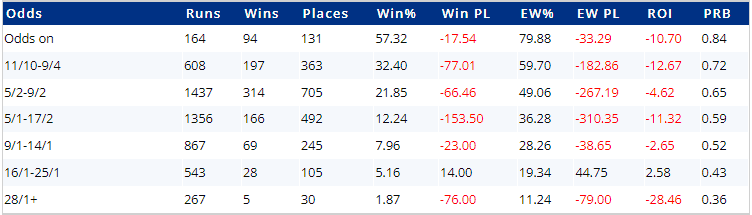
Buick when teaming up with his boss, Godolphin trainer Charlie Appleby, has secured a strike rate edging close to three wins in every ten rides. Not only that, they have combined to virtually break even to SP, with profits to BSP hitting £139.33 (ROI 9.6%). Indeed, to BSP they have secured profits in six of the last seven seasons. His record is less impressive when riding for the Gosden stable – a stable for whom he has been stable jockey in the past - with a modest strike rate of under 15% and poor returns.
One trainer not in the table due to the minimum ride stipulation is Sir Michael Stoute. Buick and Stoute do not team up that regularly, but when they do their record is excellent – 19 wins from 73 (SR 26%) for a profit of £42.07 (ROI +57.6%). To BSP profits that increases to £57.59 (ROI +78.9%). Their PRB figure is excellent also standing at 0.68.
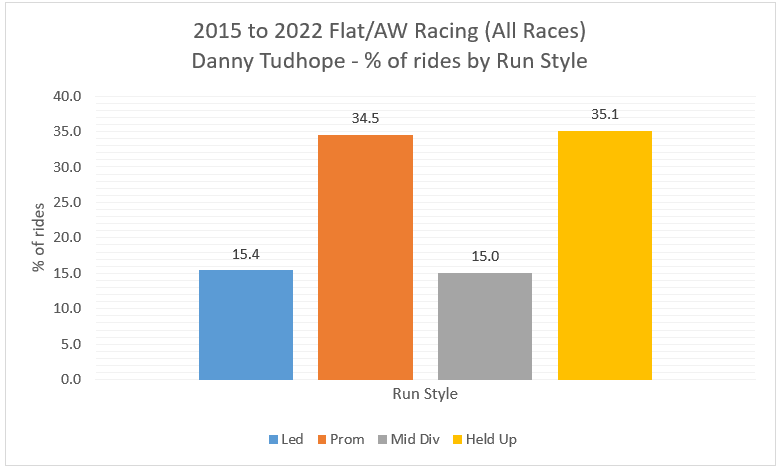
One thing I like about Buick is that he is an excellent rider from the front. He wins on board virtually one ride in three when taking the early lead. Here are his win percentage splits for the four main run styles:
Buick follows the usual trend in that his front running rides win more often than his prominent ones which in turn out-perform mid div / hold up rides. For the record, at distances of 1m2f or less his front running strike rate stands at 35.1%; at 1m3f or longer it drops to 19.1%.
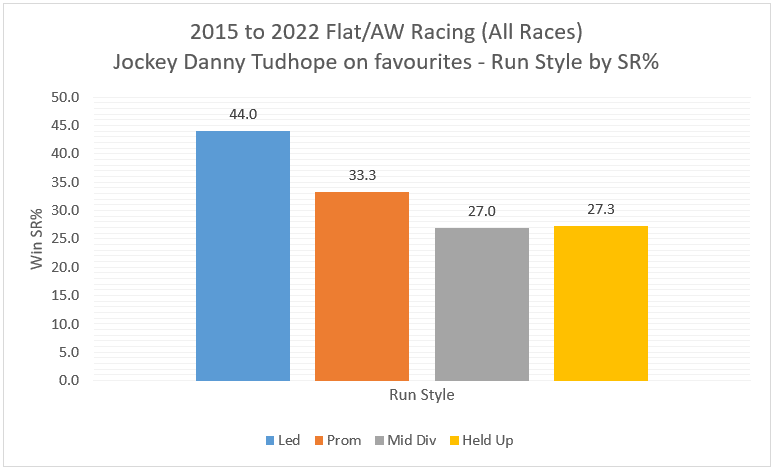
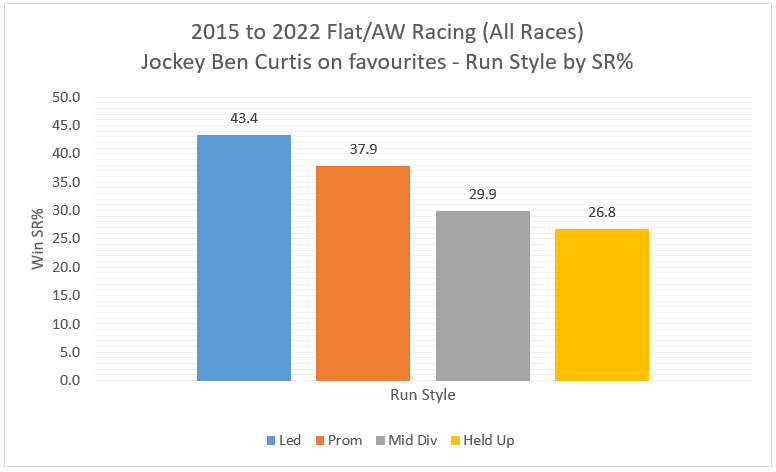
As regular readers will know, I like to look at favourite run style data, too, as this eliminates any potential selection bias regarding ‘good horses at the front, bad ones at the back’. Here are the relative win strike rates for Buick-ridden favourites in terms of the four main run styles:
Again, front running market leaders did best by some margin, while favourites that raced mid-division early had a very poor record: these runners would have lost you 26p for every £1 bet. Buick's record on held up favourites are a lot stronger than most jockeys, presumably because of the number of Godolphin horses able to outclass their opposition.
Before moving on, let us look at some additional statistics for the reigning champ:
Buick has a great record at Newmarket from a significant number of rides. Specifically, he scored on 212 winners from 843 (SR 25.2%) for a BSP profit of £94.09 (ROI +11.2%). When riding for Charlie Appleby at HQ the record is even more impressive – 132 winners from 412 rides (SR 32%) for a BSP profit of £93.34 (ROI +22.7%).
In contrast, at York his record reads 24 wins from 197 (SR 12.2%) for a BSP loss of £41.53 (ROI -21.1%).
On 2yos Buick has won 25% of races returning a BSP return of 6p in the £.
On 2yos having their second career start Buick has a strike rate of 1 in 3 and has returned a profit to BSP of just over 15 pence in the £.
Buick is a very good all round jockey who I am always happy to see riding a horse I fancy.
Jim Crowley Jockey Profile
Jim Crowley is a seasoned campaigner, and retained rider for the Shadwell operation, who is right up there when it comes to win rate. Here is his overall record going back to 2015:
These are excellent stats and backing all Crowley runners to BSP would have yielded a profit of £424.79 to £1 level stakes, equating to returns of nearly 8p in the £.
Crowley rides for numerous different trainers and there are 16 trainers for whom he has ridden more than 100 times. Here are their stats:
We see some very good stats here with seven of the 16 trainers showing a blind profit to Industry SP; and 11 trainers showing a profit to BSP.
Crowley has produced excellent results with horses from the top two in the betting when riding for Owen Burrows, William Haggas and the Gosden stable. All three have yielded good BSP returns on investment (Burrows +19.8%, Haggas +16% and the Gosden stable +8.6%).
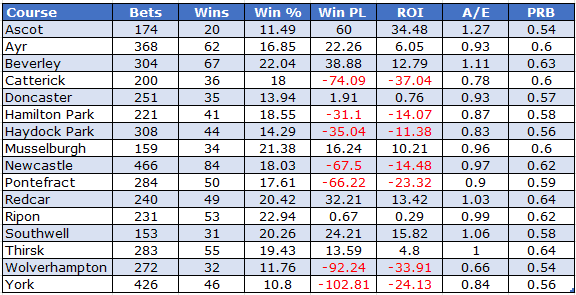
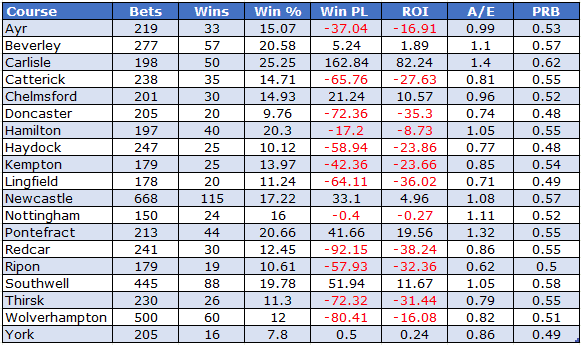
In terms of courses, Crowley has ridden more than 100 times at 18 different venues. Here are the A/E indices at these tracks:
It is very impressive to note that eight courses have A/E indices in excess of 1.00 with Nottingham hitting a remarkable 1.57. His overall Nottingham stats are unsurprisingly outstanding – 43 wins from 131 rides (SR 32.8%) for an SP profit of £159.14 (ROI +121.5%). To BSP this improves to a profit of £186.86 (ROI +142.6%). His PRB course figure is also very strong standing at 0.65.
Here are a couple of stats for Crowley that are also worth sharing:
He has an excellent record in very small fields. In races of five runners or fewer he has won 144 races from 410 rides (SR 35.1%) for a BSP profit of £130.46 (ROI +31.8%). He has made a profit to industry SP also of £84.64 (ROI +20.6%).
On front runners he has performed especially well for trainers Charlie Hills and Owen Burrows. This is particularly true in races of 1 mile or less where Crowley hits the 34% win percentage mark for both trainers.
Crowley is hugely experienced and this shows in his stats.
Oisin Murphy Jockey Profile
Oisin Murphy was British Champion Jockey in 2019, 2020 and 2021. He did not race in 2022 as he was banned for two failed breath tests and breaking coronavirus rules but has resumed riding with a win percentage of 17.5% in 2023, slightly above his overall record as can be seen in the table below:
These are sound stats given Murphy has taken over 2000 more rides than Buick and 1000 more than Crowley, despite missing the whole of 2022! He clearly is a rider who does not have an issue with being busy. Like Crowley he has ridden 100 times or more for several trainers and here are the stats (ordered by strike rate):
Although he has not made a profit to SP when riding for Saeed bin Suroor, they are a combination to keep an eye on. The PRB of 0.70 is particularly high and, when betting to BSP, they have snuck into profit. Indeed to BSP, all bar Simcock and Williams have produced a profit with Oisin in the plate. Keeping with the BSP theme, if we combine all nine trainers, then Murphy has made a profit with them as a group in every year from 2015 to 2021. The combined yearly returns to BSP are shown in the graph below:
It is rare to get seven profitable years in a row when combining as many as nine different trainers.
There are four other trainers to keep an eye out for where Murphy has had less than 100 rides in each case. They are the Harry & Roger Charlton barn (10 wins from 32), Mick Appleby (16 wins from 66), John & Thady Gosden (31 wins from 84) and John Butler (8 wins from 21).
Murphy has a notably good record on 2yos with an overall strike rate in the review period of 17.4% thanks to 256 winners from 1473 runners. To Industry SP these runners yielded small losses of just under 4p in the £; to BSP, however, this turns into a profit of over 13 pence in the £. Here are three additional 2yo stats worth sharing:
2yos that have started in the top four of the betting have provided 226 wins from 971 runners (SR 23.3%) for a BSP profit of £92.32 (ROI +9.5%)
For the Gosden stable he has had 14 2yo winners from just 39 runners (SR 35.9%) for a BSP profit of £12.08 (ROI +31.0%)
2yos that Murphy has taken into the lead early have won over 30% of their races. But...
2yos that were held up by Murphy have won just 8.4% of the time
Continuing with the run style theme, I have always liked Murphy from the front as an angle. Indeed, if your crystal ball was in mint condition and you had predicted pre-race all of Oisin's front runners in all races (not just 2yo ones), you would have been rewarded with an SP profit of £312.85 (ROI +30.9%). To BSP returns were nearer 45p in the £.
Looking at his run style record on favourites we see the same pattern we have seen numerous time before:
Front running favourites do best as is the norm and they would have been profitable to the tune of 12p in the £. Prominent racers would have seen you lose 2p in £, mid div 'jollies' lost 24p for every £1 bet, while hold ups lost 19p.
Here are some additional stats for Murphy, starting with two negative ones:
Murphy has a poor record with very short priced runners. On horses priced 8/13 or shorter he has had 61 wins from 112 (SR 54.5%) for losses to Industry SP of £28.10 (ROI –25.1%)
With big-priced runners his record is poor also. Horses priced 28/1 or bigger accounted for just four winners and nine placed runners from 337. Losses to Industry SP stood at £206.00 (ROI –61.1%). To BSP it improves a little but he still lost over 42p in the £
Murphy has achieved a strike rate of 20% or more at five courses (with a minimum of 100 rides) – these are Chelmsford 20.1%, Newcastle 21.5%, Nottingham 20%, Salisbury 21.1% and Wolverhampton 20.5%. Four of the five have yielded blind profits to BSP (Wolverhampton being the only track that has not)
When teaming up with Hughie Morrison at Nottingham they are 6 wins from just 13 runners. They have also had two seconds at 14/1 and 12/1. When riding at Lingfield for Archie Watson, Murphy is 12 wins from 35 (SR 34.3%) for a BSP profit of £11.80 (ROI +33.7%)
I really like Murphy as a jockey and I especially look for horses he is riding that may take the lead early.
MAIN TAKEWAYS
Below is a summary of my key findings, firstly for William Buick:
Buick has a good record riding for his boss Charlie Appleby, making a blind profit to BSP with a decent strike rate. He also has a good record when booked to ride for the Stoute stable
He is outstanding from the front especially in races of ten furlongs or less.
He has a very good record at Newmarket for all trainers, but especially with Appleby. At York his record is relatively poor.
His record with 2yos is decent, with second starters doing particularly well.
Onto Jim Crowley now:
Crowley has a strike rate of better than one win in four with four trainers (100 rides or more) – John & Thady Gosden, William Haggas, Roger Varian and Owen Burrows. Three of the four have yielded a profit to Industry SP
He has an outstanding record when riding at Nottingham
In small fields of five runners or less Crowley has been exceptional
And finally Oisin Murphy:
Murphy has a good record with many trainers he rides regularly for.
Harry & Roger Charlton, Mick Appleby, John & Thady Gosden, and John Butler are trainers he rides less often for but his record with all four is excellent.
He goes well on 2yo runners.
He is excellent when riding from the front.
He has a relatively poor record with very short priced runners (8/13 or shorter); likewise with outsiders priced 28/1 or bigger.
Two trainer/jockey course combinations to note are Murphy and Morrison at Nottingham, and Murphy and Watson at Lingfield.
*
So I have come to the end of this series on jockeys. Of course, I have barely scratched the surface as there are hundreds of riders I have not analysed at all. Most punters have favourite jockeys or indeed ‘lucky’ ones, but digging into the stats is a worthwhile use of all of our time. Building up a picture of strengths and weaknesses is important, and with Geegeez’s tools - especially the Profiler and Query Tool - it is not difficult to do or time consuming. In fact, it's fun!
Other jockeys you may want to look at in your own time include James Doyle, Andrea Atzeni, Jack Mitchell, Kevin Stott and Adam Kirby; or indeed whoever interests you. If you find anything noteworthy, feel free to comment below as it will help the Geegeez community. Until next time, when I'll be looking at something different, stay lucky.
- DR
https://www.geegeez.co.uk/wp-content/uploads/2023/07/StarofMystery_WilliamBuick_CharlieAppleby.png319830Dave Renhamhttps://www.geegeez.co.uk/wp-content/uploads/2022/10/geegeez_banner_new_170x78.pngDave Renham2023-07-04 18:40:162023-07-05 16:42:29Jockey Profiles: Best of the Rest
You would think a €1.25 million pot would be enough to entice raiders from across the water to the Irish Derby, writes Tony Stafford. English connections of six of the nine runners duly did arrive at The Curragh in anticipation of the second Derby win of Auguste Rodin, and some friends and family too, but as far as the horses were concerned, it was a private party for the home team.
A length-and-a-half victory for the 4/11 shot, Aidan O’Brien’s almost obscene 15th success in his principal home Classic, might smack of routine, but routine it definitely was not.
Aidan had five runners, all for the Coolmore boys, and Messrs Tabor and Smith were on hand, along with John Magnier and Georg Von Opel alias Westerberg. Donnacha and Joseph supplied one each, Donnacha’s for the boys, although Joseph’s fifth home – incidentally behind four of his father’s – Up And Under, has Go Racing Ltd as its owner and I’ve no idea who they are or where they come from.
In the Derby at Epsom, nine of the 14 runners were trained in England. Runner-up King Of Steel gave the winner quite a battle before giving best, and was a full five lengths clear of the rest of the field. Roger Varian’s colt lived up to it in a fluent victory at Royal Ascot in the King Edward VII Stakes. There he had two of the better-fancied runners from Epsom similarly well beaten again.
They were Artistic Star (Ralph Beckett) and Arrest (John and Thady Gosden) and the way they were put in their place by the Epsom runner-up gave a very solid look to the form.
You could see why none of the other, more remote, Derby Day also-rans from the UK took on the re-match. There was more realism in the second challenges of home-team contenders White Birch, third for the John Joseph Murphy stable, and Sprewell (fourth for Jessica Harrington), and unsurprisingly they were the second and third in the betting yesterday and the only two at single-figure odds.
Neither replicated the Epsom form, but in some ways neither did the winner. As had been the case there, where Adelaide River cut out much of the running, he again set the pace. He had been a well-beaten eighth at Epsom, but now it took a long while for the favourite to master him.
Much of the story of the race, though, involved the one Aidan runner not to be involved in the finish. This was San Antonio, a son of Dubawi, who at 16/1 was the second shortest of the Ballydoyle quintet even after he finished as far back as 11th at Epsom.
Here he was galloping happily alongside and just behind Adelaide River with the favourite in customary Irish Derby O’Brien comfort zone, close up, when suddenly four furlongs from home, San Antonio broke down and unseated Wayne Lordan. San Antonio sadly was fatally injured having fractured his right foreleg. Lordan was taken to Tallaght Hospital where last night he was said to be “concussed but fully conscious and able to move all limbs”..
The fall caused interference to the favourite and considerably more to some of those in behind including the two other home hopes, who both ran below par, their riders and trainers blaming the incident.
Ryan Moore certainly thought leaving Auguste Rodin without cover on the outside of the leader was a major contributor to what appeared a workmanlike at best performance. With a strong headwind in the first half of the race, and a tailwind in the straight, leading had been hard work initially and then pegging back the leaders just as difficult in the run home.
Eventually Auguste Rodin got on terms and, with his rider working hard, edged ahead, but Adelaide River, in Moore’s words, having enjoyed “the run of the race”, was even pegging back the favourite, and in no way looking a 33/1 shot.
Covent Garden, 80/1 in third, had been three lengths behind Sprewell in his latest race, the trial the Harrington horse won before Epsom. It was left to Peking Opera (66/1), a disappointment in the Queen’s Vase (1m6f) at the Royal meeting 12 days previously, to take fourth under Tom Marquand.
We’ve been accustomed in recent years of O’Brien multiple representation, especially at Epsom, to see more than one Ballydoyle work jockey step into the limelight: Padraig Beggy (Wings of Eagles, 2017) and Emmet McNamara (Serpentine, 2020) picked up career defining wins in the greatest race in the UK Calendar, but the home boys have stayed home of late.
Now, the five Ballydoyle horses were ridden by the regular trio of Moore, Heffernan and the unfortunate Lordan, while Tom Marquand will be happy to pick up his rider’s share of 50k for the fourth place of Peking Opera. Former Irish champion Declan McDonagh (2006) and more frequently riding nowadays for Joseph, finished third. Not a chalk jockey in sight!
They are clearly taking ever more careful account of jockeyship, something which especially concerns Michael Tabor; and his championing of Moore was the main reason for that appointment after Johnny Murtagh’s time there ended. Ryan has been riding with renewed vigour and enterprise, and at Ascot his energy and tactical awareness were the best we’ve seen from a flat race jockey for a long time. That has filtered through to his regular trips across to Ireland where before racing yesterday, he jointly led the riders’ table on 30 wins.
O’Brien sits second to the Gosdens in the UK trainers’ prizemoney list, having won £2,746,146 against Big John and Little Thady’s [he’s not that little! – Ed.] £3,210,084. At home, before racing yesterday, he was on more than €1.8 million. That has swelled to just a few Euro over the three milion mark, almost three times Joseph’s far from negligible tally in second.
Tabor was fulsome in his praise of his trainer yesterday. It is salutary to relate that it was only a few years ago that the media and those rumour mills, always so prevalent in racing, were predicting that David O’Meara was about to take over at Ballydoyle and that the Coolmore owners were ready to jettison their man.
John Magnier must go down in racing history as the genius who discovered the man to follow his unelated namesake but equally supreme, Vincent O’Brien.
When he retired, Vincent got an honorary doctorate and was forever thereafter described as Dr O’Brien. Maybe somebody can think up an appropriate appellation for Aidan when he allows someone else to win the Derby (nine and counting) and Irish Derby (15). It must be something unique as there’s been nobody like him.
Ryan Moore, so much more at ease with the media nowadays – the natural caution of this private young man having been hard for him to come to terms with - also was fulsome in his praise of the trainer. He said that over the past ten years he had provided so many good horses for him to ride. Auguste Rodin was Ryan’s first winner of the Curragh race, to go with his three at Epsom, two for O’Brien including last month.
The rest of the season is panning out quite nicely for them with such as Irish 2.000 Guineas and St James’s Palace Stakes winner Paddington dominating the mile division for now and, despite his near miss at Ascot in the Commonwealth Cup, top sprint honours can still come the way of Little Big Bear.
As for the two-year-olds, there was a rare reverse in yesterday’s opener when close Ascot third Bucanero Fuerte rallied late to get the better of Aidan’s favourite, Unquestionable, in the Railway Stakes. The pair, both sons of Coolmore’s star young stallion Wootton Bassett, were miles clear of the third-placed His Majesty, who had been a close fourth in the Norfolk Stakes.
That followed two wins at the start of both Friday and Saturday’s Curragh cards, all comfortably achieved. The highlight undoubtedly was the facile all-the-way win of Frankel filly Ylang Ylang on debut on Saturday. This 1.5 million gns buy from Newsells Park Stud had the look of a guaranteed contender for races like the Moyglare Stud Stakes. I was at Chester on Friday night watching another Wootton Bassett colt, owned in partnership by Newsells Park with Jonathan Barnett and trained by Michael Bell.
He ran a promising first race finishing third to Witness Stand who looked very smart. Tom Clover trains that one. It took five hours without stopping to get back from Chester which was just five minutes less than the journey home from Lingfield (one third the distance) on Saturday when a three-hour wait on the M25 put in perspective how lucky I had been with my five hours each way on the M6 on Friday.
It wasn’t entirely a weekend without enterprise by English trainers. Michael Dods sent his top-class sprint handicapper Commanche Falls for the Listed six-furlong race yesterday and was rewarded with a nice payday as he outpaced the local speedsters.
But his chance was there for all to see. Much less obvious were the claims of the Hughie Morrison-trained and Arbib family-owned Stay Alert, a Group 3 winner last year, but only fifth behind Free Will and Rogue Millennium in the Middleton Stakes at York.
In running an excellent second in the Yulang Pretty Polly Stakes on Saturday to the George Boughey favourite Via Sistina, she collected valuable Group 1 placed black type as a 25/1 shot, and can go on from here.
The winner looks a top performer. Boughey has lost one major owner from his yard after a run of unfortunate veterinary issues during Royal Ascot but the way he spoke diplomatically about his former client, wishing him and his family all the best, suggested he has the right temperament for this tricky profession in which he has started out so well.
This is the fourth in my series of articles on jockeys, and this time I am examining the performance of some riders in Ireland, writes Dave Renham.
As with the previous three articles I am analysing the last eight full years of flat racing (2015-2022) but focusing solely on Irish results. For the majority of the number crunching I will be using the Geegeez Query Tool, but I will also use the Profiler tool amongst other things. In all the tables the profits/losses quoted will be to Industry SP, but I will share Betfair SP where appropriate.
The first point to make is that you should not blindly compare Irish jockey strike rates with their UK counterparts. This is because the average field size in Ireland is bigger than it is in the UK. In the past eight seasons, the average number of runners in a UK flat race stands at 9.2; in Ireland this jumps markedly to 11.7. If we compare by year we see that the gap in the last couple of years has increased further:
Hence strike rates for jockeys racing in Ireland are going to be lower than for jockeys racing in the UK. If we want to compare jockeys across the Irish Sea against each other, then the PRB figure (Percentage of Rivals Beaten) is a better barometer to use.
Jockey Performance in All Races
Let us first look at all jockeys that have ridden at least 400 times in the past eight seasons in Ireland. I have included all of them, rather than hand pick those with the highest strike rates. The reason for this is that I do not know that much about some Irish jockeys so I am keen to absorb all the stats I can:
As we can see there are no jockeys in profit to SP with many heavily in the minus.
Anyone who read my Ryan Moore article will be familiar with his overall stats. Moore is comfortably ahead of the rest with a crazy strike rate, thanks as we know in the main to his partnership with trainer Aidan O’Brien. The next best strike rate is owned by Colin Keane, on 14.83%, which is less than half the figure of Moore! Speaking of Keane, let us dig a little further into his stats:
Colin Keane
Keane is stable jockey to Ger Lyons, a relationship that began in 2014. Keane has been Champion Jockey in Ireland in four of the last six seasons (2017, 2020, 2021, 2022), and in 2021 he had his highest number of wins in a season with 156. Let us look at his record with different trainers (minimum 50 rides), ordered by number of runs:
There are some strong PRB figures here, with Keane securing a PRB of 0.60 or better with eight different trainers. Naturally, the most rides have been for Lyons, but the O’Callaghan combination completely stands out. In 2022, they teamed up 18 times and nine of those horses ended up in the winner’s enclosure. They have partnered up at 14 different Irish courses and had winners at ten of them! Three of the courses where they have not had a winner have been at courses where Keane has ridden for O’Callaghan just once.
Two trainers perhaps to avoid are Martin and Mc Court – both have relatively poor figures in comparison to the average, though are still at least 50% of rivals beaten together.
For Ger Lyons, Keane is close to one win in five which is excellent. Here is a graph of their trainer/jockey combo in terms of yearly strike rate – looking at both win strike rate and each way strike rate:
There were slight dips in 2018 and 2022, but generally quite consistent figures. It should be noted that 2023 started very poorly, so this is something we need to keep our eye on. Things have improved in June and hopefully the pairing are back to normal service resumed now.
Here are three of the most potent Keane/Lyons stats:
2yo horses have done extremely well with 177 wins from 759 runners (SR 23.3%). To SP, returns have shown a small 3p in the £ loss. To BSP though a profit of £65.91 would have been made equating to returns of over 8p in the £.
Clear favourites have won 233 races from 572 races (SR 40.7%) for a BSP profit of £49.66 (ROI +8.7%).
Horses making their debut have an outstanding record. Of the 333 debutants, 71 have won (SR 21.3%) for a BSP profit of £158.33 (ROI +47.6%). Profits to SP were smaller but still returned just under 20p in the £.
Moving back to looking at Keane’s overall record again, it is time to consider some of his run style data. Geegeez members will know I am a big fan of looking at favourite run style data as this eliminates any potential selection bias regarding ‘good horses at the front, bad ones at the back’. Here are the relative win strike rates for Keane horses that have started as the market leader in terms of the four main run styles:
No surprises here with front running favourites doing clearly best. This is an even stronger bias than we normally see with hold up favourites scoring less than one win in every four. Front runners, meanwhile, would have secured a profit of around 24p in the £ to SP assuming our crystal ball could have accurately predicted that they would all go forward as well as being favourite. This profit would jump to 30p in the £ if backing them all to BSP.
Seamie Heffernan
Heffernan has some interesting run style stats when we focus on shorter distance races of 5f to 7f. Below are his strike rates both from a win and each way perspective:
As can be seen, Heffernan’s record on front runners from both a win and placed viewpoint is top notch. The figures for hold up horses in these shorter distance races are very weak – fewer than one in twenty winning, fewer than one in eight placing.
Heffernan has ridden 103 front runners in these 5-7f races for trainer Aidan O’Brien and has won on 38 of them (SR 36.9%). For the same trainer over the same distance spread, we see hold up horses claiming just 12 wins from 153 (SR 7.8%). Of the 153, 77 came from the top three in the betting! Now I appreciate I probably have the largest and noisiest ‘drum’ when it comes to run style stats in the whole of the racing world but when the numbers look like this, I just have to make you aware.
Horses from top three in the betting, by jockey
As the main table indicated, most jockeys have modest profit records at best when looking at their rides as a whole. Let’s look at how they have performed in terms of when they are riding a fancied runner – specifically, a horse in the top three in the betting. Here are the jockeys who have secured the best strike rates (minimum 100 runners):
Moore tops the list once more; Keane is in 5th, while three jockeys have managed to secure a profit to SP, namely Shane B Kelly, Ben Coen and Connor King. The average A/E figure for all Irish riders on horses from the top three in the betting is 0.88, so a few of them are nicely above this figure.
A look now at the jockeys with the lowest strike rates (below 16%) with the same group of fancied horses:
These jockeys are probably ones to be wary of even if riding a horse that heads, or is near the head of, the market. They have produced some hefty losses as a group.
Jockeys on front running favourites
Earlier we saw that Colin Keane had an excellent record on favourites that took the lead early. Here are the jockeys with the highest strike rates with such runners, of which Keane is one of them:
Absolutely exceptional figures for Moore; in the previous article on Ryan I noted his excellent record on front running favourites when combining UK and Irish stats. To that we can now add that his Irish front running win stats are 15% higher than his UK ones. I also mentioned in that piece that Moore does not go to the front early as often as he should – this cements my feeling for time immemorial. Of course, many of Aidan O’Brien’s horses are steadily away which makes getting to the front more difficult.
Jockey Performance, by Racecourse
For this section I decided I would look for any big positives or negatives at the Irish courses as regards to jockeys. Here are my findings:
Ballinrobe – Shane Foley has the highest strike rate at the course (19.3%) thanks to 11 wins from 57; Rory Cleary is 0 from 41. To be fair Cleary has not had many good chances at the course;
Bellewstown – Declan McDonogh has a 20% win rate at the course (11 from 55) and provided a BSP profit of £32.79 (ROI +59.6%); he has a decent placed record too. Dylan Browne McMonagle has managed just two successes from 52 including just one from 22 with horses 7/1 or shorter;
Cork – Billy Lee has ridden 45 winners at the track in the past eight seasons (Colin Keane also has won 45) from 245 rides. He has secured strike rates above 20% at Cork in three of the past five seasons, and in six of the eight seasons you would have made a profit backing his runners to BSP. When teaming up with trainer Paddy Twomey, Lee has ridden 13 winners from just 33 runners which equates to a strike rate of 39.4%.
Curragh – Ryan Moore has a good record here with 109 winners from 393 rides (SR 27.7%). To BSP his mounts have virtually broken even. His record in Group 3 contests is eye catching – 29 wins from 59 (SR 49.2%) for a BSP profit of £48.07 (ROI +81.5%). Contrast Moore with the Curragh stats for Connor Hoban who has managed just two wins from 197 runners, though again opportunity is obviously not created equally for the two riders.
Dundalk – the course that stages by far the most Irish racing due to it being an all-weather track. Colin Keane seems to ride the track as well as any – he has had 1210 rides with 198 successes (SR 16.4%). A BSP profit of £81.56 (ROI +6.7%) would have been achieved backing all his rides blind. His record is quite consistent when analysing the data by year. Keane’s strike rate exceeds 20% when riding for his boss Ger Lyons and when riding for Noel Meade.
Fairyhouse – Rory Cleary is 0 from 101 at the track in the study period.
Killarney – Declan McDonogh is head and shoulders above the rest here with 26 wins from 104 rides (SR 25%) for a BSP profit of £170.64 (ROI +164.1%).
Leopardstown – Ryan Moore has 42 victories here and is just half a percentage off hitting a 30% win strike rate. You would have lost 11p in the £ however, even to BSP.
Naas – it is Ryan Moore again who has by far the best strike rate at 35.8% (29 wins from 81) for a 4p in the £ BSP return. Colin Keane and Seamie Heffernan are the only other two jockeys above the 15% mark.
Navan – Moore is a rare visitor here but has an impressive 13 from 31.
Tipperary – Billy Lee has the best record here – 39 wins from 214 (SR 18.2%) for a BSP profit of £72.48 (ROI +33.9%).
MAIN TAKEWAYS
Let me summarise the key findings:
Irish races have bigger field sizes so we need to appreciate that when we compare Irish strike rates with UK ones;
Ryan Moore has a 3 in 10 strike rate in all races. He has a fantastic record on front running favourites. He has a decent record at several tracks but take note whenever he makes a trip to Navan;
Colin Keane has a very good record on debutants when riding for Ger Lyons. His ‘all runners’ record is outstanding for Michael O'Callaghan (though steadier so far in 2023). He also rides Dundalk as well as anyone and has an excellent strike rate on front running favourites;
Shane B Kelly, Ben Coen and Connor King has proved profitable to follow when riding a fancied horse (first three in the betting);
Seamie Heffernan rides from the front exceptionally well in sprint races (5f to 7f). His record over the same distances on hold up horses is very poor;
Billy Lee has good records at both Cork and Tipperary – each was highly profitable during the review period;
Declan McDonogh is a jockey to follow at Killarney. His record is far superior to the rest.
----
This article has been very interesting to me to research because I personally rarely bet in Irish races; but during the research I’ve found a number of avenues to attack the flat racing puzzle there. I hope the findings have been interesting for you, too.
A friend called yesterday afternoon and asked, “What are you going to write about? Dettori? Coolmore? My choice”, he said, “would be the King and Queen Camilla, how they fully and seamlessly followed the example of the late Queen, treating Royal Ascot with fitting respect.” He could have added, even down to owning a winner and having the joy of the Duke of Kent presenting the trophy to them, writes Tony Stafford.
My preference though, only locked in my mind a few minutes after 6pm yesterday, was one that got away. All week, until Thursday at 10am, a small trainer based in Newmarket was convinced he had in his stable the winner of the Golden Gates Handicap, penultimate race on Saturday.
The unfortunate thing for Dylan Cunha, though, a South African with just under a year behind him as a trainer in the UK, was that the 10-furlong Round Course allows only 16 runners in races as against 20 at a mile-and-a-half.
With a few minutes to go, we spoke, and he said: “It’s not looking great, Johnston and Appleby haven’t declared yet” – but then they did and Dylan’s hopes for Silver Sword and a £50k first prize evaporated in a trice.
He did have yesterday’s one-mile Sunday Series race at Pontefract as back-up, but a ten grand winning dividend hardly makes up for five times that as well as the kind of publicity a win at the meeting would mean to a small stable.
“It’s been very hard to convince UK owners of what we are capable”, he said in an earlier chat before we got to know each other better. “Most of the horses have a South African ownership element at least and all we can do is show on the racecourse that we are up to the job.”
The same goes for Greg Cheyne, 46, ten times a top five rider in South African and twice runner-up there. An experienced rider with more than 2,000 wins to his name and who has moved to the UK to take up a job as pupil assistant to William Haggas.
He’s not the usual pupil assistant, the type sprinkled around Newmarket especially, from “good families” often with ownership and breeding in the family tree, much like Haggas was in his early days and even before.
I’m sure I’ve told this story before. William, now 63, was at school when at the time I used to speak every night to Michael Dickinson who was still riding. He’d come in from his nightly sauna when father Tony’s plans percolated through his head as the steam ebbed away the excess pounds from that spare, long frame.
The Dickinson trinity of dad Tony, mum Monica and son Michael were for a time almost the equivalent of a 70’s version of Willie Mullins and trained, among other very good horses, Silver Buck for William’s mother Christine Feather. The young master Haggas, apart from being a star cricketer that Fred Trueman once declared as a future Yorkshire captain, also kept a close watch on affairs at Gisburn in Lancashire, the original Dickinson base before the move across the county line to Harewood near Harrogate in West Yorkshire.
One evening Michael came on the phone. Always a little hyper, this time he neglected the usual greeting of “now then”, instead launching into a furious tirade saying: “That little so-and-so William Haggas keeps phoning me from Harrow telling me how to train his mother’s horses!”
A Cheltenham Gold Cup and two King Georges at Kempton were to fall to Silver Buck as well as fourth in the Famous Five Michael Dickinson Gold Cup of 1983. His was a long, honourable career which ended with a stable accident when still in his prime the following year.
By that time, Haggas had already moved to Newmarket, as pupil assistant for two years with fellow Old Harrovian Sir Mark Prescott and then four with John Winter before starting training in his own right in 1986. Thirty-seven years on, he is of course one of the acknowledged masters of his craft, working alongside wife Maureen, daughter of Lester Piggott.
Anyway, I digress, Dylan and Greg went north to Pontefract yesterday rather than south-west to Ascot the day before. The market was unequivocal, Silver Sword being backed down to 13/8 favouritism. If you need to know a little of Dylan’s talent, consider this about the Group 1-winning handler during his time in South Africa where he was one of the leading trainers. Silver Sword, an 11 grand December 2021 yearling had two runs in August last year early in Dylan’s UK training career and the result each time was catastrophic, at least for the trainer.
Apprentice Grace McEntee had the misfortune to be on the already gelded grey son of Charm Spirit for whom the comment on debut at Chelmsford was “dwelt, refused to race” and then, at Newbury 18 days later, “slow away, soon hung left, refused to race.”
Now what can you do after that? Well Dylan took him home, gradually instilling confidence so that by October he was ready to show more conventional reaction to training, finishing fifth of 11 as a 250/1 shot at Newmarket before three weeks later getting his first place with a second of 13 at Lingfield. Thus he could be sent away at the end of his juvenile career with reputation restored – to a degree!
Project forward to the February sale at Newmarket and I was having a cup of tea with my pal John Hancock, bloodstock insurer extraordinaire, and another friend, Michelle Fernandez, and knowing I edit a couple of sites every day, Trainers Quotes and From The Stables, she thought I might like to meet this trainer she had got to know. “He might be one for your site, he’s South African.”
I asked her to find out from him before he came over whether he knew Bernard Kantor, a friend who was the joint-founder and long-time boss of Investec Bank, sponsors of the Derby for quite a few years, sharing the podium with Her Majesty and the winners of the great prize. He is now retired.
Dylan Cunha came over and said: “You asked if I knew Bernard Kantor. I trained for him and we had plenty of winners together. In fact, one of his horses probably was most responsible for my coming over here as he had looked like a potential champion but had serious problems. I was so disillusioned I decided to call it a day and came to England a few years ago.”
He agreed he would join the Trainers Quotes team and told me that day about this grey gelding he had that was going to be a big part of his year. By April, Silver Sword had won very easily at Southwell and the plan was the London Gold Cup at Newbury in May. When you have one or two nice horses, you need the luck to hold and a couple of days before the race the horse had a small setback and Newbury was off.
Instead, turning out at Epsom, the gelding was second to a smart John and Thady Gosden performer on an interrupted preparation and that convinced him he would win at Royal Ascot.
Early in the week, when I wondered whether he would get in on his mark of 86 – up 4lb for Epsom – he said, “84 and 83 got in last year, so we should be all right.” History will show he wasn’t.
The best thing about the decision to run over an inadequate trip of a mile was the stiff nature of the Pontefract track, and having broken well from stall two, he soon had the two leaders covered and the punters who had shortened his price during the day never had a moment’s anxiety. Pulled to the outside by Cheyne, he took control just over a furlong out, drew clear and then had time to be eased. The winning margin was just over three lengths under 9st10lb joint top-weight. If they had another two furlongs to go, the margin could probably have been trebled.
Before yesterday’s race, still disappointed about missing Ascot, Dylan told me of a valuable ten-furlong race at his local course that is already on his radar. The Bet365 Handicap over ten furlongs for three-year-olds is a 0-105 that opens day two of the July meeting. That race carries a similar prize to the Golden Gates and he should have no fears of making the cut, especially as he’ll be into the 90’s by then.
I’m thrilled for this hard-working handler, and another winner with Ascot connections also pleased me greatly on Thursday. You won’t find the name Paradise Row on the list of Ascot winners, but part-owner Jonathan Barnett and trainer William Knight were in a box watching the progress of that three-year-old filly when she ran at Chelmsford, a few minutes after 150/1 shot Valiant Force had carried football agent Kia Joorabchian’s colours to victory in the Norfolk Stakes.
Barnett is also a major football agent, and founder and Chairman of ICM Stellar sports, race sponsors every year at Chester. Rather less ebullient than the boss of Amo Racing, he watched as his filly battled home to a first career success at the Essex track. With a few friends around him and his trainer to cheer her home, it felt like a Royal Ascot winner. I agree with her handler that bigger things await this Zoffany filly as she gains experience, maybe even a run in one of the handicaps at next year’s Royal meeting. After all, dreams in racing can come true!
TS
https://www.geegeez.co.uk/wp-content/uploads/2023/06/DylanCunha.jpg320830Tony Staffordhttps://www.geegeez.co.uk/wp-content/uploads/2022/10/geegeez_banner_new_170x78.pngTony Stafford2023-06-26 07:13:152023-06-26 07:13:15Monday Musings: Compensation for Dylan
Day four, Friday, at Royal Ascot is the last of our previews this week, and I very much hope you've enjoyed the mix of in-house and guest writers who have covered the action so comprehensively. Do touch on some of the links within the post if you like the way our guests present things - they'll appreciate it.
Right, let's get down to business. Seven more head-scratchers, starting with a proper metaphorical case of nits...
2.30 Albany Stakes (6f, Group 3, 2yo fillies)
The Albany, as races come to preview, is always a race full of fun and games, mainly due to the lack of form on offer. Most of the runners have either never run, or only run once and won that race!
However, we do have a favourite emerging in Carla’s Way, who ran a blisteringly above par time at Doncaster at the start of the month for Simon and Ed Crisford. The horse is drawn well in stall 2, so she should be able to get to the rail and be prominent from the outset, which is of real value in a race of this kind (best case is to be drawn either low or high, and race prominently).
At the other end of the draw is Soprano for George Boughey and William Buick, out of stall 16 and another who is likely to be close to the pace. Boughey is notably operating at a 30% strike-rate with last time out winners, and it would not surprise me at all to see this one challenge for favouritism on the day. It should be noted that 17 of the last 19 winners were drawn in stall 10 or higher, but the two exceptions were in the last two years! They came from boxes 2 and 4, close to the rail.
Presented by the "Cleeve Racing" service
A recent run is also a good sign with all bar two winners (going back to the race's inception in 2002) having run within 35 days. Neither Soprano nor Do It With Style fit this stat.
Porta Fortuna looks attractive on paper, the draw from 8 is a bit of a put off as she will race in the middle of the pack, which can be a bit of a graveyard for wins; but the run at Naas was impressive enough and the booking of Frankie Dettori by Donnacha O’Brien cannot be ignored.
Ryan Moore rides Matrika, who will come out of stall 1, and therefore demands closer inspection. Another horse who was successful over Irish Guineas weekend at the Curragh, she ran above par that day and the money has certainly started to come.
Ascot is quite a stiff six furlongs, hence it is interesting to see that 11 of the last 12 winners had run over 6f at some point before their Albany win.
Shortlist:
Carla’s Way 7/2
Porta Fortuna 7/1
Matrika 8/1
3.05 Commonwealth Cup (6f, Group 1, 3yo)
Preview by Matt Bisogno
The newest Group 1 at Royal Ascot and one of the best races of the week: a stallion maker, in fact. The likes of Muhaarar and Caravaggio have already sired Group 1 winners from the three colts with three-year-old crops, and it may be that Advertise joins them before the end of the campaign. So who among this year's cohort might join this illustrious band?
In the absence of Cold Case, a bakers' dozen go to post, headed by last season's champion juvenile Little Big Bear. He patently failed to stay in the 2000 Guineas (though his performance suggested it was more than just stamina that let him down that day), but bounced back over a sprint trip in the G2 Sandy Lane at Haydock last time. While that was a comfortable score, the horse in second there, Shouldvebeenaring, is a 25/1 shot here. You can make the case that the runner up should be shorter in the betting, or that the winner should not be even money here; but it's fairly tricky to argue the market disparity is about right.
Little Big Bear was still about five pounds below his two-year-old peak effort at Haydock and, again, you can argue that he's sitting on a season best or that he's not quite trained on as the horse he was. I don't really have a view on that except that he's evens, which is a price I'd need to be happy about all such questions. I am not.
Sakheer, a son of Zoffany, is second choice, and he too flopped in the 2000 Guineas, though less emphatically than LBB. His Mill Reef juvenile win was impressive, over this three-quarter mile trip, and he can't be discounted for all that we have only the soft ground mile run in 2023 on which to conjecture.
That is the case with Lezoo, too, after she finished eighth in the 1000 Guineas. Her only defeat in five races last year was a half length second to Mawj, subsequently 1000 Guineas winner, and her four wins include one over course and distance and one in the Group 1 Cheveley Park Stakes. She looks an out and out six-furlong filly, and the fairer sex have won this twice in the eight renewals and hit the frame five more times, at a slightly better rate than the boys. Lezoo is berthed in the highest box so will need to break alertly and straight
Julie Camacho would be relatively unfashionable in the context of Royal Ascot Group 1's, but she knows how to train a sprinter as demonstrated by her expert handling of Judicial. Shaquille looks another in that mould, a prolific scorer in minor Pattern company - including an easy two length Listed score last time - fully deserving of a tilt at the big time. He's one of the front end pace angles, too, and if getting loose in the lead could take some pegging back.
Noble Style was three lengths behind Shaquille last time and has a bit to prove on his two '23 runs. In fairness, he was far from disgraced in the 2000 Guineas but that was a clunk the last day when odds on; first time cheekpieces might elicit a bit more verve: trainer Charlie Appleby has an astonishing - even for him - 40% hit rate when deploying the sheepskins (14/35, +31.04 at SP).
This is a race that has yet to be won by a horse priced bigger than 12/1, and it's very difficult to see that fact not surviving at least one more year.
On balance, Little Big Bear is comfortably the most likely winner but there remain unanswered questions for a horse trading at levels. I may be missing something with Sakheer because I cannot see how he's less than half the price of Lezoo (who is drifting as I write) - the filly's juvenile form is better than the colt's, and their Classic runs were virtual carbon copies of each other's.
It is possible that one or both hasn't trained on, market vibes suggesting Lezoo is the more likely to fall into those nettles. But I'm going to chance her, each way: on form, she's closest to the jolly and she's a comfortable each way price at 9/1, with books paying four places. And I very much respect the 'cheeky Charlie' angle for Noble Style, who is worth a small win single at double figure odds.
3.40 Duke Of Edinburgh Stakes (1m4f, Class 2 handicap, 3yo+)
Presented by Sam Darby's "Winning Post Profits" service
This is probably my favourite betting race of the meeting, partly because the market rarely seems to consider the draw bias. Logic would dictate that a lower draw would be better around a bend like this but these big field handicaps are very rough and it seems getting a clear run down the outside is far more important than saving ground by going the shortest route. The PRB3 graph below shows just how crucial the draw can be here.
It’s also worth noting that prominent racers tend to do particularly well, presumably because there is so much trouble in running in these races, that being out of the way of the scrimmaging is a massive advantage.
The above image shows draw and pace bias in combination over this course and distance. The eyecatching overperformance comes from prominent/mid division racers from those drawn middle/high but it also shows the only run style you want to back from a low draw is prominent. There doesn’t seem to be a great amount of pace on here and the pace seems to be dominated by Godolphin runners so you’d assume those horses won’t cut each others’ throats and harm their respective chances. That might put extra onus on the prominent racers in this. With that in mind the one who sticks out like a sore thumb is the second favourite, Teumessias Fox. He ran well twice here last year and since being gelded he’s won both his races easily, tracking the pace and cruising clear on both occasions. The handicapper has had his say with a total rise of 16lbs following his last two wins. He’s earned those rises given how impressive he’s been but there is very little substance to his recent scores, which does concern me. I’m a big fan of ‘hot form’ and those two races look to me like cold form. If his winning distances had been smaller I’d be very much against him; but it’s not his fault they’ve been poor races, and he’s won them both so easily it’s impossible to tell where his ceiling is. The main thing in his favour is he seems to be the perfect horse for this race tactically but is he still adequately handicapped? Likely to be slightly more patiently ridden, but still within that hot zone of being drawn middle to wide and not ridden too patiently, is the early favourite for this, Al Nafir. Whereas Teumessias Fox’s form is a bit ropey, you can’t really get more solid than Al Nafir’s Old Rowley Cup win. He went up 10lbs for winning that race but the runner up is now 10lbs higher as well, plus the 3rd, 5th, 6th, 9th and 13th all won shortly after. His overall profile isn’t as sexy as some others, he’s tasted defeat plenty of times, but he seems to have a very specific need for this trip and faster ground and the only time he had that was last season when winning one of the hottest handicaps of the season. This will be his seasonal debut which is a slight concern but Charlie Appleby has had many horses ready first time out this season, for instance King Of Conquest won the Suffolk Stakes off a similar absence in May and it’s likely this has been Al Nafir’s target for some time. Well fancied 4yos have dominated this race in the past decade so that pair look the most likely winners but I’m reluctant to back Al Nafir at the price because of the absence and I can’t back Teumessias Fox because the races he’s been winning haven’t been strong enough for my liking. With so much else in his favour, I might feel very annoyed if Teumessias Fox is well placed and scoots clear off a no more than even gallop whilst everything else in behind meets trouble in running but so be it. For various reasons I’m against the majority of the field (Nagano reluctantly because of his absence) but one at a big price I want to have on my side is HMS President. He’s run well in four races here previously without winning and he won a really hot contest last time out at Newmarket. The 2nd, 4th, 6th, 8th and 11th have all come out and won and several that ran well are yet to run again so that race could look even hotter within the next few months. He’s only up 3lbs for that which seems very kind. That race was over a couple of furlongs further, on easier ground, but HMS President is equally effective in these conditions and even ran well here on fast ground over 10f last season so there are no concerns about his speed.
HMS President did win last time out but he’s seemed to shirk it in a finish previously, a trait that has seen him finish 2nd in nine of his 33 runs. I’m happy to back him each way at 25/1 with a few bookies at the time of writing, but I also acknowledge the aforementioned pair are more likely winners and could easily relegate him to 2nd if he does indeed run well. So as well as that each way single I’ll be looking to back both Al Nafir and Teumessias Fox in straight forecasts with HMS President finishing 2nd, just as consolation in case he again finds less than expected in a finish.
Sam Darby - Winning Post Profits. You can join my private service for just £1 if youclick here.
4.20 Coronation Stakes (1m, Group 1, 3yo fillies)
Presented by John Burke's "Victor Value" service
The Group 1 Coronation Stakes run over a mile is one of Europe’s premier races for three-year-old fillies. First run in 1840 its been won by some great fillies in recent years including Attraction, Russian Rhythm, Sky Lantern, Winter and Alpha Centauri. The race often brings together the winners of Newmarket’s 1000 Guineas with the French and Irish versions and can be a defining moment in a filly's career.
Just seven have been declared for this year’s race. Sadly, that septet doesn't include 1000 Guineas winner Mawj who misses the race due to coughing. That means we won’t see the much anticipated rematch between Mawj and Tahiyra.
Tahiyra was runner-up at Newmarket and went one place better when running out a decisive winner of the Irish 1000 Guineas at the Curragh. With no Mawj in the line-up, Dermot Weld's entry is likely to go off a very short-priced favourite. She’s got the change of gear that stamps her a high class filly and it would be great to see her put in a performance that shows her to be the best Classic female miler in Europe. Despite being a big fan of Tahiyra, on quick ground I think she could be vulnerable. However, which if any of her six rivals can take advantage?
The reliable Meditate finished runner-up to Tahiyra in the Irish 1000 Guineas as she did in last year’s Moyglare Stakes. Strictly on the formbook she can’t beat the favourite but quick ground does give her a chance of doing so.
Comhra seemingly put in a much improved effort when 1½ lengths 3rd of 10 in Irish 1000 Guineas. The application of the first time cheekpieces probably played their part in that good performance and if they continue to have the desired effect there’s no reason why she won’t be in the shake up.
Sounds Of Heaven improved plenty on her juvenile form when winning a York Listed race last month. She had one of today’s rivals, Queen For You, a short head back in second that day and I think she can confirm placings with that filly. The daughter of Kingman seemingly appreciated the quick ground at York so underfoot conditions should pose no terrors for her. I think she’s an exciting prospect who’s open to plenty of improvement and could be the one to take advantage should the firmer turf prove to be the undoing of the favourite.
Verdict: Tahiyra is the one they all must beat, and she may be good enough to get away with quick ground on this occasion. At the prices, though, I have to take her on. The obvious one is the consistent Meditate who will love the ground and should give her running. If there were three places available, I would be interested in Comhra each way. However, there aren’t, so I’m happy to take a chance on the improving Sounds Of Heaven who can give her trainer Jessica Harrington a third success in the race since 2018.
Suggestion: Sounds Of Heaven – 12/1 general
5.00 Sandringham Stakes (1m, Class 2 handicap, 3yo fillies)
Presented by Josh Wright from "Racing To Profit"
It’s highly unlikely lightning will strike twice for me this week in fillies only handicaps but in I dive into what looks another challenging contest, this one for 3YOs only. Yet again I’ll be using my own trends and trainer pointers to help me out.
The trainers…
As this is a race for fillies only, it’s worth recapping some of my musings from Day 2, which did help me land on Villanova Queen, having unearthed Jessica Harrington’s fine record with the girls at this meeting. She’s now 4/14,6p with Royal Ascot Fillies and runs Foniska in this contest. She couldn’t, could she?
As per my preview on Day 2, John/Thady Gosden and Simon/Ed Crisford all have decent records with their fillies and are represented here also with four runners between them. As do Roger/Harry Charlton, they have a reserve here, so require a couple to withdraw in order to get a run. Roger Varian has a few runners also, and he operates at a greater than 15% win SR with his fillies.
Looking more closely in this race and trainers’ records with 3YO Fillies, the majority have a solid enough record, all bar four trainers with a greater than 10% win SR with such types. Roger Varian, William Haggas, John Gosden, Charlie Appleby all have between 17% and 19.5% win SR with their 3YO fillies and could be a group to focus on more generally with such types, and maybe in this race. I’d advise against backing them all though as you’d quickly burn through your betting bank.
One other trainer I’ll flag is Owen Burrows… it could be worth noting that at Ascot (all meetings), in handicaps, straight course only, he’s now 15 bets / 4 wins / 6p / 26% wsr / +10 Betfair SP. With those sent off 10/1 or shorter, 4/10, 6p. He runs Embrace in this, who ran in the 1000 Guineas when last seen. The yard are flying, 3/7, 5p in last 14 days, 78% rivals beaten. This filly also makes handicap debut, and Burrows is 5/19, 8p +3 SP with such types in the last 2 years, another stat worth noting. He operates at a 26% win SR with all his handicappers, which is a bit mad really, he knows the time of day and is worth keeping onside more generally.
Whatever my pokes do in this race, hopefully some those stats are of use moving forwards.
Those yards represented who look in particularly fine fettle include…Charlie Appleby, Aidan O’Brien, Ed Dunlop, Jessie Harrington, Owen Burrows and John/Thady Gosden.
Turning our attention to the ‘trainer race records’ – those trainers to have won the race previously in the last 15 renewals, represented this year…
The trends for this are not as ‘strong’ as some of the other races this week, but a profile of having placed at least once in the last two starts, having placed once or twice this season and having had 2+ runs this season would have found 12 of the previous 15 winners (12/131 qualifiers, 33 places, just +12 Betfair SP) although this profile was 0/13 last year… however, if it bounces back, we’d be looking at a long list of eight in which we could focus…
Winning on seasonal return isn’t impossible in this, Roger Varian’s Cell Sa Beela the only one trying to do so this year.
William Haggas (0/15, 2p) and Aidan O’Brien (0/9, 2p) haven’t hit the board in this race in the period, which could pose a question for trends qualifiers Jackie Oh and Orchid Bloom, although given the yards, maybe just a matter of time.
To the horses…
To my eyes this race is towards the ‘nearly impossible’ end of the Royal Ascot puzzle scale and I’ve banked on my trends helping me out. Unexposed 3YO fillies, most in form, some having been highly tried, others more battle hardened in handicaps. Some of these will relish a strong pace and take big steps forward. The ground could also be plenty fast enough, which is an unknown for a fair few.
I will just mention the pace/race set up… almost all the sustained pace looks to be drawn middle to high, with Mrs Harrington’s Foniska the only pace setter low – she could get free on the front end, dropped in trip, with fast ground an unknown and is no forlorn hope to make all.
But, those drawn in the lower third or so could have their work cut out, unless there’s a track bias and low just rides quicker come Friday. I’ve ended up with three horses drawn 18+, so we’ll see if I’m on the right side…
Jackie Oh – 7s – one for Aidan O’Brien who’s yet to win this but does have a couple of placed efforts to his name. She hits my trends and I was impressed with her Irish 1000 Guineas effort, not far off them 2f out and not exactly stopping come the line when others went forward. The front two in that are classy and this is quite the drop in class. Ryan can ride a patient race drawn high and there’s a chance she gallops all over these, able to cruise along at a higher speed than a fair few in here. Fillies under big weights have won this and she could outclass them for her red hot connections. Her half-sister won this in 2020 also.
Novus – 16/1 - 25/1 – the first of two bigger priced EW pokes. Gary Moore is in fine form, as is his filly, who could well relish this step up to a mile, given there’s stamina galore on the dam side. She certainly wasn’t stopping at Goodwood when bolting up, in a race working out well. She brings a touch of ‘handicap hardiness’ to the party which could be a positive, and she looks to be drawn in the right place and has Andrea Atzeni to help her. She’s got a low weight and just looks overpriced. I suppose fast ground is a question, given her recent form on softer, but it’s more of an unknown and she ran well on Good to Firm over 5f on debut. So, here’s hoping. But at the odds, worth an interest EW wager.
Balalaika – 50/1 - 66/1 – she may be nowhere good enough here but Hayley Turner has won this twice in the last four years and it could be significant that she’s been booked. The horse arrives in form and drops back slightly in trip from Hamilton’s stiff 9f, which looked to stretch her a tad. That was a Sunday Series handicap and they’re competitive affairs which should stand her in good stead here. She can take a pull and they were aggressive with her there. She’s the sort who may well appreciate being buried off a relentless gallop and these are the conditions that can transform horses like this, leaving behind previous form. She hits my trends, Rebecca Menzies is a very good dual-purpose trainer and I’ll trust in Hayley to sneak her into 5th or 6th, which would be a decent result. And you never know!
It’s likely I haven’t mentioned the winner of course but I hope you’ve enjoyed the read and my other previews. You can read similar musings by joining my FREE Newsletter at the link below…
5.35 King Edward VII Stakes (1m4f, Group 2, 3yo colts & geldings)
Presented by Gavin Priestley's "Festival Trends" service
Sandwiched in the middle of the Derby and Irish Derby, the 'Ascot Derby' is usually a poor shadow of either of those Group 1's, and the Epsom winner hasn't shown up here in a very long time. We have therefore to be content with the also rans from Epsom, a few that missed it for one reason or another, a number of lesser lights from the O'Brien stable and a few trainers tilting at windmills hoping to pick up some place money.
The trends say we need a run as a 2yo, 1-3 seasonal runs, 2-7 career starts and the most recent within the last 12-56 days in a class 1-3 race where they finished top 4 (unless it was the Derby). Interestingly, 12 of the last 16 winners had yet to win a Group race.
This year we have the Derby runner-up making an appearance which brings a bit of class to proceedings. The last time the Derby second turned up was in 2010 when At First Sight finished 4th here having chased home Workforce at 100/1 on his previous start. King Of Steel ran a remarkable race considering it was his seasonal debut and he only gave way in the last half furlong with the front two pulling four lengths clear of the remainder. He is a worthy favourite.
We also have the 7th, 9th and 10th lining up to give the race a Derby Consolation look about it.
It is worth noting that only six winners of the King Edward had their last run at Epsom since 1997 but four of those have come in the last six years and four of the six runners in this years field did contest the Derby. Those six winners in total had finished 3rd, 5th (twice) and 10th (three times). Bizarrely, simply backing the 10th home in the Derby when he shows up here would have given you results of 1-3-1-1-5 and a LSP of +12.25pts. That weird and completely accidental stat would point to the chances of Arrest who was sent off favourite at Epsom but seemed to lose his chance before the race had even been run having boiled over before the start.
The two that didn't run at Epsom are Relentless Voyager, who was third in the Italian Derby last time out, and Continuous, who had run third in the Dante but was only 8th in the French Derby. He'll be looking to bounce back from that run with the form of his York run giving him every chance. He's definitely the pick of the pair who side-stepped Epsom and can't be discounted given his illustrious connections (won the race last year with the Derby 5th).
With that emerging trend for trainers to target the race with an also ran from the Derby, usually with those that had failed to handle the course or had an excuse for a poor run at Epsom, I'm going to side with the beaten favourite from the Derby to continue that fine run of horses finishing down the Blue Riband field before running well here.
6.10 Palace Of Holyroodhouse Stakes (5f, Class 2 handicap, 3yo)
Preview by David Massey
There’s been some burn-ups over the years at Royal Ascot but I can’t remember the last time I saw one as loaded with pace as this is.
Using Geegeez pace map it points to no fewer than a potential TWELVE front-runners if you look at the run styles from their last two runs, and that increases to 16 if you make it three runs. The potential for the pace to unravel in the last half-furlong is there for all to see and although I’ll be the first to say that hasn’t happened a lot this week as yet, we’re barely halfway as I write this and the ground is expected to continue to quicken up as the meeting goes on.
So the way I’m looking at this at the moment is one that is very much an ar*e-covering exercise. I’ll chance my arm with something that might get clear and not come back, along with a couple that are likely to come from off the pace and weave through late, always an exciting watch at Ascot.
Mick Appleby went quite close to winning this race with Fantasy Master back in 2021 and he’s got one of the fastest in the field in Michaela’s Boy, who now finds himself back in handicap company after good efforts in the 3yo Championships at Newcastle, where he again found 6f too far, and in the Listed Westow Stakes at York on his latest start where he had little chance on the figures but outran them to finish third. Freddie Larson has been unable to claim his 3lb on either of those starts but can do so here, so he takes off most of the 4lb he was raised for York. His early gate speed could take him clear of these and it’ll then be a matter of hanging on in the last 200yds.
The other three I think are worth a mention are all “first-timers” of one description or another.
In the case of Walbank, it’s a first start for Dominic Ffrench-Davis, with Amo Racing shuffling the pack as they do every now and then. Previously with David Loughnane, he went off favourite for the Norfolk last year and only found The Ridler too good. He lost little in defeat in the Molecomb but wasn’t seen after that until a below-par effort in the Westow, finishing well behind Michaela’s Boy. Ffrench-Davis doesn’t get too many first-time winners with other's castoffs though it’s interesting to note Maxi King won first time for him after leaving Loughnane earlier this year, so it can be done. The addition of blinkers might spark him back into life.
Sweet Harmony looks one of those that will be held up off the pace to come through late, having form over both 6f and 7f, and there is the chance they’ll simply go too quickly for her. Having said that, she had the speed to lead over 6f at Haydock and looked worth a try at 5f on that running, finishing fourth to Get Ahead - just touched off in Group 2 company at Chantilly on her next start - after weakening late. Had she been equipped with blinkers she’d have been even more interesting, as trainer Richard Spencer has a very good record when applying such headgear first time, but she’s still of some interest with the cheekpieces today.
A final swing will be Brave Nation, who looked a speedy 2yo last year, winning on debut and then finishing fourth in the Norfolk. Things unravelled rather quickly after that and in four starts since he’s only beaten two horses home. However, there was just a glimmer that all isn’t totally lost at Newmarket last time, as he travelled into the race nicely enough before finishing weakly again; hopes now rest on him being gelded since that effort. According to the H/S1 report, Michael Bell is 5-25 with first time gelded runners in the last two years (for a small profit to level stakes) and if it does turn him around you’ve a well-handicapped horse, being some 11lb lower than this time last year. There’s all sorts of risks attached, of course, but at 66-1 you don’t have to pay much to find out what, if any, ability remains.
*
And that, dear reader, is that. 28 races covered by seven writers, five of them guests, across four days; and a great couple of winners already in their midst. Thank you for making geegeez.co.uk a part of your Royal Ascot 2023 experience and, if you like what we do and are not yet a member of our multi-award winning* Gold racecards and form tools service, you can take it for a spin for as little as £1 at this link.
Matt
*We have just been voted 'Best Betting Website' - for the sixth time - and 'Best Betting Data Resource' - which we've scooped both times to date - in the 2023 SBC Awards. Click here to see what we've got >>
p.s. What did you think of the approach this week? Did you enjoy it? Want to see more like this? Or prefer something else? Please leave a comment below and let us know
To the middle day of five, and the feature race of the entire week, the Gold Cup. Run over two and a half miles, and evoking recent memories of both Frankie Dettori and Stradivarius, but perhaps more poignantly of Her late Majesty The Queen and Estimate's win a decade ago. The Queen's enthusiasm and social mandate for the sport is irreplaceable, and it is to be cherished that King Charles - and perhaps especially Queen Consort Camilla - are sprinkling some of their patronage across a meeting so fondly enjoyed by the former sovereign.
Let's get to the sport: Thursday's septet of sizzlers tees off at two-thirty with the...
2.30 Norfolk Stakes (5f, Group 2, 2yo)
Presented by the "Cleeve Racing" service
A favourite has not won the Norfolk in the last 12 renewals; however it is not quite as open as you may first perceive, with 8 of the last 12 winners coming from the 2nd and 3rd favourite spots, respectively.
Unlike many races at the Royal meeting prior course form is not required with none of the last 12 winners having won at Ascot, but a win somewhere looks to be a must: 12/12 winners having had a previous run, and 11/12 having had at least one win in the build up to the race.
The question therefore is will Elite Status be the trend-destroyer? He was impressive on second start at Sandown, running a time way above par at the course and winning by an impressive five lengths. Surely if any horse is going to turn the grim record for favourites around, he is.
Noche Magica was beaten by Givemethebeatboys at the Curragh, that one running well in defeat on Tuesday in the Coventry Stakes. Noche Magica should improve for the surface and is dropped back to 5f, having won over that trip at Cork on debut. The 15/2 available at the moment looks more than fair, and it is of some note that the price is shortening. It is also very much worth mentioning that, from a small sample size, trainer, Paddy Twomey has his horses flying in the last 14 days.
A race where it typically pays to be up with the pace, the Wesley Ward talking horse, American Rascal, is likely to give them all something to aim at. Ward is quoted as saying, “he really is something” and, being the first foal of Lady Aurelia, herself a two-time winner here, in fantastic style in 2016 and 2017, out of the Breeders' Cup Classic winner Curlin, he could well be. If you are backing the Ward horse however, you are doing so out of the talk and hype largely and maybe, just maybe, that's enough!
Another horse, shortening as I write, is His Majesty for Ryan Moore and AP O'Brien, 10s in most places. A drop back to 5f will suit and he will be expected to improve for the surface, having won in Listed company at the Curragh on debut. It can pay to be drawn high and held-up in this race, and His Majesty will definitely make the short list.
Outside of those mentioned, nothing else leaps out of real interest. Elite Status looks to be the horse to break the trends and justify favouritism, but I will focus my attention on Noche Magica and His Majesty, the latter being one the market has caught on to.
Shortlist:
His Majesty 10/1
Noche Magica 13/2
3.05 King George V Stakes (1m4f, Class 2 handicap, 3yo)
Presented by Gavin Priestley's "Festival Trends" service
25 of the last 26 winners finished top 3 last time out which is quite remarkable for such a competitive handicap while all of the last 13 winners finished top 2. Since 1997 there have been 22 winners to have won at least one of their last two starts with all four exceptions being maidens coming into this race.
All of the 13 winners since 2010 were rated 85-95. If we forget 2020 (the year of covid and a delayed start to the flat) we can also see that all of the last 13 winners had raced within the previous 40 days and had run at least twice that flat season.
Since 2007, all 32 horses to have raced in a maiden last time out have been beaten as have all 21 runners dropping down in trip compared to their last run. All 19 horses to have had their last run in a Group race this century have been beaten (Listed race runners are 1 win from 30 runners) while all five horses to race in a class 5 handicap last time have finished unplaced. Only two winners this century (2009 and 2012) had run more than seven times in their career up to this point with those two winners coming from the 59 horses with eight or more career starts.
Last year's winner, Secret State, was the first winner to carry more than 9-03 to victory since 2001. There had been 49 horses carrying 9-04 or more between those two winners.
John Gosden won this race in 1997 but has seen all 22 runners since then beaten with just four making the frame. His losers include 11 last time out winners, 20 that finished in the top four last time out and ten at under 8/1 including three favourites. He runs three this year with Burglar the mount of Frankie Dettori and the shortest price of the trio. He's won two of his three starts, both novice events either side of a defeat at odds on but the form from all three of those races looks poor with not a single winner coming from the 19 horses he's beaten.
Mark Johnston loved to have runners in this race and he won it five times between 2002 and 2018. He also had seven placed runners including the 3rd in 2020 and the 4th in 2019 from a total of 64 runners in the race. All five of his winners had run at least four times in their career, were rated 85+ and finished first or second last time out. Backing these Johnston types that were 12/1 or shorter would have given you the following results: 113014041017000 That's five winners and three places from 15 runners for a profit of +34.5pts. Son Charlie will be looking to restore the stable's great previous record in the race with Struth, who looks to fit the bill best of their two entries.
Another trainer looking to turn back the clock to former glories in this race is Sir Michael Stoute who won the King George V four times between 1998 and 2008 but has seen all 12 of his runners since get beaten (three placed). He's decided against running Nader King, despite having him jocked up earlier in the week, and that's thrown me a little as I had him down as my best handicap bet of the meeting. Back to the drawing board for me but that's probably a good sign to the chances of Perfuse who is now the only runner from the stable's three original entries.
I'm going to look away from the big name yards, though, to back a couple of outsiders. The first is DOUBLE MARCH who is one of only four runners to pass all the trends. He won at the course last time out in a race that has worked out very well with the 5th, 6th and 7th all winning since and both of the other two horses to have run since finishing second. In fact, in all of the races he's ever contested, there have been multiple subsequent race winners behind him including the Southwell maiden he won at the end of last season which has seen the runner up win his first two starts this season (now rated 91), the fourth win a maiden next time out at 28/1 (now rated 92) and the 5th win a novice event on his next start. Even the 9th home, beaten 12 lengths, is two from two this season and now rated 80. At Ascot last time Double March stayed on well to go clear in the final furlong before being eased close home and looking well worth a try at this longer trip. Up 7lb to 87 for that win I still think he's ahead of the handicapper and I fancy him to outrun his odds.
My other selection doesn't quite fit the trends but comes from the Hughie Morrison stable whose runners since 2010 have finished 35522. His runner this year, MR MISTOFFELEES is therefore greatly respected especially as he has been dropped a pound since his last run in the London Gold Cup handicap, a race that always provides lots of winners through the season. Plenty of subsequent winners have come out of the novice event he won at Kempton last December and he was only six lengths off Dante winner The Foxes in the Craven on his seasonal debut where subsequent easy winner Mostabshir was only a nose in front of him. We'll take as many places as we can and back him each way.
SELECTIONS: DOUBLE MARCH EW 25/1 / MISTER MISTOFFELEES EW 33/1 (6 PLACES)
The Ascot Oaks as almost literally nobody calls the Ribblesdale has attracted a bumper field of 19 this year. That is the biggest since at least 1988, and the implication is that there's no standout contender. The betting suggests otherwise, however, with the undefeated-in-two Al Asifah a shade of odds on despite the massed ranks in opposition.
You'd be forgiven for asking, "Who?", because Al Asifah, trained by the Gosdens and ridden by Jim Crowley, only made her debut four weeks ago, in a Haydock maiden. She won by half the track, or just shy of five lengths to be more scientific, and then dished up in a Listed contest, again over ten furlongs, at Goodwood. The margin that day was six and a half lengths and she's clearly 'could be anything' material. Regardless of what she could be, she already is seven pounds clear of her nearest rivals on RPR's and, naturally after just the two appearances, retains a bundle of upside.
So what are the negatives? Well, one is inexperience and two is the chance of a troubled passage in such a congested field: she was held up on debut and raced mid-division last time out, but those were six- and seven-runner races respectively. It's one of the quirks of Ascot that a high draw over a mile and a half is actually a positive, which is counter-intuitive but well supported by any of win or place strike rate, or percentage of rivals beaten as the image below attests. Actually, it may be more accurate to say that low is inconvenienced because middle draws have done just fine, too. Al Asifah has stall 13.
She is also stepping up in trip and, though she's by Frankel, her dam was a miler though with stouter-staying horses close up in the pedigree: she's likely, but not certain, to stay on breeding for all that her visual impression was that she'll relish the extra quarter mile. The fact that the Gosdens have won four of the last six renewals of the Ribblesdale is another string to the bow of her chance.
But there are plenty of unexposed ascendant types bidding to topple her, led by Infinite Cosmos, Bluestocking and Warm Heart. The first named was only third to the Gosdens' Soul Sister in the Musidora, an Oaks trial, at York; but she had an unorthodox journey that day, missing the kick then pushed into the lead before fading from a furlong out. She may again be handy granted a level beginning but I'd expect a slightly more patient ride than bidding to make all. She is very much bred for this range, and beyond.
Bluestocking represents the Ralph Beckett Midas Touch with fillies; a dual Oaks-winning trainer, he's the only handler apart from Gosden and Aidan O'Brien to win the fillies' Epsom Classic since 2012! Bluestocking was a head behind Warm Heart when they met in the Listed Fillies' Trial at Newbury (10f, good) last time and was closing all the way to the line. Her pedigree doesn't scream middle distances but she'll get help from Frankie, who takes over from Rossa Ryan, in the saddle.
Ryan Moore partnered Warm Heart at Newbury and stays on board here. She's a typically well-bred Galileo filly, out of a mare who won three G1 sprints in Australia. Not necessarily a natural for twelve furlongs, then, and she was all out at the line over a quarter mile shorter last time; but she'd won over the same ten furlong trip on soft to heavy the time before and may see the longer yardage out.
One definitely bred for the gig is Maman Joon, by Sea The Stars out of a Norse Dancer mare. Her siblings include Candleford, a mile and a half winner at Royal Ascot last year, and Atty Persse, also a mile and a half winner at Royal Ascot, in 2017. Maman Joon is a two-race maiden, but the more recent of that brace was when fourth in the Oaks last time out. She's drawn wide in 15 and can improve enough to hit the frame with a reasonable conveyance through the race.
From France, Crown Princesse, trained by Fabrice Chappet, is an interesting contender: she has raced only on all-weather and very soft turf to date but the last of her four races - when a close third in the Group 1 Prix Saint-Alary over ten furlongs, puts her in the mix. The fact she's travelled implies no going concerns, and she's the sort to have a strong turn of foot as can be seen from the sectionals at Parislongchamp:
She may need more luck in the run than many from stall five, but if the gaps open she is expected to finish well.
Of the massive outsiders, perhaps Understated's case may be exactly that: she's yet to finish outside the first two in three starts, and looked to struggle with the track at Goodwood when second in a Listed race there last time (good, 10f). Back on a more conventional circuit, and emerging from a middle draw, she's expected to race handily and is bred to stay well.
In summary, this is all about Al Asifah, who will very likely win if getting a clean run. That 'if' makes odds on unattractive, and I'd rather risk a cup of tea win and sticky bun place about the chance of something at a price. In that context, 22/1 Maman Joon is the unfortunate to be encumbered by my wild speculation.
4.20 Gold Cup (2m4f, Group 1, 4yo+)
Presented by John Burke's "Victor Value" service
The Gold Cup, run over 2m 4f, is one of the world’s most prestigious flat races, which has a long history dating back to 1807 and is arguably the highlight of Royal Ascot. The race attracts some of the best stayers in training, with notable winners including Yeats, who won the race four consecutive times from 2006 to 2009, and Stradivarius, who matched that feat between 2018 and 2021. In 2013 it was the late Queen’s mare Estimate who came out on top on a memorable day for the sport.
This year’s line-up doesn’t include a Yeats or Stradivarius. That said, fourteen have been declared for one of the trickiest renewals I can remember. I’m not really a trends player but I have noticed that four-year-old’s have a good recent record providing eight of the last 15 winners of the race. It’s also not really been a race for a shock winner with just one winner from 102 runners (-81, 9 placed) being returned 14/1 or bigger since 2008.
The bookies were going 10/3 the field on Wednesday morning with recent course winner Coltrane and last year’s St Leger winner Eldar Eldarov vying for favouritism.
Given that not many horses in the modern era stay a truly run 2m 4f it’s a bonus for supporters of Coltrane that the six-year-old is proven over course and distance having won the Ascot Stakes 12 months ago. He’s suited by a sound surface and won’t be far away.
Eldar Eldarov was a good ½ length 2nd of 6 in Yorkshire Cup on his seasonal return. Has the class to win this and was doing his best work at the finish at York; he could well stay and may even improve for the step up to 2m 4f. Trainer Roger Varian’s horses are going well so far this week.
Broome was a length further back in third in the Yorkshire Cup. I had fancied him for this after his win in the Dubai Gold Cup (2m) at Meydan, but Ryan Moore seems to prefer stablemate Emily Dickinson.She won a Listed race at Navan (1m6f) on her seasonal return but disappointed at Leopardstown last month. She has looked a thorough stayer, but it may depend what sort of mood she’s in: on a going day she’s a major contender. You have to respect Ryan’s choice, but Broome is a confirmed stayer and I think he’s overpriced.
Subjectivist won the 2021 renewal but has only had two starts since suffering a serious tendon injury. He looked to have retained plenty of his old ability when a five-length 3rd of 15 to Broome at Meydan last time and, if he was back to his 2021 best, he would have an obvious chance.
Courage Mon Ami made it a perfect three from three when winning a Goodwood handicap (1m 6f) on his appearance 26 days ago. On the evidence of his Goodwood success, he should stay 2m but whether he’ll stay 2m 4f is a an unknown, but looks worth a try. This is a huge step up in class.
Yibir was returning from a ten-month layoff when a respectable two length 4th of seven to Haskoy in Aston Park Stakes at Newbury last time. He shaped like the run was needed there and wants further than 1m4f these days. It is unclear if he will stay this marathon trip but he has the class to go close if he does.
Echoes In Rain is a smart hurdler who won a mares' Grade 1 hurdle at the Punchestown Festival last time. The seven-year-old showed she stays two miles on the flat when a neck 2nd of 30 to Waterville in the Irish Cesarewitch at the Curragh last September and, while she has plenty to find on Official Ratings, she’s trained by Willie Mullins so you can’t totally dismiss her.
Trueshan looks on the downgrade, and usually only runs with soft in the description; but he’s had wind surgery since finishing a seven length 4th of six to Coltrane in the Sagaro Stakes here last month.
Verdict: Coltrane and Eldar Eldarov are worthy market leaders and of the pair I prefer the claims of the latter. If 2021 winner Subjectivist was back to his best, then he would be tough to beat. Courage Mon Ami is open to any amount of progress but we must take a chance on his stamina as well as his class. BROOME might be overpriced due to Ryan Moore opting for stablemate Emily Dickinson and he’s my pick at double figure odds.
Broome – 12/1 general
5.00 Britannia Stakes (1m, Class 2 handicap, 3yo)
Presented by Josh Wright from "Racing To Profit"
Ah, The Britannia Stakes… 33 unexposed 3 Year Olds, all still open to improvement run to run. Some will relish the occasion and relentless gallop we could see here, many will not. Nearly half the field won on their last start and you won’t be shocked to hear I’m relying on some help from my trends and trainer pointers…
15/15 were top 2 at least once last three starts (were not: 067,4p)
15/15 0-3 runs this season (4+ : 0/42, 2p)
15/15 won by trainers with 1 or 2 runners in race (3+ : 0/71, 11p)
14/15 had run over no further than 8.5f in career (had: 1/85, 10p)
14/15 had not run at Ascot previously (had: 1/86, 8p)
14/15 had won at least once last three starts (had not: 1/127, 13p)
14/15 Top 5 last start (6th or lower: 1/98, 8p)
14/15 did not run in a C1 race last start (did: 1/64, 6p)
Applying those pointers would have found 11 of the previous 15 winners (11/128 runners, 32p, +127 Betfair SP), although was 0/11 last year – that’s how it can go with this approach. If these trends bounce back this year, we’re looking at a long list of eight…
Quantum Impact, New Endeavour, Good Karma, Fort Vega, Naxos, Royal Cape, Highbank, Thunder Ball
The odds have been some guide in this, those sent off bigger than 28/1 SP 0/185,13p in the period. That could be something to keep an eye on.
An official rating of OR87-96 has been a sweet spot (excludes the top six in the weights this year) as has six or fewer career starts. Applying those pointers would leave five…
Quantum Impact, Good Karma, Fort Vega, Naxos, Royal Cape
The trainers…
Those to have won the race in the last fifteen renewals, with runners this year, are…
Quantum Impact (R Beckett)
New Endeavour (R Varian)
Royal Cape (H Morrison)
Carracci (A P O’Brien)
Of those trainers with runners in the race who look in particularly good form in the previous 14 days… Aidan O’Brien (6/19,11p, 75% RB - rivals beaten), Charlie Appleby (5/15,7p, 75% RB), Charlie Johnston (19/73, 31p, 57% RB), Jessie Harrington (6/25,10p, 62% RB), Dominic Ffrench Davis (3/9,3p, 57% RB)
That’s not to say other trainers are out of form of course, just those five yards are going particularly well.
In the last fifteen renewals this isn’t a race where the likes of Charlie Appleby (0/10,1p), Richard Hannon (0/20,2p) or John Gosden (0/25,5p) have done overly well. Charlie Johnston has officially taken over the license from his dad Mark, and played an active role in recent years; but it isn’t a race they’ve done that well in either, now 0/34,3p. Maybe Charlie will have more luck under his own name. Of course, racing here is ultra-competitive and maybe one of those will get on the board this year, with nine runners between them.
To the horses…
In a race packed with unexposed 3YOs, including fifteeen last time out winners, I’ve stuck to my trends and trainer pointers and hope they work again. They may well do of course, and I’ve still picked the wrong ones from the long-list but my three against the field…
Quantum Impact – SP – the bookies are not taking many chances with Frankie’s rides this week but a few of his have drifted out nearer the off and it could be worth taking a chance on SP, if you don’t have ‘best odds guaranteed’. 6s could be getting on the short side in a race of this nature but the horse hits my profile and Ralph knows what’s required to win this race. Frankie is good friends with the owners and it will be significant he’s on. He’s 8/21,12p +12 SP when riding for Ralph in the last year. There appears an even spread of pace on paper and it awaits to be seen if it’s best to be high or low. Hopefully there isn’t a track bias. The horse knows how to win and improved again stepped up to 1m on his last start. The 3rd there won a Class 2 on his next start so there’s substance to the form.
Royal Cape – 20/1 – another drawn low. Tom Marquand does well when riding for Hughie Morrison, 3/14,5p +18 SP in the last year, and the trainer knows what’s required around here. This horse was a bit keen at Haydock, got shuffled back and wasn’t in the best position when the tempo lifted. He ran on well under gentle encouragement, on ground he may have found plenty quick enough. The winner that day is fancied for the Group 3 Jersey Stakes on Saturday. He could well enjoy this sort of race set up, if patiently ridden and if settling early. Hopefully the occasion doesn’t get to him but he’s a big price for some fun interest.
Fort Vega – 22/1 – I thought it best to have one drawn high onside also, with pace that side also. Connections were thinking about the Irish 2000 Guineas and The Jersey Stakes for this horse, which suggests they think plenty of him and if they’re correct, he should be leaving behind a mark of OR89 in handicaps at some stage. Such Group level thinking may be fanciful but he’s got a progressive profile having won narrowly the last twice. He’s a powerful mover which should help in this sort of race and a more patient ride could also aid him, having hit the front plenty soon enough last time, but showing a great attitude to hold on. The third that day won his next start, adding some substance to the form. He’s a likeable horse who can hopefully outrun his odds, in another very tricky looking contest.
*Keep in mind almost all bookmakers are paying 1/4 1-2-3-4 in this race, with all profits on the race going to charity.
Another race where, in recent times, you’ve not had to delve too deeply to find the winner, although Claymore’s upsetting of the applecart last year, defeating the long odds-on Reach For The Moon in a small field, bucked the trend a little. There will be no such odds-on poke this year and it looks a much more competitive event, with a few with recent solid form taking on horses with a little to find on the figures, but for whom improvement may well be forthcoming. It makes for interesting punting.
We’ll start with the form horses and on that score Caernarfon comes out as well as anything. I had her pegged as a soft ground horse but she showed that thinking all wrong with her third in the Oaks, where she improved enormously. She arguably shaped like the second-best horse in the race and was only run out of the silver very late on after trying to chase the winner down; and, for all that was a big step up in trip, I don’t see a drop back to ten furlongs here being a problem. She gets a useful 3lb fillies' sex allowance, and stall 10 is no disadvantage - the last time we had a 16-runner Hampton Court, the winner and second both came from double-figure draws. She holds strong claims and heads up my shortlist.
Waipuro’s sixth in the Derby was a solid effort and afterwards trainer Ed Walker thought he didn’t stay and that a drop back to 10f would suit; but he had a pretty hard race there and might have left his effort for this behind. I like the horse and am happy to be proved wrong but I feel it may be another day for him.
Frankie rides Epictetus for the Gosdens and he too has form in the bank, but their other runner, Torito, ridden by Benoit de la Sayette, holds better claims from my perspective. This fast-improving colt won the Lester Piggott Handicap at Epsom with a bit left in the tank, where runner-up Silver Sword had impressed me when scoring easily at Southwell the time before, so I rate the form strongly. He has a turn of foot, never a bad thing when Ascot is concerned, and looks smart. He’s second on my shortlist and will be in my placepots, too.
If there’s one at a big price - and I can’t resist a big price, you all know that - Oviedo fits the bill nicely. Having had six starts already he’ll be ignored by most punters but I can put the line straight through two of those as they were on soft/heavy ground, which I don’t think he wants. Concentrate purely on his good and good to firm ground form and things look a bit brighter. He won his maiden at Doncaster in eyecatching fashion (the pair behind both next-time winners) before being thrown in against Chaldean in the Acomb, again shaping very well for third. He didn’t encounter good ground again until last time out at Redcar where, stepping up to a mile and a quarter, he easily took care of City Streak, himself a ready Chester winner the time before. That form leaves him short by a few pounds but a 40-1 price tag makes up for that, as does his wide draw in 16 which could be ideal for one that will be ridden prominently. Extra places are on offer and I won’t be able to resist a couple of quid each-way.
6.10 Buckingham Palace Stakes (7f, Class 2 handicap, 3yo+)
Presented by Sam Darby's "Winning Post Profits" service
It was great to see this race return in 2020 after it was replaced on the card for five years and, it has to be said, this year’s renewal looks as difficult as ever! On Tuesday the rain not only had an effect on the ground but also seemingly on the draw. Prior to the morning downpour it was the stands’ side that had the highest going stick (higher means faster ground) but after the rain fell the far side had the highest reading. The action developed far side to middle in the straight course races so at the time of writing a lowish draw does seem to be preferred. Wednesday’s racing will tell us more, especially the Queen Mary Stakes and the Royal Hunt Cup which are the biggest field straight course races on day two. It’s worth noting that the near side is yet to be explored and, according to Tuesday’s going stick readings, the near side was faster than the middle so you may wish to hold your bets until those races have been run in order to gain more evidence. Pace will also play its part in determining where the best part of the course will be and the pace map, as usual, makes interesting reading.
It looks like all the pace is together in the centre stalls so they may end up coming up the middle in an arrowhead formation rather than splitting into multiple groups. The market is heavily leaning towards the more unexposed runners and it’s easy to understand why. Of those at shorter prices I’d probably want to be against Biggles and Baradar (ground, assuming they don’t get thunderstorms on Thursday) and also Croupier (trip) whilst I think Unforgotten could land a race of this nature but he’s short enough all things considered now that he’s favourite. Kingdom Come is closely matched with Unforgotten on their most recent outing and I think over this shorter trip Kingdom Come will reverse form with that rival, so I much prefer him at the prices given some bookies have Unforgotten at less than half the odds. Northern Express is another one near the head of the betting that I quite like. This looks the ideal race for a smooth traveller like him and he was unlucky to be beaten by Croupier last time out at York so Northern Express should be the shorter of the pair here. Michael Dods’ runner looks an improved performer again this year and he ran an excellent 4th in the International Stakes 11 months ago off a 5lb lower mark. There is no standout bet for me in this and to get involved in a race where half the field have valid claims I really want some big prices on my side. There are several things NOT to like about Spirit Of The Light in this race. He’s well exposed, he has a poor win record for a horse of his quality and he ran very poorly in not one, but two course and distance races last season which is a big red flag. However, so many of his runs this season give him claims here. He ran some excellent races at Meydan in the early part of the year and then continued that form back here. His 2nd at Musselburgh in April on ground that was softer than ideal was brilliant form given the 4th and 5th have won since and the 1st, 3rd and 6th have also gone close. He holds Northern Express on that form. He followed that up with an excellent 3rd at Newmarket where he finished on the heels of the subsequent 1st and 3rd in the Victoria Cup. On his most recent start he found 6f at York too sharp but he was making up eyecatching ground after meeting trouble in running and he again shaped extremely well. His price ranges from 14/1 to 25/1 at the time of writing and I’d be inclined to back him win only given he’s drawn very high, which could be a negative. Those poor course runs are also a factor in suggesting he shouldn’t be a place bet. I’m even more keen on Accidental Agent, though, who is pretty much the outsider of the field at 50/1. The 2018 Queen Anne stakes winner is clearly on the decline but his rating may have declined more than his ability at this stage. He’s run some of his best races at Ascot and Newmarket: those venues have been the scene of his last five successes on turf. He looks to be at his best on straight courses and on decent ground, he’s won five from 22 on straight courses on good or better ground which is a fine record given he’s been highly tried in his time. On last season’s form he has a decent chance in this. He was beaten 3½ lengths and 2½ lengths in similar course and distance handicaps last season off marks of 112 and 109 respectively and he’s now down to a mark of 101. He’s 16lbs better off with Northern Express for a 2¼ length beating in the International Stakes so has clear claims of finishing ahead of him. Even on his seasonal debut spin this year at Newmarket, on good ground off a 3lb higher mark, he has a decent chance given he wasn’t beaten far after being held up off one of the steadiest gallops you’ll ever see. Stall 8 might be just about perfect for him and he should be seen to best effect here on what will hopefully be decent ground. So, to summarise, I’m looking to have an each way wager on Accidental Agent at around 50/1 and a smaller win only bet on Spirit Of Light at 20/1.
Sam Darby - Winning Post Profits. You can join my private service for just £1 if youclick here.
**
That's a wrap on the third day of five for Royal Ascot 2023, and the third day of four here at geegeez.co.uk. It's tradition that readers are invited to rely on their own wiles for Saturday's card; but, before that, tune in again tomorrow for our 'home and away' previews of the Friday action.
And so to the second juicy segment of the Royal Ascot tangerine: all fruit, no pith or peel. This week, geegeez.co.uk is featuring guest previews from some trusted friends - and fine judges - starting with the Wednesday curtain-raiser, the...
2.30 Queen Mary Stakes (5f, Group 2, 2yo fillies)
Presented by the "Cleeve Racing" service
The Queen Mary Stakes is a frantic five furlongs for the best two year old fillies in the game.
Got To Love A Grey was very impressive when successful at York, a Karl Burke front-runner is never to be ignored with the yard around 20% strike rate over the last 28 days. She would want to get out again, as being drawn in 15 it normally requires a prominent type to be successful. Got To Love A Grey also won well at Nottingham on soft, hence any juice in the surface should not be a hindrance.
The eye is further drawn to Born To Rock, for Jane Chapple-Hyam; she ran an above par time when winning at Yarmouth, do not be surprised if the two fillies mentioned thus far get out and set the others plenty to think about.
As to stats/trends, the top three in the betting has found eight of the last 12 winners. 10/12 winners won last time out, and that run was within 40 days of their run at Royal Ascot.
Beautiful Diamond, again for Karl Burke, sits atop the market and is shortening in places, she is likely to be held up as opposed to Got To Love A Grey, although the stats and trends would point to the favourite, money in the morning for the latter would be significant.
Relief Rally steps up in trip for the Haggas yard, and is in the mix for 3rd favourite, the yard however is not performing as expected and whilst that can all change in one day, she would not be a horse I would be interested in. That being said, as I type the odds are shortening and the yard have indicated there is nothing wrong with their horses, with rumours about feed swirling about amongst others.
In order as to how I will play the race, I will keep an eye on any significant market movements in the morning to see if any of the Burke runners separate themselves? Will the George Boughey filly, Graceful Thunder, receive support, having won well at Sandown, and being thought good enough to leap from Class 4 straight into Group 2 company? She's another likely prominent type, and the 33/1 available at present looks quite tempting. The same can be said for Princess Chizara, who is as front-running a type as they come, and her win at Brighton was impressive on the eye albeit in Class 5 company.
I will look to back both Burke horses, although will leave Beautiful Diamond if it hardens at the top of the market and goes below 4/1, preferring Got To Love A Grey who at present is around 10's.
It has been a good race for market movers, hence keep an eye on Balsam, ridden by Ryan Moore, who makes her debut in this class. It would be a stat-buster if she won but the booking is significant, and any money that comes late may just highlight her chances.
The pin will further likely land on Graceful Thunder and Princess Chizara at bigger prices and they are certainly both worth further consideration.
Shortlist:
Got to Love a Grey 10/1 each-way
Graceful Thunder 33/1 each-way
Princess Chizara 33/1 each-way
3.05 Kensington Palace Stakes (1m, Class 2 Handicap, 4yo+)
Presented by Josh Wright from "Racing To Profit"
This is the third renewal of the Kensington Palace Stakes and, as such, there are no trends to help me along, and no 'trainer race records' to help either. Darn!
It may be worth noting that the first two winners carried 8-2 and 9-1, so it will be interesting to see whether any of the classier types can take this, those near the top end of the handicap, many of whom have some form in Class 1 contests. The first two renewals may suggest that a bigger weight is a hindrance, but it's early days in which to be making such assertions. As with many 'Festival Handicaps' you often need a bit up your sleeve and a progressive profile can help, those making their way up the handicap and yet to have reached their ceiling in conditions. Will class prevail this year or is there a lurker further down the handicap?
As I don't have any trends to help, I've had a look at a few more general trainer pointers, which for those of you who enjoy 'trainer angles' may wish to note down for the future. If trainer stats are not your thing, feel free to jump to the bottom with my race summary!
To start with I've had a look at all those trainers represented and how they perform with 'fillies' (female horses under the age of five). The top two trainers by win strike rate, with all such runners in recent years, are John/Thady Gosden and Simon/Ed Crisford.
The Gosdens operate at a 21.46% SR with all fillies, losing 203 points to starting price, but +243 to Betfair Starting Price.
Team Crisford operate at a 20.42% SR with all fillies, +71 starting price, +418 Betfair Starting Price. There may well be a micro angle hiding within these stats, if you enjoy playing around in the Query Tool.
Sir Michael Stoute, Roger Varian, Ralph Beckett and Roger/Harry Charlton are the other trainers represented who operate at greater than 15% win strike rate with their fillies.
Back to John/Thady Gosden for a moment... if you focused on 'fillies' / Ascot (all meetings) / horse sent off 12/1 or shorter starting price...
127 bets / 32 wins / 61 places (including wins)/ 25% sr / +57 SP / +83 Betfair SP / AE 1.42. (they do best with 3 and 4yo fillies)
There are two potential 'qualifiers' for that angle on Wednesday: Lady Eros (10/1) in this race, of particular interest under Oisin Murphy. And Grande Dame in the following race, under Jamie Spencer, who rides the 'Ascot Straight 8f' better than most.
Before I move on to touching on the horses and where my pins have landed, just a couple more micros to absorb and take away...
Roger/Harry Charlton...with their fillies at Ascot (all meetings) they are: 35 bets / 10 wins / 16 places (including wins) / +29% sr / +17 SP / +23 Betfair SP / AE 2.23
They are 0/5, 1p at the Royal Meeting with their fillies but of course the racing this week is rather competitive! But an angle to note for sure moving forwards. They run Discretion in this race.
Finally on the trainers front, I'll mention Jessica Harrington, who with her Royal Ascot fillies is 13 bets / 3 wins / 5 places (including wins) / +3 Betfair SP. All wins so far have been in non-handicaps but Jessie's fillies are worth noting here this week. She runs Villanova Queen in this.
To the horses...
For those of you who like to focus on horses with course form, those to have won or placed at Ascot include... Crystal Caprice, Mukaddamah, Tarrabb, Belhaven, Don't Tell Claire, Farhh To Shy. Maybe the winner is there, staring me in the face, but I've landed on three others for small stakes interest...
Lady Eros (9/1 - 10/1) - Given the Gosden stats above and her profile, I want her onside at 9-10/1. She arrives on the back of a comfortable success at Yarmouth, making all from a subsequent winner. She's a strong traveller and may well enjoy settling off a fast pace here. She's drawn in stall 1, this race on the round course, and that's a positive if Oisin can get her handy, without too many horses in front. He may need a gap up that rail as they swing into the straight. The ground should be fine and there has to be more to come at some point, especially given connections. She needs to step up, moving up from class 4, but she's open to any amount of progress in handicaps. Her dam has produced four winners already, and they all hit a RPR of at least 99 (some 105+), so here's hoping she leaves behind a mark of OR86 at some point. She's got a light weight which may help also. She'd be my main stab in this fiendishly tricky contest.
At bigger prices, Villanova Queen (16s) and Al Agaila (25s-28s) could be worth some minor EW support. Jessica Harrington's charge could have too much weight here, but she brings a touch of class, having run well in a Group 3 last April before being thrown into the Irish 1000 Guineas. She started this season well with a win over 7f, before soft/heavy found her out, and then she appeared outpaced back over 7f on her latest start at Listed level. She moves back up to 8f here and makes handicap debut - a mark of 99 could still underestimate her, for all it's a tough ask at the weights, but the yard are in great form.
Al Agaila represents the in-form team Crisford, and she needs to leave behind her run at Nottingham, after a break and where they blamed the very quick turf. If she runs like that again she won't be sighted, but she was in fine form on the all-weather before and looked progressive. She's a strong traveller who could appreciate settling behind horses here. She'll need luck from her wide draw but it's not impossible from out there and she could enjoy cutting through up the straight. The fact she stays further may be no bad thing and she may appreciate the expected slower ground here. It remains to be seen whether she's just an 'all-weather' horse but hasn't had many tries on grass. She could well give us a run for our money at a big price.
3.40 Duke Of Cambridge Stakes (1m, Group 2, 4yo+ fillies and mares)
Preview by Matt Bisogno
A mile Group 2 on the straight course, for older fillies and mares, the Duke of Cambridge was first run in 2004. Since then, both John Gosden (and son Thady) and Sir Michael Stoute have won it four times. The Cheveley Park Stud has won five DoC's and is clear leading owner.
Cheveley Park and Sir Michael unite to the cause of Potapova, whose form this year - P5 - looks more like that of a point-to-pointer than a Group-class filly. On her day she's pretty good, as she showed when winning the Group 3 Atalanta Stakes last year; but it's faith in the connections that would be the most plausible route to a wager.
At the top of the shows are Jumbly and Prosperous Voyage. Jumbly has a mile win here, on the round course in the G3 Valiant Stakes last July, where she needed every yard of the trip to prevail. This is a step up in grade but the greater emphasis on stamina that the straight line presents is a positive. She opened her account this season with a career best second in the Group 2 Lanwades Stud Stakes and if stepping forward from that will take the beating.
Prosperous Voyage has greater race fitness, having already run twice this term. A disappointing debut at Newmarket, where she looked to be in need of the run, was confined to the dustbin 18 days ago when she came from last to first under Frankie Dettori in the Group 3 Princess Elizabeth Stakes (Potapova three lengths behind, slightly troubled rail passage). This filly's form is closely pegged to that of Inspiral, who runs in the Tuesday opener. Expect her price to contract if that one wins, and to contract again if Frankie wins the previous race on the card. There is a minor concern that this comes soon enough after her Derby Day exertions.
As well as Jumbly, trainer Joseph O'Brien also saddles Honey Girl, a two-time winner this campaign before disappointing as favourite in the previously referenced Lanwades Stud Stakes. That she was favoured attested both to her form and the regard in which she is held, and she may be able to revert to winning ways albeit that her best races have been run on a softer surface.
Grande Dame, for the Gosdens, ran very creditably when third in the Group 1 Sun Chariot last October but hasn't been seen since; it's a big ask for her to prevail on seasonal bow. She may be ridden prominently, which was one of the keys to Saffron Beach's success a year ago.
Second in this class last time was Rogue Millennium: she was 20/1 there and patiently ridden, cutting through the Middleton field and very nearly catching all six of her rivals but failing to reel in Frankie on the favourite. There doesn't look to be too much pace in this race, with no more than an even gallop expected, and that may scupper her prospects of a repeat performance.
Queen Animatu has never been out of the frame in eight all-weather races, five of them wins; but she's nought from six on turf. There was some evidence presented in a blog somewhere that Ascot rides a little like an all-weather track (though I cannot support that statement here and now, alas) and it will need to for this lass to come out in front. She's not for me, though trainer William Haggas is obviously hugely respected.
Last year's winning trainer, Jane Chapple-Hyam, picked up Internationalangel after she was not sold at 19,000 guineas in August 2021. At that point, the filly was rated 67 having won two moderate contests in her previous three runs. She then went on to win her next five, all away from turf, before running a half length second to Highfield Princess in the 7f All Weather Filly and Mare Final over seven furlongs. Although she's not won since, she's amassed another £57,000 in prize money. Recent turf form has been restricted to just two domestic starts, second in a G3 and fourth in a G2, but she was also third in a valuable conditions event in Meydan on her final spin of three in the Emirates. This trip may stretch her stamina and she is probably not quite up to the level, on turf at least, but she's a fantastic story horse and has a most under-rated trainer.
Random Harvest may bid to make all, as she did when repelling all bar Prosperous Voyage at Epsom last time; but the turning Surrey Downs would be a lot more conducive to trailblazing than this stiff straight piste. Lightship was highly progressive on the all-weather this winter, rising from an opening handicap mark of 67 to her current perch of 100. She was bashed on bottomless at Goodwood on her sole 2023 turf try and was also thumped in her two Irish maiden efforts this time last year; as such the jury is very definitely out on whether she handles the lawns as well as the beaches.
The market looks to have a fairly tight grip on the Duke of Cambridge, with Jumbly and Prosperous Voyage the right favourites. They take out about 60% of the book, which seems reasonable. Of the two, I'd take a small chance on Prosperous Voyage though, in truth, whichever one goes off bigger - and bigger than 5/2 - would represent a sliver of value. Of the remainder, Potapova could be a busted flush, but her owner and trainer have farmed this race down the years and her run last time behind Frankie and Prosperous V was a little better than it looks in the book. She's 20/1 which might be playable for a tiny Hail Mary win single.
4.20 Prince Of Wales's Stakes (1m2f, Group 1, 4yo+)
Presented by John Burke's "Victor Value" service
The Prince of Wales's Stakes is one of the most prestigious Group 1 races run during the Royal Ascot meeting. Contested over 1m 2f, it's open to horses aged four years old and up. The race has a long history, first being run in 1862. Over the years, it's been won by the likes of Brigadier Gerard, Dubai Millennium, Ouija Board, and Highland Reel. This year's renewal has attracted just six runners but, from a quality perspective, it looks like the race of Royal Ascot to me. Five of the six runners are separated by just 2lb on Official Ratings.
The first thing to stand out is the lack of pace in the race. Luxembourg proved his tactical versatility when making all to win the Group 1 Tattersalls Gold Cup at the Curragh last time. I thought he got a peach of a ride from Ryan Moore that day and had enough in hand to hold off Bay Bridge. If there's no pace, I would expect Ryan to go on again, and he could easily follow up.
Bay Bridge was a ½ length runner-up to Luxembourg at the Curragh, but I thought the winner was always holding him. The five-year-old was a bit keen last time, and that could prove to be the case here if there's no pace on once more. A length runner-up in last year's race, he's got to be respected given his liking for the course and distance, but he would want the showers to arrive.
Adayar won the Derby at Epsom and King George VI and Queen Elizabeth Stakes here in 2021. His best performance last season came when a ½ length 2nd of 9 to Bay Bridge in the Champion Stakes over track and trip last October. He took advantage of the drop into Group 3 company on his seasonal return when winning the Gordon Richards Stakes at Newmarket last month, with the runner-up Anmaat going on to win the Group 1 Prix d'Ispahan at Longchamp. A smart performer at his best, he looks more than capable of winning a Group 1 over 1m 2f, and we do know he likes the track.
My Prospero was just a nose behind Adayar in the Champion Stakes. The four-year-old had earlier in the season finished a short head third to Coroebus in the St James's Palace Stakes. There was plenty to like about his seasonal reappearance effort when a 2 ½ length 4th of 12 to Modern Games in the Lockinge Stakes (1m). He got outpaced 2f out but was doing his best work at the finish that day, and the return to 1m2f looks a big plus.
Mostahdaf isn't totally without a chance on ratings, and we do know the five-year-old goes well fresh and on quick ground. That said, I will be disappointed if he were to win a race as hot as this.
It's good to see the race has attracted an international challenger in the shape of Classic Causeway. The American-trained four-year-old hasn't been in the winner's enclosure since landing the Belmont Derby last July. He could be a pace angle, and quick ground suits; but even a reproduction of his best American form wouldn't be good enough.
Verdict: Luxembourg should be able to confirm Curragh form with Bay Bridge. Adayar goes well here and shouldn't be far away. That said, 1m 2f on quick ground could be too much of a speed test for him. My Prospero will be suited by the return to 1m2f and the colt can’t be far away from a breakthrough Group 1 success. He’s my selection in the race and looks a bit of value at around 4/1.
Selection: My Prospero – 4/1
5.00 Royal Hunt Cup (1m, Class 2, 3yo+ Handicap)
Presented by Sam Darby's "Winning Post Profits" service
Traditionally one of my favourite races of the meeting, especially when there is a clear draw bias. Unfortunately the draw bias can be very unpredictable. I’ve usually preferred to be drawn high on summer fast ground here on the straight course but it can change from year to year, meeting to meeting, and even day to day. Both sides have had plenty of success in the past decade. Five winners have been drawn 11 or lower, one was drawn in the middle in 15, and four have come from 21 or higher. Bear in mind I’m writing this before any of Tuesday’s races have taken place so it might be very obvious by the time you read this as to where the bias is, if there is one. My advice would be to hold your bets until after the King's Stand has been run at 3.40pm on Tuesday, at which point two big field races will have taken place on the straight course and you’ll have more draw evidence than I currently have. In the absence of any evidence from this week’s racing I’m going to use the pace map for the race to help figure out where you might want to be drawn. It’s immediately obvious that there *should* be a stronger pace on the near side (high numbers) than the far side (low numbers) which would suggest to me that the higher numbers will get a better tow into the race. The other thing that the pace map tells you, courtesy of the heat map, is that hold up performers tend to come out best in this kind of race. Perotto is the early favourite and I respect his chances, having backed him to win the Britannia Handicap over course and distance two years ago. He’s 3lbs lower now and trained by Roger Varian as of this season. He put in a promising comeback in the Victoria Cup on soft ground, one of the last off the bridle and staying on well into 7th.
Despite winning the Britannia, he’s not necessarily better over a mile than 7f but he is almost certainly better on fast ground so it’s not difficult to envisage him improving. A hold up ride from a very high draw is possibly going to be the way to see a horse run to maximum effect here so he’s very much respected in this. He’s not an awful price but he’s short enough considering he does have to improve on recent showings, for all there are obvious reasons why he should improve. One I’ve had in mind for this race for a while is Intellogent and if you take a look at the pace map, he should be just as advantaged by the run of the race as Perotto. Intellogent was 2nd in last year’s renewal and that seemed one of the stronger Royal Hunt Cups for a while. The winner went close in the International Handicap next time out, the 3rd won his next three starts, the 5th and 7th won next time out and the 13th and 15th were other subsequent winners from the race. Intellogent returns here 1lb lower than he was in last year’s race. That Hunt Cup run wasn’t his only strong big field form from last year. He was also a close 3rd and arguably unlucky loser in the John Smith’s Cup, a remarkable achievement given he gave weight to the winner who has now won a Group 1! His form tailed off somewhat for the rest of the season but he’s looked better than the bare result in both runs this season. He traveled really well in the Earl Of Sefton but ultimately needed the run on softer than ideal ground and then he caught the eye at Newbury last time, doing best of those held up after meeting trouble in running. He’s clearly been targeted at this all season and I fancy him to go well. Another one I’ve had in mind is Astro King. He, too, represents last year’s Hunt Cup form when he was 4th off a 3lb higher mark and it’s worth remembering he was 2nd to Real World in this two years ago as well, winning the race on the near side. He very much caught the eye last time out at York in a decent race that didn’t play to his strengths and he looks primed to strike in what ought to be ideal conditions (a stiff mile and fast ground). The draw is potentially a problem though as he’s in stall 12. At bigger prices Greatgadian (top price 28/1) could outrun his odds. His Lincoln run was excellent, as was his recent Nottingham effort which didn’t set up for him, and he could run into a place if stall 13 is okay. Orbaan is another who could be suited by this test but a repeat attempt at the Goodwood Golden Mile is probably what he’s being primed for. Outbreak should appreciate the ground and he’s a massive price (50/1) considering he finished in front of Intellogent last time out but he might find himself a bit too close to the pace in this and stall 10 might not be ideal. He’s one I could see going well in that Golden Mile at the Glorious Meeting next month or even the mile handicap at Sandown on Eclipse day. One last one I want to mention is Ghaly. His win at Newmarket towards the end of last season has worked out amazingly well and, although that came in soft ground, he does handle faster turf. The balance of his form suggests he is better on soft though and it’s also his seasonal debut so I’m not a backer in this but I’ll be keeping a keen eye on him with a view to having a bet next time he gets plenty of give underfoot. So, in terms of what to back, if Tuesday’s races suggest a strong bias towards lower numbers I’d be very keen on Astro King (10/1 easily obtainable at time of writing) to make it third time lucky in this race. If it looks as though higher numbers are favoured then Intellogent would be my bet (10/1 easily obtainable at the time of writing). If it is looking like only the higher numbers can win I’d also be interested in a reverse forecast on Perotto and Intellogent. There is a fair chance there is no visible advantage from tomorrow’s races and if that’s the case I’d be having a small win only bet on Astro King and a slightly bigger each way bet Intellogent.
Sam Darby - Winning Post Profits. You can join my private service for just £1 if youclick here.
5.35 Queen's Vase (1m6f, Group 2, 3yo)
Preview by our own David Massey
In recent times, you’ve not had to look too far from the top of the market to find the winner of this, with the biggest-priced winner in the last five years just 15/2. Aidan O’Brien has trained the winner twice in that time, with Santiago in 2020 and Kew Gardens back in 2018, so it makes some sense to start with his Peking Opera, a 15/2 chance at the time of writing.
Useful at two, he improved when stepped up to 13f at Naas last time, looking like he needed every yard, and this further step up in trip should bring about a bit more improvement.
You can knock a hole or two in the Naas form should you want to, as all six runners were covered by 2½l and the time figure was nothing more than solid, but you write O’Brien and Moore off at your own peril. Still, he's not for me at the prices.
Gregory comes into this as favourite after two wins from two starts for John Gosden and as the mount of Frankie Dettori, who could steer something that gives the kids rides for a pound a pop on Blackpool Beach at Ascot and the crowd would still back it: Gregory will be supported on the day. He looked a thorough stayer at Goodwood last time out and Rab Havlin had to get stuck into him before he found top gear, but once he found it, he came right away in the closing stages looking a stayer in the process. The worry with him could be a lack of tactical speed in the closing stages; I’d imagine Frankie will be looking for the outside as any check in his run could see him struggling to find that big gear. He will remain of some interest whatever happens here, but if he’s too short, I’ll be considering laying him.
Circle Of Fire was given little chance against Military Order in the Derby Trial last time, trying to come from a poor position to win and got no nearer than a 5½l third. He looks sure to relish the step up in trip, the dam a winner over a mile and a half, but his overall form needs improvement.
Of those at the front of the market it’s Chesspiece that makes the most appeal. I had the pleasure of seeing him in the flesh at York and he’s a really good-looking, tall, well-built type that looks made for staying trips. He ran on willingly after seeming in a spot of trouble at the top of the straight and the extra two furlongs today will be in his favour. For all that Ascot might not turn out to be the track to best showcase his talent, I suspect he’ll be ridden forward to sit behind the likely pacesetters and that should give him first crack at the leaders turning in. He showed some speed on debut when scoring at Newcastle anyway, and that despite greenness. I fancy the York run is strong form and will work out well, and he’d be my main pick for the race.
Of those at bigger prices St Vincents Garden makes some appeal. He’s looked nothing but a stayer from the word go and although he’s got ground to make up on Peking Opera on that Naas effort, the race wasn’t run to suit and he was tapped for toe. In fact, I thought he did rather well to win his maiden at Fairyhouse last time given he was dropped back slightly in trip, and this test will suit him well. The dam was a thorough stayer at 2m (and slightly beyond!) on the Flat and I’d not be surprised to see him outrun his odds.
6.10 Windsor Castle Stakes (5f, Listed, 2yo)
Presented by Gavin Priestley's "Festival Trends" service
Since being upgraded to Listed status in 2004 all 19 winners have been males (just 2 fillies placed from 56 runners) who had run 1-3 times (44 losers had run 4 or more times) and had run in the last 43 days (18 losers had not). They had all finished top 6 last time out with all 19 horses that finished 7th or worse last time out also finishing unplaced here.
Only one winner had their last run on the all weather (from the 34 to have tried) when the maiden Flashmans Papers caused a massive shock at 100/1 in 2008. He had, though, made his debut on turf at Windsor.
Maiden winners aren't that uncommon with, as well as that 2008 winner, the 1997, 1999, 2002, 2019 and 2020 winners all scoring for the first time here. It's worth noting that they had all finished either second or third last time out. The last horse to win on debut was the Sir Michael Stoute filly Dazzle who scored as the 7/2 favourite back in 1996 when the race was run as a Class 2 contest.
14 of the last 17 winners had suffered a defeat at least once in their career with all 3 exceptions coming into the race having won their only start. The last 18 runners to have won both their last two starts have been beaten in this with just two making the frame.
Wesley Ward has won the race twice but all of his other 15 runners have finished unplaced including his last 12 runners (he last won the race in 2014), all of his 10 fillies and 13 of his 14 runners that were 10/1 or shorter in the betting.
Shocks are common in the Windsor Castle with Flashmans Papers at 100/1 and Wesley Ward's Strike the Tiger at 33/1 being the largest priced winners this century. We've also had two 16/1 winners, two 20/1 winners and a 22/1 winner since 2006.
Middle drawn horses haven't fared too well in the Windsor Castle with all bar two of the last 26 winners drawn within 7 of either end of the stalls.
Runners from Sandown's National Stakes have had a good record in the race since 2015 (321214) with both 2017 winner Sound And Silence at 16/1 and 2021 winner Chipotle at 22/1 having run in that contest. In fact, in 2021 the Sandown race provided the 22/1 winner and 4th at 66/1 from just two qualifiers. This year's impressive winner Elite Status goes elsewhere at the meeting, and is a hot favourite, but the 2nd and 3rd are represented.
It really is a very open race and with the recent history of the National Stakes and outsiders doing well I'm simply going to side with the runner up from this year's race, WORLD OF DARCY. He was eased down when winning on debut at Pontefract in early may (runner up was a stable mate and has since won his last two races) before doing best of the field to chase home Elite Status, albeit at a distance of 5 lengths in that Sandown Listed contest. He comes from a stable who does well with their juveniles and should go well from a decent draw.
And that brings us to the two-fifths point of the week, but half way on the geegeez previews with yours true traditionally too cream crackered after going through 28 races to face the Saturday card. It could well be that that comes as a blessed relief by then!
It's the best week in the British flat racing calendar, and Royal Ascot 2023 promises to showcase the very pinnacle of the sport with runners from around the world competing on the greatest stage. With no more than a few showers forecast conditions are expected to ride on the quick side of good through five days of thrilling action.
In a change from tradition, necessitated by a badly timed dose of Covid and a longer than expected return to full fitness, I've drafted in some help to cover this year's Royal meeting. Specifically, I've asked six pals in the game to each preview one race per day Tuesday to Friday; and I will preview the other one each day. That should make for an interesting mix of styles, and it's an opportunity for a few of the best tipsters around to illustrate their work.
As I always say when I write 20,000 words-plus in the big meeting weeks, it's the same amount of effort that goes into the research whether the picks win or lose, so please try to keep an eye on each contributor's 'process' - how they present their case - as well as their performance in this tiny four-races-each sample. If you like what you read, you can check out more of their work at the links provided; but, of course, this is the geegeez.co.uk Royal Ascot preview, so allow me to kick things off in the Queen Anne Stakes...
2.30 Queen Anne Stakes (1m, Group 1, 4yo+)
Preview by Matt Bisogno
About half an hour after the Royal Procession, which - crucially for racing - will include His Majesty The King and Queen Consort Camilla, a dozen older blueblood thoroughbreds will travel the same final mile, albeit at a considerably more rapid rate, in the Queen Anne Stakes, the now traditional opening act at Royal Ascot.
The straight mile takes some seeing out for both horses and riders and is a pure test of 'getting the fractions right'. As can be seen from the image below, held up horses have the best record on quick ground in this field size over the no turn mile track.
Indeed, it is worth dwelling on the fact that horses racing either on the lead or prominently are a woeful 2 from 85 (2.35% strike rate), whereas those ridden more patiently have won 14 from 122 (11.5% strike rate). The place percentages and PRB (percentage of rivals beaten) figures corroborate the win numbers: taking one's time is generally the way this gets done.
Fans of the top of the market need not fear, as both Modern Games and Inspiral usually rate in the middle to latter part of the field before making their big moves. Inspiral will be the first of 30-odd Frankie 'bogeys' for bookmakers and if she collects, expect further cuts to the odds of Signor Dettori's mounts later on the card. Her form case is strong, if hardly bombproof; to wit, she won the Fillies' Mile as a two-year-old on Newmarket's straight Rowley course, and she won the Coronation Stakes over the round mile here last year - both Group 1 contests. She also prevailed in last year's Prix Jacques le Marois.
But she was beaten in the Falmouth (straight mile, G1) when sent off 1-7, and was only 11/10 when missing the break in the QEII over course and distance last backend. In spite of winning five of her seven career starts, she's lost her most recent two. She has gone well fresh, which is a positive, but looking closer at the merit of her form, she beat the same filly, Prosperous Voyage, twice, before losing to her, and was four lengths behind Modern Games in the QEII. Prosperous Voyage is a good filly but she wouldn't be 2/1 in this field, or 3/1.
Moreover, in France, she had a neck to spare over Light Infantry, who re-opposes as a 25/1 shot. Very few ride straight miles better than Jamie Spencer, which makes Light Infantry interesting at his price.
What of Modern Games? There was, for about half an hour, some chat about Charlie Appleby's team being out of form. It wasn't totally unmerited as his usual 25% and up strike rate dropped to a more everyman 12%. Then, of course, the blues started winning again and, at time of writing, he's showing at 38% in the past fortnight. More usefully, he's a 29% hitter over the past year. Modern Games won the Breeders' Cup Mile last autumn, a more different mile G1 you couldn't wish to find; but he also ran second in the QEII over this track/trip combo and won the G1 Lockinge down Newbury's straight eight.
It could be argued that the field that last day was less than stellar; given that a number of them also line up here, that argument is academic. Modern Games looks the more credible for match bet players against the filly, despite conceding three pounds sex allowance to that one.
Let's talk about ratings for a minute. Given that we are 2/1 each of two - Inspiral and Modern Games - you might expect that they'd have a clear ratings edge over the other ten. Well, they are top of the pile, the colt on 121, the filly on 120; but it's a yawning, erm, one pound back to the next pair, Mutasaabeq and Native Trail, both on 119, with Light Infantry 116, and Pogo and Berkshire Shadow on 115. That's quite a congested collective, just six pounds separating seven runners. Regardless of whether either of the two jollies win, the race is screaming for an each way play against them.
Mutasaabeq goes from the front, and although Circus Maximus was able to win in that manner under a masterful Ryan Moore ride in 2020, I'd be against such tactics normally. Mutasaabeq is likely to face contention from Pogo for the lead, and in any case has done his winning in small fields at Group 2 level. Native Trail often races prominently, and may also be a little closer to the heat earlier than ideal. His form is perfectly plausible, away from an abortive two-race ten furlong adventure. On his first spin this term, he ran flat behind the aforementioned Muta on what also his first start after a wind op.
Last year started with a win in the Craven, second in the 2000 Guineas and a win in the Irish 2000 before running a close third in the Eclipse; it ended, one run later, with a pasting at the hands of an imperious Baaeed in the Juddmonte International at York. Back at a mile and if ridden with restraint, he can reverse form with his last day conqueror, though he doesn't look any sort of bargain in the market.
Chindit is another who tends to race up with the pace, as he did when the middle man of seven in this race a year ago; he was whacked eight lengths by Baaeed there, but one must remember that Baaeed dished out plenty of spankings in 2022. It should also be noted that, during the closing stages of the Lockinge, in which Chindit finished second to Modern Games, he tried to bite that rival! Presumably that was a one off but it does rather bring into question his temperament...
Let's come back to Light Infantry. David Simcock's globetrotter has run some crackers in defeat: he was a staying on second over an inadequate seven furlongs in last year's G1 Prix Jean Prat, was a staying on neck second to Inspiral next time out in the G1 Jacques le Marois, and was a two length staying on sixth of 20 over seven and a half in the G1 Golden Eagle at Rosehill, Australia, after that. Sure, he's taken time to find his form this season but, on his third and most recent outing was a short neck second in the G1 Prix d'Ispahan over nine and a half furlongs. He actually led there but, if Spencer bides his time here, this fella is likely to finish well. And he's 20/1. He's my each way against the field, four places with 365 if you can get them.
3.05 Coventry Stakes (6f, Group 2, 2yo)
Presented by the "Cleeve Racing" service
Royal Ascot, Day 1... and for the Royal meeting, Cleeve Racing's head advisor, Mike C, will be previewing some of the major 2-year-old races, and providing a shortlist for Geegeez punters to consider.
Tuesday, is the Coventry Stakes... this is a race, in more modern times, where it has paid to look away from the favourite, with winners at 150/1, 11/1 and 8/1 going in in the space of the last three renewals. A wise man once said, "trying to make sense of 2 year-old form is similar to Michael Fish predicting the weather"... but was he right?
Well, looking at the market, the impressive River Tiber sits 2 wins from 2 runs and has posted speed figures above par at Navan and Naas respectively. Asadna burst onto the scene for the Boughey yard, and on the clock, is arguably the quickest horse in the race (when one considers weighting - they will all run off a level 9st 3lbs here).
Bobsleigh, at a much bigger price, catches the eye after chasing down the front-running Balon D’Or at Epsom just before the line. That hold up style, however, may prove his undoing as he will need to be passing some serious horses this time. Jockey Charles Bishop may be wise to ride him sightly more prominently on what is likely to be decent ground (assuming the rain largely stays away!). 11 of the last 12 Coventry winners won their prior start, an angle which removes five from the field, though none shorter than 40/1.
Givemethebeatboys has secured the Dettori magic for the race, and had the beating of Noche Magica (well regarded for the Norfolk on Thursday) when scoring at the Curragh on Irish Guineas weekend. Jessica Harrington’s horses come into the meeting with a 26% strike rate over the last 14 days, and she's 7 from 29 at Ascot in the past five years, so her runners are not to be ignored.
A 66/1 shot here, Politico won over 6f at Chester and James Doyle has been jocked up by Charlie Johnston. If able to improve for the firmer ground, this front-runner is well drawn in 4, and will certainly want to get out and see it all before him; if he gets rolling, and you can get extra places with your bookmaker (Sky 6 places, 365 5 places), he may take some catching if the race falls apart behind.
Politico and Bobsleigh are big prices, and at 66/1 & 20/1 would be the each-way plays at small stakes, and I'd certainly be looking for extra places or other concessions. River Tiber looks the right favourite and you would be brave to not think AP O’Brien and Ryan Moore will rule the meeting once more; at the odds, however, towards the top of the market, Givemethebeatboys, who goes through the sales ring Monday ahead of the meeting, looks worthy of an each way play. The Frankie factor may shorten the odds further in the morning, hence if you fancy that one, get on overnight.
3.40 King's Stand Stakes (5f, Group 1, 3yo+)
Presented by Gavin Priestley's "Festival Trends" service
Since 1997, we have had 11 winners from the 26 renewals of the King's Stand that were trained outside of the UK and Ireland (France, America, Hong Kong, Spain and Australia) making it the most 'international' race run at Royal Ascot in the last quarter of a century. Ireland's contribution in that time consists of dual winner Sole Power, who is the only Irish-trained horse to win the King's Stand since 1987, with 32 Irish-trained horses to have tried since 1997.
Australian runners top the table of international raiders with five wins this century, all five having contested the Group 1 Lightning Stakes at Flemington that February. Four of the five won that Group 1 with the other (Nature Strip) failing by a short-head in second. This year's winner, Coolangatta, is set to line up and she must therefore be respected having won that very important trial by ½ length from the subsequent Group 1 winner I Wish I Win.
We've had a 3yo, 4yo, 5yo, 6yo and a 7yo win in the last six years with a pretty even spread of those age groups throughout this century but no horse over seven has won the King's Stand in the history of the race as a Group 1 (1973). Based purely on the win % strike rate of each age group the 6yo and 7yo's just shade their younger counterparts.
Charles Hills has probably been the best trainer record in the race with his last nine runners finishing 272722145. These runs have come from just three horses including his runner again this year, Equilateral, who has finished 2-7-5 in the 2019/2020/2022 renewals. He'll be bidding to become the oldest ever winner of the race but it's difficult to see him winning as an 8yo when he was unable to win in his younger days as a 4,5 or 7yo.
Six of the seven winners between 2003 and 2009 were overseas winners that didn't have an official BHA rating but the odd one out through those seven years, and all of the last 13 winners, have been rated 111+. That means a lot of the runners in this year's field don't quite 'cut the mustard' compared to a typical King's Stand winner. This includes the well fancied filly Dramatised (currently rated 108).
But, five of the seven winners between 2010 and 2016 had their previous run in the Group 2 Temple Stakes at Haydock and, although the race hasn't provided the winner since then, there have been seven horses to come out of that race to finish top five here including at odds of 50/1 and 66/1. Dramatised beat Equilateral in this year's Temple Stakes by a length with Existent 4th and Mitbaahy, Happy Romance, Annaf and Twilight Calls further behind in 5th, 6th, 8th and 9th respectively. All five winners and the nine further placed horses that last ran in the Temple Stakes had all finished in the first seven. Annaf and Twilight Calls therefore have it to do to reverse form here.
Fillies or mares have only won the race four times this century but those winners came from a much smaller number of runners than their male counterparts which actually gives them a better overall % strike rate. You would be foolhardy to dismiss any female runner in this race based purely on their sex especially as we find three exceptional female sprinters at the head of the betting market: two 3yo fillies from opposite sides of the globe, Coolangatta and Dramatised, and the multiple Group 1-winning 6yo mare Highfield Princess.
On both the trends and current form it would seem that the race winner is likely to come from this trio with my preference being to side with HIGHFIELD PRINCESS. She racked up a Group 1 hat-trick last Summer before rounding off her year with a 4th in the Breeders' Cup Turf Sprint. She's a versatile mare who has won Group 1's on ground ranging from Soft to Good to Firm and has won from 5f to 7f. She made a very encouraging seasonal debut when, despite her sex allowance, she still had to give weight to the entire field yet just failed by only ½ length to hold on in the closing stages of the Group 2 Duke of York Clipper Stakes at York.
This is going to be fast and furious with some international 'speedballs' who like to race from the front sure to make it a real five furlong dash, and that might just help the selection who likes to race prominently herself and who will be quite content to get a tow into the race before unleashing her stamina-packed finish.
For those looking for a bigger price to get stuck into, I'm also having a small each way bet on BRADSELL who returns to the scene of his greatest victory to date, last year's Coventry. Things haven't really gone to plan since with defeat in last season's Phoenix Stakes and two 3rd place finishes so far this year but he's had excuses and this drop back to 5f looks a great move from his trainer. He hasn't quite got home in either of his starts in 2023 but both times he came through to lead at around the furlong pole and this fast run 5f race could be just what he needs to see him return to something like his best.
SELECTIONS: 5/2 HIGHFIELD PRINCESS WIN / 33/1 BRADSELL EW (As many EW places as you can get)
The St James's Palace Stakes has a rich history and has seen some of the best three-year-old milers in the sport compete for the winner's first prize. It often attracts top-class horses who have previously contested one of the mile colts' Classics earlier in the season. It offers a chance for the leading three-year-old milers to establish themselves as the best in their age group. Nine have been declared for this year’s renewal and it promises to be the race of day one of Royal Ascot.
All the Guineas form lines come together in this year’s race: we have Newmarket’s 2,000 Guineas winner Chaldean and the third home Royal Scotsman; the Irish 2,000 Guineas form is represented by winner Paddington, and we also have the French 2,000 Guineas runner-up, Isaac Shelby. Add in a couple of progressive up in class contenders in Cicero's Gift and Mostabshir and we have the makings of a cracker of a contest.
It was good, good to firm in places on the round course on Monday morning and so far most of the thunderstorms/heavy rain missed Ascot with light rain forecast for Tuesday. If the ground has eased that will be a big boost to the chances of ante post favourite Chaldean. The son of Frankel is likely to be ridden prominently. However, there looks to be plenty of pace on and horses ridden more patiently to tend to be the ones to be with over this round mile.
Second in on my ratings is Paddington. The son of Siyouni has won all three starts this season and created a good impression when winning the Irish 2,000 Guineas. Tactically versatile, he’s open to more improvement than Chaldean and is bidding to give Aidan O’Brien a ninth success in the race.
Royal Scotsman ran terribly in the Irish 2,000 Guineas last time. That performance was too bad to be true and whist I think the round track will suit the colt better he does have questions to answer after his run at the Curragh.
Isaac Shelby was runner-up in the French 2,000 Guineas and should be suited by the anticipated strong pace. He's another who is ground versatile, having won on good to firm as a juvenile and nearly won a Classic on very soft last time, and I think there could be more to come from this colt who has solid each way claims.
Cicero's Gift has been well supported in the ante-post market. A winner of his sole juvenile start, he has won both his races this year and produced a Group 1 level turn of foot to win at Goodwood last month. He's yet to race on quick ground but there’s no reason on pedigree why he can’t be effective on it.
Mostabshir is another who has been well backed in the ante-post betting. He's back up in class after winning a novice stakes last time, but there was plenty to like about that quick ground success at York.
I find it difficult to make a case for the other three runners Galeron, Charyn and Indestructible. Of the three, Galeron was just 3¼ lengths behind Paddington in the Irish 2,000 Guineas and should be suited by the likely pace of the race.
Verdict: Of the front two in the betting - Chaldean and Paddington - I’m firmly in the latter’s camp. The price has gone on Cicero's Gift but he remains an exciting prospect. The same can be said of Mostabshir but there’s a bit of juice left in his price, and he could drift on the day. The market seems to be underestimating Isaac Shelby’s French Guineas form, but I think it would be unwise to do so, and I think he can go close. Paddington is the most likely winner but at 10/1 Isaac Shelby looks the value each way play.
Isaac Shelby – 10/1 @ Paddy Power & Betfair Sportsbook (paying 3 places)
5.00 Ascot Stakes (2m4f, Class 2, 4yo+ Handicap)
Presented by Josh Wright from "Racing To Profit"
The trainers...
As always a thorough stamina test awaits this year's runners and riders, with the trip just shy of 2m4f. It's an unsettled forecast which is never overly helpful and the course could receive up to 6mm of rain on race day, on watered ground. It has been very dry, however, and whether this changes the ground too much it awaits to be seen, but even on decent ground there is rarely a hiding place in this contest. I'll assume it will be no worse than 'good'.
Unsurprisingly given the distance, dual purpose trainers, many with a focus on the jumping game, have done very well in recent years. Willie Mullins leads the way, winning this on four occasions in the last eleven renewals, from nineteen runners. Ryan Moore has ridden three of those winners and that combination, with last year's second Bring On The Night, heads the market with the odds compilers taking few chances.
Ian Williams knows how to win this race also, having bagged it twice in recent years. He's throwing four darts at this year's contest: Zinc White, Law of The Sea, The Grand Visir and East Asia. Alan King (Tritonic) and Nicky Henderson (Ahorsewithnoname) are the two other trainers with runners in this year's renewal to have won the Ascot Stakes previously. Their runners deserve an even closer look.
Keeping an eye on those trainers who've previously been successful in a race is a worthwhile 'way in', as you'd like to think they've targeted the race again and know the type of horse required to get the job done. In these big Festival handicaps I do also like using my own trends to help narrow down the field. The danger with trends and 'shortlists' is that you can be blinded to other runners, but again, as a 'way in' or 'starting point', I find them useful.
The trends...
My 'trends profile' for this race, looking at the last 15 renewals...
15/287 total runners, 61 placed horses (including winners)
15/15 had 11+ career runs (10< : 0/70,13 places)
14/15 had won at Class 3 level or above (had not: 1/84, 13p)
14/15 had won over at least 2 miles in career (had not: 1/78, 12p)
14/15 had never run in race (had: 1/39, 2p)
14/15 had 2+ handicap wins in career (0-1: 1/118, 20p)
Applying those trends would have found 12 of the previous 15 winners, 12/91 runners, 29 placed horses (including winners), +151 points to Betfair Exchange Starting Price, if backing them all. The horses to hit the profile this year are:
Ahorsewithnoname, Callingthewind, Zoffee, Solent Getaway, Tritonic, Urban Artist, Prince Imperial, East Asia
Every winner in the previous 15 renewals has also run in at least four handicaps. Plenty with fewer than four have placed, but as yet none have got their heads in front. From that list above, Ahorsewithnoname and Urban Artist need to overcome their handicapping inexperience.
For those of you who enjoy finding your own winners, those initial eight 'qualifiers' could be a worthwhile starting point, along with the trainers list above also.
*
So, where does that leave me... after much cogitating...
Calling The Wind - I want to have the Richard Hughes runner onside here at double figures, with as many places as I can get my hands on.
Any users of Geegeez Gold and the 'Instant Expert' tab will see why he appeals as an EW proposition in this race - see above.
Provided he drops his head we should get a run for our money and he's one of the few horses in here proven over the trip on the flat (and over further), which should count for plenty as they enter the final 1/2 mile. He also won't mind what the weather does. The horse hits my trends profile and has yet to be out of the places at Ascot, with a course record of 1/5, 5 places. Two of those places were in the last two runnings of the Queen Alexandra Stakes, which is over a couple of furlongs further and that distance may just stretch him here.
This trip looks his optimum, especially if he can get a more prominent position and just lob along. If he settles (he was a bit fresh when last seen), he should just keep galloping at the end, when many have had enough. He's just a very likeable stayer and this mark of 99 looks workable. With Billy Loughnane's useful 3lb claim, he's just 2lb higher than when winning a decent handicap at Goodwood over 21.5f. In fact this is just his second ever flat handicap over 20f or further, and there could still be some upside potential in such conditions. I'd like to think this has been the plan and Richard has his string in fine form... 5/22,8p in the previous 14 days, 59% rivals beaten. Everything looks set for a monster run here and he should be able to get out and slot in handy. Hopefully he can give the favourite something to think about entering the final couple of furlongs...
Of course, the rest of the field may be chasing home Bring On The Night. I don't think anyone is going to be shocked if he puts up a bold show and maybe he will just win. He hasn't been seen since finishing second in this race last year, but we all know Willie can ready one off a long break. Hopefully he may be plenty fresh enough but, if he repeats last year's effort, he sets a rather good standard, given he bumped into Coltrane that day; that one has since won at G3 and G2 level, and is now 19lbs higher than when taking this. I'm not sure there's a future Coltrane in this line up, and Bring On The Night is open to plenty of improvement also and a worthy favourite, but not a price I like diving into in these sorts of races.
The Wolferton looks a wide-open affair this year with bookmakers currently going 7-2 the field (4s if you’ve a Bet365 account, you lucky people).
Saga heads them up for the King and Queen, and the Gosden/Dettori combination, so I don’t need to tell you he’s bound to be well backed on the day; if Frankie’s already got a winner or two on the card, he'll be shorter still, with bookmaker liabilities on the multis running up. Nearer the time you’ll need to consider whether Saga has simply been overbet if that scenario unfolds, in which case there will be value elsewhere.
However, right here right now, we’ve no idea what’s going to happen and so I’m trying to find what value there is today. Saga has only won one of his ten starts to date - in itself, not a problem, as recent winning form is no barrier to winning this - and his Ascot record in full reads 1628, his second coming in the Britannia here last year when he would have won with a better start. He still has to fully prove that a mile and a quarter is his trip though, and almost on that alone I’d want to try and take him on.
The first one that caught my eye for this was Sir Michael Stoute’s Solid Stone, purely as I was at Sandown on Brigadier Gerard night and to my eyes he looked badly in need of his seasonal outing. He was meant to make the pace for Desert Crown that night but in truth he didn’t set much of one, the fractions to halfway not quick, and once he was headed I expected him to drop right away, given his level of fitness.
However, to my surprise, he rallied well in the closing stages to get back past Cash for third, a most promising seasonal debut. Last year he only needed the one run to put him straight before winning at Windsor on his second outing, and he then went on to finish third to Juan Elcano in this very race. He’s fully effective on the ground and at the trip, and clearly handles Ascot, so there are plenty of plus points. I’d expect Richard Kingscote to ride him forward from stall 11 - even though there are plenty of pace-pressers, front-runners are somewhat thinner on the ground - and race front rank throughout.
At an even bigger price I’ll be risking a few shekels each-way on Checkandchallenge with Skybet’s 5 places each-way. He’s yet to even try ten furlongs but the pedigree - he’s a half brother to White Shaheen, who was a winner at 12f, amongst others - gives hope and so do the visuals, often getting a little outpaced in his races before staying on at one pace again. He’s been very highly tried in Group 1 and Group 2 company on his last four starts, taking on the likes of Modern Games and Bayside Boy, beaten only 2½l in the QEII last year and he’ll be one that’s ridden cold out back with Atzeni looking for the gaps late. I’m expecting prices north of 25-1 tomorrow and at that point, he’ll be getting a few of my hard-earned quids.
6.10 Copper Horse Stakes (1m6f, Class 2 Handicap, 4yo+)
Presented by Sam Darby's "Winning Post Profits" service
Before going through the field in a race like this I prefer to review potential draw and pace biases so that I can upgrade/downgrade each runner as I look at them, based on how advantaged/disadvantaged they are likely to be. You don’t get too many big field races over this marathon distance at Ascot unfortunately and this race itself has only had three previous renewals so I’m not going to get overly attached to any pace or draw data due to the small sample size. From the data we do have, prominent racers enjoy a fair sized advantage with mid-division next best. Extreme rides (either on the pace or held up) seem disadvantaged. There only seems to be one habitual front runner in this field, although a few others have made the running on just one of their most recent starts. I think this race will be run at no more than an even gallop which won’t suit those held up or the ‘grinders’, it will suit those near the pace and those with a relative turn of foot at these distances. As for the draw, again due to the limited sample size I’m taking these figures with a slight pinch of salt but the higher draws have struggled on what limited evidence there is.
Rolling three stall average percentage of rivals beaten at the Copper Horse Handicap distance
I’m using some fairly broad parameters to increase the sample size but judging by this PRB3 data I’d rather be on a horse drawn in single figures than double figures. There will be plenty of interest in this race due to the inclusion of Vauban in the field. Willie Mullins’ 2022 Triumph Hurdle winner is a fascinating contender and you’d have to assume he’s well in here off a flat rating of 101 given his hurdle rating is 160. Mullins also has the second favourite in this race for good measure in the form of Absurde. How much he has in hand from a mark of 101 completely depends on how much he’s improved for the switch to Mullins from his previous trainer in France and it’s just speculation really. I can never really be a backer of these Mullins horses in Royal Ascot handicaps. So many of them run well but they are nearly always very short, most of them are unproven on fast ground when they come here and it’s pure guesswork as to how well handicapped they are . My general approach is just to hope they get beaten, be it on merit or by luck, and look for some each way value against them. Vauban may well win but I think you’ll find better 7/4 shots at Thirsk or Ripon this week (amongst other places). The Joseph O’Brien-trained Point King is probably the most likely front runner and, although he has a ‘bad’ draw in 16, by going forward he could easily negate that. He’s fairly unexposed but has been showing his hand to the handicapper by running well in Listed races around this distance so I wouldn’t be in a rush to back him. The conjecture continues with Charlie Appleby’s Ruling Dynasty, who makes his handicap debut after winning a 12f novice contest on his only run this season. He’s by far the least exposed in the field having had just three runs but his form last season at least is nothing special. On his second career start he beat a now 69-rated rival off level weights by less than 2 lengths. He was impressive last time out at Haydock, stepped up in trip, but it’s almost impossible to determine the strength of that form. Out of principle I’m against anything making a handicap debut off 97 in a race like this, especially a horse by Night Of Thunder, a sire who has had limited success beyond 12f. I would have been quite interested in a small each way bet on Raymond Tusk given he’s generally available at 66/1 and has run several good races here before. He’s drawn really wide and I can’t understand how the handicapper has put him up 2lbs for finishing a well beaten 3rd last time out so I’m swerving him. If Ascot really caught the thunder showers I’d be keen on Postileo but I’m not sure he’s as well handicapped on faster ground as he is in softer conditions. Meanwhile Cemhaan is a horse I’ve followed for some time and conditions are ideal for him but he’s surely badly handicapped now having gone up 9lbs for winning easily last time when getting a very soft lead on a day when Kempton was really favouring front runners. On the assumption of fast ground there are two horses I’d consider as possible bets… The best piece of flat form from any of these runners has to be finishing 2nd (beaten a neck) in the 2020 St Leger and we have the opportunity to back that runner, Berkshire Rocco, off a mark of 99 here. Not only that, he’s finished 2nd in a Group 3 over this course and distance and won a Listed race over it. Having missed most of last season through injury, he hasn’t quite returned the same horse that was rated 116 at his peak but he has generally been running well at his new level. That was at least the case over the winter but on the face of it he’s run below par on both runs since a 58 day break. He was definitely below par on All Weather Finals Day at Newcastle, however his last run, when 10th beaten 7 lengths in a handicap at Newmarket, is better than it first looks. The 2nd, 4th, 6th, 8th and 11th have all come out and won since and Andrew Balding is adamant he wants better ground, so that run can probably be upgraded a fair bit given it took place on soft turf. He’s drawn a little wider than seems ideal (11) but he should be well placed if he races prominently, as he often does. Decent ground should suit him perfectly and it’s been almost two years since he ran on good or better ground so we could see an immediate improvement from him based on underfoot conditions. I’ve also got some interest in another runner who missed most of last season and that’s Aaddeey. He’s been a particularly frustrating horse for me to follow as I was convinced he was very well handicapped off marks around 100 in 2021 due to several good runs in warm races but I was also convinced he wanted good ground. He’s won twice since then on soft ground! I do think he might be even better on top of the ground though and, after losing his form in his final two runs last season for Simon & Ed Crisford, he’s back this season for Archie Watson. That stable switch, and a wind op, seemed to get him back to form last time out as he won pretty cosily at Ripon. He had the run of the race that day and it wasn’t a particularly strong event but he’s at least proved his well being again, even if it’s cost him a 4lb rise. He’s only gone this far once before and didn’t seem to quite get home but that was in soft ground and a few other things didn’t go his way that day so whilst the jury is still out on his stamina, it’s certainly not as though he definitely doesn’t stay. He used to be held up for previous connections but I’d be quite happy to see him track the pace this time from his lowish draw. If he does that it wouldn’t surprise me if he’s one of the runners going best turning for home. This race looks a lot tougher than previous renewals due to several unknowns but I do think there is a little bit of value in backing both Aaddeey and Berkshire Rocco each way given they are both generally available at 16/1 (bigger in places) at the time of writing. I couldn’t be massively confident though so I could only advise very small stakes on this one. Sam Darby - Winning Post Profits. You can join my private service for just £1 if youclick here.
*
And so endeth a bumper yomp through the form of day one of Royal Ascot 2023. For the first time this week, my thanks go to the team of smart judges who have each taken a turn at the wheel across the seven races. They'll all be back for Day Two, as will I. Let's get this party started!
Matt
https://www.geegeez.co.uk/wp-content/uploads/2017/06/royalascot2017_gates.jpg320830Matt Bisognohttps://www.geegeez.co.uk/wp-content/uploads/2022/10/geegeez_banner_new_170x78.pngMatt Bisogno2023-06-19 13:51:152024-06-10 10:56:46Royal Ascot 2023: Day One Preview, Tips
As Royal Ascot looms, writes Tony Stafford, what could be better for the boys from Coolmore Stud as they ponder their prospects across another important week than that a brilliant dual Classic winner comes along to advertise their operation?
When the horse in question, by their UK and Irish 2,000 Guineas winner Churchill, is owned and trained elsewhere, it must be almost more satisfying. Chances are that when the Christopher Head-trained Blue Rose Cen beat their filly Never Ending Story, trained by Aidan O’Brien, by four effortless lengths in the Prix De Diane at Chantilly yesterday, it will not have bothered them a jot. There, she was supplementing her triumph in the French 1000 Guineas from a month ago.
Fixing stallion fees is one of the primary skills of this operation. A dual Guineas winner by Galileo, so one of his speedier Classic horses, Churchill might have been earmarked from the outset to get to the top. In that context the initial fee of €35k was more an enticement than a reflection of their faith in their horse.
That was in 2018 and, the following year, he was introduced to Queen Blossom, a filly that had started out as a €15k graduate of the Goffs Sportsman yearling sale (3rd division stuff really) but who did well for P J Prendergast with a win on debut and a one-mile Group 3 success on her third start. Later she was exported to the US.
It took a while for her to match that first stakes success and reach her peak over there. But she found it in the unusually severe stamina test (for the US) of the Santa Barbara Stakes at Santa Anita, a 1m4f Grade 3 for older fillies and mares, which fell right into her wheelhouse. By then a five-year-old, she was the lesser fancied of two Richard Balthas entries but won nicely and was soon on the way back to Europe, after a $220k sale.
A few months later, she was through a sale ring once more, but this time the late John Hassett had identified the daughter of smart but ill-fated dual-purpose sire Jeremy, as a prospect and acquired her through Ted Durcan for 110,000gns. She was sent to be one of Churchill’s second crop harem. Three and a half years on, her daughter Blue Rose Cen stands with a record of seven wins in nine starts, her only defeats at two on debut and when a close second to Aidan’s subsequent Breeders’ Cup Juvenile Turf winner Victoria Road, who has yet to appear following a training injury at the start of the season.
Those two impressive Classic victories will be the impetus for Churchill to move into the next level as a stallion. The fee was down to €30k for the present covering season, but we can expect something more akin to €50k or more when the numbers get crunched by the back-room experts in Co Tipperary come the late autumn.
Blue Rose Cen had hitherto been the second-top-rated horse in the stable of relative newcomer Christopher Head, but no longer. Head, 36, could hardly have a better heritage if he wanted to operate within any branch of thoroughbred racing as he is a fifth-generation member of the revered Head dynasty.
Originally from the UK, his great-grandfather William moved to France early in the 20th Century and soon became a leading National Hunt rider and later trainer, winning four jumps championships either side of World War I during which he fought with the British army.
Son Alec initially started riding over jumps and won successive runnings of the Grande Course de Haies, the second time on Le Paillon (1947) on which he finished runner-up to National Spirit in the 1948 Champion Hurdle.
Le Paillon went on to win the Arc but, after some falls and increasing weight, Alec’s wife Ghislaine encouraged him to retire and to set up as a trainer which he did as a 23-year-old. For half a century he won a series of major races including four Arcs which he also won three times later as a breeder and another as an owner.
When he retired to give full attention to his Haras Du Quesnay, which he ran with outstanding success with wife Ghislaine, his daughter Christiane (Criquette) took over as trainer while younger brother Freddy had a stellar riding career on the flat, before also proving a top-class trainer.
Christopher is Freddy’s son, and when I spoke to Ted Durcan last night, he said the sophomore handler has really been shaking up the established order and practice of training in France. In some ways his methods make him French flat racing’s equivalent to Ben Stokes and Brendan McCullum in England cricket.
Blue Rose Cen, following that record of four from six as a juvenile, the last of which a five length romp in the G1 Prix Marcel Boussac, has now won a Guineas trial, the French 1,000 and the French Oaks in 2023 by increasingly easy margins.
I mentioned that she only moved ahead of stable-companion Big Rock because of yesterday’s success. Big Rock had run three races in maidens before the turn of the year with another trainer before his owners moved him to Head.
Starting in a minor handicap at Longchamp three weeks after that fifth place for his previous trainer he won off 37 (81 UK equivalent) by five and a half lengths. Raised in grade the following month, Big Rock won a Listed by 4 ½ lengths; then two Group 3 races, the La Force by 2 ½ and the Guiche by five lengths.
By the time he turned out for the Prix du Jockey Club as the 17/10 favourite this month, his mark had been elevated from to 115. Even though beaten into second in the Jockey Club, by the unbeaten Ace Impact trained by Jean-Claude Rouget, he went up another 1lb.
It will be interesting to see whether Big Rock will continue running with the regularity he has so far, with some smart entries already including the Arc; and no doubt his trainer would love to follow the family tradition in that race. At this stage Blue Rose Cen might seem the more likely to be there on the first Sunday of October.
Christopher will have been aware of the many brilliant Head family fillies all his life, such as Three Troikas and dual Arc winner Treve for Criquette. While not an Arc heroine, the remarkable Goldikova, winner of the Queen Anne Stakes on the opening day of Royal Ascot in 2010, was trained by Freddy. She went on to win three consecutive Breeders’ Cup Mile races and was a close third as a six-year-old when attempting the four-timer.
Tomorrow’s Queen Anne field is nowhere near the level of last year, when Baaeed enjoyed his exhibition. Neither is there anything within a stone and then some of Frankel, winner two years after Goldikova. Thoughts of his grandfather will also be at the forefront of the emerging young handler as it was a year ago this Thursday that the great Alec Head died aged 97.
But on the opening day I’m most looking forward to the clash between Chaldean, the 2000 Guineas winner, and Irish 2000 victor Paddington, who stepped into the void left by vanquished Ballydoyle 2000 flops but subsequent Derby (Auguste Rodin) and Haydock sprint (Little Big Bear) winners.
Royal Scotsman, Galeron and Charyn all try for a third time having run in both colts’ Guineas, but I’ll be cheering for Isaac Shelby to keep Brian Meehan’s spirits up after his near miss in the French 2000.
My bet of the week, however, is Zinc White in the Ascot Stakes. There’s only an 8lb range between the 100-rated top-weight Tritonic and Ian Williams’ Chester Plate winner on his first run for ages. The 8lb he was raised was just enough to get him in here on the bottom at number 20 and Ian is entitled to say it’s just as important to be lucky as to be talented.
***
For those of you that might have been confused having read the various versions of last week’s effort, I can only hold my hands up, especially to Conrad Allen, whom I misquoted several times, making a pig’s ear of getting his amazing story in some order. Writing in the middle of the night has its potential downside, not least eliminating the possibility to re-check, or be corrected by the subject once he has read what has been attributed to him.
Fortunately, Conrad was able to point out where I’d gone wrong in transcribing my notes and the final effort, I trust, was acceptable to him. Many thanks to the Editor too for his forbearance. Meanwhile Conrad’s filly Princess Chizara is jocked up to run in Wednesday’s Queen Mary Stakes in the colours of owner Izy Manueke and I hope she gives them a bold showing after her speed-laden debut win at Brighton.
- TS
https://www.geegeez.co.uk/wp-content/uploads/2023/06/BlueRoseCen_PrixdeDiane2023.png319830Tony Staffordhttps://www.geegeez.co.uk/wp-content/uploads/2022/10/geegeez_banner_new_170x78.pngTony Stafford2023-06-19 07:08:062023-06-19 07:12:16Monday Musings: A New Head of the Table
It's awards season again and, for the... checks notes... sixth time in seven years, geegeez.co.uk has been voted 'Best Betting Website'. As well as that, the site has been voted 'Best Betting Data Resource', and chief writer and site owner Matt Bisogno was chosen as 'Best Betting Writer'.
The SBC Awards have been running for more than a decade and, as an independent barometer of the betting public, they are highly anticipated. As such, everyone at geegeez.co.uk is delighted to regain the Best Betting Website award after slipping to second, a nose behind Oddschecker, last year. That was the only blip in a run of Gold medals stretching all the way back to 2017, and we're thrilled that the public vote has restored us to the top of the pile.
In fact, geegeez.co.uk polled almost a quarter of all votes, with Oddschecker a fairly distant second, collecting 14% of votes cast. The high profile trio of betting.betfair.com, sportinglife.com and racingpost.com were in a photo for third place, edged by the first named.
Pete Ling, who heads up the SBC Awards, wrote,
"Matt Bisogno and his team have been consistent podium finishers in past SBC Awards and some additions to their service over the last year appear to have been very popular, restoring them to a position that they held for five consecutive years prior to 2022."
The Best Betting Data Resource award is a newer category, introduced only last year. geegeez.co.uk scooped that inaugural running, and we extended our advantage this time around, polling a whopping 30% of the votes cast. In second place was timeform.com, who received a very respectable 24% of votes, with no other site securing more than 7% of the total votes.
Whilst geegeez.co.uk offers a huge amount of free editorial and deep dive analytical content for UK and Irish racing fans, our premium product is Geegeez Gold, which is a horseracing betting data resource; so it's extremely heartening to know that you value the service we provide so highly - thank you.
Here's Pete Ling again:
"GeeGeez’s popularity with punters was confirmed in the ‘Best Betting Data Resource’ category as they also clinched this title, thus securing themselves a well-earned double with just over 30% of the vote."
And finally, in the Best Betting Writer category, Matt Bisogno was a short head winner in an excellent field, with Kevin Blake a close second, and notables such as Simon Nott, Lydia Hislop, Tony Calvin and Simon Rowlands also in the line up.
On hearing the news, Matt said, "I'm absolutely thrilled that geegeez.co.uk has won the two main website awards - for the first time, both together - and that so many members of the betting public put us at the head of their lists. Regarding the writer award, that's a huge surprise and probably not justified on recent scarce evidence; perhaps I built up enough of a lead late last year when a good bit more prolific with my contributions, to nick this race from the front. It's a pleasure and no small honour to be in the same list as some of those other names, many of whose work I read religiously. Thank you to everyone who voted for geegeez.co.uk in these awards - it means an awful lot to all of us."
Bisogno continued,
"geegeez.co.uk is a team game, with what we offer only possible through the continual hard work of 'vice-captain' Chris; techie gurus Nige, Dave M, Tom, and Andrey; analysts and scribblers Dave Renham, David Massey, and Tony Stafford; and some great raw data sourced from the likes of Racing Post, TPD, Press Association, the BHA, Goalserve and Peter May - over which we sprinkle our 'magic dust'. There are a lot of moving parts and we're lucky enough to have many skilled hands to make relatively light work of most of the challenges we face. We've a lot more planned for the second half of 2023, so stay tuned!"
A BIG 'Thank You' Offer to Free geegeez.co.uk Subscribers
Thanks again to everyone who voted and, if you're not currently a Gold subscriber, you can sign up now for a month's trial for just £1, whether you're brand new to the site or have tried Gold out before. This offer is available only until the weekend, and gives full access to the site throughout Royal Ascot, Newcastle's Northumberland Plate meeting, Sandown's Eclipse and Newmarket's July Festival, as well as the Irish Derby fixture, and the Festival meetings at Bellewstown and Killarney.
p.s. even if you can't afford Gold normally and therefore have no intention of staying on beyond your month's free trial, you're very welcome to take the trial. We know that stuff costs plenty just now, and if you're a pennies punter we try to provide as much as possible with free Gold races and a free Gold 'Feature of the Day' every day - as well as all of our editorial being free to read. And this month, for 3p a day, you can put Geegeez Gold to work for you all day, every day for a full month. Here's the link again >
p.p.s. thank you again for your votes, and for being part of the geegeez.co.uk family
https://www.geegeez.co.uk/wp-content/uploads/2023/06/SBC2023_1.png320830https://www.geegeez.co.uk/wp-content/uploads/2022/10/geegeez_banner_new_170x78.png2023-06-14 15:05:142023-06-14 15:21:51Geegeez Wins… Again Again Again!
This is the third in my series of articles on jockeys, and in this one I am examining the two jockeys who have ridden the most winners at northern or Scottish tracks in the past eight seasons, namely Danny Tudhope and Ben Curtis, writes Dave Renham. Between them they have ridden over 7500 horses in this part of the UK, winning 1242 races (Tudhope 687 wins, Curtis 555), and these runners have accounted for about 75% of Tudhope’s total rides in the UK/Ireland and about 64% of Curtis’s. They have both been successful ‘down south’ as well; Tudhope, for example, has ridden four winners on two separate occasions in Royal Ascot festivals – once in 2019 and then again in 2022.
As with the previous two articles I am analysing the last eight full years of flat racing in the UK and Ireland (2015-2022). I am using the Profiler Tool along with the Query Tool as the main vehicles for my data gathering. In all the tables profits/losses quoted are to Industry SP, but I will quote Betfair SP where appropriate.
Let’s start with Tudhope.
Danny Tudhope Jockey Profile
Danny Tudhope: Overall Record
Let me first review Tudhope’s overall stats by looking at his performance on every single runner during this eight-year period:
This is a very presentable set of figures – a win rate of roughly one win in every six and very modest losses of just over 7½ pence in the £ to SP. Indeed, to BSP this would have been converted into a profit of £317.49 (ROI +6.1%), with five of the individual years showing 'in the black' against the machine. Tudhope's A/E index, a ratio that essentially determines value, is above the average for all jockeys, as is his PRB figure.
Danny Tudhope: Record by Year
Yearly stats are the next port of call. Here is a breakdown by both win and win/placed (Each Way) percentage / Strike Rate (SR%):
As can be seen, 2019 was his best year hitting the winners' enclosure on nearly one in five of his rides. Overall, Tudhope's performance has been very consistent both from a win and placed perspective, which is something one always likes to see. This consistency can be viewed even more clearly when we look at his yearly PRB (Percentage of Rivals Beaten) figures:
Danny Tudhope: Record by Betting Odds / Price (SP)
The Profiler on Geegeez gives a breakdown of performance by Starting Price splitting the market into seven price brackets. Tudhope’s figures are as follows:
At the shorter prices (9/4 or less) his figures are slightly below what would be expected, certainly in terms of returns. The remaining figures are slightly above what might be expected in terms of returns. His strike rate of 5.16% on horses priced 16/1 to 25/1 is well above the figure for ALL jockeys, which stands at only 3.47%. The same is true when looking at the 9/1 to 14/1 price bracket – Tudhope’s SR% stands at 7.96%, the ALL jockey figure stands at 6.56%. These mid- to bigger-priced horses have definitely offered some value for punters over the past eight seasons, though with single digit hit rates, it can be a long time between drinks!
Danny Tudhope: Record by Distance
A look at Tudhope’s record at different distances now. I have grouped them into five distance bands as with the previous two jockey pieces, and once again it is win strike rates that are being compared:
Similar strike rates, although the longest distance win percentage is slightly below the others. This might be due to the smaller sample size of 139 races. Tudhope primarily rides in races of 1 mile or less – roughly 75% of all his rides have been over these shorter distances with an even split between 5-6f and 7f-1m. Personally, I am a fan of Tudhope in sprints – he is excellent when on a front runner in these 5-6f races, winning over 30% of the time (92 wins from 300). Backing all these runners would have yielded a profit of £161.01 to SP (ROI +53.7%). Clearly we are never totally sure which horse is going to front run, but if a Tudhope sprinter does go to the front early it is cause for optimism. For the record, his returns on front runners have been virtually identical in handicap sprints and non-handicap sprints.
He also has a winning strike rate of around 27% in 7f-1m races on front runners which is equally as eye-catching, if not more so (N.B. average SR% for ALL jockeys on 7f-1m front runners is 18%).
Danny Tudhope: Record By Racecourse
I am now going to look at all courses where Tudhope has had at least 150 rides. The courses are listed alphabetically:
As expected, the majority of the courses in the table are northern English or Scottish tracks. Overall there is a fair smattering of profitable courses. When looking at market factors and taking out some of the bigger priced winners, four courses stand out, namely Beverley, Musselburgh, Redcar and Ripon. Tudhope riding at any of these should generally be considered to be a positive. At Beverley it is worth noting that restricting Tudhope to horses that were either favourite or second favourite would have yielded 46 winners from 142 rides (SR 32.4%) for an SP profit of £31.63 (ROI +22.3%). To BSP this edges up to +£47.88 (ROI +33.7%).
Danny Tudhope: Record by Trainer
Time to examine the trainer stats and below are all the trainers (still in business) for whom Tudhope has had at least 100 rides. They are ordered by strike rate.
Tudhope is David O’Meara’s stable jockey which explains the huge number of rides for the Yorkshire handler. He has a very good strike rate when riding for the William Haggas stable, but a good proportion of these rides have been at short prices. A couple of courses stand out with the Haggas / Tudhope combination: firstly they are 8 from 17 at Redcar, while at Newcastle they have secured 11 wins from just 23 runs.
He has profitable records to SP when riding for Archie Watson and Karl Burke. In fact, when riding for Watson, which he has done between 2017 and 2022, five of those six years produced a profit to BSP.
There are three trainers that should be mentioned, although none made the above table due to not having enough rides to qualify. They are Kevin Ryan, James Bethell and Sir Michael Stoute. Tudhope has a good record with all three both from a strike rate and a returns perspective.
Danny Tudhope: Record by Run Style
Onto run style now. I have already shared the fact that Tudhope has an excellent front running record on horses that race between 5f and 1m. Here is a breakdown of his run style performance in terms of percentage of runners that match each one:
These figures are very similar to those you would find if you averaged out all jockeys in the weighing room. It is a shame he has not led early on more than 15.4% of all horses considering how effective he is from the front. Of course, that style doesn't suit all horses on all occasions.
Tudhope wins more often with front running horses than with prominent racers, which in turn out-perform midfield racers and those held up early. This is the normal pattern we see for virtually all jockeys on the flat.
Danny Tudhope: Record by Market Factors
As regular readers will know I am a big fan of looking at favourite run style data, too, as this eliminates any potential selection bias regarding ‘good horses at the front, bad ones at the back’. Here are the relative win strike rates for Tudhope horses that have started as the market leader in terms of the four main run styles:
Front running favourites perform much the best. They secured a profit of around 15p in the £ assuming your crystal ball could have accurately predicted that they would all front run as well as being favourite. Tudhope has won from the front on favourites at all distances so is clearly an excellent judge of pace when leading, regardless of distance.
He is also one of the better jockeys from off the pace, especially in races at beyond a mile. In longer distance races I would not be put off by a Tudhope runner that habitually is held up.
I will summarize Danny Tudhope main takeaways at the end of the article, but now it is time to look at Ben Curtis.
Ben Curtis Jockey Profile
Ben Curtis Overall Record
Here are the overall stats for Ben Curtis:
Curtis has a slightly lower win strike rate than Tudhope, but still highly respectable, around the one win in seven mark. The A/E index of 0.95 is close to ‘value’ and to BSP Curtis would have secured punters a 4p in the £ profit across all his 5796 rides, which is mightily impressive.
Ben Curtis: Record by Year
Here is a breakdown by both win, and win/placed (Each Way) percentage / Strike Rate (SR%):
There has been a clear uptick when comparing 2018-2022 data with that from 2015-2017. This has occurred both from a win and each way perspective. There is a reason for this, as the improvement coincided with getting better rides as a whole from 2018: we can see this when we look at the prices of his runners year by year, especially the shorter end of the market. Here is a graph looking at the percentage of Curtis's rides by year that have been on horses priced 9/2 or shorter.
As the graph indicates, in 2022 compared with 2015 he rode more than double the number of horses sent off at 9/2 or shorter (in terms of percentage of his rides). Riding shorter priced runners improves the strike rate and that has been the driving force in the more recent past. I have said before that, where possible, we cannot be dependent on just one type of statistic. The more data and info we have at our fingertips the better, especially when it helps us understand why certain stats look the way they do.
Ben Curtis: Record by Betting Odds / Price (SP)
A look now at the Profiler splits in terms of Industry Starting Price:
The shortest priced runners (odds on) have, amazingly, nudged into SP profit. That is unusual. The 9/1 to 14/1 bracket has also seen him out-perform the average, certainly in terms of strike rate, as we saw with Tudhope earlier. It looks like the very big-priced runners (28/1 or more) are worth avoiding though – just 5 winners from 553 with losses of just over 62 pence for every £1 staked.
Ben Curtis: Record by Distance
Time to see if there are any clear differences when we look at Ben's record at different distances. Normally these figures are very similar, but it is always worth checking just in case:
As with Tudhope the very longest distances have the lowest strike rate, but again the sample size is smaller than the other categories – 197 races in the 1m7f+ sample. I would say Curtis has no major strengths or weaknesses when it comes to riding at different distances.
Ben Curtis: Record by Racecourse
Let's take a look at ‘Curtis by course’ – as before the courses are listed alphabetically and the minimum number of rides to qualify is 150:
Seven of the 19 courses have produced a profit to SP, with the Carlisle stats leaping off the page. At Carlisle Curtis has secured comfortably the highest strike rate compared to other courses, likewise the A/E index is the highest of all courses as is the PRB figure. Profits are extremely high, but we need to dig a bit deeper to see how many big-priced winners have affected the bottom line.
The biggest priced winner for Curtis at Carlisle has actually only been 25/1 so that makes these figures even more impressive. Below is the Carlisle breakdown by year, which is always useful to review for consistency:
Probably two things stand out initially. Firstly the eye is drawn to the poor performance in 2019 and, secondly, the 2015 profit figure accounts for over half of the eight year bottom line. Dealing with the poor 2019 – this is bound to happen when examining course/jockey stats. If you look at the PRB figure for that year it was similar to four of the six other years, so things are not as bad as they look at first glance. Also when delving in more detail into 2019, it emerges that Curtis rode eight horses at the course which finished second including at some reasonable prices – 6/1, 7/1, 8/1. With smaller data samples these ‘poor’ years will happen. Statistical variance, luck, quality of rides will all play a part too.
In terms of 2015 providing more than half the profit, it should be noted that four of the other six seasons made a profit, and decent profits at that. 2022 was a losing year, but his placed strike rate was actually the highest of any of the seasons (59%) so again perhaps not as ‘bad’ a year as the raw stats suggest.
All in all it is clear that Curtis rides Carlisle very well and, for the record, he has won for 24 different trainers at the course, so he is not reliant on a single handler, like so many jockeys are. He has also won for 30 different trainers at Beverley (57 winners).
Ben Curtis: Record by Trainer
That leads us nicely onto Curtis's performance for different trainers now. Below are all the trainers (still operating) for whom Curtis has had at least 100 rides. They are ordered by strike rate.
* including singular trainer name entities at the same yard
The combination with William Haggas is extremely good, although Curtis has only had nine rides for the stable in the past two seasons. Curtis has produced a profit to SP with horses from the top three in the betting for five of the trainers in the table; namely Haggas, Boughey, Palmer, Ellison and Appleby. He has only started riding for Boughey in the past three seasons but it is worth noting that on horses priced 6/1 or shorter the combo has produced a highly impressive 38 winners from 81 runners (SR 38.8%) for an SP profit of £22.10 (ROI +27.6%). To BSP returns increase to +36%. He has ridden a lot for Karl Burke in the past, but last year saw him have just six rides so it is not a combination that is going to produce many more runners it seems.
Before moving away from trainers, Curtis also has an excellent record when riding for two other trainers – for Charlie Hills he is 13 wins from 44 (SR 29.6%) and for George Scott 16 wins from 59 (SR 27.1%).
Ben Curtis: Record by Run Style
Onto run style now, and here is a breakdown of Curtis’s run style in terms of percentage of runners that match each one:
It is good to see he is above the average figure for ALL jockeys when it comes to front runners and also he is below the average for hold up horses. This to me suggests that he has some appreciation about the value of early track position.
Onto his win record on favourites in terms of run style:
Curtis has a slightly higher SR% figure on prominent favourites to the norm, but the general pattern is seen once more – there is such a simple answer to the question, ‘Would you prefer to be on a front running favourite or a held up favourite?’
It should also be shared that Curtis's front-running favourites were profitable to SP, as were the prominent racing favourites.
Danny Tudhope and Ben Curtis: Main Takeaways
The table below summarises the key takeaways for these two giants of the northern circuit:
So there you have it – two for the price of one!
I hope this article has uncovered a few more angles that may prove profitable for you to deploy over the coming months.
- DR
https://www.geegeez.co.uk/wp-content/uploads/2023/06/DannyTudhope_BenCurtis.png319830Dave Renhamhttps://www.geegeez.co.uk/wp-content/uploads/2022/10/geegeez_banner_new_170x78.pngDave Renham2023-06-12 14:59:052023-06-12 14:59:05Jockey Profiles: Danny Tudhope and Ben Curtis
Whilst the title of the piece suggests I'm only away from home two days, as anyone that works The Derby will tell you, it feels like an awful lot longer, writes David Massey.
The days are long and, for a fair part, boring. That's down to Epsom's policy of having bookmakers in place before a single paying customer is in the track. I can, to an extent, understand that in some areas; for instance, where we will be betting in the Lonsdale Enclosure, which is where you see all those double-decker buses in the middle of the track, the buses themselves are told to be in for a certain time. However, our pick time on the Friday is 10am and on Derby Day, 9.30am. Usually that would mean a 4 1/2 hour gap before the first, so you're sat down reading the paper or chatting to fellow bookmakers to kill time, but with the first at 12.50 this year that means the dead time is considerably reduced.
Anyway, I'm getting ahead of myself. It's Thursday evening and we are on our way down, staying in Addlestone, about half an hour from the course. I'm delighted with that as it means a trip to the excellent Bread And Roses for breakfast. (Tim: "Do you ever think about anything other than food?" Me: "Yes, racing"). This, of course, is to avoid any M1/M25 pitfalls on the Friday morning and whilst it means more expenses, it's the right thing to do.
I know this as when we do arrive Friday at 9.15 am, Jerry, one of the best known workmen on the track and a thoroughly nice bloke to boot, divulges that he's been there since half seven. "It was only just light when we set off," he informs us. "I'm told we've got to be here for half six tomorrow." His face tells a picture of what agony that is going to bring. I suddenly feel rather lucky that I'll be getting up at seven tomorrow morning.
Anyway, our team of six (we are running three pitches) get the gear out and that includes the extra bit of essential kit you require for the Derby meeting. As well as laptops, batteries, lightboards and the like, deckchairs are a must. Quite simply, if you don't, there's nothing to sit on, with all the available room required for the buses to park up in.
Martin, aka BMW, is reminiscing about the time when he used to bet on The Hill back in the 80s. "Teenoso's Derby. I remember that well", he says. "Well, me and Tim [also on the team this weekend] rocked up late, didn't we? We were both suited and booted and I'd managed to get hold of a "moody" [for those unaware, this is racing parlance for fake] Lyons caterer's pass, they catered for the Royals in those days. The bloke on the gate stopped us and looked at my pass. 'You're a bit late, aren't you?' he says. I tell him we got held up traffic. 'No, I mean that pass. It's about six years out of date!' Well, now we're stuck aren't we? I've one last dice to roll. "Look, pal, whilst you're arguing with me about that pass, the Queen's strawberries are going off in the back of the van. We need to get them into a fridge and quick!" At this point your man decides he can't take any chances, with a queue building up behind us, and waves us in. We got betting and won a carpet on the day."
Such larks, eh? Wouldn't happen these days... 😉
We decide to get betting around 1pm but it is very slow to get going. The buses are still having lunch and nobody wants to strike a wager. I'm betting with Col in pick 1 today, the best pick by a mile in the Lonsdale, but even here it's slow business. Last year, the train strike really had an effect at York and it appears it is having the same effect today. How bad we won't know until the end of the weekend, but normally the grass around would be covered in picnickers and there's a lot of green still visible.
The racing starts and Bobsleigh and Austrian Theory are both decent results in the first two but, as ever, the Frankie factor kicks in when it's big-race time and the payout queue is a long one after Emily Upjohn hoses up in the Coronation Cup. As was pointed out by Ian of IG Racing after, "the book is so lop-sided when Frankie rides on big days there's simply nothing you can do about it. You shorten it and shorten it again, but it doesn't matter, they just plough in regardless. Nothing you can do expect pray." They aren't answered in the Oaks either, with Soul Sister getting the better of the favourite.
The rest of the day passes by without incident or highlight, and at stumps we look at how business has been. Over 50% down. And expenses up. As it stands, they aren't yet covered for the two days, and we have work to do Saturday.
The inevitable early, and indeed cold, start on Saturday. We arrive at 8.25am and the first thing to notice is the increased security presence. I walk to the other side of the track and am stopped twice in the space of 200yds over there. You can't fart without someone being there to ask what you're up to.
I do a bit of work in the Press Room to pass the time, but by 10am I'm back in place at the joint. There aren't anywhere near as many buses as last year, with some big gaps where they usually are. They should put some seats in.
Those on foot are allowed in half an hour later, and the rush to get the best picnic spots is on. It's very much like when they open the gates at Cheltenham, only that's for the seats. That isn't going to happen here.
I ask the ice-cream lady if I can have a share in her van today if I give her a point bigger all bets she has with us. I think that's a great deal, personally, but at £4 a pop (that includes a Flake) she decides she'll take her chances in the sun.
With the earlier start we get betting at 11.30 but, again, it's steady away. I spend more of my time shifting the public from my betting area ("behind the line, please") than I do taking bets. Four doors down from me, a group of lads have set a trestle table up and are already into the drinking games. A long afternoon in store for the bookmaker they're in front of.
There's normally a bit of banter with the punters on days like this but this year has a strange feel to it. This isn't what I would call a "normal" Derby crowd. Sure, the picnickers are out in force but other than that, it seems like a very top-heavy young lads crowd. And most are not interested in having a bet, merely seeing how much ale they can get down them in as short a space of time. Twice I have to ask a small crowd of them to move on, as they're standing right in front of the joint, but every time they shuffle one way or the other, they're back in front of me within five minutes. Rare I raise my voice but, unless I do, I'm not going to take any bets. So I have to get stern and thankfully, Christian Holland, the bookmaker to my right, throws his two penn'orth in as well. This has the desired effect and they finally move themselves, along with about half a dozen Sainsbury's carrier bags full of cans.
Regal Reality was well backed for the first, and gets plenty of punters off to a winning start, and then it's Derby time. I don't need to tell you what the punters want to back, do I?
Arrest, and only Arrest. One-horse book again. However, he's already sweating up badly as he goes past me to post and by the time he's down at the start looks very wound up and on his toes. I feel like we might get a result.
There's no sign of any protests as they start to go behind, and in all honesty, as betting has all but finished, I'm looking up and down our rails for any signs of activity. There are none. The last one goes in and they're off. I stand down off the joint to get an apple out my bag and watch the race when a roar goes up. We do now have a protester and he's no more than 100yds away from me. Did I miss him? Was he in our enclosure after all? It appears not - he's come from Tatts and is now running across the course. It's all over in the blink of an eye, though, as he's nowhere to go and the police do an excellent job in getting him off in under 20 seconds. After the race he's literally carried out, with a few choice words in his ear from racegoers.
Arrest - well-named for the protester - is well beaten, so we're bound to win, although from a personal perspective I'd have loved King Of Steel to have held on, if only because I could say I saw him win on debut...
Strangely, the public desert Frankie for the Princess Elizabeth - maybe they don't think it's his day - but they are wrong to do so as he gets up on Prosperous Voyage. I've laid a £200 bet at 6-4 on my pitch but other than that, there isn't any decent money around.
In fact there are long periods of not taking a bet at all as the afternoon progresses. The trains not running have killed business again. Navello is a skinner in the Dash, I take £800 on the race and have the grand sum of £47.50 to pay out. Torito and Sheer Rocks are both okay results but, as ever, and in order to get out the track as quickly as possible, you pray to The Last Race Gods for a result and we get one, with Badri a cracker, other than the guy who had £40ew (with the fractions, natch) at 12s.
We're packed and in the car for six, the best result of the day by far. I see Jerry in the car park, and bless him he looks done in. "I think", he offers, "if I'm asked 'do you want to work The Derby?' next year, I might have a dental appointment, or be at someone's wedding..."
Sadly, we bump into the Wembley traffic on the way home and the M1 is a nightmare. Never mind. We're heading back to the Midlands and that's all that matters. Southwell on Tuesday, you know. Give me the Rolleston Massive any day of the week!
- DM
https://www.geegeez.co.uk/wp-content/uploads/2016/03/CheltenhamFestivalBookmakerOffers.jpg320830David Masseyhttps://www.geegeez.co.uk/wp-content/uploads/2022/10/geegeez_banner_new_170x78.pngDavid Massey2023-06-12 08:27:462023-06-12 08:27:46Roving Reports: Two Days of Epsom
What happens when a self-confessed journeyman trainer suddenly gets the opportunity to go to the sales, armed with the sort of hitherto undreamed-of financial backing to make him a candidate for the best prospects on offer?
That was the situation suddenly presented to Conrad Allen, 36 years a trainer and, apart from three years when resident senior handicapper for racing in Qatar, between 2009 and 2011, a man who has sent out winners every year since 1987, writes Tony Stafford.
Now though, the Breeze-up season was his target as new investor Ify Madueke excitedly looked through the catalogues first for the Craven, then Goffs at Doncaster and, lastly, the Guineas breeze back at HQ.
Ify is the father of Chelsea’s exciting January signing Noni, at £26.5 million one of the club’s less expensive buys in that explosive and excessive January window. Noni is a 21-year-old English player of Nigerian heritage, but one who had nurtured his skill and reputation over three years with PSV in Holland.
Not everyone has been overjoyed at Chelsea’s spending but for Conrad, 63, an avowed Spurs fan who grew up in nearby Edmonton, it has meant a new client coming literally from out of the blue.
“There was no joy for us at the Craven when prices were astronomical for anything I liked, but I picked out two at Goffs the following week.
“I loved the Twilight Son filly, who came up first. Ify said he would go to 200k for her. Unfortunately Richard Brown also liked her, and he got her for 360 grand – we were underbidders at 350! She is now called Beautiful Diamond and won very easily first time for Karl Burke.
“Undeterred, an hour later we were in for a Dark Angel filly, but again there was plenty of competition, Andrew Balding securing her for £340,000. She has had two runs and was a good second in the Hilary Needler at Beverley on Saturday,” he rued.
So now it was down to the least prestigious of the three, the Guineas breeze. Happily, trainer, new owner, and advisor Jim Lovat, a vastly experienced racing man who had been an owner with horses at a high level with former trainer Jeremy Noseda, got their filly. Lovat had owned High Havens Stables when Conrad trained from there for ex-footballer and broadcaster Alan Brazil.
“She was a small, active, typical breeze-up horse, by Cotai Glory and we got her for 65,000 guineas. We also bought a second filly, a daughter of US Navy Flag, who will take much more time.
“From the kick-off, Princess Chizara, named after the owner’s daughter, was quick, and leading up to her debut at Brighton last week, I called Ify and told him I wanted a jockey who was prepared to come to ride her here. That would rule out all the top boys and asked him for Darragh Keenan, brave and very much a horseman.”
The Brighton race was a four-runner affair with a long odds-on shot, three second places on his book. He was Mashadi, a 265,000 guineas yearling purchase trained by Richard Hannon for Amo Racing. As Conrad relates, “Our filly was going down to the start with her head in Darragh’s face and for quite a while behind the stalls it looked as though she might refuse to load. Fortunately, Darragh showed his horsemanship, and the starter was patient with her.”
Headed from the gate for a few strides by the favourite, Princess Chizara then took off, led inside the first furlong, and was never passed thereafter, drawing away to win impressively by almost five lengths in quick time. “Now we must go to Ascot. It was slightly annoying when the coverage on Sky Sports Racing suggested it unusual for me to have a nice juvenile. For much of my training career I would spec ten to 15 juveniles every year, with Harry Beeby of Doncaster sales urging me (and everyone else) on. If I told him I didn’t have any money, he’d say, “Pay for them when you sell them.” That was fine if they were any good, but when they weren’t, you couldn’t sell them and then had to keep them and be stuck with them.
“As I grew older and wiser, I stopped doing that and as you become part of the furniture, new trainers come along. People stop sending horses to you. I recall one example. My wife Bobbie worked as a secretary/assistant to Dana Brudenell-Bruce, daughter of Stanhope Joel (brother of Jim) and sister of Solna Thomson Jones, owners of Snailwell Stud and therefore major breeders.
“Once every month Bobbie used to drive Dana to the races and this day we went up to Beverley together where I had a winner. On our way back she said: “We are going to send some yearlings to young James Fanshawe who is going to start training, to help him.” He had been assistant to Michael Stoute. I knew then, coming as I did from Edmonton, I just wasn’t the right type for these established owner-breeders, and I haven’t been proved wrong since either.
“It was a total fluke that I ended up in racing. As a young child, I spent much of my early days in the company of actors as my father had been in the original cast of Half A Sixpence with Tommy Steele. We moved to New York when the show moved to Broadway, but when my parents split up, we came back to North London. My mother used her contacts in the business to get me loads of work in 1960’s TV adverts, such as Rice Krispies, Bisto and Vosene. I also went for the role of Oliver Twist in the film of Oliver but didn’t get it!
“That convinced me that acting wasn’t for me and the options for a young man from a one-parent family in those days were three-fold, an apprenticeship, in a bank or the Army. I chose banking and for two years I built up experience, soon showing I had the acumen for finance. The people I worked with were mainly very much older and with deaths, retirements and my own progress, promotion was rapid.
“But I had been attracted to horse racing as my grandfather had been a bookmaker and earlier as I had been looking for a challenge, I had decided to go to the local stables and begin riding. At first, I found it difficult, but I was determined to rise to the challenge, so I was soon offering to help at the Trent Park stables in North London in exchange for lessons.
“This continued alongside working in the bank and when I said I wanted to leave, I was assured I could come back when I wished. But one bank manager suggested, as I had improved my riding, to apply to become a jockey.
“We wrote to six trainers and got six job offers. I chose Tim Moloney at Melton Mowbray. At 18, I was older than the other apprentices and at the same time, I took out a mortgage and bought my first house.
“I had three ambitions, to ride in a race, to compete against Lester Piggott, and to partner a winner; and it took me until 21 to achieve all three. After working as a lad for Harry Wragg, I then rode as back-up to Philip Robinson with Mick Ryan. In those days, apprentices lost their claim through age, unlike nowadays, so once I lost mine, after one win as a fully-fledged jockey, I stopped there and then.
“I then took a livery yard at Brinkley, taking people’s broken-down horses and bringing them back to racing fitness. Eventually one contact asked me to accommodate an Anglo-Arab and train her. I had no idea what to do, but finally agreed and we took the horse to Goodwood for an Arabian race. When I saw the opposition, mostly looking like horses straight out of the field, I got rather more confident, and the filly won.
“It was a short step then to training and, by late 1987, I had a licence, never having enough money to buy into the top level but always sufficient contacts to keep the show going. I will, sadly to my mind, forever be known as the man who trained the first-ever winner on a UK all-weather track, and that was a total fluke!
“I thought the first day of all-weather was something to aim at, and entered two horses for the claimer, at Lingfield Park on October 30, 1989, which was due off as the third race. In the end, with multiple divisions, one of ours, Niklas Angel was in the first of 12 races on the card and won the race at 11 a.m.
“Continuing my investing in property, I bought Shadowfax Stables, building up to around 30 horses, with the help of a couple of important owners, who brought in many investors.
“We were the forerunners in stable sponsorship but when both men died from cancer within a short time of each other, the people they had brought in also melted away. From 25 horses, suddenly I was down to four.
“I had sold my yard and asked Charlie McBride – formerly my assistant – if I could move them to him and that I would ride them out for free. I had been planning to go to the US to train, but first I resolved to clear all my debt with vets, feed and the other outstanding costs of running a racing yard.
“Then one day, Michael Fenton, the handicapper, not the jockey, and a friend of Charlie’s, asked had I thought of becoming a handicapper?
“I said, of course not, I’m a trainer.” He said “Exactly, you act as a handicapper every day of the week,” telling me Qatar wanted a handicapper. They would fly me out there, pay me $8,000 a month, find me accommodation and a car.
“I got the job simply because of Michael’s recommendation and because I told them I could do it. Soon I was travelling around the world attending all the international handicappers’ meetings in Hong Kong, Dubai and Paris and conferences in Sydney, Paris again and Tokyo.
“I could have stayed longer but it was really like a paid prison sentence, so I decided to come back. I did keep my Qatari contacts and trained for them, but it wasn’t something that could be relied upon over any length of time.”
Here I can make my own small intervention. As Conrad told me at the time, if I wanted the job, he could probably arrange it for me. Another opportunity spurned in my life of missed chances? Possibly.
It was over the past couple of years, as he had been chugging along quite happily, that Conrad was made an introduction by Martin Dwyer that has undoubtedly led to this new phase in his career’s becoming possible.
“Martin had become friendly with a young businessman he had been riding for, who had been very successful in the building industry. Having initially started owning a few horses, he rapidly developed a vision of owning 100 within a few years.
“His name was Simon Lockyer, but at the time we were introduced, he had over-invested with his previous trainers and needed a drastic cutting back. He told me he wanted to send me 38 horses. I had 18 boxes at my yard in Hamilton Road, but with access to a similar number further up the road in a livery/spelling yard.
“I said I would take eight, and we chipped away, and he said this was the first time a trainer had ever recommended he reduce rather than increase his string. We were left with a manageable number of horses that were not only money-spinners at their level, but proved to the business that given the right material I could get results. None of those we discarded ever gave cause to regret those decisions. Unfortunately, Simon, of whom I have a high regard, has had to withdraw from racing for now, but I hope his wish one day to return on a more realistic scale, can be in partnership with me.
“Several of the remaining horses were quickly sold, and crucially, in the case of Tyger Bay, a share went to Middleham Park. Now, as he has done so well, we have Incrimination for them with the promise of another to come.
“But more importantly, when Ify Madueke wanted advice on which trainer to employ, Jim Lovat recommended me. As we stood in the winners’ enclosure at Brighton on Friday, Jim said: “At least now you know you’re a good judge.” I replied, I’ve always been a good judge, but I’ve never had the money to back it up.” He smiled and said, “You have now!”
“Princess Chizara is all speed, so the choice is whether to stay with the fillies in the Queen Mary, probably including Beautiful Diamond, or take on the boys in the Windsor Castle. All those years ago when we had a Queen Mary filly in Toocando I’m sure I went the wrong path taking on Lyric Fantasy. Next time out we were was second to future 1,000 Guineas winner Sayyedati In the Cherry Hinton at Newmarket.
“It’s great to have that sort of discussion to look forward to after all these years,” he said.
- TS
https://www.geegeez.co.uk/wp-content/uploads/2023/06/PrincessChizara.jpg320830Tony Staffordhttps://www.geegeez.co.uk/wp-content/uploads/2022/10/geegeez_banner_new_170x78.pngTony Stafford2023-06-12 07:25:222023-06-12 11:17:17Monday Musings: Conrad Allen – A Life in Racing
geegeez.co.uk uses cookies to improve your experience. We assume that's OK, but you may opt-out from the settings. Cookie settingsACCEPT
Privacy & Cookies Policy
Privacy Overview
This website uses cookies to improve your experience while you navigate through the website. Out of these cookies, the cookies that are categorized as necessary are stored on your browser as they are essential for the working of basic functionalities of the website. We also use third-party cookies that help us analyze and understand how you use this website. These cookies will be stored in your browser only with your consent. You also have the option to opt-out of these cookies. But opting out of some of these cookies may have an effect on your browsing experience.
Necessary cookies are absolutely essential for the website to function properly. This category only includes cookies that ensures basic functionalities and security features of the website. These cookies do not store any personal information.
Any cookies that may not be particularly necessary for the website to function and is used specifically to collect user personal data via analytics, ads, other embedded contents are termed as non-necessary cookies. It is mandatory to procure user consent prior to running these cookies on your website.