Read all sorts of commentaries and tips across a range of racing disciplines on the most popular horse racing blog in Britain, from staff and guest writers.

Monday Musings: Mullins’ Marvels

There was an eight-runner juvenile hurdle race at Leopardstown on Saturday, the opening race on what was expected to be a Willie Mullins obliteration of all other stables over the two days of the Dublin Racing Festival, writes Tony Stafford. In the event, he collected eight of the well-endowed prizes on offer, six at Grade 1 level.

I made his horses’ earnings from the winners alone a total of €755K so, with a bunch of places on top, it would easily have topped a million, although it wasn’t always as planned, as you will read later.

Anyway, returning to Saturday’s opener, Willie’s 1-3 favourite Lossiemouth was expected to build on her easy December wins in a Grade 3 at Fairyhouse and a Grade 2 on this track, adding to a ten-length debut success at Auteuil back in April of last year.

No wonder the filly was the long-range favourite for next month’s JCB Triumph Hurdle and that status is unchanged at 13/8 even though she was beaten by two and a half lengths on Saturday. The main culprit was not the winner Gala Marceau, but rather the interference she suffered on the way round.

We marvel at the Mullins magic, but we should marvel more at the money he can manage to drum up from a host of big name owners ready to join the party. Of the eight in Saturday’s field, six were trained at Closutton in Co Carlow. All six were bought after running in France, none at a public auction.

One of those, perhaps inevitably, was Gala Marceau, the beneficiary of Lossiemouth’s travails but clearly decent in her own right. The most experienced in racing terms of the Mullins sextet, she raced four times on the flat as a 2yo in France, winning her final start by five lengths over 1m1f on heavy ground at Le Croise Laroche, the track that’s only a stone’s throw from Lille station, the intermediary stop of the Eurostar before Paris.

Switched to jumps she won both her hurdles, at Compiegne (€20k) and Auteuil (€30k), the latter by 11 lengths on April 30. The next sight of her was in Lossiemouth’s race on St Stephen’s (Boxing) Day when, receiving 3lb, she was a creditable runner-up although beaten seven-and-a-half lengths. She runs in the colours of Honeysuckle’s owner, Kenny Alexander.

Gala Marceau, unsurprisingly, is contesting second spot in the Triumph market. It’s easy to see the appeal for Mullins and Harold Kirk, his principal French racing talent spotter. Apart from the obvious ability, she’s by Galiway, the sire of Vauban, last year’s easy winner of the juvenile championship at Cheltenham for the Mullins stable and a far from disappointing third in yesterday’s Irish Champion Hurdle.

Lossiemouth had only needed a single run for the attention to be drawn to her and for Susannah Ricci’s colours to appear on her when she made that Fairyhouse debut as an eye-watering (with hindsight) 3-1 shot. It was understandable at the time as the 5-4 favourite Zarak The Brave, another import, and carrying the Munir-Souede double green livery, had already won a race by ten lengths since his transfer to Ireland.

Lossiemouth is a daughter of Great Pretender, sire of Mullins’ Benie Des Dieux as well as the Paul Nicholls pair Greanateen and P’tit Zig, so another desirable stallion for the top echelon of owners to salivate over.

Next home in third was Tekao, also a Mullins inmate, in his case a son of Doctor Dino, sire of State Man and Sharjah as well as French-trained Master Dino and Alan King’s doughty performer Sceau Royal. State Man had a big date yesterday. Tekao raced only once in France, in late April in a flat race over ten furlongs at Lyon Parilly, which he won by three and a half lengths, but basically so easily it could have been 33 and a half.

Transferred to Mullins, he started odds-on for his first two hurdles, finishing third of 22 to very useful Comfort Zone at Navan before opening his account in an 18-runner juvenile at Leopardstown’s Christmas fixture, getting the better of Ascertain.

In finishing third on Saturday, ten lengths behind Lossiemouth, he puts the merit of the first two in context and he was improving on the previous form, as Ascertain was now six lengths behind, four times as far as at Navan.

In fifth we had yet another Mullins horse, Gust Of Wind, who had been the subject of a recent ownership change. He was previously owned outright by Barnane Stud until last month following his sole prior start, on September 29, when he easily won a 21k newcomers’ race at Auteuil. He now runs in partnership with the Hollywood Syndicate. Their Il Etait Temps is clearly very smart, having won by ten lengths in a 15-runner novice at Thurles before running Facile Vega to four lengths at Leopardstown over Christmas and they were due to renew internal hostilities in the big novice hurdle yesterday.

Another by Great Pretender, Gust Of Wind started as the 8-1 third favourite on Saturday and clearly will be expected to win any ordinary maiden/novice that the master trainer wants to send him to next time.

Sixth, 28 lengths behind the winner, came the gelding Cinsa, also carrying notable livery, that of Sullivan Bloodstock. A son of little-known (to me, anyway) Tirwanako, he obviously was spotted running well enough, in fourth some way back in Lossiemouth’s Auteuil debut, to attract the attention of Mr Kirk. A 50-1 shot here, he probably finished where expected as was the case of the complete outsider, Jourdefete, the second Ricci runner.

He too had only a single run in France when 3rd of 10 at Vichy in early May. Miles behind Lossiemouth on his Irish debut, he was a similar distance back here, but don’t be shocked when he starts winning nice races when going into handicaps.

Six horses then, mostly seen and acquired last spring and the interesting thing for me is whether they are allocated by the trainer or whether there’s some sort of in-house negotiation before the  ownerships are settled.

Imagine the Riccis, JP, Andy Sullivan and Kenny Alexander bidding away closeted together in a room. Or even separately making sealed bids. Maybe the names simply go into a barrel and the lucky winner gets the horse. Then again, they are all more than lucky and successful enough in life to start with!

Mullins had won three races, all at the top level, on the opening day and added five more yesterday, but he will have been perplexed that his two shortest runners on the day, Blue Lord (1-4) for the Double Greens in the 2m5f Ladbrokes Dublin Chase and, more pertinently, the hitherto untouchable Facile Vega (4-9) in the novice hurdle, were both rolled over.

Naturally, the multiple back-up policy in the Grade 1’s, where hardly anyone else has a hope in face of such strength in depth, meant he still won each of the races.

Blue Lord was comfortably beaten by Gentleman de Mee, the Aintree novice chase conqueror of Edwardstone last April but just ticking over since, while Il Etait Temps wasn’t at all troubled to gain revenge over Facile Vega, but there’s clearly some sort of issue with that long-term banker for his novice hurdle target at Cheltenham.

All seemed serene as he went along at the head of the field In company with Joseph O’Brien-trained one-time Epsom Derby favourite High Definition. Then, at around halfway, High Definition made a mistake and J J Slevin, the trainer’s cousin, was unable to stay on board, leaving the favourite clear.

But in another case of family fortunes, Il Etait Temps challenged the leader around the bend and, once passed, Facile Vega compounded: “he stopped quickly” said Paul Townend. That left Willie Mullins’ nephew Danny to complete a day’s double initiated on Gentleman de Mee, and augmenting his shock winner on Saturday’s opener, all at the expense of Townend bankers.

Naturally, the concluding mares’ bumper, just a Grade 2 but always a pointer to Cheltenham, had a Mullins winner, Fun Fun Fun, allowed to start at 9/4 but a winner by almost ten lengths. Son Patrick shared the limelight here.

That followed two more Willie Mullins wins. State Man made all at the expense of a gallant Honeysuckle in the Irish Champion Hurdle, the mare just edging Vauban for second, so still creditable enough. State Man is clearly Ireland’s top hope of winning the Champion Hurdle, especially if Nicky Henderson forgets to declare Constitution Hill on the day.

We got our first sight of State Man in the UK at last year’s Cheltenham Festival when he started 13-8 favourite in a field of 26 for the County Hurdle and won smoothly. That was the prelude to four consecutive wins at the top level, climaxed by the easy defeat of the dual champion and national heroine yesterday.

State Man showed up over here with a rating of 141 after second place in a juvenile hurdle at Auteuil in May 2020, then after a 19-month absence, a fall in a maiden hurdle at Tramore and a bloodless romp at odds of 1/7 at Limerick.

That County Hurdle entry proved a nightmare scenario for the official and he must still be having palpitations, not just over him, but also another potential bloody nose at that fixture, which was only narrowly averted. He needed the help and courage of fellow Irish hurdler Brazil, once at Ballydoyle, who gave Gaelic Warrior 8lb and a short head beating in the juvenile handicap hurdle.

The handicapper had awarded Gaelic Warrior a figure of 129 and all he had to work with to arrive at it were three runs within just over six weeks at Auteuil the previous spring. He hadn’t won any of them, so when this season started Willie Mullins had a handy novice to go to work with.

Raised only 5lb for the Fred Winter Hurdle run, Gaelic Warrior won his maiden hurdle at rustic Tramore by 86 lengths and a conditions race at Clonmel by 15 lengths. When he appeared for his second handicap, supporting the Festina Lente Charity, and now off 143, itself highly charitable in the circumstances, it was no shock that in a 17-runner handicap, he started odds-on.

Needless to say he won, picking up the €88k prize with aplomb and completing a consolation double on the day for Paul Townend. He has entries in the two novice races next month and I doubt Mullins will favour the County Hurdle with what must be a new figure of at least 155, but we do like to bend over backwards for the invaders.

A Supreme success would catapult him alongside State Man for next year. In the meantime, when the weights for the handicaps come out, I will be scouring the lists, seeking out the least plausible Willie Mullins horse in anticipation of a small early wager, knowing it will start a short-priced favourite – as long as it’s the right one!

- TS

Monday Musings: Trials and Tribulations

For all last week, owners, trainers and punters were hoping that Cheltenham’s richly endowed and numerically enhanced nine-race card would go ahead, writes Tony Stafford. It did, although it was a close-run thing as the weather only chose to relent the night before.

It might seem churlish to suggest it, but probably one or two trainers (maybe more), their horses’ owners and many of the racegoers that filled the stands, might in retrospect be wishing it hadn’t.

There was £605,000 to be carved up and the big guns were out in force, none bigger than Willie Mullins, who had been celebrating reaching 4,000 career wins earlier that weekend.

His Energumene, owned by Brighton FC chairman and fearless punter Tony Bloom, was expecting to sweep up another fat cheque for winning the Clarence House Chase. The Grade 1 event was added to the card after Ascot’s cancellation as the frost extended its second embrace of winter tentacles the previous Saturday.

With only five to beat and with the most obvious of them, Edwardstone, having bailed out early in his previous race when unseating Tom Cannon at Kempton, it seemed very unlikely that Energumene would not be enhancing his already formidable Rules record of 10-1-1 from a dozen career runs.

The 2022 Queen Mother Champion Chaser, beaten on debut in a bumper on his first run for Mullins in early November 2019, had since gone unscathed until his sole defeat over jumps in the corresponding race to Saturday’s, in its proper home at Ascot a year and a week earlier.

Energumene had led that four-horse affair from the outset but could not hold off the forensically timed challenge by Nico de Boinville on Shishkin. The biggest disappointment for me of the entire Cheltenham Festival 2022 was Shishkin’s apparently inexplicable failure to run his race as Energumene gained his revenge in style.

Shishkin, the favourite that day as he had been in all except one of his races before Ascot last year, simply didn’t go a yard, pulling up.

He has raced only once since, finishing a tired third to Edwardstone in the Tingle Creek Chase at Sandown in early December and much has been made of his non-appearance in the list of entries for the Queen Mother Champion Chase this year, although a supplementary can be made if circumstances change.

Saturday’s market chose to forget Edwardstone’s subsequent lapse at Kempton, preferring to point to his Arkle (for novices) success at last year’s Cheltenham Festival. For most though, while this had the appearance of a match race even though half a dozen pitched up, it looked rather one-sided.

Now though the pair are inseparable in the market for this year’s Queen Mother at around 2/1 each. Which of them won on Saturday? Well, neither. In that eventuality, one or both must have failed to finish for one reason or another? No, both completed, Edwardstone coming to take the lead on the run-in and then being outstayed and headed close home while Energumene ran a listless race in third, six-and-a-half lengths behind.

What could possibly have beaten them? The spoiler of their private battle was Editeur Du Gite, a 14/1 shot trained by Gary Moore, that had been supplemented for the race following his taking advantage of Edwardstone’s exit to win the Desert Orchid Chase and £57k on the second day of Kempton’s Christmas meeting.

There, he set off ahead under non-claiming 3lb claimer Niall Houlihan, and with everyone expecting him to come back, he kept stretching the lead in that Grade 2 contest, winning by 13 lengths from the Skeltons’ Nube Negra.

Grade 2 races are one thing; Grade 1’s against a Willie Mullins champion are quite another. When Houlihan again stepped away in front on Saturday – in a way stealing Energumene’s frequent thunder - again nobody took much notice.

The lead wasn’t too excessive as they came down the hill with the race heating up and the main contenders still in touch, but suddenly the favourite wasn’t moving like a winner. The same wasn’t true though of Edwardstone, and after they jumped the last with the Alan King horse in full flow, the outcome seemed to be a 1.01 Betfair certainty.

Edwardstone duly went past his rival after the last fence, but could not shake him off and Editeur Du Gite battled back to get up close home with his rider never resorting to the whip. Editeur Du Gite has now won six of his 16 chases, three of them around Cheltenham in five attempts. He’s down to 5/1 for the big race, but the market may have over-reacted to that one run.

Alan King seemed happy enough at the outcome and even Mullins was sanguine, but then you can afford to be when you’ve already trained 4,000 winners. Even Mark Johnston can only point to a hundred or so more than 5,000!

The next setback for two more big fancies for the Cheltenham Festival came in the three-mile Cotswold Chase when Dan Skelton’s Protektorat, so upwardly mobile over the past year, and the 2022 Grand National winner Noble Yeats, were expected to dominate.

Instead, it was a pair of Northern chasers prepared by female trainers that took the first two places. For much of the race Ahoy Senor was prominent along with the ever-popular Frodon and Bryony Frost, but then in mid-race he seemed to lose interest and dropped into midfield.

As he marked time, the Ruth Jefferson eight-year-old Sounds Russian swept round on the outside and went for home. Protektorat still looked an obvious threat in second coming down the hill but Noble Yeats had looked sluggish all the way round and was still some way back. Protektorat coud only go on from there at one pace and, as they turned for home, Ahoy Senor and Derek Fox rallied and went on to a hard-fought success. Sounds Russian was a creditable runner-up while Noble Yeats motored up the hill to get within a length of the second at the line.

Emmet Mullins and the Waley-Cohen family, trainer and owners of the Grand National hero will hope when he comes back to Cheltenham in March, they will go a better gallop and there will be more of them – mostly from Ireland no doubt – to make it a truer test. My preference for a bet on him, even though he will have a massive weight, is in the Grand National. Only an eight-year-old, I believe he’s a clone of Red Rum and Tiger Roll and could win at least three of them.

Okay, a couple of short ones had been turned over, but surely now the punters could look forward to the Cleeve Hurdle and a fourth successive victory in the three-mile test for the wonderful Paisley Park. Now an 11-year-old, Andrew Gemmell’s star was still sprightly enough to win the Long Walk Hurdle, another major jumps race salvaged from Ascot, this at Kempton on Boxing Day.

The received wisdom is that Kempton is an easy track and one where you would not expect Paisley Park’s stamina to be as effective as elsewhere, but as the others died at Kempton, he just kept galloping and won easily.

Now on a track he does clearly enjoy, with a Stayers’ Hurdle to go with his trio of Cleeve’s, surely he would make it four. In Dashel Drasher, he had an inveterate pacemaker to ensure a good gallop and that 10-year-old was joined in his role by the upgraded handicapper Botox Has.

As they grouped up going down the hill, Paisley Park was in touch having raced more fluently than usual in the early stages of the race, but Dashel Drasher, showing plenty of dash, quickly looked to have them cooked. And then came an unexpected challenger and not Paisley Park. It was French six-year-old, Gold Tweet, equally adept at hurdles and chases in France, but never yet over three miles, who sprinted up the hill under Johnny Charron to give Gabriel Leenders an unexpected training success at 14/1.

Charron was having his first ride in the UK, but he is a star turn in France where he won the Grand Steeple Chase in 2022. Leenders says he may now be tempted to get the owners to supplement Gold Tweet for the Stayers’ Hurdle but said: “It’s expensive and we’re not rich,” seeming to forget that Saturday’s race carried a first prize of almost £40,000 and owners, trainer and jockey will cop most of that.

It’s nice that sometimes, pre-conceived ideas are confounded. We too easily take the established order as permanent. In racing it is permanent, until they go to post again and as all punters know, any horse can be beaten and at the same time massive-priced animals can win, especially in 2023!  What a refreshing day to see a few fresh faces picking up the big pots!

- TS

Dave Renham: A Window into My World of Racing Research

INTRODUCTION

I am writing the introduction of this article at roughly the midpoint of my research. Hence the style of this piece will be slightly different to my usual framework as normally I have finished the research and number crunching before I start to pen. Regular readers of my articles on Geegeez will know that I often produce a series of articles on a particular topic, but this is a 'standalone' piece.

Now, I would love to have been given a pound for every hour of horse racing research I have done in my life. If totalled up, that money would run into thousands upon thousands of pounds. Fortunately my research has been very varied in terms of what I have researched as well as how I have researched it. That has clearly been a good thing, as using different approaches and/or studying different themes or ideas has helped me to stay curious and motivated. I know from experience that as soon as the research becomes a drag, the likely resulting article is not going to be one of my best.

My research has changed beyond recognition from the late 1990s when I started. Back then, virtually all of my racing work was connected with draw research and especially draw biases. I wrote, or co-wrote, four books in those early years, but it is more the manner of how one researches which has changed so much. In those days, the internet was in its infancy and racing programs were rare. Hence I spent many an hour pouring over my Superform Annuals gathering the draw data I required, initially using pen and paper and numerous exercise books before moving onto basic spreadsheets in Microsoft Excel.

Clearly going through race by race, page by page, then writing down the relevant data or inputting it to excel took time. A lot of time. I lost count of the occasions I was still working at two in the morning; how I was able to get up for work at around 6.30 am is beyond me – it would certainly be beyond me these days! However, there were (and still are) significant advantages to this slow data gathering process. Primarily, this is because you do get a real ‘feel’ for the data you are collating, rather than pressing a button and being presented with the raw stats breakdown.

The first ‘game changer’ for my (and many others') racing research was Racing System Builder (RSB) – this came in CD form and once installed on your PC you had a huge array of variables that you could test either in isolation or in combination. You could create systems and the like to your heart’s content. It was also so quick – a press of a button and several years’ worth of data was collated in seconds. Unfortunately, from my draw research perspective, it was far from ideal as it split the draw into quintiles (fifths). I split the draw into thirds. However, in terms of becoming familiar with other potential research options it was fantastic.

As the years passed racing programs became more widely available as well as websites offering online research options. These programs gave more scope to research different ideas, or combinations of ideas, and with most of my articles being stats based, I could test so many more theories and gather a wider variety of data. So I analysed weight in handicaps, sire data, the effect of the market and of recent form, days since last run, last time finishing position, trainers, jockeys etc, etc. Articles could be researched relatively quickly – all I needed was an idea and the correct filters on the racing program. From there I would collate the data, interpret it and transfer it into the pieces. Obviously they still needed a bit of text and context which I added around the ‘numbers’.

I still research the majority of my articles in this fashion, but for this offering I will be combining the ‘old’ with the new. In other words, I’ll be partly using online databases, but also going through individual races one by one to pull out additional data I require. Not only that, I am going to walk you through exactly how I did it and how I tried to interpret it. Because, who knows, you might like to try something similar yourself!


RESEARCH STARTING POINT

Let me explain my initial thinking in terms of what I wanted to research. As a fan of run style and the draw I wanted to include those components. I also wanted to examine some of the speed rating data Geegeez uses, as well as studying anything around potential market bias. Having decided upon those four key areas, I set about deciding which type of races I would examine. I figured it would be a good idea to stick to similar races so I chose the following rules:

  1. All weather races in UK
  2. Handicaps with exactly 8 runners
  3. Sprint races only (5 & 6f)
  4. Races run round a bend

The last rule meant that I could include four courses - Chelmsford, Kempton, Lingfield, and Wolverhampton. The only difference in those four to be aware of is that Kempton is the only right handed course. However, I did not perceive this to be a problem.


AIMS OF THE RESEARCH

The aim of my research was to try to find an edge of some kind, which is the same aspiration each time I embark on some new research. Unearthing a killer angle is not always going to happen and, as a researcher, you need to be able to deal with that. Even if I do not find anything ‘earth-shattering’, the chances are I will uncover some worthwhile angles even if they may not quite be the "holy grail" life-changing ones we all dream about.

GATHERING THE DATA

I mentioned earlier that my research would involve a combination of quick database-generated research and the slow 'old school' race by race approach. I decided to study four years of results going from January 1st 2019 to 31st December 2022. That gave me roughly 190 races to start with. 190 races felt like a manageable number as I was going to need to study each one individually as well as reviewing the database output.

In order to get the vast majority of the data I required, I set the necessary parameters on two databases, one being the Geegeez Query Tool, in order to get all the runners from each race into an excel spreadsheet. This gave me my starting point as, once done, I had several columns of key info for each runner such as date, price, finishing position, course, distance, etc. However, there were still three columns missing that I needed, these being some specific run style (pace) data, draw positions and some Speed Rating data.


Speed Ratings Data

The Speed Ratings I was to be using are the Peter May ratings. These can be found in the daily racecards (in the column 'SR') as well as being available to back check in the Query Tool. To gather this info I used the Query Tool to firstly find all the top rated runners, then the second top rated, and finally the third top rated. I then assigned these positions to the relevant horses in the spreadsheet.


Run Style / Pace Data

For the run style data I wanted to find the top three horses in terms of their pre-race run style/pace total from their previous four runs. To find what I needed I clicked on a race result, and once the result came up I then clicked on the ‘PACE’ tab. From there I ordered them with highest totals first – an example of what I mean is shown below looking at the 8:20 race at Kempton on 17th March 2021:


In this example, Phuket Power was top ‘pace’ rated with 13, Spring Romance second on 11 and Capote’s Dream third on 10; thus I labelled these three horses 1, 2, 3 respectively on my spreadsheet. Now, as you can see there were a couple of horses that had a ‘U’ figure. This occurs occasionally when it is unclear from the in-running comments what pace number should be assigned to a specific run. For these horses I double checked different sources, or even watched the start of the relevant race so that I could add the right figure. In this example, the two horses with ‘U’s did not gain enough extra points to move into the top three. You can also see the speed ratings column (SR) I mentioned earlier in the screenshot in the furthest column on the right.

There are times when you get horses with identical four race pace totals, which means it is potentially difficult to get a ‘top three’. An example of such a race is this one from Wolves run on the 5th January 2021:


As you can see, once ordered, four horses are tied in second with 13 pace points. My method to sort out which horse comes where is one I have always used. I compare the horses with the same score (in this case, four horses) starting with the last run (LR) as this is arguably the most relevant. In this example, Alsvinder and Bellevarde score 4, the other two score 3. Hence, Alsvinder and Bellevarde are the two horses that will fill the second and third pace spots as they score the highest on the most recent (and, for me, most important) run. To determine which way round these two came, I then looked at second last run (2LR) and compared their scores. Alsvinder scored 2, Bellevarde 3, so that meant Bellevarde was second rated and Alsvinder third. It is amazing how many races had joint firsts, seconds or thirds in the pace totals, so however you decide to split these 'same score' horses, you need to stick your method every time.

In terms of collating these pace/run style scores, I ignored any race where four or more runners did not have four recent pace figures such as the following race:


The four horses at the bottom, namely Bailey’s Afterparty, Anatiya, Night Narcissus, and Highest Ambition, did not have the required number of runs. Hence I did not add pace scores for this particular race to the spreadsheet and it was not included in any pace/run style calculations. This is simply my personal choice, but I think it makes sense to ignore this type of race at least from a pace and run style perspective.


Draw

For the speed ratings and the pace run style data I was simply interested in the top three – this was due to the vast amount of extra time it would have taken to add in all the remaining five individual hierarchy positions per race. As a researcher, I sometimes have to make sensible decisions in terms of how much time I am actually willing to spend researching something: input for output and all that. However, draw wise it did not take me too long to add the stall positions for each runner into the spreadsheet. I was able to do it in eight groups starting with draw 1 and moving up the draws to finish on draw 8. Essentially eight lots of copying and pasting draw data into a spreadsheet and just matching it up to the relevant race/horse. In terms of Excel, once I had all the draw data pasted in, it was merely using the ‘sort’ function to match each horse up to each draw. The beauty of Excel is that some of the basic functions are really useful from a research perspective; of course, I use more sophisticated functions and formulae as well, which makes it a package that ideally suits my research needs.


Market Data/Bias

For the market data I used the Betfair exchange starting prices (BSP) which I already had in the original starting spreadsheet. From here I sorted them and assigned a market position from 1 to 8 to each runner in each race. It made sense to use BSP because it typically avoids horses having the same price, as would be the case if using Industry SP. Market Rank is something that is easy to check on a database like the Query Tool, but I wanted to be able to combine 1sts, 2nds and 3rds and see whether there were any patterns that may help in pinpointing potential straight forecast and tricast type options. It would be unlikely as these types of exotic bet are clearly in the bookmaker’s favour, but as someone who has often used such wagers in draw-biased races in the past, I thought it was at least worthy of investigation. In fact, I wanted to check forecast and tricast results for all four of the key areas I was researching.


NUMBER CRUNCHING

With everything I needed now in the spreadsheet it was time to start crunching the numbers. When I get to this point I am obviously hoping to find some golden ‘nuggets’, but I am humble enough to realise that the percentages are not in my favour in terms of uncovering something with gilt-edged profit written all over it.


Draw

First stop was to look at the draw. Below are the win strike rates (blue) and the each way strikes (orange) for each draw/stall position. I have accounted for non-runners; so, for example, if the horse drawn 1 was a non-runner, then the horse drawn 2 would become draw 1, etc.


I have added two lines of best fit (the dotted ones) to show the trend. Horses drawn closer to the inside do have an advantage over those horses drawn wider. Now of course, this fluctuates from course to course and from distance to distance, but as a general rule, on turning sprint tracks a lower draw is preferable due to its position closer to the inside rail.

The BSP profit/losses and returns are shown in the table below:


This table clearly illustrates that the two widest draws have delivered the poorest returns. It is perhaps only what one might expect to find as a researcher, but it is nice when the numbers match the theory. Horses drawn 2, 3 and 4 have all secured a small profit to BSP and, ultimately, the focus draw-wise in these races should probably be on the four lowest stalls. Clearly, horses drawn 6 have actually produced the biggest BSP profit but, with winners at 95.0, 44.0 and 36.0, these figures are skewed somewhat. Whenever you look at profit and loss, it is a good idea to check the prices of all the winners in each respective group.

Looking at the intra-race exotic bets now, I decided to check out forecasts (CSF) and exactas combining horses drawn 1, 2 and 3; for tricasts and trifectas I combined the horses drawn 1 to 4.

Both forecast and exacta options would have produced virtually identical losses – around £140 to a £1 stake if perming the three lowest draws in each race in a full cover permutation (six bets in total). This would equate to losses of roughly 12p for every £1 bet. As far as tricasts and trifectas were concerned there was a big difference in the overall bottom line as one race saw the following result:


As you can see at the bottom of the screenshot the trifecta paid £3292.20, the tricast considerably lower at £1584.32. Overall, perming the lowest four draws in all 189 races in a full cover perm (24 bets) would have seen the trifecta in profit to the tune of 22p in the £ (ROI 22%); tricasts would have produced losses of 27%. This specific race with its trifecta payout perhaps illustrates why these types of bet can lure punters in. A huge payout is always a possibility and of course these types of bets can be wagered with relatively small stakes if you wish (eg. 10p a line would be an outlay of only £2.40 per race). My view is that in general they are a fun bet rather than a serious one, but having personally won £20k on a tricast back in 2004, these exotic bets are worth considering, especially if you feel you have a potential edge. However, you will almost certainly need a big win or two to make it pay over the longer term.


BSP Market Rank

Moving away from the draw, my next port of call was to look at BSP Market Rank. Here are the win percentages for each market position (1 = favourite, 2nd fav, etc):


We can see a familiar sliding scale here, with favourites winning close to one in every three races. Of course, strike rates are all very well but punters need to see the bottom line; so here are the profit and loss figures at BSP:


The top three in the betting have combined to effectively break even. The outsiders of the field have proved the most profitable thanks in the main to a 61.08 BSP winner.

On the exotic bet front perming horses from the front end of the market is generally a route to the poor house. Perming the bigger priced runners requires the patience of a saint, coupled with the requisite good luck. Also, as I have mentioned in many previous articles, the problem with any market based bet is that we do not exactly know what their final prices are going to be. Obviously we can back as late as is humanly possible, but even then we may not be completely accurate in terms of what we are attempting to do. For the record, the three biggest priced runners filled the first three places in just one of the 189 races, which would have yielded a humongous profit, but more about that particular occasion a bit later...


Run style

Run style / pace is next on my agenda. I wanted to examine the performance of the top three pace scoring horses (as discussed earlier). We know that run style/pace is key, especially in sprints, but of course these pace scores are based on the last four runs, not the actual race in question. One would hope that if a horse has shown early pace in recent races then there is a good chance of that happening again, but of course horse racing is not an exact science, so this is not a ‘given’. Here are the records of the top three scoring horses from the pace tab:


A 95.0 winner was the main reason for the 2nd top rated profit, but what I did notice was that, as a group, the top three pace rated horses outperformed the horses pace ranked 4th to 8th. The average win percentage when combining the top three pace scoring horses was 14.7% (81 wins from 552 runners); the average win percentage for horses ranked 4th to 8th was 11.2% (103 wins from 920 runners).

Sticking with the top three pace rated runners from each race, I compared the 5f handicap results with those for 6f handicaps. My expectation / theory is that they should be slightly more successful at the shorter trip. Here are the stats:


The 5f runners have produced a better win strike rate which backs up my theory, but the 6f runners have produced a better profit. However, that 95.0 winner I mentioned previously was from the 6f group, so this perhaps validates another of my long held theories even more: 5f races offer the strongest run style/pace bias of all the flat distances.

In terms of forecasts, exactas and the like, perming the top three pace rated runners in straight forecasts would have seen you effectively break even. Perming the top two instead (known as a reverse exacta/forecast) would have seen a 22p in the £ profit for exactas, a small 2p in the £ loss if going the CSF route. Trifectas/tricasts when perming the top four pace rated runners would have shown big losses equating to roughly 45p in the £.


Peter May Ratings

The final area to look at is the Speed Ratings data/results. As with pace/run style my focus was the top three speed rated runners in each race. Here are the results:


There are no prizes for guessing where that 95.0 priced winner popped up! Now, although the top two rated horses did not make a profit, on the plus side their strike rates were above the norm. With eight runners in a race, the average strike rate for each of the runners given a level playing field is 12.5% (12.5 x 8 = 100). So to have strike rate around the 18% mark is quite decent for all that the ROI is still in negative equity.

Perming the top three speed rated horses in forecasts made a small 5p in the £ profit over the 186 races that were rated; exactas though produced a loss of around 11p in the £. Tricast / trifecta perms of the top four speed rated produced a phenomenal overall profit across the four years of around 60p in the £ thanks mainly to this result:


This was the race I mentioned earlier regarding the three biggest BSP priced runners filling the first three places. As you can see, there was a massive payout for both the trifecta and the tricast of over £5,500 and, as the racecard below shows, these horses were not only in the top four of speed ratings, they were actually the top three speed rated:


This result is a second example of why some punters do like these types of bets. What is there not to like about getting £5,500 return from a £24 bet; or, to smaller stakes, a £550 return for a £2.40 stake?

The four key areas have now been studied but before winding my work up, I thought it might be interesting to combine certain factors together to see what would results they would have brought.


COMBINING TWO FACTORS/AREAS

Speed Rating / Pace

I wanted to check out what happened when a horse had both the highest speed rating in the race and the highest pace total from their last four runs. Unfortunately there were only 31 horses that matched this criteria. However, six did win creating a profit to BSP of £7.66 (ROI +24.7%). I decided to expand this to horses that had one of the highest two speed ratings coupled with one of the two highest four race pace totals. This gave me 108 qualifiers of which an impressive 28 won (SR 25.9%). To BSP they would have made you a profit of £26.15 to £1 level stakes (ROI +24.2%). This was highly satisfactory, especially considering there was only one double-figure priced winner (BSP 15.5). Also, a further 20 horses hit the post finishing second.

It is clear that 108 horses from 108 races is a relatively small sample, but it does offer some impetus to expand this idea by looking at other 5f and 6f handicaps on the turf as well.

After finding this interesting and potentially profitable idea, it seemed to make sense to combine the ‘top two’ from different areas from now on. Would any other combo get close to those impressive figures?


Speed Rating / Draw

Horses drawn 1 and 2 that were also one of the top two speed rated runners occurred in 111 races. Of these 23 won (SR 20.7%), but they produced a BSP loss of £13.55 (ROI -12.2%).


Speed Rating / Market Rank

Horses first or second in the betting that were also top two in the speed ratings produced the following numbers – 49 wins from 153 qualifiers (SR 32.0%) for a small BSP profit of £14.56 (ROI +9.5%). This is another area I want to investigate further. 


Pace / Draw

What about combining draws 1 and 2 with the top two pace rated horses? This partnership produced 98 qualifiers of which 19 were successful (SR 19.4%). A small loss of £1.02 was made equating to 1p in the £.


Pace / Market Rank

Looking at the top two in the betting who were also in the top two of the four race pace ratings, these runners won 29 times from 103 starts (SR 28.2%) for a minute profit of £1.92 (ROI +1.9%).


Draw / Market Rank

Onto the last pairing now. Horses drawn 1 and 2 that were either favourite or second favourite combined to score 33 times from 122 runs (SR 27.0%) for a small loss of £7.34 (ROI -6.0%).


"Top four combo"

My final stat to share is when a horse was in the 'top two' of all four of the sections at the same time; that is, horses from the top two in the betting, drawn 1 or 2, first or second in the speed ratings and having the highest or second highest last four race pace totals. Not surprisingly I suppose, there were only a handful of qualifiers, 14 to be precise. But... eight of those 14 did win! Profits of £10.28 would have been achieved equating to returns of around 73p in the £. The chances of this type of strike rate and performance being maintained is unlikely to say the least, but it's worth keeping an eye on!


CONCLUDING THOUGHTS

Well, this has been quite a journey for me and a long one at that. Having to go through race by race is hard work, but ultimately I think the research uncovered some interesting findings. Not only that, it has inspired me to do some more digging around these themes, albeit it will no doubt be rather slow digging!

Before I finish I should mention that all BSP profits and losses have taken a 5% commission into account, as that gives the truest reflection of real life returns using that medium.

Until next time,

Dave Renham

Roving Reports: The Rover Returns to Rolleston

When Matt was kind enough to ask me to write these articles last year, we couldn't think of a name we could file them all under. Until Matt came up with "Roving Reports", that is, which seemed to fit the bill nicely. I rove around, I report on what I've seen and done. Easy.

I've decided that works fine in the summer, but the cold snap means this is most definitely an un-roving report, coming mainly as it does from my runs to Southwell and back this January. That's not my fault, of course. Plan A was to go to Lingfield for the Winter Million last weekend and take in Ascot on the Saturday for the Clarence House. That went west pretty quickly, and so Plan B was to go to Revesby Point-to-Point, near Boston in Lincolnshire, on the Saturday, drive to Hunstanton after and do Fakenham on the Sunday.

That plan looked quite a rosy one. There were no problems at Revesby, I was informed, and videos coming from the track of the clerk's stick going easily in to the turf and of the race cards being printed off all looked most promising.

Indeed, so confident was I of it going ahead that, when offered 4-5 about the fixture being on by David Johnson at Southwell one day last week I immediately shoved two £20 notes in his hand. By Friday morning he knew he'd done his money; by Friday afternoon he had my forty quid safely in his pocket after an inspection at the track revealed a small shaded area where the frost hadn't come out, and it was off. Another twenty minutes after that Fakenham's Sunday card bit the dust. £40 worse off and now with nowhere to go. The good lady suggested Saturday might be a good time to go buy a new sofa, which we badly need. We did, and I'm now considerably worse off than the forty notes I lost to Dave, although I can at least look forward to sitting down and not getting a broken spring up my backside.

So it's been Southwell that's kept the show on the road for me this month and, as ever, I've worked all the fixtures for Rob and the S&D firm. The attendance at these fixtures has been like chalk and cheese. The afternoon fixtures haven't been so bad, and there are enough punters around, albeit usually to small to medium money, to make it worthwhile. The night fixtures are a different animal, though. Last Wednesday (the 18th) was about as bad as it got. An initial small crowd dwindled as the evening went on, and I didn't strike a single bet for the last two races. In total I took 28 bets on my joint for the whole evening. 27 of those bets were small bets, and one was a bet of £1000 each way on one that was unplaced, giving me an average bet size for the night of £86. This, as I've said before, is the problem as a bookmaker at these meetings, there's not enough money to work around a big bet when you take one, so you just lay a bit off and get the prayer mat out. On this occasion, they were answered, but we aren't always so lucky.

However, the night before, the Tuesday, was incredible. Again a smallish crowd but the money was flying around thanks to about half a dozen punters who turned up out of the blue and just fancied having a go. They all wanted The Tron each-way in the second, and did no damage as it came second, but the fourth race was one of the liveliest heats I've seen in a while. First the money came for the winner, Nolton Cross, with a £100 and then a £200 bet in early, then they couldn't get enough of Blow Your Horn, with a £1000, a £400 and three £200 bets all taken. Rob can't keep pace. "Stop laying it!!" he yells across the ring at me. I remind him after I'm just the slave pitch and not the one controlling the price of it...

Anyway, it never looks like winning and despite laying the winner twice, we get out of jail on the race. Not often you lay £300 worth of bets on an 11-2 winner and call it a good result, but there we go. A trip to the paddock for the novice, up next, reveals the 4-11 jolly isn't anything to be frightened of, and that gets a good striping which is just as well, as we get that beat too. The punters have one last crack at getting it back on the short-priced Walking On Clouds in the next and when that's sunk, so are they. It's been a good night for the books, less so if you're on the other side of the fence.

Sensibly, we only bet the last ten minutes for the night meetings at Southwell. By that I mean if the race is off at 7pm, say, we won't go up with prices until 6.50pm. There's simply not enough people around to justify standing about for half an hour between each race, and this enables us to have a cup of tea, a loo break, and a chat about the next and what we fancy. This can result in some dangerous talk - see earlier about me losing £40 to Dave in an idle moment - but mostly it's all good-natured banter about how well/badly the evening is going. It's also about what flavour the tea-bar soup is, with tomato-and-something usually favourite, although curried parsnip is a shorter price with each passing fixture. I think we've had it five times in January already, and there's still a week to go.

Tonight, as I write this (Tuesday) we've another evening meeting. Sellers at 40 regarding how many bets I take could well be in clover come half eight.

Look, Cheltenham are, and I quote, "fairly hopeful" of racing on Saturday. So I'll see you all there, yes? If it's off, we might be looking for some chairs to go with the sofa...

- David Massey

Monday Musings: Frustration Abounds

One week nearer Armageddon, or as UK trainers have come to call it, the Cheltenham Festival, and those trainers have just endured another week without any NH racing, writes Tony Stafford. Hereford last Monday went ahead and now Ffos Las on Monday looks hopeful, but with only 50 days to go, spirits in those jumping yards could hardly be at a lower ebb.

Take Gary Moore. Situated due south of London, between Brighton and slightly further Lingfield, he was looking forward to gorging himself on the fabulous riches made available in the second Winter Million extravaganza offered by the often-maligned Arena Racing Group at Lingfield.

The first and third days, last Friday and this Sunday, interspersed with a flat card on the Saturday, which did go ahead as planned, were to provide a string of valuable races and Moore had fancied runners in most of them.

The Friday abandonment as frost gripped the country for the whole week, stretched the Sunday card to nine races. It offered obvious chances for fast-improving Haddex Des Obeaux, a scintillating winner at Doncaster last time out; emerging long-distance handicap chaser Movethechains; and stable favourite Goshen, who seems to have found his true metier as a three-mile hurdler.

Moore had made his frustrations known after the first long frozen spell in the south and southeast, that one accompanied by a heavy one-shot snowfall that refused to go away. Trainers had already endured the hottest (and driest) summer on record making working on grass gallops almost redundant for much of the year, even in places as well-endowed with them (and permanent staff to maintain them) as Newmarket.

Then, when the ground on the tracks started to become acceptable to even the most ground-dependent jumpers, along came Mr Frost to halt their progress.

So here we are with only 50 days to the Festival, and Moore and also Kim Bailey, who was denied a run both at Ascot on Saturday in the Clarence House Chase and Sunday at Lingfield with Two For Gold will now be looking to Cheltenham next Saturday. The Clarence House has been added to the card to make it another nine-race programme. Hopefully it will enjoy better luck with the weather than Lingfield, and Kim has also described the season so far as “brutal”.

Also added to the normal run of January fare at Prestbury Park is the Glenfarclas Cross-Country Handicap Chase, expunged from its normal December slot owing to the aftermath of the dry summer, but now apparently all – or most! – is well.

The BHA forecast going for the Cross-Country course on Sunday morning was good to soft, soft in places, frozen in places. The BBC Weather forecast for Cheltenham this week promises minus 4 for Monday night, plus 1 for Tuesday and plus 2 for Wednesday, Thursday and Friday.

It cannot be a certainty that all the frozen bits will have been expunged by Saturday morning, especially with an 11.40 a.m. start for the Triumph Hurdle Trial, with day-time temperatures not expected to be higher than plus 7 at any time this week. We do have, though, around 105 minutes’ extra daylight now compared with the shortest day just over five weeks ago to help the thawing process.

Of course, mention of the Triumph Trial reminds me of that day in 1986 when Tangognat won the corresponding race in my (now David  Armstrong’s) colours, though he got well stuffed in the Triumph itself. It was some (not much) consolation that Brunico, which I originally bought in a package deal from Malcolm Parrish, and had a share in when he won on debut at Windsor for Rod Simpson, was a fast-finishing second for Terry Ramsden to 50/1 shot Solar Cloud, ridden by Tangognat’s twice successful rider Peter Scudamore, now claimed by David ‘the Duke’ Nicholson.

Talking of Rod and Terry, a few weeks back I was chatting to my seafood business-owning friend Kevin Howard, who said one of his regular customers, Denis Rankoff (apologies Denis if Kev got the name wrong!), had been an owner with Simpson “ages ago” and Kevin thought I might be interested in meeting him.

A couple of weeks ago, I called in for some jellied eels and on a very quiet Sunday there was just one other (and also venerable) gentleman there and it turned out to be the said Mr Rankoff. He told me he had been more involved with greyhounds, preferring to be, as he termed it, a “big fish in a small pond” rather than be consumed in the ocean of horse racing, so he didn’t stay long in the business and wasn’t much interested in it either.

“I had a couple of nice wins but when you added it all up, the losers more than outweighed the winners, so I sold my horse and that was that”, said Rankoff..

Of all the horses, the one that won him his money later had a rather big involvement with me, Terry Ramsden and David Wintle, to whom we moved him on, purchasing him out of the Simpson yard. At the time Wilf Storey was making hay with another horse from the Parrish consignment, Santopadre, exiled from Rod with the instruction: “shoot him”, a comment also reserved for Seram, the companion in the box from Lambourn to Co Durham the same day.

The Simpson exhortation did come to pass for poor Seram who almost got Chris Grant killed first day on the gallop when aiming straight for another horse, but Santopadre was actually very talented, winning three in a row, each time carrying plenty of Ramsden money. And, after the third win, by 15 lengths with a double penalty at Wetherby (for two seller/claimer wins), his blue and white colours too. He finished a close fifth in that same Triumph Hurdle, not lasting up the hill as well as the better stayers in a fast-run race.

As I said, Wilf had been winning races with Santopadre, and Fiefdom, and the bookmakers were beginning to panic at the prospect of another Storey gamble, so a plot was hatched. Ramsden bought Topsoil and switched him to David Wintle while we suggested to Wilf that he might want to buy something very moderate but enter him for the same race as Topsoil, and somehow convince the bookies this “secret” horse was the “buzzer”.

He found one from Bob Johnson, Kenny’s father, and the race was also identified, on January 3, 1986, a selling hurdle at Haydock Park. On the strength of his recent winners, Wilf opened an account with one of the major firms with a substantial limit and 45 minutes before the race, fortuitously the first on the card, marched down to the rails and put the whole lot on his horse Darwina.

We had looked closely at the race beforehand and could see only one possible danger, a John Jenkins horse, so Terry’s plan was a big win bet and a forecast. As the time of the race approached, Topsoil and the Jenkins runner were close in the market with Darwina just a shade longer, the firmness encouraged by the fact that Peter Scudamore was booked. He’d ridden Tangognat to success in the New Year’s Day 4yo hurdle at Cheltenham just two days earlier.

The race went pretty much to script. In those days you couldn’t watch, so on the phone we heard as Topsoil got the better of his obvious rival by three-parts of a length with 25 lengths back to the third and Darwina pulled up before halfway. Peter smiled when in the paddock he was told, “you get paid, win or lose!” Darwina was given back to Bob Johnson straight after and Terry, presumably expecting an easier win, asked: “What went wrong?” He expected certainties to win like one!

Back to this weekend, Cheltenham offers a total of £605k for its nine races which also include a £100,000 Paddy Power-backed handicap chase over 2m4f and the three-mile Cleeve Hurdle with 70 grand in the offing. The Triumph Trial, like the big race itself, after many years still supported by JCB, is worth £80k.

Doncaster also are scheduled for Saturday and there’s another £263,000 to be divvied up there. These are the days trainers and owners of good horses need to have to shoot at. Meanwhile, the Irish usually fare much better on the weather front and of course their prizemoney, even for the most mundane card, puts ours to shame, but that’s another story entirely.

  • TS


Further to my article last week concerning the death of my friend Roger Hales, his funeral will be at Gorleston (near Great Yarmouth) Crematorium at 11.30 a.m. on Monday, February 20.

Avoid Overwhelm: Material Factors, by Race Type

In some ways this is a dangerous post. In it I will attempt to answer the question, "which factors should I consider in which races?"

It's "dangerous" because different people use different things for different purposes. What works for me may very well not work for you; and what works for you works for you!

Nevertheless, one of the biggest problems with a horse racing form product like Geegeez Gold is overwhelm, that feeling that there's just too much stuff and not knowing where to start or where to end.

In what follows, then, I will share my preferred factors for given race types or situations. Again, they may not be right for you, but at least I hope they will provide some food for thought and perhaps some starting points if you're not sure where to begin right now.

The key to avoiding overwhelm is not to use too many variables. Start with one, build on to two or three, and then pause for thought. The way I tend to do things is that I will look at a race through the prism of a certain factor. What I mean by that is that, for example, if I'm looking at a five furlong sprint on a turning track, I know that I want to be with the early pace setter. If there's no early pace setter in the race I'm going to look to see if there's a possible prominent runner from an inside draw, and if there's no such horse, I'm probably going to move on to another race.

If there is a front runner, that horse becomes the focus of my attention and then I'm going to use more traditional form methodologies to support or refute the horse's case. By "traditional form methodologies" I mean things like form on the going, in the class, at the distance, recent form, trainer form, and so on. It's hardly rocket science, but the key is that I have a single angle in, and if that angle is not satisfied I'm probably going to pass the race. There are, after all, always a lot of races to look at.

In each case I'm starting from a position of asking the question, what do I know, or what do I think I know about this race?  In a race with older horses that all have an exposed level of form I can know quite a lot about the race before it happens: for example, I can know the likely shape of the race in terms of the pace, and run style of the horses, I can know about trainer form, horse form, which parts of the track might be suited given the distance and going, and so on.  These are races I personally like a lot because they have bundles of information and, crucially, very few gaps that need to be guessed at.

But what about races where there is little horse form information? Well, even here, although we don't know anything about the horses especially because they haven't run or they haven't run much before, we still have information about their pedigree, the trainer, jockey, and the track; and it is that information that comes to the fore in situations like this.

So let's consider some race setups and the key factors that I personally would engage in each one.

Maiden and novice races

In maiden and novice races, we're often dealing with horses that have either very little or no previous form. When horses are making their debut, we should look to the sire and especially to the trainer and the trainer's performance with first-time starters. Some trainers have their horses ready to go on the first day while others like to bring their horses on slowly, giving them an education from race to race in the early part of their career.

It also helps to know some general statistics about lightly raced or unraced horses. For example, two-year-old and three-year-old horses having their first ever start win at about 7.4%. But that same group of horses win at about 12% on their second run. So we can expect the average horse to step forward markedly from first to second start.

Within that overall statistic there are, of course, myriad different individual trainer statistics. Win strike rate in maiden and novice races is in large part down to the quality of the horses in question. So it is that the likes of Gosden, Appleby and Haggas have a huge advantage over some of the smaller, less well-patronised, trainers in those early races when the very best thoroughbreds race against more workaday types.

And, even within the top trainers, there are differences. Charlie Appleby wins with debutants 23% of the time - that's more than three times the average; and he wins with second time starters 33% of the time. Meanwhile, John Gosden (and son, Thady) wins at about 1 in 6 on debut and slightly better than one in four on second start.

Those win strike rates are much higher than the average for all trainers but naturally such information is known by the market as a whole and value can be hard to come by.

But knowing the average for the cohort can help us to look for those trainers who win more often than that average but are slightly more under the radar. Some examples of first time out trainers who perform better than one might expect include Ger Lyons, Paddy Twomey,  Paul (and Oliver) Cole, Jane Chapple-Hyam, Tom Clover and Richard Spencer.

Backing all  debutants from these yards since 2018 would have returned a profit of 334 points at an ROI of close to 50% to starting price. Now of course hindsight is 20/20,  but these names are not especially fashionable and their debutants can be expected to continue to pay their way going forwards.

With second time starters, Messrs. Appleby, Gosden and Haggas lead the way again but are, unsurprisingly, unprofitable to follow blind. However, Keith Dalgleish,  Martyn and Freddie Meade,  and to a lesser degree Hugo Palmer have been very interesting handlers to watch out for with once raced horses.

Here on geegeez.co.uk, our Trainer Snippets report has buttons for '1st Start' and '2nd Start':

And you'll find this information inline in the racecards under the 'trainer' icon:

Note also the Impact Value column, IV, which shows in this example that Owen Burrows is approximately two and a half times more likely (2.62x to be precise) to win with a second time starter than the average. That's good to know.


Single age group handicaps

Handicaps for horses of a single vintage, e.g. two-year-old handicaps (also known as nurseries), three-year-old only handicaps and, over hurdles, four-year-old only handicaps, are notoriously tricky races. To be honest, I tend to leave them alone as far as possible because, in terms of what we know, we just don't know enough. Well, I don't at any rate.

These races tend to have lots of horses who are capable of better than they've shown so far and whose trainers may or may not be adept at placing them to best effect on their first or second starts in a handicap. That is usually, though not exclusively, in a single age group handicap like one for three-year-olds only. But, as with the novice and maiden races, if we know what the cohort average strike rate is we can use that to extrapolate against individual trainers.

Using the Impact Value metric we discussed in the previous section, an IV of one implies a trainer wins as often as the average; and a number below one suggests they win less frequently than the average. So that means a number above one implies a trainer wins more often than the average. (You can - and should, in my opinion - read more about these metrics here).

Whereas with a horse's first and second lifetime starts they tend to improve their win chance on the second occasion, horses that are running for the first time in a handicap actually win slightly more often than horses running for the second time in a handicap.

Indeed if you had backed all horses making their handicap debut since the beginning of 2018 in 2-year-old only and 3-year-old only handicaps at Betfair SP you would have won 700 points for an ROI of 5%,  over nearly 14,000 bets! Incredibly, backing horses running for the second time in a handicap in those same race categories would have yielded almost 1% positive ROI, again at Betfair SP.  Always look twice at a horse making his first or second start in a handicap.

That same report, Trainer Snippets, and the same buttons - though this time with the 'Race Type Hcap' option selected - will give you some interesting contenders to consider. In this example, Andrew Slattery wins a little better than twice as often as the average with handicap second time starters, so his horse Clever Capall needs closer review.


Here's the inline racecard representation of the same snippet:


Notice how the HC2 indicator brings it to our attention that the horse is second time in a handicap.


Sire angles

In novice and maiden races, and also handicaps when there is little form, it can be useful to review the profile of the horse's sire. This will often reveal whether conditions are favourable, especially if the horse is encountering a different distance today or is running on ground towards the extremes of going.

There are many tools you can use on Geegeez to help with sire angles. The easiest to access is Instant Expert. Change the dropdown that says 'horse' to 'sire'. Then see what shows itself in the viewport.

In this example, we might be apprehensive about the chance of the second favourite, whose sire Recorder is 0 from 25 on standard going in the last two years.


Looking at the inline racecard form behind the 'breeding and sales' icon, we see Recorder's two-year all-weather record is actually an even more moderate 0-from-41 when factoring in all going conditions:


Chronograph, the son of Recorder in question, actually did run well on debut - finishing third - and we already know that Hugo Palmer horses improve from first to second run and can be worth following on their second run. So in this case we have mixed messages and it's up to you, the punter, to decide which information is more material. Ultimately, if you're not sure, be guided by what you consider to be a price that reflects the risk associated with the negative statistic(s) you've unearthed and still leaves some margin: if you don't like the price, it's a pass.

If you want a single digest of all sire information on a given day, our Sire Snippets report is the place to go. Here, we can see that it looks as though progeny of Al Kazeem may be somewhat underrated by the market...


Who is the leader?

It is hard to overstate the value of early pace in races. Getting an early lead in a race, especially if uncontested, is a huge advantage. Watch out for, and mark up, any horse that looks to have a chance of getting an easy early lead. I have spoken about this before in this post.


In the table above, '4' equates to 'Led', '3' to 'prominent, '2' to Midfield and '1' is held up. It is pretty unambiguous about the advantage of being in the front. The data in the table relates to all runners in the last five years: UK and Ireland, flat and jumps, handicaps and non-handicaps. The A/E and IV columns show the advantage that those horses which lead generally have.

It is crucial to try to understand which horse will lead in its race, though this is not necessarily a straightforward task, and often we simply won't know. But the value of trying to predict the early leader is one of the most crucial elements of horseracing form study, regardless of race code, distance or any other factor.

To understand if a horse has a chance to get an early lead, review the in-running comments at your chosen form book. Here at geegeez, we categorize run style in four different groups: led, prominent, midfield, and held up. The favoured group is 'Led' followed by 'Prominent', with 'Midfield' and 'Held up' generally, though not always, of less interest.

As a time-saving alternative to reviewing in-running comments, use a pace map. Needless to say, we have highly configurable pace maps for all British and Irish races on this site. Here is an example, where there is also a colour overlay illustrating where the best historical combinations of draw and run style have been. Green is good!


In this race, one might expect Betrayed, drawn in stall one and with little obvious pace contention around him, to make a bold bid. We can see from the colour 'blobs' at the top that 'Led' has been a favourable run style; and the table below that further articulates the fact.

The pace map itself has been sorted by draw ('Dr' column) and is being viewed across the average of the last four runs for each horse. It is in 'Heat Map' mode, the other views being data (a number grid of 1's, 2's, 3's and 4's) and graphic (same as heat map but without the colour overlay).


Group and Graded races

The best races, Class 1, includes Listed, and Group/Grade 3, 2, and 1 races: Group races on the flat, Graded races in National Hunt. These are often contested by at least a subset of improving unexposed horses whose ability ceiling is not yet known. In such races, a maligned and consequently frequently overlooked metric is the good old 'Official Rating'.

Indeed - and don't tell those private ratings boys - backing all of the top two (plus joint-top/joint-second) official ratings horses in Class 1 races (Listed, G1, G2, G3) since the start of 2020 would have returned almost 200 points at Betfair SP at a return on investment of nearly 6.5% across close to 3000 bets. With a strike rate of 22%, this is a classic no brainer angle that, at the very least, will keep you in the game longer and without much pain. Obviously, using it as a starting point for further study is the suggested way to play.

[Incidentally, this angle has also made a BSP profit at five of the last seven Cheltenham Festivals and is +56.38 at starting price during that time]

**

I wanted to keep this post a little bit shorter than my usual long rambling affairs, so I'll stop there.  As you can see, each different race type has different factors that I consider to be of the most importance.  You may disagree, and that's fine of course: it's the name of the game.

But the point I'm trying to make is that, in any given race situation, I am not using a hundred factors; I may only be using two or three. But in different race types they will be a different two or three. Consequently, I never feel overwhelmed.

And, as I've mentioned many times previously - most recently here - if you choose the right races, rather than trying to look at all of them, or the ones the bookies want you to look at, you will give yourself the best chance. If you want to know more about choosing the right races, have a look at "The Price is Wrong", a little three-part exercise that you might find fun, and potentially helpful.

So those are my thoughts, now it's over to you. Which factors do you consider most important in specific race types? Leave a comment below, and share what you know. And if you want me to research something, also leave a comment and I'll do what I can if I have access to relevant data.

Matt

p.s. don't forget, if you fancy recording a little screen share of how you use Geegeez Gold, we're looking to publish some of your approaches on the blog. More info here >


Over To You, #1

In the first of a new and occasional - maybe very occasional if nobody else wants to share what they're doing! - series, we free up the stage for a Geegeez Gold subscriber 'show and tell'. This inaugural episode features Gold user Rob Bayliss talking about how he combines various elements of the service to find value bets.

Before I virtually hand over to Rob, could we showcase your Gold experiences? To appear in this slot on site, you'll need to record a video of between five and twenty minutes duration, with screen capture and clear audio. Free screen capture software (you press a button and it records your screen) is available here. (I use the paid version of this software)

Simply upload your video to the web (Screencast-o-Matic has a button to upload to their cloud servers) and send us a message with the video link and a line on what you do and why.

We can't guarantee to use all videos, but if you have an angle you're happy to share and can produce a short(ish) recording of how/why you do things the way you do, there's a great chance we'll be able to use it. And thanks in advance, really looking forward to seeing how you make Gold work for you!

Right, enough said, over to Rob...

Trainer Profiles: Fry, Lacey, Newland, O’Brien, Snowden

In this the final Trainer Profiles article for the time being, I am examining the training record of five trainers that I have yet to study in the series. I will be looking at ten years of UK racing data from 1st January 2013 to 31st December 2022, the majority of which can be sourced by members using from the Geegeez Query Tool. All profits / losses have been calculated to Industry Starting Price and Betfair SP data will be shared where meaningful, also.

As I will be looking at several different trainers, each individual piece will focus on what I perceive to be their most important areas – highlighting where possible key positives and negatives. Let’s get cracking...

Harry Fry

Harry has been training in Dorset for just over a decade having taken out his license in October 2012.

Harry Fry Yearly Breakdown

Let’s look at Fry's yearly breakdown by win strike rate first:


The trend as a rule is downward, although 2022 did see a bounce back, perhaps as a result of settling in to his new training premises. Below are the combined strike rates and BSP returns comparing the first five years with the second five years.


2023 will be quite informative in terms of whether the 2022 improvement can be replicated.


Harry Fry Time of Year Breakdown

Sticking with the ‘time’ theme, Fry’s record has been much better in the main months of the National Hunt Season (November to March) as the table below shows:


There is a definite edge in strike rate, return on investment, Actual/Expected and Impact Values for the November to March period.


Harry Fry Performance by Market Rank

A look at some market data now, and here are the Fry figures for market position:


We can see a clear drop off once we get to 5th or bigger in the betting market, part of which is the fact that this group incorporates fifth and 15th in the markets depending on field size. Meanwhile, focusing on the top four of the betting, returns have been a solid 8 pence in the £ when betting to BSP. It looks best therefore to concentrate on Fry runners that are near the head of the betting market.


Harry Fry Performance by Run Style

In terms of run style Fry tends to the follow the pattern of the average trainer as this chart shows:


Roughly 52% of his runners race front rank early (led/prominent); 48% for mid/back pack runners. Not surprisingly though, the win percentages play out as we have seen in every previous piece:


If we had been able to predict when a Fry horse would take the early lead we would have been quids in. If... Note also the very poor returns for hold up horses.


Harry Fry Individual Stats (positive/negative)

Here are some of the strongest stand-alone stats that I have found for Fry:

  1. Four courses have seen a strike rate of 25% or more (minimum 50 runs) – these are Exeter, Newton Abbot, Uttoxeter and Kempton. All four courses have made profits to BSP; Kempton and Exeter have significant profits to both SP and BSP, the former returning 98p in the £ to BSP, the latter 52p. Conversely, Chepstow has not been a happy hunting ground with just 7 wins from 65 (SR 10.8%)
  1. Horses making their debut have won 39 races from 184 (SR 21.2%) for an SP profit of £30.07 (ROI +16.3%). To BSP this increases to +£59.04 (ROI +32.1%)
  1. Horses switching to NH racing from the ‘level’ are rare from this stable. However 35 horses have come from turf or all weather flat races last time, with only three winning
  1. Last time out winners have scored an impressive 32.4% of the time (133 winners from 410) returning 5p in the £ to SP, increasing to 12p to BSP
  1. Horses returning to the track after a break of nine weeks or more have a decent record – 136 wins from 635 (SR 21.4%). A 17p return to BSP


Tom Lacey

Tom started training in 2012 but it was not until 2017 that he sent out more than 100 runners. In the past three years that number has been over 200 each year. He has been profitable to BSP in five of the last seven years going back to 2016.


Tom Lacey Performance by Course

A look at some course data first and, specifically, at the win percentages / strike rates across all tracks where Lacey has sent at least 40 runners.


Huntingdon stands out, with 13 wins from 44 for an SP profit of £32.32 (ROI +73.45%). To BSP this increases to £41.81 (ROI +95.0%). For the record, in handicap hurdles at the course, he is an impressive 7 from 21 (SR 33.3%) with winners at 9/4, 7/2, 9/2 (twice), 7/1, 9/1 and 16/1.


Tom Lacey Performance by Distance

Distance splits next for Lacey:


These figures suggest that his record in shorter races is slightly worse. Profits in the 2m2f to 2m6f group are decent especially as the biggest priced winner was 25/1 and not something massively outlying. The 3m+ runners would have snuck into profit if using BSP. In terms of strike rates, the 2m2f+ runners as a whole are at or around 20% which is notably better than performance at the shortest distances.


Tom Lacey Performance by Jockey

 Jockey wise, here is a comparison of Lacey's use of professionals versus claiming riders:


There are virtually identical strike rates and the profit/loss figures are fairly similar. Hence, there is no need to put off if a claiming jockey is on board; indeed, it is possible the market slightly undervalues that angle.

There are three main jockeys Lacey currently uses and here are their stats:


The figures for Burke, certainly in terms of returns, are very poor - and well below the other two. It is worth noting that, like Dunne, Sheppard has been profitable to BSP. Sticking with Sheppard, his record in handicaps is excellent (strike rate of just above 20%). These races would have generated a 14p in the £ return to SP, 33p to BSP. In non-handicaps, his strike rate has been just 12.4%.


Tom Lacey Individual Stats (positive/negative)

Some further statistical nuggets for Tom Lacey are below:

  1. Horses priced 28/1 or bigger from the yard are 0 from 120, with just 11 placed
  1. Horses from the top five in the betting have combined to break even at starting price
  1. Horses making their debut have won 22 races from 141 (SR 15.6%) for a minimal SP profit of £3.31 (ROI +2.4%). To BSP this increases to +£36.07 (ROI +25.6%)
  1. Horses running less than three weeks since their last run have provided 58 wins from 259 (SR 22.4%) for an SP profit of £79.64 (ROI +30.8%); BSP +£121.24 (ROI +46.8%)


Dr Richard Newland

Richard Newland was a GP before he switched to training horses in 2006/07.


Dr Richard Newland Yearly Breakdown

Dr Newland has had plenty of success but this graphic shows a clear recent downturn in fortunes:


As we can see, in six of the first seven years (2013 to 2019) he managed a win percentage of over 20%. However, the last three years have seen strike rates between 15.9% and 12.8%. I have looked at various profitable angles in a bid to find ones that have held up OK in the past three years, but I could find only one.


Dr Richard Newland Last Run

The one area where he has continued to be profitable is with runners who failed to complete the course last time out. That is, horses whose previous form figure is a letter not a number; for example horses that fell (F), were pulled up (P), etc. Splitting up and comparing 2013 to 2019 with 2020 to 2022 we get the following results:


The strike rate has dropped but Newland has produced similar profits in the last three years to the previous seven. Whether this is a type of runner that punters should continue to follow is up for debate, but clearly Newland has been quite adept at getting these horses to bounce back.

As a rule I would be wary of backing Newland runners at the moment. Hopefully 2023 will see a resurgence.


Fergal O’Brien

Irish-born O’Brien started training in 2011 and in 2019 he moved to his current stables near Cheltenham. In October 2021, he joined forces with Graeme McPherson and, in 2022, finished 6th in the trainer’s championship, his highest position to date. O'Brien has one of the more interesting twitter accounts, and you can follow the team here. [Incidentally, you can - and should! - follow geegeez on twitter here]


Fergal O’Brien Yearly Breakdown

Let me start by looking at O’Brien’s yearly breakdown by win strike rate:


From 2016 to 2022, six of the seven years have seen very similar figures (only 2018 saw a dip); hence there is a good chance the yard will hit around the 17-19% mark again in 2023.


Fergal O’Brien Performance by Course

Racecourse data is next on the list to examine. Here are the tracks where he sent at least 100 runners. I have ordered by win strike rate:


There is quite a range of results here, with five courses managing a blind SP profit. A further five courses are in profit to BSP (Bangor, Market Rasen, Uttoxeter, Worcester and Southwell). Kempton has the lowest strike rate, not helped by a National Hunt Flat race record of just 1 win in 25.

Perth heads the list from a strike rate perspective, and if you combine all Scottish courses together (Ayr, Kelso, Musselburgh and Perth) they have combined to produce 57 winners from 201 runners (SR 28.4%) for an SP profit of £41.51 (ROI +20.7%); to BSP this edges up to £52.16 (ROI +26.00%). Any O’Brien runner heading that far north is worth at least a second glance. His biggest priced winner in Scotland has been 10/1 so this means there have been no huge prices skewing the stats. The trainer's twitter account is fond of "Perth pints" - and we punters should be fond of Perth punts, too!

Now, let's split the course stats into hurdle and chase output. The table below compares strike rates and A/E indices. With a ‘par’ A/E index for all trainers at around 0.87, I have highlighted A/E indices of 0.95 or higher (in green) – these are essentially positive. A/E indices of 0.79 or lower (in red) are essentially negative:


Bangor, Huntingdon and Perth are the three courses that have both A/E indices above 1. Huntingdon chase results are particularly strong, as are Bangor’s. On the negative side, Stratford chase performance has been very poor from a win perspective at least (2 wins from 52).


Fergal O’Brien Performance by Distance

Let's look at the distance data next:


There seems to be a bias against the longer races of three miles or more. For the record, chase and hurdle results of 3m+ have been very similarly flatter than shorter trips.


Fergal O’Brien Performance by Jockey

Here are the five jockeys who had 50 or more rides in the past ten years, and rode for the stable in 2022:


Paddy Brennan stands apart, edging into an SP profit from nigh on 2000 rides. To BSP you would have secured a ten-year profit of £357.05 (ROI +17.9%). The last two seasons, though, have seen small losses to BSP, despite solid strike rates of 21.1% and 23.1% respectively. Clearly, the market is cottoning on.


Fergal O’Brien Individual Stats (positive/negative)

  1. Horses wearing a tongue tie only (no other headgear) have secured a strike rate of just over 20% for SP returns of 3.5p in the £. This increases to nearer 20p in the £ to BSP
  1. Horses making their debut have won 52 races from 279 (SR 18.6%) for a SP profit of £39.87 (ROI +14.3%). To BSP this increases to +£121.84 (ROI +43.7%)
  1. On front runners Paddy Brennan has won 88 races from 247 runners (SR 35.6%). Backing all such runners would have made a huge profit to both SP and BSP
  1. Front runners who were in the top three in the betting have won 34.4% of races; hold up horses from the top three in the betting have won just 19.7% of their races


Jamie Snowden

Jamie Snowden worked with Nicky Henderson for three years before going it alone in 2008. Despite having a relatively small, but growing, yard Jamie has had a steady stream of winners in recent years.


Jamie Snowden Yearly Breakdown

Win percentage by year kicks off the Snowden analysis:


Despite the 2020 blip (Covid may be part of the reason), in general we see a sound improvement after the first three seasons (2013-2015). Time to dig deeper:


Jamie Snowden Breakdown by Race Type

Race type is the first port of call:


Runners in Hunter Chases are extremely rare, but maybe he should have more! Joking aside, the main race types have similar strike rates (and Impact Values, to mitigate for field size differential), though hurdle races have seen quite significant losses. This similar strike rate pattern is seen in numerous areas for Snowden, who appears to be an extremely consistent trainer; so let’s look at the more niche area of run style.


Jamie Snowden Performance by Run Style

Snowden appears to have an appreciation of the importance of early pace with nearly 23% of his runners taking or contesting the lead, while nearly 42% of his runners track the pace. The pie chart below shows his full breakdown:


The Held Up percentage is well below the norm for most trainers, again demonstrating that Snowden understands the significance of run style.

The win percentages for each run style group are shown in the following bar chart:


These figures are even more pronounced than normal. Hold up horses have a quite appalling record. Clearly these runners must be avoided unless there is very compelling evidence to the contrary. Front runners win a shade better than one race in every four, which is very impressive.


Jamie Snowden Individual Stats (positive/negative)

As I mentioned earlier, Snowden has very ‘even’ looking stats – there are only a few ‘stand out’ snippets (mainly negative) and these are listed below:

  1. Class 1 races have proved difficult. Just 6 wins from 129 with steep losses of 68p in the £ to SP, 64p to BSP
  1. 3yos have won just 1 in 43 races
  1. Female runners have had a slightly higher win percentage than male runners and they would have made a small profit of 3p in the £ if betting to BSP
  1. Horses upped in class by two class levels or more (e.g. Class 5 to Class 3) have a poor record, winning just 4.3% of the time (7 wins from 162 runs)


Summary: Main Takeaways

Here are the key positives and negatives that this article has uncovered across the quintet of trainers analysed:


I hope you have enjoyed the articles in this trainer series. If there is anything you would like me to research and write about, please leave your suggestions in the comments. I will do my best to accommodate you.

Thanks for reading!

- Dave Renham

Monday Musings: Remembering “Ginger” Roger

I suppose it will be happening ever more regularly now, writes Tony Stafford. The phone rings and someone says: “Did you know so-and-so died?”

Roger Hales, a great friend of racing, lost to us last week

Roger Hales, a great friend of racing, lost to us last week

Until the call last Tuesday I didn’t know Roger died, and it was only when I did that I realised I hadn’t been getting since before Christmas the almost daily call of “Fancy anything today? I’m just calling to see if you are all right.” Or rather, “all roit”.

Considering he was a year older than me and that from his days as a teenager down the mines near to his Nuneaton home, his breathing was always difficult, he got around walking many fast miles every day until very recently.

The breathing problems became even more difficult in later years when visits to doctors’ medical centres, and even brief stays in hospital to get some much-needed oxygen, characterised his time in his new life in Great Yarmouth, which he enjoyed to distraction especially when he moved within a few hundred yards of the track.

Roger “Ginger” Hales had been a fixture on the country’s Midlands racecourses from the time his father, who ran a betting business in the town, first introduced him to some of the characters of his own life experience.

Occasionally jockeys would come to see Hales senior and, while he did tell me a couple of names and the services for which they would be paid, I think it unfair to besmirch their memory.

I am much less reluctant to relate an anecdote which he loved to tell, about his family’s next-door neighbour, a certain Billy Breen. He was a celebrity in the Nuneaton of the 1960’s when, in common with many people in those days, their telephone was on a party line with next door.

When Billy, stage name Larry Grayson of “shut that door” fame, noticed Roger’s mum had picked up her receiver while he was already talking, he would proceed shamelessly to “camp up” the conversation. “She loved it,” said Roger. “Billy was the nicest man. We were all delighted with his great success on TV.”

Part of the family routine in those days was that they would all decamp every late summer for the big September meeting at Great Yarmouth, where dad would have a pitch at the races and Roger would help while his mother and sisters enjoyed the full holiday experience.

Then there were years training greyhounds to win races all around the country. “One top trainer used to pump them full of steroids,” he recalled. “I got hold of a few of them from him and it took at least six months to get it out of their system, just walking them and giving them proper natural food. Then we would take them flapping (unlicensed racing) and often pull off a gamble!”

Later in life – and this is when I first met him, around 20 years ago - he was running a company making metal garden items, such as hanging baskets. He walked up to me, unannounced, at Yarmouth, introducing himself. He told me how he ran a company employing many staff but that it was going bust as major firms took so long paying their bills for the products they bought.

Within a couple of years, he had left his family, moving permanently, alone, to Yarmouth where he soon became a very popular figure around the town. A few times when I visited for a race meeting and was able to be there for a couple of hours beforehand, we would walk through the market and be stopped every few yards. No mean feat for an outsider!

But the connection with racing continued well into his 70’s and he could often be seen either helping a trainer at the races or driving a horsebox from one end of the country to another. Noel Quinlan was one of those he knew best.

Noel said: “He would do anything for you – even drive down from Yarmouth to Newmarket to muck out or drive a box. Then when he returned the box he would wash it out and leave it much cleaner than when he collected it. He was about the same age as my late brother Michael and he was so sad, as we all were, when he died.”

Roger used to love to come and watch Raymond Tooth’s horses run as we got to know each other better. I needed to be there and often when there was a long trip north, he would insist on driving, usually meeting near Huntingdon. He had been a long-distance lorry driver and had a licence which allowed him to drive larger horseboxes.

One tale involving a much smaller vehicle, a two-hander which needed to be collected in Newmarket; transferred up to Richmond in North Yorkshire where he was to pick up a filly and then on to Wilf Storey in Co. Durham to drop her off, was not without incident.

It soon became obvious to him as he left Richmond and the filly (a two-year-old) settled in, that the partition was faulty, and she was falling into the middle all the time. She had a bumpy ride, poor thing. Then after delivering her safely, making sure to avail himself of Brenda Storey’s legendary Victoria Sponge cake <I always used to bring one back from there!> on his way out of Wilf’s yard, he banged into one of the guarding posts at the entrance, doing a fair bit of damage to the vehicle, less so the stone. I expect it took a degree of soft soap to sweet talk the box-owner and allay his irritation.

Back in 2011, several years earlier than the box incident, we got into a great routine. It was at the time of French Fifteen’s brilliant two-year-old career with Nicolas Clement. After he won his first race near the German border, which we missed, Clement found him three more successive winning opportunities.

Roger would drive down from Great Yarmouth to Hackney Wick, pick me up and drive via a very late Eurotunnel train to the West of France from Calais, usually arriving early in the morning.

We went in July to Chateaubriant, August to Le Lion d’Angers, and in early September to Craon. On  the last-named trip French Fifteen won a very good Listed race at the expense of the favourite, trained by Jean-Claude Rouget, who used to expect to win the race every year.

To say Roger enjoyed the day is an under-statement as after the race he was invited to join us on the podium and conversed for a few minutes with a senior administrator who happened to be one of the Baron Rothschilds. “I was speaking to a Rothschild!”, he kept reminding me, all the way home.

The colt’s next race was a Group 3 at Saint-Cloud, and that was the one time Raymond could attend; so he, Steve Gilbey and me, travelled by Eurostar for his only other defeat as a juvenile apart from his debut, finishing an okay second, but losing just the same.

There were misgivings (both from owner and trainer) about whether he should run in the Criterium International (Group 1) back then, but in the end we bit the bullet; though it was to be me and Roger again. As usual, it was an early pick-up so, knowing his penchant for promptness, I called at 5 a.m. asking: “Are you in the car park?” He replied that, no, he was stuck on the side of the M11 with a broken-down car and a phone with no credit.

Having organised a pick-up to take him and his vehicle back home, I set off to drive to Paris. When FF won in great style, I couldn’t partake of the free-flowing champagne but a one-time (and not especially favourite) divorce client of the boss, John Livock, certainly did enjoy the refreshments. By the time I set off back home for Chelsea and Ray’s house to deliver the massive trophy, I was almost convinced that Livock and not Tooth was the owner!

Within a week, French Fifteen was sold to a member of the Qatar Ruling family. He came to the 2,000 Guineas the following spring and got within a neck of Camelot in a desperate finish. Roger always remembered bumping into Nicolas Clement before the race and having a great chat. As he turned back to us before going in, he said: “What a gentleman, he gave me two owners’ badges.”

Everyone who knew Roger regarded him as a gentleman. His Yarmouth friends Richie Farnese, Gary Holmes, who called me with the awful news, and Malcolm “Murphy” Alexander recalled countless instances of helping infirm older relatives and how he would volunteer at the medical centres when anyone needed to get to hospital.

His friend Vicky Coleman, who he referred to whenever they bumped into anyone as “my babs” has a similar story. Her grandmother was ill with cancer a few years back and Roger “used to take granny everywhere when he still had a car. He was the same with my mum Maureen and my two girls.”

When Covid struck, coincidentally his health deteriorated, Vicky believing his not being able to drive being the major reason rather than the virus. I remember at the time when nobody was supposed to go out, but the buses were still running, he would call and say: “I’m in Norwich” or “I’ve come to Peterborough”. He would say: “No-one’s about, but I managed to get a cup of tea and then I’ll be coming back and probably be the only person on the bus.”

Nobody got better value from their Seniors Bus Pass, or as he would laugh at his frequent later trips to his various medical appointments, “Or the NHS!”

I hate funerals but once this lovely man’s time to be laid to rest is settled, I will move heaven and earth to be there.

- TS

Horse Racing Betting in 2023: Five Key Differentiators

Betting is fun, perhaps more so on horses than most other sports because of the speed with which the result is known; that rapid production of endorphins induced by the short duration of a race compared with, say, a football match.

Arriving at a selection is also fun, the process taking a good bit longer than the actual event for most 'serious recreationals'. Whilst there are no genuine shortcuts outside of getting someone else's opinion (for better or worse), there are facilitators and differentiators.

What are facilitators and differentiators?


A facilitator is merely something that greases the wheels, smooths the process, or saves time. In terms of horse racing betting, it's usually either the aforementioned trusted human advisor or, for fans - like me - of the puzzle, it's a website form resource like the one found elsewhere on these virtual pages. There's plenty of content about how to use the geegeez toolkit elsewhere - try this link for a run down, so in this post I want to consider the other term, differentiators.


Differentiators are characteristics that distinguish one entity from another.


Winners, or Profit?

The most important differentiation in racing bettors is between those seeking winners and those seeking profit. Let's just pause on this for a moment. While the two need not be mutually exclusive, it is usually the case that long-term profit is found away from the pointiest part of the market. Why? Because the favourite is usually the horse about which the most is known, or at least deduced: greater awareness leads to greater investment, generally speaking.

Desperately Seeking Certainty...

Those mythical beasts, the favourite backers, are often "on good terms with themselves" - as the vernacular of the lazy studio pundit hackneys - because, well, because the favourite wins more often than any other market rank. And, with dwindling field sizes and less competitive racing as a result of the emergence of a training cartel - a small band of elite handlers in whose yards a disproportionate amount of the best horses reside - the percentage of winning favourites is ever increasing, as the image below (UK clear favourite, win strike rate by year) attests.


This is not necessarily a problem in or of itself, because the price of favourites contracts to reflect the increased frequency with which they win. In other words, you still lose the same amount of dough backing 'the jolly old' as you did: between 6p and 8p in the £. [Although 2022, a full year of industry SP returns, was notably the worst in the past 15 years or so]


The upshot is that, for casual punters who want to win but don't want to do anything to facilitate that outcome, this is very likely a tolerable end: a slow and inevitable, but painless, death by a thousand betting slip cuts.

Of course, it is possible to rarely deviate from the sharp end of the betting list and win; this will generally mean somehow getting on prior to the final formation of the market (i.e. beating SP/BSP). And that is the aspiration for those who need regular consistent winners: to make money backings shorties. Possible, but pretty tricky.


A long time between drinks...

For those who have been around the game a little longer, and/or who have a tank and constitution capable of withstanding what Shakespeare once famously called "the slings and arrows of outrageous variance" (or something), the game is not about finding the most likely winner but, instead, about finding the one that is most incorrectly priced.

And there, in a nutshell, is the puzzle: price vs probability. We need to find the 4/1 shot that should be 7/2; or, in early markets, the 4/1 shot that should be 5/2 (until that concession gets taken away).

Even if we're right about the true odds being 7/2, we're still looking at 77.7% losers. But, over a thousand £1 bets, those 22.3% winners (223) will return £1,115 - or a profit of 11.5%. If you still think taking 7/2 is acceptable when you can get 4/1, you're doing it wrong.

Even at relatively short odds of 7/2, there may be a losing run of 27 or 28 bets in a 1000 race sample; so we have to be set up, emotionally and financially, to deal with that.

Five Key Differentiators

After what has been a circuitous introduction even by my own highly verbose standards, it's time for the meat. If you've got this far, I'm safely assuming you're at least receptive to the notion that finding bargains is different from - and better than - buying cheap stuff. With that in mind, here are five angles I personally use when trying to isolate value; that is, before striking any bet.

I feel that all of these five approaches (with the possible exception of the second half of the final one) should be suitable for even moderately experienced bettors with a small amount of available time - say half an hour to an hour. The master key - so many keys in this post - is in choosing our battles: if we select the right races, we have a way above average chance of coming out in front. Bookies have to price every race, we need only play when we feel advantaged. So let's crack on...

Relevant Form: Exposed, but consistent in today's conditions

This is perhaps the simplest of the five differentiators. We're looking for races where all runners are exposed; that is, they're experienced and have shown pretty much all they have to the handicapper already. In such races, we are not expecting a progressive horse to leap forward seven to ten pounds; rather, we expect that the horse best suited to conditions will have a great chance... and, from a value perspective, especially if that horse is returning to optimal conditions today having recently run under less suitable criteria.

These horses typically lurk in lower grade handicaps for older horses: four-year-old-plus Class 5 and 6 races, the type we see on the all-weather every day through the winter. If you think these races are no good, again, you're not doing it right.

The elements to look out for might include - amongst others - proven form at today's track and trip, on today's going, and / or in today's class and field size. Amazingly - it's almost like I knew where I was headed with this! - there's a tool on geegeez.co.uk that illuminates such things for the whole field in an instant. We call it the Instant Expert. Let's look at a couple of examples:

This was a Class 6 0-58 handicap for horses aged three and up. The three-year-olds in the field were relatively exposed, or else it wouldn't have been for me. We can immediately see from the coloured blocks which horses have won, and which have failed to win, under similar conditions. Here, the favourite, Zealot, had a line of green profile though that was achieved with just a single previous win over course and distance.

More wins or places in the horse's relevant form adds confidence. The horses that interested me here were Zealot, but I didn't like his price, and Rooful. The latter looked an attractive each way proposition; and so it proved: he wasn't good enough to beat the favourite - who scored easily - but he was best of the rest.

The exacta, which I didn't play, paid nearly 9/1.

Sometimes - often in fact - there is a lot of green in the grid, especially when looking on the place view. In these scenarios, we know immediately that it's probably a well contested event and that we should look for easier fish to fry. Here's an example:

Loads of green, plenty of amber and few dollops of red and white (no relevant data). Too tricky. Move on.

Below are a few more Instant Expert grids, and your challenge is to decide which horses offered playable value, and which races looked too competitive and should have been passed.

Play or Pass?

Answers - well my answers anyway, there aren't any right or wrong answers as such - are at the bottom.

1


2


3


4


5


6


My answers were as follows:

1 - Pass, too competitive. 66/1 Myboymax won!

2 - Pass, too competitive. Alligator Alley, 15/8 fav, won

3 - Borderline. Probably pass, but I'd have been drawn to Brazen Idol, who finished second at 5/1. 11/4 fav The Thin Blue Line won

4 - Pass! 15/8 fav Twilight Madness won

5 - Play. A perfect example of a terrible race in need of a winner, with a single horse moderately favoured by conditions and within a few pounds (see right hand columns) of its last winning mark. Back From Dubai had some Class 6 questions to answer but this 0-55 required very little winning. 9/4 was hardly rock n' roll but he was against quantity rather than quality opposition, even allowing for the grade.

6 - Play at the prices. Lots of imponderables in here but, of those with proven form against conditions, Thirtyfourstitches was 20/1 - and won!

This approach works just as well for National Hunt races as it does for those on the flat, as example 6 perfectly demonstrates.


Takeaway: It is quick and easy to rattle through a day's racing - especially the older horse handicaps - using the Instant Expert grids as a barometer of competitiveness. Of course, I'd advocate consuming more information before making a betting decision, but even if this won't necessarily isolate a bet by itself, it's a great way of shortlisting races to review in greater detail.

Which leads me onto my second differentiator...


The Shape of the Race: Draw and Run Style

If you've been reading stuff on here for any length of time, you'll have noted myself, but especially Dave Renham and Chris Worrall, evangelising about the value of draw and run style. Or, over jumps, just run style. Again, these angles play especially well on the all-weather, because most synthetic tracks in UK and Ireland race on turning tracks, many of them from the minimum trip up.

Draw and run style seem to be fairly well subsumed into market prices these days; at least into starting price market prices. That leaves an opportunity on earlier shows to snaffle some value. But the big opportunity in my view is with draw and run style in concert. Going a step further, I'd favour run style over draw in certain scenarios which I'll come on to. And I'd especially favour a horse from a wide gate with an ostensibly uncontested lead. These horses are very often great bets, presumably because the wide post blinds the market (or at least temporarily unsights it) in spite of the fact that there is a good chance of the runner in question making it to the bend in front without burning too much fuel in the process.

The caveat is that we're looking for a horse that we hope will get an uncontested lead; that is, one which looks as though it is the lone pace angle. Here are some recent examples.


We're looking at the PACE tab on the geegeez racecards here, and our mate Back From Dubai, whose profile was the only compelling one in his race in the previous section. Here, although it's far from a likelihood, we can see the pace prediction showing 'Possible Lone Speed' and Back From Dubai showing up as 'that guy'.

In this example, I'd have been wary of the three, perhaps four, prominent racers drawn inside him. But he also had the form profile in his corner: in a race where very few had anything to recommend them, he had lukewarm plusses from a couple of different perspectives.

As it happened, Back From Dubai did make all for the win.

Here's another pace map - this time, a race where the front end might well not be the place to be:


We can see the pace prediction this time is 'Possible Strongly Contested Speed' and the visual shows three, perhaps four, horses all in the LED column for the average of their past four runs. In these situations, those on the front often take each other on early: this makes for an overly fast gallop in the first part of the race and usually an attritional crawl home at the finish. Such races play to those horses incapable of early speed but who see out the trip well, albeit in their own time!

This particular race was won by the unexposed, and still unbeaten - now in three races - Hickory, who was a class above his rivals. As the result shows, he was good enough to travel on the heels of the speed, while the placed horses came from far back, even though typically this course and distance favours front-runners (see the green blob above the pace map).


This doesn't just work on all-weather or on turning tracks, by the way. Both Newmarket courses, for example, offer great advantage to front-runners over most trips up to about nine furlongs. If you'd had the proverbial crystal ball and been able to predict every front-runner at HQ since 2009, you'd have been on to a very good thing as you can see from the table below, taken from geegeez' Query Tool. '4' signifies an early front runner, '3' a prominent racer early, '2' a midfield runner, and '1' a hold up type. Many tracks have a similar profit profile. The advantage of early speed is hard to overstate.


And what of the jumps? Here's an example from a handicap chase:


Under the conditions of the race, we can see that 'Led' (green blob) types have fared best. According to the pace map itself, Quick Draw figured to take them along and, as must be the way in such cherry-picked examples, he did just that after besting an early challenge and repelling the later runners, only one of which could get within ten lengths.


Takeaway: Look for one ideally, possibly two, horses in the 'Led' column, regardless of draw; and try to flesh out a form case from there. If two look to go forward, the inside drawn horse has a geometrical advantage in terms of bagging the rail, all other things being equal. But if the lone pace is drawn wide, you can generally expect a positive value proposition. When three or more horses appear in the 'Led' column, it might not be a race in which to be playing a front-runner.


Trainer Patterns: HC1 and TC

There are lots of ways for a trainer to elicit improvement from a horse, but two for me stand above all others: first time in a handicap and first run for a new yard. Let's take them in turn.

First run in a handicap

Before a horse can run in a handicap it must qualify for a handicap rating. To do that, it will typically (ignoring dual winners on the flat or those in the top four twice over hurdles) need to run three times in open or confined novice or maiden company. If that read like a foreign language, fret not. Here's the gist: the best and the worst horses are often forced to keep the same company at the start of their careers; after a small number of races they'll start to find their place in the hierarchy of ability.

If you're John (or Thady) Gosden or Charlie Appleby, you take the free hits early doors and then move up in search of the three horses in your yard who can legitimately contest for the Guineas or Derby etc. If you're John Butler or Mick Appleby - with the greatest respect to those genuinely fine exponents of their craft - you don't have the luxury of a conveyor belt of million-pound yearlings lolloping into your barn annually.

Regardless of the quality of horse, the job of any trainer is to optimise the results from those horses. That typically means finding a race the horse can win and, for bonus points, doing it when the money is down. This post won't cogitate on the ethics of such action for one simple reason: there's no ethical case to answer. As punters, we can discern the blueprint of a trainer as well as we can that of a horse's form cycle. And we should. We absolutely must.

If you are scanning a race, spot a horse making its handicap debut (or even its second run in a handicap), and you don't make a note to look a tad more closely at said runner, more fool you. If a horse that has form of 566, is stepping up a quarter mile in distance (and happens to be bred for it), and showing at 6/1 in the betting for its handicap debut doesn't have you watching the replays, you may be better off swerving races where these inexperienced and progressive - often from an extremely low base - runners hang out.

And, of course, that's absolutely fine because - remember - the number one takeaway from these million words is, Choose Your Battles. CYB. Play where you know most, and where you're as comfortable as possible with what you don't know. Like which trainers, and which of their horses, might leap forward on handicap bow.

Geegeez has some assistance for you, natch. We have a report entitled Trainer Handicap 1st Run. Does what it says on the tin. We also have a handy HC1 (and HC2) indicator on the racecard. And we display in line the trainer's performance in the past two years with such types. These things look a bit like this, report first:


As with all the reports, you can set parameters at the top to filter the day's qualifiers. And there are various other filtering options - for instance, I'm looking at the Course 5 Year Form view here, which tells me Harry Fry has run two handicap debutants at Plumpton since 19th December 2017. Clicking on the trainer's name reveals today's runner(s), and clicking the little up arrow to the left hand side displays inline the relevant past performances - here we can see that one of the pair won and the other was third.

Obviously, two is an inconsequential sample size, and it is for you to gauge what sort of figure is (vaguely) meaningful to you. What I can say is that, in the context of HC1, small sample sizes and low strike rates are the norm: it really is nailing jelly territory. Again, if that puts you off, pass races where there is an array of 'cap debuts. There will still be 200 other contests on the day!

Here is the indicator and inline trainer snippet content:


It's worth noting a few other things while we're here. This horse is having its second run after a wind op and its first wearing a tongue tie. Both of those might be expected to eke out a little improvement; and look at the contextual snippets block - accessed by clicking the trainer icon (with the red box around it). There we see Fry's two year record with handicap debutants at any track, which is fairly unexciting, but note above it his record when moving a horse notably in distance. Hmm, interesting.

The nature of most HC1 plays is that we're grappling in the dark, with every chance that the horse is just not very able and runs a clunker. In that context, we MUST be price sensitive. Would I bet the horse above at 3/1? No. At the 13/2 showing up now? I'm tempted...


Change of scenery, change of luck?

A change of stable will often lead to a change of fortunes for a horse. It might be the way the horses are trained, the gallop, the box in which a horse is stabled, or some more personal attention (moving from a large 'factory' yard to a small 'boutique' operation). Like humans, horses respond to different stimuli. The challenge is in knowing which trainers are more capable, and with which type of 'cast off'. If all of what has been proffered heretofore has been 'inexact science', this really is quack territory!

It's an area that geegeez can offer some clues, but in truth I'd like for us to be able to do more. Currently we have a 'Trainer Change' report and a 'TC' indicator on the card, and two-year records on the racecard view for the trainers of all such runners. The report looks like this (5 Year Form view here) :


And the racecard view like this:


Again, note the additional insights: of those nine runners making their stable debut in the past five years, only three ran in the past two years. Note also that Lucy Wadham has excellent PRB (percentage of rivals beaten) stats across the board - 0.50 (50% of rivals beaten) is a par score and her record is consistently above that. Course form is a positive, too, and this mare wears cheekpieces for the first time. Who knows whether that's a plus or not? [It's generally not but, of course, geegeez has a report for it - and I can tell you Lucy is 0 from 10 with first time cheekies in the past two years, only two placed, a moderate 43% of rivals beaten. Won't stop this one winning if she's good enough, but it's a big red 'x' on her scorecard for me]


Takeaway: with HC1, check the trainer's performance with similar types; and look for additional 'tells', such as a layoff of one to three months (perhaps to get the horse fully fit), equipment changes (notably a hood or tongue tie), wind or gelding surgery (wind ops overall are incrementally more effective across as many as a dozen runs, so W2, W3, W4, W5+ are all material - better in fact than W1, more on this another day), a change in race distance (especially if pedigree suggests it will be favourable), and so on. With HC2, look out for when HC1 was quite soon after the previous run with a break prior to HC2 - again, this could imply some 'bolt tightening' since the last day.

On trainer changes, it is obvious that not all trainers are equally talented and, especially, not all trainers are equally good at finding the key to a horse in their care. A change of scenery is sometimes enough, but often it is a change of regime or some personal attention - maybe a weekly back massage or whatever - that can aid a horse's progression.


Going: Fast or Slow

This article is mainly about racing form differentiators, and a little bit about how Gold helps as a facilitator. In terms of form differentiation, one of the great separators of men (and women) from boys (and girls) is extreme conditions. One example of this - there will be another for my fifth and final point - is the going. Almost all horses act on good ground, though some are slower than others; by extension, most horses act on good to soft or good to firm (flat racing). To a lesser degree, many - though not most - horses act on soft going. But only a few genuinely handle extreme underfoot conditions: heavy and firm ground.

These conditions place additional emphasis on dealing with the terrain as opposed to the opposition, and it is often the case that a horse which has shown it can win on extremes prevails over classier rivals less suited to, or unproven on, the outlying state of the sod.

Here's a table with some percentages in it:


The percentages in isolation are irrelevant, especially when comparing different going descriptions. This is because less extreme going conditions tend to have bigger field sizes and, therefore, smaller win percentages.

No, the job here is to look at how the percentages within a going column change based on the number of previous wins on that going. For example, on good ground officially (we won't get into unofficial interpretations of going, or incorrect official ones, we'll take all that as read because we're dealing with large sample sizes in the main), horses with no prior winning form score about 10% of the time. This rises to a bit more than 12% for those with a single prior win on good ground and hovers around the same figure for runners who have twice won previously on good; it then drops a notable bit for triple good scorers.

Good to soft has a similar, if slightly more consistent for prior winners of one to three on the same ground, profile. Good to firm shows a similar increase from going maidens to those with a single verdict on the same official turf, then a regressive profile for winners of two and three. Deviating the other way, to soft, we see a fairly consistent picture for winners of one to three previous races on soft turf.

But look at heavy ground. Winners of one or two races on heavy are 1.4 times more likely to win than heavy maidens; and winners of three heavy ground races previously are more than 1.5 times more likely to prevail than maidens on that extreme of going.

On firm ground, we see a similar leap from maiden on that terrain to those with one or two wins. The thrice-winner sample size is only 70 (all other samples across the table were in at least multiple hundreds and generally thousands).

Now, of course, there is a selection bias here: horses unraced on heavy or firm that perform below expectations may never race on that going again; and, those which won on extreme going are more inclined to be entered under similarly differentiating conditions in future. It is often the case that a horse doesn't 'need' extreme going but, rather, that it inconveniences other horses more than the runner in question. Plenty of horses either don't have the stamina to cope with heavy ground (which makes races last longer at a slower speed), or "won't let themselves down" (i.e. don't put it all in) on very fast ground that some, especially bigger horses, find stinging or jarring.

Win strike rates are all very well but they don't pay the bills, as alluded to at the top of the piece. So let's flesh out the percentages with some Betfair SP ROI (return on investment) data.


Interesting. We can see that dual and three-time winners on heavy have a positive expectation; and winners of one and two on firm have also returned players to the black (remember, that bottom right cell in the table is a very small sample size - four-time firm ground winners, an even smaller group (obviously, because they're a subset of the three-timers), had a strike rate of 16.67% and a BF SP ROI of 51.99% - albeit from two winners out of twelve!)

Meanwhile, from soft going to good to firm, it was all but impossible to find a profit via proven going performers.

I've spoken historically about "the rule of two", whereby we get past the notion that a single heavy ground win might have been in a very weak race or by some sort of fluke. Two wins affirms that a horse is definitely suited - or can at least handle - extreme going. Naturally, if the horse is two from five, it will be more compelling than if it's two from 25! And, of course, as we should never tire of saying, the price makes the play.

Those tables above are race code agnostic, by the way: they include flat turf, hurdles, chases, and National Hunt Flat races; and both UK and Irish form, since 2008. And they were reproduced from the excellent horseracebase.


Takeaway: when the going is heavy or firm, look to proven performers on that terrain, especially if they're reverting to those conditions for the first time in a while and are commensurately attractively priced. Here's Downforce, a three-time winner on heavy, and a 14/1 scorer this day at the end of the flat season:


Field Size: Strong Travellers / Fast Finishers

The final component in my facilitation/differentiation quintet is field size. The number of runners in a race often has a bearing on the tempo at which the race is run; and that in turn has a notable influence over which horses in the field might be best suited. Again, we're looking towards the extremes here, though, having said that, with the continued shrinkage of field sizes comes a problem for those one-paced galloping types. But I'm getting ahead of myself.

Let's think about an average five-runner race. Unless there are two or more front-running types in the field, the balance of probabilities is that the race will be steadily run with an acceleration in the latter part of the contest. That suits horses which are able to change gear, i.e. accelerate, late in the play. Many horses cannot, and for these more galloping types, field size truncation is not good.

At the other end of the spectrum, we have the likes of heritage handicaps in which volume of runners more often than not guarantees a strong early tempo. In such events, a horse able to travel kindly through the race, and then able to keep travelling when others are in the red zone, is the one to side with. These types might have been habitually outpaced in small field affairs before arriving at their more suitable setup: as such, they're often attractive prices.

How about some examples?

Big field bulldozers

Big fields first, and a horse called Fresh. Trained by James Fanshawe, this lad is a top class sprint handicapper. Here is his handicap form, by field size:


We can see from his percentage of rivals beaten (PRB) figures that he is generally on the premises; but, in smaller fields, he tends not to have the speed to match less resilient but nippier rivals. However, in those big heritage handicaps he's an evergreen challenger:


There are lots of other examples of horses like this: Commanche Falls, Mister Wagyu, Albegone, Primo's Comet, Lawful Command, Give It Some Teddy, Escobar, Bopedro. Over jumps, there's Third Wind, Sire du Berlais, Lightly Squeeze, Dans Le Vent, Lively Citizen etc. With many firms paying five, six, even seven or eight places in big field handicaps, these guys and their ilk are well worth playing.

The best place to find them is our old friend Instant Expert. Clicking on a colour block opens the contextual form inline, so you can also check for any near misses to the places:


Small field edges: race position

At the other end of the spectrum is the growing number of small field, often tactical, races. Here, positioning and toe are the attributes needed. By positioning, I mean run style essentially: if it's a steadily run race, the ones at the front have a head start in a sprint finish. Where do you want your horse to be?


One point to you if you said, "at the front". The table above shows the performance in handicaps of four to seven runners over the last five years. It includes all-weather, flat turf, hurdles and chases, UK and Ireland.

It doesn't matter if you look at win strike rate, each way strike rate, return on investment, A/E, IV or whatever: there is a linear pattern whereby those at the front do best (by miles), those handy do next best, and those in the second half of the field fare not well.

To counter any claims of a selection bias in race positioning based on ability, the table below is a subset of the one above containing only horses sent off clear favourite:


The bias is less extreme but the linearity remains, with front-runners still well favoured over prominent racers, and the later running styles about even behind those further forward.

Identifying front runners is is a challenge, but these tables articulate unequivocally why it is worth our time to attempt that act of clairvoyance. Geegeez Pace Maps, available for every race, assist considerably with the challenge.

Small field edges: fast finishers

Regular readers might have known I'd try to squeeze in a mention of sectional timing somewhere. Eager not to disappoint, this is an example of where that information can be very helpful. Specifically in this case, it answers the question, "in small fields, which horse(s) - apart from the likely leader - have the gears to contend?" [There are, of course, all sorts of other considerations, like ability (!), to keep in mind - but let's stay with the script for now]

Sectional times can tell us how fast horses finished their races; importantly, they also tell us the overall race context in which the finishing time was achieved.

A little more scene-setting: in a big field truly run race, we might (depending on going and track layout) expect the winner to finish in a time close to 100% of the overall race time, section for section (e.g. a five furlong race run in 60 seconds, the final two furlongs run in 24 seconds). A fast finish in that context might be a finishing speed of 103%.

But in a steadily run race, where the field has dawdled through the first three furlongs in 40 seconds, we might expect the closing two furlongs to be more in the order of 22.5 seconds (again, depending on going and track layout) - much faster than the earlier part, and a finishing speed of 111%.

Once we've identified likely fast finishers in the field, we need to overlay the circumstances in which they recorded their fast finish on top of how we perceive today's race will be run. Using the two examples above, if today's race looked like having a good solid tempo - perhaps a couple or three horses who tend to either lead or be prominent - we might favour the 103% fast finish, because that was achieved under similar conditions. If, on the other hand, there was no obvious pace horse - or a single front runner - we should probably be more interested in the 111% fast finisher, which has shown its ability to quicken takingly off a pedestrian pace.

Here is an example of how this works in reality. In the race below, a six-runner mile handicap, we can see that, based on the last three races for each horse in the field, Zealot is likely to get his way in front. Note the Pace Prediction: Probable Lone Speed.


If that's correct, we'd expect a steady tempo to the race; after all, if you're leading without any contention, it makes sense usually to conserve as much energy for the finish as possible. With three or four habitual waited-with sorts in opposition, which if any have shown the ability to quicken off a potentially false gallop? Our Fast Finishers report suggests the well-backed Dingle, but only tentatively at best.


That fast finishing effort was six races ago, on a different track and under what is presumed to be a different tempo to today's race.

Meanwhile, a look at the Full Form tab - with 'Show Sectionals' checked - reveals another contender:


Hovering over  the coloured blobs in the 'Race Speed vs Par' column (title unhelpfully obscured in the image above), shows the sectional percentages for our OMC (Opening / Mid-race  / Closing) format. We can see that this race was run slowly early (S-6, start to 6f out, run 91.1% as quickly as the race overall), before picking up to an even tempo in the middle half mile (6-2) and a very fast closing quarter mile (105% of the overall race speed).

That race tempo looks a reasonable fit against today's likely setup and, what's more, the horse in question, Tropez Power, won it - over today's course and distance and in today's class. He's a dual winner from four starts on all-weather and, in between those wins, he again showed good acceleration to close from 3 3/4 lengths behind to a length behind at the line in another similarly run race.

It's possible that Zealot just leads from start to finish, though up in grade he's short enough for me. At around 9/2, Tropez Power could be a bit of value. (And, naturally, there are any number of other eventualities, but we're in the business of finding one of the more credible ones at odds which appeal!)

[Update: Zealot, despite missing the break, was rushed up to lead and held up gamely from the two fast finisher horses, Dingle and Tropez Power. Tropez Power actually made a big acceleration a quarter mile out - which got me excited - but then flattened out and looked a bit of a tricky ride. You can't win 'em all]

Getting one's head around sectional timing is not the easiest way to play the horses, but there are real insights to be gleaned for those who take some time to figure it out.

*

Betting horses is a great puzzle, a glorious uncertainty indeed. For me, and many/most geegeez readers, much of the joy is in the thrill of the chase: the time sunk into reading the clues and fathoming a plausible value play from there. To that end, these five differentiators may help your levelling up agenda in 2023; and, needless to say, Geegeez Gold is the great facilitator that underpins them all.

**If you enjoyed this article, please do share with others on the soshul meejahs. There are some links below where it says "Share this entry". [Thank you]

Good luck,
Matt

p.s. not yet a Gold subscriber? Take a 30 day trial for just £1 here >

Trainer Profiles: Anthony Honeyball

In this penultimate article in my Trainer Profiles series, I will examine the record of Dorset handler and geegeez-sponsored yard, Anthony Honeyball. I will be sharing ten years of UK racing data from 1st January 2013 to 31st December 2022, the majority of which can be sourced by members using from the Geegeez Query Tool. All profits / losses in this piece have been calculated to Industry Starting Price. Of course, we should be able to significantly improve upon the baseline figures of SP using exchanges or Best Odds Guaranteed, and I will share Betfair SP data when appropriate.


Anthony Honeyball Brief Bio

Anthony was an amateur under the tutelage of Richard Barber before signing up as a conditional jockey for Paul Nicholls where he rode 45 winners. In 2006, he switched his attention to training horses which he did initially from his parents’ Quantock farm in Somerset. In 2012, Honeyball moved just a few miles up the road to Potwell Farm where he has been ever since. For more information on the horses currently in the year, check out this excellent stable tour Matt published in October.


Anthony Honeyball Overall Record

To begin with let's break down Honeyball's win record down by year:


There have been three years where he exceeded a strike rate of 20% (2017, 2019 and 2020) and, although the last two years have dipped under that mark, SP losses have still been small. Indeed the last three years have all individually been profitable if betting to BSP. Overall, six of the ten years have been profitable to BSP and in the ten years he has basically broken even to that metric.

Time to dig a bit deeper.


Anthony Honeyball Performance by Race Distance

Let’s look at race distance splits. Previous articles have highlighted that some trainers perform better at specific distance bands. What about Honeyball?


There seems to be a slight bias here against the shortest distances (2m1f or less) – both the strike rate and returns are worse with this cohort. Honeyball has actually made a profit to Industry SP in the longer races of three miles or more, although this is essentially down to three of his runners that won at prices of 20/1, 25/1 and 28/1. I do, however, want to examine his three mile-plus record in a little more detail.

Anthony Honeyball Performance in 3 mile+ Races

Let's split these longer races into handicap and non-handicap races first:


The vast majority of runners at this range have come in handicaps with the non-handicaps  providing significant losses despite the relatively small sample and decent strike rate. It makes sense to further split the handicap data into 3m+ handicap chases and handicap hurdles:


We now see a lower strike rate in handicap chases, but both have similar profit profiles and A/E indices; these long distance handicaps are definitely a positive area for Honeyball.


Anthony Honeyball Performance in Races of 2m1f or less

As we saw earlier, these races provided the lowest strike rate from a distance band perspective. Let’s split non handicaps and handicaps as we did for the longer races earlier:


These are very unusual stats: it is extremely rare for handicap results to have a better strike rate than non-handicaps. In this case the margin is a comfortable one, too. In terms of returns there is a huge gap with handicaps providing 52p in the £ better results as compared to non-handicaps.

In fact if we look at non-handicap races as a whole (all distances) there have been losses of over 28p in the £; in all non-handicap hurdle races this goes up markedly to over 46p in the £. Handicaps are the place to concentrate on, it seems, and that is where we're going next.


Anthony Honeyball Performance in Handicap races

We have already seen that Honeyball has performed well in certain handicap races. Here is a price breakdown across all handicap races:


The yard maintains a very good strike rate with shorter priced runners, but thereafter it is not the normal sliding scale we expect to see with price data. Although the dataset is a little limited, which could partially be a reason for this, all price bands have had more than 100 runners. In terms of profits, the majority of profits have come from the bigger-priced runners as the graph below clearly shows:


Blind profits have been recorded in three of the price bands; the 9/1 to 14/1 group have virtually broken even; but the 3/1 to 11/2 bracket have shown surprisingly steep losses. I’m not sure what to read into this but the 3/1 to 11/2 group did have 246 qualifying runners which is a big sample. What is clear is that Honeyball is a trainer to keep an eye on in handicap races and don’t be afraid to back his bigger-priced runners if you have found a good reason to.


Anthony Honeyball Performance by Class

Onto class of race next. Below there is a comparison of win and each way strike rates across the classes:


There is a definite pattern and correlation in the data here: much lower strike rates in the higher class races, which is perhaps to be expected and is typical of many/most yards; meanwhile in the two lowest grades (5 and 6) Honeyball has made a profit in each. These Class 5 and 6 races have shown similar results when we split the ten-year time frame into two, as the graph shows:


It seems therefore that these lower class races are ones to look out for.

While we are discussing ‘class’ there is a difference when it comes to comparing horses that have dropped in class compared to those who have not:


Class droppers have clearly out-performed horses that are racing again in the same class as last time or horses that have been upped in class. Class droppers also would have secured solid returns of just under 7p in the £ to SP; 24p in the £ to BSP.


Anthony Honeyball Performance by Course

With fewer overall runners than other trainers we have looked at so far, course stats are going to be less substantial. Hence my first port of call is to look at all race course data. Courses with 50 or more runners in total are shown in the table. They are ordered by strike rate:


Fontwell has been where Honeyball has saddled the most runners of any course in the UK, and he has had the greatest success there, too, both in terms of win strike rate and also return on investment. Exeter and Taunton has also proven profitable to Industry SP. Not surprisingly perhaps the three most profitable courses have all produced A/E indices above 1.00. Concentrating  on Fontwell, here are the strongest stats I found when breaking the results down:

  1. Seven years out of ten have seen a profit to Industry SP which shows good consistency. To BSP there have been eight winning years, with the two losing two years seeing losses of just 5p and 6p in the £ respectively
  1. Honeyball has been successful in both handicaps and non-handicaps as the table below shows:

There is a slightly higher strike rate in Fontwell non-handicaps, but the returns to SP are virtually the same; A/E indices are exactly the same! To BSP, non-handicaps edge it by 31p in the £ to 27p.

  1. In Fontwell Class 5 and 6 races only, Honeyball has seen 26 of his 60 runners win (SR 43.3%) for a profit to SP of £32.96 (ROI +54.9%); to BSP this increases to +£38.58 (ROI +64.3%)
  1. He has recorded 15 wins from 32 runners (SR 46.9%) in National Hunt Flat races at the Sussex track. Returns of 53p in the £ to SP, 63p to BSP.


Anthony Honeyball Performance by Running Style

As regular readers will know, run style data is something I believe can be an important piece in the betting puzzle; certainly in a good proportion of races. To begin with let us see the proportion of runners that fit a specific running style. Geegeez breaks these running styles into four: Led – front runners; horse or horses that take an early lead; Prominent – horses that track the pace close behind the leader(s); Mid Division – horses that race mid pack; Held Up – horses that race at, or near the back of the field early.

Here are the splits for Honeyball:


These figures are relatively ‘normal’ although the front-running percentage is slightly higher than the 'all trainers' figure; commensurately, the midfield figure is slightly lower. Below is the success rate with each run style as far as win strike rate goes:


We have seen this pattern time and time again in this series of articles: horses that go to the front and lead early (L) win a far bigger proportion of their races compared to the other run styles. Prominent racers have also done well for Honeyball, hitting just over one win in every five races, but horses that raced mid-pack or at the back have relatively poor records. Looking at the potential returns for each group, it should be noted that the front-runner and prominent racer groups would have secured an SP profit; midfield runners would have lost 27p in the £, and hold up horses fared a little worse at 33p.

I want to look at favourites now and specifically their success rate in terms of run style:


We see exactly the same pattern here with early leading favourites having an excellent record. If you had backed all Honeyball favourites that ended up racing early in mid-division or at the back, it would have cost you a whopping 31p in the £ to SP.

Before moving on, let us split the front-runner data by race type. Potential returns are shown (obviously requiring your crystal ball to have been working perfectly to have identified those racing from the front before the races took place!):


These stats are highly unusual when comparing them to all trainers. Normally front runners do best in chases when comparing the three main race types; here, the yard's front runners have excelled in hurdle races. The average win percentage across all trainers for front running hurdlers is around 20%; Honeyball is close to double that. Clearly, any potential front runner from the stable in a hurdle contest is a horse to be seriously interested in.


Anthony Honeyball Performance by Jockey

Onto some jockey analysis now and, specifically, a look at any jockey who has ridden at least 50 times for Honeyball since 2013, with the proviso that they had at least one ride for the stable in 2022. I have ordered them by number of rides starting with the most:


David Noonan and Ben Godfrey have produced a blind profit but a 20/1 winner for Noonan and a 40/1 winner for Godfrey are the simple reasons behind this. Both Aidan Coleman and Rex Dingle have decent records when riding favourites – a 44% and 43% strike rate respectively, with both pilots making a profit to SP and BSP. They also improve upon the overall stable win percentage on front runners – Coleman stands at an impressive 37%, Dingle just under 34%.


Anthony Honeyball Extra Facts and figures

With the main body of the article complete, here are some extra stats or nuggets that may be of interest:

  1. Honeyball's longest losing run over the past ten years stands at 39. He has had 30 or more consecutive losers on three separate occasions;
  1. Between 15th December 2017 and 17th February 2018 he had 19 winners from 47 runners equating to a strike rate in excess of 40%; between 28th November 2019 and 6th February 2020 he had 18 winners from 45 runners (SR 40%);
  1. There are punters around who occasionally back their favourite trainer or favourite jockey and put their selections in doubles, trebles etc. Hence I thought I would look at what would have happened if you had backed all Anthony Honeyball runners in trebles on the days when he had exactly three runners. He has had exactly three runners running on the same day 100 times; the treble would have been landed just twice. However, despite just the two wins, if you had placed a £1 win treble on all 100 days you would have made a profit of £281.38 from an outlay of £100. Not such good news if you had attempted the idea with doubles on days when he had just two runners. In this case you would have lost £109.19 from your outlay of £218;
  1. Last time out winners have won nearly 21% of the time, but they have been poor value racking up losses of 32.6% to SP, 29% to BSP;
  1. Horses that failed to complete the course last time have proved profitable albeit from a relatively modest strike rate of 12.6%. To BSP this would have seen a return on investment of 40.7% (nearly 41p in the £). You would have made a profit on these runners in six of the ten years;
  1. Horses that have raced before and which are making their seasonal debut have an excellent record – 57 wins from 297 (SR 19.2%) producing profits to both SP and BSP; BSP being £87.46 (ROI 29.4%).


Anthony Honeyball – Main Takeaways


Anthony Honeyball is a trainer that should be on all of our radars as punters. His runners exhibit plenty of positives and I hope some of those have come out in this article; and that further yields can be derived from his Potwell Farm team this year and beyond.

Good luck

- DR
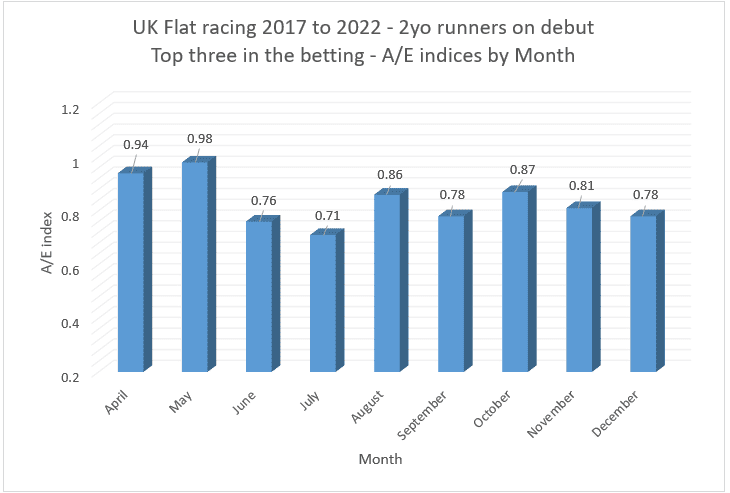
Monday Musings: A Glut of Shocks

Have you noticed, there seems to have been an astonishing number of long-priced winners of late? Lack of energy has restricted my analysis to a few days from the middle to the end of last week, with starting and finishing points designed to give the most biased slant to prove the argument, writes Tony Stafford.

Thus, I’ll kick off on Wednesday at Hereford when there were four winning favourites but 14/1 and 12/1 scorers. In the evening at Kempton, one winning favourite emerged alongside 25/1 and 10/1 winners with vanquished 8/11 and even-money shots, but the statistician’s delight came at Newcastle at the beginning of the afternoon.

Within half an hour, after the two opening races went to the market leaders, David Griffiths, no stranger to long-priced success, stepped in with 125/1 shot Endofastorm – my mate, Wilf Storey, sent out that 3/1 favourite Going Underground – unfortunately he did.

Half an hour later it was the turn of Keith Dalgleish. His four-year-old gelding Notimeforanother must rank as one of the all-time inappropriately named winners, so soon after the Griffiths filly and in his case just the 100/1.

But there are 100/1 shots and 100/1 shots and this one should never have started anything like that. Indeed, if certain members of the tipping/punter profession had looked carefully at the race, they would have come away with the value bet of all-time. They say you can’t eat value, but this one instance of it was a tasty dish indeed.

The decoy was his run the previous week over the straight one mile, ridden by the same jockey, Billy Garritty. Starting slowly, he trailed the field throughout and was beaten 33 lengths into last place. His rider reported he was never travelling.

He travelled all right on Wednesday, in midfield until nudged along by Garrity two out. He joined the Alice Haynes-trained even-money favourite, Regal Rambler, 110 yards out and beat him by a neck.

That was his fourth racecourse appearance, the second coming in an Aintree bumper where after showing initial promise at Market Rasen, he was the 11/2 third favourite but finished 33 lengths behind the winner.

Hanging under Jamie Moore in the closing stages, he appeared a likely non-stayer, at least at 2m1f on soft ground. The Market Rasen race was over 13.5 furlongs and he had started the 2/1 favourite and finished a good runner-up to the Don Cantillon-trained winner. I’ll keep you in suspense for a little longer as to that horse’s identity.

The previous October, Poetic Music had won the same Market Rasen race on debut for John Butler. She was sold to a new client of Fergal O’Brien’s for 60 grand at Cheltenham soon after and went on to win two more bumpers, including the New Year’s Day one at Cheltenham before finishing sixth to Facile Vega in the Festival Bumper at Cheltenham. She won first time over hurdles before being beaten by the smart Nicky Henderson filly Luccia in a Listed hurdle at Newbury.

The winner of the same 2022 Market Rasen juvenile bumper cost two and a half times as much to winkle away from the shrewd Mr Cantillon, the £150k being paid at that Cheltenham auction by a patron of Ben Pauling’s. Three days before Notimeforanother won at those incredible odds, the Pauling juvenile followed Poetic Music’s example by winning the New Year’s Day bumper at Cheltenham. Fiercely Proud, for that’s his name, could be very smart and no wonder Notimeforanother could win a low-grade 4yo and up novice race for the equally sharp Mr Dalgleish!

Moving on from Wednesday, Thursday at Chelmsford featured 40/1 and 22/1 scorers with no winning favourite and, while Ffos Las was a more even battleground, there were still 16/1 and 12/1 winners in West Wales. As for Wolverhampton, while four favourites did oblige, Clive Cox’s 1/9 shot Captain Pep, in the Middleham Park colours, never looked like pegging back a Tony Carroll front-runner which checked in at 16’s by two comfortable lengths.

Friday was more level pegging, but in less than half an hour on Saturday there were three notable reverses for lovers of short-priced favourites at Sandown, Wincanton and Cork. A safe haven for backers when times are tough is usually the Willie Mullins stable and with 24 winners in the past fortnight, there must have been room for some profit.

But it has taken him 98 runners over the busy Christmas/New Year period to amass those victories (including three yesterday, two long odds-on, at Naas) and 38 of the runners started favourite. One of those to be over-turned was the 1/4 shot Alastar in the opening maiden at Cork on Saturday.

This son of Helmet had smart form in France and Italy as a three-year-old but had not raced since November 2021 when unplaced in a Group 2 race in Italy. Bought for €150k that autumn, he was gelded early last year. So many of the international Mullins/Howard Kirk buys have lengthy preparation times before arriving on Irish racecourses, with everyone fully expecting the formality of a win. It’s usually the longer the gap the more certain it becomes and 4/1 on about him was hardly a shock.

What was surprising was that the Denis Hogan-trained jumps debutant four-year-old Action Motion, a 12-times raced 65-rated non-winner on the flat, could get the better of the 98 RPR-rated gelding by half a length at 20/1.

Two more short-priced reverses immediately preceded the Cork boil-over. First the Gary Moore French import, Bo Zenith, winner of his only previous start in Auteuil, started 4/11 for his UK debut at Sandown but in the rain-softened ground, he faded up the hill behind the Nigel Hawke-trained I Have A Voice, trailing home 27 lengths back in third. Third favourite at 17/2, this sound stayer looks to have a future and could be a candidate for the Boodles Juvenile Hurdle.

Between these two obliterations, the defeat of a 4/6 shot at Wincanton might seem small beer. Kim Bailey had expected his Top Target to follow his previous success at Wetherby, but after racing prominently, he had no answer to the finishing burst of the 50/1 Joe Tizzard contender I Shut That Door who simply sailed past on the run-in to win by more than two lengths.

Bailey was interviewed on Sky Sports Racing after his front-running chaser Moonlighter battled on gallantly to win at Chepstow yesterday and he bemoaned the season that he and his trainer counterparts have been enduring, not least the implications it has had in hindering the preparation of some of his better horses for Cheltenham, which looms barely nine weeks away.

The seemingly never-ending dry summer and then the very cold weather which wiped out jump racing for a week before Christmas have severely restricted most of his horses in how often he could run them. Those trainers who pressed on regardless often were taking risks and for those who haven’t, now realistically there can only be time for one or at a pinch two prep runs if conditions stay suitable from now on.

Mullins though is so powerful that he will again be approaching the Festival with a guaranteed clutch of favourites. Facile Vega, State Man and Dysart Dynamo all strutted their stuff with aplomb in the period in question (not that State Man will be favourite if as expected he takes on Constitution Hill!) and even if six odds-on shots from Wille bit the dust, the punters will not be dissuaded from seizing what they have come to regard as their annual spring piggy bank.

As to Bailey, 28 years on from his amazing Champion Hurdle (Alderbrook) and Gold Cup (Master Oats) double, he still retains all the enthusiasm and skill, now operating from his nicely-developing yard at Andoversford, a few miles outside Cheltenham. Those big wins came five years after his Grand National success with Mr Frisk.

There’s no doubt that with so many promising unexposed types in his care, the belief persists that a second win in one of jump racing’s Big Three could still await him as he enters the later phase of his glorious career.

Having been around for the entirety of that time, I have to say, I can never remember so many massively-priced winners, even a few for him. I believe it’s a function of Betfair’s domination of the betting market coupled with the weakness on-course and the effects of affordability checks.  Maybe the Editor, who was formerly chairman of the Horse Race Bettors Forum, could spell it out for me and you all!

 - TS

[I don’t know, really, though I suspect it’s most likely to be a combination of moderate racing and the uneven distribution of overround – where the top of the market offers tighter prices and the tail fatter odds – since the move to industry SP’s. That, of course, might be hogwash – Ed.]

My 2022 Betting Profit and Loss

As has become a bit of an annual tradition, each year in early January I share my personal betting P&L. To be frank, it's all rather mundane - certainly no financial fireworks at any rate - but I'm very happy to continue to 'walk the talk'. To be clear, that means having a huge amount of fun seeking out and making bets, and aiming to finish the year a pound or three in front. Fun first, profit second: two entities that are not mutually exclusive!

Here's the video. One quick line before you press play. I've sped up the tedious transaction management part of the video in the interests of respecting viewers' time (!) - if you'd like to look more closely, you can slow the video down via the little cog icon bottom right and the 'playback speed' option.

If you want to see earlier versions (weirdo! 😉 ), you can find 2021 here, and 2020 here.

[Please don't judge the amount of transactions associated with coffee and egg, or beer, spend!!]

Do feel free to share a comment, or ask any questions, in the section underneath the video.

Matt


Roving Reports: A Tale of Woe

A very happy New Year to all Roving Reports readers!

I expect you've tuned in here today to hear exciting tales of Newbury, Cheltenham and the like. Tales of daring, of bookmakers standing lumpy bets, of big Christmas crowds and even bigger Christmas bad beats.

Instead, good people, I have a tale of woe to tell you. No sooner had Boxing Day come and gone than this horrid virus that seems to have gripped half the nation managed to get a hold on me too, and for the last week I've been so ill I've been unable to do much other than sit on the sofa and watch the racing. This has its advantages in so much as I haven't had any early starts or humping the gear around in the rain but it also means that, at a busy time of the year, I've earned nothing in the past week. There's no sick pay scheme when you're working the pitches, you know.

I'm hoping to be back at Southwell on Friday night. I'll make a decision on that on Thursday, but for the time being, I'll tell you about the last time I worked, which was Huntingdon on Boxing Day.

This was to be Huntingdon's Boxing Day swansong, with the fixture being moved to Aintree next year and from that point on. It remains to be seen how well that works, as Liverpool is very much a football city and whether people can be persuaded to change sport (and indeed, tradition) is not a given.

I get a lift to Huntingdon with my good friend Daren, who picks me up nice and early from Loughborough. Sharing the journey there and back always makes for an easier day, as there's someone to discuss all your certain winning selections on the way there, and to moan about what bad luck you've had on the way home. (It's the same with the Lottery - I'm picking the correct numbers every week, it's only the machine that keeps selecting the wrong balls.)

As is usually the case here, I'm working with the Speechley firm, otherwise known as S&D Bookmakers. We've a heavyweight team here to run no fewer than five pitches, three on the rails, two in the ring, and once we've set up we get betting straight away. There's an hour to the first but we know today will be busy, and it is important to get business for the first, as once a customer bets with you they tend to stay with you on a day like this. The key is to be pleasant, and have a laugh, which is second nature to me anyway. Every customer is wished the best of luck for the day as they place their bet, although one customer is hardly full of Christmas cheer, spitting back at me "yeah, you don't mean that, you want us all to lose!" I explain to her that some customers today will win, some will lose, and I'll get paid either way, so I may as well be pleasant to everyone! She does not have another bet with me.

It's slow enough to get going but once we're in full swing, it's a steady stream of punters, most wanting £2ew on. That's fine, as long as you've a near endless supply of pound coins (inevitably they'll pull a fiver out) and I make the decision to make it £2.50ew as a minimum, unless they've the correct money. Which on a day like today, I think, is fair enough.

Loup De Maulde is a good result for us in the first, although business is quiet. As the race is taking place, a look out to the A14 shows there's a whole queue of cars still waiting to get in. Supreme Gift is no good in the second, although it could have been far worse as we take a £50ew A Definite Getaway at 66s. Three out he looks certain to be placed, and maybe even win; there's a sigh of relief when he's just run out of the places.

The car queue has disappeared and the place is heaving by Race 3. One thing you have to recognise as a workman is when someone's clearly lurking with a wad of cash, looking for a price, and it's your job to try and reel him in. There one such bloke in front of me, and I start a conversation. "What you looking for, mate?"

He's looking to have a 750-400 the jolly, Crystal Moon. It's 13-8 with us. I offer him the middle ground of a 700-400 but no, he's insistent 15-8 is what he wants. Can't say I didn't try. When it wins, I feel I did the right thing standing my ground.

A stewards enquiry is called. Now, on a day full of once-a-year punters, that's the last thing you want. Those wanting payment are now milling about, waiting for the bing-bong to tell them their fate. This also has the knock-on effect of decreasing business by about 50% for the next race. Folk won't bet if they don't know how much they have to bet with. I'm keeping punters entertained with a joke or two whilst they wait and they really do have to wait, what looks a fairly cut-and-dried places-remain-unaltered verdict is taking more time than thought. Finally that announcement is made, and we can get paid out. Then... the rush begins.

They are at the post with around two minutes to the off and now everybody wants on. I've a queue of about 15 that isn't getting smaller. I'm flat out trying to clear it, which I do with about a minute to go.

Normally, with about 20 seconds to the off, I will stop betting as Jason, running the master book, needs that bit of time to make sure the book is how he wants it, and any late big bets that come raining in from the satellite pitches can easily affect it. However, having cleared my queue, I look up and all I can see is...queues either side of me.

I can't resist a challenge. "NO QUEUE HERE!!" I shout at the top of my voice. Like a pack of meerkats, up pop a hundred heads. The next 60 seconds are a blur as the twenties, forties and fifty pound bets are thrust my way. I'm serving two at a time, almost, to get everyone on. The horses are lining up to go. "Keep betting!" I say to Andy, on the keyboard and punching the bets in. More twenties and forties. We just - just - get them all on as they jump. The first thing I do is go and apologise to Jason for leaving him no time to sort his book, but he's not bothered! Better taking the money than not, he says.

We get a result with the aptly-named Seelotmorebusiness, Harry Derham's first runner which, strangely, has gone unbacked and drifted like the proverbial barge.

William Cody is no good in the next but Jason has decided I should bet the King George on my board, and so I give it a roar. Business for the big race is steady, but a £500-£200 Bravemansgame ensures it isn't a winning one.

Back to Huntingdon and my favourite £2ew punter of the day is back. She's having £12 on every race and has drawn every time so far. This time she backs Supasunrise and Master Malcolm ("because my brother is called Malcolm" - yes, it's that sort of a day) as two of her three bets this time and true to form, she's got the winner and third.

Billy Boi Blue is as bad a result for the payout as possible in the last, as everyone knows a Bill, or Billy, or Mac or Buddy, as Sheryl Crow might have sung, and that's the end of that. We've had a great day though, and as we pack away the gear and get paid, there's a definite sadness we won't be here next year.

That ought to be the end of the tale, but when I get home, I get a text from Jason.

"You've not got any money on you, have you?"

This is a text that sends your heart sinking, as it means the money is wrong. Now, it has been known for me to walk off with some of the float in my pocket. I once got home from Southwell, turned my pockets out and two nifties fell on the floor. I was horrified, as I knew they weren't mine. I rang Rob to ask if the float was short.

"Exactly a oner," came the reply.

"I think I might know where that is..."

One of the reasons Rob employs me is that he knows I'm honest all the day long, and if there's money missing it'll be a genuine mistake. However, after checking every pocket and bag I've taken with me, I find nothing. That gnaws away at me all night but I'm pleased when Jason finds a fair bit of it after a recount. Some margin of error is perfectly acceptable on a busy day like today but you don't want it miles out. I shall sleep easier now...

That is, until, the flu kicks in the next day. Best of 2023, everyone.

- DM

Meeting Charlie Johnston

The most predictable thing about Mark Johnston is his unpredictability, writes Tony Stafford. When most Scotsmen would be thinking of First Footing on New Year’s Eve, his mind was set on Last Running as he let it be known publicly that his entries in conjunction with son Charlie at Wolverhampton on that Friday evening would be his last.

That left Charlie Johnston, 32, as the sole licence holder at Middleham’s Kingsley House Stables. That long-standing name nowadays more importantly incorporates the magnificent Kingsley Park with its independent gallops less than a mile from the High Street.

Middleham has a wide range of excellent existing work facilities available to the other trainers in the area, which Johnston used for the longest part of his 34 years in the town. But with the stable size swelling beyond 200 horses, it became clear there was a need to ensure continuity of exercise every day. As anyone who knows Newmarket will tell you, delays of getting onto the gallops if stuck in behind a big string can be frustrating for trainers and cause difficulties for horses with the potential for over-excitement.

Thus Kingsley Park was designed, and is organised in eight self-contained stable blocks, all with access to the most up-to-date swimming pools, water treadmills, and with the veterinary and farriery expertise needed to keep the massive show on the road. They are all within yards from stepping on to the various gallops, be they grass or artificial. Each yard has its own manager, reporting directly to the management team and several assistant trainers, the best-known being the admirable Jack Bennett.

Since qualifying as a vet, Charlie has been increasingly involved in the family business and he, his father, and mum Deirdre form the Board of Directors. It was at their quarterly Board Meeting on December 1st that the suggestion of a more immediate change-over was first mooted. Let Charlie explain.

“When we first applied to the BHA for the joint-licence, which began on January 1st last year, we all had it in our minds that it would probably be something which would continue for four or five years as a partnership. It quickly came down to more like two years as the transition had gone smoothly from the outset.

“Then at the last Board Meeting, Dad said: “What about January 1st?” We looked at each other and everyone seemed to like the idea. It had the obvious benefit of making for a tidy transition.”

The first step was to check with the BHA that it could be arranged in time. Then the owners had to be consulted. Charlie said: “As of January 3rd, none of the owners has disagreed with the new arrangement. Of course, Dad will be here every day as usual and all the planning processes that have been in place for decades to decide what and where we run will continue unchanged.

“Mum will, as ever, be riding out her two lots on racehorses every morning, then go across to look after her eventers. She will also continue travelling the country and the world watching eventers she has with other people. The only thing really that will change in the short term is that, when they go on holiday, the phone won’t be ringing non-stop.”

After initially training in Lincolnshire, Mark and Deirdre Johnston moved to Middleham in 1988 buying Kingsley House which, at one time a decade or so earlier, had a less reputable incumbent in Ken ("Window") Payne, the one-time selling-plate king who I knew originally in the days when he trained in the New Forest.

One of his most famous episodes at that time was when he saddled two horses in a four-runner seller, putting his own apprentice John Curant on the “trier” and Lester Piggott on the wrong one. They were the right one (for Ken) and the wrong one (for the betting public) as, Big Jake I seem to remember, strolled home from Mr Bojangles and the Long Fellow.

It was while at Middleham that Payne took charge of a syndicate horse I organised with fellow Daily Telegraph journalists and habituees of Coral’s betting shop in Fleet Street. These included, bizarrely, two punting band leaders in Mike Allen and Trevor Halling – father of boxing commentator, Nick Halling.

Halling senior incidentally got such a kick from that connection that he made a new career in racing journalism in the south-east and was a long-standing regular at Lingfield and all the Sussex tracks. My friend Keith Walton, who is a former boxer who trains professionals, also coaches several Northern jockeys in the skills of the noble art. Keith, a regular on the racecourse in the summer, has a top prospect in David Crawford, known locally as the Black Panther. He promises that when Crawford next appears on a televised bill, he will ask Nick Halling about his father’s health.

Returning to Payne, a horse called Princehood started for us with the remarkable veteran Louie Dingwall who trained on the beach at Sandbanks, in Dorset, where her shack, with its own petrol pump, would represent at least £1 million worth of real estate nowadays – ask Harry Redknapp! One day, aged 86, and with limited vision, she drove her horsebox all the way to the south of France and won the Grand Prix des Alpes-Maritime and £13 grand with Treason Trial, her own horse.

Princehood, a 300gns auction buy, did nothing while in Dorset, but, sent north, won a BBC televised sprint on a Saturday at Lanark just before it closed in October 1977. In typical Payne fashion, he had told us to back him two days earlier in a modest race at Doncaster where he ran a stinker. Nobody had the foresight to take the 14/1 as we watched with dismay during our work break in the King and Keys pub in Fleet Street that Saturday.

Payne’s time at Middleham had various controversies, one of which was the suggestion that as more owners were attracted to the stable, it outgrew its capacity and there were instances of multiple occupation of boxes, fine with a mare and foal, but less advisable with hard-trained racehorses. Also, his accounting was reputedly off course, with it often taking several more than four quarters in a horse to complete the ownership whole! After his wife had gone off with the singer Gilbert O’Sullivan, Payne reputedly went to live in America with his male hairdresser!

The Johnston days happily have been much more conventional. From the outset in 1988 and by October 2017, in saddling Dominating to win at Pontefract, Mark became only the third trainer to saddle 4,000 winners in the UK. Less than a year later, Poet’s Society (Frankie Dettori) won at York at 20/1 to make it a record 4,194 wins and then, in August last year, Johnston crossed the unconscionable milestone of 5,000 victories when Dubai Mile won at Kempton.

Thus, with just the 5,000 (and a few) to aim at, Charlie set off with a 33-1 fourth at Lingfield on Monday and has runners all week from today (Wednesday). Everyone will be wishing this personable young man all the best.

One thing that hasn’t yet taken much of his attention is the use of the family plane, which Mark flies all over Europe and which Charlie concedes is a massive help in the organisation of their time.

“No, flying the plane is probably something that might happen eventually. There is no doubt that it has been a great advantage to be able to supervise everything on the gallops for two-thirds of the morning and still be down at Ascot or Newmarket in time for the first race at 2 o’clock.

“I’m not sure that as well as handing over the licence, Dad will be too excited about being an unpaid pilot for me; but flying has helped keep us in touch with everything, and it would be a shame if it were no longer available to us” he said. It would also make that lovely grass runway just behind the barns a severe waste.

Mark Johnston is relatively young at 63, compared with other senior trainers like Sir Michael Stoute and John Gosden, the latter now named on a joint-licence with son Thady. But, as Charlie says, “He didn’t want to go on indefinitely. He and Mum have built all this up from nothing, and he never wanted it to just fritter away. I’ve no intention of that ever happening!”

Don’t worry   - it won’t!

- TS

Your first 30 days for just £1