Read all sorts of commentaries and tips across a range of racing disciplines on the most popular horse racing blog in Britain, from staff and guest writers.
It's Dante day, and I'm on the iron horse headed north to the Knavesmire. While I've a moment I wanted to share a few notices about various things, some of them even related to horse racing...
HBF Survey
As longer suffering readers will know, I used to be Chair of the Horseracing Bettors Forum, a group of racing punters trying to lobby for the interests of all punters. It's a pretty thankless task, I can tell you, often because we - they - don't really know exactly what's vexing other bettors.
Well, with that in mind, HBF has released its one question survey, which asks respondents to order some items from most to least important. On the basis of the replies they get, that will inform their agenda for the coming year.
It will take you literally a minute or so to respond, please do if you want to contribute to the direction of travel for HBF.
Again, those who have been around a while know that each July/August I offer my thoughts on the upcoming footy season with a little multiple bet. They're the proverbial curate's egg - good in places - and are shared as a footy/betting fan rather than any kind of expert.
Anyway, this season's play has done OK - here's the original post - and last night PSG sealed the French title while Stockport County booked their place at Wembley. To the stakes I played, that's £168.92 of £240 returned, with three tickets still live on County.
The current cash out offer is £391 or so, which will go up or down a little depending on whether Bolton finish the job away at Bradford.
If Stockport win the play off final, those three tickets return around £930 - or of you played for £2 stakes, £93. So it's worth thinking about hedging a little. I'm going to take one team out of the equation by waiting for the result of tonight's match, and will then lock in a bit of profit - most likely by backing Stockport's final opponent (though I haven't fully decided yet).
Of course, you may have already elected to cash your tickets for a profit of £320 after stakes are accounted for (or £32 for £2's)... entirely up to you. I'm just wanting to highlight that if you followed me in, we're in a strong position and should be pondering getting a bit of jam...
Geegeez
A couple of things on geegeez development. We've moved our development server this past fortnight, and it's not been straightforward. It doesn't affect live operations, but it has slowed down a couple of things I was hoping to have released this week. They're just about ready so with a following wind the first - new sectional results - will land next week.
I'm also conscious that for some users the report suite is slower than you'd like. It's also slower than I'd like. We're looking at a candidate solution for that and will be working up a 'proof of concept' in the coming weeks. If it flies, we'll be making some fairly major changes - all invisible to you, except for the speed uplift - in the background in coming months.
QT 2.0 is almost ready, featuring a raft of new variables across current run, last run and second last run... but I want to freshen the interface as well as upgrade the query options. That pushes the timeline out, too, I'm afraid... but it is happening!
So, there's a lot going on even though it may not appear to be the case. Bear with us for just a little longer.
Mindset
Apropos of nothing... actually, it popped up on my x feed because it got auto-posted on our geegeez account on that platform (give us a follow)... I re-watched for the umpteenth time a webinar I recorded a few years ago about 'setting up to succeed'.
I appreciate how narcissistic that probably sounds, but it's actually - and quite surprisingly, to my ear/eye at least - full of good sense that I value being reminded of twice every three years or so. If you've not seen it, or even if you have, it's one of the best things I've done and you can (re-)view it below if you'd like.
French Open tennis
And finally, or enfin if you prefer (you probably don't), the French Open tennis - the second Grand Slam of the season - gets underway on Monday at Roland Garros in Paris. There will be no Carlos Alcaraz, injured, so it's a reasonable opportunity for Novak to chase that elusive record-breaking Slam title. Alas, Sinner is currently in imperious form... Meanwhile, the women's draw looks more open, but the slower surface makes all matches more watchable - and more bettable!
One of my other projects is a website called tennisprofits.com, and for the next couple of days there's a special discounted Triple Slam ticket available. It covers the hottest four months of the calendar, taking in the clay in Paris, the grass is London and the hard blue courts in New York - and everything alongside and in between.
Four months' access for the price of three... and we're close to releasing a system builder there, too, which I think is just about the first of its kind. I made a little video which you can watch here if that sort of thing interests you, or might do.
TennisProfits.com is a very cool site where I get to look after the tech side and leave Paul Shires, our resident full-time pro trader, to be the subject matter expert. Dave Renham also chips in with some typically thought-provoking articles on his other wagering love. Oh, the link for the Triple Slam ticket is here.
That's all, we're done...
Right, back to trying to find a winner at York. Low was strongly favoured in the sprints yesterday, but my guess is they'll over-water to compensate. I'll be having a close look at how Persian Spring goes, drawn 10 and likely getting a late late show steer from Jamie Spencer, before deciding whether to play low in the two ensuing five furlong dashes. On the front is normally the way over the minimum here... but high or low remains to be seen.
Good luck,
Matt
https://www.geegeez.co.uk/wp-content/uploads/2021/04/racingfotos_54810711165.jpg319830Matt Bisognohttps://www.geegeez.co.uk/wp-content/uploads/2022/10/geegeez_banner_new_170x78.pngMatt Bisogno2026-05-14 06:36:052026-05-13 22:49:16Parish Notices, May 2026
And now the thinking starts, writes Tony Stafford. Ryan Moore has won two of the last nine editions of the Derby at Epsom for the Aidan O’Brien/Coolmore juggernaut, on Auguste Rodin in 2023 and City Of Troy the following year.
O’Brien has won six of the last nine. That means Ryan missed out on Wings Of Eagles (Padraig Beggy) in 2017; Anthony Van Dyck (Seamus Heffernan), two years later; Serpentine in a deserted Epsom in Covid year 2020 (Emmet McNamara) and Lambourn (Wayne Lordan) last year.
If you think one in three is bad luck, imagine Ryan’s conundrum this time around. Ballydoyle has the first five in the betting (or did before Pierre Bonnard’s defeat at Leopardstown yesterday) as O’Brien aims to make it 12 wins in the race, extending his own record. As previous history shows, he can win with any of them.
Victory for the stable will inevitably extend Michael Tabor and Sue Magnier’s tally to an eye-boggling 13 - Pour Moi won it for them from the Andre Fabre yard in 2011. Long-time associate Derrick Smith came on board after the initial two victories for the stable, first for legendary stallion Galileo (2001), and High Chaparral the following year.
The two winners that Ryan did ride in that period (he also has two more earlier) both have their first foals on the ground this year, so there’s a chance some might be seen at the foal sales in the autumn. It’s likely though that many will be retained for racing. Those that do come on the market will be almost as eagerly sought as the initial progeny of Frankel following his unblemished racing career which gave such credit to Galileo, his sire.
Of the other quartet, Wings Of Eagles was a 40/1 shot when winning his Derby and then broke down within sight of the winning post at The Curragh, never to race again. He’s standing for €4k at one of Coolmore’s NH stud farms and is already getting some nice jumpers to his name.
Anthony Van Dyck was fatally injured during the running of the 2020 Melbourne Cup, won by Aidan O’Brien’s son Joseph with Australian-owned seven-year-old Twilight Payment.
Serpentine’s story deserves re-telling. In the Derby he was one of six O’Brien runners, the most fancied being Moore’s mount, Mogul. He was never to get into the race, like many others, while McNamara immediately sent Serpentine to the lead. He was a dozen lengths clear of the field at the three-furlong pole and held on to win unchallenged by five lengths with a strong tailwind blowing him home.
McNamara, who didn’t record a single race ride in his native Ireland that year, was immediately replaced on the horse, Christophe Soumillon taking over as Mogul and Moore gained their revenge in the Grand Prix de Paris that September. Mogul, a 3.4 million guinea yearling, won two more big races later that year. Coolmore originally stood him as a NH stallion. Now, along with fellow former O’Brien trainee Capri, he remains in Coolmore ownership, both horses having relocated to Wood Hall Stud in Shropshire, fee £2,500.
Serpentine, having collected the Derby on only his fourth race following a wide margin maiden victory at the third time of asking, never approached those heights in his career for Aidan, even trying 2m4f for the Gold Cup at Ascot the following season.
In all, Serpentine, who was gelded and then sent to Australia, has now raced 31 times and managed only one more success – over 1m2f. His latest effort on New Year’s Day 2026 was in a Group 2 handicap in which he finished 14th of 15! I doubt we’ll see much more of the nine-year-old, but in Australia anything goes.
Lambourn might have been demonstrating something of a Serpentine manoeuvre last year when making all while Ryan on favourite Delacroix got stuck in traffic some way behind and finished only ninth. That Delacroix could return to the track as soon as the Coral-Eclipse a month later and beat Ombudsman revealed his true merit. He stands at €40k at Coolmore.
Lambourn’s successful return in the ten-furlong Huxley Stakes at Chester last week confirmed him as more than just a one-pacer. It took plenty of pluck to hold off Bay City Roller but whether he’ll beat stablemate Jan Bruegel, not to mention Calandagan, in the £1 million Coolmore Coronation Cup at Epsom next month is another matter.
Until Isaac Newton showed his limitations in the Lingfield Derby Trial, won by William Haggas’s Maltese Cross narrowly from Ralph Beckett’s Bay Of Brilliance, O’Brien had mopped up all the colts’ – and for that matter fillies’ – Epsom trials.
As a result we have Benvenuto Cellini as 5/2 favourite after sluicing home in the Chester Vase; Constitution River next at 5/1 after winning a no-contest Dee Stakes following a long layoff; while Christmas Day, due to run in the Dante on Thursday at York, is a 12/1 shot along with Futurity winner Hawk Mountain, who reappeared with a smooth win at Longchamp in the Prix de Guiche a week yesterday.
In between we had Pierre Bonnard, smart last year but behind Christmas Day when they both returned to action last month. His effort in the five-runner trial at Leopardstown yesterday when beaten in a tight finish by son Joseph’s James J Braddock would seem to have diminished this one-time strong candidate’s chance on June 6.
And it doesn’t necessarily end there. After Aidan’s big five, there were another 11 still in the Betfred-sponsored Classic at the latest stage, from 37 entered all told. There’s still time for a Wings Of Eagles to emerge, although he did win the Dee Stakes, or a Serpentine to come from nowhere.
It won’t be an easy choice for Ryan – let’s hope the best jockey of his time gets it right. He certainly has come back from last year’s long spell on the sidelines with renewed vigour and possibly his best-ever standard, and that’s saying a lot!
Among the fillies, Amelia Earhart (5/2) supplanted the Gosdens’ I’m The One (5/1) as Oaks favourite with a comfortable success over that rival in the Cheshire Oaks, and it’s big odds bar the pair with the exception of Diamond Necklace, more likely heading back to Paris for the Prix de Diane. That Chester race felt beforehand like a re-match between the two big Oaks contending stables on a par with when Enable (John Gosden) easily beat O’Brien’s very smart filly Alluringly in the Vase before trouncing Rhododendron, Auguste Rodin’s mother, by five lengths at Epsom on her way to glory.
Over at Longchamp yesterday, under awful weather conditions and rapidly deteriorating going, the O’Brien team were expecting more success in the two French mile Classics. In the Poulains, for colts, late switch Puerto Rico, who was initially regarded as Coolmore’s 2,000 Guineas choice instead leaving that race to its runner-up Gstaad, started the 11/10 favourite. Disappointingly, he could finish only fourth behind the Francis-Henri Graffard, Mickael Barzalona, Aga Khan Studs horse Rayif.
The winner, drawn ideally on the inside, raced just behind the sole UK runner, Karl Burke’s Hankelow, then quickened off the last slight bend and won smoothly from a challenging pack. They were led home by the Andre Fabre/Godolphin runner Komorebi and William Buick, who finished strongly to pip Hankelow for second. Puerto Rico was a one-paced fourth and stablemate Dorset sixth.
In the fillies race, the Pouliches, O’Brien had the favourite in Diamond Necklace. Unbeaten in three starts at two, including in the Marcel Boussac on Arc Day, she and Ryan followed the Barzalona route up the inside and strode away majestically for an extremely easy success.
A filly from the first crop of the very smart St Mark’s Basilica, Diamond Necklace has the look of a potential champion. She was not inconvenienced by the soft ground and already it’s shaping up as a battle between her and 1,000 Guineas winner True Love, not to mention Precise, as to which is the best and where they might all be going next time out.
This was surprisingly only a second win for O’Brien in the race after Rose Gypsy as long ago as 2001, when she was a contemporary of Galileo. A lot of water has flown under Coolmore’s bridge since then.
**
Just one oddity from Saturday’s racing. When William Knight’s homebred five-year-old mare Royal Velvet made a successful step up to Pattern racing with a smooth success in the Group 3 Chartwell Stakes at Lingfield, that was her ninth win from only 21 starts. Of her 12 defeats, none has been in second place and she has recorded only one third placing.
That shows as she has gone from a rating of 69 to 99, when a race gets serious there is usually only one winner. Congratulations to Suzie Hartley, her owner, recently the subject of open-heart surgery but there to see her pride and joy give her a recuperative boost. It won’t be the last time either. Ascot here they come!
An initial investigation into Geegeez Instant Expert
I wonder how many people who read my weekly articles here are Geegeez Gold members? If you are, I think you're going to like this one... and if not, maybe it will give a gentle nudge to try things out, writes Dave Renham.
Introduction
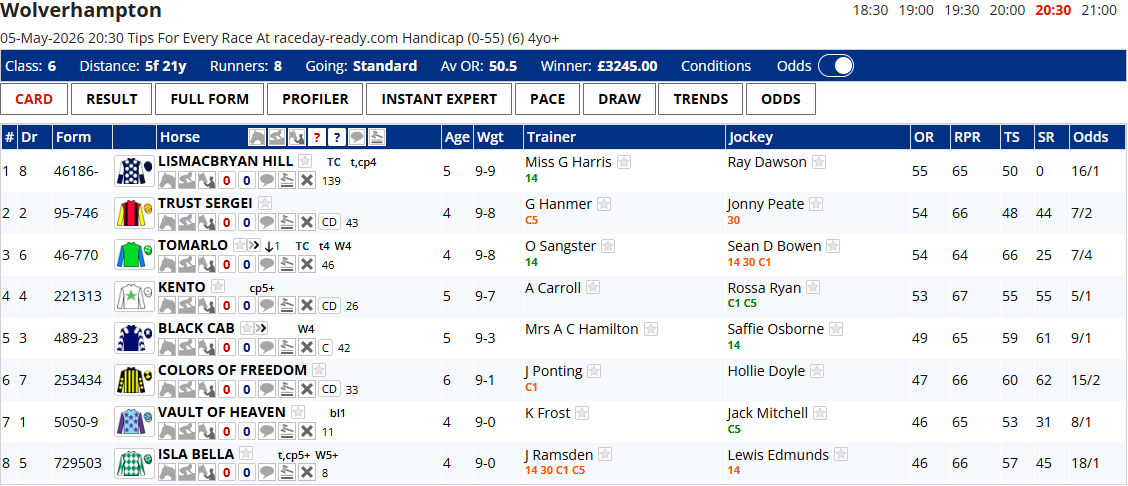
One of the many benefits of being a Gold member are the daily racecards. These give far more ‘bang for our buck’ compared with other racing sites. Below is a screenshot of the racecard for a contest at Wolverhampton on Tuesday 5th May of this year:
As we can see, there is the usual type of information we would see on most racecards such as the draw, recent form figures, name of the horse, age of the horse, weight carried, the trainer, jockey and official rating. However, we also get to have the Racing Post Rating (RPR) for each horse, the Racing Post Topspeed figure (TS), and Peter May’s excellent ratings (SR).
These extras are just the start, as if we cast our eyes to the top of the Racecard we can see some tabs: Full Form, Profiler, Instant Expert, Pace, Draw, Trends and Odds. Clicking on these tabs presents a wealth of further information and data in order to assist with our race analysis. There are also some icons just below these tabs (between the word ‘Horse’ and ‘Age’) with breeding data, jockey and trainer form etc, etc. So, to coin a phrase, these racecards are literally gold!
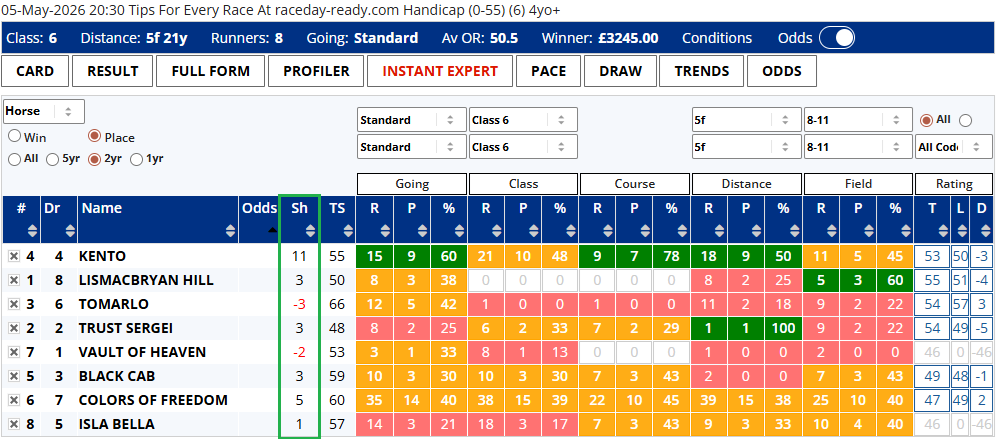
In this article I want to focus on the Instant Expert tab in a little more detail. This tab is exclusive to Geegeez, and the tab lets us see a variety of key data for horses as shown below using the same race as above:
Instant Expert gives us punters key horse information. It has a unique ability to summarise the form profile of every runner in the race into a single easily digestible view. It covers the form of each horse in terms of wins (or places), runs, and win (or place) percentage for each of five key areas namely going, class, course, distance, and field size. It also compares today’s official rating for each horse with their last winning official rating. The display is colour coded to help see things more clearly at a glance: green for a higher percentage rate, amber for a middling percentage, and red for a low percentage. Horses with no form under a certain condition have grey figures. It should be noted that the past data is taken from UK and Irish racing only so will not include overseas form.
Users have the ability to change parameters easily. In the above example I am using placed form over two years. This is my favoured combination, but at the touch of a button we can change this to one or five years, or even look beyond that for older horses using the ‘All’ tab. We can look at win data only if preferred over any of the four-time frame options. Also, we can expand individual areas if required; so for example when I look at All Weather races, after looking at the stats for the specific going, I will click the going tab, so it includes both standard going and standard to slow to give me extra data. Clearly, we can do the same with all other variables should we wish and I will often do this for longer distances on the distance dropdown. For example, if a National Hunt race is being run over 2 miles 1 furlong, I will expand a little by including past results from any race from 2 miles to 2 miles 2 furlongs.
In addition to drilling into each horse within the five key areas, we are able to look at sires, trainers and jockeys within those areas too should we wish. Sire data is particularly useful for 2yo races for example, when the majority of runners have little or no past form to speak of. Trainer data is something most punters like to look at, and I will always look at the trainer data when analysing any race. This Instant Expert tool is exceptionally useful, and we can crunch so much data within a matter of a few seconds.
In the last few months there has been a new addition to the Instant Expert template, namely a new column with scores based on The Shortlist scoring system. Green percentages score three points, one point for amber, none for grey, and minus one for red. Hence across the five areas horses can obtain a top score of 15 (five greens) and the lowest score is -5 (five reds). The scores update when you change the variables and dropdowns above the main data grid. In the screenshot I shared above, the Shortlist column has the heading ‘Sh’ and is highlighted in the green box.
In this race, we can see Kento had the highest Shortlist score of 11, whereas Tomarlo had the lowest figure of -3.
Having set the scene, I am now going to share some research I have undertaken connected with these Shortlist scores. I have used a data set that I used for run style / pace articles a year ago, in May 2025. I will be looking at 5f handicap data from the whole of 2024 with the exception of 2yo handicaps, or nurseries, due to limited past horse form.
This sample covers 575 races and over 5000 horses with their individual Instant Expert Shortlist totals. This, therefore, is a reasonable sized sample, and I must say that adding over 5000 Shortlist scores to my Excel sheet was not the quickest process! [We're very grateful! - Ed.]
After all the leg work to input these individual scores, I hoped that I would find something worth sharing! Let’s see…
I am going to write this research up while crunching the numbers so, at this point, I do not know which way this will go. Normally, I do all the research, then crunch the numbers and then write it up. Therefore, it will read more in the present tense than usual.
So, to recap, the highest possible Shortlist score is 15 and the lowest -5 so one area I plan to look into will be the performance of different individual Shortlist scores. I guess the hope is that the higher scores, 12, 13 and 15, (14 is not a score that can be achieved), would certainly win more often and hopefully prove better value, than the lowest scores such as negative values of -1 to -5. However, there is a slight caveat to this because there will be plenty of races that are contested by horses with modest or poor long-term records and hence a Shortlist score of 3 or 4 could in fact be the highest Shortlist score in the race; so I will also need to rank the Shortlist scores in each race. One would hope and indeed expect that the higher ranked positions would win more often than the lower ranked ones and, assuming that is the case, does that lead to a difference in returns?
In terms of these ranked positions, there will be some horses in most races who have the same Shortlist score and therefore they will be treated as ‘joints’. In other words, if we have a five-runner race and the Shortlist scores are 13, 11, 8, 8 and 0 then the horses scoring ‘8’ with be ranked both ranked third, there will be no fourth ranked horse, with the horse with ‘0’ being ranked fifth. Fairly obviously I hope the 13 score would be ranked one or top, with the ‘11’ second.
In this article I will start by looking at the results with no price cap as I just want to examine the raw data first. Obviously, the odd big priced winner could skew the bottom lines, but I will mention it when that happens. I will probably use a price cap at various junctures, I’m just not sure exactly when as yet.
Instant Expert Shortlist (Sh) – Performance by Rank
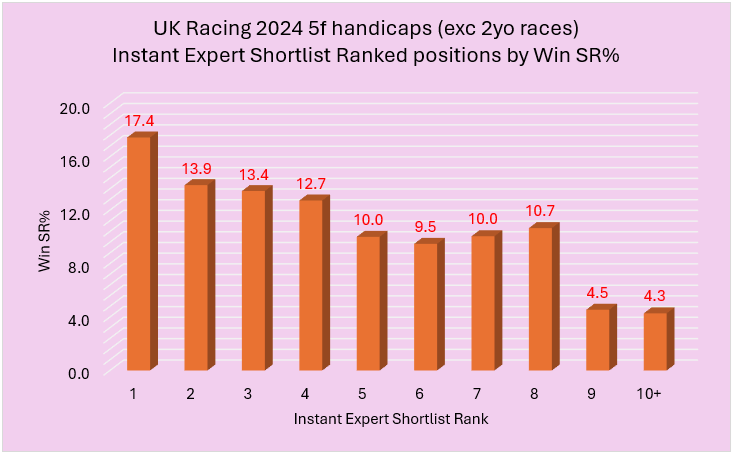
My starting point is to look at the ranked positions of the Shortlist scores across all the handicap races in my sample. I began by comparing their win percentages / win strike rate. The graph below shows the breakdown:
The hope was that we would see the usual sliding scale from left to right as we normally do when we look at any type of ‘ranking’. Generally, that has been the case here, although those ranked seven and eight are slightly out of kilter. I think because there were a good number of ‘joint’ positions we should expect slightly more overlap than normal. The good news though is when we look at either end of the graph we see the top ranked runners winning the most often and those ninth or worse winning the least. Not only that but the top ranked have by far the best win rate and likewise those ninth or lower have by far the worst.
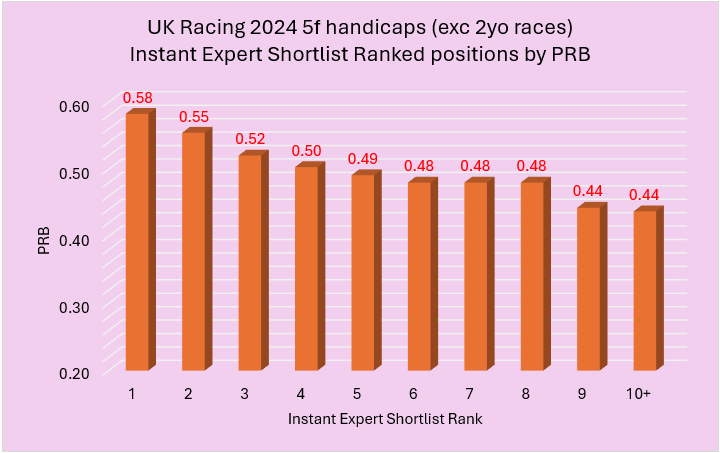
To build the picture further I want to look at the PRBs (Percentage of Rivals) for each rank. This metric essentially creates much bigger sample sizes as the figures are affected by all the runners in every race. Hence, I am hoping this graph will have the near perfect left to right sliding scale:
0.58 is a strong PRB for the top ranked and we essentially see our ‘normal’ type of graph when analysing the performance of ratings or in this case rankings.
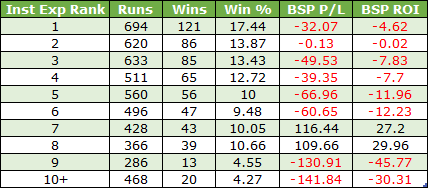
So, how does all this equate then into profit and loss returns? As I tend to do in all my pieces, I will use Betfair SP (BSP) less 2% commission on any winning bets for these calculations. Here are the splits:
As far as I am concerned, it makes excellent reading if focusing solely on either end of the table. The top ranked runners have by far the best win strike rate, while the top two ranked runners combined have seen very small losses overall. Meanwhile those ranked ninth and tenth have produced significant losses of nearly 46p and 30p in the £ respectively. These definitely look to be horses to avoid.
However, we can see that those horses ranked seventh and eighth both made decent overall profits. At first glance this is not ideal as I would have preferred to see any profitable figures at, or near the top of, the table. However, both of their profit figures have been skewed by one big priced winner in each case. A horse called Rainyniteingeorgia won at Lingfield on 22nd December 2024 at the odds of 127.21 when ranked seventh. Take that winner out, and the remaining 427 horses ranked in seventh place would have made an overall loss. In terms of the eighth ranked winners Big Nut won at Musselburgh in August ‘24 at odds of 80.0 which wipes out a huge chunk of the eighth ranked runners’ profits.
Instant Expert Shortlist (Sh) – top two ranked runners
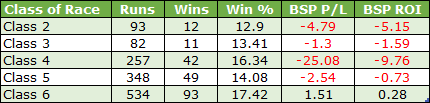
I want now to dig into the top two ranked runners in a bit more detail as when combined together they have not been that far from breaking even (losses of just under 2.5 pence in the £). With these combined results I am going to see if they have performed better or worse within different areas. To begin with, I am going to look at Class of Race. Here are the splits for each Class level combining the results of the top two ranked runners:
The figures do not fluctuate massively. Lower win rates in Class 2 and 3 races is what I would expect as these races tend not only to be very competitive but have bigger fields. Bigger fields mean lower win percentages. Also, the data sets for both of these class brackets are relatively small. Returns are similar across the different classes, although in Class 4 races the losses were a tad above the rest.
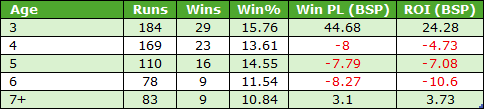
How about if we split the top two ranked runners by the Race Age Classification? There are three main types being 3yo only races, 3yo+ (races for horses 3 years old and older), and 4yo+ (4 years old and older races). There was one 6yo+ race in the sample which is obviously too small to worry about!
Before digging into the stats for each I am hoping to find slightly better results for the more exposed runners, namely the 4yo+ races. I am also expecting that the 3yo+ races would be the least predictable with less exposed 3yos running against more exposed rivals. However, I have been known to be wrong before! Right, let's see how the top two ranked runners have fared across the three different age classification types:
The 3yo only results are interesting; definitely better than I would have expected. The results for the 3yo+ and 4yo+ races seem to match my initial hypothesis which is pleasing. There is a significant difference in the strike rates between 4yo+ and 3yo+ races for these top two ranked runners. Also, the 4yo+ results for these runners see very decent returns of close to 16p in the £, compared with losses of over 17p in the £ in 3yo+ races.
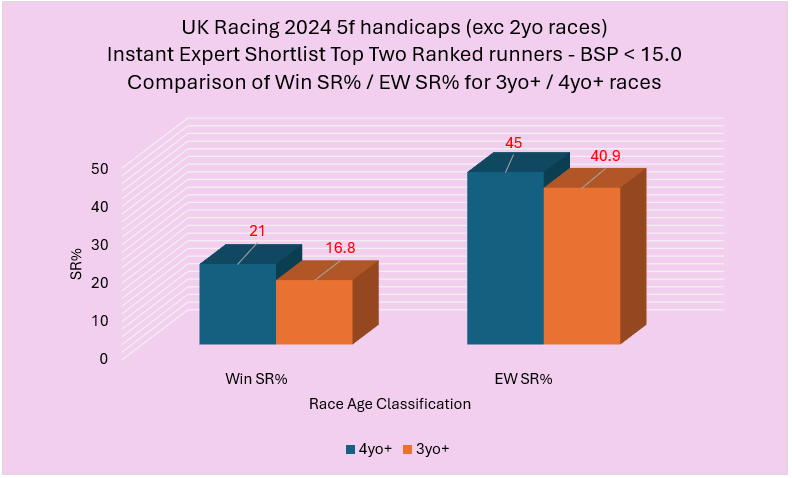
However, before we get too carried away, the 4yo+ figures did have a BSP winner of 55.0 which accounts for a decent chunk of the overall profit figure. Therefore, it makes sense to implement a price cap when comparing these 3yo+ and 4yo+ results to avoid bigger priced runners potentially skewing bottom lines. Thus, for the next dataset I will include only horses that were priced under 15.0 BSP. Let's see if this changes things or not. I will build up the tension by first comparing the win and each way (win & placed) percentages for each:
We see positive correlation with the 4yo+ top two ranked runners having outperformed their 3yo+ counterparts in both the win percentage and the EW percentage. This also correlates so far with what saw before I introduced a price cap. What about the profit/loss returns? The table below shows the splits and does the 4yo+ group come out on top as before?
They have indeed, and comfortably so. Based on this sample, and I appreciate it is just one sample of races, it seems that the top two rated runners from the Instant Expert Shortlist scores should be considered a strong positive in 4yo+ handicaps.
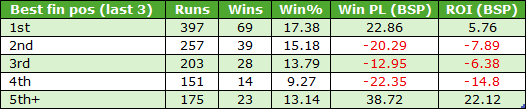
Sticking with 4yo+ handicaps, how have the top two rated performed when they finished first, second or third LTO? Let’s find out:
These figures are very impressive with each one showing a profit. I should add a caveat that each individual LTO position sample is fairly modest. However, to create a bigger sample, if we combine the results to include any horse that finished in the top three LTO we get 50 wins from 195 (SR 25.6%) for a healthy BSP profit of £54.17 (ROI +27.8%). Based on these findings, horses that finished in the first three LTO require close scrutiny if racing next time in a 4yo+ handicap when in the top two of the Instant Expert Shortlist scores.
Shortlist Rank Comparison: 3yo+ Handicaps vs 4yo+ Handicaps
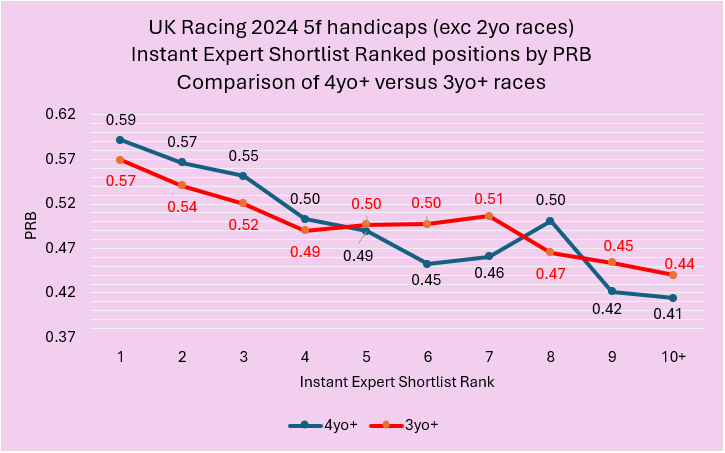
Before finishing I want to share the PRBs for all individual Instant Expert Shortlist ranks for both 4yo+ handicaps and 3yo+ handicaps. We have seen already that the top two ranked runners have performed much better in 4yo+ races. How about using a PRB comparison across the board? The chart below gives us a neat graphical comparison:
This graph perfectly illustrates why, for this sample of races, the ranking of Instant Expert Shortlist scores would have worked better in 4yo+ handicaps compared with their 3yo+ counterparts. The graph highlights the edge to higher ranked runners in 4yo+ handicaps coupled with the fact that the lower ranked runners perform less well when compared to the lower ranked 3yo+ groupings.
It is important to reiterate that what the graph shows is what we should expect from drilling into each horse in terms of their record on the going, in the specific race class, at the course, over the distance, and within a specific field size grouping. Handicappers aged four or older, as a rule, would have raced more often than 3yo handicappers over a full 2-year period. This would be especially true in the first half of the year, as 3yos only have two full years of races once they reach the end of their 3yo year, and that's assuming they started racing early on as juveniles.
More data for each of the five areas should be expected to be more robust and reliable.
*
When I started this research, I was heading into the dark somewhat. I assumed I would have enough decent material for an article and, as it turns out, I have plenty more to delve into. And I haven’t even started to look at the individual Shortlist scores from 15 to -5 yet. All in good time!.
Based on my findings so far, the Instant Expert tab is one that is not only unique to Geegeez, but it really might have the potential to almost single-handedly improve our bottom line. That certainly seems the case for the data analysed to date.
Next week I will continue my research and share the rest of my findings.
Until then...
- DR
https://www.geegeez.co.uk/wp-content/uploads/2026/05/IE12.png453725Dave Renhamhttps://www.geegeez.co.uk/wp-content/uploads/2022/10/geegeez_banner_new_170x78.pngDave Renham2026-05-10 22:25:172026-05-10 22:25:17A First Look Under the Instant Expert Bonnet
In this article I am going to take an in depth look at three-year-old (3yo) only Class 2 handicaps run on the turf, writes Dave Renham. These are the highest level of handicap, so they tend to be very competitive. We often hear pundits saying something like "this horse could be a Group horse in a handicap", and there will be some of these 3yos which prove them right by going on to tackle Listed and Group level in the future.
The data have been taken from UK flat races (turf only) spanning eight seasons, from 2018 to 2025. The profit/loss figures have been calculated to Betfair SP (BSP) less 2% commission. It should also be noted that 65% of all qualifying races were staged at one of four tracks: Ascot, Goodwood, Newmarket and York. Plenty of top-quality handicaps held at top-quality venues, and we should expect around 35-40 qualifying races from this point in time this season.
Market Factors
Let me kick off by looking at market factors. In the table below I have split the results by BSP:
Horses at the shorter end of the price range (BSP 4.5 or less) performed well, while there was not a single winner priced above BSP 70.0 which is slightly surprising. The 28.01 to 70.0 group have edged into profit but this often happens if we get two or three more big-priced winners than the norm across a specific time frame.
Based on the earlier evidence, it will probably come as no surprise to hear that favourites have made a blind profit over the past eight seasons. The favourite stats have been thus:
Considering the competitiveness of these races, for favourites to return close to 16p in the £ ‘blind’ has been rather impressive. Favourites also did well at two courses in particular, Ascot and Newmarket, as can be seen in the following table:
Favourites also excelled from a small sample at Newbury with nine of the 14 winning (SR 64.3%) for a healthy profit of £23.50 (ROI +167.9%).
In terms of negative stats for favourites, market leaders struggled when racing up in the North or Scotland. In these contests their record reads 28 wins from 113 favs (SR 24.8%) for a loss of £14.67 to £1 level stakes, equating to losses of 13p in the £.
One final set of data for favourites that I will share looks at different distance bands. I have split the races distances into five groups in order to provide better sample sizes. The groups are 5f to 6.5f, 7f to 1m.5f, 1m 1f to 1m 2.5f, 1m 3f to 1m 4.5f and 1m 5f or longer. The BSP ROI percentages for each group have been as follows:
All five groups proved profitable during the review period suggesting real consistency across the board when it comes to market leaders.
Having looked at the market, it is time to look into other areas. For the remainder of this piece, I will be using a BSP price cap of 18.0 to avoid any winners especially from the BSP 28.01 to 70.0 bracket potentially skewing individual bottom lines.
Sex of horse
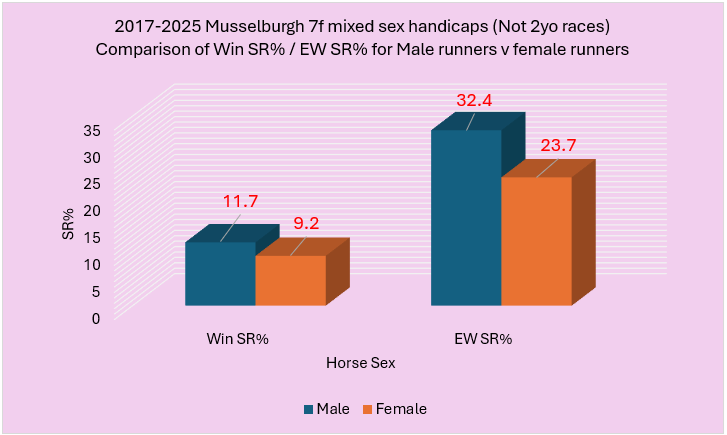
Let me share some data now in terms of the sex of the horse running. It should be noted that there are far more male runners contesting these races than females. However, when female runners have competed against their male counterparts, they have struggled somewhat. So, below I have considered only mixed sex races to get a fair comparison between the two. I want to share the A/E indices for each group first – these are based on BSP prices so are the most accurate:
Males have offered far better value than females in these races and, when we look at the win rates / returns, we see positive correlation with that finding:
Male runners delivered a better strike rate and in terms of returns would have lost us around 22p in the £ less than females. Female runners have been relatively rare, but they have not been good investments.
It is also worth splitting male horse data to review the performance of colts versus geldings. These results include male only races as well as the mixed sex ones. The splits were thus:
As we can see, colts have comfortably outperformed geldings so that is another useful nugget of information we could potentially utilise in the future in these contests.
Weight carried
A look at weight carried now. These splits do not include any jockey claim, so the chart displays the actual weights each horse was allotted for the race. In terms of win rate, we witnessed the following:
This pattern, where horses carrying more weight win more often, tends to be the case in all types of flat handicaps. However, prices are generally well adjusted for this so that there is no clear edge to those horses that win more often. Time to see how the splits pan out here in terms of profit/loss/returns:
Returns wise, the highest weighted runners only lost a small amount. There has been no clear pattern, although I would be a little wary of backing lower weighted runners (8st 7lb or less) without a very good reason. It should be noted that if we dropped to 8st 4lb or less this cohort would have lost about 8p in the £ more tipping the scales at a little over 24p in the £.
Previous Career wins
Has the number of wins a horse has previously achieved made a difference over the past eight years? Let’s take a look:
One or two prior wins seems to have been the optimum. Horses that have won three or more times were very poor value – I guess why this has been the case is because these runners have become more exposed and, therefore, open to less improvement. Indeed, horses that won at least three times and had raced at least six times had an even worse record, winning just 39 times from 340 (SR 11.5%) for losses of £85.07 (ROI -25%).
Considering briefly the number of previous runs in handicaps a horse has had, if we concentrate on runners that had at least six runs previously in handicaps they have scored just 9.6% of the time (21 wins from 219) for losses of £63.54 (ROI -29%).
Again, I am guessing some of these animals were just less open to improvement. Compare this to horses which had previously run just once in a handicap, such types enjoyin a positive record of 77 wins from 511 runners (SR 15.1%) for a profit of £26.54 (ROI +5.2%). These runners were far less exposed, with more scope for improvement, from their current handicap mark.
Finishing position LTO
Normally with last time out (LTO) finishing position we see LTO winners following up more often than runners-up, who in turn win more often than LTO thirds, and so on. We tend to see a sloping graph with the bars getting lower, the further down the field the horse finished last time. However, that pattern has not occurred for these races as the graph below shows:
The left-hand side of the graph starts in a familiar fashion, but then we see the bar rising on the right-hand side. Hence it seems that LTO position has not quite been as important as it can be for other types of races. The full splits were as follows:
The value clearly has been with horses that finished fifth or worse LTO. They produced very strong profit figures as well as a decent win strike rate. These numbers for the 5th or worse cohort can be improved if restricting last time out runs to handicaps only. The figures then read 62 wins from 402 (SR 15.4%) for a profit of £117.08 (ROI +29.1%).
Course LTO
A quick look to see if the LTO course data has given us any past positives. Well, there have been four LTO courses that would have produced a profit. These have been:
Four of the top tracks in the country which I guess should come as no surprise, three of them representing 75% of the major 3yo Class 2 turf handicap hosts. The LTO York figures have been particularly eye-catching.
Trainer Angles
The final area to look at is trainers. Good individual trainer datasets have been hard to come by for most handlers but nine have had at least 50 horses run in these events (with the 18.0 BSP price cap) and their stats are shown in the table below. The trainers have been ordered alphabetically:
Charlie Appleby, Andrew Balding, Clive Cox, the Gosden stable and Richard Hannon all performed well and made fair profits. In contrast, Ralph Beckett and Richard Fahey have both struggled, posting significant losses.
Appleby, Balding, the Gosdens and Hannon also fared notably well when saddling the favourite.
*
Summary
This piece of research has highlighted plenty of positives as well as negatives in these handicaps. Here is a quick ready reckoner for us:
Until next time...
- DR
https://www.geegeez.co.uk/wp-content/uploads/2024/09/Summerghand.jpg320830Dave Renhamhttps://www.geegeez.co.uk/wp-content/uploads/2022/10/geegeez_banner_new_170x78.pngDave Renham2026-05-05 13:31:132026-05-05 13:31:13Making Sense of 3yo Class 2 Turf Handicaps
Irritatingly, I couldn’t make it to the two big races over the weekend, but watching from home didn’t diminish the experience of seeing three bright lights dominate the first Classic of the European season, writes Tony Stafford. Bow Echo, his young trainer George Boughey and barely-out-of-his-teens rider Billy Loughnane, treated Newmarket to its finest hour since Frankel slaughtered his opposition back in the 2000 Guineas of 2011.
Both Boughey and Loughnane have sprinted through the normal gestation period in their respective careers. Boughey went from a handful of horses and two wins in 2019, having left his role as assistant to Hugo Palmer in Newmarket, to the first of four successive centuries in 2022.
Loughnane’s rise has been even more meteoric. The son of trainer Mark had his first rides in 2022 on the all-weather yet by the end of that winter had 41 successes, winning the apprentices’ AW season award just beyond his 17th birthday.
Comparisons with Lester Piggott are inevitable, but Lester was able to start riding at age 12 whereas the earliest allowed nowadays is 16. At 20, Loughnane has what will prove the first of many Classic wins, I’m sure, and he will be a major threat to Oisin Murphy’s hold on the jockeys’ championship starting now.
Last year Loughnane rode 223 winners and was on 65 for this year after Saturday’s exploits. Of course, the jockeys’ championship, oddly, only includes racing between mid-April and October, but it isn’t far-fetched to suggest he might have a little more hunger than Murphy. The champion will need to keep his own well-publicised demons at bay in face of what will be the most serious human challenge yet to his pre-eminence.
Comparisons with horses of previous generations are often meaningless, but Bow Echo, who won by almost three lengths from Coolmore’s hastily re-entered Gstaad after a costly glitch from the Ballydoyle office computer, looks very much in the Frankel range of ability on their comparable Guineas runs.
Tom Queally allowed Frankel to run his rivals into submission a long way from home, winning by ten lengths on the way to a blemish-free lifetime tally of 14 from 14. Bow Echo is thus ten away from that after this exceptional performance. Had Gstaad not been included as the sole Aidan O’Brien runner, the margin theoretically could have been ten lengths, thus firmly in the Frankel range.
Had Bow Echo not been in the field or not lived fully up to Boughey’s expectations – a friend told me in the week that the trainer thought him a certainty – Gstaad would have won by eight, just the job to keep the Coolmore machine in full flow. Their PR department would have been Frankelising the performance.
Saturday’s winner, along with the third home, Distant Storm, the eventual joint-favourite with the runner-up, are both sons of the 2014 2000 Guineas winner Night Of Thunder. His Guineas success was notable in that he came right across the track in the closing stages yet still had enough under Kieren Fallon to catch market leaders Kingman and Australia as a 40/1 chance for Richard Hannon.
Night Of Thunder was hardly over-trumpeted in his first season as a stallion at Darley’s Kildangan Stud when his opening fee was €30k. Success breeds excess in terms of stud fees though and he is up to €200k as a result of his being champion stallion in the UK and Ireland last year.
In the 14-horse field on Saturday, he had four representatives – the others being Billecart in 12th and Needle Match in 13th. Three more 2000 Guineas winners were also represented. Apart from Frankel, they were Sea The Stars (2009), who went on to win the Derby and the Arc, and Saxon Warrior (2018).
The latter’s son Padraig Dawn is trained by 24-year-old Charlie Pike, who is in his first season with a licence. That horse gave him his first and, so far, sole winner at Southwell in February from 35 starters, although in finishing eighth only three lengths behind the third horse, he deserves a big mention.
So too, Coolmore-based and raced Saxon Warrior, result of a trip to Japan for his smart mother Maybe to be mated with Deep Impact. He won the Classic eight years ago and is still on Coolmore’s books but very much at the basement end. His 2026 fee is only €10k, as against £350k for Frankel and €300k for Sea The Stars. Two Coolmore stallions were doubly represented with Starspangledbanner and St Mark’s Basilica, so eight of the 14 were sired by only three stallions.
In yesterday’s 1,000 Guineas, looking from far away on the screen, as the fillies went into the stalls, you had to be impressed with how True Love looked: big, strong and also well found in the market. There had been doubts about whether Ryan Moore’s mount Precise would get to the race but as she shortened to 7/4 favouritism those had seemingly been dispelled.
Meanwhile, True Love, winner of the Cheveley Park last year and a returning winner this spring, had the time-honoured Classic profile and she won in fine style, making it an eighth 1000 for Aidan O’Brien, this time with Wayne Lordan in the saddle. She might not be an exact equivalent of Bow Echo, but she looks the type to progress through the year.
Most of the sires represented on Saturday are either at Coolmore or under Godolphin/Darley management. That is vastly at odds with the 18-strong line-up from Churchill Downs for the Kentucky Derby, first leg of the US Triple Crown, staged late on Saturday evening.
Only one stallion had more than a single runner and that was champion sire Into Mischief, whose fee is $250k. But only one stallion represented in the field had won the Kentucky Derby, the 2016 hero Nyquist, and as the line-up says, competitors in the Run For The Roses come from all directions.
Only Gun Runner of the other 16, at $250k matches Into Mischief’s covering fee, while the winner of the race Golden Tempo, was sired by Curlin, now a 22-year-old, most remembered for winning the 2008 Dubai World Cup. His fee is $225k.
Golden Tempo came from 'downtown', as they say, his jockey Jose Ortiz 18 lengths off the lead after half a mile, and deploying similarly exaggerated waiting tactics to brother Irad, on Renegade, who ran on for a close second. And this was a first Kentucky Derby win by a female trainer, Cherie DeVaux adding to her growing haul of records.
Gun Runner had a better day on Friday when he supplied the one-two with Always A Runner (Chad Brown) and Meaning (Michael McCarthy) as well as two of the backmarkers in a 13-strong field for the Kentucky Oaks. Brown was further cementing his reputation as a supreme trainer of fillies, on dirt as in the Oaks, but also on turf.
**
I would have made this my lead today had it not been for the excellence of Saturday’s big race winner and to a slightly lesser extent the runner-up. I remember when Sea The Stars was going along, Aidan used to have a pop at him with different horses trying to find chinks in his impregnable armour without ever managing to do so. The rest of the season among the milers will be fascinating.
What wasn’t fascinating was the treatment meted out to the three-year-old King’s Courtier, trained by Julia and Shelley Birkett at Exning, near Newmarket.
Three, I must say, talentless runs at two brought the son of Bated Breath an initial mark of 30. In the past, horses so far out of the handicap were allowed to run, but off what is the nominally bottom-weighted mark of 45. Now, the Rules state you cannot run and must find a maiden to try to improve the rating.
So, four months after his feeble 12th of 13 at Chelmsford, he was loaded into the horsebox for the 250-mile round trip to Wolverhampton. Mindful to get the best possible placing, unlike a few less in need of such an urgent situation, the three-year-old started 66/1 and got within eight lengths of the winner.
The misfortune was that the horse immediately ahead of him was rated 53, questionable in that only once in three had he run anything remotely worth that mark.
Result, the BHA handicapper raised him 27lb – that’s near enough two stone for finishing fourth in a modest at best race.
Now Julia, an experienced and well-respected trainer since 2000, who joined forces with daughter Shelley last year, was in a right pickle. Recently, the rule which enabled horses 1lb and 2lb above the ceiling mark in handicaps to run, was taken away in Class 5 and Class 6. That meant King’s Courtier could not run in a 0-55 and would have to go to 0-60. “There aren’t any for him,” says Julia, so she had to go up to 0-65 for his first handicap run. “There’s no way he’s that class,” she lamented.
So, it was a shorter road and a bit easier on the diesel, trip last Thursday that was undertaken for King’s Courtier for a seven-runner race at Yarmouth. Julia/Shelley’s horse started 50/1 and finished 18 lengths behind the penultimate runner in the race. We all know that handicappers do not like dropping horses – except for certain top trainers it sometimes seems! – so Julia is anxiously waiting on tomorrow’s revised mark.
Unless they drop him to 45 it will be a travesty of justice, but they won’t. Indeed, it wouldn’t be a surprise if the Civil Service types that seem to fill the job nowadays, say: “He couldn’t have run anything like to form, so let’s leave him where he is.”
Make no mistake this is a massive scandal, and I would suggest to Dominic Gardner-Hill (if he’s still the man?) that he has a serious look at the reasoning whereby life has been made so difficult for an honest, hard-working stable and the man who has been paying the bills for the past 20 months! Not no mention the ever-spiralling administration charges.
- TS
https://www.geegeez.co.uk/wp-content/uploads/2026/05/Bow_Echo_2000Guineas2026.png319830Tony Staffordhttps://www.geegeez.co.uk/wp-content/uploads/2022/10/geegeez_banner_new_170x78.pngTony Stafford2026-05-04 08:32:162026-05-04 09:39:01Monday Musings: Bright Lights in Newmarket
The draw and run style combinations we need to avoid
The inspiration for this piece was the recent Form Hacker’s Guide researched and compiled by Matt, and I suggest readers to take a look if not done so already, writes Dave Renham. In those two excellent pieces (which you can read here and here), Matt started by focusing on 10-runner handicaps on turning tracks, expanding later to 8- to 12-runner handicaps.
His research noted that the wider drawn runners generally struggled, as did those drawn 1 (those closest to the inside rail) if they did not get away well. He also noted that races of 1 mile or less were best as they tend to be run at a true gallop. My aim for this article is to build on those initial Form Hacker findings.
Approach
So, this was my plan. I wanted to highlight the worst course and distance (C&D) draw/run style combinations in the UK. I decided to look at handicap races only but expanded the remit to 8+ runner handicaps from 5 furlongs to 1 mile: the majority of these were 8 to 12 runner affairs. Unlike Matt's research, I also included races run on straight courses. Data has been taken from between 2021 to 2025, so five full years/seasons.
Being able to consistently find horses that represent poor value is extremely useful when it comes to improving your bottom line. The more horses we can (reasonably) confidently put a line through the better. If we can ignore, say, three horses in a 12-runner field due to the chance of any of them winning being considerably lower than their prices suggest, then we suddenly turn the betting market in our favour.
For example, imagine this hypothetical market on Betfair for a 12-runner handicap:
This market gives a book percentage of 102.3% (that is, an overround of 2.3%), so the type of market we will find on Betfair for this sort of race. Let us imagine that the horses ranked 4, 6 and 10 in the betting can be as good as ignored due to their draw and likely run style. That takes out just under 21% from the market book and turns the odds well in our favour.
Now, I appreciate that one of those horses we eliminated could win, but if we are right with our research then this will happen sufficiently rarely that the method will still give us a decent edge over the longer term. It’s time to crack on.
Mechanics
On geegeez.co.uk, we are able to look at draw and run style combinations through the Draw Analyser. Below is a 'heat map' screenshot taken from Chepstow over 6f for this recent five-year time frame in 8+ runner handicaps:
The numbers in this heat map image are PRBs (Percentage of Rivals Beaten). To refresh, Percentage of Rivals Beaten (PRB) is a calculation based on a horse's finishing position in relation to field size. It makes key distinctions between a horse finishing, say, third in a five-horse race (PRB 50%, two rivals beaten, beaten by two rivals) and finishing third in an eleven-horse race (PRB 80%, eight rivals beaten, beaten by two).
PRB is beneficial for researchers like me because it helps to make datasets bigger. In racing we are often blighted by small datasets, relative to what general statistics would consider so at any rate. And when we then try to discern knowledge from the data by looking only at wins, we ignore nine-tenths of the information we have (assuming an average field size of ten, one winner, nine losers).
The Draw Analyser also gives us more extensive data for each draw/run style group, and this is shown for the same Chepstow example below:
We are able to see in this one table the sample sizes in more detail. They include win and placed percentages, profits/losses (SP and Betfair SP), A/E indices, Impact Values and the PRBs.
On geegeez.co.uk, we express PRB as a number in decimal form between 0 and 1 rather than a percentage. So 0.69 for example, the PRB for the low drawn led group (see table above), equates to 69% while the low drawn held up figure of 0.39 equates to 39%, and so on. The key thing to remember about PRB figures is that a par score is 50% of rivals beaten, or 0.50, so better than 0.55 is positive and worse than 0.45 is a fair negative.
To qualify as a ‘poor’ C&D draw/run style combination I am looking for groups of runners with draw/run style PRBs below 0.40, as this indicates these horses have really struggled. In addition, there must have been at least 40 horses within each specific C&D draw/run style combination which will give us a decent PRB sample size from which to work from.
Below are the worst 20 draw/run style C&Ds starting with those with PRBs of 0.38. The C&Ds are not strictly in order of poorness culminating with the ‘worst’, but in general the later C&Ds will show a slightly stronger negative bias.
Let's get to it!
The Worst 20 Course/Distance Draw/Run Style Combinations in UK Flat Racing
Carlisle 6f – draw third LOW; run style – HELD UP
We start with Carlisle over 6f. This C&D sees runners turn right roughly 150 yards after the start and then take a further shallow right turn just after two furlongs, with a final slight turn between the two- and three-furlong pole. Let’s look at the splits for low drawn held up runners:
The win rate was higher than both the placed% and the PRB of 0.38 suggests it should be. An extra win or two over 71 races can change the win percentage considerably. I surmise though, that over a longer period the win rate would be nearer 5 or 6% based on the PRB. All in all, low drawn held up runners over this C&D have been horses that have generally found it tough.
Chester 7f – draw third MIDDLE; run style – HELD UP
Chester is the tightest track in the country, so I had expected to see it make the list somewhere. Over 7f, horses positioned in the middle third of the draw have been at a significant disadvantage as the figures below show:
These runners lost a little over 70p in the £ over the past five years. I am guessing that some of the runners get squeezed somewhat from both lower and higher drawn runners starting more quickly and, on this tight track, being behind a wall of horses makes life very tricky. For the record low drawn hold up horses have also struggled with a PRB of 0.42.
Leicester 6f – draw third HIGH; run style – HELD UP
To the Midlands and Leicester. The 6f trip at Leicester is run over on a straight course and high drawn held up types have had a poor time of it as the stats show:
Just the three wins from 64 qualifiers, and when we look at the stall position rather than simply highest third of the draw, horses drawn 10 or higher that were held up won no races from 40 runners. Indeed, horses that raced in mid-division when drawn 10 or higher over 6f here also failed to score, this time from 34 runners. Thus, high drawn runners that raced mid div or were held up have seen 74 consecutive losers over this 6f trip at Leicester.
York 1 mile – draw third HIGH; run style – HELD UP
I have always been a fan of this C&D as low draws have enjoyed a strong edge in such races for many years. York's mile handicaps are run around a bend and the horses drawn in the top third (high), when held up, have struggled as the numbers below illustrate:
This C&D witnessed extremely low win and placed percentages for the high/held up cohort, especially considering the very decent sample size. Also, if we concentrate on handicaps with bigger fields, horses drawn 13 or higher when held up won just once from 61 (SR 1.6%) with only 3 horses placing (SR 4.9%). This is the strongest bias seen to date and clearly we should steer clear of habitual hold up horses drawn high over this C&D.
Windsor 1 mile – draw third LOW; run style – HELD UP
Windsor is a unique flat track as the racecourse is a figure of eight, although over a mile it is effectively like a round course. Horses drawn low that were held up really struggled since 2021 as these numbers indicate:
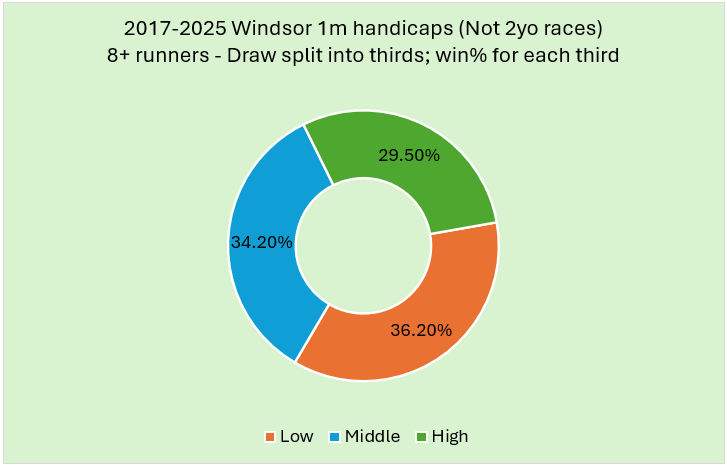
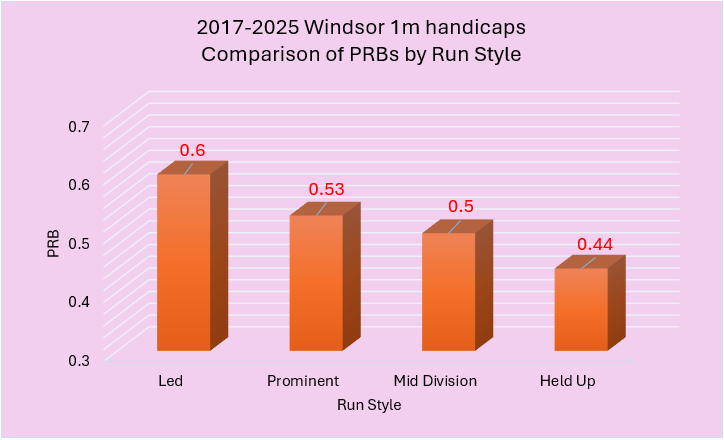
As we can see, not only has the PRB figure been very poor, but all other metrics have followed suit. Both the win and placed rates were extremely low and if backing all 115 runners we would have lost just over two-thirds of stakes. It should also be noted that horses drawn in the lowest stall (1) have performed dreadfully with 0 wins and just one placed effort from 26 runs; the PRB stands at a dismal 0.30. This backs up Matt’s findings in his Form Hacker’s Guide where he noted that slow starting horses drawn 1 tended to really struggle.
We can also see that the runners drawn in the bottom third of the draw struggled year on year when viewing the win percentages for each year. The graph below shows the splits:
In addition, the yearly PRBs correlate positively with the win percentages with four of the five years seeing PRBs of 0.39 or lower.
Musselburgh 1 mile – draw third LOW; run style – HELD UP
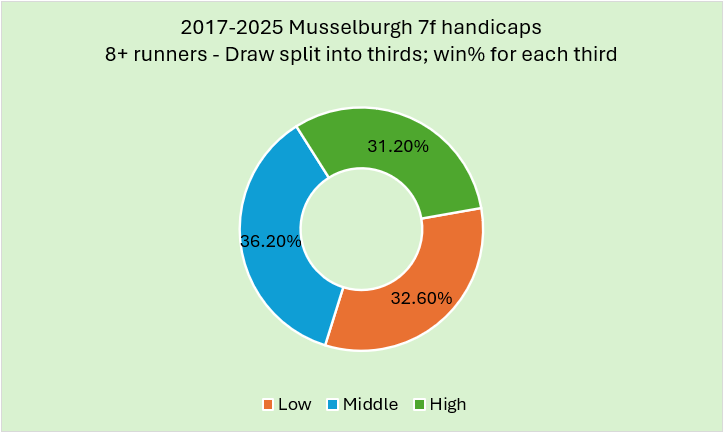
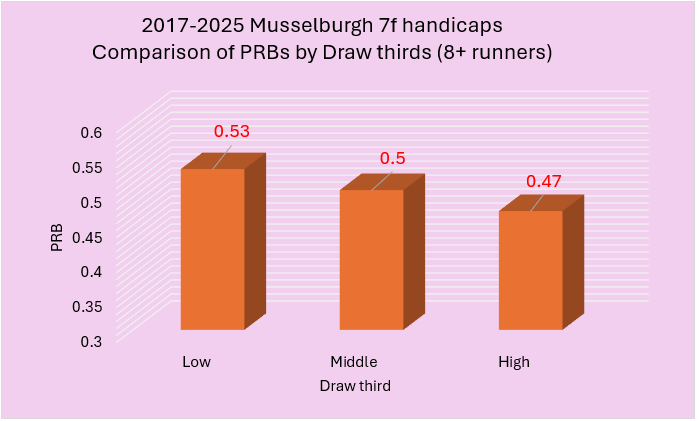
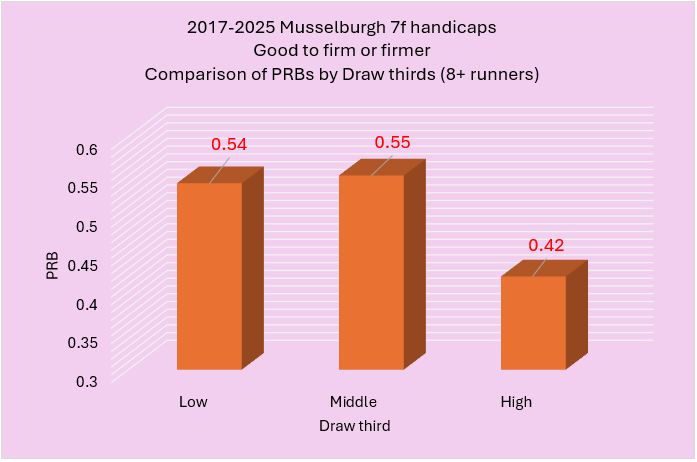
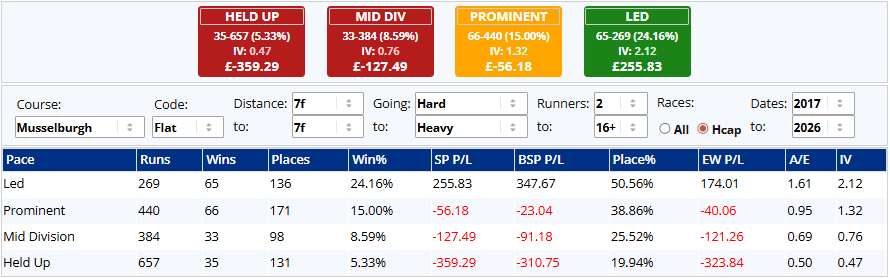
Musselburgh is a course I like from a punting perspective as over 7f and 1 mile there is a very strong front running bias. Hence, it comes as no surprise that we see hold up horses struggling over the mile trip when drawn low. Here are the splits:
As can be seen these low drawn runners have really found it tough going. They have the same PRB as the other C&Ds shared to date, but the lowest win rate, lowest A/E index and lowest IV value. If we had backed all 44 runners we would have lost over 85p in the £. Hold up horses drawn either 1 or 2 went 0 from 21 with just two placing in the five year review period. Low drawn hold ups are a ‘no no’ from a backing perspective.
Chepstow 7f – draw third LOW; run style – HELD UP
Chepstow’s 7f races are run on a straight track and hold up horses have struggled generally (we will see more evidence of this in a minute). Those hold up types drawn low produced the following stats:
Just a single win and, although the place% is one of the highest we have seen so far, when we compare it to the ‘LED’ place% over this C&D (all draw thirds combined) we see that this stands at 44.4%. There is quite a difference between the two percentages.
The next C&D on the list is the first where the PRB drops to 0.37 and it happens to be the same C&D as this one!
Chepstow 7f – draw third MIDDLE; run style – HELD UP
It is the middle third of the draw this time combined once again with held up runners. Here are their splits:
We see similar figures for most metrics, although the place% is lower than the high drawn figure previously shared. It should be noted that hold ups from the highest third also struggled and almost made the list as well but their PRB of 0.41 was just above the cut-off point.
It should also be noted that when we look at ALL hold up horses over this C&D (all draw thirds combined) that started in the top three of the betting, only two of 32 won for hefty losses of over 77p in the £.
Ayr 6f – draw third HIGH; run style – HELD UP
Back up to Scotland and one of the sprint trips at Ayr next. Here are the stats:
The win rate looks slightly inflated based on the PRB and Place% but, having said that, backing all runners would have still incurred losses of £74.75 (ROI -65%). The bias against high drawn held up horses seems to have been accentuated on softer ground. On going described as good to soft or softer the PRB was just 0.32 over the past five years with a win percentage of under 5%.
Nottingham 6f – draw third LOW; run style – HELD UP
Over to Nottingham now and low drawn runners when held up off the pace performed poorly between 2021 and 2025. Their stats were as follows:
Just the two wins from the 50 hold up horses and the PRB as with Ayr 6f stands at 0.37. It may be that this bias is stronger on slower ground because for the 19 qualifiers who ran on good to soft or slower their PRB was a measly 0.31. They did manage one win from those 19 runners, but no other horse managed to place. Also, when we look at the other hold up horses from middle and high draws their performance on easier ground was much worse also. Hence this gives extra confidence that slower ground here makes it even harder for hold up horses.
Lingfield AW 5f – draw third HIGH; run style – HELD UP
Lingfield's all-weather (AW) track next. The 5f trip is slightly unusual as round course 5-furlong tracks go because the stalls are placed on the outside, rather than next to the inside rail. I wonder if this is why high drawn hold up horses have struggled, especially when factoring in that the first turn at Lingfield occurs before a furlong of the race has been completed.
Hold up horses are either going to be trapped very wide having to go the longest route or, if they dive to the inside, they are likely to encounter significant traffic. We have a decent sample size supporting these assertions:
Such hold up horses over Lingfield's all-weather five incurred losses of 55p in the £ if backing all blind to £1 level stakes. Focusing on horses from the top three in the betting that were held up from one of the three highest draws, this cohort won just four of the 36 races (SR 11.1%) for a loss of £17.54 (ROI -48.7%).
Windsor 5f – draw third LOW; run style – HELD UP
5f at Windsor sees horses essentially race over a straight five though there is a slight kink at halfway, so horses on the inside (low) can get squeezed if racing off the pace and close to the rail. I am guessing this has been a contributing factor to the poor figures for this combination. The stats were as follows:
One win, and a placed rate of just one in seven. Compare this place% with that of early leaders here (any draw) which stands at 58%! Hence, front runners have been four times more likely to place than low drawn hold up horses over this 5f trip.
Backing all low drawn hold up horses over this 5-year period would have lost £50.22 (ROI -89.7%), and one additional finding is that on firmer ground (good to firm or firmer), the bias against hold ups seems to have strengthened still more. Under these conditions hold up runners were 0 from 33 with just three placed efforts; PRB 0.34.
This makes sense because, on firmer ground, the horses tend to congregate near the stands’ rail (low) meaning real traffic problems for hold up horses close to the rail. Conversely, on softer ground horses often fan out in the final two furlongs, racing middle to far side more, meaning that low drawn hold ups are not faced by a wall of horses sticking to the stands’ rail.
Wolverhampton 5f – draw third HIGH; run style – HELD UP
Our second AW C&D, again over 5f, this time at Wolverhampton. Here the stalls are positioned, as we would expect, on the inside and higher draws are at disadvantage regardless of run style. However, the disadvantage is made worse if they are held up as these stats show:
This is the biggest sample of the 20 C&Ds in this article so we can be very confident in the findings. Backing all high drawn hold up runners would generated eye-watering losses of £193.48 which equates to just under 58p in the £. Horses drawn high that raced midfield also performed poorly with a win rate of under 4% and a PRB of 0.42.
York 6f – draw third MIDDLE; run style – HELD UP
Coming from behind at York over 5f or 6f has always been difficult and middle drawn held up runners over 6f have had a particularly poor record in recent times:
The draw, as well as run style, has often been key here over the past few seasons with lower draws definitely enjoying an edge. Hence, middle and higher draws have tended to be at a disadvantage at most meetings. As well as the middle, high drawn hold up runners have also found it tough over 6f here winning just five races from 126 runners; PRB 0.41.
Catterick 7f – draw third LOW; run style – HELD UP
A look at 7f at Catterick now. This is a round course 7f where the stats have been as follows:
We see a very low win rate from a decent sample of over 100 runners. I mentioned earlier about Matt’s findings regarding horses drawn 1 struggling when running around a bend. This has definitely been the case here as hold up horses drawn 1 have won zero races from 26. It has not been any better for those drawn 2 either, that group going 0 from 21. Nine of those losers (both draws combined) started either favourite or second favourite.
Catterick 5f – draw third HIGH; run style – HELD UP
Over to the 5f trip at Catterick which is well known for favouring early speed. Hence, one would expect horses that have been held up to struggle and that has been the case. Those drawn high have produced the following stats:
Hold up horses have struggled regardless of post position here. Low drawn hold ups have a PRB of 0.41, while hold up horses drawn in the middle third of the draw appear next on this list...
Catterick 5f – draw third MIDDLE; run style – HELD UP
Horses drawn in the middle have also struggled over this C&D when being held up. As with the high drawn runners their PRB has ended up at 0.37. Here are all the relevant metrics:
We see a slightly lower win rate, coupled with a marginally higher placed rate. The A/E index though has been much lower as has the Impact Value (IV). I should also share that horses which raced mid-division from either a high or middle draw also performed poorly, winning just twice from 50 combined qualifiers (SR 4%).
It will come as no real surprise that there is a significant run style bias over this C&D as the graph below shows:
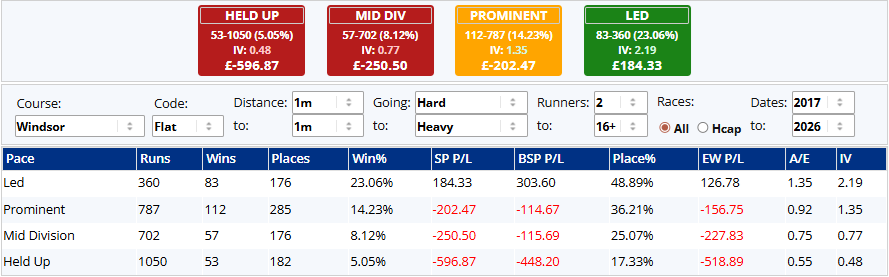
The graph combines all early leaders / front runners comparing their record to all hold up horses regardless of post position over this course and distance. This type of difference occurs at numerous courses over 5f.
Musselburgh 7f – draw third HIGH; run style – HELD UP
Back to Musselburgh over 7f this time where high drawn held up runners have produced a poor set of figures:
This is the lowest PRB so far standing at just 0.35 suggesting it has been a huge disadvantage to be held up here when drawn high. Indeed, stall 8 seems to be where the trouble has started, as horses drawn 8 or higher when held up won just one of 70 races (SR 1.43%) over the five years with a place% of just 7.1% and a PRB of 0.33.
Musselburgh 5f – draw third LOW; run style – HELD UP
Sticking with Musselburgh we now look at the stats for low drawn runners when held up over the minimum trip of 5f:
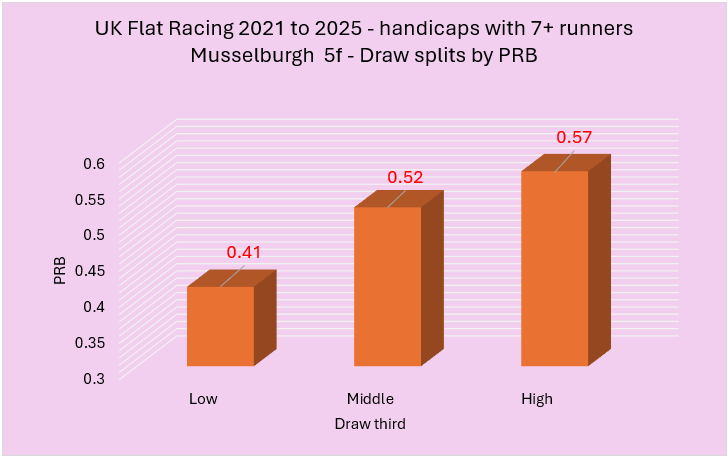
Low drawn runners are stuck out wide at Musselburgh over five furlongs and it seems if they start slowly their chances of success are very low indeed. The lowest drawn runner (drawn 1) has a quite dreadful record when being held up managing no wins and also no placed efforts from 36 runs! The PRB for this cohort has been... wait for it... just 0.20. Runners berthed in stall 2 also drew a blank from a win perspective when held up (0 from 28 with just 2 placed efforts). There is an argument to suggest that this C&D has shown the strongest bias in the list.
Leicester 1 mile – draw third HIGH; run style – HELD UP
We come to the final C&D and the one with the lowest PRB in the list, at just 0.34. Leicester’s 1 mile trip has seen the following stats for high drawn hold up horses:
15 of the 44 races over this C&D over the past five years were won by the horse taking the early lead. Higher draws were at a disadvantage so knowing these two facts helps explain the poor figures for hold up horses drawn high. Finally, horses drawn 9 or higher when held up over C&D were 0 from 28 over the period of study.
*
Summary
Before I finish this table shows the combined results from all 20 C&Ds including the Betfair profit and loss - well, just loss! - figures:
It makes fairly damning reading. Roughly one win in 25 and for every £100 staked a loss of £47.50. Ouch!
It is not an accident that all twenty draw/run style combinations were draw third/held up.
Horses that race at the back of the field early do not win very often in flat handicaps at a mile or shorter.
Here's a handy 'cut out and keep' guide to the 20, listed alphabetically:
How to spot a hold up horse...
The million dollar question, of course, is how do you spot a hold up horse? Well, that's not straightforward to answer, but I can tell you this: in the five year study period, across UK flat handicaps, horses that were held up in their two previous races led on their next start just 4.2% of the time... and they were held up again 56.5% of the time. 27% of this 30,000+ sample size raced in midfield, meaning that five out of every six horses that were held up in their previous two races raced in the latter part of the field on their next start.
It's not a crystal ball by any means, but it's a pretty good start. Being able to eliminate horses confidently from races we are analysing means we start to move the odds in our favour. As Matt also indicated in his ‘hacks’ there are not just negative angles which will help us but positive ones too.
Combining positive draws with positive run styles moves the odds even further in our favour. From there, it should be easier (note, easier not easy!) to find value selections which is the route to long term profit.
I guess I should plan another article in the near future looking at the C&Ds with the highest draw/run style combo PRBs. Until next time...
- DR
https://www.geegeez.co.uk/wp-content/uploads/2018/04/Catterick_Sprint.jpg319830Dave Renhamhttps://www.geegeez.co.uk/wp-content/uploads/2022/10/geegeez_banner_new_170x78.pngDave Renham2026-04-28 17:31:412026-04-28 17:31:41The WORST Draw / Run Style Tracks in 2026
Careful. By the time you read next week’s words here the 2026/27 jumps season will already be four days old, we’ll be 40 per cent through the 2026 UK Classics, and only seven weeks short of the longest day of the year, writes Tony Stafford.
And what of the 2025/26 season? Well, that was pretty much Dan and dusted before Cheltenham, and Mr Skelton duly got over the £5million mark with his Sandown exploits – which were not without their difficulties.
Now he wants to beat Martin Pipe’s record number of 243 winners in a single season, while second-time champion jockey Sean Bowen reckons 300 wins will be within his reach – he finished off with 241, so 48 behind A P McCoy’s best of 289 in the 2001/02 campaign.
But let’s forget the jumping for a while – the boys will have had almost a full week off, bar a single Friday meeting at Warwick’s temporary hosting of Cheltenham’s hunter chase fixture. Last week’s meeting there, also replacing unfit Cheltenham, was pretty turgid apart from the money.
No, I’m not planning to relive my 1992 2000 Guineas Day when I waited until Lester returned to unsaddle on Rodrigo De Triano for Robert Sangster and trainer Peter Chapple-Hyam before setting off to keep an appointment with a potential client 266 miles away at Hexham racecourse. That fixture is joined by Uttoxeter, so the counting starts again then.
Meanwhile we have the small matter of five days at Punchestown starting tomorrow. As with Dan Skelton for the past two years – largely abandoned this time round as he had no chance of catching the new champion – Willie Mullins has now a target on the back of Gordon Elliott, something we’ve seen more than once in the past.
Elliott goes into Punchestown on €4,710,170, €160k ahead of his nemesis. He’s having a proper go, starting with 15 runners including his Aintree heroine Brighterdaysahead tomorrow, and a possible 61 in the following four days.
Mullins kicks off with 22 tomorrow and has at least 33 on each of the following days, with a preponderance as ever in the non-handicaps and championship events. It’s more than an uphill struggle for Elliott, even though he has had 323 individual horses to call on this season against Mullins’ modest team of just 290!
When talking numbers, you cannot get away from those two superstars from Hong Kong, Ka Ying Rising and Romantic Warrior. Both turned out at Sha Tin’s big day yesterday and thrilled their legion of followers in their respective races. I doubt there’s ever been a plus £1 million to the winner prize with eight runners, contested (and obviously won) by a horse starting at 100/1 on.
That was the price of Ka Ying Rising as he made it 20 wins in a row with only two narrow second places the blemishes on the six-year-old’s card. There was never a moment’s doubt that he would duly outclass the opposition in the Chairman’s Sprint Cup. How connections must wish that the year-younger Wunderbar hadn’t turned up for his second and third starts.
Each time it went to a close-run thing, first by a nose and then a short head. The two horses’ fortunes have veered apart since then, Ka Ying Rising cantering to a four and a bit length win from second-favourite Satano Reve (89/1!), a winner of a Group 1 sprint last time out at Chukyo racecourse, Japan. Wunderbar’s last run was in a handicap this year off a mark of 100. He was ridden by Richard Kingscote and finished eighth of twelve. Ka Ying Rising is rated 128.
Donnacha O’Brien’s useful Comanche Brave was fifth yesterday under Oisin Murphy, having started at 350/1. Connections copped a handy £80k against the £1.281 million collected by the Zac Purton-ridden winner. He had started at 1/20 for each of his previous eight wins around Sha Tin, a sequence only interrupted by a smooth success at Randwick racecourse in Sydney last year where he was an even-money shot.
I doubt many Hong Kong racegoers with winning tickets will have bothered cashing them in, basically to get their money back. As when Deep Impact came over to Longchamp from Japan, the legion of his supporters that forced his price down on the Pari-mutuel on that Arc would not have cashed them either.
Even if they had backed him for a place – he finished third over the line to Rail Link and Pride, ahead of Hurricane Run – they will have been found a spot on many a Tokyo trophy cabinet. I had forgotten – it was 20 years ago after all – that Deep Impact was subsequently disqualified for having a banned substance in his post-race test. That doesn’t alter the fact that he was one of the greatest in Japan and sired the 2023 Derby winner for Coolmore in Auguste Rodin from the mating with their top filly Rhododendron.
Hong Kong’s other great equine hero, the eight-year-old Romantic Warrior, did the business once more in the QE II Cup, his fourth win in the race, starting as a four-year-old in 2022. James McDonald’s mount missed out last year, I recall injured following his narrow defeat at Meydan the previous month, but has returned as good as ever, making his tally 22 wins from 29 starts.
His prizemoney tally now tops £25 million and he is ahead of Forever Young after that Japanese champion’s failure to secure as expected the Dubai World Cup at Meydan last month. The difference between second and first that day was more than £3 million, but you get the feeling that Romantic Warrior can only go on for so long and it’s merely a matter of time.
That said, he was the 30/100 favourite and had to beat three smart overseas performers to send the locals home happy that another of their heroes had seen off the visiting opposition. He had a length to spare over runner-up Masquerade Ball, last seen running the world’s highest-rated horse Calandagan close at Meydan; third was Sosie, in the same place as when he was behind Daryz in the Arc last October.
Next came another eight-year-old, Karl Burke’s Royal Champion, a close up fourth under Oisin adding £171k to his Middle East earnings at Bahrain and Riyadh at the beginning of the year. Burke is becoming adept at identifying winning targets overseas for his charges and that can only develop further as the returns continue to accumulate for his owners.
Talking of owners, so many older horses, some entire and more often geldings, are benefiting from staying in training for longer, especially at middle distances and above. While there are always plenty of new stallions every year, the fashion is for the precocious sprinting type that can get its progeny on the track early and maybe even have a shot at Royal Ascot.
Tony O’Callaghan, wife Anne and son Roger have been ultra-successful in that regard, and their Tally-Ho Stud had another day in the sun when a colt by their stallion Mehmas sold for £880,000 at the Doncaster breeze-up sale last week.
Mehmas never ran beyond age two but did plenty in those eight runs for Richard Hannon and Al Shaqab, winning four times including the Group 2 July Stakes, beating Blue Point. The only time Hannon stretched him beyond six furlongs he was second to Churchill in the National Stakes over seven at the Curragh.
The O’Callaghans bought him and he began his stud career with a fee of £12,500 at Tally-Ho. By the time the first runners appeared on the track it was down to £7,500 but his progeny soon showed speed, precocity and class and he was set. Now his fee is €70k.
Like Romantic Warrior, Mehmas is a son of Acclamation, and it isn’t hard to estimate that with say 150 mares visiting him each year at that fee, he will be rapidly approaching the sort of figures that his paternal relative has amassed on the track. That has been the Coolmore method for decades and one that other top stud operations like Godolphin, Shadwell, Juddmonte, and no doubt in their long-term planning, Amo Racing also aspire to.
One of Mehmas’s classiest sons, Minzaal, is now finding his feet as a stallion and my friend Maurice Manasseh was shrewd and maybe lucky enough to buy a lovely colt by him at Doncaster for £60k last week. Minzaal won the Gimcrack at two and the Haydock Sprint Cup on his final career start as a four-year-old.
Bred by Shadwell, from a Juddmonte family, I’m sure this very stylish-looking colt will give Maurice plenty of fun with the Crisfords.
If you feel I’ve been procrastinating a bit when talking about the Guineas this weekend, you may well be right. I’ve not missed either the 2000 or the 1000 since 2002 (and for at least another 25 years before that) but I’m ashamed to say I won’t be at Newmarket on either day owing to unforeseen domestic duties.
The last absence happened when I was off to Louisville for my one and only visit to the Kentucky Derby, in the entourage of Prince Ahmed Salman’s Thoroughbred Corporation. I watched mesmerised as the green and white stripes on War Emblem won the race in all-the-way fashion under Victor Espinoza for the Bob Baffert stable. We were in Paris by late that evening and saw the 1000 from there the following day at the George V Hotel.
Anyway, what’s going to win this time? With so little encouragement coming from the original ante-post fancies and with Bow Echo looking very short, I’ll take a chance with Roger Varian’s Avicenna, each-way at 16’s for the 2000 on Saturday.
As to the 1000, Aidan O’Brien could hardly have been more complimentary as Precise made her way through and out of the grades last year. I can picture Ryan Moore, convalescing from injury and denied a ride on any of her four wins, standing next to the paddock on his own admiring her in the middle distance as she went round before the Fillies’ Mile last September. He won’t relinquish that mount once he gets on her, so Christophe Soumillon, you can merely watch as she wins on Sunday.
- TS
https://www.geegeez.co.uk/wp-content/uploads/2024/05/NotableSpeech_2000Guineas_2024.jpg319830Tony Staffordhttps://www.geegeez.co.uk/wp-content/uploads/2022/10/geegeez_banner_new_170x78.pngTony Stafford2026-04-27 04:27:442026-04-27 05:16:52Monday Musings: Dan and dusted
Back in early February, I wrote a piece about 3-mile handicap chases at Uttoxeter, writes Dave Renham. This was the third time I had looked at a specific course and distance and diving deeply into past statistics. I will again revisit this idea today, delving forensically into Musselburgh's 7 furlongs trip, focusing on handicap races only. And, as a ‘Brucie Bonus’, I will also look at the key stats in Windsor 1-mile handicaps. Two for the price of one!
I have noted before in the earlier articles that looking for patterns and pointers for races from a specific course and distance (C&D) is a type of trends-based approach. Using past race trends remains very popular – for example, for every race I bet on at the Cheltenham festival this year I first studied past race trends in an attempt to gain some extra insight into how the races may pan out this year.
For this article I have taken handicap data from 2017 to 2025. Profits are calculated to Betfair Starting Price (BSP) with returns adjusted for 2% commission. It should be noted that for all areas other than the draw and run style I have ignored 2yo handicaps. For the record there were only nine such 2yo races at Musselburgh.
Musselburgh 7f handicaps – an overview
Firstly, there have been on average 21 qualifying races a year over seven furlongs at Musselburgh (handicaps only), so a decent number. Just over 40% of the races were Class 6 races, the lowest tier, while around 65% were either Class 5 or 6. Let’s start the digging process.
Musselburgh 7f handicaps: Betting market
I am going to look at the betting market for our first main set of stats and specifically market rank. I have used the Betfair market for this:
The value has been with those second and third in the market, while favourites have been over bet. There were no ridiculously priced winners over the past nine seasons with the highest two being 50.0 and 58.93. Horses priced BSP 60 or more were 0 from 94 with just four placing.
It is interesting when we analyse favourite performance in more detail as there has been a big difference when we split their record by Class of Race.
At the lower levels favourites have done OK. In better class races (4 and above) their record has been very poor indeed.
Musselburgh 7f handicaps: Sex of horse
Time to see whether the sex of the horse has made a difference. I have restricted races to mixed sex races (which was still a decent sample of 146 races), and below shows a comparison between the win and each way strike rates:
The blue bars show there has been a definite edge to male horses, and the full splits were thus:
Males accounted for many more of the runners but made a blind profit to BSP. Of course, we need to double check these bottom lines have not been skewed by winners at huge prices, so here are the splits using a price cap of BSP 18.0 or less:
We still see a clear difference between the sexes in these Musselburgh contests with males doing best.
I have said many times before, especially when using BSP for profit and loss, it often makes sense to use a price cap to avoid skewed findings. Therefore, for the remainder of the article, bar the run style and draw stats, I will be using the BSP 18.0 price cap.
Musselburgh 7f handicaps: Age
I am going to split the age stats into two – firstly I will look at 3yo+ handicaps, after which I will look at 4yo+ handicaps. So, 3yo+ handicaps first. Roughly half of all the handicaps over this C&D were open to 3yos and older:
There was a strong overall performance by the youngest age group, 3yos. Not only did they make a profit to win bets, but they would have made a small profit on the Betfair Place market as well. The 7yo+ group had the lowest win rate, as we would probably expect, but nudged into profit. However, four of their nine winners were priced between BSP 13.0 and 15.0 which helps to explain that.
A look at the 4yo+ handicaps now and the age splits. There were 64 such contests across the period of study:
We see a similar pattern here with the youngest horses, in this case 4yos, having performed best, and comfortably so. These 4yos have offered good value and their A/E index (BSP) backs that up with an impressive figure of 1.20.
Musselburgh 7f handicaps: Course form
Previous course winners have scored 15.4% of the time (57 wins from 365) for a small loss of £2.46 (ROI -0.7%).
Horses that had never raced at Musselburgh before saw 69 of them win from 471 (SR 14.7%) for a profit of £39.47 (ROI +8.4%).
Horses that had raced at the track before but had failed to win won 47 of 347 (SR 13.5%) for a loss of £31.02 (ROI -8.9%).
Musselburgh 7f handicaps: LTO Course
I am going to look now at where horses that contested these Musselburgh 7f handicaps ran last time out. There are four LTO venues that have provided at least 75 runners priced 18.0 or less. These have been:
Positive returns emerged from three of the four. Clearly it was a positive to have run at Musselburgh last time, while Catterick, like Musselburgh a sharp track, also shows positive figures during the review period.
Musselburgh 7f handicaps: Recent runs
Next stop is to look at the horses’ best finishing position over the past three runs to see whether anything can be gleaned. The splits were:
It was a positive for horses to have won at least once in their previous three starts, such runners making a small gain of close to 6p in the £. Likewise, ‘out of form’ horses, those whose best finishing position in the last three runs had been 5th at best, also proved profitable when priced BSP 18.0 or less. Indeed, returns increase to 30p in the £ if focusing solely on male runners.
Musselburgh 7f handicaps: Trainers
Trainer data is limited for most handlers in this context, but two names shone.
Richard Fahey had an 18.7% strike rate (14 wins from 75) for a profit of £12.32 (ROI +16.4%).
Grant Tuer enjoyed an even better record with 13 wins from 39 (SR 33.3%) for a very healthy profit of £39.60 (ROI +101.5%).
For the last two Musselburgh sections I will be ignoring the price cap and including all runners once more. This is because I am not focusing on profit/loss for the draw and run style analyses.
Musselburgh 7f handicaps: Draw
For a potential draw bias to exist we need bigger fields to analyse, so I have focused on races with at least eight runners. Let me share the raw data first, splitting the draw into the three sections I normally do – low third, middle third and high third, giving the win percentages for each third of the draw.
As we can see these stats suggest that there has been very little favour to any specific third. However, if we look at the PRBs (Percentage of Rivals Beaten) we see there may have been a small bias after all.
Low have had an edge over high (0.53 versus 0.47) and if we restrict races to good to firm or firmer, we see something quite interesting:
On firmer going the PRB numbers are indicating that high draws have been at a real disadvantage under such conditions. Indeed, high draws have managed to ‘win or place’ just 21% of the time on good to firm or firmer, well below the expected figure on a perfectly fair track of 33.3%.
On soft or heavy ground low draws have performed extremely well, winning 12 of the 20 races. This was quite a small sample but with a PRB of 0.56 I would expect low draws to continue to enjoy a decent edge when the ground comes up soft or heavy in future.
Musselburgh 7f handicaps: Run Style
Finally for this course and distance I will review the run style PRB splits.
As we can see there has been a significant edge to horses that led early, and the nearer the front they were in the first part of the race the better. Hold up horses performed poorly.
By using the Geegeez Pace Analyser we can see the remaining metrics in full:
More evidence of the strength of the front running bias over this C&D. Oh, for a crystal ball that could predict the early leader!
**
It is now time to switch our attention to 1-mile handicaps at Windsor. Again, 2yo handicaps have been ignored except when looking at draw and run style.
Windsor 1m handicaps – an overview
There have been slightly more Windsor 1-mile handicaps compared to Musselburgh 7f ones with an average of 22 qualifying races a year. Before looking at the numbers in more detail let me share what Class of race we tend to get when racing this C&D. The graph below shows the splits:
Roughly two thirds of all races have been class 5 or 6, with just 10% of races in either Class 2 or 3. Time for some digging.
Windsor 1m handicaps: Betting market
Let me take a look at the Betfair betting market and the performance of different ranked positions.
Here we see the front end of the betting market has dominated, with both favourites and second favourites making decent blind profits. The 5th+ group was also profitable but essentially this was down to two winners at big prices – BSP 107.08 and BSP 116.69. Removing those two outliers meant the remaining 1089 runners made a loss of 8 pence in the £.
Sticking with favourites and second favourites, if we combine them and look at the returns achieved in 3yo+ races, 3yo only races and 4yo+ races we see positive figures for all three:
It seems that the top two in the betting have performed consistently well over the past few years.
Again, in the next few areas I will only include data regarding horses priced BSP 18.0 or less to avoid skewed bottom lines.
Windsor 1m handicaps: Sex of horse
The advantage males had over females in mixed sex races at Musselburgh over 7f has not been replicated here, but males still enjoyed a small edge. In terms of strike rate males won 15% compared to females on 12%, and they posted better returns, albeit only by around 3p in the £.
However, the value metric, the A/E (BSP) index, does indicate that males have been far better value with males on 1.05 and females on 0.87.
Windsor 1m handicaps: Age
I am going to look at the age splits in 3yo+ handicaps, as such races have occurred most often (86 races). The breakdown was thus:
We see a similar and arguably stronger 3yo edge here to the one in the Musselburgh research. 3yos won far more often than all other age groups and produced a tidy profit. Horses aged 7 and older also made a profit but the sample size was small, and three of the six winners were priced BSP 12.00, 14.00 and 16.30 so I would not see this age group as a positive over this C&D.
The 4yo+ handicap data covered only 31 races so this has been too small a sample to drill down into and find anything meaningful.
Windsor 1m handicaps: Course form
Previous course winners have scored 18.3% of the time (30 wins from 164) for a profit of £13.97 (ROI +8.5%).
Horses that had never raced at Windsor before saw 86 of them win from 643 (SR 13.4%) for a significant loss of £90.12 (ROI -14%).
Horses that had raced at the track before but had failed to win, won 59 from 379 runners (SR 15.6%) for a profit of £18.54 (ROI +4.9%).
It does seem that past experience at the track has been useful regardless of whether a horse won there previously.
Windsor 1m handicaps: LTO Course
It is time to look at where the horses ran last time out. There are four LTO venues that have produced positive stats from at least 50 runners priced 18.0 or less. These have been:
I mentioned in the course form section above that the stats were indicating that a previous run at Windsor had been a positive. We have now had an even stronger positive if they had raced at the track last time out. The figures for horses coming from Newmarket have also been exceptionally good.
Windsor 1m handicaps: Recent runs
I could not find any worthwhile patterns when analysing the last three runs, but in terms of LTO winners, they performed poorly losing £31.37 from 170 qualifiers showing negative returns of over 18p in the £.
It is also worth noting that last time out winners actually did very well when sent off as the favourite (a 36%-win percentage coupled with returns of 28p in the £), but if they did not start favourite their record was dreadful: just 11 wins from 120 runners (SR 9.2%) for a loss of £45.49 (ROI -37.9%).
Windsor 1m handicaps: Trainers
Trainer data is again very limited and only one trainer, Richard Hannon, saddled more than 30 qualifying runners in the review period. He ran 68 horses, of which 10 won (SR 14.7%), for a small loss of £1.85 (ROI -2.7%).
Clive Cox is worth a mention as he has had eight wins from just 25 runners (SR 32%). Profits were £24.94 (ROI +99.8%). For the record he saddled six different horses to win, so it was not a case of one or two horses skewing the stats.
Windsor 1m handicaps: Draw
As earlier I will be concentrating on races with at least eight runners when looking at the draw (2yo handicaps included). Here were the win percentage splits for the bottom, middle and highest thirds.
Once again, we have had a very level playing field. This has been backed up when looking at the PRBs:
Essentially, I think we can disregard the draw at this trip.
Windsor 1m handicaps: Run Style
Finally for this article I will be taking a look at the run style PRB splits over this C&D.
As with the Musselburgh findings we can see there has been an edge to horses that have led early, and the nearer the front a horse was early in the race, the better. The bias was not as significant here, but it was still strong. The Geegeez Pace Analyser below shares the other key metrics:
These stats correlate strongly with the PRB figures and confirm the front running bias.
**
That's it for this week – two for the price of one and it’s not even Christmas! I hope we will be able to exploit these findings across the 40 or so qualifying races we will have this season.
One of the most upwardly mobile jump trainers in the country is undoubtedly Jamie Snowden, writes Tony Stafford. Over the 17 seasons since he first took out his licence in Lambourn, Snowden has consistently improved both number of wins and prizemoney, and this term is the first time he’s exceeded £1 million in earnings.
The 84 wins have come at a strike rate of 25 per cent, and while it’s churlish to say a horse has been unlucky to lose when a bad mistake is the reason for it, his Git Maker’s second in Saturday’s Coral Scottish Grand National was probably undeserved.
True, the winner Kap Vert, a six-year-old trained by the duo of Philip Hobbs and Johnson White was an entirely deserving recipient of the £112k first prize on only his fifth start in a chase. That said, Git Maker’s performance for all bar one monstrous error at the 21st of the 27 fences made things much more comfortable for the winning yard’s local ownership partnership of If The Kap Fits.
In his 13 chases before Saturday, Git Maker had been runner-up to the following year’s Cheltenham Gold Cup winner Inothewayurthinkin in the 2024 Kim Muir for amateurs at Cheltenham, and has places to his name in the 2024 Scottish and this year’s Midlands Nationals.
In those now 14 races Snowden’s ten-year-old has never fallen with only a single pulled up after 14 fences on one occasion and once completed the only eight fences remaining when another nine were lost to a low sun.
By my reckoning, he has safely negotiated 268 fences in around 48 miles of racing. So why then did he make the catastrophic error at the 21st fence on Saturday? Having raced among the last three for the first half of the race, Jonny Burke moved him up around the outside easily into third place down the back for the last time.
It seemed a matter of time before he contested the lead, but he stumbled badly on landing, losing impetus to the extent that he was back in ninth or tenth by the following fence. Then another ordinary leap two fences further on would, we assumed, have finished it for him.
But no, this valiant stayer battled back again, so that he shared second going to the last. Slower away from the fence than both the winner and the 4/1 favourite, Joseph O’Brien’s Kim Roque, he stayed on determinedly to the line and was a nose ahead of the third, that making the difference of £21k for connections, so not a total disaster.
As a side note on disaster, Kim Roque raced here in the Ronnie Bartlett silks, and that same owner sold the winner last spring. How’s your luck?
I haven’t spoken to Jamie, but I was wondering who made the decision whereby stable jockey Gavin Sheehan switched off the Ayr ride to go instead to partner four Snowden runners at Bangor – none of which won – and neither did Gavin’s two outside rides.
Sheehan had ridden Git Maker in ten of those previous 13 runs over fences and two of those he missed came in the Kim Muir where the top amateur Will Biddick took the ride. For my money, Sheehan excels in judging pace in long-distance chases on a par I believe with Harry Skelton and the champion Sean Bowen. Not that Burke did anything wrong, far from it – did he not after all survive that terrible blunder and retain the partnership?
Dan Skelton meanwhile went on his merry way with a Sunday double at Plumpton worth £40k bringing him to within just 126 grand of making the £5 million for the season. There was a brilliant interview with him by the Racing Post’s Lee Mottershead yesterday, revealing much about the 41-year-old’s planning and some of his admitted weaknesses as he approaches the massive achievement coupled with a first trainers’ title.
On an earthlier level, I was thrilled that Jack Quinlan has set a new personal best this season – one for each of his 33 years. Jack has resolutely stayed close to his Newmarket roots and while the Amy Murphy connection that brought him so much success with Kalashnikov earlier his career has ended with Amy’s moving full-time to France, a former Newmarket trainer, Neil King, has provided him several highlights.
Biggest of those was the Aintree Grade 1 win of Storming George this month. Jack, as you would expect, was well aware of the winners statistic but was surprised when I congratulated him for passing half a million in stakes. “I had no idea,” he said. A bit of a mini-Skelton really. Jack had never previously got to £400K, just as Dan had never until this season got to £4 million and goes straight to the £5m.
*
After seeing what happened at Newmarket and Newbury last week, I’m not sure the picture for the first two English Classics at Newmarket next month is any clearer. It seems that the best way of enhancing one’s horses’ chances was to keep them away from the trials. So, George Boughey’s unbeaten Bow Echo, a son of Night Of Thunder has hardened his position as others fell by the wayside.
It must have been the result of some exceptional work on the gallops for the 115-rated colt to be as short as 11/4 while Zavateri, second in Saturday’s Greenham at Newbury and rated 118 on last year’s Dewhurst fourth behind Gewan, is at 25/1 after a satisfactory second to Alparslan. Gewan was fatally injured in a gallop a couple of weeks ago, sadly, while Coolmore’s Dewhurst runner-up Gstaad will probably go straight to Newmarket after missing the trials.
The two best US dirt horses from the 2025 Classic generation were back in action after a break in the Oaklawn Handicap, a Grade 2 race at Oaklawn Park in Hot Springs, Arkansas on Saturday evening. Godolphin’s Sovereignty, trained by Bill Mott, was seen off by the seven-year-old White Abarrio, who brought his career tally to ten wins from 25 starts and £6.7 million in prizes. All six runners in the race were still entire horses, three of them four-year-olds, two aged five and the winner two years their senior.
Last year Sovereignty won the Kentucky Derby from Journalism, and they again finished in that order in the third leg of the Triple Crown, run over the reduced trip of 10 furlongs at Saratoga while Belmont Park was closed for rebuilding.
Sovereignty did not run in the second leg of the Triple Crown, the Preakness Stakes at Pimlico, which left the way clear for Journalism to step up. American dirt fans are licking their lips in anticipation of another year’s competition from two great horses.
- TS
https://www.geegeez.co.uk/wp-content/uploads/2026/04/KapVert_ScottishNational2026.png460957Tony Staffordhttps://www.geegeez.co.uk/wp-content/uploads/2022/10/geegeez_banner_new_170x78.pngTony Stafford2026-04-20 07:33:152026-04-20 07:33:15Monday Musings: An Expensive Blunder
Have you ever needed to get somewhere but have found yourself stuck in traffic, writes Tony Stafford. Of course you have. At £1.90 a litre for diesel (if you’re lucky) you would imagine there would be fewer than usual cars out on the North Circular Road in London, early on a Saturday April afternoon, but no.
I needed to get home to watch the Grand National having undertaken an errand but realised it unlikely unless I wanted to collect a guaranteed speeding ticket. Brainwave! Didn’t BBC Radio Five Live cover every race of the Cheltenham Festival’s four days uninterrupted last month, with Gina Brice at the helm? Why wouldn’t they give some attention to the event their admirable chief commentator (and West Ham United fan) John Hunt rightly described as the “most famous race in the world”?
We had the vital matter beforehand of full commentary of Brentford versus Everton from 3pm but with the big race starting an hour later, Steve Crossman, hosting the day’s coverage from Aintree, assured racing fans that there would be the best build-up to the race, with the football switching to Radio Five Sports Extra while we were at Aintree.
Needless to say, there were five additional minutes to the first half at Brentford, so it wasn’t until 3.50 and 35 seconds that the half-time whistle blew.
Once more, this time by commentator Ian Dennis, we were promised all the build-up was on its way. If you want to stay with the football, retune to Sports Extra, otherwise here it’s all about the 178th Grand National.
Crossman by now had the microphone, announcing there’s ten minutes to go and that he had just “seen I Am Maximus in the golden dark brown colours” (sic). Then without a second breath he added, “half times in the football, Burnley/Brighton” and we got a brief report on that so important match.
Next Steve was “in the parade ring with the suits, dresses – all the colours of the rainbow. On the course, John Hunt”. “Can Willie Mullins win it again and make it three in a row to equal Vincent O’Brien’s feat of 70 years ago?”
John spotted Panic Attack and Gerri Colombe, one of five runners for Gordon Elliott, and noted JP McManus and his six runners.
Steve jumped in, “Half-time Oxford 1-0, St Mirren…, Southampton 0 Derby 1. Other half-times <without reports>”.
Seamlessly, he switched back to Aintree and Davy Russell, twice the winner on Tiger Roll. “When you go out to ride in the Grand National what do you feel?”
Davy says, “You have to keep calm, take your routine, think about which horses you want to be around, and those you don’t want to be near <in the race>.
Again Steve showed his nimbleness. “Half-time, Hearts… Could the door be creaking open for Celtic? The reporter said, “Celtic are dominating the ball…”
Steve again: “Other scores, League 2 Newport/ Harrogate. That reporter informed Grand National fans hanging on every word that Newport had achieved the great escape in avoiding relegation from the Football League nine years ago and now that fate seems destined for basement club Harrogate.
Back to John. “The last chance for punters to have a bet.” Over to Rob Nothman who has been at the BBC since the time they used to broadcast live sport on TV. “Betting movements. I Am Maximus is favourite at 13/2, Jagwar second favourite at 15/2 ahead of Panic Attack at 8/1.”
Time marches on, but it stands still if you want football info. Live scores… but even as the last dregs of the halftimes around the country were dribbled out, the sound of bugles could be heard in the background.
Steve again. “This sound tells us that it’s nearly time, the buglers of the King’s Guard in their red tunics and black caps. Davy is still with us.”
Davy: “So many bright colours, bays, greys, all the jockeys’ colours. Gerri Colombe is a good horse, Oscars Brother, trained by Connor King and ridden by his brother, Daniel. “
Steve: “The jockeys climb on board … and walk past Blackmore’s Bar named after Rachael, the first woman to ride the winner of the race. Then Red Rum’s Bar. Toby McCain-Mitchell, grandson of three-time winner Red Rum’s trainer Ginger McCain has the ride on Top Of The Bill.”
Back to John. “They are cantering down right in front of us” and then John introduces his three co-commentators, in order Darren Owen, Gary O’Brien and Gina Brice, the first woman, they say, to commentate on the race. Do I not remember though in the dim and distant past, Aintree’s then owner Mirabel Topham, an actress in her younger days, once making a very amateurish attempt at doing so when the normal commentator stayed away?
Back to Steve. “Davy, I bet the heart rate goes through the roof when the race starts.”
Davy: “Yes, but it’s eerily quiet all the way round.” Davy valiantly and generously tries to get Andrew Thornton, another former jockey and regular Sky Sports Racing man in the north, also one of the pillars of the Cheltenham radio coverage, into the discussion, but he’s shut down.
Steve now must bring in the script he presumably wrote that morning, thus. “You might love the manicured greens of Augusta, the clean white lines of the football but this is all about the torn-up turf, mud, sand and hammering hooves.”
John says: “And torn-up tickets! It’s the biggest betting race of the year, so Rob?”
“I Am Maximus is down to 11/2 clear favourite ahead of 7/1 Panic Attack and 8/1 Jagwar.”
By now they were standing at the start and at 4.02 23, 12 minutes and two seconds after the half-time whistle at Brentford, they were off. The money had continued to go on I Am Maximus, apparently principally a £100k winning bet, reputedly from none other than his owner JP McManus. A hundred grand bet from JP is like a tenner from most of the punters there on the day and in the betting shops of the UK. Not to mention a fiver for you and me!
I stopped off straight after the race to get a bar of chocolate in a petrol station and got back to the car at 4.15 on the dot. Radio Five Live happily had sorted all the post-race thoughts from its team by then and we were back at Brentford. No need to retune then!
Bang on 5pm, the strains of the introduction to the station’s long-running Sports Report programme, still with Steve in the saddle, as it were, from Aintree. He did have a quite lengthy and informative interview with Willie Mullins, keeping John Hunt nearby to help Steve avoid the obvious blunders that the once-a-year “expert” can make.
Willie said how he had wanted to concentrate on the Gold Cup for I Am Maximus and leave the Grand National alone as he’s already won it. “But thankfully, JP was firm wanting him to have another try.”
Mullins suggested there would still be time to win a Gold Cup. “Didn’t L’Escargot win a Gold Cup and then a Grand National?”
Quite right in some respect, but the amazing L’Escargot won two Gold Cups, age seven and eight, then at the age of 12, at the fourth Aintree attempt, overturned a previous defeat in the race by Red Rum, by 15 lengths all from the last fence! How good was he? That was one of two second places for the race’s greatest alongside the three wins. Even the very classy I Am Maximus would do well to match that!
Having backed L’Escargot for that first Gold Cup at 14/1 ante-post I watched him drift to 33’s on the day, but it remains one of the thrills of my racing life being there to see him win, as it was on my first ever visit to the meeting when he won a division of the Gloucestershire Hurdle.
To win a Grand National five years after a first Gold Cup was astonishing. His owner, Raymond Guest, also went down in history for a similarly amazing double. He was the winning owner of one of the great Derby winners, Sir Ivor, trained by Vincent O’Brien after the legendary handler had packed up the jumping game as he had nothing more to prove.
Last week I said I was bored with the Grand National as it had all become too predictable. Mullins did win it again, but he only had a fifth and an eighth among his other seven runners. There were again two UK horses in the first ten, McManus’ Iroko and Johnnywho (4th). The former followed I Am Maximus through late on to pip Joseph O’Brien’s Jordans for second after the Jordans had looked to have the race won under Ben Jones’ aggressive ride.
That meant last year’s second and fourth moved up one spot and two respectively, as the winner, Mullins’ Nick Rockett, was a late withdrawal. Oliver Greenall and Josh Guerriero reckon runner-up Iroko can make it third time lucky next year.
Although rated 150, so guaranteed to get in the race, Jordans had only one win from 11 runs over fences on his card, but fortunately that was over three miles, otherwise he wouldn’t have been qualified to run. Joseph O’Brien is sure to exploit him to great effect in the future.
There was a measure of unpredictability this year, as seven horses fell with another seven unseating their riders as 16 of the 34 finished the course. At the first fence Patrick Mullins, last year’s winning rider, was unseated from his father’s Grangeclare West, the third home last year. Two more casualties quickly followed: Quai De Bourbon, also Mullins, 33/1, fell at the second and Panic Attack, badly hampered by the latter there, departed at the big ditch that followed.
So Dan Skelton didn’t bring home the Grand National, but four winners on the day (184 on the season) brought him to £4,762,920 against Mullins’ Grand National-enhanced figure of £2,668,886. Dan could be in reach of that unprecedented £5 million seasonal haul with money aplenty on offer at Ayr and Sandown and loads of little fish in between (little fish are sweet, as Arthur Stephenson used to say). I think he can do it.
As to the BBC, I don’t want you to think that Steve Crossman made a bad job of things. It’s just that whoever produced that show ought to have switched the entire football coverage from 3pm onwards to Sports Extra, leaving a full hour to dissect the many interesting aspects of what they did repeatedly say was the world’s biggest race. Then another period of reflection bringing it up to 5pm and Sports Report.
In the end, it was 12 minutes and two seconds, with at least half of it given away to keep us racing fans abreast of events at St Mirren and the travails of Harrogate Town.
I wonder how the executives at the beleaguered Beeb can equate six minutes as the “best build-up to the biggest betting race in the world” – with the reputed (was it 70?) BBC staff being sent across to cover the Masters golf at the same time at licence-payers’ expense. That’s another major event you need to search for elsewhere to see it live.
The BBC has had more than its share of scandals in recent times. That they no longer televise the Grand National is shameful enough, leaving it to ITV and Racing TV. But to think that six minutes is regarded as the best build-up coverage shows just how warped the Corporation’s values have become.
- TS
https://www.geegeez.co.uk/wp-content/uploads/2026/04/IAmMaximus_GrandNational_2026.png319830Tony Staffordhttps://www.geegeez.co.uk/wp-content/uploads/2022/10/geegeez_banner_new_170x78.pngTony Stafford2026-04-13 05:25:082026-04-13 08:49:33Monday Musings: BBC Shows National Apathy
Last week I looked at some draw biases over 5 furlongs in 7+ runner handicaps, writes Dave Renham. In this follow up I will examine ‘negative draw bias’, or NDB for short. I discussed NDB four years ago in a piece (here), but this one will take a slightly different slant. Or at least it will be highlighting NDB horses in a slightly different way.
Russell Clarke, who has written several excellent articles on geegeez.co.uk, was the first person I saw discussing NDB back in the 1990s in Odds On magazine. Ever since then it has been something I have kept a close eye out for.
What is negative draw bias?
Negative draw bias highlights a horse or horses that ran well from a poor draw and, hence, in theory have performed much better than their finishing position initially indicated. From there, we would have a horse to keep an eye on, hoping that a good opportunity to bet this horse may come up soon afterwards given more favourable circumstances.
As with many things in racing, negative draw bias is not quite as simple as it sounds. There are problems with the idea – for example, once we have found a horse that has run well from a poor draw, we have the tricky decision of how long to continue supporting the horse in the future? One run? No more than three runs? Until it wins? What if it loses four or five races? There clearly is no ‘correct’ answer to this question.
We also need to think about under what circumstances we back the horse. Should we back it blindly? Or only under similar conditions? What if it is drawn poorly again, and so on .
A third question to consider is, can we be completely sure the horse has actually run well against a draw bias? In my 2022 article, when looking for examples of NDB I focused on individual races that had seemed to show a significant draw bias. These were primarily big field affairs, often on a straight course where one side of the draw seemed to be strongly favoured over the other. There is a case to say that biases that occur like this can be down to a pace bias (i.e. the fast horses were all congregated on one side of the track and therefore made that 'mini race' quicker) rather than a draw bias, but my educated guess is that it is often a combination of the two. How important one is over the other though is anyone’s guess and not something I want to dwell on here.
Approach
For this article I am going to take a different approach to highlighting NDB horses. It is essentially a systematic approach, and the starting point is last week’s draw bias article. System-based ideas are rigid and not for everybody, but the big plus is that we can find system qualifiers without having to do any serious legwork. Because, for this ‘system’, I’ve done the legwork for you.
Last week I highlighted a variety of courses that had shown an apparent draw bias over 5f in handicaps between 2021 to 2025. From this initial group of courses, I wanted to try and establish those with the strongest biases. I did this using two rules. The first rule was that the disadvantaged third of the draw needed to have a win percentage of below 25% coupled with a PRB figure of 0.48 or lower. The second involved a simple calculation of multiplying the win strike rate percentage of the disadvantaged third of the draw by its PRB with only the lowest scoring courses making the cut. I felt this was a fair way to do it and, essentially, I needed to use some sensible parameters to establish what were likely to be the strongest biases.
The courses that qualified were:
Ascot, Ayr, Bath, Chester, Musselburgh, Redcar and Thirsk.
Now I had the courses with the strongest 5f draw biases against my calculation, I planned to use them within my NDB method like this:
I wanted to see how horses that had run well from the poorest section of the draw at these course/distance combinations fared on their next run.
The system I came up with, then, was thus:
Last run at one of Ascot, Ayr, Bath, Chester, Musselburgh, Redcar or Thirsk
Last run in a 5f handicap with 8 or more runners
Finished second or third when drawn in disadvantaged section of the draw.
Not many rules, which I think makes the best kind of system.
I do need to clarify what I mean by disadvantaged section of the draw. Specifically, I wanted to try and find the very worst drawn runners; so instead of including all stall positions within the ‘worst’ third of the draw, I set things up like this:
Essentially, I was trying to concentrate on horses berthed in the lowest quarter of the draw as best as possible. Clearly, because all field sizes are not divisible by four, I could not do that perfectly, so the draw positions in the table clarify which stalls qualify as being in the ‘disadvantaged’ section.
It should also be noted that the draw positions have been adjusted for when there were non-runners. For example, if the horse drawn 3 was a non-runner, then the horse drawn 4 was now effectively drawn 3, draw 5 became 4 and so on.
Baseline Method Qualifiers
Before moving on to the nitty gritty, let me quickly give two last time out (LTO) run scenarios, one where a horse would qualify under this NBD system and one where a horse would not.
LTO run at Redcar 5f where the field size was 14 runners. The horse drawn 12 finishes in third place. This horse qualifies under the NDB system, as draw 12 counts as a disadvantaged stall.
LTO run at Thirsk 5f where the field size was 10 runners. The horse drawn 3 finishes second. This horse does not qualify under the NDB system, as draw 3 does not count as disadvantaged stall (with 10 runners only stalls 1 and 2 qualify).
An issue with this system is that we are only going to get a small amount of qualifiers because not many runners finish second or third from a very poor draw. Indeed, over the five years I studied there were only 109 qualifiers across all LTO C&Ds. How they fared is shown in the table below:
So, the good news is that they made a fair profit with a solid strike rate, but the less good news is that the system has averaged out at around 22 qualifiers per year.
Here are the course LTO splits:
As we can see, six of the seven tracks were individually profitable, with Redcar having a shocker! Of course, these individual course sample sizes are extremely small, but it is pleasing to see that it is not just one course or one big priced winner that has been responsible for the profits.
One quick caveat at this juncture: when I researched the original draw bias piece, I used handicap races with 7+ runners. For this NBD system I tweaked it slightly and am using 8+ runners. There was nothing sinister going on like trying to improve upon the results, it was simply to make it easier for me to split the draw in four. I did back check the results for LTO races with 7 runners and the overall results would have actually improved matters! However, I was not going to change to 7+ runners LTO just to get better figures. Back-fitting is not a good option.
Broadening the Search
After this promising start I decided to look for other strong track and trip biases to test the NDB system. The distances I wanted to check next were the other ones along with 5f where the draw bias tends to be strongest – namely 6f, 7f and 1-mile races. Let’s start with the longest trip and work backwards.
1 Mile
Over the 1-mile trip the C&Ds that passed my two earlier rules were Hamilton, Pontefract and York. Their draw third win splits for qualifying 1m handicaps (7+ runners) were as follows:
And the PRBs
All three courses saw high draws really struggle during this recent timeframe and below are the overall stats when combining all NDB system qualifiers that ran over these C&Ds last time out.
It's another smallish sample despite combining three more courses, but also another very profitable one. There was a winner priced BSP 35.44 so after commission that effectively accounted for half of the profits but even taking that out of the equation the figures would have been excellent.
Here are the individual LTO course splits:
All three in profit, albeit again the sample sizes are very small. One course over 1 mile that just failed to pass my two rules was Redcar. For the record, applying the NDB system to this LTO C&D would have yielded five winners from 25 producing a return of 26p in the £.
7 Furlongs
When I switched to look for courses over 7f with a strong bias only one course passed the two NDB system tests: Goodwood. High draws have struggled there with just 16.3% of the top ‘third’ winning (PRB 0.47). Subsequent NDB system qualifiers from here would have amounted to 20 runners with the following results next time out:
Another small profit which keeps things moving along in the desired direction.
6 Furlongs
Finally, I looked at the strongest 6f biases to see which C&Ds qualified for the NDB system. Four passed my rules namely Kempton, Leicester, Yarmouth and York. For all four it was the higher draws that performed poorly. Here are their top third win percentages and PRBs:
It’s amazing that three of the four had exactly the same win percentages. The chances of that happening was extremely unlikely shall we say!
Combining these four LTO C&Ds together, NDB qualifiers would have produced the following results:
It is yet another group of courses combining to make a profit, and a bigger sample here due mainly to Kempton’s LTO qualifiers accounting for more than half of the total. (The advantage of a lot of races over a specific C&D). Here are the individual LTO course splits:
Three of the four would have been profitable, with Yarmouth just missing out.
There were a couple of other courses over 6f that were close to qualifying across my two rules, namely Chelmsford and Pontefract. As it turns out both would have proved extremely profitable if I was able to apply the NDB system rules to their potential qualifiers. Unfortunately, though they cannot be added to the overall totals. As I said earlier NO BACK-FITTING! In any case, Chelmsford has now unfortunately been mothballed, at least for the foreseeable future.
Combined Total
Ok, it is time to share the combined totals for all LTO C&Ds qualifiers (5f-1m).
That's not too shabby, if I do say so myself!
For anyone interested in following this NDB system this year, below is a list of all of the qualifying LTO courses used in the article. I have essentially replicated the earlier ‘number of runners’ table but added all the C&Ds (6f to 1 mile) to the relevant columns:
This research has seen a good deal of legwork from yours truly, and it was also extremely hard to put together coherently in an article, but it is hopefully an interesting piece. As can be seen, there's a lot of milage in negative draw bias angles - so keep your eyes peeled!
- DR
https://www.geegeez.co.uk/wp-content/uploads/2024/09/Summerghand.jpg320830Dave Renhamhttps://www.geegeez.co.uk/wp-content/uploads/2022/10/geegeez_banner_new_170x78.pngDave Renham2026-04-08 08:27:112026-04-08 08:27:11Negative Draw Bias in 2026
Are you bored with the Grand National? I am and I would never have believed it could happen in the days when I used to make my selection in the Daily Telegraph for the race straight after going to the weights press conference, writes Tony Stafford.
That started, believe it or not, when Red Rum got up to beat Crisp in 1973 – he won it twice more, of course – and happened another eight times in my three decades of trying. Then there were 40 runners, stiff, unforgiving fences, many fallers, few completions and the race, if not stopping a nation, as the Melbourne Cup reputedly does, was the vehicle for office sweepstakes all around the country, mainly eagerly contested by people who never bet otherwise.
Last year, with the new limitation on runners, down to 34, easier obstacles and a slightly shorter trip, it has become almost another long-distance steeplechase on a park course to be mopped up by the big Irish brigades.
With no incentive not to run as the need for specialist jumping skills other than getting from one side to the other has become irrelevant, the same old names will be trotted out year on year.
The 2025 version had the full complement of 34 runners and 16 of them (41%) completed. The so-called “fearsome” Aintree fences, 30 of them, accounted for only five casualties. Three horses fell, one unseated the rider and a fifth was brought down, so just 14% actual casualties. Additionally, 13 were pulled up.
I could have landed anywhere over the past half Century, but I thought 20 years would be enough for most racing fans’ appetites. That year, 40 horses took their place in the line-up, just nine finished – Numbersixvalverde, trained by Martin Brassil in Ireland, beating the 2005 winner Hedgehunter, notable as the first Grand National winner for Willie Mullins.
Hedgehunter had another three attempts, during sparing campaigns between tries, while in 2006, the 2004 winner, Amberleigh House, ridden by Graham Lee with to my mind the outstanding ride in the race during my seven decades of watching, was pulled up as a 14-year-old behind Numbersixvalverde.
It took another 19 years before Ireland’s perennial champion trainer added to it with I Am Maximus, who tried valiantly to repeat history for the stable last April, failing but only in an honourable second place as Hedgehunter had done almost two decades earlier.
Here, Saturday’s top-weight had to give best to the almost unconsidered Nick Rockett, a 33/1 shot ridden by the trainer’s son and supreme amateur Patrick Mullins. He too will be back again, second highest-rated after having an interrupted career since.
To complete the Mullins stranglehold in terms of recent Aintree form, we have Grangeclare West, third last year and now nicely into form having won the Bobbyjo Chase, often a good guide to the big one. There he beat another of the high-weighted horses in Saturday’s line-up in Gordon Elliott’s Gerri Colombe.
Gerri Colombe is one of five Elliott horses guaranteed to run, and with the riches on offer, £500,000 to the winner and a total of £1,000,000 to disperse, it’s hardly surprising that we’ll be lucky to get more than one or two absentees by race time.
Elliott trained Silver Birch, the 2007 winner, so early into his training career that he had yet to train a single winer in Ireland. He has proved throughout the subsequent two decades, with a blip or two along the way, that he knows how to prepare an Aintree horse, winning twice with Tiger Roll, who probably would have equalled Red Rum’s three wins if Covid hadn’t intervened to stop the 2020 edition of the race.
Belatedly back to 2006, I must say there was one element I hadn’t either been aware of or simply forgot. The winner’s owner, Mr Carroll, collected a few pennies short of £400,000. With the loss of value due to annual inflation over the intervening time, that equates to an equivalent of almost £700,000 today.
So, while we gasp at the big prize pool on offer, it still hasn’t kept pace with inflation, not that Mullins minded 12 months ago when he copped £885k of the million total on offer.
In 2006, in a field of 40, nine got round. Eleven fell, six unseated rider and two refused. As last year, there were plenty of pulled-up horses, 12 against 13 last year. Thus only 22% finished the course and another 46% were casualties.
If you thought Elliott had a strong hand as he aims for a fourth win in the race, Mullins with nine of the 34 guaranteed places, has 26% of the entire field. Add the other three top Irish jumps trainers, Gavin Cromwell, Henry de Bromhead and Joseph O’Brien, and you get 21 of the 34, almost two-thirds. Only nine UK-trained horses are guaranteed a run, two of them, Iroko and Jagwar, owned by JP McManus and trained by Oliver Greenall and Josh Guerriero, both with decent chances.
Others I would like to see win are Mr Vango, trained by my long-term Daily Telegraph colleague, the late John Oaksey’s daughter Sara Bradstock and Panic Attack, trained by Dan Skelton.
Panic Attack has been a star already this season, the ten-year-old mare impressively winning the Coral Gold Cup (formerly Hennessy) over 3m2f and after another easy win at Cheltenham In January, she then finished third to Mullins’ brilliant mare Dinoblue in the Grade 1 Mares Chase when dropping back to 2m4f at the Festival last time out.
Panic Attack has been a stand-out contributor to Dan Skelton’s season in which he has become the first trainer ever to break the £4 million barrier in a season. Last year Mullins earned £3,570k from his UK runners, but that had twice previously been exceeded by Paul Nicholls, Skelton’s mentor.
Nicholls set a mark of £3,646,511 in 2007/08 and then exceeded it by a paltry £75 another 15 seasons later. If Skelton could win with Panic Atack it would push his takings towards an almost unthinkable £5 million. To achieve that though he would need to pick up many of the valuable prizes this week at Aintree, next week at Ayr and on finals day at Sandown later in the month.
It would be a supreme achievement should Panic Attack win. She would be the first mare to do so since the Jack O’Donoghue-trained Nickel Coin in 1951, 75 years ago. Neville Crump, three years earlier, won with Sheila’s Cottage, the first of her sex to be successful in the race since 1902. It isn’t easy – only 13 mares have won in the near 200 year history of the race, most in the days when they were walked to the course! If she does win, it would rank as Dan’s most treasured career moment.
Meanwhile, with the UK turf flat campaign still in its “phoney war” phase, most interest this Easter is with the domestic Mullins/Elliott rivalry at Fairyhouse and Cork yesterday and today.
Numerically there isn’t much between them with Mullins running a total of 52 horses over the two days and Elliott 48, but as ever it is in the Graded races where Mullins holds the advantage. He needed to retrieve a little over £300k on his rival, having lodged €4,175,250 with 172 wins from 704 runs and 284 individual horses.
Elliott’s 171 wins have come from 1066 runs from 314 individual horses. They don’t race every day in Ireland by a long shot but that’s an average of two runs every day for Mullins and three for Elliott. Would you want to take them on? That makes it even more admirable that young Mr Skelton – maybe not so young now – has managed to see everyone off and in record-breaking fashion too!
The feature of yesterday’s racing was Harry Cobden’s continuing quest, eventually into the 30s, to ride a first winner in Ireland. JP McManus’ retained jockey for next season finally got the job done on the last of six Mullins runners, five of them favourites, and four, like the sole winner Funiculi Funicula, at odds-on.
As to my Grand National 1-2-3 it’s Panic Attack from Banbridge (Joseph O’Brien) and Mr Vango. Sorry Willie, but there’s always next year.
- TS
https://www.geegeez.co.uk/wp-content/uploads/2025/04/Willie_Patrick_Mullins_NickRockett_GrandNational2025.jpg319830Tony Staffordhttps://www.geegeez.co.uk/wp-content/uploads/2022/10/geegeez_banner_new_170x78.pngTony Stafford2026-04-06 07:09:132026-04-06 07:09:13Monday Musings: Bored of the National?
I must admit that this is my favourite time of the year for two reasons, writes Dave Renham. Firstly, I am starting to think about the sunnier and warmer weather to come in the next few months; and secondly, the flat turf season is now upon us.
From a betting perspective I prefer the flat because traditionally I have had a better betting record in flat racing compared to National Hunt. The flat also has a special place in my heart because the first book I published was a flat racing one. That book was about draw bias and back then, in the late nineties, draw bias offered astute punters a real edge. Nowadays that edge has diminished somewhat.
Primarily, that is because there are fewer biases due to either better course management or rail movements, or indeed both. Also, draw information is more accessible these days so it can be difficult to find an angle that is not widely understood. However, having said that, up to date accurate bias data is still important because biases are constantly evolving; we must not blindly stick to what we have known in the past.
Introduction
One of the beauties of Geegeez is that we have the Draw Analyser tool which means we can check all course and distance combinations in terms of recent draw bias changes. In this article, then, I will share the most up to date draw bias information for UK racecourses over the 5-furlong distance, concentrating on those tracks where the statistics seem to indicate there has been a recent advantage to one part of the track or another. Data have been taken from 2021 to 2025 with the focus being handicap races as they give us more reliable draw data. I am also ignoring races with very small fields so only including those with seven runners or more.
When analysing each individual race, I have split the draw into ‘thirds’ - those drawn in the bottom third (low), those drawn in the middle third, and those drawn in the top third (high). It should also be noted that the draw positions are adjusted when there are non-runners – for example if the horse drawn 3 is a non-runner, then the horse drawn 4 becomes drawn 3, draw 5 becomes 4 and so on.
On a completely fair course the winning percentages for each "third" of the draw should be around 33% each. The differences in the percentages will help to determine the strength of the bias. I’m also going to share the PRBs (Percentage of Rivals Beaten) when there seems to be a potential bias to help give us a more accurate overall view.
In my experience, I consider there to be two types of draw bias. One is a clear bias towards a specific section of the draw; this is the strongest possible bias. The other is a bias against a specific section of the draw.
I will work through the qualifying courses in alphabetical order.
Ascot 5f
The round course at Ascot sees horses run right-handed so on the straight course where 5f races are run, the highest stall is drawn closest to the nearside stands’ rail. There have been 40 qualifying races, and the draw third splits have been as follows:
Low draws seem to have struggled a little in terms of wins over the past five years. That is at least partially because the centre of the course tends to ride a little slower than the ground closer to the stands rail. A look at the PRBs now:
The PRBs suggest that higher draws have an edge. My own experience is that lower draws have indeed been at a disadvantage, and the highest draws have a very slight edge over the middle. However, biases can change at Ascot throughout the year, so we need to keep an eye on developments.
Ayr 5f
To the west coast of Scotland now and Ayr's five-furlong strip. Like Ascot there have been 40 qualifying races over the past five years. The draw splits in terms of wins are as follows:
High draws have really struggled from a win perspective. Let me share the PRB splits:
The PRBs correlate extremely well with the win third percentages, corroborating that high has been at a considerable disadvantage over this 5f trip in recent years.
Bath 5f
Bath has two 5f distances, and we are concentrating on the shorter of the two - the bare minimum. This C&D has plenty of races annually and in the past five years there have been 57 qualifying contests in total.
Horses drawn low seem to have enjoyed a solid advantage, winning twice as many races as those drawn high. Will the PRBs correlate? Let’s see:
The PRBs also indicate that lower draws have enjoyed quite a decent edge. If we had backed every single low drawn runner blind over the past five years we would have secured a BSP profit of £85.53 (ROI +51.5%).
Beverley 5f
Thirty years ago, Beverley over 5f had one of the strongest draw biases in the country. That is no longer the case, but it is still perceived that horses near to the far rail (low) retain a slight edge.
There have been 99 qualifying races over the past five seasons - an excellent sample size - and low draws have enjoyed a small edge in terms of wins. High draws continued to get the worst of it. The PRB figures suggest that the bias is a little stronger than the raw win third percentages suggest, and largely against high:
It is well worth noting that 28 of the 99 races have been won by one of the two lowest drawn horses. Moreover, horses drawn 11 or higher have really struggled, winning just five races from 98 with losses equating to 57p in the £.
Catterick 5f
There have been plenty of qualifying sprints at Catterick – 83 to be precise, and the breakdown was thus:
Based on the win stats, middle draws seem to have been at a slight disadvantage. This is also reflected in the PRB figures:
The key, though, to Catterick is the ground. On better ground lower draws have an edge; on softer ground that reverses and high draws often prevail, as when there has been plenty of rain the near side rail seems to possess the fastest strip of ground.
On good or firmer ground 19 of the 42 races have been won by horses drawn in the lowest third (45.2%), and their PRB has been clearly best at 0.55 (middle was 0.46, high 0.49). There have been 21 races on soft or heavy of which the top third have won 10 (47.6%). The PRB figure for the top third of the draw was 0.54.
Chepstow 5f
Over to Chepstow now starting with the win strike rates:
The numbers suggest that higher draws may have a small edge. Do the PRBs correlate?
The PRBs back up the likelihood that there is a small advantage to being drawn high. This has been especially true on good or firmer ground as 17 of the 32 races (53.1%) were won by horses drawn high, with a PRB of 0.55. Overall, if given the choice, one would prefer to be drawn higher than lower, especially on better ground.
Chester 5f (& 5½f)
Chester has traditionally had one of the strongest sprint biases in the country. However, in recent years, with the introduction at some meetings of a false rail at the top of the short home straight, the bias has been less potent and the strike rates back that up.
High draws still struggle a lot, but middle draws have been almost as successful from a win perspective as low draws over the past five years. The reason for this is almost certainly due to course officials moving the inside rail for some races. In fact, two thirds of these races saw rail movement of some distance or another.
The PRBs correlate well with the win stats:
In the past five years, the value has been with those drawn in the middle. Backing all middle draws ‘blind’ would have produced a small profit to BSP of £13.67 which equates to 10p in the £. The middle third A/E index also stood at a healthy 1.13 indicating good value.
This is an example of what I discussed earlier: that we need to be aware of recent changes and not assume a historical draw bias remains as strong as it was previously. I suspect that the market is yet to fully adjust to these changes so, for the foreseeable future, middle drawn runners should continue to offer the best value.
Goodwood 5f
Down to the South coast next and my favourite track from which to watch racing. There have been 30 qualifying races over the past five years which is one of our smaller samples. The win percentages for each third were as follows:
17 of the 30 races were won by horses berthed in the lowest third of the draw. Based on this alone the bias looks strong. Let’s see what the PRBs have shown:
This is one of the reasons it is always good to focus on more than one statistic, especially with smaller sample sizes, as we should reasonably have expected a PRB of around 0.57 or 0.58 for the low third based on the win stats. Here, we have 30 races and hence only 30 winners – a relatively small sample. However, the PRB figures give some sort of score to all 310 runners – providing a much broader, and potentially more accurate, set of numbers.
So where does that leave us with Goodwood’s 5f trip? Well, I think low drawn runners do have an edge. The ground tends to ride quicker in the centre to far side than it does near side where the high drawn runners are positioned. Also, there have been some clear examples of low draw bias in certain races – one such being the Buccellati handicap run at the Goodwood Festival meeting on 1st August 2024. The first five home were:
As can be seen, in this 16-runner race, low draws dominated the finish with four of the lowest five draws occupying the first four finishing positions. The trifecta paid nigh on £3,600 for £1.
Overall, I’d take low over high again this year.
Musselburgh 5f
Back into Scotland and to the Edinburgh shores for Musselburgh's minimum. There have been 102 qualifying races over the past five years. The win percentage breakdown for each third of the draw was as follows:
Horses drawn high have been virtually twice as successful as those drawn low from a win perspective. High draws are located close to the nearside stands’ rail, so it seems the ground has generally been riding quicker nearer to that rail than out in the centre if the win stats paint a fair picture. There is also a slight dogleg on the straight which kinks away from the lower drawn horses on the flank.
Let us see if we get better correlation with the PRBs than we did with Goodwood given to the much larger 102-race sample:
The PRBs correlate strongly with the win figures and, therefore, it seems that there has been a decent high draw rail bias in play over the past five years. This result from early last season is a good example of this:
High draws dominated this one with those drawn one to five nowhere to be seen. Ideally, then, any horse we feel has a strong chance here should be drawn high.
Pontefract 5f
Pontefract next. With the 5f track turning left one would assume lower draws might have some sort of edge. The splits for the 46 races were thus:
There definitely seems to have been an advantage to horses drawn low and hence near the inside rail. Let’s look at the PRBs:
The PRBs confirm that lower draws have indeed held sway. It is also worth noting that horses drawn right on the inside (stall one) have won 10 of the 46 races showing a BSP profit of £30.15 (ROI +65.5%). Very high drawn runners, those exiting stall 11 or higher, have really struggled with 0 wins from 26 and only one of those 26 making the frame.
Redcar 5f
There have been 49 qualifying races over the minimum trip at Redcar with the following win strike rates by draw third:
Nearly half of the races have been won by horses drawn in the lowest third. Let’s look at the PRBs to see if they corroborate this possible low draw bias:
These figures confirm we have one of the strongest biases seen to date. 21 of the 49 races were won by one of the two lowest drawn horses. Backing both stall 1 and stall 2 ‘blind’ would have secured similar returns for each at around 60p in the £. My advice: keep an eye out for 5f handicaps here as the draw might help us find some value selections.
Ripon 5f
46 races to analyse at Ripon with the following splits:
A strong edge it seems for middle draws which is surprising considering how horses tend to gravitate to the near rail (high). Do the PRBs show a similar pattern?
The PRB figures back up the win stats to some extent, although with a 50%-win rate I would have expected a higher PRB for the middle third. This course and distance is a tricky one for me; I am not convinced there is a strong bias here, even though the stats point to middle draws having the edge. Maybe the ground a few horse widths away from the rail rides slightly quicker. Not sure.
Thirsk 5f
Back in the 80s and 90s the Thirsk high draw rail bias was as strong as any in the country. That is not the case any more, but do higher draws retain an edge? Here is what the 60 race sample threw up:
High draws have performed best, albeit not by much. Lower draws, however, have really struggled from a win perspective. Onto the PRBs:
These figures suggest the high draw edge is slightly stronger than the win stats implied. They do also confirm that lower draws have been at a disadvantage. One more nugget to share is that on good to soft or softer ground the PRB for the lowest third was just 0.41. It seems the bias against lower draws strengthens as the ground eases.
Yarmouth 5f
42 races at Yarmouth to dissect now; firstly, with the win splits:
Lower draws may have a slight edge based on these figures, and the PRBs confirm that there has been a bias in play over of the past five years:
0.56 for low draws is a solid number. It seems that if betting at Yarmouth over five this year, we should definitely prefer to be drawn lower than higher.
York 5f
Finally, we come to York. There were 58 races with 7+ runners on the Knavesmire over the past five seasons with the following breakdown:
The lowest third of the draw has accounted for half of the winners. Do the PRBs correlate positively with the above numbers?
Yes, the low PRB of 0.56 confirms the advantage low draws (far side) have enjoyed here.
I should also mention that this low draw edge has looked even stronger in bigger fields. Races with 15+ runners saw the winner emerge from the lowest third of the draw 19 times in 31 races (61.3%). Further, horses drawn 15 secured just one win in 31 attempts, while horses drawn 16 or higher have won 0 races from 90! Very high draws are definitely best avoided.
*
Draw bias in 2026 is not as prevalent or as strong as it once was. However, in this piece I have reviewed 15 tracks at the minimum distance where post position does seem to make a difference; and, in some cases, a significant difference.
Before closing, I need to flag the impact that the run style of a horse will have on any potential draw bias. Normally the combination of a good draw and early speed increases the win rate and, looking across the five-furlong handicap front-running stats from 2021 to 2025 for these courses, that has been the case more often than not.
Beverley, however, has been a course where low drawn front runners actually underperformed, and that has been the case with low drawn runners at Chester, too. My guess is that some drawn low have gone off too quickly at these courses as jockeys try to take best advantage of their stall position at what have historically been renowned draw bias tracks. For the record, there were 27 low drawn front runners at Chester of which only three have won.
There were two tracks where front runners drawn in the best ‘third’ have absolutely excelled. Firstly, low drawn front runners at Pontefract won 9 times from just 18 qualifiers (50%); while at Thirsk, of the 11 high drawn front runners, 8 won (72.7%). Two other tracks also saw well drawn front runners perform extremely well and they were Redcar (8 wins from 23; 34.8%) and York (10 wins from 28; 35.7%).
I hope this article has demonstrated that, while perhaps not the same as in the golden years around the turn of the century, draw bias can still make a real difference in 2026.
- DR
p.s. for much more in depth commentary on draw biases in the UK and Ireland, see our 'Articles' archive here.
https://www.geegeez.co.uk/wp-content/uploads/2019/02/DavidProbert_newGeegeezLogo_2000x400.jpg4002000Dave Renhamhttps://www.geegeez.co.uk/wp-content/uploads/2022/10/geegeez_banner_new_170x78.pngDave Renham2026-03-31 09:51:522026-03-31 09:51:525f Draw Bias in 2026
Few UK trainers have been as consistent over recent years as the Crisfords, father Simon and son Ed, writes Tony Stafford. Between 2022 and last year they maintained a strike rate not far off 20%, consecutively earning £1.3million, then £1.7million, and then £1.4 million the last twice. Those four campaigns brought a total of 294 wins from 1,542 runs and just short of £6 million in stakes.
With runners in six of the races on Saturday’s Dubai World Cup meeting on the Meydan racetrack, despite winning only one of them, their combined haul from three placed efforts in the night’s biggest events and a couple of relatively irrelevant minor prizes from the other two, they cleaned up a total of £2,946,000 for their owners – half of their entire total from four years’ exceptional success in Newmarket.
The Crisfords do not mess around unduly with the generally paltry sums available in domestic all-weather racing (next Friday being the great exception to that, of course) in the flat turf close season. Instead, Simon has made excellent use of the many decades of association with Sheikh Mohammed, for whom he was a long-term advisor before taking up training, to build a formidable satellite yard in Dubai every winter.
While horses running for the Crisfords in Godolphin blue are a rarity, the connection is still patently obvious. On Saturday, World Cup Day at Meydan, some were surprised that the meeting went ahead with the backdrop of the Iran war and its effects on several Middle East states, including the United Arab Emirates.
For those closest to the racing industry there, abandonment would have been, for want of a better word, a tragedy. Had the Crisfords been unable to run their six runners on the card, presumably most of them would have been on an Emirates flight back to the UK for the forthcoming turf season.
As I said earlier, all six earned a pot with £11k for eighth going to Cover Up and £7k more for Telemark’s seventh place at least helping towards the expenses for their owners. The tempo quickened, though, when in the 2m Group 2 race, chock-full of UK and Irish talent, their five-year-old mare Fairy Glen made it five wins in 11 career starts, defying odds of 20/1 to do so.
Having performed consistently last year in decent races at around 1m6f, it was a clever intuition by the training duo to drop back to 1m1f for a Group 2 fillies’ and mares’ race at Meydan last month. She came through that relative speed test with a snug win under Mickael Barzalona and the pair teamed up successfully once more on Saturday.
This time it was a 2m Group 2 against males and she got the better of recent Group 1 and Group 3 winners in a hotly contested affair. That win was worth £429k, but their three later runners, none of them winners, made even that sum, as the Americans might say it, “pocket change”.
First came Quddwah, tackling the world’s second-top-rated turf horse from 2025, Ombudsman, in the Dubai Turf over 1m1f. Ombudsman, trained by another Newmarket-based father-and-son team in John and Thady Gosden duly maintained his status with a workmanlike success.
Behind him, the Crisfords’ six-year-old entire horse, Quddwah, sneaked up the inside but Ombudsman, with William Buick revelling in riding in Godolphin blue, came wide and fast to win by a couple of lengths. The prize for the winner was £2,148,000, while Quddwah’s efforts under Christian Demuro earned £740k.
Then it was the turn of the seven-year-old gelding West Wind Blows, the outsider of five opponents for the number one turf horse of 2025, Calandagan, in the Sheema Classic. Despite being totally ignored at 33/1 Rossa Ryan took the Crisford runner to the front from the start, setting a strong pace.
Inevitably, we thought, Rossa must have got the fractions wrong, but his mount stuck on very gamely for all that he could not resist Calandagan, the 1-4 favourite, ridden with restraint by Barzalona. This three-quarter length winner picked up £2,577k with £888,888 going to owner Abdulla Al Mansoori for West Wind Blows. William Knight has had plenty of sport in Dubai in recent years with another of Mr Al Mansoori’s horses, the talented sprinting filly Frost At Dawn.
The Crisfords have not restricted themselves to turf racing at the Dubai Carnival and, in the five-year-old Frankel gelding Meydaan, they presented a serious opponent in the Dubai World Cup to the obvious favourite and top dirt horse in the world, Japan’s Forever Young.
On a night when form in the turf races stood up, the events run on the dirt were much less predictable. Had Forever Young justified odds of 8/11, he would have passed the prizemoney haul of Hong Kong’s Romantic Warrior, a horse he beat in Riyadh early last year.
Forever Young fell short though, running a sluggish race, and he never looked like catching front-running Magnitude, trained in the United States by Steve Asmussen and ridden by Jose Ortiz. Meydaan stayed on well to finish third, almost three lengths behind the runner-up, under Buick.
Magnitude goes back to the US with £5,155,000 to his name, with Forever Young hardly making it worth his while at £1,777,777! The second ‘all the eights’ of the night for the Crisford team, almost rounded it out at £3 million.
On a day of plenty for the haves, it was great that a lesser-known name on the international stage should share another Dubai evening in the limelight. North Of England-based jockey Connor Beasley has struck up a nice partnership with local trainer Ahmad Al Harmash. They first teamed up eight winters ago, and their partnership developed over time.
Last year Beasley won two races on the same card, one of them a race for Arabians. Now, owner and rider won successive Group 1 sprint races, the first of them on turf and the second on dirt, completing a 376/1 double (28/1 then 12/1) and collecting more than £1.5 million for the two winning prizes.
In 2022, Beasley’s best season in the UK brought 90 wins for £1.41million in total prizemoney from 737 rides. He eclipsed that tally on Saturday with two career-defining victories - in 35 minutes! He and Rossa Ryan were straight back into action at Doncaster yesterday, initially on big-priced animals in the second race, worth £5,400 to the winner.
While many eyes were focusing on Meydan on Saturday, the start of the turf flat season at Doncaster and a nice card at Kempton helped whet the appetite for the coming domestic season. It’s appropriate that the clocks will have gone forward by the time these notes are in the ether.
Star of the show domestically was Jack Channon, son of Mick, who won both the William Hill Lincoln and the Spring Mile, the latter race for horses that hadn’t made the main event. Urban Lion just dipped in time to win by a nose in a desperate finish to win the Lincoln under Ed Greatrex, denying James Owen’s Rogue Diplomat of what would have been a handicap five-timer.
If the Rogues Gallery group of owners had to feel a little disappointed to have been beaten by such a narrow margin, they might muse that their four-year-old had risen only 14lb since launching his winning sequence at Newmarket last August, the margins being in turn a neck, half a length, three-quarters of a length and finally a nose over 7f at Doncaster last October.
Channon’s other winner, Mazcala, won much more comfortably, sprinting clear for George Bass in the Spring Mile. Colin Keane, on his first day riding in the UK since winning the Cheltenham bumper a couple of weeks ago, was runner-up on the gambled-on joint-favourite Far From Dandy. We’ll be seeing much more of Keane over here from now on, as he’ll be riding for Juddmonte this campaign.
I mentioned Good Friday obliquely earlier on, but it will be my next date on the track, aiming at Chelmsford City where Rogue Diplomat’s trainer James Owen hopes to run another of his money-spinners, Carlton, in the £30k 1m6f handicap. Having lobbed in over hurdles at Huntingdon last time out, my friend Mick Godderidge and his pals will be anticipating win number nine on the course to go with a couple of wins over jumps, all since December 2024. Mick says, “We don’t mind waiting a bit before getting the run going over hurdles!”
Owen amazingly has already won 37 flat races this year at a strike rate of 18 percent. That goes with a five percent better ratio of victories to runs from his 80 winners over jumps this campaign. There’s upwardly mobile and then there’s James Owen!
- TS
https://www.geegeez.co.uk/wp-content/uploads/2026/03/Calandagan_SheemaClassic2026_Meydan_Dubai.png11811771Tony Staffordhttps://www.geegeez.co.uk/wp-content/uploads/2022/10/geegeez_banner_new_170x78.pngTony Stafford2026-03-30 04:41:172026-03-29 14:49:00Monday Musings: Crisfords Cash in on DWC Night
The start of the turf flat season is upon us with the Lincoln meeting at Doncaster on Saturday and, in this article, I will delve into an area that I have never written about for Geegeez before, writes Dave Renham. I will be looking to see what, if any, impact on two-year-old performance foaling date has.
Introduction
2yo races can be tricky to unravel at any time of year, but especially so early in the season as the vast majority of runners are making their racecourse debuts. I have written several articles about juvenile races in the past focusing mainly on trainer and sire data to help give us an edge. Now it is time to share my foaling date research as there are some angles that we may be able to exploit in the coming weeks and months.
The data have been taken from UK flat racing (turf and AW) spanning eight seasons from 2018 to 2025. The profit/loss figures have been calculated to Betfair SP (BSP) less 2% commission. I will be examining 2yo non-handicap races only, as firstly 2yo handicaps do not start until later in the year and secondly with 2yo races I think it is better to analyse non-handicaps and handicaps separately.
On geegeez.co.uk, foaling date can be found behind the breeding/sales icon on the racecard:
And on the Full Form tab / popout:
Two-year-old non-handicap races run in March and April
To begin with I want to focus on early season 2yo non-handicap data, so races that were run in the months of March and April. Below is a chart of the win strike rates for the different foaling months:
As can be seen 2yos foaled in January have a clear edge in term of win rate and, generally speaking, at this early stage of the season the older the 2yo the more likely they have been to win. Here is a fuller breakdown of two-year-old non-handicap races in March and April by foaling month:
January foals not only won more often in the first few weeks of the season, but they were also extremely profitable to follow. There was a BSP 57.43 winner in there, but even that runner the profit stands at over £100, with returns of 64p in the £.
It should be noted that the profit for April foals was skewed massively by one huge price winner at BSP 334.75; so in reality April runners, with their low strike rate as well, were poor value. The May data is limited but it is unlikely that it would improve much even with a bigger sample.
If I set a price cap of BSP 20.0 or less, to remove the chances of skewed bottom lines,the table looks thus:
I would take the May figures with a pinch of salt due to the tiny 21-runner sample size, but it is noticeable again the edge January foals had over February ones, who in turn outperformed March and April foals.
Two-year-old non-handicap races run in May
Moving into races run in May, here are the foaling month data, keeping with the BSP 20.0 or less price cap:
Again, January foals won the most often and edged into blind profit once more. February foals enjoyed the second-best win rate (just) and produced decent overall profits. The pattern in May was similar to the March/April one where the January and February foals were better value than those later foaled runners, as well as scoring more often.
Two-year-old non-handicap races run in June and July
It is at this point in the season that the playing field starts to level out and the edge that January, and to a lesser extent February, foals had disappears. The graph below shows the win strike rates for each foaling month for racing in June and July. This incorporates all runners (no price cap):
The strike rates for January, February and March foals were virtually identical with April and May roughly one percentage point behind. If we reintroduce the price cap of BSP 20.0 or less, the results for June and July and looked like this:
January foals no longer had an edge in terms of strike rate and more importantly offered poor value. March foals fared especially well in terms of profits and returns, while May foals won as often as the rest, but overall they were once again poor value.
Summary by Month
By mid-summer, therefore, foaling date bias to horses born in earlier months has diminished. To illustrate this I have constructed a graph of win strike rates by month for each of the different foaling months (all prices).
The graph neatly captures that once we hit June and beyond win rates start to even out. By December the win rates between four of the five foaling dates were within 0.6% of each other. That's quite the difference when compared with races run in March, April and May.
Favourite performance in two-year-old non-handicaps by foal month
I now want to look how the favourite has fared in 2yo non-handicaps when considering their foaling month. I have viewed this as a whole, so combining the race results from all months and years. These were my findings:
Favourites foaled in January produced a nominal profit, while April foals have come close to breaking even.
There is a strong stat to share for January foaled favourites when we again focus on the early months of the season. Horses foaled in January which started favourite when racing in either March, April or May won 38 races from 73 (SR 52.1%) for a heathy profit of £25.48 (ROI +34.9%).
In contrast, the youngest 2yos - those foaled in May - have quite a poor record when sent off favourite, recording losses of over 10p in the £.
The data shared to date in this article for May foals have been the poorest of the foaling months by some margin, this being another case in point. For the record. June foals started favourite on just three occasions so far too small a sample to analyse.
Top four in the market: performance in two-year-old non-handicaps by foal month
Expanding this overall research to horses that started in the top four of the betting across all months and years we would have seen the following splits:
When starting in the top four of the betting, January foals again performed best in win strike rate terms, and notchde a tidy profit to boot. On the flip side, May foals once more produced the worst returns by some margin. [There were just seven June foals that started in the top four of the betting – again far too small a sample to share.]
Sticking with January foals that started in the top four of the betting, they turned a profit in seven of the eight years as the graph below illustrates:
*
To conclude, foaling dates clearly make a difference in the early weeks of the season based on these findings. January foals seemed to have a genuine advantage over their younger rivals in the months of March and April especially. Their performance dropped away a little in May, but they still went well in that month.
February foals also started the season well, seemingly peaking in May, while March foals performed best in the months of June and July.
The one constant across all months was the poor record of May foals compared to the rest. In term of returns, other than from the small sample in March and April, they recorded fairly significant losses across the board even with more fancied runners.
I was not sure how much I was going to find when embarking on this research, but I have been pleasantly surprised with the findings. Keep it to hand in the early weeks of this season.
Until next time…
- DR
https://www.geegeez.co.uk/wp-content/uploads/2024/03/Zminiature_Brocklesby2024_Doncaster_DylanCunha_RhysClutterbuck.png320828Dave Renhamhttps://www.geegeez.co.uk/wp-content/uploads/2022/10/geegeez_banner_new_170x78.pngDave Renham2026-03-24 13:43:312026-03-27 11:42:18Early Season 2yo Performance by Foaling Month
geegeez.co.uk uses cookies to improve your experience. We assume that's OK, but you may opt-out from the settings. Cookie settingsACCEPT
Privacy & Cookies Policy
Privacy Overview
This website uses cookies to improve your experience while you navigate through the website. Out of these cookies, the cookies that are categorized as necessary are stored on your browser as they are essential for the working of basic functionalities of the website. We also use third-party cookies that help us analyze and understand how you use this website. These cookies will be stored in your browser only with your consent. You also have the option to opt-out of these cookies. But opting out of some of these cookies may have an effect on your browsing experience.
Necessary cookies are absolutely essential for the website to function properly. This category only includes cookies that ensures basic functionalities and security features of the website. These cookies do not store any personal information.
Any cookies that may not be particularly necessary for the website to function and is used specifically to collect user personal data via analytics, ads, other embedded contents are termed as non-necessary cookies. It is mandatory to procure user consent prior to running these cookies on your website.