Read all sorts of commentaries and tips across a range of racing disciplines on the most popular horse racing blog in Britain, from staff and guest writers.
Day 3 of Tix Week and, after a quick break yesterday, today we're looking at the new Plus Pro framework. It's the most user configurable way to play multi-race pool bets but does take a little more knowing than Plus Simple and ABCX. A little, but not a lot.
Before that, then, if you've not watched the previous video posts, you'll find the Plus Simple on hereand the ABCX one here.
OK, let's talk about Plus Pro. In a nutshell, if Plus Simple is an automatic car, Pro is a manual. It gives you more control, a bit more speed through the gears, but takes a little more knowing in the first instance.
Today's video - where I try to get through an inscrutable sextet at Clonmel, reveals all.
[Tip: you can make the video clearer by clicking the cog icon bottom right and choosing 'quality' 1080p, and you can make me speed faster with the 'playback speed' option in the same place]
Tomorrow, Friday, I'll attempt to draw all the strands together by sharing which framework suits which approach, as well as a bunch of better placepotting hints and tips.
In the meantime, if you have any questions, let me know in the comments and I'll be happy to cover them for you.
Matt
https://www.geegeez.co.uk/wp-content/uploads/2026/02/TixPlus.png320830Matt Bisognohttps://www.geegeez.co.uk/wp-content/uploads/2022/10/geegeez_banner_new_170x78.pngMatt Bisogno2026-02-26 11:35:382026-02-26 11:35:38Tix Week: Plus Pro
An analysis of Racing Post’s Topspeed (TS) in UK National Hunt Racing, Part 1
Back in December I wrote a two-part article analysing the performance of the Racing Post Topspeed Ratings (TS) in all-weather (AW) racing, writes Dave Renham. You can catch up with part one here and part two here.
I must admit to being pleasantly surprised by the overall performance of the ratings and so, in this article, I am going to analyse Topspeed in UK National Hunt racing. Hereafter I will use the abbreviation TS in lieu of Topspeed. TS ratings can be found in the Geegeez Racecard and past TS data is now interrogable in the Query Tool, which I have used to research this piece.
Introduction
If you have yet to read the two AW pieces let me explain what the TS ratings are and how they work. First and foremost, they are the Racing Post’s Speed Ratings.
The raw TS figure is a measure of the speed a horse achieved in a particular race. It is amended slightly considering things like distance, weight carried, and the ground conditions.
Essentially, TS is calculated by comparing a horse’s time with a standard time for the same course and distance. The TS figures we see in the Geegeez Racecard are known as "adjusted" TS ratings with the main adjustment made for weight carried in the current race. I believe the TS handicapper also tweaks this adjusted TS rating for the current race conditions. The adjusted TS figures we see in the Racecard are based on a horse's best raw TS performance from the past 12 months. Performances must have occurred in the same ‘Race Code’, so for NH racing, past hurdle race TS raw ratings will be used for hurdle races only, while past chase TS ratings will be used for chases only.
So where do we find the TS figures on a daily basis? In the screenshot below I have highlighted in yellow where the adjusted TS figures can be found on the Geegeez Racecard from a race run on Feb 5th this year:
It should be noted that some races will have a horse or horses that do not have a TS rating. This may be due to the race being their first run in a chase for example, or horses on debut, etc.
My focus for this article, as stated earlier, is UK National Hunt racing and I will be analysing TS figures for these specific race codes (NH Flat, hurdles and chases). I have ignored hunter chases as many of these horses were previously running in point to points, and I am also excluding any NH Flat races run on the AW.
Data have been taken from January 1st, 2019, to December 31st, 2025, with the profit/loss figures being calculated to Betfair SP (BSP) less 2% commission. Like my AW deep dive, this is the first of two articles exploring the results of the Racing Post’s TS ratings.
Strike Rates by TS Rank
Over the years I have talked to numerous figures in the racing world who have compiled their own ratings in the past, be they speed ratings or ability ratings. All of them have stated that in order to judge the effectiveness of their ratings the win rate is key. The top-rated runner should win the most often, the second-rated should have the second highest win rate and so on, gradually reducing for the others. In an ideal world, the top-rated runner would also be the best performer in terms of returns. However, it is important to point out that regardless of how good a set of ratings is, we cannot really expect the top-rated runner to secure a blind profit across thousands of races.
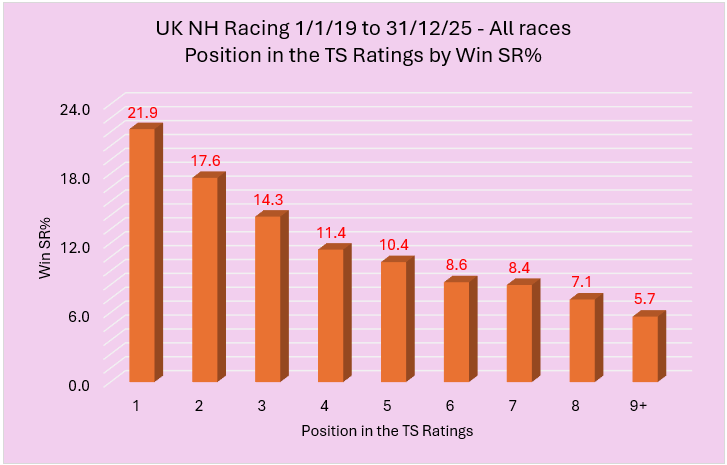
I am going to start by looking at win percentages (strike rates) for different TS rated runners. This covers all qualifying races across the period of study. The horizontal axis is labelled from 1 and stands for the top-rated runner, 2 is the second rated, 3 the third rated and so on:
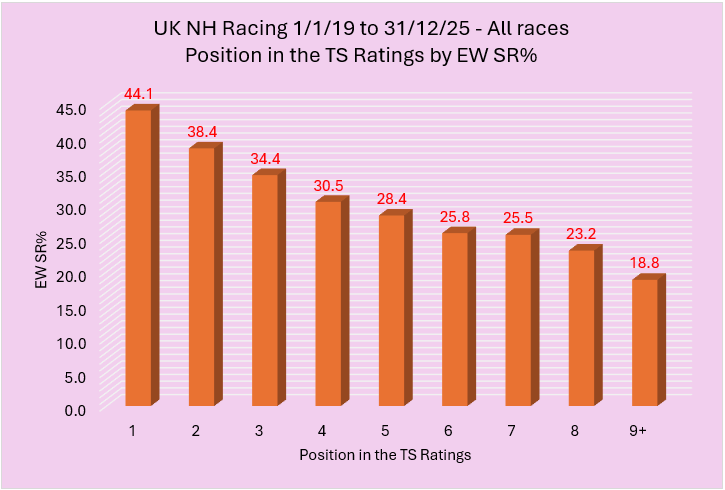
The win strike rate for top-rated runners has been better than one win in every five races which is a decent starting point for any set of ratings. More importantly perhaps, the win percentages have correlated positively with the rated positions showing the sliding scale I was talking about earlier. Hopefully, the same pattern will be replicated as we look at Each Way (win & placed) strike rates. Here are those splits:
The top-rated runner has achieved the highest percentage once more, and the sliding scale is once again in evidence. These ratings certainly have the right ‘feel’ at this juncture.
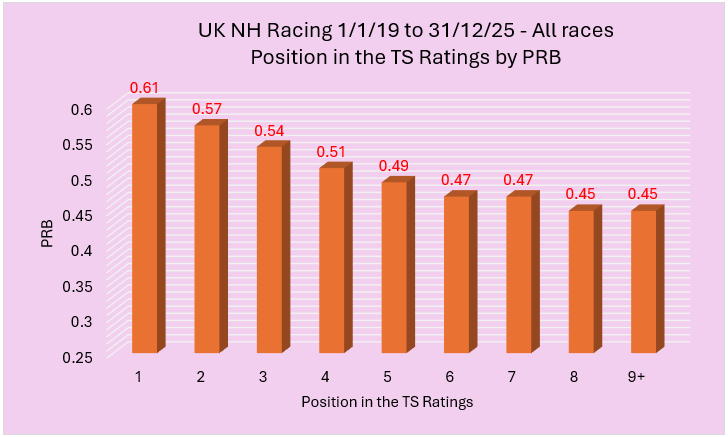
Finally for this opening section, let me share the Percentage of Rivals Beaten (PRB) figures. Being able to share these is due to another of the recent Geegeez additions - that of having PRB figures available in the Query Tool Results Summary. Again, the hope is that we see the same type of graph, with the bigger bars on the left and the smaller ones on the right:
We have the hat-trick in terms of correlation with this graph. Based on the first three sets of data analysed, the TS ratings seem to have been highly accurate at predicting the overall performance of a horse in relation to the TS ranked positions.
TS Top Rated in UK National Hunt
From my initial starting point, having seen the edge for the top-rated runners in terms of win rate, EW rate and PRB, it makes sense to focus on the TS top-rated horses to see if we can find any positive or indeed negative angles to exploit. Below is the record of every single TS top-rated runner since 2019:
Over 25,000 top-rated runners is a significant sample, and to see a small profit overall is extremely impressive. From here, it is time now to dig a bit deeper.
Annual strike rates – TS top-rated runners
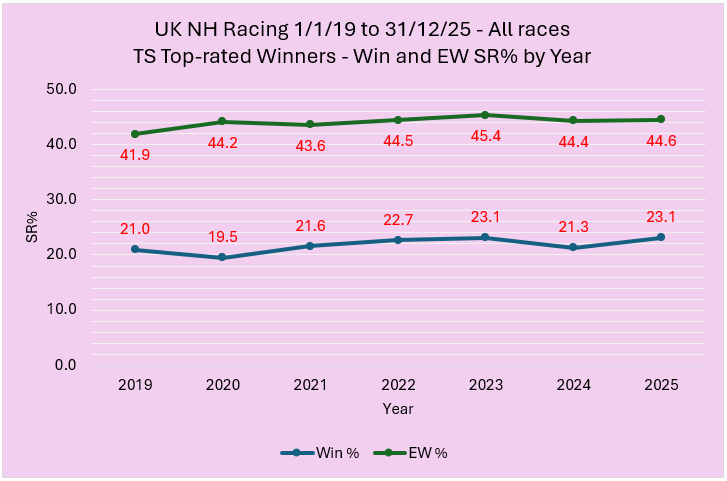
Let me start the digging process by comparing the yearly win strike rates, and the yearly win & placed (Each way) strike rates to see how they matched up. The graph below shows the splits:
Both lines are relatively straight indicating that the performance of the TS top-rated runners has been consistent from year to year out when it comes to winning and placing. In terms of the PRB figures they have been remarkably consistent, ranging from a low of 0.60 to a high of 0.61.
Market Rank – TS top-rated runners
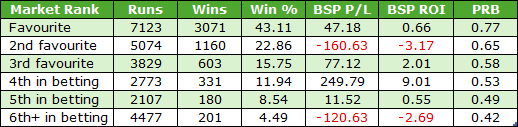
I would now like to look at the record of the top-rated runners in terms of market position / rank. The market rank is based on traditional SP, that is Industry SP rather than BSP. Profits and losses, however, have still been calculated to BSP:
Top-rated runners when favourite have edged into profit, but the overall figures do not really conform to any major pattern. Essentially, all market positions have performed quite well with only second favourite and 6th+ in the betting runners producing losses. In reality though, the losses have been quite small.
TS top-rated favourites by Race Code
Sticking with favourites, let me share how well they have performed across the three different race codes namely chases, hurdles and NH Flat (bumpers):
There were much higher win rates for favourites in hurdle and NH Flat races than in chases, and perhaps this has influenced the bottom lines as both are in the black. The record for chasing favourites has still been decent enough considering we are talking over 2000 qualifiers.
TS top-rated favourites by Handicap or Non-Handicap
How about top-rated favourites in terms handicaps versus non-handicaps? The splits were thus:
Non-handicap TS top-rated favourites nudged into profit while the handicappers broke even. All findings so far are generating 'good vibes' as far as the TS ratings set is concerned, as each group of results has shown robust consistency.
TS top-rated favourites by Handicap Chase or Handicap Hurdle
The final set of favourite stats I wish to share are the TS top-rated splits in terms of handicap chases versus handicap hurdles. Once again, we see the consistent theme continuing.
We have seen remarkably similar metrics across the board.
Handicaps versus non-handicaps – TS top-rated runners
Reberting to top rated TS runners, regardless of their market rank, I now would like to examine the difference between handicaps and non-handicaps in terms of those top-rated horses. The split was thus:
As we should have expected top-rated non-handicap runners had the better win rate; but both secured a blind profit, albeit only just in the case of the handicappers.
TS Performance by Rating Rank
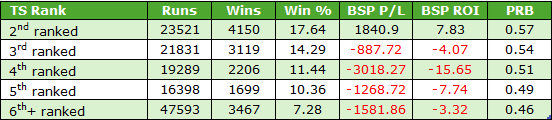
In the second half of this two-parter I will share more top-rated stats, but for now I want to move away from the top-rated horses and take a quick look at the performance of the second-rated runner. Before I do though, let me share the results for different rated positions across all races:
As the table shows, second ranked TS rating runners have secured a significant profit. However, before we get too excited and back these runners blind, let me divide those second-rated runners into two cohorts, one priced 20/1 or longer and the other priced 18/1 or shorter:
Both were in profit, but as we can see the vast majority of the profit came from the longshot bracket. That said, six of the seven years for the 20/1+ group turned a profit as the table below shows:
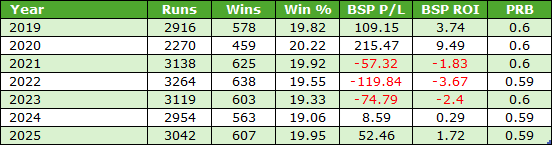
Strike rates of between 2% and 3% are only for those with titanium constitutions, so here is the breakdown for the shorter priced group (18/1 or less) of TS second-rated runners by year:
There were four winning years out of seven, and the three losing years were not too bad. Again, we can see excellent consistency in terms of win rates and PRB figures.
2nd Top-Rated Bonus Stats
There are a couple of extra stats worth sharing as regards the second-rated TS runners.
Firstly, when starting favourite, second-rated TS runners have scored just under 38% of the time (1789 wins from 4715) for a sound profit of £200.08 (ROI +4.2%).
Second, focusing on hurdle races only would have seen a return of over 12p in the £ for those positioned second in the TS ratings.
**
For the TS top-rated and second rated to both prove profitable over such a time frame is testament to the quality of the ratings. Next week, in the second article, I will expand on the performance of top-rated TS runners, looking in depth separately at both non-handicap and handicap data. Until then...
- DR
https://www.geegeez.co.uk/wp-content/uploads/2024/07/SureTouch_SummerPlate2024.jpg319830Dave Renhamhttps://www.geegeez.co.uk/wp-content/uploads/2022/10/geegeez_banner_new_170x78.pngDave Renham2026-02-24 14:51:082026-02-24 14:51:08Topspeed Ratings in UK National Hunt, Part 1
It's day 2 of Tix Week, woohoo! Today we're looking at the ABCX framework, one of the most common approaches for multi-race tote pool players. Before that, though, if you've not yet taken a look at yesterday's video post, you'll find that here. It covers the most simple way to play Tix (choose budget, choose horses, place smart bet) and if you're new to this sort of thing, it's a great place to start. To today...
What you need to know about ABCX
ABCX is a way to build multi-race tickets by ranking your picks A, B or C based on confidence, then structuring your bets so your strongest selections get the most coverage and your weaker ones get less, helping balance cost and potential return. Using Tix, the software does all the structure bits, so you just need to pick your horses and confidence levels.
This video explains everything, as I try to pick out a winning placepot at Catterick. [Tip: you can make the video clearer by clicking the cog icon bottom right and choosing 'quality' 1080p, and you can make me speed faster with the 'playback speed' option in the same place]
I'll be back on Thursday with a look at the Tix Plus 'Pro' variant, and then on Friday I'll share some general advice on picking between the frameworks as well as some 'pro tips' for playing placepot/jackpot bets.
In the meantime, if you have any questions, let me know in the comments and I'll be happy to cover them for you.
This week on geegeez, I'll be highlighting the different playing modes on Tix, our tote multi-race staking software. By the end of the week, you'll know about Simple, ABCX, and Pro - and when to use each scenario.
Very little, in truth. You choose your maximum budget, minimum stake per line, and the horses you want included; the software does the rest.
Watch this video, where I walk you through a placepot play using Tix SIMPLE. I've had a crack at Plumpton's main meeting £50,000 guaranteed pool and, as well as mentioning a couple of things to look out for when playing placepots, I also discuss the mechanics of Tix SIMPLE. It bears repeating, though, that you don't need to know how it works particularly; you just need to know that it's a better way to stake the placepot you already play.
Here's the video. [Tip: you can make the video clearer by clicking the cog icon bottom right and choosing 'quality' 1080p, and you can make me speed faster with the 'playback speed' option in the same place]
Back tomorrow with Part 2, where we'll laser in on the ABCX framework.
But, for now, why not have a crack at TIX yourself this afternoon? Go here to check it out.
Matt
https://www.geegeez.co.uk/wp-content/uploads/2026/02/TixPlus.png320830Matt Bisognohttps://www.geegeez.co.uk/wp-content/uploads/2022/10/geegeez_banner_new_170x78.pngMatt Bisogno2026-02-23 11:27:002026-02-24 11:01:45Tix Week: Plus Simple
Almost exactly a year ago, I was invited by my friend Malcolm Cain to attend a Cheltenham preview meeting on a Saturday evening in Central London, writes Tony Stafford. It was a great do, very close to the event itself, and much debate focused on whether Constitution Hill would be able to regain the Champion Hurdle he had ceded to State Man and injury the previous year.
Lydia Hislop was one of the panellists and she was wary about the present state of his jumping whereas I managed to get in a word suggesting he was the best hurdler I’d ever seen. As we all know, he fell in the Champion Hurdle a few days later when a 4/7 shot; tumbled over again at Aintree the following month, and stopped as if shot at Punchestown.
In the five-horse Fighting Fifth Hurdle on his comeback run last November he got only as far as the second hurdle when making it three falls and a submission in his four latest runs following an unblemished ten victories in a row and a total of 103 lengths to the good.
While the behind-the-scenes machinations that produced last Friday’s £40k 4yo and up novice race at Southwell over one and a half miles might well have had ulterior motives, the desired effect – a win for the nine-year-old – was achieved and spectacularly so.
What nobody expected – unless Oisin Murphy might have had an inkling, judged on his post-race comments about when he rode the horse a couple of weeks earlier – was the sort of performance that you rarely see in any flat race.
While there weren’t any superstars among the opposition, more than a few of them were anything but the proverbial trees. Nine and a half lengths was the verdict, so 11 career wins – 112 lengths in total, at ten lengths a time and no doubt we hope, much more to follow.
We’ll have to wait until midweek’s crucial schooling session for a decision. Nico de Boinville will be hoping that Nicky Henderson and owner Michael Buckley will agree with him to allow their extraordinary nine-year-old to return to his day job, before embarking on what could be a lucrative second career on the flat.
As a jumps trainer – not merely any jumps trainer but one who has won nine Champion Hurdle races and pretty much everything else – Henderson would no doubt love to make it a round ten. He’s 75 now, yet there’s no diminution in the ambition nor the uncanny knack of getting his horse right on the big day.
In some ways Southwell on Friday was a big day. The Arena publicity machine (and Simon Mapletoft on Sky Sports Racing – I didn’t watch ITV) was in full volume afterwards, talking up the “tremendous crowd”. I suppose 3,800 is a lot for a Friday night at Southwell. I’ve been there when you’d struggle to find 300 – including staff and jockeys!
There was no disguising the excitement though as Oisin and the wonderful gelding returned to weigh in. He had overcome so many new experiences. First time in starting stalls, a first time on a Tapeta surface, and, of course, the first time he didn’t need to jump an obstacle.
I know Oisin has experience over jumps. He was fulfilling an ambition when he rode the six-year-old Ike Sport for Neil Mulholland on Boxing Day 2024 at Wincanton. The pair never got involved and Oisin eventually pulled up his mount. No doubt he’ll be at Cheltenham as a guest of Michael Buckley and probably hoping Nico forgets to set his alarm and a substitute rider is needed.
Incidentally, my host at the Cheltenham preview last year was involved with Buckley in a Cheltenham Festival winner trained by Nicky Henderson. They were among the members of the Men In Our Position Syndicate that also included Victor Chandler.
We talk of the correlation between hurdles and flat race abilities in handicap terms as being between 45 and 50lb. Constitution Hill is a 170-rated jumper, so there’s no reason why that couldn’t translate as a 120ish flat horse. Initial estimates of the worth of the single romp at Southwell has him already well into the low 100s and if he’d have had another furlong, say, to travel, he’d have won by at least 15 lengths, so you can add a few pounds to that!
What would you do if you were Michael Buckley? He has already stated that he wouldn’t mind having a crack at the Melbourne Cup. Two miles on fast ground? Maybe.
If he did go to Melbourne and won, he would eclipse the record age of a winner. Joseph O’Brien sent the eight-year-old Twilight Payment to win the 2020 race and he thereby joined Toryboy in 1865 and the 1938 victor Catalogue as the joint-oldest winner.
Meanwhile, in Hong Kong yesterday, local history was made as Ka Ying Rising made it 18 wins in a row in the Queen’s Silver Jubilee Cup, taking the £693k Group 1 race by an easy three and a half lengths under Zac Purton, smashing the track record in the process.
The David Hayes-trained five-year-old beat the previous record of 17 in succession set by another great local hero, Silent Witness. He started at 1/20 and Hong Kong racegoers who like to back a favourite would never have had much doubt that he would triumph yet again. The question now is, how far can he stretch the elastic?
Reverting to what could await Constitution Hill when he does turn to a flat-race programme, there is no bar on older horses being successful on the level. Hughie Morrison’s Alcazar was at his best as a ten-year-old when his crowning glory was victory in the Prix Royal Oak (Group 1) at Longchamp under Micky Fenton.
My memory is not always accurate, but I do believe that a 12-year-old hurdler called Beau Caprice won a division of the Gloucestershire Hurdle, forerunner of the Supreme and run in the old days in two divisions, in 1966. I think he was trained by Fulke Walwyn. [He was – Ed.]
But I cannot remember any nine-year-old winning a flat race first time out, certainly not one of this quality and by such a wide margin. Even if de Boinville gets his way and Constitution Hill does run at Cheltenham in a couple of weeks’ time, that surely will be the finale to his stellar jumping career, but one which with luck might have already equalled the feat of such as Istabraq with his three in succession.
- TS
https://www.geegeez.co.uk/wp-content/uploads/2026/02/ConstitutionHill_Southwell2026.png320830Tony Staffordhttps://www.geegeez.co.uk/wp-content/uploads/2022/10/geegeez_banner_new_170x78.pngTony Stafford2026-02-23 07:47:342026-02-23 09:58:12Monday Musings: A Strong Constitution
Home or Away? NH Jockey Performance by Retained Stable or Other
The iconic BBC TV show A Question of Sport is one that I am sure many readers will remember, writes Dave Renham. One of its regular rounds was ‘Home or Away’ where team members could answer a ‘home’ question on their own sport for one point, or an ‘away’ question on any sport which was worth two points.
Introduction
That was the inspiration for a piece of research in which I analysed different jump jockeys and split their data set into two. One cohort was for performance with their main, or retained, trainer, and the other was for their record with other trainers. What I mean by ‘main’ trainer is the trainer with whom the jockey had most rides for in a particular calendar year.
For some jockeys that will mean the trainers or stables they are contracted to where they would be known as the stable jockey. Harry Skelton is Dan Skelton’s stable jockey, for example; Nico De Boinville is Nicky Henderson's, and so on. These jockeys ride for their ‘home’ stable as it were. For others, they may not be contracted specifically to a stable but there will be a trainer from who they get more rides from than anyone else.
Of course, even jockeys who have the vast majority of rides for one trainer will get rides for others – these are the ‘away’ trainers, as it were.
Therefore, I plan to start by looking at a group of jockeys comparing their overall performance for their main trainer compared with all other trainers combined. From that point, I will dig deeper in the hope of uncovering some positive and negative angles that hopefully we will be able to exploit in the future.
The data has been sourced from eight full years of UK National Hunt racing spanning from 1st January 2018 to 31st December 2025. Profits / losses have been calculated to Betfair Starting Price (BSP) with returns adjusted for 2% commission on any winning bets. I have not included jockeys who ride rarely; all jockeys in this piece have ridden numerous times for both cohorts.
Home vs Away: Broadest Win Strike Rate Differentials
Let me first compare win strike rates – below is a graph showing the NH jockeys who had the biggest differential between win rates for their main trainer compared with all others combined:
Win strike rate is not everything as we know, but these ten jockeys have won far more often for their main trainer compared with other trainers combined. Focusing on these ten jockeys, below are their ROI percentages based on a one unit level stakes bet. However, to avoid big priced winners potentially skewing the figures, I have restricted horses that were priced BSP 20.0 or less.
Here we see that only six of the ten have had better returns with their main trainer, whereas four (Bass, Deutsch, Hammond and Mania) fared better with other trainers combined. Having said that, Fox, Gethings, O’Brien and Powell have all had significantly better returns when riding for their main trainer.
Here are a few snippets to share (with the BSP 20.0 or less price cap in place):
David Bass has secured a strike rate in excess of 20% for Henry Daly and David Dennis. The sample sizes were quite small (53 rides and 28 respectively), but both turned a fair profit too. He had a similar record with Charlie Longsdon when riding primarily for Kim Bailey – he now rides primarily for Longsdon!
James Davies had an excellent full set of stats when looking at his rides for his current main trainer, Nick Gifford. He has had 31 winners from 154 (SR 20.1%) for a profit of £46.13 (ROI +30%). Virtually all of these profits have come from chases.
Derek Fox rides for the Lucinda Russell yard and their record together at Scottish tracks is worth noting, with the aforementioned price cap – a strike rate of 19.6% thanks to 111 winners from 567 for a healthy profit to BSP of £90.11 (ROI +15.9%).
Paul O'Brien now rides primarily for Harry Derham, and their record together is excellent. Their strike rate has been a very impressive 27.1% for a profit of £49.85 (ROI +14.4%).
Brendan Powell has struggled when teaming up with Alan King – they are 0 from 22 with the price cap, 0 from 14 with bigger prices. On a more positive note, when riding for Joe Tizzard at Ascot they have a very good record with 10 wins from 24 (SR 41.7%) for a profit of £30.65 (ROI +86.1%).
Home vs Away: Top NH Jockeys Win Strike Rate Differentials
Below is a comparison of home vs away win strike rates for ten more jockeys including some of the biggest ‘hitters’, namely Sean Bowen, Harry Cobden, Gavin Sheehan and Harry Skelton:
Nine of the ten continue the theme of earlier with higher win strike rates for their main trainer. James Bowen bucked the trend, just, with a 15.4% win rate for other trainers compared to 15% for his main trainer. However, these stats are potentially slightly misleading because he has had over two hundred rides in the past two years for two separate trainers – Warren Greatrex and Nicky Henderson, and over a hundred for his father’s (and now brother's) yard, that of Peter/Mickey Bowen.
Let me compare these jockeys as I did previously by displaying their ROI percentages with the max BSP 20.0 price cap in place:
In terms of ROI%, seven of the ten had worse returns for their main trainer. Having said that most of the gaps between the numbers were small. It does seem that for Skelton and O’Neill, riding for their main trainer has seen much better returns.
Top Trainer Combinations
Here are some additional stats for these jockeys with horses priced BSP 20.0 or less, starting with Brian Hughes. He has had an excellent record when combining with the following trainers:
I would definitely keep an eye out for any of these Hughes trainer combos in the future. An added extra before moving on is that if we had backed second or third favourites when Hughes was riding for one of these six trainers, we would have secured a sizeable profit of £97.30 (ROI +48.4%) thanks to 53 wins from 210 (SR 36.4%).
It will be interesting to see how Harry Cobden fares next season when he begins his role with JP McManus. I wonder how often he will get to ride for other trainers compared with the last few years when stable jockey for Paul Nicholls. The reason I say that is because one trainer who he rides occasionally for, James Owen, produced some excellent results (BSP 20.0 or less) – 18 wins from just 58 rides (SR 31%) for a profit of £13.35 (ROI +23%). Hopefully Cobden will still be able to ride for Owen from time to time in the future.
Ben Jones has done well when riding for Ben Clarke. Ignoring those big outsiders (of BSP 20.01+) their record together saw 18 winners from 65 (SR 27.7%) for a healthy profit of £73.44 (ROI +113%) being achieved.
Sean Bowen is currently stable jockey to Olly Murphy and, since their partnership started to grow in 2023, their combined record has been positive. The last three full years (2023 to 2025) with horses priced BSP 20.0 or less delivered 249 wins from 879 rides (SR 28.3%) for a profit of £73.48 (ROI +8.4%).
During this three-year time frame, they combined to be dynamite at Ffos Las, hitting 13 wins from just 27 runners (SR 48.2%) for a profit of £45.37 (ROI +168%).
In terms of other trainers, there are three with whom Bowen enjoyed an excellent record between 2018 to 2025 with the price cap in place. They are shown in the table below.
These are three more trainer / Sean Bowen combos to keep an eye out for.
Moving on to Gavin Sheehan now, and his record with trainer Jamie Snowden with horses sent off 20.0 or lower BSP. The last five years have been extremely solid for this pairing, with the last three being particularly good. The table below shows the yearly splits from 2021 to 2025:
Four winning years out of five, with the losing year showing only a very small overall loss. Sticking to this 2021 to 2025 period, when combining at Huntingdon the Sheehan/Snowden combination excelled with 18 first places from just 35 runners (SR 51.4%) for a profit of £32.70 (ROI +93.4%).
Selected NH Jockeys: Single Ride on the Day
Finally in this piece, I have looked at some data for these 20 jockeys when they went racing for just one ride on a specific day, as long as the price on the horse in question was BSP 20.0 or less. Firstly, when that single ride was for their main trainer; secondly when that single ride was not for their main trainer.
'Home' trainer stats
I will start by looking at their ‘one ride on the day’ stats when it was for for their main trainer:
The figures for Nico de Boinville have been particularly impressive from a significant sample size. When having just one ride on the day for his boss Nicky Henderson their strike rate has been close to 32% with excellent returns of nearly 20 pence in the £. Brian Hughes has an excellent record also, albeit from a much smaller sample.
'Away' trainer stats
And here are the stats for the same jockeys when the one ride on the day is not for their main trainer. Again, to qualify the price of the lone horse must have been 20.0 BSP or lower.
14 of the 20 jockeys would have made a blind profit with these runners from 2018 to 2025 which is noteworthy. One negative to note has been the record of Sam Twiston-Davies with his sole daily rides having produced losses in both groups, of 35p and 28p respectively.
Three others to note in the 'away' column
I have just one more thing to share before I conclude this piece. There are three jockeys, outside of the 20 I have discussed, that I would like to highlight in terms of their records with single rides in a day when not riding for their main trainers. These are Rex Dingle, Richie McLernon and Jack Quinlan. Their stats have been as follows:
*
This article has covered a variety of jockey angles which were new to me, and hopefully a fresh take for you, too. I hope and expect that we will be able to use of some these numbers to our advantage over the coming months.
Until next time...
- DR
https://www.geegeez.co.uk/wp-content/uploads/2020/11/Rex_Jepeck_830x320.jpg320830Dave Renhamhttps://www.geegeez.co.uk/wp-content/uploads/2022/10/geegeez_banner_new_170x78.pngDave Renham2026-02-18 08:55:382026-02-18 08:55:38NH Jockeys: Home or Away?
You might wonder whether the dream of Saudi Arabia’s rulers to dominate the world’s most watched sports at the highest level is wearing a little thin, writes Tony Stafford. Golfers and soccer players have been enticed by unfathomably large sums to join the Liv Tour and Saudi Pro League respectively, but even after no more than a year or two in some cases disillusionment is setting in.
In the Kingdom, horse racing’s attention is largely on one day and specifically one race. Last Saturday was the seventh instalment of the Saudi Cup, run on dirt over a mile and a furlong of the Riyadh racecourse at Janadriyah. A field of 13 included three Japanese competitors, six horses from the US and was filled out with a quartet of generally outclassed locals.
The race had a prize fund totalling £15 million, but despite facing decent opposition, the favourite and defending champion Forever Young started as short as 1/3 and duly did the business for owner Susumu Fujita, trainer Yoshito Yahagi and jockey Ryusei Sakai. The trainer also won the race in 2023 with Panthalassa.
Forever Young shared top spot in the dirt-race section of the 2025 International Classification with the US-trained three-year-old Sovereignty. Their mark of 128 was 2lb inferior to the overall champion, the French-trained turf specialist Calandagan, who was boosted to that mark when winning the Japan Cup at Tokyo Racecourse in late November.
Saturday’s opposition to Forever Young was headed by the Bob Baffert-trained Nysos, a far from negligible performer who had won six of his seven previous starts. One of those was at Grade 1 level and his sole defeat until the Saudi Cup was also at that level and then by only a neck.
His rating going into the race was 119, 9lb inferior to Forever Young’s, but after the one-length defeat, he is certain to have his mark adjusted upwards. The pair were almost four lengths in advance of the best of the rest, the Wathnan Racing-owned but US-trained Tumbarumba, partnered by Wathnan’s retained rider James Doyle.
Here’s the time to mention the lavish prizes. The winner collected £7,407,407; Nysos earned £2,592,592; Tumbarumba pocketed £1,481,481; fourth-home Bishops Bay (US) takes home £1,111,111. £740,740 was the prize for Japan’s fifth-placed Luxor Café, while Sunrise Zipangu, the next-home under Oisin Murphy, lifted £444,444. Murphy has often been associated with Japanese runners in international events over the years.
The money went all the way down to 10th place. That position was held by one of the home contingent, Ameerat Alzamaan. It was well worth Ryan Moore’s time to travel over to Saudi Arabia, his mount earning £148,148.
Those massive figures explain what happens when the best part of £30 million in overall stakes is available. Do the authorities at the top in the Kingdon continue to feel that the £30 million for one day is value for money? As long as they do, the “have saddle will travel” community will be happy to join the party.
Moore, Murphy and Doyle are among that small group of UK-based riders (also including the absent Willliam Buick) at the forefront of the world’s jockeys and all three will return home with nicely enhanced bank balances. I’m not sure whether they cop the imagined ten per cent of total prizemoney in Saudi but even if it is a mere five per cent, it would represent a great way to divest the costs of family Christmases.
Overall, Murphy held sway, his £2 million and a bit total bolstered by two wins, in a Listed race (£370k) and more spectacularly in the £1,333k Turf Cup over ten and a half furlongs on the Karl Burke-trained Royal Champion.
Moore was third here on George Boughey’s Survie, carrying the Doreen Tabor colours, and the resulting £222k contributed to Ryan’s £700k haul on the afternoon. Later he teamed up with Tom Clover’s Tabletalk in the 1m7f Turf Handicap, bettered only here by Joseph O’Brien’s Sons And Lovers ridden by Dylan Browne McMonagle. The Irish team’s reward? A cool £1.1 million.
Doyle’s nearest to a win came on the French-trained, Wathnan-owned speed merchant Lazzat, but he couldn’t match the US performer Reef Runner, trained in Florida by David Fawkes.
Another septet of UK jockeys was recruited mostly for a single mount and again normally without making an impact. David Loughnane and Danny Tudhope got lucratively among the place prizes once each, while the other five, namely Pat Dobbs, moving across from his winter base in Dubai, Jason Watson, Pat Cosgrave, Callum Shepherd and P J McDonald all went without a prize, but could well have been paid a guaranteed fee to attend.
Many years ago, when Saudi Arabia was just getting acquainted with organising top-class international sports events, a golf tournament’s first prize was exceeded many times over by the appearance money paid to Justin Rose.
**
We’re in that period of the season when most trainers will be holding their breath with Cheltenham in mind. One who will be going there with optimism is Ben Pauling after Saturday’s wonderful hat-trick in the first three races on the Ascot card. Novice hurdler Mondoui’boy; The Jukebox Kid, comfortably in the Reynoldstown Chase; and Fiercely Proud in the day’s featured handicap hurdle all won well to show his team is right at the top of its form.
Pauling is involved at the six-day stage in one of the most compelling events of the winter – and it’s a flat race at Southwell on Friday. With £40k added, it’s the “Let’s do Nicky Henderson and Michael Buckley a Favour novice stakes”, a race for four-year-olds and upwards over 1m4f.
Hughie Morrison was speaking to me about it the other day and mentioned that with that amount of money, it cannot be divided, and 32 horses were entered, with a maximum field of only 14 able to run. For a day Nicky must have been nervous that Constitution Hill could have a low ballot number and miss the gig.
I know loads of trainers who routinely get what they describe as “crap draws”, but the boffins (or AI maybe nowadays) that programme the machine that spews out the ballot order the day after entries, thus yesterday, gave Constitution Hill number 16 so only two of the 32 need to come out.
One bookmaker’s odds I saw had the former Champion Hurdler as the 4/6 favourite. Kevin Phillipart De Foy’s Amo Racing-owned Square Necker, a winner at Dundalk in December, is next best at 7/4 with Willie Mullins’ Daddy Long Legs, a 152-rated hurdler, next best at 7/2.
If you think I begrudge the Seven Barrows team being helped to find a non-jumps race for Constitution Hill’s quest to regain his Champion Hurdle crown, far from it.
Sixteen years ago, the season after his 2009 Champion Hurdle success, Nicky was struggling to find a suitable prep for Punjabi. Kempton was persuaded to stage an £8k to the winner hurdle race with advantageous terms, also at the end of February. Punjabi started 1/6 and won by 12 lengths, but his wind gave out in the big race a few days later and stablemate Binocular gained his revenge.
Ray Tooth’s star performer was never the same again. The year after Binocular’s Champion Hurdle win, Sandown provided another “gift” for him. It was gladly accepted at 1/10 but again a second title victory proved beyond the J P McManus star.
- TS
https://www.geegeez.co.uk/wp-content/uploads/2026/02/ForeverYoung_SaudiCup2026.png319830Tony Staffordhttps://www.geegeez.co.uk/wp-content/uploads/2022/10/geegeez_banner_new_170x78.pngTony Stafford2026-02-16 09:04:412026-02-16 09:04:41Monday Musings: Saudi Riches
At the end of a busy week which has already featured a major sectional data enhancement to the Full Form tab, we now unleash a raft of small changes designed to make your life easier. Let's crack on with them...
Enhanced Tracker buttons on the racecard
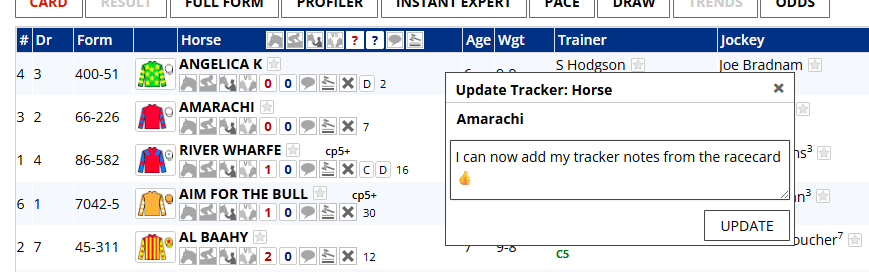
Historically, there was a cumbersome process whereby you could add a horse (or trainer/jockey/sire) to your tracker via the little star icons on the racecard... but you then needed to go to the Tracker page to add or update any notes. No more. Now, a click on the star brings up a dialogue box enabling direct entry of notes. If you already have an entity tracked, you can remove it via a 'remove' button that displays next to the 'update' one. That's better...
Breeding suffixes on Full Form and Profiler tabs
Adding breeding country suffixes to horse's names is a small but quite useful little tweak. Not much else to say on that one.
Shortlist scores on Instant Expert
Ooh, what's this? We've added a new column to Instant Expert with scores based on The Shortlist scoring system. Three for green, one for amber, none for grey, minus one for red. Top score 15, bottom score -5.
The scores update when you change the variables and dropdowns above the main data grid. Nifty.
'Last 5 Years' option on Draw Tab
Sometimes the draw bias over a particular track and trip changes. Maybe the rail configuration was amended, maybe a different irrigation system was put in place, occasionally they dig up the entire track and re-lay it. These things have a bearing on any bias that previously existed, and our 'last 5 years' button allows you to quickly compare the data from 2009+ with that for the most recent half decade. Simple dimple.
Each way terms added to the Odds Tab
Jeez, it took us a while to get to this. But, finally, we are there. Number of places and the fraction of the win odds paid are now displayed on the odds tab for each bookmaker. Useful.
Report tweaks galore and a bug fix
We've added csv download buttons to most reports and course selector dropdowns on all reports. And we've added odds to most of them, too.
You're welcome!
Hopefully there's something useful there for most users. A gazillion more updates planned for this year, but that's a goodly bunch this week to get you started.
Matt
p.s. As always, you can view the full User Guide here. There's a lot inside Geegeez Gold including things you probably didn't even realise were there! Any questions, let me know below.
https://www.geegeez.co.uk/wp-content/uploads/2026/02/febupdate3.png345661Matt Bisognohttps://www.geegeez.co.uk/wp-content/uploads/2022/10/geegeez_banner_new_170x78.pngMatt Bisogno2026-02-12 17:42:382026-02-12 17:43:30Gold Updates: February 2026
Firstly, let me apologise for the title of this piece, writes Dave Renham – it is simply my attempt at humour! However, it certainly points us in the right direction for the subject of today's article.
Introduction
A tongue tie is a piece of material, usually made of nylon or a rubber band, that sits over the horse’s tongue and under the lower jaw. There are a few reasons why trainers deploy tongue ties. For example:
It helps to prevent upper airway obstruction.
It can stop a horse from getting their tongue over the bit, increasing the jockey’s control.
It can help prevent the horse from potentially swallowing its tongue.
It aims to improve performance due to greater air intake.
The jury is out in terms of how effective tongue ties really are, so in this article I am going to delve into the stats in terms of performance for horses that have worn tongue ties in races and try to deliver a verdict.
The data has been taken from UK National Hunt racing between 1st January 2018 and 31st December 2025. Profits have been calculated to Betfair Starting Price (BSP) with returns adjusted for 2% commission on any winning bets. Around 90% of the stats I will share have been sourced from the Geegeez Query Tool.
Tongue Ties: Overall Performance
Let me start by sharing the overall data for all horses that have raced in a tongue tie during the period of study.
As can be seen there have been nearly 60,000 runs in total for horses wearing a tongue tie. Clearly, a lot of horses wear tongue ties at some time in their careers. Returns to Betfair SP have actually been slightly better for tongue tie wearers than for those which have not worn them – a loss of 2.7p in the £ versus a loss of 4.1p.
Furthermore, tongue tie wearers edged the strike rate battle 12.4% to 11.9%. Maybe tongue ties do improve performance very slightly? Let's do some more digging.
Tongue Ties: Annual Strike Rates
I want to share the yearly win strike rates first for horses that have worn a tongue tie, and the splits are shown in the graph below:
There has not been too much fluctuation over the years. 2022 saw the highest win rate of 14%; 2020 the lowest at 11.3%. But what about returns on investment?
The yearly splits for these have been thus:
2024 was somewhat out of kilter with other years with losses just a smidge under 9 pence in the £. Six of the seven other years saw returns lie between +2.4% and -2.8% so fairly similar.
Tongue Ties: Market Rank
A look at market rank now, and I have based the following table's betting positions on Industry SP:
Favourites snuck ‘into the black’ with some solid stats across the board, while second and third favourites also performed pretty well, producing relatively small losses across 7000+ bets each.
For the record there were 20 winners priced at BSP at 100.0 or bigger, so it again makes sense to put in place a price cap for the remainder of the article. That prevents a big-priced winner here and there skewing the bottom line. I will use an Industry SP price cap at 16/1 – so the remaining stats shared only include runners that were sent off 16/1 or shorter. Here are the results for all runners wearing a tongue tie that were priced ISP 16/1 or less:
Nearly 42,000 horses have still qualified using the price cap and, overall, runners have performed well - even nudging into profit if we had backed every single horse ‘blind’.
Tongue Ties: Handicaps vs Non-Handicaps
Let me look at handicaps versus non-handicaps – here is what the splits tell us:
Non-handicappers won more often, as would be expected, and both ended up in the black once more. That's pleasantly surprising.
Tongue Ties: Race Class
How about class of race? What has that shown? The table below reveals all:
The Class 1 stats were possibly to be expected: a relatively modest win percentage and a loss made. However, I must admit I had expected slightly bigger losses. However, if we restrict Class 1 races to non-handicaps only, we can see that horses wearing tongue ties struggled even with the bigger priced runners excluded. This cohort of horses priced 16/1 or shorter in Class 1 non-handicaps managed 175 wins from 1033 (SR 16.9%) for a loss of £98.09 to £1 level stakes (ROI -9.5%). Hence, losses were not far shy of 10p in the £.
Going back the table, Class 3 and 4 races both delivered sound profits; however, I cannot explain why this may have happened. If any reader has a logical suggestion, I would love to read it in the comments.
Tongue Ties: Age Factors
My next port of call was the age of the horses in question when priced 16/1 or less:
I find these stats the most fascinating so far. Three-year-olds have really struggled and, although the sample size was small compared to many of the age groups, 325 runners was still a decent number. Losses of more than 50p in the £ coupled with a low strike rate suggests that these runners can be safely ignored from calculations in the future.
Indeed, an additional 3yo stat connected with market rank is worth sharing: 3yos that started in the top three in the betting won 20.9% of races (37 wins from 177) for a hefty loss of £46.20 (ROI -26.1%). Before moving away from 3yos completely I had a look at their record when priced 18/1 or bigger – just three wins from 222 attempts.
The other age stats that caught my attention were those for horses aged 11 or 12. Both have produced similar solid profits and returns. My theory is that when talking generally some of these runners have been overlooked or ignored. Most bookmakers and punters would not immediately be drawn to horses wearing a tongue tie who were also aged 11 or 12, so I reckon a few have started a point or two bigger than their true price, giving us a value scenario over time.
Tongue Ties and Topspeed
One of the relatively new angles that can be tested in the Query Tool is the performance of the Topspeed speed ratings from the Racing Post. The graph below compares the PRB figures (Percentage of Rivals Beaten) for the top three rated/ranked runners as well those ranked fourth or bigger.
We see fairly strong positive correlation. Let me dig deeper by sharing the records in full for the top three rated/ranked runners:
All three have made a blind profit across the 2018 to 2025 timeframe, with solid looking strike rates to boot. Betting all of the top three ‘blind’ would have turned a profit in five of the eight years under review, with two small losing years and a borderline break-even year.
Tongue Ties in combination with other headgear
I next wanted to take a look at what happened when other types of headgear were used in conjunction with a tongue tie. For the record, there were a couple of scenarios where two additional types of headgear were combined with the tongue tie but, with only 48 and 12 qualifiers respectively, these have been ignored. The splits for the rest were thus:
Adding either blinkers or a visor has seen the worst outcomes in terms of both win rate and returns. In contrast, the hood/tongue tie combo performed very solidly.
Regarding the results for tongue tie only we see the following:
As can be seen, a small profit was achieved for the tongue tie only brigade.
Tongue Ties and Run Style
A quick look at the run style stats now – the PRBs for the tongue-tied runners were as follows:
We see the usual pattern with the graph sloping from left to right, and front runners clearly doing best. If we had been able to predict which of the tongue-tied runners would lead early in their races, we would have secured a huge profit of £2294.70 to £1 level stakes (ROI +29.3%). In contrast, hold up horses lost £2352 equating to losses of nearly 20p in the £.
Tongue Ties: Trainer Angles
The final area I want to explore is some trainer data.
First time tongue tie
Firstly, a look at trainer performance when their horses have been wearing the tongue tie for the very first time. Trainers with at least 75 qualifiers priced 16/1 or shorter are shown in the table:
These stats have been extremely positive for many of the trainers with ten of the 14 making a profit. The Kim Bailey (and Mat Nicholls) yard have had outstanding results with a near 23% win rate, returns of over 80p in the £ and a PRB standing at 0.63.
Two yards stand out from a negative perspective – the O’Neill stable’s performance has been very poor with losses of nearly 72p in the £. Likewise, the Greenall/Guerriero yard have had similarly disappointing returns (69p in the £).
Second time tongue tie
Let me now look at the same 14 stables and their record when horses are racing in a tongue tie for the second time:
This time the results are far less punter-friendly with just five of the trainers in the black. The stables of Bailey/Nicholls, Olly Murphy, Fergal O’Brien and David Pipe (just!) all again secured profits.
And the O’Neill stable performed much better with second timers, albeit from a smallish sample, while the Greenall/Guerriero yard also produced a much stronger performance this time, though their runners as a whole still recorded a small loss.
Summary
Overall, the stats for horses wearing tongue ties were a lot better than I was expecting. There have been a number of positive areas highlighted that we potentially can take advantage of in the future. Likewise, a few negative angles to be aware of too.
At some point in the future, I will have a look at flat racing data for tongue tie wearers to see what tells us.
Until next time...
- DR
https://www.geegeez.co.uk/wp-content/uploads/2026/02/Coquelicot_tonguetie_Sandown.png319830Dave Renhamhttps://www.geegeez.co.uk/wp-content/uploads/2022/10/geegeez_banner_new_170x78.pngDave Renham2026-02-10 22:50:252026-02-10 22:50:25Measuring the impact of a Tongue Tie
If you play the placepot (or jackpot, quadpot or any other multi-race pool bet), you'll know the joys and frustrations of the bet. On the upside is the chance to cop a very tidy sum for a modest investment; flip the coin and you'll get back less than you laid out or, quite often, miss by one leg (usually, though infuriatingly not always, the trickiest one).
How we used to play the placepot
For me, aside from those Kiplingesque "twin impostors" joy and frustration, bets like the placepot - and especially the jackpot - are a fantastic puzzle. The challenge is always to 'win twice': first, we have to correctly identify the winner/a placed horse in each leg; and second, because of the pooled nature of the wager, we have to occasionally go where the masses shun. We have to find a race (or two) where the winner and/or the horses in the frame are less obvious and, therefore, less endowed by tickets in the pool.
This, clearly, is tricky in the extreme with a single line running through six races. As we include more selections race to race so the multiplication gets more daunting and the dilution of our stakes makes for a less rewarding potential return... unless we hit that glorious home run whose increasingly distant and rose-tinted memory keeps us coming back for more in spite of the evidence from the interim.
The thing is, when we hit that wonder score with a caveman* ticket, we got lucky. Massively lucky. And, let's be clear, day to day we always need luck during the sextet of races. But I know how unsophisticated I was when I bagged my biggie...
I'd played a two horses per race combination: 2 x 2 x 2 x 2 x 2 x 2 = 64 bets, at 10p per line. It was Ripon and a friend of mine, Gavin Priestley (with whom you may be familiar from his excellent Festival Trends work) and his brother Gary, also a pal, had three betting shops in the Torbay area. They offered early odds based on a tissue (set of prices) they paid for.
Anyway, the opening race this day at Ripon was a maiden and there was a 'springer' in the market on their tissue, but generally offered at long odds elsewhere. As it turned out, he returned much shorter - probably close to single figures though I don't exactly recall. He finished second, with unfindable horses immediately in front and behind, and the placepot pool was decimated by first leg casualties. Actually, more than decimated: there was only about 2% of the pool left, according to teletext.
The rest of the card went far closer to expectation but the dividend still returned £6876.30 to a £1 stake. I had managed to hit four of my 10p lines (one each in four legs, two apiece in the remaining pair), so copped for 40p of the payout, or £2,750.52. I was a student on summer holidays at the time, and you can imagine the disco we had that night!
*caveman ticket: a bet where no thought has gone into the staking, and all selections carry the same chunk of your wedge regardless of being odds on or 20/1.
Why we shouldn't play placepot like that
That sublime payoff came in, I think, 1993 when I was 22 years old (I went to uni a little bit later as I'd worked in a Job Centre for a while beforehand). Thirty-something years have since passed and I have never got especially close to reprising it. Now, it should be said that a fair number of years ago I changed my staking approach and in so doing have narrowed the range of possible outcomes: in plain English, I'm using smarter staking that places more of my bunce on more likely combinations and less of it on those Hail Mary plays. In other words, I'm doing it better these days.
The harsh reality is that, although I copped for a bigg'un during my formative punting years, that approach generally returned zero or something close to zero. It was a conveyor belt of famine punctuated by the occasional 'happy meal' and one enormous episode of all-you-can-eat gluttony. The reason I remember it is because it was a monstrous outlier.
Candidly, and without wishing to be a fun-sucker, I had significantly over-staked on an outsider in that wager. I can't remember what price the other horse in that race was but it would have been the jolly, or at worst the next in. Let's be generous and say it was 4/1 with the other one being 16/1 (again, I don't remember the detail but this is illustrative enough). In that situation, I had the same stake (half of the entire bet because it was leg 1) running on to a pair of horses, one of which was four times more likely to make the frame than the other!
Let me emphasise this point with more real world numbers. Let's suppose for a moment that we're playing the jackpot - so we don't have to calculate place odds - and that in a fictional sextet of races, we play the 2 x 2 x 2 x 2 x 2 x 2 = 64 bets combo on horses priced at evens and 2/1 in each of the six legs.
The market reckons the chances of all of the even money shots winning is 63/1 (2 x 2 x 2 x 2 x 2 x 2 = 64), or about a 1.56% chance.
But what do you suppose the odds of all the 2/1 shots winning are?
The math is simple again: it's 3 x 3 x 3 x 3 x 3 x 3 = 729 (or 728/1). That's about a 0.14% chance!
So you can see that including a lot of 16/1 shots in a placepot, or 10/1 shots in a jackpot, is at best extremely inefficient; and at worst, the punting equivalent of death by a thousand cuts.
Key takeaway: not all horses have equal chances to win or make the frame, even if/when we like their chance more than the market does. And so we should not stake every horse in every race to the same amount.
Why we make dumb bets
The maths are unarguable, and I know you know that. Very possibly, like me in the good old bad old days, you're making poor plays on the placepot.
But, as all the best sales copy likes to reassure you, it's not your fault...
They made you do it. Those tricksy tickets with their rows of boxes and handy little multipliers. They practically sleepwalk you into sculpting your rock of punting marble into a pebble of a winning ticket, gradually chipping away what turn out to be quite large chunks of your funds.
Think about that 2x2 through six races. Imagine you get one horse placed and one out of the frame in leg one. You've done half your dough there. Now imagine you had a 4/1 and an 8/1 as your brace on leg 1, and the 4/1 places. Let's say it was a quarter the odds the place for ease of calculation purposes, and we end up back with evens and 2/1. One has a notional 50% chance to place and the other 33% or so.
They should not be staked the same!
The real issue is that this seemingly small error is compounded six times in a placepot or jackpot bet with level stakes: a caveman bet. There's a reason it has that rather unflattering name.
And then there was light
Before too long - and it must have been unimaginably miserable prior - cavemen figured out how to make fire and, with that, light and warmth and cooked food. They never, ever returned to the dark cold raw days that preceded their pivotal discovery.
In its own small way, discovering smarter staking - without the need to do the clunky maths and place the tickets manually (although I did that for a while!) - has made me a smarter staker. Obviously.
If I'm being honest, I play the placepot far too often, even when I have nothing in the way of strong opinions. That hurts my bottom line, but smart staking keeps me in the game just fine. And I love the companionship of a race every half an hour while I'm working in the house alone. It's not just about winning, you know!
However, winning is obviously important. I've been wining a few quid consistently on small stakes jackpot tickets, and giving it back on the placepots because of their comforting side effects. I consider that a more than agreeable trade off. You may not, in which case you'll need to be more discerning with when you play the 'pots. All fine.
But none of us should be playing caveman perms any more. Let me spell it out for you...
How to Make Smarter Placepot / Multi-Race Bets
Until now, Tix, the tool I co-created with the guy who built the vast majority of the geegeez.co.uk racecards, has been a little under-appreciated by 'two by two' players because - I admit - it looks a little daunting on first inspection. It's really not. But I don't want you to just take my word for that, so I'm going to show you.
Smarter Placepot Bets #1: ABCX
Tix features something called ABCX, which is a means of making some horses more important than others on your tickets. It's a lot better than caveman staking.
However, if I really can't persuade you to try a different way and that is your preferrred style, just picking all horses in the 'A' column makes it possible to place your straight perm ticket on Tix - and receive a 5% bonus on any winnings. By the end of this post I hope you'll see there's a better way - which is equally simple.
ABCX allows users to separate their strongest fancies in a race (A) from their warm fancies (B) and their live outsiders (C) - as well as those horses which are not of interest (X). I've produced some video content about it here, and Dave Renham wrote some further content on ABCX here.
It's a great way to differentiate between horses you really like and those you kind of like, or horses that are short prices and those that are longer odds.
But it's not perfect. The staking approach is a little 'blocky' - think Minecraft or Sensible Soccer rather than Grand Theft Auto - so, while it's much better than level staking, it lacks nuance and it doesn't really allow the user to sculpt a ticket to their own preference. Despite that, I still sometimes favour it over...
Smarter Placepot Bets #2: Tix Plus 'Simple'
New in Tix this week is a second framework called Tix Plus. It's further split into 'Simple' and 'Pro' variants, which sit either side of ABCX in terms of ease of use.
Plus 'Simple' really is simple: you pick your stake and your horses and let the software do the rest. That's it.
But what's happening under the bonnet is clever, very clever.
First things first, though. To access Tix Plus, you need to change the 'Betting Mode' dropdown from ABCX to Tix Plus, like so:
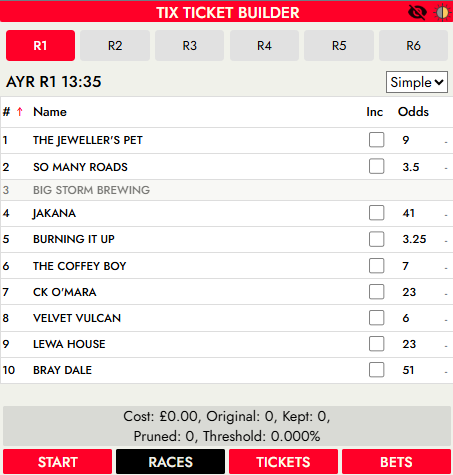
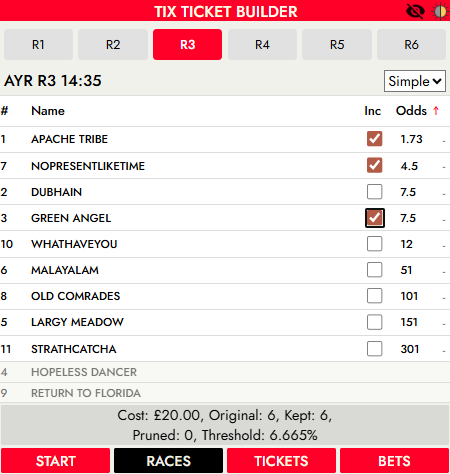
Then pick your meeting and pool, and you'll be taken to the RACES tab. For Tix Plus in 'Simple' mode, it looks like this:
Let's quickly talk around this view. At the top are the legs of the bet (R1-R6, races 1 to 6), and just below that is the specific race (AYR R1 13:35, race 1 at Ayr, due off at 1.35pm UK time). On the right of that is another dropdown, currently set to 'Simple'. This is where you can choose the 'Pro' version if you prefer; I'll come on to that shortly.
The main body of the view has saddlecloth number, horse name, a column of checkboxes called 'Inc' (include), and the current odds in decimal. Later in the day (from 9am), the dashes on the right of the screen may include some arrows: a green 'up' arrow means a horse has been supported, a red 'down' arrow means it is drifting.
All columns are sortable and, personally, I tend to sort by odds so that I can quickly see the betting shape of the race.
At the bottom of the view is a summary displaying ticket cost, the total number of possible permutations/tickets, the number of tickets that will be placed and the number which will be 'pruned' (not placed), and the threshold at which that decision will be made.
Let me explain that, but I'll first say that the only thing you must know is that, usually, not all possible permutations/tickets will be placed. That is, there will normally be at least some tickets in the 'pruned' pile.
So what's happening behind the scenes here?
After you've chosen your stake and your minimum unit stake (I suggest starting with 1p for unit stake), you begin to build your tickets. The image below is after I've picked my horses in three of the six legs:
I've set my budget here to £20, and (unseen) I have two horses in R1, a banker in R2 and (visible here) three horses in R3. 2 x 1 x 3 = 6 possible tickets, and all are kept at this stage.
Let's go ahead and fill out the rest of the perm:
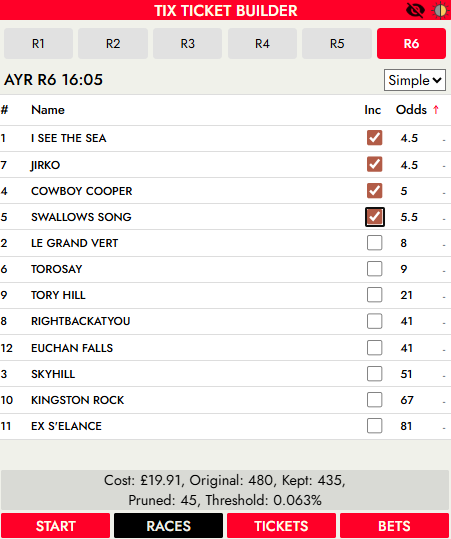
So it turns out the second half of this placepot sextet was much more competitive looking than the first. I ended up, for illustration purposes it should be said!, taking five horses in R4, and four each in R5 and R6. The image above shows R6, and my total possible tickets are 2 x 1 x 3 x 5 x 4 x 4 = 480. See 'Original: 480' at the bottom of the image.
But... the software is only retaining 435 of these and is discarding 45. Why, when £20 is plenty to cover 480 bets at 4p per line, is it not covering all permutations?
The answer is because not all lines are created equally. In my leg 3 (see image two up), I have an 8/11 (1.73) shot and a 13/2 (7.5) chance. Clearly the market doesn't believe they have the same prospects of placing, and neither do I. If we move on to the 'TICKETS' tab, you'll see what's happening here:
There's a lot going on in this image, so let's break it down. The main body of the view is dedicated to the tickets to be placed. The table headings are ticket (the selected horses on each ticket), %age (the percentage chance, based on the current win odds, of that ticket containing six winners*), £/line (the stake per line in that ticket), # (the number of lines in that ticket), Total (£/line x #, stake x lines, e.g. in th top row, £0.13 x 4 = £0.52).
I've clicked the little 'i' icon to the left of the first ticket, and it shows the individual breakdown of the four lines contained within it. Clicking the 'i' icon in the header row will open all of these should be curious to that microscopic level of detail!
There is then a 'PLACE TICKET' button at the end of each row. There is also a 'PLACE ALL BETS' button at the top. When you're happy with your bet, you can click that button and all tickets will be placed into the tote's pool.
*it is a little misleading to use win odds on placepots and other place pools as it implies your chances of getting a payout are hugely lower than they actually are. We will amend this in the next version but, for now, the key component is the 'threshold'. So let's quickly discuss that...
Threshold is the point at which two elements collide: your allocated budget running out, and the chances of a combination of horses being successful based on their odds. Basically, if there isn't enough money to proportionately stake all combinations, the software starts with the least likely single line combination of horses (based on their odds) and eliminates that combo. It carries on doing this until there are sufficient funds for the remaining 'kept' bets.
In this example, all bar 35 of the 480 possible combinations have been kept, at a total cost of £19.91. To see the combo's that were pruned, click the green 'Show Filtered Out Tickets' button:
All 45 pruned tickets included the '3' horse in R3. That was the 13/2 shot selected alongside an 8/11 and a 7/2.
The magic here is that, whereas £20 staked evenly across 480 bets would cover every possible pick for 4p, in Tix we have the most likely combinations covered for as much as 13p per line, and 106 different combinations covered for at least twice that 4p base stake.
Naturally, the flip side is that the least likely combo's have less than 4p staked on them, but those tickets - should they hit - will pay a much bigger dividend.
Tix is a realist, not a fantasist. It leans into the most likely outcomes and away from the Hail Mary's whilst still covering a fair number of those long shot bombs (depending on budget and unit stake).
Why is this good, and why is it bad?
Well, the bad news is you're less likely to hit that once in a lifetime payoff... but the good news is that, day to day, you'll get more returns that will keep you in the game longer and you still have the chance of plenty of fat divvies along the way.
Reminder: Tix Plus 'Simple' is choose stake, pick horses, place bet. The clever stuff is completely hands off.
Smarter Placepot Bets #2: Tix Plus 'Pro'
For the architects and sculptors out there, you - like me - can opt to be a little more hands on.
Welcome to Tix Plus 'Pro'!
This really is very cool, and it's the unidentical twin of Tix Plus 'Simple'.
Here's how 'Pro' looks:
The differences are two columns and one row. Columns first.
To the right of the odds/arrows columns are '%age' and 'Book'.
'%age' is a smoothed book percentage including the whole fields. It's done in 5% increments until we get to the serious longshots where 1% becomes the norm. In the example above, we see that Apache Tribe, odds of 1.83 (5/6 fractional) has a 45% %age. You might also note that the %age figures don't sum to 100. This is fine, because the 'Book' figures will always sum to 100.
In this example, we have three selected horses whose '%age' values are 45, 20 and 10, totalling 75. The 'Book' value for the favourite is 60, calculated simply by divided his '%age' by the sum of all selected '%age's. That is, 45/75 = 0.6 or 60%.
The beauty of 'Pro' is that you may overwrite any '%age' figure to emphasise your personal opinions.
If you love the jolly but still want a small bit of cover elsewhere, make that 45 number bigger. If you respect the jolly but feel his chance is over-stated, edit 45 to a smaller number. Below I've changed that %age to 35 and you can see how the division of stakes has changed in the 'Book' column.
By doing this, users can very tightly define the distribution of their budget through the bet.
The extra row appears at the bottom of the RACES view, and it is for 'Unnamed Favourite' (UNF). UNF doesn't show up on the 'Simple' version because it doesn't have a book percentage: we don't know which horse will be favoured, still less what price it will be.
In the 'Pro' view, selecting UNF will remind you to add a %age for it (see below). If you don't, it will simply be ignored. The chosen percentage will then be factored into the 'Book' calculations outlined above.
At the end of the sequence (six legs in this case), you'll again have summary info at the bottom of the view. This time, you can see I've got 459 of 480 possible combinations retained, and 21 pruned. The threshold is also slightly higher, which means my top staked ticket is now 12p per line rather than 13p previously, and I have slight amendments to other combinations. All of that is done in the engine room and is invisible to the user.
But you have ultimate control with Tix Plus 'Pro', so if you want to change things just tweak the '%age' figures in the races where you want that change.
Like I said, this is certainly not for everyone, but for those who want greater control over their multi-race pool play I think Tix Plus 'Pro' is like hitting the jackpot!
The Ultimate 'Smart' - Bonus Payouts on All Winning Tickets!
Tix enables everyone to bet placepots, jackpots and other multi-race tote bets in a smarter way. That already gives you a much better chance of coming out ahead. And, to compound that advantage, all winning tickets placed through Tix benefit from a 5% bonus. Every £100 in winnings get £5 more.
Let's say over a year you staked £2600 through Tix (£50/week, about £7/day), and your returns were £2500, a loss of £100. £2 a week for some daily fun is definitely a price I'd pay! But because of the 5% bonus, that £100 loss becomes a £25 win.
Now, obviously, there's nothing life-changing there; but the point I'm trying to highlight is that the bonus can easily be the difference between winning and losing over time and, of course, if you're a winning placepot punter, you're just going to win more!
Otherwise, you'll need to sign up with the tote first. You can do that here, then go to the link above.
I can't wait to hear how you get on with Tix Plus - and, of course, if you have any questions, just leave a comment below and I'll be sure to get back to you.
Matt
https://www.geegeez.co.uk/wp-content/uploads/2026/02/Gemini_Generated_Image_tbq4nktbq4nktbq4-scaled.png9852560Matt Bisognohttps://www.geegeez.co.uk/wp-content/uploads/2022/10/geegeez_banner_new_170x78.pngMatt Bisogno2026-02-10 19:14:022026-02-10 19:27:19Introducing Tix Plus: A Placepot Tool for Everyone
As 2025 ticked into 2026, somewhat without fanfare we filled the gaps in our UK sectional data coverage by incorporating the British RMG (Racing TV) tracks. Thus, going forwards as well as two years backwards, we have a full picture of all completed UK runs for each horse. [That is to say, we do not publish sectional data for runs in Ireland or where a horse failed to finish for any reason].
In support of this, I'm keen to bring greater utility to the dataset: put simply, and in line with other elements of the site like Instant Expert, I want you to be able to see 'the headlines' at a glance.
Being completely candid, I don't think we're there yet... though I do think this first iteration of the visualised data is a step forward. It is likely there will be changes to the current layout, and we'll certainly be adding a bit more oomph to the full result view as well. But, rather than damn it before I've even shared it, let me introduce you to a new block - live right now on site - within Full Form (Gold subscribers only, I'm afraid).
It's called, brilliantly innovatively, 'SECTIONALS', and it sits right underneath the current 'RACE FORM' section:
There it is, highlighted in the yellow box.
How Things Were...
Previously, we had a 'show sectionals' checkbox at the top of the RACE FORM block which spliced some traditional race data with some sectional data. Because I wanted to publish more of the latter, I've given it a home of its own. The CARD tab horse form retains the 'show sectionals' checkbox, for now at least.
Let's take a look at the new SECTIONALS block:
There's a fair bit to unpack here (awful phrase, that, isn't it? I'll never use it again... until the next time I forget), so let's get to it.
The left hand block, up to and including 'Race Speed vs Par / FS%' is consistent with the previous 'show sectionals' view within RACE FORM. In my opinion, there's a lot to be discerned from the running lines - a five chunk breakdown of a horse's position in the race and distance behind the leader (or in front if leading) - and I feel this is a vastly underused component of our profiling. It may be unfamiliar to UK form students but this is the de facto layout in North America for presenting past performance.
We can see for example from this horse's four consecutive wins (or, actually, first past the posts because he was disqualified and placed fourth in one of them) that he has some gate speed but is largely unhurried and makes his move late in the race; indeed, he hit the front only in the final split (from the furlong pole to the finish line in those five furlong races). The table below shows the furlong markers in the race, by distance, that each 'point of call'/ running line entry aligns with. The fifth and final point of call / running line entry is always the finish line.
As with anything new, it takes a bit of getting used to. Having spent plenty of time in the US form book across myriad Breeders' Cups, I find this layout a whole lot quicker to consume, and more accurate, than the (generally very good, but often subjective) in-running comments traditionally presented this side of the pond.
So far so yesterday. What exactly is new here?
Race / Runner Speed vs Par
The central block from the image above, 'Race Speed vs Par / FS%', is the pivot point. It's both old world and new, as we've given users the option of a text 'speed band' label (e.g. Q FAST) or a percentage quicker or slower than par (where par is our algorithm's projection of what a truly run race looks like in terms of energy distribution). Here's the more technical and granular 'Percentage' view of finishing speed - note the buttons above the table where you can switch from one to the other.
And here is the simpler version, itself very handy for at a glance analysis:
I deliberately left the final call point (finishing positiondistance beaten) of the running lines in the images - left hand side - so we could compare this horse's winning performances with the losing ones from a 'way the races were run' perspective.
There's a clear contrast here: his wins were achieved when the race speed (left hand trios of boxes) was even, and the defeats came off faster early tempos. We can see also, from the right hand trios of boxes, that this runner won when generally just even pacing his way through to the finish.
That is the most efficient way to run in any kind of race, be it a horse race (over five furlongs or in the Grand National), a 1500m track and field race, or in a Formula 1 Grand Prix (the latter pair in terms of lap times: humans, horses and cars go slower on bends than on straight bits; and faster downhill than uphill).
So, having found the suggestion of a pattern, the question is, "how will today's race be run?"
I'm not trying to tip a winner here, so that's academic for the purposes of this article; but our example horse is drawn wide today against a projected lone front runner and with a fair bit of inside pressure for the leader. That's a verbose way of saying that I'm not sure how exactly it will be run and/or whether it will suit our protagonist: on balance, I suspect not.
But he's a horse that could easily be added to a tracker on the basis of a perceived pattern of performance, and with a note saying something like "worth a bet when the pace looks even". For completeness, the horse in question is Hint Of Humour and the race (5.30 Wolv, 9th February) will have been run by the time this is published.
Sectional Times
Let's see what else has been added to the SECTIONALS view. We've added some time data, and some user configuration around that. Specifically, you can look at the race leader's times at each of three sections in the race, or the horse in question's times - and you can view either the time for each section or the incremental (i.e. total) time to that point.
In the example below, Hint Of Humour again, I have filtered for his Wolverhampton 5f form.
Look at how consistent his times have been. In the four races prior to his Boxing Day spin he completed the first quarter mile within a tenth of a second either side of 26.2 seconds; he then had slightly more variation in his middle furlong of five - but still only 0.4 seconds from quickest to slowest; and his closing two furlong splits ranged between 22.8 and 23.1 seconds: incredibly consistent speeds over an unvarying track/trip combination.
On that most recent run he went faster than ideal early, and was subsequently slower in the middle and closing furlongs. As it turned out he was only beaten half a length but that was having led at the furlong pole before tiring.
FS% Diff and UP
Moving a little further right, we have two more columns: FS% Diff and UP.
FS% Diff is the finishing speed difference for the closing section, in percentage terms, between the race leader and the runner in question. And, for completeness, finishing speed percentage is how fast a horse ran the last part of a race in comparison to how fast it ran the full race. You don't really need to know the formulas.
Concentrating on the image below now, hovering over the 0.76 figure in the view displays the Race (leader's) finishing speed percentage (97.62%) and that of this runner (98.36%).
98.36 / 97.62 = 1.00758 (or 0.76% FSP Diff).
Again, the calculations are merely for the curious. The implication of a positive number is that the runner in question finished more strongly than the leader at the start of the closing section; and, naturally, a negative number (none in this example) means the runner in question was slower to the finish than the leader at the start of the closing section.
All you need to know is:
Positive FS% Diff = quicker to the finish
Negative FS% Diff = slower to the finish
Finally, and with its title unhelpfully obscured, on the right hand side we have the UP column: it's the one with the numbers 4, 0, 1, 1, 3 in it.
UP is Upgrade, and it's our attempt to elevate the performance of some horses in some races based on how inefficiently they were ridden. The least efficient rides tend to get the biggest upgrades, the suggestion being that on another day that horse may be capable of better.
NOTE: an inefficient ride is not always a bad one. Consider the horse that makes all at a very fast pace and which scrambles home in front; its jockey has simply made the other runners (and their riders) even more inefficient. Everything is relative. It doesn't take the most efficient ride necessarily, sometimes it only takes the least inefficient one.
Again, the confusion is added by me. All you need to know is that there is the suggestion a horse could offer more another day when the UP number is bigger than 0. In the example above, we've already talked about how the top form line was achieved off a notably quicker early - and commensurately slower late - tempo. Our algo reckons that effort should be marked up.
Summary
So that's an introduction to the new SECTIONALS block on FULL FORM. It can help contextualise race performances and shine a light on horses that might have more to offer than meets the eye. In all cases when considering a horse with attractive upgrade figures or an apparent pattern to their better efforts consider the likely tempo of today's race against those prior positive spins; if the setup looks similar, you might have unearthed a value play. But keep in mind that context is critical with this stuff.
One other closing thought: no approach to the past performance data should be used in isolation. Sectional times are just one more weapon in your form reading armoury. There will be races where it's not especially helpful, and others where it might be the kingmaker. Just like any other angle.
The beauty of sectional data is that its lack of familiarity is a barrier to entry for many; that means some of its lightly coded messages are there for you and not many others. We don't need only to look for the horse that might step forward, but in the same way we can identify runners that might be overbet based on a flattering recent win or close up run. We're working on some content for the RESULT tab that might make this more apparent. More on that another day...
Matt
https://www.geegeez.co.uk/wp-content/uploads/2026/02/ff_sectionals8.png320830Matt Bisognohttps://www.geegeez.co.uk/wp-content/uploads/2022/10/geegeez_banner_new_170x78.pngMatt Bisogno2026-02-09 16:34:042026-02-09 17:34:19New Sectional Data Presentations
Come on Paul, make a stand, writes Tony Stafford. Persuade owner Colm Donlon to pay the £18,000 supplementary fee and put Tutti Quanti in next month’s Champion Hurdle! In some ways the parallels are obvious. On February 8th 1997, Make A Stand, ridden by A P McCoy made all to win the Tote Gold Trophy in a one-two for the Martin Pipe stable, beating stablemate Hamilton Silk by nine lengths, dominating his 17 opponents with ease.
He carried 11st7lb off a mark of 140, which included a 4lb penalty for his previous success at Kempton in the Lanzarote Handicap Hurdle, then a two-mile race rather than its five furlongs longer identity these days. The following month he won the Champion Hurdle in similar fashion.
Tutti Quanti on Saturday, like Make A Stand 29 years earlier, was immediately taken to the front by Harry Cobden, accompanied by a couple of over-optimistic opponents. The trio was quickly clear of the rest of the 15-runner field. Then by the turn into the straight, the die was already cast. Moving smoothly, Tutti Quanti, despite 12st top weight for his mark of 138, was the only horse not already struggling in the very testing ground.
His advantage began inexorably to extend from Wellington Arch, who had taken second place by that point. Then up the long home straight, seemingly after little effort from the horse and certainly minimal energy from his rider, he had that gallant pursuer 15 lengths adrift by the line. I reckon it could have been nearer 25 lengths had Harry wished.
Astonishingly, the second was another 18 lengths clear of a trio that fought a slow-motion tussle for the honour of third (and not inconsiderable prize of £18k). It went to 7lb claiming amateur Miss Heidi Palin on 33/1 shot Faivoir, trained by Dan Skelton. Skelton also provided the race favourite, heavily backed Let It Rain, but she pulled up.
We were still finding difficulty at the time of Make A Stand’s success in calling the race anything other than the “Schweppes”, even though the Tote had taken over its sponsorship a decade earlier in 1986. Some, including me, hark back to the old days far too frequently. Sir Rupert Mackeson, the veteran bookseller, even referred to “Schweppes weekend” in his email on Saturday morning, 40 years after the soft drinks firm had abandoned ship!
The race was instigated in 1963 as one of the earlier lucrative commercial race sponsorships in UK racing and was staged once at Aintree before moving to its subsequent home of Newbury. It was quickly made famous and as much notorious through the exploits of the Findon, Sussex-based master trainer and former wartime Commando, Captain Ryan Price.
Ho won the first two with Rosyth, whose second success resulted in a six-week ban for his trainer following a dodgy prep run for his horse. Le Vermontois’ triumph involved no such scandal.
On that February Saturday in 1967, I was walking up (or was it down?) a hill in Northumberland with a transistor radio glued to my ear. I was there to cover the FA Amateur Cup quarter final between Whitley Bay and Walthamstow Avenue - the event and the Avenue both long sadly confined to the dustbin of history. We won, by the way, but were knocked out in the semi-final.
A couple of the local press guys – I worked that year at the Walthamstow Guardian, my first job on a newspaper - travelled in the team coach to their away matches. Following home games at Gander Green Lane, we routinely got to join the players for dinner in Jim Gill’s restaurant at the bottom of Walthamstow High Street.
I listened as Hill House easily made it four wins from the first five runnings of the race for Price. Even with the questionable acoustics, the boos that rained down from the stands could be clearly heard even above Peter Bromley’s spirited commentary.
Hill House had refused to race at Kempton two weeks before the big day and then was only fourth at Sandown the previous weekend, most professionals reckoning he had a typical “easy”. In the Schweppes, Hill House duly strode clear to win by 12 lengths, returning to a crescendo of booing. Price’s wife Dorothy vowed never to go racing again – and never did.
A subsequent inquiry found that Hill House had tested positive for cortisone, a banned substance but then further tests found evidence he manufactured his own cortisone. The matter ended there, but not the stigma to Captain Price.
Normal service resumed the following year when Persian War, a five-year-old trained in Wales by Colin Davies, ridden by Jimmy Uttley and owned by bookmaker Henry Alper, set a weight-carrying record of 11st13lb. The historians had not immediately realised that near 60-year record had finally been expunged from the books by Tutti Quanti’s winning under 12st on Saturday.
Persian War went on to win the Champion Hurdle that March and twice more before being relegated to second place behind Bula, another outstanding champion of that vintage era. Bula was trained by Fred Winter.
Persian War had been a slowcoach on the flat but was transformed by jumping when his stamina was a major contributor to his success. Make A Stand, like Persian War, started on the flat. He was a son of Master Willie and was in training with Henry Candy.
Make A Stand won a 23-runner nursery at Newmarket off 74, but by the time he turned up for a claiming race at Leicester in August the following summer, his mark had declined to 52 – the handicappers were a little more understanding in those days. You’d need to run 30 times now rather than Make A Stand’s six to drop that far! He did win that 1m4f race with ease, and the next time he ran was for Pipe, two unsuccessful flat-race outings finishing his three-year-old activity. I wanted to check the Racing Post’s analysis for the Leicester claimer, but 32 years on, we’re still waiting!
Make A Stand was fast away the following year when initially put to hurdles, winning three in a row, before Martin also exploited his still modest flat mark. By the time he got to the Tote Gold Trophy, he was the veteran of 27 races and came to Newbury fresh from three consecutive handicap hurdles victories at Sandown, Ascot and Kempton. There was never much doubt that number four would be in the bag. It wasn’t!
In the Champion Hurdle he beat a field that included the previous year’s winner Collier Bay, and in a hint of what was to come, a youthful Aidan O’Brien sent out the 33/1 runner-up Theatreworld. Aidan was to win the next three championships with the peerless Istabraq.
Tutti Quanti was hardly coming out from left field on Saturday. He had comfortably won the Gerry Feilden Hurdle over the same course and distance in November and on the morning of the race, Nicholls told Cobden he was extremely confident. He was the 100/30 second-favourite.
Why then, after such an overwhelming success in one of the most competitive (usually) handicap hurdles of the season, shouldn’t he go down the Persian War and Make A Stand route?
For an investment of £18k, the potential win prize of £252,315 represents around 14/1 for his money – albeit the owner’s portion is more like 70 per cent. Still, you’d be making a lot of people, including trainer, jockey and stable staff, happy if it happened; and Donlon picked up a healthy £87k on Saturday, so he starts from a position of strength.
They have until March 4, six days before the race to decide and the weather in the meantime will be a major factor in the decision. I remember in 1986 desperately wanting rain for a horse of mine that was fancied for the Triumph Hurdle, and the whole previous six weeks were cold and dry. Could be the same over the next three weeks, though unlikely if recent weather is to go by, but as I say, Colm doesn’t need to decide yet.
The most significant performance of the week, apart from Tutti Quanti, was the win of Lulamba in the Game Spirit Chase. Having effectively had only one and a half previous runs over fences (low sun ruled out six fences on debut), Nicky Henderson’s novice was far too good for more experienced chasers at Newbury. I think he can emulate Sprinter Sacre and Altior and go on to win the Arkle at Cheltenham next month.
- TS
https://www.geegeez.co.uk/wp-content/uploads/2026/02/TuttiQuanti_Newbury_Feb2026.png319830Tony Staffordhttps://www.geegeez.co.uk/wp-content/uploads/2022/10/geegeez_banner_new_170x78.pngTony Stafford2026-02-09 08:17:482026-02-09 08:17:48Monday Musings: Make A Stand
Last month, I wrote a piece on 7-furlong handicaps at Kempton, writes Dave Renham. That was the second time I had looked at a specific course and distance in this way. Certain types of races on the all-weather lend themselves to the approach as there are many such contests each year. In National Hunt racing we do not get the sample sizes that we do on the AW, but I still wanted to try a similar thing. I trolled through different course and distance (C&D) combinations and discovered that Uttoxeter over 3 miles had the greatest number of handicap chases annually of any course in the country. So it is that this combo begins my NH deep dive journey. As a bonus, there will be some additional course and distance 'goodies' appended to this piece.
I mentioned in the last article that looking for patterns and pointers for races from a specific C&D is a type of trends-based approach. Using past race trends has become more popular in the past 15 years or so, although generally this approach has been used for big races such as the Grand National or the Derby.
As stated above, I will be focusing on handicap chases over 3 miles only, with data taken from 2017 to 2025. Profits have been calculated to Betfair Starting Price (BSP) with returns adjusted for 2% commission. Let's crack on.
Race Distance
Before looking in depth at the numbers let me share the class of race we tend to get when racing over this C&D. The graph below shows the splits:
Around 75% of all races are either Class 4 or 5 contests with not too many high class chases over the 3-mile trip here.
Betting market
Let me look at the betting market for our first main set of stats and specifically market rank. I have used the Betfair market for this:
As we can see favourites have done well, producing returns of just over 10 pence in the £. Second favourites have fared quite poorly, especially when priced higher than BSP 6.0 – this cohort has won just two races from 40 (SR 5%) for hefty losses of £27.92 (ROI -69.8%). Those ranked fifth or higher in the betting have had a poor record, and it should be noted that the biggest priced winner over this C&D across the 143 race sample was returned just 31.54 BSP. This has not been a happy hunting ground for outsiders. Horses priced BSP 35.0 or bigger were 0 from 149 with just nine placed efforts. Backing them to win would have obviously lost punters £149 to £1 level stakes if backing every single one but backing them instead to place on Betfair would have also amassed big losses of £70.01.
Age
A look next at the age of horses that competed over this C&D. There was only one four-year old runner, so I have ignored that age group. Let me share win strike rates first:
There seems to have been a clear advantage to younger horses, especially those aged five to seven. Let us see how the overall figures look in terms of profits and returns:
There definitely has been an age bias here, and this table confirms it. Younger horses, aged five to seven, have not just won far more often but each have produced a blind profit. In contrast, there were significant losses for those aged eight to ten. The 11-year-old-plus group have edged into profit but this figure is badly skewed as three of the nine winners were the three biggest priced from all of the races, with BSPs of 29.18, 31.07 and 31.54.
Course form
A look at course form next. Below is the breakdown of course winners versus non-course winners; however, the non-course winners have been split into two: those who had raced at the course before and those who had not:
Course winners had the best win strike rate, but they would have lost more than 10p in the £ if betting blind. Those with no course experience have performed quite moderately with the lowest strike rate and the heftiest losses.
Distance change
I wanted to look to see if a change in distance from last time out had made any difference. For the record, the ‘same distance’ stats include races of half a furlong shorter or longer from last time, as well as the exact 3-mile trip:
The figures suggest that a run last time out within half a furlong of the Uttoxeter 3-mile trip was the optimum. It produced the best win percentage and much better returns. The A/E (BSP) index for this group was excellent too, standing at 1.10.
Weight carried
I decided to look at weight carried by splitting the runners into two – those 11st 3lb or higher versus 11st 2lb or lower. This gave us fairly even groups to compare:
These results surprised me a little as I had expected those carrying more weight to win slightly more often. In terms of returns over this period, the lower weighted cohort almost broke even whereas those in the higher weight bracket incurred a hefty 20% loss at BSP.
Recent form
Next on my list was the performance last time out in terms of finishing position. The splits were thus:
A bit of a mixed bag here with horses that finished fourth last time faring best in terms of returns. Funnily enough the figures for last day fourths were not really skewed by big priced winners, but the sample size means these results are unlikely to replicated in the future; well, I surmise that to be the case, especially from a returns perspective.
The main takeaway here I guess is the inferior performance in terms of ROI% of horses that finished fifth or worse last time out – losses of 21p in the £ is steep. This is especially true as the overall returns combining all courses in 3-mile handicap races have seen a loss of just 3p in the £ to BSP.
Run Style
Back in November I wrote a two-parter sharing the top ten handicap chase C&D biases in the UK. This track/trip combination did not make the final list, but it was part of my ‘long list’ of 20 and was one position away from being shared with readers as it stood in 14th, and I shared the top ten as well as three near misses (11th to 13th). Anyway, the following splits for wins to runs ratio for each run style group should not surprise anyone!
Front runners / early leaders have had a strong edge, with hold-up horses really struggling. This has been mirrored by the each way stats with leaders making the frame over 43% of the time, compared with just 23% for hold up horses (within their run style groups). Hence the PRB figures also continue this strong correlation:
For the record, if we had been able to predict pre-race who would lead early then we would have seen huge returns of over 69p in the £!
Ratings
With the recent addition of Topspeed ratings and Racing Post Ratings (RPR) to the Geegeez Query Tool, I thought I would share some results over this C&D focusing on ranking position. RPR first:
The rankings proved to be excellent since 2017 with the top two rated outperforming the rest by some margin, both in terms of strike rate and profit / loss / ROI%. And how has Topspeed fared?
Top rated runners again performed very well while second rated runners also nudged into profit, albeit just. Both sets of ratings were extremely good across this time-frame.
*
I hope this article has highlighted where the value has been in these Uttoxeter 3-mile handicap chases, and now as promised here are some bonus C&D extras. These snippets cover Bangor, Exeter and Perth as each of these tracks hosted more than a hundred handicap chases over 3 miles between 2017 and 2025. The key findings are shared in bullet point format.
Bangor 3-mile handicap chases
As with Uttoxeter there were no winners priced BSP 35.0 or bigger.
Favourites lost over 10p in the £.
Amazingly, just like Uttoxeter, horses that finished fourth LTO made a decent profit of 48p in the £ from an 18% win percentage!
Horses carrying 11st 2lb or more again won more often than the 11st 3lb+ group and produced a small blind profit of just over 3 pence in the £.
This has been a rare C&D where front runners have not had an edge. Indeed, prominent racers fared best in terms of wins to runs ratio. Meanwhile front runners, midfield and hold-ups all had similar wins to runs ratios, within 1.7% of each other.
The top-rated Topspeed runner won 22 races from 104 (SR 21.2%) for a profit of £27.45 (ROI +26.4%).
Exeter 3-mile handicap chases
Favourites really struggled here, winning just 19.8% of the time (21 wins from 106) for hefty losses of £38.58 (ROI -36.4%).
Outsiders fared better at Exeter than at Bangor or Uttoxeter with five horses winning at odds in excess of BSP 35.0. Backing all such longshots would have yielded a profit of £180.60 (ROI +150.5%).
11yos and up enjoyed just one win from 90 attempts.
Horses finishing first, second or third LTO all individually made a blind profit to BSP.
Exeter’s 3-mile trip favours front runners very strongly. They won 29% of all races from just 15% of the total runners.
The top-rated Topspeed runner won 16 races from 107 (SR 15%) for a profit of £14.98 (ROI +14%).
Perth 3-mile handicap chases
Favourites excelled, winning 34.9% of the time and returning just over 11 pence in the £. Second and third favs also were ‘in the black’.
There has been just one winner priced over BSP 18.0.
Horses with two or more previous course wins did well with 22 wins from 94 (SR 23.4%) for a healthy profit of £42.78 (ROI +45.5%).
Last day winners have struggled in terms of returns, losing over 27p in the £ at BSP. Horses that finished second or third last time were both profitable to follow.
Front runners have a small edge over 3m at Perth, while hold up horses have really struggled.
That's all for this piece. I hope you will be able to make use of these facts and figures in the coming months and years.
Until next time...
- DR
https://www.geegeez.co.uk/wp-content/uploads/2018/01/welshnationalpreview_chasethespud.jpg319830Dave Renhamhttps://www.geegeez.co.uk/wp-content/uploads/2022/10/geegeez_banner_new_170x78.pngDave Renham2026-02-03 16:06:382026-02-03 16:06:38Uttoxeter 3m Handicap Chases: Deep Dive
About a year ago now, maybe a bit more, a plan was hatched, writes David Massey. It was a plan to go to Thailand as part of Mrs M’s sister’s 50th birthday celebrations. She’d like one more big holiday abroad, she said. I was all for it, as there was no way you were getting me on a plane to a country with the humidity levels of the Royal Ascot press room; I’ll be able to experience that without going abroad come June. So it meant that as the good lady and her sister sent me some lovely photos of sun-kissed beaches, wonderful food and quite lethal-looking fireworks displays that I found myself in the somewhat colder climate of Scotland.
I’ve skipped ahead a bit here. Once it was clear I had little or no interest in the holiday - I detest flying, I detest heat - I started my own planning for these two weeks which began on Cheltenham Trials Day, took in the delights of Hereford and Chepstow where I was joined by my friend Alex for the day (she likes to pretend she’s my assistant for the day, which basically means having her photo taken with Mick Fitz and blowing smoke up his backside about how great he was as a jockey) and will finish at Warwick at the end of this week. Sadly, the weather played its part last week too, and the planned visit to Exeter will have to wait until the late spring.
And in the midst of all this was my first trip to a Scottish course, namely Musselburgh. I went with my long-time friend Becky, who some of you might know as a racecourse photographer at Cheltenham. I’ve known Becky for a decade and more now; whenever people ask how we know each other, she says I stalked her one day at Towcester. She says stalked, I say "enthusiastically followed.” Big difference, as I told the court.
So it is with great excitement we set off on Friday afternoon on our marathon five-hour journey (it’ll actually take six) to Edinburgh. I’m doing the driving, as Becky is cursed with bad luck when it comes to cars. She’s gone through more automobiles than Kia has trainers in the past three years, which is saying something. We have snacks (gone by the time we reach Sheffield) and great music, and the conversation on the way includes but is not limited to a Grand National quiz, my poor taste in music (she says), her ex-boyfriends (some household names in there, I’ll say no more, they’ll be in her autobiography no doubt), how many horses she plans on buying this year, and what they’ll win in the next four years. We hit Newcastle around six and the traffic grinds to a halt. It’s dark when we come out the other side and suddenly there’s just nothing around for miles; I feel we’re driving through some pretty bleak countryside, but as it’s as black as soot, it’s hard to tell. On cue, as we hit the Scottish border, it starts raining again. Still an hour to go.
We arrive at our destination around seven, and grab some food. We do, of course, have separate rooms, there’s none of that shenanigans (a dirty weekend that’s squeaky clean) and agree to meet in the morning around eight. There’s some football on BBC Alba, St Johnstone vs Partick Thistle. I fall asleep with it on.
Saturday. We make our way up to the track fairly early as I have some Trackside work to do. Part of the reason for coming up here is to try and get a few more bookmakers signed up to the on-course service as we’re planning to do a bit more work in the North this calendar year. I have a chat with the on-course books, they seem a friendly lot, and I know one or two of them anyway, who do the introductions. The course isn’t overly big but that’s a good thing, everything is easy to find and get to, and I have to say it has one of the poshest William Hill on-course shops I’ve ever been in. Plush seating? Very nice. There’s also some old-fashioned weighing-room scales in there for you to have a try on; there’s an overweight notice incoming when I give them a go.
It’s good racing too, quality stuff. I’m against Lord in the first (too keen again pre-race) and just about cop, and Star Of Guiting is a small winner for me in the next. Easy, this game. And then it goes wrong, although I have to say I’m delighted to see JPR One, a horse I’ve always had a lot of time for, win the Scottish Champion Chase. Becky is chatting to his delighted lads afterwards; they’re off to Wetherspoons later to celebrate, they tell us. That’s how you do it. I try to get Absolutely Doyen beaten in the novice hurdle but fail, and that takes a chunk of the winnings back. Then I kick myself for not backing Magna Victor in the next (if it’s an Alastair Ralph runner at Musselburgh, just back the thing) but Kelce ensures the day at least finishes on a high. Becky, having had horses with Neil Mulholland in the past, is particularly pleased at Kelce’s victory, and Georgie, his lass, has been kind enough to sort us some owners badges for tomorrow which, with less work on, should be a more relaxing day.
Back at the hotel, we sort-of plan on maybe going out before we realise we’re both old and knackered, and would rather just eat in-house again before falling asleep. I’m so tired I manage that much more easily than I did Friday night (always the case when I go away - awful sleeper first night, much better the second, weird that) and don’t wake until seven the next morning.
Becky’s already gone for a run, so I make my way down to breakfast about eight. With Leopardstown postponed for 24 hours, today is the first day of the DRF too, so I’m catching up on all the gossip via the WhatsApp’s from last night. Along with another cracking card at Musselburgh, it promises to be a great day ahead.
Before we go racing though, we find the beach and go for a little walk. There’s always something very therapeutic about being next to the sea, hopefully when that big Lucky 15 comes in and we retire, it’ll be somewhere on the South West coastline. Failing that, there’s always a weekend in Skegness to look forward to. By some miracle, the sun has come out and the wind has dropped. For the first time this year, I’m fairly sure, I can feel some degree of warmth. It doesn’t last long, the cloud soon returns though.
So we’re back at the track. I tell you what, the music that the course is pumping out is best described as “eclectic.” We go from what appears to be some Ceilidh tune to - and I’m not kidding here - the House Of Pain’s finest moment with “Jump Around.” It makes my selection on the way home look normal.
It’s also student day today, and the place is packed out with them. They’re very well behaved and cheer them home on every circuit, which is nice. I lose count of the number of times Becky says “you can see her arse in that skirt, and probably more” as the afternoon progresses. Being the gent I am, I don’t look. Obviously.
Let me say how lucky we are to have the owners badges today as the hospitality is incredible. We both agree the meal is the best we’ve probably ever had on track, with a complimentary drink too (Becky has the wine, I’m driving so it’s just orange juice for me) and with sticky toffee pudding to finish off, well, superb work Musselburgh, that’s all I can say. Only Sedgefield on the one occasion I had cause to visit as an owner comes close to this.
And then when Transmission wins the Edinburgh National and Becky has to collect the winner’s trophy, that’s her weekend made. She wears a smile a mile wide. I’ve managed to win enough off that one to pay for the weekend, which will do me fine. I’m not a greedy man. That said, if there’s any more of that sticky toffee going…
It’s soon time to go home. On this occasion, the light holds out and we enjoy the beautiful, rugged Scottish countryside that we couldn’t see on the way up. It really is something to behold, the sea never more than a couple of miles from the road. It’s been a fantastic weekend and I’m already looking forward to my next Scottish visit, which will be Kelso in a few weeks’ time for the Morebattle Hurdle. I get home by nine, and catch some shuteye. Back to the grindstone and Southwell on Monday - at least it won’t take so long to get there!
- DM
https://www.geegeez.co.uk/wp-content/uploads/2026/02/MusselburghRacecourse1.png319830David Masseyhttps://www.geegeez.co.uk/wp-content/uploads/2022/10/geegeez_banner_new_170x78.pngDavid Massey2026-02-03 14:05:372026-02-03 14:07:39Roving Reports: Work til you’re Musselburgh Bound
Normally we would have had both days of the Dublin Racing Festival to reflect upon this not so bright Monday morning, but it’s rather like the 1997 Grand National, writes Tony Stafford. Then, at the height of the IRA’s bombing campaign in the UK, a bomb threat led to 60,000 racegoers (including me) being evacuated from Aintree.
The race was delayed for 49 hours to the following Monday and those that could – unfortunately I couldn’t – reconvened for a single race off at 5.00 p.m. in the afternoon.
Naturally, my original tip for the race, Lord Gyllene, owned by Sir Stanley Clarke, also owner of Uttoxeter racecourse, trained by Steve Brookshaw and ridden by Tony Dobbin won the 36-runner race and its £178k prize by 25 lengths from Charlie Brooks’ Suny Bay. He started 14/1 and I don’t think I backed it!
This weekend the only villain of the piece was the ground on Saturday morning for the opening instalment of what is best known as the Willie Mullins Benefit Weekend. That card was rescheduled for today and in view of the lead up to yesterday’s programme, the ground didn’t look too bad.
The great man did win two of the Grade 1 races on the card, impressive scorers for the JP McManus/Mark Walsh team that will soon be dissolved when Harry Cobden takes over the job as his stable rider in the two countries.
First, in the Ladbrokes Novice Chase over 2m5 1/2f, Kaid d’Authie (5/1) rather than Mullins’ hotpot Final Demand (100/30 on) took the spoils. Willie had supplied three of the four runners. Then in the Ladbrokes Dublin Chase (2m1f) Majborough dispelled any fears about his technique over fences. He made all to beat favourite and last year’s Queen Mother Champion Chase winner Marine Nationale by 19 lengths with an exhilarating display of front-running and fast jumping.
Majborough is now the deserved favourite for this year’s Queen Mother Champion Chase and there isn’t much that can happen in the six weeks that remain before the Festival to remove him from that position.
Mullins then had a later, and possibly even more unexpected reverse, with 10/11 shot Lossiemouth, regarded in many places as the likely Champion Hurdle winner next month following the departure from calculations of Sir Gino last weekend. In what looked beforehand a virtual match race for the Timeless Sash Windows Irish Champion Hurdle – great sponsorship that! - Lossiemouth was never going as well and was unable to match the finishing verve of Gordon Elliott’s Brighterdaysahead. That market rival was thus emphatically reversing the one-length Christmas defeat by Lossiemouth over the same course and distance.
Brighterdaysahead has now won ten of her 14 career starts. One reverse was when she failed to live up to second favouritism in last year’s Champion Hurdle, finishing a long way behind Golden Ace in fourth, a placing that even flattered her on the day.
It was won with a fair portion of good fortune by that seven-year-old mare, trained by Jeremy Scott. If anything, Golden Ace has improved her profile since. First, she ran a fine second at Punchestown last spring behind State Man, who had been denied a second Champion Hurdle victory when falling in a clear lead at the final hurdle last March. The margin of just over four lengths at Punchestown suggested Golden Ace was progressing. A gritty win in the Fighting Fifth at Newcastle and second to Sir Gino in the Christmas Hurdle show her continuing improvement.
State Man is another absentee this time around. We could still be seeing the 2023 champion Constitution Hill if he comes through that tantalising hurdle-avoiding gallop round Southwell on Friday evening the 20th of this month. It’s strategically placed timing-wise before the big race, Southwell having grafted Hendo’s star’s target onto an original seven-race Friday night card.
Including that new race, there’s a total of £245k on offer during the evening, and Constitution Hill’s event could hardly have been more sensitively framed. It’s a 4yos and upwards novice over 1m4f. I hope there are some nice animals to make Constitution Hill work for the £21k first prize. Make a note in your diary, 5.00 p.m. off time, first leg of that Friday night bonanza.
He is down to a 6/1 chance, despite that litany of falls in his latest appearances. Brighterdaysahead and Dan Skelton’s The New Lion, workmanlike at Cheltenham the previous weekend, vie for favouritism, with Constitution Hill coming next. Such is the paucity of serious contenders at this stage, Lossiemouth is still fourth favourite with Golden Ace just behind her.
Brighterdaysahead and Lossiemouth are age seven. I remember when Ruby Walsh was talking on ITV the other day, he pointed out that Lossiemouth also has the mares’ race as a Cheltenham option – and that was before yesterday’s disappointment. I wouldn’t be too surprised if Willie decides on that course of action.
Now you know I love a statistic, even if as the Editor will be the first to point out, my interpretation is not always flawless. Mullins was matched for winners yesterday by Gordon Elliott who also picked up a valuable handicap hurdle with Bowensonfire (10/1). The UK champion jockey of that name, Sean Bowen, making his first visit to Leopardstown, is indeed “on fire” and he didn’t waste any time getting a winner. He was on Backmersackme who took another nice €88k’s worth for the Emmet Mullins’ (Willie’s nephew) stable.
Sorry Sean, you slipped in there before I could illustrate again what an unbalanced affair top Irish jumps racing is – as if it wasn’t already obvious. Yesterday Wilie Mullins had 32 runners on the card while Gordon Elliott had just the meagre ten, so 42 between them from a total of 96 on the day.
Today, Willie has 19 declared to Gordon’s 23, so between them 42 of 77, and over the two days 84 from 173, slightly more than 48 per cent. I think that’s ridiculous.
Willie’s UK raids continue to be hit-and-miss. On Saturday, impressive Kempton Christmas winner Kitzbuhel was widely expected to dominate Sandown’s Scilly Isles Novices Chase. Perhaps it was being denied an early lead that unsettled him, with the Fergal O’Brien-trained Sixmilebridge setting a fast pace in front. He never looked in danger of defeat once the favourite and a re-routed Paul Townend checked out at the sixth fence, where the rider was unseated after some poor right-handed leaps.
As I’ve already awarded the trainers’ championship to Dan Skelton, who sensibly kept away from Leopardstown, I must report over the past two weeks he’s had 20 winners from 54 runners, barely half Mullins and Elliott will have jointly sent out over two days in Dublin. Now past £3 million, it’s time to toast a great young force in the training ranks.
- TS
https://www.geegeez.co.uk/wp-content/uploads/2026/02/Brighterdaysahead_IrishChampionHurdle_2026.png319830Tony Staffordhttps://www.geegeez.co.uk/wp-content/uploads/2022/10/geegeez_banner_new_170x78.pngTony Stafford2026-02-02 07:04:572026-02-02 07:04:57Monday Musings: A Short Delay
geegeez.co.uk uses cookies to improve your experience. We assume that's OK, but you may opt-out from the settings. Cookie settingsACCEPT
Privacy & Cookies Policy
Privacy Overview
This website uses cookies to improve your experience while you navigate through the website. Out of these cookies, the cookies that are categorized as necessary are stored on your browser as they are essential for the working of basic functionalities of the website. We also use third-party cookies that help us analyze and understand how you use this website. These cookies will be stored in your browser only with your consent. You also have the option to opt-out of these cookies. But opting out of some of these cookies may have an effect on your browsing experience.
Necessary cookies are absolutely essential for the website to function properly. This category only includes cookies that ensures basic functionalities and security features of the website. These cookies do not store any personal information.
Any cookies that may not be particularly necessary for the website to function and is used specifically to collect user personal data via analytics, ads, other embedded contents are termed as non-necessary cookies. It is mandatory to procure user consent prior to running these cookies on your website.