Read all sorts of commentaries and tips across a range of racing disciplines on the most popular horse racing blog in Britain, from staff and guest writers.
If you’re wondering why “Hey! Student” is the title of my latest meanderings, well, two reasons, the first of which is obvious enough, writes David Massey. What follows is about Haydock’s Student Day, which took place at the weekend, and for which I was working in the ring; and secondly, I’ve always wanted to crowbar a The Fall song into the title of one of my pieces. For those that care, which I am aware is very few of you, it was originally called “Hey! Fascist” but rebadged once Mark E Smith realised he disliked students more.
There’s barely a workman alive that won’t have done a racecourse Student Day at some point. They tend to vary from course to course, with some allowing mingling with the crowd to those - like Haydock’s - where the students are penned in to their own area, presumably as much for the safety of the annual members who, it is safe to say, would have limited knowledge of the dubstep classics that the DJ bangs out between races.
The key piece of kit today is the card machine. If you haven’t got a working card machine, prepare to have a very quiet afternoon. On a normal, civilian, raceday the split of the take would be around 85% cash, 15% on the debit card on average. On a student day, you can pretty much reverse that. The younger generation do not believe in “cash is king”, instead “tap ‘n’ go” is very much the phrase that pays.
The weather forecast is playing a part, too. Most are suggesting some rain after 4pm, which will mean the last two races could be a bit of a washout. If it’s no worse than that, then we can just about live with it. If it comes earlier, that could badly affect business.
Which would be a shame, as it’s a card of two halves - the first four races, small fields with some odds-on chances, but bigger fields for the handicaps in the second half which give you a chance of taking better money and getting a result.
An early-ish start of 8.15 (the nights are starting to get longer, aren’t they?) and the fact I’m now on a diet (lousy high cholesterol) mean that the McD’s breakfast is foregone in favour of two Shredded Wheat and some toast. For snacks later in the day; one apple, one orange, and one Tunnocks chocolate wafer, my treat for the day. Welcome to my new, joyless, world of food.
It’s all quiet on the Preston front when we get there, with the first of the coaches not due until around 11.30, but that gives us plenty of time to get the first pitch up (we’re running two, I’m single-manning the second one) and make sure the card machine is in working order. It is. We get going and straight away a few lads want a bet. In the meantime I’m putting the second pitch up and once I’m up and running, there’s a steady trickle of lads and lasses having a flutter.
Unsurprisingly, quite a few need a crash course in how to place a wager, and I’m happy to oblige. A bit of a chit-chat with a few reveal many of them are from the Manchester universities, which is where my kids are. (Neither are here.) When I tell them my daughter is also at Manchester Met, one of them asks what halls she’s in. I honestly haven’t a clue. I think about sending my daughter a text to ask but as any of you out there with a teenage daughter knows, if you send them a text, you’ll get a reply around four days later. If you’re lucky. To be fair to my daughter she replies to my query within five hours, which in her world is almost instantaneous.
One lad, who appears to have been on the ale already, tells me he has to have a tenner on You Wear It Well as “it’s his cousin’s horse.” Now, I’m not saying his cousin isn’t Sir Chips Keswick, but… well, he isn’t. Later, the same lad will perform a quite incredible acrobatic feat as he careers down the steps in the stand, loses his balance, somehow jumps down three steps in one go, not spill a drop of his beer as he regains his balance and runs off in the direction of the burger van.
I take 40 bets on the first race for the grand sum of £300. You can work out the average bet size yourself. Stainsby Girl is actually popular with those having their fivers on and gets an enormous roar as she wins. Because they’re all betting on cards but getting paid in cash means you need plenty of money on a day like this, too.
After the first it busies up and there are queues waiting to get on. Almost every bet I take is either a fiver win or fifty bob each way, and whilst the processing time for each punter is a bit longer than normal, there are no complaints and the banter is good-natured. In fact, perhaps to my surprise, I’m quite enjoying the day, despite some terrible dance music between races.
And what’s this? “£150 win Salver, please.” Cash, as well. Where’s he come from? “He can’t lose!” he tells me. I’m rather fretting that whether Salver wins or not will determine if the lad can eat properly next week, or if he’ll be living off 20p packs of noodles for the foreseeable. I needn’t have worried, as Salver does indeed win with a bit in hand, and the £50 profit he picks up will buy another round or two. He even offers to buy me one. What a lovely lad.
Butch is very popular in the next. One young lady comes waving her ticket at me, proclaiming “I’ve won, I’ve won!” When I point out to her that they have another circuit to go, her mates rightly laugh at her, and she sheepishly wanders back to the stands.
And then, disaster. The weather forecast is wrong. The rain arrives a good hour earlier than predicted, and the waterproofs are reached for. It’s such a shame, as the afternoon was building up quite nicely, with the better races to come. It quickly turns to heavy rain and the umbrella goes up. Only thing is, the firm have packed the wrong umbrella. Instead of the big mush, I’ve got the tiny rails umbrella. I might as well stand on the joint with a colander on my head. I have to cover everything, laptop, printer, card machine, money, as the rain comes in sideways. It kills business stone dead.
I’m now taking half of what I was, and with each race it gets less and less. Worse, the card machine packs up. This is game over. By the time we get to the seventh, the boss tells me to pack up, as it’s pointless carrying on. Everything is soaked, and that includes my clothes, as the waterproofs are now starting to leak too. I pack the kit away, and go and help out on the main pitch for the last race. Behind us, one bookmaker, also packing away, drops the lightboard on the floor as he tries to pack it away. It’s so wet it slipped out of his hands, and crashes to the floor. That could be a very expensive mishap, as a new board will cost him well over a grand - even the cheap ones - if it’s not working.
By the time we get in the car, at half five, there’s barely a word being said as we’re all so knackered, tired and wet through. It hasn’t stopped the students partying - after the last the music cranks up another five notches, and I offer the paracetamol around.
A genuine shame that what was promising to be a good day for everyone has fizzled out. And it isn’t as if I’ve anything nice for tea to look forward to. Broccoli, anyone?
It’s tough to sneak into the leading trainers’ groupings pretty much anywhere in the world, writes Tony Stafford. In the UK and Ireland, the same few names finish atop both the flat and jumps tables year on year, and on the flat, certainly, it takes an upstart, such as George Boughey, and a massive intake of horses and major owners to break into the top ten.
He had 163 horses listed for last year’s campaign which brought tenth place in the table, but ironically fell 33 wins short of the 136 of the previous year. That earlier explosion was the catalyst for the massive increase in George’s string.
In jumping, the top ten have a familiar look about them both in Ireland and the UK. We know it’s Mullins, Elliott and De Bromhead with few recent encroachers making the list in Ireland, although Emmet Mullins has the look of somebody who can be making his way higher up the standings. Helps when, like Gordon Elliott, you train a Grand National winner early on and Mullins (E) did just that with Noble Yeats two years ago.
In the UK, apart from Olly Murphy and Joe Tizzard, neither of whom started from scratch, there’s nobody else. Ollie had considerable family buying power from the start, and Joe took over lock stock of father Colin’s team. Gold Cup wins and the memory of them have kept Joe in the limelight and dad is still around when needed. Plus ca change, plus la meme chose, as the French say.
Higher up, indeed sandwiching now the hitherto private battle at the top between Paul Nicholls and Nicky Henderson, is Dan Skelton, who also needed the start provided financially by show jumping father Nick, and the schooling for several years as assistant to Nicholls.
When brother Harry gets off a winner, and no doubt probably also one that didn’t run up to expectations, he has no hesitation in declaring potential upcoming races for the horse, whether Dan is there or not. This is a family operation par excellence and nicely bedded in now.
The other perennial challengers for the title cannot be there for ever you would think. Nicholls at 61 has so much drive and ambition that one would hardly think he would be reducing his energies towards training jumpers; indeed he has been recruiting at the top end of the market for the partnership headed by the considerably older (even than me!) Sir Alex Ferguson.
Henderson, despite being 73 is similarly unlikely to be withdrawing from the daily grind as long as he has horses of the calibre of Constitution Hill, Shishkin and Jonbon in his care. However well or otherwise that high-profile trio fares at Cheltenham next month, he has the four-year-old Sir Gino as the horse likely to become his eighth winner of the Triumph Hurdle and, if he wins, all the future that status predicts.
Given the depth of competition, especially after a spell where a decent proportion of the better meetings have succumbed to the weather, it must have been rare indeed for a stable outside the top echelon to land a hat-trick of winners on a single Premier Raceday card.
At Ascot on Saturday, Ben Pauling had five horses entered, two in one race. Neither of those got the call, although first string Bad would have done if not on the wrong end of a heads-up, heads-down winning-line dance.
The other three individual representatives all scored, for a combined treble return of 730/1. If Bad, the naughty boy who had his head up at the wrong time, had instead been on better behaviour, the resulting four-timer would have stretched to 4,020/1. All four horses were ridden by Ben Jones, benefiting from the absence through suspension of first jockey Kielan Woods.
Big Ben, he’s well over 6ft, rather than the jockey, and his owners collectively won £78k for linking a novice hurdle, Pic Roc, 11/2, beating a Nicholls hotpot; the Grade 2 Reynoldstown Chase – fast-track often to Cheltenham glory – Henry’s Friend, completing his own hat-trick, 13/2; and a handicap hurdle with Honor Grey, 14/1, a horse coming back from almost two years off. Bad’s race was very tough, too.
In the middle of the time since departing Nicky Henderson’s yard, where he had been joint assistant along with Tom Symonds, Pauling had a couple of campaigns when his horses were afflicted by viral problems. Last season’s tally of 80 wins, almost double his 2021/22 score, suggested that the worrying period was behind him.
Pauling will need another 24 in the remaining nine weeks of the present term to match that, and a couple of hundred grand in prizes to pass the earnings figure. He would have been much nearer it had jump racing not lost so many fixtures to the weather.
Nevertheless, standing in the table on 11th place and with £728k doesn’t have anything near the impact that his all-televised Saturday Ascot trio (and a near-miss) undoubtedly had. Many more people watch ITV racing on a Saturday than the number that assiduously study the Racing Post stats I would imagine, let alone buy the ‘paper every day.
Pauling has invested shrewdly in his future, moving a few years ago to the Naunton Estate, 20 minutes by car from Cheltenham and close to Nigel Twiston-Davies. The Paulings bought a property which adjoined a golf course, and which is now part of the family business.
It necessitated redirecting a couple of the holes to accommodate one of the gallops, but now it’s as though – apart from the stable area looking so spic-and-span – the yard had been there for decades.
You would think, golf-loving owners with runners at the Festival (or not!) might be checking in next month for nine holes and breakfast before making the last leg to Prestbury Park. Saturday was a landmark day in his development The seven entries in the early-closing races might not have the look of potential winners but you can be sure that when the handicap entries come out, he will be one of the UK trainers aiming to make the sort of impact that Dan Skelton has done in recent seasons.
Another former Nicky Henderson assistant was making a mark last week at Sandown, and as he described it, “it was a wonderful day for me in my own little world”.
The self-effacing trainer responsible for those words was Jamie Snowden and, looking again at the list of trainers, he stands 14th coming up towards £600k.
Why his “own little world”? Jamie had just followed winning the Grand Military Gold Cup at Sandown three weeks earlier with Farceur Du Large, over the same course and with the same ex-Irish horse, in the Royal Artillery Gold Cup.
A former soldier, Jamie had tried in vain to win either race since his retirement as an amateur jockey, having claimed both races from the saddle four times. He might say it was his own little world, but I used to love going to both days’ racing in the old days, always meeting up with my old pal, the late Broderick (The Cad) Munro-Wilson.
He used to ride his own horses in those races and the other two military events that now are offered to professionals, from the 1970’s, and his style of riding always amused the experts in the stands.
Munro-Wilson always loved Sandown and rode loads of winners there. I think he was a territorial rather than a career military member and made his money in the City. He had one unbreakable theory about Sandown: “You jump the Pond (three out) and however well your horse is going, take a pull! Seeing how he got horses to rally up the hill when seemingly having lost their race, with arms, legs, and anything else he could bring to the party moving at full pace, remains in my memory after all these years. As an aside, Sally Randell, who is Fergal O’Brien’s partner and assistant, was one of the very good riders around Sandown and she didn’t start riding in races until she joined the army.
Farceur Du Large was the object – I assume – of some very thoughtful planning. The upper limit for qualification for the two races – both weight-for-age events – is 130, a mark the nine-year-old had dropped to from a peak of 136. He had been owned by Gigginstown House Stud having run unsuccessfully in the Irish and Midlands Grand Nationals along with the Galway Plate. Off since that race, Jamie had him primed for the Grand Military.
Appreciating the drop in class, steady pace and the effective riding of Major Will Kellard, he romped home for RC Syndicate II before reappearing under a partnership of 12 Regiment Royal Artillery and RC Syndicate.
The Rules in my early days, when literally many hundreds of men resplendent in immaculate uniforms would stroll the lawns and enclosures, were strict. Gradually, to qualify as owners, leases became the way to go and it seemed that even anyone who had ever eaten their breakfast egg with soldiers just about qualified.
Whatever the future of Farceur Du Large, he has allowed Jamie Snowden to tick off a large item on his wish list. A winner with You Wear It Well at Cheltenham last year, he hoped for a pre-Festival warm-up win for her at Haydock on Saturday, but she made one bad jump that stopped her in her tracks. That left Coquelicot to pick up 2nd and 6k, making this column’s editor happy that he had made the dash back from a skiing holiday, arriving just in time.
In this article I am going to do a deep dive into last time out winners, writes Dave Renham. The focus will be on National Hunt racing in the UK with data taken from 2016 to 2023, and I am going to concentrate on horses that have already had at least three career runs.
There are two reasons for this: firstly, these animals have at least some form in the book; and secondly, later in the piece, I will be looking at some data which is concerned with two and three runs ago. All profits / losses have been calculated to Betfair Starting Price less 5% commission.
NH Last Time Out winners overall
When most of us look at horse form, our eyes are initially drawn to where a horse finished last time out. It is the most relevant performance being the most recent. We perceive that the most recent form is the most important and this is true, especially when considering the percentage chance a horse has of winning. The following graph shows strike rates for different last time out (LTO) positions:
As can be seen, horses that won LTO have managed to repeat that success more than 21% of the time. Also, as we move down the finishing positions (2nd through to 7th or worse) the percentages decline. It is worth noting that horses which fell or unseated LTO score more often than horses that finished 5th or worse. Horses that were pulled up LTO have the lowest win percentage next time out.
Sticking with LTO winners, despite their good strike rate this group would have lost around 5p in the £ betting all of them blind. In other words, for every £100 staked you would have £95 returned, losing £5. I have mentioned many times before that strike rates are just one part of the story, and not the most important; a high strike rate does not guarantee profitability.
One indicator of ‘value’ is an A/E index so let's compare those in terms of position LTO:
LTO winners have a reasonable A/E index of 0.91 – the second highest of all the finishing positions shown. To offer some context, the average A/E index for all runners is 0.87. Before moving on, it is worth noting that horses that unseated LTO perform much better in their next race than I suspect most people would have thought.
So, can we improve upon these LTO winners by looking at some different subsets? Very probably. Let's see...
NH Last Time Out winners by age
Below is a breakdown of NH LTO winners by age:
Once we get to horses aged eight or older, we see the strike rate dropping. However, despite this it is the LTO winners aged nine and ten that sneak into profit. Once we hit the veterans - 11+ - such LTO winners look best avoiding, with a low strike rate (in comparison to the other ages) of 13.6%, a poor A/E index of 0.83, and losses of over 12p in the £.
NH Last Time Out winners by Gender
A look at the sex of the horse next. As we know male horses win slightly more often than female horses but when it comes to last time out winners, we see that females have just edged it as the table shows:
We can see that female last time winners have been much the better value, with a higher A/E index and a near break-even scenario compared to losses of 5.86% for their male counterparts.
NH Last Time Out winners by Starting Price
It is time to split the LTO winner results up by price. I have used Industry SP for this comparison:
If we look at the A/E indices, it seems the better value lies with the shorter priced runners, especially those 6/4 or shorter. The 16/1 to 25/1 group has made to profit to BSP, but the figures are skewed somewhat as eight of these winners started between 40.0 and 63.37 on Betfair. What did surprise me slightly was the number of last time out winners that started at a big price on their next run – nearly 4400 LTO winners started 11/1 or bigger.
NH Last Time Out winners by Last Race Odds
I thought I would look at the odds horses were sent off when they won LTO: my thinking was that bigger priced winners would have been a surprise and hence more likely not the type of runner to follow up next time. Well, that was my theory! Here is the breakdown – I have used slightly different price groupings to those above to illustrate some patterns:
If we look at the numbers, the strike rates go down as the LTO price increases, which shows that the LTO price is extremely relevant in terms of win percentage chance next time. As a rule, the returns get worse as the LTO prices increases; likewise, the A/E indices trend downward also. Hence, when taking the LTO price data as a whole, it suggests that the shorter the LTO price the better, even if profits are not directly forthcoming.
NH Last Time Out winners by Trainer
One area I always try to look at, assuming it is relevant, is trainer data. Are any trainers particularly successful in terms of backing up a last time out win? Let us first look at the trainers that have the highest A/E indices with LTO winners. To qualify they must have had at least 100 qualifiers during the period of study. Here are the 15 trainers that have the highest figures:
The A/E indices range from 1.05 to 1.26. Generally anything above 1.00 is considered ‘value’ and, to provide a benchmark, the overall A/E index for LTO winners is 0.91. Hence all these trainers are well above that mark. Most of the trainers would not be considered the absolute top tier in terms of their peer group, but this cohort does I believe warrant close scrutiny when sending out a LTO winner. Indeed, all 15 have produced blind profits to BSP as the table below shows (trainers ordered by strike rate):
These are excellent figures correlating well with their A/E indices. Digging down into a few of these trainers, there are some interesting additional stats to share:
Kim Bailey has fared especially well with LTO winners who are coming back from a break. Horses from his stable that have been off the track for 70 days or more after a LTO win have scored in 20 races from 59 starts (SR 33.9%) for a BSP profit of £17.82 (ROI +30.2%).
Peter Bowen'a chasers that won LTO scored again 32% of the time returning a very impressive 86 pence in the £.
Henry Daly has a good record in lower level races. In races classified Class 4 or lower (i.e. Class 4-6) his LTO winners have managed to record another win on their next run 27 times from 72 (SR 37.5%) for a BSP profit of £39.43 (ROI +54.8%).
In my series on jockeys I highlighted that Charlotte Jones has a very good record riding for James Moffatt. This is certainly the case when Jones is riding a LTO winner from the Moffatt stable. They have combined to score 22 times from 61 (SR 36.1%) for a BSP profit of £52.74 (ROI +44.3%).
Now, if we have several trainers with good records with LTO winners, conversely, we are going to have trainers with poor records. Below are the trainers whose A/E index lies under 0.80 which is extremely low for this type of runner.
As can be seen, we have some low strike rates and very hefty losses to boot. The average win SR% for all trainers with LTO winners stands at 21.5%; this subset sees their SR% range from 18.7% down to 12.3%.
Some of the ‘bigger’ named trainers are yet to be accounted for so here is a selection of their figures for horses that won LTO (ordered by A/E index):
Most of these trainers have a higher-than-average win strike rate, which is to be expected, but as is shown, all bar Harry Fry have produced losses to BSP. Again, this is a good reminder that strike rate is far from the ‘be all and end all’. Generally, the market adjusts to the fact that these trainers are likely to win more often than the average trainer.
NH Last Time Out winners: Last Three Runs
My last port of call for LTO winners is to look at the previous two starts before the win. I want to compare LTO winners that finished in the first three on both of their previous two runs, with those that finished 4th or worse in both of their previous two runs. Here are the splits:
It seems that the ‘in form’ horses (those that finished 1st, 2nd or 3rd in both of their two previous runs prior to their LTO win) are the ones to keep an eye out for. Losses are minimal (1p in the £) and one would hope that a further researched subset of these runners could prove to be profitable.
Indeed, one profitable subset of horses that finished 1st, 2nd or 3rd in both of their two previous runs prior to their LTO win are those returning to the track within two weeks. Strike while the iron is hot and all that. The results are positive: 357 wins from 1067 runners (SR 33.5%) for a profit to BSP of £156.32 (ROI +14.7%). This group has been consistent with six of the eight study period years turning a profit and the two losing years seeing the very smallest of reverses.
*
It is not easy to profit from last time out winners, but certain trainers highlighted in this article have certainly managed it over recent seasons. Also, LTO winners that finished 1st, 2nd or 3rd in both of their two previous runs prior to their LTO win, have been profitable when focusing on those that are returning to the track within two weeks of that LTO success.
I hope this article has given you a better insight into LTO winners and what to look for, and what not to look for. Until next time...
- DR
https://www.geegeez.co.uk/wp-content/uploads/2020/11/Rex_Jepeck_830x320.jpg320830Dave Renhamhttps://www.geegeez.co.uk/wp-content/uploads/2022/10/geegeez_banner_new_170x78.pngDave Renham2024-02-14 07:04:552024-02-09 14:10:37Analysing Last Time Out Winners
I realise that most people nowadays might not have more than a passing acquaintance with the 1960’s musical, The Sound of Music – although it’s part of the TV schedules every Christmas – but over this weekend I’ve had two of its best-known songs going constantly through my head, writes Tony Stafford.
Firstly, with the Festival now only four weeks away, there’s the title song which begins, well slightly amended: The hills are alive with the sound of Cheltenham.
And secondly and more appropriately for UK trainers: How do you solve a problem like Willie Mullins? (Maria, of course, speeding up problem!).
As ever, one name sticks out as the home antidote to the Willie Mullins epidemic of winners. That’s Nicky Henderson, now the wrong side of 70 but as he showed at Newbury on Saturday, he can see off the Irish maestro when he has the right horse.
Mullins didn’t bother to tackle Shishkin in the Denman Chase – it was left to a couple of Sir Alex Ferguson partnership horses, trained respectively by Paul Nicholls (Hitman) and Dan Skelton (Protektorat) to follow the Ascot-errant and still unforgiven for it Seven Barrows horse home.
From being an outstanding novice hurdler and then chaser, Shishkin has the Mullins-like career tally of 14 wins from 20 and would have made it 15 if he hadn’t lost his concentration and unseated Nico De Boinville at a messy penultimate-fence incident of which he was blameless, in the King George at Kempton on Boxing Day.
Willie kept his big boys at home, preferring instead to run most at the Dublin Festival last weekend. Gold Cup titleholder and next month’s favourite Galopin Des Champs stands firm at the head of the market at around even-money after his Irish Gold Cup win over Fastorslow, but if not quite breathing down his neck, Shishkin as a 9/1 shot doesn’t seem bad value each-way.
Mullins’ challenge for the Betfair Hurdle was a triple one and, of them, a newcomer from his favourite talent pool, ex-French Ocastle Des Mottes made a bookie-terrifying first run for the stable after a lengthy absence, but the 7/2 shot gave no indication on his French form that he had such a chance, running like it to finish only eighth. The other pair, Onlyamatteroftime, one of the best-backed on the day at 8/1, finished 18th while Alvaniy was pulled up.
Resplendent at the front of the race were the J P McManus colours, often connected to Mullins horses, but equally well-accustomed as representing Henderson. They came to the fore approaching the final flight of the Betfair Hurdle in the shape of Iberico Lord, and caught and outpaced Dan Skelton’s L’Eau Du Sud, a 28/1 shot and another in the Ferguson syndicate. They shelled out €740k for bright prospect Caldwell Potter last week. Sir Alex seemed to think they’d got a bargain - I suppose it might seem so compared with the cost of footballers these days or indeed tickets to last night’s Superbowl! Paul Nicholls will be training him.
This was the fifth win in the race for Henderson and considering he doesn’t blatantly lay out horses to benefit their handicap marks in the way that many trainers are obliged to given the state of UK prize money, he still wins stacks of them. Like Iberico Lord, they continue to improve through experience. lberico Lord has now won four of eight races and is sure to be in the field, and may be favourite, for the County Hurdle at Cheltenham. The runner-up will be at the meeting too, Dan Skelton being a wizard at winning Cheltenham handicaps, often under the noses of legions of Irish horses who clearly have been laid out for them.
I was surprised to see, on my latest excursion into the pages of Horses In Training 2023 – I always pick up the new one at Cheltenham – that while J P has 12 horses listed under the Henderson team, that represents only 8% of the trainer’s total of 142.
The next two Sound of Music songs I think apply to the same Nicky Henderson horse, not seen when expected for a warm-up race as he attempts to defend his Champion Hurdle title. Obviously for owner Michael Buckley, Henderson and De Boinville, you could say Constitution Hill is one of Their (My) Favourite Things and has Climb(ed) Every Mountain. As to Edelweiss, I’ve no idea how it fits in, except it’s a white flower and Buckley’s colours feature a white jacket.
I think my quick look through the races already priced up had nine Mullins horses at the head of their respective markets, although Ballyburn and Fact To File both have a second option. If the seven won – never mind any of the later closing races – that would be enough to take him past the century of winners at the Festival from his mark of 94.
Henderson stands 2nd on 73 and can be very hopeful with Royal Gino in the Triumph Hurdle after his easy demolition of Burdett Road in their trial over course and distance last month. The six Mullins juveniles that ran at Leopardstown last weekend have yet to show anything like that form.
Chances are spread over the four days for him, too, with Constitution Hill the banker. I cannot remember any horse being 4/1 on with a month to go in any Cheltenham race. That said, I believe he’s the best we’ve seen, so why not and the bookies are betting non-runner no bet, with no potential injury safely-value to fall back on. All set for Champion Hurdle number ten for Nicky and eat your heart out, Willie and State Man!
After the big two, Nicholls has had 48 Festival winners, but even though his stable is very solid and his jockey Harry Cobden gets the best out of everything he rides, he’s not the force of the Kauto Star/Denman era. Who could be? The old-time trainers used to spread the winners around a lot more when Cheltenham was three days of six races. Best of those was Fulke Walwyn on 40.
Next from today’s vintage comes Gordon Elliott on 37 and he will still be boiling after losing Caldwell Potter and quite a few more of his stars at the private disposal sale of the 29 horses owned by Andy and Gemma Brown, all sold without reserve at Tattersalls Ireland a week ago.
The Browns, who have a young family, have had some success over recent times but also devastating losses through injury and are taking some time out. Elliott did his best to get back his most treasured prospect, bidding €720,000 for Gigginstown House Stud, but Anthony Bromley stayed the pace to set a record for a jumper in training.
Getting back to the roll of Festival honour, of present-day trainers Jonjo O’Neil has 26, Henry de Bromhead 21 and Philip Hobbs 20. From Martin Pipe down – 34 wins – apart from Jonjo O’Neill on 26, it’s a parade of the great old-timers, showing it was never easy to win at this meeting, even more so with the fewer opportunities in their day.
Fred Winter had 28, Fred Rimell 27, Tom Dreaper, Arkle’s handler, equals Jonjo on 26, Vincent O’Brien 23 along with Bob Turnell and, from an earlier era, Ivor Anthony had 22, which bar the War would have been considerably more.
What is interesting is that Mullins has had 65 in the last ten years, which means only Henderson’s career tally matches that. The wonder is that he hasn’t done the brave thing that his peerless predecessor and compatriot Vincent O’Brien did and switch to the flat, although that could be because Ballydoyle hasn’t been available!
Vincent basically targeted the big races over jumps in the UK between 1948 and 1959, before opting out. He won three successive Champion Hurdles (all with Hatton’s Grace, 1949-51); four Cheltenham Gold Cups, three in a row 1948-50, and again in 1953 with different horses and three in the Grand National, a hat-trick from 1953-5. In the post-War years, the present-day Supreme Novices Hurdle was run in two divisions as the Gloucestershire Hurdle. Between 1952 and 1959 O’Brien won ten!
If he’d have continued until the 1990’s rather than becoming the best flat-race trainer in the world, he would probably have set a target even Willie Mullins would never have managed to match!
TS
https://www.geegeez.co.uk/wp-content/uploads/2022/01/Shishkin_DesertOrchid_December2021.jpg319830Tony Staffordhttps://www.geegeez.co.uk/wp-content/uploads/2022/10/geegeez_banner_new_170x78.pngTony Stafford2024-02-11 20:06:462024-02-11 20:06:46Monday Musings: The Sound of Music?
As I write this opening salvo, I have yet to undertake the number crunching for what will follow so I can be as candid as possible, writes Dave Renham.
Have you ever wondered if there is an optimum or near optimum number of runs a horse should have in a year? I must admit I hadn’t really thought about it until the other day when I was pondering potential new angles for research. My educated guess was that sweet spot in terms of number of runs would be different for each race code, perhaps lower for National Hunt compared with the flat or all-weather. My reasoning for this was relatively straightforward, and hopefully logical, in that National Hunt racing is more demanding and hence horses would need longer breaks between races. Longer breaks between races means fewer races in a campaign. That particular question will not be answered in this article as I am going to focus on National Hunt racing only. Soon I will revisit this idea for the flat and then we'll test the hypothesis.
Thinking about National Hunt only then, I was edging towards around five to six runs as the likely optimum before I started my research. The argument I made to myself was that most National Hunt horses run for a particular portion of a year: a good number will run primarily between October and April which comprises the main NH season. Of course, there are summer jumpers who tend to ply their trade in the off season, as it were. Both types are likely to race for between five and six months of the year; and, working on a premise of roughly one run per month, that is where I came up with my five to six runs prediction.
For this research, data has been taken from UK National Hunt racing spanning from January 1st 2017 to December 31st 2023, a period of seven years. Also, to clarify, ‘horse runs in a year’ means the number of runs a horse has had in last previous days. Any profit/loss figures will be quoted to both Industry SP and Betfair Starting Price (BSP).
OK, with that said, let's combine all horses and review by number of runs, focusing first on their strike rate.
N.B. I have excluded debutants from all the findings – hence the cohort of horses with zero runs in the last 365 days only contains horses that had run before, i.e. more than a year prior. Now, this is the only group for which I have made that adjustment. This means therefore that you may get a runner, say, in the ‘three runs in a year group’ that has had precisely three career starts. I have not tinkered with this ‘one run or more’ data in terms of considering career starts for a variety of reasons. One reason was because it was by far the easiest way to collate the data. Doing it any other way would have caused me so many problems / questions it would not have been worth the time and effort. Another key reason was because I did cross check a few parts of the data in terms of considering how many career runs a horse had in relation to their last year's number of runs. It made virtually no difference to the overall strike rates, A/E indices, etc. So ‘if it ain't broke’ etc.
It is always important to be transparent when analysing data – sometimes there is no perfect way, or the route to perfection doesn't justify the additional effort. You just have to go with the method that in your opinion works best.
Reverting to the graph, the zero runs in a year group has comfortably the lowest strike rate at 6.4%. One would have expected this as I am guessing being off the track for so long means most of the runners in this group would have likely had at least a small setback, possibly quite a serious one. The highest strike rate (13.4%) is for horses that had raced five times in the past year, but there is very little difference between the groups of four to twelve runs. At least my five to six prediction lies within this grouping!
It should be noted that the sample sizes start to diminish once we hit nine or more runs in a year. Hence, I have grouped 9 to 10 runs together, 11 to 12 together and 13 or more together. Also, it should be noted that if I had split the 13+ group into subgroups the graph would have continued in a downward direction. Knowing this, if we added a couple of extra bars to the chart we would see a typical bell-curve distribution. As we know, win strike rates are only part of the story, so let's take a look at the win & placed (each way) strike rates as a comparison. Here are the findings:
As can be seen there is excellent correlation with the win only strike rates. One would expect this to be the case, but datasets do not typically match as well as this.
Time to look at A/E indices, which is one of the key indicators of ‘value’. Here is another bar graph, then, this time comparing the A/E:
Given the numbers A/E indices generate, we again have a similar pattern to the two previous graphs. It may be slightly less obvious, perhaps, but the highest figures lie once more between four and 12 runs. The 0, 1, 2 and 13+ indices are again the lowest four as previously seen looking at the Win SR%s.
It is now time to examine the results by runs, wins, profit/loss, ROIs. Here are the breakdowns:
Losses are steepest in the 0 to 2 and 13+ groups. Again, this correlates well with all the pointers given from the previous stats. It is interesting to see the 9 to 10 and 11 to 12 groups edging into BSP profit, but as you would expect there is the occasional huge-priced winner which skews this.
The returns produced again suggest it is best to concentrate on the four to 12 run group, although it could be argued that if focusing on ‘returns’ we could also include horses with three prior runs in the year.
In an ideal world, at this juncture I would have liked to see if there was much difference in terms of whether we were dealing with hurdlers or chasers, but this was too complicated to test thoroughly; the reason being that there were too many horses which switched from hurdles to chases or vice versa within that 365-day time frame. What I could look at, though, were individual trainer performances, so let me share that with you.
In the table below I have compiled the win strike rates pertaining to the number of runs in a year for a selection of trainers. I have also included their overall National Hunt win strike rate (excluding debutants) to offer a baseline, and the tables have been ordered by these individual win percentages (starting with the highest).
I have also colour coded the tables so anything in green shows an above average trainer performance in relation to their overall SR% while considering the average SR% figure for all trainers; anything in red represents a below average performance in relation to their overall SR% while considering the average SR% figure for all trainers.
I have had to split the table into two due to the amount of data. Hence, the first shows the number of runs in the last 365 days of between 0 and five, the second table looks at six or more runs. Where there are empty cells, the sample size was too small to give a meaningful SR%.
This makes for interesting reading for certain trainers. Here are five handlers I have noted for one reason or another:
Harry Fry has performed extremely well with horses that have had 0, 1 or 2 runs only in the last 365 days – he bucks the overall trainer trend with such runners.
Dr Richard Newland has excelled with horses that have run at least eight times in the last year / 365 days. With this group of runners he has secured a strike rate of close to 24%, compared with his overall strike rate of 17.6%.
Peter Bowen’s runners seem to improve steadily the more they run in a year. He has a poor record with the 0 to 2 runs group, the 3 to 5 group hit at his average win rate but, when we get to six runs or more, they generally exceed his average win rate. Horses that have run 11 or more times in a year have won 33 races from 149 runs (SR 22.2%) – nearly 8 percentage points higher than his overall SR% of 14.5%.
Paul Nicholls has a poor record with horses that have not run at all in the last 365 days – losses to BSP amount to -£29.21 which equates to 35p for every £1 bet. However, with all the rest, his strike rate is very consistent ranging from 21.7% to 25.7%. Just a 4% differential between highest and lowest.
Runners from the Christian Williams generally improve the more they race. Horses that have had 0, 1 or 2 runs only in the last year have produced woeful win figures, losing backers over 75p in the £ to SP; 65p in the £ to BSP. Whereas once we get to seven runs or more in a year we see much better results – much higher strike rate and close to a break-even betting situation.
*
This has been an interesting area to look at; as I mentioned at the beginning this is something I had never properly thought about before, let alone researched. It certainly has uncovered some data I will use in the future especially when it comes to horses that have not run many times in the past year. Also, being aware of individual trainer patterns is surely going to be helpful moving forward. It was not the easiest idea I have researched, however, it has certainly made me want to look at similar data for flat racing – something I will share with you in the future.
- DR
https://www.geegeez.co.uk/wp-content/uploads/2022/11/Cookie_Ascot_2022.jpg387830Dave Renhamhttps://www.geegeez.co.uk/wp-content/uploads/2022/10/geegeez_banner_new_170x78.pngDave Renham2024-02-07 09:01:152024-02-07 10:19:38How does exposure impact performance?
We’ve just had the two days of the Dublin Racing Festival, and the excitement of the course commentator when he announced that Willie Mullins had just completed a clean sweep of the eight Grade 1 races over the two days, finally sent me to sleep, writes Tony Stafford. More of that later…
Instead, I will start on a very different tack, following up a piece here last summer in which I revealed I had been stunned by the enterprise and success of Sophie and Christian Leech’s small stable near Bourton-on-the-Water in Gloucestershire. They were at it again at Leopardstown on Saturday, with the only English-trained runner on the entire card. There were two yesterday, one finished eighth, the other pulled up.
In the piece I told the tale of an itinerant eight-year-old who had spent time in several of the best stables in the UK and Ireland, but how said gelding, Lucky One, only came to his peak when sent from the Leech yard to compete in very valuable hurdle races in France. He had just picked up €69k in one race and has since finished sixth (for the second time) to France’s best hurdler, Theleme.
I thought I’d start yesterday morning by looking at their team in Horses In Training 2023. Twenty were listed, and I reckon you’d go a long way in any serious horse racing country to find a similar-sized yard where the youngest occupant was a single five-year-old. Seven of the rest, starting at the top were 15, 14 twice, 13, 12 and 11 twice. The 15yo did not run last year but won his last race as a 14-year-old the previous summer. His name? Applesandpierres.
Another five of the newcomers in the total of 18 to run in the UK this jump season are aged 10 or older and Via Dolorosa, now a 13-year-old, won two races and 60k in France last October..
So what, you might ask, would they do when they get a proper horse to train? Sophie gives the credit for travel plans and overseas race planning to husband Christian and son Ed, and they also clearly keep an eye out for talent spotting when the possibility arises.
Not in the way of Mullins, who had secured five of his six runners in Saturday’s Grade 1 juvenile hurdle at Leopardstown, by reputedly paying massive sums privately for the most part for horses that usually have won a single maiden hurdle. The odd exception will have run on the flat in France.
The Leech collective eye settled on a 2m1.5 furlong claiming chase for four-year-olds at Auteuil in early October. The horse in question, Madara, a son of State Man’s sire Doctor Dino, had already won two steeplechases either side of his fourth birthday, when a 4/1 shot and a faller in a €60k to the winner Grade 3 race at Compiegne.
At the same time, his trainer David Cottin, previously a multiple French champion jumps jockey, son of a great trainer and now making an incredibly successful second career, had lost his licence. Four of his horses, including Madara, were involved in having had banned substances administered. Madara found his way to Yannick Fouin’s stable and, second time out, he was entered for the claimer.
He finished a neck second to a horse called Romarius and Sophie claimed him, paying €25,555, a hefty increase on the nominal 18k he was in to be claimed for. A bit like it used to be here 40 years ago.
Switched to Bourton, with chase wins already in his locker, the Leech’s didn’t waste time sending him over fences. His form was good enough for a 66 jumps rating, equating to 145 over here. The starting point for the first of three runs in late October (just 20 days after the claim), November and December was outlined.
Unseated and then sixth in the first pair, he then showed terrific speed to run away from his opponents in a 20k chase at Cheltenham’s December meeting. I can’t remember many four-year-olds winning handicap chases at Cheltenham. After that, the plan was laid to run in the €59k to the winner Ryanair Handicap Chase (Listed) over 2m1f.
French-based James Reveley was booked and, watching the race, this now five-year-old was cantering along easily in the front five on the inside rail all the way round. You could see James never had a problem and even though there were four in a line coming to the final fence, he showed the suggestion of a sprinter’s pace to surge around five lengths clear before James eased him markedly at the finish.
I know to all intents and purposes Madara can be regarded as a French horse even now, despite four runs for his new connections, and that French jumping-bred horses start practising over small obstacles even as early as yearlings. But this hard-working team is far from being the only trainers with that type of raw material.
I had a quick look down the races run over fences at the three UK cards on Saturday along with Leopardstown and then Musselburgh and the Dublin course once more yesterday.
In all 128 horses ran in chases at Wetherby, Sandown, Musselburgh and Leopardstown over the two days and only one other five-year-old, apart from Madara, ran. That was a horse trained in Ireland, running at Musselburgh on Saturday. He finished last of five to get round.
After Saturday’s race there was plenty of talk between connections about which Cheltenham Festival race they would be going for. Sophie and Chris (and of course their oh so happy owners, stable stalwart Brian Drew and friends) don’t look further than the Grand Annual. He’ll win it pulling a cart!
*
4/1 about an eight-timer – how exciting!
I’m sure bookmakers would have been inundated with multiple bets over the two days’ action, usually on singly-named horses in each leg. Not many of those will have got past the first race. Willie always helps the enemy with multiple runners doing their absolute best. The first three wins on day one all went to second or even third choices for the yard each ridden by Danny Mullins rather than Paul Townend who was on the stable first-choices.
I thought it would be salutary to try to work out the true combined odds for his runners in each race, or somewhere near, so here goes. On Saturday the first race comes out at 2/7, the even-money favourite beaten by the great man’s 16/1 no-hoper; race two, six juveniles lined up, five bought from France in the manner of Lossiemouth last year and all either having a first or second run for Willie, the 7/2 second-best beat the 9/4 favourite. The combined odds of the six comes out at 92%, so say 1/12; In the one race of the eight where Mullins didn’t have the favourite, Barry Connell’s unbeaten long odds-on shot ran a stinker, his trio including the 6/1 winner total 40%, so 6/4; and finally In the Irish Gold Cup, Galopin Des Champs (1/3) and one other made up to a 2/9 chance.
Yesterday opened with a Mullins match, the wrong one won; the wonderful Ballyburn, owned by David Manasseh and Ronnie Bartlett, enjoyed a seven-length Sunday stroll, despite four more Mullins beasts including Ebor winner Absurde. The winner was 10/11, the quintet combined at 1/3. Next, El Fabiolo (4/11) had three stablemates among four opponents. The odds amounted to 104%, so another no bet. Finally in the Champion Hurdle, State Man (2/5) plus two of the other three, came out at 95%, so 1/20.
Buoyed by the 6/4 because of the eclipse of Marine Nationale in the novice chase on Saturday, the other five only represent around 2/1. Even then, would you have bet against it? Great horses admittedly, and Mr Mullins will have added – hey let’s have a reckon up! I’ve had a quick scan and make it his 30 prize-earning runners made a combined €1,190,00. Wonder how much it cost just to buy the six juveniles that represented him on Saturday?
*
At a much more realistic end of the business I was delighted for Fionn McSharry, who trains in West Yorkshire, not far from Leeds, home of Keith Walton, her mentor. Keith is a form student, boxing coach, former pro fighter and conditioner of many northern jockeys, and was also thrilled when Fionn’s Berkshire Phantom won at Wolverhampton. The four-year-old, sourced from the HIT sales from the Andrew Balding yard for 28k last October, came good with an easy win and It won’t be his last victory. I’m equally sure that for the dedicated Fionn, it will be the first of many.
https://www.geegeez.co.uk/wp-content/uploads/2024/02/Madara_Leopardstown.png320829Tony Staffordhttps://www.geegeez.co.uk/wp-content/uploads/2022/10/geegeez_banner_new_170x78.pngTony Stafford2024-02-05 08:21:562024-02-06 12:49:27Monday Musings: Leech Mad For It
It’s 6.50am on Saturday morning, and the alarm has just bleeped its way through the first of three wake-up calls (copyright D. Thompson), writes David Massey. The other two, which will come at 6.55 and 7am, signify the start of what has become known among jumps fans as Trials Day, but the good lady is having her own trials at the moment, torn between wanting to come for a day at the races with me, and the immediate warmth and comfort of a lie-in.
“Eh, what, errrr, what?” is the reply I get when I ask if she’s tagging along. Unsure of whether this is a yes, no or maybe, I give her another five minutes to make up her mind before she decides that yes, she’s coming along for the entertainment. I know this means I’ll be driving home tonight in silence, as her falling asleep on the way home is now the nap of the day. Quite literally.
We’re out of the house for eight, as I have to be there for around ten due to working on the rails today. It’s the usual stop-off at the Maccies two miles from our house for breakfast and it’s the usual muck-up with the order too, as somehow they manage to put cheese on both of our bacon rolls. Now I like cheese, and I like bacon, a lot, but just not together. One of these times, they’ll get the order right. (Wrong coffees last time. More trials…)
So, after an early start and the wrong food order, you can imagine the good lady is already in a cracking mood. I turn the radio up, which seems like a good idea.
Driving down, we can see how the floods have receded around the Worcester area. Last time we drove this way the Avon had flooded badly, and the fields were lakes, but most of it, all bar a bit just before Strensham where there was still some low-lying water, has disappeared. Amazing how quick the ground has recovered.
The morning call comes in from my writing colleague Rory Delargy as I drive down. Rory, as many of you will know, is working in Riyadh half the time at present. At the weekend he flies into Dublin to do the PP Podcast on a Monday with Ruby Walsh before flying back. He’s spent more miles in the air than your average Arctic Tern this winter.
He’s also in the bad books of the good lady after forgetting the time difference between Riyadh and Nottingham the other morning, and ringing me at precisely 5.56am. I know this, because the good lady looked at her alarm clock before asking the not unreasonable question “who the f**k is ringing you at 5.56am?” I saw it was Rory, immediately realised what he’d done, and declined the call. He called back at 5.58am, which only made a bad situation worse.
We make good time and are there for just before ten, which means I get time to say a few hellos to some fellow press and photographers. “Going to Yarmouth this year?” asks one of the snappers. He knows full well I’m not, which is why he keeps asking every time he sees me. I tell him I’m having a badge made that says “NOT GOING TO YARMOUTH” that I can point to every time he asks me.
Anyway, the pick is made at 10.30 and I’m stood next to Pinno, so it’ll be an afternoon of him asking me questions that all end in the words “Davey Boy.” “Can we get this jolly beat, Davey Boy?” is the first of them. He’s referring to Burdett Road, who was the favourite when he asked, but they flip-flop and Sir Gino then heads the market. It’s normally slow to get going but not today: it’s lively out there, and in comes a grand on Burdett Road at 11-8. That’s followed by a £200 on Sir Gino, and clearly this is a race that’s divided opinion. As it should! We go the right way with Sir Gino and we’re off to a good start.
The next, though, is not so good. We go 9-2 Ginny’s Destiny near the off, having not taken much for it, and I’m filled in good and proper. Bets are flying in at me, 40s and 50s, a 200 win and a 400 win. I can just about keep up. Two out I think we’ve a chance with Es Perfecto, but by the time the last comes around, it’s game over. A 3k+ payout, which not only hits your float hard, but the line to get paid out is long, and doesn’t help my business for the next.
Here’s Tracy, one of my favourite punters. A Cheltenham member, she has a fiver on every race and if you followed her blind, you’d not go far wrong. Always cheery and smiling, she has a fiver on Ga Law for the next. A minute later, I take a 300ew at 7s the same horse and when that romps home, that’s my float done. I go and ask the boss for more money. “Try to stop laying winners, that might help.” I’ll write that down, might come in handy.
Capodanno is a better result for us and stops the rot, but now it’s Jonbon time. I’m betting with and without the jolly, and there’s plenty want to back Nube Negra without the favourite at 4-1. I do NOT take an each-way bet on Jonbon - a first - but one lady wants £2 on him just so she can say she backed a winner. I don’t need to tell you how that went.
I have a group of young lads and lasses not far in front of me at the off. Whilst Jonbon runs, they’re all taking Insta photos of one another with the track behind them. None of them has any interest in what's going on. When Jonbon clouts four out and raises a big “wooooh” from the crowd, it barely registers with them. Does it depress me? I’m afraid it does.
Elixir De Nutz is all but a skinner. One person has had a tenner with me, and that’s it. When he picks his money up and informs me he actually backed the wrong horse… I tell him that, as he’s told me this information, I get to keep the winnings. For a split second I think he believed me.
The flip side of a skinner, particularly when you’ve another odds-on jolly in the next, is that it kills business off. We’re all stood around looking at one another for much of the next half-hour. I go off to fetch some chocolate which I intend sharing with Joanne, three doors down from me, working for Ken Howells. We often share biscuits and cakes and the like and when I return, she’s deep in thought counting money. I just stand there, holding the Mars Bar, and she bursts out laughing. “What are you laughing at?” I ask. “Because I know what’s coming, and I’m trying to concentrate!” she says, and I split the Mars in half. She doesn’t refuse.
The crowd want Paisley Park to win, of course they do, and he nearly gets up in the Cleeve. We’re glad he didn’t, but I think we’re the only ones that are. That’s saved another long payout queue. Before the last I see my good friend and fellow Derby County supporter James, who informs me the Rams are one down. And his punting has gone badly. I also know he’s all-in on the Ravens to win the Superbowl. I’m guessing he’s had better weekends. Always tomorrow.
Gidleigh Park is actually a fair result in the last. Business picked up for it but they all wanted Antrim Coast and Johnnywho, both of whom are well beat.
And finally, the nap gets beat, as the good lady remains wide awake for the whole of the car journey home. Derby turn it around to win 2-1. And I've backed the first winner at Kempton. The journey home always seems shorter when you’ve had a winner. Scientific fact.
Next stop, well, maybe Sandown this weekend. See you there. Probably.
- DM
https://www.geegeez.co.uk/wp-content/uploads/2024/01/SirGino_TriumphTrial.png319830David Masseyhttps://www.geegeez.co.uk/wp-content/uploads/2022/10/geegeez_banner_new_170x78.pngDavid Massey2024-01-31 18:57:352024-01-31 18:57:35Roving Reports: “Are you sure?”
In November 2017 Matt published an article that looked at five well established horseracing adages, writes Dave Renham. He tested them by looking at data going back to 2011 and he split his findings into two comparing an earlier data set to a more recent one. You can find the link here.
In this piece I will revisit his ideas whilst making a few little tweaks here and there. I will go back to 2011 like Matt did, but we now have an extra six years of data to add into the mix. Hence the research covers the time frame of 1st Jan 2011 to 31st December 2023.
Matt looked at UK racing only, which I will also do, and, in his piece, he lumped National Hunt, turf flat and all-weather racing together. I will do the same but will additionally focus on individual race codes when appropriate.
So let's get started with...
“Back the outsider of three”
This saying is a popular one, but what do the stats tell us? I have used Betfair Starting Prices (BSP) in three horse races to order the three runners in terms of market position. We'll begin by sharing the win percentages for all three market ranks:
These percentages are as one would expect with respectful gaps between each. Indeed, the favourite scores roughly twice as often as the second choice, who in turn wins approximately twice as frequently as the outsider. All well and good, but what about the bottom line? Here are those findings with both Industry SP and BSP figures shared:
As we can see, to Industry SP the returns are virtually the same. However, to BSP the outsider of the party has turned in a return of just under 6p in the £. This is an excellent illustration of the fact that we should not be lured in by high win strike rates. Of course, higher strike rates can turn a profit, any strike rate can. However, as punters we need to look for value because, ultimately, we are much more interested in profit than winners, right?
Now if we break the outsider of three data down by individual year big fluctuations in profit/losses can be seen, due mainly to sample sizes and standard variances. Hence, I am going to look at the annual data in a slightly different way using a method I first saw in Nick Mordin’s excellent book, ‘Winning Without Thinking’. He looked at data in five-year batches, which is a good way to try and compare things more effectively due to more reliable sample sizes. You can also see patterns changing more easily – if indeed they do change. Here is the breakdown including the Betfair profit and loss figures for these five-year groupings:
The strike rate has been consistent as one would expect given the bigger yearly groups. The majority of the five-year batches have seen a profit (six of the nine); and the three losing years showed only modest losses, with one of these losers (2019 to 2023) effectively breaking even.
Next, I thought it would be interesting to see how the outsider of three fared in different race codes so here are those figures:
A BSP profit for all three – it is interesting that the vast majority of three runner races occur over the jumps. So, while we're about it, let’s split the NH data into chases, hurdles, and NH Flat races:
Wow! That was worth doing. What a difference. Three runner chase races look to be the way to go. I am not sure why this is the case: I guess jumping mistakes become more significant in smaller fields so that could be part of it. Whatever the reason it certainly gives food for thought. I looked at the yearly breakdown for the outsider of three in chases and there were a couple of poor years, but nine of the 13 turned a BSP profit.
All in all, ‘back the outsider of three’ is an adage that seems to be TRUE.
There are plenty of worse betting approaches I can tell you!
“Never bet odds-on in a novice chase”
I heard this one in a betting shop when I was around 19 and just starting to dabble in the sport. You would think this one may be true given that novice chases are for horses with limited chasing experience and jumping mistakes are probably more likely. So, let’s look at the 12-year data:
It looks like the old adage is true given this initial data. Losses are quite small, but you would need a huge uptick in win percentage to get anywhere near a profit due to the short prices. If we look at the 5-year batch results, we see that all groupings produced a loss to BSP:
The losses range from just over 1p in the £ to just under 6p. I did also look at splitting the SPs up into groups to see if that would show us anything. Here are the findings:
The bigger the odds price the poorer the returns; it certainly seems generally worth swerving novice chasers priced between 4/6 and 10/11.
It seems for the second time in this piece we have a TRUE adage. At least it's fair to say we're edging towards TRUE over FALSE, especially at the odds-on prices closest to evens.
“Back the longest traveller”
This one does appear to have some logic behind it: why send a horse a huge distance unless you strongly fancy it, right?
To start with I looked simply at the ‘longest traveller’ – this includes joint-longest travellers, too. That's because distances are measured not only from individual stables but from training centres also (like Lambourn or Newmarket, for example). Therefore, we see a good number of joint-longest travellers. Here are the overall findings by race code. I have not included horses from overseas:
The strike rate for the 'all qualifiers' group (14.2%) is above the average for all horses in all races (average SR% is around 11%). However, despite this, losses are broadly in line with the average, both in terms of Industry SP and BSP returns. (Average ROI% for all horses in all races using Industry SP is –24%, BSP stands at –6%).
Before moving on, these 'ALL race' figures shared give you a baseline to judge any set of racing data / stats. They cover of 130,000 races in the UK since 2011 so we can be sure these figures are accurate.
Back to the longest traveller table and we can see that the turf flat group have fared slightly better than the rest in terms of returns, but those losses still rack up over a long series of qualifiers. Let's now examine the actual distance travelled by these longest travellers. Below is a graph showing the different win strike rates for different distance bands:
I have mentioned previously that strike rates do not tell the full picture, but it is noteworthy that the very longest travellers (300 miles+) have been by far the most successful group. Breaking the data down further we can see the profit/loss and returns for each travelling distance band:
The profit/loss figures make far more comfortable reading when we get to 250 miles or more. Both the 250–299 and 300+ groups have performed much better to Industry SP compared with the other groups and are close to breaking even to BSP.
It will come as no surprise that the 250-299 and 300+ groups had a few big-priced winners which of course will skew the figures, but all the other groups had similar high SP winners. In fact, the 300 or more group had fewer big-priced winners in proportion to the number of qualifiers than any other group. The longest travellers had just one winner priced over 100/1 (BSP 110.96) and one priced between 50/1 and 100/1 (BSP 53.85). Compare this to the 100-149 mile group which had ten winners returned above 100/1 including a BSP price of 880.09, and 15 winners between 50/1 and 100/1.
I would also like to share that horses which have travelled 300+ miles and were priced 7.0 or less on Betfair were not far from break even (loss of only 1.5% from 2497 runners).
When Matt looked at this in his article the adage seemed to be a strong FAIL – in that shorter time span at least. However, these longer 12-year stats are not as bad, especially if focusing on horses that have travelled 300+ miles. Using the 5-year results grouping technique, we can see that the figures have improved since the first piece was penned:
In conclusion, the adage ‘back the longest traveller’ looks still to be a FALSE one, but I suspect that adding a couple of extra filters, assuming they are logical and not back-fitted, may offer a chance of parity or even a small profit in the future.
“Follow a filly in form”
This is another extremely well-known saying. While the first three maxims we looked at were clear cut and obvious in terms of meaning and how to test them, this one is less so because it is harder to quantify the term “in form”.
In Matt’s article he focused initially on last time out winners including all female runners. That makes sense and I’ll start there as well. Hence, here are the overall stats for LTO female winners and splitting them by race code:
This paints quite a bleak picture for LTO winners despite decent looking strike rates. The all-weather returns are by far the worst of the three codes which should come as no surprise if you have read previous all–weather articles I have written where I've referenced female runners. In those I have shared data showing that females under–perform on the sand compared to the turf. To provide some numbers, let me compare the win strike rates of females on both surfaces – this is for ALL runners, not solely LTO winners:
There is a significant difference of 1.5% and this is a fair test because the average field sizes in both codes have been the same over the past twelve seasons. Not only that, the A/E indices are in favour of the turf runners too (0.87 v 0.82). Meanwhile, losses have been more than 7p in the £ worse on the sand (–11.9% v –4.7%).
Switching back to last time out female winners now, and it should be noted that fillies are female runners aged 3 or 4 so let me split the fillies’ data out from that for older mares (5yo and older). Mares have won slightly more often when attempting a repeat win (19.1% v 17.8%), and Industry SP and BSP returns have been similar too with a 1% difference for Industry SP and 0.3% for BSP.
With the age of these female runners not really making any difference to the stats, for the remainder of this section I will continue to look at both fillies and mares combined. There seems no obvious reason not to do this.
Onto to looking at female horses who have won their last two starts. Does that improve matters?
Once again, the AW bottom line is bad. However, back-to-back wins have certainly improved matters overall.
Indeed, females racing in flat races on turf have snuck into BSP profit. Looking in more detail at the turf flat data for these hat-trick seekers we find that figures are, perhaps unsurprisingly, not skewed by big-priced winners. There were 117 horses that started at a BSP of 35.0 or more and only one won – backing all 117 runners in this price bracket would have lost you £58.45 to £1 level stakes (ROI –50.0%).
Sticking with the hat–trick seekers racing on the turf, I decided to look at their two previous wins in terms of the surface they raced on. My hypothesis was that if one or both had come on the all-weather, then those wins on the sand would potentially be more significant and perhaps these horses performed even better when attempting the hat-trick. So, of the 2872 hat-trick seeking females racing on the turf, 748 of them had notched up either one or two of their back-to-back wins on the all-weather. Here is the full breeakdown for these runners:
It's nice when you are vindicated about a theory! Females who were able to win one or both of their last two runs on an all-weather surface have shown the profitable upgrade in performance I was hoping for whilst all but maintaining the turf win strike rate.
Before ending this section, I did quickly look at female runners who had finished in the first three on their last two starts and I’ll share them below:
What we can again take from this is that the bottom line is again much better on the turf flat compared to the all-weather (6% difference to BSP).
Taking all the data shared in this section the term “follow a filly in form” or to be precise “follow a female runner in form” is generally FALSE. The caveat is that hat-trick-seeking females racing on turf flat are possibly worth following if one or both of their previous two wins came on an all-weather track.
“The bigger the field the bigger the certainty”
Onto to our last adage. Again, it is not totally clear how this should be tested, but considering the word ‘certainty’, we should be looking at the clear favourite. How big though are we looking at in terms of the size of the field? Matt in his article chose 16 which is completely logical. For me, to begin with, I am going to look at it slightly differently and consider the favourite across all field sizes. This will hopefully offer some context. I have elected to group field sizes thus: 2 to 5 runners, 6 to 10 runners, 11 to 15 runners, and 16 or more runners. Here are the results for outright favourites:
The strike rates differ drastically but you would expect that given the number of runners. The ROI percentages for BSP are all within 0.6% of each other, but sadly the big field group (16+ runners) has produced marginally the worst returns.
Sticking with the 16 runners or more group because the adage states “the bigger the field”, let me split the favourite results by Race Code:
The turf flat and National Hunt have similar bottom lines, whilst there are very few AW races that qualified. How about splitting now by handicap and non-handicaps? Here is what I found:
A difference can be seen here with non-handicap favourites losing notably less. Indeed, to BSP they are within 1% of breaking even. On the flat non-handicap favourites with 16+ runners have just edged into SP profit.
Let me now break it down by the actual price of the favourite. One would guess / hope that the shorter priced ones would perform better, being more of a ‘certainty’ – well according to the price anyway! Here goes:
We seem to be getting somewhere here with the 9/4 or shorter jollies hitting a BSP profit and, obviously, no big-priced winners skewing the stats. So maybe this maxim has some veracity.
The penultimate test is to look at these 9/4 or shorter favs in 16+ runner fields where they were well clear of the second placed horse in the betting market. I chose an arbitrary measure of 3 points or more to see how that particular cohort did (e.g. if the fav is 2/1 then second fav must be 5/1 or bigger, etc). Here are the results:
A further improvement with Industry SP nicking a profit now, too, though we've wittled the sample size by a fair amount.
Finally, I want to take this cohort (9/4 or shorter, 16+ runners, 3 points clear of second fav) and split non-handicap vs handicap. When Matt looked at something similar to this, he noted the handicap results had proved profitable. Let’s see what these figures tell us:
The handicap stats do produce a positive outcome, hitting nearly 12p in the £ profit to BSP. For the record, virtually all the profit came from National Hunt favourites. Sadly, the sample size for these clear favourite handicappers is quite small, but there will be plenty of worse bets one could strike in future.
It seemed this adage would have been false until we considered shorter prices and differences in price between the favourite and market second choice. Hence, we can give this maxim a tentative TRUE if focusing on the 9/4 or shorter group.
*
This exercise has been enjoyable to work through, as well as hopefully building on previous research by Matt. Of course, you can interpret any of the adages in a slightly different way to me, and perhaps use slightly different research points. However, from the data I have shared in this piece I think there are plenty of interesting takeaways.
In many ways, Trials Day at Cheltenham 2024 did exactly what it said on the tin, writes Tony Stafford. But for one trainer, a successful, remunerative trial early in the afternoon had become a gut-wrenching tribulation half an hour later. Jamie Snowden had hardly finished celebrating Ga Law’s sparkling return to his Paddy Power Gold Cup winning form from December 2022, when his other stable star Datsalrightgino was stricken down with a fatal fall at the ninth fence of the immediately following Cotswold Chase.
I suppose plenty of our handlers can be described as target trainers, but the ex-Army man Snowden fits that description to a tee. Both his best horses had last raced on another major day, Newbury’s Coral Gold Cup meeting early in December, each going to post for the top race with uncertainty about whether they would stay the three miles, two furlongs at the headlong gallop the former Hennessy Gold Cup routinely becomes.
Both seven-year-olds (the ideal age for that race over more than half a century) at the time, Ga Law had been up with the pace until early in the straight second time round but faded and was thus brought back to 2m4f, the distance of his Paddy Power win.
This race carried less prizemoney, but £56k was decent enough. Like the slightly richer at £70k Cotswold Chase which followed, Paddy Power was again the sponsor, the handicap offering the nod to the firm’s Cheltenham Countdown Podcast.
In the Coral Gold Cup, Datsalrightgino definitively proved his stamina with a late-running effort under Gavin Sheehan. No doubt everyone was happy enough as the partnership sat at the rear of the small field on Saturday, anticipating a similar run through to Newbury’s. Sadly, though, in the manner of sound jumpers that had previously never fallen, his lapse proved fatal.
Over the years, a win or place in the Hennessy often signalled future stardom. Most glaringly, the 1992 runner-up Jodami, carried only 10st2lb yet won the Cheltenham Gold Cup the following March. The future had seemed to open with endless possibilities for Snowden and Datsalrightgino, who won the race under 5lb more and quite easily too.
That feast or famine setback was typical of racing in general and jump racing in particular. It came at a time when Snowden had been in a great run, winning a novice hurdle at Catterick with a potential Boodles Handicap Hurdle contender on Thursday and the Grand Military Gold Cup at Sandown on Friday with his stable newcomer Farceur Du Large.
A race he won as a rider four times, the Grand Military had eluded him until now but this ex-Irish 10-year-old who had achieved a great deal for Noel Meade until losing his form, admittedly in major handicaps over the past year, had slipped down to a rating of 130, the upper limit for the military race.
So, while not a handicap, but almost (apart from females) a level weights affair, it has become a nice target for horses like Farceur Du Large, that can meet vastly inferior opposition on much more favourable terms – not that his 11/1 starting price reflected his history or the fact that Jamie would have been ultra-keen to win it.
There were Festival hints throughout the weekend, including the hitherto invisible juvenile champion hurdler of 2022-3, Lossiemouth. Willie Mullins finally took the wraps off her in the Grade 2 Unibet Hurdle and the Triumph Hurdle winner from last March and then slightly less overwhelmingly superior at Punchestown in April, metaphorically laughed at Love Envoi to win by just over nine lengths.
Speculation naturally followed as to whether she would be offered up alongside older stable-companion State Man as opposition to Constitution Hill. The reigning champ missed Saturday’s race just as he had the re-scheduled Fighting Fifth at Sandown last month, this time for a slight training issue rather than the fear of too-testing ground.
In that race, Love Envoi had been a slightly lesser distance behind Not So Sleepy, as Lossiemouth on Saturday, but really it could have been a fair bit more. Hughie Morrison’s old Timer Not So Sleepy has put together an exceptional hurdles record over the years, often spectacularly so.
Lossiemouth was quoted as a 10/1 shot in Champion Hurdle betting, behind only last year’s one-two, State Man being at around 9/2 and Constitution Hill, naturally odds-on. If Mullins decides to go the mares’ route, Lossiemouth is similarly odds on to join six-time winner of the race Quevega. It’s hard to call it a substitute for the biggest prize. Admittedly, Honeysuckle stepped across to it last March to avoid Nicky Henderson’s emerging star rather than attempt to complete her personal hat-trick. I think she earned that little bit of latitude and understanding for her emotional farewell to the track.
In 2022, Marie’s Rock was a surprise 18/1 winner of the mares’ race for Nicky Henderson. Amazingly, she started joint-favourite at 9/4 with Honeysuckle for last year’s race when equally surprisingly she could manage only 7th of 9. There’s no sign to suggest the nine-year-old has any less talent than before as she showed in the feature race at Doncaster yesterday, the Warfield Mares Hurdle, Grade 2.
There, our old friend Coquelicot shared the pace for much of the way but, in the straight, class told and she had to be content with fourth place and just short of 2.5k for geegez.co.uk and Anthony Honeyball. It looked for a few strides that Marie’s Rock was about to be swamped for pace by You Wear It Well, winner of last year’s Mares’ Novice Hurdle at the Festival and attempting to bring a little joy to the Jamie Snowden camp.
Her stamina was unproven before the race, but now having got close to the Henderson mare, she will have more opportunities going forward. Dropping back to 2m4f at the Festival is a given for her and equally the winner, who showed just that little too much power for her on the demanding Doncaster run-in
The Gold Cup picture didn’t really look any clearer after Saturday. With Datsalrightgino not concerned in the finish, there was a Willie Mullins winner in Capodanno, but he is officially rated 21lb inferior to reigning champ Galopin Des Champs. Capodanno will possibly aim at the shorter Ryanair Chase for the Mullins stable, but there will be several ahead of him in the pecking order even for that race.
The latest episode in the on-going tussle between staying hurdlers Paisley Park, Dashel Drasher and Champ came in the Cleeve Hurdle. All three were in with a chance on the run-in at the end of the three miles and they finished in that order in second, fourth and fifth behind Noble Yeats, the 2022 Grand National winner.
Still only a nine-year-old, there’s no reason why he shouldn’t make a winning return to Aintree after his bold show under a massive weight last year and maybe stop off on the way in the Stayers Hurdle or even the Gold Cup as he did last year.
The excitement building that second-season trainer James Owen may have a potential Festival winner in his care will have cooled after Burdett Road was well beaten by market rival Sir Gino in the JCB Triumph Trial. Ten lengths was the margin about a horse that was pinched by Nicky Henderson from under the noses of the Mullins buying team (and other Irish connections, too) after it won a juvenile race in April last year at Auteuil. It’s easy to forget just how good Nicky is with juveniles and in the Triumph Hurdle, his seven wins in the race being a record.
- TS
https://www.geegeez.co.uk/wp-content/uploads/2024/01/SirGino_TriumphTrial.png319830Tony Staffordhttps://www.geegeez.co.uk/wp-content/uploads/2022/10/geegeez_banner_new_170x78.pngTony Stafford2024-01-28 22:35:102024-01-28 22:35:10Monday Musings: Trials and a Tribulation
As the title suggests, in this article I will look at horses that have previously won at the course, over the distance, and over course and distance. My findings apply to UK National Hunt racing only, and I have looked at the last eight full years, from 2016 to 2023.
The perception of many punters is that course form is important; likewise, a majority see it as a positive if a horse is proven over the distance. Let's see what I can dig up!
Course winners
Let me start with course winners. Courses in the UK are not uniform – the topography of every track is different. There may be some courses that are the same or very similar circumference, but in terms of gradient at different points, soil composition, undulations, finishing straights, and so on, they are all at least reasonably different. Likewise, hurdles and fences are placed in different locations depending on the course which again helps to make each course unique.
I want to begin by comparing the strike rates of course winners with horses that have not won at the course (non-course winners). Both win and each way figures are shown:
Course winners clearly perform better both from a win and a win & placed (each way) perspective. In terms of returns to SP, course winners still fare better although one would have lost 17p in the £ backing all of them. Non-course winners lose around 50% more at just under 26p in the £. At Betfair SP, however, there is just a penny (1%) in it.
Looking at the non-course winner group first, if we split them by: 1 - those who have previously run at the course, and 2 - those who have not run at the course previously, then we see that those who have never raced at the course have been slightly more successful in win percentage terms – 11.6% strike rate compared to 10.8%.
The question I now want to ask is can we find a subset of course winners that might prove profitable to follow? This seems very unlikely based on the overall data. However, below are some of the angles I delved into. Firstly, I looked at the differences in terms of number of course wins. The graph below illustrates individual win percentages by number of course wins:
The strike rates are relatively even. The highest strike rates are seen at either end of the spectrum (1 win only, and 5 or more wins).
The '5 or more wins' group is the smallest by some margin (312 qualifiers) but it did make a profit at SP and, therefore unsurprisingly, at BSP. A couple of reasonably priced winners were the main cause of the profits, but it should be noted that there was a BSP profit in six of the nine years, and five profitable years using Industry SP.
One could argue that using course wins alone might not be the best comparison. For example, ythere might be a horse that has won let’s say three times at the course from four attempts, while another may have won three races from 20 attempts. So I thought it may be prudent to look at the course win percentages for horses to broaden the picture. Here are the findings for all horses that had won at least once previously at the course:
This paints a pleasing picture for fans of course winners: as the graph indicates, the better a horse's course win percentage, the better the performance in terms of success. When we consider returns, those horses with the lowest course win percentages have struggled, incurring losses of 15p in the £ to BSP in the '1 to 10%' group and 11p in the £ for '11 to 20%' group. Meanwhile, the other groups combine to lose only 5.5p in the £.
Again though, we have to be aware that this approach also has flaws. For example, a horse could have a previous 100% course win record by racing at the course just once. Another horse with a 100% record could be four from four. Any data must always be scrutinized properly as no data set is perfect.
Before moving on to distance winners I want to examine some output for individual courses. To do this I am going look at course A/E indices for horses that have won at least once at the relevant track. Here are the courses with the ten highest A/E indices*.
These are strong figures. Out of these ten NH tracks, backing all course winners would have yielded a blind BSP profit at five of them (Cartmel, Perth, Newcastle, Kelso, Hexham), with the other five making only very small losses. It seems that past course winners can generally be seen as a positive when returning to one of these ten venues.
Distance winners
It is time to switch the focus on to distance winners. As with the course winners section, I will start by comparing the strike rates of distance winners with horses that have not won at the distance (non-distance winners). Both win and each way figures are shown once more:
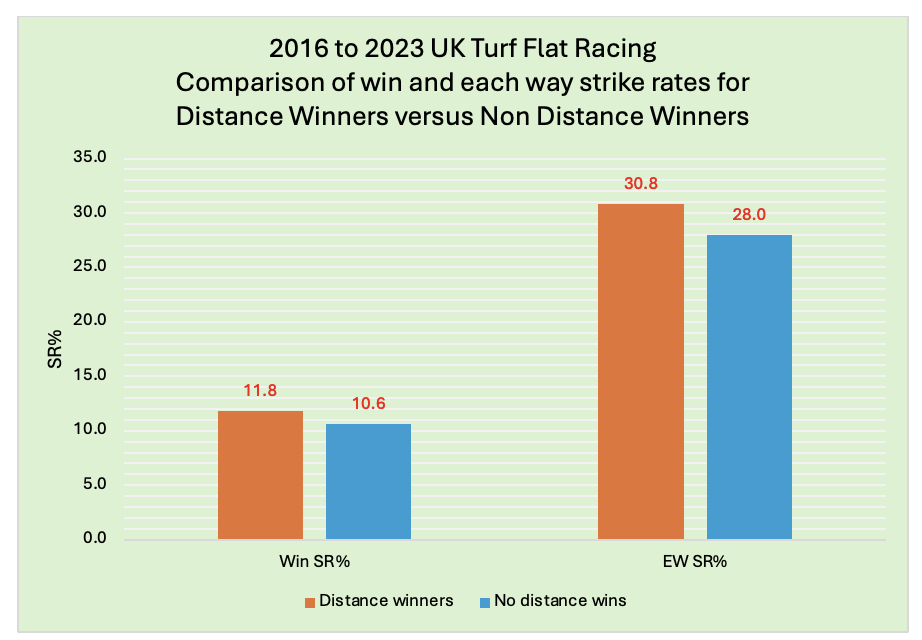
These figures correlate closely with the course data shared earlier. In terms of returns to BSP the distance winners have also performed better, losing only 4p in the £ compared to 8p for non-distance winners.
Let me next look at the strike rate in terms of number of distance wins. Here are the splits:
As with the course figures, five or more distance wins comes out with the highest win strike rate. Not only that, but the group also made a blind profit to BSP, although two winners priced 41.49 and 31.48 skewed the figures a little. For the record, horses with exactly four previous distance winners broke even at BSP. It does seem therefore that numerous wins at the distance (say four or more) is more a positive than a negative.
Let's now look at distance win percentages, as I did earlier for course winners. Here are the findings for all horses that have won previously at the distance in terms of their overall career win record at the relevant distance:
We have the same upward slant once more. The higher a horse’s win percentage at the distance, the higher the win rate.
When viewing all the data, it seems therefore that distance winners are better investments than non-distance winners. It also seems that multiple wins at the distance or a high win percentage at the distance can generally be taken as positives.
Course and distance (C&D) winners
Finally, it makes sense to review the performance of course and distance winners. A quick note, a horse can have been a course winner over a different trip, and a distance winner at a different track; such horses would not be considered a course and distance winner for these purposes: we are looking specifically at winners over today's course and distance in combination.
To be absolutely clear, we are looking at horses with Eleven Eleven's CD profile, not those with Absolute Dream's C,D profile.
As previously I will start by comparing the strike rates of C&D winners versus horses that have not won over C&D (non-C&D winners). Both win and each way figures are shown once more:
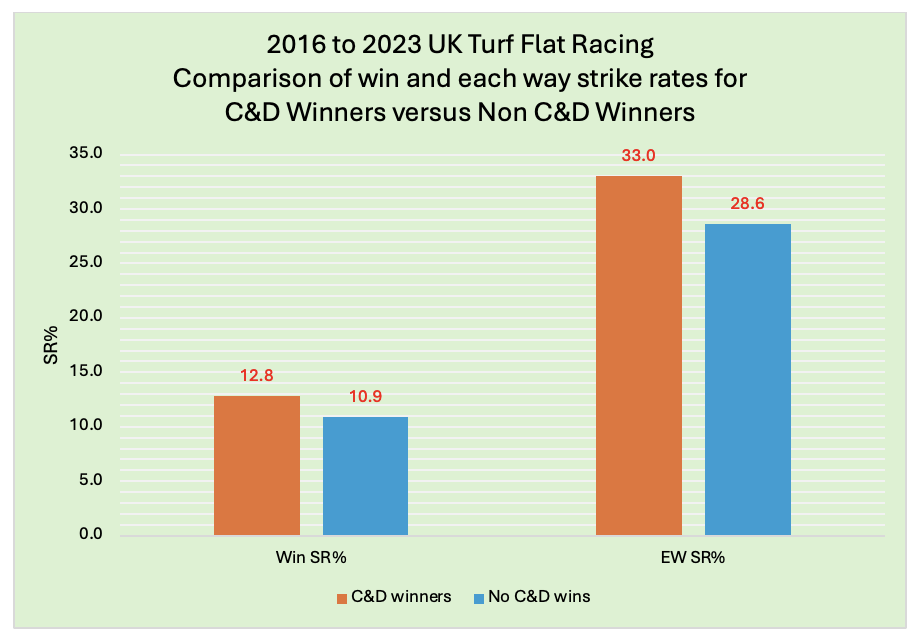
These are the highest win percentages we have seen for the ‘winner’ group to date. However, the returns to BSP for C&D winners is only marginally better than for non-C&D winners. Therefore, the market seems to have made an appropriate price adjustment.
Onto the win strike rate in terms of number of C&D wins. Here are the splits:
It should be noted that only 357 horses managed three or more C&D successes during the time frame, with only 116 of those achieving four-plus. However, if we look at C&D winners who have won at least three times previously they have combined to make a profit of £24.49 (ROI +6.9%) to Industry SP and £68.88 (ROI 19.4%) to BSP. It looks, then, as though horses that have won at least three times over course and distance are worth a second glance from a punting perspective.
It is C&D win percentages next, and it will be interesting to see if we have the same sloping graph / correlation as we had in the two previous graphs of this type:
The trend is up, as previously, although the 51-70% group spoils the party somewhat by dropping below 14.5%! The 71% to 100% group again performs best in terms of win percentages, hitting close to one victory in every five runs.
Let's look at some individual course data now. To change it up a bit I am going to look at the performance of all courses in terms of past C&D winners running again at the course.
It is easier to fit into a table than a graph so that is the plan. I can share more data this way also. Courses are listed alphabetically with positive A/E indices (0.95 and above) shown in green and negative indices (0.79 or lower) shown in blue. Profit / losses have been calculated to BSP less 5% commission:
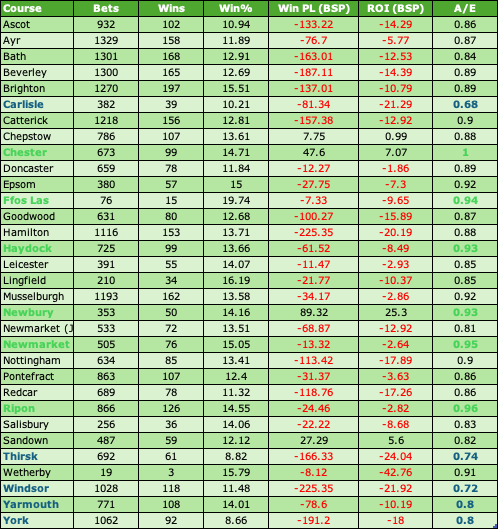
Seven of the 11 green courses managed a blind profit to BSP, (Fakenham, Ffos Las, Hereford, Hexham, Kelso, Newcastle, and Wincanton),and Taunton broke even. If you backed all previous C&D winners at these 11 courses (2016-2023) you would have returned a BSP profit of £184.35 to £1 level stakes (ROI +5.7%).
Combining these positive courses once more - this is how the annual figures worked out:
As can be seen, five of the eight years were in profit, and the three losing years were far from disasters losing 1.3p, 2.8p and 5p in the £ respectively.
Therefore, the data suggest that any past C&D winners declared to run at these eleven courses (Cartmel, Fakenham, Ffos Las, Hereford, Hexham, Kelso, Newcastle, Perth, Stratford, Taunton, Wincanton) should at least be shortlisted.
Now, as I have said many times, I am merely reporting on past data and we cannot be sure any of these findings will be replicated in the same way in future. However, just for fun I checked the 2012 to 2015 data for the same eleven courses to see how prior C&D winners had fared. The results were 364 winners from 2095 runners (SR 17.4%) for a BSP profit of £124.24 (ROI +5.9%). It seems therefore that these courses may offer past C&D winners an ‘edge’ over non-C&D runners.
Finally, let me share some trainers who have performed well with previous C&D winners when comparing their performance against their non-C&D winners. Eight trainers are listed in the table below comparing their win percentages for the two respective groups:
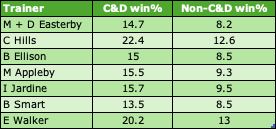
These eight all perform notably above the norm when it comes to past C&D winners. Not surprisingly, six of the eight have produced blind profits to BSP with their C&D winners. Here are their individual figures for previous C&D winners:
It should be noted that most of the qualifiers have been in the shorter to medium price range and hence the stats are not badly skewed. The A/E indices are generally strong, too. It will be interesting to see how these trainers fare in the near future with their prior C&D winners.
Summary
In conclusion, previous course winners, distance winners, and course and distance winners each win more often than their non-winning counterparts. As a rule, they also seem slightly better value, although the market has unsurprisingly adjusted well, as it tends to do for any material factor. Ultimately, whilst blind profits are not on offer here - who knew?! - I would view these 'contextual' past winners as more of a positive than a negative when evaluating a race.
- DR
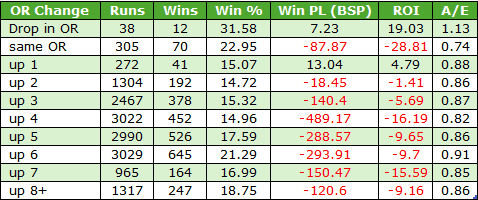
https://www.geegeez.co.uk/wp-content/uploads/2024/01/Cartmel_Racecourse.png320829Dave Renhamhttps://www.geegeez.co.uk/wp-content/uploads/2022/10/geegeez_banner_new_170x78.pngDave Renham2024-01-22 17:37:412024-01-22 17:37:41The Importance of Course/Distance Form in NH Racing
Anyone who ever played cricket will have heard those four words, Yes, no, wait….sorry! as he trudged back to the pavilion, run out by half a pitch length thanks to his partner’s indecision and then wanton sense of self-preservation, writes Tony Stafford.
If you’ve got a voice in your head, yes indeed the yesnowaitsorries are a floating ownership group, mainly of National Hunt horses. It was brought together through a joint love of cricket and racing, with the late Alan Lee, former cricket and racing correspondent for the Times, a very active member.
Over the past three months, mostly with good friend Kevin Howard, owner of the Noak Hill Shellfish Cabin off the A127 in deepest Essex, I’ve heard the same phrase trotted out at least 20 times. The project was a now 3yo gelding by Dandy Man called Edgewater Drive. The price plus Wilf Storey’s training fees was calculated based on 10 per cent shares and initially described by would-be joinees as “a cup of tea”: “Yes”, they said, almost without exception.
Next, rather than the No, it was Wait, after all Christmas was coming, the heating bills were astronomical. Well actually, better say No. As 20 dwindled down to zero, “Sorry” was replicated from a score of lips as Kevin withdrew back to the cabin, readying a bowl of jellied eels he’d promised to take to Gary Wiltshire, resident bookmaker at the owners’ room in Chelmsford racecourse.
Neil Graham, boss of Chelmsford, had been very optimistic at the meeting before last when talking about yesterday’s fixture – the first floodlit card on a Sunday in the UK. The total prize money on offer was £144k, a figure that will be replicated at Kempton on February 18.
Sunday racing in the UK had become generally a two-meeting apology, but yesterday was always going to be an exception, weather permitting. Apart from the innovative Chelmsford card, it was to be the last of three scheduled days of the Lingfield Winter Million. Friday’s first stage over jumps was unsurprisingly frozen off, but Saturday went ahead on the all-weather track with almost £250k distributed.
Then yesterday, the hoped-for miracle happened. Temperatures, stubbornly well below freezing for a week, suddenly went comfortably into positive numbers and the £492k card survived. The promise from the BHA to bolster otherwise mundane winter Sundays has made a good start. When we spoke to Neil he was anxious that the punters should roll in at Chelmsford, but as ever I was more than hopeful.
I’ve thrown in the odd Sangster family element in a good few of these articles over the years. Edgewater Drive had his two-year-old season with Ollie Sangster and didn’t make the frame in three starts. Another three times unplaced runner for Ollie, the now 3yo Floating Voter, came home in front in his first handicap – off 55 – at Wolverhampton on Saturday and that had been the plan for Edgewater Drive too until a foot injury stopped him, instead going to the sales before the plan could be tested.
On Thursday, two days before Floating Voter’s win, I was watching the early-evening all-weather action, but miscalculated and instead saw a race about to start at Pornichet, a track along the Atlantic coast from my dream holiday location, La Baule. The fact I never made it there is immaterial, so much was I brainwashed by a veteran production man on the Daily Telegraph sports desk.
Ronnie Fowler was really a news man, but liked his sport so ended up with us. With his soft West Country burr, ready smile and always with a holiday in France either to have just returned from or was about to embark upon, as I said, we knew all about La Baule.
Pornichet racecourse is what you would probably describe as Grands Provences, certainly prominent enough to have a regular spot on Attheraces (Sky Sports Racing).
The commentator had a rundown of the betting of this 4yo and up maiden, declaring that the Nicolas Clement-trained Midsummer Dance was an 8/13 shot having been a good second on her French debut a few weeks earlier.
At the same time, he remarked that the filly was making the opposite directional move than is usually the case. When Sam Sangster was looking for a trainer in France I unhesitatingly recommended M. Clement. Later we discovered that not only had Nicolas trained for Robert Sangster when he started out – he won the Arc in his first season – but also Nicolas’ father Miguel had trained for him.
From his lovely yard in Chantilly, he had prepared French Fifteen to win the Group 1 Criterium International at Saint-Cloud and, after Ray Tooth had sold him three days later, trained him for new connections to be a close second to Camelot in the 2000 Guineas.
Sam has done very well with Nicolas in the interim and when they went off at Pornichet just before 6 p.m. I heard Midsummer Dance moving along easily at the head of the 1m7f maiden race. The leader was Gruschenka and they were still hammer and tongs at the head of the 13-runner field turning for home before the favourite drew away comfortably.
She won by two and a half lengths and the runner-up was five lengths to the good over second favourite Piper’s Hill, to whom we will return in a moment.
It was as they passed the winning line first time around that I twigged. The same blue, green sleeves, green cap with white spots in which Mr S E Sangster’s horses, as differing from Manton House Thoroughbreds, which have the proper Robert Sangster colours with white cap, green spots. It’s amazing how much difference that cap switch makes.
This was the second run in France for the Mendelssohn filly Midsummer Dance. She was originally bought for $300k by a partnership including John Gunther, racing owner of the Newsells Park stallion Without Parole. I’m sure the plan was to send her to him when she won a few races.
Newsells Park, with its owner of a few years Graham Smith-Bernau, aided by General Manager Julian Dollar and Racing Manager Gary Coffey, has become one of the major players both in the sale ring and on the racecourse since Smith-Bernau acquired it.
They would have been expecting to welcome Midsummer Dance, but she failed to impress in three runs for the Gosdens and while improving to be placed a few times when switched to Harry Eustace, the rating of 59 was never going to persuade the owners to keep her.
Instead, she went to last year’s Horses In Training sale where she was knocked down to Blandford Bloodstock, probably Sam’s mate Stuart Boman, for just 12k. The one winning sibling to her was the Ralph Beckett trained Fox Vardy, who was rated in the low 90’s at one time and raced at the later stages of his career over two miles.
While with Harry Eustace, Midsummer Dance usually raced at ten furlongs, but for her first run at Chantilly last month, Nicolas Clement stepped her up to two miles and she finished an excellent second.
Now back a furlong, she stayed on well. I mentioned her UK mark of 59. When beaten three lengths at Chantilly, her victor earned a rating of 36 (x 2.2 to get the pounds from kilograms figure) hence 79.
The third horse on Friday already had a mark of 36, so having beaten him by seven and a half lengths, you would have to say she’ll be rated at least 36, maybe a shade more. That’s a minimum of 20lb higher than the UK mark. We’ll find out in a day or two.
Sam Sangster and his long-time collaborator and principal UK trainer Brian Meehan are the partners in the Mendelssohn filly. They had a bit of fun with the ownership as although carrying Sam’s (S.E Sangster) colours, she races in the name of Shelby Ltd. Maybe it should be Shelby Unlimited after the partners in Isaac Shelby, Brian’s Group 2 winner of the Greenham Stakes last year, was sold for a seven-figure sum before the 2000 Guineas to free-spending Wathnan Racing.
I mentioned Edgewater Drive at the beginning of this piece. Wilf Storey pointed out that only three horses have previously moved from Manton, the Sangster family base for more than 30 years, to his Consett, Co Durham yard.
Looking for a potential hurdler in 1993, I bought the three-year-old Caerleon gelding Great Easeby unraced from Robert: “a total slowcoach”, he said when Peter Chapple-Hyam was the trainer. Wilf won races on good tracks, flat and jumping, culminating with success in the 24-runner Pertemps Handicap Hurdle at the Cheltenham Festival. The following year, when “unbeatable” Unsinkable Boxer won the race for Martin Pipe, Great Easeby was an early faller, but started third-favourite!
Next was Jan Smuts, an expensive yearling buy for Raymond Tooth. He had a bad injury and then on third career start, pulled himself up in a flat race at Windsor.
It was thought he was unlikely to race again but had his final win in 2018 as a ten-year-old. He had been sent to Storey for free and raced a further 116 times, winning seven over flat and jumps and placed another 48 (!) times between second and fourth.
Finally, Card High. I watched out for his big white face as he toiled on Brian’s gallops every Thursday, too slow to finish last in his work! Sam’s older brothers Ben and Guy Sangster were happy to pass him on and he became another multiple winner (eight) and more than 50 per cent in the money in 50-odd runs.
Wilf, and granddaughter and assistant Siobhan Doolan, both have at least as much faith in this young, still growing three-year-old, as any of his predecessors. Wilf says: “He’ll stay.” Once they get up there on the Moor darting around avoiding the 300 sheep at Grange Farm, they usually do.
So, if you believe the sales pitch (unlike the Doubting Twenty!) and would be interested in maybe having a shot at a very cheap option to the rather pricier, but admittedly fantastically successful Geegeez.co.uk syndicates so skilfully managed by Matt Bisogno, the Editor, just give a call to Mr Storey or Ms Doolan. You’ll find them on the web.
When you get to “Yes”, never mind the No or Wait. I predict you won’t be Sorry!
- TS
https://www.geegeez.co.uk/wp-content/uploads/2024/01/manton.png320830Tony Staffordhttps://www.geegeez.co.uk/wp-content/uploads/2022/10/geegeez_banner_new_170x78.pngTony Stafford2024-01-22 04:21:112024-01-21 21:26:37Monday Musings: Yes, No, Wait…
In this article I will be looking at a different approach to analysing market data, writes Dave Renham. I will not be using the traditional methods of rank – favourite, second favourite, etc. – or using a specific price or price band. My focus is going to be solely on handicap races. The data has been taken from the last four full years of UK racing (2020 to 2023) and I am looking at races of between 6 and 14 runners.
My plan is to split the betting market into three thirds – in the same way that I do when I analyse draw bias. The idea here is straight-forward: horses with the shortest prices will be classified in the top third of the market, more mid-range prices will be classified in the middle third of the market, while bigger prices/outsiders will be classified in the bottom third of the market. I have used Betfair SP rather than Industry SP to do this. The reason is that with Industry SP there are more prices that are the same, which can make the splits into thirds more challenging.
One slight downfall of this method is that there is not always an even split due to the actual number of runners. However, I will use the same principles as I do for my draw bias work meaning that it should balance out fairly as the table below shows:
Hence, with 7, 10 or 13 runners, the middle third gets the extra runner, while races with 8, 11 or 14 runners the top and bottom thirds get the extra runner. Hopefully therefore, we will get a fairly accurate reflection of how the market behaves.
Each third will produce a percentage figure – in simplistic terms let us imagine a series of 100 races. If the top third of the market won 61 races, the middle third won 28 and the bottom third won 11, then the market percentages would be 61% for the top, 28% for the middle and 11% for the bottom. Clearly, we are not going to get ‘equal’ percentage splits of 33.3% for each group given the inherent accuracy of the betting market.
Handicap hurdles
I want to look at handicap hurdle splits first, and these are shown in the pie chart below:
These figures show the expected bias to the shorter priced runners (top third of betting). Close to two in every three races has a winner emerging from that portion of the market. Just one in ten races goes to the outsider group (bottom third of the market) which is perhaps slightly fewer than most people may think, me included.
Next, I grouped the races into smaller fields (6 to 8 runners), medium sized fields (9 to 11) and bigger fields (12 to 14) looking for differences. The findings were as follows:
As you can see the market bias to the front end has strengthened as the field size increases. This is a useful nugget to be aware of, especially if you strongly consider prices and market position. It also makes some sense if you consider the likely prices on offer within the specific runner groupings.
The next port of call is handicap chases.
Handicap chases
I have split the data for these races in the same way and am interested to see how well the figures match. It’s expected that they will correlate quite strongly, but how strongly? Let’s look at the overall market third splits first:
As expected, the splits are like the hurdle ones, but the outsider group have performed better in these races, striking at one win in eight compared with one win in ten. This is a relatively significant shift considering their outsider group status. I must admit I had expected outsiders to fare worse in handicap chases rather than better, as my perception was that handicap hurdles were harder to predict than their chasing counterpart.
Time to group the races into the three field size groupings as I did earlier. Here are the splits:
These figures do not quite fit the same pattern as handicap hurdles although there are some similarities, such as the top third of the market have the lowest win percentage in the 6 to 8 runner group once more, and by some margin. The bottom third of the market performed best in the 12 to 14 runner group, winning almost twice as often as in handicap hurdle races with similar field size.
Overall, the data is pointing to outsiders having more of a chance in handicap chases, and the front end of the market having more of a chance in handicap hurdles.
All-weather handicaps
Finally, it’s onto the sand to see what patterns emerge there. The overall market splits look like this:
These results are very similar to the handicap hurdle ones. The outsider group have performed the worst here with just 9.7% of wins. The front end (top third) has performed the best of the three race codes, with 64.1% of races going to that group.
Let’s now look at the splits within the field size groupings:
This conforms more to the pattern of the handicap hurdle data with the market more influential as field size grows. The top third of the market are very close to winning two-thirds of races when the field size is 12 to 14. Conversely, the bottom third of the market win only around one in every 12.
For the all-weather cohort, the data covers nearly 7000 races so it is a decent sample! Hence, I thought it would be interesting to split the market data up by class of race. Here are the findings:
There is a definite pattern here, with the front end of the market performing better as the races get weaker. At the other end of the market the reverse is true as one would expect given that initial finding. Hence, in the two better classes of race (2 and 3), the outsider group have performed better than in mid to lower class races (4 to 6). They have particularly struggled in the lowest Grade of Class 6 handicaps winning less than 9% of all races.
To conclude, when we look at the different race codes – handicap hurdles, handicap chases and all weather handicaps – the win strike rates by market splits are similar but there are important and subtle differences, too.
*
Selected Cheltenham Festival Handicap Market Trends
With the Cheltenham Festival not too far away, it is worth looking at past trends of some of the big handicap races. I have looked at two Cheltenham races, the first of which is the Pertemps Handicap Hurdle over 3 miles. I have data for the last 26 renewals and the market splits for the winner are as follows:
These are the sort of figures we have seen throughout this article although horses from the bottom third of the market have slightly under-performed in this race providing less than 8% of the winners. Now this race does have big fields so given much of the data we have seen so far, this is perhaps no huge surprise.
The Plate handicap chase (2m 4½f) is the other race I have looked it, and the breakdown for that is as follows:
Here is a quite different picture with a much more level playing field, implying a far more open contest. Of course, 26 races is a smallish sample, but ‘the world and his wife’ shares Cheltenham race trends, and usually not as many as the last 26 races!
If you are a fan of big race trends, I think this type of market breakdown/analysis is a better idea than say looking at the performance of favourites, or the performances of horses priced 25/1 or bigger, etc. It gives more of an overall feel, in my view.
*
I hope you found this slightly different perspective an interesting read. I plan to use this method to dig into turf flat races at some point in the next few months, and will share my findings then.
- DR
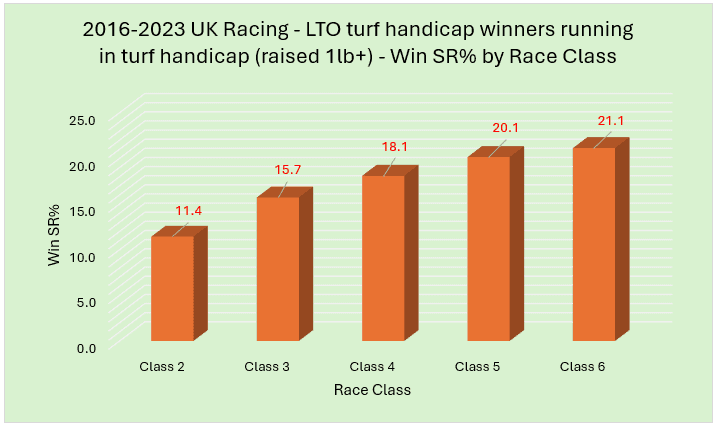
https://www.geegeez.co.uk/wp-content/uploads/2022/11/Cookie_Ascot_2022.jpg387830Dave Renhamhttps://www.geegeez.co.uk/wp-content/uploads/2022/10/geegeez_banner_new_170x78.pngDave Renham2024-01-17 09:15:572024-01-17 09:16:55Analysing Market Data in Handicaps
We’re just about into the final third of the 2023-24 jumps season in the UK and Ireland and the concluding bumper at Fairyhouse on Saturday provided an interesting statistic, writes Tony Stafford. Its winner, the debutant Romeo Coolio, ridden by Mr Harry Swan for the Gordon Elliott team, was the trainer’s 155th victory of the domestic campaign.
This, from the once reviled but now it seems fully rehabilitated and still ebullient handler, was Elliott’s 300th individual runner of the season. It brings his prizemoney tally to €3,274k.
Until the last few days, he had been ahead of his great (and hitherto too-great!) rival Willie Mullins in all categories apart from strike-rate. Willie has had to make do so far with 254 individual horses, but his 168 victories (two at Punchestown yesterday) have careered him past Elliott a shade sooner than usual. By the time we get to May, no doubt, Mullins will I’m sure be back in his usual place at the top of the pile with all those big prizes still to be won. He stands on an interim €3,387K.
Two more were added to the first-time Elliott count at Punchestown yesterday and with lots more buys from the pointing and French fields to come, it might even be feasible to expect an end-of-season accumulation of 400, but let’s play safe and suggests it will be 350, as if that wouldn’t be totally unbelievable.
If Gordon were, say, to be content with just a 20-hour waking day – he should manage four hours’ kip surely! - then he could afford to give each of the three hundred a respectable four minutes of his attention – in between driving to the tracks and speaking to the media, not to mention living of course.
No doubt though, as the season has gone on, there has been a regular in-and-out process so that the horses that favoured summer ground and opposition are sent elsewhere until their optimum part of this year comes around. Or even sold.
Even so, you must reckon on a minimum of 200 boxes either at the main yard, or sprinkled around nearby to accommodate the hordes as they prepare for their races.
Planning programmes, making entries, and generally finding alternative objectives when the weather intervenes as has been the case lately, taxes the ingenuity. In some ways it’s easy. “There are five nice races at Punchestown next week,” he might say, adding “Put those ten in that one, that lot in the next” and so on.
Meanwhile Mr Mullins is doing the same thing at his only marginally less horse-swollen base, and hence the pair go head-to-head in almost every novice, conditions race and Graded event in the calendar. I’ve never forgotten Luca Cumani’s words, however. It might have been at the time he lost the Aga Khan’s horses when, in a pique, HH decided to have nothing trained in the UK. Luca always reckoned it was easier to train a lot of horses than a lesser number. You could find the time of day about them, he argued, as Luca certainly could.
Such is the Mullins/Elliott joint domination that only two other trainers have run more than 100 horses. Third in every category is Henry de Bromhead, who despite his Gold Cup and Champion Hurdle successes has been limited to exactly half as many horses as Elliott – 151. His 62 wins have come from 51 horses, and he’s almost on €1.1million. Almost without exception, UK trainers will be saying, “I should be so limited!”
Gavin Cromwell comes next in the list with 124 horses, €700k coming from 35 individual winners of 47 races. Philip Rothwell (26 from 76) and 34 wins from 353 runners is 5th to show the extent to which the sport across the Irish Sea is dominated by a cartel that has no inclination of going away.
No wonder Elliott bristled at the prospect of any restriction in the number of horses he could run in one race. His 15 of 20 in the Troytown last November might have been only a sample of what is to come given his relentless expansion. The possible limit of four in UK handicaps, especially the Grand National, will be welcome, though not for Elliott – if any of our trainers is equipped to take advantage.
On the flat and over jumps It’s a self-fulfilling numbers game. The two Premier race day cards at Kempton and Warwick on Saturday – to which a decent Wetherby programme was grafted on, drew only the minimal attention of Irish stables.
Mullins with a third and Elliott, a fifth place, had one visitor each, but Joseph O’Brien brought Banbridge to Kempton for the Coral Silviniaco Conti Chase and he beat Pic D’Orhy to remind us that he is indeed still training jumpers. Mullins was 3rd in this with Janidil.
At one time it seemed O’Brien would make a more significant challenge to the big two, but as he has been winning races like the Melbourne Cup (twice) and Group/Grade 1 races in Ireland, the UK, the US and Dubai, the concentration has understandably been more on flat racing.
In the present jumps season, Joseph has run only 36 horses in a total of 80 races and the 14 winners have collected 16 victories. His domestic tally of €311k is respectable in the circumstances. He clearly has quality rather than quantity in mind for the winter game.
One trainer aware of the possibilities offered by the dual Premier fixtures at Kempton and Warwick was Dan Skelton, holidaying in Barbados but still ably backed up by brother Harry, who rode a Warwick double, the former champion jockey and his wife Bridget Andrews among others supervising matters on course.
The numbers game truism holds here, too. Dan Skelton, while not yet in the scale of Ireland’s big two, has still sent 191 different horses to the races this season, easily the most among UK stables. On Saturday 9% of them – viz 16 – were dispatched to the three jumps meetings and they came back to Warwickshire with six winners, one second, four third places, two fourths and a sixth.
Skelton won the Lanzarote at Kempton with 33/1 shot Jay Jay Reilly, making his first run back over hurdles since early 2022. The trainer’s other major victory came with Grey Dawning, the gelding thrillingly going clear of his field in the Grade 2 Hampton Novices Chase at Warwick. Cheltenham beckons for both and many more I would assume from this target stable. His team will be one of the main defences against the onslaught of well-treated Irish “improvers” in many of the handicaps in seven weeks’ time.
It must be a shade frustrating in comparison with what a similar haul would have brought in Ireland or France, that six wins (worth £145k and those other places, yielded 180 grand, given the trumpeting of the new concept). It was still enough to carry him past Nicky Henderson into second slot in the UK trainers’ list.
Skelton’s 70 wins from 457 runners have earned £1,370k so he stands rather more than £200k behind his former mentor and perennial champion, Paul Nicholls. The Ditcheat master, hopefully now back on terra firma after the previous week’s abandon ship call came out in his flooded stable yard, has 72 wins from 306 runs (58 from 151 individual horses) and is just a tick short of £1.6 million.
Henderson has sent out 132 horses – a visitor to Seven Barrows might ask, “Where does he find room for them all?” – and 65 wins from 266 runs and £1,235k in prizes.
An unexpected name in fourth place is Venetia Williams, not that her talent isn’t well chronicled. In a way she defies the numbers element, even if she is comfortably behind the top three at £935k. The million should come. Her achievement is notable as she has sent out only 64 horses, 25 of them winning 38 races. Nicholls, Henderson and Williams are all operating at 24% whereas Skelton is at a relatively modest 15%.
As a one-time associate used to say – and sorry Mr Hatter I’ve used it many times, including here – “Everything is just different numbers.” It is.
The marvel of the Elliott/Mullins and to an extent Skelton achievement is to have control over such an obviously unwieldy model. How does a trainer do morning or evening stables as in the old days? I’ve been at Hughie Morrison’s yard a few years ago and the lad would present his horse as the trainer came along the line, asking how he was and checking limbs to satisfy himself. (Of course, unlike the old days when it was probably a maximum of two horses per lad, the 2020s model required a fair bit of nimbleness on the part of the grooms as they swopped to organise one of their other three or even four further on!)
You could picture Noel Murless or, from an earlier generational, Fred Darling, satisfying himself not only with the horses’ but also the lads’ appearance as he checked them off one by one. Evening stables at Elliott’s must be fun. By the time he gets round the lot, there wouldn’t be much time for a pint.
TS
https://www.geegeez.co.uk/wp-content/uploads/2018/04/mullins_elliott_fists.jpg319830Tony Staffordhttps://www.geegeez.co.uk/wp-content/uploads/2022/10/geegeez_banner_new_170x78.pngTony Stafford2024-01-15 05:12:052024-01-14 18:43:39Monday Musings: The NH Numbers Game
This is the last article in my series on jockeys and, to close, I have decided to do something slightly different, writes Dave Renham. For this piece I have been number crunching using Excel and reviewing all UK National Hunt Racing results going back to the beginning of 2019.
My plan? To try to evaluate jockey performance in a different way compared with more standard horse racing approaches. The idea is relatively simple: I am going to compare a jockey’s finishing position with their market position. It will be easier to give an example so let us imagine the following set of ten results:
Using these ten results I add up both columns to compare the market position total to the finishing position total. Adding up the market positions (1 + 1 + 2 + 2 + 3 + 3 + 3 + 4 + 4 + 7) we get a total of 30. The finishing positions equal 50 (1 + 3 + 4 + 8 + 1 + 6 + 5 + 3 + 8 + 11) when added up.
Hence the jockey in this imaginary example has arguably performed below expectations as the total of finishing positions is higher than the total of market positions. Now my idea is to give this overall performance a numerical figure by dividing the market position total by finishing position total. In this case we would get a performance rating of 0.60 (30 divided by 50).
I soon realised, though, that I had an issue with non-completions: horses that fell, unseated, were brought down, or pulled up. I decided it made sense to group all such horses giving them a position in last place. Doing it this way each jockey would be affected in the same way creating as level a playing field as I could. Whether this is the ‘ideal’ I am not sure, but it made the most sense to me.
So let’s start by looking at the 20 jockeys with the highest performance ratings. To qualify each needed to have at least 300 rides during the five-year period.
In general, this list contains lesser-known jockeys most of which actually have quite a poor win record. This is illustrated in the table below which shows their overall record in terms of strike rate / returns:
The question that springs to mind, then, is why are these jockeys producing the highest ratings? I believe there are two things in play here. Firstly, if we look at the majority of their each way percentages, they are higher than one might expect given their respective win percentages. John Kington is an excellent example of this with his each way percentage roughly five times higher than his win percentage. As a general rule in racing, the each way percentage is around 2½ times bigger than the win percentage.
And secondly, most of these jockeys normally ride outsiders, and if you are riding the outsider in a field of 10, any result other than 10th will give you a performance rating of greater than 1.00. Clearly, for shorter priced horses that are at the top end of the betting market, it is harder for those to beat their market rank with their finishing position. Indeed, favourites are unable to beat their finishing position – they can only match it should they win, or fall behind it.
I decided therefore that it would be a better idea to create jockey performance ratings within different Starting Price brackets, which would produce a more level playing field. The price brackets I chose to focus on, which granted were somewhat arbitrary, were: 3/1 or shorter, 100/30 to 5/1, and 11/2 to 8/1.
3/1 or shorter – let’s consider the shortest price bracket first. I have used a minimum of 50 rides and here are the top performing jockeys in terms of my performance ratings model. Overall, the ratings within this price bracket will look relatively low, for the reasons I mentioned earlier:
It is interesting (and pleasing) to see Charlotte Jones topping the list – she was discussed positively in the two most recent articles in the series. Her record reads a hugely impressive 28 winners from 51 (SR 54.9%) for an SP profit of £28.18 (ROI +55.3%). Also, as the graph clearly shows, she and Theo Gillard are well clear of the rest of the top ten.
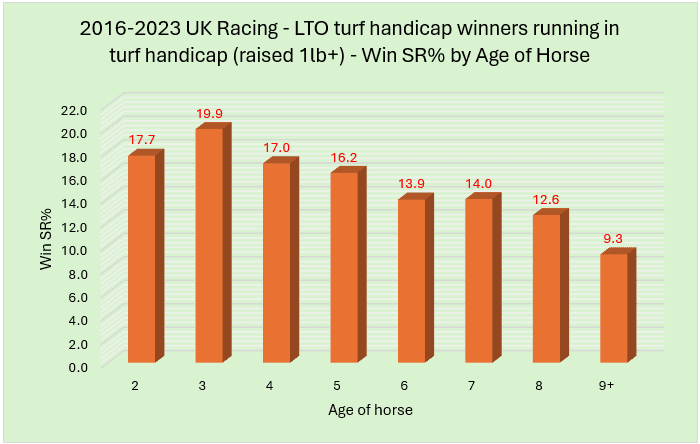
I also want to share the ratings of the main jockeys who have appeared in this jockey series as well as some others I’ve mentioned along the way:
It is surprising perhaps to see de Boinville with the poorest rating with these well fancied runners. However, I did some digging, and he pulls up these shorter priced runners much more often than the average jockey (5.6% compared 3.5%). Hence, this looks the most likely reason why he is a significant amount below the rest.
100/30 to 5/1 – now a look at the middle price bracket. Again, here are top ten jockeys in terms of my performance ratings:
Patrick Wadge tops the list and by a comfortable margin in relative terms. It should come as no surprise therefore that he has been profitable with these runners to the tune of 31 pence in the £ to SP, 45p in the £ to BSP. Specifically, he has had 57 runners of which 15 won (SR 26.3%). Fergus Gillard has also proved nicely profitable thanks to his 26 winners from 104 rides (SR 25%). Profits to SP stand at +£28.65 (ROI +27.6%); to BSP +£38.54 (ROI +37.1%).
Now at look at the ‘main’ jockeys again – McMenamin featured in the top ten above so is not included again – he would have led this list and by a comfortable margin:
Again, we can see that Nico de Boinville is clear at the bottom. His strike rate with these runners has been 14.8%, with SP losses of over 28 pence in the £. Compare that with the average figures for all jockeys where the strike rate is 17.2% and losses are only at 12p in the £.
11/2 to 8/1 – onto the final price bracket into which we will look in detail. Once more I have collated the jockeys with the top ten ratings:
Two ladies top the list, with Charlotte Jones appearing again, this time in second place, and once again she has proved profitable to the tune of 19p in the £. Tabitha Worsley tops the pile, though, with an impressive 1.04 figure.
The shame for Tabitha Worsley is that she gets limited opportunities on better horses. 65% of her rides in the past five seasons have been on horses priced 16/1 or bigger; 44% have been 33/1 or bigger. If we consider her overall record on horses from the top three in the betting, they have essentially broken even to SP and, to BSP, have seen returns of 12p in the £.
A look now at the ‘main’ jockeys with horses priced 11/2 to 8/1:
It’s a familiar story for Nico de Boinville, whose allegiance with Nicky Henderson means almost everything he rides is over-bet; while Danny McMenamin again tops the list, continuing his decent ratings performance across the board.
Higher prices - I did briefly look at other price brackets and here are a few headlines:
For horses priced 17/2 to 11/1, once again two female jockeys had the highest ratings – Emma Smith-Chaston was top with 1.15, while Lilly Pinchin was second with 1.14. Danny McMenamin scored well again, with 1.02, topping the main group of jockeys. Nico de Boinville was not bottom of the main group this time with his score of 0.83; that dubious accolade went to Harry Cobden who was on 0.82.
Looking at the 12/1 to 18/1 bracket Paddy Brennan was third out of all the jockeys with an excellent 1.21 rating. Meanwhile, de Boinville was second worst out of ALL jockeys with a figure of 0.92. In the 20/1+ group, Tabitha Worsley and Danny McMenamin both appeared again in the top ten scoring 1.23 and 1.22 respectively.
It seems abundantly clear from these figures that Nico is hugely over-bet by the wagering public and Danny McMenamin is still vastly under-rated.
*
This article has hopefully fuelled some food for thought amongst readers. In order to make money at horse racing one needs to have an edge over the ‘crowd’. Ideas like these performance ratings have the potential to give us that edge.
While I am not remotely suggesting that these numbers are the holy grail of jockey ratings, what I am clear about is that if we don’t test out new theories or ideas, we are probably going to bet in very similar ways to everyone else. That is unlikely to give us the long-term edge most punters dream of.
Before I finish, this type of idea could be used to create horse performance ratings or trainer performances ratings, too. I might look into either or both in a future piece.
I suppose waterlogged Sandown on Saturday was one of the much heralded (but hard to find as far as my rubbish Internet researching skills were concerned) 170 Premier meetings that will enhance the racing experience in 2024, writes Tony Stafford.
Apart from the issue of expecting some extra prizemoney when unscheduled meetings such as Newcastle on Saturday are drafted on to live ITV coverage as a fill-in, there’s nothing much to remember about the weekend in the UK. The seven races at Gosforth Park had combined winners’ money of just over £29k. Scandalous really on a Saturday, especially if the course, as I would imagine, gets an ITV bung to go with the already-generous normal broadcast payment.
Meanwhile in California, Frankie Dettori was up to seven winners since Boxing Day after a Friday treble and a Saturday single at Santa Anita. No wonder, as he told Richard Hills, he’s enjoying himself and liking his percentages of the generous California prizemoney as well as the sunshine.
Then, over in South Africa, Piere ‘Striker’ Strydom, 57, so Frankie’s senior by four years, and with more than 5,000 career winners to his credit, was also coming to the close of his mainly domestic but similarly stupendous career. He went to the races on Saturday hoping for a record-equalling seventh success in the L’Ormarins King’s Plate over a mile at Hollywoodbets Kenilworth. (Do you mind if I just call it the King’s Plate at Kenilworth from now on?).
Piere seemed to have the whip hand leading up to the King’s Plate as his mount See It Again had beaten 7/5 joint-favourite Charles Dickens quite comfortably when they met late last year in the WSB Green Point Stakes over the same course and distance. Then again, Charles Dickens hadn’t got the best of runs and could get going only soon enough for second.
See It Again is trained by Michael ‘Muis’ (or ‘Mouse’) Roberts, 69, many times champion jockey in his native South Africa, with two wins in the King’s Plate. He rode with great success in the UK and was champion jockey in 1992, and is probably best remembered for his partnership with the brilliant multiple group 1 winner Mtoto. That sound middle distance champion was twice successful in the Eclipse Stakes for Ahmed Al Maktoum and the late Alec Stewart. I will return to Master Roberts later.
The first of Strydom’s six King’s Plate victories came in 1990, coincidentally the year that Aldo Demeyer, partnering his main rival Charles Dickens on Saturday, was born. Strydom wasn’t the only jockey aiming to match Anton Marcus’ seven wins. Bernard Feyd’herbe made it six when upsetting the odds-on Charles Dickens last year with Al Muthana, who was also in the field with Bernard in the plate.
In the event, Charles Dickens didn’t just gain his revenge on those two, he obliterated them with a show of class and speed.
He had two and three-quarter lengths to spare over See It Again. Once more, Al Muthana’s run in fourth bettered what was expected of his 33/1 status.
The first two are slated to go to stud shortly. See It Again, until he beat Charles Dickens last time, had been racing over longer distances and Roberts has that option again before the final decision on a stud career is made. Successful owner-breeders Drakenstein Stud and trainer Candice Bass-Robinson can now anticipate a lucrative career as a stallion for Charles Dickens who stands at ten wins from 13 runs with three places on the racecourse.
He’s a son of South African champion sire, the US-bred Trippi. There’s a UK element to See It Again’s background as he is a son of Twice Over, a four-time Group 1 winner for Henry Cecil and Khalid Abdullah, including two Champion Stakes.
The tough, durable and honest Twice Over, whose final race was when fourth behind stablemate Frankel as a seven-year-old in the Juddmonte International at York, was bought and syndicated as a stallion by my friend Bernard Kantor.
Twice Over has proved a great success at stud. Bernard, of course, was co-founder and chairman for many years of Investec, the bank that sponsored the Derby for much of this century, helping it regain its international status.
Earlier on the card, the filly that was preferred to those principals in the big race for Horse Of The Year honours last time around, Princess Calla, was beaten in a 1m1f fillies’ and mares’ Group 1 race, Beach Bomb coming out on top by a neck. One of the performances that earned her award was when beating See It Again last July; Charles Dickens must be favourite for that distinction this time.
My Michael Roberts tale is simply told. Some bright spark suggested during my Daily Telegraph days that it might make a good feature if we would follow him around as he moved from course to course by small plane. Another couple of jockeys were with us but they were riding elsewhere. The pilot, Neil, who used to fly Frankie very often, warned that when he dropped us off for Leicester, time was limited with the other jockeys going on elsewhere; so as we went to get out, the plane was already moving gently forward.
The nimble Mr Roberts skipped out and away from trouble, but the more cumbersome pressman lingered a second or so, collecting his luggage when bash, the tail wing smashed into his back.
I was knocked flat, well flattish anyway. As the plane continued its progress, I assured Michael I was okay, and we moved over to the waiting taxi for Leicester races. By the time I got home that evening, there was a wide bruise across the middle of my back and it stayed there for much of that summer! That must have happened at least 35 years ago.
When I saw the result of the King’s Plate, indeed all through the winner’s career, I’ve internally reminisced about his namesake, a chaser with, I thought, Alex, but apparently Alan Kilpatrick. After such a long while, time and horses coalesce, but it was more than 50 years ago that the remarkable Major (later honorary Colonel Sir) Piers Bengough rode Charles Dickens to three consecutive wins (1970-72) in the Grand Military Gold Cup at Sandown Park.
Old Etonian Bengough already had an interesting life in the army, stationed in Germany where he found time to train up to 11 of his own horses, winning races at Hanover, Dusseldorf, and Dortmund. Then it was back home with the Royal Hussars as the regiment’s Commanding Officer between 1971-73.
A long-standing member of the Jockey Club, he held several senior positions, but nothing was more appropriate for the tall, moustachioed army officer than to become for 15 years Her Majesty’s Representative at Royal Ascot, following the Marquess of Abergavenny.
It was he who had the final say when access to Ascot’s Royal Enclosure held much more of a social meaning than nowadays. One memorable occasion which made all the red-top papers was the exclusion of Joan Collins on the basis that she was wearing someone else’s badge! Fair enough Joanie!
Lady Bengough was a remarkable woman too. At the age of nine, Bridget Adams was the youngest in the UK to have earned a silver medal for figure skating and developed that skill to the extent that she represented the UK at the Olympics. Dutifully by his side at the races for all their years together, Lady Bengough survived her husband by 15 years.
- TS
https://www.geegeez.co.uk/wp-content/uploads/2024/01/CharlesDickens_KingsPlate2024.png320830Tony Staffordhttps://www.geegeez.co.uk/wp-content/uploads/2022/10/geegeez_banner_new_170x78.pngTony Stafford2024-01-08 07:47:312024-01-08 12:19:16Monday Musings: The Striker and the Mouse foiled by Dickens
geegeez.co.uk uses cookies to improve your experience. We assume that's OK, but you may opt-out from the settings. Cookie settingsACCEPT
Privacy & Cookies Policy
Privacy Overview
This website uses cookies to improve your experience while you navigate through the website. Out of these cookies, the cookies that are categorized as necessary are stored on your browser as they are essential for the working of basic functionalities of the website. We also use third-party cookies that help us analyze and understand how you use this website. These cookies will be stored in your browser only with your consent. You also have the option to opt-out of these cookies. But opting out of some of these cookies may have an effect on your browsing experience.
Necessary cookies are absolutely essential for the website to function properly. This category only includes cookies that ensures basic functionalities and security features of the website. These cookies do not store any personal information.
Any cookies that may not be particularly necessary for the website to function and is used specifically to collect user personal data via analytics, ads, other embedded contents are termed as non-necessary cookies. It is mandatory to procure user consent prior to running these cookies on your website.