Read all sorts of commentaries and tips across a range of racing disciplines on the most popular horse racing blog in Britain, from staff and guest writers.
W H Smith said the 2024 version of Horses In Training would be available for dispatching from March 20th, writes Tony Stafford. Normally, I would buy my copy a few days earlier than that, at Cheltenham, but this time I wasn’t there, and rather inconveniently forgot to ask the Editor, who was, to collect one for me.
Age doesn’t help. A few years ago, I bought a copy from the Racing Post shop there and duly left it in the box that was obligingly made available – necessary as I’d not bothered to book a press badge for the week.
WHS said – or rather its web site did, it seems they don’t have any actual people working for them nowadays – that it would take two or three days to arrive. It hasn’t. I’m a bit worried because on the same ordering page, they still have Horses In Training 2023 available at the same price. Few authors can share editor Graham Dench’s smugness that an out-of-date issue is as valuable as the new one.
You might ask why I should be worried that a company with the worldwide reputation of W H Smith to protect could be thought to be that slipshod. Last year, when the wonderful Sir Rupert Mackeson arranged through his sources to get me HIT 2023, it duly arrived from the year before so I’m holding (or not) my breath. They did send the correct one out eventually.
Why am I so het up about it? Well, it’s the start of the flat and I always like to look at which yards have accumulated more horses than before and note the trainers who prefer not to reveal their equine strengths.
In general, the big get bigger, the small struggle and it needs something a little different for a trainer to make an early impact. As George Boughey has shown over the past few years, being youthful as well as able comes into it, and he was up to 165 officially last year. I wonder how many in 2024 – no don’t tell me – I’ll wait until tomorrow or whenever the priceless volume arrives.
When I was introduced by our mutual friend Michelle Fernandes to Dylan Cunha at the April sale in Newmarket last year, I confess I hadn’t heard of him, or if I had, it would have skimmed over my consciousness like so many things do nowadays. But looking at HIT after our chat, I saw he had 17 horses in his yard in Windsor Road, Newmarket.
Dylan is from South Africa and left the land of his birth a couple of years ago to see if he could make it over here. A winning Group 1 trainer back home, he had chanced him arm but with the help of the highly-talented Silver Sword in the yard – an impressive winner of the last race at York’s Ebor meeting last year – he made quite a stir.
Needing a larger premises as the numbers crept up, he did a deal to take over the famed Phantom House Stables of William Jarvis when the last trainer of that revered surname decided to call time – understandably keeping the family home on the premises.
A great friend and contemporary from Harrow school of William Haggas, it must have become in part a frustration to see his pal’s career travelling in the opposite direction, perhaps one day even to the extent that Haggas might make it to champion trainer, but it will need a slowing-down from the Gosdens and Aidan O’Brien, maybe even Roger Varian, to permit that.
The move sorted, Dylan was always active at the sales and by this point he has 50 horses under his care – I’m not sure whether HIT will have caught up with it. Last week I read an article in the admirable South African Monday to Friday racing publication Turf Talk that published an interview with the family man who is doing his home country proud.
It revealed that he was running a two-year-old in the Brocklesby on the opening day of the flat. Traditionally the first juvenile race of the season from its time until 1964 at Lincoln racecourse, it often brings out a nice debutant.
Zminiature, named for his size but clearly not his ability, dealt with his 14 opponents in authoritative style, expertly guided home by Rhys Clutterbuck, nicely settled into his new role as Dylan’s stable jockey. They also had a winner together with 9/1 shot Gogo Yubari the previous afternoon at Lingfield.
Zminiature was the first of his 25 juveniles to be seen out and the win gives him the enviable position of putting down a marker for the rest of them when getting close to running. I do fear for the South African bookmakers who must have been subjected to a bit of a hammering from this well-touted, over there at least, first-day winner.
Another new partnership on the opening day provided an even more significant, and unexpected, result for the talented David Egan, new first rider for Amo Racing. David had spent some of the weeks leading up to Saturday with a few choice rides and wins in the US for Amo’s boss, football agent Kia Joorabchian, and this first UK winner together since the announcement of their new partnership couldn’t have been better timed for the rider.
The five-year-old Mr Professor, a 33/1 shot, was one of seven Amo horses listed in Alice Haynes’ 2023 team, but they, like so many others, have moved on. Likewise, Alice, who has added the spacious Machell Place to her existing yard around the corner at Cadland stables at the foot of Warren Hill in Newmarket as her numbers increase.
Dominic Ffrench Davis has always been a popular man with his fellow trainers and one who has proved he can succeed over jumps and on the flat. This year will be his 31st with a licence and promises to be his best yet.
When the 2023 book came out, it listed just one Amo horse. In the event, 32 individual horses for the mercurial owner won 16 races, double Dominic’s previous best from 14 years ago. His prizemoney haul of £480k was almost five times his existing record.
Victory in the Lincoln already has Dominic above £80k for the year, a figure he has only three times previously exceeded, with a maximum of just over £100k in 2022. Egan meanwhile cannot wait to partner King Of Steel, still in training as a four-year-old with Roger Varian, for whom he has ridden so many winners.
Having finished second to Auguste Rodin in the Derby, King Of Steel won at Royal Ascot and again on Champions Day there, gaining a first Group 1. Where Kevin Stott did not gel with the owner for whatever reason, the ultra-sharp Egan, whose father John is still riding well into his 50’s when he has time between his bloodstock dealing, will be hoping his relationship with Kia lasts rather longer.
The new season also provided a big welcome back for Silvestre de Sousa, after his ban in the ultra-sensitive world of Hong Kong racing. The triple UK champion returned with a winner on his first ride at Newcastle less than a fortnight ago, and he is up to four after Varian’s Charyn, three times toiling last year in the wake of Paddington, took his chance to win the first turf flat race of the year – a Listed affair – under de Sousa.
Races like the Lockinge were immediately mentioned on his likely agenda and de Sousa, who has ridden off 8st3lb over the past year, is one of those rare creatures that can do light when a top trainer needs one. He will be hard to resist in such circumstances and might even make a play at challenging William Buick and Oisin Murphy for the title.
Spring is upon us, and the turf flat kicks off this weekend, writes Dave Renham. It is my favourite time of the year as all of my winter research can be unleashed in an attempt to hammer the bookies! Of course, despite all the hard work put in it, it does not guarantee profits for the year ahead. No doubt it will be the usual rollercoaster of good weeks, bad weeks, and indifferent ones. Hopefully, though, there will be more good than bad!
In this article I am going to investigate recent trainer form to see what I can unearth. Newspapers, betting sites and some pundits seem to place a lot of stock in trainer form; I must admit that I tend not to, but I am prepared to change my mind depending on what I discover: have I been missing a trick all these years? Let’s see.
I have taken flat and all-weather data from 2021 to 2023 for UK racing and profits/losses have been calculated to Betfair Starting Price less 5% commission (readers can do better than those results by selecting the 2% commission option in your Betfair account).
My focus is going to be on 14-day trainer form, but with a caveat. The caveat is that a trainer must have had at least 20 runners during that time frame. I’m adding this to make sure we eliminate small samples which are unreliable.
To try and explain how small samples can be unreliable, a trainer could theoretically have had five runners in a 14-day period with one win and four losers giving them a recent win strike rate of 20%. Generally, a strike rate of 20% for trainers at any time is considered very good. However, firstly that 20% strike rate is based on very limited data. Secondly, let us imagine all five runners had been odds-on favourite – that would not be crying out good trainer form. To be clear, I’m not suggesting that 20 runners in a 14-day period is the perfect number of runs, but it seems as sensible an arbitrary figure as any.
General 'Recent Form' Trainer Statistics
Time to review the first set of data. Here, I am looking at trainer strike rates – both win and each way linking with the win percentage individual trainers had achieved in the previous 14 days.
This initial piece of evidence suggests, at least from a strike rate angle, that trainers who had been in better form over the past 14 days outperform those whose recent form had been less good. Both the orange line (Win SR%) and the blue one (EW SR%) show solid correlation with the graph, on an upward trajectory.
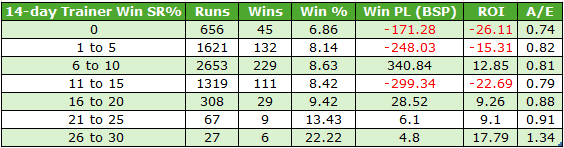
However, as a recent article of mine suggested, strike rates are not the be all and end all; we need to look at value and profit / loss. The table below gives us a breakdown of this:
This presents a less clear picture but, looking at the returns, the trainers who have scored 5% or less with their last 20+ runners over the most recent two-week period have provided the worst returns. Looking at the trainers with the highest recent strike rate (31% or more), it appears that the betting market has compensated for this to a great extent given losses of more than 13p in the £.
Of course, the data shared so far looks at all trainers combined. This gives us a general starting point, but to get a better overall perspective we need to split the trainers into groups. This is because comparing the 14-day win strike rate of Charlie Appleby, say, with Liam Bailey makes little sense. Appleby has a 29.6% strike rate during the time frame compared to Bailey’s 4.3%. In addition, Appleby’s A/E index of 0.94 is nearly double that of Bailey whose figure stands at 0.48. Hence in a scenario when Appleby and Bailey have secured a 15%-win strike rate in the past 14 days, we should be aware that Bailey is performing well above his norm and Appleby well below. Looking at all trainer data therefore gives us a flavour but cannot paint the full picture.
To mitigate somewhat for this, I am going to consider split trainers into groups based on their annual win rate while analysing recent form (14-day results).
I have split them into five groups: those with an annual strike rate of 8% or less, those between 9% and 12%, 13% to 16%, 17% to 20%, and finally trainers winning at a rate of 21% or more.
Trainers with a yearly win strike rate of 8% or less
Looking at all trainers who had run at least 200 runners from 2021 to 2023, around a fifth of them had an overall win strike rate of 8% or less. With this group I would not expect to see many qualifiers in the higher 14-day strike rate groupings.
The biggest group of qualifiers has occurred in the 6-10% 14-day strike rate (SR%) bracket and they have made a BSP profit. However, this is down to two unusually big-priced winners of 451.93 and 350.0 which skew the figures considerably. What is clear is that once trainers in this group hit 16% or more with 20+ runners in a 14-day period they do start to have better results. Combining the results of the 16%+ group they have returned 10p in the £ with a solid A/E index of 0.93 from a sample of around 400 runners.
Trainers with a yearly win strike rate of between 9% and 12%
This group of trainers is the biggest and includes runners from the stables of Richard Hannon, Richard Fahey, David O’Meara, Kevin Ryan, and Jim Goldie to name but five. Let us look at the overall win and each way strike rate first:
The graph shows that this group of trainers have performed quite poorly in terms of win strike rate if their 14-day Win SR% had been between 21 and 30%, which is surprising. I expected the orange and blue lines to rise gradually and relatively smoothly from left to right.
When we compare the A/E indices we see a similar pattern:
Combining the runners from the 21-25% group and the 26-30% group would have lost over 16p in the £ to BSP. Even the 31%+ group lost 15p in the £ despite a decent A/E index. It seems that the market is aware when these types of trainers are showing good recent form and prices have been more than adjusted to account for it. Here is a tabular view of this group:
The 0% group has performed better than expected. However, as we will see, this turns out to be an outlier when considering the rest of the research I share.
Trainers with a yearly win strike rate of between 13% and 16%
This group of trainers includes Charlie Johnston, Archie Watson, and Clive Cox. Here are their stats:
There are better strike rates across each grouping as we would expect from higher general strike rate trainers, but these handlers look worth avoiding if they have had no winners from 20+ runners in the past 14 days. Losses of over 26p in the £ is steep albeir on a smaller sample size.
The picture is not much brighter at the other end of the scale – trainers that seem to be in flying form with a 14-day SR% of 31% or more have made losses of over 14p in the £. Their strike rate is relatively poor, too, at 15.09% and their A/E index a modest 0.86. These are the two key discoveries from what is essentially another mixed bag of findings.
Trainers with a yearly win strike rate of between 17% and 20%
Let’s see if this smaller group of trainers can give us some stronger patterns. Ralph Beckett and Sir Michael Stoute are two trainers who are included here in the following results:
When these trainers are out of form (14-day SR% of 5% or less) they look worth avoiding. Combining the top two rows of data we see significant losses of 27p in the £. Conversely, when they hit the dizzy heights of 31% winners or better in the past 14 days this cohort has edged into profit. I would guess that it will come as less of a surprise for such trainers to hit these levels from time to time and perhaps the market has failed to properly adjust.
Overall, these stats are strong with a decent strike rate of close to one in four, returns of over 7p in the £ and an excellent A/E index of 1.04. In general, these stats correlate better with what I would have expected to see.
Trainers with a yearly win strike rate of 21% or more
We are now looking at a very select band of trainers including Charlie Appleby and Willie Haggas. Here are their win strike rates based on recent form:
I want to focus on win percentages (hence no EW ones on this graph) to help illustrate how little difference there is in some of the numbers. For example, when this group of trainers had previously had a 6-10% win SR% over the past 14 days their win rate was 19.8%. When it was 21-25% in the previous 14 days their win rate was virtually the same at 19.9%. Let me share the fuller picture:
The first thing to point out is that a 14-day SR% of 5% or less is extremely rare in this collective, as one would expect. Secondly, I want to highlight the poor performance of the 31%+ group which incurred losses of over 18p in the £ and produced a disappointing A/E index of just 0.83.
There is no easy explanation as to why the 26-30% group have fared so well in comparison. My reading of the data is that when these yards seem a little under par (previous 14-day SR% of 11 to 20%) their runners may offer a little bit of value. I guess punters could be put off by the relatively modest recent strike rate, but essentially these runners are still scoring close to each trainer’s norm.
At this juncture the picture is quite muddy when it comes to 14-day trainer form. The strongest and most important finding is that we can say that a 14-day win SR% percentage of 5% or less is a negative.
*
Individual 'Recent Form' Trainer Statistics
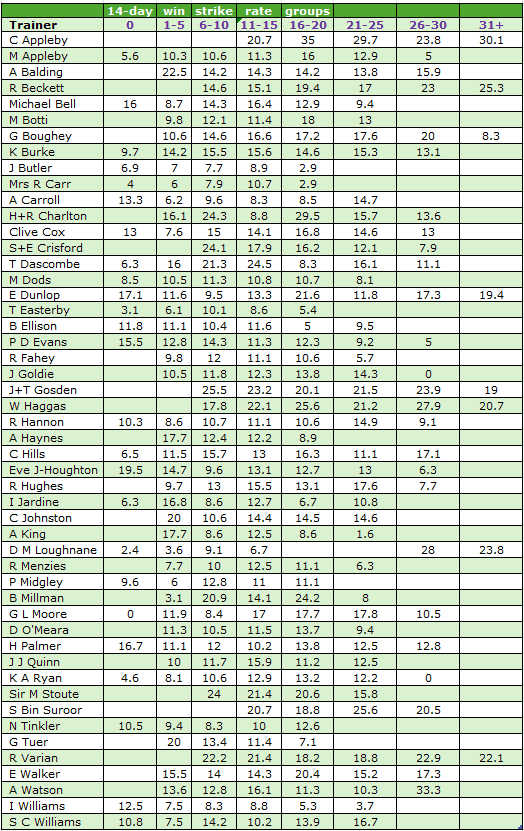
It is time now to look at individual trainers. With each trainer plying their trade in a different way, one would hope there might be more insights to glean here. Fifty of the leading trainers are shown in the table below in terms of their win strike rate (missing cells are due to limited data):
Before going into more detail let me share their A/E indices with you as well. I have colour coded the A/E indices with positive figures of 1.00 or more in green and negative ones of 0.70 or less in red.
Individual Trainer Angles to Note
These are what I think are the most significant findings:
Andrew Balding does unexpectedly well when his recent 14-day SR% is less than 5% returning 37p in the £ on all runners. He also made a BSP profit with his 6-10% group.
Ralph Beckett looks a stable to follow when he hits the 14-day win SR% of 26% or more. An A/E index of 1.05 and a small profit to boot.
The Crisford stable has a bizarre set of strike rates and A/E indices:
Both metrics correlate with each other which gives us confidence in the findings, but the data is suggesting that the poorer the recent form of the stable the better.
Don’t be put off by low recent 14-day win strike rates for Eve Johnson Houghton. When her strike rate was 5% or less in the previous two weeks her runners have offered good value. Backing all runners blind in this context would have secured a small profit.
When Alan King’s 14-day SR% has been between 21% and 25% he has managed just one winner from 62 runners. Losses of 90p in the £ would have been recorded backing horses from a so called ‘hot’ stable.
Daniel Mark Loughnane has the type of profile I was expecting more of. When his 14-day SR% is 5% or less his record is very poor. When it hits 26% or more his record has been excellent. He does a look a clear case of “avoid when his stable is cold, take advantage when the stable is hot”.
When the Kevin Ryan stable is out of form, his runners are probably worth swerving, especially if he has failed to record a winner from 20+ runners in the previous 14 days.
Saeed Bin Suroor’s A/E indices for the four groupings in which he has enough data are all above 0.90 suggesting his stable perform in a similar vein regardless of very recent form.
Grant Tuer shows a similar pattern to Crisford implying that the poorer the recent form of the stable the better from a betting perspective.
*
Summary
So, what are the main takeaways from this research? When looking at the general picture, I think the data indicate that poor 14-day form has more of an effect on performance than good 14-day form. ‘Cold’ stables with 14-day win rates of 5% or less from 20+ runners are best avoided (with a few individual exceptions).
In terms of when a stable has been ‘hot’ over the past 14 days we see an uptick in win rate, but this does not guarantee value or profitability due to such form being fully exposed in the market.
Regarding when a ‘hot’ trainer should potentially be followed I would use the individual trainer table of A/E indices looking for figures close to, or greater than, 1.00.
I plan to revisit this idea in the future, looking at a slightly longer prior time frame to see what difference, if any, that makes. I could also delve into NH trainer stats as well. But that’s for another day. I hope you have enjoyed this piece, and good luck with your early flat season betting.
DR
https://www.geegeez.co.uk/wp-content/uploads/2023/10/WoodhayWonder_Newmarket.jpg319830Dave Renhamhttps://www.geegeez.co.uk/wp-content/uploads/2022/10/geegeez_banner_new_170x78.pngDave Renham2024-03-20 09:42:362024-03-20 09:42:36Is Recent Trainer Form Important?
As has become somewhat customary, I've taken a few moments to publicly critique the wagering positions from which I stood to gain or lose during that marvellous week of racing action, the 2024 Cheltenham Festival.
It won't be interesting to everyone, perhaps only to very few, and I publish not to boast/wallow (*delete annually as applicable) but to share my own lessons learned from this most immersive of punting processes. As ever, stakes are irrelevant - many bet more than me, many bet less, whatever; the key is how the journey went and, to a much lesser degree, what the destination looked like.
If that makes little sense, now is a good time to plug into the below. [Usual reminder that I speak kinda slowly, so feel free to use the little 'cog' icon bottom right to increase the playback speed to something more acceptable for your lugs].
Below the video are a few screen grabs of various bets just to show when they were placed (many at the time of publication of the posts in which they were nominated as suggestions). And if you want to review the previews, as it were, I've linked to those right here:
For those of you of a notably vicarious disposition, here are some slips...
The Good
A lot of the good stuff for me - in fact, pretty much all of the good stuff - happened in the novice hurdles this year. Slade Steel (Supreme), Ballyburn (Gallagher), Majborough (Triumph) and Stellar Story (Albert Bartlett) basically were the profit side of the ledger.
Stellar Story was, well, just that, especially as Gavin also tipped him on the preview. He returned a Betfair SP of 46, so I didn't get the value here - maybe it should go in the 'bad' section...
Plus Captain Guinness, who really only expunged the El Floppiolo entry (see The Ugly below)...
A saver on Jade de Grugy to place (see The Bad below)...
And Limerick Lace, an alliterative late lump of lustre on the ledger...
The Bad
Not bad in value terms, more like bad beats - though of course those wily bookie chaps usually know what they're about. I was lucky that Jade was the final leg (excluding WPM and Prestbury Cup which were nigh on certs) which made it hedgeable. Got a profit overall by laying Jade for a place - see above.
Nowhere to go with this, and I didn't even do the smart thing and back Absurde (who finished fourth behind these three last time out, and won the County Hurdle at 12/1, 15.5 BSP) for a couple of quid.
The Ugly
And this was an ugly one. Actually, only in terms of its predictable outcome was it disfigured; the double (2/5 and 2/9) paid 8/11 come the hour, and I'd secured 11/10 so it was a value play. As can be seen, I cashed a slice out when I first got a wobble about it; and as referenced in the video I hedged a little back, too, so it probably wasn't as ugly as I was thinking.
Doing debriefs can be very cathartic! [And absolutely objectifies what can be misguided subjective perspectives on the ledger - definitely worth your time to fill out the spreadie in my view]
Summary
Overall, it was a brilliant week from a sporting perspective though I (and I'm sure most readers) really felt for Nicky Henderson. That said, it's a strong case for making hay while the sun shines: the singular focus on the Festival is unhealthy and, when the horses are, erm, unhealthy during that week in March, there's no Plan B. Hoping at least some of those good horses will show up at Aintree and/or Punchestown.
Punting wise, for yours true it was very good - and a rarity to get quids on 'Give Back Friday'. This year, it was the bookies giving back to me. Nice. Normal service is expected to resume on Friday 14th March 2025.
Until then...
Matt
p.s. how was Cheltenham for you? Best sporting moment? Best bet / worst bad beat? Leave a comment and let us know.
https://www.geegeez.co.uk/wp-content/uploads/2024/03/275624968-scaled.jpg12802560Matt Bisognohttps://www.geegeez.co.uk/wp-content/uploads/2022/10/geegeez_banner_new_170x78.pngMatt Bisogno2024-03-18 08:47:552024-03-18 08:47:55My 2024 Cheltenham Festival Betting P&L
There was plenty of talk last week about what a numbers game racing has become, writes Tony Stafford. Cheltenham became hostage once more to Irish stables, Willie Mullins leading the way of course. I have come to enjoy his successes if only that it gives me another chance to show that in his constant interviews, he is the most polite, unassuming man you could get for all that success. Then again there was plenty of excitement going around after Ballyburn.
Dan and Harry Skelton were second only to Willie, and if Dan could usurp his long-time mentor Paul Nicholls and win a first trainers’ championship that would also be nice, joining brother Harry who was champion jockey a few years ago.
No, but it’s two other different numbers that have taken my fancy: 11 (and a little bit) and 3,000. One concerning race times – the other an auction price that shows even modest investments can sometimes buy into some exceedingly desirable bloodlines at a time when everyone is there to have a crack.
First the race times. I think last week provided some of the most testing ground ever to have been seen, certainly since before the days of racecourse drainage systems.
I can now reveal that one race last week was run in a slower time than any of the Grand Nationals since 1883. So, what could it be? The ground was certainly heavy for the running of the 4m2f Midlands Grand National at Uttoxeter on Saturday, with Irish-style water on the course in places.
The winner went round in 9 minutes 43.10 seconds, slower than any of the Aintree showpieces since Red Marauder and Richard Guest led home three surviving rivals in a funereal 11 minutes, 0.1 seconds 23 years ago.
But it wasn’t that time that stands supreme. Hexham operated last week with a going stick figure of 3.2 - I cannot remember one of those. It was heavy at the corresponding meeting in 2023, when the four-mile handicap chase was completed in 9 minutes 57.57 seconds. Last week it took Breeze Of Wind a mind-numbing 11 minutes 0.20 seconds, equivalent to between three and four furlongs extra in distance.
If you think he must have been left all alone in that race – far from it. Five of the six runners were still in contention coming to the final fence as the rather unlikely distances over the line reveal: 1.25 lengths, short head, neck and then 3.75 lengths to the final finisher.
You might also expect any horse to have undertaken the gruelling examination of Hexham that day to need to stay at home for a few weeks of R and R. Not a bit of it. Philip Kirby’s Heritier De Sivola galloped clear of his rivals to win Thursday’s three-mile handicap chase eased down by 32 lengths. Two days later at Newcastle, carrying a 7lb penalty for the Hexham win, he bolted up by more than five lengths, again on heavy ground on one of the country’s most demanding tracks.
Reverting to the time question, it took Breeze Of Wind and chums one-tenth of a second more to complete the four miles of the BK Racing Hexham Marathon Handicap even than Red Marauder to win his Grand National in the days when the big race was a full 4m4f. His time had not been exceeded since 1883 when owner-rider Count Karel Kinsky won on Zoedone in 11 minutes 39 seconds flat.
With the ground everywhere – except the amazing track that is Kempton – susceptible to the slightest shower, so high is the water table, fears for the prospective going for the Lincoln this week and the Grand National next month are realistic.
Now for the other number. Imagine you are at a bloodstock sale and have your eye on a two-year-old filly – in this case from the remaining dispersal of the late Sir Robert Ogden’s horses - and are waiting for lot 618, a filly by Showcasing.
But you’ve also looked at lot 617, a daughter of Kingman – stud fee 125k – and accept she will be way out of your price range. There was a negative about her, though, as she had scarred knees and the white obviously scared everyone off risking the unraced two-year-old.
But Julia Feilden had done her research and found out that before he died in March 2022, Sir Robert sanctioned a £20,000 operation to help correct a serious physical problem with the filly’s forelegs, the impact of the splints leaving unsightly (to some) white hairs on her knees as a consequence.
While wanting to wait for her number one pick, Julia watched in amazement as the bidding stalled on the Kingman filly, and after she stepped in, stopped, to her amazement, at her bid of 3,000gns.
The following lot was knocked down to Sam Sangster for 50k – “miles beyond my limit”, recalls Julia, but that filly has won already, second time out in a novice for the Brian Meehan stable at Southwell and looks set for a decent career as a three-year-old.
Already named when she bought her, Julia formed a syndicate of which she is a ten-per-cent shareholder. On Saturday night at Southwell, having learnt her trade on turf in the summer/autumn, she brought her all-weather form figures to 3211, adding to a recent Chelmsford success.
Dylan Hogan – “either he or my daughter Shelley ride her every day – she’s very buzzy” came from a long way back to get up near the line, Notre Dame showing lots of speed. Rated only 60, Julia reckons she needs to win on the turf to maximise future financial potential. But whatever the truth of that, it does prove that for the professionals, there’s always one that defies logic and slips though the net.
**
The thorny question of how the Irish do so well at Cheltenham was broached upon by the BHA’s Julie Harrington in an earnest publication even as the one-sided (though not quite as much as in some years) battle continued. I think a good proportion of the blame falls to the issue of how our handicappers treat the Irish and then our own horses.
To illustrate my point, you get the feeling that the BHA team hate horses winning races. It seems their brief is to allow one win, maybe two and then to put the handbrake on.
Last week I felt so sorry for Sophie Leech and family and their owners for the treatment of their Madara after he won at the Dublin Racing Festival. Only one of three runners from the UK to go over there in early February he added to a nice win at Cheltenham by collecting a valuable 2m1f chase at Leopardstown.
Just a five-year-old, the ex-French gelding came with a flying run that day under James Reveley, beating Henry de Bromhead’s Path d’Oroux by 2.5 lengths. The BHA handicapper’s response was to raise his mark from 133 to 143. Meanwhile the runner-up went up by only 3lb!
In the end neither enjoyed the Grand Annual at the Festival, possibly because of the ground, Madara fading away and the de Bromhead horse always at the back.
Another ridiculous piece of handicapping was the mark allotted to Ebor winner and Melbourne Cup seventh Absurde, a 110 flat-racer. From spring last year, this six-year-old was given a programme that suggested just how highly he was regarded in the Willie Mullins stable targeting big prizes under both codes.
Phase one jumping – aimed at getting a handicap mark – as lenient as possible, so he wins his novice at Killarney in May first-time out very easily at 2/7. Phase one flat – Royal Ascot where he was second to stable-companion Vauban in the Copper Horse Handicap, but 7.5 lengths behind the winner.
Phase two jumping – Listed race at Galway, sixth of nine. Phase two flat, wins Ebor off 104 under Frankie Dettori.
Phase three flat, 7th in Melbourne Cup off new flat mark of 110.
Phases three and four jumping, pulled up behind Coldwell Potter, the 740k buy from the Elliott stable; then 4th at levels and 33/1 behind Ballyburn. Now he’s eligible for a mark.
Phase five, with 138 jumping compared to 110 flat – so with probably at least 12lb and likely a bit more to spare, he shows brilliant speed to stop yet another well-laid-out Skelton fancy going up the hill. Too easy – if you’re Willie Mullins and you have an Ebor winner to work with!
As if that wasn’t enough, ten of the only 13 finishers in the Boodles Handicap Hurdle for four-year-olds were Irish-trained. The Noel George team – with a McManus horse the handicappers dropped 10lb off one run of evidence, Milan Tino – and I’m not sure if he counts as training in France, was 6th; Jack Jones with an ex-Joseph O’Brien horse (he trained the winner) An Bradan Feasa was 8th; and Fergal O’Brien with the Jim Bolger capture Teorie was 10th.
In the old days trainers aiming at Cheltenham used to try to buy from the October HIT sale when there was just the Triumph Hurdle and its field of up to 30 runners to aim at. Now with this handicap to target, the Irish get going well before that. There needs to be a much better co-ordinated programme of worthwhile juvenile contests from August onwards as horses need at least three runs to get a handicap mark.
- TS
https://www.geegeez.co.uk/wp-content/uploads/2024/03/Absurde_CountyHurdle.png319830Tony Staffordhttps://www.geegeez.co.uk/wp-content/uploads/2022/10/geegeez_banner_new_170x78.pngTony Stafford2024-03-18 05:10:342024-03-17 21:20:07Monday Musings: Some Absurde Numbers
It's been a weird, and occasionally unsatisfying, week with the abandonment of the Cross Country Chase and the lamentable early showings - and subsequent withdrawals - of Nicky Henderson's star players. But here we are, three down one to go and buoyed for a crack at the Foxhunters Gold Cup. If you're behind at this point, the good news is there is still time; the bad news is this is 'Give Back Friday'...
1.30 Triumph Hurdle (Grade 1, 2m1f)
Previewed by Matt Bisogno. Although Nicky has had to pull most of his star players, he does - at time of writing, Wednesday morning - still plan to run Sir Gino, strong Triumph Hurdle favourite heretofore but now drifting like The Drifters aboard the Kon-Tiki. Let's consider his form credentials before getting bogged down in the health of the yard. Unbeaten in three, Sir Gino was considered smart enough to debut in a Listed contest at Auteuil. Sent off at bigger than 20/1 on the Paris nanny, he scored by a bit less than two lengths.
Subsequently transferred to Seven Barrows, the first thing they did was give him a wind op (well, it probably wasn't the first thing, but you know what I mean). His breathing facilitated, he scooted up by half the track in a decent Kempton Introductory Hurdle; and he then buried the Burdett Road dream by bashing that one ten lengths in a Grade 2 on the Old course here. His form is miles clear of the rest of the home team, but that bug in the Henderson yard makes it very difficult to accept a shortish price.
That's all the more true when you see what Willie's bringing to the party. Perhaps Majborough will be the pick of his, perhaps he won't; but in time he very well might be, according to 'the vibes'. In any case, his close soft ground third to stablemate Kargese in the Grade 1 Spring Juvenile Hurdle on first start for over a year - he'd run as a three-year-old at Auteuil on 2nd April 2023 - was expected to blow away the cobwebs and it surely did.
Willie ran five in that race, Majborough only third choice in the betting, and the two ahead of him in the market filled the first two slots home. They were led by second favourite that day, Kargese, who looks a smart filly. Always prominent, she wasn't always fluent, but ran on well in a first time hood. She'll keep that pacifier on here and will again take on Majborough and the second from the Spring, Storm Heart. This ex-French flat horse won a maiden by 22 lengths before his G1 second, and he too retains plenty of upside. It is noteworthy that he's the choice of Paul Townend.
Willie ran five in the Spring Juvenile, and he saddles - wait, let me count them - sEvEn here! Seven. Out of the 14. I mean, what? As with the bumper, there's a chance he doesn't know the pecking order; but unlike the bumper, he's won this with his first string three times in the last four years. That points to Majborough in spite of having to turn the tables with both Kargese and Storm Heart. He's clearly held in high regard.
A quick whizz through the other four Willies - Bunting was fourth in the Spring Juvenile, only a bit more than two lengths behind the winner, and is another who on form could come out in front this time; Ethical Diamond was sixth there, and has five lengths to find - still not impossible; and High Wind was eighth at Leopardstown and ostensibly has plenty on to get past any of the aforementioned Mullins mob.
Meanwhile, Salvator Mundi hasn't run for eleven months since claiming argent at Auteuil in another Listed race. But here's the thing: he was second to none other than Sir Gino! The pair of them pulled ten clear of the third placed horse and, while Sir Gino, was value for a little more than 1 3/4 length margin, that obviously still makes Salvator Mundi 'live' in here if he's fit after that long layoff.
Nurburgring is quite battle hardened but I'm not sure his form with Kala Conti is quite as strong as some of the Closutton collective, or that he has the upside of them.
Back in Blighty, Salver has been winning and winning. He served up (geddit?!) in the G2 Finale at Chepstow having already won his two prior hurdles in lower class; then he won the Victor Ludorum at Haydock. A feature of his most recent brace of scores was very wet underfoot, so conditions ought not to be a concern - whether he's as good as the Irish and/or Sir Gino remains a concern!
I'm struggling to make cases for the rest, though Peking Opera was a very good flat horse and Ithaca's Arrow ploughed through the Newbury mud last time (he also ploughed through quite a few of the hurdles). Fratas has been off for a long time. And I backed Mighty Bandit a long time ago at a shorter price than he is now. He's moved from Elliott to Greatrex and has a clunk last time on his scorecard, though he was clearly wrong that day. He's a lot harder to fancy for that water under the bridge since my guessy ante post voucher, but he did look very good on his first hurdling start.
Triumph Hurdle Pace Map
Bound to be pacey early, with something from the Willie phalanx locking horns most probably with Salver and perhaps Fratas.
Triumph Hurdle Selection
Very tricky in light of the issues surrounding the jolly. He can't possibly be a bet as things stand, which makes punting a guess up. Paul Townend has ridden the three recent Mullins winners, but Mark Walsh is retained by JP McManus for Majborough. Townend rides Storm Heart and that one could be a bit of each way value in a race where there's not a lot between many of them. I'd love to see Salver win.
Suggestion: Try Storm Heart each way at 11/1 or so.
I was a bit miffed when Dan Skelton (handicap genius or barefaced cheat – you decide) said he was going to miss the County Hurdle with 2023 winner Faivoir as I’d availed myself of some 28/1 ante-post on the basis of his eye-catching run in the Betfair Hurdle when fifth behind Iberico Lord. Stablemate L’Eau du Sud was runner-up that day and Skelton seemed adamant that the latter would carry his hopes in the County.
I was even more miffed when, hoping to cash in, I napped Faivoir in the Imperial Cup only to see him beaten a nose by Go Dante. He’s clearly well handicapped, and Skelton has decided to let him run again. I thought initially that this sounded like a bad-beat declaration, but my friend Mr Massey mentioned the stable’s record when turning runners out quickly in handicaps. Naturally, I headed over to geegeez.co.uk (pint please, Matt) to double check.
True enough, Skelton’s record with quick turnarounds is excellent with two wins and a second in the last two years from just seven runners, including Heltenham’s 17/2 score at Newbury recently. Looking back further his figures are even better for hurdlers alone with five winners from 12 runners turned out less than a week from a previous start. That’s enough to make Faivoir interesting again even if he did have a hard race at Sandown and presumably he won’t run if there are signs he’s not fully recovered.
L’Eau du Sud ran a stormer in the Betfair and while the form was let down by the winner in the Champion Hurdle, I think we all know that the Henderson lurgy was responsible for that, and ditto Betfair fourth Doddiethegreat’s late capitulation in the Coral Cup. The form of that race is clearly strong, as it always is, and the only negative about L’Eau du Sud is the price, with every man and his dog having hitched on to the Skelton bandwagon.
The other good trial for this race is the 2m Listed handicap hurdle at the DRF which this year was won by Lord Erskine from Magical Zoe and Zenta with a number of horses taken out of the race in what we affectionately refer to as a “shemozzle” at the penultimate flight. One of those brought down was Bialystock, who was travelling well and improving on the inner at the time. I think that trio are all of interest, and while a 7lb rise for the first two seems a little harsh at first glance, Bialystock is only 1lb higher and that also makes him of interest here.
Both Zenta and Magical Zoe were relatively handily placed off the turn, and out of trouble wide on the track, but it’s possible that both went slightly too early as 50/1 winner Lord Erskine was produced very late to swamp them from the final hurdle. One can knock the form because of the odds of the winner, but I think it’s very solid and Lord Erskine came in for a really well judged ride, finding the best of the ground wide on the track and delaying his challenge until late.
In short, there is nothing between Magical Zoe and Zenta on Leopardstown form and the pair can be expected to play a big part in the finish if held on to for slightly longer, while Bialystock is weighted to beat them if you take the view that he would have finished off as strongly as he travelled there. On that point, Ruby Walsh feels that Bialystock needs a fairly sharp 2m to show his best given he’s very speedy and was concerned about the stiff 2m1f here when I mentioned Bialystock as a County possibility. That’s a warning worth heeding but he still merits his place on the list.
Of the others King of Kingsfield and Absurde were third and fourth behind Ballyburn and Slade Steel and are of obvious interest dropping into a handicap from that Grade 1 contest which has thrown up two impressive winners in the big novice hurdles this week. Both are worthy of consideration, but both are also well found already in the market.
County Hurdle Pace Map
Another almost guaranteed quick pace though it's not clear from where the early dash will emerge. Aucunrisque looks a likely but Westport Cove is the only other to have led in its most recent three spins. A handful of others led four back. I still reckon it'll be quick but could be wrong as I don't know who goes on!
County Hurdle Selection
In terms of the final call, price will be crucial, and the favourite is a tad short now for all he could ease on the day. Faivoir is 16/1 in a couple of places which is very fair given the stats quoted above and his attractive mark, while even Ruby’s words don’t completely put me off Bialystock after his eye-catching run at Leopardstown.
Suggestion: Try Faivoir at 16/1 and/or Bialystock at 11/1 each way with as many extra places as you can find.
2.50 Albert Bartlett Novices' Hurdle (Grade 1, 3m)
Previewed by Gavin Priestley, FestivalTrends.co.uk.
All of the last 14 winners had their last run over 2m3f-3m 1/2f.
All of the last 14 winners had their last run in the previous 26-90 day period.
12 of the last 13 winners had finished top 3 last time out.
All of the last 12 winners with an official rating were rated 136+.
9 of the last 10 winners returned 11/1 or bigger.
12 of the last 13 winners had raced 7 or fewer times over hurdles.
12 of the last 14 winners were aged 6 or 7yo.
11 of the last 14 winners had won at 2m4 1/2f+.
11 of the last 14 winners had their last start in Graded company (8 in a Grade 2).
10 of the last 14 winners were Irish Bred.
9 of the last 14 winners finished Top 3 in a Graded hurdle last time out.
8 of the last 14 winners had won a Graded hurdle previously.
4 of the last 14 winners returned 33/1 or bigger.
3 of the last 14 winners had raced 15 or more times in their career.
Willie Mullins had 22 straight losers between 2010-2016 but has now won 3 of the last 7.
8 of the last 12 winners had won an Irish PTP.
4 of the last 9 winners wore a tongue tie.
All 6 female runners have finished unplaced.
Only 1 of the last 13 winners had their last race in a handicap (27 such runners).
The sire Oscar has 2 wins and 3 places from 16 runners since the races inception.
The Grade 2 Lyons Of Limerick Jaguar Land Rover Novice Hurdle is a decent Albert Bartlett Novices’ Hurdle trial given that the 2015, 2017 and 2021 Albert Bartlett winners had all taken part in the race prior to winning at Cheltenham, while Fury Road (third by a neck in the 2020 Albert Bartlett) had won that trial back in 2019. This Season's winner, Loughlynn, had looked a progressive horse prior to this win but has been pulled up since in a Grade 1 and gives the race a miss. The runner up at Limerick is here though and Gordon Elliott's 7yo STELLAR STORY looks just the type to go well in this.
A winning Irish pointer who is also a two time NH Flat winner, from three starts, he beat Ile Atlantique and Caldwell Potter on his third bumper start which is cracking form, that pair subsequently doing very well in Grade 1 company over hurdles and the former running third in Gallagher Novices' Hurdle on Wednesday. Stellar Story won first time up over hurdles this season and was then done for pace against a couple of speedier types in a Grade 2 at Navan over 2m4f at the start of December. He was then second in that Limerick Grade 2 Hurdle before staying on late in 4th in the big 2m6f Grade 1 Novice at the Leopardstown Festival a couple of weeks ago. I think he's crying out for this step up to 3 miles and the form of that NH flat race at Naas last February has worked out really well. He ticks all the boxes for Cheltenham, has form on soft ground and given the history of outsiders running well in this race I'm certainly not put off by his price. I like his chances a lot.
Albert Bartlett Novices' Hurdle Pace Map
Quick, and attritional, as it usually is in 'the potato race'. Giggy may get jiggy on the lead, with some help from Wiggie Willie.
Previewed by Matt Bisogno. A Gold Cup shorn of one of its stars as Shishkin has succumbed to the mystery ailment afflicting Seven Barrows in recent days, but of course the show must go on. We still have the champ, Galopin Des Champs, back to defend a crown he acquired with a seven length beating of Bravemansgame twelve months ago.
Galopin was subsequently beaten not once but twice - either side of his seasonal break - by perrenial rival Fastorslow, before exacting revenge last time in the Irish Gold Cup at the Dublin Racing Festival. It is widely assumed that that finishing order will be maintained, but the market has arguably over-stated that. Regardless, GdC looks on top of his game and his top form is the best in the race. He's a logical and worthy favourite.
Fastorslow has a few less notches on his bedpost, and had something of a bridesmaid look having run up to Corach Rambler in the Ultima last term and also been second in the Coral Cup the year before. He's since, erm, 'got married' (note to self, don't start analogies that will go nowhere) twice in Grade 1 company before that reverse at the hands of Galopin. [*trying desperately to crowbar in the old joke: "I've got two wives, do you think that's bigamy?" "I think that's very big of you!" - there, I did it, apols also for that]
Getting back on track, Bravemansgame was just that one spot away from winning the Blue Riband a year ago, and he's having another crack now. Why wouldn't he? Since then, he's had more seconds than a minute, running up to Gentlemansgame, Royale Pagaille, and Hewick respectively. The most recent was in the King George and that, again, is top form, albeit in defeat. Soft ground would hold no fears though he's unproven on heavy bar a Listed bumper flop at Ascot way back in 2019; that shouldn't be over-factored.
Staying with Team GB, L'Homme Presse will surely be a different dude this time from the shadow of himself that showed up in the Grade 1 Ascot Chase: never put in the race that day (pocket talk, sigh) he finished well enough over a clearly inadequate trip. Lest we forget, he was the 2022 Brown Advisory winner and though I didn't like it at the time, that was a belting prep for this.
Most of Gerri Colombe's best form has been on a sounder surface - Grade 1 Mildmay, Grade 1 Scilly Isles - but he's also got G1 verdicts on soft and soft to heavy. He was duffed up by Galopin Des Champs at Christmas, beaten 23 lengths there, and we've not seen him since. That'd be a worry for me although he's obviously a very talented chap at his best.
And then there's the fairytale ownership story that is Hewick. Bought for £12.50 (or thereabouts), he's won a bet365 Gold Cup, a Galway Plate, an American Grand National, an Oaksey Chase, and a King George. And the Durham National! Wowzers. And he actually cost €850. Just incredible - good luck to those very, very, very lucky owners and the astonishing journey this horse has taken them on. But can he win a Gold Cup?
Well, the answer to can he win a Durham Nash was probably 'no', as it was to 'can he win xyz other big race?', so let's break with that errant tradition and say, yes, he can win a Gold Cup. Whether he will or not is another question entirely. He jumps well and he stays very well so those are great credentials, as is his obvious will to battle and win, but there is a rather large fly in the ointment. ALL of his best form is on quick ground. It will not be that here, "and so I'm out" (said in my most earnest Deborah Meaden voice).
Ground would be a small niggle for Corach Rambler, too. Yes, he won a four runner novice hurdle on heavy back yon, but he will have outclassed his rivals there; and yes, he won the Ultima on soft last season. I actually really like him as a 'running on' play - maybe a place lay to back, or some such - and if I can get four places I'm bound to back him for a little bit. Because he's actually very good. Two wins here in the Ultima and a Grand National triumph tell us that; and he's surely had his mark managed as far as possible hitherto this campaign with a view to a repeat National bid. Those shackles now off he'll bring his A game here.
I can't have any of the rest. FishcakeMonkfish has been fragile and largely absent since his brilliant novice chase season, failing to win in three starts since; it's tough to envisage that streak being broken on his fourth go, in the Gold Cup. Nassalam does love the mud - he blitzed them in the Welsh National on heavy - so if it was a really, really wet day he'd enter minor calculations. Former Brown Advisory winner The Real Whacker has been missing since and isn't for me; and while I respect everything Henry de B runs at the Festival, even I'm having a hard time magicking a case for Jungle Boogie.
Cheltenham Gold Cup Pace Map
Quite a tough one to call pace wise, with a feature of most of the runners being their run style versatility. Galopin Des Champs has led in small fields the last twice but might take a lead here, while the Games - Bravemans and Gentlemans - could also get an early call. Should be a good even gallop and may the best horse win.
Cheltenham Gold Cup Selection
It might be that Galopin Des Champs just wins or that, if he doesn't, Fastorslow does. I'll probably do that 'no brainer' exacta which will pay 5/1 or so. But I kind of like L'Homme Presse as a sleeper in the field and he'll be my each way play. Lower down, Corach Rambler will be running on and can hit the extended frame; and if it's very wet - it might be! - Nassalam could surprise a few.
Suggestion: Try a little on L'Homme Presseeach way, and perhaps Corach Rambler(not too wet) or Nassalam(biblical rainfall) with as many places as you can get. But, obviously, no surprise whatsoever if the top of the market outclasses them.
4.10 Challenge Cup Open Hunters' Chase (Class 2, 3m 2 1/2f)
Previewed by John Burke, VictorValue.co.uk.
As ever I will begin with a look at a few general race trends:
Ten year-old’s have won six of the last ten renewals of the race – six winners from 47 runners +130.63, 12 placed with the A/E=1.86.
Nine of the last ten winners have been aged 10 or 11.
Favourites are three winners from ten runners -0.24, six placed. But five winners were returned between 16/1 & 66/1.
Eight of the last ten winners had won between 2m7f and 3m2½f.
There have been a number of repeat winners of this race, with Salsify, On The Fringe and Pacha Du Polder enjoying back-to-back successes since 2012.
To the form and the first thing you notice is the number of declared runners. This year’s renewal has attracted just a dozen hunters. 23 ran last year and the race average since 2008 is 22.75. Hopefully it’s a case of quality rather than quantity but I suppose it may also say a lot about the direction of travel of the hunter chase game.
I'll admit that if Matt hadn't asked me to preview the race, I probably wouldn't have given it much attention. However, I'm glad I did because despite the small field, I believe it could be an interesting contest.
Ferns Lock, Its On The Line, Premier Magic, and Samcro all share the top spot on official ratings.
Ferns Lock, although making his first appearance at Cheltenham, is a proficient jumper and a strong traveller. If he manages to stay the extended 3m2f distance, he's the most likely winner, although that's not certain given his racing style.
Its On The Line, recently acquired by JP McManus and trained by Emmet Mullins, boasts a solid record with three consecutive wins in hunter chases. He battled to victory over one of today's rivals, Billaway, in his last outing at Naas and is a strong stayer who could challenge Ferns Lock on the run-in.
Premier Magic secured victory in last year's race and followed up with another win at Cheltenham in May. Although he held off Its On The Line by 1¾ lengths last year, the latter has gained experience since then, and Premier Magic might find it tougher to repeat his success.
Samcro has shown revitalised form in point-to-point races, winning four times between October and November. While he might struggle against the likes of Ferns Lock and Its On The Line, he can't be completely discounted.
Billaway, winner of this race in 2022, fell twelve months ago but showed promise in his recent runner-up finish at Naas. Although his jumping isn't as polished as some of his rivals, his staying power keeps him in the mix.
Quintin’s Man found 2m6f an inadequate stamina test when 3rd of eight at Haydock last month. He won a course and distance hunter chase here last May so the return to today’s trip appears more suitable. He’s going the right way but would need to improve plenty to trouble the principles.
Sine Nomine delivered an improved performance to win a heavy ground hunter chase at Wetherby last month. The mare is now three from five under Rules and, whilst she needs to improve again to even get into the places, she might be capable of doing so.
Challenge Cup Open Hunters' Chase Pace Map
The map only shows Rules form, so ignores point to points. As such, it's not to be trusted for all that it implies a fair gallop set by one or both of Billaway and Ferns Lock with possibly 14yo Shantou Flyer wanting a piece, too, if he can keep up!
Challenge Cup Open Hunters' Chase Selection
The battle seems to be between Ferns Lock and Its On The Line. If Ferns Lock conserves his energy early on, he’s the most likely winner, but Its On The Line is a strong finisher. Premier Magic, last year's winner, can't be dismissed, and for those seeking a value bet, Sine Nomine will hopefully be available at decent each-way odds.
That's a wrap for me. I've thoroughly enjoyed sharing my race previews with you, and I hope you've found them enjoyable and informative. Until next time, happy racing!
Suggestion: Try Ferns Lock to win at 11/4 and/or Sine Nomine each way at 16/1 or bigger.
Previewed by Matt Bisogno. Ah, the Mares' Chase. An 'after the Lord Mayor's Show' of a race if ever there was. Or maybe 'After the Lord Mares' Show'. Perhaps not. Let's get on with it, shall we?
It's 20/1 bar four and that's mainly because Dinoblue, even money, is in the field. Her form in front of Gentleman De Mee and closest to El Fabiolo the last twice is the best by a margin; but she's only run once at this twenty furlong range, a ten length fourth in a Fairyhouse G1 novice hurdle. She kept on that day, and doubts about stablemate Lossiemouth's stamina for a similar step up were unambiguously dispelled on Tuesday. She'll probably win - she's a really smart mare.
But what if she doesn't stay? In such a scenario, Gavin Cromwell may hold the key. He runs two, Limerick Lace and Brides Hill. Limerick Lace handles soft and heavy ground, stays very well (keeping on second in the three mile Thyestes Chase) and bolted up in a Listed mares' race at this trip in Doncaster last time. I'm not convinced she's quick enough but I'm certain she'll handle conditions.
Brides Hill is on a four-timer, and she looks a trip specialist. She, too, has soft ground form, though not heavy ground form, and she's had a lot of races. She'd not be near the top of my list.
Another with conditions in her corner is Allegorie De Vassy, twice a winner on heavy in her last three starts, both in Listed company. She finished second in this last year and may again have to settle for minor honours, though she probably will go close.
Making a case for anything else is probably folly, but at a massive price Marsh Wren is better suited to conditions than most. Still a novice, she's a winner of eight of 13 starts, three of four in chases, and went to Ireland to beat some of their Listed class mares last time. She has a chunk to find on the book but goes from the front and will, as they say, "give a bold sight".
Mares' Chase Pace Map
This should be a proper test at the trip which may or may not find out the best mare in the field. Kestrel Valley and Marsh Wren, along with Dinoblue's stablemate, Instit (pronounced Ansty, apparently), will be the trailblazers.
Mares' Chase Selection
Dinoblue has to show she stays, and she might. If we knew she did, she wouldn't be evens, I guess, but I still don't like that price given the unanswered question. Limerick Lace is probably quite solid for all that she's probably quite slow (might be what's needed if it's wet) and Allegorie De Vassy is another the market (and I) expect(s) to be on the premises. If you want to go mad - we might need to by this point - Marsh Wren without the favourite, could sneak a minor placing.
Suggestion: I'm going to try to get Dinoblue beaten, which will be a waste of time if she stays. In that context, back Limerick Lace to win at 9/2.
Previewed by David Massey. This year’s Martin Pipe is a slightly strange affair, with a less compressed look to the handicap than is normally the case. It tends to be a 0-145 handicap where the bottom in is usually around the low 130’s but this time around you’ve a few below that mark and bottom weight Russian Ruler, for the not-in-form Nicky Henderson (it has to turn, doesn’t it?), is rated just 122.
The lowest rating for anything winning this in the last decade is 135, and most of the unexposed ones that tend to do well in the race are 130+, and I think we’ll find the winner there.
Ocastle Des Mottes is one of the Willie Mullins plots for this and he has a touch of the Galopins about him. The future Gold Cup winner had been sixth in a Grade 1 on his previous start before winning this in 2021 and Ocastle Des Mottes, whilst not competing at that level last time, still went off favourite for the Betfair Hurdle last month. Perhaps all the pre-race shenanigans when he had to be re-shod didn’t help his cause, but he was a little disappointing all the same in finishing eighth. I feel that, given the level of support he had that day, he must be capable of better, and I’d not be writing him off on the back of one run.
Willie’s Quai De Bourbon is the one that’s come in for all the support ever since the market opened, but he looks underpriced on what he’s achieved so far. His defeat of stablemate Westport Cove looks solid enough, with the runner-up going on to be beaten 12 lengths by Tullyhill at the Dublin Racing Festival, and a mark of 140 looks fair enough. He has one of the most experienced jockeys on board in Michael O’Sullivan and he has plenty of upside to him. The market has him well found, all the same.
Gordon Elliott has twice won this in recent years and of his battalion Better Days Ahead is the one that makes the most appeal. He didn’t shine in the Champion Bumper last year but has shown steady progression in four hurdles starts, coming up against Slade Steel at Navan two starts ago (not knocked about as the stable’s second string that day, but still not beaten far) and then second to Asian Master over a trip too short at Navan last time. Those two pieces of form look all the stronger after the Supreme and, with the useful Danny Gilligan in the plate, he just about heads up my shortlist.
It isn’t a totally one-sided affair, as the British have won the Martin Pipe twice in the last four years, with Iroko last year and the game Indefatigable four years ago (seems like yesterday, that) but the home team is not a strong one. You’d like to think at some point David Pipe might win the race named after his father but he’s 0-23 despite chucking some decent ammunition at it over the years. Thanksforthehelp was probably trying to get himself qualified for the Pertemps at Chepstow last time; that failed, and this looks more in hope than any great plan.
The one I could throw a few quid at each-way from our side is Gary Moore’s Teddy Blue. I’m not entirely convinced he’s in the right race today - the County would have been my preference - but regardless, he’s developed his own ideas about the game and isn’t one to fully trust. That’s fine if he’s a 40-1 shot, as you don’t have to pay a lot to find out what side of bed he’s got out of, but his recent form is decent enough. He travelled up well to throw down a challenge in the Lanzarote before fading late and, at Ascot last time, was only beaten five lengths in a competitive affair. He will hang left under pressure, and the hope is a fast-run affair will keep him on the bridle long enough before he realises he’s in a race and by then, he’s hopefully got the place part of the bet wrapped up.
Martin Pipe Handicap Hurdle Pace Map
Again, not obviously stacked with pace but hard to see that it won't be truly run. Gordon runs seven so one will likely go on, most likely either or both of Better Days Ahead or Mel Monroe.
Martin Pipe Handicap Hurdle Selection
Suggestion: Two bets for me - each-way 10/1 Better Days Ahead and a little win and place at 50/1 Teddy Blue.
And that, as they say, will be that. I hope that you're having a great week, be it only in sport or with some wagering success too, and wishing you all the best with your Friday plays. Thanks a million for following geegeez this week, and special thanks to the great writing assistance I've received from David, Rory, Gavin and John - top men, all. Do check out their links in the above if you've appreciated their work as much as I have.
Be lucky.
Matt
https://www.geegeez.co.uk/wp-content/uploads/2021/03/galopindeschamps_langerdan_cheltenhamMartinPipe2021.jpg319830Matt Bisognohttps://www.geegeez.co.uk/wp-content/uploads/2022/10/geegeez_banner_new_170x78.pngMatt Bisogno2024-03-14 11:08:212024-03-14 20:29:38Cheltenham Festival 2024: Day Four Preview, Tips
Day Three, Thursday, and it's out with the Old (Course) and in with the New (Course). Fresh ground then, but plenty of precipitation has tumbled over it so mud lovers aforethought perhaps...
1.30 Turners Novices' Chase (Grade 1, 2m 4f)
Previewed by Matt Bisogno. The Turners is an intermediate distance novice chase and one which, unlike other intermediate distance races, tends to detract from the Arkle and Brown Advisory without ever really establishing its own identity. For some that will be a harsh interpretation but, besides a couple of arguable exceptions (Vautour, Chantry House, Stage Star - I told you they were arguable), there's little on the roll of honour to get the pulse charging. No matter, for every race needs a winner, and I'd be better investing your reading time in that challenge than navel-gazing about the right for this contest to exist.
This season's renewal fits that 'not quite as good as it ought to be' bill to a nicety. The betting is headed by Grey Dawning, trained by Dan Skelton. A 14 length winner of the G2 Hampton Novices' Chase at Warwick last time, he was flattered greatly by that margin: Broadway Boy and Apple Away went at it from the get go, trading blows as though this was a mile and a half sprint. It wasn't, and they cooked each other allowing GD to plod past exhausted rivals.
Still, he must be a good horse, and his previous second to Ginny's Destiny perhaps holds the key to unlocking this race. That was here but on the other track, but Ginny's has run his last four races - all over fences - here, winning the most recent three including one on this exact track/trip. Paul Nicholls will saddle him and Harry Cobden will steer, and he's very likely to try to make all. But perhaps Grey Dawning handles really deep ground better? Certainly his more patient run style could be favourable.
Pick of the Irish is expected (by the market, at least) to be Facile Vega. Trained by Willie and ridden by Paul Townend, he won the Champion Bumper in 2022 and was second to Marine Nationale in the Supreme last year. That form entitles him to win this, except that over fences he's been a couple of beats slower: having won his beginners' chase on soft to heavy, he's been turned over in a brace of Grade 1's on quicker ground. This will be a first run beyond 2m1f for him and, if he stays - the million dollar question - he's got a right chance.
Iroko was presumed out for the season but returns here for a first run since early November. He was a good winner of last year's Martin Pipe and made a highly promising chase debut on his sole spin this term; but that layoff is a big niggle for me.
Gordon Elliott sends Zanahiyr to this, having pulled stumps mid-season on a hurdling campaign and got two chases into him. The first was a novice-y round behind Fact To File, form which might not look too bad after the Brown Advisory - and, actually, doesn't look too bad anyway; and the second was a hard fought verdict over Aspire Tower over a trip too short. Both those races were beginners' chases and this is a big step up in class, for all that he's mixed it with the best hurdlers for three and a half seasons. His fencing inexperience is a concern and he might be slightly better on a sounder surface.
Venetia sends Djelo here. He started off beating Master Chewy in a handicap chase and then won two more chases, the last of which was a G2, before having no chance when completely buggered up by Matata's errant transit at Lingfield in January. Since then, Djelo ran second to the very talented (and probably under-rated) Nickle Back in the Grade 1 Scilly Isles Chase: that was on good ground and he was ridden patiently, never able to reel in the runaway winner. But that form fits here, and he's probably a touch over-priced.
I'm struggling to make much of a case for the remainder.
Turners Novices' Chase Pace Map
Ginny's Destiny probably leads, with a few close up, but I'm expecting an even gallop.
Turners Novices' Chase Selection
Grey Dawning is clearly a talented horse and he migh just win, but I don't like his price. Similarly, Ginny's Destiny has a small question to answer on the ground for me and his price doesn't allow for that. I think Facile Vega could take a big step forward for the extra three furlongs, and he's a win only play in case he simply doesn't stay. But Djelo looks the one who will appreciate conditions and is a fat price.
Suggestion: Try Facile Vega win only at 10/3 or Djelo e/w at 16/1.
Previewed by Rory Delargy. The first thing to look for in the Pertemps Final is what runs for Gordon Elliott. He’s had 19 runners since 2017 (including one putatively trained by Denise 'Sneezy' Foster) and has saddled three winners and three seconds in that time. All of those horses were priced at 10/1 or shorter, so we must have maximum respect for the Elliott first string, Cleatus Poolaw.
Cleatus Poolaw has the right profile for a handicap hurdle winner here, being an unexposed novice arriving on the back of a career-best effort when 3½ lengths second of 14 to Noble Birth in the recent Naas qualifier. He’s 9lb higher for that which seems fair given that was his first handicap outing and he ought to progress for it. He has a remarkably similar profile to Delta Work, who won this as a novice in 2018 before quickly proving himself a Grade 1 performer. I don’t think Cleatus Poolaw is in that category, but he’s certainly a must for the shortlists in a race with extra places on offer.
Gaoth Chuil is a second-season hurdler who has run really well upped to 3m on her last two starts at Leopardstown and remains unexposed as a stayer. The British handicapper hasn’t been harsh on her considering she may well have won last time but for a late error, and she is in shrewd hands with Ted Walsh as wily as they come. The one off-putting thing is that the only time she has travelled to the UK, she ran her only poor race at Aintree last spring. Plenty of horses dislike travelling and it’s possible that she’s one, for all a sample size of one is hardly enough to make a conclusion.
Le Milos may prove best of the Brits, with Dan Skelton clearly feeling the return to hurdles could pay dividends with last season’s Coral Gold Cup winner. Of similar merit over hurdles and fences when with Tim Vaughan, he has improved markedly for Skelton and is lower in this sphere than over the larger obstacles, opening up the possibility that he could be well treated. He qualified with a low-key run at Market Rasen and was given a strangely (!) negative ride at Ascot last time. There is no better trainer at playing the handicap system at this meeting than Dan Skelton, and Le Milos is following a typical Skelton route of keeping under the radar before the big meeting.
Cuthbert Dibble is a really likeable sort for Nigel Twiston-Davies, and the trainer has won this race twice before, but the last time was in 2008 and his record of a win and six places from 52 handicap hurdle runners in the last two decades is slightly off-putting. Cuthbert Dibble has won both starts over hurdles this term, but that is not a positive historically, with only Presenting Percy since 2010 having won more than once in the current season (and that wasn’t by design!). It’s also unusual for the winner of this to have won a qualifier with only one of the last 22 winners having done so. In short, Cuthbert Dibble’s connections have been too honest in his campaigning, which is why I’d love to see him win.
Kyntara is one to consider at bigger odds, for all he’s shown his hand to a greater extent. Well suited by soft or heavy ground, he has only had nine starts over hurdles and has looked most reliable, only finishing out of the frame once. Second in the Warwick qualifier, he improved again when runner-up to Emitom last time, and while he’s not had his handicap mark minded, he could still run well for Mel Rowley, whose horses are in good nick at present.
Nicky Henderson has a good record at getting his horses into the frame in handicap hurdles at this meeting, but the abject form of the yard suggests that his runners in this may be pulled out; that said, he’s kept some in on Wednesday, and it’s possible that those (housed away from those who have been running poorly, perhaps?) will perform better, which would shed a new light on things. In the meantime, they need to be left alone.
Pertemps Final Pace Map
Plenty of pace on, as you'd expect.
Pertemps Final Selection
Shortlist: Those highlighted in bold, with Le Milos just getting the nod at current prices.
Suggestion: Try Le Milos at 12/1 each way with extra places.
Previewed by Matt Bisogno. One shy of a dozen very good, but maybe not great, horses line up for this year's Ryanair. The best of them is probably Banbridge, but he's got a problem: the celestial taps appear stuck in the 'on' position and that's simply no good for him. In fact, he probably won't run. If he does line up and it's wet, he's a lay.
The reigning Ryanair champion is Envoi Allen, and he's back to defend his crown. Last season he won a G1 at Down Royal before a no show in the King George en route to this gig; this time he flunked in a Gowran pipe opener and was pipped in the Down Royal G1. His trainer, Henry de Bromhead, will have him at concert pitch now and the long absence wasn't an issue twelve months ago. Now ten, he's not getting any younger, mind.
Stage Star looked to have assumed the mantle vacated by the same yard's Frodon this season. He runs most of his races at Cheltenham, mixing handicaps with Graded chases and winning them all... until New Year's Day, when he pulled up on heavy ground. He'd won the Turners last season and the Paddy Power Gold Cup (handicap) this season, so if you can forgive that P last time he's a player.
Gordon Elliott brings Conflated to this party, dropping back from three miles after two last fence unseats in a row. He also fell in this race two years ago, his most recent attempt at the trip, but he wasn't out of the reckoning at that point. A clear round makes him a win only player, but he's obviously a risky conveyance in that regard.
Winning the 3m1f Cotswold Chase is an unorthodox prep for a tilt at the Ryanair, but that's the path plotted by Capodanno's connections. He'd previously been third to Galopin Des Champs in the G1 Lexus (three miles) and ran in last year's Grand National. Eh? Turning back the clock a little further, Capodanno was 2nd to Bob Olinger over this trip in a soft ground Punchestown novice chase, and if it's really testing ground and they go quick, it could bring him into calculations. There are quite a few if's there, however.
Fil Dor, another for Gordie, has the opposite range problem: he's been racing at two miles since his very high class juvenile days, two sorties beyond 17f yielding a couple of clunks, in the Coral Cup and a Grade 2 hurdle at Fairyhouse. Although he finished well on the first of his two chase starts this term, he just doesn't look to have the requisite stamina.
If you're starting to see a pattern whereby horses that are too slow for the Champion Chase or not stout enough for the Gold Cup drop in here, the presence of Protektorat will do little to disabuse you of that notion. He's run over at least 2m6f on his last ten racecourse visits, and beyond three miles in eight of those. Two and a half miles it is then... To be fair to him, he's been third and fifth in the last two Gold Cups, but he's not an obvious Ryanair winner to my eye.
Jamie Snowden has Ga Law, winner of the Paddy Power a year before Stage Star and, therefore, similarly proven in today's conditions. Stage Star was rated 155 to Ga Law's 142, though. This fella had a quintet of clunks on his CV post-Paddy Power but arrested the decline in style with a win on Trials Day here in January. He's never quite convinced as a Grade 1 horse and one of the Festival handicaps might have been a better play, for all that such a plan was probably blown with the last day verdict.
Hitman's best form is at least at two and a half miles, as when he was second in the G1 Melling Chase at Aintree two years ago. He was also third in this race last year when sent off 22/1 and he handles muddy turf. I can see him skulking around out of the way before running on quite strongly, and maybe nicking a place at a big price.
And what about Ahoy Senor? Well, I'm afraid, what about him? He's not looked the force of old this season and he's little to no form at the trip. He could have a part to play, however, if he gets embroiled in the early pace; such an act might be a hindrance to the chance of Stage Star who habitually goes forward himself.
In the long grass lies Fugitif, trained by the slightly unfashionable Richard Hobson and second in the Plate last year. He's a two-and-a-half-miler through and through, and he has been campaigned almost exclusively at Cheltenham for two seasons now. During that time, his track record is 222413, all but the most recent figure achieved in handicap company. Then, on Trials Day, he ran in the two mile Clarence House Chase, diverted from Ascot, and finished off well without ever having the pace to challenge Elixir De Nutz or Jonbon. He's another who won't be involved early but who could fall into the frame late - and he's long odds at that.
Ryanair Chase Pace Map
Stage Star is most likely to lead but he may not get it all to himself. Should be a truly run race.
Ryanair Chase Selection
It's a really interesting betting puzzle but not an easy one. I'm inclined to take a small win only chance on Conflated, and two even smaller (like, miniscule) e/w plays - extra places, please! - on Hitman and Fugitif. I won't get rich or poor punting that trio but it might make for an interesting watch,
Suggestion: Try Conflated win only at 8/1 and/or very small each way on 25/1 Hitman and/or 33/1 Fugitif
Previewed by Gavin Priestley, FestivalTrends.co.uk.
All of the last 14 winners had their last run in a Graded race (13/14 in Grade 1 or Grade 2).
All of the last 14 winners had been rested at least 30 days (13/14 46 days).
All bar one winner this century had finished top 4 last time out (exception fell).
13 of the last 14 winners were rated 152+.
13 of the last 14 winners were aged 6-9yo.
13 of the last 14 winners had run at the track previously.
13 of the last 14 winners had run 1-4 times over hurdles that Season (October).
12 of the last 14 winners returned 14/1 or shorter.
9 of the last 14 winners had finished top 2 in all completed runs since October.
8 of the last 14 winners won their last race.
6 of the last 14 winners had their last run at Cheltenham.
No 5yo has ever won the World Hurdle / Stayers Hurdle.
Only 2 horses aged over 9 have won (1986 Crimson Ember & 2023 Sire De Berlais).
All 12 runners stepping up from handicap company have been beaten.
There have been only 6 Irish winners since 1996 and they have come in the last 10 years (Solwhit, Nicholls Canyon, Penhill, Flooring Porter (x2) and Sire De Berlais).
5 of the last 7 winners were 7yo. 7 of the last 10 winners were second season hurdlers.
With four 9yo's, two 10yo's, an 11yo and three 12yo's in the 13 strong line up you'd be forgiven for thinking this is a veteran's race!
Nine-year-old winners are rare with most of those that win being previous winners of the race (Galmoy 87/88, Inglis Drever 07/08 and Big Bucks 09/10/11/12), although Solwhit did win in 2013 on his first start in the race and on his first attempt at 3 miles: there's always a trends busting result somewhere in the history of a race.
Eleven-year-old winners are even rarer with last year's champion, Sire Du Berlais, being the first of that age to prevail since 1986 (Crimson Embers). No ten-year-old has won in the modern era (1972 onwards) or any horse twelveplus (there was a 13yo winner in 1927!). I think it's safest to stick to the 6-8yo age group unless an older horse has previously won the Stayers Hurdle.
That gives us four possibles who all seem to pass the main trends for this race: Teahupoo, Crambo, Flooring Porter and Paisley Park.
As much as I'd like to see Paisley Park turn back the clock and win it for the second time I just think he'll find at least one or two too good as he has done all season. There won't be a more popular winner all week should he manage it but I'm going to reluctantly look to one of the relative youngsters in the field, the 7yo CRAMBO.
He beat Paisley Park in an exciting renewal of the Long Walk at Ascot just before Christmas. Five of the last seven winners have come from that age group, including Paisley Park in his 2019 win, and the selection has done nothing but improve over the last twelve months. He made the transition from decent handicapper to Grade 1 winner at Ascot and, although he'll need to improve again, he looks on an upward curve and more than capable of finding that little bit extra.
SELECTION: CRAMBO 1pt
Stayers' Hurdle Pace Map
With Flooring Porter, Dashel Drasher and Home By The Lee all set to go forward, this may be run at quite a fast clip.
Stayers' Hurdle Selection
Shortlist: Teahupoo, Crambo, Flooring Porter and Paisley Park
Top of the list for this year’s renewal of the Plate is Theatre Man, for all he’s been well backed in the last 48 hours. That can hardly be a surprise, given his profile, and his latest form - when second to Ginny’s Destiny in the Timeform Novices Handicap Chase at Cheltenham - might already have received a boost earlier in the afternoon. If Ginny’s has won, God alone knows what price Theatre Man might go off.
He’s only had the three chase starts but has taken steps forward each time, and the way he finished off last time suggests he’s going to enjoy coming off a solid pace. He gets a bit further than this (although on soft ground, he’d not get three miles) and as ever, that’s never a bad thing this week.
I’d have liked to have seen what Trelawne could have done in the Ultima on Tuesday as regards Crebilly’s chance, as he was last of three behind Jonjo O’Neill’s unexposed 7yo at Exeter and might have given the form a boost. The assumption is that Crebilly has been laid out for this, but Jonjo’s suffered a few reverses in the past couple of weeks and for all the chat is about how moderately many of Nicky’s are running this week, Jackdaws Castle doesn’t appear to be firing on all cylinders either, and he’s easy enough to pass over at around a miserly 4-1.
Henry De Bromhead took no time in getting off the mark this week, winning the very first race, and his Arctic Bresil is the most interesting of the Irish contingent. The Irish used to struggle to win this, but they’ve won five of the last eight renewals and seemingly, like most races Festival week, they are getting the hang of this one, too. Arctic Bresil was, let’s say, quite eyecatching when second to Mister Policeman at Punchestown over two miles last time; he could never get on terms with the easy winner, but stayed on quite takingly for second, not asked for much effort, and looked like he wanted a longer trip. Normally I wouldn’t even look at one that‘s not won over the trip but he’s bred to want this, a half-brother to a couple that won over 2m4f-3m, and since when have the Irish ever taken any notice of trends and stats?
I’ve desperately tried to crowbar Frero Banbou into this as well, as he’s got his ground and has plenty of Cheltenham form to call upon. Sadly, one of his lesser efforts was in this last year when he finished twelfth, and given he’s not won for over two years, the case for him is thinner than an After Eight mint that's been stepped on by an elephant. Still, Venetia has a decent Plate record, with three winners and two seconds, and I won’t be able to resist a throwaway tenner on the Tote (surely the way to play him) if he’s a monster price.
And finally, the curious case of Saint Felicien. Well backed for the 2022 Coral Cup, he ran a stinker on bad ground, with connections stating he wanted quicker ground. After an absence of twenty months, he ran a cracker in the circumstances to finish a nine-length third to Facile Vega in a beginners chase at Navan, and although he took another three goes to get off the mark he was quite impressive at Gowran Park last time, jumping a bit cleaner than had been the case. It might be he’s finally twigged what’s required and as an unexposed chaser (this will be his fifth start over fences) he’s open to more improvement. And the ground for all four of those chase starts? According to Timeform - heavy, heavy, heavy and heavy. I’m not so convinced it wants quicker ground...
Festival Plate Pace Map
A Festival handicap. They'll go quick. Saint Felicien and Frero Banbou expected to be up top, and we'll see how long they can stay there for.
Festival Plate Selection
I really like Theatre Man and think he has to go close.
4.50 Dawn Run Mares' Novices' Hurdle (Grade 2, 2m 1f)
Previewed by Matt Bisogno. Another of my lesser favoured races of the week is the Dawn Run, but I love the Ryanair, which many people don't, and respect the Stayers' Hurdle - it can't all be golden, can it? This race has thrown some shocks in its time but it looks to have some genuine star quality this time around in the form of Jade De Grugy, Dysart Enos and, notably, Brighterdaysahead.
Let's start with the last named who trained Gordon Elliott has suggested could be the best he's had. I mean, he's conditioned thousands of horses and, I think 88 Grade 1 winners in UK/Ire, so that's a bold shout. If he's even nearly right, she'll win. But let's look at her known credentials rather than the soundbite. She's five from five, two bumpers and three hurdles, and cost €310,000 as an unraced store!
That's because her pedigree is Kapgarde out of Matnie, the mare who'd already produced Mighty Potter, French Dynamite, Indiana Jones and Caldwell Potter, all 150+ RPR horses, although not all of them had run to that level when she was bought. She won a G3 mares' novice by five lengths in spite of a mistake at the last, then she won a Listed mares' novice over 2m5f by 12 lengths without turning a hair. That was on heavy ground and the G3 on soft so it probably can't be wet enough for her.
Jade De Grugy is similarly unbeaten, in three in her case, and she too sauntered home in a G3 mares' novice last time. She'd previously bolted up in a big field maiden hurdle at Leopardstown over this trip and is also proven on very soft turf. On figures, there's little between the two mentioned so far and it's a question of projecting which can leap forward the most in a race where they are both, and many others too, expected to leave current levels of form behind.
Dysart Enos is the one to have achieved the most on the track hitherto. Trained by Fergal O'Brien, she's a Grade 2 bumper winner, at the Aintree Festival last season, a race that habitually throws a slew of future winners. As well as her own three from three form since, second placed - and re-opposing - Golden Ace has won both starts since, and third home Williamstowndancer is three from five subsequently. Dysart Enos's novice hurdle form is all ungraded but she does have a win over the track to her name and on soft ground, too. Most of her form is on quicker sod, mind, and there's a small niggle there.
Jeremy Scott, whose Dashel Drasher has been such an incredible flag bearer, saddles Golden Ace, closest to Dysart Enos at Aintree and a dual scorer at a good ungraded level since. She's by Golden Horn out of a Dubawi mare, so an interesting (blue blood) pedigree. I feel that Golden Horn could be one of the pre-eminent NH stallions in a year or two so it will be interesting to see how this mare goes.
It's quite big prices the rest, led by Birdie Or Bust. Although one must respect everything Henry de Bromhead brings to the Festival, her defeat by Williamstowndancer and whacking at the hooves of Brighterdaysahead suggest she's a lot on her plate. In her defence, she has a 'now' factor about her having won a Listed race last time; that was on yielding, and it will be likely be deeper underfoot, as well as in opposition terms, here.
One rank outsider that should be mentioned is Majestic Force. Trained by Henry, she has had just one run, a rallying win on heavy ground over two and a half miles in a Punchestown maiden hurdle. That's not obviously the answer to this conundrum, but the fact she's entered is interesting even if probably not sufficiently so to merit small investment.
Mares' Novices' Hurdle Pace Map
Three who have made a habit of being close to the front, including Jade de Grugy; but we have scant evidence to go on. Will probably be truly, perhaps strongly, run.
Mares' Novices' Hurdle Selection
Some very promising mares in here, most notably the top three in the market. It's close on what they've achieved so far between Brighterdaysahead and Jade De Grugy, and so the fact that the latter is a point bigger tempts me more than the 'best yet' chat about the former (for all that I doubt that's unfounded). Dysart Enos has a bit to find on hurdles form and there is usually something less considered lurking that can improve into podium contention - that could be Golden Ace or Majestic Force. But this looks very likely to go to the top of the market.
Suggestion: Back 9/4 Jade De Grugy as a credible value alternative to a very promising hype horse in Brighterdaysahead.
5.30 Kim Muir Challenge Cup Chase (Class 2 Handicap, 3m2f)
Previewed by John Burke, VictorValue.co.uk. The Kim Muir has not been a good race for favourite backers in recent seasons with favourites (clear & joint) recording only one winner from 12 bets -£8 to £1 stake, 4 placed in the last ten years.
Eight of the last ten winners of the races were returned between 3/1 & 12/1. However, there have been two winners at 40/1, including Chambard in 2022.
Eight winners were ages 7 & 8.
Nine winners carried 11-0 or more. Those carrying less than 11-0 are one winner from 47 runners, two placed. The sole winner carrying below 11 stone was Chambard.
Eight of the last ten winners had an Official Rating 137+.
Six of the last ten winners were running within 30 days of their last start. If you had backed all 63 runners you would have made a £52.5pts profit to a £1 level stake and +100.76 to BFSP.
This year's Kim Muir boasts both an impressive field size and depth. Indeed, one could make a compelling case for half of the 24-strong field.
Inothewayurthinkin appears to have been meticulously prepared for this race and can improve for the step up to 3m 2f. With favourable ground conditions and the talented Derek O’Connor booked, he emerges as a strong contender. However, there are slight concerns regarding his jumping, and his current odds don’t offer much value in such a competitive field.
Where It All Began recently secured his first win over fences in the Grand National Trial at Punchestown, displaying a preference for testing ground and 3m 3f. Although his chances may be affected by drying ground, he remains nicely handicapped and could be a serious threat if replicating that recent performance. Stablemate Cool Survivor, while yet to win over fences, has won over hurdles (3m) and could improve for today's longer trip.
Angels Dawn, last year’s winner, showcased a return to form with a third-place finish in the Thyestes Chase. However, she’s 11lb higher than 12 months ago and faces a stronger line-up this time around.
Dom Of Mary demonstrated his staying ability when winning the Sussex National (3m 4½ f) at Plumpton two starts back and wasn’t disgraced off 9lb higher when 1 ¾ length 3rd of 8 at Sandown (3m) last time. A good stamina test will suit, and he’s got scope off his present mark when he gets such a test.
Rapper won a handicap chase over course and distance last January. Mostly out of form since, he returned to something like his best when a length 2nd of nine to Threeunderthrufive at Ascot last time. He needs to back up that latest effort which isn’t certain given his profile, but he’s got each way claims on a going day.
Bowtogreatness remains a maiden after nine starts over the larger obstacles but ran a cracker when 2½ lengths 3rd of 12 to Forward Plan in the Coral Trophy Handicap Chase at Kempton 19 days ago. However, it's worth noting that he didn't display the strongest finishing effort at Kempton, a pattern observed previously. It’s a tough race to try to break the maiden tag over fences but he’s handicapped to be competitive.
Daily Present, despite lacking experience over fences, displayed a good attitude to rally and win on handicap chase debut at Down Royal (3m) last time. The way he finished his race last time suggests a step up in trip will suit and he could be yet another dark horse in the mix.
Lastly, Whacker Clan, a winner over course and distance in October, looks poised to perform well. The runner-up that day, Twig, finished second in the Ultima here on Tuesday. This chap was not seen again until a prep run over hurdles last month, and that run should have put him spot on fitness wise; provided the ground isn’t too testing, he’s certainly one to watch closely. Stablemate Amirite was better fancied in the betting in the Cheltenham race but unfortunately his saddle slipped, resulting in a 4th place finish. On his latest outing he finished 5th of 27 in the Paddy Power Chase at Leopardstown over Christmas. While he seemed to handle soft ground adequately there, his winning performances have mostly been on a sounder surface. His stamina for the 3m 2f distance still needs to be demonstrated, but he's likely on a fair mark.
Kim Muir Pace Map
It's a huge field handicap chase. They'll go quick.
Kim Muir Selection
Considering the size of the field, it's a race where more than one bet can be justified, and that's my approach. I'm opting against the potentially well-handicapped favourite Inothewayurthinkin, even though he might end up winning. At 7/1 odds I might have been interested, but at 7/2 I'm looking elsewhere. That leaves me with Where It All Began, Whacker Clan, Daily Present, and Rapper.
While Rapper has the potential to win if it's his day, his inconsistency makes me hesitant. However, I might place a small saver bet on him just in case he triumphs at a big price and I miss out. Daily Present appears to be a wise guy horse from Ireland and could attract money, but he lacks the necessary experience for me. Thus, my focus shifts to Where It All Began and Whacker Clan.
Suggestion: 1pt win 14/1 Where It All Began and 12/1 Whacker Clan
*
...
Good luck!
Matt
https://www.geegeez.co.uk/wp-content/uploads/2024/03/FlooringPorter_Cheltenham_StayersHurdle_2023.png319830Matt Bisognohttps://www.geegeez.co.uk/wp-content/uploads/2022/10/geegeez_banner_new_170x78.pngMatt Bisogno2024-03-13 14:12:312024-03-14 08:34:02Cheltenham Festival 2024: Day 3 Preview, Trends, Tips
Cheltenham Festival 2024: Day Two Preview, Trends, Tips
Day Two. Wednesday. The second half of the first half and a day when, seemingly, it has rained since time immemorial. After a full on drenching last year, the action may again be played out under sullen skies and over sodden swards. Be that as it may, we have a second septet of compelling skirmishes, each one an opportunity to play up - or down - our tank. Vamanos!
1.30 Gallagher Novices' Hurdle (Grade 1, 2m5f)
Previewed by Matt Bisogno.
Ah, the BallymoreBaring Bingham Gallagher Novices' Hurdle. Fair play to the new sponsors, who stepped in at the eleventh hour to support this race and who, I trust, got a commensurate discount as a result. It's a disappointing reality that sponsors are hard to come by at the pinnacle event - certainly the one where those hawking products and services can expect the most eyeballs and, therefore, traction - in the sport. By my count, and there might be reasons unknown to me for why they're not, none of the National Hunt Chase, Grand Annual, County and Martin Pipe have a sponsor. Crikey. Anyway, the Bally... Baring... Gallagher does, and good luck to them: they're an insurance company and Jockey Club supporter lest you didn't know.
Down the years, this race has been more of a kingmaker for the Champion Hurdle than the Supreme in spite of that one's recent alumnus Constitution Hill flying the flag for the day one curtain raiser. Gallagher simply looks at Ballyburn and says, "hold my drink"...
There is little doubt in anyone's mind that, prior to the 2024 Cheltenham Festival, Ballyburn brings the best novice form. His pre-race RPR is 7lb superior to anything else in this race and 10lb clear of the top rated in the Supreme (Slade Steel, who he comprehensively beat last time). Five runs to date (six if you include his easy point win) have yielded two bumper scores, latterly at the Punchestown Festival, and, though beaten on seasonal debut by Firefox, he's since won a maiden (by 25 lengths from a good horse) and the Grade 1 two mile novice at the Dublin Racing Festival, by seven lengths and with another seven back to the third. He's got an almighty engine on him, and seems to be pretty versatile ground wise; the trip is fine and he can lead or race handily; and he's jumped very well in the main.
The only slight reservation I can think of - and it is really slight - is that he's not had to jump a hurdle at the business end in his last two races; so while he's been well on top each time, we don't know how he hurdles under pressure. I expect he'll be fine, but I don't know.
A better question might be to ask which horses can put him under pressure, so let's posit that one. Ile Atlantique, another Willie entry, was outstayed by yet another from Closutton in Readin Tommy Wrong in the G1 Lawlor's of Naas over two and a half last time. Tommy heads for the Albert Bartlett, rightly so as his effort in Naas was very much one of a stayer. It is often said of the Gallagher that it's more of a speed than a stamina test, with runners tending to settle into a steadier rhythm than, say, the Supreme - a two mile burn up from flag fall. That being the case, Ile Atlantique's two mile tactical speed could be valuable, though he's only run once over timber prior to his defeat last time. That was a maiden hurdle which he won by 19 lengths, beating little of consequence. He looks to have a good bit to find, though it's possible that he will locate at least some of the form deficit with Ballyburn for his ultra-shrewd owner, Tony Bloom (pictured above).
Predators Gold is a horse that interests me. He's a son of Masked Marvel, a sire I've bet on being 'the coming man' of the NH stallion ranks by acquiring and syndicating an expensive yearling filly with 50% his genes! It'll be a few years before we find out how good she is, and in the meantime I've become a full-time cheerleader for the Marvel behind the Mask. He's pretty good is this lad in spite of silver medals the last twice. Those were both in G1's, at two miles and then two and three-quarters, and this slight drop in trip on presumed slightly better ground could be the happy medium he seeks. In truth, I don't think he can beat Ballyburn - he's a touch more exposed than a couple of others in here - but he's a good chance of being on the podium again. Does it go without saying that he's a 42nd string to the wildly hirsute Mullins bow?
Best of the British could be Handstands, for Ben Pauling and former Gold Cup sponsor Tim Radford. He is an unbeaten domestic, defending a point and three hurdle scores, the most recent of which was in the Listed Sidney Banks at Huntingdon, where he beat the previous Grade 1 winner and subsequent Grade 2 second, Jango Baie. That form reads pretty well for all that it's probably a dollop below the pick of the Irish team. Still, he has very clear potential and might come out as the top home team runner (if you like sound bites, his trainer has apparently suggested Handstands is better than Willoughby Court, who won this race in 2017).
Nicky Henderson has Jingko Blue, three times a runner and twice a winner to date. A non-standard prep has seen him eschew Graded action in favour of a Class 3 handicap last time out; he fair bolted up there, seeing his official rating balloon from 124 to 140 in the process. Even allowing for the further progression that leap implies, he still has something like a stone to find with Ballyburn. And soft ground may not be in his favour, though the jury remains out on that score.
Willie has the outsider Mercurey, too, this one running in the Mr Blobby / Susannah Ricci colours. He's stepping up half a mile in trip and, by Muhtathir, that doesn't look the most obvious manoeuvre (that's easy for me to spell!). So far he's been beaten in two maidens before getting off the mark in a third such race, and that doesn't fit with this race. I can't see him at all.
Jimmy Du Seuil was picked up for €200,000 in October 2022 and then we didn't see him for more than a year - amazing how often that happens with Willie runners - before he just failed to reel in stablemate Asian Master in a maiden hurdle. He was the evens favourite that day so clearly felt to be at a good level, and he made no mistake a month later in similar company.
Having written about these two horses, I was curious as to how Willie's maiden winner to Grade 1 hurdlers have performed. In 2008, Fiveforthree bridged that class chasm as a 7/1 chance in the Ballymore - now Gallagher - i.e. this race. And in 2022, The Nice Guy did likewise at 18/1 in the Spuds race. Thirty others tried and failed, though you'd have got paid out on at least six of them for a place. In other words, market wise, they've probably fared no worse than any other Willie cohort; which is to say losing a little bit over time and the real longshots don't win.
Gallagher Novices' Hurdle Pace Map
More Willies out front than a Festival urinal, and one of them will tow Ballyburn into the race if he doesn't make his own running.
Gallagher Novices' Hurdle Selection
I am not going to be especially creative here. Ballyburn can lead or follow, handles the ground, has won at the distance, generally jumps fluently for a novice and has the best form. What's not to like? Again, he's not necessarily a bad price even though he's a short price. I like Predators Gold but not to beat the jolly.
Suggestion: Back Ballyburn or just watch the race.
Previewed by Gavin Priestley, FestivalTrends.co.uk.
All of the last 14 winners were rated 144+.
All of the last 14 winners had raced 2-5 times over fences.
All of the last 14 winners had run in the previous 25-80 day period.
All of the last 14 winners had finished top 3 on their last start (when completing).
All of the last 14 winners were aged 6-8yo (10/13 were 7yo's).
All of the last 14 winners had won over hurdles from no more than 10 hurdle runs.
All of the last 14 winners raced over 2m4f-3m last time out.
All of the last 14 winners had raced 6-16 times under rules in their career.
13 of the last 14 winners ran in a Grade 1 or Grade 2 race last time out.
13 of the last 14 winners had finished top 4 in all completed Chases.
10 of the last 14 winners had raced at a previous Cheltenham Festival.
All 27 horses fitted with headgear have been beaten this century.
The last mare to win the RSA was way back in 1981 (all 10 female runners this century have finished unplaced).
None of the last 14 winners had run on the flat.
A disappointing turnout for the race and yet again we have a Willie Mullins odds on favourite, Fact To File, to contend with but this time he doesn't quite tick all the trends boxes due to him going straight from NH flat races to chasing without running, and therefore winning, over hurdles. Although it's only a small chink in his profile it does give us some hope that we can get one of these Mullins hotpots beaten.
Paul Nicholls' Stay Away Fay won last year's Albert Bartlett Hurdle and has had a great start to his chasing career winning his first two and then running the race of his life when a close third in the Cotswold Chase last time out. Racing against hardened, more experienced chasers he battled all the way to the line to get within 3 1/2 lengths of the Grade 1-winning Mullins chaser Capodanno and last year's Brown Advisory winner The Real Whacker. Back down to novice company he should go well but wearing headgear is a big no no in the Brown Advisory and I don't like that Nicholls is reaching for the first time cheekpieces here.
If you take that pair out of the race there's very little to separate the other four runners on ratings so I'm going to take a big chance on the outsider of the field GIOVINCO who was a perfect 3 from 3 over hurdles, including a Listed win, and has done well over fences except a surprisingly poor run in the Kauto Star Novice Chase at Kempton on Boxing Day when racing on good ground. He'd previously been only 1 1/2 lengths behind Stay Away Fay on softer ground at Sandown where he travelled strongly through the race before being continously hampered by a loose horse around the 3rd last fence. He still cruised upside the eventual winner as the pair jumped the last and kept on nicely up the run in but wasn't quite able to keep a straight line and keep tabs with Stay Away Fay in the last 100 yards. He had his warm up for this when cantering home in a two-runner Limited Handicap at Newcastle, against a rival receiving 19lb, and I think he has every chance of outrunning his odds here. I just wish we had eight runners for that 3rd each way place.
Brown Advisory Chase Pace Map
An even pace likely, with Stay Away Fay expected to have his own way in front.
Previewed by David Massey. For me, this year’s Coral Cup has been about one horse for quite some time now, and more to the point, whether he’d get a run. For a long time I thought he wouldn’t; then the confirmations were made, and I thought he had a chance, and as it turns out, Doddiethegreat (for it is he) has made it with a bit to spare. What were you worrying about?
One maxim I always have in racing is this; if they’re brought back after a long absence, there’s usually a reason why, and for all that Doddiethegreat has the Scottish Champion Hurdle as the longer-term target, that doesn’t mean he can’t win this en route; and ever since his Betfair fourth he’s looked just the type to give Nicky Henderson a fifth win in the race.
After an easy score at Ascot following two years off the track last November, he showed he had retained all of his ability when second to Go Dante over 2m1f here in December, form that’s worked out well, not least from the winner who bagged the Imperial Cup at the weekend. He improved again when fourth in the aforementioned Betfair Hurdle last time, not getting the best of luck in the run but staying on strongly after the last and looking for all the world like a step back up in trip would suit.
He has already won a novice hurdle over 2m5f at Kempton back in 2021, and ground doesn’t seem to bother him. There are many ticks in boxes when looking at his overall profile, and it’ll be a big disappointment - mainly in terms of my ante-post bets - if he can’t go close.
If he blows out, then what else? Well, classy types have a decent record in the race and Ballyadam, despite the steadier of twelve stone, has bundles of it. He’s also got Festival form, which is never a bad thing, having finished fifth in the last two editions of the County Hurdle, and I do feel this intermediate trip could be ideal after finishing third to Irish Point in the Grade 1 Christmas Hurdle at Leopardstown last time. A hard task off top weight, but definitely one for those exacta and trifecta mixes.
Doddiethegreat might be Nicky’s main hope, but I’d not be dismissive of First Street either. Whilst we know him best as a two miler these days, he stayed this sort of trip earlier in his career, and he has won a handicap off a 3lb higher mark back in 2022. He’s run respectably against both Lossiemouth and Constitution Hill this year and comes into this off the back of wind surgery, something he seems to need fairly regularly; but he has won after the procedure before, and the way he’s finished off over hurdles on each occasion this year has suggested he requires this step back up in trip. Another class animal with the right sort of mark from which to go well.
Others to consider for placepot and exactas/trifectas include Langer Dan, reigning Coral Cup champ and now back to that mark after some down-the-field efforts over trips too short, in the main; Sa Majeste, for so long one of the talking horses; and, at a bigger price, Supreme Gift, who has been chasing for much of the season but, back over hurdles at Ascot last time, went down fighting in a ¾l defeat: third home Astronomic View was an easy winner at Warwick on Sunday, so the form has had a boost. The visor, on that day, is retained, and Harry Cobden is hardly a negative either…
Coral Cup Pace Map
Bound to be a nice bit of pace on, and should be fair to most run styles.
Coral Cup Selection
Back Doddiethegreat at 7/1 with as many places as you can find (six generally, Skybet eight but a point shorter as I write).
A Champion Chase that has been El Fabiolo's to lose for much of the season. And in the absence of his Closutton mate and reigning champ of the past two years, Energumene, he shows at odds on to register a third victory in a row for that man Mullins, who - let's not forget - had never won the QMCC prior to 2022. More sobering for those taking the short odds is that he'd saddled three odds on favourites, and six priced 9/2 or shorter.
Remember the brilliant Un De Sceaux? Beaten at 4/6 for Willie in 2016. The mighty Douvan? Fell at 9/2 in 2018, when Min was only second as a 5/2 shot, and - worse - 7th in 2017 as a 2/9 chance. Then, more recently, Chacun Pour Soi was returned 8/13 but could only return to the 3rd place area in the winners' enclosure. Since then, Energumene was sent off at 5/2 and 6/5 in his two recent winning years.
So has Willie now found the key? Or should we be wary of quotes of around 1/3? Well, the answer is possibly yes to both questions. A casual glance at El Fabiolo's form, which reads 121111111, four of them Grade 1's, might be enough for the less curious to conclude 'case closed'. There is, however, a small niggle...
We need to talk about El Fab's jumping. It's pretty clumsy and there's no getting away from that fact. If you don't believe me, I've copied the in-running comments from his six races over fences below. He's won them all, but that might be something to keep in mind if you're tempted to pile in at cramped odds.
In opposition are the usual suspects, pretty much. Jonbon heads them, as he did the rest of the field in last year's Arkle where he was five lengths second to El Fabiolo. After that, he won four on the spin, three of them Grade 1's, before coming surprisingly unstuck at 1-4 in the Clarence House Chase, diverted for the second year in a row to Cheltenham after Ascot was abandoned. His in-running comment that day was prefaced with "didn't jump well", a feature too of his most recent quartet of races. The surprise winner that day was Elixir De Nutz, a likeable and oddly progressive ten-year-old, who had previously been pulled up and midfield in the last two renewals of the Grand Annual: that hardly screams Champion Chase contender. But he has won three of his last four, each time when eschewing his customary front-running role (indeed, when leading early over fences he's won one from ten; when racing prominently early over fences he's four from six - you'd think someone would have mentioned that to connections...)
I mean, I expect this to be well run and the top two in the market - who are clearly the best two horses in the field - have had persistent jumping frailties. While they're comfortably the most likely pair for the exacta, that's not the way to bet.
Last time out, Edwardstone looked a new man under revised tactics. Sent forward in the four-runner heavy ground Grade 2 Game Spirit he barreled clear by 40 lengths from Funabule Sivola. Quite apart from the small field and deep ground, that result is flattering because Boothill looked booked for a certain second, within ten lengths or so of the winner, when ejecting two out. Connections mentioned after that 28th career start, Edwardstone's first as a ten-year-old, that they'd worked out how to ride him. What the... fertilizer? In any case, that chat is patent hogwash as a record of four wins from six completed starts - including the Grade 1 Henry VIII Novices' Chase - when racing prominently asserts. Further, he won the Tingle Creek (G1) when held up so, you know, it's not about the run style, is it? That said, such a sound bite implies he'll want to go forward here and he is unlikely to be alone in that desire.
Getting back to Newbury, and that form line has a dubious look to it; the remainder of Eddy's 2023/24 catalogue is probably a fairer reflection of where he's at: he was twice second to Jonbon before failing to stay two and a half miles behind Banbridge. In his defence, he's the most consistently good jumper of the first three in the market. But I can't really see it.
Who's left? How about Henry de Bromhead's Captain Guinness? HdB is the best trainer at the Festival in recent years - yes, even better than Willie in my opinion - and this lad has strong place prospects. Second to Energumene twelve months ago - Edwardstone tailed off as second favourite, Funambule De Sivola failing to complete - he finished last term getting close to Jonbon in the Celebration Chase at Sandown. He's been campaigned seemingly with this in mind all season: after a G2 win on debut in November, he was pulled up (post race clinically abnormal) at Christmas in a Grade 1 before running on from an impossible position in the Dublin Chase behind El Fabiolo last time. I expect him to be ridden a little closer here, and to benefit from a rapid tempo, and I think he has a decent chance of making the frame. And, if jumping is the watch word, who knows?
That leaves Gentleman De Mee, perhaps the most likely pace angle. The second runner for Willie Mullins and a second for JP McManus, this lad beat Edwardstone in the Maghull Novices' Chase (Grade 1) at Aintree two years ago and won the G1 Dublin Chase of 2023, too, so he's got plenty of class. Both of those top level scores were on the soft side of good, though it might be a lot wetter here. I just feel that, if Edwardstone also goes forward, and with any or all of Jonbon, Elixir De Nutz, Funambule Sivola and El Fabiolo snapping at his heels, he's going to be vulnerable in the last quarter of the race.
All in all, it's a fascinating renewal of the Champion Chase, and one where jumping could well decide the outcome.
Champion Chase Pace Map
Gentleman De Mee looks the most likely to take them along, with Edwardstone also expected to go forward. Elixir De Nutz could press, too, ditto El Fab or Fumble de Siv. I think they'll go quickety quick.
Champion Chase Selection
As mentioned, this revolves around jumping and the unconvincing athleticism of the front two in the market. El Fabiolo is clearly the best horse in the race and, if avoiding serious error, should win. But given that eight of the eleven horses sent off at odds on in the Champion Chase this century have been beaten (5/6, 4/5, 4/5, 4/6, 2/9, 2/5, 8/13, 5/6) I'm looking to back a horse each way. It's unlikely that neither of El Fab and Jonbon will fail to complete so we're probably playing for minor money; but in that context I want to oppose Edwardstone and play Captain Guinness. I feel it might set up for a midfield runner to close into tired horses and he could get into the first two, and then who knows?
Suggestion: Back Captain Guiness each way at 16/1 or so.
4.10 Glenfarclas Chase (Cross Country, Class 2, 3m6f)
Previewed by Matt Bisogno. Sadly, this race has been abandoned.
The Glenfarclas Chase, a cross country event contested around three ever-decreasing circles before spinning off up the straight of the main track is not everyone's cup of rosy, it's fair to say. Me, I love it, which is not to say that in recent times I've been especially successful at finding the winner. The nature of the race has changed: inaugurated as a handicap in 2005 it graduated to a conditions event in 2016 since when its become a very happy hunting ground for former - and in some cases still - high class chasers.
We're talking the likes of Cause Of Causes, Tiger Roll, and Delta Work, all of them 'medalling' in the Grand National subsequently. And all of them trained by Gordon Elliott (by proxy in one case), a man who trained a National winner before he'd trained a winner in his native Ireland. His horses jump and stay.
Delta Work is the reigning champ, having retained his crown a year ago, and bids for the three-peat (as they say across the pond - yuk). He's knocking on a bit now, eleven years young, but that didn't stop his mate Tiger Roll from bagging his own hat-trick (that's better) at the same age. When Delta Work won this last year he prepped with a 13 length 6th of eight in the Boyne Hurdle at Navan; this year he's prepped with a 15 length 6th of eight in the same race, so we all know where we are with him. He handles wet ground fine - it's wetter on the infield track than the Old and New Courses - and knows his way home blindfold around there.
But there's a ton of back class in the field this time headed by Gold Cup winner Minella Indo, and Savills and National Hunt Chase winner Galvin. Add in this year's Troytown and former Thyestes Chase winner Coko Beach and a raft of credible place contenders at least and it makes for what is very likely the deepest field in Glenfarclas history.
Minella Indo won the Gold Cup in 2021 and was second a year later; pulled up in the Blue Riband twelve months ago, his sights have been lowered considerably and he had a reconnaissance visit in the December handicap over track and trip. There he conceded a stone and a half to Latenightpass but was beaten only five lengths or so. He'd started out this season winning a Grade 3 at Punchestown but was last of the four in the Grade 1 at Down Royal after which this new plan was hatched. He stays well, has class and is proven at the track and the Festival.
Galvin probably doesn't want it too wet. Most of his best form is on a sounder surface, as when fourth in the Gold Cup two years ago; but he's raced mainly on softer recently. Indeed, he was second to Delta Work in this race a year ago and was down the field in the two handicap chases over the track/trip late last year. Sent off 10/3 favourite for the November edition, he was never put into the race; but he did run a little better in the October variant, finishing a place and four lengths behind Minella Indo. This has obviously been the plan all season but I'm not at all sure he can bring his A game when water wings are needed.
One who loves it deep is Coko Beach. He's officially top rated in the line up, on 161, and this season has run 3rd in the Munster National, won the Troytown, been 2nd in the Becher Chase and bolted up in the PP Hogan Cross Country Chase at Punchestown. He stays well, jumps well and handles most ground; the only thing I don't like about his profile is that it's a very un-Gordon Elliott prep for the race! That said, Tiger Roll came to the race in good form when winning his second Glenfarclas in 2019, but it's a weird niggle I can't quite shake. He's taken a few of my quids nevertheless.
Foxy Jacks has run cross country here three times and failed to get round twice, though he did win on the other occasion! That was in the November handicap last year in which the heavyweights Delta Work and Galvin both went missing, presumed not off. The winner that day was in receipt of a stone but faces those old foes off levels here. He's not for me, thanks, and nor are any of the others. Stattler, representing Willie Mullins, might take a few betting pounds but his trainer is 0 from 15, four places, over the Festival banks and barrels.
Of the remainder, I'd give Waldorf more chance than Stattler, and the rest just need to keep out of the way by and large.
Glenfarclas Cross Country Chase Pace Map
Something at a big price will lead the dawdle until the third lap, at which point the class horses will pull on their running spikes and clear away. I think.
Glenfarclas Cross Country Chase Selection
Gordon Elliott has won six of the last seven (one of them under the pseudonym Denise Foster) Festival cross country races and has an iron grip on a bid for a seventh. And yet it's Henry de Bromhead who saddles the ante post favourite, Minella Indo. He's highly respected but not as much as Elliott's dominance - as well as six from seven winners since 2017, he's also saddled four of the second placed horses, a quite phenomenal record. Choosing between his entries is not easy and Delta Work might well be the one. But I've been drawn to Coko Beach, still relatively young at nine and in the form of his life. He's no longer an each way price so I hope he'll go very close to winning.
Suggestion: Try Coko Beach at around 4/1 in a cracking renewal.
4.50 Johnny Henderson Grand Annual Handicap Chase (Grade 3, 2m)
Previewed by Rory Delargy. Two things to have uppermost in your mind regarding the Grand Annual are that the going is likely to be testing and tacky and that the switch back to the Old Course means that it is a kinder race for prominent racers, whereas the stiffer New Course was a benefit for hold-up horses (who can forget Paul Carberry on Bellvano).
There are lots of poorly handicapped horses in this race and it’s not hard to whittle the field down to horses well enough treated who can cope with the conditions and the Cheltenham fences. The significant gamble that such an approach rules out is Harper’s Brook, who is rated one of the best bets of the Festival by a couple of people I respect, but while he’s a talented horse, he strikes me as one of the very WORST betting propositions of the week.
Firstly, it’s well established that for all his talent he is ungenuine and has twice pulled himself up in front after trading at 1.01 on Betfair. I napped him on the latter occasion, so am unlikely to forget it. What really puts me off Harper’s Brook is his record at Cheltenham where he has raced four times without beating a single rival. I’ll be mildly surprised if he finishes the race and stunned, I tell you, STUNNED if he manages to win. I will have to lie down in a dark corner for quite a long time, in fact. A long time.
Saint Roi bids to become the seventh horse in Festival history to win a handicap over both hurdles and fences, but for a horse who was briefly ante-post favourite for the Champion Hurdle a few years back, his record since his County Hurdle win is disappointing, and his only win in his last 18 starts came back in December 2022. He’s capable of getting placed, but too expensive to follow.
Madara rates a mention as a progressive 5yo with a 3-3 record on testing ground, and he went to Ireland to spank the local handicappers at the DRF. I’m not dead against him here, but all the talk about his chances ignores the fact that he’s not only gone up 10lb for that win against largely unconvincing rivals (there really isn’t a great deal of depth to the two mile chase scene in Ireland beyond the top-class runners), but he is now not eligible for a juvenile allowance. That allowance was 6lb when he won at Cheltenham two starts back and still 3lb at Leopardstown but has now been eroded entirely. It won’t stop him, as such, but he’s effectively 19lb higher than when beating In Excelsis Deo two starts back, and I don’t think it has been factored into his price.
The two I like most are Libberty Hunter and Hardy du Seuil with the former looking really solid in the conditions. He would be unbeaten over fences but for overjumping on debut at Chepstow and has added wins at Wincanton and on the New Course here, beating Arkle hope Matata by a length in a 2m handicap in December. Those wins have come on heavy and soft ground and he coped well with the jumping test when scoring last time. Harry Cobden takes over from regular pilot Adam Wedge and that looks no negative, with the handicapper unlikely to have caught up with the son of Yorgunnablucky, who was bred by the shrewd Brian Eckley, who trained Libberty Hunter to win twice in bumpers before he was bought on behalf of the Ruckers for £160k.
Hardy du Seuil is lightly raced over fences having switched back to hurdles last season, but he has some solid form, and very much caught the eye when staying on into third behind Etalon at Sandown last month on his first start since April 2023. He was noted by m’learned friend Mr Massey as looking big and well (ie not yet fit) at Sandown, and he has a good record on his second start after a break, winning on his second start for Jamie Snowden over fences, and finishing third and first having needed his return last season.
His mark of 132 is 3lb lower than when an excellent second at Kelso on his penultimate chase start since when he has scored over hurdles, and the only time he’s been worse than second on soft ground since his debut came when a respectable seventh in the Imperial Cup last spring, with lifetime figures reading 22221723.
Grand Annual Pace Map
Always run at a harem scarem pace, and often suiting those not too far from the teeth of it, you may not want your pick to be too far back.
Grand Annual Selection
Suggestions: Try 13/2 LibbertyHunter, or 14/1 Hardy du Seuil
Suggested Place Lay: Harper’s Brook
Previewed by John Burke, VictorValue.co.uk. Just when I was anticipating diving into the Coral Cup or the Grand Annual, Matt presents me with the Champion Bumper! However, upon closer inspection, it seems more like a handicap in terms of the betting.
The Festival Bumper is a good example of race trends evolving, and the trend is away from big-priced winners. Four of the last five winners were returned 7/2 or shorter and the outlier was the 11/1 Willie Mullins trained Ferny Hollow ridden by Paul Townend. All the last ten winners of the Champion Bumper where LTO winners and all of them were aged five or six.
Contenders:
A maximum field of 24 horses are set to compete in this year's renewal. Despite previous trends favouring shorter-priced horses, this year's contest appears to be wide open. The absence of a standout bumper horse from Ireland contributes to the race's unpredictability, reflected in bookmakers offering odds of 6/1 for the entire field at time of writing (Tuesday morning).
Willie Mullins fields the favourite, Jasmin De Vaux, who showcased promise with a victory at Naas on his stable debut in January. Partnered again by Patrick Mullins, he's expected to perform well. Mullins also saddles Cantico, ridden by stable jockey Paul Townend, who cruised to victory at Navan last month.
Gordon Elliott's contender, Jalon D'oudairies, boasts an unbeaten record in two bumper starts and is considered a strong prospect for the race after a victory at Leopardstown last time. He’s got a big chance. Elliott also saddles Romeo Coolio, an impressive debut winner at Fairyhouse who looks an exciting prospect for staying hurdles next season.
You Oughta Know, also trained by Mullins, heads the Racing Post Ratings but faces stiff competition from other contenders.
Fleur Au Fusil won a Naas bumper on racecourse debut and followed up in a Grade 2 mares bumper at Leopardstown last month. Given how keen she was it was notable that she was able to finish off her race as strongly as she did at Leopardstown. It’s not a total surprise that Mullins opts to apply the first time hood on the mare.
Among the British challengers, Teeshan from Paul Nicholls' yard showed promise with a victory at Exeter last month, while Ben Pauling's Sixmilebridge impressed on his stable debut at Sandown. Though primarily seen as a hurdling prospect for the future, Sixmilebridge shouldn't be overlooked in this race.
Champion Bumper Pace Map
Pinch of salt pace map...
Champion Bumper selection
It looks a minefield to be honest with most of the field potential improvers. Fleur Au Fusil caught my eye with her recent Leopardstown victory, but she'll require the hood to help settle her if she’s to get home, although the faster race tempo should also help. Both Jalon D'oudairies& Romeo Coolio, trained by Gordon Elliott, stand out as strong contenders, and it's difficult to choose between the two. Teeshan appears to be the top choice among the British runners and can secure a place, or even victory, in the race.
In the end I'm wavering between Jalon D'oudairies and Teeshan, but I've settled on the former. The 13/2 available looks fair in a race which I have priced up at 6/1 the field.
Suggestion: 0.5pt win - Jalon D'oudairies
*
Good luck!
Matt
https://www.geegeez.co.uk/wp-content/uploads/2023/03/Energumene_2022ChampionChase_TonyBloom.jpg319830Matt Bisognohttps://www.geegeez.co.uk/wp-content/uploads/2022/10/geegeez_banner_new_170x78.pngMatt Bisogno2024-03-12 12:37:372024-03-13 08:31:26Cheltenham Festival 2024: Day Two Preview, Trends, Tips
We're back! The 2024 Cheltenham Festival is here, and I can't wait! Finding winners will, in the main, be tricky; though value is lurking everywhere. The job of our race previews will be to combine those two challenges to try to give you something to cheer and something back at the end of it. I've asked a few smart judges to help me with the previews, so as well as a trio of races each day from yours true, there's one daily preview each from our own David Massey, plus Rory Delargy, Gavin Priestley and John Burke. All the fun of the fair - let's crack on!
1.30 Supreme Novices' Hurdle (Grade 1, 2m 1/2f)
Previewed by Matt Bisogno. The big roar that accompanies this race sometimes feel like a racecourse full of punters has been holding its collective breath for 361 days (or 362 this time around). And the traditional curtain-raiser is usually a very satisfying conclusion to the prior hiatus, pitching together a raft of exciting unexposed types all with even grander aspirations down the line.
In the recent past, the Supreme has not been the Irish benefit it might appear at first glance. Yes, Barry Connell won it last year with the sadly absent from the Festival this time Marine Nationale, but before that Nicky Henderson prevailed in both 2022 and 2020 - and 2016 - and Tom George took the major honours in 2018. Odd years Ireland, even years UK? Probably not, but that's a nice symmetry to remind us that the domestic runners have performed well in recent renewals.
Since 2011, 0nly the very talented monkey Labaik won this without having also scored the time before, and he was 25/1 when the tapes rose (he should have been almost that price to actually jump off). You're not getting north of 4/1 about Firefox who was similarly vanquished the last day. Of course, his supporters will protest that he was up half a mile in trip and didn't stay; maybe that's right, and his form at this range - notably when beating the presumed superstar Ballyburn the time before - stands very close scrutiny for all that it was 'only' a 24-runner maiden hurdle. Let me put it another way: while it won't necessarily stop him winning, Labaik is the only horse this century to win the Supreme having finished further back than third on his prep run. If you still like Firefox (I do, just not his price), you may be heartened to know that he, like Labaik, is trained by Gordon Elliott.
Willie Mullins naturally saddles a phalanx of blue bloods, and his first choice normally wins. Indeed, going back to Ebazayin, a 40/1 scorer for Mullins in 2007, that was his only - and therefore first choice - entry. He's since won another five Supremes, each ridden by the stable jockey (Ruby four times, Paul Townend once). That Paul has opted for Tullyhill is a potential red herring this year because Mystical Power has a retained jockey - and there is nothing to separate them in the market as I write (Sunday afternoon).
Mystical Power runs in the green and gold of JP McManus, but is co-owned by Susannah Ricci and Mrs John Magnier. He's by Galileo out of the star mare Annie Power, which perhaps explains the ownership triumvirate - or at least two-thirds of it. He's three from three to date - a bumper, a novice at the Galway Festival, and the Grade 2 Moscow Flyer in January. Winners of the Moscow Flyer include Douvan, Vautour, Min, and more recently Impaire Et Passe. While the form of this season's renewal has yet to be franked, Mystical Power bolted up by seven lengths and he is yet to be extended.
Closest to A Dream To Share in last year's Grade 1 Punchestown bumper was Tullyhill, who got off the mark at the second time of asking over timber having been second on debut at odds of 1-8. Ouch! The bridge jumpers knew their fate early, mind, as he overraced from the start, jumped poorly throughout and was spent by the second last, eventually beaten a whopping 24 lengths that day. Of course, that effort was all wrong as he showed when waltzing home by seven in a maiden field of 25 next time, and more materially when dotting up by nine in a Listed novice on heavy ground last time. That form is questionable in the context of a race like this, though he beat Jigoro by slightly further than did Mystical Power, and he couldn't really have won any more easily.
If you liked Ballyburn for this, his representative is the Henry de Bromhead-trained Slade Steel, who was third and second to the Gallagher Novices' Hurdle favourite in a bumper and a Grade 1 novice hurdle respectively. De Bromhead has ostensibly a poor record in this - though a great record at the Festival - but closer scrutiny reveals that of his eight previous runners, Captain Guinness was brought down two out when still tanking along, Ballyadam finished second, and Inthepocket was fourth, all since 2020 and from just four entries. Henry is perhaps the best target trainer of all in recent Festivals, his hit rate at the last five being a scarcely believable one in seven.
A bit of a wise guy horse on the preview circuit has been Mistergif, another Willie wunner, this one in the double green of Munir and Souede. Rated 75 or so on the flat in France, he failed to win in nine starts before trying hurdling. Under the new code, he was fifth in a Listed race on his debut and then second in a conditions event, both at Auteuil; but the horse that beat him on that final French start is zero from five (fallen three times, third once) since. True, since transferred to Closutton he's won his maiden by a street, but again that form looks shallower than the toddlers' end at your local baths. He's pretty exposed is this chap and he's shown very little. Of course, he can win, but there's now't in the book to say he should.
Let's go back to the Brits and those even numbers. Nicky Henderson bids for a 2020/22/24 treble with Jeriko Du Reponet, in the same McManus ownership as Mystical Power. Winner of his point by 11 lengths from The Other Mozzie, a relatively modest chap under Rules to this point, he was a big talking horse before making his debut at Newbury at the start of December. He won there, and twice subsequently, but without looking a star on any of those occasions. That said, the most recent effort was in the Grade 2 Rossington Main where the horses beaten into second and third ran 1-2 in the G2 Dovecote next time; that adds some much needed ballast to Jeriko's form.
On numbers, the Seven Barrows runner has plenty to find; but when we consider that Nicky also had second placed Jonbon behind Constitution Hill in 2022 and third placed Chantry House (and fifth placed Allart at 33/1) behind Shishkin in 2020, as well as third placed Buveur d'Air behind Altior in 2016, it's fair to say that he has unleashed some serious horsepower in the Supreme. In fact, overall, 17 of Henderson's 32 runners in the race finished in the first three - take that, Willie! There's a leap of faith required with this chap that there isn't with some of the Irish Grade 1 horses but that's reflected in their respective odds. One does need to keep a weather eye on the yard's form, however, as there have been a fair number of P's on the recent Hendo score card. He hasn't had a runner, let alone a winner, since 2nd March and has just one entered pre-Cheltenham, at Plumpton on Monday.
What about Tellherthename for Ben Pauling? It's at this time of year that we hear plenty of "the best I've ever trained" bluster, and Pauling has gone on record as naming this fellow in that category. The son of Malinas, a £200k purchase at Cheltenham this time last year having won his Irish point, was a close second on debut behind the subsequent Grade 1 winner Jango Baie, and followed that up with a 14 length verdict over Lucky Place, who went on to narrow Grade 2 defeat subsequently. Clearly not right when reopposing Jango Baie in that G1 he was pulled up on the soft ground there before beating the geegeez.co.uk syndicate horse Dartmoor Pirate into second at Huntingdon last time. The Pirate has since run a mighty fourth of 17 in the famously competitive EBF Final last Saturday, with Pauling novices filling out the first two places there! Tellherthename was withdrawn from the Betfair Hurdle on account of the ground and connections will want it to dry out as much as possible for their charge. With the forecast being for persistent drizzle and light rain, official going of soft is a very short price. That would have to count against this lad.
One who would be right at home in the mud and at a massive price, too, is Favour And Fortune, second in the aforementioned Aintree G1, and a winner on heavy previously. He was just touched off in a muddling three horse race last time (heavy) with this tempo expected to be more his metier. He was thumped in the Champion Bumper here a year ago (soft), however, so just might not be good enough.
I'm struggling to make a case for any of Kings Hill, Supersundae and Gold Dancer. The latter pair are both trained by Willie Mullins and both came with ostensibly good French form. Gold Dancer could conceivably step forward significantly from his first run for his new trainer but he'd very much need to.
Supreme Novices' Pace Projection
Closutton holds the key to the pace. Mistergif led on his sole Irish start though that was a maiden hurdle only, while Tullyhill has led the last twice. Firefox has also led in two of his last three, likewise Tellherthename. Even to fast looks the most likely pace setup on the scant evidence we have.
Supreme Novices' Hurdle Selection
This looks very open between the top four or five in the market, none of which would be a surprise winner. Mystical Power and Tullyhill are a coin toss for which one finishes ahead, my suspicion being that Mystical Power might edge that side bet. Firefox requires a leap of faith that the longer trip was the reason for his below par effort last time; even if you buy that, questions can be asked as to why he was tested over that extended range; he's a very good horse - duh - but plenty short enough in the betting for my liking. And that brings us to Jeriko Du Reponet and Slade Steel. The former has his trainer's long term Supreme record very much in his favour, but his trainer's recent form very much not. On balance, unless he drifts to a double figure price, I'll let him beat me - if he did drift he'd be playable win only, I think. Slade Steel has a top trainer and top form behind Ballyburn (who was a strong favourite for this before defecting to the Gallagher). He'll be finishing strongly and looks a solid each way alternative to a 'nothing between them' top of the market.
Suggestion: Back Slade Steel e/w at 5/1or bigger, four places if you can find 'em
Tix Pix: Tix is a smart multi-race bet placement tool that is free to use. You can find it here. There are guaranteed million pound daily placepot pools and £50,000 jackpot pools, with stakes as low as a penny. For obvious reasons (all on the same horses), Tix Pix cannot select the horses I intend to play. Instead, I'll share where I think I'm going narrow or deep. In this race I'll be playing A's only on jackpot and brace for an early bath. Check out Tix here >
*
2.10 Arkle Challenge Chase (Grade 1, 2m)
Previewed by Matt Bisogno. More Grade 1 action, you lucky people, as the first foray over fences, the Arkle Challenge Trophy, follows the Supreme. Somewhat downgraded by the absence of a number of high profile horses, most recently and notably Marine Nationale, the reigning Supreme champ, we're left with a competitive but trappy wagering challenge.
As I write there are four horses priced at 5/1 or shorter, headed - just - by Gaelic Warrior. Trained by Mullins for Ricci, he was presumed for the Turners after his romp in the Grade 1 Faugheen Novices' Chase over two and a half miles at Christmas. But then came Leopardstown and the Dublin Racing Festival (DRF) where, in the Grade 1 novice chase there, he just ran a shocker. Mistakes with his fencing likely contributed to him dropping out of contention from before three out, and he was well beaten when unshipping Paul Townend at the last.
It's not obvious, to me at least, why he's running here rather than the longer race on Thursday, and he's a very shaky favourite in my book after that lamentable showing last time (at odds of 4/7). True, he had solid form prior to that, but was never in the Arkle conversation. Perhaps the defection of Marine Nationale has to do with his arrival in this slot, but I just don't like his prep at his price. The first time hood doesn't look a plus either - Willie Mullins has saddled 30 horses with a hood at Cheltenham in the last five years and only one of them won:
Willie also has Il Etait Temps, soundly enough beaten by GW at Limerick in that Faugheen but a winner either side, most recently in the G1 Irish Arkle, also at the DRF. He too wears a hood here and, though more likely to run his race than Gaelic Warrior, I feel, his best race is not as good as that one's, and only a fine margin in front of Found A Fifty, just a neck back last month. Found A Fifty has led in each of his four chase spins and will face pace contention here; that might compromise his chance. In any case, he looks a little way behind peak showings from the other pair mentioned so far.
My Mate Mozzie was only a length and a half behind Found A Fifty but hasn't raced this year, and his best form looks to be on better ground.
The fourth sub-5/1 musketeer at time of writing is Hunters Yarn, and he's a third wheel for Willie. It didn't really work out for Hunters in the County last season, sent off 11/2 but finishing mid-div, and he's been beaten twice from three starts since: he was second in a G2 novice hurdle at Fairyhouse last Easter before kicking off over fences with a tumble at the last when clear. Most recently, he bolted up on his second attempt at a beginners' chase and, while he's generally a very good jumper, he made a horlicks in each of those chase starts. Even in what looks a sub-par Arkle, he doesn't seem quite good enough on the evidence to date.
Remember Quilixios? He was a very smart juvenile hurdler and the Triumph winner in 2021. In the following season he was bested three times by Teahupoo at two mile trips before having a long (nearly two years) spell on the sidelines. Back this season as an older, stronger horse he's won two of three chases, both ungraded. In between times, he was thumped in the G2 Florida Pearl over three miles. Whilst it's perfectly fair to assume he didn't stay there, the balance of his post-injury form requires a lot to be taken on trust regarding retained ability.
Mention this in hushed tones, but is it possible that this year's Irish cohort are not as good as normal? The best of the home guard could be Jpr One, trained by Joe Tizzard. Joe is in good form - two notable winners at Sandown's big weekend fixture - and this one has a nice bit of experience after four chase outings. He unseated at the last over course and distance in November, when seemingly having the race in the bag, but had a win before and since. The 'since' comprises two runs, a third place in the Grade 1 Henry VIII Novices' Chase when making a mistake two out, and a win last time in the G2 Lightning Novices' Chase on very soft ground at Lingfield, narrowly from the re-opposing Matata. Matata is one of the pace angles in the field and that may see him do too much too soon, whereas Jpr One tends to be handy but off the speed.
Nigel Twiston-Davies saddles both Matata and Master Chewy, the latter one of the more experienced chasers in the field. On his run behind Champion Chase hopeful Elixir De Nutz - beaten just a length and a half getting nine pounds - he is better than a 25/1 poke. And there are reasons to throw out his defeat behind Jpr One last time: specifically, he was almost brought down at the first as Matata veered right down the fence causing Djelo to fall and Master Chewy to take back in evasive fashion as the meat in the sandwich. He was unsure at his next couple of fences before regaining some composure but it might be that his race was run.
Authorised Speed doesn't look slick enough at his obstacles, and probably not good enough in any case.
Arkle Pace Projection
Lots of speed, most obviously from Found A Fifty and Matata, but also Gaelic Warrior, Jpr One and Authorised Speed - perhaps others, too.
Arkle Chase Selection
I really don't like this race from a betting perspective. You have to make excuses for the horses at the top of the market where their price doesn't allow for such latitude. And you have to be imaginative to see the horses lower down the lists beating the ones at the top. But perhaps this is a race for imagination play. In that spirit, I'll take the Brits to beat the Irish, primarily through Jpr One and Master Chewy.
Jpr One has the best domestic form but not by much; he also has a trainer in form and can handle conditions. Master Chewy is a bit of a punt but, if ridden patiently, he might be able to pick up the pieces... and if they go a million on the front then he could just nick the whole enchilada. Of course, he's priced as though he has little chance and that may be how it transpires. Caveat emptor.
Suggestion: Try one or both of Jpr One 9/1 and/or Master Chewy 25/1 each way and cheer Blighty against the raiders.
Tix Pix: Spreading out all over A, B and C in what looks a trappy race. Check out Tix here >
*
2.50 Ultima Handicap Chase (Grade 3 handicap, 3m1f)
Previewed by Gavin Priestley, FestivalTrends.co.uk.
The Ultima is the first handicap of the meeting and is a hyper-competitive race that can throw up some very useful performers. Last year's winner Corach Rambler, which was doubling up in the race having scored in 2022, went on to win the Grand National on his next start while the horse he beat by a neck, Fastorslow, went on to win a Grade 1 at the Punchestown Festival subsequently and now sits second in the betting for Friday's Gold Cup.
Although they've been getting closer in recent times (2nd and 4th last year), the Irish don't have a great overall record in the Ultima (0/38 since 2007) and you have to go back to 2006 and Tony Martin's Dun Doire to find their last winner. That doesn't mean Ireland doesn't have a say in the race, though, as Irish-bred horses have been responsible for the last five winners and ten of the last 11 (exception French-bred).
A top six finish last time out is very important (14 of the last 15, exception unseated rider) as is a run at Cheltenham previously (all of the last 17 winners, with Dun Doire the last horse to win without course experience) while all of the last ten winners have been rated 139+ (an emerging trend has seen eight of the last ten renewals go to a horse rated 139-148).
All of the last 16 winners had raced at least once since the start of Newbury's Coral Cup Handicap Chase meeting the previous November.
Applying these trends leave us with a shortlist of 4 horses: Monbeg Genius, Victtorino, Chianti Classico & Lord Du Mesnil who range in age from a 6yo to an 11yo.
20 of the 24 winners this century have been aged 7-9yo but there's been an 11yo winner in 2021, a couple of 10yo winners (2007 & 2010) plus a French-bred 6yo in 2018. The three winners before the turn of the century were all 10 & 11yo's so I'm not sure age is too much of an issue for this race.
What is worth noting, however, is that 11 of the last 14 winners had raced fewer than ten times over fences and interestingly nine of the last 12 winners had worn some king of headgear (cheekpieces, hood or blinkers). Five of the last 13 winners had run in the Ultima Handicap the previous year.
If we look through the form of the four horses on our shortlist we can see that one of them was third in this race last year, just two lengths off Fastorslow, has run only eight times over fences and his trainer reaches for the first time cheekpieces. The Irish-bred 8yo, MONBEG GENIUS, has long been my fancy for this race and despite his relatively underwhelming run at Kelso a couple of weeks ago that did come on the back of a long break since his excellent Newbury Coral Gold Cup Handicap Chase third where he had picked up an injury. He raced strongly until tiring from the second last at Kelso and I'm hoping that he may have just needed the run that day. His trainer Jonjo O'Neill won the race three times between 2009-2014 and horses that had run in the Coral Gold Cup at Newbury that season won in 2017, 2019, 2020 and 2023.
He ticks every box and looks a typical Ultima winner. I retain the faith in him and think he has an excellent chance at a decent price.
Ultima Pace Projection
Just an even gallop in prospect in all likelihood despite the large field.
Ultima Handicap Chase Selection
Back MONBEG GENIUS1pt EW 14/1 (6 places)
Tix Pix: A's and B's and not straying far from the top of the market.
Previewed by Matt Bisogno. In what amounts to a tragedy for fans of the sport, Contitution Hill has been suffering with an infection that has sadly ruled him out of this year's Champion Hurdle. He was long odds on to retain his crown having cruised home by a wide margin in his only run of the season, the Christmas Hurdle at Kempton. I'm daring to dream that he might show up at either or both of Aintree and/or Punchestown, but realistically it might be better to get him right and go again in a (please God) busier 2024/25 campaign. It should be remembered that he's only seven, so time is very much on his side.
Anyway, enough of the no show, and on with the show show. Every leading man needs a capable deputy, and there can be no finer understudy at the entire meeting to step into the big man's shoes than State Man. Like the absent champ, he is also seven and his record reads well. Very well. F11111121111. The '2' was behind Connie Hill last year, and nothing else has got to within three lengths of him in eight - EIGHT! - Grade 1's before and since the lowering of his colours a year ago. He normally races handily or on the lead, though was held up in last year's Champion Hurdle presumably in the hope the hill found out the Hill, he's won G1's on all ground types softer than good, and he's a country mile clear on ratings. What's not to love? Well, his price maybe, because it's a very short price, though that's not to say it doesn't represent value.
If any horse can stop State Man's procession to glory it might be Irish Point, in the Robcour colours and trained by Gordon Elliott. This time last year, while State Man was getting closest to Constitution Hill, Irish Point was winning a Grade 3 novice hurdle at Naas. He's since won the 2m4f Grade 1 Mersey Novices' at Aintree, and then this season he's added a Grade 3 at Down Royal and the Grade 1 Christmas Hurdle at Leopardstown. So far so good. But that Leopardstown race is contested over almost three miles and, as the name suggests, it was contested at the end of last year. Not since then have we seen this fella. It was a terrifically convincing score there but in a slow time beating (relatively) slow horses. I don't see how that makes him second pick for a Champion Hurdle. But I've been wrong about such things many times before.
Iberico Lord was supplemented for this after the defection of stablemate Constitution Hill, and he has serious handicap winning form this term. Specifically, he won the Greatwood over course and distance in November and then the Betfair Hurdle at Newbury in February. The third and fifth from the Betfair finished 1-2 in the Imperial Cup at the weekend so that form looks solid. In between times, Iberico Lord was well beaten at Ascot and perhaps it was a combination of the slower pace and faster turf that did for him. It should be at least a little bit softer here but whether there's much pace in the race remains to be seen. Whilst he's obviously progressive, he's got about a stone and a half to find on official ratings if the favourite runs to within a pound or three of his mark.
It's possible that Luccia could be sent on in a bid to force a stronger pace, she herself having made all in the race when her barn mate Iberico flopped; but that's not her normal run style. And nor should a 140-rated mare be in the same conversation as a 165+ gelding.
The wonderful veteran Not So Sleepy is hard as nails and still retains plenty of ability even at the ripe old age of twelve. His form in the race is P565 and, though he did win the Grade 1 Fighting Fifth, that was 94 days ago and a weaker G1 you'll struggle to find. Please don't misunderstand me: I love this bloke; I just don't want to bet him to win a Champion Hurdle.
Willie also has Zarak The Brave, who is at least vaguely credible for the frame at a price. His form this season is 1P1, wins in the Galway Hurdle (off 145 in a field of 19 on goodish ground) and a Naas Grade 3 in a small field on soft sandwiching a flunk when he was found to have been post-race clinically abnormal. I'm not entirely sure what that means but perhaps it was a fibrillating heart; conjecture aside, if he can bring his A game he is one of the few within a stone of State Man on ratings.
Champion Hurdle Pace Projection
Either or both of Not So Sleepy and Luccia could go forward, but there's not a ton of obvious early speed.
Champion Hurdle Selection
This is all about State Man. He's a very unsexy price but might still be value at around 1/3. You can expect Iberico Lord to shorten if Nicky's team have shown anything prior to this race, and he looks the one with the most upside - he needs to be as the second lowest officially rated in the field and with 26lb to find on a strict interpretation of the book. I don't really fancy Irish Point, who in my view would have been better placed in the Stayers' Hurdle even if his owner does have Teahupoo for that. No, this is State Man's to lose. And I don't expect him to lose it.
Suggestion: Watch State Man win well. And/or back him to do likewise.
Tix Pix: If State Man is beaten, a lot of jackpots will go pop. Including mine. He's never raced on heavy
Previewed by John Burke, VictorValue.co.uk. Let’s begin with what look like some of the key race trends.
Favourites (Clear & joint) have won 3 of the last 10 renewals of the Mares Hurdle and have performed 44% worse than market expectations. Eight of the last 10 winners had an Official Rating of 147 or higher. Six of the last ten winners were trained by Willie Mullins (4) and Henry De Bromhead (2).
Last year's Triumph Hurdle winner, Lossiemouth, made a highly impressive return to action here on Trials Day. While she's the clear favourite and the most likely winner, stepping up to 2m 4f poses a question mark on her stamina.
Lossiemouth’s nearest market rival, stablemate Ashroe Diamond, boasts an impressive record of five wins from six starts against her own sex. If the favourite falters due to stamina, Ashroe Diamond could capitalize, although the fitting of a first-time hood for a return to 2m 4f would be a slight concern.
Love Envoi, winner of the Mares' Novices Hurdle here in 2022, finished a 1 ½ length second to Honeysuckle in this race last year. Although she hasn't been at her best this season, she was a 9 ½ length runner-up to Lossiemouth in the International Hurdle here (2m 1f) last time. We know she seems to thrive at the Festival and the fitting of first-time cheekpieces could improve her performance against Lossiemouth. Each-way claims remain.
The Henry de Bromhead pair of Telmesomethinggirl and Lantry Lady shouldn't be dismissed outright. Telmesomethinggirl, who returned to hurdling this season after a stint over fences, looked rusty on her seasonal return at Leopardstown but was a lot better when a 1¼ length 2nd of four to Zarak The Brave at Naas last time. It’s worth remembering that she was going well when brought down two out in this race in 2022. Lantry Lady, who falls into the "could be anything" category, boasts a perfect 2-2 record over hurdles with wins on heavy ground. The 2m 4f distance should bring out more improvement in her. Although Rachael Blackmore appears to prefer Telmesomethinggirl, Jack Kennedy is a capable substitute. Both of Henry de Bromhead's mares present each-way opportunities. The same trainer also saddles Hispanic Moon.
Mares' Hurdle Pace Projection
An even pace is most likely, perhaps even a slow one. That said, plenty of owners and trainers are represented by multiple runners so they may send a 'hare' forward to chase. Regardless, it's not easy to see this being quickly run.
Mares' Hurdle Selection
The outcome of the race largely depends on Lossiemouth's ability to stay the 2m 4f distance today. If she manages to do so, she will outclass her rivals. However, her tendency to be keen raises a doubt about her effectiveness over longer distances. Excluding Lossiemouth, the race appears wide open. last year's runner-up, Love Envoi, is a contender for the places once again. However, I lean towards the Henry De Bromhead duo of Telmesomethinggirl and Lantry Lady. While Rachel Blackmore seems to prefer Telmesomethinggirl, Lantry Lady shows more potential for further improvement, making her the more intriguing option.
Suggestion: Lantry Lady– 0.5pts each way – 33/1 @ Bet365
Tix Pix: A's, B's and C's in here in search of a result, I think. Check out Tix here >
I was delighted to be asked by Matt to contribute to the Geegeez previews this week, and was even more delighted when he asked me to look at one of the key handicaps each day. Looking forward to working on the Ultima for Day One, imagine my horror when, instead, he gave me the Chinese puzzle ball that is the Boodles. Many thanks to our Dear Leader for his generosity! [Sorry mate! - Ed.]
The Boodles. Plot race, right? Just back the one that’s been given three quiet runs and a mark that’s well below what it’s really capable of. Well, have a look at the price of the winners over the past ten years - just one winning favourite, every other winner bar one returned at double figures including a 25-1 winner, three 33-1 winners and Jeff Kidder at 80-1, who had started out in the August of the previous year and was having his fifth start over hurdles. Stats, schmats.
My starting point for this is Milan Tino, who wouldn’t fit many of the trends but has been given a chance by the British handicapper off a mark of 126, which looks very fair based on his French third to Jigme in a Grade 2 at Auteuil last October. Jigme went on to win the Grade 1 Grand Course later in the year and that form, along with what he’s achieved in two starts at Cheltenham this winter, make him a solid option. Physically, he’s looked a horse that wants further already to my eyes, and it can’t be a bad thing that he’s already shown form over a bit further than two miles, such stamina likely to come in handy on ground expected to ride soft on the first day after Sunday’s rain.
Of the Irish, it’s tempting to go in with Willie’s Batman Girac after an eyecatching run at Leopardstown last time, one that certainly suggested the Boodles would be his next stop; but, despite some near misses, this is one race at the Festival that Closutton have yet to get the better of, and I’d prefer Willie Durkan’s Eagle Fang, who comes from the Naas race that has thrown up Brazil, Jazzy Matty, Aramax and Band Of Outlaws in recent times. The way he came clear in the closing stages, in heavy ground, was a good step up on anything he’d achieved previously and whilst this will be his sixth run over hurdles already, which you could argue means other, more lighty-raced types could improve past him, he’s more battle-hardened and should run his race. At 16-1 and bigger, with extra places on offer, that makes plenty of appeal.
Back in fourth at Naas was Nara, who really has looked a Boodles project on her two starts on Irish shores so far. A ready winner on her only start in France at Auteuil (last April!), she looked very much in need of the experience when fourth to Nurburgring at Fairyhouse in December, her novicey jumping holding her back from finishing any closer than a one-paced fourth; but she travelled and jumped better at Naas, looking some sort of threat between three out and two out before her early exertions saw her flatten out late. The reapplication of the hood looks a smart move, as she was a bit keen pre-race and I don’t expect to see her in the paddock at Cheltenham until the bell for jockeys-up goes, at which point it’ll be straight in and straight out again. There should be more to come once she learns to take her racing better, for all you’d struggle to say she’s been thrown in here.
If we’re looking for the Hail Mary, a phrase our editor Matt loves so much, then it has to be Latin Verse. He looks so unlike a Boodles winner it’s untrue - this will be his seventh hurdles start and he’s already raced in an all-aged handicap at Ludlow last time out, one which he won by no fewer than 19 lengths. A 10lb rise for that win not only looks lenient - Timeform expected him to get a stone and more - but it creeps him right into the bottom of the handicap. If you’re a lover of figures (and we are, of course) he comes out well on both form and time. In some ways he reminds me of last year’s fifth Mr Freedom, who took a totally different route from most Boodles campaigners and was having his tenth start of the season, having taken in a couple of handicaps, by the time he got to Cheltenham, but it didn’t stop him from that strong finish (and might have done better still but for his pilot almost coming off turning for home). I suspect Latin Verse can similarly show that experience is no bad thing when it comes to the Boodles. At 33-1 and six places, he has to be worth a few quid each-way.
Boodles Handicap Hurdle Pace Projection
Not a map to place too much store by, because many can be expected to adopt a different run style now they're actually doing their best!
Boodles Handicap Hurdle selection
Try 28/1 Latin Verse or 20/1 Eagle Fang each way.
Tix Pix: Depending on how much bankroll I've got left, I'll take as much A action as I can afford, and back up with some B's. There will be hedge opportunities on Betfair if it's worthwhile. Check out Tix here >
Previewed by Rory Delargy. The National Hunt Chase has changed markedly in character since gaining Grade 2 status and being shortened in trip. What used to be a race for Corinthian amateurs in which anything could – and frequently did – happen, has become a classy contest dominated by Irish shamateurs (that is to say you can’t book one without a buff envelope), and there is no point in the old plodders turning up any more. In some ways that’s a shame, but the farrago of the 2019 running where the few who finished were legless was a pathetic last hurrah for the race of old.
On that cheerful note, let’s dive into the latest renewal, with just the seven runners meaning there’s no point looking for an each-way angle into the race. All seven of the runners have a chance and the first thing I want to say is that the old advice that Derek O’Connor’s mount already has a 5lb advantage is not to be believed. O’Connor has been a fine rider over the years but there are no weak links in the riding line-up here, and this race ought to go to the best horse at the trip, pure and simple.
O’Connor rides Corbett’s Cross, who was a big talking horse before running out here last year, and he was brought down in his prep race for this when the rider was given his traditional ‘feeler’ at Fairyhouse. That is hardly ideal, and while he was a respectable second in the Grade 1 Neville Hotels (Fort Leney) Novice Chase at Leopardstown at Christmas, that form hasn’t really been tested, with the winner injured and Flooring Porter (10 lengths behind Corbett’s Cross in third) reverting to hurdles. He has a chance, for sure, but is of no great interest at around 2/1 given his imperfect preparation.
Embassy Gardens, like Corbett’s Cross, was a big fancy (ante-post favourite) for the Albert Bartlett 12 months ago, but pulled up before running down the field at Punchestown. He’s won both starts over fences in the style of a useful prospect, but his defeat of Sandor Clegane at Naas saw him race on the best of the ground as the runner-up persisted with racing on the chewed-up inside, and impressive as it was, it’s very hard to put a figure on. As such, he’s short enough to be backing at current odds.
On a side note, both Corbett’s Cross and Embassy Gardens wear a hood for the first time, and while there have been several winners at the Festival to wear a first-time hood (Benefficient, Jezki and Western Warhorse to be precise), none since that trio have been successful. On the other hand, many of Willie Mullins’s runners at Cheltenham over the years have worn earplugs which have not been declared, so the figures only tell part of the story.
Salvador Ziggy has achieved as much as the pair above but is a more realistic price, with his second under 12st in the Kerry National a fine effort for a novice. He comes here after an abortive trip to run in the Grand National Hurdle at Far Hills in October, and while the absence might be a worry, he was second in the Pertemps last year off an identical lay-off. He appeals as best value of the Irish contingent.
Mr Vango has it to do on the ratings and the other three all met in the Reynoldstown Chase at Ascot last time, where Henry’s Friend held off Kilbeg King and Apple Away. It may look surprising that the winner is now the outsider of that trio, but he is the one least likely to stay this six-furlong longer trip, and I’m in agreement with the betting market, for all I like the horse.
Kilbeg King got low at several of his fences at Ascot but still stayed on dourly at the end to force the winner to pull out all the stops. Prior to Ascot, Kilbeg King had jumped better when a creditable third in the Grade 1 Kauto Star at Kempton, his jumping allowing him to get into contention in the home straight having been out-paced in the middle of the race by the brilliant winner.
If he can jump like he did at Kempton, then he ought to run really well for Anthony Honeyball, who was unlucky not to win this race with Ms Parfois a few years ago (winner Rathvinden would have been demoted under new whip rules). Like Ms Parfois, Kilbeg King will be ridden by Will Biddick, who has been the best English amateur at Cheltenham over the past decade and more.
APPLE AWAY is seemingly held on Reynoldstown form, but I thought she was better than the bare result at Ascot, jumping really well on the whole and trying to battle back when getting squeezed out at the final fence. She was picking up again at the line, and appeals to me as the sort to relish a thorough test of stamina. It’s worth recalling that she was a Grade 1 winner over hurdles at Aintree last April, and it’s typical of Lucinda Russell’s horses to only show their very best form in the spring. She got involved in an ill-advised pace duel when second to Grey Dawning in the Grade 2 Hampton Novices’ Chase at Warwick and my belief is that she can improve enough for the step up to 3¾m to turn the tables on the pair who beat her at Ascot.
National Hunt Chase Pace Projection
Mr Vango is a forward goer, so too Apple Away; but the small field means they'll likely be steady away over this extended trip.
National Hunt Chase Selection
Selection: 1pt win APPLE AWAY at 10/1
Exotic Mixers: Kilbeg King & Salvador Ziggy (1/4 pt combination exacta)
*
And that's a wrap for Day 1 at the Cheltenham Festival 2024. Hopefully this has been an entertaining read, and with a little luck, there's a winner or three in its midst. We'll all be back to do it again tomorrow - see you then.
Be lucky!
Matt
https://www.geegeez.co.uk/wp-content/uploads/2023/02/StateMan_IrishChampionHurdle2023.jpg319830Matt Bisognohttps://www.geegeez.co.uk/wp-content/uploads/2022/10/geegeez_banner_new_170x78.pngMatt Bisogno2024-03-11 13:38:262024-03-12 07:54:21Cheltenham Festival 2024: Day One Preview, Tips
So we’ve seen the first day declarations for Cheltenham, writes Tony Stafford. Ballyburn was duly taken out of the opening Supreme Novices’ Hurdle leaving Willie Mullins with only six of the 12 declared runners. At time of writing, he has 13 of the 24 in Ballyburn’s race, the 2m5f opener on Wednesday.
As four of those run tomorrow, he can only have a maximum of another eight to help with the owners’ badges – you get a lovely lunch there. More’s the pity, I won’t be partaking of it myself this year.
Willie has contented himself with just the one back-up to the now unbackable State Man in tomorrow’s Champion Hurdle. He also runs Zarak The Brave for the double greens, Messrs Mounir and Souede, one of his host of top juveniles from last season. He twice contested big races – though not the Triumph – against Lossiemouth and did well to run her close in a Grade 1 at Punchestown last May.
The home team of four is emotionally led by the wonderful Not So Sleepy, not just the best, but most versatile 12-year-old in training, still around 100-rated on the flat and twice a winner of the Grade 1 Fighting Fifth, last December switched to Sandown, for Hughie Morrison and Lady Blyth.
That he could run away from such as Love Envoi, 2nd to Honeysuckle in the Mares’ Hurdle last year, You Wear It Well, successful in the mares’ novice in 2023, and Goshen, back to life with a win at Exeter on Friday, tells his quality. As indeed does his official rating of 158, easily the highest of the home contingent and third only behind State Man (169) and Irish Point (159), winner of his last four with progressive ease for Gordon Elliott.
Last week I expressed my sympathy and embarrassment at not realising the extent of Mark Bradstock’s illness to which he succumbed a few days after his final recorded training success with Mr Vango at Exeter.
Knowing his lifelong determination and just how deeply the late Lord Oaksey felt about Cheltenham and National Hunt racing in general, it was always long odds-on that his daughter and Mark’s widow Sara would keep the show going and that he would take up his engagement in the 3m6f National Hunt Chase for amateur riders.
It will be her first runner since, but she had the training of Carruthers for three seasons in point-to-points after he retired from the NH scene as a previous Hennessy Gold Cup winner and will have been right there in the middle of the training of their Cheltenham Gold Cup winner, Coneygree.
If that horse could be prepared by their small team to see off the might of Willie Mullins, Noel Meade, Jonjo O’Neill, Oliver Sherwood, Paul Nicholls, Alan King, Venetia Williams, Nicky Henderson, Henry De Bromhead et al nine years ago, then why not a repeat against one each from Willie and nephew Emmet Mullins, Gordon Elliott and a trio from home stables of Ben Pauling, Anthony Honeyball and Lucinda Russell?
None of the sextet ranged against him have won over the distance of his Exeter success – three miles, six furlongs - and no doubt the market is being unduly influenced by the cowardly 132 mark allotted for that win by the official handicapper.
I thought 20lb rather than 12lb would be the minimum. The field at Exeter contained a trio of last-time winners and as commentator Mike Cattermole said as they came to the 14th of the 21 fences: “It’s anyone’s race”. Mr Vango had made all to that point, and apart from a first-fence faller, the other six were still in touch. All three-mile winners, they simply were steamrollered in the last phase of the content as Mr Vango’s exceptional stamina kicked in and he stretched ever further clear.
Rarely do you see races where the leader is more than a fence clear of his still-competing rivals and that was the case as he jumped the last and over the winning line, with of an official 60 lengths margin over a recent previous course and distance winner. I bet Ben Jones wished he could turn amateur for one race tomorrow.
Instead, we have Gina Andrews, easily the best lady amateur riding and multiple (ten times!) point-to-point lady champion. She knows her way around Cheltenham at the Festival, too, having won on Domesday Book for Stuart Edmunds in the 24-runner Kim Muir Chase for amateur riders at 40/1 seven years ago.
Her tally is fast approaching 600 wins, with her points score on the way to 500 and under Rules on 91 with 84 over jumps and seven on the flat. As with Patrick Mullins in Ireland, who habitually has a succession of steering jobs (maybe not quite) in bumpers, Gina can keep the weekends going with regular wins for her husband Tom Ellis, trainer king of the point-to-point field. She is about as amateur in proficiency terms as Patrick and just as capable – while she gets most of her on-course practice, unlike him, jumping fences.
Straight after Exeter, Mr Vango was a 25/1 chance. The first entry stage came soon after and there were only ten entered and his price stayed unaltered. Now the overnight declarations feature three absentees, one each for Willie Mullins, Elliott and Pauling, leaving all three with a single runner. Yet you could still (or so they said, ha!) get 25/1 first three each way with bedfellows Coral and Ladbroke.
As a very infrequent punter these days and then in the minute category I can reprise one of the most frustrating days ever of my life at Wincanton on Thursday. I’d gone with my friend Kevin Howard to watch his mate Fred Mills’ horse run in a novice hurdle.
Kevin drove, a pleasure as well as a rarity for me, and he needed to use the brake pedal only once – for ten seconds, all the 152 miles from near Brentwood. Coming back was even easier – rush hour M25 no problem. Tunnel straight through.
In between it was a nice surprise to see the amazing Lynda Burton in the owners’ dining room. “It’s my last day as we’ve moved to Berkshire from down here. I’ve been here for nine years and will be at Cheltenham next week and don’t worry, I’ll still do Newmarket,” she said. Collective sigh of relief from owners and their friends all around the country at that news!
After all the pluses, it was what happened when I thought I’d have a tenner each way on my nap bet in the William Hill Radio Naps Table, in the 2.45 at Lingfield, that everything turned sour. While Kevin was in the paddock, I went off to watch Roger Teal’s hitherto out-of-form sprinter Whenthedealinsdone at Lingfield.
Peter Collier – he’ll be around the Mullins team all this week – said there’s a William Hill down the track, so I passed plenty of Tote terminals and ended up in the tiny shop. The outsider signage was bold enough but the two-man operation inside a small square area signalled to me just how much betting shops on racecourses in the UK have declined.
In the one in the main enclosure at Newmarket, once thronged with punters and with four or five people taking bets, now even on the big days it feels like an abandoned aircraft hangar and it’s almost a case of being asked by the staff, “Can I take a bet please?”
Anyway, Whenthedealinsdone is 20/1, so I write out my wager and as one punter was at the far till, peopled by a gentleman of some years, so you would have thought considerable experience, the other was the province of a much younger man.
I passed over my £20 note and slip, forbearing to state the price, which after an unnecessarily long interval for him to find it, he finally called back – “20/1”. So far, so good.
I waited and waited and after a while, with the field beginning to go in the stalls, he disappeared from the front vantage point. He emerged from under the counter brandishing what looked like a large toilet roll but of course it was a till roll. He proceeded to try to fix it in place - to no avail. With no customer to serve, one would have thought Mr Robertson might have suggested to his junior: “Give us the bet!” but no, Mr Experience said: “You’re doing it wrong. Let me show you.” That’s experience in all its majesty!
So “show you” he did. Meanwhile, my betting slip and crisp bill of monetary exchange languished somewhere in the ether on the other side of the counter. My hopes were dashed already as they exited the stalls, and when, after never looking like winning, Whenthedealinsdone ran on strongly for a close 3rd – designated the “eyecatcher” in the following morning’s Racing Post, dashed they proved to be.
Meanwhile till roll now in place to the satisfaction of both Mr Experience and Master Clueless, the latter, without any explanation passed back the same £20. At least he didn’t replace it with four grubby fivers. Little consolation. I’d done £30 in cold blood and it grated on me all day – indeed all week!
Of course, I pretty much lost my rag, asking for Mr R’s name and he pretty much gave it away before clamming up. “We mustn’t tell you”, he said, reasonably enough in these troubled times. It just occurred to me, do they still have the betting disputes people at the track? Presumably not. [They do – Ed.]
In the old days bookmakers were overwhelmed by many “slow bet” merchants who waited until their horse or dog was in contention before passing over the money undetected when they were inundated with punters screaming to get on. Now the boot’s on the other foot. Slow cashiers.
Why not, as everyone knows. Bookmakers offer a price but, on the phone, they’ll go away and want to lay you a fraction of it if anything at all – that’s my mates rather me talking.
There are a couple of aftermaths for this passage of play. The last show for Whenthedealinsdone was 20/1, as Master Clueless correctly called it back to me. Within seconds of the finish the SP came back and was 14/1. You may say, the game (bookies’ version) isn’t straight. It’s certainly one way traffic!
Also, while I’ve been writing (immediately after the final field was known) the 25/1 first three bookies’ offer on Mr Vanga is already down to 16/1. I’m sure it will be much less again by tomorrow. Good luck Sara and owners, the Cracker and Smudge partnership.
- TS
https://www.geegeez.co.uk/wp-content/uploads/2024/03/Wincanton_Stands.png319830Tony Staffordhttps://www.geegeez.co.uk/wp-content/uploads/2022/10/geegeez_banner_new_170x78.pngTony Stafford2024-03-10 22:07:402024-03-10 22:07:40Monday Musings: Mr Vango and a Wincanton Fandango
In front of a packed and enthralled gathering at the Kensington Holiday Inn last night, a panel comprised of some of the shrewdest judges in the racing game assemble to share their wisdom. They were Matt Tombs (MT), Festival stats man extraordinaire, Lydia Hislop (LH), multi-racing broadcaster of the year and presenter/writer of different versions of Road to Cheltenham, Paul Kealy (PK), Racing Post's best tipster, and Jamie Benson (JB), compere and representing the evening's sponsor, tote.co.uk.
Here's what they all had to say...
Tuesday / Day 1
Supreme
PK: Really like Firefox, especially if Ballyburn goes Baring Bingham or in the without market if that one runs here. Worries about the Henderson yard form put me off Jeriko de Reponet. [Of course, there's still time for that form to change]. Daryl Jacob is sweet on Mistergif at a bigger price.
LH: Tullyhill has jumping questions to answer but think he'll end up being the Willie Mullins #1 - this is his only entry. Firefox has a good chance, and think Jeriko might drift to the point where he's a backable price.
MT: Might play an outsiders on drying ground, Favour And Fortune. But really like Firefox and, if Ballyburn goes to the longer novice race, think he's one of the bets of the week.
JB: Mistergif a live outsider. Plenty of chat for him.
Arkle
MT: Don't fancy Facile Vega, or JPR One. Ought to like Il Etait Temps but he always seems like he's about to mess things up! Taking a punt on Hunters Yarn who looks a fast horse, and he's more likely to get away with a mistake at Cheltenham, where the fences are nowadays relatively easy. He just has lots of speed.
LH: Can see Found A Fifty being handy without leading, and performing much better as a consequence.
PK: Feel like Found A Fifty might want further. Think Hunters Yarn is the best horse in the race, he's top class, and is the most likely winner.
Champion Hurdle
PK: Very much like Irish Point as a horse though doubt he's quick enough to trouble State Man.
MT: Didn't think State Man could beat Constitution Hill, but he is a really top class horse in his own right and clear of the remainder of this field.
Mares Hurdle
LH: Will Lossiemouth stay 2m4f? It's not guaranteed. Marie's Rock, always thereabouts at this level, is a viable each way alternative.
PK: Agree about Marie's Rock, and Gala Marceau is interesting at a price if you can forgive the run last time.
MT: Don't think Lossiemouth will stay. She's a lay.
Rest of Day 1
LH: The Goffer has the right profile in the Ultima. Aye Right could be an outsider to note. In the Boodles, Roaring Legend will be a big price after his last time loss but he stays well and is tough. Batman Girac a very obvious alternative. In the National Hunt Chase, Salvador Ziggy has a great profile but did have a mishap in the American Grand National last time; been freshened up since then which could be the key.
MT: Like The Goffer in the Ultima, a top of the market race these days. Also like Salvador Ziggy in NH Chase with the same caveats as LH.
PK: City Chief in the Ultima but worried about stable form; The Goffer is better weighted than when fourth last year. In the Boodles, Gary Moore's Through The Ages, a half brother to Yibir, has class and could be better than we've seen. Broadway Boy is a good bet in the NH Chase, or so I thought - apparently he goes Brown Advisory. Can still be backed non-runner no bet (NRNB) for this NH Chase.
JB: Bright Legend in the Boodles represents the right connections (won with Band Of Outlaws) and exits "that" Naas race that has found the last five Boodles winners.
LH: Ballyburn likely wins in whichever race he shows up in. Predators Gold could be interesting at a price e/w but is a bit of a 'wise guy' horse.
MT: Second string Willie Mullins horse has never won this race or the Supreme. Handstands may be best of the British, trainer Ben Pauling apparently thinks he's better than Willoughby Court (former winner of this race).
Brown Advisory
PK: Broadway Boy form is very good, best of the UK contingent. Had a terrible scope after the Warwick race in which he flopped so that effort is excusable. Fact To File does look smart but Davy Russell thinks he may not stay this trip.
LH: Stay Away Fay could outstay them. He's a very likeable horse. Fact To File looks a brilliant horse but not sure this test plays to his strengths. Like Monty's Star but not his price. Feel like UK is stronger in this division than in many recent years.
MT: Want Fact To File to win, because he could be a good horse for the sport. But think he's probably running in the wrong race (the shorter Turners being a better option). Broadway Boy e/w NRNB a reasonable bet.
Champion Chase
MT: Don't want to oppose El Fabiolo who is short in the betting but not the wrong price. On drier ground, Captain Guinness could be ridden for a place at double figure odds. But think El Fabiolo is an amazing horse who will win easily.
LH: There's nothing to take on El Fabiolo though Edwardstone is a viable e/w bet in spite of the odd jumping liberty. Jonbon is a bit more careful at his fences but on soft ground might not be a play.
PK: Apparently they figured out how to ride Edwardstone last time... as a ten-year-old having his 28th career start! Don't really like backing 10yo+ in the Grade 1's. El Fabiolo is "a tank" and will be extremely hard to beat.
Rest of Day 2
MT: In the last five years, the top two in the Cross Country Chase market have finished first and second, and the third horse hasn't been within 20 lengths of the winner!
PK: In Coral Cup, Built By Ballymore will charge up the hill if the going is soft. Trainer Martin Brassil has saddled the runner in the race in the last two years. Ballyadam is interesting off a layoff in the same race. Love Libberty Hunter in the Grand Annual.
LH: Also like Libberty Hunter in the Grand Annual, and can see Saint Roi running well for all that his hold up run style is probably not ideal for the race. Davy Russell believes soft ground is against Galvin in the Cross Country Chase.
LH: Ginny's Destiny may have been underestimated, think he'll run well. Gaelic Warrior is in danger of going the wrong way while Facile Vega has good Cheltenham form and enjoys soft ground. Want to see how the market evolves before having a bet.
MT: Connections might feel they have to ride Grey Dawning more aggressively. Gaelic Warrior might be a win only bet given his talent but also temperament. American Mike NRNB is reasonable too, though he may go to a different race.
PK: Ginny's Destiny might end up a value price on the day and could be a bet. Gaelic Warrior cannot go left-handed so against him. Iroko is a possible fly in the ointment: he's very talented but has been off a long time.
Ryanair
PK: Banbridge probably won't run/ surely can't win on soft. Can't have the 10yo Envoi Allen. Big field handicap form might be an angle which brings in Stage Star but Fugitif is big at 20/1 and also Protektorat at 14/1 is good value.
LH: Also likes Protektorat. Not sure how much pace there will be, so think Harry Cobden will be able to dictate on Stage Star. Can see the Fugitif argument, and Envoi Allen has proven Cheltenham form.
MT: Banbridge is the bet IF the ground dries out. At 25/1, Classic Getaway could be worth a try. Ran well early season and drop back in trip makes him interesting NRNB.
Stayers' Hurdle
PK: Teahupoo couldn't win last year so why bet him this? Crambo is progressive but he didn't beat Paisley Park and the old guard by much and PP is a bigger price. Flooring Porter would come into the reckoning if lining up here and, on very soft ground, Botox Has (40/1) would get a bet.
LH: Teahupoo is the young class and could easily win. Crambo up and coming, though Sire Du Berlais is perhaps not in the same form as he was when winning a year ago. He's 12 now. Quite strong on Teahupoo.
MT: Teahupoo is the one good horse in the line up. Not sure Crambo's form is at the same level. At big prices, might be worth a chance with Home By The Lee or even Good Time Jonny at 40/1: he's taking the same Pertemps to Stayers' route that Sire Du Berlais doubled up in last year.
Rest of Day 3
PK: White Rhino in the Pertemps and maybe Lord Snootie if getting a run. Farouk d'Alene would be interesting in that race, too, if getting a good claimer to take a few pounds off. In the Plate, Theatre Man is short enough but perfect for this.
LH: Letsbeclearaboutit in the Plate rates a bet. In the Mares' Novices' Hurdle, we're in for a treat between Brighterdaysahead and Jade de Grugy. The former looks the real deal. Dysart Enos will get weight from them as a non-winner over hurdles but Brighterdaysahead has very strong vibes in her corner.
MT: Not sold on Dysart Enos in the Mares' Nov Hurdle, don't the like softly softly approach ahead of a battle like this. In the Pertemps, Gabbys Cross has had a very smart prep and 12/1 is fair enough. Cool Survivor looks a great play in the Kim Muir.
PK: Need to know how the Nicky Henderson form is before contemplating Sir Gino at odds on. He's looked great but that yard form is a real concern. Ethical Diamond is a very interesting Willie Mullins entry at 25/1 in a place.
LH: Ruby has mentioned Ethical Diamond a few times. Agree about the NJH form before considering Sir Gino, whose own form is excellent. Of the Irish, Nurburgring is vaguely attractive. Majborough is a very good looking horse and one for the future, but he might find the Triumph too much at this stage.
MT: Impressed with Sir Gino but feel he's sure to drift unless yard form turns around very soon. What Paul Townend rides for Willie Mullins will shape the rest of the market. Willie apparently said early season, "My Triumph winner got beat first time out", when talking about Ethical Diamond.
Albert Bartlett
MT: Nine of the last ten winners were double figure prices, this race being a totally different challenge to the small field bimbles most have entertained during the regular season. Like Johnnywho, but main advice is take a couple or three darts at appealing odds, win only.
LH: No strong opinion on this race, though feel Reading Tommy Wrong has a reasonable profile.
PK: "Johnnywho is the only one I've backed in the race"
Gold Cup
LH: Big Galopin Des Champs fan. It was a superb effort last year and, ridden positively, think he's the winner again. Things can go wrong with Shishkin (start, lazy mid-race), ground may be against Bravemansgame, while Fastorslow is a good horse but too short in the betting. Feel that Gerri Colombe is too slow away from his fences. For the frame, try L'Homme Presse - ignore the obvious prep over the wrong trip last time - or Corach Rambler - we don't yet know how good he is.
MT: As a racing fan, I hope Galopin Des Champs wins: he's the star turn and is a perfectly square bet at 6/4 on the exchange. But siding with Corach Rambler at the prices.
PK: Agree with Galopin Des Champs chat. Don't think the ground suits Bravemansgame, Shishkin and Gerri Colombe are the wrong price (not positively) and Corach Rambler is a very good horse.
JB: Could The Real Whacker be the forgotten horse? Not impossible in the 'without GdC' market.
Rest of Day 4
LH: Mares Chase is all about whether Dinoblue stays the trip. Allegorie de Vassy looks vulnerable, so if Dinoblue doesn't stay perhaps the Cromwell pair will emerge: Limerick Lace and/or Brides Hill. In the County Hurdle, Iberico Lord or Zenta - both JP horses - look a strong double act.
MT: The Betfair Hurdle form is red hot, so Iberico Lord could go in again in the County. Dinoblue looks good in the Mares Chase and think she will stay. In the Hunter Chase, hard to understand why Premier Magic isn't favourite. He is a very decent bet at 7/1.
For many punters, eyes are fixed firmly on the 2024 Cheltenham Festival as we are now literally days away, writes Dave Renham. In this article I am going to examine the Festival handicaps looking back at the most recent 15 renewals, which take us back as far as 2009. There will be nine handicap races in 2024, four over fences and five over hurdles. These handicaps are bound to be difficult puzzles to solve, unsurprisingly when one considers the number of runners that contest them: over the study period, the average field size for all handicaps has been 22.5!
So, let’s get started.
Cheltenham Festival Handicaps: Market Factors
To begin with, I want to look at the betting market. Here are the Betfair SP returns for different sections of the market:
At this helicopter level, three things stand out for me. Firstly, the performance of favourites which, as a group, have made a profit. Secondly, the very poor performance of second and third favourites combined. And thirdly, horses priced 7th to 10th in the betting outperforming in win strike rate terms those ranked 4th to 6th. It seems that the value has been with these horses over the past 15 years. Interestingly, horses 7th to 10th in the market returned a profit in nine of the 15 Festival years.
Now, I have combined both hurdle and chase handicaps for the market stats. It is worth noting the favourite stats are quite different when we split into race type:
Handicap favourites in chases have fared well, winning better than one race in five and returning over 32p in the £. Added to that they have an excellent A/E index of 1.15. Handicap hurdle favourites have performed much less well. This is a good example of why we have to dig deeper into general stats, although we are dealing with smallish sample sizes here. Let me split the results up now starting by focusing on handicap chases.
Cheltenham Festival Handicap Chases
Course form
In terms of these races I want to look at whether a previous win at Cheltenham is a positive. To do that, I'll compare the A/E indices of previous Cheltenham winners with those who have not notched a success at the track. This includes all horses that have run at the track before:
There is quite a significant difference here with past Cheltenham winners the better value. They also have a better overall strike rate.
There is another group of runners that I have not shared yet, which is Cheltenham debutants: horses having their first ever run at the iconic venue. These runners have performed the poorest of all with an A/E index of just 0.63.
Country of Breeding
Next, I want to look to see if the country of breeding makes any difference. Essentially there are three main countries to look at – GB, Ireland, and France. They have provided 97% of the handicap chase runners. Be aware that the win strike rates are going to be low due to huge fields. Here are the splits:
Irish-bred runners have provided the most qualifiers and they have clearly the best record. The A/E indices for British- and French-bred runners are very low. It should be noted that this is not because handicap chases have been dominated by Irish trainers as we will see later. For the record, American-breds have won two races from 25 runners, but they have had no qualifying runners since 2017, German-breds are one from 18.
Days since last run
Is there a ‘sweet spot’ in terms of the time since the horse was last seen racing? In terms of value there does seem to be. Here are the A/E indices for different groupings. All groups contained at least 250 qualifiers meaning there was a decent sample and similar number of runners in each:
The first two columns are comfortably the highest implying that horses returning to the track within five weeks have offered the best value. These horses have combined to produce a modest, though not insignificant, 8p in the £ return on stakes. The three cohorts off the track for 36 days or more combined to lose 12p in the £. It seems in handicap chases a more recent run is favourable.
Position Last Time Out
How does last time out performance impact proceedings? Horses that won or finished second last time out (LTO) win far more often than those that finished third or worse. The strike rate comparison is 6.4% versus 3.9%. In terms of profit/loss, however, both groups made losses to Industry SP as you might expect; but LTO winners and runners-up lost 16p in the £ compared with 34p in the £ for horses that finished third or worse. When we look at Betfair SP results we see the following in terms of profit/loss to £1 level stakes:
Horses that finished first or second LTO have proved profitable to BSP. As a return on investment, this equates to 19p in the £ as opposed to losses of 17p in the £ for horses which finished third or worse LTO.
Of course, both groups have seen big priced winners pop up occasionally which one could argue has skewed both of their bottom lines. However, LTO winners/runners-up have combined to make a profit when the BSP price has been 12.0 or shorter, too. Under these price constraints they have returned just under 8 pence in the £. When we use this price limiter on horses that finished 3rd or worse LTO that group of runners produced losses of 18p in the £.
All the past evidence points to the fact that horses that finished first or second LTO should demand most of our attention when looking for handicap chase selections.
Trainers
Normally when I examine trainer data, we get some potential backing options. However, when we are dealing with competitive handicaps averaging 20+ runners, successful trainers are going to be difficult to find. Here is a list of all trainers who have had at least 25 handicap chase runners during the study period. The table is in alphabetical order:
Some big names have not managed a single winner in this timeframe including Willie Mullins and Dan Skelton. Following specific trainers in terms of backing to win looks a poor option based on the numbers we see in the table. Hence, I have looked at profit and losses to the Betfair Place market and one could argue a few trainers have the potential to be playable in that context. Here are the findings (biggest profit first):
Roughly one third of all Gordon Elliott’s Cheltenham Festival handicap chasers have finished in the first four over the past 15 years, which is quite incredible considering the fierce competition in these races. He looks a solid option backing to Betfair Place or each way with traditional bookies. Likewise, his runners should be considered if attacking the placepot.
Indeed, looking back at the bookmaker places paid last year, it's reasonable to assume six places at 1/5 odds (sometimes they paid down to 8th place). On that basis, and at Starting Price, the following returns could have been achieved - using BOG could only improve on these figures:
Naturally, there are some losing years, and 2024 may be another of those, but as part of a portfolio play, it may be worth keeping in mind.
Elsewhere, Messrs. Pipe, George, Twiston-Davies and Henderson should also not be written off in these races. Their runners would again be considerations for me, certainly as far as the placepot is concerned. One trainer that it seems sensible to steer right away from in Festival handicap chases is Paul Nicholls. Nicholls has long been one of the best trainers in the country but his record in these contests is extremely poor and offers dreadful value.
Finally on trainers, Venetia Williams' figures for both win and place have been skewed somewhat as her three winners were priced 72.43, 66.23 and 42 on the win market, 10.78, 11.88 and 7.2 on the place market. That said, the fact she's had three winners at huge prices means they're likely underestimated.
Run Style
My final port of call for the handicap chasers is run style. We have seen before in numerous articles I have written than run style can be a big factor. Below is a graph showing the A/E indices for the four individual run styles – led (L, 4 in the table below the chart), prominent (P, 3), mid division (MD, 2) and held up (HU, 1).
As we can see there is a huge bias to horses that lead early or race close to the pace. In fact, if you had been able to predict pre-race which horses would lead or race prominently you would have secured a whopping great profit on both groups to Industry SP, let alone BSP!
*in this table, the nulls are where - for much older results in our database - the run style has been impossible to score from the in-running comment. 4 is led, 3 prominent, 2 midfield, 1 held up.
There have been 12 horses that have led early and gone on to win a handicap chase at the festival since 2009 and of those, seven had led on their most recent start, while 10 had led in at least one of their last two starts. Also, nine of the 12 had ‘LTO four race pace totals’ of 12 or higher with three of them out-right top rated in terms of pace for their race. Hence, likely front runners should offer us value.
Bonus Handicap Chase Stats
I have a couple of additional handicap chase stats that I think are worth sharing.
Firstly, it looks best to ignore any horse that has failed to reach the first three in any of their last three runs. 288 handicap chasers have come to the Festival with this record and just eight have won (SR 2.8%) for BSP losses of £162.38 (ROI -56.4%).
And secondly, it is preferable to have run at Cheltenham LTO compared to many other courses. Below is a table looking at the performance of Festival handicap chasers since 2009 which had run LTO at any of Ascot, Cheltenham, Doncaster, Kempton, Leopardstown, Newbury and Sandown. These are the LTO courses that have supplied at least 100 runners:
There is a much higher strike rate for last time out Cheltenham runners but, more importantly, a small profit to BSP and a stand-out A/E index of 1.17 (next best LTO course 0.62).
*
Enough with the handicap chasers. It is time to delve into handicap hurdles now, a group in which I suspect it might be difficult to find strong positive ‘angles’ given the even bigger fields. However, I’ve been wrong many times in the past!
Cheltenham Festival Handicap Hurdles
Course form
I’ll start by once again looking at the past course form data in terms of A/E indices.
These figures are much closer than we saw with the handicap chase figures. There remains an edge to prior course winners but it is modest at best. Having said that, course winners have snuck into BSP profit, but the figures are skewed by some big priced successes.
Country of Breeding
Irish-breds were the value in handicap chases. What about over the smaller obstacles?
Irish-bred runners have again proved the best value, though not as dominant as over fences; still, they are certainly more playable than British-bred runners overall. IRE breds have also proved profitable to BSP, with nine winning years out of 15, albeit with a few big priced winners sprinkled into the mix. Such pedigrees clearly outperform their competition because if we compare Industry SP figures, Irish-breds lost only 8p in the £, but British- and French-breds lost a massive 43p and 32p in the £ respectively.
Days since last run
Will we see the same pattern that we did with handicap chasers where there seemed a value bias to horses which had run within the past five weeks (35 days):
The 50-to-77-day group here have provided the value from a win perspective. They have also provided comfortably the highest percentage of placed horses when comparing the five groups. Maybe freshening hurdlers up with this type of break is the optimum. My takeaway from this is that a medium-sized break from racing is much more a positive than a negative. Likewise, digging deeper into longer breaks, horses off the track for 91 days or more (13 weeks +) have won just three races from 181 runners with an A/E index of just 0.32.
Position Last Time Out
In handicap chases we saw that LTO winners and runners up looked the way to go taking all the data into consideration. In handicap hurdles it appears that we should primarily focus on LTO winners as the graph below illustrates when comparing A/E indices:
There is quite a significant difference in these values. Not only that, LTO winners have by far the better strike rate, both win and placed, and they have also made a blind profit to BSP. One fact to be aware of is that no LTO winner has won when returning from a layoff of 91 days or more (they are 0 from 39), correlating well with the data shared from the ‘days since last run’ section.
Trainers
Having seen the trainer data for handicap chases, I would expect a slew of low strike rates once more. The table below is in alphabetical order with 25 runs again the minimum requirement:
Taking the group of trainers as a whole these are better figures than the chase ones. Gordon Elliott has an excellent record considering the field sizes involved, as has Dan Skelton. Alan King and the Hobbs/White combo have very poor win records, but both have been profitable backing to place on Betfair. Nigel Twiston-Davies has a poor place record on top of his 0 from 40 win performance, and might be one to swerve unless you really like one of his.
Run Style
Finally a look at the run style splits:
These are far more even than the handicap chase figures. Front runners have an edge but even if your crystal ball was in tip top shape and you had backed all early leaders pre-race, you would have made a loss to SP. Generally, looking at data for all courses, chases tend to offer front runners a much bigger edge than they do in hurdles. The Cheltenham Festival stats correlate strongly with the general findings.
Bonus Handicap Hurdle Stats
Before winding this piece up there are two additional stats I’d like to share with you regarding handicap hurdles.
Firstly, mares are rare starters in these races but when they do run, they have won 7 races from 86 for a BSP profit of £99.06 (ROI +115.2%) – their A/E index is an impressive 1.71.
Secondly, a group of horses to avoid are those aged 9 or older who have combined for just 3 wins from 203 runs, with huge losses to boot.
Cheltenham Festival Handicaps: Main Takeaways
This has been quite a deep dive into handicap races at the Cheltenham Festival and I hope there are some solid profit pointers in its midst. Let me finish by focusing on what I think are the key stats from each race type.
Handicap Chase Takeaways
Handicap Hurdle Takeaways
*
The Cheltenham Festival handicaps are some of the most challenging wagering puzzles in the entire racing calendar. Finding winners is tough, and requires luck as well as good judgement. I hope that the snippets above will put you on the right side of the ledger come next Friday evening.
- DR
https://www.geegeez.co.uk/wp-content/uploads/2020/03/saintroi_chelt2020.jpg319830Dave Renhamhttps://www.geegeez.co.uk/wp-content/uploads/2022/10/geegeez_banner_new_170x78.pngDave Renham2024-03-05 09:54:012024-03-06 10:43:01Cheltenham Festival Handicaps: An Overview
A week today (or tomorrow, if our esteemed editor publishes on Monday) we’ll all be like kids at Christmas as the Cheltenham Festival begins, writes David Massey. Money in our pockets and hope in our hearts, we’ll attack the week as if it’s the only show in town and racing doesn’t exist for the other fifty-one weeks of the year, only to watch those ante-post dockets go up in flames one-by-one as something you hadn’t even considered goes sailing by your good thing at the top of the hill, leaving yours eating trail dust.
Not that there’ll be much dust around, with the forecast going no better than soft and, depending on which long-range weather forecast you’re looking at, it’s either going to tip down during the Festival, or it’ll be as dry as a bone, cold, with minus temperatures at night. I like weather forecasters, as they make us racing tipsters look like we’re on solid ground with their weekly absolute guess-ups. Maybe I’ll have a go at the weather next week and Sarah Keith-Lucas can try and find the winner of the Ultima, see how she likes those apples.
Anyway, I have been around and about for the last couple of weeks, with work trips to Market Rasen and Doncaster with the Paul Johnson firm, Southwell for their Winter Derby day with S&D Bets, and Hereford and Newbury with MT Racing. That was my yearly outing to Hereford: with two members of the firm sunning themselves in Barbados it means I get the call up. Hereford, much like Fakenham and Great Yarmouth, is three-and-a-half hours from anywhere in the United Kingdom, and whilst a lot of the rain has dissipated from north of the Midlands, it’s clear from the drive down that they’re still struggling around Hereford and Worcestershire. Fields turned into duckponds, and the ones surrounding Hereford can’t be seen for floodwater. I’m amazed it was even on. Fair play to the groundstaff.
There are no fewer than 15 bookmakers turning up for what is, after all, just a normal weekend meeting but the crowd is a good one and there’s enough business for all. I’d forgotten how much the people of Hereford love a forecast - I stuck it up on the lightboard for the first race, a four-runner handicap chase, and I don’t take much less on the forecast than I do on the actual race itself. Compare that to Newbury last Saturday where I put the forecast up for the opener and didn’t take so much as a washer on it. Strange.
The race is off, and there’s early drama with a faller which brings another down. Phil (Cashmore Racing) three doors down from me is scratching his head. “How has this happened?” he bemoans. “I was against Burrows Park and that’s been brought down, so I’m going to win on the race. But look at this,” he says, pointing to his forecast book. “I’m going to lose all that whatever happens, the only forecasts I’ve laid are the two left standing!” Sometimes, in this game, you can be right, and still not get paid.
Five out of seven favourites win on the afternoon, and one of the other winners, Bertie B, is 12s into 7s, so you really don’t need me to tell you how the afternoon went for the majority of the books.
Southwell on Winter Derby day saw a hundred members of the public let in for the first time since it (almost) went behind closed doors after the Storm Babet floods last year. There’s still reduced facilities at Southwell, with the downstairs grandstand out of action (and will be for a while yet) but tickets went quickly enough, I’m told, and it is nice to have a bit more of an atmosphere about the place. The winter nights are bad enough even when things are “normal”, for want of a better word, but with only owners and trainers there over the winter, what tends to happen is there’s a few racing people at the start of the meeting but they drift away once their horse has run. By the time you get to the last two races you’ve got a few annual members left, and maybe twenty others. If an owner has a monkey on, you take the bet, shut your eyes and hope.
The hundred that did turn up were mostly families with children, looking to enjoy an afternoon’s racing and a bit of fresh air. As such, small money, but enough of it around to make a decent book. Results were mixed, a few jollies going in but the worst result for many was Rose’aid finishing third at 125-1 in one of the maidens. Head in hands stuff for the Stevie Stretch firm, who laid £50 ew to one punter and a tenner each-way to another. Oof.
Newbury on Saturday saw another of the Invades student days. Before we all start slagging it off again, I’ve got some positive words to say about these days now. The students themselves, as they go to more and more of these racecourse days, are learning what it’s all about and as such, behave themselves very well, in the main, and now know how to place a bet. Yes, it’s almost guaranteed they’ll want £2.50ew on a debit card but so be it, if that’s how it’s going to be. It’s harder work but they know what they’re doing now, and have become easier to process - if you'll excuse the phrase - when placing their wagers.
As David Johnson, from the Paul Johnson firm, rightly pointed out to me, there have been 11,000 students at Doncaster over this weekend, 6,000 on the Saturday and 5,000 on the Sunday. If we can get a 10% retention rate on those students that's 1,100 racing fans you’ve got, hopefully for life. David is an angry middle-aged man these days - he gets more like Michael Douglas in Falling Down with every passing month - but he comes out with the odd pearl of wisdom every now and then, and he’s spot on here.
Anyway, it’s all well and good me saying all this as I get the luxury of the rails at Newbury and don’t have to deal with the students, all of whom are behind me in the Dubai Millennium hall! After the usual quiet start on the first (see earlier comment about the forecast, a waste of time) it picks up nicely, and there are a few decent bets flying about. Sadly one of them is on the winner, Heltenham, with one punter having £100 on, but it’s a small winning race all the same.
Bucephalus is almost a skinner, with most punters avoiding it as they can’t pronounce it, and we go the right way with Spring Note too. I watch the race with one of the big firms who have laid a £6000-£4000 Brentford Hope. Two out, they’ve done their money but a mistake at the last gets him off the bridle, and he finds less than I do having climbed four flights of stairs. Easy game...
I always joke to one customer that they are my “customer of the day” and today that’s Belinda, who has a colourful bee brooch on her coat (“it’s my nickname”, I am informed) and is having £2.50 each-way on two horses in every race. So far she’s backed Highland Hunter, Heltenham, and is collecting again after Knowhentoholdem wins the fifth race. She puts her bets on for the next, not only for herself but her aunty and best friend, neither of whom can be bothered to put their own bets on, it seems. “Ooh, I’ve got a £20 note here!” she exclaims, pulling one out of her coat pocket. I jokingly remind her it’s the one I gave her earlier, when Heltenham had won. “Oh yeah, I backed that one too, didn’t I?” she laughs. She goes on to back another winner and almost cops again in the last, but Geturguccion is just touched off by Jasmine Bliss, who went down to post like she was on wheels, and carried my tenner. Next door to me, Norman Barnes also see it go down well and immediately duck it, and push the second favourite out instead. There are bookmakers that still bet to opinion, rather than what the machine tells them - you’ve just got to find them to get the value.
They knew. Jasmine Bliss wins and sends us, and punters, home happy.
I’ll be at Sandown with MT on Saturday and quite possibly Warwick Sunday, but then, let the fun begin.
See you all at Cheltenham! Best of luck to us all, we’ll need it!
- DM
https://www.geegeez.co.uk/wp-content/uploads/2018/02/Cheltenham_Rails_Bookmakers.jpg320826David Masseyhttps://www.geegeez.co.uk/wp-content/uploads/2022/10/geegeez_banner_new_170x78.pngDavid Massey2024-03-04 13:00:002024-03-04 13:14:57Roving Reports: Not Long Now
As a recent Racing Post article by their feature writer Julian Muscat outlined, Charlie Appleby, Godolphin and, usually, William Buick have been utterly dominant throughout the first two months of the Dubai Carnival at Meydan, seemingly knocking off the Group races at will, writes Tony Stafford. It was becoming almost as boring, and routine, he said, as had Willie Mullins at the Dublin Racing Festival and no doubt will be next week at Cheltenham. (I wasn’t the only one, it seems!)
Thank goodness, then, for one of the much-diminished squad of UK trainers who was happy to take them on. Step forward William Knight. It was at last year’s Carnival that his then seven-year-old Sir Busker suffered a freak incident that at the time looked to have ended his career as the Knight stable standard-bearer.
“You wouldn’t mind so much if it had happened in a dirt race”, he recalled during a barren summer, looking back at his shock when the fragment from the kicked-back piece of turf that landed square in Sir Busker’s eye and necessitated surgery and a long spell of rehab in Dubai after his race on last year’s World Cup night.
Happily, the gelding eventually returned to the UK, running a few times, adding a couple of places in autumn handicaps at Newcastle to career earnings of more than half a million for owners Kennet Valley Thoroughbreds and six wins, including at Royal Ascot.
Ironically, you might say, both Nick Robinson, whose founding of Kennet Valley Thoroughbreds was the impetus for syndicate ownership in the UK, and Neville Callaghan, long-term incumbent of Rathmoy Stables, now Knight’s beautiful base in Newmarket’s Hamilton Road, died in the last few months of 2023.
The year had started promisingly for him, with three wins by the first week of February. Amazingly, though, over the next seven months just two more successes came, for Paradise Row at Chelmsford during Royal Ascot week and Bunker Bay in a four-horse handicap at Yarmouth in July.
I remember him telling me: “We aren’t doing anything different, and the horses seem to be well, but they just aren’t winning.”
You can imagine his frustration and indeed fears for the future. The sales were coming up and all he could point to were five wins in the calendar year. Then somehow it changed. Some younger horses came along to live up to their promise, and crucially he managed to restock a fair amount at the yearling auctions. Last week came news of three new horses coming from an exciting high-value operation managed by his bloodstock agent brother, Richard.
Anyway, by the end of the year he had pushed the tally to 16, below what had become his norm but reassuring all the same after the travails of midsummer. One of the wins came from a two-year-old filly by the US sire Frosted out of a War Front mare that had been bred in the States by Rabbah Bloodstock, part of the sprawling worldwide Sheikh Mohammed enterprise. Godolphin Lite you might say.
Called Frost At Dawn she came to Rathmoy in the ownership of one of the regular Rabbah patrons, Abdulla Al Mansoori, who previously had the odd horse with Knight. William had suffered numbers-wise last year after Rabbah’s restructuring led to its biggest entity in the yard cutting back appreciably.
Frost At Dawn made her debut in late October, amid the Knight revival, taking the well-trod 490-mile round trip from Newmarket to Newcastle – laughingly described by the trainer as “my local track”, so often has he used it to educate and win with inexperienced horses from his yard.
She ran well, finishing a promising second, yet was allowed to start at 10/1 when easily winning three weeks later at nearby Chelmsford. The decision was then made to target some of the valuable fillies’ prizes for juveniles either side of the New Year.
Having started off with a second place at seven furlongs in late December, Knight understandably pushed her up a furlong for her next race early in January and she clearly didn’t stay. I think the Racing Post comment “pressed pace, upsides two furlongs out, folded tamely” was a little harsh, and it was back a furlong again next time when once more she led through the race but didn’t get home.
That brought the realisation that she was probably a sprinter. Her fourth race in Dubai was her career first over as short as six furlongs last month. Starting 40/1, again she took up the running, and this time was beaten on the line by the Godolphin favourite.
The common denominator in all of this was her speed, and now William took the plunge, entering her for the Group 3 Nad Al Sheba Turf Sprint sponsored by Emirates Skywards. Having been confined to racing against her own age and sex, this was a different matter altogether. It’s an all-aged race open to both sexes and it drew a 15-runner field, only three of which – William’s filly, the Godolphin hotpot Star Of Mystery, and a colt that started 100/1 and finished 14th, were the sole three-year-olds in the line-up.
I spoke to William before the race and he pointed out that while there was a massive disparity in their official ratings and prices, the form line through a Ralph Beckett filly called Starlust with the favourite suggested Frost At Dawn had only one length to find.
Star Of Mystery, of course, was an Appleby / Buick / Godolphin 4/9 shot against Frost At Dawn’s 33/1 – “unbelievable each-way value”, said William in his comments for the From The Stables service I edit every day. This opinion was markedly at variance with the official handicap figures as she had 21lb to find, and of course the market. She emphatically proved both wrong.
Down now to five furlongs for the first time, Frost At Dawn took up the running two furlongs out and then sprinted away under Mickael Barzalona to win by two and a half lengths in track record for the Meydan five furlongs. Admittedly, times were fast on Saturday, but when you consider the legions of smart Godolphin and other sprinters that must have graced that turf course in the 15 seasons since the track superseded Nad Al Sheba, it’s impossible not to be impressed by the time and performance.
Also impressive is the way William Knight soldiered on through the tough times and has come out smiling – well maybe just a hint of one. As to where the UK handicappers will rate Frost At Dawn after this brilliant performance is another question. He could well have to keep her to Group and other stakes races from now on.
Those older sprinters behind her included two well-tested horses from Ireland and the UK, apart from the favourite who has a 113 rating and won a couple of times for Charlie Appleby in a busy two-year-old season last year as well as her Dubaian exploits. Additionally, Johnny Murtagh’s five-year-old mare Ladies Church, a four-time winner, who was 8th, 9.75 lengths behind is rated 104, 4lb less than Charlie Hills’ Equality, who at six boasts five wins, and trailed in a near-eleven lengths 12th. Only the last horse home went into the race with a lower rating than the winner and most of those in between were well into the 100’s.
There are few more personable people in racing than William Knight. I’ve known him for a good while now and I couldn’t be more pleased with that astonishing result. Let’s hope a certain two-year-old son of Kodiac, sire of Star Of Mystery, lives up to early promise. Meanwhile he will be anticipating the prospect of the potential for horses being sent to him from the breeze-ups which will be on us all too soon.
*
Now I must come to the shock and indeed embarrassment I felt with the news on Saturday that Mark Bradstock, the subject of last week’s article, had died. The story revolved around the amazing performance at Exeter of his horse Mr Vango, a 60-length winner a week last Friday and my belief he would stand a chance in the 3m6f National Hunt Chase at Cheltenham next week.
Bradstock, 66, whose widow Sara is the daughter of my long-term former Daily Telegraph colleague John, Lord Oaksey, had shown he could win big races, notably the Cheltenham Gold Cup and Hennessy Gold Cup with half-brothers Coneygree and Carruthers respectively.
I had no idea that he had been so ill, apparently for two years. Mark was highly thought of by his training peers and the one consolation, if there can be any in such awful circumstances, is that he must have been delighted to see one last impressive win from his family-run stable. I send my condolences to Sara and their two children Alfie and Lily.
TS
https://www.geegeez.co.uk/wp-content/uploads/2024/03/FrostAtDawn_NadAlShebaSprint_WilliamKnight.png320830Tony Staffordhttps://www.geegeez.co.uk/wp-content/uploads/2022/10/geegeez_banner_new_170x78.pngTony Stafford2024-03-04 08:20:082024-03-04 10:48:38Monday Musings: Darkest Before the Dawn
I am guessing that around 70% of the people reading this bet on horses on a regular basis, writes Dave Renham. By ‘regular basis’, I mean either daily or weekly. Regardless of how many bets you may have in a day, week, month, year or lifetime, the aim for the majority is probably to be profitable. Plenty do it just for fun and if they make a few quid from time to time that’s a bonus. And the smart ones combine those two reasons: profit, and fun.
For me I put myself mainly in the first category. There are two reasons for this, firstly a sense of arrogance, I guess; wanting to prove myself and outwit / outcompete the bookies. Secondly, I like having more money. Simple as that!
Introduction
To achieve the goal of long-term profits we all follow a slightly different path, not just in terms of how many bets we average a week / year but in how we go about the process. I think time is one of the biggest factors for many. It certainly is for me – gone are the days when I was able to spend all day, every day solely devoted to betting. I did that for roughly six years straight when I was running a tipping service from 2001 to 2007. I was in my mid-thirties when these 12-hour days dedicated to horse racing and betting was the norm. Nowadays, the thought of a 12-hour shift just makes me feel tired! Not only that, but I also cannot devote that sort of time to it even if I wanted to. Alongside my life in racing, I teach private online Maths lessons, have family commitments, etc, etc.
As it stands, at this point of my life, I would guess that on average there are probably three or four days in the week where I can give some time and thought to betting. That may be 4-5 hours on any given day, that may be as little as an hour. Hence, I have had to adapt my betting methods from those I employed between 2001 to 2007. Back then I focused on 5f to 6f sprint handicaps, as well as the occasional 7f contest. I would analyse every single qualifying race in significant depth. Some races would offer up bets, some would not. Spending a few hours on one race is fine if you can pinpoint a value selection – not so much fun when you can’t!
Fast forward around 20 years, and my pathway to finding bets is somewhat different. In the rest of this article, I’ll share some of my approach…
I wonder how many readers keep a list of horses to follow. That is something I have always done, but now I am far more reliant on it than I was back in the day. In fact, it has become the first thing I look at on the days when I have time to analyse some races. If I have a horse to follow declared to run, then my first port of call will be to look at the race in which it is running and assess its chance. If I have no daily qualifiers from my list, I will head to my ‘comfort blanket’ of shorter distance handicaps, looking primarily for any race where there is potentially a run style bias, a draw bias, or ideally both.
Going back to my horses to follow list I am going to share what types of things I look for in terms of how a horse can make it on to my list.
Horses that run well against a pace bias (Negative pace bias)
This type of idea is something I discussed in a two-parter for Geegeez back in November 2020. Here’s part one, and here is part two. In the article I picked ten races which seemed to show a pace bias and looked at the subsequent performance of horses that had ostensibly run well against the bias. The research for those two articles inspired me do much more digging. After writing those pieces I spent a few months fine tuning what I will call my negative pace bias method, and by April 2021 I was using it to highlight horses to follow for my personal betting.
In terms of determining a race which has the potential to throw up pace bias qualifiers that could make my horse to follow list, I use just two methods, both of which rely on a basic criterion or starting point. I want to share one of these ideas with you and my ‘in’ in terms of looking for this group of qualifiers is as follows:
Race distance of 5f to 7f
Race must be handicap with at least 10 runners
The first three finishers must have either been given pace abbreviations of L or P, or first three must have been given pace abbreviations of M or H.
On the third point, this stipulation allows me to explore two pace scenarios. Firstly, when there is bias to more prominent racers; and secondly an off the pace bias when mid-pack or hold up horses fill out the first three placings.
This initial starting point means I can trawl through recent results to find some qualifying races. It does not mean I will find a horse to follow in every race that passes my basic criterion. However, permit me to walk you through one example that did. It was a 7f 10-runner handicap at Southwell from January last year. Here are the first seven finishers with comments in running, run style (RS) abbreviations and sectionals:
As you can see, the first three home raced close to or up with the pace (see 'RS' (run style) column - L, P, P) as indeed did the fourth placed finisher. Another thing to note is that in terms of positions given from the running lines (the set of five bold font numbers - in-race position - and superscript - distance behind the leader/ahead), all four of these runners maintained a position in the top four throughout.
A further key fact staring us in the face thanks to the sectional data was that the first part of the race was slow (note the blue colours in the left hand side 'blobs' and especially in the first race blob above the result. Generally, if the early pace is slow in a shorter race, then those positioned near the front have an even greater advantage than usual. It means that in these early stages they are not exerting themselves too much and thus they can be expected to have more in the tank at the business end of the race. This makes it harder for horses in midfield or at the back early in the race to pass them late on. That certainly seems to have been the case here and the final telling sign is that, according to the sectional blobs, the final two furlongs were run FAST or VERY FAST compared with par, suggesting there was indeed plenty in the tank for those horses that had raced prominently.
All the pointers in this race suggest that the first four home were strongly favoured by how the race was run in terms of pace. Titan Rock, on the other hand, which finished fifth, was not favoured by how the race was run. He was held up early in 8th, maintained a similar position for much of the race before finishing fastest of all in the last two furlongs. Not only that, he ‘took keen hold’ early which would have expended some additional energy. He finished best of the midfield/held up runners and was a horse that I felt had run well against a pace bias. Another positive was that, priced 22/1, he had also outrun his odds. He was a horse that I put on my horses to follow list.
Zip, who finished 6th, and Witch Hunter, 7th, were also of interest as both were settled off the pace early; and Titan Rock only beat Zip by a nose, who in turn was only a neck in front of Witch Hunter at the line. Zip had been favourite, so I downgraded his run a little as he was unable to make up any ground in the final furlong or two. Witch Hunter was of more interest than Zip because he, like Titan Rock, had been keen early, but had also been forced to switch left two furlongs out losing him some vital time. Hence Witch Hunter made my list as well as Titan Rock with Zip missing out.
Now we are all familiar with the phrase Sod’s Law... well, Zip won on his very next start at the juicy price of 11/1. So, I potentially had missed out on a big priced winner having failed to put him on the list. In better news I backed Titan Rock on his next two starts, which are shown below along with that original Southwell run:
A win at 13/2 arrived two runs after Southwell - when racing closer to the pace – that did help ease the pain of missing out on Zip’s win! Witch Hunter on the other hand was less of a success from a personal perspective. Here are his next seven runs and once again I’ve included the original Southwell result at the bottom:
As you can see Witch Hunter did eventually get his head in front at the huge price of 50/1 (7 runs and 5 months after Southwell), but I had removed him from my list by then. I ended up backing him on his next four runs, hitting the post twice at 5/2 and 14/1. I kept him on the list despite a poor 20th out of 22 showing at Doncaster. This is because he had never raced on heavy ground and was trying a mile for the first time. In hindsight, maybe I should have skipped this race and waited for the next one.
There is no fixed number of races a horse will stay on my list. Having said that, it is rare that I retain one for more than three or four runs. Likewise, I will not back every horse to follow that is declared to run. I will put my money down if I perceive the horse to offer me value.
In many respects it would be much easier if I had a hard and fast rule that stated, for instance, that any horse on my list to follow should be backed three times and then removed from the list. However, for me, that becomes more systematic which is not how I operate. That might be an idea for some – it would certainly save time and help with discipline; but I still like individual race analysis and trusting my judgement.
I could offer many more examples of horses that have ended up on my list via the pace bias route – some winning soon afterwards, others not. As with any approach it is not bombproof. The decision about the races you pick and the horses you list are personal to you. That's part of the fun!
I have been using this method for nearly three years now and it is one I will be continuing to use in the coming months and years, which probably tells you that I think it is a worthwhile one!
Horses that run well against a draw bias (Negative draw bias)
Negative draw bias attempts to highlight a horse or horses that ran well from a poor draw and hence in theory have run better than their finishing position may have initially indicated. Essentially, this is using the same premise as I did with horses that had run well against a pace bias.
I discussed the general theory of negative draw bias before back in May 2022 and, despite writing about it there, I think it is important to emphasise that this idea continues to produce future winners on a regular basis. Now, draw bias per se is not as potent as it once was and much, if not all, of the value has gone in terms of backing well drawn horses. However negative draw bias is alive and continues to kick and I want to keep it firmly in the minds of readers as you can definitely profit from this. Allow me to share with you how I pick what makes it to my horses to follow list.
There are two ways a horse could be flagged up on negative draw bias. Firstly, horses which run well from a known poor draw, for example a horse drawn 10 at Chester over 5f finishing within a length or two of the winner. And secondly, a race where the numbers seem to indicate one side of the draw was strongly favoured. This primarily occurs on straight courses with big fields (circa 15+), usually when such races see the field split into two or more groups.
Let's look at the first one – horses that run well from a 'known' poor draw. The criterion for 'poor draw' varies from course to course and distance to distance. For example, at some track/trip combinations a horse drawn 10 or higher is drawn poorly, at others a horse drawn 7 or higher is drawn poorly. I use a small but select band of course and distance pairings, namely:
As with the pace bias races, I tend to stick to handicaps and in general the bigger the field size the better. In terms of distance beaten or finishing position for potential list qualifiers, it depends on the individual race and my perception of the strength of the bias.
The second approach takes longer to establish potential list qualifiers as I need to examine every big field handicap to see if one part of the draw has seemingly been strongly favoured. Below is a race where I found three horses that made it to my horse to follow list:
This was a Chester sprint over five and a half furlongs, so low draws tend to be well favoured. The first horse that caught my attention, then, was Evocative Spark who had started from stall 8. Chester sprints I always re-watch a few times on video, and I watched this race back at least five times viewing different horses. I don’t always check the race video regarding potential list making horses but track position at Chester can be crucial due to its very tight nature.
Horses drawn 8 or wider at Chester over 5½f have a PRB figure of around 0.41, so the 8 post for Evocative Spark in this field of eleven was a poor one. Also, the horse finished really well having been short of room – he was the fastest horse in the final furlong (note his 1-0 split of 12.26s). This was a definite for my list. Likewise, Count D’Orsay, who finished a neck behind Evocative Spark in 5th was drawn even worse in 10 (DR says 12 but stalls 9 and 10 were non-runners). Not only that but he raced wide losing important ground on such a tight track. He also finished very well (3rd fastest horse in final furlong clocking 12.41s) and he too made my list.
There were two other horses I considered, the first of which was Dare To Hope. Draws 1 to 4 are by far the best draws here so the 7 box for Dare To Hope I still classed as a negative. He ran better than his finishing position of 7th suggested, but not quite well enough to make my list. The other horse I considered was the winner Call Me Ginger. It is rare that I will consider a winner as a potential horse to make my list but, having watched the race a few times, I realised that Call Me Ginger was value for more than his winning margin. Starting from stall 6 he ended up racing three wide most of the way before being shuffled about seven horses wide on the final turn. He ran much further than ideal so I reckoned that if he hadn’t been wide for so long, he would have won by two or three lengths rather than a short head. Hence, Call Me Ginger was the third horse to make my list from this race.
So, what happened in subsequent races? I’ll start with the horse that didn’t make my list, Dare To Hope. Next time out, having been dropped 2lbs in the weights, he finished second at 17/2, before winning two starts later at 14/1. This is a bit of déjà vu – first Zip and now Dare To Hope!
Meanwhile, Evocative Spark came out next time and won easily.
However, before readers pat me on the back, I did not back the horse as I was put off by his draw in 9. A wide draw over 7f is not as bad as over 5½f but it was enough to put me off. The words ‘missed’ and ‘boat’ spring to mind once more.
In happier news, Call Me Ginger was back racing seven days later at Ascot and I did back him: he won at 11/2.
Count D’Orsay came second in his next two starts, both of which carried my money. I backed him one more time, but he finished 8th and was taken off the list.
*
Let's now switch to big field handicaps where a draw bias has seemingly occurred, and there were three similar examples at Royal Ascot last year: two on Friday and one on Saturday. The first race indicating a strong draw bias was the Sandringham with the first ten horses home as follows:
The draw seemed to play a huge role in the outcome of this race with the first seven home drawn 25, 16, 18, 24, 20, 29 and 19. High to middle draws totally dominated the finish and the first seven all raced on the stands’ side (near side). Magical Sunset (drawn 5) and Lady Alara (drawn 3) were the first two home from the low draws on the unfavoured far side. This race screamed out that both these horses had run far better than their finishing position suggested. Hence both were added to my list of horses to follow.
Later that day in the 5f Palace Of Holyrood Handicap the same pattern emerged with high to middle draws dominating the race. The first eight finishers were drawn 25, 16, 17, 20, 27, 29, 13 and 23. Harry Brown (drawn 7) finished 9th, best of the low draws and far side group. The second horse home on the far side was The Big Board who finished 11th. Of the two, Harry Brown made my list but as The Big Board finished a further 2¼ lengths behind Harry Brown I decided not to add him.
The next day the Wokingham Handicap replicated the middle to high draw pattern making 5th placed Fresh (drawn 4) and 9th placed Kings Lynn (drawn 2) potential horses for the list. These were the only single figure drawn runners to finish in the first 17 horses over the line! Fresh was two lengths behind the winner and Kings Lynn a further length back. Both had done enough in my opinion to be followed.
In hindsight perhaps I should have reconsidered adding The Big Board to the list given that these races, which had been so close to each other, had both shown such a strong and consistent bias. However, I didn’t, and you guessed it, déjà vu reared its head again. The Big Board won its next two starts at 4/1 and wait for it... 22/1.
Of the five listed horses I backed Fresh three times before taking him off the list after a best effort of 5th of 17. Kings Lynn finished 6th next time, not beaten far, but after finishing well down the field in the Stewards Cup (22nd of 27) he was removed, too. Harry Brown I backed twice with disappointing finishes of 8th and 10th before binning him. Lady Alara also won two races later at 25/1, but I had scrubbed her from the list after a poor run at Sandown. Ouch! Magical Sunset proved more fruitful: she finished 7th next time but was beaten less than two lengths. I kept her on the list which proved a very good decision as she won next time at 18/1.
Using negative draw bias to pinpoint horses to follow is a method I have used for over 25 years. So, a lot longer than I have used my negative pace bias methods. Back in the late 1990s and early 2000s I felt these horses would offer value in subsequent races, and I still believe that now. As with negative pace bias such horses won’t always win for you, and sometimes you will drop horses from your list that a run or two later make you feel a fool by winning. I have also shown examples above of horses that I considered but did not ultimately appear on my list and who went on to win soon afterwards. Moreover, I have shared times when I have not backed a horse from the list only for it to win. This is part and parcel of betting I’m afraid – those ‘if only’ moments, those ‘déjà vu’ moments. You win some, you lose some.
Maybe, after all, I should experiment on paper at least, backing all negative pace and draw qualifiers on their next three starts and see how the outcome would differ. Can I be a 'system' man after all?!
Race Watching / Race Replays
While discussing the Chester sprint earlier, I mentioned I re-watched the race several times. Reviewing past races is something I have done for years, but I wish I had done more of it especially going back in time. In terms of negative pace or draw bias races, I tend to watch back all the potential negative pace bias races, but not all the draw biased ones. I tend to skip re-watching big field straight course handicaps which look draw biased – over the years I have found that using the draw positions and the comments are good enough, plus the fact many of these races I do watch live.
Although I bet far more on the flat, I do also bet on National Hunt racing, primarily in chases. National Hunt chases are the races I watch back more than any other race type, including flat races. My focus is generally on novice chases, and I try to steer clear of the bigger meetings or more high-profile young chasers. One time of the year when I watch a lot of NH racing is in the summer. Evening jumps meets are more accessible for me in terms of being able to watch racing live, so I find that a useful avenue when searching for horses to add to my list.
I want to use an example of a horse I noted back in the summer of 2017, namely Adrrastos. I saw him win at Worcester in a novice handicap chase on 18th July of that year. What impressed me was his jumping – he was fluent, jumped straight and when push came to shove his athleticism seemed to stand up well to pressure. That was his chase debut and, looking back on his hurdling career, he had won once and been placed a further five times in seven starts. His two bumper races also saw him pick up a pair of places. Hence, for the level he was at, he had been consistent over the smaller obstacles / on the level which I took as a positive. I also liked the fact that he led from start to finish. As readers of my articles will know I like front runners in chases. Another positive was that his trainer, Jamie Snowden, was faring better with his chasers than his hurdlers at the time (Chase A/E index was 0.88; hurdle one was 0.65).
Adrrastos had done enough for me to make my horses to follow list. I backed him next time in a four-runner chase at Stratford. He won comfortably by ten lengths (SP 7/4) leading from start to finish and jumping cleanly bar a slight nod on landing at the final fence.
Now, chasers can stay on my list for several races, especially young improvers, and Adrrastos as a five-year-old was in that category. His next run saw him upped in class into to a £13,000 handicap chase back at Worcester and it was his first time outside novice company racing against more experienced chasers. I decided to swerve this race from a betting perspective. I thought his price was a little tight (SP 7/2) given the class rise.
As it turned out I made the right decision. He was taken on for the lead this time and raced mainly in second. Coming to the last there were five horses within a couple of lengths. He showed a good attitude to finish close up in third, beaten 2¾ lengths. That effort was plenty good enough to keep him on my list but I did notice a couple of times he was jumping slightly to the right. Not badly, but enough for me to make a note. This was a left-handed track and horses that jump out to the right consistently are at a disadvantage especially if the jumps are on a bend. I was hoping therefore to see him race right-handed soon as this jumping trait would not potentially be an issue.
He headed to Plumpton next and was back in novice company and back down in class (£6,000 race). These were big positives for me; the only negative was being upped in trip from two miles to 2½ miles. I was not sure this increase in distance was what he needed. However, after looking at the race in detail I decided if I could get 8.0 or bigger on Betfair then that would represent value, and I managed to nick 11.0 just before the ‘off’. Adrrastos led but made his first serious jumping error in four starts and was pulled up soon afterwards, just before the second last. To be fair, despite leading at the time, I am not convinced that he would have gone on to win without the error. I think it was the extra distance that was his undoing.
The question now was should I keep him on my list? My answer was yes, but with caveats. I was now looking for very specific conditions for this horse. Back to two miles, ideally on a right-handed track, ideally likely to front run, and below Class 2 company.
Adrrastos did not reappear on the racecourse for 502 days! I had pretty much forgotten about him until his name was flagged up again. In this race, three of the four conditions were met – track was Hereford which was right-handed, it was over two miles and it was a Class 3 event. One downside was when I looked at the pace tab on Geegeez:
In the LR/2LR/3LR/4LR (last run, 2nd last run, etc) columns, 4 means 'led'. It didn’t look like Adrrastos would have it all his own way in front. Dicosimo was another genuine front runner while Envole Toi had also front run in his previous three races. Hence three of the four conditions had been met, the other was iffy.
The other potential downside was this huge break. I assumed though that if the trainer was running him again, he was ready to go; whether he would be fit enough was another matter. I looked at his trainer’s record with horses coming back from a long break – with chasers it was not too bad although to get a decent sample I looked at breaks of six months or more.
As with any potential bet from my horse list, I had to decide whether the price available offered me value. Taking all things into account I felt he should be priced somewhere around the 10/1 to 14/1 mark. 20s was available on Betfair and so I felt that represented a viable bet.
Dicosimo won the battle for the lead with Adrrastos racing in second, but Adrrastos jumped well and was still in contention three out and travelling nicely. He took the lead at this point and never surrendered it. The ideal outcome! Adrrastos stayed on my list for a further six months in which time he ran on eight further occasions. Of those eight, I backed him in four, winning once at Kempton (right-handed track where he led from start to finish), and coming 4th, 3rd and 3rd in the other three. It is rare for me to keep a horse on my list for so long, but there will be occasions when it makes sense to do so. I felt this was one such horse.
I have given you one detailed example of how I have deployed watching race replays in the past. This is one of many examples I could have chosen. Not all have gone as well as this of course, but I specifically chose that one because I wanted you to appreciate that horses can stay on the list for more than a few races. If, that is, there is good reason!
Watching past races is not for everyone but I find it very useful. Yes, I will spot things that 99% of others will, but there will be occasions when I spot something that most do not – I just have to make sure these ‘spots’ are insightful ones!
Sectional Timing
This is a relatively new area for me. Sectional timings are now a part of my pace and draw research at the courses we can get them. Clearly, sectional timing is linked inextricably to pace bias. I used some of the sectional data in the Southwell race discussed earlier in the negative pace bias section. I also used it when looking at the Chester draw race. The beauty of sectionals is it gives us more numbers to play with, as opposed to just race comments, pace abbreviations, etc.
In the last 12-18 months I have been experimenting with a variety of sectional timing ideas that I hope have the potential to find horses for my 'to follow' list. I am still learning what might work and what definitely doesn’t, but it is a fun process as it is something I have not looked at in depth before. I am not quite at the stage yet when I can confidently say a specific sectional timing idea is likely to be profitable, so no horses have been added to my list to this point. However, let me share an example of one of the ideas I’ve had that may have potential.
So, I have been looking at big field handicaps and specifically at well fancied runners (favourites / strong second favourites) that were well beaten, with the idea of trying to use sectional timing to find reasons for their poor run. If the reasons are compelling enough, then perhaps these horses could be worth following. Each of these race studies/analyses of sectionals will be slightly different depending on exactly how the race panned out and how the favourite ran.
Here is an example race from Ascot last year (I have excluded the in-running comments to get a big enough screenshot). The first ten finishers home are below:
The favourite, Perotto, finished 10th, so on the face of it a disappointing run. However, if we look carefully, out of the top ten finishers, nine of them were positioned in the back half of the field early (after two furlongs) - note the first bold number, representing race position, and the superscript denoting distance behind the leader. Perotto is the only one of the those that was positioned in the top ten early, 3 lengths off the lead (103).
The first part of the race (S-6, start to six furlongs out) - see the blobs above the result grid - was FAST compared with par, the last part (1-0, the final furlong) Q SLOW (quite slow), so everything was pointing to a pace collapse, or at least a notable deceleration, late in the race. If we focus on Perotto’s path through the race, he was challenging for the lead two furlongs out (3hd) having been five lengths off the lead at the 4-furlong pole (135). Maybe this effort was not his optimum strategy, and from there he started to drop away again.
At this point I wanted to dig further by using some of the numbers the sectionals gave us. Because the horses that were placed in the top ten positions early all finished 10th or worse, I thought it would be a good idea to compare the final furlong splits of these ten horses. I have highlighted the times (red squares) and positions/lengths behind leader (blue squares) in the screenshots below:
Perotto’s final furlong time of 13.94s was over half a second quicker than any of the horses that had raced in front of him early. The next fastest, Ghaly, was clocked at 14.53 (0.59 seconds slower). My assumption therefore was that, considering the early pace, Perotto did well to finish that quickly.
Taking all the sectional evidence into account, I feel that Perotto’s run was better than it looked. Now I’ve stated earlier that no horse has yet made my list by sectional ideas such as this one. My thinking is still not fully formed as I have intimated. I suppose I could argue that this race could be considered a negative pace bias race, which technically it was, but it did not meet my criteria to qualify on pace bias grounds. It would have done if it was over 7f as opposed to a mile.
On this occasion, it would have been a sound decision to list the horse as Perotto has raced three times since and won twice, at 5/1 and 10/3.
I am hopeful that in the next few months I will be confident enough with at least one of my sectional timing ideas to begin putting it into practice.
Those of you interested in sectional timing should really check out the data on the Geegeez site and Matt’s excellent content which can be found from the Articles tab at the top of any page and scroll down to the Sectional Timing area – there are 17 articles dedicated to it.
**
This has been a long article and it's time to wind things up. I do have other ways horses qualify for my to follow list, but that will have to wait for another time.
Please share any ideas for horses to follow lists in the comments below – it would be great to hear your thoughts.
- DR
https://www.geegeez.co.uk/wp-content/uploads/2019/09/timoshenko_Goodwood_830x320.jpg320830Dave Renhamhttps://www.geegeez.co.uk/wp-content/uploads/2022/10/geegeez_banner_new_170x78.pngDave Renham2024-02-27 11:13:062024-03-01 09:36:26How to Compose a ‘Horses to Follow’ List
There is one trainer who has held a licence for 36 seasons and who, in only one of them has he failed to train a winner, yet equally, has never reached double figures of wins in any of them, writes Tony Stafford. Any ideas?
In that time, he has won a Hennessy Gold Cup and a Cheltenham Gold Cup, both with horses bred from the same mare he bought unraced as a potential retirement interest for his father-in-law. Maybe you would be thinking he was a part-time wealthy “amateur” practitioner of the trade, but not a bit of it.
In just over two weeks’ time at Cheltenham, our hero will not be frightened to take on the might of Mullins, Henderson, Nicholls and the rest in the National Hunt Challenge Cup Amateur Jockeys’ Novice Chase over 3m6f.
Few horses get to the start of that race having won over the distance. Our man’s horse had run in only one chase, finishing third, before last week. Yet when he turned out for his second, over said distance, he was already rated 120, based on four runs over hurdles. I guarantee you when his new rating is revealed tomorrow morning at 7 a.m. on the BHA website, he will be quite a lot higher. In his case I would hate to be the handicapper!
Before Friday at Exeter – yes, we’re slowly revealing our evidence – the trainer had run six individual horses in a total of eight races this season (April to April) with no wins. To keep up the exemplary 36-year (minus one) record, the My Pension Expert Devon National Handicap Chase, only passed as fit for racing after a morning inspection, would hopefully change all that.
Step up Mark Bradstock and wife Sara, nee Lawrence, with the eight-year-old Mr Vango. Sara apparently told the Racing TV people beforehand – I didn’t see it – that he would win. He did, and how!
It wasn’t a massive field, but with two or three confirmed front-runners and all with far more experience than their gelding, it wasn’t guaranteed on first sight that he would get to the front. Get to the front he did, though, and listening again to Mike Cattermole’s commentary with accompanying pictures, you can tell his growing incredulity at what he, those at Exeter, and we around the country were witnessing.
Making all, and along with a couple of inevitable novicey errors, he strode through almost two full circuits of the galloping Haldon track in deep ground seemingly without much effort.
Halfway through the second time round the pack was still within reach but, coming to the end of the back straight and turning for home, the margin between Mr Vango and no doubt an equally disbelieving Ben Jones kept stretching. It was ten, then 20, then 30, and over last, according to Mike, he was 50 lengths clear.
The trio that was still going hadn’t even reached the penultimate fence when Mr Vango jumped the last. Neither had they arrived at the final obstacle as Ben was pulling him up. The finishing margin was 60 lengths. Foxboro, an old slowcoach who had toiled in rear all the way so hadn’t really been involved in the unequal task of trying to match strides with this galloping automaton, plodded on past two others to record a symbolic but still rewarding £6k runner-up spot, 14 lengths clear of the legless other pair.
I cannot resist a little dig at the Racing Post. After the win, Mark Bradstock’s prizemoney tally for the season is listed as £1,492 – the Exeter race alone was worth 13 grand to the winner. [Of course, geegeez has it correct at £16.5k in seasonal earnings – Ed.]
I think I should declare a slight personal interest. Sara Lawrence became Sara Oaksey when her father John inherited his late father’s titles as Lord Thevethin and Oaksey, the latter being the name he preferred to use. Since Mark, previously five years’ assistant to the great Fulke Walwyn and winner of 18 races as a jockey, took out his licence in 1989, she has been a constant vital cog in the small family outfit along with showjumping son Alfie and point-to-point rider/trainer Lily. As their web site shows, they still have limitless ambition along with unerring belief that they hold the key to developing jumping horses to their highest potential.
The mare Plaid Maid that Mark sourced won five races for John, one hurdle (probably to his annoyance) but then four in her main job over fences. It was after her racing career though that she made her mark on the sport, producing both Carruthers, their 2011 Hennessy winner, of which John was part-owner. He, sadly, died the following year.
Carruthers continued racing for Mark Bradstock for four more years then, aged 13, transferred to Sara to train in point-to-points. Over the next three years he ran 17 times for one win, with daughter Lily in the saddle each time, retiring as a 15-year-old.
I’m sure Sara and Mark have constantly wished they could have told him that Carruthers’ little brother Coneygree had won the Cheltenham Gold Cup. I remember there wasn’t a dry eye in the house when he beat Willie Mullins’ Djakadam and 14 others nine years ago next month.
Coneygree was still a novice – the first since Captain Christy in 1974 to win the Gold Cup – and did it having been unbeaten in his first three chases, at Newbury twice and Kempton. He made all the running, jumping boldly, at Cheltenham and I couldn’t help wondering last week if that might also be the recipe for success with Mr Vango if he takes his place in the field next month.
Coneygree’s path to the Gold Cup was troubled – he had almost two years off before that first chase late in 2014 because of injury. After the triumph he won one more race at Sandown in November of the following season, but that was it as far as wins go.
Plaid Maid had been bought to interest John after his retirement, as if being the leading light in the Injured Jockeys Fund for many years and an honorary member of the Jockey Club wouldn’t have been enough for most people, never mind the writing.
His father had been Chief Allied prosecutor of leading Nazi criminals at the Nuremburg War Trials and John, expected to be a lawyer – he studied law at Harvard after his initial studies at Oxford – watched the proceedings as a deeply impressionable young man.
He preferred though to become a journalist, but one that could combine writing with winning 200 races as a jumps amateur. My good luck was that, by joining the Daily Telegraph in 1972, I was able to watch at first hand the way in which he combined his art with his love of riding and horses. And I did so for the next three decades. He always greeted me with, “Hello boy!”
For many years we worked in tandem on reporting the Grand National for the Sunday Telegraph. In those days there was a limited number of telephones and we used to have the use of one room and a land line in a house called Chasandi sited dead opposite the Aintree main entrance. Brough Scott and others also had similar facilities in other rooms in the house. I think the newspapers paid for the couple’s extension!
I took my notes, attending the initial stage of the post-race press conference, then repaired to offer my version of events verbatim over the phone to readers of the Irish, Scottish, and northern editions of the paper. John’s considered, exhaustive, rounded-out and always unique version came an hour or so later and the rest of the country got his elegant turn of phrase. Mine disappeared into the ether!
One incident I’ll never forget was the time he asked me to join him while he was working for ITV at the Derby. In those days the beautiful grassy paddock (sorry Epsom, that one now isn’t a patch on it even if it lets the racegoers see the horses) was down where the racecourse stables still are now. John had a small raised cabin with a big picture window halfway down one side as he watched and spoke to the viewers.
I’m not sure I did much for him that day - it’s not as if he asked me to go get him a cup of tea and a biscuit or anything - but there’s a reason I’m fond of relating it. It was 1981, the year of Shergar, one of the greatest Derby winners but one that is remembered for what he wasn’t allowed to do rather than what he did on the racecourse or might have done at stud. Everyone before 2000 knew the name, even now you occasionally hear it in stand-up routines.
But back to Mr Vango and friends. Have a look when you get a moment at the lovely website of Mark and Sara Bradstock and you will wonder how, in these days of trainers with 300 horses to call upon, these amazing people get so few chances to show how good they are.
Coneygree gave Nico De Boinville’s career the jump start that was needed for Nicky Henderson to take notice. He was still a conditional when he won the Gold Cup. In Coneygree’s previous race he was unavailable, and Richard Johnson stepped in. Nico said: “I dreaded that he would keep the mount for the Gold Cup but when he won the Denman Chase at Newbury, Sara called to say he was my ride.”
Some family, some legacy and if Mr Vango runs and wins – he’s 25/1 with bookmakers with whom you might get on, it could encourage a few more people to support them.
Talking of support, it’s the House of Commons debate on affordability checks at Westminster Hall today. If racing is to have any chance of getting proper funding, it’s vital that the people that can wish to bet are not artificially denied the chance and the case is properly put to the proportion of MPs who are lukewarm about racing.
My sources say, even without those fatuous checks, bookmakers need shaking up, so often are even tiny bets refused. One friend tells of the Australian system or how it was when he lived there a while ago and I doubt it’s changed since.
When he was there, bookmakers were allowed on course, while off-course was their tote (called TAB) monopoly. Depending on which ring the bookie worked in at the track, he or she was compelled to lay to take out a minimum value in each respective ring.
We have the best racing in the world and the worst conversion from what’s bet on it into prize money. Getting rid of this affordability nonsense would be a first step, but much more needs to be done even when that stain on the sport is crushed, as I hope it will be. I wonder what John, or My Noble Lord, as the late John McCririck always called him, would have thought of it all!
- TS
https://www.geegeez.co.uk/wp-content/uploads/2024/02/Coneygree_SaraBradstock_NicodeBoinville_CheltenhamGoldCup2015.png320830Tony Staffordhttps://www.geegeez.co.uk/wp-content/uploads/2022/10/geegeez_banner_new_170x78.pngTony Stafford2024-02-26 05:18:182024-02-26 09:07:18Monday Musings: Bradstocks Aiming High Once More
geegeez.co.uk uses cookies to improve your experience. We assume that's OK, but you may opt-out from the settings. Cookie settingsACCEPT
Privacy & Cookies Policy
Privacy Overview
This website uses cookies to improve your experience while you navigate through the website. Out of these cookies, the cookies that are categorized as necessary are stored on your browser as they are essential for the working of basic functionalities of the website. We also use third-party cookies that help us analyze and understand how you use this website. These cookies will be stored in your browser only with your consent. You also have the option to opt-out of these cookies. But opting out of some of these cookies may have an effect on your browsing experience.
Necessary cookies are absolutely essential for the website to function properly. This category only includes cookies that ensures basic functionalities and security features of the website. These cookies do not store any personal information.
Any cookies that may not be particularly necessary for the website to function and is used specifically to collect user personal data via analytics, ads, other embedded contents are termed as non-necessary cookies. It is mandatory to procure user consent prior to running these cookies on your website.