Read all sorts of commentaries and tips across a range of racing disciplines on the most popular horse racing blog in Britain, from staff and guest writers.
It’s funny when you speak regularly with people in racing, especially in my case primarily those I’d known in my previous incarnation, that memories come flooding back, writes Tony Stafford.
For example, before the first at Ascot on Saturday, a two-year-old contest, representing part-owner Jonathan Barnett and his Fire Flame, I stood at the end of the paddock to view it on the big screen. While there, I ran (or rather stumbled) into David Loder and John Garnsey. Many years ago, when Loder started training at Sefton Lodge in Newmarket, he had terrific success, notably with his juveniles, which were always well-schooled and ready to run.
Ricky Bowman was an “enthusiastic” work rider at a time when whip use was less frowned upon and indeed “when whips were whips”.
So, the Loder horses went into action with the equivalent of a race behind them and it was pretty easy to find winning opportunities. Many of the best prospects found their way into my Daily Telegraph tips as I was in contact with David every day.
So much so that when I bumped into legendary punter Harry Findlay at Doncaster sales maybe 15 years later, he said that when I napped one, he had his maximum on. “No commission, Harry?”
David has stopped training for some time. When he left Newmarket for the first time to look after the Sheikh Mohammed horses in Evry, France, on the site of the former racecourse, after Jeremy Noseda declined the offer, the contact finished.
Before he left, we regularly used to suggest that John Gosden didn’t seem to be doing much of a job with the Sheikh Mohammed home-breds in his yard. The first year he returned, I bumped into him as he was about to run his juvenile City On A Hill in the July Stakes. Of course it won, as did Noverre the following year.
As we were about to pass, he stopped me and said:” You know we used to laugh at John Gosden about what a crap job he did with the Sheikh Mo home-breds?” "Of course", I laughed. “Well, I’ve got them now and I think he was a f…… genius to do what he did with them!”, he said.
Now the wheel has turned full circle, David and Anthony Stroud are back buying the sales horses for Godolphin in close concert with the boss and Charlie Appleby, who was with Loder in the yard back in those Evry days.
I was chatting to Charlie a bit later along with Jono Mills, who was the young manager for the Rabbah (Godolphin-lite as I used to call them) horses at the time. Quite a few were in the revised Loder team after the Sheikh ended the Evry project and David took out a licence to train publicly from Egerton stud, next to the National Stud in the town, and the base for David Elsworth until his retirement a couple of seasons ago. Johnny Murtagh, before his Classic-winning time at Coolmore and post-John Oxx, rode the horses and unlike in David’s first go at the job, they tended to finish 2nd. Murtagh couldn’t ride a winner and Dave soon ended the experiment - Jono still remembers the frustration of it all.
Now, tall and lean and looking like some distinguished film producer, Loder can lay claim to Thursday’s wide-margin Sandown debut winner Ruling Court, a €2.3 million buy from Arqana. “Maybe he beat trees, but he looked good,” he said. A son of Justify so maybe another City Of Troy would be the hope
John Garnsey was and is an almost exact (but slightly younger) contemporary of mine, him at the Daily Express. Quiet and amusingly laconic whenever we meet, he usually says something like: “Well at least we’re still here!”
We had all agreed as the horses milled around behind the stalls that one of the runners, Letsbeatsepsis, had a most unfortunate name. Trained by Gary and Josh Moore, obviously there was a story behind it. Loder was there to watch another of his discoveries, the 1.5million gns Al Misbah, the 11/10 favourite.
A slow start didn’t help the favourite and he could only keep on for fourth, just ahead of a tubby-looking Fire Flame, with both beaten for third by Letsbeatsepsis, an 80/1 shot.
I thought I’d better investigate and indeed there is a story. I called Jayne Moore, wife of Gary, mum to joint-trainer Josh, recently-retired jump jockey Jamie and TV star Hayley. Oh, there’s also Ryan, who won that race on Richard Hannon’s Our Terms and went on to take the next, the Princess Margaret Stakes (Group 3) for Ollie Sangster.
Jayne explained that Letsbeatsepsis’ owner-breeder Patrick Moorhead had fallen ill with sepsis a few years back and hadn’t heard of it until he caught the disease. He was in ITU for months, but when he recovered, thought it would be an appropriate name to make people aware of it.
Saturday’s runner, a first foal, shows enough talent to do just that. I did some research and discovered that sepsis in the UK claims 48,000 deaths annually. The much more publicised breast cancer (11,500) and prostate cancer (12,000) claim together less than a half as many victims. To illustrate the full horror of sepsis, it is estimated that 11 million, one-fifth the world’s annual death toll, succumb to it.
Gary had only half a dozen two-two-year old wins in the past five years but now with Josh on the licence you can expect the younger end of the team to press for more flat horses and if possible of a precocious nature.
One young man on the fast track to success is Ollie Sangster, and not the least of his skill in only his second season as a trainer has been to judge the time when allowing big-name owners to buy out the existing owners.
Judging by the smiles of parents Ben and Lucy before the Princess Margaret, the price paid for the twice-raced maiden Simmering by Al Shaqab Racing was substantial enough for original partner Lucy to enjoy the day whatever happened.
Just as at Royal Ascot where Simmering flew home in the shadow of highly rated Fairy Godmother, showing similar finishing speed in the Albany Stakes to the winner, Simmering again got a fair way behind. Then Ryan, switched from her Royal meeting nemesis, found himself a fair way back but came through the middle of the field and was well on top at the finish. A 70,000gns daughter of Too Darn Hot, Simmering will have enhanced her value still further, but that sure touch Ollie showed when lining up a Group 3 to break a maiden will have impressed the international set.
Later, Ben Sangster, still with a full-on smile, was anxious not to put too much expectation on the young man’s shoulders. Ollie, obviously grandson to Robert Sangster, should according to Ben, “take small steps. The dream is still there though that one day he can move into the main yard at Manton House.”
One final point about King George day and the main event. Before the race Aidan O’Brien, having walked the course earlier, and Ryan Moore told Michael Tabor of their misgivings after 3mm of water were added overnight. Also, near the inside they had put down a fair amount of sand. Michael, realistic as ever, said: “It’s what it is!” almost resigned to another down to the 2023 Derby winner’s in-out career.
One thing I’m pretty sure of: the winner, the Francis-Henri Graffard-trained gelding Goliath will have been the first winner of the race with such a pronounced case of stringhalt. As he went past us in the pre-parade, I was dying to ask him: “Can you do it as well with your right hind leg?" Bet he can’t! Decent performance though.
**
Yesterday featured the last day’s UK jump racing for around three weeks. While the top jockeys will be able to afford to go on exotic trips, their lesser-earning counterparts will be ruing the fact of reduced earning possibilities. Nicky Richards told me that he thought the stop was an opportunity missed. In Ireland they have races for jockeys that have won fewer than 20 races in the previous season and he reckons that should have been copied here.
Meanwhile, on another contentious issue, Dylan Cunha, who won a Racing League contest at Yarmouth last Thursday, goes further, believing that the top 20 trainers could be excluded to no harm for themselves, leaving the better prize money in these races to the remainder. Hughie Morrison, one of the Team Scotland trainers in the Racing League, believes that the bigger than usual for the grade money available has merely been “stolen” from the rest of the UK’s races in their respective grade. Three men with plenty to say and all with feasible opinions.
- TS
https://www.geegeez.co.uk/wp-content/uploads/2017/06/royalascot2017_gates.jpg320830Tony Staffordhttps://www.geegeez.co.uk/wp-content/uploads/2022/10/geegeez_banner_new_170x78.pngTony Stafford2024-07-29 06:44:402024-07-29 06:44:40Monday Musings: Beaten by Sepsis
This is the second article in a two-part series where I am looking at the Tote Placepot, writes Dave Renham. The data have been collated from the first six months of 2024 to give readers a good overview of this popular type of pool bet. I have included both UK and Irish racing. Part one can be found here.
The maths
The first point worth making is that the final pool size is less important than one might think in terms of your potential to win big. Let me explain mathematically why by comparing two hypothetical Placepot pools that, in terms of race-by-race outcomes, effectively mirror each other. I will assume that in each race, the placed horses account for 30% of the remaining units. Here’s how the maths work:
Placepot 1 – Final Pool Size £50,000
As you can see, the final winning units figure is £36.45. To calculate the Placepot payout, we need to divide £50,000 by £36.50, which gives a final dividend of £1,371.74 for a £1 unit stake.
Placepot 2 – Final Pool Size £400,000
In this example, we have £291.60 units left, but if we divide this figure by £400,000 to get our payout, lo and behold, we get the same final dividend of £1,371.74 for a £1 unit stake.
This happens because Placepot payouts/dividends are based on the percentage of the pot that is left. 10% of £1,000 and 10% of £2,000,000 is still 10%! Indeed, with a low starting pool of £79,000, the largest payout in the six months leading up to June's end came at Chelmsford. The payout to a £1 stake was just shy of £40k for a £1 unit stake. In addition to this payout, the third highest dividend in this time frame came at Tramore (£11,230.30 for a £1 stake), and the pool that day was just £13,667.
Average Placepot Dividend by Month
Having clarified some of the maths, let me start to look at some dividend data. In my previous article, I mentioned that in most years, the average dividend across all courses is around £400 to £500 to a £1 stake. Regarding the first six months of 2024, the average dividend has been £438. However, when we compare the average dividend month by month, we see how it can fluctuate:
As you can see, the January and February averages were much lower than the other four months, with January surprisingly modest at just £123.30. March and June have the most significant averages, just above the £600 mark. One cannot say whether these monthly figures indicate the ‘norm’, but with the Cheltenham Festival in March and Royal Ascot in June, I guess these two months will be at the higher end of the scale most years. Both have been the scene of monster dividends in the recent past.
Average Placepot Dividend by Country
It's time to break the data by country – UK versus Ireland.
Both nations are over the £400 mark, with the UK edging it. This is partly because Irish meetings take 30% out of the pool rather than the UK figure of 27%. It is, however, another example of how the payouts over time tend to average around these marks.
Distribution of Placepot Dividends
Now, I want to look at how the dividends have been spread across in terms of actual payouts. The table below illustrates this:
As can be seen, most payouts have been £100 or under – roughly 40% of pots have returned £50 or less, while 57% of all Placepots have been £100 or less. At the other end of the scale, payouts of over £1000 have occurred at 7.4% of meetings. As a regular Placepot punter, it pays to have patience – big payouts will occur, but they won’t happen day in and day out.
Placepot Dividends by Course
Regarding Placepot data for individual courses, data is limited for some tracks due to only six months of data. However, any course that has seen 12 or more Placepots in 2024 is shown below with their average dividend. I have ordered them by the number of meetings:
There is considerable variance between some courses, but that is to be expected, given the nature of this specific bet. These fluctuations are also more likely to be seen given the number of meetings we are dealing with. For example, in the courses with only 12 meetings, it just takes one significant dividend to increase the overall average markedly. This happened with Fairyhouse, as it turns out, thanks to a £7424 dividend, changing the average from £471 to £1051.
Course Dividend Example: Newcastle
The five all-weather courses at the top of the table have had a decent number of meetings. Let me share all the dividends for the top three courses in the table to help build a picture for each. Looking at Newcastle, here are all 45 dividends:
27 of the 45 (60%) were under £100, so just above the average for all courses (see earlier). Also, there were no payouts over £1000. This helps explain why the average dividend is down at £152.85. Newcastle hosts mainly all-weather racing (37 of the 45 meetings in the sample), and the average dividend on the sand was £172.64. Eight National Hunt meetings had a very low average dividend of £61.31.
Course Dividend Example: Wolverhampton
Wolverhampton had 44 meetings with the following dividends:
28 of the 44 dividends (63.6%) were under £100. There was one significant payout of £1349.80. Again, these numbers explain the modest average figure of £135.96.
Course Dividend Example: Southwell
Southwell, like Newcastle, hosts both NH racing and all-weather racing. The average figure for the NH meetings was £1088.03; for the all-weather, it was just £133.80. Let me split the individual dividends up this time – first, the NH:
There is quite a variety within this small subset, with seven dividends under £112 and five over £500 – three of those over £2K.
Onto the Southwell All-weather dividends:
There was nothing big here on the dividend front, with just one payout of more than £500. This means the four highest payouts came from the 12 NH meetings rather than from the 27 AW ones.
Breakdown of a Monster Placepot Dividend
To finish, I would like to go back and look in detail at the biggest Placepot payout in the last six months, which I mentioned earlier, was at Chelmsford. It occurred on 29th March, so let me take you through race by race.
Race 1 – The money wagered on this meeting was £78,973.19. After the 27% deduction, the starting pot was £57,650.41. The result for the first race was as follows:
With only two getting placed and the favourite missing out in third, around 81% of the pot disappeared, with £11,075.02 remaining going into race 2. Just over 50% of that 81% were units on the favourite.
Race 2 – A 12-runner event next, meaning three ‘placers’:
Although both the favourite and second favourite placed, the first three runners accounted for less than 40% of the remaining units, leaving £4273.85 in the pot with four races still to go.
Race 3 – Another 12-runner race for the third one:
The favourite placed again, as did the third favourite. This time, a smaller chunk was lost (around 37% of the units), leaving £2702.75 in the pot.
Race 4 – A 16-runner handicap was next on the card, meaning four horses would ‘place’:
I am sure all readers will be looking at the prices of the first four and appreciating that this result decimated the pot. Three huge prices were 2nd, 3rd, and 4th, while the winner, Merrijig, was 6th best in the betting at 14/1. Only 1.4% of the pot survived this race, leaving a paltry £37.28 for the last two races.
Race 5 – A 15-runner race was next, and at this point, a huge payout was on the cards. The last two races would ‘decide’ how big:
The favourite and third favourite placed, but even so, 75% of the remaining units were lost, leaving under £10 left - £9.75 to be precise.
Race 6 – The final race saw the following result:
Two joint third favs made the frame, but 85% of the remaining money was lost, leaving just £1.46 to be split between the winning punter(s). The final dividend was £39,486.50 for a £1 stake.
This dividend was so significant due mainly to the result of race 4, with the four placers at 14/1, 40/1, 80/1, and 40/1. However, race 6 played a more significant part than you might think. If that final race had seen the top three in the betting come 1,2,3, then the dividend would have been cut to £11,960.67. That nearly 12K is not too shabby, but it is a long way off, almost 39.5K!
**
Summary
The Tote Placepot is an excellent bet with enormous potential – it can only take one or two shock results to enhance the final dividend significantly. In theory, you could have five favourites placing and have a decent payout. Imagine a scenario where five favs have already placed, and the last race was a 7-runner affair where the first and second were priced 50/1 and 100/1. In this case, the pot would probably flip from an expected £10 dividend to potentially £2,000 or more.
Having the scope to build in more permutations is key for long-term success IMO. This is where the Tix software comes into its own. Using Tix, you can have several favs in the perm, a few mid-priced runners, and a few outsiders. This gives you cover for minimal stakes. If you haven’t used it – try it today!
-DR
https://www.geegeez.co.uk/wp-content/uploads/2015/11/placepotpointers-e1462366254647.jpg317803Dave Renhamhttps://www.geegeez.co.uk/wp-content/uploads/2022/10/geegeez_banner_new_170x78.pngDave Renham2024-07-23 20:09:002024-07-23 20:09:00A day in the life of the Tote Placepot: Part 2
The joys of shared ownership were never better exemplified than on Saturday, with big wins on both the flat and in the most valuable race of the summer jumping season, writes Tony Stafford.
Suppose you owned a highly respected stud farm and stood three stallions, one of which, Nathaniel, is long-standing and good enough to have produced a mare of the calibre of world champion Enable, you would always be on the lookout for anything you thought capable of coming some way towards that sort of racecourse brilliance.
Step forward Graham Smith-Bernal, boss since May 2021 of former German-owned Newsells Park Stud. Nathaniel, a son of Galileo, has over the past couple of years been joined by smart mile performer Without Parole and top sprinter (five times Group winner) A’Ali.
Trained by John Gosden, Nathaniel began life in that famed juvenile maiden at an evening meeting at Newmarket, finishing a gallant runner-up to Sir Henry Cecil’s career-saving Frankel, also making his debut. Frankel’s famed 14-race unbeaten record entitles him to be regarding as maybe the best-ever flat racer.
Nathaniel was no slouch either, winning the King George at Ascot as a three-year-old, the Coral-Eclipse the following year, and edged out by a nose by Danedream in his follow-up King George attempt. He bowed out with a third to old adversary Frankel in the 2012 Champion Stakes, finishing their careers in the same race, too.
Four lengths was the margin this time, the brilliant French gelding Cirrus Des Aigles intervening. Frankel has lived up to his racecourse form at stud and stands for the Juddmonte operation for £350k. You might say that Nathaniel, if he can produce another Enable, is outstanding value at one-twentieth the Frankel figure at £17,500.
So here goes. There was a first-time Nathaniel filly in a Kempton 2yo maiden at the tail end of last year, running for the emerging Valmont operation and trained by Ralph Beckett. A £200k Tattersalls Book 1 yearling, You Got To Me started her debut race slowly, but soon made smooth headway to track the leaders on the outside. That effortless speed was what most impressed the Newsells team.
Then, having got to the lead inside the last furlong and a half, she showed resolution to win quite nicely at the finish, coming out best of four in a line 100 yards out, staying on well as you would expect a Nathaniel to do. Graham made contact as to whether she might be for sale. “Luckily, Valmont are traders. I offered £200,000, for a half-share. They replied “£300k.” We settled on £250k.” Some deal I think.”, he said.
The partnership began with a win in the Lingfield Oaks Trial (or rather the Ralph Beckett benefit), followed by fourth in the Oaks and again fourth in the Ribblesdale, where she was very free, going into a near ten-length lead at Swinley Bottom. Once headed, she battled on more resolutely than could have been expected in the circumstances, for a close fourth.
Beckett decided to fit a first-time tongue-tie on Saturday in the Irish Oaks, to curb that enthusiasm, and it worked perfectly. The result? A measured performance where Hector Crouch managed to keep in Ryan Moore on the Coolmore favourite Concede just behind him in the home straight, and You Got To Me went on to win by a comfortable one and a half lengths, again showing that strong finish.
It probably helped the team that Moore didn’t get as smooth a passage as the winner and it will be interesting to see whether the result will be replicated on a further meeting.
Another Enable? Who knows, but You Got To Me is going the right way, stays well as do all the Nathaniels, but with that extra instant speed ingredient that most horses don’t possess. Instead of the boss being there to enjoy the win first-hand, it was deputed that racing and nominations manager Gary Coffey should represent the Newsells half of the team at the Curragh, a proud moment for the Irishman. “It was a great day for us, almost up there with when another partnership horse, Waldgeist, won the Arc the year after Enable’s second win in the race.”
Smith-Bernal, kept on home soil worrying about the health of the family dog, instead hosted 16 members and friends of a (sadly unplaced) Charlie Johnston-trained runner at Newmarket’s oddly-timed fixture. They had no luck, but a beaming Smith-Bernal made sure the champagne kept flowing. It was almost better to be celebrating in the owners’ dining room at Newmarket, able to whoop with delight as she passed the post. We happened to leave the course at the same time, he and wife Marcella holding hands, he with that massive grin still on his face.
The Newsells model is different from many others. They have around fifty mares of their own and another fifty or so for clients as well as a similar number of boarders. Their own colts and fillies are all available for sale. Newsells fixes a value and if they are unsold at the sale, often partnerships are negotiated with the stud retaining an interest for racing.
It wasn’t all gloom for Coolmore and especially Ryan Moore. He rode the most audaciously patient ride on the much-improved four-year-old Tower Of London in the one mile, six furlong Group 1 Curragh Cup.
The three-year-old and fellow Galileo horse Grosvenor Square set the pace in a race where top-class dual-purpose performer Vauban and Tower Of London dominated the market. Also, in the O’Brien stable, he set up a 20-length lead and was still at least eight ahead coming to the final furlong. Meanwhile, a long way behind Grosvenor Square, Tower Of London was easing past Valmont and swiftly made up the ground. He won with his head in his chest. Wow, such mastery of his trade!
There was a future potential opponent for You Got To Me and Concede in the Hughie Morrison-trained four-year-old Mistral Star, on show later on the Newmarket card. Mistral Star took on a sizeable field in a ten-furlong Listed race and smoothly raced away from them. The homebred will be pushed quite close to a 110 rating after this and Morrison knows just how to bring the Helena Springfield fillies to their optimum potential. She looks sure to stay further on this evidence.
Now to, for me, the happiest Saturday result of all. On Thursday I sat in a Gaucho restaurant in London’s West End, while this publication’s editor showed us three a recent video of the Geegeez.co.uk chaser Sure Touch in a schooling session before taking up his Saturday target in the centenary Summer Plate Chase at Market Rasen.
I had to agree with Matt that it was “sensational”, especially for a horse with only five previous chases on his card for Olly Murphy. As he was winning the big race, attended by my York races landlord Jim Cannon and a couple of my fellow guests, all of whom are in this syndicate, I’d forgotten all about it.
Contacting Matt later in the afternoon, the drinks had already been flowing. I don’t suppose any of the numerous errors that no doubt will be sprinkled within this offering will be picked up, so I better check again. [They have been 😉 - Ed.]
Then yesterday, the team were on the mark at Newton Abbot with the 4/1 favourite Konigin Isabella, trained by Anthony Honeyball. Rumours that Jim paid for the helicopter to take the team from Lincolnshire to Devon are apparently untrue.
The moral of this epistle is clear. If you have a couple of hundred grand or so, scour the autumn maiden juvenile races for potential. If you want to join a syndicate, have a look at Geegeez.co.uk. Other syndicates and agents – some of whom we often mention here – are available.
- TS
https://www.geegeez.co.uk/wp-content/uploads/2024/07/SureTouch_SummerPlate2024.jpg319830Tony Staffordhttps://www.geegeez.co.uk/wp-content/uploads/2022/10/geegeez_banner_new_170x78.pngTony Stafford2024-07-22 05:50:022024-07-21 19:20:41Monday Musings: Of Cups and Plates
In this article, I will look at how the Tote Placepot panned out on a randomly chosen day this year and what led me to research it, writes Dave Renham. I have chosen May 1st, not for any other reason than it was the first of the month and was not too long ago. I wanted to select the day randomly rather than trawling through some results and focusing on a day when there was a considerable placepot dividend or two. Punters who regularly attempt the Placepot know there are plenty of meetings with low dividends, but the fact that some huge payouts do occur makes it a bet worth considering. In fact, the average payout for the Placepot is usually between £400 to £500 in any given year.
As most readers will know, the Placepot is a bet you can place at any race meeting, and it works by choosing a selection or selections in the first six races on the card of the relevant meeting. The aim is to have a selected horse or horses to finish in the placings in each of the six races. It is important to appreciate that the number of placings per race depends on the number of race runners and, in some cases, whether it is a handicap or a non-handicap. The finishing positions that constitute a place in any race in the Placepot are as follows:
2 to 4 runners – 1st
5 to 7 runners – 1st and 2nd
8 to 15 runners – 1st, 2nd and 3rd
Non-handicap 16 or more runners – 1st, 2nd and 3rd
Handicap 16 or more runners – 1st, 2nd, 3rd and 4th
If a selection becomes a non-runner, your choice in that race moves to the favourite. You can choose ‘favourite’ in your selection process rather than a specific horse if you’d like – that is an option. It is also worth sharing that if you are on the favourite and there are joint- or co-favourites, the one with the lowest racecard number becomes your selection.
Selecting just one horse in each of the six races will create one betting line. You can, of course, choose more than one horse in a race if you wish to spread the risk, which will increase the number of betting lines. Most seasoned Placepot punters mix up the number of selections for each race to widen the net, as it were.
For those using permutations, calculating the outlay (cost) of your Placepot bet is relatively straightforward. Ultimately, you need to know how many selections you have in each race to determine your betting lines. To do this, multiply those six figures together. Hence, if you chose two horses in three races and one horse for the other three races, you will create 8 betting lines (see below).
2 x 2 x 2 x 1 x 1 x 1 = 8 lines
The cost of the bet will depend on your unit stake – if your unit stake is £1, then the cost will be £8:
8 lines x £1.00 unit stake = £8.00 total stake
You can adjust the unit stake to suit. For example, you may want to use a unit stake of 25p instead, which means the overall cost of the bet would be £2.00 (8 x 25p).
Placepot dividends are paid to a £1 stake. Hence, if the Placepot dividend is, say, £100, and you have one winning line with a unit stake of 25p, your dividend would be a quarter of £100 because you are using a quarter of a £1 stake. Your payout in this scenario would be £25 (£100 divided by 4).
For any Placepot player, though, you need to be aware of the excellent Tix software, a staking optimisation tool built by Matt and Nigel Dove. The Tix software gives far more scope for perming your selections using different stakes, should you wish. Find out more about Tix here.
The upside of the Tote Placepot is that it is a ‘pool’ bet, which means you are essentially pitting your wits against other people rather than the bookmakers. Also, a fair number of Placepot bets per day are struck at the racecourse by racegoers who are simply having a fun bet whilst on a day out. Therefore, I feel I should have a significant edge regarding my betting ‘opponents’.
However, before getting too carried away, the bet has a downside: the Tote takes out 27% of the money put into the Placepot betting pot. Hence, if £100,000 is bet on a specific Placepot, only £73,000 of this is available to win. It is essentially like a Bookmaker’s overround where they build in their profit margin.
OK, with that explainer done, let me share the Tote Placepot data for the five UK meetings that raced on May 1st:
Overall, the day was not the most productive one for Placepot players with three meagre payouts. The payouts are calculated by dividing the Adjusted Final Pool Size by the remaining winning units. Hence, the Ascot dividend of £139.90 comes from £85,632.55 divided by 612.02.
I want to analyse one of these Placepot meetings in detail—the biggest one on the day at Ascot.
Race 1 – 1.10
This was a six-runner Class 2 conditions race for 2yos. Hence, two Placepot places were up for grabs (1st and 2nd). Below shows how many units went on each horse, what percentage of the pool that was, the Starting Price of each runner, and their Finishing Position.
The horses in red were the two Placepot ‘placers’. Interestingly, the most ‘pooled’ money was not on the favourite, Diligently; it was on the second favourite, Rock Hunter. Because of this, slightly more of the pot remained than one might have expected. Hence, £45,939.17 was left in the Placepot pool as we entered race 2. This equated to around 39% of the Adjusted Final Pool.
Looking at the % splits for each horse, we can also see that Sex on Fire had more than double the amount of money placed on him than Atherstone Warrior (11.1% of the pool versus 5.33%) despite their prices being virtually the same at 17/2 and 9/1. I do not have a bulletproof reason why this might have been the case, as you would expect the amounts on each horse to be closer to each other. However, data on any 2yo race is limited at this time of the year. In this particular contest, you had two debutants, three horses having their second career start, and one having their third. Hence, even the most seasoned punter finds getting a confident handle on this race more difficult. That is probably part of why there was such a discrepancy between the two horses. I am guessing there was a jockey factor in play, too, as Hoyle Doyle was riding Sex on Fire. She is a famous jockey, and I suspect some occasional Placepot punters would have seen her name and simply based their judgment on that. Another could be how their prices fluctuated during the day, but more of that discussion later.
Race 2 – 1.40
This was a Listed race with only five runners, so again, there would be two ‘placers’ counting. Here are the splits:
Again, the SPs do not quite match up with the % of pool figures. The second favourite, Docklands, had the most pool units, 3% more than the actual favourite. Likewise, there were two horses at 4/1, and there was a 6% difference between the two, equating to around 2700 units.
This was the second race in which the favourite had failed to place. Generally, better dividends occur when favourites have a poor day in terms of placing. Hopefully, this makes perfect sense, as favourites will be popular with Placepot pickers.
Race 3 – 2.15
This was another five-runner affair; this time, a Group 3 contest. Let me share the data for this one:
This time, the favourite comfortably had the most units staked on him, but again, the market leader failed to place. With the 11/1 outsider coming second and having a meagre 1.55% of the pooled money (354.82 units), this result increased the chances of a big payout. 78% of the staked units before this race were lost, leaving a pot of £5255.03.
Race 4 – 2.50
A 10-runner Group 3 sprint over 6f was the next action on the day, and a more extensive field of 10 runners went to post. Three to count this time, and here are the figures:
This race was not helpful in terms of a chance of being a very big Placepot payday. The two horses with comfortably the most units staked finished second and third. The 28/1 outsider Jakaiaro finished a neck away in 4th. If that had reversed placings with the third, it would have caused a serious dent in the remaining ‘pot’ and increased the chances significantly of a big payout. So, there was just under £3100 left in the pot with two races to go.
Race 5 – 3.25
An eight-runner sprint handicap was the penultimate Placepot race at Ascot that day. Here is how the remaining units were split between the runners:
The favourite placed for the second race running and, despite being 7/2, had over 37% of the remaining betting units. This could have been nearer 20-25% of the remaining units based on the actual SP, which again would have increased the final dividend considerably. Based on the upcoming Race 6 results, if the favourite Woolhampton had secured 25% of the remaining Race 5 units rather than 37.48%, the final dividend would have increased by around 22%. That’s significant. However, it highlights that we are dealing with unit sizes for individual runners that can fluctuate perhaps more than one would expect, given the so-called ‘true’ chance of the horse placing based on the SP.
Race 6 – 4.00
The second division of the handicap sprint was the final race as far as the Placepot was concerned. Again, we saw eight runners go to post. There were 2078.18 units remaining before the race:
The favourite failed, and the two horses with the most units (top two in the market) could not place. 29.45% of the units of the remaining units survived, leaving £612.02 left in the pot from the initial £85,632.55. The Placepot payout was a reasonable, if not huge, £139.90 to a £1 stake.
Being basically a ‘numbers man’, it is interesting for me to scrutinise each of these six races in some depth. What struck me was the correlation between the individual horses’ SPs and the units staked on these horses. It certainly was not always a positive correlation in line with expectations.
I decided to graph some Ascot data by looking at the individual horses’ SPs and the % of Placepot pool units staked on these horses. It shows all horses with SPs of 6.0 decimal odds (5/1) or shorter:
The graph does slope from the top left to the bottom right, but it is far from smooth and has plenty of outliers/anomalies.
Here is a tabular format with the exact %s (to 1 dp) for the number crunchers out there. I have highlighted in red what I perceive to be the main outliers:
As you can see at the top of the table, we have three different horses priced up at 3.0 (2/1), but one has 38.8% of the money in the pool, and the other two are much lower at 28% and 26.2%. Arguably, there is an even more significant differential when we look at the three 6.0 (5/1) runners with pool %s ranging from 5.4% to 18%.
You will get fluctuations when analysing price versus pool %, but I must admit, I was initially surprised when I looked at these Ascot results. Of course, the data is limited to just six races, but even so, I did expand my digging to the other four meetings that day and found that of all the horses priced 2/1, the lowest pool % for one horse (Cajetan) stood at 22.3%, and the highest was 38.8% (Sweet William) at Ascot. Then, I looked at some bigger price brackets than I did for Ascot and found that two horses priced 6/1 (7.0) were poles apart when it came to their pool %s – one had 20% of the units in the pool, the other just 7.4%.
Now, it should be stated that prices of horses often change from the early odds to their final SPs, so I surmised that this must be a significant contributory factor in this wide pool % of variances we have seen from such limited data. Hence, I continued to do some more digging. I looked at the two 2/1 SP shots I mentioned in the above paragraph (Cajetan and Sweet William) to see their Early Odds (e.g., their odds in the morning). Lo and behold, the 38.8% pool horse Sweet William was 15/8, a notch under the 2/1 SP, and the 22.3% pool horse Cajetan was a much bigger price ‘early doors’ at 9/2. In this comparison, therefore, it seems likely the early odds were the main reason behind the Placepot pool % variance. So, it got me thinking... obviously!
I thought it might be worthwhile to check out some horses whose prices remained the same during the day. I decided to check out some horses with early odds of 2/1 and, also a final Starting Price of 2/1. I expect these runners should be with a few percent of each other in terms of pool percentages. This type of research must be done slowly, race by race, so I have only looked at the last 30 qualifiers (at the time of writing). That should give us a fairly good overview. Here is what I found:
As you can see, we still have some significant variances. The highest figure was 47.3%, more than double the lowest figure of 22.1%. OK, they were the ‘extremes’, but even if you ignore, let’s say, the highest and lowest three figures, there is still a difference of over 10% from highest to lowest (39.4% versus 29.1%). The average figure for all 30 horses is 33.8%, which is what I would have expected.
So, what does that tell us? Clearly, fluctuations in ‘expected’ pool %s will occur regularly. Is it possible to pinpoint patterns and predict likely pool %s for some horses? That is the 64-million-dollar question. My guess is that the make-up of all the prices within each race plays a key role, not just the individual prices themselves. I am sure there are other factors, and I have some ideas, but that is for another time (and a huge chunk of research).
Of course, some punters may argue that the important thing from their perspective is that they get at least one horse placed in each race and have a slice of the Placepot dividend. That is a fair point, but I’m guessing you would rather win one pot in ten if the dividend is, say, £5000, compared with winning five pots in ten, all paying under £20. We could all win more ‘pots’ if we stacked our selections with all horses from the top end of the betting. However, any such ‘wins’ will produce low dividends and give you no chance of securing a long-term profit. In fact, you will be haemorrhaging money! You need a better strategy than that to win big at the Placepot!
**
Summary
It's time to wind up this first foray into the Tote Placepot. I appreciate that I have inadvertently created more questions than answers. Still, I hope you might now have an increased appreciation of the Placepot and how much there is to the whole conundrum. For me, it’s time to do some more research into this Tote pool bet, and I will share that with you next time.
-DR
https://www.geegeez.co.uk/wp-content/uploads/2015/11/placepotpointers-e1462366254647.jpg317803Dave Renhamhttps://www.geegeez.co.uk/wp-content/uploads/2022/10/geegeez_banner_new_170x78.pngDave Renham2024-07-15 14:37:492024-07-15 14:37:49A day in the life of the Tote Placepot
On Tuesday evening I left Brighton racecourse at around 7 p.m. after a frustrating day brought on by the closure of the A23, diversions from which cost me at least one and a half hours’ irritation, worrying that I’d get there in time, writes Tony Stafford.
At about the same time, John Hunt was arriving home in Hertfordshire having commentated at Lingfield Park’s afternoon meeting. He found a horrific scene which in one ruinous moment wiped out 75 per cent of the life he and wife Carol had built together for their three daughters.
The fact that three female members of one family, Carol and younger daughters Hannah and Louise, had become a target of a single malevolent individual is bad enough: the ordeal he subjected them to before administering the final sanction simply multiplied the horror.
My own view while waiting for news of the outcome of the search for the suspect – do we still today have to go through that charade when it’s all too certain who the triple killer was? - is anger. That’s right, anger that while being so gifted in sending the three blameless women to their deaths, this Army-trained killer didn’t have sufficient skill or guts to end his own life.
So now he has precipitated a farcical process that will mean an entirely futile murder trial sometime in the months to come that will make even harder the mourning process for John and eldest daughter Amy.
Everyone commenting on John Hunt, an exemplary commentator on numerous sports, is unified in describing him as a wonderful individual.
My recollection of him every time we’ve spoken over the last couple of decades is that infectious smile and a love for West Ham United. No doubt he was coming home ready to sit down with the family to watch the Spain-France Euros semi-final.
There must have been a moment, when the BBC’s coverage of racing was already confined to radio, that brought him to a crossroads as to whether to stay with them. At the time Cornelius Lysaght was the correspondent and John just did the commentaries.
These were often restricted to the last few furlongs of a major flat race or the final obstacles over jumps as the Saturday afternoon programme producers deigned to leave a Premier League game for one precious minute. John never cribbed about it even though it must have been utterly frustrating.
After Lysaght was moved on, Huntie’s status increased and then came the swimming commentaries at the Olympics and other major events. His eagle eye, developed from watching high-speed horse racing finishes, made him outstandingly better than the Olympic gold medallists that were previously the Beeb’s imprecise eyes on the pool.
Even soccer and other equestrian activities at the Olympics have since come within his range, at the same time never interfering with his initial job as a race commentator or increasingly in the Sky Sports racing studios as a genial and impressively fluent, knowledgeable presenter.
I hope John will feel able to resume that Olympic Games role this month. It might be a little easier than having to bump into all the regulars he would see if his first resumption was to be at the races.
We all, of course, wish him well, and wonder how such wickedness has come into our world: bodies in suitcases killed by someone from Colombia allowed to be living here, left on a bridge in Bristol, and an assassination attempt on a presidential candidate.
*
The world and racing go on and on Saturday we were back to the bizarre fixture clash of Newmarket’s July Cup, York’s John Smith’s Cup, both Premier Racing fixtures, and Ascot’s non-Premier card which carried the Group 2 Summer Mile. It must have seemed a bit of a joke at Ascot that they could put on a programme with £200k in winners’ prize money and be the least important of three meetings on the day.
There was additionally in previous years Chester, but they were forced by the authorities to revert to a teatime start and apparently didn’t like that too much. Salisbury and Hamilton made up the numbers at more conventional evening start times.
Then yesterday, when Chester, Hamilton or Salisbury might have been able to stage a nice Sunday afternoon card, instead it was jumps only at Perth in Scotland where the weather was rubbish and Stratford, at least under sunshine in front of a decent attendance.
Newmarket on Saturday featured the latest example of Jane Chapple-Hyam’s expertise (as if it were needed), the Australian-born step-daughter of the late Robert Sangster, landing the £340k first prize for the Group 1 July Cup with the progressive Mill Stream.
The four-year-old son of Gleneagles is still a colt and, boasting also a Group 2 win at York earlier this year in his locker, he could be a potential stud prospect when his racing career is deemed to have finished. It was a major triumph for Peter Harris, once famed for top-class jumpers and a former trainer, but now happy to have Jane do the work while he supplies the raw material (and the cash that is needed to acquire it).
Earlier, the Chapple-Hyam stable was also on the mark in a £25k to the winner fillies’ handicap at HQ. Asian Daze had been bought out of Johnny Murtagh’s stable at the Goff’s London Sale on the eve of Royal Ascot for £200k on behalf of Australian Gai Waterhouse and co-trainer Adrian Bott.
She ran well in the Sandringham Stakes, when her 9th of 30 would have been improved considerably with a clear run. Transferred after Ascot to Jane, this was her first run since, and her fellow Aussies will be looking forward to Asian Daze clocking up some serious money when she gets Down Under.
Talking of money, I made only one visit to the July HIT sale at Newmarket, the Brighton escapade draining my physical resources, and I thought three days at Newmarket races would be enough to cover Thursday onwards.
That just left me with Thursday evening. As I arrived half an hour before the action started, in time to find my old sparring partner John Hancock in his customary seat in the buffet, I bumped into Dylan Cunha. The South African trainer has made a great impact over the past two years, and he has been particularly sharp at spotting bargains at the yearling and HIT sales.
I asked him, “Have you anything in mind? I’ll keep an eye on whether you get something.” He turned to his left at the same time pointing out three bench seats backing onto the pre-parade walking area. He said, “Do you see those gentlemen? They are all from various parts of the Middle East” – so nine in all. “They’ve been there for ages and when one stands up, someone else comes across and takes his place.”
Buyers from Kuwait, Saudi Arabia, Dubai, Qatar and increasingly Bahrain all want to buy horses from the UK, Dylan said. “It works both ways. I sold a horse yesterday <Wednesday> that I valued at 4k and he went for 18 grand. Unbelievable!”
The common view was that if a horse was worth ten thousand it would fetch 25k, if 20, treble it. So it proved.
Some of it is down to the system where three horses are needed to fill a crate for export – one, two or three on the crate costs the same. Buyers may have bought two to bring home and will be desperate to secure a third. It seems that they will always be able to find someone back home to believe it’s worth the money.
Tonight, I’ll be off to Windsor hoping for a repeat Monday night win there for the Jonathan Barnett/ Newsells Park stud-owned and Michael Bell-trained Wootton’s Jewel.
To give you an idea of horse prices these days, especially for those aged three as he is: at Windsor last time on his first start of the year, Wootton’s Jewel was a short-head winner over the Andrew Balding-trained Star Runner and Oisin Murphy didn’t look too chuffed that Hector Crouch had got the better of him. Last week, Star Runner, rated identically on 77 with his Windsor conqueror, was sold to William Durkan for 105,000gns, presumably to go jumping, rather than for export to the Middle East. When Wootton’s Jewel wins again tonight, what will he be worth, 150 grand?!
- TS
https://www.geegeez.co.uk/wp-content/uploads/2024/07/black.png320830Tony Staffordhttps://www.geegeez.co.uk/wp-content/uploads/2022/10/geegeez_banner_new_170x78.pngTony Stafford2024-07-15 07:35:522024-07-15 07:35:52Monday Musings: A Desperate Week
This is the second article examining nursery handicaps – handicaps for 2-year-olds, writes Dave Renham. In the first piece, I looked at various factors, including the betting market, position last time out (LTO), the sex of the horse, weight carried, career starts, and run style. You can read that one here.
In this second article, I will look at fitness in terms of when their most recent run was, LTO price, and trainers, amongst other things. The data are sourced from the last nine seasons of UK flat and all-weather racing (2015 to 2023), and profits and losses are quoted to Industry SP. I will quote Betfair SP where appropriate.
Days since last run
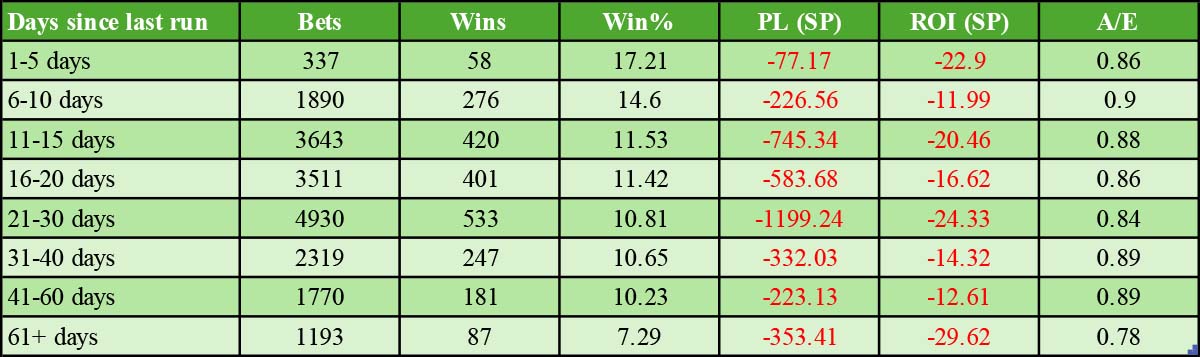
This is a metric most punters take notice of. The general pattern for all flat races is that the shorter the time since racing, the higher the strike rate. However, the market is well-adjusted to this and prices are usually balanced accordingly. Let’s see, though, whether an edge can be found, either positive or negative, from the 2yo nursery stats:
The strike rate pattern can be seen here, as mentioned above. Horses returning to the track within five days are comfortably hitting the best strike rate but are the third worst in SP returns. They also provided the worst returns to BSP of all the groupings. The one group to avoid, though, is the group that has had the longest time off the track (61+ days). These have offered the worst returns, the lowest strike rate, and the lowest A/E index.
Surface switch (or not)
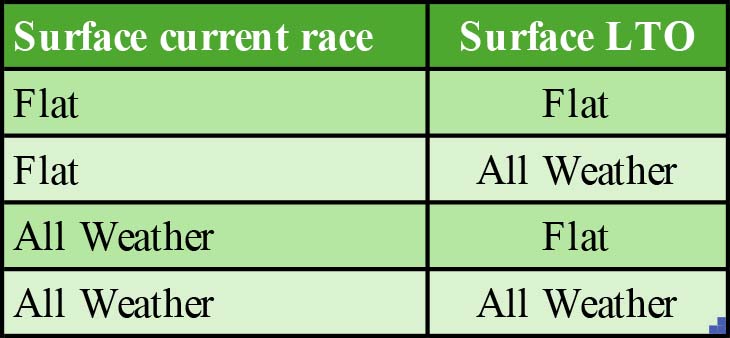
I want to share some data on what surface the nursery was run on (e.g. turf or all weather) compared with the horses' previous start. Hence, there are four possible combos to look at:
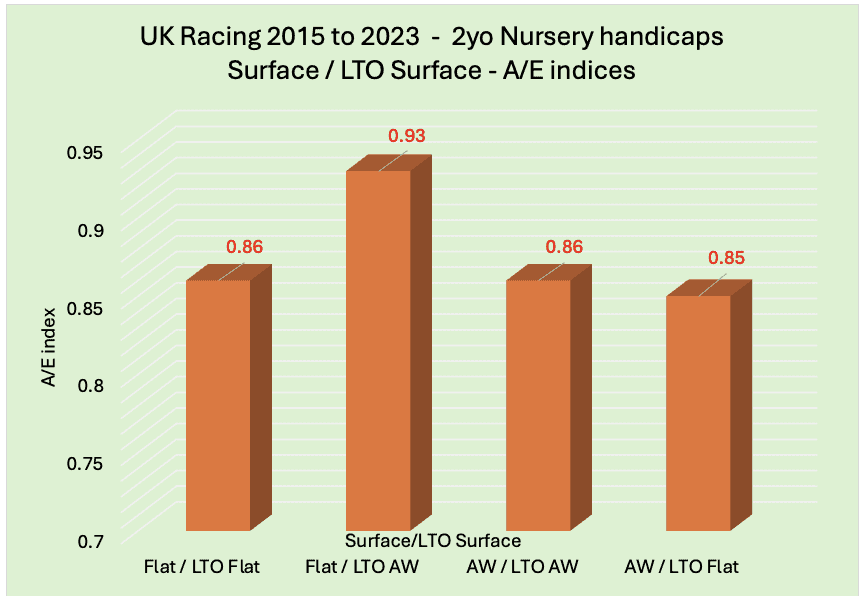
So, what do the stats say? The A/E indices suggest that one of the four combinations offers far better value than the other three. The graph below shows the figures:
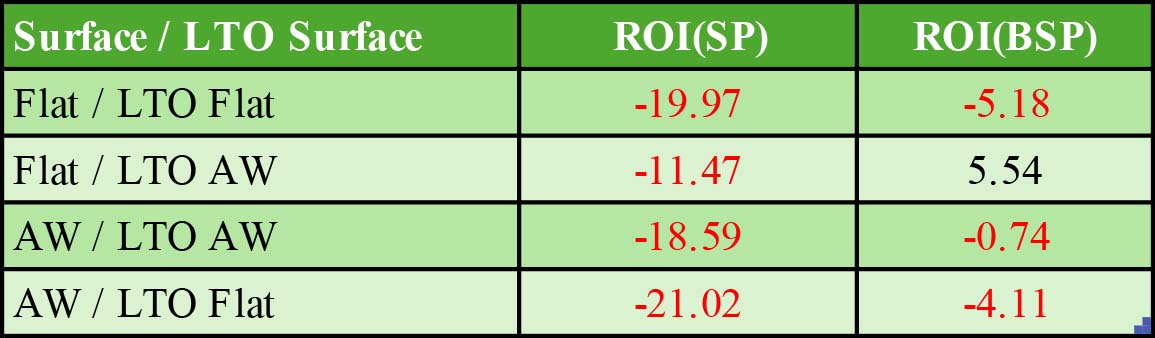
Horses switching from a run on the all-weather LTO to the turf this time have offered punters by far the best value. This is also reflected in the returns for both SP and BSP.
The Flat / LTO AW figures for SP returns are better by over 7p in the £ than the other three. In addition, the BSP returns are positive at around 5.5 pence in the £. This is probably due to the market slightly downgrading the chances of young horses switching from the sand to the turf. With limited race experience on both surfaces, it can be challenging for bookmakers to price up these surface switchers accurately.
LTO Race Type
Next, look at the LTO Race Type, splitting by handicap vs. non-handicap.
It has been a slight advantage for nursery runners to have run in a nursery handicap on their most recent start. Regarding non-handicaps LTO, you might want to avoid any horse coming from a claimer, as they would have lost you 77p in the £. Also, horses coming from sellers have done poorly, losing over 32p in the £.
LTO Price
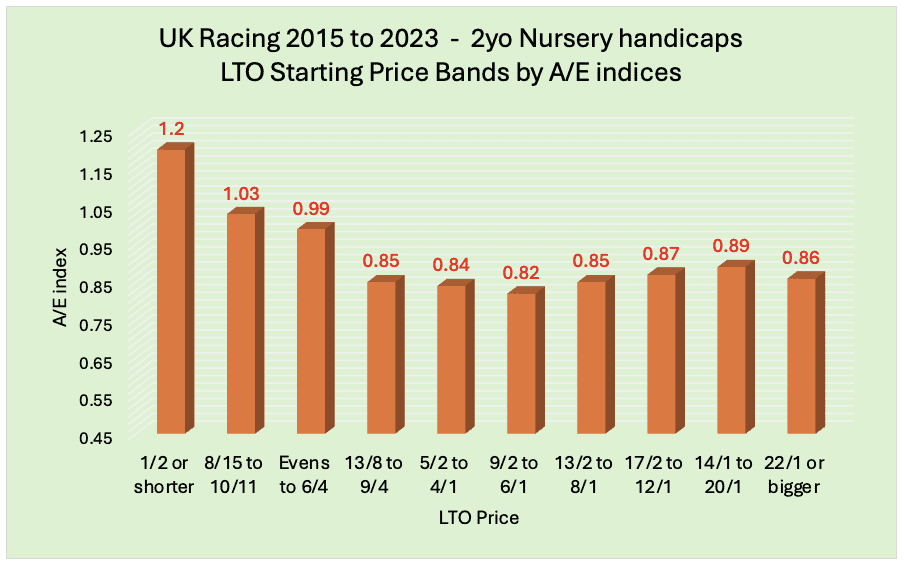
I often look at this metric: the price of the horse on its last run. To begin with, I will look at some LTO Starting Price Bands, focusing on the value metric, which is the A/E index:
When examining last day starting price, we see a scenario similar to the one in the first article – the maxim is the shorter, the better. Horses priced up 6/4 or shorter on their most recent start are ones to watch closely. Backing these runners blind to SP would have yielded a slight loss, but to BSP a return of nearly 6p in the £ would have been achieved. Also, if you had been a bit more selective with these 6/4 or less LTO runners, sticking to those that started in single figures next time, then you would have been rewarded with 177 wins from 689 runners (SR 25.7%) for a BSP profit of £85.84 (ROI +12.5%). You would have also made a profit to SP with these runners to the tune of £27.27 (ROI +4.0%).
Class Change
Does a change in class of race make any difference? Here are the splits:
There is not much to choose between the three here, although the ROI% is better for class droppers. Class droppers have been profitable at Betfair SP but these results have been skewed by several high prices hitting the mark.
Trainers
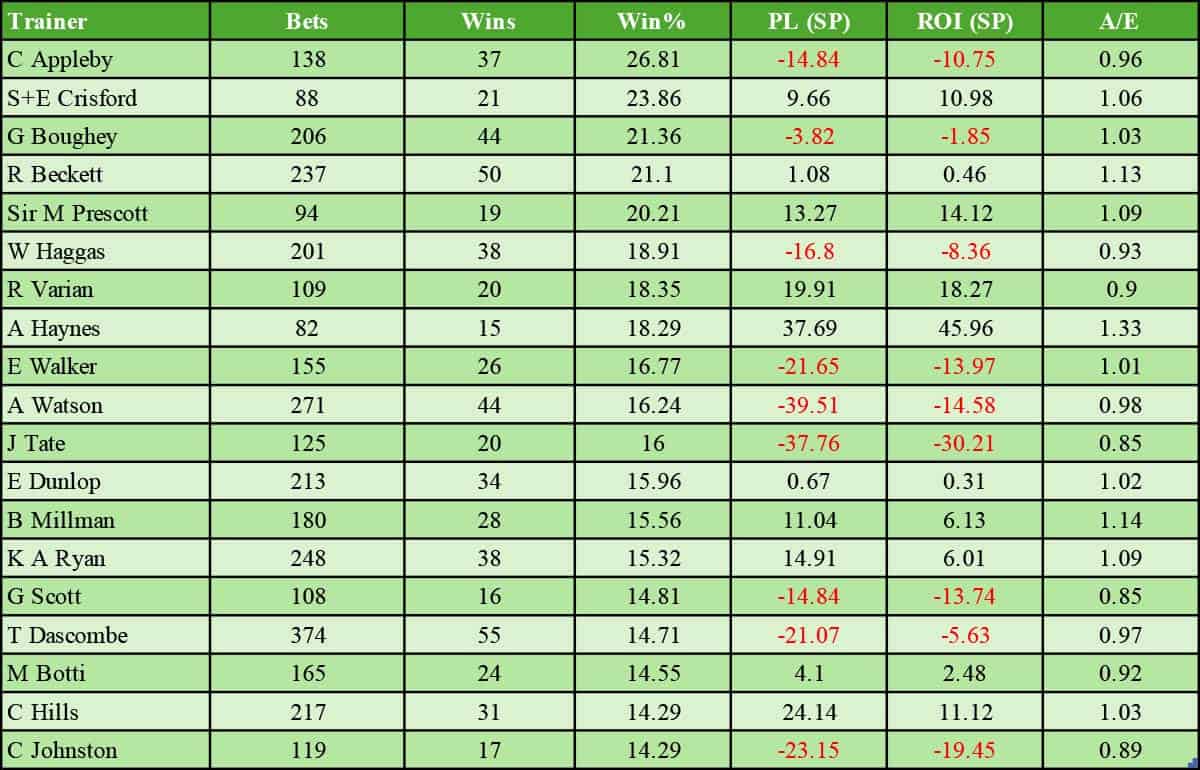
My final port of call is to look at trainers. Firstly, let me examine the trainers who had at least 70 nursery runners during the study period and obtained a strike rate of 14% or higher. I have ordered them by win strike rate:
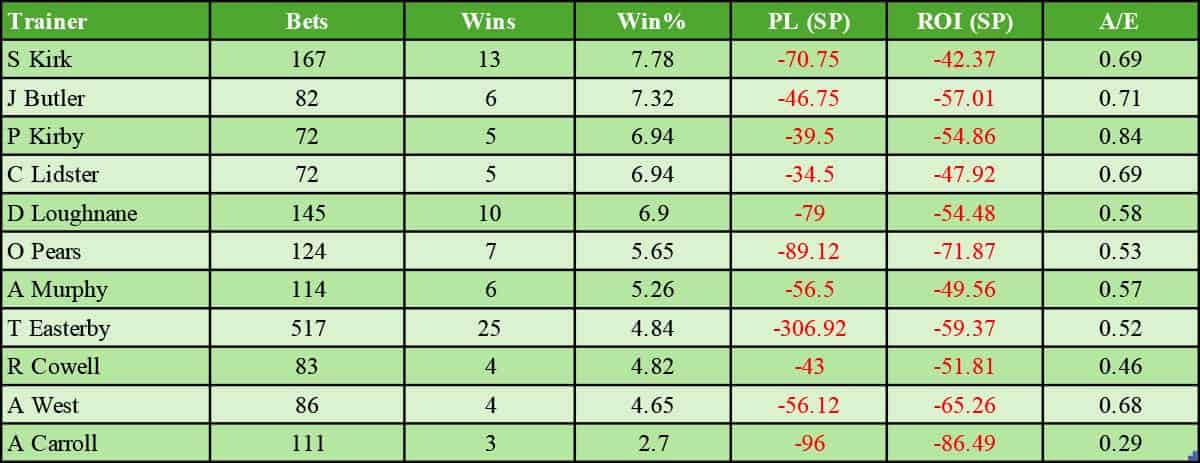
Ten trainers have managed a profit of which eight have an A/E index above 1.00. All eight of these trainers should be classed as positive in these races. I will revisit some of these in a minute, but before then, onto those trainers who have recorded a strike rate of below 8%:
All eleven in this table have seen losses of over 40 pence in the £ to £1 level stakes, and I would be avoiding these trainers in nurseries unless some other impressive stats could convince me otherwise.
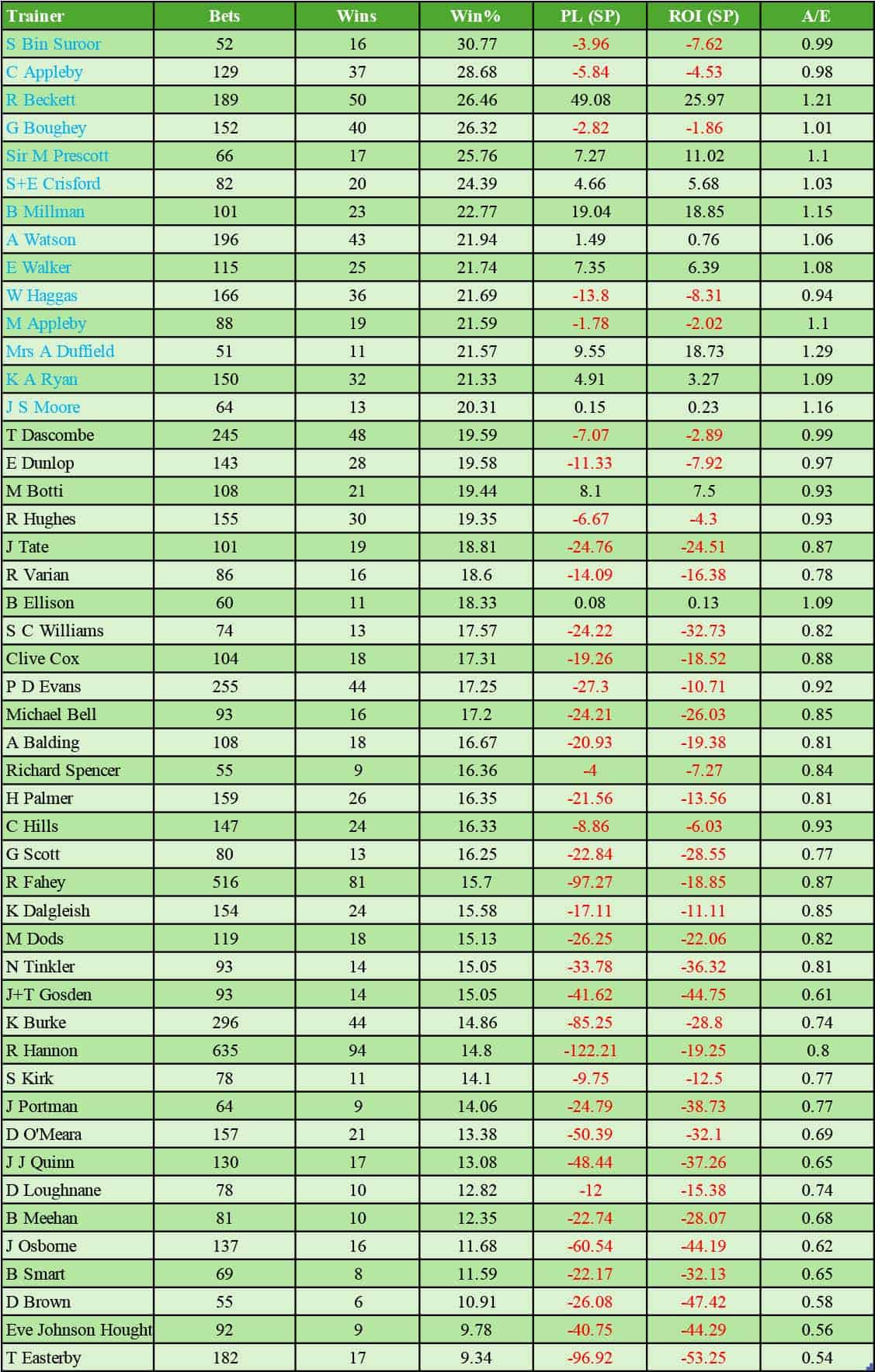
As often with trainer data, to avoid high prices potentially skewing profits let me focus on trainer performance with runners that started in single figures (e.g. 9/1 or less). For this group I have relaxed the qualifier restriction to 50, including 48 trainers that had at least 50 qualifiers by using this price restriction:
Ralph Beckett has the stand-out single price stats, producing returns just shy of 26p in the £. He also has an excellent A/E index of 1.21. Breaking down his results for these 9/1 or shorter nursery contenders, I notice that his male runners have completely outgunned the female ones. The first article noted that male horses comfortably outperformed their female counterparts in mixed-sex nurseries. Here, the contrast is even more stark. His male horses (when 9/1 or shorter) have won over 31% of their starts returning 47p in the £; his female runners within the same price bracket have won just 18% and would have lost you over 6p in the £.
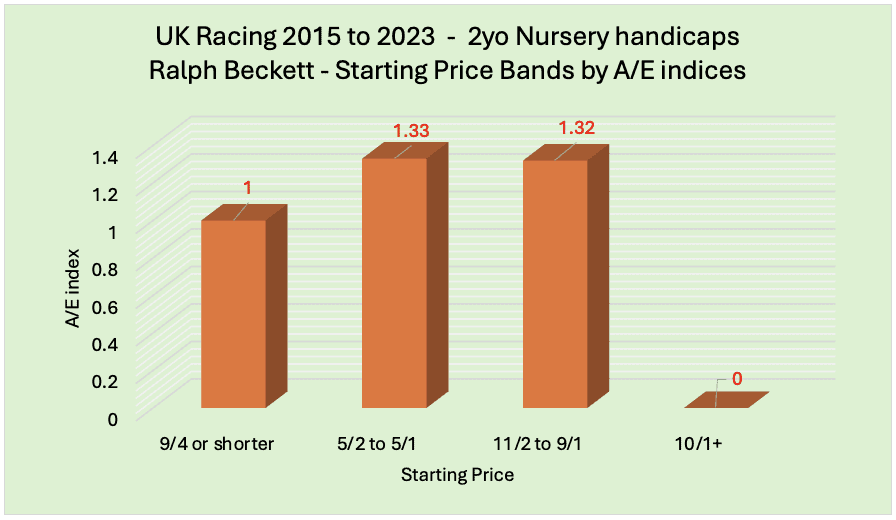
The stats are also very interesting for Beckett when looking at ALL his runners across ALL SP prices – we see the following based on A/E indices:
There are no winners in the 10/1+ bracket – he is 0 from 48 with only two placed. The message is clear – any Beckett runners priced 9/1 or shorter should offer excellent value; any priced 10/1 or bigger offers little or no value.
Returning to the latest table, other trainers to keep on the right side would be Sir Mark Prescott, Rod Millman, Ed Walker, Archie Watson, and runners from the Crisford stable. I would also keep an eye out for all the others highlighted in blue near the top of the table.
I think any trainer in the bottom quarter of the table whose A/E index is under 0.75 should be treated with caution.
Five Key Trainer Angles
Before finishing, I would like to share five of the most vital trainer stats I could find:
1. Charlie Appleby at Newmarket has secured 14 wins from 37 (SR 37.8%) for an SP profit of £13.29 (ROI +35.9%).
2. At Grade 1 tracks (Ascot, Doncaster, Epsom, Goodwood, Newbury, Newmarket, Sandown, and York), the Crisford stable has won 10 of 30 starts (SR 33.3%) for a profit of £17.91 (ROI +57.9%). This is an excellent effort considering these nurseries are some of the most competitive.
3. George Boughey has a strike rate of 41.8% with nursery favourites (28 wins from 67) for a profit of £12.65 (ROI +18.9%).
4. Ralph Beckett has an excellent record with LTO winners thanks to 14 wins from 37 runners (SR 37.8%) for a profit of £19.63 (ROI +53.1%).
5. Tom Dascombe, like Beckett, has done well with winners LTO, scoring 33.3% of the time (18 from 54) for a profit of £43.67 (ROI +80.9%).
**
That concludes my analysis of nursery handicaps, which are a betting medium that can certainly form a part of one’s betting portfolio. I hope some of these angles can give you that vital edge over the crowd.
-DR
https://www.geegeez.co.uk/wp-content/uploads/2022/03/ralphbeckett.jpg319830Dave Renhamhttps://www.geegeez.co.uk/wp-content/uploads/2022/10/geegeez_banner_new_170x78.pngDave Renham2024-07-09 09:40:082024-07-09 09:40:082-Year-Old Handicaps: Nurseries Part 2
You say it quickly and it does seem a little unusual, writes Tony Stafford. But it’s only when you put it in perspective - that it was Mrs Susan Magnier’s first visit to a UK racecourse for twelve years on Saturday at Sandown - you appreciate how remarkable it was.
Then you begin to understand how City Of Troy is regarded among the Ballydoyle owners, his trainer and jockey Ryan Moore He’s not merely another star racehorse. He’s something apart, everyone involved in his development believing from very early days on the home gallops that he is unique.
I can’t remember whether Vincent O’Brien’s daughter attended any of the 2012 Classic races. That was a memorable year with victories in the first four. Indeed, the clean sweep was only denied them when Enke – he of the failed dope test the following year which found steroids in his system when under the shamed Mahmood Al Zarooni’s care – denied Camelot the Triple Crown.
No doubt the very young Susan O’Brien/Magnier would have lived every minute of the last Triple Crown, her father’s horse Nijinsky coming over in 1970 to achieve the extraordinary feat - the first for 35 years since Bahram in 1935.
A named co-owner (rather than husband John) in almost all the earlier and subsequent triumphs for the non-related Aidan O’Brien team of Coolmore partners, it’s amazing to appreciate just how many major wins she had absented herself from before Saturday.
If we start with the Classic wins. From 2013 onwards, she, with Michael Tabor and Derrick Smith mostly, has won the 2000 Guineas three times, the 1000 Guineas five times, the Derby seven times, the Oaks six times and the St Leger four times; that’s 25 in all, never mind that 2012 quartet.
If we descend into all races, Aidan has sent over since 2013 around 1500 runners for a little more than 200 wins and prize money of £60 million The poverty of UK prizemoney in relation to that of other leading racing authorities is best shown by the last figure.
There’s no question that City Of Troy is the one horse racing today that would command the sort of money that football clubs pay for the best players. His value, like them, potentially soars above £120 million to my mind. Unlike footballers, though, stallion owners can get their money’s worth.
Some racehorses of recent times, especially Galileo, the principal equine power base behind the consistently astonishing Coolmore/O’Brien success of the past 20 years, have commanded stud fees reputedly close to £500k. When Coolmore list one of their stallions as “private”, just being able to inveigle a mare into his breeding shed has needed something of that dimension and the promise not to reveal how much has been paid for the privilege.
Multiply that by a conservative 125 or so mares covered each year; factor in a two or three-year span to retrieve all the money and you get the Coolmore formula – one pursued, usually in vain, by their imitators.
City Of Troy, while not a son of Galileo, does have Galileo on the dam side, through his mother Together Forever, a Group 1 winner at age two, and one of the many mares by their champion looking for worthy mates to keep the pot boiling at the highest level.
Step up (and he already has) Justify, one of two recent Triple Crown winners, both now operating from Coolmore’s Ashford stud in Kentucky.
City Of Troy has done enough to deserve to stand where Galileo did for so many illustrious years. Unbeaten and the European champion at two, he won the Derby impressively after that Guineas aberration, then on Saturday he beat his elders in the Coral-Eclipse, the first meaningful Group 1 battle between the generations of the 2024 season.
As in the UK, to illustrate how difficult that achievement has been, Justify, and American Pharoah a few years earlier, were also pathfinders after a 37-year gap since Affirmed won the 1978 Kentucky Derby, Preakness and Belmont Stakes in the tough five-week schedule that series entails.
For a UK horse to win our Triple Crown, I suggest an even more difficult trifecta: he has to be quick and ready enough to land the 2000 Guineas at a mile in early May; stay 14 and a bit furlongs on the daunting Doncaster circuit in September; and in between have the adaptability to come home first around the difficult Epsom 12 furlongs with its gradients and cambers in the first week of June.
I think time will tell us that Sheikh Mohammed’s remarkable mare Oh So Sharp, the last filly to complete the female Triple Crown in 1985, with 1000 Guineas, Oaks and St Leger, deserves much more attention than is generally afforded her.
The first element inexplicably eluded the team, Ryan Moore coming back visibly shocked at the unexpected reverse on Newmarket’s Rowley Mile. Yet so quickly does the racing year evolve that within two months we’ve already seen his rehabilitation – back almost to the sublime domination of his generation as a two-year-old – in the Derby and then the victory in the Coral-Eclipse Stakes at Sandown on Saturday.
Justify’s win over 12 furlongs on the US’s biggest oval, Belmont Park, where he completed the set in the Belmont Stakes, offered promise that his progeny would stay at least middle distances, without compromising the speed which won the two shorter distance Triple Crown races.
Had City Of Troy won the 2000 Guineas, he may well have missed Sandown, and gone instead to the Irish Derby and would now be gearing up for the St Leger. The combative John Magnier and friends, though, are always out to stretch the boundaries. After Sandown, presumably it’s the Juddmonte at York and if the Irish Champion Stakes is not then on his agenda, it seems that even the Breeders’ Cup Classic on dirt could be. Then again, maybe both.
There was no sign of weakening – quite the reverse – from City Of Troy in the Derby, and then when all looked potentially to be going wrong in the Eclipse, the will to win from horse and rider Ryan Moore, kept the opposition at bay.
A couple of incidents stayed in my mind from before the race. One of the closest inside the group said that after all the rain that had fallen on Sandown, had it been his decision to make, he would have pulled City Of Troy from the race. Two trainers, Brian Meehan and Hughie Morrison, did withdraw their runners on concerns about the going.
Next, standing quite close in the pre-parade paddock,while Aidan was, as he prefers, saddling his horse in the open in the middle of the paddock rather than in a saddling box, I remarked to a friend, “see how calm and placid he is,” at which exact moment his left hind leg flashed back and only Aidan’s nimbleness enabled him to evade it. Three or four further attempts to clean out his trainer were also unsuccessful and then it was on to the main paddock and a host of people anxious to see the superstar.
In the race, Wayne Lordan made the running on stable pacemaker Hans Andersen and, while Ryan was happy enough to follow him, Ghostwriter eased up on his inside as they reached the end of the back straight. Then around the home bend, any idea of serenity for the rider was eroding as City Of Troy seemed momentarily to lose his footing and he had a length quickly to retrieve on his opponent.
Up the straight, though, he gradually mastered Jeff Smith/ Clive Cox’s smart performer, but then had a more serious rival to deal with. The Joseph O’Brien four-year-old Al Riffa had sat last of all but came with the final challenge and one that from the stands looked likely to prove decisive.
I wondered afterwards whether Sue Magnier might have been looking on momentarily in horror, reliving the day when brother David with Secreto beat her father’s hot favourite El Gran Senor in the Derby of 1984. Here, though, City Of Troy’s battling qualities eliminated such horrors, kicking in and he had the race won by a full length.
When asked what had he expected beforehand, Ryan Moore answered, “I thought he’d win by ten lengths.” I’m sure Sue Magnier did too, but now everyone knows that for all the brilliance, there’s also a dogged will not to be beaten in that remarkable DNA. Roll on York!
In case you wondered, yes, I did get another chance to press the flesh. His lad kindly waited a few seconds as I got into position and this time, unlike at Epsom, his coat was a little wet to the touch. Maybe the Eclipse got to him rather more than the Derby did - and no wonder!
- TS
https://www.geegeez.co.uk/wp-content/uploads/2024/07/CityofTroy_SueMagnier_CoralEclipse2024.jpg319830Tony Staffordhttps://www.geegeez.co.uk/wp-content/uploads/2022/10/geegeez_banner_new_170x78.pngTony Stafford2024-07-08 07:14:032024-07-08 07:14:03Monday Musings: Sue And The City
“You off to Royal Ascot, are ya? Like having a week’s racing holiday, isn’t it? Swanning around, drinking champagne, take a few bets from the top hats. Easy week. ” Yes, friend, that’s what happens, writes David Massey.
My week begins on Monday night at Windsor, where the firm I’m working for is standing but my services are not required, so I can have an evening off and some pre-Ascot chat. A few of the Northern lads are having the night at the races too, sucking wind through their teeth at the prices they’re having to pay now they’re down South. However, we all back John’s Dragon in the second, which pays for the overpriced burger and chips I’m having for tea.
I pick the keys up for our digs, which this week is in Datchet, about eight miles from the track. We’ve an Airbnb house, which means we all get our own rooms, and there’s a lovely garden area out the back to enjoy a beer each night. In fact, it’s a really lovely house, although not a quiet one - it’s directly on the flight path to Heathrow, and when you can’t hear the planes, you can hear the noisy parakeets instead. “They’re classed as vermin, you know,” says Liam, one of our party for the week. “If I’d got my gun, they’d be a lot quieter.” Liam does a lot of field sports and I don’t think he’s joking.
As well as the bookmaking - and this will be my last year at Ascot in that regard - I’ve a whole heap of writing to do daily, and I find myself working in the media marquee in the centre of the track each morning. It’s a huge, greenhouse-like fixture, basic but functional. “Like working in a cannabis farm”, as one of the bookmakers PR’s describes it, and he’s probably not far off (not that I'd know, you understand). Last year, this place started off well and fell to bits as the week went on. Let’s see what 2024 brings.
In terms of a loo, we’ve a gents and a ladies Portakabin behind the greenhouse. After three cups of tea I need to go. It’s disconcerting to hear a noise that resembles water hitting a wooden Portakabin floor as I do, and lo and behold, the plumbing is broken. Worse, because the Kabin is on a tilt, the stream appears to be heading back my way. I bet Charles doesn’t have to put up with this.
I report the broken urinal, and warn others in the Press tent that might think about using it not to.
The lunch food is decent - picnic boxes - and there’s plenty of cold drinks, which I snaffle into my bag as I make my way over to the ring. I’m on the rail all week, which means dealing with the Royal Enclosure mob. I’m hoping the Arab punter I had last year is there, and remembers me (he had about 6k on with me, all told); sadly, he's nowhere to be seen.
Next to me on the rail is the Aussie bookmaker Rob Waterhouse, and my neighbour for the whole week will be the lovely Erin, from Melbourne. Erin is young, enthusiastic and fun, all the things I’m not, but we get on well, and we help each other out when needed. Erin tells me she’s just got her bookmaking license in Oz, and relays the way she works, which is very much at odds with how many British bookmakers would work. She’s more than happy to stand one, even if her price is bigger than Betfair, it seems. At one point I saw she was 13-2 a horse that was a 5-1 chance on the machine - come racing, get the Aussie value, it appears!
It doesn’t take me long to bump into a bet, a 7000-2000 Charyn. I’ve backed Charyn myself, which now puts me in the difficult position of not being able to cheer it home. “Never cheer the favourite home”, was one of the first pieces of advice I was ever given by a bookmaker, “or you’ll not be in a job long.” I don’t say a dicky bird as Charyn bursts through to win. Jason comes over with seven grand for me to pay the punter out. “Try not to lay any more winners”, he jokes. “You’ve already made a dent in the float, and this is a long week!”
Our Charyn punter comes back for another go and has a grand each-way Camille Pisarro in the Coventry. The good news is it’s well beaten with a furlong to go; the bad news is that one lucky punter, guessing, has had £50 win on Rashabar at 66-1 with me. The float takes another whack.
It's a very quiet start to the week, and for the last three races trade dies a sorry death. Since going to seven races a day at Royal Ascot, it is noticeable how business often drops off late in the play, with many preferring to go home early and avoid the worst of the traffic. Very few stay for the 6:15, and despite it being a competitive handicap, it’s my worst take of the afternoon. We pack up and go for food, which tonight is the Turkish restaurant in Windsor. (If you’re looking to lose weight, don’t work Ascot week.)
Wednesday. The plumbing in the Portakabin has been fixed! By fixed I mean the offending urinal has now got a bin liner with police tape all over it, and a bucket placed under the corresponding piece of piping. Tremendous. The coffee machine also appears to be giving up the ghost; I ask it for a latte, and am returned an empty paper cup. “Please enjoy your drink!” it chirrups. I would if you’d given me one.
Every day Bet Victor’s Sam Boswell is relieving me of a tenner for some placepots. We can’t decide what should go in for the Queen Mary, other than the favouite. “Stick Leovanni in,” I say, “ it won well enough at Nottingham”. I’m not overly hopeful of getting past Leg 1 today.
The coffee machine is fixed - turned off, turned on again, has that ever worked before? - and I crack on with the rest of my writing. I really fancy a couple on Thursday and get them over to Rory (Delargy) for tomorrow’s column nice and early.
If I thought Tuesday was quiet in the ring, welcome to Wednesday. It never gets busy until the Royal Parade has gone past, whatever day it is, but it seems to take an eternity today. However Leovanni is a good result, ignored by most punters, and it isn't until I get a text from Sam reminding me I picked it for the placepot that the result even clicks with me. Two 50-1 chances fill the frame; 95% of the placepots have bit the dust. Five more good results and I can take the rest of the week off. Illinois keeps the dream alive in the second but that’s as far as we go; I had managed to talk Sam out of Laurel in the Duke Of Cambridge and that’s the end of that. Of course we got the last three results up. Of course we did.
No big bets to speak of all day, lots of twenties and fifties (one bloke peeling them off from a roll as big as any Andrex) but at least a winning day, although again, trade dies a sorry death for the last three. That’s becoming a habit.
Back at the digs and the boss has finally made an appearance after three weeks in Las Vegas playing poker. He arrived at Heathrow around 2pm, got a cab straight to Datchet, and now wants to go to sleep. It’s only 7.30 but he can’t keep his eyes open. We start to watch the Euro match but it’s no good, Rob’s totally jetlagged, and at half eight he’s snoring his head off. We give him a kick and tell him to go to bed. Wednesday night food is a BBQ, with the lovely Heather, the fourth member of the team this week, doing the honours.
Thursday 6.50am. The alarm goes for Day 3 and I go for a shower. Sadly, the water pressure is now very low and I can’t fix it, so it’s like a shower in tepid rain. It’ll have to do. I’m hoping this isn’t a bad omen for the day, as I do like a few, and have invested quite heavily in Assailant, Skukuza and Carrytheone.
My car park at Ascot for the week is 7B. This has both its advantages and disadvantages. The main advantage is that I’m not in Car Park 2 and as such, don’t have to climb the North Face of the Eiger every morning to get to the track. Last year, I was knackered and in need of another shower before I’d even sat down at my desk. 7B is on the inside of the track, next to the pull-up area for the horses; I can actually see my car from the Queen Anne Enclosure on the other side of the track. So there’s no long trek to my workspace, which is great, but getting out, it means I’m right at the back of the queue. Good job I’m not in a hurry.
Thursday is Ladies Day and so we’re hoping business will be a bit better. Thankfully it is, small stuff but workable, and helped in no small part by IT issues from those around me. Erin is struggling to get her lightboard working properly, and then the wifi appears to go off completely just after the Royal Parade has gone to post. (There is a theory that this happens every day of Royal Ascot - namely if something dreadful happens, the police and emergency services need all the bandwidth going, which I can sort of see.) It gives me around 15 minutes of betting time on my own for the first, which I make the most of. I take an even 2000 Whistlejacket, which stays in the hod and repairs a bit more of the float damage. The new problem with the float is fivers and pound coins - we’ve not brought enough of either - which means a call to a friend on course who helped in a similar situation last year. I won’t name her for fear her employers will read this and she’ll get in trouble, but she once again comes to the rescue with £200’s worth of golden nuggets and five pound notes and the promise of more tomorrow.
Assailant runs a cracker in the King George V Handicap and looks a likely winner at one point before just fading late. I’ve had a good run for my money, at least, and got half back in-running, so no disasters. I’m against Diamond Rain in the Ribblesdale and my place lay cops; Skukuza runs a mighty race to be second to the Aussie-bound Mickley in the Britannia, and Carrytheone rattles home for a place at a big price in the Buckingham Palace Stakes. (Wins the Bunbury Cup. You’ve been told.) As good a day at Ascot betting-wise as I’ve had in a while. Sharing the wealth, as I always try to do, I buy Heather a thankyou for all the work she’s done at the digs this week (she put a wash on for us all Thursday night, and even hung it all out. What a star!) and get her a couple of pouches of tobacco, as she loves a roll-up. I nearly die when I’m told the price of Ready Rubbed in the shop; I genuinely thought it was about a tenner a go. Best part of a bullseye for the pair! Don’t moan Massey, you’ve had a winning day. Pizza for evening food; I fear the scales will not be kind when I get back home.
Friday. Liam has fixed the shower. The joys of a proper hot power shower cannot be underestimated. I swear the parakeets are noisier than they were on Tuesday, though. I have at least taken the precaution of bringing my own breakfast food, namely five packs of Shredded Wheat, probably the most healthy thing that’s gone down my neck all week. Sadly I forgot to buy milk at the shop when I got Heather’s baccy last night; as such I can inform you that almost-dry Shredded Wheat are not my idea of fun.
The weather has started to take a bit of a turn, too. The sun we’ve had for most of the week is starting to disappear as the clouds roll in. There’s even chat of a bit of rain tonight. Given I don’t work well in hot weather this is a bonus for me, although Erin thinks otherwise. “It’s bladdy FREEZING!” she complains. To an Aussie I suppose fifteen degrees is a touch on the cold side, but to this Midlands bumpkin it’s ideal, thankyouverymuch.
The money is usually better on the Friday, and so it proves, although the first two results are shocking. Fairy Godmother attracts plenty of £100 and £200 bets and one lad has £800 quid on at 2-1 with me. Two out the money is staying with me; by the winning post, I’m in need of another float topup. Second home Simmering was a skinner. They play it up on Inisherin and his backers barely have a moment’s worry. I’m concerned that if I ring Rob for more dosh again I’ll get a mouthful. However, on his joint in the ring they only wanted Givemethebeatboys and so it’s not the disaster I think it is. And the rest of the afternoon’s results are corking, with no sign of the jollies; only a £100 each-way on Soprano at 14s in the Sandringham stops it being a near clean-sweep for the firm. Food is leftovers from the last two nights, which we need to start mopping up (you don’t want to be packing up a lot of on the wane tuck Saturday morning, do you?)
And finally, to Saturday. We’re all knackered and ready for home, but there’s one last day to get through. But we have encountered a major problem.
Liam and Heather have, somehow, managed to leave the keys to their vehicle (which hasn’t moved off the drive all week) with Jason, who is now in Newmarket. Frantic calls have been made to and fro, as the car has to be moved by 2pm latest for the incomers to the Airbnb; it is arranged the car keys will arrive at Ascot (via a jockey) around 11am. That means I’ll have to drive one of them back to the digs to collect their vehicle when the keys get to Ascot, and if the keys are late, it’s going to make getting back into the track a nightmare; we could even miss the first. And as it turns out, the keys are indeed late, not arriving until after midday, so it’s decided Heather has to get an Uber back, or it’ll mean half the team going missing, which we can’t afford to do. Heather makes it back easily, as it turns out, with an hour to spare, and disaster is averted. The stewards’ enquiry as to whose fault it was the keys ended up in Newmarket in the first place are still ongoing, I understand.
Bedtime Story gets punters off to a winning start, but Isle Of Jura, Khaadem and Haatem make sure we get it back with interest. And then, one of the highlights of the five days as Valerie, my Punter Of The Week Royal Ascot 2023, makes a welcome reappearance.
Those of you with long memories might remember Val turned up on the Wednesday last year when she started with a couple of fiver each-way bets in the first, backing the winner Crimson Advocate, and from that point onwards, never looked back as she went on the rampage, following up with Villanova Queen, Rogue Millennium, Mosthadaf and finishing the day off with £25 each-way Sonny Liston and Jimi Hendrix in the Hunt Cup. She took well over a grand from the firm and was almost apologetic as she picked her final winnings up on the day. “Do you remember me?” she asks. How can I possibly forget the luckiest punter I’ve ever come across? It’s an absolute delight to catch up with her and her son, but sadly she can’t replicate her luck of last year, and her two in the Wokingham were well beaten. All the same, it is lovely to see a familiar face.
As the day progresses, the Ascot wifi starts to drop out a lot, to the point where we reach the Golden Gates Stakes, and three bookmakers near me are struggling to get prices up on the board. In fact, they give up completely for the last, the Queen Alexandra, and I’ve got it to myself. I’m taking absolute chunks - it’s my best take of the week by a country mile. All we need to do now is get a result.
Uxmal, the 2-1 favourite, romps home. You can’t have it all, can you?
On the way home, I call in at the services on the M40 for food. I see a bookmaker I know quite well struggling to use the touchscreen as he tries to order his KFC. It appears bookmaker IT issues aren’t just confined to the track.
I’m back at 10pm, and am asleep by eleven. That’s a wrap, as they say. My week’s “racing holiday” is over for another year. See you all at Goodwood, yes?
July sees the recommencement of nursery races, handicap races for 2-year-olds, with the first of them scheduled for Haydock and Carlisle this Saturday, writes Dave Renham. This article is the first in a two-part series that will look at these niche races. I have collated data from the last nine UK flat and all-weather racing seasons (2015 to 2023) with profits and losses quoted to Industry SP. I will quote Betfair SP where appropriate.
The market
My first port of call is the betting market and a look at some Starting Price bands. Let me focus first on a value metric, the A/E index:
As the graph neatly indicates, the shorter the price, the better the value. The only slight outlier is the 18/1 to 33/1 but, essentially, as the price gets bigger the value decreases.
If we now examine the Return on Investment (ROI%), we can see how well the two metrics correlate with each other:
Odds on shots have made a small profit, although there were only 131 such runners, so you certainly would not have raked it in! While I am not usually a fan of short prices, any horse priced 6/4 or shorter in a nursery is worth a second look. Conversely, performance dips when we hit 13/2 or greater, so nurseries look generally top-of-the-market orientated.
With shorter prices doing relatively well, let me dig into the results for favourites; one would surmise, given the data so far, that they are likely to be the best option in terms of market position. Here are the overall stats:
We have a strike rate of around three wins in every ten races, a good A/E index of 0.98 and minimal losses to SP. To Betfair SP, this loss would have become a £37.52 profit, giving a small +1.6% ROI. In addition, nursery favourites have performed better on the all-weather than they have on turf, as the stats below show:
Nursery favourites on the all-weather have edged into SP profit. To BSP, these figures improve to £61.43 (ROI +5.8%).
Another favourite angle I looked at was the going conditions on the turf. It seems the firmer, the better:
The good to soft or softer results may be because the market assumes that a young horse with limited experience can act on a softer surface when it has not raced on one before. This is just a theory. The good/firm+ and good ground results for favourites saw a small positive return to BSP.
The final favourite stat to share focuses on horses that had previously won twice as a 2yo. Of these 303 horses, 109 won (SR 36.0%) for an SP profit of £15.79 (ROI +5.2%). To BSP, this improved to a profit of £32.78 (ROI +10.8%).
Position Last Time Out (LTO)
I want to examine a recent performance metric, so let's investigate the position LTO stats.
The slight anomaly is the results for the 5th – they are out of kilter with the remaining ones. Overall, it seems the better value - or least worst, perhaps - lies with those runners who finished first or second LTO. If we look at the BSP returns for those finishing in the first two LTO, losses become very small at less than 1.5 pence in the £.
Sticking with those runners that were first or second LTO, if we restrict that LTO race to a nursery, we edge into BSP profit by £43.15 to £1 level stakes (ROI +1.7%). Essentially, I would view a run in the top two places LTO as a slight positive.
Weight carried
When I first came into racing, there was an old adage about backing the top weight in a nursery. I’m not sure how successful that may have been ‘back in the day’ before we had a wealth of weight stats to pore over. However, that is not the case now. Although top weights win more often than any other weight position, they would still have lost you nigh on 20p in the £ for every £1 staked. Below, I have looked at actual weight carried rather than position in the weights. When I talk about the actual weight carried, I take any jockey claim into account. Below are the ROI%'s for different weight groupings.
Across the board, we have losses to SP and, in some cases, significant losses. As a rule, the lower weights have returned more significant losses, and hence, I would be wary of backing a horse carrying 8st 9lb or less and ignore totally if they are under 8st. In fact, the 7st 13lb or less group won just 3.7% of the time, with an extremely poor A/E index standing at 0.55.
While discussing weight carried, let's compare the performance of jockeys in terms of claiming jockeys. Trainers use apprentices in handicaps to take weight off their horse's back which, in theory, should slow them down less during the course of a race. The quid pro quo is that these jockeys are less experienced than the ‘pros’. Here are the stats:
The more experienced the jockey, the better the win rate and the higher the A/E index. In terms of ROI%, the correlation with those two metrics is good, although 5lb claimers have lost 1p more in the £ than 7lb ones. The ‘top’ jocks (no claim) are close to breaking even when betting on BSP. Ultimately, I would be less inclined to back a horse in a nursery with a claiming jockey on board, especially one carrying 5 or 7lb.
Career Wins
Earlier, I touched on the fact that two or more career wins when sent off favourite was a positive. So what about all runners in terms of career wins? Let’s look at the win and each way strike rates first:
In terms of win SR%, horses with two or more wins in their debut year have been the most successful. Those who are still maidens have struggled in comparison. When we look at the returns to SP, these correlate well with the win strike rates – the 2+ group would have lost you 13p in the £, the 1-win group lost 18p, and the 0 wins group lost 20p.
Sex of horse
This is an area I like to look at because occasionally gender biases are unearthed. The vast majority of nurseries are for both sexes, and I have concentrated on those mixed-sex nurseries (roughly 1900 races over the study period). Here are the figures:
Male horses clearly come out on top across all metrics. When I learned this, I thought analysing nurseries with a similar split of male to female runners was worthwhile. I have looked at races where the split is no worse than 40% females versus 60% males and vice versa.
The bias toward male runners strengthens a little, especially considering the ROI%s. All things being considered, a male runner is a better nursery proposition than a female one.
Run Style
The final area to examine in this first piece is run style. I’ll begin by reviewing the win strike rate for the four categories geegeez.co.uk stores in its database: led, prominent, mid-division, and held up.
Based on all previous evidence I have shared regarding run style, these figures should come as no surprise. Let’s see if the A/E indices correlate:
The bias to early leaders/front runners in these contests is significant. As I have mentioned numerous times, the early leader will only be known a few seconds after the race has started. Hence, taking advantage of this run style bias is not easy. What the early leader conundrum does do, as far as I am concerned, is to continue my pursuit to find more accurate ways of predicting the early leader in run style-biased races. If your crystal ball had managed to predict all nursery early leaders since 2015, you would have made a profit of £701.95 (ROI +24.6%) to £1 level stakes. That equates to £7019.50 to £10 win bets.
**
Part 1 Summary
In conclusion, here are the key points:
1. The best value lies with shorter-priced runners - 6/4 or better / favourites.
2. Favourites have been profitable to SP & BSP on the all-weather and to BSP on good or firmer going. Favourites have also proved profitable to SP and BSP, with at least two previous wins.
3. Horses that finished 1st or 2nd last time out in a nursery have edged into BSP profit.
4. Horses carrying 8st 9lb or less have a relatively poor record; those carrying under 8st have an abysmal record.
5. Male horses outperform female horses.
6. Horses that lead early have a considerable edge.
And that wraps up part 1. In part 2 next week I will continue my digging into these nursery handicaps. Until then...
-DR
https://www.geegeez.co.uk/wp-content/uploads/2018/07/BillesdonBrook_Goodwood.jpg316830Dave Renhamhttps://www.geegeez.co.uk/wp-content/uploads/2022/10/geegeez_banner_new_170x78.pngDave Renham2024-07-01 14:14:032024-07-01 14:14:032-Year-Old Handicaps: Nurseries Part 1
When is a suspension not a suspension?, writes Tony Stafford. When it is handed down to an Irish trainer, even when at the second attempt the authorities do try to add a little sting to what was originally deemed insufficient punishment. It seems effectively it’s little more than a rap on the knuckles.
We had the Gordon Elliott episode a few years back when Ireland’s second most successful jumps trainer had to give up his licence. With her stable conveniently close by, Mrs Denise Foster, the chosen one to carry on business at Cullentra Stables, had her transfer rubber-stamped and approved by the authorities. She recorded 17 and 32 wins in the seasons 2020/21 and 2021/22 which spanned Elliott’s 12-month ban.
A licence-holder since 1997/98, Denise must have shown something to Gordon that the stats did not reveal. Her seasonal tallies since that opening date had been 0, 0, 1, 2, 3, 1, 3, 1, 1, 1, 2, 1, 2, 1, 3, 2, 3, 4, 2, 0, 1 and 1. Since the Elliott days it’s been back to normal with 2, 2, and 0 so far in the early phase of the 2024/25 campaign.
Therefore, Mrs Foster recorded a total 38 wins in 26 seasons in her own right, against 49 in the segments of seasons that Gordon left her.
I remember thinking at the time, maybe there should be a “cooling-off” period when – say another season – when while the returning trainer can seek out new owners - and horses to train for them - those animals left with a substitute, and clearly not a “serious” trainer in terms of an Elliott or Willie Mullins, would need to find elsewhere for their horses to be trained for that period. Maybe even to stay with the “convenient other” that had them before that period.
Elliott, at least, was fully remorseful for his actions and vowed never to repeat anything like that again and has certainly come back keeping to that promise. He is now firing again and if not managing, as had seemed possible in the past, to wrest the champion title accolade away from Willie Mullins, he continues to make a decent show of it. That was something that had seemed most unlikely at the height of his “dead horse on the gallops” picture infamy.
If the Elliott ban had its irritating elements through the Foster months, even more so was the brief suspension of Charles Byrnes, king of the unsighted gambles. He lost his mandate but was still able to lead horses around the paddock while one of his sons held the licence and another rode it to victory. What part of that was “not training” the horse.
But now, Tony Martin has eclipsed all of that with Saturday’s victory of Alphonse Le Grande in the Northumberland Vase, consolation race for the Northumberland Plate at Newcastle.
Initially given only a suspended six-month ban for a third drug-related breach of regulations within four years, the Irish racing powers relented in face of criticism of the leniency of the judgment and imposed three of the six-month ban to start on May 15.
Martin had time therefore to bring Alphonse Le Grande over to Chester a week or so earlier to mop up the valuable consolation race to the Chester Cup and after his performance there, few at Newcastle on Saturday expected anything other than another success and almost £40k more of UK prizemoney for the Hollie Doyle-partnered stayer.
It was almost laughable how easy it was, and additionally it was notable for the fact that trainer Cathy O’Leary was having her first flat-race winner for 15 years and only the fourth in 20 seasons with a licence. And who is Mrs O’Leary? Tony Martin’s sister of course!
By contrast with Ms O’Leary, Denise Foster’s career had been almost prolific.
The sight of Martin standing alongside a couple of the winning owners and Hollie Doyle on the rostrum, evoked a “Sod you lot” attitude. I’m not sure whether it was before or after the presentation that one of the owners, asked what the plan was, said: “We’ll give it a couple of weeks and then sit down with Tony”. Martin’s ban still would have a month to go at that stage – no mention of the official trainer.
Martin, no doubt, would love to target next month’s Ebor at York, with its massive prizemoney. He won it eight years ago with Heartbreak City, half-brother to the Geegeez.co.uk money-spinner Coquelicot, but having won here off 81, he would need at least a stone’s hike to get into the York race and even then, it would be a stretch.
Maybe Goodwood’s valuable 1m6f Coral Handicap could be an obvious target with another potential £51k on offer to the winner. That would entail a 4lb penalty for York, but unless the first hike is more extravagant than is likely, even with a win at Goodwood he would still likely be left on the sidelines. Never mind Tone, the richly-endowed Irish Cesarewitch, worth £324,000 to the winner last year and a race he would probably squeeze into off a mark in the low 90’s, might be the way to go.
After his ban, in an interview recalling how his career had developed, Gordon Elliott said: “When I first sat on a horse at Tony Martin’s 30 years ago, I could never have dreamt what was in store”. Maybe neither could his then youthful first employer.
Sanity resumed in Ireland’s premier Classic yesterday when Los Angeles battled to turn around Epsom form with Ambiente Friendly to give Aidan O’Brien and part-owner Michael Tabor each their 16th triumph in the race.
There was a battle between the pair up the home straight and it was not until the last half-furlong that Los Angeles and Ryan Moore got the better of his brave rival, ridden by Rab Havlin, to clinch the €712k first prize. Late on, fast-finishing Sunway, partnered by Oisin Murphy for David Menuisier, edged out Ambiente Friendly. Fourth home Matsuri, for Roger Varian/James Doyle, was also staying on well. That late run increased Sunway’s prize from €112k to €237k.
Initially, the result gives a major boost to the Derby form when City of Troy had the placed pair well covered, and that will have added confidence to his chance of beating his elders in the Coral-Eclipse Stakes at Sandown on Saturday.
But Sunway’s performance, following his 7th last time in the Prix du Jockey Club, is also an advertisement for the unbeaten winner of that race, Look De Vega. In traditional Gallic fashion, this potential champion can do the favoured French thing over the summer – waiting for the Arc while the other main contenders beat their brains out at Sandown, Ascot and York. Intriguing.
A few months back, I looked at the performance of horses on their next start having had their last race at the Cheltenham Festival, writes Dave Renham. I will revisit that idea in this post but the focus now is on horses that raced last time out at Royal Ascot. Royal Ascot finished on Saturday so now is a great time to examine the numbers.
The data was taken from 2009 to 2024 (prior to this year's Ascot meeting), and profits and losses were calculated to Betfair Starting Price less a 5% commission.
All runners
Looking at all runners coming from Royal Ascot on their next start – they have scored 14% of the time with losses to BSP of 10 pence in the £.
Finishing position at Royal Ascot
My first detailed port of call is where the horse finished in their race at the Royal meeting. Let’s see the splits:
Last time out (LTO) winners and runners-up score better than one win in five on their follow-up run. LTO winners from two stables should be noted – firstly, Royal Ascot winners from the Aidan O’Brien stable have gone on to score next time 22 times from 55 runs (SR 36.4%) for a profit of £5.26 (ROI +9.6%; A/E 1.00). The Gosden stable has produced similar figures with 12 wins from 38 (SR 31.6%) for a profit of £3.95 (ROI +10.4%; ROI 0.98).
LTO runners-up have edged into profit, but this is down to one huge-priced winner (BSP 75.0), which completely skews the figures. Ultimately, finding an edge from where they finished in their Ascot race seems complicated.
One interesting comparison to make is between the performance of horses that beat more than half of their Royal Ascot rivals (excluding winners) and those who beat fewer than half of them. Below is a graph comparing win and each way (win & placed) strike rates for both groups:
As you can see, horses that finished in the top 50% of runners in their Ascot race have completely outperformed those that did not in strike rate (both win and each way). They would also have lost you 6p less for every £1 bet compared to the 0 to 49% group.
Digging a bit deeper, if we restrict this 50% to 99% group to those that ran in Royal Ascot handicaps, these 1360 qualifiers would have turned a profit of £84.50 (ROI +6.2%). These handicap stats are not hugely skewed by the winning prices either.
Course (next time)
Course data next. Which courses fare better than others when Royal meeting runners visit on their follow-up run? Here are the courses that have had at least 100+ qualifying runners:
Five courses have turned a profit: Chester, the Curragh, Haydock, Newbury, and York. The Newbury results include three winners priced between 40.0 and 60.0 BSP, so this profit figure can be ignored. Meanwhile, York had a massive 200.0 BSP winner, so this is the second course to have unreliable BSP profit figures. Sticking with York, horses that raced next time at the York Ebor meeting in August have an abysmal record with just 17 winners from 210 (SR 8.1%) for a BSP loss of £90.07 (ROI -42.9%). The A/E index stands at an extremely low 0.60. The other three ‘positive’ courses (Chester, the Curragh, and Haydock) have not had their results badly skewed, and visits to these courses after Royal Ascot can be viewed as a positive. Haydock figures, I would say, are the most reliable as they managed a profit to Industry SP.
The Goodwood next time stats are poor. Most of these qualifiers appeared at Glorious Goodwood – 724 of the 768 runners. Of these, just 78 won at the Goodwood Festival for losses of £190.40 (ROI -26.3%). Personally, I would ignore the vast majority of LTO Royal Ascot runners reappearing at Glorious Goodwood.
Before moving on, it looks best to disregard horses that switched from the turf of Ascot to the all-weather on their next start, as their combined figures read a disappointing 52 wins from 369 runs (SR 14.1%) for hefty losses of £133.56 (ROI -36.2%).
Days since the Ascot run
Let me now examine the performance of these Royal Ascot runners based on how quickly they return to the track. Below is a graph mapping their A/E indices:
Horses returning to the track between 8 and 14 days later have provided the best value. So, keep an eye on them in the next few days. On average, per year, 40 to 45 horses return to the track within that time frame. They have won just over 18% of their follow-up starts. They have not been profitable if backing ‘blind’, but they are horses that undoubtedly require a second glance. Horses off the track for more than four months (121 days +) have offered the poorest value and have the lowest strike rate amongst all groups.
Class Change
A look at Change in Class of race next – here are the splits:
Clearly, horses dropped in class have by far the best record, with comfortably the best strike rate and losses at just 4.1% compared with 17.7% and 19.9%, respectively.
Trainers
It's time to look at the performance of trainers. A tiny proportion of horses switch trainers after Royal Ascot, so the data I am sharing is based on trainer results, with horses running for the same stable as they did at the Royal meeting. Here are all trainers with at least 70 LTO Royal Ascot qualifiers. They are in order by win-strike rate:
Two trainers have impressive A/E indices, with horses having their first start after Royal Ascot: Bin Suroor (1.19) and Fahey (1.06). Runners from both stables are worth keeping a close eye out for. Five trainers have made a profit, but to try and avoid big-priced winners skewing the figures, let me show the performance of the trainers above if we restrict their runners to those who started in the top four of the betting on their next start:
This table is a better one to concentrate on from a trainer's perspective. The top six have some excellent stats regarding strike rate – all have proved profitable, and four (Bin Suroor, Cox, Fahey, and Beckett) have A/E indices above 1.00. It is interesting to see Charlie Appleby's very modest figures, as he is usually a trainer who has excellent stats.
Additional Stats
1. Horses whose SP was 7/2 or shorter at Royal Ascot have gone on next time to win 83 times from 302 runners (SR 27.5%) for a minimal loss of £4.58 (ROI -1.5%).
2. In contrast to the first additional stat, horses whose SP was 40/1 or bigger at Royal Ascot have won next time 166 times from 1679 runners (SR 9.9%) for significant BSP losses of £323.47 (ROI +19.3%).
3. 2yos beaten more than five lengths at Royal Ascot have struggled next time out, scoring 15.9% of the time and losing over 23p in the £ to BSP. Compare this to the 2yo winners from the Royal meeting who have gone on to win over 30% next time out, losing just 3p in the £.
4. 3yo Royal Ascot winners have gone on to win next time in 35 races from 148 starts (SR 23.7%) for a break-even situation.
**
Conclusion
It is challenging to make blind profits using a specific angle from LTO Royal Ascot competitors. However, based on all the findings, I feel LTO handicappers are worth keeping a close eye on as long as they didn't win and beat at least 50% of their Royal Ascot rivals. Several will pop up and win next time, many going under the radar.
Regarding trainers, Saeed Bin Suroor and Richard Fahey head my list, with Ralph Beckett and Clive Cox close behind. This is especially true if their Royal Ascot runners start in the top four of the betting next time.
Horses heading to Haydock after Ascot and those making their trips to Chester and the Curragh have done well. I would be wary of any Royal Ascot runner reappearing for the first time subsequently at Glorious Goodwood or the York Ebor meeting.
Horses dropping in class are far more likely to win than those which do not. Finally, horses returning to the track 8 to 14 days after their Royal Ascot spin are the best-performing group regarding time off since their Ascot run.
-DR
https://www.geegeez.co.uk/wp-content/uploads/2024/06/BedtimeStory_Chesham2024.jpg319830Dave Renhamhttps://www.geegeez.co.uk/wp-content/uploads/2022/10/geegeez_banner_new_170x78.pngDave Renham2024-06-24 18:19:122024-06-24 18:19:12What Happens After Royal Ascot?
It’s so difficult if you aren’t sure where to look, writes Tony Stafford. I’ve got a 2002 Directory Of the Turf and a few Horses In Training to help me and also the BHA web pages, but can I find a copy of the latest Weight For Age scale? No, I can’t. At which point, dozens of people – if that many read this, of course - will be jumping up and down and saying, here it is you idiot. [Here it is, you absolute gent - Ed.]
The nearest I got was to project forward two months to a race I know allows two-year-olds to compete with their elders. Of course, it’s the Coolmore Wootton Bassett Nunthorpe Stakes over five furlongs at York’s Ebor meeting.
Two-year-olds carry 8st 3lb and three-year-old have 9st 11lb. You’d think that would be more than enough for a juvenile to take advantage and beat his/her elders. The last two to do so were Lyric Fantasy (7st 8lb for Michael Roberts) in 1992 for the Richard Hannon senior stable, Lord Carnarvon’s filly beating stable-companion Mr Brooks and Lester Piggott by half a length.
The last male winner of the race was the John Best-trained and John Mayne-owned Kingsgate Native 19 years ago and I remember thinking him a good thing. He and Jimmy Quinn did the business that day and these are the only two since Ennis in 1956!
The WFA allusion is significant. If the scale requires a concession of 22lb by older horses to their juniors over five furlongs in August, then extending that to seven furlongs and going back even earlier into the season, to mid-June, surely must take the number past 30lb [it's 38lb from the start of July - Ed.].
On Saturday at Royal Ascot, the very high-class Haatem was shrewdly directed from the Group 1 company he had been keeping down to Group 3 for the Jersey Stakes for three-year-olds. The 2000 Guineas third, behind Notable Speech and Rosallion, his stable-mate and the only horse to beat him in the Irish 2000, left the St James’s Palace to that horse and dropped back a furlong.
He won, but was all out in a race where there were three in a line as they passed the post and the first ten were all at it hammer and tongs in the last 100 yards. Haatem recorded a time of 1 minute 26.85 seconds.
Two hours earlier, the opening race on day five, the Chesham Stakes, a seven-furlong Listed race for juveniles, threw up the most spectacular performance of the week. Here, Bedtime Story, a daughter of Frankel out of dual Nunthorpe winner (at age four and five) Mecca’s Angel, making her second start, was simply sensational.
Ryan Moore waited until just before the two-furlong pole before sending her into the lead and she sauntered further and further clear right to the line. The winning margin was nine and a half lengths, despite Ryan’s having no need to do more than keep time with her action.
Neither did he bother to correct the slight coming off a straight line in the last furlong, moving maybe three or four horse widths to the left. Her winning time? 1 minute 27.01 seconds, just one-sixth of a second slower than Haatem, carrying 6lb less. The fillies in the Jersey Stakes carried 5lb less than Haatem.
In form terms, Bedtime Story’s run was far in excess of Haatem’s once the scale is considered and was a reminder of the day last summer when the same Hannon horse saw the backside of City Of Troy in the Superlative Stakes.
He did get his revenge at Newmarket on City Of Troy’s baffling - even to Aidan O’Brien and Ryan Moore - run in the 2000 Guineas but it was back to normal as City Of Troy romped home in the Derby and also for much of last week for the Ballydoyle team.
Before the week started, Ryan had confided to a friend that Auguste Rodin, Opera Singer and Kyprios were his top three. Opera Singer hardly let the side down with second place in the Ribblesdale, but Auguste Rodin and Kyprios were both right back at their best. Judging how the former’s stylish success was celebrated by some of the visiting Australian contingent, his future, either on the track or in the breeding shed, might well be interesting.
My meeting began with one of those omissions that could easily have spoilt the whole five days. I stood in the paddock chatting to Sam Sangster and Brian Meehan as the juveniles for race two, the Coventry Stakes, waited to go into the stalls.
Brian had told me in the morning how he expected a big run from Rashabar, who was drawn on the far side, running in Sam’s Manton Thoroughbreds colours. Before the race it would have been guesswork as to which side would be favoured. As Rashabar detached himself from his group coming to the last furlong, you could see there were challengers aplenty on the near side.
They flashed over the line together but wide apart and it was by a nose that Rashabar prevailed with the next nine home all on the other flank. Eleventh home but second on his side was the Coolmore favourite Camille Pissarro, four lengths behind.
Brian Meehan has begun to specialise in 80/1 winners; he also had one, Monkey Island, at Newbury during York’s Dante meeting. The 80/1 here stretched to 129/1 on the Tote, of which I foolishly forgot to accommodate myself on the way down from the stands. Billy Loughnane, only 18, deserved all his glowing comments for an excellent ride.
Meehan also was successful later in the meeting in a Group 3 with the lightly-raced three-year-old Jayarebe, owned by Iraj Parvizi, back with the trainer after a longish gap. Brian won the Breeders’ Cup Turf for the owner with Dangerous Midge in 2010 at Churchill Downs.
It’s always nice to record successes by friends, but in the case of Wilf Storey it’s almost becoming an embarrassment. Probably last week or maybe the one before, I recounted the tale of Edgewater Drive and his win at Carlisle.
Last Monday, now faced by older horses and from a 7lb higher mark, the Dandy Man three-year-old gelding bolted up again under the much-underrated Paula Muir. I had mentioned the absurd disqualification of a recent winner of Paula’s at Wolverhampton, one which carried the added injustice of a two-day ban.
Paula learnt before Edgewater Drive’s race that the Wolverhampton disqualification had been overturned as had her ban. A double bubble for her.
On Saturday evening at Ayr, nicely sandwiching the entire Royal meeting, she and Wilf Storey were reunited with the seven-year-old Going Underground. Winner of just one of his 32 previous races and off through injury for a year until a recent comeback run, he came from miles back to win on the line. You rarely see that type of finishing speed in 0-50 Classifieds. If his old wheels can handle it – Going Underground not Wilf - he should win again.
Earlier this year, Paula was considering giving up and had been training for a future career as a dog groomer, but five wins in short time for Storey have no doubt helped change her mind. Much of the credit for the team withstanding owners wishing to replace her at several stages in the past have been met firmly by Wilf.
As to the Storey story. My friend of almost exactly 40 years has run four individual horses on the flat this year – all picked up for a total of less than 20k at various Newmarket sales. Between them they have had ten runs in 2024 and won five of them. There can’t be many trainers, let alone this veteran, well into his 80’s, with a 50% strike-rate!
- TS
https://www.geegeez.co.uk/wp-content/uploads/2024/06/BedtimeStory_Chesham2024.jpg319830Tony Staffordhttps://www.geegeez.co.uk/wp-content/uploads/2022/10/geegeez_banner_new_170x78.pngTony Stafford2024-06-24 07:31:212024-06-24 07:31:21Moday Musings: For Age
And so to the fourth and final quarter of the geegeez.co.uk daily race previews, Friday, Day 4. Two Group 1's, led out by the relatively new Commonwealth Cup and followed up with a cracking Coronation Stakes, are the features but there's plenty to go at from start to end, beginning with the...
2.30 Albany Stakes (6f, Group 3, 2yo fillies)
Presented by John Burke's "Victor Value" service
It's hard to believe we've already reached the fourth day of Royal Ascot — time certainly flies when you're having fun. This is my final day of previewing a daily race for Geegeez, and I've genuinely enjoyed it. I hope you've found my musings on the various contests both insightful and enjoyable.
On Wednesday, I tipped a 20/1 winner for Victor Value subscribers. Interestingly, if I hadn’t been previewing the juvenile races for this site, I probably wouldn’t have even looked at that race. So I owe a big thanks to Matt Bisogno for pushing me in the two-year-old direction. [You're welcome, John - just wish I'd given you the Windsor Castle for Wednesday! - Ed.]
Today, let's talk about the Albany Stakes, a prestigious Group 3. Here are some key details about the race: Run over six furlongs the Albany Stakes was inaugurated in 2002, making it one of the newer races at the Royal Ascot meeting. Initially classified at Listed level, it was promoted to Group 3 status in 2005, reflecting its growing importance and quality of participants.
Over the years, several winners of the Albany Stakes have gone on to achieve greater success in their racing careers, enhancing the race's reputation as a launchpad for future champions. For instance, the last two winners, Porta Fortuna (2023) and Meditate (2022), both went on to achieve Group 1 success. Winning or performing well in the Albany Stakes can significantly enhance the reputation and value of a filly, both in terms of racing and breeding potential.
The Albany Stakes continues to maintain its status as a key early-season race for two-year-old fillies.
Key Trends (Last 5 Years):
Last Time Out Track: Naas – 2 winners from 5 runners +40, 3 places
Last Time Out Placing: 1st - 5 winners from 86 runners, 15 places (non-winners last time are 0 from 33 runners, 4 places)
Key Contenders:
Fairy Godmother
Trainer: Aidan O’Brien. Fairy Godmother built on her debut promise by defeating five rivals in the Group 3 Fillies' Sprint Stakes at Naas last time. The daughter of Night Of Thunder is bred to be speedy and sets a high standard.
Heavens Gate
Trainer: Aidan O’Brien. Heavens Gate won a Curragh maiden over the distance 26 days ago. Like Fairy Godmother, she is open to further improvement. She has the rail draw in stall 17.
Mountain Breeze
Trainer: Charlie Appleby. Mountain Breeze looked impressive when winning at Newmarket last month. The daughter of Lope De Vega is now two from two and is poised for a big run, posing the main threat to the favourite in my view.
California Dreamer
Trainer: Adrian Murray. California Dreamer finished a length third to Fairy Godmother at Naas. This was a significant improvement from her Dundalk debut, indicating she has more to offer, although beating Fairy Godmother will be tough.
Twafeeg
Trainer: Archie Watson. Twafeeg showcased her speed by winning on debut at Doncaster 20 days ago. There is more to come from her, and an Archie Watson juvenile should never be underestimated at Royal Ascot.
Simmering
Trainer: Ollie Sangster. Simmering showed plenty of promise on her debut at York, finishing third behind Arabie, who has since won a Group 3 at Chantilly. Sent off the 3/1 favourite at York she must have been showing plenty at home. While beating top contenders like Fairy Godmother and Mountain Breeze will be tough, Simmering has room for plenty of improvement. With Jamie Spencer on board, she could get into the places.
Albany Stakes Verdict:
Fairy Godmother sets a high bar and will be tough to beat, but Mountain Breeze is also a strong contender and should provide a stern challenge. Twafeeg, coming off a recent win at Doncaster, has solid each-way claims. The most intriguing runner in the line-up is Simmering, who arguably has the most potential for improvement among the 17 fillies.
Betting Advice:
My idea of the winner is Fairy Godmother and 13/8 looks a fair price about her chance but if you’re looking for an each-way play at big odds I would consider Simmering if you can get 25/1 and four places.
Simmering: £2 each way – 25/1 @ bet365 (paying four places)
3.05 Commonwealth Cup (6f, Group 1, 3yo)
Preview by Matt Bisogno
Introduced in 2015, this six furlong Group 1 for three-year-olds only is a terrific addition to the Royal Ascot menu. It's been a slot where failed Classic aspirants have rediscovered their top class mojo over a more suitable trip; and where genuinely fast horses can show their (go faster) stripes. In its nine years to date, no trainer has taken the prize more than once, and no horse has returned greater than 12/1 in spite of big fields being commonplace.
Sheikh Obaid has a strong hand with, at time of writing, the first two in the betting. Inisherin was supplemented at some expense, even by a Sheikh's standard, after an easy score in the Group 2 Sandy Lane Stakes at Haydock. He'd previously led the 2000 Guineas field to the quarter pole before the lactic acid kicked in and he checked out. Remarkably, and atypically, he'd never run shorter than a mile prior to the Haydock race. That's a bit of a question mark given it was soft ground there, and so more of an emphasis on stamina, whereas it will be fast turf here. Moreover, leading against milers who are saving something for the final two furlongs is different from trying to best the fastest and classiest speedsters of his generation. He has an obvious chance to win but looks opposable at the prices.
Arrow number two in Sheikh Obaid's quiver is Elite Status, who lived up to his name when hacking up in a Listed race over this trip at Newbury last time. Trained by Karl Burke, who has trained a Commonwealth Cup winner, he's had plenty of experience, with four wins from seven starts thus far. They include a second Listed score as well as a Group 3 but he was thumped in both the Prix Morny and Middle Park (both G1) at the end of last season. You could argue that he was over the top for them, but it is also not unreasonable to take a less charitable view of those no shows. Perhaps he's not quite at this level.
Jasour was beaten in that same brace of top level two-year-old sprints, and also bookended those heavy defeats with Pattern class wins: in his case he preceded them with a G2 victory and debuted this campaign with a G3, over course and distance in the trial race to boot. That was a notable career best and it's perfectly plausible that he's improved plenty from two to three. This, of course, will be the acid test. His trainer, Clive Cox, has, like Burke, won this race before so knows the formula.
Third to Big Evs and Valiant Force, both 2023 Royal Ascot winners, in the G1 Breeders' Cup Juvenile Turf Sprint, Starlust showed there that he could handle very fast ground. He was staying on over that turning five furlongs but has beaten plenty of times (eight, to be exact, from a dozen starts). Moreover, his best form is mostly at the minimum and he looks exposed in comparison with some of his rivals. That said, he does bring the highest official rating into the race, his 114 being earned with a nine pounds hike for an easy handicap verdict last time.
Givemethebeatboys was due to run in that Breeders' Cup race but was scratched by the Santa Anita vets the day before the race, a deeply frustrating experience for all involved, no doubt. Before then, he'd run creditably in the Phoenix and Middle Park Stakes, and holds Elite Status and Jasour on literal analyses of that form. He began 2024 with a Listed win at Navan before just failing to pass the intended but now absent Bucanero Fuerte in a Naas Group 3 last time. This stiff six looks ideal though he'll need to improve a good bit.
Archie Watson has an excellent record at Royal Ascot - three wins last year, just failed in the Coventry over course and distance on Tuesday - and saddles Evade, winner of the 7f Surrey Stakes last time. Trained prior to that Epsom race by Andre Fabre, he'd finished 2023 with a distant view of Rosallion's rump in the Group 1 Prix Jean-Luc Lagardere. But it was a big step forward on Oaks day, where he was tardy from the gate but showed plenty of speed to move to the front of the field; he then battled gamely while seeming unbalanced on the camber and can arguably be marked up a touch.
Classic Flower runs for Patrice Cottier, who saddled Horizon Dore to run third in the Group 1 Prince Of Wales's Stakes on Wednesday. In the same ownership, this daughter of Calyx has been second on all three starts in '24, all on very wet turf. Her trainer must fancy her to show more on terra firmer, and she did win a Group 2 on good to soft last October. Her form is hard to peg - likely a beat below the pick of her rivals - but she is consistent, could conceivably step forward for fast turf, and her trainer is respected.
The rest of them probably have too much to find but I want to mention two highly progressive runners who wouldn't be total shock winners. Firstly, Stuart Williams trains Pandora's Gift, a filly that has raced exclusively on all-weather surfaces heretofore. Second on her debut as a 20/1 shot, she's won her other four starts, most recently when waltzing away with a Listed prize at Chelmsford. Prior to that she won in a manner rarely seen in a valuable all-weather handicap. She went up 12lb for that win and another 11lb for her Listed victory. If she can translate that level to turf, a further similar bound forward would put her bang there. If.
The twice-raced Kind Of Blue is the other worth noting. James Fanshawe has had some very good sprinters - remember The Tin Man? - and while it's very early to include this colt's name in the same sentence, he looked very good in the second of two novice stakes wins last time. That was good to firm ground on Doncaster's straight track, so no conditions fears, but this is a chasmic class rise. One to keep on side going forwards and it will be interesting, though not wager worthy, to see how he goes in this G1.
This is quite difficult. I want to be against Inisherin, whose ability to lead may be compromised against genuine top class sprinters. Obviously, I expect him to win now. Elite Status made a big jump on figures on his sole three-year-old start and may have matured into a far better model, with similar comments applying to the slightly more lightly-raced Jasour; the latter is a bigger price and appeals as a bit of value at around 6/1. And at Hail Mary prices, I want to take penny flyers on the two fillies, Classic Flower and Pandora's Gift. There are reasons to believe both could step forward a chunk on what they've achieved under these markedly different conditions and, while they might fail badly, the price justifies small interest. Two fillies have won this in its short history so there are no reservations on that score: it's 'simply' whether they'll be remotely good enough!
If I'm wrong about the Sheikh Obaid pair, so be it, but it looks a more open contest than the top two to me...
Suggestion: 80% of a unit win Jasour at 6/1, 5% e/w Classic Flower 33/1 and 5% e/w 25/1 Pandora's Gift
3.45 Coronation Stakes (1m, Group 1, 3yo fillies)
Preview by Rory Delargy
Donnacha O’Brien’s Porta Fortuna is arguably more exposed than a few around her in the market for the Coronation Stakes, but she is proven at the highest level and her form stacks up well given she has previous at the track and the likely fast ground suits her ideally.
Porta Fortuna was a decisive winner of the Albany Stakes here twelve months ago, where she impressed with the way she moved through the race before taking it up at the furlong pole and repelling the challenge of Matrika. She was below form on softer ground in both the Phoenix Stakes and the Moyglare Stud Stakes (5¾ lengths joint-third to subsequent Irish 1000 Guineas winner Fallen Angel) but belatedly built on her Royal Ascot win when clocking a smart time in the Cheveley Park Stakes at Newmarket at the end of September, beating Rubies And Pearls by a length and a half on ground Timeform called good to firm.
She then ran a screamer in the Breeders’ Cup Juvenile Fillies’ Turf on her first try at a mile, and again shaped really well after an absence when second in the 1000 Guineas on good ground. She was forced to go earlier than ideal there in pursuit of Ramatuelle, and that pair gave Guineas winner Elmalka a target to aim at, with the margin between the trio at the line very small. The closing sectional suggesting that the winner was favoured by making her move latest of all.
The pair she split are both respected but I’m more than happy to continue to support Porta Fortuna, who has more than once shown herself to be very game under pressure. The fact that she is proven on track and ground is a big positive and the turning mile should suit better than the straight one at Newmarket given her tactical speed.
Ramatuelle could be considered an unlucky loser at Newmarket with plenty blaming Aurelien Lemaitre for kicking too soon but, while Lemaitre has made a couple of high-profile errors, I thought he gave the Justify filly an excellent ride, maximising her superior speed at a crucial part of the race and almost stealing it as a result. My view is that she barely stays 7f and that she will be vulnerable here where she has a draw in stall one which means she must either be ridden aggressively to get track position, or hope that others give her room which is far from certain.
Elmalka is unexposed and will be fancied by many to progress again, but we saw Notable Speech fail to match his 2000 Guineas effort in the St James’s Palace earlier in the week, and Ascot does present challenges of its own. As mentioned, I thought that while the ground she made up late looked remarkable she happened to be in the right part of the track the way that race unfolded, and I’m not sold on her superiority on the day.
Recommended: 1pt e/w Porta Fortuna @ 7/1 (general)
**
If you're betting placepots or jackpots (or quadpots or Scoop6) at Royal Ascot, you're muchbetter off using Tix - it's free so check it out today!
**
4.25 Duke Of Edinburgh Stakes (1m4f, Class 2 handicap, 3yo+)
Presented by Sam Darby's "Winning Post Profits" service
This is probably my favourite race of the week and one of the best course and distances to have a bet on in big fields. That’s because there is a strong draw bias that is largely overlooked in the betting.
The line graph above shows the PRB3 performance by draw. It’s quite clear that the bottom eight or so stalls perform far worse than any higher stall and this trend is repeated with the win and place data too. The lowest seven stalls have won four handicaps on good or better ground whilst the next eleven stalls have won twenty times in the same time period.
The heat map shows draw and pace in combination and this is even more enlightening. There seems to be a fairly significant advantage in racing prominently or in mid-division from middle to high draws. Those run styles/draw combinations have accounted for 14 of the last 20 handicap winners in these conditions.
The only other ‘positive’ draw and run style combination is leaders from middle draws. The worst performing combinations are high drawn front runners and low drawn hold up performers.
It’s relatively easy to explain this draw bias. Big field mile and a half handicaps here can be really rough races where those on the rail often don’t get anything resembling a clear run. They don’t get long to sort themselves out in the straight so the horses that are a bit handier, and on the outside, are well positioned in relation to the lead and are pretty much guaranteed a clear run.
Fortunately, the one I’ve liked for this since the declarations first came out is a prominent racer and drawn high, which should see him to maximum effect. For quick reference, you can use the Geegeez Gold pace map below to see which horses fall into the likely advantaged category here.
On Tuesday I was strongly against Belloccio in the Copper Horse Stakes because Willie Mullins needed to suddenly improve the horse by 10lbs+ on turf for him to figure. Mullins worked his magic and the horse won well. My gripe with the Mullins horses is we know from previous experience that they are very likely to win or run well. At the same time, they often come here unproven over the trips at which they are running, unproven on the ground and their handicap marks are usually complete guesswork. That’s not the case with Ethical Diamond who ticks all those boxes and also even boasts some of my beloved ‘hot form’.
As a 3yo, before moving to Mullins’ yard he improved for the step up in trip from 10f to 12f, when beating a subsequently 94-rated runner up by 2 lengths giving her 5lbs. That run alone makes him look well treated as he is also rated 94 now himself.
He didn’t really fire over hurdles for Mullins but the ground was testing on all three occasions and he was very highly tried. The return to the flat in May did the trick, though, as he was beaten just a short head over 10f at Leopardstown. The winner has since won a handicap off an 8lb higher mark (admittedly over further) whilst the 3rd has since won a 19-runner handicap (admittedly over shorter).
Ethical Diamond has unfortunately gone up 5lbs for that effort but the form looks strong and he’s almost certain to improve for the step back up to 12f here. He likes to race prominently and is drawn in stall 18 (will probably be 16 by the time the reserves come out) so the only thing not to get excited about is the price. He’s around 5/2 at the time of writing and although that might seem short in a big field handicap, it looks pretty fair given how lightly raced he is and the scope there is for more to come stepping back up in trip.
If the race doesn’t go to Willie Mullins, it still looks more than likely it will go back to Ireland as they have a strong grip on this. Crystal Black is a very progressive rival, winning four of his last five starts. He’s been winning over a mile and also 10f and having that mile pace suggests he might not see out this trip. He’s also drawn in stall 4 which is another reason I'm happy to take him on.
Deakin represents last year’s winning trainer, Joseph O'Brien, and he was a neck behind Crystal Black over 10f last time out. Unlike Crystal Black, he’s very much proven over this trip and should have a good chance of reversing that form here considering the extra trip and also the fact he’s drawn in stall 21 (will be 18 after the reserves come out). He’s unproven on fast ground but has coped fine with good and looks a likely player.
Behind Crystal Black and Deakin last time out was Safecracker and he looks overpriced at 16/1 or so. He’s proven over this longer trip and, crucially, is also proven on fast ground. His run style isn’t ideal for the round course but I wouldn’t be surprised if he too reverses form with Crystal Black.
The home challenge is headed by Shadow Dance, a Roger Varian-trained 4yo who hasn’t run since finishing runner up in the Old Rowley Cup in October, traditionally one of the stronger 3yo races of the season (last year’s renewal has produced future winners yet again). Varian’s horses have generally been running to form first time out this season and Perotto had the same prep before finishing 3rd in Wednesday’s Royal Hunt Cup. He’s likely to be seen to best effect over further in future and I think he might end up poorly positioned so I’d be slightly again him here, but I fancy his chances of winning a decent 14f handicap before long.
La Yakel also reappears here after a break and, given he’s generally looked better over shorter and on softer turf, he is opposable from stall 1. Fairbanks and Sea King are both progressive and in form but stalls 2 and 6 could be a disadvantage for that pair. In any case, Fairbanks probably showed the handicapper too much when winning comfortably on his penultimate start, and Sea King might be better in smaller fields and when fresh.
Bague D’Or was one I liked for the Copper Horse earlier in the week but the main angle with him is his record over 14f on fast ground. Back in trip, I’m far less keen on him.
In summary, I think there is a good chance we see an Irish one-two in this year's Duke Of Edinburgh Stakes. I’m pretty keen on Ethical Diamond and I’m not put off by his price. Deakinis my clear next best and I might even have a little go on the forecast/exacta. I can see Shadow Dance and Safecracker finishing well from off the pace but they might be at a tactical disadvantage.
Sam Darby - Winning Post Profits. You can join my private service for just £1 if youclick here.
5.05 Sandringham Stakes (1m, Class 2 handicap, 3yo fillies)
Presented by Josh Wright from "Racing To Profit"
These Royal Ascot handicaps do not get any easier and unfortunately for me it is not the strongest of trends races, not against the sort of pointers I use anyway.
However, it should be noted that the market has been some sort of guide with 13 of the 16 winners sent off 11/1 or shorter ISP, those sent off bigger, 3/251, 25p. Having said that, between 2017-2020, three of the four races were won by 20/1+ shots, two trained by Charlie Fellowes, who isn’t represented this year. Over the last three renewals, those sent off 12/1+ are now 0/65, 6p. It would make all our jobs a little easier if the market continued to be some sort of guide, even though I do like the odd big priced-poke in such races.
Ignoring the market for the moment, there are a couple of pointers which can help. Horses that had two or three runs in the previous 90 days, who’d won or placed at least once on their last two starts and who’d run at Class 3+ at least once in their career, would have found 13/15 of the UK/Irish trained winners (Wesley Ward winning this in 2017, not included in these stats).
If that profile was to hold we'd be left with a long list of 12, but without any pointers to narrow it further other than hoping the market is once again a guide. Those twelve are:
Everlasting, Zaynab, Flight of Fancy, Fair Angellica, Battle Queen, Cat Ninja, Asian Daze, Arisaig, Soprano, Marcella, My Margie, Raknah
Looking at horses representing trainers who have won this race previously can also be useful.
- John & Thady Gosden: Cat Ninja, Mrs Morrell, D Fawless, Strutting
- Charlie (and Mark) Johnston: Arisaig
- Johnny Murtagh: Asian Daze
Cat Ninja, Asian Daze, and Arisaig are the three horses to hit my trends profile and which represent yards who know how to win this race.
I'm going for two each-way bets from the trends list, with as many places as you can find, and hope that once again it's the turn of an outsider to take this race.
Arisaig - 25/1 - EW - Charlie Johnston's filly has been in decent form, and his dad knew what was required to win the Sandringham so hopefully that's rubbed off. Arisaig appeared to appreciate more patient tactics when last seen, having been ridden very aggressively at Newmarket the time before, but still running with credit. She showed an impressive change of gear at Lingfield and won like a horse on the upgrade. It was a performance to think that a fast run mile on this straight course with plenty of cover up the middle could be just what she wants. I always like the booking of Jamie Spencer on this track, where you can almost back him blind each way at the Royal Meeting for interest stakes; and he got the job done again yesterday with a 16/1 > 5/1 SP winner. He booted home 90/1 and 140/1 BFSP winners last year. Spencer will switch Arisaig off, get her in a rhythm and allow her to finish her race - I'd like to think that may be good enough to run into the places here, and who knows after that? Evidently she needs to step up again, but she's going the right way and her relative experience could be worth plenty here.
Soprano- 25/1 - EW - George Boughey's filly has been highly tried in her career to date - straight into Group 3s and Listed contests after her Newmarket maiden win - and this is her handicap debut having finished her juvenile season 'winning' her side in the Group 1 Cheveley Park Stakes. She's been running with credit, but often running on in small fields with the leaders having set sail for home. It's her first attempt at a mile, and trying such a trip here is never ideal, but that's built into the price and is arguably a reason for a jolt of improvement. Like Arisaig, she may relish this strong pace, being covered up and running through tiring horses. She's related to a few milers on her dam side, so fingers crossed she appreciates the extra distance. Billy Loughnane was on the scoresheet on Day 1 and I'm hoping he'll be patient and try and thread his way through. The yard is in fine form also. Soprano has a touch of class and if seeing out the trip can hopefully grab a place at worst. As always, if you can grab a place, you can win, so fingers crossed.
Predicting any draw bias on this straight track appears impossible and so far this week it appears to have been riding fairly, more a case of where the sustained pace comes from. These two will have the option of staying up the middle, though Jamie could go low if he wishes and Billy could go high if wanted, so all bases covered there.
It could be the market has this right again, Indelible stepping out of maiden/novice company, but she does look very short to my eyes. Ralph Beckett is 0/10, 0p in the race also, which wouldn't fill me with confidence if wading in, but maybe she's just a cut above these - the market suggests so and given how good Ralph is generally, and especially with fillies, he will surely win this at some point.
I could name ten more horses and get nowhere near the winner, it's that sort of contest! However, Arisaig and Soprano are two lively outsiders who look overpriced to my eyes. Some bookies are paying as far down as eight places, which could help! Good luck with any bets.
'Ever fancied owning a share in a racehorse? Josh now has 11 horses in training and over 170 shareholders.
5.40 King Edward VII Stakes (1m4f, Group 2, 3yo colts & geldings)
Presented by Gavin Priestley's "Festival Trends" service
For the purposes of the trends we'll overlook the result from 2020 because, due to Covid, the Derby was actually run after Royal Ascot that year.
Traditionally sandwiched in the middle of the Epsom and Irish Derby's the 'Ascot Derby' is a pale shadow of either of those Group 1's, and the Epsom winner hasn't shown up here in a very long time although the Derby second did run, and win, last year. In fact, five of the last seven winners had their last start at Epsom where they had finished 2nd, 3rd, 5th and 10th (twice).
This year we have just two Derby runners taking part: Voyage, who was actually first past the post at Epsom but did so without a jockey having stumbled and unseated Pat Dobbs shortly after leaving the starting stalls, and Macduff who was quietly fancied for the race but pulled too hard and never got himself into a challenging position.
So, as is usual for the King Edward VII we have a field made up of a couple of also rans from Epsom, a few that missed it for one reason or another, a number of lesser lights from the O'Brien stable, a couple of winners stepping up from novice company and a few trainers tilting at windmills hoping to pick up some black type and place money. We do also have a couple of French raiders to spice things up this year, however, including the 5th from the Prix du Jockey Club.
The trends say we need a run as a 2yo, 1-3 seasonal runs, 2-7 career starts and the most recent within the last 12-56 days in a class 1-3 race where they finished in the first four (unless it was the Derby). All of the last nine winners were rated 103+ and, interestingly, 13 of the last 17 winners had yet to win a Group race. It also hasn't paid to get too fancy odds wise recently with four of the last five favourites winning and eight of the last nine winners returning 7/1 or shorter.
We can knock a few out on the trends for one reason or another but there are still plenty of the field that seem to tick all the boxes so I'm simply going to go with that recent trend regarding the Epsom runners and side with the horse that was down the field in the Derby.
MACDUFF did well as a 2yo and rounded off his season with a 4th in the Royal Lodge before shaping with promise in the Classic Trial at Sandown on his seasonal debut. He was a staying on second there behind Arabian Crown and, on the back of that run, he was nibbled at ante post at big prices for the Derby and was eventually sent off at 14/1. Taking a keen hold he never really got going and raced in rear throughout to come home a disappointing 13th of the 16 runners. Ralph Beckett now reaches for the first time cheekpieces in the hope they'll help settle him (Macduff not Beckett!) and I'm willing to give him another chance based on his earlier form. He wouldn't be the first horse to fail to handle Epsom before winning here, and he does seem a big price on what he had achieved before Derby day.
SELECTION: MACDUFF 1/2pt EW 25/1
6.15 Palace Of Holyroodhouse Stakes (5f, Class 2 handicap, 3yo)
Preview by David Massey
Pace. It’s important. We’re always told “pace yourself”, whether that’s life in general, or you’re on a three-day bender over a bank holiday weekend. (Please drink responsibly.) Without a certain amount of pace, we’d never get to where we want to go. And if it’s over five furlongs at Royal Ascot, you arguably need a bucketful of it, and that’s what this field has. And in spades, too. Buckets and spades...
Wherever you look here, there’s pace: seven of the nine runners drawn in single figures have led at some point in their last three runs, four from the middle and five from those drawn 20 and above. That’s pretty much half the field that like a view of the front, and unless one of them is an Art Power in disguise - remember him back in 2020, they came here instead of the Commonwealth Cup and he absolutely took them apart with a devastating display of front-running - I cannot help but think this will suit something that can travel in midfield and come through late to win it.
Step forward Blue Storm, who has already taken one big handicap this season after winning the 3yo Dash at Epsom last time out, reversing form with three of those that had finished in front of him at Chester on his seasonal reappearance the time before. He was nicely on top at Epsom late, and this stiffer track should suit even better. A 6lb rise for that is fair, he’s now proven himself in a full field, he’ll travel well in centre pack and has the strength late to play a part. He ticks a lot of boxes for a 14-1 chance, for me, and heads up my list.
Fantasy Master hit the frame in this back in 2021 for Mick Appleby and his Shagraan has a similar sort of profile. You’d be hard pressed to say he was unlucky against Equity Law at Sandown two starts back but I was impressed with the way he travelled there and, once he did find the gaps, he stayed on well for second. I thought at the time this might be the race for him after that effort. He did nothing to dissuade me when third to James’s Delight at Newmarket last time, form that’s already working out, and I think he can reverse placings with second home Two Tribes if given a more patient ride today. Mick seems to have rejuvenated the horse after he left Clive Cox, and I suspect he’s had this race in mind for some time. Stall 19 gives him options, too.
Speaking of Clive Cox, his Symbology is worth a mention at a huge price as well. The negatives aren’t hard to find - she’s not shown much in two starts this year, although in her defence, she’d probably have needed her first start of the year in the Carnarvon Stakes at Newbury after nine months away from the track, and then she got no cover at the weekend when well held in the Scurry Stakes. So, yes, you have to be forgiving, but here’s the figures bit - Clive Cox, when running his handicappers within seven days of their last run, is 9-46, which is pretty good on its own, but even better when the expected winners was just over six.
There’s a lot to take on trust and ideally I’d have preferred another furlong, but at 66-1 we don’t have to pay a lot to find out whether she can bounce back to form on a track for which she’s already shown a liking. (In fact, she’s the only horse in the whole field to have finished in the frame at Ascot previously. Another little plus…)
*
And that, dear reader, is that. 28 races covered by seven writers, six of them guests, across four days; and a great smattering of winners already in their midst. Thank you for making geegeez.co.uk a part of your Royal Ascot 2024 experience and, if you like what we do and are not yet a member of our multi-award winning Gold racecards and form tools service, you can take it for a spin for as little as £1 at this link.
Thanks again, and be lucky.
Matt
p.s. What did you think of the previews this week? Did you enjoy them? And what was your personal highlight of the week so far? Please leave a comment below and let us know
Eyes down look in for another full house: seven more devilishly difficult punting puzzles. And, as is the usual way of it during Royal Ascot, it's quality from top to bottom. The feature race of the day is the historic pinnacle of the whole week, the Gold Cup, a Group 1 contested over two and a half miles. Kyprios is a very warm order in his bid to regain a crown he was unable to defend last year. Before that, though, it's the flying juvies in the...
2.30 Norfolk Stakes (5f, Group 2, 2yo)
Presented by John Burke's "Victor Value" service
I’m writing this preview having just watched Electrolyte, my pick in the Coventry Stakes on Tuesday go agonisingly close at 40/1 SP. On we go...
The Group 2 Norfolk Stakes kicks off Day 3. It’s one of the highlights of the juvenile races at Royal Ascot, specifically showcasing two-year-old sprinters. Originally known as the New Stakes, it has a rich history dating back to 1843. It was renamed in honour of the Duke of Norfolk in 1973. The race has been a stepping stone for many future stars in the sprinting world. Trainers, such as Richard Fahey, Aidan O’Brien and Wesley Ward have had notable success in the race in the past decade.
Horses that have demonstrated early speed and can break well from the gates are often at an advantage in this fast 5-furlong dash.
The race is a 'Win and You're In' race for the Breeders' Cup Juvenile Turf Sprint.
Key Contenders:
Thirteen colts and geldings and one filly have been declared for this year’s renewal. We have a short- priced favourite in Whistlejacket. The Aidan O’Brien trained colt is a full brother to Little Big Bear who won the Windsor Castle Stakes for Aidan in 2022. Whistlejacket built on a promising racecourse debut when making all to win a Listed race (5f) at the Curragh. He finished 3¾ lengths in front of Arizona Blaze who has since gone onto win a Group 3 (6f), also at the Curragh. It’s hard to see Arizona Blaze reversing places with Whistlejacket.
Big spending Wathnan Racing have a couple of contenders in Shareholder and Aesterius. Shareholder, the choice of retained jockey James Doyle, looked a very well developed juvenile when overcoming greenness to win the Two Year Old Trophy at Beverley 12 days ago. He’s capable of better and should be in the mix. Aesterius knew his job when winning at Bath on his racecourse debut last month: despite being up with the pace all the way the colt was still strong at the finish. He looked a good prospect in victory and can improve further. Trainer Archie Watson went so close in the Coventry Stakes and Aesterius can do the same for him here.
Moving Force battled on well but was just touched off by Shareholder at Beverley. He was trying to give the winner 7lb so it was a good effort, and he can progress again. Trainer Richard Fahey saddled the winner in 2021 & 2022.
Saturday Flirt, trained by Wesley Ward, is the only filly in the line-up. The daughter of Mendelssohn came from off the pace to win at Keeneland (5½ f) on debut in April. She now runs in the colours of Mrs Fitri Hay and must be respected.
Tropical Storm left behind his debut effort when a much improved neck 2nd of 7 to The Actor at Newbury last month. He’ll need to step up again to win his but could well do so.
Norfolk Stakes Verdict:
It’s possible that Whistlejacket will prove much too good for his rivals. However, he’s plenty short enough for me and I prefer the claims of Aesterius, who is a standout 14/1 with Bet365 / William Hill and worth taking each-way.
Betting Advice:
Aesterius £4 each way – 14/1 @ Bet365.
3.05 King George V Stakes (1m4f, Class 2 handicap, 3yo)
Presented by Josh Wright from "Racing To Profit"
I’d be lost without my own trends and stats for these ‘festival’ handicaps and, having already served me well in this year’s Ascot Stakes with a 20/1 winner, hopefully they can help us out here. That’s even more true with a 3YO only handicap where the majority of runners seemingly arrive in decent form and are open to improvement. Let’s dive in…
16/16 were rated OR 95 or lower (0/38, 10p rated higher, small numbers and the placed horses suggest that may fall sooner rather than later, only three runners this year OR96+)
14/14 (of those with a career win) had won at Class 4 level or higher
14/14 (of those with a career win) had won at least once on their last two starts
Applying those pointers would leave us a short list of six…
Going The Distance, Fouroneohfever, Gallantly, City Burglar, Warda Jamila and Naval Force
I should add two further horses, both rated 95 or lower, who’ve yet to win in their career in the UK/Ireland, (my trends ignore form from other racing jurisdictions) … French Duke and Autumn Winter.
I will add one other stat, mainly as it’s a potential negative for City Burglar, but those drawn in stalls 1 or 2 in the period are now 0/30, 3p. I suspect said horses either use up too much gas trying to get a prominent position early, or end up behind a wall of horses as the race hots up. It’s sure to be broken one of these years, though, and not many fancied horses have had a go.
Now we just need to hope the trends profile holds, as that makes our job easier, with eight horses to focus on instead of twenty. Still, assuming the winner is in those eight, landing on the right one is still a challenge!
Where possible I don’t like applying too many trends to form a shortlist but with 15/16 winners being colts, if upholding that would leave Fouroneohfever, Gallantly and City Burglar, and the two who’ve yet to win a race… French Duke and Autumn Winter. All of those finished in the top three last time out which has been a big positive also.
The trainers…
Given racehorse trainers would tend to be creatures of habit, it can pay to focus on those handlers who have previously won said race, as they know the type required to get the job done and this may well have been the target.
The trainers who have won this race in the previous sixteen renewals, are represented by…
- Aidan O’Brien: Chantilly, Gallantly, Gasper De Lemos, Autumn Winter
- Ralph Beckett: Going The Distance, Poniros, City Burglar
- William Haggas: Glided Warrior
Cross-referencing the stats and the trainers gives… Going The Distance, City Burglar, Autumn Winter and Gallantly
For those of you who enjoy solving the puzzle hopefully the above may help.
So, where have my darts landed?
Looking at this race a couple of things strike me: firstly, no horse has yet won on officially Good to Firm ground and only City Burglar has even placed on such a surface, all bar three horses have yet to encounter fast ground – some of these are going to improve for conditions, and that could be a reason for something in here taking a massive step forward, notwithstanding this may be the most frantic gallop most of these have ever experienced.
The Geegeez Pace map suggests this could be frantically run with a few who like to lead and many who like to race prominently and push the pace. We’ll see how it transpires but this may go to a jockey who engages their brain and sits off the early fractions…
French Duke – 9/1 - the first of the two who are yet to win a race, but in this race that sort is 2/8, 3p +185 BFSP, so it’s certainly been no hindrance, and this son of Sea The Stars did all but win when last seen. He’s one of the few in here who could drop in, he’ll need some luck, but William Buick knows his way around this course and distance (5/26, 8p last five years) as does Roger Varian: while he’s only had two runners in this race previously, he’s 5/16, 6p +14 SP with all runners over this track and trip, and the yard are hitting form. French Duke is thoroughly unexposed, should strip fitter for his return run where he may have done too much too soon, and could improve for fast turf and this further step up in trip. I expect him to be running at them late, we’ll see if he gets the gaps.
Autumn Winter – 20/1 - the other one from my list yet to win a race, but Aidan O’Brien knows what’s required, his one winner of this returning 22/1 SP. The booking of Jim Crowley suggests he’s down the pecking order, but he makes handicap debut here after some promising maiden efforts, all in heavy ground. This Galileo colt could well transform for a sounder surface, and a half mile step up in trip. Given the longer race I hope his rider drops him in behind the pace.
Naval Force – 33/1 - one at an even bigger price here for Donnacha O’Brien, who had a group winner at last year’s meeting. There are plenty of unknowns about this son of Churchill also, his first go on faster turf which I think may well suit him, and again a step up in trip to the longest distance he’s faced. Donnacha wouldn’t send him simply for a day out, and he could be a lively outsider in a race where price has been no barrier to success.
Those three darts will do for me in an ultra-competitive handicap. I may not have mentioned the winner, or indeed picked the right ones from the trends list, but they’re the most interesting to my eyes and with any luck they give us something to cheer.
'Ever fancied owning a share in a racehorse? Josh now has 11 horses in training and over 170 shareholders.
A Group 2 over the Oaks distance for Classic generation fillies, and a race that Teams Gosden and Ballydoyle have held in a half nelson since 2014. During that decade, only Jessica Harrington (2022) and David Wachman (2015) have encroached upon the duopoly. It may be little surprise then that those two powerhouse yards will saddle five runners between them, three for John and Thady, two for Aidan.
None of that quintet is favoured, however, that honour bestowed upon Diamond Rain, a gorgeous daughter of Shamardal out of Oaks winner Dancing Rain. Trained by Charlie Appleby she was unraced at two and, as a three-year-old this term, is unbeaten in two. The first of that pair of wins was here at a mile, the second a striking saunter in a noted Oaks trial at Newbury, Listed level. She skipped Epsom and steps up two furlongs and two grades to contest this. Drawn inside and a prominent racer last time, she's going to be very hard to beat.
Second in the betting lists is Kalpana, trained by Andrew Balding for Juddmonte. She's another who didn't race as a juvenile, but has had four spins in 2024 starting with a neck verdict at Wolverhampton in January. She then bumped into the very smart Inisherin (6th in the 2000 Guineas and now favourite for the Commonwealth Cup on Friday) over a mile at Newcastle before winning a nine-runner Newmarket handicap by ten lengths. Ten! Upped to Listed class last time, over the same ten furlong course and distance as her handicap stroll, she pulled a dozen lengths clear of the third but couldn't quite reel in Friendly Soul.
Aidan's pair are Port Fairy and Rubies Are Red. The former was just caught by the re-opposing Forest Fairy in the Cheshire Oaks last time; while Port F hasn't run since, Forest F rocked up in the Oaks, finishing 17 lengths behind the winner. That doesn't look like Ribblesdale-winning form even allowing for maybe not handling the track that day. Rubies Are Red was even further back at Epsom and is now a four race maiden, though she did run a solid race in the Lingfield Oaks Trial when second.
Best of the three Oaks fillies to contest this was You Got To Me, who finished fourth. She'd previously won half a length in the Lingfield Oaks Trial, a run that puts her close to Rubies Are Red. I think Ralph Beckett's filly is the better but I'm not totally sold on her stamina.
In third at Lingfield was Danielle, for the Gosdens. That is the best of her four efforts to date and she'd need to improve a stone to win. John and Thady also send Siyola, a twice-raced debut winner who ran third behind Diamond Rain in the Newbury Listed race. She was a bit keen in the race that day and, with this bigger field offering prospects of a bit of cover and settling better, she might be able to get closer to the winner there this time; they are both open to plenty of improvement.
Queens Fort rounds out the Clarehaven Stables trio. Another twice-raced filly, she was fourth in a mile and a quarter maiden here on her first run before taking a mile and a half maiden on the all-weather at Lingfield last time. It's a quantum leap from that to this but she's a Galileo out of a smart mare so she, too, could improve again (and she, too, will need to).
Lava Stream is a different model altogether. Trained by David O'Meara she's had six runs, losing the first three and winning the most recent three. Although not obviously bred for this far - by Too Darn Hot - there is stamina on the dam's side and she needed all of the ten furlongs to prevail at Goodwood last time in Listed class. She's a bit of a 'now' filly, improving fast this season, and I quite like her as a late runner to get into the frame. I can't make a case for any of Je Zous, Higher Leaves or Sheema's Rose, which is not to say they won't win of course.
From a betting perspective, she's not much of a price but 13/8 DIAMOND RAIN has looked all class in two starts to date. There's a very good chance she'll take this further step up - in class and distance - in her ample stride. In the each way markets, I can't resist a small play on 25/1 Lava Stream who was doing all her best work at the finish last time and looks deceptively progressive.
4.25 Gold Cup (2m4f, Group 1, 4yo+)
Preview by Rory Delargy
Some races are easier to analyse than others, and some are a nightmare, with little form to tie the contestants together. The Gold Cup falls into the first category but is no less intriguing for all that most of the major contenders have intertwined form. The best horse in the contest based on historical form is the 2022 winner Kyprios, but whether you judge him on that form or his runs since returning from an injury last autumn is the key debate to have.
Based on that stellar season where he racked up a series of Group 1 wins, including a career-highlight in the Prix du Cadran which he won by 20 lengths despite literally going walkabout in the closing stages, he will be hard to beat, and his odds are predicated on the notion that he’s as good as ever.
It is possible to argue that two workmanlike wins against inferior rivals this term are a fair bit short of the form he showed then, and he was turned over in the Long Distance Cup by Trawlerman on British Champions Day. The excuses that day were that he had an interrupted prep and that Frankie Dettori outrode Ryan Moore tactically, and there is some merit in both, but excuses are just that. Trawlerman won at level weights when the pair clashed last year and the Godolphin horse has improved markedly in the last 18 months, as shown by his latest third in the Dubai Gold Cup, a race he was well beaten in twelve months prior, before winning all three starts on British soil.
Winner of the 2022 Ebor, Trawlerman showed his liking for Ascot with a close third in the Long Distance Cup later that year, and his British form in the last two years has been progressive since being fitted with a hood, with form figures on home soil reading 113111. He failed to fire in the Middle East last year so his third to Tower Of London in the Dubai Gold Cup was encouraging, especially as he rallied late having been headed. The key feature of his win here on Champions Day was that he also rallied to regain the lead having been headed by Kyprios in the home straight, and he gives the impression that he will be even better suited by the longer trip of the Gold Cup.
I don’t really get why Trawlerman’s stablemate Gregory is a shorter price than him, with his best effort a win in the Queen’s Vase here last year. He’s lost all three subsequent starts by the guts of five lengths each time and while he may appreciate the longer trip, he needs to improve by 7lb to match the leading pair and I'm less convinced than others that he will relish the step up from 1¾m to 2½m at the first try. Vauban was in front of him in the Yorkshire Cup last time, but doesn’t look to be crying out for a stiffer test, and his win here last year was in handicap company over 1¾m which leaves him with a bit to find. It’s a similar story for last year’s Ebor runner-up Sweet William, who does at least hold Caius Chorister on Henry II Stakes form at Sandown.
Coltrane beat Caius Chorister the same narrow margin as Sweet William did when winning the Sagaro Stakes here and there is little between the trio, who have place claims but seem held on collateral form. Ironically, Trueshan proved he didn’t need softish ground when winning the Prix du Cadran last year and he also beat Sweet William at Doncaster prior to that. He could outrun his lengthy odds if allowed to run, for all his participation must be in doubt given previous late withdrawals from this race.
If you're betting placepots or jackpots (or quadpots or Scoop6) at Royal Ascot, you're muchbetter off using Tix - it's free so check it out today!
**
5.05 Britannia Stakes (1m, Class 2 handicap, 3yo)
Presented by Gavin Priestley's "Festival Trends" service
There are some very strong trends associated with the Britannia handicap and hopefully they can narrow down the field sufficiently to help us find the winner. I'm going to ignore the result for 2020, due to the Covid outbreak, as Royal Ascot was run out of order with some of the major meetings that year and without the usual build up to the race for these 3yo's.
The most striking stat from the last 12 non-Covid renewals is that they had all finished top five on their last run (71 losers finishing 6th or worse last time out).
Looking at some other stats we can see that all of the last 12 winners had run in the previous nine weeks (63 days) with all 28 horses trying to defy such a break beaten (just two placed). Other types of runners that we can overlook in the Britannia include those dropping down in trip compared to their last run (55 losers in the last 12 years), those that last ran on the all-weather (34 losers / 4 placed), those that last ran in a maiden (all 17 such runners unplaced) and any rated under 87 or carrying less than 8-04 (all ten unplaced).
Unfortunately, this year those trends don't help us too much with only a handful of runners ruled out; but if we look at the other end of the weights we can see that only one winner has managed to carry more than 9-03 and only one winner has managed to defy a rating of 100+ (Aidan O'Brien's War Envoy in 2015) from the 55 to have tried over the last 12 years. In fact, since War Envoy won in 2015, all eight winners have been rated in the 90's (three of the eight were rated exactly 90).
A typical Britannia winner is also fairly lightly raced with ten of the last 12 winners having raced 3-6 times in their career and when coupled with what has been a fairly significant draw bias in the Britannia (high numbers have dominated this century including nine of the last 10 winners coming from a double figure draw) this would take us down to a shortlist of five: Involvement, Qirat, Artic Thunder, Mickley and Skukuza.
Of the five I quite like the look of ARTIC THUNDER who two starts back got within three lengths of the subsequent 2000 Guineas winner Notable Speech (didn't run his race in yesterday's St James Palace) at level weights, leading that race until the final furlong. He showed that performance was no fluke when going to Ascot to win a Class 2 handicap by a short head with the third horse 3 1/2 lengths back and, despite going up 7lb, could still be well in going by that Kempton run.
The step back up to a mile shouldn't be a problem as he was sticking on well at Ascot and always looked to have the measure of the runner up. It's a big field of mostly unexposed 3yo handicappers but his trainer did win this race in 2014 and the selection seems to fit the profile of a typical Britannia winner. He's worth chancing at the odds.
SELECTION: ARCTIC THUNDER 28/1
5.40 Hampton Court Stakes (1m2f, Group 3, 3yo)
Preview by David Massey
The only winning favourite in the last five years for the Hampton Court Stakes has been Mohaafeth, who had been due to run in the Derby before a last-minute injury kept him away from the race; but, equally, the biggest-priced winner in that period has been 7-1, which both Claymore (when defeating the long odds-on Reach for The Moon) and Waipiro were when winning in 2022 and 2023 respectively.
So we don’t usually have to look too far down the market to find the winner, and we might not have to look far at all if the fast-improving King’s Gambit takes another step forward after his easy Newbury win last time out.
It was hard not to be impressed with the manner of that win, showing a very smart turn of foot after being produced at the furlong pole, and the way he powered on to pull four lengths clear of the improving Poniros, with previous winner Chantilly back in third, was impressive.
The fact that connections weren’t trying to win clever with him rather suggested that further handicaps weren’t on their minds anyway: just as well as he received a 14lb fine for it, but rather that they knew they have a Group horse on their hands and one that will be stepping up in grade sooner rather than later.
All the metrics of that win stack up, form and time figures both impressive, and now he’s proven himself on quicker ground, it’s hard to find many negatives to his chance.
Technically speaking, First Look’s second in the Prix du Jockey Club is a better piece of form but all of his turf form to date has come on ground no quicker than good, according to Timeform, and by Thursday it’s going to be very quick. (I can tell you from walking the course Tuesday morning there’s no give out there, and it’s only going to get quicker.) That has to be a concern, and for all he’s respected, King’s Gambit looks the better option.
Taraj changed hands for a pretty penny earlier in the week, with Amo Racing going to £480,000 to get him on Monday, and they will be looking for an immediate return. His third to Los Angeles in the Leopardstown Derby Trial reads well enough, but it needs improving upon.
You can, if you are the forgiving sort, make some sort of case for Jayarebefrom the outside stall 12, which might suit his front-running style given there's not that much pace on here. He looked a useful sort when winning the Feilden Stakes back in April, for all that Newmarket was suiting front-runners at the time, and it’s worth remembering he had Derby second Ambiente Friendly behind him that day. He ran to a similar level at Chester in the Dee Stakes despite pulling too hard for his own good for the first half of the contest; the key will be getting him to settle in front and saving something for the final stages. Both Brian Meehan and Sean Levey are off the mark for the week, and of those at double-figure prices, he makes a bit more appeal than most.
6.15 Buckingham Palace Stakes (7f, Class 2 handicap, 3yo+)
Presented by Sam Darby's "Winning Post Profits" service
I write this before any races have been run on Wednesday so it’s possible that, 13 races later when it’s time for the Buckingham Palace Stakes, there could be a fairly obvious draw bias. Despite being a little in the dark I’m relatively confident I know which side is going to be favoured here, and it’s not the side most of the market leaders have been drawn on…
Higher draws do have a better record over 7f here on fast ground but, quite remarkably, the main three pace angles in this race - and possibly the only three pace angles - will be emerging from stalls 1, 2 and 3. Arabian Storm is shown on the pace map as a potential leader from stall 15 but he’s a reserve and probably won’t get in.
Perhaps the ground will be faster on the near side by the time this race comes around and high draws might be favoured but it seems the lower drawn horses are going to get a much better tow into the race and I’m therefore largely attracted to lowish drawn hold up performers.
I do want to have Fresh on my side despite him exiting stall 30. He’s a three-time course winner and has also finished a close 2nd in the Wokingham previously. He might be a little regressive now at the age of 7, which is why he’s so well handicapped on older form (10lbs lower than his last win) but I’m a sucker for horses that perform very well in far from ideal circumstances (which he did), as it’s pretty certain they’ll run even better when getting the ideal setup.
He’s been slow to come to hand this season but he showed much more of his old sparkle last time at Haydock in a steadily run race over 6f where he was only beaten 1.5 lengths, and very much shaped as though a stiffer test would suit. If all the pace was on the near side I’d be having a hefty each way bet on Fresh but I think, in the circumstances, a small win only bet will suffice. Assuming he is drawn on the wrong side, he should be monitored in the near future as I think his turn is approaching.
The horses more likely to be well handicapped all seem to be drawn higher so I wouldn’t be surprised if the places are filled with big prices from the lower half of the draw. I was tempted by Greatgadian at 40/1, who might love a really well run 7f handicap having done most of his racing over further. He would have been a bet on his all-weather form but he does seem a better horse on artificial surfaces and for that reason I’ll leave him out of calculations from stall 4.
I’ve been watching Summerghand find the run of the race against him time and time again this season and the old boy has become extremely well handicapped again. He would have been my bet in the Wokingham had he looked likely to get in but the big question mark here is the trip. He’s always been a 6f specialist, though he was stepped up to 7f last time out at Newmarket and, because of his sole previous effort over this trip in the UK, I thought he had half a chance in that.
All the way back in 2019, Summerghand was 4th of 17 in soft ground in the Challenge Cup here off a mark of 102. Given he’s better on faster ground, that was an excellent effort and seemed to confirm that he gets 7f. But he got disappointingly outpaced last time at Newmarket though over the 7f trip and, whilst he finished well, he was never getting near the leaders. He’ll likely be better at this course but considering the winner was in a similar position to him about 3f out, the pace setup can’t be blamed for Summerghand’s performance there.
Still, I’m not sure the Rowley Mile course suits him so much these days so at 33/1 I’m willing to give him the benefit of the doubt slightly here from stall 13. He’s finished 2nd once, and 5th twice, in the Wokingham and he’s always been strong at the finish in those so must have some sort of chance from his lowest mark in over six years. If this isn't to be his day - he tends to show his very best form around August time - I expect him to take advantage of his slipping mark very soon.
Tacarib Bay has run in three handicaps at Ascot: he was 2nd to Tempus over a mile two years ago off a mark of 106; in the same year he was 3rd in the Balmoral off 104; and he was 6th (1st of 14 in his group) in last year’s renewal of this race off a mark of 103. All three of those runs make him look well handicapped off 99 here.
As recently as November he won a Listed sprint at Newcastle and, again over 6f at Newcastle in January, he was 5th off 106 in a hot handicap. He hasn’t beaten many home in three starts this season but headgear goes back on now suggesting this is either a bit of a plot, or a last roll of the dice. From stall 10, at 40/1, I’m willing to pay to find out.
In summary, the positioning of the pace makes the low draws too difficult to ignore. The more fancied runners mostly seem to be drawn high and I like the chances of Fresh on that side so I’m recommending a small win only bet on him (top price 20/1 at time of writing, similar available on Exchanges). I think low drawn horses at big prices could dominate the finish, though, and I’ll have further small win only bets on Summerghand (33/1) and Tacarib Bay (40/1). Low confidence, but saving stakes for a winner on Friday!
Sam Darby - Winning Post Profits. You can join my private service for just £1 if youclick here.
**
Hoping your Gold Cup day wagering will be fun and profitable. It should definitely be the first one but if it's not the second, there's always tomorrow...
And so to the second finger of the geegeez.co.uk Royal Ascot KitKat: no Saturday here, that's for you. As you'll hopefully know by now, this week we're featuring guest previews from some trusted friends - and fine judges - alongside yours truly, starting today with John 'Victor Value' Burke in the Wednesday curtain-raiser, the...
2.30 Queen Mary Stakes (5f, Group 2, 2yo fillies)
Presented by John Burke's "Victor Value" service
The Queen Mary Stakes is one of the most prestigious races for two-year-old fillies at Royal Ascot. First run in 1921, this race often features the most precocious and speedy fillies of the season, and many past winners have gone on to achieve significant success in their racing careers.
Key Trends (Last 5 Years):
Stall 17+: 4 winners from 37 runners +4.5, 9 places. (Stalls 1-16: 1 winner from 74 runners -68.5, 6 places).
Odds: 9/1 or shorter: 4 winners from 21 runners +7, 11 placed.
USA Trained: 2 winners from 11 runners +4.05, 4 placed.
The Listed Marygate Stakes at York’s Dante Meeting has been a good pointer to the Queen Mary producing three winners since 2008. This year’s race was won by Betty Clover who takes her place in the line-up.
Surprisingly, Aidan O’Brien has never won the Queen Mary.
Top Contenders:
Make Haste heads the ante post betting after creating a good impression when successful on racecourse debut at Naas last month. A speedy daughter of Blue Point she produced a good change of gear to win at Naas and is open to further improvement. Could have handy draw in stall 18.
Aidan O’Brien saddles Truly Enchanting who overcame greenness to win at Tipperary (soft) on debut 22 days ago. Strong at the finish last time the daughter of No Nay Never should be fine on quicker ground and looks a good prospect. Can she give her trainer a first Queen Mary success?
Leovanni, trained by Karl Burke, looked a smart prospect when winning a Nottingham maiden 14 days ago. Capable of better, it was good to firm that day so quick ground won’t faze her and she should go well.
Enchanting Empress made it 3 from 3 when winning the Listed National Stakes at Sandown (soft) last time. A reproduction of her Sandown form would probably be good enough to place in an average Queen Mary. Yet to race on ground better than good to soft but if she handles it she won’t be far away from stall 25.
Betty Clover was a winner at Bath on her racecourse debut and returned to winning ways in the Listed Marygate Stakes last time. Came from off a strong pace to win at York and should benefit from Ascot’s stiffer 5f.
Ultima Grace, trained by Wesley Ward, looked speedy when winning on the dirt on debut at Keeneland (4 ½ f) in April. A daughter of American Pharoah, she’s likely got the scope for further improvement and shouldn’t be underestimated for a trainer who has won the race three times since 2015. Said by Ward to have worked well on grass and could be nicely berthed in stall 17.
Miss Rascal built on her racecourse debut promise when winning a course and distance maiden last month. Looked very professional when successful last time which will hold her in good stead here. Tom Marquand stays in the saddle. Likely to go well if stall five isn’t an inconvenience.
Queen Mary Stakes Verdict:
The Queen Mary Stakes promises to be an exciting sprint with a blend of precocious talent and potential future stars. Based on pace maps, the race is likely to be strongly contested from the start. Ascot’s five furlongs favours those who race prominently, so I’m focusing on horses who are likely to be close to the speed.
Ultima Grace has shown good early speed and should thrive on fast ground, and Miss Rascal impressed with her recent win over the course and distance. But Make Haste has garnered significant attention with connections turning down substantial offers, indicating their confidence in her potential.
Betting Advice:
My main selection is Make Haste but I’m having savers on Miss Rascal and Ultima Grace
• Make Haste: £16 win @ 6/1 with William Hill
• Miss Rascal: £2 win @ 10/1 with William Hill & Ladbrokes
• Ultima Grace: £2 win @ 11/1 with William Hill & bet365.
3.05 Queen's Vase (1m6f, Group 2, 3yo)
Presented by Josh Wright from "Racing To Profit"
I’m gunning for HIGHBURY in this race, at around 7/2…
As always, let me start with some stats and trends… a historical ‘race profile’ points to previous winners having finished top 2 at least once on their last three starts, top 3 last time out, 0-2 runs this season, and having run over 1m4.5f or shorter last time out… this would have found 13 of the previous 16 winners, and 11 of the last 12.
IF this profile holds again, we’d be looking at a shortlist of just four… Illinois, Highbury, Grosvenor Square and Mina Rashid
It may also be worth noting that 15 of the last 16 winners were sent off 15/2 or shorter ISP, those sent off bigger in the period a miserly 1/143, 20p.
To the trainers…
Those handlers to have won this race in the last 16 renewals, and represented today, include Andrew Balding (Mina Rashid), John & Thady Gosden (Pappano) and of course Aidan O’Brien, who leads the way with six winners from 28 runners, 13 places (inc. the winners), four of those sired by the late great Galileo, who is the daddy of all four of Aidan’s runners this year.
Staying with Aidan for the moment, his runners sent off 5/2 or shorter ISP are a perfect 3/3, which as I type is a positive for Illinois, but maybe he and Highbury will flip around, we shall see. Those sent off 10/3 or shorter ISP are 5/9, 5p +10 BFSP. Aidan was responsible for the only 8/1+ shot winning in the period.
Evidently there are no issues with the yard form. I’m writing this before the team’s Day 1 runners strut their stuff, but in the previous 14 days the Master of Ballydoyle is 11/23, 15p, 79% of rivals beaten. They’re firing on all cylinders and couldn’t be entering the week in much better nick, no excuses on that score.
Highbury…
He ticks a lot of boxes for me here and at 7/2 or so offers a shade of value, to my eyes at least. In truth I do not know if Ryan Moore had the choice here, he usually does however Wayne Lordan has been on for both his career runs, evidently knows him best and is 7/13, 8p when riding for his boss in the previous 14 days. He couldn’t be coming here in much better form, as now stable #2. Aidan’s ‘second’ and ‘third’ string jockeys have won this race a few times and it will be interesting to see what the market does as race time approaches.
Of all the O’Brien runners in the Queen's Vase this year, he has least to prove on the ground, supposedly Good to Firm when bolting up at Leopardstown 38 days ago over 1m4f. He travelled comfortably and won easily in a race that is working out very well: six horses have since run and all have either won or placed. He’s well drawn to race prominently, and the Geegeez Pace Map suggests team Ballydole may dominate from flag fall. I’d certainly expect Highbury to be in the top four after a furlong, in the perfect spot to pounce. There looks to be so much more to come from him, and he’ll no doubt relish this further step up in distance and bounce off the ground, which is a question for some. I’d make him favourite.
Ryan More rides Illinois, possibly why he’s favourite -I suspect were he on Highbury, they’d be the other way round. Or so I keep telling myself! That may be indicative of what the team expects but I’m not sure. In any case, Illinois looked uncomfortable around Lingfield on faster ground, his previous runs on a softer surface. He hung up the straight with an awkward head-carriage, and on that basis, at 2/1 or so, I wanted to oppose.
Maybe it was the undulating course, or an off day, but he looked far from happy and stayed on at the one pace, for all he beat the rest easily; and, of course, he bumped into The Derby runner-up. I wasn’t convinced he was crying out for further either, but I’m prepared to eat humble pie on that score. Aidan’s other two have questions on fast ground also, and I’d like to think that both the stable #1 and #2 can’t be wrong here, for all it’s happened before.
Having said that, Grosvenor Square has it in him to run into a place, entitled to improve on his effort at Chester which was his first start of the season. He shaped there as if he’d relish a stamina test, if handling Good to Firm, and I’d expect him to take a fair step forward. He may also be happier around this more galloping expanse.
Birdman could be staying on into the places if handling the ground, an unknown, but historically this goes to horses stepping up further in trip from their last start, who haven’t yet shown their hand over 1m5f+, which he did when winning a Listed race last time. Those running over such a distance when last seen are 0/29, 5p in this race, but that's clearly a stat which is there to be broken. I just feel there’s a chance he’ll lack the tactical pace required.
Mina Rashid could also make the frame for all, as previously discussed, historically this hasn’t been a happy hunting ground for bigger priced horses. The form of Chester is yet to be tested and I don’t like the fact he wears a hood – that suggests he could get worked up pre-race in this carnival atmosphere and you do not want to be pulling on your first start over 1m6f, in a Royal Ascot Group 2. It looks a fair step up, but Andrew Balding knows what’s needed to win this race - he took it with Dashing Willoughby in 2019 - which is worth something and, if settling, he could run a nice race if you prefer an each-way stab at something. At least we know he’ll handle the ground and he shapes like a stayer in the making. I wasn’t too taken with any others.
The more I look at this race, the more bullish I become on 7/2 Highbury’s chances, what could possibly go wrong?! Maybe Grosvenor Square or Mina Rashid will chase him home, for those who like to play the forecasts, but I'm try to get the current favourite beaten!
*
'Ever fancied owning a share in a racehorse? Josh now has 11 horses in training and over 170 shareholders.
3.45 Duke Of Cambridge Stakes (1m, Group 2, 4yo+ fillies and mares)
Preview by Matt Bisogno.
The Duke Of Cambridge, formerly Windsor Forest, Stakes is a mile Group 2 usually run on the straight track for older fillies and mares. This year, it moves to the round course. Since its inception in 2004, 17 of the 20 winners were four-year-olds and only Aljazzi in 2018 has won for five-year-olds and up since 2008. This is interesting because the current joint-favourites are both aged five.
They are last year's winner Rogue Millennium and the Gosdens-trained Laurel. Let's cover the Rogue first. Naturally, course and distance are no problem but she came into the race in much better form twelve months ago; then, she was dropping back a quarter mile in trip having run second at a big price in the G2 Middleton Stakes at York. That extra stamina proved to be the clincher as she ground down Random Harvest by a neck at the line. This season, she's run just once, a taking enough prep at the Curragh over a mile (G2, good) when never nearer than at the finish; the stiffer test here will suit better and she ought to come on for the run, but with so many less exposed fillies in opposition she's hardly a value price.
In her third season racing and with just five career starts under her belt, one couldn't describe Laurel as a hardy type (see what I did there?!) but she is commensurately unexposed. Those five starts comprise a Newmarket fillies' novice debut score, two Kempton all-weather wins (one at Listed level), a close second in the Group 1 Sun Chariot and a clunk when last seen in the 2023 Lockinge. So, we've not witnessed her on track for over a year and she has only a single piece of form to justify her price; granted, it's a strong piece of form, but it was recorded in October 2022.
Let's cast the net across the four-year-old cohort as they're 8/1 and bigger as I write. And, with this stiff mile taking some getting, I like the 'turn back' angle: horses shortening in trip from their last run. Historically that has most often brought into play the Princess Margaret Stakes at Epsom and the Dahlia Stakes at Newmarket. A filly who stepped out in both is Running Lion, who was a fair second on her seasonal bow at HQ having over-raced in that small field, before enduring a hideously luckless passage down the inner at Epsom on Derby day.
Trained by John and Thady, and ridden by Oisin, Running Lion hasn't tried as short as a mile in her last six outings but she was previously unbeaten in three at the trip. With enough pace around to help her settle and with the slightly wider track at Ascot to mitigate for traffic problems, she's an interesting player.
It might be that the Epsom race is queenmaker in this year's Duke Of Cambridge, with three of the first four home - respectively the winner, 3rd and 4th, Breege, Royal Dress and Julia Augusta - as well as Running Lion re-opposing. It was an archetypically messy race on the Epsom cambers and bears reviewing. The first image below is just inside the final quarter mile with Running Lion (all green) locked up on the rail, the yellow of Julia Augusta and the light green with lilac cap of Breege in the clear; red striped cap is Royal Dress having a shoulder barge with Chic Colombine, also in the highlighted box...
And this is at the furlong pole: Running Lion eased off, Julia Augusta no more to give, Breege - unimpeded - falls in for the win from the fast-finishing Chic Colombine and Royal Dress.
The question is, how would things have panned out granted smooth transit for all runners? It's a puzzle and obviously somewhat subjective; my feeling is that Royal Dress would have won. Placing Running Lion, beaten less than four lengths, is nigh on impossible. What is easier to posit is that Julia Augusta and Breege were least inconvenienced, the winner not being far enough clear of the third (and the eighth?) to expect to confirm placings. Claro?!
In any case, Breege's best form has come with some give and, as you can probably tell, I'm looking elsewhere for my play. Royal Dress, by Night Of Thunder out of a Dynaformer mare, is unexposed at a mile and her pedigree says she ought to keep rolling all the way to the Ascot lollipop. A slow maturing type she doesn't have an admirable win record but may have been waiting for a stiffer test of this nature. Having won a mile soft ground Listed race at Goodwood on her four-year-old debut she would have arrived here unbeaten in 2024 in more fortuitous circumstances.
The other 'turn back' filly is Sea The Lady, trained in France by Christopher Head (formerly of Big Rock and Blue Rose Cen fame). In what seems to be something of a carousel of comings and goings at Head's yard, this filly arrived from Yann Barberot's over the winter and ran an encouraging stable debut when third in a Longchamp Group 3 at ten furlongs. She travelled well and exhibited a nice gear change before flattening out there: perhaps that was lack of race fitness, perhaps stamina running out, perhaps the very soft ground, and most likely a combination of those factors.
Back in trip, with a race under her belt and for a trainer who has shown he can target big pots at Ascot, she's at least an interesting runner. There is the niggle, however, that having been bought by UK breeders for €300,000 as a broodmare prospect she could be a(n expensive) ticket for the very good owners' luncheon. In short, she's hard to weigh up, the balance of her form likely not good enough.
One to have plied much of her recent trade over further is Novus, beaten a whisker by Royal Dress last time in that Goodwood Listed contest. She has form to put herself on the podium but probably would have preferred softer turf. While, of the recent pure milers, Ocean Jewel won a Group 2 at the Curragh last time and was unlucky in the run on her first try at this trip in the G1 Matron Stakes last September. Unlucky she may have been but she was nearly ten lengths behind the winner, with Rogue Millennium some way ahead that day. Still, she's quite lightly raced and unexposed at a mile and, consequently, a player.
Orchid Bloom wasn't too far behind Ocean Jewel last time but I don't see why placings should be reversed, all other things being equal.
In the end, I'm going back to the beginning, and the Princess Margaret form: I think 12/1 Royal Dress and 14/1 Running Lion are both backable at those prices.
**
If you're betting placepots or jackpots (or quadpots or Scoop6) at Royal Ascot, you're muchbetter off using Tix - it's free so check it out today!
**
4.25 Prince Of Wales's Stakes (1m2f, Group 1, 4yo+)
Preview by Rory Delargy
With warmer temperatures and a receding rain threat ensuring quick ground at Ascot, it’s hard to see a shock in the Group 1 Prince Of Wales’s Stakes. The front pair in the market stand out on official ratings and both have shown their very best form on fast turf; so, while it’s tempting to find an each-way angle into races at the Royal meeting, sometimes you have to simply play the cards you’ve been dealt. In short, this looks a shootout between Auguste Rodin and Inspiral, and the former edges the verdict at the current prices.
White Birch seemed to beat Auguste Rodin on merit in the Tattersalls Gold Cup but while Joseph Murphy’s star is best with some cut in the ground, Auguste Rodin’s best form last year came when the turf was very quick. All three of his blowouts came on good or softer, including on watered turf at Meydan, whereas four runs on good to firm or firm resulted in wins in the Derby, Irish Derby, Irish Champion Stakes and Breeders’ Cup Turf. That’s quite a haul for a “twicer”.
It's hard to be certain that the ground is the reason for Auguste Rodin’s inconsistency and he obviously won the Group 1 Futurity on heavy as a juvenile; but it’s also tough to deny that his firm ground efforts have been those of a superstar, his form on softer of late not in the same class. He can have no excuses, it seems.
Inspiral has been rerouted here from the Queen Anne, and while I think that’s the right call given she seems best around a turn, there has to be some debate about her stamina for a stiff ten furlongs. She won the Breeders’ Cup Filly & Mare Turf over this trip at Santa Anita, again showing her liking for fast turf and a turning track, but the sharp circuit in California would place less emphasis on stamina than Ascot’s more demanding track.
Her best form gives her every chance and her draw is a positive as long as Kieran Shoemark has the confidence to keep her wide, but I wonder whether the tactics will be to tuck in at the back of the field in order to attempt to conserve her stamina. I suspect that will indeed be the case and I’m not a fan of dropping in from a wide draw at this track, as it makes you a hostage to fortune.
Talking of the jockey’s confidence, I wonder whether Shoemark has had his dented by defeats on Inspiral in the Lockinge and Emily Upjohn in the Coronation Cup. He was outmanoeuvred tactically in both races but was riding mares who – by their trainer’s admission – were not fit to do themselves justice. Shoemark is filling big shoes at Royal Ascot this week, and I’d have preferred to see him ride a big winner to get the proverbial monkey off his back. I’d be genuinely pleased to see him do that here but the percentage call in a situation like this is to side with Ryan Moore, who certainly won’t be second guessing what defeat might mean.
Recommended: 1pt win Auguste Rodin @ 7/4 (William Hill)
*
5.05 Royal Hunt Cup (1m, Class 2, 3yo+ Handicap)
Presented by Sam Darby's "Winning Post Profits" service
My biggest headache for every Ascot meeting is the straight track draw - and, in truth, I’m no closer to figuring it out. I will go through the data shortly but there is only so much it can tell you. Last year, and in 2021, the places were dominated by very high drawn horses, yet the winners in those years came from stalls 7 and 4.
Gone are the days where anything can be confidently ruled out because of the draw, but is there any advantage at all?
Concentrate on the blue line on the first graph above, taken from the geegeez racecard DRAW tab, which shows the PRB3 (average percentage of rivals beaten of a stall and its immediate neighbours) in big field mile handicaps on good or better ground. There are some peaks and troughs but the overall feel I get is that you can run well from pretty much any draw.
What we see in the draw and pace combination graph is far more interesting and useful. This shows that there is a significant pace bias towards those that are held up but it also tells us that if you are held up, or race in mid division, the draw seems to have almost no impact on your chance overall. That’s not to say that in every race the low draws have the same chance as the high draws, it’s more a case of the high draws are favoured just as often as the low draws. That’s an important distinction and it’s an acknowledgement that there can be biases from race to race, but they are difficult to predict.
The other takeaway from the above graph is that prominent racers and front runners tend to perform worse when drawn higher. My guess at an explanation for that would be you tend to see slightly more runners come near side and that perhaps creates more pace pressure and competition for the lead amongst those drawn higher. That may or may not be a factor.
There may be some draw bias clues from Tuesday’s races (the second and third races in particular) but without having seen those races at the time of writing, the best clue we may get about the draw bias is to see where the pace is positioned on the track. Here is the geegeez racecard PACE map for the Royal Hunt Cup.
It is interesting that there are only two real pace angles in here and the fate of the low drawn horses may well rest with what Neil Callan decides to do aboard The Gatekeeper from stall 14. Hollie Doyle is expected to simply pop Regheeb out from stall 31 and go straight forward, near to the near side rail, but Neil Callan will either stay in the middle or go nearside (he surely won’t switch to the far side?). If he traverses to the near side then the low draws are in very big trouble as they could end up in a small group headed by Thunder Ball and all the real pace will then be near side.
So, looking at the pace map, I wouldn’t be surprised if the middle and stands’ side groups merge into one in the final few furlongs (similar to 2022) and in that year the middle-ish draws seemed to do well with draws on the flank slightly underperforming.
If The Gatekeeper comes near side then I can see lower draws struggling so I’d say the safest area of the draw might be around the 19 mark, as that covers middle and high, but I may be wrong!
I’m never keen on unproven stamina in this race and that means I’m immediately putting a line through Wild Tiger, even if stall 20 might end up the almost ideal position. I also think Real Gain might be a little too slow for this and ideally suited by further so I’m against him too.
Things finally fell right for Sonny Liston last time out for him to get an overdue success but he’s 11lbs higher than when runner up in this last year so I’ve got question marks over how well handicapped he is now. He’s in stall 19 so could be well placed.
The ground might have been a bit too testing for Coeur d’Or in the Balmoral here last season but I’d still have expected him to perform better given he wasn’t far from the pace in a race where there was a massive bias in favour of those up there early on, so I’m not convinced he’s got what it takes to win this either.
Metal Merchant surely wants softer and Streets Of Gold looks a proper 7f horse to my eye whilst Aerion Power is 5lbs higher than when 4th last year and possibly badly drawn in stall 1. That’s quite a few of the fancied horses with some sort of negative against them (in my opinion).
I do like Beshtani, given he was beaten just a short head by a subsequent winner at Epsom and gets to race here off the same mark. He looks a winner waiting to happen but I think there is a bit of risk attached backing anything drawn in single figures here, although stall 9 is obviously the highest of the single figures. This will be the fastest ground he’s faced and he was ridden fairly prominently at Epsom, which could be a negative here, but I like his general profile. If I was having a a third bet in the race, he would be it, but he’s short enough so I’m going to recommend two ‘punts’ at bigger prices.
PEROTTO was sent off favourite for this last year off a 5lb lower mark and it’s not difficult to see why. He won the 2021 Britannia Stakes off 99 and, having lost his way under Marcus Tregoning, he’d made a promising debut for Roger Varian in the Victoria Cup off a mark of just 97 and been dropped a pound since then.
He was ridden too close to the pace in last year’s race and didn’t really fire, although finishing 10th wasn’t a terrible effort. He ran better in a first time hood on his next start at Sandown when winning a good handicap off a 7lb lower mark than today. The next three home all won shortly after so that was a very good effort.
He got bogged down in soft ground in the Golden Mile at Goodwood next time (also drawn badly in that race) but still ran okay, and then he showed his true form on better ground on the round course here on Shergar Cup day, doing well to chase down the leader in a very steadily run race.
He’s gone up 3lbs for that and hasn’t been seen since as he reportedly had a setback in the Spring, but Roger Varian has stated he’s happy with him and his runners don’t normally need a racecourse outing before they show their form so he should be fit enough. Stall 17 is probably a good draw but I’d definitely be going win only as he obviously comes with risks attached.
Hopefully Tom Marquand switches him off early and allows him to come through horses and if that happens the top price of 20/1 could look very good, with the more generally available 14s and 16s just about acceptable. If going win only though, you’ll likely get a much bigger price on the Exchanges (available at 25 at the time of writing).
One at a very big price I wouldn’t mind having a small each way bet on is SILENT FILM. He’s run some decent races here in the past, finishing runner up off a 2lb higher mark in a 7f cavalry charge just under 2 years ago and finding himself too poorly placed when 4th to Perotto at the Shergar Cup over the round mile last season.
He was 2nd to Ouzo in Meydan in January, who won again next time out, and I’m particularly interested in his 10f 3rd at Epsom in April in a race where the 1st and 5th have both won since and the runner up has filled that same spot again in a big handicap on Derby day.
It does concern me that his worst efforts have all come on good to firm but all his winning has been on good so I’m not sure if that’s just a bit of a weird coincidence. Something always tends to run into the frame (at least) at 33/1+ so I wouldn’t put anyone off a small bet at that price (50/1 top price).
In summary, all draws being equal, I’d say 12/1 Beshtani is the most likely winner of this year’s renewal but in search for a little bit of ‘value’ I’m going for a small win only wager on 20/1 Perotto (will be bigger on the exchanges) and a small each way bet on 50/1 Silent Film.
Sam Darby - Winning Post Profits. You can join my private service for just £1 if youclick here.
5.40 Kensington Palace Stakes (1m, Class 2 Handicap, 4yo+)
Preview by our own David Massey
Two things you really should take note of when looking at this year’s renewal of the Kensington Palace Stakes are - one, it will take place on the straight course, which isn’t usually the case; and because of that, two, you’ll have had a pretty good clue as to whether there’s any draw biases as the Hunt Cup is the race on the card before this.
I suppose there’s a third thing as well, and that’s that there’s not a lot of pace on here, not on paper at least. Timeform suggest a very strong pace, but I don’t think it will be any more than evenly run. The geegeez pace map is below with, essentially, no horse in the 'led' column (which is to say, no horse has on average led in its last three starts - Moonspirit and Doha are the closest to that profile).
Top of my list is Ed Bethell’s Elim, who was progressive on the all-weather throughout the winter of 22/23 and came back from a year’s absence to be sent off favourite for what looked, at the time, an ordinary Redcar handicap a month ago. She did nothing wrong in finishing a close fourth, travelling well but just getting a bit tired late in the piece, looking very much like the run would bring her on.
As it turns out, that handicap has worked out better than expected, with winner Ron O following up in a warm race at York last week, and second, Arctic Mountain, after winning at Lingfield on next start, being sent off a very short price from a 5lb higher mark to also win at York last week. Sadly, tack issues meant we couldn’t see whether Arctic Mountain was well handicapped or not as he didn’t complete, but what we do know is that Elim races off the same mark as Redcar and looks potentially well treated here.
The nicely-bred Summer Of Love will probably want a bit further in time, but this stiff mile will suit, and don’t be put off by the fact she’s only seen the all-weather so far. I wrote an article last week about where last-time-out winners at Ascot come from, and the all-weather - particularly Newcastle and Kempton - comes out as a positive. All the same, 8-1 looks the rock-bottom price given her form is by no means the strongest in the race, and she does need to improve again.
Instead, let’s finish off with a couple of flyers at huge prices.
Farhh To Shy is going to be a 40-1 chance, give or take, and that’s the sort of price that, for a horse that will travel as well as anything, is going to give you a bit of excitement deep into the race. Watch her finish third to Cell Sa Beela here last October - sent off 14 on Betfair, she trades 6-4 at the furlong pole and you’d think it was a matter of how far she wins by. Sadly, she finds little off the bridle, not for the first time (or the last) and she does no more than hang on for third.
It was a similar story back at Ascot here in May, where again she travelled up like a good ‘un, but found three-fifths of naff all off the snaffle, and ended up sixth after looking like a place was far more likely. In truth, she’s a back-to-lay here for those so inclined, but one of these days she’s going to win a race without coming off the bridle and if there is more pace on here than I think there is, that can only be a help.
At 66-1, Canoodled is getting a fiver each-way lobbed in her direction too. There are too many moderate efforts on her report card to be confident about her chances, but there’s no way she can be the price she is based on her fourth in the aforementioned Ascot 7f handicap that Cell Sa Beela won last season (Farhh To Shy third), beaten just half a length and if it had been a mile and not 7f, I rather suspect she might have won. You can argue it was a muddling contest but she shapes like this stiff mile on quick ground is what she wants to showcase her talents. She ran on from the back at Epsom last time to finish midfield, but that track didn’t play to her strengths at all, whereas this will.
6.15 Windsor Castle Stakes (5f, Listed, 2yo)
Presented by Gavin Priestley's "Festival Trends" service
Since being upgraded to Listed status in 2004 all 20 winners have been male (just 2 fillies placed from 56 runners) who had run 1-3 times (44 losers had run 4 or more times) and had run in the last 43 days (23 losers had not). They had all finished top six last time out with all 20 horses that finished 7th or worse last time out also finishing unplaced here.
Only one winner had their last run on the all-weather (from the 34 to have tried) when the maiden Flashmans Papers caused a massive shock at 100/1 in 2008. He had though made his debut on turf at Windsor.
Maiden winners aren't that uncommon however with, as well as that 2008 winner, the 1997, 1999, 2002, 2019, 2020 and last year's winner Big Evs all scoring for the first time in the Windsor Castle. It's worth noting that they had all finished either second or third last time out. The last horse to win on debut was the Sir Michael Stoute filly Dazzle who scored as the 7/2 favourite back in 1996 when the race was run as a Class 2 contest.
15 of the last 18 winners had suffered a defeat at least once in their career with all 3 exceptions coming into the race having won their only start. The last 18 runners to have won both their last two starts have been beaten with just two making the frame.
Wesley Ward has won the race twice but all of his other 15 runners have finished unplaced including his last 12 runners (he last won the race in 2014), all of his 10 fillies and 13 of his 14 runners that were 10/1 or shorter in the betting.
Shocks are common in the Windsor Castle with the aforementioned Flashmans Papers at 100/1 and Wesley Ward's Strike The Tiger at 33/1 being the biggest priced winners this century. We've also had two 16/1 winners, three 20/1 winners and a 22/1 winner since 2006.
Horses drawn 12+ have won 10 of the last 14 renewals with three of the four exceptions coming from either stall 1 or 2.
Runners from Sandown's National Stakes have a good record since 2015 (32121400) with both 2017 winner Sound And Silence at 16/1 and 2021 winner Chipotle at 22/1 having competed in that contest. In fact in 2021 the Sandown race provided the 22/1 winner and 4th at 66/1 from just two qualifiers.
Inexplicably the 2nd and 3rd from the 2023 National Stakes disappointed badly in this race last year but I'm going to keep the faith with that trial race and go with a horse that will hopefully be going the other way round i.e. run well here having disappointed badly in this year's National Stakes.
Richard Hannon's HAWAIIAN was a ready winner of a maiden first time up at Newbury despite stumbling at the start. That race couldn't have worked out much better with the runner up winning by four lengths next time, the 3rd finishing second to Epsom Woodcote scorer Teej A on his next start, the 4th winning next time out before running third in a Listed race at York and the 5th came out to run The Actor to a neck in what has turned out to be a very hot Newmarket maiden. No wonder he was sent off a short priced favourite for the National where he was no bigger than 6/5 but ran no race at all and was beaten by the furlong pole. The trainer was happy to blame the soft ground that night and if we can strike a line through that run he could be a very big price given the form of his previous effort.
I'm also going to suggest a small bet on the Kevin Ryan runner END OF STORY who was another to win a maiden that has worked out very well but flopped next time when well supported in the betting. That run came in the Woodcote at Epsom where he led for a long way but didn't seem to see out the 6f and was beaten by the time they entered the final furlong. Back to a more conventional track and over 5f I think he could be worth another chance at a massive price.
SELECTIONS: HAWAIIIAN1/2pt EW 18/1 / END OF STORY 1/4pt EW 50/1 (4 places)
*
And that's half time in our quartet of daily previews. Hopefully we've - and you've - hit the target in the first half but, if not, there are 14 more conundrums to work through on Thursday and Friday. Join us for those!
geegeez.co.uk uses cookies to improve your experience. We assume that's OK, but you may opt-out from the settings. Cookie settingsACCEPT
Privacy & Cookies Policy
Privacy Overview
This website uses cookies to improve your experience while you navigate through the website. Out of these cookies, the cookies that are categorized as necessary are stored on your browser as they are essential for the working of basic functionalities of the website. We also use third-party cookies that help us analyze and understand how you use this website. These cookies will be stored in your browser only with your consent. You also have the option to opt-out of these cookies. But opting out of some of these cookies may have an effect on your browsing experience.
Necessary cookies are absolutely essential for the website to function properly. This category only includes cookies that ensures basic functionalities and security features of the website. These cookies do not store any personal information.
Any cookies that may not be particularly necessary for the website to function and is used specifically to collect user personal data via analytics, ads, other embedded contents are termed as non-necessary cookies. It is mandatory to procure user consent prior to running these cookies on your website.