Read all sorts of commentaries and tips across a range of racing disciplines on the most popular horse racing blog in Britain, from staff and guest writers.
Thirty-eight years ago Littleton Stud owner Jeff Smith was at Royal Ascot to watch 10,000gns bargain yearling buy Chief Singer make his debut in the Coventry Stakes, the most important two-year-old race at the Royal meeting, writes Tony Stafford.
Trained by Ron Sheather, Chief Singer, a giant at 16.3hh, stood out in the field of more conventionally sized juveniles. This was so much the case that before the start Lester Piggott took time out to talk to Ray Cochrane, rider of the Smith horse.
Piggott was disparagingly dismissive about the colt to which Cochrane replied: “Have a good look at his face as that’s the last time you will. All you will see at the finish is his backside!”
Chief Singer, 20-1, duly bolted up by four lengths. The following year, Chief Singer was the only horse to give El Gran Senor a race in the 2,000 Guineas and he followed that performance with consecutive victories in the St James’s Palace by eight lengths, back to six furlongs for an easy victory in the July Cup at Newmarket, and he then completed the hat-trick in the Sussex Stakes at Goodwood.
That proved to be his final win as his temperament got the better of him and he was sold in a £4 million deal to go to stud. Smith had been the owner of Littleton Stud in Hampshire since 1976 and unfortunately as the Racing Post only began publication in 1988 any winners before that have been difficult to access.
What I can say without fear of contradiction though is that the ever-suffering Arsenal fan, Jockey Club member (since 2009) and Chairman of his local Salisbury racecourse for a year longer, has enjoyed winners every season (mostly home-breds) since 1988 with Group 1 triumphs liberally sprinkled along the way.
You couldn’t ever describe the always genial Smith as a small owner-breeder, but he does have much more interest in breeding winners for himself than producing horses for others to benefit from.
In those 34 seasons I make it 485 wins for Smith with trainers like David Elsworth, especially, Ian and now Andrew Balding, James Eustace, (recently retired in favour of his son Harry) and Ralph Beckett. No doubt Jeff, who made his money designing and providing internal fittings for aircraft, will have a figure way above 500 as his personal measure.
The reason for all the attention to Jeff Smith at this stage of the season is partly the result of yesterday’s running of the Group 1 Prix Jacques Le Marois at Deauville together with the prospect of next Wednesday’s Juddmonte International at York.
In gaining a second successive Jacques Le Marois, the Gosdens’ Palace Pier needed to see off a sustained challenge by the 2,000 Guineas and St James’s Palace hero, Poetic Flare. John Gosden suggested his colt had been only at around 80 per cent efficiency but form advocates would be more inclined to take the result at face value; Palace Pier (rated 125 officially) having a neck to spare over 122-rated Poetic Flare, trained and bred by Jim Bolger. Third, just under two lengths back, was the Aidan O’Brien-trained Order of Australia, a winner at the Breeders’ Cup last year.
The Jeff Smith interest here is plain. Poetic Flare, who has danced every dance this year, was gallant all the way to the line at Deauville, as he had been in his previous start in the Sussex Stakes at Goodwood last month. The ground was easier there and Una Manning, daughter of Bolger, suggested obliquely by saying yesterday’s ground was perfect, implying that Poetic Flare hadn’t been entirely comfortable in the Sussex Stakes.
But it would be hard to discern too much difference in Poetic Flare’s finishing effort there or anywhere else in his busy 2021 campaign. And whose colours finished ahead of Poetic Flare? None other than Jeff Smith’s.
In a year of many top-class three-year-old fillies – cite Aidan O’Brien’s quintet of Group/Grade 1 winning fillies from the Classic generation of 2021) - Alcohol Free, trained by Andrew Balding, is one of the best having won not just the Sussex Stakes but also, against her own sex, the Coronation Stakes at Ascot. In between she was a fast-finishing, unlucky-in-running, third to old rival Snow Lantern in the Falmouth Stakes at Newmarket and earlier a close fifth in the 1,000 Guineas to Mother Earth as joint-favourite in deference to her Group 1 Cheveley Park Stakes victory last year.
On Wednesday, she has a real giant-killer’s task in the Juddmonte International, not least because she is stepping up to ten furlongs, but also as she has to overcome St Mark’ Basilica. When the Aidan O’Brien colt added the Eclipse Stakes at Sandown last month to the two facile wins in the French 2,000 Guineas (Poule d’Essai des Poulains) and French Derby (Prix du Jockey-Club) he was awarded a European-high rating of 127 by the BHB’s handicappers.
That figure has since been matched by Godolphin’s Derby winner Adayar after his emphatic performance in the King George VI and Queen Elizabeth Stakes. In Wednesday’s feature, Mishriff, the globe-trotting and highest-earning horse trained in Europe, stands clearly second-highest rated on 124.
Mishriff, trained by John and Thady Gosden, earned a combined near £10 million for his Middle Eastern exploits in his owner Prince AA Faisal’s native Saudi Arabia (£7.5million), and Dubai (£2.3 million), at the end of last winter. He was reckoned a shade short of peak (that old Gosden chestnut!) when third and comfortably outpaced behind St Mark’s Basilica at Sandown but was probably more the finished article when runner-up in the King George.
So where does that leave Alcohol Free, rated 119? For one thing she comes into Wednesday’s race as an inmate of the stable that leads the trainers’ rankings in the UK. In recent seasons top place has invariably meant John Gosden or Aidan O’Brien. Two years ago Balding set his record earnings of more than £3.6 million from 124 wins. So far in 2021 his 106 wins have yielded stakes of £3.036 million, so he is firmly on target to beat both figures.
That 2019 Balding tally was some way less than half the earnings of the front two, with John Gosden at £7.91 million (192 victories) exceeding runner-up O’Brien’s £7.68 million from his 13 top-class winners by barely £230,000.
Now though, Gosden has made little impact with the Classic generation in his first year’s partnership with son Thaddeus and is languishing down at number six (81 wins and in his case a paltry £2.117 million). They trail Charlie Appleby and Godolphin (64 and £2.731 million); O’Brien (eight wins and £2.337 million); Mark Johnston (148 and £2.283 million) and Richard Hannon (101 and £2.143 million).
What that sextet has in common (although obviously O’Brien campaigns by far the greatest proportion of his team at home) is they all have strings exceeding 200. Size matters in racing these days, as indeed it probably always has done.
It will be difficult for Balding to hold on especially from Charlie Appleby who has not just the Derby winners, Adayar and Hurricane Lane (Irish, and also six-length winner of the Grand Prix De Paris), but also a host of horses primed to win Group and Listed races for the rest of the year when the two-year-olds will come increasingly on stream.
In the younger division, Balding can point to Berkshire Shadow and the unbeaten filly Sandrine as potential major earners for the rest of the season. For a trainer whose father Ian trained the great Mill Reef, one of the outstanding thoroughbreds of the Post War era, his now being firmly in the top echelon of his profession must be highly satisfying, the more so with his father and mother Emma still around at Kingsclere to enjoy it. Like Appleby, Andrew is modest about his achievements.
For Jeff Smith, the Juddmonte might not have been the obvious next step apart from the fact that the race holds a special place in his racing experience. Six years ago, the hitherto-unbeaten Golden Horn, winner latterly of the Derby and Eclipse Stakes for John Gosden and Anthony Oppenheimer, took a 130-rating into the Juddmonte.
Languishing on a mark a full 21lb lower, although she was getting the 3lb filly allowance in the York race, was the David Elsworth-trained Dubawi filly Arabian Queen, a daughter of Smith’s hard-working mare Barshiba. Nobody but Elsworth would have asked such a question of the Group 3 winner, but the veteran trainer had the first, last and all the laughs in between as Smith’s 50-1 outsider ran down the Frankie Dettori-ridden 9-4 on favourite in the last 50 yards. Golden Horn went on to win two more Group 1 races and was only narrowly beaten by Found in the Breeders’ Cup in his final race and second defeat.
For all his success over almost 40 years, Jeff Smith can be forgiven for telling his local newspaper in an interview last autumn that the Cheveley Park Stakes win for Alcohol Free had been his happiest moment in racing.
There have been two more great triumphs since for her and victory on Wednesday would no doubt put the cherry on the cake. But then you realise Jeff amazingly has owned three Racehorses of the Year in Chief Singer, his fabulous sprint filly Lochsong (Ian Balding), which he also bred, and the popular staying Flat-racer Persian Punch.
Over eight seasons in 63 races for David Elsworth, Punch won 20 races, 16 at Stakes (Group and Listed) level and never knew when he was beaten, much in the manner of his trainer. Persian Punch ranks alongside the great steeplechaser Desert Orchid as two undoubted horses of a lifetime for Elsworth.
I’d love Alcohol Free to win, but I hold with my belief that St Mark’s Basilica is a great champion. I also hope to see Snowfall put in another domineering performance after her Oaks and Irish Oaks cakewalks in the manner of Love last year in the Yorkshire Oaks on Thursday. Exciting days ahead - I wish I could be there, but it will have to be next year!
https://www.geegeez.co.uk/wp-content/uploads/2021/08/racingfotos_68722127127.jpg320624Tony Staffordhttps://www.geegeez.co.uk/wp-content/uploads/2022/10/geegeez_banner_new_170x78.pngTony Stafford2021-08-16 07:37:412021-08-16 12:14:24Monday Musings: Smith still having all the laughs
Some very, very good racing to look forward to at York next week but for now we must tackle one of the live contests on ITV this weekend. The big field races are largely coming at Ripon in the Great St Wilfrid and also the consolation race. Both races are maximum 20 runner fields and it’s the big one itself that looks slightly more interesting, at 3.10pm.
Amazingly, for once we have a clear weather forecast meaning we know what ground to expect. It’s good at the moment and usually well watered so might not get much faster before the off.
I think we are going to see some quite strong biases for this one…
Draw
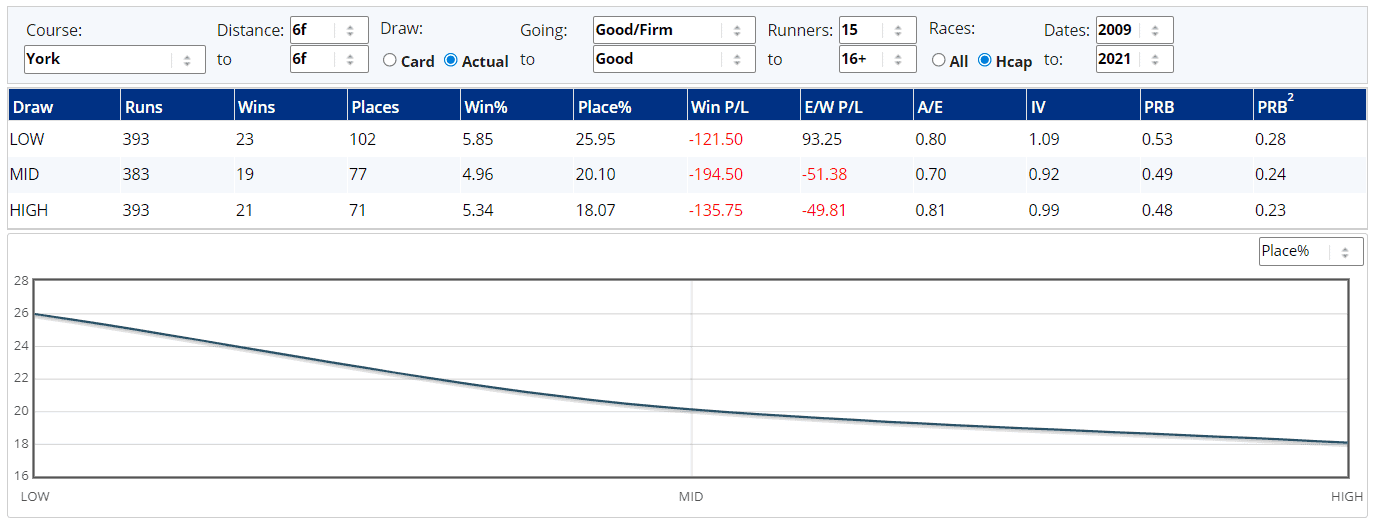
Is it going to be low, middle or high for this big sprint handicap?
There is only a relatively small sample size here but I’m keen to keep the filters as they are for this. On softer ground there can be much more of a bias towards the higher drawn horses so that could skew the data for likely going conditions on Saturday. I also don’t want to reduce the number of runners as the fewer runners there are, the further the lower numbers will be from the far side rail.
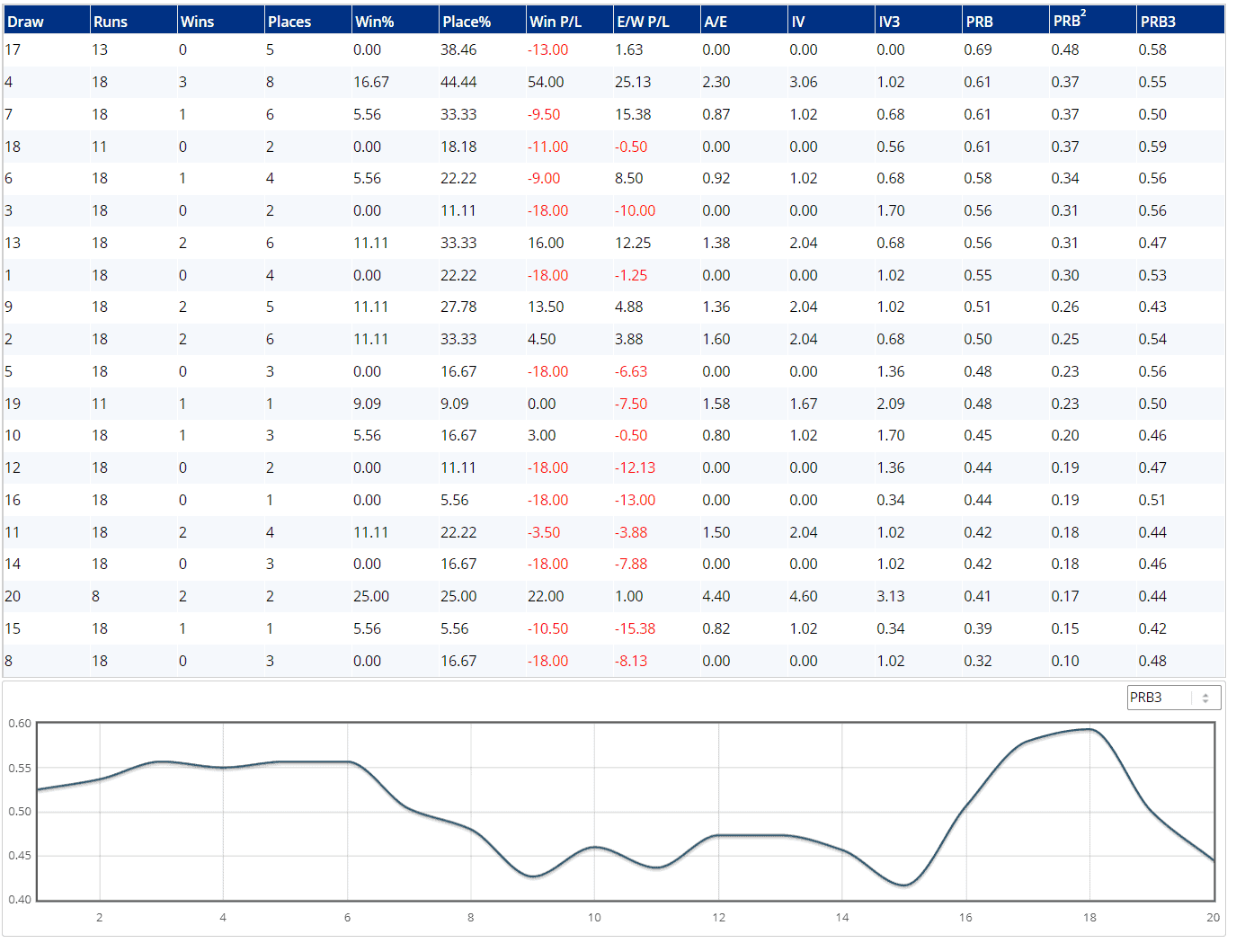
So on to the data sample we are presented with. More winners come from the middle but we’re not really concerned about the winners here as it’s a small sample. The place data suggests Low and middle have the edge (very little in it) but the PRB data, which makes the most of our small sample as every runner contributes to this metric, has low out in front at 0.54 with middle and high both slightly disadvantaged at 0.48.
So how can low draws be best if the last five winners of this race have been drawn 17, 15, 19,10 and 13 and the last five winners of the consolation race have been drawn 18, 14, 20, 20 and 16? That looks like a real bias AGAINST the low draws.
Winners are a small sample but it looks like a high draw is best from this more recent data. Even if you look at the sample of races used above but only from 2016 the PRBs for low and high are still both the same (0.52).
When the data doesn’t quite make sense it’s best to watch some course and distance races back. The last time this race was run on good ground was 2018 and in the consolation race they all came stands’ side (high) with stall 14 winning on the rail and stall 1 finishing runner up despite tracking across the course. In the main race they split into two groups and although stall 19 was successful (once again on the near side rail), the 2nd and 3rd were drawn 7 and 4 and raced on the far side.
The previous year this meeting was also run on good ground. In the consolation they split into two groups with stall 20 winning on the rail (yet again), pulling clear with stall 17 and after that pair it was pretty even between the two sides. In the main event that year they split into two groups and the winner was stall 10, who went far side, but there was again very little between the two groups.
So what my eyes are telling me, admittedly from a small (but very relevant) sample, is that they’ll probably split into two groups, being bang on the near side (high) rail usually leads to a strong performance and if they do split into two groups there can often be very little between the two sides.
Based on what I’ve seen I’m expecting the individual stall data to show that very high draws do well, very low draws do pretty well and the middle performs less well.
The four best individual stalls for PRB are 17, 4, 7 and 18. That means two of the highest four stalls are in the top four best stalls. Stall 20 performs less well for PRB but it’s the most successful stall for win percentage with 2 winners from just 8 runners. The most wins have come from stall 4.
Most of those stalls mentioned above were pretty high or pretty low and the PRB3 line graph below the table shows a spike in performance amongst the highest few stalls and also a strong performance from the lowest six stalls.
Lots to weigh up there but it seems the near side (high numbers) are more likely to be advantaged than far side (low numbers) but in all probability there will be very little between the two sides. Being drawn nearer to either rail looks an advantage but nothing can be 100% ruled in or out solely because of the draw.
Pace
Ripon is often a front runner’s track, will that be reflected in the data?
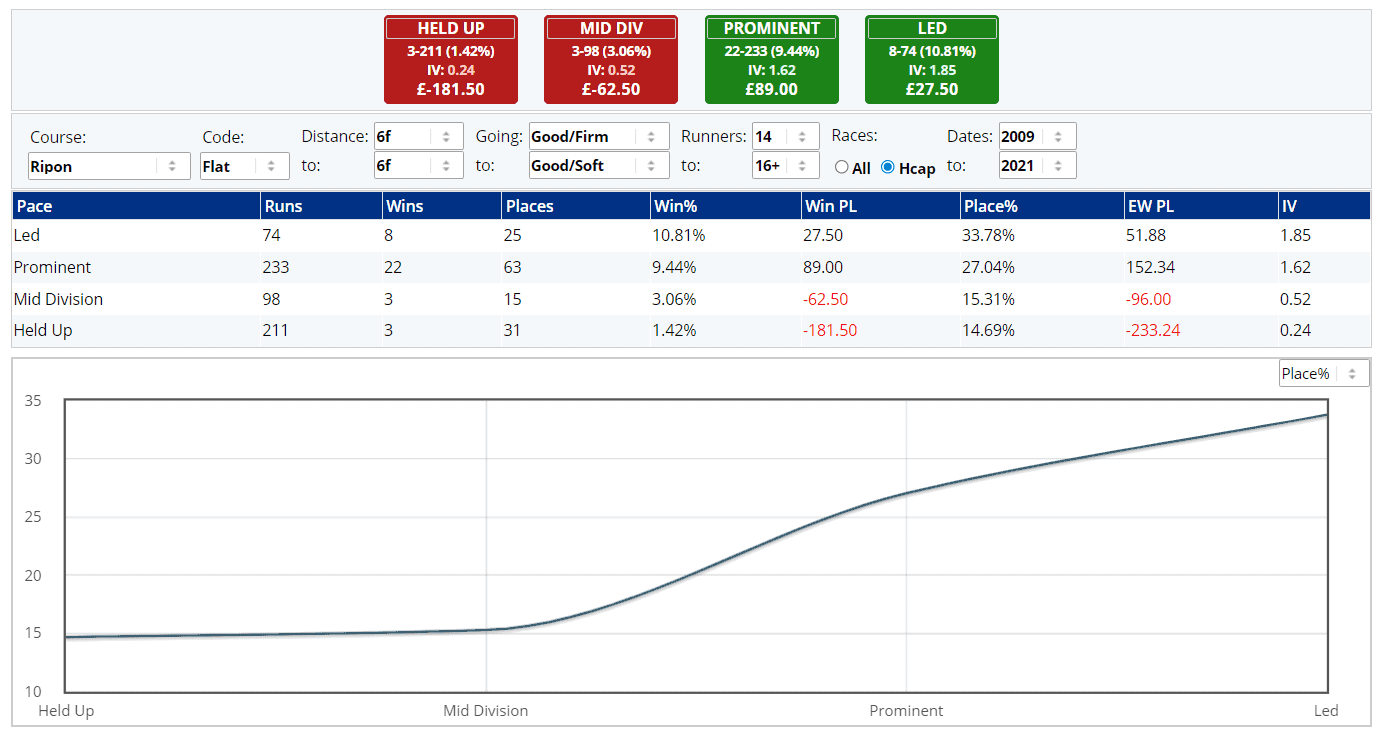
I’m happier to relax the filters a little for pace compared to draw in order to get more data and we see a pretty strong bias here.
A huge 30 of the 36 winners have been front runners or prominent racers. Prominent racers perform best of all for win purposes but front runners have the best place percentage (33.78%) compared to prominent (27.04%). Once again returns for those more patiently ridden drop quite dramatically with a place percentage of 15.31% for mid division and 14.69% for held up.
I said I wouldn’t completely rule anything out because of the draw but I would be very reluctant to back anything that isn’t going to be close to the pace in this. Generally speaking, in 16+ runner sprint handicaps, there will be plenty of pace angles but the pace is still holding up well here.
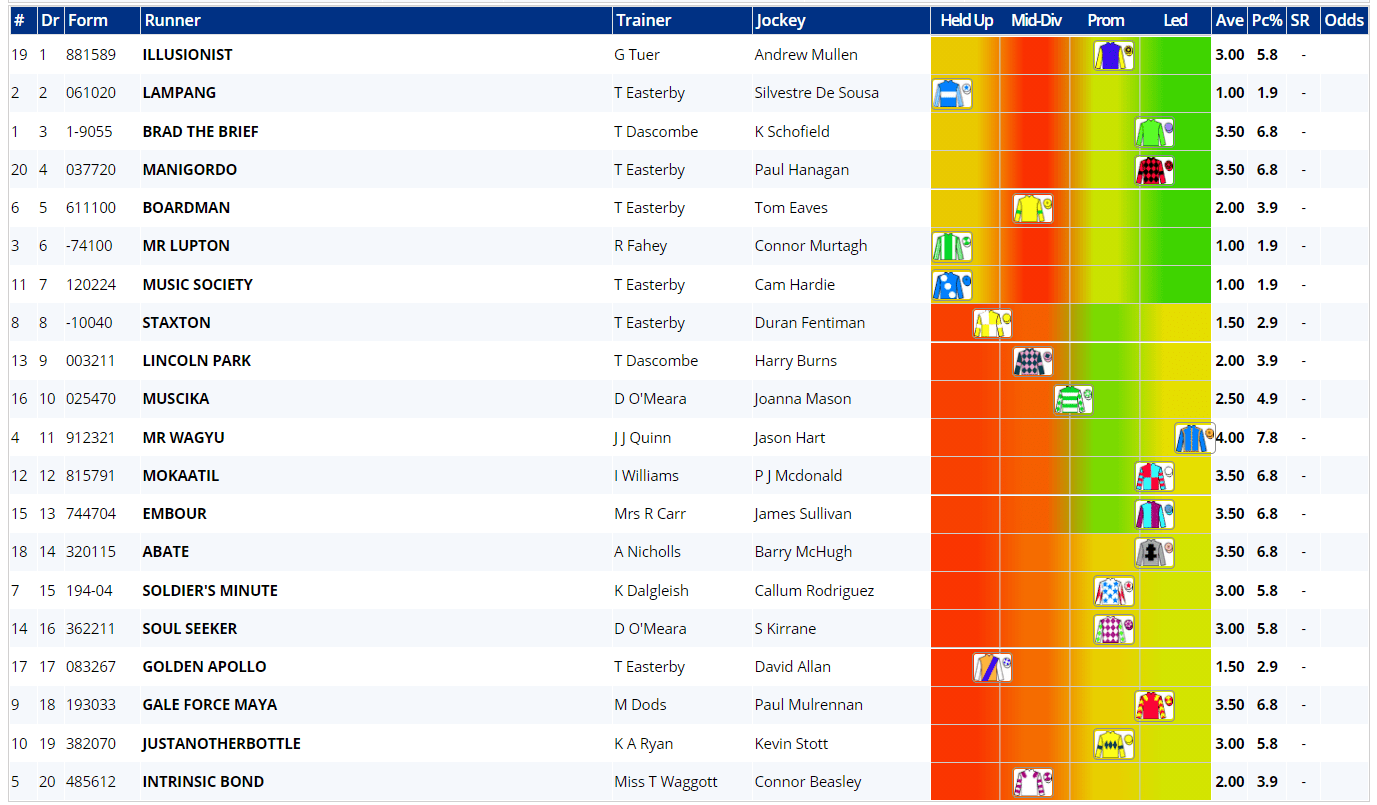
Great St Wilfrid Handicap Pace Map
Plenty of pace angles in this so they could go fairly hard early on and many could be well placed. Given the amount of pace angles it could pay to be handy rather than an out and out front runner.
The quickest of these early on could be Mr Wagyu who has been hugely progressive this season. He’s all pace and should lead overall early. He’s drawn in the middle though so you can’t be sure which side he will go.
Pace and Draw Combination
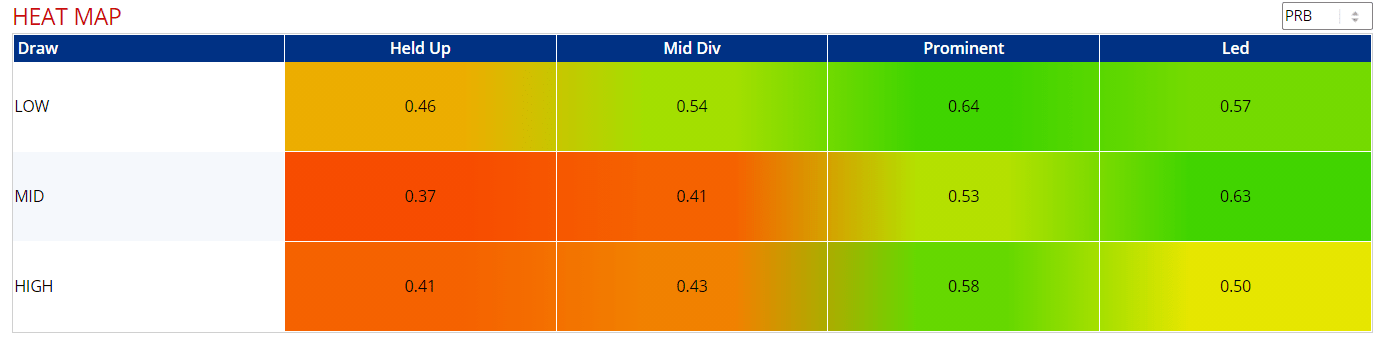
With some strong pace biases on show and draw biases in the mix too the draw and pace combination heat map should make for interesting reading.
Slightly surprisingly the best pace and draw combination is leading but leading from the middle. This is perhaps the best way to get a good early position from what is probably not a good draw in most cases.
Middle drawn, patiently ridden runners do very poorly and it seems it’s easier to make up ground when drawn low rather than high. It’s difficult to pinpoint why that might be but it often seems that slightly more runners go near side (high) than far side (low) when the fields split. This would mean hold up performers could meet more traffic on the near side (high) than the far side (low) giving lower drawn hold ups a clearer run more often than not.
The Runners
Here are the runners for the 2021 Great St Wilfrid Handicap, in early odds order.
Staxton
Made all on the near side rail in this last year on good to soft ground. He’s won his last three visits to this venue, including on good to firm in April, and his overall form figures here read 235111. When 5th he was still 2nd in his group. This year he is drawn in stall 8 which might be a little more central than ideal.
He clearly goes very well at this venue, it’s just a question of handicap mark and current form. He followed up his last course and distance win with a couple of lacklustre runs but then he was 4th, not getting a clear run, in a very strong renewal of the Scottish Stewards’ Cup (winner won the Goodwood Stewards’ Cup, 3rd won the consolation race, runner up was beaten a short head next time in a hot York handicap). He’s now 1lb lower than that effort and 1lb higher than his last win here so he’s clearly very feasibly handicapped. He ran just about okay in the Stewards’ Cup consolation race last time out in soft ground, that run was largely in line with most of his recent soft ground form.
He’s clearly got a lot going for him, his draw is probably the biggest negative but it can certainly be overcome.
Mr Wagyu
He was 7 lengths ahead of Staxton at Goodwood when winning the Stewards’ consolation race but he was only half a length ahead in the Scottish Stewards’ Cup and Staxton is now a full 12lbs better off. He’s got a great run style for this course but has run poorly here on his last three visits, to counter that though he won his previous two runs here before that so he clearly handles the course. The suspicion is he is going to struggle to confirm form with Staxton here with this course playing to that rival’s strengths perfectly.
Soul Seeker
He's won his last two races but both of those runs, and his two other wins, came at 5f. He’s quite tactically versatile and you couldn’t be too sure how he’ll be ridden but with the step up in distance in mind he could be ridden a little more patiently than usual and that might not suit this course as well. He’s capable of further progress but probably at the minimum trip.
Music Society
He's been progressing nicely and he was beaten just a nose in the hot Scottish Stewards’ Cup but he’s now 8lbs higher here. He’s only 4lbs higher than when beaten a short head at York and isn’t completely handicapped out of this but the biggest problem could be his run style. He likes to be held up and that’s probably why he’s without a win in three attempts here.
Lampang
Certainly not the most consistent and added a slow start to his resume last time out in the Stewards’ Cup (ran okay given his start). He’s tactically versatile when he breaks on terms and did win easily on his only visit here (odds on in a novice) but he’s not really reliable enough to justify his place in the market. He is three from four on turf away from soft ground though and was found to be coughing on his one flop so is potentially interesting on that basis.
Lincoln Park
Another likely pace angle, his last three turf wins have all come at Chester and he seems ideally suited to both that course and ground with plenty of cut in it. He shouldn’t get his ground, has been beaten in all twelve runs when rated 86 or higher (rated 88) here and looks a bit too short.
Boardman
Won three races with ease earlier this season but those wins came at 7f and he’s paid for that with his handicap mark. He’s probably looked more out of form than in the grip of the handicapper on his last two runs which is quite worrying and the drop back in trip isn’t guaranteed to suit, certainly at this course where his run style won’t be favoured.
Embour
He's certainly competitive from this kind of mark as he won off a 3lb higher mark on seasonal debut. He also ran well enough last time out when only beaten just over a length, not suited by a speed test over a furlong shorter at Musselburgh. His prominent racing style should suit this course (never run here before) but all his wins have come in far less competitive races than this and he’ll likely be vulnerable in this company, for all he could run well enough. Minor places might be a good result for him.
Gale Force Maya
Yet another who is often near the early pace and she was beaten just half a length here last time out, albeit in much easier race than this. She’s looked in the grip of the handicapper since winning at Doncaster in April, she’s been beaten off this mark of 92 in all five runs since.
Intrinsic Bond
Went backwards in the spring after a promising seasonal debut but everything came together when winning easily at Catterick two starts ago. Proved this sort of mark isn’t beyond him when beaten just a neck here last time (just ahead of Gale Force Maya), not seen to best effect held up. He made the running when winning at Catterick and a return to more forceful tactics would be a big help here but he might want a little bit of cut in the ground to be very competitive at this level.
Mokaatil
A three time winner this season and still 14lbs lower than his career high mark. He had nothing in hand last time out though and all his wins this season have been at this minimum distance and he’ll likely prove vulnerable back up at 6f.
Mr Lupton
A very in and out sort, summed up by winning a competitive handicap at York three runs ago (often runs well there) followed by barely beating a rival in two starts since. Difficult to catch right and won’t be as well suited by this venue as many others.
Soldier’s Minute
Goes very well at Kempton and York and no reason why this course shouldn’t suit. He’s still 2lbs above his last winning turf mark despite a losing run of 13 on the surface. He’s been in poor form so far this season and is perhaps being laid out for the Ayr Gold Cup if anything (has run well in defeat in the last two renewals).
Golden Apollo
Everything looked in place for a big run at York two starts ago so it was disappointing he could only manage a 6th behind Music Society. He followed that up with an equally disappointing 7th at Doncaster, not running terribly but still never looking like winning. He ran okay in this last year considering his run style doesn’t really suit the course and he met trouble in running but he’s going to have to improve plenty on recent showings to overcome a likely pace bias.
Abate
Disappointed at York a few starts ago but bounced back from that with two wins, both in small fields. Those wins have cost him a 10lb rise in the weights though and he was put in his place last time out off a 1lb lower mark. Runs off a career high mark and doesn’t look well enough handicapped to figure.
Brad The Brief
Needs to find improvement based on both handicap runs to date, for all the last one came a year ago. He’s paid for a heavy ground Group 3 win in France and hasn’t been in much form this year so difficult to see him bouncing back on faster ground. Another that should be up there early.
Manigordo
Sprang a shock when winning at 25/1 at Thirsk in April and has largely struggled since, although he ran a decent 2nd a month ago at Redcar. That was in a much less competitive race than this and he’s run poorly again since. He’s shown he can bounce back from poor runs but he’s inconsistent and even his best form probably leaves him with something to find here.
Justanotherbottle
He's all pace and has only ever won at shorter trips. Well enough beaten on his last two starts and will need to bounce back to form (and find extra stamina reserves) in first time blinkers.
Muscika
Talented but hard to get right. He’s run well here on several occasions in the past without winning in six attempts. Well handicapped on several pieces of form, even this season, but he should have been able to run better at York last time and he’s not one for maximum faith. Wouldn’t be a complete shock if he did run well though.
Illusionist
He hasn’t been at his best on his last three starts but he has run as though in form, he just needs much softer ground. He’s still unexposed at this trip but the ground will probably be fast enough here and he’s one to look out for when the rains return after he’s dropped a few more pounds.
The Verdict
Not many I fancy here to be honest and I’m struggling to make a case for any at bigger prices. Golden Apollo will enjoy the pace setup and has run well here before but seeing him ending his losing run here seems unlikely. He may end up doing best of the hold up horses though.
The form picks at this distance surely have to be Mr Wagyu, Music Society and Staxton. This trio were all in the first four in the hot Scottish Stewards’ Cup and whilst Mr Wagyu and Music Society have advertised that form since, and paid for it in the handicap, STAXTON finds himself running off a 1lb lower mark and should have few problems reversing that form with these two rivals, especially at ‘his’ track.
He was held up in that race, which wouldn’t suit here, but he’s been ridden prominently in every other start this season and in all runs here at Ripon so expect to see him handy here. He doesn’t need to lead, and probably doesn’t want to with all these front runners in the line up, so chasing the leaders will be optimal. He can go either side from his draw, so if the consolation race 35 minutes earlier suggests near side is the place to be he’s not committed to going far side from stall 8. We’ve seen in the past that even those on the ‘wrong’ side still often place so whichever side he goes he should have few problems placing at the very least making him a very solid each way bet, even as ‘short’ as 7/1.
https://www.geegeez.co.uk/wp-content/uploads/2020/07/Ripon_Racecourse.jpg319830samdarbyhttps://www.geegeez.co.uk/wp-content/uploads/2022/10/geegeez_banner_new_170x78.pngsamdarby2021-08-13 07:53:452021-08-13 07:53:45Great St Wilfrid 2021 Preview and Tips: Course Specialist Can Strike Again
For the first half of my working time in Fleet Street, life was still very much as it had always been in the early years after World War 2, writes Tony Stafford. Initially the BBC was the only Channel either side of the hostilities but then, in 1955, ITV brought in the first commercial opposition and nine years later BBC2 came on stream.
The dailies had combined sales well into eight figures at the start of the 1960’s and I remember there were THREE London evening newspapers. Every Saturday the paper man came round with the “Classified” edition where the football results magically appeared in the “fudge” – stop press -minutes after the matches finished. Every paper boy on the street corners in Central London called “Star, News and Standard”, always in that order until the Star disappeared in 1960, as we and our dads queued to find out what had happened to our team.
New (as we knew it anyway) technology was anathema to the print unions in those days and the internet and social media were half a lifetime away.
As I said, newspapers were the principal provider of news: households without television exceeded those homes with the big piece of furniture and its tiny screen of hazy black and white (grey really) pictures in the corner of the living room.
In those days, when we got to August everything shut down as politicians, journalists, schools and many big industrial factories went on holiday. Back in Fleet Street for those left behind, and then later when the two ‘new’ channels were well established, we had what was universally known as the “Silly Season”.
Suddenly editors were looking for quirky stories of the famed “man bites dog” variety. Reporters were dispatched around the country for the oddest and unlikeliest events which from September on wouldn’t have seen the light of day.
In many ways British horseracing has been mired in a similar tradition perhaps more firmly than its other major competing nations in Europe. The silly season has not really been possible yet this year with the pandemic still extending its grip and the Olympic Games 2020 going on for the past fortnight in Covid-strangled Tokyo. But there’s still time!
Between Goodwood (concluded on July 31 this year) and the end of August only the four days of York interrupt the ordinary sausage-machine offerings, weekends of valuable handicaps apart. One welcome innovation this year has been the William Hill Racing League where a dozen teams of four trainers, each calling on a squad of 30 potential runners and with three jockeys attached to each team, compete in six races on six consecutive Thursday evenings. Two have been contested so far.
With £50,000 available from each race, the idea seems to owe much to the successful 22 years of the Shergar Cup, the latest edition of which at Ascot on Saturday was won by the women’s team headed up by Hayley Turner and starring Nicola Currie and French sensation, Mickaelle Michel.
Any boost to prize money is welcome though an initial look at the type of trainer capable of compiling a team of 30 is obviously one for the already-haves rather than wishful-thinking have-nots.
But say a Newmarket trainer has an 80-rated horse that might be running for a £5k or so first prize in the normal run of things, it can be in line for a £25,000 first prize in the Racing League. Thirty-six handsome prizes among the thousands of embarrassingly unrewarding ones only fix one leak while water continues to escape from the rest.
Just three highlights at York – the Juddmonte, Yorkshire Oaks and Nunthorpe – carry Group 1 status, but that still exceeds Ireland’s single Group 1 in the month, the Phoenix Stakes, staged yesterday at The Curragh.
There were two more Group 1 races across Europe yesterday, the Grosser Preis von Berlin over a mile and a half at Hoppegarten and Deauville’s Prix Maurice De Gheest over six and a half furlongs. That was the first of four races at that level during Deauville’s holiday season, but throughout the month the programmes are of a higher quality than anything we have here as Chantilly goes to the seaside.
There is a received understanding that good sprinters in France scarcely exist, its proponents pointing to the UK domination of the Prix de l’Abbaye on Arc Day each year. Only four French-trained horses have won the five-furlong dash in this century, namely Imperial Beauty (2001), Marchant D’Or (2008), Whizz Kid (2012) and Wooded last year.
When the three home-trained sprinters/seven-furlong horses lined up for the Maurice De Gheest yesterday, they were respectively on offer at 9-1, 92-1 and 69-1 in face of potentially strong opposition not just from the UK and Ireland but also the Wesley Ward-trained Golden Jubilee promoted winner, Campanelle.
That filly ran an awful race, finishing last, while Starman, winner of the July Cup at Newmarket last month and the 9-5 joint favourite with the Ward filly, ran third, to two of the home team. Well behind was an assortment of Group 1 and 2 winners and the recent Wokingham hero, Rohaan.
But at the head of the race, a relatively unheralded horse that had won each of his previous six races this year stormed away from the field to win comfortably. Marianafoot, a six-year-old entire, owned by his breeder M Jean-Claude Seroul, was making it eight wins in a row since mid-December and was providing another reminder of the talent of his 35-year-old trainer, Jerome Reynier, who is based in Marseille.
Reynier has been training in his own right for eight years and in 2020 climbed into the top ten trainers’ list in France for the first time, owing much to the exploits of another six-year-old, Skalleti, also owned by M. Seroul.
He had a Deauville win over an under-ripe Sottsass, subsequently winner of the Arc, and this year has won four in succession including two Group 1 races at home and in Germany.
Reynier is a self-confessed racing nut who recalls that, aged 14, he used to make little contribution in his classroom as he was usually busy studying bloodstock sales catalogues. Little wonder that he was a winner of a Godolphin Flying Start award in 2008. A period as a bloodstock agent buying for his father, also a racing fanatic, preceded his taking the plunge eight years ago.
The €300,000-plus first prize (including owner’s premium} strengthens his place in fifth in this year’s trainers’ table and he is in rarefied company.
Leading the charge in his customary private battle with Jean-Claude Rouget is Andre Fabre with 78 wins worth €3.9m from 130 horses. Rouget has 97 wins from 131 horses and trails Fabre by close to €300k in prizes. Fabre provided yesterday’s runner-up, the filly Tropbeau, who, unbelievably given her connections and her fourth in last year’s French 1,000 Guineas, was the 92-1 chance mentioned earlier.
The Maurice De Gheest was the twelfth Group 1 race to be contested in France in 2021 and Aidan O’Brien has won five of them from 11 horses. That is enough to put him just behind third-placed Frank Rossi who has needed 135 horses and 68 winners to keep his nose in front of the Ballydoyle maestro, now fine-tuning his York team which will include St Mark’s Basilica and Snowfall. Jerome Reynier, still in his mid-30’s, is a very solid fifth and destined to go higher with the top two no doubt feeling the long-term draft from behind.
The Brits played a minor role in France but two big wins for Newmarket stables in Germany and Ireland proved that if the races aren’t to be found at home, “have horsebox, will travel” is still the mantra.
Sir Mark Prescott sent two of Kirsten Rausing’s home-bred fillies to Hoppegarten, a track bought in 2008 by an old acquaintance of mine Gerhard Schoeningh. He was based in England around the turn of the century and, after asking me whether I could introduce him to Sir Henry Cecil, had some nice winners with him.
Hoppegarten, in what was the old East Berlin, is the only privately-owned racecourse in Germany and has been brought back to its former prominence by Gerhard. The big race, the Grosser Preis, went to Prescott’s smart four-year-old Alpinista and Luke Morris who had Godolphin’s Walton Street back in third. Additionally, Prescott’s Alerta Roja finished second in a Listed race on the card.
One of the enduring mysteries of the international breeding business is just how Tony O’Callaghan’s Tally Ho Stud can continue to produce stallions that immediately out-perform what might reasonably be expected.
We all know about Kodiac, now at €65k a pop after producing a string of high-class performers over the past decade, but how about Mehmas? Available at €7,500 last year having entered the stud at €12,500 but, after his first crop ran away with the first-season sire title, he was upped to €25k for this year.
Tally Ho has two interesting first crop sires this year, and both were available at a covering fee of €5k. Cotai Glory is far and away the leader in his division with 18 individual winners. Heading his list is the brilliantly-fast Atomic Glory, already twice successful with ease in a Group 3 and then Group 2 in France for Kevin Ryan. Atomic Glory looks an obvious favourite for the Prix Morny (G1) later this month at Deauville.
Tally Ho’s other €5k bargain is Galileo Gold, Hugo Palmer’s 2000 Guineas and St James’s Palace Stakes hero. Palmer acquired his son, now called Ebro River, for Galileo Gold’s owners Al Shaqab for 75,000gns out of Tattersall’s Book 2 last October. Yesterday the owners collected almost double that when Ebro River landed the aforementioned Group 1 Phoenix Stakes as a 12-1 shot having looked short of top-class in recent runs at the major summer meetings.
Both stallions will assuredly be moving up into the Mehmas bracket for the next covering season and with sons Roger and Harry nowadays adding youthful energy as well as brilliant talent-spotting to the legendary skills of Tony and his wife Anne, John Magnier’s sister, Tally-Ho will be on top for many years to come. They repeatedly find new stallions that suit the sort of owners and breeders who like two-year-old winners! Who doesn’t?
- TS
https://www.geegeez.co.uk/wp-content/uploads/2021/08/Marianafoot_PrixMauricedeGheest.jpg319830Tony Staffordhttps://www.geegeez.co.uk/wp-content/uploads/2022/10/geegeez_banner_new_170x78.pngTony Stafford2021-08-09 07:21:122021-08-09 07:43:25Monday Musings: Of Silly Season, Jerome, Maurice and Mariana
Let’s get this out there early – I like the Shergar Cup…
I couldn’t care less about which team of jockeys win but we are presented with six races, all with ten runners so they aren’t too hard to figure out and most races tend to be 3/1 or 4/1 the field so the majority tend to be backable prices.
The twist of course is the jockeys but in every race we should account for the quality of the jockeys. If you think a particular jockey isn’t of the required quality to back you can handicap the horses accordingly. Most years you can probably rule two or three of the ten runners out simply because the jockey has never ridden the course, ridden right handed, etc.
This year the jockey choices are very ‘safe’. The Rest of the World team includes Sean Levey, Andrea Atzeni and Kevin Stott who are hardly strangers to Ascot. The only real wildcard jockey selection seems to be Mickaelle Michel, a 26 year old French rider who has joined the Ladies Team. To be honest I’m not particularly familiar with her skills but you’d think the majority of the jockeys who are riding here week in, week out might have a slight edge on her.
I’m going to change the format of these previews this week and go through all of the races at the Shergar Cup, but in slightly less detail than usual. Hopefully I’ll be able to demonstrate that it can be a punter friendly card!
Unfortunately it is yet another weekend where we are playing guess the going due to an uncertain weather forecast. At the time of writing the ground is good but there are thunderstorms coming. It doesn’t look like a substantial amount is forecast so I’m going to assume good ground, maybe just on the easy side. If anything handles good and slightly softer that would be ideal.
Shergar Cup Preview and Tips
12.50 – Shergar Cup Dash – 5f
The draw isn’t going to have much of an impact at this meeting with the ten runner fields, especially on the straight course with the stalls positioned in the centre. Pace will have an impact in all races so let’s take a look at the pace map for this one.
The first thing to note here is that two of the pace angles, Mokaatil and First Edition, are both reserves for this race and will only get a run if there are non runners. This means King Of Stars may well get an uncontested early lead. It can be difficult to make all on the straight course at Ascot but it is far easier to do so over the minimum trip so don't write off front runners here. King Of Stars will be one that wants the rain to stay away and he’s been beaten off 7lb and 5lb lower marks recently on his favoured ground so whilst he should fare better than at Goodwood, he may be unlikely to take advantage of an easy lead.
Count D’Orsay would be fairly interesting if lots of rain came but he’s been disappointing in two trips to Ascot and it’s possible this isn’t his track.
It is certainly Tis Marvellous’ track.
Pretty much all his best form has come here, he was even 4th in last year’s King’s Stand behind Battaash on ground that was a bit softer than ideal. Having run well here in a big field handicap last month on ground that was again slightly softer than ideal (probably similar to how it will ride here) it was disappointing he wasn’t able to add to his Ascot record last time out when the ground was in his favour. There didn’t seem any excuses that day but there has to be a suspicion that wasn’t him at his best. It would be easy to suggest he’s not been at his best this season but on seasonal debut he was just behind Came From The Dark (now rated 7lbs higher), Garrus (now rated 6lbs higher) and King’s Lynn (now 14lbs higher) and that run came away from Tis Marvellous’ beloved Ascot off a 1lb higher mark. The less rain the better his chance.
Stone Of Destiny is capable on his day but predicting which is his day is becoming increasingly difficult. He has a slightly disappointing strike rate for one of his ability and he’s only placed once from six handicap runs on triple figure marks so he’s opposable enough. He ideally needs a very strongly run race.
Tone The Barone has an impressive strike rate and has won twice over course and distance from three attempts. He’s been off since April for an unknown reason but has won off this sort of absence before. He was in decent enough form before his break (won over 5f and then didn’t stay 6f). Goes on good ground but probably wouldn’t too much rain.
Snazzy Jazzy is well served by deep ground and further so his run over 5f at York on good ground in listed company last time has to be considered very promising. This stiffer track will suit but it probably won’t be stiff enough unless they get a lot of rain.
Desert Safari ran twice at Glorious Goodwood and caught the eye on both occasions. The ground was probably a bit softer than ideal when he ran over 5f and then he found 6f a bit far in the Steward’s Cup. He’s not been the most consistent this season but is definitely in form, it’s just a case of catching him on a going day. He is however still completely unexposed at 5f on turf and unbeaten in that scenario away from soft ground (from one run).
Summary
Not the deepest of races and TIS MARVELLOUS ticks an awful lot of boxes. He probably doesn’t need to improve on his last two recent efforts here to take this and he’s tactically flexible. If backing him it may be best to wait until it looks like the ground shouldn't be too bad.
There are a lot of ifs and buts about the rest. Desert Safari and to a slightly lesser extent Stone Of Destiny could go close if on a going day, the former makes more appeal of that pair. Tone The Barone could be a big danger if fit after a break whilst King Of Stars should run well if there is very little rain.
If it was more testing than expected then perhaps Snazzy Jazzy and Count D'Orsay would be the ones to concentrate on as most of the market fancies seem to want decent ground.
1.25 – Shergar Cup Stayers – 2m
Here’s the pace map for this contest, and there isn’t seemingly a whole lot of pace in this race so it may not be a severe stamina test.
Hochfeld looks most likely to go forward with Call My Bluff potentially happy to track the Mark Johnston runner. It would be no surprise to see this develop into a bit of a sprint finish so a stayer with a bit of speed might be best here.
The two most likely pace angles fit that bill to a certain extent but Hochfeld is inconsistent and his better runs this season haven’t really worked out whilst Call My Bluff will want a lot of rain, potentially more than they get.
Uber Cool looks likely to go off favourite. He returned from a whopping 959 day break at Chester in May with a comfortable victory and a long break since (70 days) has presumably been the plan in an attempt to avoid the dreaded bounce factor. The ground doesn’t seem to bother him whichever way it goes and he’s won an impressive seven of his fourteen starts. He’s 4lbs higher than when beating Elegiac in 2018 and that runner quickly went up 10lbs in the rating so he looks well handicapped from that run. He has been beaten three of the four times he’s raced at two miles or further thought, but he has won over this trip at Goodwood (just held on) and this might not be too much of a stamina test, especially if there isn’t lots of rain.
Island Brave won this race last season but that was a shock, he’s 6lbs higher here and hasn’t been in as good form this season. He was 4th in the Northumberland Plate last time out but that was a different surface and the form hasn’t worked out.
East Asia seemingly improved for the switch to turf this season and won three on the trot on ground ranging from soft to good. He isn’t as good on the all weather so is forgiven a flop at Newcastle next time but he bounced back to form over two furlongs shy of this trip on the fastest ground he’s encountered to date. That was a hotter race than this and he should improve for slightly easier ground and the step back up in trip here. He might not be done winning yet and whilst he should be okay on good ground, any more rain will help him further.
Indianapolis is a horse I selected in these previews a couple of weeks back at Newbury and he ran well enough in fifth given he was given too much to do. A return to a more prominent ride should suit and not only has he won at this meeting before, he was also in good form here two starts ago on good to soft ground and the winner and runner up have both come out of that race and run very well. Might not quite be up to winning but looks likely to be in the shake up.
Summary
Uber Cool is probably the one to beat but he might not want this to be too much of a test and he’s clearly been difficult to train so has become a riskier betting proposition.
I’s rather back either EAST ASIA or Indianapolis each way with the former making a bit more appeal as a likely winner. I respect Uber Cool enough to probably include him in some forecasts and tricasts with the other pair.
Call My Bluff would definitely be considered on good to soft or worse but even then East Asia is just as comfortable on that ground and possibly still better handicapped so an each way bet on the selection seems a safe play.
2.00 – Shergar Cup Challenge – 12f
Another pace map to look at, this time racing over 12f.
Torcello would be the only guaranteed pace here except he’s not guaranteed as he’s 2nd reserve and needs two non runners to get a run. Restorer did make the running on his penultimate start but normally tracks the pace so Group One Power could be the one who goes on. He has led early on his last three runs at this trip. It seems unlikely they’ll go hard so tactical speed and/or a prominent position could be important.
Sam Cooke had been struggling with keenness in his races but seemed to settle better in a hood last time out and ran his best race for some time as a result. He was a length and a quarter behind Group One Power that day at Chester and is 1lb better off here. He’s run well here before, is still lightly enough raced and has leading form claims. He might not settle if they go a slow gallop though and he'll want a fair bit of rain to fall to be at his absolute best.
Group One Power probably wouldn’t have beaten Sam Cooke last time out had that race been run over this trip instead of half a furlong shorter. He might have gone a little fast early in that race though as the other runners that were prominent early finished 6th, 7th and 10th, so to be beaten just half a length was a sound performance. He should be well placed in this and has run well here before twice. Joe Fanning is probably a lucky jockey draw given he knows very well how to set the fractions from the front.
HMS President ran on Thursday so could be a non runner in this. He ran well in a strong race at Windsor over half a furlong shorter on his penultimate start but didn’t conclusively prove his stamina that day. He’s not badly handicapped and was in good form on Thursday but could be found wanting late on if he does turn up here, for all he’s respected.
Spanish Kiss won a very hot York handicap in May (2nd, 3rd, 5th and 6th have all won since) but he too has won again since, by a wide margin, and now finds himself 16lbs higher. He ran okay here in a decent race a few weeks ago but dropping back in trip might not be ideal plus the handicapper might now have him.
C’Est No Mour seems overpriced given he’s won two of his last three and was a little unlucky last time out. His win at Goodwood in June has worked out well with the runner up and 3rd both winning next time out. C’Est No Mour is only 4lbs higher here but that was over two furlongs further than this. He’s won on anything ranging from good to soft up to good to firm but is probably better on faster ground. He’s fairly handicapped but hasn’t placed in four runs here and his run style may leave him vulnerable here.
Summary
Much will depend on the ground here. GROUP ONE POWER is better than the bare result of his last few runs and could get a very easy lead in this for a good front running jockey. If the ground goes to good to soft Sam Cooke would probably be preferred whilst C’Est No Mour will probably be seen running on too late.
2.35 - Shergar Cup Mile – 1m
The pace map for this race, which is on the round course, not the straight course.
Corazon Espinado is the most likely pace angle but he’s a reserve for this and needs two to come out so he’s unlikely to get a run. In his absence Lord Rapscallion could lead but he’s not a guaranteed pace maker. Data Protection often makes the running but he was held up last time out and this is a shorter trip than he usually races over so he might not have the pace to lay up with them here. Vintager often only tracks the pace so he might not add much to the early speed meaning we are probably looking at no better than an even pace.
Dance Fever is the relatively warm favourite after a 3rd place in the much more competitive International Stakes here last time out over 7f. He’s up another 4lbs here, will be racing on slower ground (he’s been kept to very fast ground in his career so far) and has been beaten in both starts over a mile. Hopefully the rain doesn’t cause him to become a non runner because he’s opposable and helps make the market.
Dashing Roger likes to race prominently and enjoys plenty of cut in the ground. He bounced back to form two starts ago, winning at Sandown. He went up 6lbs for that but the runner up has won since. He was 3rd off a 1lb lower mark on good to soft last time out, the winner was 4th in the Golden Mile at Goodwood and the 4th won a competitive handicap there with ease so that was pretty strong form. He’s maybe slightly in the grip of the handicapper now but should run very well again from a decent early position if the word ‘soft’ appears in the going description.
Vintager has hit form in his last couple of starts but he won a fairly poor race at Windsor and then was a little unlucky on his latest start in an average race. If the ground doesn't soften much he could run okay. Of much more interest at a bigger price would be course specialist Raising Sand. He won this race comfortably back in 2017 and has four wins and a further four places at Ascot. It had looked like age had caught up with him until cheekpieces went on in the Buckingham Palace Stakes in June. He was drawn on the wrong side that day but still finished 6th overall and he ‘won’ on his side, finishing ahead of ten other runners. Last time out he ran in the International Stakes and he was 8th, 3rd in his centre group. He’s now 5lbs and 3lbs lower respectively from those races and crucially will get easier ground here. He’s never won on good to firm ground and those recent efforts are probably as well as he’s ever run on fast ground. He's now 12lbs lower than his highest mark (two years ago) and 6lbs below his last winning mark. He's raced more prominently than usual in the cheekpieces and that should help here.
Ouzo ran a very good 4th here in the Royal Hunt Cup and never got a clear run so could be marked up but he was perhaps flattered by racing close to the stands’ side rail that day as that looked easily a career best on ground that would have been plenty fast enough. He didn’t back that up next time out when behind Dashing Roger at Salisbury. He’s only 2lbs higher than when winning at York last season but he needs very soft ground to be at his absolute best.
Summary
RAISING SAND looks a pretty obvious one and I’m surprised, given his Ascot record, he’s not much shorter in the betting. Good to soft might be absolutely perfect over this trip but even good ground should be enough for him to go close. On good ground Vintager could be the one who gives him most to do.
If the word ‘soft’ did appear in the going description Dashing Roger would be worth including in a forecast whilst Ouzo would come into the reckoning if it did get very testing.
3.10 – Shergar Cup Classic – 12f
Here's the pace map for this 3yo race.
This could be the most truly run race of the day with three last time out leaders and another that has made the running in one of their last two starts. There are no reserves in this race.
Mark Johnston has a total of three entered in this, including State Of Bliss. That runner ran a blinder in what should be a warm Goodwood handicap but that was his fourth second place in six runs. He’s still lightly raced but is beginning to look like one of those that struggles to get its head in front. Johnston did win this in 2019 with a similar type though. Annandale almost certainly wants further and Harlem Soul needs to bounce back from two poorer runs.
Barn Owl is the early favourite. He scrambled home in a Ripon novice in June but that form has been franked with the runner up, who got 5lbs from Barn Owl, winning a handicap since. That runner up is now rated 82 so Barn Owl probably isn’t badly treated off 84. He looked like this trip might suit when runner up at Sandown on seasonal debut but that didn’t look a strong race and rain probably wouldn’t suit (withdrawn on good to soft at Goodwood).
Possible Man won a decent novice in December but he’s had some limitations exposed since then. He did win last time out off just a 1lb lower mark, just beating State Of Bliss who is 2lbs worse off here so unlikely to reverse form. Stamina doesn’t look guaranteed and he was last of four when facing soft ground so rain is unlikely to help him either. Seems to be one to take on.
Sky Cutter seems quite a tricky type who gives trouble before races. He’s proven over this trip and on ground with some cut in it (he’d probably want lots of rain) and has finished runner up on both starts in the UK, for all the form of those races doesn’t look anything special. He was given an enterprising ride last time out and almost got away with it but he’s likely to have more competition for the lead here. One of the more proven runners at the very least.
Star Calibre couldn’t take advantage of weight for age against elders here last time out over two miles despite having the run of the race and he’s now looking a bit tripless.
Contact is more exposed than a few of these but he has a likeable profile. He enjoyed the step up to this trip at Pontefract, winning by 5.5 lengths, and although raised 8lbs for that he was still a creditable 5th on testing ground at Haydock trying 14f for the first time in what is normally a strong race. The very soft ground that day probably didn’t suit and whilst Contact should enjoy that trip again in the future, a strong gallop at this distance might be perfect for now. A good ride for Mickaelle Michel.
Summary
I’m keen to oppose quite a few of those near the head of the market in this one with some form question marks and definitely ground question marks if there is more than a little rain.
Sky Cutter seems solid, especially if the ground softens appreciably, but he needs to step up again on his previous form and he’d have made more appeal if an easier lead looked likely. CONTACT will need a bit of luck in running but if they go hard early as expected it could play into his hands and he’s take to finish fast and late at a decent price. One of the more difficult races though.
3.45 – Shergar Cup Sprint – 6f
The pace map for the final race on the card.
There are a couple of pace angles here so the race should be run at a decent clip. Bowman has looked far better on fast ground (or artificial surfaces) to date so there is the chance he is pulled out after some rain, although he’s been allowed to take his chance on soft ground before so seems likely to run and help set this up for something a little more patiently ridden.
If there is a non runner Crazy Luck would look fairly interesting. He’s shown good form with cut in the ground and bumped into another progressive sort last time out. The main reason for non runners here could be softening ground so the likelihood is if he gets a run, he’ll probably get his ground too.
Slightly unsurprinsgly though the three who are clear in the betting look those open to most progress though.
Royal Scimitar is completely unexposed at sprint trips. He won over 6f on his debut (runner up now rated 110) but raced over further until dropping back to this trip last time out in a hotly contested handicap restricted to 3yos at the July Festival. He’s 5lbs better off with Popmaster having finished a short head behind that rival in 4th but softening ground would be a concern - he’s been a non runner on good to soft and soft this season. He pulled away from his group in that Newmarket handicap in good style, only beaten by much higher drawn rivals, so could be a good thing if the rain stays away.
Popmaster’s best hope of beating Royal Scimitar has to be the rain. He seems pretty versatile with regards to the ground but is arguably better on slightly softer ground, he even ran well on heavy here during the Royal Meeting over what seems to be an inadequate 5f from a poor draw. His form in 6f handicaps reads 32231 and he’s still only 11lbs higher than when bumping into both Rohaan and Diligent Harry in a Lingfield handicap in March, that pair are now rated 25lbs and 20lbs higher respectively. He still looks feasibly handicapped, is very consistent, is proven at the course and won’t mind any rain.
If it does rain heavily Dream Composer is the potential fly in the ointment for Popmaster. He was 2 lengths ahead of Popmaster at Royal Ascot and he’s now 4lbs better off. He may have been much better drawn than Popmaster that day but he actually ended up making his challenge on the same part of the course and finished much more strongly so should be well enough fancied to confirm that form with the extra furlong looking a big positive. He was actually supposed to face Popmaster last time out at Doncaster but was a non runner because of the good to soft ground, perhaps an indication that he wants it really soft. He did seem to enjoy the heavy ground at Ascot after all.
Summary
Picking between the three favourites seems quite tricky and it has to be an extremely ground dependent decision. If there is very little rain and the ground is no worse than good then Royal Scimitar could be chanced, but even 4-5mm of rain might be too much for him to show his best as he seems to get on well with very fast ground.
POPMASTER is the least ground dependent of the trio and should run well whatever happens but ground just on the soft side of good could suit him perfectly, especially as it would probably be too slow for Royal Scimitar and too fast for Dream Composer.
On good to soft or worse Dream Composer might be narrowly favoured over Popmaster but even good to soft ground might be deemed too fast for connections of Dream Composer, even if he did win on good to soft at Carlisle earlier this term beating two subsequent winners in the process.
I’ve predicted good ground so I’ll stick with Popmaster but out of all the races on this card this is the one where the slightest going change would sway my decision more than any other so it may pay to wait until closer to the race or until the likely forecast is clearer.
https://www.geegeez.co.uk/wp-content/uploads/2019/08/HayleyTurner_ShergarCup2019_830x320.jpg320830samdarbyhttps://www.geegeez.co.uk/wp-content/uploads/2022/10/geegeez_banner_new_170x78.pngsamdarby2021-08-06 11:40:002021-08-06 11:40:00Shergar Cup 2021 Tips and Preview
After the weirdness (and, at times, tedium) of last season's concertinaed behind-closed-doors matches-every-day affair, the delayed Euro 2020 tournament has acted as a palate cleanser ahead of the return to something closely resembling normality in the upcoming 2021/22 football season.
The regular reader (thanks mum) will know this is my one-time foray into my other passion, footy, and she also knows I like to frame a bet within this virtual page. More on that in a moment but first, as is customary, how did last season's effort go?
Last Season: Nearly...
The shape of the bet has been unwavering: a perm trixie (four picks, doubles and trebles) comprised of a team for Premier League relegation, a team for Championship or League 1 promotion, and two teams for League 2 promotion (where there are three auto spots and playoff positions down to seventh).
After a total blowout in 2019/20 - it certainly won't be the last of those! - we almost got the lot last term, though it was very much a case of a first fence faller meaning we never actually had the chance of the full ticket. Here's why:
- Aston Villa 15/8 to be relegated from EPL (11th, comfortably stayed up)
- Peterborough 7/2 for League 1 promotion (2nd, automatic promotion)
- Cheltenham 3/1 for League 2 promotion (winners)
- Bolton 5/4 for League 2 promotion (3rd, automatic promotion)
The problem with this perm trixie was that Villa started in electric fashion and were all but safe by Christmas meaning the jackpot dream was sunk. That said, Bolton looked doomed early and we were hanging on for a (good-priced, in truth) double courtesy of Posh and Chelto. They got their jobs done relatively comfortably and a searing late charge from the Trotters meant we had two doubles and a healthy profit.
For the first time in these annual previews, I'm going to slightly change things up. Win or lose, I won't regret it because the shape of League Two this year is almost unplayable such is its competitiveness, on looks at least. So, instead, I'm going to risk a yankee (11 bets, doubles, trebles and a fourfold) across the four divisions. I'll be smaller staking it compared with previous years because, naturally, an extra leg involves a higher degree of risk (and potential reward).
It is also the case that nobody really knows how reliable last season's form will be given the genuinely unique nature of the truncated campaign and playing without fans, as well as financial implications left, right and sideways.
With more caveats in situ than a dyslexic tie seller, then, here we go...
Premier League Relegation
This looks competitive with at least two of the promoted sides fancied to swerve the trap door; and there are some weak-looking sides who have flirted with the drop in recent seasons. All of Newcastle, Burnley and Crystal Palace look vulnerable, which immediately suggests this may be hotly contested.
Burnley are tenacious and might benefit from getting fans back at Turf Moor more than the other pair, while Newcastle have a bit of class with the likes of Saint-Maximin and goals in Wilson.
Palace have a wantaway talisman who hugely over-performed on his career scoring tallies last year in Wilf Zaha. More than that, they have a big name manager completely unproven in the Premier League in Patrick Vieira. The Frenchman did well enough in New York and Nice, and obviously understands the EPL dynamic, but he's inherited a moderate squad in need of significant bolstering. The level of player turnover at Selhurst Park is borderline alarming, old heads replaced with young potential.
Their 14th position last season owed much to over-producing from their chances (41 goals scored versus an expectation closer to 35), and a reversion to the norm - where Blunteke and Zaha produce single-figure output - looks likely. The talented Eze is out until 2022 and, while I was impressed with Michael Olise at Reading last term, it's asking a chunk for him to hit the ground running in the big league.
It feels like a recipe for a very difficult season for Palace, all the more so if Zaha finally gets his wish to move away.
Championship Top Six
I'm going to get whacked for this, no doubt, but my team, Bournemouth, have a decent chance of promotion making odds against for a top six finish look pretty fair. I don't generally call Cherries geese swans so, while the expected loss of the classy Arnie Danjuma will be a blow, it is strongly mitigated by a fit again Junior Stanislas and David Brooks looking in great shape. Of course, they are two regular sick notes, and Dom Solanke's work for the team has been more of an asset than his finishing; but the sale of Sam Surridge means new manager Scott Parker will almost certainly be in for a striker.
The south coast outfit are very strong in midfield, with the likes of Jefferson Lerma, Ben Pearson, Brooks, Stanislas, and the soon-returning Lewis Cook bolstered by emerging talent Gavin Kilkenny. Even if the brilliant Lerma departs there is still a lot in the engine room.
Defensively, things are more concerning, especially with Parker's high intensity high press looking like we'll be a 'both teams to score' sort of outfit. Leif Davis has been signed at left back, Steve Cook is a fantastic (and grossly under-rated) player - but is injured currently, Adam Smith has signed on again having been linked with the top division, and Lloyd Kelly continues to develop. In sticks, Mark Travers may have an opportunity to assume the number one position. But there's very little in reserve: additions are undoubtedly needed.
For all that, Cherries have bundles of quality and a failure to make the top six would be seen as a very poor season.
League One Promotion
No big surprise pick here - as if the first two were - as I agree with seemingly every pundit on the planet that the combination of an excellent manager, a decent squad from last season, ambitious signings and money in the kitty from new owners makes Ipswich Town look good value to get promoted to the Championship.
Paul Cook is the man in the hot seat, stepping in for the final two months of the last campaign: long enough to run the rule over his inheritance and establish where funds required investing. Cook decided an overhaul was necessary and no fewer than 15 players have since left the club (as well as two loanees), while eleven have come in (including one of the loanees).
Macauley Bonne gets support up top from Joe Pigott (20 goals in 45 league games for AFC Wimbledon last season) and Conor Chaplin, who registered a lot of minutes - if not a lot of goals - for Barnsley in his most recent campaign. Rekeem Harper has been recruited in centre midfield: I don't know much about him but he has 44 games in the Championship to his name, including 18 last term, so this is an easier grade.
A goalkeeper, Vaclav Hladky, and plenty of defensive cover have also been added. The worry, as with Bolton last season, is that it often takes time for large influxes to gel. The Tractor Boys have been notably fast starters in the last two seasons but faltered towards the finish; it's just possible this will see the converse transpire and, if they're within eight points at Christmas, they'll be a runner.
As usual, Sunderland help make the market and, as usual, I want to be against them. They'll get the job done one of these years but, boy, are they expensive to follow.
League Two Promotion
I normally like to take two for promotion from this division given the three automatic places and the playoffs keeping us engaged down to seventh place. But this season League Two looks inscrutable. Salford, and their famous ownership, head the lists with double-figure odds available about any other you like. In truth, I don't especially like any other, a faintly credible case possible for at least a dozen teams.
Having toyed with Tranmere Rovers, I eventually plumped for the consistency of Exeter City. Perennial play-off participants prior to uncharacteristically falling three points short last season, manager Matt Taylor is one of the most ensconced in the division. Taylor has retained most of last term's playing squad, with the primary exceptions of Randell Williams who has gone up a couple of divisions and a couple of hundred miles, to Hull; and Ryan Bowman, 14 goals last time around, to Shrewsbury.
He's brought in bundles of experience - the likes of 'keeper Scott Brown (36), Jonathan Grounds (33), and Timothee Dieng (29) - as well as some promising youngsters, such as Aston Villa youth product Callum Rowe and former MK Don, Sam Nombe.
It doesn't look a world-beating squad, but with captain Matt Jay capable of reprising his 20-goal season, and plenty of quantity if perhaps not top quality in support, they ought again to be in there pitching.
The 2021/22 Wager
As mentioned, I'm breaking with perm trixie tradition and instead playing a yankee to slightly smaller stakes. It's asking a lot to hit all four, or even three, but a double will recoup much of the stakes and a treble with three doubles will well reward the ambition. Catching the lot will be good times.
Betway don't let me wager horses with them but they'll happily take my footy punts, and they are the best price - just - on this quirky quartet. The acca with them amounts to 99/1 with the same play paying 96/1 with bet365.
It's a season's worth of entertainment for £5.50 if you want a 50p slice of the action, or whatever stake suits your budget and your gullibility/conviction* (*delete as applicable) in my selections.
Here's hoping...
Other interesting bets
I have no special in on football (or racing, for that matter) but I do think that Man City are a bit of value even at 4/6. Much has been made of their slow start last season, but less of their middling finish with the silverware already in the bag. Specifically, they lost at home to Leeds and Chelsea and away at Brighton. They also struggled to get past Newcastle in that run.
Even without signing one or both of Harry Kane and Jack Grealish, they're standout contenders and two-thirds of your stake is more than I'd personally want to lay. I've stuck them in a chunky double with an unspecified horse racing special market!
Aston Villa to be relegated is no back number. The play is predicated on Jack strutting elsewhere, so much of Villa's goodness emerging from his boot and brain double act. SkyBet are 9/1 which, even allowing for the volume of drop contenders, is mildly appealing.
Burnley or Palace to score the fewest goals at 6/1 and 15/2 respectively is also attractive inasmuch as non-scoring football teams can be attractive.
And in the top scorer market, dutching 10/3 Kane and 9/2 Salah at better than 11/8 combined will be hard to beat. If Harry goes to City, the play looks stronger for him; while if Kane stays at the Lane, Mo's prospects are improved.
It's quite hard to make a case for the rest who are either too profligate (Werner, Sterling, Mane) or too old (Vardy, Cavani) or too irregular a starter (Jesus). If Aubameyang stays at Arsenal and stays fit, it wouldn't take a huge leap of faith to see him back near the top of the charts. But he'll be 33 at some point during the season so teetering on the brink of the 'too old' category.
I love a finisher from a promoted Championship side in this market, and Ivan Toney is a 50/1 sore thumb in that context. He has snaffled 55 goals over his previous two seasons, in League One and the Championship, granted, but he will be the focal point through which all Brentford work flows. And he takes the pens. He's got some quality, too.
*
So that's where I've splurged my footy cash. Who do you fancy for the season ahead? Leave a comment below with your best bets.
Matt
https://www.geegeez.co.uk/wp-content/uploads/2020/09/football.jpg320830Matt Bisognohttps://www.geegeez.co.uk/wp-content/uploads/2022/10/geegeez_banner_new_170x78.pngMatt Bisogno2021-08-05 16:25:272021-08-05 16:31:452021/22 Football Season Preview
Coming up for 22 years ago, a web site called thefreelibrary.com came up with the idea of publishing what it suggested were the ten strangest names for people in racing or in a few cases historically had been involved in the UK and Irish horse racing industries, writes Tony Stafford.
Of the ten until the time I wrote last week’s article, six were still alive. Now there’s just four, with numbers one and four – both of whom I knew, the latter very well and someone I considered a friend, incongruously no more.
Numbers five, six and eight have all departed: in order Grand National-winning jockey Dave Dick (what’s strange about that, freelibrary?) in 2001; Fred Darling, champion trainer of seven Derby winners, in 1953; and Aubrey Brabazon, multiple Cheltenham Festival winner for Vincent O’Brien in the early post-War years (1996). Number seven, Dancing Brave’s original partner Greville Starkey, rider of 2,200 winners, died in 2010.
One I trust who has plenty of time to go, checking in at number three is the long-term but now no longer BBC Radio racing correspondent Cornelius Lysaght (pronounced Lycett), who is still in his 50’s. My daughter bought me his very nice coffee table book about the great racecourses of the world a couple of Christmases ago.
Otherwise the rest of them were born a year or four either side of my arrival in the aftermath of World War 2. Tristram Ricketts was a senior official who served two stints at the Levy Board split by a shorter spell under Peter Savill at the BHB, forerunner to the BHA. I met him often in the days when I was still firmly ensconced in Fleet Street and later Canary Wharf.
He was born a few months after me in 1946 and came into racing having been spotted as someone of merit by Sir Desmond Plummer during that worthy’s time as Tory leader of the Greater London Council. I see Sir Desmond’s name every time I enter, as I did on Saturday afternoon, through the newer Southbound Blackwell Tunnel – he officially opened it 54 years ago today (Monday).
Sir Desmond turned from politics to racing administration and for a while theoretically held the purse strings at the Levy Board, while Tristram travelled smoothly in his slipstream, making far more of a career of it than his mentor. Maybe Plummer’s slightly pompous manner, contrasting with Tristram’s friendly, business-like attitude left an impression I’ve never been able to shake.
Son of Sir Robert Cornwallis Ricketts, 7th Baronet, Tristram became Sir Tristram upon inheriting the baronetcy in 2005 but sadly died only two years later. His mother Anne was the daughter of Sir Stafford Cripps, the Labour Chancellor of the Exchequer of the first peacetime Cabinet. He had also been in the all-party War Cabinet, but now benefited after Churchill’s landslide defeat just a short time after he had virtually single-handedly stood up to Hitler in face of so many colleagues’ wanting him to sue for a “negotiated end” to the conflict with Nazi Germany.
All through my school days a couple of the more venerable masters at my Central London grammar were wont to call me Cripps, so I’ve always had this vision of that grey, slim, serious man with the round spectacles in my subconscious.
Years later when my son played various sports against Eton College, that school’s tennis (real and lawn) and rackets coach Norwood Cripps and I revived a connection we had on the cricket field in the early 1960’s. He was on the ground staff with MCC Young Professionals at Lord’s and the London Federation of Boys’ Clubs team used to play them every year on the main pitch. He played the first two years of my three.
In our later meetings he confessed that when he was at school, he was always called “Stafford” by his teachers. A one-time English junior snooker champion when aged 13, he was gifted at all sports and regularly won the national professional rackets championship – that’s the game with the hard little round ball that hits the wall at 90 mph. He was still active at that level only a few years ago! Norwood used to love to come to Ascot – living at Datchet was quite handy. He was Charlie Brooks’ tennis coach among no doubt many other people in racing.
So now we come to two members of that quirky club who are still going strong. At nine we have Len Lungo, who ended his training career in Scotland more than a decade ago but continues to own the stables now occupied with distinction by Iain Jardine. Lungo won two Cheltenham Festival races and a Northumberland Plate having spent his formative time, like Gordon Elliott, with Martin Pipe.
At number ten, born like Lungo in 1950, is the recently retired John Oxx, the most gracious man I’ve ever met on a racecourse. Notable for his flawless handling of the great Sea The Stars, he should probably be someone for whom I hold a long-standing grudge.
One Thursday morning I was watching a crucial gallop at Brian Meehan’s yard at Manton where two of his possible Classic horses for 2009 were to show their paces. Crowded House, winner of the Racing Post Trophy the previous October was winter favourite for the Derby and he was joined by his fellow three-year-old Delegator and two older horses in the work. These were decent handicapper Nasri and Ray Tooth’s Exclamation, a disappointing three-year-old but winner of a massive pot in a juvenile sales race at Newmarket in 2007.
Crowded House was tailed off in the gallop while Delegator showed tremendous speed to outclass Exclamation who in turn was clear of Nasri. I got straight on the phone and backed Delegator at 33-1 for the 2,000 Guineas but exactly in the manner of French Hollow and Camelot a few years later, having looked sure to win, he was picked off by Mick Kinane and Sea The Stars.
I knew I didn’t misinterpret the gallop but as Sea The Stars went on to win the Derby, Eclipse, Juddmonte, Irish Champion and Arc in an unbeaten season, all the time with John Oxx only gently suggesting it had anything to do with him, I was left cursing my luck.
So now we come to numbers one and four. Last Wednesday after a long illness Rufus Voorspuy died. He stopped training early this century having been particularly successful at the Sussex jumps tracks near where he trained, but he ended his days in Scotland.
He was a great friend of Peter Hudson, one-time estate manager at Manton in Barry Hills’ time there before running a private stable in Lambourn for Sheikh Mohamed Al Sabah from Kuwait, now occupied by Willie Muir. I mentioned the frustrated Barney Curley-like Yankee that Hudson arranged in 1989 when after three winners, the biggest cert of all got beat in a fillies’ maiden at a Leicester Saturday evening meeting.
“Bad luck, she’ll win at Ascot”, her jockey opined after her sixth place barely two weeks before the big day. She did, by six lengths; followed up back there the following month in the Princess Margaret and then won the Group 1 Phoenix Stakes in August.
I cannot claim to have been a pal of Rufus Voorspuy’s but number four and a massive kick in the teeth for me on Friday was to hear that Broderick Munro-Wilson, by a few months my senior, had died. I couldn’t believe it. Here was the man who always checked whether I’d be going to the military race days at Sandown where in his riding days he had enjoyed considerable success.
The main thrust of his calls would always be preceded by a string of invective and expletives aimed at my allegiance to the football team from the red half of North London – although he always called them “South London …..s!). His apparently illogical and unforgiving attitude stemming entirely from Arsenal’s Woolwich roots even though it was more than one hundred years ago that they moved across the river. Such it is with many Tottenham diehard supporters.
Brod was in the post-race champagne celebration at Kempton in 2007 after Punjabi’s win and it was there, having first been invited along by Derek Hatter, who I hear is still (pushing 90) fighting fit – he was seen having a coffee outside an establishment in Mill Hill Street the other day – that I met Raymond Tooth. Also there was Brod and knowing the lawyer was looking for a racing manager, put my name forward. Thanks Brod (and Derek)!
Always fit-looking in the extreme, I’d seen Munro-Wilson not long before last year’s initial lock-down and he appeared as he always did, at least ten years younger than his actual age.
Brod had a theory about riding Sandown. While everyone looked and laughed at the stiff-backed military posture, which he also employed on the polo field – all the reports of his demise referred to his association in that sphere with Prince Charles – he said: “When you jump the Pond three out, take a pull. Everyone goes like sh.. off a shovel, but if you hold on, you’ve more chance of getting up the hill.” It really did work. He was a gifted horseman, training his own polo ponies in between everything else in his hectic world.
That was true, among others, of his riding of The Drunken Duck over the years at Sandown and you want to see that style, you can find on the Racing Post site attached to his obituary a film of his marvellous win in the 1982 Cheltenham Foxhunters’.
A skilled if a somewhat corner-cutting money-maker in the City, he helped many small businesses on their way, notably getting Laura Ashley funded being his biggest achievement. Later in life he became a star of television shows often with a “society” or etiquette dinner party slant. The obits usually referred to his being in the SAS, but that was as a Territorial. His extreme fitness in the saddle owed much to that side of his life.
There were two memories of our connection I would like to mention. My then wife and I were invited to his 40th birthday in Hampstead where the A-list gathering was entertained by Showaddywaddy – look them up if you haven’t heard of them.
The Drunken Duck’s Cheltenham triumph came in 1982 and later that year he asked me if I could find him a horse to go into training with Michael Dickinson. We found a gelding for ten grand (or was it 12?) called Talon and on Boxing Day 1982 he became possibly the least memorable of Dickinson’s record 12 winners in a single day, although it was a big thrill for Brod and me. The following March came Michael’s Famous Five of the Cheltenham Gold Cup.
As I said, I cannot believe Brod is gone. Once memorably he was called a “cad” in a court case, but the grin never strayed very far from that impish face. Like Derek Thompson you could never knock him down. Rufus and Brod, in the same list 22 years ago and both gone within two days last week. It’s uncanny.
- TS
https://www.geegeez.co.uk/wp-content/uploads/2021/08/brodmonrowilson.jpg320830Tony Staffordhttps://www.geegeez.co.uk/wp-content/uploads/2022/10/geegeez_banner_new_170x78.pngTony Stafford2021-08-02 05:42:202021-08-01 17:50:53Monday Musings: On the Passing of Rufus and Brod
Saturday’s 1.20pm at Goodwood, a 7f, class 2 handicap for the classic generation, is a race where there should be some strong course biases on display so it looks a good race to cover this week. The Geegeez Gold data should help us narrow this field down significantly.
These previews have to be written early which means there is always some guesswork involved with the ground when there is an uncertain forecast. The assumption at the time of writing is that the ground will be good, maybe just on the fast side of good.
There is normally a pretty strong bias around the bend over the 7f course at Goodwood, this isn’t the biggest field (11 runners) so will the draw have an impact on this contest?
There certainly still seems to be a bias towards those drawn low, even in this mid sized field. High draws win half as often as middle draws who in turn win around three quarters as often as low draws. The place data follows a similar trend and the PRB figures for low, middle and high are 0.54, 0.50 and 0.46 respectively.
The individual draw data tells us that there is a steady decline in performance the further from the inside rail you are drawn with stall 1 generating the best PRB figure and the highest stall generating the worst PRB. Stall 2 performs best for both wins and places.
In this field size every stall certainly has a chance of winning but it’s pretty clear that a lower draw gives an advantage and ideally you probably don’t want to be drawn higher than about 7.
Pace
We saw a fair sized draw advantage over this course and distance, what about a pace bias?
A fairly significant bias again, this time leaning towards those ridden nearer the pace. The win percentage data largely supports an argument that the closer you are to the pace the more chance you have of winning and the place percentage data backs that up completely with front running doing best (50% place strike rate), prominent doing next best (33.12%), then mid division (24.75%) followed by held up (21.11%).
The difference in percentages is around 17%, then around 8%, then around 3%, so the advantage seems to be growing exponentially the closer to the pace you are and front runners enjoy a big edge here.
Interestingly backing both front runners and prominent racers blind for both win and place is profitable so it looks as though we want something that races near the pace or something that looks extremely well handicapped if it’s going to be patiently ridden.
Pace Map
A strong pace here could swing things back in favour of the more patiently ridden contingent so we should take a look at the pace map.
There are three pace angles in this race so we could get an at least evenly run contest but those pace angles occupy the three highest stalls. Their best hope is to get across early so we could see a very quick first furlong with three wide drawn front runners all attacking from the gates to get the ideal position on the inside rail.
There seems to be a distinct lack of prominent racers so if you wanted to back something near the early lead then there are only three real contenders for this according to the pace map. Farasi Lane looks most likely to be the one that tracks the front three.
Draw and Pace Combination
With strong draw AND pace biases here we’ll presumably see a big advantage to low drawn front runners, of which we don’t seem to have any.
As predicted, the best place to be as far as finishing ahead of rivals is on the front end from a low draw. It’s interesting to note that leaders from high draws don’t have a good record. They must have to use too much fuel early to get that position from their draw and with all three front runners likely to go fast competing for that early lead we could end up seeing all three fade late on.
Those that are drawn high seem best off racing in mid division, although dropping them out isn’t a major disadvantage either. If you are drawn in the middle you can gain an advantage by front running but all other run styles seem fairly similar in terms of result. As for low draws, front running is obviously best of all and then there isn’t much difference between being prominent or mid division but the low draw advantage is nullified if a horse is held up. This is because they are unlikely to get a clear run on the rail and if they switch they have to go around the entire field.
Applying these findings to the pace map, Quintillus and Seven Brothers have actually got relatively good draws for their run styles, whereas Spirit Of Bermuda, Just Frank and Red Mirage do not.
Farasi Lane probably has the best run style from the low draws and you wouldn’t want to rule out Run For Freedom solely because of draw and pace. Master Zoffany and Shark Two One look likely to forfeit their draw advantage by being most patiently ridden.
The Runners
Here are the runners, in early odds order, from most fancied to least fancied.
Quintillus
Hasn’t fared well with the draw but likely to be fairly patiently ridden anyway. He was sent off just 6/4 in a warm Newmarket maiden on debut so has clearly been well thought of at home. He could only manage 4th that day but won easily on his second start, switched to the all weather, hammering Run To Freedom who is now rated 91 and reopposes here. That form makes him look very well handicapped.
He didn’t seem to see a mile out on his next two starts and was subsequently gelded before running much better over that trip in the Britannia Handicap, finishing a close up 3rd. Only four of the first ten home in that race have run since but they’ve produced form figures of 9111 so it’s clear that was a hot race, as it often is. He may well improve over a sharper test here but he is up another 5lbs.
Master Zoffany
Has shown his best form at 7f but also with cut in the ground and a drying surface here may be of a little concern. Both wins this season have come at Chester, beating several subsequent winners off a 9lbs lower mark and a couple of subsequent placers off a 3lb lower mark last time. Just Frank was 0.75 lengths behind that day and is 3lb better off here.
The feeling is Master Zoffany can win again but his inside draw here means he either has to go the brave man’s route which will more likely than not result in traffic problems or he’ll have to circle the entire field. That combined with the fact the ground might not have enough juice in it is reason to oppose at the price for all he is one to be positive about in the future.
Spirit Of Bermuda
Ran a good 4th in a hot Newmarket handicap in April.
The winner is now rated 22lbs higher, the runner up has won his only start since, the 3rd won next time out by over 3 lengths and the 5th has since won a race by 6 lengths. The 6th has also won since.
He blotted his copy book when refusing to race next time but has won both starts since, seeming to relish the drop back to this 7f. That latest win is working out well with the 2nd and 8th winning next time out and the 6th finishing runner up on his next start so a 2lb rise for that looks very lenient and he’s still only 7lbs higher than that run in the hot Newmarket handicap in April. Fast ground seems quite important so drying ground will improve his chances and the only real negative is the wide draw but at least he’s lowest drawn of the potential pace angles.
Dark Shift
Hasn’t gone on as expected since winning a soft ground Nottingham novice in May and had looked well handicapped off this sort of mark on a couple of bits of form. A fast 6f at York probably didn’t suit ideally and others who ran well from off the pace in that race have been winning or running well since but he was still a bit disappointing at Ascot’s stiffer 6f with the ground seemingly in his favour last time. This step up in trip will need to bring about plenty of improvement but drying ground might not be ideal and neither is his run style.
Just Frank
Habitual front runner who is closely matched with Master Zoffany on Chester form. He’s run since then, finishing 3rd at Doncaster on ground that might have been a bit faster than ideal. First time cheekpieces go on here which means his performance could go either way. An easy 7f with a bit of cut in the ground is probably going to prove ideal but this race is normally won by something far more progressive, for all he isn’t badly handicapped.
Farasi Lane
Reacted well to first time cheekpieces in November, winning a handicap comfortably, so it was a surprise to see that headgear dispensed with for his next three runs. He was only narrowly beaten here on one of those and was a creditable 2nd at Newmarket (4th and 6th won since) but upped his form again last time with cheekpieces reapplied, winning a decent Sandown handicap comfortably. He’s now won nicely twice on the two occasions he’s worn this headgear and it stays on this time.
He's up 5lbs but he was far superior in that last race and the 2nd and 3rd have both finished runner up since so the form of that run is okay. He’s been ridden a bit more aggressively than usual in the headgear so he may well be prominent here from a good draw. Most of his form is with a bit of cut but he was only beaten a short head here on good to firm earlier this season leaving him with very few questions to answer.
Oo De Lally
Split two progressive types over course and distance on soft ground in May and won a decent Newcastle handicap over this trip on his next start off a 2lb higher mark. Was raised 4lbs for that and then pitched into listed company at Chester on his next start, running below form and finishing last, beaten 12 lengths. The draw was against him but doesn’t really explain a performance quite that bad. He’s the type to bounce back but he does now have something to prove, especially on what could be faster ground.
Run To Freedom
Both runs this season have come at Sandown, runner up on the first of those in a race that was almost certainly weaker than this and then a well beaten 6th behind Farasi Lane last time out. He was sent off favourite for that and should be better than that form but neither of the runs this season are likely to be good enough to win this.
Red Mirage
Won his first three starts but paid for an easy Kempton handicap win with an 11lb rise in the weights and he’s been beaten 5 lengths and 10 lengths. That latter effort was his only run on turf and it was his worse effort to date plus he’s badly drawn so he looks very opposable, for all he could be one of those Mark Johnston horses that bounces back from a poor run or two.
Shark Two One
Sent off at 50/1 and 5.5 lengths behind Master Zoffany last time out. That was his best run this season but it still seems he’s not as good as last season and therefore badly handicapped on those efforts last term. Also a non runner on fast ground this season and all his best form is on much more testing ground so opposable again here.
Seven Brothers
Won three of seven starts including seasonal debut in April off this mark, beating the well handicapped Popmaster. Much better than the bare result at Newmarket on his next start in a hot handicap but ran poorly at York on his next start. Blinkers went on for the first time last time out in a hot Newmarket sprint handicap and although only 11th and beaten 4.75 lengths he still finished his race off well enough. The blinkers aren’t retained here.
He's fairly handicapped on a couple of bits of form this season and therefore looks a big price but he does have to prove a step up in trip is what he wants. He is bred for sprinting so he’ll probably need to lower his sights a little at 6f rather than going up to this distance in order to get his fourth career win.
The Verdict
The trio who make most appeal here are Quintillus, Spirit Of Bermuda and Farasi Lane.
Had Spirit Of Bermuda had a much lower draw he’d be a pretty confident selection as he’d have a great chance of making all. The record of wide drawn front runners over this course and distance is just about enough to put me off at the price, wide drawn leaders haven’t even had a place in five attempts in the data sample used in the Draw Analyser.
Quintillus will probably improve for the drop in trip and the Britannia Handicap is working out nicely. He’s clearly been well regarded and he has a massive form chance. He’s not well drawn in 8 though and although his run style might nullify that bad draw, being held up here is a disadvantage so against some decent opposition he’ll need to be extremely well handicapped. At the price I can let him win.
The one with seemingly everything possibly in his favour is FARASI LANE. He’s a bit more exposed than some of these but he’s well drawn, proven at the course, won a decent race last time out, came 2nd in a hot race on his penultimate start and crucially nothing has got near him in two starts with these cheekpieces on. He’s as big as 10/1 in places at the time of writing and that just looks far too big as an each way bet in what should be a very good race.
These three runners will be ridden by the three jockeys in this race with the most wins at this venue in the past couple of years so they’ll all be in good hands to give their running.
https://www.geegeez.co.uk/wp-content/uploads/2019/12/intrinsic_StewardsCup.jpg319830samdarbyhttps://www.geegeez.co.uk/wp-content/uploads/2022/10/geegeez_banner_new_170x78.pngsamdarby2021-07-30 12:21:382021-07-30 12:21:38Glorious Goodwood Preview: Farasi Lane Offers Value In Saturday’s Opener
I finally made it to Ascot on Saturday, my first visit to a racecourse since the last day of the 2020 Cheltenham Festival, writes Tony Stafford. As I drove the last few miles the excitement was almost making me breathless and I was delighted that by waiting until there was an element of normality, my trip was just as I remembered all those wonderful big-race summer afternoons.
The best part, apart from seeing a great winner of a very good King George, was the thing that I, as a now very senior citizen, always regarded as my private, exclusive club. When you’ve been racing in a sort of professional role you get to know hundreds, probably into the thousands, of people in the same narrow environment.
When loads of them stop to ask, “How are you? Long time, no see!” and variations of those sentiments having been stuck mostly at home for 16 months, it is so energising. I always used to say, “Most people my age probably see half a dozen people a day if they are lucky. I go racing three or four days a week and see maybe an average of a hundred or more that I know.”
And Ascot on Saturday was as normal as it ever was. Bars, restaurants and boxes open and fully extended, the always beautifully attired Ascot crowds basking in the better than predicted weather and fast ground befitting the middle of summer.
One person who didn’t make it was the “You’ve been pinged!” trainer of the brilliant Adayar, Charlie Appleby, who had neglected to do what people increasingly have been doing, removing the app from their phones.
Not too many Derby winners have followed their Epsom success with victory in the same year’s King George. It was more commonplace in the first 50 years of the race’s existence after its inauguration in 1951. But in this century, until Saturday only Galileo, Adayar’s grandsire via Frankel, had managed the double.
Appleby therefore made it four mile and a half Group 1 wins since the beginning of June with his two Frankel colts, the home-bred Adayar and his stablemate Hurricane Lane, the Irish Derby and Grand Prix de Paris hero, bred by Philippa Cooper’s Normandie Stud.
Both horses won maidens in the last part of October, Hurricane Lane on debut and Adayar second time out. Both therefore were far less trumpeted at the beginning of this season when again Hurricane Run started with more precocity, indeed until he finished third to Adayar, the apparent third string at Epsom, he was unbeaten.
Adayar’s juvenile victory came in the Golden Horn Maiden at Nottingham, the race name being awarded to the great Derby winner the year after his Classic triumph. Previously it was known as the Oath Maiden Stakes in honour of the 1999 Derby hero owned by the Thoroughbred Corporation, who won the same maiden to get his career on the go the previous autumn.
I thought I would have a look at Charlie Appleby’s 2021 three-year-old complement courtesy of Horses in Training. Charlie had 70 horses of that age listed at the start of the season, 21 fillies and 49 male horses. Of the 21 fillies, eleven are by Dubawi, also the sire of 27 Appleby colts and geldings. Surprisingly, as many as 12 were already gelded at the start of the campaign and at least a couple more have subsequently experienced the unkindest cut.
Appleby had three colts by Dubawi as major candidates for the 2,000 Guineas: Meydan Classic winner Naval Crown, who beat Master Of The Seas that day; Master Of The Seas himself, who went on to win the Craven Stakes; and One Ruler, runner-up to Mac Swiney in the 2020 Vertem Futurity, also went to the Guineas. Master Of The Seas did best, losing out in a desperate thrust to the line with Poetic Flare and, while that Jim Bolger horse has gone on to run in both the Irish (close third to Mac Swiney) and French (easy winner) Guineas, and then dominated the St James’s Palace Stakes, we are yet to see Master Of The Seas again.
Another Dubawi colt to do well has been Yibir, winner of the Bahrain Trophy at Newmarket’s July meeting, while the geldings Kemari (King Edward VII) and Creative Force (Jersey Stakes) both at Royal Ascot have been to the fore.
It is noticeable that several of the gelded group have been either difficult to train or simply very late developers.
Meanwhile, the five-strong team of Frankel sons have been nothing short of spectacular. It will be of great satisfaction for the organisation that Adayar is out of a Dubawi mare and not an especially talented one.
What of the other three? One, Magical Land, has been gelded. He won the latest of his seven races for Appleby and has an 80 rating. The others have not been sighted this year. Fabrizio, placed as a juvenile, is a non-winner but Dhahabi is an interesting horse I’d love to see reappearing.
At 3.1 million guineas this half-brother to Golden Horn carried plenty of expectations. He won on debut and, last time in the autumn, was third to One Ruler in a Group 3 at Newmarket. Just the five Frankels, then, and I bet Charlie wishes he had a few more. The list of juveniles shows 48 sons and daughters of Dubawi and 11 by Frankel.
For many years the ultra-loyal and ever agreeable Saeed Bin Suroor was the only and then the principal Godolphin trainer. His stable is now increasingly the junior partner with half of the 140-odd complement listed as four years of age or older, and many of these are probably more suited to the structure of racing in Dubai over the winter. Saeed has three Dubawi three-year-old colts and one filly this year, but none by Frankel. The juveniles listed reveal one by each stallion.
How ironic that in the year of Prince Khalid Abdullah’s death in January, the all-conquering owner of Juddmonte Farms never saw the crowning of Frankel, already the greatest racehorse certainly of the past half-century, as a Derby-producing sire.
He will surely progress again from this situation and, now with Galileo also recently deceased, is in position as the obvious inheritor of his sire’s pre-eminence.
The other younger contenders will take time to earn their prestige and it can only be good for racing that a horse that went unbeaten through 14 races has made such a statement at the top end of the sport.
To win his King George, Adayar had to see off the challenge from the tough Mishriff, stepping forward from his comeback third to St Mark’s Basilica in the Eclipse Stakes. His owner, Prince Abdulrahman Abdullah Faisal, was one of the people I’ve known for half a lifetime that greeted me on Saturday. Also, Adayar had to consign Love to her first defeat for 21 months. The concession of so much weight to a younger colt by an older mare – 8lb – is never easy, but her race didn’t go as expected either.
Her pacemaker Broome missed the break and then only gradually moved into the lead. In the straight Love looked poised and then Mishriff tightened her up on the outside as Ryan Moore was beginning to move her into a challenging position. Having to change course, as the Coolmore filly did halfway up the short Ascot straight, is never the recipe for success.
It is fair to say, though, that Adayar would have won whatever. It will be interesting to see how Appleby shuffles his pack. Someone suggested the St Leger. If you wanted to make Adayar a jumps stallion, that’s what you would do. He won’t go anywhere near Town Moor in September. With due deference to the fifth Classic, he will have much bigger fish to fry.
- TS
https://www.geegeez.co.uk/wp-content/uploads/2021/07/adayar_KingGeorge_Ascot_2021.jpg319830Tony Staffordhttps://www.geegeez.co.uk/wp-content/uploads/2022/10/geegeez_banner_new_170x78.pngTony Stafford2021-07-26 07:41:162021-07-26 08:35:30Monday Musings: The Apples of Charlie’s Eye
A top day of racing on Saturday and I’m spoiled for choice with choosing which live race to cover. From a betting perspective it’s the big field handicaps that grab my attention which makes it a choice between York’s Sky Bet Dash and Ascot’s International Stakes. I’ll probably be having a stronger wager in the latter but Ascot are due thunderstorms on Saturday so it’s going to be a waiting game to see how the ground turns out. York is set to be dry according to early forecasts so previewing the Sky Bet Dash should be a bit more straight forward at this stage.
The race is due off at 2.40 and unless the weather forecast changes it is set to be run on fast ground.
A pretty good sample size here and the data suggests an edge towards those drawn lower. The win data is pretty evenly matched but the place percentages favour low heavily, followed by middle and then high. This is backed up with the PRB data, low draws having a PRB of 0.53, middle draws 0.49 and high draws 0.48.
When you watch the sprints at York the winners nearly always seem to finish in the middle of the track so it seems slightly surprising that middle draws don’t come out best. If anything more runners seem to race along the near side rail (high) than the far side rail (low) so again it’s a bit surprising low numbers seem to outperform high by so much.
Perhaps the individual stall data can shed more light on this.
Ignoring stall 21, which has only been used once, the top four individual stalls as far as PRB are concerned are 2, 6, 4 and 3 in that order. Some of the higher stalls have performed well but the worst five stalls individually using PRB as the metric are 9 or higher which certainly suggests lower is better overall.
Determining a draw advantage isn’t just about showing that some stalls perform better than others, how much better they are is the really important aspect. Looking at the PRB3 figures the majority of the lower to middle stalls are around 0.53 and the majority of the middle to higher stalls are around 0.49 so whilst it looks a bit of an advantage to be lower it’s clearly not a huge disadvantage to be amongst the higher stalls.
Pace
I’m fairly certain we’ll some some strong data here.
Anyone who bets fairly regularly on the York straight track will know it favours speed. More winners than any other run style come from the rear but they provide a much bigger sample. In terms of win percentages, a big looking 11.54% of early leaders triumph compared to 4.59% for prominent, 4.68% for mid division and 5.24% for held up. That’s a big advantage for front runners as far as winning is concerned, but is it the same for place percentages?
Once again the top place percentage is with front runners (34.62%) whilst prominent racers have a 21.62% place strike rate. It’s 18.3% for mid division and 20.27% for held up. The main difference between the data seems to be mid division is second best for win purposes but worst of all for place bets. The figures are closely matched though and it does look as though the front is the place to be where possible with prominent a bit of an advantage over the remaining run styles but perhaps not as advantaged other them as expected. I certainly thought prominent which be far more favoured than held up.
Sky Bet Handicap Pace Map
So which of these are most likely to lead early on?
There are four main pace angles in this, spread fairly nicely across the track. The low pace should come from Giogiobbo and Manigordo with central pace provided by Muscika and high pace from Flying Pursuit.
There seems to be a lack of prominent racers with Streamline, Admirality and Blind Beggar likely to track the above mentioned quartet.
The remaining runners look as though they’ll be played fairly late.
Draw and Pace Combination
I’ve mentioned before how much I value this part of the draw data in Geegeez Gold, it gives an extra layer of insight into draw and pace, especially when there are strong draw or pace biases.
A real standout advantage for those who make the running from a middle draw. That’s a big tick for Muscika who just happened to win this last year.
The worst place to be is mid division from a middle draw, that would be the area where you are most likely to find yourself surrounded by rivals with nowhere to go so that makes perfect sense.
If you are drawn low you are generally best off being close to the pace and performance tails off very slightly the further back in the field you are. Those drawn high see less fluctuations in performance based on run style.
The Runners
Here are the main contenders, in early odds order.
Mondammej
He's run in some tough handicaps this season, often well fancied, but has been beaten on his last six starts, placing in four of those. His worst performances came at Chester on good to soft and York on soft, both over 5f, and this will be a very different test over the extra furlong on much better ground.
He is running out of excuses though. The ground will have been against him several times and at Newcastle when runner up to the progressive Ejtilaab he did best of those held up and best of those in the centre of the track. Last time out seemed to be as good as he is but to be fair he was only beaten half a length and the ground might still have been a little softer than ideal. He stayed on as though another furlong will suit and we may see Significantly and/or Tis Marvellous frank that form on Friday afternoon.
He ran well here in May on good ground, with the 5f looking inadequate and overall he looks very likely to run his race and run well. This could be last chance saloon for backers though if he doesn't get his head in front.
Giogiobbo
Rated 103 when he came to England two and a half years ago but after a winless two seasons he dropped to a mark of 67. He’s taken full advantage of that this season winning all three starts (all at Doncaster) and although he’s never run here at York, his front running style will be ideally suited to this venue.
He’s still 'only' gone up 11lbs this season for his three wins which is reasonable, putting him on a mark of 78. It’s a complete stretch to suggest he’s still got the best part of 20lbs in hand given his rating two years ago as he’s an 8yo now but he could have a bit more left in the tank. This is a much tougher race than those he’s contested this season though.
Golden Apollo
Having his 14th run here on Saturday. He generally runs well here but often finishes just outside of the places. He’s run into form in his last couple of starts, a little unlucky not to grab a win in either.
He was 2nd in this race last year off a 3lb higher mark, 4th two years ago off a 2lb higher mark and 2nd off a 6lb higher mark three years ago. Three of his four places here have come in this race, the other coming when winning the hot 3yo handicap run in June the previous year. This course and distance, at this time of year, clearly suit him. In fact 11 of his last 13 places have come in either June, July or August so he clearly just takes a little warming up each season.
Music Society
Not the easiest to win with (only one win in the past two seasons) but did get his head in front at Pontefract this season and is generally consistent. He was 7th in this last season off a 3lb lower mark but goes into the race in better form this season having been beaten just a nose in the Scottish Stewards’ Cup last time out at Hamilton. He’s possibly slightly better with an uphill finish though and he did flop here just a couple of weeks ago.
Flying Pursuit
Won this in 2017 and 2018 and was 5th in 2019, all with plenty of cut in the ground. He hasn’t even managed to place on ground that was good or better since 2017. He’s presumably been entered in the hope of thunderstorms but as things stand he looks far more likely to be scratched than to get near the places.
Gulliver
Goes well here, in fact all four of his turf wins have come on the Knavesmire. He has won over course and distance on fast ground but that was in 2019 and he seems better with cut in the ground these days – his last two wins here came on soft ground in October. He looked far too slow here in May in a similar race on good to soft off a 2lb higher mark and is likely to be making up late ground at best here. One to watch out for here in October chasing the hat trick (assuming soft ground at that meeting).
Streamline
Lightly raced 4yo who has mostly featured on the all weather but he won on debut on turf and ran to a fair level here as a 2yo in a listed race, ticking the important course form box. His only poor run came at Kempton in March and he subsequently missed three months of action but made a satisfactory return behind Mondammej and he’s now 5lbs better off for a length defeat.
Blind Beggar
The sole 3yo in the line up and ran well in the big 3yo handicap over course and distance last month, finishing a better than the bare result 6th on fast ground. His best form before that had come on softer ground and it’s entirely possible he’ll prove even better when there is a bit more dig. A reproduction of that 6th could see him go close here though. The 2nd and 7th have both won since and he was ridden with more restraint that day than is normally the case so could improve with a more prominent ride.
Only 10th last time at Newmarket but that was also on fast ground in a hot 3yo handicap and he wasn’t beaten much further than at York. Looks capable of running well but might need rain before he can win a race of this nature.
Venturous
Consistently running well but finishing just outside of the places at the moment, a strong sign that he probably isn’t well handicapped. He’s not far off his career high turf mark and is 12lbs higher than his last turf win. Most his wins are at 5f but an easy 6f is within his range. He stayed on from a poor position here in May and has run several good races here but he’ll do well to get into the places in this for all he shouldn’t run at all badly.
George Bowen
Not always the most consistent with slow starts often hampering his chances and this isn’t a course where you want to forfeit ground early. He did win a similar race to this by 6 lengths here in 2017 but he’s never gone close to matching that sort of form here again, managing no better than 5th in seven course and distance runs since. Capable on his day but not one to put too much faith in.
Muscika
Last year’s winner is ideally drawn to attack in the middle here and is only 1lb higher than when taking this twelve months ago. He’s been inconsistent this season but got within a neck of beating Ejtilaab (won next time out) at Epsom in June off a 1lb higher mark and although 7th of 8 last time out, he was only beaten 2 lengths off a 2lb higher mark.
The case for a good run possibly relies on a switch in headgear and a return to this venue. He wore blinkers when winning this year but wasn’t in as good form in the two runs either side of that in the same headgear. There is no obvious correlation between what headgear works for Muscika and it’s probably just that he’s quite an inconsistent horse. He has been more consistent here though producing form figures of 221010 on his last six runs at York.
Admirality
Difficult to win with and has struggled for much consistency this season. Fast ground suits well and he's run well here before but he’s probably better over 7f and even at his best he tends to finish as the runner up – he’s finished 2nd on six occasions since his last victory.
Manigordo
Returned to form last time out at Redcar (2nd) after a couple of lesser displays and his run style is suited to this course for all he has run poorly twice here this season in two attempts. The race he ran well in on Sunday was a much lesser event than this but he did push a potentially very well handicapped runner close.
This might be a bit too hot and his course form is a worry, for all it might just have been a couple of off days (ran just as poorly at Thirsk last month having won there in April).
Mokaatil
Surprise Epsom Dash winner and although he has run many times over 6f his best form seems to come at the minimum trip. Has seemed badly handicapped since winning at Epsom and his best chance of defying this sort of mark may come at that venue again, he’s two from three there.
Typhoon Ten
A bit unlucky to not get his head in front this year given he’s been beaten both a nose and a short head. His sole turf win came off a 2lb lower mark at Windsor and he doesn’t look to have the form to land a race this competitive.
Lahore
Won here over 5f last year off a 1lb higher mark and ran okay in the Ayr Gold Cup last season when 6th off a 4lb higher mark. His run style does leave him with plenty to do here but he has a fair course record, although not quite running up to his mark last time out in listed company here. Capable of outrunning his odds but would need to bounce back to his best to be in the shake up.
The Verdict
An amazingly difficult puzzle to figure out and it’s much easier to list the runners that I think are least likely to place than to finish in the money. For the record they are Music Society, Flying Pursuit, Gulliver, Venturous, George Bowen, Admirality, Manigordo, Mokaatil, Typhoon Ten and Lahore.
The above is based on good to firm ground. I’m not expecting the ground to soften but if it did get really testing Gulliver could be the one, whilst on good or softer I’d be far keener on Blind Beggar than on good to firm. If you can get as many as six places in this I wouldn’t at all be opposed to backing Blind Beggar each way, even on fast ground, but I think he’ll struggle to win this on good to firm so he only makes so much appeal.
I can’t rule out Giogiobbo but this is a big step up and all his form this season is at Doncaster - this could just be too tough for him.
As long as the ground stays fast, Blind Beggar is reluctantly passed over for win purposes leaving the shortlist as Mondammej, Golden Apollo, Streamline and Muscika.
Golden Apollo has a great record in this race, is in form and well handicapped. It all seems a bit too obvious doesn’t it? He’s probably at his best at this time of year and in big fields. He’s maybe drawn a little higher than absolutely ideal but looks guaranteed to run a big race. My feeling is he’ll find one or two too good again but he should be a safe each way bet once again.
Muscika would probably win this if able to reproduce Epsom form from last month but he’s just too inconsistent. He’s not really an each way proposition given that inconsistency, even at 16/1, but given his run style, draw and course record he's worth a win only saver whatever you fancy to win this.
That leaves Mondammej and Streamline. Mondammej is another that looks nailed on to run his race in what are probably pretty much ideal conditions (has raced on softer ground most of this season, and over shorter) but he’s very well found in the market and he’s drawn very wide in 15. If Flying Pursuit is pulled out because of the ground he’ll lose a pacemaker on his side and it could be another case of close but no cigar.
At around twice the price I’d rather side with STREAMLINE. He’s handicapped to beat Mondammej on their recent meeting and although most of his form is on artificial surfaces he has run to a good level on turf and has even placed in listed company here at York. He races far more prominently than Mondammej so is less of a hostage to fortune. He too is drawn a bit higher than ideal but he’ll go forward so may find it easier to get a better, more central position and is likely to be less reliant on the other pace around him to take him into the race.
https://www.geegeez.co.uk/wp-content/uploads/2021/04/racingfotos_54810711165.jpg319830samdarbyhttps://www.geegeez.co.uk/wp-content/uploads/2022/10/geegeez_banner_new_170x78.pngsamdarby2021-07-23 11:38:432021-07-23 11:38:43Sky Bet Dash Preview: Lightly Raced Streamline Looks Value Play
When people have been around the racing game for a while, especially when they haven’t had the good fortune to crack it in the way of a Henderson or an Aidan O’Brien, a good way of teasing out their identity is to offer snippets from their lifetime, writes Tony Stafford.
We all know about Mr Frisk, the Kim Bailey-trained Grand National winner ridden by the amateur Marcus Armytage, son of trainer Roddy and brother to the first female Hennessy Gold Cup winning rider Gee, later Tony McCoy’s secretary.
Marcus was subsequently a colleague of mine at the Daily Telegraph – indeed he is still there. But our mystery man beat the youthful Old Etonian to it, winning five chases in a row, and unbeaten in six on the gelding in an invincible season as a novice, at one point telling an interviewing journalist that he and Mr Frisk would win the Grand National. Events would subsequently conspire for the combination of horse and jockey to be broken through no fault of our rider.
Next clue, born and bred in West Ham, East London, he went to the same school as did - a good few years earlier of course - Michael Tabor and the late and much-loved David Johnson, owner of all those wonderful jumpers with Martin Pipe. Our hero’s father Norman, youngest of a family of 13 after serving with distinction in the army, joined the Daily Telegraph as a printer.
In the days of hot metal linotype he and his many skilled colleagues would stand one side of the “stone”, the flat piece of the print room’s furniture along which the individual pages would be laid out and constructed. He would help the sub-editor – very often me on the racing pages – standing on the other side to fit it all in from my upside-down, back-to-front perspective. My job was assisted by having paper printers’ single long “takes” of the individual stories and racing cards which had to be cut to length – rather different nowadays with instant editing for all, not least without all the sensitivities of not crossing other unions’ demarcation lines.
Knowing what and how much to cut was the key but a good stone man on the other side made it easy and Norman knew his stuff all right. I loved those days and can still read newspapers upside down – maybe not the most helpful attribute these days, rather like knowing Latin declensions and conjugations!
A bit sketchy so far, well how about this? At 6ft 2 1/2inches he was the tallest jump jockey of his time. One season he broke his right collarbone nine times; it was only when ironically riding Bailey’s Just For The Crack at Newbury that both went in the same fall.
After retiring from race riding in the mid-1990’s he would not begin training in his own right for a few years, instead working as Norman Mason’s assistant – the assistant to the amusement machine magnate from the North-East was in effect the trainer.
Mason also had a Grand National winner, but Red Marauder’s success in 2001 when one of only four finishers happened after the mystery man’s departure having overseen his novice win. He was already setting up his own stable by then. What has defined him in the intervening two decades has been his extreme patience waiting, it seems, forever to land a touch for his owner, then carrying it off with certainty.
If you haven’t got it yet you never will so here we go - say hello to Alan Jones. From West Ham to the West Country via Northumberland has been a stretch. He still stands just as tall and with a season-best of ten a while ago and more likely four or five every term from his ten-strong string of individually and minutely prepared jumpers, he keeps the show going for his owners.
One of them enjoyed such a winning punt on his veteran horse Tiquer in the winter of 2017-18 that he decided to invest at a higher level. “He won 140 grand”, recalls Alan, “so decided to go to Goff’s in Ireland that October to look for a smart yearling. He had been using an agent but he thought his fees excessive, so he asked me to go along and find a nice filly for around 100-110k”, recalls Alan.
“We started with a dozen but boiled it down and eventually settled on a Camelot filly. To my surprise we got her for €100,000. The wind came out of my sails a bit when the owner sent her to Richard Hannon, but she was from a major Coolmore source, consigned by Timmy Hyde’s Camas Park stud, so you would have expected her to go to a big Flat yard. In any case, he is my biggest owner so you’d want to keep him happy.
“Of course, I kept my ear to the ground, listening for news on how she was doing at Hannon’s. It seemed she didn’t make the expected progress and it was as much an economy measure as anything else when I was asked to take her for the winter as a two-year-old”, said Jones. The next season as a three-year-old soundness was again an issue with her so it was back again to Mr Jones for some more rest and recuperation.
Ironically, recalls Jones, it was just when he detected the filly was starting to shape up that the owner nearly brought the project to an untimely end. “She was improving every day and then suddenly there was a potential buyer wanting to send her to stud unraced. I told the owner I thought we could still do something with her and luckily he finally agreed.”
Thus on Sunday, prepared on the same type of hill up which Martin Pipe, who in Jones’s estimation, completely changed the science of training racehorses, Lady Excalibur was finally ready to go.
The chosen target, a bumper at Stratford last Sunday, came along 1,021 days after Alan Jones signed the docket to re-invest that big chunk of his owner’s massive touch. After the event he reckoned “she’s not quick” but if you watch the video of where she is turning for home and where she is at the finish with Tom O’Brien sitting pretty you might have another opinion. The world is her oyster and whatever she does on the track she will always have a value as a potential broodmare.
As Tom told him afterwards, “You are just like my Uncle Aidan, you can perform miracles. This one certainly is”. Praise indeed, but when your stable is limited to a handful of animals, candidates for such miracles come along only rarely. In 60-year-old Alan Jones’ case 1,021 days from purchase to payoff is a bit of a sprint!
- TS
https://www.geegeez.co.uk/wp-content/uploads/2021/07/MrFriskbutNOTMarcusArmytage.jpg320830Tony Staffordhttps://www.geegeez.co.uk/wp-content/uploads/2022/10/geegeez_banner_new_170x78.pngTony Stafford2021-07-21 08:48:092021-07-21 08:48:09A Racing “Guess Who”
Until Wednesday evening in Paris it was all plain sailing for Aidan O’Brien, writes Tony Stafford. He could pick his Group 1 spots for the rest of the year with his team of Classic colts and more plentiful top fillies and wait to see what presumably ineffectual opposition Europe’s other major stables would be able to throw at them.
But then along came Hurricane Lane, only third to lesser-fancied stable-companion Adayar in the Derby at Epsom but subsequently a workmanlike winner in the face of a good late challenge by English-trained Lone Eagle (Martin Meade) in the Irish Derby at The Curragh.
Neither run could have prepared us for the Frankel colt’s storming performance on Bastille Day (14 July) as he ripped away the home team’s barricades <couldn’t help myself> beating the Prix du Jockey Club also-rans with possibly more ease than St Mark’s Basilica had managed a month earlier.
Die-hard traditionalists have already been put in their place in France. In the old days the Jockey Club was 2400 metres (12 furlongs) in line with Epsom and The Curragh and was reduced to its present distance of 2100 metres in 2005.
That move coincided with the moving up to a mile and a half of the great Fête Nationale celebration race on a movable feast of an evening card at Longchamp. The Grand Prix de Paris, until the arrival of the Prix de l’Arc de Triomphe in 1920, had been the most prestigious and valuable race in France and was run over 3000 metres (15 furlongs), and even 3100 metres for a shorter intervening period.
In 1987, though, it was reduced significantly in distance to 2000 metres (1m2f) and it was at that trip that Saumarez won the 1990 race prior to his victory in the Arc that October. Previously trained to place in the Dee Stakes at Chester by Henry Cecil, Saumarez made Nicolas Clement, who had recently taken over the stable when his father Miguel died, the youngest-ever trainer to win France’s greatest race.
It works for France because, as Hurricane Lane showed so eloquently, a horse could run in and even win either or both the Epsom and Irish Derby, or indeed the Jockey Club, and there would still be time to prepare him for the Grand Prix.
That is just what Charlie Appleby did with such skill and the most notable element of it was how much he had in hand of the William Haggas colt Alenquer whose form with Adayer in the Sandown Classic Trial over ten furlongs in the spring appeared to give him a collateral edge on Hurricane Lane.
Alenquer not only beat Adayer on the Esher slopes but afterwards comfortably won the King Edward VII Stakes at Royal Ascot. But he was put in his place as Hurricane Lane stormed <that verb again!> six lengths clear of Wordsworth, first home of the O’Brien trio. It looked at first appraisal a major improvement on The Curragh but closer inspection reveals that Wordsworth had been beaten slightly further in his home Classic.
So where does that leave Adayer? Well, according to a conversation Charlie Appleby had with a friend who visited his luxurious stables in Newmarket before racing on Saturday, Adayer is fancied to run a very strong race as he faces up to last year’s O’Brien Classic superstar, Love, in Saturday’s King George.
The filly has the edge in the market after her comeback win over an inadequate ten furlongs in the Prince Of Wales’s Stakes at Royal Ascot but Appleby, mindful that the weight-for-age scale favours three-year-olds, is by all accounts confident he will do so. Love concedes 8lb to the Derby hero while William Muir and Chris Grassick’s Coronation Cup hero Pyledriver gives him 11lb. Ascot is also the probable target for Lone Eagle.
Like O’Brien, Appleby is a modest man who often deflects praise to the people around him. Indeed as my friend left, Charlie said, “If you couldn’t train horses from here, where could you?”
Guesses that maybe St Mark’s Basilica might step up in distance on Saturday have been scuppered by his trainer’s single-mindedly pointing him towards the Juddmonte International. Those three days in York next month will also feature the next step towards the stars of Snowfall, following in the footprints of Love from a year ago by taking in the Yorkshire Oaks.
By the way, Jim, get my room ready! I’ll see how my first day back racing on Saturday at Ascot goes and then I might take the liberty of giving you a call. Where have I been? Too busy with all this Covid lark, mate, but I have been thinking of you!
However short a price Love was on what was to prove her last run of 2020 after the easy wins in the 1,000 Guineas and Oaks, the latter by nine lengths, 4-9 will be looking a gift if that is available about Snowfall. Could be 1-5!
Many felt the exaggerated superiority, indeed a UK Classic record-winning margin of 16 lengths, could in part be ascribed to the very testing ground at Epsom. Just as many were predicting that on faster ground in Saturday’s Irish Oaks she might go for economy.
Leading two furlongs out under Ryan Moore, delighted to be riding her for only the second time – he was on board for the shock Musidora win at York on May 12 three weeks before Epsom and that Frankie Dettori benefit – she drew away by eight-and-a-half lengths in majestic style.
As we know, the Coolmore boys like all the boxes ticked and the opportunities covered, but I can categorically tell you that they did not expect her to win at York. Even when she did, the beaten horses’ connections were dreaming up reasons why you could not trust the result.
After all she was rated only a modest 90 on the back of her juvenile exploits, the most memorable apart from winning a small maiden race was the mix up when she wore the wrong colour hat when well behind in the Fillies’ Mile at Newmarket last autumn.
After the Epsom and Curragh regal processions there is only one place you would consider for a soft-ground loving but equally comfortable on quicker turf three-year-old filly of her status - the Prix de l’Arc de Triomphe. It took me a while – having discarded my European Pattern Races 2021 book with hundreds of others in advance of a hoped-for downsizing move – to work out why she had not been one of the dozen O’Brien horses entered for the Arc.
Six older male horses – Mogul, Broome, Armory, Serpentine, Japan and Inisfree (where’s he been for 20 months?) – are supplemented by Love. The five three-year-olds are the colts St Mark’s Basilica, along with domestic Classic flops Bolshoi Ballet, High Definition and hard-working Van Gogh whose dance in four Classics (the UK and Irish Guineas, when third behind Mac Swiney, and French and Irish Derby) brought that one positive result.
That left room for one filly and, considering Santa Barbara took until last week to gain Grade 1 winning honours in the New York Oaks while four of her supposedly inferior female counterparts beat her to it, the evidence is there. They did indeed think she was far and away the best.
At least that was the case until 3.15 p.m. on the afternoon of May 12. The Arc closed at France Galop’s HQ around four-and-three-quarter hours earlier. Now they have to wait until September 27 to get her in and pay a heavy penalty to do so.
In all, 101 horses made it. I am sure that date is writ large on the Racing Office wall and, if she enjoys another exhibition round back at the Yorkshire track she first consented to tell her trainer and owners how good she is, the supplementary entry will be made. Chances to win the race do not come along very often.
For all his and his owners’ successes in big races around Europe and in the US, the Arc has proved elusive. Two victories, with four-year-olds Dylan Thomas in 2007 and the brilliant filly Found five years ago, leave him still with a blank to fill. No Ballydoyle three-year-old has won the race since the days of Vincent O’Brien, who took the first of his two Arcs with Alleged in 1977. His second win, doubling up for Lester Piggott the year after followed Ballymoss in 1958, showed once again just how tough a race it is to win.
As mentioned, two O’Brien fillies are entered, Love and Santa Barbara. The latter might continue to make up for her earlier limitations in the Nassau Stakes next week but, as we know, a trio of Classic-winning alternatives, Joan Of Arc, Mother Earth and Empress Josephine, are equally qualified to step in and possibly pick up the Goodwood fillies’ Group 1.
Meanwhile Kevin Ryan has been exploiting the early juvenile Group contests in France with Atomic Force. Beaten first time out and gelded before a win in a small race at Hamilton, Ryan took him to Longchamp last month and he won Group 3 Prix du Bois nicely.
Returning yesterday for the Group 2 Prix Robert Papin, he started 2-1 on and bolted up. He will probably return for the Prix Morny at Deauville next month. Having watched that win the Sky Sports Racing team suggested the Nunthorpe might be an option given how much weight juveniles get from their elders. This year though that could be a hot race if newcomers on the Group 1 sprinting scene like Ed Walker’s Starman and Tim Easterby’s flying filly Winter Power turn up.
- TS
https://www.geegeez.co.uk/wp-content/uploads/2021/07/HurricaneLane_GrandPrixdeParis.jpg319830Tony Staffordhttps://www.geegeez.co.uk/wp-content/uploads/2022/10/geegeez_banner_new_170x78.pngTony Stafford2021-07-19 07:12:212021-07-19 07:12:21Monday Musings: The Middle Distance Ranks Are Massing
Hardly a vintage weekend of racing, even with the Irish Oaks taking place at the Curragh, and personally speaking the only live heat to make any betting appeal is the 2 mile handicap at Newbury, due off at 2.25pm.
Draw advantages often diminish over longer trips, is there anything in the draw over 2 miles at Newbury though?
Only a small sample size here so the win percentages are of little to no interest. The place percentages suggest low is advantageous with a place percentage of 28.57% compared to 17.78% for middle and 23.81% for high.
The PRB data should be a bit more reliable in a small sample than place data and that again suggests low is best of all but the PRB is only 0.51 with middle next best at 0.50 and high showing up at 0.48.
There seems no real trend looking at the individual stall data so it seems safe to assume it’s a pretty level playing field as far as the draw is concerned.
Pace
It’s going to be another small sample but does the data suggest any sort of pace bias here?
The lack of depth to the data suggests we shouldn’t get carried away here but what data there is does imply that patiently ridden runners could have an advantage. That’s not a massive surprise given Newbury has a long straight which should allow most runners time to get a clear run and time to get fully wound up.
Mid division comes out best in terms of place percentages and comfortably so with this run style generating a place strike rate of 35.71%. Next best is held up at 24% which isn’t too far ahead of prominent at 20.59%. Front runners have performed worst of all at 9.09%.
All other things being equal it may well pay to support something coming from the rear half of the field in this.
Pace Map
Let’s take a look at the pace map for this contest.
There isn’t a lot of pace forecast for this race with Withhold, a previous winner of this race, likely to get a fairly comfortable time of things up front. Mildenberger and Call My Bluff seem most likely to apply pressure but both are likely to be content tracking the pace.
With a pretty steady gallop here much of the course bias pace data could go out of the window. It certainly seems that runners that appreciate a strong test of stamina could be inconvenienced with the speedier stayers perhaps the ones to concentrate on.
The Runners
Here are all thirteen runners, in early odds order.
Zeeband
Still very lightly raced and comfortable winner of the Northumberland Plate consolation race a few weeks ago. He’s gone up 8lbs for that but the step up to two miles for the first time brought about a career best and that was also his first run in a visor, which is retained here.
He clearly has the potential to rate higher but it’s worth noting that Zeeband’s best turf runs have come with a fair amount of cut in the ground and it’s likely to be on the fast side of good here. He does seem to have a nice blend of speed and stamina so if the ground is fine a bold show should be expected.
Rodrigo Diaz
Another lightly raced improver who has been better than ever this season. He was unbeaten in handicaps last season, finishing the season with a victory over 14f at Wolverhampton. All of those wins came on the all weather but he’s proved just as good on turf this season, finding only the progressive Aaddeey too good at Newmarket before winning at Doncaster. He beat the improving Duke Of Condicote that day (now 8lbs higher) with a bit to spare so should be capable of defying a 7lb higher mark.
With that in mind it was disappointing he was only 3rd off a 6lb higher mark next time out back at Kempton. He wasn’t ideally placed that day and looked as though going back up to 14f would help but it’s interesting connections have persisted with 12f races after he won at 14f, possibly suggesting they don’t see him as real a stayer. This might not be a thorough test of stamina though and he should still be on a mark he can win off.
Withhold
Won this two years ago and could get an easy lead here. His win in this came off a mark of 107 and he rated as high as 113 but some lacklustre efforts this season have seen him drop to a mark of 105.
Most of last season’s form would give him a decent shout, he got within a length of Trueshan at Salisbury and Trueshan went on to win impressively at Group 2 level. This season though he was beaten 62 lengths at Chester and 17.5 lengths in listed company at Sandown in a race he had previously won. On the form of those runs he has no chance here and he needs more than just an easy lead to bounce back. One to watch in the market as he’s been well backed before victory in the past but difficult to back him with much faith.
Margaret Dumont
Seemed to improve for a switch to artificial surfaces this season for Hugo Palmer having raced exclusively on turf last season for Mark Johnston. She looks a very thorough stayer and ran a good 2nd to Zeeband last time out at Newcastle. Her sole run this season on turf saw her beat 60 lengths though and fast turf was blamed for that defeat so that has to be a concern here.
She did run okay a couple of times on fast ground last season but even that form gives her plenty to find here off a higher mark. She’s not without a chance if transferring that all weather form to turf but on all known turf form she’s very opposable.
Scaramanga
In good form over hurdles earlier this year and a flat rating of 86 does look exploitable compared to a hurdle rating of 151. An 86 day absence isn’t necessarily a concern given he won here over hurdles in March off a 146 day break.
He’s yet to win in ten flat runs though. His form on softer ground can be thrown out as he wants fast ground and his flat form figures on fast ground or the all weather since joining current connections reads 2432. Appeals more as a place only bet if this race has been the plan for him but backing him to win this is a bit of a leap given he’s been so expensive to follow on the flat.
Call My Bluff
Progressive stayer who may be slightly better on turf than artificial surfaces. His form at this trip or further on turf reads 11211 with the one defeat coming against Main Line who was winning his eighth straight race (all codes).
He won by just a neck last time out at Chester and is 3lbs higher here, possibly suggesting the handicapper is catching up with him. He’s probably still well handicapped on soft ground but the major concern here has to be the ground. He’s been pulled out twice this season because of good or good to firm ground and his only run on fast ground to date resulted in a defeat off a 23lbs lower mark.
Just Hubert
Thorough stayer who was 7th in this last year off a 2lb lower mark before winning the 2m4f handicap at Glorious Goodwood. His two best runs in the past year have both come at Goodwood and perhaps he needs a track like that to keep him interested as he seems too slow at most other venues these days. First time cheekpieces go on in a clear attempt to perk him up and they may have the desired effect, but they could just as easily have an adverse effect.
Mildenberger
Rated higher on the all weather than turf and rightly so but is capable of some smart performances on grass. He was 2nd to Roaring Lion in the 2018 Dante Stakes and 3rd in the 2019 Jockey Club Stakes at Newmarket. He perhaps hasn’t improved going up in trip on turf like he has on artificial surfaces though and he was a disappointing favourite last time out in the Esher Stakes, for all the ground might have been slightly too slow on that occasion. His turf form at distances further than 12f suggest he’ll do well to win this off 106.
Sleeping Lion
A capable stayer whose last win came off a 7lb lower mark at Kempton in April. A 7lb rise for that win seems harsh and so it proved at Royal Ascot when Sleeping Lion was well beaten, albeit poorly placed. He’s generally struggled to put two good runs together since his 3yo win here three years ago and is therefore rarely a strong betting proposition. When he’s good, he’s very good but not one to put too much faith in and this is a tough task off this mark.
Indianapolis
Without a win since 2019 but finally getting some respite from the handicapper. His form from this time last year would give him a good chance in this – he was 3rd to reliable yardstick Hochfeld over 14f and then 4th in a 17 runner handicap at York, both efforts coming off 10lb higher marks.
This season he showed very little in three runs having moved to Ian Williams in March but last time out he was much better, only 4th of 9 at Ascot but beaten just 2 lengths. Even two runs ago he was only 3.5 lengths being the favourite here Zeeband and he’s now 12lbs better off. There was money for him last time out so an improvement was clearly expected and it will be interesting to see if that money comes again here.
Mancini
Another that improved last time out on some previously lifeless runs this season. Mancini’s last two wins have come off this mark, in 2019 over 2m on fast ground and in 2020 over 14f on fast ground. Every drying moment will be music to connection’s ears. The big doubt is the field size though. All his six wins have come in single digit field sizes, in bigger fields he is 0 from 13.
Global Heat
Improved for a step up to 14f as recently as February, going down just a short head in a Meydan Group 3. He shaped as though worth a try over further that day but didn’t cut any ice behind Subjectivist in the Dubai Gold Cup at that distance. On his return to the UK he was pulled up in testing conditions in the Queen Alexandra Stakes at Royal Ascot. It’s probably not best to judge him on that latest effort and he still has scope as a stayer but he’s rated 105 here, is so far unproven at this distance and has some well being questions to answer so he’s not easy to back.
Lucky Deal
After missing 18 months of action he worked his way back to form, winning twice on the all weather either side of the new year. He continued in good form on artificial surfaces but has struggled since on turf. The handicapper hasn’t shown much leniency dropping him just 4lbs for a combined losing distance of over 63 lengths. Blinkers haven’t brought about any improvement and connections now reach for a visor. He’s becoming well handicapped and will bounce back at some point but is difficult to back on current form and needs a real test of stamina to be at his absolute best.
The Verdict
A slightly disappointing turnout for this race with many of these having questions to answer. Zeeband and Rodrigo Diaz are clearly the progressive ones in the field but the former has some ground doubts and doesn’t look worth risking at the price whilst the latter has to prove his stamina. Backing horses going up in distance can be a great angle but he doesn’t look to be crying out for two miles.
It’s probably worth taking a chance on INDIANAPOLIS each way at around 16/1 (most bookies paying 4 places). Ian Williams won this last year at a similar price and this runner is well handicapped on last season’s form, giving hints he was returning to something near his best last time out. He’s capable of racing prominently which might be an advantage with a lack of strong page in this and his form over shorter distances could be an advantage if this turns into a bit of a sprint finish.
Withhold seems unbackable on current form, Margaret Dumont is probably better on the all weather, Scaramanga has been expensive to follow and is yet to win on the flat whilst Call My Bluff would prefer softer ground. The majority of the fancied runners aren’t guaranteed to give their running so Indianapolis has an excellent chance of placing at the very least.
https://www.geegeez.co.uk/wp-content/uploads/2019/05/mustashry_laurens__Lockinge2019.jpg320830samdarbyhttps://www.geegeez.co.uk/wp-content/uploads/2022/10/geegeez_banner_new_170x78.pngsamdarby2021-07-16 10:28:152021-07-16 10:28:15Indianapolis Overpriced In Newbury Staying Handicap
The second of three articles requested by readers was on the subject of the Profiler tab, which we introduced to Geegeez Gold racecards this time last year. So, in this post, I'll show you how it works and outline some use cases, including how you can get around the inflexibility of 'today's race conditions'.
I've recorded a video for those who prefer to watch/listen, and below that is a written version of the same (or very similar content). These links will take you to any specific section you might be interested in.
Profiler is a racecard tab that breaks a horse's (or jockey's or trainer's or sire's) form down by a range of race condition variables. In the example image below for a horse called Raha, we can see the FILTERS block at the top, common with our Full Form tab, and, beneath that, Raha's Going performance profile. All other variables are closed in the image, to highlight what is available to users.
The cyan coloured row with red edges highlights today's race condition: in this case, the going for today's race is good to soft.
WHEN should I use Profiler?
Profiler undoubtedly works best when there is a good amount of evidence in the form book. Its value is in compartmentalising that evidence such that patterns are easily visible. As such, it is typically more useful when researching the profiles of jockeys and, in my opinion, especially trainers and sires.
The example below shows trainer Paul Midgley's profile for going, distance and class.
Ignoring the cyan rows we can immediately see that he is almost a pure trainer of five-furlong sprinters, and his record at that trip is some way above his record over longer. We can also see that his all-weather form is not as good as his turf form; and we can see that his Class 1 and 2 record is inferior to lower class races, in win and place percent terms at least.
This is a five furlong race, so we can use the 'Distance' filter in the top block to narrow our analysis down only to that range. And I've also selected 'Hcap' as that is where the majority of Midgley's horses ply their trade. Let's see how the figures look now, for five furlong handicaps:
His record on good to soft or faster turf and, contrary to earlier perception, in higher class races is excellent. Note that the strike rate in Class 2 is much lower but the ROI is positive, just.
Things to be wary of with Profiler
As with all data sets, including Query Tool results, we need to be sensible and challenge the output rather than blindly accept it because we've been seduced by the black figures in the P/L column. In the example above, it makes sense that a relatively unfashionable trainer like Paul Midgley would be profitable in better class 5f handicaps while only maintaining a moderate strike rate in such company: as bettors, we have to be comfortable with long losing runs if we wish to play 7% hit rate trainers; it's not for the faint hearted, or those whose bankroll may be short stacked!
Outlying percentages or profit figures should always be treated with deep scepticism. Why is this singular condition so profitable? Does it make sense that, for example, Midgley 5f handicappers would show a positive ROI on good to soft ground particularly? Answer: almost certainly not, but his 5f 'cap runners' form on all turf going have a broadly aligned place percentage. That's far more reliable in the round.
Which leads me on to my next point: place percentages are more reliable than win percentages. Percentage of Rivals Beaten (PRB) is more reliable again and we'll look to add that to Profiler at some point before too long.
HOW Should I use Profiler?
So that's what Profiler is, how it works, and a couple of things we need to be careful about. But how should we use it? While you'll quite probably have your own ideas about utility, allow me to suggest a couple. These take the form of either knowing more about today's race, or creating shortlists/QT angles/tracker entries. Let's begin with the latter.
These profiles can only be generated when a horse has run plenty, so the list of better class all-age handicaps in the second post above is instructive; but you might also run a query in Query Tool to get a list of Class 5 all weather six-furlong handicaps, for example.
Trainer Profiles
We've already looked at this to some degree with Paul Midgley above. But what if we want to test a specific scenario not linked to today's race conditions? Let's say we wanted to examine the widely-held contention that Venetia Williams-trained runners go well in deep ground over marathon trips; but alas Venetia has no runners today. Then what?
First port of call is the search box on the racecards and, having identified the person (or horse) we wish to investigate, click the arrow by their name to see if there are any upcoming entries:
In this case, Venetia has an entry later in the week. So I click on that entry to go to the racecard for it:
Hmm, it's a shorter distance good ground novice race. Does that matter? Not necessarily. I go to the Profiler tab, RESET MY FILTERS (important!), and then select the TRAINER button and Venetia's runner:
In the above, I've also chosen handicaps only and 'All NH'.
Now, looking at win or place strike rates in the going section can be misleading for two reasons. Firstly, races on bottomless ground generally have fewer runners than races on 'terra firmer'. And secondly, as punters, we need to know what the money impact is, so that's the ROI column.
As it happens, in this case, the ROI figures align with the win/place strike rates in that they are more positive. ROI for heavy ground is NOT positive, but it is closer to break even than for the majority of other going categories. The same is true for longer distances in the main, though not extreme distances (beyond 3m4f), although samples are small.
But the fact that this race is at 2m2f and on good ground is a bit of an obstacle to what we want to achieve in looking at deep ground and longer distances. The solution? Go to the Full Form tab for Venetia and find a recent race in which she saddled a runner on heavy ground over a trip. Here's Profiler for Royale Pagaille's astonishing performance in the Peter Marsh in January:
Note that I've selected all NH handicaps on heavy ground. We can see that those parameters were unprofitable in the last five years (the 'Heavy' line in the Going column). But looking at longer trips, it is indeed the case that there might be a small bit of juice in Venetia's heavy ground handicappers over trips from two-and-three-quarter miles or so, and up.
Sadly, though not remotely surprisingly, changing the date range to the last two years - something you absolutely should do, compare longer-term with shorter-term time frames - reveals the edge has evaporated:
But I don't want to leave you without after all this, so one Miss Williams edge that remains is in small fields:
The above is the two-year view of Venetia Williams' heavy ground handicappers (chase and hurdles) in small fields (2-7 runners). In such races she's been consistently profitable over one, two and five years. I was curious as to why, and it looks like most of them go from the front (group 4), or close to the front (3) - thanks QT!
[The 'null' run is where the run style could not be deduced from the in running comment]
Sire Profiles
Sires can be profiled in the exact same way as trainers above; and, as with trainers (and jockeys and horses), we can create either tracker or QT Angle entries - with associated notes - to be alerted of our profiles.
Unexposed Runners
A second sire use case is when trying to understand more about a horse having its first run, or its first run under different conditions. We may not be able to know how that individual horse will perform but we can get an idea of what might happen based on all runners with at least a 50% common lineage.
Here's Our New Buddy, stepping up two furlongs to a mile and a half tonight on her second handicap start:
She's been beaten far enough - 12L, 11L, 9L - in her most recent three runs for many to overlook her chance. But should they be so dismissive? Let's find out:
In Profiler, I've selected Our New Buddy and SIRE (New Approach) and Flat/Handicap/Age (3)/Distance (1m4f).
The trip should be a positive and, at this distance, progeny of New Approach have done well in lower level handicaps (see Class 3-6). I've included field size and weight as examples, though I'd not be getting too stoked about them as supporting ballast.
More credible is the bottom row of the Trainer Snippet intel on geegeez, see image below:
Our New Buddy may get whacked again this evening, but there are reasons to believe she can show more for the extended range and for the second try in handicap company.
As with all horseracing data - and indeed information in any other sphere - nothing is alpha and omega: we need to get as much awareness as we can in order to make the most informed decisions we can. Profiler is one more tool in our kit bag to that end.
Good luck,
Matt
https://www.geegeez.co.uk/wp-content/uploads/2020/07/profiler830x320.png320830Matt Bisognohttps://www.geegeez.co.uk/wp-content/uploads/2022/10/geegeez_banner_new_170x78.pngMatt Bisogno2021-07-15 10:42:182021-07-15 11:09:10How to Use the Profiler Tab
Reassuringly he was always there; then, half-watching Racing TV the other day, suddenly he wasn’t. People of my generation always used to ask, “Where were you when the news came through that JFK was assassinated?” For the record I was in a little street in Bow, East London, with just about my first proper girlfriend and her family, writes Tony Stafford.
Bloodstock people of all ages now will relate their whereabouts at the time of the passing of the greatest stallion of all time. Galileo, aged 23 and sire of 91 Group and Grade 1 winners at the time of his death late last week is no more. No longer is that the figure either, Bolshoi Ballet making it 92 in New York on Saturday completing an Aidan O’Brien / Ryan Moore Grade 1 double with Santa Barbara, now respectively Derby and Oaks winners after all.
Galileo’s legend though will continue to develop, with a couple more crops of those whole-hearted, ultra-genuine performers yet to grace the track, mostly from Coolmore Stud and Ballydoyle who monopolised his progeny from the time Teofilo and others showed him to be a sire for all seasons and more importantly all ages. Messrs (and Mrs) Magnier, Tabor, Smith and of course the whole Aidan O’Brien family owe him a massive debt of gratitude.
Having had him as my equine hero for a decade and a half and as the password on almost all my electronic devices such as they are, it was gratifying that on a visit for the Champions Weekend in September 2018 along with Harry Taylor and Alan Newman I got to meet him.
Minutes later we were allowed into the Coolmore museum and saw the life-size and oh so realistic embodiment of his sire Sadler’s Wells whose apparently never-to-be broken tally of records has indeed been shattered by this phenomenon.
Typically Alan gave him a cuddle and for months afterwards would show anyone within reach the pictures, asking, “Who do you think this is?” I, of course, would have been tempted to say, “Surely it’s you!” but most people are less unkind.
I remember sitting in the late George Ward’s Ascot box, along from the Royal Box – a fair way along if I’m honest – telling the heroic combative boss of Grunwick, the company that produced the Instaprint and Tripleprint photo services long before cameras did the same job instantly, about him.
George had been through an awful front-page making ordeal with the unions decades earlier but came through it and got interested in racing, becoming a major sponsor and a leading light in the Racehorse Owners Association.
I told him, “George, you have to send a mare to Galileo, he’s only €30k!” He said, “That’s too rich for me, I’ve just a few ordinary mares.” Fair enough and of course by the time the next lot of nominations were considered his fee had already increased notably.
Sadly George died soon afterwards and now the equine object of my admiration, long since designated as having a “private” fee is gone, too.
One quote I saw (and a figure too that was often bandied about) was that you needed to stump up €500k to unlock the golden gates to his magical semen. But such was the flexibility of John Magnier’s marketing skills that the way to Galileo’s heart (as far as breeders’ mares were concerned) could often be through foal shares. The mare had to be pretty good in most cases but the numbers also needed to be kept up, so “private” had to be the way to go.
I could imagine breeders sitting down around a table at Royal Ascot, Longchamp or Newmarket sales asking each other: “How much did you pay?” I bet they always erred on the high side!
A slow computer early this morning limited my intended analysis of the Coolmore stallion roster 2021 but as far as I could tell, from 24 of the 26 other sires listed to be standing as Flat stallions this year, their combined fees amounted to just about half a million Euro – equivalent to one top-priced (no deals) Galileo.
Two exceptions are the highly-promising pair Wootton Bassett, a relative newcomer, but now raised to €100,000 and No Nay Never, up to 125K after his progeny’s exploits in his first few years’ activity. Two nice Wootton Bassett winners over the past weekend will keep him in breeders’ headlights.
Their upward momentum is reminiscent of a similar hike for No Nay Never’s sire, Scat Daddy, another shrewd buy from Coolmore, running in Michael Tabor’s colours in the US towards the end of his career. He had just been promoted to a fee of $100,000 at their Ashford Stud, Kentucky, base after a brilliant start when he had an accident at the farm. His untimely death came with a stunning book of mares waiting in vain for his services.
There can be little doubt he would have been a realistic US-based counterpart to Galileo if the evidence alone of the unbeaten Triple Crown winner Justified is considered. Two other sons of Scat Daddy, plus two of No Nay Never, grace the present Coolmore Ireland roster. Caravaggio, by Scat Daddy, has made a great start with his first two-year-olds this year and Coolmore has taken the hint - he will be based at Ashford in 2022.
Also at Ashford is the other Triple Crown hero of the modern age, American Pharoah, while the horse that came nearest to a UK Triple Crown, which would have been the first since Nijinsky in 1970, Camelot stands at only €45k in Co Tipperary. He is the sire of Santa Barbara, who thus on Saturday belatedly joined the four other Group 1 winning three-year-old fillies at Ballydoyle. Needless to say Alan has pictures with both Triple Crown winners, but I didn’t make that trip.
Two of the five, Empress Josephine and Joan Of Arc, both Classic winners this year, are daughters of Galileo. As far as my haphazard researches allow, I believe seven sons of Galileo are standing at Coolmore and Churchill, the 2,000 Guineas winner of 2017, is already off to a flying start with eight individual winners in his first crop.
Apart from the Flat-race squad, Coolmore NH has a further 18 stallions between Castle Hyde, Grange Stud and The Beeches where six more sons of Galileo ply their trade, so to speak. Classic winners Capri, Soldier Of Fortune and Kew Gardens are among them along with Order of St George, a dual Gold Cup hero from Ascot.
Two non-Galileos working away there are his fellow Sadler’s Wells horse, Yeats, the four-time Gold Cup winner and the multiple Group 1 winner, Maxios (by Monsun), busiest of the lot last year with 298 mares successfully accommodated. At €7k a pop, his new increased price, that’s good business.
If there is to be a sire to step into those size 14 shoes – not really but you get the illusion! – it has to be St Mark’s Basilica (Siyouni-Cabaret/Galileo). Now I know why, straight after that epic Eclipse win at Sandown that brought a best in the world rating of 127 to eclipse (ha!) Palace Pier, one insider said, “They are hoping he might be the one to replace Galileo.” He better not lose from now on then, but I fail to see why he should.
Back in the late 1960’s and early 1970’s when Robert Sangster, Vincent O’Brien and his son-in-law John Magnier were going hard in the bloodstock business in the US having acquired Coolmore from Tim Vigors, the great Northern Dancer was commanding fees of $1 million.
Such was his allure that when Henryk De Kwiatkowski was looking for mares to send to his Horse Of The Year, Conquistador Cielo, he paid 3.8 million dollars for a mare in foal to Northern Dancer. She lost the foal – and he didn’t pay the extra for foal insurance. Conquistador Cielo, subject of a $36 million syndication proved to be pretty rubbishy as a stallion but Henryk had another horse, by Northern Dancer, who did turn out pretty good at the same time. That was Danzig and he at one stage was getting quite close to the magic million too. Pity I didn’t find a mare to send to him (for free!) when I was offered the chance.
As the Old Testament would say, Northern Dancer begat Sadler’s Wells; Sadler’s Wells begat Galileo; Galileo begat Frankel, Teofilo, Minding, Love and many more champions besides. There are legacies and legacies, but none like Galileo’s. Rest in peace, we’ll never forget you and I can’t wait to see you standing next to your dad in the Coolmore museum. I’m sure Alan will let me know when the star attraction is ready for viewing.
https://www.geegeez.co.uk/wp-content/uploads/2018/09/Galileo_TonyStafford_HarryTaylor_AlanNewman.jpg320830Tony Staffordhttps://www.geegeez.co.uk/wp-content/uploads/2022/10/geegeez_banner_new_170x78.pngTony Stafford2021-07-12 09:38:122021-07-12 09:38:12Monday Musings: Remembering a True Legend of the Turf
Plenty of very competitive races to get stuck into on ‘Super Saturday’ but the main race of interest is surely the John Smith’s Cup at York (4.05pm). This is one of my favourite races of the season and it’s often won by a horse capable of mixing it at Group level.
A massive field of 22 set to go to post for this one, one of the biggest fields you’ll see go around a bend all season, so is there a draw bias?
According to the data above, there isn’t much between low, middle and high. Middle draws have produced the most winners (13) whilst there is little between low and high from a win perspective (9 and 10 respectively).
There isn't much between the place percentage data either. Middle draws once again have a very slight edge with a 20% place strike rate but low comes in at 21.94% with high draws not far behind at 20.41%.
The PRB data also backs up the suggestion that there isn’t much of a draw bias with low draws producing a PRB of 0.50, middle draws at 0.51 and high draws 0.49.
Looking at the individual stall data, there isn’t a huge amount between a lot of the stalls again. The main thing that stands out is the extremely high stalls tend to perform relatively poorly but there is very limited data for these. Stalls 17, 18 and 19 do have a decent sample size and they are amongst the poorer stalls for place percentage and PRB but stall 17 has won this twice on ground that is good or softer and stall 22 has won before on faster ground.
Given the data I’d prefer to be drawn between 3 and 16 inclusive but very high draws look a slight disadvantage rather than a reason to rule out a runner.
Pace
York tends to be a pace track over sprint distances but is it fairer over this extended 10f?
This course and distance looks pretty fair from a pace perspective on easier ground. Not many winners manage to make all, with a relatively poor win percentage of 4.17% but the place percentage doesn’t perform too badly at 18.75%, even if it is statistically the least successful run style for place purposes too.
The best win percentage belongs to prominent, followed by held up whilst the place percentages suggest mid division is very slightly favoured over prominent. The place percentage backs up the win percentage data in front runners doing least best and hold ups doing next least best but there is very little in the figures suggesting you shouldn’t be put off any run style unless the pace map shows an extreme likely pace outcome.
John Smith’s Cup Pace Map
This is the pace map for the 2021 John Smith’s Cup, based on each runner’s last two runs.
Very interesting that there is a ton of likely early pace in this contest. A huge eight of these runners led early last time out and three of them have led early on at least their last two starts. There is so much pace that you’d probably think twice about even backing anything that races prominently as they could be too close to a pace collapse.
Judging by the likely pace in this race, preference would be for runners who should be held up in mid division or in the rear.
Draw and Pace Combination
One more data view before we look at the runners.
This heat map shows the likely best run styles for each draw in this race. Historically higher drawn front runners have performed better than their lower drawn counterparts whereas the best draw for prominent racers has been low.
We are probably more interested in the best draws for mid division and held up given the likely strong pace and the data from previous races suggests a middle draw is slightly preferred for both of those run styles. There is very little between low and high draws for the more patiently ridden runners.
The Runners
Here are the main contenders for this year’s John Smith’s Cup, in early odds order.
Astro King
Progressive this season in top handicaps and was runner up in the Royal Hunt Cup on his latest start. He’s gone up 4lbs for that run but gets to run off the same mark here so is 4lbs well in. Connections have often said he’ll be better going back up in trip (raced exclusively at a mile this season but ran over 10f last year) and several of his runs back that up but the ground has to be a slight question mark here. His poorest run to date came on soft ground over this trip and any rain that falls on Saturday is likely to decrease his chances of winning. He’d have been a solid contender on fast ground but he’s opposable on good to soft or worse.
Surrey Pride
Boasts rock solid claims after a course and distance win here in May. He won pretty comfortably that day, looking to have improved since a successful 3yo campaign, and a 6lb rise surely underestimates him given how that form has worked out. The 2nd, 4th, 5th, 7th and 8th have all won since which is extremely hot form and I’m a big fan of course form when betting at York, especially when there is some cut in the ground.
One common misconception in racing is that horses that don’t want fast ground automatically want soft ground and vice versa. Surrey Pride is one of those horses that doesn’t want extremes of going. He finished 4th on his only run on good to firm, his form on soft or heavy ground reads 5557 and his form on good or good to soft reads 61111, with the only defeat coming on debut (in a maiden that worked out well). If the ground doesn’t soften beyond good to soft on Saturday (there is a bit of rain forecast) he’s the one to beat. The one question mark is being drawn in the highest stall. It’s probably a disadvantage, but not a massive one and not one that hasn’t been overcome before (Farraaj won from stall 22 in 2014).
Aaddeey
I gave this horse a good write up for the Old Newton Cup on Saturday only for the ground to soften and for him to be withdrawn. It’s unlikely the ground is going to be perfect here and the drop in trip has to be considered a pretty big negative. He did run well over 10f at Newbury on seasonal debut in what was a warm race but he’s 15lbs higher here courtesy of improving for running over 12f. A strong pace will help him but he’s probably going to get 14f this season and on ground that is softer than ideal he’s worth taking on.
Dawaam
Owen Burrows’ runner is four from five on the all weather but yet to reach the places in three efforts on turf. You couldn’t say he doesn’t go on turf as he was only beaten 5 lengths in the Wolferton at Royal Ascot last time and he’s technically 8lbs well in here. However he did fail to beat a rival home on his only run on good to soft ground and that came off a lower mark than this so he’s a bit of a punt in this and surprisingly short in the betting, the fact that he’s 8lbs well in probably largely determining that.
Ascension
Happiest when the mud is flying so his run on fast ground in the Royal Hunt Cup last time out is easily forgiven. He was a comfortable winner before that on good to soft ground at Newbury in a fair handicap but probably flattered by running on the favoured near side rail on that occasion and not necessarily the best runner in that race. This is his first run over further than a mile and he hasn’t looked to be crying out for this test to date but his sire has winners at all trips and the dam stayed 10f so there are possibilities.
Fishable
A Ripon specialist (form figures there of 1141) but does have York form too. He was runner up over course and distance last season on soft ground and then although only 8th in first time cheekpieces here behind Surrey Pride in May, he missed the break by about 5 lengths that day and was badly squeezed up when in the process of running a big race. He has gone up 3lbs since for winning again at Ripon.
He looks to have a major form chance but he did make all last time and trying those same tactics here would probably be a mistake. He has also been held up plenty of times though and it might just be a case of connections choosing to ride him more prominently when he goes to Ripon, tactics that are suited to that course. Stall 18 is probably slightly higher than ideal but not the end of the world.
Al Zaraqaan
Progressive on the all weather over the winter but hasn’t run to the same level on any going type since on turf. He did run better on turf at Group 2 level on fast ground than he did on soft ground in a listed race but he’s not going to get fast turf here and he’s yet to prove he’s capable of winning a big handicap off a mark of 107 on turf. He does have further progression left in him though.
Good Birthday
Won the Zetland Gold Cup at Redcar this season and it’s a race that has worked out very well. He was well placed that day though and probably not the best horse in the race and he didn’t back it up next time out at Newmarket when well beaten. The ground might have been more to blame that day than a 4lb rise and easier ground will undoubtedly suit more here. He’s been well beaten in two runs at York and isn’t always the most reliable so although he’s capable of running well if on a going day, others look better handicapped.
Nicholas T
Not many horses win the Northumberland Plate before coming here but he does have plenty of form over this trip and is on a roll having put together back to back wins. He’s taken his form to a new level this season over trips further than this and it’s likely he could struggle off a career high mark now.
Bright Start
Probably been better on all weather surfaces to date and his only win came on dirt in Meydan over the winter. He has run well on a variety of going types on turf and can’t be completely ruled out having finished a nose runner up to a progressive type last time out but his turf form does leave him needing to step up and he could be ridden too close to the pace here.
Johnny Drama
Took his form to a new level over the winter on all weather surfaces and if he translates that improvement back to turf he’s well handicapped considering his turf mark is 9lbs lower than his all weather mark. He has been runner up over course and distance off this sort of mark twice so he’s not completely ruled out even if he hasn’t improved. His turf form last season requires a step up though and he could be a bit too close to the early gallop for comfort here.
Lucander
An interesting one at the price. He won over course and distance last season on soft ground which gives him a 100% record at York from two runs. He was runner up in last season’s Cambridgeshire off a 1lb lower mark on good ground and returned in good form this season, finishing 2nd at Newmarket behind an enterprisingly ridden rival. The third in that race has won since. Only beat one home last time in the Royal Hunt Cup but a mile on fast ground wouldn’t have suited. He’s often held up in mid division which should be perfect from his middle draw and the easier ground and return to York should help him improve from a poor effort last time out.
Data Protection
Tends to run his best races at Newmarket or Epsom and was well below par when favourite on his only try at York. Likely to help set a strong pace and has work to do off a career high mark.
Cockalorum
In the form of his life at the moment although this is a big step up from the class 4 handicaps he’s been winning. He made all for both recent wins too and those tactics are unlikely to see him to best effect here.
Dark Pine
Proved his recent improvement wasn’t just down to all weather surfaces when winning at Chester before finding heavy ground over further at Royal Ascot too much. Not handicapped out of this off 4lb higher and could go well at a price but obviously needs to improve again in this company.
Hartswood
Has a bit of a reputation as a York specialist despite just the one win here, having also filled the places in several top handicaps here. Won last time out when getting the run of the race at Newcastle and still has a chance of landing a decent race at this course off his new mark. He’s only tried this distance once and didn’t seem to stay so would have made much more appeal in the mile handicap earlier in the card but it will be interesting to see how he takes to this trip here at York.
Victory Chime
Had limitations exposed last time out at listed level and has generally performed best at front runner friendly tracks. Much more competition for the lead here and probably not well enough handicapped.
Winter Reprise
Needs to step up massively on what he’s done this season and seems very reliant on leading early, which will almost certainly compromise his chance here.
Palavecino
Hasn’t quite matched his all weather form on turf despite not having a split mark and it’s a slight worry his best turf form seems to have come at Chester. Another that could be too close to the early gallop and doesn’t look well enough handicapped.
What’s The Story
Has a good record at York and runs in this for the fourth consecutive year. This trip seems to stretch him a little and his best chance of a win off this mark would be on fast ground over a mile here.
Sky Defender
Inconsistent and difficult to win with but has shown he can run well off this sort of mark and has strong course and distance form. Probably too reliant on getting an easy lead though which he won’t get here and needs to bounce back from a poor run.
Strait Of Hormuz
Still lightly raced and better than the bare result in both runs this season. He’s only 3lbs higher than when winning a decent handicap at Doncaster last season over this trip and didn’t seemingly stay further on his next two runs. He dropped back to this trip last time out at Epsom and although beaten 11.5 lengthsit was a day of exaggerated winning distances and Strait Of Hormuz met trouble in running and had to be snatched up. He does have form on softish ground but he’s probably better on good or better, which means the ground has probably gone slightly against him here. He’s worth watching out for on better ground though and should outrun his odds, especially if less rain falls on Saturday than is forecast.
The Verdict
A fair few of those near the head of the betting look worth taking on for reasons outlined above and although Strait Of Hormuz is very likely to outrun his odds, especially if the course doesn’t catch any more showers, he probably needs even faster ground to go close in a race of this nature.
I’m so much more confident betting on course form at York and Lucander, Fishable and Surrey Pride all have strong course and distance form to their names. The fact that Lucander is unbeaten in two runs here makes him really interesting and there are obvious reasons for him to bounce back here from a poor run but he would have appealed slightly more if he’d run just a bit better at Ascot last time. He’s still massively overpriced and worth covering though, especially with Laura Pearson riding and claiming 5lbs.
Fishable may not have won here but he’s unlucky to not have placed in both course and distance starts and will find conditions perfect here. If he’d got a clear run behind Surrey Pride last time he’d probably have finished 3rd or 4th and would be going into this a shorter price. He’s been in good form all season, is consistent and after just ten runs should still be improving a little. The only slight worry with him is being ridden too close to the pace but he’s been held up in all three visits to York (didn’t have much choice last time admittedly after missing the break).
Assuming Saturday's rain isn't enough to send the ground back to soft though SURREY PRIDE looks the most likely to go well. We’re yet to see how far he can go on good/good to soft ground and he’s proven over course and distance with his last race working out well. He’s been held back for this since and his run style is ideally suited to a course like this where he can make up ground on the bridle. The draw isn’t ideal but his run style should be.
https://www.geegeez.co.uk/wp-content/uploads/2021/04/racingfotos_54810711165.jpg319830samdarbyhttps://www.geegeez.co.uk/wp-content/uploads/2022/10/geegeez_banner_new_170x78.pngsamdarby2021-07-09 11:43:182021-07-09 11:43:18John Smith’s Cup 2021 Preview: Take Pride To Emerge On Top
geegeez.co.uk uses cookies to improve your experience. We assume that's OK, but you may opt-out from the settings. Cookie settingsACCEPT
Privacy & Cookies Policy
Privacy Overview
This website uses cookies to improve your experience while you navigate through the website. Out of these cookies, the cookies that are categorized as necessary are stored on your browser as they are essential for the working of basic functionalities of the website. We also use third-party cookies that help us analyze and understand how you use this website. These cookies will be stored in your browser only with your consent. You also have the option to opt-out of these cookies. But opting out of some of these cookies may have an effect on your browsing experience.
Necessary cookies are absolutely essential for the website to function properly. This category only includes cookies that ensures basic functionalities and security features of the website. These cookies do not store any personal information.
Any cookies that may not be particularly necessary for the website to function and is used specifically to collect user personal data via analytics, ads, other embedded contents are termed as non-necessary cookies. It is mandatory to procure user consent prior to running these cookies on your website.