Read all sorts of commentaries and tips across a range of racing disciplines on the most popular horse racing blog in Britain, from staff and guest writers.

Prepping for NH 2025/26, Part 4: Handicap Hurdles

Prepping for the Jumps - Part 4, Handicap Hurdles

This the fourth article in a series looking forward to the National Hunt season, writes Dave Renham. In the opening part, linked to below, I discussed novice hurdle races, and today I am going revisit the hurdle theme but this time we'll be looking at all other handicap hurdle races. Essentially this will include all handicap hurdle races without the term ‘novice’ in the title.

As throughout this series, data has been taken from 1st January 2018 to 31st August 2025 with profit and loss calculated to the Betfair Starting Price (BSP) with a 2% commission applied on any winning bets. Only UK NH races have been researched so this does not include Irish racing.

The previous articles are here:

Part 1: Novice Hurdles        Part 2: Novice Chases       Part 3: Handicap Chases

On average there have been just over 1000 qualifying races per year, so we have a good sample size to review. I will start by examining the betting market.

Market factors

Betfair's market rank data shows the following:


Favourites made a small profit across the time frame, and it is interesting to see the A/E index broken down by time of year/months. Grouping months in pairs (e.g. January & February, March & April, etc) revealed this:


From September to April, the A/E indices were strong across the board. In the summer months, when there is less NH racing, the figures were low in comparison. [Readers may note that Peter May's SR figures are not produced on site between June and August because the data is considered less reliable at this time]

The betting returns (ROI%) correlate with the A/E indices as the following graph shows:


Anyone backing favourites from September to April over the period of study would have ended up doing quite well. If we had backed handicap hurdle favourites blind in the eight months 'non-summer months' from 2018 onwards profits accrued to £286.92 from £1 level stakes.

Having looked at the market, it is time to move on to other areas. As with the first three articles, I am going to impose a BSP price limit of 20.0 or lower from now on, to avoid any winners at excessively big odds potentially skewing the bottom line.

Sex of horse

There will always be more male runners than females and the ratio in handicap hurdle races was around 3:1 over the period of study. The findings are shown in the table:


Both sexes achieved similar win rates but, overall, female runners offered better value. However, fillies - female runners aged three or four - struggled, albeit from a modest sample. 597 fillies raced in these contests with 58 winning (SR 9.7%) for hefty losses of £202.20 (ROI -33.9%); A/E 0.68.


Age of horse

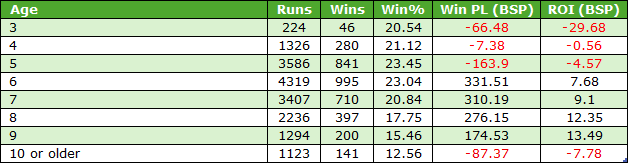
Let me move onto the age stats now. We saw that younger female runners struggled and, overall, that has been the case for both sexes as the table below shows:


Male runners aged three or four lost over 16p in the £, not as much as the fillies but still a steep loss. Horses aged five made a small blind profit and, looking across all metrics, five and six-year-olds showed a solid record.

The older brigade, those aged ten and up, made a fair profit with a decent A/E index of 1.09. Backing all these older runners to place on Befair was profitable also. Perhaps some punters ignored their chances based on age and hence they started slightly higher prices than their true price point. Sticking with the 10-year-olds, they performed even better over shorter distances of 2m4f or less. Their record with this distance requirement was 176 wins from 1328 runners (SR 13.3%) for a healthy profit of £204.62 (ROI +15.4%); A/E 1.13. On the place market the profit was also solid at £85.07. Based on this recent evidence, 10-year-olds may offer some value in the months to come.

Country of Breeding

I want to look now at some breeding data next with focus on the country of breeding. The splits were as follows:


American bred runners were rare and their record was poor. There was not too much in it in terms of the three main countries of Britain, Ireland and France, although the Irish figures read slightly better. German breds made a very small blind profit, as they did on the Betfair Place market, too (£18.78).

Position Last Time Out (LTO)

A look next at some LTO data focusing on the position a horse finished last time out. Here is the breakdown:


I feel Position LTO is a factor that I should always share but, on many occasions, there has been limited value to be found. Based on these stats horses running third LTO offered punters a minute profit but, in my view, this was likely coincidence and ultimately the finishing position last time offers no real clues to handicap hurdle races during the timeframe.

Days since last run (DSLR)

A look next at how long handicap hurdlers have been away from the track between runs. The ranges are necessarily a little arbitrary, and below is how I've broken them down:


It is rare for me to share these DSLR stats because usually there is nothing clear-cut to note. However, on this occasion there were some strong pointers which the table above shows clearly. Horses returning to the track within three days did really well, albeit from a smallish sample; and those who returned within four to seven days essentially broke even, so quick returners could be an area to keep a close eye on this season.

At the other end of the 'time off' spectrum, horses that were absent from the track for four months or more also turned a fair profit, so I am assuming a similar thing happened here as it did with the 10-year-old and older stats we saw earlier. My guess is that these runners started at prices that were marginally higher than their true price due to a possible ‘fitness bias’.

Trainers

Trainer data is always a favourite of racing fans so let’s see what we can find. In the table below I've listed all trainers who saddled at least 250 handicap hurdle runners during the study period. The trainers are ordered alphabetically:


23 of the 55 trainers made a blind profit during the timeframe, while 12 managed A/E indices of 1.10 or higher. Any of these 12 can be deemed to be trainers that performed well above the average.

On the flip side, a handful of trainers struggled, including Alan King, Martin Keighley, Seamus Mullins and Ian Williams. These handlers look over-bet in such races as a general rule.

From this initial starting point, I wanted to examine trainer performance across different BSPs. To do this I split their results into six price bands:


I wanted to compare A/E indices across said price brackets over the review period. Each trainer needed to have at least 60 runners within each individual price band to qualify and, to appear in the table, the trainer must have achieved that in four or more of the six price bands. Any price band where they sent out fewer than 60 runners was left blank.

Any entry highlighted in ‘blue’ was a positive, anything in ‘red’ a negative. My criteria for this was:


By colour coding it helps us to compare the data sets more easily. Here were the splits:


If we look back at Chris Gordon’s overall record, we can see that it was extremely positive with an overall A/E index of 1.08 and returns equating to just over 20 pence in the £. Hence, it is no surprise perhaps to see him with three ‘blues’ out of five, and indices of 1.00 and 0.93 in the other price segments. Likewise, Tom Lacey, whose overall strike rate was above 23% with returns of 28.9% and a 1.26 A/E index, had four ‘blues’ out of five with the other A/E index above 1.00 at 1.03.

Seeing that type of positive consistency across different price bands makes Lacey’s overall stats even more impressive. Rebecca Menzies, another trainer who had excellent overall stats, achieved four ‘blues’ out of five. She, along with Gordon and Lacey were trainers to excel during this timeframe and it will be interesting to see if they can replicate this over the coming months. If we combine the results of these three trainers and look at the yearly ROI% returns we see the following:


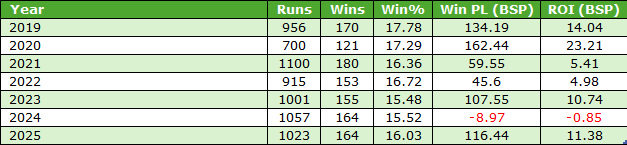
Seven winning years out of eight – I wonder if system punters might consider combining the three this year and backing all such runners?

Neil Mulholland attacks handicap hurdles on a regular basis so his overall figures are impressive. In terms of the price bands, he had three ‘blues’ out of six, with the other three indices being 1.00, 1.09 and 0.94. Again, over the past few years he has been a trainer to keep on the right side of, so I am expecting his runners to go well once more this year.

Other positives worth noting are that both the O’Neill stable and the Hobbs/White yard did exceptionally well with shorter prices runners (BSP 3.5 or less). The O’Neill stable had 49 winners from 109 (SR 45%) for a profit of £19.11 (ROI +17.5%); the Hobbs/White had a 50% strike rate thanks to 43 winners from 86 for a BSP profit of £24.86 (ROI +28.9%).

In terms of negatives, Alan King’s overall figures were quite poor, showing losses of over 27p in the £. That manifested as four ‘reds’ out of five. He is not typically a trainer to offer value in handicap hurdles based on these findings.

Summary

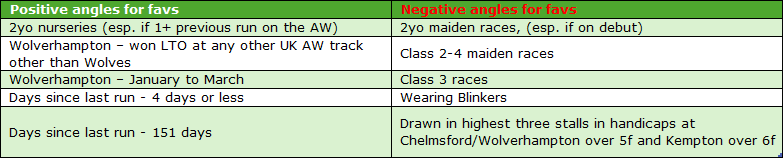
Let me finish by placing my interpretation of the main positives and negatives highlighed above in a table, as a sort of handicap hurdle ‘ready reckoner’:


That’s it for this 'NH Prep' deep dive. Next week I'll be taking a look at bumpers, or National Hunt Flat races to give them their full title. Until then...

- DR


Roving Reports: Shut That d’Or

Do you know what the French for "doors closing" is? Until a couple of weeks ago I'd have struggled to tell you, but I now know that "porte à fermeture" is the correct French phrasing, writes David Massey. This is purely down to the number of times I took the lift at the hotel in which we stayed in Paris for our recent weekend away for the Arc. I now hear the words in my dreams, my wife has started saying it every time I leave the room and leave the door open, and it has become so ingrained in my memory I now remember it better than the names of my own children.

Maybe this is the right way to teach French to older idiots like me, just batter the phrase at them until they can no longer forget it. My wife Caroline was most impressed by my wonderful mangling of two beautiful languages in the pizza restaurant of "deux more beers, s'il vous plait" but at under four euros a boisson I definitely wanted deux more.

I'm jumping ahead here. Let's start at the beginning, when we decided earlier this year we'd go to the Arc for the first time. We booked through Racing Breaks #notanad and given my absolute fear of flying - actually, a fear of crashing - it was always going to be the Eurostar that took us to Paris. I've been on a plane three times in my whole life, once to Belfast, once to Dinan and once before to Paris, having been to Auteuil for Champion Hurdle Day there a few years back when One Track Mind took his chance. That was a fun day, and there are stories to tell that can't be repeated on here, but it was the last time I flew: after a rocky landing in Birmingham I swore off the air, preferring to stick to wheels and tracks to get about.

So we, along with seemingly half of England, are catching the Friday afternoon Eurostar to Paris. This, for a 56-year-old man who hasn't been abroad in years, is actually quite exciting. The Eurostar rattles along apace; there's a helpful video explaining how to break the window in your carriage and get out safely if something goes wrong, or perhaps get trapped with one of the many racing "personalities" that appear to be on the train. One of them is in our carriage. I've seen him more since he retired than I ever did when he was commentating.

We get to Gare du Nord an hour late. No, hang on, my phone has merely adjusted to local time. Forgot about that. Metro, then a quick ten minute walk to our hotel, not a million miles from the Eiffel Tower, and we're all checked in and in our hotel room 28 storeys up from the Parisian ground. I'm not struck on heights, either, but here we are.

As it's getting on a bit, we decide to find somewhere local to eat and find a great little pizza place two streets away. It's run by, as it turns out, an Iranian family, and they couldn't be more welcoming. The pizza is excellent, the beer cheap, and we have a good meal for a shade over forty euros.

Saturday morning breakfast in the hotel is incredible. So many people, so many nationalities, but everyone is catered for really well. You name it, it's there. Puts the standard buffet breakfast I'm so used to on my domestic travels to shame. And of course, the croissants are so much better than they are over here. I've lost a stone and a half in the last five months by eating better food, and I strongly suspect I might be putting a fair bit back on over the next three days.

We're off to Longchamp for their Saturday card, too. 80 euros for two tickets that get us pretty much everywhere we want to go is very fair given the quality of racing. I immediately fall in love with the place. I love the simplicity of it; paddock to bar to concourse in under a minute, and for all I love a battle with the old enemy on a British racecourse, the PMU machines fascinate me.

Sadly, what I thought was a winning forecast in the Cadran was merely a swinger, which teaches me a valuable lesson to know what bet I'm actually wagering rather than what I think I'm wagering. I think being three beers in at this point doesn't help - I can't drink like I used to, the Skegness years are long behind me - but I'm having such a fun time I don't really care. The racing is fantastic, although what's with the idea of two commentators for each race? Even for shorter contests they swap over at halfway. Imagine that over here. Over to John Hanmer halfway through the Epsom Dash. It'd be done before you've identified what's in front.

Saturday night sees us eating in a steak restaurant near the Champs Elysees with about ten others. It's an incredible place, the steaks hanging up in ageing cabinets and you can choose your own, should you wish. Our waitress for the evening is great fun, her English is superb - even her swearing is top-notch - and she keeps our rowdy lot in order. Suffice to say, the forty-two euros we paid last night would barely get you a look at the menu here. Throw in a couple of Uber's there and back and the night is not a cheap one. We do, however, get to see the Eiffel Tower all sparkly on the way back. Which is nice.

A lot nicer than Paris traffic, though. As someone that does over 20,000 miles a year driving to and from racecourses I like to think of myself as fairly competent, and can cope with whatever the British roads can throw at me. But Paris is on another level. This is basically real-life Mario Kart. Diving in for any gap that appears, lining up four wide at junctions clearly meant for two cars, getting cut up at roundabouts, these are all perfectly normal for your average Paris Uber driver, it seems. I asked our driver why there was so much traffic on the road at 11pm on a Saturday night. "Paris!" he exclaimed, shrugging his shoulders. Two more motorbikes dive for the same gap at the lights in front of us. I think I'd rather fly.

Sunday is Arc day. After more hotel lift-related mayhem (smart lifts my arse) and another wonderful breakfast (I eat more than yesterday, given I'm likely to be drinking again and probably won't eat again until tonight) our coach arrives to take us to the track. One lady thinks we'll miss the first, but she's made the rookie error I made at Gare du Nord on Friday. Add an hour onto those Racing Post off times, we'll be fine.

There's ten times as many people here as yesterday and it's basically like being at one massive party. What a fabulous atmosphere there is. I bump into plenty of pals on my way around, and we meet up with my friends Alex and Sophie, regulars at northern tracks. The beer is flowing, the racing is superb. "Make some noise!" shouts the racecourse announcer as they go in for the Arc. I've had ale, readers, and am more than happy to oblige with his request. Daryz proves just too good for Minnie Hauk, a shame for the Irish but good for my bank balance as I tipped him up in the steak restaurant last night. Alex and I play the bandits - as we've named the PMU machines - all afternoon, and that's another thing the French do so well. They aren't scared of you having a bet, it's almost encouraged, in fact. Out front there are five large platforms with young people on top waving huge flags saying "Time To Bet!" five minutes before the off of each race. I'm not saying there aren't faults with a Tote system but my word, it has its merits too, with some huge jackpot bets on offer for small stakes.

The afternoon flies by, and it's been very enjoyable. It's really whetted mine and Caroline's appetite to do this again; both Auteuil and Le Lion d'Angers are mentioned (well, it does have that wonderful X-Country course, after all). At the age of 56, I think I might finally become a traveller, after all. Ludlow on a Wednesday has its undoubted charms, of course, but this weekend has been a real eye-opener for me.

Monday morning. And after one last breakfast, it's back to Blighty. We arrive in St Pancras an hour early. No, hang on...

Let the jumps season commence. See you all at Cheltenham this weekend, yes?

- DM

Monday Musings: A Five and a Six Away from Ascot

On a day when Ascot’s Champions Day supplied winners at 200/1 and 100/1 for home stables, two of Ireland’s biggest yards were at it elsewhere, writes Tony Stafford. It came as little surprise when Aidan O’Brien had the first five and then mercifully allowed someone else to get on the scoresheet before making it six on the day back home at Leopardstown.

With several multiple opportunities through the card, it wasn’t easy to identify which would be the better, notably in the fifth, the Group 3 Killavullan Stakes. This went to 13/8 second-best Dorset in the Derrick Smith silks, after getting first run on the Michael Tabor colours on 6/4 favourite Daytona, clear of the rest and much to the mirth of the two gentlemen concerned back at Ascot.

I doubt whether even they or their trainer would have been able to predict all six beforehand. If they had, it was around a 1,150/1 six-timer, eclipsing the 200/1 longest-ever Group 1 winning starting price recorded by the Richard Fahey-trained Powerful Glory back at Ascot. His victory in the Qipco Champion Sprint owed much to a Jamie Spencer masterclass amid the whoops and disbelieving on the straight course at Ascot where his age-old skills never dim.

Two races later I did venture into the paddock, when many of the connections stay to view their race on the big screen, to watch the Queen Elizabeth II Stakes. Horse racing can bring emotion far removed from everyday life and I swear I saw more than one very emotional woman and at least half a dozen men unashamedly crying as Charlie Hills’ Cicero’s Gift returned to unsaddle.

It was a day of days for owners Rosehill Racing and even jockey Jason Watson was wiping away a tear or two as he brought the unconsidered five-year-old back having edged out the big guns. Behind, a revived The Lion In Winter led home Alakazi and Docklands, with the disappointing pair Field Of Gold and Rosallion next home.

No doubt emotion in the entire Hills family was the order of the day just short of four months after Charlie’s father Barry, such a genius of a trainer, died at the age of 88. I snatched a few words with Barry’s widow and Charlie’s mum Penny earlier in the day. Afterwards I recalled one day driving down Fulham Palace Road in West London a decade or more prior, passing Charing Cross Hospital where Barry was being treated for cancer and seeing Penny on her way out having visited him, as she did every day during his illnesses.

She looked great on Saturday and I’m sure she felt that her son, often under-valued by ultra-critical people in racing – not always the kindest of arenas – had gone a long way to silencing his critics. After all, hadn’t he also won the Grade 2 Woodford Stakes at Keeneland two weeks earlier with the nine-year-old Khaadem, partnered by Frankie Dettori? That Fitri Hay-owned sprinter had won the Group 1 Queen Elizabeth II Jubilee at Royal Ascot both in 2023 and last year. You don’t keep top-class horses going that long into a career without having a real talent for the job.

Frankie no doubt would have been keeping an eye on matters at Ascot on the 29th anniversary of his unique seven-race through-the-card feat. I saw Gary Wiltshire at Chelmsford on Thursday night and he’s still dining out on how he lost £2 million laying the last winner of that septet. I won’t ever forget it either, having to write an extra chapter for the book Year in The Life Of Frankie Dettori, ready to go as it was then.

Gary’s latest book detailing those days is a steady seller, and I hope Victor Thompson’s Eighty Years in the Fast Lane, also published by Weatherbys will get a nice response. I helped Victor and his partner Gina Coulson put it together, and the final piece in the puzzle came with Nick Luck’s stylish and heart-warming foreword last week. Publication should be at the end of this month.

If ever I write another book of my own, the title ought to be “I digress” (!), because almost the most unlikely eventuality of all those remarkable Saturday feats was occurring over in the US at Far Hills racecourse in New Jersey.

Gordon Elliott might have been bullied almost into submission in the top races over the years by Willie Mullins, but he certainly knows how to pick his spots. He sent a team of horses to the US’s biggest day of jump racing in both prestige and money terms on Saturday and won five, including their Champion Hurdle and Grand National.

Jack Kennedy, happily recovered from his latest injury, rode four of them, giving way to Danny Gilligan on Coutach in the £72k to the winner Champion Hurdle. Pride of place goes to the last of the quintet, Zanahiyr, an Aga Khan-bred son of Nathaniel, Enable’s sire. Nathaniel, at the age of 17, has been making enough of a revival to stand at an increased £20k at Newsells Park Stud. Graham Smith-Bernal, Newsells’ owner, was still bubbling over another sales triumph (3.6 million gns) even though only second of the pile at Tattersalls Book 1 for a son of Frankel, sold of course to Amo Racing.

Zanahiyr collected £120k for his neck success over fellow Irishman, the Gavin Cromwell-trained Ballysax Hank. He’s another versatile type having won the Summer Plate at Market Rasen (a race won the previous year by geegeez syndicate horse, Sure Touch, which also followed up there this week) and collected a 1m6f flat race on home turf before his trip to New Jersey.

Cromwell had fulfilled a long ambition when sending out Stumptown, a regular in good handicap chases, to win the Velka Pardubicka over the fearsome obstacles at Pardubice, Czech Republic, the previous weekend.

In all, Elliott’s five pulled in a total of £300,000. It’s to his credit that he’s come through the dark days and the ban that followed that infamous photo with ever more energy and operational dexterity.

Judged on recent events Elliott, Cromwell and Joseph O’Brien will be ever more visible going for the top UK prizes this winter when the home defence, with one or two exceptions, might struggle to withstand them – never forgetting the imperious Willie Mullins.

I hear a whisper that the champ already has earmarked the horses he intends to line up for the five Grade 1 races that were the fixture for so many years for the opening day at Cheltenham’s Festival meeting next March. One of the stable’s most ardent followers was bemoaning the rearrangement of the four-day programme that as he says dilutes the top races through the week. Maybe it’s a response by bookmakers sick of having their pants down and bottoms smacked every year by Wearisome Willie!

I digressed and did so again. What a day. We saw a proper middle-distance champion in the French gelding Calandagan, too speedy for the rest and ridden with great tactical awareness by Mickael Barzalona, two weeks on from his Arc de Triomphe win on Daryz. An early test of that form was Kalpana’s easy repeat win in Saturday’s Champion Filly and Mare race, soon clear in the straight and never tested in repelling a late thrust from Estrange. That striking grey ran a blinder considering the unsuitably fast ground.

John Gosden seemed more pleased to have ended the three-race tussle with Delacroix (who finished fourth) on the credit side, two-to-one, than worry about Osbudsman’s being beaten by the French raider who, like Daryz, is trained by Francis-Henri Graffard.

In that race I was astonished that Delacroix hadn’t finished in front of outsider Almaqam, trained by Ed Walker, especially as my vantage point was as near to level with the winning line as it can get. Certainly, it’s better than from the Royal Box fifty yards further down the straight!

Again, there was chat about Christophe Soumillon, even after winning the Two-Year-Old Conditions race on Mission Control for the Coolmore team and O’Brien. In the big one, he was ahead of both Calandagan and William Buick on Ombudsman turning for home but then was swamped by a pincer movement from behind, immediately losing his nice pitch. I doubt he would have troubled the winner, but he might have been in another close fight with the Gosden horse had he kept out of trouble. Most of us thought he ought to have done better in the finish for third too, but I’ve talked about his coming unstuck in photos before.

Then again, having had a chip each way (forget which of my old-time friends used to say that!) on Karl Burke’s Holloway Boy in the closing Balmoral Handicap, the one handicap on the day, my eyes again deceived me. I knew Crown of Oaks had won to give yet another big handicap to William Haggas but was sure Holloway Boy, in his first run since Meydan in April, was a narrow outright second.

Once more, I was wrong, the dead-heat announcement being a further surprise. Talking of Holloway Boy he, like the fifth-placed favourite Native Warrior, is trained by Karl Burke, one trainer inexorably moving up the ladder.

A reflection of that is how he’s now winning races overseas, too. Yesterday in the Group 2 Prix du Conseil de Paris at Longchamp he reversed Balmoral Handicap fortunes with Haggas, Convergent getting the better of his rival’s Dubai Honour by a neck.

Native Warrior was one of five Wathnan Racing runners on the day, from four different stables, all ridden by James Doyle. His is a fantastic job and one that can only get better as the owners and Richard Brown extend their tentacles.

There are still a few rungs to go before Karl Burke makes the top three in his peer group. After Saturday’s skirmishes, when O’Brien, Andrew Balding and the Gosdens each had one winner, it’s status quo in the UK trainers’ title race, with Aidan now guaranteed another triumph. If he wins the Futurity at Doncaster on Saturday, he’ll nudge over £8million in prize money.

Finally, after a day with more to mention than space warrants, on the way out I bumped into old pal Graham Thorner, former trainer and Grand National winning rider. I suggested that Ascot remains unique in that it attracts massive crowds for all its dates and that I’d never seen so many young people at a race meeting before. He agreed. Whatever Ascot’s blueprint for success, they should make sure they pass it on to less successful venues.

- TS

Prepping for NH 2025/26, Part 3: Handicap Chases

Preparing for the Jumps - Part 3, Handicap Chases

In this third article in a series looking forward to the National Hunt season we'll continue last week's chase theme, this time focusing on non-novice handicap chases, writes Dave Renham. That is, any handicap chase without the term ‘novice’ in the title. As before, data has been taken from 1st January 2018 to 31st August 2025 with profits and losses calculated to the Betfair Starting Price (BSP) with a 2% commission applied on any winning bets. Only UK NH races have been researched, so this does not include Irish racing.

We have a good number of qualifying races per year, usually between 850 and 900; in total, then, this equates to nearly 6500 races. I will start as I always do by examining the betting market.

Market factors

I have used Betfair to determine market rank and the table below shows performance by position in the Betfair SP market:


Favourites performed well and even made a small blind profit. Concentrating on the other market positions, horses ranked fourth in the betting made a solid profit which is a big outlier when comparing to other market positions in the table whose ROI%s are all in the same ballpark. It is interesting that if backing horses fourth in the betting year in year out, a blind profit was achieved in six of the eight years.

Personally, I do not see backing horses fourth in the market as a strategy this coming season because I am assuming it is down to variance. Having said that, I looked back on the previous eight-year subset (2010 to 2017) and horses fourth in the market made a profit then, too. The ROI% was +3% in that time frame. I’ll leave you to decide how to interpret that...

Returning to favourites for a slightly deeper dive, here are the yearly ROI% numbers:


As we can see, there were flucatuations from year to year ranging from 2018, the year showing the best returns at +7.4%, to the year showing the worst returns (2019) at -12.3%. This is a good example that even annual results for a similar type of horse are rarely uniform. It is something as bettors we really need to appreciate. It’s like the tossing a coin analogy where the first ten tosses see seven heads and three tails, and the second ten see the script flipped somewhat with two heads and eight tails. The previous ten tosses are usually not a statistical or mathematical guide to the next ten. We know over a long period of time that the percentages for the number of heads compared to tails is going to trend towards 50-50, but over shorter periods we will get significant fluctuations.

Moving on, and still with favourites, here is performance by race class.


As we can see there are far more handicap chases when we get to Class 3 level or lower. The strike rate for Class 1 handicaps was lower than the rest and this was simply down to bigger average field sizes. The lowest class (5) has seen the best results with six of the eight years turning a profit, and the A/E index of 1.07 was extremely solid.

Having looked at the market, it is time to look into other areas. As with the first two articles, I am going to impose a BSP price limit of 20.0 or lower from now on, to avoid any winners at excessively big odds potentially skewing the bottom line. It still includes nearly 40,000 runners so the sample size remains huge.


Sex of horse

There will always be more male runners than females but how did their stats stack up against each other? Let me see:


In terms of performance, both sexes performed in a comparable way across all the key metrics so there was no real edge to either.


Age of horse

Moving on to age data now, and I'll begin by sharing the A/E indices across different ages:


The 4yo stats are based on just 127 runners so, concentrating on the bigger samples of horses aged five and older, there seems nothing much in it between the ages of five and nine, but once we get to handicap chasers aged ten or older we start to see a dip.  Here is a fuller view covering other key metrics:


When looking at the data as a whole, there seems to be the same age bias as we saw in the graph in play here: lower win rates for horses aged 10 and older, and much poorer ROI percentages too. Even when focusing on horses aged 10+ that started favourite or second favourite, their record was relatively poor in comparison to the other market stats we saw earlier. This cohort of older favs won 374 races from 1671 runners (SR 22.4%) for losses of £160.48 (ROI -9.5%); A/E 0.93. Logic dictates therefore that in general we should concentrate on horses aged five to nine.


Country of Breeding

Changing tack to breeding and specifically the country of breeding, below is a breakdown for the four main breeding entities - British, Irish, French and German-breds:


We have similar strike rates for the three main countries, Britain, Ireland and France. German-bred runners are less common and have performed below the level of the other three.

There are interesting stats for French bred runners when we split their data into different age groups. Combining five- and six-year-old runners together they produced 400 winners from 2056 qualifiers (SR 19.5%) for a small profit of £52.94 (ROI +2.6%); A/E 1.05. Moreover, backing all qualifiers to place on Betfair also nudged into profit to the tune of £36.58.

Compare this to the record of French-breds aged 10 and up. This older cohort produced 168 winners from 1324 runners (SR 12.7%) for a hefty loss of £150.30 (ROI –11.4%), A/E 0.94.

British-bred runners aged eight or younger combined to produce a good set of figures: 832 wins from 4545 runners (SR 18.3%) for a healthy profit to BSP of £420.95 (ROI +9.3%). The A/E index of 1.08 suggests these runners have offered good value. British-bred older runners, though, performed even more poorly than their French counterparts, hitting a strike rate of just 11.6% (229 wins from 1973) for losses of £277.60 (ROI -14.1%); A/E 0.89.


Position Last Time Out (LTO)

A quick mention of the most recent piece of form in terms of finishing position LTO. There were no clear patterns that I found but here are three stats that I thought were reasonably interesting.

Firstly, LTO winners performed reasonably well, making only a small loss of 1.5 pence in the £. They won 21.6% of the time, so with a bit of extra digging there may be some value to be found in certain last time winners in handicap chases.

Secondly, horses that fell or were unseated LTO did not perform well. They collectively achieved 201 wins from 1520 (SR 13.2%) for a loss of £114.44 (ROI -7.5%); A/E 0.93.

And thirdly, horses that were pulled up LTO but started favourite next time had a good overall record. Clearly, not a high percentage of horses that were pulled up LTO go off favourite on their next start, but when they did, 71 won from 201 runners (SR 35.3%) for a decent profit of £48.02 (ROI +23.9%); A/E 1.25.


Weight

In handicaps of course horses carry weight based on their Official Rating, although it is rare to find anything significant overall as the handicapper does such a good job rating and weighting horses. It can difficult sometimes to decide how best to analyse weight. Weight carried or weight rank are two obvious options, and I have used both many times before.

For these data I have chosen a new idea by comparing different groups in relation to the average weight carried in the race. As Geegeez has recently added the average OR for each race in their racecards it seems a good idea to take this approach. I have split the runners into three groups:

  1. Horses carrying 4lb or more than the race average.
  2. Horses carrying 4lb or less than the race average.
  3. Horses weighted within 4lb of the race average.

Here are the A/E indices of the three groups:


Horses carrying less weight offered the best value within the timeframe and the ‘4lb or less’ group turned a small profit of £238.04 (ROI +2%). Overall, this group contained 11,106 runners of which 1676 won (SR 15.1%). The other two groups lost 4p in the £ across 14,284 bets and 13,599 bets respectively.


Race Class change

A look at change in class next. Here are the splits:


Horses upped in class did best, albeit by a smallish margin given the number of runners within each group.


Trainer Angles: Overall

The final port of call for this piece is to look at some trainer data. Let me start by flagging those trainers with the highest win rates (who saddled at least 150 runners during the time frame). This is a big table containing over 50 trainers. They are ordered alphabetically:


32 of the 54 trainers made a blind profit which is a higher number than I had expected, while seven had A/E indices of 1.20 or higher – these trainers are Gary Hanmer, Ben Haslam, Matt Sheppard, Henry Daly, Martin Keighley, David Dennis and Richard Hobson. That septet appears to have gone under the radar somewhat. Here are some additional positives for some of those trainers:

  1. Ben Haslam seems to excel with older horses. Those aged 9 or older won 25 times from 107 (SR 23.4%) for a profit of £51.98 (ROI +48.6%); A/E 1.48. There were a few multiple winners but 11 different older horses came home in front so Haslam seems to have good knack of rejuvenating veteran runners.
  2. Henry Daly did especially well in races of three miles or more. In these contests he saddled 31 winners from 154 (SR 20.1%) for a huge £103.14 profit (ROI +67%); A/E 1.33.
  3. Sticking with Daly, his runners won just three times in 47 attempts in Class 1 or 2 events. However, in Class 3 or lower his record was 43 wins from 179 (SR 24%) for a profit of £111.44 (ROI +62.3%).
  4. Martin Keighley has shown excellent consistency when we compare his record across the year. When we split the year into four groups of three months (Jan to Mar, Apr to Jun, Jul to Sept and Oct to Dec), his win strike rates were as follows:


Not only was Keighley consistent, he also secured returns of at least 14p in the £ in each of the four quarterly groupings.

  1. Richard Hobson produced a profit in seven of the eight years. Hobson’s record with favourites should also be noted – 16 wins from 37 (SR 43.2%) for a profit of £20.09 (ROI +54.3%); A/E 1.48.


Trainer Angles: Comparative Data

The final data for these 54 trainers that I would like to share shows their results split into two groups – 2018 to 2021 and 2022 to 2025. I have placed the comparative data in a table covering win strike rate, ROI percentage and A/E indices. Anything highlighted in ‘blue’ is a positive, anything in ‘red’ is a negative. My criteria for each, was as follows:


By colour coding the table I hope that it helps to compare the data a little more easily. Here is the table:


Some points I would like to highlight:

Firstly, there is a statistical quirk which, when I saw it, I took a double take. Notice the two strike rates for the different groups of four years for Nick Alexander – they both are 16.77%, but what makes this even more remarkable is that the wins to runs ratio for both timeframes was 26 wins from 155 runners!

Other key points to note:

  1. Messrs. Daly, Haslam, Keighley and Sheppard, four of the seven positive trainers noted earlier, managed to be consistently good across both time frames.
  2. Brian Ellison, Warren Greatrex, Alan King, Ben Pauling, Jeremy Scott and Robert Walford have all shown a significant uptick in performance in the more recent four years.
  3. Nigel Hawke and Tom Lacey have both struggled more recently, well down on their stats for the 2018 to 2021 period.
  4. The Greenall / Guerriero stable, along with the Moore stable have both had decent results in both timeframes. We could say the same about Neil King and Evan Williams.


**


And that concludes my handicap chase analysis ahead of this jumps season. There's plenty to go at in there and I hope some of the stats will assist you in finding some good value handicap chase winners between now and the spring.

- DR


Monday Musings: A Ces for the Home Team

I recently wrote about the sad decline in the attraction to trainers of Newmarket’s Cambridgeshire Handicap, run two weeks ago with a first prize of £90k, writes Tony Stafford. On a track where they could easily accommodate 35 horses and room for five or six London buses in between up the straight it looked a mundane affair at best.

They even used to run a consolation race (for much less money) for a few years not so long ago and while never having the relevance of the Chester Cup or Northumberland Plate consolations, it at least gave a run to people who had prepared their horses for the big race and missed out. While admiring the performance of its top-weighted winner Boiling Point for Karl Burke last month, the 2025 race was a tame and wholly domestic affair.

Of course, when it came to the Cesarewitch on Saturday, for a similar first prize, the Irish were interested – sending out ten of their mainly second-division stayers, but where was the feasible home defence going to come from?

In all, only 19 went into the stalls for the race that, as my friend Maurice Manasseh, half a century on from John Oaksey, reminded us, “It begins in Cambridgeshire and finishes in Suffolk”. One of those racing homilies I never tire of hearing.

Accustomed over the years to seeing a massive line-up way over there, a mile along the A14 just behind the service station, this year’s contingent went the reverse way all the 2m2f of it in dribs and drabs. It used to be a stream, and you wondered how they could survive four-and-a-half miles.

I’m sure it’s the smallest field for at least in my consciousness. I restricted myself to going back until 2019 – Wikipedia doesn’t list the size of field, but while there were a couple of near misses with 24 last year and 21 plus two non-runners on the day in 2022, otherwise it has been invariably 30-plus, certainly since 2019 in any case. [Certainly since at least 1997 – Ed.]

That 2019 race went to Willie Mullins with his star hurdler Stratum and was worth 217 grand to Midas-touch owner Tony Bloom. How can a race with this amazing history have declined by more than half in money terms in just six short years?

Part of that irrelevance, no doubt, reflects the enormous strides made by its Irish counterpart, run two weeks earlier with a full 30-horse field. That race carried a first prize of more than 300k whether you count it in £ or Euro.

Ours was a mere pittance in contrast but was well enough patronised by Joseph O’Brien and previous winners Willie and Emmet Mullins, Charles Byrnes as well as Tony Martin. He, apart from doing the job with Leg Spinner in 2007 also had a hand (at least) in the win of his sister Cathy O’Leary with Alphonse Le Grande last year while he was serving a ban – but not one severe enough to stop him celebrating afterwards on the winner’s rostrum.

The Irish on Saturday were 2nd,3rd, 5th, 6th, 8th, 9th and 10th from their ten representatives, while winner Beylerbeyi, fourth placed Divine Comedy (Harry Eustace) and seventh home Belgravian (Andrew Balding) did at least intrude on the invaders’ expected party. Certainly, the watchers around me were astounded that neither Willie Mullins nor Joseph O’Brien had the winner.

But such is the power of their two stables in flat race staying contests that between them they supplied 14 of the 30 starters at the Curragh two weeks previously including winner Puturhandstogether for O’Brien in the J P McManus colours. I doubt a 4lb penalty would have stopped him off 86 on Saturday (including the penalty) if he hadn’t had bigger fish to fry.

And so to the winner. I saw Ian Willims for a few minutes before he saddled Beylerbeyi for the race. I had been amazed that his five-year-old was as short as 7/1 for a race of this calibre and suggested his handling of the gelding had been remarkable, but he said, “We’ve got to see if he stays yet.”

Until July, I had Beylerbeyi firmly pitched as a middle-range miler; indeed apart from two unsuccessful runs in novice hurdles at the end of last year the longest trip he had ever encountered was one mile one and a half furlongs around Wolverhampton.

Williams loves acquiring chuck-outs from top French stables, most notably Francis-Henri Graffard – not a bad place to buy from – and Beylerbeyi, although a winner first-time at two, from four runs for Jean-Claude Rouget’s top yard, was picked up for only €7k and knocked down to Williams.

Like many trainers, he finds it harder to get his horses’ ratings to drop even after a series of unsuccessful runs, so he put the horse in the care of less-fashionable Patrick Morris, and the adverse effect happened, 13lb off for four defeats, upon which he entered the Williams team proper.

It took 11 runs starting from and ending on 62 before Beylerbeyi’s initial victory – point taken! – in June last year over seven furlongs at Wolverhampton. Within weeks that had transformed into a hat-trick with victories over seven again and then a mile at Doncaster. Three more runs preceded one further win, in the outing over the extended nine furlongs I mentioned earlier, back at Dunstall Park.

He was still racing at around a mile when he reappeared this year and then, in July, he was third when tried over one mile two and a half furlongs at York. Then it was another hat-trick, all upped to 1m4f. You would still hardly regard that as sufficient evidence for eyeing the Cesarewitch and its 2m2f slog.

Beylerbeyi is by Invincible Spirit, sire of many high-class sprinters and milers, and I doubt his breeders Al Shaqab Racing would have predicted a race like Saturday’s as on their radar. But the sire does have a good win percentage with the smaller group of his progeny that have tried 1m6f and above. When Ian moved him up to 1m6f, he finished strongly when second at the Doncaster St Leger meeting and then was an eye-catching third at Newbury.

But here he was, running over half a mile further than ever before, no wonder the trainer’s apparent uncertainty. Beylerbeyi broke slowly and Billy Loughnane held him up last of the entire field for much of the trip. He moved him out just as Hughie Morrison’s Caprelo had started his run a couple of lengths ahead of him on the outside and, when that opponent’s promise quickly evaporated, Beylerbeyi simply got stronger.

Caprelo’s rider Tyler Heard had been instructed to sit in the pack and hold on to his mount. He told Hughie afterwards, “They seemed to be going so slow; I was worried they would get away from me”. Morrison pointed out yesterday morning that in fact this was the fastest race on the day compared with standard times on a day when the Dewhurst and two other Group races for two-year-olds were contested. I can further tell Hughie that this was the second-fastest Cesarewitch of this century!

So just when the Irish hordes, headed by Joseph’s Dawn Rising with a run timed to perfection it seemed by Oisin Murphy, and Willie’s Bunting (William Buick), whose transit was troubled, seemed to have it between them, along came Beylerbeyi.

Loughnane, on the outside of what promised to be a three- or even four-horse conclusion, utilised the speed that won Beylerbeyi so many races at around a mile and he was soon clear, going away from his field at the finish.

With such races as the Chester Cup and Ascot Stakes among Williams’ favourites and both on his palmarès, expect Beylerbeyi to be aimed at those and maybe more ambitious targets next year. One regret Williams might have is that he didn’t give the five-year-old a third jumps run. His mark might even have been lower than he’ll get after tomorrow’s re-think.

Loughnane has 106 wins in the portion of the year that decides the Jockeys’ Champion with Oisin Murphy way out in front on 140 and guaranteed to collect his prize on Saturday at Ascot. Over the whole year, Loughnane has a remarkable 167 victories. Still only 19, he is destined for many jockeys’ titles of his own.

One former champion, Ryan Moore, has had to sit out a good portion of the important autumn this year as the number one for Coolmore. In his stead Christophe Soumillon hasn’t been received with universal joy by some of the people around the team.

His success in France last weekend was enough to quell some of the criticism, but now back on UK soil and despite big wins on fast-improving and now 1,000 Guineas favourite Precise on Friday and unbeaten Pierre Bonnard, impressive in beating stablemate Endorsement in the 10-furlong Zetland Stakes the following day, the chatter continued.

One said, “He’s okay with steering jobs or in France, but I reckon he’s been beaten in seven photo-finishes on Coolmore horses since York.”

The 44-year-old’s riding of Gstaad in the Dewhurst Stakes, the race that probably would have had the Aidan O’Brien colt in pole position for the 2,000 Guineas next May had he won, also drew criticism.

While James Doyle on the Andrew Balding-trained 25/1 chance Gewan raced prominently throughout the seven furlongs, Soumillon allowed Gstaad to drift back into centre-pack in the middle of the race and had several positions looking for gaps before getting into second in the last furlong. He was beaten by three-parts of a length.

A contemplative and solitary Ryan surveyed the paddock before the race, and I would love a penny for his thoughts on how it panned out. It did make a £350,000 difference in the gap between the two protagonists for the trainers’ title. O’Brien still holds a £630k lead over Balding, but a round million would have felt more secure going into a mouth-watering British Champions Day at Ascot next Saturday.

At least, with the weather set fair, we should have unusually decent ground for this fixture when if Delacroix, on his final appearance, should win the Champion Stakes it will all be done and dusted.

- TS

Prepping for NH 2025/26, Part 2: Novice Chases

Preparing for the jumps – Part 2, Novice Chases

This the second article in a series which is looking forward to the National Hunt season, writes Dave Renham. In the first piece I looked at non-handicap novice hurdle races. In this one, I will focus on novice chasers. I plan to look at both non-handicap and handicap races, starting with the former.

Data has been taken from 1st January 2018 to 31st August 2025 with profits and losses calculated to the Betfair Starting Price (BSP) with a 2% commission applied on any winning bets.

Non-handicap Novice Chases

There has been a serious drop in the number of non-handicap novice chases in recent years so good betting opportunities have proved somewhat limited. However, I feel it is still worthwhile sharing my findings and I would like to begin by looking at market factors for all qualifying races.

Market factors

I have used Betfair in terms of market rank and here is the breakdown:


Favourites won roughly 50% of all races and backing all of them would have made a small loss equating to just over a penny in the £. Second favourites offered some value and this was especially true when they had been shorter prices. Second favourites with a BSP of 3.0 or lower won 86 races from 194 runners (SR 44.3%) for a profit of £34.98 (ROI +18%). Meanwhile, backing horses positioned 4th or higher in the betting market would have lost a significant amount. That is despite a good looking A/E index.

Having looked at the overall market, it is time to look into other areas. As with the first article, I am going to impose a BSP price limit of 20.0 or lower from now on, to avoid any winners at excessively big odds potentially skewing the bottom line.


Sex of horse

Does the sex of the horse make a difference? Let’s see:


As can be seen, the ratio of male runners to female is around 6:1. In terms of performance, males have won more often but the bottom lines are very similar, as are the A/E indices.


Age of horse

Let me move onto the age stats now, beginning with the returns across different ages (the BSP ROI percentages):


Note that the 4yo stats are based on just 29 runners, so concentrating on the bigger samples of horses aged five and older, we can see that the trend is the younger the horse the better the returns. Once we get to horses aged nine amd up losses become fairly steep. Here are the full stats, including other key metrics:


It is interesting to note that 5yos have an A/E index below 1. That is surprising based on the strike rate, profit and returns. At the other end of the age spectrum, it does seem that we should be slightly wary of horses aged nine or older.


Country of Breeding

I want to look now at breeding and specifically the country of breeding. Here are the splits for the three main countries:


French breds performed best and showed a healthy profit, while British breds produced the worst returns. French bred runners which won last time out did particularly well, winning once in every three starts (80 wins from 240) for a profit of £71.99 (ROI +30%); A/E (BSP 1.07.


Trainers

Finally for the non-handicap novice chases let's look at some trainer data. Below is a table sharing individual trainer data in non-handicap novice chases during the period of study and with the 20.0 BSP price cap. To qualify a trainer must have had at least 50 such runners during the time frame:


The trainers that stand out are Harry Fry, Alan King and Jamie Snowden with strong metrics across the board. Gordon Elliott’s figures are solid too.

*

Let's now move on to the second part of the article where the focus will be on novice handicap chases. There are around five times the number of these compared to the non-handicap ones, so we have more data as well as more races to potentially attack this winter. I will also be drilling down into some additional areas than I did for the non-handicaps. 


Novice Handicap Chases

Market factors

I will start again with market rank. This includes all runners; and, as with the non-handicap novice chases, once we move on from this section I will have imposed the BSP 20.0 price limit:


Favourites have gone close to breaking even, while horses second and third in the betting market have both lost small (and similar) amounts. Those fifth+ in the betting market have made a profit but essentially this boiled down to three winners at BSP 210, 180 and 324.41. Remove that trio and the cohort would have lost money. Hopefully this helps explain the price cap I will be using once more from now on.


Sex of horse

In the non-handicaps discussed earlier there was little in it between male and female runners. Was that the case in novice handicap chases? Let’s compare the strike rates first:


We see a definite edge to male runners this time. How about the A/E (BSP) indices?


Again, there is strong edge here for males, so does this correlate when we look at the profit/loss/ROI% figures? Here are the full splits:


There is a huge discrepancy in terms of the total number of runs for each group, but the male edge is there across the board. For mares, losses of nearly 17p in the £ coupled with a very modest 0.89 A/E index illustrate the struggles they had in such races. I would be wary of backing any female runner in novice handicap chases against the geldings.


Age of horse

We saw earlier that in non-handicap novice chases horses aged nine or older produced the poorest returns by some margin. Was that replicated in handicaps? As before I'll start by sharing the returns across different ages (the BSP ROI percentages):


This time, we see even poorer returns for the aged nine and up group. Losses of more than 18 pence in the £ are negatively noteworthy. Here is the full breakdown for each age group:


4yo runners were again relatively rare but they had the highest win rate, best ROI% and highest A/E index. Hence, it seems those young'uns require at least a second glance. 6yos had a good record and with over 3500 runners in a very decent sized sample; they made a profit to follow blindly in seven of the last eight years. I cannot give a logical reason why 6yos have done so well, except perhaps that this is the optimal year in their career trajectories from young horses graduating from novice or second season hurdlers.

Going back to the older brigade of runners aged 9yo+, they had the lowest strike rate and the poorest A/E index, coupled with those poor returns noted earlier. I would need a good reason to back an older horse in a novice chase of any description based on these numbers.


Country of Breeding

We saw earlier that French bred runners had an edge in non-handicap novice chases. We see a similar pattern in handicap novice chases, too:


The French breds held sway once more with the best figures across all metrics. It should be noted that German bred runners also performed well from a small sample. There were 79 GER-bred runners of which 18 won (SR 22.8%) for a very healthy profit of £51.59 (ROI +65.3%); A/E (BSP) 1.36. With 14 different winning German bred horses and no horse winning more than twice, nothing can be said to have skewed the data.

Going back to French breds, those who raced in a hurdle race last time saw excellent returns of nearly 25p in the £. Over 700 qualifiers there was a profit to BSP of £175.86 (ROI 24.8%); A/E (BSP) 1.17. Also, younger French bred runners fared extremely well with those aged seven or less producing a strike rate of 20.8% (409 wins from 1968 runners) for a profit of £180.10 (ROI +9.2%). Further, this young cohort was consistent with seven profitable years out of the eight - only 2018 producing a loss, and a small one at that.


Position Last Time Out (LTO)

A look now at the most recent piece of form in terms of finishing position LTO.


These splits are interesting. As we would expect, LTO winners had the best strike rate; and last day runners up achieved a better win rate than horses further back (third or worse) on their most recent start. However, those recent 1-2 finishers incurred losses of over 9p in the £ which is well above the norm for such runners: they're clearly over bet. Also, their A/E indices were lower than we would normally see.

The best value was found with horses that finished sixth or worse LTO and I guess some of these have flown under the radar.


Weight Carried

In handicaps horses carry weight based on their Official Rating so I wanted to review this angle. Below are the A/E indices for different weight brackets:


The higher weighted runners seem to have offered the worst value and when we look at the full splits, we see that this is the case:


The best value seems to have been with the mid-range weight bracket of 11st to 11st 4lb, followed by the 10st 8lb to 10st 13lb group. Higher weighted runners (11st 5lb or more) were indeed the worst value.


Trainers

The last port of call for this piece is to review some trainer statistics for novice handicap chases. We have more data to drill into than the ‘nons’ so let me start by sharing trainers who have saddled at least 100 such runners during the time frame. They are ordered alphabetically:


Almost half of the trainers in the table (15 out of 33) recorded a profit with their runners which is a decent effort. Here are a few individual trainer stats worth sharing:

  1. The Greenall/Guerriero yard have excelled with horses making their second chase start. This cohort won 9 of 24 (SR 37.5%) for a profit of £26.62 (ROI +110.9%); A/E (BSP) 1.96.
  2. Nicky Henderson had only 28 female runners but 9 won (SR 32.1%) for a profit of £21.10 (ROI +75.4%); A/E (BSP) 1.81. He also performed well with horses making their chasing debut thanks to a 25% strike rate (19 wins from 76) for a profit of £20.74 (ROI +27.3%), A/E (BSP) 1.14.
  3. The Hobbs/White yard made an overall loss, but when their runners start favourite we should take note. Their market leaders won 13 from 37 (SR 35.1%) for a profit of £13.04 (ROI +35.2%); A/E (BSP) 1.17.
  4. Paul Nicholls should be noted when saddling the favourite. His record with jollies has been superb. 45 of the 88 won (SR 51.1%) for a healthy profit of £22.83 (ROI +25.9%); A/E (BSP) 1.22.
  5. Evan Williams has bucked the trend when it comes to last time out winners. His record has been excellent with 13 winners from 40 (SR 32.5%) for a profit of £20.31 (ROI +50.8%); A/E (BSP) 1.63.
  6. Venetia Williams has done well with horses aged seven or younger. They produced a profit of £31.11 (ROI +20.6%) thanks to 37 winners from 151 (SR 24.5%); A/E (BSP) 1.09.
  7. Kerry Lee did not make the table due to having saddled just below 100 runners in total, but her favourites did well, winning 12 of 26 starts (SR 46.2%) for a profit of £9.89 (ROI +38%); A/E (BSP) 1.40.

**

That's it for this second part of our 2025/26 NH prep series. There is a banquet of stats and snippets in this piece that hopefully will point us in the right direction when it comes to novice chases this season. Look out for part 3 next week when I'll be lasering in on another cohort of runners performing through the autumn, winter and spring. Until then...

- DR


Monday Musings: Daryz Makes it the Aga’s Arc

Ten furlongs (and a little bit) on fast ground at York is a world away from a mile and a half in very soft going at Longchamp in October, writes Tony Stafford. Run in a fast time – yesterday’s Qatar Prix de l’Arc de Triomphe was the only race among a string of Group 1’s to better the standard – identifies it as a very good version of the race, certainly as far as the first two home were concerned.

The going might explain in part Daryz’s elevation from last of six as a 14/1 shot at York to winning the Arc at slightly bigger odds. In doing so, he collected more than £2 million for the Aga Khan studs. Sadly, Prince Karim, who died in early February this year, never lived to see his colt, a son of champion 2,000 Guineas, Derby and Arc winner Sea The Stars on the racetrack.

https://youtu.be/poLX14qVTA8?si=6MWEOQdjr4vIwOfK

Daryz only made his debut in early April and trainer Francis-Henri Graffard guided him gently through the grades before York, via two conditions events, then a Listed race and a Group 2, before sending him overseas for the first time.

There was an obvious feeling of shock when he flopped in the Juddmonte, but Daryz restored confidence with a narrow defeat in the Group 3 Prix du Prince d’Orange over ten furlongs of Sunday’s course three weeks ago. Just a neck behind Japan’s Croix Du Nord, his was very much a try-out for yesterday, and the form turnaround – 11 lengths – was a stark reminder of how the top French trainers have always used the racing calendar to their advantage.

Daryz would undoubtedly have been at much shorter odds bar the flood of money on the Pari-Mutuel for the three Japanese runners. Two, Croix Du Nord and Alohi Alii, were out with the washing in 14th and 16th of the 17 starters, while Byzantine Dream, supported down to 7/1 second favourite, could do no better than fifth.

So far, we haven’t mentioned the favourite, unreasonably so as Minnie Hauk ran an astounding race, beaten only a neck by the Mickael Barzalona-ridden winner having been in the front four throughout. When Christophe Soumillon took her to the front, it looked like being a Coolmore/Aidan O’Brien treble on the day, but Daryz proved just too strong.

As the colt and filly fought out the finish, it was admirable that they stretched more than five lengths ahead of their field. With such as the Juddmonte one/two Ombudsman and Delacroix absent, as well as unqualified-by-the-conditions star geldings including Calandagan and Goliath, it wasn’t the race of earlier vintages when EVERYTHING used to turn up.

Having been a fan of racing well before Sea Bird II’s 1965 Derby and Arc demolition jobs, I’ll never forget his day in Paris when he cantered over such as Reliance, Diatome and further back the top-class American colt Tom Rolfe.

Big money is to be earned with less sweat for connections and horses alike these days, though, and no doubt the Japanese will be regretting putting so much energy into their continuing luckless quest to win the race. They do far better on Dubai World Cup Day and yesterday’s valiant trio should be ready in time for that.

As the records describe him, Aga Khan IV won the race four times between 1982 and 2008 with Akiyda, Derby winner Sinndar, Dalakhani and the brilliant mare Zarkava.

His father, Prince Aly Khan, married to the actress Rita Hayworth and destined to an early passing via a fatal car crash, enjoyed success in 1959 with Saint Crespin. And his father, Aga Khan III, won the race which was founded in 1920 with Migoli in 1948 and Nuccio four years later.

Talking about the Arc soon afterwards Barzalona explained how he needed to make the most of his good draw. Soumillon on Minnie Hauk (drawn 1) was fast away and Barzalona slotted the winner, exiting stall two, in just handy. It’s always seemed weird to me that over longer distances it happens, but the draw did make a big difference in this race. The highest drawn of the first four home was Marco Botti’s Giavellotto, (drawn five) just behind third-placed Sosie (stall three) in fourth.

You would imagine that the winner, unraced at two, would have plenty to gain from staying in training, and might be aimed at a rare Arc double next year. I would love to see Minnie Hauk, a daughter of Frankel, continue too. One obvious stud route for her was closed when Wootton Bassett came to his untimely end in Australia last month.

It seems a date next month at the Breeders’ Cup has not been ruled out. Yesterday was only her fifth race of the year and seventh in all, so she has hardly been over raced. I’m pretty sure the ever-combative owners would be all for it.

Incidentally, Wootton Bassett had two winners on the Sunday card, both from mares by Galileo. Having already picked up the Qatar Prix Marcel Bousac with Diamond Necklace, O’Brien, Soumillon and the Coolmore partners added the Prix Jean-Luc Lagardere for two-year-old colts with Puerto Rico.

Last weekend at Newmarket, on remarking to Michael Tabor that True Love had done well to retain her form through a long season in winning the Cheveley Park Stakes, he replied, “That’s what Aidan does.”

He could have used the same phrase to describe the progress of the Lagardere winner. He was beaten twice in maidens; another couple of times in Curragh Group 2 races before finishing 4th in the Keeneland Phoenix Stakes (Group 1) a couple of places behind True Love.

He broke his maiden at the sixth time of asking at Doncaster last month and improved again markedly on that with an all-the-way emphatic success here. Last year’s winner of the race, stable-companion Camille Pissarro, went on to victory in this year’s Prix du Jockey Club and was retired after getting injured when 4th to another stablemate, Delacroix, in the Coral-Eclipse Stakes.

The second win from that Wootton Bassett-Galileo nick was the Christopher Head-trained Maranoa Charlie in the Prix de la Foret. The three-year-old had been extremely unlucky when third at York and showed his true colours here.

There had been a few mutterings that Soumillon’s spell as temporary replacement for Ryan Moore had not been a success, but the contra view was that he would come into his own on the French tracks. His masterful judgment of pace coming from the back on Diamond Necklace was a typical French ride from the Yves Saint-Martin era, never getting involved until coming with a smooth run down the outside. Those 8/1 odds for Newmarket next spring might shrink a fair bit over the winter.

Unusually, yesterday wasn’t a great day for UK trainers, who drew a blank. One who did play a part in a piece of racing history, however, was Amy Murphy. Now happily settled in Chantilly, she had been among the back-up team behind Asfoora’s first ever win for an Australian-trained horse in France.

Asfoora’s trainer Henry Dwyer was rather sheepish as he related how if it hadn’t been for Ms Murphy and a very quick Uber driver, the mare would not have been allowed to race.

Instead of taking Asfoora’s passport to the track, he brought the one for a horse he’d bought at the Arqana Arc Eve sale on Saturday. Amy sorted the driver and the correct passport arrived with a minute and a half to spare.

It didn’t take Asfoora quite that long to beat her 16 rivals in the Prix de l’Abbaye de Longchamp under a very confident Oisin Murphy. She came through to challenge outsider Jawwal in the last furlong, winning by a comfortable half-length in 56.39 sec. The seven-year-old isn’t regarded as the best sprinter in Australia but she’s more than good enough to beat the cream of Europe’s speed merchants.

It was sad that Peter Charalambous’s Apollo One found so much trouble in the six furlongs of Ascot’s John Guest Racing Bengough Stakes on Saturday, more than enough to prevent a follow-up from last year’s triumph. Stopped in his run repeatedly, he stretched out gamely to the line, making up several lengths in the last furlong, but missed out by a rapidly diminishing short head to Mick Appleby’s Annaf.

Winning group races is never easy, but this was one that slipped through his owner-trainer-breeder’s fingers. It made the difference of £30k and prevented the seven-year-old (that’s right, another one) from getting neatly onto career earnings of almost exactly half a million quid.  I’m sure it’s only delayed.

  • TS

Prepping for NH 2025/26, Part 1: Novice Hurdles

Preparing for the jumps – Part 1, Novice Hurdles

The days are getting shorter, the nights are getting longer, which means the National Hunt season is beginning to click into gear, writes Dave Renham. October has 51 scheduled meetings in the UK over jumps, more than double the number in September. I will be writing a series of six articles over the coming weeks that share statistics, both positive and negative, that I hope we can use to our advantage this season.

Introduction

In this first piece I am going to concentrate on novice hurdle races, with data taken from 1st January 2018 to 31st August 2025, a period of a little over seven and a half years. Profits and losses have been calculated using Betfair Starting Price (BSP) with a 2% commission applied on any winning bets.

Novice hurdle races can be either handicap or non-handicap contests, and as there are roughly treble the number of non-handicaps, my focus is on this bigger group. Let me start by looking at market factors for all non-handicap novice hurdle races.

Market factors

I will use Betfair's market rank, which may occasionally be slightly different from the industry SP rank - though such differences are unlikely to materially impact any discernible patterns. I will start by sharing the results for the ‘value’ metric, the A/E index. These indices are based on BSP prices and the splits are as follows:


Third and fourth favourites offered the best value. Is that replicated when studying a wider array of metrics?


Third favourites performed the best from a profit/loss perspective, while fourth favourites essentially broke even, so the A/E indices were a good guide in terms of value. Meanwhile, favourites won roughly half of all these races but despite that dominance they made a small loss overall. Those sent off fifth market rank or lower on Betfair did extremely poorly, losing over 34p in the £.

Returning to favourites, horses aged five and six provided around 75% of all favourites, and those runners virtually broke even if backing all of them blind – 1293 wins from 2513 (SR 51.5%) for a minimal loss of £5.67 (ROI -0.2%); A/E (BSP) 1.01. There were some positive angles for favourites, but due to the short prices on offer it is difficult to produce significant returns.

Here are a few:


I will analyse trainers in greater detail below, but it seems that Gordon Elliott should be noted when saddling a favourite in non-handicap novice hurdle races.

Having looked at the market, it is time to move on to other areas. However, I have imposed a BSP price limit of 20.0 or lower from now on, to avoid any winners at excessively big odds potentially skewing the bottom line.

Sex of horse

Is there any difference between the performance of male horses versus female ones? There are three times as many male runners when it comes to non-handicap novice hurdles, so more races are won by males of course. However, was there a difference in the respective win strike rates using the BSP 20.0 or lower limit?


Males outperformed females by around 2.4% in absolute win percentage terms, which equates to a differential of just over 10%. That also translated to a marginally better bottom line:


As we can see, male runners broke even during the review period while female runners lost us just over two pence in the £. There was not too much in it overall but, in general terms, male runners were slightly better betting propositions than females over the period of study.

Age

A look at the age of horses racing in non-handicap novice hurdles next. There were only 15 three-year-old qualifiers since 2018 - that age group almost exclusively running in juvenile races - so I have ignored those. Here are the splits for four-year-olds and up:


It is interesting that the general trend in terms of win strike rate was the older the better, which is unusual in most race types across both flat and NH. Not only that but the best value was also with older horses. Those aged six and up recorded solid overall profits. Sticking with the aged six and older group, if we restrict races to shorter distances (2m 1f or less) their record improved further:


Returns approached 13p in the £ and this cohort secured a positive return (ROI%) in seven of the eight years as the graph below shows:


The only losing year has been this current year, 2025, but losses are small and there is still plenty of time to edge back into profit.

Previous hurdle runs

My next port of call looks at the number of hurdles races each runner had previously had. The findings surprised me a little:


The more experience over hurdles a horse boasted the better the win percentage. This perhaps correlates well with the age stats displayed earlier although it doesn't necessarily follow that an older horse is a more experienced one.

The most successful group in monetary terms were those making their debut over hurdles. These runners secured a profit of over £260 to £1 level stakes, equating to returns in excess of 10p in the £.

Perhaps not surprisingly based on previous findings, hurdle debutants aged six-plus was a strong angle: 116 wins from 560 runners (SR 20.7%) for a profit of £138.24 (ROI +24.7%); A/E (BSP) 1.12. It could be argued that this is back-fitting, but nevertheless the results catch the eye.

Last time out (LTO) Race type

What about LTO Race type? Is there anything to glean from these stats? Let us see:


The vast majority of runners ran in a hurdle race last time, which is to be expected, but it is the last day NH Flat figures that stand out with a near 9% ROI. If we further restricted those LTO NHF qualifiers to horses that finished in the first five on that prior spin, results improved to 258 wins from 1132 runs (SR 22.8%) for a profit of £156.87 (ROI +13.9%); A/E (BSP) 1.05.

Trainers

Different trainers target different types of races, and of course the quality of horses within their stables differs massively. That has a bearing on the handlers who appear in this section, others performing to better effect further down the line in handicap company.

Below is a table outlining individual trainer data in novice hurdles during the period of study with the 20.0 BSP price cap. To qualify a trainer must have had at least 90 such runners:


13 of the 32 trainers made a blind profit, with Lucinda Russell’s figures particularly impressive (returns of over 39p in the £). She had an excellent record at Ayr with 11 wins from 34 (SR 32.4%) for a healthy profit of £38.87 (ROI +114.3%). She also made decent profits at Newcastle (6 wins from 16) and Carlisle (7 wins from 19) – each with returns in excess of 100%.

In contrast the O’Neill and Pipe stables have performed relatively poorly, showing significant losses.

Previous hurdle runs by trainer

I would like to expand my trainer research a little by looking at the performance of trainers' runners in relation to the number of previous races they had had over hurdles. Firstly, let me compare win strike rates:


We saw earlier that, in terms of win percentage, the more exoerience the better over hurdles; but as far as individual trainers are concerned there are not too many that conform to that pattern. Lucinda Russell, for example, saw her strike rate drop as her runners gained more experience over hurdles. Her record with hurdling debutants was excellent – a strike rate of 30.9% thanks to 17 wins from 55 for a profit of £48.56 (ROI +88.3%); A/E (BSP) 1.53.

The stables of Alan King and the Moores also fared particularly well with hurdle debutants although both had fewer qualifiers in the past year or two.

At the other end of the scale was Ben Pauling whose hurdle debutants struggled overall, scoring less than 9% of the time and incurring losses of over 65p in the £. Likewise, Warren Greatrex runners in such races improved steadily from a low (9.68%) novice hurdle debut strike rate.

Trainers to note with horses having their second run over hurdles were Donald McCain and Jamie Snowden. McCain’s 33 wins from 94 (SR 35.1%) notched a profit of £17.93 (ROI +19.1%), A/E (BSP) 1.25; while Snowden’s 16 wins from 39 (SR 41%) was worth £8.27 (ROI +21.1%); A/E (BSP) 1.20.

In terms of the more experienced hurdlers, Kim Bailey's team did well when they'd had at least three previous runs (the 4+ group). His record in that context reads 19 wins from 46 (SR 41.3%) for a healthy profit of £16.73 (ROI +36.4%); A/E (BSP) 1.26. Fergal O’Brien also performed well with these experienced runners, securing 64 wins from 169 (SR 37.9%) and a profit of £31.28 (ROI +18.5%); A/E (BSP) 1.17.

Let me build on that and share a comparison of A/E (BSP) indices. For this table I have highlighted the most positive indices (in blue) and the poorest ones (in red):


Nigel (now assisted by Willy) Twiston-Davies earns a mention as the only trainer to have managed an A/E index above 1.00 across all four groups. The Hobbs/White yard were close with three 1.00+ figures and a 0.98, as was Kim Bailey whose only figure below 1.00 was 0.99. Not surprisingly I guess, all three of these stables made a blind profit with their novice hurdlers as can be seen in the earlier table.

Onto my final piece of digging, which is...

Trainers and courses

Have any trainers excelled at specific course with their novice hurdlers? These were the strongest combinations ordered by course (20 runs minimum to qualify):


All 16 combinations proved profitable, with the Hobbs/White performance at Taunton particularly impressive. Long may it continue!


**


I hope this opening salvo for the National Hunt has highlighted some interesting angles for non-handicap novice hurdles. I'll be back next week with Part 2, looking at the novice chase division.

Until then...

- DR

Monday Musings: From Laundry House to the very top

It wasn’t just at Coolmore Australia or the parent company’s headquarters in Co Tipperary that news of Wootton Bassett’s demise brought abject misery and frustration just as last week’s offering here hit the laptops, writes Tony Stafford.

For the Laundry Cottage Stud Farm, in Hertfordshire, 35 miles up the A1 from Central London, it ended a magical 15 years for the breeders of the brilliant, unbeaten juvenile and then an even more remarkable stallion career.

It seems a contradiction in terms that a precocious horse, good enough to go through five races at two unbeaten, including the sales races with their massive fields and prizemoney at York and Doncaster and then the Group 1 Jean-Luc Lagardere at Longchamp, would become a late bloomer as a sire. That was Wootton Bassett to a tee. Melba and Colin Bryce, owners of the aforementioned stud, bought the seven-year-old mare Balladonia at the Tattersalls July sale in 2003, for 27,000gns.

She had already captured the imagination of owners The Cosmic Cases – hard to track them down I’m afraid – but they still have one in training this year with their equally elusive (except on the racecourse) trainer, Richard Fahey.

The Cases – I feel I can call them that as despite never speaking to them, I’m one of their dearest racing admirers by now – paid 30k in successive years for Balladonia to produce Mister Hardy (2005) and Mister Laurel (2006). So when two years later the colt son of Primo Dominie arrived in the Doncaster ring, they (along with Frank Brady) were again in action, stretching the price to 46 grand at the St Leger yearling sale.

Sent to Fahey, he had that stellar year in 2010, making him champion two-year-old in France after winning their top colts’ race. His counterpart in the UK, and overall European champion, was another unbeaten (and how!) juvenile in Frankel. Wootton Bassett raced only four times as a three-year-old, once encountering Frankel, to whom he was an admiring and remote seventh in the St James’s Palace Stakes.

So no Classic achievements for Wootton Bassett, but for Laundry Cottage the exploits of their star graduate had a major influence on prices paid for his younger siblings. Next up was Pretty Primo, 120k in 2009; then Related (2010), and Abbey Village (2011), both 80k; Glenalmond, 100k in 2013 and Barton Mills 42k in 2015. They all won races, so some performance from a mare bought quite cheaply as a seven-year-old. I make it more than £650k all round.

The Bryce family all pitch in at the stud. Daughter Gina finds time between her television and family commitments to help, as do her brother Calum and sister Ailsa. Gina’s husband, Alex Elliott, as well as being a regular buyer of Amo Racing youngsters and older horses, acts as stud manager.

I’ve mentioned it before, about when over a breakfast expertly presented by Michael Bell at his stables in Newmarket around a decade ago, I met the charming duo of Melba and Colin. During the acceptable hour or so, Colin revealed that, when Gina graduated from the Darley Flying Start programme that has set so many on their way to success in racing and its associated activities, they presented her with a book – written by me! I wonder does she still have it?

Meanwhile, the slow developer had started his stud career in France, and in five seasons he went from an initial fee of €6k, via €5k and €4k twice, before getting back up to €6k, by which time his stock had taken an exponential leap (one of several in his amazing career).

Twice more he did his Gallic job at a revised €20k and then twice again at double that, at which point Coolmore stepped in.

Wootton Bassett’s progeny had already shown high-class ability and in restrospect (always helpful!) it seemed a fair assumption that given the improved quality of mares likely to be available for him at Coolmore, he could prove a wise investment. Whichever of the stud’s astute executives came up with the idea deserves the greatest of respect.

Wootton Bassett was already 12 years of age when covering the first of sadly only five crops. At 17 he leaves the legacy of Group 1 winners galore including Aidan’s Whirl, and also Twain, the unbeaten (two from two) horse that we have waited all year to see from Ballydoyle, so far in vain.

Both are among the 83 horses remaining in the Prix de l’Arc de Triomphe, run next Sunday at Longchamp, but Whirl, after her last of six performance behind local four-year-old Aventure, is dropping back in trip for the Prix de l’Opera.

Aidan is relying on four-time Oaks winner Minnie Hauk (Cheshire, Epsom, Irish and Yorkshire) and she is the obvious threat to Aventure, my pick to improve on last year’s second to Bluestocking, who had also beaten her in the 2024 Vermeille. Los Angeles also gets the gig.

At age 17, then, Wootton Bassett was no spring chicken, but the consolation is that he leaves behind three full Irish crops and that will almost certainly amount to around 500 individuals. Plenty of opportunities over the coming three seasons. Hopes that he would be the natural successor to Galileo, who died age 23 in 2022, may be largely dashed, but he’s still up there with Frankel as the sire whose progeny the big owners want to buy into.

Saturday’s racing at Newmarket threw up a tough Coolmore winner of the Cheveley Park Staes in True Love, who is getting tougher as she continues her career. “That’s what Aidan does”, said Michael Tabor in the winner’s enclosure afterwards.

The best performance of the three Group races on the card for juveniles was undoubtedly that of the Godolphin favourite Wise Approach in the Middle Park Stakes. Slowly away and then hampered, William Buick was right at the back for much of the race.

As Coolmore’s Wootton Bassett colt Brussels took what seemed an unassailable lead into the last furlong, suddenly you saw Buick on the wide outside and his mount sustained the unlikely run for an exceptional victory. He looks one for the Commonwealth Cup next June.

The training achievement of the day, however, was that of Karl Burke whose four-year-old Boiling Point made all under 9st12lb to win the Cambridgeshire. Most observers had ruled out horses drawn in the first ten stalls as many more recent runnings of the race had been dominated by those racing on the stands side.

But this was an unusual and in many ways unsatisfactory first leg of the old Autumn Double – if anyone bothers to link the two races anymore. Only 24 were declared, they normally have at least ten more, and this was reduced by one by race time.

The jockeys immediately after the start decided on a two-group strategy and many from the grandstands might have been surprised that the split seemed equal, with acres of Suffolk turf between them. In the event, Boiling Point under Clifford Lee made all the running beating ten others on that side with the Roger Varian-trained Indalo, receiving 18lb, getting to within a nose at the line. First home on the stands side was Erzindjan in fourth, trained by Terry Kent.

Karl’s 106 wins and £2.65 million domestic earnings are some way short of both numbers (121) and winnings (more than £4 million) from last year, but a remarkable 52 of this year’s victories have come from his two-year-olds. Only three of these have been on all-weather.

A reminder of other days occurred at Aqueduct racecourse in New York, otherwise known as the Big A, taking Belmont’s fixtures while it is being remodelled. There, Frankie Dettori teamed up with Charlie Appleby and Godolphin as Rebel’s Romance mopped up the ninth Group or Grade 1 success of his career, landing prohibitive odds of 13/20 by an easy three and a half lengths in the Joe Hirsch Turf Classic. Mentioning the title, I can see lugubrious Joe in my mind from the press boxes in the US in the 1980s and 1990s.

Talking of late bloomers, although Rebel’s Romance won his first two races, it wasn’t until his tenth that he collected his initial Group 1. In the subsequent nineteen appearances, he’s won another eight, while his cumulative tallies are 20 wins from 29 and earnings of £11,269,144. A money-machine par excellence and the seven-year-old is yet another testament to the gelding of horses before they can get irrevocably out of love with the game.

  • TS

Monday Musings: Dazzling Doubles

There are doubles and then there are doubles, writes Tony Stafford, with a couple on Saturday courtesy of trainers Richard Spencer and Richard Hannon bordering on the absurd.

How else could you describe the feat of Spencer in winning both the Ayr Gold and Silver Cups (in reverse time order) within just over an hour, in each case with a horse making all the running over the tough six furlongs in testing ground, denying 24 other smart sprint handicappers on either occasion?

Spencer might well take the plaudits for having the two horses in prime form, respectively Candy (Silver) smoothly as a well-backed 8/1 shot with plenty in hand; and Run Boy Run, in a rather more contested finish in the Gold Cup. But behind the trainer there lurks a master planner.

Both horses of course are owned by Phil Cunningham, Spencer’s employer at Sefton Lodge stables in Newmarket. He admitted to having never been to Ayr before but was at the entire three-day meeting and in time for Thursday’s stalls draw for the two features. You can say the research paid off. Phil’s policy of targeting the biggest meetings this year has been handsomely rewarded, and he has been in attendance at them far more often than in the past.

What I liked most about Ayr on Saturday was the fact that none of the 50 horses declared and securing their place in the two valuable sprints – there was £92k on the line for the Gold Cup – was withdrawn, which is a rarity these days. Nobody was left wishing their horse had been, in their connections’ view, unfairly denied a run in one or other of the races.

The times were almost identical, the lesser (in terms of prizemoney, £33k) Silver Cup run in 0.25 sec faster. Maybe the effect of pounding hooves earlier on the yielding turf equated to that time difference – there’s no question though that Candy, winner of the valuable Redcar Gold Trophy last October as well as a course and distance nursery at this meeting twelve months ago, could have a massive future. Graduates of so many of this year’s Group sprints have gone to erstwhile handicappers.

Candy was an auction buy for Spencer and Cunningham, but even more pleasure will have been gained by Run Boy Run, not just a home-bred but also a son of his own stallion Rajasinghe, the Coventry Stakes winner for the owner who stands at the National Stud.

At one time Phil was even offering free coverings by the stallion as a way to getting Rajasinghe’s name onto racecards. The success of Run Boy Run and the team’s Stewards’ Cup winner Two Tribes, a creditable tenth in Saturday’s big race, will prove another boost to the stallion’s appeal.

A small side bar. For years I’ve been wondering why Peter Charalambous would not send his brilliant Apollo One from the Portland, second again the week before last, to Ayr, but he’s waiting for Ascot and the Group race he won last year. Run Boy Run was two places behind him at Doncaster.

The National Stud must be at its most optimistic for many years. Rajasinghe is doing his stuff with limited opportunities, but recent Group 1 winner Diego Velazguez will be joining him after having won the biggest mile feature of the summer in France, the Prix Jacques Le Marois for the Aidan O’Brien stable at Deauville late last month.

I tried to squeeze numbers out of Sam Sangster who brokered the deal, but he remained coy. One opinion related a seven-figure (of course) sum with a sizeable contingency and that secondary requirement has already been met with the Deauville success which makes him a six-time winner on top of his massive yearling price.

One number Sam will not be disputing is the £82k he bid to secure Oceans Four, trained by long-standing associate Brian Meehan in the popular Family Amusements colours. I thought the decision to drop him back a place after being beaten an inch in the Solario Stakes was pedantic in the extreme by the Sandown stewards and I was delighted that he picked up his own Group 3 prize at Chantilly on Saturday – and 30-odd grand too.

But to return to the doubles. How on earth could a juvenile from the Richard Hannon stable, junior or senior before him, be allowed to start at 125/1? It happened though at junior’s local course on Saturday. Richard and the entire family were understandably thinking of his mother, who died last Monday, and saw this win at the family’s favourite track as highly meaningful.

The winner was Night Patrol, fast away in the middle of the pack and comfortably in front until challenged by two opponents in the final 100 yards. The way he stuck out his neck and outstayed his rivals, well on top at the finish, augurs well for his future.

Hannon added to that with a mere 18/1 shot in the next race on the Newbury card, a seven-furlong handicap. Here, former Hannon stable apprentice Tom Marquand had the ride on the four-year-old Christian David and employed opposite tactics, holding up the son of Profitable at the back of the field. He came with a late rattle and got the better of fellow 18/1 shot Tarkhan who had fulfilled the pacemaking role here.  Just the 2,393/1 double for Hannon stable Newbury adherents!

They also raced on Saturday at Newmarket. If you were looking out for a potential winner of the Cesarewitch, staged at the big Dewhurst meeting next month, you shouldn’t really be looking normally at the Trial for that race.

But if anyone would be capable of doing the double it would be one of those Irish enfants terribles, Tony Martin or Charles Byrnes, close to the wind sailors both, and highly capable of landing a punt when and where it’s wanted.

Martin was nowhere to be seen, so it was on Byrnes that the responsibility fell to maintain Ireland’s domination of our staying handicaps. Andrew Balding, prolific everywhere of late, bravely tried to swim against the green tide, but Belgravian, his 11/8 favourite could fare no better than third, with Byrnes, Henry de Bromhead and Peter Fahey, filling the one-two-four.

Well, a more accurate analysis was that “daylight” was second, third and fourth as Reverand Hubert, ridden by Harry Davies, easily romped eight lengths clear. He finished in the ruck last year in the big one and isn’t yet a certain starter next month but Byrnes hopes his penalty will get him in the final line-up. Could be another Irish benefit, and that’s without worrying about the Wilie Mullins hordes!

- TS

Handicaps: Today vs Last Run (Part 2)

Handicap comparisons – last run to current run (Part 2)

This is the second article of two where I am continuing to look at some handicap data focusing on horses in terms of their most recent run compared with their current one, writes Dave Renham. The first article can be viewed here.

Introduction

In the first piece I looked at a variety of criteria including distance, class, weight carried, official rating (OR), average race OR, odds, course and trainer. I looked at each of these individually, but in this second half I plan to combine some of those variables. I also plan to look into trainer-based ‘last run to current run’ stats in greater depth.

I have analysed UK flat handicap races between 2019 and 2024 on both turf and all-weather (AW), with a few caveats. Firstly, horses must have been at least three years old; secondly, they must have had at least six career starts; third, they must have run in a flat handicap last time out; and, finally, their price must have been 12.0 BSP or lower.

Sticking with horses aged three or more seemed logical as far as handicap races go; and with horses needing at least six career starts to qualify, it means that most of them would have found their niche as it were in terms of distance, class, and so on. Using last time out (LTO) flat handicaps meant we could get a proper comparison in terms of changes in distances, official rating, weight etc., while the price limit avoids bottom lines being skewed by the odd huge price making the winner’s enclosure. Profit and loss detail has been calculated to Betfair Starting Price (BSP) less 2% commission on winning bets.

Before sharing my latest findings I want to set the scene, which I hope explains why I started looking at specific combinations of criteria. Hopefully the next paragraph will do this!

Context

The class of race that a horse runs in is restricted somewhat by their OR (also known as their handicap mark), so most horses race at a similar level to the one they raced in last time. Hence, horses tend to run against a similar level of opposition from one race to the next. This may change a little over a period of races as there will be some horses that are improving or running consistently well. For example, horses that win multiple races in a relative short number of races will soon move up class levels and face stronger opposition.

Of course, we can get the opposite with horses struggling and sliding down the handicap, and thus facing easier opposition in subsequent starts. However, as stated earlier, most horse ply their trade in a similar class, and also race over a similar distance, and perhaps there is something to said for horses being familiar with the type of race they are running in.

When back at the trainer’s yard, racehorses tend to be looked after day to day by the same person, kept in the same stable, ridden out by the same jockey: a fairly well defined routine. Horses have familiarity at home all the time, because it provides safety, stability and so on. It makes sense therefore that horses should respond to familiarity on the racecourse.


"Doing the same thing"

So the first combinations of criteria I researched were ones that were the same in this race as in the previous run. My initial focus therefore was on familiarity or similarity at the racecourse. I chose six variables - distance, class, weight carried, OR, average race OR, and betting odds - and I combined three of them at a time. This means I looked at 20 different three-way combinations. Here are my findings:


It was a surprise to find that 17 of the 20 combinations had produced a profit to BSP. Not only that, two of three losing combos came from the two smallest samples (40 and 103 qualifiers respectively). Maybe there is something to be said for familiarity on the racecourse?

Of course, there are numerous other three-way combinations I could try. I could change the parameters so that they all differ, or indeed one or more differ with one or more remaining the same. However, that would take an age to calculate, and we would have perhaps the biggest table of data in the world to try and analyse! Moreover, I could potentially try combining four parameters in any which way, or two... the list is endless.


Back in trip with some variables the same

However, before moving on to my trainer analysis I would like to share a few more combinations, because one of the things that came out of the first article was that horses dropping in distance outperformed those that were upped in trip. So it makes sense to look at some combinations with one of the parameters being ‘dropped in distance’. The other two parameters I will keep as the ‘same’. Here are a few of the more profitable combinations in terms of ROI% first:


All five shown provided solid returns and the full splits with strike rate percentage (SR%) and profit are as follows:


With so many three-way combinations producing positive results, we could be forgiven for thinking that virtually all of them have been profitable. That is certainly not the case, however, and there were a few that lost a fair few quid. Five such 'dodge or lay' combinations are shown in the table below:


To summarise, thinking about the original table I shared where three parameters stayed the same and were then combined, it has made me feel that the fewer changes the better for most horses running in handicaps. It makes sense, of course, and from the numbers I have crunched at least it seems this is the case. Perhaps this is largely a case of horses running well and "if it ain't broke, don't fix it".

Trainers

The second part of this article is devoted to a variety of trainer-based stats that came out of my research. For any trainer to qualify in this section, they would have needed to have saddled at least 100 runners within each group.

Change in Course

In the first piece it was noted that horses that were racing at the same course as they did LTO had a slightly better record overall than those that switched courses. I wondered, are there any trainers that show a significant difference in their 'same course' vs 'different course' results? Well, yes, there were six trainers who seemed to strongly fit that profile and the graph below shows a comparison of their win strike rates:


It is nice to see some trainers that we rarely see in my articles appearing here such as Michael Herrington, Derek Shaw and Adrian Wintle. There were some significant differences in their respective win percentages. However, does that translate to other metrics? The full stats are shown in the table below:


All six produced far better returns and improved A/E indices with those much better win strike rates. David O’Meara has been profitable with both groups but the ROI% differential is still over 22% or 22p in the £.

One additional stat I would like to share is that horses from these six stables which finished in the first three LTO, when returning to the same track next time combined to produce 149 wins from 599 runners (SR 24.9%) for a profit of £208.33 (ROI +34.8%).

Change in Distance

I next wanted to see if there were any trainers that had significantly different figures in connection with distance change? There were seven trainers where this was the case and, in the table, below I have shared their ROI% and the A/E indices across the three metrics – horses dropping in distance, horses upped in distance and horses racing over the same distance.

Anything highlighted in blue is a strong positive, anything in red is a strong negative and anything black is neutral:


Again, it is good to see some different names from those who usually appear. As the table shows, Michael Bell, Ruth Carr and the Quinn stable fared particularly well when keeping their runners to the same distance. Brian Ellison, Philip Kirby and Grant Tuer excelled with horses dropping in distance from their last run. Meanwhile Ed Dunlop had a good record with both horses dropping in distance and racing at the same distance. Pretty much all seven, perhaps excepting Messrs. Tuer and Bell, struggled when moving horses up in distance.

Change in Class

A look at change in class of race next and for this section I am going to look at four trainers individually.


Ralph Beckett

A look at Beckett’s figures first:


As we can see, his runners struggled when upped in distance. They had a much lower win rate, lost a significant amount to BSP (unlike the other two which made good profits), and their A/E index was poor at 0.77. For the record, they had a much poorer placed record too. We should be a bit wary of Beckett horses moving up in grade.


Julie Camacho

Not a trainer I have studied or shared many stats on in the past, but there are definite differences with Camacho's results for class change:


Horses racing at the same level as last time performed really well and may be worth looking out for.


Scott Dixon

Another trainer rarely discussed in previous articles but Dixon had some very strong stats. Below are the A/E index comparisons first:


Horses upped in class performed exceptionally well based on these figures. When we analyse a wider set of metrics we can see that this is the case across the board:


Based on these findings, Scott Dixon’s runners should be noted when upped in class as the data look extremely solid. These runners did slightly better in sprints compared the other distances.


R Fell + S Murray

Finally in this section, a look at the Fell/Murray duo. They performed best when keeping runners to the same class. The table below shows the splits:


A solid performance for the pair when running in the same class, doing particularly well in Class 4 handicaps as well as with their female runners.


Change in Odds

Shorter this time than last time

The final trainer area I examined was a change in odds. The sample sizes for trainers with horses which were sent off at the same odds were too small so I compared only lower odds to their last run and higher odds to that previous race. The first table shows trainers who performed far better with runners whose price was shorter (lower) than on their previous run compared with those whose price was higher:


In general, we would expect much better strike rates for the 'lower' group across all trainers, not just this select band: shorter prices win more often than bigger prices, simple as that. However, these four had much more significant differences between the ‘lower’ and ‘higher’ results than the other trainers I looked at.

Longer this time than last time

Onto the more unusual group of trainers who had more positive results with horses which were bigger prices than they were last time out:


All five had better strike rates for their runners sent off longer than last time, which goes somewhat against the grain. There were decent profits across the board for this cohort and again it was good to see trainers that have rarely appeared in other articles (Declan Carroll, Kevin Frost, Mark Usher and Stuart Williams).

**

I think that's plenty for this piece. Both this one and last week's have uncovered some interesting stats and hopefully there will be ways to profit from those in the future.

Until next time...

- DR

Monday Musings: It’s Aidan Again!

Now we know why Kevin Buckley was dispatched to Doncaster, writes Tony Stafford. Few trainers or owners would miss the chance of a ninth St Leger, a third in a row, and a possible 1-2-3 to boot, probably enough to wrap up another UK trainers’ title.

No, while the boys’ UK representative was on the Town Moor to watch another routine Classic win, the big guns were at Leopardstown where Derby flop Delacroix wound up a fine career at 10 furlongs by adding the Irish Champion Stakes to his victory in the Coral-Eclipse at Sandown in July.

Meanwhile, earlier in the afternoon, Lambourn, who had benefited from Delacroix’s discomfort at Epsom, vied for the lead back at Doncaster, but again wilted in the closing stages as had been the case in the Great Voltigeur at York. His eventual fourth place, behind determined outsider Rahiebb and his second stablemate Stay True, was an honest enough performance, without perhaps the authority expected of a dual Derby winner.

That perhaps was the intended route for Delacroix when he lined up under Ryan Moore at Epsom. In retrospect, though, for his future stallion pretentions two top Group 1 wins at ten furlongs are immeasurably better box office for would-be owners of elite mares than the sort of mishmash race that Epsom provided on that first Saturday in June.

Lambourn’s future might be over further. Alternatively, as was the case for his predecessor, surprise winner of the Covid Derby, Serpentine, a change of location to Australia and a future pop at the Melbourne Cup might be on the cards.

No confusion though for Delacroix, who it seems we have seen for the final time. As Aidan O’Brien said after his defeat of the two classy UK-trained seven-year-olds Anmaat and Royal Champion, he’s booked for a place at Coolmore stud. “We’ve been waiting a long time for a Dubawi.” No wonder, with all those Galileo mares waiting for an appropriate suitor back in the velvet paddocks of Tipperary.

Having probably been disappointed by his initial few rides as the Ryan Moore replacement without a win, Christophe Soumillon at last got the financial reward his “have saddle will travel” initiative would have expected.

First prize in the Irish Champion Stakes was €712k to which the Belgian will also collect the rider’s proportion of the combined €147k for winning the two stakes races for juveniles on the Leopardstown card. Diamond Necklace looked a smart filly in the Listed event while in the Group 2, five-length winner Benvenuto Cellini sent out an early signal for next year’s Derby.

It must be something of a warning for Irish racing that the one-mile race could only muster three opponents for the 2/1 on chance from Aidan, especially as all three were trained by Aidan’s sons Joseph and Donnacha, whose connections picked up a far from negligible €47k for their pains.

I would have been at Doncaster in the normal way of things and it was hard not to admire the battling qualities of the Tom Marquand-ridden Scandinavia in the final Classic of the UK season, but it should also have been no surprise after his defeat of older stayers in the Goodwood Cup.

The collective £510k earned by the St Leger trio surely puts the championship beyond Andrew Balding although the master of Kingsclere continued picking up nice prizes all week, again benefiting from Oisin Murphy’s skills.

Scandinavia had comfortably beaten the Gosden-trained Sweet William in the Goodwood Cup and that older horse’s easy win in Friday’s Doncaster Cup, named for my old Daily Telegraph deputy Howard Wright, should have been enough to cement the favourite’s credentials.

Howard, who died earlier this year, had never missed a St Leger day since he was taken to the track as a toddler by his parents 80 years ago. Now, with sponsors Betfred attaching his name to the longest race of the meeting, there’s no reason why he shouldn’t be with us there for many years to come.

At close of play on Saturday, the margin in favour of Ballydoyle over Balding had stretched to an almost unassailable £750k and Andrew will need to win at least three of the races on Champions Day at Ascot next month as well as some nice handicaps in the meantime to overcome that deficit. Not that Aidan won’t be interfering!

On the same day, one of my favourite horses was running in one of my favourite handicaps. The Portland Handicap over 5f140y is something of a specialist’s trip and there’s no question that Jim Goldie’s horses know how to win it.

On Saturday, Jim’s Eternal Sunshine stuck out his neck to make it three wins in the last four runnings of the race (one of them via appeal). In doing so he denied another big sprint handicap win for the Peter Charalambous legend Apollo One. A regular big player in many valuable sprints over the past three seasons, he seems back at his best and nothing would please me more than if he could knock off another one by the end of the season.

  • TS

Handicaps: Today vs Last Run (Part 1)

Handicap comparisons: last run to current run (Part 1)

As the title suggests, in this first article of two I will look at some handicap data and compare horses in terms of their most recent run and their current one, writes Dave Renham. I will be looking at changes in a variety of criteria including distance, class, weight carried and official rating to name but four.

I have analysed UK flat handicap races between 2019 and 2024 on both turf and all-weather (AW), with a few caveats as follows.

Firstly, horses must have been at least three years old. Second, they must have had at least six career starts. Thirdly, they must have run in a flat handicap last time out; and finally their price must be 12.0 BSP or lower.

Sticking with horses aged three or more seemed logical as far as handicap races go, and with horses needing at least six career starts to qualify, it means that most of them would have found their niche as it were in terms of distance, class, etc. Using last time time out (LTO) flat handicaps means we can get a proper comparison in terms of changes in distances, official rating, weight, etc., while the price limit avoids bottom lines being skewed by the odd big odds runner hitting the winner’s enclosure. Profit and loss has been calculated to Betfair Starting Price (BSP) less 2% commission on winning bets.


Change in Distance

Let me start by comparing the stats for changes in distance. With nearly 90,000 qualifiers the sample size is significant, and below are the figures for each in terms of BSP A/E indices:


As we can see, horses dropping down in distance have offered the best value and when we look at the profit/loss figures we see the same thing:


Horses dropping in trip have nudged into profit, while those upped in distance have lost the most, showing the worst returns. It should also be noted that horses upped in distance that ran over five or six furlongs LTO have the poorest record. These runners have won 798 races from 5314 qualifiers (SR 15%) for a loss to BSP of £329.20 (ROI -6.2%); BSP A/E 0.96.

Conversely, horses that have dropped in distance and are running this time over five or six furlongs have provided the following positive results – 1238 winners from 6952 (SR 17.8%) for a profit of £189.89 (ROI +2.7%); BSP A/E 1.05.

Finally for distance move, horses dropping in distance more than two furlongs have produced the following stats – 349 wins from 2034 runners (SR 17.2%) for a profit of £90.85 (ROI +4.5%); BSP A/E 1.05. These are solid looking figures so don’t be put off by horses dropping in trip by over 2f.


Change in Race Class

On to change in class next from their most recent run. Here are the splits:


We have very similar strike rates, A/E indices and ROIs. Horses upped in class lost a little more than the other two, and perhaps the most interesting stats come from that ‘upped in class’ group when looking specifically at Class 2 contests.

Class 2 handicaps are the highest level of handicap in the UK and let me first share the record of horses switching up from Class 3 handicaps to Class 2 handicaps: they scored just 14.2% of the time (233 wins from 1643) for hefty losses of £239.49 (ROI -14.6%); BSP A/E 0.88.

However, horses making a bigger leap in class, hence those racing at Class 2 level having raced at Class 4 level or lower LTO, produced a profit of £71.68 (ROI +8.1%) thanks to 156 winners from 886 runners (SR 17.6%). The BSP A/E index stands at a very healthy 1.13. For the record, younger handicappers within this cohort, aged three to five, returned an even healthier 14 pence in the £.

It is interesting to try and decipher why this cohort of runners performed so well. I guess, and it is just a guess, that trainers who are prepared to make such a class leap with their horses must have enough confidence that the horses have sufficient potential to bridge the class gap.


Change in Official Rating (OR)

I would like to look at Official Rating changes next. I will start by sharing the win percentages (win strike rates) for each group shown by the graph below:


Horses which had a higher OR compared to their last run won around once in every five and were roughly 5% ahead of those whose OR was lower compared to LTO. However, when we compare the returns there is little in it:


Horses that have a higher OR almost certainly performed well last time out and those with a lower one probably performed moderately or indeed poorly. LTO performance has a clear influence on next time out strike rates and that is what I’m sure we are seeing here.

I do have another strong positive stat to share which is connected to horses whose OR was at least 7lbs higher than LTO. This cohort of runners have produced excellent figures with 401 winners from 1683 qualifiers (SR 23.8%) for a very healthy profit of £223.15 (ROI +13.3%); BSP A/E 1.08.

In terms of horses having lower ORs, those runners dropping just 1lb actually snuck into a very small profit returning exactly 1p in the £; those dropping 3lb or more would have lost 6p in the £.


Change in Weight carried

I wanted to look into this area but did not expect to find much. Essentially, I didn’t want to miss anything, and if we don’t test we won’t know! I had assumed the ‘same’ weight group would be a small one relative to the others and so it was:


The group carrying exactly the same weight as last time had the best record overall and with nearly 7000 qualifiers it is a decent enough sample. I cannot easily explain why they proved profitable. I am assuming it was down to variance but that is just another guess. What is interesting is when we split these ‘same weight’ results up by class.


The lower classes of race (5-7) proved to be very profitable and, remarkably, this cohort would have turned a profit in every single year as the graph below shows:


The majority of the profits came from 2020 to 2022, but even so these figures are surprisingly consistent.


Change in Average Race OR

In a recent article for geegeez.co.uk, which you can read here, I discussed the average OR for different types of handicap races. I'm pleased to report that 'average OR' will soon be published on the geegeez racecards. Here I am comparing the change in that average to see if we can see any clear pattern:


Amazingly we see strike rates within 0.12% of each other. There are slight differences in ROI%s, but the A/E indices are virtually the same, so I have been unable to find an edge either positive or negative here.


Change in Odds

I want to examine odds data now. These are based on Industry SP rather than BSP:


Horses that were shorter in price than last time had the best strike rate as we would expect. However, they did not manage to produce a profit. The smallest subset is the group of horses that were sent off at the same price as LTO. They turned a profit but, as with the earlier weight stats, I have no real explanation why.


Change in Course

How about change in course from LTO? The majority of horses race at a different track from the one they competed on the previous day; but in the winter especially we see more horses racing at the same all-weather track. Here are the overall splits:


Horses that ran at the same course as LTO had a slightly better record overall than those that switched venues. Also, horses that raced at the same AW course LTO as this time just edged into profit as the table below shows:


Below is a breakdown of the six AW courses:


Return runners at four of the six all-weather circuits were in profit, while Chelmsford is the only course where having a LTO run at the same track could be considered to be a strong negative. The Kempton figures meanwhile have been particularly strong.


Change in Trainer

The final change I want to examine in this piece is connected with trainers. Naturally, the vast majority of horses in this sample raced for the same trainer last time as in the current race. However, are trainer switches preferable? Let’s see:


Horses that switched stables made a solid profit overall, with returns close to 10p in the £, and there were three trainers that stood out and they are shown below:


Mick Appleby seems to be the ‘go to’ stable when it comes to switching stables, especially when talking about handicappers. His record is very good from a decent number of runners. Tony Carroll and James Owen had smaller sample sizes but both of them produced exceptional figures, and all three are definitely worth keeping an eye on in the future when saddling a new recruit under these specific parameters. One trainer who has been less successful is Stuart Williams, whose record reads 0 wins from 21 in the study period.


Summary

In this piece, I have looked at a variety of changes between two handicap runs. When looking at these types of areas, especially with huge sample sizes, it is important to understand that it is rare to find strong positive angles. However, although not all areas offered us an edge, there have been some useful findings. Here is a recap of the most interesting:

  1. Horses dropping in distance outperformed those running over the same trip or those upped in trip.
  2. Horses upped in distance that ran over five or six furlongs LTO had a poorish record.
  3. Horses dropping in distance to run over five or six furlongs this time proved profitable.
  4. Horses dropping in distance more than two furlongs made a small profit.
  5. Horses racing in Class 2 handicaps having raced in Class 3 handicaps LTO had a poor record.
  6. Horses racing in Class 2 handicaps having raced in Class 4 to 7 handicaps LTO had a good record, especially those aged three to five.
  7. Horses whose OR was at least 7lbs higher than LTO made very solid profits.
  8. Horses carrying the same weight as LTO proved profitable. The stats were much stronger in class 5 or lower handicaps.
  9. Horses running at the same AW course as LTO performed better than horses that raced at the same turf course as LTO. Both groups outperformed horses that switched courses.
  10. Horses that changed stables since the last run made an overall profit. Three trainers who had very positive stats in this scenario were Mick Appleby, Tony Carroll and James Owen.


In the second part of this article I will look at combining different areas together as well as digging further in terms of trainer performance within specific areas. Look out for that one next Wednesday.

- DR

Monday Musings: Raising the Stakes in September

Placed as it is in the calendar just as the seasons seem to have turned abruptly from debilitating summer heat to breezy early autumn, Kempton’s September Stakes retains its status as a Group 3 race despite being run on Polytrack, writes Tony Stafford.

Its recent distinguished roll of honour is overshadowed by the two pre-Longchamp wins of the peerless Enable and it was no doubt with that John Gosden trainee’s exploits in mind that Andrew Balding plotted a repeat success for his Kalpana on Saturday.

Following that one’s three Group 1 places this year behind Los Angeles, Whirl and, finally, Calandagan in the King George at Ascot, but no wins, the Juddmonte filly had been promoted to favouritism for the Prix de l’Arc de Triomphe in a month’s time.

It seemed odd that she should have been at such a short price, but no doubt last year’s late season exploits, following the September Stakes with victory in the Fillies and Mares Stakes on Champions Day at Ascot, gave the suggestion she would again be at her best in the autumn this time around.

The reruns of Saturday’s contest and that of a year ago when, under P J McDonald, she challenged on the outside two furlongs from home and drew clear for a four-plus lengths win over Lion’s Pride, had little in common as this time she couldn’t get past Marco Botti’s six-year-old Giavellotto in the closing stages.

Colin Keane challenged at almost precisely the same moment as McDonald had, on the outside, but whereas previously she accelerated then stayed on stoutly, she found very little this time. Commentator Mark Johnson called her “breezing up”, but it wasn’t long before he inserted a note of well-founded caution.


Now she has been pushed out abruptly in the Arc market, one that was further amended after events at Longchamp yesterday, to which I will return later. The consensus is that she might miss the big race in Paris – there’s always Ascot as a backup against the girls.

Giavellotto has been a terrific servant to his trainer, the six-year-old now a winner of eight races topped off by last December’s Longines Hong Kong Vase where he had the globe-trotting Dubai Honour as his nearest pursuer. Oisin Murphy took over the riding of Giavellotto when Andrea Atzeni decamped to Hong Kong at the end of the 2023 season, a move replicated this week by the ultra-professional David Probert, who looks sure to make the best of his opportunity.

The seven-year-old Dubai Honour had been off since May but made a splash with his comeback run yesterday in the Group 1 Grosser Preis von Baden; he’s no doubt building up for another tilt at the massive prizes on offer at the end of the year around the world. His career earnings, mainly from overseas, are just north of the £5 million mark. That exceeds by £2 million the money earned by Haggas’s 118 wins and 119 places from the 142 individual runners he has sent out in the UK in 2025.

The trainer’s latest win came in yesterday’s Garrowby Stakes at York where Elmonjed, the stable second string, prevailed in a tight finish. The race though was marred by the fall a couple of furlongs from home after severe crowding of the Haggas and Shadwell number one Almeraq. His rider, Jim Crowley, and Trevor Whelan, also involved in the melee and a faller from Tiger Bay, both reportedly suffered broken legs.

Haggas remains a long way behind the big three in the trainers’ title race. I suggested the other week that Andrew Balding was coming up on the rails and now he has crept above the Gosdens into second place, by dint of nine wins from 53 runners over the past fortnight. Even Aidan O’Brien might not be in reach unless Ballydoyle wins the St Leger and has a beanfeast at Ascot’s Champions Day next month.

Aidan has secured the services of Christophe Soumillon to replace the injured Ryan Moore, and no doubt the Belgian will be at the Irish Champions fixture next weekend. Presumably then, a domestic jockey will be needed for the St Leger with Wayne Lordan also ruled out, in his case by suspension.

Haggas reckons it’s been a moderate season for him as he hasn’t been a factor in many of the top races, but his skill in handicaps has never been in doubt. He added four more on Saturday, with three of his charges starting favourite. In the case of Crown Of Oaks, overwhelmingly so as he siphoned up a contest at Ascot for horses that had not won more than one race, in laughably easy fashion.

Kneejerk reaction from the bookmakers was to promote the three-year-old to 4/1 favouritism for this month’s Cambridgeshire at Newmarket, neglecting to factor in his extreme unlikeliness to make the cut.

From his mark of 85, he gets the 4lb penalty which brings him equally with nine others at a highest possible position of 79, therefore worst case of 88. Thirty-five can run, so it will be a gamble if Haggas waits to find out if the six and half-length cantering winner gets in. He faces at least a 10lb rise, but cynical fellow trainers waiting for tomorrow morning’s new ratings might be thinking the son of Wootton Bassett could get away with a single figure uplift.

Haggas wasn’t the only four-time scorer on the day. It was Oisin Murphy’s 30th birthday on Saturday and he celebrated it by adding three further wins to Giavellotto’s. For the second time last week I marvelled at his instinctive understanding of what would suit his mount as he waited until two furlongs from home even to put Hughie Morrison’s handicapper Caprelo into contention in his two-mile handicap.

Always going comfortably, Caprelo could be seen enjoying every moment and, making use of the cutaway in the straight, he brought the improving four-year-old with a smooth run. The winning margin of three lengths could have been extended. Now Hughie will be wondering whether Caprelo’s uplift matches or even exceeds that of Crown Of Oaks!

Earlier in the week, I was at Windsor where Oisin gave hitherto disappointing Glitter Code an instinctively perfect ride which, though no fault of the rider’s, ended in third rather than first place. Oisin said that William Knight’s gelding pulled himself up when hitting the front, otherwise it might have been success at the 16th attempt.

Oisin’s skill confirmed his owner’s view that he would stay 1m4f and especially as he did so on heavy going. The snag is that Oisin will be elsewhere when Glitter Code reappears at Epsom on Thursday. He’ll be a hard act to follow.

It didn’t take the runaway championship leader long to continue the run of success over at Longchamp yesterday. Teaming up with the Japanese Byzantine Dream, he found a strong finish to edge out the Andre Fabre-trained Sosie by half a length in the Prix Foy, the trial race restricted to four-year-olds and upwards.


Murphy, who has been a regular ally of Japanese runners in Europe and the United States, reckons that, having not raced since May, Byzantine Dream would improve a little for the run and be at his peak back at the track next month.

If Soumillon had expected an instant dividend on his recently announced stand-in job for O’Brien, he would have been disappointed. First, on the strongly supported Henri Matisse in the one-mile Prix du Moulin de Longchamp, he could finish only a fading fifth to Sahlan who had just enough in hand to resist the last-gasp finish of the frustratingly unlucky Rosallion.

One bright spot here was the back-to-form close third for Ballydoyle of The Lion In Winter, belatedly finding some 2025 promise and only a neck adrift of Rosallion. The Breeders’ Cup might now be on his agenda.

Then Whirl, taken wide early in the Group 1 Prix Vermeille for fillies and mares, faded into last place having led in the straight. This race featured the most likely Arc winning performance, as Aventure drew nicely clear of her field.


Last year’s second, both in this race and then the Arc behind Ralph Beckett’s Bluestocking, she had the traditional French preparation with no run in July or August and will be at her peak as she tries to fend off Whirl’s stablemate Minnie Hawk and the rest next month. I reckon she is the one to fear.

- TS

Your first 30 days for just £1